p. 689
Chapter 16: Non-Euclidean Geometries
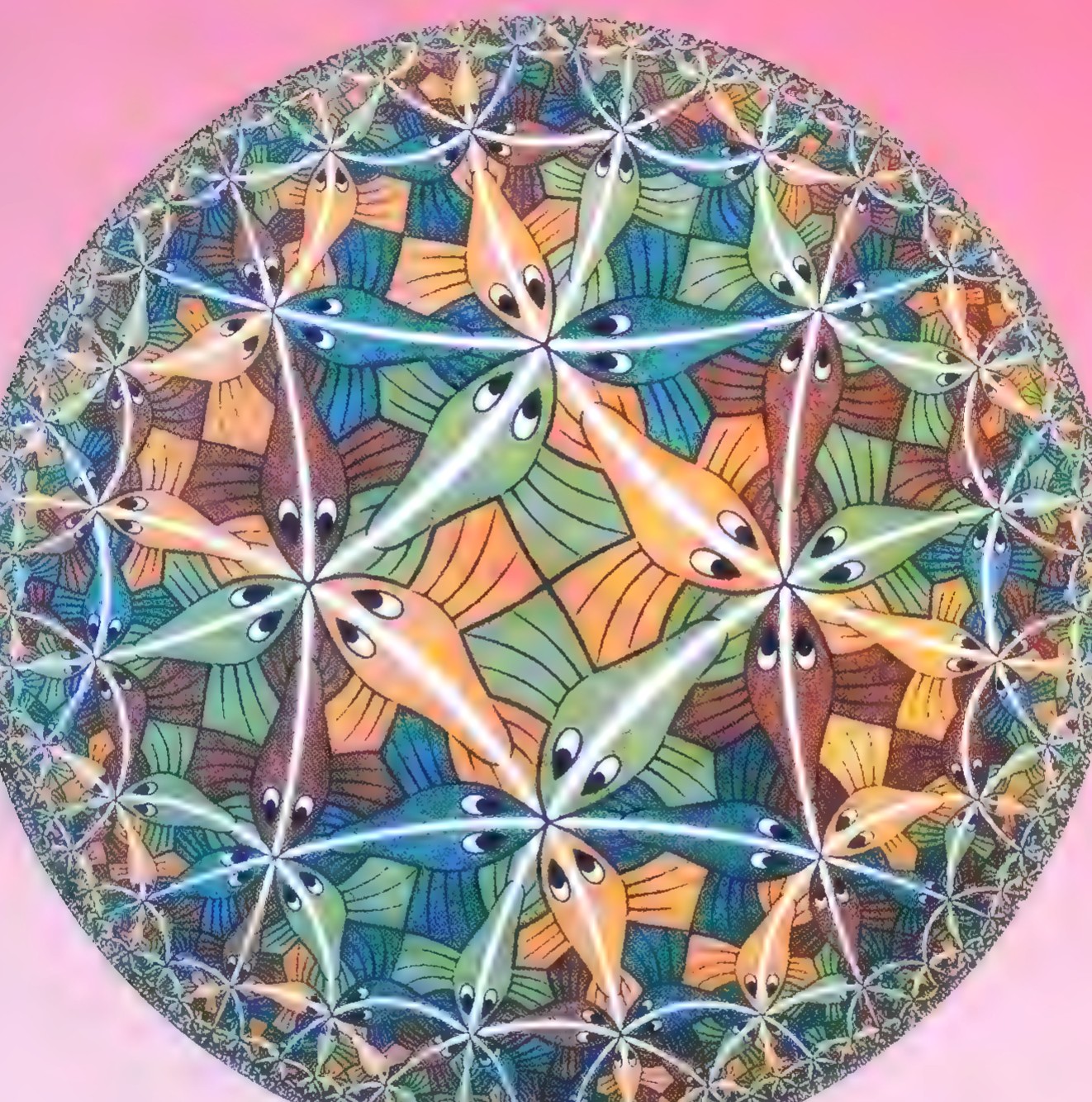
Circle Limit III—Maurits Escher. © 2002 Cordon Art B. V.–Baarn-Holland. All rights reserved.
A remarkable thing happened in the nineteenth century. Mathematicians realized for the first time that there are geometries other than that of Euclid. These geometries are based on different assumptions and lead to theorems that seem to contradict common sense. Nevertheless, these geometries, called non-Euclidean, are logically consistent, and one of them may actually be the correct system for describing our universe!
p. 690
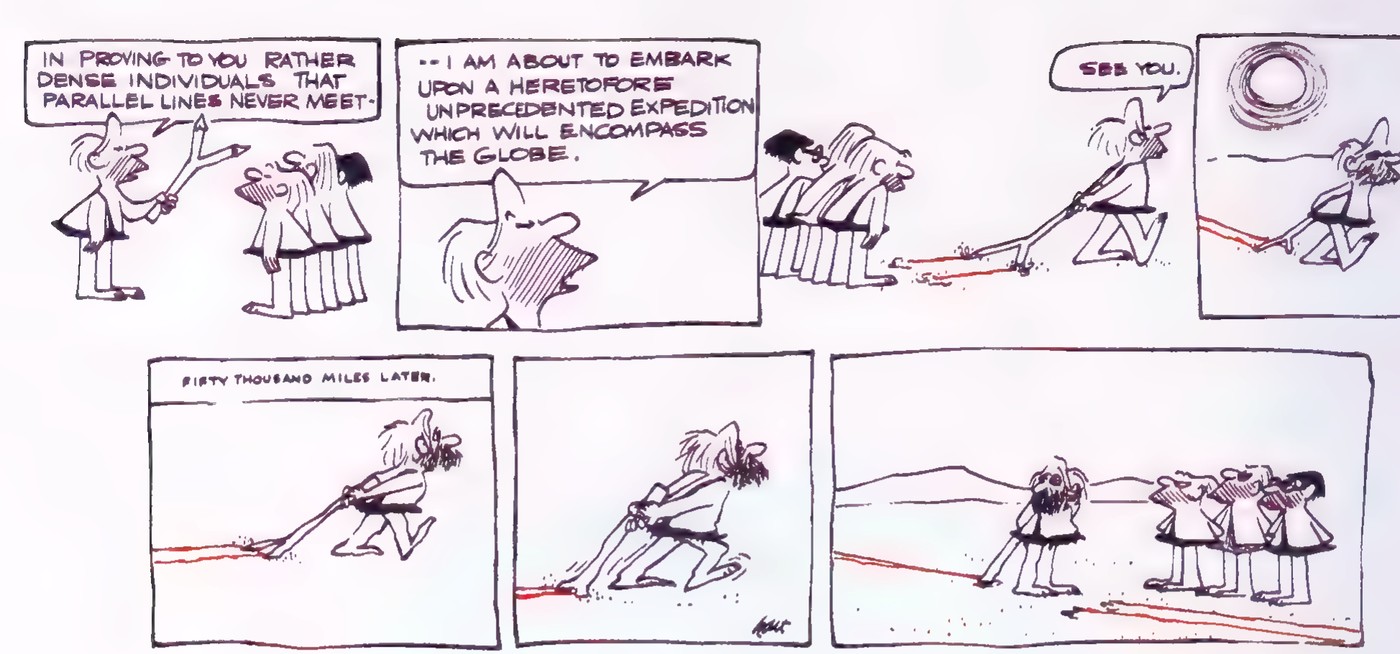
Used by permission of Johnny Hart and Creators Syndicate, Inc.
Lesson 1: Geometry on a Sphere
Euclid defined parallel lines as “lines that, being in the same plane and being produced indefinitely in both directions, do not meet one another in either direction.” In the cartoon above, one of the characters tries to prove that parallel lines never meet by tracing them on the surface of the earth. His two-pronged stick, however, has worn down to a nub by the end of the journey, and so the “parallel lines” have come together to meet in a common point.
Aside from the wearing down of the stick, the cartoon shows a way in which geometry on a sphere differs from the plane geometry that we have been studying. We think of lines as being straight and infinitely long, but “lines” drawn on the surface of a sphere are curved and finite in extent. The “plane” on which they are drawn, the surface of the sphere, is not flat but curved and is finite in extent.
Peter, the character in the cartoon who tried to prove that parallel lines never meet by tracing them around the earth, has come back to his starting point. This suggests that he walked “straight ahead,” never turning either left or right. Such a path is along a great circle of the sphere.
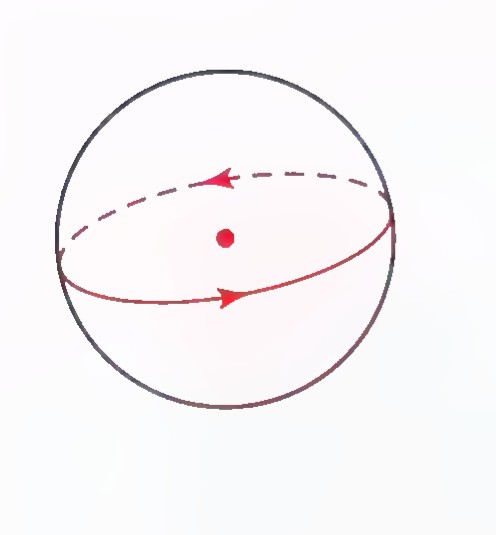
Definition
A great circle of a sphere is a set of points that is the intersection of the sphere and a plane containing its center.
p. 691
From this definition, it follows that a great circle divides the surface of a sphere into two equal parts, called hemispheres. The most famous great circle on the earth is the equator, which divides the earth into the northern and southern hemispheres. Other well-known great circles on the earth are the meridians, the circles that pass through the North and South Poles. The Poles, where the axis about which the earth turns intersects the earth’s surface, are an example of a pair of antipodal points.
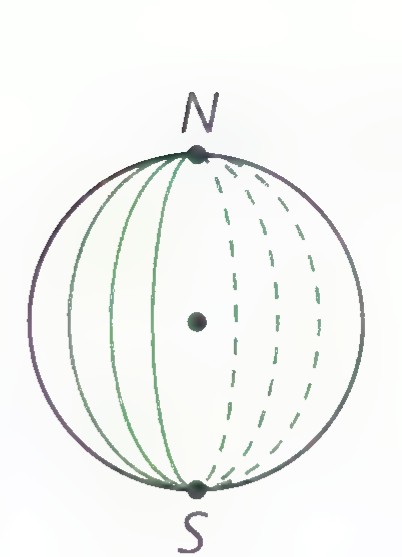
Definition
Antipodal points are the two points of intersection of a sphere with a line through its center.
At the beginning of our study of geometry, we did not define the terms “point,” “line,” and “plane” but gave them meaning by making postulates about them. Would these postulates still seem reasonable if we changed our ideas of these terms? For example, suppose that, in thinking about geometry on a sphere, we call great circles “lines” and the surface of the sphere a “plane.”
Our first postulate said:
Two points determine a line.
If great circles are “lines,” the figure at the right suggests that this postulate is no longer true. Lines l and m intersect in two antipodal points, A and B; so points A and B evidently do not determine a line.
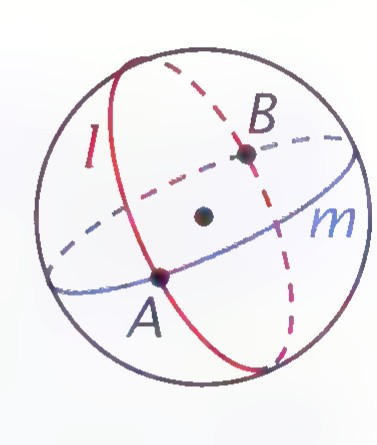
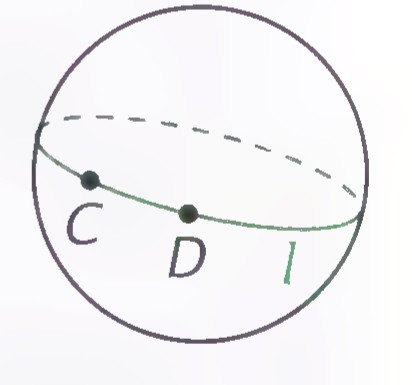
Suppose, however, that we consider a pair of antipodal points to be just one “point.” (Remember that, as with “line” and “plane,” we did not define the term “point.”) If we do consider a pair of antipodal points to be just one “point,” then our first postulate is true again. Lines l and m intersect in just one point (called A and B). To determine a line, we need two points—C and D in the next figure at the right.
With our new ideas about points and lines comes a surprising result. The last figure on this page represents a point, P, and a line, l, that does not contain it. Through P, how many lines can be drawn parallel to line l? The answer is none. Every great circle of a sphere intersects all other great circles of the sphere!
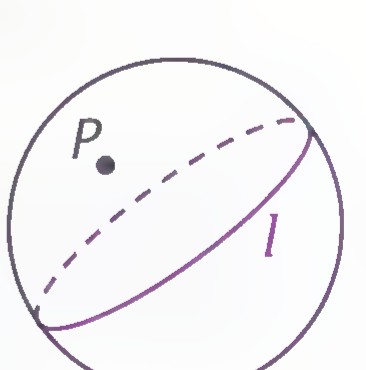
What does all this mean? It means that we have the beginning of a geometry in which the Parallel Postulate that we have used in the past no longer applies, because, through a point not on a line, there are now no lines parallel to the line.
With other changes in our postulates concerning distance and betweenness and this new assumption that there are no parallel lines, we can develop a new geometry with all sorts of unexpected theorems. Although these theorems flatly contradict others that we have proved in our study of geometry, they make sense in regard to the new parallel postulate and in regard to one another. They are part of a non-Euclidean geometry. In this chapter, we will become acquainted with the two main non-Euclidean geometries.
p. 692
Exercises
Set I
In the following exercises, we will refer to the geometry that we have been studying throughout the course as Euclidean geometry and to our new geometry on a sphere as sphere geometry. The surface that we use for our model of sphere geometry is curved in three-dimensional space, but the surface itself is two-dimensional and we will think of it as a “plane.”
Our Spherical Earth. This statue at Rockefeller Center in New York City is of Atlas holding the earth on his shoulders.
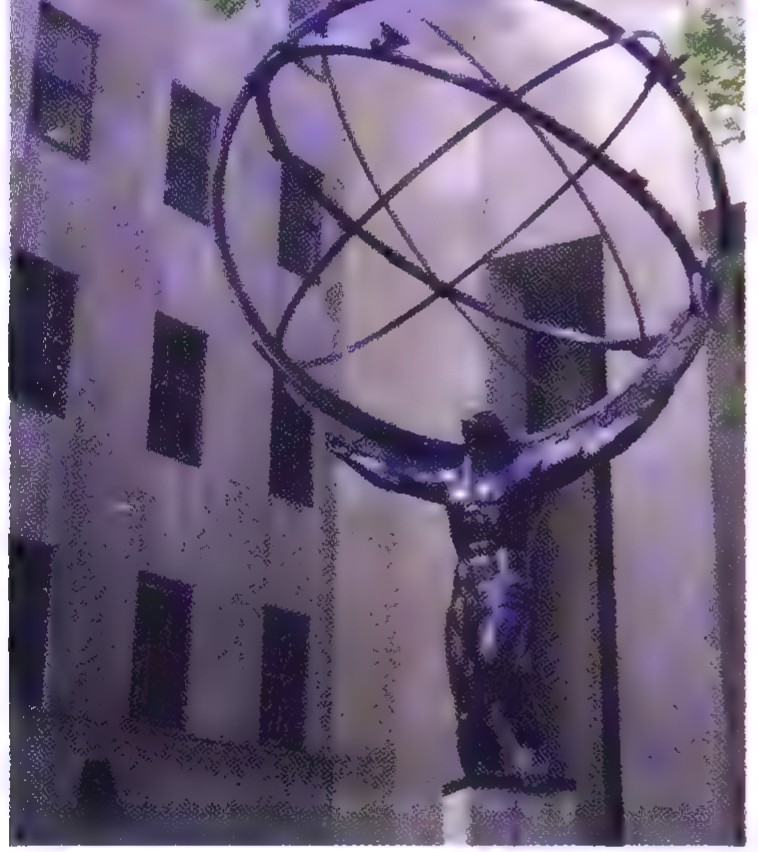
The earth is represented by several great circles.
- Where is the center of a great circle of a sphere?
- What is its radius?
- Into what does a great circle divide a sphere?
Any two great circles of a sphere intersect in a pair of antipodal points.
- What type of line segment inside a sphere connects two antipodal points?
Basic Differences. The figures below illustrate some simple differences between Euclidean geometry and sphere geometry. Each figure represents three points and a line that contains them.*
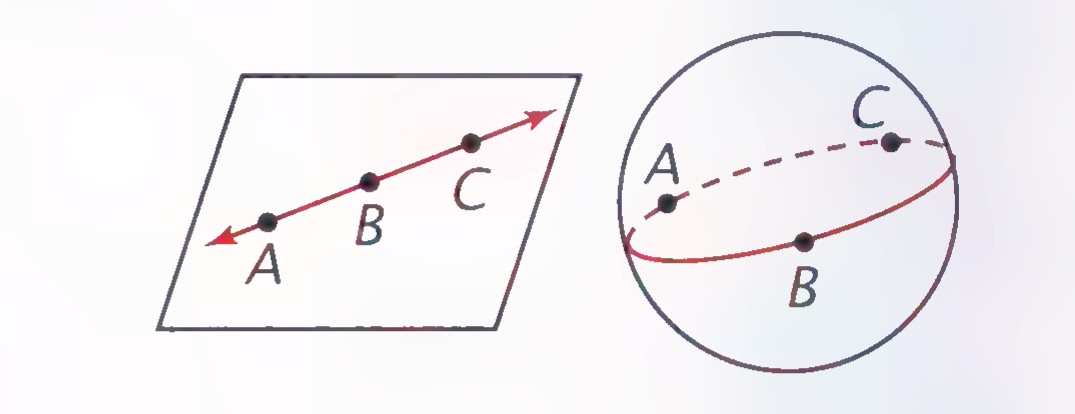
Tell whether each of the following statements seems to be true for one of the geometries (name it) or both of them.
- Points A, B, and C are collinear.
- Point B is between points A and C.
- If AB = BC, then B is the midpoint of AC.
- AB = BC = AC.
- AB + BC = AC.
- If two points lie in a plane, the line that contains them lies in the plane.
- Point B separates the line into two parts.
Shortest Routes. The figure below from Euclidean geometry shows two points connected by arcs of three circles.
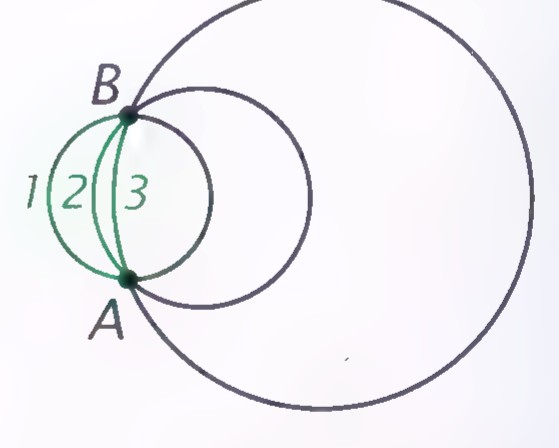
- Which of the three numbered arcs is the shortest?
- How does the circle of which the arc is part compare in size with the other two circles?
*We take the liberty of using some of the words of Euclidean geometry in sphere geometry without formal definitions when the meaning is clear by analogy or from examples given.
p. 693
- From these results, how would you describe the shortest path from A to B in sphere geometry?
- Why is this part of sphere geometry of interest to the airlines?
Beach Ball. This beach ball has been divided by great circles into congruent triangles.
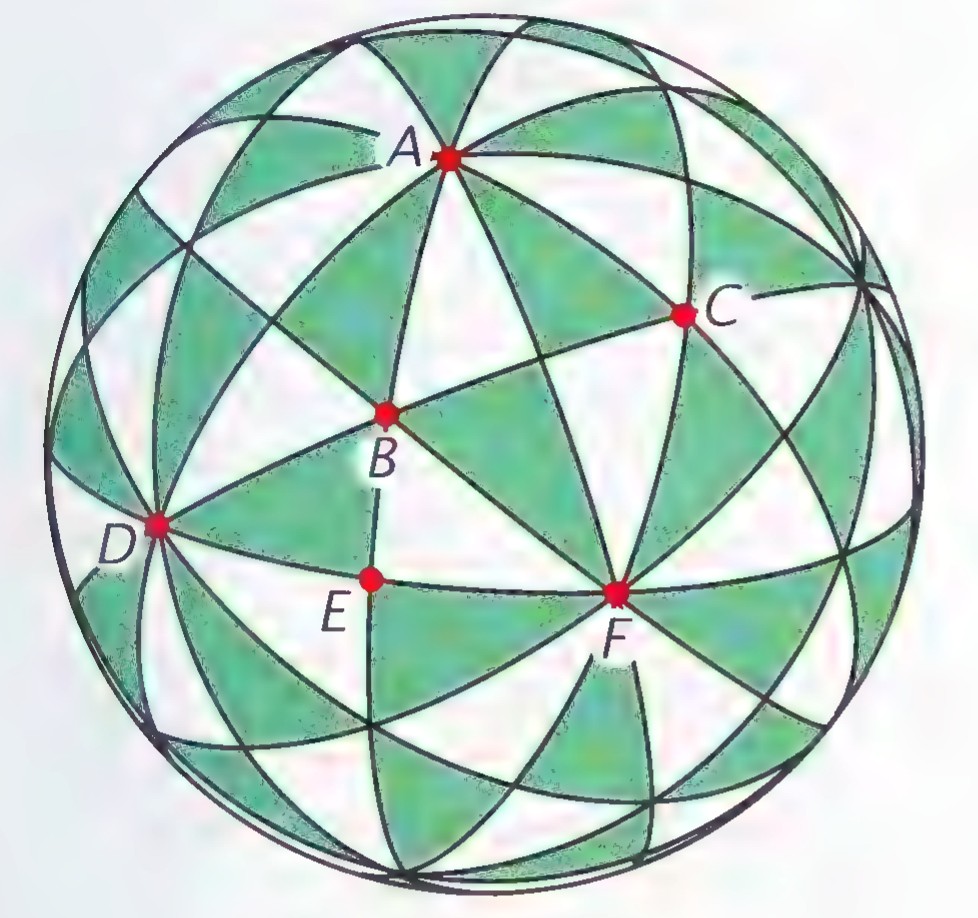
Each triangle is a 36°-60° right triangle.
- What is the sum of the angles of one of these triangles?
- Are the acute angles of a right triangle in sphere geometry complementary? Explain.
Find the measures of the angles in each of the following triangles and then find their sums.
- △ABC.
- △AEF.
- △CDF.
- △ADF.
- If a triangle in sphere geometry is equiangular, does it also appear to be equilateral?
- How does the sum of the angles of a triangle in sphere geometry seem to be related to its area?
- What kind of triangle would you expect to have an angle sum very close to 180°?
Set II
Spherical Triangles. Menelaus, a Greek mathematician, wrote a book on sphere geometry in about 100 A.D. In it, he proved many theorems about spherical triangles.
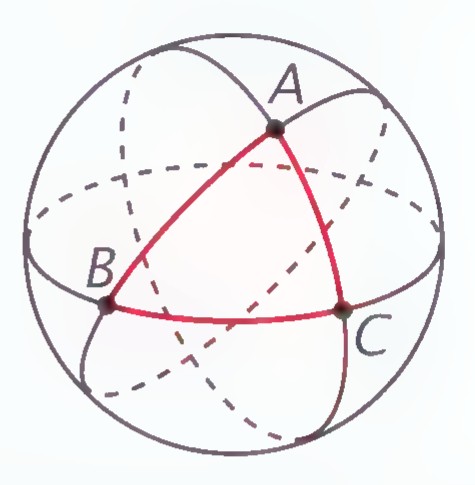
- What figures are the sides of a triangle in sphere geometry?
Menelaus proved that the Triangle Inequality Theorem of Euclidean geometry is also true in sphere geometry.
- What does this theorem say?
He proved that, if the angles of one triangle are equal to the angles of another triangle, then the triangles are congruent.
- Is this statement true in Euclidean geometry? Explain.
Menelaus also proved that the sum of the angles of a triangle in sphere geometry is related to the area of the triangle.
- What do you think the connection is?
Seemingly Parallel. The figure below seems to show two lines in sphere geometry that are parallel.
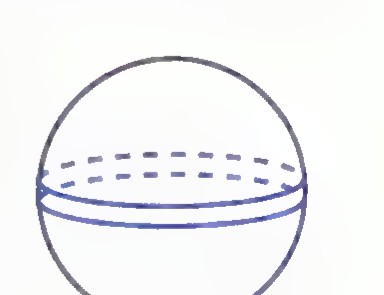
- Why do the two curves seem to be parallel?
p. 694
Parallel lines do not exist on a sphere; so something is wrong with our thinking about this figure.
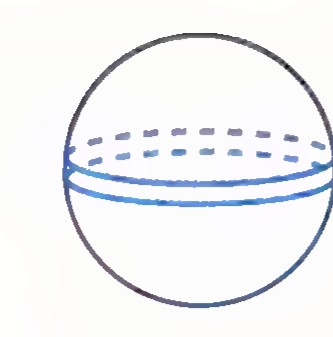
- What is it?
Euclidean and Sphere Geometries. In the figure below, lines AB and AC are both perpendicular to line BC.
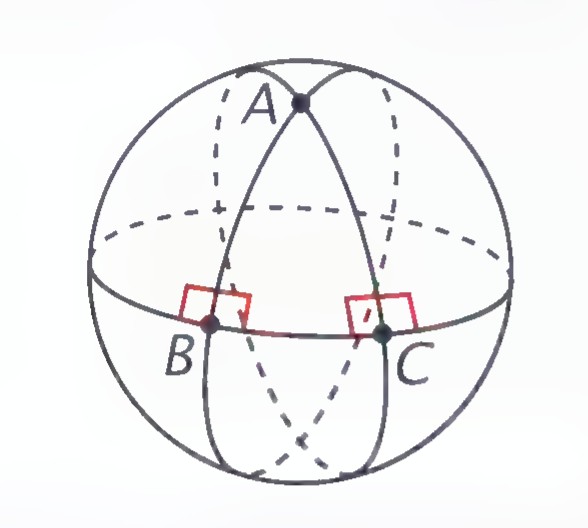
- In Euclidean geometry, how many lines through a given point in a plane can be perpendicular to a given line in the plane?
- Is your answer to exercise 31 also true in sphere geometry?
- In Euclidean geometry, what can be concluded about two lines that form equal corresponding angles with a transversal?
- Is this conclusion also true in sphere geometry? Explain.
- In Euclidean geometry, what can be concluded about two lines that lie in a plane and are perpendicular to a third line?
- Is this conclusion also true in sphere geometry?
- In Euclidean geometry, what can be concluded about an exterior angle of a triangle with respect to the remote interior angles?
- Is this conclusion also true in sphere geometry? Explain.
- In Euclidean geometry, what can be concluded about the sum of the measures of the angles of a triangle?
- Is this conclusion also true in sphere geometry? Explain.
Wet Paint. Obtuse Ollie’s father painted a straight line on the floor of his garage. While the paint was still wet, Ollie rolled his father’s bowling ball along the line.
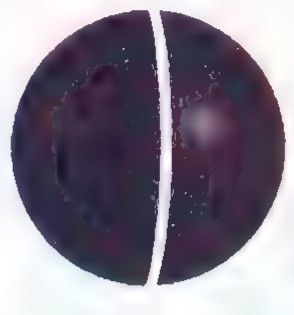
- In what ways is a line painted on the floor different from a line in Euclidean geometry?
Acute Alice told Ollie that the ball had a line on it.
- Does Alice’s statement make any sense? Explain.
- What determines the length of a line on a sphere?
Equilateral and Right. A triangle of the type shown in the figure below cannot exist in Euclidean geometry. △ABC is an equilateral right triangle!
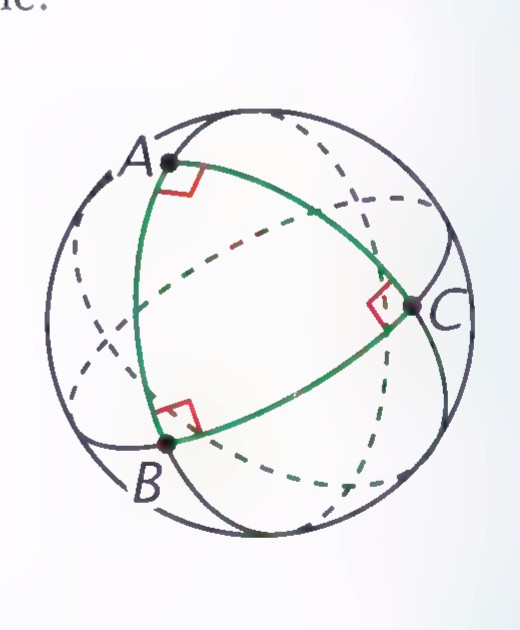
In what way is it different from triangles in Euclidean geometry that are
- equilateral?
- right?
- How does the line through B and C compare in length with the sides of △ABC?
p. 695
Given that the radius of the sphere is 2 units, what is
- the length of the line through B and C?
- the perimeter of △ABC?
- the area of the sphere?
- the area of △ABC?
Set III
Antipodal Points. If you could dig a hole through the center of the earth from where you are to the opposite side, where would you end up? One way to find out would be to turn a world globe so that your location is at the top and then look at the bottom. Another way would be to use the map below.
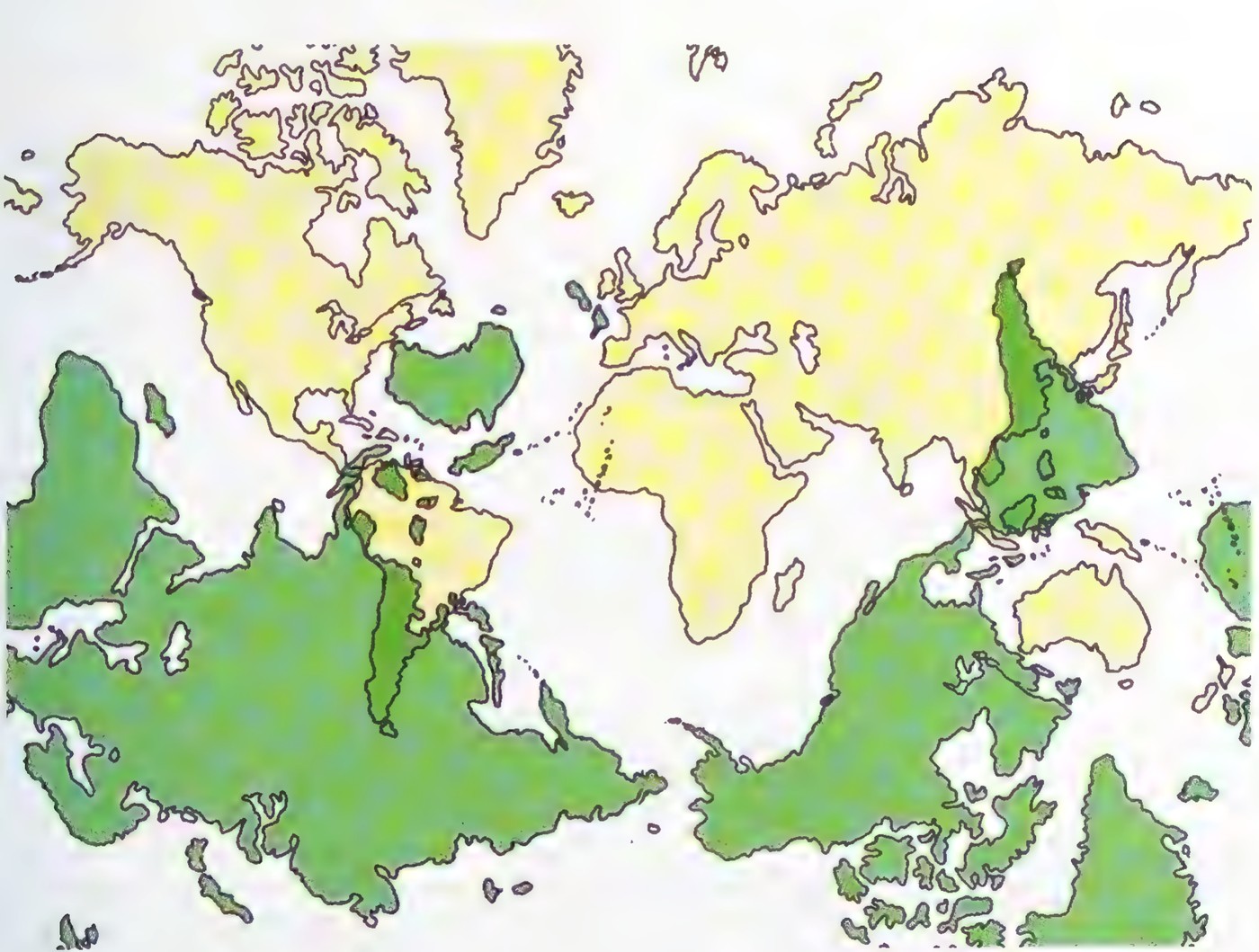
- What do you think the map represents?
- What does the map show that is rather surprising?
p. 696
Lesson 2: The Saccheri Quadrilateral
The most controversial statement in the history of mathematics was made by Euclid near the beginning of the Elements. After presenting a series of definitions, Euclid listed five postulates, the last of which said:
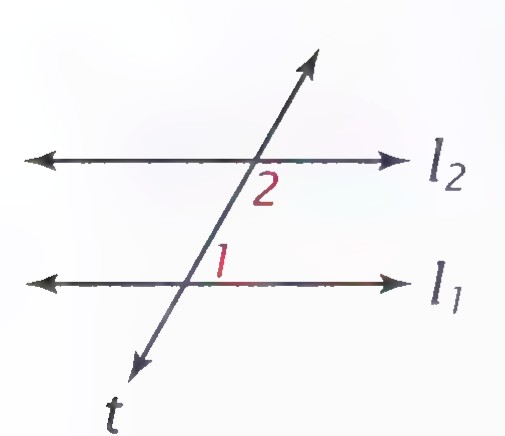
If a straight line falling on two straight lines makes the interior angles on the same side less than two right angles, the two straight lines, if produced indefinitely, meet on that side on which are the angles less than the two right angles.
In regard to the figure at the left, this postulate says that, if ∠1 + ∠2 < 180°, then l₁ and l₂ must eventually intersect in a point on the right side of t.
Euclid’s Fifth Postulate was criticized almost immediately, not only because it was much more complicated than the first four postulates, but also because many felt that he could have proved it on the basis of the first four.
p. 697
A briefer statement that implies Euclid’s Fifth Postulate is our Parallel Postulate:
Through a point not on a line, there is exactly one line parallel to the given line.
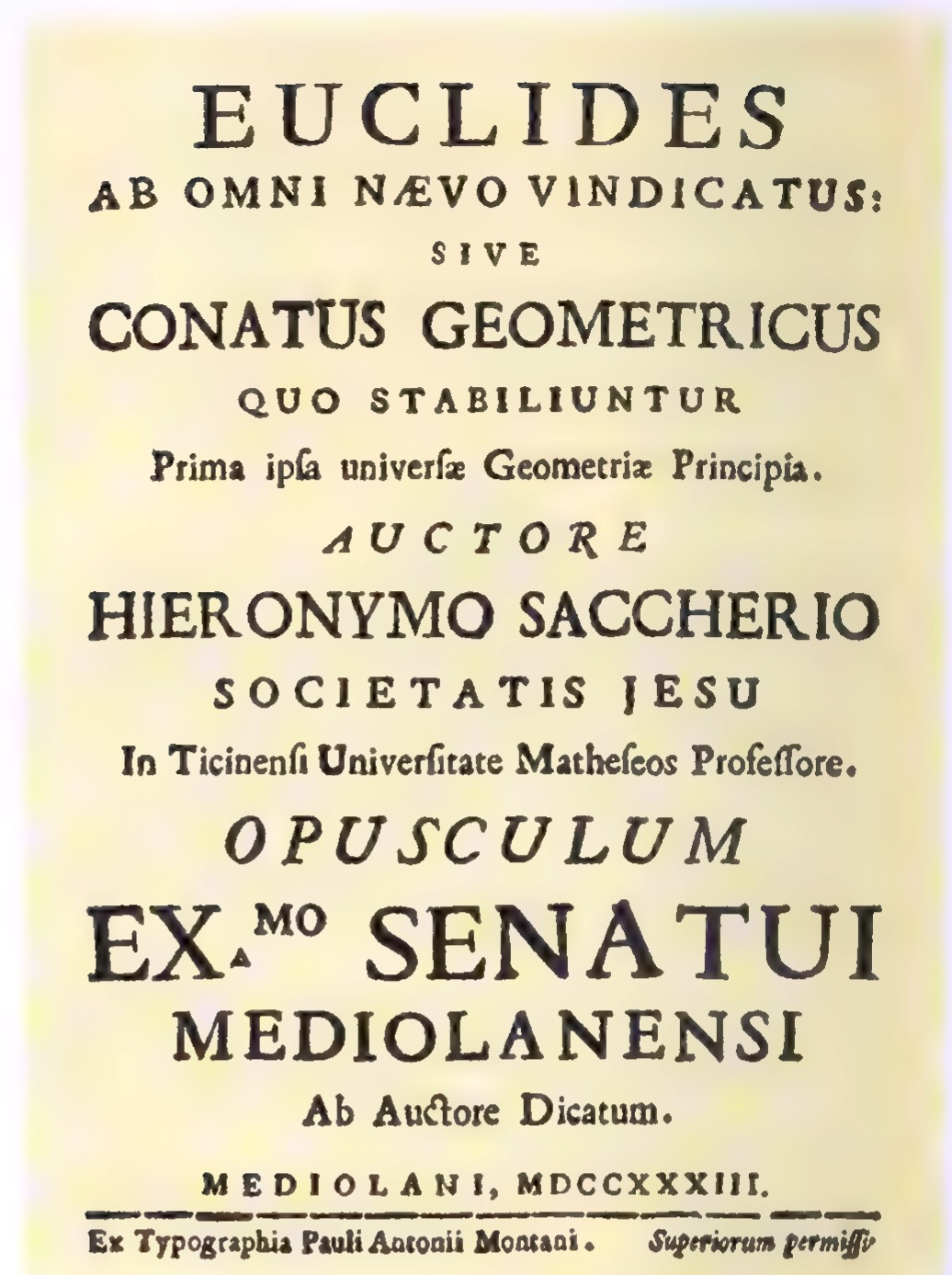
Among the many people who tried to prove Euclid’s Fifth Postulate was an eighteenth-century Italian priest named Girolamo Saccheri. A professor of both philosophy and mathematics, Saccheri tried to use indirect reasoning to establish the postulate as a theorem. As you know, indirect reasoning begins by assuming that the opposite of what you want to prove is true and continues by showing that this assumption leads to a contradiction. In 1733, about 2,000 years after Euclid wrote the Elements, Saccheri wrote a book titled Euclid Freed of Every Flaw. He intended to prove that Euclidean geometry is the only logically consistent geometry possible.
He began his work with a quadrilateral that has a pair of sides perpendicular to a third side. We will call such a quadrilateral “birectangular.”
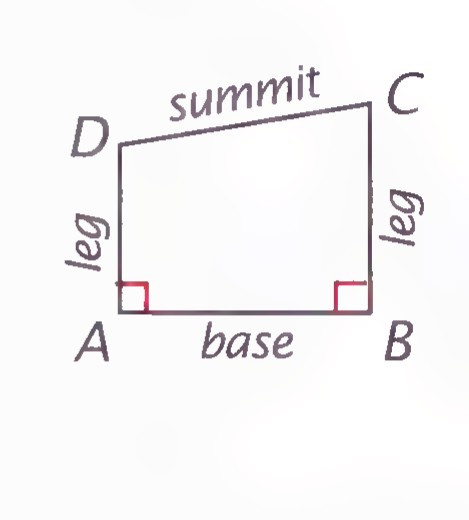
Definition
A birectangular quadrilateral is a quadrilateral that has two sides perpendicular to a third side.
The two sides perpendicular to the third side are the legs, the side to which they are perpendicular is the base, and the side opposite the base is the summit. In the first figure at the right, ∠A and ∠B are the base angles and ∠C and ∠D are the summit angles of quadrilateral ABCD. Also, ∠C is the summit angle opposite leg AD, and ∠D is the summit angle opposite leg BC.
A birectangular quadrilateral whose legs are equal might be called “isosceles,” but it is usually called a Saccheri quadrilateral in honor of Saccheri.
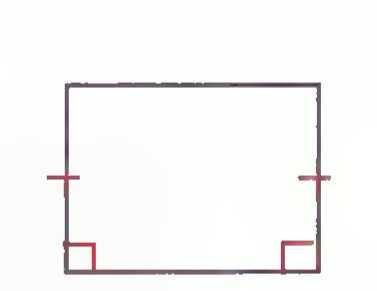
A Saccheri quadrilateral
Definition
A Saccheri quadrilateral is a birectangular quadrilateral whose legs are equal.
A Saccheri quadrilateral looks very much like a rectangle; that is, the summit angles look as if they must also be right angles, from which it follows that the figure is equiangular. It is easy to prove that this is so in Euclidean geometry. In a geometry with a different postulate about parallel lines, however, it can be proved that a Saccheri quadrilateral is not a rectangle, because its summit angles are not right angles!
Before we look into these ideas further, we will state some theorems about birectangular quadrilaterals that are true in both Euclidean and non-Euclidean geometries. Each of them can be proved without using the Parallel Postulate, and their proofs are considered in the exercises. In the next lesson, we will use these theorems to derive some strange results that Saccheri obtained.
p. 698
Theorem 87
The summit angles of a Saccheri quadrilateral are equal.
Theorem 88
The line segment connecting the midpoints of the base and summit of a Saccheri quadrilateral is perpendicular to both of them.
The next two theorems are comparable to a pair of theorems about inequalities in triangles that you already know.
Theorem 89
If the legs of a birectangular quadrilateral are unequal, the summit angles opposite them are unequal in the same order.
Theorem 90
If the summit angles of a birectangular quadrilateral are unequal, the legs opposite them are unequal in the same order.
Exercises
Set I
Wyoming. The boundary of Wyoming mapped on a plane can be thought of as a Saccheri quadrilateral whose base, YO, is its southern border.
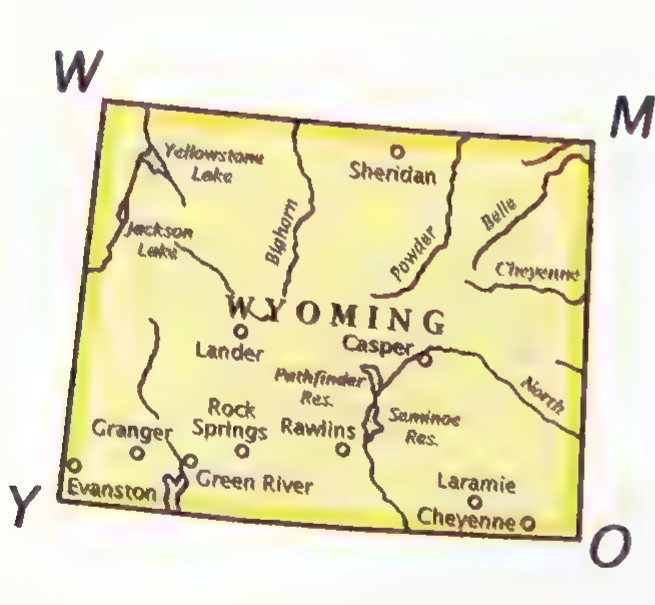
- What are sides WY and MO called with respect to quadrilateral WYOM?
- What are ∠Y and ∠O called?
- What is WM called?
- What are ∠W and ∠M called?
- Which sides of WYOM are equal?
- Which angles of WYOM are right angles?
Complete the proofs of the following theorems of this lesson by giving the reasons.
Theorem 87. The summit angles of a Saccheri quadrilateral are equal.
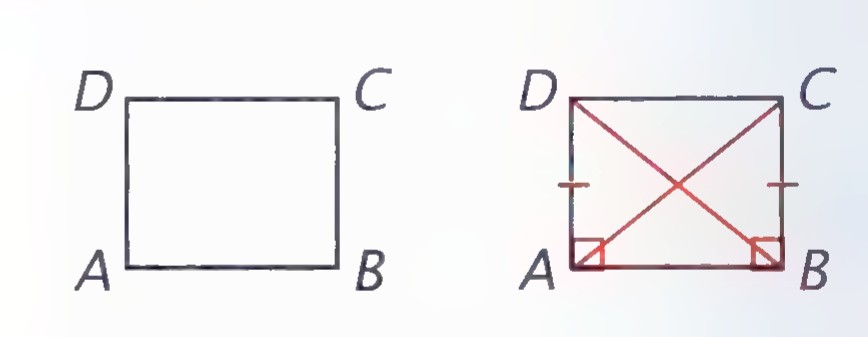
Given: Saccheri quadrilateral ABCD with base AB.
Prove: ∠C = ∠D.
Proof
- Draw AC and BD. Why?
- AD = BC. Why?
- ∠BAD = ∠ABC. Why?
- △BAD ≅ △ABC. Why?
- BD = AC. Why?
- △BCD ≅ △ADC. Why?
- ∠BCD = ∠ADC. Why?
p. 699
Theorem 89. If the legs of a birectangular quadrilateral are unequal, the summit angles opposite them are unequal in the same order.
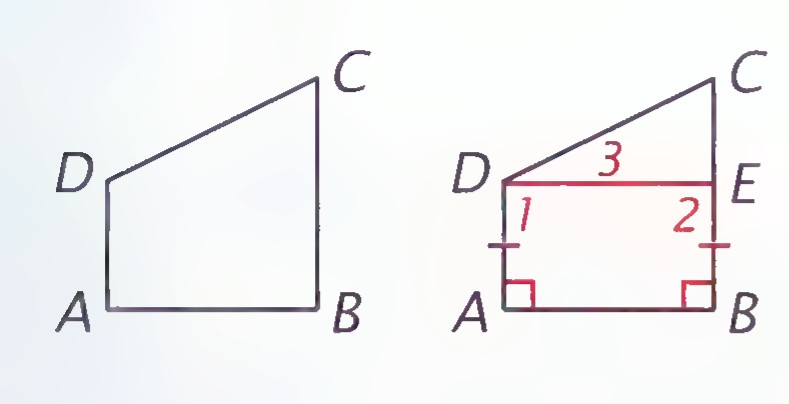
Given: Birectangular quadrilateral ABCD with base AB, CB > DA.
Prove: ∠D > ∠C.
Proof
Because ABCD is a birectangular quadrilateral with base AB, DA ⊥ AB and CB ⊥ AB. Also, CB > DA.
- Choose point E on BC so that BE = AD. Why?
- Draw DE. Why?
- ABED is a Saccheri quadrilateral. Why?
- ∠1 = ∠2. Why?
- Because ∠ADC = ∠1 + ∠3, ∠ADC > ∠1. Why?
- ∠ADC > ∠2. Why?
- ∠2 > ∠C. Why?
- ∠ADC > ∠C. Why?
Theorem 90. If the summit angles of a birectangular quadrilateral are unequal, the legs opposite them are unequal in the same order.
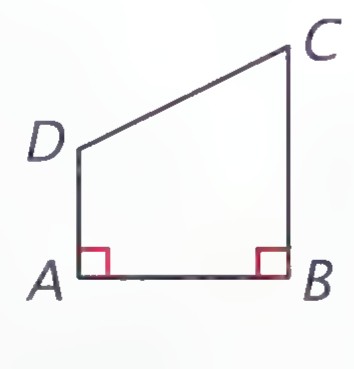
Given: Birectangular quadrilateral ABCD with base AB, ∠D > ∠C.
Prove: CB > DA.
Proof (by the indirect method)
- Either CB > DA, CB = DA, or CB < DA. Why?
Suppose CB = DA.
- If CB = DA, what kind of quadrilateral is ABCD?
- If your answer to exercise 23 is true, then ∠D = ∠C. Why?
- What does this conclusion contradict?
Suppose CB < DA.
- If CB < DA, then ∠D < ∠C. Why?
- What does this conclusion contradict?
- What is the only remaining conclusion about CB and DA?
Set II
Nasir Eddin. One of the many people who have tried to prove Euclid’s Fifth Postulate was a Persian mathematician who was the court astronomer of the grandson of the famous Genghis Khan. His name was Nasir Eddin and he lived in the thirteenth century. Nasir Eddin began by supposing that l and m are two lines such that perpendiculars from A and C to line m make ∠1 ≠ ∠2 and ∠3 ≠ ∠4.
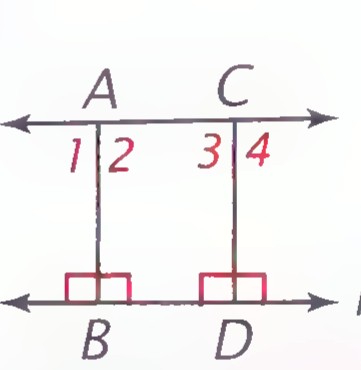
- If ∠1 and ∠3 are acute and ∠2 and ∠4 are obtuse, which segment must be longer: AB or CD?
- Why?
Complete the following proof of Theorem 88 by giving the reasons.
Theorem 88. The line segment connecting the midpoints of the base and summit of a Saccheri quadrilateral is perpendicular to both of them.
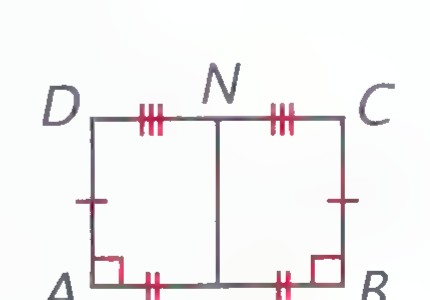
Given: Saccheri quadrilateral ABCD with MN connecting the midpoints of AB and CD.
Prove: MN ⊥ AB and MN ⊥ DC.
p. 700
Proof
First, draw DM and CM.
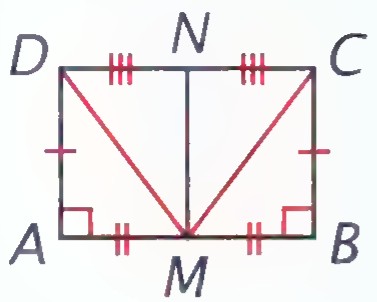
- How can you conclude that DM = CM?
- DN = CN. Why?
- It follows that MN ⊥ DC. Why?
Next, draw AN and BN.
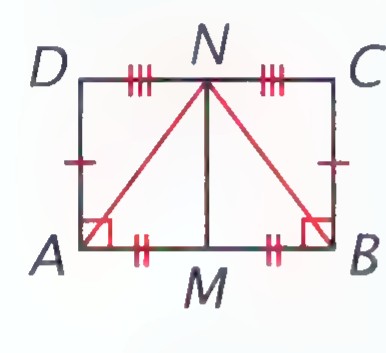
- How can you conclude that AN = BN?
- It follows that MN ⊥ AB. Why?
Polish Flag. The flag of Poland is shown in the figure below.
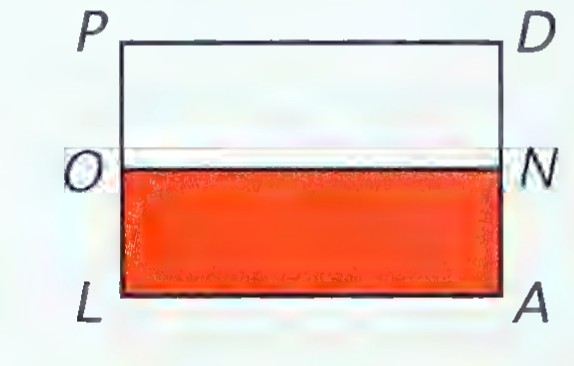
- Copy the figure and mark the following information on it: PD = LA, ∠P and ∠L are right angles, O is the midpoint of PL, and N is the midpoint of DA.
Assuming only the information that you have marked on the figure and nothing about parallel lines, answer each of the following questions.
- What kind of quadrilateral is PLAD?
- Which side is its summit?
- Why is ∠D = ∠A?
- Why is ON ⊥ PL and ON ⊥ DA?
- What kind of quadrilaterals are OPDN and LONA?
Alter Ego. In Euclidean geometry, it is easy to prove that a Saccheri quadrilateral is a rectangle.
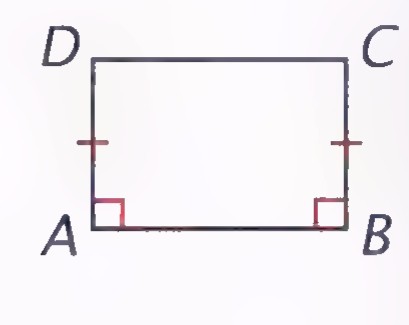
- In Euclidean geometry, why would the legs of a Saccheri quadrilateral have to be parallel?
- Why does it follow that a Saccheri quadrilateral is a parallelogram in Euclidean geometry?
- Why does it follow that its summit angles are right angles?
- Why does it follow that it is a rectangle?
- In Euclidean geometry, what relations does the summit of a Saccheri quadrilateral have to its base?
Irregular Lots. The figure below shows an overhead view of two slightly irregular lots.
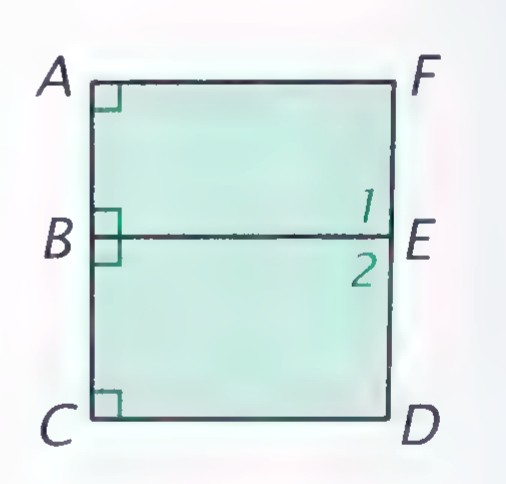
The angles at A, B, and C are right angles but the angles at D, E, and F are not; ∠1 > ∠F and ∠D > ∠2.
- What can you conclude about the relative lengths of AF and CD? Explain.
- If A-B-C and F-E-D, what can you conclude about the relative sizes of ∠F and ∠D? Explain.
p. 701
Set III
Offsets. The jog in this road in Castleton, North Dakota, is caused by a basic problem in geometry.*
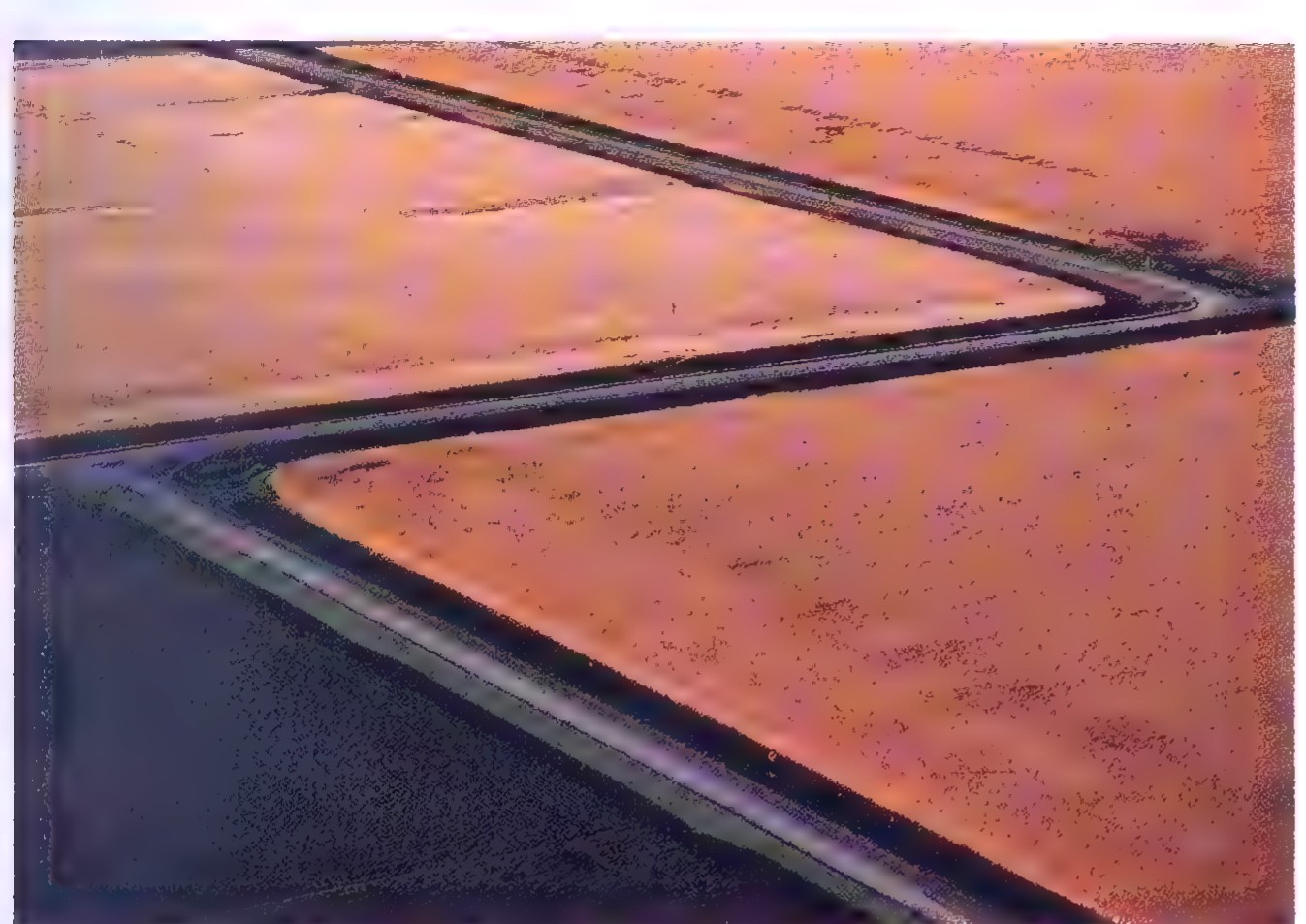
The figure at the right illustrates what the problem is. Each quadrilateral represents a “township,” a unit of land used by surveyors. A township is supposedly bounded by a square measuring 6 miles on each side. If its sides lie along map directions as in the diagram, a township is effectively bounded by a Saccheri quadrilateral. The road from B to J has a jog in it from E to F.
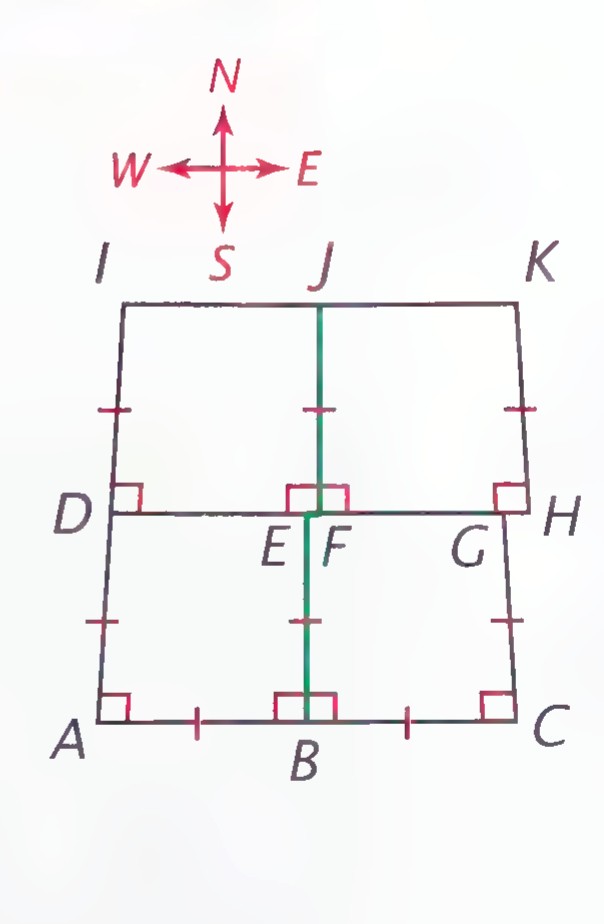
- Are the legs of these Saccheri quadrilaterals parallel? Explain why or why not.
Each side marked with a tick mark is 6 miles long, and DF = FH = 6 miles.
- How do you think the summits of these quadrilaterals compare in length with their bases? Explain.
- How do you think the summits change as the townships continue farther north?
* Taking Measures Across the American Landscape, by James Corner and Alex S. MacLean (Yale University Press, 1996).
p. 702
Lesson 3: The Geometries of Lobachevsky and Riemann
Saccheri thought that he could use his quadrilaterals to prove the Parallel Postulate. Having shown that the summit angles are equal, he planned to prove indirectly that they must also be right angles. To do so, he had to eliminate the possibilities of them being either acute or obtuse.
Saccheri managed to arrive at a contradiction by assuming that the summit angles are obtuse. Rather than being able to eliminate the possibility that they are acute, however, he ended up creating the beginning of a geometry that is non-Euclidean, that is, a geometry with a different assumption about parallel lines. Saccheri missed the implications of what he had started, and so he named his book Euclid Freed of Every Flaw. A better name would have been A New Kind of Geometry.
Saccheri died in 1733, a few months after his book was published. It was nearly a century later before anyone began to realize that geometries different from Euclid’s made logical sense. Three men independently reached this conclusion: the great German mathematician Carl Friedrich Gauss; a Hungarian, Janos Bolyai; and a Russian, Nicolai Lobachevsky.
p. 703
The assumption that Saccheri couldn’t disprove—that is, that the summit angles of a Saccheri quadrilateral are acute—is the “acute angle” hypothesis. The non-Euclidean geometry based on this hypothesis is often called Lobachevskian geometry, the name that we will use.
The Lobachevskian Postulate
The summit angles of a Saccheri quadrilateral are acute.
With the use of this postulate, the following theorems can be proved in Lobachevskian geometry.
Lobachevskian Theorem 1
The summit of a Saccheri quadrilateral is longer than its base.
Nicolai Lobachevsky (1793–1856)
Lobachevskian Theorem 2
A midsegment of a triangle is less than half as long as the third side.
These theorems are false in Euclidean geometry. They contradict the theorems of Euclid that are based on the Parallel Postulate. The Parallel Postulate states that, through a point not on a line, there is exactly one line parallel to the given line. For the theorems stated above to hold in Lobachevskian geometry, it must be true that, through a point not on a line, there are many lines parallel to the line!
In Lesson 1, you learned that, in sphere geometry, there are no parallels to a line through a point not on it. However, this result contradicts other Euclidean theorems proved before the introduction of the Parallel Postulate. In fact, it is equivalent to assuming that the summit angles of a Saccheri quadrilateral are obtuse, which is why Saccheri was able to eliminate this possibility.
Nevertheless, if some other postulates related to distance and betweenness are changed in addition to the Parallel Postulate, a logically consistent non-Euclidean geometry can be developed in which there are no parallels at all. A German mathematician, Bernhard Riemann, was the first to understand this concept. We will refer to the geometry that he created as Riemannian geometry.
The basic differences between Euclidean geometry and these two non-Euclidean geometries are summarized in the table below. In each case, either statement can be proved to be a logical consequence of the other.
| Statement | Euclid | Lobachevsky | Riemann |
|---|---|---|---|
| Through a point not on a line, there is | exactly one line parallel to the line. | more than one line parallel to the line. | no line parallel to the line. |
| The summit angles of a Saccheri quadrilateral are | right. | acute. | obtuse. |
Bernhard Riemann (1826–1866)
p. 704
Exercises
Set I
We restrict our proofs to Lobachevskian geometry because, in this geometry, only the Parallel Postulate is changed. For this reason you can use any idea considered before Chapter 6 in this book.
Complete the proofs of the theorems of this lesson by giving the reasons. (Some of the sides of the figures have been drawn as curves to make the figures look non-Euclidean.)
Lobachevskian Theorem 1. The summit of a Saccheri quadrilateral is longer than its base.
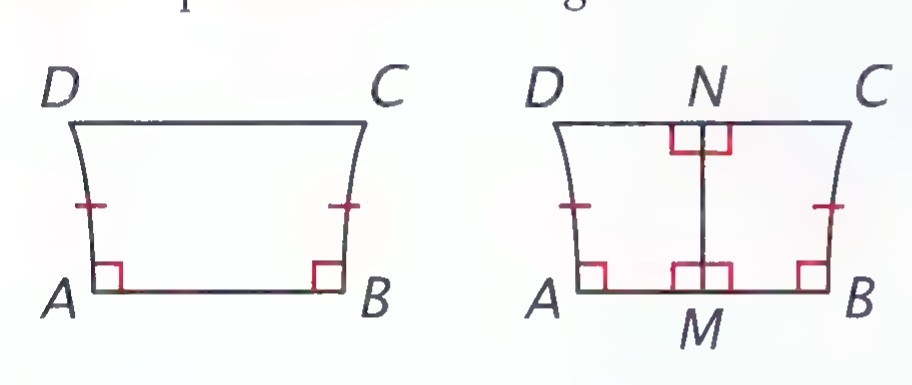
Given: Saccheri quadrilateral ABCD with base AB.
Prove: DC > AB.
Proof
Because ABCD is a Saccheri quadrilateral with base AB, DA ⊥ AB and CB ⊥ AB. Therefore, ∠A and ∠B are right angles, and so ∠A = ∠B.
- ∠D and ∠C are acute. Why?
- ∠D < 90° and ∠C < 90°. Why?
- ∠D < ∠A and ∠C < ∠B. Why?
Let M and N be the midpoints of AB and DC as shown in the second figure.
- What permits us to let M and N be these midpoints?
- What permits us to draw MN?
- MN ⊥ AB and MN ⊥ DC. Why?
- AMND and BMNC are birectangular quadrilaterals. Why?
We have proved that ∠D < ∠A and ∠C < ∠B.
- It follows that DN > AM and NC > MB. Why?
- DN + NC > AM + MB. Why?
- DC > AB. Why?
Lobachevskian Theorem 2. A midsegment of a triangle is less than half as long as the third side.
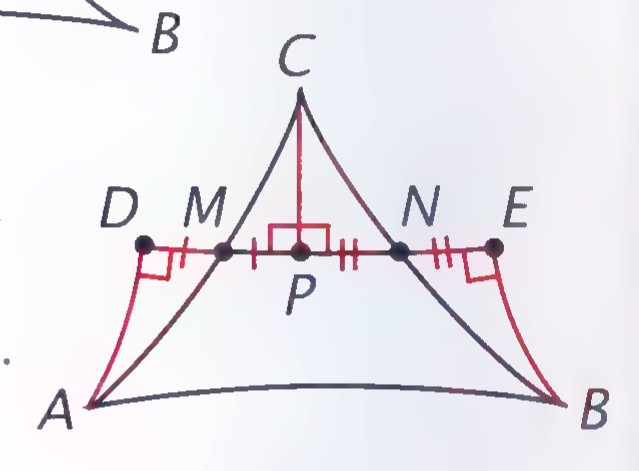
Given: △ABC with midsegment MN.
Prove: MN < AB.
Proof
Through C, draw CP ⊥ MN. Choose points D and E on line MN so that MD = MP and NE = NP. Draw AD and BE.
- △ADM ≅ △CPM and △BEN ≅ △CPN. Why?
- AD = CP and BE = CP. Why?
- AD = BE. Why?
Angles D and E are right angles because they are equal to the right angles at P; so AD ⊥ DE and BE ⊥ DE.
- ADEB is a Saccheri quadrilateral. Why?
- AB > DE. Why?
Because DE = DM + MP + PN + NE, MP = DM, and PN = NE, it follows that DE = MP + MP + PN + PN = 2MP + 2PN = 2(MP + PN).
- DE = 2MN. Why?
- AB > 2MN. Why?
- AB > MN, so MN < AB. Why?
p. 705
Set II
Lobachevsky and His Geometry. This stamp is one of two Russian stamps issued in honor of Nicolai Lobachevsky.
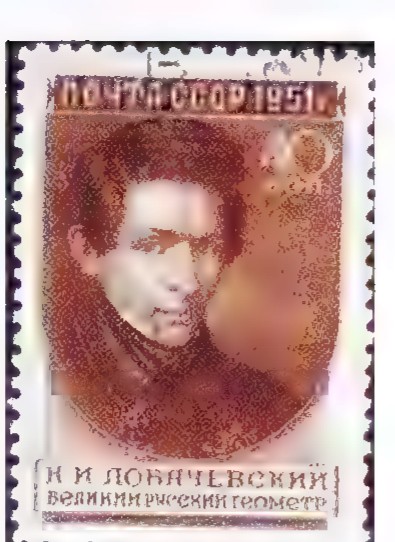
- Can you guess what any of the words on the stamp mean?
Rewrite each of the following sentences from Euclidean geometry so that it is true in Lobachevskian geometry.
- Through a point not on a line, there is exactly one line parallel to the line.
- The summit angles of a Saccheri quadrilateral are right.
- The summit of a Saccheri quadrilateral is equal to its base.
- A midsegment of a triangle is half as long as the third side.
Lobachevskian Quadrilateral. ACDF is a quadrilateral in Lobachevskian geometry.
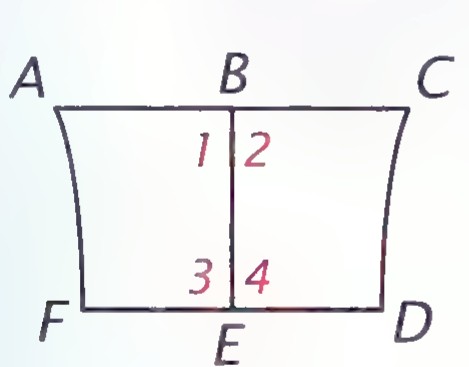
- Copy the figure and mark the following information on it: AF ⊥ FD, CD ⊥ FD, AB = BC, FE = ED, and AF = CD.
- What kind of quadrilateral is ACDF?
- What kind of angles are ∠A and ∠C? Explain.
- What kind of angles are ∠1, ∠2, ∠3, and ∠4? Explain.
- What kind of quadrilaterals are ABEF and CBED?
- Why is BE < AF and BE < CD?
- State a theorem in Lobachevskian geometry about the length of the line segment that connects the midpoints of the summit and base of a Saccheri quadrilateral.
Riemannian Quadrilateral. The sphere geometry that we studied in Lesson 1 helps us understand Riemannian geometry because there are no parallel lines in either.
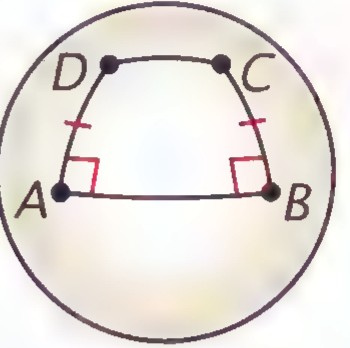
The figure above shows a Saccheri quadrilateral on a sphere.
- What kind of angles do ∠D and ∠C seem to be?
- Does your answer agree with the table on page 703?
- How do DC and AB seem to compare in length?
- State a theorem in Riemannian geometry that you think corresponds to Lobachevskian Theorem 1.
Riemannian Triangle. The figure below shows a triangle on a sphere; MN is one of the triangle’s midsegments.
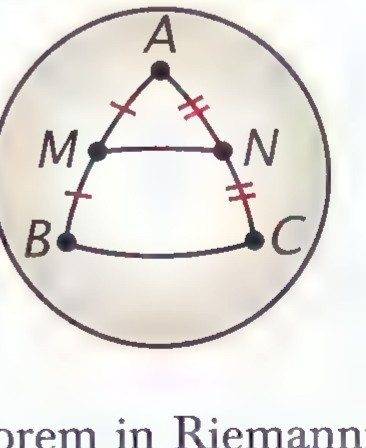
- State a theorem in Riemannian geometry that you think corresponds to Lobachevskian Theorem 2.
- Do you think that a midsegment of a triangle in Riemannian geometry is parallel to the third side of the triangle? Explain.
p. 706
Triangular Pyramid. In the pattern below, B, D, and F are the midpoints of the sides of equilateral △ACE. The pattern can be folded to form a triangular pyramid whose properties depend on whether it is Euclidean or non-Euclidean.
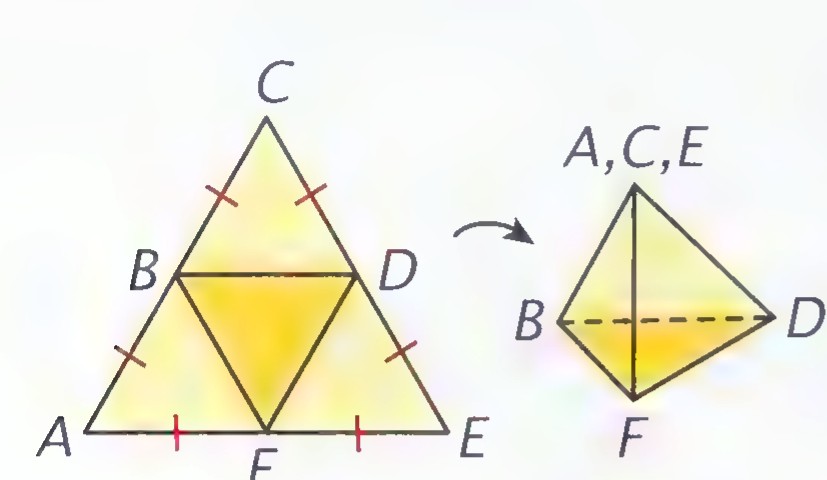
- In Euclidean geometry, how do the edges of the pyramid compare in length with the sides of △ACE?
- What can you conclude about the faces of the pyramid?
In Lobachevskian geometry, the pyramid formed by folding the pattern is slightly different.
- How do the edges of its base, △BDF, compare in length with the sides of △ACE?
- What can you conclude about its faces?
Open Box. The pattern below can be folded to form an open box in Euclidean geometry.
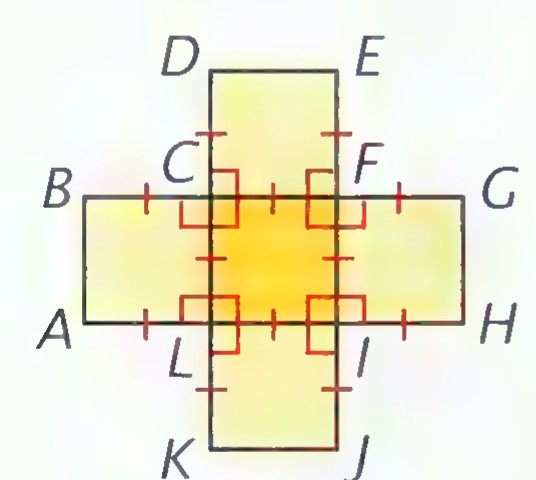
- On the basis of the marked parts, what special shape would the box have?
- What can you conclude about its faces?
We can show that such a pattern is impossible in Lobachevskian geometry.
Pseudosphere. The photograph below is of a model of a pseudosphere, a surface invented by the Italian geometer Eugenio Beltrami.*
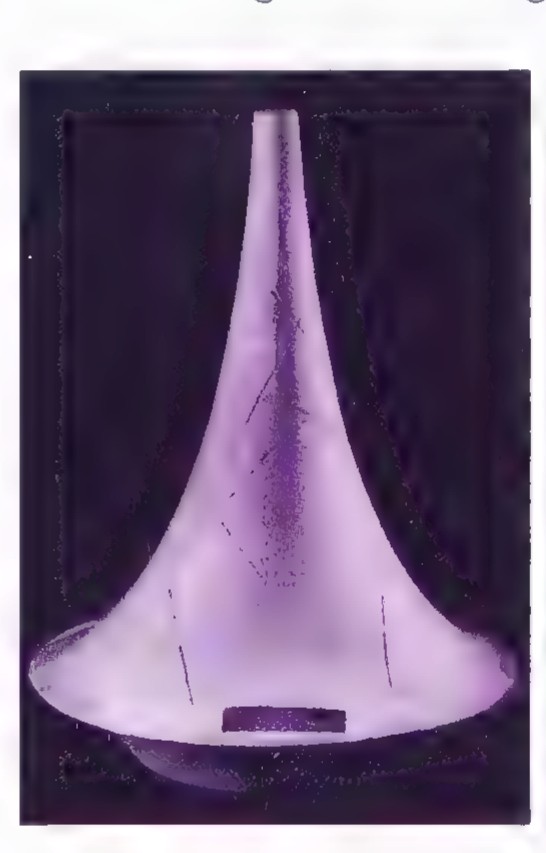
The surface of a pseudosphere can be used to represent a part of a plane in Lobachevskian geometry. In the figure above, ABCD is a Saccheri quadrilateral.
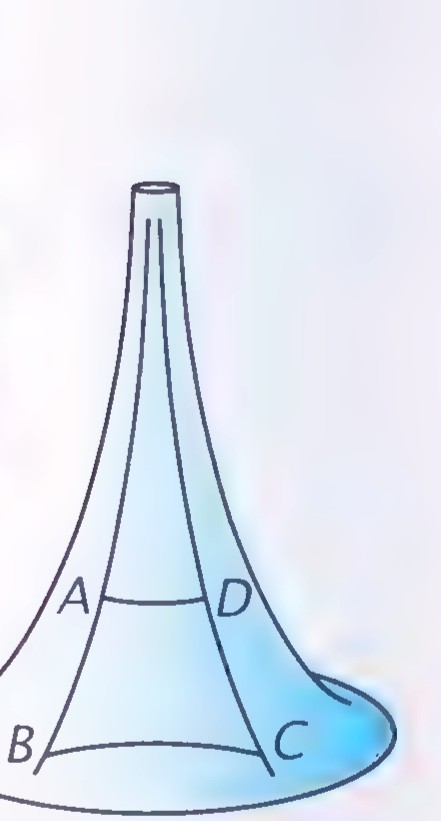
What conclusions can you draw about the figure?
* Beyond the Third Dimension: Geometry, Computer Graphics, and Higher Dimensions, by Thomas F. Banchoff (Scientific American Library, 1990).
p. 707
Lesson 4: The Triangle Angle Sum Theorem Revisited
We live in a mysterious universe. Before Einstein and relativity, physical space was assumed to be Euclidean. In the nineteenth century, mathematicians realized that the geometry of Euclid is not the only one possible, but none of them would have guessed that a non-Euclidean geometry might better describe the universe. Yet Einstein’s theory of relativity and the experiments confirming it suggest that a geometry other than Euclid’s does.*
At about the time that Lobachevsky and Bolyai were developing the non-Euclidean geometry to which we have been referring as Lobachevskian, Karl Friedrich Gauss measured the angles of a huge triangle. You know that, in Euclidean geometry, the sum of the angles of a triangle is exactly 180°. According to the geometry of Lobachevsky, it is less than 180°, whereas, in Riemannian geometry, it is more than 180°.
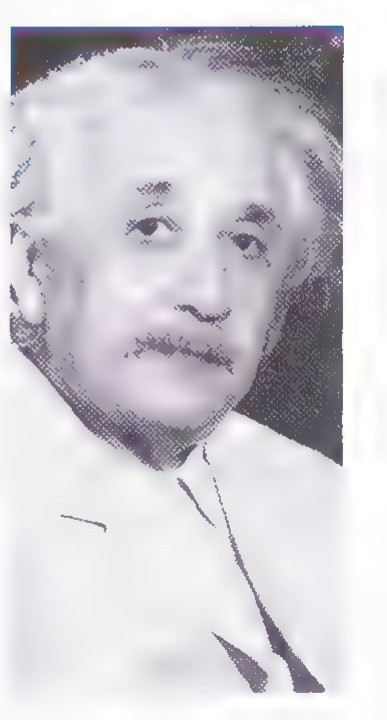
Albert Einstein (1879–1955)
*For more information about the possible geometries of space, see Einstein’s Legacy, by Julian Schwinger (Scientific American Library, 1986).
p. 708
The sides of the triangle that Gauss measured were formed by light rays sent between three mountain tops in Germany. The sum of the angles of the triangle turned out to be just a few seconds more than 180°. Gauss’s measurements were as accurate as was possible at the time, but Gauss understood that the fact that the sum was slightly more than 180° could have been due to experimental error. Indeed, Gauss knew that the mountain-top triangle was much too small to determine whether physical space is non-Euclidean, even though the lengths of its sides ranged from 43 to 66 miles. According to both Lobachevskian and Riemannian geometry, the smaller the triangle, the closer the sum of the measures of its angles is to 180°. If space can be described by either of these non-Euclidean geometries, then a triangle with three stars as its vertices, rather than three mountain tops, would be required to determine which model is correct.
One of the consequences of the fact that the sum of the measures of the angles of a triangle in the non-Euclidean geometries is not 180° is that scale models cannot exist in these geometries. In other words, if two figures are not the same size, they cannot have the same shape!
It is no wonder that, with such surprising results as these, it took a long time for the non-Euclidean geometries to be taken seriously. We know enough about Lobachevskian geometry to be able to prove theorems that cover these observations.
Lobachevskian Theorem 3
The sum of the angles of a triangle is less than 180°.
Corollary to Lobachevskian Theorem 3
The sum of the angles of a quadrilateral is less than 360°.
Lobachevskian Theorem 4
If two triangles are similar, they must also be congruent.
Gauss, the mathematician who measured the triangle on the mountain tops, was probably the first person in history to realize that the geometry of Euclid and the geometry of our universe are not necessarily the same. At the time of the development of Lobachevskian geometry, Gauss wrote to a friend: “I am becoming more and more convinced that the necessity of our [Euclidean] geometry cannot be proved, at least not by human reason.” With regard to the fact that the theorems of the non-Euclidean geometries seem to be absurd, he wrote:
It seems to me that we know . . . too little, or too nearly nothing at all, about the true nature of space, to consider as absolutely impossible that which appears to us unnatural.
In the twentieth century, British scientist J. B. S. Haldane observed that the universe may not be only stranger than we imagine, but it may be stranger than we can imagine.
p. 709
Exercises
Set I
Complete the proofs of the theorems of this lesson by answering the questions.
Lobachevskian Theorem 3. The sum of the angles of a triangle is less than 180°.
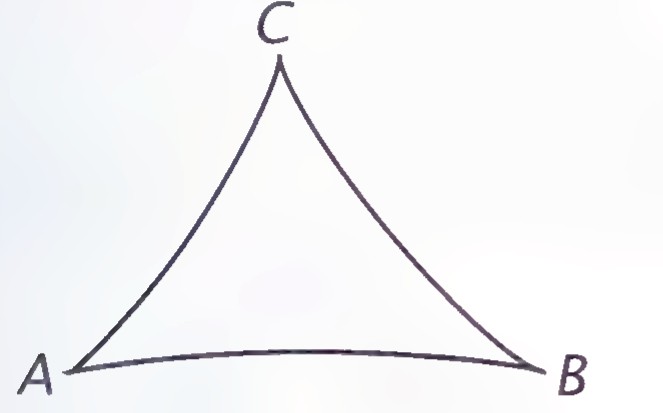
Given: △ABC.
Prove: ∠A + ∠B + ∠C < 180°.
Proof
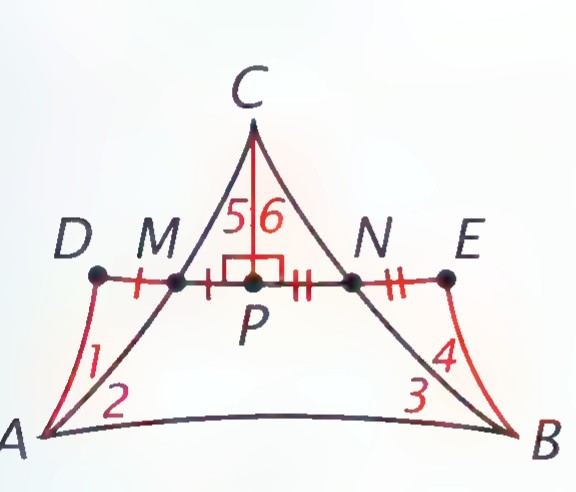
Let M and N be the midpoints of sides AC and BC, and draw MN. Through C, draw CP ⊥ MN. Choose points D and E on line MN so that MD = MP and NE = NP. Draw AD and BE.
- △ADM ≅ △CPM and △BEN ≅ △CPN. Why?
- Which angles of ADEB are right angles?
- Which sides of ADEB are equal?
- What kind of quadrilateral is ADEB?
- ∠DAB and ∠EBA are acute. Why?
- What can be concluded about ∠DAB + ∠EBA from the fact that ∠DAB < 90° and ∠EBA < 90°?
Because ∠DAB = ∠1 + ∠2 and ∠EBA = ∠3 + ∠4, it follows that ∠1 + ∠2 + ∠3 + ∠4 < 180°.
- To which angles in the figure are ∠1 and ∠4 equal?
- Why is ∠5 + ∠2 + ∠3 + ∠6 < 180°?
- Why does it follow from this that ∠CAB + ∠CBA + ∠ACB < 180°?
Corollary to Lobachevskian Theorem 3. The sum of the angles of a quadrilateral is less than 360°.
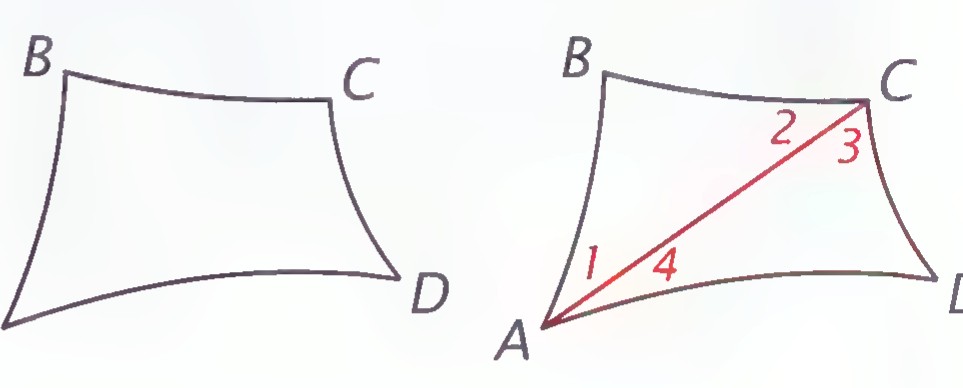
Given: Quadrilateral ABCD.
Prove: ∠A + ∠B + ∠C + ∠D < 360°.
Proof
Draw AC.
- ∠1 + ∠2 + ∠B < 180° and ∠3 + ∠4 + ∠D < 180°. Why?
- ∠1 + ∠2 + ∠B + ∠3 + ∠4 + ∠D < 360°. Why?
- ∠1 + ∠4 = ∠BAD and ∠2 + ∠3 = ∠BCD. Why?
- ∠BAD + ∠B + ∠BCD + ∠D < 360°. Why?
Lobachevskian Theorem 4. If two triangles are similar, they must also be congruent.
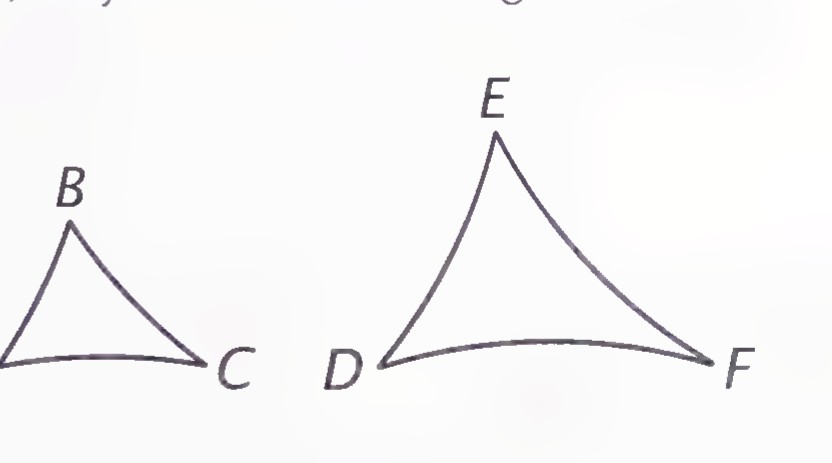
Given: △ABC ~ △DEF.
Prove: △ABC ≅ △DEF.
Proof
By hypothesis, △ABC ~ △DEF.
- Why is ∠D = ∠A, ∠E = ∠B, and ∠F = ∠C?
p. 710
Our proof will be indirect. Suppose that △ABC and △DEF are not congruent. If this is the case, then BA ≠ ED and BC ≠ EF, because, if either pair of these sides were equal, then the triangles would be congruent by ASA.
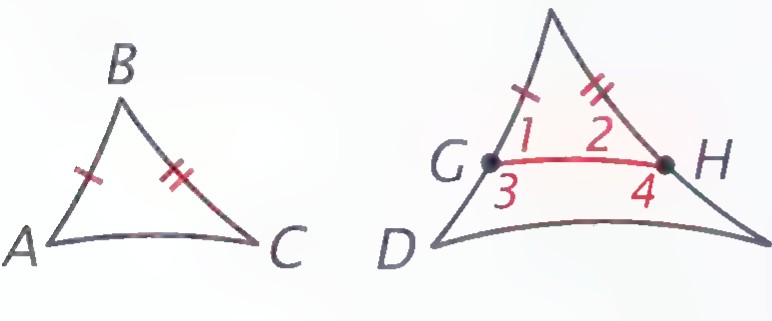
We will now copy the smaller triangle on the larger one as shown above. Choose point G on ED so that EG = BA and point H on EF so that EH = BC. Draw GH.
- Why is △GEH ≅ △ABC?
It follows that ∠1 = ∠A and ∠2 = ∠C because they are corresponding parts of these triangles.
- Why is ∠D = ∠1 and ∠F = ∠2?
- Why is ∠1 + ∠3 = 180° and ∠2 + ∠4 = 180°?
- Why is ∠1 + ∠2 + ∠3 + ∠4 = 360°?
- Why is ∠D + ∠F + ∠3 + ∠4 = 360°?
- If we assume from the figure that DGHF is a quadrilateral, the equation in Exercise 19 is impossible. Why?
Because we have arrived at a contradiction, our assumption that △ABC and △DEF are not congruent is false! So △ABC ≅ △DEF.
Set II
Lobachevskian Triangles. In Lobachevskian geometry, the sum of the angles of every triangle is less than 180°. The larger the triangle’s area, the smaller the angle sum is.
Use these facts to decide on answers to the following questions about triangles in Lobachevskian geometry.
- If two angles of one triangle are equal to two angles of another triangle, can you conclude that the angles of the third pair are equal? Explain.
- What can you conclude about the acute angles of a right triangle?
- What can you conclude about the measure of each angle of an equilateral triangle?
- How does the measure of each angle of an equilateral triangle depend on the lengths of its sides?
Triangle on a Sphere. The figure below illustrates an isosceles △ABC with AB = AC on a sphere.
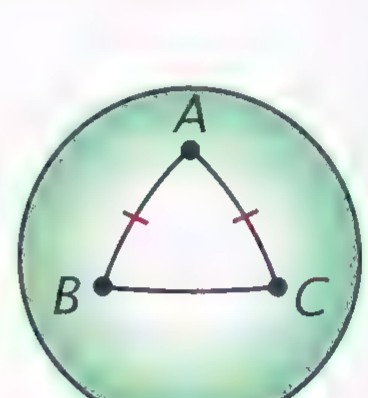
On the basis of the figure, what
- seems to be true about ∠B and ∠C?
- seems to be true about ∠A + ∠B + ∠C?
- kind of geometry seems to be illustrated?
Triangle on a Pseudosphere. The figure below illustrates an isosceles △ABC with AB = AC on a pseudosphere.
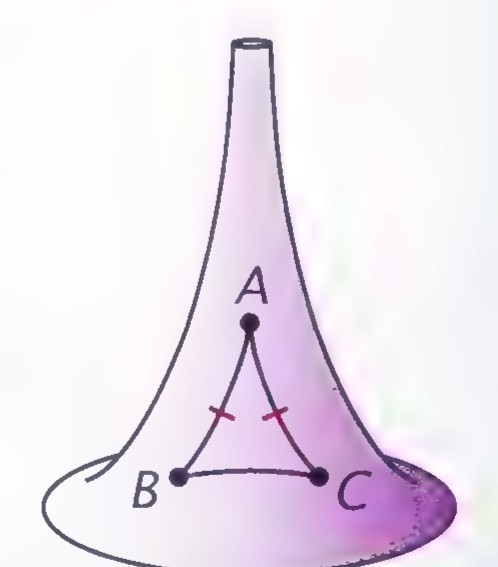
On the basis of the figure, what
- seems to be true about ∠B and ∠C?
- seems to be true about ∠A + ∠B + ∠C?
- kind of geometry seems to be illustrated?
p. 711
Exterior Angles. In the figure below, △ABC represents a triangle in Lobachevskian geometry and ∠1 is one of its exterior angles.
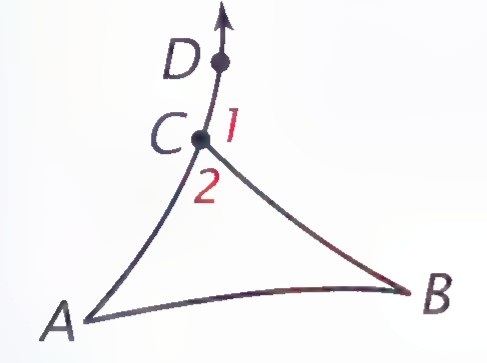
In both Euclidean geometry and Lobachevskian geometry, ∠1 > ∠A and ∠1 > ∠B.
- What else can you conclude about ∠1 in Euclidean geometry?
- Use the figure to show whether or not your conclusion about ∠1 is also true in Lobachevskian geometry.
Angle Inscribed in a Semicircle. In the figure below, ∠ABC is inscribed in a semicircle.
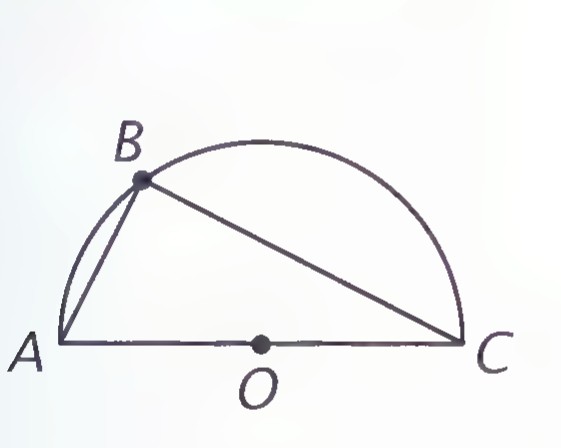
- What can you conclude about ∠ABC in Euclidean geometry?
Radius OB has been added in the figure below.
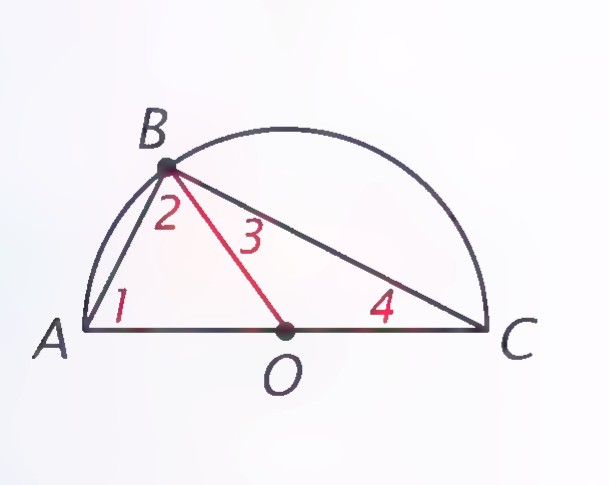
- Use the numbered angles to show whether or not your conclusion about ∠ABC is also true in Lobachevskian geometry.
Magnification and Distortion. The following photographs are an exaggerated illustration of the fact that a figure cannot be enlarged in Lobachevskian geometry without its being distorted.
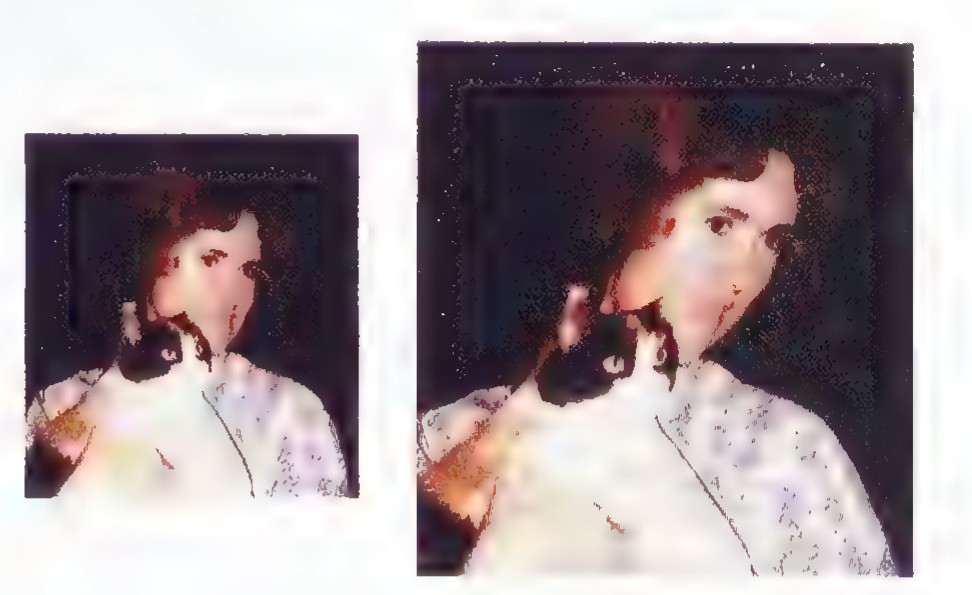
In the figure at the left below, △ABC is a right triangle with right ∠C. In the figure at the right, the triangle has been enlarged by extending line AB so that AD = 2AB and by drawing DE ⊥ line AC.
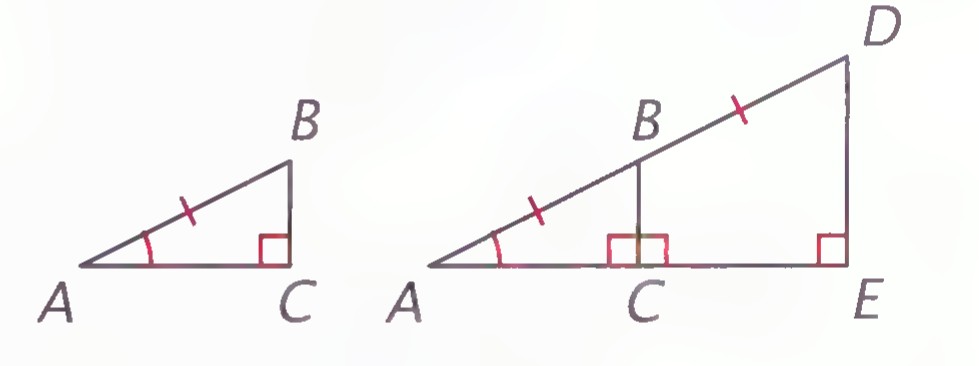
In Euclidean geometry, what can you conclude about
- △ADE and △ABC? Why?
- ∠D and ∠ABC?
- the lengths of the sides of △ADE with respect to the corresponding sides of △ABC?
In the figure below, line DF has been drawn so that ∠1 = ∠A, and BC has been extended so that it intersects DF at F.
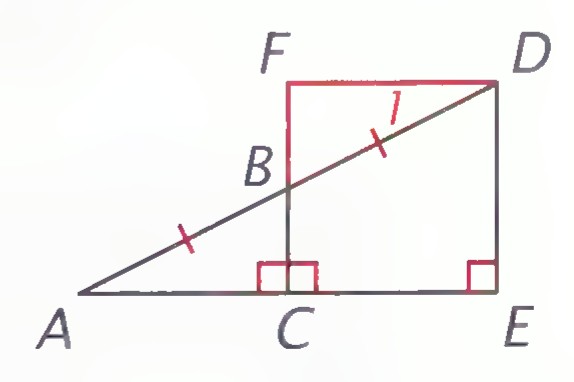
- Copy the figure and mark this information on it.
p. 712
In both Euclidean geometry and Lobachevskian geometry, what can you conclude about
- △DBF and △ABC? Explain.
- the lengths of BF and BC?
- ∠F?
- quadrilateral CFDE?
In Lobachevskian geometry, what can you conclude about
- ∠FDE?
- the lengths of DE and FC? Explain.
- FC and 2BC?
- DE and 2BC?
- the lengths of CE and FD?
- the lengths of CE and AC?
- AE and 2AC?
- How do the sides of △ADE compare in length with the corresponding sides of △ABC in Lobachevskian geometry?
Set III
Astronomical Triangle. In 1829, Lobachevsky reported that he used some astronomical measurements to find the sum of the angles of the triangle determined by Earth, the sun, and the star Sirius. He found that the sum differed from 180° by approximately 0.000000001°.
- Does Lobachevsky’s finding prove that physical space is non-Euclidean? Explain why or why not.
- Would it be easier to prove by this method that physical space is Euclidean or that it is non-Euclidean? Explain.
p. 713
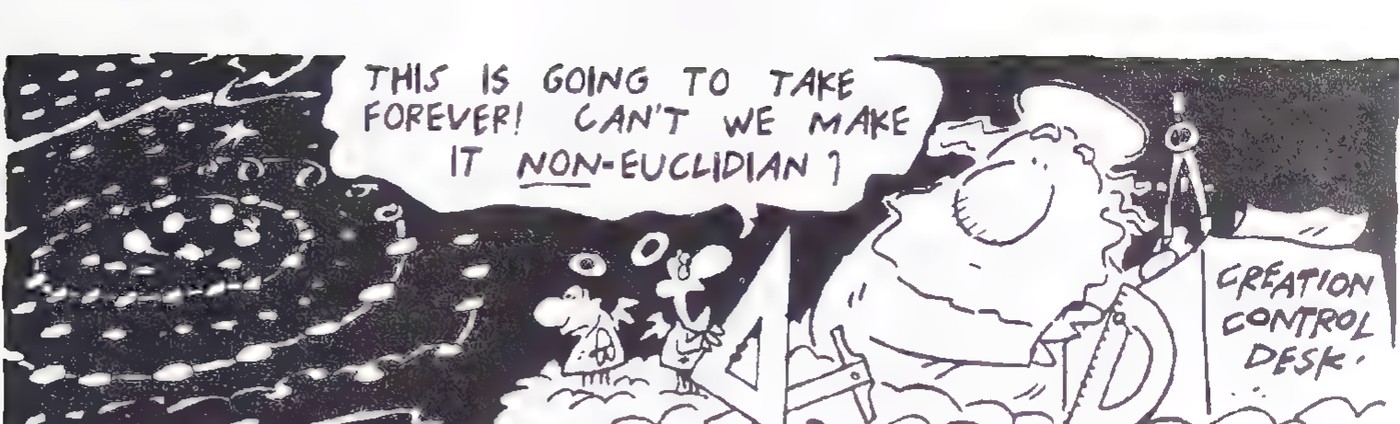
© 1992 by Thaves. Distributed from www.thecomics.com. Reprinted with permission. All rights reserved.
Summary and Review
Basic Ideas
Antipodal points 691
Birectangular quadrilateral 697
Great circle 690
Lobachevskian geometry 703
Riemannian geometry 703
Saccheri quadrilateral 697
Postulate
The Lobachevskian Postulate. The summit angles of a Saccheri quadrilateral are acute. 703
Theorems
87. The summit angles of a Saccheri quadrilateral are equal. 698
88. The line segment connecting the midpoints of the base and summit of a Saccheri quadrilateral is perpendicular to both of them. 698
89. If the legs of a birectangular quadrilateral are unequal, the summit angles opposite them are unequal in the same order. 698
90. If the summit angles of a birectangular quadrilateral are unequal, the legs opposite them are unequal in the same order. 698
L1. The summit of a Saccheri quadrilateral is longer than its base. 703
L2. A midsegment of a triangle is less than half as long as the third side. 703
L3. The sum of the angles of a triangle is less than 180°. 708
Corollary. The sum of the angles of a quadrilateral is less than 360°. 708
L4. If two triangles are similar, they must also be congruent. 708
| Statement | Euclid | Lobachevsky | Riemann |
|---|---|---|---|
| Through a point not on a line, there is | exactly one line parallel to the line. | more than one line parallel to the line. | no line parallel to the line. |
| The summit angles of a Saccheri quadrilateral are | right. | acute. | obtuse. |
| The sum of the angles of a triangle is | 180°. | less than 180°. | more than 180°. |
p. 714
Exercises
Set I
Sphere Geometry. The figure below appeared in a book published in 1533.*
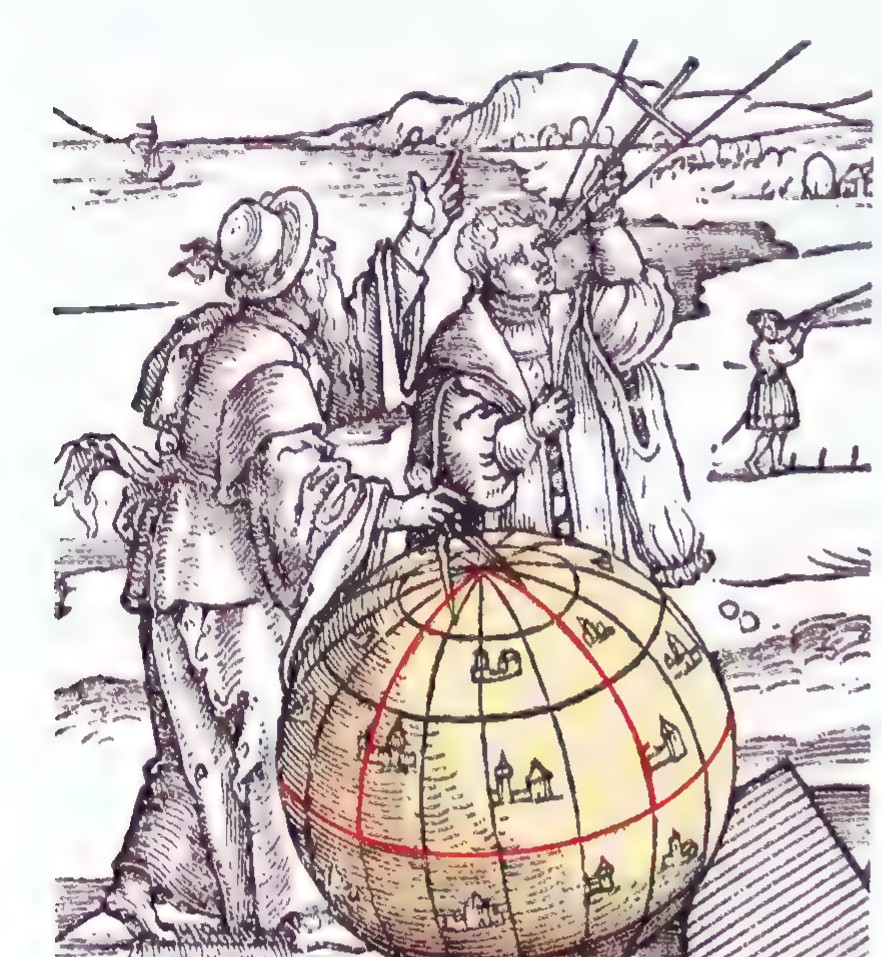
Most of the curves on the globe are “lines” in sphere geometry.
- What is a “line” in sphere geometry?
Tell whether each of the following statements is true or false in sphere geometry.
- Through a point not on a line, there is exactly one line perpendicular to the line.
- In a plane, two lines perpendicular to a third line are parallel to each other.
- If two lines intersect, they intersect in no more than one point.
- The sum of the angles of a triangle is 180°.
- An exterior angle of a triangle is greater than either remote interior angle.
* Introduction to Geography, by Peter Apian.
Saccheri Quadrilateral. In the figure below, ABCD is a Saccheri quadrilateral in Lobachevskian geometry; ∠B and ∠C are right angles, and AB = BC = CD.
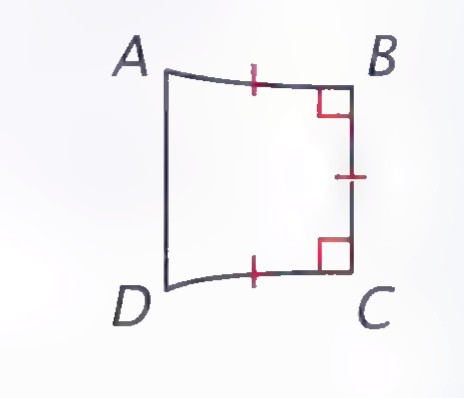
- Which side of ABCD is its summit?
- What can you conclude about the length of AD?
- Can ABCD be a rhombus? Explain.
- What kind of angles are ∠A and ∠D?
- Can ABCD be a rectangle? Explain.
Beach Ball. This beach ball has been divided by great circles into congruent triangles.
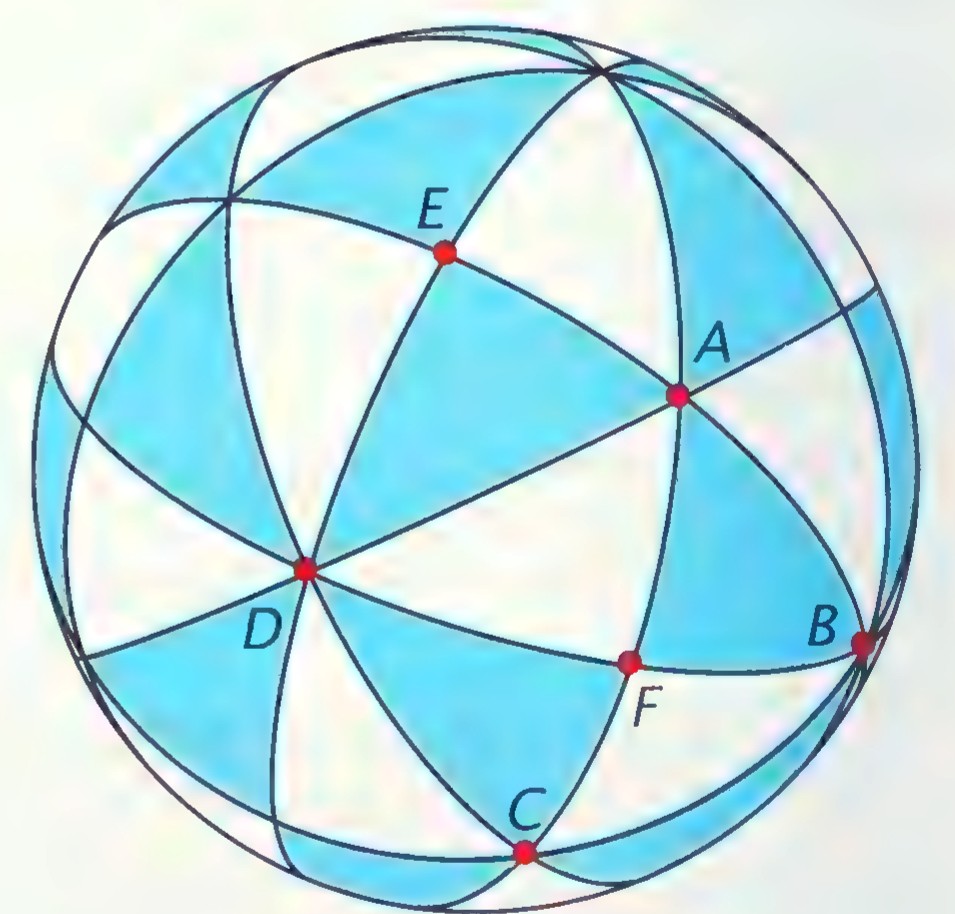
The angles at E and F are right angles, the angles at A and C are 60°, and the angles at B and D are 45°.
What is the sum of the measures of the angles surrounding
- point A?
- point B?
- point C?
p. 715
- Make a large copy of the part of the figure bounded by quadrilateral EBCD. Label the measures of all of the angles in your figure.
- Find the measures of the angles in quadrilateral ABCD.
- If the opposite angles of a quadrilateral in Euclidean geometry are equal, what can you conclude?
- Does the same conclusion appear to hold in sphere geometry? Explain.
- What can you conclude from the fact that quadrilateral ABCD is equilateral?
- How are the diagonals of ABCD related to each other?
- Is this relation also true for such quadrilaterals in Euclidean geometry?
- Find the measures of the angles in quadrilateral EAFD.
Can a quadrilateral have exactly three right angles in
- Euclidean geometry?
- sphere geometry?
Set II
Lobachevsky’s Ladder. In the figure below, l₁ and l₂ represent the two parallel side rails of a ladder. Segments AB, CD, and EF represent three rungs that are perpendicular to l₁.
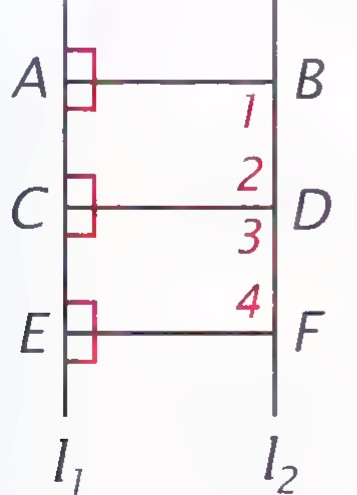
In Lobachevskian geometry, no more than two of the three rungs AB, CD, and EF can have equal lengths.
- Copy the figure and mark it to suggest that AB = CD = EF.
- If AB = CD = EF, what kind of quadrilaterals are ABDC and CDFE?
- In Lobachevskian geometry, what kind of angles are ∠1, ∠2, ∠3, and ∠4?
- What can you conclude about ∠2 + ∠3?
- How does this conclusion contradict the fact that ∠2 and ∠3 are a linear pair?
- What does this contradiction prove about the rungs of the ladder?
Pythagoras Meets Lobachevsky. In the figure below, △ABC is a right triangle and MN is one of its midsegments.
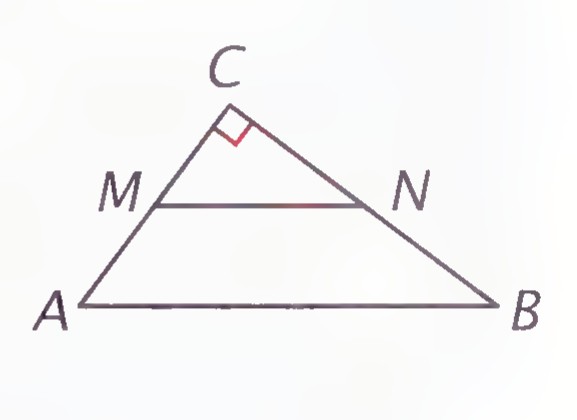
Suppose that CA² + CB² = AB² and CM² + CN² = MN².
- On what theorem of Euclidean geometry are these equations based?
Because M and N are the midpoints of CA and CB, CM = CA and CN = CB.
- Why does it follow that
- Use this equation and the initial assumption that CA² + CB² = AB² to show that MN = AB.
- What theorem in Lobachevskian geometry does this result contradict?
- What does this contradiction indicate about the Pythagorean Theorem in Lobachevskian geometry?
p. 716
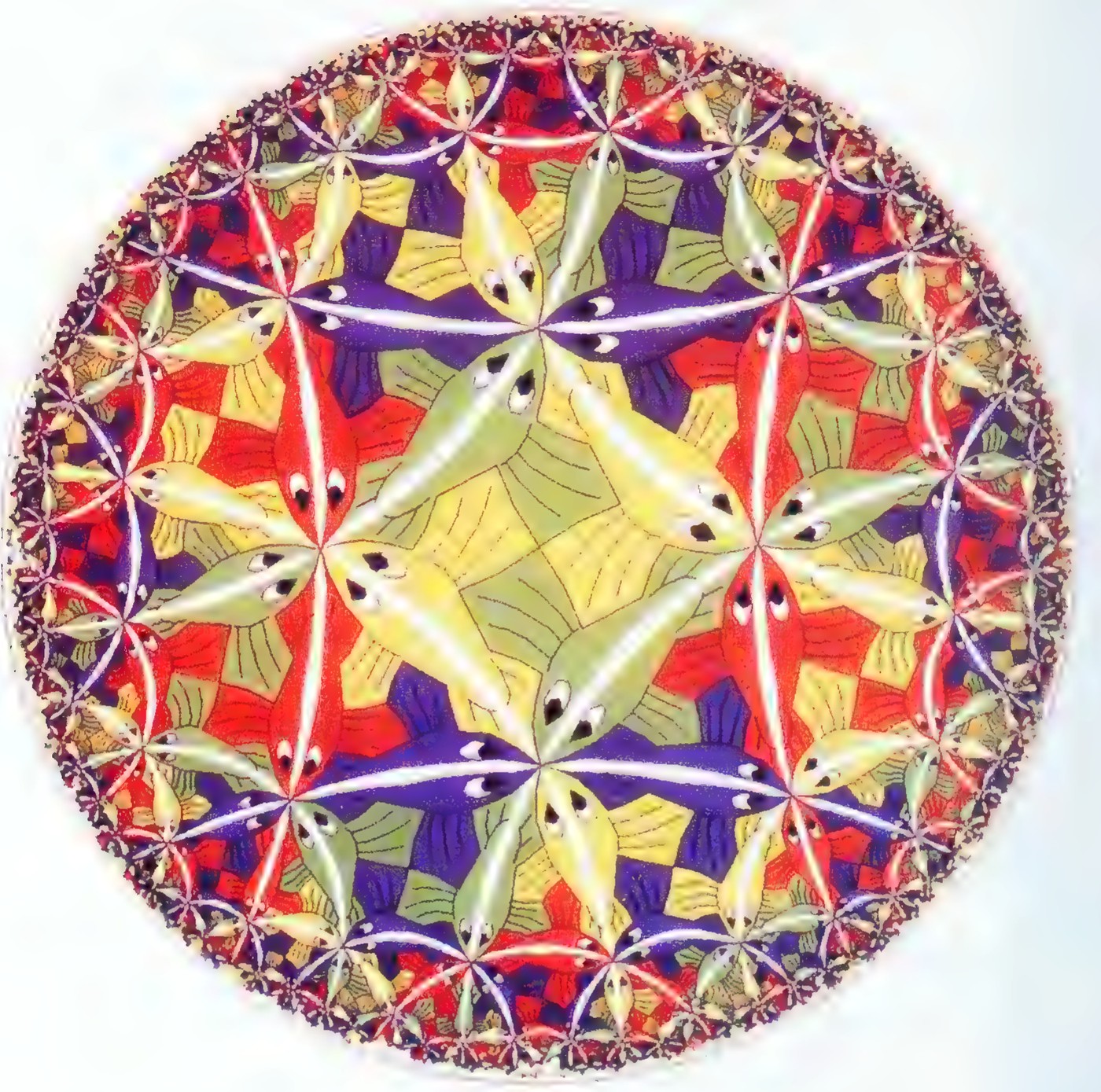
Lobachevsky Meets Escher. The print by Maurits Escher at the beginning of this chapter illustrates a model devised by a French mathematician, Henri Poincaré, for visualizing the theorems of Lobachevskian geometry. Silvio Levy used a computer to create the above version of it.*
To understand this model, it is necessary to know what orthogonal circles are.
The figure at the right shows two orthogonal circles O and O’ intersecting at points A and B. The tangents to the circles at these points have been drawn.
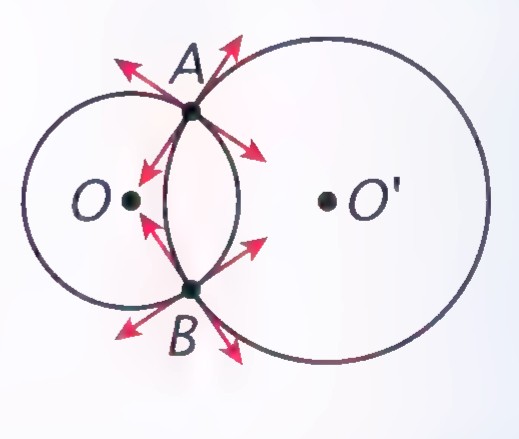
- On the basis of this figure, define orthogonal circles.
* The Visual Mind: Art and Mathematics, edited by Michele Emmer (MIT Press, 1993).
p. 717
In Poincaré’s model of Lobachevskian geometry, points of the plane are represented by points inside a circle, and lines are represented by both the diameters of the circle and the arcs of circles orthogonal to it. Examples of some lines in this model are shown in the figure below.
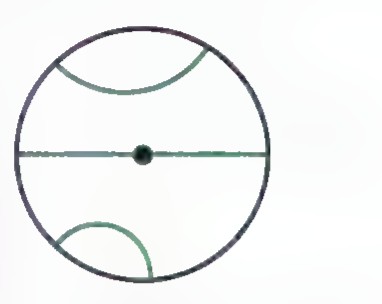
The figure below shows two points in a circle and the only arc through them that is orthogonal to the circle.
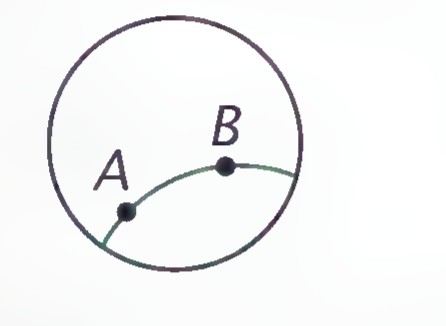
- What postulate does this figure illustrate?
The figure below shows an “orthogonal arc” and several such arcs through point P that do not intersect it.
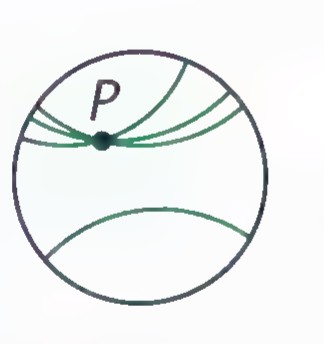
- What idea in Lobachevskian geometry does this figure illustrate?
State a theorem or postulate in Lobachevskian geometry suggested by each of the following figures.
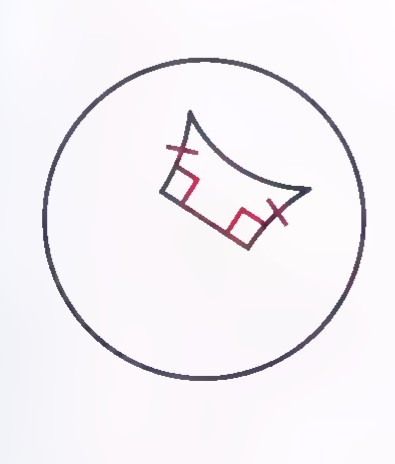
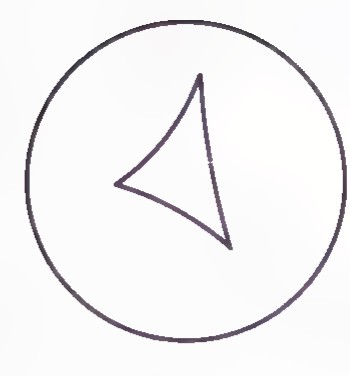
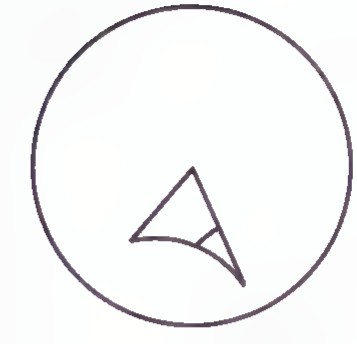
The Geometry of the Universe. According to one model of the universe, called Einstein’s spherical universe, the geometrical properties of space are comparable to those of the surface of a sphere.
- If this model is correct, what conclusion follows about the volume of the space of the universe? Explain.
- If an astronaut were to travel far enough along a straight line, what would this model predict? Explain.