Chapter 16 — Teacher’s Guide Answers
Answers and teaching commentary for Chapter 16: Non-Euclidean Geometries, transcribed from the scanned Teacher’s Guide. Diagrams are cropped from the same page scans.
OCR note. The text was recognized automatically and has not been corrected line by line; formulas and symbols may be imperfect. Check the original PDF for exact wording.
Homework: Chapter 16 exercises · Selected answers · Teacher’s answers PDF
Lesson 1
Set I (pages 692-693)
The beach ball of exercises 16 through 24 is a
. “spherical dodecahedron,” the result of projecting the edges of a regular dodecahedron on the surface of its circumscribing sphere. Because of the duality of the reqular dodecahedron and regular icosahedron, the ball is also a “spherical icosahedron.” The sphere is divided into 120 congruent right triangles, of which 6 are contained in each equilateral triangle of the icosahedron and 10 are contained in each reqular pentagon of the dodecahedron. More on the mathematics of this topic can be found in chapter 1 of Spherical Models, by Magnus J. Wenninger (Cambridge University Press, 1979).
Our Spherical Earth.
1. At the center of the sphere.
*2. Aradius of the sphere.
3. Two hemispheres.
4. Adiameter. Basic Differences.
5. Both geometries.
6. Euclidean geometry.
7. Euclidean geometry.
8. Sphere geometry.
9. Euclidean geometry.
¢10. Both geometries.
11. Euclidean geometry. Shortest Routes.
12. Arc3.
13. It is the largest.
14. The length of the minor arc of the great circle that contains them.
15. B-~cause the shortest route between two points is along a great circle.
Beach Ball.
*16. 186°. (36° + 60° + 90°.)
17. No. In these triangles, their sum is more than 90°.
*18. £A =2(36°)=72° £B = £C =60 LA+ ZB+ £C =192°.
19. £ZA =36°, LE=90°, £LF =2(36°) =72°; ZA + ZE+ LF =198°.
20. £C=60°, £D = 36°, £LF = 3(36°) = 108°; ZC + £D + £LF =204°.
21. ZA = /D = £LF =2(36°) =72°% ZA + ZD + £F =216°.
©22. Yes.
23. The greater the area of the triangle, the greater the sum of its angles seems to be.
24. A very small triangle.
Set II (pages 693-695)
Exercises 25 through 28 describe some of the content of Sphaerica, the major work of Menelaus. The following summary of the first book of Sphaerica is from Morris Kline’s Mathematical Thought from Ancient to Modern Times (Oxford University Press, 1972): “In the first book, on spherical geometry, we find the concept of a spherical triangle, that is, the figure formed by three arcs of great circles on a sphere, each arc being less than a semicircle. The object of the book is to prove theorems for spherical triangles analogous to what Euclid proved for plane triangles. Thus the sum of two sides of a spherical triangle is greater than the third side and the sum of the angles of a triangle is greater than two right angles. Equal sides subtend equal angles. Then Menelaus proves the theorem that has no analogue in plane triangles, namely, that if the angles of one spherical triangle equal respectively the angles of another, the triangles are congruent. He also has other congruence theorems and theorems about isosceles triangles.”
The bowling-ball exercises were inspired by some remarks on geodesics by David Henderson in Experiencing Geometry in Euclidean, Spherical and Hyperbolic Spaces (Prentice Hall, 2001). In chapter 2, titled “Straightness on Spheres”, Henderson describes some activities to help in visualizing great circles as “the only straight lines on the surface of a sphere.” He suggests: (1) stretching a rubber band on a slippery sphere—it will stay in place only on a great circle, (2) rolling a ball on a straight chalk line—the chalk will form a great circle on the ball, (3) putting a stiff strip of paper “flat” on a sphere—it will lie properly
only along a great circle, (4) using a small toy car whose wheels are fixed so that it rolls along a straight line on a plane—the car will roll around a great circle on a sphere but not around other curves. Henderson’’s book is a valuable resource for anyone who teaches geometry.
Spherical Triangles.
©25. Arcs of great circles.
26. The sum of any two sides of a triangle is greater than the third side.
27. No. In Euclidean geometry, the triangles would be similar but not necessarily congruent.
28. The greater the area of the triangle, the greater the sum of its angles.
Seemingly Parallel.
29. They do not intersect.
*30. Both curves cannot correspond to lines. (Lines are great circles and great circles divide the sphere into two equal hemispheres. If one of these curves divides the sphere into two equal hemispheres, the other one clearly does not.)
Euclidean and Sphere Geometries.
*31. One.
*32. No.
33. That they are parallel.
34. No. The corresponding angles formed by lines AB and AC with line BC are equal because they are right angles, but the lines intersect in point A.
35. That they are parallel.
36. No.
37. ltis greater than either remote interior angle (and equal to their sum).
38. No. In AABC, for instance, the exterior angle at B is equal to the remote interior angle at C.
39. Itis 180°.
#40. No. The sum of the angles of AABC is greater than 180°.
Wet Paint.
41. ltis finite in length, has a definite width and thickness, and so on.
42. Tt makes sense if the “line” on the ball is a great circle.
43, The radius (or diameter) of the sphere. Euclidean and Right.
44. Tt has 90° angles rather than 60° angles. Also, the sum of its angles is 270°, not 180°.
45, It has three right angles rather than one.
46. It is four times as long. (The two perpendicular lines through point A divide the line through points B and C into four equal parts.)
47. 4munits. [c = 2n(2) = 4]
48. 3munits.
49. 16m square units. [A = 4rr2 = 4n(2)? = 16m]
50. 2msquare units. (AABC is one of eight congruent triangles into which the lines containing its sides divide the sphere.)
Set 111 (page 695)
The following material is from the “Games” column of Omni magazine, reprinted in The Next Book of Omni Games, by Scot Morris (New American Library, 1988):
“Ross Eckler, editor of Word Ways, sent us an interesting question based on his geographical research. As you move from place to place during your life, including visits to foreign countries, visualize the corresponding paths of your antipodal points—the point traced exactly through the center of the earth to the opposite side of the globe.
What fraction of the time, would you say, is your antipodal trace on water, and what fraction of the time is it on fand?
Most people confronted with this problem allow for the fact that about two thirds of the globe is covered with water. So they answer that their antipodal point would be on water anywhere from 65 to 9o percent of the time. The truth of matter is that for most Americans the answer is likely to be closer to 100 percent.
The reason for this is the extremely nonrandom distribution of land and water. For example, there
Lesson 2
are only a few square miles of the continental United States that map onto land: two specks in Southeast Colorado that correspond to St. Paul and Amsterdam Islands, in the Indian Ocean, and a larger speck on the Montana-Canada border ‘that corresponds to Kerguelen Island, also in the Indian Ocean. None of these points are near major highways, however, so most people have never been there. Western Europe and Israel— common tourist destinations—also map into water, with the exception of parts of Spain.
Interestingly, the Hawaiian islands are totally land-antipodal, mapping into Botswana; most of Alaska, however, maps into water, except for a region near Point Barrow that is opposite of Antarctica.
Have you taken a trip to South America? If S0, your antipodal point might have dried off. Bogota, Quito, Lima, and much of Chile and Argentina are opposite China, Sumatra, and neighboring lands.
A visit to Australia does no good whatever. The entire continent neatly fits into the Atlantic Ocean, with Perth missing Bermuda by only a few miles.
The chances are very high, therefore, that at no time during your life could you have dug a hole through the center of the earth and struck land on the other side.”
Polar Points.
1. The sphere of the earth has been mapped twice so that each pair of antipodal points coincide.
2. For most points of the earth that are on land, the corresponding antipodal points are in an ocean.
Set I (pages 698-699)
The western and eastern borders of Wyoming are each about 280 miles in length. The southern and northern borders are about 370 miles and 350 miles, respectively. A nice class exercise might be to use the latitudes of the southern and northern borders (41°N and 45°N) to calculate the ratio of the circumferences of the circles of latitude and show that it is in reasonable agreement with the ratio of these lengths. Students who know their geography may enjoy naming the states that border Wyoming. (Montana on the north, Utah and Colorado on the south, Idaho and Utah on
the west, and South Dakota and Nebraska on the east.) Another question of interest would be to name other states whose borders are Saccheri quadrilaterals. (There is only one: Colorado.) Theorem 85, that the summit angles of a Saccheri quadrilateral are equal, is the first theorem proved by Saccheri in his Euclid Freed of Every Flaw. The first English edition of Saccheri’s book, titled Girolamo Saccheri’s Euclides Vindicatus and edited and translated by George Bruce Halsted with the original Latin on the facing pages, was published by Open Court in 1920. It was republished with added notes in 1986 by the Chelsea Publishing Company and can be ordered from the Mathematical Association of America on the Internet (www.maa.org).
Wyoming. e]. Itslegs.
2. The base angles.
3. The summit.
4. The summit angles.
¢5. WY and MO.
*6. £Y and Z0. Theorem 87.
7. Two points determine a line.
8. The legs of a Saccheri quadrilateral are equal.
9. All right angles are equal.
10. SAS.
11. Corresponding parts of congruent triangles are equal.
2, S5,
13. Corresponding parts of congruent triangles are equal.
Theorem 89.
¢14. The Ruler Postulate.
15. Two points determine a line.
16. Itis a birectangular quadrilateral whose legs are equal.
17. The summit angles of a Saccheri quadrilateral are equal.
18. The “whole greater than part” theorem.
19. Substitution.
©20. An exterior angle of a triangle is greater than either remote interior angle.
21. The transitive property. Theorem 90.
22. The “three possibilities” property.
©23. A Saccheri quadrilateral.
24. The summit angles of a Saccheri quadrilateral are equal.
25. The fact that £D > £C.
©26. If the legs of a birectangular quadrilateral are unequal, the summit angles opposite them are unequal in the same order.
27. The fact that £D > £C.
28. CB>DA.
Set II (pages 699-700)
Of Nasir Eddin (12011274), Howard Eves wrote in An Introduction to the History of Mathematics (Saunders, 1990): “He wrote the first work on plane and spherical trigonometry considered independently of astronomy. Saccheri (1667-1733) started his work on non-Euclidean geometry through a knowledge of Nasir Eddin’s writings on Euclid’s parallel postulate. His was the only attempt to prove this postulate in the period from the ancient Greeks up to the Renaissance.” An outline of Nasir Eddin’s approach to the postulate is included on pages 208-210 of the first volume of The Thirteen Books of Euclid’s Elements, with introduction and commentary by Sir Thomas L. Heath (Dover, 1956).
t
Theorem 86 is the second theorem proved by Saccheri in his Euclid Freed of Every Flaw.
A curious fact about the flag of Poland: if it is flown upside down, it becomes the flag of both Monaco and Indonesia!
Nasir Eddin.
©29. CD.
30. ABDC is a birectangular quadrilateral in which £2 > £3 (£2 is obtuse and £3 is acute); so CD > AB. If the summit angles of a birectangular quadrilateral are unequal, the legs opposite them are unequal in the same order.
Theorem 88.
«31. DM = CM because AADM = ABCM (SAS).
32. The midpoint of a line segment divides it into two equal segments.
33. In a plane, two points each equidistant from the endpoints of a line segment determine the perpendicular bisector of the line segment.
34. £D = ZC because the summit angles of a Saccheri quadrilateral are equal; so AADN = ABCN (SAS); AN = BN because corresponding parts of congruent triangles are equal.
35. In a plane, two points each equidistant from the endpoints of a line segment determine the perpendicular bisector of the line
segment. Polish Flag.
36. p D
(0] N
L A
37. A Saccheri quadrilateral.
*38. DA.
39. The summit angles of a Saccheri quadrilateral are equal.
*40. The line segment connecting the midpoints of the base and summit of a Saccheri quadrilateral is perpendicular to both of them.
41. Birectangular. Alter Ego.
*42. In aplane, two lines perpendicular to a third line are parallel.
43. A quadrilateral is a parallelogram if two opposite sides are both parallel and equal.
Lesson 3
*44. The opposite angles of a parallelogram are equal.
45. Because a quadrilateral each of whose angles is a right angle is a rectangle.
” 46. Itis equal to and parallel to the base. Irregular Lots.
47. AF>CD. ABEF is a birectangular quadrilateral in which £1 > ZF, and so AF > BE; BCDE is a birectangular quadrilateral in which £D > £2, and so BE > CD. The conclusion that AF > CD follows from the transitive property.
48. /D > /F. ACDF is a birectangular quadrilateral in which AF > CD. If the legs of a birectangular quadrilateral are unequal, the summit angles opposite them are unequal in the same order.
Set 111 (page 701)
Accompanying the photograph by Alex S. Maclean of the jog in the road in Castleton, North Dakota, from Taking Measures Across the American Landscape (Yale University Press, 1996) is this caption by Hildegard Binder Johnson: “It did not take long for legislators to understand that a township could not be exactly six miles on each side if the north-south lines were to follow the lines of longitude, which converged, or narrowed, to the north. The grid was, therefore, corrected every four townships to maintain equal allocations of land. These slippages, measured every twentyfour miles (or every thirty minutes if one was driving), poignantly register the spherical and magnetic condition of our planet, doglegging to counter the diminishing distances as one moves north.”
Offsets.
1. No. The sides of the townships lie along map directions; so the lines containing their legs all intersect at the North (and South) Pole.
2. They are shorter than the bases. It is given that AB = DF = 6 miles; DE < DF, and so DE < AB.
3. They become shorter and shorter. (If a township had its summit very close to the North Pole, it would look very much like an isosceles triangle.)
Set I (page 704)
Lobachevskian Theorem 1, that the summit of a Saccheri quadrilateral is longer than its base, is part of the third theorem proved by Saccheri in his Euclid Freed of Every Flaw. (Saccheri covers all three cases, stating that the summit is equal to, less than, or greater than the base, depending on whether the summit angles are right, obtuse, or acute.)
Lobachevskian Theorem 1.
1. The summit angles of a Saccheri quadrilateral are acute in Lobachevskian geometry.
2. An acute angle is less than 90°.
3. Substitution.
o4, Aline segment has exactly one midpoint.
5. Two points determine a line.
6. The line segment connecting the midpoints of the base and summit of a Saccheri quadrilateral is perpendicular to both of them.
7. A quadrilateral that has two sides perpendicular to a third side is birectangular.
8. If the summit angles of a birectangular quadrilateral are unequal, the legs opposite them are unequal in the same order.
9. The Addition Theorem of Inequality.
10. Substitution. Lobachevskian Theorem 2.
11. AADM = ACPM by SAS (AM = MC, DM = PM, and ZAMD = ZCMP ). ABEN = ACPN for the same reason.
12. Corresponding parts of congruent triangles are equal.
13. Substitution.
®14. A birectangular quadrilateral whose legs are equal is a Saccheri quadrilateral.
*15. The summit of a Saccheri quadrilateral is longer than its base in Lobachevskian geometry.
16. Substitution.
17. Substitution.
18. Multiplication (or division).
Set II (pages 705-706)
Although our study of non-Euclidean geometry
is limited to two dimensions, exercises 37 through 46 illustrate some of its strange consequences in three dimensions. The simple pattern of equilateral triangles that can be folded to form a reqular tetrahedron in Euclidean geometry results in an irreqular tetrahedron in Lobachevskian geometry. The pattern of squares that can be folded to form an open box in the shape of a cube in Euclidean geometry does not exist in Lobachevskian geometry. The Set || exercise of Lesson 2 illustrated the difficulty of trying to subdivide the surface of a sphere (the Riemannian plane) into squares and the same is true of the Lobachevskian plane. The existence of squares and cubes depends on the Euclidean Parallel Postulate; so areas and volumes in non-Euclidean geometry are not measured in square or cubic units. The existence of a square in a geometry forces that geometry to be Euclidean because the square can tile the plane, and subdividing the resulting squares produces a Cartesian grid that forces a Pythagorean pattern on the entire plane.
Lobachevsky and his Geometry.
19. (Student answer.) (Below the portrait of Lobachevsky is his name. The last word is “geometry.”)
*20. Through a point not on a line, there is more than one line parallel to the line.
21. The summit angles of a Saccheri quadrilateral are acute.
22. The summit of a Saccheri quadrilateral is longer than its base.
23. A midsegment of a triangle is less than half as long as the third side.
Lobachevskian Quadrilateral. 24.
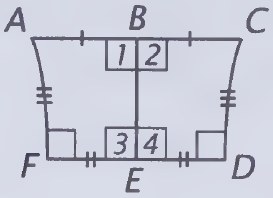
Diagram from page 276.
25. A Saccheri quadrilateral.
26. Acute. The summit angles of a Saccheri quadrilateral are acute in Lobachevskian geometry.
27. Right. The line segment connecting the midpoints of the base and summit of a Saccheri quadrilateral is perpendicular to both of them.
#28. Birectangular.
29. If the summit angles of a birectangular quadrilateral are unequal, the legs opposite them are unequal in the same order.
30. In Lobachevskian geometry, the line segment that connects the midpoints of the summit and base of a Saccheri quadrilateral is shorter than either leg.
Riemannian Quadrilateral.
31. Obtuse. ’
32. (Student answer.) (Yes.)
33. DC<AB.
¢34. In Riemannian geometry, the summit of a Saccheri quadrilateral is shorter than its base.
Riemannian Triangle.
35. In Riemannian geometry, a midsegment of a triangle is more than half as long as the third side.
36. No. There are no parallel lines in Riemannian geometry.
Triangular Pyramid.
#37. They are all half as long.
38. They are equilateral and congruent.
39. The edges of the base are less than half as long as the sides of AACE.
40. Its lateral faces are congruent isosceles triangles in which the base is shorter than the legs. Its base is an equilateral triangle.
Open Box.
41. It would have the shape of a cube.
*42. They are congruent squares.
Lesson 4
43. Saccheri quadrilaterals.
44. They would be longer than the sides of CFIL. (In Lobachevskian geometry, the summit of a Saccheri quadrilateral is longer than its base.)
45. Asquare.
46. A square is also a Saccheri quadrilateral but, in Lobachevskian geometry, the summit of a Saccheri quadrilateral is longer than its base. (Also, in Lobachevskian geometry, the summit angles of a Saccheri quadrilateral are acute, not right.)
Set II (page 706)
In the section on non-Euclidean geometries in Mathematics—The Science of Patterns (Scientific American Library, 1994), Keith Devlin observes that, with adjustments such as those considered in Lesson 1, the surface of a sphere is a good model for representing Riemannian geometry. He then asks, what surface would be a good model for representing Lobachevskian geometry? Devlin writes: “The answer turns out to involve a pattern that is familiar to every parent. Watch a child walking along, pulling a toy attached to a string. If the child makes an abrupt left turn, the toy will trail behind, not making a sharp corner, but curving around until it is almost behind the child once again. This curve is called a tractrix.” A pseudosphere is a surface produced by rotating a tractrix about its asymptote; in contrast with a sphere, which has a constant positive curvature, a pseudosphere has a constant negative curvature. Remarkably, a pseudosphere matched with the appropriate sphere has the same volume and surface area. For more on this subject, see A Book of Curves, by E. H. Lockwood (Cambridge University Press, 1963).
Directions for crocheting a pseudosphere are given by David Henderson in Experiencing Geometry in Euclidean, Spherical, and Hyperbolic Spaces (Prentice Hall, 2001).
As with geometry on the surface of a sphere, lines on a pseudosphere are represented by geodesics, the shortest paths on the surface between pairs of points. These paths are easily pictured on a sphere because they are along arcs of great circles. Unfortunately, for the pseudosphere, the only simple geodesics are the meridians, illustrated by lines AB and DC in the figure illustrating the Saccheri quadrilateral, and
the circles orthogonal to them, of which AD and BCin the figure are arcs. H. S. M. Coxeter in Introduction to Geometry (Wiley, 1969) points out that, because of this shortcoming, the pseudosphere is “utterly useless as a means for drawing significant hyperbolic figures.”
Pseudosphere.
From the figure, it appears that AD < BC; so
BC is the summit of the Saccheri quadrilateral.
It follows that AB = DC because they are the legs. Also, ZBAD and ZADC are right angles and £ABC and ZDCB are acute angles because they are, respectively, the base angles and the summit angles of the Saccheri quadrilateral. Lines AB and DC are parallel because, in a plane, two lines perpendicular to a third line are parallel (this theorem comes before the Parallel Postulate in Euclidean geometry).
Set I (pages 709-710)
Lobachevskian Theorem 3, that the sum of the angles of a triangle is less than 180°, is part of Proposition 15 proved by Saccheri in his Euclid Freed of Every Flaw. Saccheri states it thus: “By any triangle ABC, of which the three angles are equal to, or greater, or less than two right angles, is established respectively the hypothesis of right angle, or obtuse angle, or acute angle.”
Saccheri’s Proposition 16 includes the corollary about the sum of the angles of a quadrilateral being less than 360°.
English mathematician John Wallis (1616-1703) tried to prove Euclid’s Fifth Postulate but assumed in doing so that, for every triangle, there exists a similar triangle of any arbitrary size. Saccheri was aware of Wallis’s attempt and discusses it in his book. The proof of Lobachevskian Theorem 4 outlined in exercises 14 through 20 is, in fact, the one used by Saccheri in establishing that Wallis’s assumption and Euclid’s Fifth Postulate are logically equivalent.
Lobachevskian Theorem 3.
1. AADM = ACPM by SAS (AM = MC, DM = PM, and ZAMD = ZCMP). ABEN = ACPN for the same reason.
®2. /D and ZE.
3. AD and BE.
4. A Saccheri quadrilateral.
5. The summit angles of a Saccheri quadrilateral are acute in Lobachevskian geometry.
6. ZDAB + ZEBA < 180°.
7. £1=45and £4 = £6.
8. Substitution.
9. Substitution. Corollary.
*10. The sum of the angles of a triangle is less than 180° in Lobachevskian geometry.
11. Addition.
12. Betweenness of Rays Theorem.
13. Substitution.
Lobachevskian Theorem 4.
*14. Corresponding angles of similar triangles are equal.
15. SAS.
16. Substitution. (£D = £A and £1 = ZA; ZF=/Cand £2=«/C)
*17. The angles in a linear pair are supplementary.
18. Addition.
19. Substitution.
20. The sum of the angles of a quadrilateral is less than 360° in Lobachevskian geometry.
Set II (pages 710-712)
Exercises 31 and 32 lead to the theorem that, in Lobachevskian geometry, an exterior angle of
a triangle is greater than the sum of the remote interior angles. Exercises 33 and 34 reveal that, in Lobachevskian geometry, an angle inscribed in a semicircle is acute. Both theorems are considered by Saccheri, the first as a corollary to his Proposition 15 and the second as his Proposition 18.
The following excerpt is from the preface to the second English edition of Euclid Freed from Every Flaw (Chelsea, 1986): *In this book Girolamo Saccheri set forth in 1733, for the first time ever, what amounts to the axiom systems of non-
Euclidean geometry. It is in this book that, for the first time in history, theorem after theorem of [Lobachevskian] non-Euclidean geometry is stated and proved. . . . Why—one cannot help asking—did Saccheri not evaluate correctly what he had achieved, why did he not claim credit for the discovery of non-Euclidean geometry?. .. In his era, it would seem, the existence of a valid geometry alternative to Euclid’s was, quite literally, unthinkable. Not impossible, not wrong, but unthinkable.”
Exercises 35 through so show an example of an attempt to “double a triangle” in Lobachevskian geometry. For the right triangle considered, when the hypotenuse is doubled, one leg of the resulting triangle is less than doubled, whereas the other leg is more than doubled!
Lobachevskian Triangles.
#21. No. The sums of the angles of the two triangles may not be equal.
22. Their sum is less than 90° (or, they are not complementary).
23. Each angle is less than 60°.
24. The longer the sides, the smaller the angles. Triangle on a Sphere.
25. /B =/C.
©26. ZA+ /B + ZC>180°.
#27. Riemannian geometry. Triangle on a Pseudosphere.
28. ZB=/C.
29. ZA + £B+ ZC <180°.
30. Lobachevskian geometry. Exterior Angles.
*31. L1=LA+ £B.
32. The conclusion about £1 is not true in Lobachevskian geometry. £1 + £2 = 180° (the angles in a linear pair are supplementary) and ZA + ZB + £2 < 180° (the sum of the angles of a triangle is less than 180° in Lobachevskian geometry); so ZA + £B+ £2 < £1 + £2 (substitution). It follows that ZA + ZB < £1 (subtraction); so, in Lobachevskian geometry, 21 > ZA + ZB.
Angle Inscribed in a Semicircle.
33. Itis aright angle.
34. The conclusion about ZABC is not true in Lobachevskian geometry. Z£1 + £ABC + £4 < 180° (the sum of the angles of a triangle is less than 180° in Lobachevskian geometry). OA = OB = OC (all radii of a circle are equal); so £1 = £2 and £3 = /4 (if two sides of a triangle are equal, the angles opposite them are equal). Also, ZABC = £2 + /3, and so Z£2 + (L2 + £3) + £3 < 180° (substitution); 50 2(£2 + £3) < 180° and £2 + £3 < 90° (division). So ZABC < 90°. An angle inscribed in a semicircle in Lobachevskian geometry is acute.
Magnification and Distortion.
*35. AADE ~ AABC (AA).
36. /D = ZABC.
37. Each side of AADE is twice as long as the corresponding side of AABC.
38. F D
B
A C E
39. ZDBF = AABC. £1 = ZA, BD = AB, and ZFBD = ZCBA; so they are congruent by ASA.
40. BF =BC.
*41. /Fis aright angle. (£F = ZACB.)
*42. CFDE is a birectangular quadrilateral (in two different ways).
*43. ZFDE is acute. (The sum of the angles of a quadrilateral is less than 360° in Lobachevskian geometry. The other three angles of CFDE are right angles.)
44. DE > FC. If the summit angles of a birectangular quadrilateral are unequal, the legs opposite them are unequal in the same order.
)
45. FC = 2BC. (FB = BC because ADBF = AABC.
©46. DE > 2BC. (Substitution.)
47. CE <FD. (If the summit angles of a birectangular quadrilateral are unequal, the legs opposite them are unequal in the same order.)
48. CE<AC. (FD = AC; so CE < AC by substitution.)
49. AE <2AC. [CE < AC, and so AC + CE < AC + AC (addition); so AE<2AC]
50. AD =2AB, DE > 2BC (exercise 46), and AE < 2AC (exercise 49).
Set II (page 712)
Marvin Jay Greenberg, in a section of Euclidean and Non-Euclidean Geometries—Development and History (W. H. Freeman and Company, 1980) titled “What Is the Geometry of Physical Space?” wrote: “Certainly, engineering and architecture are evidence that Euclidean geometry is extremely useful for ordinary measurement of distances that are not too large. However, the representational accuracy of Euclidean geometry is less certain when we deal with larger distances. For example, let us interpret a ‘line’ physically as the path traveled by a light ray. We could then consider three widely separated light sources forming a physical triangle. We would want to measure the angles of this physical triangle in order to verify whether the sum is 180° or not (such an experiment would presumably settle the question of whether space is Euclidean or [non-Euclidean].
Gauss allegedly performed this experiment, using three mountain tops as the vertices of his triangle. The results were inconclusive. Why? Because any physical experiment involves experimental error. Our instruments are never completely accurate. Suppose the sum did turn out to be 180°. If the error in our measurement were at most 1/100 of a degree, we could conclude only that the sum was between 179.99° and 180.01°. We could never be sure that it actually was 180°.
Suppose, on the other hand, that measurement gave us a sum of 179°. Although we would conclude only that the sum was between 178.99° and 179.01°, we would be certain that the sum was less than 180°. In other words, the only conclusive result of such an experiment would be that space is [Lobachevskian]! …
To repeat the point: because of experimental error, a physical experiment can never prove conclusively that space is Euclidean—it can prove only that space is non-Euclidean.”
Furthermore, the fact that the same quasar can be observed along two different directions indicates that light paths violate our assumptions about straight lines in Euclidean space.
Astronomical Triangle.
1. No. The difference could be due to errors in measurement.
2. It would be easier to prove that physical space is non-Euclidean. It is impossible to measure anything exactly; so it is impossible to know that the sum of the three angle measures is exactly 180°.
Review
Set I (pages 714-715)
The beach ball of exercises 12 through 24 is another “spherical polyhedron,” the result of projecting the edges of a regular polyhedron on the surface of its circumscribing sphere. Because of the duality of the cube and the regular octahedron, it is both a “spherical cube” and a “spherical octahedron.” The sphere is divided into 48 congruent right triangles, of which 8 are contained in each square of the cube and 6 are contained in each equilateral triangle of the octahedron.
Sphere Geometry.
*1. Agreat circle.
2. False.
3. False.
*4, True (because antipodal points are considered to be identical).
5. False.
6. False. Saccheri Quadrilateral.
*7. AD.
8. AD > BC (or, AD is the longest side of ABCD).
9. ABCD cannot be a rhombus, because it is not equilateral.
10. Acute.
11. ABCD cannot be a rectangle, because ZA and £D are not right angles. They are acute.
Beach Ball.
*12. 360°.
13. 360°.
14. 360°. 15.
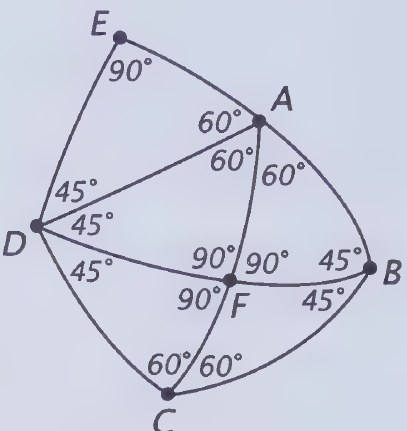
Diagram from page 280.
e16. ZABC =90°; ZBCD = 120°; ZCDA = 90°; ZDAB = 120°.
¢17. The quadrilateral is a parallelogram.
18. No. There are no parallelograms in sphere geometry, because there are no parallel lines.
¢19. Itis a rhombus.
20. They are perpendicular to each other and they bisect each other. (It is given that all of
the triangles are congruent.)
21. Yes.
22. ZE =90° £LEAF =120°; ZAFD = 90°; ZFDE = 90°.
*23. No.
24. Yes.
Set II (pages 715-717)
The ladder-rung exercises demonstrate that, in Lobachevskian geometry, two parallel lines are not everywhere equidistant. The earliest known attempt to prove Euclid’s Fifth Postulate was made by Posidonius in the first century s.c.. Posidonius did it by changing Euclid’s definition of parallel lines to say the two lines are parallel if
the distance between them is always the same. Concerning this idea, Saccheri wrote in Euclid Freed of Every Flaw: “Thence now | may proceed to explain, why in the Preface to the Reader | have said: not without a great sin against rigid
- logic two equidistant straight lines have been assumed by some as given. Where | should point out that none of those is carped at, whom | have mentioned even indirectly in this book of mine, because they are truly great geometers, and verily free from this sin. But | say: great sin against rigid logic: for what else is it to assume as given two equidistant straight lines: unless either to assume; that every line equidistant in the same plane from a certain supposed straight line is itself also a straight line; or at least to suppose, that some one thus equidistant may be a straight line, as if therefore it were allowable to make assumption, whether by hypothesis, or by postulate, of any such distance of one from another? But it is certain neither of these can be made traffic of as if per se known.”
It is probably no surprise that the Pythagorean Theorem does not hold in the non-Euclidean geometries, because geometric squares do not even exist in them. In terms of the lengths of the legs a and b and hypotenuse cof a right triangle, in Lobachevskian geometry, c* > a* + b% and in Riemannian geometry, ¢ < 3> + b2
Maurits Escher created four Circle Limit prints based on Poincaré’s model of Lobachevskian geometry, one of which, the picture of angels and devils, appears in Chapter 12, Lesson 5. The geometer H. S. M. Coxeter had sent Escher a drawing of the Poincaré model in 1958 and Escher replied: “Since a long time | am interested in patterns with ‘motives’ getting smaller and smaller till they reach the limit of infinite smallness.” Coxeter tells of this in The Mathematical Gardner, edited by David A. Klarner (Prindle, Weber & Schmidt, 1981), and describes the model: “the ‘straight lines’ of the [Lobachevskian] plane appear as arcs of circles orthogonal to a boundary circle drawn in the Euclidean plane. Angles are represented faithfully but distances are distorted, with the points of [the boundary circle] being infinitely far away. Although the [fish] get ‘smaller gradually from the center towards the outside circle-limit’, we enter the spirit of [Lobachevskian] geometry when we stretch our imagination in order to pretend that these [fish] areall … congruent.”
Lobachevsky’s Ladder. 25.
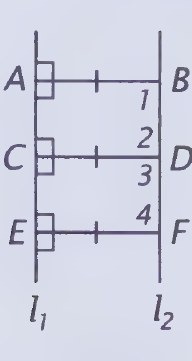
Diagram from page 281.
I l,
©26. Saccheri quadrilaterals.
©27. Acute.
28. £2+ /3 <180°.
29. The angles in a linear pair are supplementary.
30. It proves that they cannot all be of equal lengths.
Pythagoras Meets Lobachevsky.
31. The Pythagorean Theorem.
©32. Substitution.
33. (%CA)’- + (%CB)2 =MN?2, and so 1
1 4CA + 4CB MN?; so ZCA2+ —CB2= 2
i(CA2 + CB?) = MN2. If CA2 + CB2 = AB?,
1 ZAB2 = MN? by substitution; so
1 EAB =MN.
#34. A midsegment of a triangle is less than half as long as the third side.
35. The Pythagorean Theorem is not true in Lobachevskian geometry.
Lobachevsky Meets Escher.
36. Two circles are orthogonal iff they intersect in two points and their tangents at the points of intersection are perpendicular to each other.
#37. Two points determine a line.
38. Through a point not on a line, there is more than one parallel to the line.
39. The summit angles of a Saccheri quadrilateral are acute (or, the summit of a Saccheri quadrilateral is longer than its base).
#40. The sum of the angles of a triangle is less than 180°.
41. A midsegment of a triangle is less than half as long as the third side.
The Geometry of the Universe.
42. ltis finite. The volume of the space of the universe would be comparable to the area of the surface of a sphere, which is finite.
43. The astronaut would eventually return to the point from which he or she started. A straight line in space would be comparable to a line on the surface of a sphere, which is a great circle.
Set I (pages 718-722) German Terms.
1. Radius.
2. A diameter is a chord of a circle that contains its center.
3. Asecantis a line that intersects a circle in two points; a tangent is a line that intersects a circle in exactly one point.
Regular Polygons.
4. Aregular hexagon and a regular dodecagon.
5. They are convex, equilateral, equiangular, and cyclic.
6. 60° and 120°.
7. (Isosceles) trapezoids.
8. 720°. [Each angle has a measure of 2(60°) = 120°; 6(120°) = 720°.]
9. 1,800°. [Each angle has a measure of 60° + 90° = 150°; 12(150°) = 1,800°.]
What Follows?
10. Its base and altitude.
11. Is perpendicular to the chord.
12. Lies in the plane.
13. The triangle is a right triangle.
14. Have equal areas.
15. Are equal.
16. Tangent to the circle.
17. Aline.
18. V3.
19. In the same ratio.
20. The hypotenuse and its projection on the hypotenuse.
21. The area of its base and its altitude.
22. The ratio of any pair of corresponding sides.
23. Is-1.
24. Half the positive difference of its intercepted arcs.
Pythagorean Squares.
25. w+x+y.
26. The two areas are equal. Because the squares are from the sides of a right triangle, @+w) +(y+2)=(w+x+y);sov+z=x by subtraction.
The Value of Pi.
27. AABCis aright triangle. ZACB is a right angle because it is inscribed in semicircle.
28. A—Cg = % (The altitude to the hypotenuse
of a right triangle is the geometric mean between the segments into which it divides the hypotenuse.)
2 CD
29. CD = 410 =3.16. (—= = —, CD?=10, o (CD 5
CD =410
30. No. V10 >mnbecause m=3.14. Euclid in Color.
31. The opposite angles of a cyclic quadrilateral are supplementary.
32. Inscribed angles that intercept the same arc are equal.
33. The sum of the angles of a triangle is 180°.
34. Two right angles, or 180°.
Largest Package.
35. 15,000 in3. (10 x 20 x 75.)
36. No. The length of its longest side is 75 in and the distance around its thickest part is 2(10 + 20) = 60 in; 75+ 60=135>130in.
37. 26in. (e + 4¢ =130, 5e = 130, e = 26.)
38. 17,576 in%. (26°.) Four Centers.
39. The orthocenter.
40. The incenter.
41. The centroid.
42. The circumcenter.
43. B (the incenter).
44. D (the circumcenter).
45. C (the centroid).
46. B (the incenter). Formulas.
47. To find the circumference of a circle (using its diameter).
48. To find the length of a diagonal of a rectangular solid (using its length, width, and height).
49. To find the area of a trapezoid (using its altitude and two bases).
50. To find the altitude of an equilateral triangle (using its side).
Kindergarten Toy.
51. A, a cube; B, a cylinder; and C, a sphere.
52. V=¢3, A=6e%
53. V=mr2h, A=2mrh +2mr2 [or A =2nr(h +1)].
54, V= gms,A=4m2.
Steep Roof. ESTOA = L= C o 12-0 12 4 mAB= 20 _ A _ 7 45 _
2-24 -12 4
56. 60°. (tan ZAOB = % —1.75; ZAOB = 60.3°.)
57. 24 ft.
(OA = AB = V122+21% = +/585 =242
58. No. (It is not equilateral, because OB is slightly longer than the other two sides or, equivalently, because ZAOB is not 60°.)
Greek Crosses.
59. 12x.
60. 5x2
61. 10x2.
62. x10.
63. 4x/10. Baseball in Orbit.
64. About 138 mi. [c = 2rr = 2n(22) = 44n =~ 138]
65. About 83 minutes. (& = 100 mi / hour
1.38 hours =~ 82.8 minutes.)
Two Quadrilaterals.
66. 2w + 2x + 2y + 2z = 360° (the sum of the angles of a quadrilateral is 360°); so 2(w + x + y + z) = 360° and w + x +y + z = 180° (division).
67. In AAFD, £F + w + z = 180° and, in ABHC, ZH + x + y = 180° (the sum of the angles of a triangle is 180°); so £F = 180° - w - z and £H =180° - x - y (subtraction).
68. LF + ZH = (180° - w—z) + (180° —x —) = 360°-w-x—-y-z=360°—(w+x+y+2) (addition); so £F + ZH = 360° - 180° = 180° (substitution).
69. ZF and ZH are supplementary (if the sum of two angles is 180°, they are supplementary); so quadrilateral EFGH is cyclic (a quadrilateral is cyclic if a pair of its opposite angles are supplementary).
Long Shadows.
70. Approximately 5,500 ft.
(tan 1280 = 220, _ 1,250 x tan12.8°
=5,500.)
71. Approximately 26 ft. (tan 12.8° = E, Y
y= ta_ni’Z_.B—“- ~26.4; or ;’éfig = 5, etc.) Tree Geometry.
72. k.
73. k2. 74, 1.
75. k.
76. Those of the larger tree would be 102 = 100 times the area of those of the smaller tree.
77. Those of the larger tree would be 103 = 1,000 times the weight of those of the smaller tree.
78. The larger tree. SAT Problem.
79. 3ms units. [2(%27!5.]
80. gnfi + 52 [or (%n + 1)s?] square units.
[2( %rrsz) +s2= %nsz +s2]
Sight Line. 81, About 23°. (tan £1 = —, £1=23°) ) 210
70
82. About18°. (tan £2= - ) o =1, =18,
Set I| (pages 723-727) Dog Crates.
83. 19in. (V = lwh, w - e ) i - e =19.
84. No. They are not similar, because their corresponding dimensions are not
30 - 22 tional: — = —. proportion: % * 2%
(2 _083and 2 ~0.85) % 2%
85. 51,364 in3. V= (%)3(12,540) — 51,363.84] Tangent Circles.
——-— =1 (or any equivalent equation) by Ceva’s Theorem.
87. Yes. If the radius of the three circles is 7,
————— =1, rror
88. Yes. Letting the radii of the three circles be nn 7y Ty and 7, we have L.2.3 —q 172 ¥ P
Squares on the Legs.
89. The altitude to the hypotenuse of a right triangle forms two triangles similar to it and to each other (or AA).
90. The ratio of the areas of two similar
polygons is equal to the square of the ratio of the corresponding sides.
91. They are equal because ®ABEF = AB? and oBCHG =BC2
92. Yes. DAFEB ~ DBGHC. (Their corresponding angles are equal and their corresponding sides are proportional.)
Formula Confusion.
93. (Student answer.) [Because c = 2nr, the formula A = %rc is equivalent to A = r(2rr) = rv2, which gives the area of the circle correctly.]
94. No. Because A = 4mr?, the formula V = %rA is equivalent to V = —;-r(4nr2) =2nr3, but the
volume of a sphere is %mfi
95. Yes. Because A = 2rvh, the formula V = %rA is equivalent to V = %r(anh) = mr?h, which gives the volume of the cylinder correctly.
Regular 17-gon.
180 (17 sin = )
96. 3.12. (17 sin—-.
180 180
97. 3.07. (17 sin 7 cos 7 )
98. 62 cm. [p=2Nr=2(3.12)(10) = 62.]
99. 307 cm?. [A = Mr?=3.07(100) = 307.]
100. The corresponding measurements of the circle would be larger.
101. 63 cm and 314 cm2. [c = 2nr = 2n(10) = 207 = 63. A=mr2=n(10)2 = 100m =~ 314.]
Packing Circles.
3
102. 372 [73(2r)2= 1/51’2.]
2 2
103. S [3(rd) = S ] 1
104. About 91%. (ZT“ =T
=0.91.)
3r2 243
Rain Gutter. 105.
543
607 E5B
e 10 c5F
————
106. AAEB and ADFC are 30°-60° right triangles; AAEB = ADFC (AAS).
107. In a plane, two lines perpendicular to a third line are parallel.
108. Corresponding parts of congruent triangles are equal.
109. ADFEis a parallelogram because AE || DF and AE = DF (a quadrilateral is a parallelogram if two opposite sides are both parallel and equal); so AD || EF (the opposite sides of a parallelogram are parallel).
110. 53 =8.66 cm. (AABE is a 30°-60° right
triangle with hypotenuse AB = 10; so EB = 5 and AE= 513.)
111. 130 cm?. (ABCD is a trapezoid with BC = 10, AD =20, and AE = 5y3; so
®ABCD = % 53 (10 + 20) = 7543 =130.)
Incircle.
112. The angle bisectors of a triangle are concurrent.
113. The incenter.
114. The tangent segments to a circle from an external point are equal.
115. If a line is tangent to a circle, it is perpendicular to the radius drawn to the point of contact.
116. In a plane, two lines perpendicular to a third line are parallel to each other.
117. ODCE is a parallelogram because both pairs of its opposite sides are parallel. OD = EC and OE = DC because the opposite sides of a parallelogram are equal.
118. AB =29. (AABC is a right triangle, and so AB? = CA2 + CB? =202 + 212 = 400 + 441 = 841; so AB = V841 =29.)
119. 20 -r. [ODCEis also a square; so CD =r. AD = AF (the tangent segments to a circle from an external point are equal) and AD=AC-CD=20-r]
120. 21-r.
121. AB=AF +FB;5029=(20-7) + (21 -7), 29=41-2r,2r=12,r=6.
Angles and Sides.
122. By the Law of Cosines.
123. cosC= % (c2=a2+b?-2ab cos C, 2=c2+c2-2c2cos C,2c2cosC=c?, 2cosC=1,cos C= -;‘.)
124. ZC=60°.
125. Yes. If a=b =c, AABC is equilateral; so each of its angles has a measure of 60°.
126. cos C=0. (c2=a?+b2-2ab cos C, ¢2=c2~2ab cos C, 2ab cos C=0, cos C=0.)
127. £C=90°.
128. Yes. If ¢ =a? + b, AABC is a right triangle with hypotenuse ¢, and so £C = 90°.
Circular Track.
129.
B
A
130. If aline is tangent to a circle, it is perpendicular to the radius drawn to the point of contact.
131. If aline through the center of a circle is perpendicular to a chord, it also bisects the chord.
132. AACO s a right triangle; so AQ?2=AC? + CO? R?=1002 + 12, and so R? - 72 =10,000.
133, 31,416 m2. [Ayq =TR? 102 =m(R2 - 12) = 10,000m = 31,416.]
da Vinci Problem.
134, %n. (%nl?)
1,1 . = (=12 135 2 (2 )
11 136, 1no L. “2
1.1
137. 2n—4. [8(1”_5)‘]
138. 2m. [In isosceles right AOPF, PF =1; so OF = 2; n(+2)? = 2n]
139. 4. [2n—(2n—4).]
1 T
140. 1. (—4.
A Problem from Ancient India.
141. 10 units. (FB = HA + AB.
FB = 6% +(12-x)*, HA=6,and AB = x. V36+(144-24x+x%) =6 +x,
180 — 24x + x? = 36 + 12x + x2, 144 =36x,x=4. FB=6+4=10.)
Circumradius.
142. Every triangle is cyclic.
143. If a line through the center of a circle is perpendicular to a chord, it also bisects the chord.
144. ABOH = ACOH (HL); so ZBOH = ZCOH; so ray OH bisects ZBOC; so ZBOH = %ABOC.
145. A central angle is equal in measure to its intercepted arc.
146. Aninscribed angle is equal in measure to half its intercepted arc.
147. /BOH = %ABOC = %mBE: ZA.
148. The sine of an acute angle in a right triangle is equal to the ratio of the opposite leg to the hypotenuse.
a
149. sin #BOH = 2 and ZBOH = ZA; so r a
sin A= -2—,rsinA= %,a=2rsinA, 7
= 27, sin A ”
150. By the Law of Sines.
151. 3cm. (—— = s
& 2 _216=2rr=3) sinA sin 30°
152. Example figure:
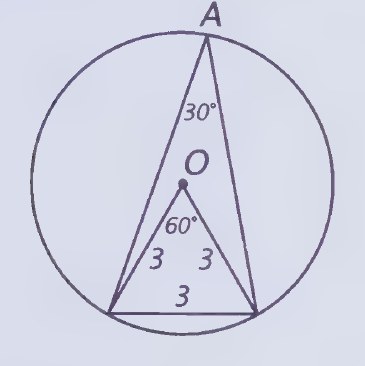
Diagram from page 287.
Conical Mountain. AF FC
153. 70 m. (AAFC ~ AAGE by AA; 50 —— = —=, R Y ARS8 4 S T GE X _ 35 g5y-35x+3500,and so x+100 85
50x = 3,500, x = 70.)
154, 1,286,220 m?. V= %Bh . %n(85)2(170) ~1,286,220.]
155. 89,797 m3. [V = %Bh = %11(35)2(70) ~89,797.] 14
156. 89,797 m [V = —- 3735 = 89,797.]
157. 1,100,000 m®. (1,286,220 - 89,797 - 89,797 = 1,106,626.)