p. 617
Chapter 15: Geometric Solids
So far, our study of geometry has been mostly limited to two-dimensional figures such as polygons and circles. In this chapter, we consider some familiar three-dimensional figures, the sets of geometric solids known as prisms, pyramids, cylinders, cones, and spheres. You will become familiar with how to recognize and draw these figures and will learn from where the formulas for their surface areas and volumes come. The chapter ends with the topics of similar solids and the regular polyhedra.
p. 618
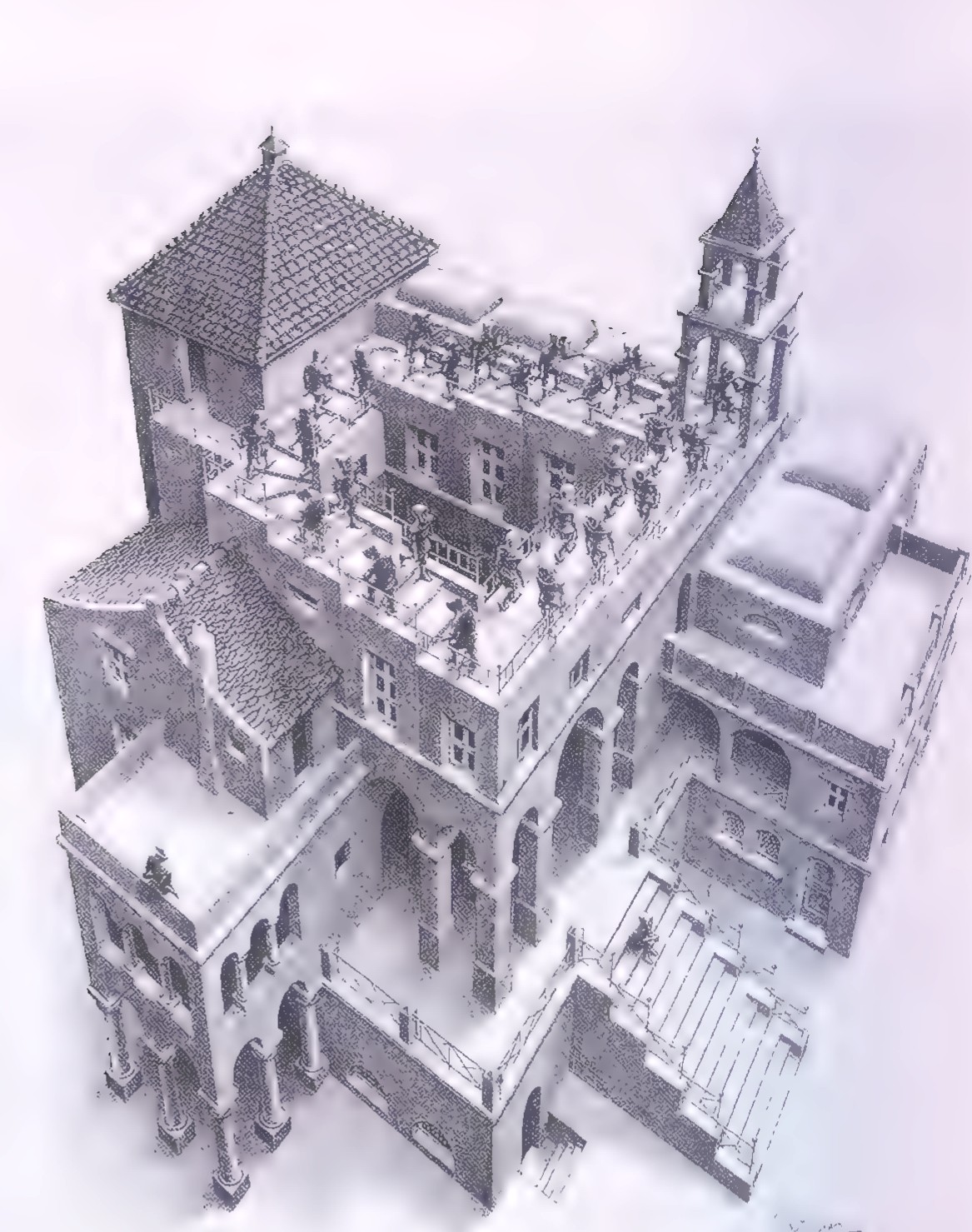
M. C. Escher’s “Ascending and Descending” © 2002 Cordon Art B. V.–Baarn-Holland. All rights reserved.
Lesson 1: Lines and Planes in Space
In creating a picture, an artist depicts our three-dimensional world on a two-dimensional surface. A technique called perspective is used to represent space on a single plane. Some artists, including Maurits Escher, play tricks with perspective. An example is the staircase on the roof of the building in the picture above by Escher titled Ascending and Descending. The trick is that the people walking in one direction are always ascending, whereas those walking in the other direction are always descending!
Escher’s picture depends on special line and plane relations in space and on the way that we see them. In this lesson, we will look at some of these relations.
At the beginning of our study of geometry, we made two assumptions about points, lines, and planes:
Postulate 1. Two points determine a line.
Postulate 2. Three noncollinear points determine a plane.
p. 619
To this list, we now add two more assumptions.
Postulate 11
If two points lie in a plane, the line that contains them lies in the plane.
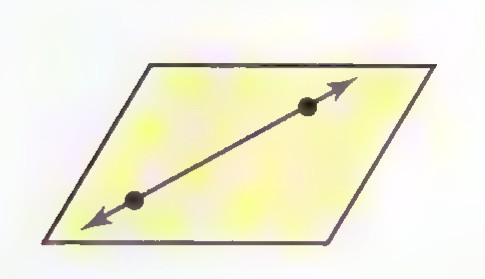
This postulate expresses the fact that, if you mark two points on a flat sheet of paper and draw a straight line through them, the line also is on the paper.
Postulate 12
If two planes intersect, they intersect in a line.
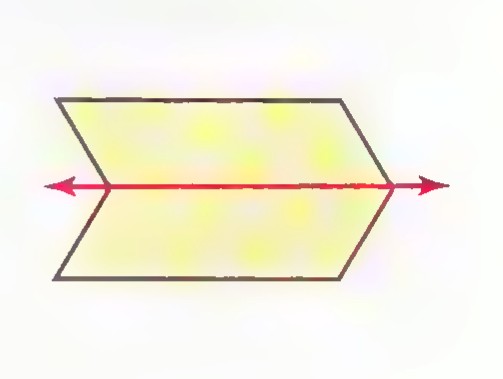
This postulate expresses the fact that, if you fold a sheet of paper into two parts (two planes), the planes meet along the crease in the paper (a line).
Escher’s picture is filled with lines and planes that are parallel or perpendicular. In plane geometry, two lines either intersect or are parallel. In the geometry of three-dimensional space, there is a third possibility. Two lines can be skew.
In the detail from Escher’s picture at the right, the line labeled l contains the peak of the roof, and line m contains one of its lower edges. These lines neither intersect nor are parallel; they are skew.
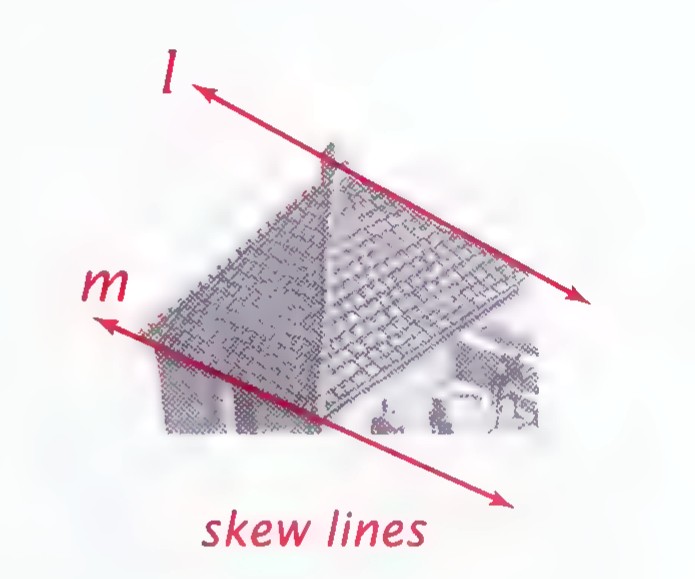
Definition
Two lines are skew iff they are not parallel and do not intersect.
For two planes in space, or a line and a plane, the word “parallel” simply means “nonintersecting.” Like any two parallel lines, two parallel planes are separated by a constant perpendicular distance.
Definitions
Two planes, or a line and a plane, are parallel iff they do not intersect.
In the detail of Escher’s picture at the right, plane R is parallel to the plane of the ground, P; line n also is parallel to plane P.
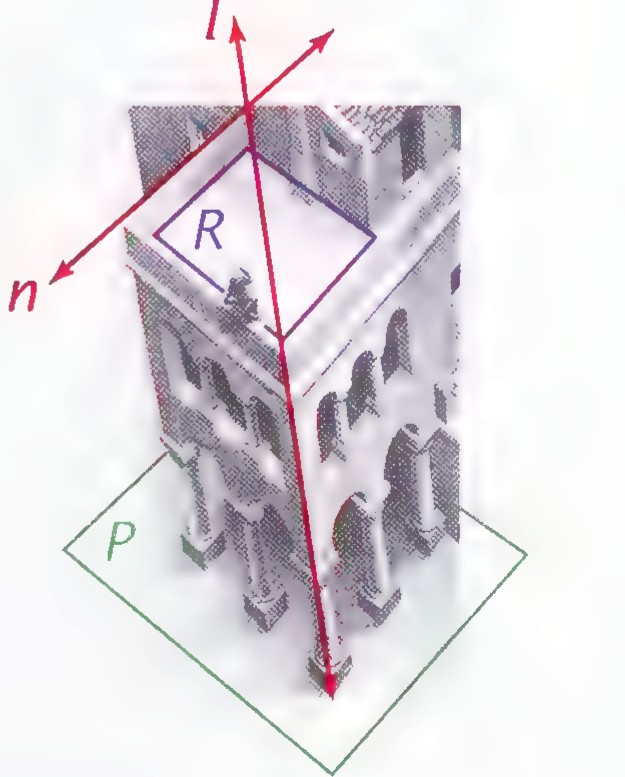
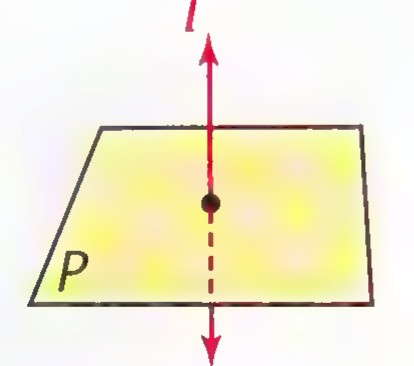
In the same picture, line l is perpendicular to plane P. It is tempting to say that a line is perpendicular to a plane if they form right angles, but where are the right angles in the figure above?
p. 620
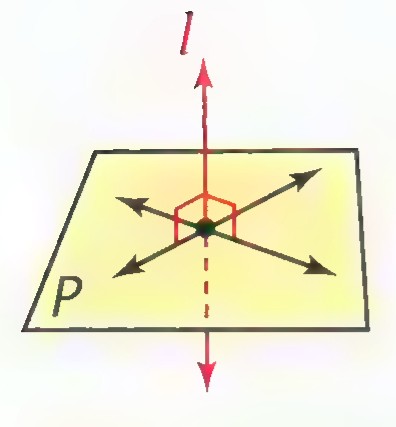
The figure at the left shows that right angles exist when we look at lines in the plane that pass through the point of intersection. We can base our definition on this fact.
Definition
A line and a plane are perpendicular iff they intersect and the line is perpendicular to every line in the plane that passes through the point of intersection.
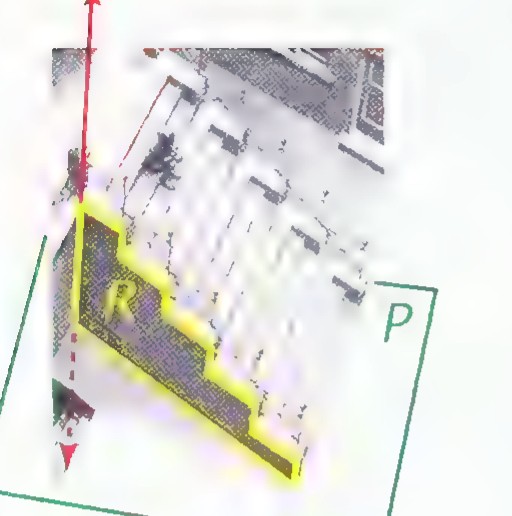
Finally, the detail at the left from Escher’s picture illustrates two planes that are perpendicular. If there is a line, such as l, in plane R that is perpendicular to plane P, then plane R is perpendicular to plane P.
Definition
Two planes are perpendicular iff one plane contains a line that is perpendicular to the other plane.
In the geometry of space, a line and a plane (or two planes) that are neither parallel nor perpendicular are said to be oblique.
Exercises
Set I
Visual Planes. Each of the figures below gives the impression of a plane in space.*
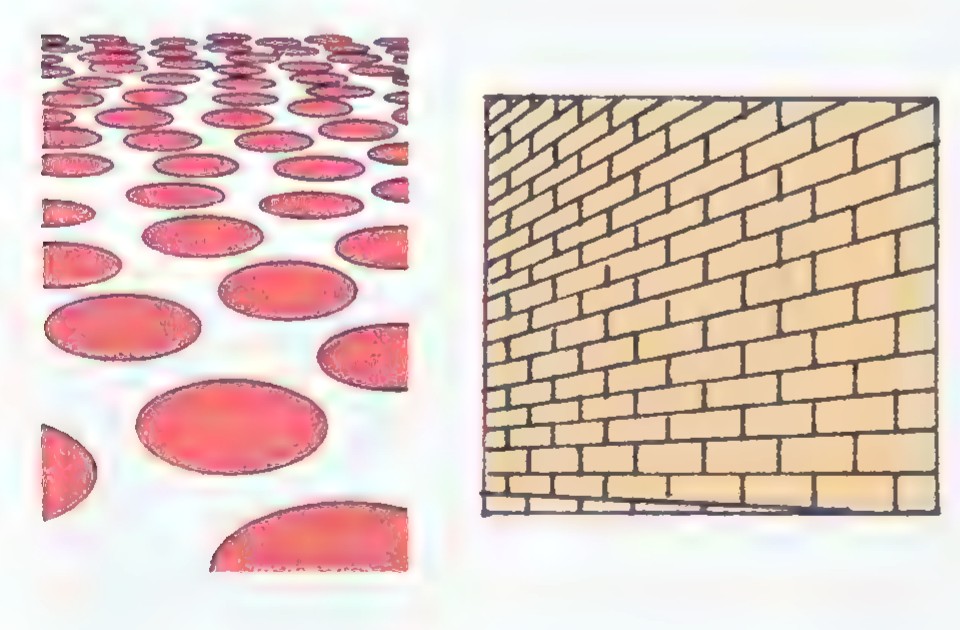
- Which figure seems to illustrate a vertical plane?
- Which part of this plane appears to be closest?
- In interpreting the figure in this way, what shape are you assuming the quadrilaterals to be?
- What type of plane does the other figure seem to illustrate?
- Which part of it appears to be closest?
- In interpreting the figure in this way, what shape are you assuming the curves to be?
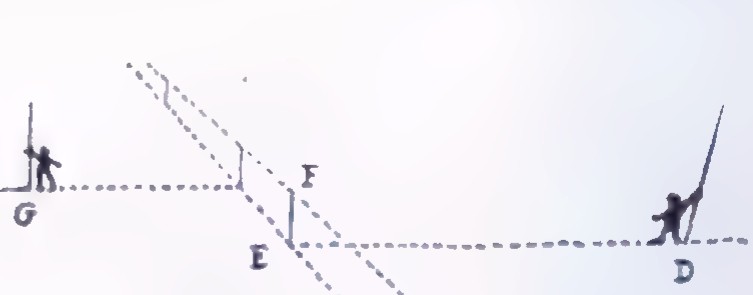
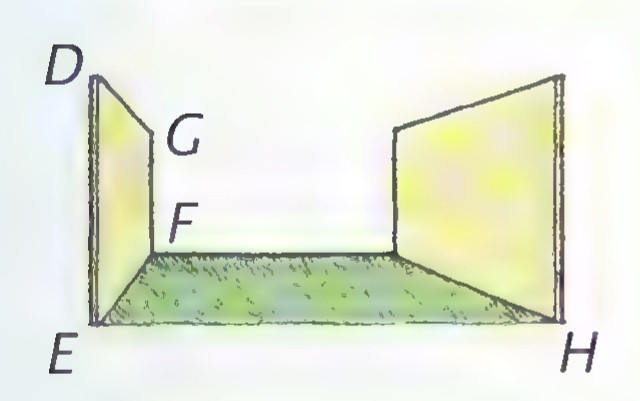
Pole People. The figure below is from a book on perspective published in Paris in 1642. The artist drew the two people holding the poles to help suggest that the scene is three-dimensional.
* Intelligence: The Eye, the Brain, and the Computer, by Martin A. Fischler and Oscar Firschein (Addison-Wesley, 1987).
p. 621
- What relation does the line of the pole at D appear to have to the ground?
- What kind of plane, horizontal or vertical, seems to contain both of the dotted lines through E and F?
- What do the dotted lines seem to indicate about EF and the two vertical segments at the upper left of EF?
- What might be assumed about those dotted lines if EF and the two vertical segments at the upper left of it were not included in the figure?
Posts and Walls. The figures below are from a chapter on form and space in a book on architecture.*
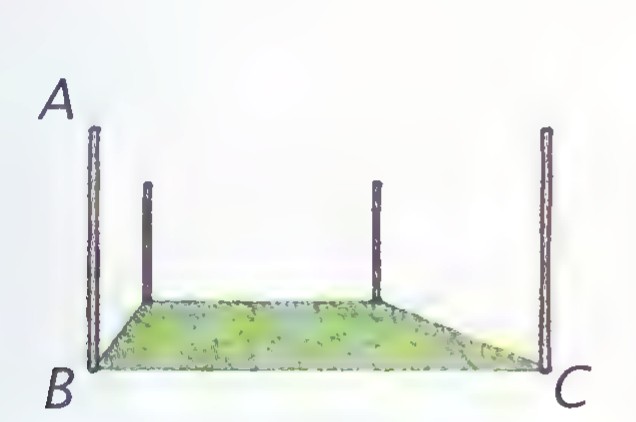
- Can you conclude that the post labeled AB in the upper figure is perpendicular to the “floor” if it is perpendicular to line BC? Use the definition of a line perpendicular to a plane to explain why or why not.
- Can you conclude that the plane of the wall labeled DEFG in the lower figure is perpendicular to the “floor” if it is perpendicular to line EH? Use the definition of perpendicular planes to explain why or why not.
* Architecture: Form, Space, and Order, by Francis D. K. Ching (Wiley, 1996).
3-D Shading. The figure below was created by psychologist Ted Adelson.†
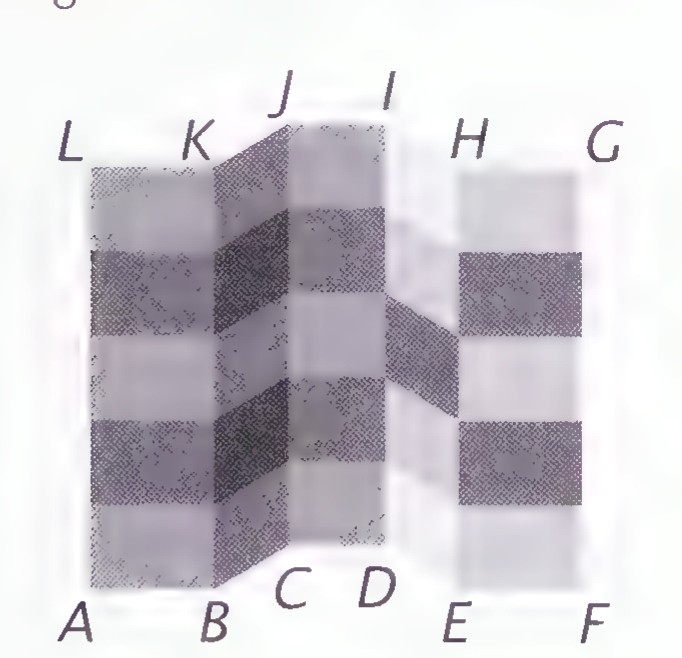
Each of its 25 regions is bounded by a quadrilateral. What kind of quadrilateral do they seem to be if the figure is viewed
- as flat?
- as three-dimensional?
If you view the figure as three-dimensional,
- which part appears as if it might lie in the same plane as ABKL?
- which part appears as if it might lie in a plane parallel to the plane of ABKL?
- which two parts might lie in perpendicular planes?
- there is something strange about the position of CDIJ with respect to the rest of the figure. Can you tell what it is?
Compare the grays in the two rectangles in the figure above, which correspond to the rectangles labeled 1 and 2 in the figure below.
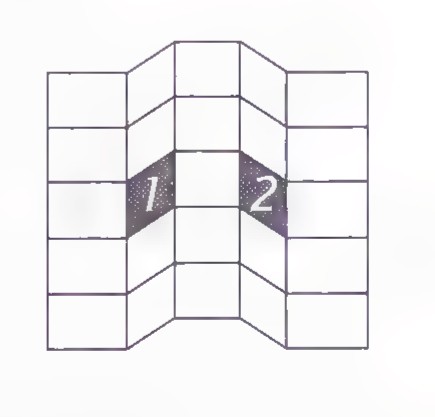
- Which one looks darker?
- Is it actually darker?
† Visual Intelligence: How We Create What We See, by Donald D. Hoffman (Norton, 1998).
p. 622
Polarized Light. The figure below shows the electric and magnetic fields in a wave of polarized light.*
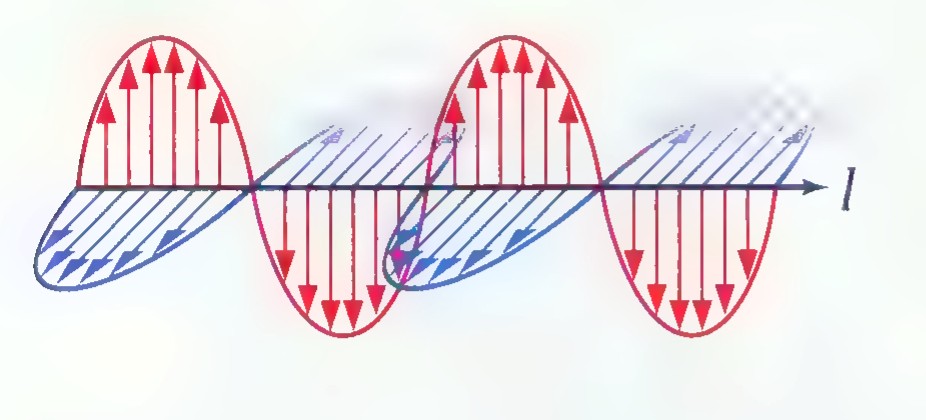
The two fields lie in different planes.
- What relation do the two planes have to line l?
- What relation do the two planes appear to have to each other?
- By definition, what must hold for this relation to be true?
Kilroy in Space. The figure below represents three planes in space.†
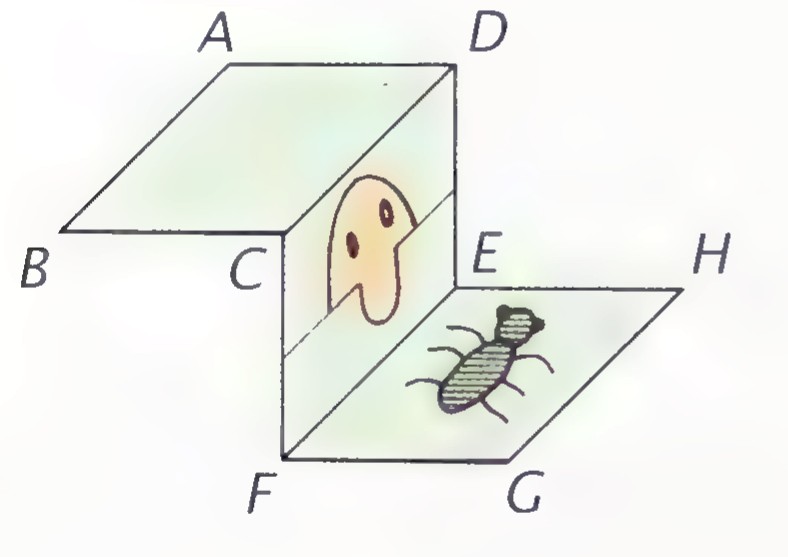
- If plane ABCD is parallel to plane EFGH, what relation does line CD have to line FE?
- If plane ABCD is parallel to plane EFGH and line CF is perpendicular to plane ABCD, what relation does CF have to plane EFGH?
* Lasers: Harnessing the Atom’s Light, by James P. Harbison and Robert E. Nahory (Scientific American Library, 1998).
† “Illusions of the Third Dimension,” by Martin Gardner, Psychology Today (August 1983), reprinted in Gardner’s Whys and Wherefores (University of Chicago Press, 1989).
- If planes ABCD and EFGH are perpendicular to line DE, what relation do the planes have to each other?
Use your answers to exercises 24 through 26 to copy and complete the following statements.
- If a plane intersects two parallel planes, it intersects them in . . . ?
- If a line is perpendicular to one of two parallel planes, it . . . ?
- Two planes perpendicular to the same line are . . . ?
- Can Kilroy (the character looking over the wall) see the bug?
Set II
Triangles in Perspective. In the figure below, △ABC and △A’B’C’ are said to be “in perspective” because the lines through their corresponding vertices are concurrent in point P.
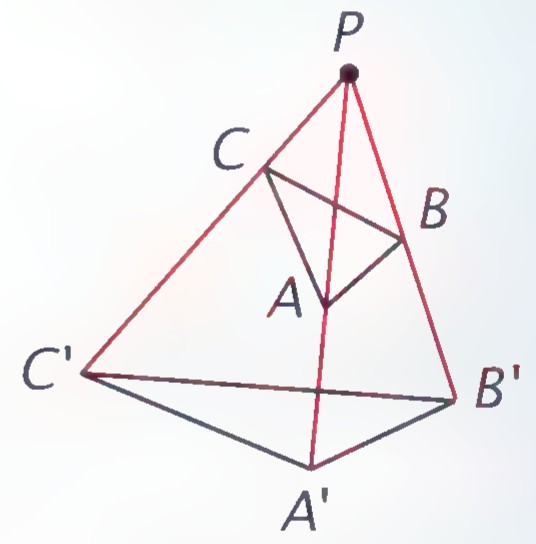
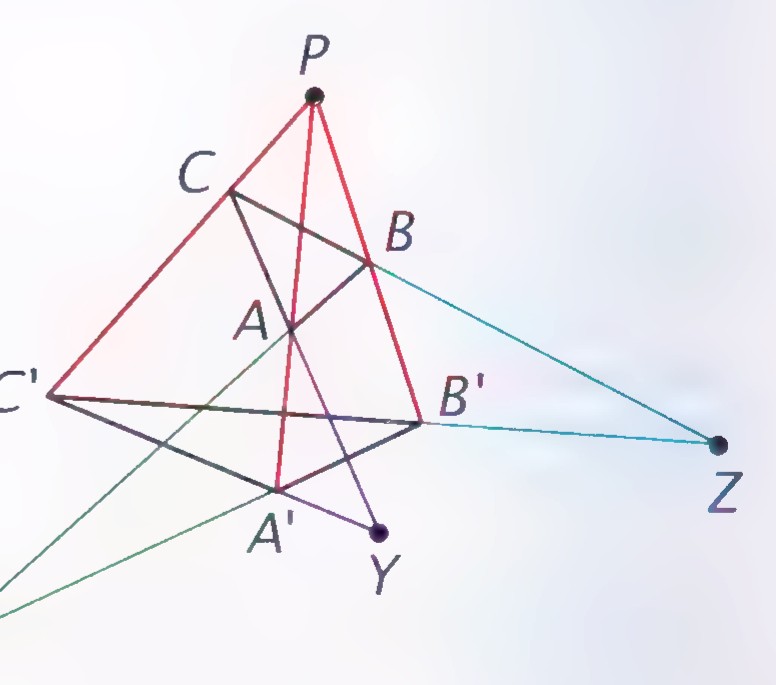
The pairs of lines containing their corresponding sides intersect in points X, Y, and Z.
p. 623
- What seems to be true about points X, Y, and Z?
If you think of the figure as being three-dimensional, then points A, B, and C determine a plane.
- Why?
It follows that the three lines containing these points also lie in the plane determined by the points.
- Why?
- What relation do points X, Y, and Z have to this plane?
If the figure is three-dimensional, then △ABC and △A’B’C’ appear to lie in different planes.
- What relation do points X, Y, and Z have to the plane determined by points A’, B’, and C’?
- If two planes in space intersect, in what do they intersect?
- What can you conclude about points X, Y, and Z?
Impossible Slice. This figure was designed by Japanese graphic artist Mitsumasa Anno.*
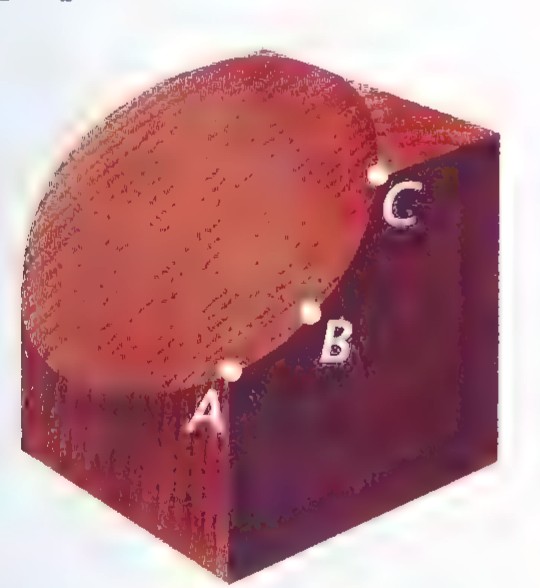
It appears to show a cube from which a piece has been cut off to produce a flat circular face.
- If this description were true, what fact about intersecting planes would it contradict?
* The Unique World of Mitsumasa Anno, translated by Samuel Crowell Morse (Philomel Books, 1980).
- What fact about noncollinear points such as A, B, and C does the figure contradict? Explain.
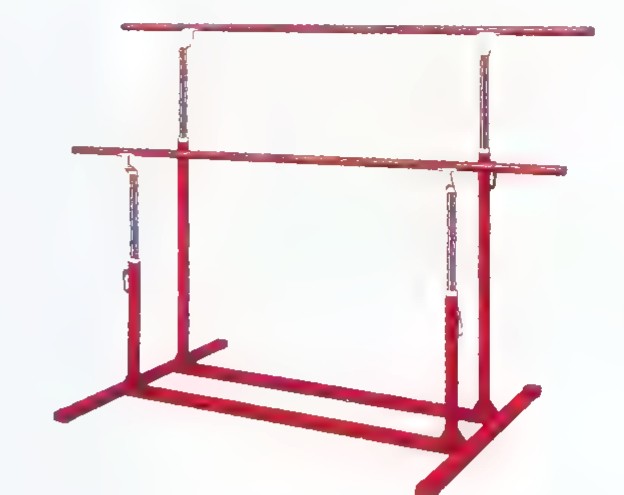
Uneven Bars. The uneven bars in women’s gymnastics are parallel to the floor—that is, horizontal.
- If two lines in space are horizontal, does it follow that they are parallel? Explain.
- If two lines are parallel, does it follow that they lie in the same plane? Explain.
The bars lie in parallel vertical planes that are 43 cm apart. The figure below is a view from one end.
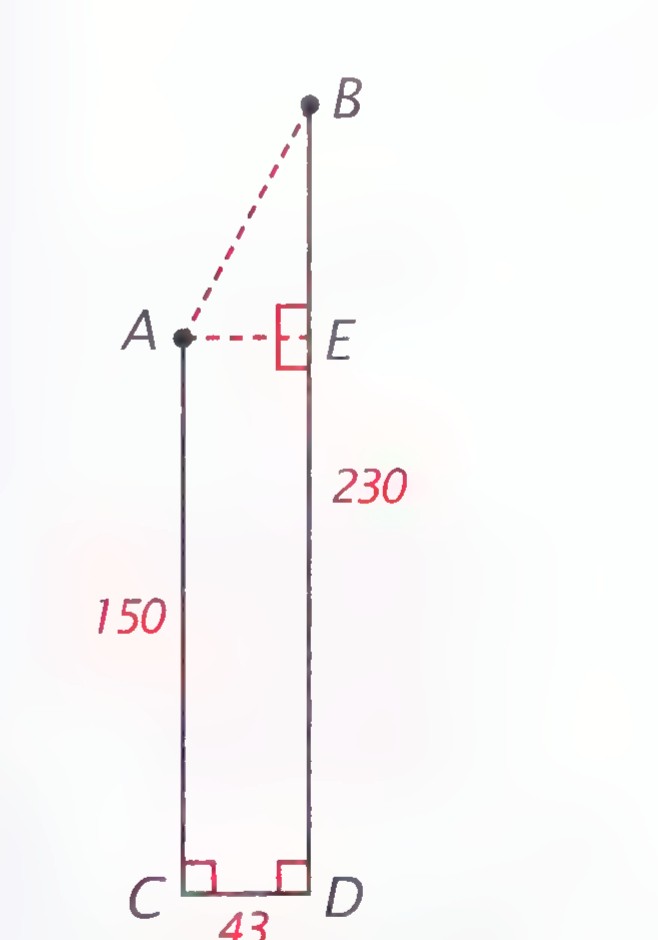
Side view
Given that the lower bar is 150 cm above the floor and the upper bar is 230 cm above the floor, find
- AB, the clearance between the bars.
- ∠BAE, the inclination of the plane of the parallel bars to the horizontal.
p. 624
Pyramid. In this figure of a pyramid, EF is perpendicular to the plane of its base, AC and BD intersect at F, and FA = FB = FC = FD.
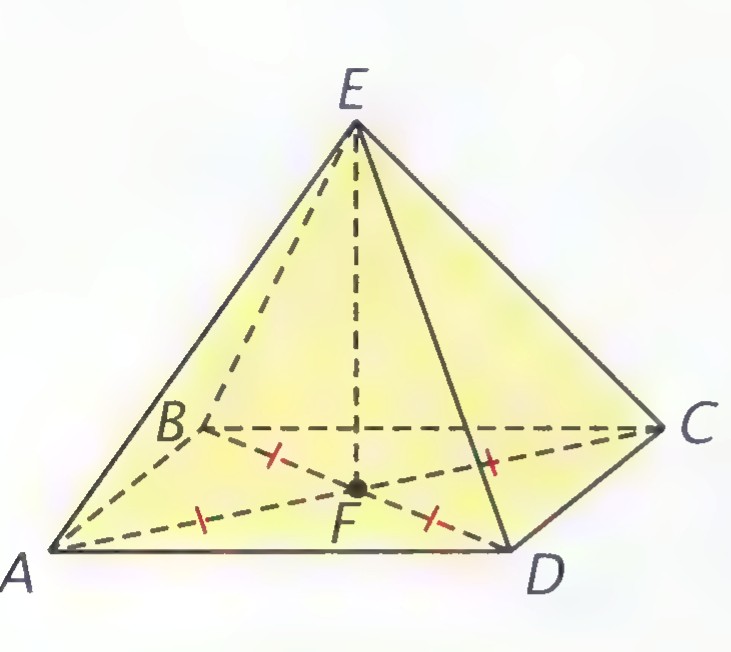
- EF ⊥ AC and EF ⊥ BD. Why?
- △EFA ≅ △EFB ≅ △EFC ≅ △EFD. Why?
- EA = EB = EC = ED. Why?
- ABCD is a parallelogram. Why?
- AB = DC and AD = BC. Why?
- △EAB ≅ △EDC and △EAD ≅ △EBC. Why?
- △FAB ≅ △FDC and △FAD ≅ △FBC. Why?
Lopsided Box. Although Obtuse Ollie built this open-topped box from five flat pieces of wood, it ended up being lopsided.
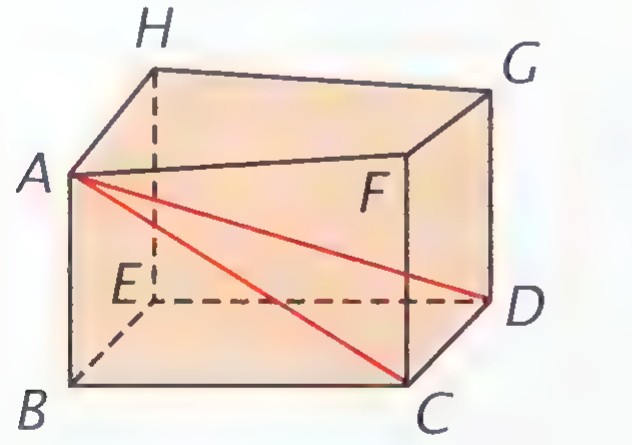
He did manage to make AB perpendicular to the bottom (BCDE) and CD perpendicular to the front (ABCF).
- Which faces of the box must be perpendicular to each other?
- Name the angles in the box that are definitely right angles.
- Is it possible to tell how AC and AD compare in length? Explain.
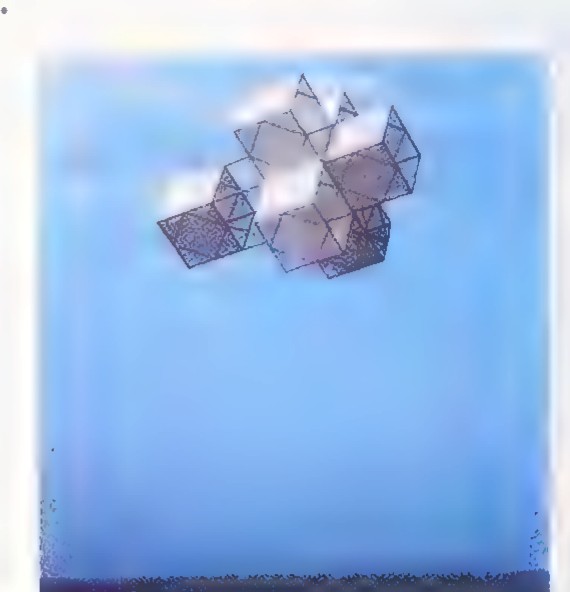
Cube and Hypercube. The photograph below shows a “hypercube” kite, designed by José Yturralde.*
The following figure shows one way to unfold and flatten out a three-dimensional cube into a two-dimensional pattern of polygons called a “net.”
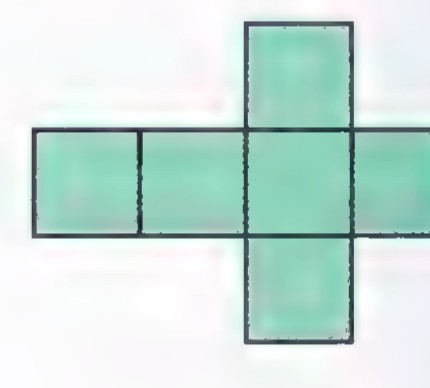
- How many square faces does a cube have?
- In how many lines do the edges of the faces of the unfolded cube lie?
The figure below shows one way to unfold a four-dimensional hypercube in three dimensions.
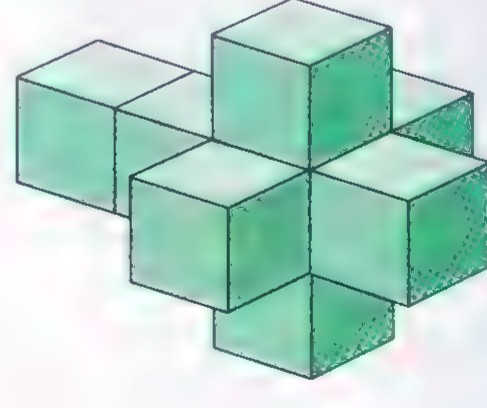
- How many cube faces does a hypercube have?
- In how many planes do the square faces of the cube faces of the unfolded hypercube lie?
* Beyond the Third Dimension: Geometry, Computer Graphics, and Higher Dimensions, by Thomas F. Banchoff (Scientific American Library, 1990).
p. 625
Set III
This picture by Escher, titled Belvedere, illustrates another impossible building. What do you see in the picture that appears to be impossible?
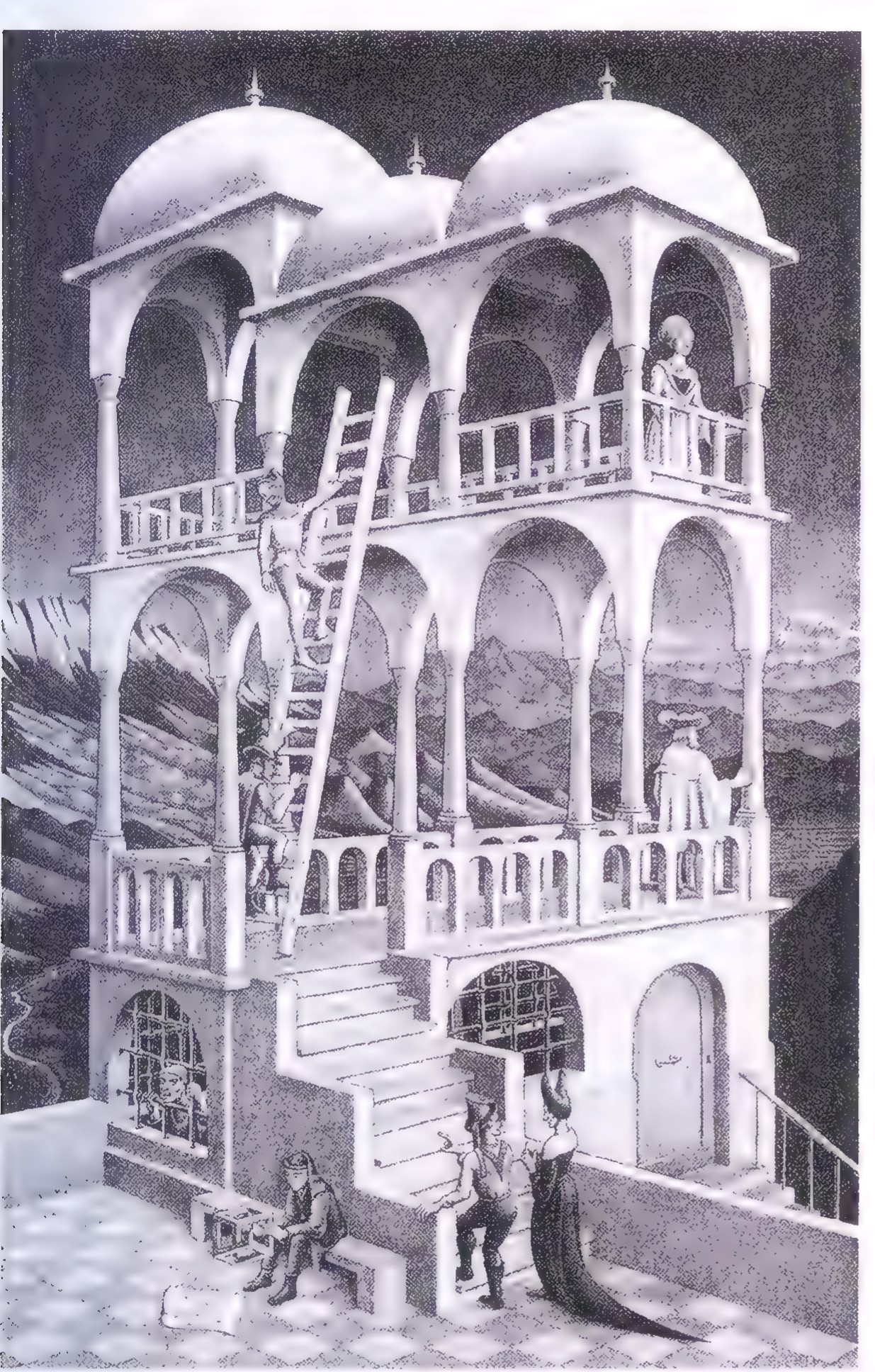
M. C. Escher’s “Belvedere” © 2002 Cordon Art B. V.–Baarn Holland. All rights reserved.
p. 626
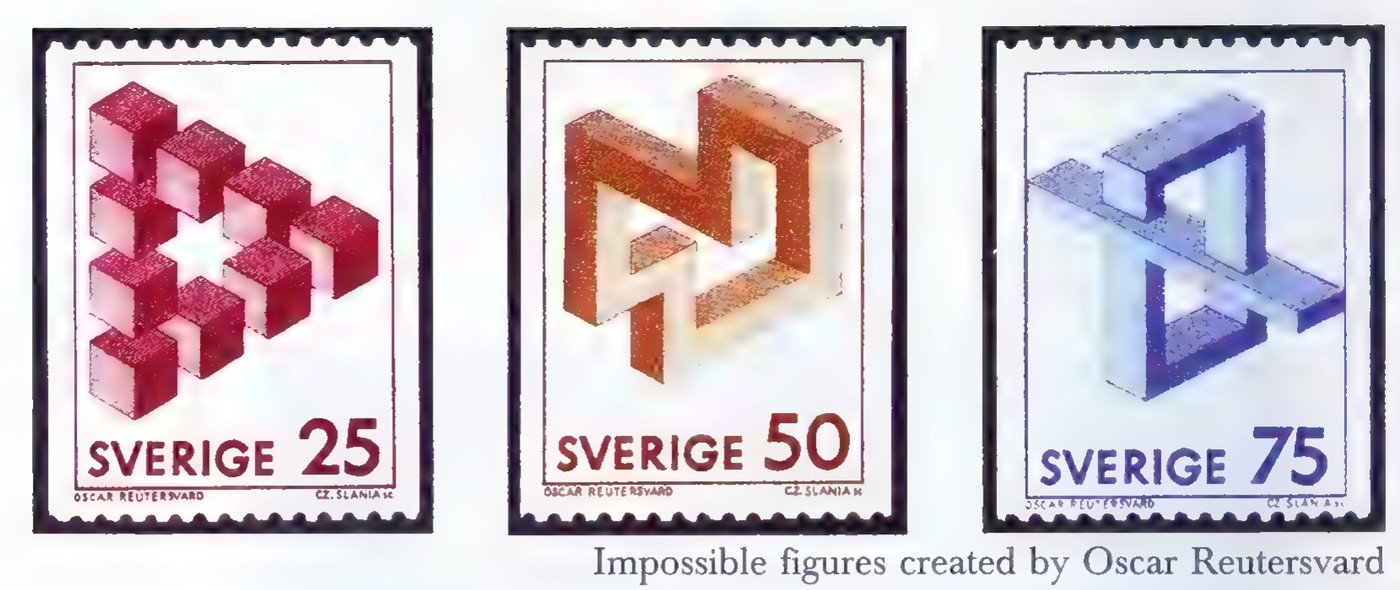
Impossible figures created by Oscar Reutersvard on stamps issued in Sweden in 1982.
Solid Geometry as a Deductive System
Years ago, students spent a full year learning plane geometry before taking a course in solid geometry. In the following lessons of this chapter, we will study in an informal way some of the basic topics included in that second course. Instead of continuing to define every term precisely as we did in the preceding lesson, we will take for granted the meanings of words in some of the definitions throughout the rest of this chapter. Furthermore, we will not attempt to prove every theorem but will merely use informal arguments to make the theorems seem reasonable. This approach will enable us to explore a wider variety of topics than would otherwise be possible.
As with the algebra reviewed earlier, you are already familiar with many ideas from solid geometry. Several examples beyond those of Lesson 1 are given on this page and the next.
Determining a Plane
One of the first assumptions in our logical development of geometry was
Postulate 2. Three noncollinear points determine a plane.
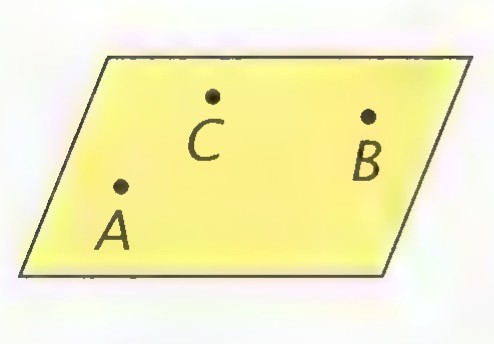
It is possible to prove that other configurations also determine a plane by means of this postulate and the two assumptions of the preceding lesson:
Postulate 11. If two points lie in a plane, the line that contains them lies in the plane.
Postulate 12. If two planes intersect, they intersect in a line.
p. 627
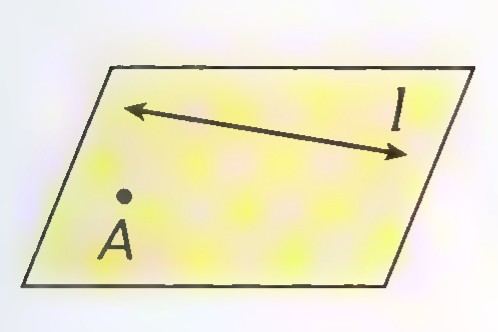
Theorem. A line and a point not on the line determine a plane.
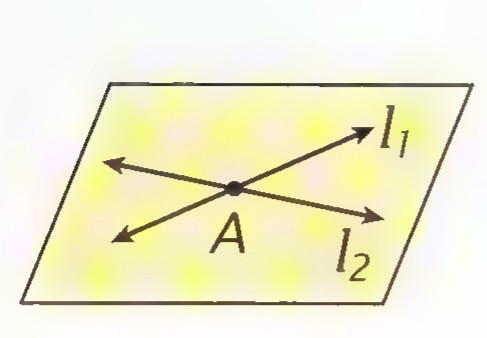
Theorem. Two intersecting lines determine a plane.
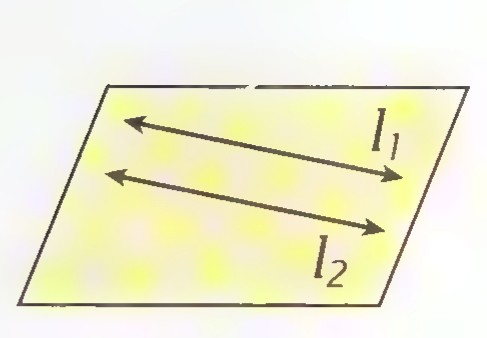
Theorem. Two parallel lines determine a plane.
In our definition of a line and a plane that are perpendicular, we said that they intersect and that the line is perpendicular to every line in the plane that passes through the point of intersection. From this definition, the following theorem can be proved.
Theorem. A line and a plane are perpendicular if they intersect and the line is perpendicular to two lines in the plane that pass through the point of intersection.
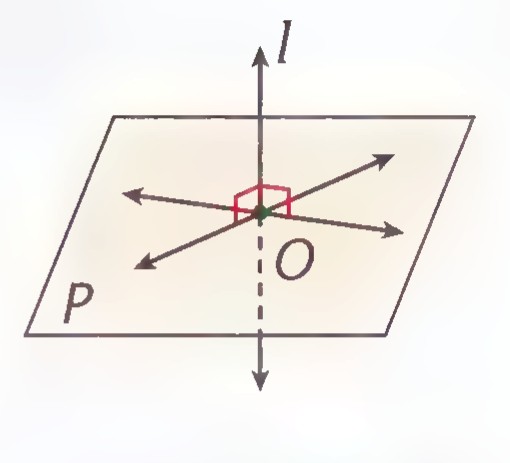
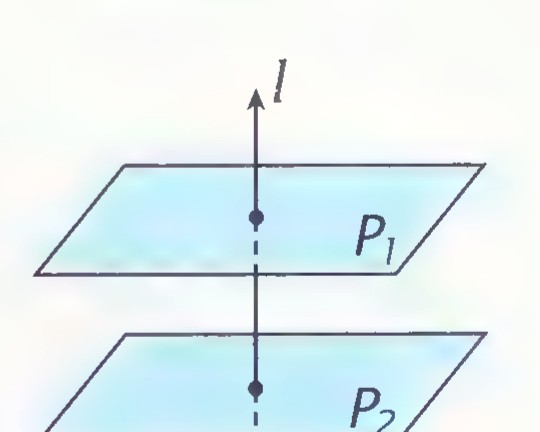
More examples of statements that can be proved in solid geometry are stated below and illustrated at the right.
Theorem. If three lines are perpendicular to a line at the same point, the three lines are coplanar.
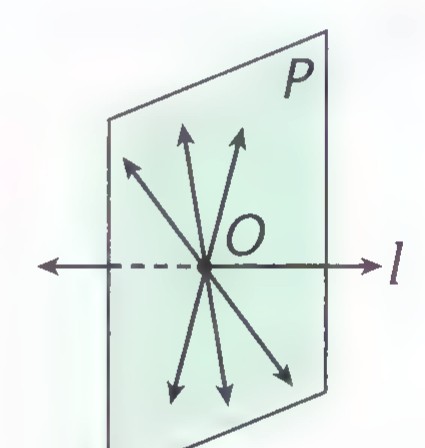
Theorem. Planes perpendicular to the same line are parallel to one another.
Theorem. Lines perpendicular to the same plane are parallel to one another.
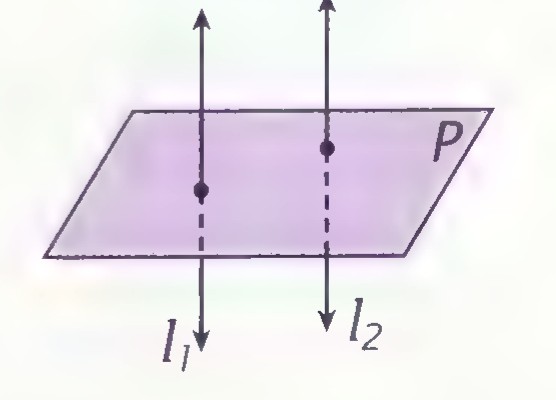
Theorem. A plane perpendicular to one of two parallel lines is perpendicular to both of them.
Many other ideas of plane geometry also extend to space. Here are three examples. In space, two points each equidistant from the endpoints of a line segment determine a plane that is the perpendicular bisector of the line segment. Reflection in a plane can be defined in a way similar to our definition of reflection in a line. Our two-dimensional coordinate system with two axes perpendicular to each other in a plane can be extended to a three-dimensional coordinate system with three axes perpendicular to one another in space.
It is possible to develop all of solid geometry as a deductive system in the way with which you are now very familiar. Euclid was one of the first to do so. The final three books of the Elements contain proofs of 75 theorems in the geometry of three dimensions.
p. 628
Lesson 2: Rectangular Solids
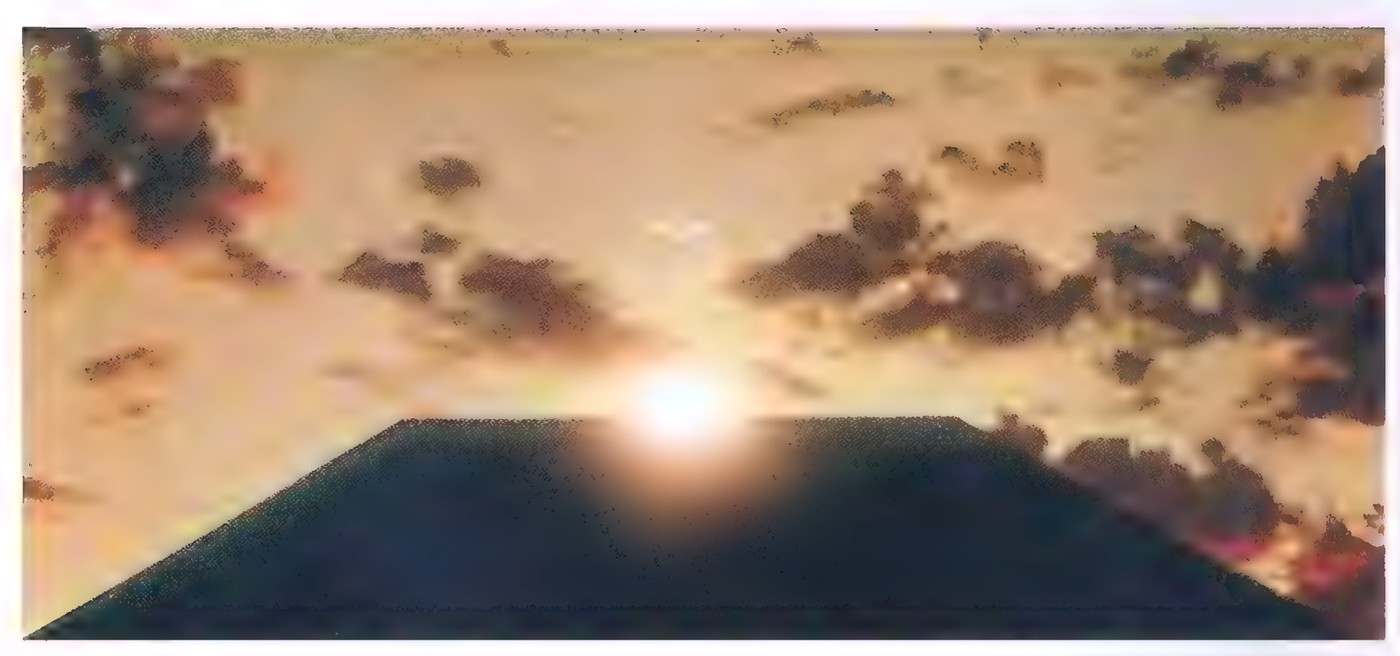
Near the beginning of the film 2001: A Space Odyssey, a mysterious monolith appears, and then from behind it rises a glowing sun directly below the crescent of the moon. Later, another monolith is discovered buried beneath the surface of the moon. The monoliths are tall black slabs, and their appearance creates an eerie effect due in part to their shape. Their shape, a rectangular solid with straight sharp edges meeting at right angles, in contrast with the natural surroundings of the monoliths, suggests that they were created by a higher intelligence.
A rectangular solid is a special type of polyhedron.
Definition
A polyhedron is a solid bounded by parts of intersecting planes.
The intersecting planes form polygonal regions that are the faces of the polyhedron. Their sides are the edges of the polyhedron, and their vertices are its vertices. Generally, our polyhedra will be convex.
Definition
A rectangular solid is a polyhedron that has six rectangular faces.
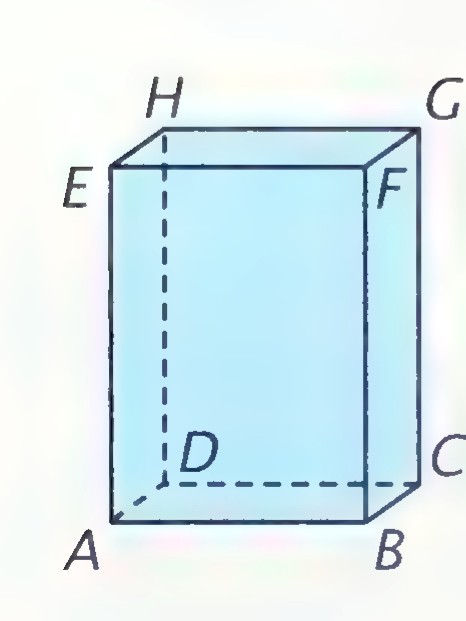
In the figure at the left, all six faces of a rectangular solid are shown. Its intersecting faces lie in perpendicular planes, and its opposite faces lie in parallel planes. Two vertices of the solid that are not vertices of the same face are opposite vertices. For example, in the figure, one pair of opposite vertices is A and G and another pair is C and E.
p. 629
A line segment that connects two opposite vertices of a rectangular solid is a diagonal of the solid. Every rectangular solid has four diagonals, and it is easy to prove that they have equal lengths. (These diagonals are sometimes called the interior diagonals of the solid to distinguish them from the diagonals of its faces.)
The lengths of the three edges of a rectangular solid that meet at one of its vertices are the dimensions of the solid and are usually called its length, width, and height.
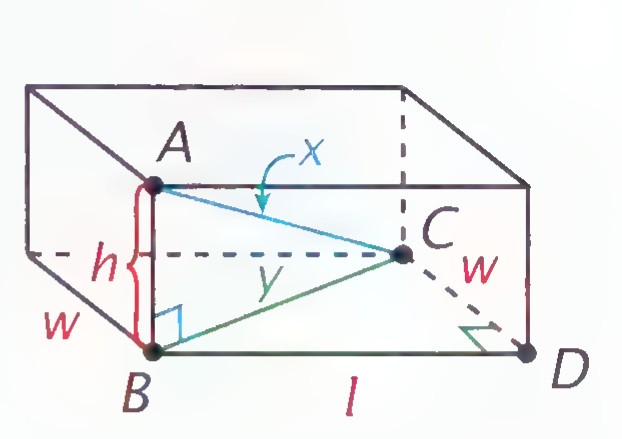
The dimensions of the solid shown at the right are l, w, and h. The length of one of the diagonals, x, of the solid, can be expressed in terms of the solid’s dimensions by using the Pythagorean Theorem.
If BC is drawn, then △ABC and △BCD are right triangles (AB is perpendicular to the plane of the base of the solid, and so it must be perpendicular to BC). In right △ABC,
and, in right △BCD,
Substituting, we get
and, taking square roots, we get
Theorem 79
The length of a diagonal of a rectangular solid with dimensions l, w, and h is .
The monoliths in the film 2001 had dimensions 1 unit by 4 units by 9 units. To find the length of one of their interior diagonals, we can use Theorem 79 to write
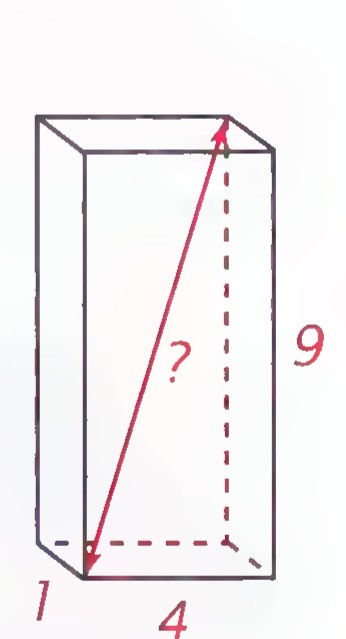
The length is exactly units, or approximately 9.9 units.
If all three dimensions of a rectangular solid are equal, it is a cube. If we let e represent the length of one edge of a cube, it follows that the length of one of its diagonals is
Corollary to Theorem 79
The length of a diagonal of a cube with edges of length e is .
p. 630
Exercises
Set I
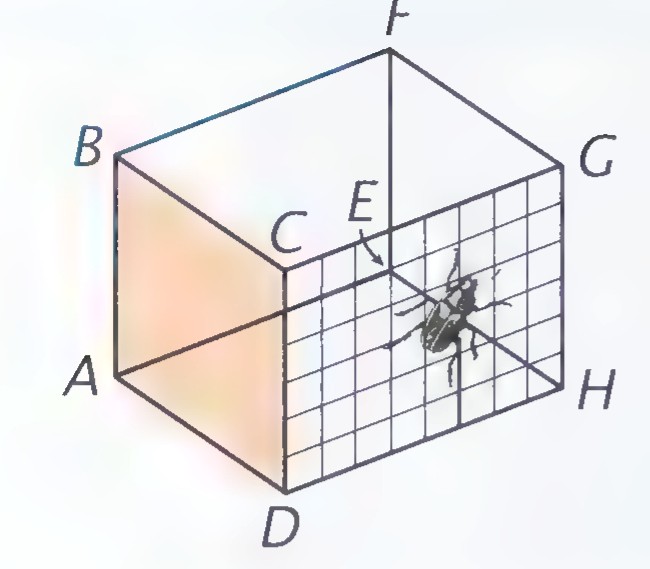
Inside or Outside? The box in the figure above is a rectangular solid.*
- How many faces does a rectangular solid have?
- How many vertices does it have?
- How many edges does it have?
- Which vertex is opposite D?
- Which edges are parallel to AB?
- Which edges are perpendicular to AB?
- Which edges are skew to AB?
- Is the beetle inside or outside the box?
Deck of Cards. A deck of playing cards is a fairly good model of a rectangular solid.†
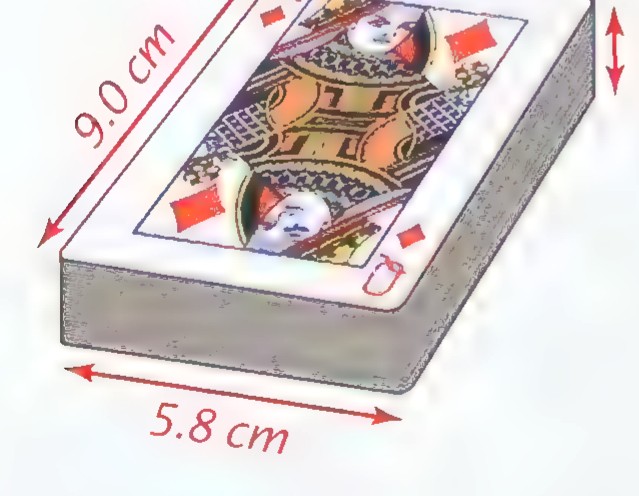
- What change in the shape of the cards would make the model better?
* Mathematical Circus, by Martin Gardner (Knopf, 1979).
† Wonders of Numbers: Adventures in Mathematics, Mind and Meaning, by Clifford A. Pickover (Oxford University Press, 2001).
- Given the dimensions of the deck shown in the figure and the fact that it contains 52 cards, find the thickness of each card.
- What is the area of the front face of each card?
- What is the area of one of the long edges of each card?
- What is the area of one of the short edges of each card?
Integer Lengths. Seven lengths are associated with a rectangular solid: the lengths of its edges, the lengths of its face diagonals, and the length of its interior diagonals.
No one knows whether all seven of these numbers can be integers, but the solid (not drawn to scale) shown here comes close.
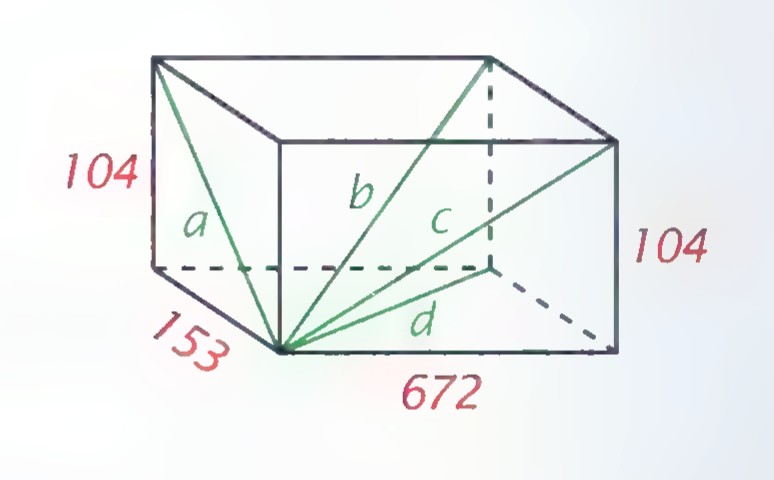
Use the lengths given to find each of the following lengths.
- a.
- b.
- c.
- d.
SAT Problem. The following problem appeared on an SAT test.
A cubic box with edge of length x inches is tied with a string 106 inches long. The string crosses itself at right angles on the top and bottom of the box. If the bow required 10 inches of string, what is the maximum number of inches x could be?
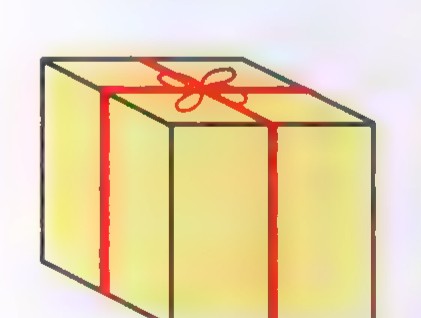
- Write an equation based on this information.
- Solve the equation for x.
p. 631
Slicing a Cube. The photograph below shows a transparent cube half filled with liquid. The top surface of the liquid illustrates a cross section of the cube, the intersection of the cube with a plane.*
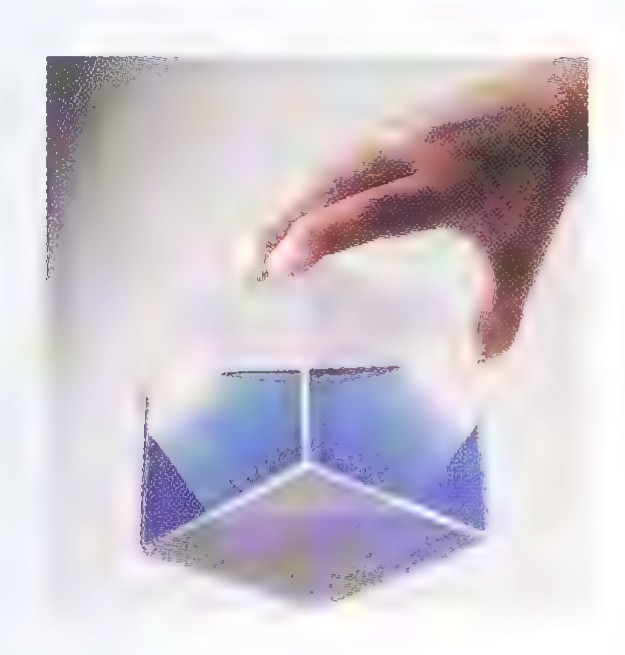
- What shape does the cross section appear to be?
In the cube at the right, M and N are the midpoints of AE and EF.
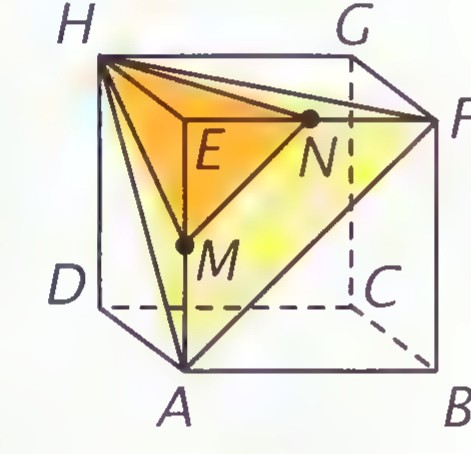
- What can you conclude about △HEM and △HEN?
- What kind of triangle is △HMN?
- What can you conclude about △HDA and △FBA?
- What kind of triangle is △HAF?
In the cube at the right, O and P are the midpoints of EH and HG.
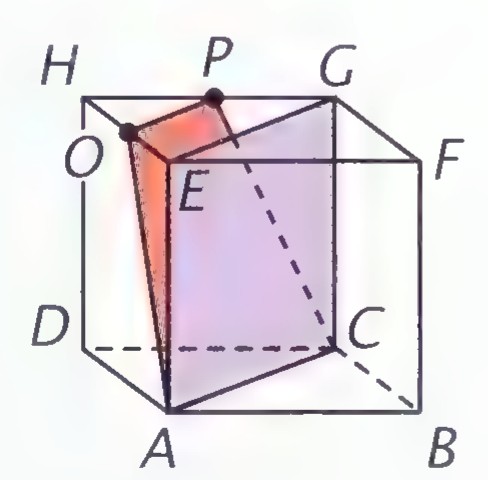
- What can you conclude about ∠EAC?
* Beyond the Third Dimension, by Thomas F. Banchoff (Scientific American Library, 1990).
- What kind of quadrilateral is ACGE? Are AE and EG equal?
- What can you conclude about OP and EG?
- What kind of quadrilateral is ACPO?
Set II
An Inside Job. Obtuse Ollie gave Acute Alice the brick shown below and said to her, “I’ll bet you can’t find the length of one of its inside diagonals with this ruler.”
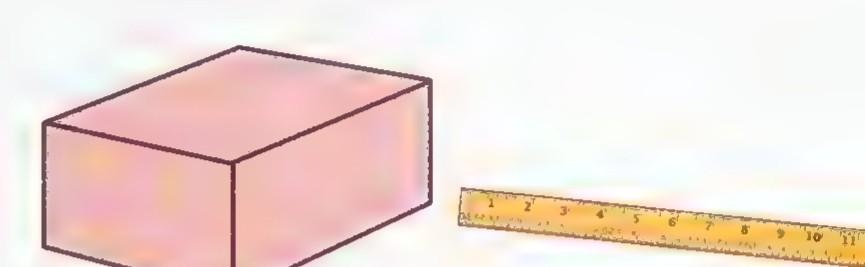
Ollie’s challenge
After thinking it over, Alice figured out a way to do it.†
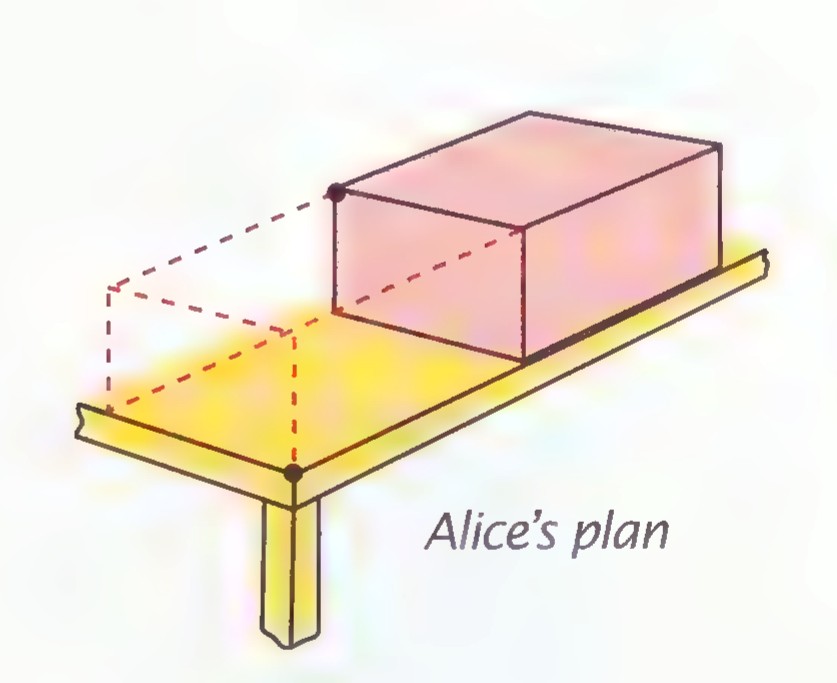
- What did Alice do?
The brick was 18 cm long and 9 cm wide, and Alice got 21 cm for the length of the diagonal.
- How thick was the brick?
- Which is thicker: the brick or Ollie’s head?
† Mathematical Cavalcade, by Brian Bolt (Cambridge University Press, 1992).
p. 632
Diagonals. Three diagonals have been drawn from vertex A of this cube: two on its faces and one inside the cube.
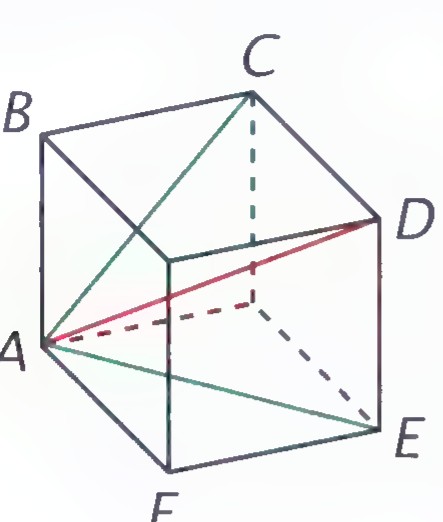
Find the measures of the following angles.
- ∠BAC.
- ∠CAE.
- ∠ACD.
- ∠CAD.
- ∠DAF.
- Is ∠CAD + ∠DAE = ∠CAE? Explain why or why not.
Hole Through a Cube. In the figure below, a square hole, ABCD, has been cut through a cube along the direction of a diagonal of the cube.*
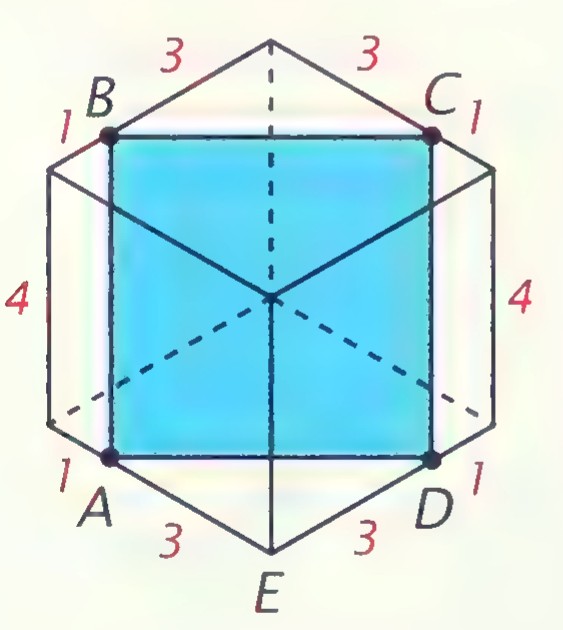
The edges of the cube are each 4 centimeters long, and the corners of the square hole are each 1 centimeter from a corner of the cube.
- Find the area of one of the faces of the cube.
* Mathematical Carnival, by Martin Gardner (Knopf, 1975).
- Find the exact length of a side of the square hole.
- Find the area of square ABCD.
- Find the length of each side of the square hole to two decimal places.
Imagine two cubes, one 4 centimeters on a side and the other 4.1 centimeters on a side.
- Is it possible to cut a hole through the smaller cube that the larger cube could pass through? Explain.
Bond Angles. Methane, a component of natural gas, is a molecule consisting of four hydrogen atoms bonded to a carbon atom. (In the ball-and-stick model shown here, a bond is represented by a stick.) The hydrogen atoms are arranged as if they were at four corners (A, B, C, and D) of a cube with the carbon atom at its center (O). Chemists have measured the molecule’s bond angles and found that they are each 109.5°.†
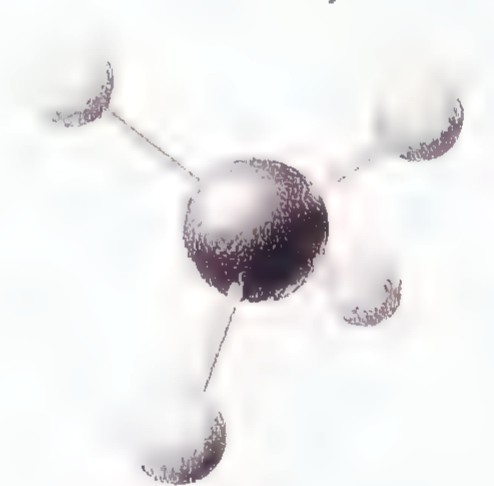
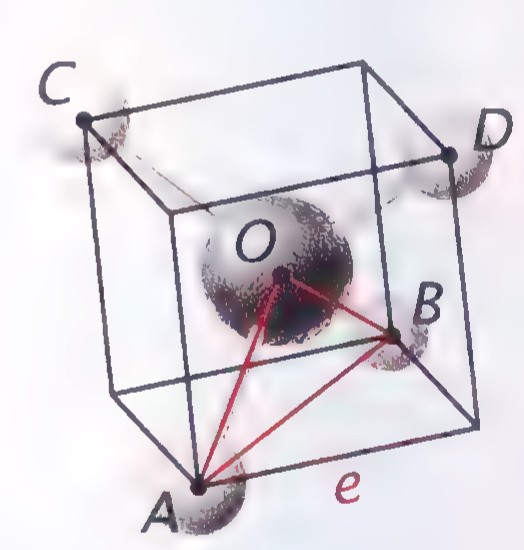
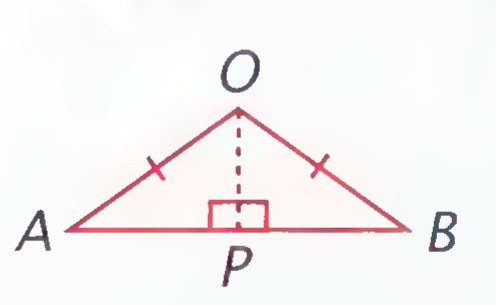
Find each of the following lengths in terms of e, the length of the edge of the cube.
- AB.
- AO.
- AP.
- Find ∠AOP to two decimal places.
- Find ∠AOB to one decimal place.
† The Architecture of Molecules, by Linus Pauling and Roger Hayward (W. H. Freeman and Company, 1964).
p. 633
Soma Puzzles. A popular puzzle is the Soma cube, created by Piet Hein in 1936. It consists of the seven pieces shown below.*
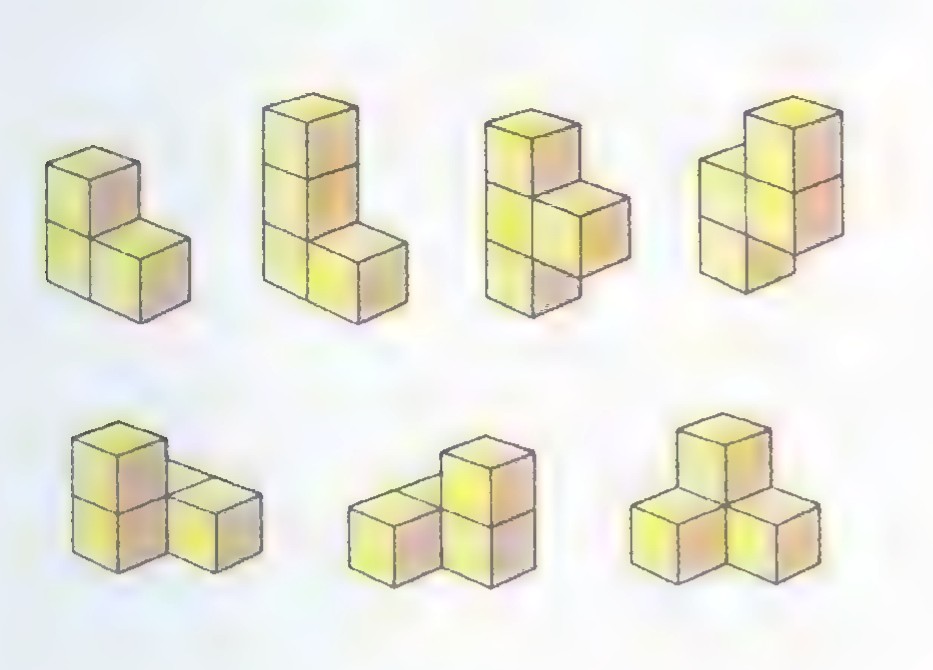
The pieces consist of small cubes glued together along their faces.
- How many of these small cubes are there in all?
Each of the following structures was made from a set of the seven pieces, but each has at least one hidden hole. How many holes does each structure have? Explain each of your answers.
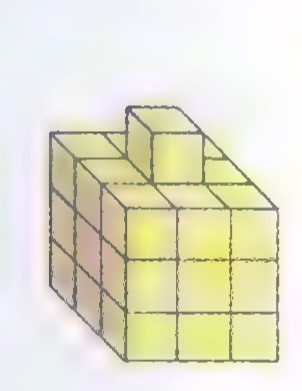
Penthouse
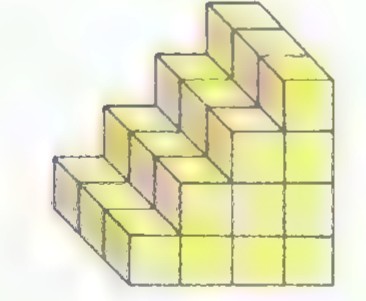
Staircase
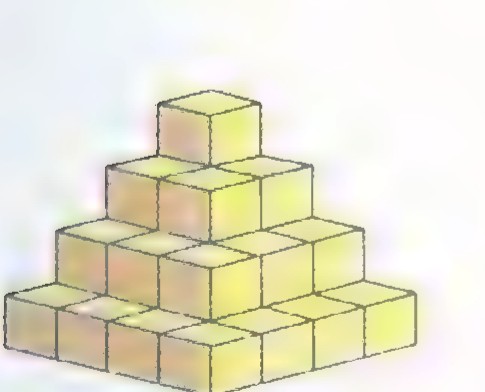
Tower
* Knotted Doughnuts and Other Mathematical Entertainments, by Martin Gardner (W. H. Freeman and Company, 1986).
This wall appears to consist of nine geometrically similar columns of cubes, but it cannot be built from the seven Soma pieces.
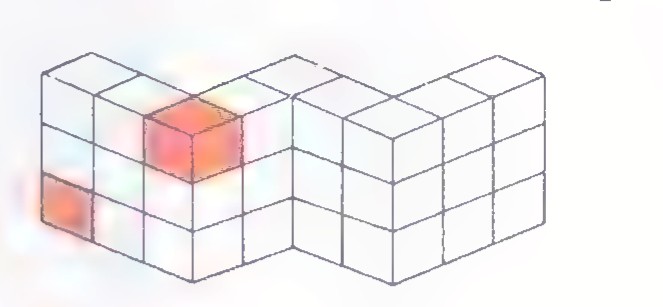
- How many “corner cubes” such as the two shown in red does it seem to contain?
- How many of these corner cubes can be made from the seven Soma pieces? (Look at each one to answer this question.)
- Why can’t the wall be built from the seven Soma pieces?
Set III
Flattened Cube. The surface of a cube can be cut and flattened out in eleven different ways to form a net of the cube. Below, on the left, is a flattened cube with letters on all six faces. On the right is a cube cut and flattened in a different way, with the letter on one of its faces shown.
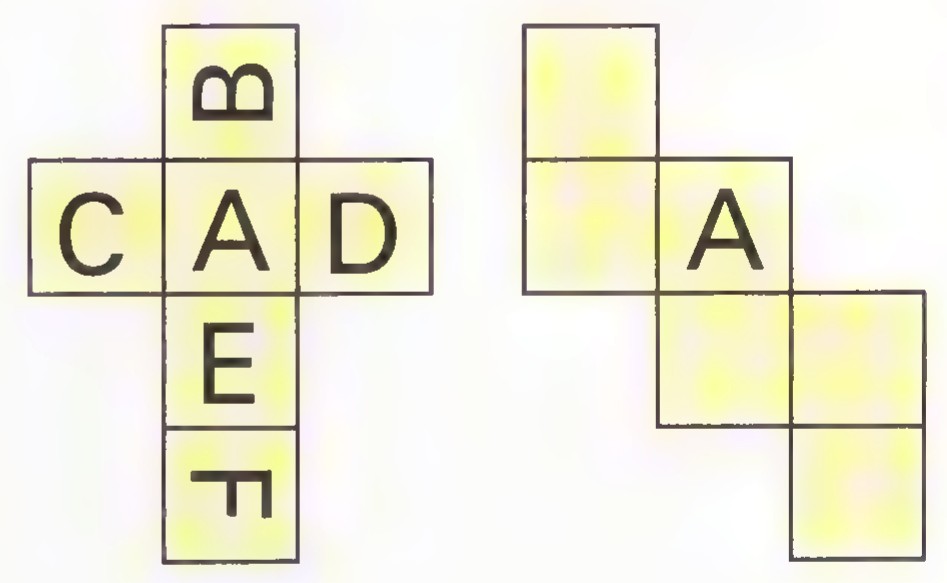
Copy the second figure. Can you fill in the remaining five faces so that, when the nets for both cubes are folded back together, they will be identical?†
† Are You as Smart as You Think? by Terry Stickels (Thomas Dunne Books, 2000).
p. 634
Lesson 3: Prisms
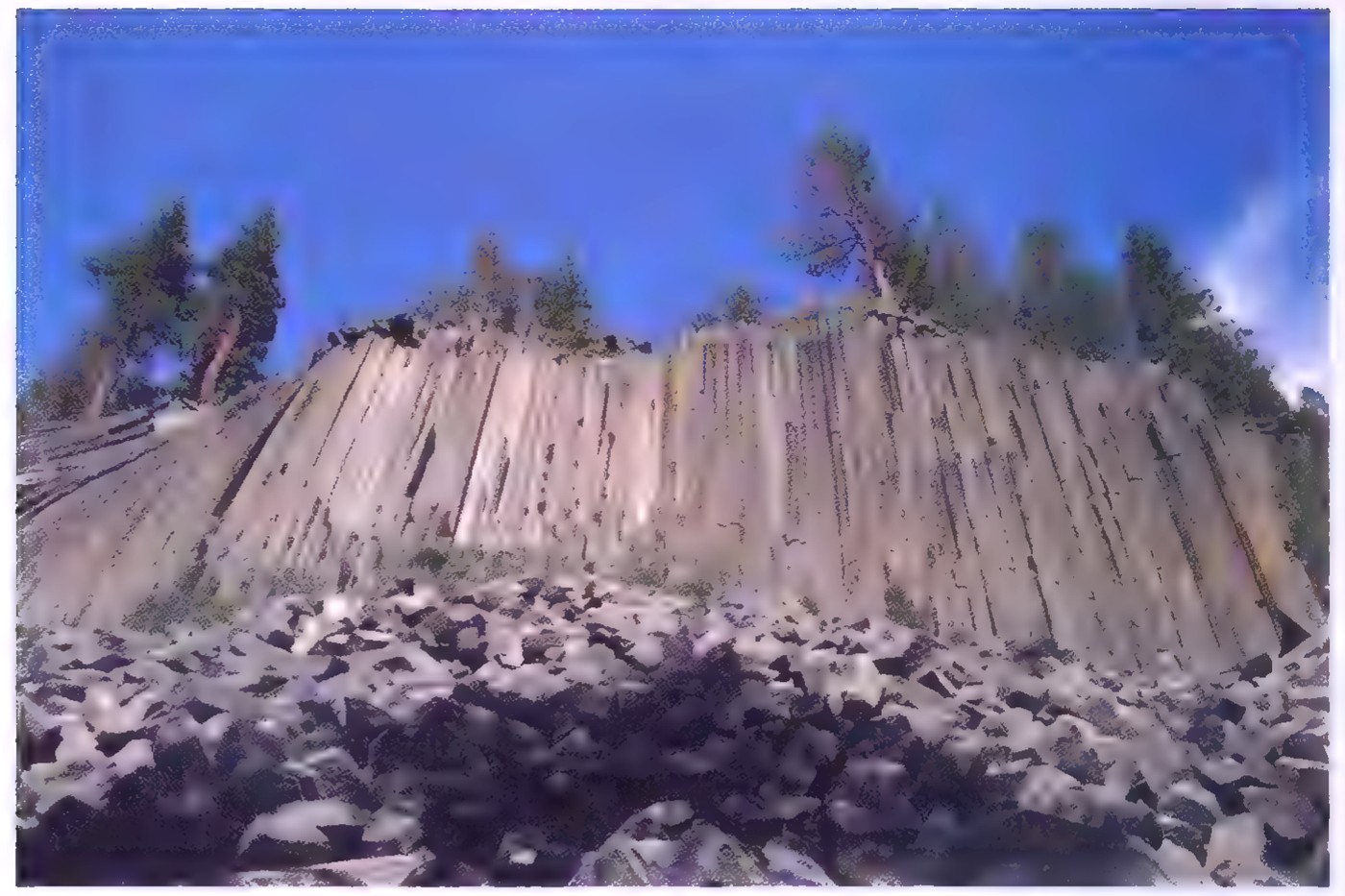
There is a strange rock formation in the Sierra Nevada mountains of California called the Devil’s Post Pile. It consists of a set of tall columns of rock, some of which are 60 feet high. The tops of most of these columns are pentagonal and hexagonal in shape. Those that have fallen over reveal that the columns themselves have the shape of polyhedra called prisms.
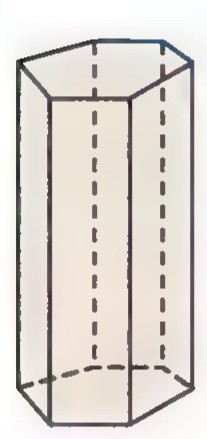
Every prism has two congruent faces, its bases, which lie in parallel planes. The line segments that connect the corresponding vertices of these faces are parallel to each other.
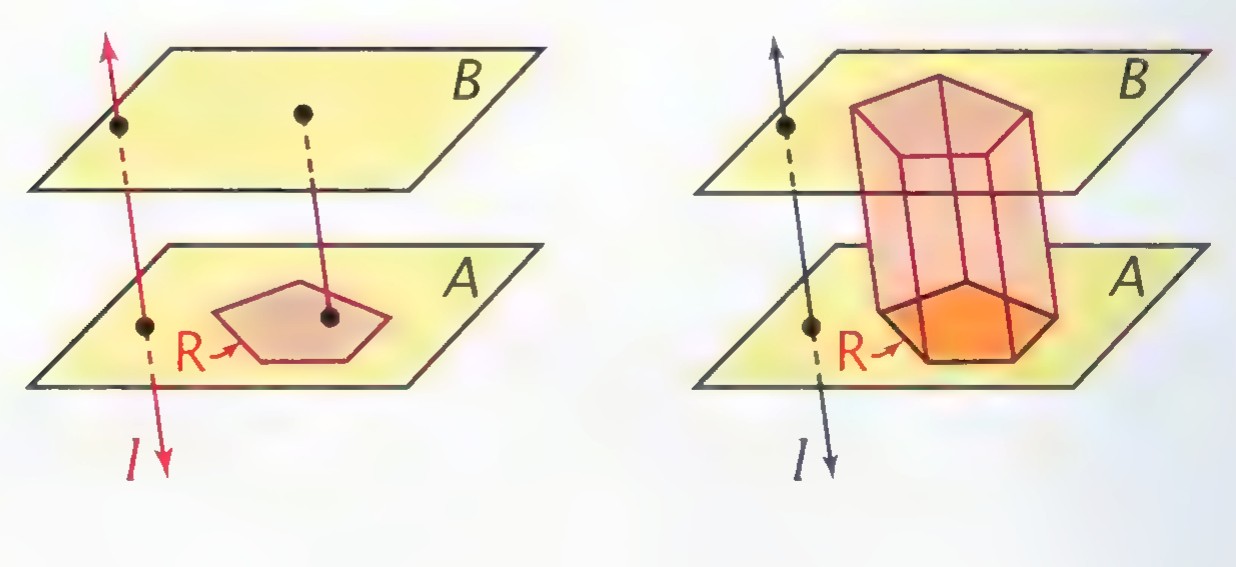
The figures below illustrate the general idea, which is stated in the following definition.
Definition
Suppose that A and B are two parallel planes, R is a polygonal region in one plane, and l is a line that intersects both planes but not R. The solid made up of all segments parallel to line l that connect a point of region R to a point of the other plane is a prism.
p. 635
The bases of the prism, then, lie in these parallel planes. The rest of the faces of the prism, its lateral faces, are parallelograms. The edges in which the lateral faces intersect one another are its lateral edges.
Prisms are classified according to two properties: (1) the relation of their lateral edges to the planes containing their bases and (2) the shape of their faces.
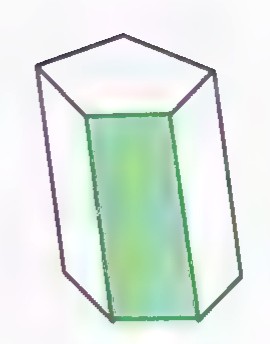
A lateral face
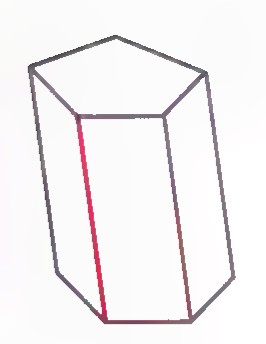
A lateral edge
If the lateral edges of a prism are perpendicular to the planes of its bases, the prism is a right prism and its lateral faces are rectangles. The prism representing one of the columns of the Devil’s Post Pile is a right hexagonal prism.
If the lateral edges of a prism are oblique to the planes of its bases, the prism is an oblique prism. The prism shown between planes A and B in the figure on the facing page is an oblique pentagonal prism.
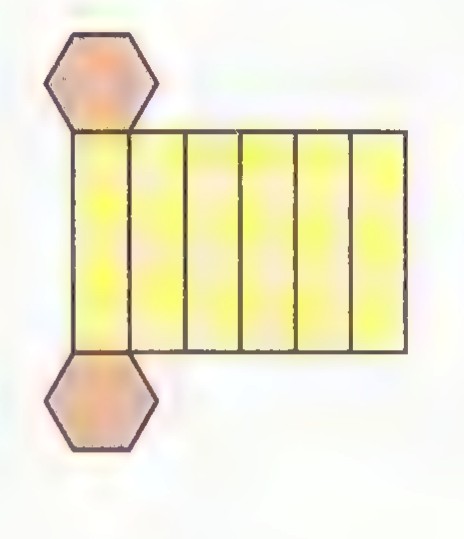
One way to make a model of the surface of a prism is to draw a pattern of its faces on a sheet of paper, cut it out, and fold it together. Such a pattern is called a net for the resulting polyhedron. The figure at the right is a net for the right hexagonal prism illustrated at the beginning of this lesson. Its six lateral faces are shown in yellow and its two bases in tan. The area of the yellow region is the lateral area of the prism; together, the areas of the yellow and tan regions make up the prism’s total area.
Definitions
The lateral area of a prism is the sum of the areas of its lateral faces.
The total area of a prism is the sum of its lateral area and the areas of its bases.
Exercises
Set I
3-D Lettering. Obtuse Ollie printed Acute Alice’s name in two-dimensional letters
and then added some lines to make the letters look three-dimensional:
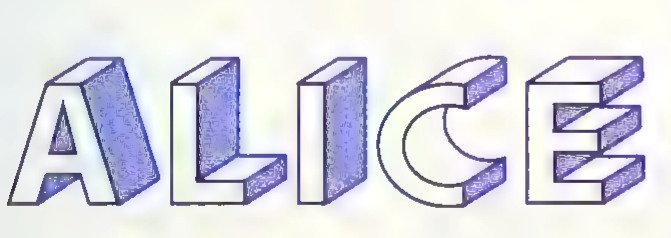
- Which letters are polygons in their two-dimensional versions?
- What are the names of the polygons?
- What geometric solid do these letters look like in their three-dimensional versions?
Prismane. In 1973, two chemists at Columbia University synthesized an organic compound that they named “prismane.”* Its molecular structure is shown in the figure below.
- Why is “prismane” an appropriate name for it?
- How many bases does the structure have?
- How many lateral faces?
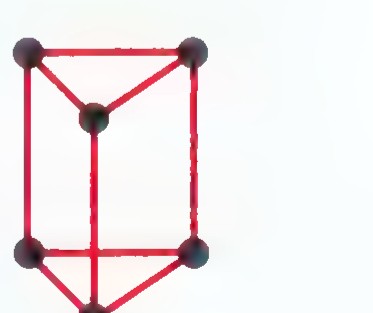
*Thomas Katz and Nancy Acton.
p. 636
The vertices of the figure represent carbon atoms and its edges represent the bonds between them.
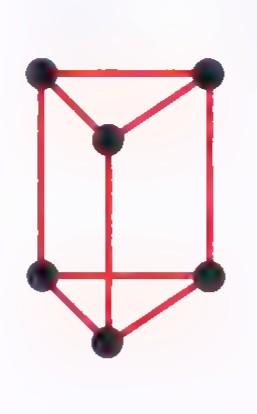
- How many carbon atoms does a prismane molecule contain?
- How many carbon-carbon bonds?
The bonds form rectangles and equilateral triangles.
- What are the sizes of the angles that the bonds make with one another?
Polyhedral Nets. The figures below show patterns, polyhedral nets, that can be folded to form the first three prisms whose faces are all regular polygons.
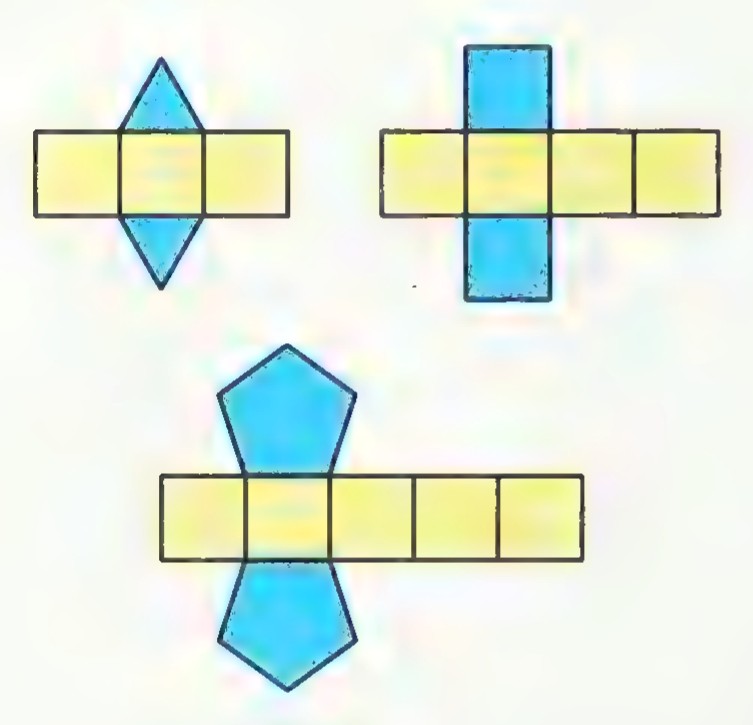
With respect to the prisms, what are the faces shown in
- blue called?
- yellow called?
If one of the bases of a prism is an n-gon, how many
- lateral faces does the prism have?
- faces does the prism have altogether?
- If each edge of one of these prisms has length e, what does the expression represent?
- What is another name for the second prism?
Inside a Prism. You may be reading this while you are sitting inside a prism. Most rooms have the shape of rectangular solids and every rectangular solid is a prism.
- If the floor and ceiling are considered to be the bases, what are the four walls?
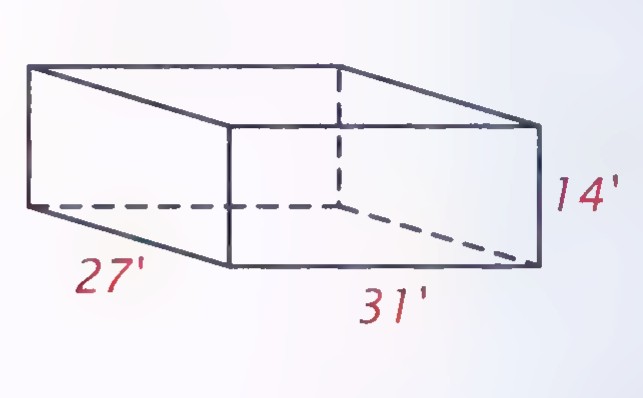
Use the dimensions shown in the figure above to find
- the area of the floor.
- the area of the four walls.
A Hexagonal Surprise. The figure below illustrates a remarkable connection between the vertices of a hexagon and the vertices of a prism.*
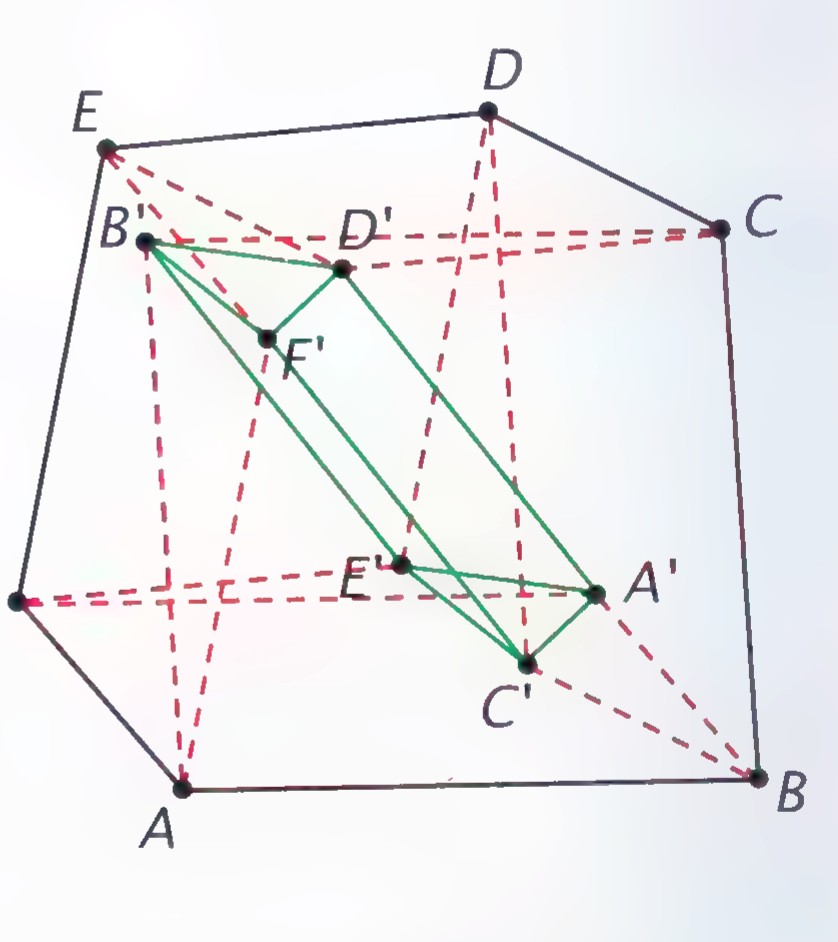
Points A and A’ are opposite vertices of ABA’F.
- What special type of quadrilateral does ABA’F appear to be?
* The Penguin Dictionary of Curious and Interesting Geometry, by David Wells (Penguin, 1991).
p. 637
Name the quadrilateral of which two opposite vertices are points
B and B’.
C and C’.
D and D’.
E and E’.
F and F’.
What type of quadrilateral does each of these quadrilaterals appear to be?
What appears to be true about
- A’D’, B’E’, and C’F’?
- △A’C’E’ and △B’D’F’?
Although the figure is two-dimensional, the segments shown in green appear to be the edges of a polyhedron.
- What special type of polyhedron does it appear to be? (Name it with two words.)
Set II
Long House. The figure below illustrates a “long house,” a type of dwelling constructed by the Iroquois in North America in about 1600.*
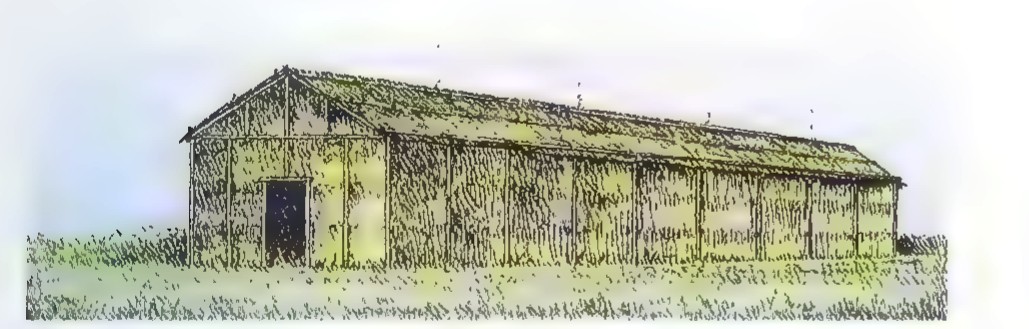
The long house has the shape of a right prism. What kind of polygons are
- the bases of the prism?
- its lateral faces?
- How many lateral edges does it have?
* Architecture: Form, Space, and Order, by Francis D. K. Ching (Wiley, 1996).
Use the dimensions given in the figure below to find the following areas.
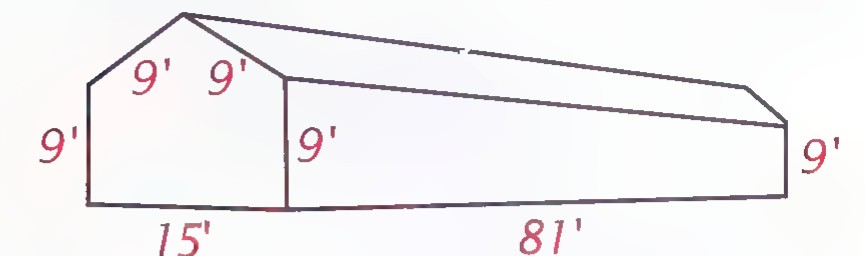
- The area of the floor of the long house.
- The area of the roof.
- Find the approximate distance of the highest part of the roof above the ground. Draw a figure to illustrate your method.
Crystal Forms. The basic shapes from which all crystals are formed are prisms.†
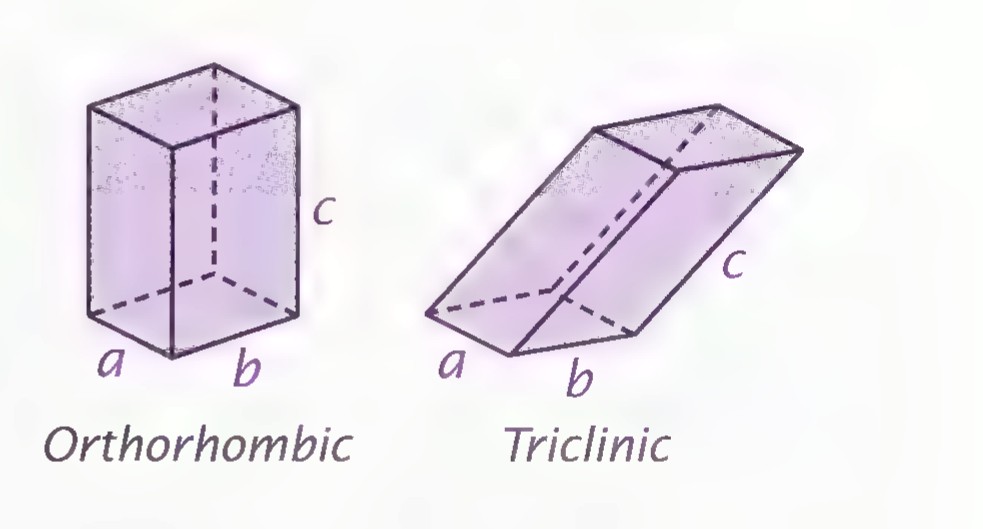
Two of them are shown above; both have edges of three different lengths.
In an orthorhombic crystal, every pair of intersecting edges forms a right angle.
- What can you conclude about the shapes of the faces of an orthorhombic crystal?
In a triclinic crystal, there are no right angles.
- What relation do the lateral edges of a triclinic crystal have to the planes of its bases?
- What type of quadrilateral must the faces of these crystals be? Explain.
† Crystals and Crystal Growing, by Alan Holden and Phylis Singer (Anchor Books, 1960).
p. 638
Feeding Trough. Troughs used in feeding animals often have the shape of a prism.
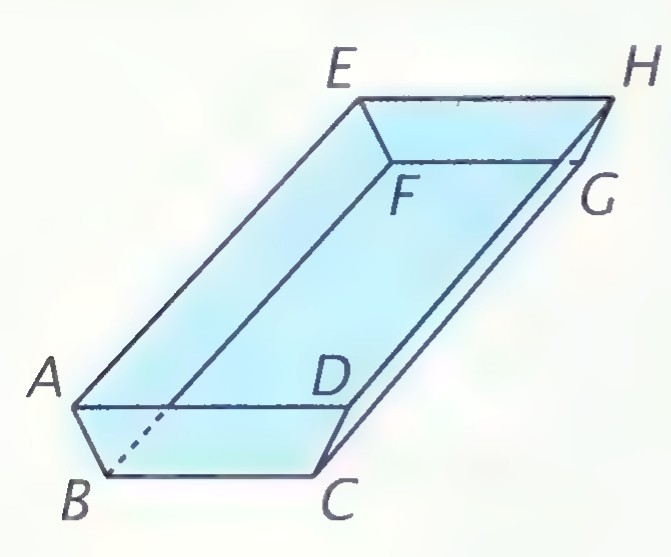
The prism shown above is a right prism in which ABCD and EFGH are isosceles trapezoids (AB = CD and EF = GH).
- Are the bases of this prism congruent? Explain why or why not.
- Can you conclude anything about AB and GH? Explain.
- Can you conclude anything about AE and CG? Explain.
- What can you conclude about ABFE and DCGH?
Magic Box. The figure below shows the design of a box used in magic tricks.
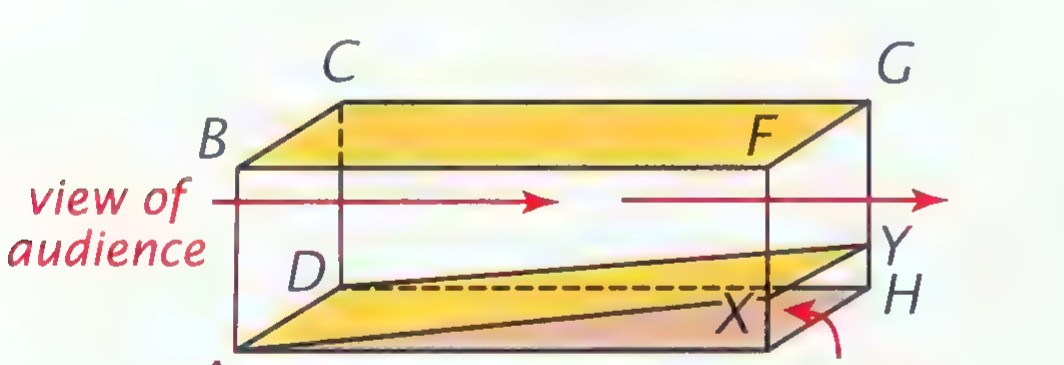
The ends ABCD and XFGY are open so that an audience looking through the box thinks it is empty. According to a book on magic:
The modern mind is so attuned to the geometry of boxes and perspective effects that it perceives the sloping false bottom as the flat bottom of the box.*
* Abracadabra! Secret Methods Magicians and Others Use to Deceive Their Audience, by Nathaniel Schiffman (Prometheus Books, 1997).
The shape of the box is such that ABCD and EFGH are the bases of a right rectangular prism and plane AXYD intersects EFGH so that EX = HY.
- What kind of polygon is EXYH?
- Why is △AXE ≅ △DYH?
- How do AX and AE compare in length?
- How do AXYD and AEHD compare in area?
- What kind of polyhedron has the shape of the hiding space?
- Which polygons are its bases?
- What kind of polyhedron has the shape of the empty space (the region through which the audience sees)?
- Which of its faces lie in parallel planes?
Euler’s Discovery.
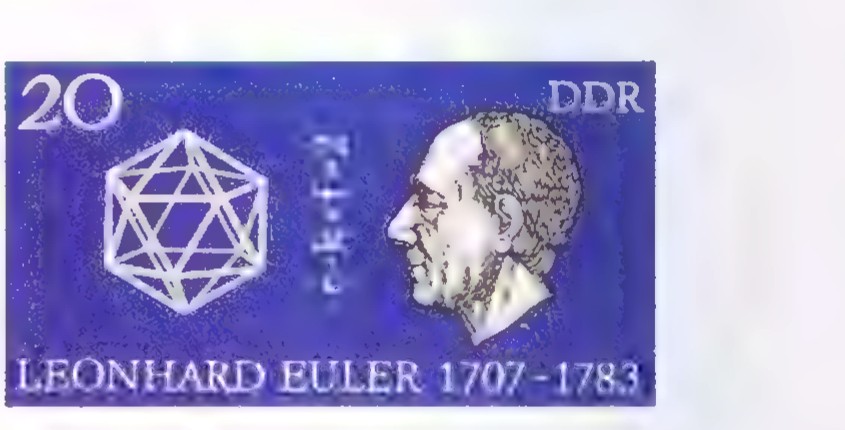
In 1752, Swiss mathematician Leonhard Euler discovered something about prisms that has been associated with his name ever since.
Suppose that the bases of a prism are n-gons. Write an expression in terms of n for
- its number of vertices, V.
- its number of faces, F.
- its number of edges, E.
The Random House Dictionary of the English Language defines the “Euler characteristic” as “the number of vertices plus the number of faces minus the number of edges of a given polyhedron.”
- Use this definition and your expressions for exercises 50 through 52 to find the Euler characteristic for all prisms.
p. 639
Set III
Topaz Angles. Scientists studying crystals in the eighteenth century made an interesting discovery that led them to conclude that crystals are made up of small “building blocks.”*
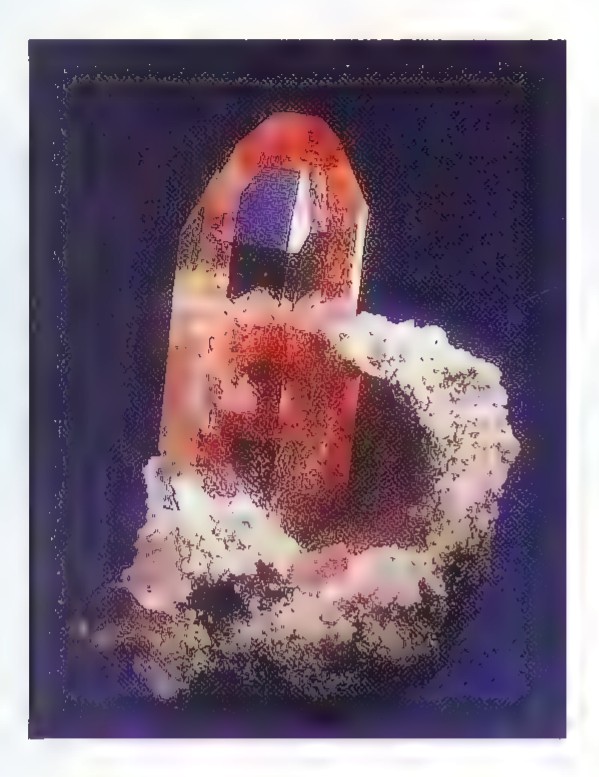
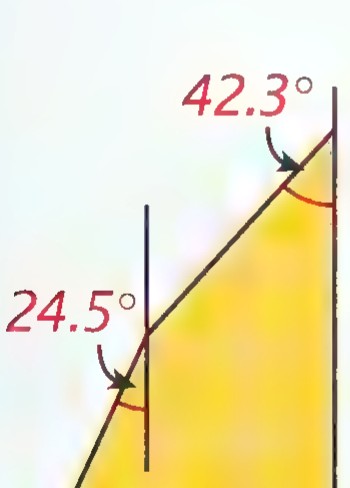
If the outline of a topaz crystal such as the one in the photograph above, for example, is traced, the indicated angles are found to have measures of about 24.5° and 42.3°.
* Crystals and Light, by Elizabeth A. Wood (Van Nostrand, 1964).
If we suppose that the crystal consists of a stack of small rectangular prisms, the two angles might be identified with ∠1 and ∠2 in the figure below.
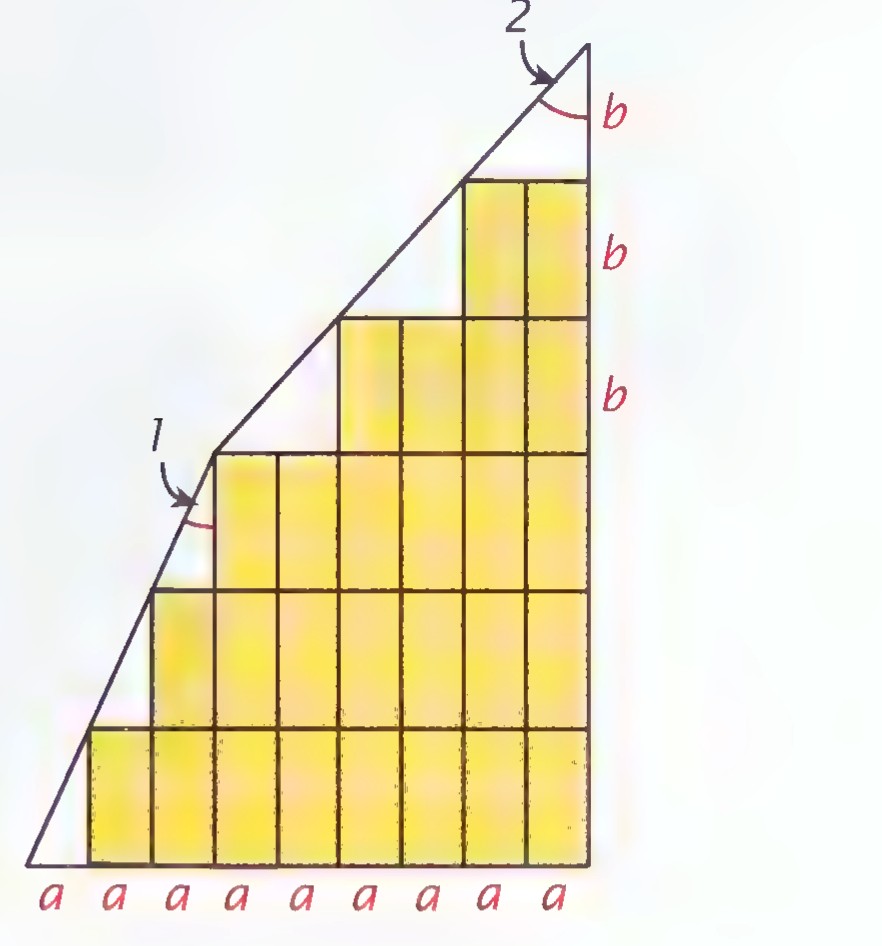
- Given that two edges of these prisms have lengths a and b as shown, express tan ∠1 and tan ∠2 in terms of a and b.
- What relation does tan ∠2 have to tan ∠1?
- Letting ∠1 = 24.5°, use your calculator to find tan ∠1 to four decimal places.
- Use your answers to exercises 2 and 3 to find tan ∠2 to four decimal places.
- Use your calculator to find ∠2 to the nearest tenth of a degree.
- Do your calculations fit with the measurements of the angles of topaz found by tracing?
p. 640
Lesson 4: The Volume of a Prism
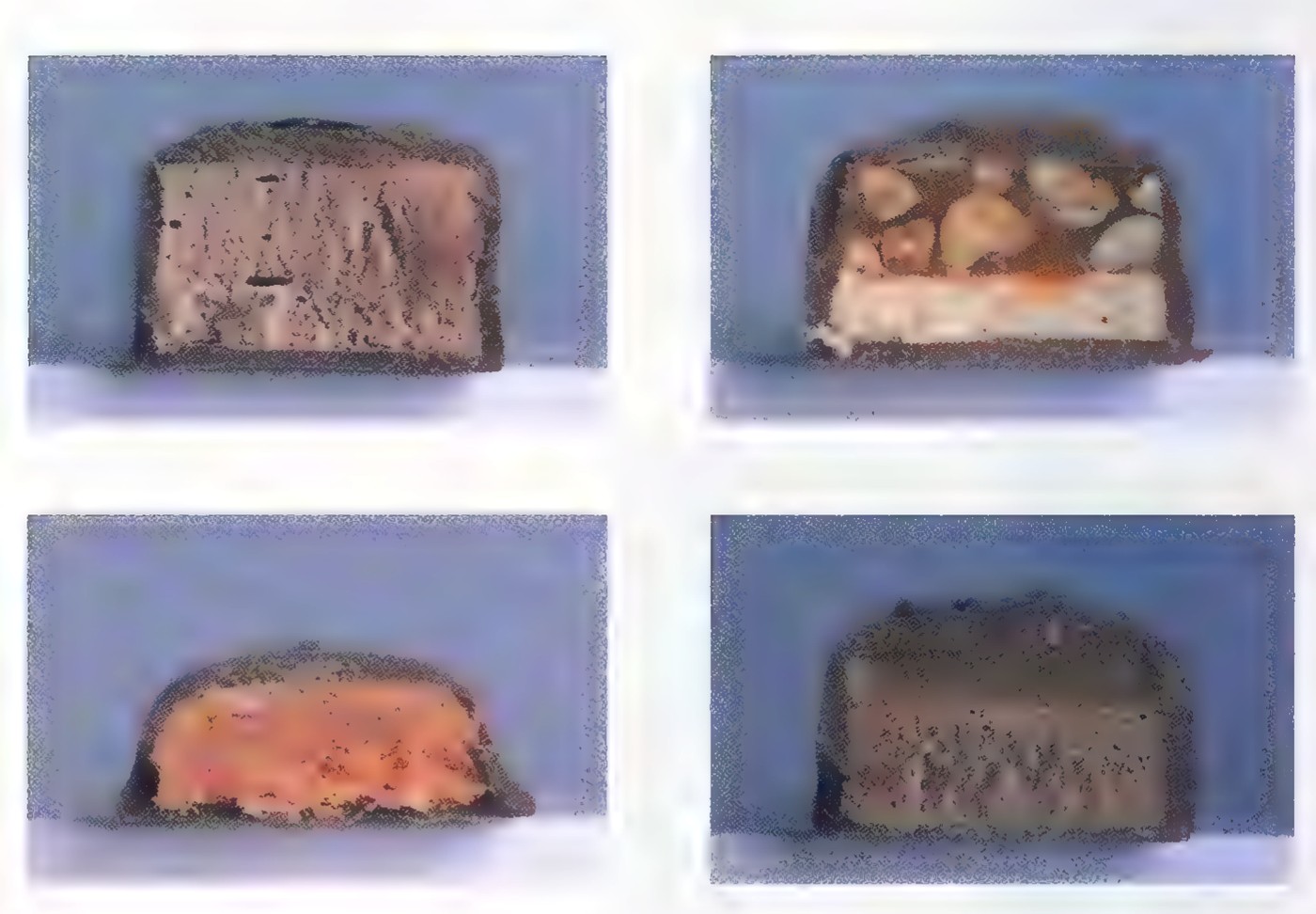
Cross sections of four popular candy bars are shown in the photographs above. How many of them can you identify?* Do you know which one is biggest?
Many candy bars are shaped somewhat like right prisms with their ends as the bases. The distance between the bases (the length of the bar) is the length of the prism’s altitude.
Definition
An altitude of a prism is a line segment that connects the planes of its bases and that is perpendicular to both of them.
The question of which of the candy bars is “biggest” is about their volumes. The volume of an object is the amount of space that it occupies. You know that distances in one dimension are measured in linear units, whereas areas in two dimensions are measured in square units. Volumes in three dimensions are measured in cubic units. The figures at the left, for example, represent 1 centimeter, 1 square centimeter, and 1 cubic centimeter.
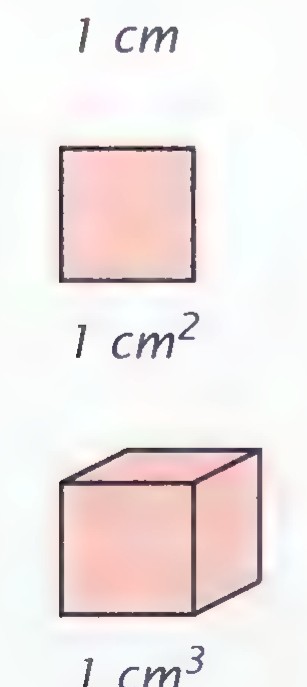
*From the Web site of the Science Museum of Minnesota.
p. 641
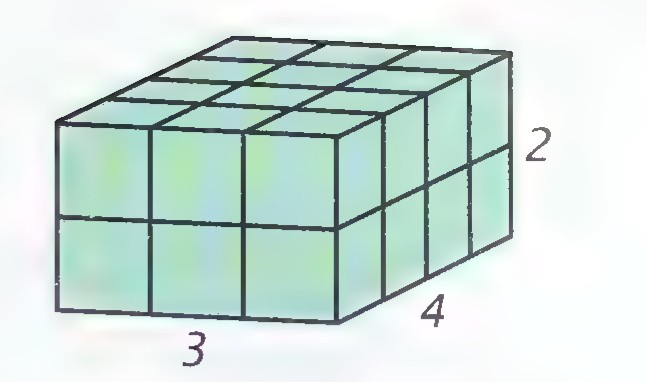
Finding the volume of a rectangular solid such as the one shown at the right is easy. A layer of 3 × 4 = 12 cubes covers the 12 square units of its base. The altitude of the solid, 2, is the number of layers of cubes, and so there are 2 × 12 = 24 cubes in all. The volume of the solid is 24 cubic units.
Similarly, if the dimensions of a rectangular solid are l, w, and h, then its volume is
or, because , in which B is the area of one of the bases,
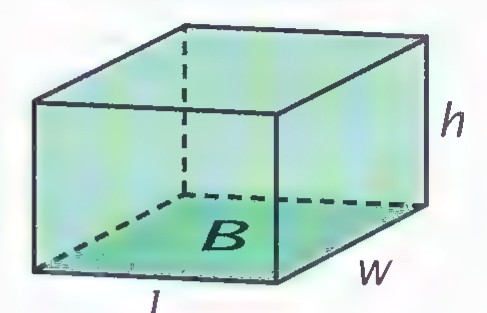
This equality is true whether or not the solid can be divided into a whole number of unit cubes as in our example.
A seventeenth-century Italian mathematician, Bonaventura Cavalieri, thought of an idea that allows us to apply this method to other geometric solids. It is based on cross sections such as those shown in the photographs of the candy bars.
Definition
A cross section of a geometric solid is the intersection of a plane and the solid.
Suppose that two candy bars have equal lengths and that we cut them into equal numbers of slices as if they were loaves of bread. Cavalieri thought that, if every pair of corresponding slices have equal areas, then the candy bars must have equal volumes. This claim is known as Cavalieri’s Principle.
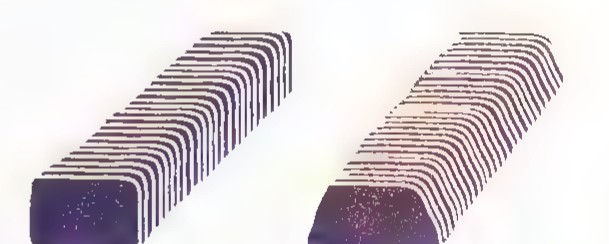
Postulate 13. Cavalieri’s Principle
Consider two geometric solids and a plane. If every plane parallel to this plane that intersects one of the solids also intersects the other so that the resulting cross sections have equal areas, then the two solids have equal volumes.
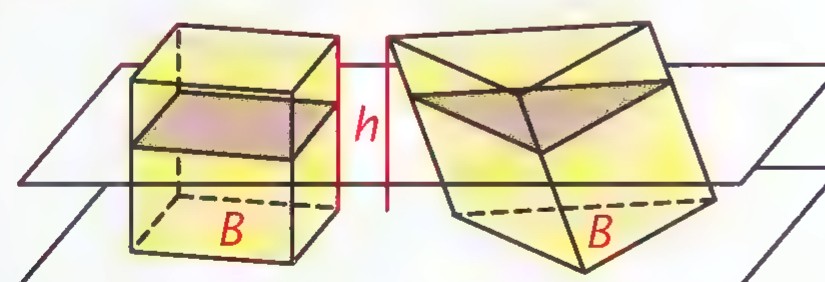
Cavalieri’s Principle shows that the formula V = Bh for rectangular solids also works for any prism, right or oblique. Suppose, for example, that both the rectangular prism and the triangular one shown above have bases with the same area, B, and that they have the same altitude, h. All cross sections of a prism formed by planes parallel to the bases are congruent to the bases, and so they have the same area as that of the bases. From this fact and from Cavalieri’s Principle, it follows that these two prisms have equal volumes.
p. 642
The following postulate expresses this fact.
Postulate 14
The volume of any prism is the product of the area of its base and its altitude:
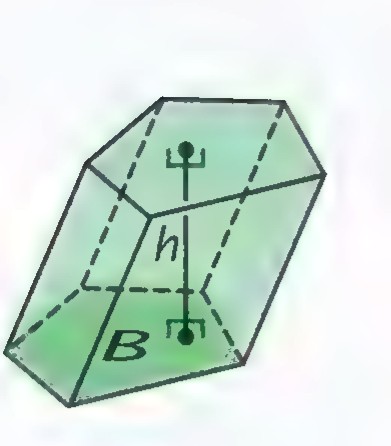
The familiar formulas for the volumes of a rectangular solid and cube can be seen as corollaries to this postulate.
Corollary 1 to Postulate 14
The volume of a rectangular solid is the product of its length, width, and height:
Corollary 2 to Postulate 14
The volume of a cube is the cube of its edge:
Exercises
Set I
Squares and Cubes. The figure below shows why the expression is read as “x squared.”
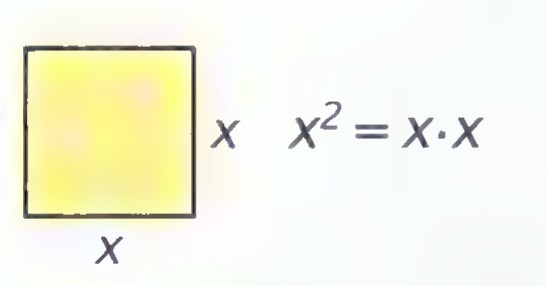
- What does represent with respect to the square?
- What is the expression read as?
- Draw a figure to show why.
- What does represent with respect to your figure?
From that fact that 1 yard = 3 feet, it follows that (1 yard)² = (3 feet)², or 1 square yard = 9 square feet.
- It also follows that (1 yard)³ = (3 feet)³. How many cubic feet are in 1 cubic yard?
Because 1 foot = 12 inches, it follows that (1 foot)² = (12 inches)², or 1 square foot = 144 square inches.
- It also follows that (1 foot)³ = (12 inches)³. How many cubic inches are in 1 cubic foot?
- How many inches are in 1 yard?
- How many square inches are in 1 square yard?
- How many cubic inches are in 1 cubic yard?
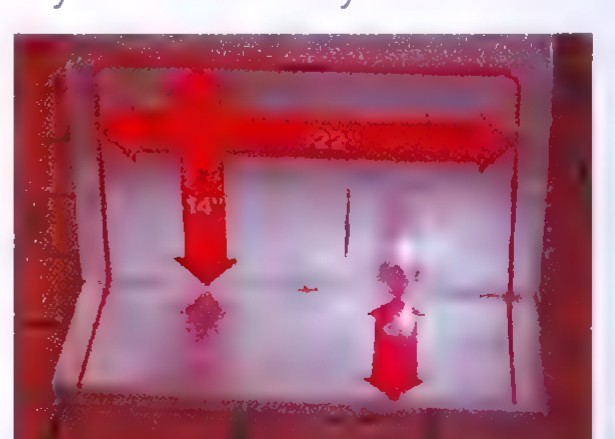
Largest Suitcase. The largest dimensions allowed by airlines for a carry-on suitcase are 22 inches by 14 inches by 9 inches.
p. 643
- Find the volume of a suitcase having these dimensions in cubic inches.
- How many cubic inches are in 1 cubic foot?
- Find the volume of the suitcase in cubic feet.
Noah’s Ark. According to Genesis 6:15, Noah’s ark was 300 cubits long, 50 cubits wide, and 30 cubits high. A cubit is the length of a forearm, conventionally taken as 18 inches long.
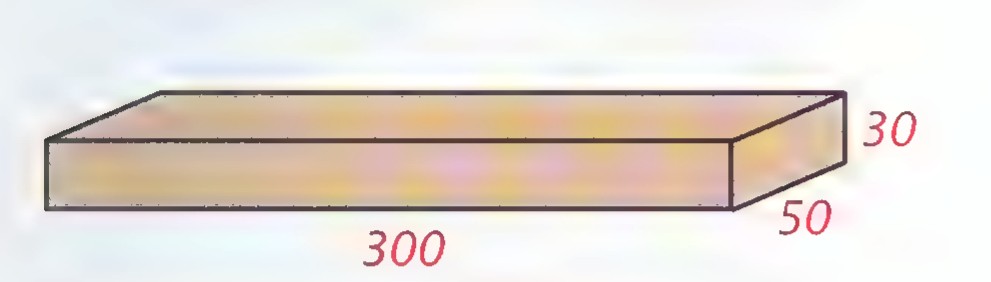
Find the approximate volume of the ark in
- cubic cubits.
- cubic feet.
- Given that the capacity of a standard railroad box car is about 3,000 cubic feet, approximately how many box cars would have the same volume as the ark?
Weathering Rock. The figures below illustrate with cubes how the surface area of rock changes as it is broken up into smaller particles by cycles of weathering.*
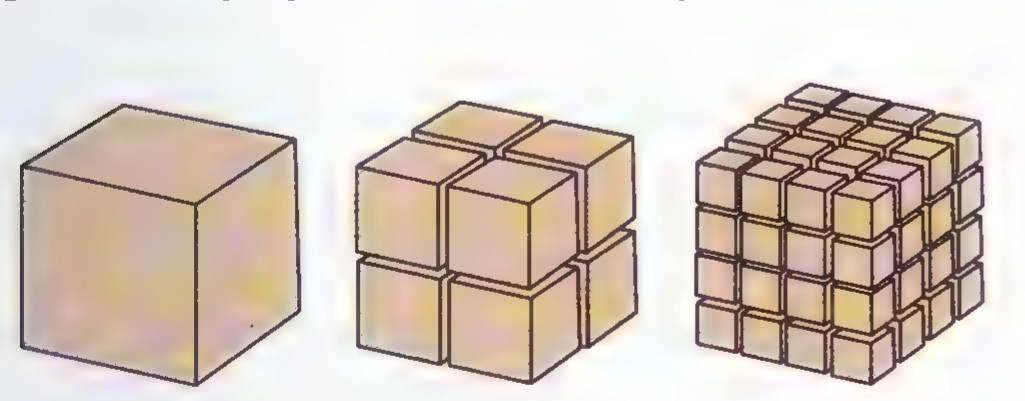
If the length of each edge of a cube is 1 meter, what is
- its volume in cubic meters?
- its surface area in square meters?
* Environmental Geology, by Dorothy J. Merritts, Andrew de Wet, and Kirsten Menking (W. H. Freeman and Company, 1998).
Suppose that the cube is broken up into cubes each of whose edges is 0.5 meter long.
- How many cubes are formed?
- What is their total volume?
- What is their total surface area?
Suppose these cubes in turn are broken up into cubes each of whose edges is 0.25 meter long.
- How many cubes are formed?
- What is their total volume?
- What is their total surface area?
As rock breaks into smaller particles, what happens to its
- volume?
- surface area?
Keng-chih’s Principle. In the fifth century, the Chinese mathematician Tsu Keng-chih wrote:
If volumes are constructed of piled up blocks and corresponding areas are equal, then the volumes cannot be unequal.
- What postulate from this lesson do these words suggest?
The figure below shows two sets of piled-up blocks on a table.
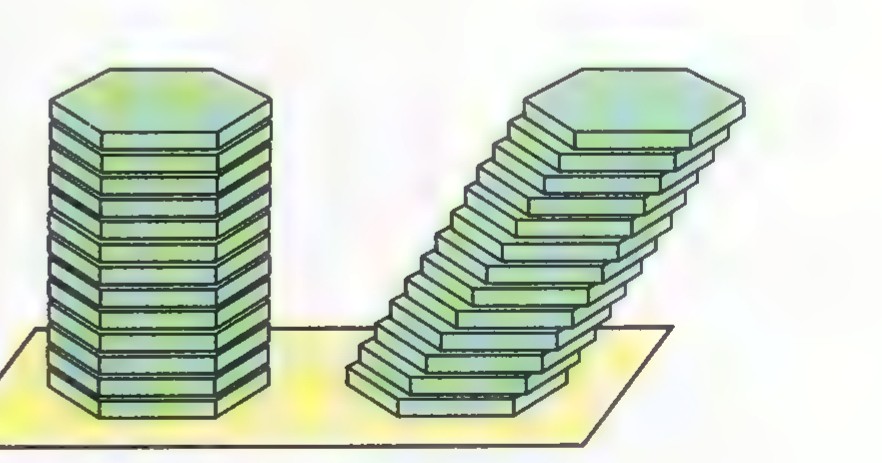
- What kind of prism does each pile of blocks appear to form?
- What does the figure suggest about two prisms whose bases have equal areas and whose altitudes are equal?
p. 644
Hole in the Ground. Obtuse Ollie asked Acute Alice, “How much dirt is there in a hole in the ground that is 123 feet long, 123 feet wide, and 123 feet deep?”
As he watched her type in the numbers on her calculator, Ollie told Alice that he didn’t think she would get the right answer.
- What answer do you think Alice got?
- Why did Ollie think that her answer would be wrong?
Prism Volumes. Find the volumes of the following prisms.
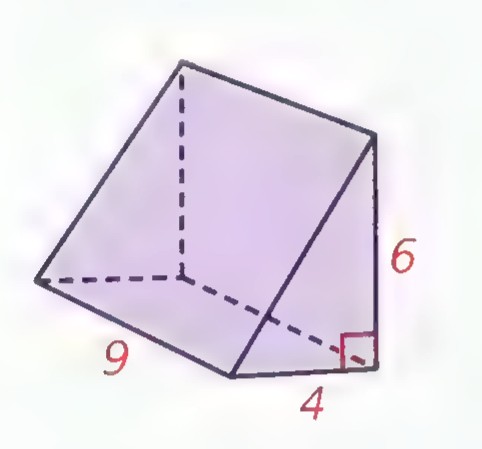
This is a right prism whose bases are right triangles.
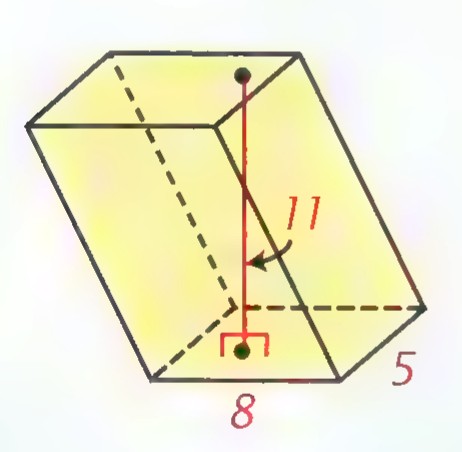
This is an oblique prism whose bases are rectangles.
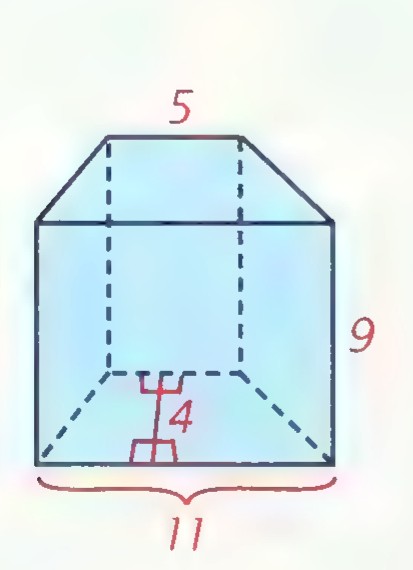
This is a right prism whose bases are trapezoids.
Candy Bars. The four candy bars pictured at the beginning of this lesson are identified here.
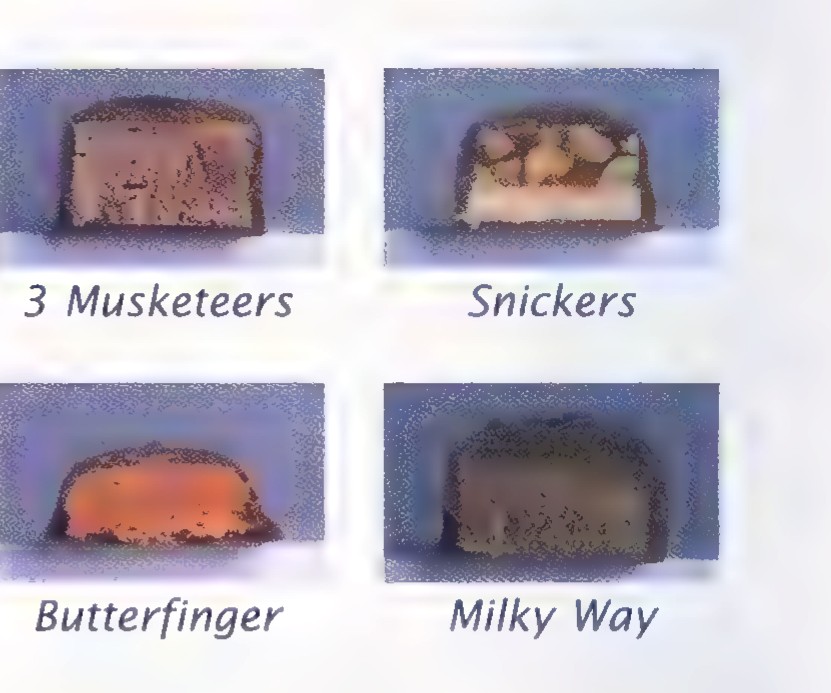
- Assuming that the 3 Musketeers bar is a rectangular solid 3.0 cm wide, 2.1 cm thick, and 12.5 cm long, find its volume to the nearest cubic centimeter.
- Assuming that the Snickers and Milky Way bars are rectangular solids 3.3 cm wide, 2.0 cm thick, and 10.0 cm long, find their volumes to the nearest cubic centimeter.
- Assuming that the Butterfinger bar is a right prism 14.5 cm long with trapezoid bases with bases of 2.3 cm and 3.5 cm and with an altitude of 1.3 cm, find its volume to the nearest cubic centimeter.
- Which candy bar is largest? Must it also weigh the most?
Set II
Ream of Paper. A ream of paper contains 500 sheets and is 2 inches thick. “Letter size” paper measures 8.5 inches by 11 inches.
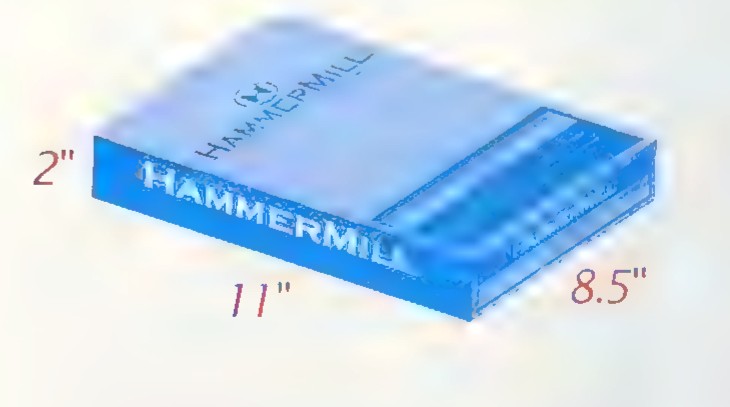
Thinking of a single sheet of paper as a right rectangular prism having its two sides as its bases, find each of the following measures.
p. 645
- Its altitude.
- Its volume.
- Its total area.
Binomial Cube. The figure below shows a cube with edges of length a + b that has been sliced into pieces by three planes parallel to its faces.
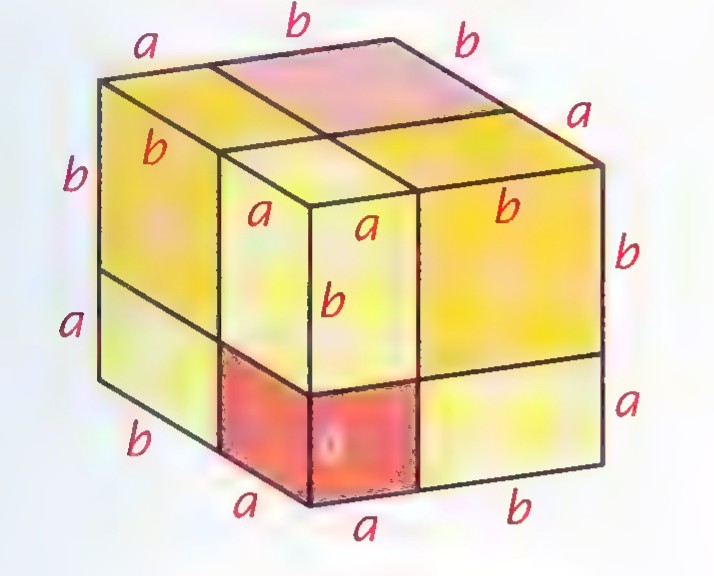
- Write an expression for the volume of the cube in terms of a and b.
- Into how many pieces is the cube cut?
- How many of these pieces also are cubes?
Write an expression in terms of a and b for the volume of
- one of the yellow pieces.
- one of the orange pieces.
- the cube as the sum of the volumes of its pieces.
Chinese Problem. In an ancient Chinese text, the Chiu Chang Suan Shu, methods are given for finding the volumes of various solids, including the one shown below.
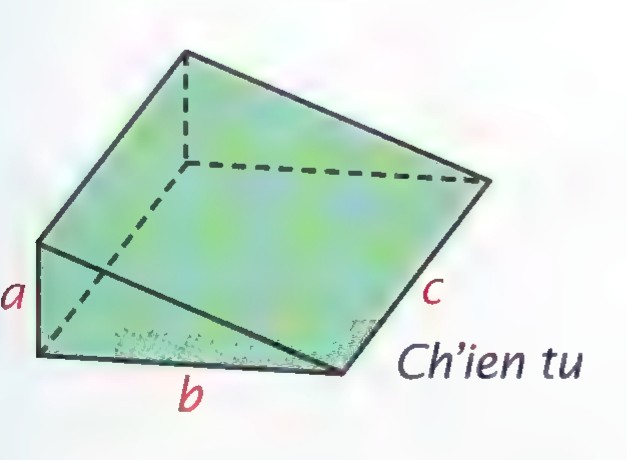
The faces of a “ch’ien tu” are rectangles and right triangles.
- What kind of geometric solid is it?
Write an expression in terms of a, b, and c for
- its volume.
- its total area.
SAT Problem. The figure below appeared in a problem on an SAT exam.
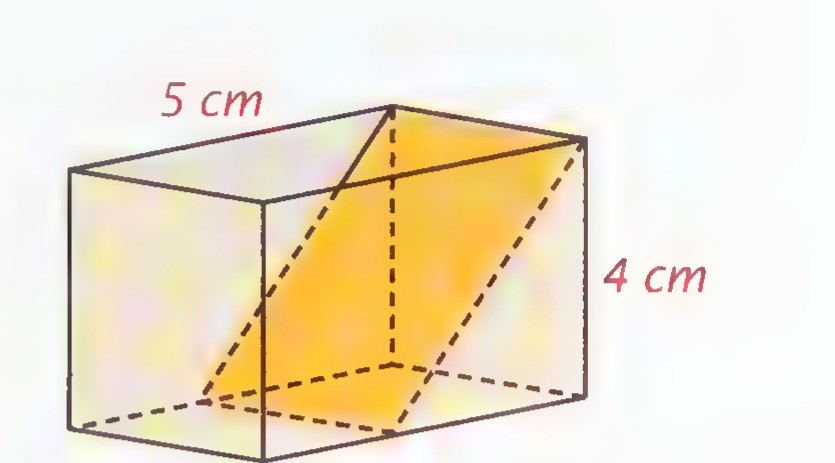
It shows an empty box with a flap lid that has an area of 15 square centimeters. One of the three unattached edges of the lid rests on the bottom of the box as shown and separates it into two compartments.
- Draw the figure and mark it as needed to answer each of the following questions.
- What is the third dimension of the box?
Given that the lid is flat, what is the volume of
- the smaller, closed compartment?
- the larger, open compartment?
Filling a Pool. The figure below shows a cross section of water in a rectangular swimming pool having the shape of a right prism. The pool is 40 feet long and 20 feet wide.
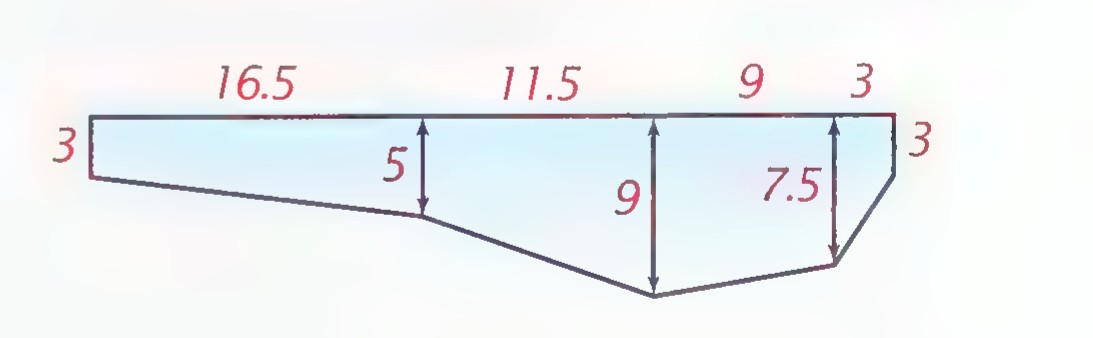
- Find the area of the cross section in square feet.
- Find the volume of the water in the pool in cubic feet.
- How long would it take to fill the pool if it can be filled at the rate of 2 cubic feet per minute?
p. 646
Advertising Claim. A television commercial for the Toyota Camry began:
How can it be that an automobile that’s a mere nine inches larger on the outside gives you over two feet more room on the inside?*
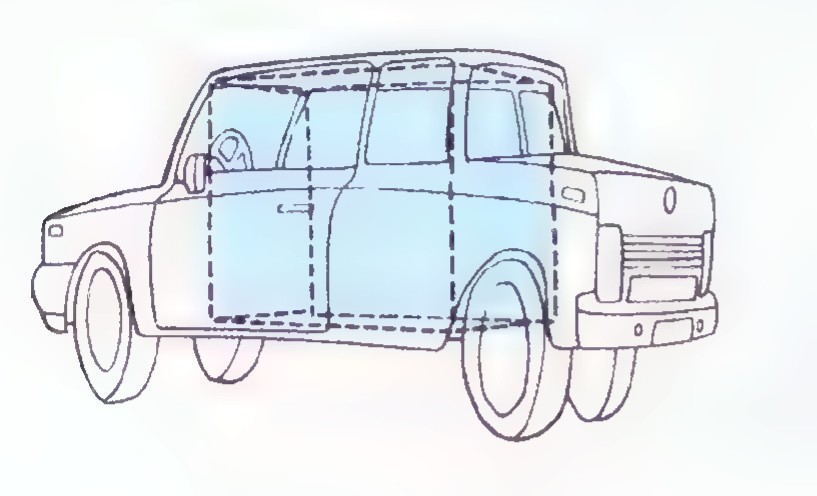
Suppose the passenger compartment of the car has the shape of a rectangular solid 6 feet long, 4 feet wide, and 3 feet high.
By how many cubic feet would its volume be increased if the passenger compartment were 9 inches
- longer?
- wider?
- higher?
- What is strange about the wording of the commercial?
Measuring a Toad. These figures show a toad and its shed skin.†
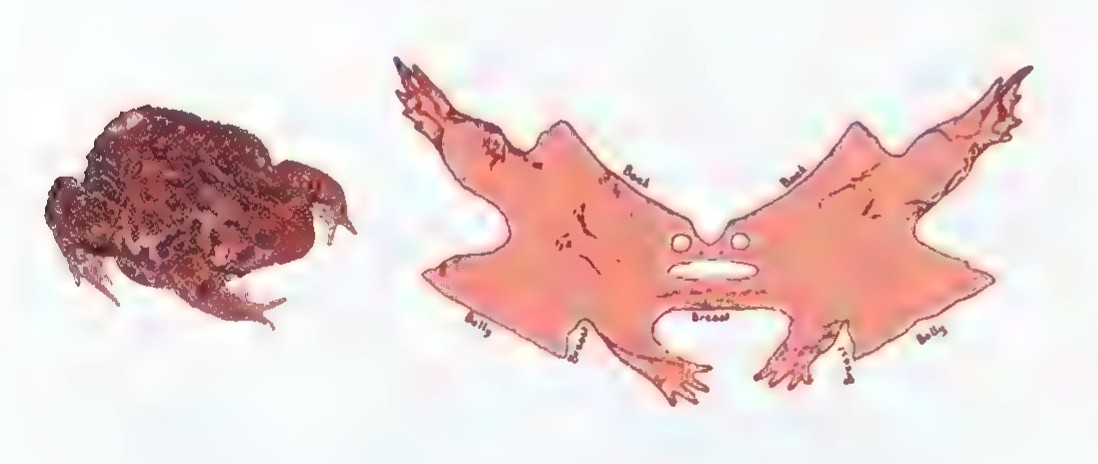
- Which do you think would be easier to measure: the surface area of a toad or its volume?
- How would you do it?
* 200% of Nothing, by A. K. Dewdney (Wiley, 1993).
† Envisioning Information, by Edward R. Tufte (Graphics Press, 1990).
Set III
Molecule Experiment. One of Benjamin Franklin’s many discoveries was that, if he dropped a teaspoon of oil onto the surface of a pond, it would spread out to cover half an acre but no more.

A teaspoon of oil has a volume of about 4 cubic centimeters and an acre is equal to about 4,000 square meters.
- How thick was the layer of oil on the pond?
- If the oil film was one molecule thick and we think of each molecule as a little cube, approximately how many molecules might be in a teaspoon of oil?
p. 647
Used with permission of Ed Fisher
Lesson 5: Pyramids
The Egyptians built more than 70 pyramids between 2700 B.C. and 2200 B.C. The word “pyramid” has become so identified with these structures that the first definition given of it in one dictionary is: “(In ancient Egypt) a quadrilateral masonry mass having steeply sloping sides meeting at an apex, used as a tomb.”*
Although the Egyptians always chose the square for the shape of the bases of their pyramids, we use the word “pyramid” to refer to any geometric solid of which one face is in the shape of a polygon (its base) and the other faces are in the shape of triangles that meet at a point.
Definition
Suppose that A is a plane, R is a polygonal region in plane A, and P is a point not in plane A. The solid made up of all segments that connect P to a point of region R is a pyramid.
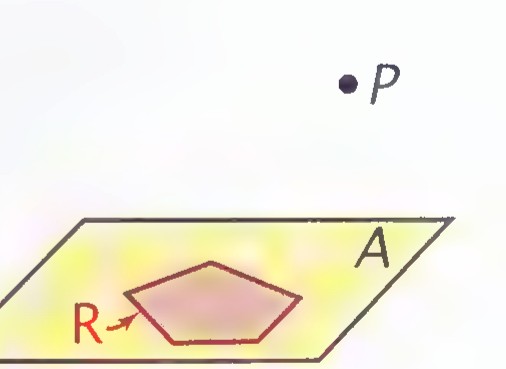
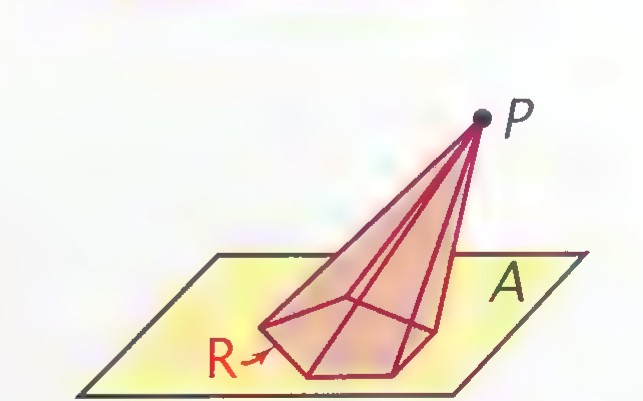
The face of the pyramid that lies in this plane is its base. The rest of its faces are the lateral faces and the edges in which they intersect each other are its lateral edges. The lateral edges meet at the apex of the pyramid.
* The Random House Dictionary of the English Language.
p. 648
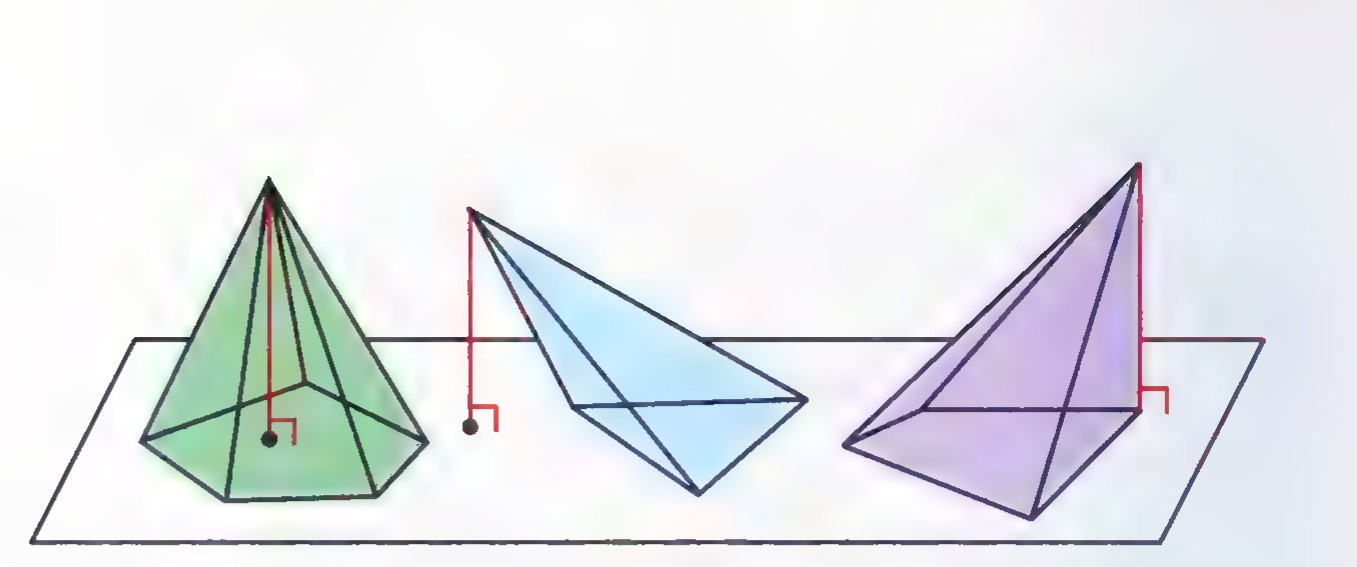
The height of a pyramid is measured by the length of its altitude.
Definition
The altitude of a pyramid is the perpendicular line segment connecting the apex to the plane of its base. It is also the length of this segment.
As the figures above show, the altitude of a pyramid can lie inside it, lie outside it, or even be one of its lateral edges.
The volume of a pyramid, like that of a prism, is determined by the area of its base and the length of its altitude. The figures at the left show a pyramid and a prism that has been drawn with the same base and altitude as those of the pyramid. This was done by constructing PI and RD so that they are both parallel to YM and equal to it in length. Points M, I, and D are connected to determine the upper base of the prism.
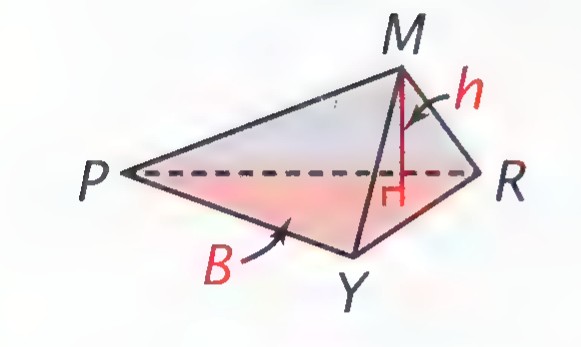
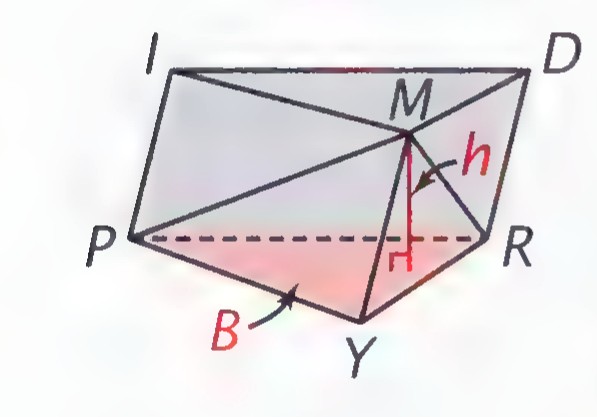
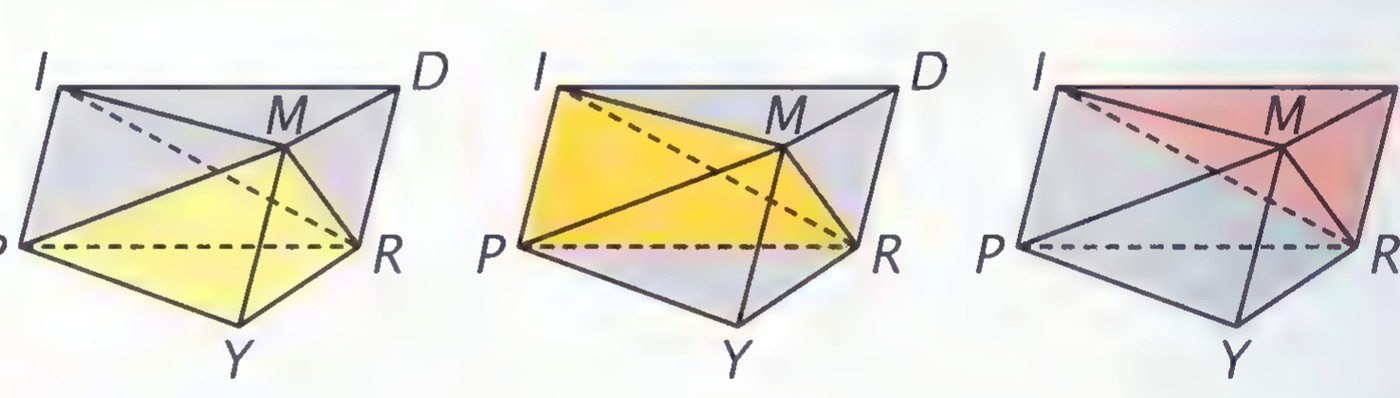
The prism thus formed can be cut into three pyramids, one of which is the original pyramid. Each pyramid is shown in one of the figures above. Cavalieri’s Principle can be used to show that these pyramids have equal volumes. Hence the volume of each pyramid is one-third the volume of the prism, or . Because every pyramid can be viewed as being made up of triangular pyramids with their bases in a common plane and having a common apex, this result holds for all pyramids. These ideas can be used to establish the following theorem.
Theorem 80
The volume of any pyramid is one-third of the product of the area of its base and its altitude:
p. 649
Exercises
Set I
X-Ray Beam. In radiography, an X-ray tube projects a beam of X-rays through the body and onto a film.*
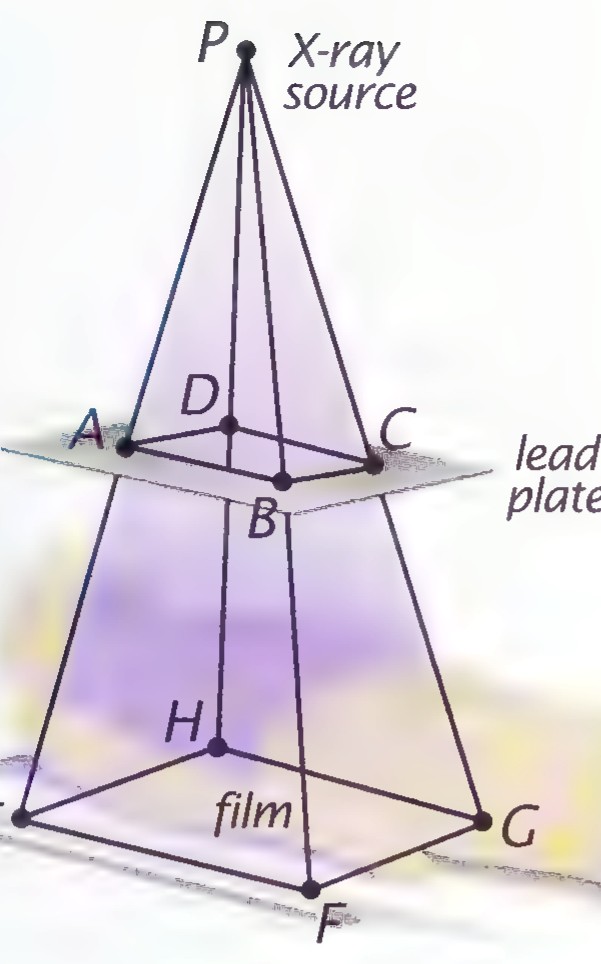
- What kind of geometric solid does the beam appear to form?
With respect to this solid, what is
- point P, the X-ray source?
- EFGH, the film?
- ABCD, the opening in the lead plate?
- △PEF?
Ferrocene. The figure below shows the arrangement of atoms in a ferrocene molecule.†
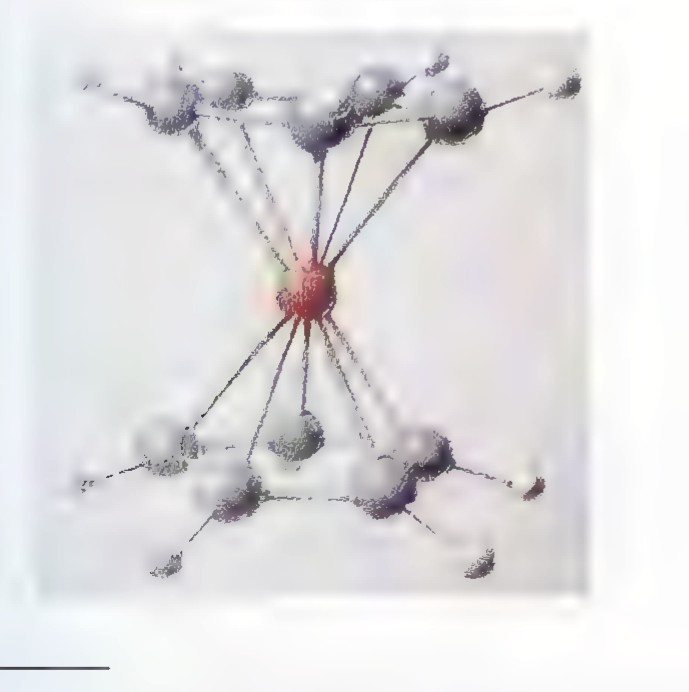
The atom shown in red is iron, the ten large atoms above and below it are carbon, and the small atoms are hydrogen.
- What shape do the bases of the pyramids have that appear in the molecule?
- Where is the iron atom with respect to these pyramids?
- What are the sticks that represent the bonds between the iron atom and the carbon atoms called with respect to these pyramids?
- What kind of triangles do the sticks representing the bonds appear to form?
Pyramid Volumes. Find the volumes of the following pyramids.
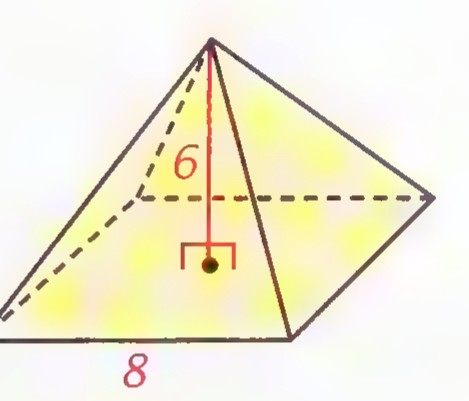
The base of this pyramid is a square.
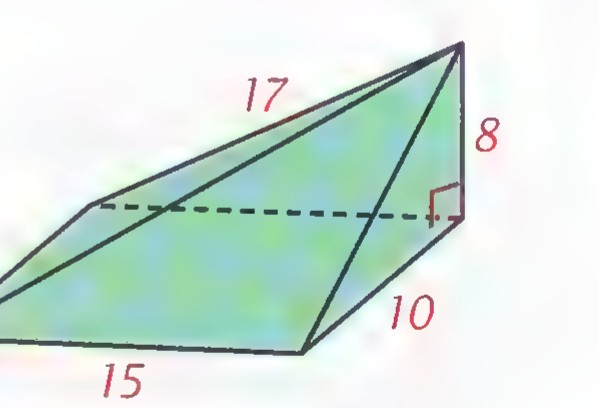
The base of this pyramid is a rectangle.
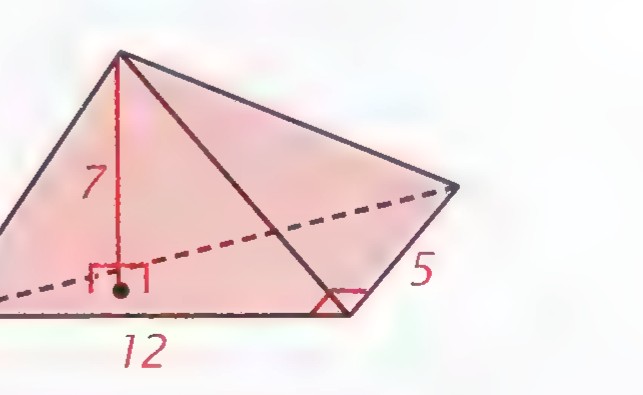
The base of this pyramid is a right triangle.
* Scientific American: How Things Work Today, edited by Michael Wright and M. N. Patel (Crown, 2000).
† The Architecture of Molecules, by Linus Pauling and Roger Hayward (W. H. Freeman and Company, 1964).
p. 650
A Regular Pyramid. The base of the pyramid in the figure below is a regular polygon. Point O is the center of its base, and PO is its altitude.
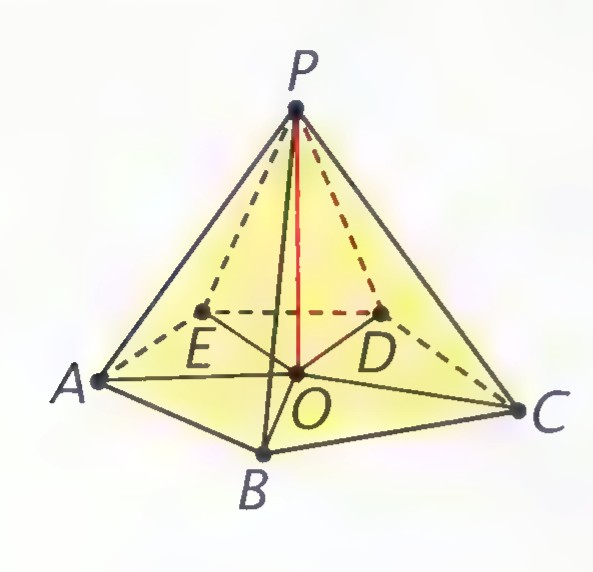
What can you conclude about
- OA, OB, OC, OD, and OE?
- ∠POA, ∠POB, ∠POC, ∠POD, and ∠POE?
- △POA, △POB, △POC, △POD, and △POE?
- PA, PB, PC, PD, and PE?
- △PAB, △PBC, △PCD, △PDE, and △PEA?
Leonardo’s Claim. In 1483, Leonardo da Vinci made the sketch below and wrote: “If a man is provided with . . . linen fabric with a length of 12 yards on each side and 12 yards high, he can jump from any great height whatsoever, without injury to his body.”
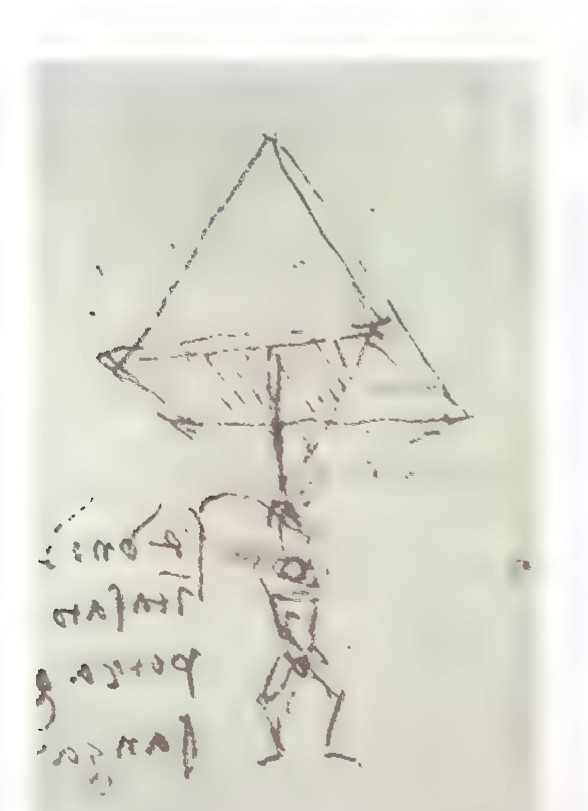
What does his sketch show?
Use da Vinci’s numbers to find the volume of air that would fill it.
Does the man seem to be the correct size with respect to the rest of the figure? Explain.
Triangle and Pyramid Compared. The formulas for the area of a triangle and the volume of a pyramid are similar but different.
- What is the area, A, of a triangle having base b and altitude h?
- What is the volume, V, of a pyramid having base of area B, and altitude h?
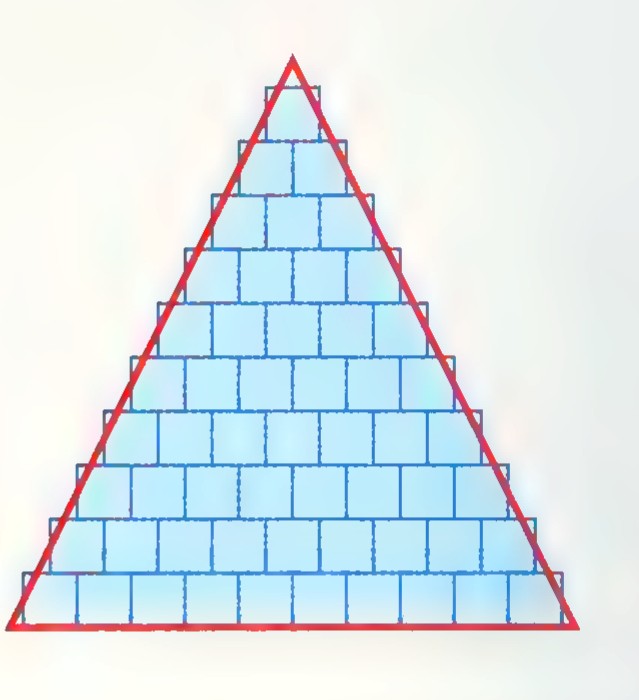
In the figure above, the base and altitude of the red triangle are each 10.5 units long.
- What is its area?
An estimate of its area might be made by counting the squares shown in blue.
- How many squares are there in all?
The red triangle in the figure can also be seen as a side view of a square pyramid.* In this case, the edges of the base of the pyramid and its altitude are 10.5 units long.
- What is the volume of the pyramid?
An estimate of its volume might be made by counting the cubes shown in blue. (The bottom layer of cubes, for example, contains = 100 cubes.)
- How many cubes are there in all?
*Based on an idea in Geometrical Investigations, by John Pottage (Addison-Wesley, 1983).
p. 651
Set II
The Divided Cube. Nicholas Saunderson, blinded by smallpox when he was 12, later became a professor of mathematics at Cambridge University.*
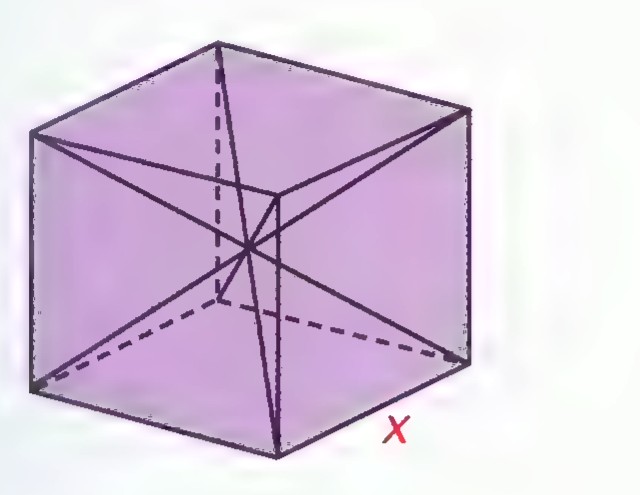
He thought of a way to get the formula for the volume of a pyramid by using the figure above. It shows a cube divided into six congruent pyramids whose apexes are at its center and whose bases are its faces.
Express the following measures in terms of the length, x, of the edges of the cube.
- The volume of the cube.
- V, the volume of one of the pyramids, based on your answer to exercise 27.
- B, the area of the base of one of the pyramids.
- h, the length of the altitude of one of the pyramids.
- Bh.
Compare your answers to exercises 28 and 31.
- What relation does V, the volume of one of the pyramids, have to Bh, the product of the area of its base and the length of its altitude?
Pyramid Numbers. The Greek historian Herodotus is said to have learned from the Egyptian priests that the square of the altitude of the Great Pyramid is equal to the area of one of its lateral faces.†
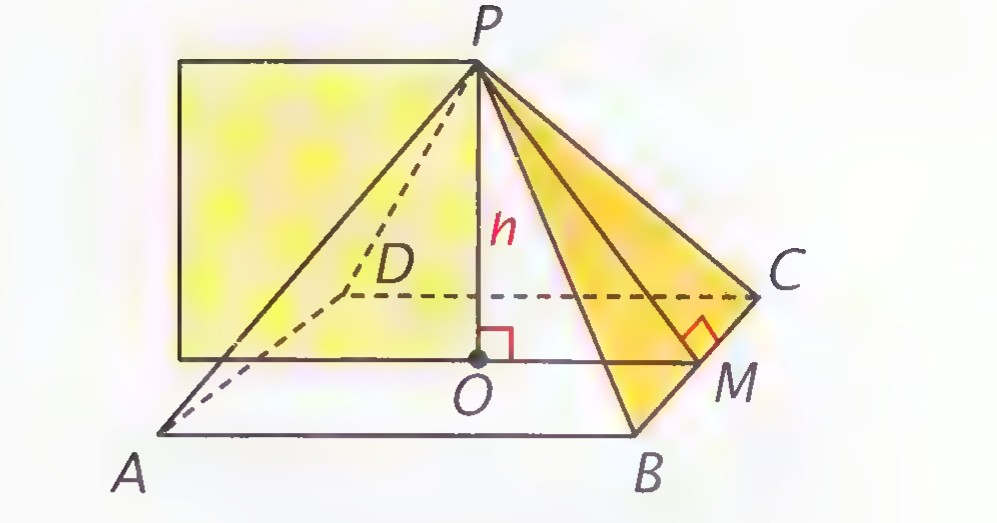
The base of the Great Pyramid, ABCD, is a square with sides of length 756 feet, its altitude PO has length 481 feet, and M is the midpoint of BC.
- Find the square of the altitude to the nearest thousand square feet.
- Find PM to the nearest foot.
- Find the area of one of the lateral faces to the nearest thousand square feet.
- Based on your answers to exercises 33 and 35, might the claim of the Egyptian priests be true?
- Find the volume of the Great Pyramid to the nearest million cubic feet.
More on the Euler Characteristic. Suppose that the base of a pyramid is an n-gon.
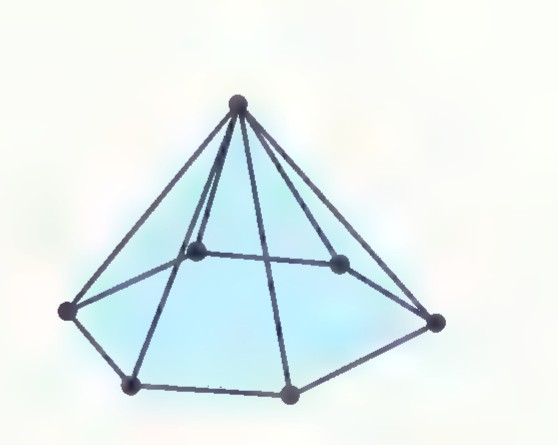
Write an expression in terms of n for
- its number of vertices, V.
- its number of faces, F.
- its number of edges, E.
The Euler characteristic is V + F − E.
- What can you conclude from your expressions for exercises 38 through 40 about the Euler characteristic for pyramids?
* The Penguin Book of Curious and Interesting Mathematics, by David Wells (Penguin, 1997).
† Gnomon: From Pharaohs to Fractals, by Midhat J. Gazalé (Princeton University Press, 1999).
p. 652
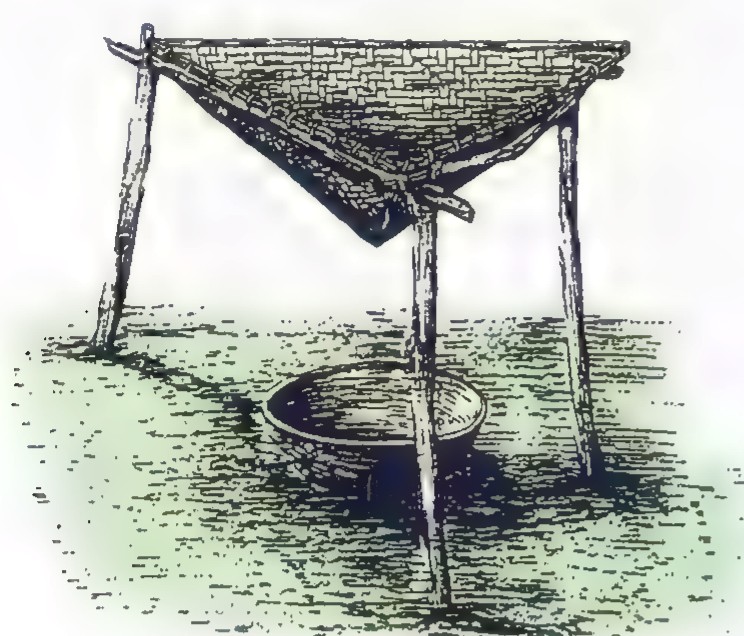
Salt Funnel. The figure below shows a funnel used in Africa in producing salt.*
- Make a model of the funnel by doing the following steps.
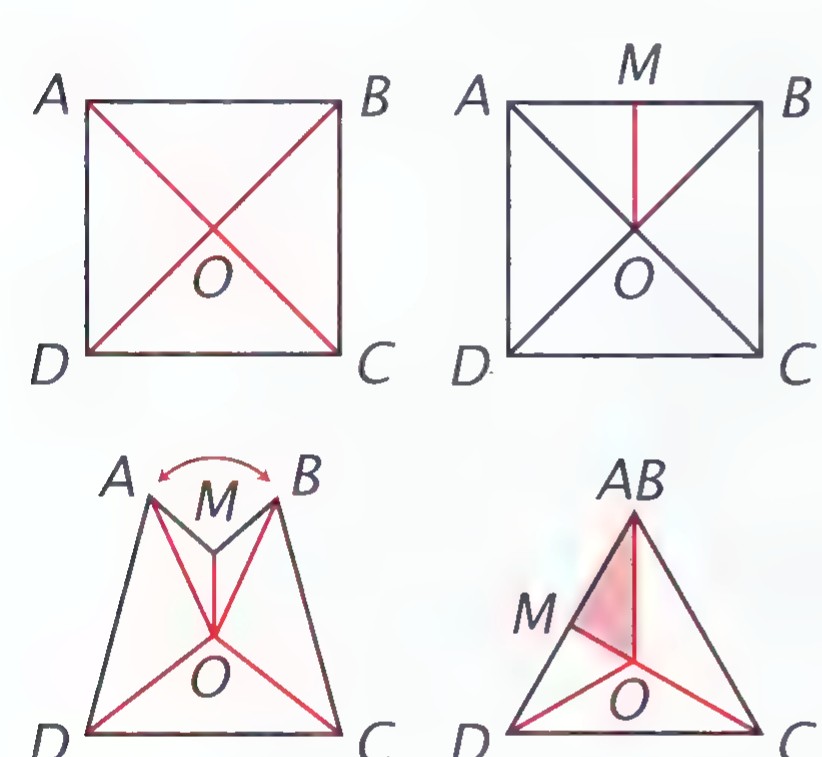
Take a square piece of paper and fold it along both diagonals (see the upper left-hand figure above).
Fold an apothem (see the upper right-hand figure).
Bring △AOD and △BOC together as in the lower left-hand figure, with point M being up and point O being down.
Tape or clip the “double triangle” together as shown in the lower right-hand figure.
* Geometry from Africa, by Paulus Gerdes (Mathematical Association of America, 1999).
- What shape is the funnel?
- What is the shape of its top?
- What is the shape of its other faces?
Given that each side of the square from which the funnel is folded has length s, what is the funnel’s
- lateral area?
- volume? (Hint: Any face of the funnel can be considered its base.)
The Frustum of a Pyramid. A frustum of a pyramid is the part of the pyramid included between its base and a plane parallel to its base. The figure below shows a square pyramid from which a smaller square pyramid has been cut off.
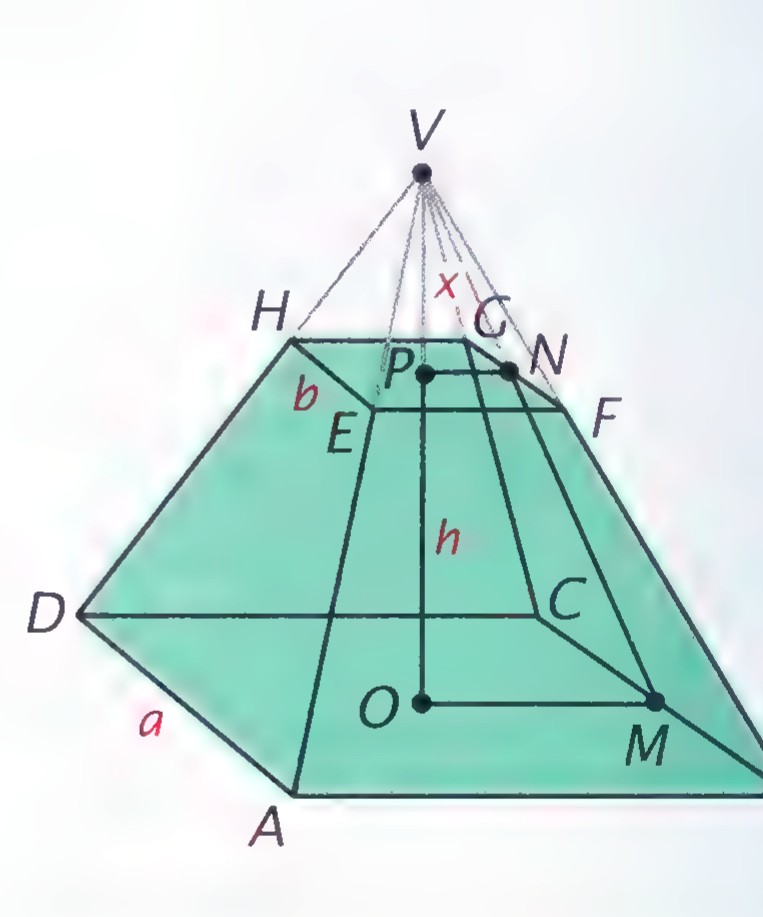
Each edge of the base of the large pyramid has length a, and its altitude, VO, has length x + h.
- Write an expression for the volume of the large pyramid.
Each edge of the base of the small pyramid has length b and its altitude, VP, has length x.
- Write an expression for its volume.
- Write an expression for the volume of the frustum (the part shown in green.)
p. 653
Given that OM and PN are apothems of ABCD and EFGH, it can be shown that △VOM ∼ △VPN.
- Write expressions for OM and PN in terms of a and b.
- Why is ?
- Rewrite this proportion in terms of x, h, a, and b.
- Solve your equation for x in terms of h, a, and b.
- Substitute for x in your answer to exercise 50 and show that the volume of the frustum is .
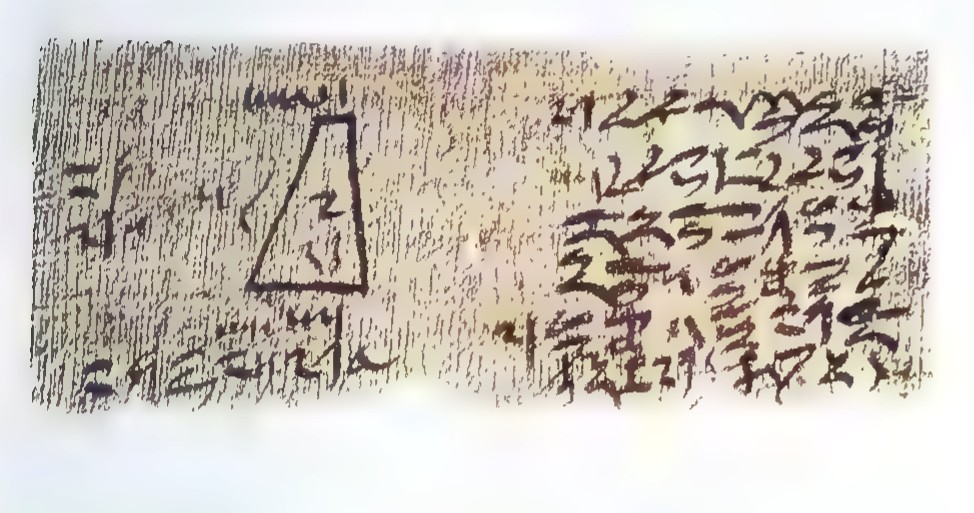
There is evidence that the Egyptians used this expression to find the volume of the frustum of a square pyramid as early as 1890 B.C.*
- Find the volume of such a frustum for which a = 12, b = 3, and h = 8.
The ancient Babylonians used a different expression, , to find the volume of the frustum of a square pyramid.
- Is this expression also correct? Explain.
* Beyond the Third Dimension, by Thomas F. Banchoff (Scientific American Library, 1990).
Set III
How Many Faces? The following question appeared on a PSAT exam.
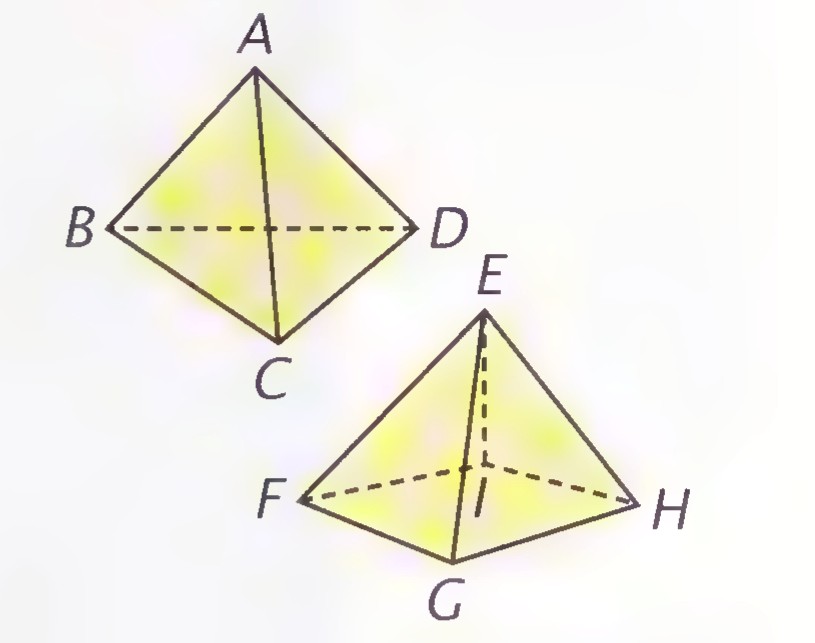
In pyramids ABCD and EFGHI shown above, all faces except base FGHI are equilateral triangles of equal size. If face ABC were placed on face EFG so that the vertices of the triangles coincide, how many exposed faces would the resulting solid have?
- Five.
- Six.
- Seven.
- Eight.
- Nine.
Daniel Lowen, when he took the test as a student at Cocoa Beach High School in Florida, showed that the “expected” answer to the question was wrong.
- What do you think the “expected” answer was? Explain.
Make models of the two pyramids and put them together as described in the question.
- What do you think the correct answer is? Explain.
p. 654
Lesson 6: Cylinders and Cones
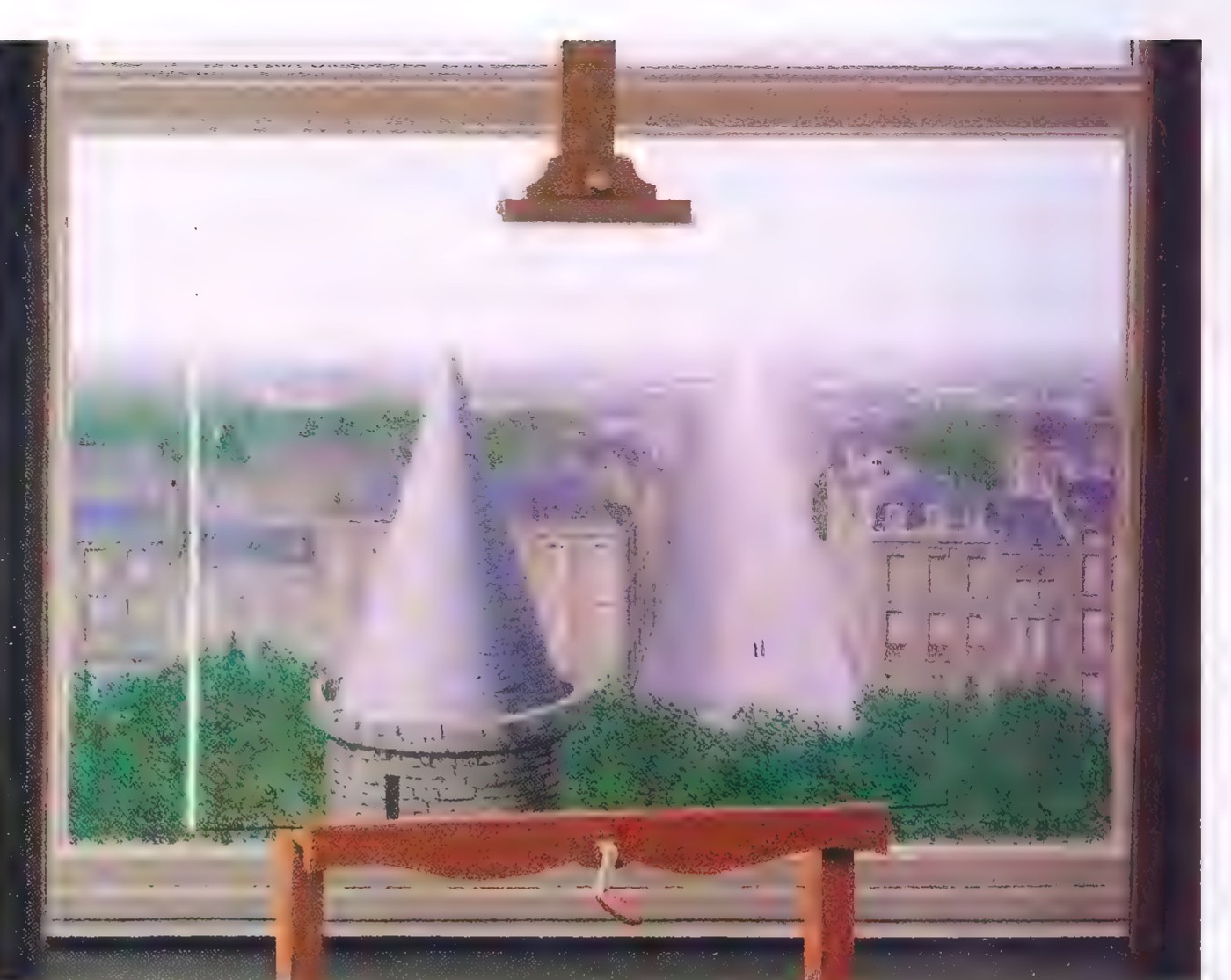
The picture above, part of a painting titled Euclidean Walks by René Magritte, contains several visual tricks. One of them concerns the roof of the tower and the street extending out to the horizon. They are almost identical in appearance, and yet the tower roof is a cone, a three-dimensional solid, whereas the street is a two-dimensional figure bounded by parallel lines.
A cone is like a pyramid. Its base, however, is bounded by a circle rather than a polygon. And, instead of having a set of flat triangular faces, it has a single curved surface called its lateral surface.
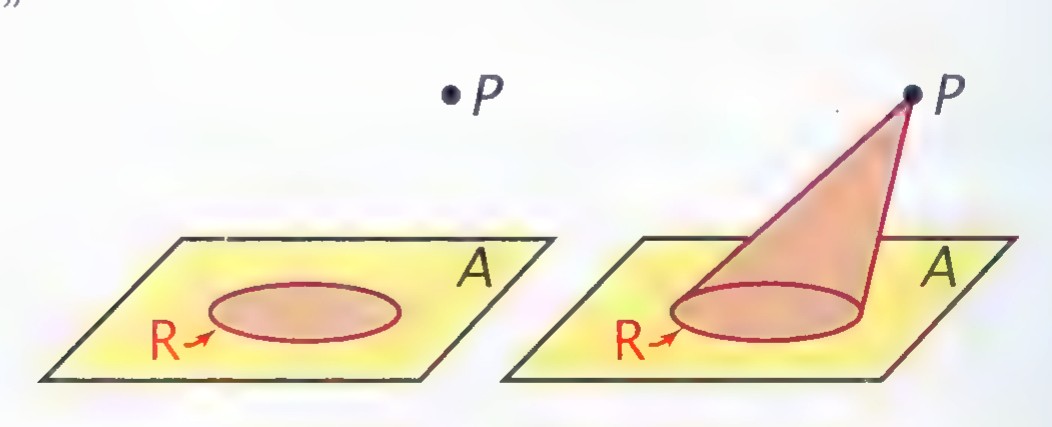
Just as the term polygonal region refers to the union of a polygon and its interior, the term circular region refers to the union of a circle and its interior. To define the term cone, we can simply replace the word “polygonal” in the definition of a pyramid with the word “circular.”
Definition
Suppose that A is a plane, R is a circular region in plane A, and P is a point not in plane A. The solid made up of all segments that connect P to a point of region R is a cone.
p. 655
The words base, apex, and altitude are used in the same sense with respect to cones that they are with pyramids. The line segment connecting the apex of a cone to the center of its base is called its axis. A cone is either right or oblique, depending on whether its axis is perpendicular or oblique to its base.
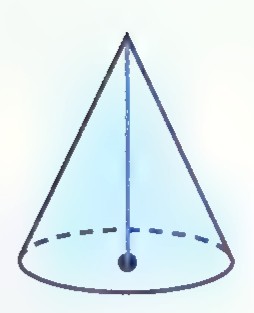
A right cone
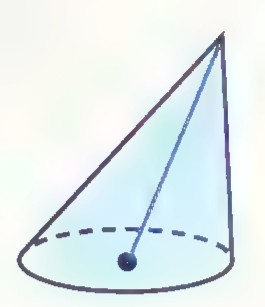
An oblique cone
Just as cones are the circular counterparts of pyramids, cylinders are the circular counterparts of prisms. Changing the word “polygonal” to “circular” turns the definition of a prism into that of a cylinder.
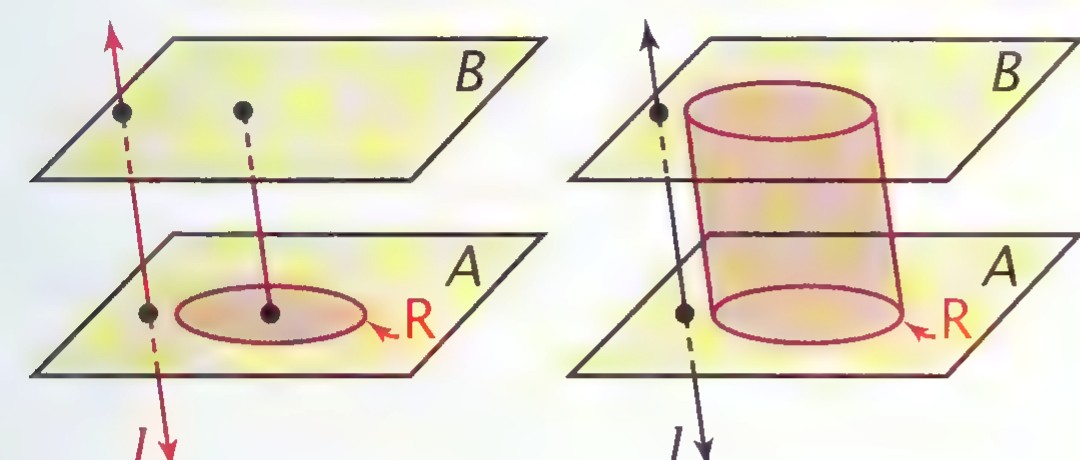
Definition
Suppose that A and B are two parallel planes, R is a circular region in one plane, and l is a line that intersects both planes but not R. The solid made up of all segments parallel to line l that connect a point of region R to a point of the other plane is a cylinder.
Every cylinder has three surfaces: two flat ones, which are its bases, and a curved one, which is its lateral surface. The word altitude is used in the same sense with respect to cylinders as it is with respect to prisms. The axis of a cylinder is the line segment connecting the centers of its bases. Cylinders, like cones, are classified as right or oblique, depending on the direction of their axes with respect to their bases.
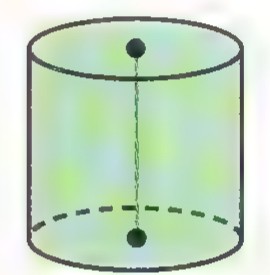
A right cylinder
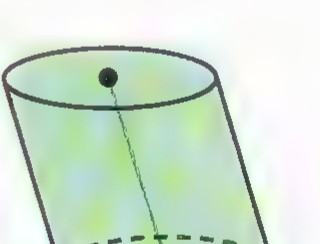
An oblique cylinder
Because a cylinder can be closely approximated by a prism and a cone can be approximated by a pyramid, the formulas for the volumes of prisms and pyramids can be used to find the volumes of cylinders and cones as well. They are restated as the following theorems without proof.
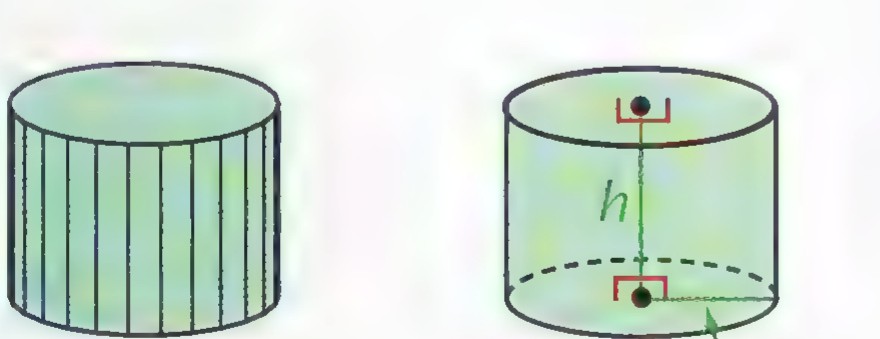
Theorem 81
The volume of a cylinder is the product of the area of its base and its altitude:
p. 656
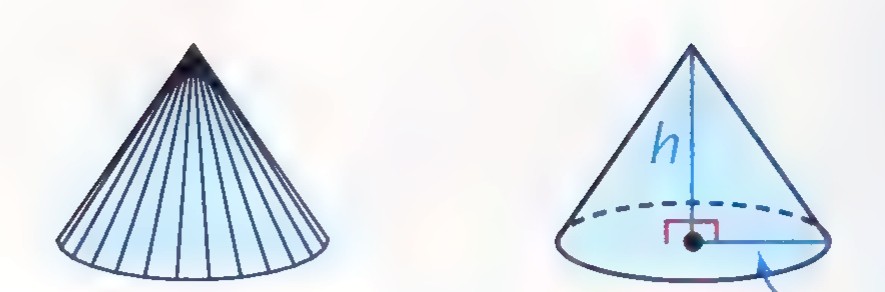
Theorem 82
The volume of a cone is one-third of the product of the area of its base and its altitude:
Exercises
Set I
Primitive Perspective. The “three-dimensional” figures below are shown in the style in which they were usually drawn in the fifteenth century.*
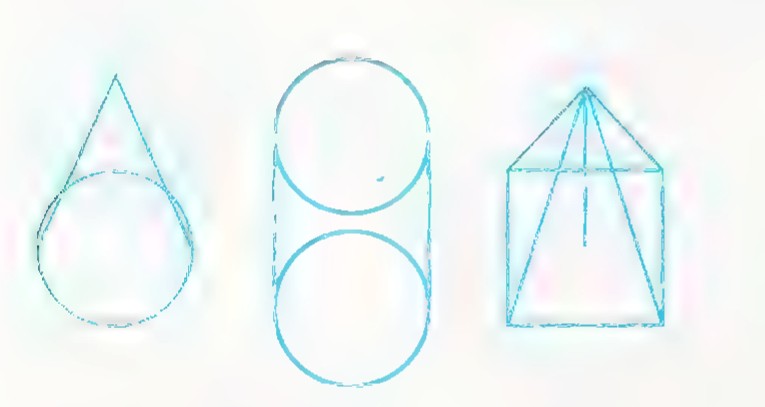
- What geometric solids do you think they illustrate?
- Redraw each figure in a more correct perspective.
Italian into English. Compare the following two statements from an Italian geometry book.
Il volume di un cilindro è dato dal prodotto dell’area di base per l’altezza.
Il volume di un cono è dato da un terzo del prodotto dell’area di base per l’altezza.
- Which words appear to be the same in Italian and English?
* The Invention of Infinity: Mathematics and Art in the Renaissance, by J. V. Field (Oxford University Press, 1997).
What do you think the following words mean?
- Cilindro.
- Cono.
- Prodotto.
- Un terzo.
- Altezza.
- In which statement do you think one of the words could be correctly replaced by “pyramid”?
Solids of Revolution. A cylinder can be thought of as a “solid of revolution” because it can be generated by revolving a rectangle about one of its sides.
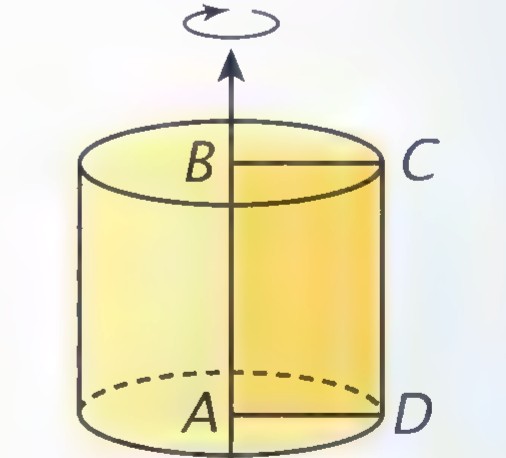
- What is the side AB about which the rectangle revolves called with respect to the cylinder?
- What is the length of AB called?
p. 657
- What is the curved surface generated by the opposite side CD called with respect to the cylinder?
- What do sides AD and BC generate?
- What relation does line AB have to the planes that contain the bases of the cylinder?
Suppose the rectangle is a 3-inch-by-5-inch file card and that it is revolved about a 5-inch side, as shown on page 656.
- Find the volume of the cylinder generated in cubic inches. Leave your answer in terms of π.
Suppose the rectangle is revolved about one of its shorter sides, as shown below.
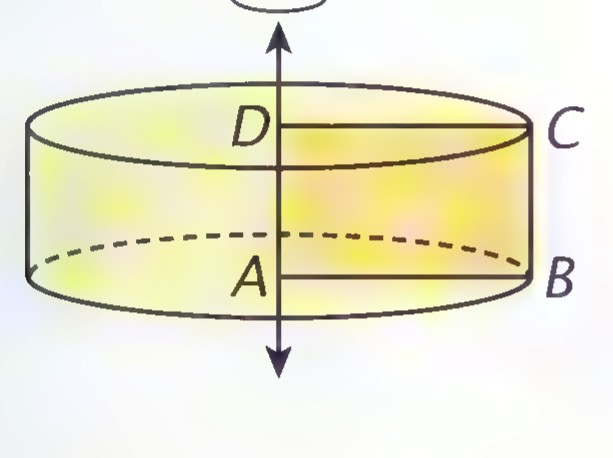
- Does the cylinder generated have the same volume as that of the preceding one? Explain.
A cone also can be thought of as a “solid of revolution.”
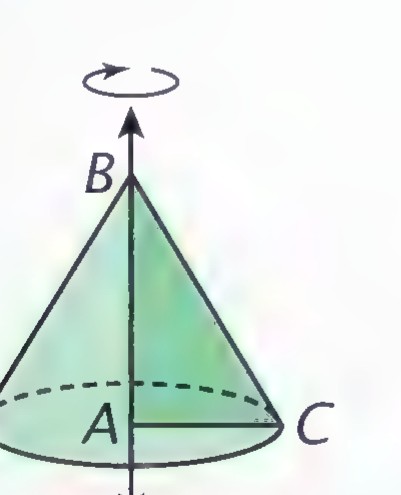
- What figure can be revolved to generate it?
- Would a cone be generated regardless of which side of the figure the figure is revolved about? Explain.
Hockey Puck. Although a sphere (the ball) is important in most sports, a cylinder (the puck) is important in ice hockey.
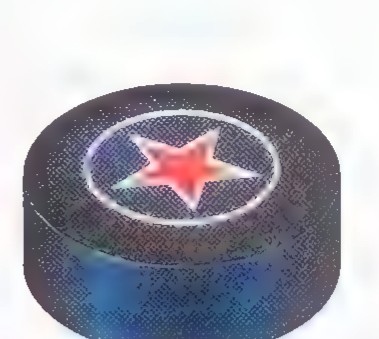
A hockey puck has a diameter of 3 inches and an altitude of 1 inch.
- Find the area of ice covered by one of its bases to the nearest square inch.
- Find its volume to the nearest cubic inch.
Cylindrical Tunnel. One of the tunnel-boring machines used to construct the Channel tunnel connecting France and England is shown in the photograph below. The machine can bore a cylindrical tunnel with a diameter of 9 meters, advancing by 75 meters per day.
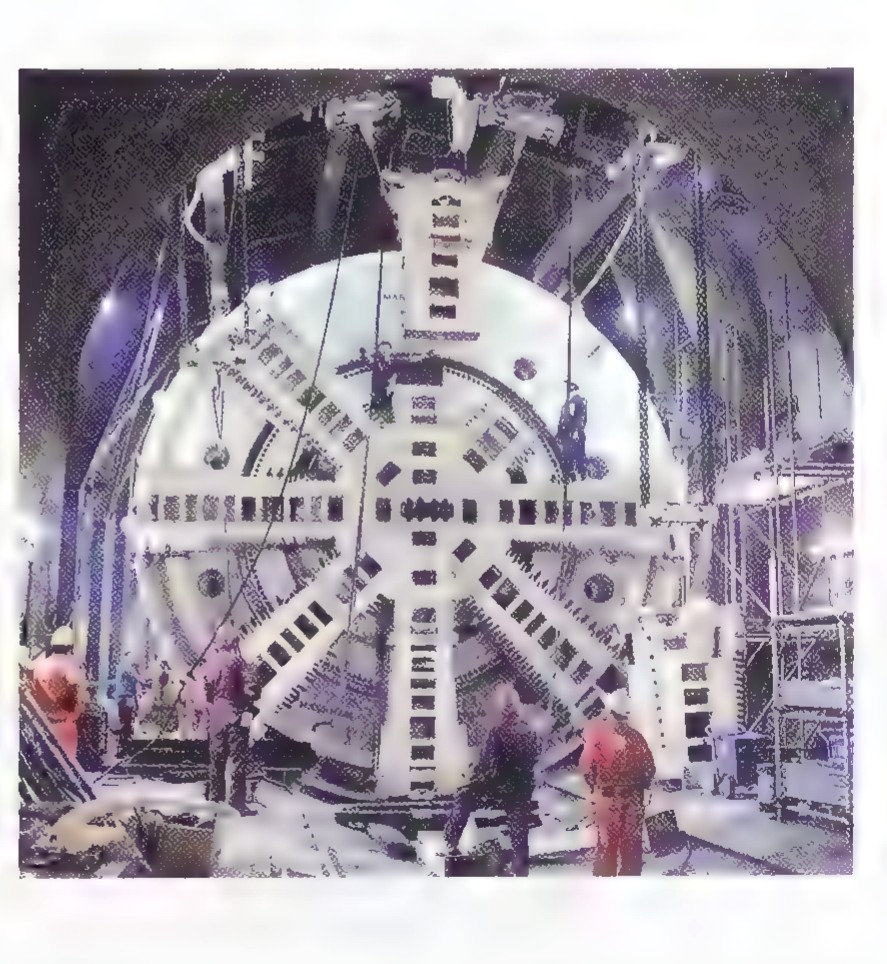
- Find the area to the nearest square meter of one of the bases of this section of tunnel.
- Find the volume to the nearest hundred cubic meters of a day’s worth of this machine’s tunnelling.
p. 658
Sliced Solids. The figures below are overhead views of two geometric solids and corresponding cross sections produced by a set of planes parallel to their bases. Each plane is equidistant from the neighboring ones.
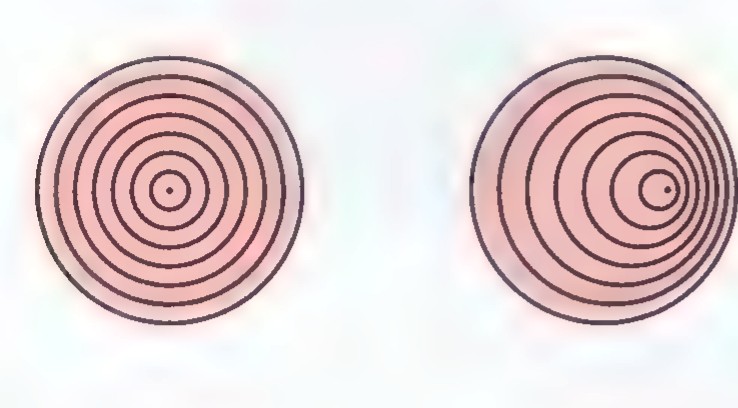
- What kind of solids do they appear to be?
- Sketch figures to show what side views of the two solids might look like.
- What can you conclude about the two solids if every pair of corresponding cross sections have equal areas?
- What is the basis for your conclusion?
Sausages in a Can. Vienna sausages are sold in cans that contain seven sausages.
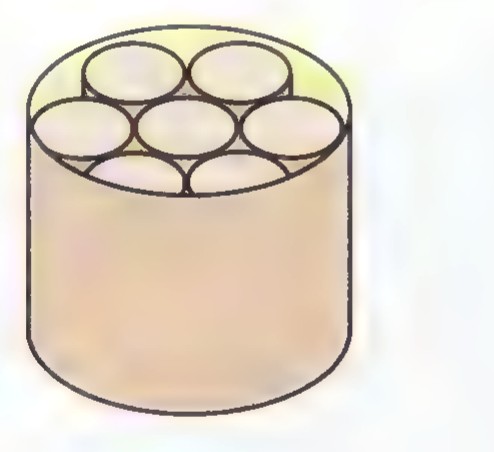
The diameter of each sausage is 2 cm and the diameter of the can is 6 cm. The sausages are 5 cm long and the can is 6 cm high.
Find the total volume in cubic centimeters of the seven sausages
- as an exact number in terms of π.
- to the nearest integer.
Find the volume in cubic centimeters of the can
- as an exact number in terms of π.
- to the nearest integer.
- What percentage of the volume of the can do the sausages fill?
Triangles or Cones. Compare the figures below.
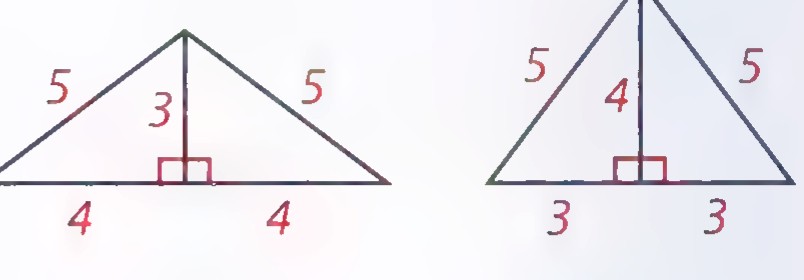
- If they are seen as isosceles triangles, how do the triangles compare in area? Explain.
- If they are seen as side views of right cones, how do the cones compare in volume? Explain.
Set II
Pipe Puzzle. The following question appears in a popular book of puzzles.*
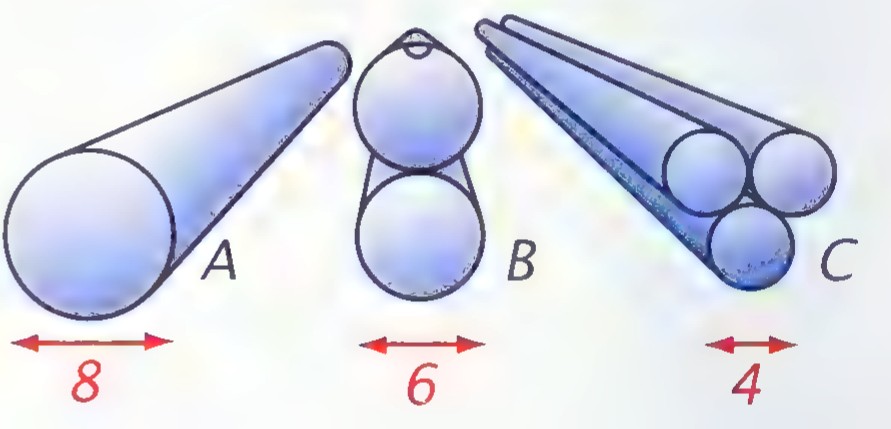
Which arrangement of lengths of pipes would hold the most water?
- To answer this question, what would you assume about the pipes?
- Which arrangement is the correct answer?
Cake Pans. The directions on a typical box of cake mix say to use either a round pan with a 9-inch diameter or a square pan with sides of 8 inches. Both pans are inches deep.
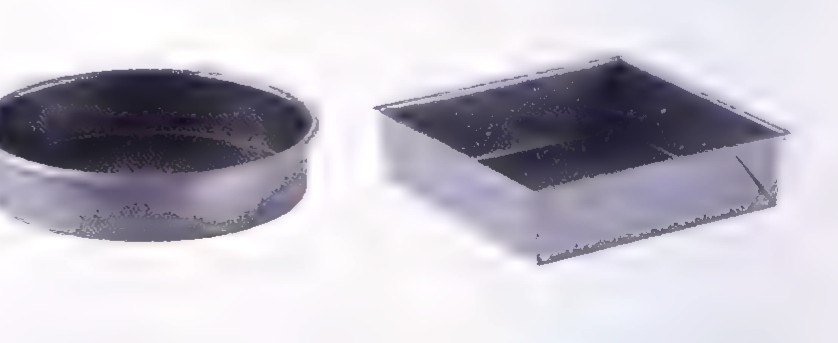
* The Mammoth Book of Brainstorming Puzzles, by David J. Bodycombe (Carroll & Graf, 1996).
p. 659
- Find the volume of each pan to the nearest cubic inch.
- How would you expect the heights of the cakes produced in the two pans to compare? Explain.
Engine Displacement. Cylinders are basic parts of gasoline engines. According to an automobile handbook,
The swept volume in cubic inches of an individual cylinder is found by multiplying pi/4 by the bore in inches squared by the stroke in inches.
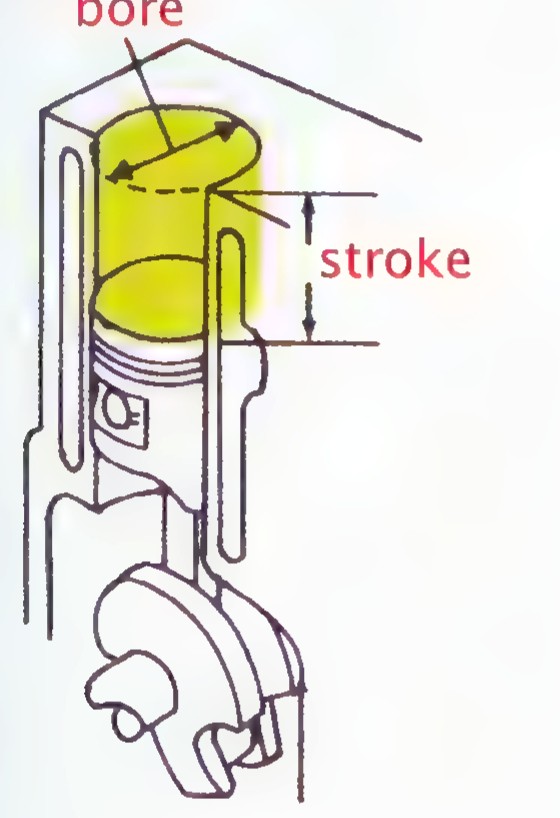
What dimension of the cylinder (shown in green) is
the bore?
the stroke?
Letting the radius of the cylinder be r and its altitude be h, show why the description above gives the correct expression for the “swept volume.”
The “displacement” of an engine is the total swept volume of its cylinders.
- Find the displacement to the nearest cubic inch of an eight-cylinder engine with a bore of 4.0 inches and a stroke of 3.5 inches.
Stage Lighting. Cones of light are used in stage lighting.*
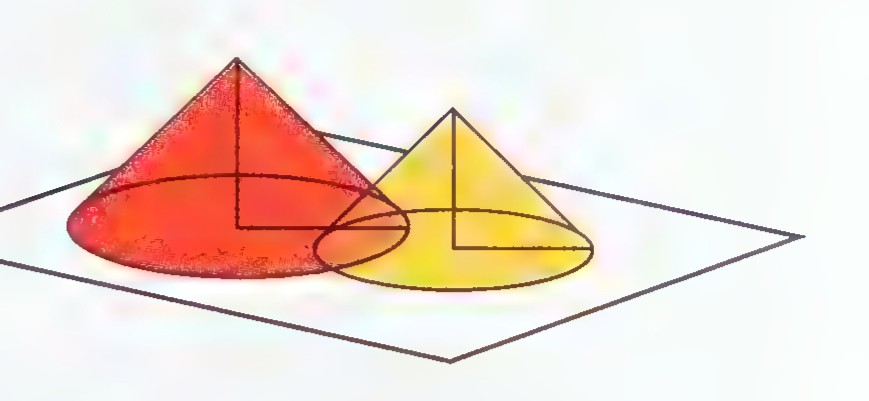
Suppose that one of these light cones is shaped so that the radius of its base is always equal to its altitude.
Write an expression for each of the following measures in terms of h, the distance of the light above the stage.
- The area of the stage lighted by it.
- The volume of space lighted by it.
Suppose the distance of the light above the stage is doubled to 2h.
- Exactly how does the area of the stage lighted by it increase?
- Exactly how does the volume of space lighted by it increase?
Paper Towels. A popular brand of paper towels contains, according to the package, “80.6 square feet” of towels. Each towel measures 11 inches by 6 inches.
- How many towels do you think are in the package?
* Beyond the Third Dimension, by Thomas F. Banchoff (Scientific American Library, 1990).
p. 660
The towels are wrapped around a cardboard tube so that the package has the shape of a cylinder that is 11 inches long and has a diameter of 6 inches. The diameter of the cardboard tube is 1.75 inches.
Find the volume of
- the roll of towels, including the tube, to the nearest cubic inch.
- the towels, not including the tube, to the nearest cubic inch.
- one towel, to the nearest 0.1 cubic inch.
Cylinder and Cone Areas. The lateral area of a right cylinder or cone is the area of its curved surface.
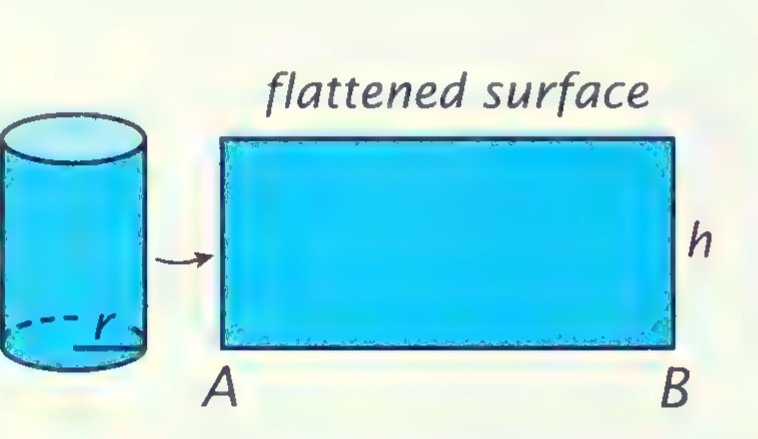
- What does the curved surface of a right cylinder look like if the cylinder is slit down one side and flattened out?
- Write an expression for AB in terms of r.
- Write an expression for the lateral area of a right cylinder in terms of r and h.
- What does the expression represent for a right cylinder?
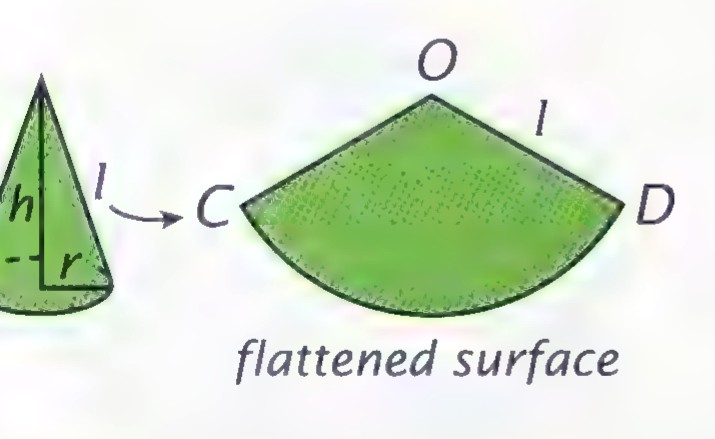
- What does the curved surface of a right cone look like if the cone is flattened out?
- Write an expression for the length of arc CD in terms of r.
- What fraction of the area of circle O is the lateral area? Express your answer in terms of r and l.
- Write an expression for the lateral area of a right cone in terms of r and l.
- Write an expression for the lateral area in terms of r and h.
- What does the expression represent for a right cone?
Coin Wrappers. Coin wrappers come in different sizes according to the dimensions of the coins that they are made to hold.
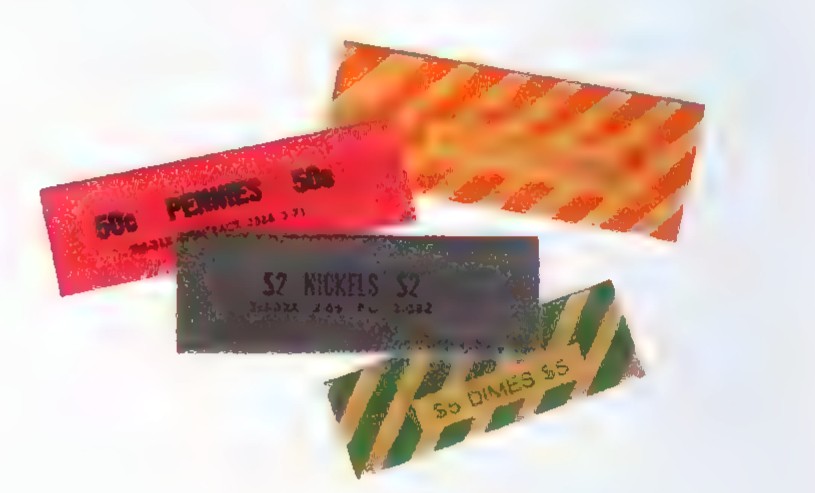
A wrapper for nickels, for example, is 34 mm wide when pressed flat.
- Show that this size is appropriate for nickels, given that the diameter of a nickel is 21 mm.
- How wide would you expect a wrapper for dimes to be, given that the diameter of a dime is 18 mm?
- In general, approximately how wide should a wrapper for a set of coins be if the diameter of each coin is x mm?
Rolling Cones. A right circular cone rolls on a flat horizontal surface.*
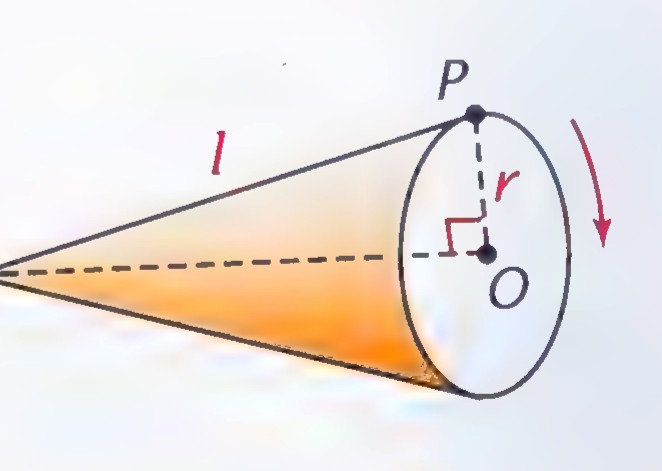
- Describe what happens to the cone.
* Mathematics Meets Technology, by Brian Bolt (Cambridge University Press, 1991).
p. 661
Suppose the cone returns to the same spot after rotating twice about its axis.
- What can you conclude about ∠PVO? Explain.
Set III
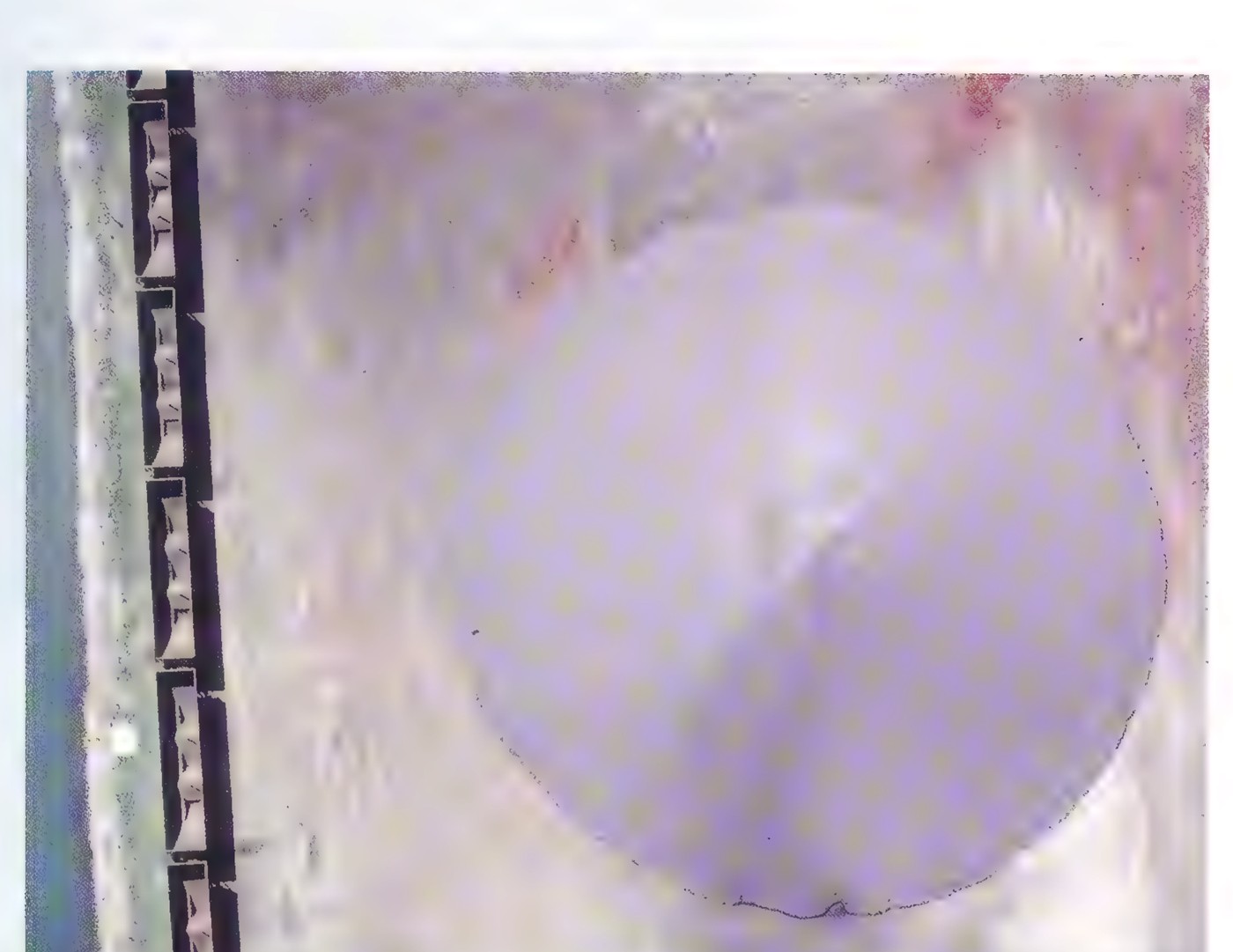
Iron Ore. The photograph above is an overhead view of a conical pile of iron ore ready to be loaded into train cars.*
The cars are 10 feet wide and the “angle of repose” of iron ore (∠R in the side view of the pile below) is 34°.
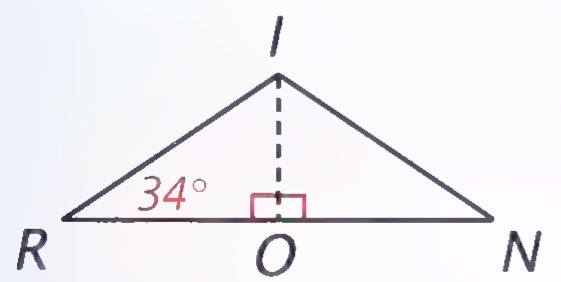
Use this information, your ruler, and a calculator to estimate each of the following measures. (It is easiest to make your measurements on the photograph in millimeters. For example, the width of the cars is 4 mm.)
- The diameter of the pile in feet.
- The height of the pile.
- The area of ground covered by the pile.
- The volume of ore in the pile.
- The number of 4,400-cubic-foot gondola cars needed to haul the pile away.
* Taking Measures Across the American Landscape, by James Corner and Alex S. MacLean (Yale University Press, 1996).
p. 662
Lesson 7: Spheres
In 360 B.C., the Greek philosopher Plato wrote:
Wherefore he [the Creator] made the world in the form of a sphere, round as from a lathe, having its extremes in every direction equidistant from the center.*
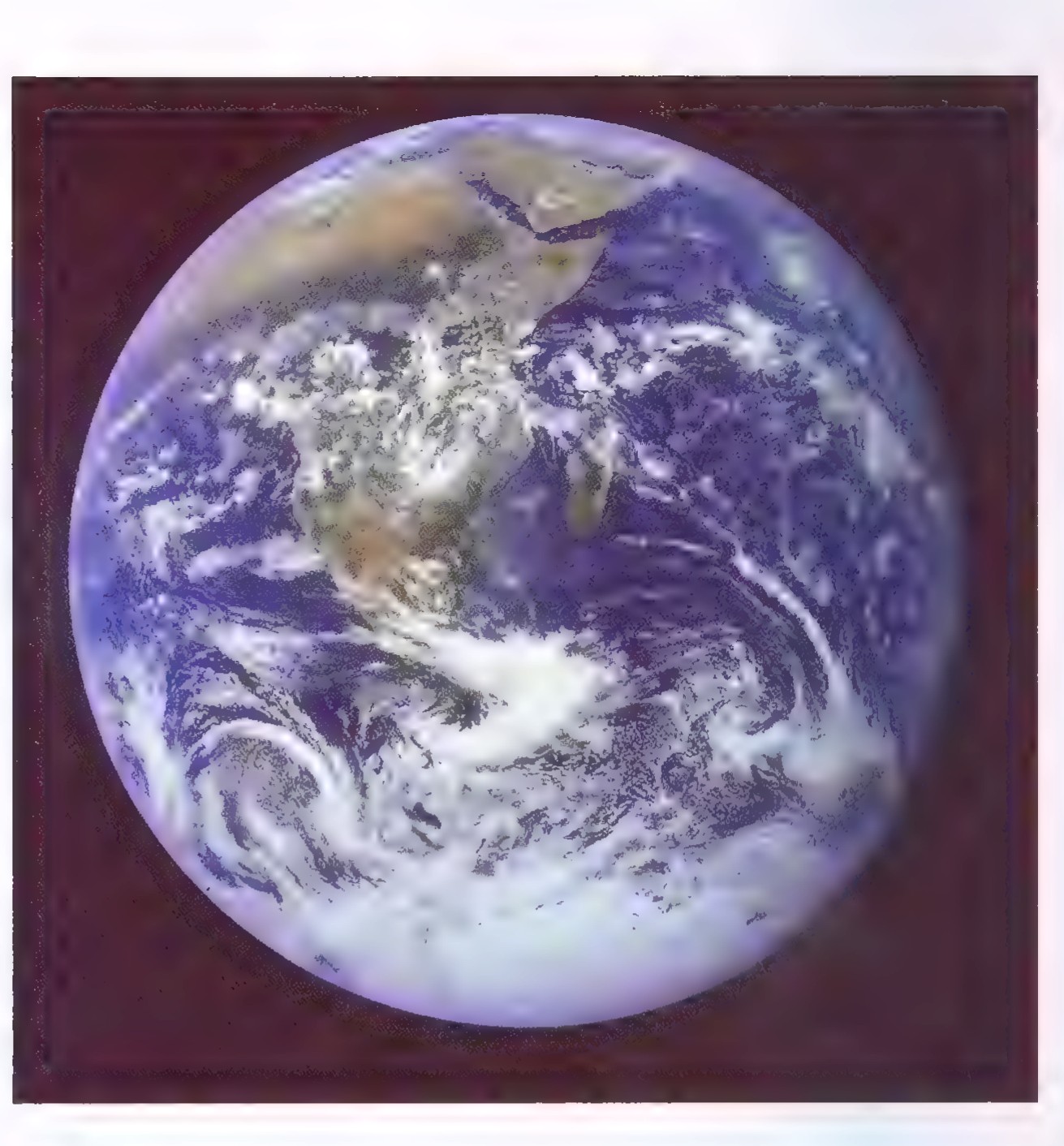
On December 7, 1972, when on the Apollo 17 mission to the moon, American astronaut Harrison Schmitt confirmed Plato’s words as he took the famous photograph of Earth shown above. The familiar shape of Africa is visible at the upper left, and snow-covered Antarctica can be seen at the bottom.
Plato’s description of a sphere, written before Euclid was born, is the basis for our definition.
Definition
A sphere is the set of all points in space that are at a given distance from a given point.
*Timaeus, translated by Benjamin Jowett.
p. 663
Notice that this definition is like that of a circle except that the words “in space” replace “in a plane.” As a result, words such as center, radius, and diameter have the same meanings for spheres as they do for circles.
You know that two useful measures of a circle are its circumference and area, both of which can be determined from its radius: and .
Two useful measures of a sphere are its surface area and volume. By the volume of a sphere, we mean the volume of the solid consisting of the sphere and its interior. You may already know the remarkable fact that the surface area and volume of a sphere, like the circumference and area of a circle, can be expressed in terms of its radius and pi.
First, we can use Cavalieri’s Principle to find the volume. The figure at the right shows a sphere of radius r sliced by a plane at a distance d from the sphere’s center. The cross section of the sphere is a circle; we will let its radius be x.
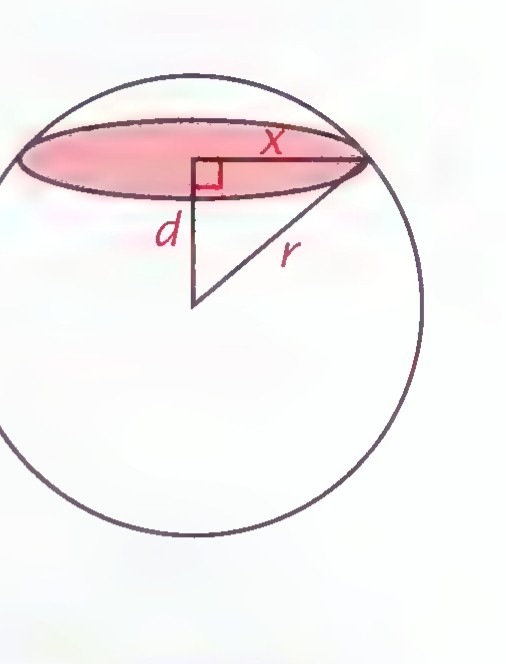
By the Pythagorean Theorem,
Because the cross section is a circle, its area is . Substituting for gives
This result can be interpreted as the difference between the areas of two circles having radii r and d. In the figure at the right, this difference is the area of the yellow region between the two circles.
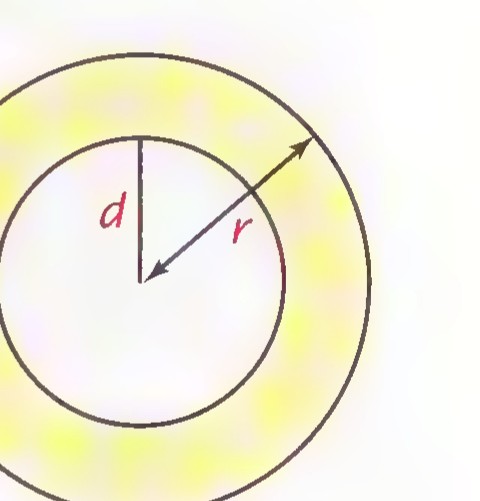
To apply Cavalieri’s Principle to finding the volume of a sphere, we use a geometric solid that has this kind of cross section. It consists of a right cylinder from which two identical cones have been removed, as shown in the figure below. The cylinder has the same radius, r, and the same height, 2r, as those of the sphere and is situated so that the two solids rest on the same plane. The two hollowed-out cones meet at the center of the cylinder and each shares one or the other of its bases.
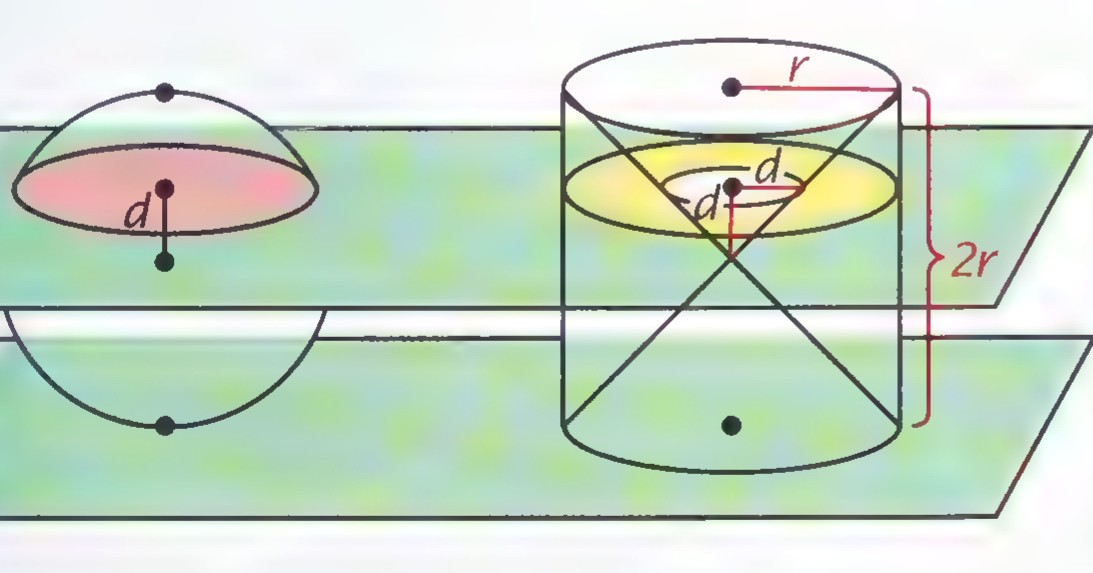
A cross section of this solid chosen at a distance d from the solid’s center is bounded by two circles with radii r and d, so the area of the cross section is
p. 664
This area is the same as that of the corresponding cross section of the sphere; so, from Cavalieri’s Principle, it follows that the volumes of the two solids are the same.
It is easy to find the volume of the cylindrical solid. It is equal to
It follows that this volume is also that of the sphere.
Theorem 83
The volume of a sphere is times the cube of its radius:
We can use this result and an intuitive argument to find a formula for the surface area of a sphere. First, we divide the sphere into a large number of small “pyramids.” Imagine that the surface of the sphere is separated into a large number of tiny “polygons.” They are not actually polygons, because there are no straight line segments on the surface of a sphere. However, the shorter the “line segments,” the closer they come to forming polygons.
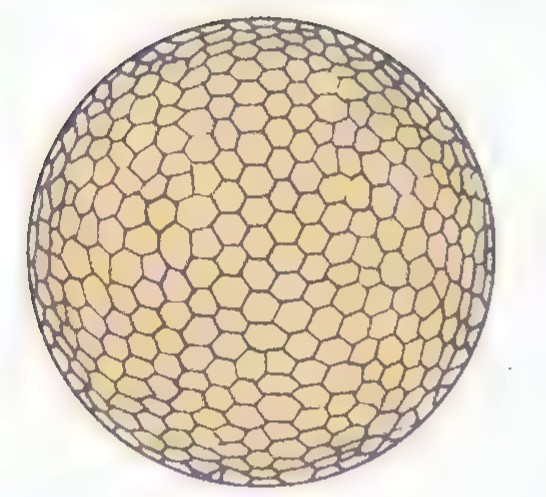
Imagine connecting the corners of all of these “polygons” to the center of the sphere so that they become the bases of a set of “pyramids” all with a common apex, the center of the sphere. All of the pyramids, then, have altitudes equal to the radius of the sphere.
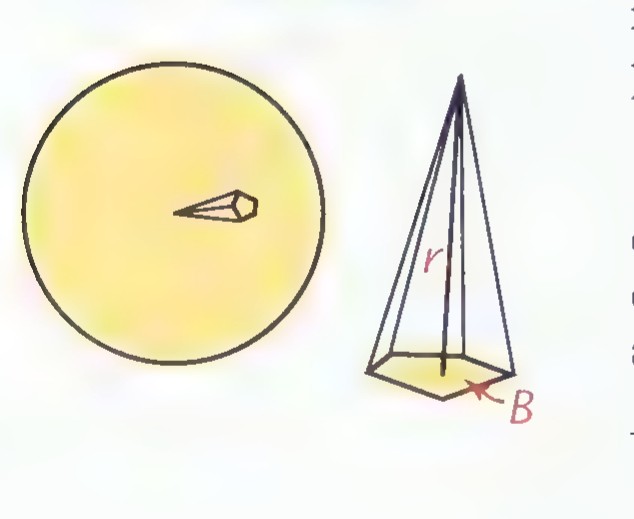
The volume of one of these pyramids is , in which B is the area of the pyramid’s base and r is the length of its altitude. The volume of the sphere is the sum of the volumes of all of the pyramids. If the areas of their bases are , , , and so on, then their volumes are , , , and so on, and
Now , and so
Solving this equation for , we get
p. 665
But , and so
Our intuitive argument is only approximately correct. We have been thinking about polygons and pyramids in a situation in which such figures cannot really exist. It is possible, however, to obtain the same result by means of the calculus, without making any of the approximations that we have made.
Theorem 84
The surface area of a sphere is times the square of its radius:
Exercises
Set I
Earth Shadow. In this painting by Mitsumasa Anno titled The Shadow of the Earth, the earth and its shadow have the same radius.
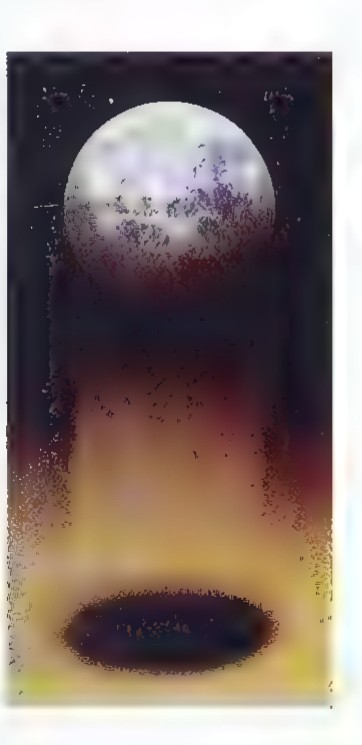
- How does the length of the earth’s equator compare with the circumference of the shadow?
- How does the area of the earth compare with the area of the shadow?
Black Hole. For our sun to collapse to a “black hole,” it would have to be compressed into a sphere with a radius of 1 kilometer.
- What would its surface area be?
- What would its volume be?
Suppose another spherical “black hole” has a surface area in square kilometers that is numerically equal to its volume in cubic kilometers.
- What would its radius be?
- What would its surface area and volume be?
p. 666
Archimedes’ Discoveries. Archimedes (287–212 B.C.) wrote a book titled On the Sphere and Cylinder.
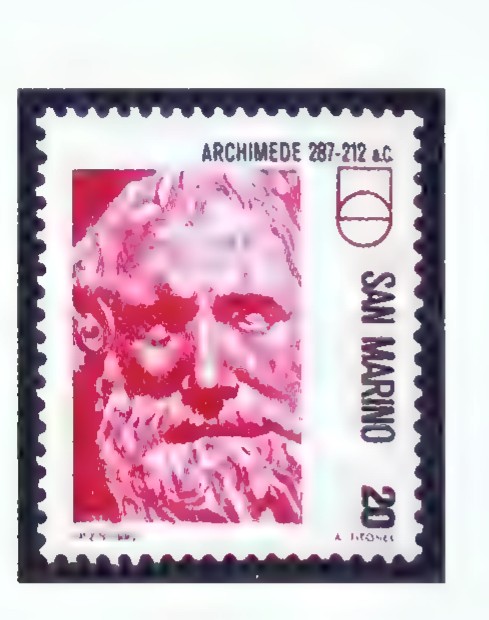
One of his discoveries was about a cone, a hemisphere (half a sphere), and a cylinder that have the same radius and height.
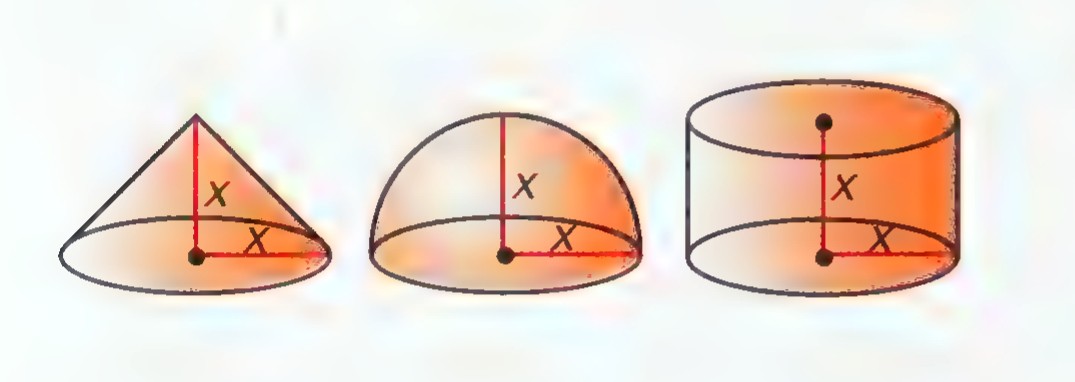
Write an expression in terms of x for the volume of
- the cone.
- the hemisphere.
- the cylinder.
- In what ways are the volumes of these three solids related?
Flatland. Flatland, a science-fiction novel by Edwin A. Abbott, is a story about life in a two-dimensional world.
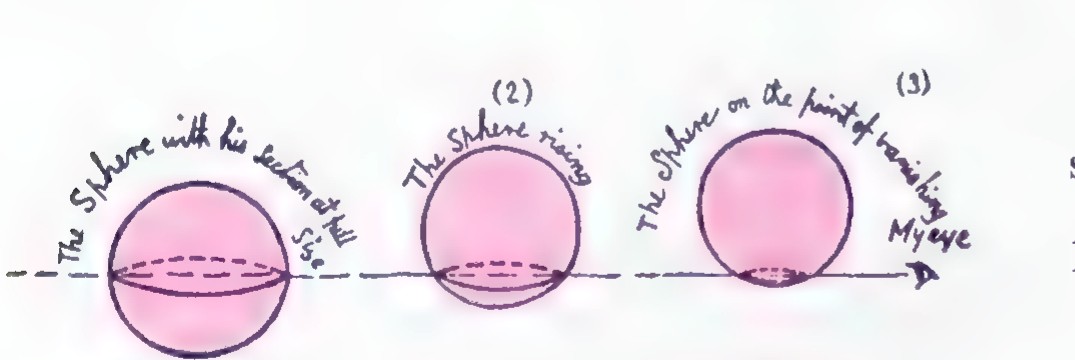
This illustration from the book is of a sphere visiting Flatland. All that Flatland’s inhabitants can see is the intersection of the sphere with their plane.
The figure below can be used to explain why they see a circle. Points A and B represent any two points in which sphere O intersects plane P, and OM is perpendicular to plane P.
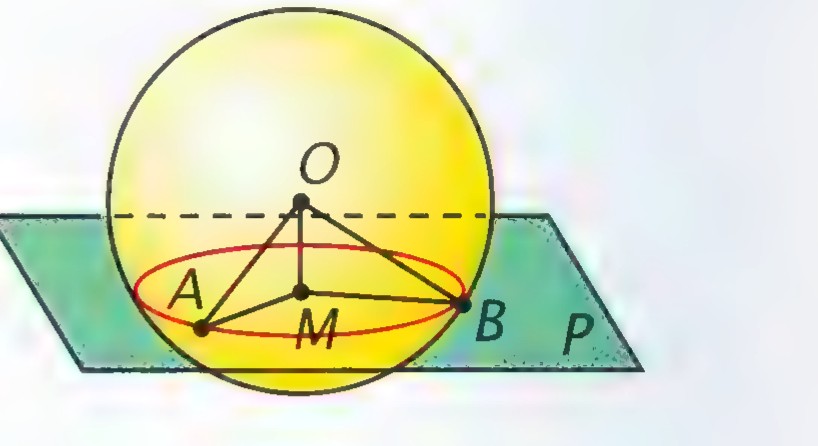
- Why is OA = OB?
- Why is OM ⊥ MA and OM ⊥ MB?
- Why is △OMA ≅ △OMB?
- Why is MA = MB?
- What does this equality imply about the curve that is the intersection of sphere O and plane P? Explain.
Sound Wave. According to a book on sound, “when a point source . . . radiates into free space, the intensity of the sound . . . is given by
where W is the power of the source.”*
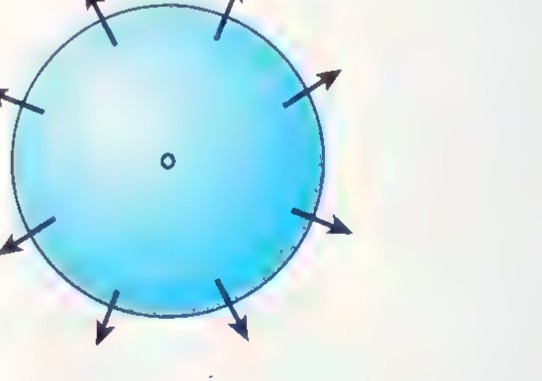
The sound wave being described is spherical in shape.
- Where is the “point source” with respect to the sphere?
- What does measure with respect to the sphere?
* The Science of Sound, by Thomas D. Rossing (Addison-Wesley, 1990).
p. 667
- According to the formula, what happens to the intensity of the sound as the radius of the sphere increases?
Volume and Density. Scale drawings of a baseball and a golf ball are shown below.
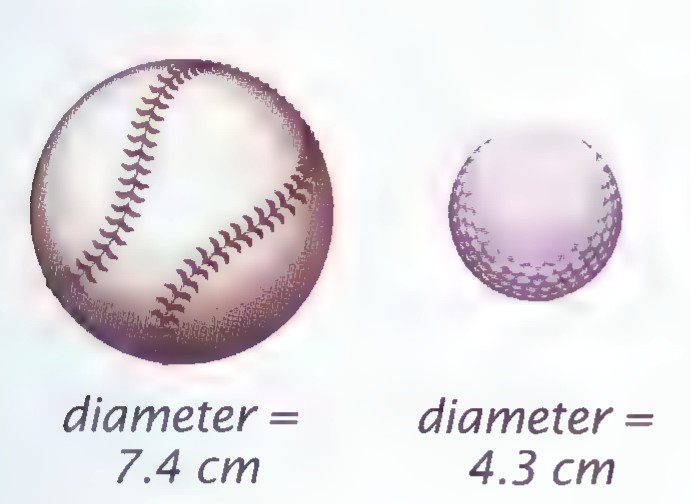
Find the volume to the nearest cubic centimeter of
- a baseball.
- a golf ball.
The density of an object is its mass per unit volume. One cubic centimeter of water has a mass of 1 gram; so its density is = 1 gram per cubic centimeter.
- Use the fact that a baseball has a mass of 145 g to find its density to the nearest 0.1 g/cm³.
An object will float if its density is less than that of water; it will sink if its density is more.
- Will a baseball float on water or sink?
As every golfer knows, a golf ball will sink in water.
- What can you conclude about its mass?
Chocolate Packing. The photograph below shows 16 chocolates packed in a box.
Compare the side view of the box below with an identical box that contains 2 chocolates having twice the diameter of the chocolates in the original box.
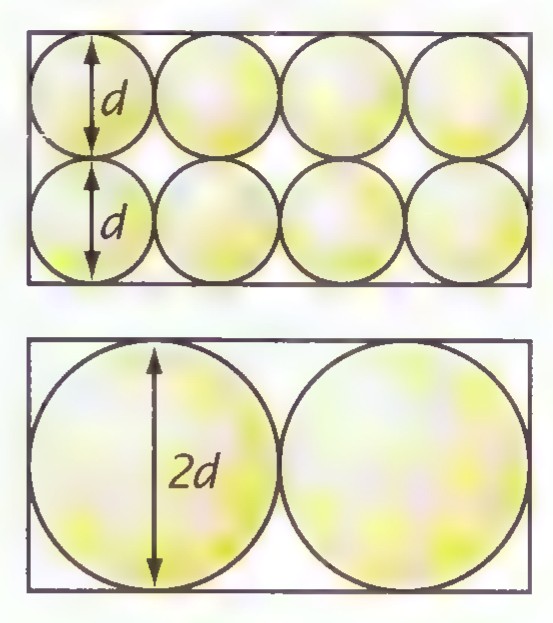
- Which box do you think contains more chocolate?
- Find the volume in terms of d of chocolate in each box to check your answer.
The chocolates are wrapped in paper.
- Which box do you think would contain more wrapping paper?
- Write appropriate expressions in terms of d to check your answer.
Set II
Half Sphere. This sculpture by Swiss artist Max Bill is titled Half Sphere Around Two Axes.
Write an expression for each of the following measures in terms of r, the radius of the half sphere.
- Its volume.
- The area of its curved surfaces.
- The area of its flat surfaces.
- Its total surface area.
p. 668
Hollow Earth. A cult once believed that the earth is hollow and that we and the entire universe are inside it.
In the figure below, circle O represents the hollow earth. To every point P outside the earth, there corresponds a point P’ inside the earth such that PT is tangent to circle O and TP’ ⊥ OP.
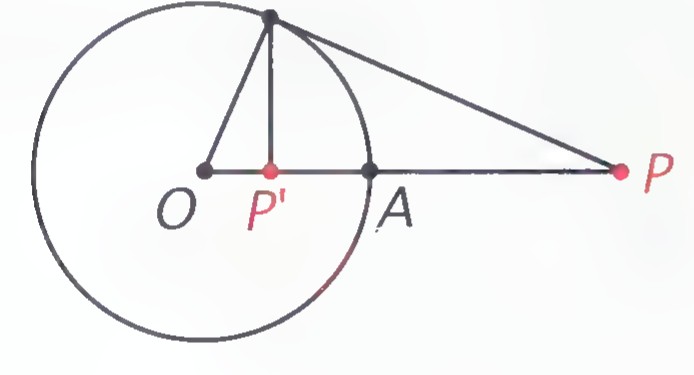
- What can you conclude about △OTP? Explain.
- It follows that . Why?
If the moon is at P, the “hollow earth” people thought that it was actually at P’. For the moon, OP ≈ 240,000 miles; the radius of the earth OT ≈ 3,960 miles.
- Find OP’ to the nearest mile.
- If we are at point A so that the moon is directly overhead, how far “above” us would the moon in the hollow earth be?
If the sun is at P, OP ≈ 93,000,000 miles.
- Find OP’ for the sun to the nearest hundred feet. (1 mile = 5,280 feet.)
- From these results, where do you think the hollow-earth people thought the stars were?
Melting Snowball. A problem in a calculus book begins:
A spherical snowball is melting in such a way that its volume is decreasing at a rate of 1 cm³ per minute.*
Suppose that the diameter of the snowball before it begins to melt is 12 cm and that the snowball melts at a constant rate. Approximately how many hours would it take for the snowball
- to melt completely?
- to shrink to a diameter of 6 cm?
Find the surface area of the snowball to the nearest square centimeter
- before it begins to melt.
- when it has shrunk to a diameter of 6 cm.
As the snowball in the problem melts, its volume decreases at a constant rate.
- Does its diameter decrease at a constant rate? Explain.
- Does its surface area decrease at a constant rate? Explain.
Earth Under Water. If the earth were perfectly spherical in shape, the water in its oceans would cover its surface to a depth of 1.65 miles.
Using 3,960 miles as the radius of the earth under the water, estimate the volume of the water to the nearest million cubic miles by using the formula for
- the volume of a sphere.
- the surface area of a sphere.
* Calculus, by James Stewart (Brooks/Cole, 1995).
p. 669
Doughnuts. Most doughnuts have the shape of a geometric solid called a torus.
Two expressions for measuring a torus are:
One expression is for its surface area and the other is for its volume.
- Explain how it is possible to tell from these expressions which is which.
- Which expression would be more appropriate for finding the amount of frosting on a doughnut?
What would happen to the volume of a doughnut if
- a were doubled but b stayed the same?
- b were doubled but a stayed the same?
Spheres in Different Dimensions. Here are the formulas for the volumes of “spheres” in different dimensions.*
| Dimensions | Volume | Dimensions | Volume |
|---|---|---|---|
| 1 | 5 | ||
| 2 | 6 | ||
| 3 | 7 | ||
| 4 |
- Judging from this table, what is our name for a two-dimensional “sphere”?
- What is our name for its volume?
- What does the volume of a one-dimensional “sphere” appear to measure?
- Use the table and your calculator to find the volumes of spheres of radius 1 in each of these dimensions, each to the nearest hundredth.
- What happens to the volume as the number of dimensions increases?
* Surfing Through Hyperspace: Understanding Higher Universes in Six Easy Lessons, by Clifford A. Pickover (Oxford University Press, 1999).
Set III
In the movie Raiders of the Lost Ark, Indiana Jones barely escapes from a huge spherical boulder rolling along a tunnel in an underground cave.†
Suppose the boulder, 30 feet in diameter, perfectly fits a square passageway as shown in the cross-sectional view at the right.
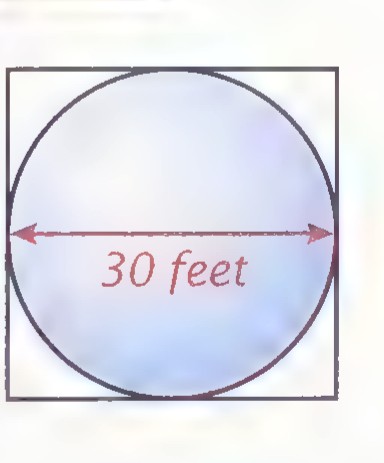
- If you couldn’t get out of the tunnel and the boulder were rolling toward you, could you avoid being squashed by it? Explain.
- Do you think your method would have worked for Indiana Jones?
† The Mammoth Book of Brainstorming Puzzles, by David J. Bodycombe (Carroll & Graf, 1996).
p. 670
Lesson 8: Similar Solids
Although the Titanic was one of the largest ships of its time, the “Titanic” in the picture above is only 44 feet long! The ship in the picture is one of several models of the actual Titanic that were constructed for the 1997 movie.
The model is convincing because, like all accurate models, it is similar to the object that it represents. Two geometric solids are similar if they have the same shape. For two such solids to be similar, every pair of distances between pairs of corresponding points in the two solids must be proportional.
The actual Titanic was about 880 feet long. Comparing its length with 44 feet, the length of the model, we get
The actual ship was 20 times as long as the model. Because the ship and model are similar, the ship must also have been 20 times as wide as the model and 20 times as high.
All these measurements are of lengths. What about areas and volumes? Were the surface area and volume of the Titanic also 20 times those of the model? As you may suspect from what you know about similar polygons, the answer is no.
p. 671
To see why, we will consider two similar solids that are polyhedra. If two polyhedra are similar, their corresponding faces are similar; so their corresponding dimensions are proportional. For example, the two rectangular solids shown here are similar if
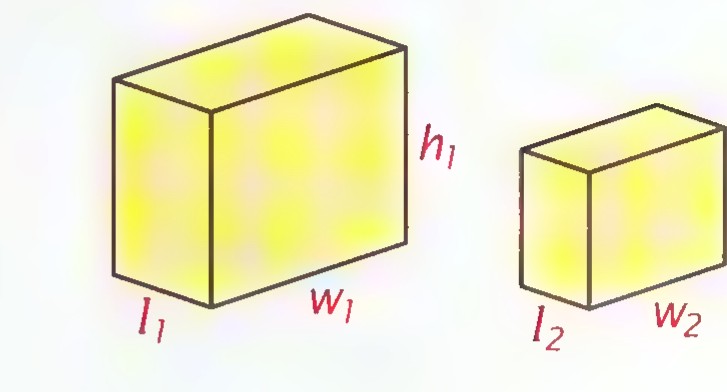
Letting these ratios equal r, we have
and so
What is the ratio of the surface areas of these solids? Their surface areas are
so
Substituting for , , and , we get
The ratio of the surface areas of two similar rectangular solids is equal to the square of the ratio of any pair of corresponding dimensions.
What is the ratio of the volumes of the same solids? Their volumes are
so
Substituting for , , and , we get
The ratio of the volumes of two similar rectangular solids is equal to the cube of the ratio of any pair of corresponding dimensions.
p. 672
These relations can be proved true for any pair of solids that are similar, regardless of their shape. We state them as the following useful theorems.
Theorem 85
If the ratio of a pair of corresponding dimensions of two similar solids is r, then the ratio of their surface areas is .
Theorem 86
If the ratio of a pair of corresponding dimensions of two similar solids is r, then the ratio of their volumes is .
These theorems make it easy to compare the properties of two similar solids regardless of their shape. We can apply them, for example, to the actual Titanic and the model of it pictured at the beginning of this lesson. From the fact that the ratio of their corresponding dimensions is 20, we can conclude that the ratio of their surface areas is = 400 and the ratio of their volumes is = 8,000. Although the Titanic is 20 times as long as the model, its surface area is 400 times as great and its volume is 8,000 times as great.
Exercises
Set I
Similar or Not? Two geometric solids are similar if they have the same shape.
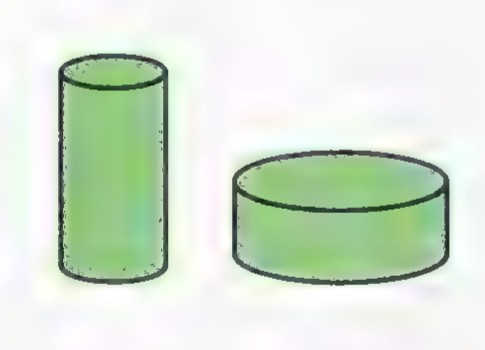
The cylinders above are not similar, because they have different shapes.
Tell whether or not you think the solids in each of the following exercises are always similar. If you think they are not similar, draw a figure to show why.
- Two cones.
- Two cubes.
- Two triangular prisms.
- Two spheres.
- Two square pyramids.
Scaling Up. The Statue of Liberty is approximately 20 times life size. In designing it, the sculptor started with a model and scaled it up several times.*
The strength of the supports of a structure depends on its cross-sectional area; the weight of a structure depends on its volume.
* Poetry of the Universe, by Robert Osserman (Anchor Books, 1995).
p. 673
If the scale of a structure is multiplied by 3, what happens to
- the strength of its supports?
- its weight?
If the scale of a structure is multiplied by 20, what happens to
- the strength of its supports?
- its weight?
If the scale of a structure is multiplied by n, what happens to
- the strength of its supports?
- its weight?
Giant Windmill. The windmill below, part of NASA’s wind-energy program, has blades 125 feet long that weigh 2,500 pounds.*
NASA proposed to build a larger windmill with blades 400 feet long. If it were geometrically similar to the one in the photograph,
- how many times longer would the larger blades have been?
- how many times greater would their surface areas have been?
- how many times greater would their volumes have been?
- Approximately how much would one of the blades have weighed?
* The Science of Structures and Materials, by J. E. Gordon (Scientific American Library, 1988).
Gulliver in Lilliput. In Gulliver’s Travels by Jonathan Swift, Gulliver’s first voyage took him to Lilliput, a land of tiny people. The emperor of Lilliput decreed that Gulliver was to be given “a quantity of meat and drink sufficient for the support of 1,728 Lilliputians.” The emperor’s mathematicians had measured Gulliver and found that he was 12 times as tall as they were.
- How did they calculate the number 1,728 from 12?
- What did they assume about Gulliver’s body with respect to their own bodies?
Later in the story, the emperor’s tailors make Gulliver a suit of clothes.
- If the suit was made from the same fabric as their own, how many times as much material did they need?
Earth and Mars. Mars is smaller than Earth. The radius of Earth is about 3,960 miles, whereas the radius of Mars is 2,100 miles.
- How many times the radius of Mars is the radius of Earth?
- How many times the surface area of Mars is the surface area of Earth?
- How many times the volume of Mars is the volume of Earth?
p. 674
Olive Sizes. Olives are graded according to their sizes. “Jumbo” olives are about 18 millimeters wide and 23 millimeters long and weigh about 5 grams.
Side view of a “giant” olive shown at actual size
- Use your ruler to draw a side view of a jumbo olive.
- Assuming that all olives are similar in shape, find the width of “supercolossal” olives that are 28 millimeters long.
- Use your ruler to draw a side view of a supercolossal olive.
- How many times the volume of a jumbo olive is the volume of a supercolossal olive?
- How much would you expect a supercolossal olive to weigh?
Three Pyramids. The three pyramids at Giza are right pyramids with square bases. They are thought to have originally had the following dimensions in meters.
| Pyramid | Base edge | Height |
|---|---|---|
| Cheops | 236 | 147 |
| Chephren | 216 | 144 |
| Mycerinus | 109 | 66 |
- Find the ratio of the height to the base edge for each pyramid to the nearest hundredth.
- Which two pyramids were closest to having the same shape? Explain.
Set II
Doubling a Cube. According to Greek legend, King Minos was unhappy with a tomb that had been built for his son because it was too small. The tomb was in the shape of a cube, and Minos demanded that it be doubled in size.*
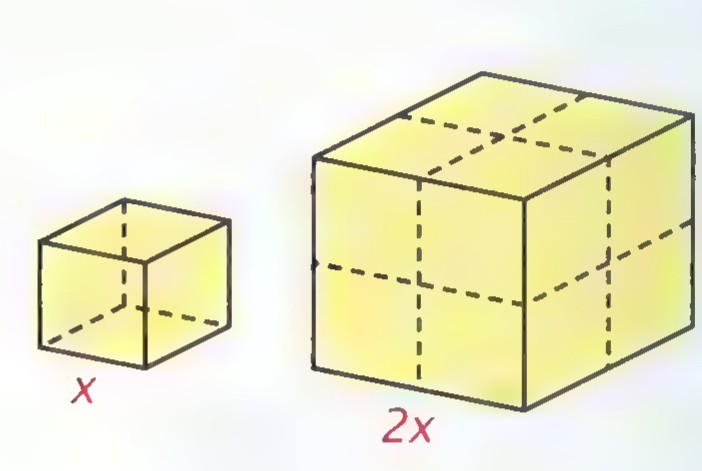
Suppose that each edge of the small tomb had length x and each edge of the new tomb had length 2x.
Write an expression in terms of x for
- the total surface area of the small tomb.
- the total surface area of the new tomb.
- the volume of the small tomb.
- the volume of the new tomb.
The ratio of the corresponding dimensions of the tombs (comparing larger with smaller) is
What is the ratio of
- their surface areas?
- their volumes?
What power of the ratio of their corresponding dimensions is the ratio of
- their surface areas?
- their volumes?
* An Introduction to the History of Mathematics, by Howard Eves (Saunders, 1990).
p. 675
Plato’s Method. Plato is thought to have considered the figure below with respect to the cube-doubling problem.
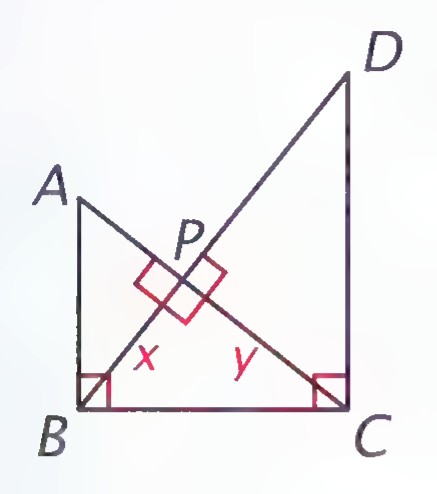
In it, AB ⊥ BC, BC ⊥ CD, and AC ⊥ BD.
- Why is and ?
Suppose PA = 1, PB = x, PC = y, and PD = 2.
- Use this information and the equations in exercise 37 to solve for x and y.
- Find the volumes of four cubes having edges of lengths PA, PB, PC, and PD.
- How does the volume of each successively larger cube compare with that of the preceding one?
Suppose that, in the same figure, PA = 1, PB = x, PC = y, and PD = 3.
- Find x and y in this case.
- Find the volumes of four cubes having edges of lengths PA, PB, PC, and PD in this case.
- How does the volume of each successively larger cube compare with that of the preceding one in this case?
Rubber Bands. “Number 10” rubber bands are inches long and inch wide, and “number 31” rubber bands are inches long and inch wide.
- Does it follow from these dimensions that they are geometrically similar? Explain.
- If it is assumed that the bands are similar in shape, how many number 10 bands would you expect to weigh the same as one number 31 band?
There are 5,780 number 10 bands in a pound and 1,420 number 31 bands in a pound.
- What conclusions seem to follow from this information?
Two Cups. The figures below show two cups, both partly filled with liquid. One is in the shape of a right cone, and the other is in the shape of a right cylinder.
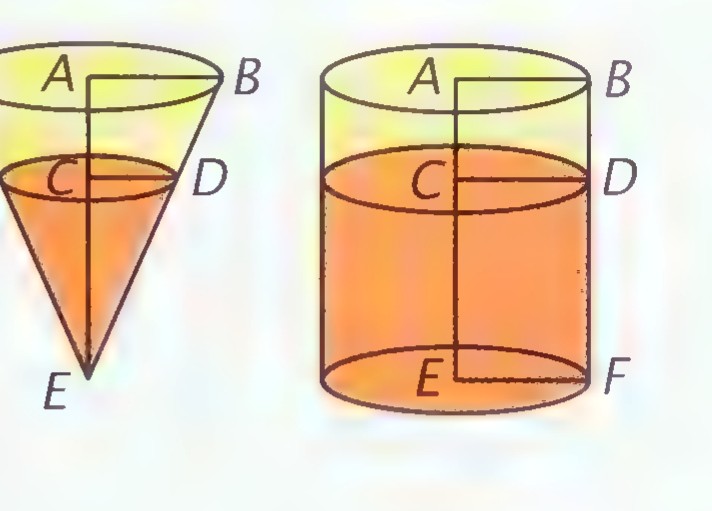
In the left-hand figure, △ABE and △CDE are right triangles.
- Does it necessarily follow that △ABE ∼ △CDE? Explain why or why not.
- Does the liquid in this cup have a shape geometrically similar to the space enclosed by the cup itself? Explain.
In the right-hand figure, ABFE and CDFE are rectangles.
- Does it necessarily follow that ABFE ∼ CDFE? Explain why or why not.
- Does the liquid in this cup have a shape geometrically similar to the space enclosed by the cup itself?
Height and Weight. A person’s weight is approximately proportional to his or her volume. Suppose that someone is 6 feet tall and weighs 160 pounds.
About how much would a person similar in shape weigh who is
- 4 feet tall?
- 5 feet tall?
- 7 feet tall?
- 8 feet tall?
p. 676
Heated Ring. A piece of solid iron in the shape of a doughnut is expanded by heating.*
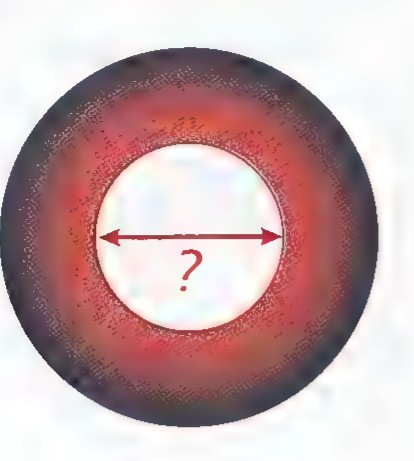
- Do you think the diameter of its hole will get larger or smaller?
When the doughnut expands with heat, its shape stays the same.
- What does this fact indicate about the diameter of its hole? Explain.
Teddy Bear Trouble. Obtuse Ollie’s grandmother makes 20 identical teddy bears each month for a local toy shop. To do so, she uses 6 square meters of material for the fur, 5 kilograms of kapok for the stuffing, 4 meters of ribbon for bows around their necks, and 40 buttons for their eyes.
The owners of the toy shop asked her to make 20 bears twice as large; so she doubled the order for all her materials.†
- Do you think doubling the amount of materials makes sense? If not, what do you think she should have ordered?
- Which material did Ollie’s grandmother use up first?
- How many large bears did she make?
- Of which material(s) would she have had exactly enough to make 20 of the large bears?
Set III
Colossal Clam. Clams range in size from as little as a pinhead to more than 4 feet in length! If a clam 2.4 inches long weighs 1 ounce, how much would you expect a clam having the same shape and a length of 4 feet to weigh? Explain your reasoning.
Used by permission of Johnny Hart and Creators Syndicate, Inc.
* Mathematical Carnival, by Martin Gardner (Knopf, 1975).
† This problem is by Brian Bolt and is from his book titled Mathematical Cavalcade (Cambridge University Press, 1992).
p. 677
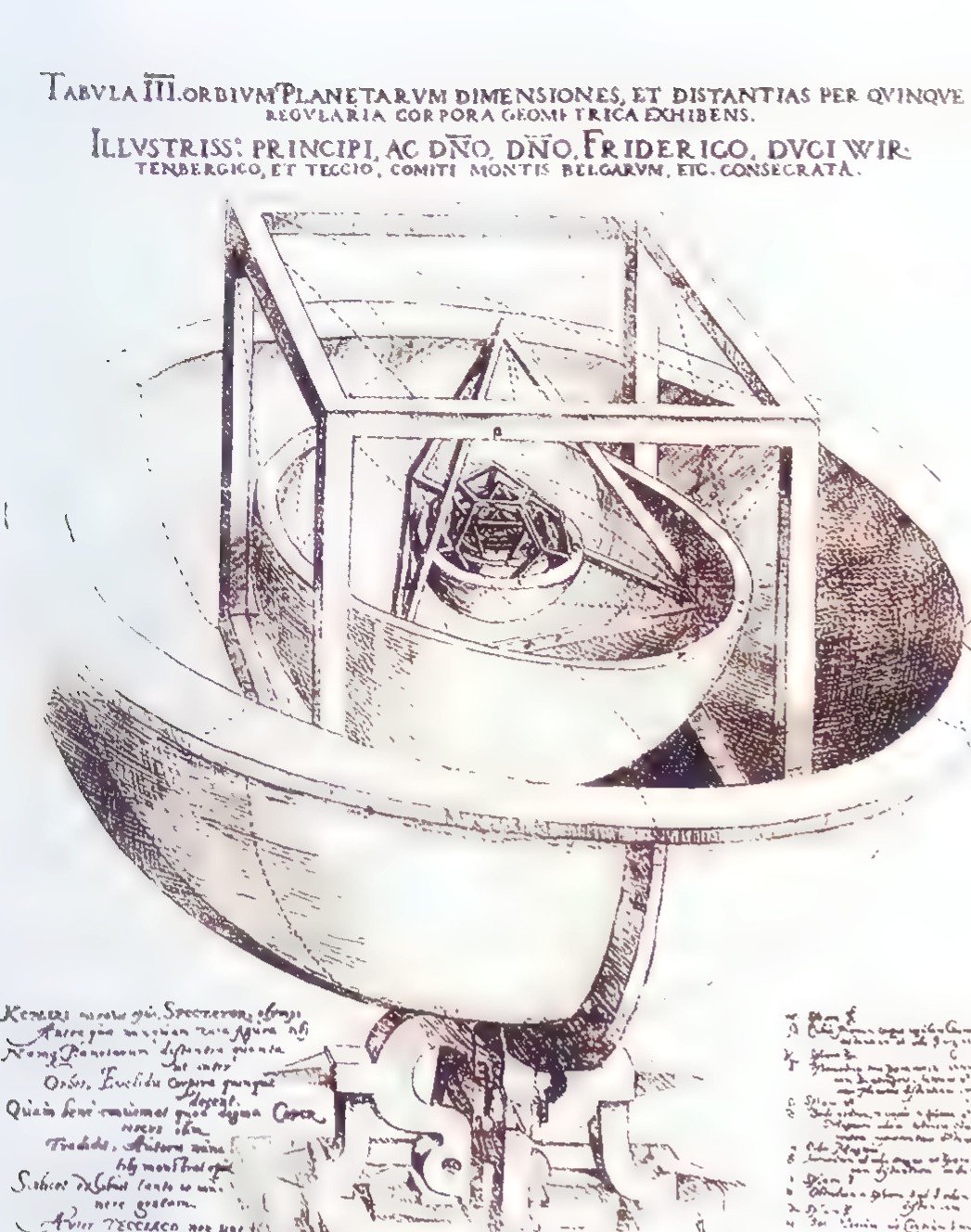
Lesson 9: The Regular Polyhedra
Perhaps the most famous picture of geometric solids ever drawn is the above illustration from the book Mysteries of the Cosmos published in 1596. The book was written by the astronomer Johannes Kepler and the picture was titled “Model of the Orbits of the Planets.” At the time, only six planets were known to exist, and Kepler thought he could explain their number and their distances from the sun by means of five geometric solids known as the regular polyhedra. He wrote:
The orbit of the Earth is a circle: round the sphere to which this circle belongs, describe a dodecahedron; the sphere including this will give the orbit of Mars. Round Mars, describe a tetrahedron; the circle including this will be the orbit of Jupiter. Describe a cube round Jupiter’s orbit; the circle including this will be the orbit of Saturn. Now inscribe in the Earth’s orbit an icosahedron; the circle inscribed in it will be the orbit of Venus. Inscribe an octahedron in the orbit of Venus; the circle inscribed in it will be Mercury’s orbit. This is the reason of the number of the planets.
p. 678
The solids to which Kepler referred were the last figures to be included by Euclid in the Elements; so it is appropriate to consider them as we come to the end of our study of Euclidean geometry.
Definition
A regular polyhedron is a convex solid having faces that are congruent regular polygons and having an equal number of polygons that meet at each vertex.
Tetrahedron
Octahedron
Icosahedron
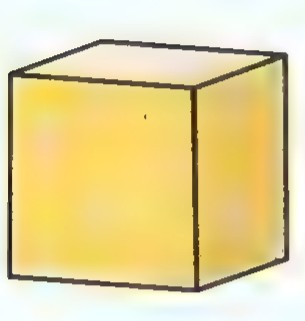
Cube
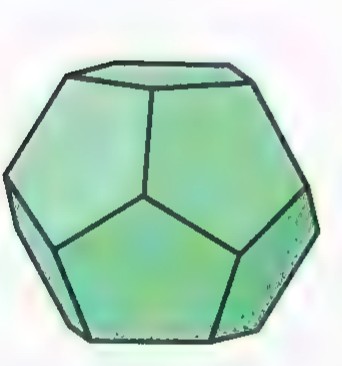
Dodecahedron
There are three regular polyhedra whose faces are equilateral triangles: the tetrahedron, with 4 faces, the octahedron, with 8 faces, and the icosahedron, with 20 faces.
The most familiar regular polyhedron is the one whose faces are squares: the cube. Finally, there is one regular polyhedron whose faces are regular pentagons: the dodecahedron, which has 12 faces in all.
Long before Kepler attempted to use them in explaining the solar system and even before Euclid wrote about them, the regular polyhedra were studied by a group of Greek mathematicians under the leadership of Pythagoras. Plato gave instructions for making models of them and claimed that the atoms of the four elements of ancient science had the shape of regular polyhedra. Atoms of fire were thought to have the shape of tetrahedrons; atoms of earth, cubes; atoms of air, octahedrons, and atoms of water, icosahedrons. The universe itself was thought to be in the shape of a dodecahedron.
Although such ideas are no longer taken seriously, the regular polyhedra, also known as the Platonic solids, have proved to be important not only in mathematics but also in such fields as molecular chemistry, art, and architecture.
Exercises
Set I
Numbers and Names. Polygons are named according to their number of sides; polyhedra are named according to their number of faces.
What is the number for
- an octagon or octahedron?
- a dodecagon or dodecahedron?
What name do you think we commonly use for
- a tetragon?
- a regular hexahedron?
If you were to look them up in a dictionary,
p. 679
you would find icosahedron but you probably wouldn’t find icosagon.
- What do you think each of these words means?
Two Triangles. In the figure below, the vertices of the smaller triangle are the midpoints of the sides of the larger triangle, but the triangles are not equilateral.
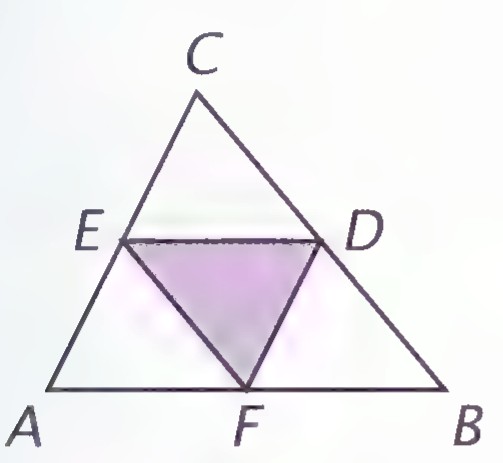
- Are the two triangles similar?
- How do the sides of the larger triangle compare in length with the sides of the smaller one?
- How do the perimeters of the two triangles compare?
- How do the two triangles compare in area?
Two Tetrahedrons. In the model pictured below, the vertices of the smaller tetrahedron are at the centers of the faces of a larger tetrahedron. Both tetrahedrons are regular.
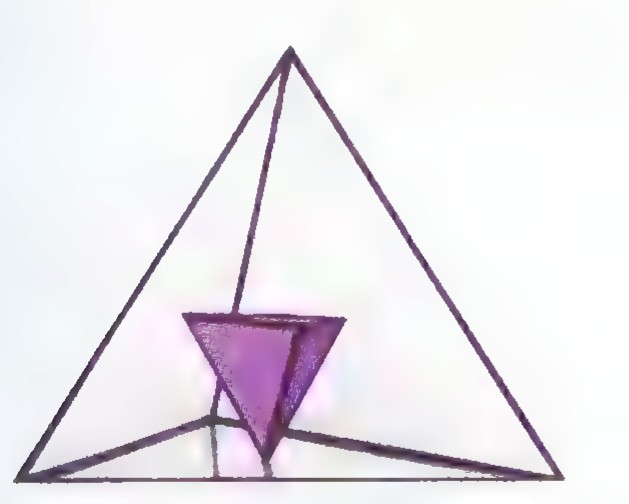
The edges of the larger tetrahedron are three times as long as the edges of the smaller one.
How do the two solids compare in
- surface area?
- volume?
da Vinci Polyhedron. Leonardo da Vinci built a set of wooden models of polyhedra and from them created a series of illustrations for a book published in 1509.
- Which regular polyhedron did da Vinci illustrate in the picture above?
- What kind of regular polygons are its faces?
- How many faces does the polyhedron have?
- How many sides does each face have?
- How many faces meet at each vertex of the polyhedron?
- How many faces meet along each edge?
Compare the following two calculations with your answers to exercises 14 through 17.
- How many vertices does the polyhedron have?
- How many edges does it have?
p. 680
Escher Box. Maurits Escher designed the tin box shown here in 1963.
- Which regular polyhedron did Escher use for its shape?
- What kind of regular polygons are its faces?
- How many faces does the polyhedron have?
- How many sides does each face have?
- How many faces meet at each vertex of the polyhedron?
- How many faces meet along each edge?
Use your answers to exercises 22 through 25 to calculate the number of
- vertices of the polyhedron.
- edges of the polyhedron.
Euclid’s Claim. Euclid claimed at the end of the Elements that “no other figure, besides the said five figures, can be constructed which is contained by equilateral and equiangular figures equal to one another.”
What did he mean by
- “equilateral and equiangular figures”?
- “equal to one another”?
The following figures support Euclid’s claim that there are only five regular polyhedra.
What is the sum of the angles surrounding each vertex of
a tetrahedron?
an octahedron?
an icosahedron?
Why are there no more than three regular polyhedra whose faces are equilateral triangles?
What is the sum of the angles surrounding each vertex of
- a cube?
- a dodecahedron? (Each angle of a regular pentagon has a measure of 108°.)
- How does the sum of the angles surrounding a point determine whether a figure is flat?
Set II
Octahedron and Cube. In the model pictured below, the vertices of the octahedron are at the centers of the faces of a cube.
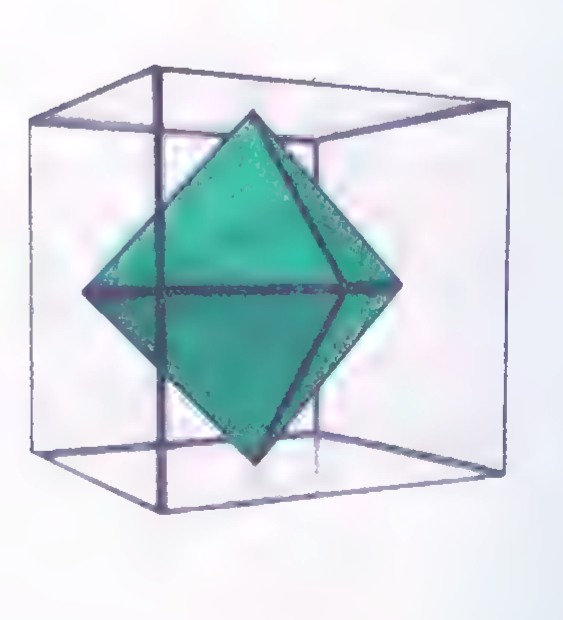
The octahedron can be viewed as consisting of two square pyramids with a common base.
p. 681
- Draw and mark the figure below as needed to find each of the following measures in terms of e, the length of an edge of the cube.
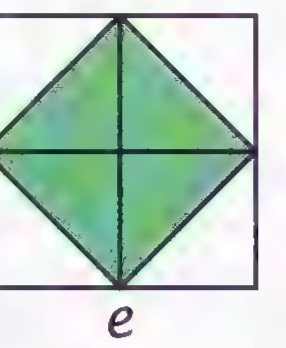
- The length of an edge of the octahedron.
- The area of the base of one of the pyramids.
- The altitude of one of the pyramids.
- The volume of the octahedron.
- What fraction of the volume of the cube is the volume of the octahedron?
Dodecahedron Construction. Euclid showed how to construct a dodecahedron by starting with a cube. He did so by adding identical “rooflike” shapes to each face of the cube as shown in the figures below.*
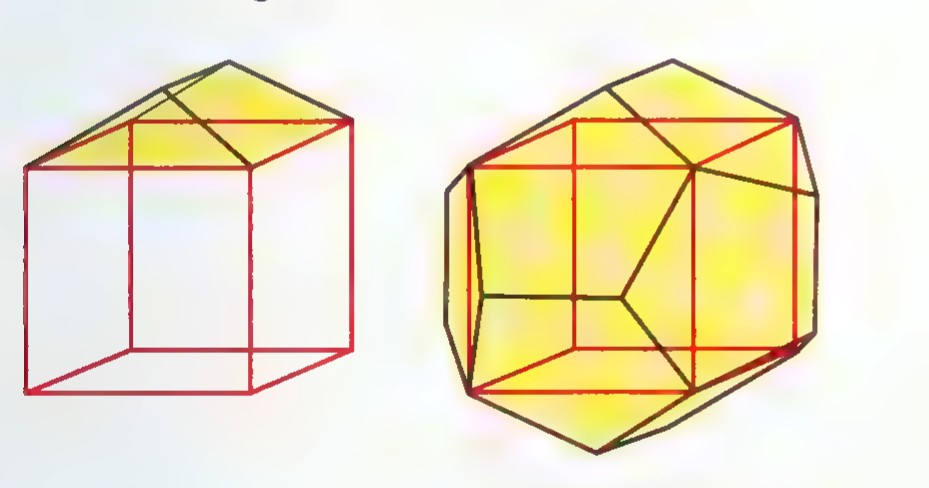
The figure below shows one of the pentagonal faces that is formed.
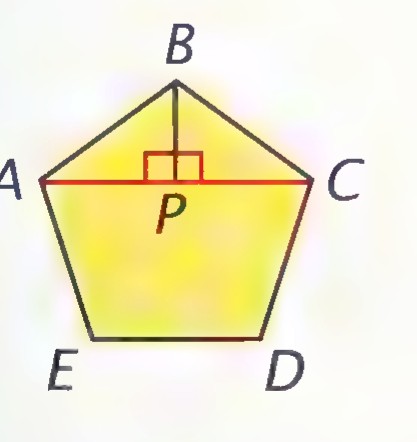
* Euclid: The Creation of Mathematics, by Benno Artmann (Springer, 1999).
- Given that BP ⊥ AC, why does it follow that △ABP ≅ △CBP?
- Use the fact that each angle of a regular pentagon has a measure of 108° to find the measures of ∠ABP and ∠BAP.
- Find the ratio of the edge of the cube, AC, to the edge of the dodecahedron, AB, to the nearest thousandth.
If AC = 1 unit, the volume of each of the added rooflike shapes is about 0.135 cubic unit.
- Find the ratio of the volume of the dodecahedron to the volume of the cube.
Round About. The first figure below is an illustration of the fact that every regular polygon is cyclic.
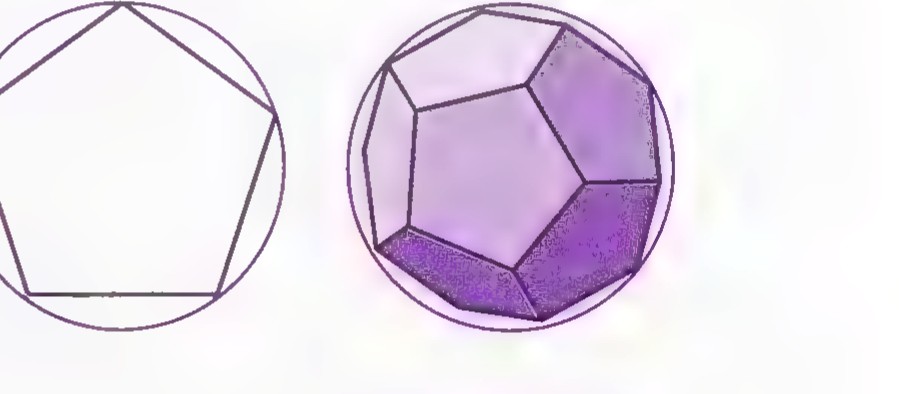
- What does saying that a “polygon is cyclic” mean?
The second figure illustrates a comparable fact for regular polyhedra.
- What do you think the fact is?
Suppose regular polygons having 12 and 20 sides are inscribed in the same circle.
- Which one has an area closer to that of the circle?
Suppose regular polyhedra having 12 and 20 faces are inscribed in the same sphere.
- Which one do you think has an area closer to that of the sphere?
Suppose the sphere in which they are inscribed has a radius of 1 unit.
- Find its area to the nearest tenth.
p. 682
A dodecahedron inscribed in this sphere has edges of length
- Find e to the nearest thousandth.
The area of a regular dodecahedron with edges of length e is
- Find the area of the dodecahedron to the nearest tenth.
An icosahedron inscribed in the same sphere has edges of length
- Find e to the nearest thousandth.
The area of a regular icosahedron with edges of length e is
- Find the area of the icosahedron to the nearest tenth.
- Which polyhedron, the dodecahedron or the icosahedron, do you think has a volume closer to that of the sphere?
- Find the volume of the sphere to the nearest tenth.
A regular dodecahedron having edges of length e has the following volume:
- Find the volume of the dodecahedron inscribed in this sphere to the nearest tenth.
A regular icosahedron having edges of length e has the following volume:
Find the volume of the icosahedron inscribed in the same sphere to the nearest tenth.
Which inscribed polyhedron has an area and volume closer to those of the sphere: the dodecahedron or the icosahedron?
Set III
Tetrahedron Puzzle. A puzzle patented in 1940 has become so popular that it is still available for sale. It consists of two identical pieces that can be put together to form a tetrahedron.*
To make the puzzle, make two copies of the pattern below on stiff paper and cut them out. Fold each one along the red lines and tape the edges of each together to form a pair of identical solids.
Can you put the two solids together to form a tetrahedron? If so, make a drawing to show your solution.
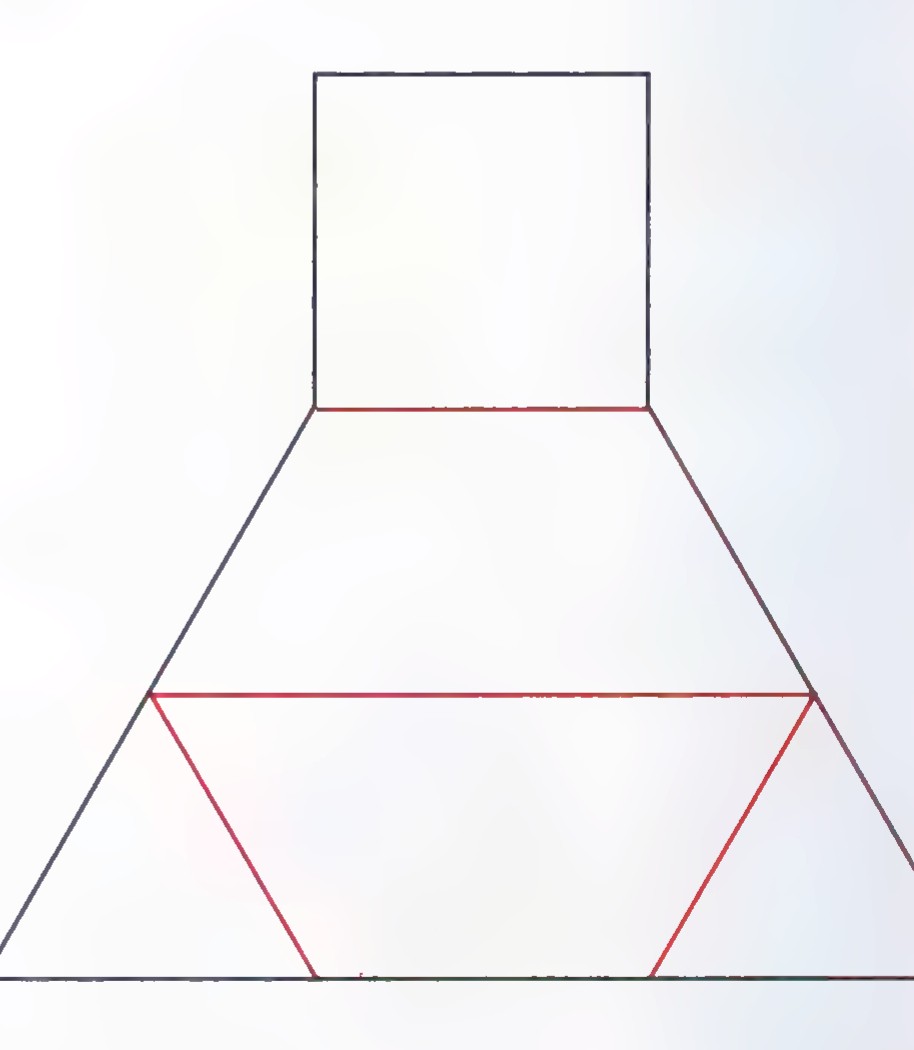
* Puzzles Old and New, by Jerry Slocum and Jack Botermans (University of Washington Press, 1986).
p. 683
Summary and Review
Basic Ideas
| Altitude of a prism | 640 |
| Altitude of a pyramid | 648 |
| Cone | 654 |
| Cross section of a solid | 641 |
| Cube | 629 |
| Cylinder | 655 |
| Diagonal of a rectangular solid | 629 |
| Dodecahedron | 678 |
| Icosahedron | 678 |
| Lateral area of a prism | 635 |
| Oblique lines and planes | 620 |
| Octahedron | 678 |
| Parallel lines and planes | 619 |
| Perpendicular lines and planes | 620 |
| Polyhedron | 628 |
| Prism | 634 |
| Pyramid | 647 |
| Rectangular solid | 628 |
| Regular polyhedron | 678 |
| Similar solids | 670 |
| Skew lines | 619 |
| Sphere | 662 |
| Tetrahedron | 678 |
| Volume | 640 |
Postulates
- If two points lie in a plane, the line that contains them lies in the plane. 619
- If two planes intersect, they intersect in a line. 619
- Cavalieri’s Principle. Consider two geometric solids and a plane. If every plane parallel to this plane that intersects one of the solids also intersects the other so that the resulting cross sections have equal areas, then the two solids have equal volumes. 641
- The volume of any prism is the product of the area of its base and its altitude: . 642
Theorems
- The length of a diagonal of a rectangular solid with dimensions l, w, and h is . 629
Corollary. The length of a diagonal of a cube with edges of length e is . 629
Corollary 1 to Postulate 14. The volume of a rectangular solid is the product of its length, width, and height: . 642
Corollary 2 to Postulate 14. The volume of a cube is the cube of its edge: . 642
- The volume of any pyramid is one-third of the product of the area of its base and its altitude: . 648
- The volume of a cylinder is the product of the area of its base and its altitude: . 655
- The volume of a cone is one-third of the product of the area of its base and its altitude: . 656
- The volume of a sphere is times the cube of its radius: . 664
- The surface area of a sphere is times the square of its radius: . 665
- If the ratio of a pair of corresponding dimensions of two similar solids is r, then the ratio of their surface areas is . 672
- If the ratio of a pair of corresponding dimensions of two similar solids is r, then the ratio of their volumes is . 672
p. 684
Exercises
Set I
Flipping Cubes. The sculpture in the photograph below is by Hungarian artist Victor Vasarely.*
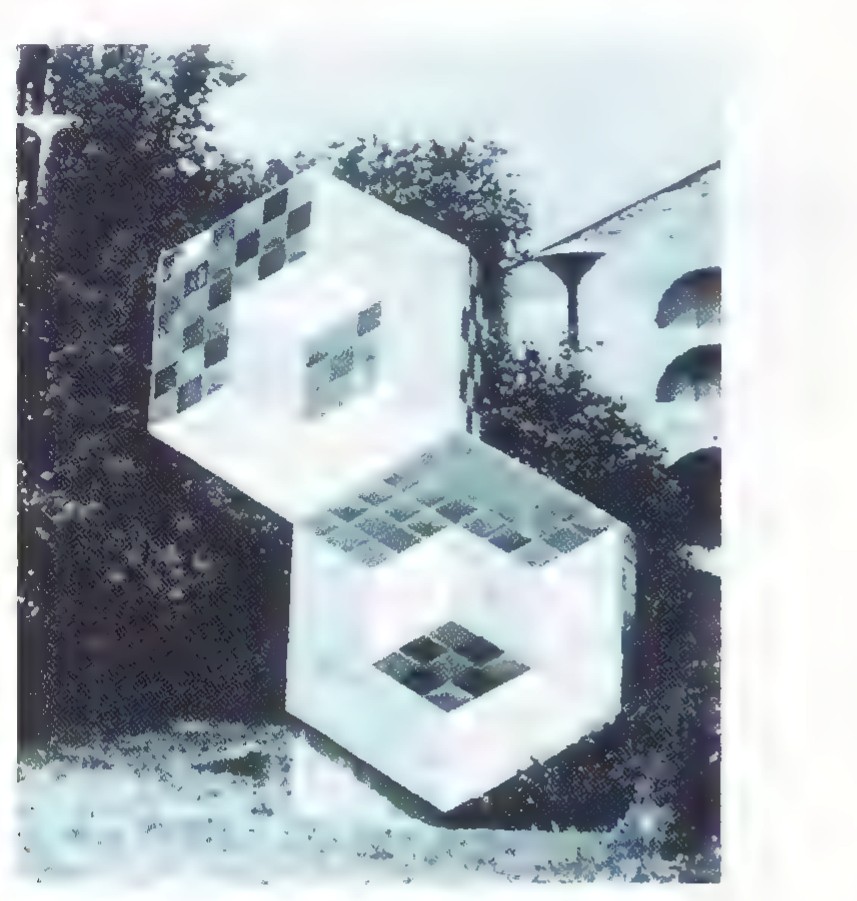
Although its surfaces, numbered in the figure below, might seem to lie in 11 different planes, two of them actually lie in the same plane.
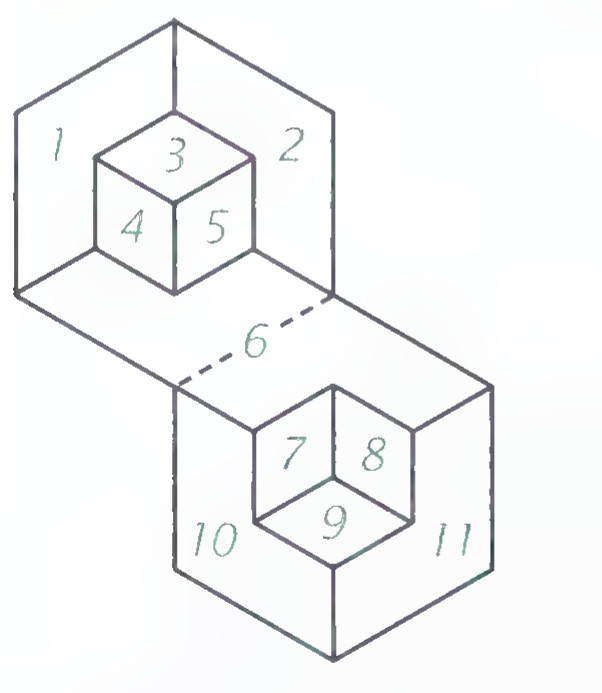
- Which two are they?
- If two planes intersect, in what do they intersect?
- What relation do planes 1 and 2 appear to have?
- Which plane(s) appear to be parallel to plane 5?
- Does plane 3 appear to be parallel to plane 9?
- What does saying that two planes are parallel mean?
Seeing Things. The figures below, devised by psychologist Gaetano Kanizsa, are interesting because, although they look almost the same, most people see them as being very different.†
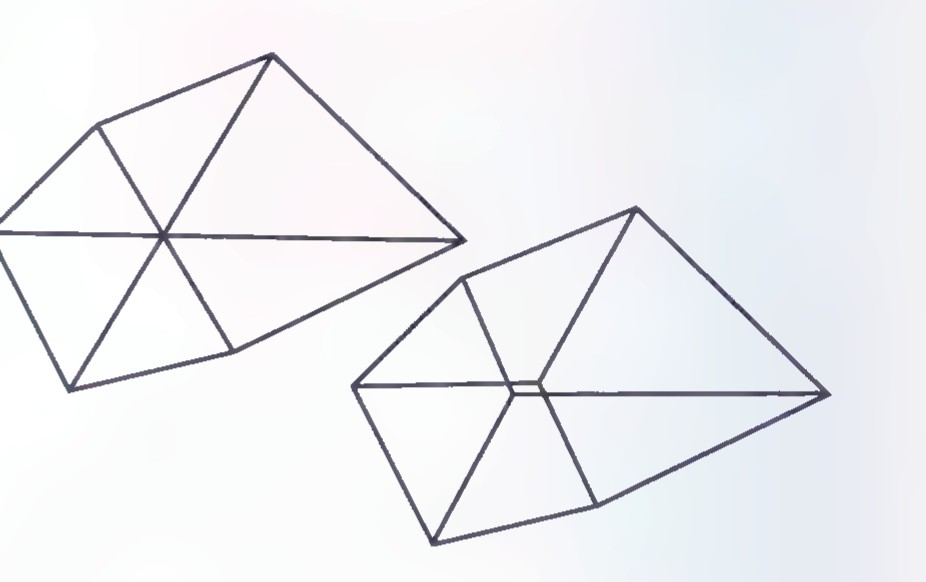
Describe in geometric terms what
- the first figure looks like to you.
- the second figure looks like to you.
Cord of Wood. Firewood is sold by the cord. A cord is the volume of a stack of wood 8 feet long, 4 feet wide, and 4 feet high.
- How many cubic feet are contained in a cord?
- How high would a cord of wood be if it were arranged in a stack 4 feet long and 2 feet wide?
* Symmetry: A Unifying Concept, by István Hargittai and Magdolna Hargittai (Shelter Publications, 1994).
† Visual Intelligence: How We Create What We See, by Donald D. Hoffman (Norton, 1998).
p. 685
Box Pattern. The figure below is a pattern that can be cut out and folded together to form a box.* It contains six squares and two regular hexagons.
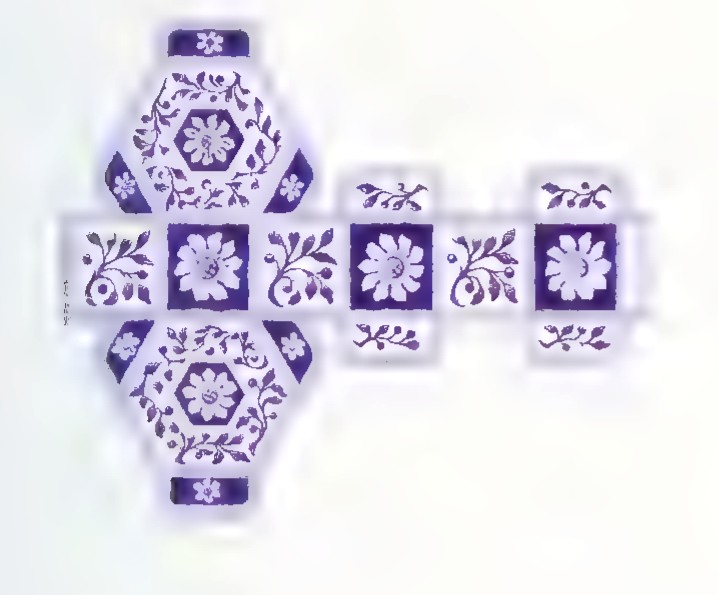
- If the pattern is made into a box, which polygons would be its bases?
- What kind of polyhedron would it be?
Octagonal Building. Two geometric solids were used in the design of this building in Florence, Italy. Both of them have bases that are regular octagons.
- What are the two solids?
- Find the volume of the lower part, given that it covers 12,000 square feet of ground and is 90 feet high.
- Find the volume of the upper part, given that it is 20 feet high.
- Find the total volume of the building.
* The Victorian Gift Boxes, by Jane Thomson (Hearst Books, 1992).
Screen Illumination. In the figure below, light from a lens at point L illuminates two possible screens: a smaller one at A and a larger one at B twice as far away. The screens are the bases of two similar pyramids.
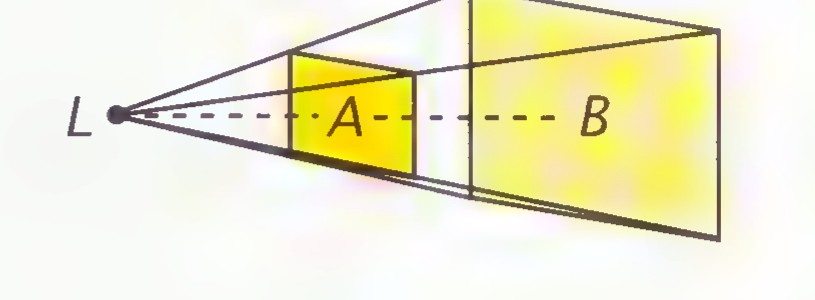
- How do the edges of the larger screen compare in length with the corresponding edges of the smaller screen?
- How does the area of the larger screen compare with that of the smaller screen?
According to the inverse-square law of physics, the light on the larger screen would be one-fourth as bright as that on the smaller screen.
- Explain why this makes sense.
Stars. The circles in the figure below (not to scale) represent cross sections of two imaginary spheres centered at the sun.†
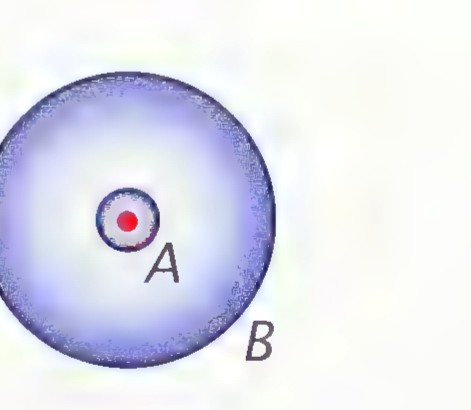
Sphere A has a radius of 10 light-years and sphere B has a radius of 5,000 light-years.
What is the ratio of
- the radius of sphere B to that of sphere A?
- the surface area of sphere B to that of sphere A?
- the volume of sphere B to that of sphere A?
† Pictorial Astronomy, by Dinsmore Alter, Clarence H. Cleminshaw, and John G. Phillips (Crowell, 1974).
p. 686
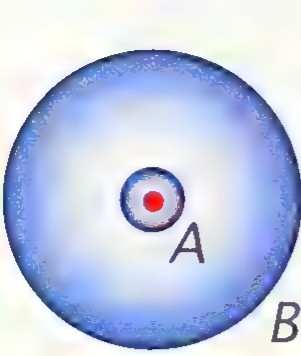
- Given that sphere A contains 10 stars, how many stars would you guess sphere B to contain?
Our galaxy is thought to have a volume 100 times that of sphere B.
- According to this estimate, how many stars might our galaxy contain?
Divided Cube. The figure at the right shows a cube in which a diagonal of each face has been drawn.
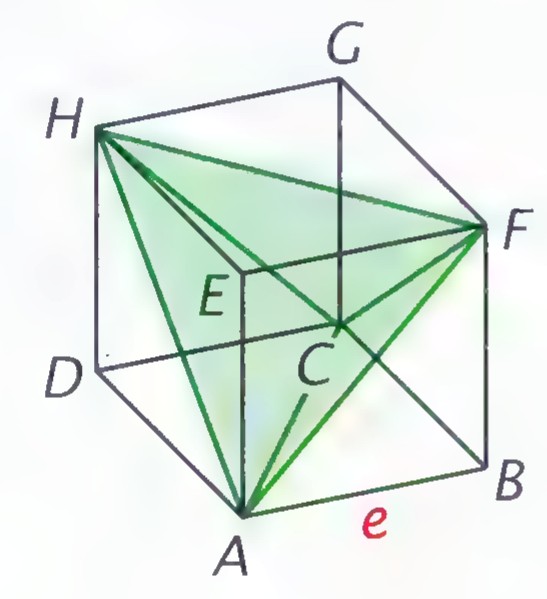
- Find the length of each diagonal in terms of e, the length of an edge.
- What can you conclude about the four triangles whose sides are these diagonals?
- Of what regular polyhedron are these triangles the faces?
- If the cube were cut apart along the planes of the faces of this polyhedron, how many pieces would be formed?
One of the pieces is the pyramid whose base is △ABC and whose altitude is BF.
- Find its volume in terms of e.
- Find the volume of the polyhedron that you named in exercise 27 in terms of e.
- What fraction of the volume of the cube is the volume of this polyhedron?
Set II
According to Archimedes. In his book titled On the Sphere and Cylinder, Archimedes proved the following theorem:
The surface area of any sphere is equal to four times the area of a great circle of the sphere.
- What do you think Archimedes meant by “a great circle”?
- Show why the theorem is true.
The next theorem in Archimedes’ book said:
The volume of any sphere is equal to four times the volume of the cone whose base equals a great circle of the sphere, and whose height equals the radius of the sphere.
- Use the figure below to show that this theorem is true.
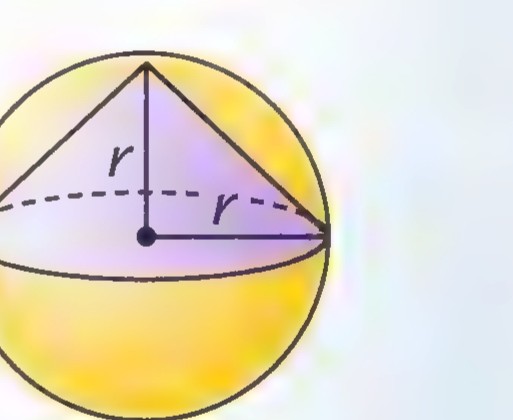
Another of Archimedes’ discoveries was about a sphere and a cylinder that have the same radius and height. This figure illustrating it was even engraved on his tombstone!
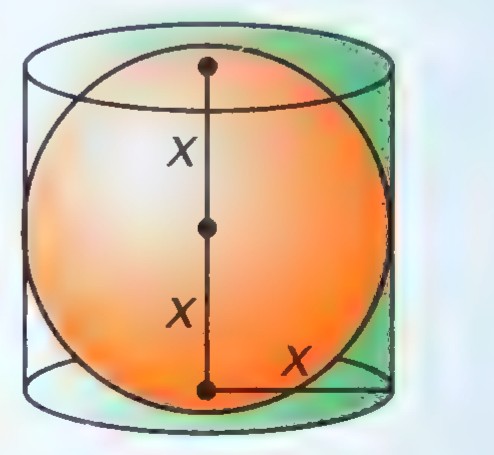
Write an expression in terms of x for
- the volume of the sphere.
- the volume of the cylinder.
p. 687
- What fraction of the volume of the cylinder is the volume of the sphere?
Write an expression in terms of x for
- the area of the sphere.
- the lateral area of the cylinder.
- the total area of the cylinder.
- How does the area of the sphere compare with the lateral area of the cylinder?
- What fraction of the total area of the cylinder is the area of the sphere?
Twisted Ring. The “twisted ring” shown below is made from cubes that have been glued together along their faces.*
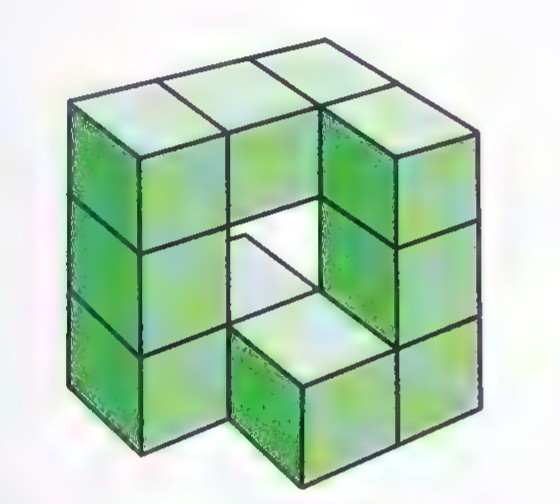
- How many faces of each cube are glued to faces of other cubes?
Given that the edges of the cubes are 1 unit long,
- find the volume of the ring.
- find the surface area of the ring.
SAT Problem. The following description appeared in a problem on an SAT exam.
A closed rectangular tank 1 meter by 2 meters by 4 meters contains 4 cubic meters of water. When the tank is placed level on its various sides, the water depth changes.
* Fractal Music, Hypercards, and More, by Martin Gardner (W. H. Freeman and Company, 1992).
Draw and label a sketch showing a position of the tank for which the water is
- the deepest.
- the shallowest.
- What are the depths of the water for these positions?
Wine Barrel. According to Cavalieri, the volume of a wine barrel, such as the one shown below, can be estimated by the expression
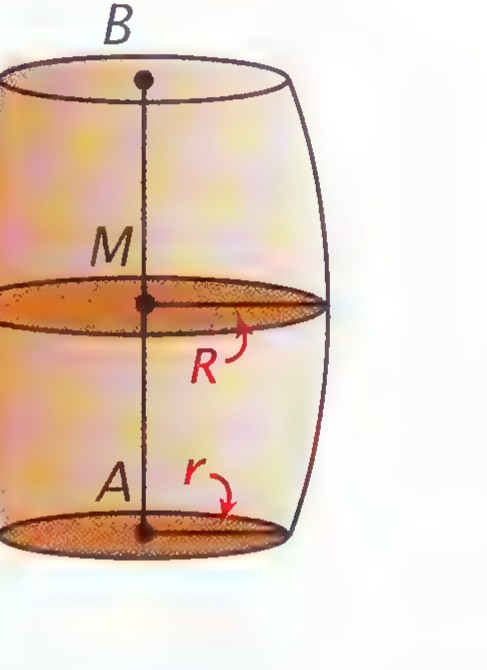
M is the midpoint of its axis, AB.
- What does represent?
- What does represent?
- What does the wine-barrel expression become if R = r?
- For what type of geometric solid does your answer to exercise 51 give the volume?
- What does the wine-barrel expression become if R = 0?
- For what type of geometric solid does your answer to exercise 53 give the volume?
- What does the wine-barrel expression become if r = 0 and h = 2R?
- For what type of geometric solid does your answer to exercise 55 give the volume?
p. 688
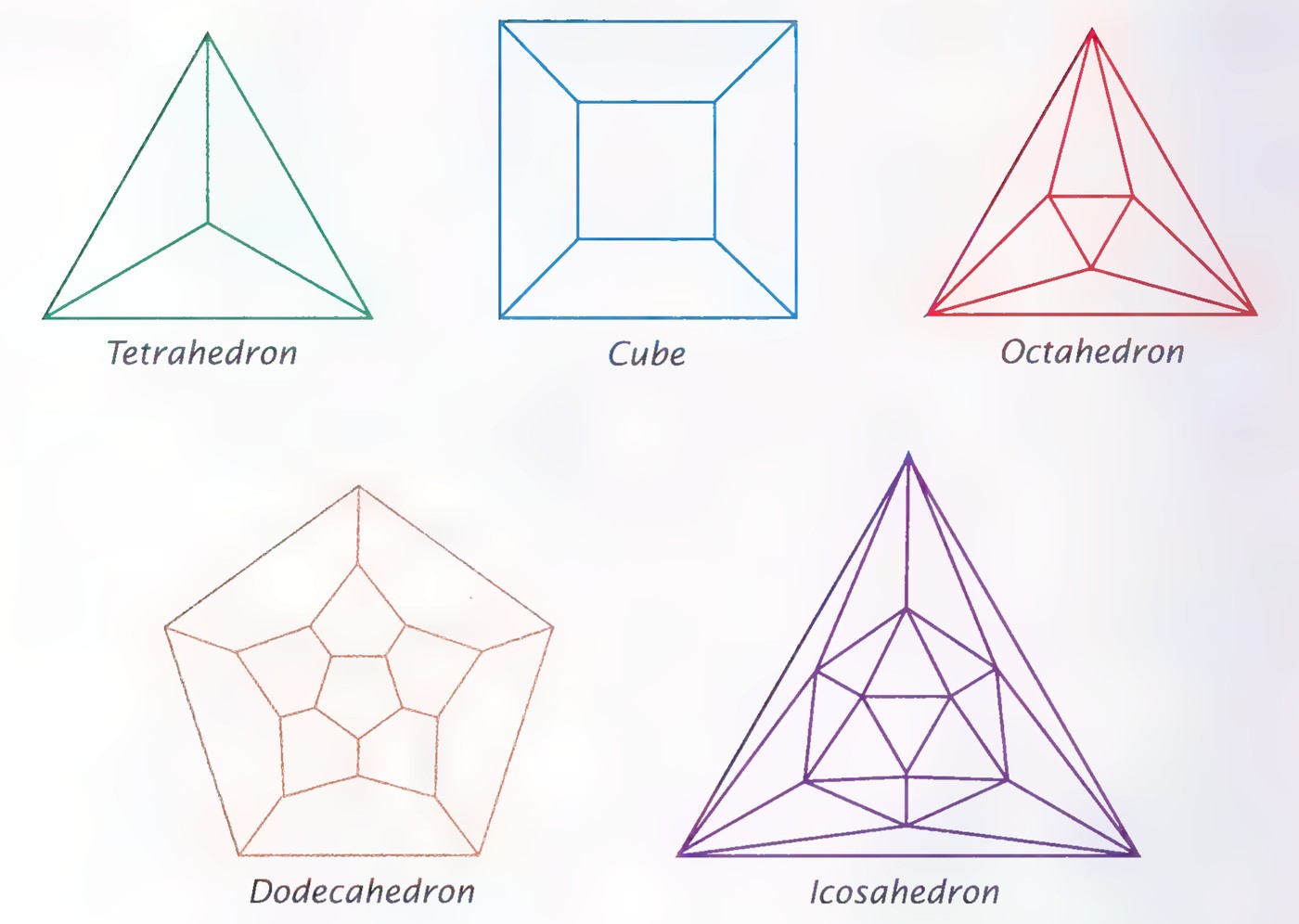
Euler Characteristic. Victor Schlegel, a German mathematician, invented the diagrams above in 1883 to represent the regular polyhedra. They show the way that the edges of a polyhedron would look if the polyhedron were transparent and you viewed it from a point just above the center of a face. That face appears as the border of the diagram.
Each diagram shows all of the faces, vertices, and edges of the polyhedron.
A tetrahedron has four faces. Does the diagram for it contain four triangles?
How many vertices does a tetrahedron have?
How many edges does it have?
Refer to the diagrams to copy and complete the following table.
| Regular polyhedron | faces, F | Number of vertices, V | edges, E |
|---|---|---|---|
| Tetrahedron | 4 | ? | ? |
| Cube | 6 | ? | ? |
| Octahedron | ? | ? | ? |
| Dodecahedron | ? | ? | ? |
| Icosahedron | ? | ? | ? |
The Euler characteristic of a geometric solid is the number F + V − E.
- Find the Euler characteristic for each of the regular polyhedra.