Chapter 15 — Teacher’s Guide Answers
Answers and teaching commentary for Chapter 15: Geometric Solids, transcribed from the scanned Teacher’s Guide. Diagrams are cropped from the same page scans.
OCR note. The text was recognized automatically and has not been corrected line by line; formulas and symbols may be imperfect. Check the original PDF for exact wording.
Homework: Chapter 15 exercises · Selected answers · Teacher’s answers PDF
Lesson 1
Set I (pages 620-622)
The figures of exercises 1 through 6 are of special interest in the field of computational vision, a subfield of artificial intelligence. Martin A. Fischler and Oscar Firschein observe in their book titled Intelligence—The Eye, the Brain, and the Computer (Addison-Wesley, 1987): “We know that the shading and texture present in a single image can produce a vivid impression of threedimensional structure. What is the computational basis of this effect? A crucial source of information about three-dimensional structure is provided by the spatial distribution of surface markings in an image. Since projection distorts texture geometry in @ manner that depends systematically on surface shape and orientation, isolating and measuring this projective distortion in the image allows recovery of the three-dimensional structure of the textured surface.”
In Visual Explanations (Graphics Press, 1997), Edward R. Tufte points out that, “For centuries, the profound, central issue in depicting information has been how to represent three or more dimensions of data on the two-dimensional display surfaces of walls, stone, canvas, paper, and recently, computer screens.” About the figure of exercises 7 through 10, he remarks: “As early as 1642, pole-people were active in scaling recession for landscapes.” Tufte also includes a nice “before and after” illustration for the Brighton pavilion (1808) that uses people holding poles to give 3 sense of scaling to a picture in which the perspective is ambiguous.
Ted Adelson’s “corrugated Mondrian,” the figure of exercises 13 through 20 is discussed in detail by Donald D. Hoffman in Visual Intelligence (Norton, 1998). According to Hoffman, the two grays in the numbered regions *measure precisely the same luminance on a photometer.” He continues: “You also see this figure in three dimensions. It’s possible, suggests psychologist Alan Gilchrist, that you group each surface with those that lie in the same 3D plane with it. Thus each vertical column would be a group. If so, then rectangle 2 would be the darkest in its group, and 1 the lightest in its group, explaining why A looks lighter than B.” This hypothesis is supported by a flattened version of the figure in which the apparent difference of the two grays is not as pronounced.
Visual Planes. o1. The second.
2. The right side.
3. Rectangles.
4. Ahorizontal plane.
5. The bottom part.
6. Circles. Pole People.
*7. It appears to be oblique to the ground.
8. A vertical plane.
9. That they are the same length.
¢10. That they lie in a horizontal plane. Posts and Walls.
*11. No. AB is perpendicular to the floor if it is perpendicular to every line in the floor that passes through point B.
12. Yes. The floor is perpendicular to DEFG because the floor contains a line, EH, that is perpendicular to DEFG.
3-D Shading.
*13. Parallelograms.
14. Rectangles.
*15. EFGH.
16. CDIJ.
17. BCJK and DEHL
18. It can be viewed as being either behind or in front of the rest of the figure.
19. Rectangle 2.
20. (Student answer.) (The grays in the two rectangles are actually identical.)
Polarized Light.
*21. They intersect in line / (or they both contain it).
22. The planes appear to be perpendicular.
#23. One plane must contain a line that is perpendicular to the other plane.
Kilroy in Space.
24. CD || FE. (CD and FE lie in the same plane, CDEEF, and can’t intersect, because they lie in parallel planes.)
” 25. CFis perpendicular to plane EFGH.
26. Planes ABCD and EFGH are parallel.
*27. If a plane intersects two parallel planes, it intersects them in parallel lines.
28. If aline is perpendicular to one of two parallel planes, it is perpendicular to the other.
29. Two planes perpendicular to the same line are parallel to each other.
30. (Student answer.) (It depends on whether the figure is interpreted as seen from above or below.)
Set II (pages 622-624)
Desargues’s Theorem, a basic theorem of projective geometry, is considered in exercises 31 through 37. Gérard Desargues was a French architect, engineer and army officer who wrote an important book on the conic sections as well as a book on how to teach children to sing! Howard Eves calls him “the most original contributor to synthetic geometry in the 17th century.” His theorem says that, “If two triangles, in the same plane or not, are so situated that lines joining pairs of corresponding vertices are concurrent, then the points of intersection of pairs of corresponding sides are collinear, and conversely.” As the exercises show, this theorem is proved quite easily by treating the figure for the theorem as if it were a three-dimensional “pyramid” of lines.
Triangles in Perspective.
31. They appear to be collinear.
32. Three noncollinear points determine a plane.
33. If two points lie in a plane, the line that contains them lies in the plane.
®34. They lieinit.
35. They liein it.
36. Aline.
37. That they are collinear.
Impossible Slice.
38. If two planes intersect, their intersection is aline.
39. That three noncollinear points determine a plane. (If points A, B, and C lie on a circle, then they are noncollinear, but they don’t determine a plane, because they lie in two different planes.)
Uneven Bars.
*40. No. Two horizontal lines can be skew. They can also intersect.
41. Yes. Part of the definition of parallel lines is that they lie in the same plane.
*42. About 91 cm. (In right AABE, AB? =432 + 802 s0 AB = /8,249 =91.)
©43. About 62°. (Inright AABE, BE 80
tan ZBAE= — = —;s0 ZBAE = 62°.) AE 43 Pyramid.
44. If aline is perpendicular to a plane, it is perpendicular to every line in the plane that passes through the point of intersection.
*45. SAS.
46. Corresponding parts of congruent triangles are equal.
*47. A quadrilateral is a parallelogram if its diagonals bisect each other.
48. The opposite sides of a parallelogram are equal.
49. SSS.
50. SSS (or SAS). Lopsided Box.
51. ABEH L BCDE and ABCF L BCDE (because AB L BCDE), and CDGF L ABCF (because CD L ABCF).
52. ZABE and ZABC (because AB L BCDE), and ZDCF, ZDCA, and £DCB (because DC L ABCF).
53. Yes; AD > AC. Because ZACD is a right
angle in AACD, ZACD > ZADGC; so AD>AC.
Cube and Hypercube.
54. Six.
*55. Nine.
56. Eight.
57. 13.
Set II (page 625)
In a talk given in Amsterdam in 1963, Escher said: “If you want to focus the attention on something nonexistent, then you have to try to fool first yourself and then your audience, by presenting your story in such a way that the element of impossibility is veiled, so that a superficial listener doesn‘t even notice it. There has to be a certain enigma in it, which does not immediately catch the eye.” (The Magic of M. C. Escher, Abrams, 2000).
The impossibility is in the way in which the columns of the first floor are connected to the second floor. As a result, someone climbing the ladder starts inside the building but ends up outside on reaching the top. The top floor is also at an angle with the second floor, which is impossible. The seated figure holds a distorted box that mirrors the impossible structure of the building.
Lesson 2
Set I (pages 630-631)
The beetle on the box is another example of the Necker cube illusion, named after the Swiss scientist, Louis Necker, who first wrote about it in 1832. Martin Gardner included it in a Scientific American “Mathematical Games” column on optical illusions, republished in his Mathematical Circus (Knopf, 1979). The idea of adding a beetle to the figure was that of the mathematical physicist Roger Penrose and his father, L. S. Penrose. Of the Penrose version, Gardner wrote: “The beetle appears to be on the outside. Stare at the back corner of the box and imagine it to be the corner nearest you. The box will suddenly flip-flop, transporting the beetle to the floor inside.”
It seems strange to think of the edge of a card (or a sheet of paper) as a rectangle having an area, but, as exercise 10 makes obvious, these objects have a thickness that can be easily calculated.
Concerning exercises 14 through 17, Martin Gardner wrote in his Wheels, Life and Other Mathematical Amusements (W. H. Freeman and Company, 1983): “Many geometric problems are solved by finding integral solutions for Diophantine equations. . . . Among the many geometrical Diophantine problems that are still unsolved, one of the most difficult and notorious is known as the problem of the ‘integral brick’ or ‘rational cuboid.’ The ‘brick’ is a rectangular parallelepiped. There are seven unknowns: The brick’s three edges, its three face diagonals, and the space diagonal. . . . Can a brick exist for which all seven variables have integer values?. . . The problem has not been shown to be impossible, nor has it been solved. . . . The smallest brick with integral edges and face diagonals (only the space diagonal is nonintegral) has edges of 44, 117 and 240. This was known by Leonhard Euler to be the minimum solution. If all values are integral except a face diagonal, the smallest brick has edges of 104, 153 and 672 [the brick in exercises 14 through 17], a result also known to Euler.”
Five different cross sections of a cube are considered in exercises 20 through 28. A good project for students who find this group of exercises interesting would be to try to discover (and possibly build models of) other possible cross sections. In Curiosities of the Cube (Crowell, 1977), Ernest R. Ranucci and Wilma E. Rollins observe: “The intersection of a plane with a cube can be an isosceles trapezoid. . . . Other cross sections include: a point, a line segment, scalene triangle, isosceles triangle, equilateral triangle, trapezoid, rectangle, square, parallelogram (are these always rectangles?), rhombus, pentagon, and hexagon.”
Inside or Outside?
*1. Six.
*2. Eight.
3. 12.
*4 F
5. CD, EF, and GH.
6. AD, AE, BC, and BF.
*7. CG, DH, EH, and FG.
8. (Student answer.) (The box can be seen in two ways; 50 both answers are possible.)
Deck of Cards.
9. Changing the rounded corners of the cards to square ones.
_ 10. 0025 em. (13) 52
11. 522 cm? (5.8x9.0.)
*12. 0.225 cm?. (1’35;29’0.)
13 x 538
13. 0.145em2. (————, cm?. ( 5 )
Integer Lengths.
*14. 185 units. (V1042 +153% — /34,225 = 185)
*15. 697 units. (V1042 +153% 4 672% = /485,809 = 697.)
16. 680 units. (¥104% + 6722 = /462,400 = 680.)
17. About 689 units.
(V1532 +6722 = /474,993 ~689.) SAT Problem.
*18. 8x +10=106.
19. 12. (8x=96,x=12.) Slicing a Cube.
*20. A regular hexagon. (This slice is the perpendicular bisector of a diagonal of the cube. With the use of this fact and symmetry, it can be proved that the hexagon is regular.)
*21. AHEM and AHEN are congruent right triangles (SAS).
22. Isosceles.
23. AHDA and AFBA are congruent isosceles right triangles.
24. Equilateral.
*25. ZEAC is aright angle. (EA is perpendicular to the plane of ABCD.)
26. A rectangle. No. (AE < EG.)
27. OP||EG and OP = 1EG. (OPisa midsegment of AHEG.)
*28. Anisosceles trapezoid.
Set II (pages 631-633)
The surprising result of cutting a hole in a cube discovered in exercises 38 through 42 is from a puzzle created by nineteenth-century English puzzlist Henry Ernest Dudeney. Included in his 536 Puzzles & Curious Problems (Scribners, 1967), Dudeney called it “A Cube Paradox” and posed it in the following way:”I had two solid cubes of lead, one very slightly larger than the other. Through one of them | cut a hole (without destroying the continuity of its four sides) so that the other cube could be passed right through it. On weighing them afterwards it was found that the larger cube was still the heavier of the two! How was this possible?” Dudeney’s answer: “It is a curious fact that a cube can be passed through another cube of smaller dimensions. Suppose a cube to be raised so that its diagonal is perpendicular to the plane on which it rests. Then the resulting projection will be a regular hexagon. [Dudeney shows a square hole cut through this hexagon to allow the passage of a cube of the same dimensions.] But it will be seen that there is room for cutting a hole that would pass a cube of even larger dimensions. Therefore, the one through which | cut a hole was not, as the reader may have hastily supposed, the larger one, but the smaller! Consequently, the larger cube would obviously remain the heavier. This could not happen if the smaller were passed through the larger.”
About the structure of the methane molecule, Linus Pauling wrote in The Architecture of Molecules (W. H. Freeman and Company, 1964, “In 1858 the Scottish chemist A. S. Couper invented valence-bond formulas for chemical compounds and wrote the formula
H H N/
/(
H H for methane. Then in 1874 the 22-year-old Dutch chemist Jacobus Hendricus van‘t Hoff pointed out that some properties of substances could be simply explained by the assumption that the four bonds formed by a carbon atom are directed toward the corners of a tetrahedron, with the carbon atom at its center. . .. The structure theory of chemistry has been based on the tetrahedral
carbon atom ever since. Spectroscopic studies of methane have shown that the . . . six H-C-H bond angles have the value 109.5° that is characteristic of the regular tetrahedron.” Pauling also comments on the fact that a tetrahedron can be inscribed in a cube helps in the evaluation of some of its dimensional properties. (This is explored in the “Divided Cube” exercises of the Chapter 15 review.) Before Rubik’s cube, there was the Soma cube. Its inventor, Piet Hein, was a Danish poet and scientist with many interests. He thought of the idea of the Soma cube while attending a lecture by Werner Heisenberg on quantum mechanics! About the “impossible” wall of exercises 52 through 54, Martin Gardner wrote in Knotted Doughnuts and Other Mathematical Entertainments (W. H. Freeman and Company, 1986): “It is possible . . . to build a wall that from the front looks exactly like the one in the illustration. If the wall is viewed from behind, however, the hidden corner [at the bottom center] is missing, and an extra cube protrudes at some other spot.” With a set of Soma cubes in the classroom, some students might enjoy trying to build the figures of exercises 49 through 51 as well as the “impossible” wall.
An Inside Job.
29. Alice lined the brick up with two edges of the top of the table and moved it over one length. She then measured the distance between the corner of the table top and the upper left corner of the brick.
*30. 6cm. (21 = V182 +9%+x?, 441 = 405 + 22, x2=36,x=6.)
31. Ollie’s head! Diagonals.
©32. 45°. (ABAC is an isosceles right triangle.)
#33. 60°. (If CE were drawn, ACAE would be
an equilateral triangle.)
34. 90°. (CD is perpendicular to the plane of AABC.)
*35. About 35°. (Letting e be the edge of the
CD_ e 1
cube, tan ZCAD = — = — = —, AC &2 2
ZCAD =35°.)
36. About 55°. (Because CD || AF, ZDAF = ZADC. In right AACD, ZCAD =35° so ZADC = 55°.)
37. No. ZCAD = ZDAE = 35° so ZCAD + Z/DAE = 70°, but ZCAE = 60°. (Ray AD is not between rays AC and AE, because the three rays are not coplanar.)
Hole Through a Cube.
38. 16 cm?. (42.)
©39. 32 cm. (AD is the hypotenuse of isosceles right AADE.)
40. 18 cm?. [(3v2)2]
41. 424 cm. (342)
42. Yes. We have just proved this possible with the results of exercises 38 through 41.
Bond Angles.
43. AB= eV2. (ABis the diagonal of a square whose side is e.)
e44. AO= %/E . (AO is half the diagonal of the cube. The diagonal of the cube is eV3.)
45 AP= %«/5 . (AP= %AB.)
AP %‘E \2
046. 54.74°. (sin ZAOP= —— = =— = 12 A0 ez 4B ZAOP ~54.74°) 2
47. 109.5°. (ZAOB =2/A0P =109.5°.) Soma Puzzles.
48. 27. (The first piece contains 3 cubes and the other six pieces each contain 4 cubes.)
*49. One. The structure appears to contain 27 +1 =28 cubes.
50. Three. The structure appears to contain 3 x 10 = 30 cubes.
51. Three. The structure appears to contain 1+4+9+16 =30 cubes.
52. Ten.
53. Nine. (Five pieces can each provide one corner cube and the other two pieces can each provide two corner cubes.)
54. The pieces can provide only nine corner cubes, but the wall contains ten.
Lesson 3
Set I1l (page 633) Flattened Cube.
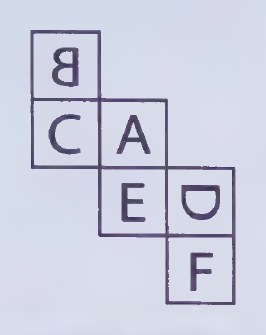
Diagram from page 247.
Chapters, Lesson 3
Set I (pages 635-637)
Chemists have synthesized several hydrocarbon compounds whose names are based on their polyhedral structures. In addition to prismane (a hexane in the shape of a triangular prism), there are cubane, housane (a pentagonal prism), and dodecahedrane. More spectacularly there are the buckyballs and their relatives—large cages formed by carbon atoms. These compounds have been studied intensively in recent years.
3-D Lettering. *l. LI and E.
2. Lis ahexagon, [ is a quadrilateral (rectangle), and E is a dodecagon (12-gon).
¢3. Prisms. Prismane.
4. Because it is shaped like a prism.
*5. Two.
*6. Three.
7. Six.
8. Nine.
9. 60° and 90°. Polyhedral Nets.
¢10. The bases.
11. The lateral faces. 12, n.
*13. n+2.
14. Its lateral area.
15. A cube (or, a rectangular solid). Inside a Prism.
16. The lateral faces.
17. 837 ft2. (27 x 31.)
*18. 1,624 ft2. [2(27 x 14) + 2(31 x 14).] A Hexagonal Surprise.
*19. Aparallelogram.
*20. BAB’C.
! 21. CBC’D.
22. DCD’E.
¢23. EDE’E.
24. FAFE.
25. A parallelogram.
#26. They appear to be parallel and equal.
27. They appear to be congruent (and, if the green figure is viewed as three-dimensional, to lie in parallel planes).
28. A triangular prism.
Set II (pages 637-638)
In Crystals and Crystal Growing (Anchor Books, 1960), Alan Holden and Phylis Singer report that “there are six styles of crystalline architecture, each employing a different sort of building block; and every crystal belongs to one of these six ‘crystal systems.” All six systems are prisms. Three are rectangular solids (cubic, tetragonal, and orthorhombic), named according to whether the edges have 1, 2, or 3 different lengths. The other three include two oblique prisms with parallelogram faces (monoclinic and triclinic) and a right hexagonal prism (hexagonal).
Concerning the Euler characteristic, Howard Eves remarks in An Introduction to the History of Mathematics (Saunders, 1990), “One of the most interesting theorems relating to any convex (or more generally any simply connected) polyhedron, is that v— e + f = 2. This may have been known to Archimedes (ca. 225 B.c.), and was very nearly stated by Descartes about 1635. Since Euler later independently announced it in 1752, the result is often referred to as the Euler-Descartes formula.” The stamp pictured in the text was issued by the German Democratic Republic in 1983 on the
200th anniversary of Euler’s death. The letters used in the formula e— k + f = 2 are the initials of the German words for vertices (ecken), edges (kanten) and planes (fldchen). We will return to the Euler characteristic in later lessons of this chapter.
Long House.
©29. Pentagons.
30. Rectangles.
31. Five.
32. 1,215 ft2 (15 x 81.)
*33. 1,458 ft2. [2(9 x 81).]
34. Example figure:
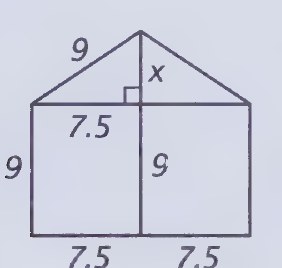
Diagram from page 248.
Approximately 14 ft. (Other roundings are acceptable.) (x2 + 7.52 =92 x2 = 24.75, x=59+x=14)
Crystal Forms.
35. They are rectangles.
36. The lateral edges are oblique to the planes of the bases.
37. They are parallelograms because their opposite sides are equal.
Feeding Trough.
*38. Yes. The bases of every prism are congruent.
39. Yes. AB = GH. AB = CD (given) and CD = GH (the opposite sides of a parallelogram are equal); so AB = GH (substitution).
40. Yes. AE || CG and AE = CG. AE and CG are lateral edges of a prism; so they are parallel. AE = CG because they are both equal to BF (or DH); the opposite sides of a parallelogram are equal.
41. ABFE and DCGH are rectangles because they are lateral faces of a right prism. (They are also congruent because all of their corresponding parts are equal.)
Magic Box.
42. Arectangle.
43. SAS. (AE = DH, ZAEX = ZDHY, and EX =HY.)
44, AX>AE.
45. The area of AXYD is greater than the area of AEHD. (AD = AD, but AX > AE; AD-AX>AD- AE.)
#46. Aright triangular prism.
47. AAXE and ADYH.
48. A right trapezoidal prism.
49. ABCD and XFGY; ABFX and DCGY. Euler’s Discovery.
*50. 2n.
SR}
52886178
53. 2.[V+F-E=2n+(n+2)-3n=2]
Set I11 (page 639)
This exercise is based on the work of the eighteenth-century French crystallographer
René Just Hally described in Elizabeth A. Wood’s Crystals and Light (Van Nostrand, 1964). Wood writes: “It is in the nature of naturalists to describe in detail the odd things that they find, and the early naturalists wrote full descriptions of the crystals they found, recording carefully the angles between their faces. One of them [Halily] noticed the special angular relationships between the faces of a crystal. . . . It was this small-wholenumber relationship between the tangents of the interfacial angles of crystals that convinced the early naturalists that crystals were made up of building blocks.” In Crystals and Crystal Growing (Anchor Books, 1960), Alan Holden and Phylis Singer elaborate on this idea: “Crystals . . . can always be imagined to be made of little building blocks. . .. The building block is somewhat fictitious, of course. Nobody supposes that the ultimate fine structure of crystals looks like a
Lesson 4
collection of brick-shaped particles. The assembly of identical building blocks is merely a way of portraying the crystal’s repetitive orderliness. Each building block represents a grouping of atoms or molecules which is regularly repeated
- throughout the crystal.”
Topaz Angles.
1. tanZ1= % and tan £2 = %
2. tan £2 =2tan /1.
3. 0.4557. (tan £1 = tan 24.5° = 0.4557.)
4. 0.9114. [tan £2 =2 tan £1 = 2(0.4557) = 0.9114.]
5. 42.3°.
6. Yes.
Set I (pages 642-644)
Tables of squares and cubes of numbers have been discovered on Babylonian tablets thought to date to 2100 B.c. The Pythagoreans may have been the first to associate these numbers with geometric figures.
According to Genesis 6:14—16, the ark had three stories and was divided into various rooms. The average height of each story would have been 15 feet.
Exercise 26 reveals that Cavalieri’s Principle had been discovered long before the man for whom it was named was born. A good source of information on Cavalieri and his work is the article “Slicing It Thin” by Howard Eves included in The Mathematical Gardner, edited by David A. Klarner (Prindle, Weber & Schmidt, 1981).
The four candy bars weigh about the same:
3 Musketeers, 2.13 0z; Snickers, 2.07 0z; Butterfinger, 2.1 0z; Milky Way, 2.05 0z.
Squares and Cubes.
1. Its area.
®2. “x cubed.”
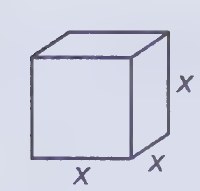
Diagram from page 249.
*4. lts volume.
5. 27.
6. 1,728.
*7. 36.
8. 1,29. (36%)
9. 46,656. (36%) Largest Suitcase.
10. 2,772in3. (22x 14x9.)
11. 1,728.(12%) 2,772
12. About 1.6 . . 3 ou G728
)
Noah’s Ark.
13. 450,000 cubic cubits. (300 x 50 x 30.)
*14. 1,518,750 ft3. (450,000 x 1.5%.)
15. Approximately 500 boxcars.
(e L e 3,000
Weathering Rock.
*16. 1m3. (13.)
©17. 6m2 (6x12)
18. 8.
19. 1 md.
©20. 12 m2 [8(6 % 0.5%).]
21. 64.
22. 1m?
23. 24 m2. [64(6 % 0.25%).]
24. It stays the same.
25. It increases (doubling at each stage). Keng-Chih’s Principle.
26. Cavalieri’s Principle.
#27. Aright hexagonal prism and an oblique hexagonal prism.
28. That the prisms have equal volumes. Hole in the Ground.
29. (Student answer.) (Alice probably got 1,860,867 ft> because 1233 = 1,860,867.)
30. Because Ollie saw Alice using her calculator. If she had realized that a hole in the ground doesn’t have any dirt in it, she wouldn’t have been doing that.
Prism Volumes.
®31. 108 cubic units. [V=Bh=(%(4x6)9=12x9=108.]
32. 440 cubic units. [V=Bh=(8x5)11=40x 11 =440.]
©33. 288 cubic units. {(V=Bh= [%(4)(5 +11)]9=32x9 = 288}
Candy Bars.
®34. 79 cmB. (V=Ilwh=30%x21x125=78.75=79.)
35. 66 cm3. (V =lwh=33x2.0x10.0 =66.)
¢36. 55cm3. {V = Bh= [%(1.3)(2.3 +35)]145= 54,665 = 55.)
37. The 3 Musketeers bar. No; weight is not the same thing as volume.
Set II (pages 644-646)
Exercises 41 through 46 develop the formula for the cube of a binomial. A good class exercise would be to confirm the result algebraically.
Exercises 57 through 60 on the Toyota are based on material in A. K. Dewdney’s 200% of Nothing (Wiley, 1993). Dr. Dewdney wrote the “Mathematical Recreations” column in Scientific American for 8 years. As the exercises reveal, the commercial seems not only to confuse length with volume but also to have gotten the figures wrong.
Ream of Paper. 2
*38. 0.004in. ( 500 )
39. 0.374in3. [V = Bh = (8.5 x 11)(0.004) = 0.374.]
*40. 187.156 in2. [A=2(85x 11) +2(8.5x 0.004) + 2(11 x 0.004) = 187.156.]
Binomial Cube. o41. (a+Db).
42. Eight.
#43. Two of them. e44. g%,
45. ab2.
46. a3+ 3a% + 3ab® + b°. Chinese Problem.
47. Aright triangular prism.
1 1
48. Eubc. [V=Bh= E(ub)c.]
©49. gb +ac +be + cVa® +b°. [A= 2(%ab) +ac+bc+ cVa® +b* )
SAT Problem.
50. p 3
ey
¢51. 3em. (5x=15,x=3.)
52. 18 cm?. [V = Bh = %(3 x4)3=18]
53. 42 cm?. (5% 4% 3 = 60; 60~ 18 = 42.) Filling a Pool.
*54. 2365 2, [A = %(3 +5)165+ %(5 +O)I15+ %(9 +7.5)9 + %(7.5 +3)3= 66 + 805 + 74.25 + 15.75 = 236.5.]
Lesson 5
*55. 4,730 ft3. (V = Bh = 236.5 x 20 = 4,730.)
56. A little under 40 hours.
( 4:;30 i 2,365 minutes = 39.4 hOlll’S-)
- Advertising Claim.
*57. 9ft3 (0.75x 4% 3.)
58. 13.5 3. (6x 0.75% 3.)
59. 18 ft3 (6 x4x0.75.)
60. The extra room on the inside surely refers to volume, not length, so the wording should say “over two cubic feet more room.” It is also strange that the commercial uses the number “two” when the volume should be increased by at least 9 cubic feet.
Measuring a Toad.
61. Its volume.
62. Push the toad under the water in a full measuring cup that can hold it comfortably. See how much water the toad displaces (the water will flow out).
Set Il1 (page 646)
Benjamin Franklin’s experiment in which he poured a spoonful of oil on the surface of a pond took place in 1765. He became curious about the effect of oil on water as a result of observing that the wakes of ships moving through greasy water were remarkably smooth. Although Franklin did not do the actual calculations, his experiment has been called a landmark in science in that it made possible the first rational measurement of the size of a molecule. A recreation of Franklin’s experiment is pictured and described on pages 199—202 of Philip and Phylis Morrison’s The Ring of Truth (Random House, 1987).
Molecule Experiment.
1. 0.0000002 cm. [V = Bh; so h = %A
V=4cm®Pand B= %(4,000 m?) = 2,000 m? =
2,000 x 1002 cm? = 20,000,000 cm?.
1 “= 50,000,000 ~ 10,000,000 0.0000002 cm.]
2. 5x10% (or 500 quintillion). [If the edge of the cube is 0.0000002 cm = 2 X 107 cm, its volume is (2 x 107 cm)3 = 8 x 10²! cm3, If the cubes are packed together with no spaces between them, there would be as
4 cm® Bx10 T em? 0=
many as
5 x 10² molecules.]
Set I (pages 649-650)
Ferrocene was first synthesized in 1951. At room temperature, it consists of yellow orange crystals that smell like camphor. It is used as a fuel additive, in rocket propellant, and in the production of antibiotics.
Leonardo da Vinci’s sketch of a parachute appeared in a part of his Codex Atlanticus in which he explored mechanical flight. It was not until three centuries later that Louis Lenormand of France is credited for inventing the parachute. Its first trial took place in 1785, when a dog in a basket with a parachute was dropped from a balloon at a high altitude. Da Vinci’s design was tested for the first time in 2000. According to BBC News, “a British man, Adrian Nicholas, dropped from a hot air balloon 3,000 meters (10,000 feet) above the ground, after ignoring expert advice that the canvas and wood contraption would not fly. . . . In the wider open spaces of Mpumalanga, South Africa, Mr. Nicholas safely floated down, saying the ride was smoother than with modern parachutes.”
X-Ray Beam.
*1. Apyramid.
*2. Its apex.
3. Its base.
*4. A cross section.
5. Alateral face. Ferrocene.
6. Pentagonal (or regular pentagons).
7. At the apex of each pyramid.
8. The lateral edges.
9. Isosceles.
Pyramid Volumes.
*10. 128 cubic units. 1 1 V= —Bh=—(8%)6=128. V=3 3( ) ]
11. 400 cubic units. v=L18n= Laox158=400] 33
¢12. 70 cubic units.
1 1.1 { 3Bh 3[2(5><12)]7 0.} V=-Bh=—[= =70.
A Regular Pyramid.
*13. They are equal. (They are radii of a regular polygon.)
14. They are right angles (and so are equal). (Because PO is the altitude, it is perpendicular to the plane of the pyramid’s base; if a line is perpendicular to a plane, it is perpendicular to every line in the plane that passes through the point of intersection.)
15. They are right triangles. They are congruent (by SAS).
16. They are equal. (Corresponding parts of congruent triangles are equal.)
17. They are isosceles triangles. They are congruent (by SSS).
Leonardo’s Claim.
18. A parachute (in the shape of a square pyramid).
*19. 576 yd®. [V = %Bh - %(122)12 ~576.]
20. No. The man looks too big. He looks as tall
as the pyramid above him, which has an altitude of 12 yd = 36 ft.
Triangle and Pyramid Compared. 1
21. A= —bh. 2
o2 v=lpn 3
#23. 55.125 square units. A= %(10.5)(10.5) —55.125]
24. 55.(1+2+3+—+10=“55)
«25. 385.875 cubic units. v= %(10.5)2(10.5) —385.875]
26. 385.(12+22+32+—+102=1385.)
Set II (pages 651-653)
Surprising as it might seem, blindness is less a disability in mathematics than it is in many other areas of study. The blind mathematician Nicholas Saunderson was mentioned earlier in the text (Chapter 4, Lesson 1) with regard to his invention of the pin-board. In his Penguin Book of Curious and Interesting Mathematics (Penguin, 1997), David Wells quotes French author Denis Diderot concerning Saunderson: “Wondrous things are told about him, and his progress in literature and in the mathematical sciences lends credence to all of them. He was the author of a very perfect book of its kind, the Elements of Algebra, in which the only clue to his blindness is the occasional eccentricity of his demonstrations, which would perhaps not have been thought up by a sighted person. To him belongs the division of the cube into six equal pyramids having their vertices at the center of the cube and the six faces as their bases; this is used for an elegant proof that a pyramid is one-third of a prism having the same base and height.”
David Burton, in his History of Mathematics— An Introduction (Allyn & Bacon, 1985), observes that, if the dimensions of the Great Pyramid were chosen so that the square of its altitude is equal to the area of one of its lateral faces, then, given that a is the altitude of a face triangle and 2b is
the length of a side of the base, % is the golden
ratio.
S
2b
Expressing the claim algebraically, we have
1 h* = ;(zb~a) = ab. Applying the Pythagorean Theorem to the figure above, we get a* = h* + b>; so h* = a* - b. Substituting for h gives
a-b = ab, from which we have a— ab- b = o. Dividing by b* gives (%)’— (%) -1=o0. Letting x = %, we have x* - x—1 = 0. Using the
” quadratic formula to solve for x gives
Y 4D 1245 2
. Because
2(D a
X = E>o,wehave~= i ~1.618 …, the b b 2
golden ratio.
The way in which the African salt funnel is used is described by Paulus Gerdes in Geometry from Africa (Mathematical Association of America, 1999): “The funnel is hung . . . and salt containing earth is put in it. A bowl is placed beneath the funnel, hot water is poured on the earth in the funnel, and saltwater is caught in the bowl. After evaporation, salt remains in the bowl.” The method for making a model of the funnel from a square piece of paper is taken from Gerdes’ book, which also includes a description of how African artisans weave the funnel.
Thomas Banchoff in his book titled Beyond the Third Dimension (Scientific American Library, 1990) calls the Egyptian formula for finding the volume of the frustrum of a square pyramid “a high point in the geometry of the ancient world.” Two strange aspects of this formula are that:
- it is suggested by Problem 14 of the Moscow Papyrus (ca. 1890 B.c.), a manuscript that makes no mention of how to find the volume of a complete pyramid, and (2) the method for finding the volume of a complete pyramid does not appear until the work of Democritus in the fifth century s.c., more than a thousand years later! It is interesting to note that a frustrum of a pyramid is pictured on the back of the U. S. dollar bill.
The Divided Cube. . 2,
*28. %x‘* (The cube is divided into six congruent pyramids.)
29. x2,
*30. lx. 2
31, %x” [(xz)(%x)]
32. V= SBh (because —x3— —( £ x3).
Pyramid Numbers.
*33. 231,000 ft2. (4817 = 231,361.)
*34. 612 ft. [PM2 =PO?+OM2= 4812 + ( )2 = 374,245;
PM = 1/374,245 =612.]
*35. 231, OOO ft2. [A= Ebh = —(756)(612) 231,336.]
36. Yes. (The answers to exercises 33 and 35 are about the same.)
*37. 92,000,000 ft3. (V- %Bh - %(756)2(481) 91,636,272
More on the Euler Characteristic.
*38. n+1.
39. n+1.
40. 2n.
41. The Euler characteristic for pyramids is 2 because V+F-E=n+1)+(n+1)-2n=2.
Salt Funnel.
42. Student model of funnel:
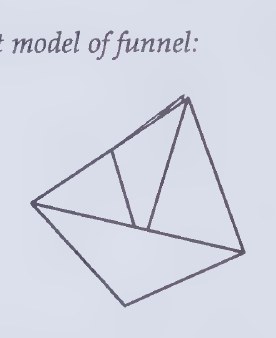
Diagram from page 253.
*43. Itis a pyramid.
44. An equilateral triangle. 45, Isosceles right triangles.
*46. %52_
1 1 1,1 1
47. Yo w=lpn-1los-1s LT o [ 5 3(25)5 65]
The Frustum of a Pyramid. 048, %uz(x +h). 1
49. gb”’x. 1 1 1., 5
50. Eaz(x +h)— Ebzx, or E(H x + ah — b%x).
1 1
51. OM= —gaand PN = —b. . P 2
#52. Corresponding sides of similar triangles are
proportional. 1 53 Xth_2° _a x 1, @ 2
54, x= b—hb [xa = xb + bh, xa — xb = bh, a—
x(a—b)=bh, x= fl.] a-b
55, %(azx +a2h— ) = _;.[(a2 —B)x + ah] =
;[(az -b?) aljib +ah] = ;[(u + b)bh + a?h] =
%(abh + B+ ) = %(az +ab+ Bk,
56. 504 cubic units. [%(122 +12x 3+ 3%)8 =504.]
57. No. Trying the numbers for exercise 56 in the Babylonian expression gives
%(122 +3%)8 =612 = 504.
Set I11 (page 653)
When Daniel Lowen, then a 17-year-old honors student at Cocoa Beach High School, discovered the error in this PSAT problem, it made national news. The article reporting the mistake in the New York Times (March 17, 1981) carried the headline: “Youth Outwits Merit Exam, Raising 240,000 Scores.” Lowen suspected that the question concerning the two pyramids might be a “trick question” and, when he got home, he made models of the pyramids to check his answer. It was the first time that an error in an SAT test had been discovered in its 33-year history.
How Many Faces?
1. Answer C (seven). Pyramid ABCD has four faces and pyramid EFGHI has five faces. When they are put together, the two faces that coincide are lost so that one would expect the resulting solid to have 4 +5-2=7 exposed faces.
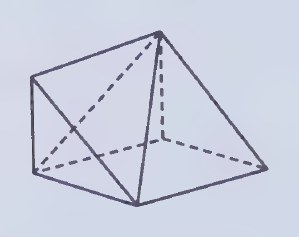
Diagram from page 254.
Answer A (five). When the pyramids are put together in the way described, two pairs of faces lie in common planes, so only two faces are formed rather than four. (This can be proved with elementary geometry by showing that the dihedral angles of the solids are supplementary.)
Lesson 6
Set I (pages 656—658)
Finding volumes of solids of revolution is an important application of integration in the calculus. The formulas for the shell and disk methods are based on right circular cylinders. Some of your students might be interested in
b 2 seeing the disk equation V = J. nf(x)] dx and
comparing it with the geometric formula for the volume of a cylinder.
The Channel tunnel consists of two large tunnels each containing a single track railway line and a smaller service tunnel midway between them. The tunnels are 5o kilometers long and were bored at an average depth of 45 meters below the ocean floor. More than s million cubic meters of rock were removed in building them, a volume twice that of the Great Pyramid.
Primitive Perspective.
1. A cone, a cylinder, and a pyramid.
2. Example figures:
Ay SYi)
Italian into English.
3. Volume, area, base.
4. Cylinder.
5. Cone.
®6. Product.
7. Athird.
8. Altitude.
9. The second. Solids of Revolution.
¢10. Its axis.
¢11. The altitude.
¢12. The lateral surface.
*13. The bases.
14. Itis perpendicular to them.
015. 45mind. [V = Bh = (n3?)5 = 45n.]
16. No. Its volume is 75m in. [V = Bh = (15?)3 = 75m.]
17. Aright triangle.
18. No. If it were revolved about the hypotenuse, the resulting solid would consist of two cones with a common base
Hockey Puck.
#19. 7in2 [A=m2=n(1.5=2.25n=7.]
20. 7ind. [V=Bh=225n(1)=7.] Cylindrical Tunnel.
21. 64 m2. [A =mr?2=m(4.5)2=20.25n = 64.]
©22. 4,800 m3. [V = Bh = 20.25n(75) = 4,800.]
Sliced Solids.
23. Cones.
24. Example figures:
AN,
25. They have equal volumes.
#26. Cavalieri’s Principle. Sausages in a Can.
027. 35m cm®. [7Bh = 7(n12)5 = 35m.]
©28. 110 cm?®.
29. 54m cm?®. [Bh = (r3%)6 = 54m.]
30. 170 cm®. 35t 110 % (541’( 170 )
*31. 65%.(—— = — =0.65.
Triangles or Cones.
32. The triangles have equal areas. (They are both composed of two 3-4-5 right triangles,
or bh= 18.3=L6.4-12) 2 2 2
33. The cone with the base of radius 4 has a larger volume. Its volume is
%Bh = —;—(1142)3 = 16m, whereas the volume
of the cone with the base of radius 3 is
%Bh = -;—(1132)4 =12n.
Set II (pages 658-661)
The pipes for exercises 34 and 35 are drawn to scale, making it possible to guess without making any calculations that the two pipes in arrangement B can carry the most water.
Pipe Puzzle. 34, That they have the same length.
35. Arrangement B. The areas of the cross sections of the pipes are: A, m4? = 16m; B, 2(r3?) = 18m; C, 3(m22) = 12m.
Cake Pans.
36. The round pan has a volume of 95 in3 and the square pan has a volume of 96 in®. [V, =Bh = (n4.59)1.5 =~ 95 and V,=Bh=(8915=9]
37. They would be about the same, although in theory the height of the round cake would be greater. The same amount of batter is used in each pan, but the area of the base of the round pan is slightly smaller.
Engine Displacement.
#38. The diameter of its base.
39. Its altitude.
40. V = Bh = nr?h. Letting the bore = d = 2r and
the stroke = 1, we have r = ; ; 50
d [id % 11(2)h 4d2h. =m(—=)2h = —,
*41. 352in3. [8V =8( %)(4.0)2(3.5) =352]
Stage Lighting. 042, mh% (A = = mh2)) a3 Yo (v = Lon= Lwin = Luw) 8 3 3 3
*44. It is multiplied by four. [A =12 =n(2h)? = 4mh2.]
45. It is multiplied by eight. 1 1 8 V= —Bh= —[n(2h)2]2h = —mh3. { 3 - [m(2h)?]2h oAl
Paper Towels.
46. 176.[80.6 ft2 = (80.6)(122) in2 = 11,606.4 in2; 11,606.4 ane) : = 1752,
47. 311ind. [V = Bh = (n39)11 = 99 ~ 311.]
«48. 285in%. [99n—n( %)211 ~285]
49. 16ir. (22 _16) 176
Cylinder and Cone Areas.
50. Arectangle.
51. 2mr.
52. 2mrh. (A =bh=2mrh.)
53. Its total area. [2rr(r + h) = 2mr2 + 2rwrh, or the areas of the two bases plus the lateral area.]
e54. A sector of a circle.
55. 2mr. (The length of arc CD is the circumference of the base of the cone.)
r lateral area > 1 ( area of circle O A (et
length of arc CD 2 r )
circumference of cirde O 2rd T
57, morl. (latel:llzarea y %;so
lateral area = %Ttl2 =nmrl.)
58. rrVr2+h? . (B=12 + K sol= VrP+h2.)
59. Its total area. [r(r + 1) = mr2 + mrl, or the area of its base plus its lateral area.]
Coin Wrappers.
60. Because the width of the flat wrapper is 34 mm, its circumference when it is formed into a cylinder is 2(34) = 68 mm. Because c=mdd=< = o8 21.6. The diameter of
non
the cylinder is about 21.6 mm, just large enough for nickels with a diameter of 21 mm.
61. About 29 mm. (¢ = nd = 18m, w=< =9n=283) 2
62. Slightly more than % mm. (w= % = %,)
Rolling Cones.
63. Its apex, V, stays in place. The points on the edge of the base of the cone sweep out a circle with center V and radius 1.
64. ZPVO = 30°. If the cone returns to the same spot after two rotations, 2c = 2(2nr) = 2n; s0 ] =2r, and so ZPVO = 30°.
Lesson 7
Set 11l (page 661)
The picture of the cone of iron ore was taken by photographer Alex MacLean, the founder of Landslides, a Boston-based firm that specializes in lower-altitude aerial photography. The cone was located near the loading docks of Ashtabula, Ohio, ready to be taken by train to steel mills in southern Ohio and West Virginia. MacLean’s photographs have been published in two beautiful books: Look at the Land—Aerial Reflections of America, with text by Bill McKibben (Rizzoli, 1993) and Taking Measures Across the American Landscape, with text by James Corner (Yale University Press, 1996).
Iron Ore.
1. About 190 ft. [From the width of the train cars, we know that 4 mm corresponds to 10 feet; so 1 mm corresponds to 2.5 feet. The diameter of the pile is 75 mm, or 75(2.5) = 187.5 =190 ft.]
2. About 64 ft. )
h [] R 95 O
(tan 34° = %, h =95 tan 34° = 64.)
3. About 28,000 ft2. [A = mr? = m(95)? = 28,000.]
4. About 600,000 ft3. V= %Bh & %n(95)2(64) ~ 600,000.]
600,000 ft* 4,400 ft°
5. About 137. ( =137)
Set I (pages 665-667)
The earth obviously has a shadow cone, rather than the shadow cylinder depicted in Anno’s whimsical painting. We have evidence of this shadow cone every time we observe an eclipse of the moon.
For our sun to become a black hole, its mass would have to be compressed into a sphere with a radius of about two-thirds of a mile (1 kilometer). If the earth were to become a black hole, it would
have to be compressed to about the size of 3 marble.
Although Euclid considers spheres in the Elements, he does not show how to find their surface areas or volumes. He does establish in the last theorem (Proposition 18) of Book XlI, however, that the ratio of the volumes of two spheres is equal to the cube of the ratio of their diameters. It was Archimedes who developed the formulas for the volume and area of a sphere in his work On the Sphere and Cylinder, which contains 53 theorems on these solids.
In Beyond the Third Dimension (Scientific American Library, 1990), Thomas Banchoff describes Flatland as “simultaneously a social satire and an introduction to the idea of higher dimensions. . . . [Its author, Edwin] Abbott used dimensional analogies to great effect in raising questions about the way we see the world, especially when we come into contact with the truly transcendental. For over a century, mathematicians and others have speculated about the nature of higher dimensions, and in our day the concept of dimension has begun to play a larger and larger role in our conception of a whole range of activities.”
Your students may be surprised to learn that a baseball floats on water. In his book titied Sport Science (Simon & Schuster, 1984), Peter J. Brancazio observes that, in a list of balls commonly used in sports, including the football, baseball, golf ball, handball, soccer ball, basketball, and volleyball, only the golf ball and handball sink in water!
The fact established in exercises 24 and 25 that the two boxes contain the same amount of chocolate is contrary to many people’s intuition, but, if we think of each sphere as inscribed in a cube, the result is obvious. The ratio of the volumes of the sphere and cube is a constant and does not depend on how large they might be.
Earth Shadow.
1. They are equal.
2. Itis four times as large. Black Hole.
*3. About 12.6 km2. [A=4nr? =4m(1)? = 4n=12.6.]
o4, About 4.2 km3. 4 4 4 V=—-mrd=—n(1*= —n=4.2. [ 3” 311() e ]
5. 3km. (4m?= i;.m% 122 = 4%, 3=1.)
6. 36m, or about 113 km?, and 36m, or about 113 km?. [4n(3)2 = 36m = 113; %n(3)3 = 36n]
Archimedes’ Discoveries.
1 Ll
7. 31’(::3.(V— 31ux 310:3.)
2 14 2 8 3 (V=ggm=3m) Sl (V= = =B = S,
9. . (V = mxx =)
10. The volume of the hemisphere is twice that of the cone, and the volume of the cylinder is three times that of the cone. The sum of the volumes of the cone and hemisphere is equal to the volume of the cylinder.
Flatland.
*11. All radii of a sphere are equal.
*12. If a line is perpendicular to a plane, it is perpendicular to every line in the plane that passes through the point of intersection.
13. HL.
14. Corresponding sides of congruent triangles are equal.
15. Itimplies that the curve is a circle. The set of all points in a plane that are equidistant from a given point in the plane is a circle.
Sound Wave.
16. At its center.
17. Its area.
*18. It decreases.
Volume and Density.
*19. 212 cm?. [V = —g-fl(3.7)3 =212]
20. 42cmd [V = %n(2.15)3 =42.]
®21. 0.7 gram/cm?. m 145g WS =8 3 v 212cm
=07 g/cmd)
22. Abaseball will float on water.
23. 1t is more than 42 grams.
(d=%>1,z”;->l,m>42.)
Chocolate Packing. 24, (Student answer.)
25. The volume of chocolate in each box is
%mfi; so they contain the same amount of chocolate.
3 16l A Ay 64,4 8. s F1rstbox.16[§n(2)]- 311 s T
Second box: 2( %mfi) = %mfi_
26. (Student answer.)
27. The first box contains more wrapping paper. The amounts are related to (but not the same as) the surface areas of the chocolates. If the wrappings are similar to one another, they will be proportional to the squares of the radii (or diameters) of the spherical chocolates that they enclose. Therefore, the box that contains more wrapping paper can be found by comparing the total areas of the chocolates in each box. )
First box: 16(4n( g)Z) - 64«:“’T — 16m®.
Second box: 2(4md2) = 8nd?.
Set II (pages 667-669)
Martin Gardner observed in one of his “Mathematical Games” columns for Scientific American (reprinted in Fractal Music, Hypercards and More.. . . (W. H. Freeman and Company, 1992) that Max Bill’s Half Sphere Around Two Axes “is based on an old folk method of quickly slicing an apple into congruent halves” and that ‘it is not as easy as it looks.” Some of your students might enjoy the challenge of trying to cut an apple in this way.
In his “Games” column in the October 1983 issue of Omni magazine Scot Morris features the “Hollow Earth,” telling the story of Cyrus Teed and his strange cult and commenting on the geometry explored in exercises 32 through 37. Morris wrote: “What’’s most infuriating is that a little mathematical fiddling turns this crazy theory into a proposition that is virtually impossible to refute. The trick is done by inversion, a purely
geometric transformation that lets a mathematician turn shapes inside-out. When a sphere is inverted, every point outside is mapped to a corresponding point inside, and vice versa.” Morris asked the great geometer H. S. M. Coxeter if there were -“any way to prove that we aren‘t inside a hollow earth” and Coxeter couldn‘t think of any. Morris observes that “just as the geometry of space inverts, so do all the laws of physics. Toward the center of a hollow Earth, light slows down and everything shrinks—atoms, astronauts, spaceships, and measuring rods.” More on this topic can be found at various sites on the internet; the entire text of the Omni article is at www.sumeria.net.
Of the two methods for finding the volume of water in exercises 44 and 45, the first method is exact. The second method, treating the spherical shell as if it were a right prism wrapped around the sphere, provides a good approximation only if h, the thickness of the shell, is very small in comparison with r, the radius of the inner sphere.
Exercise 46 illustrates the fact that an expression that measures area must produce square units, whereas an expression that measures volume must produce cubic units.
This is even more evident in the “volume” formulas given for exercises 5o through s4 for spheres in different dimensions. Because our experience is limited to three dimensions, we have special names for only linear, square, and cubic units. The formulas in the table are derived from general formulas given by Clifford Pickover in Surfing Through Hyperspace (Oxford University Press, 1999). As the powers of T in them suggest, there are two different general formulas, depending on whether the number of dimensions is odd or even. The volume of a k-dimensional sphere where kis even is
flgr“
V=
&1
whereas, if kis odd, the volume is
k=1 v=rm? [k:1]!2k+1rk_
(k+1)! (1 am tempted to put an exclamation point at
the end of the second formula, but that would only cause confusion!)
Half Sphere.
2 1,4 2 028, . [=(=md) = Zmrd.
3 [2(3 ) 3 ]
29. 2mr2. [%(4417‘2) =2mr2]
33l 3
30. 211r.[3(21’(r2) 2Tl7‘2~]
31. 35m2 QR+ %nrz =3.5m2)
Hollow Earth.
32. AOTP is a right triangle because, if a line is tangent to a circle, it is perpendicular to the radius drawn to the point of contact.
33. Either leg of a right triangle is the geometric mean between the hypotenuse and its projection on the hypotenuse (or by similar
triangles). 34 65mi. [240,000 _ 3,960, 3,960 or
240,000 OP” = (3,960)2, OP” = 65.]
©35. 3,895 mi. (AP’ = AO - OP’ = 3,960 - 65 = 3,895.)
93,000,000 _ 3,960
36. 900 ft. | === 50
93,000,000 OF” = (3,960)? OP’ = 0.17 mi = 900 ft.]
37. Near the center of the earth. Melting Snowball.
#38. About 15 hours. [V= §-11r3 = -g—rt(é cm)? = 905 cm?; 905 minutes = 15 hours.]
*39. About 13 hours. V= %n(?) cm)? = 113 cm?;
905 cm3 — 113 cm?® = 792 cm?3; 792 minutes = 13 hours.]
40, About 452 cm?. [A = 4m(6)? = 452.]
41. About 113 cm?. [A = 4n(3)? = 113.]
42. No. It takes about 13 hours for the diameter of the snowbeall to decrease 6 inches and only 2 hours for it to decrease the remaining 6 inches. (The diameter decreases at an increasing rate.)
43. No. The surface area of the snowball decreases about 452 — 113 = 339 cm? in 13 hours (an average of 26 cm? per hour) and 113 cm? in 2 hours (about 56 cm? per hour). (The surface area also decreases at an increasing rate.)
Earth Under Water.
*44. 325,000,000 mi3. V= %n(3,960 + 16503 - %n(3,960)3 -
%n(3,96l.653 - 3,960°) = 325,000,000.)
45. 325,000,000 mi®. (V = 4mr?h = 4n(3,960)%(1.65) = 325,000,000.)
Doughnuts.
46. The first expression must give its volume because (4 units)(b units)? = ab? cubic units; the second expression must give its area because (a units)(b units) = ab square units.
*47. The second expression.
48. It would be doubled. [21%(2a2)b? = 4m2ab? = 2(2m2ab2.)
49. It would be multiplied by four. [2r2a(2b)? = 8n2ab? = 4(2rab?.]
Spheres in Different Dimensions.
50. A circle.
51. Its area.
52. Its diameter.
53. Dimensions Volume 1 2 2 3.14 3 419 4 493 5 5.26 6 5.17
7 4.72
54. As the number of dimensions increases, the volume of the sphere at first increases and then decreases.
Set II (page 669)
Frank Marshall, the producer of Raiders of the Lost Ark, said concerning the rolling-boulder sequence in the movie: “A huge boulder comes crashing down through a chute and chases after Indy. We had to make it look like it rolled free, but we also had to be able to control it. The boulder was on this contraption like an arm; it was free-spinning and the arm was hidden. The boulder tumbled down the chute, then it had to be taken back if we wanted to do another take. But we couldn’t do it again very quickly because we had to put in the stalactites that got broken off as it rolled out.”
V| 7Y
A I5 B
1. You could lie down along the edge of the tunnel. In the figure above, AOAB is an isosceles right triangle; so OB = 15v2 and CB=0B-0C=15v2 —15=15(+/2 1) = 6.2 feet. The sides of the small square are
6.2 about —= = 4.4 feet; so there is plenty of 1/5 plenty room.
2. (Student answer.) (It might not work if the corners of the passage were rounded.)
Lesson 8
Set I (pages 672-674)
About the Statue of Liberty, Robert Osserman in his book titled Poetry of the Universe (Anchor Books, 1995) explains: “When the Statue of Liberty was built, the first step was the construction of a small-scale model. Building the statue to scale from the model in one step would have been a very risky operation. The sculptor decided to construct a number of intermediate models, scaling the statue up by a modest amount at each
step. One reason for caution is that each time the scale is doubled, the volume—and therefore the weight—goes up by a factor of eight. On the other hand, the strength of the supports, which depends on cross-sectional area, is multiplied only by a factor of four. That leads to the inevitable conclusion that whatever shape you design, if built on a large enough scale, will collapse under its own weight.”
A similar lesson on this subject appears in J. E. Gordon’s The Science of Structures and Materials (Scientific American Library, 1988) under the title “The Danger of Scaling Up”: “Engineering design practice is based to a large extent upon experience and precedent. One successful project leads to another, and things generally get bigger and bigger. The tendency is to scale up a successful design, keeping the working stresses the same. Not very long ago the author had a head-on collision over the conference table with NASA about its wind-energy program. A number of safe and successful windmills are 175 feet in diameter. NASA proposed, in effect, to scale up this design to a diameter of 400 feet. | had to point out that, for reasons of modern fracture mechanics, extensive redesign would be needed if the bigger windmills were to operate safely.”
The difficulty of comparing the volumes of solids from two-dimensional drawings of them is demonstrated by exercises 22 through 26 on olive sizes. The volume of a supercolossal olive is almost twice that of a jumbo olive, something that might be hard to guess from the side-view drawings of exercises 19 and 21.
The three pyramids at Giza were built in a period of about 150 years (ca. 2650 B.c.—2500 B.c.) and are named after the kings who built them.
Similar or Not?
1. Two cones are not always similar. Example figures:
AP
2. Two cubes are always similar.
3. Two triangular prisms are not always similar. Example figures:
. S
4. Two spheres are always similar.
5. Two square pyramids are not always similar. Example figures:
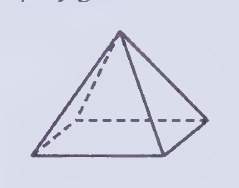
Diagram from page 261.
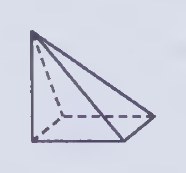
Diagram from page 261.
Scaling Up.
6. It is multiplied by 9. (32)
7. Itis multiplied by 27. (3%.)
8. Itis multiplied by 400. (202
9. Itis multiplied by 8,000. (20°.)
*10. Itis multiplied by n2 o11. Itis multiplied by n®. Giant Windmill.
12. 32.(20) 125
*13. 10.24. (3.2%)
*14. 32.768.(3.2%)
15. Approximately 82,000 pounds (or 41 tons!) (32.768 x 2,500 = 81,920.)
Gulliver in Lilliput.
16. By cubing 12. (They were basing the amount of food that Gulliver needed on his volume.)
¢17. That Gulliver’s body was similar to their bodies.
18. 144 times as much. (Basing the amount of cloth on surface areas gives 122 = 144.)
Earth and Mars.
3,960
19. About 1.9 times. (
=1.8857..) 2,100
#20. About 3.6 times. [(1.8857 …)2=3.6.]
21. About 6.7 times. [(1.8857…)2 =6.7.] Olive Sizes.
22. Exact size:
¢23. About 22mm. (= = 28 93¢~ 504, x =22, 8™
24. Exact size:
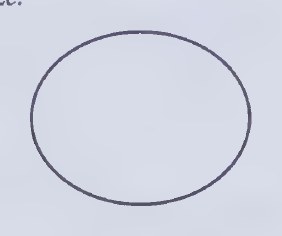
Diagram from page 262.
#25. About 1.8 times. [( %)3 =1.8]
26. About 9 grams. (1.8 x5.)
Three Pyramids.
27. Cheops, 0.62; Chephren, 0.67; Mycerinus, 0.61.
28. Cheops and Mycerinus, because the ratio of their height to their base edge is closest to being the same.
Set II (pages 674—676)
There are two stories associated with the problem of the duplication of the cube, one of the three famous problems of antiquity. In Science Awakening (Oxford University Press, 1961), B. L. van der Waerden quotes from a supposed letter from Eratosthenes to king Ptolemy:
“It is said that one of the ancient tragic poets brought Minos on the scene, who had a tomb built for Glaucus. When he heard that the tomb was a hundred feet long in every direction, he said:
‘You have made the royal residence too small, it should be twice as great. Quickly double each side of the tomb, without spoiling the beautiful shape.’
He seems to have made a mistake. For when
the sides are doubled, the area is enlarged fourfold and the volume eightfold. The geometers then started to investigate how to double a given body, without changing its shape; and this problem was called the duplication of the cube, since they started with a cube and tried to double it. After they had looked for a solution in vain for a long time, Hippocrates of Chios observed that, if only one could find two geometric means between two line segments, of which the larger one is double the smaller, then the cube would be duplicated. This transformed the difficulty into another one, not less great.”
The difficulty is in obtaining the length of the edge of the larger cube solely by geometric construction. Without this restriction, the problem can be easily solved. Exercises 37 through 43 present a simple solution, but, unfortunately, the figure used cannot be constructed by straightedge and compass.
Exercises 47 and 48 comparing the shape of liquid in a conical cup to its container has an interesting biological connection. In Cat’s Paws and Catapults (Norton, 1998), Steven Vogel wrote: “The need for growth without loss of function can impose severe geometrical limitations. Consider the possible shapes of mollusks, a widespread and diverse group that includes scallops, slugs, snails, and squid. Mollusk shell doesn’t grow, so a shell cannot enlarge except by adding incremental additions to edges and inner surfaces. For most shapes [such as cylinders and rectangular solids], such incremental additions would quickly lead to awkward changes in proportions. . . . Hollow cones are much better than cylinders or most other shapes if what matters is growth in size without simultaneous change in shape. And mollusk shells are basically cones. …”
The iron-doughnut problem is a classic puzzle in physics. Martin Gardner observes that opticians take advantage of the fact that a ring remains similar to itself as it expands when they heat the Iframe of a pair of glasses in order to remove a ens.
Doubling a Cube.
29. 622,
©30. 24x2. [6(2x)% = 24x2, or 22 - 6x% = 24x2.]
31. %8,
032, 8x3. [(2x)% = 8x3, or 23 - x3 = 823 ]
3. 4. 24”
3. 8. (Sia =8,0r2%) ., X
35. The square.
36. The cube. Plato’s Method.
37. The altitude to the hypotenuse of a right triangle is the geometric mean between the segments into which it divides the
hypotenuse.
*38. x=%/§;y—§/z.[l=xand x_y/ x y y 2
y=x2andy2=2x,(x2)2=2x,x3=2,x=%E; y=(2p=34]
*39. PA,1;PB, 2, PC, 4, PD, 8.
*40. Itis twice as large.
41. x=%;y= %.[l=£and£=l,
g U y
y=22and 2 =3x, ()2 =3x, =3, x= 33; y=(Br=3H
42. PA, 1;PB, 3, PC, 9; PD, 27.
43. It is three times as large.
Rubber Bands.
44. No. Although the corresponding lengths and widths of the rubber bands are proportional, we don’t know whether their corresponding
thicknesses are proportional. 1 1
#45. Eight. (-% = % =2; 23 = 8. If the bands TS
were made from the same material, their weights would have the same ratio as their volumes.)
5,7 -
46. The fact that the ratio 1, ——— 420 = 4.1 indicates
that the weight, and hence volume, of a #31 band is about four times that of a #10 band. The rubber bands are evidently not similar in shape and apparently have approximately the same thickness.
Two Cups.
47. Yes. AABE ~ ACDE by AA because ZA = Z/DCE and ZAEB = ZCED.
AB AE
48. Yes. B AABE ~ACDE, — = —; es. Because CE
so the corresponding dimensions of the
cones are proportional.
49. No. The rectangles are not similar because
D” 1, whereas % > 1. Alternatively, the
rectangles are not similar, because they do not have the same shape.
50. No. Height and Weight.
¢51. About 47 pounds. [( %)3 x 160 = 47.]
#52. About 93 pounds. [( %)3 x 160 = 93.]
53. About 254 pounds. [( %)3 X 160 = 254.]
54. About 379 pounds. [(%)3 x 160 = 379.]
Heated Ring.
55. (Student answer.)
56. The diameter of its hole gets larger. Because it is given that the shape stays the same, all dimensions must increase in order to remain proportional.
Teddy Bear Trouble.
57. No. She would need 22 = 4 times as much fur to cover the surface, 23 = 8 times as much kapok to fill the volume, 2 times as much length of ribbon and the same number of eyes as for the smaller bears.
58. The kapok.
59. Five. (She has enough stuffing to make 40 small bears; % =5)
60. The ribbon.
Set II (page 676)
According to the Guinness Book of World Records, a clam weighing 734 pounds was found off Ishigaki Island, Okinawa, Japan, in 1956.
Colossal Clam.
We will assume that the clams are similar and that the ratio of their weights is equal to the ratio of their volumes.
Let x = the weight of the larger clam in ounces:
s0 x = 20° = 8,000. The larger clam would weigh 8,000 ounces, or 500 pounds.
Lesson 9
Set I (pages 678-680)
The prefixes used in naming the five regular polyhedra are of Greek origin: tetra, hexa, okta, dodeka, and eikosa. Surprisingly, however, of the terms referring to “four” most commonly used in mathematics, only “tetrahedron” comes from Greek. Terms such as “quadrilateral,” “quadrant,” “quadratic,” “quadrillion,” and “quadruple” come from Latin. It is also interesting to note that, although the names of the five reqular polyhedra refer to all polyhedra having those numbers of faces, they are used almost exclusively to mean the regular polyhedra. Terms such as “pentahedron” or “decahedron,” for which no regular polyhedrons exist, are almost never used.
Exercises 6 through 11 consider two- and three-dimensional versions of the same idea. It seems appropriate that the sides of the “midpoint
triangle” in two dimensions are -21- the sides of the original triangle, whereas the edges of the “midpoint tetrahedron” in three dimensions are §
the edges of the original tetrahedron. A rather surprising difference between the two situations, however, is that, although the large triangle can be “filled” with four of the smaller triangles, the large tetrahedron cannot be “filled” with any number of the smaller tetrahedrons. In Martin Gardner’s Sixth Book of Mathematical Games from Scientific American (W.H. Freeman and Company, 1971), Gardner explains: “Because equilateral triangles also tile a plane, one might
suppose that regular and congruent tetrahedrons would also pack snugly to fill space. This seems so intuitively evident that even Aristotle, in his work On the Heavens, declared it to be the case. The fact is that among the Platonic Solids the cube alone has this property. If the tetrahedron also had it, it would long ago have rivaled the cube in popularity for packaging.”
In The Penguin Book of Curious and Interesting Mathematics (Penguin, 1997), David Wells reports that, in a questionnaire of mathematicians regarding the “most beautiful theorems” of mathematics, the fact that there are five reqular polyhedra ranked near the top of the list. Benno Artmann (Euclid—The Creation of Mathematics, Springer, 1999) points out that “Euclid’s treatment of the regular polyhedra is especially important for the history of mathematics because it contains the first example of a major classification theorem. Such theorems start with a definition (or axiomatic description) and end with a list of objects satisfying the description. There is no official definition of a regular solid in the list of definitions at the beginning of Book XI. However, we find one in the very last theorem of the Elements, which asserts the completeness of the preceding list of polyhedra.” Exercises 30 through 36 suggest the form of Euclid’s argument.
Numbers and Names.
1. Eight.
2. 12.
*3. Quadrilateral.
4. Cube.
5. Anicosahedron is a regular polyhedron that has 20 faces. An icosagon is a polygon that has 20 sides.
Two Triangles.
*6. Yes. (The sides of the smaller triangle are midsegments of the larger triangle; so they are parallel to its sides. The parallel lines form equal corresponding angles; so the triangles are similar by AA. Alternatively, the sides of the smaller triangle are half as long as the sides of the larger triangle; so the triangles are similar by SSS.)
7. They are twice as long. (This also follows from the Midsegment Theorem.)
8. The perimeter of the larger triangle is twice the perimeter of the smaller one. (The ratio of the perimeters of two similar polygons is equal to the ratio of a pair of corresponding sides.)
9. The area of the larger triangle is four times the area of the smaller one. (The ratio of the areas of two similar polygons is equal to the square of the ratio of a pair of corresponding sides.)
Two Tetrahedrons.
*10. The surface area of the larger tetrahedron is 32 =9 times the surface area of the smaller one.
11. The volume of the larger tetrahedron is 33= 27 times the volume of the smaller one.
da Vinci Polyhedron.
12. A dodecahedron.
13. Regular pentagons.
°14. 12.
15. Five.
*16. Three.
17. Two.
*18. 20.
19. 30. Escher Box.
#20. Anicosahedron.
21. Equilateral triangles.
22. 20.
23. Three.
24. Five.
25. Two.
20><3
026, 12.( )
27, 30. (20x3
)
Euclid’s Claim.
28. Regular polygons.
29. That they are congruent.
*30. 180°. (3% 60°.)
31. 240°. (4 x 60°.)
32. 300°. (5 x 60°.)
33. Because, if six equilateral triangles surround a point, they must lie in a plane (because the sum of the six angles is 360°).
34, 270°. (3 x 90°.)
35. 324°. (3% 108°.)
36. The figure is flat if the sum is 360°; it is solid if the sum is less than 360°.
Set II (pages 680-682)
The golden ratio appears as the ratio of the lengths of the edges of the dodecahedron and its inscribed cube in exercise 45. The exercise reveals that this ratio comes from the relation of the length of a diagonal of a regular pentagon to one of its sides.
Exercises 47 through 60 reveal something rather surprising. As the number of sides of a regular polygon inscribed in a circle increases, the perimeter and area of the polygon increase. As the number of faces of a regular polyhedron inscribed in a sphere increases, its surface area and volume do not necessarily increase! Howard Eves wrote in the first volume of In Mathematical Circles (Prindle, Weber & Schmidt, 1969): “The uninitiated will almost always intuitively believe that of the regular dodecahedron (a solid having 12 faces) and a regular icosahedron (a solid having 20 faces) inscribed in the same sphere, the icosahedron has the greater volume. . . . The reverse is actually the case.” Not only is the inscribed dodecahedron closer than the icosahedron to the sphere in volume, it is also closer to it in surface area. If these solids are circumscribed about a sphere rather than inscribed in one, however, it is the icosahedron whose surface area and volume are closer to those of the sphere. Another remarkable fact about the solids inscribed in the sphere is that the ratio of their volumes is equal to the ratio of their surfaces areas.
Octahedron and Cube.
S
*38. %1/5 . (From the isosceles right triangle.)
L
e 1 214=(5V2P= 2]
39. 2
e
1 1 1Pt 1 e4]. 6133.{V=2(3Ah)=2[3(2e2)(2)]= 6e3.}
42, It is one-sixth of the volume of the cube. Dodecahedron Construction.
43. By HL. (AABP and ACBP are right triangles, AB = BC because ABCDE is regular, and BP =BP)
*44. ZABP =54° and ZBAP = 36°. (£ABP = ZCBP; so
ZABP = %AABC = %108° =54° ZBAP =90° - 54° = 36°.)
*45. 1.618. (In right AABF,
sin ZABP [or cos ZBAP] = %; AC =2AP; S0 £< L ols =2sin 54° = 1.618. This is AB AB
the golden ratio.)
©46. About 1.8. [The volume of the cube is 13 =1 and the volume of the dodecahedron is1+6(0.135) = 1.81.]
Round About.
47. That there exists a circle that contains all of its vertices.
48. That there exists a sphere that contains all of a regular polyhedron’s vertices.
49. The polygon with 20 sides.
50. (Student answer.) (The polyhedron with 20 faces seems like a reasonable guess.)
51. 12.6 square units. [A =4mr? = 4n(1)2 = 4= 12.6.]
*52. 0.714 unit.
©53. 10.5 square units.
54. 1.051 units.
55. 9.6 square units!
56. (Student answer.) (Again the icosahedron seems like a reasonable guess.)
57. 4.2 cubic units. V= %m” - %n(l)i* B %’r{ ~42]
5, G [i(o.714)3(15 + 745)=28]
e o [%(1.051)3(3 +45)=25]
60. The dodecahedron!
Set II (page 682)
About this “Pyramid Puzzle,” Jerry Slocum and Jack Botermans wrote in Puzzles Old and New (University of Washington Press, 1986): “This put-together puzzle consists of two identical pieces and at first sight it seems too easy to include in a serious puzzle book. However, appearances can be deceptive and this apparently simple puzzle has frustrated many a self-confident individual.” The puzzle has been marketed in various versions, including one in which the two pieces have each been cut in half so that there are four pieces and another one with four pieces, each piece consisting of four connected spheres.
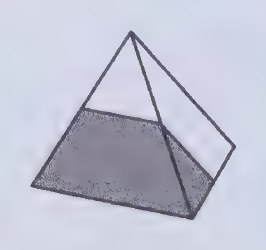
Diagram from page 266.
Tetrahedron Puzzle.
The solution is shown at the right above.
Review
Set I (pages 684—686)
In Visual Intelligence (Norton, 1998), Donald Hoffman considers the ambiguity of seeing depth: “The image at the eye has two dimensions; therefore it has countless interpretations in three dimensions. . .. Anytime you see depth you construct it, not just when you view strange drawings . .. but also in everyday life. . . . Quite simply, your visual system is biased. It constructs only those 3D worlds that conform to its rules. Most others it simply ignores. These rules are powerful. They prune the possible depths you can see from infinity down to one or two. This is useful, for if you saw all options then you would see depth flip or distort with your every glance.” Vasarely’s sculpture of the “flipping cubes” is a dramatic example of the problems that we can have in viewing a two-dimensional picture as three-dimensional.
The two figures by Gaetano Kanizsa are almost identical yet are interpreted very differently. The second, seen as three-dimensional, has the same depth flip: Is the top of the box the quadrilateral at the upper left or the one at the upper right?
A cordis an unusual unit of volume for several reasons: it is only used to measure wood, it is associated with a specific shape, and that shape is not a cube. The American Heritage Dictionary of the English Language defines it as: “A unit of quantity for cut fuel wood, equal to 128 cubic feet in a stack measuring 4 by 4 by 8 feet.”
The building considered in exercises 13 through 16 is the Baptistery of the Cathedral of Santa Maria del Fiore in Florence, Italy. It dates from the eleventh century, and its octagonal shape was evidently inspired by a building that had previously existed on the site.
The “inverse square law” considered for light intensity in exercises 17 through 19 appears in Newton’s law of universal gravitation and in Coulomb’’s law for electric charges. The authors of Project Physics (Holt Rinehart Winston, 1981) remark that “these two great laws arise from completely different sets of observations and apply to completely different kinds of phenomena. Why they should match so exactly is to this day a fascinating puzzle.”
Exercises 20 through 24 are based on one of the methods used by astronomers to estimate the number of stars in our galaxy, the Milky Way. It is assumed in this method that the density of
stars throughout the galaxy is the same as that
in our “neighborhood,” 10 stars in a sphere with
a radius of 10 light-years. The Milky Way itself is not spherical, of course, but shaped somewhat like a pancake with a bulge in the middle. Current estimates suggest that it may contain as many as 400 billion stars.
A simple method for determining the volume of a reqular tetrahedron in terms of the length of its edge is explored in exercises 25 through 31. A more challenging approach would be to treat it as a triangular pyramid so that the length of one of its altitudes has to be considered.
Flipping Cubes. *]. 4and8.
2. Aline.
3. They appear to be perpendicular.
4. 1,7,and 11.
5. It depends on how the figure (an optical illusion) is seen. (For example, if 3 is seen as the top of a cube and 9 as the bottom of a cube, the planes do not appear to be parallel. If 3 is seen as the top of a cube and 9 is seen as the floor of a cubical space, the planes do appear to be parallel.)
6. That they do not intersect. Seeing Things.
7. (Student answer.) (The most likely interpretation is that this figure is two-dimensional: an irregular hexagon with three concurrent diagonals.)
8. (Student answer.) (The most likely interpretation is that this figure is three-dimensional: a polyhedron with six quadrilateral faces.)
Cord of Wood.
9. 128.(V=Iwh=8-4-4=128.)
©10. 16 ft. (128=4-2-x, 8x=128,x=16.)
Box Pattern.
11. The hexagons.
12. A right hexagonal prism.
Octagonal Building. 13, A prism and a pyramid.
14. 1,080,000 ft3. (V = Bh = 12,000 x 90 = 1,080,000.)
*15. 80,000 6% (V = %Bh . %12,000 « 20 = 80,000.)
16. 1,160,000 ft3. (1,080,000 + 80,000.)
Screen Illumination.
17. They are twice as long.
*18. Itis four times as large. (22 =4.)
19. The same amount of light is spread over an area four times as large; so the light is one-fourth as bright.
Stars.
5,000 ) 10
*21. 250,000. (5002.)
22. 125,000,000. (5002.)
#23. 1,250,000,000. (10 x 125,000,000.)
24. 125,000,000,000. (100 x 1,250,000,000.) Divided Cube.
*25. V2.
26. They are equilateral and congruent.
#27. Aregular tetrahedron.
28. Five. (The regular tetrahedron and the
20. 500. (
four pyramids on its faces.)
1 1., 1,1 1
*2. g V= 3Bh= 350 = g
29. & [V=2Bh= =(=eDe= —e2.
1 1 1
30. §e3. [ - 4(ges) = 583.]
31. One-third.
Set II (pages 686-688)
More from Archimedes’ On the Sphere and Cylinder is included in exercises 32 through 42. About 150 years after Archimedes’ death, the great Roman statesman Cicero found his tombstone. He wrote: “When | was quaestor [administrator] in Sicily | managed to track down Archimedes’ grave. … | remembered having heard of some simple lines of verse which had been inscribed on his tomb, referring to a sphere and cylinder
modelled in stone on top of the grave. . .. Finally, | noticed a little column, just visible above the scrub: it was surmounted by a sphere and cylinder. . . . The verses were still visible, though approximately the second half of each line had been worn away.” Although the tomb no longer exists, Archimedes’ discoveries of the remarkable connections between the area and the volume of a sphere and its circumscribed cylinder are part of his lasting memorial.
The “twisted ring” of exercises 43 through 45 is equivalent to a Mobius strip. In one of his “Mathematical Games” columns for Scientific American, Martin Gardner wrote: “The cross section of a Mobius band actually is a rectangle, very much longer than it is wide. The band itself may be regarded as a four-sided prism, twisted so that one end has rotated 180 degrees before the two ends are joined. Viewed in this way it is a solid ring with two distinct ‘faces.” More concerning Mabius strips as twisted prisms can be found in Gardner’s article titled “Twisted Prismatic Rings” in Fractal Music, Hypercards and More. .. (W. H. Freeman and Company, 1992).
About Cavalieri’s method for calculating the volume of a wine barrel, John Pottage comments in Geometrical Investigations (Addison-Wesley, 1983): “Cavalieri’s barrel rule may well have been the source of an important sequence of mathematical development. . . . It was probably this formula for the capacity of a cask of wine which suggested to James Gregory . .. the more general formula for approximate integration, often written in the form
2h 1 _L de=§h(y°+4y1+y2)
which, in its turn, led to the outstanding generalizations due to Newton and Cotes, and subsequently to the minor generalization known as ‘Simpson’s rule.”
About the Schiegel diagrams of polyhedra, Thomas Banchoff wrote in Beyond the Third Dimension (Scientific American Library, 1990): “The central projections of reqular polyhedra form beautiful patterns which reveal the structure and symmetries of these objects. If a regular polyhedron has all of its vertices on a sphere in three-space, then we may use central projection from the north pole to obtain an image on the horizontal plane at the south pole. . .. The images of the edges of a polyhedron are said to form a Schlegel diagram of the polyhedron, named for Viktor Schlegel, the German mathematician who
invented this type of diagram in 1883.” These diagrams can be manipulated into various perspectives in the Poly program for computers available from Pedagoguery Software Inc., www.peda.com. The diagrams are used in exercises ‘57 through 61 to verify that the Euler characteristic of the reqular polyhedra is the same number that we proved for prisms and pyramids: 2. (See the commentary for exercises 5o through s3 of
According to Archimedes.
32. Acircle whose radius is equal to the radius of the sphere.
33. If the radius of a great circle and the sphere is 7, the area of a great circle is nr2 and the surface area of the sphere is 472,
34. The volume of the cone is %Bh = %mzr = —ém‘” and the volume of the
sphere is %1’03; so the theorem is true.
4
*36. 2rd. [V = Bk = re?(2x) = 2r03)] 4 2 3™ o 3 3 e =3 037, —. (2—==.
38. 4mx2.
39. 4mx [A =bh = 2rx(2x) = 4mx2.]
©40. 6mx2. (4rx? + 2mx? = 6mx2.)
41. The two areas are equal.
2 ) 42 3 6mx? Twisted Ring.
43. Two.
44. 10 cubic units. (10 x 13.)
2 -3
42
#45. 40 square units. (Each cube has four exposed faces; so each cube has an exposed surface area of 4 x 12 = 4 square units. 10x 4 = 40.)
SAT Problem. 46.
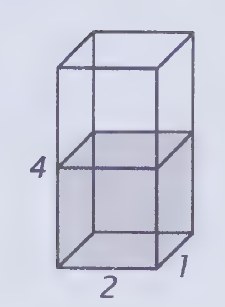
Diagram from page 269.
4
1 47.
) 2 4
48. 2 feet and 0.5 foot, respectively. (Ix2xd,=4,d,=2; 2x4xd,=4,d,=05)
Wine Barrel.
49. The area of its base.
©50. The area of the horizontal cross section halfway up the barrel.
o51. ru2h. [%(211?2 S %(W)h ]
52. A cylinder.
53. % %, [%(21102 +rdh= %mzh.]
54. A cone. [If R = 0, the wine-barrel figure becomes an “hour glass” of two cones with a common apex, bases of radius 7, and
i 1 1 1 1 altitudes of 2h 2( 3‘rrrz)( 2h) 3m’ so the £ —h.2(= Zh) = —1?h;
two cones are together equal in volume to a single cone with the same base and altitude hl
55, AmRe. [ LonR2 + n092R = Anr3) Bl 3
56. A sphere.
Euler Characteristic.
57. Yes. (The three small triangles and the triangle containing them.)
*58. Four.
®59. Six.
60. Polyhedron F V Tetrahedron 4 4 Cube 6 8 Octahedron 8 6 Dodecahedron 12 20 Icosahedron 20 12
61. Itis 2 for all of them.