Chapter 14 — Teacher’s Guide Answers
Answers and teaching commentary for Chapter 14: Regular Polygons and the Circle, transcribed from the scanned Teacher’s Guide. Diagrams are cropped from the same page scans.
OCR note. The text was recognized automatically and has not been corrected line by line; formulas and symbols may be imperfect. Check the original PDF for exact wording.
Homework: Chapter 14 exercises · Selected answers · Teacher’s answers PDF
Lesson 1
Set I (pages 574-576)
The two lithographs of Max Bill’s Fifteen Variations on a Single Theme (1935-1938) shown in the text are Variations 14 and 8. The first picture in the series, the “Theme,” consists of a continuous black spiral of 22 equal segments which form two sides of an equilateral triangle, three sides of a square, four sides of a regular pentagon, and so on, to seven sides of a reqular octagon. In each of the 15 variations, the artist plays with various geometric possibilities inherent in this figure. Many of Bill’s works were influenced by the figures of plane and solid geometry as well as topology.
In Mathematical Models, by H. Martyn Cundy and A. P. Rollett (Oxford University Press, 1961), the authors say concerning polygonal knots:
“If a strip of paper is knotted once and carefully pressed flat the folds will form a regular pentagon. All polygons with an odd number of sides [starting with the pentagon] may be produced in this way. … The even-sided polygons require two strips of equal width; a reef-knot leads to the hexagon. . ..”” Pictures of the first four polygonal knots can also be found in The Penguin Dictionary of Curious and Interesting Geometry, by David Wells (Penguin Books, 1991).
Geometry in Art.
1. Equilateral triangle, square, regular pentagon, regular hexagon, regular heptagon, regular octagon.
2. Each successive polygon shares a side with the preceding polygon.
3. The radii of the polygons.
4. The circles that can be circumscribed about the polygons.
Geometry in Nature.
5. Yes. If a triangle is equilateral, it is also equiangular.
6. Yes.
7. No. Every triangle is cyclic, but not every triangle is regular.
*8. No.
9. Yes. (If it is equiangular, it is a rectangle; so its opposite angles are supplementary.)
*10. Yes. (All regular polygons are cyclic.)
11. No. Example figure:
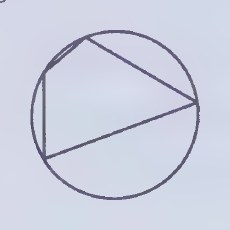
Diagram from page 222.
Cell Pattern.
12. Regular hexagons.
*13. 60°. (fl.) 6
¢14. Equilateral.
15. The sides are equal to the radius.
16. Example figure:
17. The perimeter of the hexagon is three times the diameter of the circle.
Regular Dodecagon.
*18. Three squares.
19. Four equilateral triangles.
#20. They are factors of it.
¢21. Equilateral triangles and regular pentagons.
22. Squares and regular octagons.
23. No regular polygons. Polygonal Knot.
24. Aregular heptagon.
25. No.
26. Yes.
27. Regular polygons having an even number of sides.
28. Regular polygons having at least six sides.
Set II (pages 576-578)
The approximate construction of the regular pentagon explored in exercises 29 through 32 is discussed in detail by J. L. Heilbron on pages 226 and 227 of Geometry Civilized (Clarendon Press, 1998). For a pentagon to be reqular, each of its angles must have a measure of 108°. Unfortunately, in this particular construction, ZA = ZB ~ 108.37°, £C = ZE =~ 107.04°,and £D = 109.17°. The method, popular with medieval masons, was also included by Renaissance artist Albrecht Durer in his book titled Course in the Art of Measurement with Compasses and Rulers (1525).
Hidden in the figure for exercises 51 through 61 is the golden ratio. The appearance of the 36°-72°-72° isosceles triangles in the figure is the reason. Bisecting ZABF produces a triangle similar to AABF. From this, it can be shown that the ratio of a leg of AABF to its base is the golden ratio. It follows immediately from the figure that the diagonals of a reqular pentagon cut each other in this same ratio.
Mason’s Pentagon. 2,
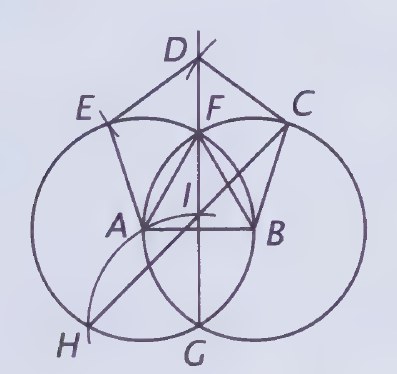
Diagram from page 223.
30. Yes. All five sides have been constructed equal to AB, the radius of the circles.
#31. Ifitisn’t regular, it must not be equiangular.
32. Yes. AABF is regular because it is equilateral and therefore equiangular.
Folding an Octagon.
33. Isosceles right triangles.
34. SAS.
35. Corresponding sides of congruent triangles are equal.
36. Isosceles (and obtuse).
37. ASA. (All of their acute angles equal 22.5°.)
38. They are equal.
*39. 22.5°. (LAEIl = —;—45” = 225P)
40. 135°. [ZEIH = 180° - 2(22.5°) = 135°.]
*41. 135° [ZIE] = 90° + 2(22.5°) = 135°]
42. They are equal.
43. They prove that it is regular. Hexagonal Fastener.
44. Radii.
45. Apothems.
46. PA =PB (all radii of a circle are equal) and ZAPC = £/BPD (vertical angles are equal); so AAPC = ABPD by HA.
#47. 30°-60° right triangles.
025 in 2 PC = 0125v3 in ~0.2165 in.
48. AC= =0.125in and
49. AB =2PA =0.50in and CD = 2PC = 0253 in ~0.433in.
50. CD, because the wrench is used to grip the sides of the head, not its corners.
Inscribed Pentagon.
Bil, A
€ D
52, They are equal because the sides of the pentagon are chords of the circle, and equal arcs in a circle have equal chords.
53. 72°. (@-.) 5 il = 1
*54. 72°. [ZABD = -mAD = 5(2:72°) =72°] 55, 72°. [ZAFB = %(m/fif +mCD) =
%(nn +72%) = 72°]
56. 36°. (£LBAC = %mfié= %72° =36°)
57. 36°.
58. Five.
59. They are all isosceles.
60. AEDF is a rhombus: AF = AB and FD = CD; so all four sides of AEDF are equal to the sides of the regular pentagon. Because AEDF is a rhombus, it follows that it is also a parallelogram.
61. AEDB and AEDC are isosceles trapezoids.
Set II (page 578)
A chapter of Robert Dixon’s book titled Mathographics (Dover, 1987) deals with “Euclidean approximations” to some of the impossible constructions. As Dixon explains concerning the regular heptagon: “To divide a circle into exactly seven equal parts would require us to be able to
360° S construct the angle of T = 51.428571°, which
we cannot do.” He then presents and analyzes three comparatively simple constructions that are amazingly close approximations of the regular heptagon based on constructing angles of approximately 51.317813°, 51.340192°, and 51.470701°.
A Close Construction.
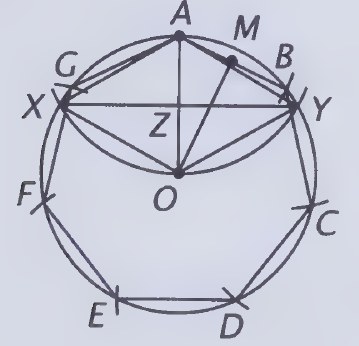
Diagram from page 224.
2. Equilateral.
3. AOis the perpendicular bisector of XY (because A and O are equidistant from X and Y.)
4. A 30°-60° right triangle.
1 1 5, = 3” (0Z= EOY’)
6. ZY = %71/5. (ZY = B0Z)
7. AB= %h/g . (AB = ZY by construction.)
8. AM = %n/i (AM = %AB.)
- 9. 25.658906.. °. (sin LAOM = M
-
AO B _h
= 73 =0.433012702.. .)
r
10. 51.317812…°. (£LAOB =2/A0M.)
11. 359.22468. . .°.
12. That ABCDEFG is not regular. If ABCDEFG were regular, 7ZAOB would equal 360°.
Lesson 2
Set I (pages 581-582)
The figure showing the design of Palma Nuova suggests that the city was surrounded by nine bastions (the spade-shaped regions) for its defense, as well as possibly by a moat.
Students taking chemistry may wonder how each hydrogen atom in the hydrogen fluoride rings can have two bonds. In his book titled The Architecture of Molecules (W. H. Freeman and Company, 1964), Linus Pauling explains: “Many properties of substances can be easily explained by the assumption that the hydrogen atom, which is normally univalent, can sometimes assume ligancy two, and form a bridge between two atoms. This bridge is called the hydrogen bond. … Hydrogen fluoride gas has been found to contain not only molecules HF, but also polymers, especially (H F);and (HF), . … Each hydrogen atom is strongly bonded to one fluorine atom (bond length 1.00 A) and less strongly to another (bond length 1.50 A).” “*A” is the symbol for Angstrom, a unit of length equal to 108 cm (o m).
The Susan B. Anthony dollar coin never became popular, owing in part to the fact that it Wwas too easily confused with a quarter in both look and feel.
Perimeter Equations.
1. The radius.
2. The number of sides. 3l Gy
*4. 3.0902. (10sin 18°.)
5. 3.1411. (100 sin 1.8°.)
6. 3.1416. (1,000 sin 0.18°.)
7. 3.1416. (10,000 sin 0.018°.)
8. Itincreases.
9. It becomes more and more circular. Angles and Radii.
¢10. Radii.
11. AABP = ACBP by SSS.
12. £1 = £2 because corresponding parts congruent triangles are equal.
13. No.
*14. PB bisects ZABC. Italian City.
15. Nine.
*16. 9sin 20°.
*17. 3.078.
18. 6,772 ft. [2(3.078)(1,100).] Hydrogen Fluoride.
19. A regular pentagon and a regular hex:
20. They seem to be equal.
©21. The radius of the hexagon appears to | longer.
3-180° ) =
022, 108°. (
4-180°
23. 120°. ( ,or 2:60°.)
24. 12.5 angstroms. (5 x 2.5.)
25. 15 angstroms. (6 x 2.5.)
©26. 5sin 36° = 2.94.
27. 6sin 30° = 3.
#28. Approximately 2.13 angstroms. [12.5=2(2.94)r, r=2.13.]
29. 2.5 angstroms. [15=2(3)r,r=2.5.] Dollar Coin.
30. 75 mm. [c=2nr =2mn(12) = 24n=75.]
o31. 74 mm. [p=2(11 sin%)12=74.] 74 mm (11 7))
32. 7 c(==7.
Set II (pages 583-584)
Most people who use them probably have no idea that the name “cell phone” refers to the cells into which the areas in which they are used are divided or that the cells have the same shape that bees use in building honeycombs: the regular hexagon. Although regular pentagons cannot be used
5 of to fill a plane as hexagons can be, the figure for exercises 41 through 48 shows that 10 of them can fit perfectly around a reqular decagon. In his book titled Geometry in Architecture (Wiley, 1984), William Blackwell observes that this is a nice arrangement for surrounding a large 10-sided pavilion with 10 smaller galleries.
Exercises 49 through 58 lead to Proposition
10 of Book XlII of the Elements: “If an equilateral pentagon is inscribed in a circle, the side of the pentagon is equal in square to that of the hexagon and that of the decagon inscribed in the same circle.” A good discussion of how this proposition is proved is included by Benno Artmann in Euclid—The Creation of Mathematics (Springer, 1999). Artmann remarks concerning this theorem:
RS0 “In other words, the side of the pentagon is the hypotenuse of a right triangle that has the sides of the hexagon and of the decagon as its legs—
be a really unexpected and beautiful insight!” After explaining that Euclid may have discovered this remarkable theorem in his investigation of the icosahedron, Artmann also observes: “It is common in mathematics that certain parts of complicated proofs become of independent interest, and afterwards one wonders how anybody could have thought of them.”
Phone Cells.
33. p=2Nr=2(6sin 30°)r = 2(3)r = 6r.
34.
35. Equilateral triangles. The sides of each cell are equal to its radius; so the perimeter of each cell is 67.
36. Equilateral.
®37. r1/§ . [ris the hypotenuse of each 30°-60° right triangle included by AABC; so the
length of the shorter leg is % and the length of the longer leg is —;-/5 . AB=2(7\3)= 3]
38. 3r43.
*39. p=2Nr=2(3sin 60°)r = 5.19r.
40. Yes. 373 ~5.19%r.
Ten Pentagons. 10
o4l — =2
5
o (ox= 130 .36 (£X= -2 = 36°)
. 1360° 13, 18°. (£XVZ= 22 =18°)
*44. By the Law of Sines.
o45. R i s?n 36 3 ] r sin 18° sin ZX sin £XYZ
=
(Because
R r !
R _ singX _ sin36° )
T sinZXYZ sin18°
46. X and Y are equidistant from V and Z. (Two points each equidistant from the endpoints of a line segment determine the perpendicular bisector of the line segment.)
47. The tangent of an acute angle of a right triangle is the ratio of the length of the opposite leg to the length of the adjacent
leg. 048, E = (TS =2.2. (Because tan ZX = L a tan 18° a and tan ZXYZ = %, WZ =atan £X = A tan £XYZ; ” tanZX A ) tan ZXYZ a’
Euclid’s Discovery. eq9, 18° (.20 _1g0) 2 10
50. 300, (L.30%° _300) 276
o 1360° .
51. 36”, (55~ =36”) 52, AX=3.0901699 .. .. (sin 18° = —‘;-‘05;
so AX =10sin 18°.)
53. BY =5. (sin 30° = %; so BY = 10sin 30°.)
54. CZ=5.8778525…. (sin36°= %; so CZ =10 sin 36°.)
55. a2 =(2 AX)2=38.19660. . ..
56. b%>=(2BY)?=100.
57. ¢2=(2CZ)2=138.19660. . ..
58. Euclid discovered that a2 + b2 = c2. If a regular decagon, hexagon, and pentagon are inscribed in circles of a given radius (or the same circle), the sum of the squares of a side of the decagon and a side of the hexagon is equal to the square of a side of the pentagon.
Lesson 3
Set IIl (page 584)
This exercise suggests that the ratio of the length of a diagonal to the length of a side of a regular pentagon is the golden ratio. We are more
- accustomed to seeing this ratio in its algebraic
1+ form, —2—5, than in its trigonometric form, 2 sin 54°. Golden-Heather.
1. ZAOB= 3—65£L =72°s0 ZAOX = 36°. 0
sin ZAOX = %,‘ 50 sin 36° = A—X
AB =2AX =2 sin 36°.
2. LCOE =2/A0B = 144°; so £LCOY = 72°. sin ZCOY = g; so sin 72° = 9— OoC 1 CE =2CY =2sin 72°.
3, 28In72° 6180339, .. and g o 2 sin 36°
2sin 54° =1.6180339 . . ..
4. The golden ratio.
Set I (pages 587-588)
. . 180 180 The expression M = nsin McosT has n
meaning only when nis an integer larger than 2, because n represents the number of sides of a polygon. Although a calculator readily finds sines and cosines for any angle, our right triangle definitions are valid only for acute angles. Nevertheless, with the use of a calculator when n =1 or 2 and there is no proper polygon, M turns out to equal o, suggesting that no area is enclosed.
Exercises 20 through 28 provide another preview of the fact that our work with regular polygons will be useful in measuring the circle.
Area Equations.
1. The radius.
2. The number of sides.
3. 0. (1sin 180° cos 180°.)
4. 0. (2 sin 90° cos 90°.)
5. 1.30. (3 sin 60° cos 60°.)
6. 3.14. (1805sin 1° cos 1°)) 703! Inscribed Polygon.
8. The area of the circle.
9. The perimeter of the nonagon.
10. The length of a side of the nonagon.
11. The circumference of the circle. The Area of a Square.
12. A line segment that connects the center of the square to a vertex, or the distance from its center to one of its vertices.
13. s2
©14. 442 [s = 2a; 50 52 = (2a)? = 4a2.]
15. Anisosceles right triangle.
*16. r= 2.
17. r2=24%
018. 272. (tABCD = 442 and 2 = 24% so oABCD = 2r2)
19. (4 sin 45° cos 45°)r2 = 2r2. Close But Not Quite.
20. Its circumference.
21. 628 units. [c=2m(100) = 628.] 22, 628 units. [p=2(60 sin 3°)100 = 628.]
23. The circle.
24. 3.14. [m.]
25. 3.14.
26. The circle.
27. 31,416 square units. (2 =m1002 = 31,416.)
28. 31,359 square units. [A = 60(sin 3° cos 3°)1002 = 31,359.]
Set II (pages 588-590)
Jézsef Kirschak, the man associated with the geometric proof that the area of a regular dodecagon having radius ris 3r?, was a professor of mathematics at the Polytechnic University in Budapest for many years. He is also remembered as the author of the Hungarian Problem Books | and 1, still available in the New Mathematics Library of the Mathematical Association of America.
Honeycomb Geometry.
29. Equilateral.
30. An apothem.
#31. 30°-60° right triangles.
r
®32. E
r
33. 51/5_ B
034,
4
3B, LA
858
R
r2) =
36. (6 sin 30° cos 30°)r2. r PB_ o 1
[0ABCDEF = 60tAAOB = 6( —
37. InABOP, sin ZBOP= — = < = —, OB r 2
38. In ABOP, cos zBop= Q0 _ 2%° _ A3 oB- 2
39. (6 sin 30° cos 30°)2 = (6( )(‘/_))z = 3‘2/§r2.
40. Yes. It agrees with the answer to exercise 35. Kiirschik Triangles.
41. AFHI and ABHI. Because they are equilateral and share a side, they are congruent by SSS. (Or, because they share a side and have 60° angles, they are congruent by ASA or SAS.)
*42. They are isosceles.
43, That they are 15°. ( 900;600
J
44. That they are 150°. [180° - 2(15°).]
45. ZAHI = ZHIC = 150°. [2(60°) + 2(15°).]
46. 1. (DH=DI=AB=BC=CD=DA=r.)
e47. AH =HI=IC = (2 sin 15°)r = 0.518r. [AH, HI, and IC are sides of a regular dodecagon with radius 7. Its perimeter is 2(12 sin 15°)r; so the length of each side is (2 sin 15°)r.]
48. DE =DF = DG = (2 sin 15°)r = 0.518r. (The yellow triangles are isosceles.) 049, irz. (BAHIC contains one-fourth of the examples of each type of triangle that make up the square.)
32 -1
50. 37262~ %)
il irz (0ADAH = —:l):aDAHIC.)
Rats!
52. (Student answer.) (The square has the larger radius.)
53. (Student answer.) (The square has the larger perimeter.)
®54. 7.1 cm. [100 = 4(sin 45° cos 45°)r2, 100 = 2r2, #2=50,7= 50 =~7.1]
55. 6.5 cm. [100 = 5(sin 36° cos 36°)r2, 100 =2.3872, 12 = 42.0, 7 = 6.5.]
56. 40 cm. (Because s2 =100, s =10, and p=45=40)
*57. 38 cm. [p = 2(5 sin 36°)(6.5) = 38.]
58. (Student answer.) (Both the radius and the perimeter of the pentagon are smaller than those of the square.)
Hebrew Exercise.
59. The problem is to prove that the area of a regular octagon having a radius of R is
22 R2.
60. A =(8sin22.5° cos 22.5°)R2 ~ 2.828R2, and 22 R2 = 2.828R2.
Lesson 4
61.
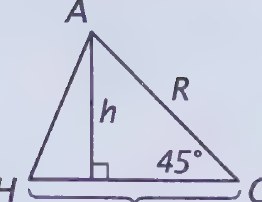
Diagram from page 229.
H‘—fi_lo
R 2R
InAAOH, h= — = —2-;so
oAAOH = LHO h= 1r(Y2Ry_ V240 2 2 2 4
The area of the octagon is
8aAAOH = 8(%1{2) = 2\2R2.
Set II (page 590)
More on the work of Marjorie Rice, including several beautiful Escher-like tessellations reproduced in full color, can be found in the chapter titled “In Praise of Amateurs” by Doris Schattschneider in The Mathematical Gardner, edited by David A. Klarner (Prindle, Weber & Schmidt, 1981) and on the Website members.aol.com/tessellations. The central tessellation with its sixfold rotation symmetry that is the subject of the exercises was discoverec by Michael Hirschhorn, a teacher in New South Wales.
Congruent Pentagons.
1. They are equilateral. (The colors along the sides of the pentagons can be used to establish this.)
2. The boundary of the figure is a regular 18-gon because it is both equilateral and equiangular. (From the measures of the angles of the pentagonal pieces, we can determine that each of the angles of the 18-gon has a measure of 160°.)
3. Approximately 2.88 units. Because the perimeter of the 18-gon is 18 and
p=2Nr=2nsin 180r, 18 = 2(18 sin 10°)r. n
1 or 2 sin 10° ) =———— =288
4. Approximately 25.53 square units. [A = (18 sin 10° cos 10°)(2.88)2 = 25.53.]
5. Approximately 1.42 square units.
(fl 1.42)
Set I (pages 593-595)
Hats are the only instance of a clothing size in which circumference is measured to determine diameter. A tape measure is wrapped around the widest part of the head (about an inch above the eyebrows) to get the circumference of the inner band of the appropriate hat. Dividing this number by m gives the hat size. This method works quite well because the circle is a reasonable approximation of the cross section of a person’s head.
The time that it takes the moon to travel once around Earth, about 27.3 days, is called the “sidereal” month. The word “sidereal” means “determined by the stars,” and that is how the period of revolution was found. A “lunar” or “synodic” month is the time between two successive new moons, about 29.5 days, and a “solar” month is one-twelfth of a solar year (about 30.4 days).
In The Innovators (Wiley, 1996), David Billington wrote: “It has been argued that the steamboat was the first great American contribution to modern technology.” Billington, a professor of civil engineering at Princeton, includes a wealth of information on Robert Fulton’’s calculations, including his patent formulas and the mathematics of his drag, power, and paddlewheel calculations.
The Babylonian-tablet exercises provide another example of Pythagorean triples appearing many centuries before Pythagoras was born.
(If i is taken as 3.14, the convenient relation of the sides of the triangle, surely intended by the problem’s creator, is lost.) It seems strange, however, that the writer of a problem of this level would think that Tt was equal to 3.
Francois Viéte has been called the greatest French mathematician of the sixteenth century. In A History of it (Golem Press, 1971), Petr Beckmann reports that Viéte was the first to discover a way to represent Tt as an expression of an infinite sequence of mathernatical operations:
R
Unfortunately, the expression is too cumbersome and time consuming to be of practical use in calculating m, and so Viéte was also one of the last mathematicians to resort to using polygons to do so. The number of sides used, 393,216, results from 16 successive doublings of Archimedes’ original hexagon.
Circumference.
1. Because d = 2r and ¢ = 2nr =n(2r), ¢ = md by substitution.
*2. m.
3. 2m. Hat Sizes.
4. % =3.143 and % = 3.138. (Both ratios
are approximatel); the value of m.)
5. The circumference of the hat.
6. The diameter of the hat. The Moon’s Orbit.
7. Approximately 1,500,780 mi. [c = 2m(238,857) =~ 1,500,783.]
8. Approximately 656 hours. ( 1,500,783
2,287 )
9. Approximately 27.3 days. (%Sf =27.3.)
Semicircles.
*10. ma.
11. mb.
12. m(a +b).
13. Because m(a + b) = ma + nb, the length of semicircle C is equal to the sum of the lengths of semicircles A and B.
14. No. Steamboat Geometry.
15. 42,240 ft/hour. (8 x 5,280.)
42,240
®16. 704 ft/ minute. ( 60
)
17. 14m ft.
704 ft /minute 14m ft / revolution 16 revolutions/minute.)
18. 16. (
Babylonian Problem. 19.
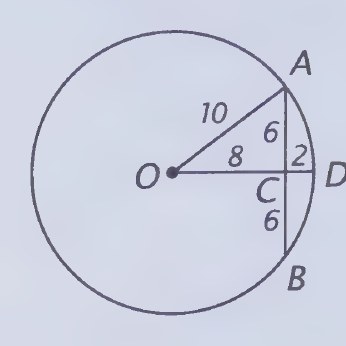
Diagram from page 230.
©20. 10 units. [c =2mnr, 60=2(3)r, r=10.] e21. 8 units. (OC=0D—-CD=10-2=8)
22. 6 units. (AC = ¥102-8% = /36 =6.)
23. With the assumption that =3, the sides of AOAC form a Pythagorean triple: 6-8-10. (Or, the sides of AOAC are all integers.)
*24. AC= %AB. If a line through the center of
a circle is perpendicular to a chord, it also bisects the chord.
25. 12 units.
Viéte’s Calculation.
026. 3.1415927.
180 ( 6 sin 393,216 3.1415927.) N =393,216 sin ———— = 3. 5
27. No. The value must be less than n because the perimeter of a regular polygon is always less than the circumference of a circle having the same radius.
Perimeters and Diameters.
*28. 242, (p=4sand d= sv2;so P_4s _ 4 _op)
d s\2 2
©29. 2.83.
30. 3. (p:6sandd=25;so£=§=3_) d 2s
31.
32. 3.14.
33. Close to 3.14 (or close to, but less than, m.)
34. p=2Nrandd=Zr;so£=&=N ds W7
N=100 sin% ~3.1410759,
Set II (pages 595-597)
Owing to Earth’s rotation, the speed at which someone living on the equator is traveling, 1,040 miles per hour, is much faster than the official world land-speed record! Our speed due to Earth’s motion around the sun, 67,000 miles per hour, is more than three times as great as that of the Space Shuttle.
Adam Kochansky published his construction as “An Approximate Geometrical Construction for Pi,” and so he knew that it was not exact. The exercises exploit the calculator in finding the various distances. It isn’t difficult to show (without using a calculator) that the exact length of BE is
40_—:‘/; . In Geometry Civilized (Clarendon
Press, 1998), J. L. Heilbron, noting that Kochansky liked to calculate, quotes him as saying: “The periphery thus found differs from the closest approximation to the true Archimedean value
[of pi] by less than the ratio of one to ten times the current year 168s. . . .” Doing the calculation,
M + U e 3.14159268 …, 3 16,850
gives the value of 1, 3.14159265 . . . correctly to seven decimal places.
Going in Circles.
#35. Approximately 24,880 mi. [Student rounding may differ. c = 2n(3,960) ~ 24,881.]
*36. Approximately 1,040 mi.
24,881 ( 2 =1,037.)
©37. 1,040 mi/hour.
38. Approximately 584,000,000 mi. [c = 2m(93,000,000) = 584,336,234.]
39. Approximately 1,600,000 mi. ( 584,336,234 365.25
=1,599,825.)
40. Approximately 67,000 mi. ( 1,599,825
2 = 66,659.)
41. Approximately 67,000 mi/hour.
*42. Approximately 19 mi/second. ( 66,659 3,600
~185)
Two Squares.
43. HL. AABO and ADCO are right triangles with AB = DC because ABCD is a square; OB = OC because all radii of a circle are equal.
4. oD= 1y (OD=1aD=ly) 2 27072
45, 2= gxz, [In right ADCO,
e+ (302= 22
046, 2= %yz (Inright AGPH, y2 =12 + 12 =2r%;
1, sori= 2y.)
47. x2= %yz (Because 12 = %xz and 2= %yz, %xz = %yl; sox2= %yz.)
48. The area of ABCD is two-fifths of the area of EFGH.
SAT Problem.
©49. 2a+2b + 2c.
50. 2ma + 2nb + 2me.
51 1 [ 2a+2b+2c 1 ‘o ’m(2a+2b+20) m
i
Videotape.
52 8251t (fi% —825)
¢53. m=3.14in. [c=2n(0.5) =n.]
54. 3m=9.42in. [c=2n(1.5)=3r]
4+ 31
=2m.)
55, 2n=6.281n. ( 5
825-12
56. About 1,576 times. ( =1,576.)
6.28
Kochansky’s Construction. 57.
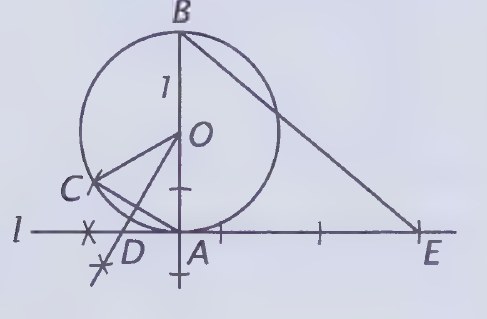
Diagram from page 232.
58. Equilateral.
59. A 30°-60° right triangle.
60. DA =0.5773503.
oa=2_ L _o5773503)
BB
61. AE~2.4226497. (AE = DE - DA = 3 - 05773503 = 2.4226497.)
62. BE ~3.1415333. (BE2= AB? + AE? so
BE = V22 + AE? =3.1415333.)
63. Itis a good approximation of 7, correct to five digits (or four decimal places).
Set 11l (page 597) Tire Change.
The ratio of the circumference of the larger tire to the circumference of the smaller tire is
fifi— =1.14; so, for each revolution of the tires, 28.97
the truck goes 1.14 times as far as before.
70 miles x 1.14 = 79.8 miles. The truck would be going about 80 miles per hour.
ter 14, Lesson s
Lesson 5
Set I (pages 600-602)
The area calculated in exercise 3 for a typical hurricane is more meaningful when compared with the areas of states such as Florida (59,000 mi2) and Louisiana (48,000 mi?), both of which were hit hard by Hurricane Andrew in 1992. Another unit of circular area measure is the “circular mil,” defined as the area of a circle
having a diameter of one “mil” (0.001 in). Circular units of area are obviously of little value in working with anything other than circles. Circular mils are used chiefly in the measurement of wire.
Exercises 13 through 16 provide an example of how a good foundation in geometry is important in calculus. Related rates and maximum/minimum problems are particularly obvious examples in that nearly every problem requires the use of plane or solid geometry.
Exercise 17 is actually the first theorem of Archimedes’ Measurement of a Circle: “The area of a circle is equal to that of a right triangle in which one leg is equal to the radius and the other to the circumference of the circle.”
Although the result of exercises 18 through 21, that in central pivot irrigation the number of subdivisions of a square region makes no difference in the area watered, may seem at first surprising, the reason is obvious when considered from the viewpoint of a dilation. No matter how small or
large the cells might be, the ratio of the areas of 2
nr each circle and its corresponding square, —,
4r* remains constant.
The use of the circle on a square grid to estimate 1t was first investigated by Gauss. According to David Hilbert and Stefan Cohn- Vossen in Geometry and the Imagination (Chelsea, 1952), Gauss “tried to determine the number f(r) of lattice points in the interior and on the boundary of a circle of radius r, where the center of the circle is a lattice point and ris an integer. Gauss found the value of this number empirically for many values of n. … His interest was prompted by the fact that an investigation of this function yields a method for approximating the value of 1t.” The details and an explanation of the procedure can be found on pages 33-35 of Hilbert’s book.
Hurricanes.
*1. 300 mi.
®2. 940 mi. [c=m(300)=942.]
3. 71,000 mi2. [A =n(150)2 = 70,686.]
4. 15mi. (700=mr2 r= 1 700 =15.)
*5. 90 mi. [c=2mn(15)=94.]
Square and Circular Inches.
6. The area of a square with sides of length 1inch.
7. The area of a circle with a diameter of 1 inch.
8. Asquare inch. 2
9. 2. (“1‘-2 —x2)
10. 100 square inches.
()’
11. 22 [ =22] n(y? 2
*12. 100 circular inches.
Ripples.
13. 60 cm.
*14. 3,600 cm2. [A = n(60)2 = 3,600m.]
*15. 60t cm.
16. 3,600m2 cm?. [A = n(60t)? = 3,600m#2.] Equal Areas.
17. 2mr (or, the circumference of the circle). If the areas are equal, mr? = %ABr; so AB =2mr.
Central-Pivot Irrigation.
18. (Student answer.)
#19. 36m square units. [The diameter of each circle is 6; so the radius is 3. The total are: of the four circles is 4(n32) = 36m.]
20. 36msquare units. [The diameter of each circle is 4; so the radius is 2. The total are: of the nine circles is 9(n22) = 36m.]
21. They are equal. Pi Square.
2. yr. (m=s%s0os= ) o23. 2 [A=mr2=n(yn)2=m2]
2 m
24. m. (? =m.)
Circle on a Grid.
©25. 6 units.
26. 3.13888…. %]221 =3.13888….)
®27. 3.1425. ( 1’2527 =3.1425.) 20
28. About 3.1411. (2832606297 =3.14107….)
29. They suggest that the limit is .
P oul (1002 m,
30. About 31,416. (—— =
p = 10,000m = 31,416. The number of points is actually 31,417.)
Set II (pages 602-604)
Exercises 39 through 46 look at an early precursor of integration. Sawaguchi Kazuyuki published his method for finding the area of a circle in 1670,
at about the time that Newton and Leibniz were discovering the rules of the calculus. As Petr Beckmann observes in A History of T (Golem Press, 1971), in theory the method can be used to find 1 to any desired degree of accuracy by choosing a sufficiently large number of strips. Beckmann also points out that, in practice, the series converges very slowly in addition to requiring the inconvenient extraction of square roots.
Area Problems.
©31. 3mx2. [The radius of circle A is 2x; so its area is 1(2x)2 = 4mx2. The radius of circle B is x; so its area is a2, The shaded area is 4x? — mn? = 32|
32. 5mx2. [The radius of the larger circle is 3x; 50 its area is m(3x)? = 9rx2. The radius of the smaller circle is 2x; so its area is (2x)? = 4mx2. The shaded area is 9rx? — 4mx2 = 5mx2.]
¢33. (4-m)x2. [The side of square ABCD is 2x; s0 its area is (2x)? = 4x2. The radius of circle O is x; so its area is x2. The shaded area is 4x2 —mx? = (4 - 2]
\3
34, (m- T)xz. [Because AABC is a 30°-60° right
triangle, AB = 2x and AC = xv/3. Because AB = 2x, OB = x; so the area of the circle is re2. Because the legs of AABC are x and
xw/_ its area is —x(x«/_)- 1/_xz The B R 2 2
shaded area is @2 — —x2 = (m— —)x2.]
©35. (5n—8)x2. [The legs of each small right triangle are 2x and x, and so
OB = 20)% +12 = V522 = x5.
The radius of circle O is xwfg ; so its area is m( x5 )2 = 5mx?. The area of the rectangle is (4x)(2x) = 8x2. The shaded area is
Sroc2 — 822 = (5rt— 8)22.]
*36. (31/5 —m)x2 [The small triangle is a 30°-60° right triangle with shorter leg x, and so its longer leg is 23 and AB =2x+/3. The area of equilateral AABC is
R
5 AB2 = —1{1—5(21/5 2= 33 2. The radius
of the circle is x and so its area is mx?. The shaded areais 3v3x2 -2 = (33 — m)a2.]
Cable Disaster.
37. Scale drawing:
(oo
38. The strength of the cable depends, not on its diameter, but on the area of its cross section. The area of a cross section of a 1-inch cable
. 1 .
is mi( 5)2 = %RZ in2. The total area of the . 1.
cross sections of two E—mch cables is
2m(— )2 = —1’(2 in2. The 1-inch cable should
have been replaced by four %~inch cables.
Slicing a Circle. 39.
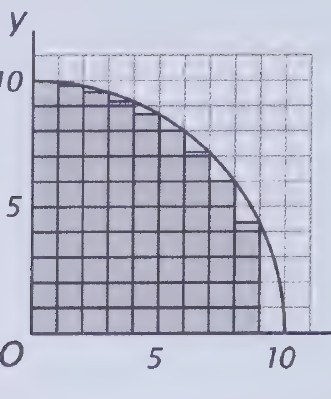
Diagram from page 234.
(0] 5 10
40. The height of the fifth strip is a leg of a right triangle with hypotenuse 10 and base 5. h2 + 52 =10% so h=102-5 = 10025 = 75. The width of the strip is 1; so its area is
1-475 = +75.
41. 99, /96, V91, /84, /64 =8, /51, V36 =6, and V19. (V10212 = +99, V102-22 = 496, 410232 = 91, etc))
2. 726. 43, 290. [4(72.6) = 290.]
44. It would be less than the actual area of the circle because the rectangular strips do not fill the quarter circle.
45. Narrower strips should fill more of the circle.
46. Keep dividing the circle into narrower and narrower strips.
Tangent Circles.
®47. a +b. [Its diameter is 22 + 2b = 2(a + b); so itsradiusisa + b.]
©48. a2 + mab or ma(a + b). [The blue area is half the area of the largest circle plus half the area of the left circle minus half the area of
the right circle. %n(a +b)2+ —;—flaz - %nbz = 0 1 1
- +2ab +b%) + —ma? — —mb2 =
5 m(a ) ) ma 2
ma? + mab = ma(a + b).)
Lesson 6
49. mab + mb? or mb(a + b). [The yellow area is found in a similar way.
1 1 1 —m(a+ by + —mh? - —ma® = 2‘r(( 4 2 2
%n(a2+2ab+b2)+ %nbz— %mfl: mab + mb? = mb(a + b).]
a ma@+b) g] b’ “mba+b) b’
50.
51. Yes. If a =b, the two areas should be equal.
We have shown that Lo el E; S0,
yellow area b ifa=b, E=1, _bluearea =1, and so b yellow area
blue area = yellow area.
52. 1. (Each border consists of three semicircles, one from each of the three circles.)
’
Set I1l (page 604)
In The Age of Faith (Simon & Schuster, 1950), Will Durant called Ramon Lull “one of the strangest figures of the many-sided thirteenth century.” Lull wrote 250 books in Catalan, Latin, and Arabic on such subjects as love poetry, theology, warfare, education, philosophy, and science. According to Durant, “Amid all these interests he was fascinated by an idea that has captured brilliant minds in our own time—that all the formulas and processes of logic could be reduced to mathematical or symbolical form.” More on Lull can be found in chapter 3 of Science—Good, Bad, and Bogus, by Martin Gardner (Prometheus Books, 1981).
Lull’s Claim.
1. 2nr =4s.
2. m2=s2
3. Solving the first equation fors, s = % Substituting for s in the second equation,
P nr2=(%r)2,m2= —11{—,4/m’2=n2r2,n=4!
Set I (pages 606-608)
In Animal Navigation (Scientific American Library, 1989), Talbot H. Waterman remarks that dolphins, like bats, “use echolocation to find food, avoid obstacles, and maybe even to navigate over longer distances. Repeated sound bursts . . . emanate from the head in a 20 to 30° beam. These directional high intensity clicks are reflected back by objects not completely absorbing them. Such echoes, which give a detailed sound picture of the environment at ranges exceeding 300 meters, are markedly better than the best underwater visibility.”
Franz Reuleaux was a French engineer and mathematician who wrote an important book in 1876 on mechanisms in machinery. One of Martin Gardner’s “Mathematical Games” columns in Scientific American deals with the subject of curves of constant width, of which, other than the circle, the Reuleaux triangle is the simplest example. This column is included in Gardner’s book titled The Unexpected Hanging and Other Mathematical Diversions (Simon & Schuster, 1969). The curve was known to earlier mathematicians, but Reuleaux was the first to demonstrate its constant-width properties, including the fact that it can be rotated inside a square without any space to spare. Exercises 18 through 22 prove that the perimeter of the Reuleaux triangle is the same as the circumference of a circle having the same width. It is also true that, of all curves of constant width having a given width, the Reuleaux triangle is the curve with the smallest area.
In Human Information Processing—An Introduction to Psychology (Harcourt Brace Jovanovich, 1977), Peter H. Lindsay and Donald A. Norman write concerning auditory space perception: “The cues used to localize a sound source are the exact time and intensity at which the tones arrive at the two ears. Sounds arrive first at the ear closer to the source and with greater intensity. The head tends to cast an acoustic shadow between the source and the ear on the far side. With some simple calculations, it is possible to determine the approximate maximum possible time delay between signals arriving at the two ears.” These calculations are done in exercises 23 through 25. Lindsay and Norman observe that the human nervous system is able to distinguish the time at which a sound reaches the ear within an accuracy of 0.00003
second! They also explain that sound localization varies with frequency: low frequency sounds bend easily around a person’s head, whereas high frequency sounds, whose wavelength is short compared with the size of the head, do not. Although the degree seems to have been used to measure angles since angles were first measured, the radian was invented in 1871 by James Thomson, the brother of the physicist Lord Kelvin (William Thomson). Unlike the degree, based on the arbitrary division of a circle into 360 parts, the radian is a natural unit of angle measure. In Trigonometric Delights (Princeton University Press, 1998), Eli Maor remarks that the “reason for using radians is that it simplifies many formulas. For example, a circular arc of angular width 6 (where 6is in radians) subtends an arc length given by s = r@; but if 8is in degrees, the
corresponding formula is s = 36—Omr. Similarly, the area of a circular sector of angular width is A= ~0r>for 9in radians and A = irtr2 for @in 2 360 degrees. The use of radians rids these formulas of n the ‘unwanted’ factor T.” Maor adds: “Even 180
more important, the fact that a small angle and its sine are nearly equal numerically—the smaller the angle, the better the approximation—holds
true only if the angle is measured in radians. . . .
lim Sin 8 e-0 g
It is this fact, expressed as =1, that
makes the radian measure so important in calculus.”
Orange Slices.
*]. Asector. 360° ( 3 ) 02, 45° (—.
1 2nr e ( 3 )
3. —mr. (—.
o4, —1-1‘[7‘2. 8
Sonar Beams.
*5. The length of AB in meters.
6. The area of sector DAB in square meters.
7. 105 m. (From exercise 5.)
8. 15,700 m2. (From exercise 6.)
Latitude.
¢9. About 6,220 mi. [i2‘rr(3,960) = 6,220.] 6,220
10. About 69 mi. ( ~69.)
20
11. About 1,380 mi. (20 - 69 = 1,380.)
Driveway Design.
*12. 2,009 ft2. (41 -49 =2,009.)
*13. 887 ft2. [2( %n(lS)z) +8-18+13-18~887.]
14. 1,122 ft2. (2,009 - 887 =1,122.)
Two Sectors.
15. L. 2
“16. 2. [Gr2f=m]
17. The yellow and blue areas are equal.
Reuleaux Triangle.
*18. 60°. (mAB = £C =60°.)
1 60 1 . 3nx (360 e 3nx)
19. —mx. (—2mx = —mx.
20. 3x.
21. mx. (3- %nx=fix.) 022, x. (c=md=mnx;s0d=x.) Sound Delay.
®23. About9in. [About %(7) + %(711) =9]
24. 13,200 in. (1,100 - 12 =13,200.)
*25. About 0.0007 second. 9in (m = 0.0007 second.)
The Radian.
26. 2mr.
*27. 360°.
o8 L (.1, 2 2mr 2n
29, 57.3°. (L . 360° = 57.3°) 21
30. 57.3°. (Z/AOB =mAB.)
Set II (pages 608-611)
In a section titled “Lunatics” in Geometry Civilized— History, Culture, and Technique (Clarendon Press, 1998), J. L. Heilbron wrote: “Despite repeated failures, adventuresome geometers over the ages have tried their hands at squaring the circle. One of the earliest and most promising attempts was the work of Hippocrates of Chios, not the great physician but a man distinguished enough in his own line to be named in the old texts as the first to compile an Elements of Geometry. Hippocrates’ attempt at circle-squaring involved ‘lunes,” moon-shaped areas bounded by arcs of circles.” Exercises 47 through 56 consider one version of Hippocrates’ lunes: four of them are equal in area to the very square on which they are constructed.
Archimedes’ “salt cellar” problem is theorem 14 from his Liber Assumptorum, or Book of Lemmas, a collection of theorems that has survived only in an Arabic translation.
Windshield Wipers.
120 *31 in. [360 m(22) | . 46in. [—2n(22) = 46.
©32. 469in?.
120 120 (222 - ——m(6) ~ 469. I= e ) ]
33. No, because the areas wiped usually
overlap. Land Area.
®34. ZAOC =53°. (sin ZAOC = l%’
ZAOC ~53.13°.)
35. ZAOB =~ 106°. (2-53° = 106°.)
36. mAB = 106°.
©37. About 93 square units. [ %HOO)Z =93]
38. 48 square units. (Because OD =10-4=6, aAABO = %AB’ oD = %16 -6=48)
*39. About 45 square units. (93 - 48 =45.)
40. Yes.
Running Track.
*41. 63.66m. (100 = -;’Tl’d, d= %0- =63.66.)
42. 66.06 m. [63.66 + 2(1.2) = 66.06.]
*43. 10377 m. [%—1’((66.06) =103.77]
a4. 25, (1000 _ o5 400
*45. About 188 m. (103.77 - 100 = 3.77; 25 laps is 50 semicircles; 50 - 3.77 = 188.)
46. About 24 m! [%ZTK(R +0.15) - %Z‘RR =0.15n=0.47; 50-0.47 = 24.] Four Crescents.
¢47. 2+/2. (AAOB is an isosceles right triangle with legs equal to 2.)
48. 2.
049, 4m. [n(2)? = 4n]
*50. 8. [(242)2=8] 51, 4n-8.
4n-8 4
52. m—2. ( =mn-2)
.53, T [%n(fi)z =]
54. 2. [m-(m-2)=2] Gl &
56. They prove that the four yellow crescents are together equal in area to the green square.
Drop-Leaf Table.
57. 20in.
©58. 1,256.64 in?. [m(20)* = 400m =~ 1,256.64.]
59. 60°. (Because CO =20H, ACOH is a 30°-60° right triangle; so ZCOH = 60°.)
60. 120°. 120
in2 [==—
61. 418.88in?. [360
m(20)2 = 418.88.]
°62. 3464in. [CD = 2CH = 2(10v/3 ) = 204/3 ~34.64.]
63. 173.21in2. [@ACOD ~ %(34.64)(10) —1732]
*64. 246 in% (418.88 -173.2 = 245.68.)
65. 765in2 [1,256.64 —2(245.68) = 765.28.]
Salt Celiar.
°66. 2a+b.
67. 22+ 2b. [CD=(2a+b)+b=2a+2b]
68. a+b.
69. m(a + b)2.
70. The area of the “salt cellar” is equal to 1 1 1 Zm(2a + b2 -2 ~mad) + —mh? = 21’(( +b) (Zm )+ 5
%n(4a2 +4ab+b?) —ma? + %nbz =
2ma? + 2mab + %flbz—mt2 + %rdfl:
a2 + 2mab + b2 = (a2 + 2ab + b2) = m(a + b)2.
Set II (page 611)
This exercise is based on the “pizza problem” discussed in detail by Joseph D. E. Konhauser, Dan Yelleman, and Stan Wagon in Which Way Did the Bicycle Go? (Mathematical Association of America, 1996): “Suppose four cuts are made through a point P in a disk so that the eight angles at P are all equal to 45°. If the resulting eight pizza slices are colored alternately black and white, must the white area equal the black area?” That the answer is “yes” was first discovered and proved by L. J. Upton in 1968. As Konhauser, Yelleman, and Wagon explain: “It turns out that the equal-area property holds if and only if the number of chords is even and greater than or equal to 4 (equivalently, the number of pizza slices is 8,12, 16, .. .). They include a proof by
dissection for the 4-chords case and a proof using calculus and polar coordinates of the general case. There is a nice photograph of Stan Wagon on the last page of the book with a granite sculpture illustrating the dissection solution to the problem.
To prove, then, that Acute Alice’s division of the pizza is a fair one is clearly not something of which a beginning geometry student is capable. To find a fairly obvious counterexample to Obtuse Ollie’s claim, however, is fairly easy to do, as the figure below illustrates.
Pizza Puzzle.
Example figure for two cuts:
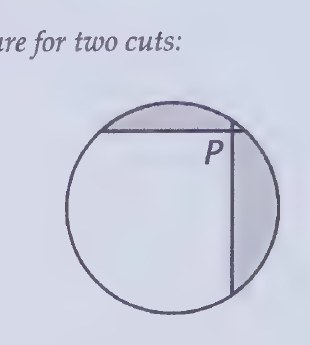
Diagram from page 238.
This figure shows that Ollie’s method may easily result in one pair of opposite pieces having a greater area than the other pair. Strange as it may seem, regardless of where point P is chosen, Alice’s method results in two sets of alternating pieces that are equal in area!
Review
Set I (pages 612-614)
Of cholesterol, P. W. Atkins wrote in Molecules (Scientific American Library, 1987): “Although this molecule has an elaborate, rigid, hydrocarbon framework, its business end (more formally, its functional group) is primarily the -OH group. In other words, cholesterol is chemically an elaborate alcohol (hence the —ol in its name.)” In a line formula for an organic molecule, the line segments represent the bonds between the carbon atoms, which are understood to be located at their endpoints unless otherwise marked. The hydrogen atoms are usually ignored. The cholesterol molecule contains 27 carbon atoms, 1 oxygen atom, and 46 hydrogen atoms. In Book IV of the Elements, Euclid discusses inscribed and circumscribed polygons—the triangle (Propositions 4 and s), the square (Propositions 6 through ¢), the regular pentagon
(Propositions 11 through 14), the regular hexagon (Proposition 15)—concluding with the regular 15-gon (Proposition 16). In his commentary on the Elements (Cambridge University Press, 1926), Sir Thomas Heath wrote: “Proclus refers to this
” proposition in illustration of his statement that Euclid gave proofs of a number of propositions with an eye to their use in astronomy. ‘With regard to the last proposition in the fourth Book in which he inscribes the side of the fifteen-angled figure in a circle, for what object does anyone assert that he propounds it except for the reference of this problem to astronomy? For, when we have inscribed the fifteen-angled figure in the circle through the poles, we have the distance from the poles both of the equator and the zodiac, since they are distant from one another by the side of the fifteen-angled figure.’ This agrees with what we know from other sources, namely that up to the time of Eratosthenes (c.284-204 8.c.) 24° was generally accepted as the correct measurement of the obliquity of the ecliptic.”
Although the penny farthing bicycle reached its peak of popularity in about 188s, it is still popular in some parts of Europe. At the time of this writing, Hammacher Schlemmer was offering a version of the bicycle handmade in the Czech Republic for $4,999.95!
Concerning the Gothic arch, J. L. Heilbron wrote in Geometry Civilized— History, Culture, and Technique (Clarendon Press, 1998): “The construction of the equilateral triangle, which figures so prominently in Euclid’s proofs, leads to a figure of great beauty and importance. . .. The curvilinear shape ACB is that of the basic Gothic arch. You can see it everywhere in churches built during the later middle ages. . . . At the threshold of the study of geometry, in connection with the very first proposition of Euclid, you have encountered one of the most important and versatile elements of architecture.”
Molecule.
1. Regular hexagons and a regular pentagon.
2. It must be convex, equilateral, and equiangular.
3. It becomes more circular.
A Regular 15-gon.
4. mAB=120°. (% =120°)
p— 1O
5. mAD =72°, (16’5;)
6. mDB = 48°. (mDB = mAB - mAD = 120° — 72° = 48°.)
7. mBE=24_ (mBE = mDE — mDB = 72° — 48° = 24°.)
8. BandE, Cand F. (mfi: mCF = 24° = %360°. Because
mEF = 72° = 3(24°), BE and CF are sides of the same regular 15-gon.)
*9. 3.12. (N=15 sin}% =15sin12°=3.12.)
¢10. 3.05. (M =15 sin 12° cos 12° = 3.05.)
1. n
*12. 6.24r. [p=2Nr=2(3.12)r =6.24r.]
13. 3.05r2. (A = Mr?=3.05r2)
6.24r 15
14. 0.42r. (s= ~0.42r.)
Penny Farthing Bicycle.
*15. About 420 turns. [§’—2—8—0 ~420.] 2n(2)
16. About 3.77 ft. [c = 2m(0.6) =1.2n=3.77.]
5,280
~1,401.)
SAT Questions.
018. 2m2. [c =2n(m) = 2m2]
ou rns. ( 377
17. About 1,401 turns. (——
19. L g=rga=1)
m n 020, 4m. [4m=2mr,r =2, A=m(2)?=4n]
Semicircles on the Sides. 1
021, %az, %bZ, and %cz [A= En(%)z = —;-taz, etc.]
22. Yes. Because AABC is a right triangle, a2 + b2 = c2. Multiplying each side of this
equation by g gives ga2 + ;bz _ ’g &
Area Comparisons.
23 Lo 2
. l l 2=l 2 24, 2m‘2. [811(2r) 21’rr.]
25. They are equal. Because o + a2 = 02 + 3, al = a3 by subtraction.
26. The yellow and red areas are equal. (This follows from the result of exercise 25 and the symmetry of the figure.)
Gothic Arch. 27.
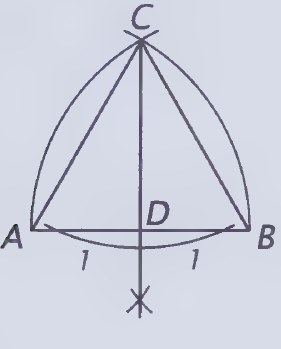
Diagram from page 240.
028. 3 ~1732. [@52= ?(2)2.]
29, §n=2.094. [%fl@y: %n,]
30. %n— V3 = 0.362.
o31. %n— V3 =2457. [\3 +2(§‘r[— \3)=
V3 + %n—2/§ = gn- V3]
Set II (pages 614-616)
The answer to exercise 43, the width of the United States, is, of course, very approximate. The air distance between San Francisco and New York City, both with latitudes close to 40°, is 2,572 miles; the coast of Maine is roughly 400 miles east of New York City.
Exercises 5o through 54 are based on the surprising fact that, given two concentric circles in which a chord of the larger circle is tangent to the smaller circle, the area of the ring between the circles is determined solely by the length of the chord, regardless of the sizes of the circles! Ac
the smaller circle shrinks to a point, the chord becomes the diameter of the larger circle and the expression for the area of the ring, TR —1r?, becomes TtR?, the area of the larger circle.
In exercises 55 through 62, the students discover a surprising property of the heart-shaped curve: any line through point O divides its border into two equal parts. We would expect this result of a line through the center of a figure that has point symmetry, but not of a figure that does not.
Cup Problem.
32. (Student answer.) (From the symmetry of the figure, AG and BH evidently have equal lengths, as do GD and HC. The two lower arcs appear to be longer than the two upper ones.)
33. 45°. (mAG = ZABG = 45°)
. [36027’((1) 0.79.]
34. 0.79. [— =I.
35. 2 —1. (Because ABFE is a square, BE = V2. BG =BA =1;50 EG = BE-BG = ¥2 - 1)
36. 135°. (mGD = ZGED = 45° + 90° = 135°.) 135
«37. 098, [z 2n(+2 ~1)= %«(Ji 1)098]
38. (Student answer.)
Time Zones.
2n(3,960)
*39. About 1,037 mi. [ ~1,037.]
*40. About 3,034 mi. [In AABO, cos 40° (or sin 50°) = AB—; 3,960 50 AB = 3,960 cos 40° = 3,034.]
41. About 19,060 mi. [2m(3,034) = 19,060.] 19 060
*42. About 794 mi. ( =794.)
43. Approximately 3,000 mi. (4-794=3,176.)
From Dodecagon to Square.
44. ltis equilateral. The vertices of the dodecagon divide the circle into 12 equal arcs; so each
arc has a measure of 3{—‘20 = 30°.
Two of the angles of the triangle are inscribed angles of the circle and each intercepts an arc equal to four of these arcs; s0 each of these angles has a measure of
1 5430 —(4-30°) = 60°.
45, 2 (or about 1.414). (A =Mr% so . 180 180 6 =12sin 2 2, 6=12sin 15° cos 15°72, 6 = 3r2, 12 =2,
r=12.)
46. 1/5 (or about 1.732). (A = Mr?; so
6=4 sin%cos %72 = 4 sin 45° cos 45°72,
6=2r2,12=3,r= 1/5,) e47. 878. [p=2Nr=2(12sin 15°)v2 =8.78]
48. 9.80. [p=2Nr =2(4 sin 45°) /3 =9.80.]
49. Itincreases.
Chord and Ring.
50. A
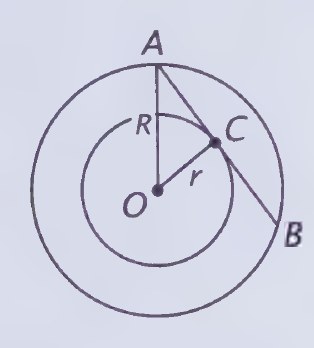
Diagram from page 241.
’i
51. OC L AB and OC bisects AB. (If a line is tangent to a circle, it is perpendicular to the radius drawn to the point of contact and, if a line through the center of a circle is perpendicular to a chord, it also bisects it.)
052, R%—mr2 or m(R? - 12).
53. m. (Because AB=2, AC=1;s072+12=R? and R2-r2=1.)
54. The radii of the two circles are not needed to find the area of the ring. The area depends only on the length of the chord. (In general, if AB = 2x, then AC = x, 2 + x2=R?2,
R? - 12 = x2; s0 the area of the ring is 2.
Half a Heart. e L [2[%21‘(1)1 + %21«2) —om+ 2= 4m)
56. ZAOC = (180 -x)°.
57. ZOCE = (180 - x)°. (In ACEO, EO = EC; so ZOCE = ZAOC.)
©58. ZAEC = (360 — 2x)°. (£LAEC is an exterior angle of ACEO; so ZAEC = ZAOC + £OCE.)
180-x 360-2x 180-x 90
*59. [ 2n(1) =
]
£ 360 180-x x 180 90 ” 9™ 90
%0 ’ 360 K %
60. m [ 2n(2) = 9—’;1’(.]
61. 2m. (
62. Line CD bisects the border of the heart because the length of CAD, 2m, is half the length of the border of the heart, 4m.
Biting Region.
*63. About 83 ft. [%21’[(15 -10) + %27’((15) + —1—21’[(15 -12)= fi1’: =83.3.] 4
64. About 557 ft2. 1 2, 3 2, 1 2 [ 4’rt(15 10)2 + 4n( 5)2 + 411( ) = - —m(1. —m(15-12)?=
] 1