p. 571
Chapter 14: Regular Polygons and the Circle
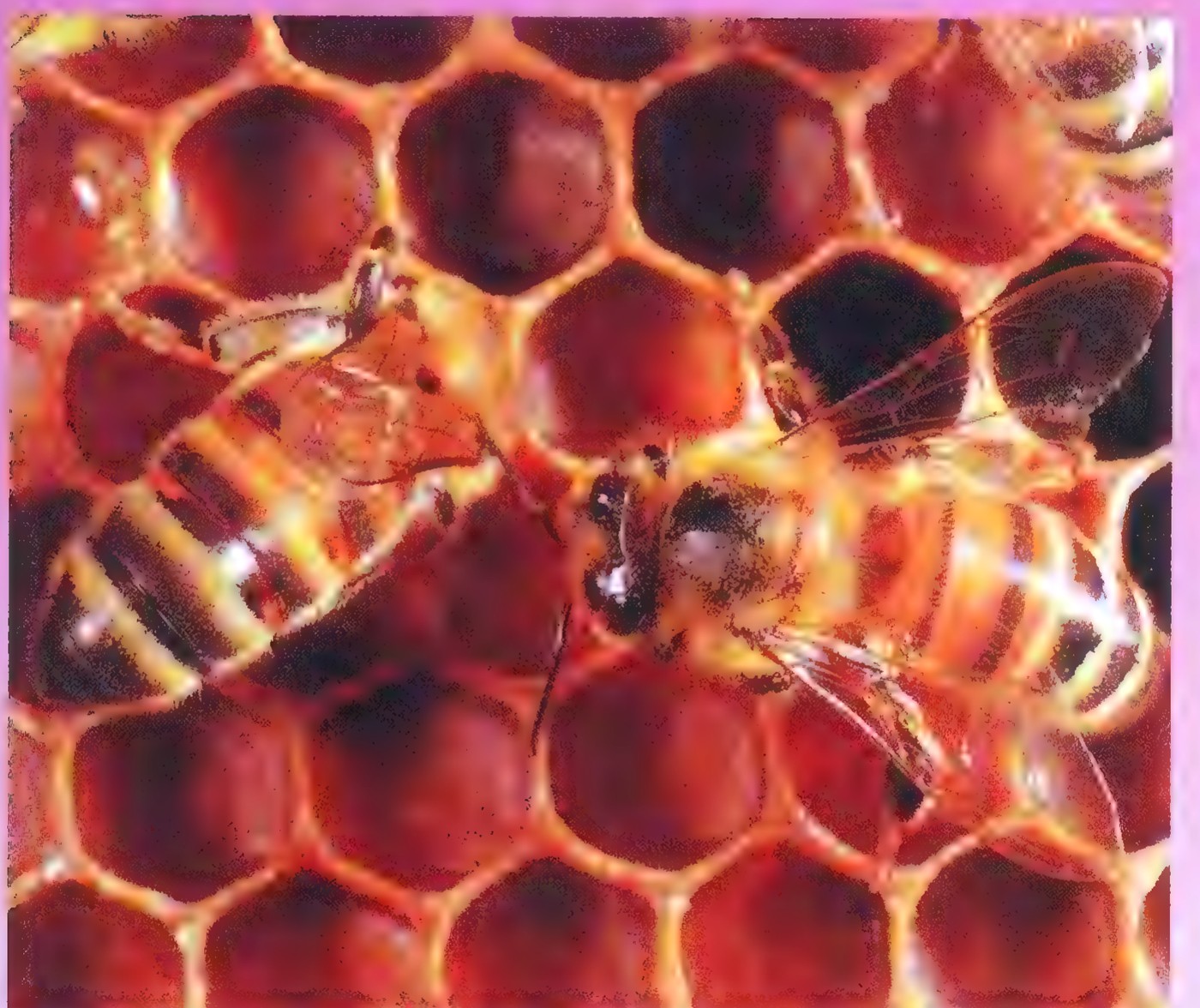
A polygon is regular if it is both equilateral and equiangular. As the number of sides of such a polygon increases, it looks more and more like a circle. This observation enabled the Greek mathematician Archimedes to make accurate estimates of the circumference and area of a circle. In this chapter, you will see how the trigonometric ratios and the idea of a limit can be used to achieve the same result.
p. 572
Lesson 1: Regular Polygons
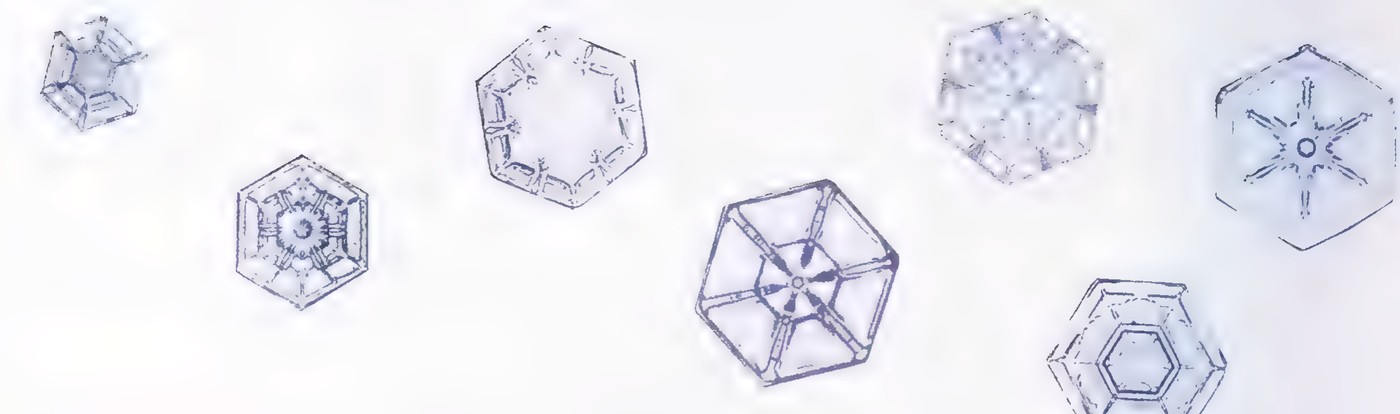
Snowflakes are a beautiful example of geometry in nature. Wilson Bentley, a farmer-meteorologist in Vermont, spent many winters taking photographs of thousands of them through a microscope; some of his pictures are shown above.*
Although it has been said that no two snowflakes are alike, those illustrated here have several basic properties in common. All are six-sided and hence hexagonal in shape. Furthermore, each is convex and has equal sides and equal angles; such polygons are called regular.
Definition
A regular polygon is a convex polygon that is both equilateral and equiangular.
Used by permission of Johnny Hart and Creators Syndicate, Inc.
* Snow Crystals, by W. A. Bentley and W. J. Humphreys (McGraw-Hill, 1931).
p. 573
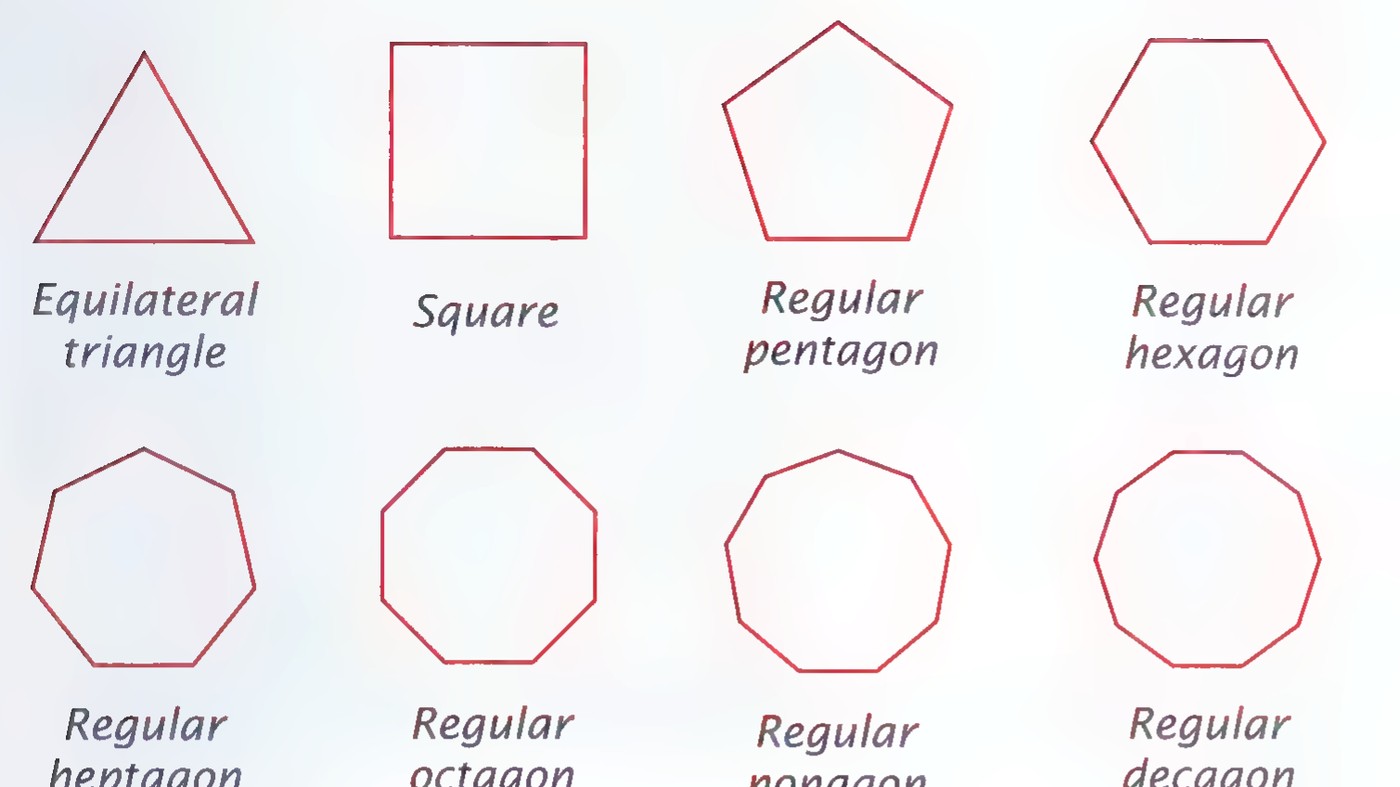
Figures representing regular polygons having from three through ten sides are shown above. Notice that, as the number of sides of a regular polygon increases, it looks more and more like a circle—a consequence of the fact that every regular polygon is cyclic.
Theorem 74
Every regular polygon is cyclic.
Given: ABCDE is a regular polygon. Prove: ABCDE is cyclic.
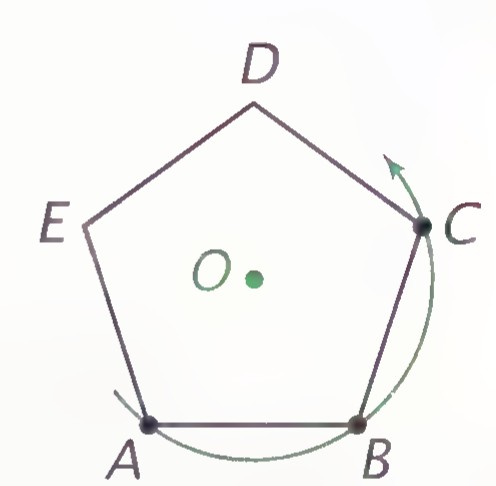
To illustrate our proof, we will use a regular pentagon. The proof, however, applies to all regular polygons because it does not depend on the number of sides of the pentagon.
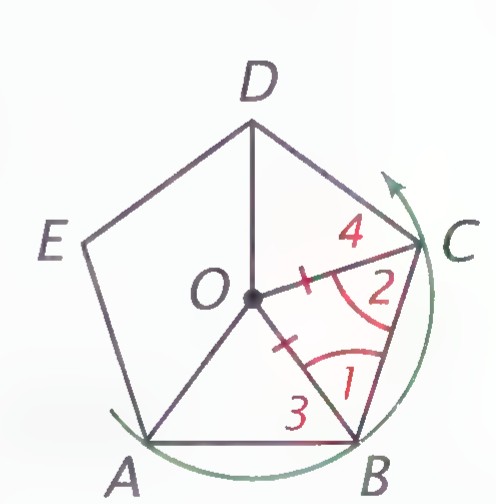
The idea is to draw a circle through three consecutive vertices of the polygon and then prove, by means of congruent triangles, that the next vertex also lies on this circle. From this fact, it follows that the rest of the vertices lie on this circle.
Proof
Draw the circle that contains points A, B, and C and let its center be called O. Draw OA, OB, OC, and OD.
We know that OB = OC (all radii of a circle are equal), and so ∠1 = ∠2 (if two sides of a triangle are equal, the angles opposite them are equal). Because ∠ABC = ∠BCD (a regular polygon is equiangular), ∠3 = ∠4 (subtraction). Also, AB = CD (a regular polygon is equilateral), and so △OBA ≅ △OCD (SAS). Therefore, OD = OA. Because OA is the radius of the circle, it follows that OD also is a radius. Hence, D lies on circle O, because a circle is the set of all points in a plane at a distance of one radius from its center.
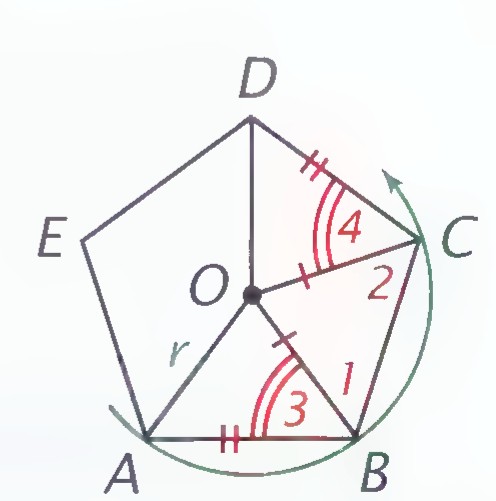
To prove that E also lies on circle O, OE can be drawn and △ODE proved congruent to △OCB in the same way.
p. 574
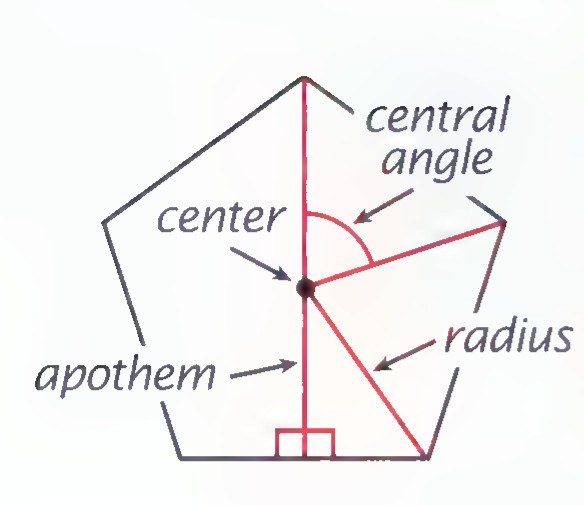
Recall that a polygon whose vertices lie on a circle is inscribed in the circle and that the circle is circumscribed about the polygon. Because every regular polygon is cyclic, some of the words that we have been using with circles are also used with regular polygons. The center of a regular polygon is the center of its circumscribed circle. The word radius, as for circles, can refer either to a line segment or to a distance: a line segment that connects the center of a regular polygon to a vertex or the distance between the center and that vertex. A central angle of a regular polygon is an angle formed by radii drawn to two consecutive vertices.
A new word, used only in geometry, is apothem.
Definition
An apothem of a regular polygon is a perpendicular line segment from its center to one of its sides.
Exercises
Set I
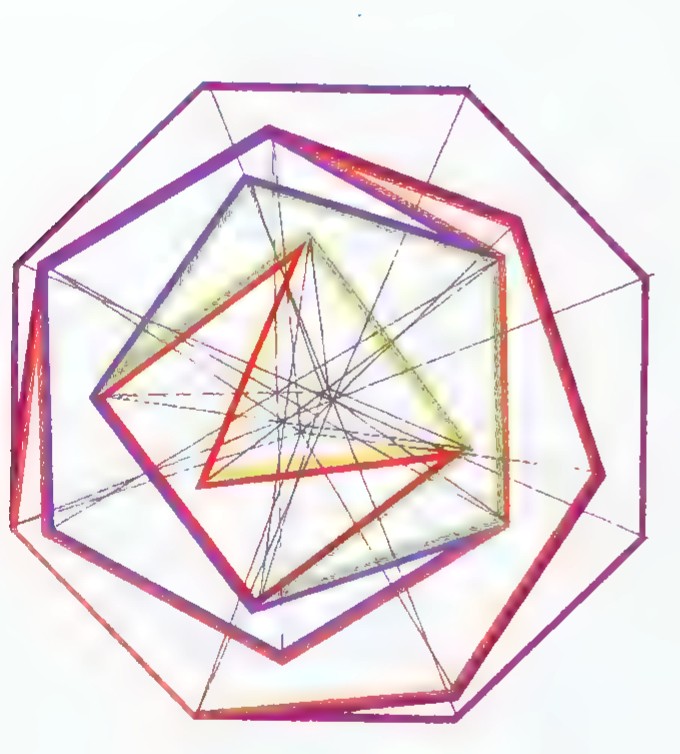
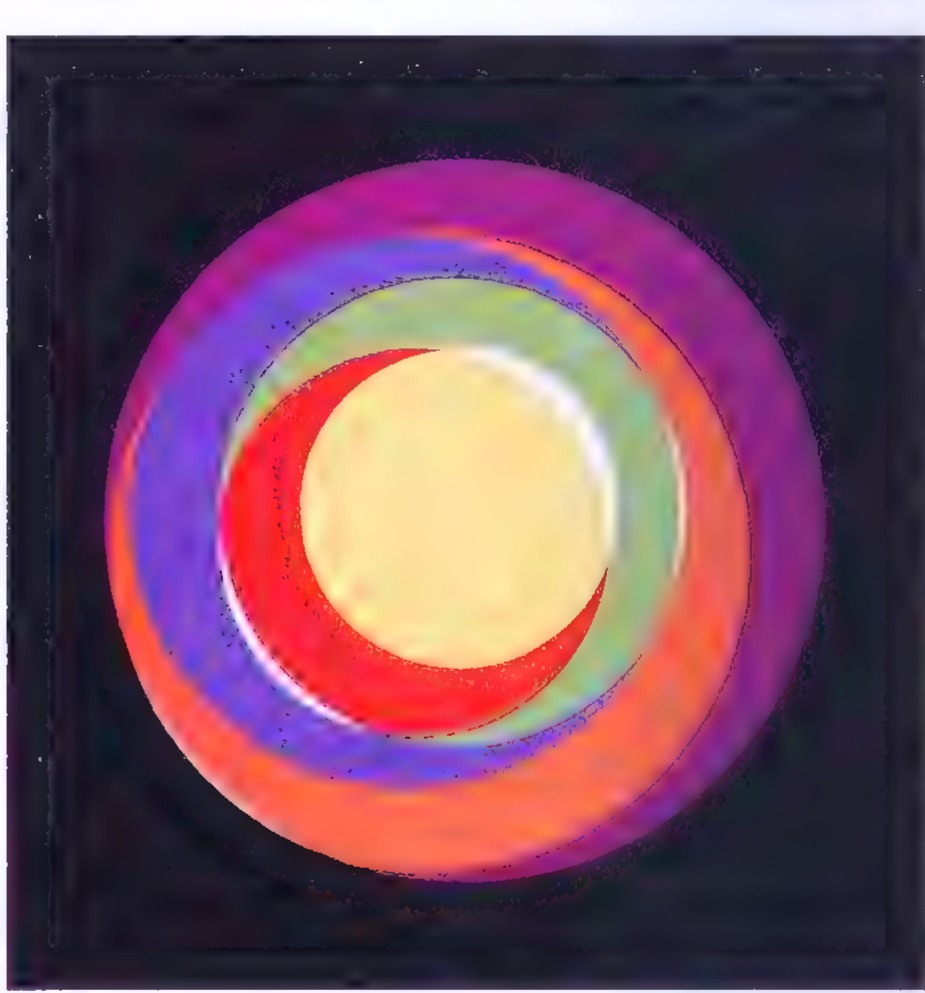
Geometry in Art. Swiss artist and designer Max Bill created a series of pictures titled Fifteen Variations on a Single Theme. Two of them are shown above.
The left-hand figure contains a series of regular polygons.
Name the regular polygons that you see.
In what way is each successive polygon related to the preceding one?
What do the thin lines represent?
The right-hand figure is related to the left-hand one.
- What do you think the right-hand figure illustrates?
p. 575
Geometry in Nature. Triangles appear naturally in this cross section of the mineral tourmaline.
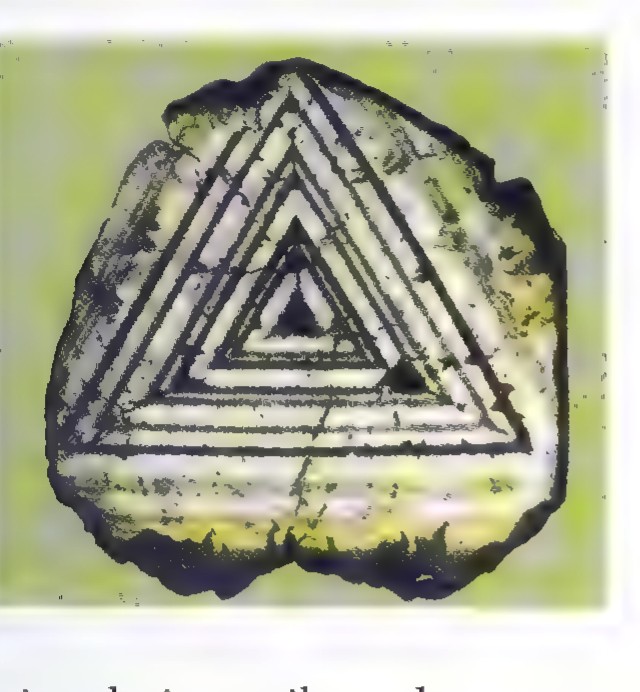
- If a triangle is equilateral, can you conclude that it is regular? Explain.
- Can you conclude that it is cyclic?
- If a triangle is cyclic, can you conclude that it is regular? Explain.
Squares appear naturally as the faces of crystals of iron pyrite, also known as “fool’s gold.”
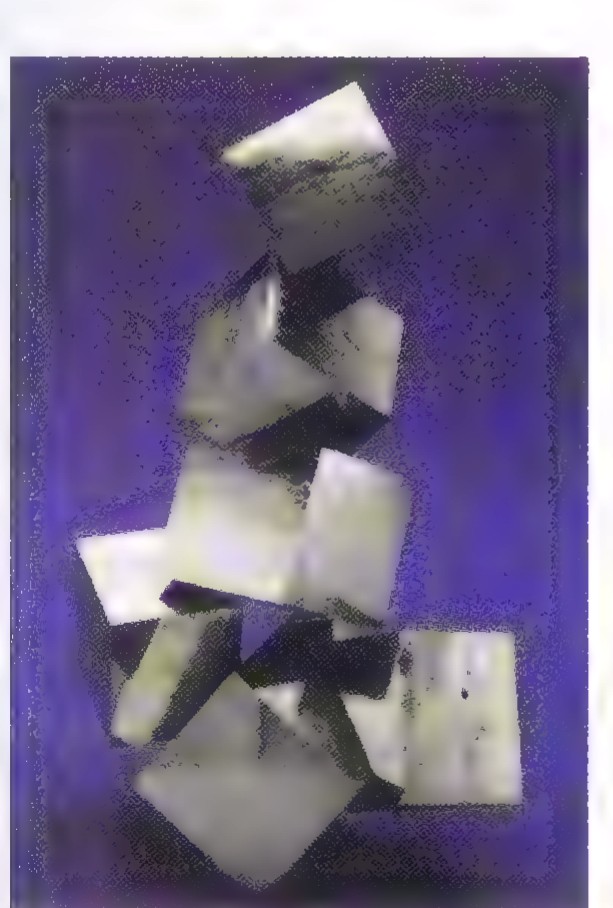
Can you conclude that a quadrilateral is cyclic if it is
equilateral?
equiangular?
regular?
If a quadrilateral is cyclic, can you conclude that it is regular? Illustrate your answer with a drawing.
Cell Pattern. When a liquid is heated from below, a pattern of cells, made visible here by metal flakes suspended in the fluid, develops spontaneously.*
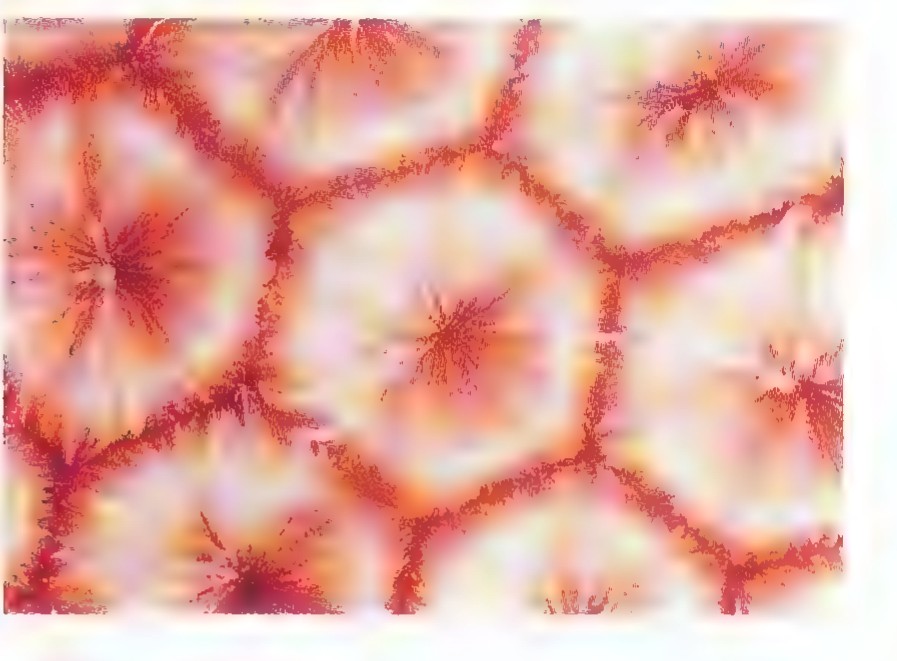
- What shape do these cells appear to have?
The figure below suggests a simple way to construct this polygon.
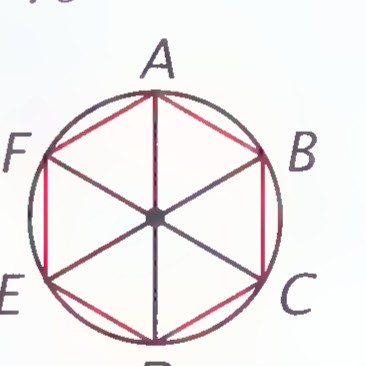
The points divide the circle into six equal arcs.
- What is the measure of each arc in degrees?
- What kind of triangles surround the center of the circle?
- How do the sides of the hexagon compare in length with the radius of the circle?
- Use this fact to construct a regular hexagon by inscribing it in a circle.
- How does the perimeter of the hexagon compare with the diameter of the circle?
* The Self-Made Tapestry: Pattern Formation in Nature, by Philip Ball (Oxford University Press, 1999).
p. 576
Regular Dodecagon. Some of the diagonals of the regular dodecagon below are the sides of other regular polygons.
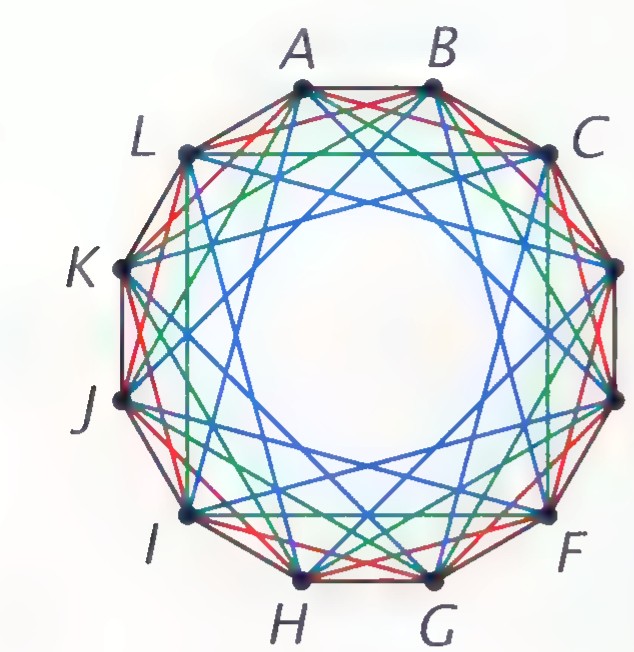
For example, the red diagonals form two regular hexagons. Notice that 2 × 6 = 12.
- What do the green diagonals form?
- What do the blue diagonals form?
- How are the numbers of sides of these polygons related to the number of sides of the dodecagon?
What regular polygons could be formed if diagonals were drawn in this way in a regular
- 15-gon?
- 16-gon?
- 17-gon?
Polygonal Knot. The figure below shows a regular polygon produced when a strip of paper is tied in a certain type of knot and pressed flat.*
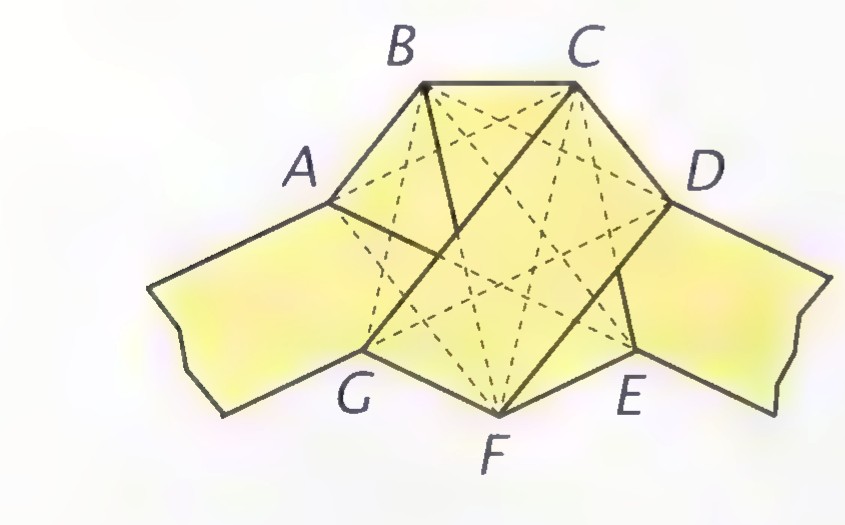
- Which regular polygon is it?
* Mathematical Models, by H. Martyn Cundy and A. P. Rollett (Oxford University Press, 1961).
Does the polygon have any
- parallel sides?
- parallel diagonals?
In general, what regular polygons do you think have
- parallel sides?
- parallel diagonals?
Set II
Mason’s Pentagon. A method used by masons in the Middle Ages to draw a pentagon is illustrated by the figure below.†
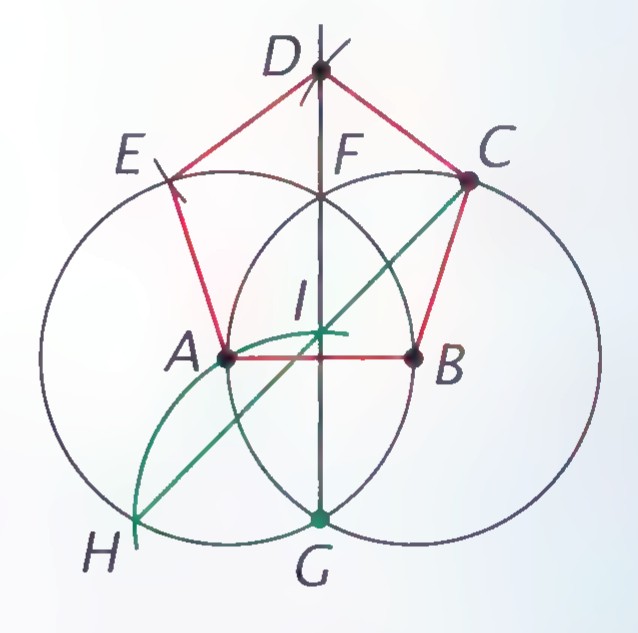
Use your straightedge and compass to construct it by doing each of the following steps.
Draw a line segment AB about 4 cm long and two circles with centers at A and B and with radius AB.
Let F and G be the points in which the circles intersect, and draw line FG.
With G as center, draw an arc through A that intersects circle A at H and line FG at I.
Draw line HI, extending it to intersect circle B at C.
With C as center and radius AB, draw an arc intersecting line FG at D.
With D as center and the same radius, draw an arc intersecting circle A at E.
† Geometry Civilized: History, Culture, and Technique, by J. L. Heilbron (Clarendon Press, 1998).
p. 577
(7) Draw ABCDE.- Is ABCDE equilateral? Explain.
ABCDE is not regular.
Explain how it can be that ABCDE is not regular.
(continued) Draw AF and FB.
Is △ABF regular? Explain.
Folding an Octagon. The figure below shows how a square sheet of paper can be folded to form an octagon.*
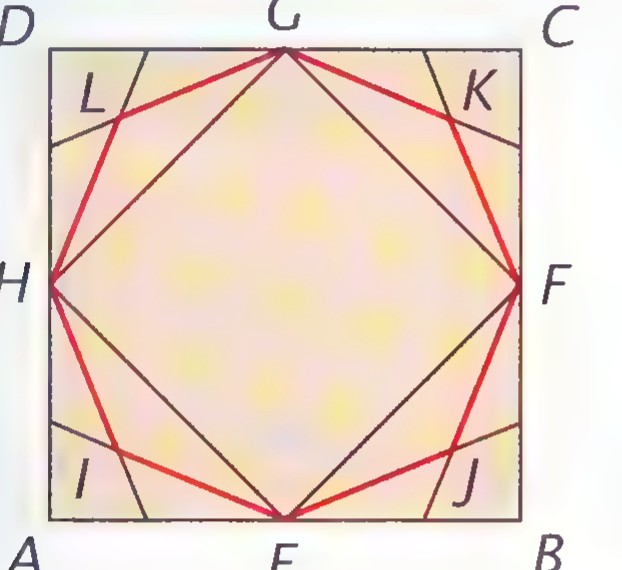
Points E, F, G, and H are the midpoints of the sides of ABCD.
- What kind of triangles are △AEH, △BEF, △CFG, and △DGH?
- Why are they congruent?
The lines in these triangles bisect their acute angles.
- Why is EF = FG = GH = HE?
- What kind of triangles are △EHI, △EFJ, △FGK, and △GHL?
- Why are they congruent?
- What can you conclude about the sides of the octagon EJFKGLHI?
Find the measures of the following angles.
- ∠AEI.
* Geometric Exercises in Paper Folding, by T. Sundara Row (Open Court, 1905).
- ∠EIH.
- ∠IEJ.
- What can you conclude about the angles of octagon EJFKGLHI?
- What do exercises 38 and 42 prove about octagon EJFKGLHI?
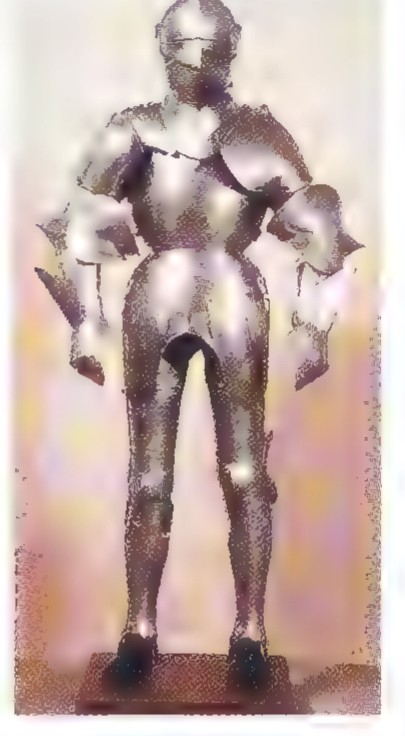
Hexagonal Fastener. Fasteners have been made with heads in the shape of regular hexagons for hundreds of years. They were even used to hold armor together in the fifteenth century.†
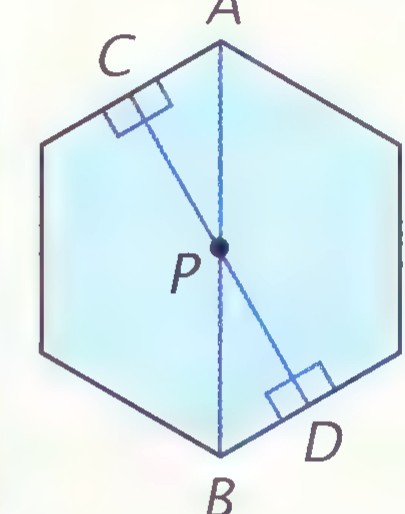
The regular hexagon in the figure above represents one of these fastener heads; AB and CD intersect at its center, P.
- What are PA and PB called with respect to the hexagon?
- What are PC and PD called?
- Why is △APC ≅ △BPD? Explain.
- What type of right triangles are they?
If PA = 0.25 inch, find
AC and PC.
AB and CD.
Which length, AB or CD, would be used to give the size of the wrench needed to turn the head? Explain.
† Sizes: The Illustrated Encyclopedia, by John Lord (Harper Perennial, 1995).
p. 578
Inscribed Pentagon. In the figure below, regular pentagon ABCDE is inscribed in the circle, and diagonals AC and BD intersect at F.
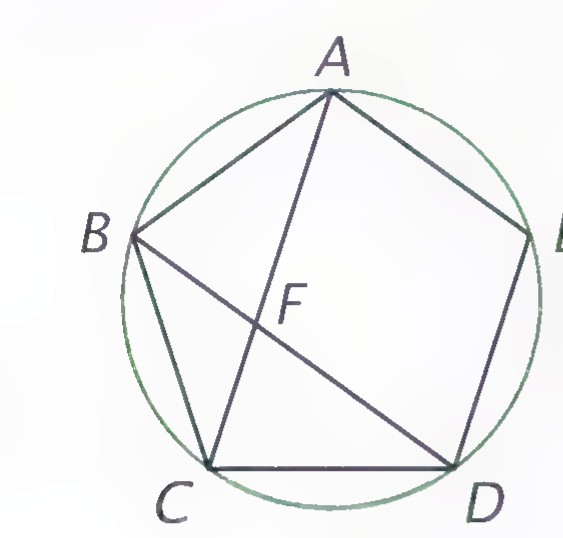
- Copy the figure and mark it as needed to answer each of the following questions.
- Why can you conclude that the five arcs into which the pentagon divides the circle are equal?
What is the measure of
each arc? 56. ∠BAC?
∠ABD? 57. ∠BCA?
∠AFB?
How many triangles are in the figure?
All the triangles have something in common. What is it?
What can you conclude about AEDF? Explain.
What can you conclude about AEDB and AEDC?
Set III
A Close Construction. No one has ever found a way to construct a regular heptagon by using just a straightedge and compass, and no one ever will!
The following construction, however, is close enough that, if you do it accurately, you won’t be able to tell the difference.
Use your straightedge and compass to construct the figure at top of the next column by doing each of the following steps.
- Draw circle O with a radius of about 2 inches.
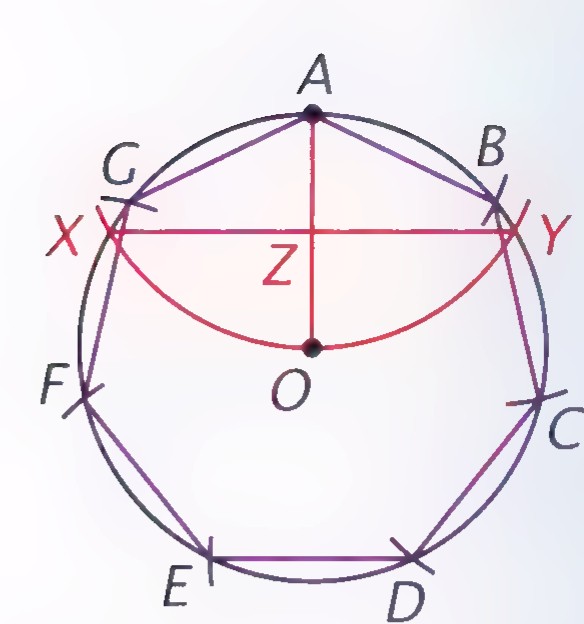
Choose a point A on it and draw AO.
With A as center, draw an arc with radius AO that intersects the circle in points X and Y.
Draw XY and let Z be the point in which XY intersects AO.
Adjust the compass to the distance ZY and, starting at A, draw arcs having this radius around the circle.
Label the endpoints of the arcs B through G as shown in the figure.
Draw ABCDEFG.
- To check the method used, draw AX, XO, AY, and YO. What kind of triangles are △AXO and △AYO?
- What relation does AO have to XY?
- What special kind of triangle is △OZY?
Letting OY = r, find each of the following lengths in terms of r.
OZ. 6. ZY. 7. AB.
Let M be the midpoint of AB and draw OM. Find AM in terms of r.
Use your calculator to find the measure of ∠AOM in right △AMO to as many decimal places as you can.
To as many decimal places as you can, find
- ∠AOB.
- 7∠AOB.
- What does the answer to exercise 11 reveal about ABCDEFG? Explain.
p. 579
Lesson 2: The Perimeter of a Regular Polygon
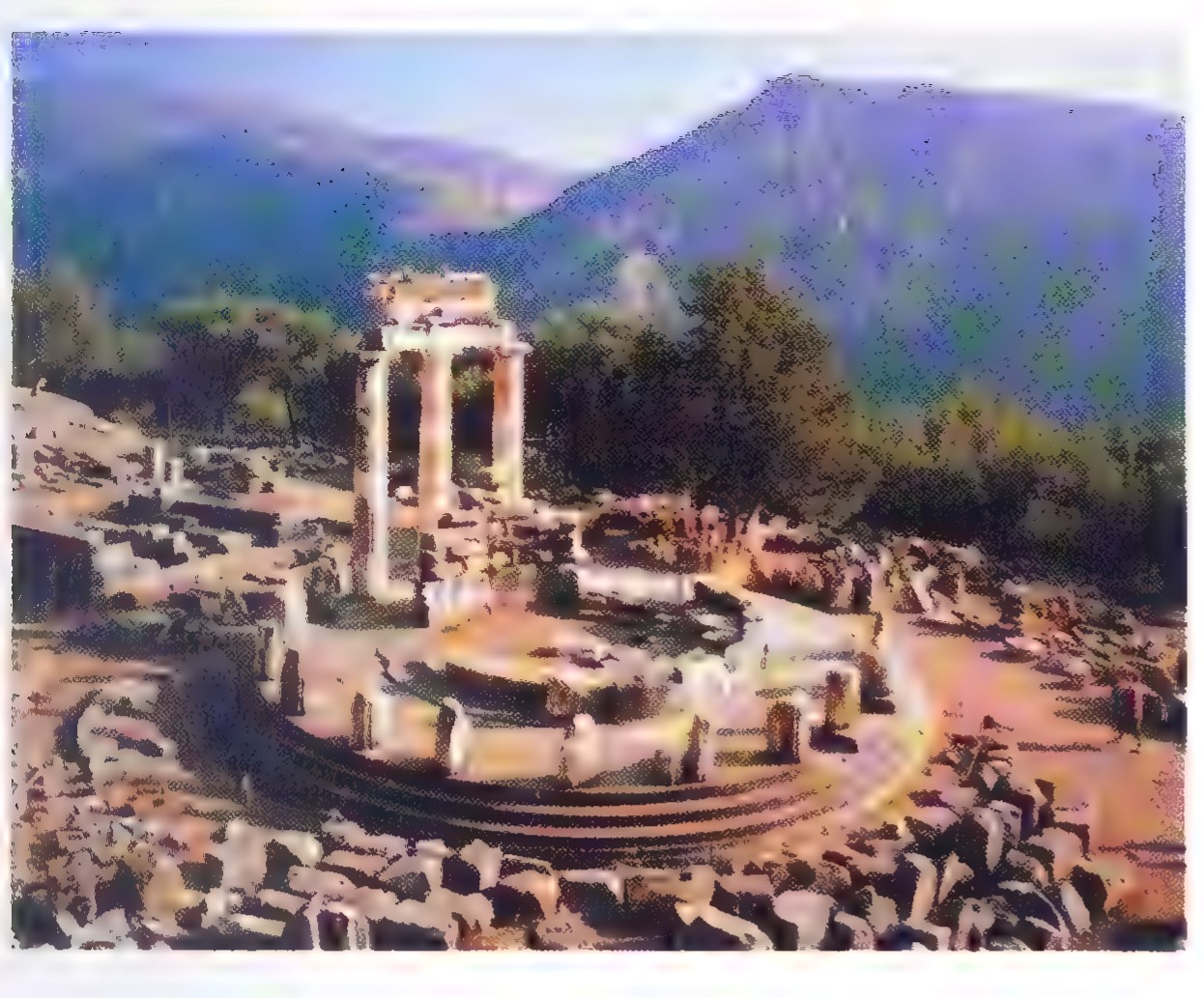
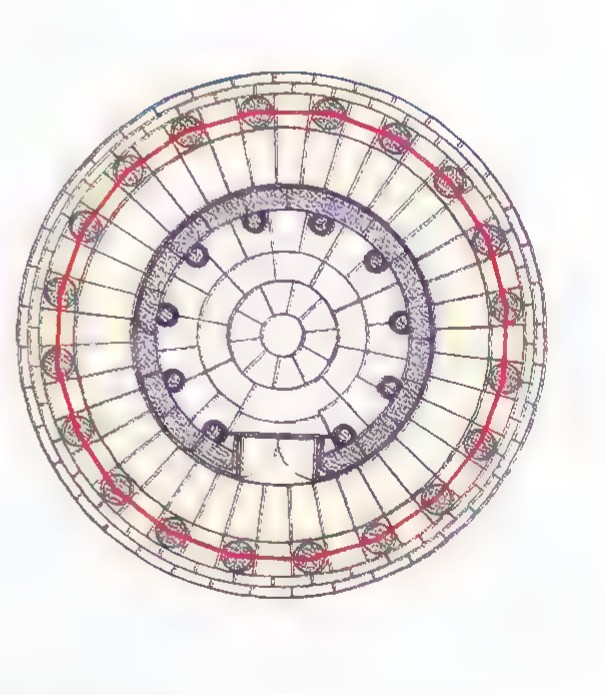
One of the most famous temples of ancient Greece was the Tholos at Delphi. Circular in shape, it had 20 outer columns set at the vertices of a regular polygon called an icosagon. The temple was built in about 370 B.C., and only three of its columns still stand.*
The ground plan of the temple is shown in the figure at the right. A regular icosagon with vertices at the centers of the bases of the 20 columns is shown in red. Because the icosagon has so many sides, it looks a lot like a circle, suggesting that we could approximate the measurements of a circle by using measurements of a regular polygon having a large number of sides. For example, the circumference of a circle should be close to the perimeter of a regular icosagon having the same radius as that of the circle.
The perimeter of a regular polygon can be found by multiplying the length of a side by the number of sides. Doing so gives us the equation
where p is the perimeter of the polygon, n is the number of sides, and s is the length of one side. This formula cannot be applied to a circle, however, because a circle doesn’t have any sides.
* Euclid: The Creation of Mathematics, by Benno Artmann (Springer, 1999).
p. 580
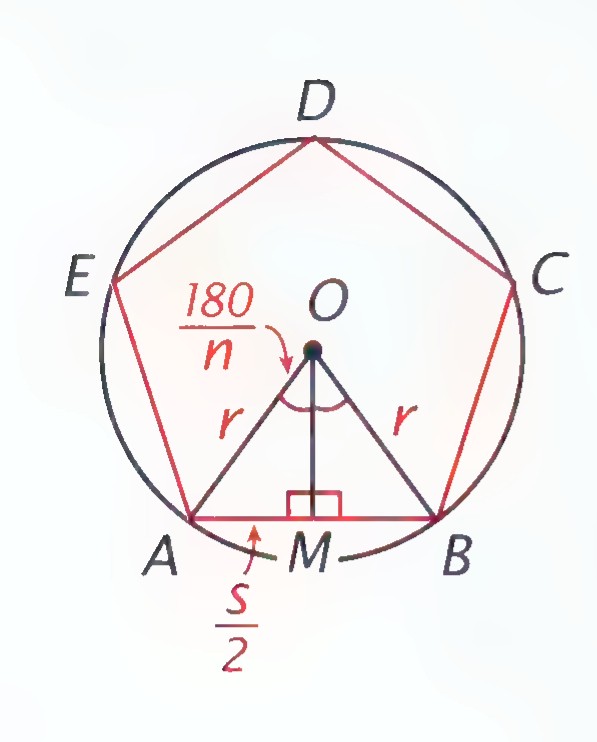
There is another way to express the perimeter of a regular polygon that can be extended to measuring a circle. This method is based on the length of the polygon’s radius. In the figure at the left, a regular pentagon with sides of length s has been inscribed in a circle with radius r.
Radii OA and OB of the circle have been drawn, as well as apothem OM. Since OM ⊥ AB, △AOM ≅ △BOM (HL). From equal corresponding parts of congruent triangles, we can conclude that OM bisects central ∠AOB as well as chord AB. It follows that and, because a central angle of a regular n-gon has a measure of , that
To see how r and s are related, we can apply the sine ratio to right △AOM:
Multiplying both sides of this equation by r gives
and by 2 gives
Because p = ns, it follows by substitution that
To understand this expression better, we notice that the product depends only on n. This is the part of the formula determined by the number of sides of our regular polygon. We represent it by the single letter N, and so . We substitute N in the equation above to get
This formula shows that the perimeter of a regular polygon is proportional to its radius. The formula does not depend on the fact that we used a polygon with five sides to derive it, and so we can state it as a general theorem.
p. 581
Theorem 75
The perimeter of a regular polygon having n sides is 2Nr, in which and r is its radius.
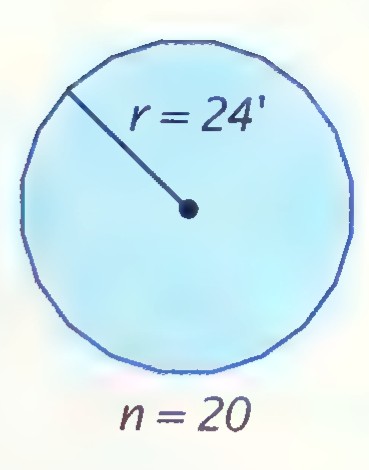
Knowing that the radius of the regular icosagon in the ground plan of the Tholos temple at Delphi is 24 feet, we can now find its perimeter. Because it has 20 sides, . Therefore,
The perimeter of the temple is approximately 150 feet.
Exercises
Set I
Perimeter Equations. The expression for the perimeter of a regular polygon introduced in this lesson has two parts:
- What does r represent?
- What does n represent?
- What is the smallest number that n can be for a polygon?
Use your calculator to find the value of N to four decimal places
- if n = 10.
- if n = 100.
- if n = 1,000.
- if n = 10,000.
As n increases, what happens to
- the value of N?
- the shape of the regular polygon?
Angles and Radii. ABCDEFG is a regular polygon with center P.
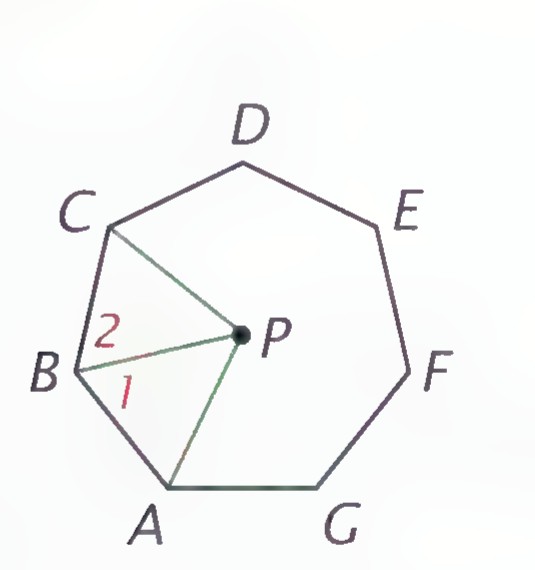
- What are PA, PB, and PC called with respect to the polygon?
What can you conclude about
△ABP and △CBP? Why?
∠1 and ∠2? Why?
Do your answers to exercises 11 and 12 depend on the fact that the polygon has seven sides?
How is the radius PB related to ∠ABC?
p. 582
Italian City. During the Renaissance, new cities were sometimes planned in the shape of regular polygons.
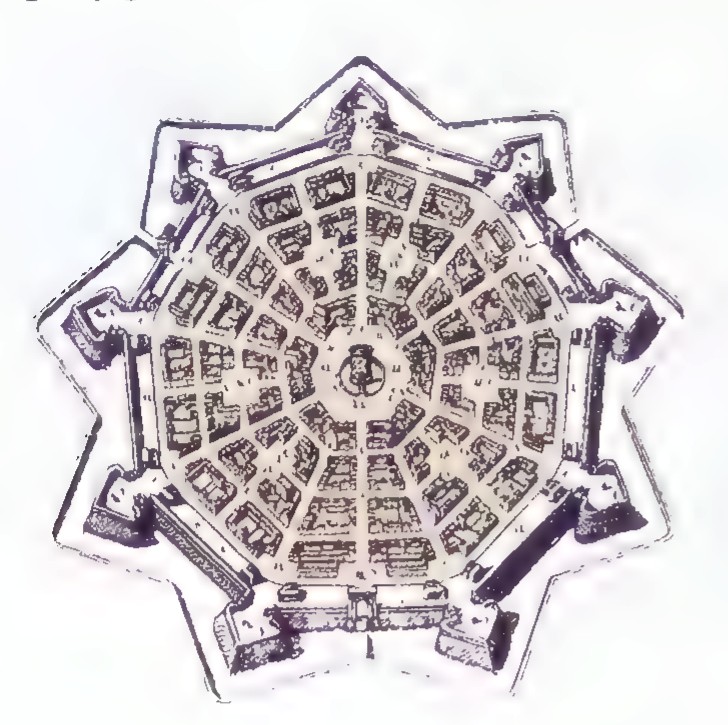
The figure above shows the design of the walled city of Palma Nuova in Italy. The core of the city is shown in color.
- How many sides does the regular polygon have that surrounds the core of the city?
Express the value of N for this polygon
by using a trigonometric ratio.
to the nearest thousandth.
Given that the radius of the city is 1,100 feet, find the perimeter of its core to the nearest foot.
Hydrogen Fluoride. Hydrogen fluoride gas, used to etch glass, has been found to contain rings of atoms having the following shapes.*
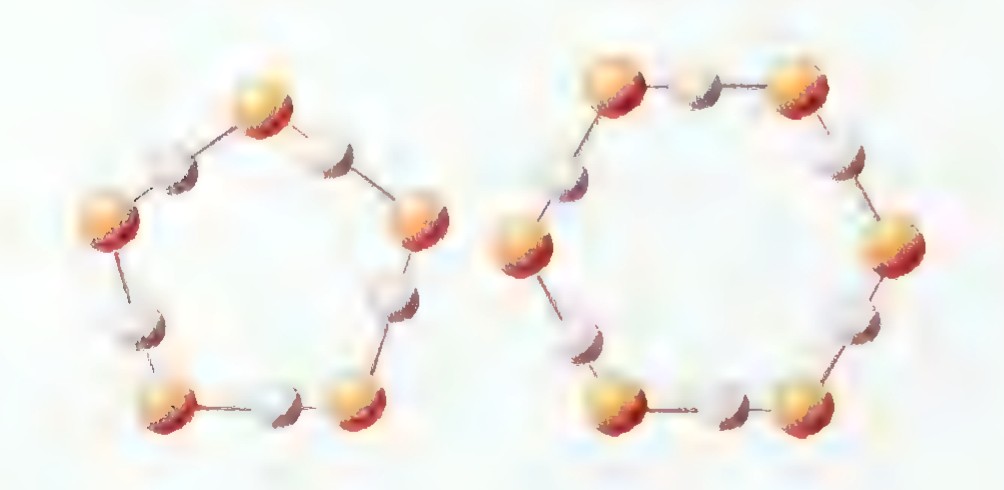
The hydrogen atoms are shown in white and the fluorine atoms in yellow.
* The Architecture of Molecules, by Linus Pauling and Roger Hayward (W. H. Freeman and Company, 1964).
- What is the name of each shape?
- How do the sides of the two shapes appear to compare in length?
- How do the radii of the two shapes appear to compare in length?
What is the measure of the angle at each corner of
- the first ring?
- the second ring?
Given that the distance between two consecutive corners in each ring is 2.5 angstroms, find the perimeter of
- the first ring.
- the second ring.
Find the value of N for
the first ring.
the second ring.
Use your answers to exercises 24 and 26 to find the radius of the first ring.
Use your answers to exercises 25 and 27 to find the radius of the second ring.
Dollar Coin. In 1979, the United States Mint issued a dollar coin with an unusual design. Each side showed a regular polygon having 11 sides inscribed in a circle.
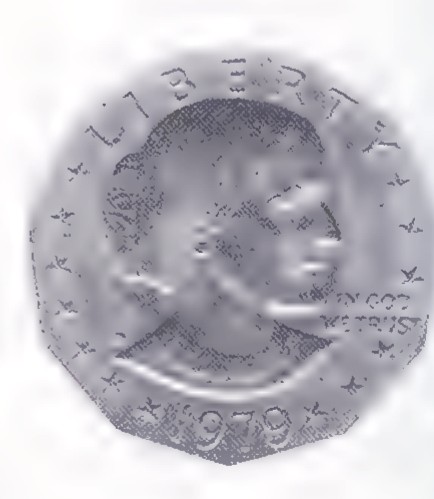
The radius of the circle was 12 mm. Find each of the following lengths to the nearest millimeter.
- The circumference of the circle.
- The perimeter of the polygon.
- The length of one side of the polygon.
p. 583
Set II
Phone Cells. Cell-phone networks consist of hexagonal cells, each having a base station at its center.*
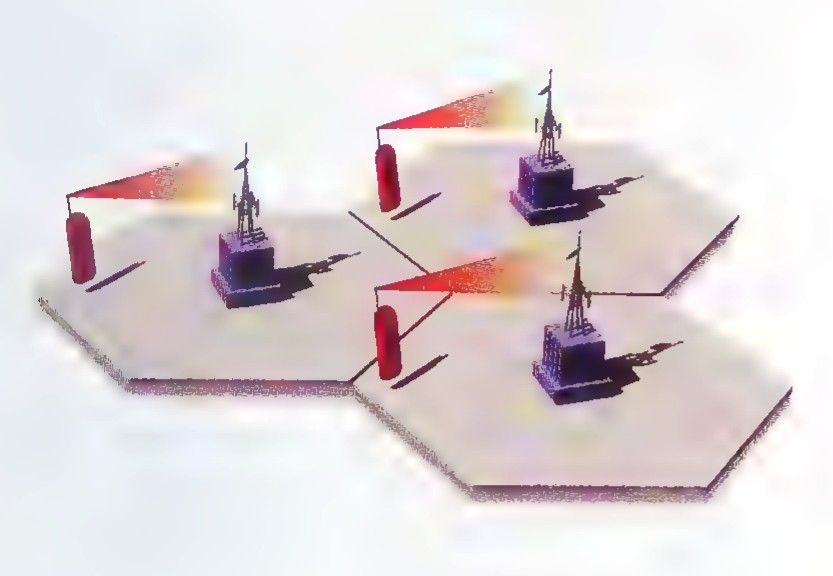
- Given that the radius of each cell is r, use Theorem 75 to find the perimeter of each cell in terms of r.
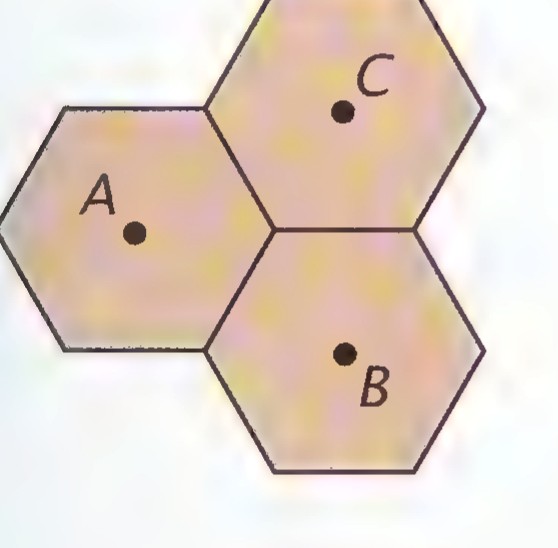
Copy the figure above and draw the radii of each cell.
What kind of triangles do you get? Use them to get the answer to exercise 33 in a different way.
Draw △ABC. What kind of triangle is it?
Find the distance between two neighboring base stations in the cell-phone network in terms of r.
Use your answer to exercise 37 to express the perimeter of △ABC in terms of r.
Use Theorem 75 and your calculator to find the perimeter of △ABC in terms of r.
Do your answers to exercises 38 and 39 agree with each other? Explain.
Ten Pentagons. In the figure below, 10 regular pentagons form a ring around a regular decagon. Point X is the center on one of the pentagons.
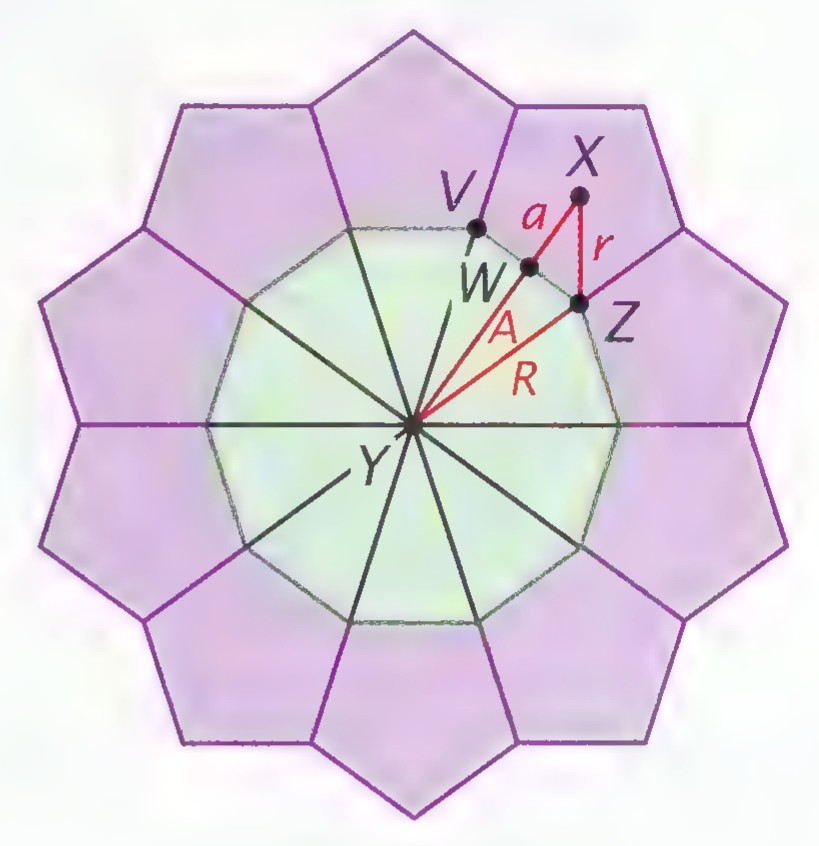
- What is the ratio of the perimeter of the decagon to the perimeter of one of the pentagons?
- Find ∠X.
- Find ∠XYZ.
- In △XYZ, why is ?
- Use your answers to exercises 42 through 44 to find the ratio .
- Why is XY ⊥ VZ?
- Why is , and why is ?
- Use your answers to exercises 42, 43, and 47 to find the ratio .
* Scientific American: How Things Work Today, edited by Michael Wright and M. N. Patel (Crown, 2000).
p. 584
Euclid’s Discovery. Euclid discovered a surprising connection between the three figures below.
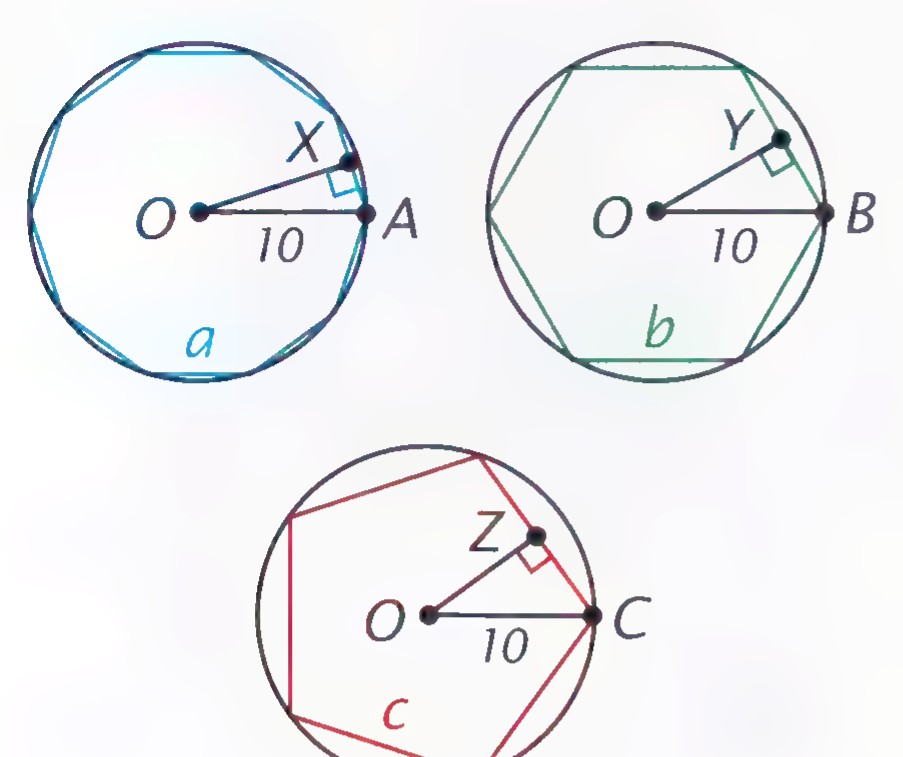
To find out what the connection is, do each of the following exercises.
Find the measure of ∠O in the
- decagon.
- hexagon.
- pentagon.
Use the sine ratio to find each of the following lengths to as many decimal places as you can.
- AX.
- BY.
- CZ.
Find each of the following numbers to as many decimal places as you can.
a².
b².
c².
What do you think Euclid discovered?
Set III
Golden-Heather. The petals of this flower are arranged like the radii of a regular pentagon.
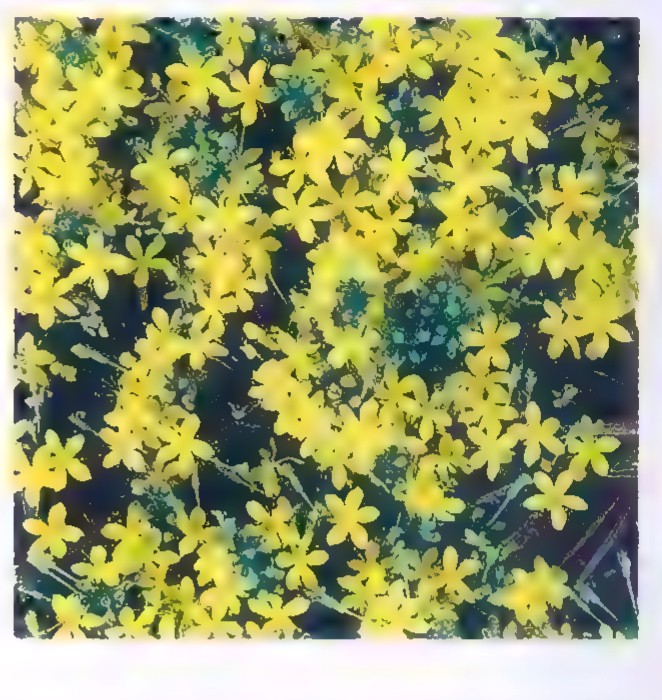
Suppose that each petal is 1 unit long.
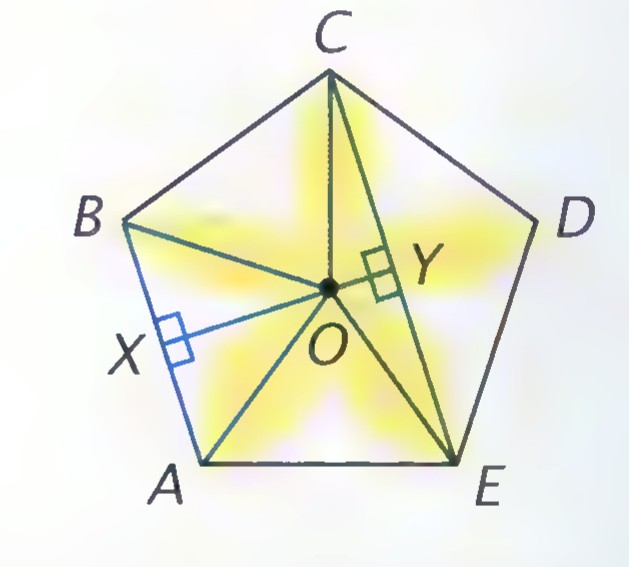
- Show that the distance between the tips of two consecutive petals, such as AB, is 2 sin 36°.
- Show that the distance between the tips of two nonconsecutive petals, such as CE, is 2 sin 72°.
Strange as it might seem,
- Use your calculator to see if this equality seems reasonable.
Even more strangely,
- What famous number is 2 sin 54°?
p. 585
Lesson 3: The Area of a Regular Polygon
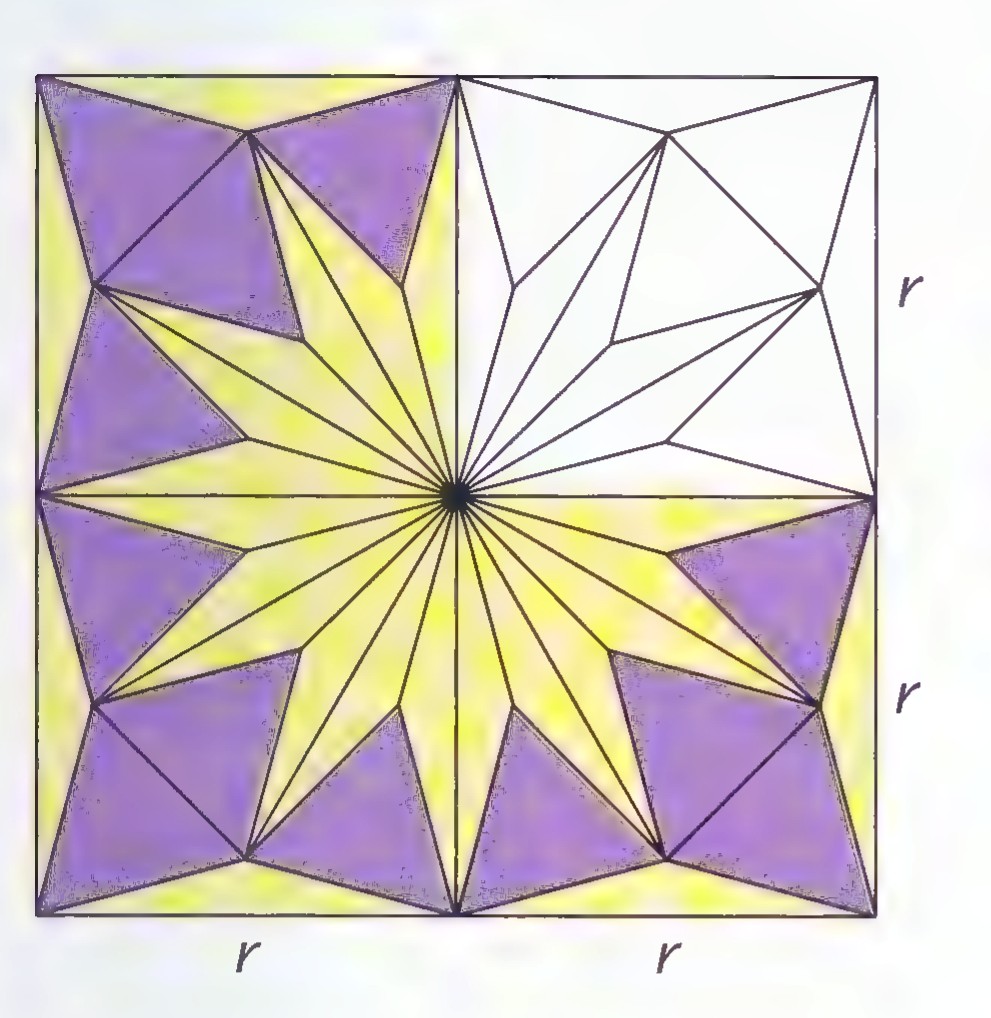
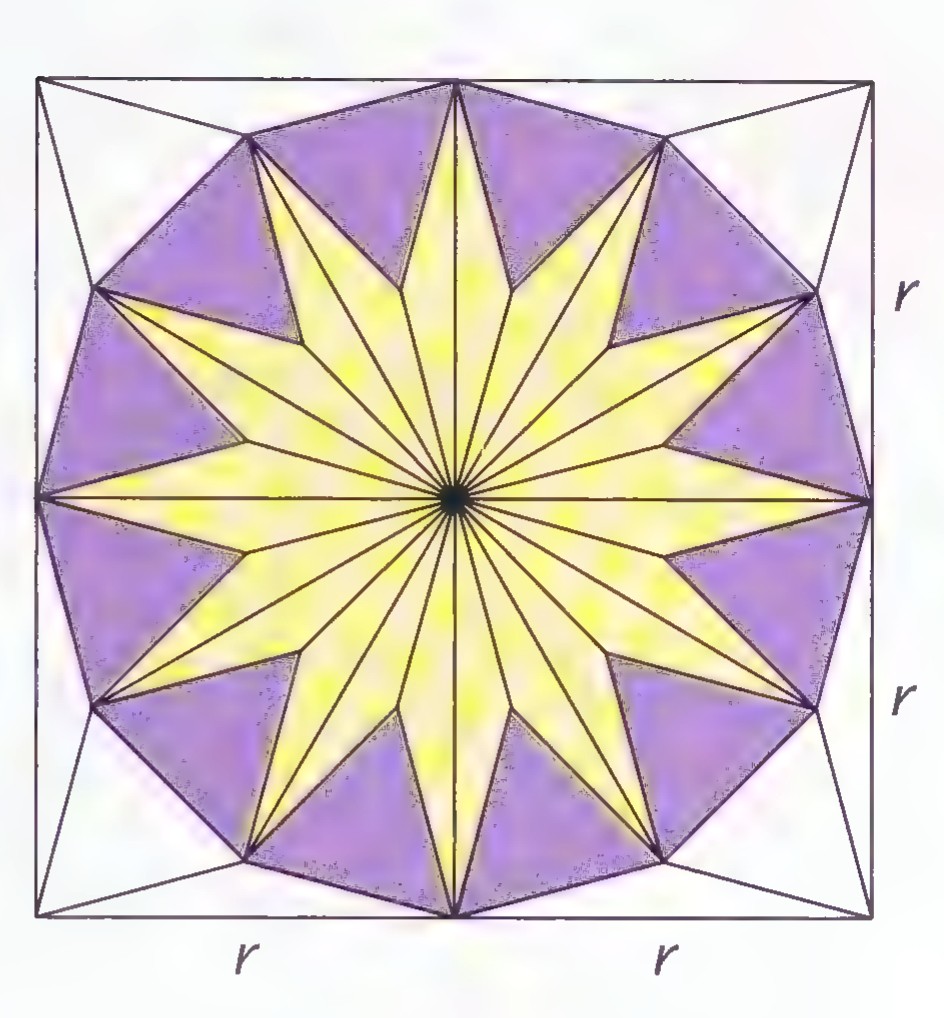
In 1898, a Hungarian mathematician named József Kürschák made an interesting discovery illustrated by the figures above. The figures show a regular dodecagon inside a square. The square is divided into four smaller squares and the entire figure is divided into two sets of congruent triangles: equilateral triangles and 15°-15°-150° isosceles triangles.
Because the entire figure contains four squares, each with side r, its area is 4r². The triangles filling three of these squares, then, have a total area of 3r². They can be rearranged as shown in the second figure to fill the regular dodecagon, showing that the area of a regular dodecagon whose radius is r is 3r².
This result is remarkable in that it is so simple. In general, to find the area of a regular polygon from its radius is much more complicated. In figuring out how to do it, we will again reason in terms of a regular pentagon, but our argument and conclusion, like those for the perimeter of a regular polygon, are valid for a regular polygon having any number of sides.
p. 586
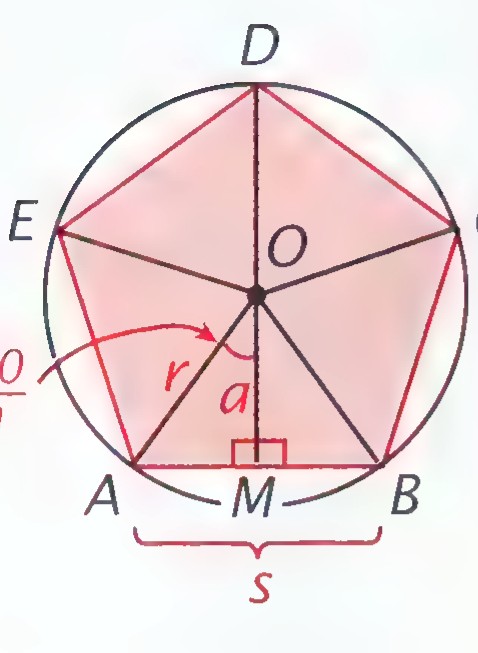
The radii of a regular polygon divide it into n congruent triangles. (In this pentagon, there are five of these triangles.) The area of one of these triangles, such as △AOB, is because apothem OM is the altitude to base AB. Thus, the total area of the n triangles is , and so
where A is the area of the entire figure. Because the perimeter of a regular polygon having n sides is ns, we can also write
This equation expresses the area of a regular polygon in terms of its apothem and perimeter.
As we did for the perimeter of a regular polygon, we can restate this formula in terms of the number of sides of the polygon and its radius. By Theorem 75,
Applying the cosine ratio to △AOM, we get
Multiplying both sides of this equation by r gives
Substituting the expressions for p and a from equations 2 and 3 into equation 1, we get
Again, we can simplify the appearance of this equation by noticing that the product depends only on n, the number of sides of our regular polygon. We represent it by the single letter M, and so . We substitute M into the equation above to get
p. 587
This formula shows that the area of a regular polygon is proportional to the square of its radius. Our argument can be applied to any regular polygon; so we can state it as a general theorem.
Theorem 76
The area of a regular polygon having n sides is Mr², in which and r is its radius.
To check this result, we return to the area of the regular dodecagon pictured at the beginning of this lesson. A calculator gives us the product of the sine and cosine.
The area of the regular dodecagon is 3r².
Exercises
Set I
Area Equations. The expression for the area of a regular polygon introduced in this lesson has two parts:
- What does r represent?
- What does n represent?
Use your calculator to find the value of M
- if n = 1.
- if n = 2.
- if n = 3, to two decimal places.
- if n = 180, to two decimal places.
- For a regular polygon, what is the smallest number than n can equal?
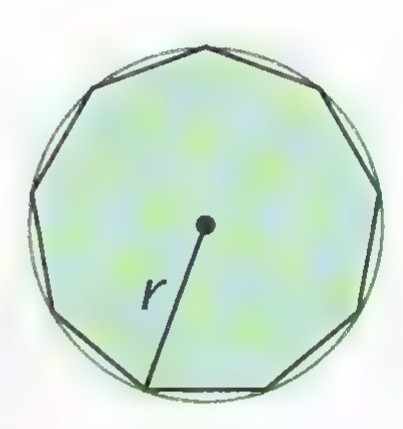
Inscribed Polygon. In the figure above, a regular nonagon is inscribed in a circle with radius r.
Tell what each of the following expressions represents in the figure.
Example: or (9 sin 20° cos 20°)r².
Answer: The area of the nonagon.
- πr².
- or (18 sin 20°)r.
- (2 sin 20°)r.
- 2πr.
p. 588
The Area of a Square. The word “radius” is usually used in referring to a circle.
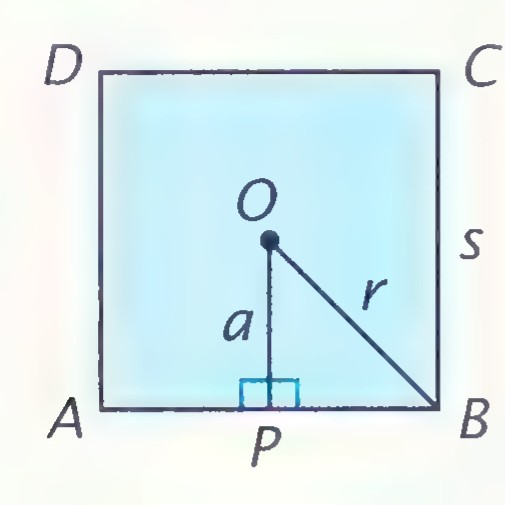
- What does the word “radius” mean in referring to a square?
Write an expression for the area of square ABCD in terms of the length of
its side, s.
its apothem, a.
What kind of triangle is △OPB?
Write an equation relating
r to a.
r² to a².
Use your answers to exercises 14 and 17 to write an expression for □ABCD in terms of r.
Use the formula for the area of a regular polygon to write an expression for □ABCD in terms of r.
Close But Not Quite. One of the figures below is a circle and the other is a regular 60-gon.
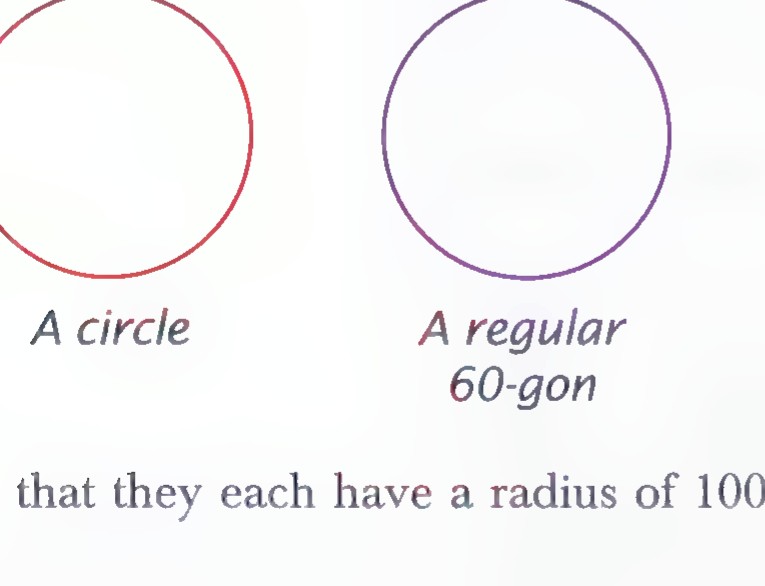
Suppose that they each have a radius of 100 units.
What is the “perimeter” of a circle usually called?
Use the formula c = 2πr to find the “perimeter” of the circle to the nearest unit.
Find the perimeter of the 60-gon to the nearest unit.
Which figure actually has the greater perimeter?
Find the ratio of the “perimeter” of the circle found in exercise 21 to twice its radius.
Find the ratio of the perimeter of the 60-gon found in exercise 22 to twice its radius.
Which figure has the greater area?
Use the formula a = πr² to find the area of the circle to the nearest square unit.
Find the area of the 60-gon to the nearest square unit.
Set II
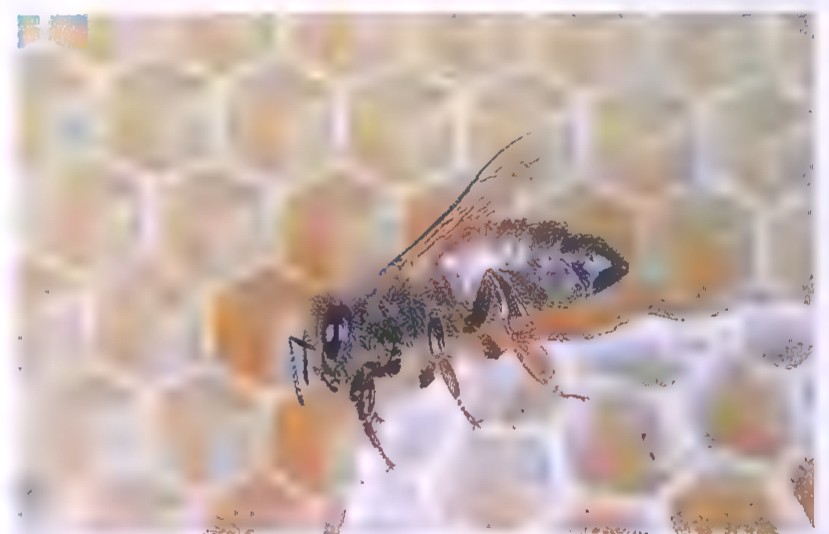
Honeycomb Geometry. Bees build the cells of honeycombs in the shape of regular hexagons.
The radii of regular hexagon ABCDEF divide the hexagon into six triangles.
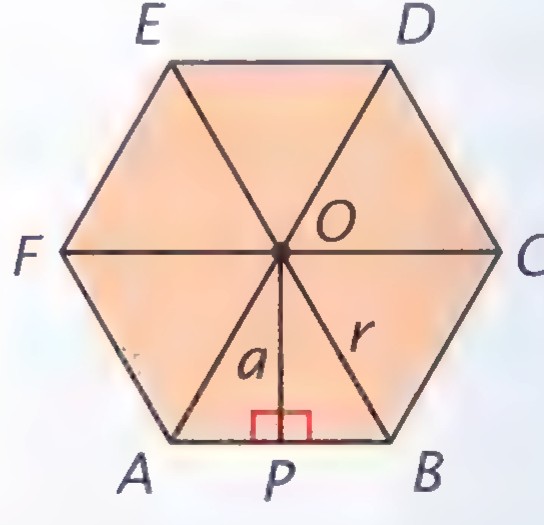
- What kind of triangles are they?
p. 589
- What is OP called with respect to the hexagon?
- Into what kind of triangles does OP divide △AOB?
Write an expression for
- PB in terms of r.
- a in terms of r.
- in terms of r.
- in terms of r.
- Use the formula for the area of a regular polygon to write an expression for in terms of r.
Use △BOP to show that
. 38. .
Substitute the results of exercises 37 and 38 into your expression for exercise 36 and simplify.
Does your result turn out to be what you would expect? Explain.
Kürschák Triangles. The figure below is one of the four identical parts of the Kürschák figure shown at the beginning of this lesson. ABCD is a square, and the purple triangles are equilateral.
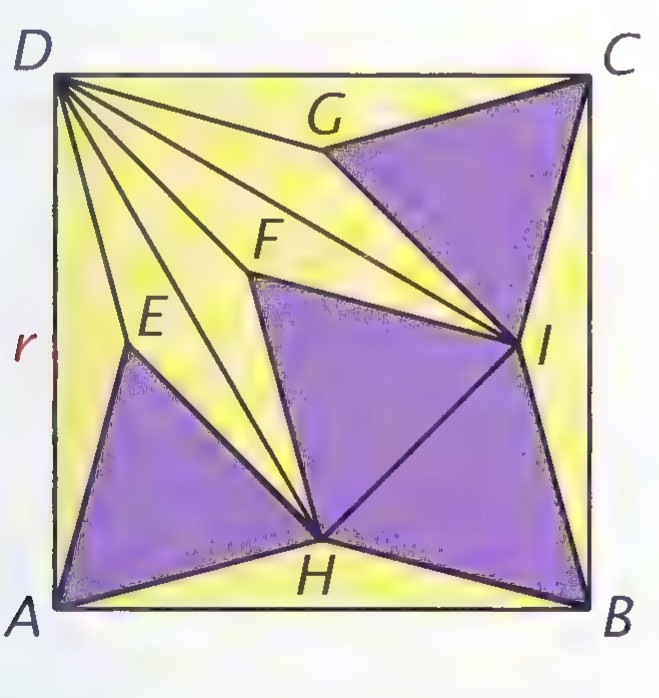
- Which two triangles must be congruent? Explain.
The purple triangles are congruent and the yellow triangles are congruent.
- What else can you conclude about the yellow triangles?
What can you conclude about
- the measures of their acute angles?
- the measures of their obtuse angles?
- the measures of ∠AHI and ∠HIC?
Given that the length of each side of ABCD is r, find each of the following lengths in terms of r.
- DH and DI.
- AH, HI, and IC.
- DE, DF, and DG.
Find each of the following areas in terms of r.
- .
- .
- .
Rats!
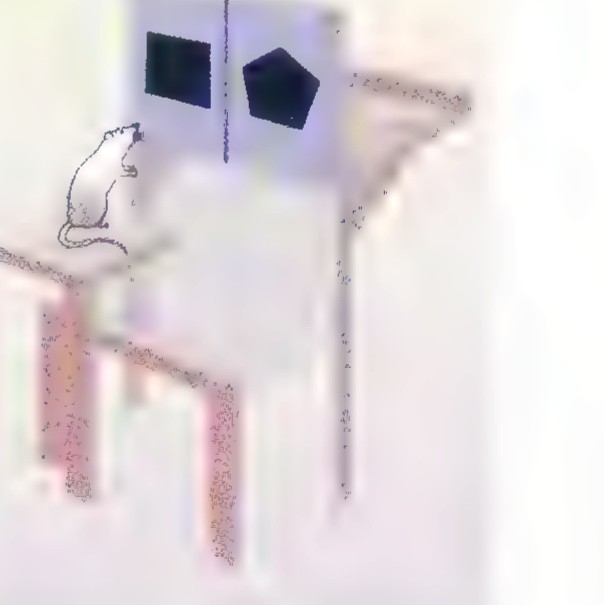
Even rats take geometry lessons! In this experiment, a rat learned to distinguish between two regular polygons marking two doors. If the rat jumps toward the “correct” polygon, the door swings open and the rat is rewarded by landing near some food on the other side. The other door is latched so that, if the rat jumps toward it, it bumps its nose and falls in the net.*
* The Animal Mind, by James L. Gould and Carol Grant Gould (Scientific American Library, 1994).
p. 590
Suppose the two polygons have the same area.
- How do you think the radii of the two polygons compare?
- How do you think their perimeters compare?
Suppose the area of each polygon is 100 square centimeters. Find each of the following lengths to one decimal place.
- The radius of the square.
- The radius of the pentagon.
- Find the perimeter of the square without using the formula for the perimeter of a regular polygon.
- Use the formula for the perimeter of a regular polygon to find the perimeter of the pentagon to the nearest integer.
- Did you guess the answers to exercises 52 and 53 correctly?
Hebrew Exercise. The problem below is from a geometry book in Hebrew.
- מצא את שטח של המתומן המשוכלל ABCDEFGH החסום במעגל שמחוגו R. תשובה: 2√2 R²
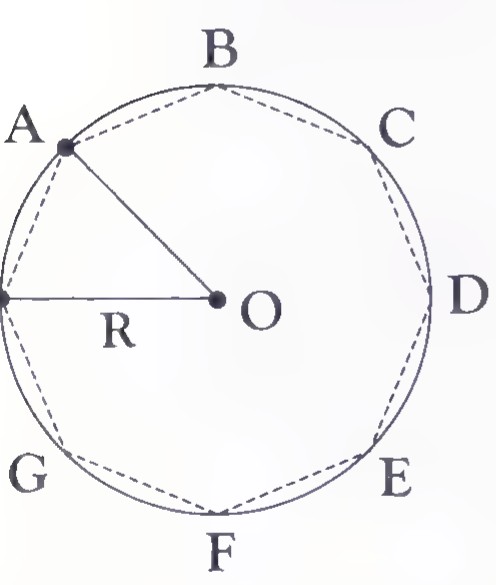
- What do you think the problem is?
- Show whether your guess seems to be correct.
- If your guess seems to be correct, use △AOH to prove it. (Hint: Draw △AOH on your paper and find its exact area by drawing the altitude from A to HO.)
Set III
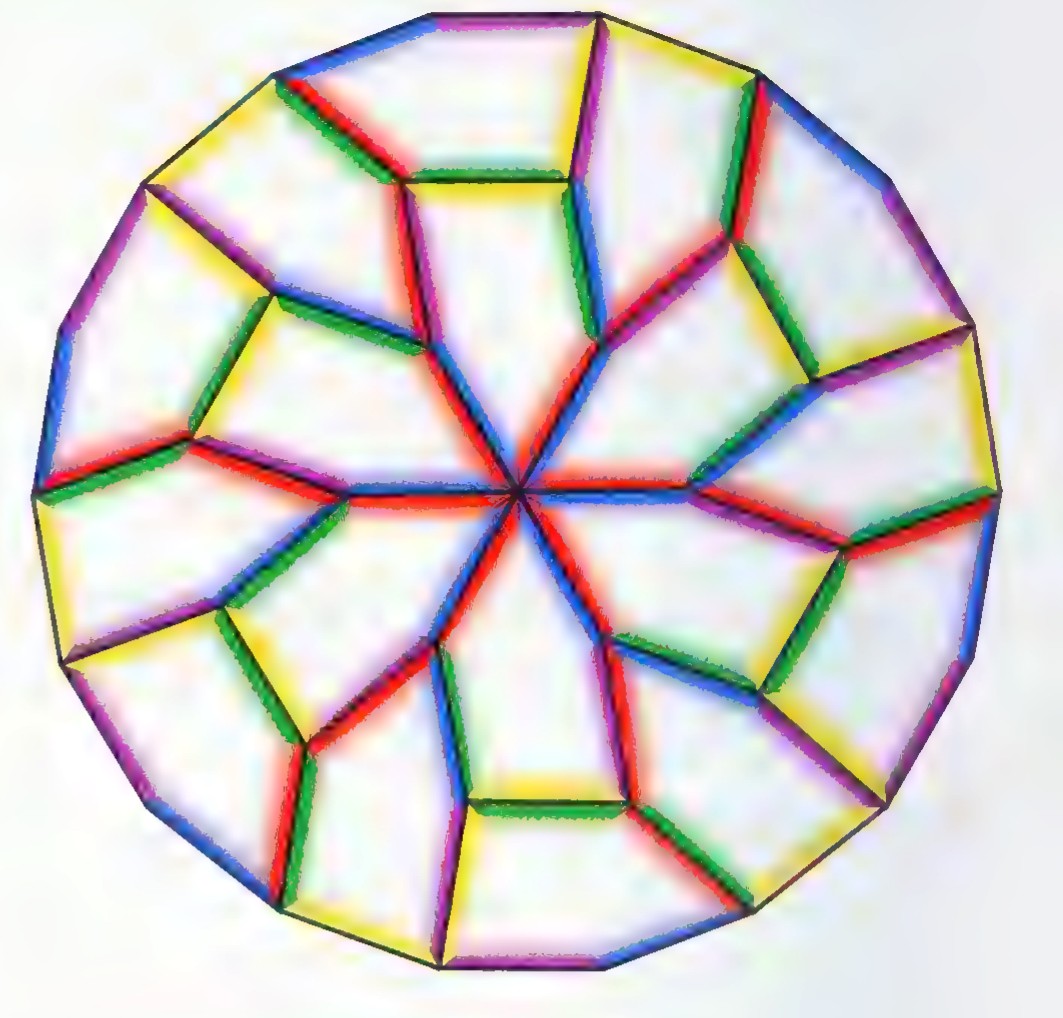
Congruent Pentagons. The figure above is based on a discovery by Marjorie Rice of San Diego, California. It consists of congruent pentagons, one of which has been enlarged below.
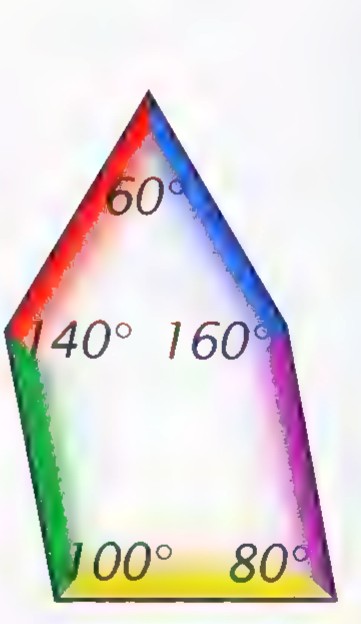
- From the arrangement, what can you conclude about the pentagons?
- What kind of shape is the boundary of the figure? Explain.
- Given that each line segment in it is 1 unit long, find the radius of the figure to two decimal places.
Find the area of
- the entire figure.
- one of the pentagons.
p. 591
Lesson 4: From Polygons to Pi
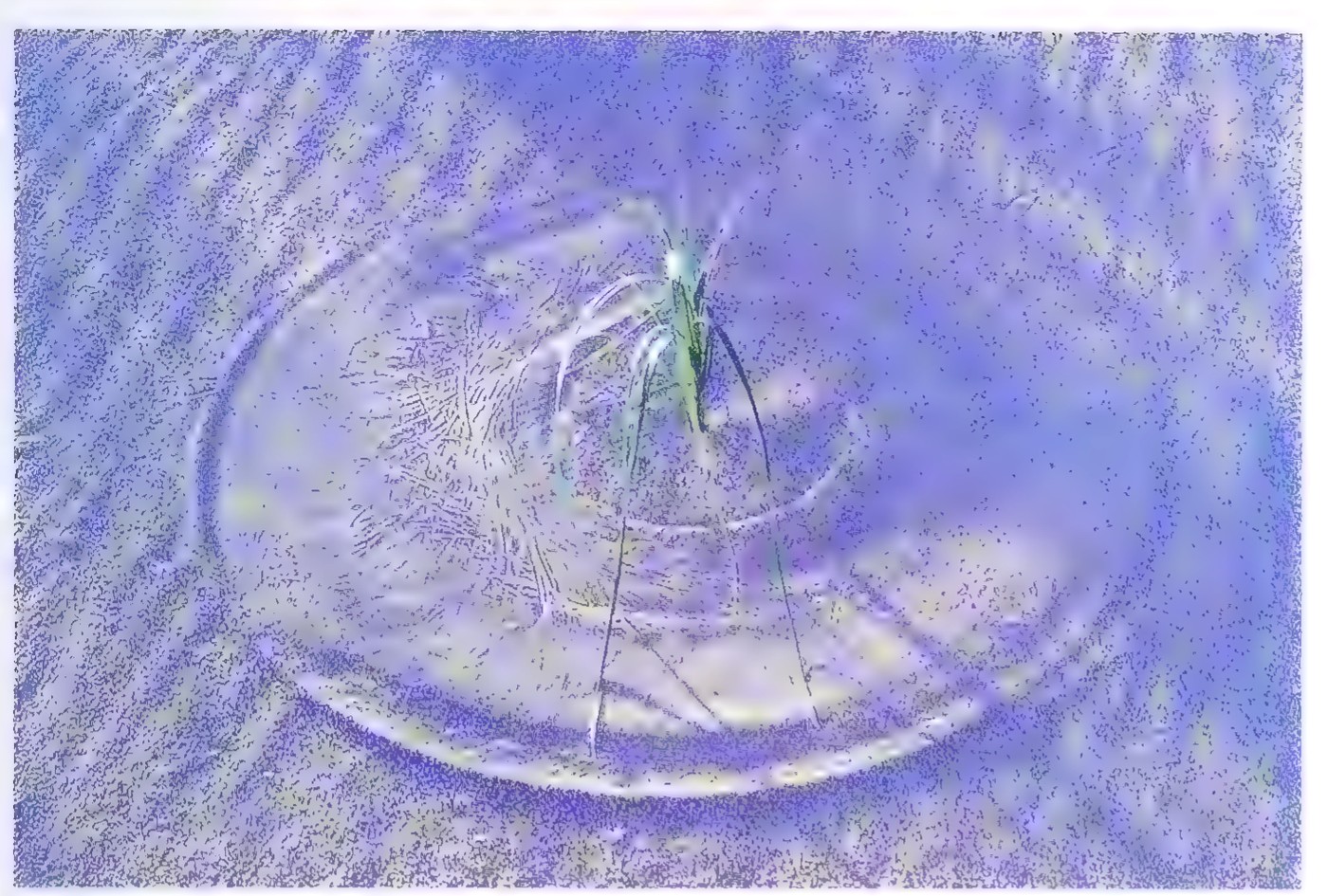
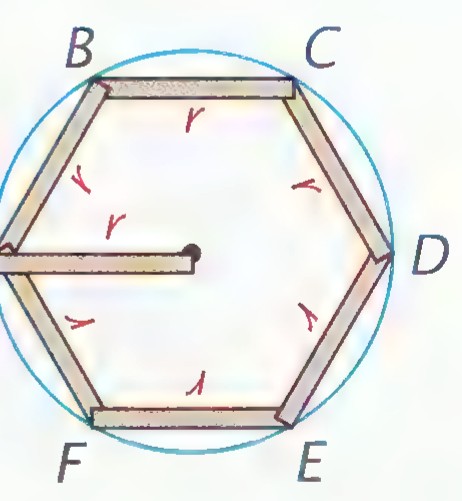
The circle in the photograph above, taken at the Great Sable Dunes in Michigan, was drawn by blades of grass blown by the wind! Imagine trying to measure the distance around it with a ruler. If the ruler were equal in length to the radius, r, of the circle, the figure at the right suggests that the result would actually be the perimeter, 6r, of the inscribed hexagon.
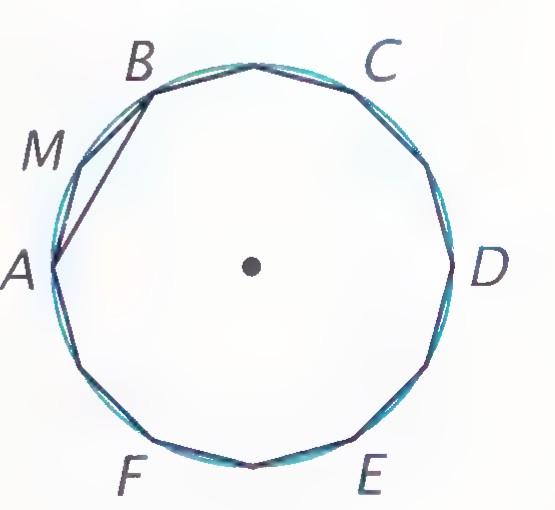
The six arcs of the circle are obviously longer than these chords. If we bisect each arc and draw the resulting chords to get a regular dodecagon, it follows from the Triangle Inequality Theorem that its perimeter must be greater than 6r. For example, in △AMB shown in the second figure at the right, AM + MB > AB.
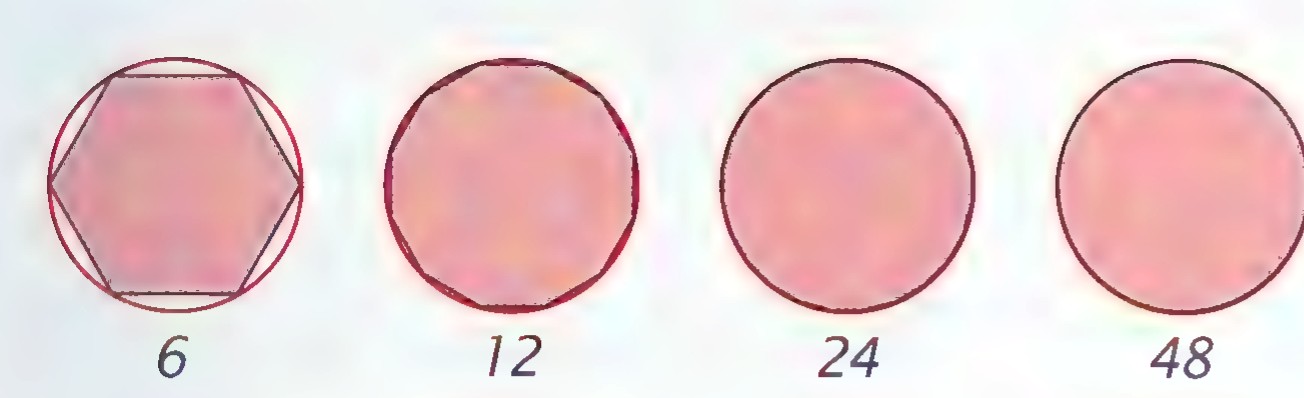
The Greek mathematician Archimedes, who lived in about 250 B.C., saw how he could find the circumference of a circle by using inscribed and circumscribed polygons. Beginning with a regular hexagon, Archimedes successively doubled the number of sides to get regular polygons of 12, 24, 48, and 96 sides. The more sides he used, the better his approximation to the circumference became.
p. 592
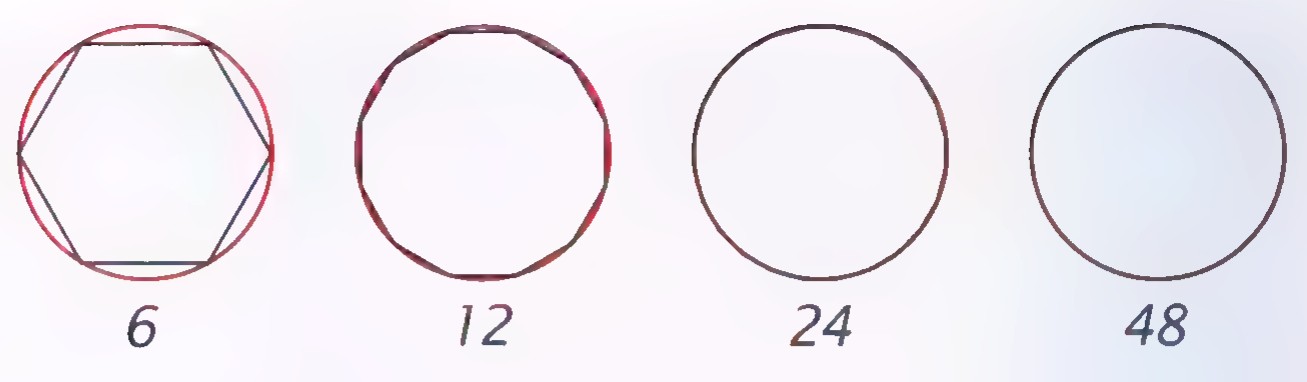
As the figures above reveal, the polygons become rounder and rounder until they are hard to distinguish from the circles in which they are inscribed. About 500 years after Archimedes, a Chinese mathematician named Liu Hui continued the doubling by using polygons with 192, 384, 768, 1536, and 3072 sides in his calculations.
From the triangle inequality argument, it is evident that the perimeters of the polygons keep getting larger. The polygons, however, are inscribed in the circles; so there is a limit to how large the perimeters can get. Intuitively, this limit is the “length,” or circumference, of the circle.
Neither Archimedes nor Liu Hui had the convenience of a calculator with which to do their computations. With your calculator, you can easily check some of the values of N given to eight digits in the table at the left.
| n | p = 2Nr |
|---|---|
| 6 | 2(3.0000000)r |
| 12 | 2(3.1058285)r |
| 24 | 2(3.1326286)r |
| 48 | 2(3.1393502)r |
| 96 | 2(3.1410319)r |
| 192 | 2(3.1414524)r |
| 384 | 2(3.1415576)r |
| 768 | 2(3.1415838)r |
| 1536 | 2(3.1415904)r |
| 3072 | 2(3.1415921)r |
| circle | 2πr |
From the table, it appears that N is getting closer and closer to a specific number. The number, its limit, is π. As a result, the perimeters of the polygons are getting closer and closer to the number 2πr. This finding suggests that the circumference of a circle should be defined as follows:
Definition
The circumference of a circle is the limit of the perimeters of the inscribed regular polygons.
This definition in turn suggests the following theorem, which we state without formal proof.
Theorem 77
If the radius of a circle is r, its circumference is 2πr.
Because the diameter of a circle is twice its radius, it follows from the equations c = 2πr and d = 2r that c = πd.
Corollary to Theorem 77
If the diameter of a circle is d, its circumference is πd.
Dividing both sides of the equation c = πd by d gives
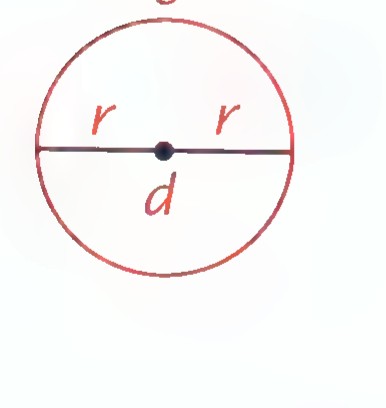
This result is the basis for the dictionary definition of π as “the ratio of the circumference of a circle to its diameter.”
p. 593
The number π is irrational; so its decimal form neither ends nor repeats. Its value is now known to more than 200 billion decimal places! Every scientific calculator has a key for it. Rounded to eight digits, sufficient for almost any calculation, π is
Exercises
Set I
Circumference. The formula c = 2πr relates the circumference of a circle to its radius.
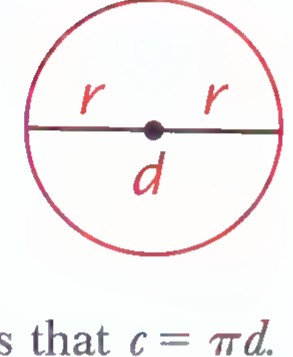
- Explain why it follows that c = πd.
What is the ratio of the circumference of a circle to its
- diameter? 3. radius?
Hat Sizes. To find your hat size, you need to know the size of your head.
Printed by permission of the Norman Rockwell Family Agency. © 1934 the Norman Rockwell Family Entries.
This chart shows two examples.
| Head size | Hat size |
|---|---|
| 22 | 7 |
| 22¾ | 7¼ |
- Find the ratio of each head size to the corresponding hat size.
The numbers in the chart are based on inches. What measurement of the hat do you think is given by
- your head size?
- your hat size?
The Moon’s Orbit. The orbit of the moon around Earth is close to being circular, with an average radius of 238,857 miles.
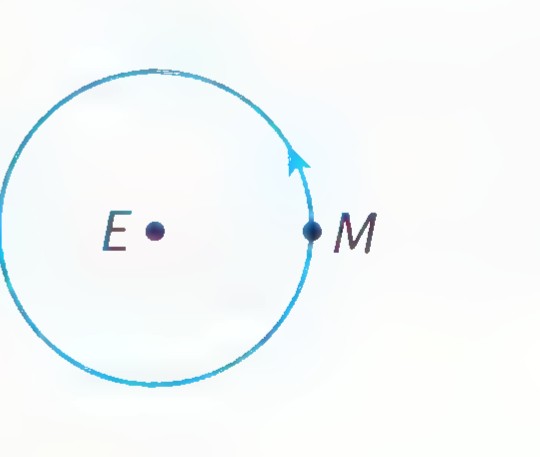
- Find the distance traveled by the moon in one orbit around Earth.
The moon’s average speed in orbiting Earth is 2,287 miles per hour.
Find the time that it takes the moon to travel once around Earth
- in hours.
- in days.
p. 594
Semicircles. In the figure below, three semicircles are centered at A, B, and C.
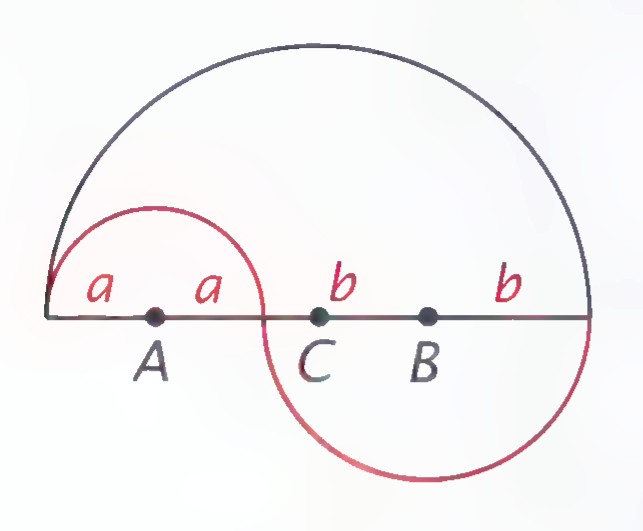
Express the following lengths in terms of a and b.
- The length of semicircle A.
- The length of semicircle B.
- The length of semicircle C.
- What can you conclude from these answers?
- Does the conclusion depend on the relative sizes of a and b?
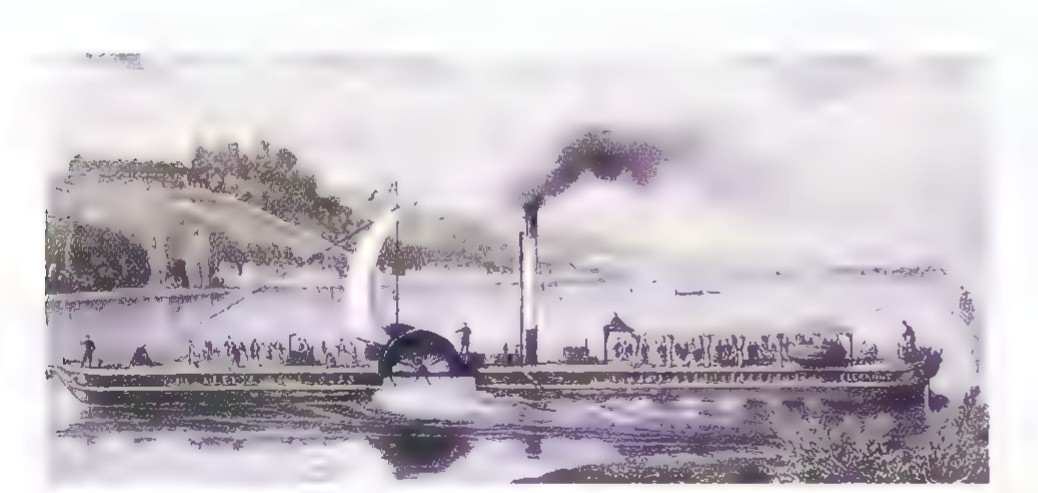
Steamboat Geometry. In designing his steamboat, Robert Fulton planned for it to travel 8 miles per hour.*
What speed is 8 miles per hour in
- feet per hour? (1 mile = 5,280 feet)
- feet per minute?
The paddle wheels were 14 feet in diameter.
- What was their exact circumference?
Fulton figured out the number of revolutions that the wheels would have to make per minute for the paddles, moving along their rims, to travel 8 miles per hour.
- Use your answers to exercises 16 and 17 to find the number that Fulton got.
Babylonian Problem. The following problem appears on a Babylonian clay tablet from about 1600 B.C.†
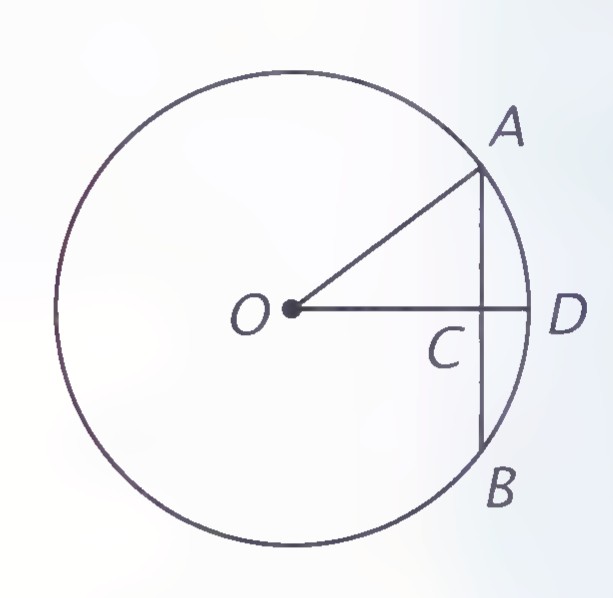
The circumference of circle O was given to be 60 units, OD ⊥ AB, and CD = 2.
- Copy the figure and mark it as needed to answer the following questions.
From the numbers used in the problem, it appears that the writer thought that π = 3. If π were equal to 3,
what would be the radius of the circle?
what would be the length of OC?
what would be the length of AC?
What is it about △OAC that suggests that the person who wrote the problem meant OA to be 10?
What relation must AC have to AB? Explain.
The problem was to find the length of the chord AB. What is it?
* The Innovators: The Engineering Pioneers Who Made America Modern, by David P. Billington (Wiley, 1996).
† The History of Mathematics: An Introduction, by David M. Burton (Allyn & Bacon, 1985).
p. 595
Viète’s Calculation. In the sixteenth century, French mathematician François Viète used a regular polygon having 393,216 sides to calculate the value of π.
- Letting n = 393,216, use your calculator to find .
- If it were carried out precisely, would Viète’s calculation give the exact value of π? Explain why or why not.
Perimeters and Diameters. Here we compare the ratios of perimeters to diameters for various figures. Use the figures below as a guide to seeing how these ratios depend on shape.
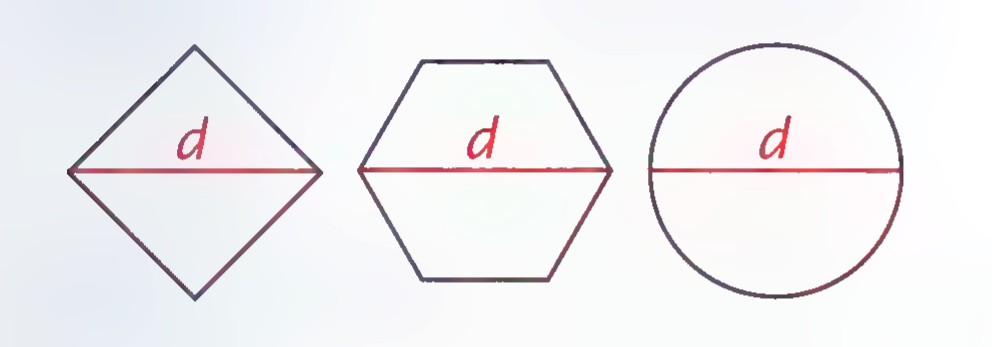
- Find the exact ratio of the perimeter of a square to the length of one of its diagonals, its diameter.
- Find the value of this ratio to two decimal places.
- Find the ratio of the perimeter of a regular hexagon to the length of one of its longest diagonals, its diameter.
- Find the exact ratio of the circumference of a circle to the length of one of its longest chords, its diameter.
- Find the value of this ratio to two decimal places.
- What would you guess the approximate ratio of the perimeter of a regular 100-gon to the length of one of its longest diagonals to be?
- Check your answer by using the formula for the perimeter of a regular polygon.
Set II
Going in Circles. Whether awake or asleep, you are always traveling in circles. In 1 day (24 hours), Earth rotates once on its axis.
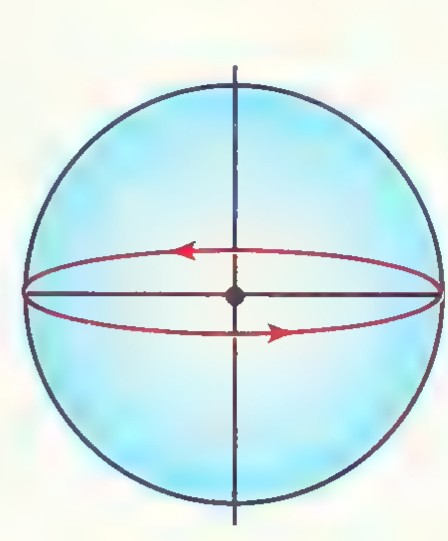
- Given that Earth’s radius is 3,960 miles, find the approximate length of the equator.
- How far does someone living on the equator travel about Earth’s axis in 1 hour?
- Owing to Earth’s rotation, how fast is that person traveling in miles per hour?
In 1 year, Earth travels once around the sun.
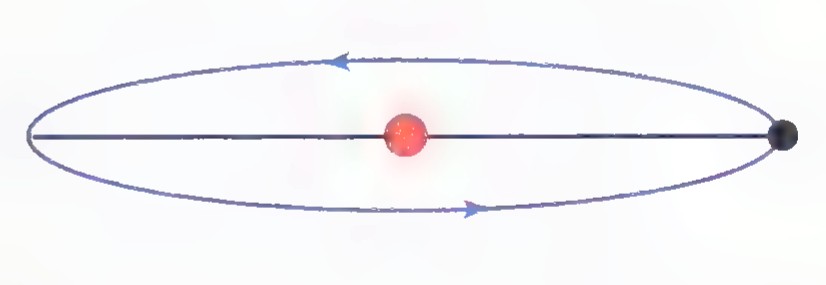
- Given that the radius of Earth’s orbit is about 93,000,000 miles, find its approximate circumference.
- How far does Earth travel in 1 day?
- How far does it travel in 1 hour?
- Owing to Earth’s motion around the sun, how fast are you traveling in miles per hour?
- How fast are you traveling in miles per second?
p. 596
Two Squares. In the figures below, circles O and P have the same radius, r.
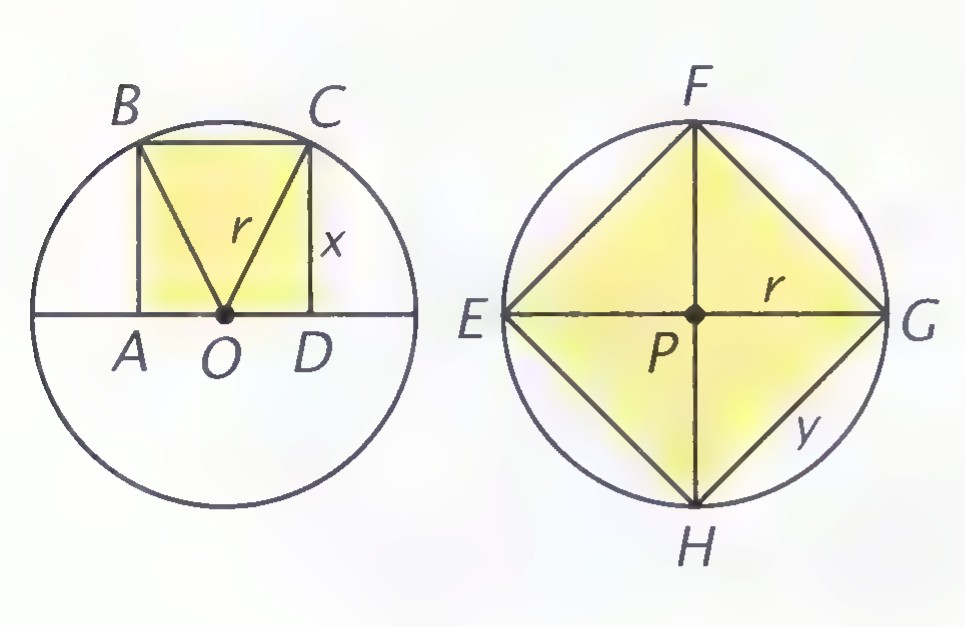
ABCD is a square with side AD lying on a diameter of circle O. EFGH is a square inscribed in circle P.
- Why is △ABO ≅ △DCO? Explain.
- Express OD in terms of x.
- Express r² in terms of x².
- Express r² in terms of y².
- Express x² in terms of y².
- How does the area of ABCD compare with the area of EFGH?
SAT Problem. This problem appeared on an SAT exam.
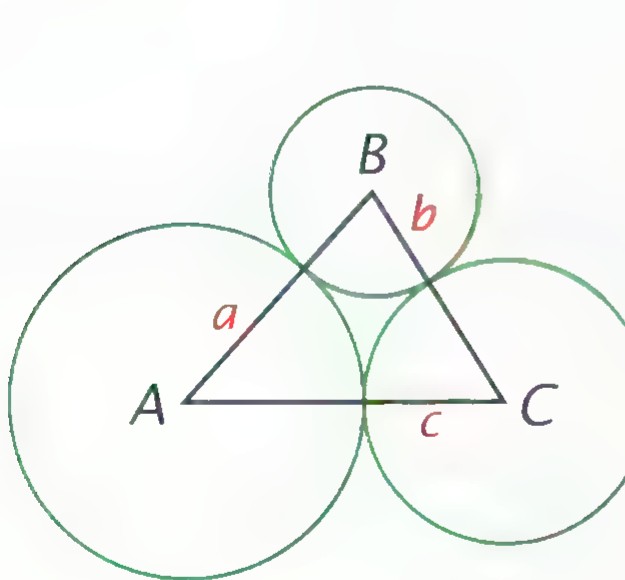
The circles with centers A, B, and C have three points of contact as shown.
Letting a, b, and c be the respective radii of the three circles, find
- the perimeter of △ABC.
- the sum of the circumferences of the three circles.
- the ratio of the perimeter of △ABC to the sum of the circumferences of the three circles.
Videotape. A VHS videotape playing at SP speed moves through the recorder at the rate of 1.375 inches per second.*
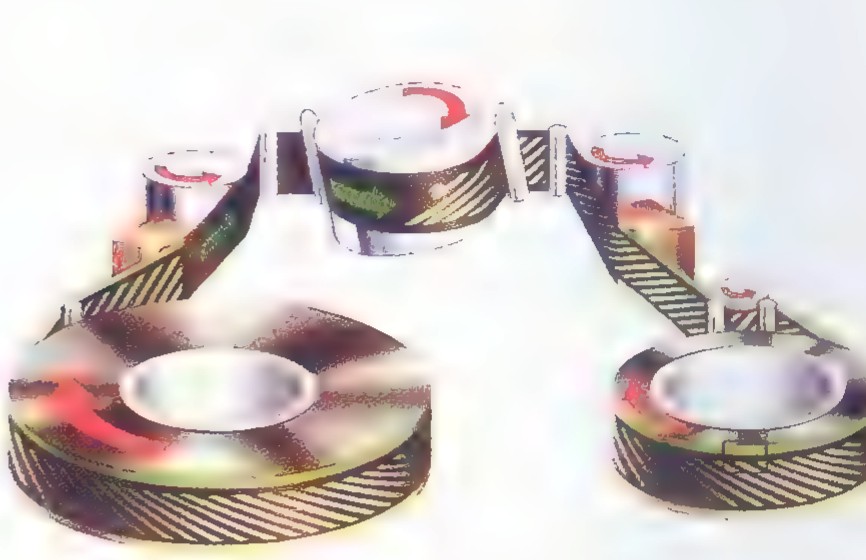
- Given that the tape plays for 2 hours, how many feet long is it?
When the take-up reel is empty, it has a radius of 0.5 inch.
- What length of tape does it take up in its first revolution?
When the take-up reel is full, it has a radius of 1.5 inches.
- What length of tape does it take up in its last revolution?
- What length of tape do you think it takes up during an average revolution?
- On the basis of your answer to exercise 55, about how many times does the take-up reel turn in 2 hours?
* Scientific American: How Things Work Today, edited by Michael Wright and M. N. Patel (Crown, 2000).
p. 597
Kochansky’s Construction. Here is a remarkable construction discovered by Adam Kochansky, a Jesuit priest, in 1685.
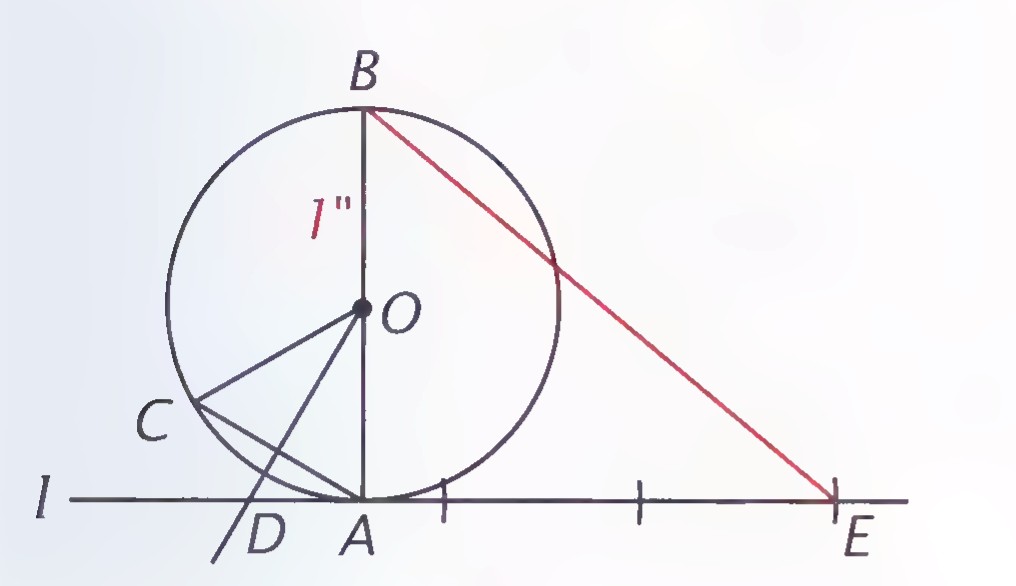
Construct the figure above by doing each of the following steps.
Draw circle O with radius 1 inch, and draw diameter AB.
Construct line l ⊥ AB at A.
With A as center and AO as radius, draw an arc intersecting the circle at C. Draw △COA.
Bisect ∠COA and let D be the point in which it intersects l.
Starting at D, mark off three arcs with radius AO along line l.
Let E be the endpoint of the third arc as shown, and draw BE.
What kind of triangle is
- △OCA?
- △ODA?
Find each of the following lengths to as many decimal places as you can.
- DA.
- AE.
- BE.
- What is interesting about the length of BE?
Set III
Tire Change. The introduction to a book for automotive enthusiasts begins with these words:
If you’re seriously interested in automobiles and how they perform, sooner or later you’ll have to deal with mathematics. Virtually all aspects of motor sports, from bore and stroke, through power and torque, to time and speed, involve mathematical calculations.*
One of the many practical problems considered in the book follows:
Someone with a four-wheel-drive truck with 28.9-inch-diameter tires replaces them with 33-inch tires to increase the ground clearance. If the truck’s speedometer was accurate with the original tires, how fast would the truck actually be going on the new tires when the speedometer reads 70 mph?
Can you show, by using your knowledge of the circumference of a circle, how to solve the problem?
* Auto Math Handbook, by John Lawlor (HP Books, 1991).
p. 598
Lesson 5: The Area of a Circle
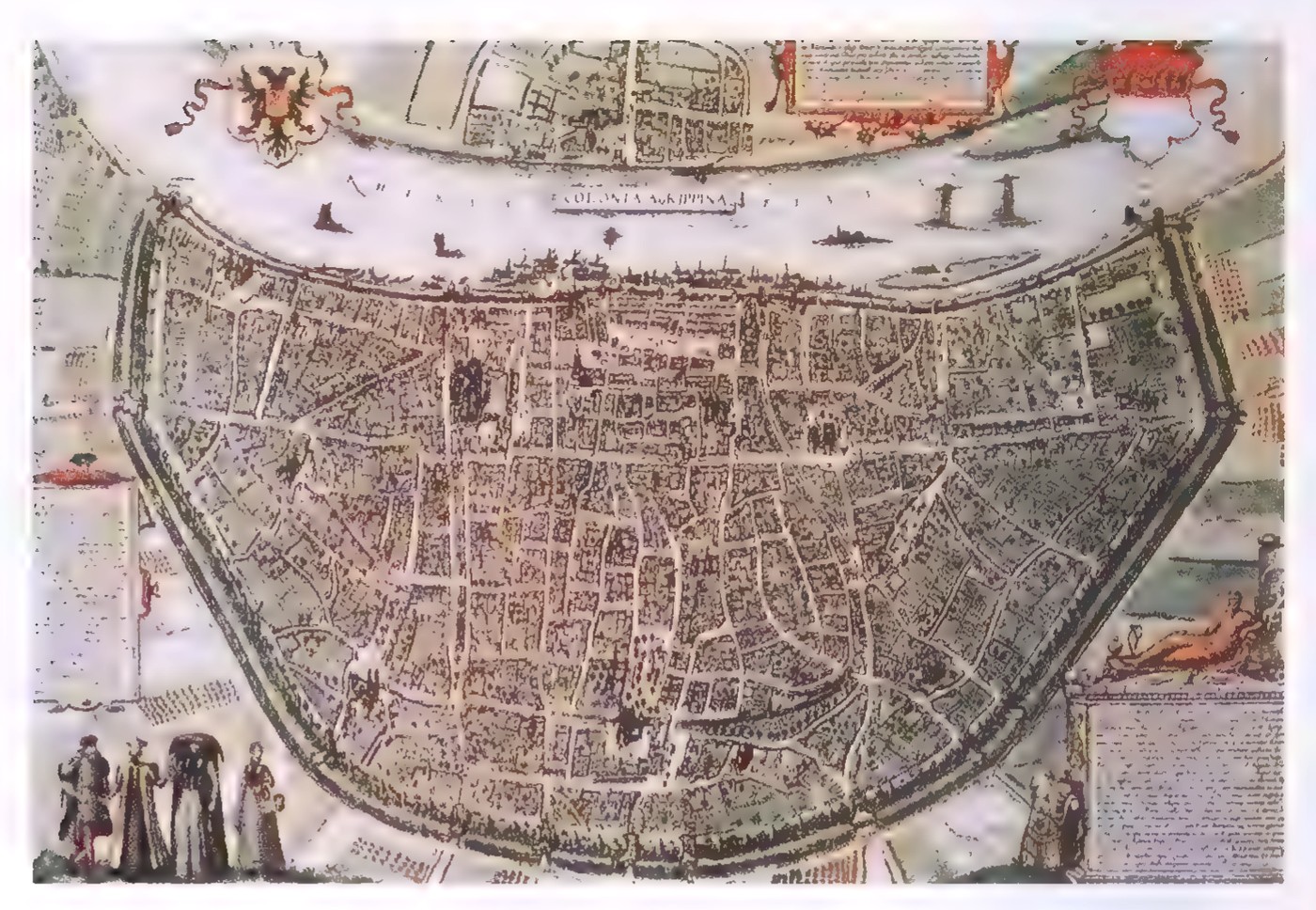
The German city of Cologne was originally a colony of the Roman Empire. Located on the Rhine River, the city took the shape of half a circle in 1180 when a semicircular wall was built to protect it. On the medieval map of the city shown above, it is called “Colonia Agrippina,” the name that it was given in 50 A.D.
Why was the wall built with a semicircular shape? The reason is that, for walls of a given length built against a boundary such as this river, a circular wall encloses the greatest area.
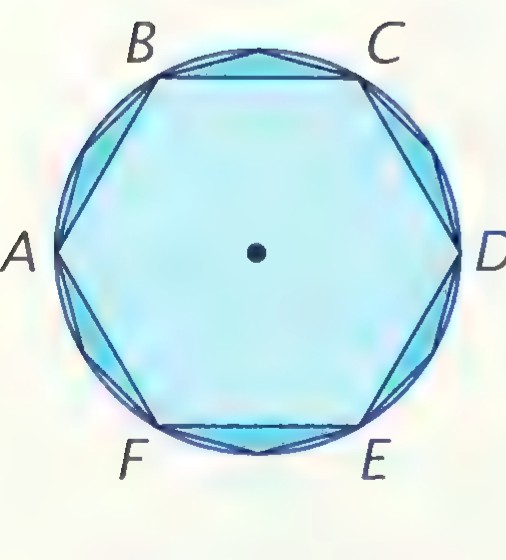
We have learned that, to measure the circumference of a circle, Archimedes and others following him thought of it as the limit of the perimeters of the inscribed regular polygons. Each time the arcs of the circle are bisected and chords are drawn to produce the next polygon, the new polygon looks more like the circle. The areas enclosed by the successive polygons increase because of the new triangles that result. There is a limit, however, to how large these areas can get. The area of the circle is defined to be this limit.
Definition
The area of a circle is the limit of the areas of the inscribed regular polygons.
p. 599
The table at the right shows what happens to the area of a regular polygon as n, the number of sides, is successively doubled. The first eight digits of M are given, and it is apparent that, like N, M is getting closer and closer to a specific number and that number is π. Hence, the areas of the polygons are getting closer and closer to the number πr².
This finding suggests the following theorem, which we state without formal proof.
Theorem 78
If the radius of a circle is r, its area is πr².
| n | a = Mr² |
|---|---|
| 6 | (2.5980762)r² |
| 12 | (3.0000000)r² |
| 24 | (3.1058285)r² |
| 48 | (3.1326286)r² |
| 96 | (3.1393502)r² |
| 192 | (3.1410319)r² |
| 384 | (3.1414524)r² |
| 768 | (3.1415576)r² |
| 1536 | (3.1415838)r² |
| 3072 | (3.1415904)r² |
| circle | πr² |
The walled city of Cologne had a radius of 0.9 mile. Because the city occupied roughly half a circle, its area was about square miles.
Suppose that, instead of having the shape of half a circle, Cologne had the shape of half a square. With the use of the figures shown at the right, it is easy to show that, if the protecting walls were the same length, the area of the half-square would be less than that of the half-circle.
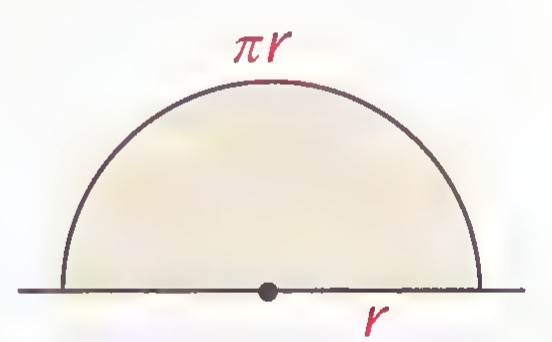
If the radius of the semicircular wall is r, its length is and the area of the city is . If a wall of the same length surrounded half a square, its dimensions would be and . The area of the city would be .
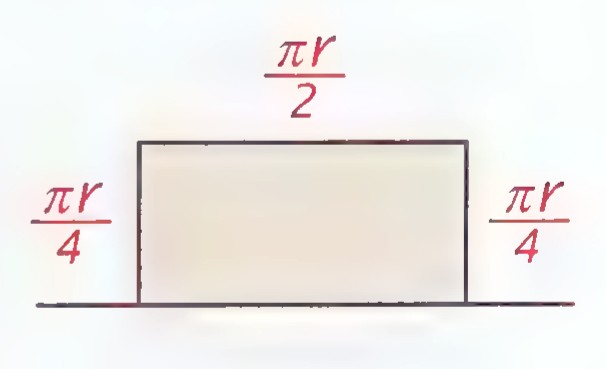
Using a calculator to compare these areas, we get
This comparison shows that the semicircular wall encloses a greater area than does the “semisquare” wall. Perhaps surprisingly, this result is obtained for every shape other than a semicircle that you might think of. No matter what other shape the citizens of Cologne might have chosen for their wall, mathematicians have since proved that the semicircle is the best.
p. 600
Exercises
Set I
Hurricanes. A hurricane is a circle of wind and clouds that spins like a top. At its center is the “eye of the storm,” a circular region of relative calm.

A typical hurricane has a radius of about 150 miles.* What is its approximate
- diameter?
- circumference?
- area?
The area of the eye can be as much as 700 square miles. What is its approximate
- radius?
- circumference?
Square and Circular Inches. Although a square inch is a familiar unit of area, few people other than electricians have heard of a circular inch.
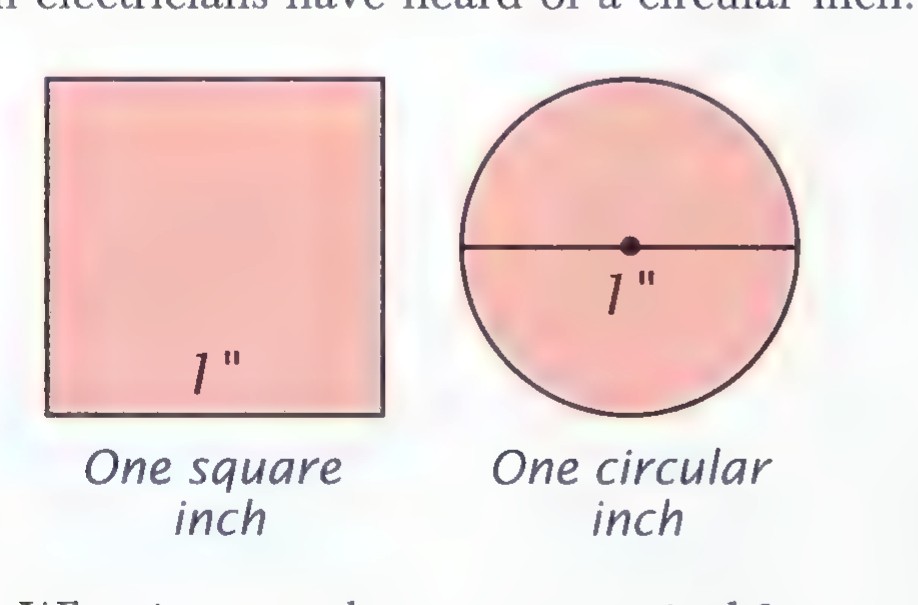
- What is meant by one square inch?
- Judging from the figure above, what is meant by one circular inch?
* Waves, Wind and Weather, by Nathaniel Bowditch (David McKay Company, 1977).
- Which unit of area is larger?
- If two squares have sides of x inches and 1 inch, what is the ratio of their areas?
- What is the area in square inches of a square with sides of 10 inches?
- If two circles have diameters of x inches and 1 inch, what is the ratio of their areas?
- What is the area of a circle in circular inches with a diameter of 10 inches?
Ripples.
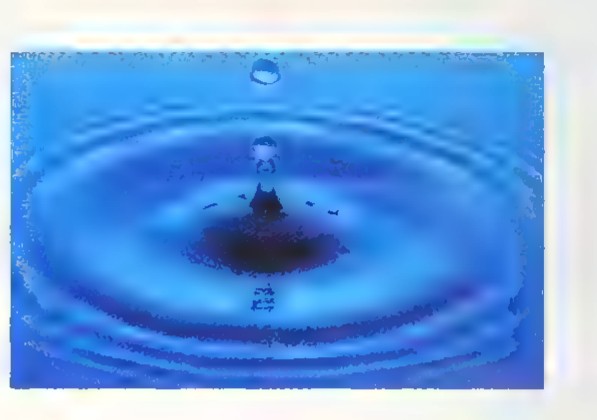
A problem in a calculus book states:
A stone is dropped into a lake, creating a circular ripple that travels outward at a speed of 60 centimeters per second. Express the area of this circle as a function of time t (in seconds).†
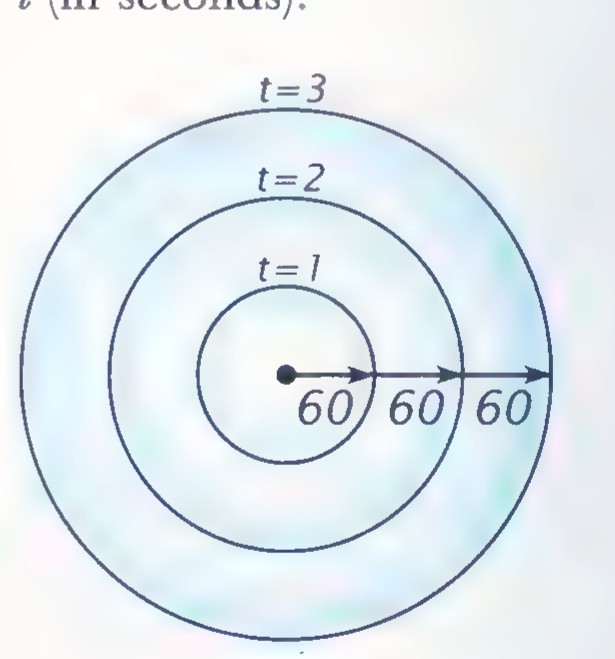
- Find the radius of the ripple at the end of 1 second.
- Find its area (in terms of π) at the end of 1 second.
- Find the radius of the ripple at the end of t seconds.
- Find its area (in terms of π) at the end of t seconds.
† Calculus, by James Stewart (Brooks/Cole, 1995).
p. 601
Equal Areas. In his book Measurement of a Circle, Archimedes compared the areas of the circle and right triangle shown below.
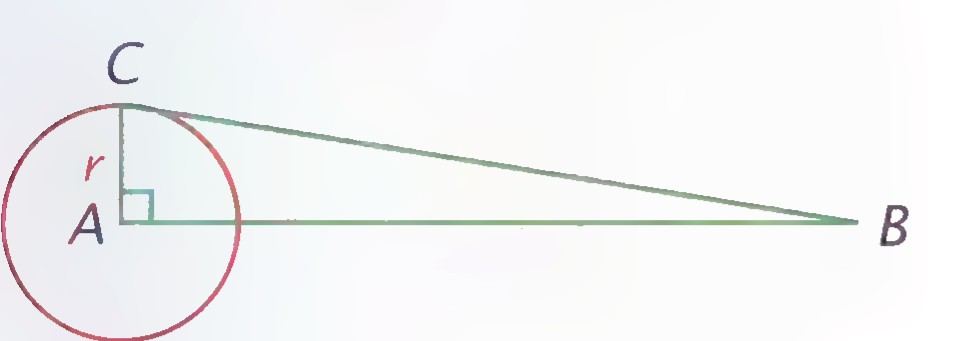
- If the areas are equal, what would AB equal? Explain.
Central-Pivot Irrigation. In central-pivot irrigation, a sprinkler pipe rotates about one end to water a circular area.
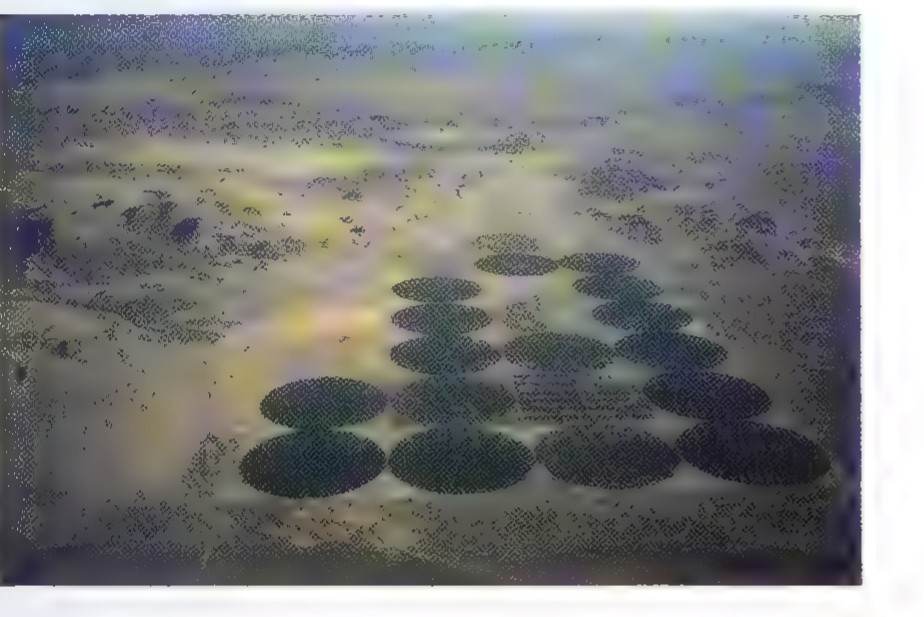
- In which of the two arrangements shown below do you think the watered area would be greater?
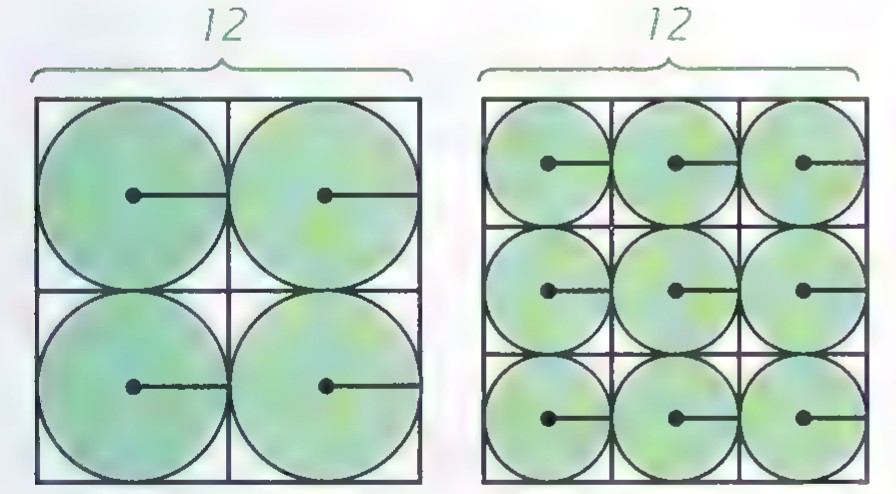
Express in terms of π the area watered in
- the left-hand arrangement.
- the right-hand arrangement.
- How do the watered areas actually compare?
Pi Square. The side of the square in the figure below is equal to the radius of the circle.
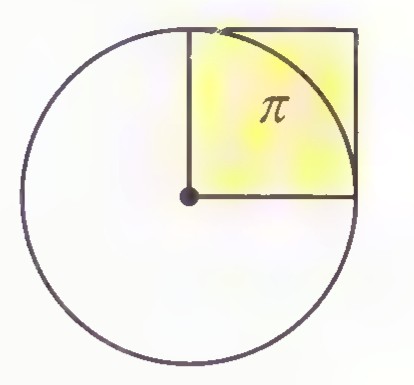
Given that the area of the square is π, find
- the exact length of each of its sides.
- the area of the circle.
- the ratio of the area of the circle to the area of the square.
Circle on a Grid. The figure below shows a circle drawn on a square grid. The number, P, of corner points of the grid on or inside the circle, shown in red, is 113.*
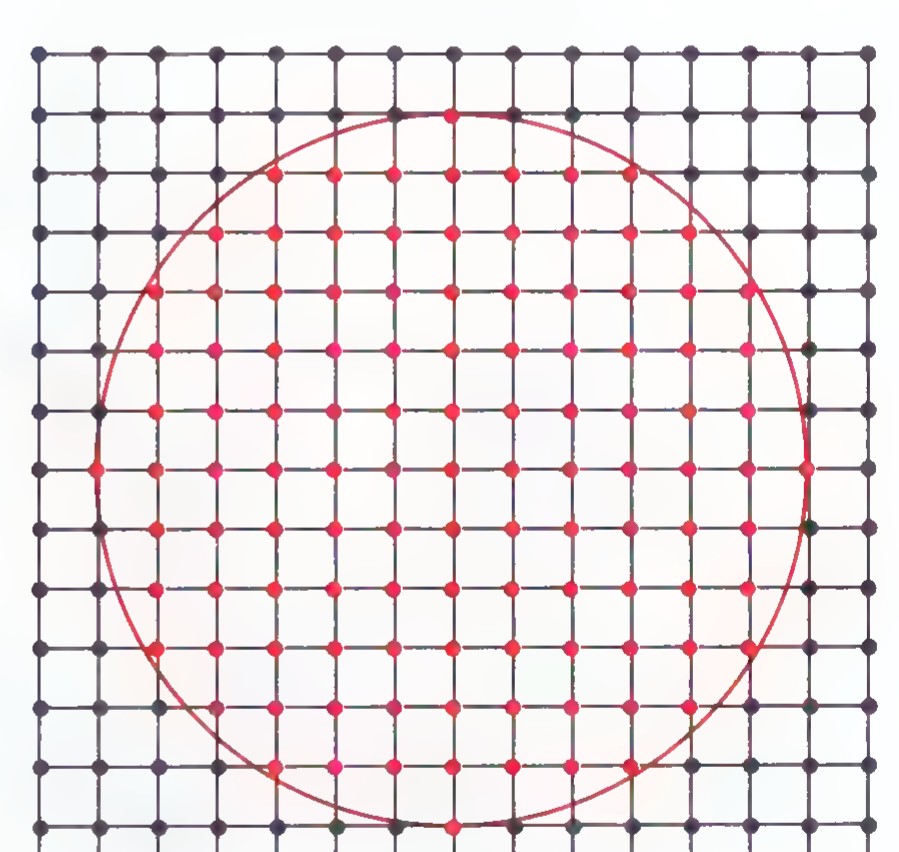
- Given that the sides of the small squares on the grid are 1 unit, what is the radius, r, of the circle?
- Find the value of .
* Geometry and the Imagination, by David Hilbert and Stephan Cohn-Vossen (Chelsea, 1952).
p. 602
If the circle were larger, with r = 20, the number of corner points on or inside it would be 1,257.
- Find the value of .
If the circle were even larger, with r = 300, the number of corner points on or inside it would be 282,697.
Find the value of .
What do these results suggest about the limit of the ratio as r increases?
Approximately how many corner points do you think would be on or inside a circle with r = 100?
Set II
Area Problems. Write an expression in terms of x² for the area of the shaded region in each of the following figures.
Example:
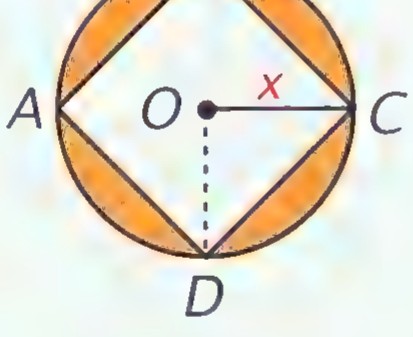
Square ABCD is inscribed in circle O.
Solution: The area of the circle is πx² because its radius is x. △OCD is an isosceles right triangle with OC = x; so . The area of the square is . So the shaded area is .
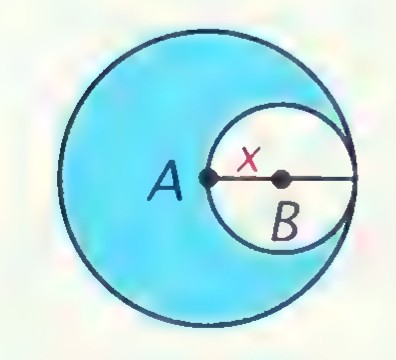
The centers of the circles are A and B.
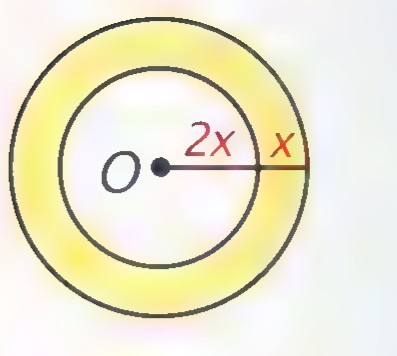
The two circles are concentric with center O.
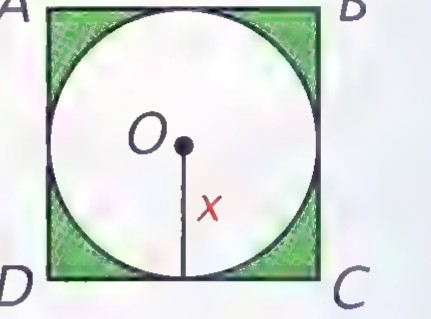
Circle O is inscribed in square ABCD.
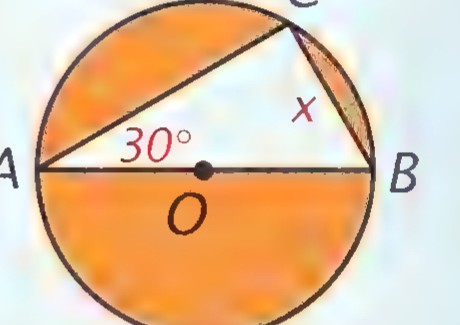
Right △ABC is inscribed in circle O.
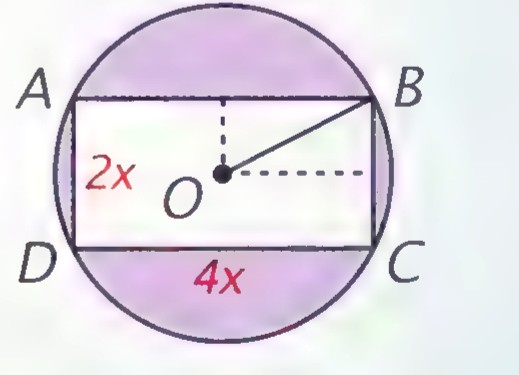
Rectangle ABCD is inscribed in circle O.
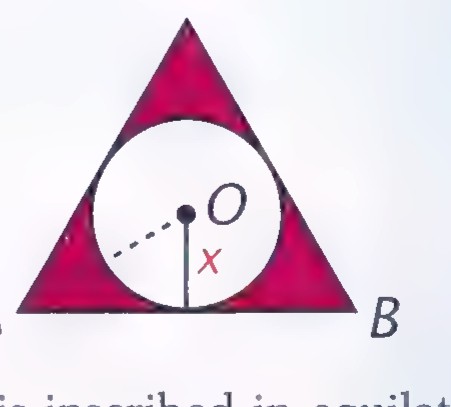
Circle O is inscribed in equilateral △ABC.
p. 603
Cable Disaster. The following story is true.*
A rigger in a steel mill noticed that a cable on a crane was damaged. Its diameter was 1 inch but the only cable available had a diameter of ½ inch. The foreman told the rigger to replace the 1-inch cable with two ½-inch cables. After this had been done, the new cables snapped, 10 tons of steel fell 25 feet, and several workers were almost killed.
- Make a scale drawing to show the 1-inch cable and the two ½-inch cables.
The foreman’s reasoning was wrong.
- What do you think should have been done instead? Explain your thinking.
Slicing a Circle. The figure below is from a book by the seventeenth-century Japanese mathematician Sawaguchi Kazuyuki.†
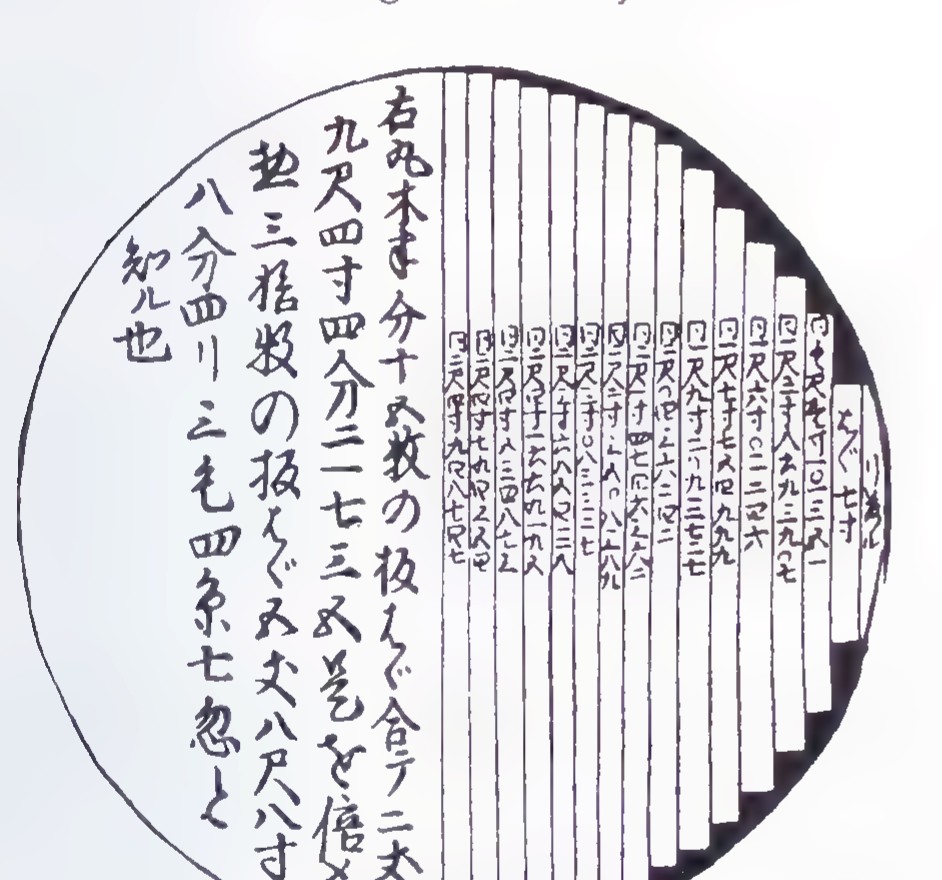
- On graph paper, draw a pair of axes extending 10 units to the right and 10 units up from the origin.
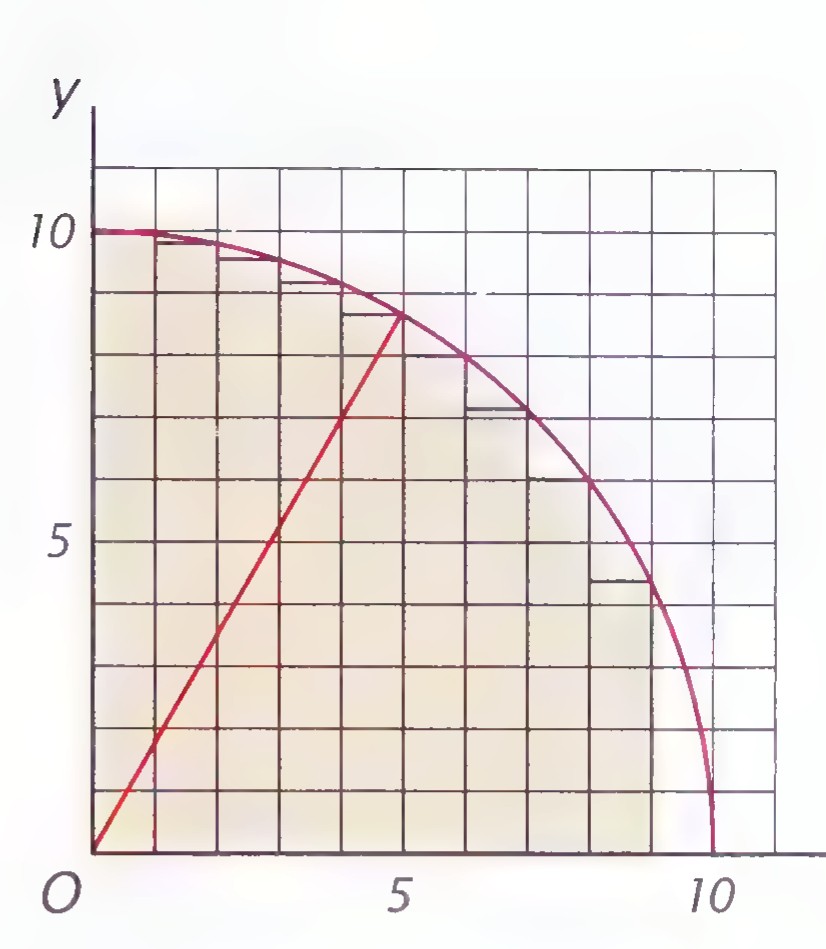
(1) Use your compass to draw a quarter of a circle with its center at O and a
    radius of 10 units as shown in the figure above.

(2) Use your ruler to draw rectangular strips 1 unit wide inside the quarter
circle as shown.- Explain why the exact area of the fifth strip is .
- Find the exact areas of the other eight strips.
- Use your calculator to find the sum of the areas of the nine strips to one decimal place.
- On the basis of this answer, estimate the area of a circle with radius 10 to the nearest integer.
- How would you expect your answer to compare with the actual area of the circle? Explain.
If the same method were used, but with strips half as wide, the sum of the areas of the 19 strips would be 75.7 to one decimal place.
- Why would you expect this answer to lead to a better estimate of the area of the circle than the preceding one?
- How could this method be continued to get better and better estimates of the area of the circle?
* A History of the Circle: Mathematical Reasoning and the Physical Universe, by Ernest Zebrowski, Jr. (Rutgers University Press, 1999).
† A History of Japanese Mathematics, by David Eugene Smith and Yoshio Mikami (Open Court, 1914).
p. 604
Tangent Circles. In the figure below, the centers of the three circles are on XY. The radii of the two smaller circles are a and b.
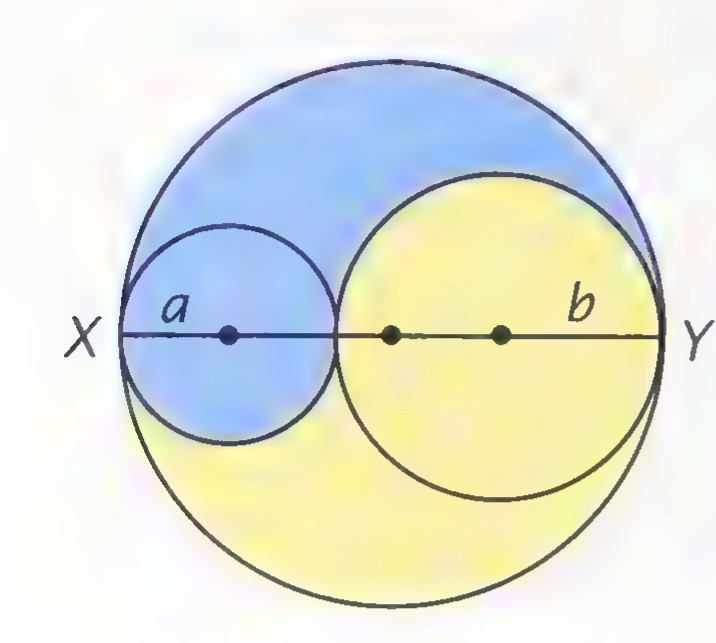
- What is the radius of the large circle?
Write an expression in terms of a and b for
- the blue area.
- the yellow area.
- Write an expression for the ratio of the blue area to the yellow area and simplify it.
- If a = b, does your ratio make sense? Explain.
- Write an expression for the ratio of the border of the blue area to the border of the yellow area.
Set III
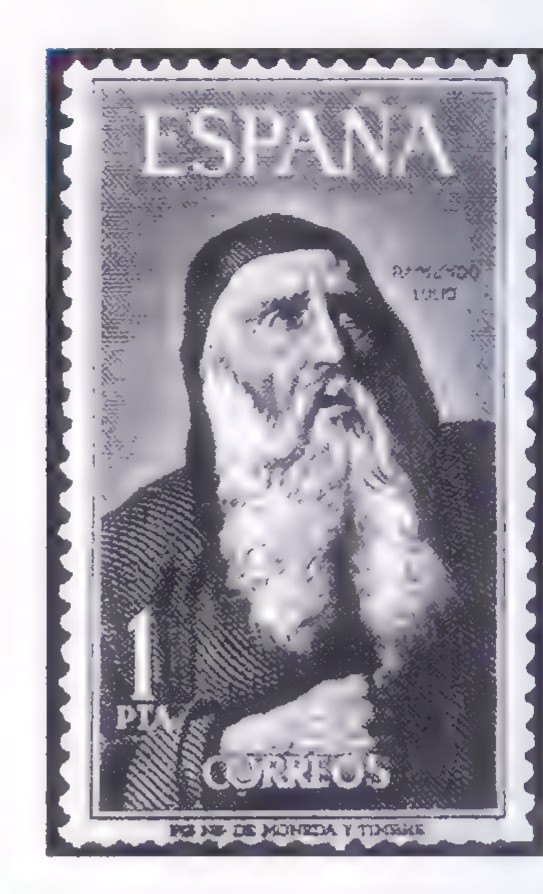
Lull’s Claim. A famous thirteenth-century poet and mystic named Ramon Lull claimed that the circle and middle square in the figure below have the same perimeter and area.
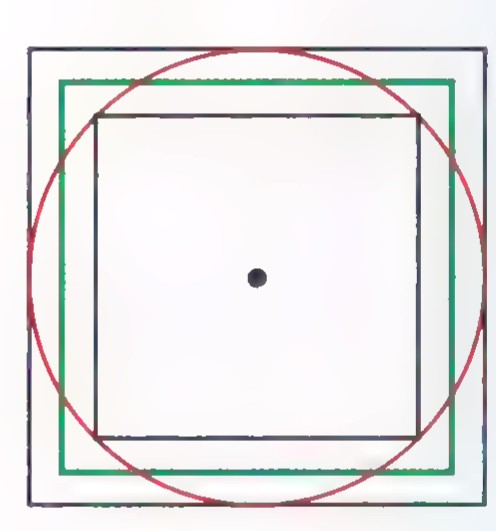
It is possible to decide whether Lull’s claim is correct without even considering the geometry of the figure.
Suppose the radius of the circle is r and the side of the middle square is s. Write an equation stating that the circle and the middle square have
the same perimeter.
the same area.
What happens when you solve your system of two equations for π?
p. 605
Used by permission of Tom Henderson.
Lesson 6: Sectors and Arcs
When a pizza is cut into slices, they usually have the shape of sectors. A sector of a circle is a region bounded by an arc of the circle and the two radii to the endpoints of the arc.
If a circle is divided into sectors with equal arcs, the sectors are congruent to one another and have equal areas. With the use of this fact, it is easy to find the area of each one. For example, if a pizza with a radius of 12 inches is cut into eight equal pieces, the area of each piece is
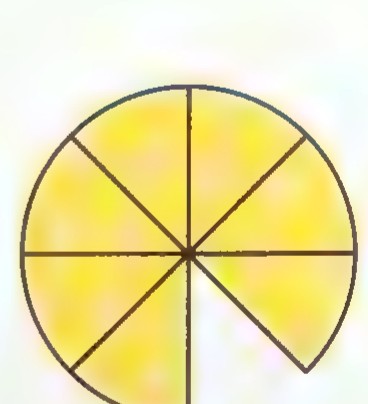
Because the border of the pizza (the 360° arc of a circle) also is divided into eight congruent pieces, each sector has an arc (and central angle) with a measure of
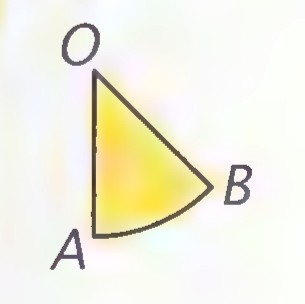
The lengths of these eight equal arcs add up to give the circumference of the circle; so each arc has length
p. 606
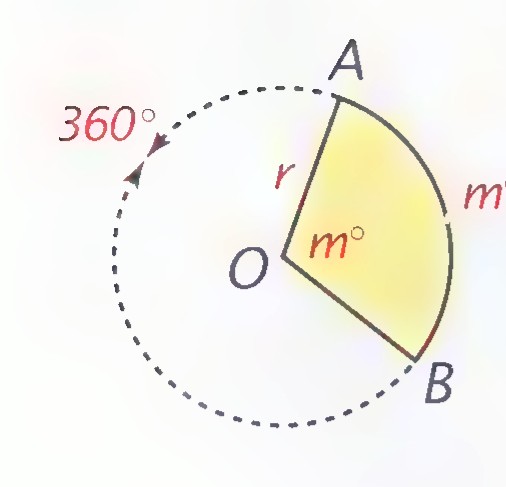
These examples illustrate the general pattern. Suppose that the central angle (and hence arc) of a sector has a measure of m° and that the radius of the sector is r. Because the arc of every circle has a measure of 360°, the area of the sector must be times the area of the circle, or . The length of its arc is times the circumference of the circle, or .
The idea is simple:
If a sector is a certain fraction of a circle, then its area is the same fraction of the circle’s area. If an arc is a certain fraction of a circle, then its length is the same fraction of the circle’s circumference.
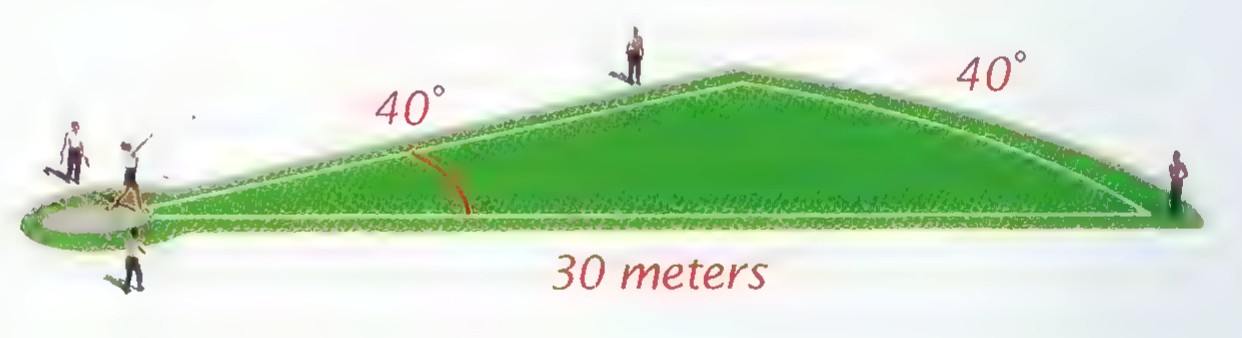
In sports events such as the shot put and the discus and hammer throws, the region into which the object is thrown is in the shape of a sector. In the Olympics, the angle of the sector in each of these events has a measure of 40°. For the shot put, the radius is usually about 30 meters. To find the area of the shot-put sector, we can reason as above:
The shot put is thrown into a region having an area of about 314 square meters.
Exercises
Set I
Orange Slices. The photograph at the left shows oranges sliced in half to reveal eight equal parts.
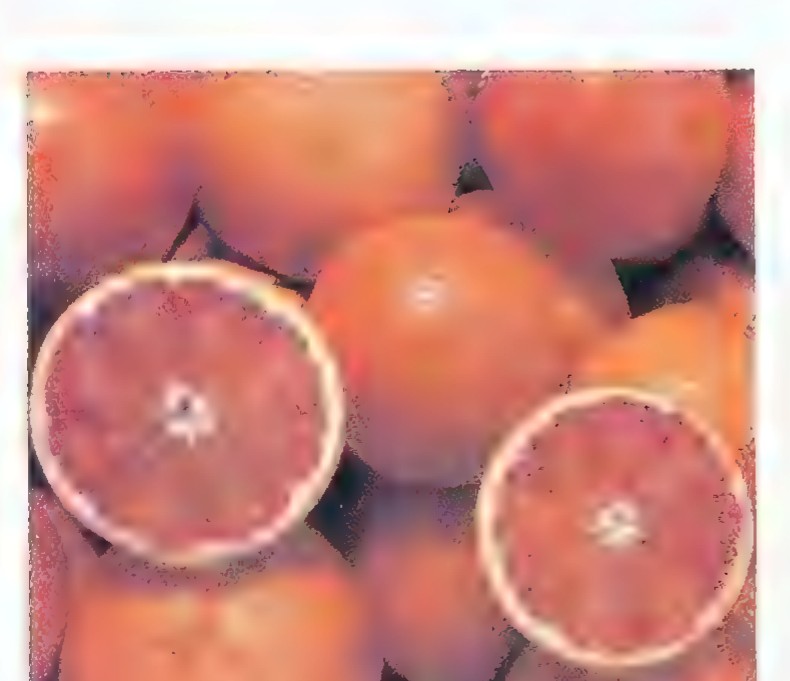
- What is the shape of each part?
- What is the degree measure of its arc?
Given that the radius of the orange is r, what is
- the length of each arc?
- the area of each part?
p. 607
Sonar Beams. A dolphin projects a beam of sound in front of it to find food and avoid obstacles.*
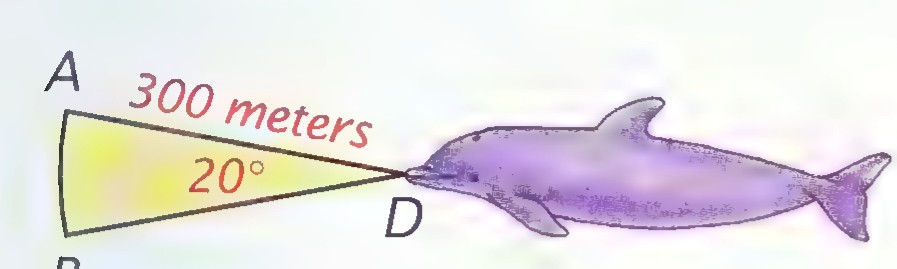
What does each of the following expressions represent?
- .
- .
Find
- the length of to the nearest meter.
- the area of sector DAB to the nearest hundred square meters.
Latitude. Latitude measures how many degrees north or south you are of the equator.
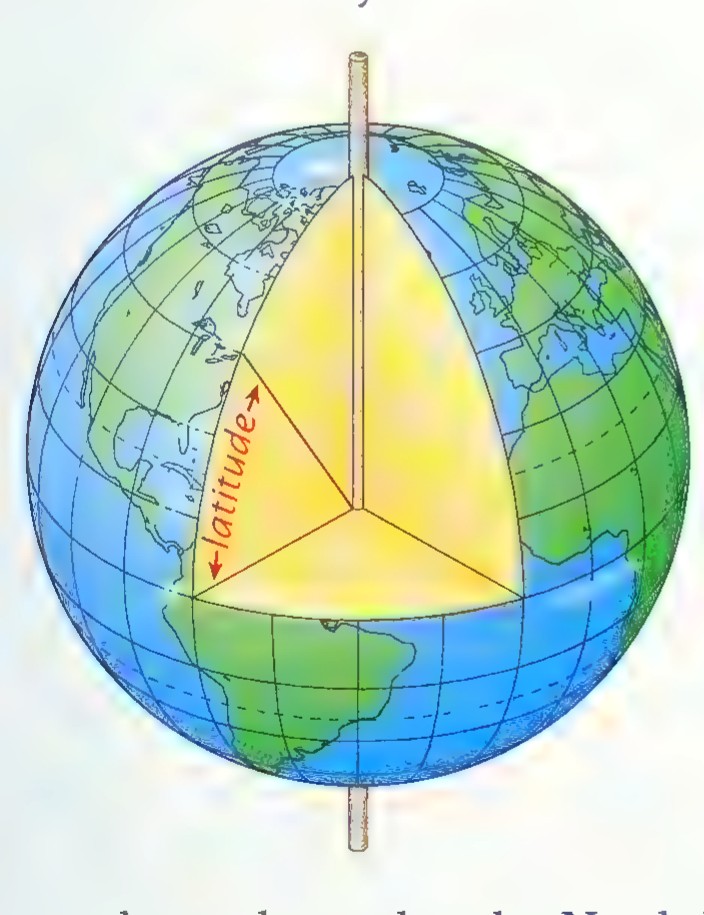
The figure above shows that the North Pole is 90° from the equator.
- Given that the radius of the earth is 3,960 miles, how many miles is it from the equator to the North Pole?
* Animal Navigation, by Talbot H. Waterman (Scientific American Library, 1989).
- How far north do you travel when you increase your latitude by 1°?
The latitude of the Hawaiian Islands is 20°N.
- How far are they from the equator?
Driveway Design. The figure below shows the design of a “Y turn” residential driveway.†
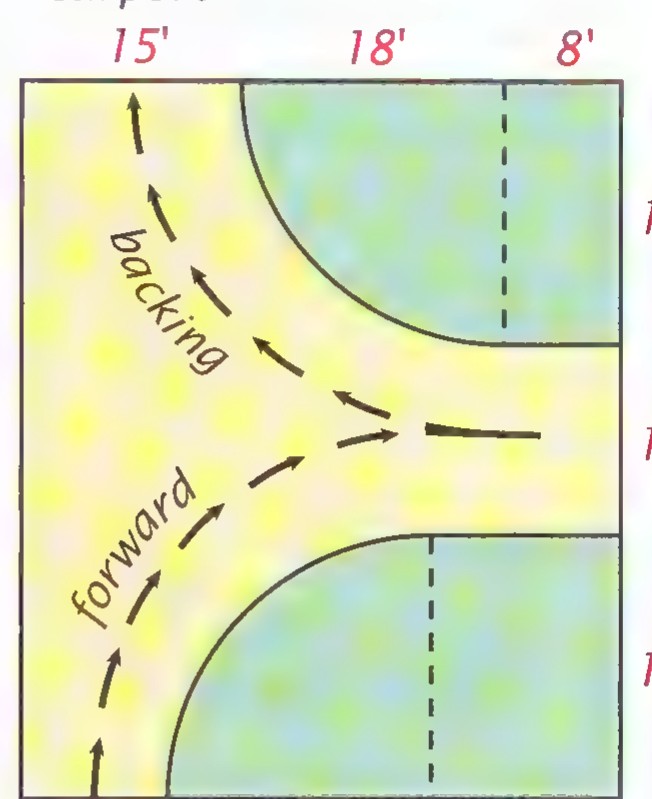
Use the dimensions given to find the following areas, each to the nearest square foot.
- The total area of the figure.
- The lawn area (shown in green).
- The paved area (shown in yellow).
Two Sectors. In the figure at the right, and .
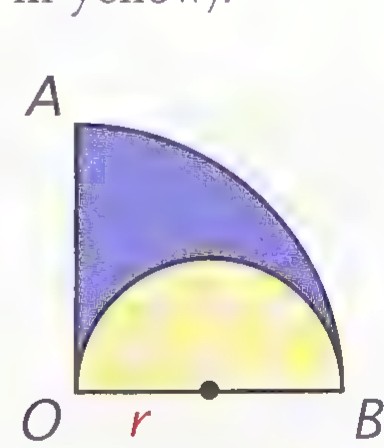
Express each of the following areas in terms of r.
- The yellow area.
- The area of the entire figure.
- How does the yellow area compare with the blue area?
† Landscape Development, Field Technical Office, U. S. Department of the Interior.
p. 608
Reuleaux Triangle. The Reuleaux triangle, named after a nineteenth-century engineer, is interesting in that its width in every direction is the same. It has been used in the design of a rotary drill that can drill square holes!
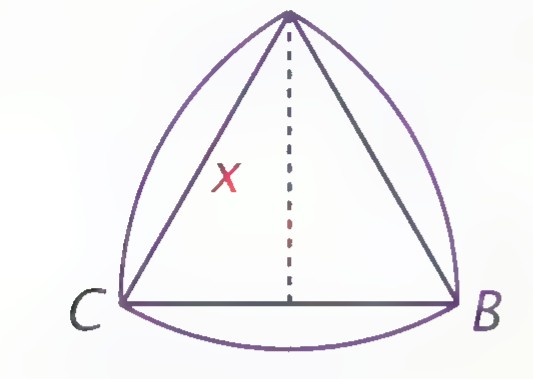
A Reuleaux triangle is constructed by drawing three arcs on the sides of an equilateral triangle. Each arc is centered on one of the triangle’s vertices.
- Find .
- Find the length of .
- Find the perimeter of △ABC.
- Find the perimeter of the Reuleaux triangle.
- Find the diameter of a circle whose circumference is equal to the perimeter of the Reuleaux triangle.
Sound Delay. Most sounds that you hear reach one of your ears before the other. Suppose your head is round and has a diameter of 7 inches.*
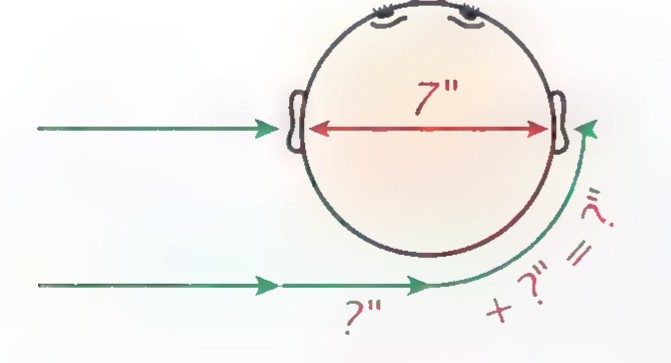
When a sound from the left reaches your left ear, it still has to go past your head to reach your right ear. Your brain can detect the resulting time delay.
* Human Information Processing: An Introduction to Psychology, by Peter H. Lindsay and Donald A. Norman (Harcourt Brace Jovanovich, 1977).
- How many extra inches does the sound have to go?
Sound travels about 1,100 feet per second in air.
- How many inches does it travel in a second?
- How much extra time does it take to reach the right ear?
The Radian. A unit of angle measure used in advanced mathematics is the radian. As you might guess from its name, it has something to do with the radius of a circle. A radian is defined as the measure of a central angle that intercepts an arc equal in length to the radius of the circle.
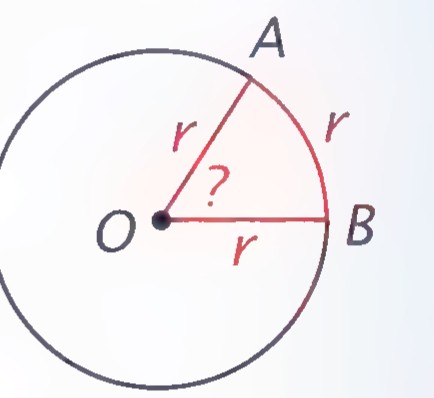
- What is the length of a circle in terms of its radius?
- What is the measure of a circle in terms of degrees?
- What fraction of the length of the circle is the length of ?
- Find .
- What is the approximate measure of 1 radian in degrees?
Set II
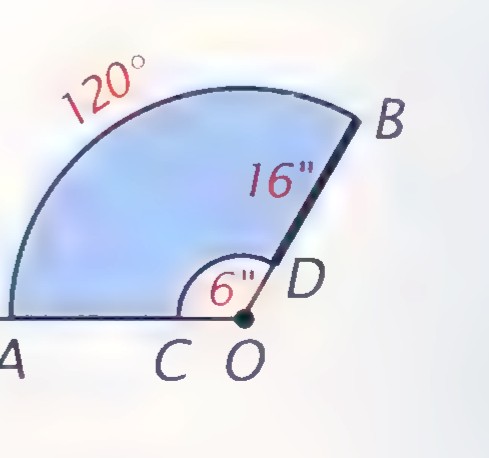
Windshield Wipers. The figure below shows the region covered by a windshield wiper of a car.
p. 609
Use the measurements in the figure to find the following numbers.
- The distance traveled by the tip of the wiper in going from A and B, to the nearest inch.
- The area wiped by the wiper, to the nearest square inch.
- A car has two windshield wipers. Is it possible, from the information given in the figure, to find the total area wiped by both wipers? Explain.
Land Area. Lucius Columella, a Roman farmer who lived in the first century, wrote a book on agriculture in which he showed how to calculate areas of land.
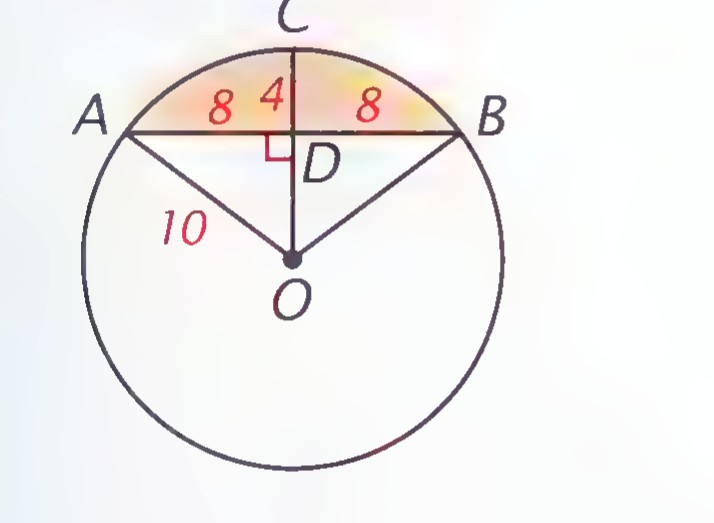
In one example, Columella claimed that the area of the orange region in the figure above was more than 44 square units.*
- Use your calculator and the sine ratio in △ADO to find ∠AOC.
- Find ∠AOB.
- Find .
- Find the area of the sector bounded by OA, OB, and .
- Find the area of △ABO.
- Find the area of the orange region.
- Was Columella correct?
* Mathematics and Measurement, by O. A. W. Dilke (University of California Press, 1987).
Running Track. The figure below represents the measure line (shown in green) of the first lane of a 400-meter running track.
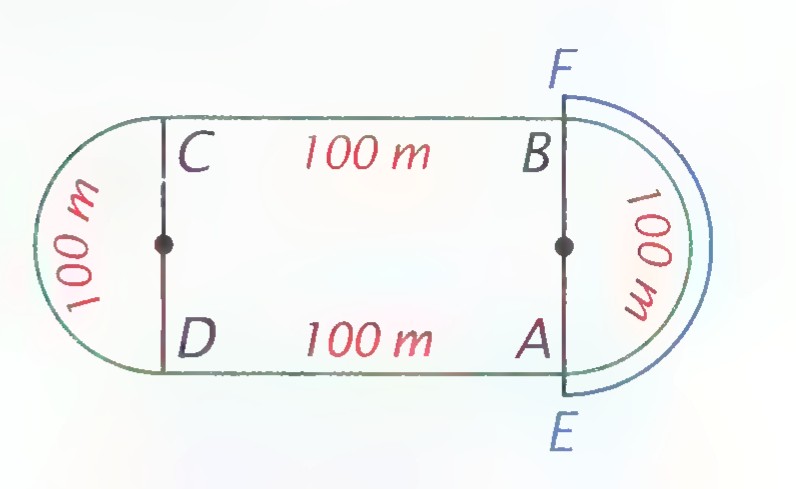
- Find AB to the nearest 0.01 meter.
EF represents part of the measure line of the second lane. Because each lane is 1.2 meters wide, AE = BF = 1.2 m.
- Find EF to the nearest 0.01 meter.
- Find the length of to the nearest 0.01 meter.
- How many laps around the track does someone make in running a 10,000-meter race?
- In this number of laps, how much farther would someone who stayed in the second lane run than someone who stayed in the first lane?
A runner’s right leg travels farther than the left leg on each curve because the race is run counterclockwise.
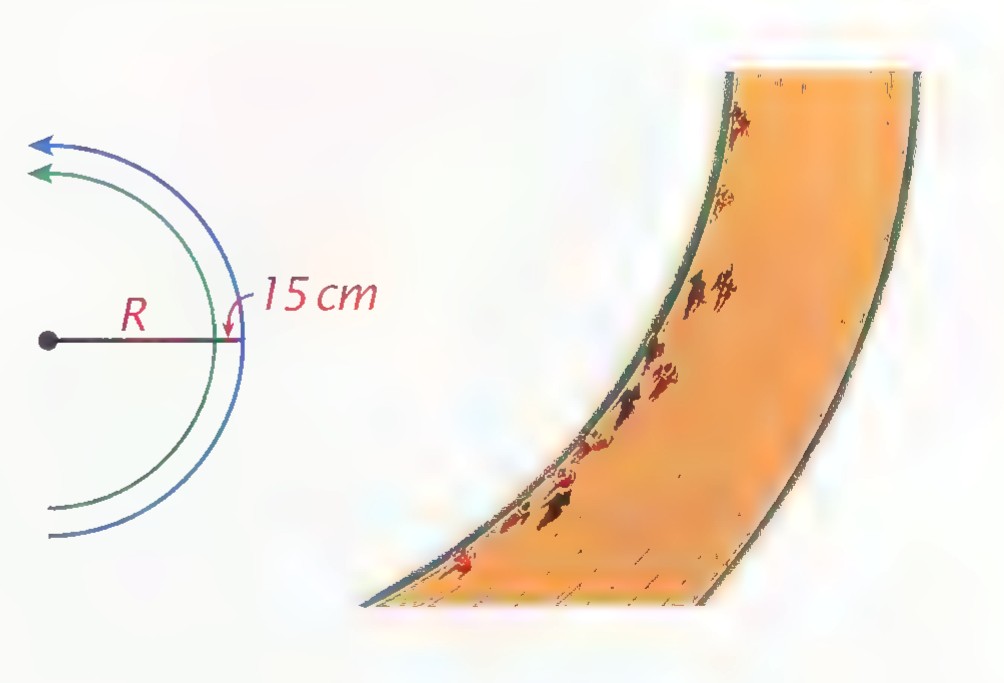
- If the difference in the radii of the two paths is 15 cm (0.15 m), how much farther does the runner’s right leg travel during the race?
p. 610
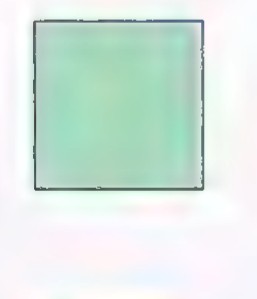
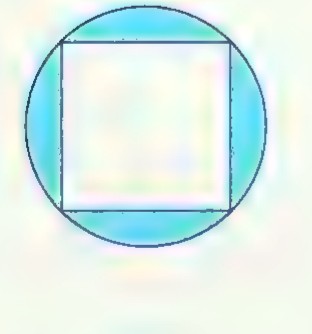
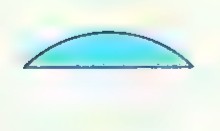
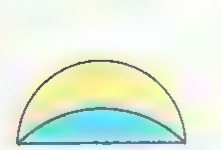
Four Crescents. In the figure below, circle O is circumscribed about square ABCD and semicircles have been drawn with the sides of the square as their diameters. M is the midpoint of AB.
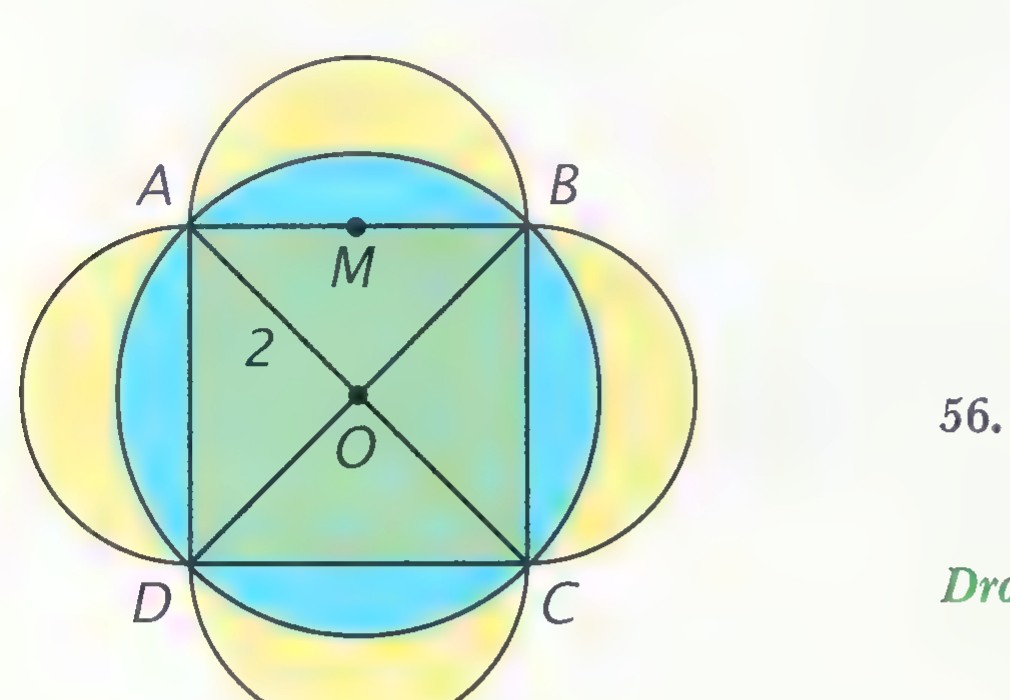
Given that OA = 2, find
- AB.
- AM.
Find the exact area of each of the following parts of the figure.
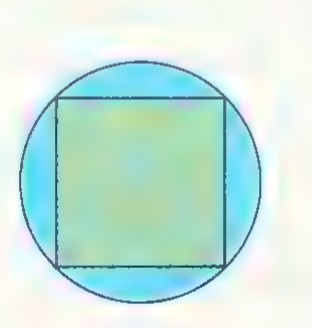
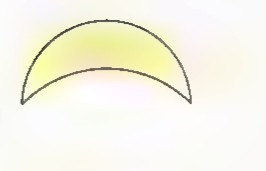
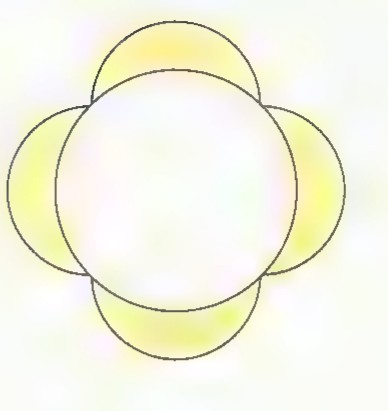
- What do your answers to exercises 50 and 55 prove?
Drop-Leaf Table.
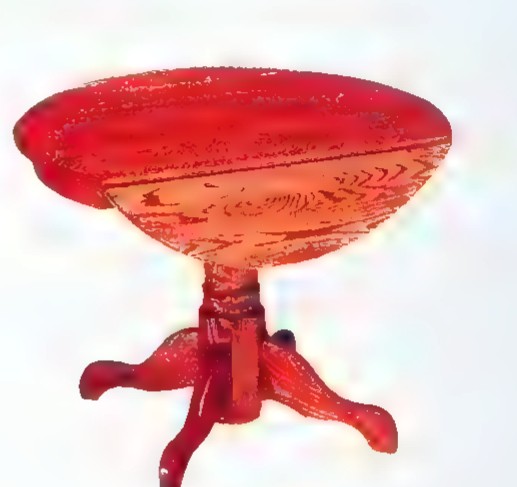
The figure below shows the design of a drop-leaf table. The two leaves are hinged along chords AB and CD of circle O; diameter EF is perpendicular to both chords.
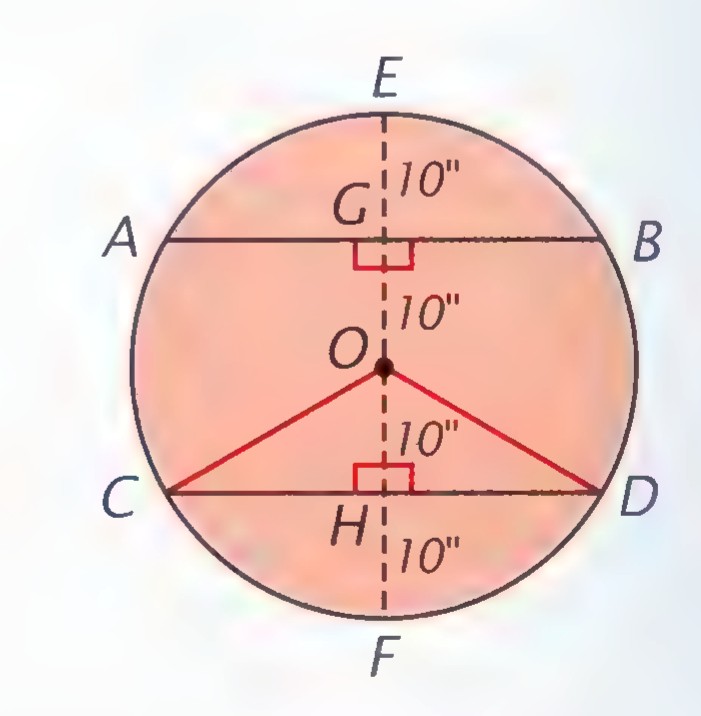
Use the measurements given to find each of the following numbers.
- The radius of the table.
- The area of the table to two decimal places.
p. 611
- ∠COH.
- ∠COD.
- The area of the sector bounded by OC, OD, and .
- CD to two decimal places.
- The area of △COD.
- The area of one of the leaves of the table to the nearest square inch.
- The area of the top of the table when the two leaves are down to the nearest square inch.
Salt Cellar. The Greek mathematician Archimedes proved that the yellow region in the figure below, which he called a “salt cellar,” has the same area as the red circle.
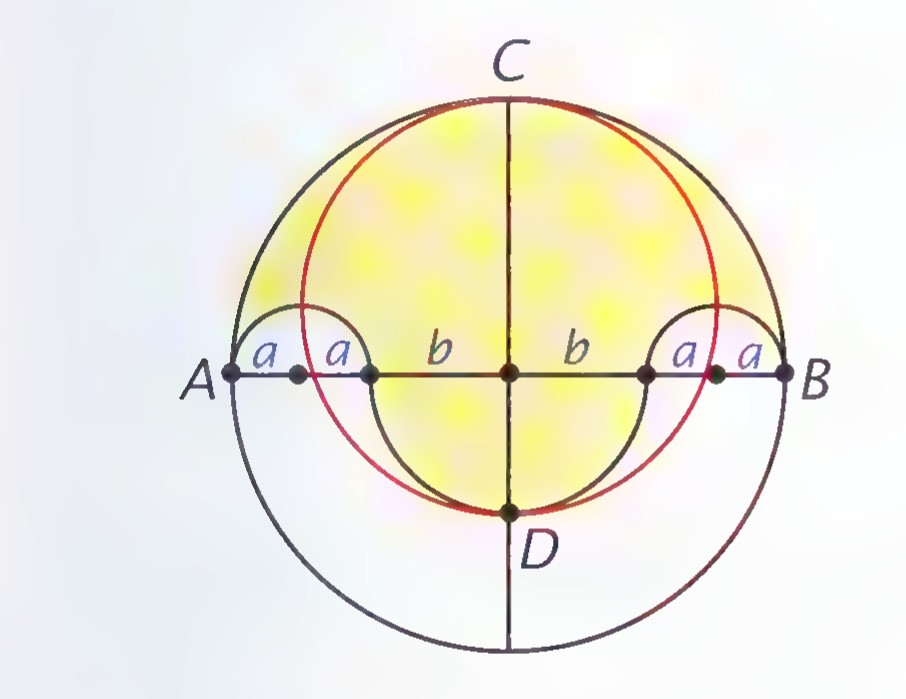
The boundary of the “salt cellar” consists of four semicircles drawn on AB. CD is a diameter of the red circle.
Express each of the following numbers in terms of a and b.
- The radius of the longest semicircle.
- The diameter of the red circle.
- The radius of the red circle.
- The area of the red circle.
- Show that the area of the “salt cellar” is equal to the area of the red circle.
Set III
Pizza Puzzle. Acute Alice and Obtuse Ollie decided to share a pizza. Ollie cut it into four pieces with two perpendicular cuts, but he didn’t cut the pizza through the center. He told Alice that he would eat the two pieces shown in orange and she could have the rest.
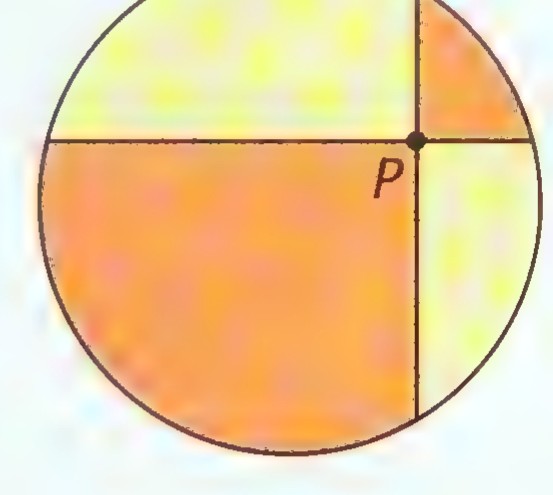
Not being sure that she liked this idea, Alice cut the pizza two more times by bisecting the four angles at P. She told Ollie that he could now take his pick between the four orange pieces or the four yellow ones.
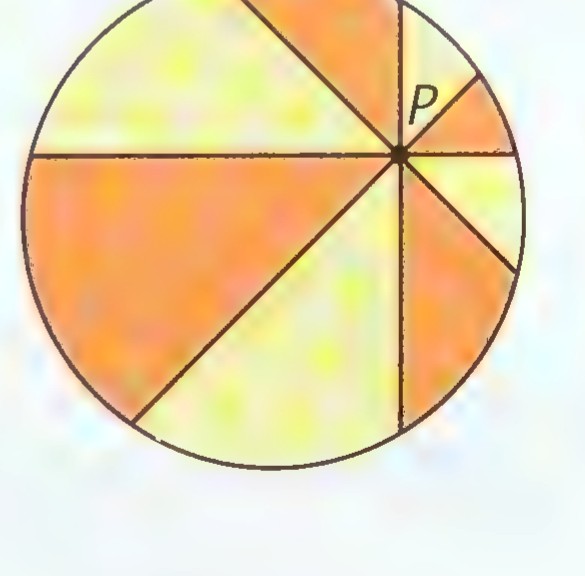
Do you think either way is fair? Make some drawings in which P is in different places to see what you discover.
p. 612
Summary and Review
Basic Ideas
Apothem 574
Area of a circle 598
Area of a sector 606
Central angle of a regular polygon 574
Circumference 592
Length of an arc 606
Limit 592
π 592–593
Radius of a regular polygon 574
Regular polygon 572
Regular polygons, names of 573
Sector 605
Theorems
- Every regular polygon is cyclic. 573
- The perimeter of a regular polygon having n sides is 2Nr, in which and r is its radius. 581
- The area of a regular polygon having n sides is Mr², in which and r is its radius. 587
- If the radius of a circle is r, its circumference is 2πr. 592
Corollary. If the diameter of a circle is d, its circumference is πd. 592
- If the radius of a circle is r, its area is πr². 599
Exercises
Set I
Molecule. A cholesterol molecule contains 74 atoms. The left-hand figure below shows a model of this molecule, and the right-hand figure shows its line formula, a picture of the way in which its atoms are connected.*
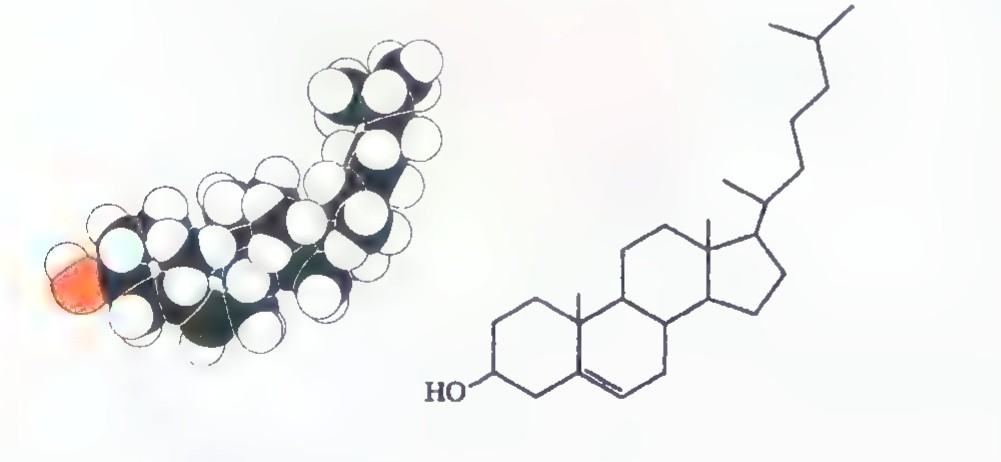
What regular polygons do you see in the line formula?
What must be true for a polygon to be regular?
What happens to the shape of a regular polygon as its number of sides increases?
A Regular 15-gon. In the Elements, Euclid showed how to inscribe a regular polygon with 15 sides in a circle. He started by constructing equilateral △ABC and regular pentagon ADEFG.
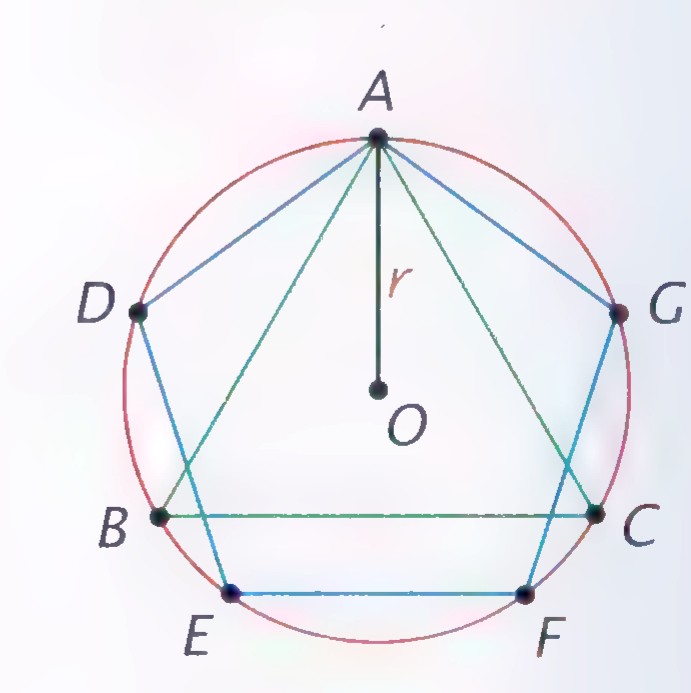
* Molecules, by P. W. Atkins (Scientific American Library, 1987).
p. 613
Find each of the following arc measures.
. 6. .
. 7. .
Which points on the circle could be connected to form sides of the regular 15-gon? Explain.
Use your calculator to find, to two decimal places, the following numbers for a regular 15-gon.
- .
- .
- What number is the limit of N and M as n increases?
Suppose a regular 15-gon is inscribed in a circle with radius r. Write an expression in terms of r and to two decimal places for
- the perimeter of the polygon.
- the area of the polygon.
- the length of each of its sides.
Penny Farthing Bicycle. Before the invention of the chain drive, all bicycles used direct drive. One turn of the pedals resulted in one turn of the front wheel.*

* Mathematics Meets Technology, by Brian Bolt (Cambridge University Press, 1991).
The typical radius of the front wheel on a “penny farthing” bicycle is 2 feet.
- How many turns of the pedals would be needed to get the bicycle to travel 1 mile (5,280 feet)?
Given that the radius of the back wheel is 0.6 foot, find
- its circumference.
- the number of turns that it would make in traveling 1 mile.
SAT Questions. The following questions have appeared on SAT tests. Give your answers in terms of π.
- What is the circumference of a circle with radius π?
- What is the diameter of a circle with circumference 1?
- What is the area of a circle whose circumference is 4π?
Semicircles on the Sides. About a century after Pythagoras’s time, a mathematician named Hippocrates claimed that, if semicircles are drawn on the sides of a right triangle, the sum of the areas of the semicircles on the legs is equal to the area of the semicircle on the hypotenuse.
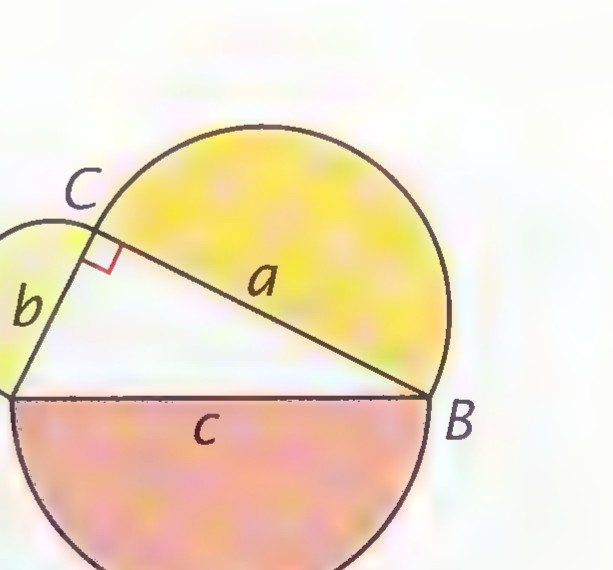
- Find the areas of the three semicircular regions in the figure above.
- Is what Hippocrates claimed true? Explain why or why not.
p. 614
Area Comparisons. In the figure below, , , and OC bisects ∠AOB.
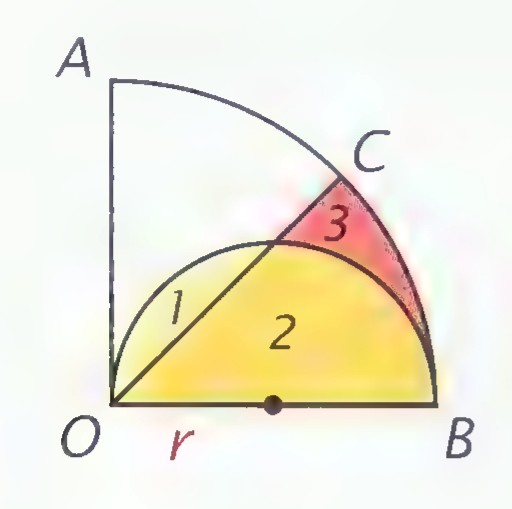
Express each of the following sums in terms of r.
- The sum of the yellow and orange areas.
- The sum of the orange and red areas.
- How does the yellow area compare with the red area? Explain.
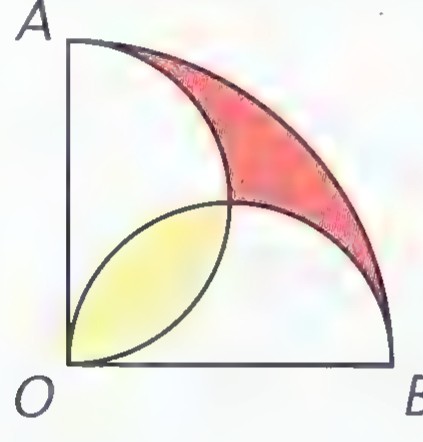
- What can you conclude about the figure above?
Gothic Arch. The Gothic arch was a popular shape in medieval architecture.
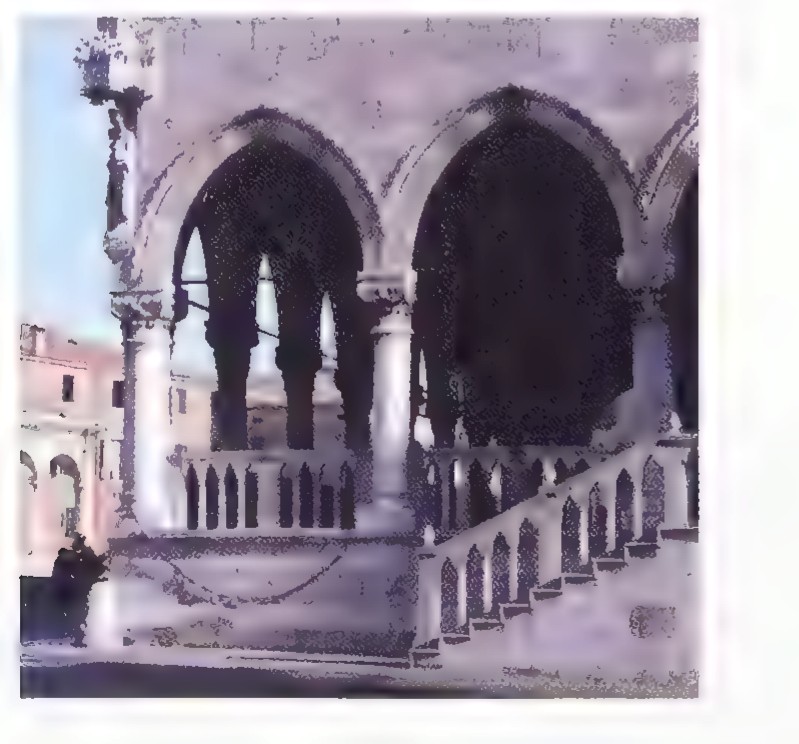
Use your straightedge and compass to construct a Gothic arch by doing each of the following steps.
Draw segment AB 2 inches long.
With A and B as centers and AB as radius, draw the two arcs intersecting at C.
Draw △ABC.
Construct CD ⊥ AB.
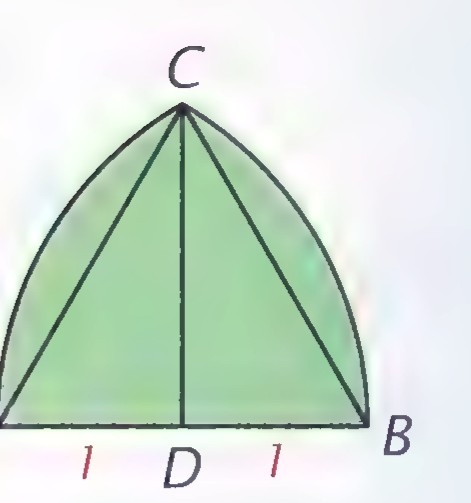
Find the areas of each of the following regions, both in terms of π and roots and numerically to three decimal places.
- △ABC.
- The sector bounded by radii AC and AB and .
- The region bounded by segment CB and .
- The entire arch.
Set II
Cup Problem. In the drawing of a cup below, EF divides rectangle ABCD into square ABFE and rectangle EFCD; AB = 1.
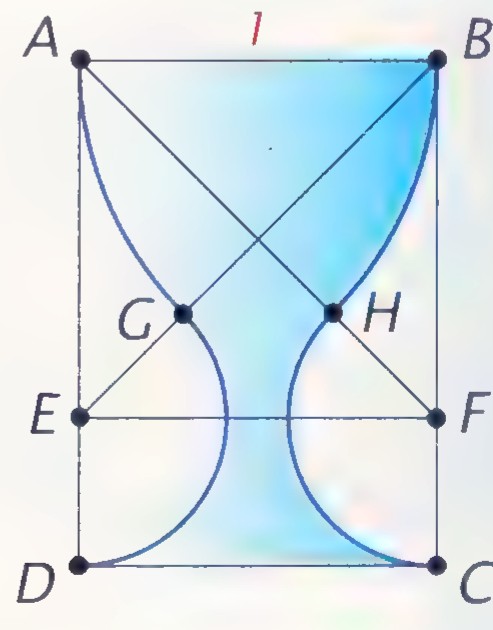
The cup is formed from four arcs: with center B, with center E, with center A, and with center F.
p. 615
- How do these arcs appear to compare in length?
- Find .
- Find the length of to two decimal places.
- Find the exact length of EG.
- Find .
- Find the length of to two decimal places.
- Were you right in your answer to exercise 32 about how and compare in length?
Time Zones. The earth is divided into 24 time zones, one for each hour of the day.
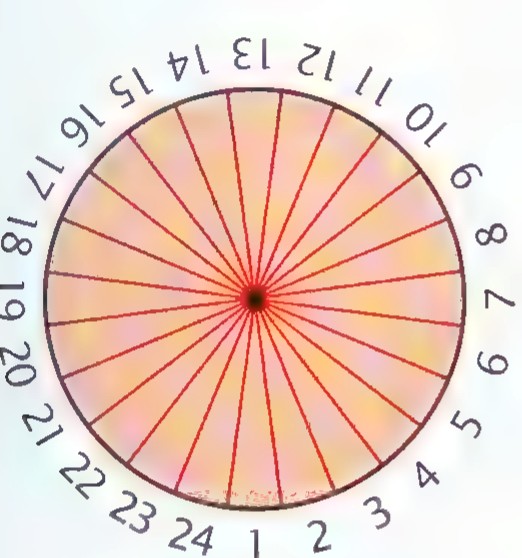
- Given that the radius of the earth is 3,960 miles, what is the width along the equator of each time zone?
The average latitude of the contiguous United States is 40°N.
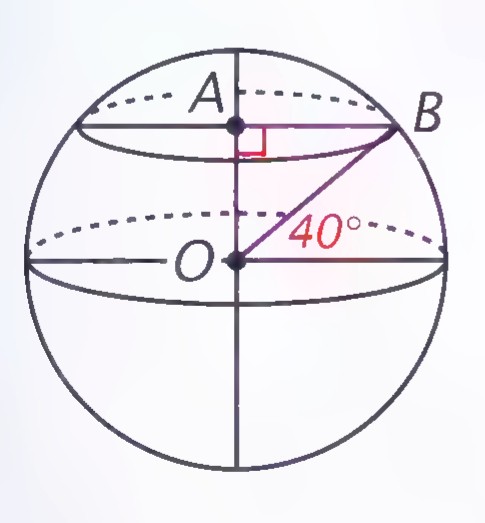
- Use △ABO to find the radius, AB, of the circle of latitude 40°.
- Find the circumference of this circle.
- What is the width along this circle of each time zone?
The contiguous United States spreads across four time zones.
- What is the approximate width of the contiguous United States?
From Dodecagon to Square. The figures below show how a regular dodecagon can be cut into six pieces that can be rearranged to form a square.*
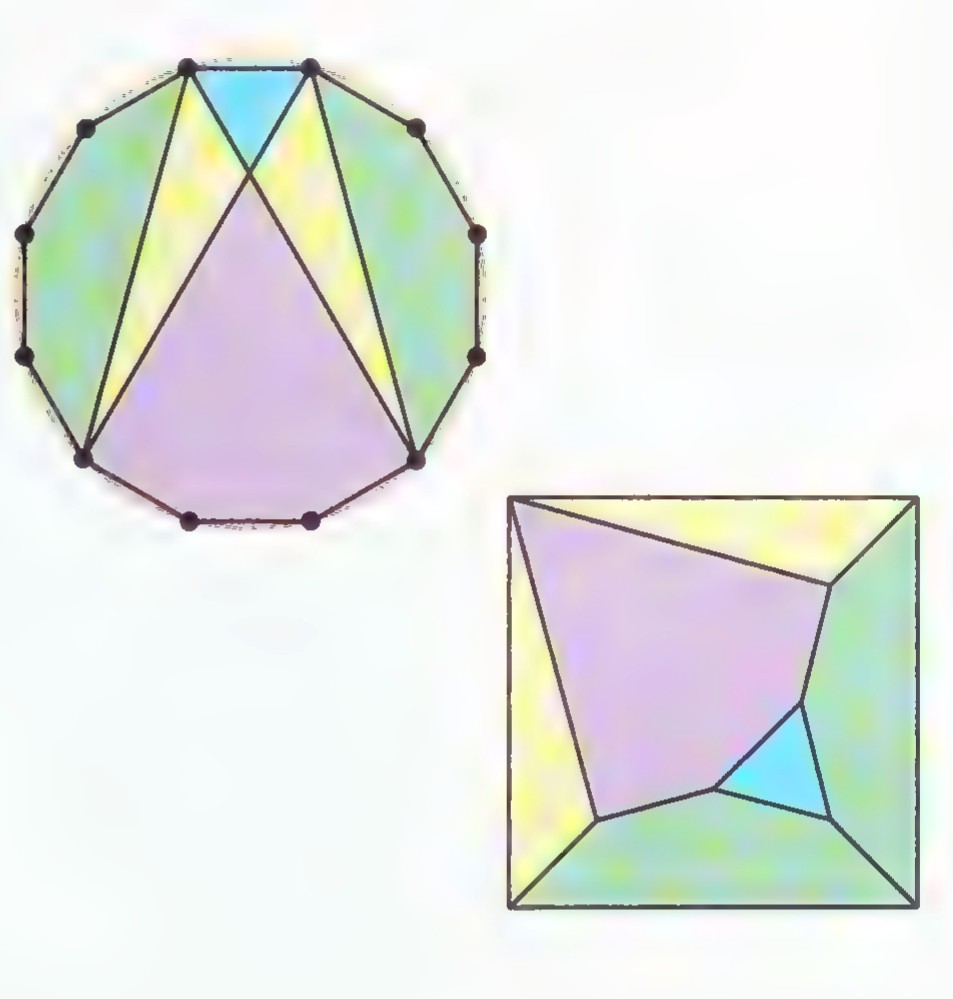
In the first figure, the dodecagon is inscribed in a circle.
- What kind of triangle is the blue piece? Explain how you know.
Given that the area of the dodecagon is 6 square units, find each of the following numbers.
- Its radius, from the area formula.
- The radius of the square.
- The perimeter of the dodecagon to two decimal places.
- The perimeter of the square to two decimal places.
- What happens to the perimeter of the figure when the pieces are rearranged to form the square?
* Geometric Dissections, by Harry Lindgren (Van Nostrand, 1964).
p. 616
Chord and Ring. The two circles in the figure below are concentric, and chord AB of the larger circle is tangent to the smaller circle at point C.
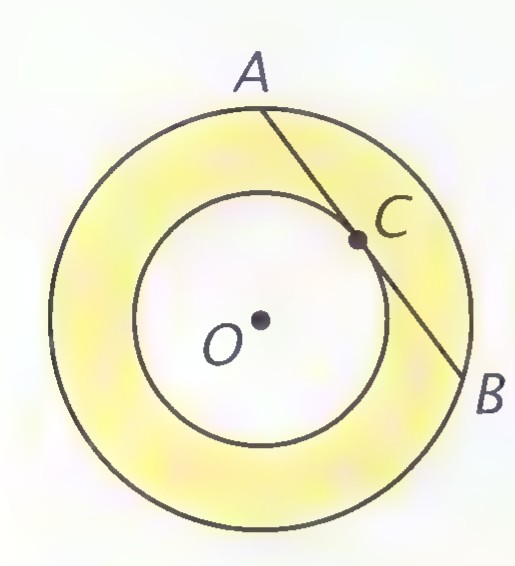
Draw the figure on your paper. Draw OC and label its length r.
What can you conclude about segments OC and AB?
(continued) Draw OA and label its length R.
Write an expression in terms of R and r for the area of the yellow ring.
Given that AB = 2, find the area of the yellow ring.
What is strange about this problem?
Half a Heart. The heart-shaped curve below consists of two equal semicircles that meet another semicircle on AB. CD is any line through O, the center of the large semicircle.
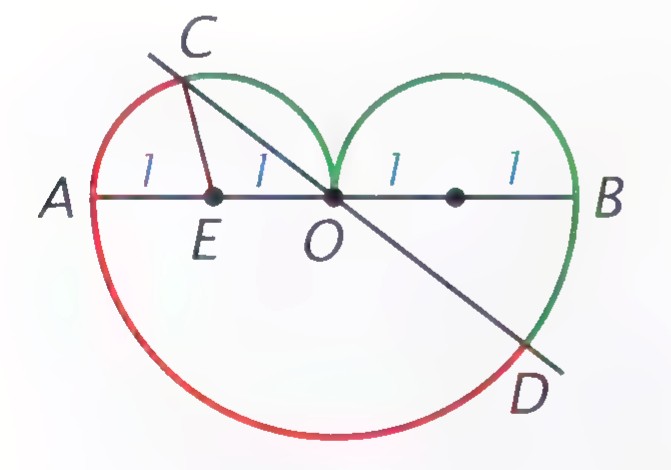
- Write an expression for the length of the border of the “heart” in terms of π.
Given that ∠AOD = x°, write an expression in terms of x for
- ∠AOC.
- ∠OCE.
- ∠AEC.
- the length of .
- the length of .
- the length of .
- What can you conclude about line CD? Explain.
Biting Region. Obtuse Ollie tied his pet bulldog with a rope 15 feet long to one corner of a shed 12 feet long and 10 feet wide.
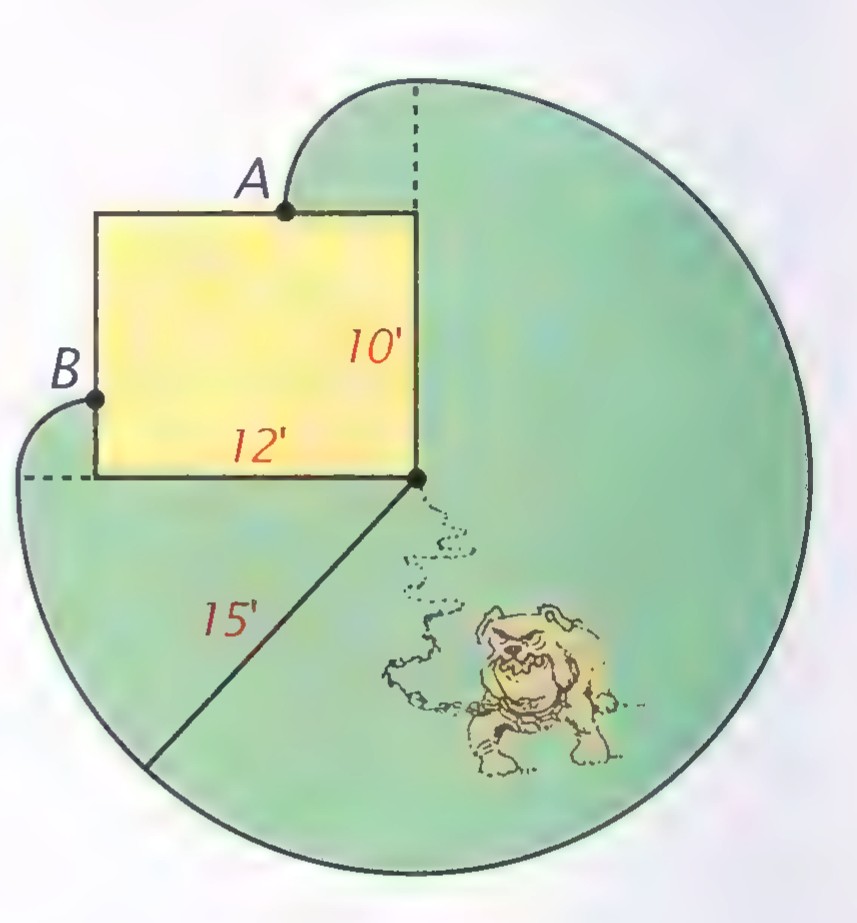
The green region shows where the dog can go.
- If the dog continually pulls at the rope, how far can it run in going from A to B?
- Find the area within biting distance of the dog.