Chapter 13 — Teacher’s Guide Answers
Answers and teaching commentary for Chapter 13: The Concurrence Theorems, transcribed from the scanned Teacher’s Guide. Diagrams are cropped from the same page scans.
OCR note. The text was recognized automatically and has not been corrected line by line; formulas and symbols may be imperfect. Check the original PDF for exact wording.
Homework: Chapter 13 exercises · Selected answers · Teacher’s answers PDF
Lesson 1
Set I (pages 532-534)
Exercises 15 through 21 illustrate a remarkable fact. Although it is easy to see why the lines through the pairs of intersections of three circles are concurrent if the circles have equal radii, the lines are concurrent even if the circles have different radii. If two circles intersect in two points, the line determined by those points is called the radical axis of the two circles. More on the theorem that the radical axes of three circles with noncollinear centers, taken in pairs, are concurrent can be found in two books by Howard Eves: Fundamentals of Modern Elementary Geometry (Jones and Bartlett, 1992) and College Geometry (Jones and Bartlett, 1995).
Exercises 22 through 25 lead to another surprise. If four lines intersect to form four triangles, the circumcircles of the triangles always intersect in a common point, named the Miquel point after an obscure nineteenth-century mathematician, Auguste Miquel. In The Penguin Dictionary of Curious and Interesting Geometry (Penguin, 1991), David Wells describes other remarkable properties of this point. The centers of the four circumcircles also lie on a circle that passes through it. It is also the focus of the unique parabola tangent to the four lines.
The regions into which a map is divided as in exercise 31 are called Dirichlet domains. According to Jay Kappraff, “a Dirichlet domain of a point from a set of points is defined to be the points of space nearer to that point than to any of the other points of the set.” A detailed discussion of the geometry of Dirichlet domains and their connection to soap bubbles, spider webs, and phyllotaxis can be found in Kappraff’s Connections —The Geometric Bridge Between Art and Science (McGraw-Hill, 1991).
Hot Tub.
1. Chords.
2. Inscribed angles.
3. Cyclic.
4. Its circumcircle.
5. AABC is inscribed in circle O.
6. They are equidistant from it.
Circumcircles.
*7. Minor arcs.
8. A semicircle.
9. A major arc.
10. An acute triangle.
11. Aright triangle.
12. An obtuse triangle.
¢13. A diameter (or a chord).
14. The midpoint of its hypotenuse.
RGB Color. 15. £ AN
/ F
16. They are concurrent.
*17. The lines are the perpendicular bisectors of the sides of AABC, and the perpendicular bisectors of the sides of a triangle are concurrent.
18. Example figure:
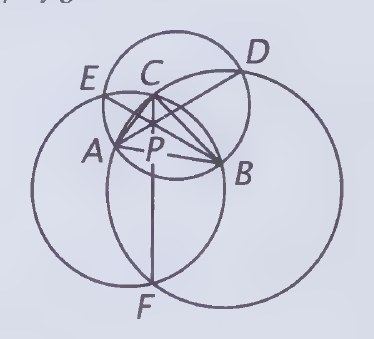
Diagram from page 201.
*19. No.
20. Yes.
21. By the Intersecting Chords Theorem. In the circle at the top, AP- PD = BP- PE and, in the circle on the left, BP: PE = CP- PF; so AP-PD =BP-PE=CP-PF.
Four Lines and Four Circles.
22. AABE AACD, ABCE, ADEF.
23. They are their circumcircles.
©24. Three.
25. They intersect in a common point. Equilateral Triangle.
26. Because AE, BF, and CD are altitudes, they are perpendicular to the sides of AABC. If a line through the center of a circle is perpendicular to a chord, it also bisects the chord.
27. 30°-60° right triangles.
#28. OA =20D because, in a 30°-60° right triangle, the hypotenuse is twice the shorter leg.
29. The radius is L the length of one of the altitudes.
Nearest School.
30. The school at B. 31.
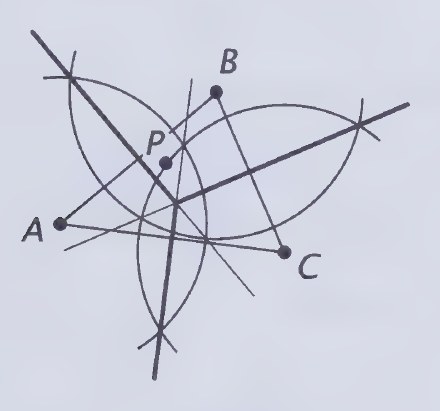
Diagram from page 202.
*32. The circumcenter of the triangle with A, B, and C as its vertices.
Set II (pages 534-535)
The triangle-folding exercises 33 through 40 are based on the fact that, if one point is reflected onto another, the line of reflection is the perpendicular bisector of the line segment connecting the two points.
Exercises 46 through 48 provide another example of a problem whose solution is based on Pythagorean triples and the Pythagorean Theorem yet was created more than a thousand years before Pythagoras was born. The tablet containing it was found in Susa, about 200 miles east of ancient Babylon.
Folding Experiment. &8
L
34. The folds are on the perpendicular bisectors of the sides of the triangle and they are concurrent.
35. Itis equidistant from them.
©36. Itis approximately 6.4 cm. 578
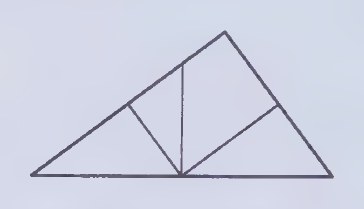
Diagram from page 202.
38. Aright triangle because 9 + 122 =15; if the sum of the squares of two sides of a triangle is equal to the square of the third side, it is a right triangle.
©39. They are concurrent on the hypotenuse of the triangle.
*40. 7.5 cm. Inscribed Triangles. 41.
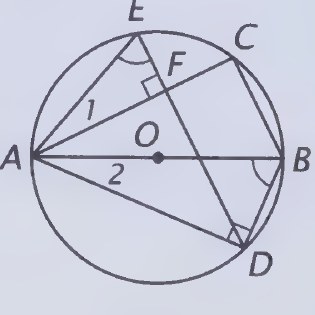
Diagram from page 202.
*42. Both ZE and ZABD intercept AD. Inscribed angles that intercept the same arc are equal.
43. ZADB is a right angle because it is inscribed in a semicircle.
44. All right angles are equal.
45. If two angles of one triangle are equal to
two angles of another triangle, the third pair of angles are equal.
Lesson 2
Babylonian Problem.
46. C
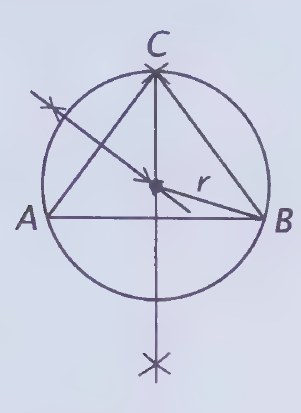
Diagram from page 203.
*47. Approximately 31 mm.
*48. 31.25 mm. 9
A o~ B
[Because AACD is a right triangle with AC =50 and AD =30, CD = 40. In right ABDO, (40 - )2 + 302 =72; so
1,600 — 807 + 72 + 900 = r2, 2,500 = 807, r=231.25]
Diameters and Sines.
49. ABCD is a right triangle because ZBCD is inscribed in a semicircle.
50. Inscribed angles that intercept the same arc
are equal. a . sin 2 Gl @imlb= =,
52. ._a_ =2r. (Because sin A=sin D, sin A q a . a sinA= —;so2rsinA=gand —— =2r.) 2r sin
53. It reveals that it is equal to the diameter of the triangle’s circumcircle.
Set lIl (page 535) The Slipping Ladder. 1.
2. Along an arc of a circle.
3. From the fact that the midpoint of the hypotenuse of a right triangle is its circumcenter, it follows that O is equidistant from A, B, and C; that is, OA = OB = OC. But OA and OB do not change in length as the ladder slides down the wall, and so OC does not change either. Because for every position of the ladder Ollie’s feet remain the same distance from C, their path is along an arc of a circle.
Set I (pages 538-539)
Theorem 69 of this lesson appears in the Elements as Proposition 22 of Book I11: “The opposite angles of quadrilaterals in circles are equal to two right angles.” Strangely, although the converse is true and very useful, Euclid does not state or prove it.
A proof that the circumcircles of the equilateral triangles constructed on the sides of a triangle intersect in a common point (assumed in exercises 24 through 28) can be found on pages 82 and 83 of Geometry Revisited, by H. S. M. Coxeter and S. L. Greitzer (Random House, 1967). The point in which the circles intersect is called the Fermat point of the triangle. According to David Wells in The Penguin Dictionary of Curious and Interesting Geometry (Penguin, 1991), Fermat challenged Torricelli (of barometer fame) to find the point the sum of whose distances from the vertices of a triangle is @ minimum. (In other words, to find the general solution to the Spotter’s Puzzle.) That point turns out to be the Fermat point. According to Wells: “if all the angles of the triangle are less than 120° the desired point . . . is such that the lines joining it to the vertices meet at 120°. If the angle at one vertex is at least 120°, then the Fermat point coincides with that vertex.” Wells also remarks that “the Fermat point can be found by experiment. Let three equal weights hang on strings passing through holes at the
vertices of the triangle, the strings being knotted at one point. The knot will move to the Fermat point.”
Quilt Quadrilaterals.
*1. By seeing if a pair of opposite angles are supplementary.
2. The diamond. Cyclic and Noncyclic.
3. The lines appear to be their perpendicular bisectors.
*4. They must be concurrent.
5. Itis equidistant from them. Euclid’s Proof.
6. Two points determine a line.
7. The sum of the angles of a triangle is 180°.
8. Inscribed angles that intercept the same arc are equal.
9. Betweenness of Rays Theorem.
*10. Substitution.
11. Addition.
12. Substitution. A Different Proof.
13. B o~ S C
*14. They are isosceles because all radii of a
circle are equal.
15. 360°. The sum of the angles of a quadrilateral is 360°.
16. 180°.
17. The sum of each pair of opposite angles of ABCDisequal tow +x +y + z.
Isosceles Trapezoid.
*18. AB || DC because they are the bases of a trapezoid.
19. ZA and £D are supplementary. Parallel lines form supplementary interior angles on the same side of a transversal.
20. ZA = /B. The base angles of an isosceles trapezoid are equal.
*21. /B and £D are supplementary.
22. ABCD is cyclic. A quadrilateral is cyclic if a pair of its opposite angles are supplementary.
23. They prove that isosceles trapezoids are cyclic.
Equilateral Triangles on the Sides.
#24. They intersect in a common point, P.
25. They are cyclic.
26. They are each equal to 120°. They are supplementary to the angles opposite them in the quadrilaterals. The angles opposite them are 60° because they are also angles of the equilateral triangles.
27. Example figure:
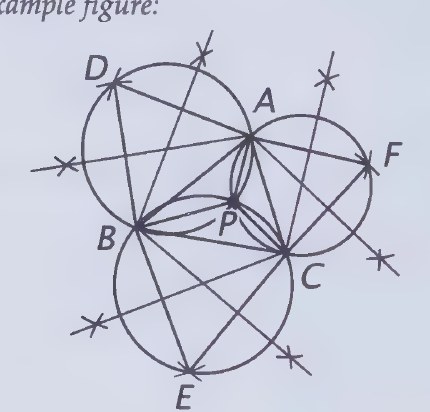
Diagram from page 204.
28. (Student answer.) (Yes.)
Set II (pages 539-541)
Brahmagupta’s formula for the area of a cyclic quadrilateral, discovered in the seventh century, is an extension of the formula for the area of a triangle in terms of its sides discovered by Heron of Alexandria six centuries earlier. (Heron’s Theorem was introduced in the Set Iil exercises of
formula on page 58 of Geometry Revisited. Although they refer to it as “one of the simplest methods for obtaining Brahmagupta’s formula,” the method is based on several trigonometric identities including the Law of Cosines and is not easy.
J. L. Heilbron in Geometry Civilized— History, Culture and Technique (Clarendon Press, 1998), refers to Claudius Ptolemy as the astronomer “who was to astronomy what Euclid was to geometry” and refers to the proof of his theorem as “one of the most elegant in all plane geometry.” From a special case of Ptolemy’s Theorem comes the trigonometric identity
Sin(x—y) = sin x cos y—cos xsin y.
Cyclic or Not.
29. ABCD is cyclic, because its vertices are equidistant from point E. A circle is the set of all points in a plane equidistant from a given point; so a circle can be drawn with its center at E that contains all of the vertices.
*30. ABCD is not cyclic, because its opposite angles are not supplementary. (The sum of a right angle and an obtuse angle is more than 180°, and the sum of a right angle and an acute angle is less than 180°.)
31. ABCD is cyclic. Because ZBCE is an exterior angle of ABCD, it forms a linear pair with ZDCB; so £BCE and ZDCB are supplementary. Because ZBCE = ZA, it follows that ZA and ZDCB are also supplementary; so ABCD is cyclic.
Brahmagupta’s Theorem.
32. Example figure: @
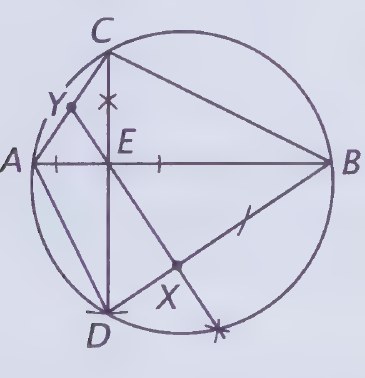
Diagram from page 205.
D
©33. Vertical angles are equal.
*34. Supplements of the same angle are equal. (£7 and £5 are supplements of Z6[£8] and £6 and £8 are supplements of £7[£5].)
35. Inscribed angles that intercept the same arc are equal.
36. Substitution.
37. Point Y is the midpoint of AC. Because £2 = /1, AY = YE and, because /3 = /4, YC =YE; so AY = YC.
38. If a cyclic quadrilateral has perpendicular diagonals, then any line through their point of intersection that is perpendicular to a side of the quaderilateral bisects the opposite side.
Area Formula.
39. The perimeter of a rectangle with sides a and b is 2a + 2b; so, for a rectangle, s =a + b. A= (a+b-a)a+b-b)a+b-a)a+b-b) =
~baba = Va%h? = ab.
#40. The perimeter of this quadrilateral is 176, so for it, s = 88. A= /(88-25)(83-39)(88 - 52)(88 —60) = V63-49-36-28 =1,764.
41. No. Itis not cyclic and its area is evidently much smaller.
Ptolemy’s Theorem. 042, The Protractor Postulate.
43. Inscribed angles that intercept the same arc are equal.
44. AA.
45. Corresponding sides of similar triangles are proportional.
*46. Multiplication.
47. Addition.
48. Betweenness of Rays Theorem and substitution.
49. Inscribed angles that intercept the same arc are equal.
50. AA.
51. Corresponding sides of similar triangles are proportional.
52. Multiplication.
53. Addition.
*54. Substitution.
55. Multiplication. Two Applications.
56. Because a rectangle is a cyclic quadrilateral and its opposite sides are equal, Ptolemy’s Theorem becomesa -a+b-b=c-¢, or a2 + b? = ¢2, the Pythagorean Theorem!
57. Applying Ptolemy’s Theorem to cyclic quadrilateral APBC, PA -BC + PB - AC =PC - AB. Because AABC is equilateral, AB = BC = AC. By substitution, PA - AB + PB - AB = PC - AB; dividing by AB gives PA + PB = PC.
Set II (page 541)
The Set |1l puzzle is adapted from one by Stephen Barr, who has created many clever puzzles. Barr’s puzzle was originally included by Martin Gardner in one of his ““Mathematical Games” columns for Scientific American and is reprinted on page 110 of Mathematical Carnival (Knopf, 1975). Readers of Gardner’s column discovered an extra set of points through which a circle could be drawn that neither Barr nor Gardner had noticed!
Overlapping Cards Puzzle.
1. These points are the vertices of the two rectangles. Because the opposite angles of a rectangle are supplementary, all rectangles are cyclic.
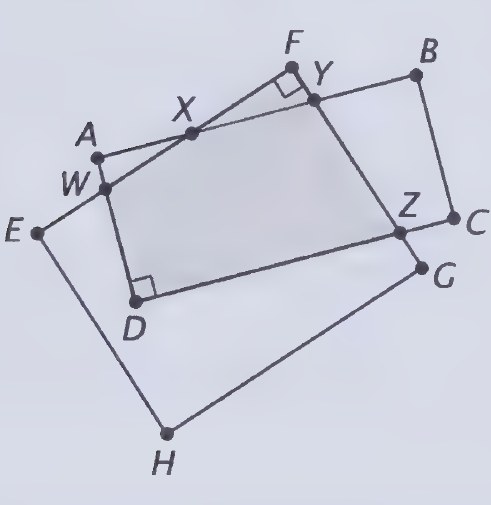
Diagram from page 206.
F AY ’
H
One set of points consists of W, F, Z, and D. Drawing the hidden parts of the edges WX and YZ produces quadrilateral WEZD. Because ZF and ZD are right angles, they are supplementary; so WFZD is cyclic.
H
Another set of points consists of W, Y, F, and A. If WY is drawn and a circle is drawn with WY as its diameter, then it can be proved that points A and F lie on this circle owing to the fact that ZA and ZF are right angles.
Lesson 3
Set I (pages 544-545)
Exercises 27 through 30 are related to a resuit known as Poncelet’s porism. Jean Victor Poncelet, a nineteenth-century French mathematician, is credited for establishing the development of projective geometry as an independent subject. As Howard Eves explains in An Introduction to the History of Mathematics (Saunders, 1990), a porism is “a proposition stating a condition that renders a certain problem solvable, and then the problem has infinitely many solutions. For example, if rand R are the radii of two circles and dis the distance between their centers, the problem of inscribing a triangle in the circle of radius R, which will be circumscribed about the circle of radius r, is solvable if and only if
R~d = 2Rr, and then there are infinitely many triangles of the desired sort.” The general version of Poncelet’s porism states that, if given two conics, an n-gon can be inscribed in one conic and circumscribed about the other, there are an infinite number of such n-gons.
Postage Stamp.
*1. The angle bisectors of a triangle are concurrent.
2. The incenter.
Circumcircle and Incircle.
3. Two.
4. They are perpendicular bisectors of the sides.
5. The vertices of the triangle.
6. Three.
7. Two angle bisectors.
8. A perpendicular from the triangle’s incenter to one of its sides.
9. The sides of the triangle. Circumscribed Quadrilateral.
¢10. Its incircle.
*11. Itsincenter.
12.
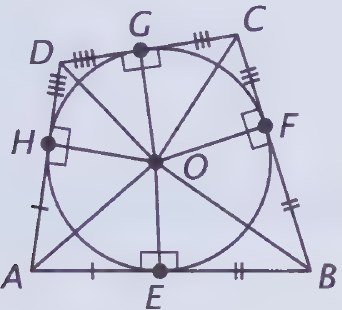
Diagram from page 207.
#13. They are perpendicular to the sides. If a line is tangent to a circle, it is perpendicular to the radius drawn to the point of contact.
14. They bisect the angles. They form pairs of triangles that are congruent by HL.
#15. They must be concurrent.
16. They must be equal.
*17. Only if the rectangle is a square.
18. Only if the parallelogram is a rhombus.
19. Only if the sum of the lengths of the bases is equal to the sum of the lengths of the legs.
Equilateral Triangle.
20. That circles have the same center.
#21. They are the perpendicular bisectors of the sides.
22. They are the bisectors of the angles.
23. Isosceles (obtuse) triangles and 30°-60° right triangles.
24. 2.
©25. 2mand 4m units.
26. mand 4m square units. Construction Problem.
27. Example figure:
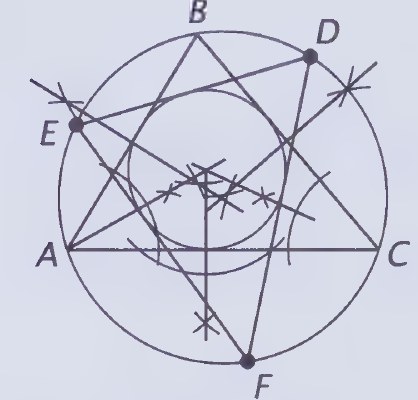
Diagram from page 207.
#28. EF seems to be tangent to the incircle.
29. (Student answer.) (Probably not.)
30. Yes.
Set II (pages 545-547)
In Dutton’s Navigation and Piloting (Naval Institute Press, 198s), Elbert S. Maloney remarks that the LOP (line of position) is probably the most important concept in navigation. When three LOPs are taken, they are usually not concurrent, but intersect to form a triangle.
The navigator ordinarily takes the point that is equidistant from the sides of this triangle (its incenter) as the “fix” or position of the ship. If there is a “constant error” in the LOPs, the method of “LOP bisectors” outlined in exercises 31 through 39 is used. As exercises 31 through 33 suggest and exercises 34 through 39 prove, the bisectors of an angle and the two remote exterior angles of a triangle are concurrent. In the method of LOP bisectors, the fix of the ship is taken at the point of concurrency.
In exercises 40 through s8, two special cases of a remarkable theorem are considered and, in exercises 59 through 62, the general case is developed. The theorem states that, for any polygon and its inscribed circle, the ratio of the
areas is equal to the ratio of the perimeters. A very nice treatment of this theorem is included i Geometrical Investigations—Illustrating the Art of Discovery in the Mathematical Field, by John Pottage (Addison-Wesley, 1983). Pottage present his material in the form of a dialogue between Galileo’s characters Salviata, Sagredo, and Simplicio. His book, like the work of George Polya, is a wonderful example of teaching mathematics by the Socratic method.
1ts
Ship Location.
31. L.
*32. Exterior angles.
33. They appear to be concurrent.
34. D A B F
2ol
G ls H E
35. APFB = APGB (AAS) and APGC = APHC (AAS).
36. They are equal because PF = PG and PG = PH.
37. AFAP = AHAP (HL). (These triangles are right triangles whose hypotenuse is AP and whose legs PF and PH are equal.)
*38. It proves that AP bisects ZDAE (because ZDAP = ZPAE).
39. They prove that the three bisector lines are concurrent.
Incircle Problem 1.
*40. FDEO is a square (because it is equilateral and equiangular).
41. AB=2r.
®42. 2mr units.
43. 8r units.
44. mr? square units.
45. 4r? square units.
3 026, T (25{:3) ‘ e
47. Z( 4) T
Incircle Problem 2.
48. ECDO is a square (because it is equilateral and equiangular).
©49. AE=3-7.
50. DB=4-7.
e51. AB=7-2r. 3-r+4-r)
52. 7-2r=52r=2,r=1.
53. 2m units.
54. 12 units.
#55. msquare units.
1
56. 6 square units. (-2—3- 4.)
n 2n n - ( )
57. —. (== =—.
n
58. =
Incircle Problem 3.
#59. The area of a triangle is half the product of its base and altitude.
60. 0ABCD = 1 1 1 1 5AB<7‘+ EBC’T*- ECD~T+ 5DA’7‘=
%r(AB +BC+CD +DA) = %rp.
*61. 2_nr P 6 2 (M _ 2w, 14 2™ P
Trisector Challenge.
63. £1 = £2. Because BE and CE bisect two angles of ABDC, E is its incenter. Because the angle bisectors of a triangle are concurrent, DE must bisect ZBDC.
Lesson 4
Set II (page 547)
Every triangle has not only an incircle, but also three excircles. Each excircle is tangent to one side of the triangle and the lines of the other two
. sides. The center of each excircle is the point of concurrence of the bisectors of an angle and the two remote exterior angles of the triangle. The centers of the excircles are the vertices of a larger triangle whose altitudes lie on the lines that bisect the angles of the original triangle.
Excircles.
1. They appear to be its altitudes.
2. AY bisects the exterior angles of AABC at A; so £1 = £2. Because O is the incenter of AABC, AO bisects ZCAB and so £3 = £4. L1+ L2+ /3 + £4 =180 so L2+ L2+ /3 + £3=180°, 2(£2 + £3) =180°, £2 + £3 = 90°, and so AO 1 YA. Aline segment from a vertex of a triangle that is perpendicular to the line of the opposite side is an altitude of the triangle.
Set I (pages 550-551)
Martin Gardner points out a rather surprising fact (Mathematical Circus, Knopf, 1979): that the altitudes of a triangle are concurrent does not appear in Euclid’s Elements. Gardner observes that, “although Archimedes implies it, Proclus, a fifth-century philosopher and geometer, seems to have been the first to state it explicitly.” The fact that the medians of a triangle are concurrent does not appear in the Elements either, but Archimedes knew that the point in which they are concurrent is the triangle’s center of gravity. More specifically, it is the center of gravity of a triangular plate of uniform thickness and density; it is usually not the center of gravity of a wire in the shape of the triangle.
“Ortho” Words.
1. Orthodontist.
2. Orthodox.
3. Orthopedic.
e4. The fact that the altitudes of a triangle form right angles with the lines of its sides.
Theorem 71.
5. Two points determine a line.
*6. The Ruler Postulate.
7. Two points determine a line.
*8. A midsegment of a triangle is parallel to the third side.
9. A quadrilateral is a parallelogram if its opposite sides are parallel.
10. The diagonals of a parallelogram bisect each other.
*11. A line segment that connects a vertex of a triangle to the midpoint of the opposite side is a median.
12. Lines that contain the same point are concurrent. Theorem 72.
13. An altitude of a triangle is perpendicular to the line of the opposite side.
*14. Through a point not on a line, there is exactly one line parallel to the line.
15. A quadrilateral is a parallelogram if its opposite sides are parallel.
16. The opposite sides of a parallelogram are equal.
17. Substitution.
18. In aplane, a line perpendicular to one of two parallel lines is also perpendicular to the other.
19. The perpendicular bisectors of the sides of a triangle are concurrent.
Median Construction.
20. (The construction lines and arcs have been omitted from the figure below.)
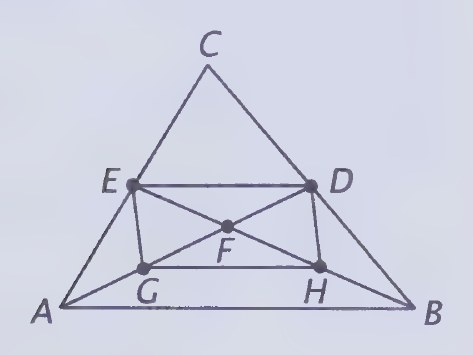
Diagram from page 210.
C
A B
21. ED || AB and ED = %AB. GH || AB and
GH = %AB. A midsegment of a triangle is parallel to the third side and half as long.
22. EDHG is a parallelogram. A quadrilateral is a parallelogram if two opposite sides are both parallel and equal.
*23. GD and EH bisect each other. The diagonals of a parallelogram bisect each other.
24. AG =GF and BH = HF because G and H are the midpoints of AF and FB, respectively. GF =FD and HF = FE because GD and EH bisect each other.
AF 2 BF 2
25.
FD 1 FE 1
26. Points of trisection. Altitude Construction.
27.
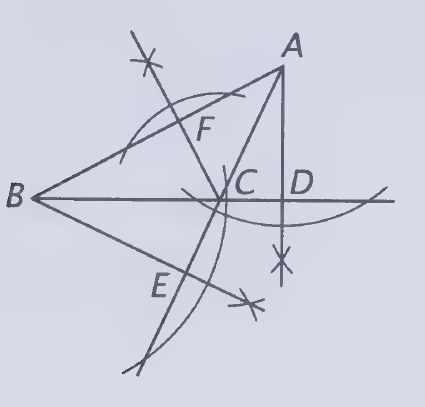
Diagram from page 210.
A
*28. AABC is obtuse.
29. No. The altitude segments do not intersect.
30. Yes. We have proved that the lines that contain the altitudes of a triangle are concurrent.
31. Its orthocenter and its circumcenter.
Set II (pages 551-553)
Exercises 32 through 37 reveal Carnot’s observation concerning the special relation between four points that are the three vertices of a triangle and its orthocenter: each point is the orthocenter of the triangle whose vertices are the other three. According to Howard Eves in An Introduction to the History of Mathematics (Saunders, 1990), Lazare Carnot was a general in the French Army and supported the French Revolution. In 1796, however, he opposed Napoleon’s becoming emperor and had to flee to Switzerland. While living in exile, he wrote two important books on geometry. In one of them, he introduced several notations still used today, including AABC to represent the triangle having the vertices A, B, and C and AB to represent arc AB. One of Carnot’s sons became a celebrated physicist for whom the Carnot cycle of thermodynamics is named, and one of his grandsons became President of the French Republic.
Other Triangles, Other Orthocenters.
#32. GE, AF, and CD.
*33. At pointB.
34. GE AE, and BD.
35. At point C.
36. GD, BF, and CE.
37. Atpoint A. Medians as Bisectors.
38. The green line segments appear to be parallel to BC.
39. It appears to bisect them.
40. They are similar by AA. (Each pair of triangles has a common angle, and parallel lines form equal corresponding angles.)
*41. Corresponding sides of similar triangles are proportional.
*42. Substitution.
43. BM =MC.
Lesson 5
44. Substitution.
45. Multiplication.
46. They suggest that the triangle would balance on the edge of the ruler.
Doing Without a Compass.
47. Example figure:
48. ZACB and ZADB are right angles. An ang] inscribed in a semicircle is a right angle.
yle
*49. PD and EC are altitudes of AAPE.
50. Its orthocenter.
51. AF is the third altitude of AAPE. The lines that contain the altitudes of a triangle are concurrent.
52. PELL
53. Example figure:
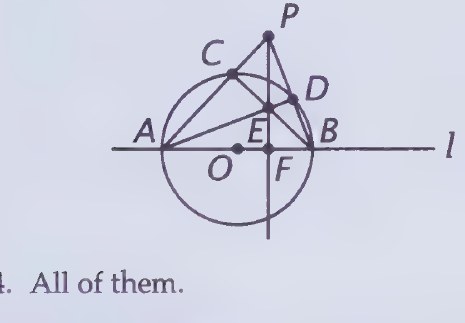
Diagram from page 211.
54. All of them. Engineering Challenge.
5. ) e
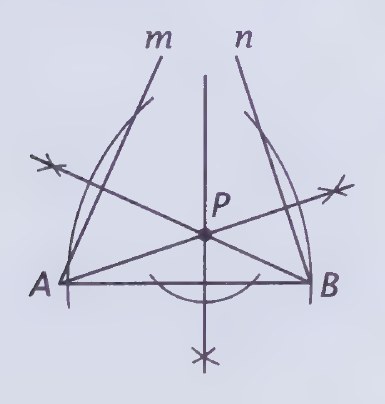
Diagram from page 211.
56. Constructing perpendiculars from A to line n and from B to line m produces two altitudes of the triangle formed by AB, m, and n. The point in which these altitudes intersect is the orthocenter of the triangle. A line drawn through this point perpendicular to AB therefore contains the third altitude of the triangle and passes through the point in which lines m and » intersect.
Set I11 (page 553)
The centroid of a uniform sheet in the shape of a quadrilateral was discovered by a German mathematician, Ferdinand Wittenbauer (1857— 1922). The parallelogram whose sides lie in the lines through the points that trisect the sides of a quadrilateral is known as its “Wittenbauer parallelogram.”
Balancing Point.
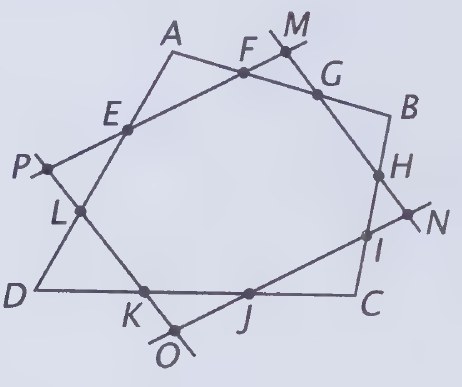
Diagram from page 211.
1. It seems to be a parallelogram.
2. The point in which the diagonals of the parallelogram intersect.
Set I (pages 557-558)
Although Ceva’s Theorem is usually stated in terms of ratios, it appears in Nathan Altshiller Court’s College Geometry (Barnes & Noble, 1952), in the following form: “The lines joining the vertices of a triangle to a given point determine on the sides of the triangle six segments such that the product of three nonconsecutive segments is equal to the product of the remaining three segments.” This version of the theorem makes it immediately obvious that Obtuse Ollie’s variations of it in exercises 25 and 26 are correct.
Which is Which? s]. CE
2. GE.
3. CD.
4. CE.
5. No. GF is not a cevian, because neither its endpoints is a vertex of the triangle.
Using Ceva’s Theorem. géé =1, fi =1,15x =48, x = 35« 15x 7.24. 3221 2 g 5-122-2. xx5 5x
*8. Not concurrent. 7187 13 13 5 845
9. Not concurrent. 14 7 13 1,274 575125 =0.999 = 1. Equilateral Triangle. 10.
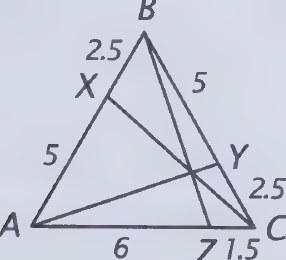
Diagram from page 212.
*11. 2.
12. 2.
13. Because the cevians are concurrent, 2-2~—Zc—i =1;s0 % = i
CZ! ecause 1 ZA =4CZ. Also,
14. B —==,ZA=4CZ. 3 CZ+ZA=75;50CZ+4CZ=725,
5CZ=75,CZ=15and AZ=6.
Ratio Relations.
=2.2.2=8. PY PZ PX g
PX PY PZ 1 1 1
et = LS s — = 6 x*tay’8z”373”3 CX AY BZ 7 Tt Pz — +—+—=3+3+3=09.
AP BP CP 2 2 2 ELL 2 faCs 2o BBz X337 3 AX BY CZ —Z . —.——=1(by Ceva’s Theorem.) Y 35 vc za 1® AB BC CA —+—+—=2+2+2=6. 0 Xtz
Right Triangle. BY 6 & YC 2 L E B g
czZ 2 1 2 78172 AX BY CZ - AX 1 PN SCLE VR R e = XB YC ZA XB 2 AX 2 XB 3
*24. Because AABC is a right triangle with legs 6 and 8, its hypotenuse is 10. Because % = % and AX + XB =10, AX=4and XB = 6. Ollie’s Equations.
25. Alice is wrong. Ollie’s equation is correct.
One way to show this is to start with Alice’s %-5-% = 1. Clearing it of fractions gives ace = bdf. Dividing both sides by ace e b
equation,
gives 1=
ace cea
26. Ollie’s second equation also is correct. One way to show this is to start with the expres-
sion L€ € ootting 2 _ e _ac e
Fav® T T v df
27. They suggest that you can begin with any one of the six segments and go in either
direction around the triangle.
Set II (pages 559-560)
In his A Course of Geometry for Colleges and Universities (Cambridge University Press, 1970),
Dan Pedoe wrote: “The theorems of Ceva and Menelaus naturally go together, since the one gives the condition for lines through vertices of a triangle to be concurrent, and the other gives the condition for points on the sides of a triangle to
- be collinear.” Menelaus is known for his book Sphaerica, in which the concept of a spherical triangle appears for the first time. The spherical version of the theorem of Menelaus considered in exercises 28 through 33 is, in fact, the basis for the development of much of spherical trigonometry.
Exercises 52 through 59 demonstrate, for the
case of an acute triangle, how Ceva’s Theorem can be used to prove that the altitudes of a triangle are concurrent.
The Theorem of Menelaus.
#28. AAXZ ~ ACPZ and ABXY ~ ACPY.
29. Corresponding sides of similar triangles are proportional.
30. Multiplication.
31. Multiplication and division.
#32. Division (and substitution).
33. The equation in Ceva’s Theorem. Concurrent or Not?
*34. If aline parallel to one side of a triangle intersects the other two sides in different points, it divides the sides in the same ratio. AX BY CZ ZA BY CZ XB YC ZA CZ BY ZA
35. =1. (By
substituting % for % and BY for YC.)
36. It proves that AY, BZ, and CX are concurrent.
What Kind of Triangle? 37.
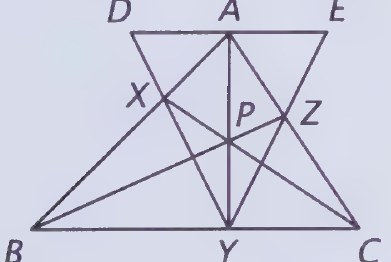
Diagram from page 213.
38. Isosceles.
39. AA. (The parallel lines form equal alternate interior angles in the triangles. Also, the vertical angles are equal.)
40. Corresponding sides of similar triangles are proportional.
e4]. —— . — . —— =1 (by Ceva’s Theorem).
42. — . — . — =1 by substitution.
43. —=1because£-—v——=l. AE
44. Because % =1, AD = AE by multiplication.
#45. In a plane, a line perpendicular to one of two parallel lines is also perpendicular to the other.
46. ADYA = AEYA by SAS. (AD = AE, ZDAY = ZEAY, and AY = AY.)
47. It proves that ADYE is isosceles. DY = EY because corresponding sides of congruent triangles are equal.
The Gergonne Point. 48.
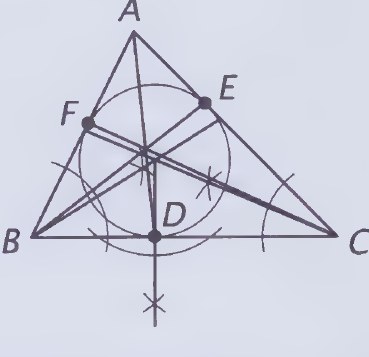
Diagram from page 213.
49. AD, BE, and CF appear to be concurrent.
50. According to Ceva’s Theorem, AD, BE, and
CF are concurrent if
The tangent segments to a circle from an
external point are equal; so AF = AE,
BF = BD, and CD = CE. Substituting in the AF BD CE
S ——p =0 — ] P T DC Ea BV fl.@.@:l;sothethreecevians BD DC EA
are concurrent.
51. The point of concurrence of AD, BE, and CF (or, the point in which the cevians connecting the vertices of a triangle to the points of tangency of the incircle to the opposite sides are concurrent).
Another Look at Altitudes.
*52. AAXC ~ AAZB.
53. ABYA ~ ABXC.
54. ACZB ~ ACYA.
EERECA AZ~ 7B
pa O fgley BX ~ XC CzZ _ 7B
57. = =22 CY YA
AX BY CZ AX-BY -CZ XB YC ZA XB YC. ZA AX-BY-CZ _AX BY CZ AZ -BX-CY AZ BX CY XC YA ZB
58.
7B XC YA
concurrent.
59. The lines containing the altitudes of a triangle are concurrent.
Set II (page 560)
If we go either clockwise or counterclockwise around a triangle and three cevians divide each side in the ratio —, then the smaller triangle
2
formed by them has an area that is one-seventh the area of the original triangle. A generalization
of this result is that, if the three cevians divide
each side in the ratio l, then the smaller triangle X
2
x=7
has an area that is — times the area of the x*+x+1
original triangle. In fact, in the chapter on affine
geometry in his Introduction to Geometry (Wiley,
1969), H. S. M. Coxeter considers an even broader
generalization. If the three cevians divide the
I o1 1 sides in the ratios —, —, —, then the smaller Xy z
triangle has an area that is
Cyz=1* (xy+x+D(yz+y+D)(xz+z+1) of the original triangle! The “seven congruent triangles” approach to the version considered in the text comes from Hugo Steinhaus’s Mathematical Snapshots (Oxford University Press, 1969).
times the area
Area Puzzle.
1. aAABD =7x. (0AABD = aAAFG + oFGHB + aABDH = x+5x+x=“7x)
2. aAADC = 14x. (Because AABD and AADC have equal altitudes and the base of AADC is twice as long as the base of AABD, 0AADC =20AABD = 14x.)
3. aAGHI = 3x. (0 AGHI = aAADC - AGIE 0 - oDHIC - 0AEIC = 14x - 5x — 5x —x = 3x.)
4. Because cAGHI = 3x and 0AABC = 0AABD + 0AADC = 7x + 14x = 21x,
0AGHI = —;—aAABC.
5. The pairs of regions with the same number appear to be congruent and hence have the same area. From this, it appears that AABC is equal in area to the sum of the areas of the seven colored triangles. If these triangles are congruent, then tAGHI (the area of the yellow triangle) is one-seventh of the area of AABC.
Lesson 6
pter 13, Lesson 6
Set I (pages 562-563)
Exercises 6 through 34 lead to the discovery of
- the Euler line. Euler, the most prolific writer on mathematics in history, noted the remarkable relation of the circumcenter, orthocenter, and centroid of every nonequilateral triangle in 176s. Not only are the three points always collinear, but the distance from the centroid to the orthocenter is always twice the distance from the centroid to the circumcenter. It is interesting to note that Euler’s proof of this relation was analytic. It was not until 1803 that Lazare Carnot published the first proof by Euclidean methods. The exercises are developed around a triangle chosen on a coordinate grid so that the coordinates of every point in the figure (except W) are integers. This was done for two reasons: (1) to help the student draw the figure accurately enough that the Euler line theorem can be discovered and
- to review basic ideas such as distance and slope. Unfortunately, this approach obscures the fact that the results obtained are not limited to this particular triangle but are generally true.
Tilted Square. e1l. ABand DC. 2 -3
3. Because the sides are perpendicular. o4, /13 units. (4/32+22 )
5. B(10, 6), C(8,9), D(5, 7).
Euler’s Discovery. The Centroid.
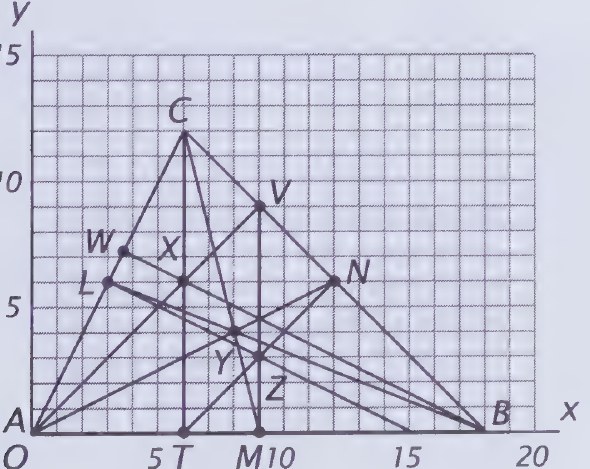
Diagram from page 215.
7. M(9, 0), L(3, 6).
8. (8,4).
9. (12, 6).
10. The coordinates of N are the averages of (or midway between) the corresponding coordinates of B and C.
11, CN = (6-12)* +(12—6)% = V36+36 = W/Z or 6/5} NB = y(12-18)2+(6-0)* = v36+36 = 1/5 or 61/5 .
12. Its centroid.
13. Medians. The Circumcenter.
14. (9,9).
15. (6, 0).
16. mNT =1and mCB =-1.
17. Yes. NT L CB; so their slopes are the opposites of the reciprocals of each other (or the product of their slopes is -1).
*18. (9, 3).
19. Its circumcenter.
20. mAC =2 and mZL =-%.
21. Their slopes indicate that AC L ZL.
22. The perpendicular bisectors of its sides. The Orthocenter.
23. CT LAB. 24, AtV.
25. mAV =1.
26. Yes, because mCB =-1 and AV 1 CB. (Also, AV || NT because AV L CB and NT L CB; so mAV = mNT.)
027. (6, 6).
28. Its orthocenter.
29. Its altitudes.
Euler’s Conclusions.
30. They appear to be collinear.
31. mXY=-1and mYZ=-1(so, X, Y, and Z are collinear).
32. XY = 2YZ because XY = V8 = 242 and YZ= 2.
33. Z. 34, ZA=7B=ZC= 90 = 310.
Set II (pages 564-565)
Students who did the Set |Il exercise of Chapter 6, Lesson 1 (page 218), may recall that the figure for exercises 35 through 42 is remarkable in that it shows an arrangement of eight points in the plane such that the perpendicular bisector of the line segment connecting any two of the points passes through exactly two other points of the figure. For most pairs of points in the figure, such as A and B or G and G, this is obvious from the symmetries of its parts.
Exercises 43 through 51 explore another property possessed by all triangles. If squares are constructed on the sides of a triangle as in the familiar figure for the Pythagorean Theorem, the line segments connecting the centers of the squares to the opposite vertices of the triangle are always concurrent. Furthermore, these line segments have a special relation to the triangle whose vertices are the centers of the squares. Each one not only is perpendicular to one of its sides but also has the same length. Again, the use of the coordinate grid makes it easier to draw the figure accurately (especially the squares and their centers) but obscures the fact that the results are true for all triangles.
Exercises 52 through 6o concern a similar result for parallelograms. If squares are constructed outward on the sides of any parallelogram, the two line segments connecting the centers of the opposite squares are both equal and perpendicular to each other. This is connected to the fact that the quadrilateral whose vertices are the centers of the squares also is a square.
A partial proof of Napoleon’s Theorem is considered in exercises 61 through 63. On the assumption that the three line segments connecting the vertices of the original triangle to the opposite vertices of the equilateral triangles are equal, are concurrent, and form equal angles with each
other, it is fairly easy to prove that the triangle determined by the centers of the three equilateral triangles also is equilateral. In Geometry Civilized (Clarendon Press, 1998), J. L. Heilbron presents a complete trigonometric proof of the theorem based on the Law of Cosines. In Hidden Connections, Double Meanings (Cambridge University Press, 1988), David Wells wrote concerning Napoleon’s Theorem: “To discover pattern and symmetry where there appears to be neither is always delightful and intriguing. It also suggests that we are not seeing all there is to be seen in the original diagram. There must certainly be another way of looking at it which will be more symmetrical from the start, and therefore make the conclusion more natural.” On pages 49—52 of his book, Wells presents another way, using tessellations, to understand this remarkable theorem.
Triangles on Four Sides.
35. .G
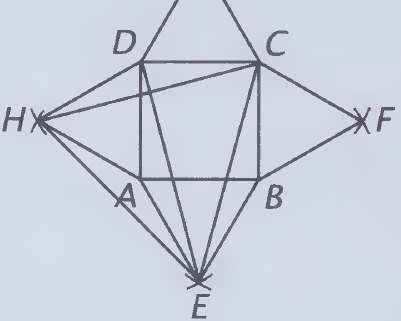
Diagram from page 216.
D @
©36. 48 units. (8 X 6.)
37. 150°. (£CBE = 90° + 60° = 150°.)
*38. 150°. (ZHAE = 360° - 60° — 90° — 60° = 150°.)
39. They appear to be perpendicular. (Also, DE appears to be the perpendicular bisector of HC.)
40. They are congruent by SAS. (They are also isosceles.)
41. It proves that AHCE is equilateral.
42. They prove that HC and DE are perpendicular because, in a plane, two points each equidistant from the endpoints of a line segment determine the perpendicular bisector of the line segment.
Squares on Three Sides.
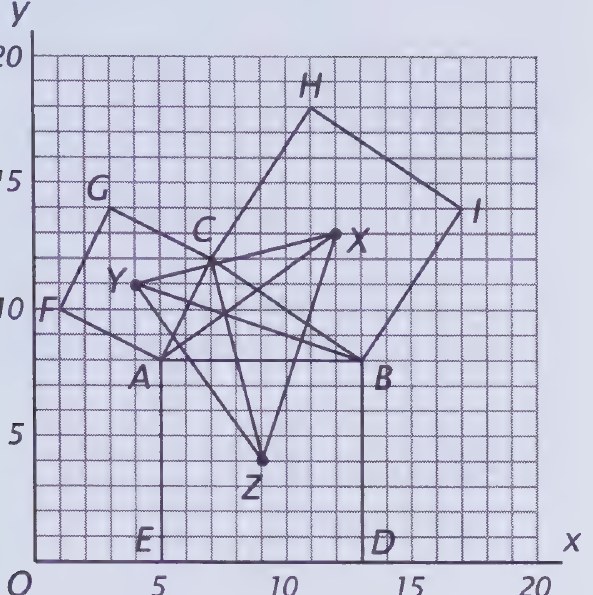
Diagram from page 217.
44. mAB=0,mAC=2, mCB=—§,
*45. No. AC and CB are not perpendicular, because the product of their slopes is not —1.
046. G(3, 14), 1(17, 14).
47. X(12,13),Y(4, 11), Z(9, 4).
48. They appear to be concurrent.
49. They appear to be perpendicular to the sides of AXYZ.
50. It is true because (mAX)(mYZ) = (g)(_%) .
1, (mBY)(mXC) = (-%)(3) =-1,and (mCZ)(mYX) = (—4)( %) =-1.
51. They are equal to the sides of AXYZ to which they are perpendicular. AX=YZ=72+5 = \74
BY = XZ = V92+3% = y90
CZ=YX=V22+82 = 68
Squares on Four Sides. 52.
AN ln’figlnln.-.“ j Vi ERNE
WA ==-.h AL .’I’ 1 i ll
53. AB=DC = 6; AD = BC = v10.
54. Itis a parallelogram.
55. Both pairs of opposite sides are equal (or, two opposite sides are equal and parallel).
56. W(12,7), X(8, 12), Y(3, 8), Z(7, 3).
57. mXZ =9, mWY =–;-.
58. That XZ and WY are perpendicular.
59. XZ=WY = V12497 = \82.
60. WXYZ is a square.
Napoleon Triangles.
61. They are cyclic because their opposite angles are supplementary. (For example, in APCE, £E = 60° and ZAPC =120°.)
62. They are perpendicular to the triangle’s sides because, in a plane, two points each equidistant from the endpoints of a line segment determine the perpendicular bisector of the line segment. (For example, XA = XP and YA = YP because all radii of a circle are equal; so XY is the perpendicular bisector of AP.)
63. AXYZ is equilateral because it is equiangular. It is equiangular because each of its angles is 60°. (For example, £X = 60° because, in quadrilateral PGXI,
ZXGP = £XIP = 90° and ZGPI =120°)
Review
Set I1l (page s65)
Here, a surprising variation of Napoleon’s Theorem is considered.
Alternating Triangles.
1. If equilateral triangles are drawn alternately outward and inward on the sides of a quadrilateral, their vertices determine a
parallelogram.
2. Yes. The theorem still seems to apply. Example figure:
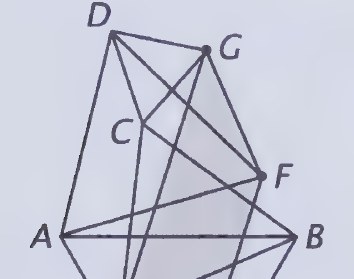
Diagram from page 218.
G
F A B
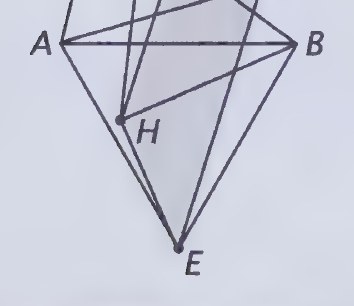
Diagram from page 218.
B
Set I (pages 566-568)
Exercises 1 through 4 illustrate the fact that the feet of the three perpendiculars to the sides of a triangle from a point on its circumcircle are collinear. The line that they determine is called the Simson line, named after Robert Simson, a professor of mathematics at the University of Glasgow. Simson produced an important edition of Euclid’s Elements in 1756. Proofs of the existence of the Simson line based on cyclic quadrilaterals can be found in J. L. Heilbron’s Geometry Civilized and Nathan Altshiller Court’s College Geometry. The Simson line leads to so many other ideas that it is the subject of an entire chapter of Court’s book.
The configuration in exercises 28 through 31 has additional interesting properties. The perpendicular bisectors of the sides of the rectangle whose vertices are the incenters of the four overlapping triangles also bisect the four arcs of the circle corresponding to the sides of ABCD. Furthermore, each vertex of the rectangle is
collinear with a midpoint of one of these arcs and a vertex of ABCD. A proof of the theorem that the incenters of the four triangles determined by the vertices of a cyclic quadrilateral determine a rectangle can be found on page 133 of Nathan Altshiller Court’s College Geometry.
Cyclic Triangle.
1. That there exists a circle that contains all of its vertices.
2. AABC is inscribed in the circle.
3. They appear to be perpendicular to them.
4. They are collinear. Circumcircle and Incircle.
5. Example figure:
£/
™ FA,
*6. AABC is a right triangle because ZACB is inscribed in a semicircle.
7. AE (or CO).
8. AC (or BC).
9. Aand D (or Band D or C and D).
10. D.
11. O.
*12. F.
13. C. Three Trapezoids. e14. JJKL.
15. EFGH.
16. A quadrilateral is cyclic iff a pair of its opposite angles are supplementary. (For ABCD, we don’t know whether a pair of opposite angles is supplementary or not.)
Double Identity.
17. Its circumcenter.
*18. Midsegments.
19. The sides of ADEF are parallel to the sides of AABC and half as long.
20. Its altitudes.
21. Its orthocenter.
22. A,B,and C. Ceva’s Theorem.
23.
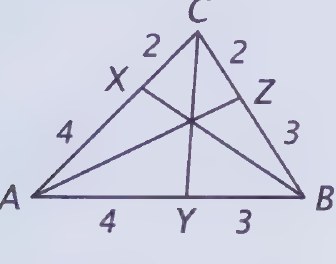
Diagram from page 219.
4 Y 3
*24, AX=4,YB=3,and ZC=2.
XA 2’YB 3 ZC 2 CX AY BZ
26, — — - =—=1 XA YB ZC
27. ltindicates that AZ, BX, and CY are concurrent.
Five Circles.
#28. Cyclic.
29. Itis circumscribed about it.
30. They are the incircles of the (overlapping) triangles whose sides are the sides and diagonals of the quadrilateral.
31. They seem to be the vertices of a rectangle. (This is surprising because ABCD, the quadrilateral from which it comes, has no special property other than being cyclic.)
Centroid. 32.
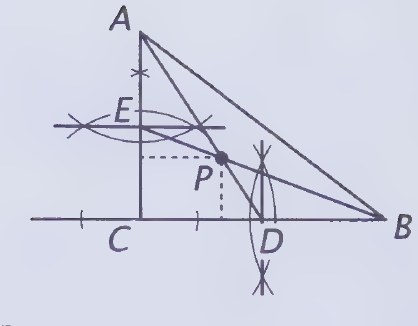
Diagram from page 219.
33. lin.
*34. % in.
35. They are one-third of the lengths.
Set 11 (pages 568-570)
The nineteenth-century Swiss mathematician Jacob Steiner has been called by Howard Eves “one of the greatest synthetic geometers the world has ever known.” The “Steiner problem” named after him concerns the problem of connecting a set of coplanar points with a set of line segments having the least possible total length. (The Spotter’s problem is the special case of this problem for a set of three points situated at the vertices of an equilateral triangle.) In The Parsimonious Universe (Copernicus, 1996), Stefan Hildebrandt and Anthony Tromba describe solving the Steiner problem by means of soap films: “Suppose we make a frame consisting of two parallel glass or clear plastic plates; these are connected by n parallel pins of the same size that meet both plates perpendicularly. If this framework is immersed in a soap solution and withdrawn, a system of planar soap films is formed. These films are attached to the pins, and they have two kinds of liquid edges, both of which are straight lines. One type adheres to the glass (or plastic), which it meets at 9o° angles. . . . The other type is where three films meet, forming three angles of 120°. . .. Since the soap-film system minimizes area, the subsystem of edges on one plate must minimize length among all connections between the n given points.” The exercises demonstrate that, for four suitably located points, equilateral triangles drawn on opposite sides of the quadrilateral determined by them can be used to construct a network of lines that meet at equal (120°) angles. Repeating the method with the other pair of opposite sides produces a different network with a possibly different total length. One of the two, however,
is the absolute minimum, the one obtained by the soap-film method.
Exercises 47 through 49 imply that two angle bisectors of a triangle meet at an angle determined entirely by the measure of the third angle of the triangle. In terms of the figure and with the use of a similar but more general argument, it can be
shown that £D = —;:LA +90°,
The two quadrilaterals in exercises 51 through 54 have another interesting relation. If perpendiculars are drawn from the point of intersection of the diagonals of a cyclic quadrilateral to its sides, their feet are the vertices of the inscribed quadrilateral of minimum perimeter. EFGH is therefore the quadrilateral of minimum perimeter that can be inscribed in ABCD.
Exercises 6o through 63 explore 3 more general case of the relations introduced in exercises 52 through 60 of Lesson 6. Martin Gardner included it in one of his “Mathematical Games” columns for Scientific American, reprinted in Mathematical Circus (Knopf, 1979). The column was on the subject of “simplicity” in science and mathematics, and Gardner wrote: “*Mathematicians usually search for theorems in a manner not much different from the way physicists search for laws. They make empirical tests. In pencil doodling with convex quadrilaterals—a way of experimenting with physical models—a geometer may find that when he draws squares outwardly on a quadrilateral’s sides and joins the centers of opposite squares, the two lines are equal and intersect at 9o degrees. He tries it with quadrilaterals of different shapes, always getting the same results. Now he sniffs a theorem. Like a physicist, he picks the simplest hypothesis. He does not, for example, test first the conjecture that the two lines have a ratio of one to 1.00007 and intersect at angles of 89 and 91 degrees, even though this conjecture may equally well fit his crude measurements. He tests first the simpler guess that the lines are always perpendicular and equal. His ‘test,” unlike the physicist’s, is a search for a deductive proof that will establish the hypothesis with certainty.” Gardner goes on to remark that this result is known as Von Aubel’s theorem and mentions several remarkable generalizations of it.
Exercises 64 through 67 establish the nice result that the area of a triangle is equal to the product of the lengths of its three sides divided by four times the radius of its circumcircle. (It is easier to begin with this conclusion and show that it is equivalent to the familiar formula for
the area of a triangle than it is to do it the other way around.)
Soap-Film Geometry.
*36. ZAED + ZAGD = 180°. ZAED and ZAGD are supplementary because they are opposite angles of a cyclic quadrilateral.
37. £AGD = 120° because ZAED = 60°.
©38. ZEGD = ZEAD because they are inscribed angles that intercept the same arc.
#39. ZEGD = 60° because ZEGD = ZEAD.
40. /DGH =120° because £DGH forms a linear pair with ZEGD.
41. ZAGH = 120° because ZAGH = 360° — ZAGD - ZDGH.
*42. /BHC =120° because it is supplementary to ZBFC.
43. /FHC = 60° because £FHC = ZFBC.
44. ZGHC = 120° because ZGHC forms a linear pair with ZFHC.
45. ZBHG =120° because ZBHG = 360° — ZGHC - ZBHC.
46. It suggests that they form equal angles. Irrelevant Information.
47. 125°. (In AABC, ZA =70° and ZABC = 60°; so ZACB = 50°. Because D is the incenter of AABC, BD bisects ZABC and so £DBC = 30°, and CD bisects ZACB and so ZDCB = 25°. In ADBC, #DBC = 30° and £DCB = 25°; so /D =125°.)
©48. 125°. (In AABC, ZA = 70° and ZABC = 40°; s0 ZACB = 70°. Reasoning as in exercise 47, we find that ZDBC = 20° and ZDCB = 35°; so £ZD =125°)
49. 125°. (In AABC, ZACB = 180° - 70° - ZABC = 110° - ZABC.
Z/DBC= %AABC and
Z/DCB = %(nm — ZABC) =55°— %AABC; 504D =180°~ L ZABC - (55° - L ZABC) = 1250) ’ ?
Medians Theorem.
50. Because the medians bisect the sides of the triangle, AX = XB, BY = YC, and CZ = ZA; AX BY CzZ o S S Therefore, o 2 = =2
AX BY CZ XB YC ZA .4
medians are concurrent.
Irregular Billiard Table.
51. Cyclic.
52. They appear to be perpendicular to its sides.
53. They appear to bisect its angles.
54. It would travel around the sides of quadrilateral EFGH (because its angles of incidence and reflection at the points in which it hits the sides of ABCD are equal).
Perimeter Problem.
*55. DB and FB.
56. AE and AF.
57. AB.
58. AB.
59. The perimeter of AABC is AB+BC+CA=2R+a+b. AB=(a-r)+(b-7r)=2R;soa+b=2R +2r. Therefore, the perimeter of AABC is 2R + (2R + 2r) = 2r + 4R.
Squares on the Sides.
60. y
T S gl 15 = : !
10 i = 11
! i T i S ERERE 1 H LEED HEEEE { | i i X o] 5 10 15 20
*61. ABCD is concave.
62. W(13, 12), X(10, 13), Y(4, 12), Z(10, 4).
63. XZLWY and XZ=WY. (XZ=WY=9.) Area Problem.
64. AABD ~ AAEC.
65. £B = ZE because they are inscribed angles that intercept the same arc. ZADB is a right angle because AD L BC, and ZACE is aright angle because it is inscribed in a semicircle; so ZADB = ZACE.
66. Because AABD ~ AAEC, AB_AD
AE AC (corresponding sides of similar triangles are proportional). So AB - AC = AD - AE
by multiplication. g7, ABACBC AD-AEBC o stitution. 4r 4r AE =2r:50 AD-2r-BC AD-BC 4r 2 AD-BC
is the area of AABC.