p. 529
Chapter 13: The Concurrence Theorems
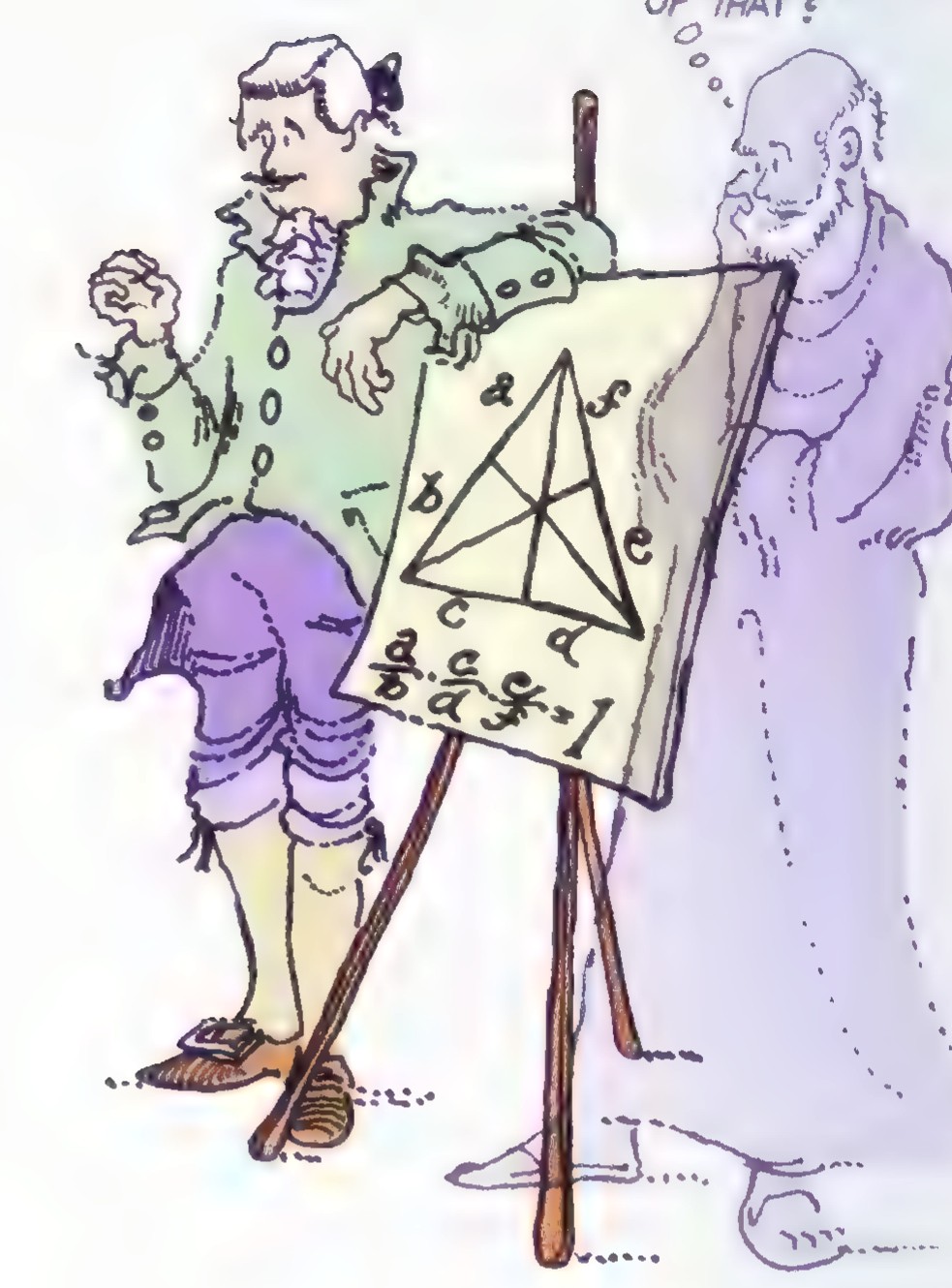
One meaning of the word “concurrence” is “agreement in opinion,” as illustrated by the person(s?) and shadow(s?) shaking hands in the figure above. In geometry, the word “concurrence” has a somewhat related meaning: the meeting of lines in a common point. A somewhat amazing fact is that, no matter what the shape of a triangle may be, several sets of lines related to the triangle are always concurrent. In this chapter, we will see why and will look at some other relations between points and lines that are quite surprising.
p. 530
Lesson 1: Triangles and Circles
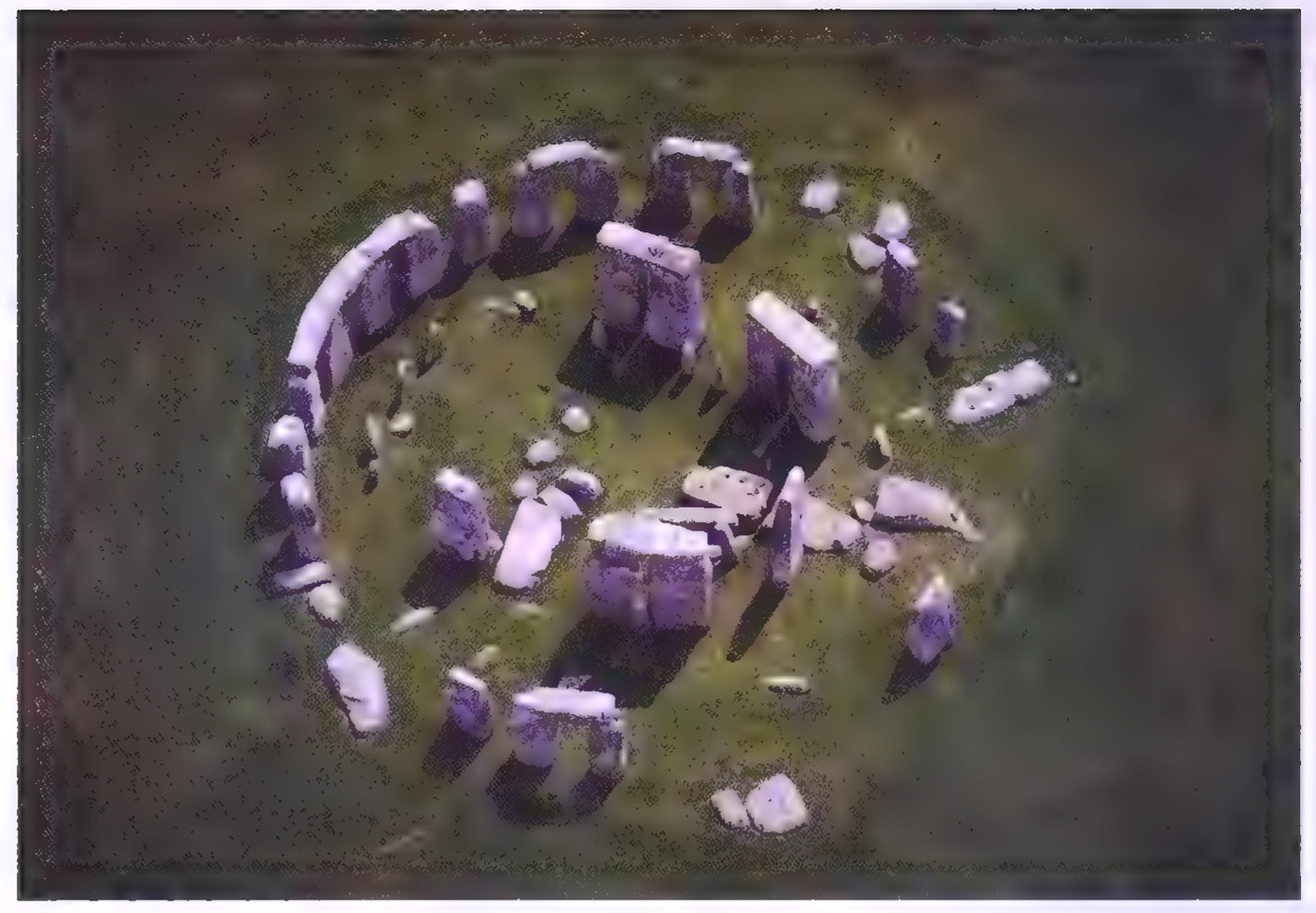
One of the earth’s ancient mysteries is Stonehenge, a monument of huge stones on the Salisbury Plain in England. Its construction is thought to have started in about 3000 B.C. when surveyors attached one end of a long rope to a post and the other end to a pointed stake. Using this primitive compass, they drew an enormous circle in the ground. In a period of more than a thousand years, more than 160 stone blocks weighing as much as 50 tons were moved into place—how and why no one knows.*
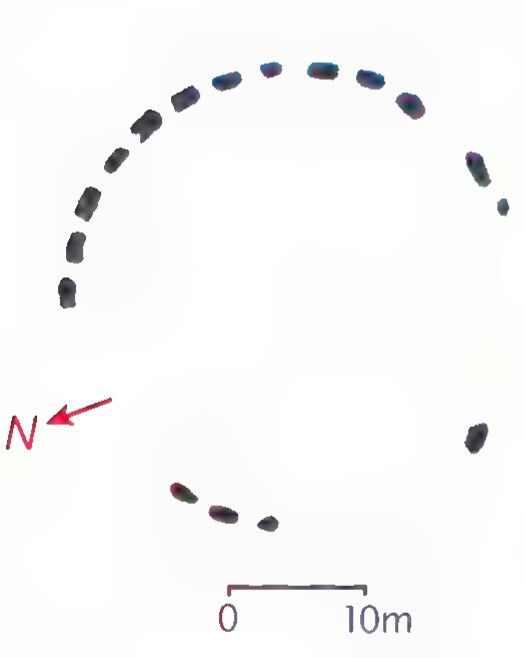
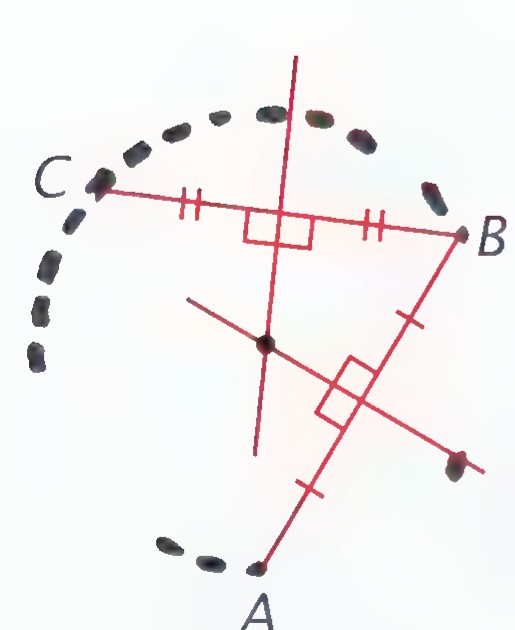
The first figure at the left shows the positions of the stones that still stand in the main circle. The second figure shows how any three of them can be used to find the circle’s center. Drawing AB, BC, and AC produces a triangle whose sides are chords of the circle. The perpendicular bisectors of the chords of a circle contain its center; so the center of Stonehenge is at the point in which these lines intersect.
Because the vertices of △ABC lie on a circle, the triangle is said to be cyclic.
Definition
A polygon is cyclic iff there exists a circle that contains all of its vertices.
* Stonehenge Complete, by Christopher Chippindale (Cornell University Press, 1983).
p. 531
It is easy to prove that every triangle, no matter what its shape, is cyclic.
Theorem 68
Every triangle is cyclic.
Given: △ABC.
Prove: △ABC is cyclic.
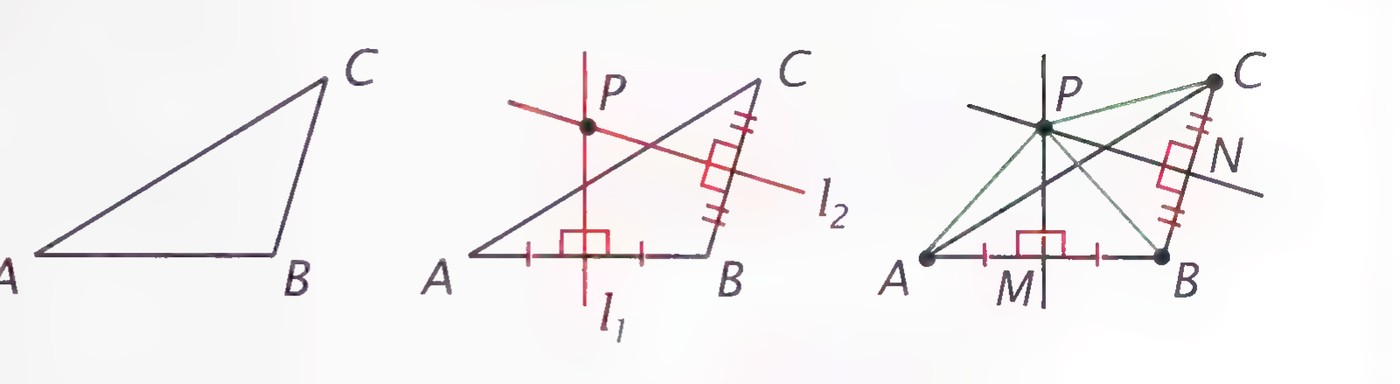
Proof
Let l₁ and l₂ be the perpendicular bisectors of AB and BC and let P be the point at which they intersect. Draw PA, PB, and PC. △AMP ≅ △BMP and △BNP ≅ △CNP (SAS); so PA = PB and PB = PC. Because PA = PB = PC, the circle of radius PA contains A, B, and C. So △ABC is cyclic.
In the figure at the right, △ABC is inscribed in circle O, and circle O is circumscribed about △ABC. Circle O is called the circumcircle of △ABC, and point O is called the circumcenter of △ABC.
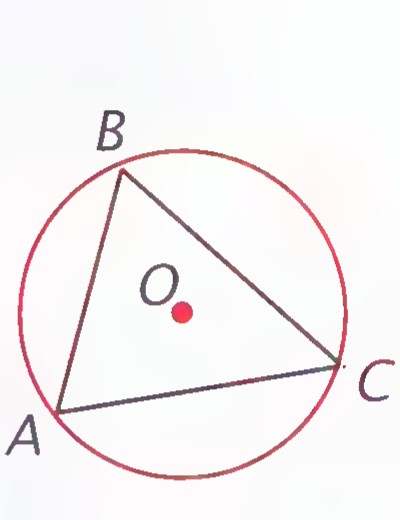
Definitions
A polygon is inscribed in a circle iff each vertex of the polygon lies on the circle.
The circle is circumscribed about the polygon.
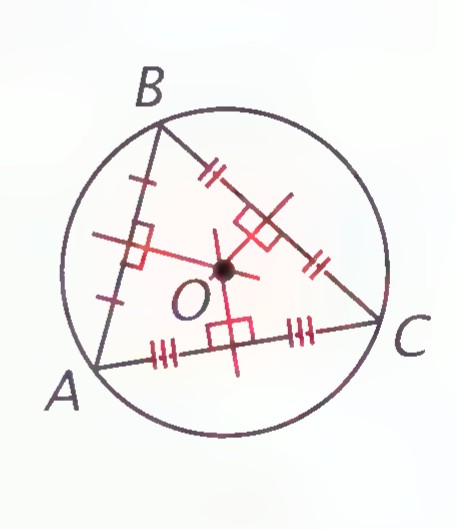
In our proof that every triangle is cyclic, we showed that the perpendicular bisectors of two of its sides intersect at the center of its circumcircle. All the sides of △ABC in the figure at the right are chords of circle O. We know from Theorem 58 that the perpendicular bisectors of the chords of a circle contain the center of the circle. Because lines that contain the same point are concurrent, this result establishes the following corollary.
Corollary to Theorem 68
The perpendicular bisectors of the sides of a triangle are concurrent.
Theorem 68 and its corollary suggest that we need only to construct the perpendicular bisectors of any two sides of a triangle to find the triangle’s circumcenter.
Construction 9
To circumscribe a circle about a triangle.

p. 532
Exercises
Set I
Hot Tub. The figure below shows a design for a hot tub as seen from overhead.*
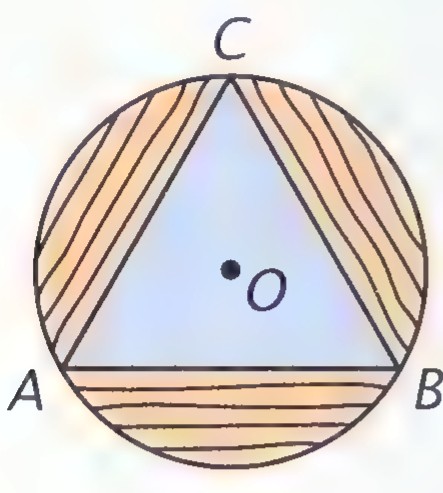
- What are the sides of △ABC called with respect to the circle?
- What are the angles of △ABC called with respect to the circle?
- What word describes a polygon for which there is a circle that contains all of its vertices?
- What is circle O called with respect to △ABC?
- What relation does △ABC have to circle O?
- What relation do points A, B, and C have to point O?
Circumcircles. The figures below suggest something about the circumcircles of different types of triangles.
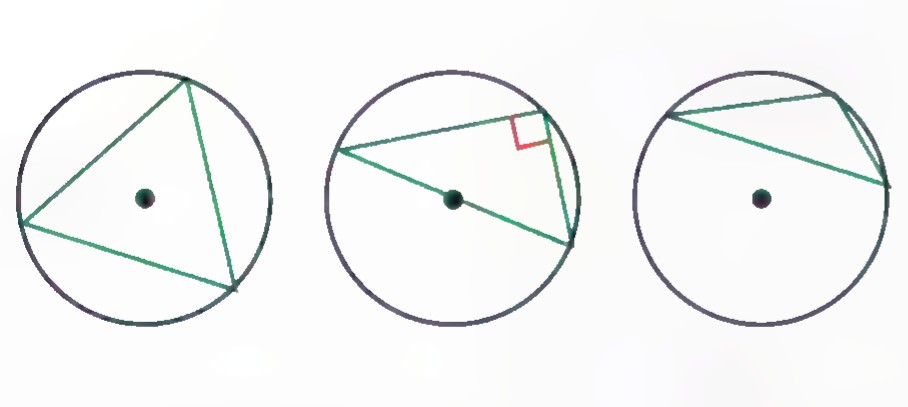
- What kind of arcs do the angles of an acute triangle intercept?
- What kind of arc does the right angle of a right triangle intercept?
- What kind of arc does the obtuse angle of an obtuse triangle intercept?
For what kind of triangle is the circumcenter
- inside it?
- on it?
- outside it?
- What is the hypotenuse of a right triangle called with respect to its circumcircle?
- What point is the circumcenter of a right triangle?
RGB Color. The primary colors of light (red, green, blue) are mixed in varying proportions to produce the colors on a television screen or computer monitor.
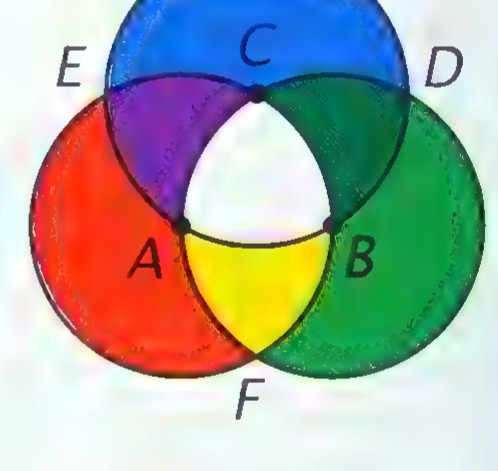
The figure above illustrates the basic combinations of these colors.
Construct the figure by doing the following steps.
- Construct an equilateral triangle with sides 1 inch long, and label its vertices A, B, and C.
- Draw three circles with their centers at A, B, and C and radius 1 inch.
- Label the points D, E, and F in which the circles intersect.
(continued) Draw AD, BE, and CF.
What do you notice about these three lines?
Why is it true?
* Indoor Sports Spaces, by Robin Crane and Malcolm Dixon (Van Nostrand Reinhold, 1991).
p. 533
In the figure below, three circles having different radii intersect in six points.
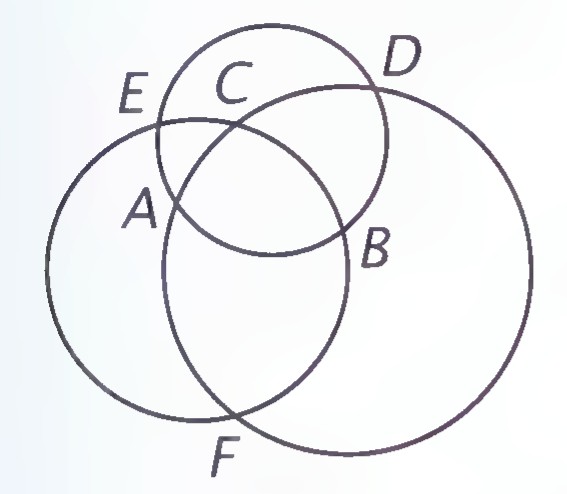
- Use your compass to draw a figure like it. Label the six intersection points as indicated.
- Draw △ABC.
- Draw AD, BE, and CF.
Are these three lines the perpendicular bisectors of the sides of △ABC?
Do they seem to be concurrent?
(continued) Label the point P in which AD, BE, and CF seem to intersect.
Given that they do intersect in P, explain why AP · PD = BP · PE = CP · PF.
Four Lines and Four Circles. In the figure below, four lines intersect in six points.
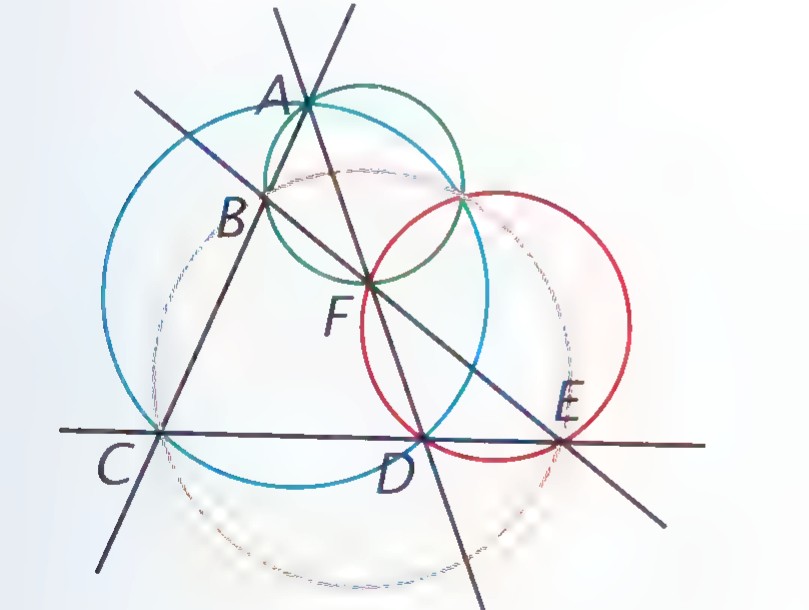
Name the triangles that they form.
How are the circles in the figure related to these triangles?
How many points are needed to determine a circle?
Although there is nothing special about the four lines, there is something unusual about the four circles. What is it?
Equilateral Triangle. In the figure below, △ABC is equilateral, it is inscribed in circle O, and AE, BF, and CD are its altitudes.
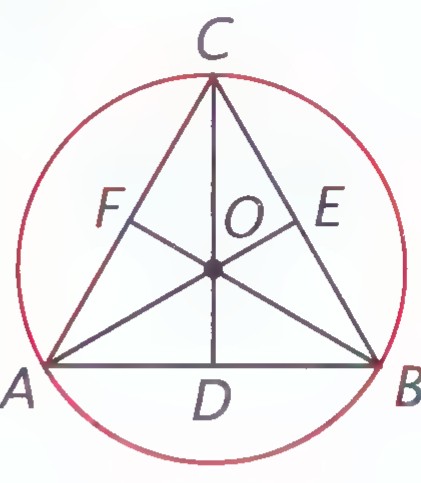
- It follows that AE, BF, and CD are also the perpendicular bisectors of the sides of △ABC. Why?
- Into what kind of right triangles do AE, BF, and CD divide △ABC?
- How does the length of OA compare with the length of OD? Explain.
- How does the radius of circle O compare in length with one of the altitudes of △ABC?
Nearest School. In the figure below, A, B, and C represent the locations of three high schools. Students are assigned to the school closest to where they live.
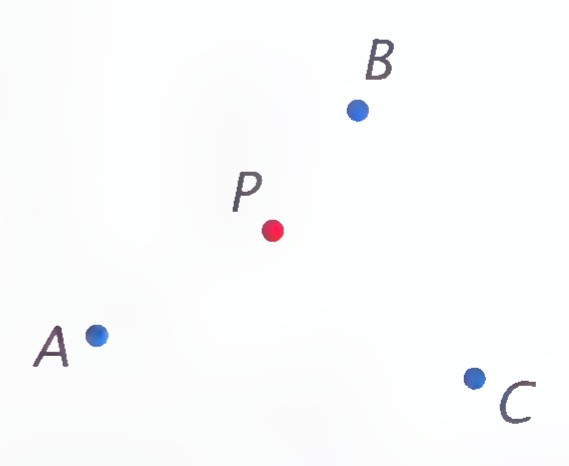
- If a high-school student lives at P, to which school does he or she go?
Make a large drawing similar to this figure on your paper.
p. 534
- Use your straightedge and compass to construct a line separating all points closer to A from those closer to B. Draw a second line separating all points closer to B from those closer to C. Draw a third line separating all points closer to C from those closer to A. Darken the parts of the lines that are the edges of the three regions in which students going to the three schools live.
- What is the point called that is equidistant from A, B, and C?
Set II
Folding Experiment. The figure below shows a triangle with sides of lengths 10, 11, and 12.
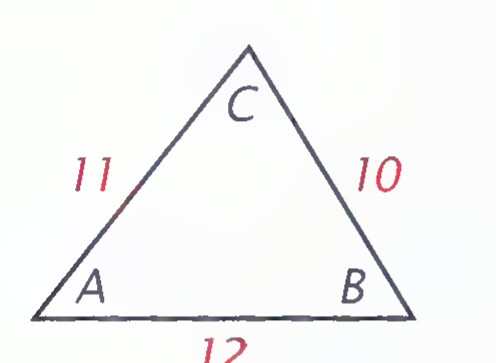
Use your straightedge and compass to construct it by using lengths of 10 cm, 11 cm, and 12 cm for the sides. Label the three vertices of the triangle A, B, and C inside the triangle as shown in the figure.
- Construct the three perpendicular bisectors of the sides of the triangle.
- Cut the triangle out. Fold it so that vertex A falls on vertex B. Open the triangle out flat and fold it again so that vertex B falls on vertex C. Open the triangle out flat and fold it again so that vertex C falls on vertex A.
What do you notice about the three folds?
(continued) Label the point P in which the folds intersect. Tape the triangle on your paper.
How is point P related to the vertices of the triangle?
Use your ruler to find the radius of the triangle’s circumcircle.
Use your ruler and compass to draw a triangle having sides of lengths 9 cm, 12 cm, and 15 cm. Cut the triangle out and fold each pair of vertices together as described in exercise 33. Tape the triangle on your paper.
What kind of triangle is it? Explain.
What do you notice about the three folds?
Use your ruler to find the radius of the triangle’s circumcircle.
Inscribed Triangles. In the figure below, △ABC and △ADE are inscribed in circle O and DE ⊥ AC.
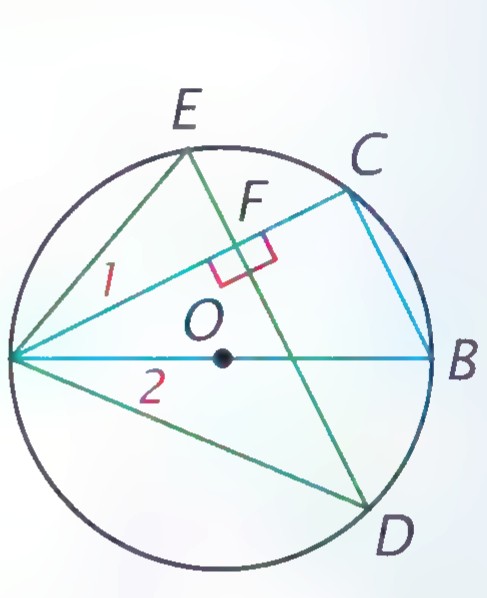
- Copy the figure and draw BD.
- ∠E = ∠ABD. Why?
- What can you conclude about ∠ADB? Explain.
- ∠AFE = ∠ADB. Why?
- What can you conclude about ∠1 and ∠2? Explain.
Babylonian Problem. In 1936, some Babylonian tablets dating from 1900 B.C. to 1650 B.C. were discovered in Iran. On one of these tablets appears the following problem:
Find the radius of the circumcircle of a triangle whose sides are 50, 50, and 60.*
- Use your straightedge and compass to construct a triangle ABC whose sides are 50 mm, 50 mm, and 60 mm, with the 60 mm side as a horizontal base, AB.
* An Introduction to the History of Mathematics, Howard Eves (Saunders, 1990).
p. 535
Construct its circumcircle; draw a radius and label it r.
- Use your ruler to measure the radius in millimeters.
- Let O be the circumcenter of △ABC. Use your drawing and what you know about it to find the exact answer to the Babylonian problem.
Diameters and Sines. Circle O is the circumcircle of △ABC and BD is a diameter.
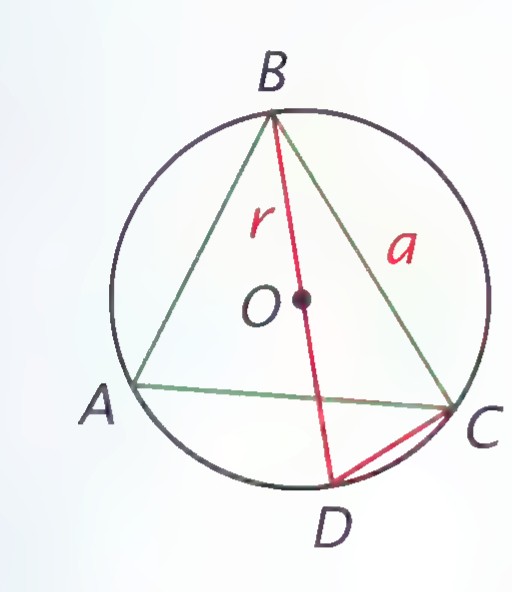
- What can you conclude about △BCD? Explain.
- Why is ∠A = ∠D?
- Express sin D in terms of a and r.
Because ∠A = ∠D, sin A = sin D. By the Law of Sines,
- Express in terms of r.
- What does this result reveal about the ratio of the length of any side of a triangle to the sine of the opposite angle?
Set III
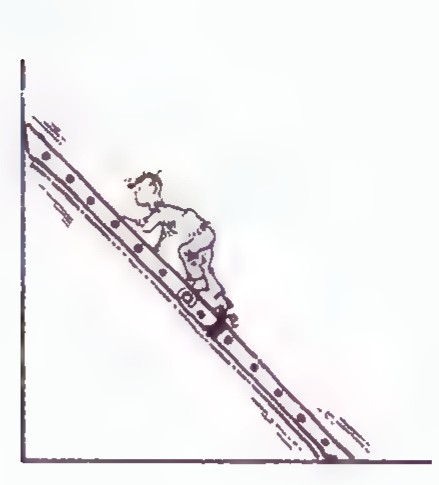
The Slipping Ladder. Obtuse Ollie put a tall ladder against a wall so that it made equal angles with the wall and floor. When his feet were halfway up the ladder, the top end started slipping and slid all the way down the wall. Ollie was too startled to do anything but hold on.
- Draw two perpendicular line segments to represent the wall and the floor. Make an accurate drawing of the path of Ollie’s feet as the ladder slid down the wall by using one of the shorter edges of a file card to represent the ladder as shown below.
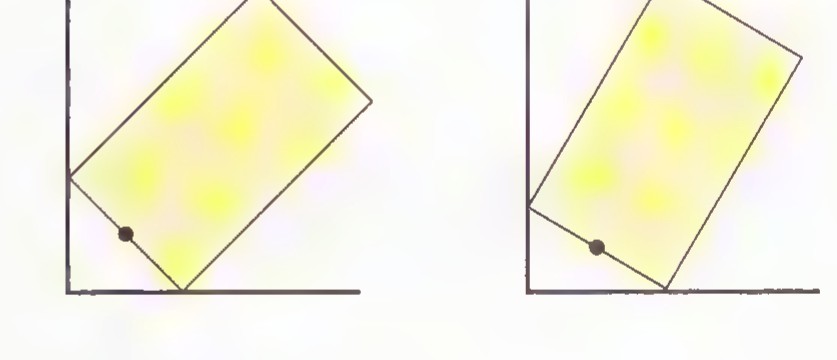
- What kind of a path do you think Ollie’s feet traveled?
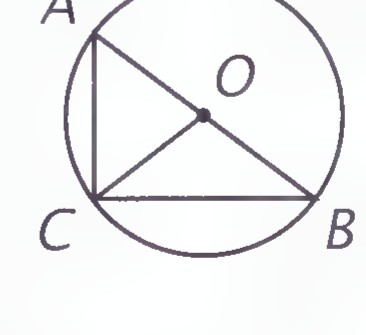
- Use the fact that the midpoint of the hypotenuse of a right triangle is its circumcenter to explain why the path has the shape that it does.
p. 536
Lesson 2: Cyclic Quadrilaterals
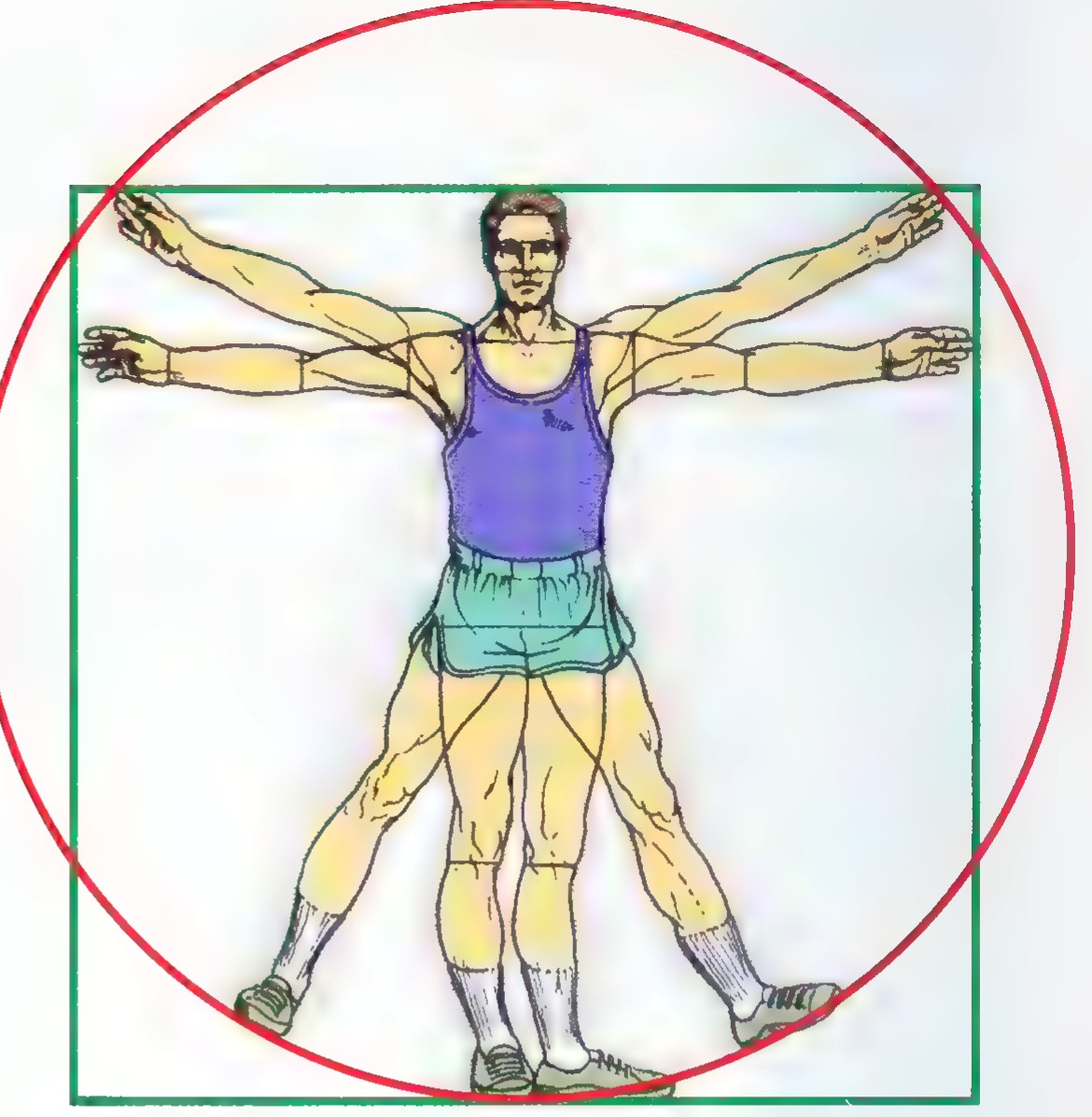
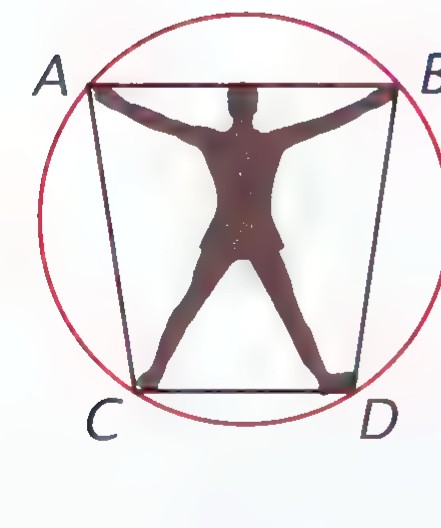
Leonardo da Vinci used geometry to study the human figure. The illustration above is based on a drawing from one of da Vinci’s notebooks. In one position, the man’s fingers, feet, and head touch the square. In the other position, his fingers and feet touch the circle. If you stood with your arms outstretched and your feet apart, would your hands and feet also touch a circle?
The answer to this question depends on whether the quadrilateral whose vertices correspond to the positions of your hands and feet is cyclic. Unlike triangles, not every quadrilateral is cyclic. Whether a convex quadrilateral has vertices that lie on a circle is determined by its angles. In stating the following theorem, we use our assumption that polygons are convex, unless told otherwise.
Theorem 69
A quadrilateral is cyclic iff a pair of its opposite angles are supplementary.
p. 537
First, we will prove that, if a quadrilateral is cyclic, its opposite angles are supplementary.
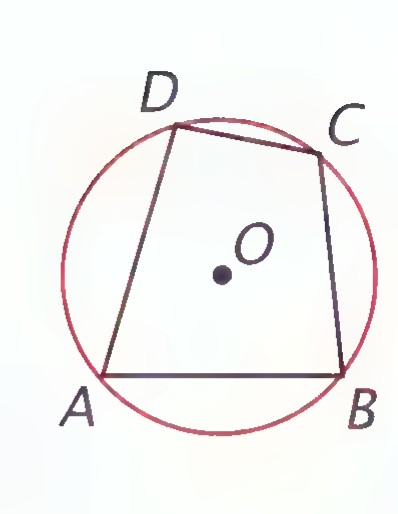
Given: Quadrilateral ABCD is cyclic.
Prove: ∠A and ∠C are supplementary and ∠B and ∠D are supplementary.
Proof
Because quadrilateral ABCD is cyclic, let circle O contain its vertices (if a polygon is cyclic, there exists a circle that contains all of its vertices).
In the circle, and (an inscribed angle is equal in measure to half its intercepted arc). Because (addition), (a circle has a degree measure of 360°). Therefore, ∠A and ∠C are supplementary. Because the sum of the angles of a quadrilateral is 360°, ∠A + ∠B + ∠C + ∠D = 360°. We know that ∠A + ∠C = 180° and so, by subtraction, ∠B + ∠D = 180°; so ∠B and ∠D also are supplementary.
Now we will prove the converse: if a pair of opposite angles of a quadrilateral are supplementary, then the quadrilateral is cyclic.
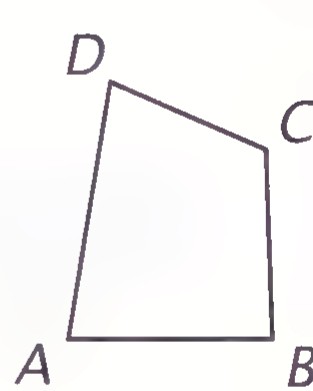
Given: ∠B and ∠D are supplementary.
Prove: Quadrilateral ABCD is cyclic.
Proof
Draw a circle through points A, B, and C (points A, B, and C determine a triangle and every triangle is cyclic). Point D lies either outside this circle, inside it, or on it.
Suppose that D lies outside the circle. Let the second point in which AD intersects the circle be called E. Draw EC. Then ABCE is cyclic.
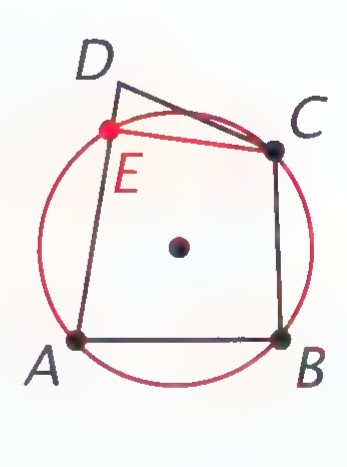
Now, ∠B and ∠AEC are supplementary (if a quadrilateral is cyclic, its opposite angles are supplementary), and ∠B and ∠D are supplementary (given); so ∠AEC = ∠D (supplements of the same angle are equal). But this equality contradicts the fact that ∠AEC > ∠D (an exterior angle of a triangle is greater than either remote interior angle), and so our original assumption must be false. In other words, D cannot lie outside the circle.
A similar argument can be used to establish that D cannot lie inside the circle. Therefore D must lie on the circle, and so quadrilateral ABCD is cyclic.
p. 538
Exercises
Set I
Quilt Quadrilaterals. Four shapes frequently used in quilt patterns are shown below.
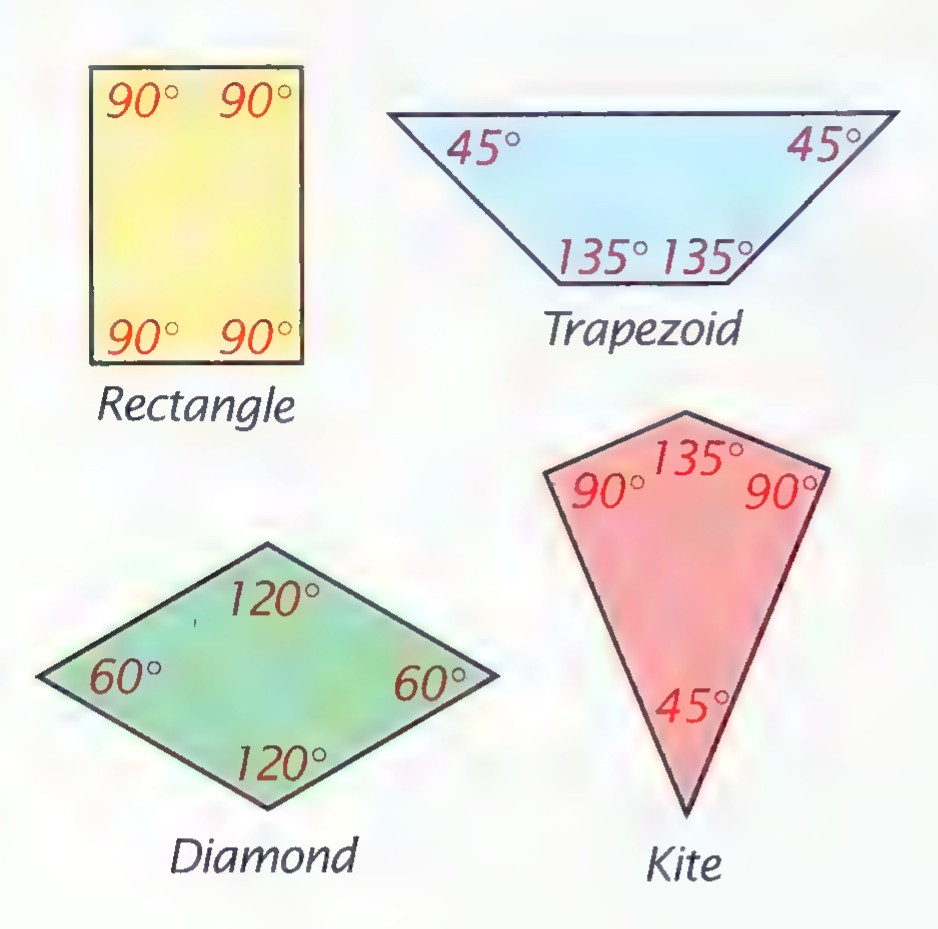
- How is it possible to tell whether each of these figures is cyclic without drawing any circles?
- Which of these figures are not cyclic?
Cyclic and Noncyclic. The figures below suggest another difference between cyclic and noncyclic quadrilaterals.
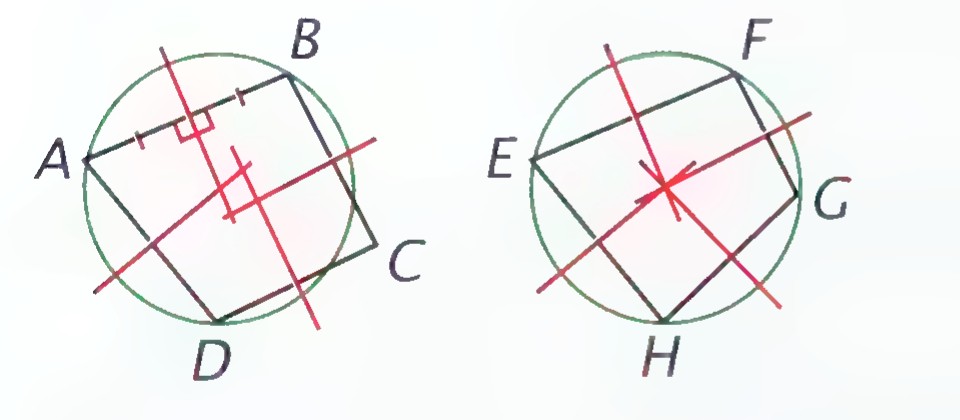
- How do you suppose the lines intersecting AB, BC, CD, and DA were constructed?
- For a quadrilateral to be cyclic, what must be true about these four lines?
- What relation does the center of the circumscribed circle of a cyclic quadrilateral have to the vertices?
Euclid’s Proof. Euclid’s proof that the opposite angles of a cyclic quadrilateral are supplementary is based on the figure below.
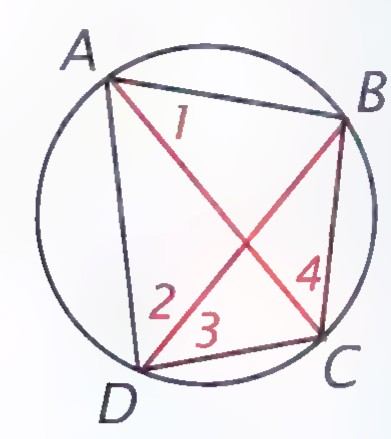
Give the reason for each of the following statements in his proof.
- Draw AC and BD.
- ∠1 + ∠ABC + ∠4 = 180°.
- ∠1 = ∠3 and ∠2 = ∠4.
- ∠ADC = ∠2 + ∠3.
- ∠ADC = ∠4 + ∠1.
- ∠ADC + ∠ABC = ∠4 + ∠1 + ∠ABC.
- ∠ADC + ∠ABC = 180°.
A Different Proof. Another proof that the opposite angles of a cyclic quadrilateral are supplementary is based on the figure below.
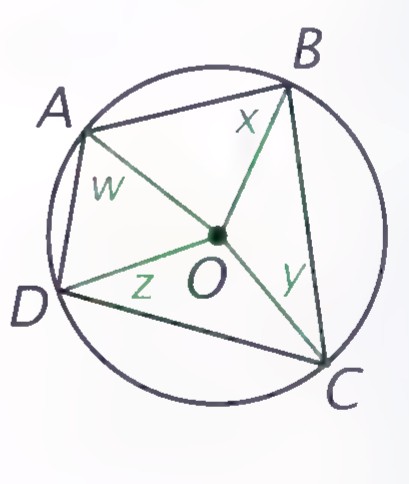
Copy the figure, including the four radii and w, x, y, and z, which are the measures of the four angles indicated.
What can you conclude about the four triangles in the figure? Explain.
(continued) Label the other four angles whose measures are w, x, y, and z.
To what number is 2w + 2x + 2y + 2z equal? Explain.
To what number is w + x + y + z equal?
p. 539
- How does this result prove that the opposite angles of a cyclic quadrilateral are supplementary?
Isosceles Trapezoid. ABCD is an isosceles trapezoid with bases AB and DC.
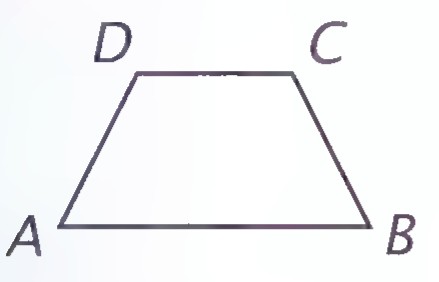
- What can you conclude about AB and DC? Why?
- What can you conclude about ∠A and ∠D? Why?
- What can you conclude about ∠A and ∠B? Why?
- What can you conclude about ∠B and ∠D?
- What does this conclusion indicate about ABCD? Why?
- What do exercises 18 through 22 prove about isosceles trapezoids?
Equilateral Triangles on the Sides. In the figure below, equilateral triangles have been constructed on the sides of △ABC.
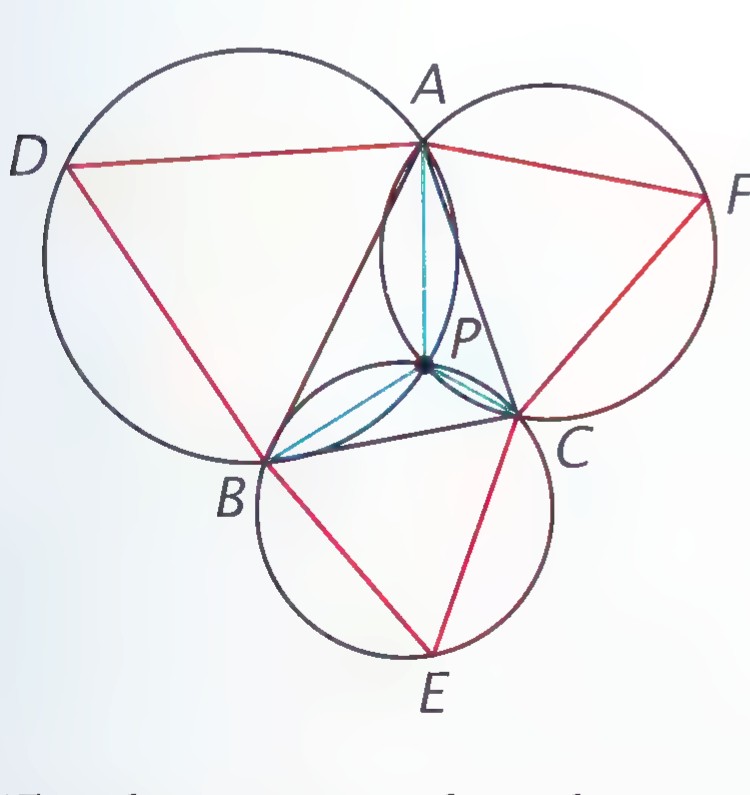
What do you notice about the circumcircles of these three triangles?
What kind of quadrilaterals are APBD, APCF, and BPCE?
What can you conclude about the three angles at P? Explain.
Use your straightedge and compass to do each of the following steps.
- Construct a triangle having a different shape.
- Construct equilateral triangles on its sides.
- Construct their three circumcircles.
Do the conclusions that you drew in exercises 24 through 26 seem to be true about your drawing?
Set II
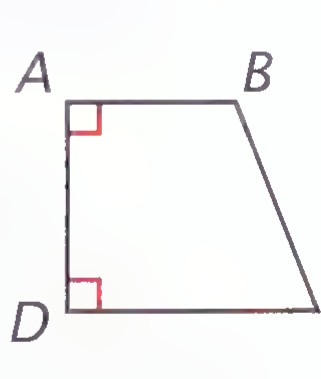
Cyclic or Not. For each of the following figures, tell whether you think quadrilateral ABCD is cyclic or not. In each case, explain your reasoning.
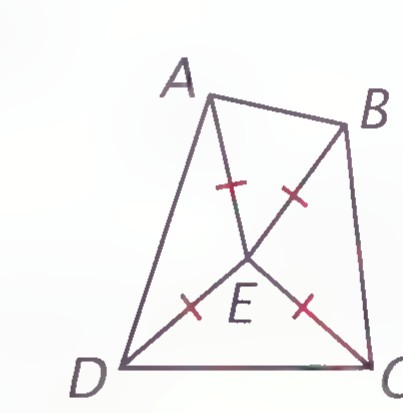
In the figure above, E is a point inside quadrilateral ABCD such that AE = BE = CE = DE.
In the figure at the right, AB ⊥ AD, DC ⊥ AD, and ∠B is obtuse.
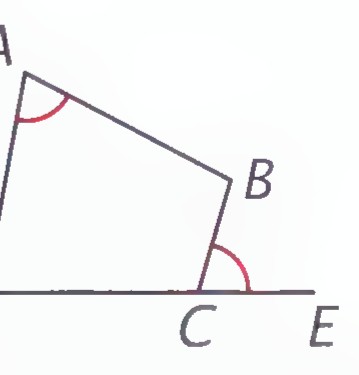
In the figure above, ∠BCE is an exterior angle of quadrilateral ABCD and ∠BCE = ∠A.
p. 540
Brahmagupta’s Theorem. Brahmagupta, an Indian mathematician who lived in the seventh century, discovered several theorems about cyclic quadrilaterals. One of them is about a cyclic quadrilateral whose diagonals are perpendicular to each other.
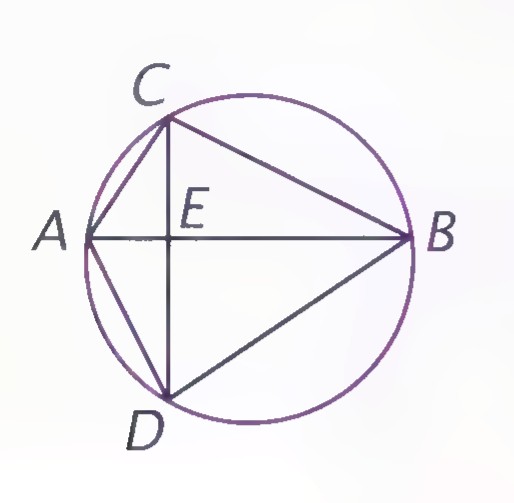
Make a drawing similar to the one above by doing each of the following steps.
- Draw a large circle and construct two perpendicular chords of unequal lengths in it. Label them AB and CD and their point of intersection E.
- Connect the four points on the circle to form the cyclic quadrilateral ACBD.
- Through point E, construct a line perpendicular to side BD and extend the line to intersect side AC. Label the points of intersection X and Y as shown in the figure below.
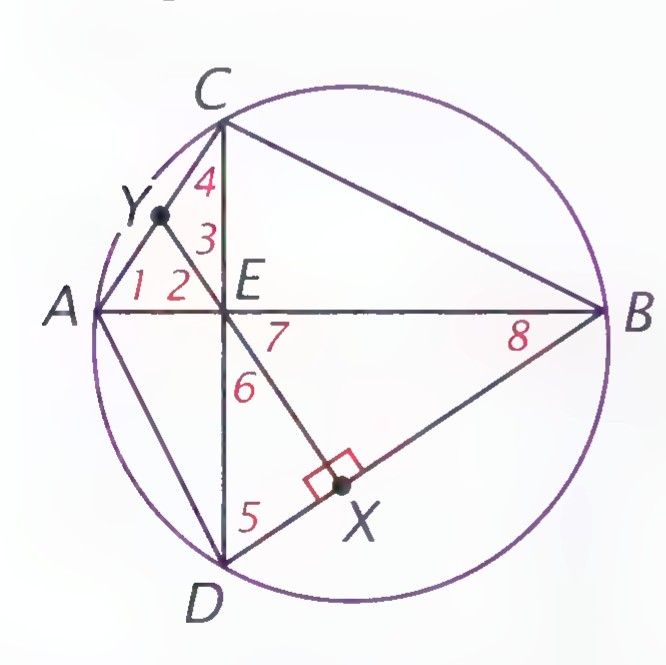
- ∠2 = ∠7 and ∠3 = ∠6. Why?
- ∠7 = ∠5 and ∠6 = ∠8. Why?
- ∠5 = ∠1 and ∠8 = ∠4. Why?
- ∠2 = ∠1 and ∠3 = ∠4. Why?
- What do the equations in exercise 36 reveal about the relation of point Y to segment AC? Explain.
The same reasoning can be used to show that lines drawn through E perpendicular to the other sides of ACBD are related to the opposite sides in the same way.
Use this conclusion to copy and complete the following statement of Brahmagupta’s Theorem:
If a cyclic quadrilateral has perpendicular diagonals, then any line through their point of intersection that is perpendicular to a side of the quadrilateral . . .
Area Formula.
You may remember that the ancient Egyptians used a formula for the area of a quadrilateral that didn’t always work.*
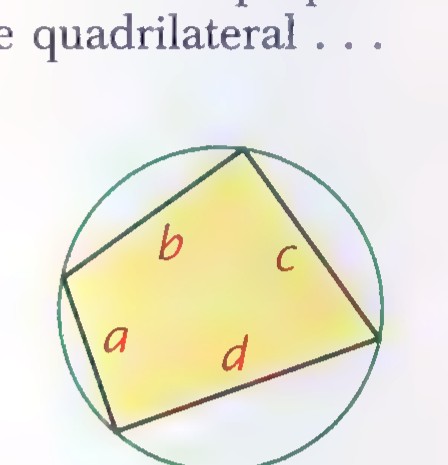
Brahmagupta found a formula for the area of a cyclic quadrilateral that does always work. The formula is
in which a, b, c, and d are the lengths of the sides of the quadrilateral and s is half its perimeter.
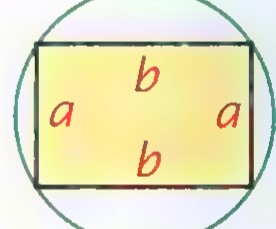
Show that this formula works for a rectangle, where c = a and d = b.
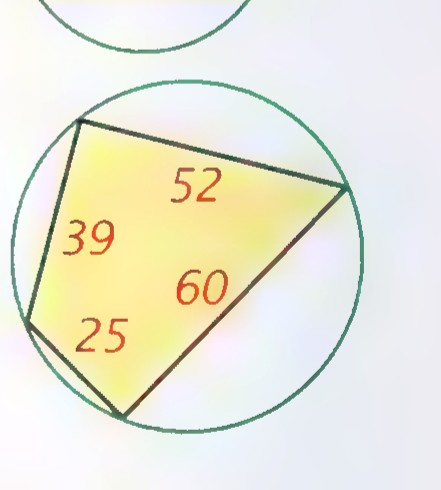
Use it to find the area of the cyclic quadrilateral at the right, which Brahmagupta used as an example.
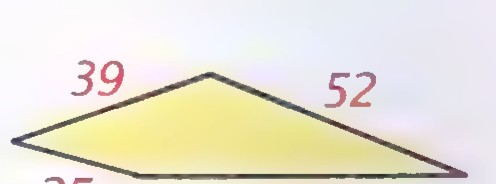
The figure below shows another quadrilateral whose sides have the same lengths: 25, 39, 52, and 60. Do you think it has the same area as the quadrilateral in exercise 40? Explain why or why not.
* Chapter 1, Lesson 5, pp. 30–31.
p. 541
Ptolemy’s Theorem. Claudius Ptolemy, an astronomer and mathematician who lived in Alexandria, proved the following theorem in about 150 A.D.:
The sum of the products of the opposite sides of a cyclic quadrilateral is equal to the product of its diagonals.
In the figure below, this theorem means that AB · DC + AD · BC = AC · BD.
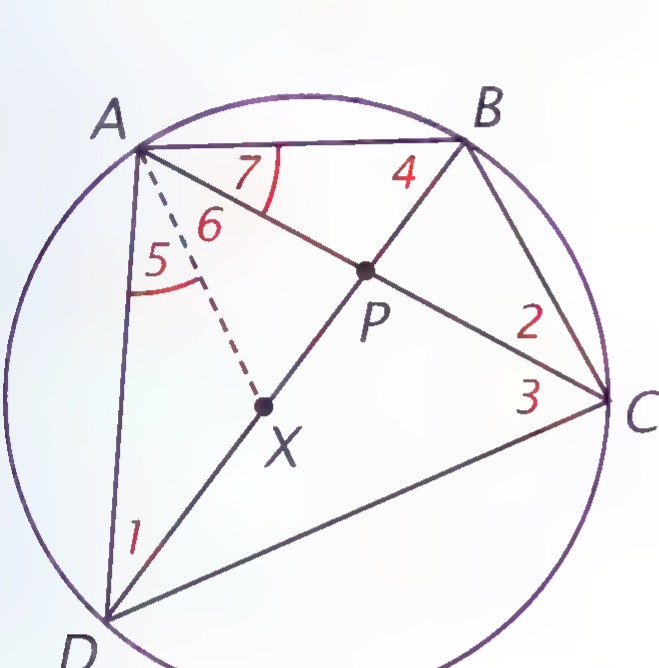
Give the reason for each of the statements in the following proof of Ptolemy’s Theorem.
- Draw AX so that ∠5 = ∠7.
- ∠1 = ∠2.
- △DAX ∼ △CAB.
- .
- .
- ∠5 + ∠6 = ∠7 + ∠6.
- ∠DAC = ∠XAB.
- ∠3 = ∠4.
- △DAC ∼ △XAB.
- .
- .
- .
- .
- AB · DC + AD · BC = AC · BD.
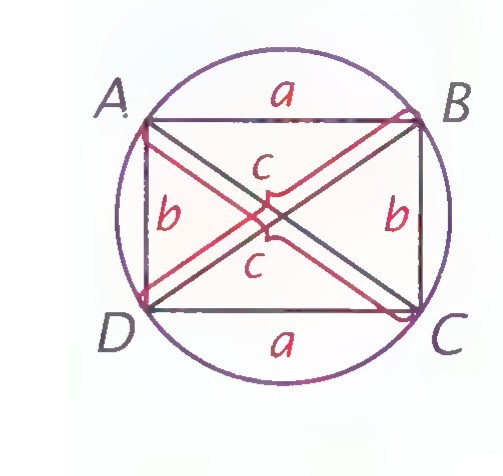
Two Applications. When Ptolemy’s Theorem is applied to a rectangle, the theorem turns into something else.
Apply it to the figure at the right to show how it does so.
In the second figure at the right, equilateral △ABC is inscribed in the circle and P is any point on AB.
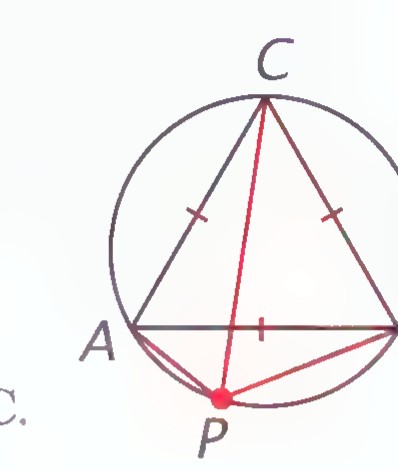
- Use Ptolemy’s Theorem to show that PA + PB = PC.
Set III
Overlapping Cards Puzzle. The figure below shows two overlapping rectangular cards.*
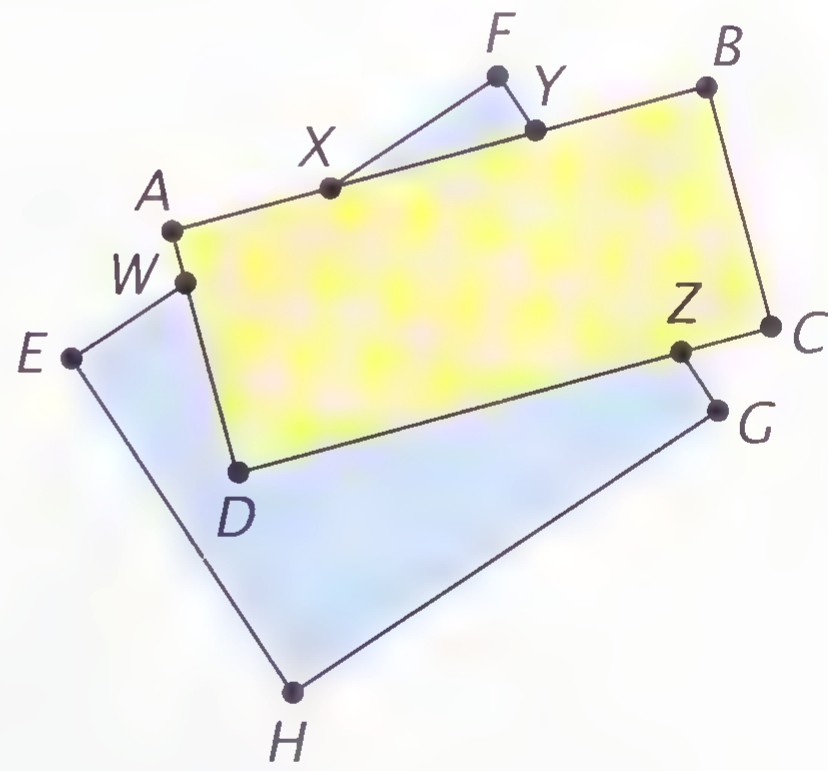
- A circle can be drawn through points A, B, C, and D or through points E, F, G, and H. Why?
- Find another set of four points in the figure through which a circle can be drawn. Which points did you find? Why are they cyclic? (Copy the figure and mark it to illustrate your answer.)
* Adapted from a puzzle by Stephen Barr in his 2nd Miscellany of Puzzles, Mathematical and Otherwise (Macmillan, 1969).
p. 542
Lesson 3: Incircles
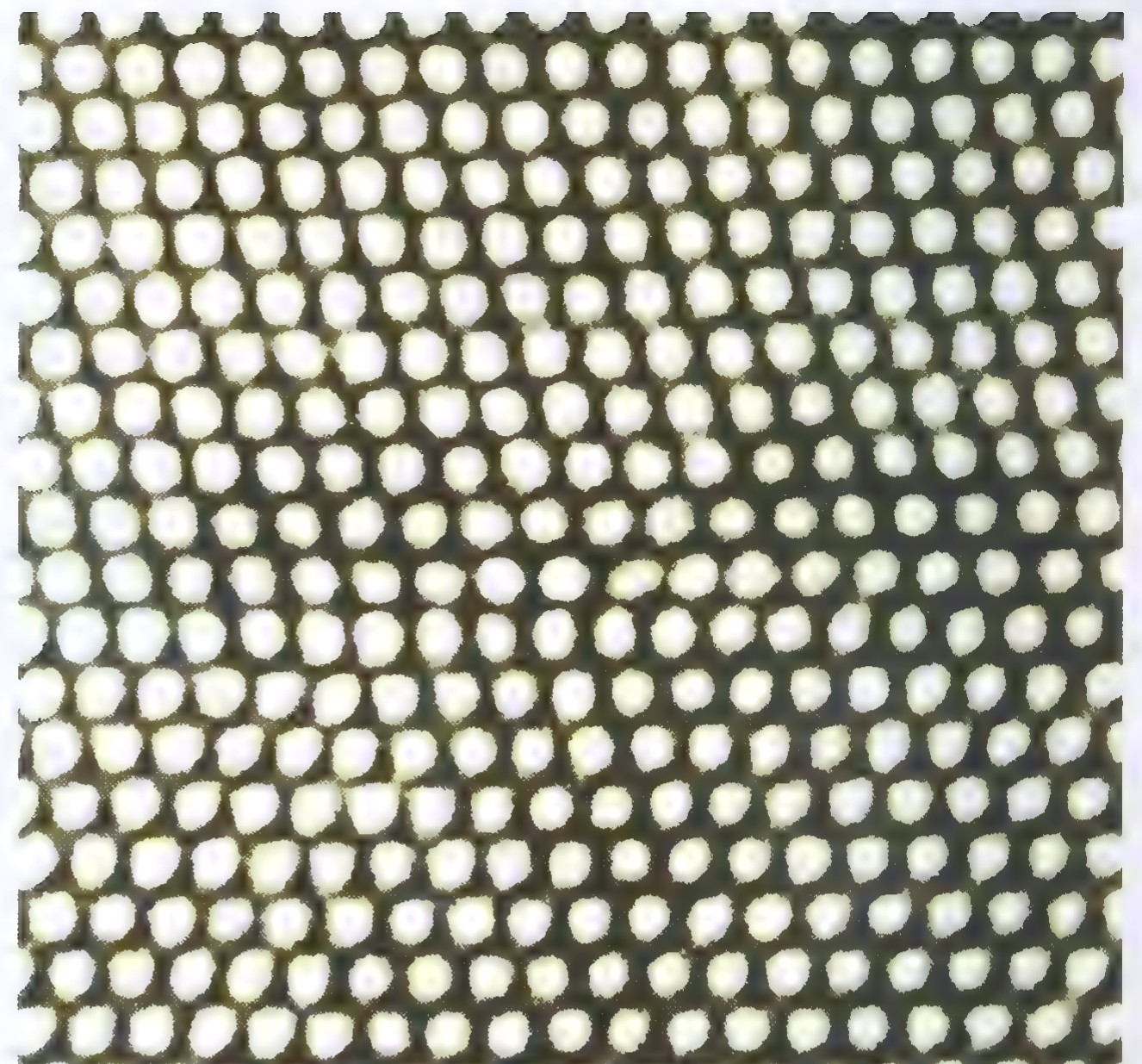
Atoms are so small that it is hard to imagine that they could be photographed. An atom of gold, for example, has a radius of only about one-hundred millionth of a centimeter.
In 1979, Hatsujiro Hashimoto and his research team at Osaka University in Japan used a powerful electron microscope to produce the photograph above. It shows a piece of gold film so highly magnified that the individual atoms can be seen as yellow dots.
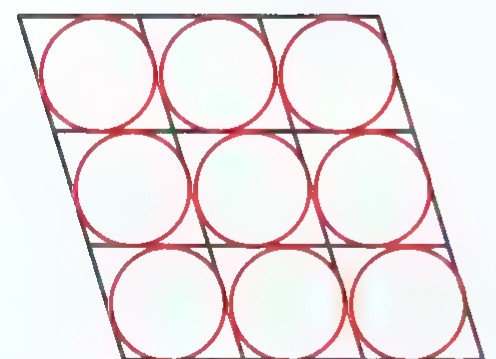
The pattern of the atoms is illustrated in the diagram at the left. In this diagram, each atom is represented by a circle. Each circle is inscribed in a rhombus.
Definitions
A circle is inscribed in a polygon iff each side of the polygon is tangent to the circle.
The polygon is circumscribed about the circle.
The circle is called the incircle of the polygon, and its center is called the incenter of the polygon.
p. 543
In Lesson 1 of this chapter, we showed that the center of the circumcircle of a triangle is the point in which the perpendicular bisectors of any two of its sides intersect. From this fact, it followed that all three of these bisectors must be concurrent. In this lesson, we will show that the center of the incircle of a triangle is the point in which the bisectors of any two of its angles intersect. From this fact, it follows that all three angle bisectors must be concurrent.
Theorem 70
Every triangle has an incircle.
Given: △ABC.
Prove: △ABC has an incircle.
Proof
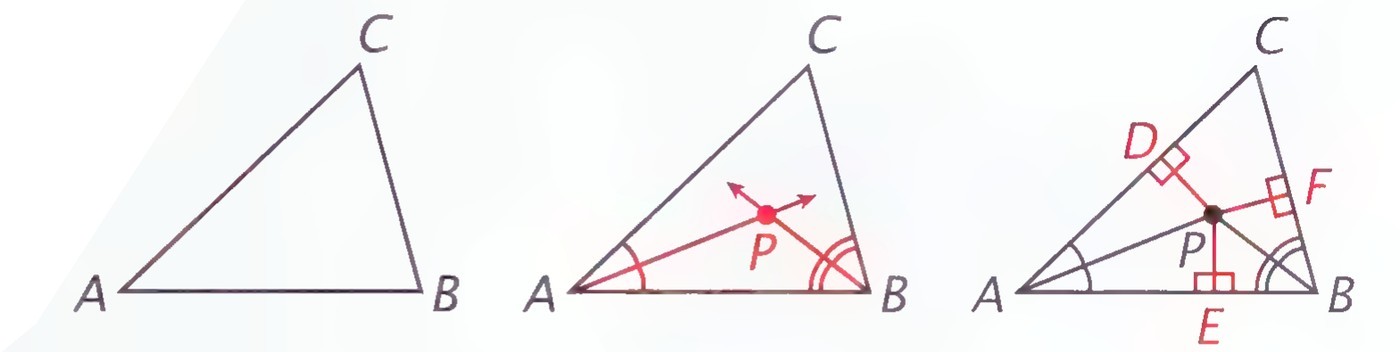
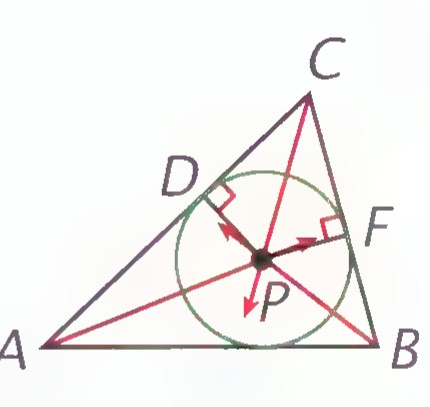
Let two rays bisect ∠A and ∠B and let P be the point in which they intersect. Through P, draw PD ⊥ AC, PE ⊥ AB, and PF ⊥ BC. △APD ≅ △APE and △BPE ≅ △BPF (AAS); so PD = PE and PE = PF. Because PD = PE = PF, a circle can be drawn with P as center and PD as radius that contains all three points, D, E, and F. Because AC ⊥ PD, AB ⊥ PE, and BC ⊥ PF, the sides of the triangle are tangent to circle P (if a line is perpendicular to a radius at its outer endpoint, it is tangent to the circle.) Therefore, circle P is an incircle of △ABC.
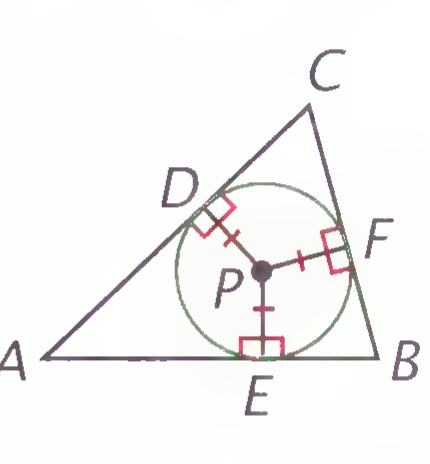
In our proof that △ABC has an incircle, we showed that the bisectors of two of its angles, ∠A and ∠B, intersect at the center of the circle. What about the bisector of the third angle, ∠C?
Draw ray CP. Because △CPD ≅ △CPF (HL), ∠DCP = ∠FCP. So CP bisects ∠ACB. Because all three angle bisectors pass through point P, they are concurrent. We state this result as the following corollary.
Corollary to Theorem 70
The angle bisectors of a triangle are concurrent.
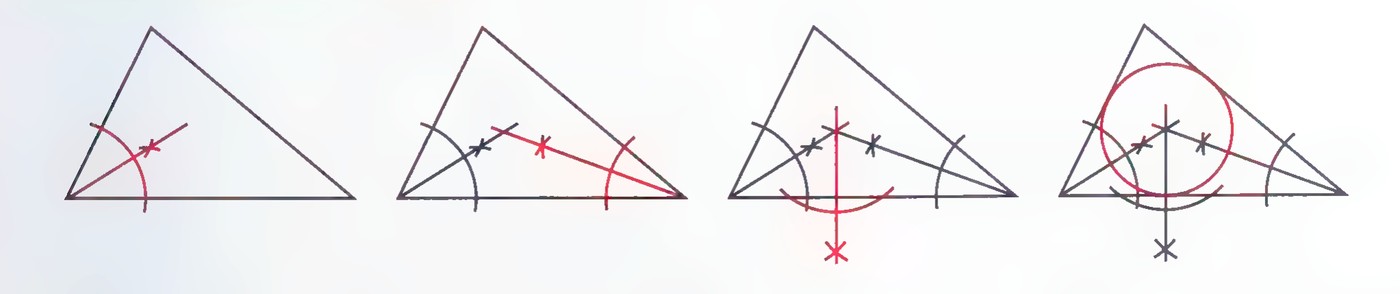
Theorem 70 and its corollary suggest that, to find the incenter of a triangle, we can bisect two of its angles. To find the radius of the incircle, we can then construct a perpendicular from the triangle’s incenter to one of the triangle’s sides.
Construction 10
To inscribe a circle in a triangle.
p. 544
Exercises
Set I
Postage Stamp. This stamp issued by the Republic of Maldives illustrates a special property of the angle bisectors of a triangle.

- What is this property?
- What is the name of the point in which the angle bisectors intersect?
Circumcircle and Incircle. The figures below compare the construction of the circumcircle and incircle of a triangle.
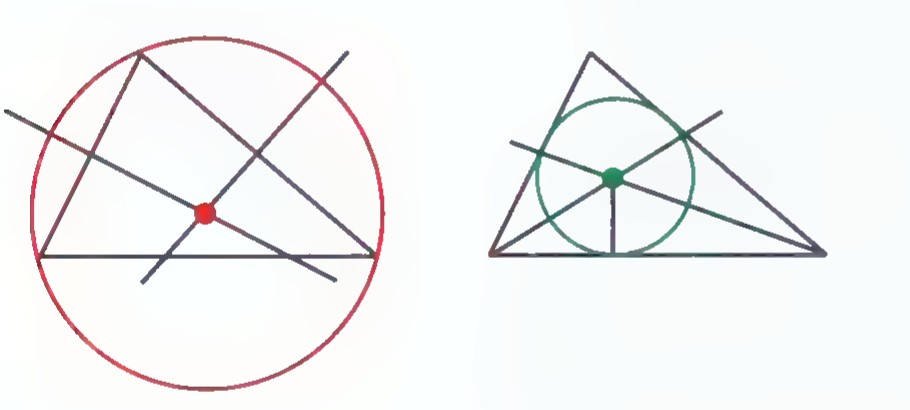
- How many lines are needed in the construction of the circumcircle?
- How are these lines related to the triangle?
- From what is the center of the circumcircle equidistant?
- How many lines are needed in the construction of the incircle?
- What lines are drawn to find the center of the incircle?
- What is drawn to find the radius of the incircle?
- From what is the center of the incircle equidistant?
Circumscribed Quadrilateral. Each side of quadrilateral ABCD is tangent to circle O.
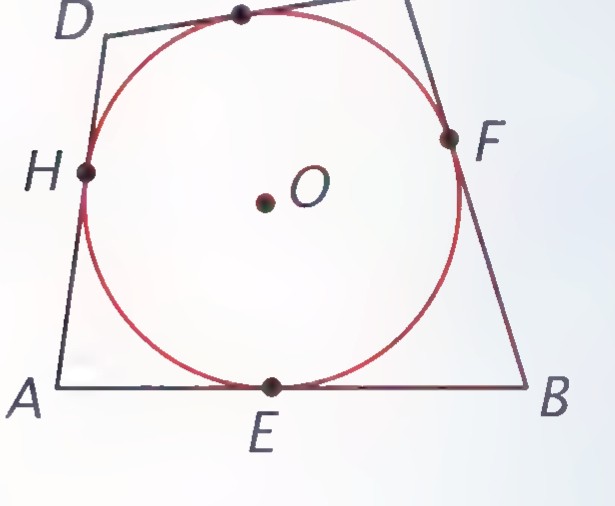
What is circle O called with respect to ABCD?
What is point O called with respect to ABCD?
Copy the figure and draw OE, OF, OG, and OH.
What relation do these segments have to the sides of ABCD? Explain.
(continued) Draw AO, BO, CO, and DO.
What relation do these lines have to the angles of ABCD? Explain.
If a circle can be inscribed in a quadrilateral, what must be true about the lines that bisect its angles?
(continued) Use tick marks to mark the tangent segments in the figure that are equal.
If a circle can be inscribed in a quadrilateral, what must be true about the sums of the lengths of the quadrilateral’s opposite sides?
Use these conclusions to tell under what conditions it is possible for the following quadrilaterals to have incircles.
- Rectangles.
- Parallelograms.
- Trapezoids.
p. 545
Equilateral Triangle. The incircle and circumcircle of an equilateral triangle are concentric.
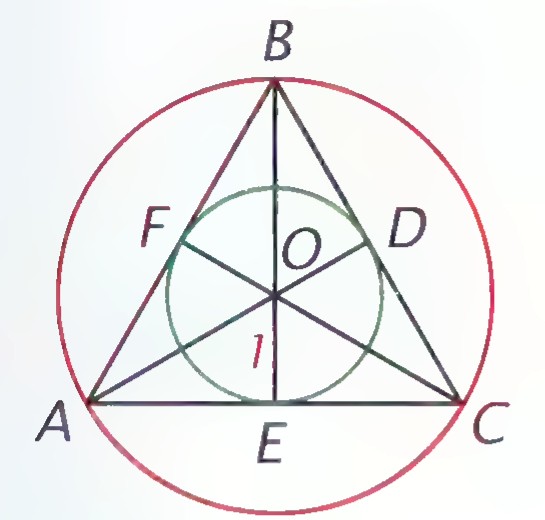
- What does concentric mean?
What relation do lines AD, BE, and CF have to
- the sides of △ABC?
- its angles?
- What kinds of triangles do you see in the figure?
Given that the radius of the incircle is 1, what is
- the radius of the circumcircle?
- the circumference of each circle?
- the area of each circle?
Construction Problem. The sides of the triangle below are 8, 9, and 10 units.
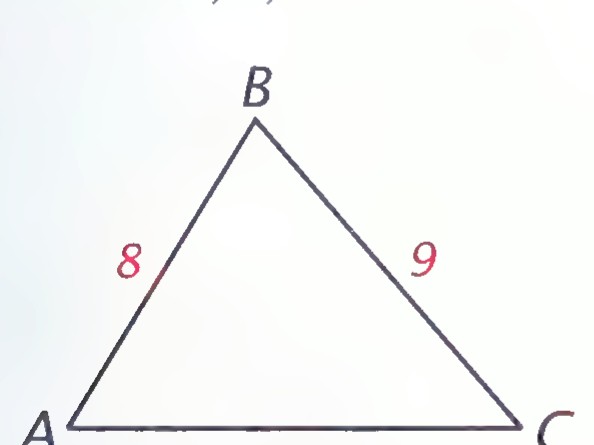
Use your ruler and compass to construct an enlargement of it, using sides of lengths 8 cm, 9 cm, and 10 cm, in the center of a sheet of paper. Label its vertices A, B, and C.
- Circumscribe a circle around △ABC.
- Inscribe a circle in △ABC.
- Choose any point on the larger circle and label the point D. Use your ruler to draw two lines from D that appear to be tangent to the smaller circle. Label the two points in which these lines intersect the larger circle points E and F. Draw EF.
What seems to be true?
Does △DEF appear to be congruent to △ABC?
On the basis of your results, does it appear possible for two triangles that are not congruent to have the same incircle and circumcircle?
Set II
Ship Location. The figure below from a book on navigation shows a method for finding the location of a ship by bisecting three angles.*
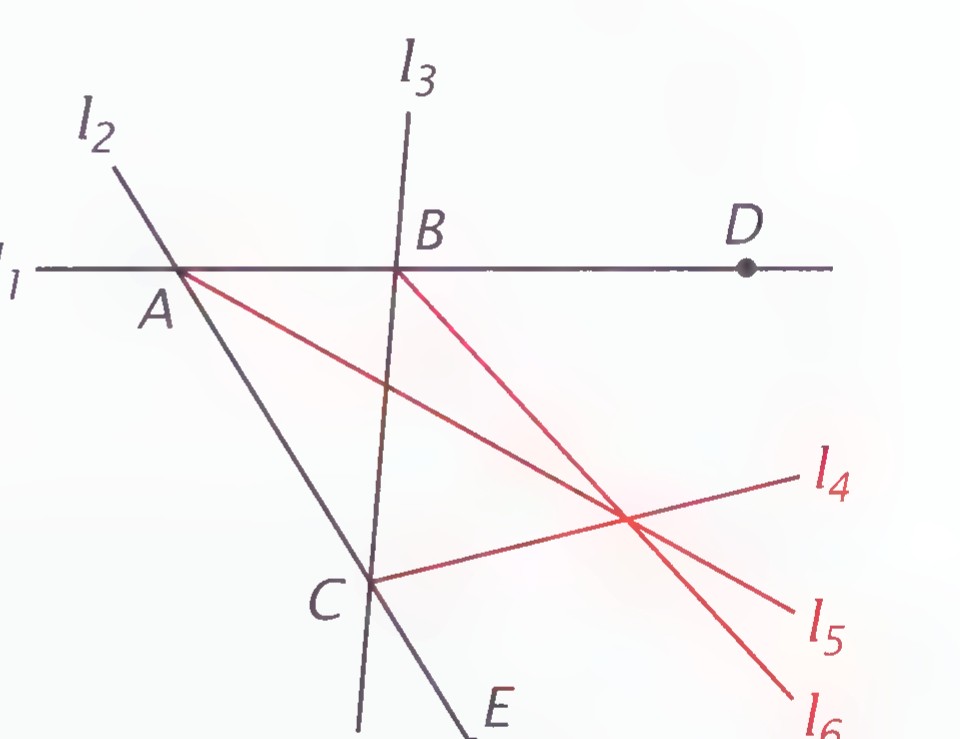
Three position lines, l₁, l₂, and l₃, form △ABC.
- Which of the three bisector lines, l₄, l₅, or l₆, bisects an angle of △ABC?
- What are the other two bisected angles, ∠DBC and ∠BCE, called with respect to the triangle?
- What relation do the three bisector lines appear to have to one another?
* Dutton’s Navigation and Piloting, by Elbert S. Maloney (Naval Institute Press, 1985).
p. 546
Copy the part of the figure, shown below, in which the point in which l₄ and l₆ intersect has been labeled P. From P, draw PF ⊥ AD, PG ⊥ BC, and PH ⊥ AE.
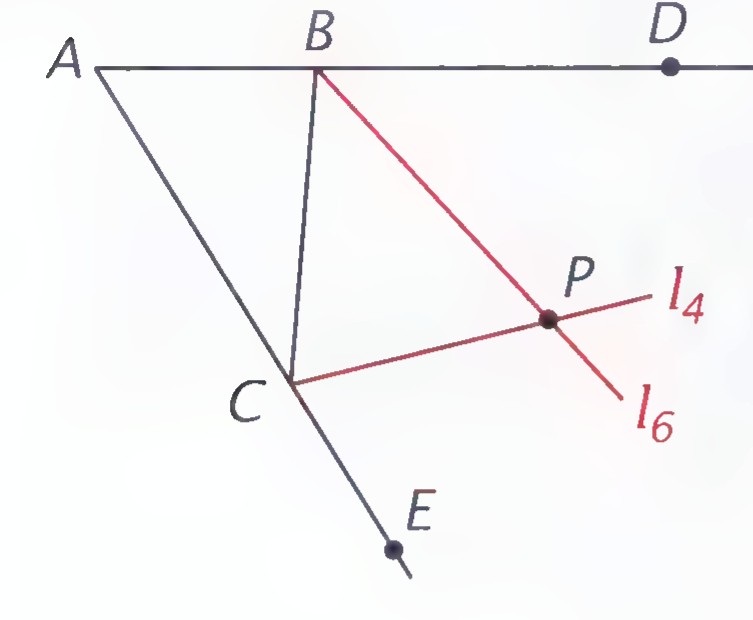
What can you conclude about the four right triangles that are formed? Explain.
What can you conclude about PF, PG, and PH? Explain.
(continued) Draw AP.
What can you conclude about △FAP and △HAP? Explain.
What does your conclusion prove about AP and ∠DAE?
What do exercises 34 through 38 prove about the three bisector lines?
Incircle Problem 1. ABCD is a square and circle O is its incircle.
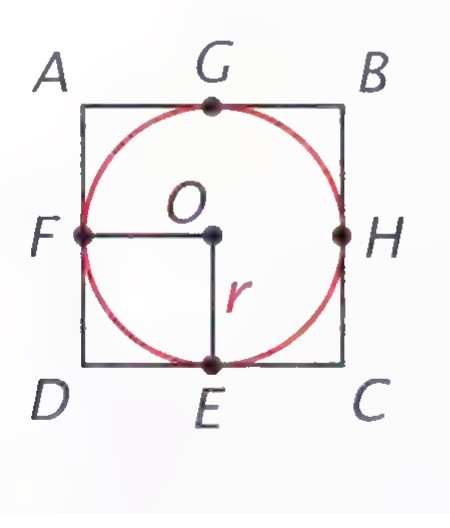
- What can you conclude about FDEO?
Given that OE = r, express each of the following in terms of r.
- AB.
- The circumference of circle O.
- The perimeter of ABCD.
- The area of circle O.
- The area of ABCD.
Find the exact value of each of the following ratios.
- The ratio of the circumference of circle O to the perimeter of ABCD.
- The ratio of the area of circle O to the area of ABCD.
Incircle Problem 2. △ABC is a 3-4-5 right triangle and circle O is its incircle.
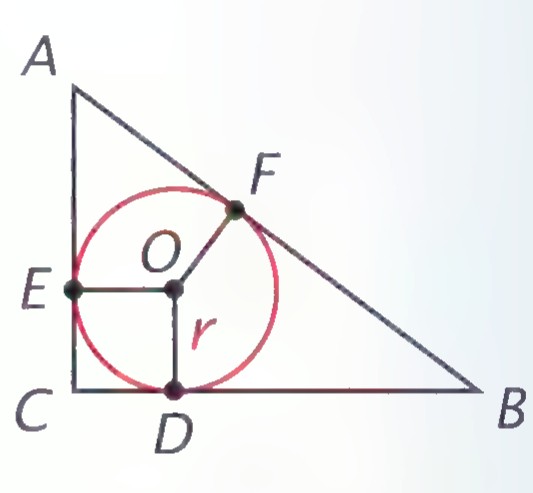
- What can you conclude about ECDO?
Given that OD = r, express each of the following lengths in terms of r.
- AE.
- DB.
- AB.
- Use your answer to exercise 51 to solve for r.
Find the exact value of each of the following numbers.
- The circumference of circle O.
- The perimeter of △ABC.
- The area of circle O.
- The area of △ABC.
- The ratio of the circumference of circle O to the perimeter of △ABC.
- The ratio of the area of circle O to the area of △ABC.
p. 547
Incircle Problem 3. Quadrilateral ABCD is circumscribed about circle O with radius r.
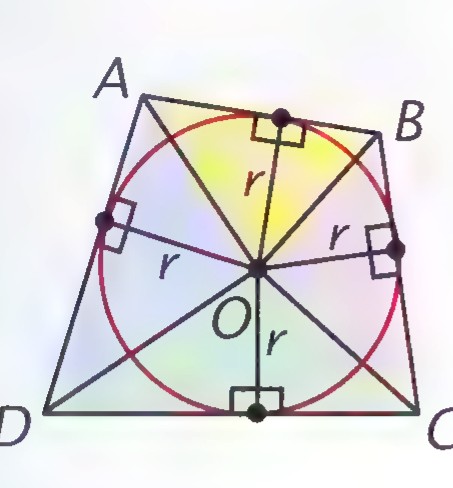
, , , and . Why?
Use the fact that αABCD = α△AOB + α△BOC + α△COD + α△DOA to write an expression for αABCD in terms of r and its perimeter, p.
Write an expression for each of the following ratios in terms of r and p.
- The ratio of the circumference of circle O to the perimeter of ABCD.
- The ratio of the area of circle O to the area of ABCD.
Trisector Challenge. In the figure below, the rays from B and C trisect two of the angles of △ABC.
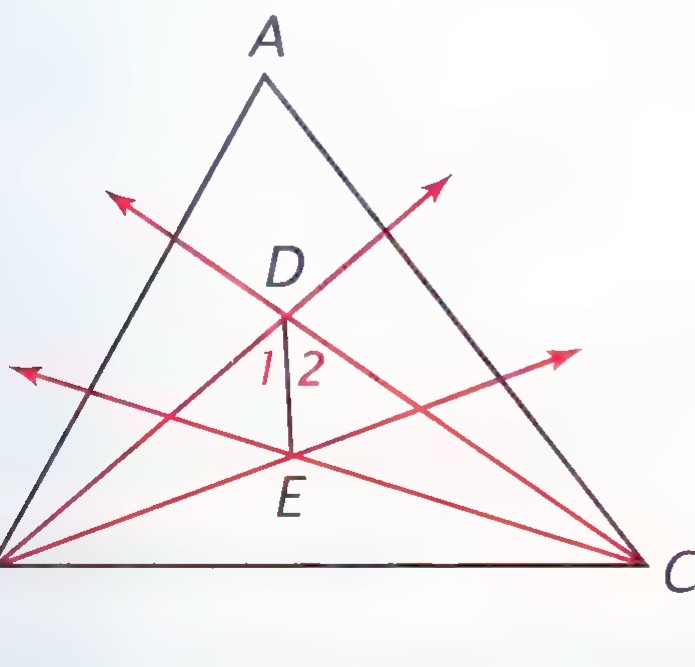
- ∠1 = ∠2. Why?
Set III
Excircles. In the figure below, circle O is inscribed in △ABC, and circles X, Y, and Z are tangent to the lines that contain its sides. The lines that contain the sides of △XYZ bisect the exterior angles of △ABC.
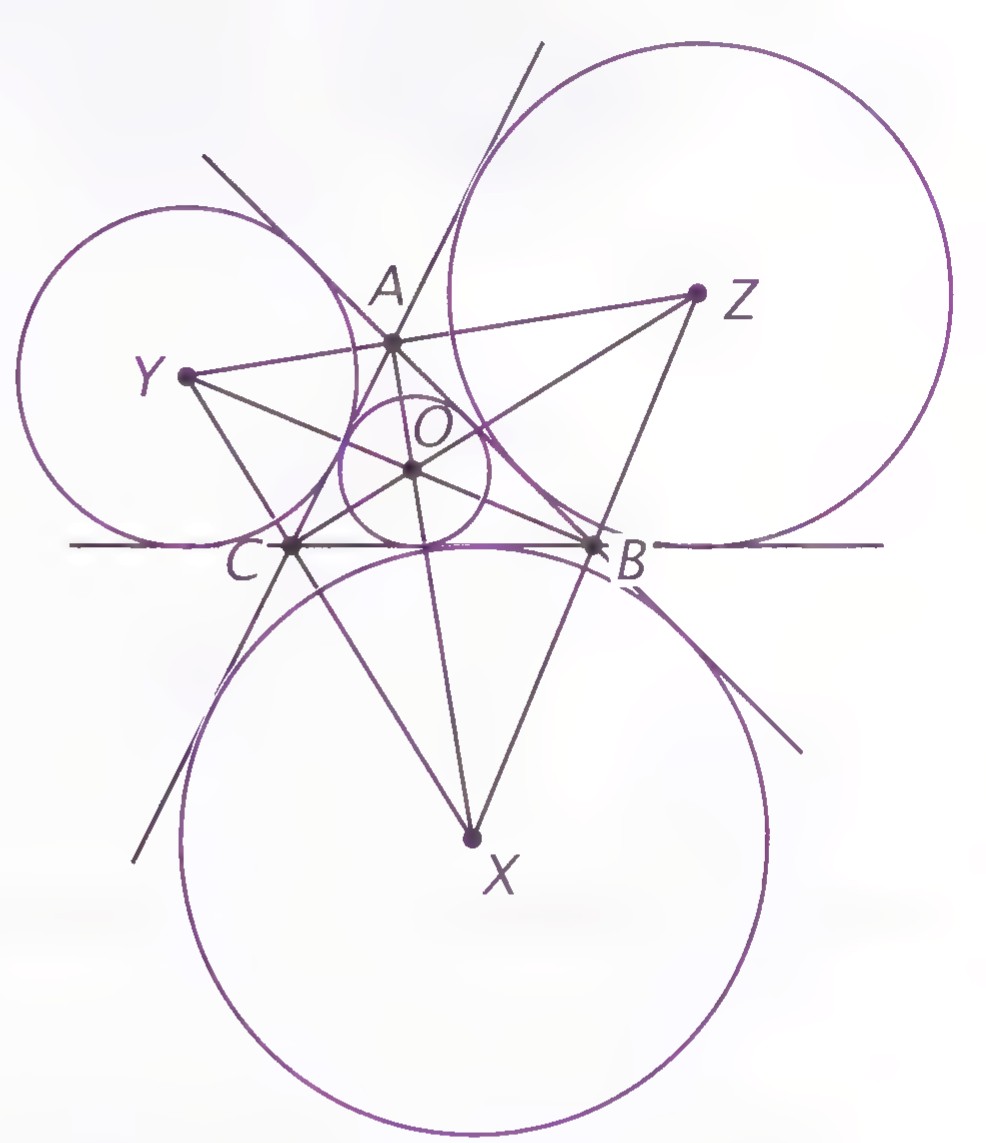
What relation do XA, YB, and ZC appear to have to △XYZ?
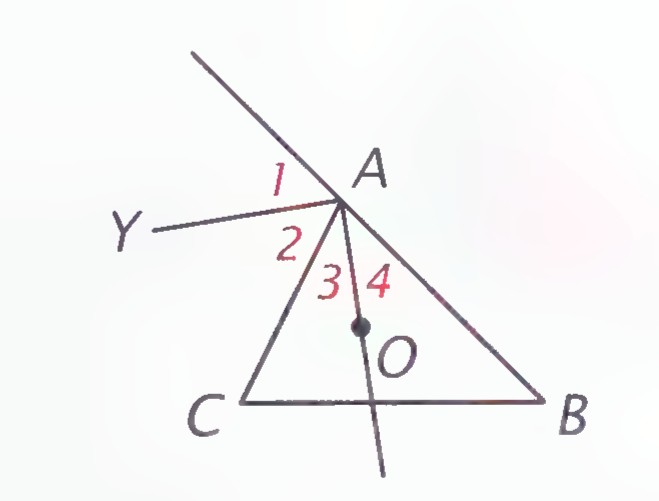
Using the part of the figure shown below, explain why your guess is true.
p. 548
Lesson 4: The Centroid of a Triangle
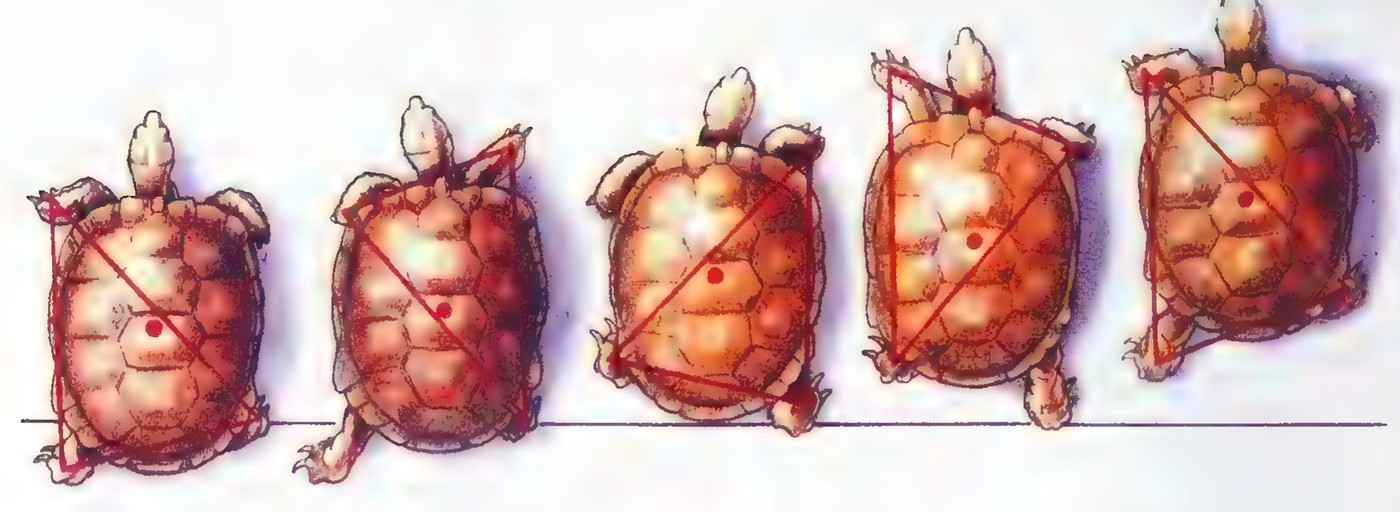
Tortoises walk very slowly. To keep its shell from scraping the ground, a tortoise generally moves just one of its feet at a time. Having the other three feet on the ground helps, because three noncollinear points determine a plane. For the tortoise to keep its balance, however, its center of gravity must always fall inside the triangle determined by these three points.*
The center of gravity of the tortoise is the point in which it is “perfectly balanced.” In the pictures above, this point is obviously not the balancing point of the triangles determined by the tortoise’s feet.
Where is the center of gravity of a triangle? By this question we mean, at what point should a triangular board having uniform thickness and density be supported so that it will balance?
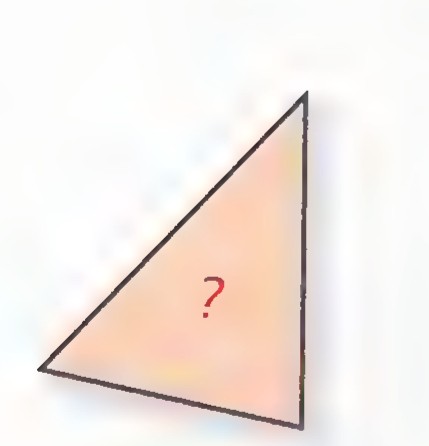
If we try to find this point by trial and error with a large board in the shape of a scalene triangle, we find that this point is not the circumcenter, the point in which the perpendicular bisectors of the sides are concurrent. Neither is it the incenter, the point in which the angle bisectors are concurrent. Instead, it is determined by the medians of the triangle.
* Exploring Biomechanics: Animals in Motion, by R. McNeill Alexander (Scientific American Library, 1992).
p. 549
Definition
A median of a triangle is a line segment that joins a vertex to the midpoint of the opposite side.
The fact that the balancing point of a triangle is determined by its medians suggests that they are concurrent, a fact whose proof is included in the exercises.
Theorem 71
The medians of a triangle are concurrent.
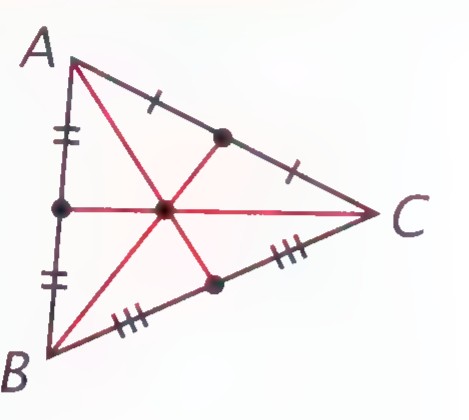
It was Archimedes who showed that the point in which its medians are concurrent is the center of gravity of a triangular board of uniform thickness and density.* Mathematicians refer to it as the centroid of the triangle.
Definition
The centroid of a triangle is the point in which its medians are concurrent.
At this point, it will probably come as no surprise to you that there are other sets of lines related to a triangle that also are concurrent. One of these sets contains its altitudes.
Theorem 72
The lines containing the altitudes of a triangle are concurrent.
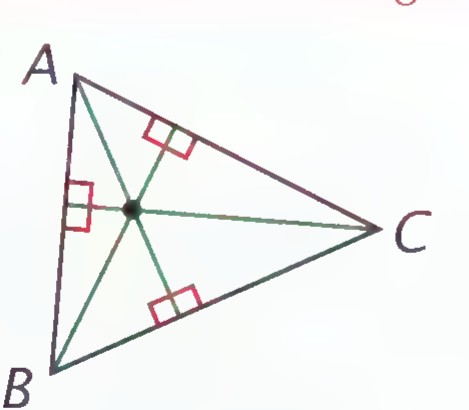
Definition
The orthocenter of a triangle is the point in which the lines containing its altitudes are concurrent.
The proof of Theorem 72 also is included in the exercises.
* Archimedes: What Did He Do Besides Cry Eureka? by Sherman Stein (Mathematical Association of America, 1999), Chapter 3.
p. 550
Exercises
Set I
“Ortho” Words. The Greek word orthos means “right.” Can you think of a word that begins with ortho that refers to
- someone who makes teeth right?
- a right belief?
- shoes to make your feet right?
- To what does the “ortho” in orthocenter refer?
Theorem 71. Complete the following proof of Theorem 71 by giving the reasons.
The medians of a triangle are concurrent.
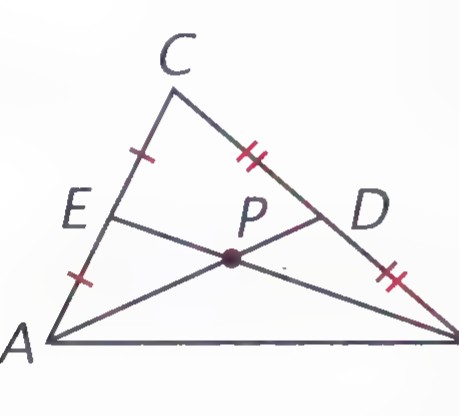
Given: AD and BE are medians of △ABC.
Prove: AD and BE are concurrent with the third median of △ABC.
Proof
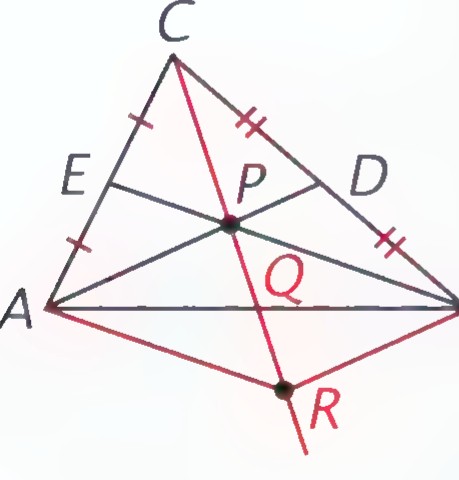
- Draw line CP. Why?
- Choose point R on line CP so that CP = PR. Why?
- Draw AR and RB. Why?
- EPB ∥ AR and APD ∥ RB. Why?
- APBR is a parallelogram. Why?
- Q is the midpoint of AB. Why?
- CQ is the third median of △ABC. Why?
- AD and BE are concurrent with CQ. Why?
Theorem 72. Complete the following proof of Theorem 72 by giving the reasons.
The lines containing the altitudes of a triangle are concurrent.
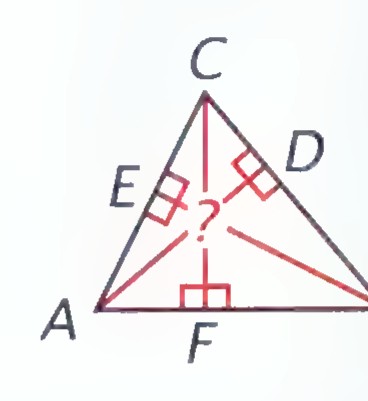
Given: AD, BE, and CF are the altitudes of △ABC.
Prove: AD, BE, and CF are concurrent.
Proof
- AD ⊥ BC, BE ⊥ AC, and CF ⊥ AB. Why?
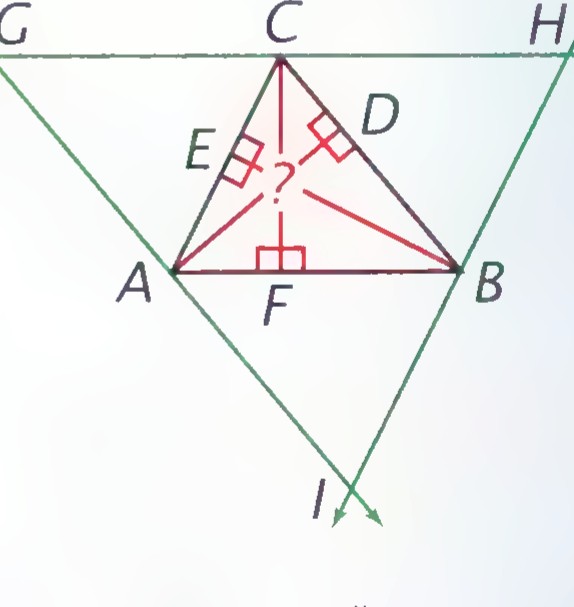
- Through A, draw GI ∥ BC; through B, draw IH ∥ AC; and through C, draw GH ∥ AB. Why?
- GCBA and CHBA are parallelograms. Why?
- GC = AB and CH = AB. Why?
- GC = CH. Why?
- CF ⊥ GH. Why?
So CF is the perpendicular bisector of side GH of △GHI. In the same way, AD can be shown to be the perpendicular bisector of GI,
p. 551
and BE can be shown to be the perpendicular bisector of HI.
- AD, BE, and CF are concurrent. Why?
Median Construction.
The sides of the triangle at the right are 8, 9, and 10 units.
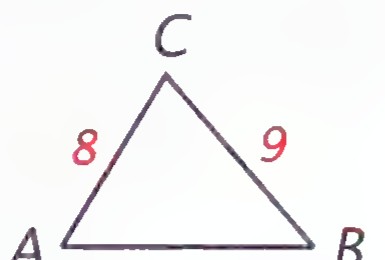
Use your ruler and compass to construct an enlargement of it, using sides of lengths 8 cm, 9 cm, and 10 cm. Label its vertices A, B, and C.
- Construct the medians from A and B to the opposite sides. Label them AD and BE and let F be the point in which they intersect.
- Bisect AF and FB and label their midpoints G and H.
- Draw EDHG.
What relation do ED and GH have to AB? Explain.
What can you conclude about EDHG? Explain.
What can you conclude about GD and EH? Explain.
AG = GF = FD and BH = HF = FE. Why?
Find and .
Points D and E are points of bisection of CB and CA.
- What are points G and F with respect to AD, and what are points F and H with respect to BE?
Altitude Construction. One of the altitudes of △ABC has been constructed in the figure below.
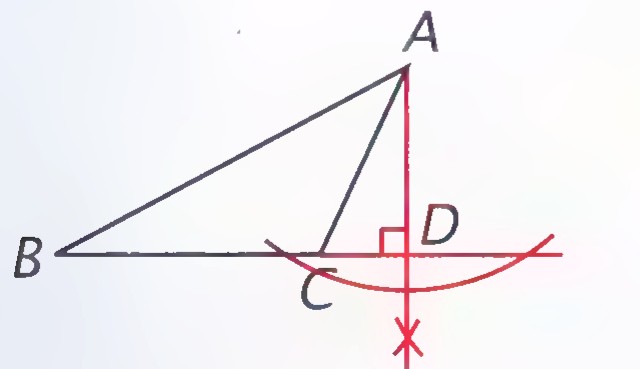
Use your straightedge and compass to copy △ABC and construct the altitude AD as shown.
What is it about △ABC that causes the altitude to fall outside it?
(continued) Construct the other two altitudes of △ABC and label them BE and CF.
Are the three line segments that are the altitudes of △ABC concurrent? Explain.
Are the three lines that contain the altitudes of △ABC concurrent? Explain.
Which of the following points can lie outside a triangle: its incenter, its orthocenter, its centroid, its circumcenter?
Set II
Other Triangles, Other Orthocenters. The figure below illustrates an interesting observation made by Lazare Carnot, who was both a political leader and a mathematician at the time of the French Revolution.
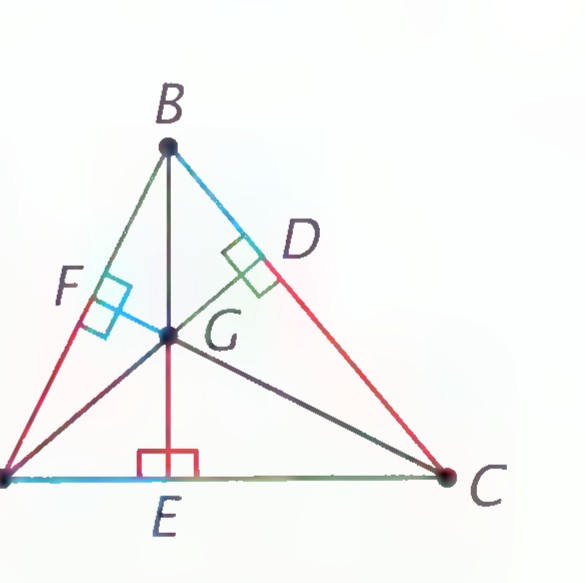
In the figure, G is the orthocenter of △ABC.
- Which three line segments are the altitudes of △AGC?
- Where is the orthocenter of △AGC?
- Which three line segments are the altitudes of △AGB?
- Where is the orthocenter of △AGB?
- Which three line segments are the altitudes of △BGC?
- Where is the orthocenter of △BGC?
p. 552
Medians as Bisectors. The figure below suggests that a median of a triangle bisects more than just the side of the triangle to which it is drawn.
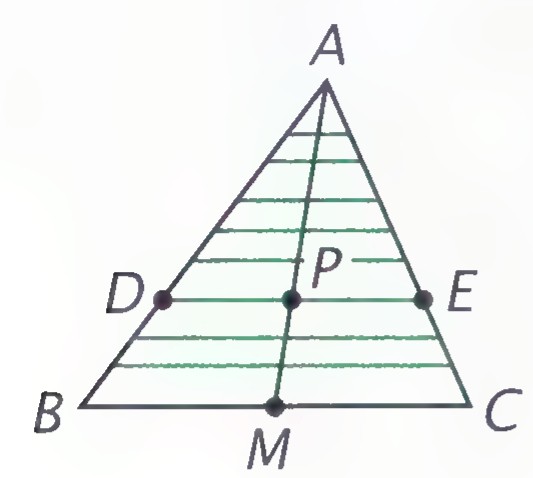
- What relation do the green line segments appear to have to BC?
- What relation does AM appear to have to these line segments?
- Given that DE ∥ BC, what can you conclude about △ADP and △ABM and about △APE and △AMC? Explain.
- Why is and ?
- Why is ?
- Given that AM is a median of △ABC, what can you conclude about BM and MC?
- Why is ?
- Why is DP = PE?
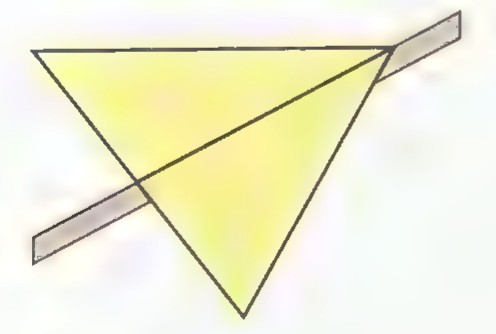
- What do exercises 38 through 45 suggest would happen if △ABC were cut from a sheet of cardboard and placed with median AM along the edge of a ruler as shown above?
Doing Without a Compass. The figure below appeared in The Old Farmer’s Almanac with the following question: Can you construct, using just an unmarked straightedge, a line through P perpendicular to l?*
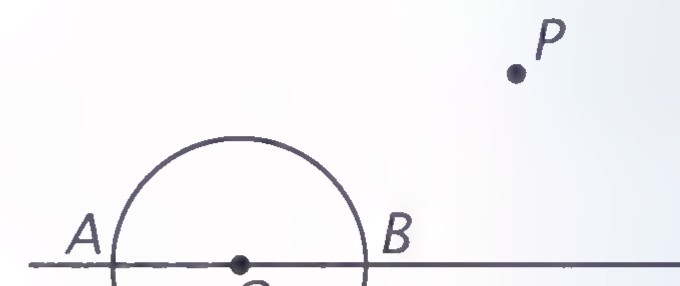
Use your straightedge and compass to draw the figure. Then use your straightedge to draw the following lines.
- Draw line PA and let C be the point in which PA intersects the circle. Draw line PB and let D be the point in which PB intersects the circle.
- Draw lines AD and CB and let E be the point in which they intersect each other.
- Draw PE. Let F be the point in which PE intersects line l.
What can you conclude about ∠ACB and ∠ADB? Explain.
What relation do PD and EC have to △APE?
What is point B with respect to △APE?
What can you conclude about AF with respect to △APE? Explain.
What fact follows about PE and line l?
Follow the directions for exercise 47 in regard to the figure below.
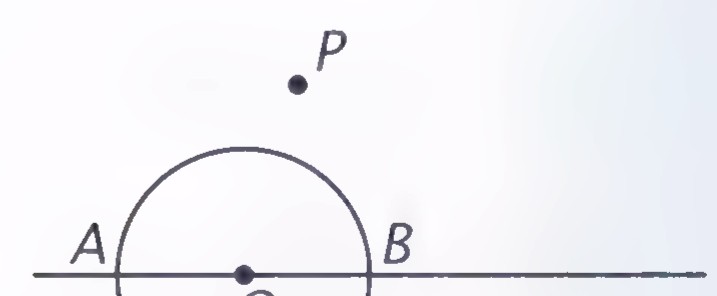
* Problem by Don Scholten, The Old Farmer’s Almanac, 1988.
p. 553
- Look again at exercises 48 through 52. Which of the conclusions in these exercises are still true?
Engineering Challenge. The figure below is from a book for engineering students.*
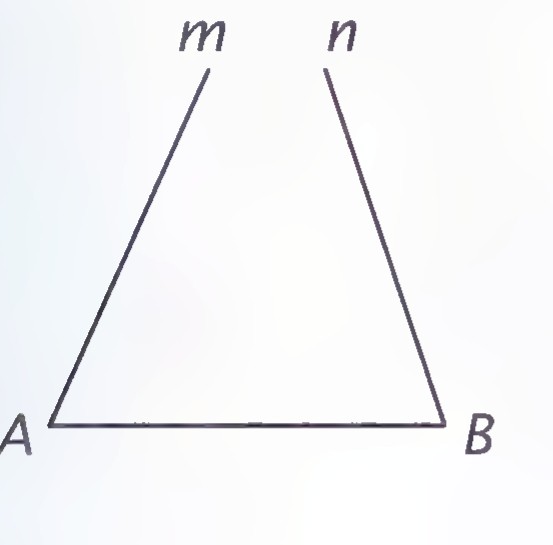
The problem is to construct a line perpendicular to AB that would pass through the point in which lines m and n intersect. The catch is to do so without extending lines m and n.
- Copy the figure and use your straightedge and compass to construct such a line.
- Explain how your method works.
Set III
Balancing Point. You know that, if a triangle is cut out of a piece of cardboard, it can be balanced on its centroid, the point in which the medians of the triangle are concurrent.
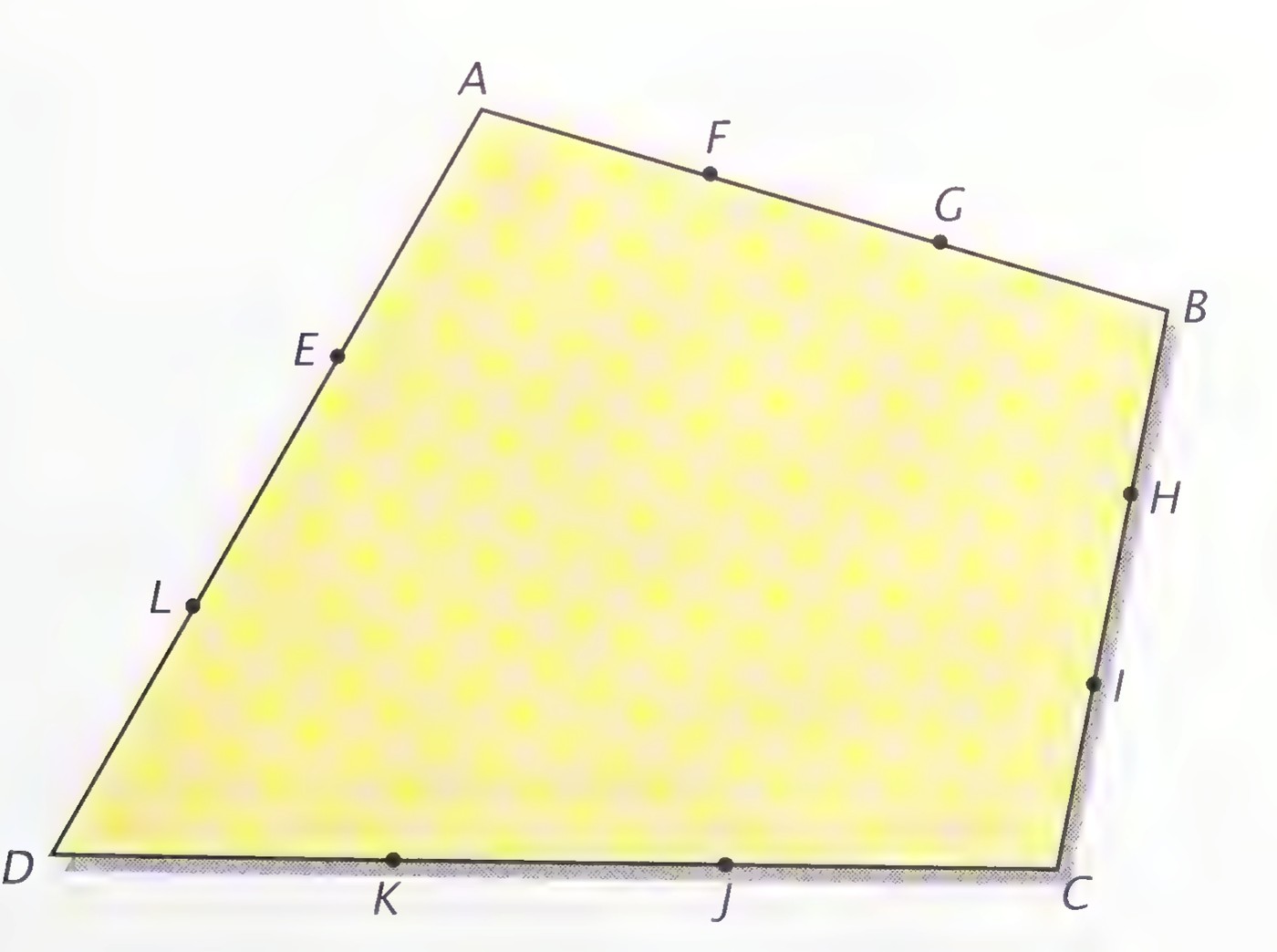
If the board were in the shape of a quadrilateral instead, where would its balancing point be? The following geometric construction for finding this point was not discovered until the nineteenth century.
The first step in finding the balancing point is to trisect the sides of the quadrilateral. Trace the figure at the bottom of this page, in which the sides have been trisected.
Now, draw EF, GH, IJ, and KL and extend them until they meet in four points outside the figure. Label these points M, N, O, and P.
- What seems to be true about MNOP?
The balancing point of the original quadrilateral ABCD is the same as the balancing point of MNOP.
- Where do you suppose it is?
* Graphics, by Alexander S. Levens (Wiley, 1962).
p. 554
Lesson 5: Ceva’s Theorem
Most of the theorems that we have encountered in our study of geometry were known to Euclid, who included them in the Elements. In fact, after the development of geometry in Greece between 600 B.C. and 200 B.C., few significant additions to the subject were made until the seventeenth century. One of the new theorems that appeared at that time was discovered by an Italian mathematician and engineer named Giovanni Ceva (pronounced “chay va”).
Ceva’s theorem concerns sets of line segments in a triangle that we will refer to as cevians.
Definition
A cevian of a triangle is a line segment that joins a vertex of the triangle to a point on the opposite side.
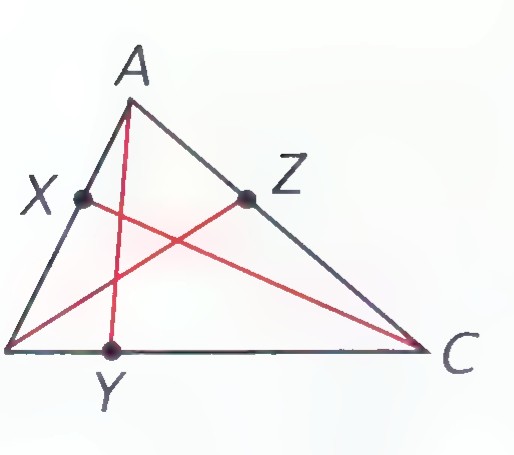
In the triangle shown at the left, three cevians have been drawn, one from each vertex. They are AY, BZ, and CX. The cevians divide the sides of the triangle into six segments: AX, XB, BY, YC, CZ, and ZA.
p. 555
In the figure at the right, the three cevians are concurrent at point P. Ceva’s theorem states that they are concurrent if and only if
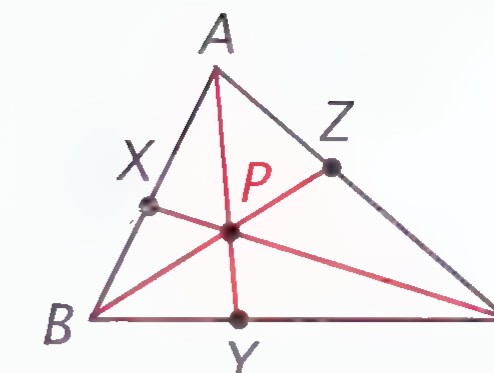
Several different ways to prove this theorem have been discovered. The appearance of the ratios in the equation suggests that one way might be to use similar triangles. Although no similar triangles are ordinarily formed by three concurrent cevians, some simple additions to the figure produce pairs of similar triangles that make such a proof possible.
Theorem 73. Ceva’s Theorem
Three cevians, AY, BZ, and CX, of △ABC are concurrent iff
Proof that, if the three cevians are concurrent, then
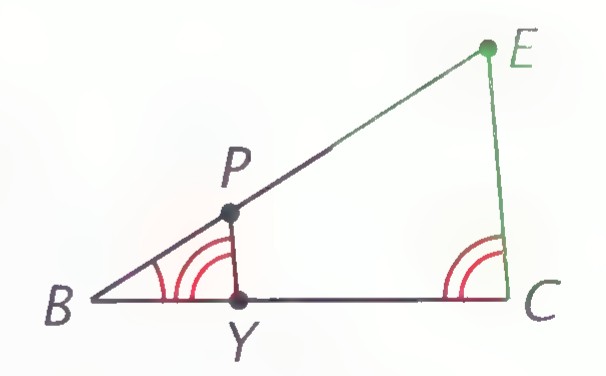
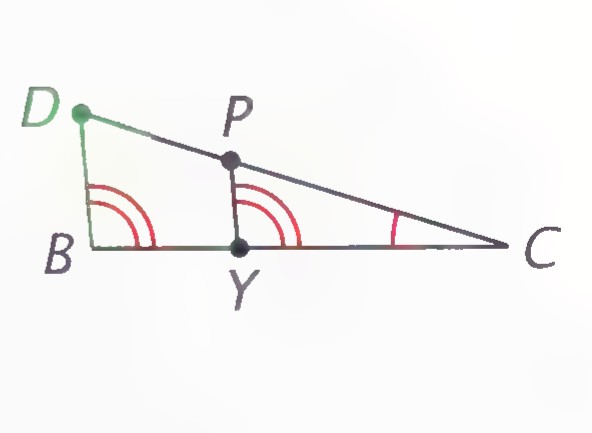
Through B and C, draw lines parallel to AY. Let the points in which they intersect CX and BZ be called D and E, respectively.
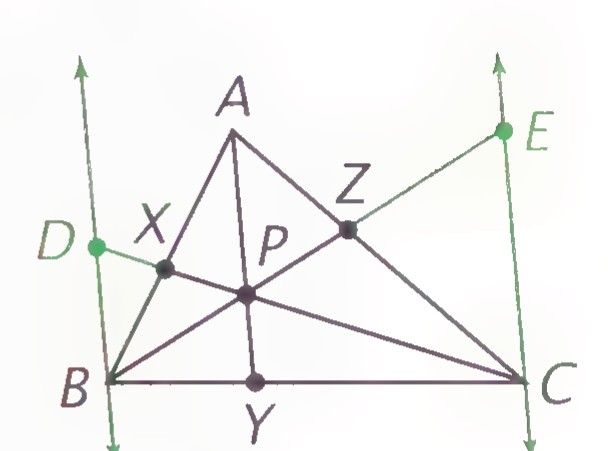
Because of equal vertical angles and equal alternate interior angles, △AXP ∼ △BXD and △CZE ∼ △AZP. Therefore,
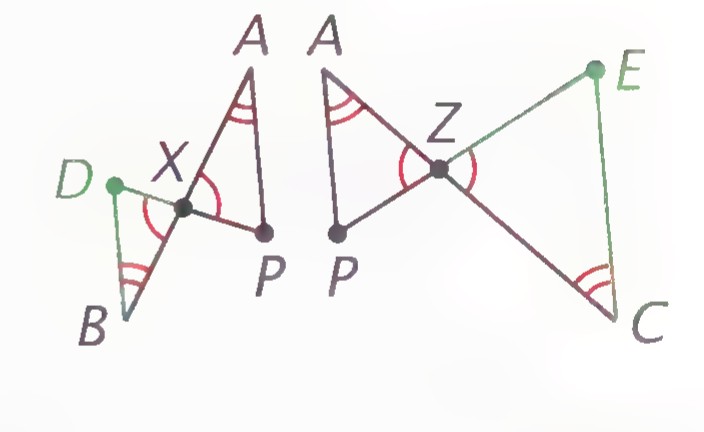
Because of the common angle and equal corresponding angles, △BYP ∼ △BCE and △BCD ∼ △YCP. Therefore,
We can now build the conclusion of Ceva’s Theorem by multiplying the left and right sides of these equations.
Simplifying, we have
and so, by algebra and by using BX = XB and AZ = ZA, we have
p. 556
Proof of the converse.
If , then the three cevians AY, BZ, and CX of △ABC are concurrent.
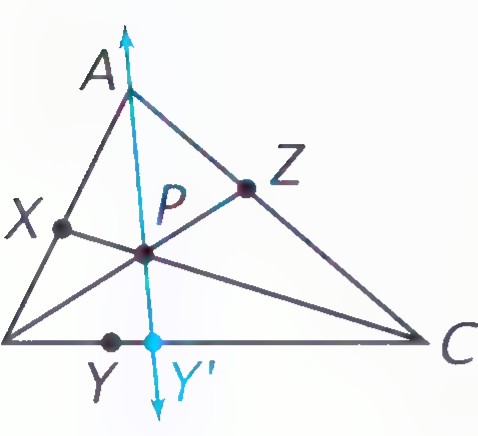
Let CX and BZ intersect in point P. Draw AP, and let the point in which it intersects BC be called Y′.
Now, from the first part, we know that
and, by hypothesis, we have
We will now show that these imply that Y′ and Y are the same point.
From the two equations above, we know that
Dividing, we get
Adding 1 to each side of this equation, we get
Because BY′ + Y′C = BC and BY + YC = BC,
Multiplying means and extremes, we get
Dividing by BC gives
Because CY = CY′, Y and Y′ are the same point. This conclusion follows from the Ruler Postulate, which says that the points on a line can be numbered so that, to every real number, there corresponds exactly one point. Because Y and Y′ are the same point, AY and AY′ are the same line. Therefore, AY, BZ, and CX all contain point P and are concurrent.
p. 557
Exercises
Set I
Which Is Which? The figure below illustrates four special types of line segments related to a triangle.
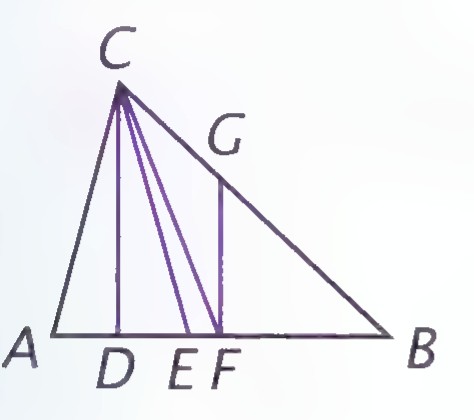
Which line segment appears to
- be a median of the triangle?
- lie on the perpendicular bisector of a side?
- be an altitude of the triangle?
- lie on an angle bisector of the triangle?
- Are all four of these line segments cevians? Explain.
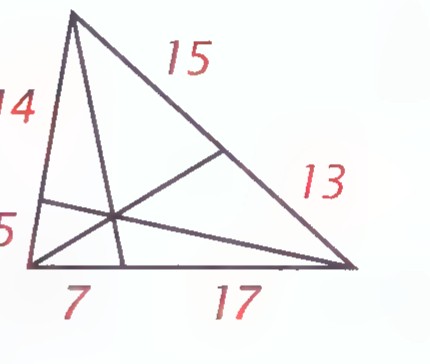
Using Ceva’s Theorem. Given that the cevians in each of the following triangles are concurrent, solve for x.
Example:
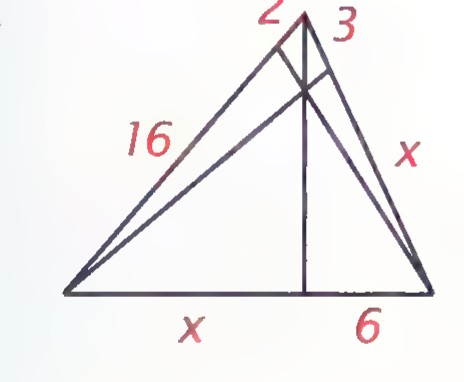
Solution: ; so , , , and .
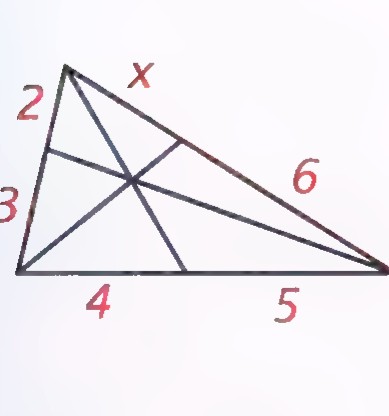
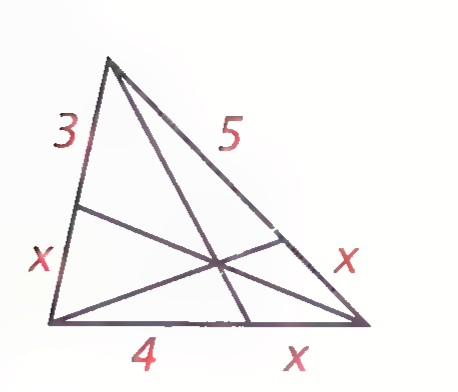
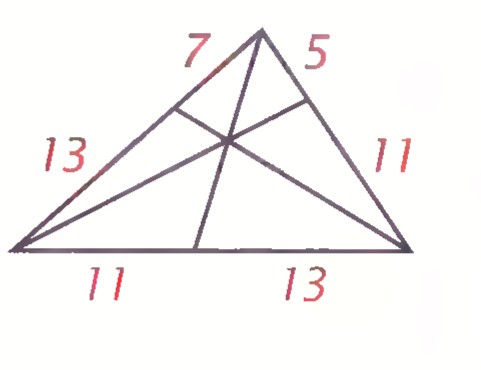
Appearances can be deceiving. Use Ceva’s Theorem to determine whether the cevians in the following accurately drawn figures are concurrent.
Equilateral Triangle. △ABC is an equilateral triangle with sides 7.5 units long.
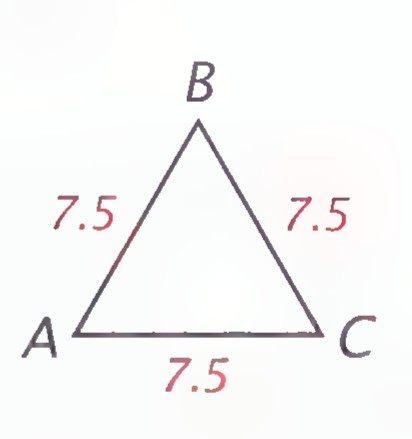
Construct the figure by doing the following steps.
- Construct an enlargement of △ABC by using sides of length 7.5 cm.
- Mark the point on AB that is 5 cm from A and label the point X. Draw CX.
- Mark the point on BC that is 5 cm from B and label the point Y. Draw AY.
- Draw the cevian from B that is concurrent with AY and CX. Label its other endpoint Z.
p. 558
Find each of the following ratios.
- .
- .
Without doing any measuring, what would you expect
to be? Explain.
the length of AZ to be? Explain.
(continued) Measure AZ to check the accuracy of your figure and your reasoning.
Ratio Relations. Medians AY, BZ, and CX are concurrent at P, the centroid of △ABC.
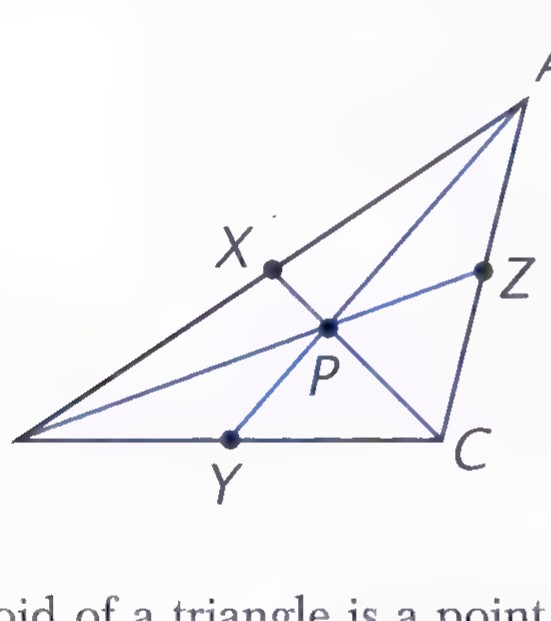
The centroid of a triangle is a point of trisection of each of its medians. What can you conclude about
- ?
- ?
- ?
- ?
- ?
- ?
Right Triangle. △ABC is a right triangle with BC = 8 and CA = 6. CY = CZ = 2.
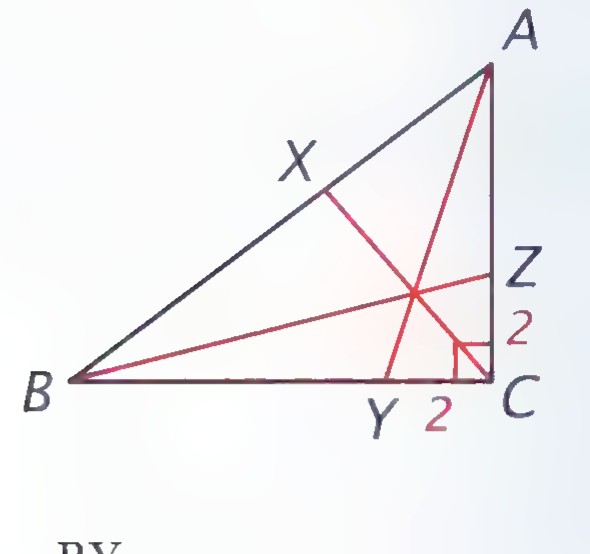
- Find .
- Find .
- Use Ceva’s Theorem to find .
- Find AX and XB.
Ollie’s Equations. In applying Ceva’s Theorem to the figure below, Acute Alice wrote and Obtuse Ollie wrote .
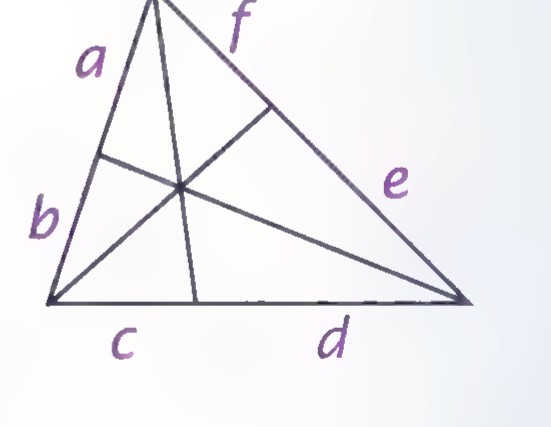
Alice told Ollie that his equation must be wrong because he should have started with a.
- Do you agree? Explain.
Ollie then changed his equation to .
- Is his new equation correct? Explain.
- What conclusions do exercises 25 and 26 suggest?
p. 559
Set II
The Theorem of Menelaus. Menelaus, a Greek mathematician who lived in Alexandria in about 100 A.D., made the following discovery long before Ceva was born.
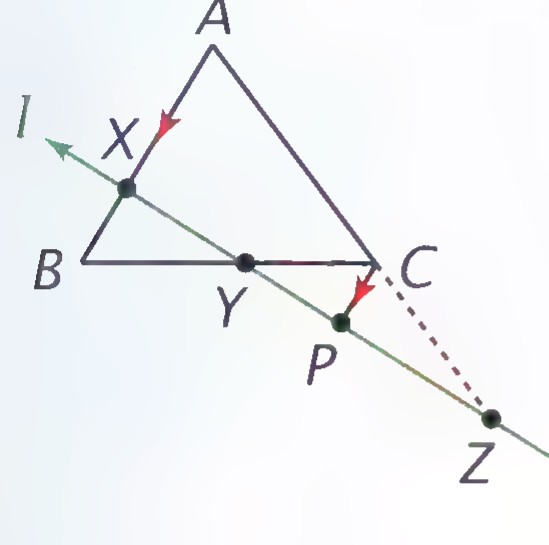
Line l intersects two sides of △ABC at X and Y and the line containing the third side at Z. Line CP has been drawn parallel to AB.
- Because of CP, the figure contains two pairs of similar triangles. Which are they?
- Why is and ?
- Why is AX · CZ = CP · AZ and BY · CP = YC · XB?
- Why is AX · CZ · BY · CP = CP · AZ · YC · XB and AX · CZ · BY = ZA · YC · XB?
- Why is ?
- To what does this result seem closely related?
Concurrent or Not? In the figure below, AY is a median of △ABC, XZ ∥ BC, and BZ and CX are cevians.
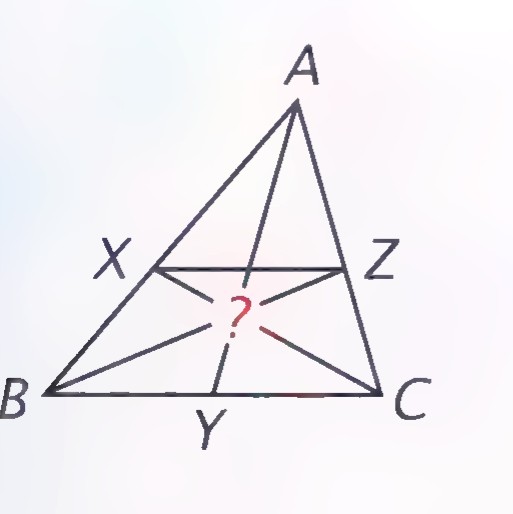
- Why is ?
- What can you conclude about ? Explain.
- What does this result prove?
What Kind of Triangle? In the figure below, AY, an altitude of △ABC, is concurrent with BZ and CX at point P. △DYE has been drawn so that DE ∥ BC.
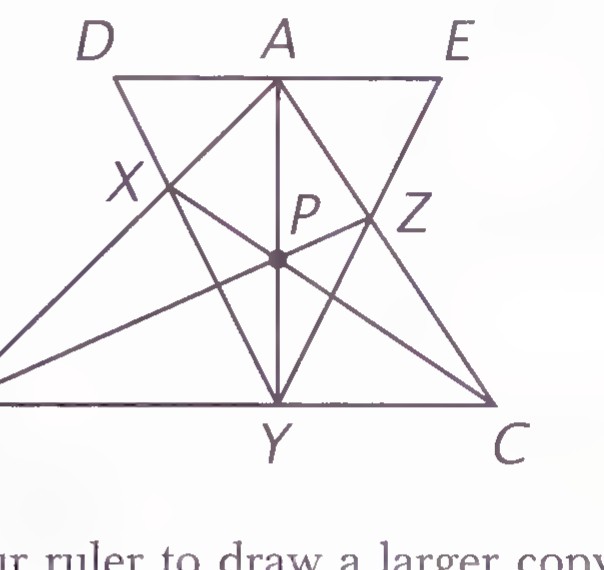
- Use your ruler to draw a larger copy of this figure.
- What kind of triangle does △DYE appear to be?
- Why is △AXD ∼ △BXY and △CZY ∼ △AZE?
- Why is and ?
- What do you know about ?
- What can you conclude about ? Explain.
- What can you conclude about ? Explain.
- Why is AD = AE?
- Why is AY ⊥ DE?
- What can you conclude about △DYA and △EYA? Explain.
- What does this relation between △DYA and △EYA prove about △DYE? Explain.
p. 560
The Gergonne Point. Joseph Gergonne, a French mathematician of the nineteenth century, discovered something about the incircle of a triangle.
Draw a large scalene triangle and labeled its vertices A, B, and C.
- Use your straightedge and compass to inscribe a circle in the triangle. Label the points of tangency D, E, and F so that D is on BC, E is on AC, and F is on AB.
- Draw AD, BE, and CF.
What do you notice?
Why is it true?
What point do you think was named after Gergonne?
Another Look at Altitudes.
In the figure at the right, AY, BZ, and CX are perpendicular to the sides of △ABC.
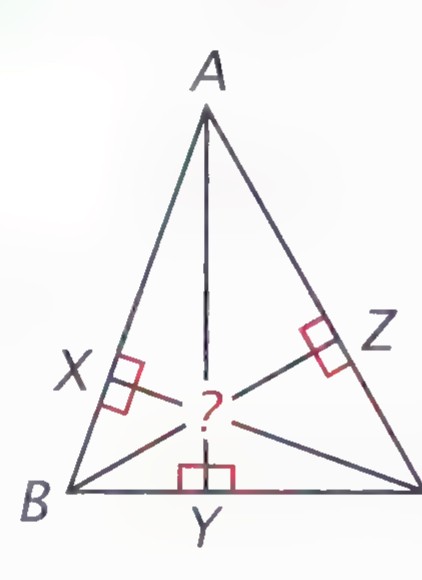
Write a similarity correspondence between each of the following triangles and another triangle in the figure.
- △AXC.
- △BYA.
- △CZB.
Use your correspondences to copy and complete the following proportions.
.
.
.
Show how it follows from these equations and Ceva’s Theorem that AY, BZ, and CX are concurrent.
What theorem do your answers to exercises 52 through 58 prove?
Set III
Area Puzzle. Rather than being concurrent, the three cevians in △ABC intersect to form a smaller triangle, △GHI.
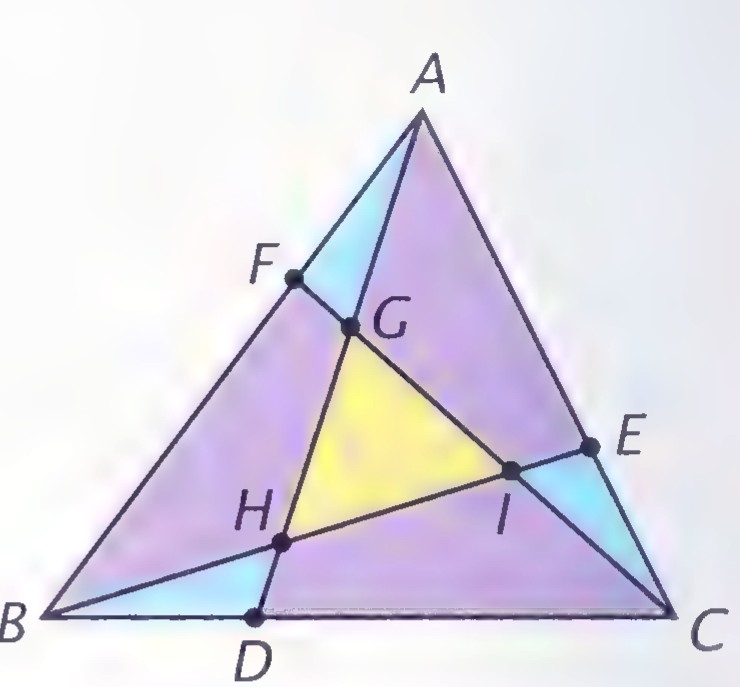
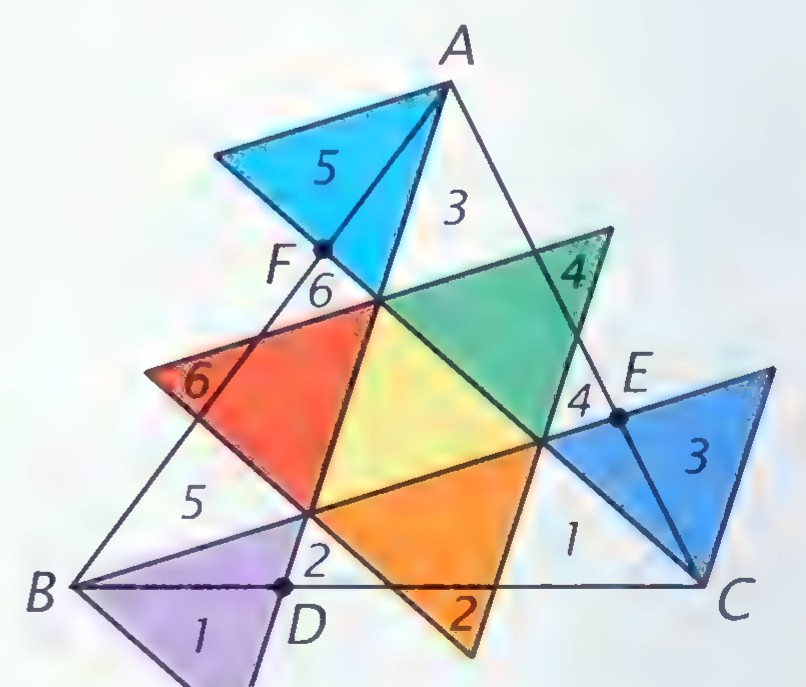
Given that D, E, and F are points of trisection of the sides of △ABC, it can be proved that the blue regions have equal areas and the purple regions have equal areas; it can also be proved that, if the area of a blue region is x, the area of a purple region is 5x.
Find the areas of the following triangles in terms of x.
- △ABD.
- △ADC.
- △GHI.
- What fraction of the area of △ABC is the area of △GHI?
- How does the figure below suggest a different way to arrive at the same conclusion?
p. 561
Lesson 6: Napoleon’s Discovery and Other Surprises
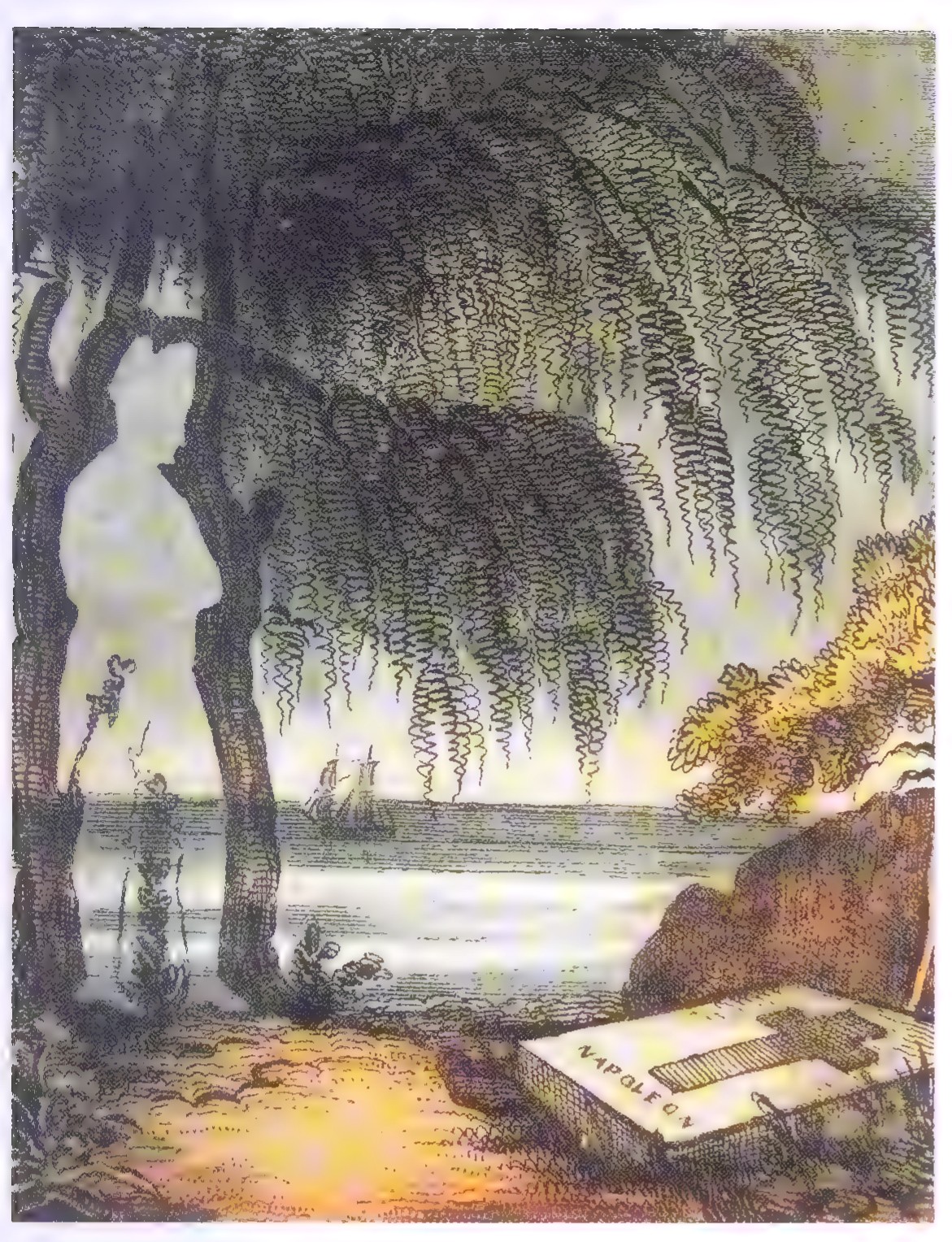
The popular picture above, published in England many years ago, is of the ghost of Napoleon visiting his grave on the remote island where he died. Its success was due in part to the fact that some people could not immediately find Napoleon in the figure.
Napoleon enjoyed mathematics and even taught geometry for a time at a university. He may have been the first person to discover something about triangles now known as Napoleon’s Theorem.
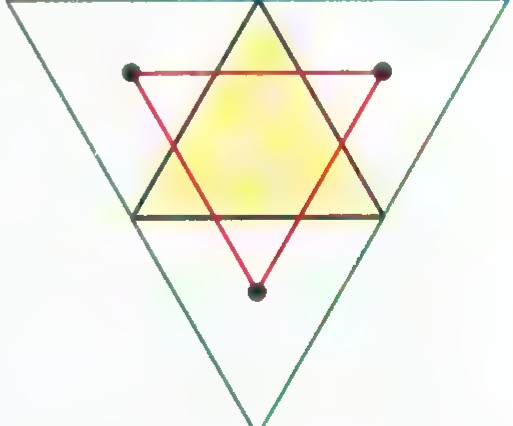
In the figure shown at the right, equilateral triangles have been drawn on the sides of an equilateral triangle. If the centers of these three triangles are connected, the result is another equilateral triangle. Because of the symmetry of the figure, the fact that this triangle also is equilateral seems natural and Euclid would have seen immediately that it was true.
p. 562
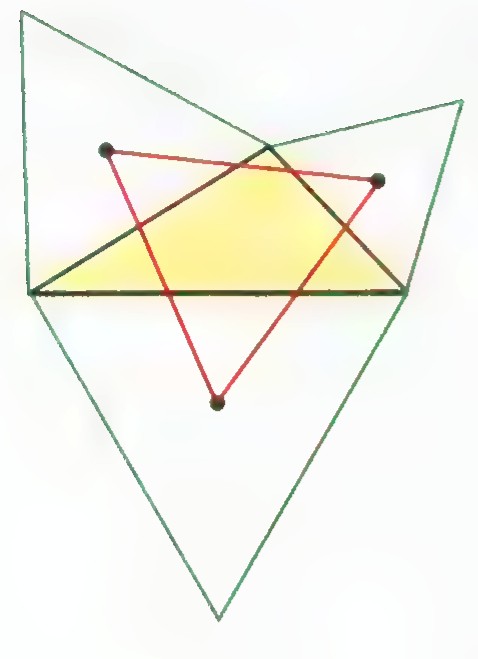
Suppose, instead, that equilateral triangles are drawn on the sides of a triangle having no special shape. If the centers of the three added triangles are connected, you might expect that the result is no longer anything special or, at most, that it might be a triangle similar to the original triangle. Amazingly, this is not the case. As the figure at the left suggests, the new triangle is again equilateral!
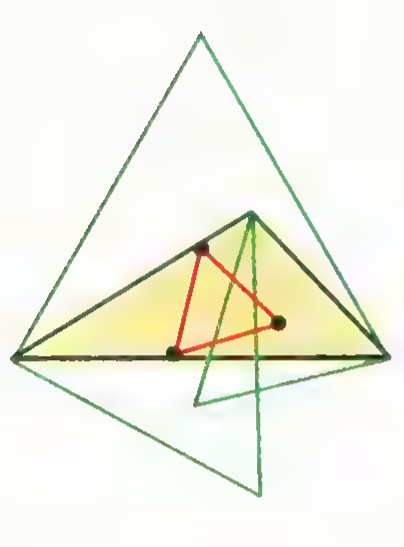
Now imagine that the three equilateral triangles on the sides of the triangle point inward instead of outward. The centers of the three added triangles still determine an equilateral triangle! Regardless of its shape, every triangle has two such equilateral triangles associated with it, known as the “outer and inner Napoleon triangles.”
Much like the hidden image of Napoleon in the picture at the beginning of this lesson, many remarkable results in geometry remained hidden for many centuries after Euclid’s time, not because they are hard to see but because no one had ever thought to look for them.
Eric Temple Bell, a historian of mathematics, wrote:
Geometry is a richer treasure house of more interesting and half-forgotten things . . . than any other division of mathematics.*
In the exercises that follow, you will see some more examples of results in geometry that are unexpected and, at times, surprising.
Exercises
Set I
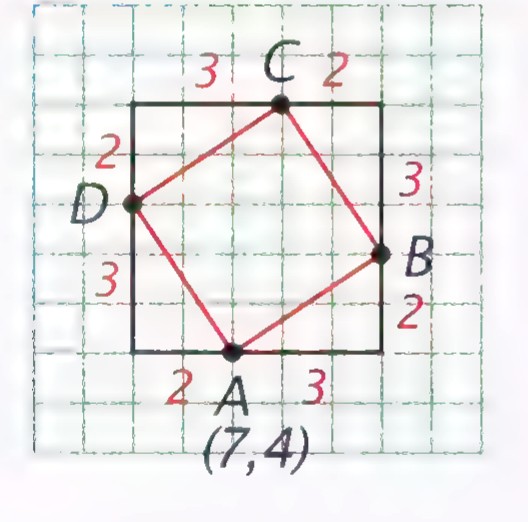
Tilted Square. The figure above shows a “tilted square” on a coordinate grid.
- Which sides have a slope of ?
- What is the slope of the other two sides?
- Why is the product of the slopes of two consecutive sides −1?
- How long is each side of the tilted square?
- If A has coordinates (7, 4), what are the coordinates of B, C, and D?
Euler’s Discovery. Leonard Euler made an interesting discovery about the orthocenter, centroid, and circumcenter of a triangle. It is illustrated in the following series of exercises.
On graph paper, draw a pair of axes extending 20 units to the right and 15 units up from the origin.
The Centroid.
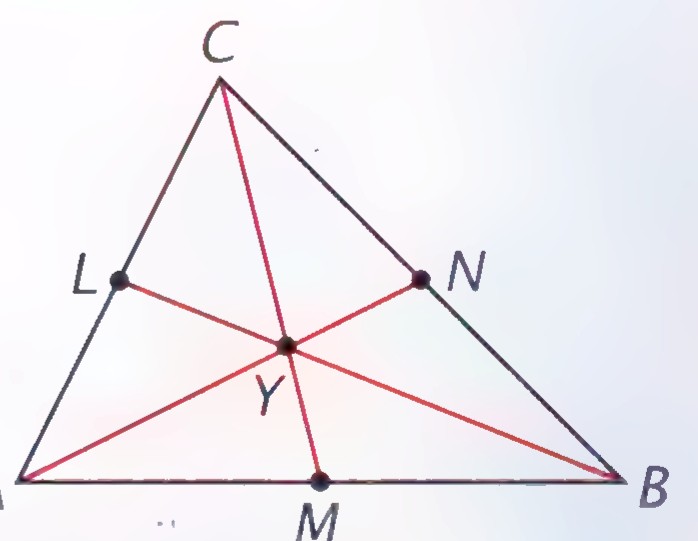
- Plot the following points and connect them to form △ABC: A(0, 0), B(18, 0), C(6, 12). Find the midpoints of AB and AC and label them M and L as shown.
* The Development of Mathematics (McGraw-Hill, 1940).
p. 563
- What are the coordinates of points M and L?
- Draw CM and BL. Let Y be the point in which they intersect. What are the coordinates of point Y?
- Draw AY and extend it to intersect CB at N. What are the coordinates of point N?
- How are the coordinates of N related to the coordinates of B and C?
- Use the distance formula to find CN and NB.
- What is point Y called with respect to △ABC?
- What are AN, BL, and CM called?
The Circumcenter.
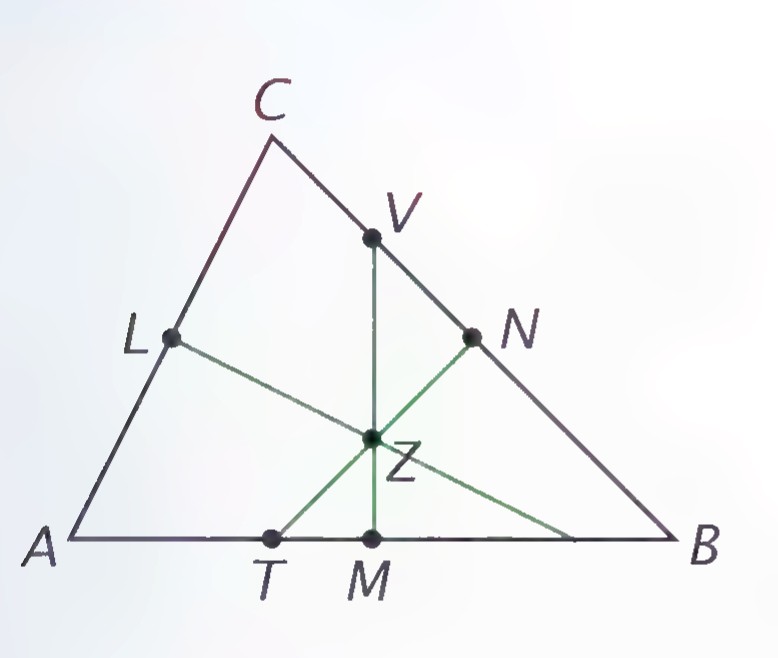
- Through M on the same figure, draw a line perpendicular to AB and extend the line to intersect CB at point V. What are the coordinates of V?
- Through N, construct a line perpendicular to CB and extend the line to intersect AB at point T. What are the coordinates of T?
- Find the slopes of NT and CB.
- Are these slopes related in the way that you would expect? Explain.
- Let Z be the point in which VM and NT intersect. What are the coordinates of Z?
- What is point Z called with respect to △ABC?
- Draw ZL. Find the slopes of AC and ZL.
- What do their slopes indicate about AC and ZL?
- What are lines VM, NT, and ZL called with respect to △ABC?
The Orthocenter.
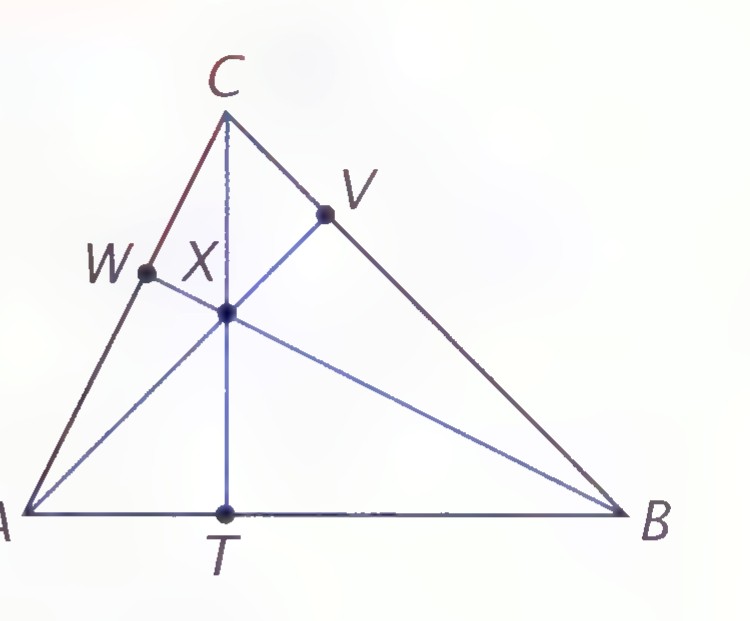
- On the same figure, draw CT. What relation does CT have to AB?
- Through A, construct a line perpendicular to CB. Where does this line intersect CB?
- Find the slope of AV.
- Does AV have the slope that you would expect? Explain.
- Let X be the point in which CT and AV intersect. What are the coordinates of X?
- What is point X called with respect to △ABC?
- Draw line BX and extend it to intersect AC at W. What are CT, AV, and BW called with respect to △ABC?
Euler’s Conclusions.
- What relation do points X, Y, and Z appear to have?
- Find the slopes of XY and YZ.
- How do XY and YZ compare in length? Explain.
- Which point in the figure is equidistant from A, B, and C?
- Find each of the three distances to see if you are correct.
p. 564
Set II
Triangles on Four Sides. In the figure below, ABCD is a square and the four triangles are equilateral.
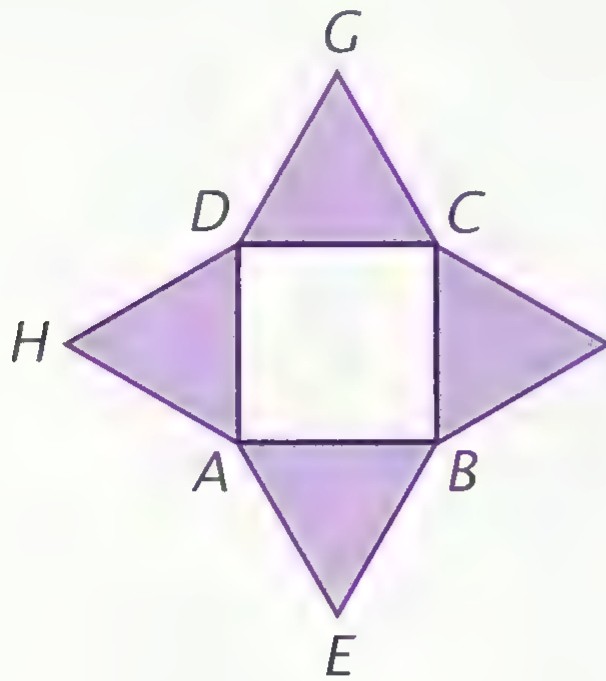
Make an accurate enlargement of the figure on graph paper by doing each of the following steps.
- Draw square ABCD so that each side is 6 units long.
- Use your straightedge and compass to construct the four equilateral triangles on its sides.
What is the perimeter of the octagonal star, GCFBEAHD?
What is the measure of ∠CBE?
What is the measure of ∠HAE?
(continued) Draw HC and DE.
What relation do these lines appear to have?
(continued) Draw HE and CE.
What do you notice about △HDC, △CBE, and △EAH? Explain.
What does what you noticed about these three triangles prove about △HCE?
What do your conclusions prove about HC and DE?
Squares on Three Sides. On graph paper, draw a pair of axes extending 20 units to the right and 20 units up from the origin.
Plot the following points and connect them to form △ABC: A(5, 8), B(13, 8), C(7, 12).
Find the slope of each side of △ABC.
Is △ABC a right triangle? Explain.
(continued) Draw squares on the sides of △ABC and label them as shown in the figure below. If you have drawn the squares accurately, the coordinates of F should be (1, 10) and those of H should be (11, 18).
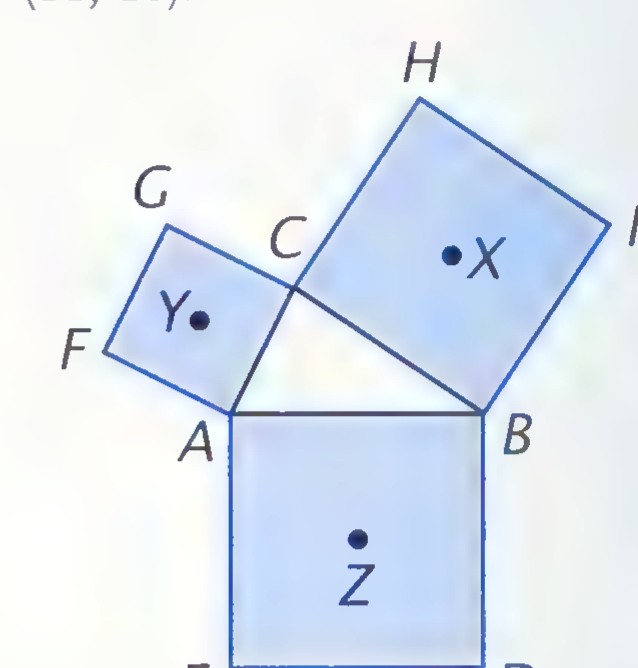
Find the coordinates of G and I.
(continued) Find the centers of the squares and label them as shown in the figure.
Find the coordinates of X, Y, and Z.
(continued) Draw AX, BY, and CZ.
What relation do these lines appear to have?
(continued) Draw △XYZ.
How do AX, BY, and CZ appear to be related to the sides of △XYZ?
Show whether this relation is really true.
How do AX, BY, and CZ compare in length with the sides of △XYZ?
Squares on Four Sides. On graph paper, draw a pair of axes extending 15 units to the right and 15 units up from the origin.
- Plot the following points and connect them to form quadrilateral ABCD: A(4, 6), B(10, 6), C(11, 9), D(5, 9).
- Find the length of each side of ABCD.
- What kind of quadrilateral is ABCD?
- How do you know?
p. 565
(continued) Draw squares on the sides of ABCD. Find the centers of the squares and label them as shown in the figure below.
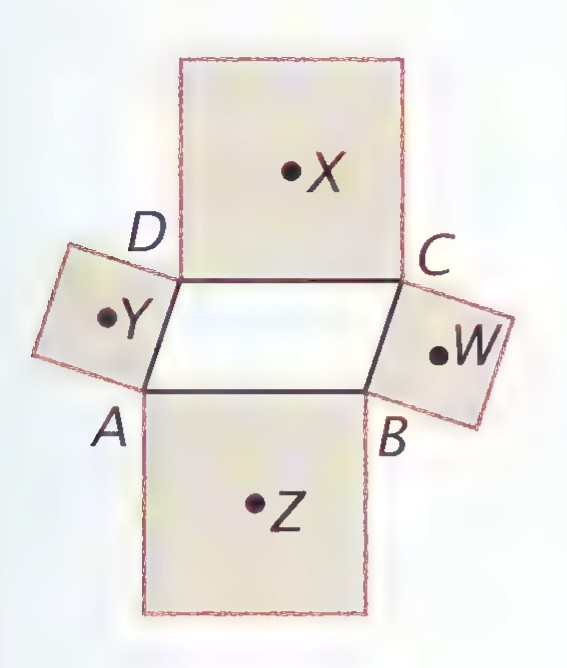
Find the coordinates of W, X, Y, and Z.
(continued) Draw XZ and WY.
Find the slopes of XZ and WY.
What do their slopes prove about XZ and WY?
How do XZ and WY compare in length?
(continued) Draw quadrilateral WXYZ.
What kind of quadrilateral is it?
Napoleon Triangles. In the figure below illustrating Napoleon’s discovery, equilateral triangles △ACE, △ABF, and △BCD have been drawn outward on the sides of △ABC, a triangle having no special shape.
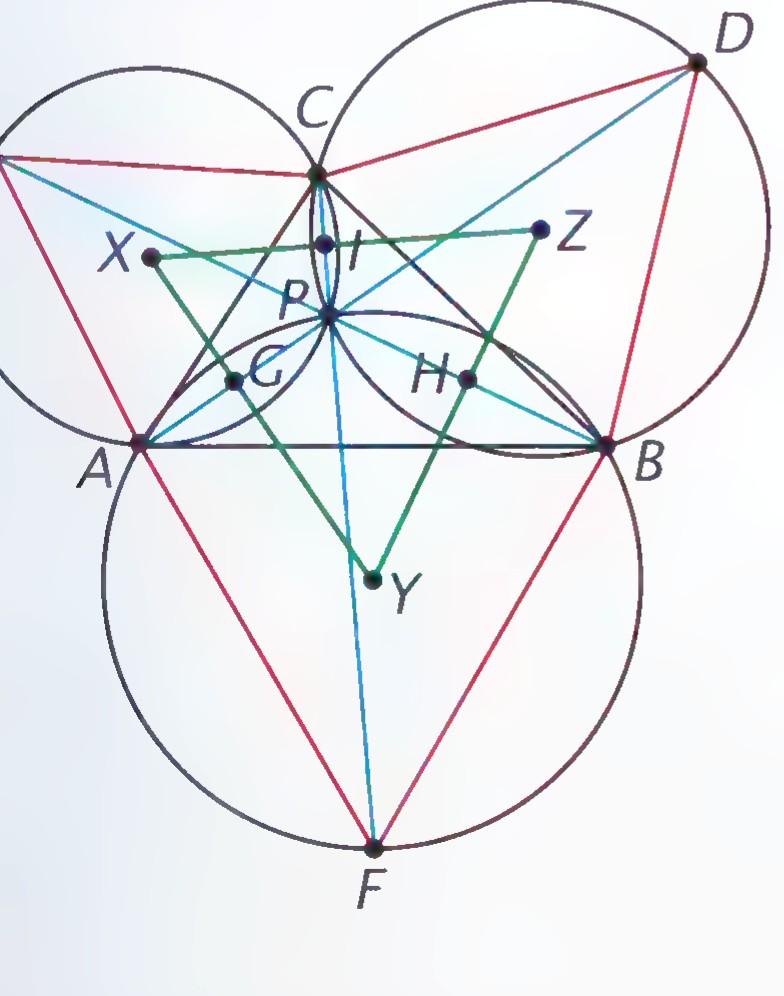
It can be proved that the line segments AD, BE, and CF are equal and concurrent and that they form 60° angles with each other.
- It follows that the three quadrilaterals APCE, APBF, and BPCD must be cyclic. Why?
As a result, the circumcircles X, Y, and Z of the three equilateral triangles intersect at point P.
- If △XYZ is drawn, it follows that the three segments concurrent at P must be perpendicular to the triangle’s sides. Why? (Hint: Notice that X is equidistant from A and P.)
- Quadrilaterals PGXI, PGYH, and PHZI can now be used to explain why △XYZ is equilateral. How?
Set III
Alternating Triangles. The figures below suggest a theorem about quadrilaterals.
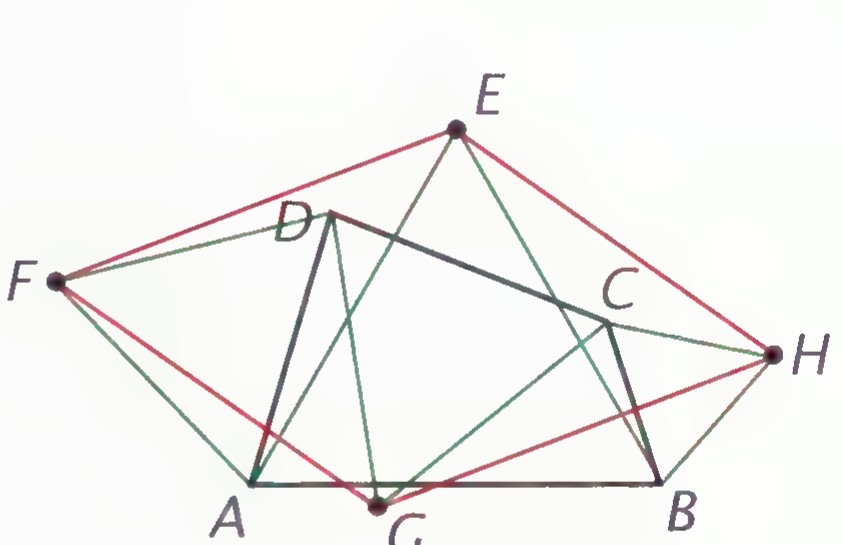
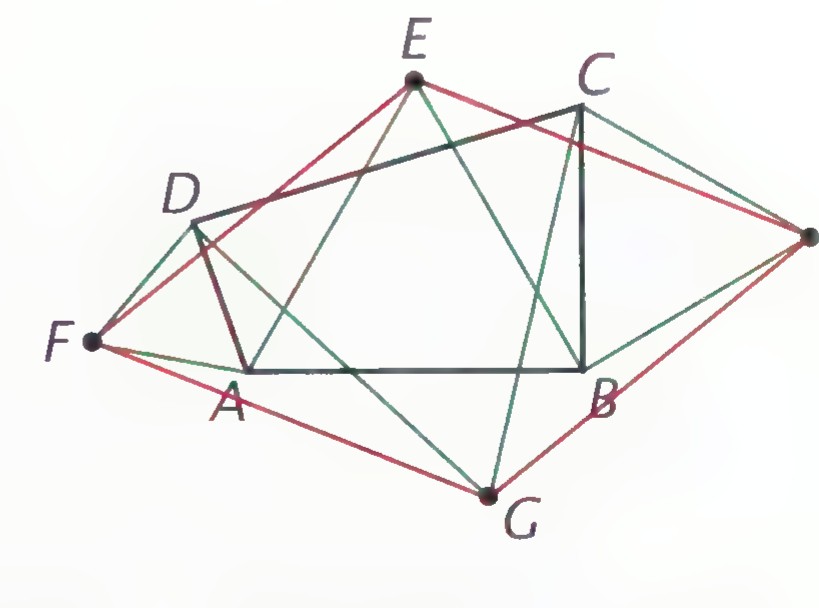
- What do you think it is?
- Make a drawing with a concave quadrilateral to see if your theorem seems to apply to it.
p. 566
Summary and Review
Basic Ideas
Centroid 549
Cevian 554
Circumcircle and circumcenter 531
Circumscribed polygon 542
Cyclic polygon 530
Incircle and incenter 542
Inscribed polygon 531
Median 549
Orthocenter 549
Theorems
- Every triangle is cyclic. 531
Corollary. The perpendicular bisectors of the sides of a triangle are concurrent. 531
- A quadrilateral is cyclic iff a pair of its opposite angles are supplementary. 536
- Every triangle has an incircle. 543
Corollary. The angle bisectors of a triangle are concurrent. 543
- The medians of a triangle are concurrent. 549
- The lines containing the altitudes of a triangle are concurrent. 549
- Ceva’s Theorem. Three cevians, AY, BZ, and CX, of △ABC are concurrent iff . 555
Constructions
- To circumscribe a circle about a triangle. 531
- To inscribe a circle in a triangle. 543
Exercises
Set I
Cyclic Triangle. The figure below shows that △ABC is cyclic.
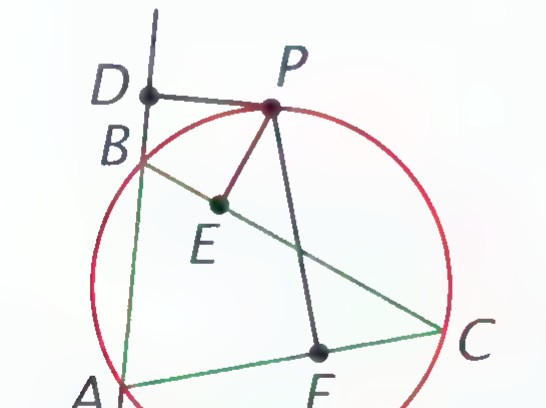
- What does saying that a polygon is cyclic mean?
- What word describes the way in which △ABC is related to the circle?
- What relation do PD, PE, and PF appear to have to the lines containing the sides of the triangle?
Although there is nothing special about △ABC or point P, there is something special about the way in which D, E, and F are related.
- What do you think it is?
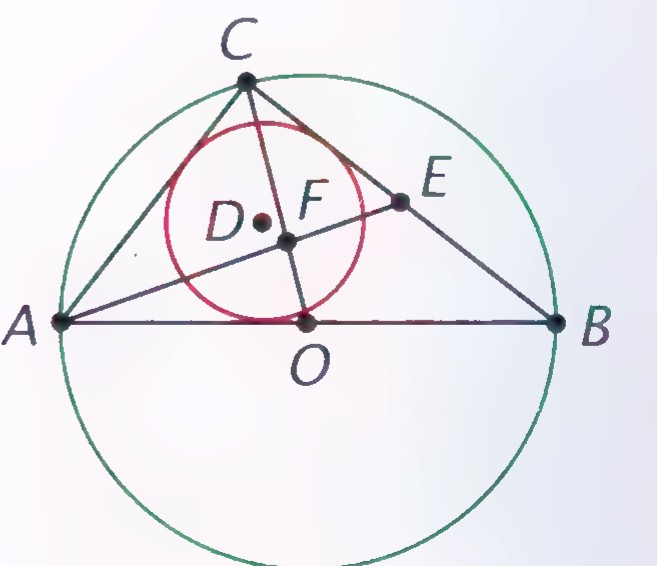
Circumcircle and Incircle. The circles in the figure below are circumscribed about and inscribed in △ABC; AB is a diameter of circle O.
p. 567
Use your straightedge and compass to construct the figure by doing the following steps.
- Draw a circle with a radius of about 2 inches and label its center O.
- Draw the diameter AB.
- Choose a point C on the circle in about the position shown in the figure and draw CA and CB.
- Draw radius OC.
- Inscribe a circle in △ABC and label its center D.
- Bisect CB and label its midpoint E.
- Draw AE and let F be the point in which AE and CO intersect.
What kind of triangle is △ABC? Explain.
Name one of its medians.
Name one of its altitudes.
Name a pair of points that determine one of its angle bisectors.
Which point in the figure is its
- incenter?
- circumcenter?
- centroid?
- orthocenter?
Three Trapezoids. For each of the following trapezoids, the measures of two angles are given.
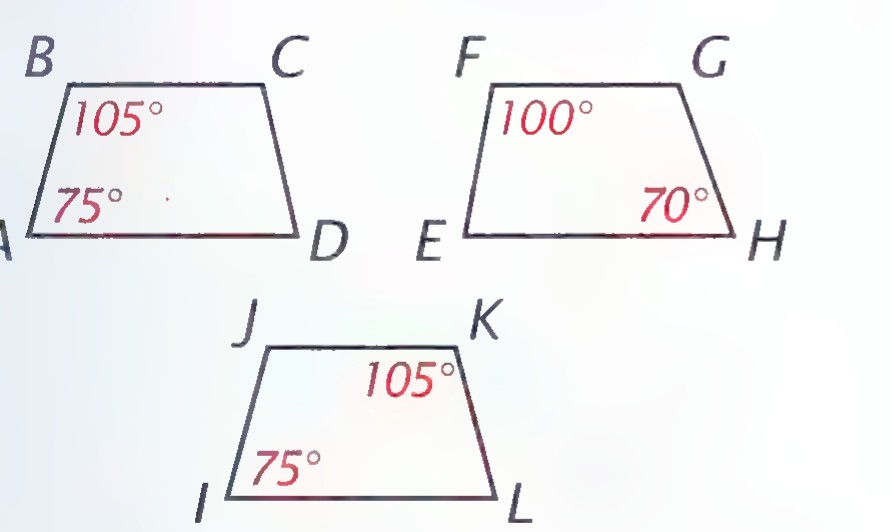
Which trapezoid(s)
- must be cyclic?
- cannot be cyclic?
- Explain.
Double Identity. In the figure below, GE, HF, and ID are the perpendicular bisectors of the sides of △ABC.
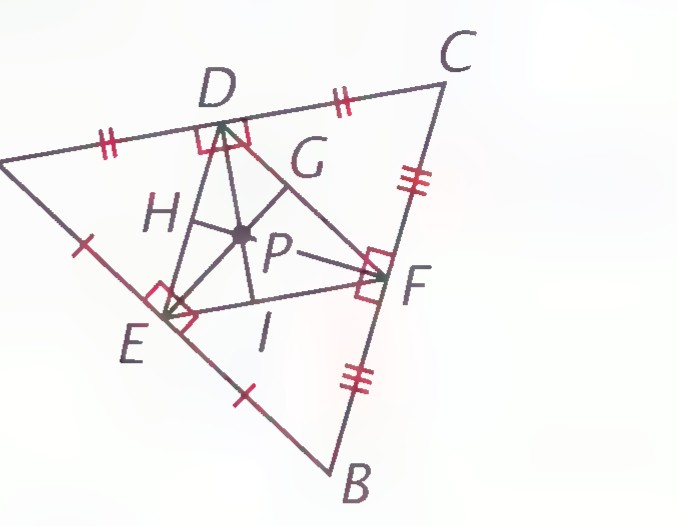
- What is point P called with respect to △ABC?
- What are DE, EF, and DF called with respect to △ABC?
- What relation do the sides of △DEF have to the sides of △ABC?
- What are GE, HF, and ID called with respect to △DEF?
- What is point P called with respect to △DEF?
- Which points in the figure are equidistant from point P?
Ceva’s Theorem. The sides of the triangle below are 5, 6, and 7 units.
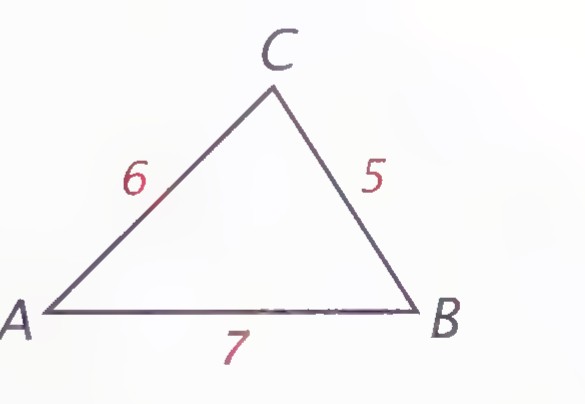
- Use your ruler and compass to construct an enlargement of it by using sides of lengths 5 cm, 6 cm, and 7 cm. Mark point X on CA so that CX = 2 cm, point Y on AB so that AY = 4 cm, and point Z on BC so that BZ = 3 cm.
Find each of the following numbers.
- AX, YB, and ZC.
- , , and .
p. 568
.
What does the answer to exercise 26 indicate?
(continued) Add the appropriate line segments to your figure to see if your answer to exercise 27 is true.
Five Circles. The figure below illustrates a surprising geometric fact.
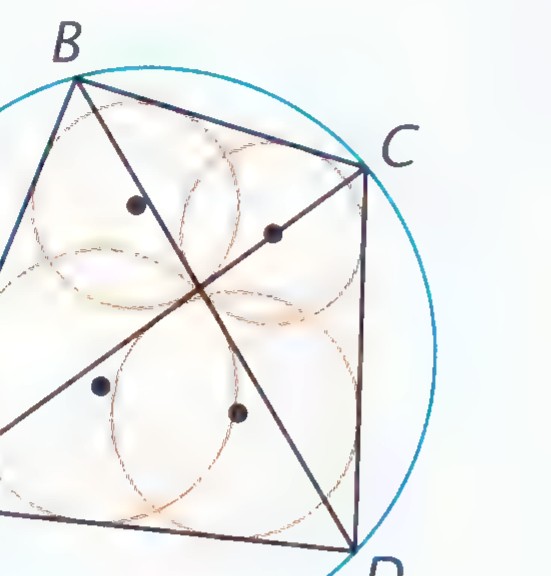
- What kind of quadrilateral is ABCD?
- What relation does the largest circle in the figure have to this quadrilateral?
Each of the smaller circles is tangent to three lines in the figure.
- How are these circles related to some of the triangles in the figure?
- What is surprising about their centers?
Centroid. Architects know that one of the properties that affects how efficiently a structural shape supports a building load is its centroid.*
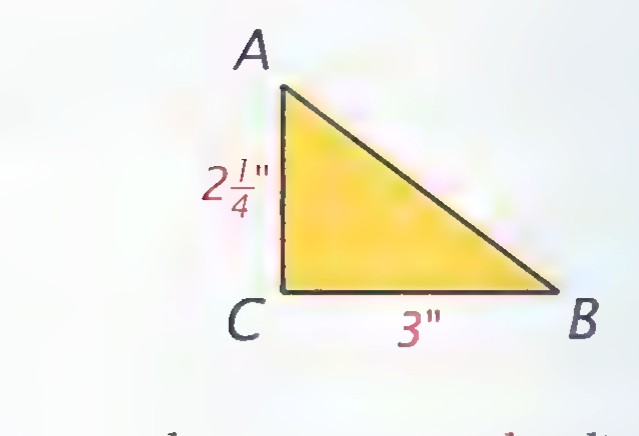
- Use your straightedge and compass to construct right △ABC having legs of inches and 3 inches as shown in the figure at the top of the next column. Draw cevians AD and BE to find its centroid. Label the centroid P.
Use your ruler to measure the distance from P to
- AC.
- CB.
- How do these distances compare with the lengths of CB and AC?
Set II
Soap-Film Geometry. The figure below shows a frame made of two parallel glass plates connected by four identical pins that are perpendicular to both plates.
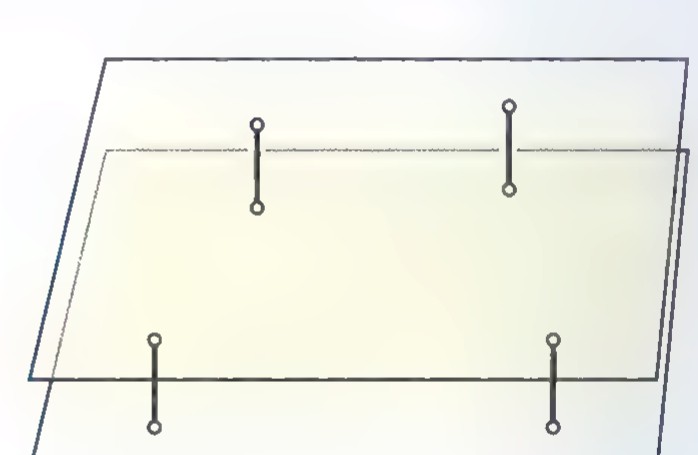
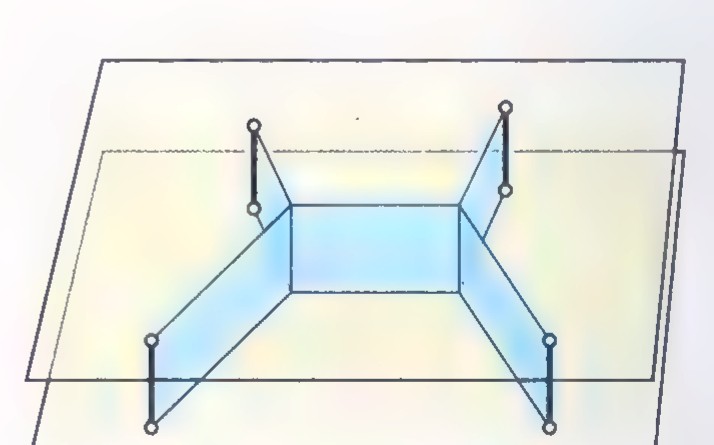
The next figure shows what happens if the frame is dipped into a soap solution and then withdrawn. Five walls of soap film are formed between the pins.†
* Architectural Exam Review, Vol. 1, Structural Topics, by David Kent Ballast (Professional Publications, 1992).
† The Parsimonious Universe: Shape and Form in the Natural World, by Stefan Hildebrandt and Anthony Tromba (Copernicus, 1996).
p. 569
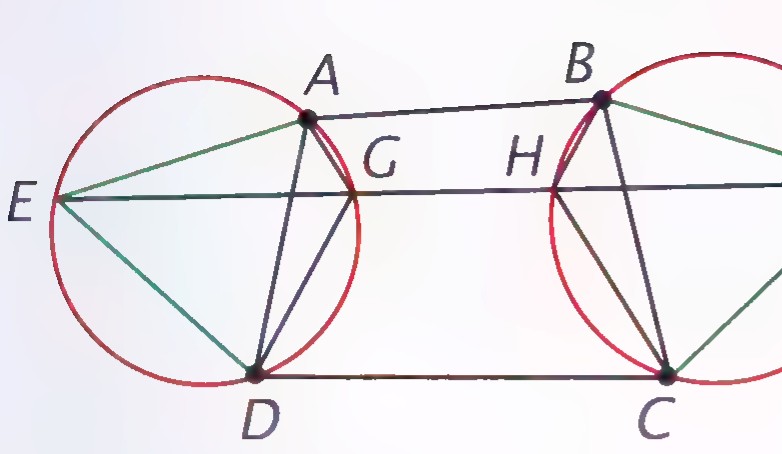
In the figure above, points A, B, C, and D mark the positions of the four pins. Equilateral triangles △ADE and △BCF and their circumcircles have been constructed on opposite sides of ABCD, and line EF has been drawn to intersect the circles at G and H.
- What can you conclude about ∠AED + ∠AGD? Why?
- What can you conclude about the measure of ∠AGD? Why?
- What can you conclude about ∠EGD and ∠EAD? Why?
What can you conclude about the measures of the following angles? Explain how you found each answer.
- ∠EGD.
- ∠DGH.
- ∠AGH.
- ∠BHC.
- ∠FHC.
- ∠GHC.
- ∠BHG.
The line segments meeting at G and H correspond to the positions of the five walls of soap film.
- What do these results suggest about the angles formed where the walls meet?
Irrelevant Information. In the figure below, point D is the incenter of △ABC.
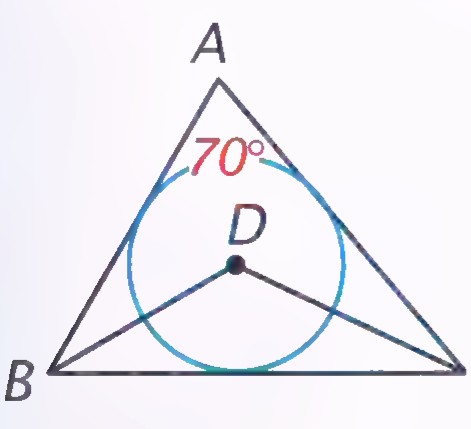
- If ∠A = 70° and ∠ABC = 60°, find ∠D.
- If ∠A = 70° and ∠ABC = 40°, find ∠D.
- If ∠A = 70° and the measure of ∠ABC is not known, find ∠D.
Medians Theorem. Ceva’s Theorem can be used to prove that the medians of a triangle are concurrent.
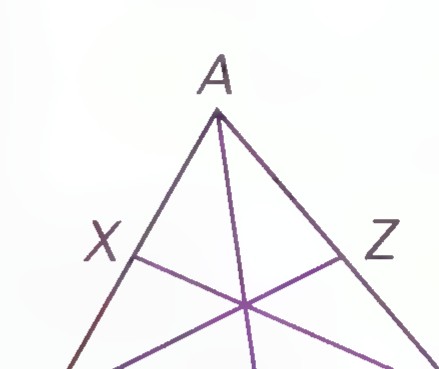
- Use the figure above in which AY, BZ, and CX are the medians of △ABC to explain how.
Irregular Billiard Table. In the figure below, the diagonals of quadrilateral ABCD intersect at point P.
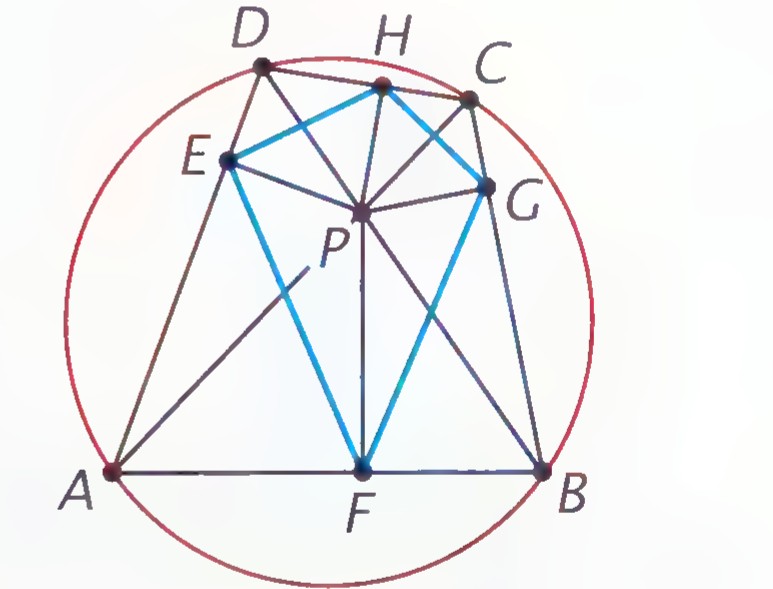
- What kind of quadrilateral is ABCD?
What relation do PE, PF, PG, and PH appear to have to
- ABCD?
- EFGH?
- Given that both of these relations are true and that a billiard table was built in the shape of ABCD, where do you think a ball at E would go if it were hit in the direction EF?
p. 570
Perimeter Problem. △ABC is a right triangle with legs of lengths a and b. The radius of its incircle is r and the radius of its circumcircle is R.
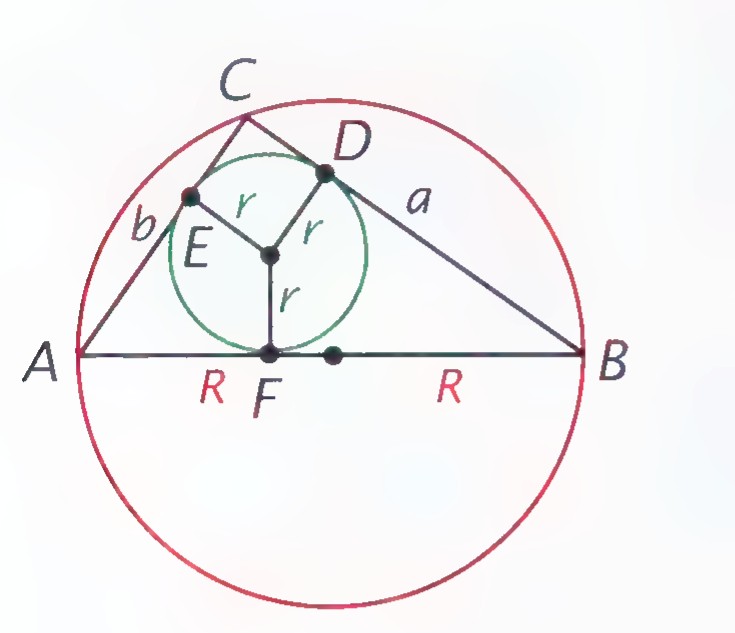
Name the line segments in the figure whose length is
- a − r.
- b − r.
- (a − r) + (b − r).
- 2R.
- Use your answers to exercises 57 and 58 to show that the perimeter of △ABC is 2r + 4R.
Squares on the Sides. On graph paper, draw a pair of axes extending 20 units to the right and 20 units up from the origin.
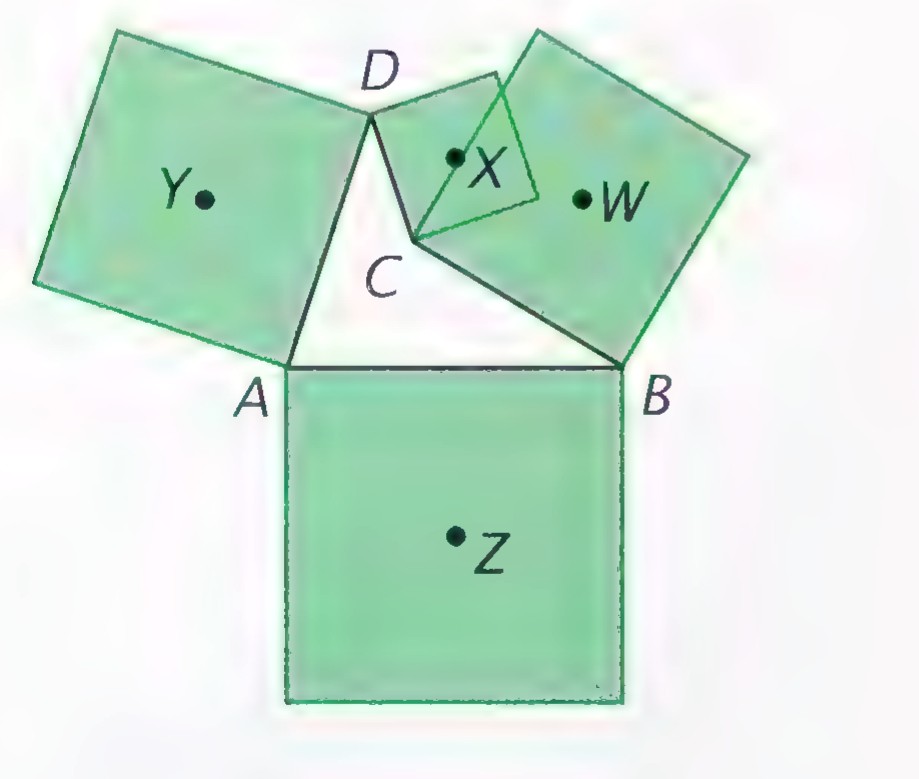
Plot the following points and connect them to form quadrilateral ABCD: A(6, 8), B(14, 8), C(9, 11), D(8, 14).
What kind of quadrilateral is ABCD?
(continued) Draw squares on the sides of ABCD. Find the centers of the squares and label them as shown in the figure.
Find the coordinates of W, X, Y, and Z.
(continued) Draw XZ and WY.
What relations do XZ and WY have?
Area Problem. In the figure below, O is the circumcenter of △ABC, and AD is one of its altitudes.
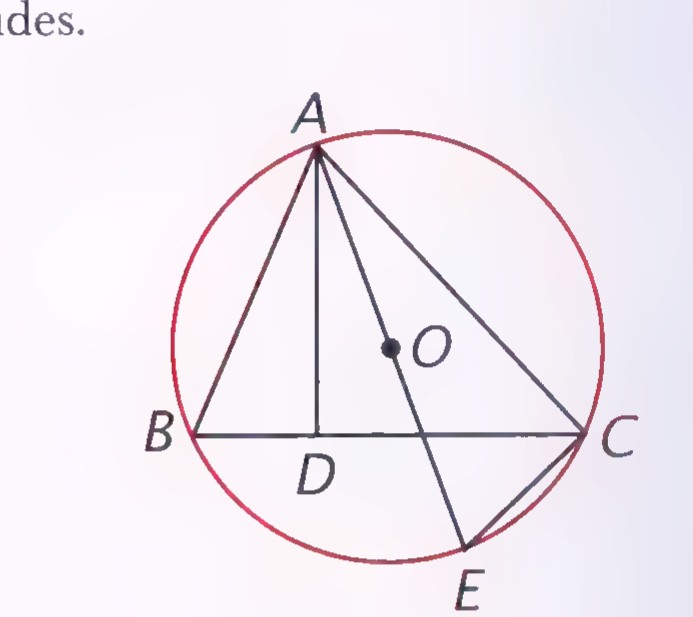
- Which triangle in the figure is similar to △ABD?
- Explain how you know.
- Why does it follow that AB · AC = AD · AE?
- If the radius of circle O is r, why does it follow that the area of △ABC is equal to the product of the lengths of its three sides divided by 4r? (Hint: Start with .)