Chapter 12 — Teacher’s Guide Answers
Answers and teaching commentary for Chapter 12: Circles, transcribed from the scanned Teacher’s Guide. Diagrams are cropped from the same page scans.
OCR note. The text was recognized automatically and has not been corrected line by line; formulas and symbols may be imperfect. Check the original PDF for exact wording.
Homework: Chapter 12 exercises · Selected answers · Teacher’s answers PDF
Lesson 1
Set I (pages 486-487)
According to Matthys Levy and Mario Salvadori in their book titled Why Buildings Fall Down (Norton, 1992), the Romans built semicircular arches of the type illustrated in exercises 1 through 5 that spanned as much as 100 feet. These arches were used in the bridges of 50,000 miles of roads that the Romans built all the way from Baghdad to London!
The conclusions of exercises 13 through 15 are supported by the fact that a diameter of a circle is its longest chord and by symmetry considerations. As the second chord rotates away from the diameter in either direction about the point of intersection, it becomes progressively shorter.
Roman Arch.
1. Radii.
®2. Chords.
3. Adiameter.
4. Isosceles. Each has two equal sides because the radii of a circle are equal.
5. They are congruent by SSS. Old Figure.
*6. Five.
7. One.
8. Four. *9, Six. Butterfly Spots.
*10. Concentric.
11. It means that a set of circles lie in the same plane and have the same center.
12. (Student answer.) (The spots look like big eyes; so they might scare some predators away.)
Chord Problem. 13.
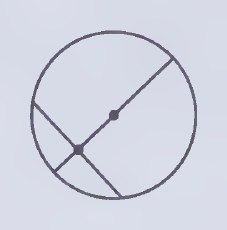
Diagram from page 180.
¢14. They are perpendicular.
15. The longest chord is always a diameter; so its length doesn’t depend on the location of the point. The length of the shortest chord depends on how far away from the center the point is; the greater the distance, the shorter the chord.
Theorem 56.
16. Perpendicular lines form right angles.
*17. Two points determine a line.
*18. All radii of a circle are equal.
19. Reflexive.
20. HL.
21. Corresponding parts of congruent triangles are equal.
#22. If aline divides a line segment into two equal parts, it bisects the segment.
Theorem 57.
23. If a line bisects a line segment, it divides the segment into two equal parts.
24. Two points determine a line.
25. All radii of a circle are equal.
#26. In a plane, two points each equidistant from the endpoints of a line segment determine the perpendicular bisector of the line segment.
Theorem 58.
*27. If aline through the center of a circle bisects a chord that is not a diameter, it is also perpendicular to the chord.
*28. Through a point on a line, there is exactly one line perpendicular to the line.
29. CD contains O.
Set 1| (pages 488-490)
The SAT problem of exercises 30 and 31 is something of an oddity in that it is a rather well known “trick question.” Martin Gardner included it in his *“Mathematical Games” column in the November 1957 issue of Scientific American— many years before it appeared on the SAT!
The CBS eye, a creation of designer William Golden, first appeared on television in 1951. Hal
Morgan observes in his book titled Symbols of America (Viking, 1986) that, “because it is essentially a picture of an eye, it has proved a challenge to the police efforts of the CBS trademark attorneys. As one company executive admitted, ‘Bill Golden, after all, didn’t invent the eye. God thought of it first.””
The story of the use of Jupiter to determine the speed of light is told by William Dunham in The Mathematical Universe (Wiley, 1994). After the invention of the telescope in the seventeenth century and the discovery of the moons of Jupiter, astronomers were puzzled by the delay in the eclipses of the moon Io when the earth and Jupiter were farthest apart. Ole Roemer reasoned that the time discrepancy was due to the extra distance that the light from Jupiter and its moon had to travel to get to the earth. Surprisingly, it was not the speed of light that especially interested Roemer but rather the conclusion that light does not travel instantaneously from one place to another, something that had not been known previously.
The definition of the roundness of a grain of sand was devised by Haakon Wadell in about 1940. He defined it to be (for cross sections of the grain) the “ratio of average radius of curvature of the corners to radius of maximum inscribed circle.” From this definition, it follows that roundness can vary from o to 1, with perfect roundness being 1.
Exercises 43 through 47 are based on a simple theorem discovered in 1916 by the American geometer Roger Johnson: “If three circles having the same radius pass through a point, the circle through their other three points of intersection also has the same radius.” The appearance of the cube in the explanation and the role played by two of its opposite vertices is quite unexpected. For more information on this elegant theorem, see chapter 10 of George Polya’s Mathematical Discovery, vol. 2 (Wiley, 1965), and the fourth of the “Four Minor Gems from Geometry”in Ross Honsberger’s Mathematical Gems I/ (Mathematical Association of America, 1976).
SAT Problem.
30. 10.
31. The diagonals of a rectangle are equal. The other diagonal of the rectangle is a radius of the circle.
CBS Eye.
32. Example answer:
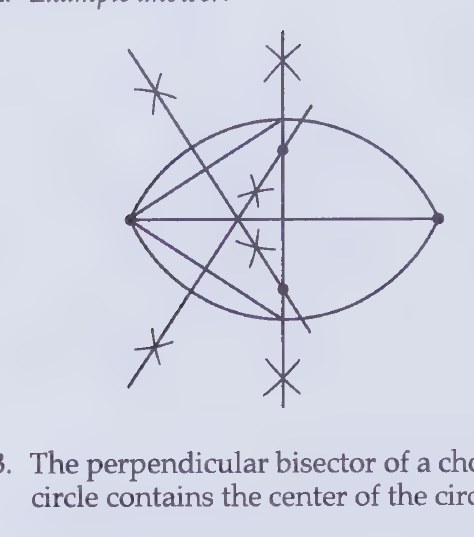
Diagram from page 181.
33. The perpendicular bisector of a chord of a circle contains the center of the circle.
Red-Spot Puzzle.
*34. Anisosceles right triangle.
*35. About 46 mm. (252— =45.96.)
”
36. Very difficult because the disks are barely big enough to cover the spot.
Speed of Light.
37. 186,000,000 mi. (2 x 93,000,000.)
#38. 1,000 seconds. (16 x 60 + 40.)
186,000,000
39. 186,000 miles per second. ( 1,000 . 186, il .
)
Roundness.
2+3+5 3(9)
*40. %, or about 0.37. [ l
20 10 4+6+10 41 = 27,orab<:»ut0 [ 318) === W&ol
42. No. The figure would be larger but still have the same shape.
1
Three Circles. 43.
44. They are each 1 unit.
#45. They are rhombuses because all of their sides are equal.
46. They are equal. The opposite sides of a parallelogram are equal and the other segments all equal 1 unit.
47. The circle would have its center at O because OA =OB=0C=1.
Steam Engine. 48.
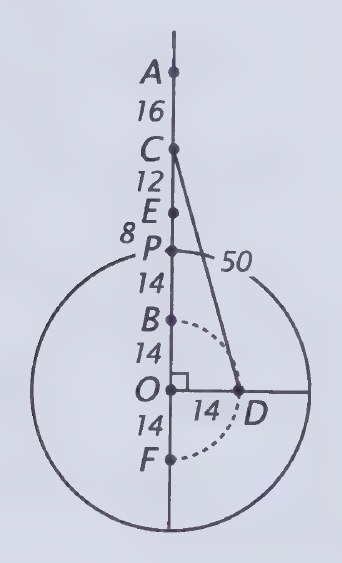
Diagram from page 182.
49. EF =50in. [EP + PF = 8 + 3(14).]
50. CD=50in. (CD = EE)
51. CO=48in. (CO?+ 142 = 502 so CO= 502142 = /2,304 = 48)
52. CE=12in. (CE=CO-EO =48 - 36.)
53. AC=16in.(AC=AB-CB =50-34)
Set II (page 490)
When this puzzle appeared in Martin Gardner’s “Mathematical Games” column in Scientific American, William B. Friedman suggested tying the rope to two places high on the tree at B so that the person could walk along the lower part while holding onto the upper part and not get wet.
Island Puzzle.
Tie one end of the rope to the tree at B. Holding the other end of the rope, walk around the lake so that the rope wraps around the tree at A. Pull the rope tight and tie it at the other end to the tree at B. Hold onto the rope to get to the island.
Lesson 2
Set I (pages 493-494)
Exercises 15 through 18 reveal how the tangent ratio got its name. As Howard Eves remarks in An Introduction to the History of Mathematics (Saunders, 1990), “the meanings of the present names of the trigonometric functions, with the exception of sine, are clear from their geometrical interpretations when the angle is placed at the center of a circle of unit radius. . . . The functions tangent, cotangent, secant, and cosecant have been known by various other names, but these particular names appeared as late as the end of the 16th century.”
Band Saw.
1. If aline is tangent to a circle, it is perpendicular to the radius drawn to the point of contact.
*2. Ina plane, two lines perpendicular to a third line are parallel to each other.
3. The opposite sides of a parallelogram are equal.
Concentric Circles.
*4. OB LAC.
*5. If aline through the center of a circle bisects a chord that is not a diameter, it is also perpendicular to the chord.
6. ACis tangent to the smaller circle.
7. If aline is perpendicular to a radius at its outer endpoint, it is tangent to the circle.
Grid Exercise.
8. 5. 4
9. —. 3
°10. —=.
1. —=.
12. Lines!and m are perpendicular to line AB.
13. Lines [ and m are parallel.
14. The slopes of I and m are equal; the slope of AB is the opposite of the reciprocal of their slope.
Double Meaning.
*15. AB is tangent to circle O.
¢16. If aline is perpendicular to a radius at its outer endpoint, it is tangent to the circle.
17. The tangent of an acute angle of a right triangle is the ratio of the length of the opposite leg to the length of the adjacent
leg.
*18. AT’ or AB. B
Railroad Curve. 19.
20. AAPO = ABPO by HL (they are right triangles with PO = PO and PA = PB).
21. Corresponding parts of congruent triangles are equal.
22. If aline is perpendicular to a radius at its outer endpoint, it is tangent to the circle.
23. No.
Tangents to Two Circles. 24.
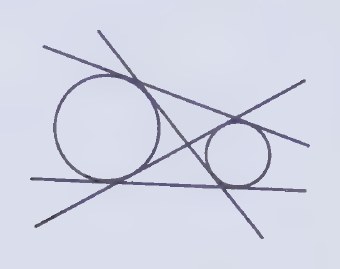
Diagram from page 183.
23,
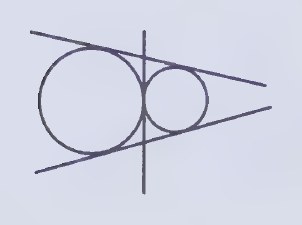
Diagram from page 183.
26. Example figure:
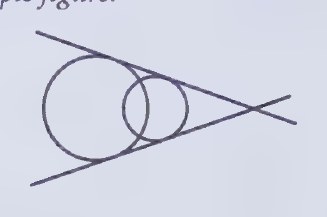
Diagram from page 183.
27. Example figure:
28. Yes. No lines can be drawn tangent to both circles if one circle is inside the other and the circles have no point in common.
Set II (pages 494-496)
Euclid’s Book IlI, Proposition 17 is the following construction: “From a given point to draw a straight line touching a given circle.” A construction based on the fact that an angle inscribed in a semicircle is a right angle is introduced in Lesson
6. In Euclid—The Creation of Mathematics (Springer, 1999), Benno Artmann says of Euclid’s construction: “The unexpected way in which the tangent I, which at first sight has nothing to do with the problem, is used to produce the wanted tangent AB is a nice surprise and makes the construction very elegant.”
Although the angle trisector called the “tomahawk” has been included in many twentiethcentury textbooks, no one knows who invented it. The tomahawk is one of many methods for
solving the trisection problem by going beyond the restrictions of classical constructions. According to Robert C. Yates in The Trisection Problem (Franklin Press, 1942; N.C.T.M., 1971), the tomahawk was mentioned in Geométrie Appliquée a I’industrie published in 183s.
J. L. Heilbron in his Geometry Civilized— History, Culture, and Technique (Clarendon Press, 1998) writes that the Gothic arch of exercises 39 through 45 can be seen everywhere in churches built in the later middle ages and that it was often filled with other geometric shapes such as circles, squares, and smaller arches. The exercises reveal the surprising appearance of the 3-4-5 right triangle in the construction of an inscribed circle in a Gothic arch.
Construction Problem.
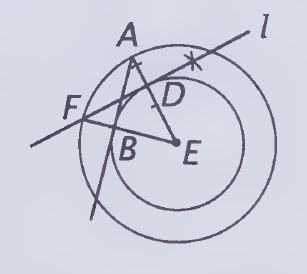
Diagram from page 184.
30. Ifalineis perpendicular to a radius at its outer endpoint, it is tangent to the circle.
31. SAS. (EF =EA, ZE = ZE, and ED = EB.)
*32. Because ZFDE is a right angle and
corresponding parts of congruent triangles are equal.
33. Itis tangent to the smaller circle.
*34. Line AB. Tomahawk.
35. SAS. (AB =BC, ZABY = ZCBY, and BY =BY.)
#36. If aline is tangent to a circle, it is
perpendicular to the radius drawn to the point of contact.
37. HL. (ACBY and ACPY are right triangles with CY = CY and BC = CD.)
38. £AYB = ZBYC and ZBYC = ZCYP because corresponding parts of congruent triangles are equal. Because ZXYZ has been divided into three equal angles, it is trisected.
Gothic Window. 39.
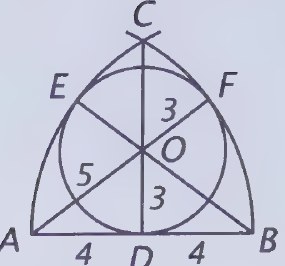
Diagram from page 184.
40. In a plane, two points each equidistant from the endpoints of a line segment determine the perpendicular bisector of the line segment.
¢41. AD =4 cm and AF = AB =8 cm. 42 (8-7)cm. (AO=AF-OF=8-r.)
43. (8-1)? =42 + 12 by the Pythagorean Theorem. 64 -16r +7r2=16 +12, 16r =48, r=3.
*44. A 3-4-5right triangle.
45. 41/5 = 6.9 cm. [If AC and BC were drawn, CD would be an altitude of equilateral
AABC; s0 CD = g(s).]
Tangent Puzzle.
46. DC is perpendicular to AD and BC. If a line is tangent to a circle, it is perpendicular to the radius drawn to the point of contact.
47. They are parallel. In a plane, two lines perpendicular to a third line are parallel to each other.
*48. A parallelogram (also, a rectangle).
49. Aright triangle.
50. By the Pythagorean Theorem: In a right triangle, the square of the hypotenuse is equal to the sum of the squares of the legs.
51. AB=y+z AE=y-z, EB=x.
52. (y+2zP=(y-2)2+x2
53. Y2+ 2yz+22=y2-2yz + 22 + 22, dyz = x2, x% = 4yz.
Set 11l (page 496)
On a trip from the earth to the moon, it is obvious that at the halfway point the earth would look
Lesson 3
bigger because it is bigger. What makes the earth and moon appear to have the same size as seen from point P is that the vertical angles formed by their common internal tangents are equal. When we observe an object in space, it is this angle, called its “angular size,” rather than its true size, by which we judge it.
Trip to the Moon.
EP is approximately 184,000 miles. AAEP ~ ABMP by AA (£A and £B are equal right angles and ZAPE and ZBPM are equal vertical angles). EP EA MP ~ MB triangles are proportional). Letting EP = x, 52 3,960 m_—x = 1_,08_0’ 1,080x = 926,640,000 - 3,960x,
(corresponding sides of similar
5,040x = 926,640,000, x ~ 183,857.
Set I (pages 500-501)
In a section of Chapter 2 of Geometry Civilized— History, Culture, and Technique (Clarendon Press, 1998), J. L. Heilbron treats the subject of the size of the earth. Columbus used a number for the circumference of the earth that was about 75% of what it actually is. Heilbron says that this mistake “had more profound consequences than any other geometrical error ever committed.” To try to convince others of the practicality of his plan, Columbus took several steps to minimize the length of the trip. Fortunately for him, he encountered the New World almost exactly where he had expected to find Japan.
The “three-body problem,” to understand the mutual effects of gravity on three objects in space, frustrated scientists from the time of Newton to the end of the nineteenth century, when it was proved that mathematical solutions of the type that they had been seeking do not exist. The only situation for which there is an exact and stable solution is the case in which the three objects lie at the vertices of an equilateral triangle: this case exists in our solar system with the two equilateral triangles formed by the sun, Jupiter, and the two sets of asteroids called the Trojans. It has been suggested that this arrangement might also be appropriate for establishing the locations of the earth’s first colonies in space. The two triangles would be formed by the earth, the moon, and the two colonies.
Routes to Japan.
¢1. Central angles.
*2. PJ.
*3. PCJ.
4. 30°.
5. 283°. (253 + 30.)
6. 77°.(360—283.)
°7. 77° Theorem 62.
8. Two points determine a line.
9. All radii of a circle are equal.
¢10. An arc is equal in measure to its central angle.
11. Substitution.
12. SAS.
13. Corresponding parts of congruent triangles are equal.
Jupiter’s Asteroids. 14. 60° J 60° A B
15. An arcis equal in measure to its central angle.
¢16. The Arc Addition Postulate.
17. SAS. (SA =S] =SB and LAS] = ZBS].)
18. Equilateral.
Arc Ilusion.
*19. A semicircle.
20. Minor.
21. (Student answer.) (Many people assume that, because EF seems straightest, it comes from the largest circle.)
22. The three arcs seem to be part of congruent circles.
Chords and Arcs.
23. The Arc Addition Postulate.
#24. No. The sum of any two sides of a triangle is greater than the third side.
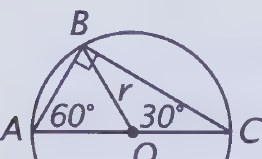
Diagram from page 186.
&
26. mAB = 60°, mBC = 120°, mABC = 180°.
#27. AB=7,BC=7v3,AC=2r.(AABCisa 30°-60° right triangle.)
28. mABC = 3mAB.
29. BC = /3 AB.
Set II (pages 501-503)
J. L. Heilbron observes that ovals formed from pairs of equal interlaced or tangent circles were commonly used in designing plazas in sixteenthcentury ltaly. St. Peter’s Square in Rome is the most famous example.
Olympiodorus taught in Alexandria in the sixth century a.0. He wrote extensively on the rainbow, even attempting, as outlined in exercises 37 through 39, to determine the distance from the observer’s eye to the center of the rainbow when the sun was on the horizon. The methods fails because, if SO were equal to OR, the rainbow would be well outside the atmosphere, which it is not.
The Square That Isn’t. 30.
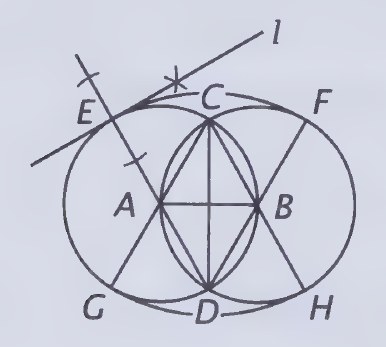
Diagram from page 186.
*31. AABC and AABD are equilateral and congruent.
32. Arhombus (and hence a parallelogram).
33. Line [ is tangent to circle A. If a line is
perpendicular to a radius at its outer endpoint, it is tangent to the circle.
34. Linelis also perpendicular to radius DE of the circle D of which EF is an arc.
35. mGE = 120°, mEF = 60°, mFH = 120°, mHG = 60°.
36. 360°.
Rainbow Distance.
37. 2+y2=1.
38. (x+12+y?2=22
39. From the first equation, > = 1 —x? and, from the second equation, y2 =22 - (x + 12 Sol-x2=2z2—(x+1)3 1-x2=22-(x2+2x + 1), 1-x2=22-x2-2¢-1, 2x=22-2,
z2-2 2
e=
Night Sky.
40. The photograph is a time exposure. The stars seem to travel in circles about a point
directly above the earth’s axis because of the earth’s rotation on its axis.
*41. All of the arcs have the same measure. (They all have equal central angles—namely, the angle through which the earth rotated during the time exposure.)
42. (Student answer.) (The earth rotates 360° in 24 hours, or 180° in 12 hours.The arcs appear to be somewhat smaller than semicircles; so a guess of about 10 or 11 hours is reasonable.)
Original Proofs.
43. Proof.
Vertical angles ZAOB and ZCOD are central angles of both circles. (Given.)
£AOB = ZCOD. (Vertical angles are equal.)
mAB = ZAOB and mCD = £COD. (An arc is equal in measure to its central angle.)
mAB =mCD. (Substitution.)
Lesson 4
44. Proof.
The vertices of trapezoid ABCD (AD || BC) lie on a circle and mAB = mCD. (Given.)
AB=CD. (In a circle, equal arcs have equal chords.)
ABCD is isosceles. (A trapezoid is isosceles if its legs are equal.)
£B = £C. (The base angles of an isosceles trapezoid are equal.)
45. Proof.
- A]}_f DE.’(AGiven.)
- mAB = mDE. (In a circle, equal chords have equal arcs.)
- mAB + mBD mBD + mDE. (Addition.)
mAB + mBD mAD and mBD + mDE = mBE. (Arc Addition Postulate.)
mAD = mBE. (Substitution.)
AD = BE. (In a circle, equal arcs have equal chords.)
46. Proof.
- mAC = mAD and mCB = mBD. (Given.)
AC=AD and CB =BD. (In a circle, equal arcs have equal chords.)
AB is the perpendicular bisector of CD. (In a plane, two points each equidistant from the endpoints of a line segment determine the perpendicular bisector of the line segment.)
AB contains the center of the circle. (The perpendicular bisector of a chord of a circle contains the center of the circle.)
47. Proof.
AD is a diameter of circle O, and AB || OC. (Given.)
ZA = £2. (Parallel lines form equal corresponding angles.)
£B = 1. (Parallel lines form equal alternate interior angles.)
OA =OB. (All radii of a circle are equal.)
4B = ZA. (If two sides of a triangle are equal, the angles opposite them are
equal.)
- £1 = £2. (Substitution.)
- mBC = £1 and mCD = £2. (An arcis equal in measure to its central angle.)
- mBC = mCD. (Substitution.)
Set 11l (page 503)
Obtuse Ollie’s curve is an example of a curve of constant width. Such curves can be constructed by starting with any number of mutually intersecting lines. The radius of the initial arc is arbitrary; each arc is centered on the point of intersection of the two lines that bound it. Interested students may enjoy proving that such a curve actually closes and that it has a constant width. (The “constant width” in regard to Ollie’s curve is DG = EH = Fi.) The proofs are based on the fact that all radii of a circle are equal and some simple algebra. Martin Gardner discussed curves of constant width in his “Mathematical Games” column in Scientific American (February 1963). This column is included in The Unexpected Hanging and Other Mathematical Diversions (Simon & Schuster, 1969).
Ollie is correct. The measures of the six arcs are equal to the measures of their central angles. Three of the central angles are the angles of AABCG; so their sum is 180°. The other three central angles are vertical to the three angles of AABC; so their sum also is 180°.
Set I (pages 506-507)
Skeet shooting is a sport in which clay targets are thrown into the air from two locations, a “high house” on the left and a “low house” on the right. The shooters advance from station to station, starting at A and ending at H. Although shooting was included in the first modern Olympics in 1896, skeet shooting did not become an Olympic event until 1968.
Skeet Range.
1. 16.5°. (In AAOG, OA = OG; so £G = ZA.)
*2. 147°. (In AAOG, ZAOG =180-ZA - 4G = 180 -16.5-16.5=147.)
¢3. 245°. (mAG = ZAOG; % =245)
4. 33°. [nGX =180 - mAG = 180 — 147 = 33, or ZA = %m&, mGX = 2/A = 2(16.5) = 33.]
5. 147°. (mYX = £YOX = ZAOG = 147.)
Theorem 63.
6. Two points determine a line.
7. All radii of a circle are equal.
8. If two sides of a triangle are equal, the angles opposite them are equal.
*9. An exterior angle of a triangle is equal to | sum of the remote interior angles.
10. Substitution.
11. Division (or multiplication).
*12. A central angle is equal in measure to its intercepted arc.
13. Substitution.
14. Two points determine a line.
*15. Betweenness of Rays Theorem.
16. Substitution.
*17. Arc Addition Postulate.
18. Substitution.
19. The center of the circle lies outside the angle. (The proof is similar to case 2 but uses subtraction.)
Corollary 1.
#20. Aninscribed angle is equal in measure of half its intercepted arc.
21. Substitution.
Corollary 2.
#22. The measure of a semicircle is 180°.
23. Aninscribed angle is equal in measure to half its intercepted arc.
24. Substitution.
#25. A 90° angle is a right angle.
Inscribed Triangle. 26.
100 120°
the B ‘.‘ C
140°
27. Central angles.
©28. Inscribed angles.
29. ZAOB =100°, ZBOC = 140°, ZCOA = 120°.
*30. x=40°y=20° and z = 30°.
31. ZABC =60°, £ZBCA =50°, ZCAB =70°. (£ABC = x + y = 40° + 20° = 60°, /BCA =y +2z=20°+30°=50°, ZCAB =x +z=40° + 30° =70°)
32. ZABC= %mKé = %120° = 60°;
ZBCA = %mfi = %mm =50°%
1 —= 1 ¢ CAB 2m 2 2 = —mCB = =140° =70°.
Set II (pages 508-509)
The figure for exercises 33 and 34 appears in a book on the number it because early methods for determining 1t were based on approximating the circumference of a circle with the perimeters of
J regular polygons. In the figure, 40 equal chords form a regular polygon having 40 sides that looks very much like a circle. More on this subject will be considered in Chapter 14.
Exercises 35 through 41 establish the theorem that an angle formed by a tangent and a chord is equal in measure to half its intercepted arc (Book 111, Proposition 32, of Euclid’s Elements).
Exercises 43 through 47 show that, if two similar triangles are inscribed in a circle, they must also be congruent.
The method for constructing the square root of a number by inscribing a right triangle in a semicircle appears in the Elements as Proposition 13 of Book VI, stated as follows: “To two given straight lines to find a mean proportional.”
Exercises 55 through 58 are connected to the following problem: Find the longest line segment that can be drawn through one of the intersection points of two intersecting circles such that its endpoints lie on the circles. This problem is discussed by Mogens Esrom Larsen in an article in The Lighter Side of Mathematics, Richard K. Guy and Robert E. Woodrow, editors (Mathematical Association of America, 1994). Larsen appropriately refers to it as a good example illustrating the role of insight in problem solving, “the experience of seeing right through the problem as can happen in geometry.”
Forty Angles. 360 ( 0 )
®33. 9° (—.
34, 63°.[%(14x9),]
Tangents, Chords, and Intercepted Arcs.
35. ZBAT is aright angle. If a line is tangent to a circle, it is perpendicular to the radius drawn to the point of contact.
#36. They are complementary.
37. ltis aright angle. An angle inscribed in a semicircle is a right angle.
38. They are complementary. The acute angles of a right triangle are complementary.
39. They are equal. Complements of the same angle are equal.
40. Aninscribed angle is equal in measure to half its intercepted arc.
41. Substitution.
42. They prove that the measure of an angle formed by a tangent and a chord is equal to half the measure of its intercepted arc.
Similar Inscribed Triangles.
*43. n°. (AABC ~ ADEF; so £F = £C.) o44, 2n°.
45. 2n°.
46. AB =DE. In a circle, equal arcs have equal chords.
47. AABC = ADEF by ASA. (ZA = 4D and
£B = ZE because corresponding angles of similar triangles are equal and AB = DE.)
Square-Root Construction.
48. F
A B C D E
49. ZAFE is a right angle because an angle inscribed in a semicircle is a right angle.
50. Itis an altitude (to the hypotenuse) of the
triangle. 51 AB_ BF BF BE
e52. BF= 3 in. (— = B, BF2=3, BF = 3.) BE 3
53. 1.73in.
54. Yes. (BF = 1% ~175in.)
Intersecting Triangles and Circles. &f,
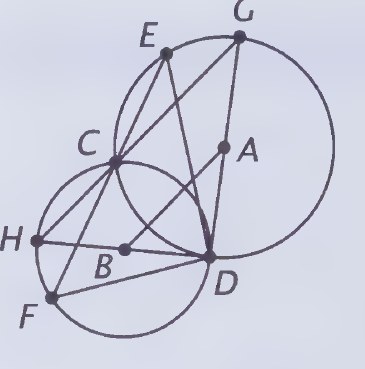
Diagram from page 189.
56. ADEF ~ ADGH by AA. (£E = £G and ZF = /H because inscribed angles that intercept the same arc are equal.)
57. ADGH is larger because diameter DG > DE and diameter DH > DF.
58. AB= —;GH and AB || GH. ABis a
midsegment of ADGH, and a midsegment of a triangle is parallel to the third side and half as long.
Set I1l (page 509) Finding the Center.
Example figure:
AN
A B
The carpenter should place the corner of the right angle of the set square on the edge of the wheel and mark the two points in which its sides intersect the wheel’s edge. These two points must be the endpoints of a diameter of the wheel. (Because the right angle is inscribed in the circle, its measure is
half its intercepted arc. 90° = %180”; sothe arcis a
semicircle and its chord is a diameter.) Doing this a second time gives a second diameter and the diameters intersect in the center of the wheel.
(Alternatively, the carpenter could place the wheel inside the angle of the set square and mark successive quarter circles.)
Lesson 5
Set I (pages 512-513)
A detailed discussion of danger angles is included by Elbert S. Maloney in Dutton’s Navigation and Piloting (Naval Institute Press, 1985). A danger circle (not shown in the figure for exercises 17 through 21) is constructed with the middle point of the danger as its center and the distance from that center at which it is desired to pass as radius. A second circle is then constructed through points A and B tangent to the offshore side of the danger circle. Any inscribed angle such as ZD that intercepts AB in this second circle provides the measure of the danger angle. The navigator of a passing ship keeps track of the measure of £, knowing that the ship is safe if £S5 < ZD and in danger if ZS > ZD.
Exercises 27 through 38 suggest that the sum of the corner angles of a symmetric star with an odd number of sides is 180°. The proof that this is true for any five-pointed star, no matter how irregular, was considered in the Set ||l exercise of
21. It would be more than 55°. Perpendicular Chords.
22. ZAED is aright angle (or, ZAED = 90°).
*23. mAD + mCB = 180°. [AED = %(mA—fi +mCB))
24. mAC + mDB = 180°.
25. 70°. (180 -110.)
26. 100°. (180 -80.) Star Problem 1. 27, 722,32 5
28. 144°. (2x72)
©29. 36°. [%(144 -72).]
30. 216°. (3% 72.)
31. 108°. (%216.)
32. 180°. (5% 36.)
Star Problem 2.
33, 400, (39 ) 9 1 034, 20°.(=40.) 2 1
35. 40°. [(40 +40)]
36. 60°. [%(so +40).]
37. 100°. [%(80 +120).]
38. 180°. (9% 20.)
Set II (pages 514-515)
The angle of view of a camera lens determines the width of the scene in front of the camera that will fit in the frame of the film. It is inversely related to the focal length of the lens. Wide-angle lenses consequently have shorter-than-normal focal lengths, whereas the focal lengths of telephoto lenses with very small angles of view are longer than normal.
The model of the motion of the sun created by the second-century Greek astronomer Hipparchus and used by Ptolemy is described in The Cambridge Illustrated History of Astronomy, Michael Hoskin, editor (Cambridge University Press, 1997): “Hipparchus’s elegant and simple model of the motion of the sun worked well enough for Ptolemy to retain it unaltered, and so it has been handed down to us. In the model, the sun orbited the earth on a circle, moving about the center of the circle with a uniform angular speed that took it round in 365 1/4 days. But Hipparchus knew that the seasons are of different lengths: in particular, as seen from earth, the sun moved the 9o° from spring equinox to summer solstice in 94 1/2 days, and the 9o° from summer solstice to autumn equinox in 92 1/2 days. Since both these intervals were longer than one-quarter of 365 1/4 days, the sun appeared to move across the sky with a speed that was not uniform but varied.
The earth therefore could not be located at the center of the circle, but must be ‘eccentric’. By how far, and in which direction? To generate these longer intervals, the earth had to be displaced from the center of the circle in the opposite direction, so that the corresponding 9o° arcs seen from earth were each more than one-quarter of the circle, and it therefore took the sun intervals of more than one-quarter of 365 1/4 days to traverse them. Hipparchus’s calculations showed that the eccentricity needed to be 1/24th of the radius of the circle, and that the line from earth to center had to make an angle of 65.5° with the spring equinox.
Granted these parameters, the model was completely defined. Luckily it reproduced the remaining two seasons well enough, and so this single eccentric circle was sufficient to reproduce the motion of the sun.”
The figure for exercises 56 through 59 is related to “The Tantalus Problem” introduced in the Set |1l exercise of Chapter 3, Lesson 3. The original problem was, given isosceles AABC with ZA = 20° ZDBC = 60°, and £ZHCB = 50°, to find the measures of ZDHC and ZHDB. Without the circle, the problem is notorious for being extremely difficult. With the circle, it is easily solved. For more on this, see pages 123—125 and pages 227-229 of Tracking the Automatic Ant, by David Gale (Springer, 1998), and pages 292-295 of Geometry Civilized, by J. L. Heilbron (Clarendon Press, 1998).
Angle of View.
39. 100°. (Z/ACB = %m’ATs.)
*40. If a line through the center of a circle bisects a chord that is not a diameter, it is also perpendicular to the chord.
41. SAS. 8 ’ (tan 25°= 75 CD tan
42. 17 ft. (tan 25° = —, CD tan 25° = §, 8 D=——=17. tan 25° )
43. To other points on circle O.
44. The photograph could not include the people at both ends of the row, because ZACB would become larger than the camera’s angle of view.
The Seasons.
*45. Each angle is 90°. [ZAEB = %(93‘14° +86.86°) = %(180”) = 90°, etc.]
46. No. If E were the center of the circle, the angles at E would be central angles and be equal in measure to their intercepted arcs.
47. Spring. 91.17
48. About 92.5 days. ( 360 % 365.25=92.5.) Place Kicker. 49.
A p 9.25 B
50. Cis the midpoint of AB. If a line through the center of a circle is perpendicular to a chord, it also bisects the chord.
*51. 6°. (tan ZAPC = —96202 =0.103, ZAPC =5.9°.)
52. 12°.(2x6.)
1 —
53. 24°. (LAPB = EmAB.)
54. At other positions on the circle.
55. It would get smaller. Angles Problem.
. 360
56. 20°. (S
578
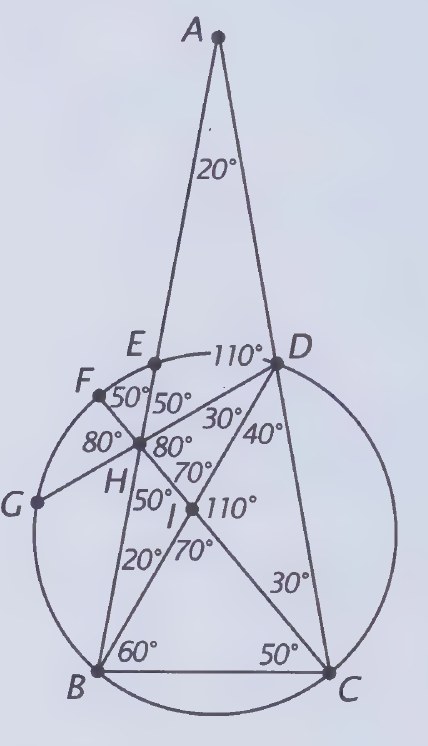
Diagram from page 192.
58. AABC, AABD, and ABCH.
59. AADH and ABIH, or ADHC and ADH]I, or ABDH and AAHC.
Set llI (page s15)
This problem was first posed by the fifteenthcentury mathematician known as Regiomontanus in the following form: “At what point on the ground does a perpendicularly suspended rod appear largest (that is, subtend the greatest visual angle)?” Eli Maor, who includes the story of Regiomontanus as well as a discussion of the problem in his book titled Trigonometric Delights (Princeton University Press, 1998), notes that “it has been claimed that this was the first extreme problem in the history of mathematics since antiquity.”
As the king walks toward the statue, the angle becomes larger until he gets to point B. Beyond
Lesson 6
this point, the angle becomes smaller again.
The angle is at its largest at B because it is an inscribed angle that intercepts just the arc of the circle corresponding to the statue. All other viewing angles are secant angles whose vertices are outside the circle; therefore, each is measured by half the difference of the statue arc and another arc of the circle.
Set I (pages 517-519)
Exercises 18 through 21 demonstrate the method usually taught for constructing the tangents to a circle from an external point. Euclid’s method for doing so (Book |11, Proposition 17) was considered in exercises 29 through 33 of Lesson 2.
The radius of a circle inscribed in a triangle is not ordinarily determined by the lengths of the triangle’s sides. For a right triangle, however,
= l(a + b—©), in which aand b are the lengths 2
of the legs and cis the length of the hypotenuse. A special case is considered in exercises 22 through 2s.
The fact that the sums of the lengths of the opposite sides of a quadrilateral circumscribed about a circle are equal is revealed in exercises 26 and 27.
Korean Proof.
1. That ZPTO and £ZPT’O are (equal because they are) right angles.
2. All radii of a circle are equal.
*3. HL.
4. Corresponding parts of congruent triangles are equal.
5. The tangent segments to a circle from an external point are equal.
Theorem 67.
6. Two points determine a line.
7. Inscribed angles that intercept the same arc are equal.
8. AA.
9. Corresponding sides of similar triangles are proportional.
10. Multiplication.
Lunar Eclipse.
11. Inaplane, two lines perpendicular to a third line are parallel to each other.
*12. The tangent segments to a circle from an external point are equal.
13. SSS (or SAS or HL).
14. £APS = ZCPS because corresponding parts of congruent triangles are equal.
15. AA. Intersecting Chords.
16. It gets larger.
17. It stays the same. Tangent Construction. 18.
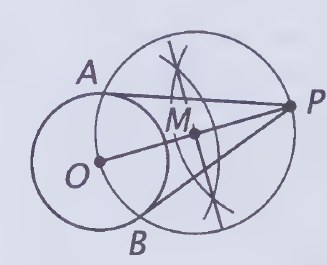
Diagram from page 193.
#19. Right angles. An angle inscribed in a semicircle is a right angle.
20. PA1OAand PB 1L OB.
21. If aline is perpendicular to a radius at its outer endpoint, it is tangent to the circle.
Tangent Triangle. 22.
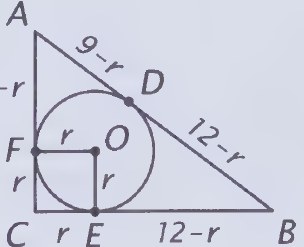
Diagram from page 193.
23. AABC is a right triangle because 92 + 122 = 152, (If the sum of the squares of two sides of a triangle is equal to the square of the third side, it is a right triangle.)
#24. CFOEis a square.
25. 9-1)+(12-7)=1521-2r=152r=6, 7=8
Tangent Quadrilateral.
26. A w E X B
w X
F
Hz (_Z pz2G’
27. The sums of the lengths of the opposite sides of ABCD are equal. AB+DC=(w+x)+y+2)=w+x+y+z and BC+AD=(x+2)+(w+y)=w+x+y+z
Set II (pages 519-521)
In his Mathematical Magic Show (Knopf, 1977), Martin Gardner wrote about the “ridiculous question” of exercises 35 through 37: “This is one of those curious problems that can be solved in a different way on the assumption that they have answers. Since P can be anywhere on the circle from X to Y, we move P to a limit (either Y or X). In both cases one side of triangle ABC shrinks to zero as side AB expands to 10, producing a degenerate straight-line ‘triangle’ with sides of 10, 10, and o and a perimeter of 20.”
Grid Exercise 1.
28. y ol T IF RRas i P - - L5
. ! 1 rsHAH x =i L5 W i : L1 ! ’ B {ed 5 S I I NEARE i i [ =
29. d= 1/(1—0)2 +(y—0)* =5;50 %2 + 12 =25
30. Point A (0, 5): 02 + 52 =0 + 25 = 25; point B (4, -3): 42 + (-3)2 =16 + 9 = 25.
«31. PAis tangent to circle O because it is perpendicular to radius OA at its outer endpoint.
32. The slope of PB is % and the slope of OB is —% Because the product of these slopes is
-1, PB L OB; so PB is tangent to the circle.
*33. PA=10; PB = y(10-4)* +(5-(-3)) = V62 + 8% = 4100 =10.
34. (-7,-1). Ridiculous Question.
©35. 20 units.
36. The perimeter of AABC =AB + BC + AC = (AP + PB) + BC + AC. Because tangent segments to a circle from an external point are equal, YA = AP and XB = PB. Substituting, the perimeter of AABC = YA +XB +BC+AC=YC+XC=10+10=20.
37. Because, although it might at first seem impossible to figure out, the problem is actually very easy. (The solution is obvious if you think of folding AY onto AP and BX onto BP.)
Grid Exercise 2. 38.
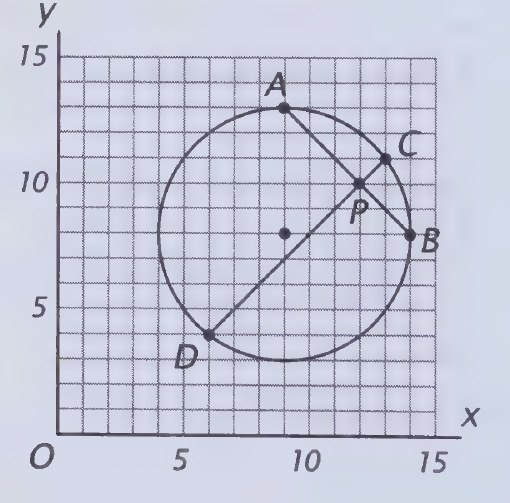
Diagram from page 194.
39. d= 1/(x—9)2+(y_s; 2 _5;
80 (x - 92 + (y - 8)2 =25.
Review
40. PointA (9, 13): (9-9)+ (13 -8)>=0+25=25; point B (14, 8): (14 - 9) + (8 —8)2 =25+ 0 = 25; point C (13, 11): (13-9)2 + (11 -8)2 =16 + 9 = 25; point D (6, 4): (6-9)* + (4 —8)=9 + 16 = 25.
*41. (12, 10).
42. PA= /18 or 3v2;PB = +8 or 242; PC=+2;PD = +72 or 642.
43. PA-PB=12;PC-PD =12, (PAPB=3V2- 242 =6-2-12; PC-PD=+2-6y2 =6-2=12)
Chord Division. 44. A F C/PL”
E
B
45, If a line through the center of a circle is perpendicular to a chord, it also bisects the chord.
*46. BP.
47. AP.
48. AP-PB=CP-PD;so (r-d)(r + d) = xx, P—d?=x% x2=12- 42
49. EP-PF=CP-PD=x2=12-42
50. r represents the radius of the circle and d
represents the distance of point P from its center.
51. Draw chord EF through the center of the circle and choose point P to be the center of the circle.
52. 25.(r2-d*=52-02=25)
Earth’s Shadow. 53, Because ASAP ~ AEBP, L= — EB. P SA EP 3,960
93,000,000 + EP 432,000 432,000EP = 368,280,000,000 + 3,960EP, 428,040EP = 368,280,000,000,
EP = 860,000 miles.
Set II (page 521)
The story “The Brick Moon” by Edward Everett Hale originally appeared in the Atlantic Monthly in 1869-1870. Its plot is summarized in considerable detail in Space Travel—A History, by Wernher von Braun and Frederick |. Ordway IIl (Harper & Row, 1985). According to this summary, “its 37 inhabitants signaled the Earth in Morse code by jumping up and down on the outside of the satellite. People on Earth threw them books and other objects, some of which missed the Moon and went into orbit around it.” The geometry of this problem is the same as that for existing artificial satellites, except that BO is different.
The Brick Moon.
x Y
ABXO is aright triangle; so BX? + XO? = BO2. Because XO = 4,000 and BO = 4,000 + 4,000 = 8,000, BX?2 = 8,000% - 4,0002, BX? = 48,000,000,
BX = 6,928 miles.
Set I (pages 523-524)
Friedrich von Martens, a German engraverphotographer living in Paris, built the camera with which he took the panoramic photograph of the city in 1844. As the overhead view suggests, the picture was taken on a curved plate.
Panoramic Camera.
1. Radii.
¢2. A central angle.
3. Aminor arc.
4. 150°.
Chords and Radius.
5. Example figure:
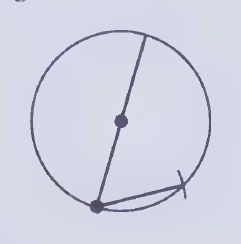
Diagram from page 196.
6. A diameter.
*7. 60°.
8. 180°. Finding Lengths and Angles.
9, 35°, (~1-70.) 2
©10. 16.5. (8x=11-12.)
11. 100°. [%(75 +125)]
12. 8. (If a line through the center of a circle is perpendicular to a chord, it also bisects the chord.)
13. 60°. (Inscribed angles that intercept the same arc are equal.)
14. 50°. (90 - 40.)
15, 30°.[5(105-45)]
16. 4.(10-6.) Two Equilateral Triangles.
17. 4.
*18. 60°.
19. 6.
20. 60°.
21. BC <DE (or BC = %DE).
22. mB’—Cmfi. Not Quite Right.
23. /B and £D are right angles. If a line is tangent to a circle, it is perpendicular to the radius drawn to the point of contact.
24. £A and £C are supplementary. Because the sum of the angles of a quadrilateral is 360° and ZB = ZD =90°, ZA + £C = 180°.
25, AB = AD. The tangent segments to a circle from an external point are equal.
26. BC = CD. All radii of a circle are equal. Three Ratios.
27. They are similar to AABC.
28. %,orl.
30. %
31. %.
Set II (pages 524-526)
The dome of Santa Maria del Fiore was designed by Filippo Brunelleschi and built in 1420-1446. The arch used is called “a quinto acuto,” referring to the fact that a radius 4 units long springs from a base 5 units long. The arch is so strong that the dome was built without a scaffold. Its construction is considered to be one of the most impressive architectural accomplishments of the Renaissance.
The most famous ring of standing stones built in prehistoric England is Stonehenge. Although the measures of the arcs in the eggshaped ring considered in exercises 45 through so are determined by the angles of the 3-4-5 right triangles, the radii are not determined by their sides. As a student who makes some drawings of this ring can discover, the longer the radii are in comparison with the sides of the triangles, the rounder the ring.
Exercises 55 through 62 demonstrate an
appearance of the golden ratio, 1+‘/§
,inan
unexpected place. (As the figure suggests, circles A, B, and C are tangent to one another as well as being tangent to a diameter of circle O. Circles A and C are also tangent to circle 0.) Students who have done the Set |1 exercise of Chapter 11, Lesson 1, may recall the interesting result repeated here:
if ris the golden ratio, then S r
A surprising aspect of exercise 63, the “pond problem,” is that the dimensions of the garden cannot be determined from the given information, because they are not determined by it! This
situation was previously encountered in Martin Gardner’s “oil-well puzzle,” included in exercises 47 through so of Chapter 11, Lesson 2. Both problems are connected to the fact that, given a point inside a rectangle, the sum of the squares of its distances from two opposite corners is equal to the sum of the squares of the distances from the other two corners.
]
32.
C yZ9AY <,
33. ZABP =90°. ZABP is a right angle because it is inscribed in a semicircle.
*34. PB LAC.
35. AB =BC because, if a line through the center of a circle is perpendicular to a chord, it also bisects the chord.
#36. Isosceles. (In the figure, they are also obtuse.)
37. AAOB ~ AAPCby AA. (LA =ZAand, because OA = OB and PA = PC, ZA = ZABO and ZA = £C; so ZABO = £C.)
38. OB || PC and OB = %PC because OB is a midsegment of AAPC.
Arch Problem. 39.
AB
040. 4cm. (CE=CB=5-1.)
1 1 41 cm. ( = 2 ) . 1.5em. (CF==-CD= =3.
*42. Approximately 3.7 cm.
(EF = m = y13.75 =3.7.)
43. Approximately 0.74. (-— = % 0.74.)
44. Approximately 68°. (In right AECE,
ZECF =~ 68°. mAE = mBE = ZECF = 68°.) Prehistoric Ring.
45. 180°. (EFG is a semicircle.)
*46. 53°. (In right AADC, from the fact that sin ZADC = % or cos ZADC = % or
tan ZADC = %’ we know that mGH = ZADC = 53°))
47. 74°. [mHI = £HCI = ZBCD = 2£ACD = 2(90° - 53°) = 2(37°) = 74°.]
48. 53°. (From the symmetry of the figure, mlE = mGH.)
49. Th’exseen:tfi) be equal. (mEFG = 180°, and mGH + mHI + mlE = 53° + 74° + 53° = 180°.)
50. In ABCD, ZBDC + £ZBCD + ZDBC = 180°. Because ZHCI = #BCD, mGH = ZBDC, mHI = ZHCI, and mIE = ZDBC, it follows by substitution that mGH + mHI + mIE = 180°.
Circular Saw.
¢51. Cis the midpoint of AB.
#52. Approximately 9.7 in. (In right AAOC, AO =5and OC =5-3.75=1.25; so AC= V5?-125” ~4.84. AB=2AC~9.68)
*53. Approximately 75.5°. (In right AAOC,
cos 280D = 2€ = 15 _ 95,65 A0 5
ZAOD =75.5°)
54. Approximately 151°. (mADB = ZAOB = 2/A0D =~ 151°.)
Golden Ratio. 55980
e56. V5. (V22+12.)
57. 5 +1.
59. 1.618034.
2
60. ———. V5+1
61. 0.618034.
62. It appears to be exactly 1 less than the ratio for exercise 59.
Pond Problem.
63. Applying the Pythagorean Theorem to some of the right triangles formed, we get 60+ =w?+y? (52 + 12 =w? + 22,
(28 + 7 =x2+22 (40 + 72 =22+ 2
It follows that
(60 + )2+ (28 + )2 = (52 + 7)2 + (40 + )2 because both sums are equal to
w?+ 22+ Y2+ 22,
S0 3,600 + 1207 + 12 + 784 + 567 + 12 = 2,704 +104r + 72 + 1,600 + 807 + 12,
4,384 + 176r = 4,304 + 184r, 80 = 8r, r = 10. The radius of the pond is 10 yards.
Algebra Review (p:
°l. x=vy 2x=y+8§; 2035 x=8, y=8. (8, 8).
2, y=2x dx -y =14; 4x -2x =14, 2x =14, goe=7, y=2(7)=14. (7, 14).
3. y=x-2 3x+1)=4y; 3(x+1)=4(x-2), 3x+3=4x-8, il =, y=11-2=09. (11,9).
4 y=x-7 y=5x-19; 5x-19=x-7, 4x =12, x=3, y=3-7=-4. (3, —4).
®5. x=y+1 2x=3y+3; 2y+1)=3y+3, 2y+2=3y+3, 1=y, x=-1+1=0. 0, -1).
6, y=3x-1 x+2y=33; x+23x-1)=33, x+6x—-2=233, 7 =305, =13, y=35)-1=15-1=14. (5, 14).
*7. x+11 =5y x=2(3y-8); 2(3y-8) + 11 =5y, 6y—16+11 =5y, y=5 x=2(3(5)-8) = 2(15-8) =2(7) = 14. (14, 5).
Algebra Review (page 528)
1. (8, 8).
2. (7, 14).
3. (11, 9).
4. (3, −4).
5. (0, −1).
6. (5, 14).
7. (14, 5).
8. (3.5, 10.5).
9. (45, 9).
10. (−2, 1).
11. (−19, −2).
12. (0, −5).
13. (51, −16).
14. (3, −11).
15. (18.5, 0.9).
16. (−1, −10).
17. (11, −4).
18. (7, 1).
19. (7, 3).
20. (9, 2).
21. (4, 0).
22. (−1, 5).
23. (8, −2).
24. (0, −8).