p. 483
Chapter 12: Circles
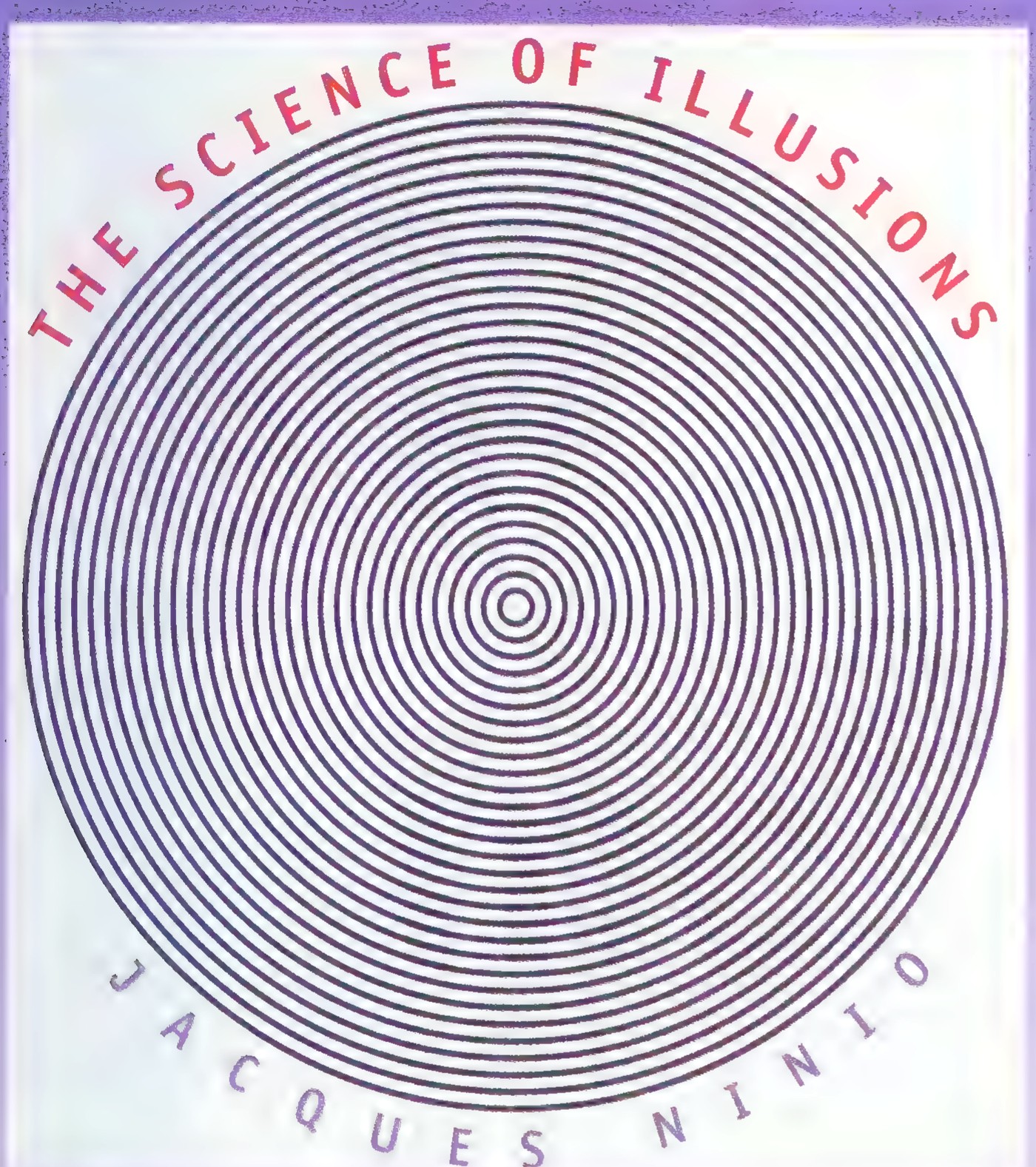
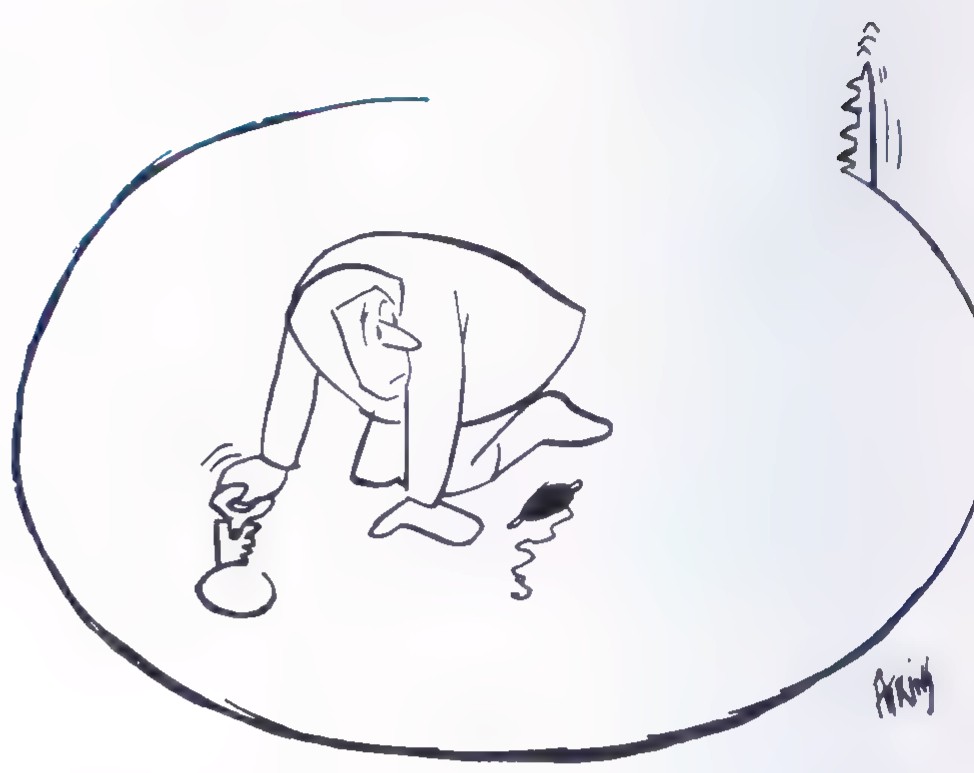
This figure contains a hidden message. What is it?
In this chapter, we explore the properties of the circle, the most symmetric of all two-dimensional geometric figures. It is because of this symmetry that wheels, coins, and many other common objects are circular in shape. We will look at the properties of circles and their relation to lines and angles. These properties will eventually enable us to use regular polygons to develop the formulas for the circumference and area of a circle.
p. 484
Lesson 1: Circles, Radii, and Chords
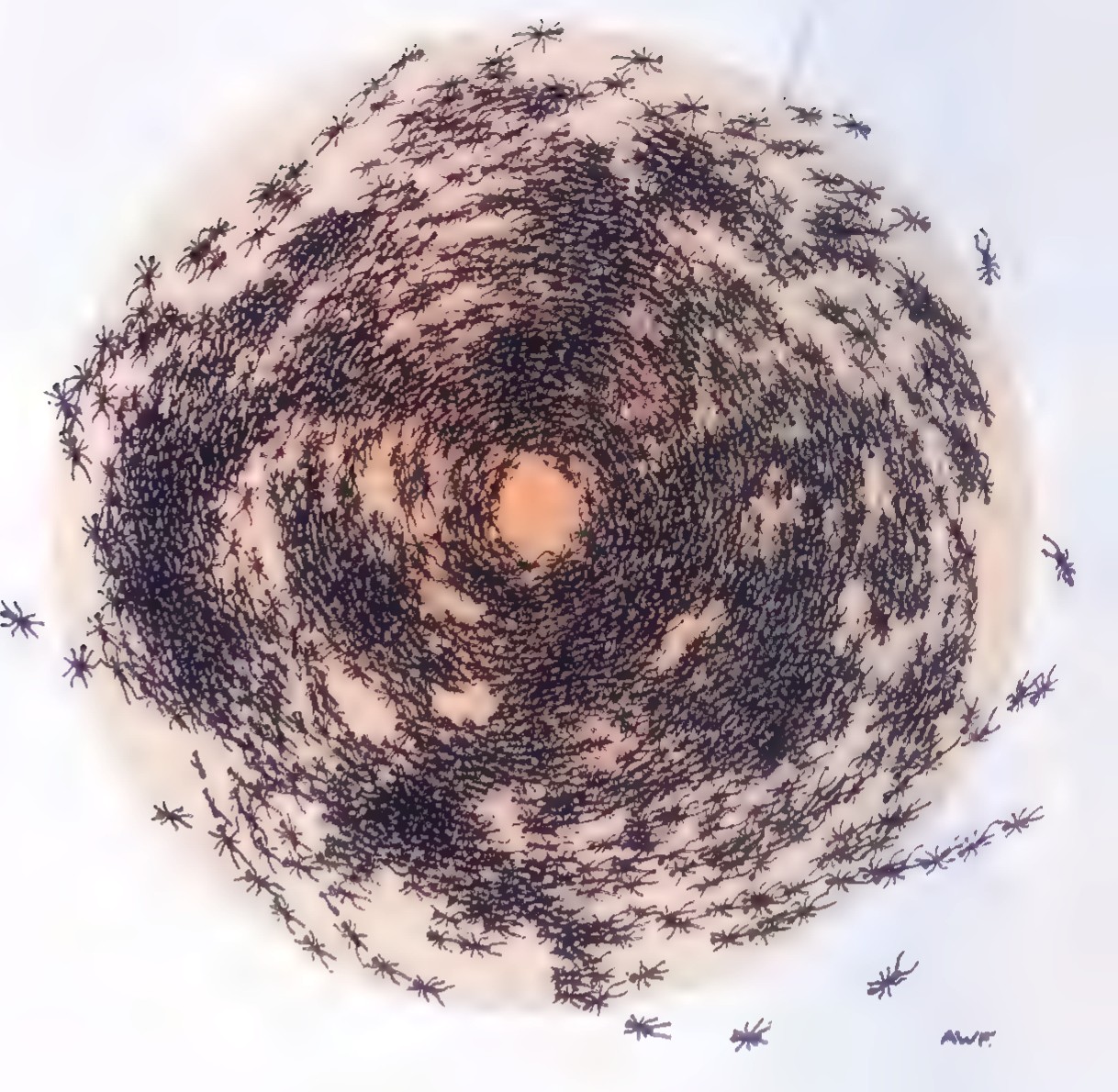
Army ants are blind and find their way by following the scent trails left by other ants. When a group of these ants is prevented from traveling along its usual path, the ants sometimes begin milling about in circles. The ants shown in the drawing above walked for more than 30 hours, stopping only when all of them were dead.*
In this lesson, we review a few familiar terms about circles and introduce some new ones.
Definition
A circle is the set of all points in a plane that are at a given distance from a given point in the plane.
The given point is called the center of the circle and the given distance is called its radius.
The ants in the picture seem to be walking in concentric circles.
Definition
Circles are concentric iff they lie in the same plane and have the same center.
* Army Ants, by T. C. Schneirla, edited by H. R. Topoff (W. H. Freeman and Company, 1971).
p. 485
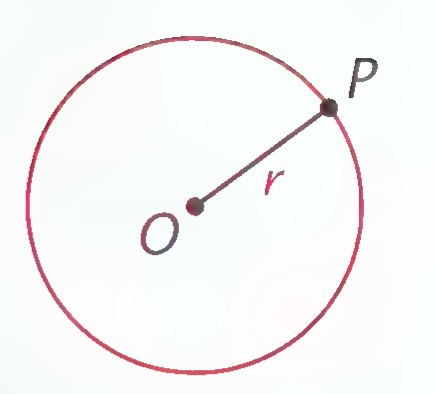
A circle is usually named for its center, and so the figure at the right illustrates circle O. It also illustrates a radius of the circle, line segment OP. Dictionaries list at least two different definitions of the word “radius”: as a distance (that is, a number) or as a line segment. Mathematicians use both meanings, and the context will show which one is meant.
Definitions
A radius of a circle is a line segment that connects the center of the circle to any point on it. The radius of a circle is the length of one of these line segments.
A useful fact that follows directly from the definitions of “circle” and “radius” is:
Corollary to the Definition of a Circle
All radii of a circle are equal.
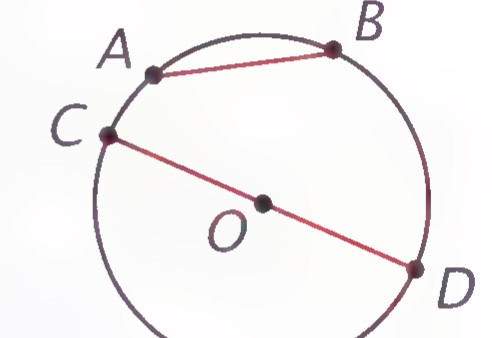
The figure at the right illustrates two other important terms related to circles: AB is called a chord of circle O, and CD is called a diameter. Like “radius,” “diameter” has a double meaning.
Definitions
A chord of a circle is a line segment that connects two points of the circle.
A diameter of a circle is a chord that contains the center. The diameter of a circle is the length of one of these chords.
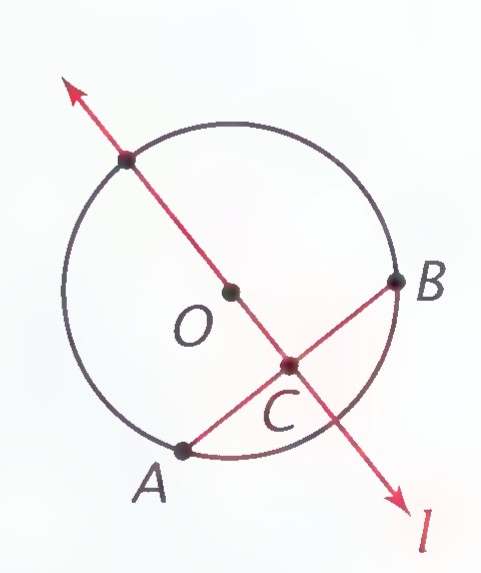
The figure at the right illustrates a line that intersects a chord in a circle. It appears to show that line l
- contains the center of the circle.
- is perpendicular to chord AB.
- bisects chord AB.
Given that any two of these statements are true, then it is easy to prove that all three are true. The proofs are considered in the exercises.
Theorem 56
If a line through the center of a circle is perpendicular to a chord, it also bisects the chord.
Theorem 57
If a line through the center of a circle bisects a chord that is not a diameter, it is also perpendicular to the chord.
Theorem 58
The perpendicular bisector of a chord of a circle contains the center of the circle.
p. 486
Exercises
Set I
Roman Arch. The ancient Romans built stone arches like the one shown below in constructing their bridges.*
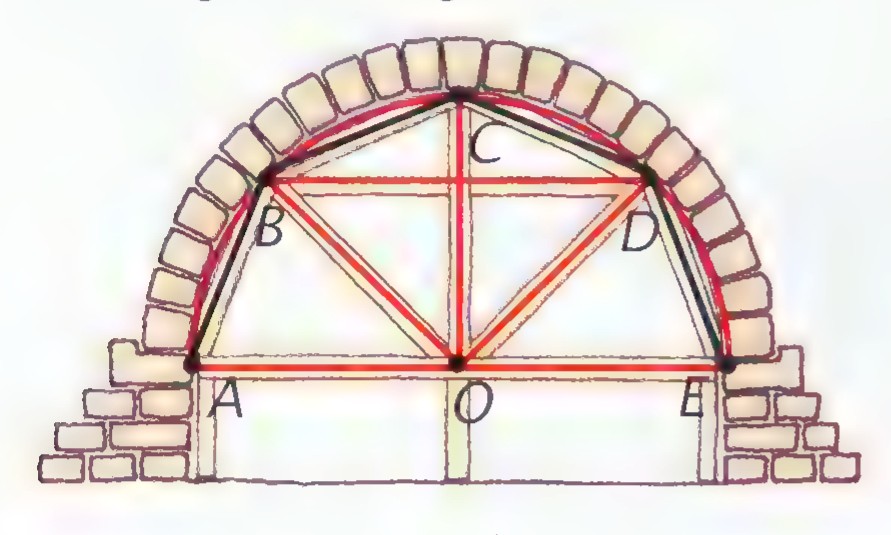
In the figure, the curve shown in red is half of a circle with its center at O; also, AB = BC = CD = DE.
- What are OA, OB, OC, OD, and OE called with respect to the circle?
- What are BD and AE called?
- What else is AE called?
- What kind of triangles are triangles △AOB, △BOC, △COD, and △DOE? Explain.
- What else can you conclude about these four triangles? Explain.
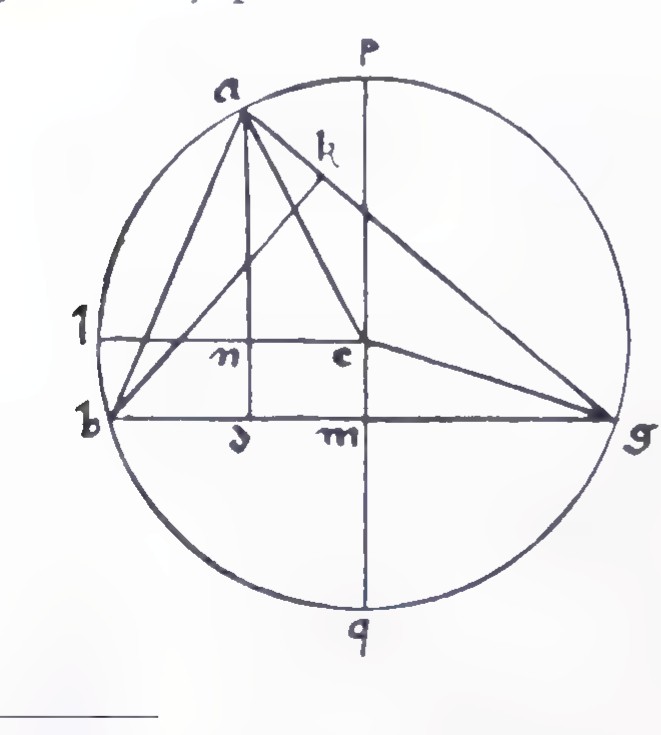
Old Figure. The figure below is from a book on trigonometry published in 1533.
* Why Buildings Fall Down, by Matthys Levy and Mario Salvadori (Norton, 1992).
How many of each of the following line segments do you see in the figure?
- Radii.
- Diameters.
- Chords.
- How many points named with letters are on the circle?
Butterfly Spots. The wings of this butterfly are decorated with circular spots.

- What word describes the circles in each spot?
- What does the word mean?
- What advantage do you think these spots might provide the butterfly?
Chord Problem. The following problem appeared in a book published in 1901:
Describe a circle, and then draw through a point within the circle the longest and the shortest chords that can be drawn.†
- Use your straightedge and compass to do the problem. (The word “describe” meant “draw.”)
- What relation do the two chords have to each other?
- How do the lengths of the longest and shortest chords depend on the location of the point?
† First Steps in Geometry, by G. A. Wentworth and G. A. Hill (Ginn, 1901).
p. 487
Theorem 56. Complete the following proof of Theorem 56 by giving the reasons.
If a line through the center of a circle is perpendicular to a chord, it also bisects the chord.
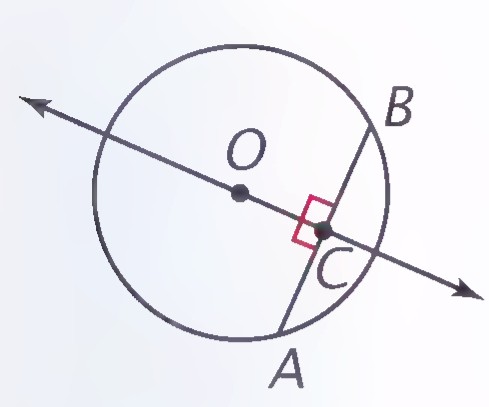
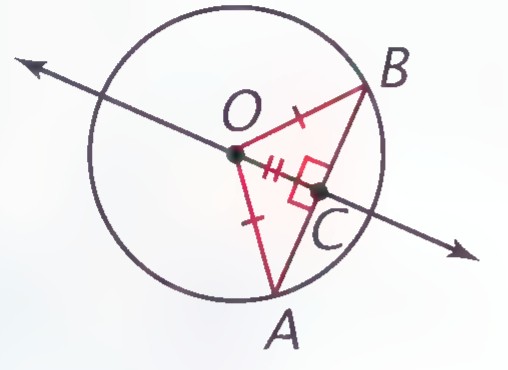
Given: OC ⊥ AB in circle O.
Prove: OC bisects AB.
Proof
- Because OC ⊥ AB, ∠OCA and ∠OCB are right angles. Why?
- Draw OA and OB. Why?
- OA = OB. Why?
- OC = OC. Why?
- △ACO ≅ △BCO. Why?
- AC = BC. Why?
- OC bisects AB. Why?
Theorem 57. Complete the following proof of Theorem 57 by giving the reasons.
If a line through the center of a circle bisects a chord that is not a diameter, it is also perpendicular to the chord.
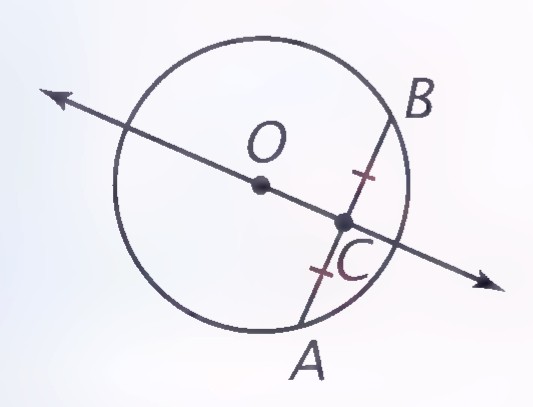
Given: OC bisects AB in circle O.
Prove: OC ⊥ AB.
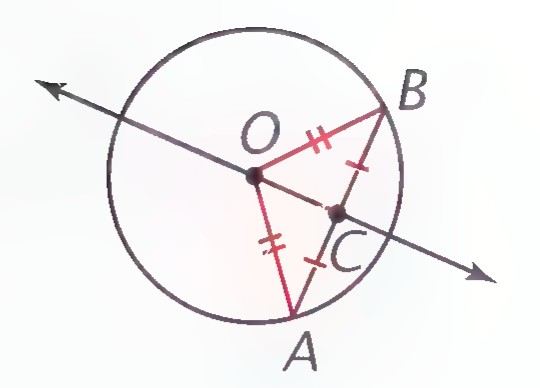
Proof
- Because OC bisects AB, CA = CB. Why?
- Draw OA and OB. Why?
- OA = OB. Why?
- Because O and C are equidistant from A and B, OC ⊥ AB. Why?
Theorem 58. Complete the following indirect proof of Theorem 58 by giving the reasons.
The perpendicular bisector of a chord of a circle contains the center of the circle.
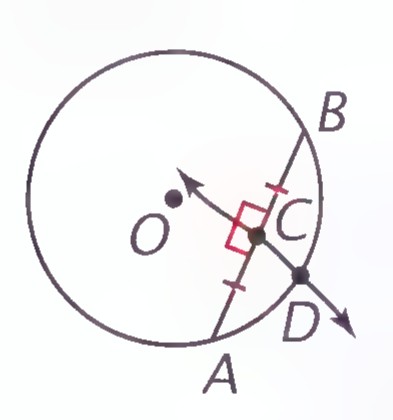
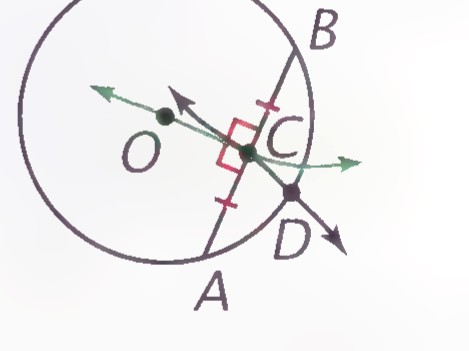
Given: CD is the perpendicular bisector of AB in circle O.
Prove: CD contains O.
Proof
Suppose CD does not contain O. Draw OC.
- OC ⊥ AB. Why?
This means that through point C there are two lines perpendicular to AB.
- What fact does this contradict?
This contradiction tells us that the assumption that CD does not contain O is false.
- What conclusion follows?
p. 488
Set II
SAT Problem. The figure below appeared in a problem on an SAT test.
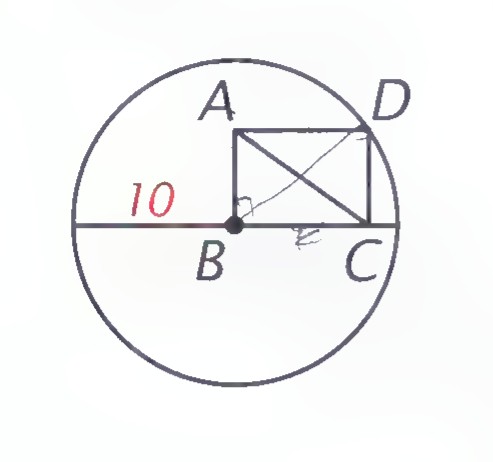
B is the center of the circle with radius 10 and ABCD is a rectangle.
- What is the length of diagonal AC?
- Explain your reasoning.
CBS Eye. The CBS eye is constructed from circles. Although the positions of the centers of the two complete circles are “obvious,” the positions of the centers of the two partial circles are not.

- Carefully trace the figure below showing part of the eye.
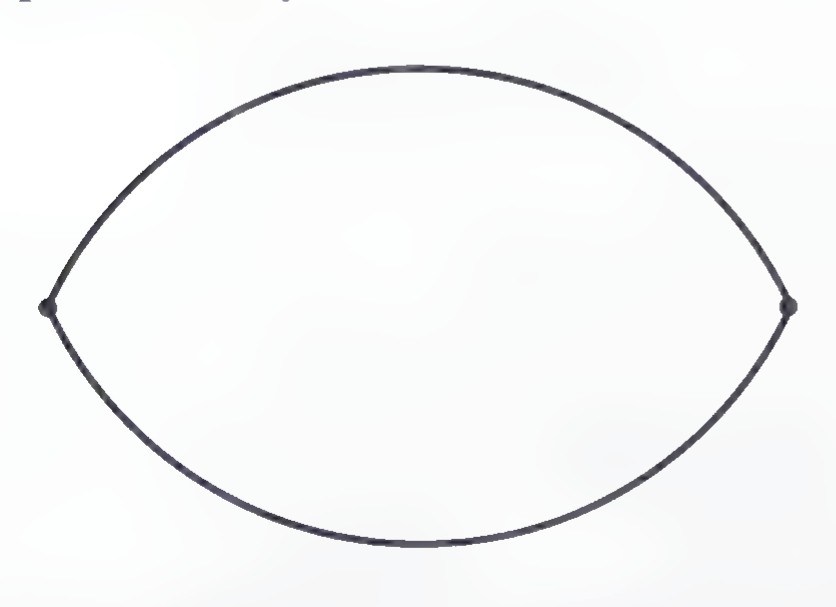
One of the theorems of this lesson can be used to find the centers of the two circles used to form the eye.
- What does the theorem say?
- (continued) Use your straightedge and compass to find the centers of the two circles by construction.
Red-Spot Puzzle. A puzzle called “Cover the Red Spot” consisted of a spot 65 mm in diameter printed on the cover of an envelope that contained four steel disks, each 46 mm in diameter. The directions said to “Hold the disks about four inches above the big spot on the envelope and try to drop the disks, one at a time on the spot, to cover the entire spot.”*

The diagram below shows the solution, in which diameters of the four disks are sides of the square ABCD and the diameter of the spot is one of its diagonals.
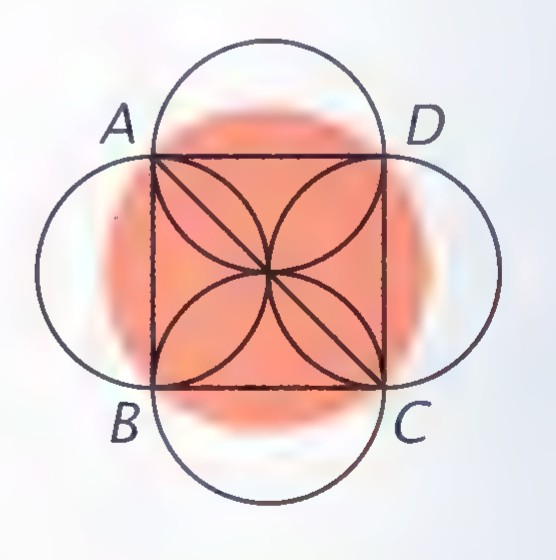
- What kind of triangle is △ABC?
- Given that AC = 65 mm, find AB.
- How difficult do you think this puzzle is to solve? Explain.
* The Book of Ingenious and Diabolical Puzzles, by Jerry Slocum and Jack Botermans (Times Books, 1994).
p. 489
Speed of Light. How the speed of light was first calculated is shown by the figure below. Point S represents the sun, and the two circles represent the orbits of Earth and Jupiter.
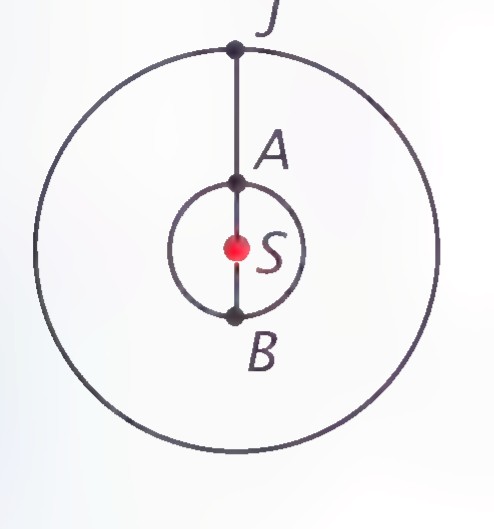
The distance from Earth to the sun is 93,000,000 miles. Light from Jupiter takes about 16 minutes, 40 seconds longer to reach Earth when Earth is at B than when it is at A.
Use this information to find each of the following measures.
- The diameter of Earth’s orbit around the sun.
- The time that it takes light to travel across Earth’s orbit in seconds.
- The speed of light in miles per second.
Roundness. The roundness of a grain of sand is defined in terms of radius.*
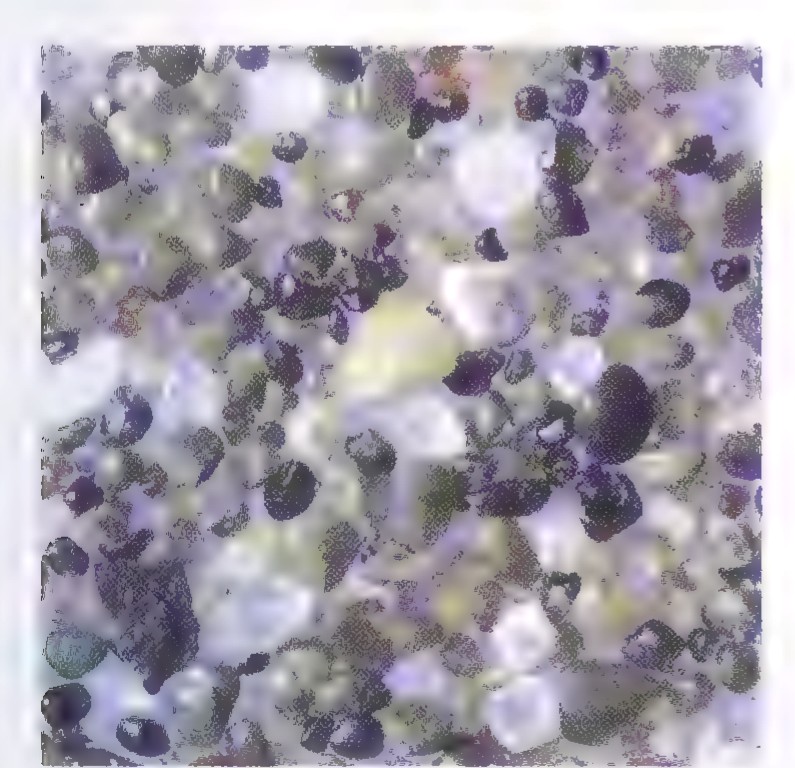
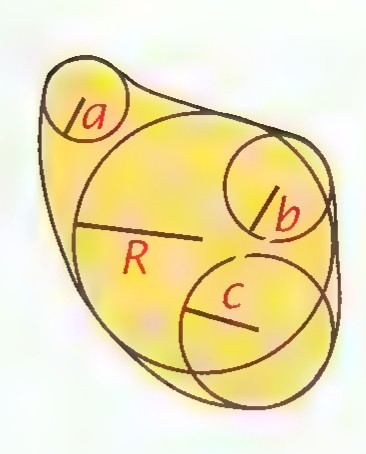
In the figure above of a cross section of a grain of sand, R is the radius of the largest circle and a, b, and c are the radii of the smaller circles. The roundness of the grain is
- Find the roundness if , , , and .
- Find the roundness if all four of these measurements are doubled.
- Does your second answer seem to contradict the first one? Explain.
Three Circles. The figure below shows three circles, each with a radius of 1 unit, that intersect in a common point.†
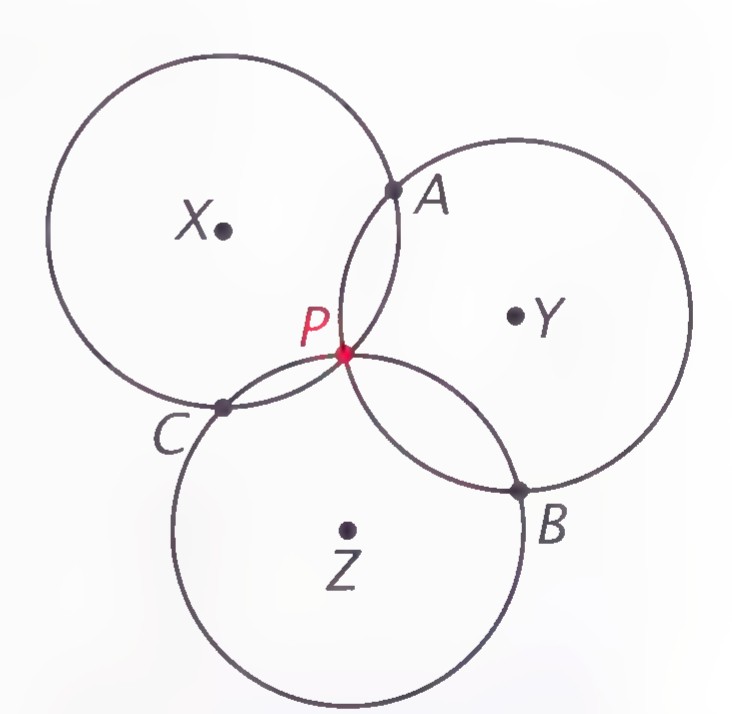
- Use your compass to make a large copy of the figure. Draw PX, PY, and PZ.
- What can you conclude about the lengths of these three line segments?
* Sand, by Raymond Siever (Scientific American Library, 1988).
† Knotted Doughnuts and Other Mathematical Entertainments, by Martin Gardner (W. H. Freeman and Company, 1986).
p. 490
- (continued) Draw XA, XC, YA, YB, ZC, and ZB.
- What kind of quadrilaterals have you drawn? Explain.
- (continued) The three quadrilaterals look like three faces of a cube. Through A, B, and C, draw three line segments to complete the “cube.” (Each segment should be parallel to some of the segments that you have already drawn.) Label the point in which the three line segments intersect O.
- What can you conclude about the lengths of OA, OB, and OC? Explain.
- A fourth circle with a radius of 1 unit could be added to the figure so that it contains points A, B, and C. Explain.
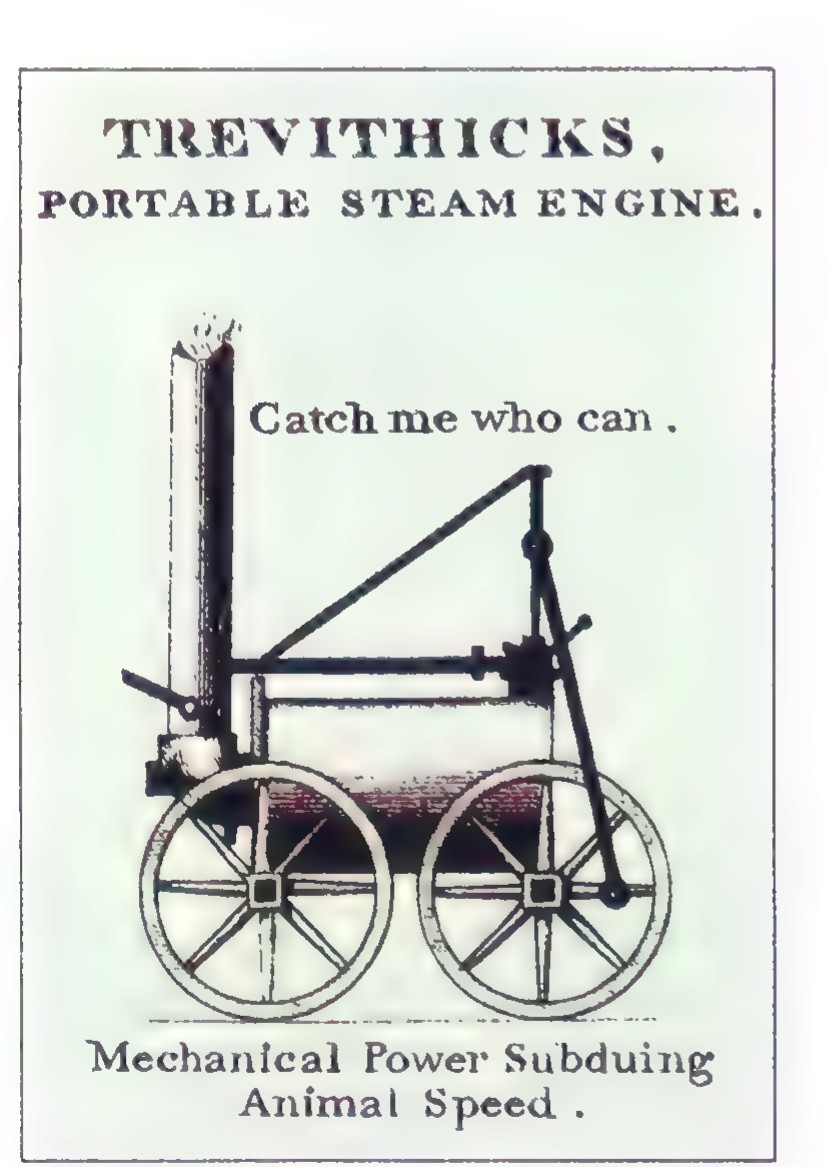
Steam Engine. The poster below from 1800 advertises an early steam engine. One end of a rod is attached to the midpoint of a spoke of a wheel. The other end of the rod moves up and down, causing the wheel to rotate.*
In the figure below, line segments AB, CD, and EF represent three positions of the rod so that AB = CD = EF.
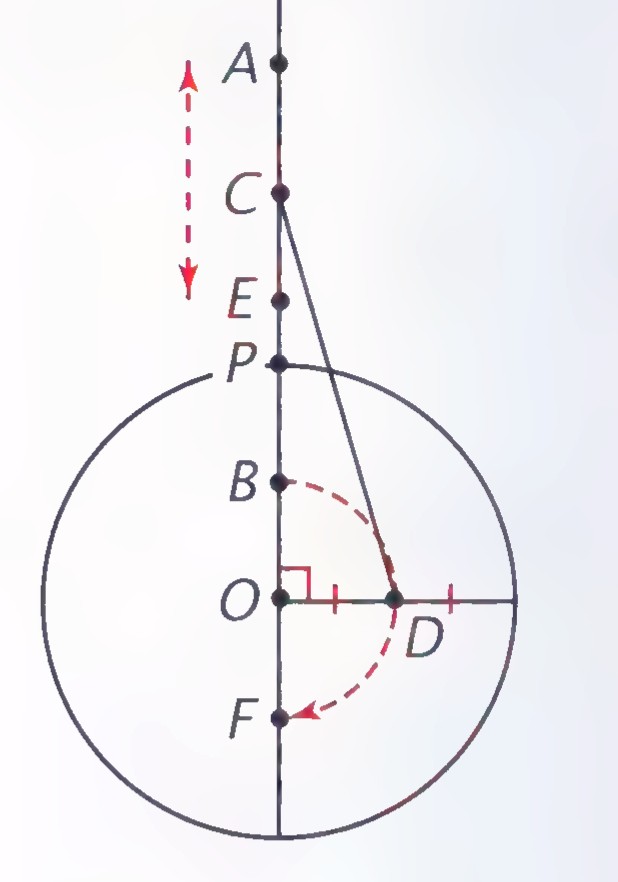
- Make a large copy of the figure and mark it as needed to find each of the following measurements.
If the radius of the wheel is 28 inches and PE = 8 inches, find
- EF, the length of the rod.
- CD.
- CO.
- CE.
- AC.
Set III
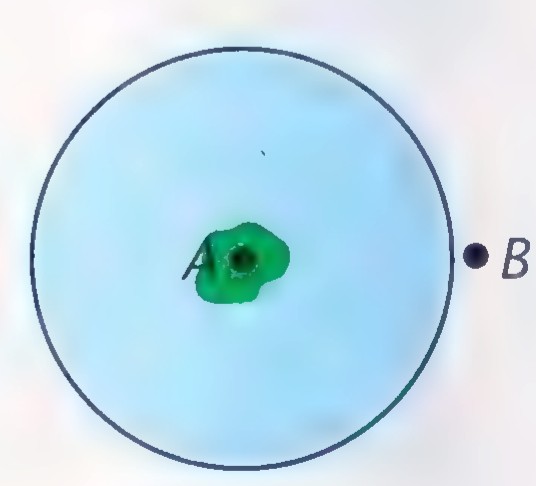
Island Puzzle. A small island is in the center of a deep circular lake, 300 yards in diameter. There are two trees at A and B. Someone who cannot swim has a rope a few yards longer than 300 yards. How can the rope be used as a way to get to the island?†
* Inventing the Modern World: Technology Since 1750, by Robert Bud, Simon Niziol, Timothy Boon, and Andrew Nahum (Dorling Kindersley, 2000).
† Wheels, Life, and Other Mathematical Amusements, by Martin Gardner (W. H. Freeman and Company, 1983).
p. 491
Lesson 2: Tangents
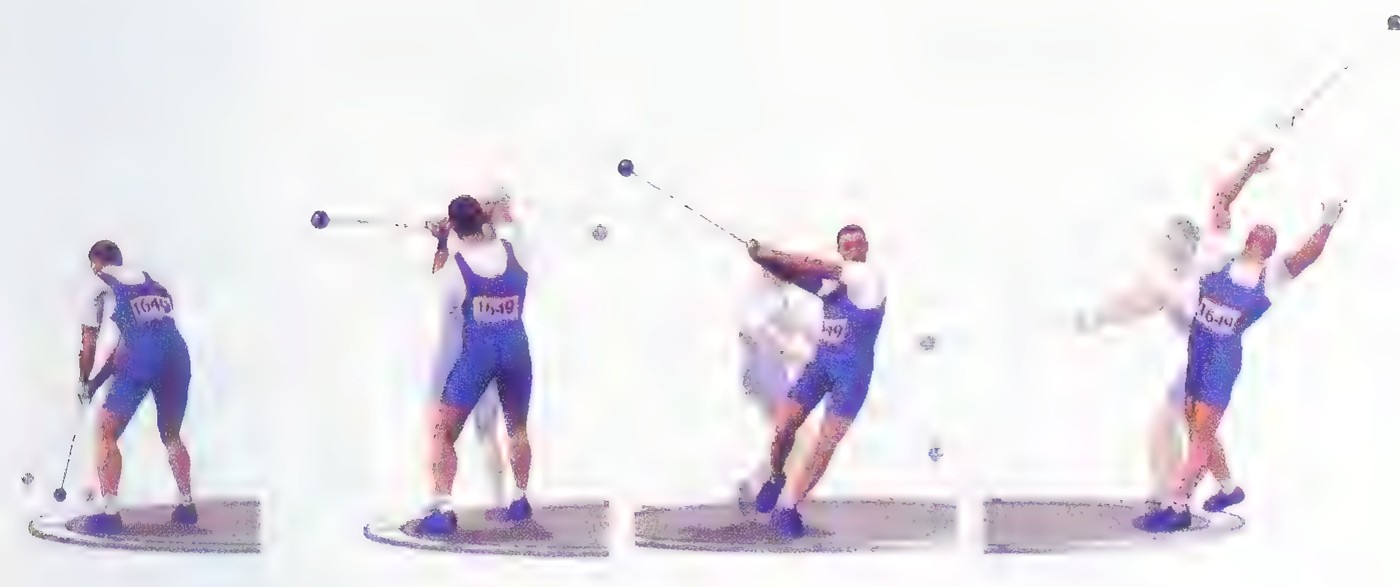
A champion hammer thrower can throw a 16-pound hammer farther than a quarterback can throw a football! To be able to do so, the thrower swings the hammer around in a circle several times before releasing it.
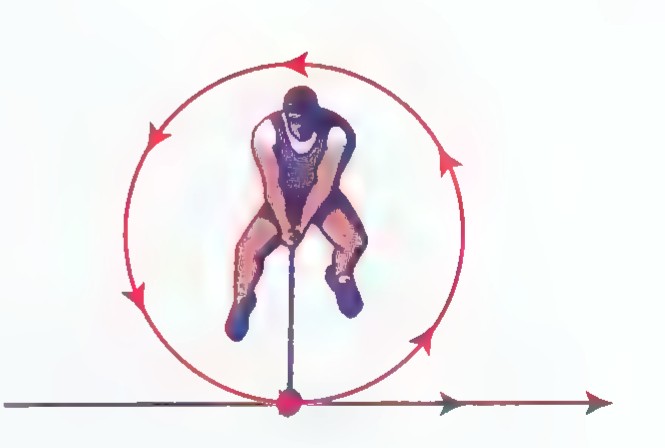
The hammer is attached to one end of a steel wire and spun around a circle whose center is the other end of the wire. When the thrower lets go, the hammer leaves this circular path and flies along a path that appears to be a straight line. This line intersects the circle in exactly one point, the point that is the position of the hammer when the wire is released. Such a line is called a tangent to the circle.
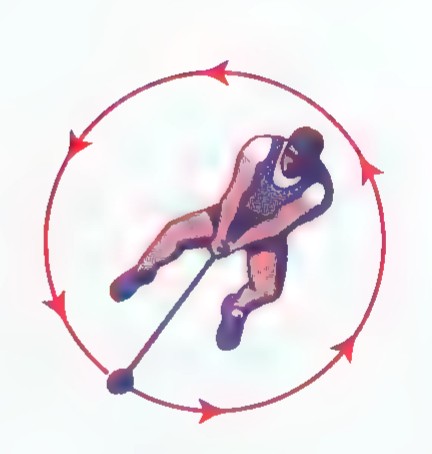
Definition
A tangent to a circle is a line in the plane of the circle that intersects the circle in exactly one point.
The hammer thrower knows that, when the hammer is released, it flies in a direction perpendicular to the thrower’s arm. This means that it must be released when the wire is at 90° to the intended direction of throw.*
The athlete is applying a basic fact of geometry: that a tangent to a circle is perpendicular to the radius drawn to the point at which the tangent intersects the circle. This fact can be proved indirectly.
* The Science of the Summer Games, by Vincent Mallette (Charles River Media, 1996).
p. 492
Theorem 59
If a line is tangent to a circle, it is perpendicular to the radius drawn to the point of contact.
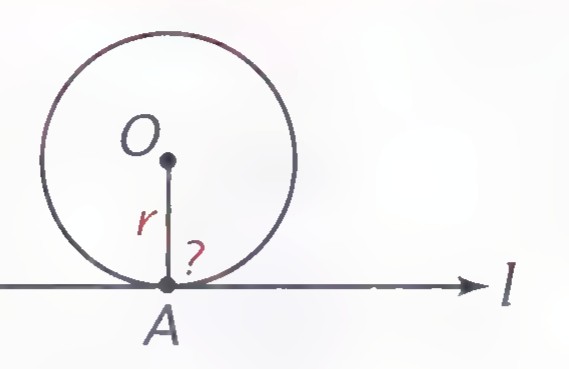
Given: l is tangent to circle O at point A.
Prove: l ⊥ OA.
Proof
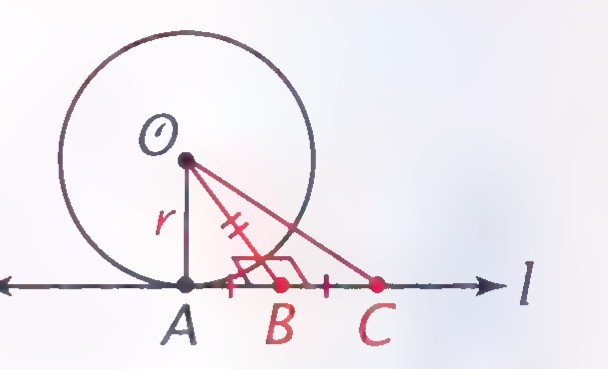
Suppose that l is not perpendicular to OA (that is, OA is not perpendicular to l). Through point O, construct OB ⊥ l. Choose point C on l so that BC = BA. Draw OC.
△OBA ≅ △OBC (SAS); so OC = OA = r. This means that C must be a point on the circle because a circle is the set of all points in the plane at a distance of the radius from the center.
So l intersects the circle in two points: A and C. This contradicts the fact that l is tangent to the circle (a tangent to a circle intersects it in exactly one point). So our assumption that l is not perpendicular to OA is false, and so l ⊥ OA.
The converse of this theorem also is true. Here a direct proof is easier.
Theorem 60
If a line is perpendicular to a radius at its outer endpoint, it is tangent to the circle.
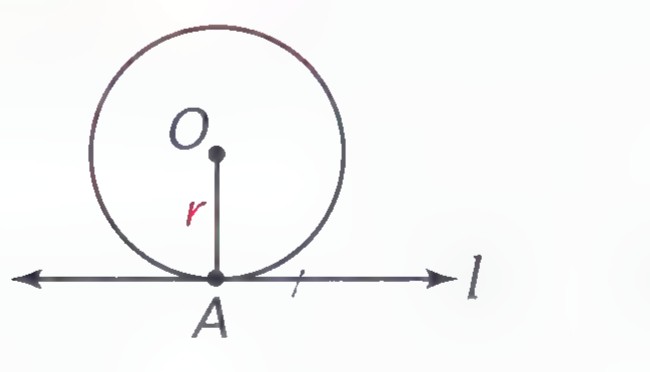
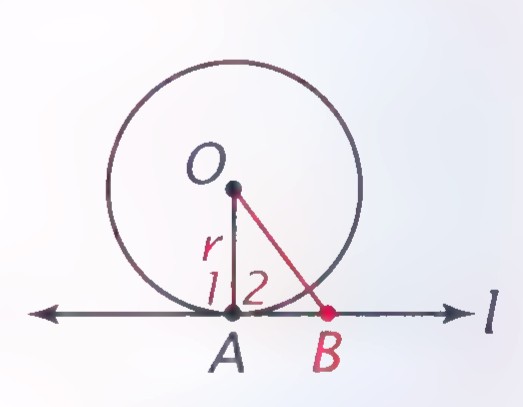
Given: Circle O with l ⊥ OA.
Prove: l is tangent to circle O.
Proof
Let B be any other point on l and draw OB. Because l ⊥ OA, ∠1 and ∠2 are right angles, and so ∠1 = ∠2. ∠1 is an exterior angle of △OAB, and so ∠1 > ∠OBA. Substituting ∠2 for ∠1 gives ∠2 > ∠OBA. If two angles of a triangle are unequal, the sides opposite them are unequal in the same order; so, in △OAB, OB > OA = r. Therefore, B lies outside circle O from which it follows that l intersects circle O only at point A. So l is tangent to circle O.
p. 493
Exercises
Set I
Band Saw. The blade of a two-wheel band saw is driven by two identical wheels, one above the other.
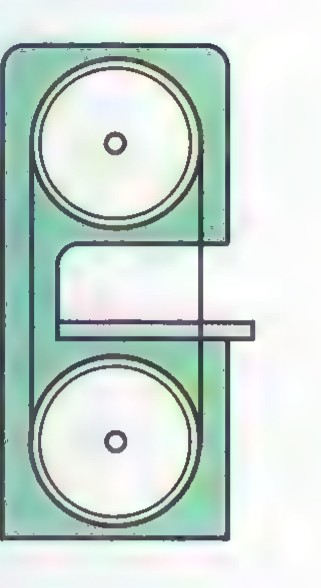
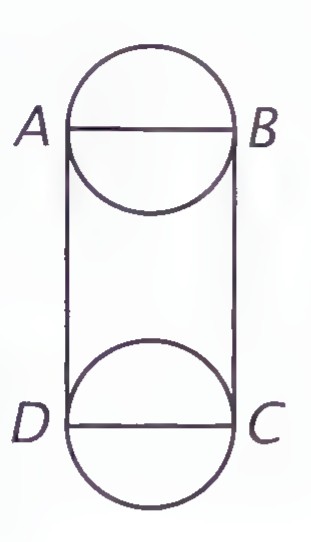
In the figures above, the blade is tangent to each wheel at the endpoints of a diameter.*
- Why is AD ⊥ AB, BC ⊥ AB, AD ⊥ DC, and BC ⊥ DC?
- Why is AD ∥ BC and AB ∥ DC?
- Why is AD = BC?
Concentric Circles. In the figure below, O is the center of both circles, and radius OB bisects chord AC.
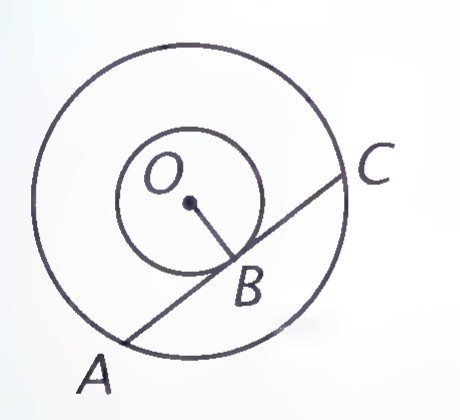
- What else can you conclude about OB and AC?
- What theorem is used in your answer?
- What else can you conclude about line AC?
- What theorem is used in your answer?
* The Complete Manual of Wood Working, by Albert Jackson, David Day, and Simon Jennings (Knopf, 1996).
Grid Exercise. In the figure below, lines l and m are tangent to circle C at A and B.
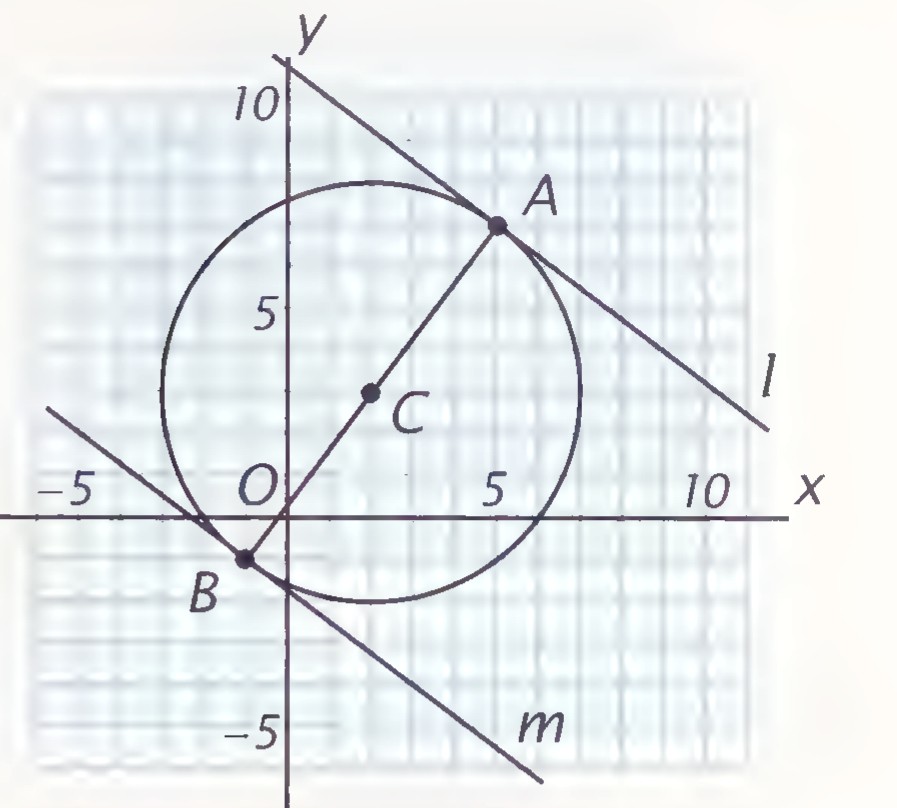
Find each of the following numbers.
- The length of the radius of the circle.
- The slope of diameter AB.
- The slope of line l.
- The slope of line m.
- What relation do lines l and m have to AB?
- What relation do lines l and m have to each other?
- How are the slopes of l, m, and AB related?
Double Meaning. In the figure at the right, OB is both a radius of circle O and a leg of right △OAB. Also, OB = 1.
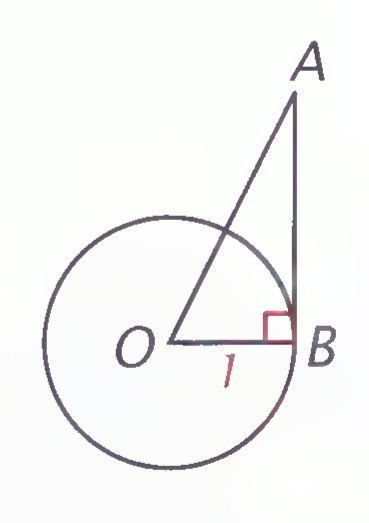
- What relation does AB have to circle O?
- What theorem is used in your answer?
- What is the definition of the tangent ratio?
- What is the tangent of ∠O?
p. 494
Railroad Curve. Tangents are used to lay out railroad tracks so that they change direction smoothly.

In the figure below, lines l and m represent the original and final directions of a track.
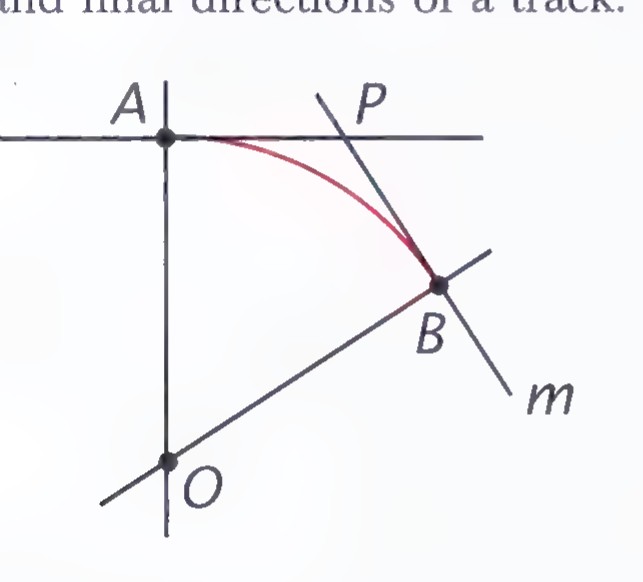
- The following construction shows the method used to smooth the corner at P.
- Draw lines l and m and let P be the point at which they intersect.
- Use your compass to mark two points A and B on these lines so that PA = PB.
- Construct a line perpendicular to l at A and a line perpendicular to m at B. Label their intersection O.
- Draw OP.
- What can you conclude about △APO and △BPO? Explain.
- Why is OA = OB?
- (continued) Use your compass to draw the arc of the circle whose center is O that connects points A and B.
- Why are lines l and m tangent to this curve?
- Will the train be jolted at A and B?
Tangents to Two Circles. The lines in the figure below are tangent to both circles.
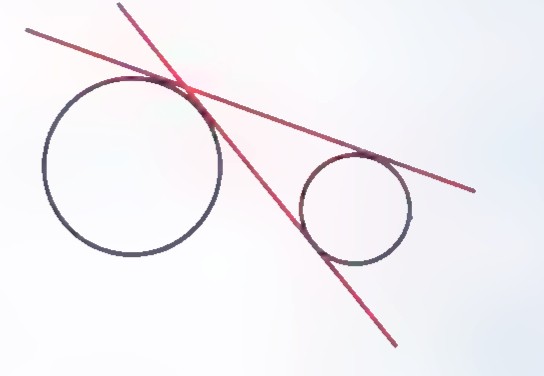
- Copy the figure and draw two more lines that also are tangent to both circles.
The two circles in the figure below have one point in common.
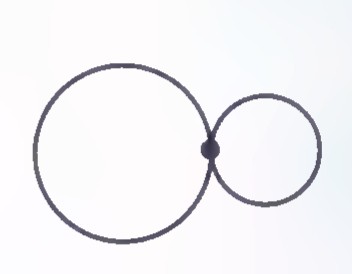
- Copy the figure and draw the lines that are tangent to both circles.
Draw a figure to illustrate two circles for which the number of lines that can be drawn tangent to both circles is
- two.
- one.
- Is it possible to have two circles for which no lines can be drawn tangent to both? Explain.
Set II
Construction Problem. The figure below appears in Euclid’s Elements.*
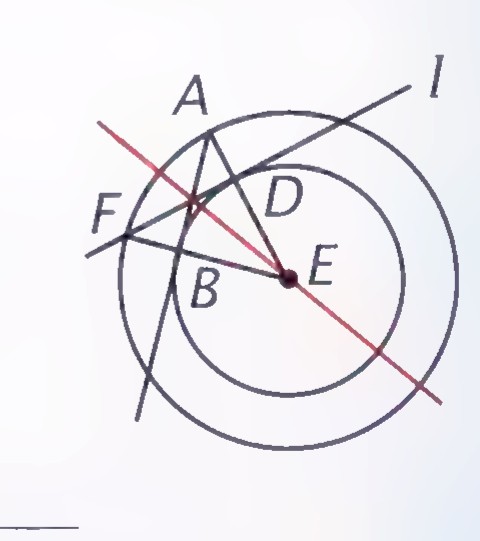
* Book III, Proposition 17. The red line has been added.
p. 495
- Use your straightedge and compass to construct it by doing the following.
- Draw a circle with a radius of 1 inch and label its center E.
- Choose a point about inch outside the circle and label the point A.
- Draw AE, and let D be the point in which AE intersects the circle.
- Draw a circle with radius EA and center E.
- Through D construct line l ⊥ AE, and let F be one of the points in which l intersects the larger circle.
- Draw EF, and let B be the point in which EF intersects the smaller circle.
- Draw AB.
- Why is line l tangent to the smaller circle?
- Why is △FDE ≅ △ABE?
- Why is ∠ABE a right angle?
- What can you conclude about line AB?
Euclid’s figure has reflection symmetry with respect to the red line.
- What is the reflection of the tangent l through this line?
Tomahawk. The figure below shows a “tomahawk” angle trisector being used to trisect ∠XYZ.*
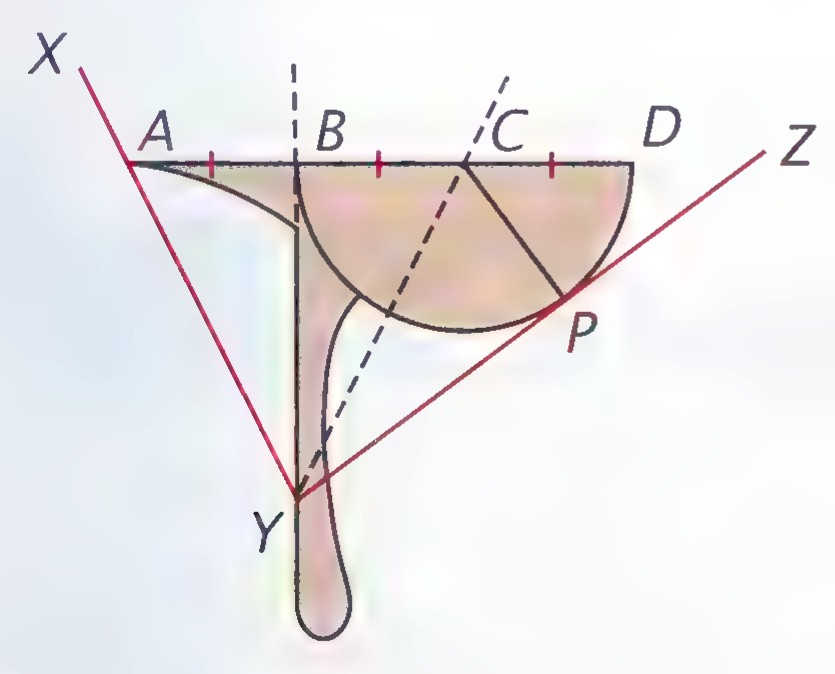
The tomahawk is designed so that AB = BC = CD, BY ⊥ AD, and C is the center of a circle with radius BC. It is placed on ∠XYZ as shown, with YZ tangent to the circle at P.
- Why is △ABY ≅ △CBY?
- Why is CP ⊥ YZ?
- Why is △CBY ≅ △CPY?
- Why does it follow that YB and YC trisect ∠XYZ?
Gothic Window. The figure below shows a design for placing a circular window in a Gothic arch.
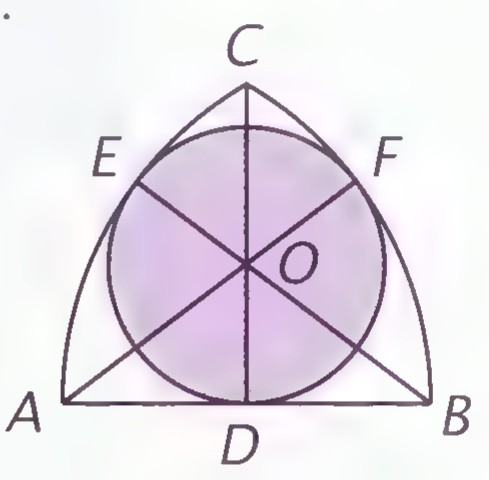
The base of the arch, AB, is tangent to the window at D. The two curved sides of the arch are parts of circles centered at A and B and with radii equal to AB.
- Draw a line segment 8 cm long, label it AB and its midpoint D. Use your compass to draw the two curved sides of the arch and label its top C. Draw CD.
- Why is CD ⊥ AB? (Hint: What points are equidistant from A and B?)
- Find the lengths of AD and AF in your figure.
- Given that the radius of the circle in the arch is r cm, express the length of AO in terms of r.
- Write an equation relating the lengths of the sides of △AOD in terms of r and solve it for r.
- What sort of right triangle is △AOD?
- (continued) Use what you know about △AOD to find point O and draw the circular window.
- How tall is the arch?
* The Trisection Problem, by Robert C. Yates (Franklin Press, 1942).
p. 496
Tangent Puzzle. The following problem appeared in the 1800 edition of the Ladies Diary, a book published annually in London for more than a hundred years.*
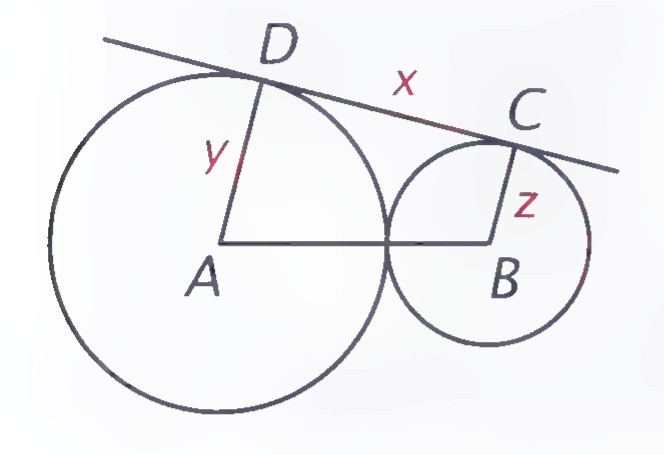
DC is tangent to the touching circles with radii y and z centered at A and B, respectively. Prove that .
One way to do so is to draw BE ∥ DC as shown below.
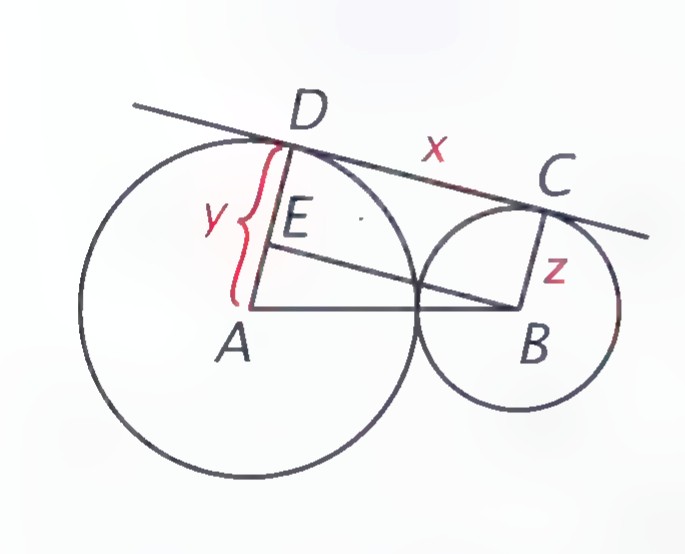
What relation does segment DC have to segments AD and BC? Explain.
What relation do segments AD and BC have to each other? Explain.
What kind of quadrilateral is BCDE?
What kind of triangle is △ABE?
Why is ?
Express AB, AE, and EB in terms of x, y, and z.
Substitute your answers into the equation in exercise 50 to get an equation in terms of x, y, and z.
Simplify the equation to finish the proof.
Set III
Trip to the Moon. On a trip from the earth to the moon, where would the earth and the moon appear to be the same size?†
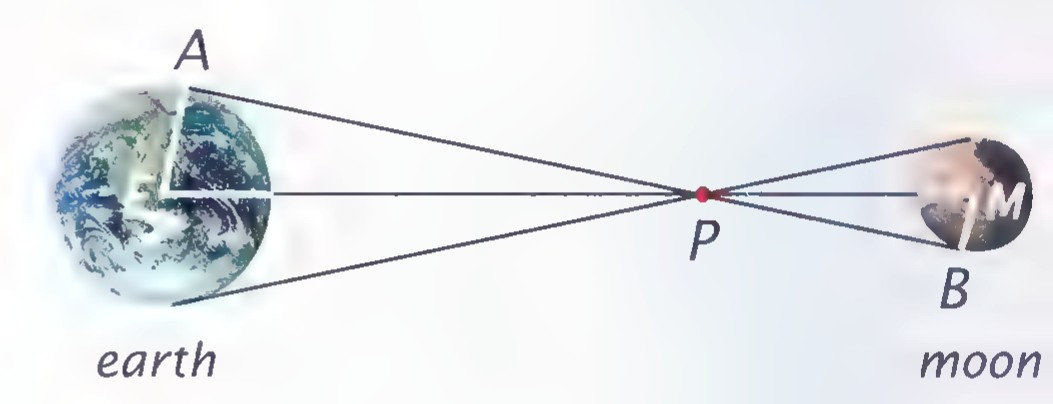
In the figure above (not to scale), they would appear to be the same size at P. Point P lies on the line joining the centers of the earth and the moon and on the two lines shown here tangent to both the earth and the moon. The radius of the earth is 3,960 miles, and the radius of the moon is 1,080 miles. Find EP, given that the distance EM is 234,000 miles. Show your reasoning.
Used by permission of Johnny Hart and Creators Syndicate, Inc.
* Geometry Civilized: History, Culture, and Technique, by J. L. Heilbron (Clarendon Press, 1998).
† Science Fiction Puzzle Tales, by Martin Gardner (Clarkson N. Potter, Inc., 1981).
p. 497
Lesson 3: Central Angles and Arcs
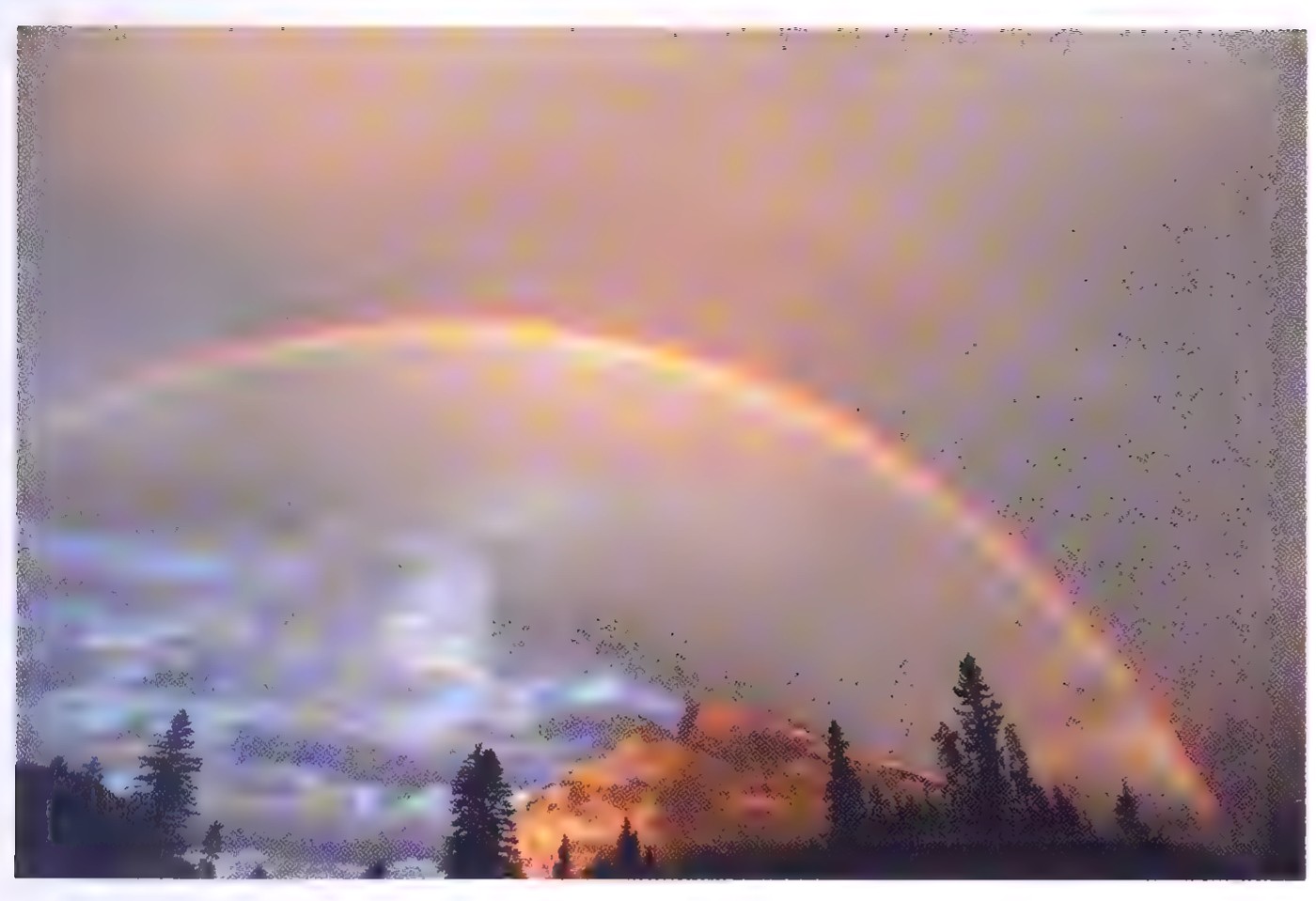
A rainbow is produced when sunlight hits a bank of raindrops in either a cloud or falling rain. The drops act as tiny prisms, the apparent color of each drop being determined by the angle at which it is viewed.
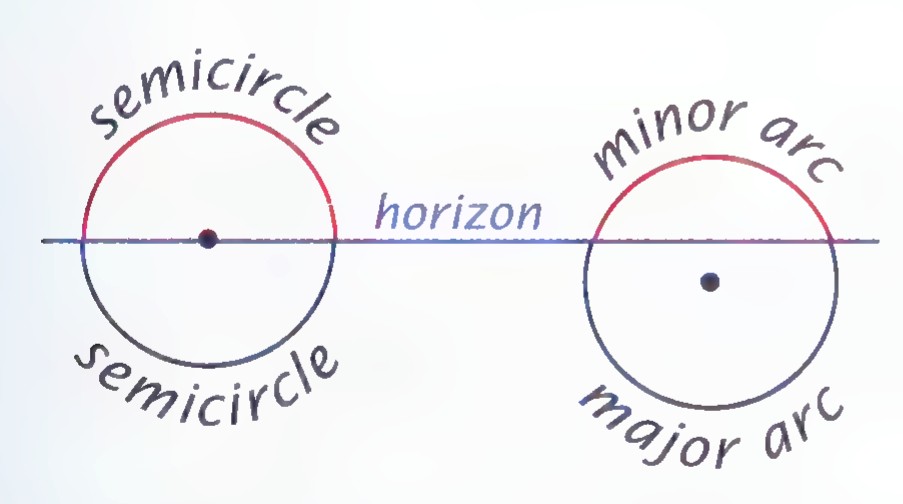
The rainbow is a set of circular arcs with a common center at a point opposite the sun. If the sun is on the horizon, exactly half of each of these circles, called a semicircle, can be seen. If the sun is above the horizon, the center of the rainbow is below the horizon. As a result, the visible part of the rainbow is less than a semicircle. It is a minor arc. The part of the rainbow below the horizon is more than a semicircle; it is a major arc.
p. 498
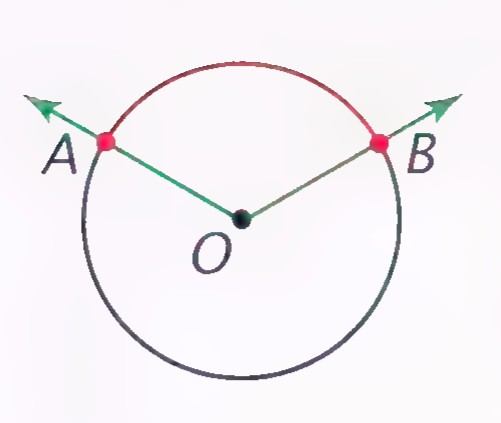
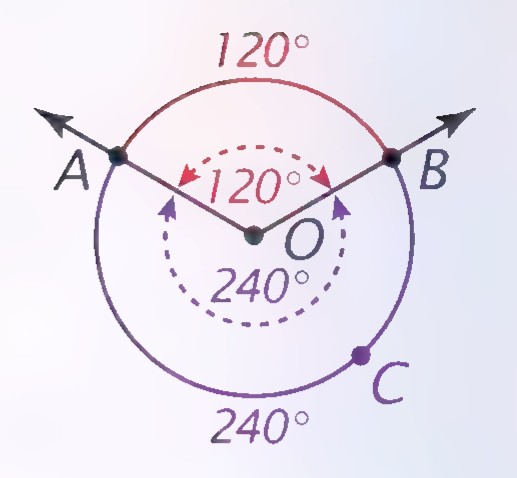
To indicate how much of the rainbow can be seen, it is convenient to relate its arc to an angle at its center. In the figure at the left above, the minor arc AB (written or ) is bounded by points A and B on the sides of ∠AOB. Because its vertex is at the center of the circle, ∠AOB is called a central angle of the circle.
Definition
A central angle of a circle is an angle whose vertex is the center of the circle.
Every pair of points on a circle determines two arcs. A minor arc is usually named by just these two points, called its endpoints. A major arc or a semicircle is named with three letters, the middle letter naming a third point on the arc. In the figure at the right above, for example, the symbol refers to the minor arc and the symbol refers to the major arc.
As you know, the measurement of angles is based on dividing a circle into 360 degrees. It is natural to base the measurement of arcs on the same idea. For example, if ∠AOB = 120°, then we say that the degree measure of , represented by the symbol , is 120°.
In our earlier treatment of angles, we limited their measures to no more than 180°. In working with circles, it is convenient to consider angles whose measures are more than 180°. The sides of central ∠AOB divide circle O into two arcs: a minor arc of 120° and a major arc of 240°. Corresponding to the minor arc, , is ∠AOB, whose measure is 120°. Corresponding to the major arc, , is “another angle” having the same sides as ∠AOB but whose measure is 240°. To distinguish between these two angles, we call the larger one a reflex angle.
Definition
A reflex angle is an angle whose measure is more than 180°.
Keeping in mind that to every major arc there corresponds a central reflex angle, we can define the degree measure of any arc.
Definition
The degree measure of an arc is the measure of its central angle.
p. 499
In the figure at the right, points A, B, and C determine three minor arcs whose measures are
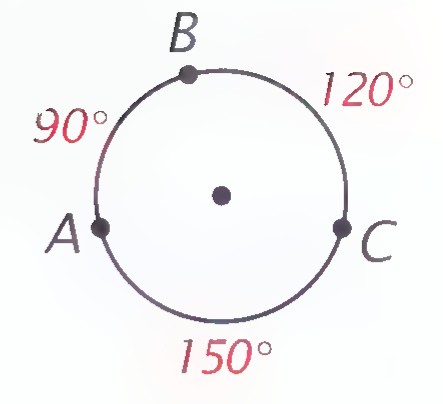
The three points also determine three major arcs whose measures are
Arc measures can always be added in this way, a fact that follows from their definition and the Protractor Postulate. Although it is possible to prove this fact, we will make it a postulate.
Postulate 10. The Arc Addition Postulate
If C is on , then .
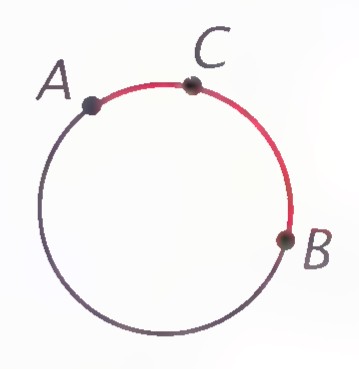
For simplicity, we will refer to arcs that have equal measures as “equal arcs.” We can prove, by using congruent triangles, that two chords of a circle are equal iff they have equal arcs.
Theorem 61
In a circle, equal chords have equal arcs.
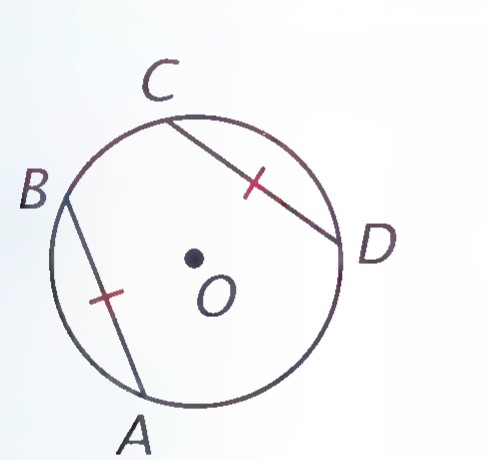
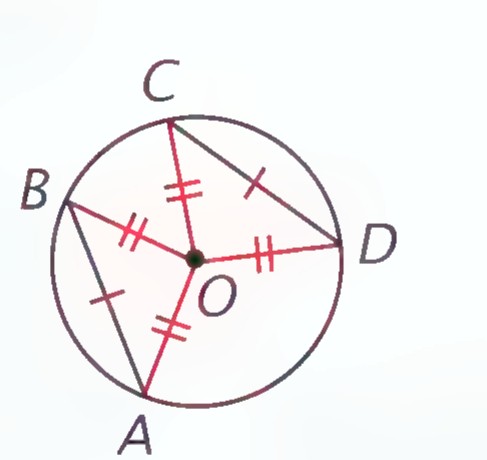
Given: In circle O, AB = CD.
Prove: .
Proof
In circle O, AB = CD. Draw OA, OB, OC, and OD. OA = OC and OB = OD (all radii of a circle are equal); so △AOB ≅ △COD (SSS). From this congruence, we know that ∠AOB = ∠COD and, because and (the degree measure of an arc is the measure of its central angle), by substitution.
The proof of Theorem 62, the converse of Theorem 61, is almost the same and is considered in the exercises.
Theorem 62
In a circle, equal arcs have equal chords.
p. 500
PEANUTS reprinted by permission of United Features Syndicate, Inc.
Exercises
Set I
Routes to Japan. In planning to sail west from Portugal to the Indies (Japan), Columbus based his calculations on the figure below.*
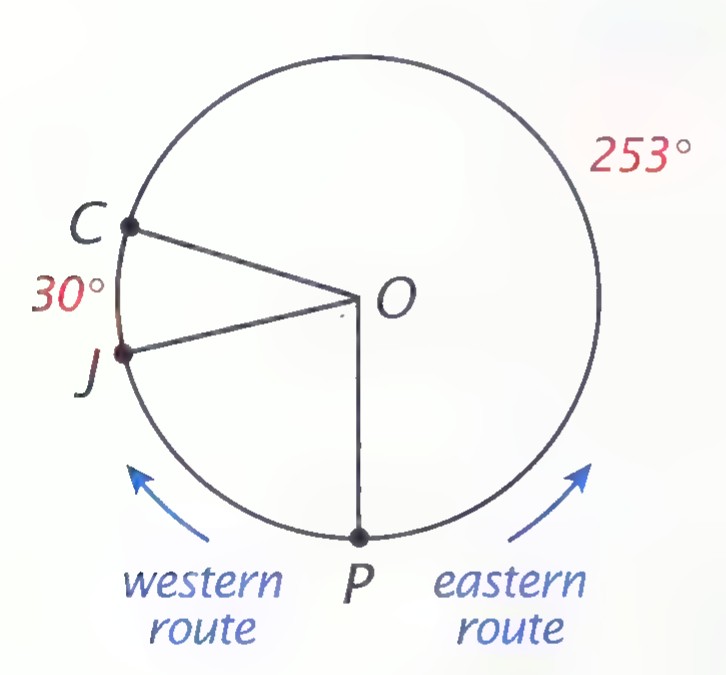
Points C, J, and P represent China, Japan, and Portugal. Marco Polo claimed that the eastern overland route from Portugal to China, the major arc going from P to C, had a measure of 253°. Polo thought Japan was 30° beyond China, and so .
What are ∠POJ and ∠JOC called with respect to circle O?
Name the minor arc that corresponds to ∠POJ.
Name the major arc that corresponds to reflex ∠POJ.
What is the measure of ∠JOC?
What is ?
What is ?
What is the measure of ∠POJ?
Theorem 62. Complete the following proof of Theorem 62 by giving the reasons.
In a circle, equal arcs have equal chords.
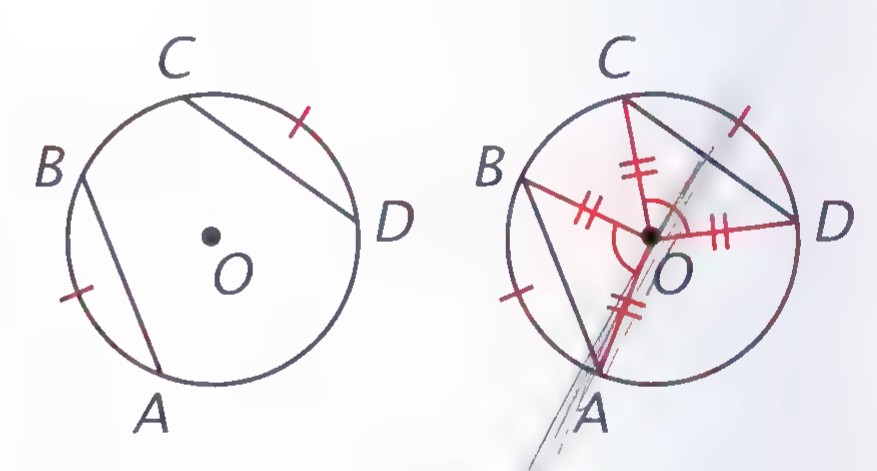
Given: In circle O, .
Prove: AB = CD.
Proof
- Draw OA, OB, OC, and OD. Why can we draw these lines?
- OA = OC, and OB = OD. Why?
- , and . Why?
- Because , ∠AOB = ∠COD. Why?
- △AOB ≅ △COD. Why?
- AB = CD. Why?
* Geometry Civilized: History, Culture, and Technique, by J. L. Heilbron (Clarendon Press, 1998).
p. 501
Jupiter’s Asteroids. As Jupiter travels in its orbit about the sun, two sets of asteroids travel with it.* In the figure below, the sun is at S, Jupiter is at J, and the two sets of asteroids are at A and B.
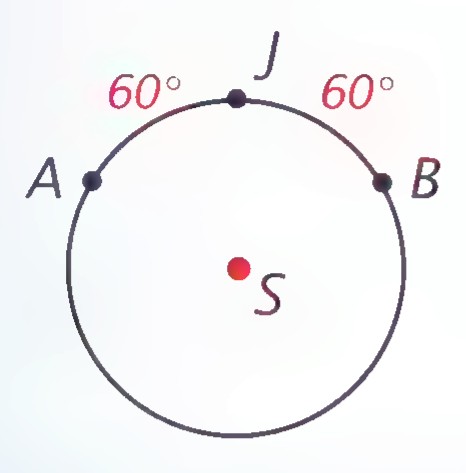
- Draw the figure and add to it radii SA, SJ, and SB and chords AJ and JB.
- Why is and ?
- Why is ?
- Why are △ASJ and △BSJ congruent?
- What kind of triangles are they?
Arc Illusion. Here is an interesting optical illusion.†
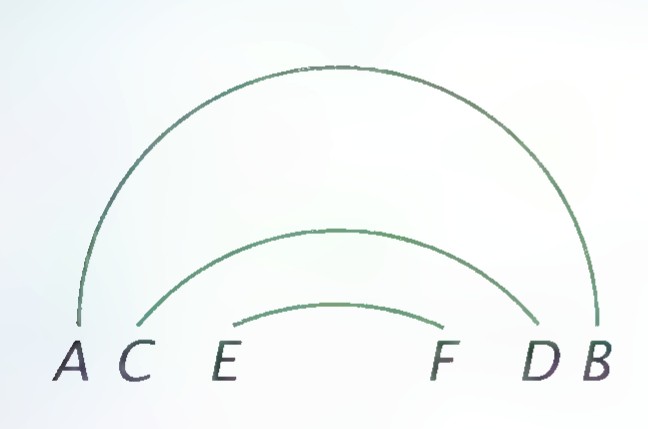
- What kind of arc does appear to be?
- What kind of arcs are and ?
- Which arc do you think comes from the largest circle?
Cover the parts of the figure to the left of E and to the right of F.
- What seems to be true?
* Constructing the Universe, by David Layzer (Scientific American Library, 1984).
† Can You Believe Your Eyes? by J. R. Block and Harold E. Yuker (Brunner/Mazel, 1992).
Chords and Arcs. In the figure below, △ABC is a 30°-60° right triangle whose sides are chords of circle O.
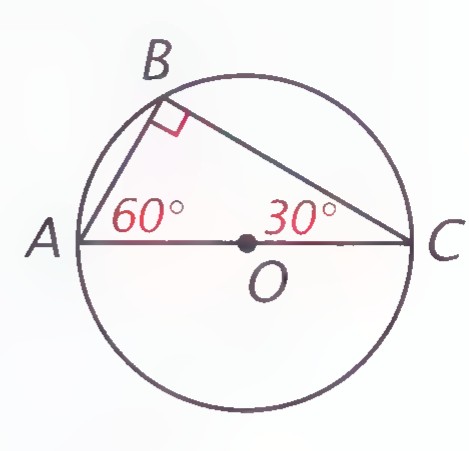
- Why is ?
- Is AB + BC = AC? Explain.
- Copy the figure and draw OB. Also, label its length r.
- Find , , and .
- Express AB, BC, and AC in terms of r.
- AC = 2AB. How are and related?
- . How are BC and AB related?
Set II
The Square That Isn’t. Saint Peter’s Square in Rome is actually oval in shape rather than square.‡
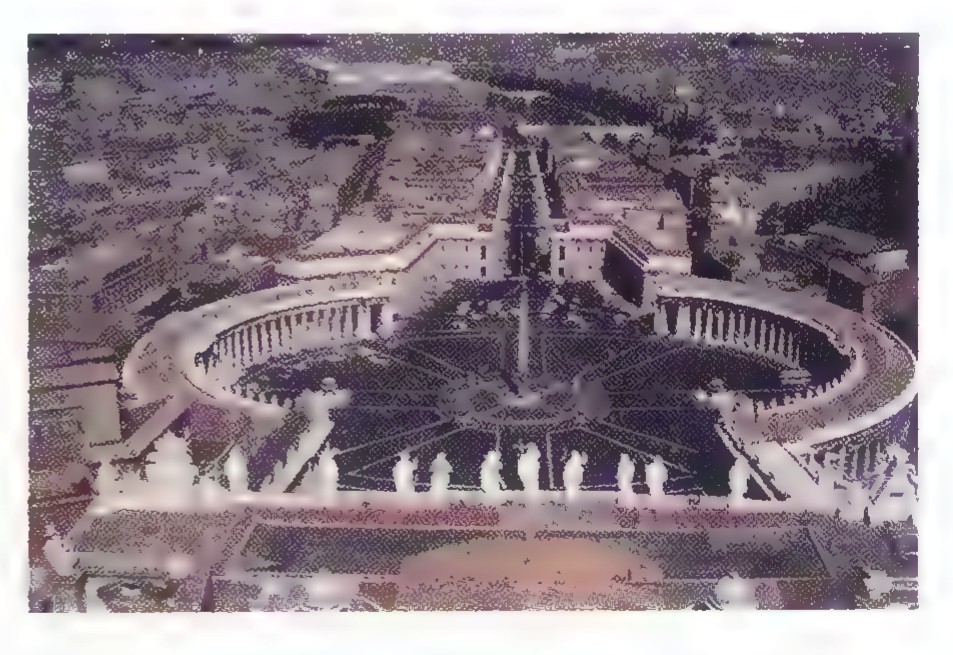
- Use your straightedge and compass to construct the oval as follows.
‡ Geometry Civilized: History, Culture, and Technique, by J. L. Heilbron (Clarendon Press, 1998).
p. 502
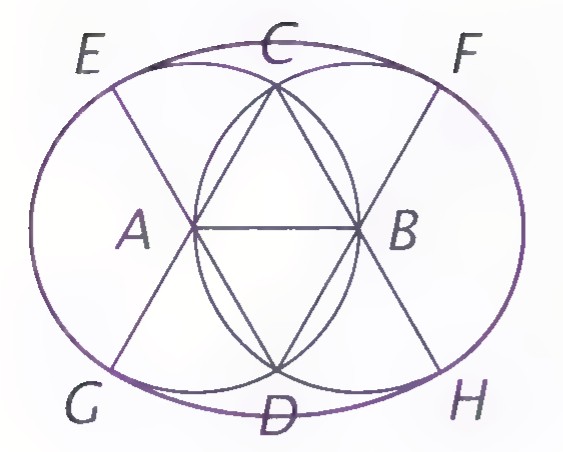
- Draw AB about 1 inch long and draw circles A and B with radius AB. Let C and D be the points in which the circles intersect.
- Draw diameters CG, CH, DE, and DF.
- With D as center, draw and, with C as center, draw .
- What can you conclude about △ABC and △ABD?
- What kind of quadrilateral is ACBD?
- (continued) Extend diameter ED beyond E and construct a line through E perpendicular to ED. Label the line l.
- What can you conclude about line l and circle A? Explain.
- Line l has the same relation to . Why?
- Find the measures of the four arcs that form the oval: , , , and .
- What is their sum?
Rainbow Distance. Olympiodorus, a sixth-century Greek scholar, used the figure below in an attempt to calculate an observer’s distance to a rainbow.*
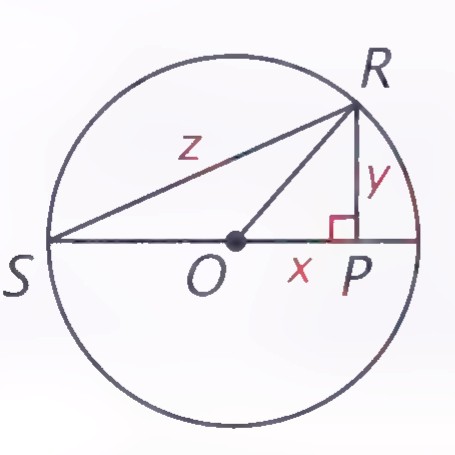
The observer is at O, the sun is at S, and the top of the rainbow is at R; RP ⊥ SP.
- Letting the radius of circle O be 1, write an equation relating the lengths of the sides of △ORP.
- Write an equation relating the lengths of the sides of △SRP.
- Use your equations to show that
Night Sky. In the photograph below of the night sky, the stars appear as arcs of concentric circles rather than as points of light.
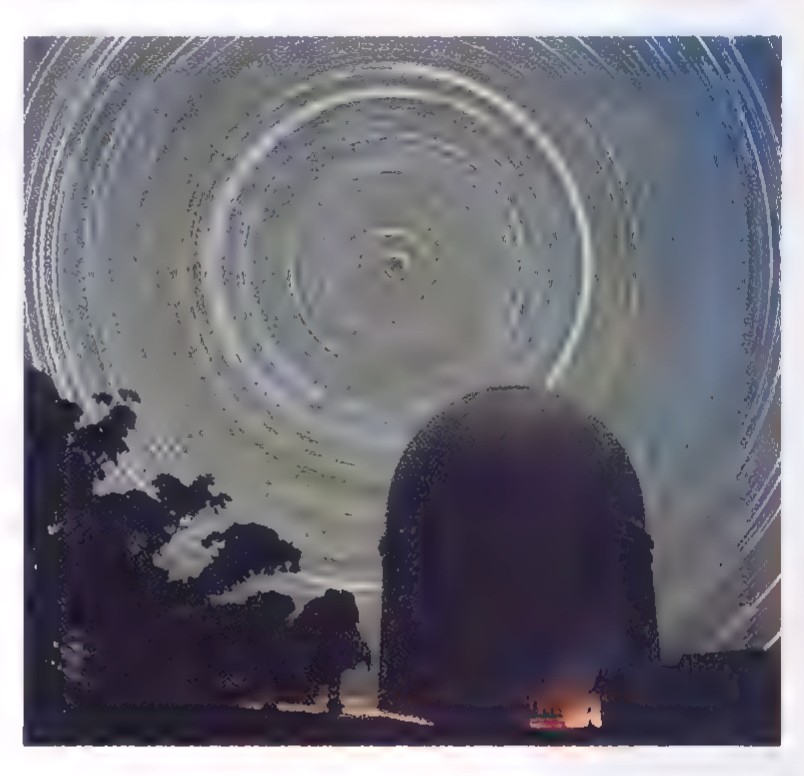
- Why?
- What can you conclude about the measures of the arcs?
- Approximately how long do you think it took to take this photograph? Explain.
Original Proofs. Write proofs for the following exercises.
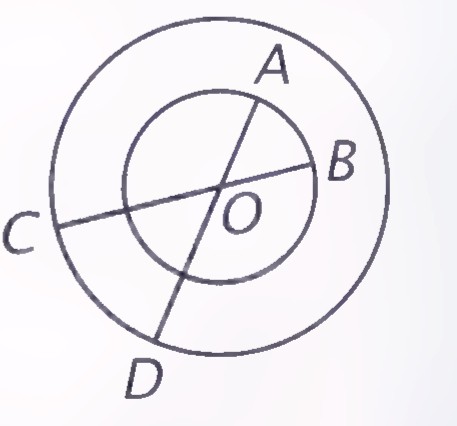
Given: Vertical angles ∠AOB and ∠COD are central angles of both circles.
Prove: .
* The Rainbow: From Myth to Mathematics, by Carl B. Boyer (Princeton University Press, 1987).
p. 503
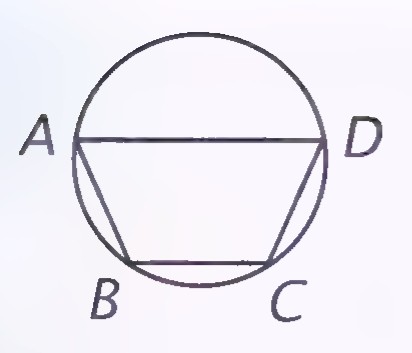
Given: The vertices of trapezoid ABCD (AD ∥ BC) lie on a circle, and .
Prove: ∠B = ∠C.
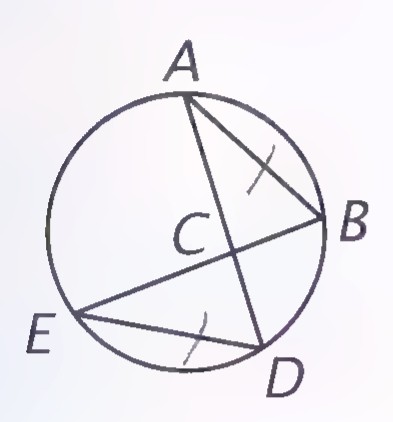
Given: Points A, B, D, and E lie on a circle, and AB = DE.
Prove: AD = BE.
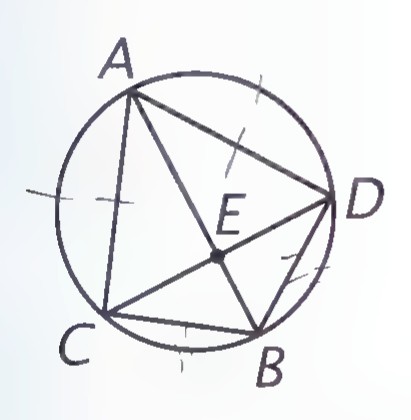
Given: Points A, B, C, and D lie on a circle, , and .
Prove: AB contains the center of the circle.
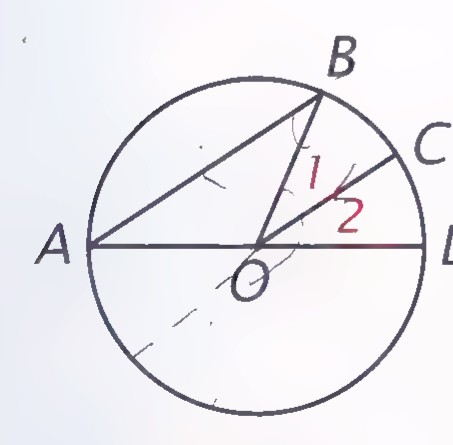
Given: AD is a diameter of circle O, and AB ∥ OC.
Prove: .
Set III
Obtuse Ollie drew the figure below with his straightedge and compass.
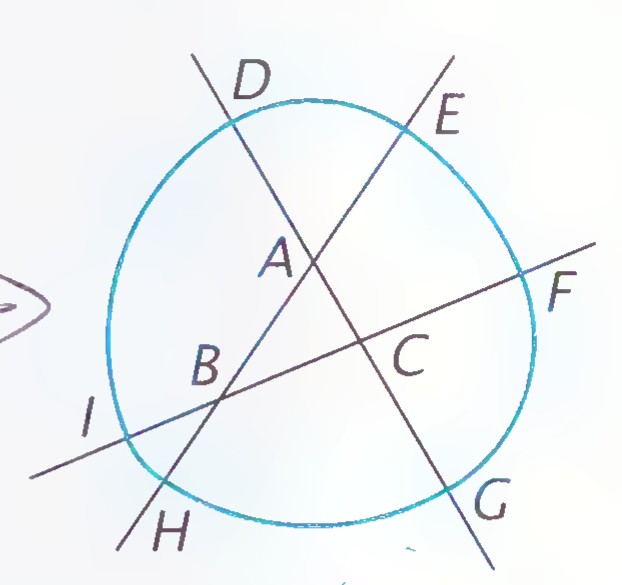
First, he drew the three lines that form △ABC. Then, starting at A, he drew with center A, with center B, with center C, with center A, with center B, and with center C.
He thought that the sum of the measures of the six arcs must be 360° because the curve ends where it began. Acute Alice thought this unlikely, because the curve is not a circle.
Which one of them is correct? Explain.
p. 504

Lesson 4: Inscribed Angles
The first demonstration of motion pictures in a theater took place on April 23, 1896, in New York City. At the time, the inventor, Thomas Edison, thought that ten movie theaters would be enough for the entire United States!*
If you have ever watched a movie from the first row of a theater, you know that it can be hard to see everything on the screen at once. The reason is that the angle that the side edges of the screen make with your eyes is very large. At the back of the theater, this angle is much smaller. You might conclude from this fact that the farther you are from the screen, the smaller your viewing angle will be. But such is not the case.
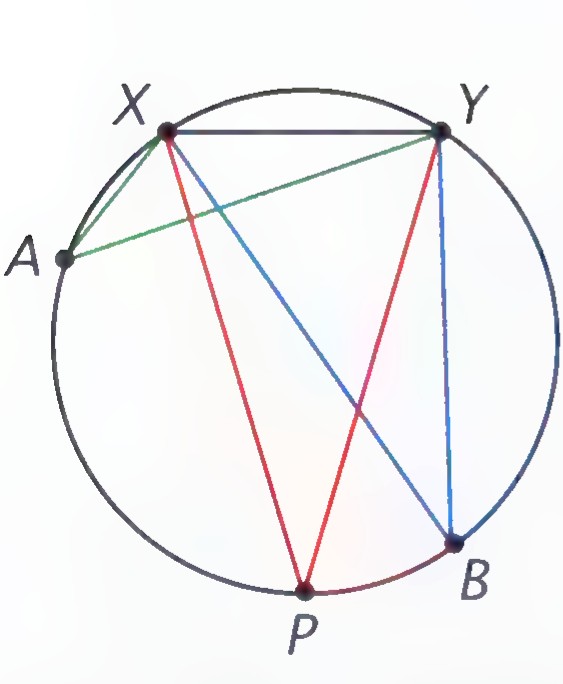
In the figure at the left, XY represents the screen and point P represents the center seat of the back row, directly under the projection window. For someone seated at P, the screen angle to which we have been referring is ∠P. Where else in the theater is the screen angle the same size?
* Edison: The Man Who Invented the Future, by Ronald W. Clark (Putnam, 1977).
p. 505
The other locations having the same screen angle are on the circle that contains X, Y, and P. Every angle whose vertex is on the arc of this circle and whose sides pass through points X and Y is equal to the angle at P. You can check whether the angles at A and B equal the angle at P by measuring all three of them with a protractor.
Such angles are called inscribed angles and, to prove that they are equal, we will show that their measure is half that of the common arc, , that they intercept.
Definition
An inscribed angle is an angle whose vertex is on a circle, with each of the angle’s sides intersecting the circle in another point.
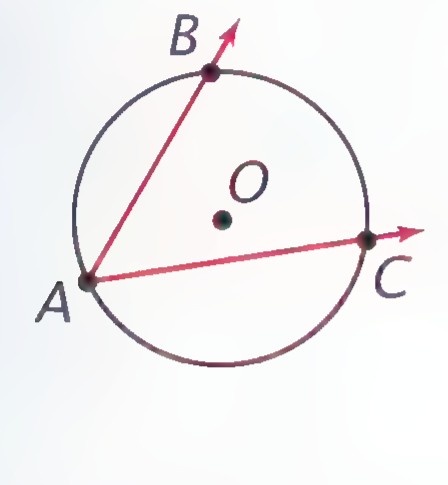
In the figure at the left above, ∠A is an inscribed angle of circle O. Here, ∠A intercepts BC and is inscribed in BAC. Note that these two arcs make up the entire circle. Every inscribed angle in a circle divides the circle into two arcs, one of which the angle intercepts and the other in which it is inscribed.
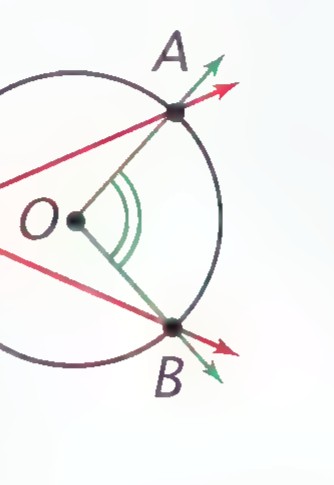
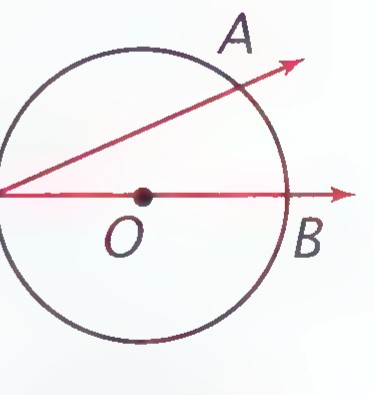
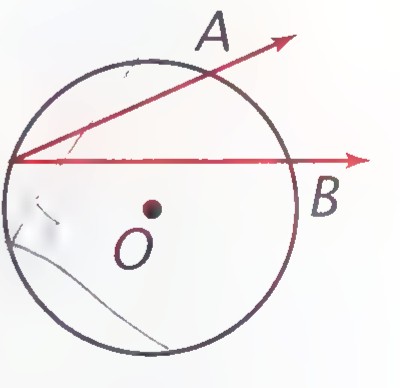
The figure at the right above shows a central angle, ∠O, and an inscribed angle, ∠P, that intercept the same arc, AB. By definition, we know that ∠O = . You can see that ∠P is smaller than ∠O; so ∠P < . We can prove that
In our diagram, the center of the circle lies inside the inscribed angle. It could also lie on the angle or outside it as the figures at the right show. In all three cases, the result is the same: .
Theorem 63
An inscribed angle is equal in measure to half its intercepted arc.
This theorem has a couple of useful corollaries. The first of them justifies the claim that the screen angles at every point on the circle are equal. Look again at the drawing on the facing page to see why.
Corollary 1 to Theorem 63
Inscribed angles that intercept the same arc are equal.
Corollary 2 to Theorem 63
An angle inscribed in a semicircle is a right angle.
p. 506
Exercises
Set I
Skeet Range. The figure below shows a skeet range.
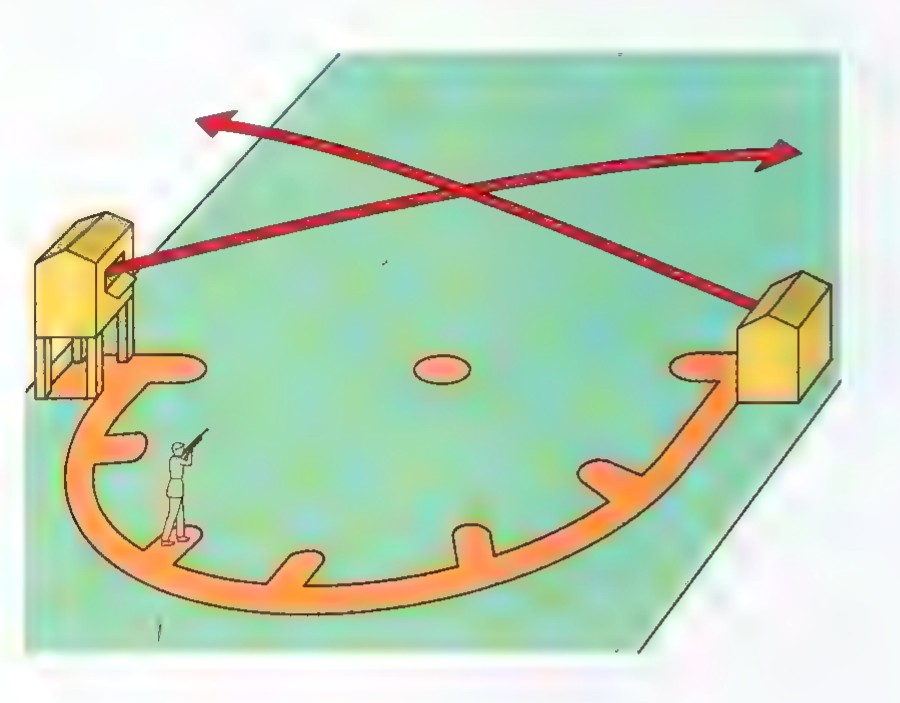
In the overhead view of it below, the shooting stations are located at seven equally spaced points, A through G, on circle O, and at point H centered on chord AG.*
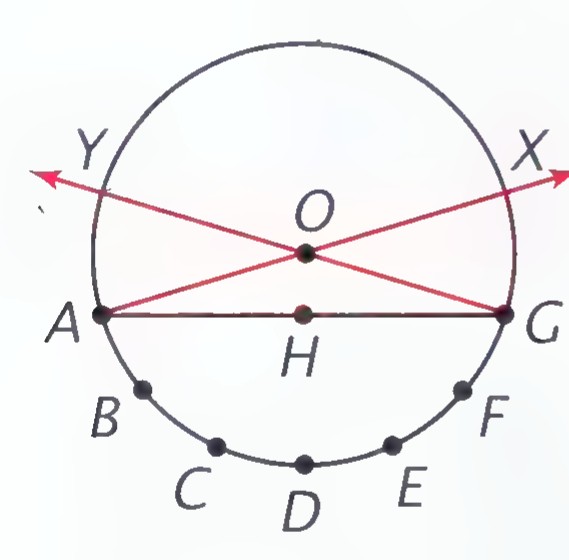
- Given that ∠A = 16.5°, find ∠G.
- Find ∠AOG.
- Given that the six arcs between points A through G have equal measures, find the measure of each arc.
The clay pigeons are released in the directions AX and GY.
- Find and .
- Find .
* Rules of the Game, by the Diagram Group (St. Martin’s Press, 1990).
Theorem 63. Complete the following proof of Theorem 63 by giving the reasons.
An inscribed angle is equal in measure to half its intercepted arc.
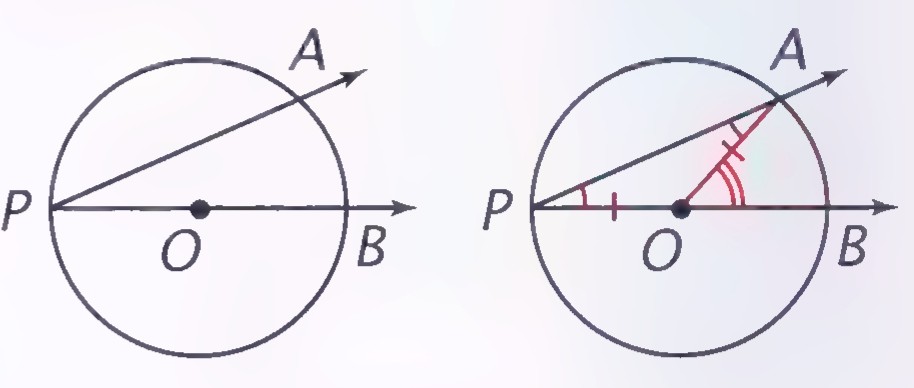
Given: ∠P is inscribed in circle O.
Prove: .
Proof
Case 1. The center of the circle lies on a side of the angle.
- Draw OA. Why?
- OP = OA. Why?
- ∠PAO = ∠P. Why?
- ∠P + ∠PAO = ∠AOB. Why?
- ∠P + ∠P = ∠AOB; so 2∠P = ∠AOB. Why?
- . Why?
- . Why?
- . Why?
Case 2. The center of the circle lies inside the angle.
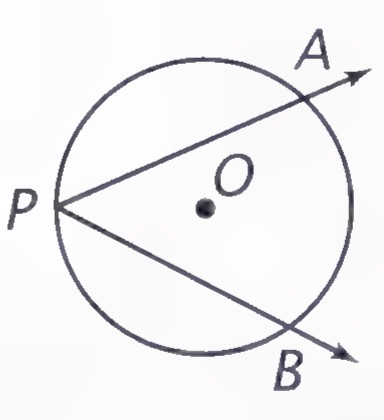
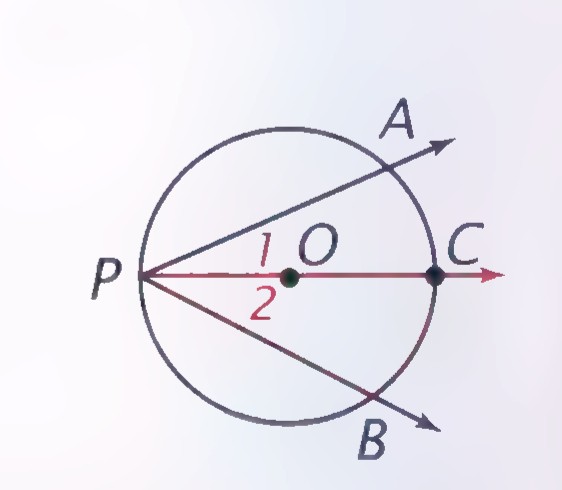
- Draw PO intersecting the circle at C. Why?
- ∠APB = ∠1 + ∠2. Why?
p. 507
- Because and (proved in case 1), . Why?
- . Why?
- . Why?
There is one more case, which can be proved in a similar way.
- What do you think it is?
Complete the following proofs of the corollaries to Theorem 63 by giving the reasons.
Corollary 1. Inscribed angles that intercept the same arc are equal.
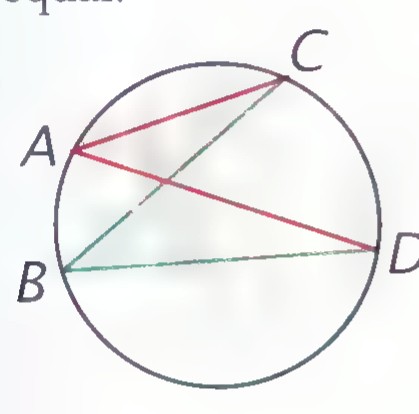
Given: ∠A and ∠B are inscribed angles that intercept CD.
Prove: ∠A = ∠B.
Proof
- Because ∠A and ∠B are inscribed angles, and . Why?
- ∠A = ∠B. Why?
Corollary 2. An angle inscribed in a semicircle is a right angle.
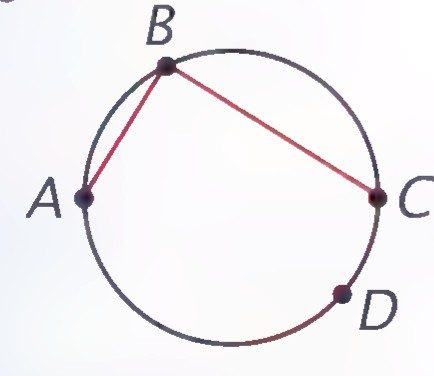
Given: ∠B is inscribed in semicircle ABC.
Prove: ∠B is a right angle.
Proof
Because ∠B is inscribed in the semicircle ABC, the arc that it intercepts, ADC, is also a semicircle.
- . Why?
- . Why?
- . Why?
- ∠B is a right angle. Why?
Inscribed Triangle. In the figure below, the vertices of △ABC lie on circle O.
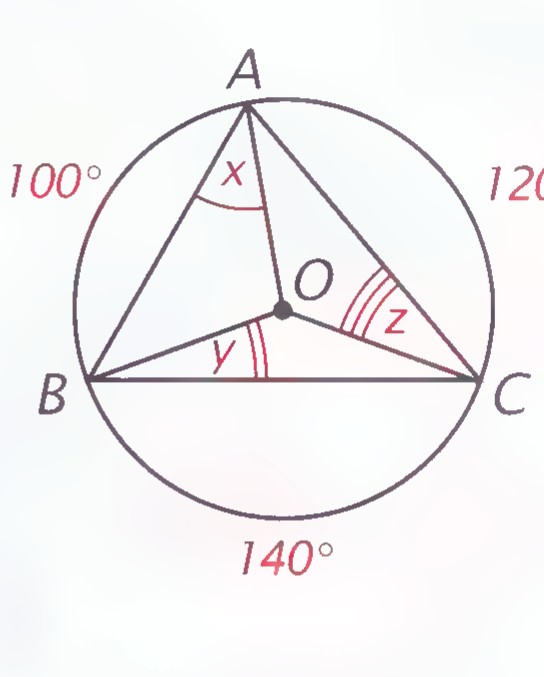
- Copy the figure and mark it as needed to do the following exercises.
With respect to the circle, what are the three angles
- whose vertex is O called?
- of △ABC called?
- Find the measures of ∠AOB, ∠BOC, and ∠COA.
- Use your answers to find x, y, and z.
- Use x, y, and z to find the measures of ∠ABC, ∠BCA, and ∠CAB.
- Check your answers by using the measures of the three arcs to find the measures of ∠ABC, ∠BCA, and ∠CAB.
p. 508
Set II
Forty Angles. In the figure below from a book on the number π, a circle has been divided into 40 equal arcs.* Each inscribed angle intercepts an arc equal in measure to 14 of these arcs.
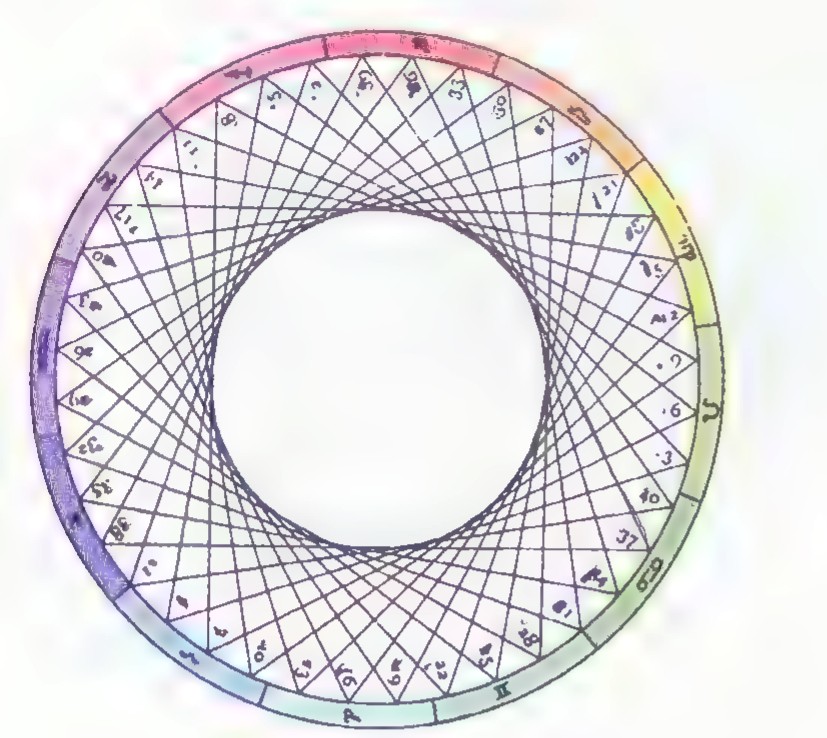
- What is the measure of one of these arcs?
- What is the measure of each inscribed angle?
Tangents, Chords, and Intercepted Arcs. In the figure below, line AT is tangent to circle O, and AB is a diameter. ∠CAT intercepts CA.
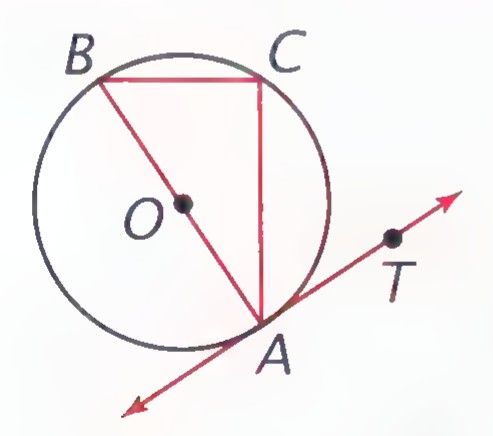
- What can you conclude about ∠BAT? Explain.
- What can you conclude about ∠CAT and ∠CAB?
- What can you conclude about ∠C? Explain.
- What can you conclude about ∠B and ∠CAB? Explain.
* A History of Pi, by Petr Beckmann (Golem Press, 1971).
- What can you conclude about ∠CAT and ∠B? Explain.
- Why is ?
- Why is ?
- What do exercises 35 through 41 prove about the relation of the measure of an angle formed by a tangent and a chord to the measure of its intercepted arc?
Similar Inscribed Triangles. In the figure below, △ABC ~ △DEF.
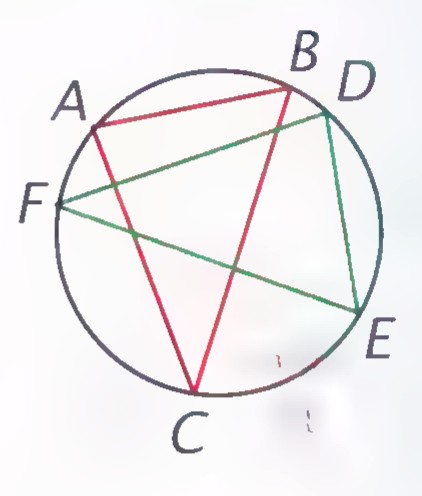
Given that ∠C = n°, find each of the following measures in terms of n.
- ∠F.
- .
- .
- What can you conclude about AB and DE? Explain.
- What does your conclusion reveal about △ABC and △DEF? Explain.
Square-Root Construction. The figure below shows a method, known since the time of Euclid, for constructing the square root of a number.†
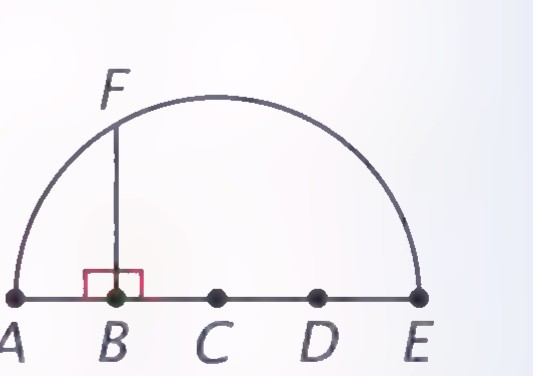
† The History of Mathematics: An Introduction, by David M. Burton (Allyn & Bacon, 1985).
p. 509
- Draw the figure as follows:
- Use your ruler to draw AE 4 inches long and mark points B, C, and D on it so that AB = BC = CD = DE = 1 inch.
- Draw the arc with center at C and radius CA.
- At point B, construct a line perpendicular to AE, and let F be the point in which the line intersects the arc.
- Draw AF and FE.
- What can you conclude about ∠AFE? Explain
- What relation does BF have to △AFE?
- Write a proportion relating AB, BF, and BE.
- Use the proportion and the lengths of AB and BE to find the exact length of BF.
- Use your calculator to find the approximate length of BF to the nearest hundredth.
- Measure BF with your ruler. Does the result seem to agree with your answer to exercise 53?
Intersecting Triangles and Circles. In the figure below, circles A and B intersect at C and D. Point C lies on △DEF and △DGH.
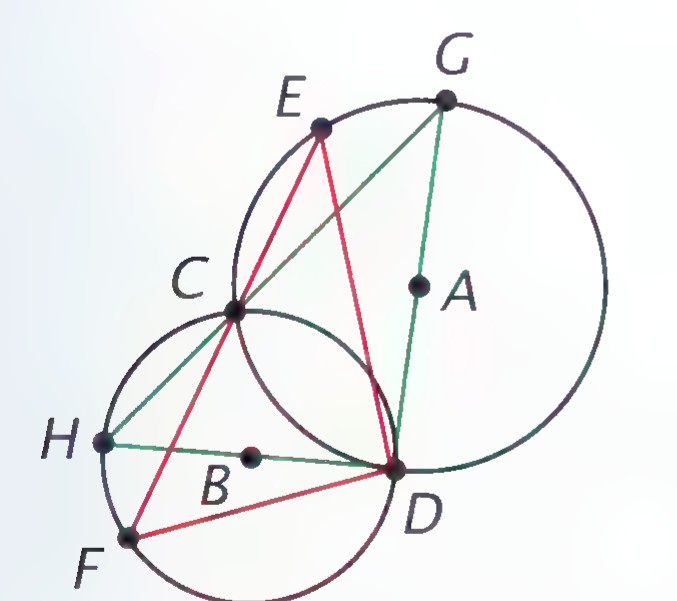
- Copy the figure by first drawing circles A and B and then drawing △DEF and △DGH.
- What can you conclude about △DEF and △DGH? Explain.
It is possible to tell which triangle is larger without doing any measuring or tracing.
- Which triangle is larger? Explain.
- (continued) Draw AB.
- How is AB related to GH? Explain.
Set III
Finding the Center. A carpenter had carefully cut out four circular wooden disks to use as wheels for a toy. His next task was to find the center of each disk so that he could drill a hole for the axle. The only tools that he had on hand were a set square and a pencil.*
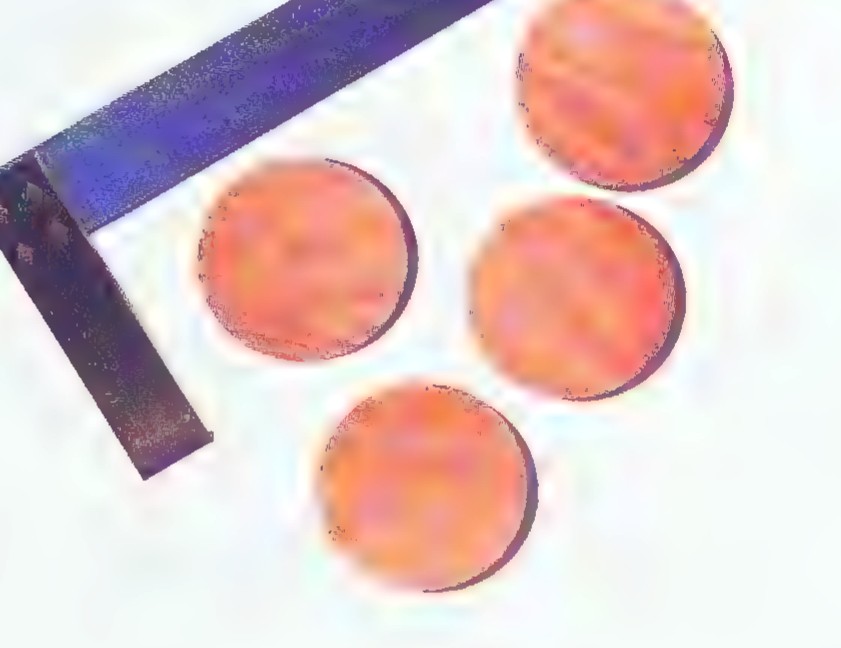
How could he use these tools to find the center of each wheel? Illustrate your answer with a drawing.
* A Mathematical Jamboree, by Brian Bolt (Cambridge University Press, 1995).
p. 510
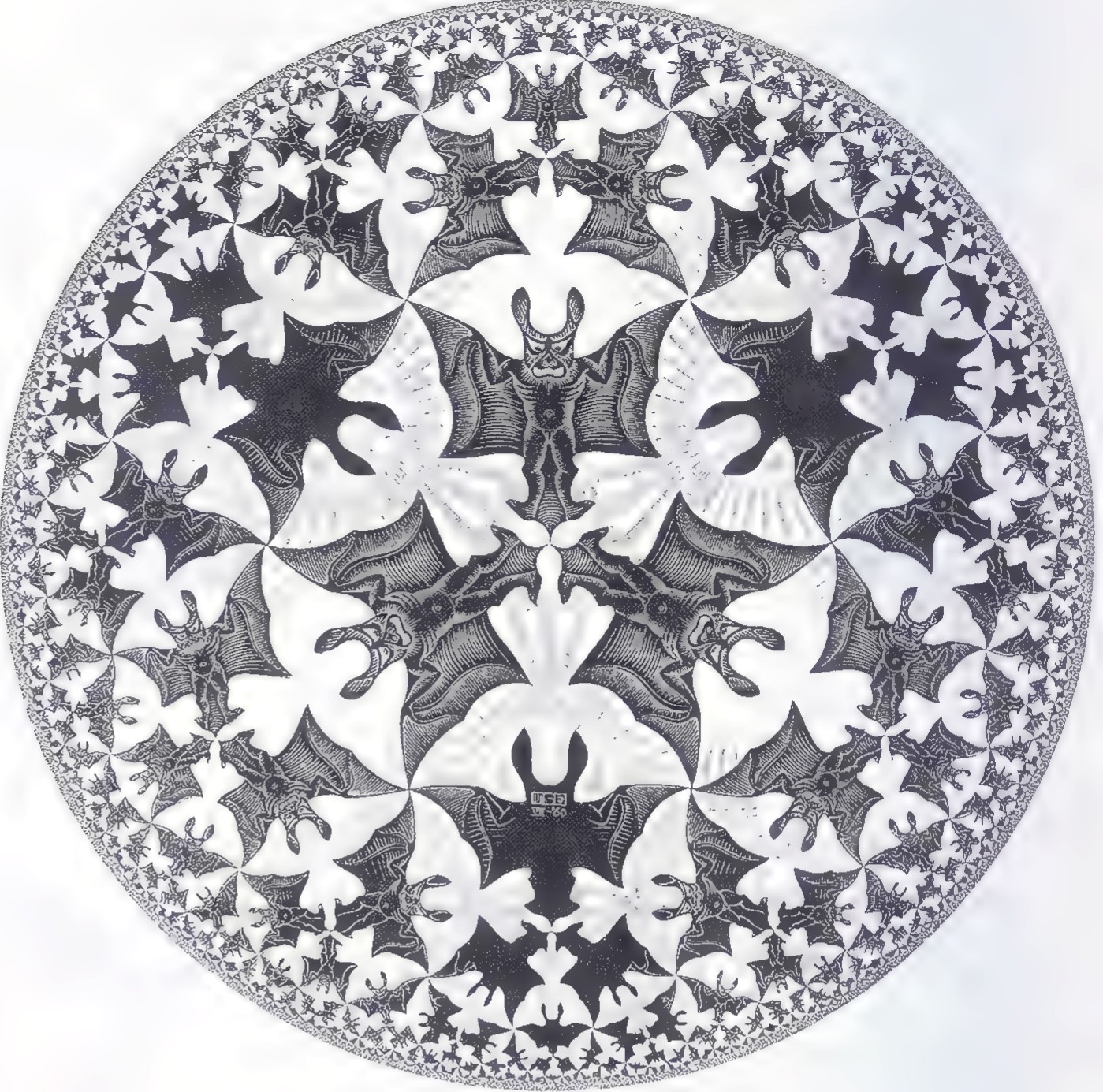
Lesson 5: Secant Angles
In this circular woodcut by Escher, pictures of angels and devils are fitted together like pieces in a jigsaw puzzle. But, unlike those of a jigsaw puzzle, the parts become progressively smaller and more numerous as they approach the edge. By this device, the artist has managed to convey an impression of the infinite within a finite region.
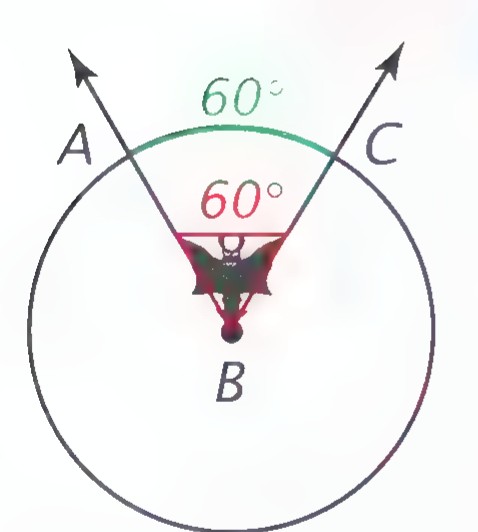
The intricate and orderly design of the picture shows that Escher was strongly influenced by ideas from geometry. For example, if the wing tips of the large devils and angels that meet in the center are connected to the center and to each other by line segments, six equilateral triangles are formed.
One of these triangles is shown in the first figure at the left. Because the triangle is equilateral, the angle at the center has a measure of 60°. If we extend the angle’s sides so that they intersect the circle, the intercepted arc also must have a measure of 60°.
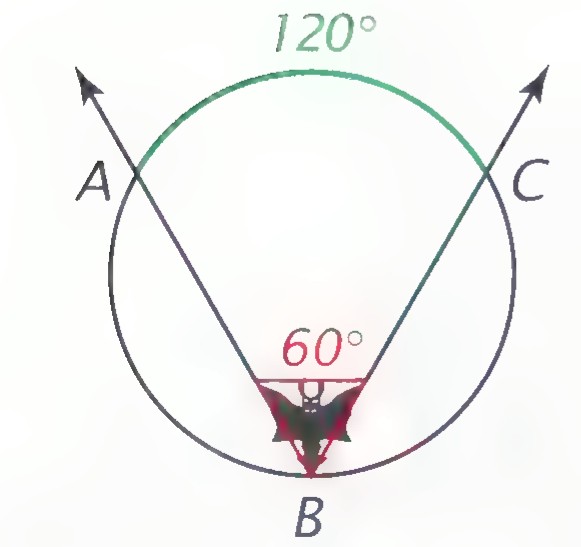
If the vertex of this angle were on the circle rather than at its center, as shown in the second figure, it would be an inscribed angle and would intercept a larger arc having a measure of 120°.
p. 511
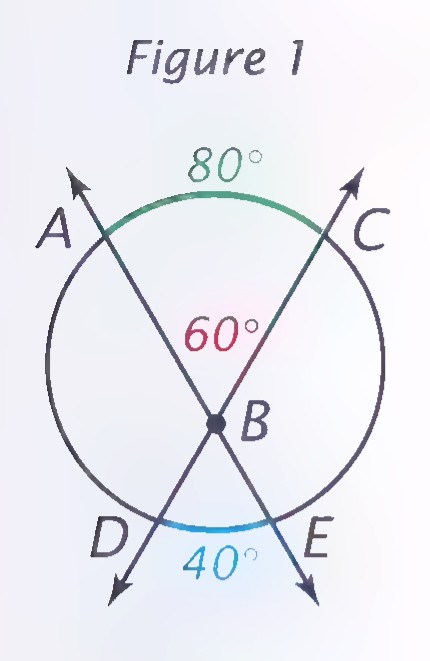
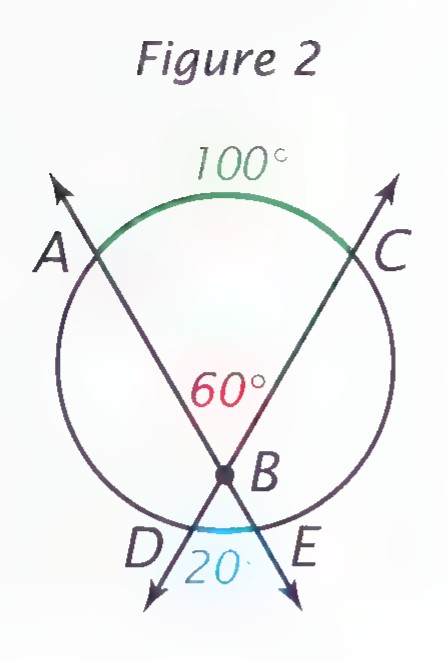
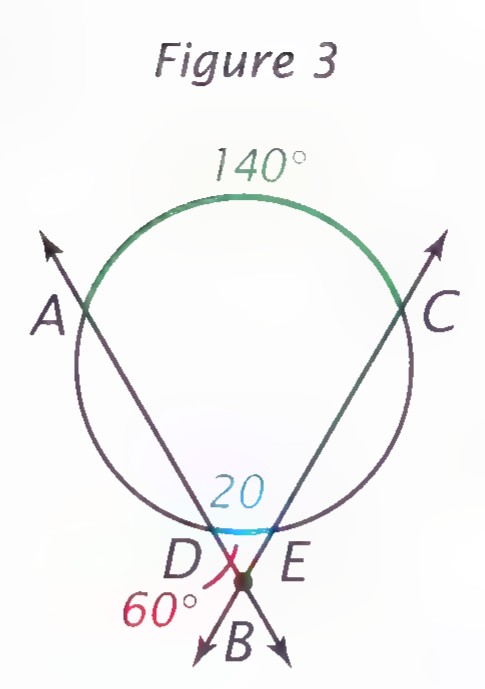
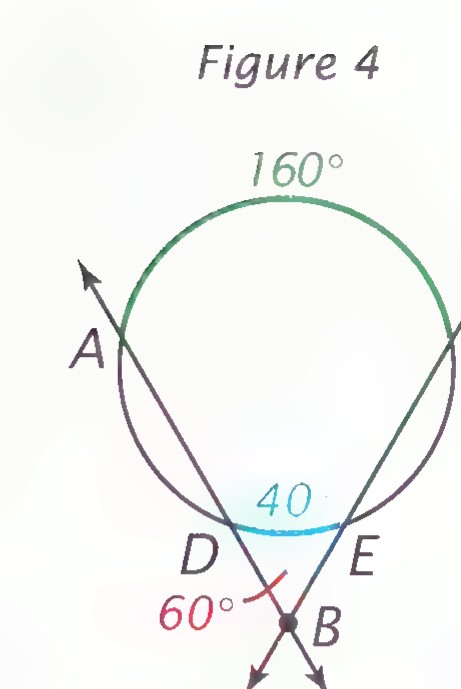
We know the relation between the measures of central and inscribed angles and the arcs that they intercept. What about other angles, such as those shown above?
In figures 1 and 2, the vertex of the angle is inside the circle. Although the size of the arc intercepted by the angle differs in each picture, the sum of the measures of that arc and the arc intercepted by its vertical angle does not change. A comparable result holds for figures 3 and 4, where the vertex of the angle is outside the circle. Here, the difference of the measures of the two intercepted arcs does not change.
The lines that form the angles in these figures are called secants.
Definition
A secant is a line that intersects a circle in two points.
The angles labeled ∠ABC in the figures are called secant angles.
Definition
A secant angle is an angle whose sides are contained in two secants of a circle so that each side intersects the circle in at least one point other than the angle’s vertex.
The four figures above suggest the following theorems.
Theorem 64
A secant angle whose vertex is inside a circle is equal in measure to half the sum of the arcs intercepted by it and its vertical angle.
Theorem 65
A secant angle whose vertex is outside a circle is equal in measure to half the difference of its larger and smaller intercepted arcs.
p. 512
Exercises
Set I
Complete the following proof of Theorem 64 by giving the reasons.
Theorem 64. A secant angle whose vertex is inside a circle is equal in measure to half the sum of the arcs intercepted by it and its vertical angle.
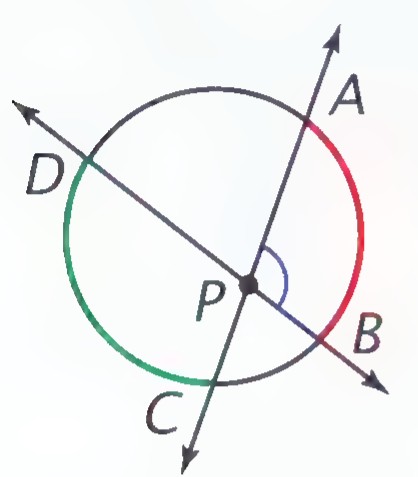
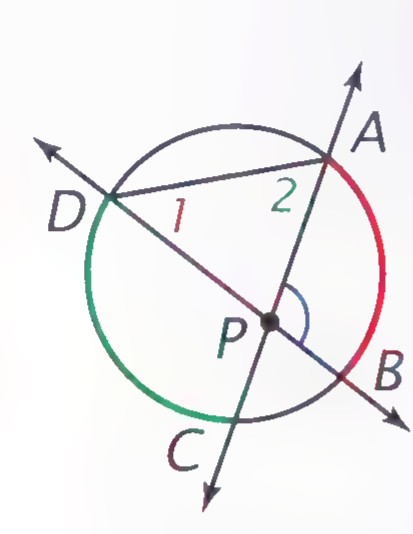
Given: Secant ∠APB with P inside the circle.
Prove: .
Proof
- Draw DA. Why?
- ∠APB = ∠1 + ∠2. Why?
- and . Why?
- . Why?
In the figure below, chords AB and CD cut the circle into four arcs whose measures are given in terms of x.
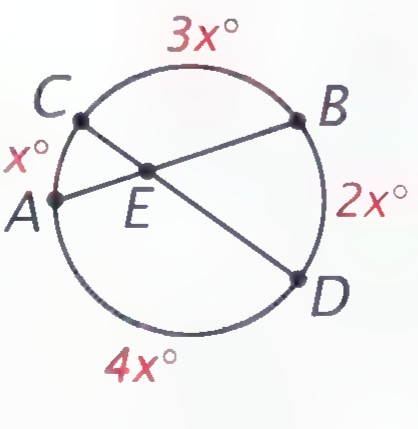
- Find x.
- Find the measures of the four arcs.
- Find the measures of the angles formed by the chords.
Complete the following proof of Theorem 65 by giving the reasons.
Theorem 65. A secant angle whose vertex is outside a circle is equal in measure to half the difference of its larger and smaller intercepted arcs.
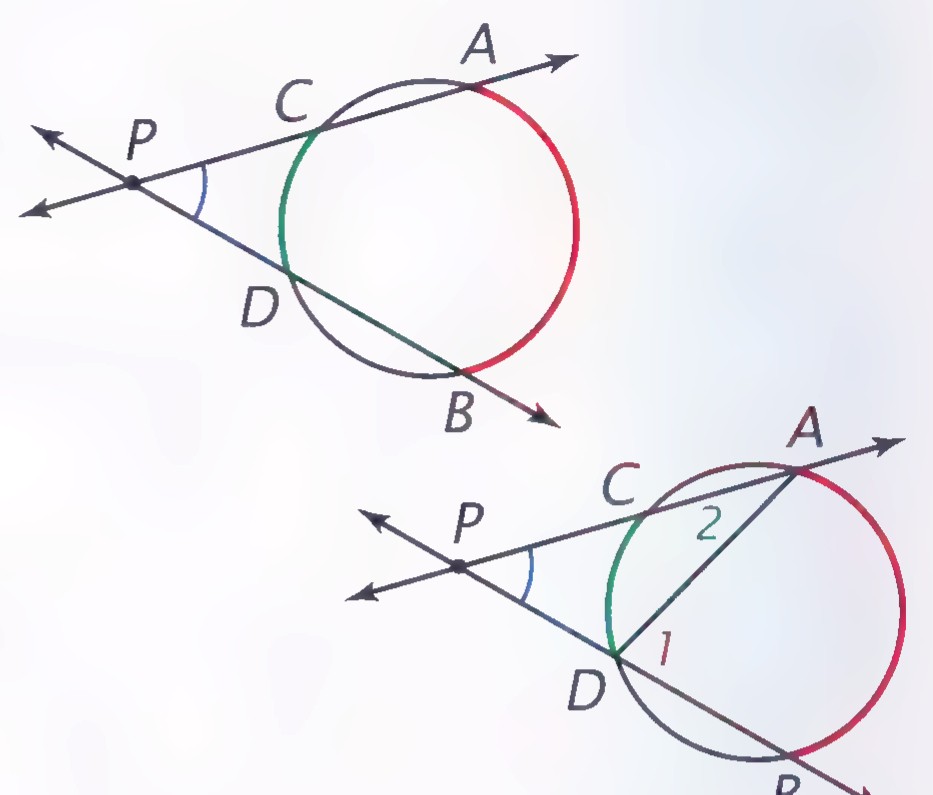
Given: Secant ∠APB with P outside the circle.
Prove: .
Proof
- Draw DA. Why?
- ∠1 = ∠APB + ∠2. Why?
- ∠APB = ∠1 − ∠2. Why?
- and . Why?
- . Why?
In the figure below, the sides of △ABC cut the circle into four arcs, three of whose measures are given.
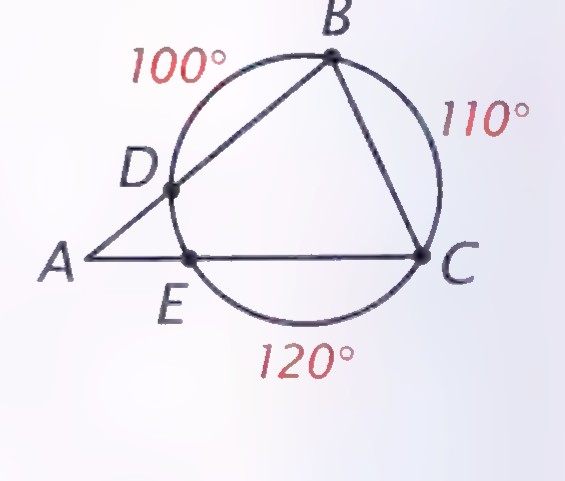
- Find .
- Find ∠A.
- Find ∠B.
- Find ∠C.
p. 513
Danger Angle. A “danger angle” is used by navigators to avoid a hazardous region near a coast.*
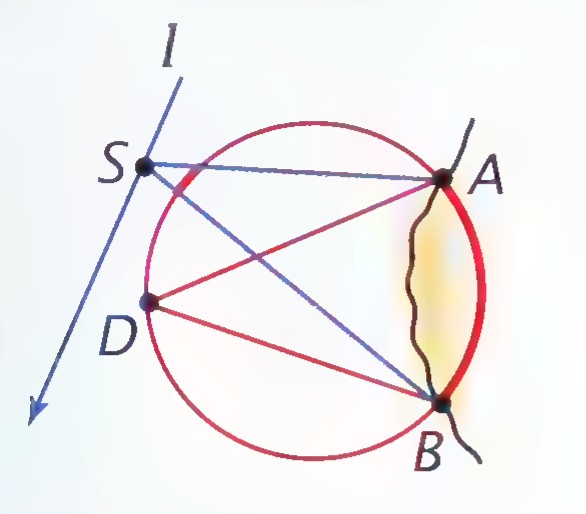
In the figure above, line l represents the path of a ship and points A and B represent two lighthouses on the coast. The hazardous region is inside the circle.
- What is the danger angle, ∠D, called with respect to the circle?
- Given that , find ∠D.
- What is ∠S called with respect to the circle?
- What can you conclude about the measure of ∠S when the ship is at S?
- What could you conclude about the measure of ∠S if S were inside the danger circle?
Perpendicular Chords. In the figure below, AB ⊥ CD.
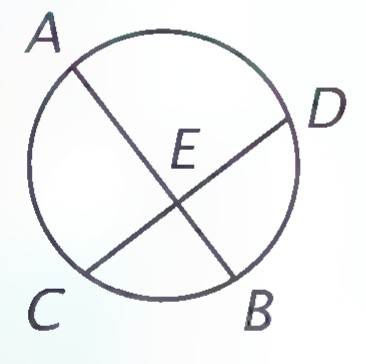
What can you conclude about
- ∠AED?
- ?
- ?
Given that and , find
- .
- .
* Dutton’s Navigation and Piloting, by Elbert S. Maloney (Naval Institute Press, 1985).
Star Problem 1. In the figure below, the star divides the circle into equal arcs.
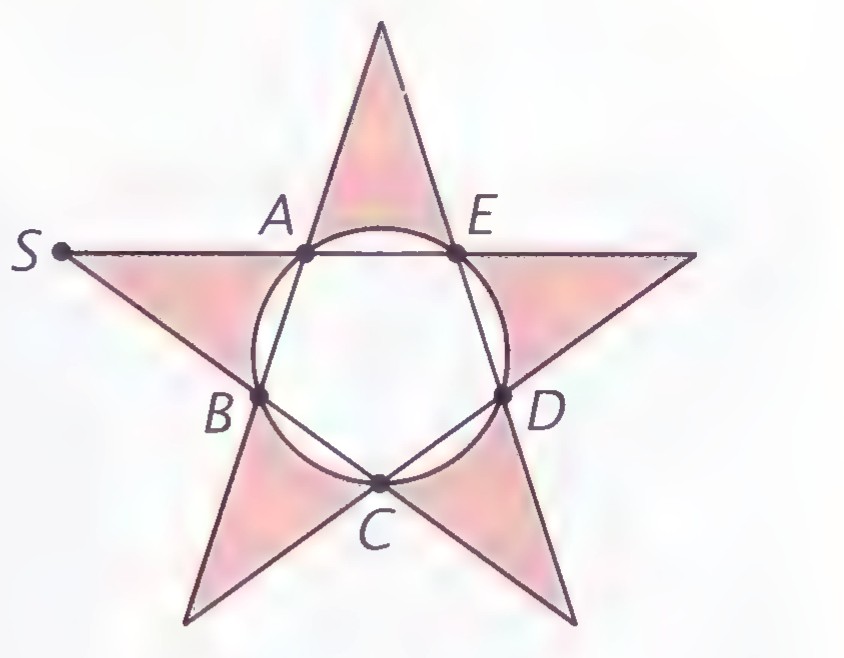
Find each of the following measures.
.
.
∠S.
.
∠ABC.
What is the sum of the five angles at the points of the star?
Star Problem 2. In the figure below, the points of the star divide the circle into equal arcs.
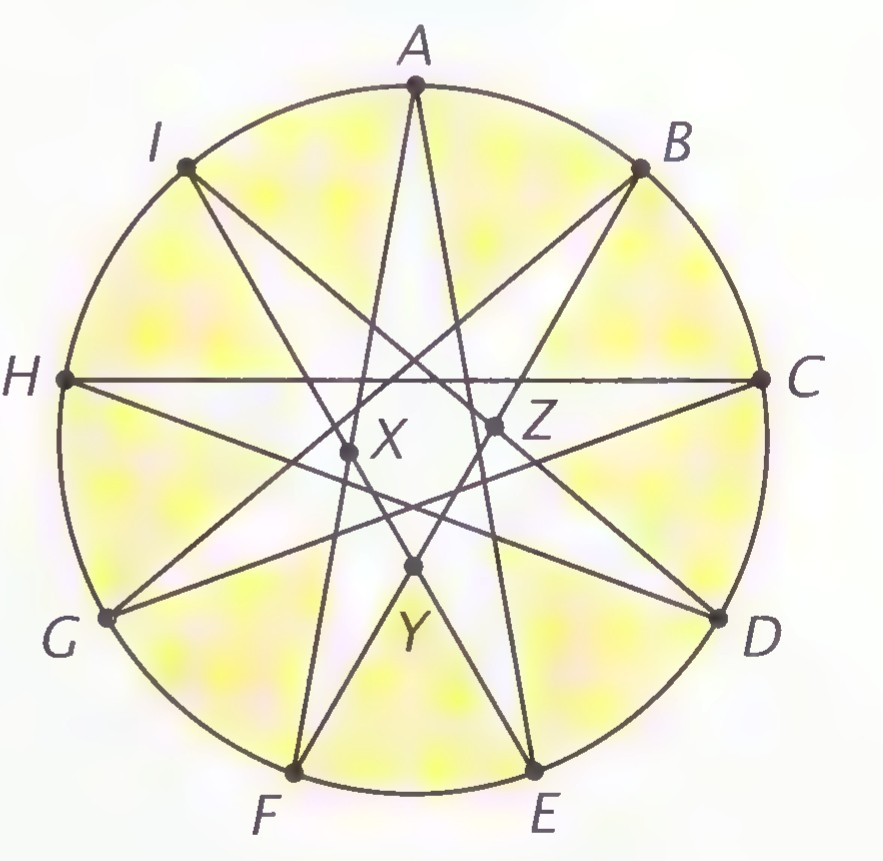
Find each of the following measures.
.
∠A.
∠AXI.
∠FYE.
∠BZD.
What is the sum of the nine angles at the points of the star?
p. 514
Set II
Angle of View. The angle of view of a camera lens is about 50°.*

The figure below shows an overhead view of the photograph setup. The camera is at C so that a group of people standing between A and B just fits in its angle of view.
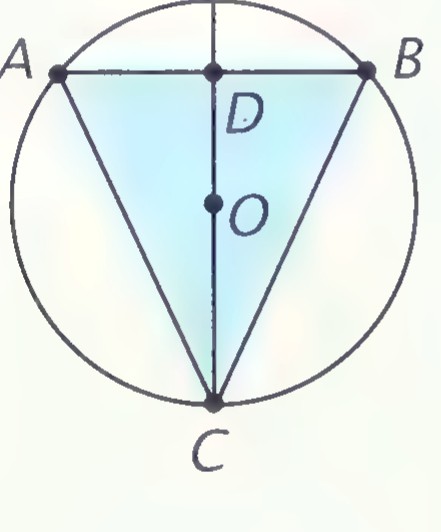
- Given that ∠ACB = 50°, find .
- Given that AD = DB, why is CD ⊥ AB?
- Why is △ACD ≅ △BCD?
Suppose the people standing between A and B form a row 16 feet long, making AB = 16.
- Find CD to the nearest foot.
- To where else could the photographer move so that the row of people just fits into the camera’s angle of view?
- What effect would moving the camera toward AB along CD have on the photograph?
* The Camera (Time-Life Books, 1970).
The Seasons. The Greek astronomer Hipparchus used the figure below to explain the lengths of the four seasons.†
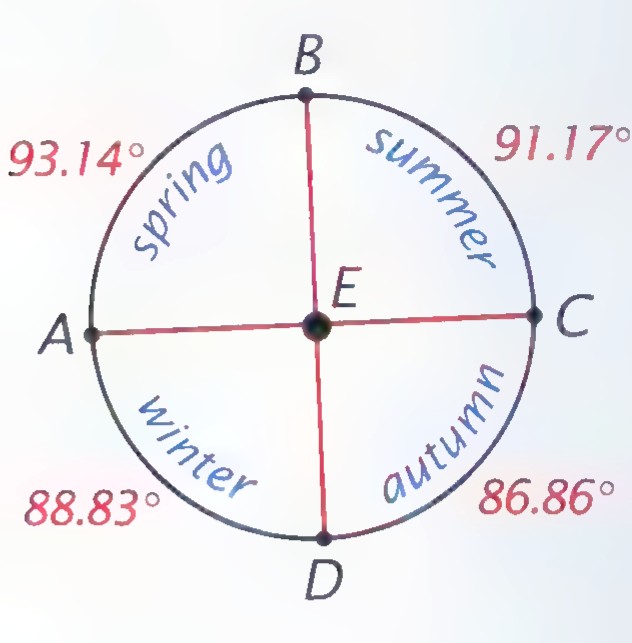
He thought that, during a year, the sun traveled in a circle at a steady speed around the earth.
- Given that chords AC and BD intersect at E, find the measures of the four angles at E corresponding to the four seasons.
- Did Hipparchus place the earth, E, at the center of the circle? Explain.
- According to the figure, which season lasts the longest?
- A year is 365.25 days; according to Hipparchus, how many days did summer last?
Place Kicker. The figure below (not to scale) shows an overhead view of a football field with a place kicker at P and goal posts at A and B.
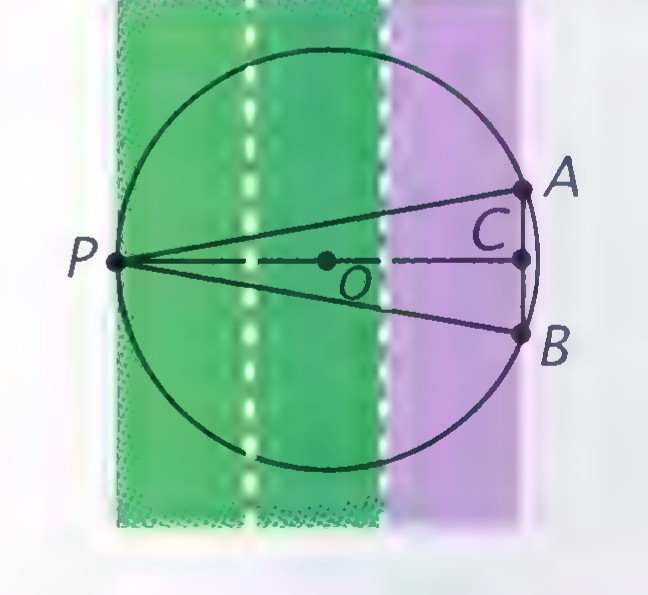
- Copy the circle and lines inside it and mark your figure as needed to do each of the following exercises.
† The Cambridge Illustrated History of Astronomy, Michael Hoskin, ed. (Cambridge University Press, 1997).
p. 515
- Given that O is the center of the circle and PC ⊥ AB, what can you conclude about point C? Explain.
Given that the kicker is on the 20-yard line (which makes PC = 90 feet) and that AB (the distance between the goal posts) is 18.5 feet, find each of the following measures to the nearest degree.
- ∠APC.
- ∠APB.
- .
- For what other positions of the kicker is the angle between the goal posts the same?
- What would happen to the angle if the kicker were to move from P to a place outside the circle?
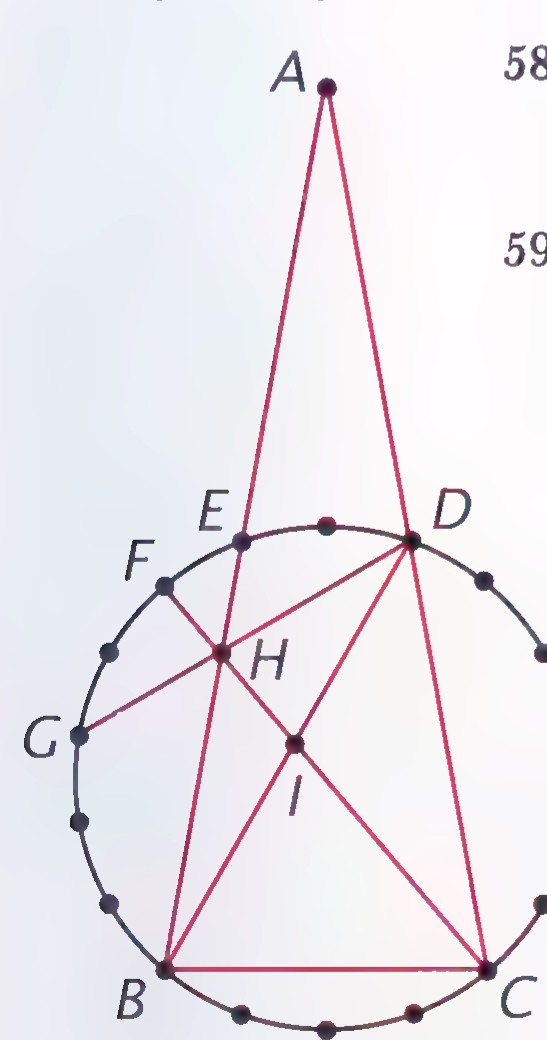
Angles Problem. The figure below consists of six line segments and a circle divided into 18 equal arcs.
- What is the measure of each small arc?
- Use your protractor and ruler to make a large copy of the figure. Find and mark the measures of as many angles in your figure as you can.
- Name the triangles in the figure that are isosceles.
- Name two triangles that are similar.
Set III
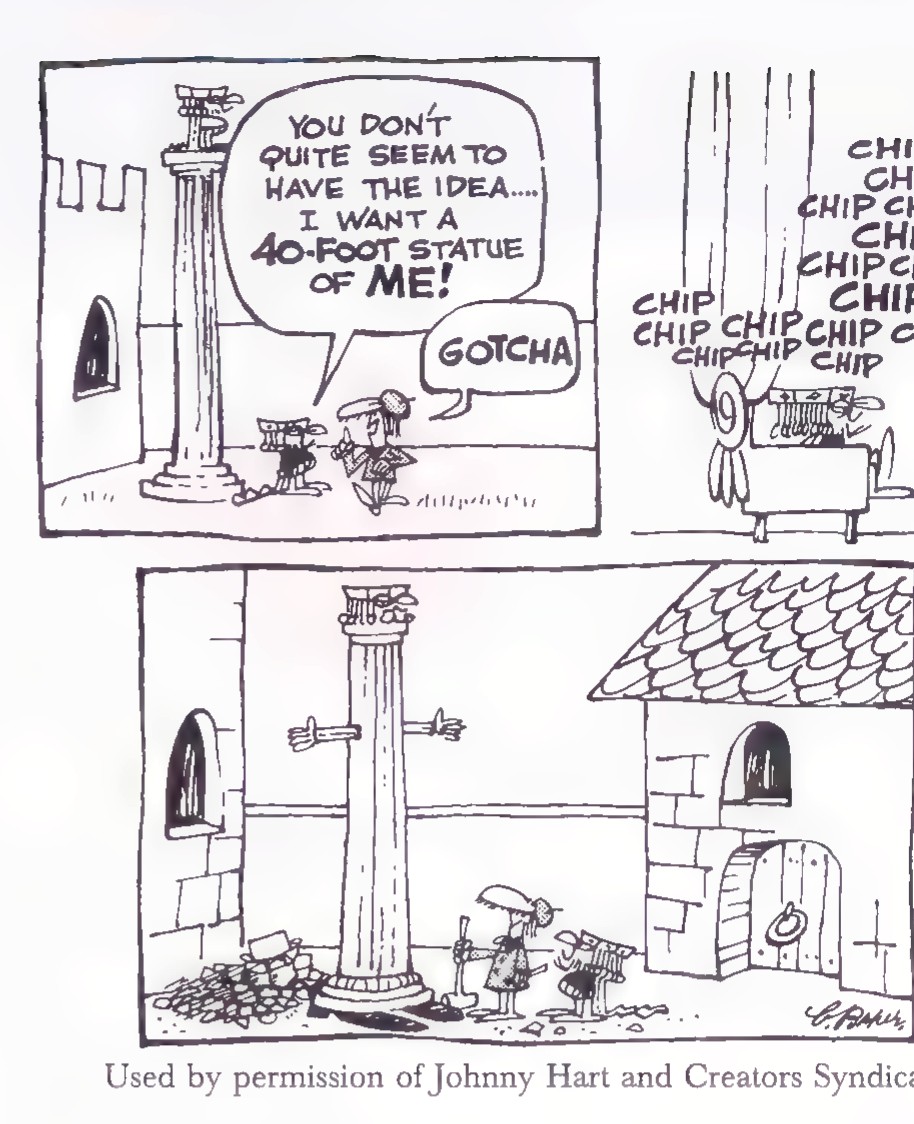
Used by permission of Johnny Hart and Creators Syndicate, Inc.
The King of Id has commissioned a statue of himself for the village square. Unfortunately, what the royal sculptor has turned out so far doesn’t seem to be what the king has in mind.
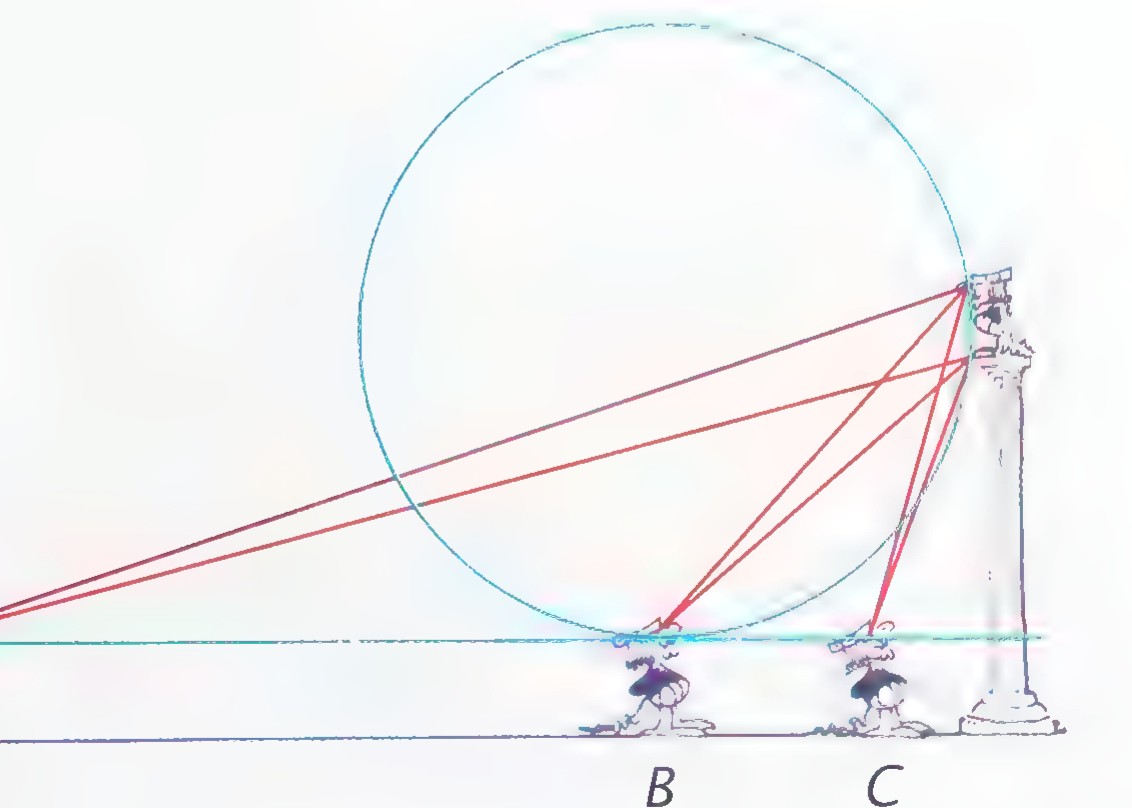
The figure below shows three positions of the king as he walks toward the original statue. The measure of the angle formed by the king’s lines of sight to the top and bottom of the statue depends on where the king is standing. Can you describe what happens to it as the king walks from a great distance away to the base of the statue?
p. 516

Lesson 6: Tangent Segments and Intersecting Chords
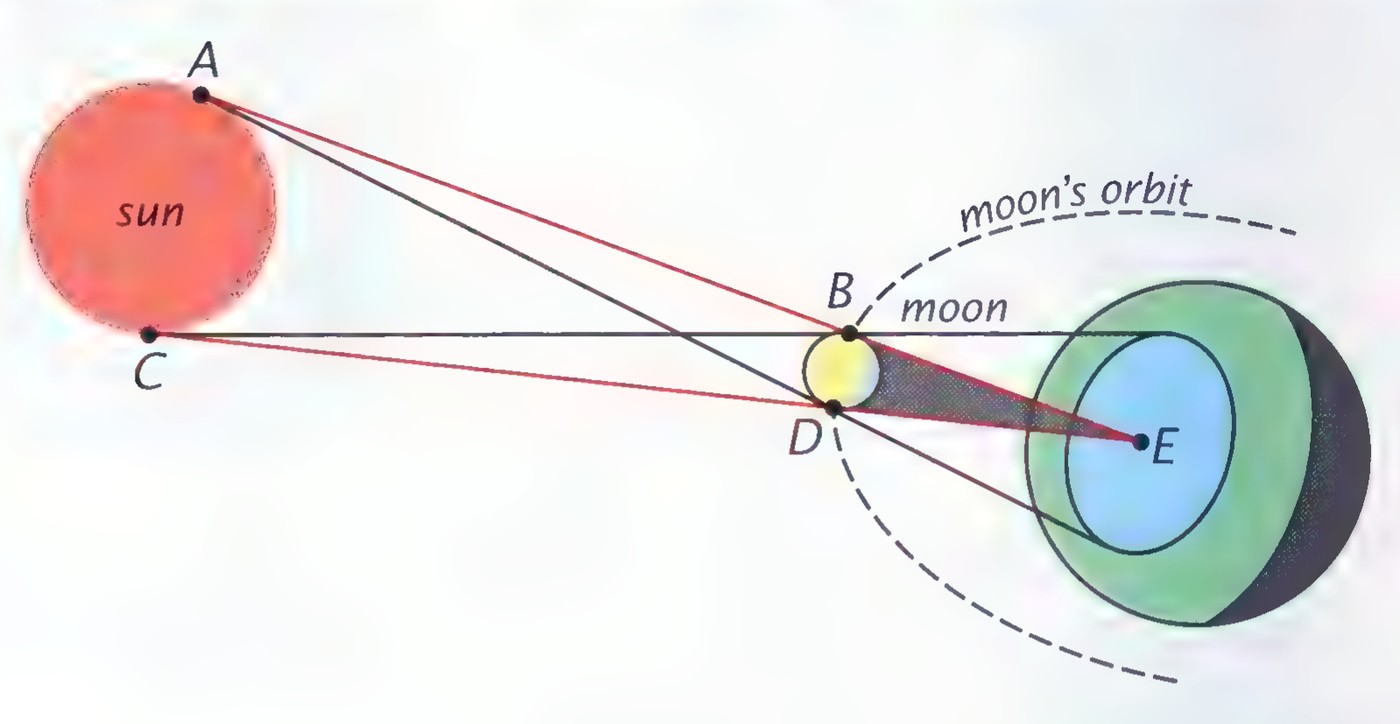
A total eclipse of the sun is a spectacular sight. The first recorded description of a solar eclipse was on October 22, 2137 B.C. It was seen in China, and the people ran through the streets beating drums and shooting fireworks to try to scare away the dragon that was swallowing the sun.*
Such an eclipse occurs when the moon passes between the earth and the sun in such a way that its shadow touches the earth. This shadow is a cone. Because of the relative sizes of the moon and sun and their relative distances from the earth, the tip of the cone often misses the earth. But when it touches the earth, a total eclipse can be seen by those in the area of contact.
At the same time, a partial eclipse of the sun can be seen from a much larger region, shaded blue in the diagram. Within this region, the disk of the sun is only partly covered by the moon.
The lines of the shadows in the figure are tangent to the circles that represent the sun and moon. Two of them, AB and CD, meet in point E. The segments EA and EC are called tangent segments from point E to the circle of the sun; segments EB and ED are tangent segments from point E to the circle of the moon.
* Sun and Earth, by Herbert Friedman (Scientific American Library, 1986).
p. 517
Definition
If a line is tangent to a circle, then any segment of the line having the point of tangency as one of its endpoints is a tangent segment to the circle.
It is easy to prove that the two tangent segments from an external point to a circle are always equal, no matter where the point and circle may be.
Theorem 66. The Tangent Segments Theorem
The tangent segments to a circle from an external point are equal.
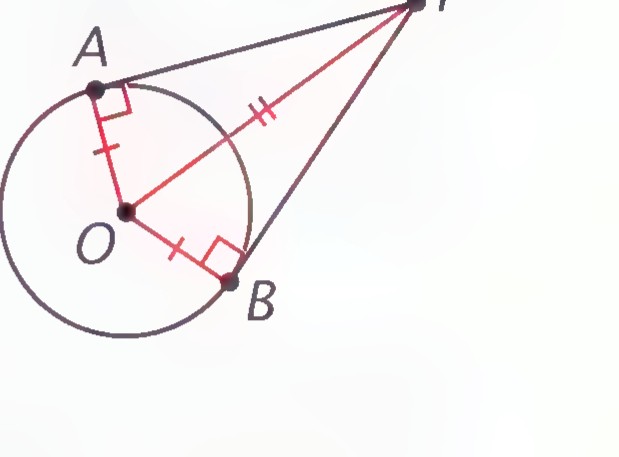
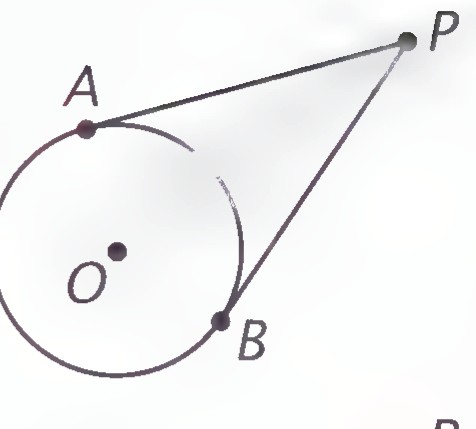
Given: Circle O with tangent segments PA and PB.
Prove: PA = PB.
Proof
Draw PO, OA, and OB. Because PA and PB are tangent segments to circle O, PA ⊥ OA and PB ⊥ OB (if a line is tangent to a circle, it is perpendicular to the radius drawn to the point of contact). Therefore, ∠PAO and ∠PBO are right angles; so △PAO and △PBO are right triangles. Because OA = OB (all radii of a circle are equal) and PO = PO, △PAO ≅ △PBO (HL). Therefore, PA = PB.
The Tangent Segments Theorem is not surprising. Another theorem about two segments related to a circle is quite surprising. This theorem is about two chords that intersect inside a circle.
Theorem 67. The Intersecting Chords Theorem
If two chords intersect in a circle, the product of the lengths of the segments of one chord is equal to the product of the lengths of the segments of the other chord.
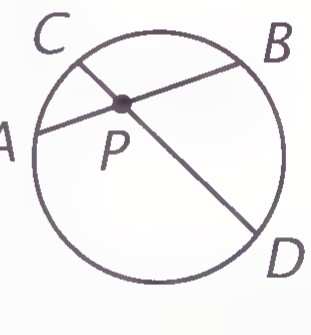
In regard to the figure at the right in which chords AB and CD intersect at P, this theorem says that AP · PB = CP · PD. The proof is easier than you might guess and is included in the exercises.
Exercises
Set I
Korean Proof. At the right is the proof of one of the theorems of this lesson as it appears in a Korean geometry book.
- What do you think the statement that ∠PTO = ∠PT′O = ∠R means?
- Why is OT = OT′?
- Why is △POT ≅ △POT′?
- Why is PT = PT′?
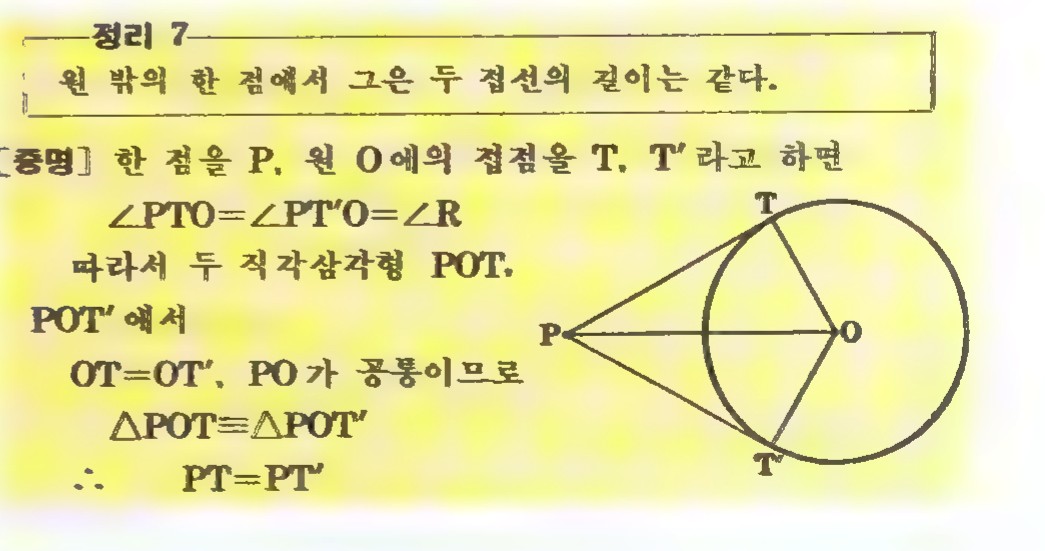
- State the theorem that has been proved as a complete sentence.
p. 518
Complete the following proof of Theorem 67 by giving the reasons.
Theorem 67. If two chords intersect in a circle, the product of the lengths of the segments of one chord is equal to the product of the lengths of the segments of the other chord.
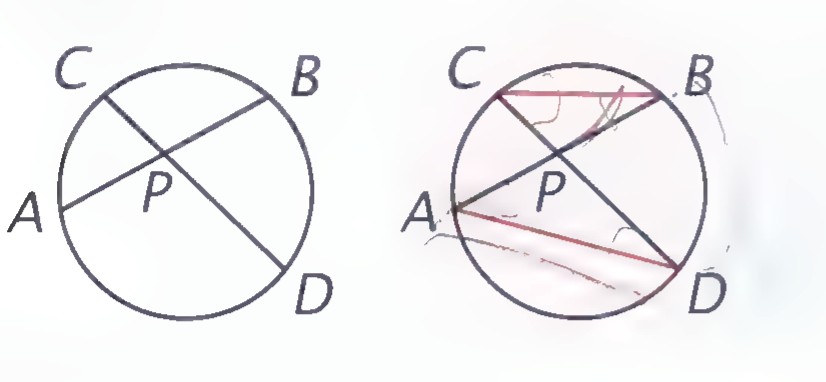
Given: Chords AB and CD intersect at point P in the circle.
Prove: PA · PB = PC · PD.
Proof
- Draw CB and AD. Why?
- ∠A = ∠C and ∠D = ∠B. Why?
- △APD ~ △CPB. Why?
- . Why?
- PA · PB = PC · PD. Why?
Lunar Eclipse. The figure below (not to scale) represents an eclipse of the moon. Segments AP and CP are tangent to the circles of the sun and the earth.
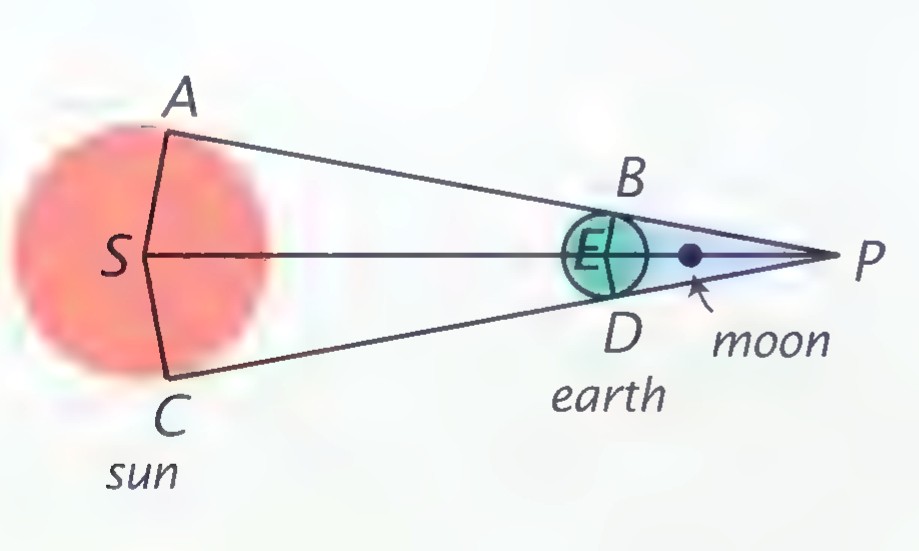
- Why is SA ∥ EB and SC ∥ ED?
- Why is AP = CP and BP = DP?
- Why is △SAP ≅ △SCP?
- Why does PS bisect ∠APC?
- Why is △SAP ∼ △EBP?
Intersecting Chords. In the figure below, chords AB, CD, EF, and GH intersect in point P.
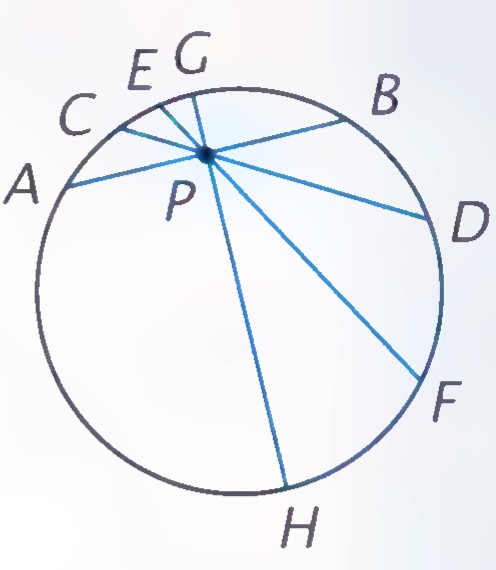
As the chords get longer, what happens to
- the sum of the lengths of the two segments into which P divides them?
- the product of the lengths of the two segments into which P divides them?
Tangent Construction. A method for constructing the tangents to a given circle from a given external point is illustrated by the figures below.

- Draw a circle with center at O and choose an external point P as shown above.
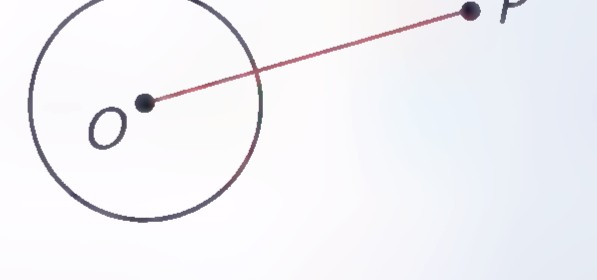
- Draw OP.
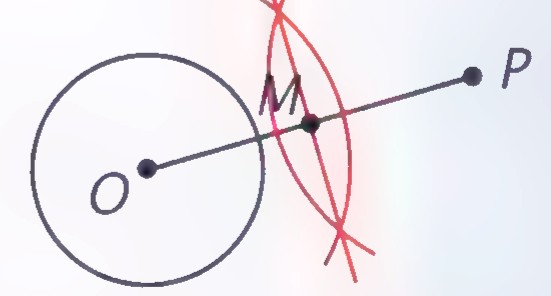
- Bisect OP and label its midpoint M.
p. 519
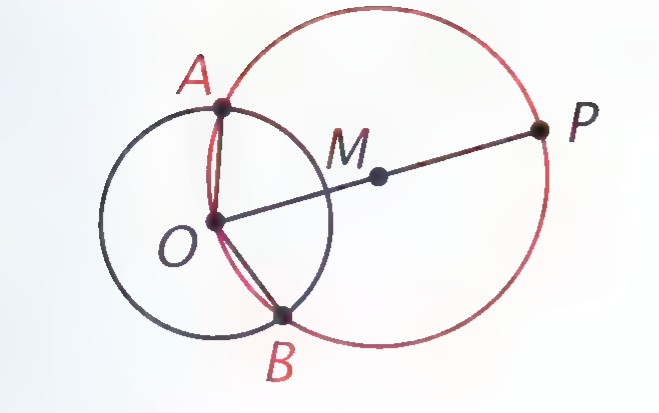
- Draw a circle with M as center and MO as radius. Let A and B be the two points in which this circle intersects circle O.
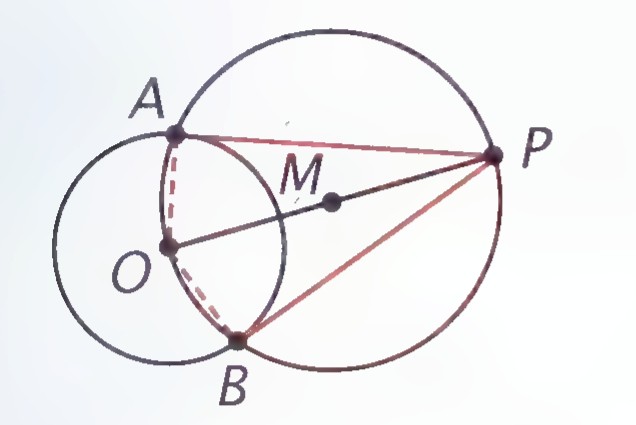
- Draw PA and PB.
Explain how the construction works by answering each of the following questions.
- What kind of angles are ∠OAP and ∠OBP? Explain.
- What relation does PA have to OA and PB have to OB?
- Why are PA and PB tangent to circle O?
Tangent Triangle. The sides of △ABC are tangent to circle O at D, E, and F; AC = 9, CB = 12, and AB = 15.
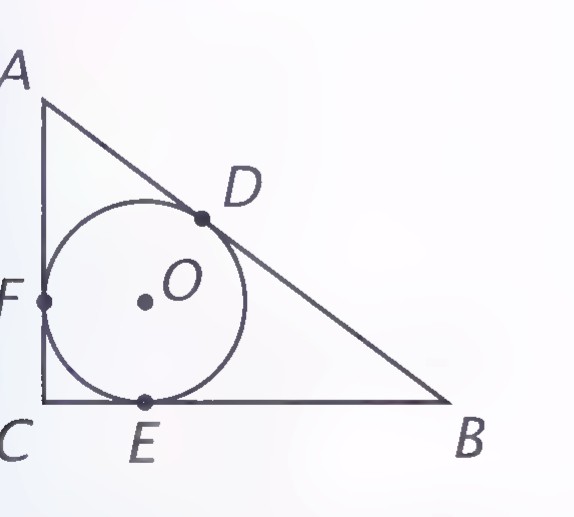
Copy the figure and mark it as needed to do each of the following exercises.
What can you conclude about △ABC? Explain.
(continued) Draw OF and OE.
What can you conclude about CFOE?
(continued) Given OF = OE = r, express the other lengths in the figure in terms of r.
Write an equation and solve it for r.
Tangent Quadrilateral. In the figure below, the sides of quadrilateral ABCD are tangent to the circle at points E, F, G, and H; AE = w, EB = x, DG = y, and GC = z.
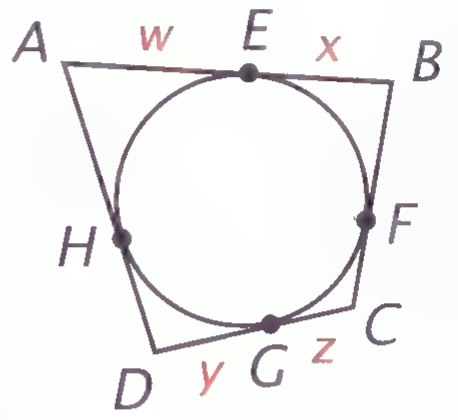
- Copy the figure and label the lengths of the other four tangent segments.
- What do you notice about the opposite sides of ABCD? Explain.
Set II
Grid Exercise 1. On graph paper, draw a pair of axes extending 10 units in each direction from the origin.
- Use your compass to draw a circle with its center at (0, 0) and radius 5.
- Use the distance formula to show that, if P(x, y) is on this circle, then .
- (continued) Label the following points on the circle: A(0, 5) and B(4, −3).
- Show that the coordinates of points A and B are solutions to the equation .
- (continued) Plot point P(10, 5) and draw PA, PB, and OB.
- How do you know that PA is tangent to circle O?
- Use the slopes of PB and OB to show that PB also is tangent to the circle.
p. 520
- Find the lengths of PA and PB.
- (continued) Label the following points on the circle: C(−4, 3) and D(−3, −4).
- From what point can tangent segments be drawn to touch the circle at C and D?
Ridiculous Question. The following problem was once posed as a “ridiculous question” in Scientific American magazine.*
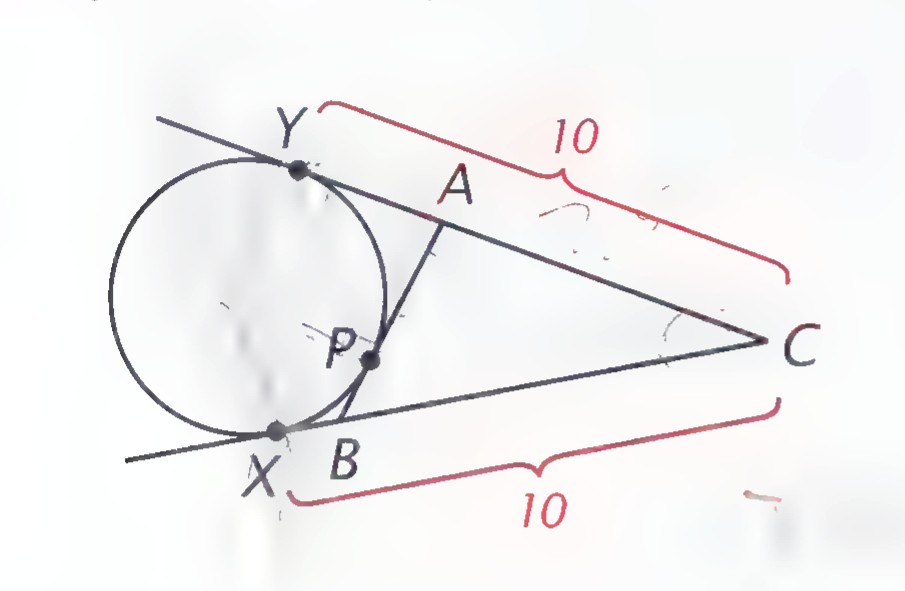
Tangent segments CX and CY have been drawn from point C to the circle. Each has a length of 10 units. Point P has been randomly chosen on the circle and AB then drawn tangent to the circle at P.
- What is the perimeter of △ABC?
- Explain your reasoning.
- Why do you suppose the problem of finding the perimeter of △ABC was called “ridiculous”?
Grid Exercise 2. On graph paper, draw a pair of axes extending 15 units to the right and 15 units up from the origin.
- Use your compass to draw a circle with its center at (9, 8) and radius 5.
- Use the distance formula to show that, if P(x, y) is on this circle, then .
- (continued) Label the following points on the circle: A(9, 13), B(14, 8), C(13, 11), and D(6, 4).
* Mathematical Magic Show, by Martin Gardner (Knopf, 1977).
- Show that the coordinates of these points are solutions to the equation .
- (continued) Draw AB and CD and let P be the point in which they intersect.
- The coordinates of P are integers. What are they?
- Find the exact lengths of PA, PB, PC, and PD.
- Find PA · PB and PC · PD.
Chord Division. In the figure below, diameter AB of circle O is perpendicular to chord CD; CP = x, OP = d, and OB = r.
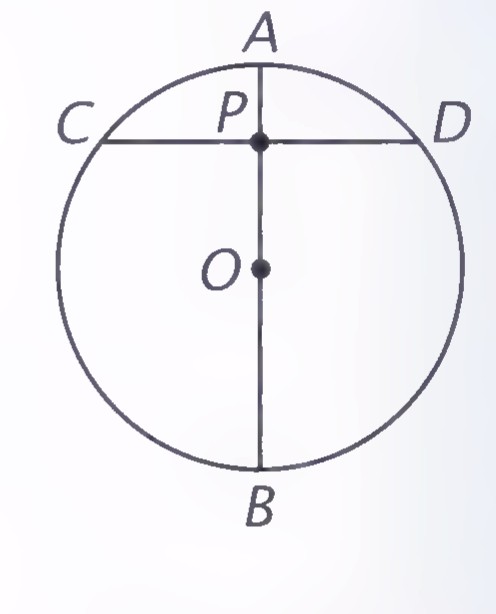
- Copy the figure and mark it as needed to do each of the following exercises.
- Why is PD = x?
Name a line segment in the figure whose length is
- r + d.
- r − d.
- Use the Intersecting Chords Theorem to show that .
- (continued) Draw another chord through P and label its endpoints E and F.
- Show that EP · PF = .
The result of exercise 49 shows how the product of the lengths of the segments into which a point divides a chord, EP · PF, is determined by r and d.
- What do r and d represent with respect to the circle and the chord?
p. 521
Suppose a circle has a radius of 5.
- Where would you draw a chord, EF, and where would you choose a point P on it so that EP · PF is as large as possible?
- To what number would EP · PF be equal?
Earth’s Shadow. The following problem is based on the drawing for exercises 11 through 15.
- Given that the radii of the sun and the earth are 432,000 miles and 3,960 miles, respectively, and that the distance between their centers is 93,000,000 miles, find EP, the length of the earth’s shadow.
Set III
The Brick Moon. The first known proposal for a space station above the earth appeared in a story titled “The Brick Moon” published in 1869.*
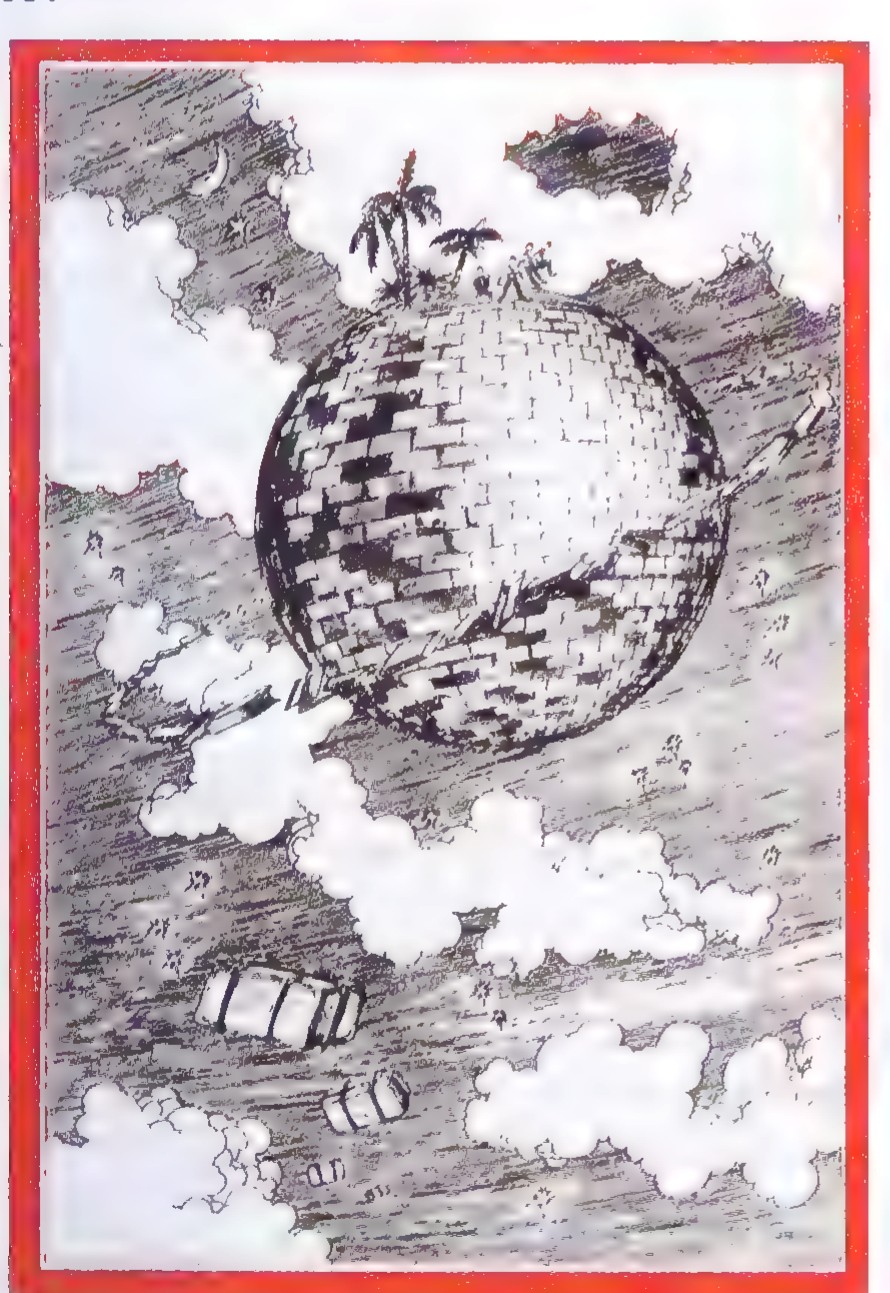
According to the story, the “Brick Moon” should be in an orbit 4,000 miles high.
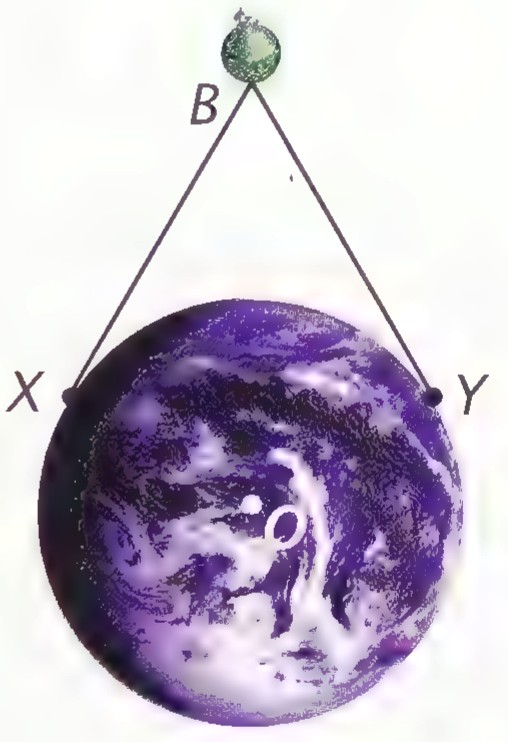
Copy the figure above in which circle O represents the earth, point B represents the Brick Moon, and X and Y represent the farthest points on the earth from which the Brick Moon can be seen. Use 4,000 miles as the radius of the earth and find the distance from the Brick Moon to these two points.
* Space Travel: A History, by Wernher von Braun and Frederick I. Ordway, III (Harper & Row, 1985).
p. 522
Summary and Review
Basic Ideas
- Central angle 498
- Chord 485
- Circle 484
- Concentric circles 484
- Degree measure of an arc 498
- Diameter 485
- Inscribed angle 505
- Major arc 497
- Minor arc 497
- Radius 485
- Reflex angle 498
- Secant 511
- Secant angle 511
- Semicircle 497
- Tangent 491
- Tangent segment 517
Postulate
- 10. The Arc Addition Postulate. If C is on , then . 499
Theorems
- Corollary to the definition of a circle. All radii of a circle are equal. 485
- 56. If a line through the center of a circle is perpendicular to a chord, it also bisects the chord. 485
- 57. If a line through the center of a circle bisects a chord that is not a diameter, it is also perpendicular to the chord. 485
- 58. The perpendicular bisector of a chord of a circle contains the center of the circle. 485
- 59. If a line is tangent to a circle, it is perpendicular to the radius drawn to the point of contact. 492
- 60. If a line is perpendicular to a radius at its outer endpoint, it is tangent to the circle. 492
Courtesy of Elmer Atkins; © 1963 Saturday Review, Inc.
- 61. In a circle, equal chords have equal arcs. 499
- 62. In a circle, equal arcs have equal chords. 499
- 63. An inscribed angle is equal in measure to half its intercepted arc. 505
- Corollary 1. Inscribed angles that intercept the same arc are equal. 505
- Corollary 2. An angle inscribed in a semicircle is a right angle. 505
- 64. A secant angle whose vertex is inside a circle is equal in measure to half the sum of the arcs intercepted by it and its vertical angle. 511
- 65. A secant angle whose vertex is outside a circle is equal in measure to half the difference of its larger and smaller intercepted arcs. 511
- 66. The Tangent Segments Theorem. The tangent segments to a circle from an external point are equal. 517
- 67. The Intersecting Chords Theorem. If two chords intersect in a circle, the product of the lengths of the segments of one chord is equal to the product of the lengths of the segments of the other chord. 517
p. 523

Exercises
Set I
Panoramic Camera. The photograph above of Paris was taken in 1846 with a camera whose lens could turn through an angle of 150°.
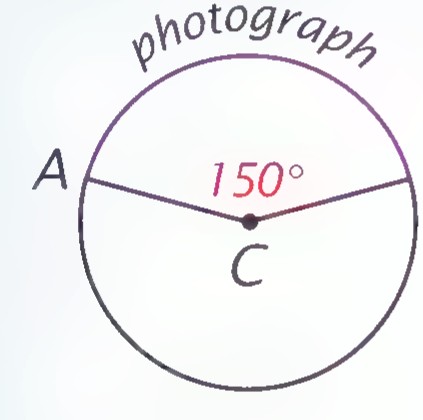
The figure above shows an overhead view with the camera at C. The scene photographed lies within the purple arc of ∠C.
- What are AC and CB called with respect to circle C?
- What is ∠C called?
- What kind of arc is the arc of the photograph?
- What is ?
Chords and Radius. An exercise in an old geometry book says to “draw a circle and then draw a chord equal to the radius. Also draw a chord equal to twice the radius.”*
- Use your straightedge and compass to make the drawing described.
- What is a chord equal to twice the radius called?
- What is the measure of the minor arc associated with the chord equal to the radius?
- What is the measure of one of the arcs associated with the chord equal to twice the radius?
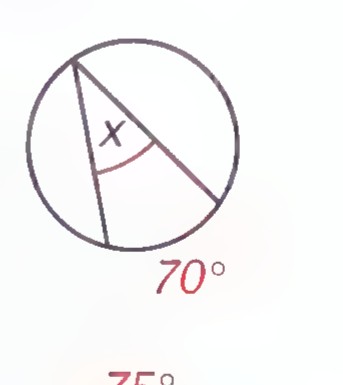
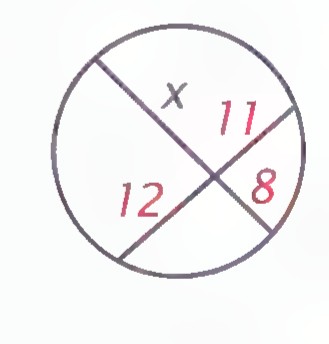
Finding Lengths and Angles. Solve for x in each of the following figures. The points labeled O are the centers of the circles.
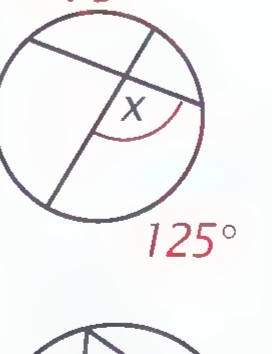
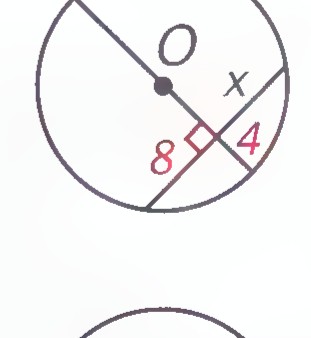
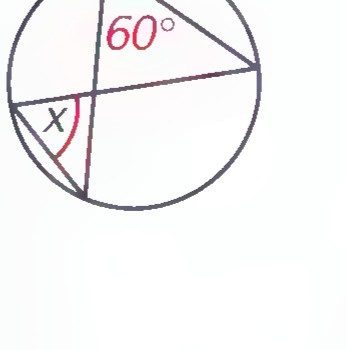
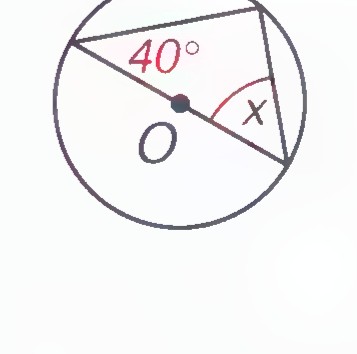
* First Steps in Geometry, by G. A. Wentworth and G. A. Hill (Ginn, 1901).
p. 524
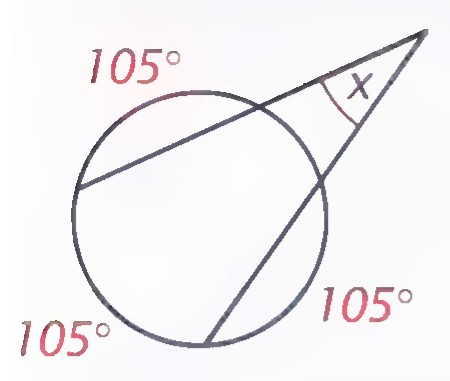
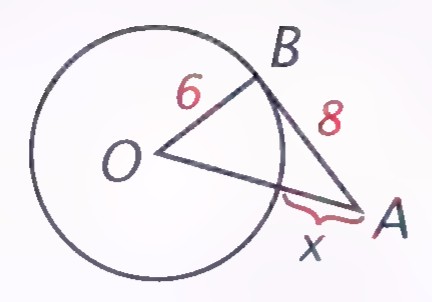
AB is tangent to circle O at B.
Two Equilateral Triangles. In the figure below, △ABC and △ADE are equilateral and A is the center of both circles. AB = 4 and BD = 2.
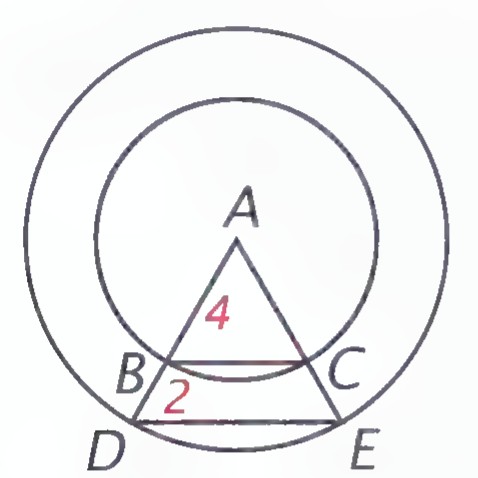
Find the following measures.
- BC.
- .
- DE.
- .
- How do BC and DE compare in length?
- How do and compare in measure?
Not Quite Right. In the figure below, sides AB and AD of quadrilateral ABCD are tangent to circle C.
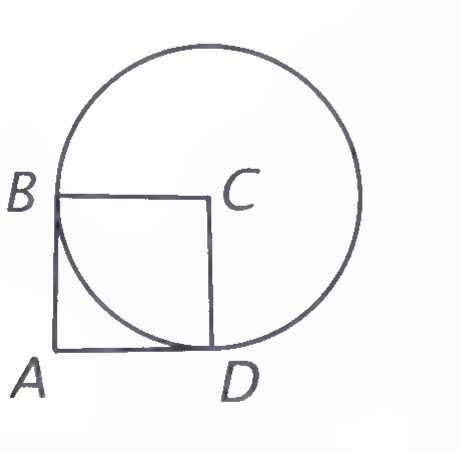
What can you conclude about
∠B and ∠D? Why?
∠A and ∠C? Why?
AB and AD? Why?
BC and CD? Why?
Three Ratios. In the figure below, circles have been drawn with two sides of equilateral △ABC as their diameters.
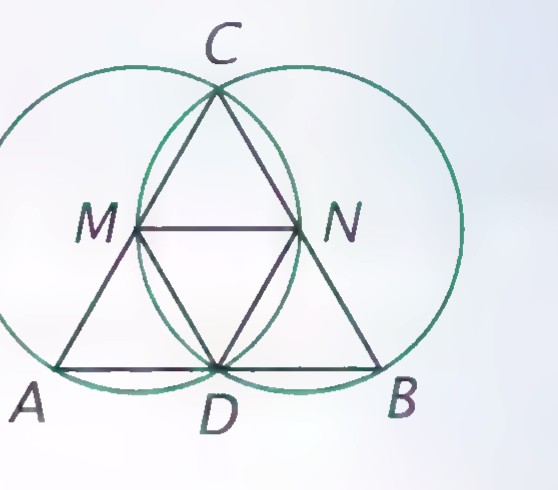
- What relation do the four small triangles have to △ABC?
Comparing one of these triangles with △ABC, find the ratio of their
- corresponding angles.
- corresponding sides.
- perimeters.
- areas.
Set II
Tangent Circles. In the figure below, circles O and P intersect at A. Also, AC and AD are chords of circle P.
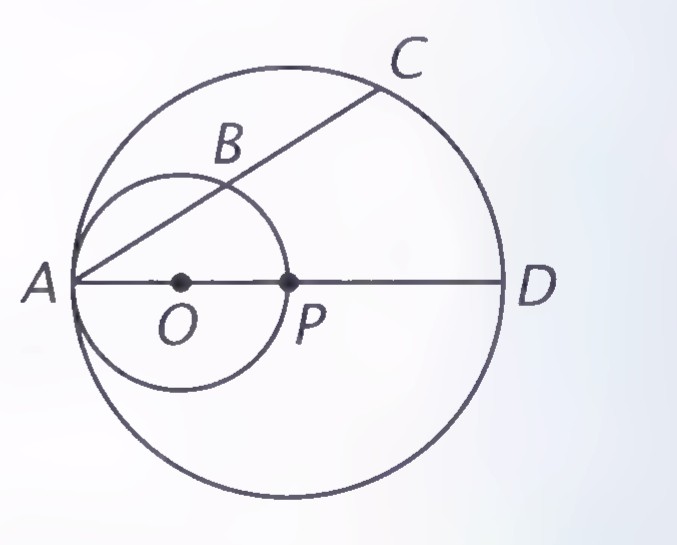
- Copy the figure and draw PB.
- What is the measure of ∠ABP? Explain.
- What does the measure of ∠ABP tell us about PB and AC?
- What can you conclude about AB and BC? Explain.
p. 525
- (continued) Draw OB and PC.
- What kind of triangles are △AOB and △APC?
- What else can you conclude about them? Explain.
- What can you conclude about OB and PC? Explain.

Arch Problem. The arches in the dome of Santa Maria del Fiore in Florence, Italy, are based on the geometric figure below.*
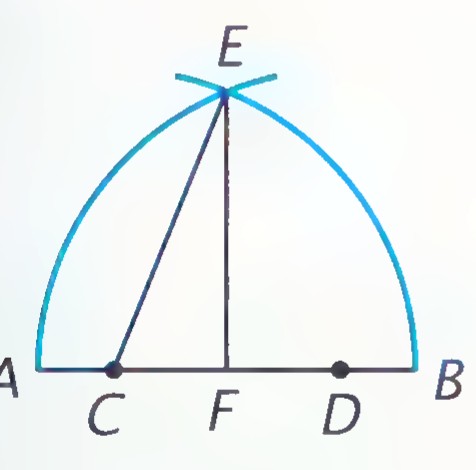
- Draw the figure as follows:
- Use your ruler to draw AB 5 cm long. Mark points C and D on AB so that AC = 1 cm and DB = 1 cm.
- With C as center and CB as radius, draw an arc as shown. With D as center and AD as radius, draw a second arc. Let E be the point in which the arcs intersect.
- From E, construct EF ⊥ AB. Also draw CE.
Calculate the following lengths. Mark each length on your figure as you find it.
- CE.
- CF.
- EF.
- Find , the ratio of the arch’s rise to its span.
- Find , the measure of one of the two arcs of the arch.
Prehistoric Ring. The inhabitants of prehistoric England constructed rings of standing stones in different geometric shapes.†
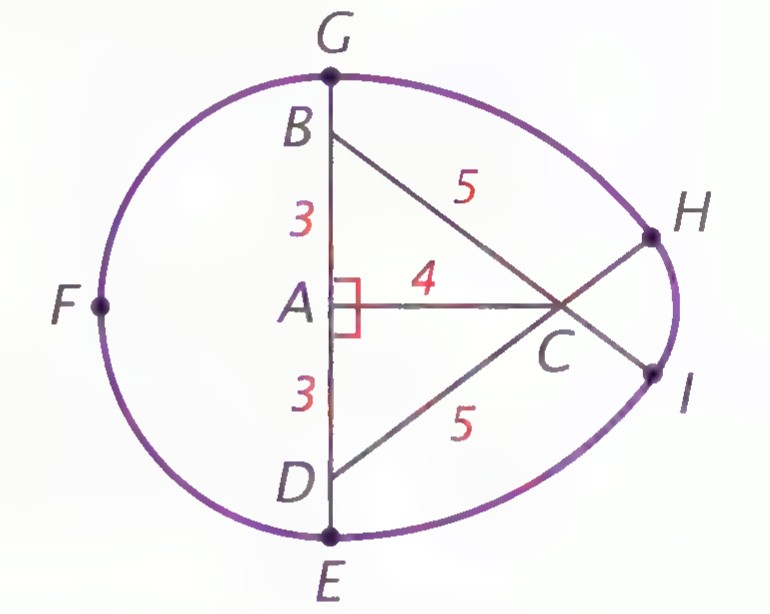
One egg-shaped ring consisting of four arcs is shown in the figure above. Use the following information and the fact that △BAC and △DAC are 3-4-5 right triangles to find the measure of each of the following arcs to the nearest degree.
- , whose center is A.
- , whose center is D.
- , whose center is C.
- , whose center is B.
- How do the degree measures of the two parts of the ring on either side of GE seem to compare?
- Explain, by using △BCD and ∠HCI, why .
* Why Buildings Fall Down, by Matthys Levy and Mario Salvadori (Norton, 1992).
† Geometry and Algebra in Ancient Civilizations, by B. L. van der Waerden (Springer, 1983).
p. 526
Circular Saw. The figure below shows the blade of a circular saw cutting into a board. The radius OD of the blade is perpendicular to the board.
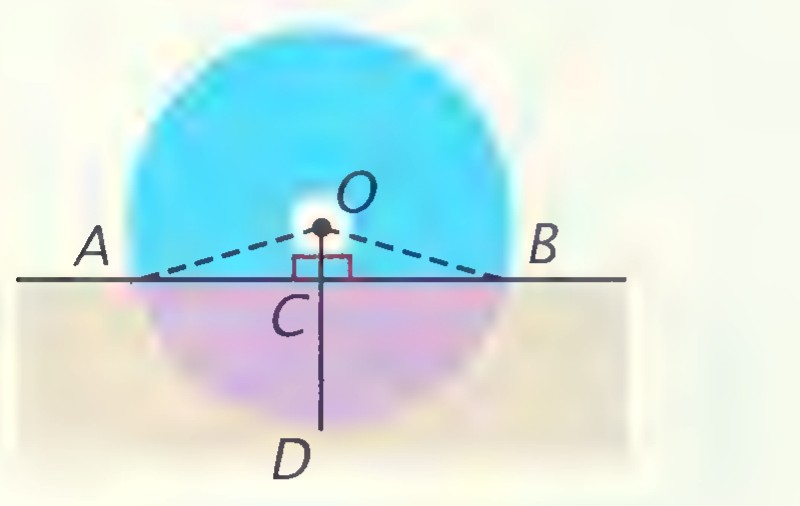
- What can you conclude about point C?
If the diameter of the blade is 10 inches and the cutting depth, CD, is 3.75 inches,
- find the length of the cut from A to B.
- find the measure of ∠AOD.
- find .
Golden Ratio. In the figure below, circles A, B, and C have radii equal to 1 and are tangent to a diameter of circle O.*
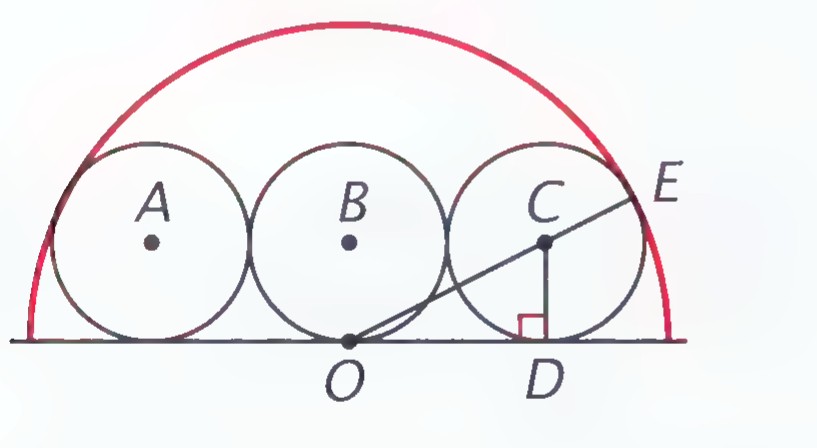
Find the exact length of
OD.
OC.
OE.
Find the exact ratio of the radius of circle O to the diameter of circle C.
Find the value of this ratio to six decimal places.
Find the exact ratio of the diameter of circle C to the radius of circle O.
Find the value of this ratio to six decimal places.
What do you notice?
Pond Problem. The following problem is from a book published in London in 1754.†
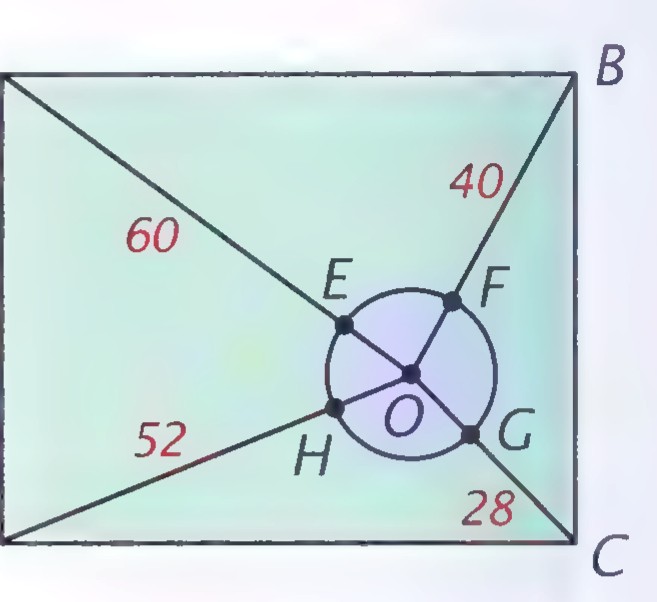
The figure above is an overhead view of a rectangular garden that contains a round pond. AO, BO, CO, and DO connect the corners of the garden to the center of the pond. Given that AE = 60 yards, BF = 40 yards, CG = 28 yards, and DH = 52 yards, the problem is to find the radius of the pond.
The figure below suggests a way to solve the problem. In it, OI, OJ, OK, and OL have been drawn so that they are perpendicular to the sides of the rectangle.
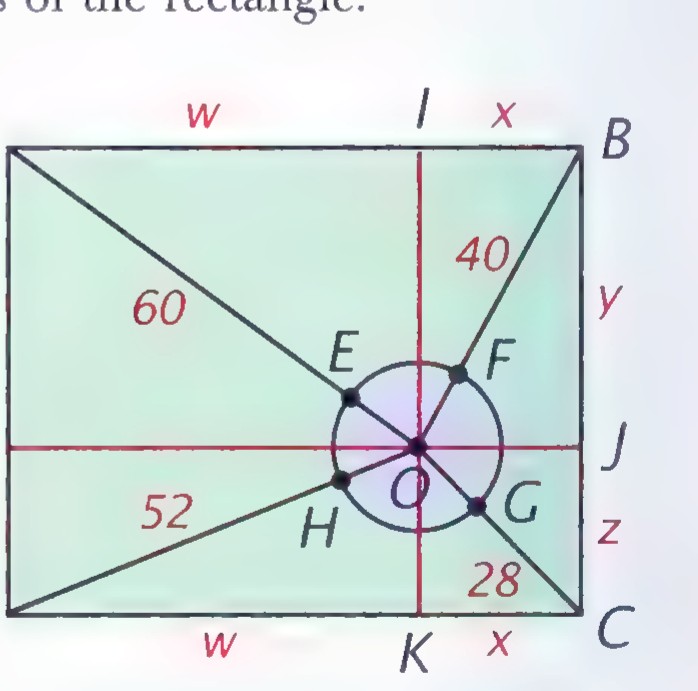
- Can you figure out a way to find the radius of the pond?
* The Loom of God: Mathematical Tapestries at the Edge of Time, by Clifford A. Pickover (Plenum, 1997).
† “The Ladies Diary,” in Geometry Civilized: History, Culture, and Technique, by J. L. Heilbron (Clarendon Press, 1998).
p. 527
Algebra Review: Solving Systems of Equations
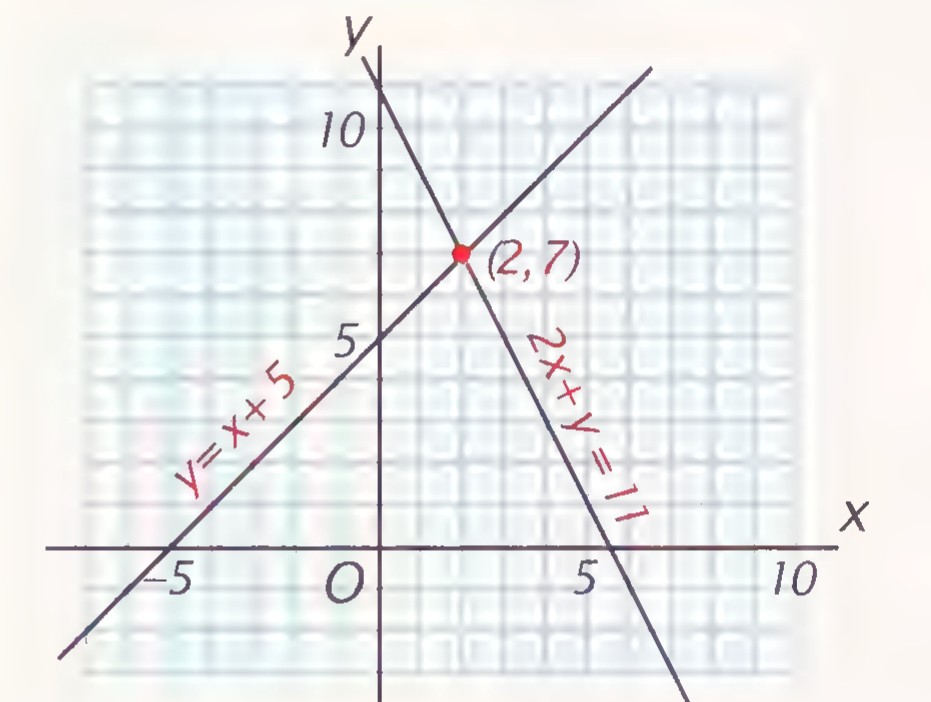
To solve a system of two equations in two variables means to find every ordered pair of numbers that can simultaneously replace the variables in both equations to make them true. If the equations are linear, this solution corresponds to finding the coordinates of the point in which two lines intersect. (If the two lines are parallel, they have no point in common and so the system has no solutions.)
Solving by Substitution
For some systems of equations, it is convenient to first solve one of the equations for one variable in terms of the other. The expression that results can then be substituted into the other equation. These steps, together with the rest of the method, are illustrated by the following examples.
Example 1: Solve the system
Solution: The second equation is already solved for y in terms of x. Because y and x + 5 are the same number, we can substitute x + 5 for y in the first equation:
Solving for x, we have
Substituting this value for x in the second equation gives
The solution to the system is (2, 7).
A graph of the two lines of this system and their point of intersection is shown below.
Example 2: Solve the system
Solution: In this case, we might begin by solving the first equation for x and substituting the result in the second equation.
We have already shown that x = y + 11, and so x = −5 + 11 = 6. The solution to the system is (6, −5).
p. 528
Solving by Linear Combination
Another way to solve a system of equations is to combine the equations to form an equation that contains only one of the variables. The solution to this equation can then be substituted into either of the original equations to find the other variable.
Example 3: Solve the system
Solution: We can eliminate y by adding the two equations:
Dividing both sides of the resulting equation by 5, we get
Substituting 7 for x in the first equation, we get
The solution is (7, 2).
Example 4: Solve the system
Solution: We can eliminate x by multiplying the first equation by 5, multiplying the second equation by −3, and then adding the resulting equations:
The solution is (−1, 4).
Exercises
Solve the following systems of equations.