Chapter 11 — Teacher’s Guide Answers
Answers and teaching commentary for Chapter 11: The Right Triangle, transcribed from the scanned Teacher’s Guide. Diagrams are cropped from the same page scans.
OCR note. The text was recognized automatically and has not been corrected line by line; formulas and symbols may be imperfect. Check the original PDF for exact wording.
Homework: Chapter 11 exercises · Selected answers · Teacher’s answers PDF
Lesson 1
Set I (pages 430-431)
The chameleon’s coiled tail is a pretty good approximation of a logarithmic spiral different from that of the chambered nautilus. Its graph can be obtained from the polar equation,
r =1.1167%, where 0is the measure of the rotation in radians and —2m < @ < 5.
Exercises 20 through 30 show a special case of the fact that, in any right triangle, the altitude to the hypotenuse divides the hypotenuse into two segments that have the same ratio as the square of the ratio of the legs. The general case will be considered in a later exercise.
Exercise 31 appears in the Elements as Proposition 17 of Book VI: “If three straight lines be proportional, the rectangle contained by the extremes is equal to the square on the mean.” (Euclid includes its converse in the same proposition.)
Chameleon Tail.
1. Aspiral.
*2. The altitude to the hypotenuse.
*3. AP and PC.
4. The altitude to the hypotenuse of a right triangle is the geometric mean between the segments into which it divides the hypotenuse.
*5SNEP!
¢6. EP and EG.
7. Each leg of aright triangle is the geometric mean between the hypotenuse and its projection on the hypotenuse.
Shadows.
8. AD.
9. DB.
10. The legs.
*11. Their projections on the hypotenuse.
*12. AC.
13. CD.
14. CB.
Find the Lengths.
o15. 4 (8= % 216, x=4) x 2
16. 6. (2= %, 2=36,x=6) x 4
o17. 2410 =632. (8 = 2540, X
x =40 = 2410 ~6.32))
*18. 4.05. (% =2 20x=81,x=405) P
248 12 g 6a=144, 8180,
19. 10. (
12 8 x=10.)
With and Without Pythagoras.
20.
©
15 20
A9 D 16 B
9 12 g (2= DB )
21. 16. (= = 22 9pB - 144, DB = 16.
2. 15 (2 _ AC pc2- 295 AC=15) AC . 9
23. 15. (AC2=92+122 =81+ 144 =225, AC=15)
24. 20. (—zi = E BC? =400, BC =20.) BC 16
25. 20. (BC2=122+ 162 = 144 + 256 = 400, BC =20.)
026. —.
2 = (=)
x4, ==
*29. False.
30. True.
Rectangle and Square.
31. They are equal because % _ ;soac=“b2) @
Set I| (pages 431—432)
Exercises 38-45 illustrate in theory an easy way to construct, given a gegment of unit length, the successive integral powers of a number greater than 1. The process can be reversed to construct the corresponding powers of a number less
than .
Strongest Beam.
524
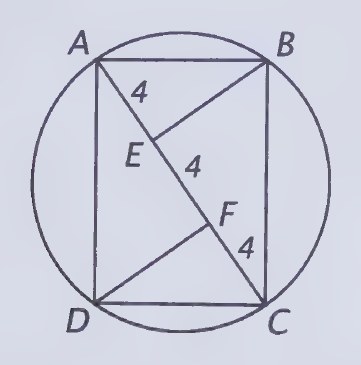
Diagram from page 158.
A
D C
033, 46. ( ——_—g.BCZ 9%, 12
BC =9 = 446.) 12 AB
34. 443, (G5~ 1 AB=4, AB=+48 = 443)
o5, 2 e
35. T(orw/i,) 4‘/5.)
36. 68in2 [(4V6)(4+3) = 16418 ~68]
©37. 113in2 (62 = 36m = 113.)
Zigzag. o33 OA_OB OB OC
39. Each leg of a right triangle is the geometric mean between the hypotenuse and its projection on the hypotenuse.
4 OB_OC,_ ,0C_OD
OoC OD oD OE
il 7
. 2. (== —,0C=12) o41. 72 ( .
042, 73, (r2 OD,rOD 7, 0D =73.)
43. 7. (g_ r ,120E =15, OE=14)
44. OF =7°and OG =15.
45. 1,000,000 inches (almost 16 miles!). (10°.) Plato’s Proportions.
OA OB OB _ OC, d — ad ~oc i oc oD’
S0 g—g =D by substitution.)
47. Yes. AABC ~ ABCD by AA (ZAis complementary to ZABO and ZABO is complementary to ZDBC; so ZA = ZDBC,
AB BC
and so ZABC = ZBCD. BC — - D because
corresponding sides of similar triangles are proportional.) SAT Problem.
*48. 5. (AC2=42+32=25,AC=5)
19. 32. (2= 2 5¢=16,x=32) 4 x
50. 1.8. z
51. 24. (A-fi 22=5.76,z=24.)
Set I (page 433)
Martin Gardner’s column on the golden ratio can be found in The 2nd Scientific American Book of Mathematical Puzzles and Diversions (Simon & Schuster, 1961). As Gardner points out, a lot of material that has been written on the golden rectangle and golden ratio is crankish in nature.
Lesson 2
Set I (pages 436-437)
Pythagorean triples have been a popular subject of recreational mathematics since ancient times. Martin Gardner includes many interesting facts about these numbers in the Sixth Book of Mathematical Games from Scientific American (W. H. Freeman and Company, 1971). Some of your students might enjoy trying to discover some of them for themselves. For example, one number must be a multiple of 3 and one of the other two numbers a multiple of 5. Another great source of information on this subject is the chapter titled “The Eternal Triangle” in Recreations in the Theory of Numbers—The Queen of Mathematics Entertains, by Albert H. Beiler (Dover, 1966). In Geometry and Algebra in Ancient Civilizations (Springer Verlag, 1983), B. L. van der Waerden points out that, although Pythagorean triples exist in the early mathematics of Egypt, India, Greece, and China, there is no mention of them
in the work of Archimedes or Euclid.
Baseball Distances. o1. 30 ft.
2. About 95 ft. (V302 +90° = /9,000 =95.)
3. About 108 ft. (V60% +90% = /11,700 =108.)
4.
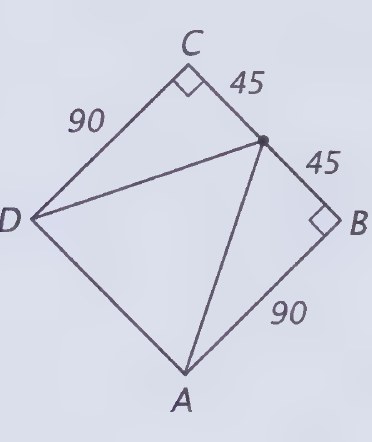
Diagram from page 159.
C 45 90 45
90
A
5. About 101 ft. (V45 = 410,125 =101.)
6. About 101 ft (by symmetry).
The Golden Rectangle. L D c &G
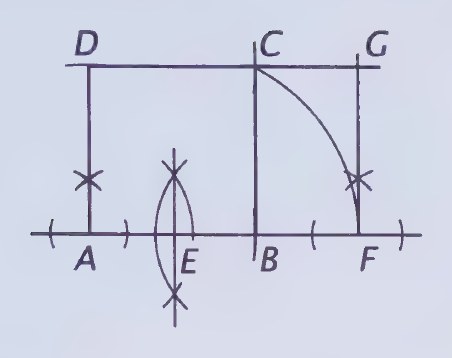
Diagram from page 159.
2. a) AD=2. b) EB=1. ) EC=+5. d) EF = +5. e) AF=1+ 5. AF 1445 p =0 2
3. 1.618033989….
4. a) GF=2. b) BF= +5 ~1. [BE= AF~AB = (1 + 4/5)~2.] g SE__2 BF +5-1
5. 1.618033989. .. . [It is easy to show that 2 1+1/— 2 2(V5 +1) B-1 2 51 (B-DEB+Y) 2(65+1) 5+1 | 5-1 -
6. That itis also a golden rectangle (also that it is similar to rectangle AFGD.)
7. 0.618033989. …
8. If r represents the golden ratio, it appears that E r — 1. [This equality can be proved 7 by solving the following equation for r: 1=r(r-1),72~r=1,12-r-1=0, CDECIF 4D | 14ivd 2(1) 2
r=
1+/§] S
r>0,andsor=
Pole Problem.
7. A
C
- 10
B 6 D
*8. 8 cubits. (BC = V102 -6 = +64 = 8.
9. 2 cubits. Emergency Exits.
10. A 3 B
12 E 24 . ‘ D 16 F €
11. 40 ft. (AC = V322 +242 = V1,600 =40.)
*12. 20 (EF = %AC.)
13. Yes. If F is midway between D and C,
DF = FC = 16. EF = V122 +16 = 400 =20.
14. A F B = ,g D F C
*15. About 8.7 ft. (DF = y202 —18% = 76 ~8..)
16. About 19 ft. (AF = y20? —6% = 364 = 19.)
17. Yes. It could be placed anywhere on wall BC. (Every point on BC is more than 20 ft from point E.)
Pythagorean Triples. o18. 72+ 242 =49 + 576 = 625 = 252.
19. Yes. (The list contains many examples.)
20. No. The square of an odd number is odd. The sum of two odd numbers is even.
e21. Each number in 14-48-50 is twice the corresponding number in 7-24-25.
22. Adilation.
#23. 6-8-10 and 9-12-15.
24. 12-16-20; 15-20-25; 18-24-30; 21-28-35; 24-32-40; 27-36-45; 30-40-50.
25. 10-24-26 and 15-36-39. Not Quite Right. )
26. In AABC, 152 + 102 = 325 and 182 = 324. In ADEF, 192 + 92 = 442 and 212 = 441.
27. Acute. The longest side of each triangle is slightly less than what it would be if the triangle were a right triangle.
Distance Formula.
*28. AB.
*29. Y=
30. Because AABC is a right triangle, AC?=AB? + BC?% 50 d2 = (x, — 2,2 + (i — y;)? and d=(x, ‘11)2 +(v2 =)
2
Set II (pages 438-440)
The solution of the oil-well puzzle is based on a fact whose generality is quite surprising. As is demonstrated in exercises 47 through 49, given a point inside a rectangle, the sum of the squares of its distances from two opposite corners is equal to the sum of the squares of its distances from the other two corners. This is also true if the point is outside the rectangle or even on it. In fact, the point doesn’t even have to lie in the plane of the rectangle. It is true for any point whatsoever!
Matthys Levy and Mario Salvadori point out in Why Buildings Fall Down (Norton, 1992) that “the earliest suspension bridges in the world, in China and South America, were ‘vine bridges’ made of vegetable fiber ropes that served as cables, hangers, and roadway.”
In Einstein’s Legacy— The Unity of Space and Time (Scientific American Library, 1986), Julian Schwinger reports that Einstein at age 12 “encountered and was deeply moved by the wonders of Euclidean geometry. An uncle had told him about the theorem of Pythagoras. . .. About this he later said, ‘After much effort | succeeded in “proving” this theorem on the basis of the similarity of triangles.’” It is interesting that some of the basic equations of relativity come from the Pythagorean Theorem. Exercises 56 and 57 provide an example.
TV Screens.
®31. d=>5x. [d? = (4x)? + (3x)?, d? = 25x2, d = 5x.]
32. x= 1d. 5
*33. 84inby 11.2in. [[f d=14, x = %(14) —28; s03x =84 and 4x =11.2]
34. 16.2inby 21.6in. [Ifd=27, x = %(27) =54; 50 3x =16.2 and 4x = 21.6.]
*35. 24 or about 1.9. 14
272 729
36. About 3.7 times as big. [( 14!) 196 | A 7t i (o= 22
Grid Exercise. 37.
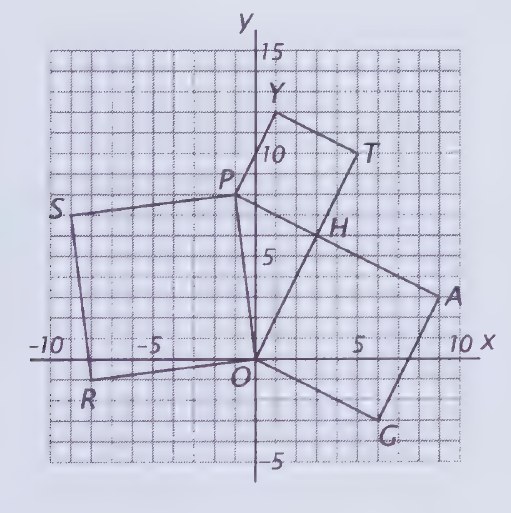
Diagram from page 161.
¢38. OH = y(3-0)? +(6-07 = ¥9+36 = V45 or 345, OP = {(8-0/ +(-1-0)* = V64 +1 = 65. B-(-1) +(6-8 = V16+4 = 20 or 245.
39. AOHP is a right triangle because OH2 + PH? = OP?. [(V45)2 + (202 = (V65 )2, 45+20=65)]
40. They appear to be squares.
41. 20, 45, and 65 square units. Rope Surveying.
¢42. The length of AP.
043, x2+202=(40-x)2 x2 + 400 = 1,600 — 80x + x2, 80x = 1,200, x=15.
44. 32-y.
45. 2 +162=(32-y2 Y2 + 256 = 1,024 — 64y + y2, 64y = 768, y = 12.
46. The converse of the Pythagorean Theorem. Oil Well.
47. P=x2+12 2=x2+ 2%, B =w?+ 22
48. B+ c2=w?+ P+ 22+ 27 P+@2=x+yP2+uw?+22
49. Thata? + 2 =b2 + d2.
50. 27,000 ft. (21,0002 + 18,0002 = 6,000 + 2, 2 =129,000,000, d = 27,000.)
Suspension Bridge.
51. 50 50
50.5 50.5
52. About 7 ft. (V50.5% —502 = +/50.25 =7.1.)
Turning Radius.
*53. D=R- VR®*-B?.
54. About 2.8 ft.
(27 - V272 -12%> =27- /585 ~2.8)
55. It becomes about half as large. (54— V54> 122 =54 2,772 ~1.4) Rocket Car.
2 2
56. Because A%+ B*=C? ~A—2 + B—Z = 1;s0 C ©
A? B? AV (B)z = 1 = ecause[ ) C 2 1-2_.B Zllza=|=],
2
C C
57. About 0.44. [{1—(0.90)* = +0.19 =0.44]
Set lll (page 440)
Fermat’s Last Theorem— Unlocking the Secret of an Ancient Mathematical Problem, by Amir D. Aczel (Four Walls Eight Windows, 1996) is an appropriate book for students who are curious about the subject and its geometric aspects. As Kirkus Reviews describes the book, it is “an excellent short history of mathematics, viewed through the lens of one of its great problems— and achievements.”
Fermat’s Last Theorem.
1. Infinitely many.
2. Infinitely many. There are infinitely many Pythagorean triples.
3. None.
4. The reporter observed that all positive integer powers of a number whose last digit is 4 end in either 4 or 6 and that all positive integer powers of a number whose last digit is 1 end in 1. The last digits of the three numbers in Krieger’s equation, then, are either4,1,and 1or6,1,and 1. But4 + 1 =5, not1, and 6 + 1 =7, not 1; so regardless of the value of n chosen, the equation cannot be true.
Lesson 3
Set I (pages 443-445) Isosceles Right Triangles. o1. Yes. They are similar by AA.
o Pe
1 2
3. c=a2.
c
*4. a= 2
5. In an isosceles right triangle, the hypotenuse is 2 times the length of aleg.
30°-60° Right Triangles.
6. Yes.
8. b=ay3.
9. ¢c=2. b
10. a=
7
ISHPER =
14. In a 30°-60° right triangle, the hypotenuse is twice the shorter leg and the longer leg is 3 times the shorter leg.
Length Problems.
+15. 8472. 10 1042
V2. (x v 542.) e16. 542. = —— o
*17. x=12,y=6+3.
18. x=2,y=243.
019, x=5+3,y= 10((_F_i_sd—)
20. 1242.
21. 14.
2. 1042, (x= f/g @i-low/_)
Equilateral Triangles.
023, 3. [‘/—a)2 024 443, [‘/—(4)2
25. 9«/’[((6)1
26. AADE contains 4 triangles congruent to AABC; AAFG contains 9 triangles congruent to AABC.
Line of Sight.
27. 902 =127 ft.
28. 150 ft. (A quick method: this triangle is a “3-4-5” right triangle with sides 3 x 30, 4 x 30, and 5 x 30.)
29. 12042 =170 ft.
Cathedral Design.
30. 753 =130 t. (%150.)
e 27” B
®31. About23in. (20 = =23.)
Olympic Course. ; : 3.25
32. About 2.3 nautical miles. (—= =2.3.) V2
33. About 7. 8 nautical miles. [3.25+ 2( ) 7.8.] V2
Set II (pages 445-447)
Exercises 38 through 41 deal with a special case of the navigator’s rule called “doubling the angle on the bow.” Another special case is the one in which
the angle is doubled from 22.5° to 45°. It is called
the L rule,” on the basis of the fact that
& 10 2 10
Exercises 42 through 47 provide a preview to students who continue their study of mathematics of the prominence of the 30°-60° and isosceles right triangle theorems in quick-calculation trigonometry.
Exercises 48 through 52 are based on a special case of “rep-tiles,” polygons that can be put together or subdivided to make larger or smaller copies of themselves. According to Solomon Golomb, Professor of Electrical Engineering at the University of Southern California, a rep-tile of order kis one that can be divided into k copies similar to it and congruent to one another. As Martin Gardner explains in the chapter on rep-tiles in The Unexpecting Hanging and Other Mathematical Diversions (Simon & Schuster, 1969), every triangle is of order 4. The 30°-60° right triangle is unusual (unique?) in that it is also of order 3, as the construction demonstrates.
Not Quite Right.
*34. 21 square units. [—73-(7)2 =3(7)=21]
35. fisz. 4
V3 49(
36. 21.2 square units. [— (7) =21.2]
12 2B, T, 8,
37. If1/_—7, il et
Navigator’s Rule.
38. AB=BD. ZABD =120° so ZADB = 30° = ZA. Because two angles of AABD are equal, the sides opposite them are equal.
39, % (Because AB = BD = x, in 30°-60° right
ABCD, BC = %-)
X
40. E‘B’
3
41. AB= xandCD—-/S——x
3
— =0.866=0.875 = — 2 8 Trigonometric Angles.
42. ZA =90° £O=60° and £P = 30°.
1 1 . OA= =, AP= —+3.
*43. OA= - 21/5
11 044, (=, =+f3). ¢ 5 2 3) 45, ZA =90°, £O =45° and £ZP =45°.
46. OA= Ap-i=£or—1/—
\2
4. (%«f,-%fi.)
Construction Exercise.
48. C
D V3
A E’1] B
49. AABD, AAEF, ADEF, and ABDE.
50. The following lengths are in inches: DE = 2, DB= v3,DF=v3,EF=1,AE=2, AF = V3,
51. (Student answer.) (Measurements of DB, DF, and AF suggest that they are 1 % inches
long, and /?_: =1 %)
52. Yes. Because DB = w/é, it follows that
AD =243 = \3 + 43 = AF + FD, and AB= 343 =3,
Area Problem.
53, Loros (1122 1, 1 1., 1 205 GT=5)
BB, B
3
5. 6+ 343. [12(%)+ 12(73).]
56. 11.2 square units. Moscow Challenge. &7
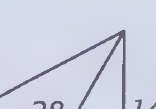
Diagram from page 164.
X~“28/ |14v3 1205 u 32 14
x=52. [Drawing the altitude to the side labeled 32 produces a 30°-60° right triangle
with hypotenuse 28 and legs 14 and 14+3. By the Pythagorean Theorem,
x2=462 + (143 )2 = 2,116 + 588 = 2,704; sox=52]
Set II (page 447) A Big Mistake.
1. A 3-4-5 triangle is a right triangle because 32 + 42 = 52 If one acute angle of a right triangle has a measure of 45°, so must the other. But, if two angles of a triangle are equal, the sides opposite them are equal. This proves that a 3-4-5 right triangle cannot have a 45° angle.
2. If the object is to find how far the tree will reach when it falls, an isosceles right triangle should be used.
Lesson 4
Set I (pages 450-451)
Students with graphing calculators will find it of interest to look at the graph of y = tan 8 over the interval 0° < 8 < 90°, especially in relation to exercises 10 through 16. The graph of this function climbs from o to 1 in the interval o° to 45° and then from 1 to ® in the interval 45° to 9o°. Exercises 27 and 28 suggest that, if two angles are complementary, their tangents are reciprocals of each other. This is nicely illustrated by comparing 1
the graphsof y = tanfand y= ——— J v 2 tan(9o-6)
Tangent Practice.
el —.
. L
°4. 0.445.
5. 0.017.
*6. 57.290.
o7 B,
8. 87.614°.
9. 89.943°. Isosceles Right Triangle.
10. £A =45°.
o1l tanA=2 =2 -1 b a
12. tan45°=1.
*13. LA >45°.
*14. tanA>1.
15. 4B <45°.
16. tanB<1.
30°-60° Right Triangle.
17. AB=2b,BC = by/3.
BC _ b3 AC b 3 =B,
*18. tan 60° =
19. tan 60° = 1.7320508 and 3 = 1.7320508.
b BC B f
21. tan 30° = 0.5773502
20. tan 30° =
\3
and
3-4-5 Triangle.
— =0.5773502. 3
) _ 52,
*22. A right triangle because 32 + 42
3
23. tanA= 7
4
24. tanB= —.
025. LA=37°
26. /B =53°.
©27. LA < £B; ZA and £B are complementary.
28. tan A < tan B; tan A is the reciprocal of tan B.
Finding Lengths. 29, 16.5. (tan 70° = % x=6tan 70° =~ 16.5.)
30. 104 (tan 46° = 1—’:), x =10 tan 46° ~ 10.4.)
31. 20.0. (tan 55° = —1%, x =14 tan 55° = 20.0.) Finding Angles.
32, 20°. (tanx= &, x=20°) 11 18
6°. (tan x 25,x 36°.)
33, 36°. =18 3
34, 57°. (tanx= 20, x=57°) 13
Set I (pages 451-453)
The lighthouse at Alexandria stood at the entrance to the most famous harbor of the ancient world. It was begun by the first Ptolemy and completed by his son in about 285 s.c. It survived storms and earthquakes until being destroyed by a particularly violent earthquake in 1303. Estimates of its height vary. The drawing of the lighthouse and the measurements of exercises 39 through 43 are based on material in Herman Thiersch’s book Der Pharos von Alexandrien (1909), included in B. L. van der Waerden’s Science Awakening (Oxford University Press, 1961).
V3 In an article for the Encyclopedia Britannica et 1970 Yearbook of Science and the Future, Jay Holmes wrote: “Because of the immense distances to be traversed, all present and contemplated space flights follow curved paths. . .. The distances proportionately magnify the effect of the slightest navigation error. A miscalculation of only one degree in the course from the moon back to the earth could result in missing the earth by more than 4,000 miles. And unlike sailors of old, modern astronauts could not turn around if they should find themselves so far off course.”
Fly Ball.
35, 58°. (tane= g,e=58.) 50 70 3 (tane 5 e )
6. 67°. (t =—,e=67.
37. 72°. (tane= @, e=72) 20
38. It increases. Lighthouse.
39, 197 ft. (tan33.3° = 28 AB : (e 300
AB =300 tan 33.3° = 197.)
40. 295 ft. (tan44.5° = fi, 300
AC =300 tan 44.5° = 295.)
AD
41. 370ft. (tan51.0°= o AD =300 tan 51.0° = 370.) . AE 42 32t (tan526°= 2o, AE =300 tan 52.6° ~ 392.)
*43. About 22 ft. (DE = AE - AD = 392 - 370 = 22.)
Binoculars.
AC _ 130
4. 013, (55 = 7005 45, 65m.(1—239.)
AD _ 65
*46. 37°. (tan ZABD = 22 = BD 1,000 ZABD =3.72)
47. 7.4°. (LABC = 2ZABD.) Grid Triangle.
*48. 26.565051°. (tan ZABD = %.)
49. 18.434949°. (tan £EBC = %,)
50. 45°. (ZABC = ZABD + ZEBC.)
+51. AB=+5,BC= 10, and AC= +5. (AB2=12+22 AB= v5;BC2=1>+3, BC=+10; AC?=12+2% AC= 5
52. AABC is an isosceles right triangle because
it has two equal sides and the sum of the squares of these sides is equal to the square
of the third side. Diamond Cut.
*53. 40.8°. (tan 1= Ofii” =0.862; 21 ~40.8°)
4 346° [fanirz e CHCE I 0.162x 0.162 > ltan 22 = e —0m3) ~ 0235
0.689; £2=34.6°]
Space-Flight Errors.
BE 239,000 PE = 239,000 tan 1° = 4,172.)
©55. About 4,172 mi. (tan 1° =
. 1o PE
56. About 14,2541111. (tan gfi = m,
PE = 49,000,000 tan %” ~14,254)
Exam Problem. 57.
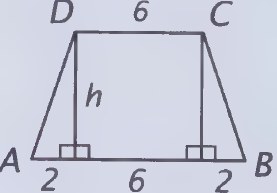
Diagram from page 166.
@ABCD = %h(10+ 6)=8h tan A= g; soh=2tanA. S0 ABCD = 8(2 tan A) = 16 tan A.
58. About 68°. (40=16tan A, tan A = E =25, ZA=68°) 16
Set Ill (page 453)
The overhead photograph of the camel caravan was taken in the Kerman Province of Iran by aerial photographer Georg Gerster.
Lesson 5
What Time is It?
To find out what time it is, we can find the angle of elevation of the sun as shown in this figure:
noon
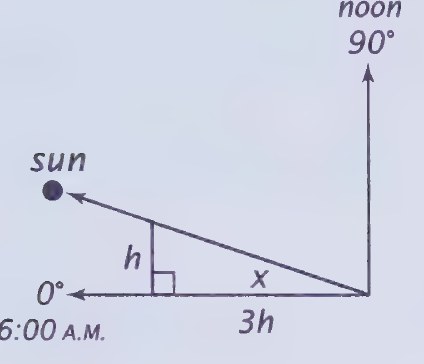
Diagram from page 167.
90°
sun [ ]
0 6:00 AM. 3h
tanx = l B l; so x = 18.435°, 3h 3 The sun’s angle of elevation changes at a constant rate because the earth rotates at a constant rate. Let t = the number of hours elapsed 18.435° ¢ 0° 6 t = 1.229 hours = 1 hour, 14 minutes. The time was about 7:14 a.m.
since 6:00 A.M.:
’
Chapter w1, Lesson
Set I (pages 456-457)
In addition to providing practice in using a calculator to find sines and cosines and their inverses, exercises 7 through 12 and the two examples illustrate the fact that a function of an angle is the cofunction of its complement. Exercises 13 through 22 reinforce this idea. The notion of the cosine of an angle developed long after the sine, and the name “cosine” was not introduced until the seventeenth century, the prefix “co-” referring to the word “complement.”
More information about Bhaskara’s calculation of sines can be found in B. L. van der Waerden’’s Geometry and Algebra in Ancient Civilizations (Springer Verlag, 1983). According to van der Waerden, Bhaskara divided an arc of 9o°in a circle first into 6, then 12, and finally 24 equal parts. He computed the values of the sines rather than finding them by measurement.
Sine and Cosine Practice.
h b
1. —or . a x+y
®2. —or —.
*3. ¥ or
*7. 0.9%.
8. 0.719.
9. 0.719.
*10. 82.935°. e11. 45.000°.
12. 45.000°. Pythagorean Triangle.
13. A right triangle because 5% + 122 =132
. 12
*14. sinA= IER 15, ZA=67°.
16. cosB = L
. 3
17. £B=23°.
18. ZA > /B; ZA and £B are complementary.
19. sin A =cosB.
5
20. = =,
©20. cos 3 5
21. sinB= —. sin 13
22. cos A=sinB.
Finding Lengths and Angles.
23 53, (sin32° = % x=10sin32°~5.3.)
24. 18.3. (cos 66° = %, x = 45 cos 66° ~ 18.3.)
25, 61°. (tanx= %, x=61°)
12.5
©26. 36.5. (cos 70° = ——, x cos 70° = 12.5, x x=122 _365) cos 70°
27. 1556, (sin13° = 22, x sin 13° = 35, X
85 sin 13°
~155.6.)
28. 60°. (cosx = 2L = 0.5, x = 60°) 54
Gi=
Sines from a Circle.
¢29. BH=2.6cm,Cl=50cm,D}J=7.1cm, EK =8.7 cm, and FL = 9.7 cm.
5.0
30. sin 30° = = =0.50, sin e 7.1 in 45° = — =0.71, sin sin 60° = Ll =0.87, 10 sin 75° = £ =0.97. 10
31. sin 30°=0.5, sin 45° = 0.7071067 = 0.71, sin 60° = 0.8660254 =~ 0.87, sin 75° = 0.9659258 ~ 0.97.
32. Tt gets larger.
33. Anumber very close to zero.
34. A number very close to one.
35. According to a calculator, sin 0° = 0 and sin 90° = 1.
Set II (pages 458-460)
A wealth of information on flying kites to great altitudes can be found on Richard P. Synergy’s Website, www.total.net/~kite/world.html. The line for the kite shown in the photograph was more than 4 miles long and was spooled from a winch. At times it exerted a force of 100 pounds! The calculation of the kite’s altitude was more complicated than that implied in the exercises because the line for the kite was not actually straight; its weight made it sag considerably. The altitude of the kite was established through altimeter readings.
As the title of Robert B. Banks’ Towing Icebergs, Falling Dominoes, and Other Adventures in Applied Mathematics (Princeton University Press, 1998) implies, he includes a good discussion of the mathematics and physics of toppling dominoes. The Guinness Book of World Records always has an entry on the latest record in this sport. In 1988, some students from three universities in the Netherlands spent a month setting up 1,500,000 dominoes. A single push caused 1,382,101 of them to fall!
Kite Flying.
#36. The sine of an acute angle of a right triangle is the ratio of the length of the opposite leg to the length of the hypotenuse.
37. Multiplication.
38. In a 30°-60° right triangle, the side opposite the 30° angle is half the hypotenuse.
39. In AABC, sin 30° =‘%. Because sin 30° = 0.5, ? =0.5,s0 h=0.51
*40. Approximately 14,500 ft, or more than
- (sin 31,600° 2.7 mi. (8Sin 42° = ———
h =21,600 sin 42° = 14,453; 1448
=27)
Force Components.
5,280
41, h= %(27,000) — 13,500 pounds, v=13,500+3 = 23,383 pounds.
v
42. sin 60° = s 27,000 v = 27,000 sin 60° = 23,383 pounds. cos 60° = —hv, 27,000
h = 27,000 cos 60° = 13,500 pounds. Flight Path.
CB 14,000 CB = 14,000 sin 3.3° = 806.)
*43. About 806 ft. (sin 3.3° =
&) 300
44. About 13.6°. A= ° (sin 14 , £A =13.6°)
Lesson 6
Leaning Tower.
45. About 10 ft. (sin3° = =, 193 x=193sin3°=10.1.)
*46. About 4°. (sin A= %’:, ZA=4°)
47. About 185 ft. (sin 5.5° = %, x =193 sin 5.5° = 18.5.)
Fiber Optics.
*48. Parallel lines form equal alternate interior angles.
*49. AAS.
50. Corresponding parts of congruent triangles are equal.
*51. 5a.
52. 5d.
53. Because G and the cosine of each 54 d numbered angle is %.
SAS Area. 54.
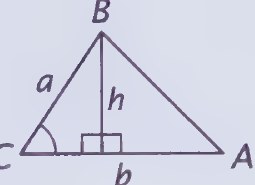
Diagram from page 169.
=
55. sinC = fl;soh:asinC. a
oAABC = ;bh: ;b(asinC)— ;ubsinC.
Dominoes.
56. Parallel lines form equal alternate interior angles.
57, sin £2= d’T”’.
58. 30°. (fd-w= %h, i e %; 50 £2=30°= /1)
59. 90°. (If d—w = h, the domino has room to turn 90° without hitting the next one. Also, ifd-w=h,sin £2=1;s0 £2=90°= /1.)
60. The next domino might not fall over.
Set 11l (page 460)
The first distance to a star beyond the sun was determined by the German astronomer Friedrich Bessel in 1838. The star, 61 Cygni, was chosen because its position against the distant sky changes more than those of most stars. A Scottish astronomer, Thomas Henderson, found the distance to Alpha Centauri (and its faint companion Proxima Centauri) a year later. The measure of the angle ZACS in the figure is called the “parallax” of the star. The unit now used to express distances in space is the “parsec,” defined as the distance of a star whose parallax is 1 second. More details on the process of determining astronomical distances by parallax can be found in Eli Maor’s book titled Trigonometric Delights (Princeton University Press, 1998). Another excellent reference source is Parallax—The Race to Measure the Cosmos, by Alan W. Hirshfeld (W. H. Freeman and Company, 2001).
Star Distance.
1. About 25,000,000,000,000 mi. 076° . 076° _ 93,000,000 3,600° 3,600 AC
(0.76” =
,
AC= %%)’7?99 ~25%101)
2.5 % 10” sl ( 5.88 x 10¹²
2. About 4.3 light-years. (————— =
Set I (pages 463-465)
About 90% of all avalanches occur on slopes between 30° and 45°, although very wet snow can avalanche on slopes of only 10° to 25°. Skiers sometimes measure the slope angle with a clinometer and sometimes merely estimate it with a ski pole.
According to Cleo Baldon and Ib Melchior in Steps and Stairways (Rizzoli, 1989), the eighteenthcentury French architect Jacques-Frangois Blondel, “concluded that the stride or pace of walking was 24 inches and that when negotiating a stairway this pace should be decreased in
proportion to the height of the riser. His theory was that two times the height of the riser plus the depth of the tread should equal the 24 inches of the pace.” Blondel’s formula is still used today, but the pace number has been increased to 26.
Slope Practice. *l. h 238G
3. The x-axis.
4. The y-axis.
5. e .1
®6. j, — e, 4. 4
7. & 1
8. 9,2, b-—. z 2
9. Two nonvertical lines are perpendicular iff the product of their slopes is -1.
10. No. Two lines with the same slope would be parallel. All of the lines named with letters intersect at the origin.
Snow Avalanches.
*11. The slope is tan 30° = 0.58.
12. tan45°=1.
Hydraulic Gradient.
*13. -60m.
14. 1,000 m.
—60 5—06(1’000)
15. —0.06. (——.
*16. About 3.4°. (tan £1 = 0.06; £1 ~3.4°.) Stair Design. 178
18 |10 18 |10
018, 2 (or about 0.56). (E.) 9 18
19. About 29°. (tanA = g, LA=29°)
20. 24 |9
24 9
3 9
21. 3 (or 0.375). (fl’)
22. About 21°. (tan A= %, ZA =20.6°)
Quadrilateral Problem.
=l 1
*23.
24. .
25, ==
26. —.
027. —=.
28. 130.
29. +130.
30. v130.
&l
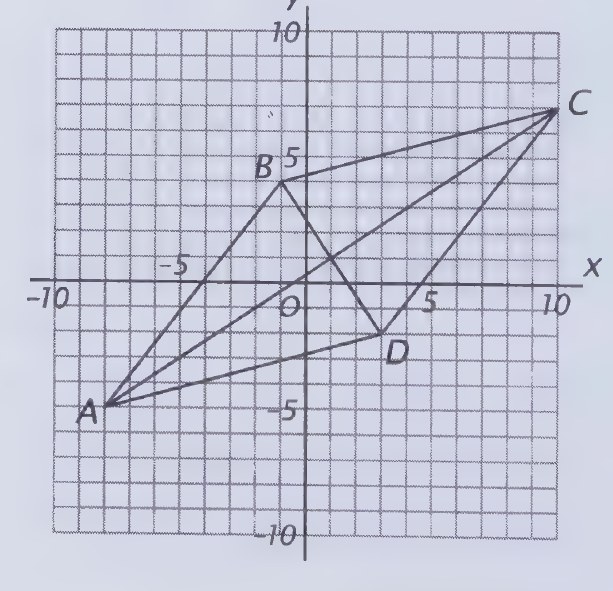
Diagram from page 170.
T
32. It is a thombus because all of its sides are equal. (Or, it is a parallelogram because both pairs of opposite sides are parallel.)
33. They are perpendicular because the diagonals of a rhombus are perpendicular.
34. They are equal.
35. Their productis —1. (Or, one slope is the opposite of the reciprocal of the other.)
Set II (pages 465-467)
The two theorems of this lesson about the slopes of parallel and perpendicular lines are only partly proved in exercises 52 through 6s. Exercises 52 through 59 establish that, if two nonvertical lines are parallel, their slopes are equal. The converse of this theorem can be proved by showing that & = 9~F; so AABC ~ ADEF by SAS similarity, BC EF from which it follows that Z1 = £2,and so L, || ,. Exercises 60 through 65 establish that, if two nonvertical lines are perpendicular, the product of their slopes is —1. The converse theorem can be
proved by showing that, if AD DS -1, then BD BD
AD BD .
3D DC’ From this it follows that AADB ~ ABDC by SAS similarity. Because AADB and ABDC are right triangles, the facts that corresponding angles of similar triangles are equal and the acute angles of a right triangle are complementary can be used to show that ZABC s a right angle; so [, L L.
Slope and x-Intercept.
©36. Its runis 550 m and its rise is =10 m.
37. 290 m above the ground. (300 - 10.)
.. 1 x . It i d it: - -=)m.
38. Its runis x m and its rise is 55x(or 55)
*39. (300- S_xS) m above the ground.
*40. 16,500 m. (300 — %x -0, Lx =300,
55 x = 16,500.)
41. Yes. (16,500 m = 16.5 km > 15 km.)
Point-Slope Equation of a Line.
042, Run=x-x;;rise =y —y;.
¥=-h x—x mx—x)=y-y, y=mlx-x)+y,.]
043, y=mx-x) +y,.[m=
4. y= —ix +300. 55
45. (Student answer.) (It is hoped, yes.)
46. The points (5,500, 200) and (1,100, 280) are on the path. The point (2,200, 250) is not.
1 ly 55( ) = —L (5,500 + 300 = 200; 1 ¥ =55 (1100 —-L(1,100) + 300 = 280; y= -%(2,200) +300 =260 = 250.]
100-Meter Dash.
#47. From the start to about 2.5 seconds.
48. From about 5 to 8 seconds.
49. From about 2.5 to 5 seconds.
50. The runner’s speed is decreasing.
51. The runner’s speed is not changing.
Theorem 52. AC E. DF EF “’
52,
53.
54. Parallel lines form equal corresponding angles.
55. AA.
*56. Corresponding sides of similar triangles are proportional.
57. Multiplication.
¢58. Division.
59. Substitution. Theorem 53.
060. I,
AD
61. 3D
*62. The altitude to the hypotenuse of a right triangle is the geometric mean between the segments of the hypotenuse.
6. - L
m,
64. Substitution.
65. Multiplication. Fire Speed.
66. First figure, tan 25° = 0.47; second figure, tan 50° = 1.19.
67. About 6.5 times as fast. The squares of the two slopes are approximately (0.47)2 =~ 0.22
and (1.19)2 =1.42; L2 6.5. 0.22
Set II (page 467)
The second-century Greek physician Galen first suggested a temperature scale based on ice and boiling water, but not until the seventeenth century were thermometers invented. In 1714, German physicist Gabriel Fahrenheit chose the temperature of a freezing mixture of ammonium chloride, ice, and water for the zero on his scale and the temperature of the human body as 96. The number 96 has many more divisors than 100 does, and Fahrenheit thought it would be more convenient for calculations! Swedish astronomer Anders Celsius introduced his scale, originally called the centigrade scale, in 1742. Strangely, Celsius chose 100° for the freezing point of water and o° for its boiling point.
Celstus and Fahrenheit.
9
1. Zorl8 5 T
(= rise 212-32 180 R 9 run 100-0 100 5
=18)
F-32
, =32 9
c “5 4 C= g(F~32).
[9C = 5(F-32), C = S(F -32)]
= — — = = = —C + 32.
6. Yes. The temperature is —40°. If F = C, then C= %C+32;305C=9C+160,—4C=160, C =-40.
Lesson 7
Set I (pages 471-472)
According to David Eugene Smith in his History of Mathematics (Ginn, 1925; Dover, 1958), the Law of Sines “was known to Ptolemy (c.150) in substance, although he expressed it by means of chords.” About the Law of Cosines, Smith wrote that it is “essentially a geometric theorem of Euclid” (Book I, Propositions 12 and 13) and that “in that form it was known to all medieval mathematicians.”
Greek Equations.
1. Sine.
2. They are opposite each other.
7 Mur’
*4. The Law of Sines.
&
5. Cosine.
6. ZA is opposite side o.
7. They include ZA.
8. ZBis opposite side B.
9. They include £B.
10. y*=o?+ B>~ 208 cuvT.
11. The Law of Cosines.
Law of Sines.
sinx _ sin 75°
012, 40°. ( , 75 i 50 sin 75° sinx = ——— =0.644, x =~ 40°. 3 0.644, x =~ 40°.) 17 013, 17.0. (—* = =X _ +_ 17 Thisis
sin 50° sin 50° consistent with the fact that the triangle is isosceles.)
14, 75°, (SI% _ sin14° 4 1 sin x = 4 sin 14° = 0.968, x = 75°)
’
Law of Cosines.
*15. 60°. [192 =162 + 212 - 2(16)(21) cos x, 361 =256 + 441 — 672 cos x, 672 cos x = 336,
336 . Cos x = — =0.5,x=60°]
®16. 32.0. [x2 =302+ 402 —2(30)(40) cos 52°,
x2 =900 + 1600 — 2400 cos 52°, x2 ~ 1022, x=32.0]
17. 15.0. [x2 =262 + 302 — 2(26)(30)cos 30°, x2 = 676 + 900 — 1560 cos 30°, x2 = 225, x=15.0]
Sines of Supplementary Angles.
sinZl _ sinZ4
*18. y x
19. sinZ4 i sin43’ x Y
20. They imply that sin £1 = sin /3. Substituting sinZl _ sinZ3 get —— = 2 Y Y multiplying by y gives sin £1 = sin £3.
. sinZ4
*21. 108°. (£3 =180°— £2=180°- £1.)
22. sin £1 =sin 72° = 0.9510565 . . .
23. sin £3 = sin 108° =~ 0.9510565 . . .
24. They suggest that the sines of supplementary angles are equal.
Set II (pages 472-474)
In a caption to a figure on which the figure for exercises 25 through 30 is based, John Keay, the author of The Great Arc—The Dramatic Tale of How India Was Mapped and Everest Was Named (Harper Collins, 2000), describes the trianqulation process: “Given the distance between points A and B (the base-line), the distance from each to point Cis calculated by trigonometry using the AB base-line measurement plus the angles CAB and ABC as measured by sighting with a theodolite. The distance between C and B having now been established, it may be used as the base-line for another triangle to plot the position of D.
]
CD may then be used as the base for a third triangle, and so on.” Keay points out that the accuracy of the Survey of India was important not only in measuring a subcontinent but also in determining the curvature of the earth.
As it travels in its orbit around the earth, the moon’s distance from the earth varies between 221,463 miles and 252,710 miles. In his fascinating book titled What If the Moon Didn’t Exist? (Harper Collins, 1993), astronomer Neil F. Comins observes that, ever since the Apollo 12 astronauts left the laser reflector on the moon in 1969, the distance at any given time can be determined to within a few inches. These measurements reveal that the moon is moving away from the earth at a rate of about 2 inches per year.
Triangulation.
025. £3=“56°. (£3=180°-ZA-41= 180° - 73° - 51° = 56°.)
©26. CB=27.7 mi. ( _CB e ?4’0 3 sin73° sin 56° CB- 24.0sin73 ~277)
sin 56°
27. ZD=53° (£D=180°-4£2- /4= 180° - 42° - 85° = 53°.)
©28. DB =34.6 mi. ( _DB = ,27’7 ) sin 85° sin 53° 27.7 sin 85° sin 53° ) DB= ———— =346.
. CD 27.7 2 mi. ( sin 42° sin 53°
9. CD =23.2 mi. =—,
CD - 27.7 sin 42 ~232) T o
sin 53°
30. CD?=CB? + DB? - 2(CB)(DB)cos 42°, CD2? =27.72 + 34.6% — 2(27.7)(34.6) cos 42°,
CD?=539.96, CD = 23.2. Distance to the Moon.
31. £ZM =1.4°. . AM 5,820
*32. 238,000 mi. (L0 s = Sin 14> AM = 5,820 sin 89.2 ~238,187)
sin 1.4°
BM 5,820
$ M 804~ sin 147 . 238,000 mi. =
py - 5E20sin840 oo sin 1.4°
The Case of the Equilateral Triangle.
*34. a?=b?+ 2 -2bccos A.
®35. a2=042+ 02 -2aa cos A, a2 = 24> - 222
2 cos A,
242 cos A= a2 cos A= %
36. Example figure:
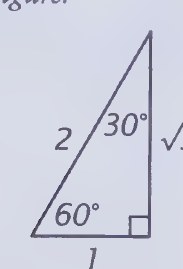
Diagram from page 174.
cos 60° = l 2
The Case of the Right Triangle.
sinA sinB _ sinC
37. = = a b c
38. 1. 30, sin A _ sin B _ 1 a b c
*40. By multiplication.
41. The definitions of the sine and cosine on aright triangle.
42. c?=42+ b2 2ab cos C.
43. 0. o44. 2=g2+ b2
45. The Pythagorean Theorem. The Case of the “Flattened” Triangle.
46. c>=4? + b2 —2ab cos C.
47. -1.
48. 2=02+ b2 + 2ab.
49. Yes. Because c2 =42 +2ab + b2 = (a + | c=a+b.
Euclid’s Law of Cosines.
50. The area of the rectang]e is cx. In right AADC, cos A- % ;s0x=bcos A.
Substituting for x, the area of the rectangle is c(b cos A) = bc cos A.
Set 111 (page 474)
The idea for this exercise came from Carl Eckart’s book titled Our Modern Idol—Mathematical Science (Scripps Institution of Oceanography, University of California, 1984). The 780-1351-1560 triangle is a remarkably good approximation of a
30°-60° right triangle because % matches 1[5
to five decimal places (— =1.7320512 … and
1/; =1.7320508 …) and % =2. Using Mathematica reveals that, to four decimal places, AABC is a 30.0000°-60.0000°-90.0000° triangle. To five decimal places, it is a 30.00000°- 60.00003°-89.99997° triangle. To eleven decimal places, ZA = 30.00000000000° but, to twelve decimal places, ZA = 29.999999999996°! Eckart remarks that “such a triangle differs from a right triangle by less than one-tenth of a second” and observes that it cannot be drawn on paper, because “paper is too flexible, and even printed straight lines are too coarse.”
A Possible Case of Mistaken Identity.
1. About 30.000000°. e based [780% = 13512 + 15602 — 2(1351)(1560) cos A, ZA =30.000000°.]
2. About 60.000027°. {By the Law of Sines, sin B _ sin30° sinB = 1351 sin 30° 1351 780 ° 780 £B = 60.000027° or, by the Law of Cosines, 13512 = 7802 + 15602 — 2(780)(1560) cos B,
Z£B = 60.000027°.]
3. AABC s an acute triangle. From the measures of ZA and £B, it follows that £C =89.999973°. Also,
13512 + 7802 = 2,433,601, but 15602 = 2,433,600; 50 a? + b2 > c2. (The
by triangle is a very good imitation, however, . of a 30°-60° right triangle!)
Review
Set I (pages 476—478)
Exercises 23 through 28 provide another example of a pair of triangles that have five pairs of equal parts and yet are not congruent. Letting AD =1 and AC = xand using the fact that each leg of a right triangle is the geometric mean between the hypotenuse and its projection on the hypotenuse,
x+1 x . we have —— = =, Solving for x, x* = x +1, X 1
X-X=-1=0,X= T‘E,the golden ratio! In 1+
1 2 AACD, cosA = —; SOCOS A = =, X
1445 ZA = 51.827292 .. .°and £B = 38.172707…°
According to J. V. Field in The invention of Infinity—Mathematics and Art in the Renaissance (Oxford University Press, 1997), “the great invention of the military engineers [of the sixteenth century] is the polygonal fort. … The commonest choice is the pentagon. A construction for a reqular pentagon can be found in Elements, Book 4, but it is hardly the sort of construction one would wish to use in laying out the ground plan of a fortress. . . . The practical method used by the Venetians, preserved in a file in the State Archives, is shown in [the figure used in the exercises]. We are given the sides of a right-angled triangle. The triangle can be constructed from rope, or by linking together the chains used by surveyors, and repetitions of it will then allow the complete pentagon to be laid out. The person who actually lays out the ground plan using this method does not need to be very good at mathematics, but it is clear that some mathematical expertise was needed to devise the method, and to calculate the lengths of the sides of the triangle.”
Greek Cross.
oil, 72,
2. ——.
&l 7
4. —.
o5, -2,
6. ACLCD.
7. AC || DE.
8. HF L BG.
9. They are equal.
10. Their product is -1. (Or, one slope is the opposite of the reciprocal of the other.)
Doubled Square.
o11. d=5+2.
12. $2.
13. 2. 14, 252 [ = (s 42 )2 = 252]
Escalator Design.
*15. 28 ft. [c=2a=2(14).]
*16. About24.2 ft. (b=a+3 =143 =242)
17. 20 ft. (40 = 24.)
18. About34.6 ft. (b=a+y3 =203 =346
*19. About 195 ft. (b =338; 504 = S0 ~195.)
3
20. About 390 ft. [c = 22 =~ 2(195).]
Basketball Angles.
e21. About 5.7°. B o = =22 _01, /B=57°. h 10-75 25 tanB=p == =% )
22. About 14°. (tanB = % =0.25, /B =14°)
Equal Parts.
23. Three.
24. The altitude to the hypotenuse of a right triangle forms two triangles similar to it and to each other.
25. Three.
026. Two.
27. Five.
28. No. The longest sides of the two triangles are not equal.
Pentagon.
29. £BOC = 36°. (%—.)
1,000
30. BC =100 ft. = ) 3 =1l A==
100
*31. OB=13 (tan OB . =137.6 ft. (tan 36° = —, 100 OB = =137.6. tan 36° ) 100
32. OC =170.1 ft. (sin 36’ oC 3 = .1 ft. (sin 36°= —, = 1% 1701 sin 36°
33. OB?+BC2=137.62 + 100% = 28,934 and OC?~170.12 = 28,934.
©34. About 408 feet. (pAOBC = 137.6 + 100 + 170.1 ~ 408.)
Three Ratios.
35. 0.87. (Letting the sides of the triangle and square be 1 unit, CF = 12—3‘ and EA=1;so
F_B o) EA 2
36. 0.75. (pPAABC = 3 and pABDE = 4; so PAABC _ 3
—=0.75) PpABDE 4 V3
37. 0.43. (tAABC = T(l)Z and aABDE = 12; so GAABC A3 ey aABDE 4
Set II (pages 478-480)
A discussion of various Steiner problems can be found in chapter 3, “Shortest and Quickest Connections,” of The Parsimonious Universe— Shape and Form in the Natural World, by Stefan Hildebrandt and Anthony Tromba (Copernicus, 1996). Given a general set of points, the shortest network of segments connecting them is called their “minimal Steiner tree.” These trees are important in the design of computer chips and have even been used by biologists studying the relationships of species. A rather amazing natural solution to finding Steiner trees comes from
dipping models made from glass or plastic plates into soap solutions!
The Babylonian clay tablet in exercises 65 and 66 was deciphered in 1945. David M. Burton remarks in his History of Mathematics (Allyn & Bacon, 198s): “This tablet is written in Old Babylonian script, which dates it somewhere between 1900 e.c. and 1600 B.c. The analysis of this extraordinary group of figures establishes beyond any doubt that the so-called Pythagorean theorem was known to Babylonian mathematicians more than a thousand years before Pythagoras was born.” Burton observes that the 541-481 error was probably that of a scribe because, in the sexagesimal notation of the Babylonians, 541 is written as 9,1 and 481 as 8,1. Eleanor Robson shows in “Words and Pictures—New Light on Plimpton 322” (American Mathematical Monthly, February 2002) that it is likely that these Pythagorean triples actually arose from computations concerning reciprocals. Even so, “Pythagorean triples” were of interest long before Pythagoras.
Isosceles Right Triangles. 38.
A
39. +2,2,2+2, 4,32, and 7 units.
*40. 7 units.
1
4. E+1+2+4+s+9+24%=49.
Two Birds. 42.
B A
30 40 F C X 50-xD
*43. AF=BF.
44. 50 - x.
45. 302+ 22 =402+ (50 - %)% 900 + x2 = 1,600 + 2,500 — 100x + x2, 100x = 3,200, x = 32.
46. 32 ftand 18 ft.
*47. About 44 ft. (AF2 =302 + 322=1,924, AF =439, BF2 =402 + 182 = 1,924, BF =
Road Systems.
48. 3mi. 49.
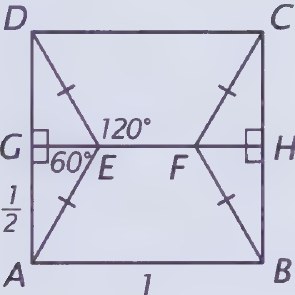
Diagram from page 177.
Approximately 2.7 mi. In 30°-60° right AAGE, the longer leg 1
AG = —; 2 so the shorter leg GE = i B
V3
and the hypotenuse AE = 2GE = =
\3
)=1- —. The sum of
EF=1-2(—
1/3
1/_
five segments is )=1+ . —1+1/—=‘
(- prip-1e g
-2.732.
50. The second solution is better.
Sun and Moon.
51. In right AOMS, cos £O = 1”-. Because
m l cos 87°=0.052= —, — = — 19 s 19
52. Because the product of the means is equal to the product of the extremes (or multiplication), s = 19m.
©53. About 380 times as far. (cos 89.85° = fi; SO s
s__ 1 382.) m cos 89.85°
Eye Chart.
54. 20 ft =240 in. tanP—fi—0015625 240
£P =0.895°; so £ZP = 0.895° x 60 minutes per degree ~ 54 minutes.
43.9) #55. Approximately % in [4.8 minutes = (é’éf =0.08°.
tan 0.08° = 240 , x =240 tan 0.08° = 0.34 in.] UFO Altitude.
56. 75°. (180° —60° —45° =75°) 820 ‘ o ey sin 45° sin 75°
57. About 600 ft. =
. 829 sin 45° ~600.) sin 75°
58. About 520 ft. (sin 60° = <2,
CD = 600 sin 60° = 520.)
i 59. About 735 ft. ( == .SLOO, P ‘/5 sin 60 sin 75 820 sin 60° BC= ——— =735.) sin 75° i B ¢ D) f the 60. About 520 ft; so it checks. (sin 45° = 7357
CD = 735 sin 45° = 520.)
Outdoor Lighting. 61.
A
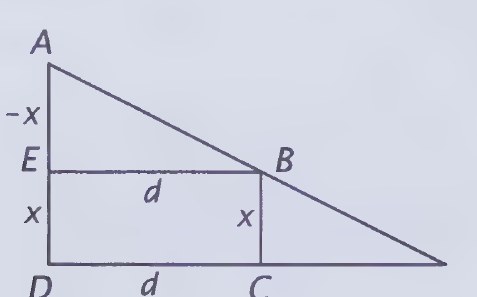
Diagram from page 178.
62, tan ZABE = h;x.
63. x=h-(tan ZABE)d. (d tan ZABE =h-x.)
64. They came from the equation for exercise 63 (and the fact that ZABE = 90° — ZA.)
Number Mystery.
65. V75%—452 =60 el V972 -65% =72 V4812 ~3192 =360 V7692 5412 = 546,516 . .. 12492 —7992 = 960 V29292 _1679% = 2400
With one exception, each pair of numbers is part of a Pythagorean triple; specifically, the lengths of one leg and the hypotenuse.
66. As the list for exercise 65 shows, the mistake is in the pair of numbers 541, 769. (541 should be 481.)
Algebra Review (page 482)
*l. 3x+4y=24, 4y =-3x + 24,
3 =-—x+6. y=-4*
2 m=—3:p-s 1
3.
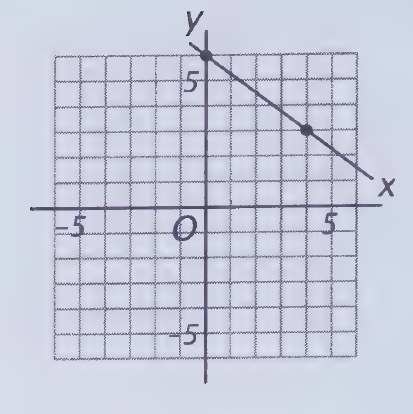
Diagram from page 178.
4, y
H A
HSEEaananms | ! [ 1
o5 y—1= %oc-(—s»,
1 y 2(x ) -1==(x+5).
8.
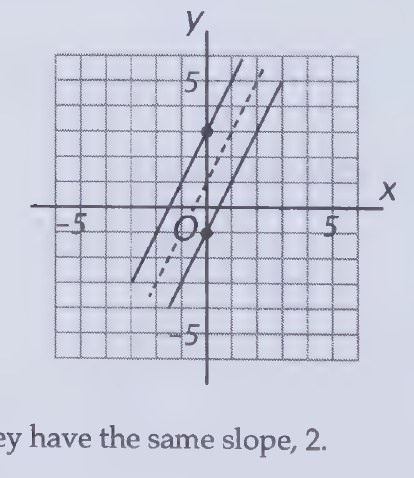
Diagram from page 178.
*9. They have the same slope, 2. o10. y=2x+1.
Algebra Review (page 482)
1. .
2. ; .
3.
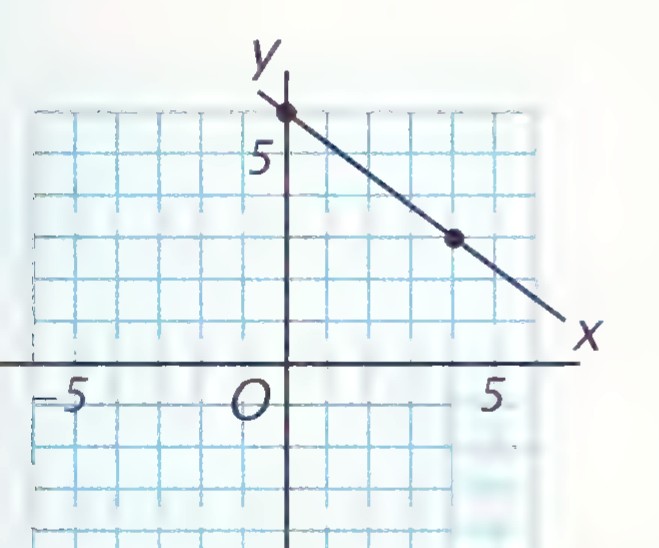
4.
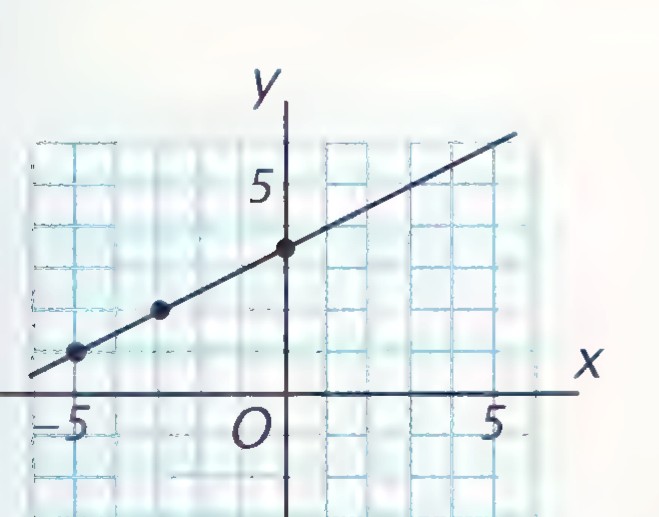
5. .
6. .
7. (or 3.5).
8.
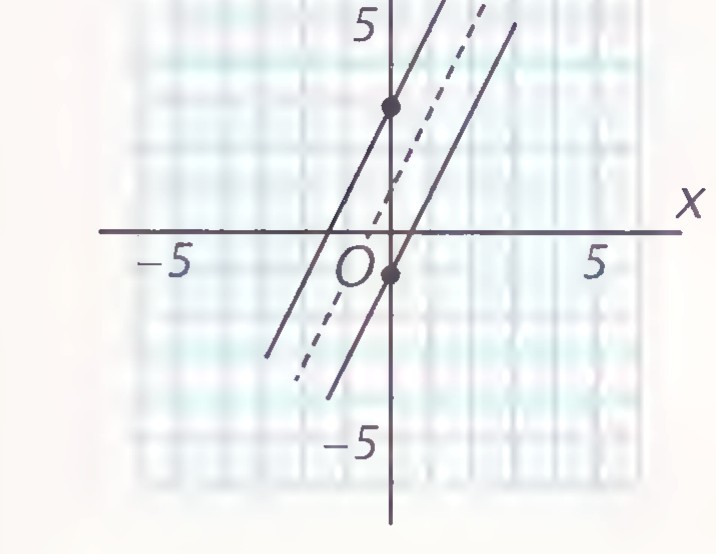
9. They have the same slope, 2.
10. .
11. ; .
12.
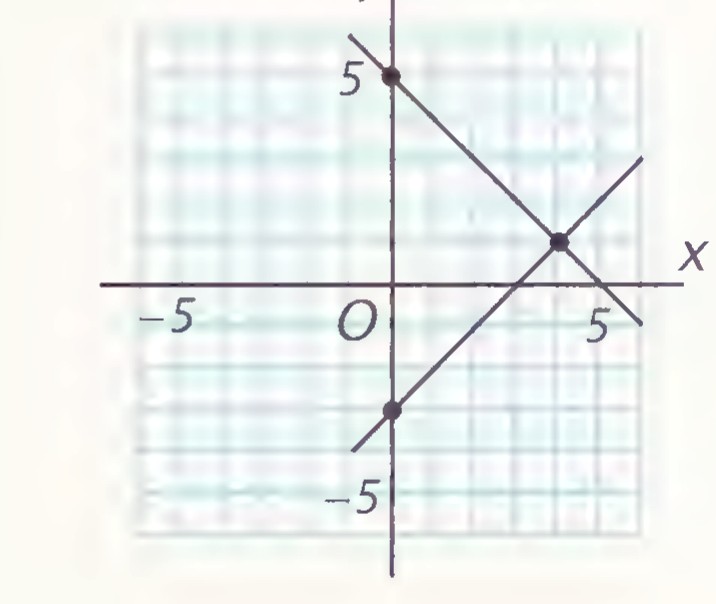
13. −1 and 1.
14. The product of their slopes is −1.
15. .
16. −6.
17.
18. .
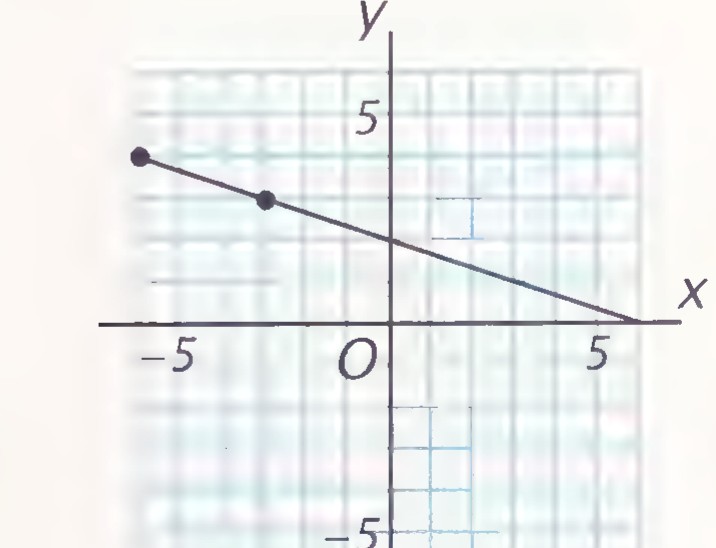
19. x-intercept, 6; y-intercept, 2.
20. .
p. 760
21.
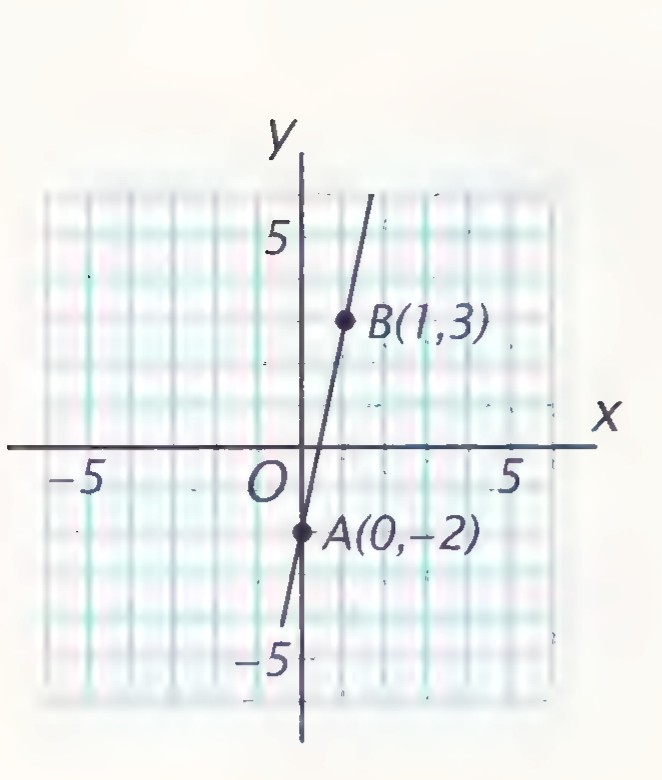
22. 5.
23. .
24. .
25. .
26. (or ).
27. ; .
28.
29. 0.
30. 10.