p. 427
Chapter 11: The Right Triangle
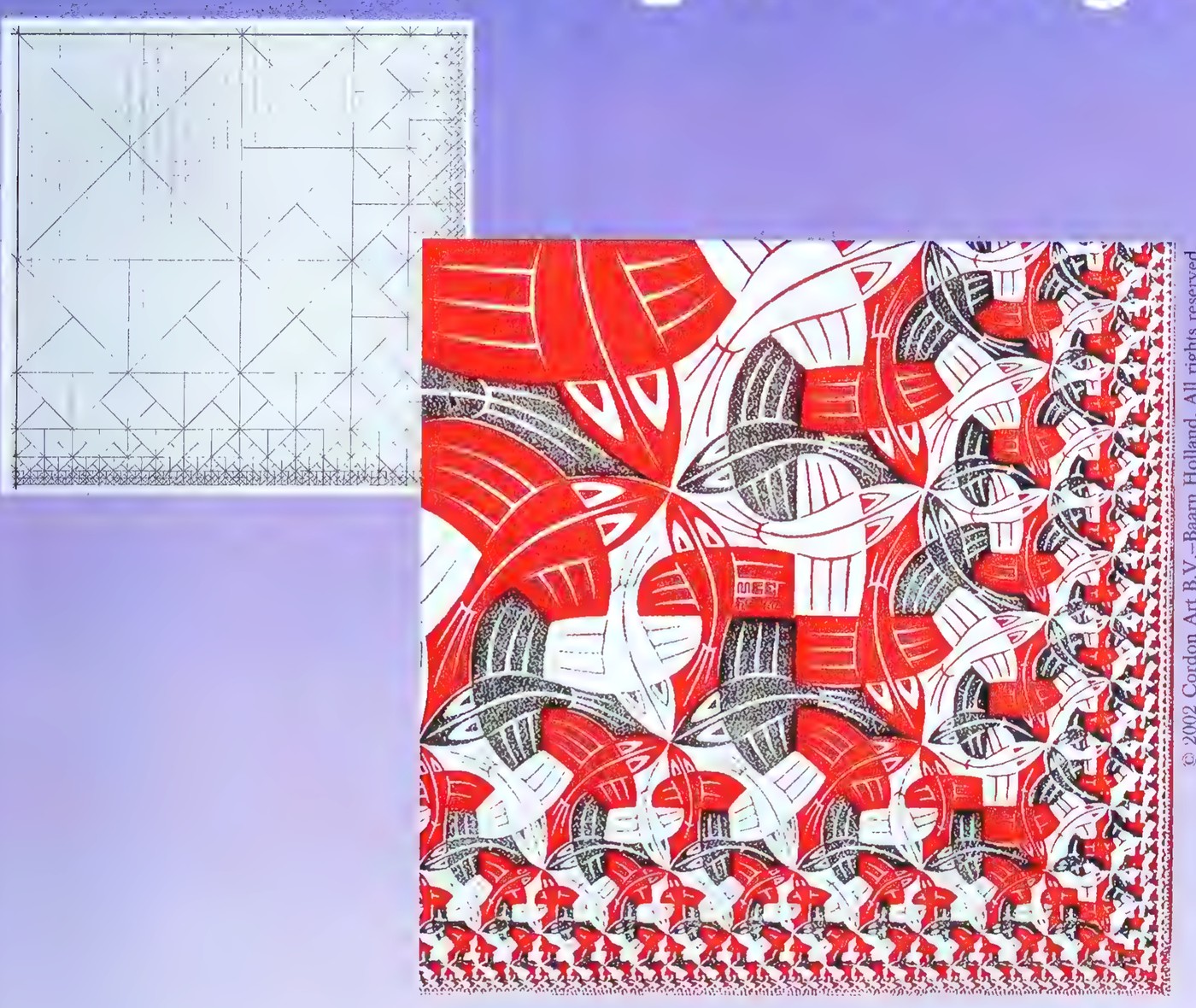
Plan and detail from Square Limit—Maurits Escher
© 2002 Cordon Art B.V.–Baarn-Holland. All rights reserved.
Of all geometric figures, the right triangle is perhaps the most important. The subject of trigonometry, or “triangle measurement,” began with observations about the properties of similar right triangles, which led to the creation of the trigonometric ratios, three of which are named sine, cosine, and tangent. These ratios have turned out to be useful in working with triangles other than right triangles and even in problems that have no connection to triangles at all.
p. 428
Lesson 1: Proportions in a Right Triangle
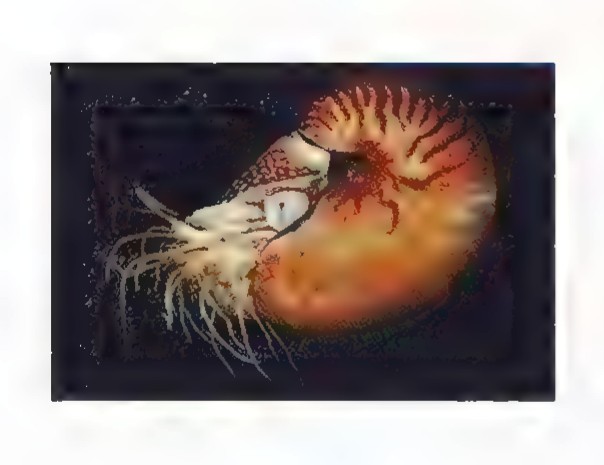
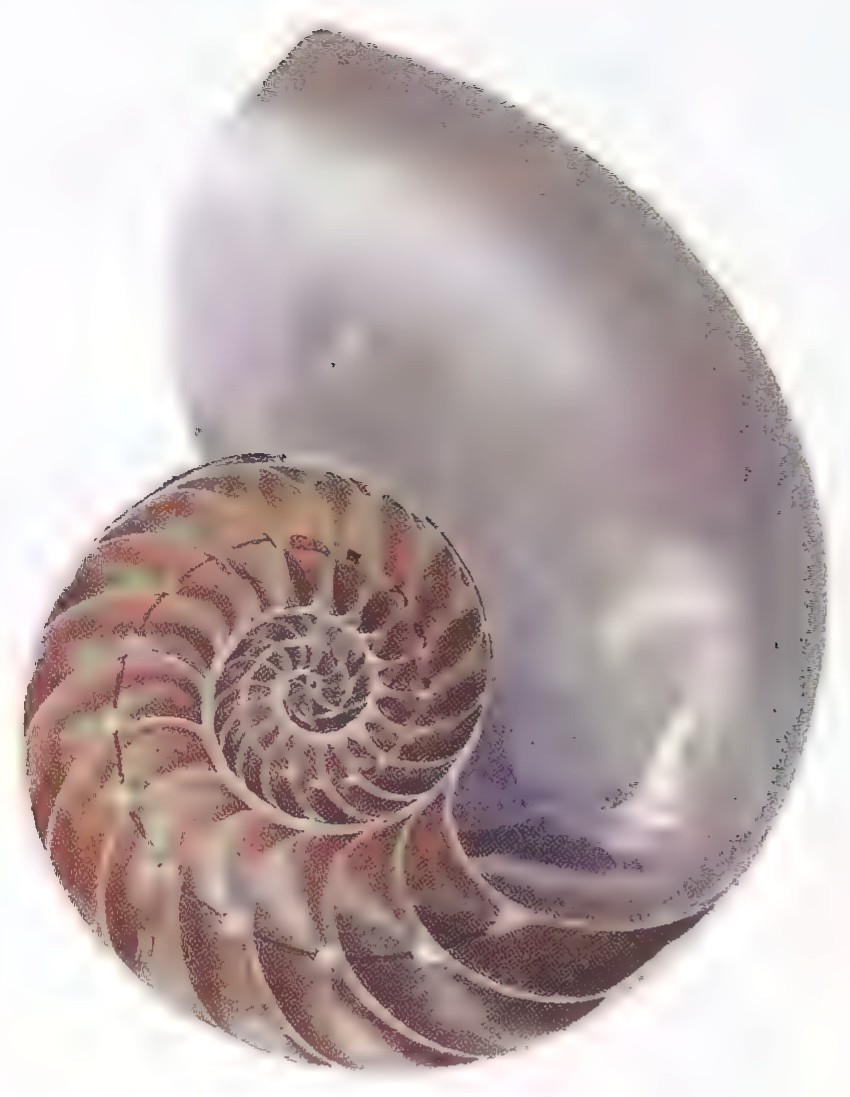
The chambered nautilus is a remarkable creature. Although the outside of its shell is attractively covered with brown stripes, it is the beautiful design inside for which the nautilus is famous. As it grows, the nautilus moves through a series of successively larger compartments that wind around a curve called a spiral. All the compartments are similar in shape and, as a result, their corresponding dimensions are proportional.
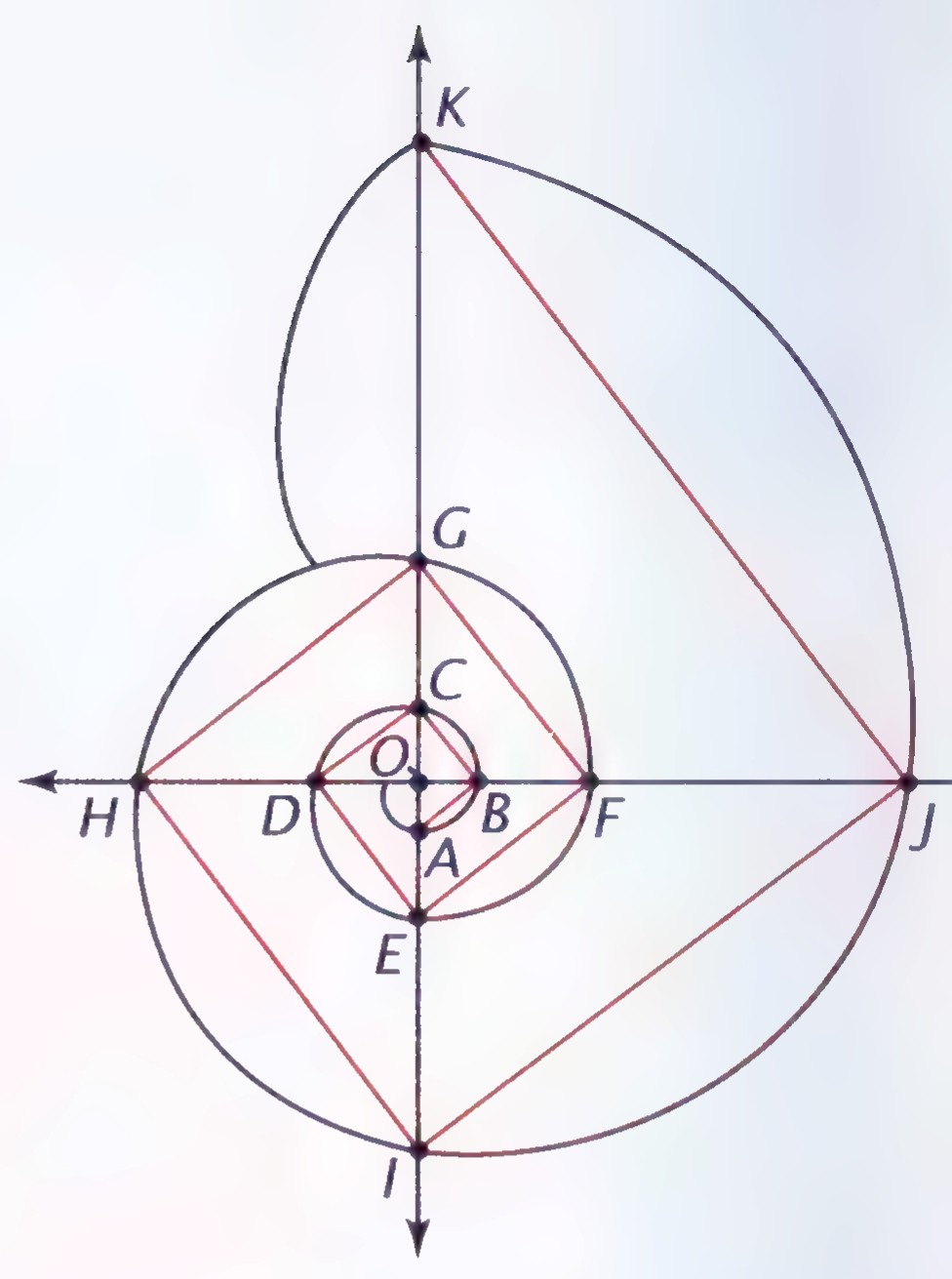
The photographs at the left and above are of a living nautilus and a shell that has been cut in half to reveal its internal design. In the drawing above, the beginning of the spiral is labeled point O. Two perpendicular lines have been drawn through point O and, as the spiral winds around this point, it intersects these lines in a series of points: A, B, C, and so on. If these points are connected in order by a series of line segments, AB, BC, CD, and so on, each segment is perpendicular to the next: AB BC CD, and so on.
For this reason, the consecutive pairs of segments are the legs of a series of progressively larger right triangles winding around point O. It is easy to prove that these triangles are similar and, as a result, that
p. 429
Each successive distance, OB, OC, OD, and so on, is the geometric mean between the distances before and after it. Each distance is the altitude to the hypotenuse of a right triangle, and the distances between which it is the geometric mean are the two segments of the hypotenuse. These relations are established by the proofs of the following theorem and the first of its corollaries.
Theorem 49
The altitude to the hypotenuse of a right triangle forms two triangles similar to it and to each other.
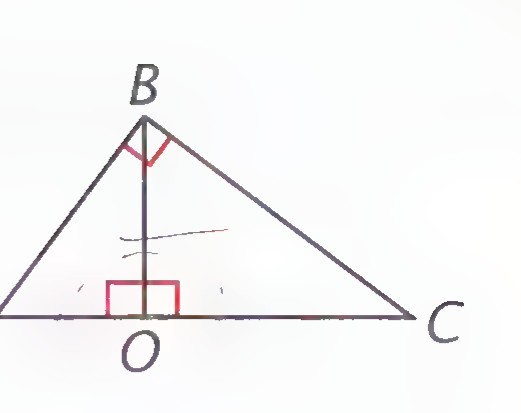
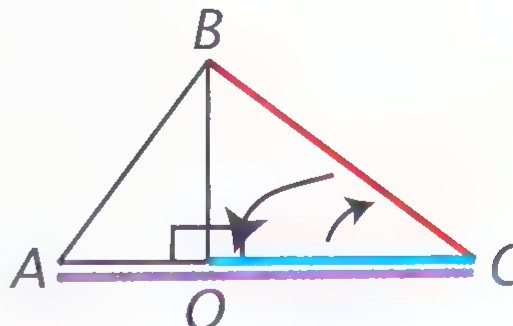
Given: Right ABC with altitude BO to hypotenuse AC.
Prove: AOB ~ BOC ~ ABC.
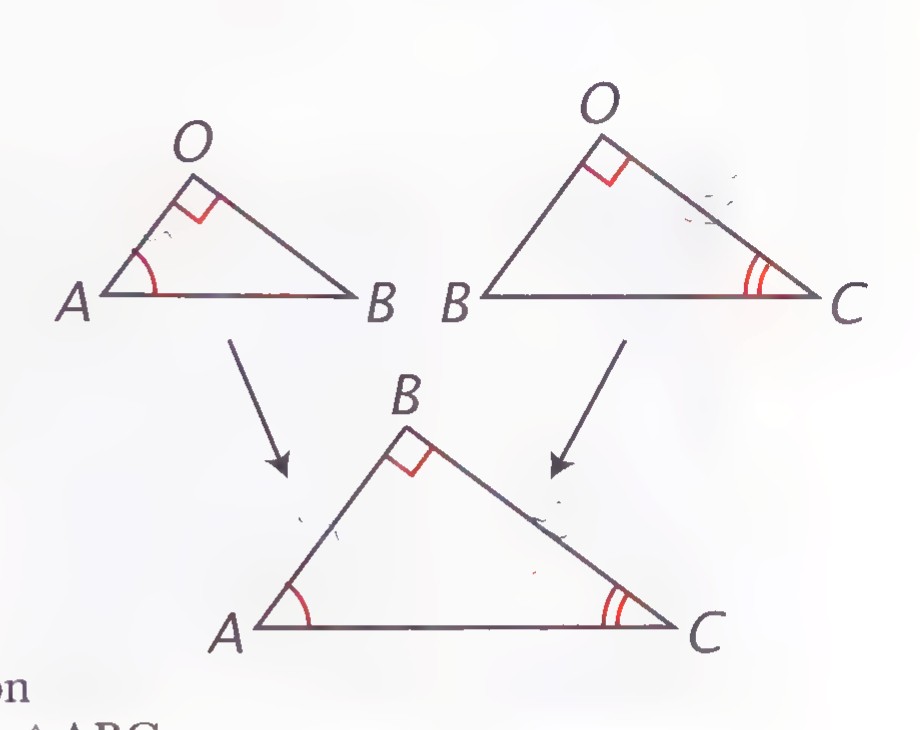
The three triangles have been redrawn at the right to make the proof easier to follow.
Proof
AOB and ABC are right triangles with a common acute angle at A; so AOB ~ ABC. Also, BOC and ABC have a common acute angle at C; so BOC ~ ABC. Finally, AOB ~ BOC because, if two triangles are similar to a third triangle, they are similar to each other.
Perhaps more important than this theorem are the proportions that follow from it. For example, from the fact that AOB ~ BOC, it follows that
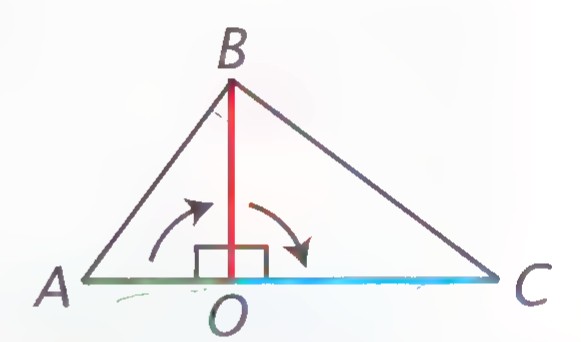
BO is the geometric mean between AO and OC.
Corollary 1 to Theorem 49
The altitude to the hypotenuse of a right triangle is the geometric mean between the segments into which it divides the hypotenuse.
From the correspondences AOB ~ ABC and BOC ~ ABC follow the proportions
The first equation shows that leg AB of the triangle is the geometric mean between the hypotenuse AC and segment AO of the hypotenuse. The second equation shows that leg BC is the geometric mean between the hypotenuse AC and segment OC of the hypotenuse. We will refer to segments AO and OC as the projections of sides AB and BC on the hypotenuse, respectively.
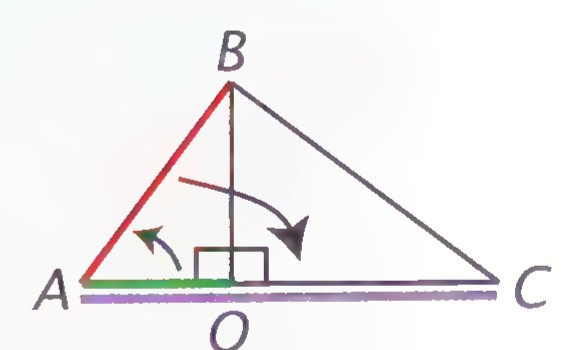
AB is the geometric mean between AO and AC.
Corollary 2 to Theorem 49
Each leg of a right triangle is the geometric mean between the hypotenuse and its projection on the hypotenuse.
BC is the geometric mean between OC and AC.
p. 430
Exercises
Set I
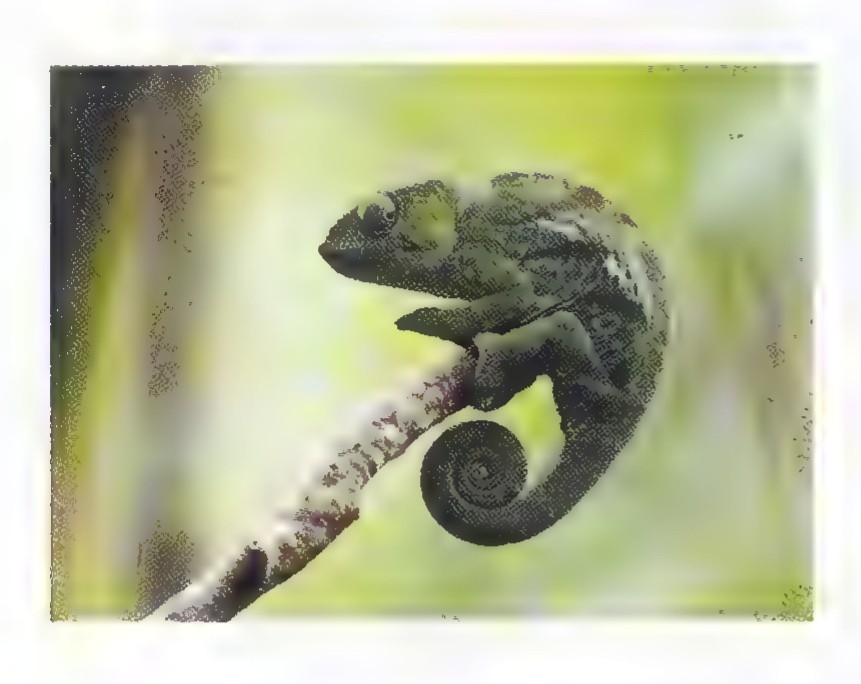
Chameleon Tail. The tail of this West African chameleon is coiled up in a shape similar to that of a nautilus shell.
- What is this type of curve called?
In the figure below, AC BD and ABC and EFG are right angles.
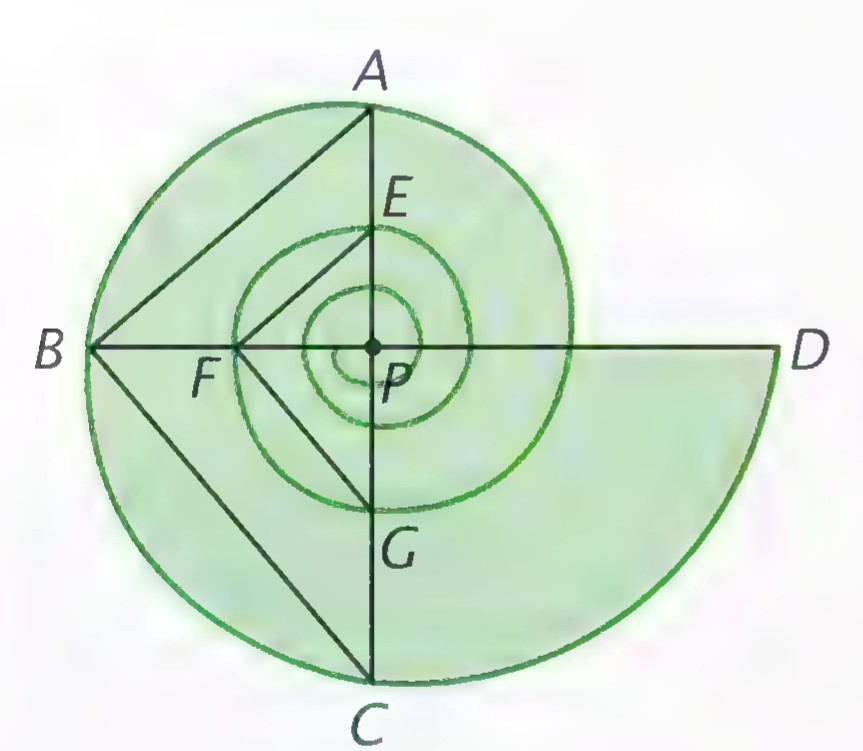
- What is BP called with respect to ABC?
- Between which two segments is BP the geometric mean?
- How do you know?
- Which segment is the projection of EF on the hypotenuse of EFG?
- Between which two segments is EF the geometric mean?
- How do you know?
Shadows. Imagine that right ABC stands with side AB on the ground and that the sun is directly overhead.
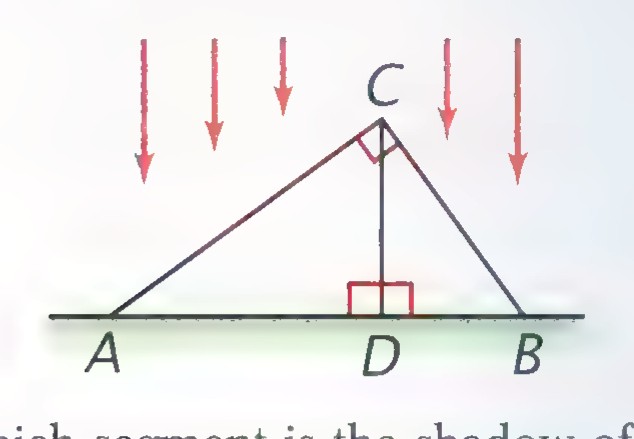
- Which segment is the shadow of AC on the ground?
- Which segment is the shadow of CB?
- What are AC and CB called with respect to ABC?
- What are AD and DB called with respect to AC and CB?
Which line segment in the figure is the geometric mean between
- AB and AD?
- AD and DB?
- AB and DB?
Find the Lengths. Solve for in each of the following figures.
Example:
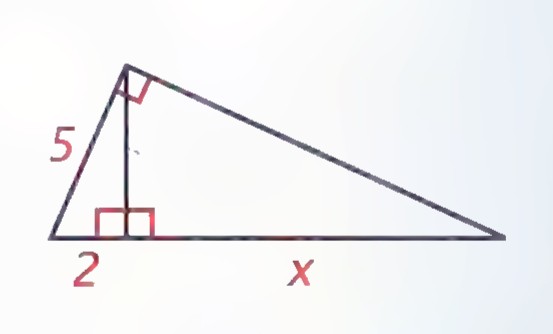
Solution:
The length of one leg is 5 and its projection on the hypotenuse is 2. Also, the length of the hypotenuse is 2 + . Each leg of the right triangle is the geometric mean between the hypotenuse and its projection on the hypotenuse; so
Solving for , we have
p. 431
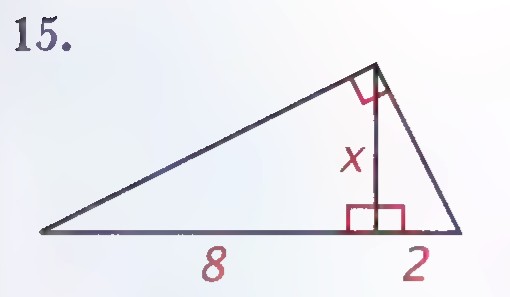
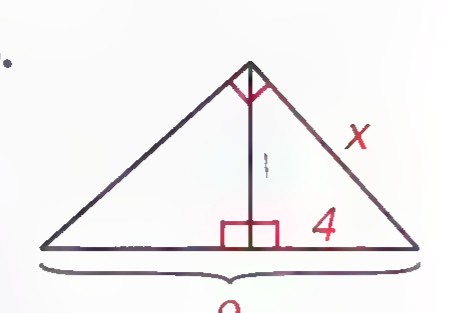
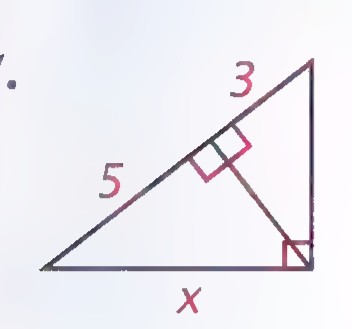
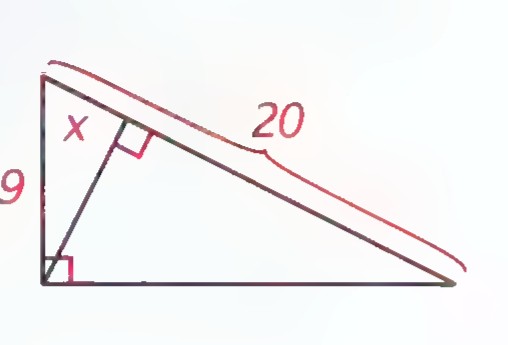
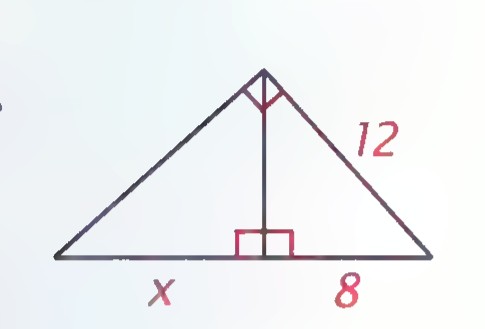
With and Without Pythagoras. In the figure below, CD is the altitude to the hypotenuse of right ABC, AD = 9, and CD = 12.
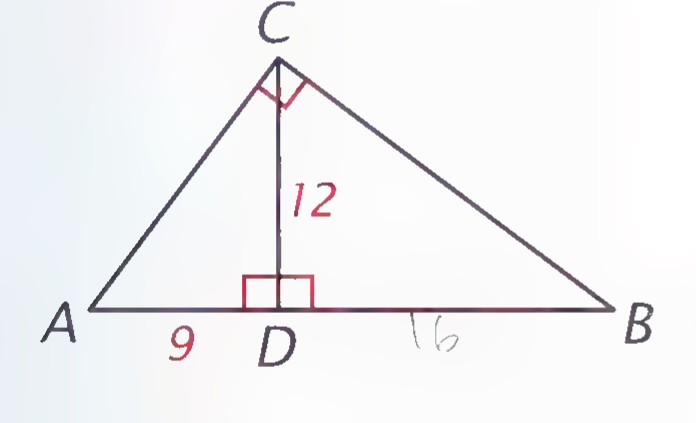
- Copy the figure and mark it as needed to do each of the following exercises.
- Find DB.
- Find AC without using the Pythagorean Theorem.
- Find AC by using the Pythagorean Theorem.
- Find BC without using the Pythagorean Theorem.
- Find BC by using the Pythagorean Theorem.
- Find .
- Find .
- Find .
On the basis of your answers to exercises 26 through 28, tell whether each of the following statements is true or false.
- .
- .
Rectangle and Square. In the figures below, the sides of the rectangle and square are equal in length to the three labeled segments in the triangle.
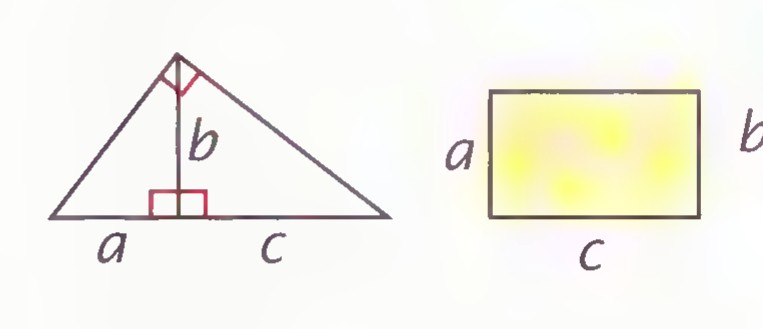
- What can you conclude about the areas of the rectangle and square? Explain.
Set II
Strongest Beam. The figure below shows a rectangular cross section of a wooden beam cut from a circular log. For the beam to have the greatest stiffness, points E and F should trisect diameter AC.
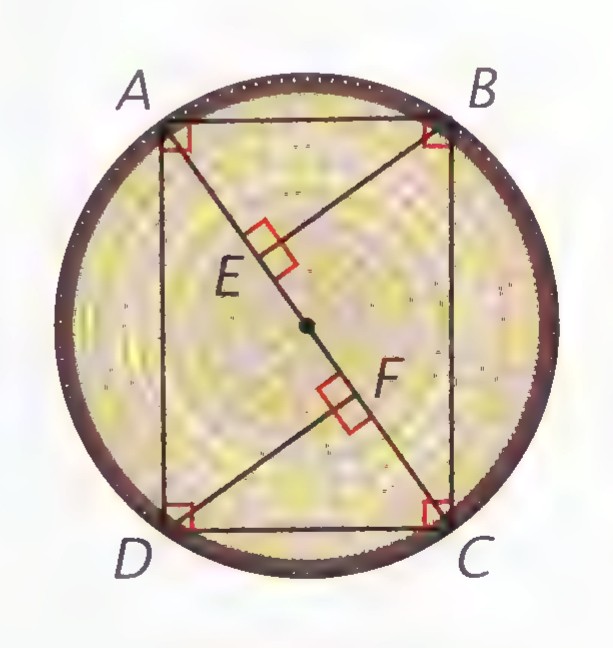
Suppose AC = 12 inches.
- Copy the figure and mark it as needed to do each of the following exercises.
- Find the exact length of BC.
- Find the exact length of AB.
p. 432
- Find the exact value of the ratio .
- Find the area of rectangle ABCD to the nearest square inch.
- Find the area of the circle to the nearest square inch.
Zigzag. In the figure below, segments AB, BC, CD, and so on, are alternately perpendicular to the sides of O.
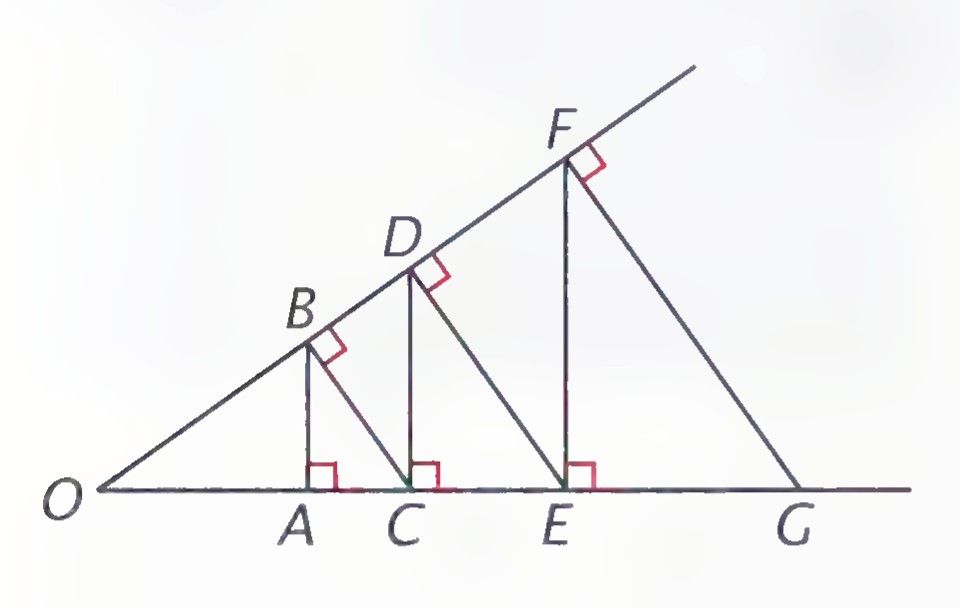
Copy and complete the following proportion for OBC:
State the theorem (corollary) that is the basis for your answer.
Copy and complete the following proportions for OCD and ODE:
Given that OA = 1 and OB = , use your proportions to find each of the following lengths in terms of .
- OC.
- OD.
- OE.
- How long do you think OF and OG are in terms of ?
Suppose the figure were drawn so that OA = 1 inch and OB = 10 inches.
- How long would OG be?
Plato’s Proportions. The Greek philosopher Plato thought that, when God constructed the universe, He used four elements. Plato wrote:
God placed water and air between fire and earth; and made them so far as possible proportional to each other, so that air is to water as water is to earth.*
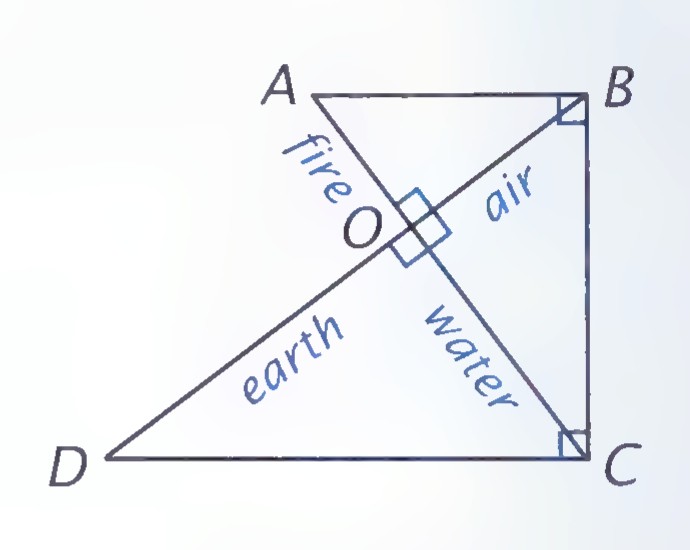
The figure above geometrically illustrates Plato’s proportions.
Does it necessarily follow that
Explain why or why not.
Does it necessarily follow that
Explain why or why not.
SAT Problem. The figure below appeared in a problem on an SAT exam.
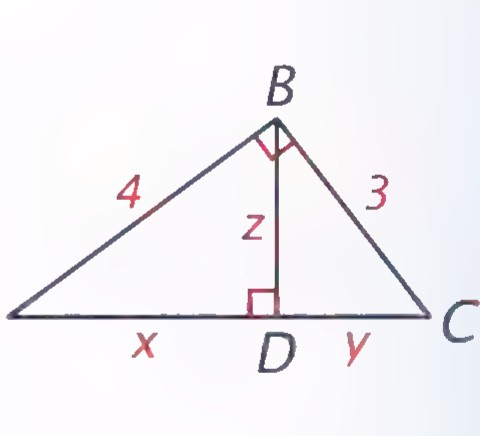
- Find .
- Find .
- Find .
- Find .
* Timaeus. Quoted in Connections: The Geometric Bridge between Art and Science, by Jay Kappraff (McGraw-Hill, 1990).
p. 433
Set III
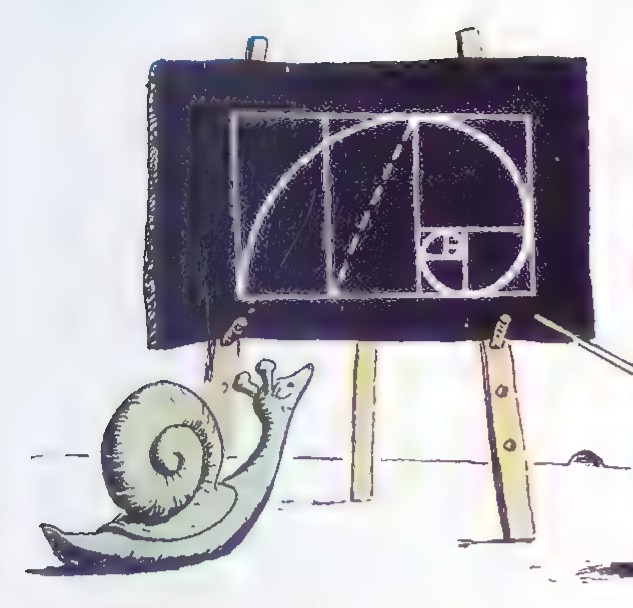
Used by permission of John McClellan.
The Golden Rectangle. The spiral of the chambered nautilus is closely related to a figure called the golden rectangle discovered by the Greeks in the fifth century B.C.
One way to construct a golden rectangle is suggested by the drawing in the cartoon above and described below.
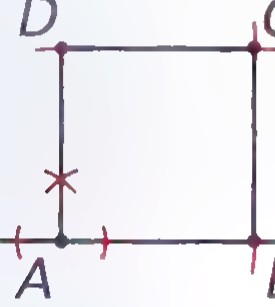
First, use the method illustrated by the figure at the left above to construct a square with sides 2 inches long. Label it ABCD as shown.
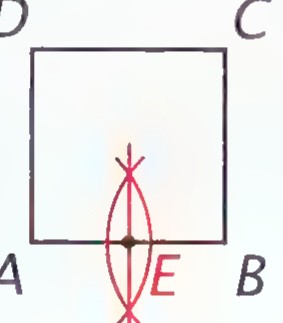
Bisect the base of the square and label the midpoint E as shown in the figure at the right above.
With E as center and EC as radius, draw an arc intersecting line AB in point F as shown in the figure at the left below.
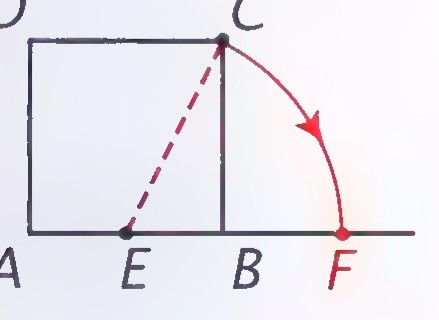
Construct a line perpendicular to AB at F. Let G be the point in which it intersects line DC as shown in the figure at the right below.
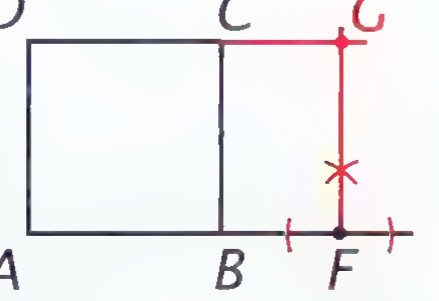
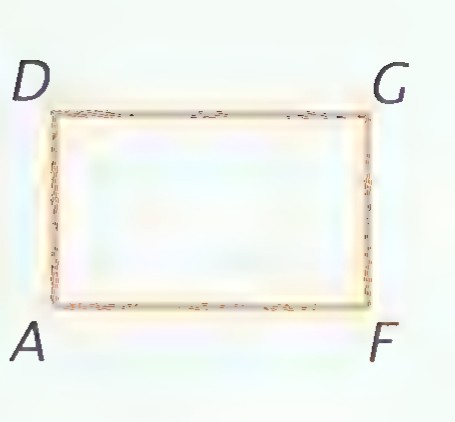
Quadrilateral AFGD is a golden rectangle. The ratio of its dimensions, , is called the golden ratio.
Find the exact value of the golden ratio by starting with AB = 2 and finding the exact values of the following lengths.
- AD.
- EB.
- EC (use the Pythagorean Theorem).
- EF.
- AF.
- Find , the golden ratio.
Use your calculator to find the approximate value of the golden ratio to as many decimal places as you can.
Find the exact values of the following lengths.
- GF.
- BF.
- Find .
Use your calculator to find the approximate value of to as many decimal places as you can.
What does this result suggest about rectangle BFGC?
Use your calculator to find the approximate value of .
What is surprising about the result?
p. 434
Lesson 2: The Pythagorean Theorem Revisited
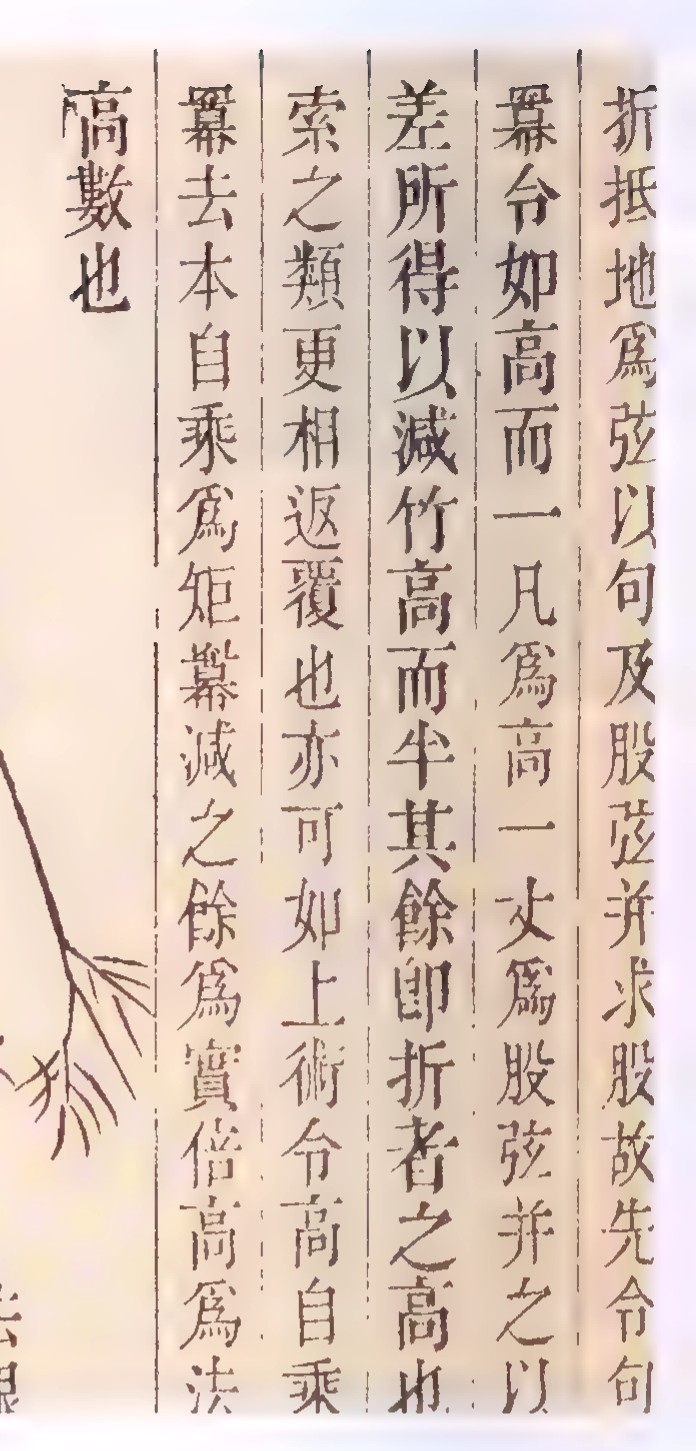
A very old problem in geometry is the puzzle of the Broken Bamboo. The earliest known book in which it appears is the Chiu Chang Suan Shu (Nine Chapters on the Mathematical Art), written in China at about the same time that Euclid was writing the Elements.*
The problem as it appeared in a book published in 1261 is shown at the top of this page. It says:
A bamboo shoot is 10 ch’ih tall. It is broken and the top touches the ground 3 ch’ih from the root. What is the height of the break?
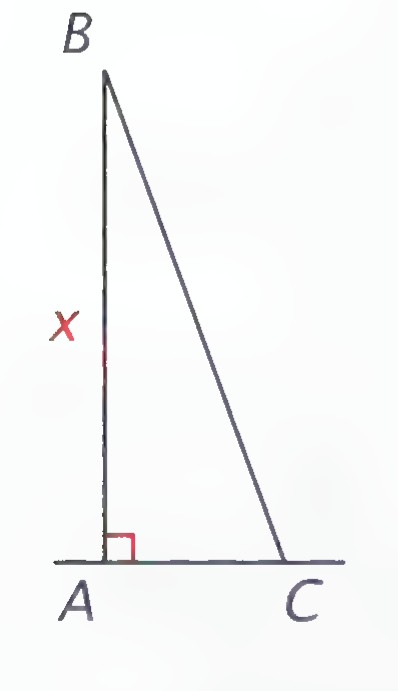
In the figure at the left, the problem is to find AB, given that
* Was Pythagoras Chinese? by Frank J. Swetz and T. I. Kao (Pennsylvania State University Press, 1977).
p. 435
If we let AB = , it follows that BC = 10 − . Applying the Pythagorean Theorem to right ABC, we have
Solving for , we get
The break is 4.55 ch’ih above the ground.
The problem of the Broken Bamboo is famous as an early application of the Pythagorean Theorem. You have studied several proofs of the Pythagorean Theorem that are based on area. In this lesson, we will consider a proof based on similarity. It depends on the second corollary to Theorem 49—the fact that each leg of a right triangle is the geometric mean between the hypotenuse and its projection on the hypotenuse.
The Pythagorean Theorem
In a right triangle, the square of the hypotenuse is equal to the sum of the squares of the legs.
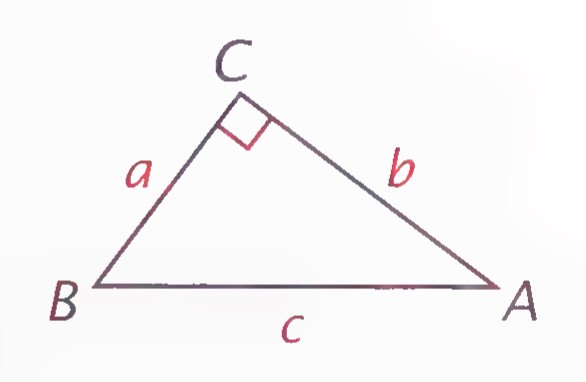
Given: Right ABC with legs of lengths and and hypotenuse of length .
Prove: .
Proof
Project the legs of ABC on the hypotenuse by drawing CD BA; let the lengths of the two projections be called and .
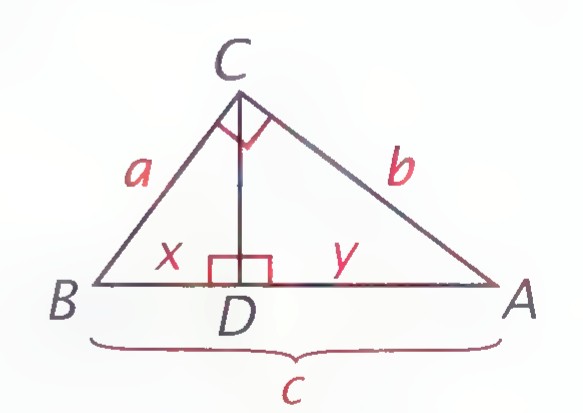
Because either leg of a right triangle is the geometric mean between the hypotenuse and its projection on the hypotenuse,
Multiplying, we get
Adding these equations gives
Because ,
p. 436
Exercises
Set I
Baseball Distances. A baseball diamond is a square with sides 90 feet long. A batter hits the ball and runs toward first base.
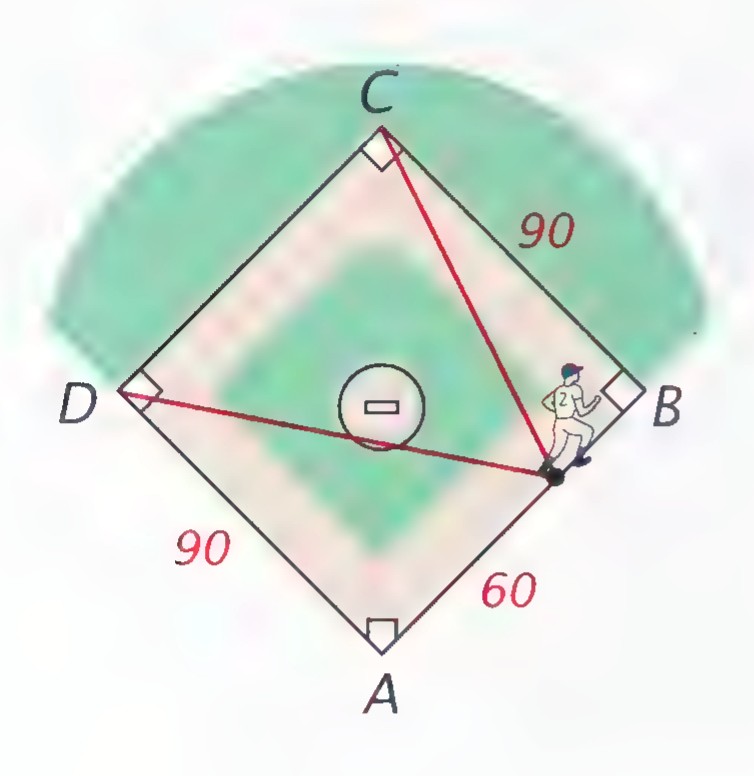
When he has run 60 feet, how far is he from
- first base?
- second base?
- third base?
- Draw a figure and mark it as needed to answer each of the following questions.
When the batter has run halfway from first base to second base, how far is he from
- third base?
- home plate?
Pole Problem. The following problem appears in the Cairo papyrus, written in Egypt in about 100 B.C.
A pole 10 cubits long stands along a wall. Its base is moved 6 cubits away from the wall.
- Copy the figure at the right, in which AB represents the original position of the pole and CD represents its final position. Mark your figure as needed to answer each of the following questions.
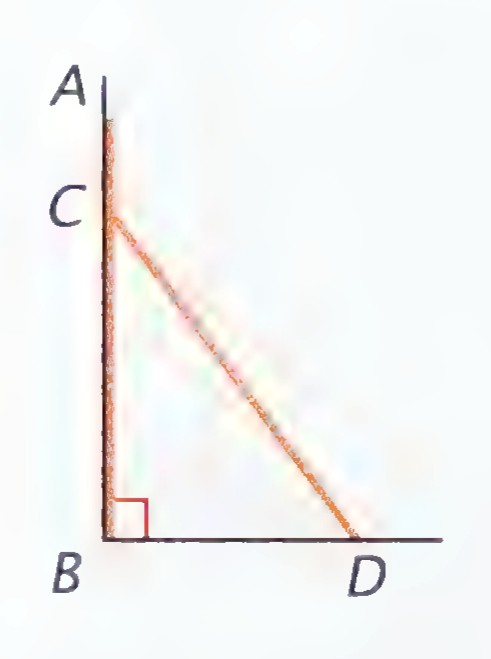
- How far up the wall does the pole reach in its final position?
- How far did the top of the pole move down the wall?
Emergency Exits. If a rectangular room has two emergency exits, the distance between them must be at least one-half the length of a diagonal of the room’s floor.*
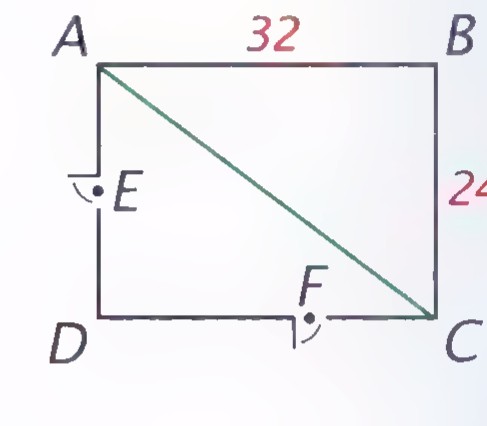
Suppose that the dimensions of the room pictured above are 32 feet by 24 feet and that one emergency exit is at E, midway between A and D, and the other exit is at F, between D and C.
- Copy the figure and mark it as needed to answer each of the following questions.
- What is the length of AC?
- What is the minimum legal length of EF?
- Would it be legal to place emergency exit F midway between D and C? Explain.
Suppose instead that emergency exit E is 6 feet from A, as shown in the scale drawing below.
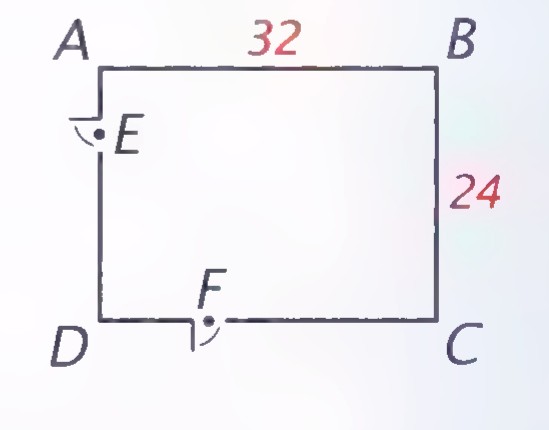
- Copy the figure and mark it as needed to answer each of the following questions.
* Uniform Building Code (International Conference of Building Officials, 1991).
p. 437
- How close to D can exit F be placed on wall DC?
- How close to A could exit F be placed if it were on wall AB?
- Could exit F be placed on wall BC? If so, where?
Pythagorean Triples. The set of numbers “3-4-5” is well known as the simplest Pythagorean triple; that is, a set of three integers that can be the lengths of the sides of a right triangle.
There are infinitely many Pythagorean triples; those in which no number is more than 50 are listed at the right below.
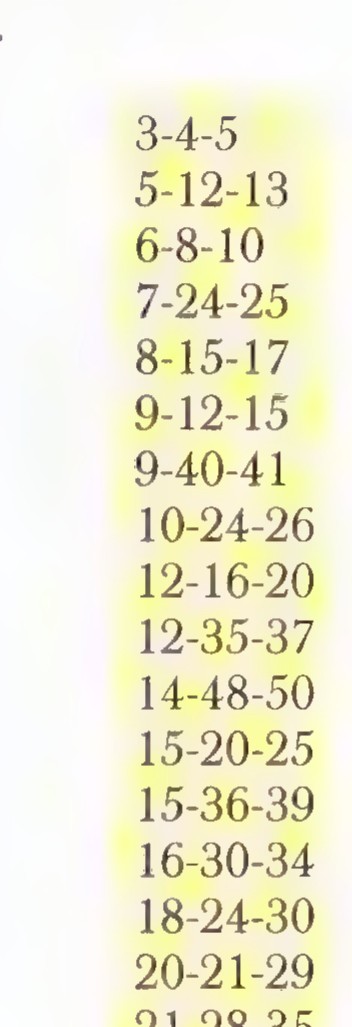
- Show why the set “7-24-25” is a Pythagorean triple.
- Can all three numbers in a Pythagorean triple be even? Explain.
- Can all three numbers in a Pythagorean triple be odd? Explain.
Some of the Pythagorean triples in the list are related to one another.
- How is the triple 14-48-50 related to the triple 7-24-25?
The figure below suggests why Pythagorean triples are related in the way that they are.
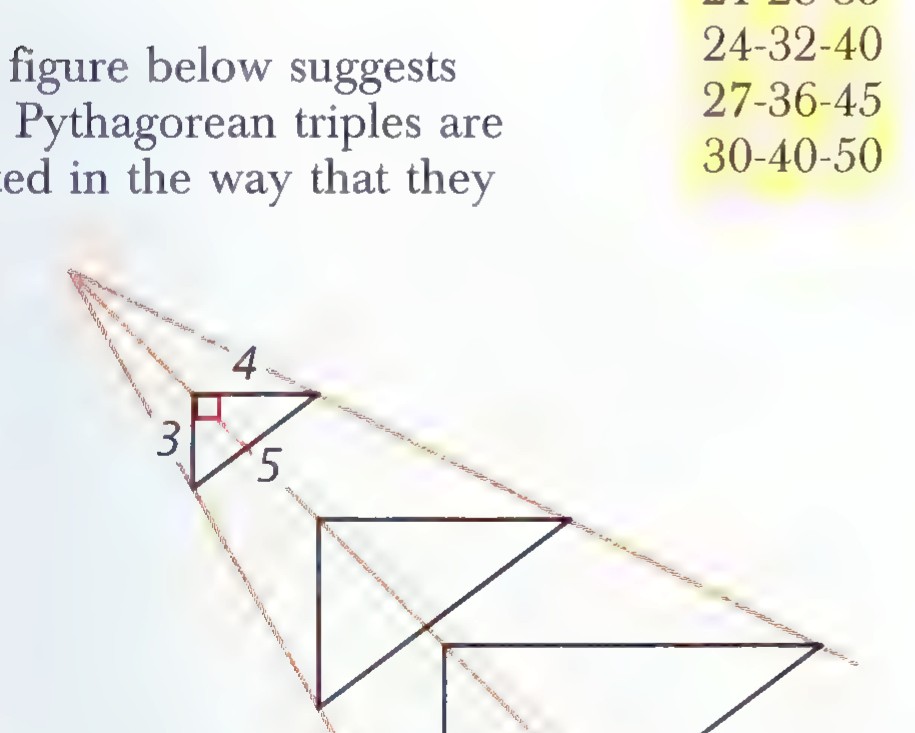
- Under what transformation are the larger triangles images of the 3-4-5 right triangle?
- What Pythagorean triples do they illustrate?
- Name the other triples in the yellow list that also are part of this set.
- Find two triples in the list that are related to 5-12-13.
Not Quite Right. The triangles below look like right triangles, but they actually are not.
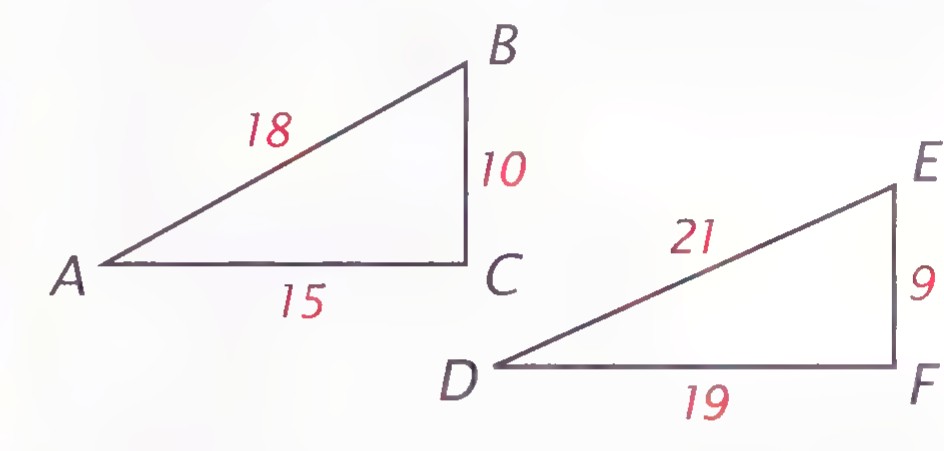
- Use the lengths of their sides to show why each figure looks so much like a right triangle.
- What kind of angles do you think C and F actually are? Explain your reasoning.
Distance Formula. The Distance Formula comes from the Pythagorean Theorem.
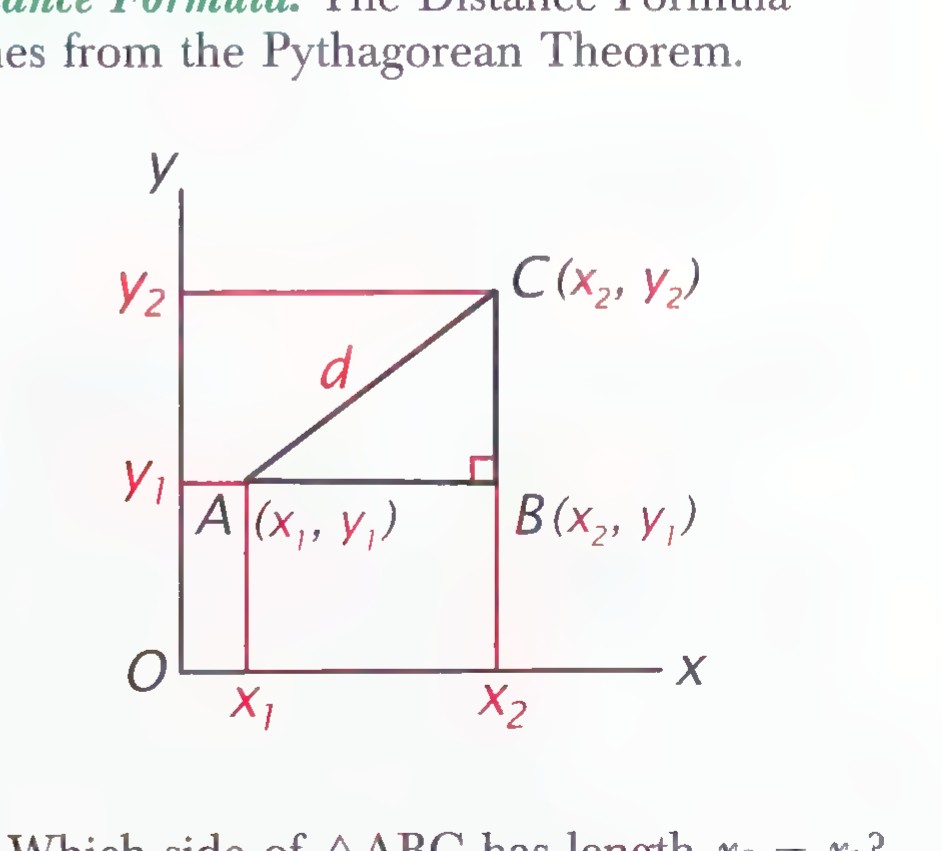
Which side of ABC has length − ?
What is the length of side BC?
Why does it follow that
p. 438
Set II
TV Screens. Television tubes were originally round, which is why the length of a tube’s diagonal (diameter) is used in giving the size of a television screen.
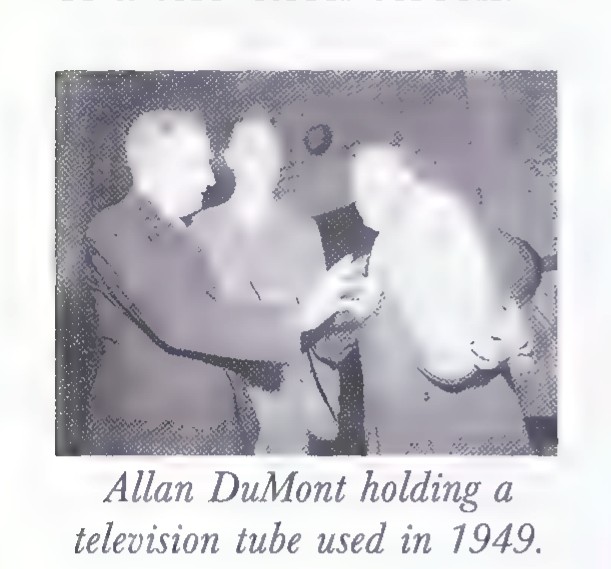
Allan DuMont holding a television tube used in 1949.
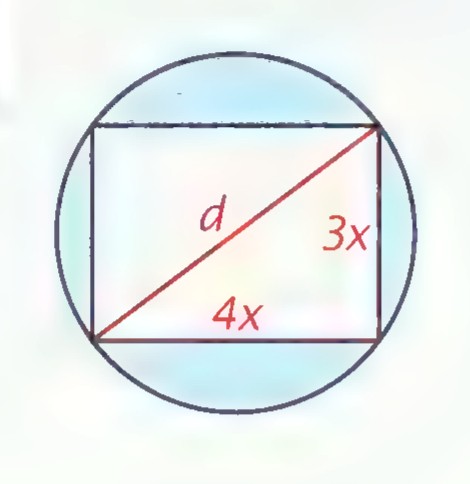
The screen is rectangular with an aspect ratio of 4 to 3.*
- Representing the dimensions of the screen as 4 and 3 and the length of the diagonal as , write an equation for in terms of .
- Write an equation for in terms of .
The first television tubes were produced in 1938 and had a diameter (diagonal) of 14 inches.
- What were the corresponding dimensions of the television screen?
The standard television set now has a diagonal of 27 inches.
- Find its dimensions.
- Find the ratio of the dimensions of the 27-inch screen to those of the 14-inch screen.
- How many times as big is the area of the picture on a 27-inch screen compared with that of a 14-inch screen?
Grid Exercise. On graph paper, draw a pair of axes extending from −10 to 10 on the -axis and from −5 to 15 on the -axis.
- Plot the following points: P(−1, 8), Y(1, 12), T(5, 10), H(3, 6), A(9, 3), G(6, −3), O(0, 0), R(−8, −1), and S(−9, 7). Draw the quadrilaterals PYTH, HAGO, and ORSP.
- Use the Distance Formula to find the following lengths: OH, OP, and PH.
- What can you conclude about OHP? Explain.
- What do you think is true about PYTH, HAGO, and ORSP?
- If your answer to exercise 40 is true, what are the areas of PYTH, HAGO, and ORSP?
Rope Surveying. Following the Sulvasutras (Rules of the Rope), surveyors in ancient India used ropes to lay out perpendicular lines.† Starting with a west–east line, they placed three poles at W, P, and E as shown below.
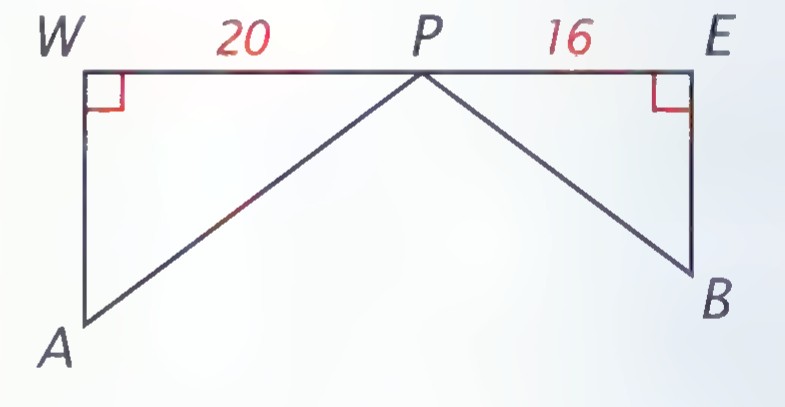
They then tied the ends of a rope 40 units long to W and P and the ends of a second rope 32 units long to P and E.
By holding each rope at a special knot tied in it and stretching the ropes tight, they formed two right triangles, WAP and PBE. Because the rope tied to W and P was 40 units long, WA + AP = 40.
- If WA = , what length does 40 − represent?
- Write an equation based on the Pythagorean Theorem for WAP and solve it for .
* Behind the Tube: A History of Broadcasting Technology and Business, by Andrew F. Inglis (Focal Press, 1990).
† Geometry Civilized: History, Culture, and Technique, by J. L. Heilbron (Clarendon Press, 1998).
p. 439
Because the rope tied to P and E was 32 units long, PB + BE = 32.
- If BE = , how long is PB in terms of ?
- Write an equation based on the Pythagorean Theorem for PBE and solve it for .
- What theorem were the ancient Indians using when they concluded that W and E were right angles?
Oil Well. Here is a puzzle that can be solved in an unexpected way.*
An oil well being drilled in flat prairie country struck pay sand at a spot exactly 21,000 feet from one corner of a rectangular plot of farmland, 18,000 feet from the opposite corner, and 6,000 feet from a third corner. How far is the drilling spot from the fourth corner?
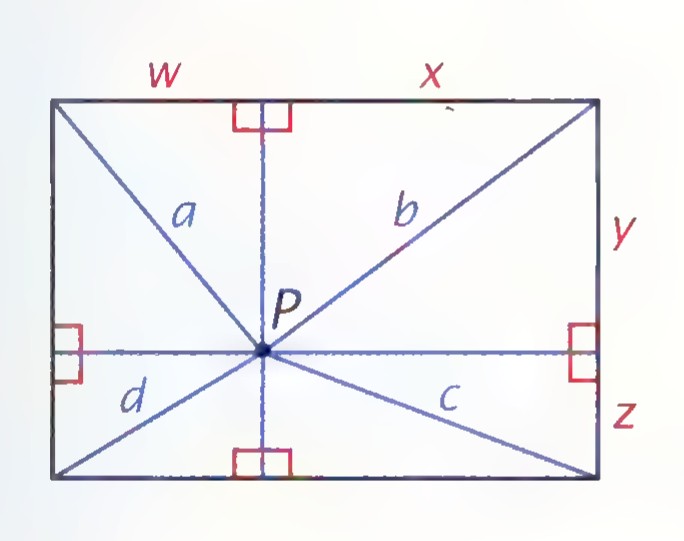
The figure above (not to scale) represents the rectangular plot, and point P represents the oil well. Notice that .
- Write similar equations for , , and .
- Write equations for and .
- What can you conclude from these equations?
- Use your conclusion to solve the oil-well puzzle.
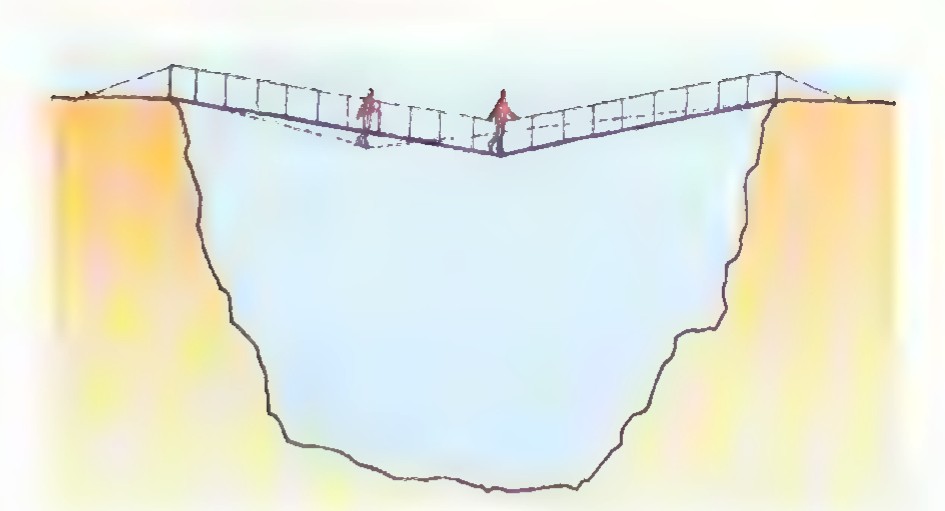
Suspension Bridge. The figure above shows someone walking across a suspension bridge made of ropes.†
Suppose the bridge is 100 feet long and stretches to a length of 101 feet under your weight when you are halfway across.
- Draw and label a figure to illustrate this description.
- How far does the bridge sag in the middle?
Turning Radius. The figure below shows an overhead view of the wheels of a car as it turns a corner. R is the turning radius and B is the wheelbase.‡
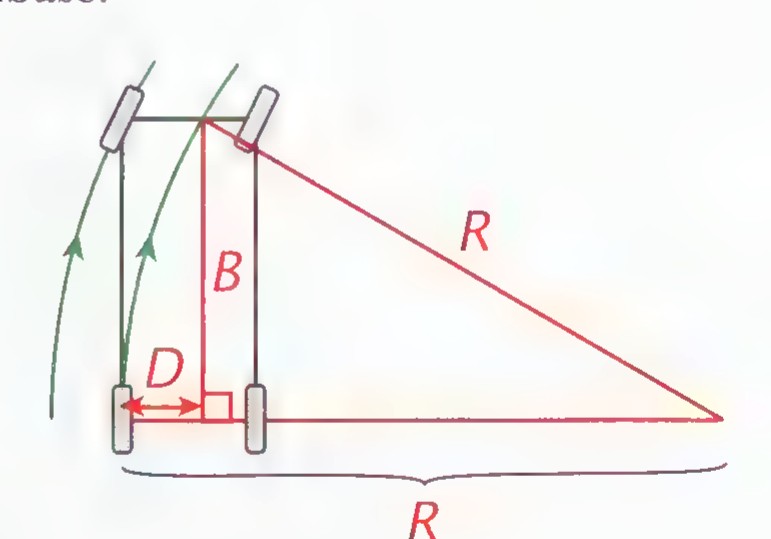
- Find an expression in terms of R and B for D, the divergence between the front and rear wheels.
- If the wheelbase is 12 feet and the turning radius is 27 feet, find D.
- Suppose the turning radius is doubled from 27 feet to 54 feet. What happens to D?
* Martin Gardner’s Sixth Book of Mathematical Games from Scientific American, by Martin Gardner (W. H. Freeman and Company, 1971).
† Why Buildings Fall Down: How Structures Fail, by Matthys Levy and Mario Salvadori (Norton, 1992).
‡ Time-Saver Standards for Site Planning, by Joseph De Chiara and Lee E. Koppelman (McGraw-Hill, 1984).
p. 440
Rocket Car. According to the theory of relativity, the length of an object appears to get shorter as it moves at speeds near the speed of light.
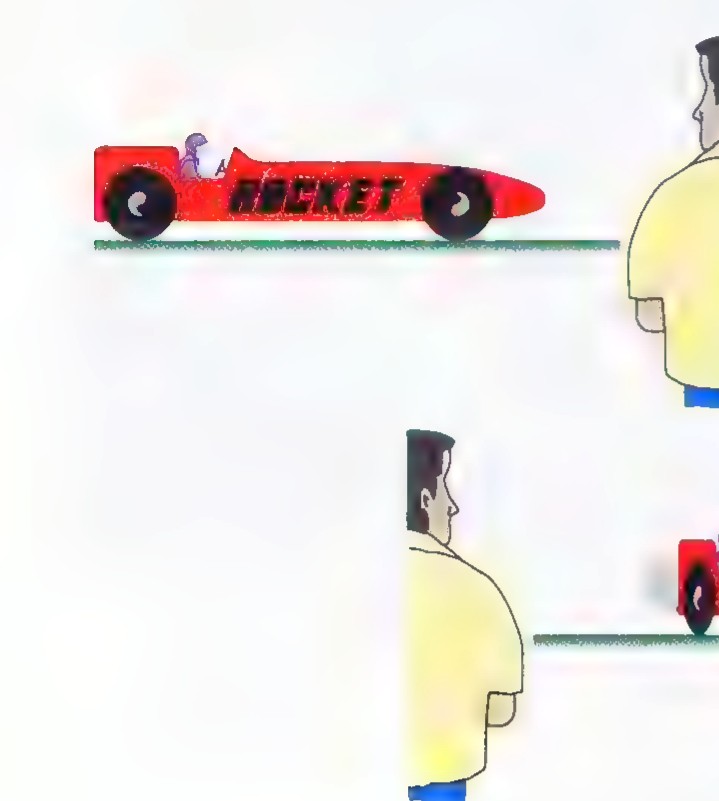
The Pythagorean Theorem is used in developing the formula for this change.
Show for the figure at the right why
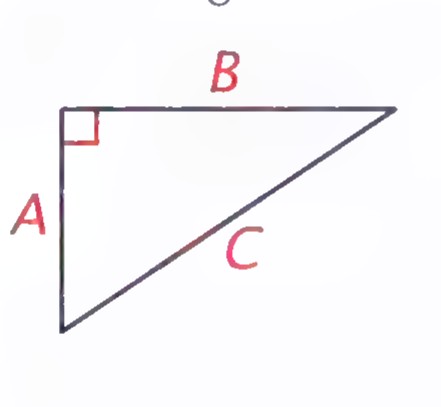
represents the ratio by which length shortens when is the ratio of the moving object’s speed to the speed of light.
- Use your calculator to find the ratio by which the length of a rocket car shortens when it is moving at 90% of the speed of light (in other words, when = 0.90).
Set III
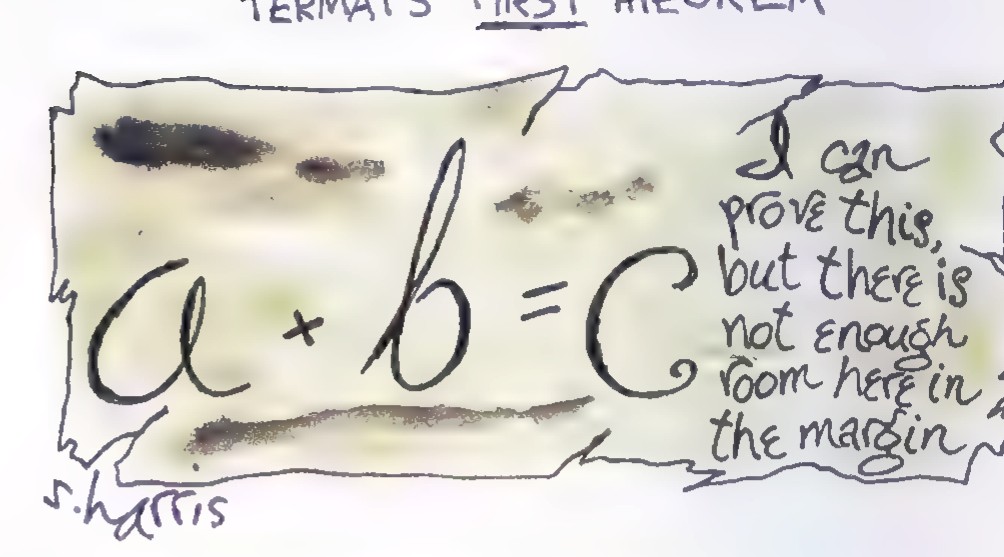
Fermat’s Last Theorem. In 1637, French mathematician Pierre de Fermat wrote a note in the margin of a book that has since become one of the most famous theorems of mathematics. Now known as Fermat’s Last Theorem, it says that, if , , , and are positive integers, the equation
has no solutions if is larger than 2. Fermat wrote that he had discovered a proof of this hypothesis but that the margin of the page was too narrow to contain it. No one to this day has been able to figure out what Fermat’s proof was. It was not, in fact, until 1995 that Andrew Wiles, a mathematician at Princeton University, succeeded in proving Fermat’s Last Theorem.
- How many solutions does the equation have if , , and are integers?
- How many solutions does the equation have? Explain.
- How many solutions does the equation have if , , and are positive integers?
An article in the March 7, 1938, issue of Time magazine reported that Samuel Krieger had discovered an equation that disproved the theorem.*
The equation was
in which is an integer that Krieger refused to disclose. A reporter for the New York Times showed that Krieger had to be mistaken.
- How did the reporter do it? (Hint: In what digits can each power in the equation end?)
* Wheels, Life, and Other Mathematical Amusements, by Martin Gardner (W. H. Freeman and Company, 1983).
p. 441
Lesson 3: Isosceles and 30°-60° Right Triangles
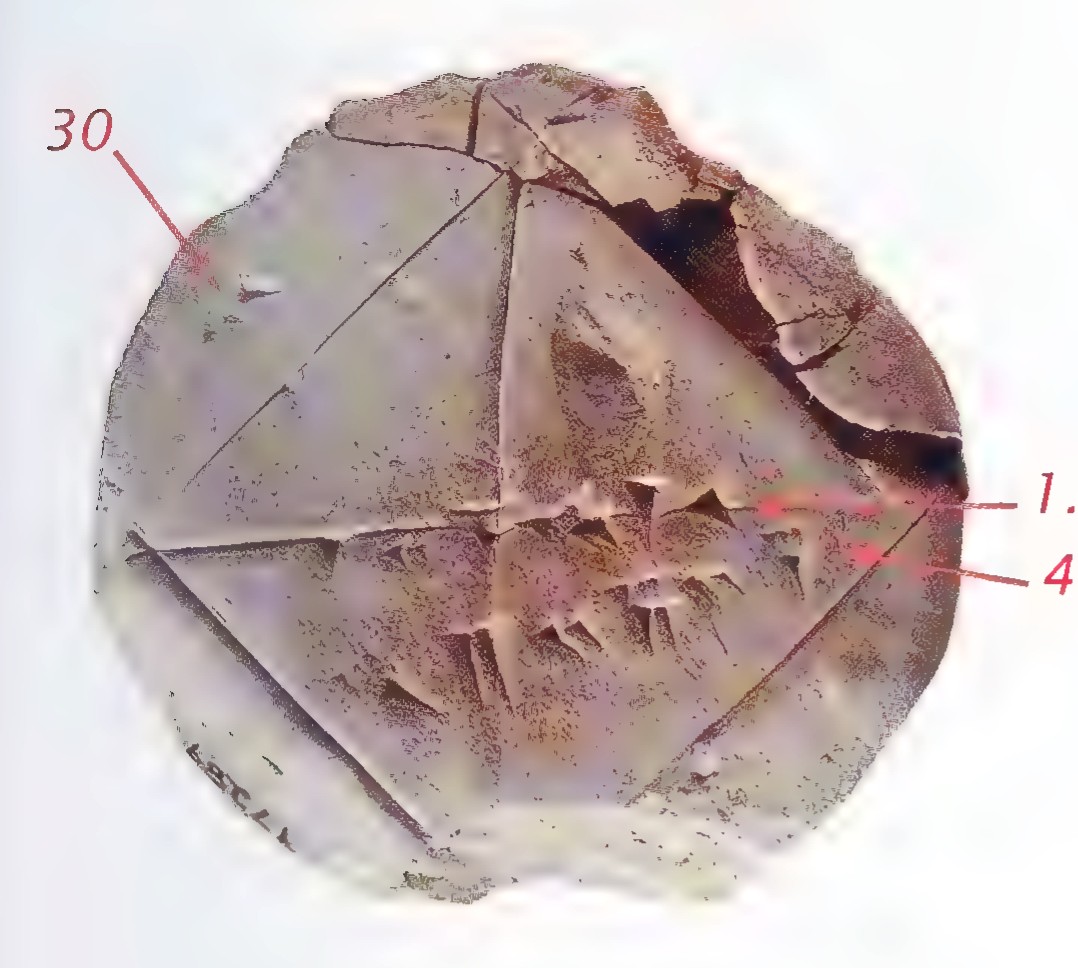
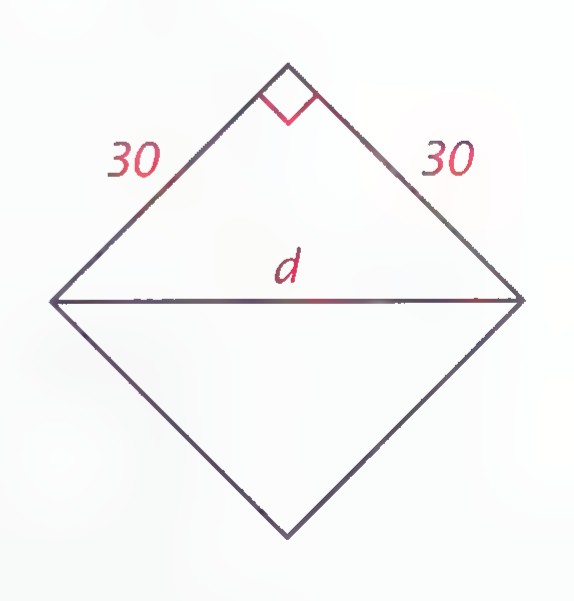
Archeologists digging in the land between the Tigris and Euphrates rivers in the late nineteenth century found thousands of clay tablets dating to 1700 B.C. Some of these tablets reveal what the ancient Babylonians knew about mathematics.* The one in the photograph above, for example, shows a square and its diagonals. The three wedge-shaped symbols at the upper left of the tablet represent the number 30. The symbols along the diagonal represent the number 1.41421 and the symbols below them represent the number 42.4263. These numbers are related because
Did the Babylonians mean by these numbers that, if 30 is the length of the side of a square, it can be multiplied by 1.41421 to get the length of a diagonal? Where did the number 1.41421 come from?
The figure at the right shows that a diagonal of a square is the hypotenuse of two isosceles right triangles. If each leg of one of these triangles is 30 units long, then from the Pythagorean Theorem we know that
Solving for gives
* Episodes from the Early History of Mathematics, by Asger Aaboe (Random House, 1964).
p. 442
Your calculator gives and , which are the numbers on the tablet. The Babylonians evidently knew that the hypotenuse of an isosceles right triangle and hence the diagonal of a square can be found by multiplying a leg (side) by .
Theorem 50. The Isosceles Right Triangle Theorem
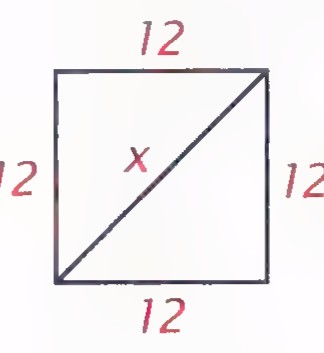
In an isosceles right triangle, the hypotenuse is times the length of a leg.
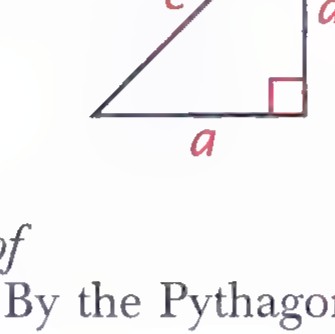
Given: An isosceles right triangle with legs of length and hypotenuse .
Prove: .
Proof
By the Pythagorean Theorem,
so .
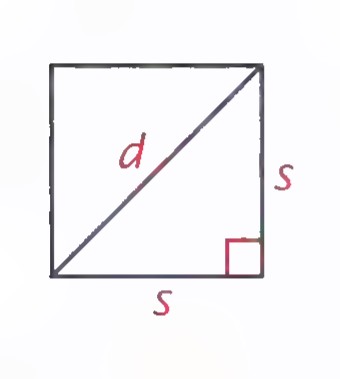
The Babylonian tablet shows how this result applies to the diagonal of a square.
Corollary to Theorem 50
Each diagonal of a square is times the length of one side.
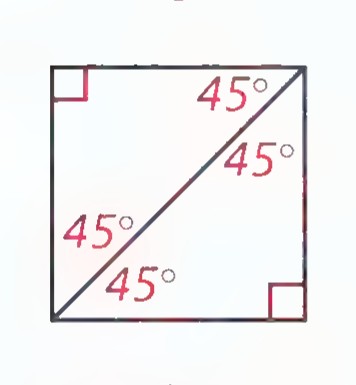
Because each acute angle of an isosceles right triangle has a measure of 45°, it is a “45°-45° right triangle.” A diagonal of a square divides it into two 45°-45° right triangles. Another important triangle in geometry is the “30°-60° right triangle.” An altitude of an equilateral triangle divides it into two 30°-60° right triangles.
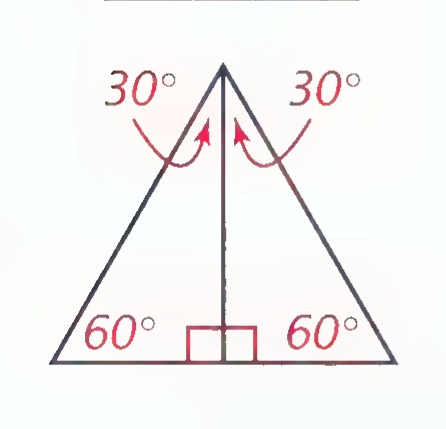
Theorem 51. The 30°-60° Right Triangle Theorem
In a 30°-60° right triangle, the hypotenuse is twice the shorter leg and the longer leg is times the shorter leg.
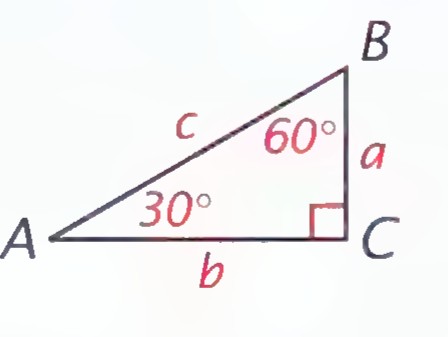
Given: ABC is a 30°-60° right triangle.
Prove: and .
Proof
Reflect point B through line AC as shown in the figure at the left, and label the reflection point D. Draw AD. ADC ABC (SAS); so D = B = 60° and CAD = CAB = 30°.
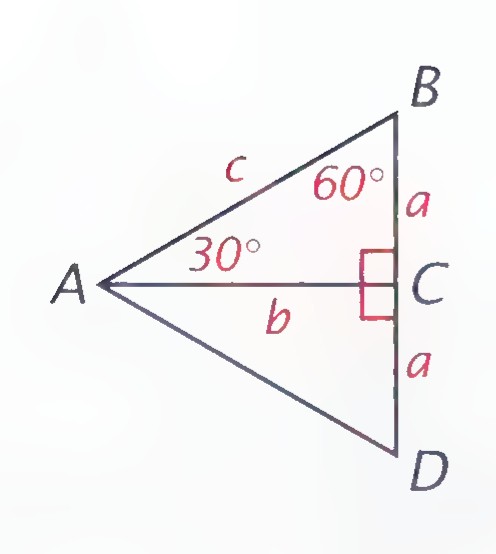
From these equalities it follows that BAD = 60°; so ABD is both equiangular and equilateral. So .
p. 443
By the Pythagorean Theorem,
Substituting, we get
The 30°-60° right triangle theorem can be used to express the altitude and area of an equilateral triangle in terms of one of its sides.
Corollary to Theorem 51
An altitude of an equilateral triangle having side is and its area is .
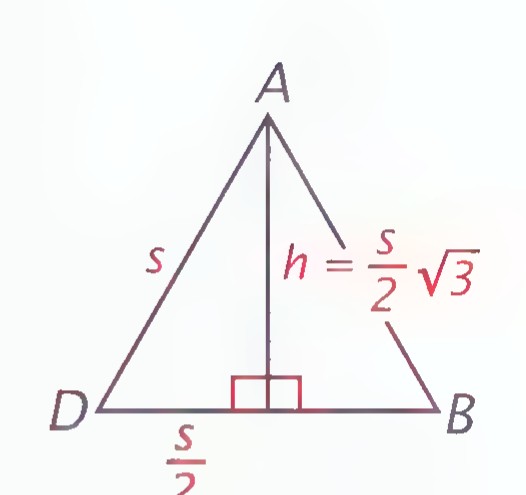
Given: Equilateral ABD with side and altitude .
Prove: and ABD .
Proof
The altitude is the longer leg of each of the two 30°-60° right triangles into which it divides the equilateral triangle. Because the shorter leg of each 30°-60° right triangle is , the altitude is
The area of the equilateral triangle is .
Exercises
Set I
Isosceles Right Triangles. The two isosceles right triangles below look similar.
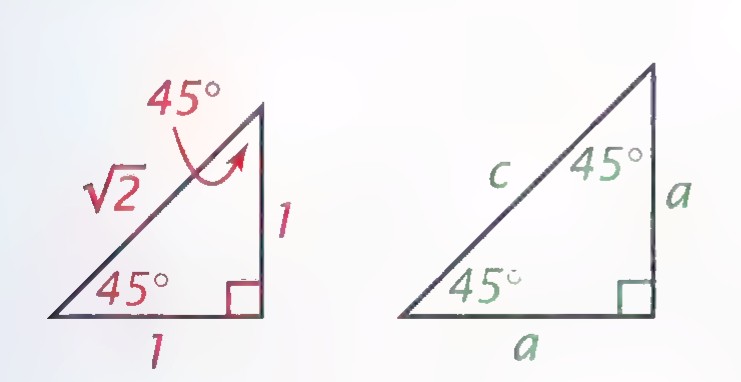
- Are the triangles similar? Explain.
- Complete this proportion: .
Use the proportion to express
- in terms of .
- in terms of .
- State the theorem illustrated by the result obtained for exercise 3 as a complete sentence.
p. 444
30°-60° Right Triangles. The two 30°-60° right triangles below appear to be similar.
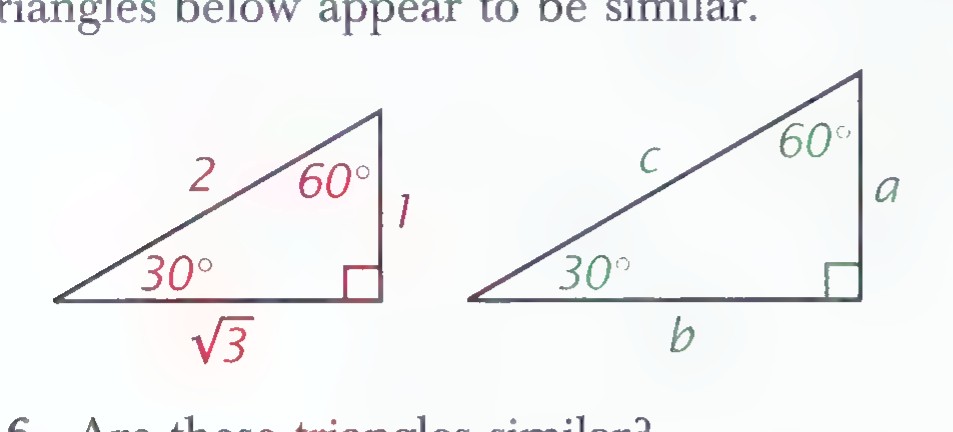
- Are these triangles similar?
- Complete the following ratios: .
Use them to express
- in terms of .
- in terms of .
- in terms of .
- in terms of .
- in terms of .
- in terms of .
- State the theorem illustrated by exercises 8 and 9 as a complete sentence.
Length Problems. Find in each of the following figures.
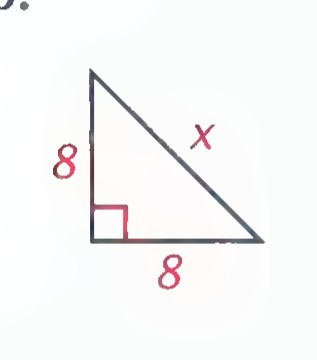
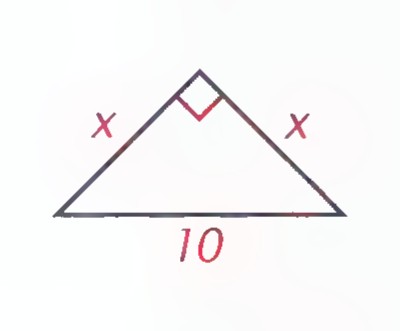
Find and in each of the following figures.
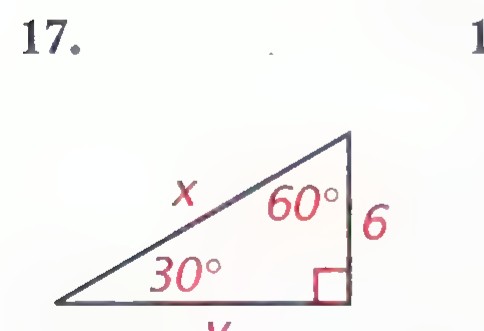
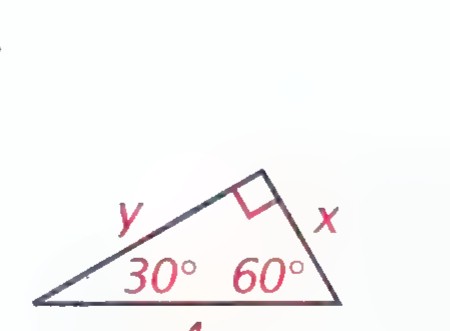
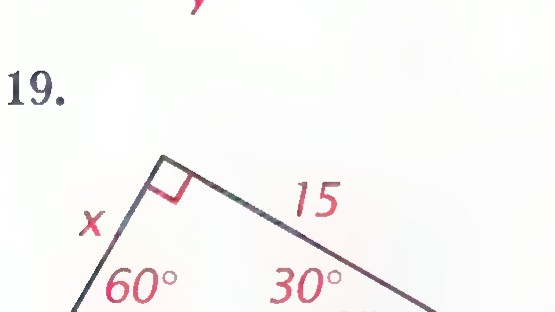
Find in each of the following rectangles.
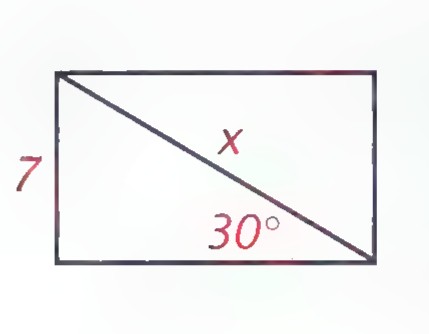
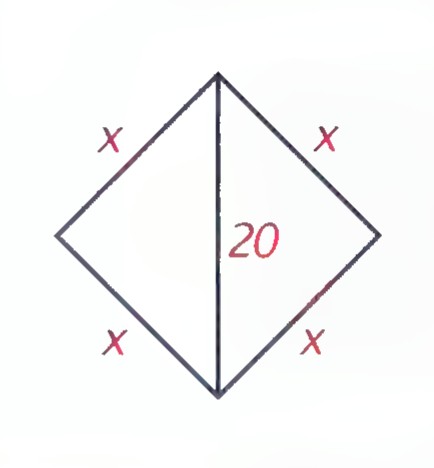
Equilateral Triangles. In the figure below, AFG contains nine small equilateral triangles, whose sides are each 2 units long.
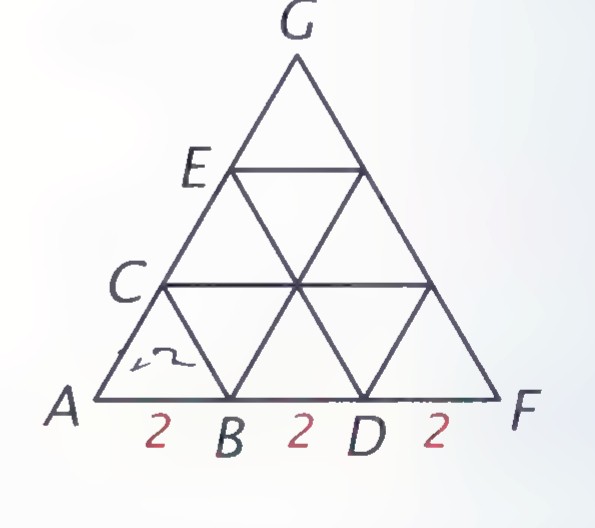
Use the formula for the area of an equilateral triangle in terms of its sides to write an exact expression for the area of
- ABC.
- ADE.
- AFG.
- Use the figure to explain why your answers to exercises 23 through 25 are related as they are.
p. 445
Line of Sight. At residential intersections, the legs of the “line of sight” triangle should be at least 90 feet long.*
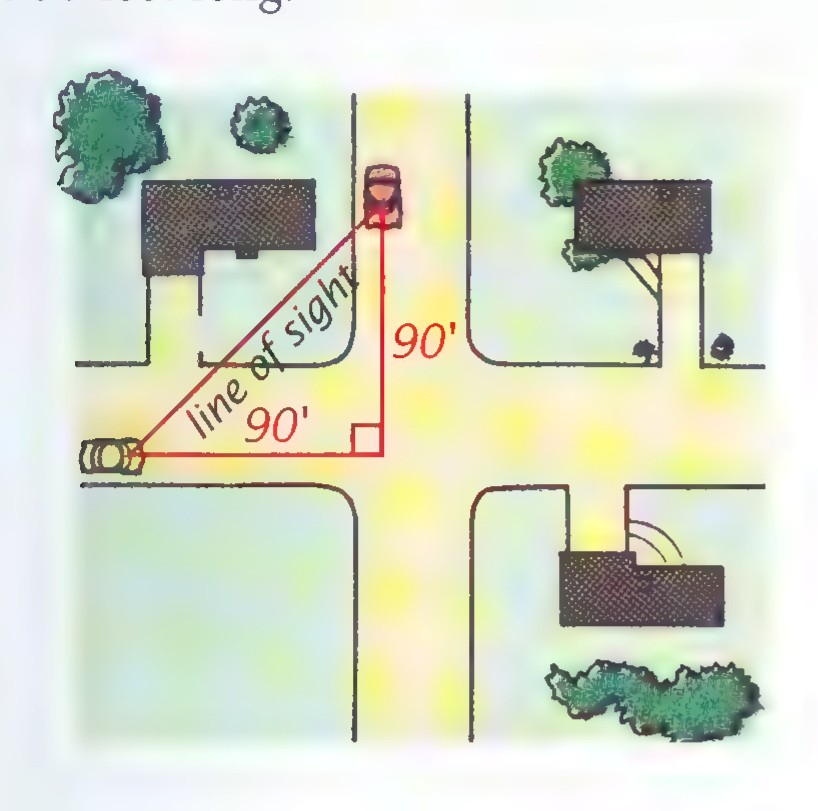
How long is the line of sight if
- each leg is 90 feet long?
- one leg is 90 feet and the other leg is 120 feet?
- each leg is 120 feet long?
Cathedral Design. Michelangelo used the dimensions of an equilateral triangle in a plan for Saint Peter’s Cathedral.†
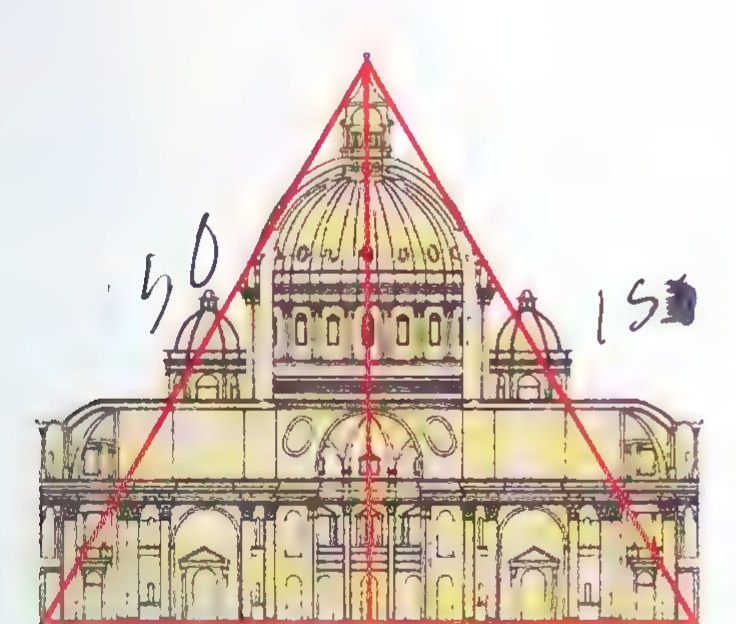
- How tall would the cathedral be if its base were 150 feet wide?
- If a model of the cathedral were 20 inches tall, how wide would its base be?
Olympic Course. Part of the course for the sailing competition in the Olympics requires boats to sail around three buoys located at the corners of an isosceles right triangle.‡
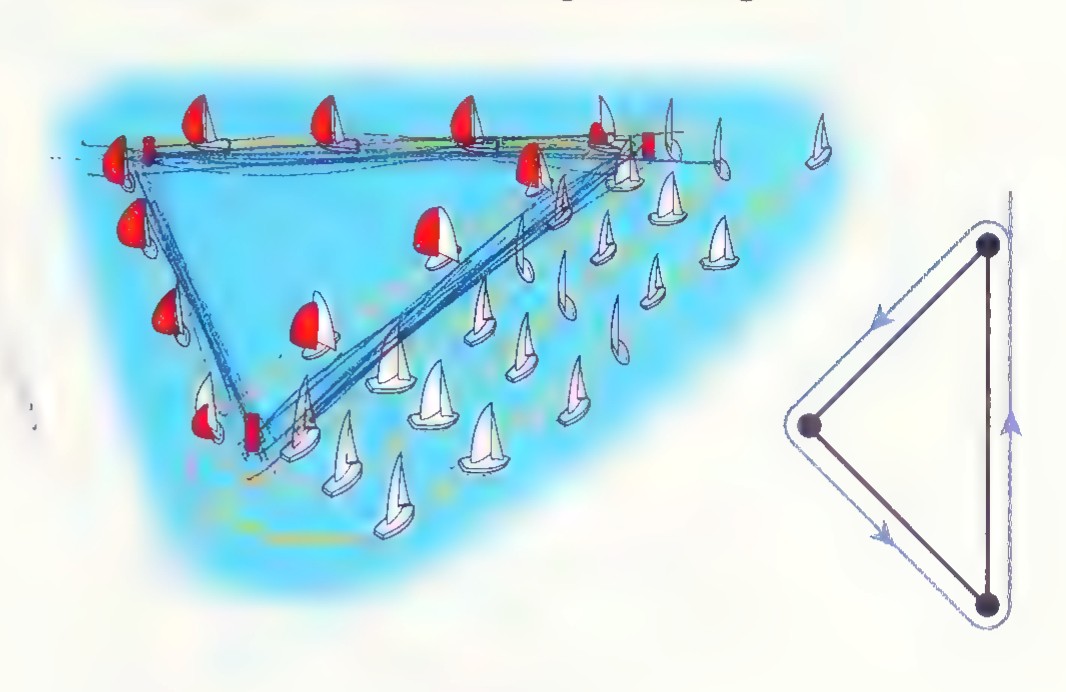
- Given that the hypotenuse of the triangle is 3.25 nautical miles, about how long is each leg?
- About how far does a boat sail in going around the triangle?
Set II
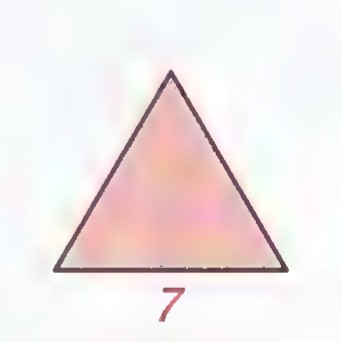
Not Quite Right. In a tenth-century popular French geometry book, the area of an equilateral triangle of side was claimed to be .
- Use this expression to find the area of an equilateral triangle whose sides are 7 units long.
- What is the correct expression for the area of an equilateral triangle of side ?
- Use the correct expression to find the area of the triangle pictured above to the nearest tenth.
- Show that the two expressions would give the same answer if were equal to .
* Time-Saver Standards for Site Planning, by Joseph De Chiara and Lee E. Koppelman (McGraw-Hill, 1984).
† Renaissance, by John R. Hale (Time-Life Books, 1965).
‡ Sports: The Complete Visual Reference, by François Fortin (Firefly Books, 2000).
p. 446
Navigator’s Rule. The navigator of a ship sailing from A to B to C along line observes a lighthouse at D. If the angles are as shown in the figure below, the navigator uses the “ rule,” which says that, when the ship is at C, its distance CD from the lighthouse is of the distance from A to B.*
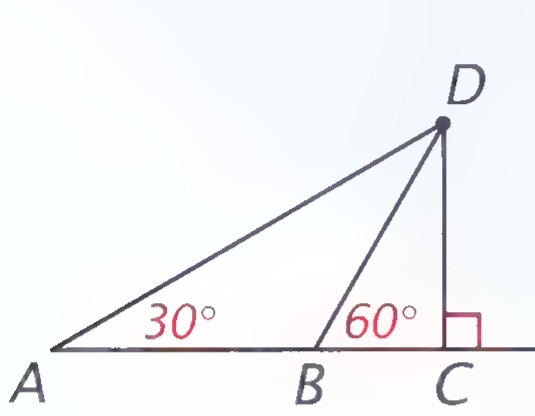
- To what other distance in the figure is AB equal? Explain.
If AB = , express
- BC in terms of .
- CD in terms of .
- Use your answer to exercise 40 to explain where the name “ rule” comes from.
Trigonometric Angles. Figures showing angles in coordinate systems are used in trigonometry.
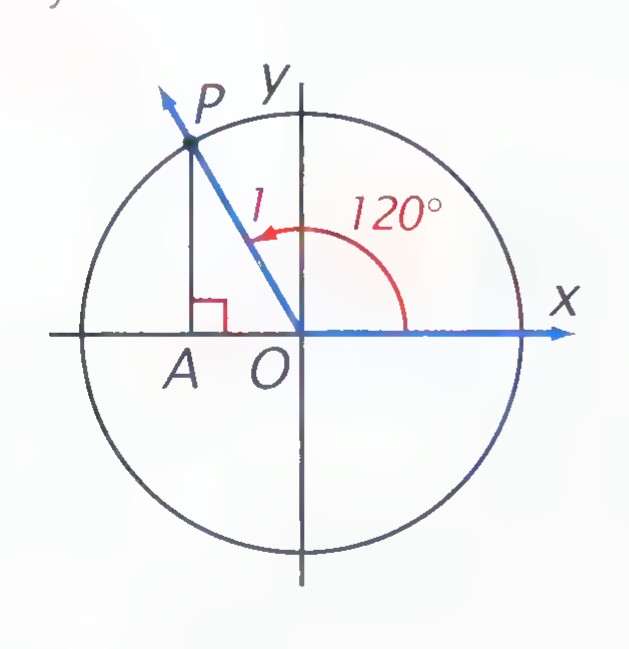
- How large is each angle of PAO in the figure above?
Given that OP = 1, find
- OA and AP.
- the coordinates of point P.
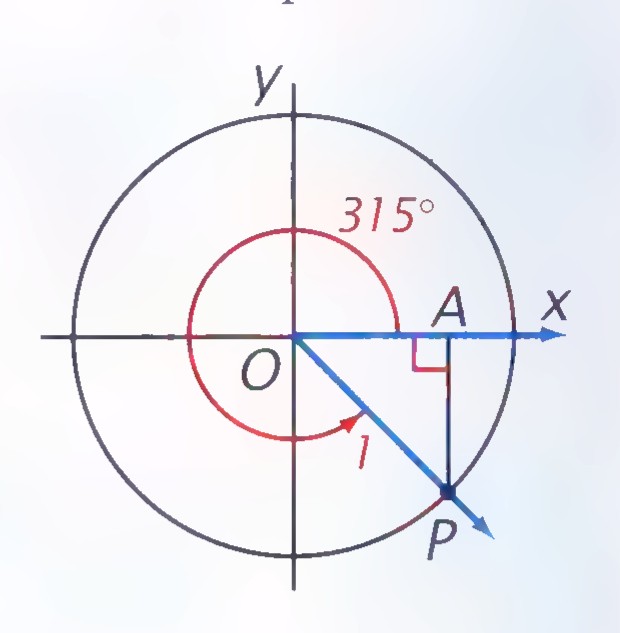
- How large is each angle of PAO in the figure above?
Given that OP = 1, find
- OA and AP.
- the coordinates of point P.
Construction Exercise. The figure below illustrates a construction that has interesting results.†
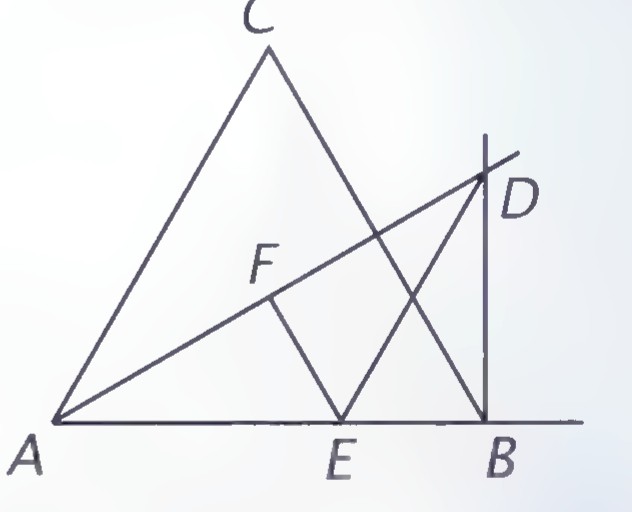
- Construct equilateral ABC with sides 3 inches long. Bisect CAB and construct a line perpendicular to AB at B. Label the point in which the bisector and perpendicular line intersect D. Bisect ADB and label the point in which the bisector and AB intersect E. Through E construct EF AD.
* Dutton’s Navigation and Piloting, by Elbert S. Maloney (Naval Institute Press, 1985).
† The Unexpected Hanging and Other Mathematical Diversions, by Martin Gardner (Simon & Schuster, 1969).
p. 447
- Name the 30°-60° right triangles that can be named by the letters in the figure.
If you have constructed the figure accurately, EB should be 1 inch long. Check this length with your ruler.
- Find each of the following lengths without using your ruler: DE, DB, DF, EF, AE, AF.
Use your ruler to check your answers.
- Are your measurements of DB, DF, and AF reasonable? Explain.
- Do the hypotenuse and longer leg of ABD have the lengths that you would predict from the length of DB? Explain.
Area Problem. The figure at the left below consists of 12 equilateral triangles and 12 isosceles right triangles.
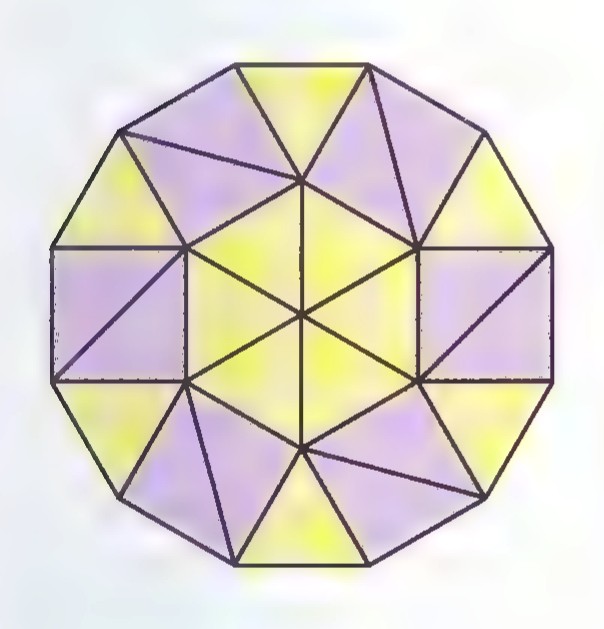
Given that the perimeter of the figure is 12 units long, find
- the area of one of the isosceles right triangles.
- the exact area of one of the equilateral triangles.
- the exact area of the entire figure.
- the area of the entire figure to the nearest tenth.
Moscow Challenge. This problem is from a geometry book published in Moscow.
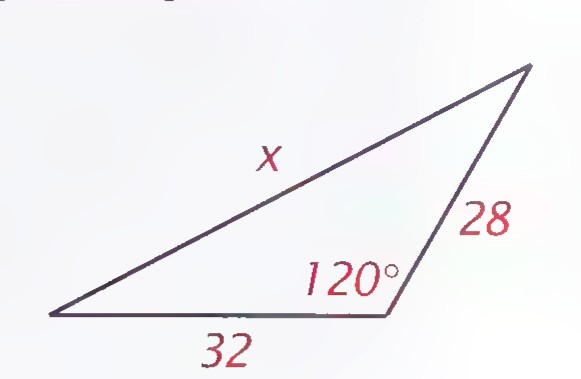
- Find the length marked in this triangle.
Set III
A Big Mistake. The illustrator of the newspaper article below telling how to cut down a tree made a big mistake.
- What is it?
- How do you think the article should be corrected? Explain.
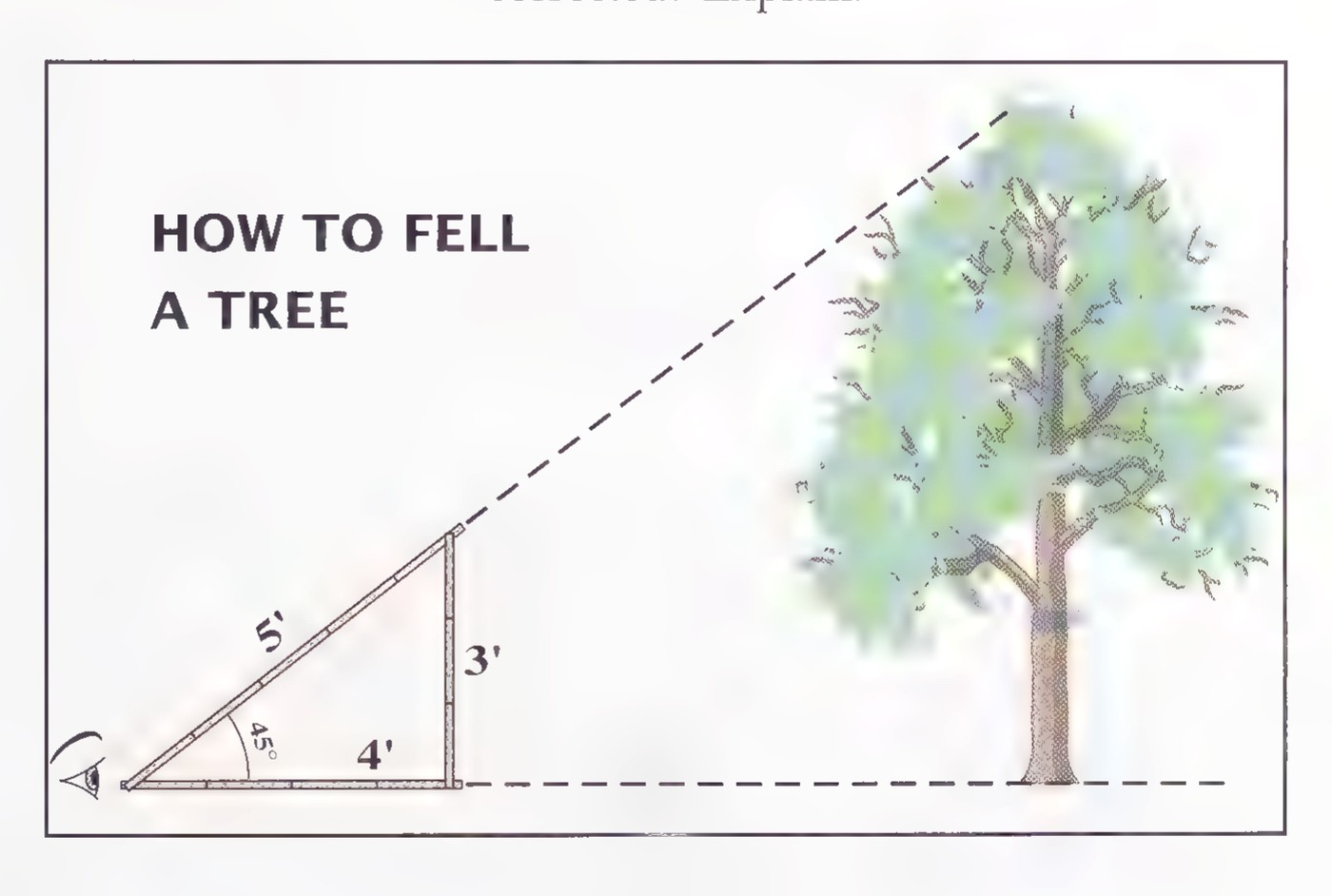
Tree removal used to be a hard, hazardous job, one better left to tree removal companies. But along came the lightweight chain saw and now it’s easy to cut a 30-foot-tall tree into neat fireplace-length logs in a few hours. There’s just one problem. Felling the tree is still hazardous, although it need not be. If you have analyzed its fall correctly and have made the proper cuts, it will fall exactly where you plan. But if you haven’t, no amount of guy wires or ropes can be trusted to guide its crash to the ground.
The first thing you have to do is find how much room it needs when it falls. You can do this by using the Boy Scout method of measuring heights. A triangle with sides of three, four and five feet is placed so that you sight along the five-foot side while you move the triangle to a point where the top of the tree comes into sight, as shown above. That’s how far the tree will reach when it’s felled.
p. 448
Lesson 4: The Tangent Ratio
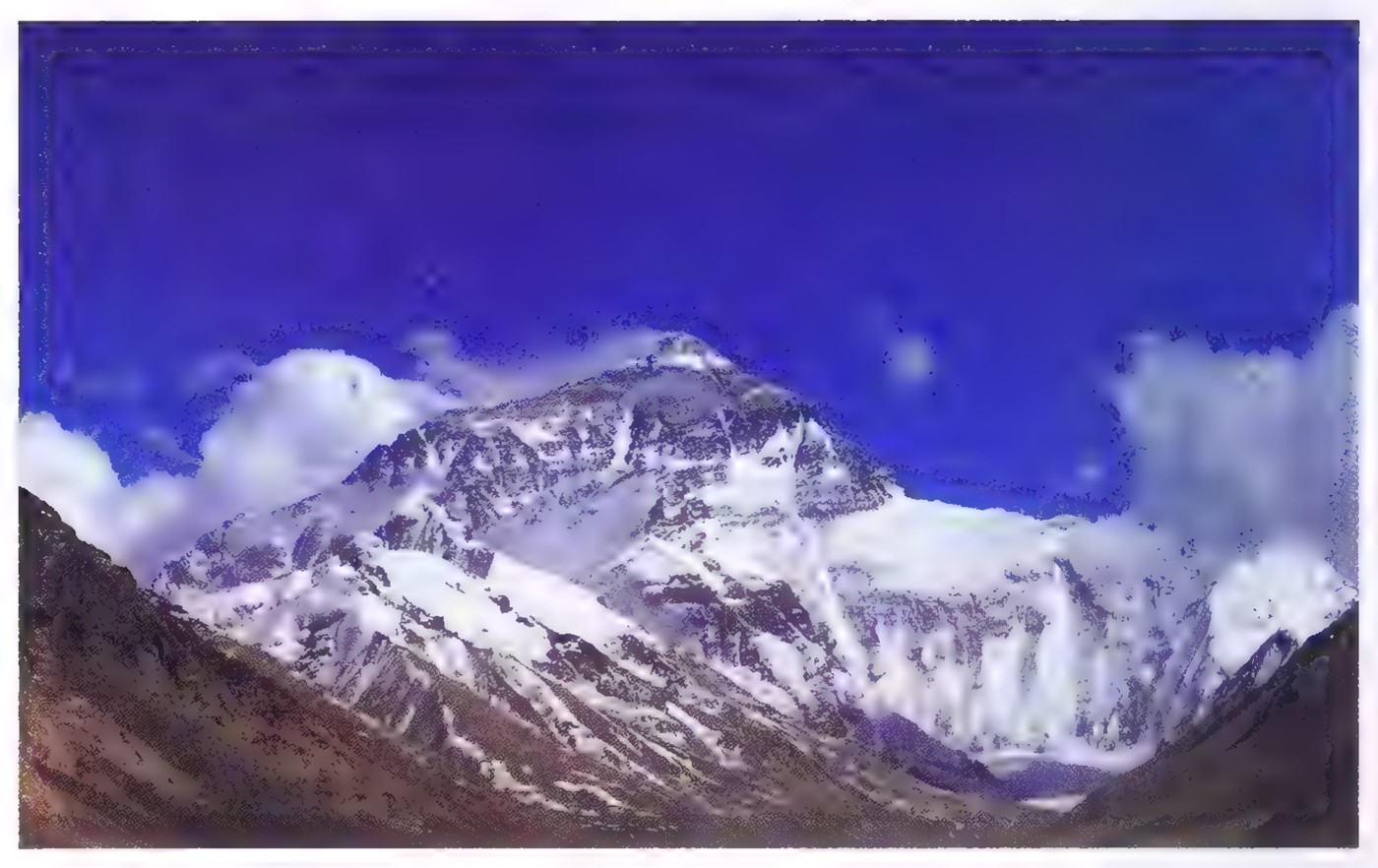
Mount Everest is the highest place on Earth. In Nepal, the mountain is known as “He whose head touches the sky.” Named by the British for George Everest, its height was determined in 1852, a century before anyone had succeeded in climbing to its summit.
George Everest was the head of the Great Trigonometrical Survey of India, known as one of the biggest ventures in the history of science.* The survey was named after the branch of mathematics known as trigonometry, a word derived from two Greek words meaning “triangle” and “measurement.” It was by measuring triangles that the height of Everest was discovered.
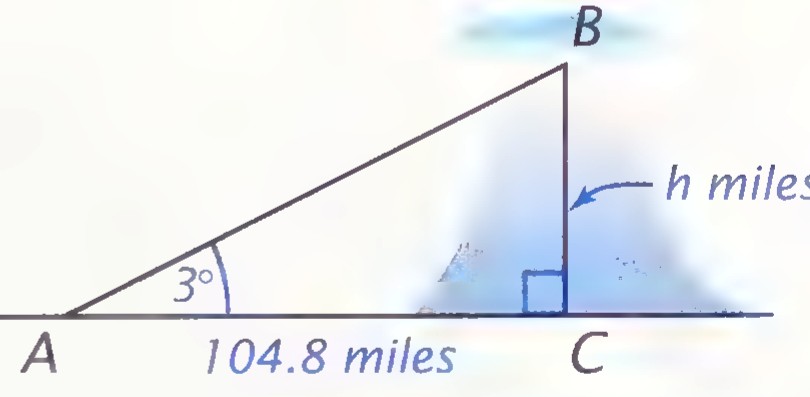
The idea is illustrated in the second figure on the facing page. In the figure (not to scale), point A represents the surveyor’s position on the plains of India and point B represents the top of the mountain. To find side BC of the triangle from A and side AC, the surveyors used the tangent ratio.
* The Great Arc: The Dramatic Tale of How India Was Mapped and Everest Was Named, by John Keay (HarperCollins, 2000.)
p. 449
Definition
The tangent of an acute angle of a right triangle is the ratio of the length of the opposite leg to the length of the adjacent leg.
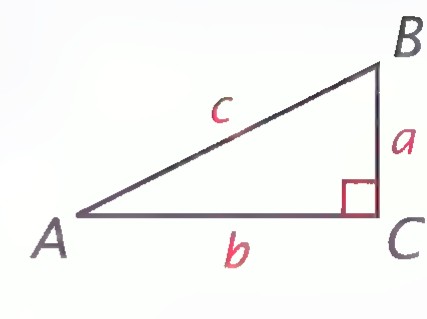
In the figure at the right, the tangent of A is and the tangent of B is . These relations are usually abbreviated as
The tangent is one of the basic ratios of trigonometry. To use it, we need to know its values for various angles. The first table of tangents was constructed in the tenth century by the Arab scholar Abul-Wefa. When the height of Everest was calculated, a table of tangents was used. Now angles and their tangents are easily found by using the tangent key of a calculator.
Usually, to find the tangent of an angle, you enter the measure of the angle and then press the “tan” key. For example, to find tan 50°, enter 50 and then press “tan” to get “1.1917536.”*
To find an angle when you know its tangent, you enter the value of the tangent first, and then press the “inverse” (or “second function”) key, followed by the “tan” key. For example, to find the angle whose tangent is 0.123, enter .123, then “inverse,” and then “tan” to get “7.0121601.” The angle whose tangent is 0.123 is approximately 7°.
To find the height of Everest after the distance AC and the angle A have been worked out, we can write
Multiplying by 104.8 gives
Using a calculator, we find that
Because 1 mile = 5,280 feet,
These measurements indicate that Mount Everest is about 29,000 feet high.
* Be sure that your calculator is set for angles in degrees.
p. 450
Exercises
Set I
Tangent Practice. Express each of the following ratios in terms of the lowercase (small) letters in the figures below.
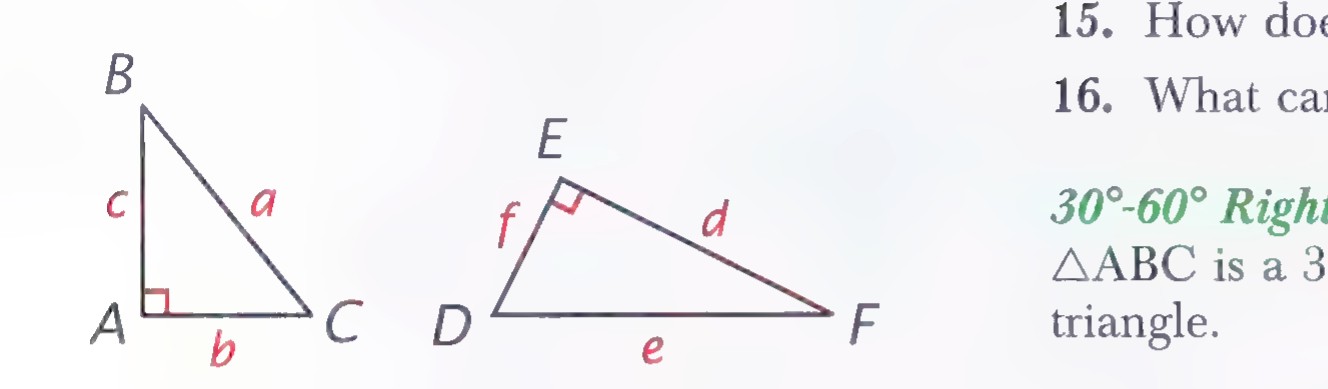
Example: tan B.
Answer: .
- tan C.
- tan D.
- tan F.
Use your calculator to find each of the following tangents to three decimal places.
Example: tan 15°.
Answer: 0.268.
- tan 24°.
- tan 1°.
- tan 89°.
Given the following tangents, use your calculator to find the measure of the angle to three decimal places.
Example: tan A = 0.25.
Answer: A = 14.036°.
- tan B = 0.1.
- tan C = 24.
- tan D = 1,000.
Isosceles Right Triangle. ABC is a right triangle. Suppose that = .
- How large is A?
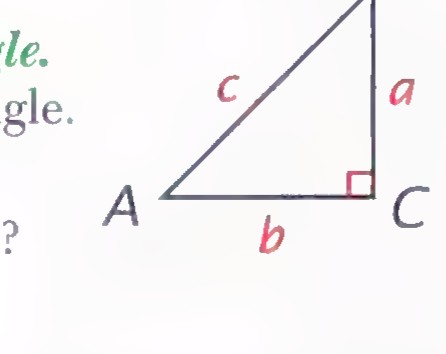
- Find the value of tan A without using your calculator.
- Use your calculator to check your answer.
Suppose that > .
- How does A compare with 45°?
- What can you conclude about tan A?
- How does B compare with 45°?
- What can you conclude about tan B?
30°-60° Right Triangle. ABC is a 30°-60° right triangle.
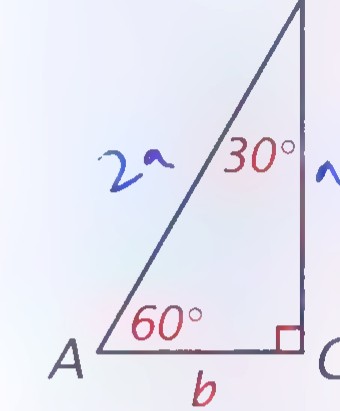
- Use the 30°-60° Right Triangle Theorem to find the lengths of AB and BC in terms of .
- Find the exact value of tan 60° without using your calculator.
- Check your answer with your calculator.
- Find the exact value of tan 30° without using your calculator.
- Use your calculator to check your answer.
3-4-5 Triangle. ABC is a “3-4-5” triangle.
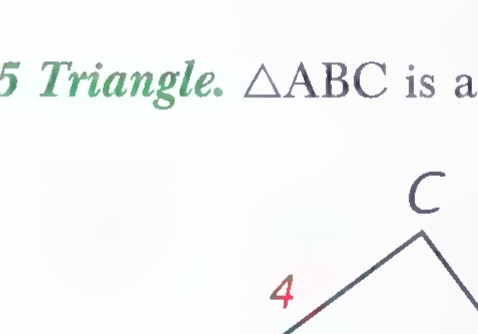
- What kind of triangle is it? Explain.
Find each of the following measures.
- tan A.
- tan B.
- A to the nearest degree.
- B to the nearest degree.
In what ways are
- A and B related?
- tan A and tan B related?
p. 451
Finding Lengths. Use the tangent ratio to find the length labeled in each of the following figures. Express each length to the nearest tenth.
Example:
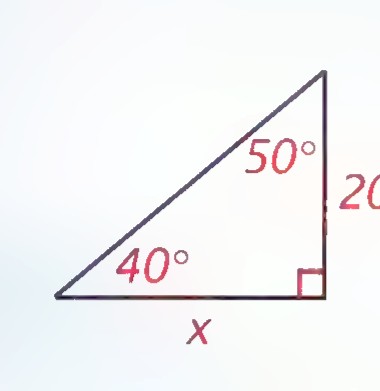
Solution:
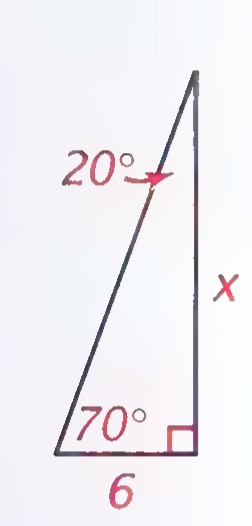
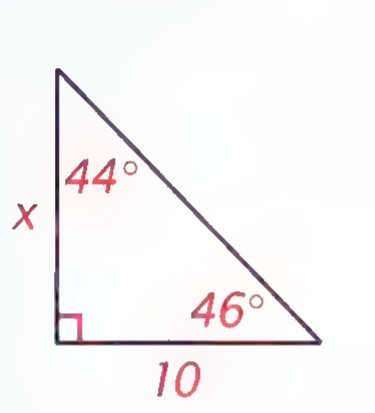
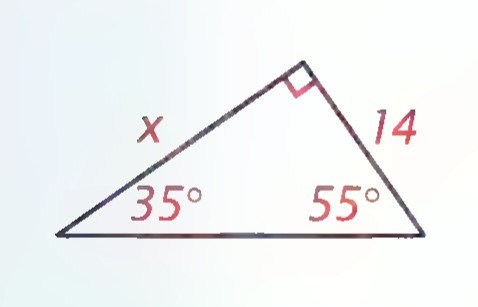
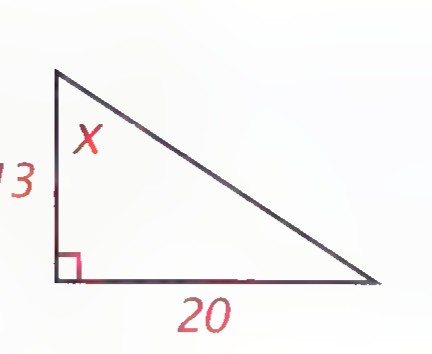
Finding Angles. Use the tangent ratio to solve for the angle marked in each of the following figures. Express each angle to the nearest degree.
Example:
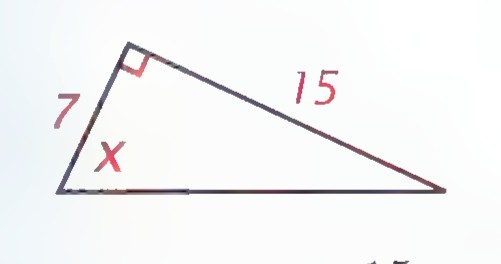
Solution:
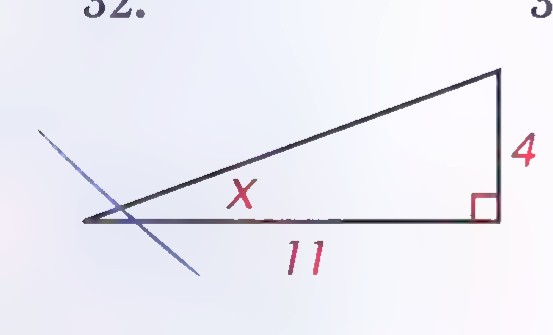
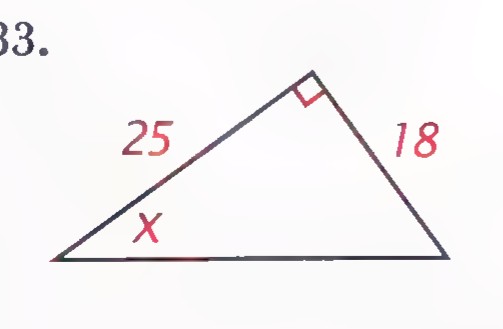
Set II
Fly Ball. The figures below are from the book Sport Science.*
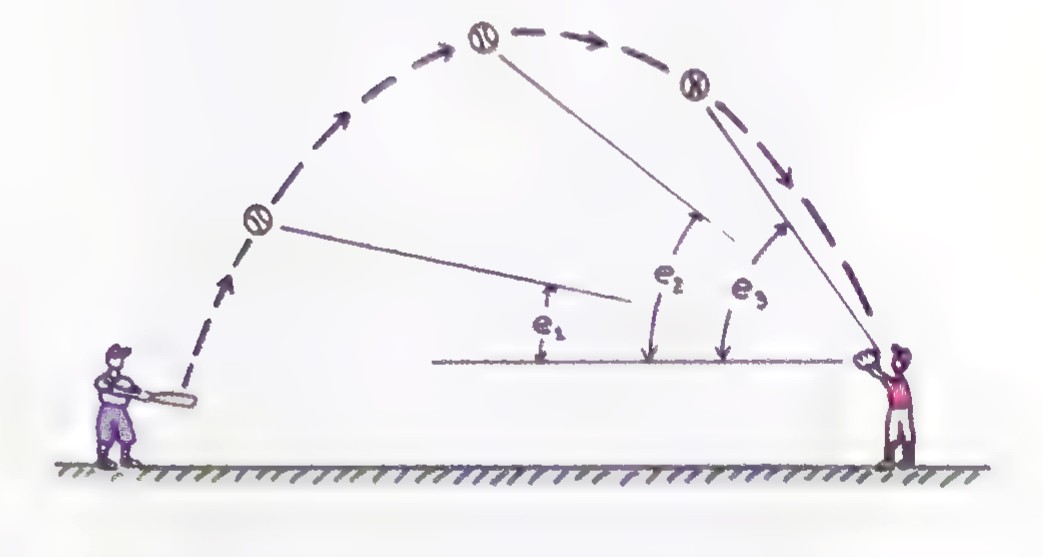
Find the angle of elevation to the nearest degree when
- H = 80 feet and D = 50 feet.
- H = 70 feet and D = 30 feet.
- H = 60 feet and D = 20 feet.
- What happens to the angle of elevation as the fly ball approaches the fielder?
* Sport Science: Physical Laws and Optimum Performance, by Peter J. Brancazio (Simon & Schuster, 1984).
p. 452
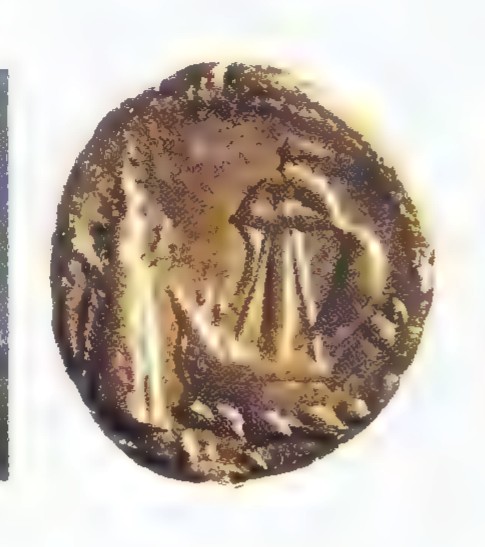
Lighthouse. One of the seven wonders of the ancient world was the lighthouse at Alexandria. Pictured on this ancient coin, it was built at the time of Euclid and stood for more than 1,500 years until destroyed by an earthquake.*
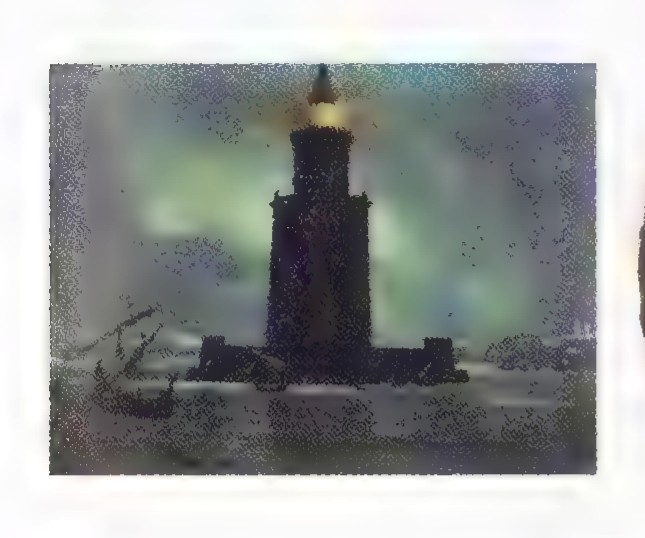
Use the measures of the following angles at point P, 300 feet from point A on its base, to find the following distances to the nearest foot.
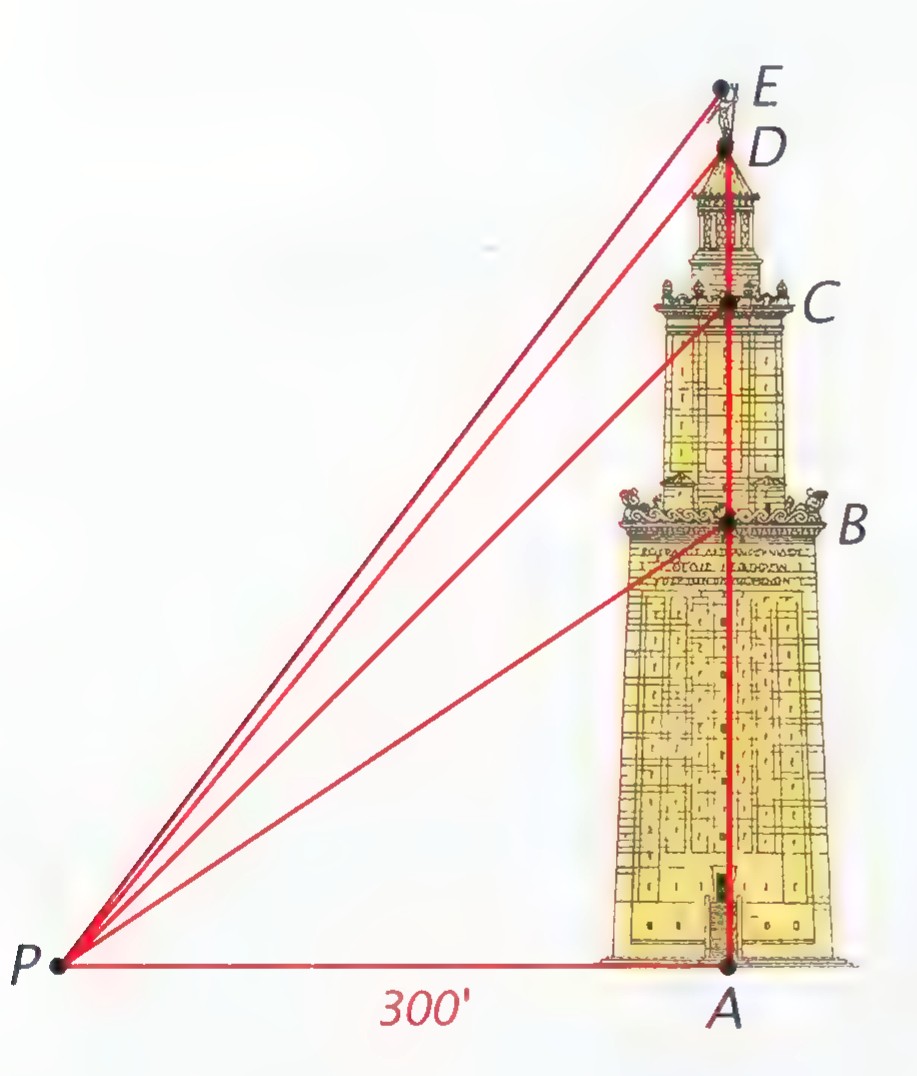
- Find AB, given that BPA = 33.3°.
- Find AC, given that CPA = 44.5°.
- Find AD, given that DPA = 51.0°.
- Find AE, given that EPA = 52.6°.
- How tall was the statue (DE) at the top of the lighthouse?
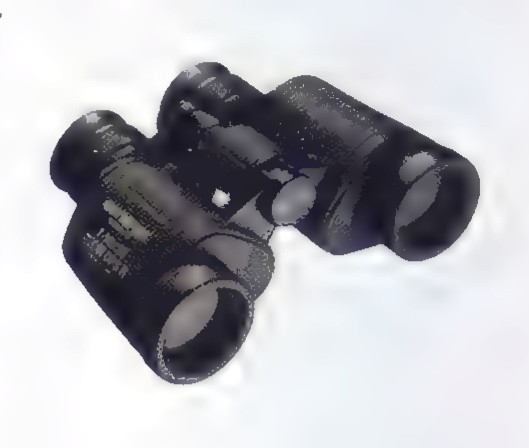
Binoculars. The “field width” of a pair of binoculars is sometimes given as a ratio of distances such as “130 meters at 1,000 meters” and sometimes as the measure of an angle in degrees.†
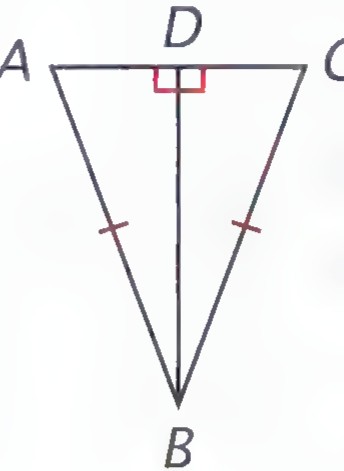
In the figure above (not to scale), point B represents the position of the binoculars, BA = BC, and BD AC. Given that AC = 130 meters and BD = 1,000 meters, find
- .
- AD.
- ABD to the nearest 0.1 degree.
- ABC to the nearest 0.1 degree.
Grid Triangle. The figure below is drawn on a grid of six squares, each having sides of 1 unit.‡
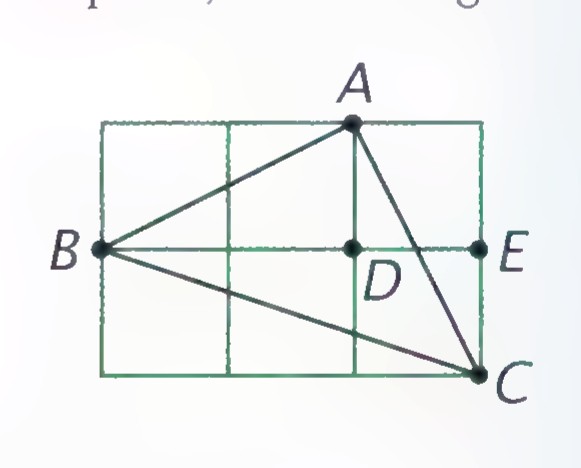
- Find ABD to six decimal places.
- Find EBC to six decimal places.
- Find ABC.
- Find the exact lengths of AB, BC, and AC.
- What can you conclude about ABC? Explain.
* Science Awakening, by B. L. van der Waerden (Oxford University Press, 1961).
† Sizes: The Illustrated Encyclopedia, by John Lord (Harper Perennial, 1995).
‡ Proofs Without Words: Excursions in Visual Thinking, by Roger B. Nelsen (Mathematical Association of America, 1993).
p. 453
Diamond Cut. The cut that produces the brightest diamond is shown in the figure below, which consists of an isosceles trapezoid, a rectangle, and an isosceles triangle.*
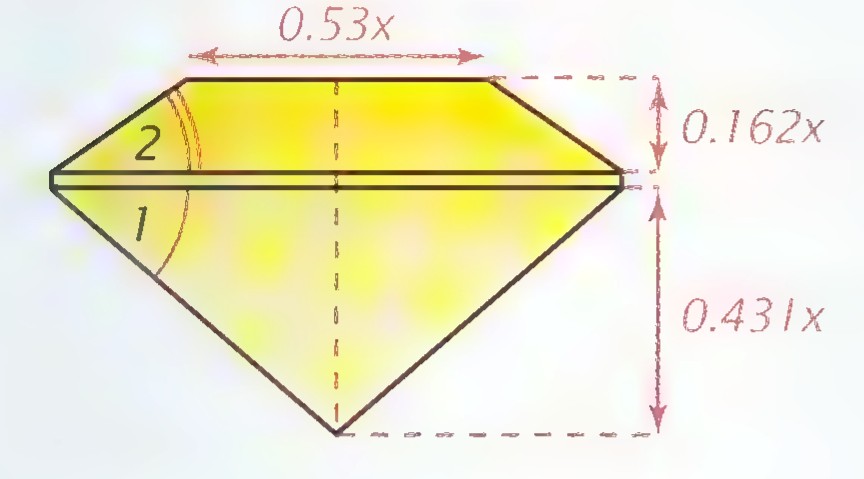
Given the lengths shown, find each of the following angles to the nearest tenth of a degree.
- The “pavilion” angle, $$1.
- The “bezel” angle, $$2.
Space-Flight Errors. Because of the great distances in space, small navigational errors can have serious consequences.
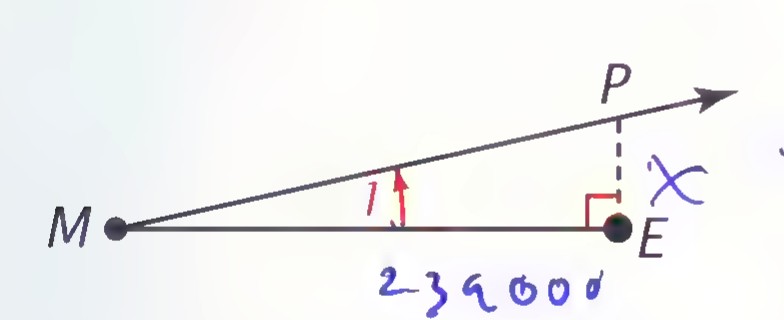
In the figure above (not to scale), ME represents the intended path of a space flight from the moon back to Earth, and ray MP represents the path resulting from an error of 1 degree; ME 239,000 miles.
- Find PE, the distance by which path MP misses Earth.
Suppose that, instead of the moon, M represents Mars, which means that ME 49,000,000 miles, and that M = 1 minute, a 60th of a degree, rather than 1 degree.
- Find the distance PE for this situation.
Exam Problem. This problem is from a national exam that was given to German students at the end of the 10th grade.†
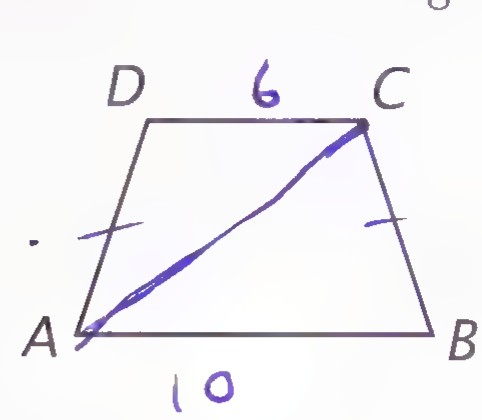
ABCD is an isosceles trapezoid in which AB = 10 and CD = 6.
- Copy the figure and mark it as needed to explain why ABCD = 16 tan A.
- Find the value of A for which ABCD = 40.
Set III
What Time Is It? Suppose that the shadow cast by each camel in this caravan is three times as long as the camel’s height.‡
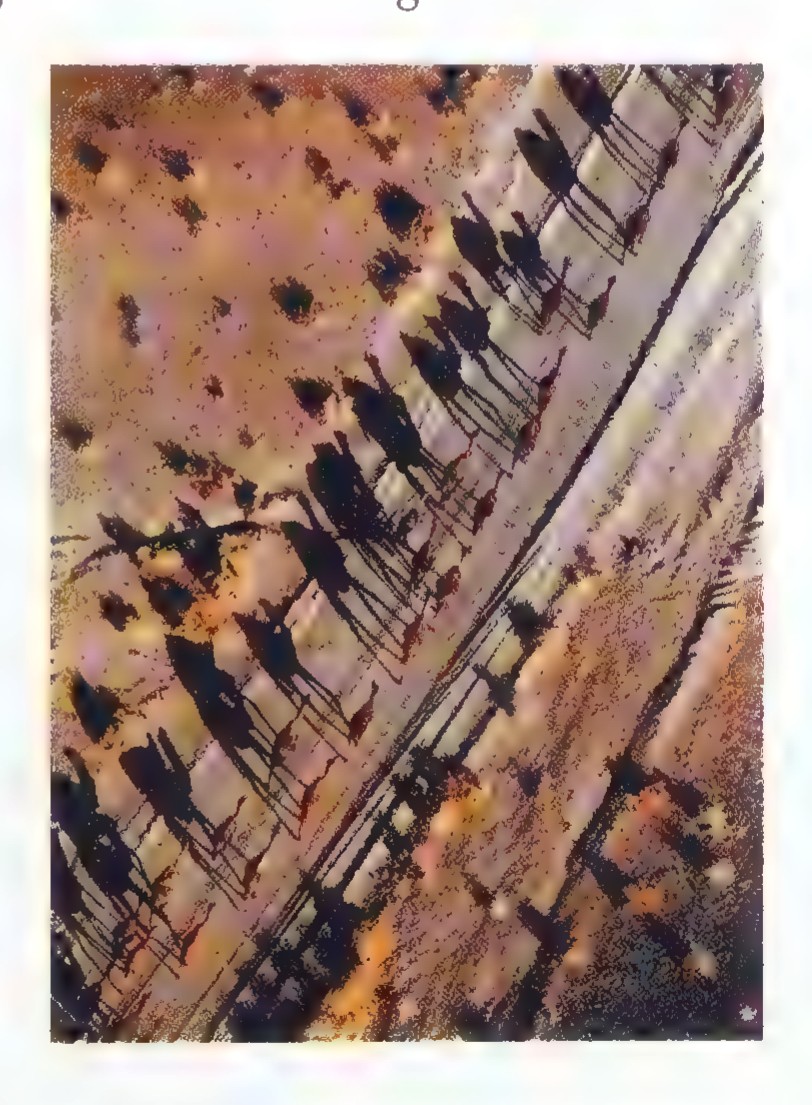
If the sun rose at 6:00 A.M. and will be directly overhead at noon, what time was the picture taken? Explain your reasoning.
* Sizes: The Illustrated Encyclopedia, by John Lord (Harper Perennial, 1995).
† The 1994 Realschule Exam.
‡ Below from Above, by George Gerster (Abbeville Press, 1986).
p. 454
Lesson 5: The Sine and Cosine Ratios
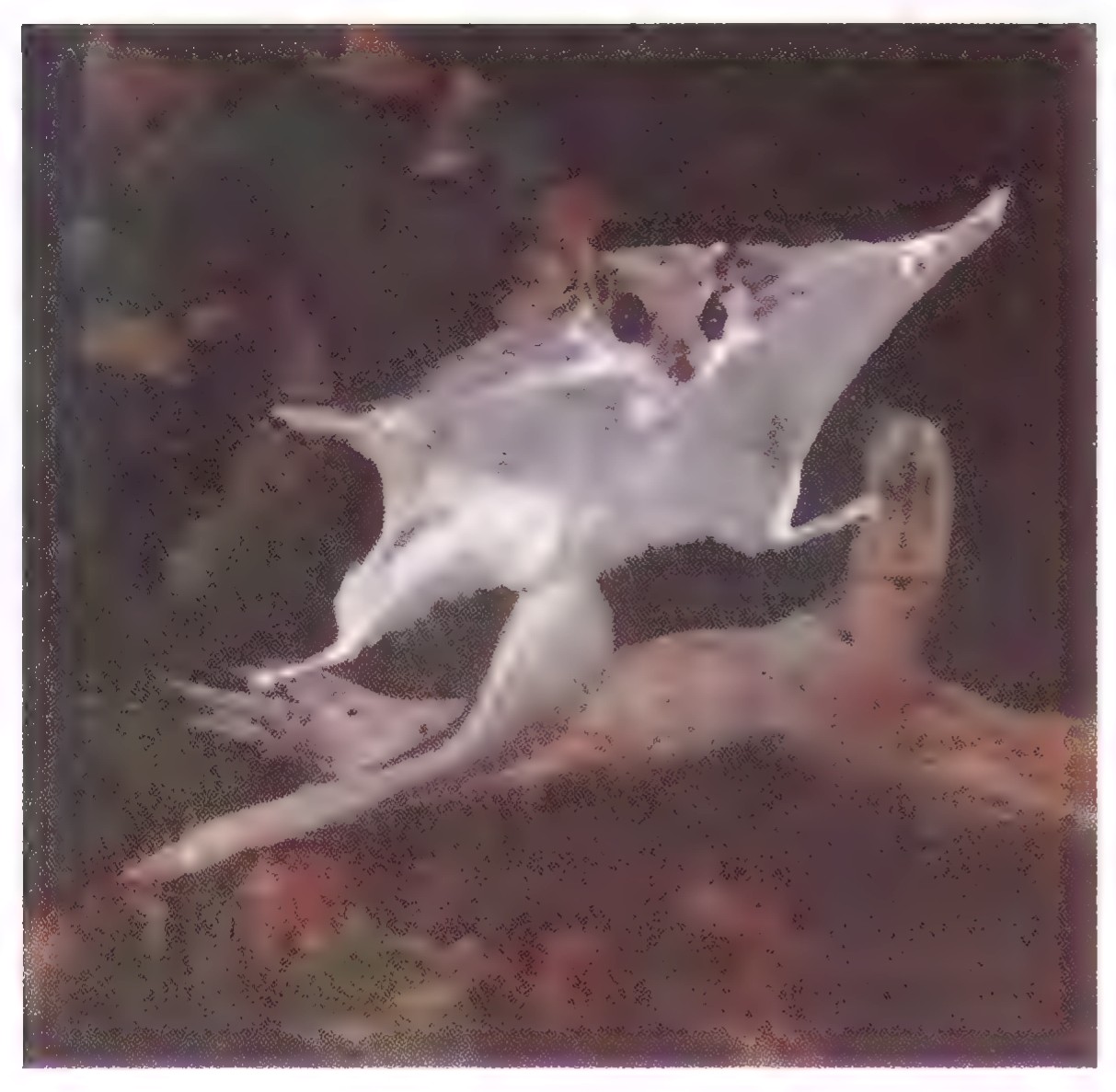
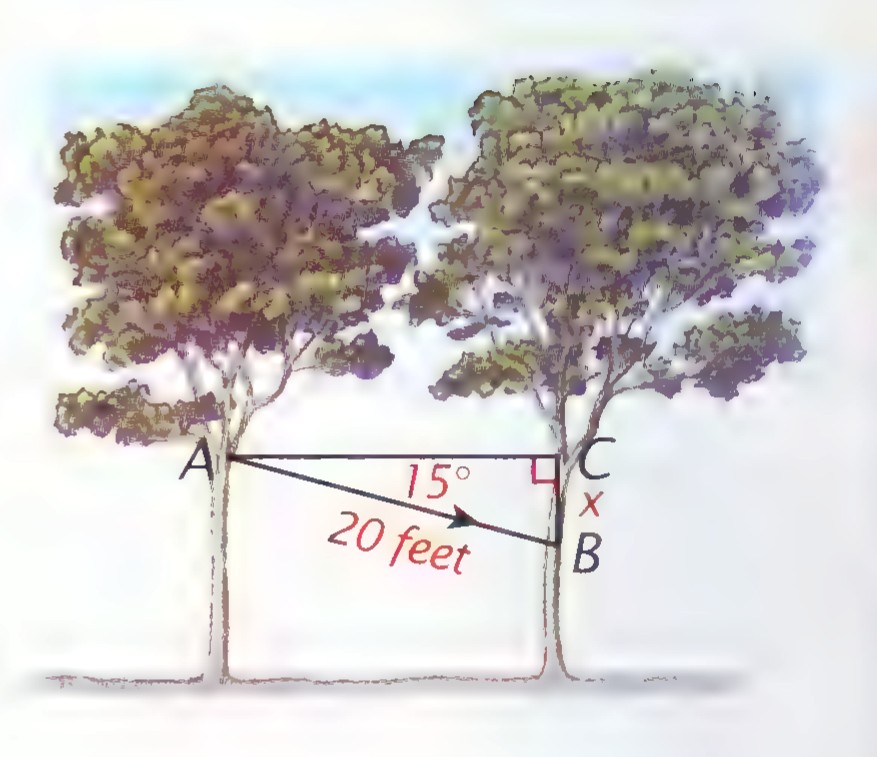
Flying squirrels have flaps of skin between their front and back legs that they can use to glide through the air. One of these squirrels climbs to the top of a tree, jumps off and glides to a lower point on a nearby tree, climbs to the top of it, glides to another tree, and so on.*
Observations of flying squirrels show that they usually glide at an angle of 15° with the horizontal. How far does one of them fall during a flight of 20 feet?
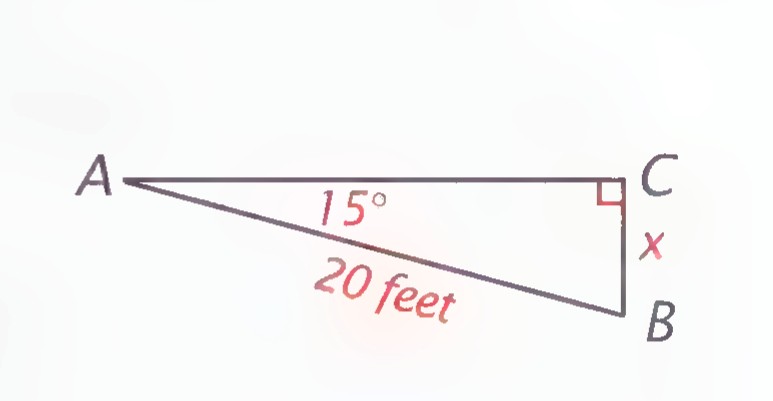
Solving this problem is equivalent to knowing the measure of A in right ABC in the figure at the right above and trying to find the length of the opposite leg, given the length of the hypotenuse. To do so, we need another trigonometric ratio, called the sine ratio.
* Exploring Biomechanics: Animals in Motion, by R. McNeill Alexander (Scientific American Library, 1992).
p. 455
Definition
The sine of an acute angle of a right triangle is the ratio of the length of the opposite leg to the length of the hypotenuse.
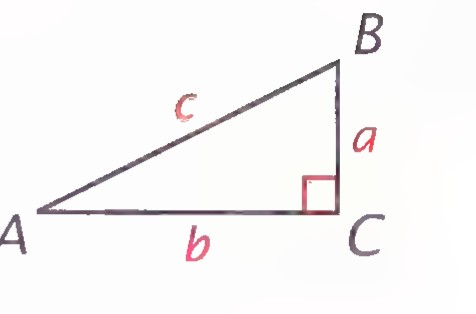
In the figure at the right, the sine of A is and the sine of B is . These relations are abbreviated as
The sines of angles of different measures, like their tangents, can be found by using the sine key of a scientific calculator. To find the distance that a flying squirrel falls in gliding 20 feet at a 15° angle with the horizontal, we can write
Multiplying by 20, we get
Using a calculator, we get
A third useful trigonometric ratio is the cosine. It relates, for a given acute angle of a right triangle, the lengths of the adjacent leg and the hypotenuse.
Definition
The cosine of an acute angle of a right triangle is the ratio of the length of the adjacent leg to the length of the hypotenuse.
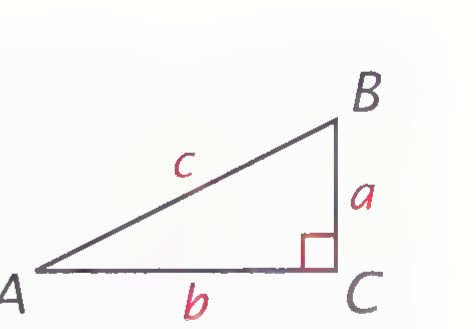
In the figure at the right, the cosine of A is and the cosine of B is . These relations are abbreviated as
To find an angle when you know its sine or cosine, you enter the value of the sine or cosine first and then press the “inverse” (or “second function”) key, followed by the “sin” or “cos” key. For example, to find the angle whose cosine is 0.747, enter .747, then “inverse,” and then “cos” to get “41.668827.” The angle whose cosine is 0.747 is approximately 41.7°.
p. 456
Exercises
Set I
Sine and Cosine Practice. Express each of the following ratios in terms of the lowercase letters in the figure below.
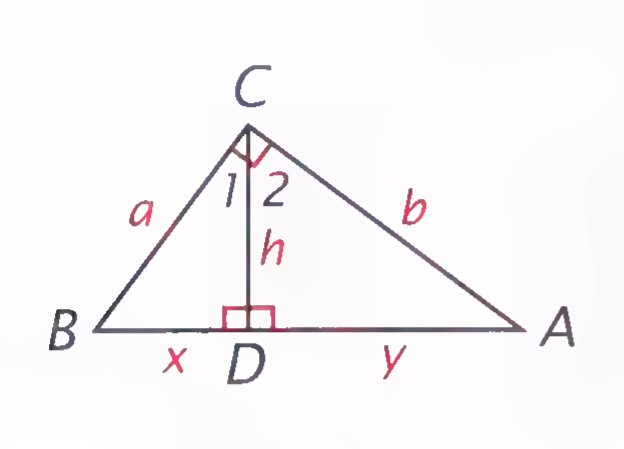
Example: sin A in two ways.
Answer: or .
- sin B in two ways.
- tan A in two ways.
- cos A in two ways.
- cos B in two ways.
- sin 1.
- cos 2.
Use your calculator to find each of the following ratios to three decimal places.
Example: cos 5°.
Answer: 0.996.
- sin 85°.
- sin 46°.
- cos 44°.
Given the following ratios, use your calculator to find the measure of each angle to three decimal places.
Example: sin A = 0.123.
Answer: A = 7.065°.
- cos B = 0.123.
- sin C = 0.70711.
- cos D = 0.70711.
Pythagorean Triangle. ABC is a “5-12-13” triangle.
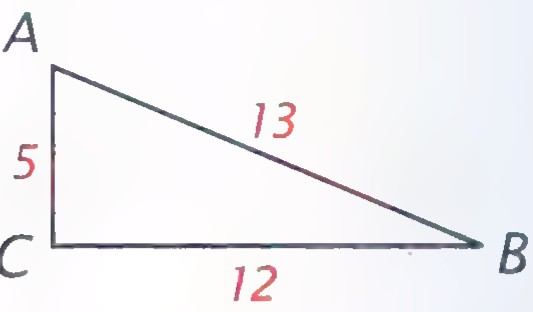
- What kind of triangle is it? Explain.
- Find sin A as a simple fraction.
- Find A to the nearest degree.
- Find cos B as a simple fraction.
- Find B to the nearest degree.
- In what ways are A and B related?
- What relation does sin A have to cos B?
- Find cos A as a simple fraction.
- Find sin B as a simple fraction.
- What relation does cos A have to sin B?
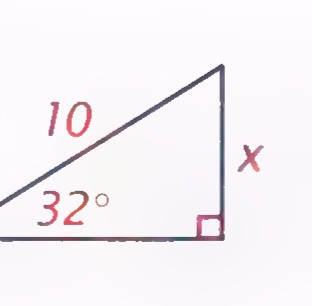
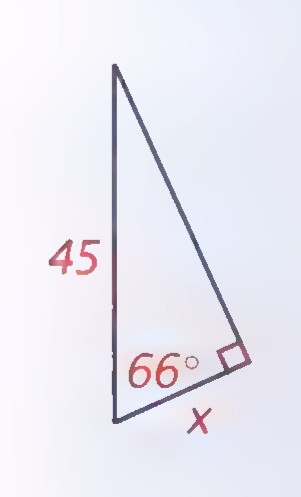
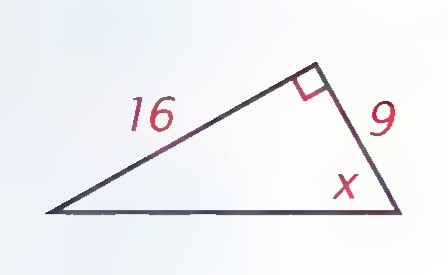
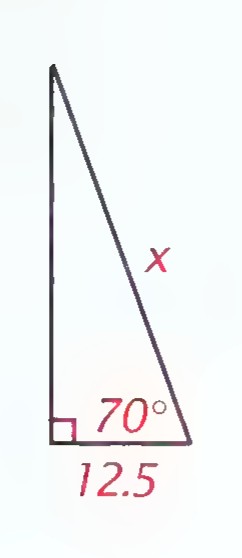
Finding Lengths and Angles. Solve for in each of the following figures. Express each length to the nearest tenth and each angle to the nearest degree.
Example:
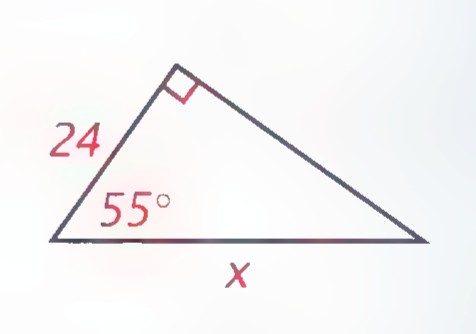
Solution:
p. 457
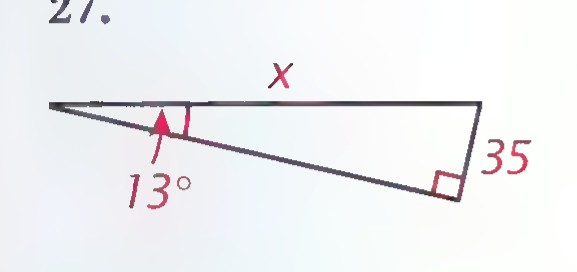
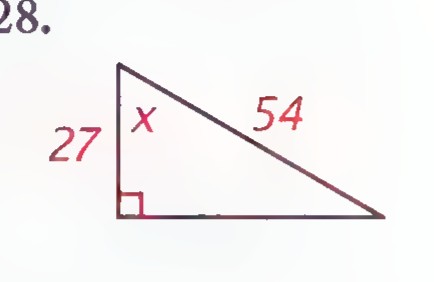
Sines from a Circle. Bhaskara, a seventh-century Indian mathematician, calculated the sines of some angles by first dividing a quarter of a circle into six equal parts.*
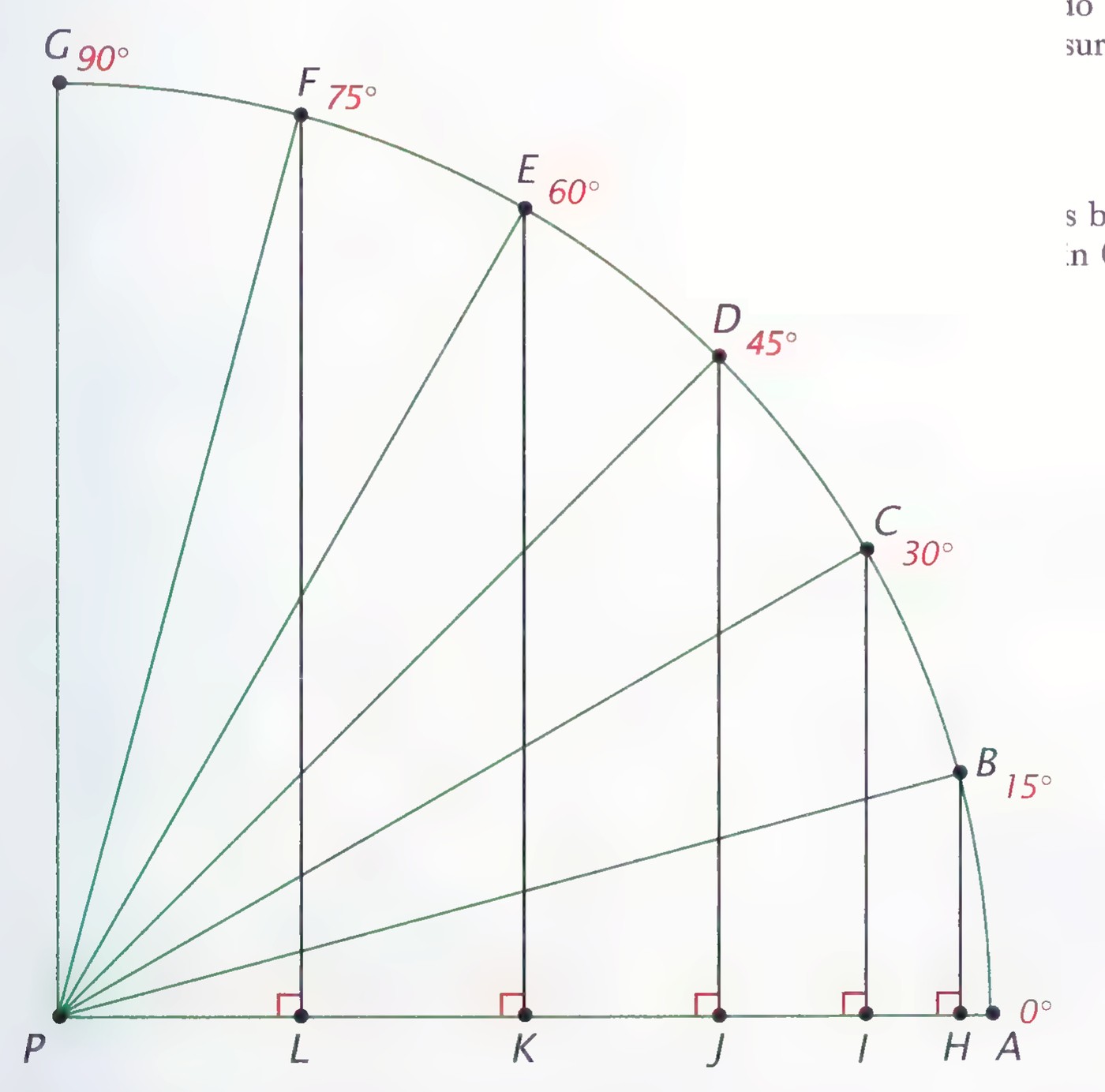
In the figure at the bottom of the page, the circle has been drawn so that it has a radius of 10 cm.
- Measure each of the following lengths to the nearest 0.1 cm: BH, CI, DJ, EK, and FL.
- Use the lengths to estimate the values of sin 15°, sin 30°, sin 45°, sin 60°, and sin 75°. (For example, sin 15° = 0.26.)
- Use a calculator to check your answers to exercise 30. (For example, sin 15° 0.258819 0.26.)
- What happens to the sine of an acute angle as the angle gets larger?
What kind of number do you think is the sine of an angle whose measure is very close to
- 0°?
- 90°?
- Check your guesses by using your calculator to find sin 0° and sin 90°.
* Geometry and Algebra in Ancient Civilizations, by B. L. van der Waerden (Springer, 1983).
p. 458
Set II
Kite Flying. How high a kite will fly depends on both the length of its string (line) when the line is taut and on the size of its angle of elevation. In kite-flying competitions, performance is often judged by this angle.*
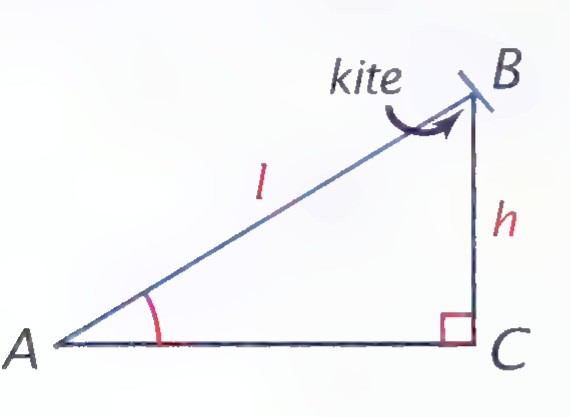
In the figure above,
- sin A = . Why?
- = sin A. Why?
An expert on kite flying wrote:
Just like most kiters I’m obsessed with flying kites at as high an angle as possible. . . . At a line angle of 30°, the kite is half as high as it’s ever going to get.†
- Use the 30°-60° Right Triangle Theorem to explain why what the expert wrote is true for a given length of line.
- Use the sine of 30° to explain why it is true.
On August 12, 2000, the kite shown in the photograph below was flown to a record altitude.
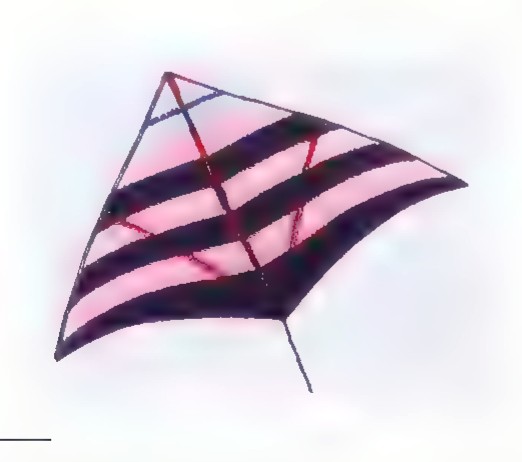
- Given that its angle of elevation was 42° when the line was 21,600 feet long, how high above the ground was it?
Force Components. This is a sample question from an exam for architects.‡
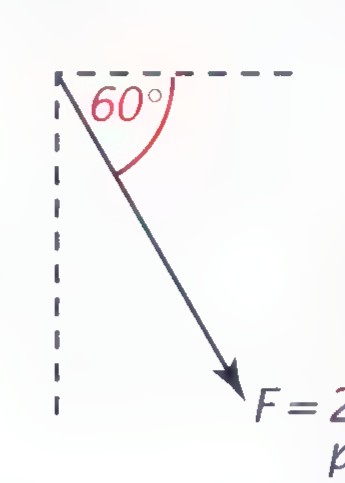
What are the horizontal and vertical components of the force shown above?
Answering the question is equivalent to finding the legs of right ABC in the figure at the right, given that CAB = 60° and AB = 27,000.
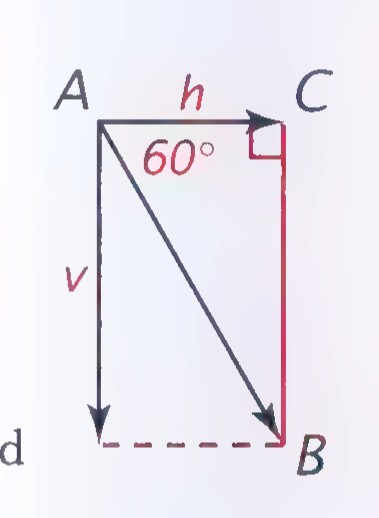
- Use the 30°-60° Right Triangle Theorem to find and .
- Check your answers by using the sine and cosine ratios to find and .
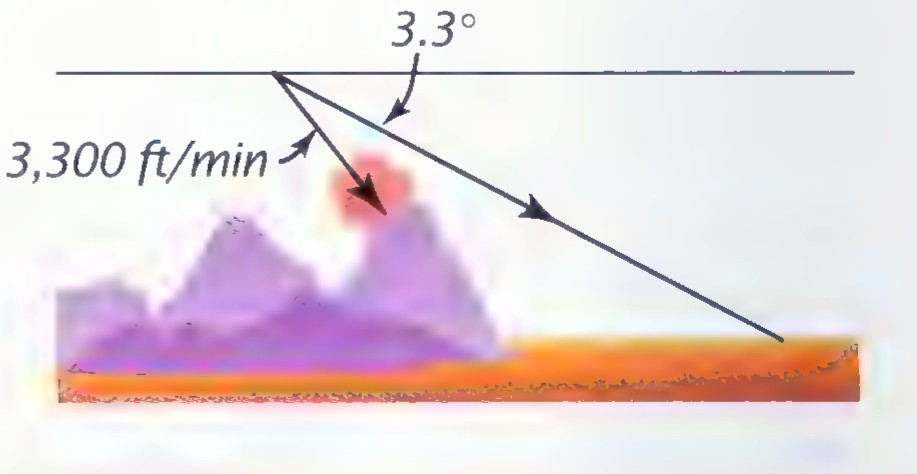
Flight Path. In 1992, a plane crashed into a mountain in France because the pilot apparently punched in a 3,300-feet-per-minute descent mode into the flight computer when he wanted a 3.3-degree flight path.§
* Kites: The Science and the Wonder, by Toshio Ito and Hirotsugu Komura (Japan Publications, 1983).
†Richard P. Synergy, in Kiting to Record Altitudes (Fly Right Publications, 1994).
‡ Architectural Exam Review, vol. 1, by David Kent Ballast (Professional Publications, 1992).
§ Invention by Design, by Henry Petroski (Harvard University Press, 1996).
p. 459
In the figure below (not to scale), AB represents the correct flight path for 1 minute of descent time.
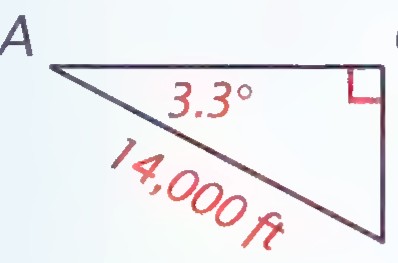
- Find CB if AB = 14,000 feet.
In the figure at the right (not to scale), AB represents the wrong flight path for 1 minute of descent time.
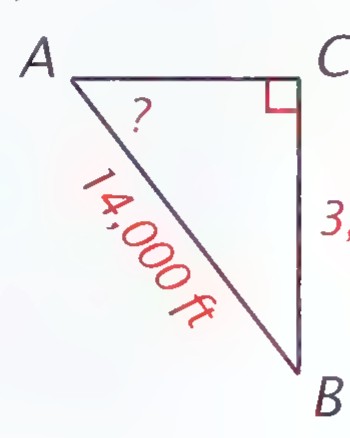
- Find A if AB = 14,000 feet and CB = 3,300 feet.
Leaning Tower. Ever since it was built, the Leaning Tower of Pisa has been leaning more and more.

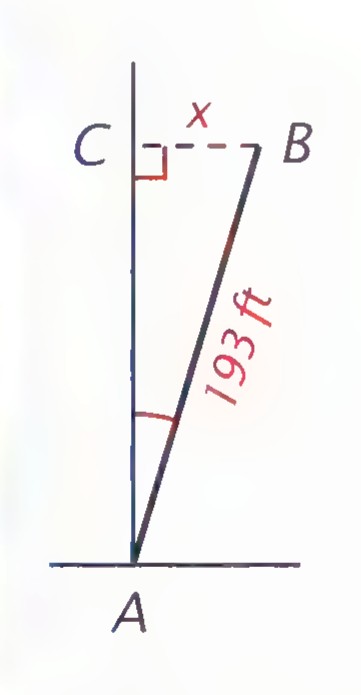
In the figure at the right above, AB represents the tower and CB represents the distance that the top leans over the base.
- In 1400, the tower leaned 3° to one side. How long was CB at that time?
- In 1500, the distance CB had increased to 13.5 feet. At what angle did the tower lean then?
- Now the tower leans about 5.5°. How long is CB now?
Fiber Optics. In fiber optics, a light is reflected back and forth along a fiber.
The figure below represents a section of fiber in which . As the light is reflected, $$1 = $$2, $$3 = $$4, $$5 = $$6, and so on.*
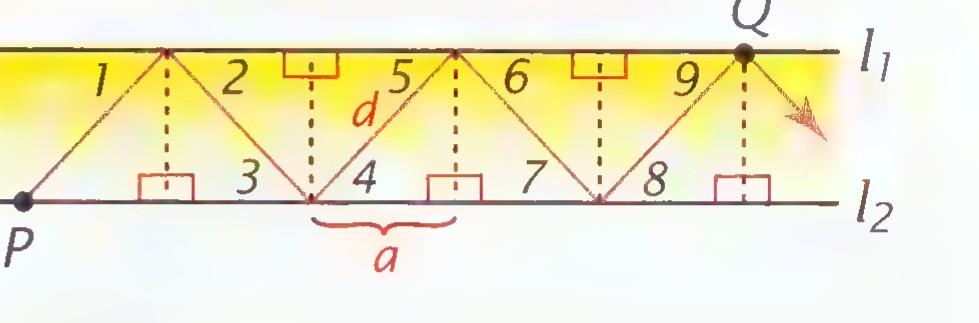
- Why is $$2 = $$3, $$4 = $$5, $$6 = $$7, and so on?
- Why are all the right triangles congruent?
- Why are all of the segments of the light path equal?
- In terms of , how far along the fiber does the light travel in going from P to Q?
- In terms of , how far does the light travel in going from P to Q?
- Why is the ratio of these two distances equal to the cosine of one of the numbered angles?
SAS Area. It is possible to figure out the area of a triangle if two sides and the included angle are known.
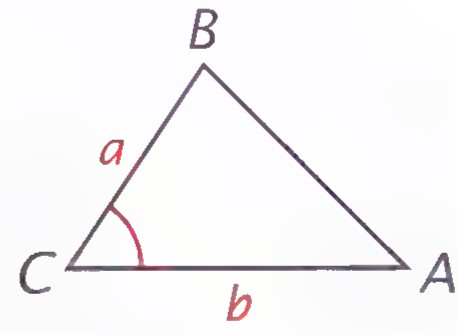
- Copy the figure above, draw the altitude from B to CA, and label it .
- Show that ABC = sin C.
* Optics, by Miles V. Klein and Thomas E. Furtak (Wiley, 1986).
p. 460
Dominoes. One of the stunts listed in the Guinness Book of World Records is “toppling dominoes.”
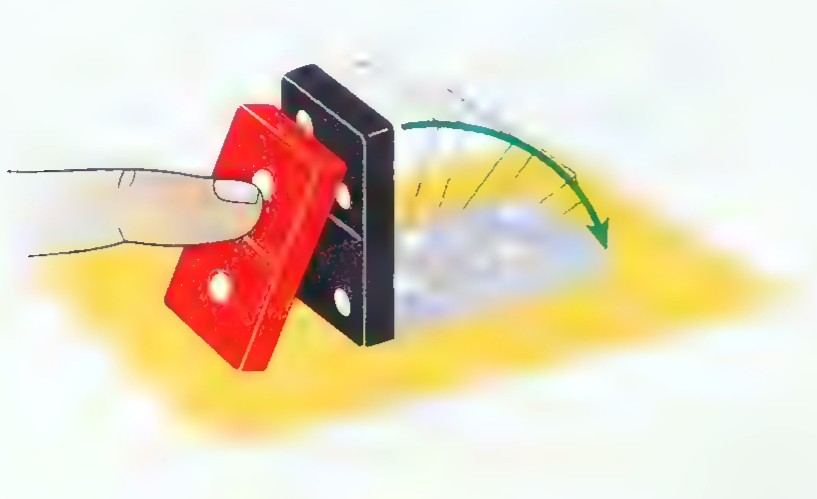
The figure below shows the first three dominoes of an evenly spaced row of dominoes standing on end. A second position of the first domino is shown as it hits the second one.*
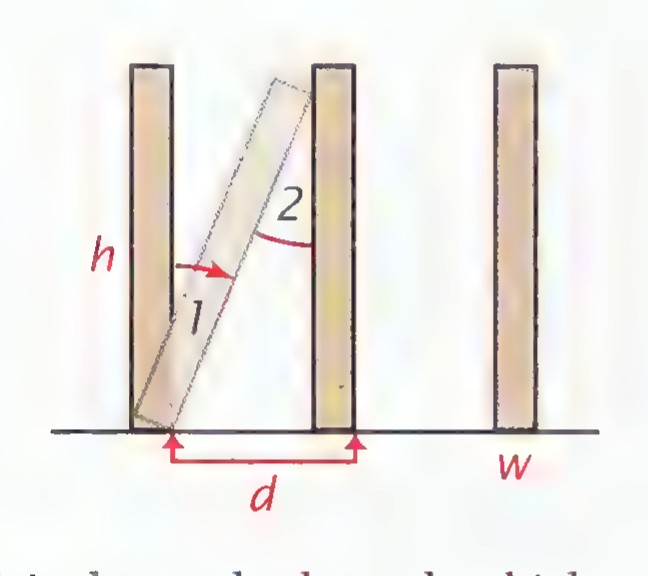
Angle 1 is the angle through which each domino turns before striking the next one.
- Why is $$1 = $$2?
The height and thickness of each domino are and , respectively, and the spacing between each pair of dominoes is .
- Write an expression for sin $$2.
- Find the measure of $$1 if − = .
- Find the measure of $$1 if − = .
- What might happen if − = ?
Set III
Star Distance. The distance to Proxima Centauri, the closest star beyond the sun, was determined by using the sine ratio and the diagram below.†
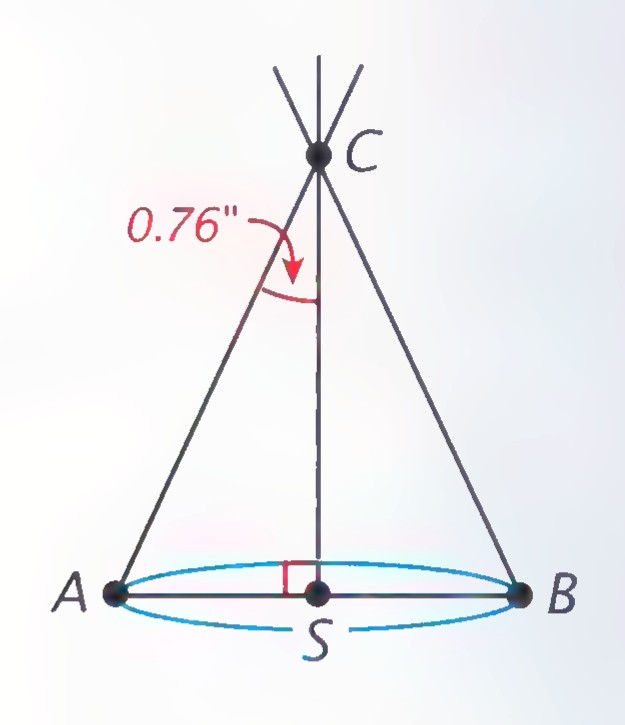
Point S represents the sun, A and B represent Earth at opposite positions in its orbit around the sun, and C represents Proxima Centauri. In right ACS, ACS was determined to have a measure of 0.76 second (“) and the distance from Earth to the sun, AS, was already known to be about 93,000,000 miles.
- Find the distance, AC, from Earth to Proxima Centauri in miles.
One light-year, the distance that light travels in 1 year, is about 5,880,000,000,000 miles.
- How many light-years is Proxima Centauri from Earth?
* Towing Icebergs, Falling Dominoes, and Other Adventures in Applied Mathematics, by Robert B. Banks (Princeton University Press, 1998).
† Stars, by James B. Kaler (Scientific American Library, 1992).
p. 461
Lesson 6: Slope
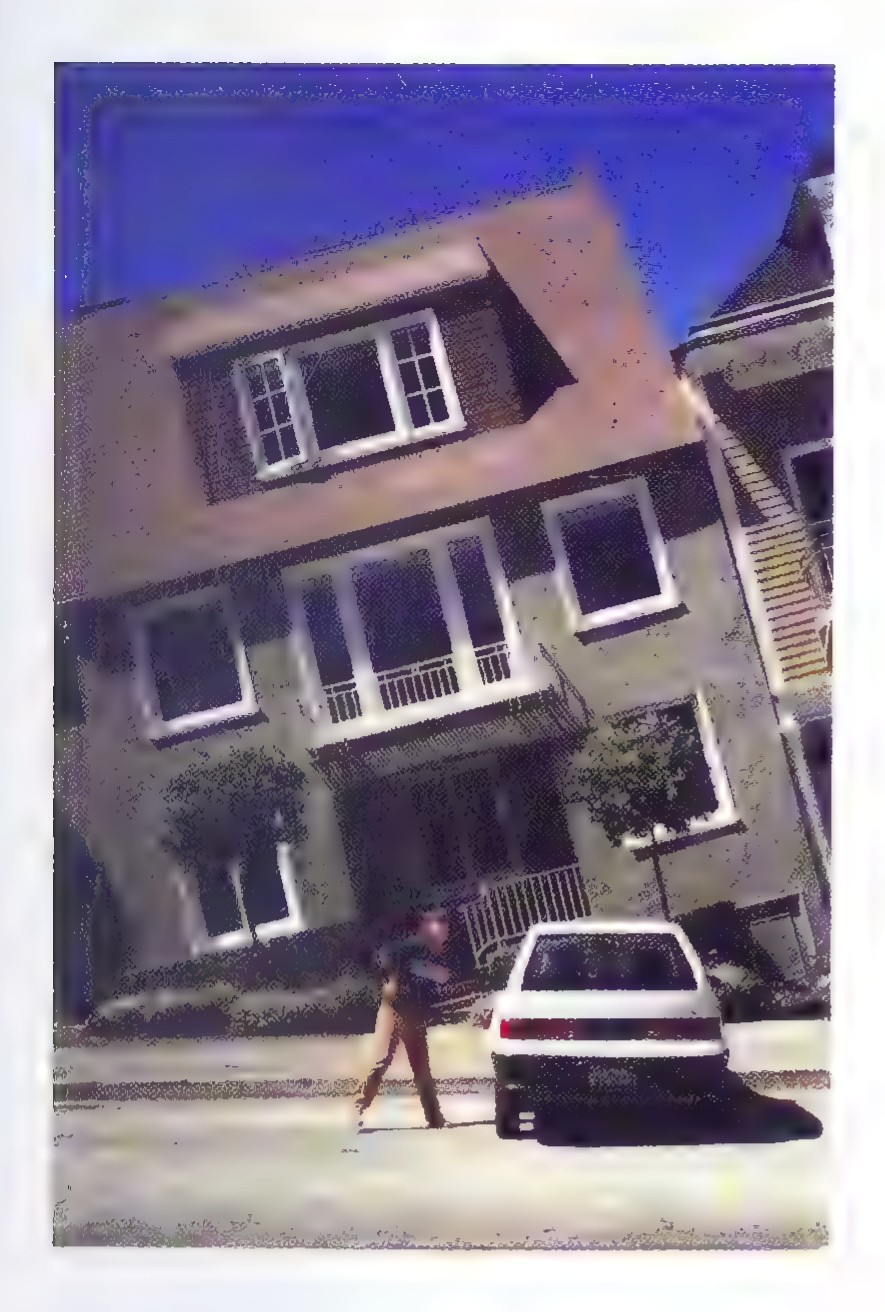
The steepest streets in the United States are in San Francisco. Steepness is measured with respect to the horizontal. The steepness of a street can be measured by its slope.
To find the slope of a line, we choose two points on it. As we go from the left point to the right point, we move a horizontal distance, called the run, and a vertical distance, called the rise. The slope of the line is found by dividing the rise by the run:
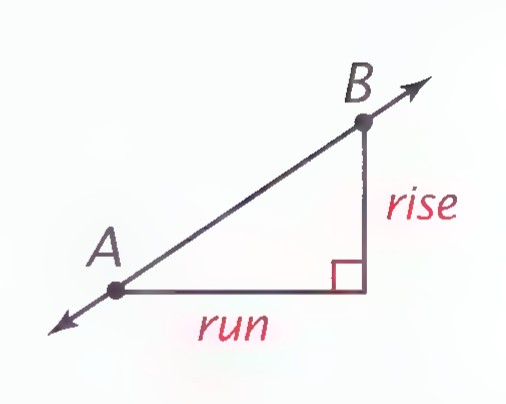
Some steep streets in San Francisco rise 3 feet for every 10 feet that they run on the level; their slope is .
Another way to measure the steepness of a line is to give its angle of inclination, the angle that it forms with the horizontal. What is the angle of inclination of a line whose slope is ? The figure at the right shows that the angle of inclination is connected to the line’s slope through the tangent ratio:
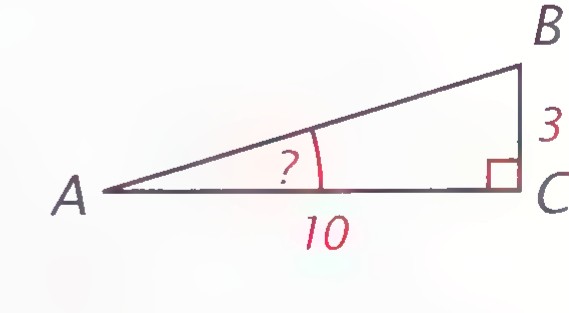
A calculator shows that A 17°; so a street with a slope of 0.3 has an angle of inclination of about 17°.
p. 462
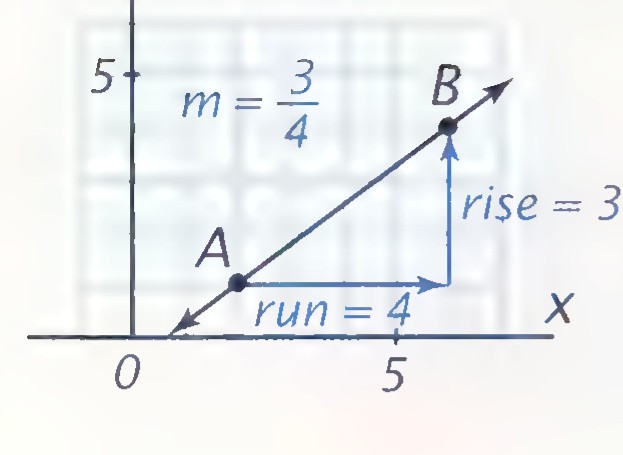
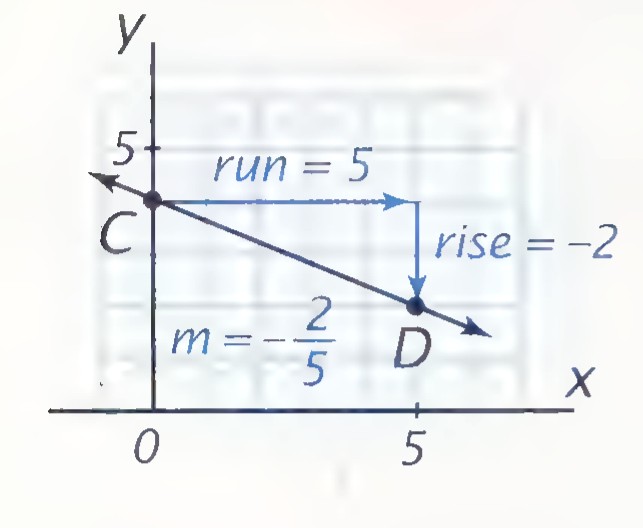
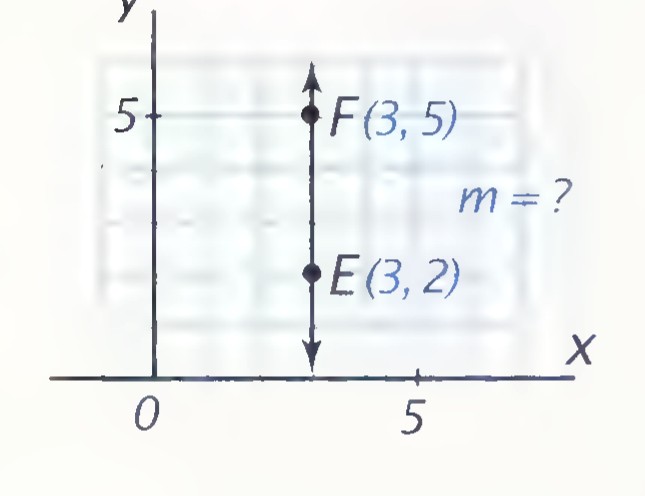
The slope of a line is easy to see in a coordinate system. In the figures at the left, the slope of line AB is and the slope of line CD is . It is customary to represent slope by the letter .
Because two points determine a line, their coordinates can be used to find its slope. For example, in the first figure at the left, the coordinates of A and B are (2, 1) and (6, 4). The rise is 4 − 1 = 3, the run is 6 − 2 = 4, and the slope is
In the second figure, the coordinates of C and D are (0, 4) and (5, 2). The rise is 2 − 4 = −2, the run is 5 − 0 = 5, and the slope is
There is one type of line, however, for which this method will not work. To see why, look at the third figure at the left. The coordinates of E and F are (3, 2) and (3, 5). The rise is 5 − 2 = 3, the run is 3 − 3 = 0, and the slope is
A calculator will indicate “error” if you try to divide by zero, and so, like division by zero, the slope of a vertical line is undefined.
For other lines, the slope is defined in the following way.
Definition
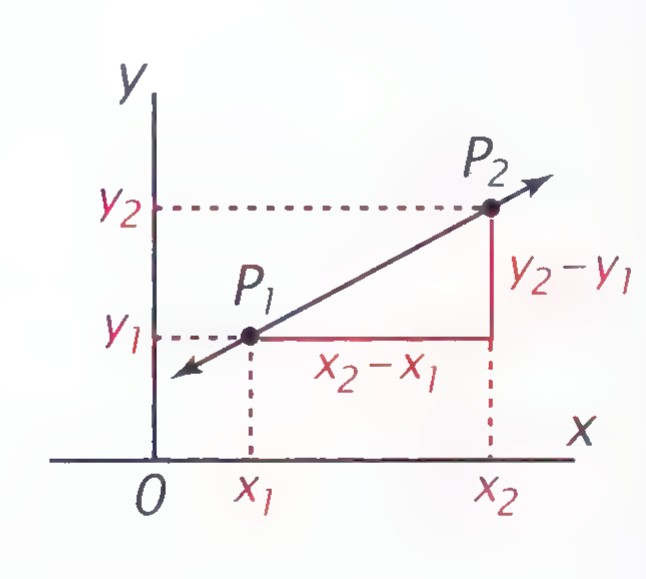
The slope, , of a nonvertical line that contains points P(, ) and P(, ) is
This definition tells how to find the slope of a line from the coordinates of two points on it. The choice of points doesn’t matter; every pair of points on a line determines the same slope.
p. 463
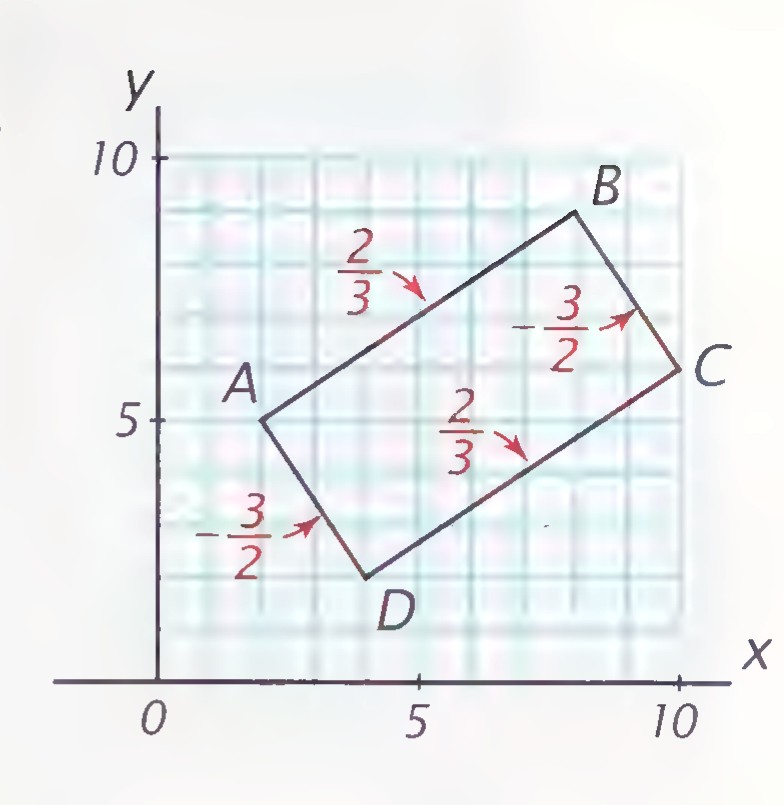
Lines that are parallel or perpendicular have slopes that are related in very simple ways. Consider the figure at the right, in which ABCD is a rectangle. Here AB DC and the slopes of AB and DC are both . Similarly, AD BC and both of these lines have slope . The sides in each pair of consecutive sides are perpendicular, and their slopes, and , are the opposites of the reciprocals of each other. Because , another way to put it is to say that the product of the slopes is −1.
These observations suggest the following theorems, which are explored further in the exercises.
Theorem 52
Two nonvertical lines are parallel iff their slopes are equal.
Theorem 53
Two nonvertical lines are perpendicular iff the product of their slopes is −1.
Exercises
Set I
Slope Practice. All of the lines named with letters in the graph below go through the origin.
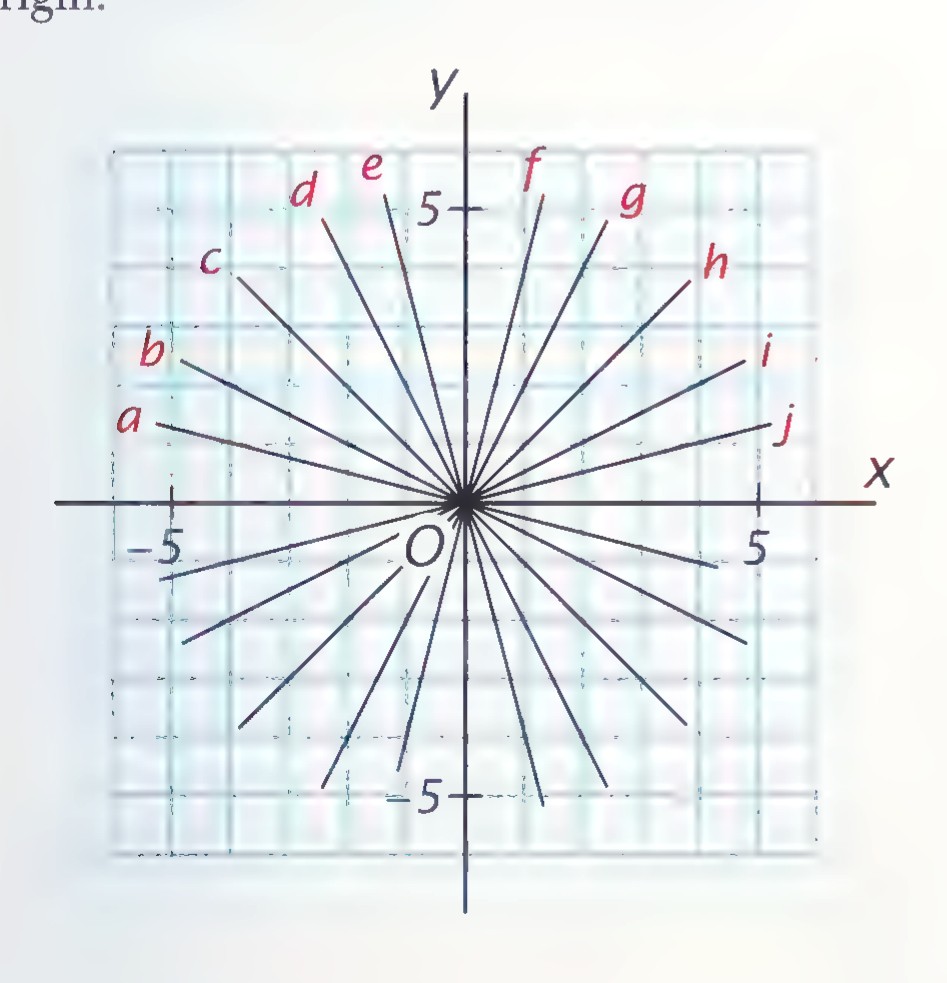
- Which line has a slope of 1?
- Which line has a slope of −1?
- Which line has a slope of 0?
- Which line has a slope that is undefined?
- Which line appears to be perpendicular to line j?
- What are the slopes of line j and that line?
- Which line appears to be perpendicular to line b?
- What are the slopes of it and line b?
- State the theorem illustrated by your answers to exercises 5 through 8.
- Can you find any lines named with letters in the figure that have the same slope? Explain.
p. 464
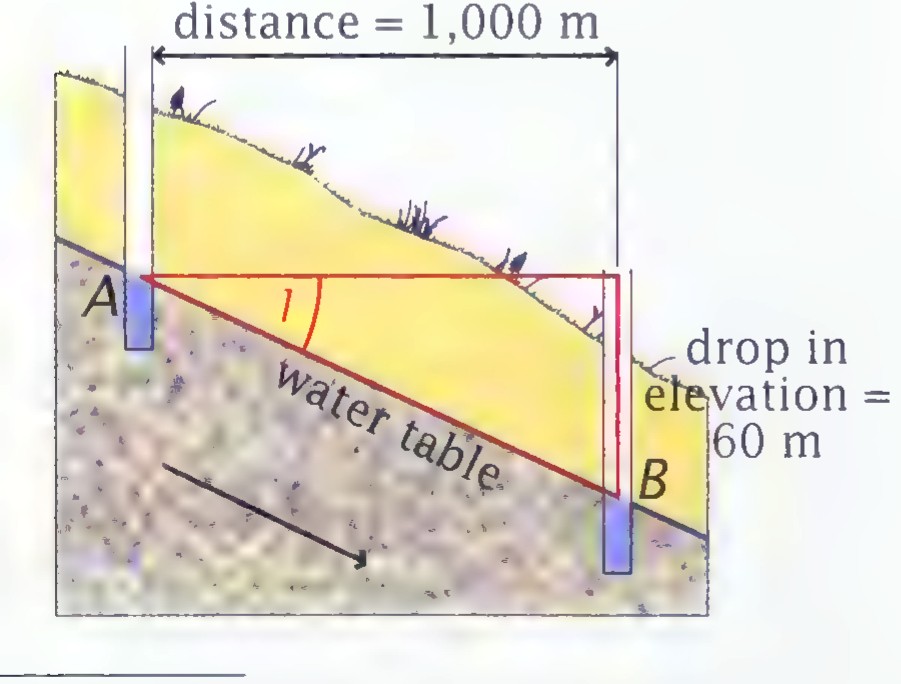
Between points A and B on the “water table” line, what is the
- rise?
- run?
- slope?
- angle of inclination, $$1?
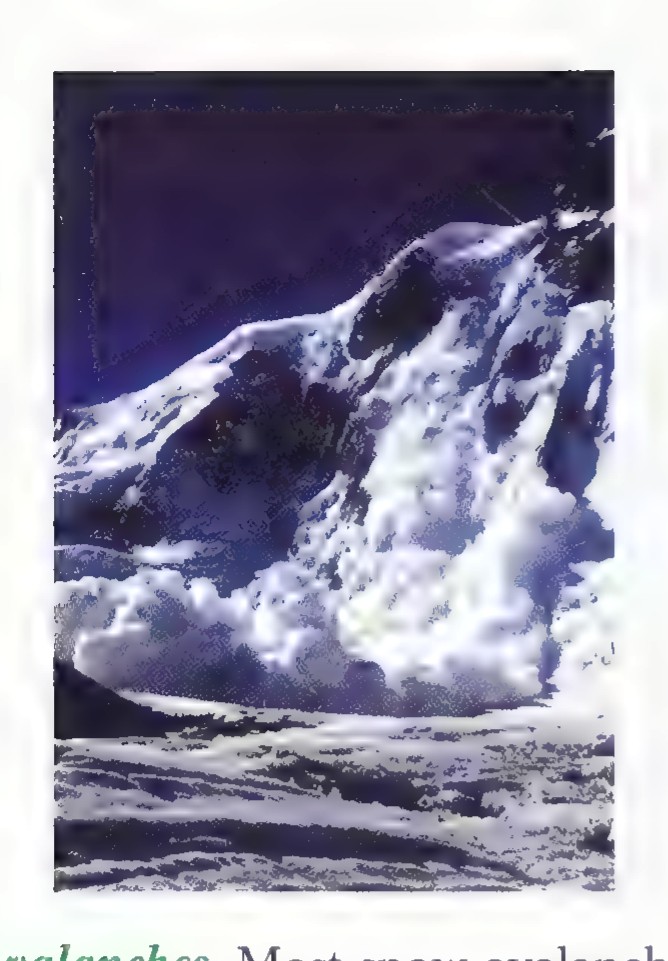
Snow Avalanches. Most snow avalanches start on slopes inclined at between 30° and 45°.
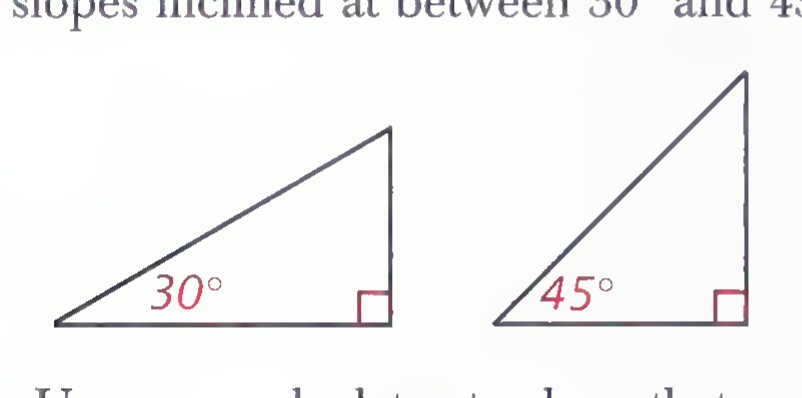
- Use your calculator to show that snow inclined at an angle of 30° has a slope of about 0.58.
- What is the slope of snow inclined at an angle of 45°?
Hydraulic Gradient. The figure below from a geology book illustrates the “hydraulic gradient” of a hill.*
Stair Design. Vitruvius, a Roman architect of the first century B.C., wrote about the design of stairs. He said that the rise should be between 9 and 10 inches and the tread (run) should be between 18 and 24 inches.†
- Draw and label a figure of stairs rising to the right showing the steepest steps that follow his recommendations.
- What would be the slope of a staircase consisting of these steps?
- What angle of inclination would the staircase have?
- Draw and label a figure to illustrate the shallowest (least-steep) steps that follow Vitruvius’s recommendation.
* Environmental Geology, by Dorothy J. Merritts, Andrew de Wet, and Kirsten Menking (W. H. Freeman and Company, 1998).
† Steps and Stairways, by Cleo Baldon and Ib Melchior (Rizzoli, 1989).
p. 465
- What would be the slope of a staircase consisting of these steps?
- What angle of inclination would the staircase have?
Quadrilateral Problem. Find the slopes of the lines through the following pairs of points.
Example: A(−8, −5) and B(−1, 4).
Solution: .
- B(−1, 4) and C(10, 7).
- C(10, 7) and D(3, −2).
- D(3, −2) and A(−8, −5).
- A(−8, −5) and C(10, 7).
- B(−1, 4) and D(3, −2).
Find the distances between the following pairs of points.
Example: A(−8, −5) and B(−1, 4).
Solution: .
- B(−1, 4) and C(10, 7).
- C(10, 7) and D(3, −2).
- D(3, −2) and A(−8, −5).
- On graph paper, draw a pair of axes extending 10 units in each direction from the origin. Plot the four points of the examples and exercises 23 through 30; draw quadrilateral ABCD and its diagonals. Use your drawing to check your answers.
- What kind of quadrilateral is ABCD? Explain.
- What relation does line AC have to line BD? How do you know?
- How are the slopes of the opposite sides of ABCD related to each other?
- How are the slopes of the diagonals of ABCD related to each other?
Set II
Slope and x-Intercept. Sailplanes can glide on paths with slope .*
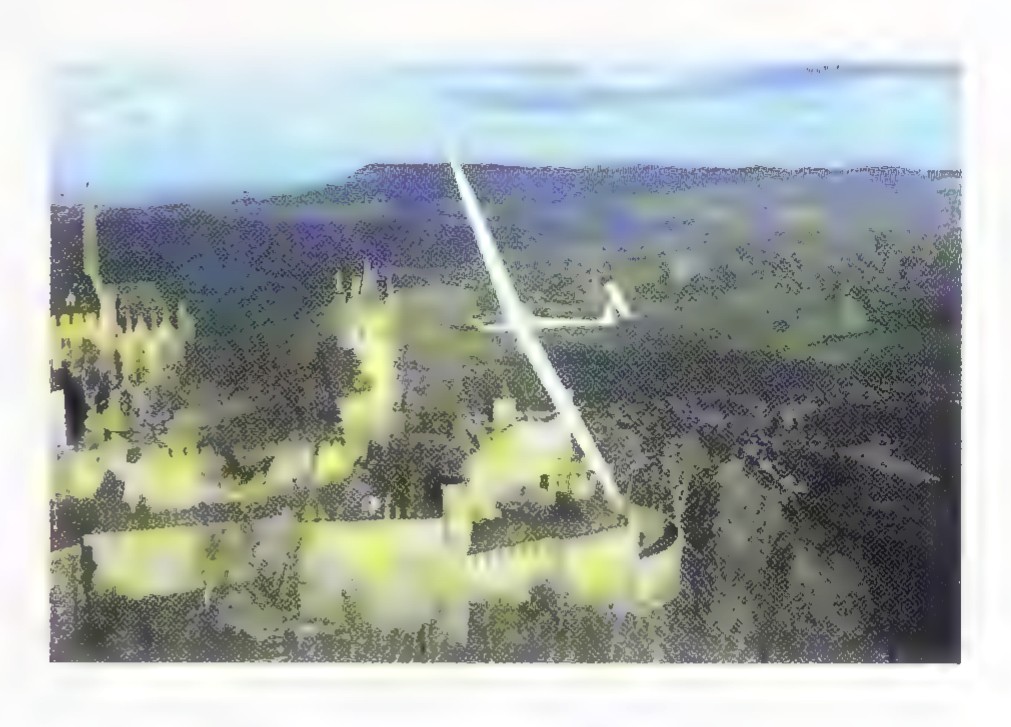
Suppose a sailplane is 300 meters above the ground as it passes overhead.
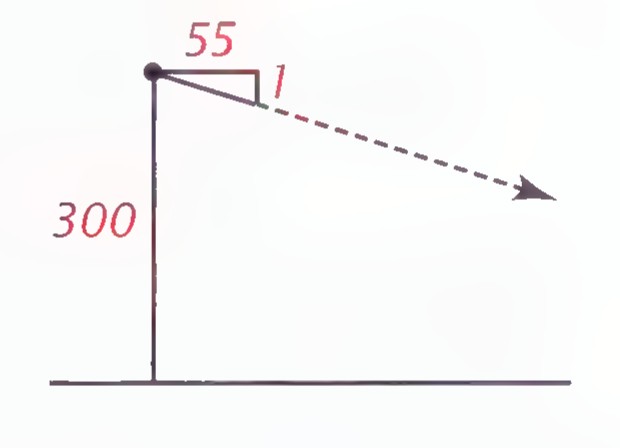
- After the plane has glided 550 meters horizontally, what are its run and rise?
- How high is the plane after gliding this distance?
Suppose instead that, after crossing overhead, the plane glides meters horizontally.
- What are its run and rise in terms of ?
- After gliding meters, how high is the plane in terms of ?
- How far can the sailplane glide horizontally before it hits the ground?
- Can it reach an airport 15 kilometers away?
* On Size and Life, by Thomas A. McMahon and John Tyler Bonner (Scientific American Library, 1983).
p. 466
Point-Slope Equation of a Line. If line passes through point P(, ) and has slope , we can find the height of every point P(, ) on by using run and rise.
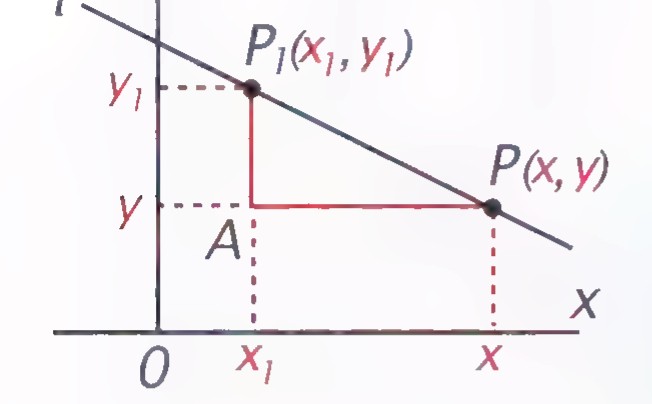
- Express the run and rise of from P to P in terms of coordinates.
- Solve for in terms of , , , and .
For the sailplane described in exercises 36 through 41, P has coordinates (0, 300) and .
- Write the point-slope equation for the line of the path of the sailplane.
- Does your answer agree with your answer to exercise 39?
- Which of the following points are on the path of the sailplane? (5,500, 200), (2,200, 250), (1,100, 280).
100-Meter Dash. The slope of a line is the same at every point, but the slope of a curve is not. The curve below shows the speed of an athlete running the 100-meter dash with respect to time.*
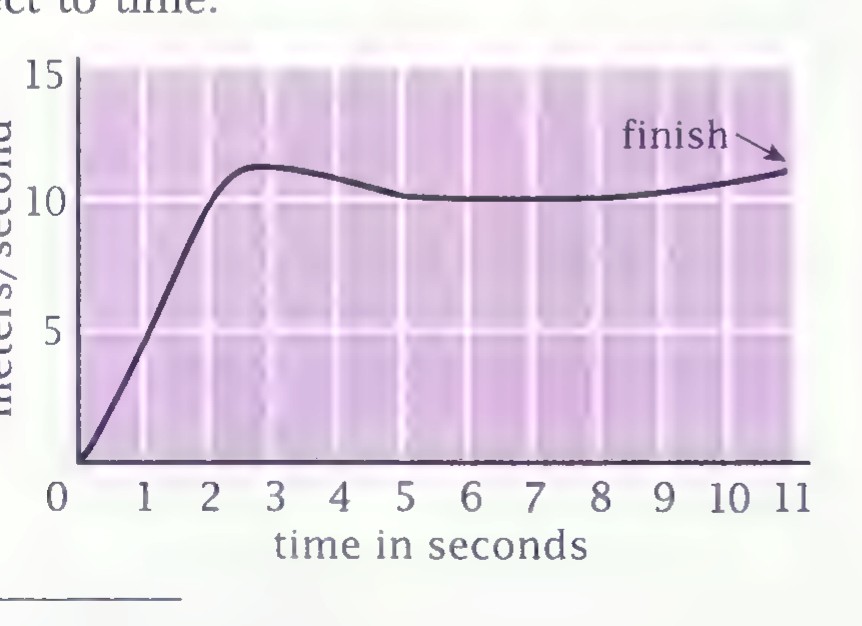
The slope of the curve is positive from 8 seconds to the finish.
- Where else does it appear to be positive?
- Over what interval does it appear to be zero?
- Where does it appear to be negative?
What is happening to the runner’s speed when the slope of the curve is
- negative?
- zero?
Theorem 52. Complete the following proof of part of Theorem 52 by giving the reasons.
If two nonvertical lines are parallel, their slopes are equal.
In the figure below, and ABC and DEF have been drawn so that AC and DF are perpendicular to the -axis.
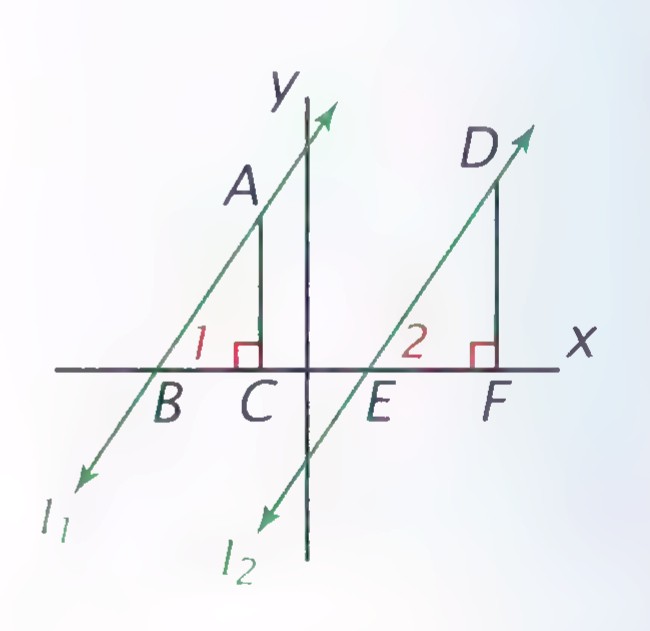
- What is the slope of ?
- What is the slope of ?
- Why is $$1 = $$2?
- Why is ABC ~ DEF?
- Why is ?
- Why is AC × EF = BC × DF?
- Why is ?
- If and , why is ?
* Liberal Arts Physics, by John M. Bailey (W. H. Freeman and Company, 1974).
p. 467
Theorem 53. Complete the following proof of part of Theorem 53 by giving the reasons.
If two nonvertical lines are perpendicular, the product of their slopes is −1.
In the figure below, and ABC has been drawn so that AC is parallel to the -axis and BD is parallel to the -axis.
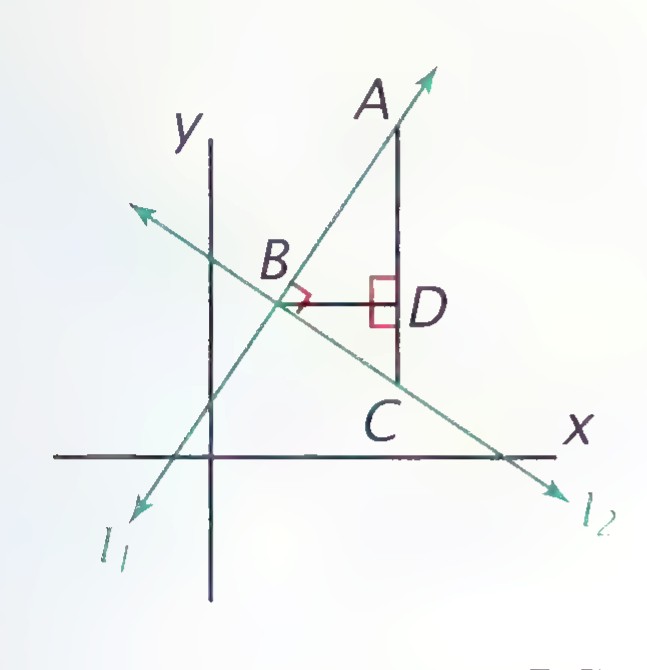
- Which line has the slope ?
- What is the slope of the other line?
- Why is ?
- If , what does equal in terms of ?
- If , why is ?
- Why is ?
Fire Speed. Fire spreading up a hillside “increases in proportion to the square of the slope of the terrain.”*
- Find, to the nearest hundredth, the slope of the hills represented by the two figures at the right.
- Given similar conditions, how many times faster would you expect fire to spread up the second hill? Explain.
Set III
Celsius and Fahrenheit. The graph below shows how Celsius and Fahrenheit temperatures are related. The two points that determine the line, A and B, correspond to the freezing point of water (0°C and 32°F) and its boiling point (100°C and 212°F).
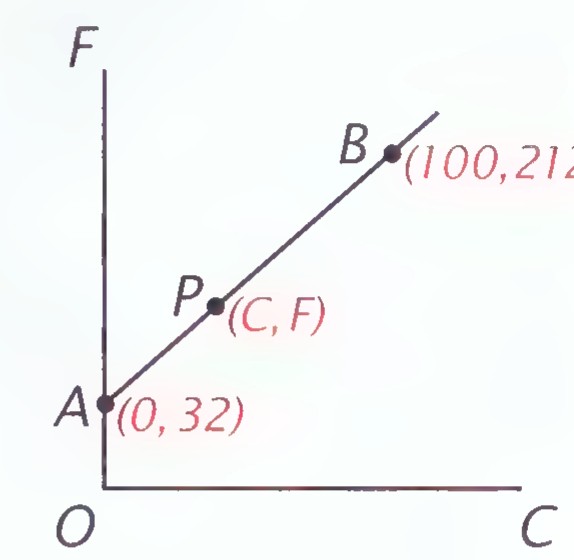
- What is the slope of line AB?
The coordinates of point P represent any other pair of related temperatures on these two scales.
- Write an expression for the slope of line AB in terms of the coordinates of A and P.
- Write an equation based on the fact that your answers to exercises 1 and 2 represent the same slope.
- Solve the equation for C in terms of F.
- Solve the equation for F in terms of C.
- Is there a temperature for which F = C? Show why or why not.
* Visual Revelations, by Howard Wainer (Copernicus, 1997).
p. 468
Lesson 7: The Laws of Sines and Cosines
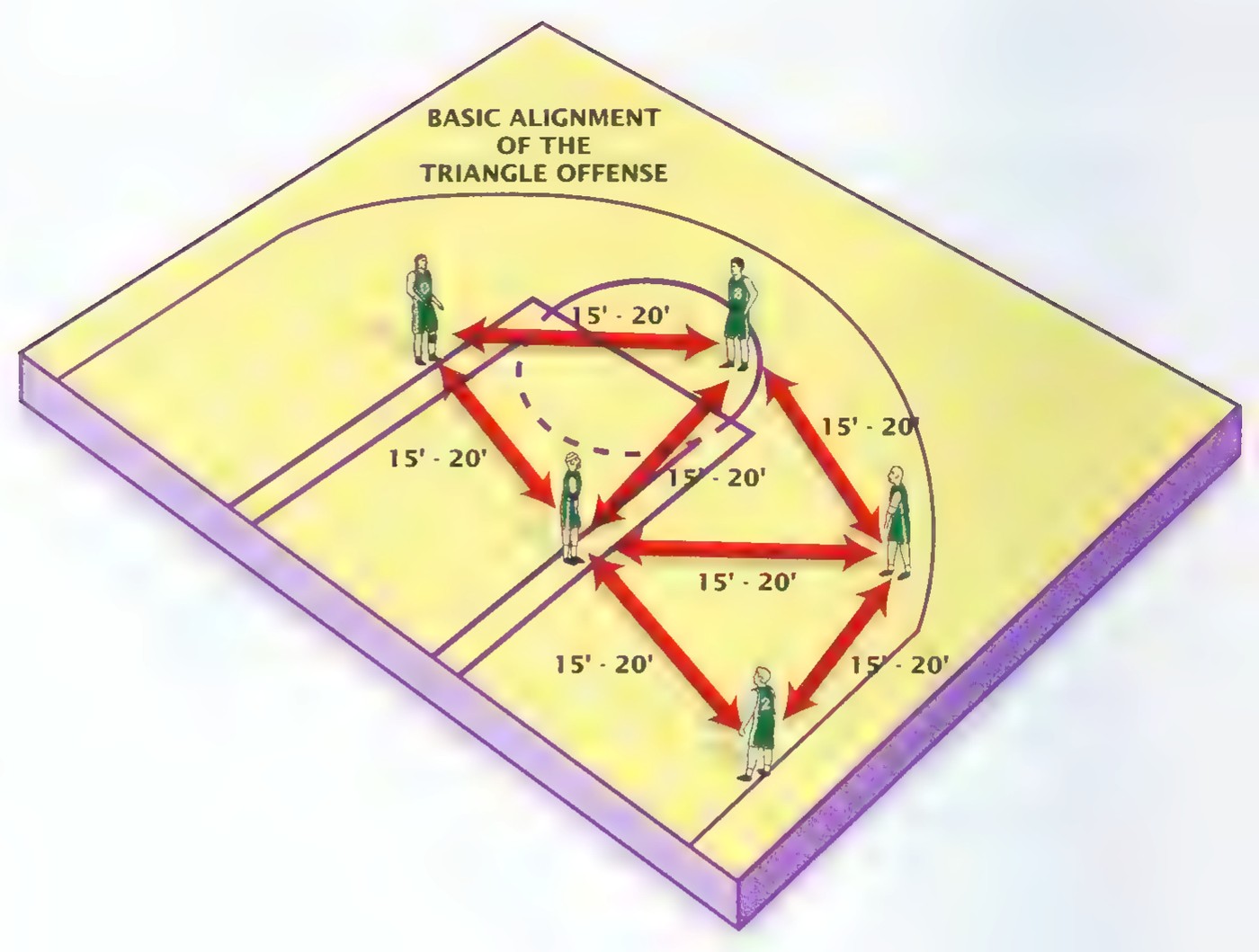
In the “triangle offense” in basketball, the players move on the floor so that they are at the corners of large triangles having sides between 15 and 20 feet in length. One coach has called it “the best offense in the N.B.A.”
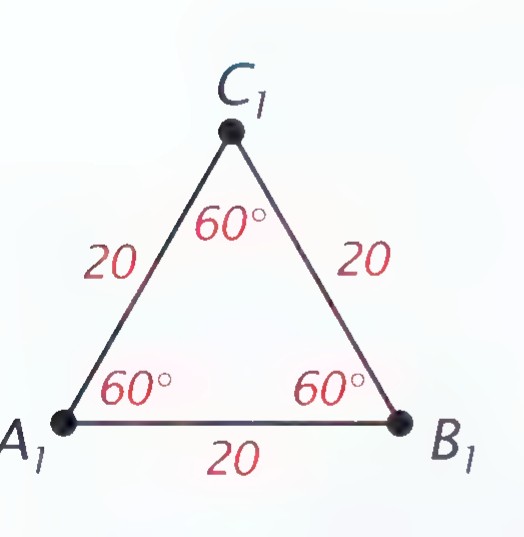
Suppose three players are spaced 20 feet from one another as shown in the first figure at the left so that they are at the corners of an equilateral triangle. If the triangle is equilateral, then we know that each of its angles is 60°.
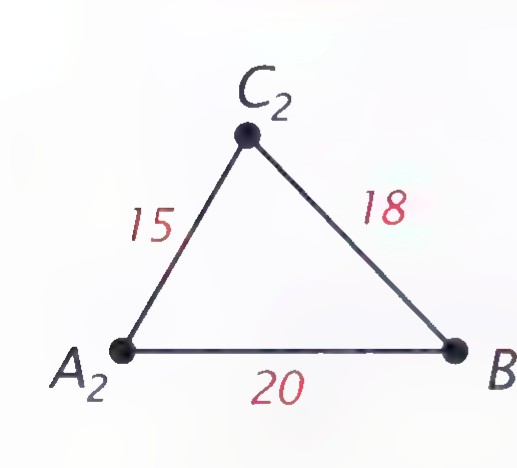
Now suppose they move so that they are spaced as shown in the second figure. How large are the angles now? Because the three sides of the triangle now have different lengths, it follows that its angles have different measures.
You have seen how the trigonometric ratios can be used to find the sides and angles of right triangles, but ABC is not a right triangle. Nevertheless, the sine and cosine can be used to find parts of triangles that are acute or even obtuse. Because we have defined these ratios in terms of acute angles, however, we will limit their use to triangles all of whose angles are acute.
The sine ratio appears in an equation relating all six parts of a triangle.
p. 469
Theorem 54. The Law of Sines
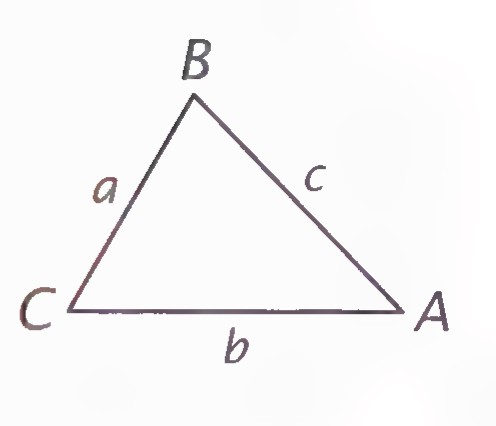
If the sides opposite A, B, and C of ABC have lengths , , and , then .
Given: ABC.
Prove: .
Proof
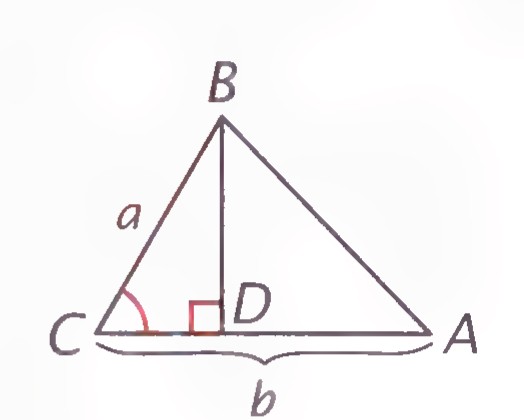
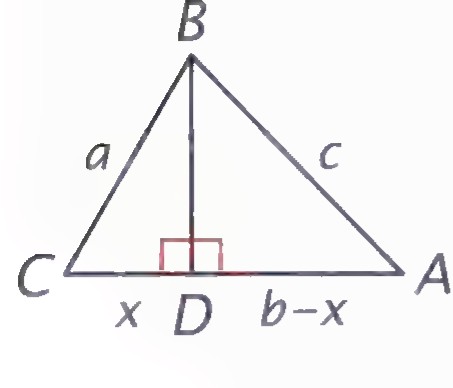
Draw altitude BD. In right CBD, sin C = ; so BD = sin C.
Because ABC = (BD), it follows by substitution that
This equality shows that the area of a triangle is half the product of two of its sides and the sine of the included angle.
Extending this reasoning to the other angles and the sides that include them, we have
Dividing these three expressions for the area by and by gives
The cosine ratio appears in the following generalization of the Pythagorean Theorem relating the three sides of a triangle to one of its angles.
Theorem 55. The Law of Cosines
If the sides opposite A, B, and C of ABC have lengths , , and , then cos C.
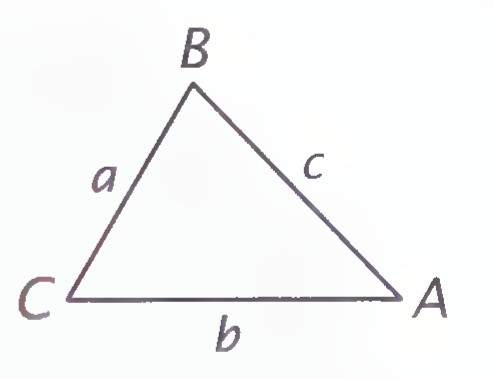
Given: ABC.
Prove: cos C.
Proof
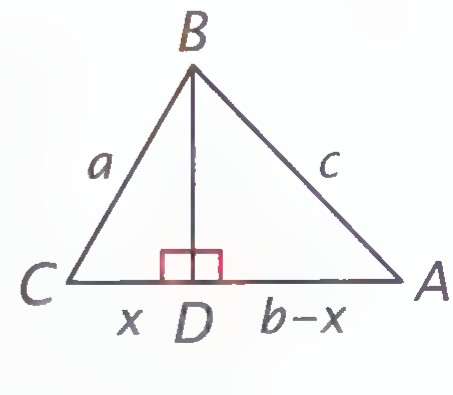
Draw altitude BD and use the Pythagorean Theorem. In right CBD, BD + = ; so BD = − . In right ABD, BD + = ; so BD = − .
Substituting for BD, we have
p. 470
In right CBD, cos C = ; so = cos C. Substituting for , we have
The following examples show how these theorems can be used to solve the “basketball” triangle. More examples are included in the exercises.
Example 1:
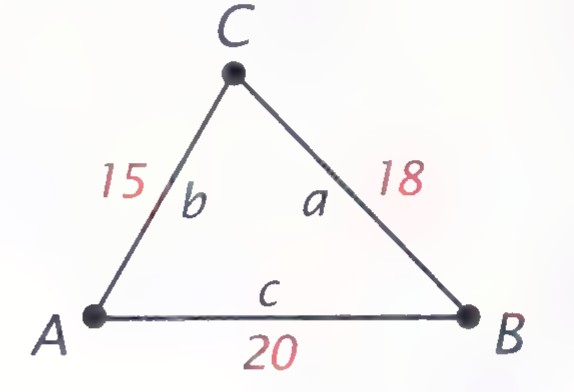
Given that = 18, = 15, and = 20, find C.
Solution:
By the Law of Cosines, cos C. Substituting gives
Example 2:
For the same triangle, find A and B.
Solution:
By the Law of Sines, . Substituting gives
Because A 60° and C 74°, B = 180° − A − C 46°.
p. 471
Exercises
Set I
Greek Equations. The following figure and equation appear in a Greek trigonometry book.
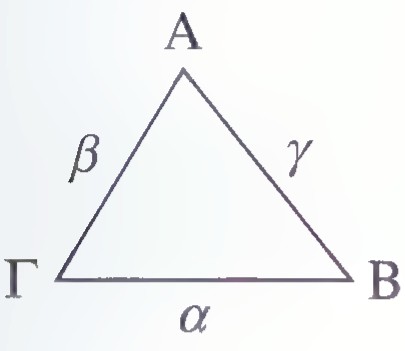
- What do you think means?
- What relation do the side and angle in each ratio have to each other?
- What other ratio is equal to the two ratios in this equation?
- What theorem do the figure and these ratios illustrate?
These equations also appear in the book.
- What do you think means?
The first equation tells how to find side if you know , , and A.
- What relation does A have to side ?
- What relation do sides and have to A?
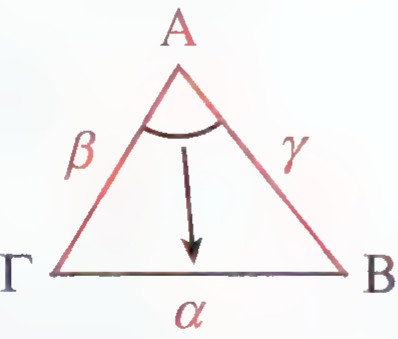
The second equation tells how to find side if you know , , and B.
- What relation does B have to side ?
- What relation do sides and have to B?
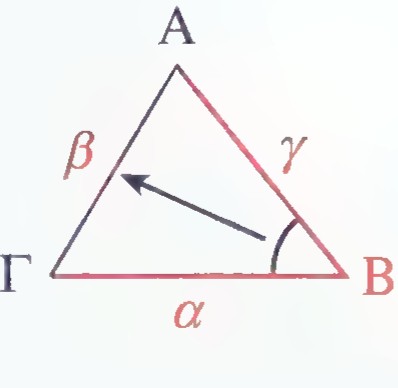
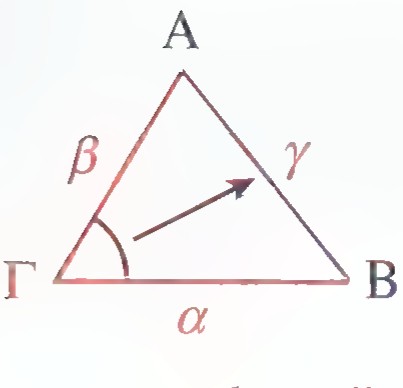
- Write the equation that tells how to find if you know , , and .
- What theorem do these equations illustrate?
Law of Sines. Use the Law of Sines to solve for in each of the following figures. Express each length to the nearest tenth and each angle to the nearest degree.
Example:
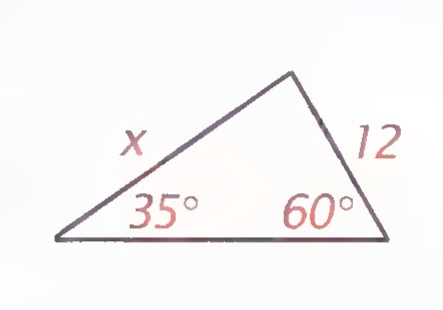
Solution:
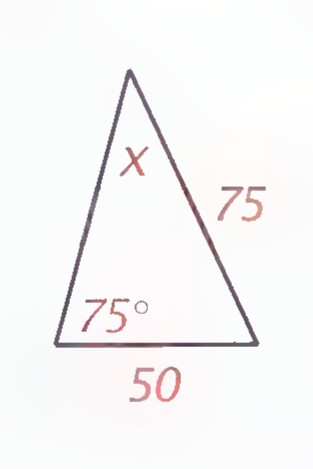
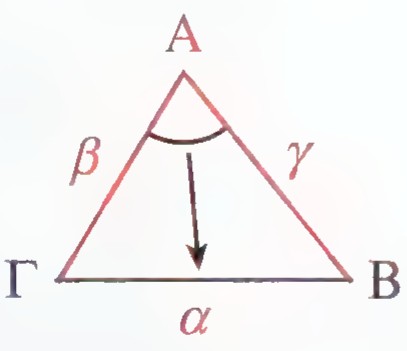
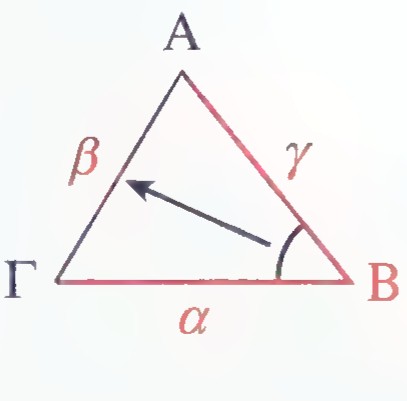
p. 472
Law of Cosines. Use the Law of Cosines to solve for in each of the following figures. Express each length to the nearest tenth and each angle to the nearest degree.
Example:
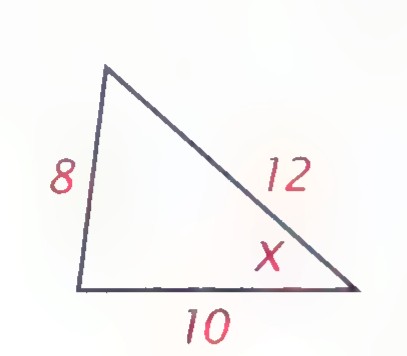
Solution:
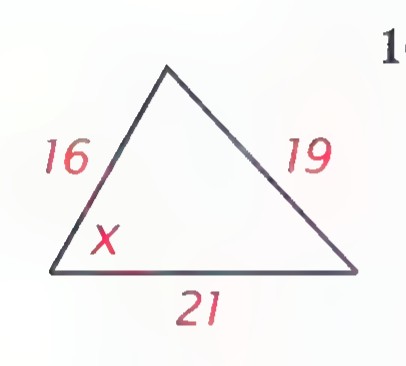
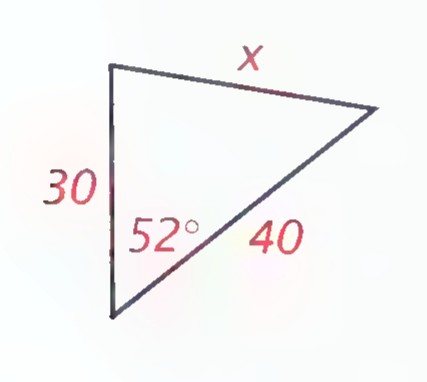
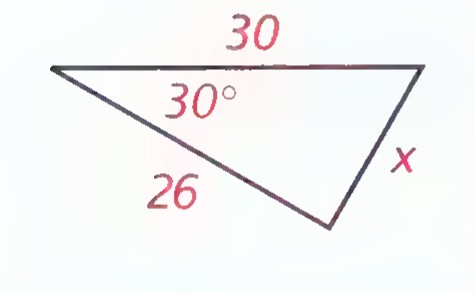
Sines of Supplementary Angles. In ABC, AB = AD = , and AC = .
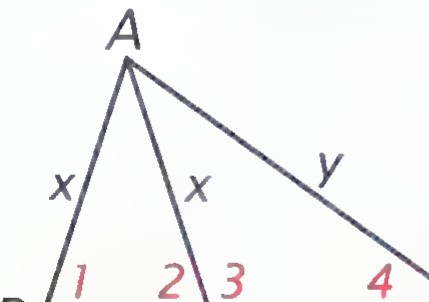
On the assumption that the Law of Sines applies to all triangles, regardless of their shape, copy and complete the following proportions.
- In ABC, .
- In ADC, .
- What do your answers to exercises 18 and 19 imply about sin $$1 and sin $$3? Explain.
Given that $$1 = 72°, find
- $$3.
- sin $$1.
- sin $$3.
- What do your answers to exercises 22 and 23 suggest about the sines of supplementary angles?
Set II
Triangulation. In a book on how India was mapped, triangulation is explained:
Triangulation means simply “triangle-ing”, or conceiving three mutually visible reference points, usually on prominent hills or buildings, as the corners of a triangle. Knowing the exact distance between two of these points, and then measuring at each the angles made by their connecting sight-line with those to the third point, the distance and position of the third point can be established by trigonometry.*
Some of the triangles used in mapping India are shown in the figure below. The
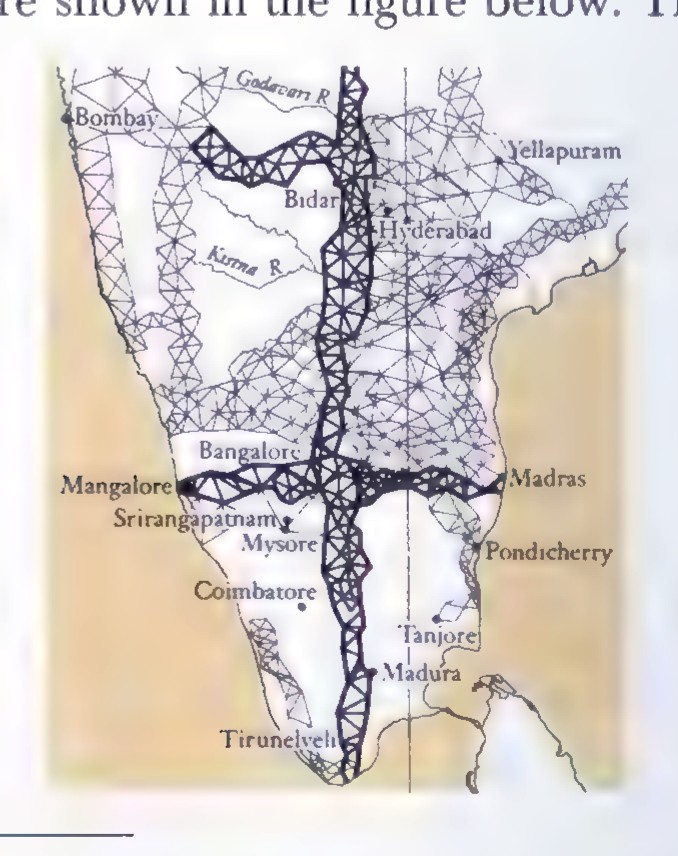
* The Great Arc, by John Keay (HarperCollins, 2000).
p. 473
exercises that follow show how the process worked.
Suppose in the figure below that the base line AB = 24.0 miles, A = 73°, and $$1 = 51°.
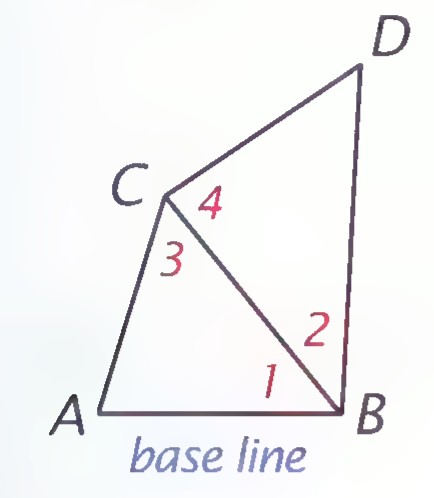
- Find $$3.
- Use the Law of Sines to find CB to the nearest 0.1 mile.
Given that $$2 = 42° and $$4 = 85°, find
- D.
- DB to the nearest 0.1 mile.
- CD to the nearest 0.1 mile.
- Check your answer to exercise 29 by using the Law of Cosines to find CD.
Distance to the Moon. In the figure below (not to scale), A and B represent the positions of two observers on Earth and M represents a mountain peak on the moon.*
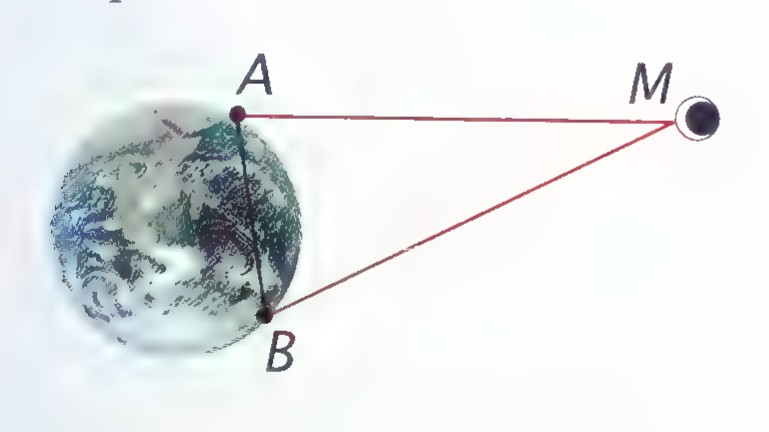
Given that AB = 5,820 miles, A = 89.4°, and B = 89.2°, find
- M.
- AM to the nearest thousand miles.
- BM to the nearest thousand miles.
The Case of the Equilateral Triangle. Verify that the Law of Cosines works for an equilateral triangle by doing the following exercises.
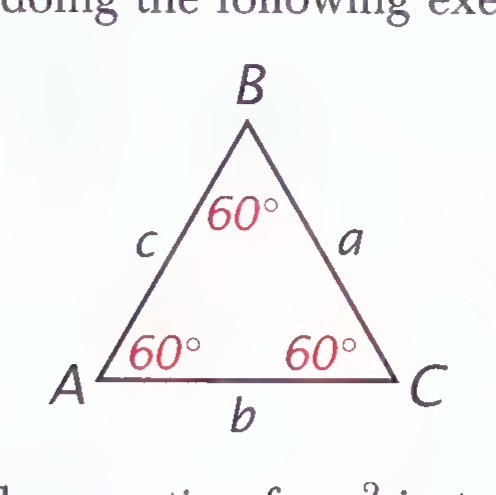
- Write the equation for in terms of , , and cos A.
- Substitute for and and solve the equation for cos A.
- Draw and label a 30°-60° right triangle to show that your answer is correct.
The Case of the Right Triangle. The Laws of Sines and Cosines can be shown to be true for all triangles, not just triangles that are acute.
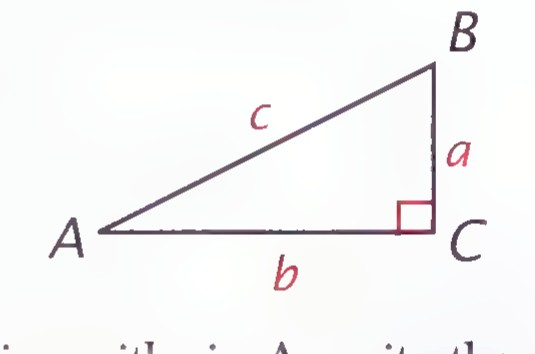
- Starting with sin A, write the equation for the Law of Sines for the right triangle above.
- According to your calculator, to what number is sin 90° equal?
- Substitute this number into your answer to exercise 37.
- Why does it follow from your answer that sin A = and sin B = ?
- What does the Law of Sines become for right triangles?
- Write the equation for in terms of , , and cos C for the right triangle above.
- According to your calculator, to what number is cos 90° equal?
- Use this fact to simplify your answer to exercise 42.
* Pictorial Astronomy, by Dinsmore Alter, Clarence H. Cleminshaw, and John G. Phillips (Crowell, 1974).
p. 474
- What does the Law of Cosines become for right triangles?
The Case of the “Flattened” Triangle. The figure below shows a strange situation.
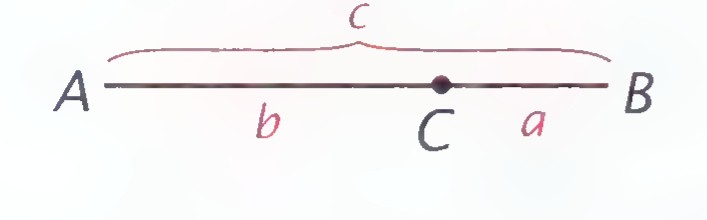
Sides CA and CB of ABC have “opened out” so that C = 180°. As a result, = + .
- Write the Law of Cosines equation for in terms of , , and cos C for this “flattened triangle.”
- According to your calculator, to what number is cos 180° equal?
- Use this fact to simplify your answer to exercise 46.
- Because = + in the figure, does your simplified answer make sense? Explain.
Euclid’s Law of Cosines.
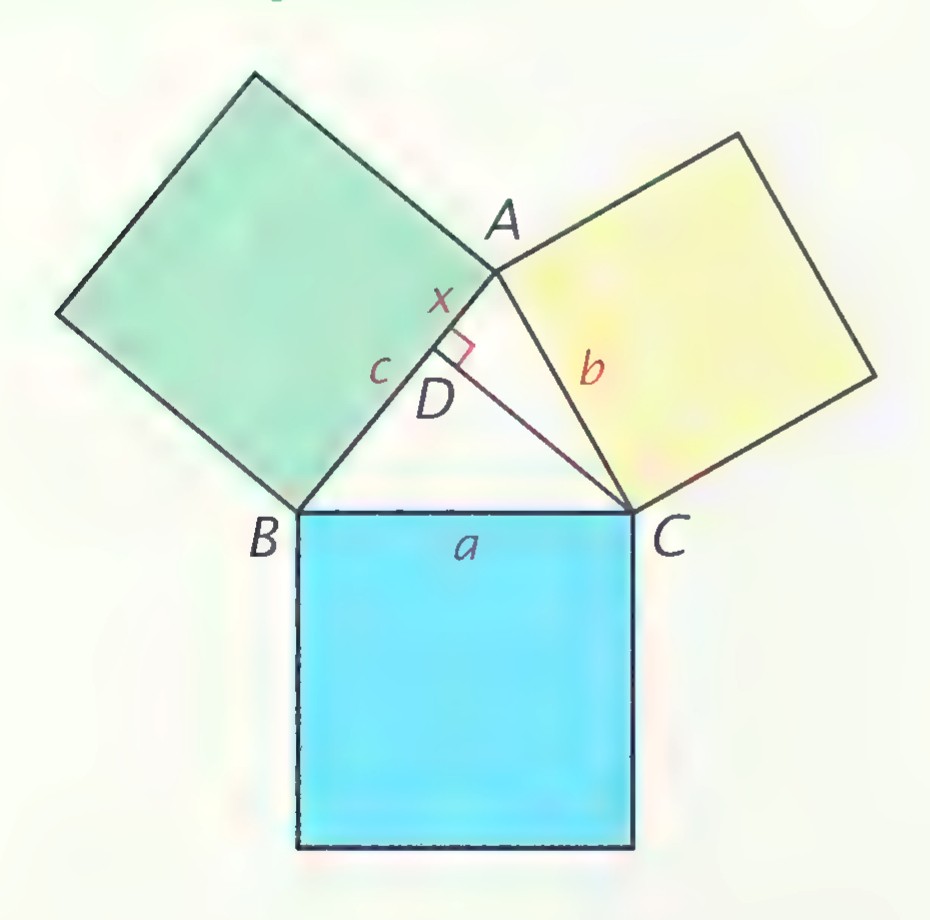
The theorems in this lesson are stated in the form of algebraic equations, something Euclid did not have when he wrote the Elements. Compare his statement of the Law of Cosines:
In an acute triangle, the square on the side opposite each angle is less than the sum of the squares on the sides including that angle by twice the rectangle contained by one of the sides of the angle and the line segment cut off within it by the perpendicular towards the angle.*
with our algebraic version of it:
The rectangle to which Euclid referred is illustrated in the figure below.
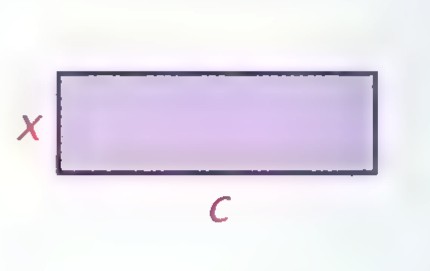
- Show that its area is cos A.
Set III
A Possible Case of Mistaken Identity.
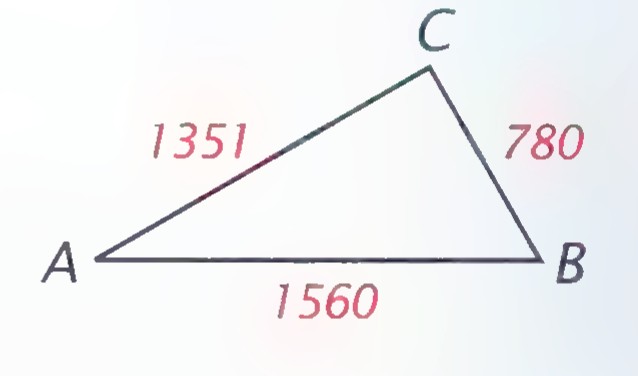
- Find A.
- Find B.
- What kind of triangle is ABC? Explain.
* Book II, Proposition 13.
p. 475

Do you recognize the subject of the lesson illustrated on this Russian stamp of 1961?
Summary and Review
Basic Ideas
| Angle of inclination | 461 |
| Cosine | 455 |
| Pythagorean triple | 437 |
| Sine | 455 |
| Slope | 461–462 |
| Tangent | 449 |
Theorems
The altitude to the hypotenuse of a right triangle forms two triangles similar to it and to each other. 429
Corollary 1. The altitude to the hypotenuse of a right triangle is the geometric mean between the segments into which it divides the hypotenuse. 429
Corollary 2. Each leg of a right triangle is the geometric mean between the hypotenuse and its projection on the hypotenuse. 429
The Pythagorean Theorem. In a right triangle, the square of the hypotenuse is equal to the sum of the squares of the legs. 435
The Isosceles Right Triangle Theorem. In an isosceles right triangle, the hypotenuse is times the length of a leg. 442
Corollary. Each diagonal of a square is times the length of one side. 442
The 30°-60° Right Triangle Theorem. In a 30°-60° right triangle, the hypotenuse is twice the shorter leg and the longer leg is times the shorter leg. 442
Corollary. An altitude of an equilateral triangle having side is and its area is . 443
Two nonvertical lines are parallel iff their slopes are equal. 463
Two nonvertical lines are perpendicular iff the product of their slopes is −1. 463
The Law of Sines. If the sides opposite A, B, and C of ABC have lengths , , and , then . 469
The Law of Cosines. If the sides opposite A, B, and C of ABC have lengths , , and , then cos C. 469
p. 476
Exercises
Set I
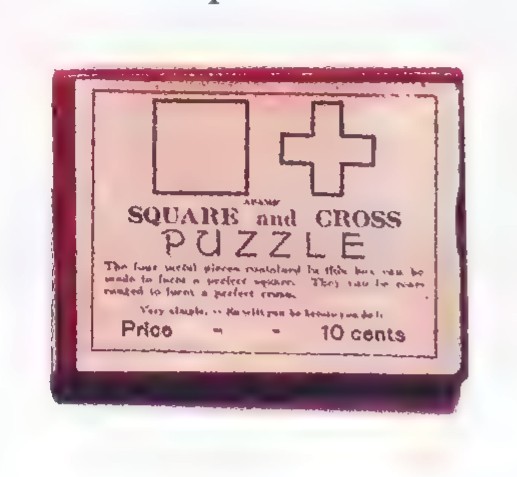
Greek Cross. An old puzzle consists of four pieces that can be arranged to form either a “Greek cross” or a square.
Find the slopes of the following segments in the “Greek cross” arrangement of the pieces shown below.
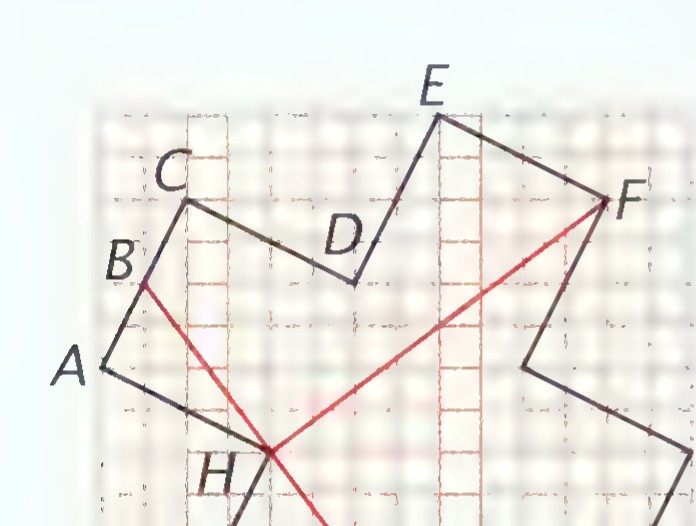
- AC.
- CD.
- DE.
- HF.
- BG.
How are the lines in each of the following pairs related?
- AC and CD.
- AC and DE.
- HF and BG.
What must be true about the slopes of two nonvertical lines if the lines are
- parallel?
- perpendicular?
Doubled Square. Baudhayana, who lived in India about 800 B.C., wrote: “The rope that is stretched across the diagonal of a square produces an area double the size of the original square.”
In the figure below, is both the length of a diagonal of the smaller square and the length of a side of the larger square.
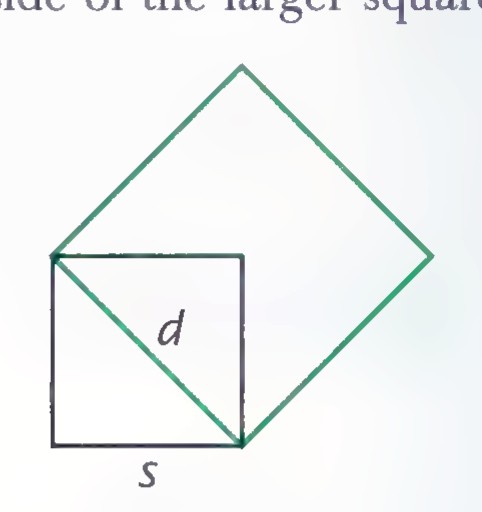
Show that Baudhayana was correct by doing each of the following exercises.
- Express in terms of .
- Express the area of the smaller square in terms of .
- Express the area of the larger square in terms of .
- Express the area of the larger square in terms of .
Escalator Design. Escalators are designed so that they rise at an angle of 30° with the horizontal.
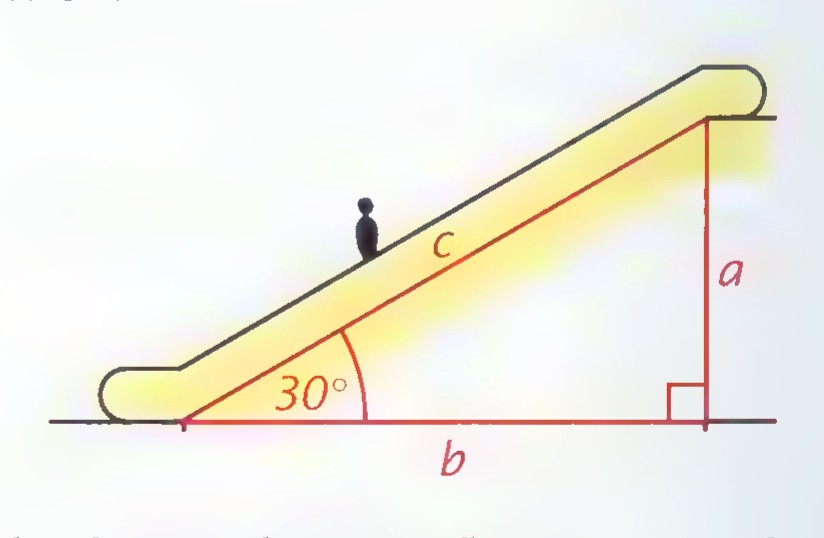
If the distance between floors, , is 14 feet, find
- the distance marked .
- the horizontal distance marked .
If the length of the escalator is 40 feet, find
- the distance between floors, .
- the horizontal distance.
p. 477
Subway escalators have been built in which the horizontal distance is as long as 338 feet.
- Find the vertical distance, , traveled on such an escalator.
- Find the length, , of such an escalator.
Basketball Angles. A basketball is normally shot from at least 7.5 feet above the floor. Almost all direct shots in basketball are made at a horizontal distance, D, from 10 to 25 feet from the basket.*
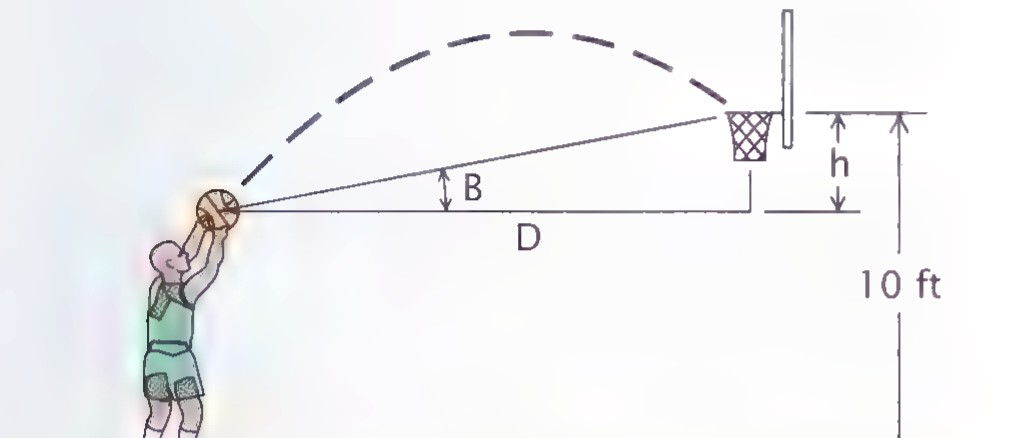
Find the angle of incline, B, if the ball is shot from a point 7.5 feet above the floor at a horizontal distance of
- 25 feet.
- 10 feet.
Equal Parts. In the figure below, CD is the altitude to the hypotenuse of right ABC and AC = DB.†
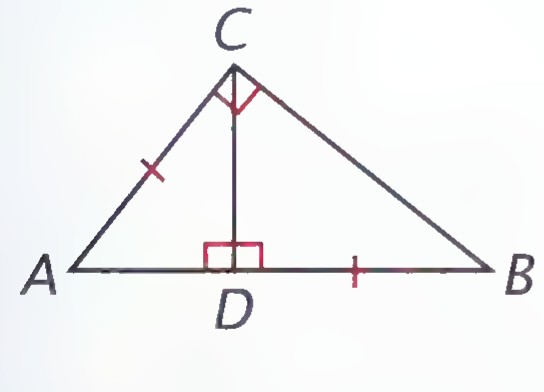
- How many similar triangles does the figure contain?
- State the theorem that is the basis for your answer.
- How many pairs of equal angles do ACD and CBD have?
- How many pairs of equal sides do they have?
- How many pairs of equal parts do they have?
- Are the two triangles congruent? Explain why or why not.
Pentagon. The pentagon has long been a popular choice for the shape of a fortress. An old method for laying out a pentagon on the ground was to stretch a rope into the shape of a right triangle.‡
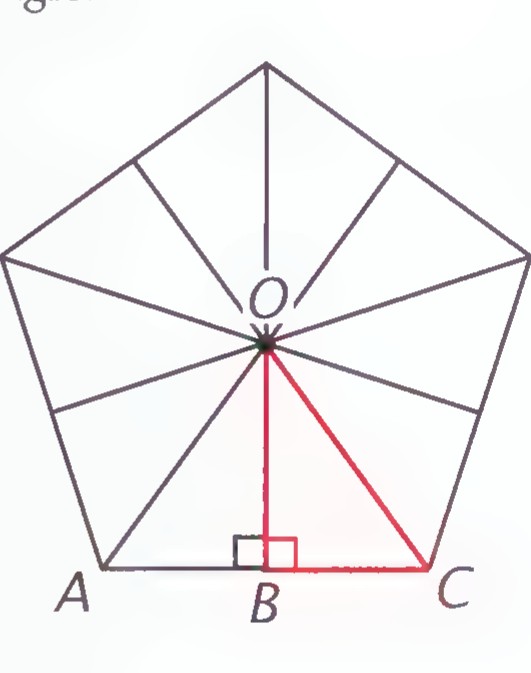
- If all ten right triangles surrounding point O are congruent, what is the measure of BOC?
- If the perimeter of the pentagon is supposed to be 1,000 feet, how long is BC?
- Use the tangent ratio in OBC to find OB to the nearest 0.1 foot.
- Use the sine ratio in OBC to find OC to the nearest 0.1 foot.
- Use the Pythagorean Theorem to see if your results for OB and OC seem reasonable.
- What length of rope is needed to lay out OBC on the ground?
* Sport Science: Physical Laws and Optimum Performance, by Peter J. Brancazio (Simon & Schuster, 1984).
†From an idea by Mike Bolduan, Catlin Gabel School, Portland, Oregon.
‡ The Invention of Infinity: Mathematics and Art in the Renaissance, by J. V. Field (Oxford University Press, 1997).
p. 478
Three Ratios. In the figure below, ABC is equilateral, ABDE is a square, and CF AB.
Find each of the following ratios to two decimal places.
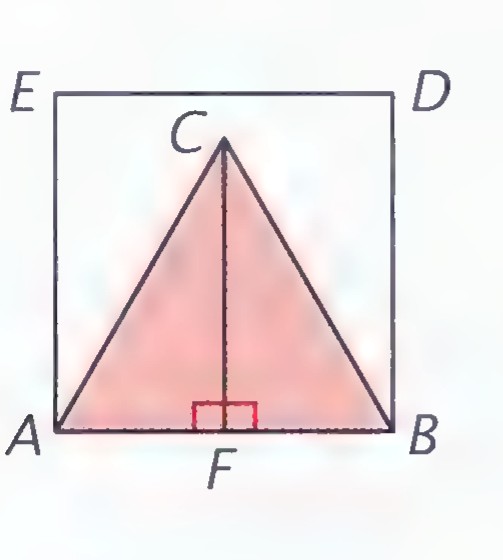
- .
- .
- .
Set II
Isosceles Right Triangles. The figure below shows a square divided into seven isosceles right triangles, no two of which are congruent.*
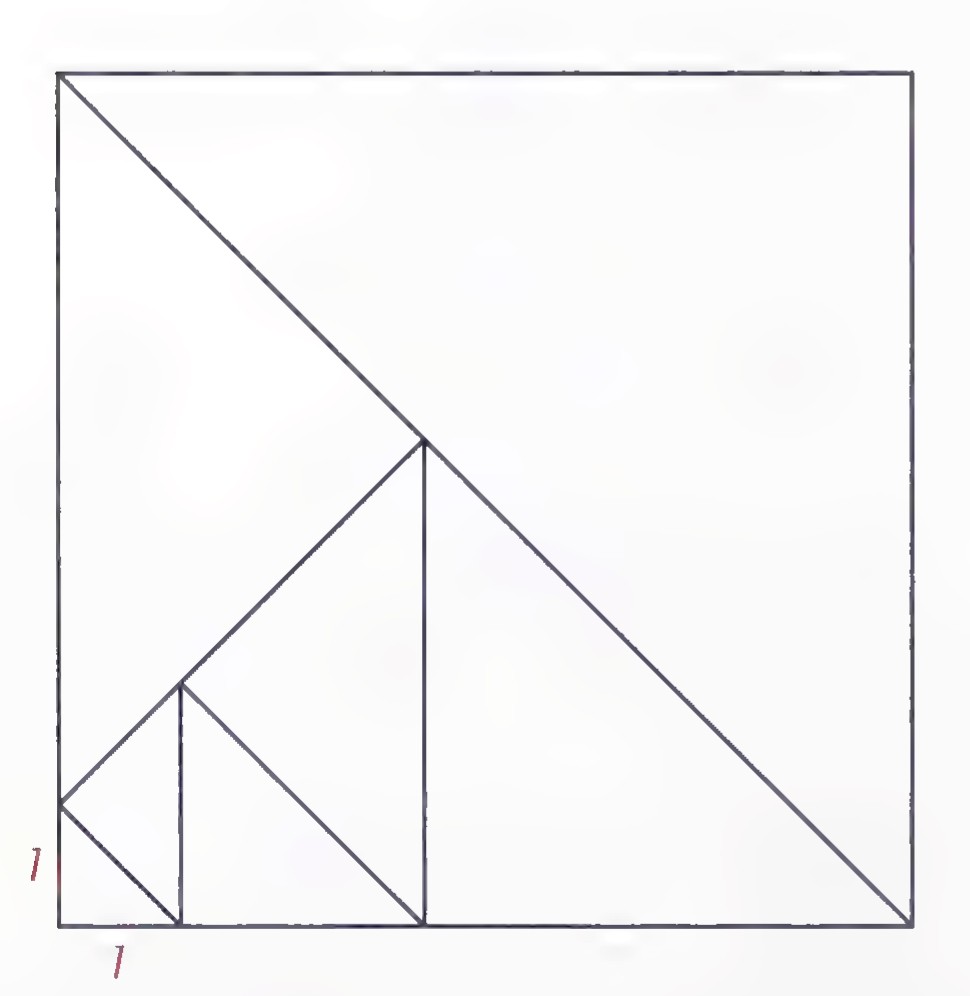
- Trace the figure and mark it as needed to find each of the following measurements.
Given that each leg of the smallest triangle is 1 unit long, find the length of
- each leg of the other six triangles.
- the sides of the square.
- Check your answers by finding the areas of the seven triangles and seeing if they add up to the area of the square.
Two Birds. This problem is from the Liber Abaci (Book of the Abacus), written in 1202 by the Italian mathematician Fibonacci.
Two birds start flying from the tops of two towers 50 feet apart; one tower is 30 feet high and the other is 40 feet high. Starting at the same time and flying at the same rate, they reach a fountain between the bases of the towers at the same moment.
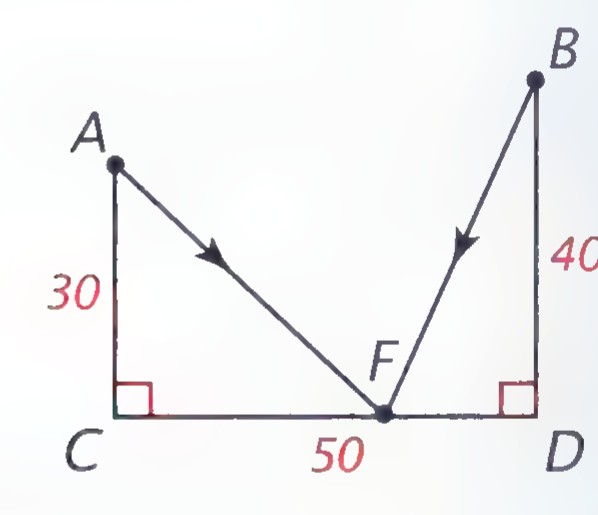
- Copy the figure above and mark it as needed to answer the questions that follow.
- From the description, which two lengths in the figure are equal?
- Let CF = and express FD in terms of .
- Write and solve an equation in terms of .
- How far is the fountain from each tower?
- Approximately how far did each bird fly?
*Ivan Skvarca, Journal of Recreational Mathematics, 1989.
p. 479
Road Systems. Jacob Steiner, a nineteenth-century German mathematician, invented this problem.
Four villages are located at the corners of a square with sides of one mile. What is the shortest system of roads that can be built to connect them?*
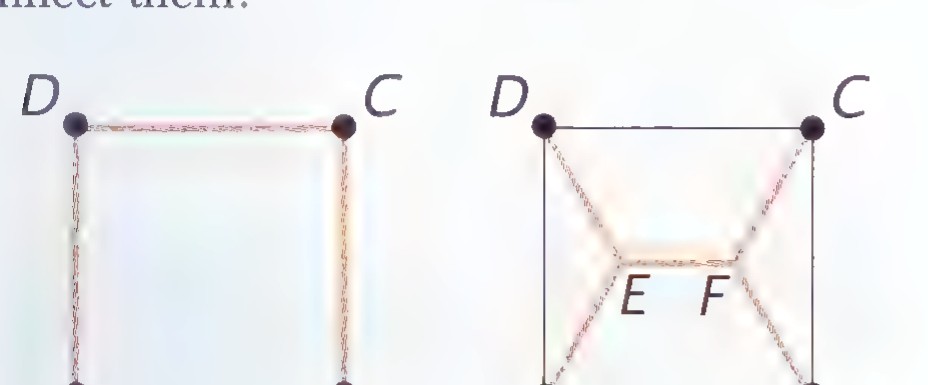
The figures above show two possible solutions. In the second figure, EF AB, the angles surrounding points E and F are equal, and AE = DE = CF = FB.
- How many miles of road are needed in the first solution?
- Copy the second figure and extend line EF to intersect the sides of the square as shown in the figure below. Mark the figure as needed to find how many miles of road are needed in the second solution.
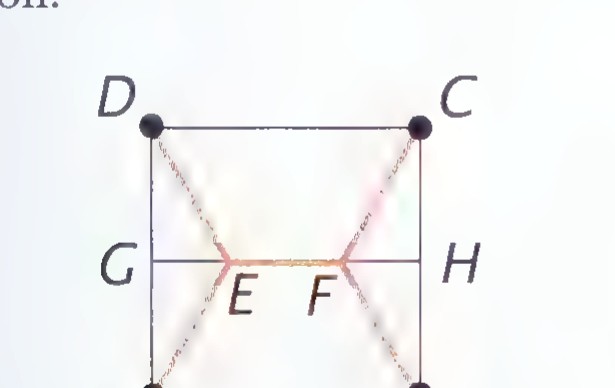
- Which solution is better?
Sun and Moon. Aristarchus, a Greek astronomer who lived at about the time of Euclid, figured out a way to compare the distances of the sun and the moon from Earth.†
The figure below (not to scale) shows the moon precisely at its first quarter so that M = 90°. The centers of the moon and sun are M and S, and O represents the observer on Earth.
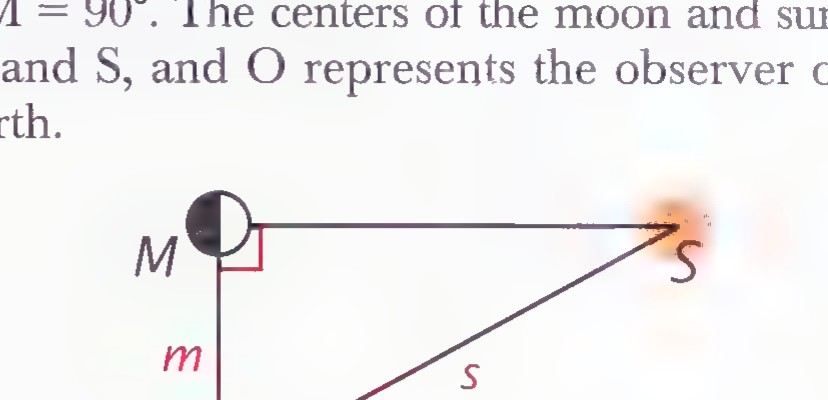
Aristarchus estimated the measure of O to be 87°.
- Show why it follows that (approximately).
- Show why this equality gives (that is, that the sun is 19 times as far away as the moon).
The correct measure of O is closer to 89.85°.
- About how many times as far as the moon is the sun from Earth?
Eye Chart. The letter E at the top of the familiar eye chart is inches tall.
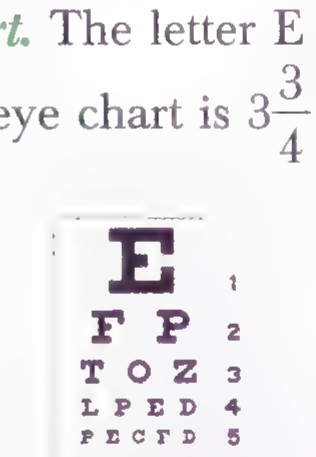

- Show that the visual angle formed by this letter at a distance of 20 feet is about 54 minutes.
Someone with 20-20 vision can distinguish letters that form a visual angle of 4.8 minutes.
- Approximately how tall are these letters?
* Introduction to Geometry, by H. S. M. Coxeter (Wiley, 1969).
† Constructing the Universe, by David Layzer (Scientific American Library, 1984).
p. 480
UFO Altitude. Two observers at A and B see a UFO hovering at point C. Its angles of elevation are A = 60° and B = 45°, and AB = 820 feet.
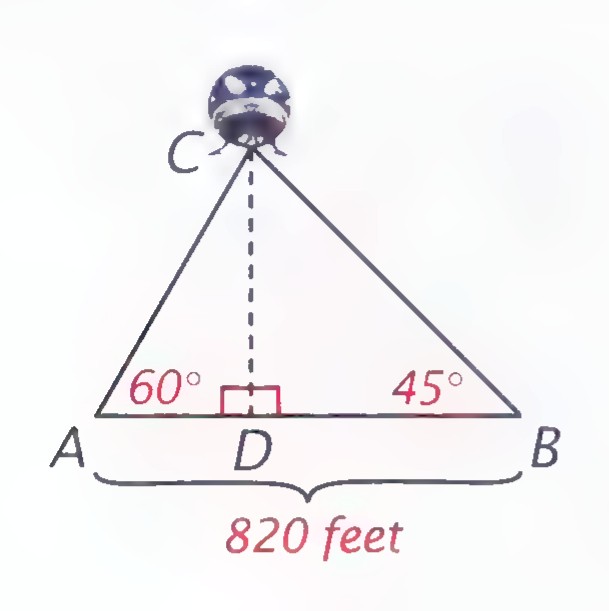
Find the altitude of the UFO by doing each of the following exercises.
- Find ACB.
- Find AC.
- Use right ACD to find CD.
Check your answer by doing the following exercises.
- Find BC.
- Use right BCD to find CD.
Outdoor Lighting. The figure and table below show how trees should be pruned to prevent interference with light.*
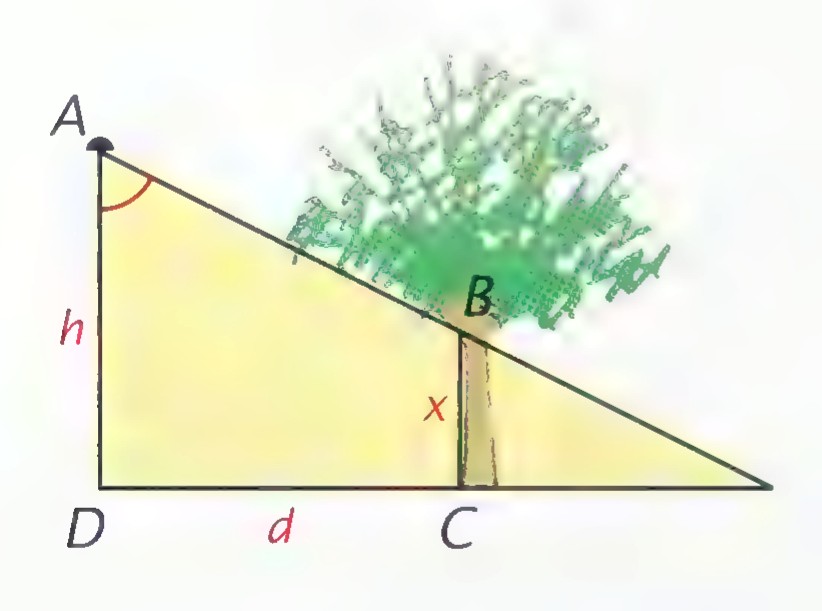
| A | |
|---|---|
| 70° | − 0.36 |
| 75° | − 0.27 |
| 80° | − 0.18 |
- Copy the figure. Draw a line through B parallel to DC. Let E be the point in which the line intersects AD.
- Write an equation expressing tan ABE in terms of , , and .
- Solve the equation for in terms of , , and tan ABE.
- Where did the three expressions for in the table come from?
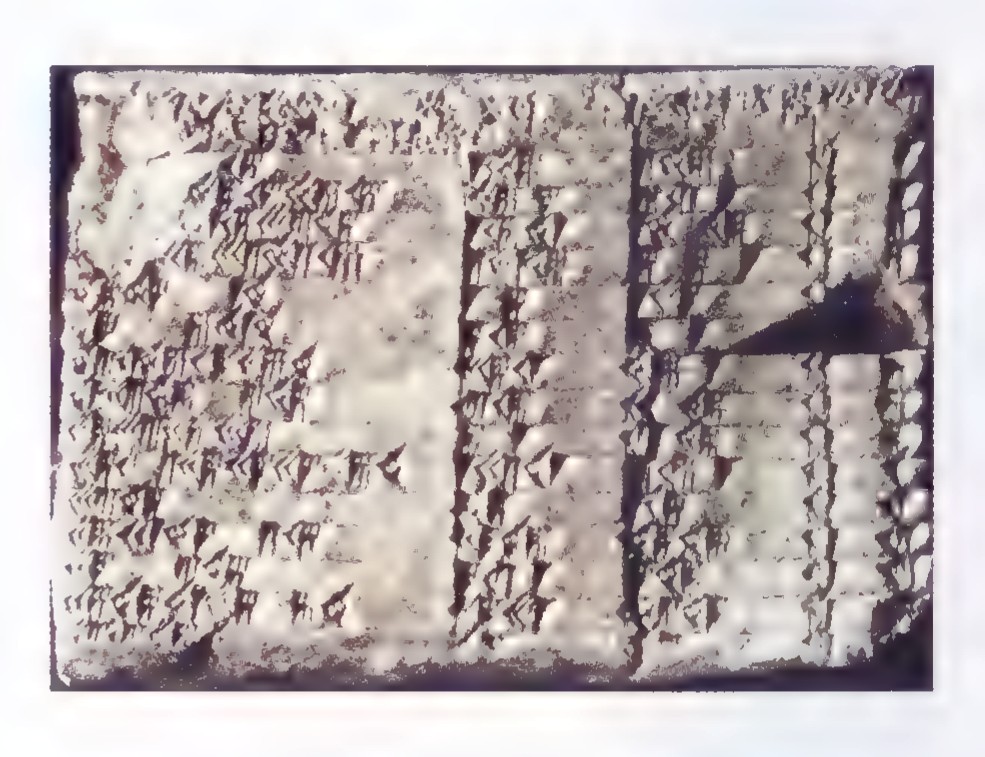
Number Mystery. This Babylonian clay tablet dated between 1900 B.C. and 1600 B.C. contains some interesting pairs of numbers. Some of them are listed below.†
| 45 | 75 |
| 65 | 97 |
| 319 | 481 |
| 541 | 769 |
| 799 | 1249 |
| 1679 | 2929 |
- See if you can figure out what is interesting about them by using a calculator.
- One pair of numbers has a mistake in it. Can you tell which pair it is?
* Barrier-Free Design, Department of Housing and Urban Development, Washington, DC, 1975.
† The History of Mathematics: An Introduction, by David M. Burton (Allyn & Bacon, 1985).
p. 481
Algebra Review: Graphing Linear Equations
The graph of every equation that can be written in the form
is a line if both A and B are not zero. For this reason, such equations are called linear equations in two variables.
Point-Slope Form
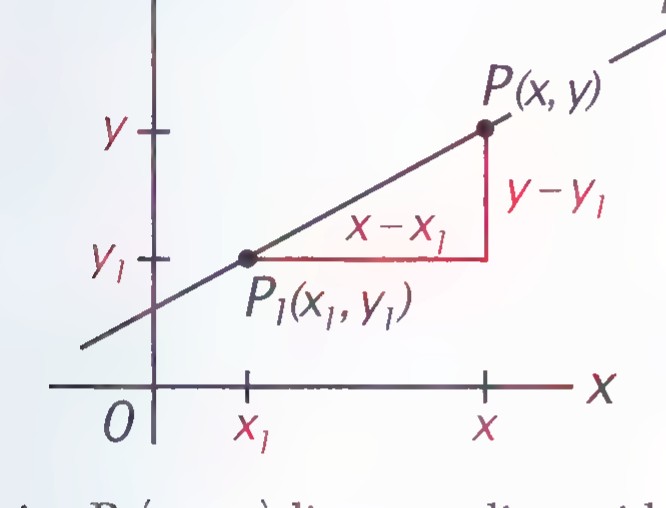
If a point P(, ) lies on a line with slope and any other point P(, ) is chosen on the line, then it follows from the definition of slope that
and so
This is called the point-slope form of the equation of a line; and are the coordinates of a point on the line and is the slope of the line.
Slope-Intercept Form
If the line intersects the -axis in the point P(0, ), then the point-slope form,
becomes
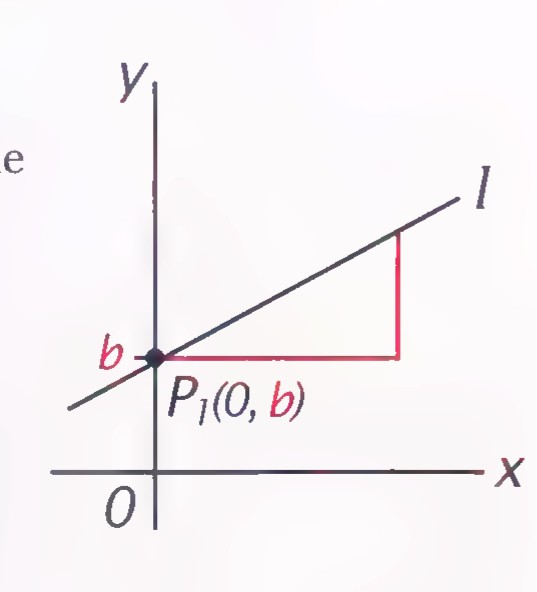
This form of the equation of a line is called the slope-intercept form; is the slope of the line and is its -intercept.
Example 1: Write an equation for the line that contains the point (4, 1) and has a slope of 2; draw its graph.
Solution: From the point-slope form, , we can write
We can plot the point (4, 1) and use the fact that the slope is 2 to plot a second point and draw the line.
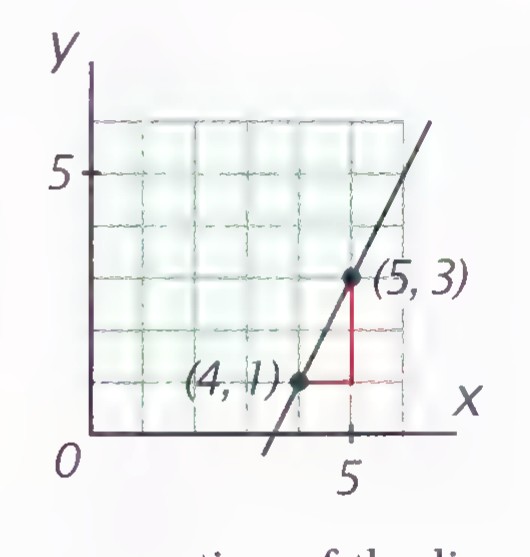
Example 2: Write an equation of the line of example 1 in the form in which A > 0.
Solution: Starting with
it follows that
Writing the and terms on the left side and the constants on the right, we have
Multiplying both sides by −1 so that A > 0, we get
p. 482
Example 3: Draw a graph of the line whose -intercept is 5 and whose slope is . Write an equation for the line.
Solution:
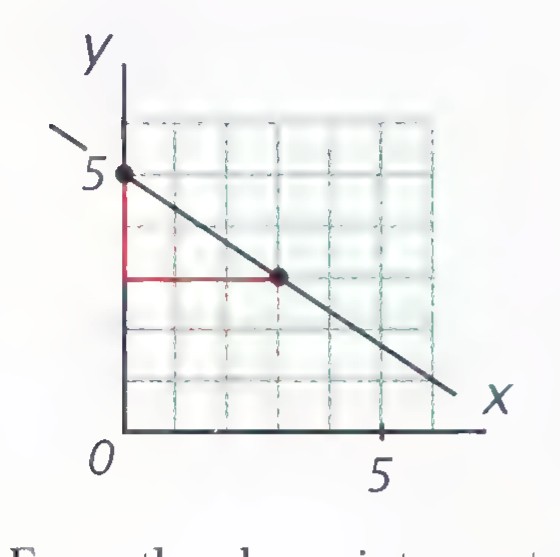
From the slope-intercept form, , we can write
Exercises
A line has the equation 3 + 4 = 24.
- Transform the equation into the form .
- What are its slope and -intercept?
- Sketch its graph.
A line through the point (−5, 1) has a slope of .
- Sketch its graph.
- Write its equation in point-slope form.
- Transform the equation into slope-intercept form.
- What is its -intercept?
Two lines have equations
- Sketch them on a single pair of axes.
- How can you tell from their equations that the two lines are parallel?
- Write an equation for the line midway between them.
Two lines have equations
- Write their equations in slope-intercept form.
- Sketch them on a single pair of axes.
- What are their slopes?
- How can you tell from their slopes that the two lines are perpendicular?
A line has the equation .
- What is its slope?
- What is the -coordinate of the point on the line whose -coordinate is 4?
- Sketch a graph of the line.
- Transform its equation into slope-intercept form.
- What are its - and -intercepts?
- Write an equation for the line in the form in which = 1.
A line contains the points A(0, −2) and B(1, 3).
- Sketch a graph of the line.
- What is its slope?
- Use the coordinates of point B to write an equation of the line in point-slope form.
- Transform the equation into slope-intercept form.
- Write an equation for the line in the form in which > 0.
A line has the equation 4 − 3 = 0.
- Transform its equation into slope-intercept form.
- What are its slope and -intercept?
- Sketch a graph of the line.
- What is its -intercept?
- Let A be the point on the line whose -coordinate is −3 and B be the point on the line whose -coordinate is 4. What is the distance between A and B?