Chapter 9 — Teacher’s Guide Answers
Answers and teaching commentary for Chapter 9: Area, transcribed from the scanned Teacher’s Guide. Diagrams are cropped from the same page scans.
OCR note. The text was recognized automatically and has not been corrected line by line; formulas and symbols may be imperfect. Check the original PDF for exact wording.
Homework: Chapter 9 exercises · Selected answers · Teacher’s answers PDF
Lesson 1
Set I (pages 340-341)
The Amtrak trademark first appeared in 1971 with the beginning of the government corporation in charge of the nation’s passenger trains. According to Hal Morgan in Symbols of America (Viking, 1986), “the arrow design was chosen to convey the image of speed and purpose of direction.”
The geometry of drums is not well known and rather surprising. In 1911, Hermann Weyl proved that the overtones of a drum determine its area. In 1936, another mathematician proved that a drum’s overtones also determine its perimeter! In 1966, Mark Kac published a paper titled “Can One Hear the Shape of a Drum?” In 1991, Carolyn Gordon gave a lecture at Duke University about drum geometry. She and her husband David Webb have subsequently discovered a number of pairs of sound-alike drums, including the pair pictured in the exercises. The drums in each pair are polygonal in shape, have at least eight sides, and the same perimeter and area. All of this information is from the chapter titled “Different Drums” in lvars Peterson’s The Jungles of Randomness (Wiley, 1998). The book also includes a page of color photographs showing the standing waves of the first few normal modes of these drums.
Train Logo.
i
(The dotted lines in this figure illustrate the possible choices of ways to divide the figure into six quadrilaterals.)
2. Trapezoids and parallelograms.
3. Its area is equal to the sum of the areas of its nonoverlapping parts.
Star in Square.
4. The star because of the Triangle Inequality Theorem.
5. The square because of the Area Postulate. (The area of the square is equal to the area of the “star” plus the positive areas of the four white triangular regions.)
6. No. Area Relations.
¢7. True, because AADC = AABC.
8. True, because Al = A4 and A2 = A3.
©9. True, because tEPHD=0AADC - oAl — 0tA2 = aAABC - aA4 — A3 = aGBFP.
10. True, because tAGHD=0EPHD + o AGPE = oGBFP + AGPE o = ABFE. o
11. True, because tEFCD=aEPHD + oPFCH = aGBFP + aPFCH = a«GBCH.
12. False. tAGPE > oPFCH. Flag Geometry.
13. x square units.
*14. 2x square units.
15. 6x square units.
*16. (x +y) square units.
17. (2x - 2y) square units.
18. (x +y) square units.
19. Yes. (x +y) + 2x-2y) + (x + y) = 4x. Drum Polygons.
#20. They are both concave octagons.
21. They have equal areas. (3.50%)
22. They have equal perimeters.
*23. 3a+ 6b.
24. No.
Set II (pages 341-342)
Exercises 35 through 39 are a nice example of how some areas can be easily compared. The areas of the regular hexagons circumscribed about a circle and inscribed in it are related in a surprisingly simple way: their ratio is 4 to 3.
Plato’s method for doubling the square is based on the same simple idea of counting triangles. It nicely circumvents the fact that, if the side of the original square is 1 unit, the side of the doubled square is an irrational number.
According to Sir Thomas Heath in his commentary on Euclid’s Elements, Proclus stated
that Euclid coined the word “parallelogram.” Euclid first mentions parallelograms in Proposition 34 of Book . It is the next theorem, Proposition 35, that is demonstrated in exercises 46 through
55. (The figure is the one that Euclid used; it illustrates just one of three possible cases relating the upper sides of the parallelograms.) Euclid does not actually mention area, stating the theorem in the form “Parallelograms which are on the same base and in the same parallels are equal to one other.” Heath remarks: “No definition of equality is anywhere given by Euclid; we are left to infer its meaning from the few axioms about ‘equal things.” Previously to the theorem, Euclid had used equality to mean congruence exclusively.
Midsegment Triangle.
25. B
A 0 c
#26. They are congruent (SSS) and therefore equal in area.
27. 0AMNO = %UAABC.
28. They are parallelograms.
29. Their opposite sides are parallel (or, their opposite sides are equal). Both follow from the Midsegment Theorem.
*30. No.
*31. Yes. Each one contains two of the four triangles, all of whose areas are equal.
32. Trapezoids.
33. No.
34. Yes. Each one contains three of the four triangles, all of whose areas are equal.
Circle Area.
®35, % square unit. (-1%.)
1 . 1
36. 7 Square unit. [3(g).]
#37. 2 square units. [12(%).]
1
38. 4 square units. [24(3),]
39. Roughly 3.5 square units. (The area of the circle appears to be about halfway between the areas of the two hexagons. Using methods that the students won’t know until later, we can show that the area of the circle
2n is 7-§=3.63…) Doubling a Square.
40. SAS.
41. Congruent triangles have equal areas.
42, Itis equilateral and equiangular. (Both follow from the fact that corresponding parts of congruent triangles are equal.)
#43. BFED contains four of the congruent triangles, and ABCD contains two of them.
SAT Problem.
e44. 4 square units.(1 04 e 00—
=4)
45. 116 square units. [100 + 4(4) = 116.] Comparing Parallelograms.
46. The opposite sides of a parallelogram are equal.
47. The opposite sides of a parallelogram are parallel.
48. Parallel lines form equal corresponding angles.
©49. They are both equal to AB.
¢50. Because DF =DC + CF = CF + FE = CE.
51. SAS.
52. Congruent triangles have equal areas.
53. Substitution. (*AADF = o1 + a3 and oABCE = 03 + a4.)
54. Subtraction.
55. al + a2 = 02 + 04 (addition); so aABCD = ABEF o (substitution).
Lesson 2
Set II (page 343)
According to Jerry Slocum and Jack Botermans (New Book of Puzzles, W. H. Freeman and Company, 1992), the magic playing card puzzle first appeared in a version known as “The Geometric Money” in Rational Recreations, by William Hooper, published in 1794.
Unfortunately, it isn‘t possible to make this puzzle out of an ordinary playing card, because the back of the card, before it is cut up, would have to be redesigned for the purpose of the trick. The figure below shows what it would look like for the card shown in the text.
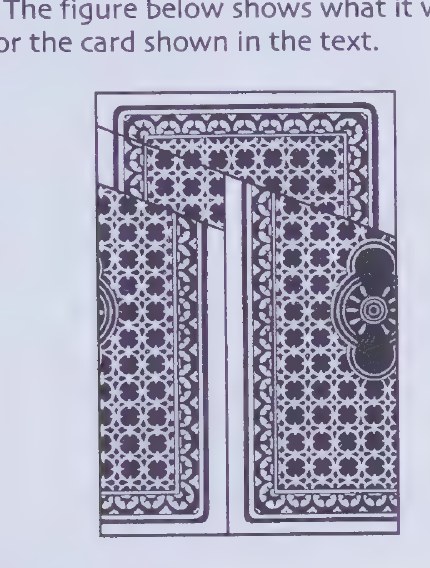
Diagram from page 121.
penEENENENEN Ny
& % £
Magic Playing Card.
1. No. If they were, the two would have equal areas. Including the “hole,” the second rectangle has a greater area.
2. The widths are obviously the same; so the lengths must be different.
3. The second figure is slightly longer than the first. The extra area is equal to the area of the “hole.”
Chapter ¢, Lesson 2
Set I (pages 345-347)
The “Abstract Painting, 1960-61” pictured in the text is minimal artist Ad Reinhardt’s most famous work. It is actually composed of nine congruent squares, each painted in a slightly different shade of black. At the time of this writing, there is a site on the Internet where another of his pictures, “Black Painting, 1960—66” can be “viewed”. The site, which appropriately has the word “piffle” in its name, is . . . black.
In Book !1 of the Elements, Euclid used geometric methods to prove a series of algebraic identities. Proposition 1 deals with the distributive property. Proposition 4, which concerns the square of a binomial, is stated as: “If a straight line be cut at random, the square on the whole is equal to the squares on the segments and twice the rectangle contained by the segments.” All this to say: (a + b)* = a* + b* + 2ab. In his History of Mathematics (Allyn & Bacon, 1985), David Burton wrote: “By Euclid’s time, Greek geometric algebra had reached a stage of development where it could be used to solve simple equations.” The equations, both linear and quadratic, were solved by making geometric constructions.
Abstract Art. el. 20 ft.
2. 240in.
3. 25 ft2 e4. 3,600 in’ Tile Pattern.
5. (Student answer.)
6. Blue region: 36 units; green region: 28 units; yellow region: 36 units. (6% = 36; 82-62=28; 102-82=36.)
Fishing Nets.
7. The sides of the small squares are % inch long.
8. Four.
9. 16.
10. To allow the smaller, younger fish to escape. Distributive Property. e11. a(b+c).
®12. aband ac.
13. a(b +c) =ab + ac. Binomial Square. e14. (a+b)2
15. a2 ab, ab, and b2
16. (a+b)2=a?+2ab + V2.
Difference of Two Squares.
17. a2-b2=(a+b)a-Db). Area Connection.
18. A=ab.
*19. Two congruent triangles.
20. The Area Postulate: Congruent triangles have equal areas.
21. A= lab. 2
Two Squares.
22, +26.
23. No. (+/26 =5.0990195.. )
24. 25.999801.
#25. No. (5.0990195? is a long decimal ending in 5, not the integer 26.)
26. No.
27. Irrational. (As students may recall from algebra, an irrational number is a number that cannot be written as the quotient of two integers. If an integer is not the square of an integer, its square roots are irrational.)
Set II (pages 347-349)
In his book titled The Cosmological Milkshake (Rutgers University Press, 1994), physics professor Robert Ehrlich remarks that “lying on a bed of nails need be no more painful than lying on your own bed, provided that the nail spacing is small enough, so that the fraction of your weight supported by any one nail is not too large.” He also provides a simple explanation of why a spacing of one nail per square inch is practical. Lumber measurements are interesting in that the three dimensions of a board are not all given in the same units: a 10-foot “2-by-4“, for example, has one dimension given in feet and the other two in inches (a “2-by-4” was originally just that but is now actually 1.5-by-3.5). Another example of combining different units is the “board foot.” A board foot is a unit of cubic measure that is the volume of a piece of wood measuring 1 foot by 1 foot by 1 inch. (Because the grading of a piece of lumber is based on cutting it into pieces of the same thickness as the lumber, the calculations
can be done in terms of area rather than volume.) Bed of Nails.
©28. 2,592 nails. (6 x 12x 3 x12.)
29. (Student answer.) (Standing on it would hurt the most.)
Surveyor’s Chain.
*30. 66 ft. (Q%Z‘Z)
31. One chain by ten chains.
32. Ten square chains.
33. 5,280 ft. (80 x 66.)
34. 6,400 square chains. (80%) 6, 400
Map Reading.
36. 480 cm?.
©37. 84 cm?.
*38. 17.5%. (%‘5 - 0.175))
39. 33 1%. (The area of the awkward region is
now 160 cm?; 250 %4) Wallpaper Geometry.
#40. 21.6 ft long. (36 ft> = 5,184 in%; 2 5184in” _ 595 in=216ft) 20in
AINTE fr i (51’3411‘1n ~192in=16 £
42. The wallpaper strips have to be placed so that the pattern matches, which means that some paper will be wasted.
©43. The total surface area of the walls.
44. Inrounding to the nearest number, if we round down, we may not have enough paper. (For example, if the result is 21.4, 21 rolls may not be enough.)
45. Itis about taking into account the area of windows and doors.
46. It would reduce it. (The basic rule is to subtract 1 roll for every 50 square feet of door or window opening.)
Cutting a Board.
47, 1,728in% (12in x 144in.)
48, 189in2 (3.5in X 54 in.)
49. 243in2. (4.5in % 54 in.)
50. 459in2 (8.5in x 54 in.)
51. 408 in2 (6in X 68in.)
52. Yes. The total area of the four cuttings is 1,299
in2 1,299 in? and 1,729
=75%.
The Number 17.
By
16 18
54. The number of linear units in the perimeter of each figure is equal to the number of square units in its area.
55. [This is a challenging problem. Letting x and y be the dimensions of such a rectangle, 2x + 2y = xy. Finding solutions to this equation is easiest if we first solve for one variable in terms of the other. 2x = xy - 2y;
soy(x—2)=2x,andsoy = 12—12 Letting x=5givesy = % ; so another rectangle is a
5by 3% rectangle. Of course, x does not
have to be an integer. Any value of x > 2 will do.]
Total Living Area.
56. 1,290 ft2. Example figure (answers will vary):
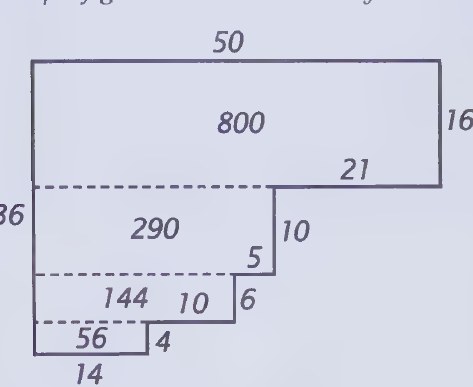
Diagram from page 123.
50
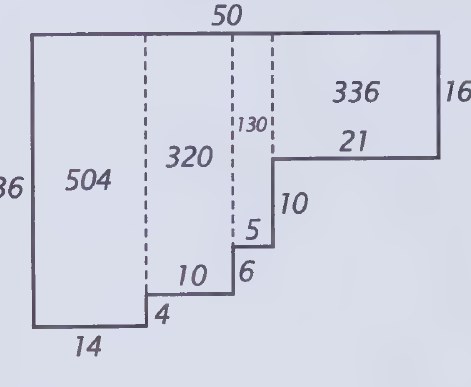
Diagram from page 123.
14
Set II (page 350)
According to David Wells (The Penguin Dictionary of Curious and Interesting Geometry, Penguin Books, 1991), a Russian mathematician in the early part of the twentieth century claimed that the “squaring the square” problem couldn’t be done. In 1939, Roland Sprague discovered a solution using s5 squares and, in 1978, Dutch mathematician A. J. W. Duijvestijn found the simplest solution, consisting of 21 squares. Martin Gardner’s “Mathematical Games” column in the November 1958 issue of Scientific American contained William T. Tutte’s account of how he and his fellow Cambridge students solved the problem of squaring the square, which was the reason for the topic being featured on the cover of the magazine. The figure on the cover was discovered by Z. Morén in 1925, and it was proved in 1940 that it is the simplest possible way in which to square a rectangle. Tutte’s account is charming and very instructive. It shows what fun and progress can be made if you are persistent, systematic, and lucky. Mrs. Brooks, the mother of R. L. Brooks, one of the four Cambridge students
Lesson 3
who did this work, put together a jigsaw puzzle that her son had made of a squared rectangle but, to everybody’s astonishment, she got a rectangle of different dimensions. Such a thing had never been seen before. It was a key observation and unexpected demonstration of the fact that making a real model and playing with it can lead to real progress. More recent discoveries are reported by Gardner in chapter 11 of his book titled Fractal Music, Hypercards and More (W. H. Freeman and Company, 1992).
Dividing into Squares.
1.
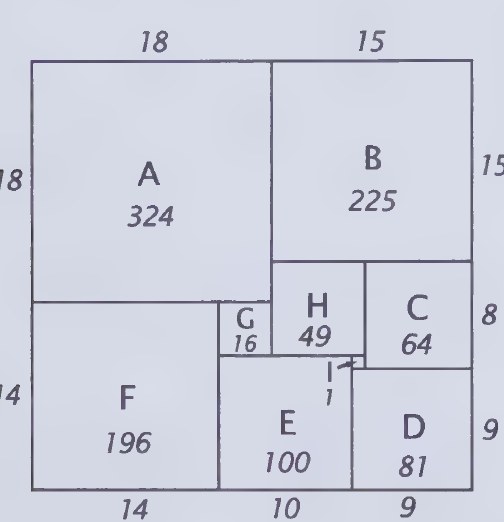
Diagram from page 124.
18 15
2. A, 324; B, 225; C,64; D, 81; E, 100; E 196; G, 16; H,49; I, 1.
3. No. Its base is 33 and its altitude is 32.
Set I (pages 353-355)
Matchstick puzzles such as the one in exercises 1 through 3 first became popular in the nineteenth century, when matches were universally used to light lamps and stoves. As a followup to these exercises, it might be amusing to place 12 matches in the 3-4-5 right triangle arrangement on an overhead projector, observe that they enclose an area of 6 square units, and consider how they might be rearranged to get areas of 5 and 4 square
//l //]
L7
= 7
units (the obvious solutions are “corollaries” to the solution for getting an area of 3 square units). Even better would be to pose the puzzle of what areas can be enclosed by 12 matches as a problem for interested students to explore. in one of his early “Mathematical Games” columns for Scientific American, Martin Gardner posed the “triangle to area of 4” version of the problem. Several readers of the magazine pointed out that, if 12 matches are arranged to form a six-pointed star, the widths
oy, §4 /
Ml /l
~__ 7
of the star’s points can be adjusted to produce any area between o and 3 cot 15° (11.196 . . .), the area of a reqular dodecagon (The Scientific American Book of Mathématical Puzzles and Diversions, Martin Gardner, Simon & Schuster, 1959).
In the days before students had calculators, the problem of finding the area of the four-sided field required a lot more work. The value of knowing how to factor is evident if the problem of calculating
1 ;(14-36)(8-17) + 5(14-36)(5-74) is compared with the problem of calculating 5(14.36)(8-17 +5.74),
as it would have been done more than a century ago.
Match Puzzle.
*1. 6square units.
2. Yes. 3 square units have been removed; so 3 square units are left.
3. They are the same: 12 units. Isosceles Right Triangle.
Theorem 39.
*6. The area of aright triangle is half the product of its legs.
- #7. The area of a polygonal region is equal to the sum of the areas of its nonoverlapping parts (the Area Postulate).
8. Substitution.
9. Substitution.
10. The area of aright triangle is half the product of its legs.
11. The area of a polygonal region is equal to the sum of the areas of its nonoverlapping parts (the Area Postulate).
12. Subtraction.
13. Substitution.
14. Substitution. Enlargement.
¢15. They seem to be equal.
16. They are twice as long.
¢17. AABC, 40 units; ADEF, 80 units.
18. Itis twice as large.
19. AABC, 60 square units; ADEF, 240 square units.
20. Itis four times as large.
#21. They seem to stay the same.
22. ltis doubled.
23. Itis multiplied by four. Chinese Parallelogram.
24. X
ol A ‘h —g
25. Yes. The triangles bounding them are congruent. (The diagonals of a parallelogram bisect each other, parallel lines form equal alternate interior angles, and the pair of vertical angles at P are equal.)
26. They have equal areas. (They are also congruent.)
Four-Sided Field.
#27. ABCD 0 = 99.87 square chains. [0AABD + aACBD = 1 2 7.18(8.17 + 5.74) = 99.87.]
BD- AE + —;—BD- CF= %BD(AE +CF) =
28. About 9.987 acres.
Set II (pages 355-357)
The key to the puzzle of the surfer is Viviani’s Theorem, named after an obscure Italian mathematician (1622—1703): In an equilateral triangle, the sum of the perpendiculars from any point P to the sides is equal to the altitude of the triangle. The proof outlined in exercises 29 through 34 works for the sum of the perpendiculars from any point P in the interior of a convex equilateral n-gon to its n sides. The pentagon case appeared as the “Clairvoyance Test” in Chapter 6, Lesson 1 (page 216, exercises 30 through 32).
A practical application of Viviani’s Theorem is in “trilinear charts.” A trilinear chart is useful in presenting data belonging to three sets of numbers, each set of which sums to 100%. A. S. Levens describes them in his book titled Graphics (Wiley, 1962): “These charts are in the shape of an equilateral triangle. It can be shown that the sum of the perpendiculars, drawn from a point within the triangle, to the sides of the triangle is equal to the altitude of the triangle. Now, when we graduate each side of the triangle in equal divisions ranging from 0% to 100% and regard each side as representing a variable, we have a means for determining the percentages of each of the three variables that will make their sum equal 100%.”
The kite problem lends itself to further exploration. For what other quadrilaterals would taking half the product of the lengths of the diagonals give the area? Do the diagonals have to be perpendicular? Does one diagonal have to bisect the other? Does the diagonal formula work for squares? Rhombuses? Rectangles? Are there any trapezoids for which it works? And so on.
In his book titled Mathematical Encounters of the Second Kind (Birkhauser, 1997), Philip J. Davis relates an amusing story about a phone call from
e a man who identified himself as a roofer and who
had a roof whose area he wanted to estimate. As Davis tells it: “He recalled that there were mathematical ways of doing this and had known them in high school, but he had forgotten them and would | help him. It seemed to me that any roofer worthy of his trade could at a single glance estimate the area of a roof to within two packages of shingles, whereas any professional mathematician would surely make an awful hash of it.” After finally getting out of the man the fact that the roof consisted of four triangles, Davis asked: “These four triangles, what shape are they? Are they equilateral triangles like one sees in some high pitched garage roofs or are they isosceles triangles? I’ve got to know.” No reply from my caller. ‘Well, let’s look at it another way: You’ve got four triangles. Find the area of each triangle and add them up.’‘How do you do that?’‘The area of a triangle is one half the base times its altitude.”*My triangles don’t have an altitude. . ..””
Surfer Puzzle.
29. The area of a triangle is half the product of any base and corresponding altitude.
30. The area of a polygonal region is equal to the sum of the areas of its nonoverlapping parts (the Area Postulate).
¢31. Substitution.
32. Substitution.
¢33. Division.
34. It proves that the sum of the lengths of the three paths is equal to the altitude of the triangle.
Three Equal Triangles.
#35. 84 square units.
(o right ADEF = %7 -24=84)
*36. 11.2 units. (%15}1 =84)
37. 6.72 units. (%25;; -84
38. 24 units. (EF =24.)
39. 16.8 units. (%th =84)
Kite Geometry. 40, A
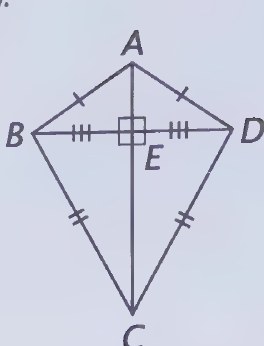
Diagram from page 126.
©
41. Inaplane, two points each equidistant from the endpoints of a line segment determine the perpendicular bisector of the line segment.
©42. Betweenness of Points Theorem.
43. The area of a triangle is half the product of any base and corresponding altitude.
44. Area Postulate.
45. Substitution. Dividing a Cake.
46. Because it has less icing on its sides.
47. A 9 B 3 X 9 AN} D C
3y 6
*48. 0AAMB = 0AAMD = 20.25 in%; 0ABMX = aADMY = 6.75 in?; 0ACMX = aACMY =13.5 in2.
49. Yes. The area of the top of each piece is 27 in? and each piece has the same amount of
icing. 0 A 7.2 1.8 B
72 54
1.8 36
D 54 36 C
Divide the perimeter of the cake, 36, by 5 to get 7.2. Starting at A, mark off points around the square at intervals of 7.2 in. Cut from the center of the cake through these points.
Shingle Roof.
51. On the scale drawing, the lengths of the base and corresponding altitude are 2.5 in and 1.5 in. Because 1 in represents 8 ft, these lengths on the roof are 20 ft and 12 ft. Therefore, the area of the section is 120 ft2.
¢52. About 1,200 shingles.
53. 4.8, or about 5 bundles. (Because 4 bundles contain 1,000 shingles, 1 bundle contains
1,200 2
shingles. = ) 250 shingles. =4.8.
120
54. 3.6 pounds. (W x3=36.)
Grid Exercise.
558
L Y rait
o 5 ‘ 10 | 15 ) 20
56. It is isosceles. By the Distance Formula, AB= V152 +4% = 241 ~1552; BC = V112+11% = 242 = 15.56; AC = V42115? = 241 =1552.
57. The exact area is 104.5 square units. (192-2:2 415 211%)
58. Irrational.
59. Rational.
Set II (page 357)
Although Heron’s name is attached to the method for finding the area of a triangle from the lengths of its sides, Archimedes is thought to have actually discovered it. Heron’s proof of the method is included in his book titled Metrica, which was lost until a manuscript of it was discovered in Constantinople in 1896. J. L. Heilbron remarks: “A good example of the difference in approach between the geometer and the algebraist may
be drawn from proofs of the famous formula of Heron for the area of a triangle.” Heilbron includes Heron’’s (or Archimedes’s) geometric proof based on similar triangles, as well as an elegant trigonometric proof, in the “Tough Knots” chapter of his Geometry Civilized (Clarendon Press, 1998). An algebraic proof is included in the preceding editions of my Geometry (1974 and 1987). The algebra can be checked by symbol manipulation programs but is otherwise more challenging than instructive.
Heron’s Theorem.
1. (Student answer.) (“Triangle 3” with sides 5, 5, and 10 seems “the most obvious.”)
2. Triangle 1: perimeter 16; s0s = 8. Area= BB—5)8-5)8-6) = V8:332 = V144 =12. Triangle 2: perimeter = 18;s0s =9. Area = 4/9(9-5)(9-5)(9-8) = ¥9-4-4-1 = V144 =12. Triangle 3: perimeter = 20; so s = 10. Area = 4/10(10-5)(10-5)(10-10) = V10-5-5:0 = 0 =0.
3. “Triangle 3” can’t be a triangle, because, if it
were, the lengths of its sides would contradict the Triangle Inequality Theorem.
4. Triangle 4 because “triangle 5” can’t be a triangle.
5. Perimeter =18;s05=9. Area= 9(9—4)0-6)(9-8) = ¥9-5:3-1 = 135, or 3 415, or approximately 11.6.
Lesson 4
Set I (pages 360-362)
The two arrangements of the automobiles in exercises 1 through s have something in common with D’Arcy Thompson’s fish transformation. Both are examples of a “shear” transformation, a transformation not usually discussed in geometry but one that is a basic tool of computer graphics. For example, some computer programs use shear transformations to generate slanted italic fonts from standard ones. Although these transformations are not isometries, they do preserve area.
An interesting story of the construction and problems of the Hancock Tower, headquarters of the John Hancock Mutual Life Insurance Company in Boston, is told by Mattys Levi and Mario Salvadori in their book titled Why Buildings Fall Down (Norton, 1992). Although now altered to be more structurally sound, the tower at the beginning had problems with the wind because of its unusual nonrectangular cross section. Among other things, all of the more than 10,000 panels of reflective glass covering its walls had to be replaced with stronger panels!
From Above.
1. That they are equal.
2. 2,800 ft2. [x = (5)(14) =70, y = (5)(8) = 40; xy = 2,800.]
3. 220 ft. [2(x + y) = 2(70 + 40) = 220.]
4. The perimeter of the second figure is greater.
5. No.
Tax Assessor Formula.
*6. Area= i(s +8)(s+8)= %(2’5)(25) =&
7. Yes. Area= i(b +B)h+B)= i(Zb)(Zh) —bh.
o8, i(zo +20)(13+13) = i(m)(ze) -
260 square units.
9. No. The area of a parallelogram is the product of any base and corresponding altitude; so the area = (20)(12) = 240 square units.
10. %(3 +24)(10+17) = %(27)(27> =
182.25 square units.
11. No. The area of a trapezoid is half the product of its altitude and the sum of its
bases; so the area = —;—(8)(3 +24) =4(27) = 108 square units.
12. %(zo +24)(7 +15) = %(44)(22) _
242 square units.
13. No. The area of each right triangle is half the product of its legs; so the area =
%(7)(24) + %(20)(15) =84+150= 234 square units.
*14. Area= %(37 +37)(37+37) = i(74)(74) - 1,369 square units.
15. No. The diagonals of a rhombus are perpendicular and bisect each other; so the area of
A R %)(12)(35) —4(210) = 840 square units.
16. Because the formula seems to always give an area either equal to or larger than the correct answer.
Pegboard Quadrilaterals.
*17. A parallelogram. (Two of its opposite sides are both parallel and equal.)
18. 1unit. A=bh=(1)(1)=1.
19. A parallelogram.
20. 1 unit.
21. A parallelogram.
22. 1 unit. It can be divided by a horizontal diagonal into two triangles, each with a base
and altitude of 1; 2(%)(1)(1) -1,
Skyscraper Design.
*23. 30,794 ft2. [(300)(104) — 2( %)(14)(29) = 31,200 - 406 = 30,794.]
24. 237,000 ft2. [(300)(790) = 237,000.]
Shuffleboard Court.
25. 3 ft2. (Triangle: %(2)(3) =3)
*26. 4.5 ft2. (Trapezoid: %(3)(1 +2)=45)
27. 7.5 ft2. (Trapezoid: %(3)(2 +3)=75.)
«28. 825 ft2. (Trapezoid: %(1 5)(5 +6) =8.25)
29. 35.25 ft2.
Set II (pages 362-364)
Students who do exercises 47 through 49 in which the trapezoidal rule is used to find the approximate area of the region between a parabola and the x-axis may be intrigued to know that the actual area is represented by the expression
2 rx—dx o 2 and that those who take calculus will learn how to find its exact value, 4.5.
The SAT problem is a good example of how important it is to “look before you leap.” The method of subtracting the shaded area from the rectangle to get the unshaded region is tempting but, even if the areas of all of the regions could be found, would be more time consuming than would simply adding the areas of the two unshaded regions. Time taken to consider alternative approaches to solving a problem is often time well spent.
Inaccessible Field.
30. The entire figure (ECBG) is a trapezoid. Subtract the areas of trapezoid ECDF, AFDA, and AABG from its area.
Sl
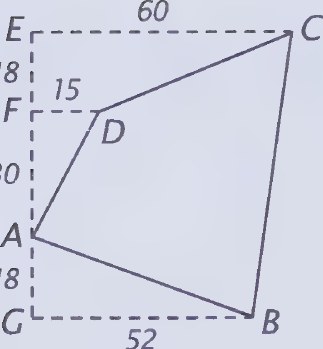
Diagram from page 129.
3. 675m?. [%(18)(60 +15) = 675.] 33, 225 m2. [%(15)(30) —25] 34, 468m>. [%(18)(52) — 468
35, 3,696 m2. [%(60 +52)(18 + 30 + 18) = 3,696.]
36. 2,328 m2. (3,696 — 675 — 225 — 468 = 2,328.)
A Fold-and-Cut Experiment.
38. The bases line up because £1 and £2 are supplementary (parallel lines form supplementary interior angles on the same side of a transversal); together £1 and £2 form a straight angle.
39. A parallelogram.
40. A quadrilateral is a parallelogram if its opposite sides are equal. (Alternatively, a quadrilateral is a parallelogram if two opposite sides are both parallel and equal.)
e41. Its areais (a + b)h.
42. The parallelogram consists of two congruent
trapezoids; so the area of each is %(a + b)h,
or -;—h(a +b).
Trapezoidal Rule.
*43. In a plane, two lines perpendicular to a third line are parallel. 1 1
44. ABGH 0 = Ex(y1 + yz). oBCFG = Ex(y2 + ys). 1 oCDEF = Ex(y3 +Y,)-
45. o ABGH + aBCFG + aCDEF = 1 1 1 Ex(y1 +y,) + Ex(yz +y,) + Ex(y3 +y)= 1 = -Z—x(y]+y2+y2+y3+y3+y4)- 1 Ex(y1 +2y,+ 2y, + y4).
*46. 165 square units. [55)8 +2015) + 211) + 6) = 2(5)66) = 1651
47. B(2,2), C(3, 4.5).
48. 4.75. [%(1)(0 +2(0.5) + 2(2) + 4.5).]
49. Itislarger. SAT Problem.
*50. AEBH, FHCG (and FHCD).
51. We don’t know exactly where point H is; so we don’t know the lengths of BH and HC.
52. 9 square units.
53. The unshaded region consists of two triangles, AEFD and AEFH, with a common base of 2. The corresponding altitudes are
5 and 4; so aEDFH = %(2)(5) + %(2)(4) = 5+4=9
Set III
The chessboard puzzle was discovered by a German mathematician named Schiomilch and published in 1848 in an article titled “A Geometric Paradox.” Good references on it and similar puzzles can be found in the second chapter on “Geometrical Vanishes” in Martin Gardner’s Mathematics, Magic and Mystery (Dover, 1956) and the chapter titled “Cheated, Bamboozled, and Hornswoggled” in Dissections— Plane and Fancy,
by Greg N. Frederickson (Cambridge University Press, 1997). A generalization of the chessboard paradox was made by Lewis Carroll; an algebraic analysis of it can be found in J. L. Heilbron’s Geometry Civilized (Clarendon Press, 1998).
Chessboard Mystery.
1. The area of each right triangle is %(3)(8) =12 units. The area of each 1 . trapezoid is 5(5)(3 + 5) = 20 units. The four areas add up to 64 units, as we
would expect for a square board consisting of 64 unit squares.
3. 65 units.
4. According to the Area Postulate, the area of a polygonal region is equal to the sum of the areas of its nonoverlapping parts. But 65 = 64.
(The explanation is that the pieces don’t quite fill the rectangle. The exaggerated drawing below shows where the extra unit comes from.)
i
Chapter ¢, Lesson s
Lesson 5
Set I (pages 367-368)
J. L. Heilbron in Geometry Civilized (Clarendon Press, 1998), wrote: “The Pythagorean Theorem and its converse bring the first book of the Elements to a close. They therefore mark a climax, the high point toward which all the apparatus of definitions, postulates, and propositions was aimed. The diagram of the windmill [the figure used by Euclid to prove this theorem] may be taken as a symbol of geometry, and hence of Greek thought, which generations . . . have regarded as the bedrock of their culture.”
Note that in exercises 1 through 3, dealing with the special case of an isosceles right triangle, the areas of the squares on its sides are expressed in terms of the area of the triangle rather than the length of one of its sides.
The proof of the converse of the Pythagorean Theorem is, in essence, that of Euclid. The only difference is that Euclid chose to construct the second triangle so that it shared one of its shorter sides with the original triangle.
In thinking about exercise 32, it is helpful to consider the squares representing a* and b* as being hinged together at one of their vertices. If the angle of the hinge is adjusted to 90°, we have the Pythagorean Theorem with ¢* = a2 + b2 As the angle is made smaller, the distance c shrinks and c? gets smaller; so, for acute triangles,
c* < 3% + b If instead, the angle is made larger, the distance cincreases and ¢ grows; so, for obtuse triangles, c* > a* + b*
Batik Design.
1. Example figure:
®2. 2,2, and 4 units.
3. 2+ 2 =4.(The square on the hypotenuse of aright triangle is equal to the sum of the squares on its legs.)
Theorem 43.
*4. The Ruler Postulate.
5. The Protractor Postulate.
6. The Ruler Postulate.
7. Two points determine a line.
8. The square of the hypotenuse of a right triangle is equal to the sum of the squares of its legs.
*9. Substitution.
10. SSS.
11. Corresponding parts of congruent triangles are equal.
*12. Substitution.
13. A 90° angle is a right angle.
14. A triangle with a right angle is a right triangle.
Squares on the Sides. ol 17,
*16. 1,225.
17. 1,369.
*18. 37.
19. 10.
20. 2e.
21. 576.
22, 24.
23. 484.
24. 16.
25. 15.
©26. No. 256 + 225 = 481 = 484.
27. 2,304
28. 3,025.
29. 73.
30. Yes. 2,304 + 3,025 = 5,329. (If the square of one side of a triangle is equal to the sum of the squares of the other two sides, the triangle is a right triangle.)
Ollie’s Triangles.
31. Example figure:
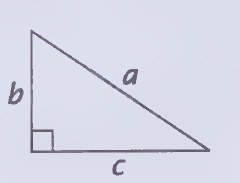
Diagram from page 131.
32. Example figure:
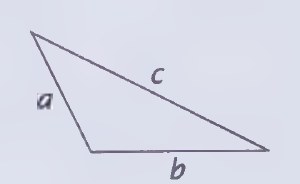
Diagram from page 131.
Set 1| (pages 368-370)
Frank J. Swetz and T. I. Kao, the authors of Was Pythagoras Chinese? An Examination of Right Triangle Theory in Ancient China (Pennsylvania State University Press, 1977), report that, although estimates of the date of origin of the Chou Pei Suan Ching date as far back as 1100 s.c., much of the material in it seems to have been written at the time of Confucius in the sixth century s.c. Itis interesting to observe that, although there is no proof of the Pythagorean Theorem given in the Chou Pei, the figure, based on the 3-4-5 right triangle, may have been the inspiration for the figure on which the proof in the text of Lesson s is based.
In The Mathematical Universe (Wiley, 1994), William Dunham tells the story of James A. Garfield and his proof of the Pythagorean Theorem. After completing his college education, Garfield began teaching mathematics at Hiram College in Ohio. Within a few years, he was elected to the Ohio Senate and then joined the Union Army; he served for 17 years in the House of Representatives before being elected president in 1880. At the time of its publication in The New England Journal of Education in 1876, it was reported that Garfield had discovered his proof of the Pythagorean Theorem during “some mathematical amusements and discussions with other congressmen.”
The figure illustrating exercises 5o and 51 is another nice example of a “proof without words.” The fact that the bisector of the right angle of a right triangle bisects the square on the hypotenuse is clearly connected to the second figure’s rotation symmetry.
,
Was Pythagoras Chinese?
©33. 6 units. [%(3)(4).]
34. 24 units. (4 x6.)
©35. 25 units. (24 +1.)
1
*37. 2ab. [4(%;417).1
©38. (b—a)2
39. GABCD = 2ab + (b —a)? and ®ABCD = 2.
40. 2ab + (b-a)* = c% s0 2ab + b® - 2ab + a* = ¢, and s0 & + b = 2.
Gartfield’s Proof.
41. SAS.
42. Corresponding parts of congruent triangles are equal.
#43. The acute angles of a right triangle are complementary (so the sum of these angles is 90°).
44. Aright angle.
#45. A trapezoid.
46. 0ABDE = %(a +b)(a + b) and
0ABDE = —;—ub + %ab + %cz.
1 1 1
47. %(u +bP2= Eab + Eab + —2-c2; so(a+b)P= 2ab + ¢% s0 @* + 2ab + b* = 2ab + ¢, and so 2 +b?=c2 Angle-Bisector Surprise.
48. E
Diagram from page 132.
D
A
C B
*49. It appears to bisect ABDE (that is, divide it into two congruent parts having equal areas).
50. It bisects ZACB. AFCG = AHCG; so ZFCG = ZHCG.
51. It bisects ABDE.
Review
Set I11 (page 370) Twenty Triangles.
N T Ay
[The areas of the three squares are 4, 16, and 20 square inches; so the sides of the large square are V20 =~ 45” (or exactly,
420 =2+/5”). We can’t get this length by using the legs of the triangles; so we have to use their hypotenuses: 12 + 22 = ¢% and so
c=+5 =22 Two hypotenuses are needed to form each side of the large square.]
2. Itis tempting to try to use the right angles of the triangles to form the right angles of the third square. This won’t work, however, because the legs of the triangles have to be inside the square.
Set I (pages 371-373)
In the section on Babylonian mathematics in The History of Mathematics (Allyn & Bacon, 1985), David Burton wrote: “In the ancient world, the error was widespread that the area of a plane figure depended entirely on its perimeter; people believed that the same perimeter always confined the same area. Army commanders estimated the number of enemy soldiers according to the perimeter of their camp, and sailors the size of an island according to the time for its circumnavigation. The Greek historian Polybius tells us that in his time unscrupulous members of communal societies cheated their fellow members by giving them land of greater perimeter (but less area) than what they chose for themselves; in this way they earned reputations for unselfishness and generosity, while they really made excessive profits.”
An excellent source of information on tangrams are the two chapters on them by Martin Gardner in Time Travel and Other Mathematical Bewilderments (W. H. Freeman and Company, 1988). Although many references report that tangrams date back about 4,000 years, historians now believe that they actually originated in China in about 1800. An ornate set of carved ivory tangrams once owned by Edgar Allan Poe is now in the New York Public Library.
Olympic Pools.
1. 125m2 (50 x 2.5.)
2. No. There is room left on the sides. The area of the pool is 1,050 m? and the total area of the 8 lanes is 1,000 m2 (the width of the pool is 21 m and the total width of the 8 lanes is 20 m.)
3. 525, (1050)
Enemy Camps.
*4. Camp A, 68 paces; camp B, 64 paces; camp C, 60 paces.
5. Camp A, 208 square paces; camp B, 220 square paces; camp C, 216 square paces.
6. Camp A because it has the greatest perimeter.
7. No. Camp B has the greatest area. Tangrams.
8. 16 units.
9. 4 units.
10. The other triangle, 8 units; the square, 8 units; the parallelogram, 8 units.
11. 64 units.
¢12. The area of a polygonal region is equal to the sum of the areas of its nonoverlapping parts.
Altitudes and Triangles.
18! A
B X C
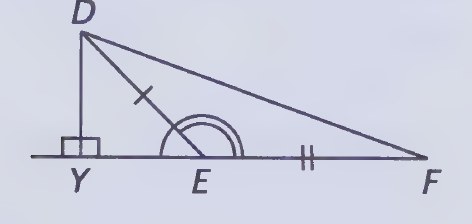
Diagram from page 134.
Y E F
*14. ZDEY.
15. AABX = ADEY.
*16. AAS.
17. Congruent triangles have equal areas.
*18. Corresponding parts of congruent triangles are equal.
19. AABC and ADEE.
#20. Triangles with equal bases and equal altitudes have equal areas.
Suriname Stamp.
21. The square of the hypotenuse of a right triangle is equal to the sum of the squares of its legs.
22. 1f the square on one side of a triangle is equal to the sum of the squares of the other two sides, the triangle is a right triangle.
e23. 11.
24. 49.
25. 169.
26. No. 121 +49 =170 = 169. Moroccan Mosaic.
027. 4a.
28. 2.
©29. 4q + 4b.
*30. a(a + 2b) or a® + 2ab.
31. 4a+2b.
32. b(a+b)orab + b2 [%b(a +a+2b.]
Set II (pages 373-375)
The Daedalus project was named after the character in Greek mythology who constructed wings from feathers and wax to escape from King Minos. The planes built in the project were designed and built at M.I.T. Daedalus 88, the plane shown in the photograph, was flown 74 miles from Crete to the island of Santorini in the Mediterranean in 3 hours, 54 minutes, all by human power alone! According to an article in the October 1988 issue of Technology Review, the plane weighed 70 pounds when empty. Its wing span and area are worked out in the exercises. The plane had a flight speed ranging from 14 to 17 miles per hour and its human “engine” power was about a quarter of a horsepower!
The problems about a crack forming in a stretched bar are based on information in The New Science of Strong Materials (Princeton University Press, 1976), by J. E. Gordon, who writes: “When a crack appears in a strained material it will open up a little so that the two faces of the crack are separated. This implies that the material immediately behind the crack is relaxed and the strain energy in that part of the material is released. If we now think about a crack proceeding inwards from the surface of a stressed material we should expect the area of material in which the strain is relaxed to correspond roughly to the two shaded triangles. Now the area of these triangles is roughly I2, where [ is the length of the crack. The relief of strain energy would thus be expected to be proportional to the square of the crack length, or rather depth, and in fact this rough guess is confirmed by calculation. Thus a crack two microns deep releases four times as much strain energy as one one micron deep and so on.”
The exercises on the area of an irreqular tract reveal that the trapezoidal rule is used in surveying as well as in calculus.
George Biddle Airy was the astronomer royal at the Greenwich Observatory from 1836 to 1881. A nice treatment of dissection proofs of the Pythagorean Theorem and their connection to superposing tessellations is included by Greg Frederickson in chapter 4 of Dissections— Plane and Fancy (Cambridge University Press, 1997).
Courtyard Design.
=
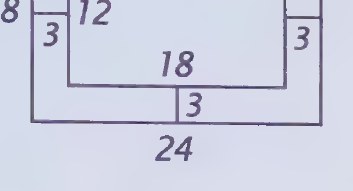
Diagram from page 135.
24
*34. 216 ft2. (12 x 18.)
35. 216 ft2 (18 x 24 - 216.)
36. Yes. Daedalus Wing.
37. 112 ft. 1
*38. 332512 [2- 5(14)(1.25 +2.5) + 2 %(28)(2.5 +3.75) + 28(3.75) = 52.5 + 175 + 105 = 332.5.]
Crack Formation.
39. a+ b =2l The colored area is %ul+%bl= —1-a+lb—l dsoa+b=2l so > b=l andso =2l
#40. It would be four times as great [because (202 =48], Triangle Comparisons.
41.
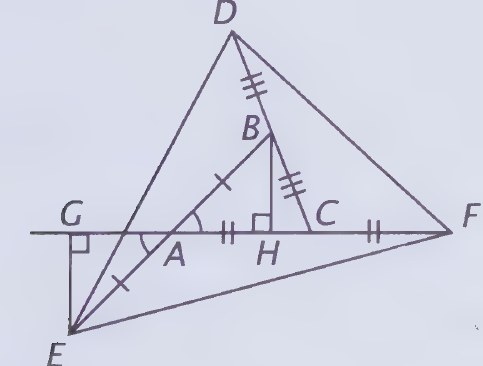
Diagram from page 135.
42. AAS.
43. Corresponding parts of congruent triangl are equal.
les
®44. aAAEF = 2x (because AF = 2AC and BH = EG).
45. 0 ADEF = 70AABC. (By the same reasoning, 0ABDE = 2x and cACFD = 2x. Because oADEF = 0AABC + 0AAEF + ABDE 0 + aACFD, oADEF = x + 2x + 2x + 2x = 7x = 70AABC.)
SAT Problem.
046. 4x*—xy. 047, 4x-y.
48. 8x. [4(2x%).]
49. 10x-2y. {2[x + 4x—y)] =2(5x - y).} Surveying Rule.
50. —l-x( +b) + ! (b+c)+ L (c+d)+ . ¥ Fxb +c)+ ol
%x(d+e)or %x(a+2b+2c+2d+e).
¢51. It would be rectangular.
52. %x(u+2a+ 2a+2a+a)= %x(Sa)=4xa.
Pythagorean Proof.
=5 53. In the first arrangement, the three pieces form the squares on the legs of the right triangle and their total area is a* + b* In the second arrangement, the three pieces form the square on the hypotenuse of the right triangle and their total area is ¢ so A=a+ 1
54. It refers to the area of the red piece. [In the first figure, the area of the red piece is clearly the sum of the areas of the two smaller squares minus the areas of the two
triangles: a% + b? - 2( %ab). When the two
triangles “stand on” the red piece, the square on the hypotenuse is formed and, when the red piece “stands on” the two triangles, the squares on the legs are formed.]
Algebra Review (page 376)
1. 500.
2. or 0.2.
3. 2.5.
4. ±10.
5. −3.
6. 42.
7. 15.
8. 20.
9. 41.
10. 3.5.
11. 0.
12. 8.
13. 5.
14. 5.
15. −36.
p. 756