p. 337
Chapter 9: Area
Formulas for the areas of various geometric figures are so useful that they are commonly learned and used by people who never take a course in geometry. In this chapter, you will see not only how these formulas can be derived as part of our deductive system but also how they can be used to solve a wide variety of practical problems. You will also see how these area theorems can be used to prove the Pythagorean Theorem.
p. 338
Lesson 1: Area
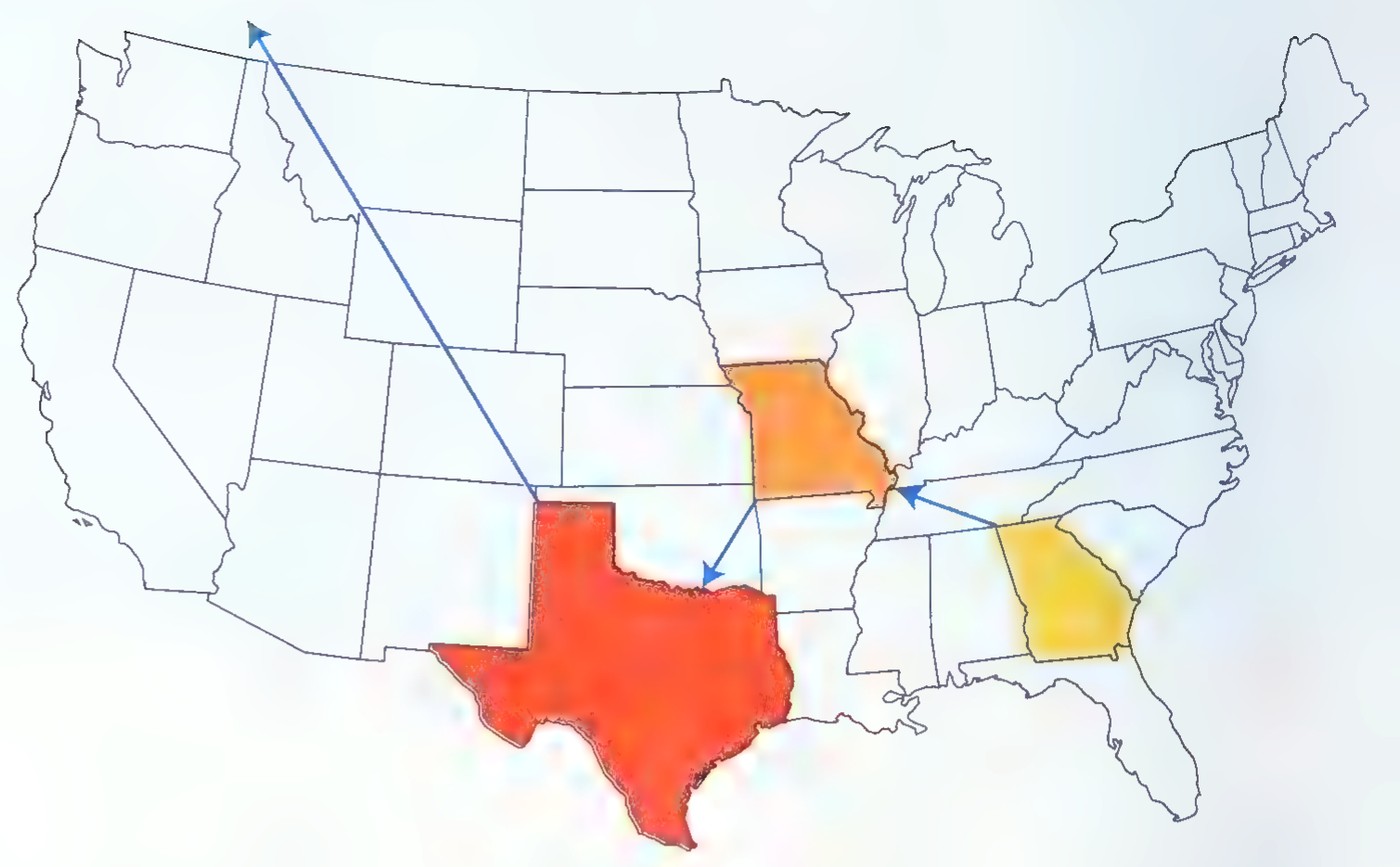
Alaska hasn’t always been the largest state. Before Alaska, it was Texas. In fact, in the history of our country, four states have had the distinction of being the largest. Georgia was the largest of the original 13 states. Then Missouri (1821–1845), followed by Texas (1845–1959), followed by Alaska.
To compare their sizes, we use numbers. For example, the area of Alaska is about 591,000 square miles, and the area of Texas is about 267,000 square miles. Without numbers, such comparisons aren’t always as easy. Look, for example, at the map above. Can you name the three largest states following Texas? The areas of all 50 states can be found in reference books.
It is easy to see how we could work out the areas of states such as Utah and Colorado on this map. Their shapes seem to be simple polygons. On the other hand, the area of Florida on this map would be more difficult to figure out. Even so, it is reasonable to assume that, no matter what shape a closed figure might have, it has an area.
In this chapter, we will review some of the formulas for the areas of various geometric figures. In doing so, we will begin with some basic definitions and assumptions, and from them we will develop the area formulas as a logical sequence of theorems.
p. 339
We start by making a simple observation. When we refer to the area of a polygon, we mean a number that is the measure of the region bounded by it. The figures below illustrate the distinction.
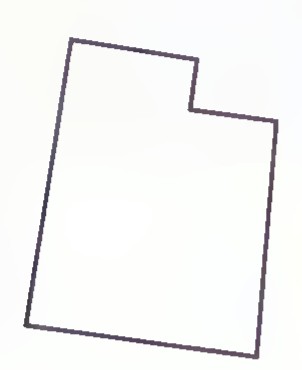
A polygon
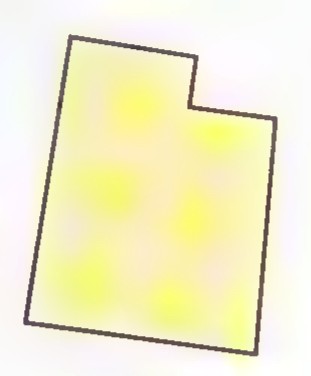
A polygonal region
By a polygonal region, we mean the union of a polygon and its interior.
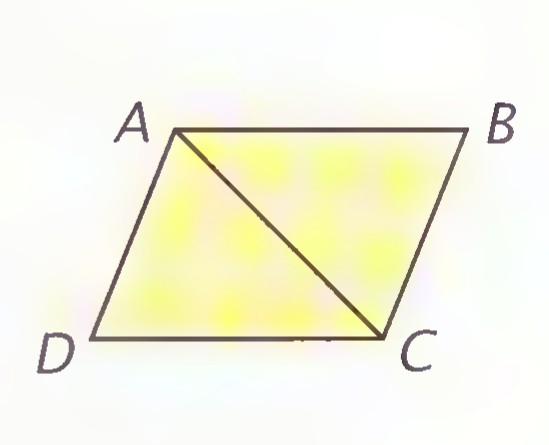
We can always divide a polygonal region into triangular regions by drawing some of its diagonals, which is how we relate the formulas for basic geometric figures to each other. Consider a parallelogram, for example. Drawing one of its diagonals forms two congruent triangles. It is reasonable to assume that these congruent triangles have equal areas and that the area of the parallelogram is equal to their sum. We summarize these observations as the following postulate.
Postulate 8. The Area Postulate
Every polygonal region has a positive number called its area such that (1) congruent triangles have equal areas and (2) the area of a polygonal region is equal to the sum of the areas of its nonoverlapping parts.
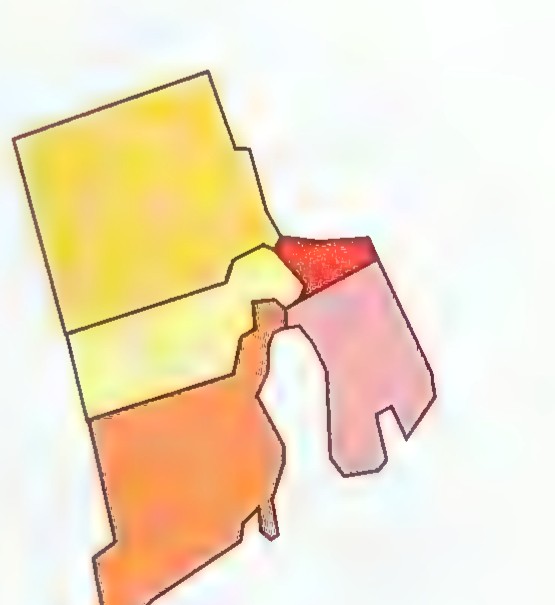
Although the Area Postulate is stated in relation to polygonal regions, it can be extended to other closed figures. For example, the figure at the right is a map of the smallest state, Rhode Island, and its five counties. The area of Rhode Island is equal to the sum of the areas of the five counties. If two of the counties were congruent (which they are not), then we could conclude that they have equal areas.
Rhode Island
We will represent the words “the area of” by α (alpha), the first letter of the Greek alphabet. For example, for the parallelogram at the right above, we can write that
p. 340
Exercises
Set I
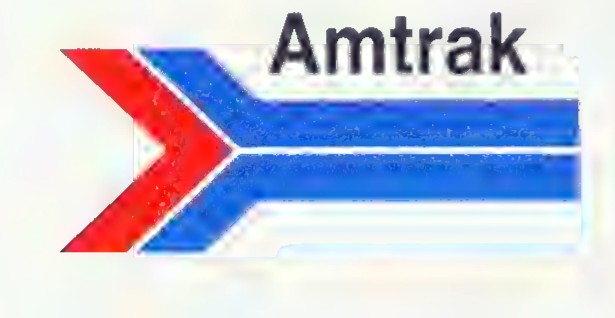
Train Logo. The Amtrak symbol, shown below, consists of three hexagonal regions.
- Copy the version of the figure below and show a way to divide it into six quadrilaterals.
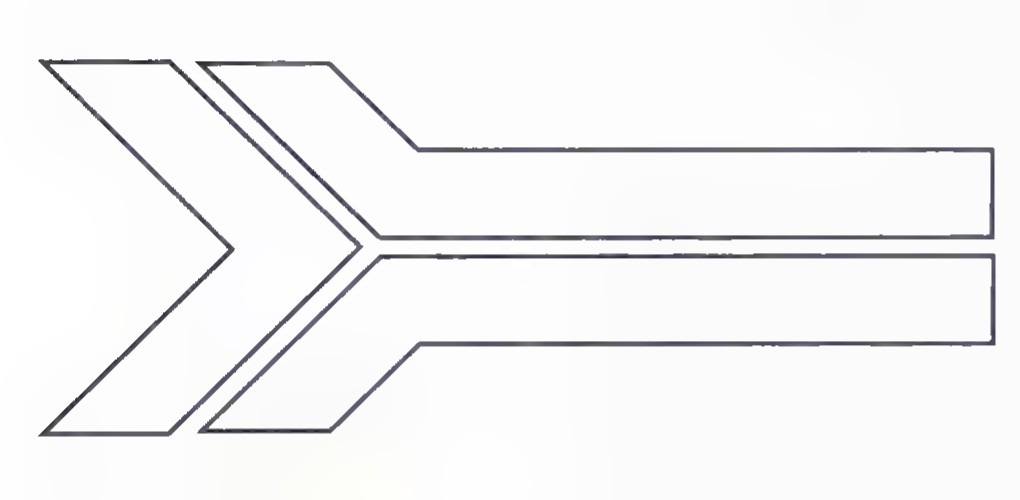
- What types of quadrilaterals are they?
- What does the Area Postulate say about the area of the Amtrak symbol?
Star in Square. The figure below shows a “star” drawn inside a square.
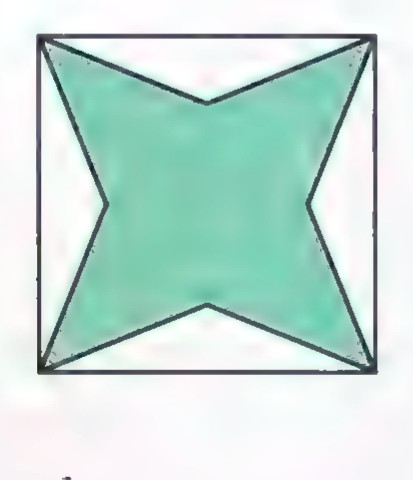
- Which has the greater perimeter, the “star” or the square? Why?
- Which has the greater area? Why?
- If one region has a greater perimeter than another, does it follow that it has a greater area?
Area Relations. ABCD is a parallelogram with diagonal AC; EF and GH have been drawn parallel to its sides.
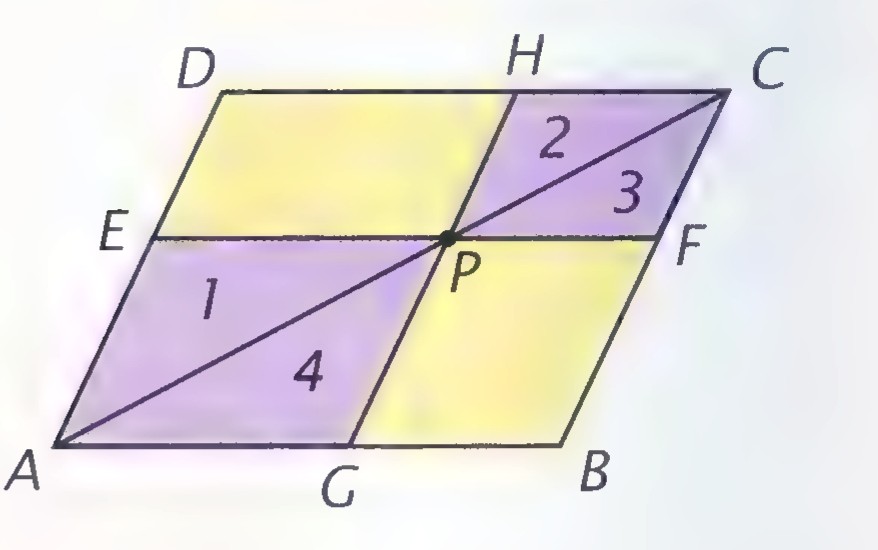
Tell whether you think each of the following statements is true or false. Indicate your reasoning.
- and
Flag Geometry. The flag of the United States is not the only one that is red, white, and blue.
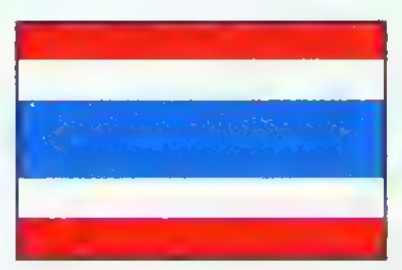
Thailand
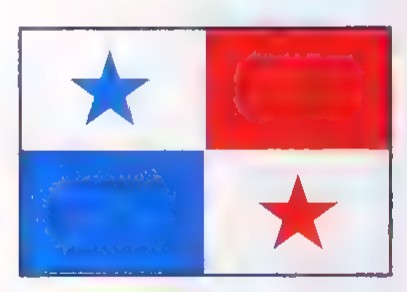
Panama
Suppose that the three colors in the flag of Thailand cover equal areas and that the area of one of the red stripes is x square units.
Write an expression for the area of
- one of the white stripes.
- the blue stripe.
- the entire flag.
The flag of Panama contains four congruent rectangles. Suppose that the flag has an area of 4x square units and that the area of each star is y square units.
p. 341
Write an expression for
- the red area.
- the white area.
- the blue area.
- If you add these three expressions, do you get the area of the entire flag? Show why or why not.
Drum Polygons. You might expect identical drums to sound alike. Surprisingly, mathematicians Carolyn Gordon and David Webb have discovered that drumheads with these two shapes sound alike.*
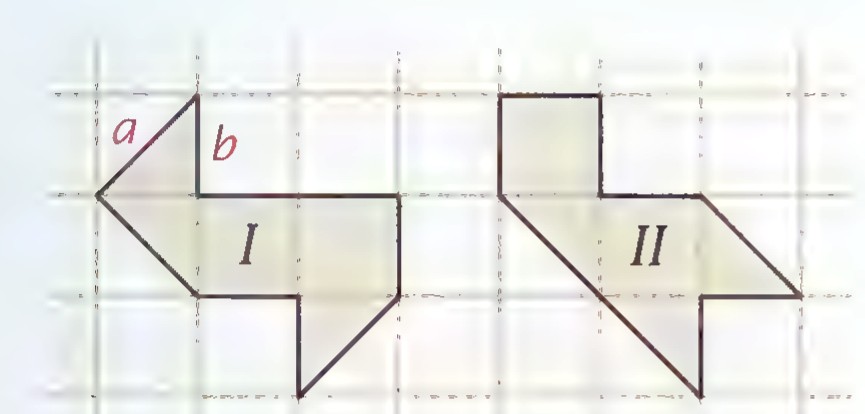
(For convenience, the shapes have been drawn on a square grid.)
- What kind of polygon is each shape?
- How do the polygons compare in area?
- How do their perimeters compare?
- Write an expression in terms of a and b for each perimeter.
- Are the polygons congruent?
Set II
Midsegment Triangle. The sides of △MNO are the midsegments of △ABC.
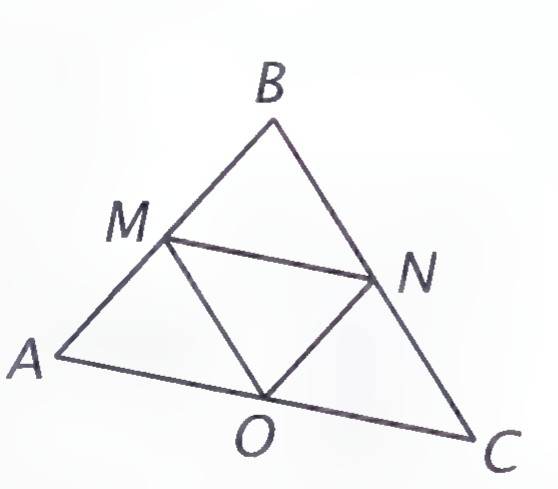
- Copy the figure and mark the segments that are equal.
- What two conclusions follow about △MNO, △AMO, △BMN, and △CNO?
- What conclusion follows about the areas of △MNO and △ABC?
- What kind of quadrilaterals are AMNO, BNOM, and COMN?
- How do you know?
- Are they congruent?
- Do they have equal areas? Explain why or why not.
- What kind of quadrilaterals are AMNC, BNOA, and COMB?
- Are they congruent?
- Do they have equal areas? Explain why or why not.
Circle Area. All of the small triangles in the figure below are congruent.†
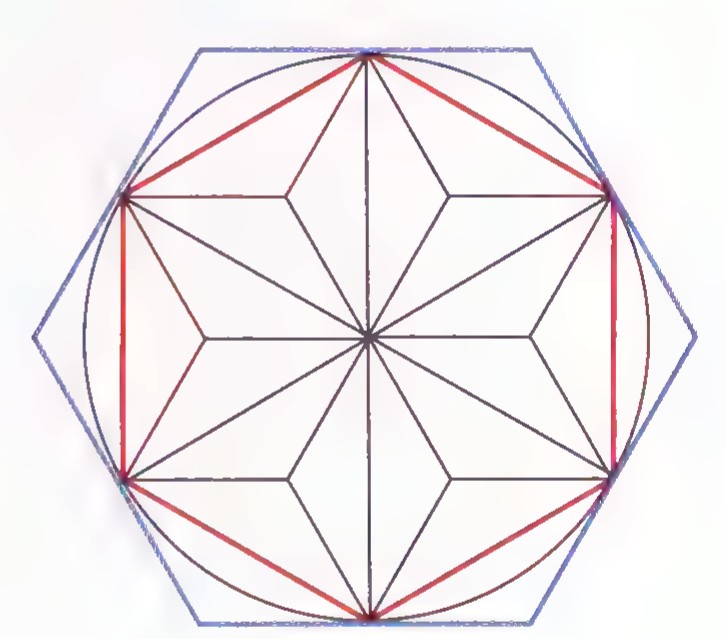
Given that the area of the red hexagon is 3 square units, find
- the area of one of the small triangles.
- the area of one of the equilateral triangles.
- the area of the star.
- the area of the blue hexagon.
- Use your results to guess the approximate area of the circle.
*The Jungles of Randomness, by Ivars Peterson (Wiley, 1998).
†Wheels, Life, and Other Mathematical Amusements, by Martin Gardner (W. H. Freeman and Company, 1983).
p. 342
Doubling a Square. In one of his books, the Greek philosopher Plato explores how it is possible to prove that one square has twice the area of another. His method is based on these figures.
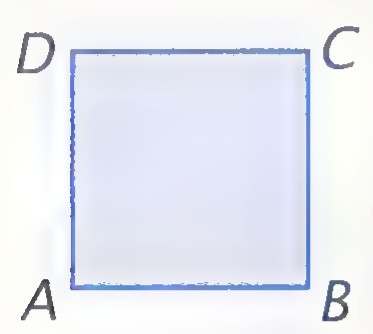
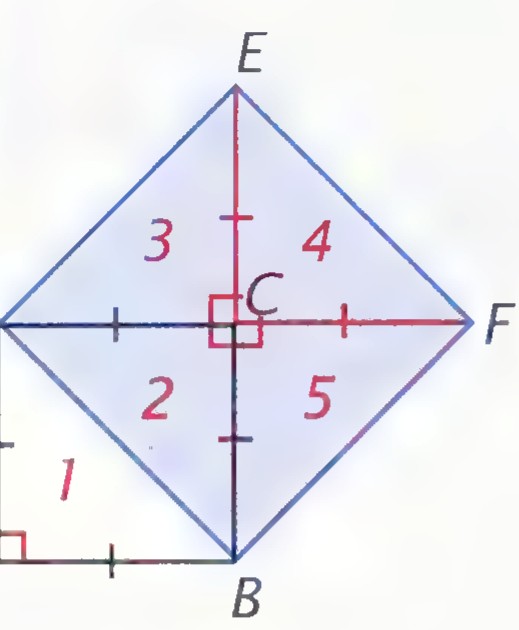
Explain Plato’s argument by giving a reason for each of the following statements.
- The five numbered triangles are congruent. Why?
- They are equal in area. Why?
- BFED is a square. Why?
- . Why?
SAT Problem. The figure below appeared in a problem on an SAT exam.
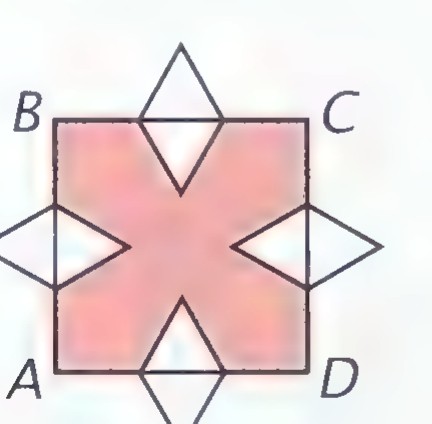
All of the triangles are congruent, the area of the shaded region is 84, and the area of square ABCD is 100.
- What is the area of one of the triangles?
- What is the total area of the entire figure?
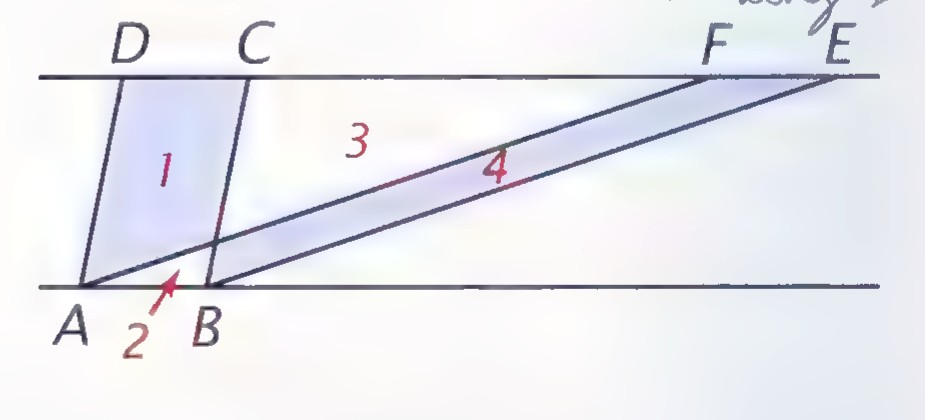
Comparing Parallelograms. Which one of the parallelograms below, ABCD or ABEF, do you think has the greater area?
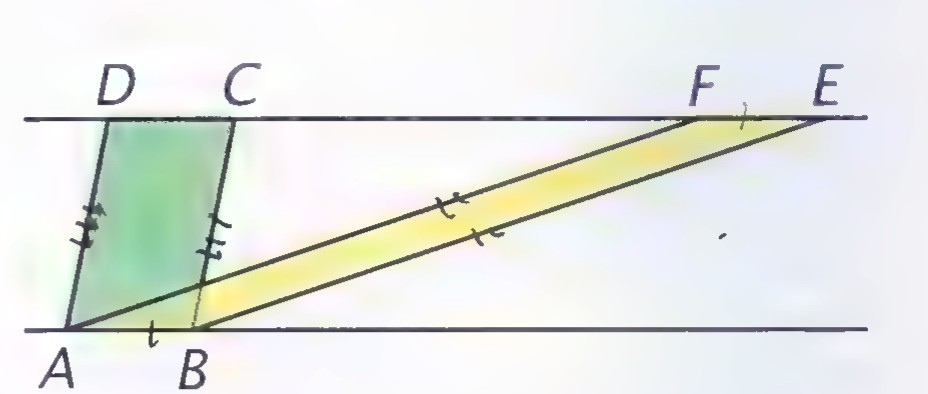
Euclid proved that their areas are equal. Show how he did so by answering each of the following questions.
Given: ABCD and ABEF are parallelograms as shown.
Prove:
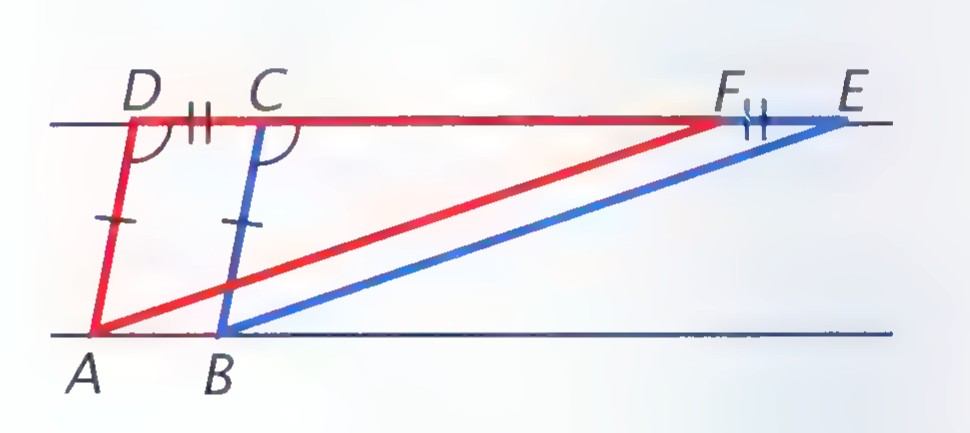
- Why is AD = BC?
- Why is AD ∥ BC?
- Why is ∠ADF = ∠BCE?
- Why is DC = FE?
- Why is DF = CE?
- Why is △ADF ≅ △BCE?
- Why is ?
- Why is ?
- Why is ?
- Why is ?
p. 343
Set III
Magic Playing Card.* Here is a baffling puzzle. A “magic” playing card has been cut into four pieces. When the pieces are put together face up, they look like the figure at the left below. If the pieces are turned over and put together, part of the back of the card is missing!
Carefully compare the front and back of the card. The area of each piece is the same regardless of whether it is face up or face down.
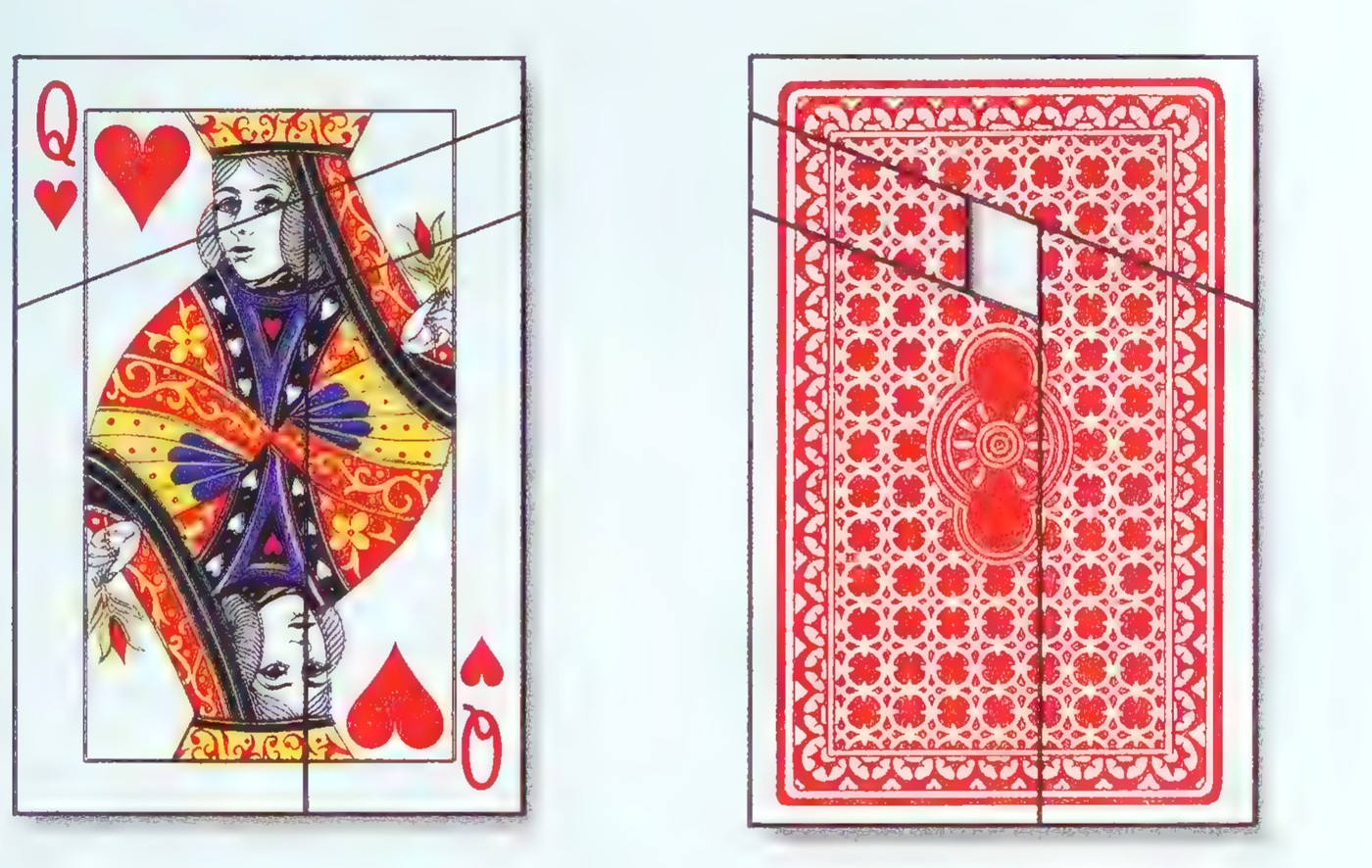
- Can the borders of the playing card face up and face down be congruent? Explain.
- What can you conclude about the dimensions of the card in each position?
- What does your conclusion have to do with how the puzzle works?
*New Book of Puzzles, by Jerry Slocum and Jack Botermans (W. H. Freeman and Company, 1992).
p. 344
Lesson 2: Squares and Rectangles
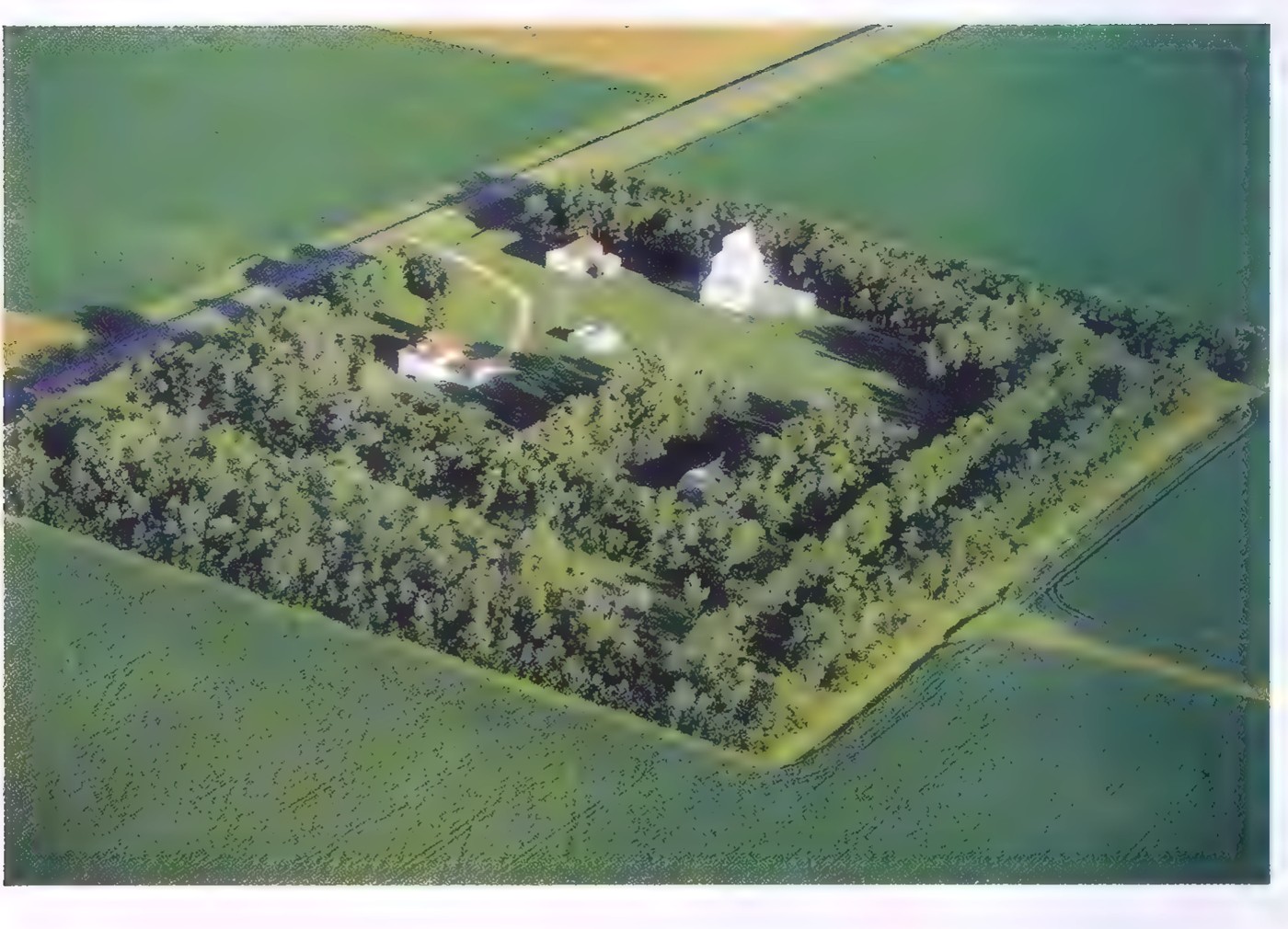
More than that of any other country, the American landscape has been influenced by geometry. The word “geometry,” in fact, comes from the Greek word geometrein, which means “to measure land.” The pattern established by the Land Ordinance of 1785 was that the country west of the Alleghenies was to be divided up into squares 6 miles on a side called “townships,” which were in turn divided into even smaller squares. The influence of this system is evident even in the shape of individual homesteads, as the photograph above of a homestead on a square lot in North Dakota illustrates.*
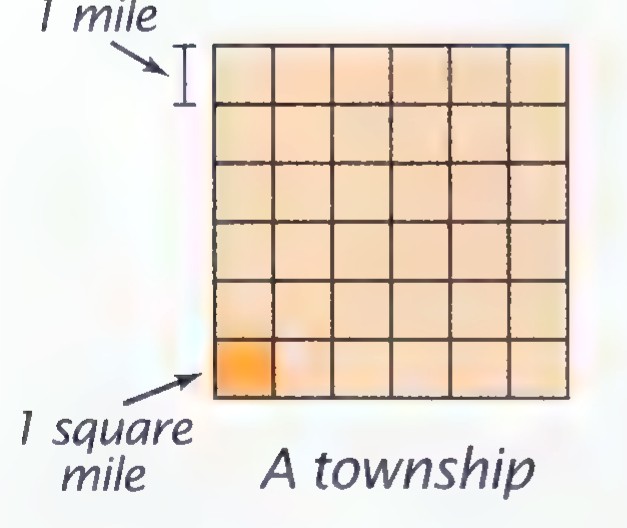
Because a township was a square of land 6 miles on a side, it had an area of 36 square miles. Area is normally measured in square units that are derived from linear units, or units of length. The numbers known as “squares” get their name from this connection. We call 6² “six squared” because a square 6 units on a side contains 6², or 6 × 6, unit squares.
*Taking Measures: Across the American Landscape, by James Corner and Alex S. MacLean (Yale University Press, 1996).
p. 345
One acre
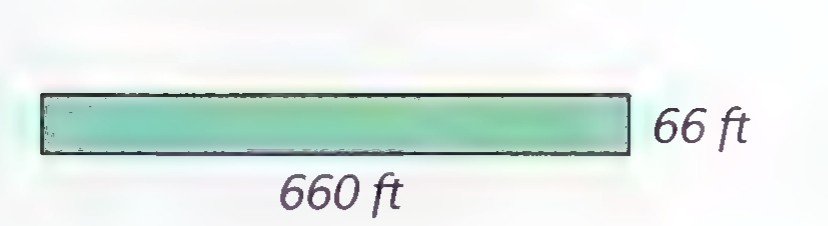
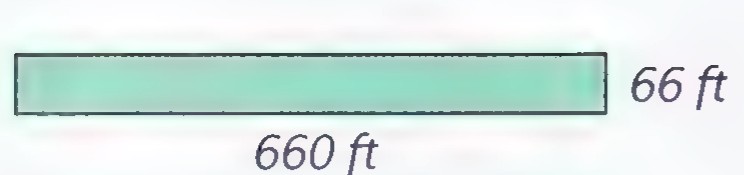
Another unit commonly used in the United States for measuring land is the “acre.” The acre originally was considered to be the amount of land that could be plowed with oxen in 1 day and was a rectangle 660 feet long and 66 feet wide. The length 660 feet was roughly the distance that a team of oxen could plow before needing to rest.
Ruling a 660-ft by 66-ft rectangle into 1-ft by 1-ft squares gives its area in square feet:
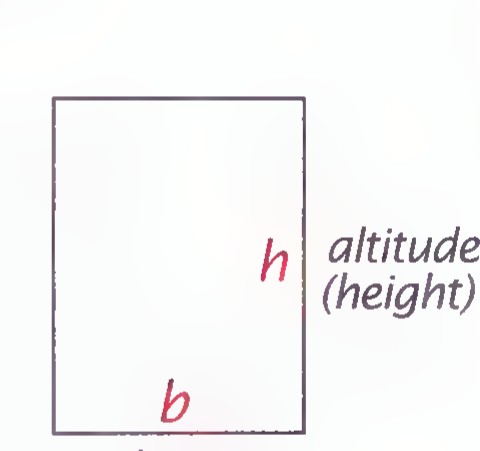
The dimensions of a rectangle are sometimes called its length and width. They are also called its base and altitude. The words base and altitude can also refer to two consecutive sides of the rectangle. (Any side can be considered the base, and a side perpendicular to the base can be considered the altitude, or “height”—another word for “altitude.”) The letters b and h are usually used to represent the base and altitude.
We have seen that the area of a 1-acre rectangle in square feet is the product of its dimensions. We will assume that the area of any rectangle can be found by multiplying its dimensions, even rectangles whose dimensions are not integers.
Postulate 9
The area of a rectangle is the product of its base and altitude.
A square is a rectangle whose base and altitude are equal, and so the special case of finding the area of a square follows as a corollary to this postulate.
Corollary to Postulate 9
The area of a square is the square of its side.
Exercises
Set I
Abstract Art. One of the strangest pieces of modern art is an oil painting by Ad Reinhardt. It belongs to the New York Museum of Modern Art and consists of a solid black square measuring 5 feet on each side.
Abstract Painting 1960–61
Find its perimeter
- in feet.
- in inches.
Find its area
- in square feet.
- in square inches.
p. 346
Tile Pattern. Each of the smallest squares in the figure below has an area of 1 square unit.
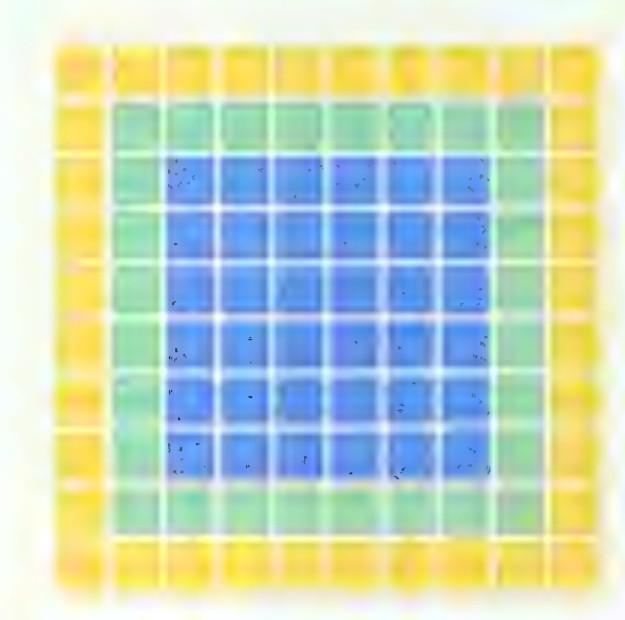
- Which of the three colored regions do you think has the largest area?
- Find the area of each region.
Fishing Nets. The mesh in fishing nets is measured in relation to the square inch.
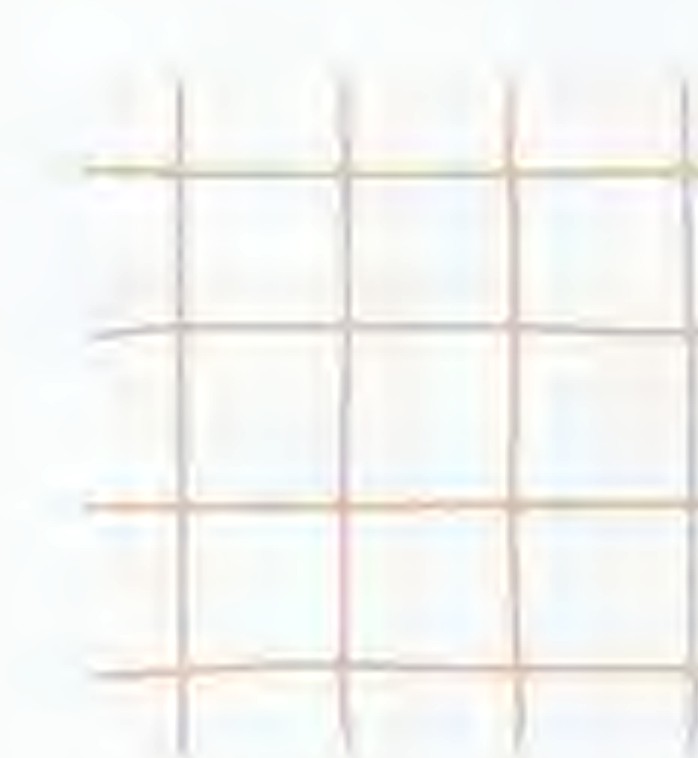
The net above has a “half inch” mesh.
- Use your ruler to explain why.
- How many small squares are there per square inch?
- How many small squares per square inch would you expect in quarter-inch mesh?
- Why do you suppose there are laws regarding the size of mesh used in fishing?
Distributive Property. The rectangular figure below is sometimes used in algebra books to illustrate the distributive property.
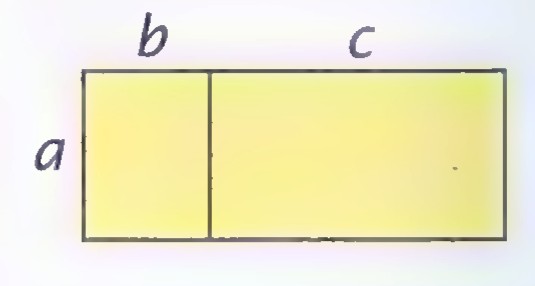
- What is the area of the entire figure in terms of the lengths of its sides?
- What are the areas of the two parts of the figure?
- Copy and complete the distributive property:
Binomial Square. The figure at the right is used in algebra books to illustrate the square of a binomial.
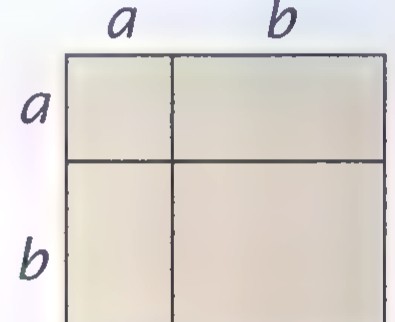
- What is the area of the entire figure in terms of the lengths of its sides?
- What are the areas of the four parts of the figure?
- Copy and complete the formula for the square of a binomial:
Difference of Two Squares.
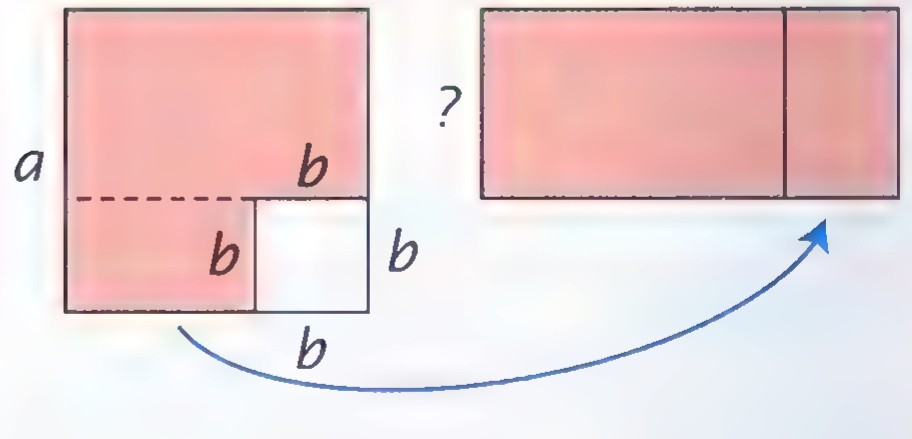
- Use the figure above as a guide to writing the formula for the difference of two squares.
p. 347
Area Connection. The figure below suggests a connection between the area of a right triangle and the area of a rectangle.
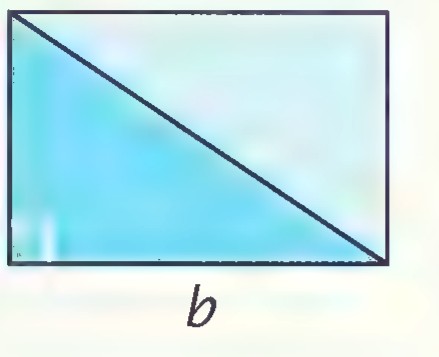
- Write a formula for the area, A, of the rectangle in terms of its sides, a and b.
- Into what does the diagonal of the rectangle divide it?
- Why do the two triangles have equal areas?
- Write a formula for the area, A, of a right triangle in terms of its legs, a and b.
Two Squares. The two squares below have areas of 25 and 26.
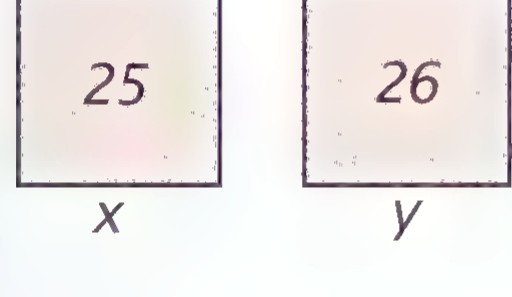
Because the area of the first square is 25, ; so .
- How long is each side of the second square?
Use a calculator to help in answering each of the following questions.
- Is the length of each side of the second square 5.099?
- What is the exact area of a square whose sides are 5.099?
- Is the length of each side of the second square 5.0990195?
- Do you think you could write the exact length of each side of the second square in decimal form?
- What kind of number is the length of each side of the second square?
Set II
Bed of Nails. An old trick is to lie on a bed of nails. For it to be comfortable, the bed should have one nail per square inch.*
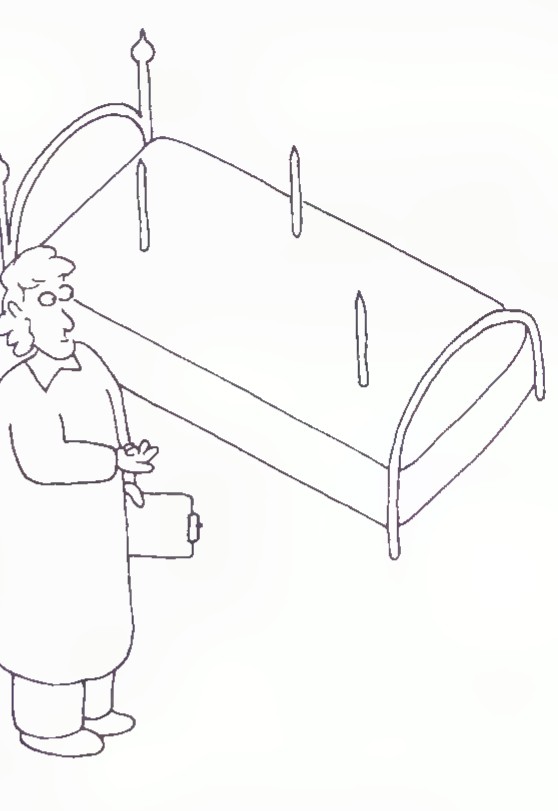
Dr. Jones rechecks his calculations on proper nail spacing before lying down on the bed of nails.
- To construct a bed of nails 6 feet long and 3 feet wide, how many nails would you need?
- Which do you think would hurt the most: to lie on a bed of nails, to sit on it, or to stand on it?
Surveyor’s Chain. The tool used by early American surveyors to measure distances was a chain of 100 links, each 7.92 inches long.
- What was the total length of the chain in feet?
*The Cosmological Milkshake: A Semi-Serious Look at the Size of Things, by Robert Ehrlich (Rutgers University Press, 1994).
p. 348
One acre
- What are the dimensions of the above rectangular acre in “chains”?
- What is its area in “square chains”?
A mile is a distance of 80 chains.
- Use your answer to exercise 30 to find the number of feet in a mile.
- How many “square chains” are in 1 square mile?
- How many acres are in 1 square mile?
Map Reading. Figuring out how to get somewhere from a map book can be awkward if a road or your destination is too close to the edge of the page.*
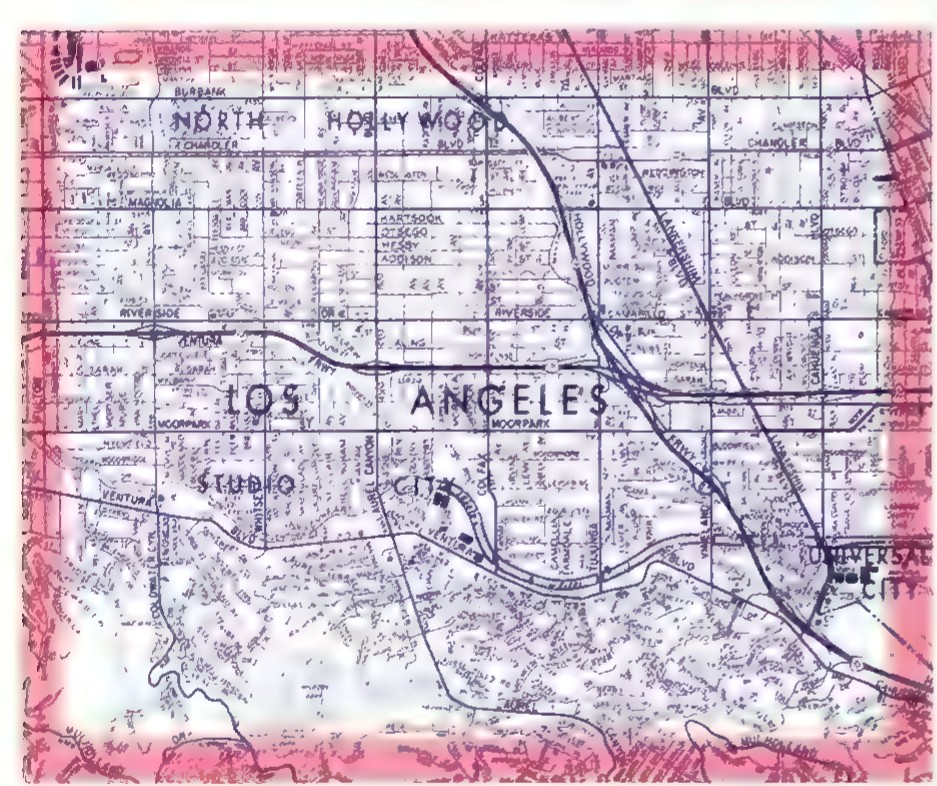
Suppose the map pages are 24 cm by 20 cm and that the awkward region is 1 cm into the page along each edge.
- What is the total area of the map page?
- What is the area of the “awkward region”?
- What percentage of the area of the map page is the awkward region?
Suppose the awkward region is 2 cm into the page instead.
- Now what percentage of the area of the map page would the awkward region be?
Wallpaper Geometry. Wallpaper is sold in 36-square-foot rolls. The most common widths are 20 inches (20”) and 27 inches.†
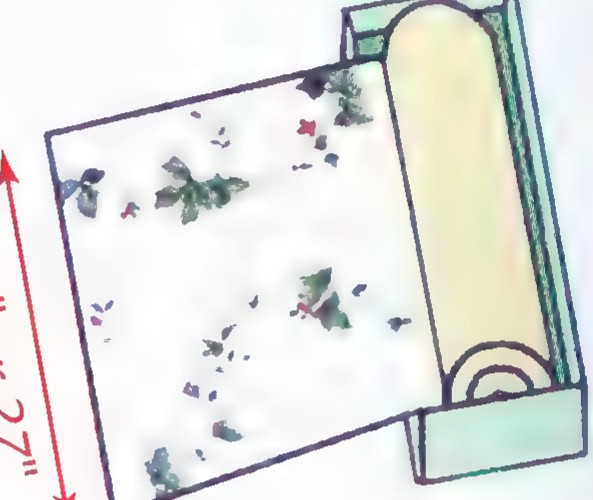
How many feet long is a roll of wallpaper with
- a width of 20 inches?
- a width of 27 inches?
The rule for estimating the number of rolls needed to paper a room is to assume that each roll will cover 30 square feet.
- Why not 36 square feet, given that it is the area of a roll?
The rule continues: Multiply the room’s perimeter by its height, divide by 30, and round up.
- What does multiplying the room’s perimeter by its height give?
- After dividing by 30, why not just round the answer to the nearest number?
- There is one more part to the rule. What do you suppose it is about?
- What effect would it have on the number of rolls needed?
*Why Do Buses Come in Threes? The Hidden Mathematics of Everyday Life, by Rob Eastaway and Jeremy Wyndham (Wiley, 1998).
†Sizes, by John Lord (Harper Perennial, 1995).
p. 349

Cutting a Board. The figure above from the Wood Handbook shows how four smaller boards can be cut from a board so as to avoid knots and cracks in the boards produced.*
The original board is 12 inches wide and 12 feet long.
- Find its area in square inches.
Use the following dimensions to find the areas of the four smaller boards in square inches.
- Cutting #1: in by ft.
- Cutting #2: in by ft.
- Cutting #3: in by ft.
- Cutting #4: 6 in by ft.
To be graded as a high-quality board, the four boards cut from it must use at least two-thirds of the board.
- Do they? Explain.
The Number 17. The Greek historian Plutarch said that “the followers of Pythagoras have a horror for the number 17. For 17 lies exactly halfway between 16, which is a square, and the number 18, which is the double of a square.”†
- Draw figures to show why 16 is a square and 18 is the double of a square.
Plutarch also mentioned something unusual about the perimeters and areas of these two figures.
- What is it?
- Can you find any other square or rectangle for which it is true? (Hint: The dimensions need not be integers.)
Total Living Area. Realtors use the total living area to help calculate the market value of a house.
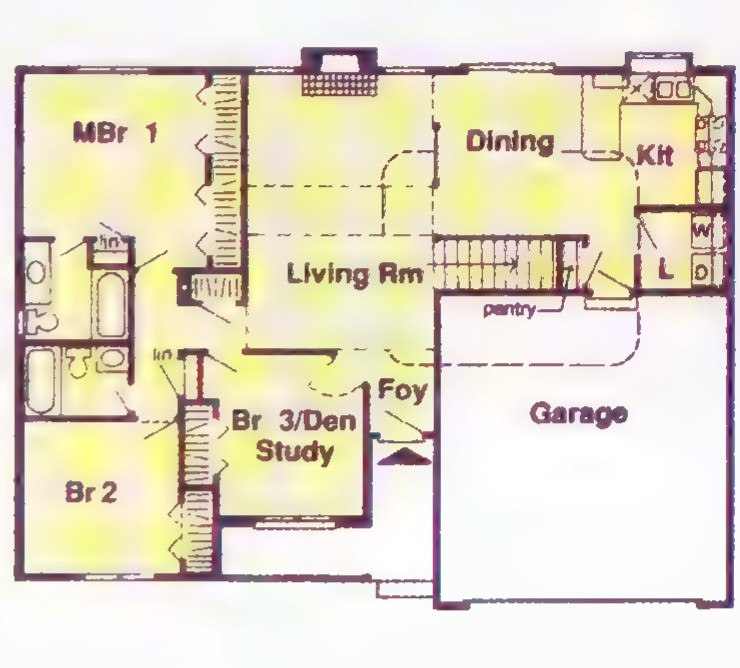
The figure below shows the “living area” part of the house. Its dimensions have been rounded to the nearest foot.‡
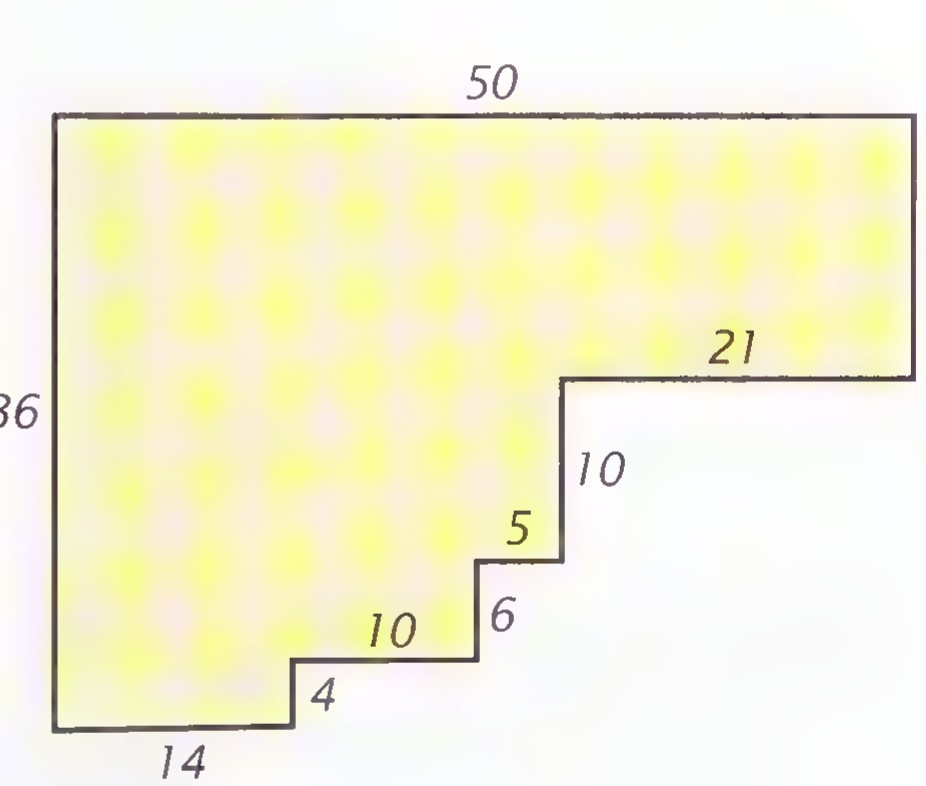
- Sketch the figure and mark it as needed to calculate the total living area of the house.
- Sketch the figure again, divide it into pieces in a different way, and check your answer to exercise 56 by calculating the total living area again.
*Wood Handbook, Forest Products Laboratory (U.S. Department of Agriculture, 1974).
†Science Awakening, by B. L. van der Waerden (Oxford University Press, 1961).
‡ The Best of Better Homes and Gardens Home Plans, Fall 1997.
p. 350
Set III
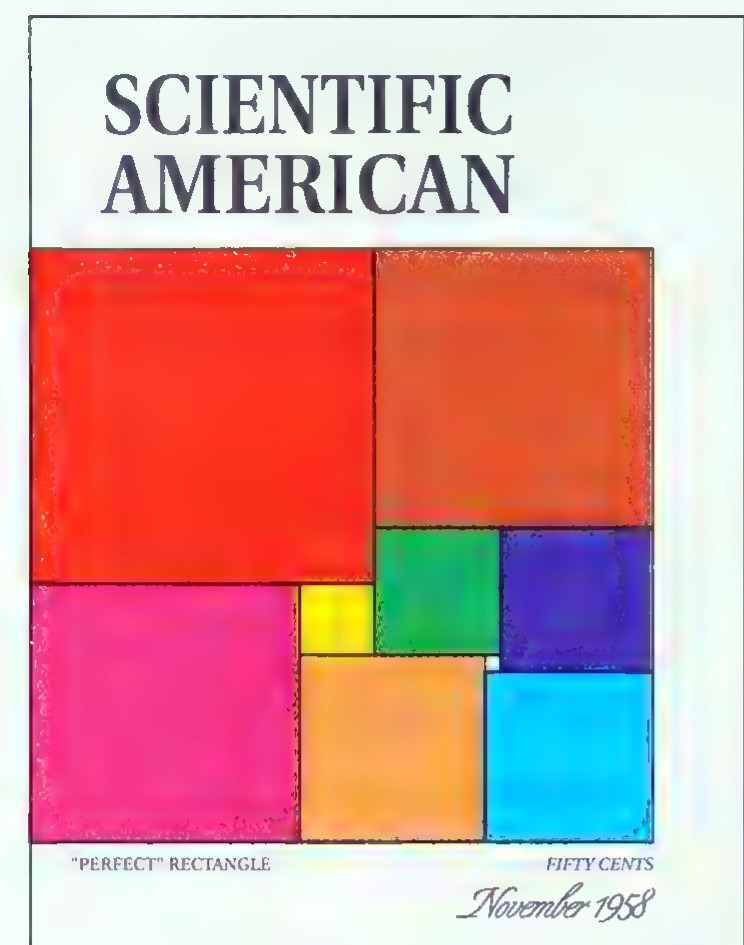
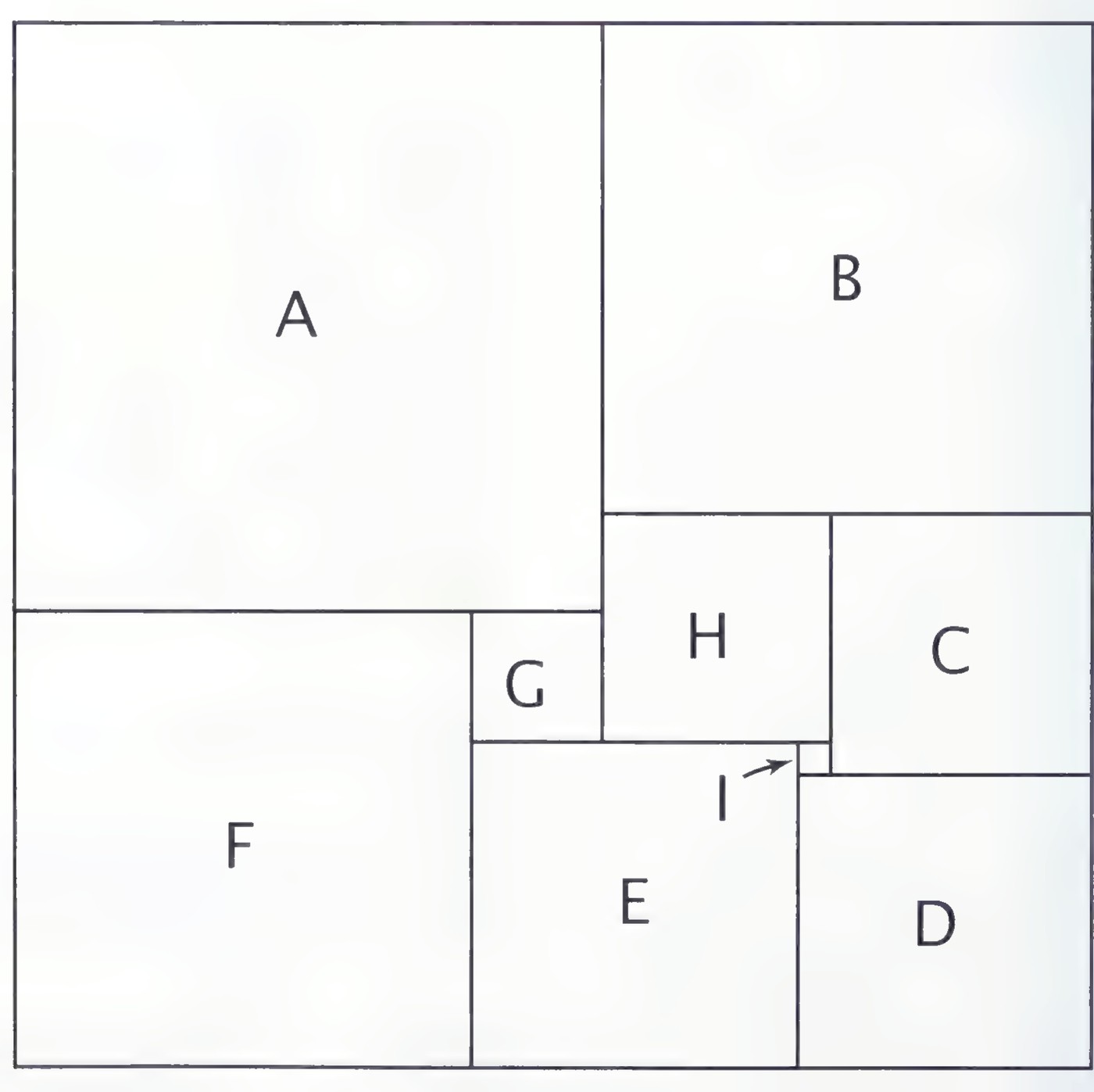
Dividing into Squares. To divide a square into smaller squares each having a different area was once thought to be impossible. The figure below, which once appeared on the cover of Scientific American magazine, seems to show a solution.
- Trace the figure on your paper.
The areas of squares C and D are 64 and 81 square units, respectively.
- Find the areas of the other squares.
- Is the figure containing the nine squares a square? Explain why or why not.
p. 351
Lesson 3: Triangles
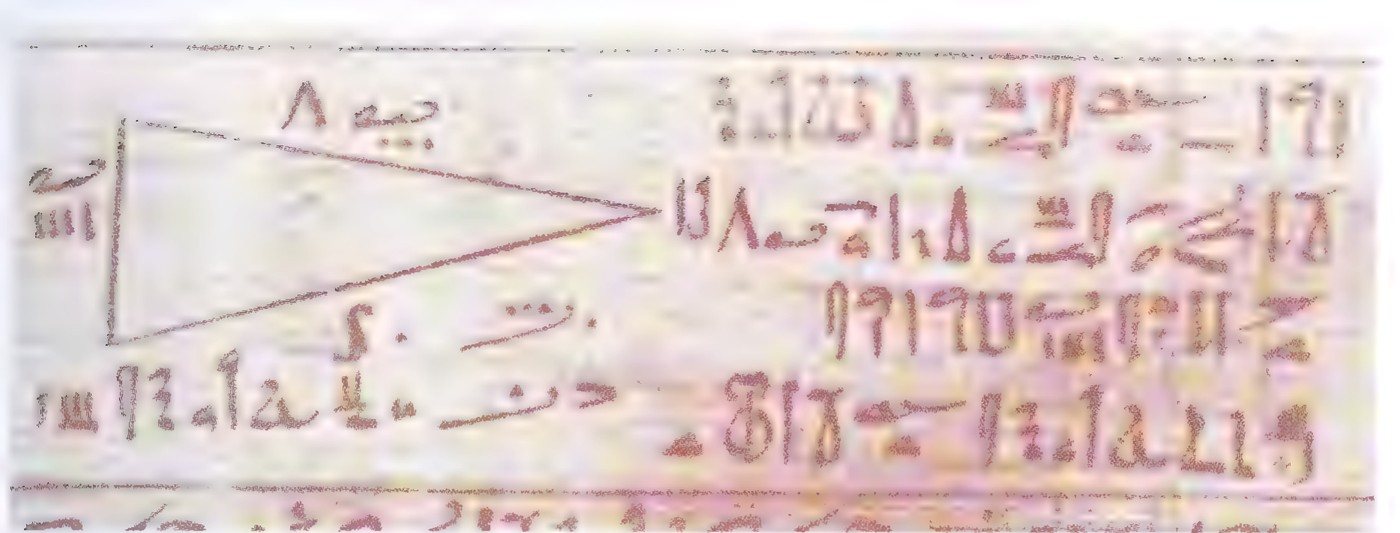
In 1858, an English tourist purchased an old scroll when visiting Egypt. Now in the British Museum, it is known as the Rhind Papyrus and is our main source of information about mathematics in ancient Egypt. It was written in about 1650 B.C. by a scribe named Ahmose, who gave it the title “The correct method of reckoning, for grasping the meaning of things and knowing everything that is.”*
Rather than explaining “everything that is,” the papyrus simply contains a series of mathematics problems and their solutions. Problem 51, shown above, was titled “Example of making a triangle in land.” Ahmes wrote:
If it is said to you, a triangle of 10 khet on the side of it, 4 khet on the base of it, what is the area of it?
Make you half of 4, namely 2, to cause that it become rectangular. Make you the multiplication: 10 times 2; the area of it is this.
Ahmose’s solution is correct only if the triangle is a right triangle. The figures at the right show where the “rectangular” part comes in and suggest why the method works.
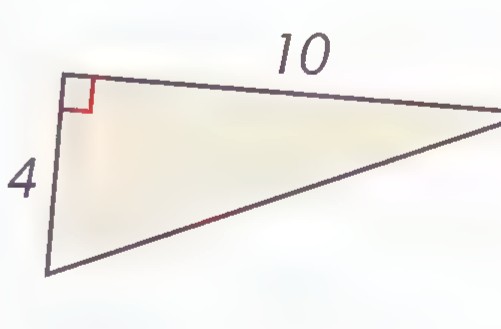
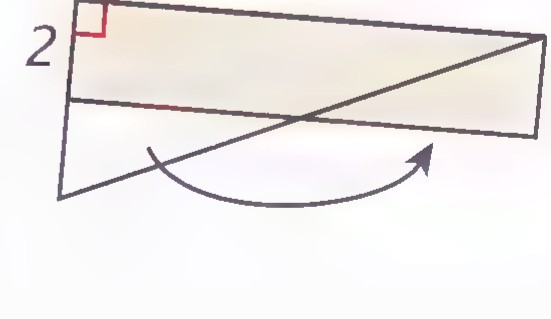
Although we could write a proof based on these figures to explain why the area of a right triangle is half the product of its legs, it is easier to base the proof on a rectangle enclosing the entire triangle.
*The Rhind Mathematical Papyrus, by Arnold Buffum Chace (The Mathematical Association of America, 1927).
p. 352
Theorem 38
The area of a right triangle is half the product of its legs.
Given: Right △ABC with legs a and b.
Prove:
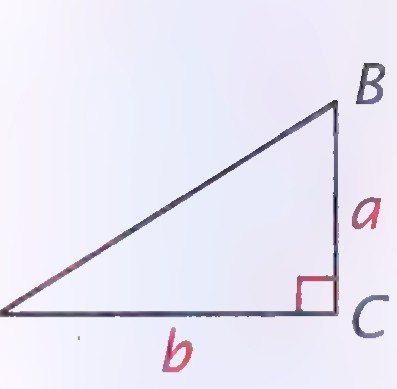
The following figures show the plan of the proof, whose main ideas are outlined below.
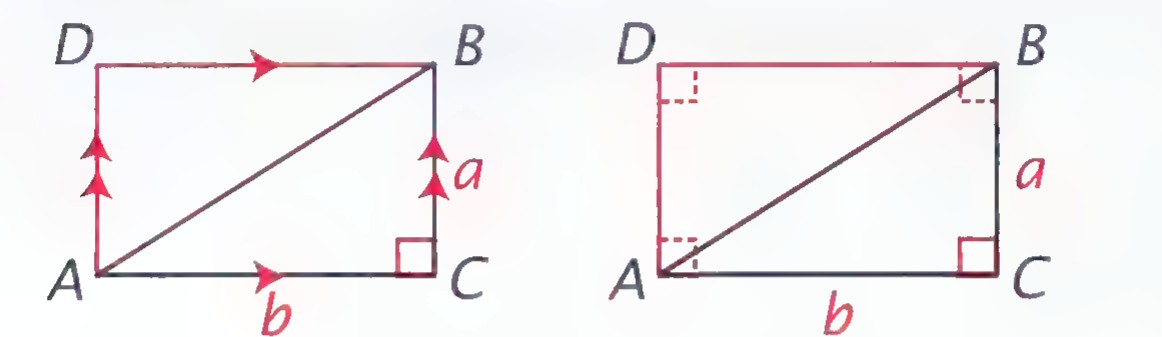
Proof
Through A and B, draw lines parallel to the legs of the triangle to form parallelogram ACBD. ACBD is also a rectangle; so . ; so . Therefore, and so .
Knowing this formula for right triangles, we can derive a comparable formula for the area of any triangle. Look again at right △ABC: if leg AC is the base of the triangle, it seems reasonable to call the length of leg BC the height, or altitude, of the triangle. In general, we think of an altitude of a triangle as the distance from a vertex to the line of the opposite side. The distance from a point to a line is measured along the perpendicular from the point to the line. Consequently, the word altitude is also used to refer to a perpendicular line segment from a vertex to the line of the opposite side.
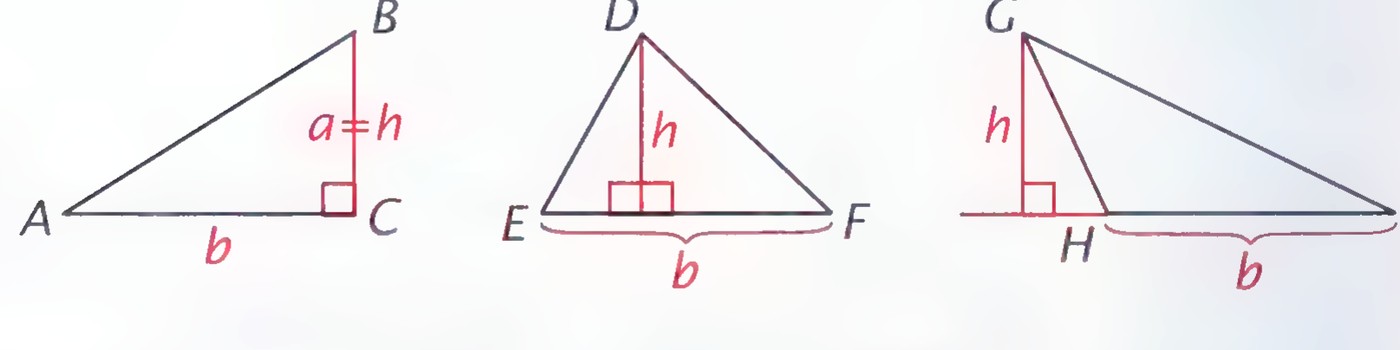
As the figures above show, an altitude of a triangle may lie on a side of the triangle, inside the triangle, or outside it. Regardless of where the altitude may be, by using the information in these figures it is easy to show how the area of a triangle can be found if the lengths of one side and the corresponding altitude are known.
p. 353
Theorem 39
The area of a triangle is half the product of any base and corresponding altitude.
An immediate consequence of this theorem is the following corollary.
Corollary to Theorem 39
Triangles with equal bases and equal altitudes have equal areas.
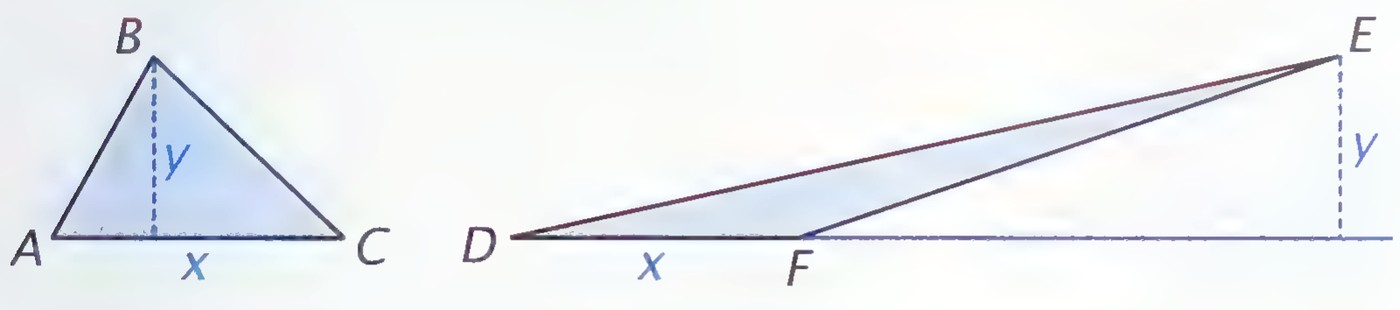
Our reasoning shows that this corollary is true, but its application sometimes leads to surprises. For example, from it we can conclude that the acute and the obtuse triangles shown above must have equal areas.
Exercises
Set I
Match Puzzle. An old puzzle begins with 12 matches arranged to form a right triangle. The puzzle is to rearrange the matches to form a figure with half its area.
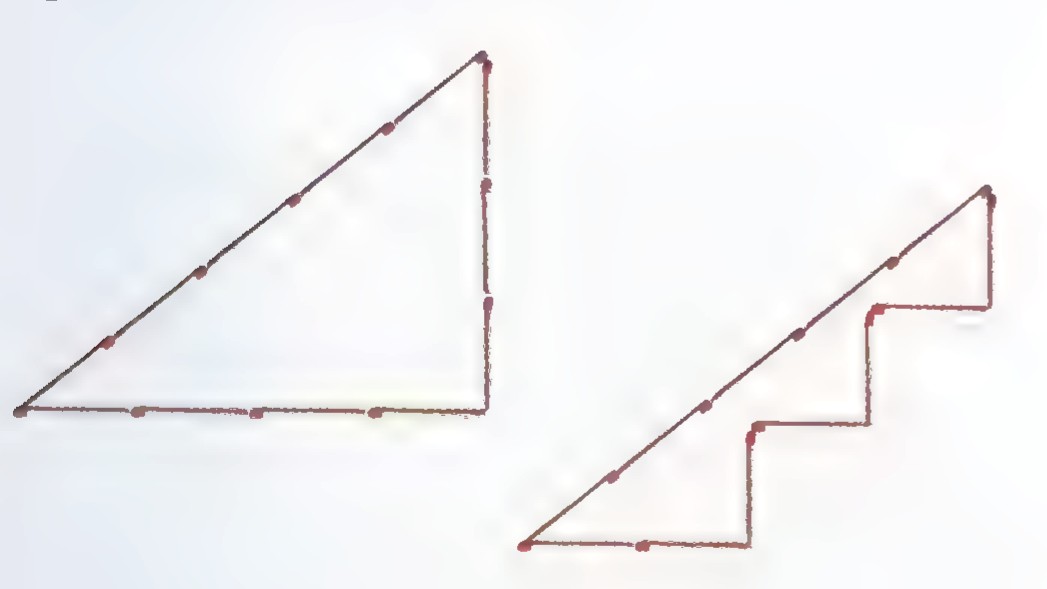
- Given that each match is 1 unit long, what is the area of the triangle?
- Does the arrangement of the matches shown in the second figure solve the puzzle? Explain.
- How do the perimeters of the two figures compare?
Isosceles Right Triangle. The figures below illustrate two ways to find the area of an isosceles right triangle.
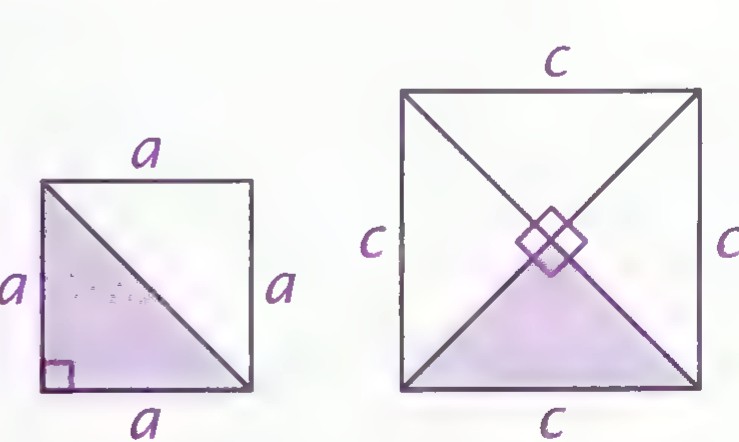
Write an expression for the area of the triangle in terms of
- the length of one of its legs, a.
- the length of its hypotenuse, c.
p. 354
Theorem 39. Complete the following proof of Theorem 39 by giving the reasons.
The area of a triangle is half the product of any base and corresponding altitude.
Given: △ABC with base b and altitude h.
Prove:
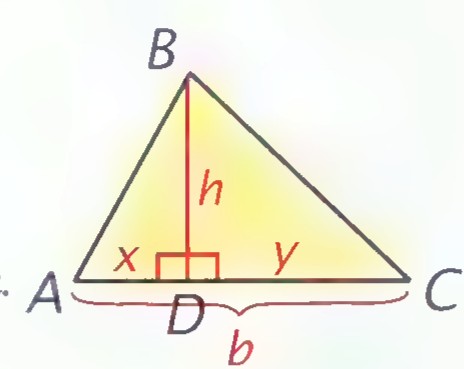
Proof
- and . Why?
- . Why?
- . Why?
- Since , . Why?
In the proof above, the altitude was assumed to be inside the triangle. The figure below illustrates the case in which the altitude is outside the triangle.
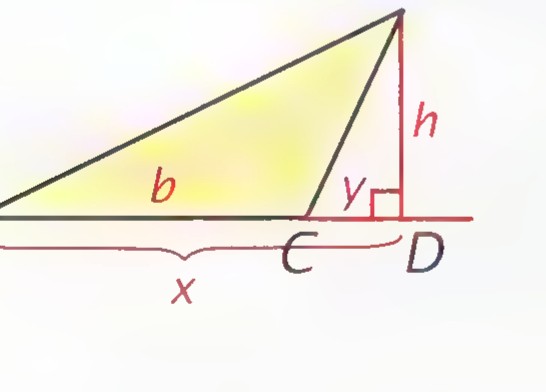
The proof for this case is almost the same, as you will see in giving a reason for each of the following statements.
- and . Why?
- . Why?
- . Why?
- . Why?
- Since , . Why?
Enlargement. When something is enlarged, everything does not change in the same way.
For example, look at △DEF below, which is an enlargement of △ABC.
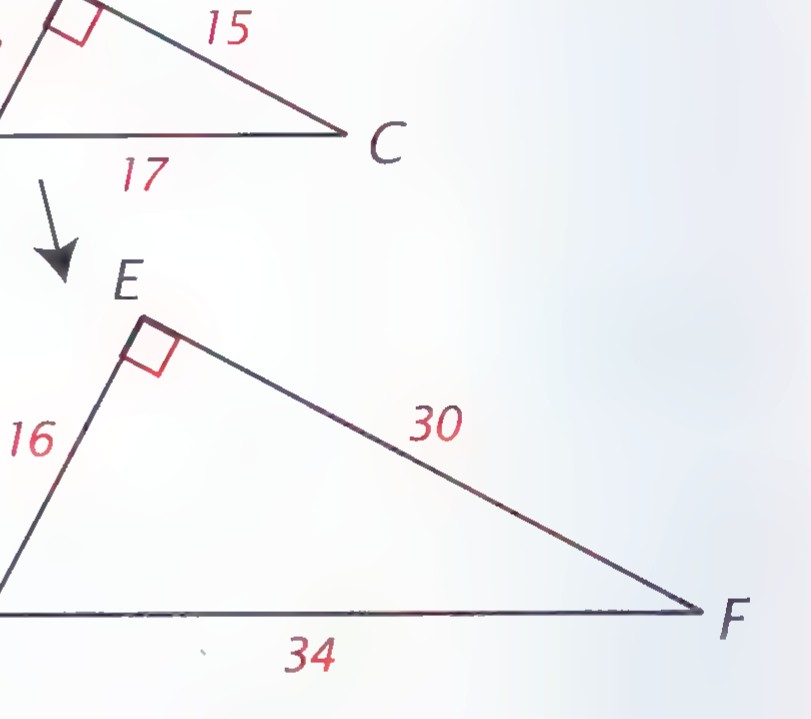
- How do the angles of △DEF seem to compare in measure with the angles of △ABC?
- How do the sides of △DEF compare in length with the sides of △ABC?
- Find the perimeter of each triangle.
- How does the perimeter of △DEF compare with the perimeter of △ABC?
- Find the area of each triangle.
- How does the area of △DEF compare with the area of △ABC?
- If the sides of a triangle are doubled, what seems to happen to the measures of its angles?
- What happens to its perimeter?
- What happens to its area?
p. 355
Chinese Parallelogram. The Chinese practice of coloring the parts of geometric figures makes it easier to discover some of their properties.
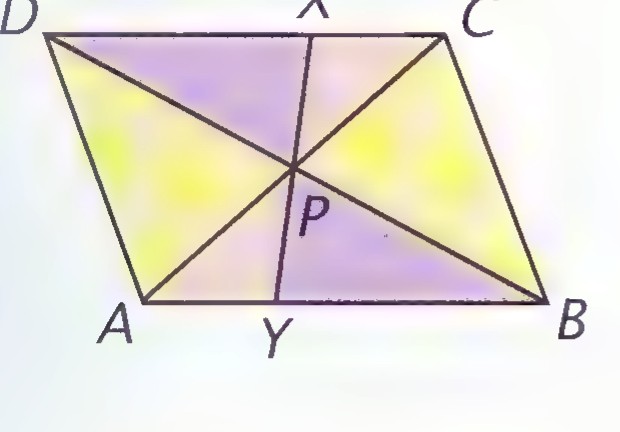
ABCD is a parallelogram with its diagonals intersecting at P. XY is any line through P.
- Copy the figure and mark it as needed to do each of the following exercises.
- The triangular regions shaded the same color seem to have the same area. Do they? Explain.
- What can you conclude about quadrilaterals XYAD and XYBC?
Four-Sided Field. This problem is from an old geometry book.*
To survey the four-sided field ABCD, begin by measuring the diagonal BD. Then determine the points E, F on BD, where perpendiculars from the points A and C meet BD. Then measure the lengths of AE and CF.
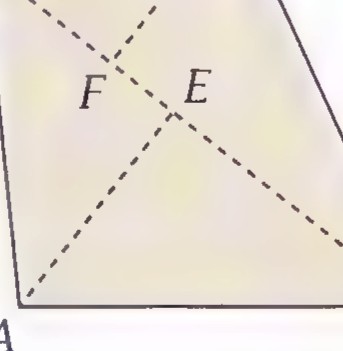
The book gives the measurements in “chains”:
BD = 14.36 chains, AE = 8.17 chains, and CF = 5.74 chains.
- Use this information to find the area of the field in “square chains.”
- Given that 1 acre is equal to 10 square chains, find the area of the field in acres.
Set II
Surfer Puzzle. In the puzzle of the surfer, the sum of the lengths of the perpendicular paths from every point on the island to the beaches seemed to be the same.†
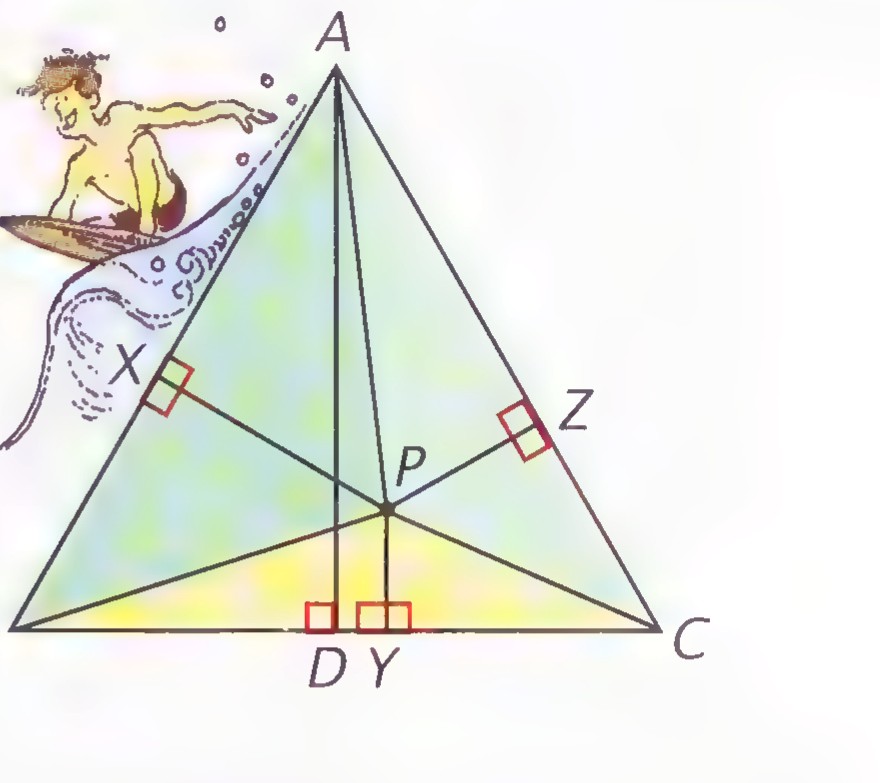
The island was in the shape of an equilateral triangle; so AB = BC = CA. Use the figure above to give a reason for each of the following statements.
- , , , and .
- .
- .
- .
- AD = PX + PY + PZ.
- How does this result prove that the sum of the lengths of the three paths from every point on the island to the beaches is the same?
*First Steps in Geometry, by G. A. Wentworth and G. A. Hill (Ginn, 1901).
†Page 5.
p. 356
Three Equal Triangles. All of the triangles below have the same area.
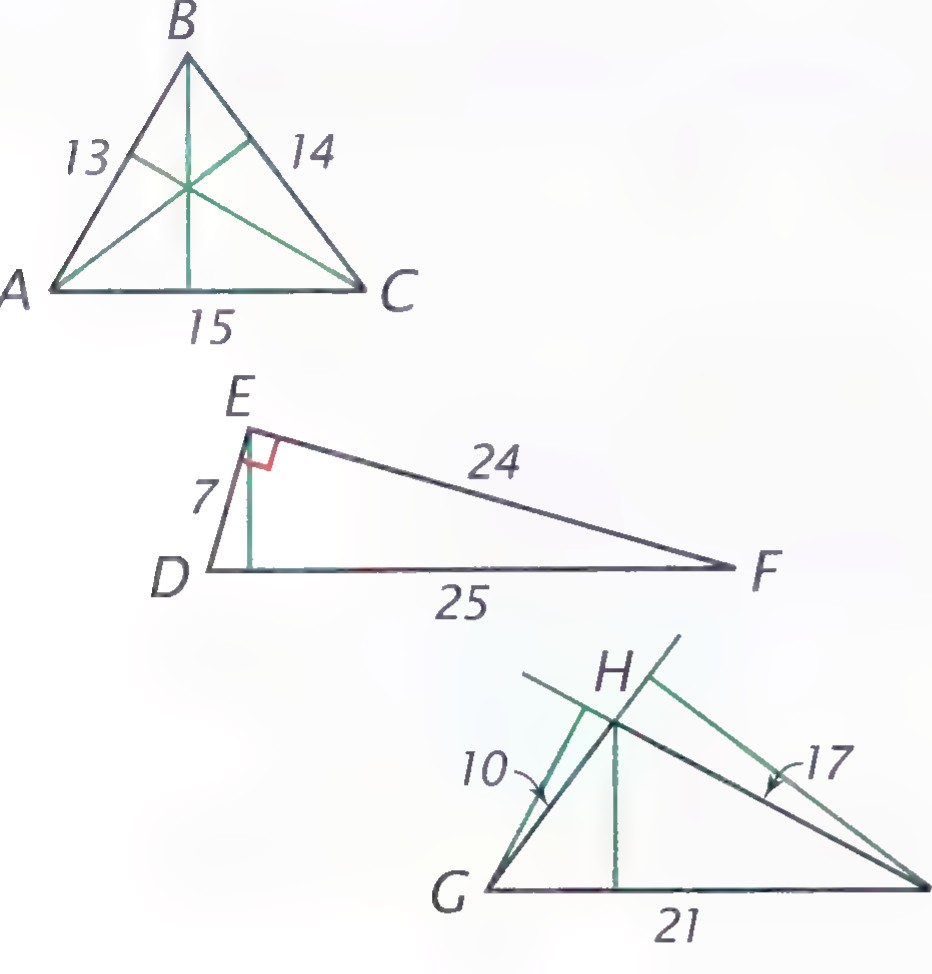
- What is it?
What is the length of the shortest altitude of
- △ABC?
- △DEF?
What is the length of the longest altitude of
- △DEF?
- △GHI?
Kite Geometry. In the kite pictured at the right, two wooden cross pieces, AC and BD, are lashed together at E. The area of the material needed to cover the kite can be found from the lengths of the two cross pieces.
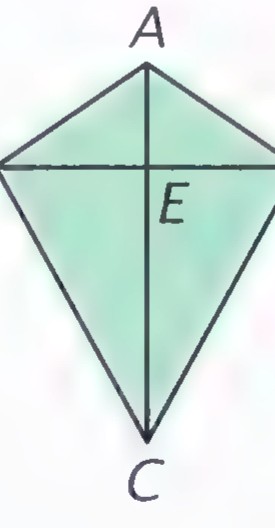
Complete the following proof.
Given: Kite ABCD with AB = AD and BC = DC.
Prove:
Copy the figure. Mark it as needed to explain the following statements.
AC ⊥ BD and BE = ED. Why?
BE + ED = BD. Why?
and . Why?
. Why?
. Why?
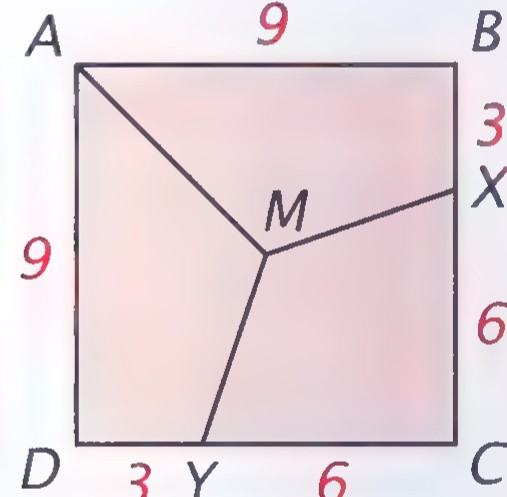
Dividing a Cake. For Acute Alice’s birthday, Obtuse Ollie bought a square cake, 9 inches on each side. They wanted to cut it into three equal pieces.*
Ollie was going to cut the cake as shown at the left below, but Alice said she wouldn’t want the piece in the middle.
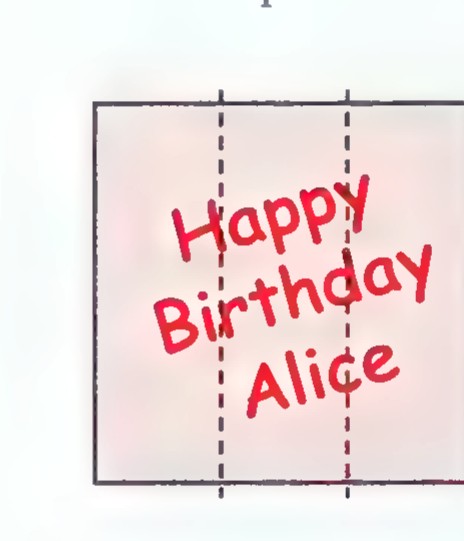
- Why not?
Alice did some figuring and cut the cake as shown at the right above.
- Use your ruler to make an accurate copy of the figure. Draw lines from M, the center of the cake, to B, C, and D.
- Find the areas of the six triangles formed.
- Does Alice’s plan produce three “equal” pieces? Explain.
- Can you figure out a way to cut the cake into five “equal” pieces? If so, show how you would do it.
*Why Do Buses Come in Threes? The Hidden Mathematics of Everyday Life, by Rob Eastaway and Jeremy Wyndham (Wiley, 1998).
p. 357
Shingle Roof. A general rule for a wood-shingle roof is to “estimate 4 bundles (1,000 shingles) for every 100 square feet of roof and 3 pounds of nails for 100 square feet.”*
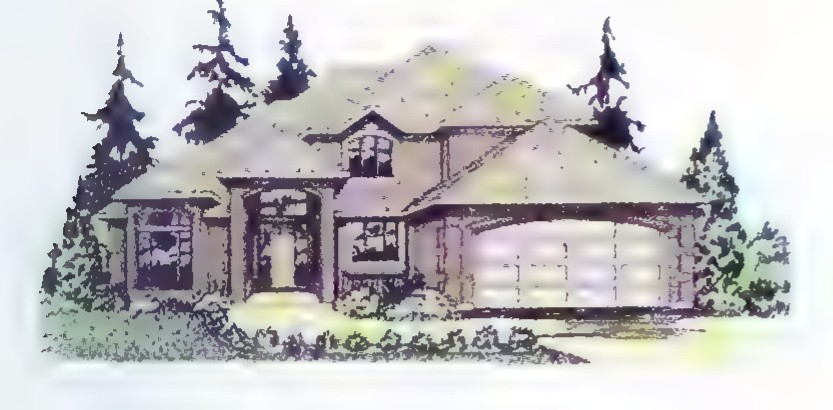
Several sections of the roof of the house shown above have the shape of isosceles triangles. In the scale drawing of one section below, 1 inch represents 8 feet.
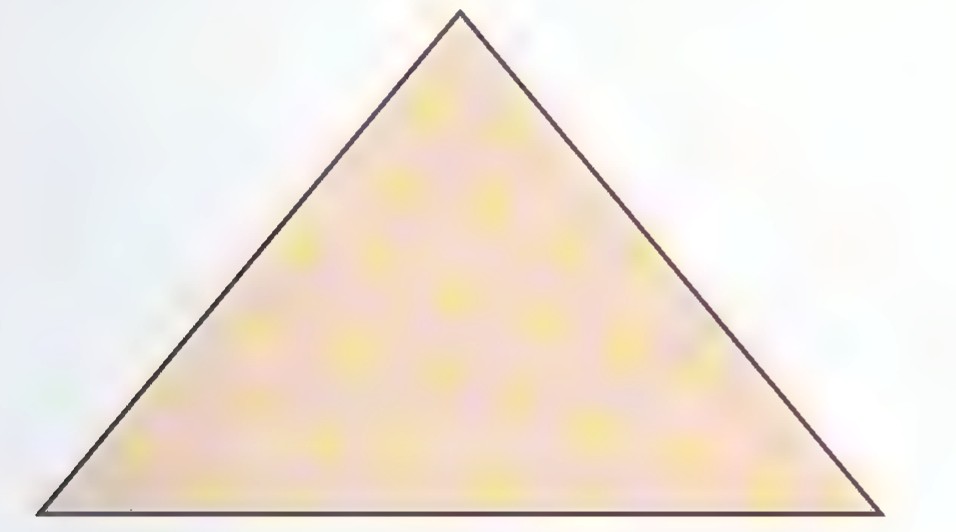
- Measure the drawing with your ruler so that you can calculate the area of this section in square feet. Describe your method.
- About how many shingles are needed for this section?
- About how many bundles of shingles are needed?
- What weight of nails is needed?
Grid Exercise. On graph paper, draw a pair of axes extending 20 units to the right and 20 units up from the origin.
Plot the following points and connect them with line segments to form △ABC: A(1, 2), B(16, 6), C(5, 17).
Is △ABC equilateral, isosceles, or scalene? Explain.
Add some extra lines to enclose △ABC in a rectangle so that you can find its exact area in terms of the unit squares of the graph paper.
What kind of numbers are the lengths of the sides of △ABC?
What kind of number is the area of △ABC?
Set III
Heron’s Theorem. Heron, a Greek mathematician who lived in Alexandria in the first century A.D., derived a formula for the area of a triangle in terms of the lengths of its sides.
His formula, sometimes called Heron’s Theorem, says that the area of a triangle with sides a, b, and c is , where s is half of the triangle’s perimeter. Before you try the formula out, suppose that there are three triangles with the following sides.
Triangle 1: 5, 5, and 6.
Triangle 2: 5, 5, and 8.
Triangle 3: 5, 5, and 10.
- Which triangle do you think has the greatest area?
- Use Heron’s Theorem to find the area of each triangle.
- One of the “triangles” isn’t really a triangle. Which one and why not?
Now try this. Suppose there are two triangles with the following sides.†
Triangle 4: 4, 6, and 8.
Triangle 5: 400, 600, and 1000.
- Which do you think has the greater area?
- Use Heron’s Theorem to find it.
*How to Design and Build Your Own Home, by Lupe DiDonno and Phyllis Sperling (Knopf, 1981).
†Riddles of the Sphinx, by Martin Gardner (Mathematical Association of America, 1987).
p. 358
Lesson 4: Parallelograms and Trapezoids
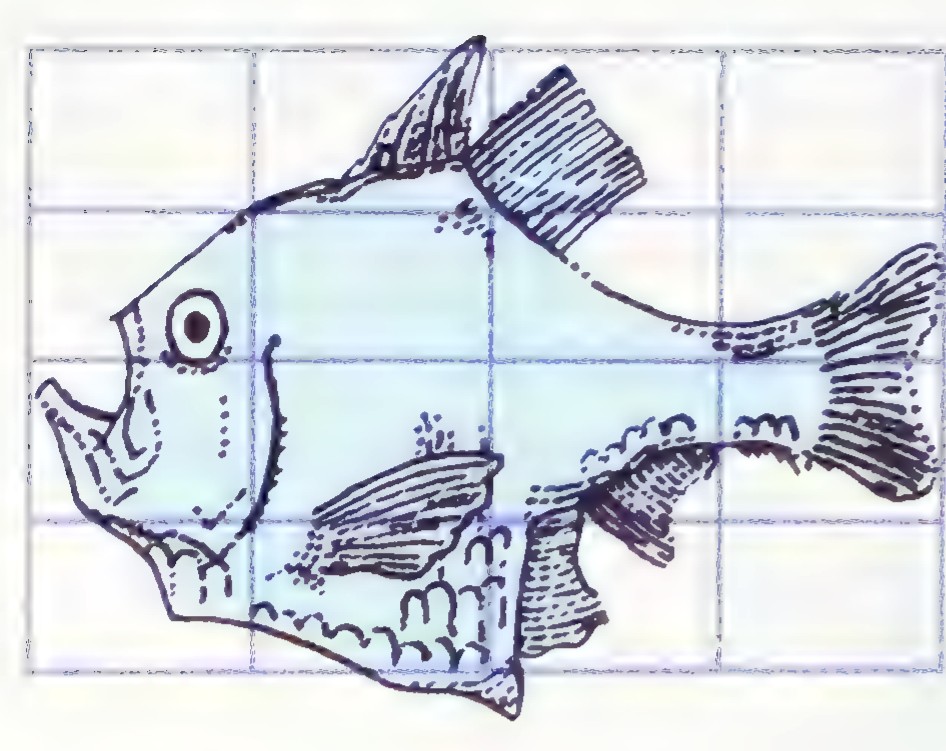
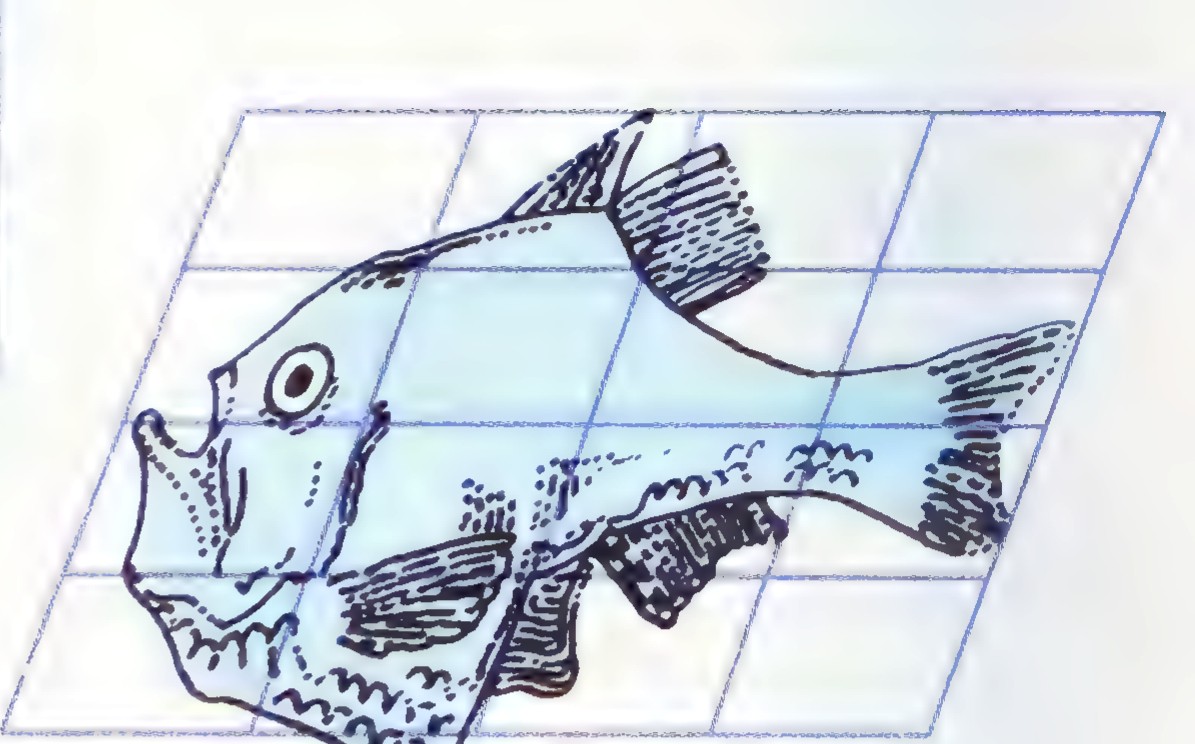
Galileo once said that the book of nature is written in characters of geometry, “without which it is humanly impossible to understand a single word.”* A remarkable application of geometry to the study of biological shapes was made by the great British scientist D’Arcy Thompson. In his book On Growth and Form, he showed many examples of how one species of animal can be considered to be a geometric transformation of another.† For example, the fish shown on the rectangular grid at the left above is of the species Argyropelecus olfersi. If the rectangles are transformed into the parallelograms shown at the right above, the shape of the fish becomes that of a species of an entirely different genus and has the name Sternoptyx diaphana.
How do you think the pictures of the two fish compare in size? The answer to this question depends on how the rectangles in the first grid compare in area with the parallelograms in the second. In this lesson, we will prove that the formulas for the areas of these two figures are the same.
*Il Saggiatore, 1623.
†D’Arcy Thompson, “On the Theory of Transformations, or the Comparison of Related Forms,” On Growth and Form, edited by J. T. Bonner (Cambridge University Press, 1961).
p. 359
Altitudes
A rectangle
A parallelogram
A trapezoid
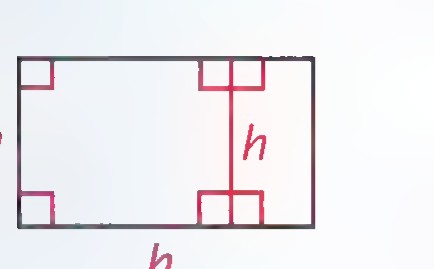
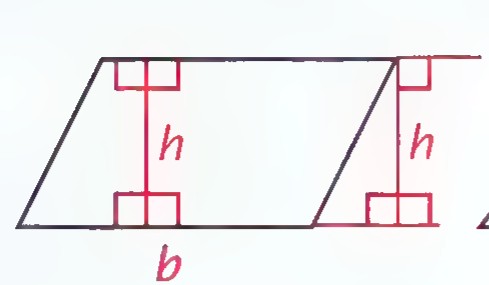
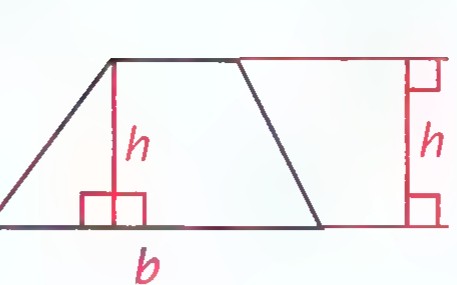
Before we do so, it is convenient to extend the idea of altitude from triangles and rectangles to parallelograms and trapezoids. As in our previous use of the word altitude, we will use it to refer to either a number or a line segment. An altitude of any quadrilateral that has parallel sides is the distance between them. Altitude can also refer to any perpendicular line segment that connects points on the lines of the parallel sides.
Theorem 40
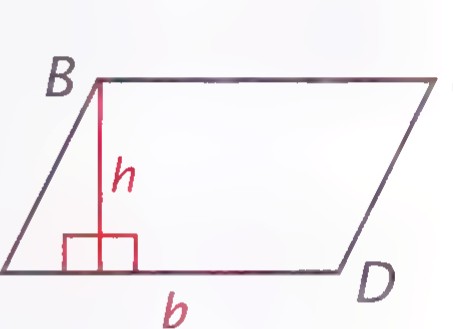
The area of a parallelogram is the product of any base and corresponding altitude.
Given: ABCD is a parallelogram with base b and altitude h.
Prove:
Proof
Draw diagonal BD to divide ABCD into two triangles. △CDB ≅ △ABD by SSS. Because and , .
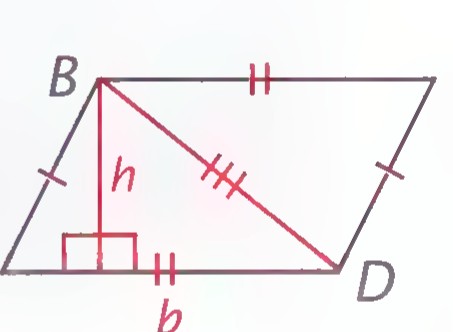
; so .
Although the area of a trapezoid cannot be found quite as easily, the formula for it can be derived by similar reasoning.
Theorem 41
The area of a trapezoid is half the product of its altitude and the sum of its bases.
Given: ABCD is a trapezoid with bases a and b and altitude h.
Prove:
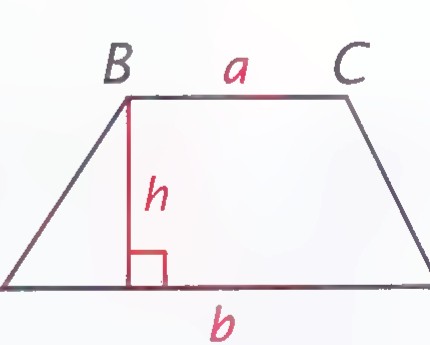
Proof
Draw diagonal BD to divide ABCD into two triangles.
and .
;
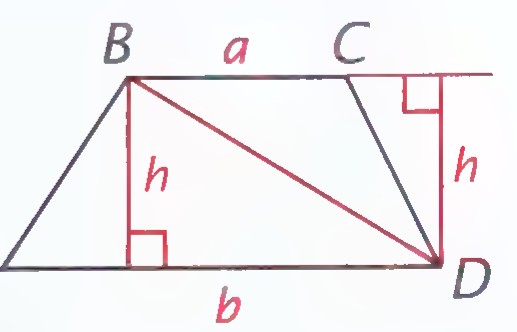
so .
p. 360
Exercises
Set I
From Above. The photograph below shows an automobile loading area in Belgium.*
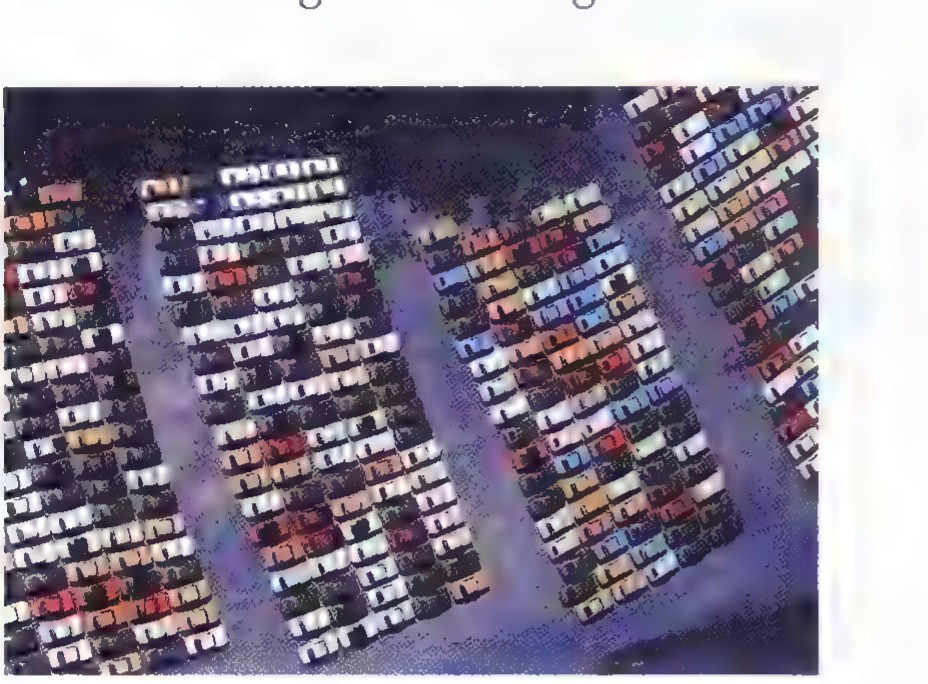
- What fact about the areas of two parallelograms with equal bases and equal altitudes do the figures below suggest?
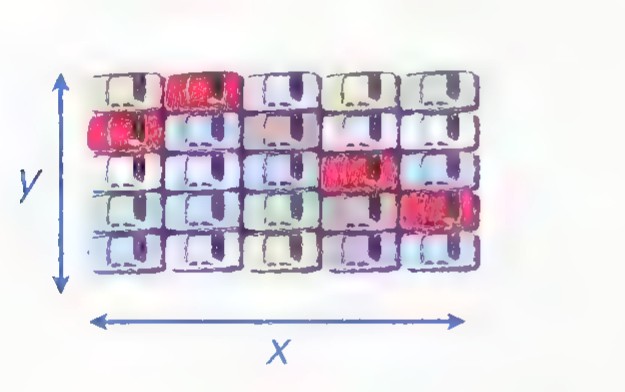
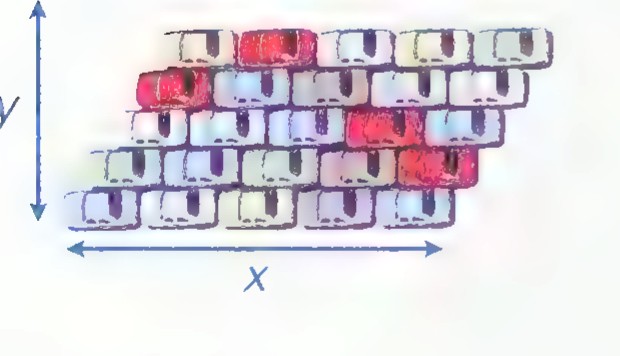
If each car occupies a space 14 feet long and 8 feet wide,
what is the approximate area of each figure?
what is the perimeter of the first figure?
How do the perimeters of the two figures compare?
If two parallelograms have the same area, does it follow that they have the same perimeter?
Tax Assessor Formula. You may recall that the tax assessors in ancient Egypt used the formula
to find the areas of fields in the shape of quadrilaterals.†
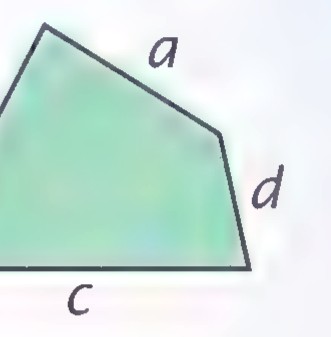
The letters a, b, c, and d represent the lengths of the consecutive sides.
- Show that this formula gives the correct area for a square.
- Does it give the correct area for a rectangle? Explain.
- Use the Egyptian formula to find the area of the parallelogram below.
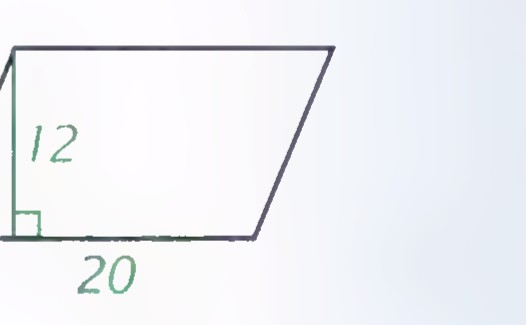
- Is the result correct? Explain.
- Use the Egyptian formula to find the area of the trapezoid below.
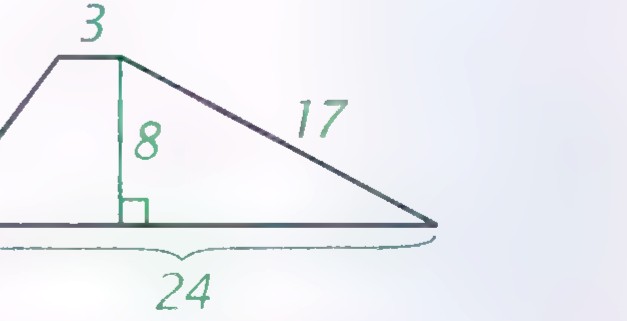
- Is the result correct? Explain.
*Below from Above: Aerial Photography, by Georg Gerster (Abbeville Press, 1986).
†Page 31.
p. 361
- Use the Egyptian formula to find the area of the quadrilateral below.
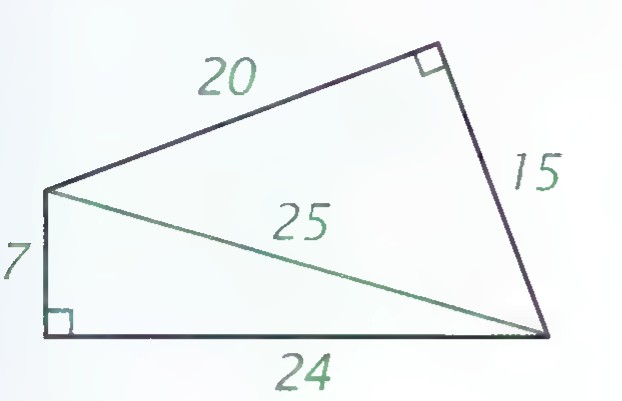
- Is the result correct? Explain.
- Use the Egyptian formula to find the area of the rhombus below.
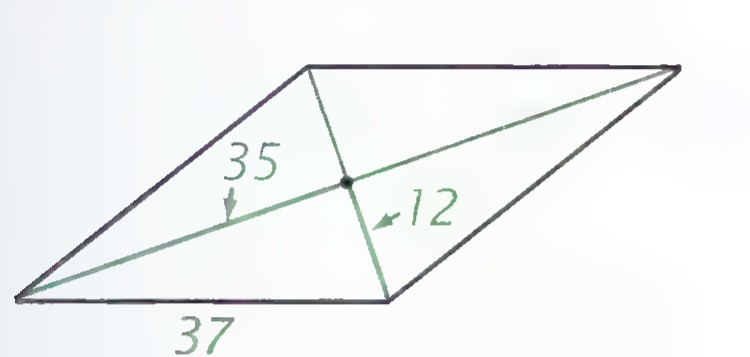
- Is the result correct? Explain.
- Why do you think the tax assessors continued to use their formula even if they knew it didn’t always give the correct answer?
Pegboard Quadrilaterals. The figure below shows pegs and rubber bands on a pegboard.* The red rubber band around the four pegs in the corner forms a square with an area of 1 unit.
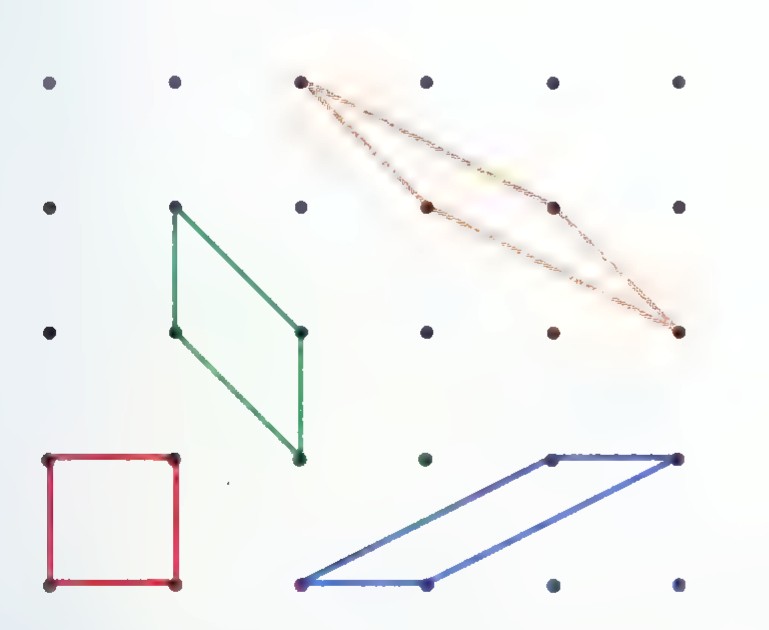
- What kind of figure does the blue rubber band form?
- What is its area? Explain.
- What kind of figure does the green rubber band form?
- What is its area?
- What kind of figure does the orange rubber band form?
- What is its area? Explain.
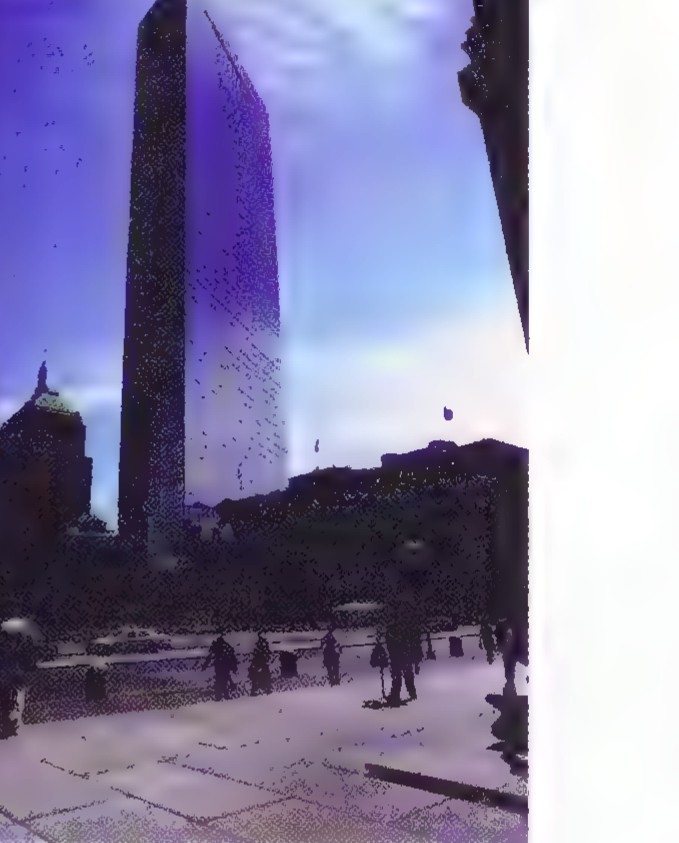
John Hancock Tower
Skyscraper Design. The John Hancock Tower in Boston has an unusual design. Its floor plan, shown below, is in the shape of a parallelogram from which two right triangles have been removed.
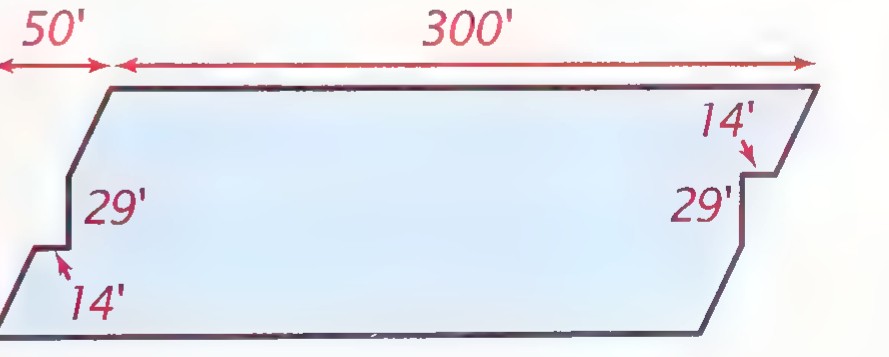
- Find the area of its base in square feet.
The building is 790 feet tall.
- Find the area of one of its larger sides.
*Geometry and the Imagination, by David Hilbert and Stefan Cohn-Vossen (reprint, American Mathematical Society, 1999).
p. 362
Shuffleboard Court. The figure below shows the design of one end of an outdoor shuffleboard court.
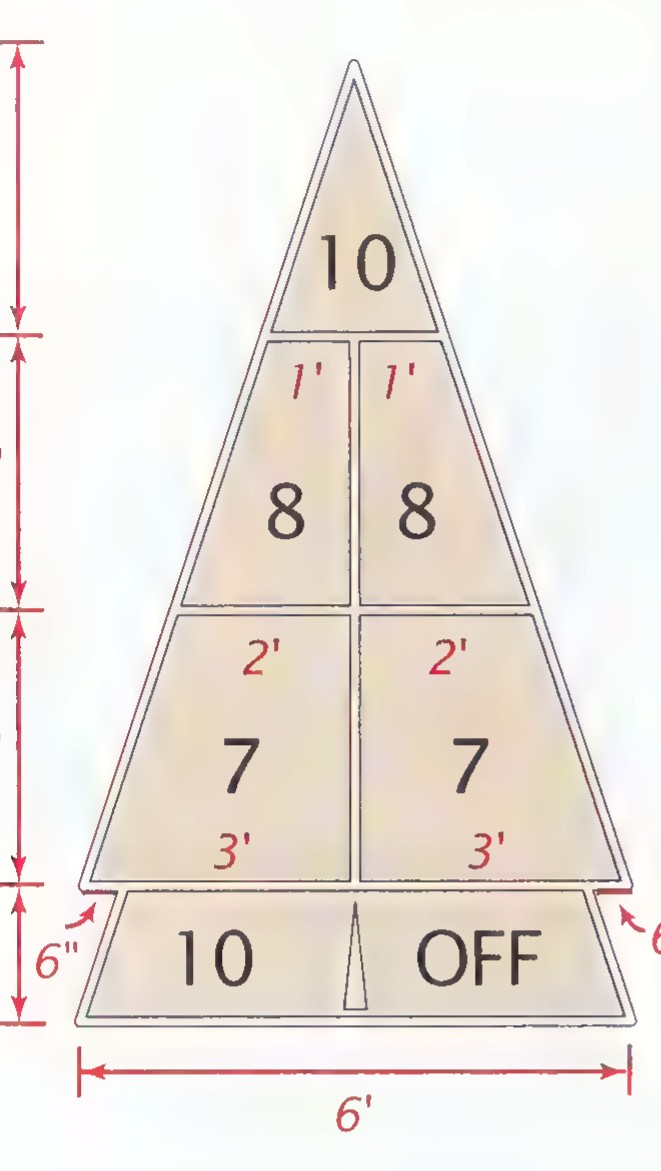
Find the areas of the following regions (zones) in square feet.
- Zone “10” at the top.
- One of the “8” zones.
- One of the “7” zones.
- The “10 OFF” penalty zone including the triangular wedge in its center.
- The total area of all six zones.
Set II
Inaccessible Field. A way to find the area of a field when its diagonals cannot be conveniently measured is shown in the figure at the top of the next column, which is from an old geometry book.*
- Describe how the area of the field, ABCD, can be found from the areas of other regions in the figure.
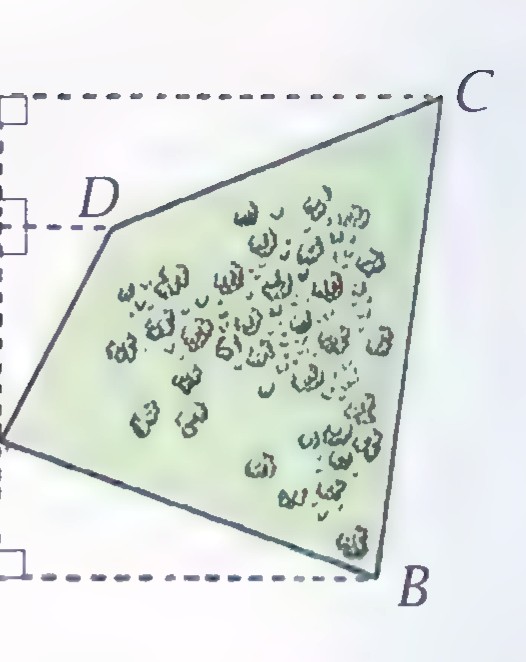
- Copy the figure and mark the following distances on it: EC = 60 m, FD = 15 m, GB = 52 m, EF = 18 m, FA = 30 m, AG = 18 m.
Use these distances to find the following areas in square meters.
- .
- .
- .
- .
- .
A Fold-and-Cut Experiment.
- Refer to the figure below as a guide in beginning the following experiment.
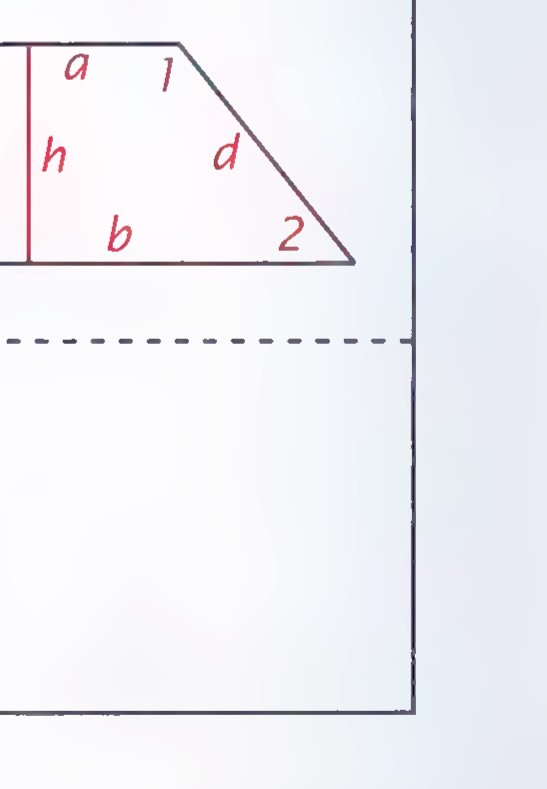
- Draw a large trapezoid on the upper half of a sheet of lined paper; use the lines on the paper to ensure that its bases are parallel.
*First Steps in Geometry, by G. A. Wentworth and G. A. Hill (Ginn, 1901).
p. 363
- Write the letters a, b, c, d, and h to represent the lengths of the bases, legs, and altitude inside the trapezoid as shown in the figure. Label the two indicated angles 1 and 2.
- Fold the paper in half so that, when you cut out your trapezoid, you get a second one identical with it.
- Label the second trapezoid in the same way that you labeled the first.
- Place the two trapezoids side by side to form a single quadrilateral and so that the legs labeled d coincide.
- Tape the trapezoids on your paper.
- The bases of the two trapezoids seem to line up with each other. Explain why they do.
- What kind of quadrilateral do the trapezoids form when arranged in this way?
- How do you know?
- Express the area of the quadrilateral in terms of letters on the two pieces.
- How does your result lead to the formula for the area of a trapezoid?
Trapezoidal Rule. The “trapezoidal rule” is one of the methods used in calculus to estimate the area under a curve.
For example, to estimate the area of the yellow region in the figure below, we can add the areas of the three trapezoids.
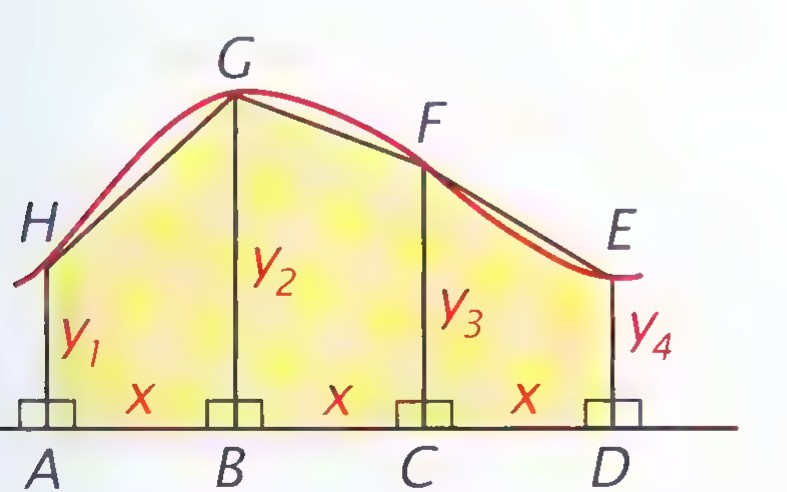
How do you know from the figure that these quadrilaterals are trapezoids?
Write expressions in terms of , , , , and for their areas.
Show that the sum of the areas of the three trapezoids is .
Use this expression to estimate the area of the yellow region if , , , , and .
The curve below, called a parabola, has the equation .
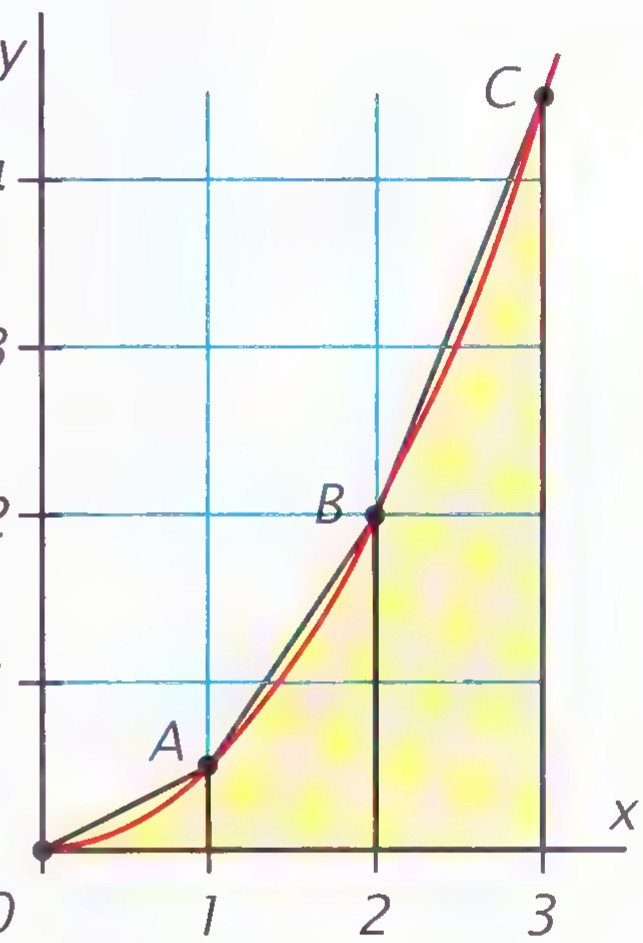
The x-coordinate of point A is 1; so its y-coordinate is .
- What are the coordinates of points B and C?
- Use the trapezoidal rule to find the area of the yellow region.
Your answer is the approximate area of the region between the parabola and the x-axis from 0 to 3.
- Is your answer larger or smaller than the area under the parabola?
p. 364
SAT Problem. The figure below appeared in a problem on an SAT exam. The problem was to find the area of the unshaded region.
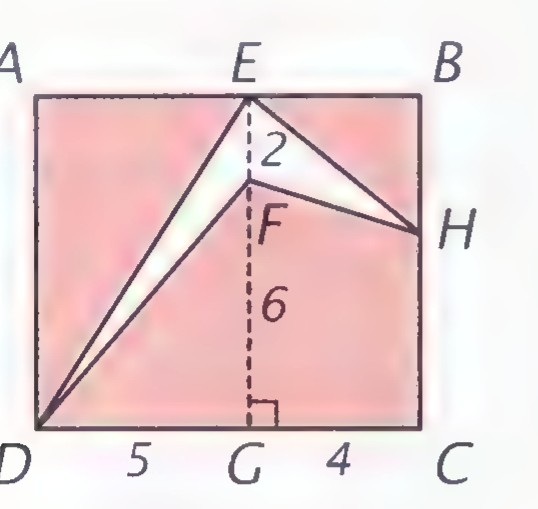
Although the figure was described as a rectangle, there is not enough information given to make it possible to find the areas of some of the regions in it.
- Which regions are they?
- Explain.
Nevertheless, it is possible to find the area of the unshaded region.
- What is it?
- Explain how you found it.
Set III
Chessboard Mystery. This puzzle about a chessboard appeared in the Brooklyn Daily Eagle on February 14, 1897.
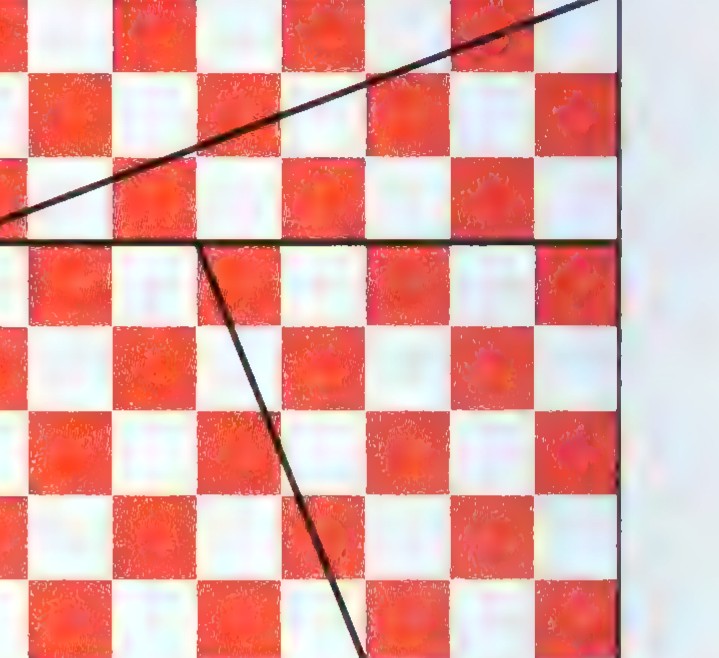
The board is divided into two right triangles and two trapezoids.
- Taking the area of one of the small squares of the board as 1 unit, find the area of each of the four pieces. Do the areas add up to the number that you would expect? Explain.
- Draw a large copy of the board, letting each side be 8 inches. Cut out the four pieces and try to rearrange them to form a rectangle having a different shape. If you succeed, make a drawing of your solution.
- What is the area of the rectangle?
- The result seems to contradict the Area Postulate. Why?
p. 365
Lesson 5: The Pythagorean Theorem
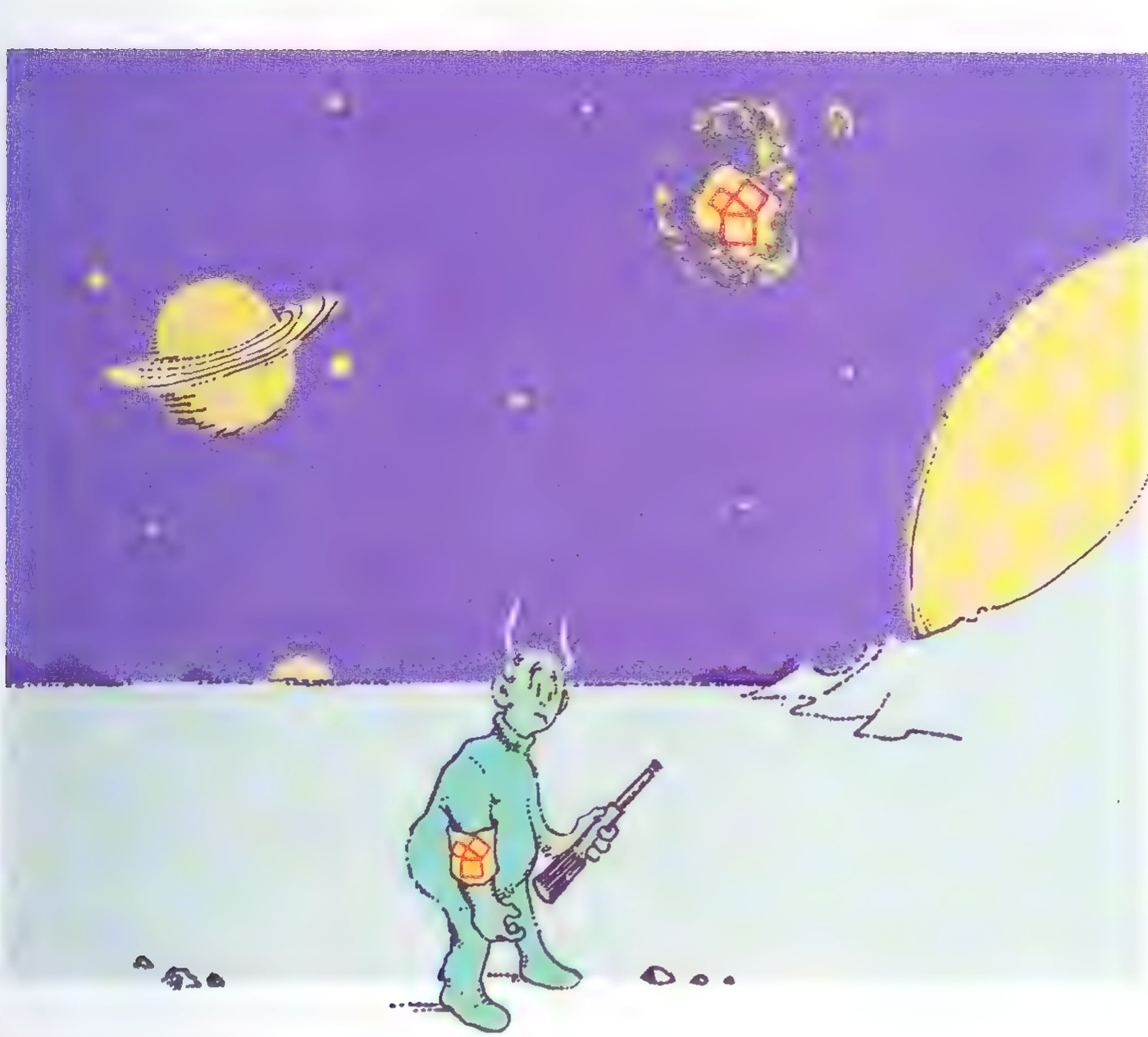
At the beginning of the twentieth century, some scientists believed that intelligent creatures might live on Mars. Among them was the American astronomer Percival Lowell, whose work led to the discovery of Pluto. Lowell thought that he could see canals on the surfaces of Mars through his telescope and speculated that they might have been dug by a Martian civilization to irrigate their dry land with water melted from polar ice caps.
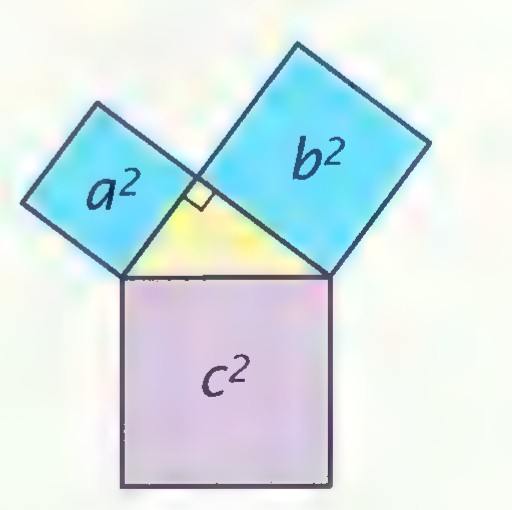
To let the Martians know that there was also intelligent life on Earth in a time long before any kind of space travel was possible, it was proposed that gigantic geometric figures be used to convey a message. For example, broad lanes of trees might be planted in Siberia to form a huge right triangle. Or canals might be dug in the Sahara desert to do the same thing; kerosene could be poured on the water in them and set on fire at night for the Martians to see through their telescopes. A geometric figure thought to be especially appropriate for this purpose is shown at the right. You probably recognize it as illustrating what is perhaps the most famous theorem in all of geometry.
p. 366
Theorem 42 (The Pythagorean Theorem)
The square of the hypotenuse of a right triangle is equal to the sum of the squares of its legs.
Many different proofs have been developed for the Pythagorean Theorem—more, in fact, than for any other theorem of geometry. Our proof, based on area, is the one to which you were introduced in Chapter 2.
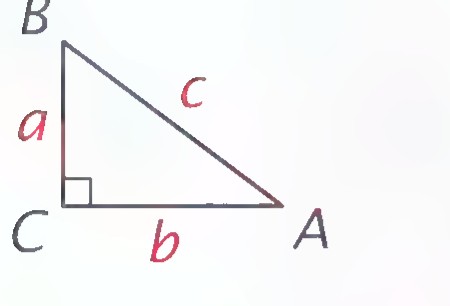
Given: Right △ABC with legs a and b and hypotenuse c.
Prove:
Proof
Construct a square DEFG with sides of length . Draw lines to divide the square into four right triangles and a quadrilateral as shown in the figure at the left. The four triangles are congruent to △ABC (SAS); so the length of each side of the quadrilateral HIJK is c.
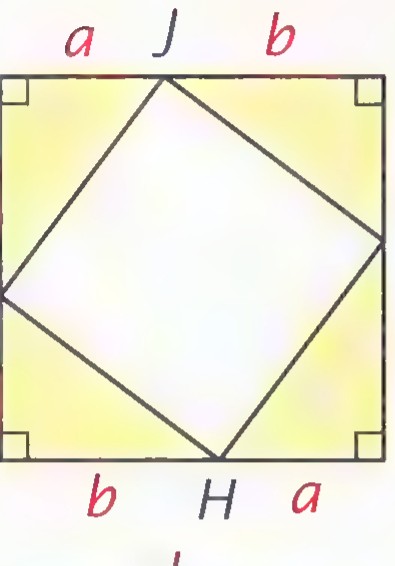
If x and y are the measures of the acute angles of △ABC, then because the acute angles of a right triangle are complementary. Numbering the angles of quadrilateral HIJK as shown in the next figure at the left, we have
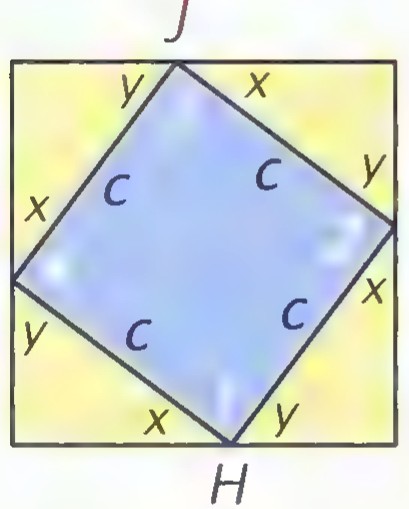
so . Because HIJK is equilateral and equiangular, it is a square.
According to the Area Postulate, the area of the entire figure is the sum of the areas of its parts; so
Doing the algebra, we get
Now that we have proved the Pythagorean Theorem, look at the figure at the left. The lengths of the sides of △ABC are 20, 21, and 29. Is it a right triangle? If it is, then 20² + 21² must be equal to 29². Doing the arithmetic gives 20² = 400, 21² = 441, and 29² = 841. Since 400 + 441 = 841, 20² + 21² = 29². Can we now conclude that △ABC must be a right triangle? Surprisingly, the answer is not yet!
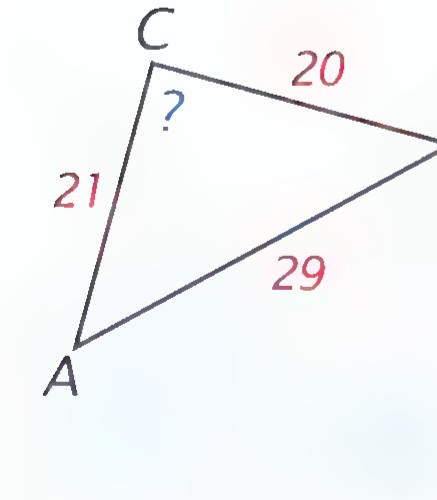
To conclude that a triangle with sides a, b, and c is a right triangle because would be to assume that the converse of the Pythagorean Theorem is true. Remember that, even though a statement is true, its converse may be false. Conveniently, the converse of the Pythagorean Theorem is true. It is stated below, and its proof is included in the exercises.
Theorem 43. Converse of the Pythagorean Theorem
If the square of one side of a triangle is equal to the sum of the squares of the other two sides, the triangle is a right triangle.
p. 367
Exercises
Set I
Batik Design. A special case of the Pythagorean Theorem is illustrated in this Javanese batik design.*
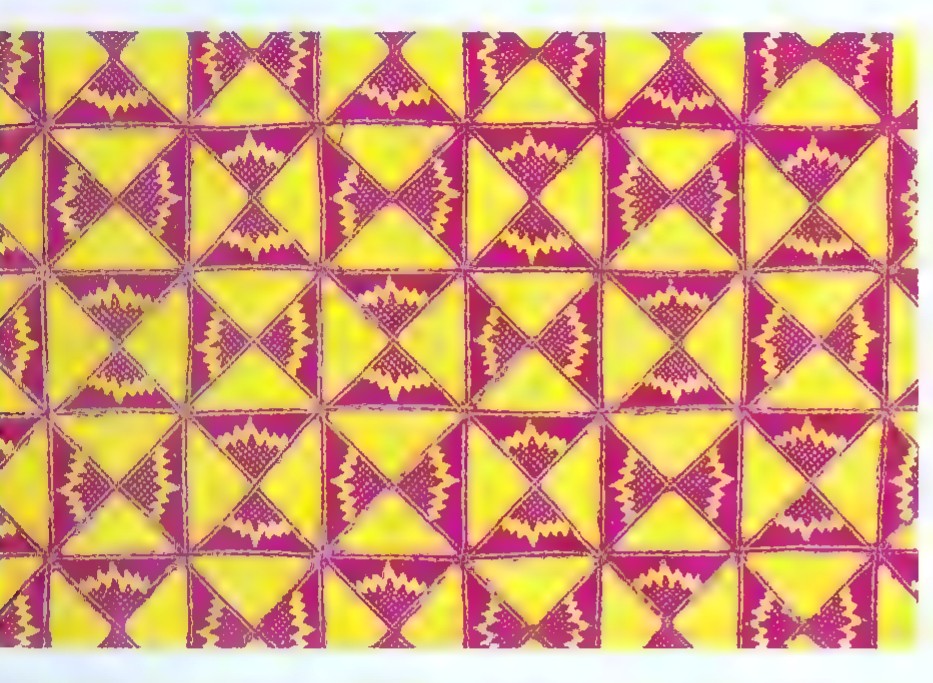
- Draw one of the triangles and the squares on its sides.
- If the area of the triangle is 1 unit, what are the areas of the three squares on its sides?
- How does the way in which these areas are related illustrate the Pythagorean Theorem?
Theorem 43. Complete the following proof of Theorem 43 (the converse of the Pythagorean Theorem) by giving the missing reasons.
If the square of one side of a triangle is equal to the sum of the squares of the other two sides, the triangle is a right triangle.
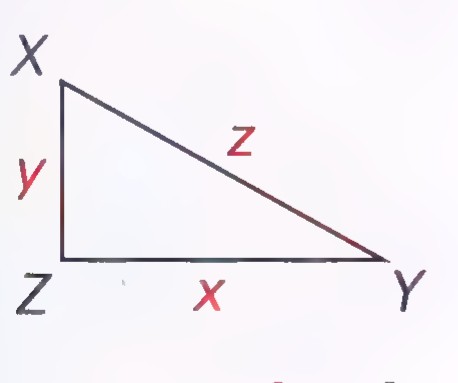
Given: △XYZ with .
Prove: △XYZ is a right triangle.
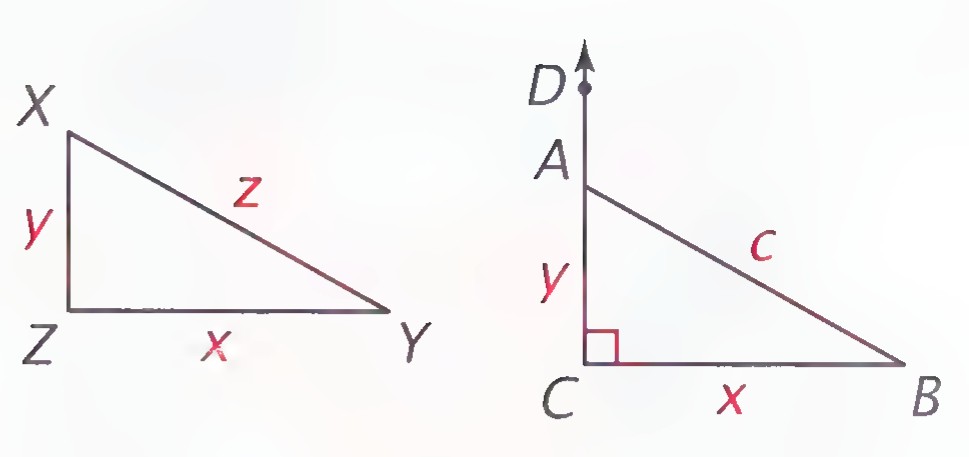
Proof
- Draw CB so that CB = x.
- Draw ray CD so that ∠C = 90°.
- Choose point A on ray CD so that CA = y.
- Draw AB.
- Letting AB = c, .
- Since , ; so c = z.
- △XYZ ≅ △ABC.
- ∠Z = ∠C.
- ∠Z = 90°.
- ∠Z is a right angle.
- △XYZ is a right triangle.
Squares on the Sides. In each of the following figures, squares have been drawn on the sides of the triangles.
In the figure below, the area of the yellow square is 144 and the length of each side of the blue square is 35.
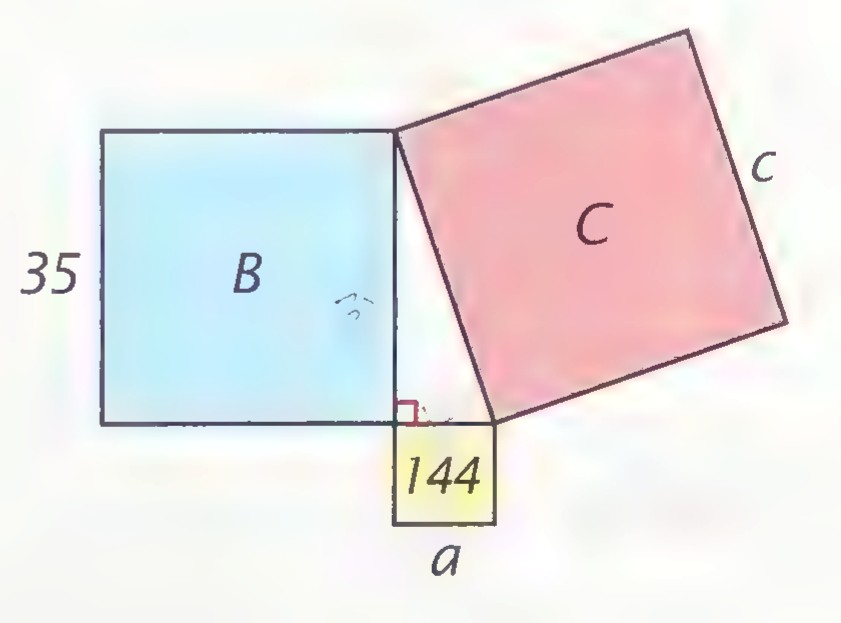
- Find length a.
- Find area B.
- Find area C.
- Find length c.
*Symmetry: A Unifying Concept, by István Hargittai and Magdolna Hargittai (Shelter Publications, 1994).
p. 368
In the figure below, the areas of the green and orange squares are 100 and 676, respectively.
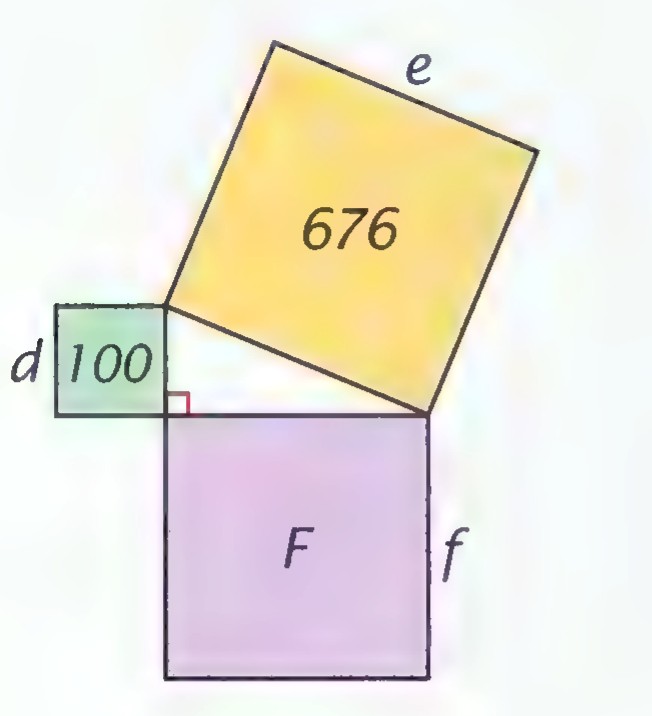
- Find length d.
- Find length e.
- Find area F.
- Find length f.
In the figure below, the length of each side of the brown square is 22 and the areas of the yellow and pink squares are 256 and 225, respectively.
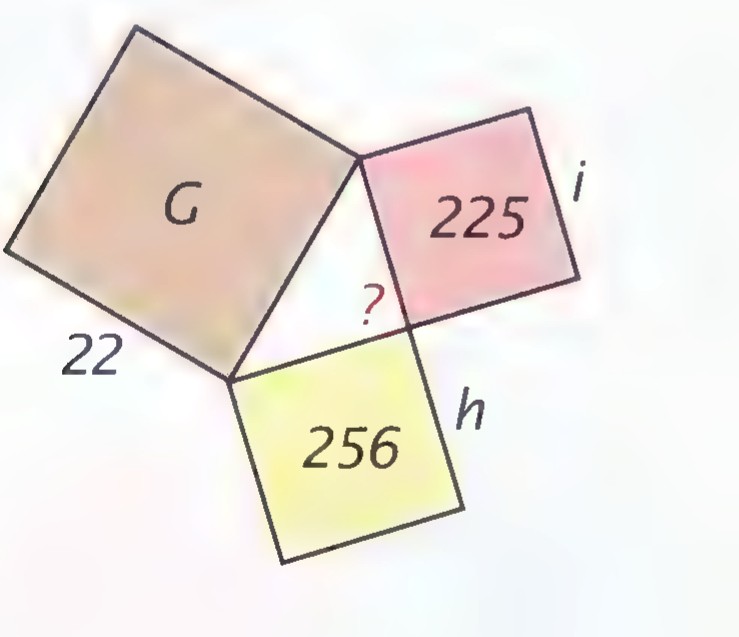
- Find area G.
- Find length h.
- Find length i.
- Is the triangle a right triangle? Explain.
In the figure at the top of the next column, the lengths of the sides of the purple and blue squares are 48 and 55, respectively, and the area of the orange square is 5329.
- Find area K.
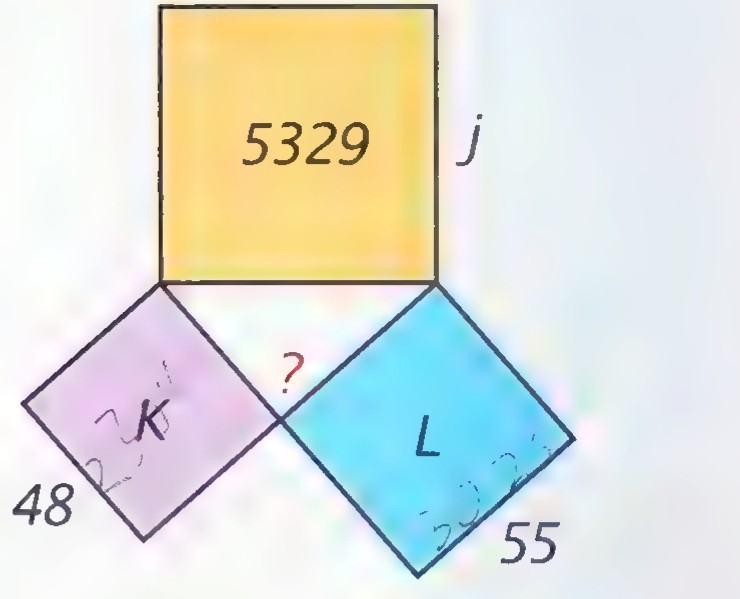
- Find area L.
- Find length j.
- Is the triangle a right triangle? Explain.
Ollie’s Triangles. Obtuse Ollie drew two triangles and told Alice that they were examples of “” and “.” Alice told him that he must be wrong but, after seeing the triangles, she had to admit that both Ollie and one of the triangles were right.
Draw a triangle for which it is true that
- .
- .
Set II
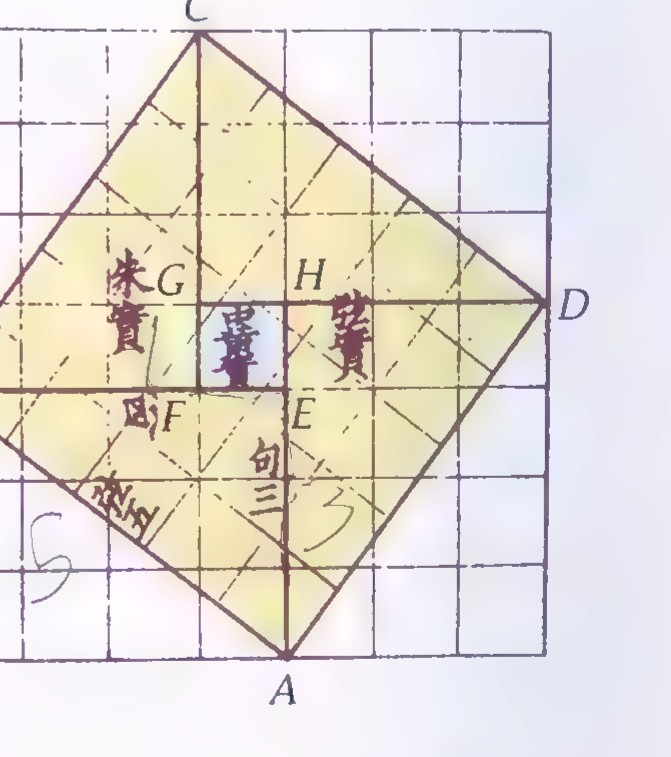
Was Pythagoras Chinese? The figure below appears in the Chou Pei Suan Ching, the oldest Chinese mathematics text known.* (The letters have been added for reference.)
*Was Pythagoras Chinese?, by Frank J. Swetz and T. I. Kao (Pennsylvania State University Press, 1977).
p. 369
If the area of square EFGH is 1 unit, what is the area of
- △ABE?
- the yellow region?
- square ABCD?
In the version of the Chinese figure below, the sides of the eight right triangles are a, b, and c.
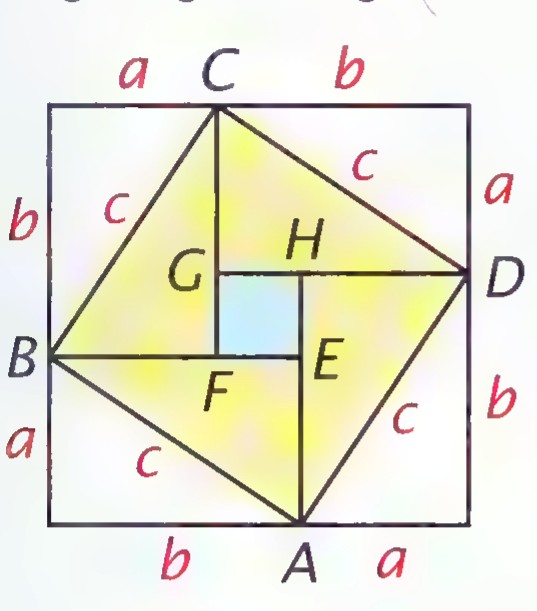
In terms of a and b, what is the area of
- △ABE?
- the yellow region?
- square EFGH?
- Write two expressions for the area of square ABCD, one in terms of a and b and the other in terms of c.
- Use these two expressions to derive the Pythagorean Theorem.
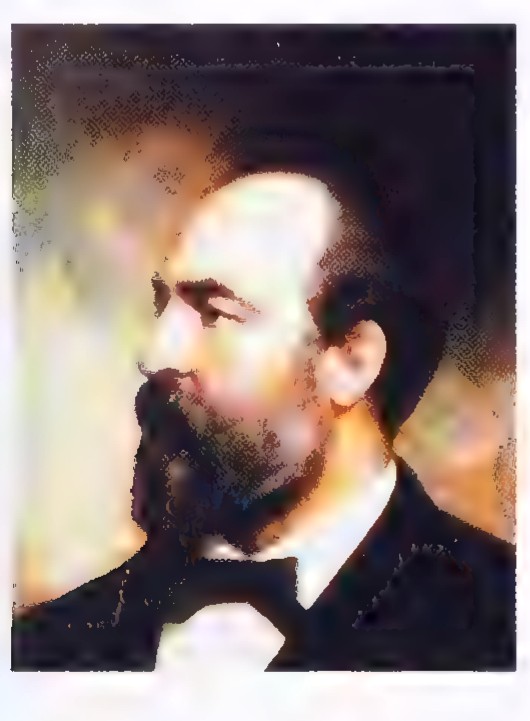
Garfield’s Proof. President Garfield invented an original proof for the Pythagorean Theorem in 1876 when he was a member of the House of Representatives.
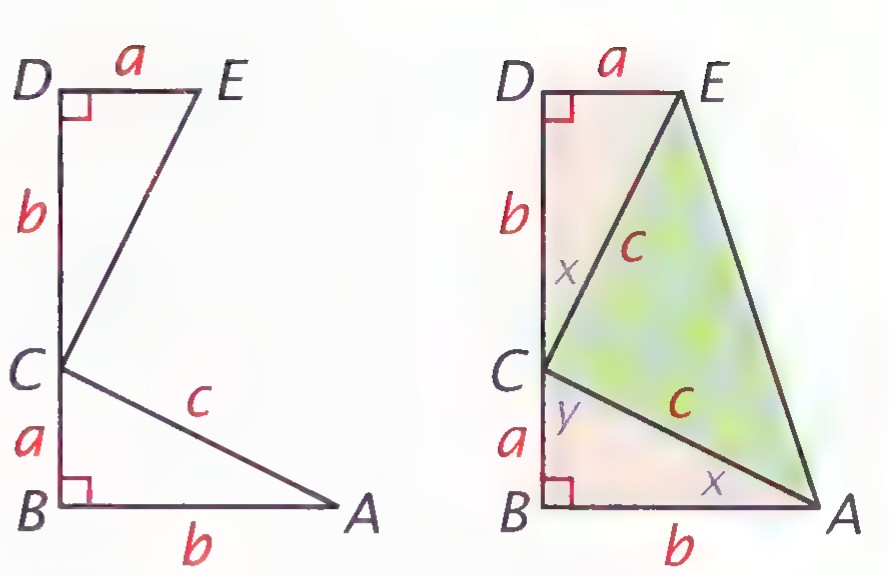
Starting with right △ABC, he extended side BC upward and constructed right △CDE so that its legs were equal to the legs of △ABC.
- Why is △CDE ≅ △ABC?
- Why are the two angles labeled x in the second figure equal?
- In △ABC, why is ?
- What kind of angle is ∠ECA?
- What kind of quadrilateral is ABDE?
- Write two different expressions for the area of ABDE.
- Use these two expressions to finish Garfield’s proof.
Angle-Bisector Surprise. In this figure, ABDE is the square on the hypotenuse of right △ABC.
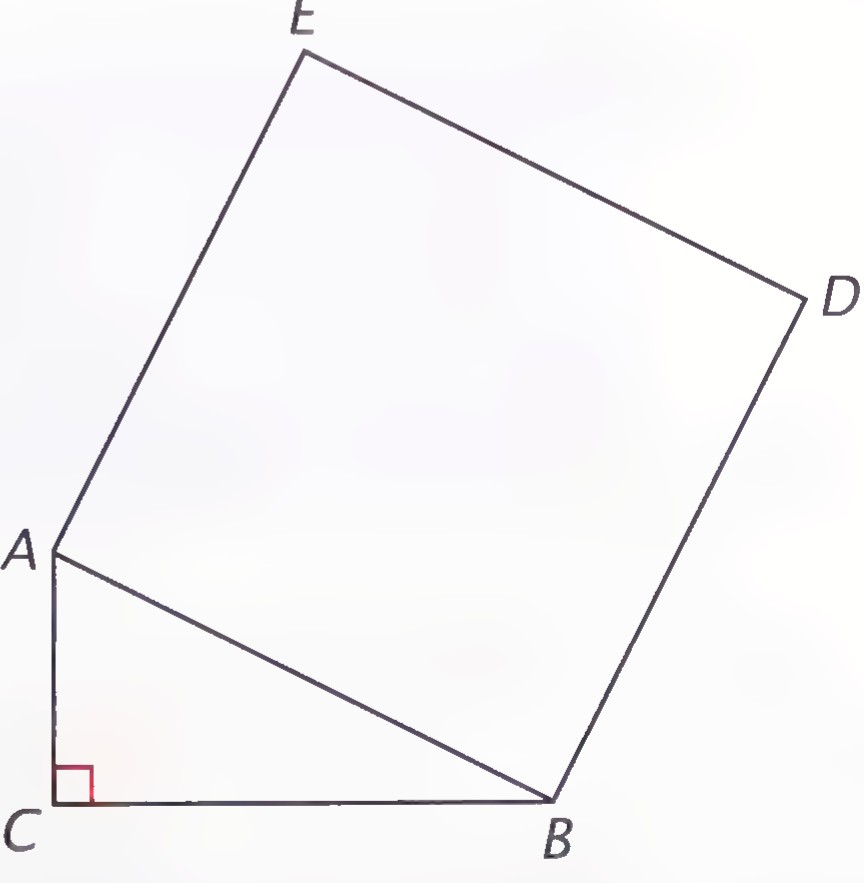
- Trace the figure and then use your straightedge and compass to bisect ∠C.
p. 370
- What does the line appear to do to ABDE?
In the figure below, three more triangles congruent to △ABC have been drawn on the other sides of ABDE to form a larger square, CFGH.*
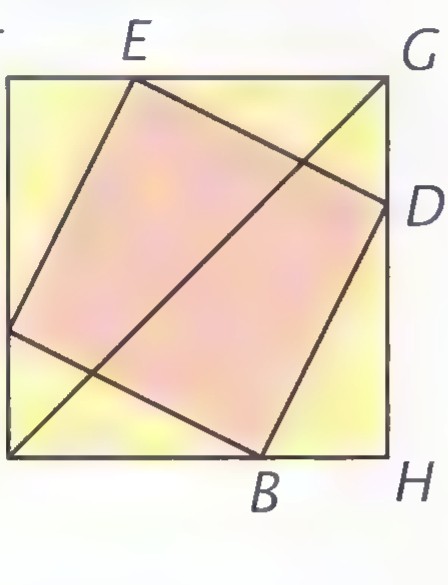
- What relation does CG have to ∠ACB? Explain.
- What does CG do to square ABDE?
Set III
Twenty Triangles. A puzzle sold in toy or game stores consists of 20 identical pieces. Each has the shape of a right triangle in which one leg is twice as long as the other.
Make the puzzle by cutting 20 triangles like the one shown below from heavy paper.
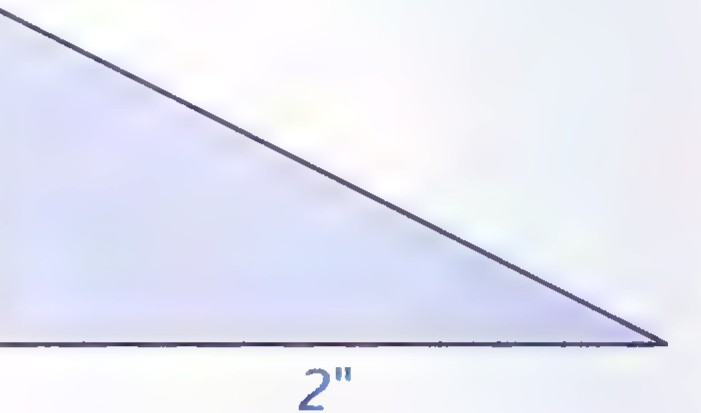
The figure below shows a convenient way to draw them on a 4-inch by 6-inch file card.
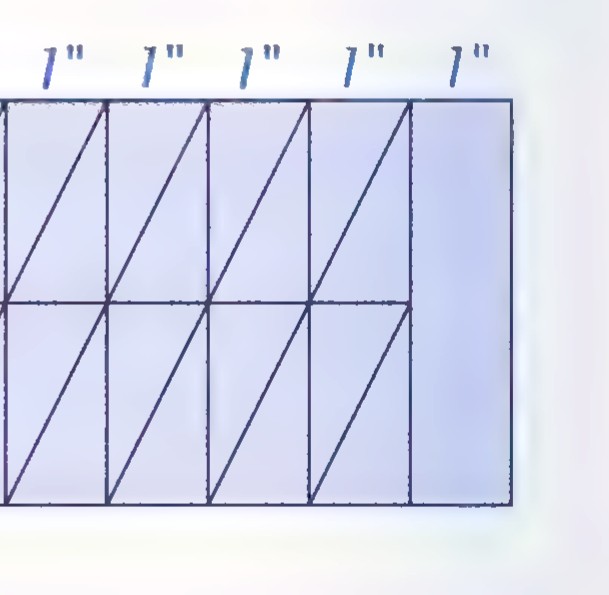
The easy part of the puzzle is to arrange the pieces to form two solid squares. The hard part is to then rearrange the pieces to form a single solid square.
- If you are able to solve the hard part, make a drawing to illustrate your solution. (Hint: It may help to think about the areas of the three squares and how they are related to the lengths of the sides of the triangles.)
- What is it about this puzzle that makes it so tricky to construct the third square?
*Proofs Without Words: Exercises in Visual Thinking, by Roger B. Nelsen (The Mathematical Association of America, 1993).
p. 371
Summary and Review
Basic Ideas
| Altitude of a quadrilateral | 359 |
| Altitude of a triangle | 352 |
| Area | 338 |
| Polygonal region | 339 |
Postulates
- The Area Postulate. Every polygonal region has a positive number called its area such that
- congruent triangles have equal areas and
- the area of a polygonal region is equal to the sum of the areas of its nonoverlapping parts. 339
- The area of a rectangle is the product of its base and altitude. 345
Theorems
Corollary to Postulate 9. The area of a square is the square of its side. 345
- The area of a right triangle is half the product of its legs. 352
- The area of a triangle is half the product of any base and corresponding altitude. 353
Corollary. Triangles with equal bases and equal altitudes have equal areas. 353
- The area of a parallelogram is the product of any base and corresponding altitude. 359
- The area of a trapezoid is half the product of its altitude and the sum of its bases. 359
- The Pythagorean Theorem. The square of the hypotenuse of a right triangle is equal to the sum of the squares of its legs. 366
- If the square of one side of a triangle is equal to the sum of the squares of the other two sides, the triangle is a right triangle. 366
Exercises
Set I
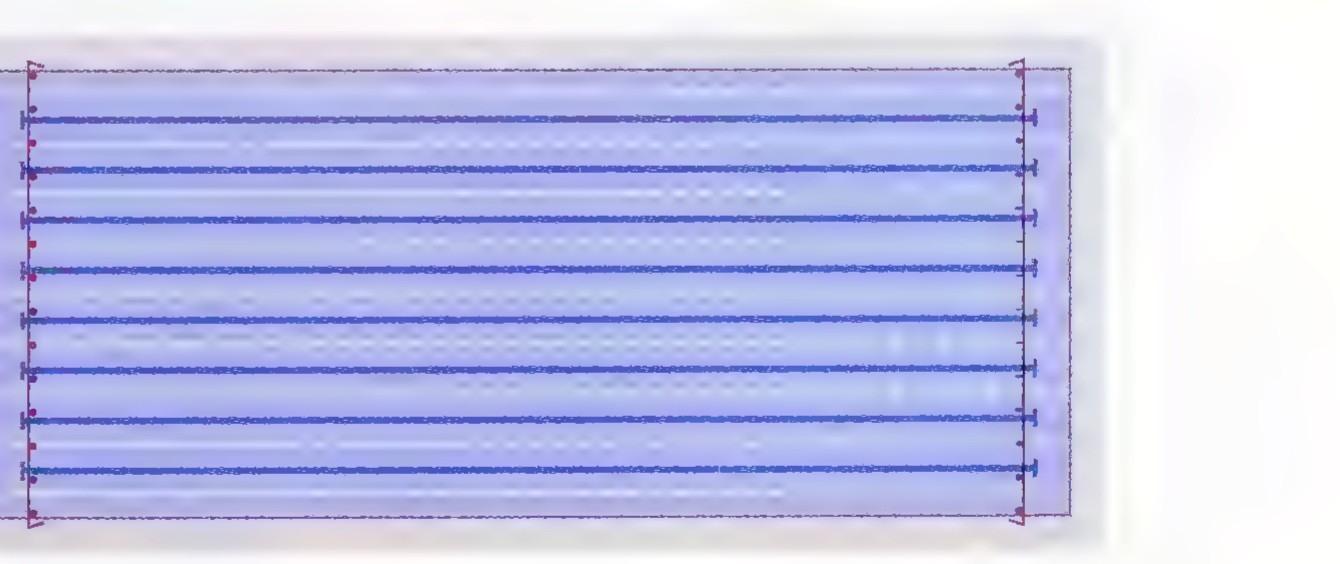
Olympic Pools. Olympic pools are 50 meters long and 21 meters wide.
For the Olympic games, the pool is divided into eight lanes, each 2.5 meters wide.
- What is the area of each lane?
- Do the eight lanes fill the pool? Explain.
For leisure use, at least 2 square meters are needed per swimmer.*
- How many swimmers can use an Olympic pool at one time?
*Indoor Sports Spaces, by Robin Crane and Malcolm Dixon (Van Nostrand Reinhold, 1991).
p. 372
Enemy Camps. In the ancient world, army commanders estimated the number of soldiers in an enemy camp according to its perimeter.*
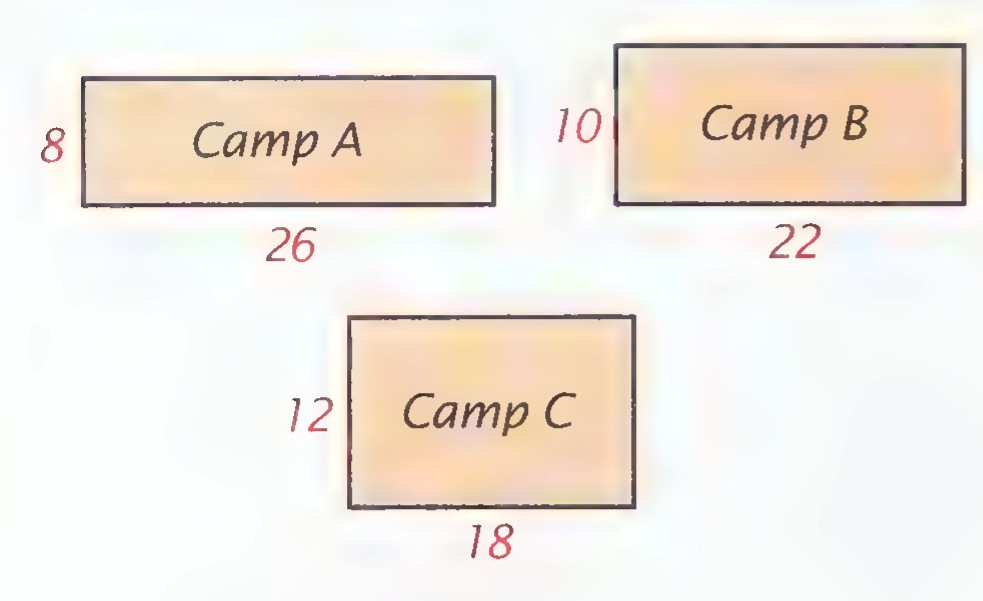
The rectangles above represent three enemy camps. The lengths of their sides are given in Roman paces.
- What is the perimeter of each camp?
- What is the area of each camp?
- Which camp would a commander think contained the most soldiers? Explain.
- Do you think the commander’s choice is reasonable? Explain.
Tangrams. The figures below were made from tangrams, Chinese puzzles made by dividing a square into seven pieces.†
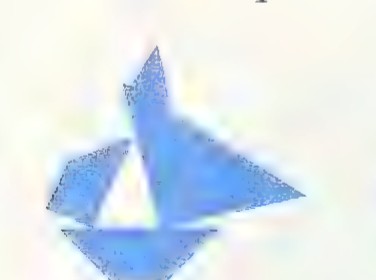
Yacht
Polar bear
The pieces are shown in the figure below.
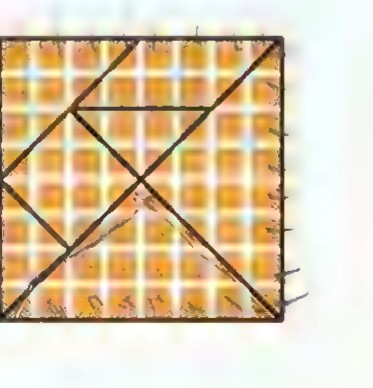
Given that the area of one of the small squares is 1 unit, find the area of
- one of the large triangles.
- one of the smallest triangles.
- each of the other pieces.
This vulture was made by fitting together, without overlapping, all seven pieces.
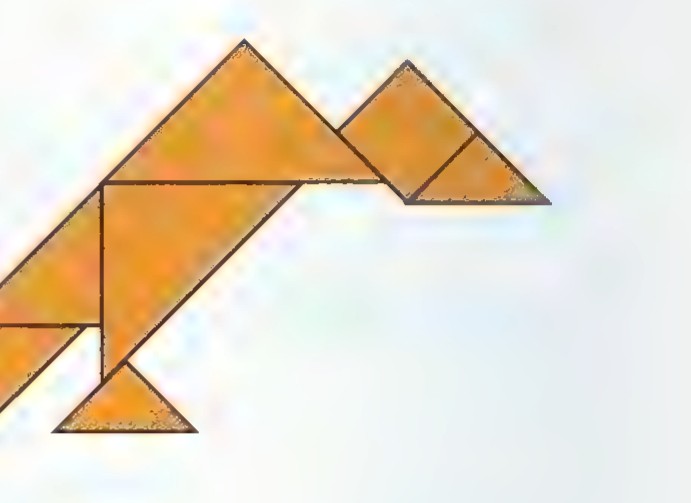
- What is its area?
- State the part of the Area Postulate that you used in finding it.
Altitudes and Triangles. In the following figures, AX and DY are altitudes of △ABC and △DEF, respectively, AB = DE, BC = EF, and ∠B and ∠DEF are supplementary.
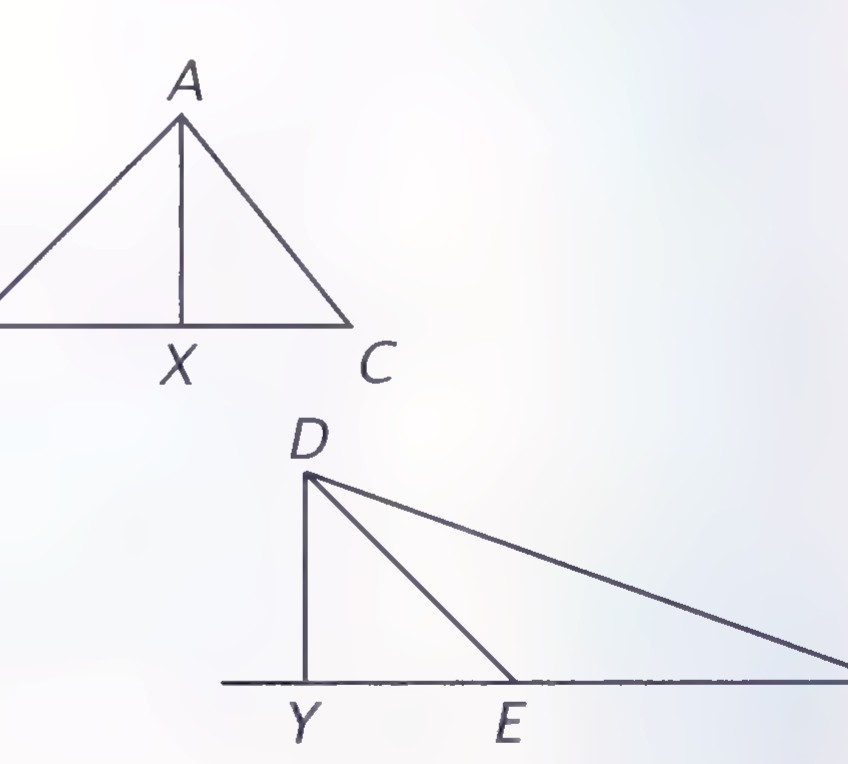
- Copy the figures and mark them as needed to do each of the following exercises.
- Find an angle equal in measure to ∠B.
- Find a pair of triangles that are congruent.
- Why are they congruent?
- Why must they have equal areas?
*The History of Mathematics, by David M. Burton (Allyn & Bacon, 1985).
†Time Travel and Other Mathematical Bewilderments, by Martin Gardner (W. H. Freeman and Company, 1988).
p. 373
- Why is AX = DY?
- Find a pair of triangles with equal areas that are not congruent.
- Why do they have equal areas?
Suriname Stamp. The stamp at the right was issued by Suriname, a country in South America.
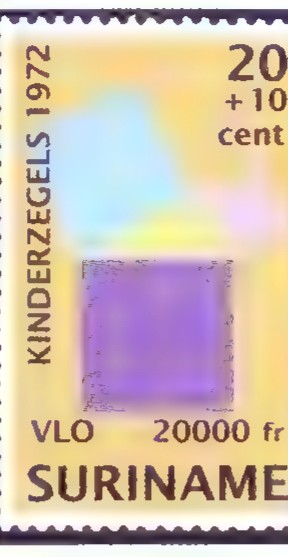
- State the theorem it illustrates. Answer with a complete sentence.
- State the converse theorem.
In the figure below, the area of the blue square is 121 and the lengths of the sides of the other squares are 7 and 13.
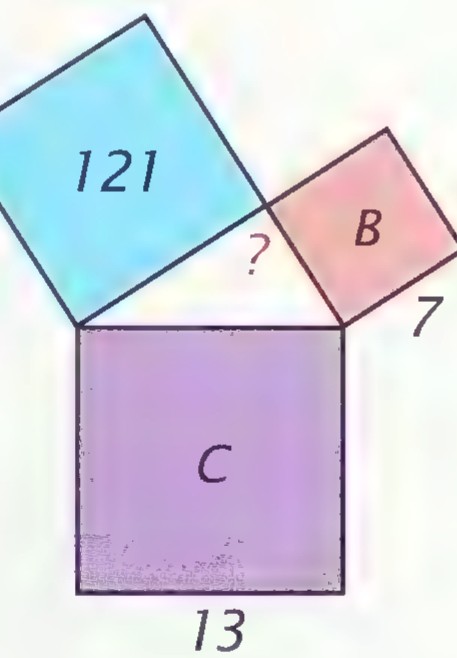
- Find length a.
- Find area B.
- Find area C.
- Is the triangle a right triangle? Explain.
Moroccan Mosaic. The mosaic below was created in the fourteenth century for a wall in Morocco.
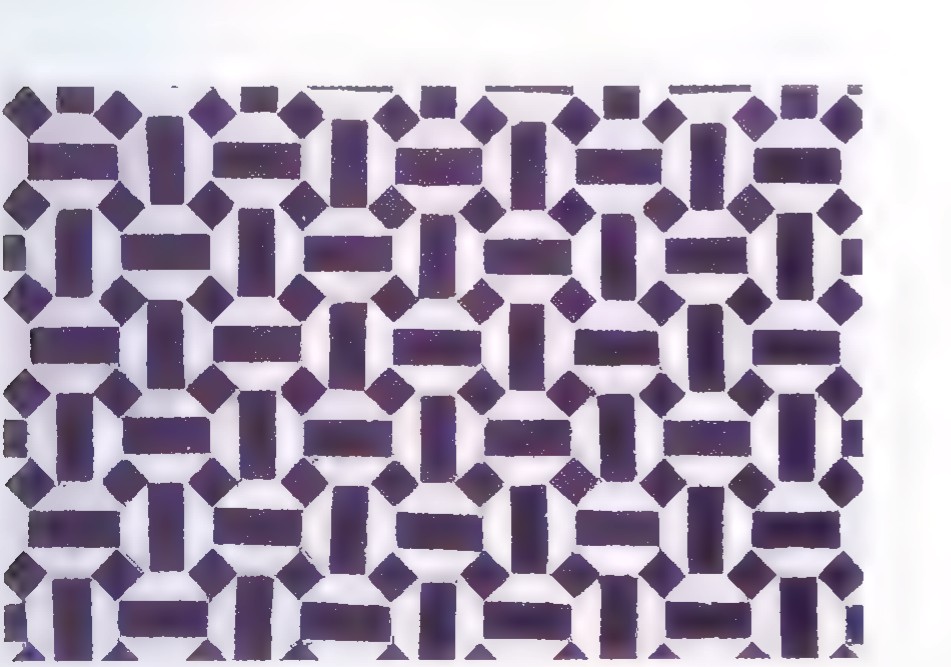
Write an expression for each of the following parts of it shown in the detail below in terms of a or b or both a and b.
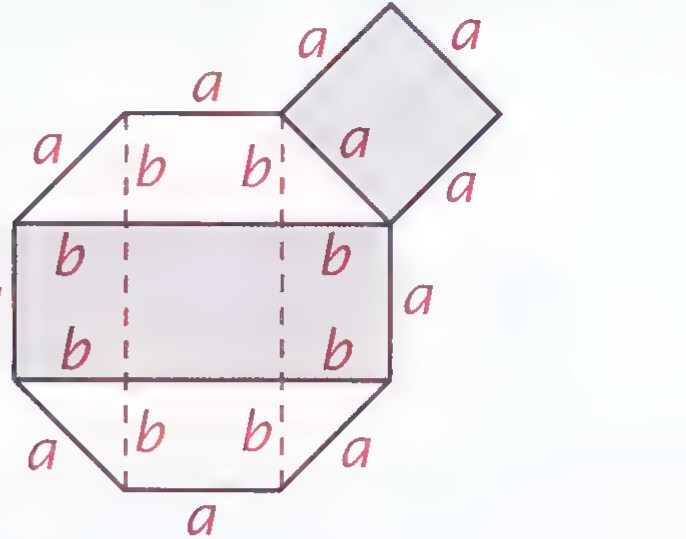
- The perimeter of the square.
- Its area.
- The perimeter of the other rectangle.
- Its area.
- The perimeter of one of the trapezoids.
- Its area.
Set II
Courtyard Design. In the Middle Ages, it was customary in designing a courtyard to make the central garden equal in area to the path surrounding it.*
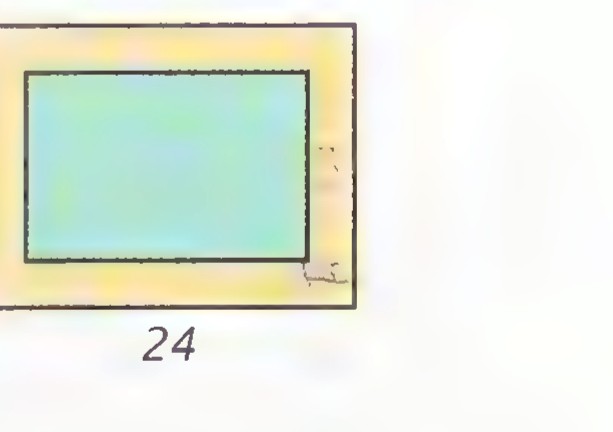
In the figure above, the courtyard is 18 feet by 24 feet, and the path around the garden is 3 feet wide.
- Copy the figure and mark it as needed to answer each of the following questions.
- What is the area of the garden?
- What is the area of the path?
- Does the design fit the description above?
*Geometry Civilized, by J. L. Heilbron (Clarendon Press, 1998).
p. 374

Daedalus Wing. The Daedalus, a human-powered plane, is shown below on a NASA test flight.
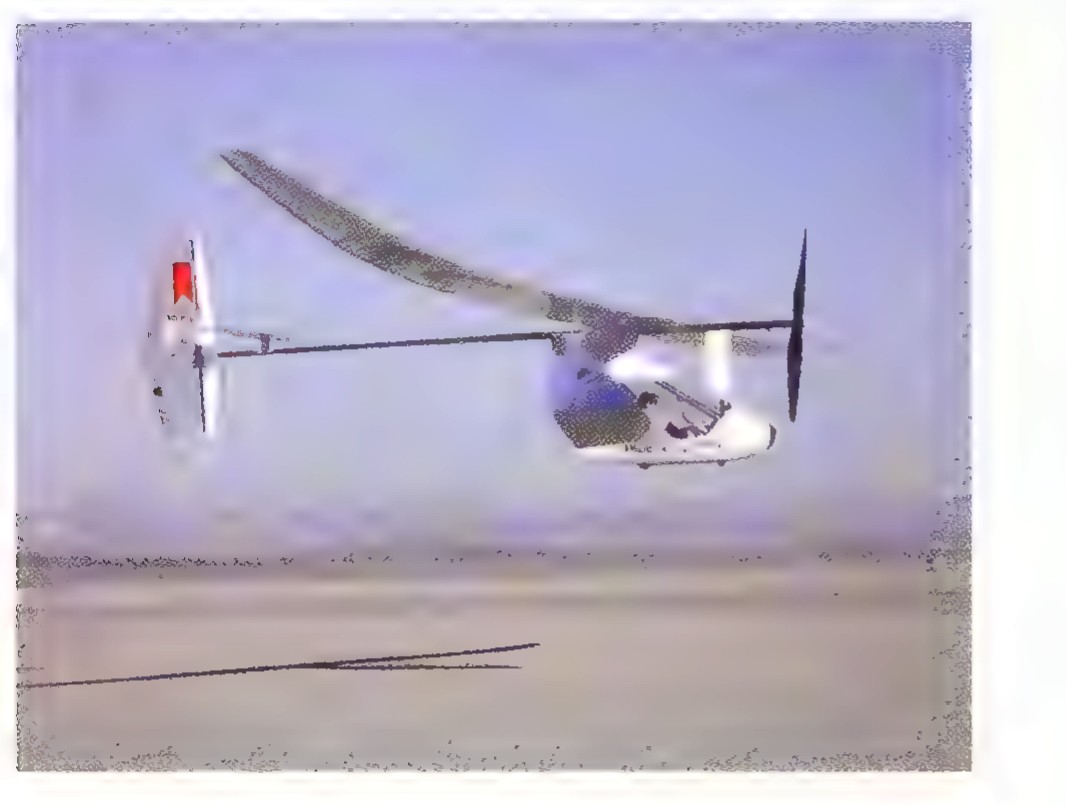
The design of its wing is shown at the top of this page.
- What is the length of its wingspan?
- What is the area of the wing?
Crack Formation. The figure below shows a crack forming in a bar of brittle material that is being pulled in opposite directions.*
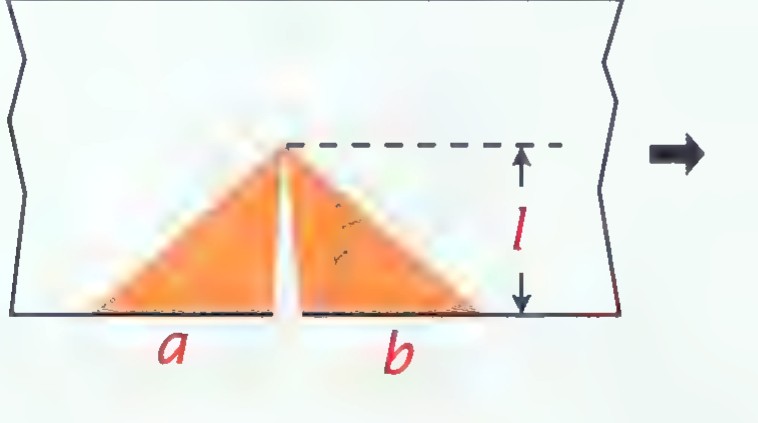
The colored area around the crack can be used to find the amount of energy that is released.
Engineers calculate this area to be approximately l², where l is the length of the crack.
- If the shaded area is l², what can you conclude about a + b? Explain.
If the length of the crack were twice as great, then the area would become (2l)².
- How would this area compare with the area shown in the figure?
Triangle Comparisons. In the figure below, the sides of △ABC have been extended so that BA = AE, AC = CF, and CB = BD. Also, both BH and EG are perpendicular to line AF.
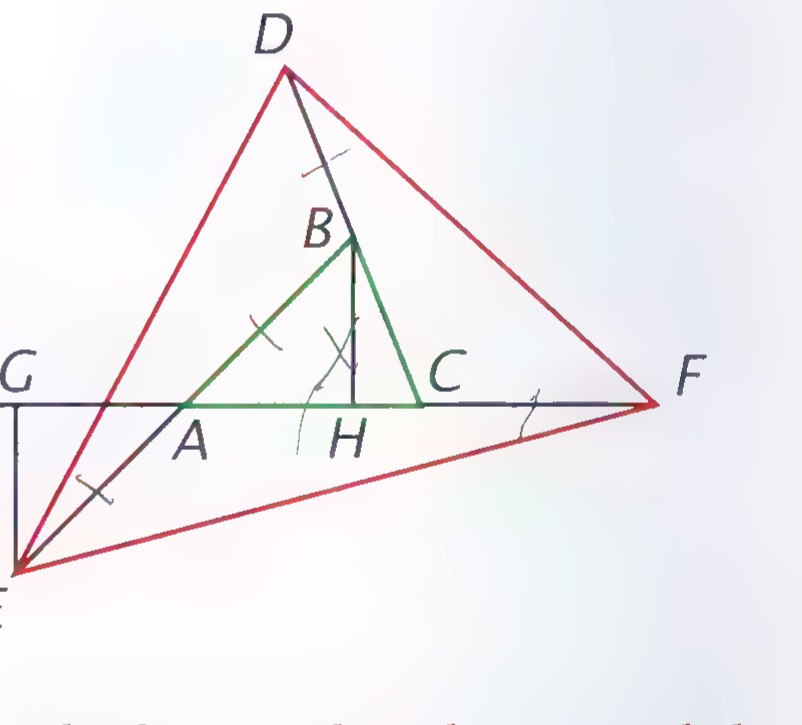
- Copy the figure and mark it as needed to do the following exercises.
- Why is △EGA ≅ △BHA?
- Why is EG = BH?
- Given that , express in terms of x.
- On the basis of this result, how do you think compares with ?
*The New Science of Strong Materials, by J. E. Gordon (Princeton University Press, 1976).
p. 375
SAT Problem. The figure below appeared in a problem on an SAT exam. It is a square whose area is 4x².
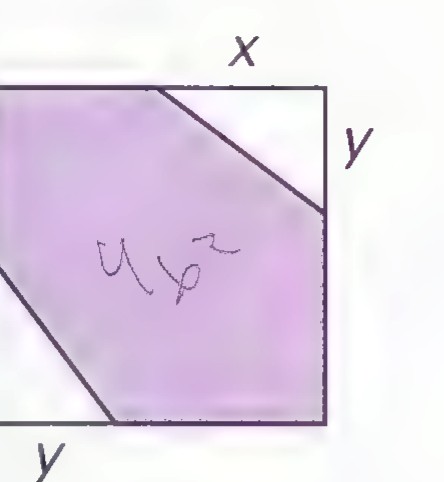
Write expressions for the following in terms of x or y or both x and y.
- The area of the purple region.
- The length of a rectangle R whose width is x and whose area is equal to that of the purple region.
- The perimeter of the square.
- The perimeter of the rectangle R.
Surveying Rule. Surveyors sometimes use the following rule: “Irregular tracts can be reduced to a series of trapezoids by right-angle offsets from points at regular intervals along a measured straight line.”*
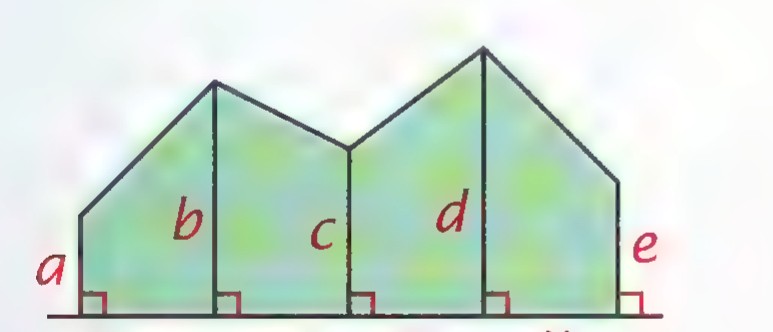
- Write an expression for the area of the tract shown above in terms of a, b, c, d, e, and x.
Suppose that a = b = c = d = e.
- If this equality were true, what shape would the tract have?
- What would your expression for its area become in terms of x and a?
Pythagorean Proof. George Airy, a British astronomer, discovered the following “dissection proof” of the Pythagorean Theorem in 1855.
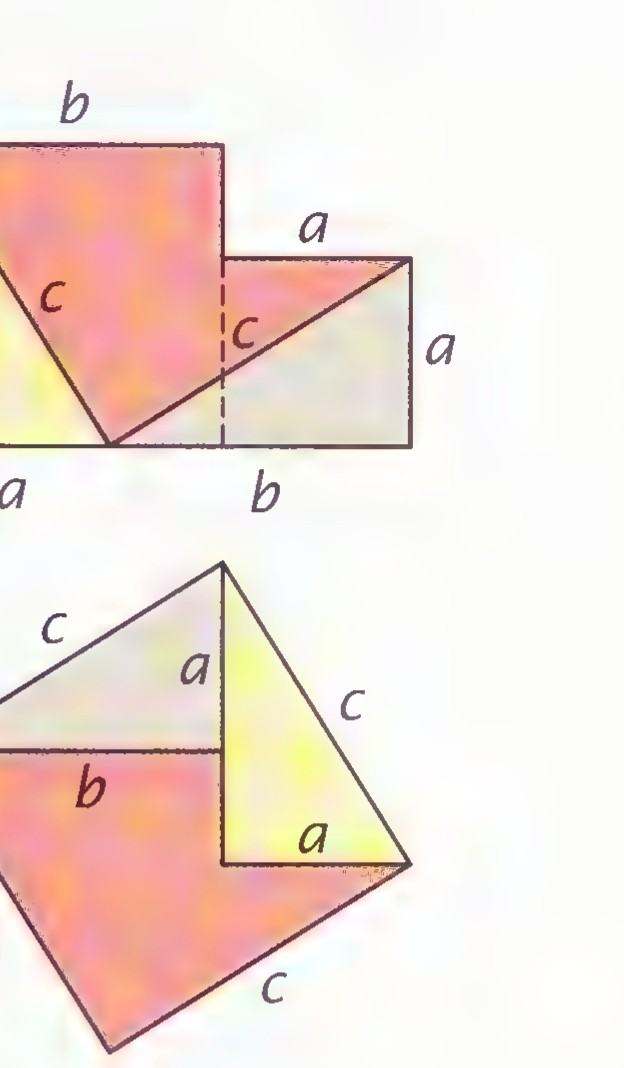
The two figures show the same three pieces arranged in different ways.
- Explain how the two arrangements illustrate the Pythagorean Theorem.
In announcing his discovery of this proof, Airy wrote the following poem:
Here I am, as you may see, a² + b² − ab. When two Triangles on me stand, Square of hypotenuse is plann’d; But if I stand on them instead The squares of both the sides are read.
- To what does “a² + b² − ab” refer?
*Elementary Surveying, by Paul R. Wolf and Russell C. Brinker (Harper Collins, 1989).
p. 376
Algebra Review: Fractional Equations
An equation that contains fractions can be solved by first multiplying both sides by a number that will clear the equation of all of the fractions. The simplest way to do so is to multiply by the least common denominator of the fractions.
Example 1:
Solution: The least common denominator of the fractions is 12. Multiplying both sides of the equation by 12, we get
Checking this result in the original equation, we get
Example 2:
Solution: The least common denominator of the fractions is 6x. Multiplying both sides by 6x, we get
Checking this result by substituting it in the right-hand side of the original equation, we get
Exercises
Solve the following equations. Check your answers.