Chapter 8 — Teacher’s Guide Answers
Answers and teaching commentary for Chapter 8: Transformations, transcribed from the scanned Teacher’s Guide. Diagrams are cropped from the same page scans.
OCR note. The text was recognized automatically and has not been corrected line by line; formulas and symbols may be imperfect. Check the original PDF for exact wording.
Homework: Chapter 8 exercises · Selected answers · Teacher’s answers PDF
Lesson 1
Set I
In their book titled Symmetry—A Unifying
” Concept (Shelter Publications, 1994), Istvan and Magdolna Hargittai point out that it was Louis Pasteur who first discovered that otherwise identical crystals can be mirror images of one another. Except for glycine, all amino acids can exist in opposite-handed forms, but only the lefthanded version occurs naturally. The Hargittais write: “Many biologically important chemical compounds exist in left-handed and right-handed forms, and the biological activity of the two forms may be very different. . . . Humans metabolize only right-handed glucose. Left-handed glucose, although still sweet, passes through the system untouched.” Martin Gardner’s book titled The New Ambidextrous Universe (W. H. Freeman and Company, 1990) is a good source of further information on the subject.
At first glance, it might appear that Roger Shepard’s figure (exercises 18 through 21) also illustrates rotations because the arrows point in opposite directions. The arrows pointing to the left, however, are not congruent to the arrows pointing to the right. The figure is featured on the cover of Al Seckel’s excellent book titled The Art of Optical Illusions (Carlton Books, 2000).
Transformations in Art.
- A translation.
2. Arotation.
3. Arotation.
4. No.
5. No. Mirror Molecules. 6. Areflection.
7. “Left-handed” and “right-handed.” Reflections. 8
Nll/l
AlA
RN
A
G S
in]=
[ 7|
Exercises 9, 11, and 14.
Each has a vertical line of symmetry. Down the Stairs.
18. A translation.
19. A one-to-one correspondence between two sets of points.
- Yes.
21. A transformation that preserves distance and angle measure.
Peter Jones.
22. Arotation.
23. The image is produced from the original figure by rotating the figure 90° clockwise.
24. S.
Set II
As the Adobe Illustrator User Guide explains, the program “defines objects mathematically as vector graphics.” Exactly how vector graphics combines geometry with linear algebra and matri> theory is explained in detail in The Geometry Toolbox for Graphics and Modeling by Gerald E. Farin and Dianne Hansford (A. K. Peters, 1998).
ix
Escalator Transformations.
- A translation.
26. Arotation.
27.
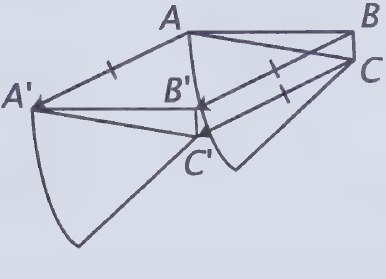
Diagram from page 104.
- They are parallelograms because they have two sides that are both parallel and equal.
29. The opposite sides of a parallelogram are parallel.
30. Itis a parallelogram.
The opposite sides of a parallelogram are equal.
SSS.
33. Corresponding parts of congruent triangles are equal.
34. A transformation that preserves distance and angle measure.
35. B
B’
A’ 2
Betweenness of Rays Theorem.
Substitution.
38. Subtraction.
39. SAS.
40. Corresponding parts of congruent triangles are equal.
41. Distances. Triangle Construction. 42.
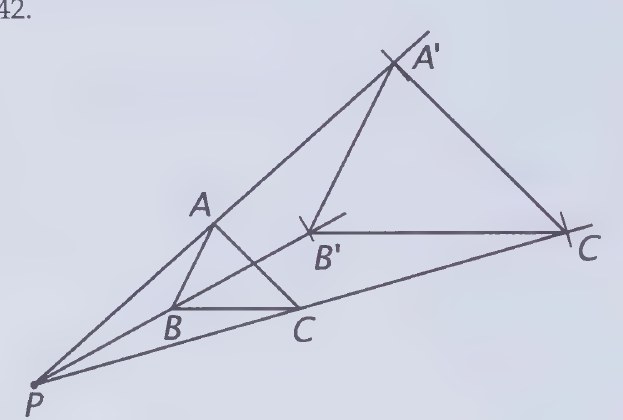
Diagram from page 104. 43. A dilation. 44. They seem to be twice as long.
45. They seem to be equal.
46. No. It is not an isometry, because it doesn’t preserve distance.
Computer Geometry.
47. A translation.
48. Arotation.
49. A dilation.
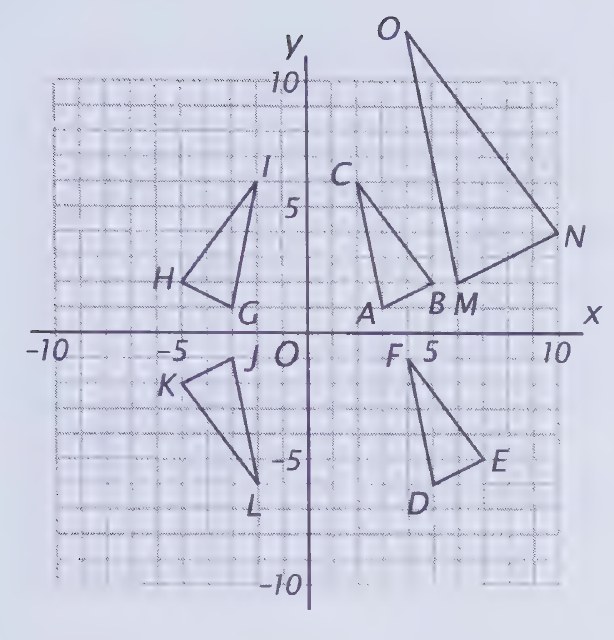
Diagram from page 105.
51. A(3,1) - D@3 +2,1-7), or D(5,-6). B(5,2) - E(5+2,2-7), or E(7, -5). C(2,6) > F(2+2,6-7), or F(4, -1). 52. A translation.
53. A3, 1) - G(-3,1). B(5, 2) - H(-5, 2). C(2,6) - I(-2, 6).
54. Areflection.
55. A3, 1) > J(-3,-1). B(5, 2) = K(-5, -2). C(2, 6) = L(-2, -6).
- A rotation.
57. A(3, 1) —» M(6, 2). B(5, 2) - N(10, 4). C(2, 6) > O(4, 12).
58. A dilation.
Set III
Toothpick Puzzle.
1. (There are two possible ways to solve the puzzle, one of which is a reflection of the other. The three toothpicks moved are shown as dotted lines in the figures below.)
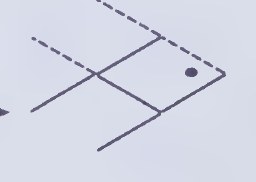
Diagram from page 105.
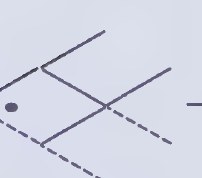
Diagram from page 105.
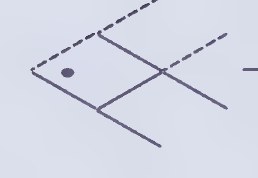
Diagram from page 105.
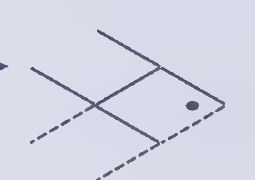
Diagram from page 105.
2. Yes. The reversed fish is a rotation image of the original fish. The center of rotation can be the midpoint of either toothpick forming the fish’s back.
Lesson 2
Set I
Capital letters in many typefaces do not have the simple symmetries suggested by exercises 10 through 13. For example, the horizontal bar of an H doesn’t always connect the midpoints of the side bars. The upper part of an S is frequently smaller than the lower part.
David Moser, the creator of the “China” transformation, has designed some other amazing figures of this sort. Two are included in the book of visual illusions titled Can You Believe Your Eyes by ). R. Block and Harold E. Yuker (Brunner/Mazel, 1992). One changes “England” from Chinese into English and the other does the same thing with “Tokyo”! Both word transformations are accomplished, like the example in the text, by a 90° rotation.
A Suspicious Cow.
1. The water from which the cow is drinking.
2. Itis upside down. The cow and barn that we see “above” the water are actually reflections.
3. A.
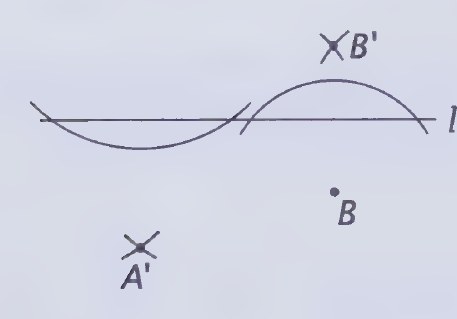
Diagram from page 106.
xB’
B > A
®4. 2x units.
5. Itis the segment’s perpendicular bise
Double Reflections.
6. b.
7. Arotation.
8. 90°. 9. 180°.
10. a WIW b M
s - K| b D
12. o H|H
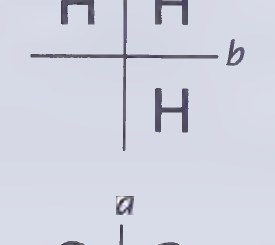
Diagram from page 106.
b H
13. a S|é
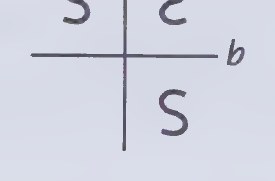
Diagram from page 106.
b
- Its image looks the same.
15. Its image looks the same.
16. Its image looks the same.
-l 17. In exercise 12. The figure has both a vertical and a horizontal line of symmetry.
SAT Problem. 18. B.
19. Areflection.
20. Measure the distances from B and P to the sector. dotted line and see if they are the same.
Can You Read Chinese?
21. Areflection.
022, Areflection.
23. Arotation.
®24. Yes, because it is the composite of two reflections in intersecting lines.
- Itis a translation of the word “China” from Chinese into English.
Set II
Ethologist Niko Tinbergen carried out a number of interesting laboratory studies concerning animal vision, including one with the “goosehawk”” and an experiment with circular disks interpreted by newly hatched blackbirds as their “mother.” These examples and others are included by cognitive scientist Donald D. Hoffman in Visual Intelligence— How We Create What We See (Norton, 1998).
Kaleidoscope Patterns.
26. B,D,and F.
Cand E.
120°.
29. Three. The three mirror lines. (The monkey faces are almost mirror symmetric; so the lines that bisect the angles formed by the mirrors almost look like lines of symmetry.) 30. No. The figure does not look exactly the same upside down. (The monkey’s left nostril is closer to its left eye than its right nostril is to its right eye; so it is possible to tell the difference.)
Scaring Chickens.
31. B. 32. E. 35, 1Dk
34. A, 35. E.
36. A. 37. A translation.
38. A translation is the composite of two reflections in parallel lines.
39. Seeing the bird at C flying to A. Boomerang. 40.
- )
-
e
*4]. Arotation.
42. A rotation is the composite of two reflections in intersecting lines.
43. At the point in which the two lines intersect. Triangle Reflections. 44. If a point is reflected through a line, the line is the perpendicular bisector of the segment connecting the point and its image.
45. A translation. 46. Its magnitude.
47. Itis twice as long; AA” = 2XY. 48. SAS.
49. Corresponding parts of congruent triangles are equal.
50. Arotation.
51. Its magnitude.
52. Itis twice as large; ∠AOA” = 2/XOY.
Set III
A. E. W. Mason, the author of The House of the Arrow (1924), is best known for his novels The Four Feathers and Fire Over England. The House of the Arrow, which featured his detective Inspector Hanaud investigating the murder of a French widow, was made into a movie three times. Following the excerpt quoted in the Set II| exercise, the story continues:
“It was exactly half-past one; the long minute hand pointing to six, the shorter hour hand on the right-hand side of the figure twelve, half-way between the one and the two. With a simultaneous movement they all turned again to the mirror; and the mystery was explained. The shorter hour-hand seen in the mirror was on the left-hand side of the figure twelve, and just where it would have been if the hour had been half-past ten and the clock actually where its reflection was. The figures on the dial were reversed and difficult at a first glance to read.”
What Time Was It? 1.
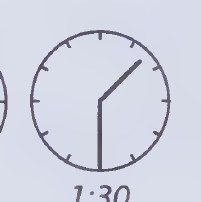
Diagram from page 107.
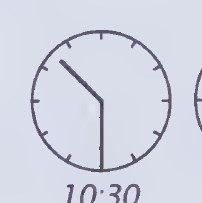
Diagram from page 107.
10:30 1:30
2. Examples suggest that the reflection of a clock face in a vertical mirror always looks like an actual time. This is not true for the reflection of a clock face in a horizontal mirror. For example, a 10:30 horizontal reflection of a
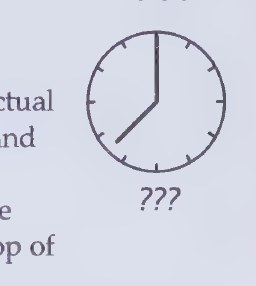
Diagram from page 107.
clock face reading 10:30 would not look like an actual time because the hour hand would be in the wrong position when the minute hand is pointing to the top of the clock.
222
Lesson 3
Set I
The number “eight” seems to have a special connection to sports in which synchronization is important. One of the definitions given in The American Heritage Dictionary of the English Language for the word “eight” is “an eight-oared racing shell.” Team routines in synchronized swimming consist of eight swimmers.
Prevaricator.
1. He has “liar” written all over his face!
2. A translation. 3. Areflection.
4. Arotation.
5. A glide reflection.
6. Yes.
7. If two figures are congruent, there is an isometry such that one figure is the image of the other.
Synchronized Oars. 8. ∠PAB and ∠PCD.
9. If the oars are assumed to be identical, AB = CD. A quadrilateral is a parallelogram if two opposite sides are both parallel and equal.
- The opposite sides of a parallelogram are equal.
11. Atranslation.
12. A glide reflection.
13. Synchronized swimming. Swing Isometries. 14. Areflection.
15. Arotation.
16. Its center. 17. The magnitude of the rotation.
- The lines bisect these angles.
19. They are the perpendicular bisectors of these line segments.
20. It is twice as large. Quadrilateral Reflections.
21. Two points determine a line.
22. They are the perpendicular bisectors of these line segments.
23. They appear to be parallel.
24. A translation.
- Two figures are congruent if there is an isometry such that one figure is the image of the other.
Set II
The symmetry of the illustration for the pianomoving problem suggests that the distances from A and J to the corner of the room are equal. If this is the case, then it is easy to prove that ADGP in the figure below is an isosceles right triangle. It follows that ∠CDG = ∠DGH = 135°. The piano, then, has been rotated 270° in all. If the symmetry doesn’t exist, ADGP will still be a right triangle with complementary acute angles; so, even though the measures of ∠CDG and ∠DGH will change, their sum will remain the same.
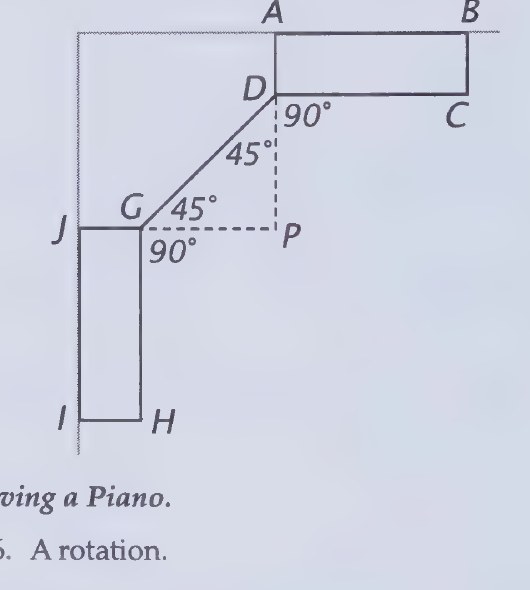
Diagram from page 108.
Moving a Piano.
26. A rotation. 27. D.
28. E. 29. G.
30. D.
31. Another rotation about point G.
32. 270°.
Bulldogs.
33. Two figures are congruent if there is an isometry such that one figure is the image of the other.
34. A translation.
- No, because the two dogs are not mirror images of each other.
36. Yes. A translation is the composite of two reflections through parallel lines.
37. No, because, if there were three reflections,
one dog would be a mirror image of the other.
38. A glide reflection. 39. A translation and a reflection.
40. Three reflections.
Grid Problem. 41.
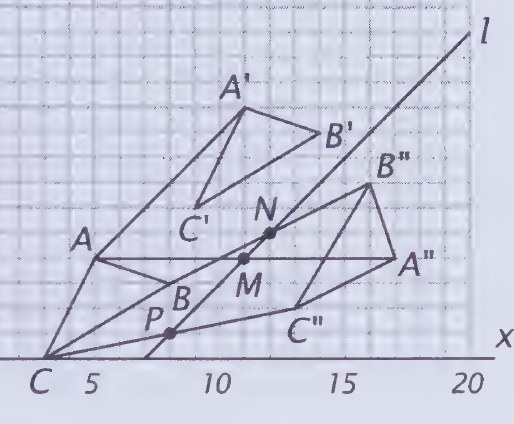
Diagram from page 109.
0O Gi7 10 5 20 42. B’(14,9), C’(9, 6).
043, 6~42.(AA’ = {(11-5)+(10-4)* =
V36+36 = 362 =6+2.)
44. AA’ appears to be parallel to line .
45. A glide reflection, because it is the composite of a translation and a reflection in a line parallel to the direction of the translation. 46. M(11, 4), N(12, 5), P(8, 1).
47. The y-coordinate is 7 less than the x-coordinate.
48. They lie on line I.
Set III
The irreqular rubber stamp figure was chosen to try to impress upon the student’s mind that the number of reflections needed to show that two figures are congruent has nothing to do with their complexity. David Henderson suggests a nice experiment in his book titled Experiencing Geometry—In Euclidean, Spherical and Hyperbolic Spaces (Prentice Hall, 2001). He says: “Cut a triangle out of an index card and use it to draw two congruent triangles in different orientations on a sheet of paper. … Now, can you move one triangle to the other by three (or fewer) reflections? You can use your cutout triangle for the intermediate steps.” This leads to proving that “on the plane, spheres, or hyperbolic planes, every isometry is the composition of one, two, or three reflections.” Chapter 11 of Henderson’s book is a good resource for students (and teachers) wanting to learn more about isometries.
Stamp Tricks.
1. Ollie stamped one of the images on the back of the tracing paper.
2. One figure is now the mirror image of the other and two reflections (of an asymmetric figure) cannot produce a mirror image.
3. Yes. The figure below shows one of the many ways in which it can be done.
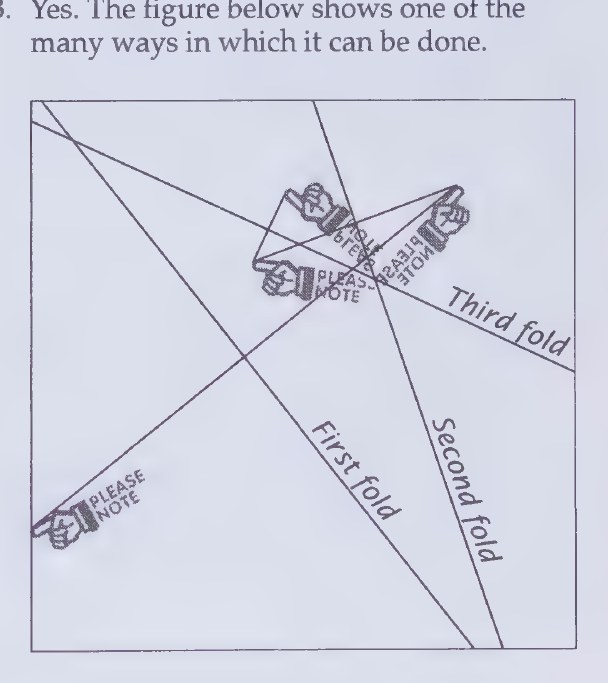
Diagram from page 109.
Lesson 4
Set I
Two wonderful sources of ambigrams are Scott Kim’s Inversions (Byte Books, 1981) and John Langdon’s Wordplay (Harcourt Brace Jovanovich, 1992). In the introduction to his book, Langdon wrote:
“Ambigrams come in a number of forms, fimited only by the ambigrammist’s imagination, and usually involve some kind of symmetry. This book is made up of three types:
1. words with rotational symmetry …
2. words that have bilateral, or mirror-image symmetry …
3. chains. These are ambigrams that cannot stand alone as single words, but depend on being linked to the preceding and ensuing words.”
In other words, ambigrams are based on the three basic types of symmetry in the plane: rotation, reflection, and translation.
The fact that games normally have two opponents or two opposing teams requires that almost all playing fields and courts have two lines of symmetry. Baseball and its related versions can use a field with just one line of symmetry because the teams regularly interchange their positions in the game.
It is interesting that, although Washington had the extra window painted solely to “complete the symmetry,” the two windows on either side of the front door, with the windows above them, are not quite in the right places.
Ambigrams.
1. Rotation (or point) symmetry.
2. Seeif it coincides with its rotation image. (Or, for point symmetry, see if it looks the same upside down.)
3. Reflection (line) symmetry.
4. See if it coincides with its reflection image or fold it to see if the two halves coincide.
Sport Symmetry.
5. Baseball. 6. It has reflection (line) symmetry with respect to a line through home plate and second base.
7. Basketball.
8. It has reflection (line) and rotation (point) symmetry. It has two lines of symmetry and 2-fold rotation symmetry.
9. The same type as the basketball court.
10. (Student answer.) (It is so that each team has the same view of the other side.)
Mount Vernon.
11. To make his house look more symmetric. Symmetries of Basic Figures.
12. The point itself. (Not its “center,” because a point does not have a center!)
13. Yes. A point is symmetric with respect to every line that contains it (because a point on a reflection line is its own image.)
- Aline looks the same if it is rotated 180°.
15. Any point on the line can be chosen as its center of symmetry. 16. Aline has reflection symmetry because it can be reflected (folded) onto itself.
17. Infinitely many. The line itself and every line that is perpendicular to it.
18. Yes. Aline can be translated any distance along itself and still look the same. 19. That rays OA and OD are opposite rays and that rays OB and OC are opposite rays.
20. If ∠AOB is rotated 180° about point O, it coincides with ∠COD.
21. Vertical angles are equal.
- In a plane, two points each equidistant from the endpoints of a line segment determine the perpendicular bisector of the line segment.
23. Aand C.
24. If two sides of a triangle are equal, the angles opposite them are equal.
25. They bisect each other.
26. CD.
27. The opposite sides of a parallelogram are equal.
28. No. BD cannot be a rotation image of AC because they do not have the same length.
Set II
For the piano keyboard, it is interesting to note that all of the translation images of a given key have the same letter name. The key that is the first translation image to the right of a given key is one octave higher and has a frequency twice as great. Without the translation pattern of the black keys, pianists would have trouble keeping their place!
In his book titled Reality’s Mirror (Wiley, 1989), Bryan Bunch explains the connection of odd and even wave functions to such topics as cold fusion and the Pauli Exclusion Principle. Bunch writes: “It would be only a slight exaggeration to say that symmetry accounts for all the observable behavior of the material world.”
Piano Keyboard.
29. Example answer:
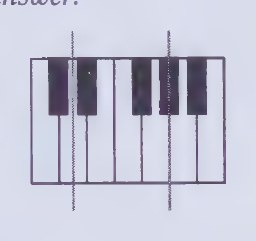
Diagram from page 111.
- Translation.
31. No. Water Wheel.
32. Rotation and point symmetry.
225°. (38 16
No. ( 127 22.5°
is not an integer.)
225°
35. Yes. (—— =10. es (22’50 ) 36. 16.
37. No.
Wave Functions.
- The y-axis.
39. Reflection (line).
40. The origin.
41. Rotation (or point). 42. Even.
43. Neither.
44. Odd.
Cherry Orchard.
- Because it can be translated (in various directions) and look exactly the same.
46. The distance between any pair of neighboring trees.
47.
48. Because it can be reflected (in various lines) and look exactly the same.
49. Because it can be rotated (about various points) and look exactly the same.
50. Any tree. Also, any point centered between three neighboring trees. (Also, the midpoints of the segments between neighboring trees are centers of 2-fold rotation symmetry.)
51. 60°.
Set III
Short Story.
1. - .
m the summer, 5 15’ goes to the beach ana SUNS herself, adds up sums of numbers, does SI u n IS and collects tir] cans. The ride home is h [ / I Y. ana that makes her head feel fiZZ:{Jl .
2. The figure can be read as either Scott’s first name or his last name.
Review
Set I
In Visual intelligence—How We Create What We See (Norton, 1998), Donald Hoffman reports that perhaps the earliest version of the “vase-faces” illusion appeared in a picture puzzle in 1795. Perceptual psychologists first began to study the illusion in 1915. Of the many variations that have appeared since, surely the most clever is its use in the vase pictured in the text.
In 1941-42, Escher filled a large notebook with notes and drawings that he titled Regular Division of the Plane with Asymmetrical Congruent Polygons. This notebook is reproduced in its entirety in Visions of Symmetry— Notebooks, Periodic Drawings, and Related Work of M. C. Escher, by Doris Schattschneider (W. H. Freeman and Company, 1990). She remarks about this work: “It is impossible to look at this notebook and not conclude that in this work, Escher was a research mathematician.”
Remarkably, the first book to be published on Escher’s work was written by Caroline H. Macgillavry, a professor of chemical crystallography. In Symmetry Aspects of M. C. Escher’s Periodic Drawings (The international Union of Crystallography, 1965), Macgillavry wrote that Escher’s notebook had been a “revelation” to her, commenting: “It is no wonder that x-ray crystallographers, confronted with the ways in which nature solves the same problem of packing identical objects in periodic patterns, are interested in Escher’s work.”
In lecturing on his work, Escher explicitly discussed his use of the four isometries of the plane in creating his mosaics. For more on this, see the section titled “The geometric rules”
(p. 31ff) in Visions of Symmetry.
Amazing Vase.
1. No. The left and right sides of the upper part of the vase do not quite look like mirror images of each other.
2. The profiles of Prince Philip and Queen Elizabeth can be seen in silhouette.
Double Meanings.
3. A one-to-one correspondence between two sets of points.
4. Atransformation that preserves distance and angle measure.
5. A transformation in which the image is an enlargement or reduction of the original. 6. No. Monkey Rug.
7. Atranslation.
8. A glide reflection. 9. Arotation.
10. Areflection. Clover Leafs.
- That it can be rotated so that it looks the same in three positions.
12. 120°.
13. No. It doesn’t look the same upside down.
14.
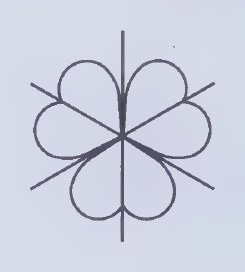
Diagram from page 112.
15.
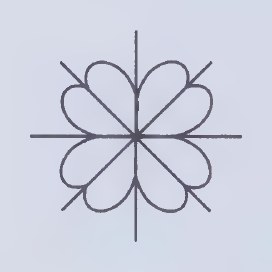
Diagram from page 112.
16. 90°. 17. Yes.
18. Good. Musical Transformations.
19. A translation. 20. A reflection.
21. A translation.
22. Arotation. Fish Design.
23. No. There seem to be two shapes of fish in the mosaic. The differences in their noses and tails are the most obvious. 24. Two figures are congruent if there is an isometry such that one figure is the image of the other.
25. A glide reflection.
26. Arotation.
27. Yes. Translations. Example answer:
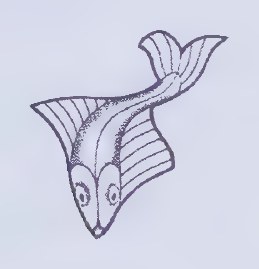
Diagram from page 113.
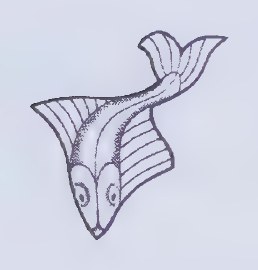
Diagram from page 113.
Set II
Keep Your Eye on the Ball—The Science and Folklore of Baseball, by Robert G. Watts and A. Terry Bahill (W. H. Freeman and Company, 1990) is a great source of examples for use in illustrating the application of algebra, geometry, and physics to the analysis of baseball. The authors describe the figure used for exercises 28 through 32: “The swing of a baseball bat exhibits two types of motion: translational and rotational. . .. To move the bat from position A to position C, one can first rotate the bat about the center of mass and then translate the center of mass.”
S
John Langdon wrote that his “past” and “future” ambigrams “are intended to represent the interminable conveyor belt of time, and the individual letters and words are the experiences, the ‘life bites’ of our existence.”
Batter’s Swing.
28. Arotation.
- A translation.
30. For a rotation, the two reflection lines intersect. For a translation, they are parallel. 31. About 47°.
32. About 24 in. (In the figure, the length of the bat is 42 mm and the magnitude of the translation is about 24 mm.)
33. Example figure:
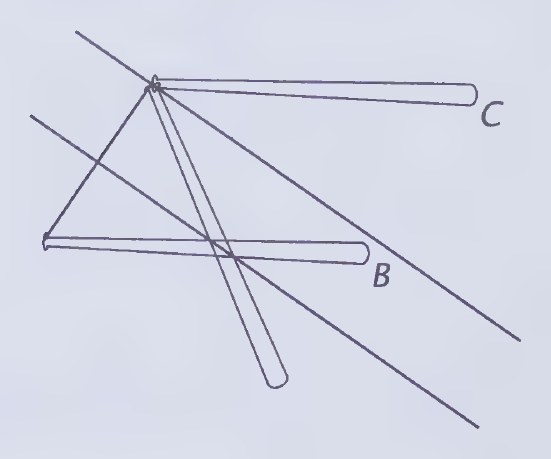
Diagram from page 113.
B
Construction Problem. 34.
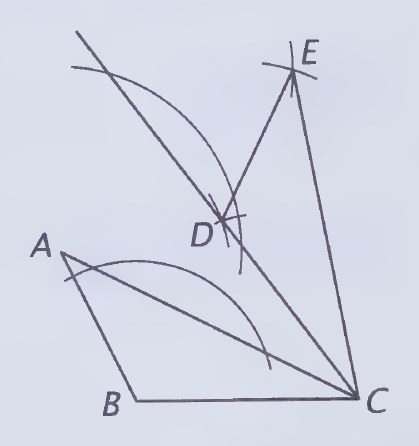
Diagram from page 113.
E
A D
B c
35. The image of AB is AD and the image of BC is DC.
36. Because AADC is the reflection image of AABC.
37. It has reflection (line) symmetry with respect to line AC.
38. Arotation.
From N to Z.
= a b
NN Z
40. A rotation. e4]. 45°
42. 90°.
43. The image of H looks like I. The image of W looks somewhat like E. (And, the image of Z looks like N.)
Past and Future.
44. Example answers:
PAST FUTURE
45. Translation.
46. So that the E’s look “correct” in both directions. 47. No.
48. The letters A and T in PAST. The letters T, U, and E in FUTURE.
49. Yes. The letter E. Dice Symmetries.
50. Group1: 1,4, and 5. These faces have 4 lines of symmetry and 4-fold rotation (as well as point) symmetry. Group 2: 2,3, and 6. These faces have 2 lines of symmetry and 2-fold rotation (as well as point) symmetry. Inregard to 2 and 3, the symmetry lines contain the diagonals of the face; in regard to 6, they are parallel to the edges and midway between them.
1. A conditional statement.
2. If you don’t put your coat on. Losers, Sleepers.
3. AnEuler diagram.
4. If you snooze, you lose.
5. You lose. Marine Logic.
6. Asyllogism.
7. If one of its premises were false. Finding Truth.
8. Theorems.
9. Postulates. Only in Geometry.
10. Points that lie on the same line.
11. The side opposite the right angle in a right triangle.
12. A triangle or trapezoid that has two equal legs.
13. A quadrilateral all of whose sides are equal. Why Three?
14. Three noncollinear points determine a plane.
15. Point, plane. What Follows?
16. Aline.
17. 180°.
18. Bisects it.
19. Are equal.
20. Equiangular.
21. Either remote interior angle.
22. The perpendicular bisector of the line segment.
23. Are parallel.
24. Are parallel.
25. Also perpendicular to the other.
” 26. The remote interior angles.
27. Equal.
28. Are equal. Formulas.
29. The area of a circle is 1 times the square of its radius.
30. The area of a rectangle is the product of its length and width.
31. This is the Distance Formula. The distance between two points is the square root of the sum of the squares of the differences of their x-coordinates and their y-coordinates.
32. The perimeter of a triangle is the sum of the lengths of its sides.
33. The perimeter of a rectangle is the sum of twice its length and twice its width.
Protractor Problems.
34. 84°.(123-39.)
35. 42°. (%84°.)
36. 81.(39+420r123-42)
37. 48°.(90° - 42°)
38. 171.(123 +48=171.)
39. Yes. OD-OC-OB because 171 > 81 > 39. Metric Angles.
40. Two angles are supplementary iff their sum is 200 grades.
41. An angle is obtuse if it is greater than 100 grades but less than 200 grades.
42. The sum of the angles of a quadrilateral is 400 grades.
2
43. Each angle of an equilateral triangle is 66 3 grades.
Linear Pair.
44. That the figure contains two opposite rays.
45. No. If the angles are equal, they would be right angles.
46. They are supplementary.
47. Each angle is a right angle. Polygons.
48. 1125 or 15+5. (€2 =152 + 302 = 225 + 900 = 1125, c= 1125 = 155 )
49. 30. (It can’t be 15, because 15 + 15 = 30.)
50. 30°, 150°, and 150°. (A rhombus is a parallelogram. The opposite angles of a parallelogram are equal and the consecutive angles are supplementary.)
51. 30° 150°, and 150°. (The base angles of an isosceles trapezoid are equal. The parallel bases form supplementary angles with the legs.)
Bent Pyramid.
52. 126°. (180° - 54°.)
53. 94°.[180° - 2(43°).]
54. 54°. (LE=∠A))
55. 169°. (126° +43°.) Six Triangles.
56. AAFP and ADEP.
57. By SAS. (ED = AP because AB = ED and AB=AP)
58. By HL. (AF = PB because AF = CD and CD =PD.)
Italian Theorem.
59. ∠B> ∠A.
60. If two sides of a triangle are unequal, the angle opposite the greater side is greater than that opposite the smaller side. (If two sides of a triangle are unequal, the angles opposite them are unequal in the same order.)
61. Major and minor. Impossibly Obtuse.
62. LA+ ∠B+ ∠C>270°.
63. The fact that the sum of the angles of a triangle is 180°.
64. It shows that what we supposed is false.
65. Indirect. Conuverses.
66. If two angles are complementary, then they are the acute angles of a right triangle. False.
67. If the diagonals of a quadrilateral bisect each other, then the quadrilateral is a parallelogram. True.
Construction Exercises.
68.
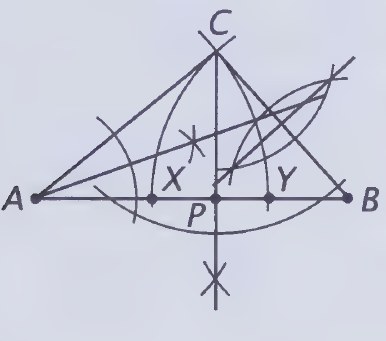
Diagram from page 116.
69. No.
70. Point P.
71. CA, CP, and CB.
Grid Exercise.
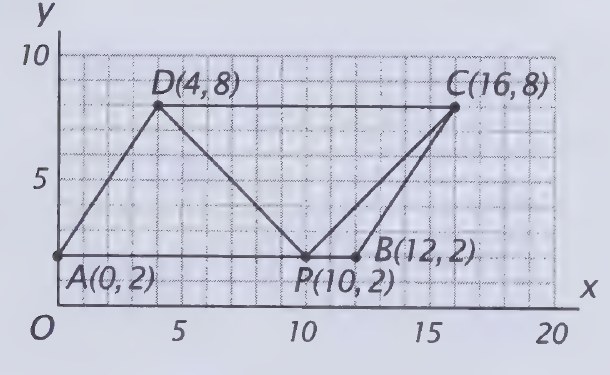
Diagram from page 116.
o 5 10 15 20
73. A parallelogram.
74 AB=DC =12; AD = BC = 80 or 45. (AD = (4—0)% +(8-2)* = V16+64 = 80 = 445.
BC = (16122 +(8-2)* = 16+64 =
80 = 4+5.
75. (Student answer.) (PD looks longer to many people.)
76. PD = +/(4-10)*+(8-2) = 36+36 = V72 = 642, PC = (16-10)2+(8-2)> = v36+36 = V72 = 642, Roof Truss.
77. LA = /L. ∠A and ∠L are corresponding parts of AAGF and ALGE which are congruent by SSS.
78. BC || FG. BC || DE and DE || FG because equal alternate interior angles mean that lines are parallel. BC || FG because, in a plane, two lines parallel to a third line are parallel to each other.
79. Yes. CD || EF because they form equal alternate interior angles with DE.
80. No. If ∠AGF and ∠GFA were supplementary, GA would be parallel to FA (supplementary angles on the same side of a transversal mean that lines are parallel). GA and FA intersect at A.
Angles Problem 1. 81.
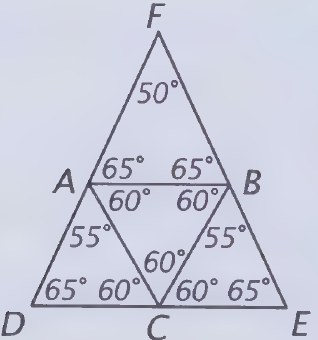
Diagram from page 116.
82. AACD = ABCE by ASA. AC = BC because AABC is equilateral, ∠DAC = 55° = ∠EBC, and ∠DCA = 60° = ∠ECB.
Irregular Star.
- B
A F J H ] E D
84. True. AEFC is isosceles because EF = FC because ∠C = ∠E.
85. True. FGHI] is equiangular because each of its angles is an angle of one of the five overlapping isosceles triangles, whose base angles are the equal angles at the corners of the star. If two angles of one triangle are equal to two angles of another triangle, the third angles are equal.
86. False. (This is evident from the figure.)
87. True. There are 10 isosceles triangles in all. The base angles of the triangles that are acute (ABFG is an example) are supplementary to the equal angles of pentagon FGHIJ; so they are equal.
Angle Trisector.
88. These triangles are congruent by SSS.
89. /1= /2and ∠2 = /3 because they are corresponding parts of the congruent triangles; so ∠1 = ∠3.
Quadrilateral Problem.
90. x + 2x + 3x + 4x = 360, 10x = 360, x = 36.
91. 144°. [4(36°).]
92. /B =72° ∠C=108% AB || DC, ABCD is a trapezoid.
Angles Problem 2. g5t
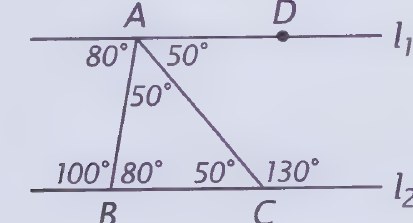
Diagram from page 117.
94. AABC is isosceles. ∠BAC = 50° = ∠ACB; so AB =BC.
A B, C.
95. a2 +b2=c
9. a+b>c,a+c>bb+c>a.
97. No. The sum of two of its sides would equal the third side, which would contradict the
Triangle Inequality Theorem. Midsegments. 98. C
D E
A B
99. Applying the Midsegment Theorem to AABC gives DE = %AB and applying it to
1 AABF gives GH = EAB; so DE = GH by substitution.
100. Again, by the Midsegment Theorem, DE || AB and GH || AB; so DE || GH. In a plane, two lines parallel to a third line are parallel to each other.
101. DEHG is a parallelogram because two opposite sides, DE and GH, are both parallel and equal.
102. AG = GF and BH = HF because G and H are the midpoints of AF and BF. GF = FE and HF = FD because the diagonals of a parallelogram bisect each other. So AG = GF = FE and BH = HF = FD.
On the Level.
103. The design of the swing is based on a parallelogram. The supports of the plank are equal, and the part of the plank between the supports is equal to the distance between the supports at the top. The top remains level with the ground. The plank, the opposite side of the parallelogram, is always parallel to the top; so it also stays level with the ground.
Folding Experiment.
104. Example figure (the student’s figure will depend on the point and corner chosen):
©
A
D B
105. It appears to be the perpendicular bisector of AB.
106. When B falls on A, CA = CB and DA = DB. In a plane, two points each equidistant from the endpoints of a line segment determine the perpendicular bisector of the line segment.
Earth Measurement.
107. 20,520 mi. (360 x 57.)
108. About 3,300 mi. (¢ = 2m; so
_ ¢ _ 20,50 2% 2n
r =3,300.)
Not a Square.
109. Yes. ABCD could be a rhombus if all of its sides were equal.
110. Yes. If ABCD is a rhombus, its diagonals will be perpendicular.
111. Yes. ABCD is a parallelogram and the diagonals of a parallelogram bisect each other.
112. No. If ABCD were a rectangle, ∠DAB would be equal to ∠ABC.
113. No. If AC = DB, then ADAB = ACBA by SSS (DA = CB because ABCD is a parallelogram.) If ADAB = ACBA, then ∠DAB = ∠ABC but
/DAB = ∠ABC. Construction Exercise.
114. Example figure: X Y C
A B
V4
115. They seem to be concurrent.
SAT Problem.
116. A rotation.
117. A translation.
118. A reflection.
119. A reflection.
120. Figure E. Quilt Patterns.
121. Rotation (point) symmetry (4-fold).
122. Rotation (point) symmetry and reflection (line) symmetry (4 lines).
123. Reflection (line) symmetry (1 line). Dividing a Lot.
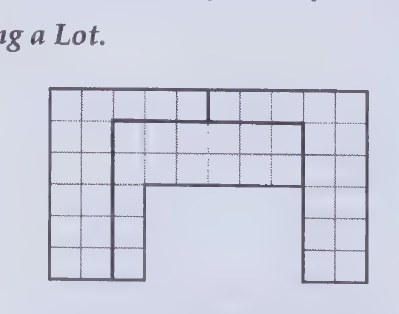
Diagram from page 118.
124.
125,
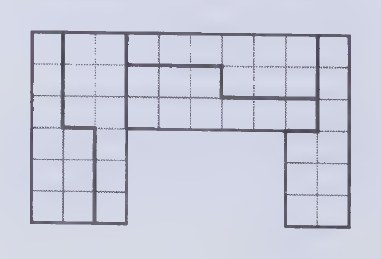
Diagram from page 118.