Chapter 7 — Teacher’s Guide Answers
Answers and teaching commentary for Chapter 7: Quadrilaterals, transcribed from the scanned Teacher’s Guide. Diagrams are cropped from the same page scans.
OCR note. The text was recognized automatically and has not been corrected line by line; formulas and symbols may be imperfect. Check the original PDF for exact wording.
Homework: Chapter 7 exercises · Selected answers · Teacher’s answers PDF
Lesson 1
Set I
The aerial photographer Georg Gerster, the
- author of Below from Above (Abbeville Press, 1986), wrote about his photograph of the freeway overpass covered by carpets: “Years after having taken this photograph, | am still amazed at this super-scale Paul Klee … . In Europe, special mats, a Swiss development, have been adopted. They retain the heat generated as the concrete hardens and make it unnecessary to keep wetting the concrete. The new procedure is more economical, though less colorful … .”
Theorem 24.
- Two points determine a line.
2. The sum of the angles of a triangle is 180°.
3. Addition.
4. Betweenness of Rays Theorem.
5. Substitution. Corollary.
- The sum of the angles of a quadrilateral is 360°.
7. Division.
8. An angle whose measure is 90° is a right angle.
9. A quadrilateral each of whose angles is a right angle is a rectangle.
- Each angle of a rectangle is a right angle.
11. All right angles are equal.
Carpets.
12. Rectangles.
13. Right. 14. Lines that form right angles are perpendicular.
15. In a plane, two lines perpendicular to a third line are parallel.
Rectangles.
16. They are equal and they are right angles. 17. They seem to be parallel and equal.
I 18. They seem to be equal (and they seem to bisect each other).
Rhombuses.
19. They seem to be equal (and the opposite sides seem to be parallel).
20. They seem to be perpendicular (and they seem to bisect each other).
- They are equiangular (or each of their angles is a right angle).
22. They are equilateral. Parallelograms.
23. They seem to be parallel and equal.
24. They seem to be equal.
25. They seem to bisect each other. SAT Problem.
26. 2x + 2y = 180. (2x + 2y + 180 = 360.)
27. x+y=90.
Set II
Martin Gardner dedicated his book of mathematical recreations, Penrose Tiles to Trapdoor Ciphers (W. H. Freeman and Company, 1989) to Roger Penrose with these words:
“To Roger Penrose, for his beautiful, surprising discoveries in mathematics, physics, and cosmology; for his deep creative insights into how the universe operates; and for his humility in not supposing that he is exploring only the products of human minds.”
Two chapters of Gardner’s book are about Penrose tilings, a subject full of rich mathematical ideas. The two tiles in the exercises come from a rhombus with angles of 72° and 108°. John Horton Conway calls them “kites” and “darts.” Amazingly, in all nonperiodic tilings of these tiles, the ratio of the number of kites to the number of
darts is the golden ratio: 1+;/§ =1.618…! There
are a number of simple ways to prove that there are infinitely many ways to tile the plane with these two tiles. Even so, any finite region of one tiling appears infinitely many times in every other tiling; so no finite sample of a Penrose tiling can be used to determine which of the infinitely
many different tilings it is! Students interested in such mind-boggling ideas will enjoy reading Gardner’s material and doing the experiments suggested in it.
The exercises on the angles of polygons are intended to encourage students to realize that memorizing a result such as “each angle of an
equiangular n-gon has a measure of (—,3—” i n—2)180°
is not important. What js important is for the student to feel comfortable and confident in being able to reconstruct such a result if it is needed.
Penrose Tiles.
28. The one labeled ABCD.
- 144°. (360° —3-72°.)
30.
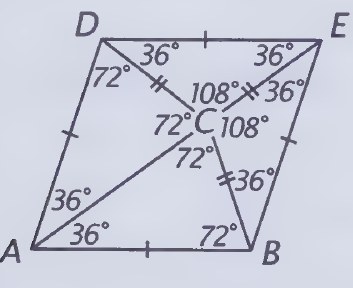
Diagram from page 86.
- SSS.
32. All are isosceles.
33. They seem to be collinear.
34. They are collinear because ∠ACE =72° +108° = 180°.
35. Yes. It appears that it could be folded along the line through A, C, and E so that the two halves would coincide.
36. No. Quadrilateral ABED is equilateral but not equiangular.
Gemstone Pattern. 37. Triangles, quadrilaterals, and an octagon.
38. Five sides, two diagonals, and three triangles.
39. Example figure:
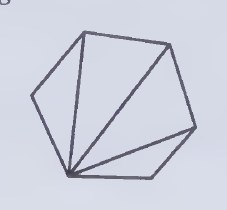
Diagram from page 86.
- Six sides, three diagonals, and four triangles.
41. Example figure:
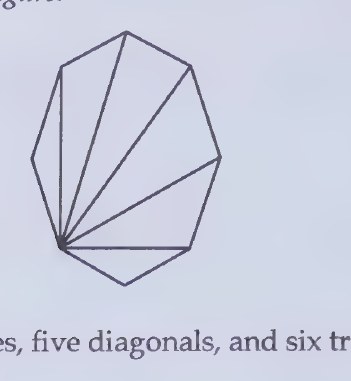
Diagram from page 86.
42. Eight sides, five diagonals, and six triangles. 43. n-3.
4. n-2.
45. A quadrilateral has 4 - 3 = 1 diagonal which forms 4 — 2 = 2 triangles.
- 720°. (4 x 180°.)
047. 120°. (zzi) 6
48. 1,080°. (6 x 180°.)
49. 135°. (w) 8 50. (n—2)180°.
5 (1=2180°
n
Linkage Problems.
- Their sum is 360°.
53. Their sum is 180° if we think of the linkage as a triangle. (It is 360° if we think of the linkage as a quadrilateral, because ∠BCD =180°.) 54. They all appear to be smaller.
55. ∠A + ∠B + ∠APB = 180°, and ∠C + ∠D + ∠CPD = 180°; so ∠A + /B + LAPB = ∠C + ∠D + ∠CPD. Because ∠APB = ∠CPD, it follows that ∠A + ∠B = ∠C + ∠D by subtraction.
Quadrilateral Angle Sum.
56. Addition.
57. Substitution.
58. Subtraction.
59. ∠1 and ∠2 are alinear pair; so they are supplementary and their sum is 180°. Likewise for ∠3 and ∠4.
(L1 + ∠2)+ (L3 + ∠4)=S; s0 180° +180° = S, and so S = 360°.
Set III
This triangle-to-square puzzle is the puzzle of Henry Dudeney first introduced in the Set il exercise of Chapter 1, Lesson 3. It is perhaps surprising that, by carefully comparing the two figures and knowing that the angles of an equilateral triangle and a square are 60° and 9o0° respectively, we can find all of the remaining angles from just the one given. (By using the fact that the triangle and square have equal areas and applying some simple trigonometry to the triangle labeled D, we can find the exact values of all of the angies in the figure. The 41° angle,
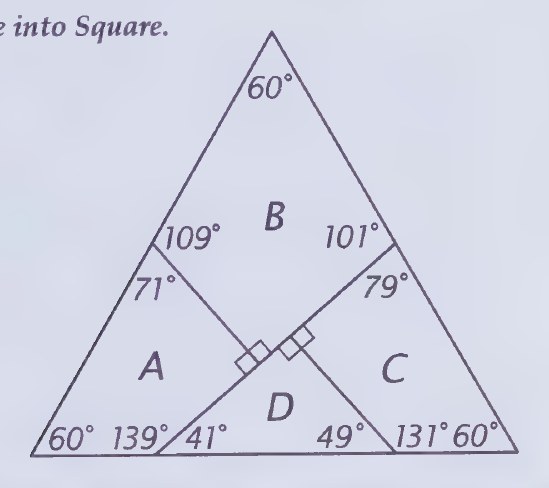
Diagram from page 87.
Lesson 2
Set I
1. The first card (the card with the picture of the baseball player).
- Point.
3. See if the figure looks exactly the same when it is turned upside down.
Optical Illusion. 4. Three.
5. Yes. The opposite sides of a parallelogram are equal.
6. BC looks longer than CF, but they are actually the same length.
7. The opposite angles of a parallelogram are equal.
8. An exterior angle of a triangle is greater than either remote interior angle.
9. Substitution. Theorem 26.
10. The opposite sides of a parallelogram are equal.
- The opposite sides of a parallelogram are parallel.
12. Parallel lines form equal alternate interior angles.
13. ASA.
14. Corresponding parts of congruent triangles are equal. 15. A line segment is bisected if it is divided into two equal segments.
Point Symmetry. 16.
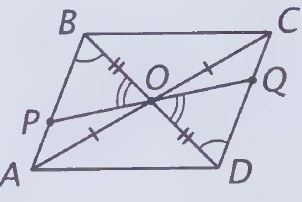
Diagram from page 87.
- The diagonals of a parallelogram bisect each other.
«18. Two points are symmetric with respect to a point if it is the midpoint of the line segment connecting them.
19. Parallel lines form equal alternate interior angles.
20. Vertical angles are equal.
21. ASA.
22. Corresponding parts of congruent triangles are equal.
23. Two points are symmetric with respect to a point if it is the midpoint of the line segment connecting them.
Set II
In encyclopedias and unabridged dictionaries, the entry for “parallelogram” is followed by an entry for “parallelogram law.” The Encyclopedia Britannica describes it as the “rule for obtaining geometrically the sum of two vectors by constructing a parallelogram. A diagonal will give the requisite vector sum of two adjacent sides. The law is commonly used in physics to determine a resultant force or stress acting on a structure.” The except from Newton’s Mathematical Principles of Natural Philosophy is taken from the original Latin edition published in 1687. It immediately follows statements of his three laws of motion.
A specific measure for ∠BAD in the figure for exercises 47 through 5o was given to make the exercises a little easier. Actually, any measure other than 60° or 120° will work. A nice problem for better students would be to rework the exercises letting ∠BAD = x°and to explain what happens when x = 60 or 120.
Parallelogram Rule.
24. Corollary.
25. A B
© D
- 10. (5 cm represents 50 1b; so 1 cm represents 101b.)
27. 25.(25x10=25.)
28. About 6 cm.
29. About 60. (6 x 10 = 60.) 30. About 24°. Angle Bisectors.
31.
z z
e D
E z 32. ∠AEB=x% ∠CED =y°.
33. AB, AE, and ED.
34. Point E is the midpoint of AD.
- AD =2DC.
36. They are supplementary. Parallel lines form supplementary interior angles on the same side of a transversal. 37. 180.
38. 90.
39. Isosceles.
40. Right. Because x + y = 90, ∠BEC = 90°.
41. BE LEC. Two Parallelograms.
42. A B
E D
- Because x, y, and z are the measures of the angles of a triangle, x + y +z = 180. Therefore, ∠ABC is a straight angle; so A, B, and C are collinear.
44. Because ABDE and BCDE are parallelograms, AB || ED and BC || ED. If A, B, and C are not collinear, then through B there are two lines parallel to ED. This contradicts the Parallel Postulate; so A, B, and C must be collinear.
045, All three (AABE = ADEB = ABCD).
46. No.
Hidden Triangles.
A
705°B F C
D
48. AADE, ACDF, and AEBE.
49. SAS.
50. Three. In addition to AABE and ABCF, ADEF is equilateral because its sides are the corresponding sides of the three congruent triangles.
Set III
The four symbols used on modern playing cards were designed in 1392 by the court painter to King Charles VI of France. The four suits represented four classes of French society: the spades, soldiers, the clubs, farmers, the diamonds, artisans, and the hearts, the clergy. According to John Scarne in Scarne’s New Complete Guide to Gambling (Simon & Schuster, 1974), playing cards first arrived in the New World in 1492 with Columbus and immediately found favor with the Native Americans, who made them of deerskin or sheepskin!
Playing Card Symmetries.
1. So that they look the same whether they are held “right side up” or “upside down.”
2. No playing card has line symmetry.
3. The diamonds are more symmetric because the diamond symbol itself has point symmetry, whereas the symbols of the other suits do not. (They do have line symmetry, however.)
4. All of the diamond cards have point symmetry except for the 7. All face cards have point symmetry. In the club, spade, and heart suits, the 2s and 4s have point symmetry.
5. The 6s and 8s of clubs, spades, and hearts would have point symmetry if one of the symbols in the middle row were turned upside down. (It is impossible for the oddnumbered cards in these three suits to be redesigned so as to have point symmetry!)
Lesson 3
Set I
The letter pis the only letter of the English alphabet that transforms into three other letters by reflections and rotations. Some students may enjoy thinking about other examples of letters that transform into at least one other letter in this way.
Pop-Up Parallelogram. 1. A quadrilateral is a parallelogram if its opposite sides are equal.
2. The opposite sides of a parallelogram are parallel.
3. Parallel lines form equal corresponding angles.
4. Ina plane, if a line is perpendicular to one of two parallel lines, it is also perpendicular to the other.
Theorem 28.
5. The sum of the angles of a quadrilateral is 360°.
6. Division.
7. Two angles are supplementary if their sum is 180°.
8. Supplementary interior angles on the same side of a transversal mean that lines are parallel.
9. A quadrilateral is a parallelogram if its opposite sides are parallel.
Theorem 29.
10. Two points determine a line.
11. Parallel lines form equal alternate interior angles.
12. Reflexive. 13. SAS.
14. Corresponding parts of congruent triangles are equal.
15. A quadrilateral is a parallelogram if its opposite sides are equal.
Theorem 30.
16. A line segment that is bisected is divided into two equal parts.
17. Vertical angles are equal.
18. SAS.
19. Corresponding parts of congruent triangles are equal.
«20. Equal alternate interior angles mean that lines are parallel. 21. A quadrilateral is a parallelogram if two opposite sides are both parallel and equal.
Letter Transformations.
- Line symmetry. The figure can be folded along a vertical line so that the two halves coincide.
23. Point symmetry. If the figure is turned upside down, it looks exactly the same.
24. Line symmetry. The figure can be folded along a horizontal line so that the two halves coincide.
Quadrilateral Symmetries.
25. Yes. Point symmetry.
- No. Line symmetry (one vertical line).
27. Yes. Point symmetry and line symmetry (two lines, one vertical and one horizontal).
28. Yes. Point symmetry and line symmetry (four lines, one vertical, one horizontal, and two at 45° angles with them).
Economics Graph.
- They seem to be parallel.
30. The quadrilateral formed by the four lines is a parallelogram (a quadrilateral is a parallelogram if two opposite sides are equal and parallel); so the lines C and C + 1 are parallel.
Set II
The method for constructing a parallel to a line through a given point not on it is another example of a “rusty compass” construction. Martin Gardner observes that, although the method has long been known, it is still being rediscovered and reported as new.
The grid-bracing illustrations are taken from the section titled “Bracing Structures” in Jay Kappraff’s Connections—The Geometric Bridge between Art and Science (McGraw-Hill, 1991). Kappraff cites the article “How to Brace a One- Story Building” in Environment and Planning (1977) as the original source of this material, an important topic for engineers and architects. Examples of pertinent theorems dealing with this subject in graph theory are: “In any distorted grid all the elements of a row (column) are parallel” and “A bracing of an n by m grid is a minimum
rigid bracing if and only if the bracing subgraph is atree.”
Parallel Rulers.
31. They are connected so that AB = CD and AC =BD. A quadrilateral is a parallelogram if its opposite sides are equal.
32. The pairs of opposite angles. Tent Geometry. 33.
B~m Y »t—F F
34. Yes. ABCD and CDEF are parallelograms; so AB = CD and CD = EF (the opposite sides of a parallelogram are equal) and AB || CD and CD || EF (the opposite sides of a parallelogram are parallel). It follows that AB = EF (substitution) and AB || EF (two lines parallel to the same line are parallel to each other). Therefore, ABFE is a parallelogram because two opposite sides are parallel and equal.
35. Yes. AD = BC, DE = CF, and AE = BF (the opposite sides of a parallelogram are equal). Therefore, AADE = ABCF (SSS).
Rope Trick. 36.
A D 37. A quadrilateral is a parallelogram if its diagonals bisect each other.
38. The opposite sides of a parallelogram are equal.
- SSS.
40. Corresponding parts of congruent triangles are equal.
41. The opposite angles of a parallelogram are equal.
42. Substitution. 43. A quadrilateral is a rectangle if all of its angles are equal.
- Parallel Postulate.
44. Through point P, there is exactly one line parallel to line [. 45.
C
A B :
46. PC is parallel to line I because ABCPis a parallelogram (a quadrilateral is a parallelogram if its opposite sides are equal).
Flexible Grid.
047. 12,
48. 4.
49. 12.
50. 4.
51. They remain unchanged because their shapes are determined by their sides (SSS) and their sides do not change.
52. They remain parallel because the opposite sides of the quadrilaterals remain equal; so they are always parallelograms.
- They are the sides of the quadrilaterals above and below the braced square.
54. They are the sides of the quadrilaterals to the right of the braced square.
55. Because all of the quadrilaterals remain parallelograms, these sides remain parallel to the horizontal and vertical sides of the braced square.
Set III
1. (The figures below show two possible answers depending on which triangles are constructed inward and outward.)
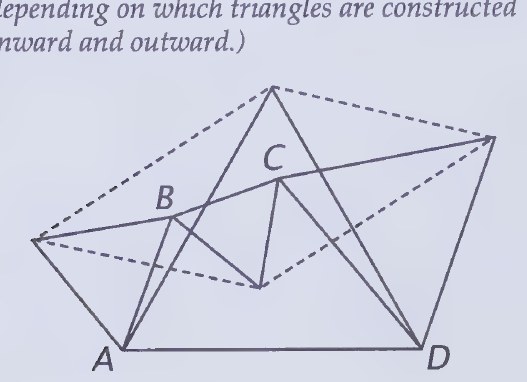
Diagram from page 91.
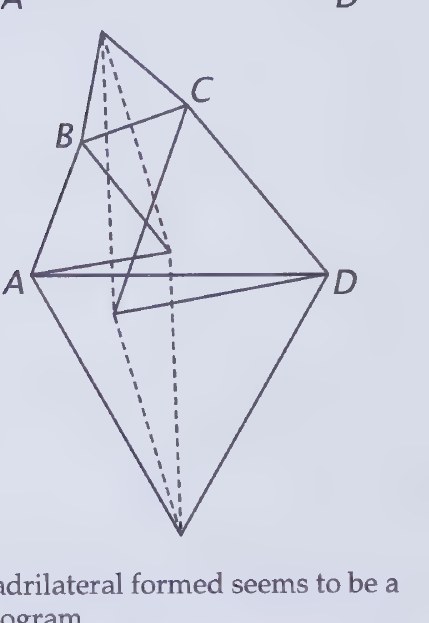
Diagram from page 91.
2. The quadrilateral formed seems to be a parallelogram.
Lesson 4
Set I
In his definitive book on the subject, Dissections— Plane and Fancy (Cambridge University Press, 1997), Greg N. Frederickson (using radians,
2m radians = 360°) reports:
“We can think of a regular polygon as a union of various rhombuses and isosceles triangles (which are halves of rhombuses). Such a characterization is an internal structure of the corresponding polygon. If the reqular polygon has an even number of sides, then the internal structure needs only rhombuses . . . . A regular polygon with 2q
. . i sides contains q each of —-rhombuses, for each q
positive integer i that is less than g plus g squares
if g is even. For example, the dodecagon contains
6 each of %-rhombuses and g—rhombuses, plus
3 squares.”
m and ; indicate rhombuses having angles of
n [6 30° and 60°.] There are several ways in which the rhombuses can be arranged when the dodecagon is divided in this way.
The remark about a square being perfect because all of its angles are “just right” was made by Albert H. Beiler at the beginning of the chapter titled “On The Square” in his book titled Recreations in the Theory of Numbers—The Queen of Mathematics Entertains (Dover, 1966).
Regular Dodecagon. ol. 12
2. Three.
3. Asquare.
4. Three. oG, 13,
6. Three. (There are six narrow, six medium, and three square.)
Theorem 31.
7. All of the angles of a rectangle are equal.
8. A quadrilateral is a parallelogram if its opposite angles are equal.
Theorem 32.
9. All of the sides of a rhombus are equal. 10. A quadrilateral is a parallelogram if its opposite sides are equal.
Theorem 33.
11. All of the angles of a rectangle are equal. 12. All rectangles are parallelograms.
13. The opposite sides of a parallelogram are equal.
14. Reflexive.
15. SAS.
16. Corresponding parts of congruent triangles are equal.
Theorem 34.
- All of the sides of a rhombus are equal.
18. In a plane, two points each equidistant from the endpoints of a line segment determine the perpendicular bisector of the line segment.
Which Parts?
- Two consecutive sides.
20. One side.
21. One side and one angle.
22. Two consecutive sides and one angle. “Just Right.”
23. If all of the angles of a triangle were right angles, the sum of their measures would be 270°, rather than 180°. 24. No. It must be a rectangle.
25. Shown below are two of many possible examples. (The ambiguity arises because the right angles may be on the inside or the outside of the
polygon.)
i
Set II
Checking a Wall.
26. No. If the opposite sides of a quadrilateral are equal, it must be a parallelogram but not necessarily a rectangle.
27. No. We know that the diagonals of a rectangle are equal but to conclude that, if the diagonals of a quadrilateral are equal, it is a rectangle would be to make the converse error.
28. A D
B C
29. SSS.
30. Corresponding parts of congruent triangles are equal. 31. A quadrilateral is a parallelogram if its opposite sides are equal.
32. The opposite angles of a parallelogram are equal.
33. Substitution. 34. A quadrilateral all of whose angles are equal is a rectangle.
35. True.
- False.
37. True.
38. False. 39. True. Square Problem.
40. A P D
= WS
B N €
41. Parallelograms.
42. They must be parallelograms because two opposite sides are both parallel and equal. (For example, in AMCO, AM || CO because ABCD is a square and AM = CO because M and O are midpoints of the equal segments AB and CD.)
- Its opposite sides are parallel.
44. Arhombus.
45. They seem to be collinear.
46. Tt appears to have point symmetry and line symmetry (with respect to the lines of the diagonals of the square).
Rhombus Problem.
47. A D
B E C
48. Yes. Because ABCD is a rhombus, AB = AD. It is also a parallelogram; so ∠B = ∠D. AAEB = AAFD (AAS); so AE = AF.
Triangle Problem. 49.
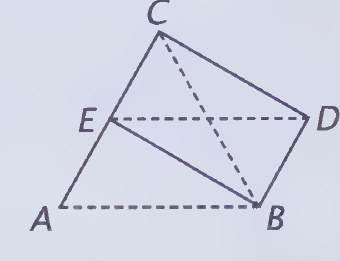
Diagram from page 93.
A B
50. Because ABDE is a parallelogram, AB = ED (the opposite sides of a parallelogram are equal). Also, because BDCE is a rectangle, ED = CB (the diagonals of a rectangle are equal). So AB = CB (substitution). Therefore, AABC is isosceles. (Additional drawings using the conditions given reveal that it isn’t necessarily equilateral.)
Set III
Bill Leonard told the story of starting a lesson with a high-school class of remedial mathematics students with the problem of counting the squares in a 4 x 4 grid. He had hoped that the students would think about it for awhile, but it didn’t take long for several students to start yelling out “16.” Leonard then asked if they had counted squares such as the one shaded in the second figure. The class immediately yelled out in unison, “7!”
Counting Squares.
1. It contains 30 squares in all. There are 16 small squares, 9 2 x 2 squares, 4 3 x3squares, and 1 4 X 4 square.
2. It contains 15 squares in all. There are 7 small squares, 6 2 X 2 squares, 1 3x3square, and 1 4 x4 square.
Lesson 5
Set I
Hal Morgan in his book titled Symbols of America (Viking, 1986), comments on the Chase Manhattan Bank trademark: “After World War |l the representational images of the nineteenth century began to give way to abstract designs inspired by the spare, geometric forms of the Bauhaus. Some of these modern designs are quite striking in their clarity and simplicity. . .. The design firm of Chermayeff & Geismar Associates created the Chase Manhattan Bank’’s distinctive octagon logo in 1960. . . . The abstract, interlocking design seems to have become a sort of model for the designers of other bank and insurance logos.” Morgan shows examples of several more-recent logos that are also point-symmetric designs of interlocking solid black congruent polygons.
Quadrilaterals in Perspective. 1. Atrapezoid.
2. That it has exactly one pair of parallel sides.
3. Yes. Picnic blankets are usually rectangular. (The perspective alters the blanket’s shape.) 4. That all of its angles are right angles (or that they are equal).
5. Yes. All rectangles are parallelograms.
6. Rhombuses and parallelograms.
7. Squares, rectangles, rhombuses, and parallelograms.
Geometric Trademark. 8. Point.
9. Itis a square because all of its sides and angles are equal. 10. They seem to be congruent. 11. Trapezoids.
12. CD and JE. 13. No. The legs of a trapezoid must be equal for it to be isosceles.
14. No. One is a right angle and the other is acute.
15. An octagon.
Theorem 35. 16. The bases of a trapezoid are parallel. 17. Through a point not on a line, there is exactly one line parallel to the line.
18. A quadrilateral is a parallelogram if its opposite sides are parallel.
- The opposite sides of a parallelogram are equal.
20. The legs of an isosceles trapezoid are equal.
21. Substitution.
- If two sides of a triangle are equal, the angles opposite them are equal.
23. Parallel lines form equal corresponding angles.
24. Substitution.
- Parallel lines form supplementary interior angles with a transversal.
26. The sum of two supplementary angles is 180°.
27. Substitution.
28. Subtraction. Theorem 36.
29. The legs of an isosceles trapezoid are equal.
- The base angles of an isosceles trapezoid are equal.
31. Reflexive.
32. SAS.
33. Corresponding parts of congruent triangles
are equal.
Set II
Stepladder.
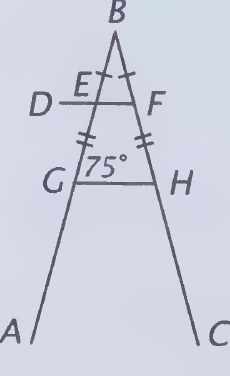
Diagram from page 94.
34.
35. Anisosceles trapezoid. 36. 75°.
37. The base angles of an isosceles trapezoid are equal.
38. Isosceles.
& 7%
- Parallel lines form equal corresponding angles.
- 105°.
42. 30°. Regular Pentagon.
43. Examples are ABCD, ABCE, ACDE, and ABDE. Their bases are parallel (they form supplementary interior angles on the same side of a transversal) and their legs are equal (given).
44. Examples are ABCH, ABGE, and AFDE. Their opposite sides are parallel (established in exercise 43).
45. Examples are ABCH, ABGE, and AFDE. They are rhombuses because all of their sides are equal. In regard to ABCH, for example, AB = BC (given), AB = HC, and AH = BC (the opposite sides of a parallelogram are equal); so HC = AH (substitution).
Trapezoid Diagonals.
AC and DB bisect each other.
A quadrilateral is a parallelogram if its diagonals bisect each other.
48. The opposite sides of a parallelogram are parallel. 49. A trapezoid has only one pair of opposite sides parallel.
50. AC and DB bisect each other.
51. AC and DB do not bisect each other.
52. Yes. One example of such a trapezoid is shown below.
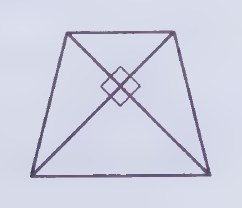
Diagram from page 95.
Set III
The Moscow Puzzles is the English language edition of Boris Kordemsky’s Mathematical Know-how, which, according to Martin Gardner, is the best and most popular puzzle book ever published in the Soviet Union. Kordemsky taught mathematics at a high school in Moscow for many years.
Gardner reported Andrew Miller’s discovery of a second solution to Kordemsky’s trapezoid dissection problem in the February 1979 issue of Scientific American and posed it as a new puzzle for the readers of that magazine.
Congruence Puzzle.
Kordemsky’s solution is shown below.
The solution thought of by Andrew Miller is shown below. The three cuts intersect the upper
, and 7z of the way from its
. 3 base at points 3 1 8
left endpoint.
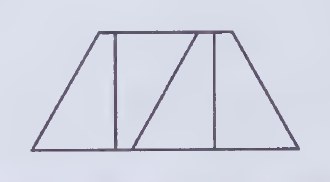
Diagram from page 95.
Lesson 6
Set I
The “state capital” quadrilateral was chosen partly for fun but primarily to show that the original quadrilateral can have any shape. It doesn’t even have to be convex. Not only can the quadrilateral be concave, it can even be “self-intersecting” or skew!
Portuguese Theorem.
1. Midpoints. 2. A midsegment.
3. Other side.
4. A midsegment of a triangle is parallel to the third side and half as long.
1
5. DE||ACand DE = EAC’
State Capitals Problem.
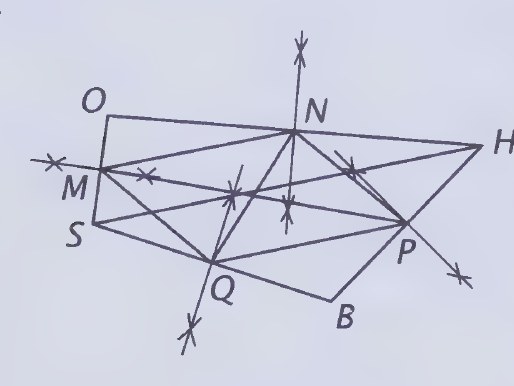
Diagram from page 96.
7. MNPQ looks like a parallelogram.
8. A midsegment of a triangle is parallel to the third side. (MN and QP are midsegments of ASOH and ASBH.)
9. In a plane, two lines parallel to a third line are parallel to each other. 10. A midsegment of a triangle is half as long as the third side.
11. Substitution.
12. That it is a parallelogram. 13. MNPQ is a parallelogram because two opposite sides are both parallel and equal.
14. MP and NQ seem to bisect each other.
15. The diagonals of a parallelogram bisect each other.
Midpoint Quadrilateral.
16. A midsegment of a triangle is half as long as the third side. 17. Addition. 18. Substitution.
19. Its perimeter.
- The sum of its diagonals.
21. The perimeter of the midpoint quadrilateral is equal to the sum of the diagonals of the original quadrilateral.
Two Midsegments.
22. ©
E G
A D F B
23. ADEC is an isosceles trapezoid because DE || AC (a midsegment of a triangle is parallel to the third side) and AD = CE.
- ∠A = ∠C because the base angles of an isosceles trapezoid are equal.
25. AABC is isosceles because, if two angles of a triangle are equal, the sides opposite them are equal.
(Alternatively, AB = 2AD = 2CE = CB .)
26. FG = %AC because FG = -;—DE and
1 1.1 1 DE= EAC [so FG = E(EAC) = 4AC]. Also, FG || AC because FG || DE and DE || AC (in a plane, two lines parallel to a third line are parallel to each other).
Set II
Exercises 27 through 36 are intended to review some basics of coordinate geometry, including the distance formula, and to get students to thinking about how midpoints and the directions of lines might be treated.
The Midsegment Theorem is, in a way, a “special case” of the fact that the line segment connecting the midpoints of the legs of a trapezoid is parallel to the bases and half their sum.
The edition of Euclid’s E/lements with the fold-up figures was its first translation into English, by Henry Billingsley. After a career in business, Billingsley became sheriff of London and was elected its mayor in 1596. An excerpt from The Elements of Geometrie, including an actual fold-up model, is reproduced in Edward R. Tufte’s wonderful book Envisioning Information (Graphics Press, 1990).
In Mathematical Gems /I (Mathematical Association of America, 1976), Ross Honsberger wrote: “Solid geometry pays as much attention to the tetrahedron as plane geometry does to the
triangle. Yet many elementary properties of the tetrahedron are not very well known.” Exercises 37 through 41 establish that any triangle can be folded along its midsegments to form a tetrahe-
. dron. Unlike tetrahedra in general, however, a tetrahedron formed in this way is always isosceles; that is, each pair of opposite edges are equal. All the faces of an isosceles tetrahedron are congruent triangles and consequently have the same area; furthermore, the sum of the face angles at each vertex is 180°. More information on this geometric solid can be found in chapter 9 of Honsberger’s book.
Midpoint Coordinates.
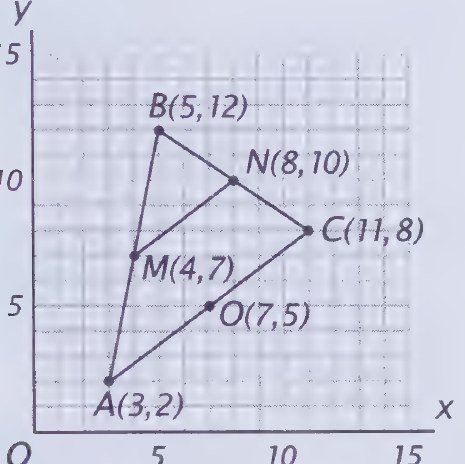
Diagram from page 97.
7 28. (4,7). 29. (8, 10).
30. (7, 5).
31. Yes. The coordinates of the midpoint are “midway between” the respective coordinates of the endpoints. (They are their averages.)
032 MN = y(8-4)2+(10-7)? = Y4243 =
\16+9 = +25 =5.
- AC= (11-3)2+(8-2) = V8 +6” = 64+ 36 = 4100 = 10.
34. Yes. MN = %AC as the Midsegment Theorem states.
- They should be parallel.
36. Yes. They seem to be parallel because they have the same direction; each line goes up 3 units as it goes 4 units to the right.
5
Tetrahedron. 37.
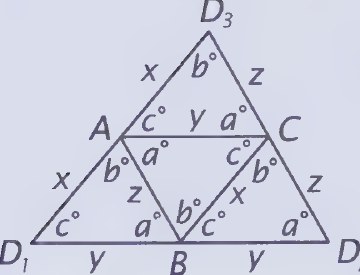
Diagram from page 97.
39. D
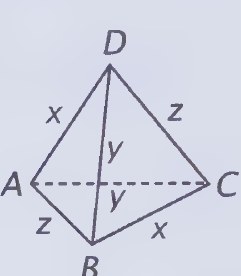
Diagram from page 97.
40. They are equal.
41. 180°. (The measures of the three angles that meet at each vertex are 4, b, and c.)
More Midpoint Quadrilaterals.
42. Example figure:
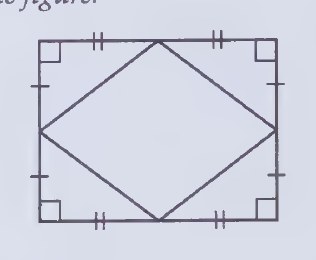
Diagram from page 97.
®43. Arhombus.
44. The line segments divide the rectangle into four right triangles and the quadrilateral. The triangles are congruent by SAS; so their hypotenuses are equal. Because the hypotenuses are the sides of the quadrilateral, it is equilateral and must be a rhombus.
45. Example figure:
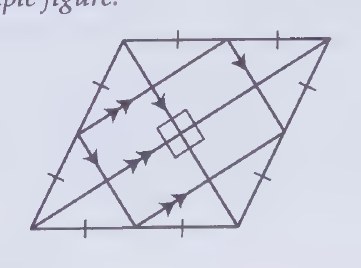
Diagram from page 97.
46. A rectangle.
47. The sides of the new quadrilateral are parallel to the diagonals of the rhombus because of the Midsegment Theorem. Consequently, they form four small parallelograms. Each parallelogram has a right angle because the diagonals of a rhombus are perpendicular. Because the opposite angles of a parallelogram are equal, it follows that the four angles of the new quadrilateral are right angles; so it is a rectangle.
48. Another square.
Base Average. 49. MN seems to be parallel to AB and DC, the bases of the trapezoid. 50. D €
M N P A
B
51. DC || AP; so ∠C = ∠NBP (parallel lines form equal alternate interior angles). CN = NB because N is the midpoint of CB. ∠CND = ∠BNP (vertical angles are equal). So ADCN = APBN (ASA).
[An alternative proof could use
∠CDN = ∠BPN (equal alternate interior angles) in place of either pair of angles above, in which case the triangles would be congruent by AAS.]
52. DN = NP (corresponding parts of congruent triangles are equal); so N is the midpoint of DP. Therefore, MN is a midsegment of ADAP and so MN || AP.
53. MN || AP and DC || AP;so MN || DC. (Ina plane, two lines parallel to a third line are parallel to each other.)
1
54. MN = EAP by the Midsegment Theorem.
Because AP = AB + BP and DC = BP (corresponding parts of congruent triangles
are equal), MN = %(AB +BP) = %(AB +DCQC) (substitution).
Set III
The problem of the nested triangles is a preview of the idea of a limit, a topic considered later in the treatment of measuring the circle. The sum of the lengths of all of the sides of the triangles is the sum of the geometric series:
1 6+ 26+ ()6 + ()6 + -0 =2%X6 2 24 2
Students who tackle this problem will be interested to know that they will explore it further in second-year algebra.
Infinite Series.
The perimeter of the largest triangle is 6 in. From the Midsegment Theorem, we know that the sides of the next triangle are half as long; so its perimeter is 3 in. Reasoning in the same way, we find that the perimeters in inches of successive triangles are 1.5, 0.75, 0.375, 0.1875, and so on.
Starting with the first two triangles, we find that the successive sums of the sides are 9, 10.5, 11.25, 11.625, 11.8125, and so on. The sums seem to be getting closer and closer to 12 inches and (as students who study infinite series will learn to prove) the sum of all of the sides of the triangles in the figure is 1 foot.
Review
Set I
A question such as that in exercise 11 is intended to arouse the student’s curiosity. According to Jearl Walker, who posed it in his book titled The Flying Circus of Physics (Wiley, 1977), “If the ratio of the bar’s density to the fluid’s density is close to 1 0r o, the bar floats in stable equilibrium as in the first figure. If the ratio is some intermediate value, then the bar floats in stable equilibrium with its sides at 45° to the fluid’s surface. In each case, the orientation of stable equilibrium is determined by the position in which the potential energy of the system is least.” This floating-bar problem is a good illustration of how scientists arrive at conclusions by using inductive reasoning (performing experiments with floating bars to see what happens) and how they then “explain” the results by using deductive reasoning (calculating the potential energy and its minimum value by using mathematics, including geometry).
The frequent appearance in this chapter of theorems whose converses also are theorems can easily mislead students into forgetting that a
statement and its converse are not logically equivalent. The intent of exercises 17 through 30 is to remind students of this fact and to encourage them to draw figures to test unfamiliar conclusions . (or even to remind themselves of facts that they have proved). Knowledge of the properties of the various quadrilaterals should not be as much a matter of memorization as of looking at pictures and applying simple common sense.
Palm Strand Rhombus. 1.
2. Both pairs of its opposite sides are parallel (because the strips have parallel sides).
3. The opposite angles of a parallelogram are equal.
4. AAS.
5. Corresponding parts of congruent triangles are equal.
6. The opposite sides of a parallelogram are equal.
7. Substitution.
8. All of its sides are equal. Floating Bar.
9. Four.
10. Yes.
11. (Student answer.) (The bar can float either way depending on it and the liquid.)
12.
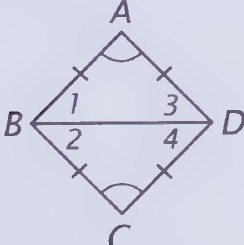
Diagram from page 99. 13. All of the sides and angles of a square are equal.
14. SAS (or SSS).
15. Corresponding parts of congruent triangles are equal. 16. If aline divides an angle into two equal parts, it bisects the angle.
Related Statements.
17. It is the converse of the first statement.
18. No. The first statement is true; the first figure shows that the triangles are congruent by SSS. The second figure shows that the second statement is false.
19. True.
20. True. 21. True.
22. False. Example of a quadrilateral that has two pairs of equal angles but is not an isosceles trapezoid:
23. False.
Example of a parallelogram that is not a rhombus:
L/
24. True.
25. True.
26. True.
- True.
28. False. Example of a quadrilateral with perpendicular diagonals that is not a rhombus:
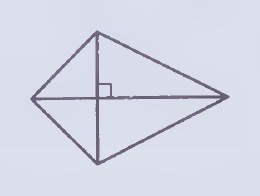
Diagram from page 99.
29. False. Example of a parallelogram whose diagonals are not equal:
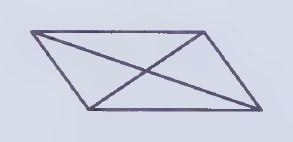
Diagram from page 100.
30. False.
Example of a quadrilateral whose diagonals are equal that is not a parallelogram:
Jumping Frog. 31. The sum of the angles of a quadrilateral is 360°.
32. They are rhombuses and all thombuses are parallelograms. (Or, Both pairs of their opposite sides are equal.) 33. The opposite angles of a parallelogram are equal.
34. They are parallelograms because their diagonals bisect each other.
35. The opposite sides of a parallelogram are parallel and, in a plane, two lines parallel to a third line are parallel to each other.
Set II
Only the right angles in the pieces of the puzzle of exercises 36 through 50 actually have measures that are integers. From AABG it is evident that
2¢ tan A = P 2; 50 ∠A = Arctan 2 = 63.43°.
Although part of basic vocabulary in books of the past, words such as “trapezium” and “rhomboid” are now close to being obsolete. Strangely, in British usage, the word “trapezium” is used to mean “trapezoid.”
Even though the quadrilaterals in exercises 54 through s7 are drawn to scale, it is almost impossible to recognize them merely by their appearance. It is tempting to conclude that, because quadrilateral ABCD is a trapezoid whose base angles are equal, it is isosceles, which, of course, is the converse error. To prove that it is isosceles would require adding an extra line to the figure
to form a parallelogram and a triangle; the proof is comparable to that of Theorem 35, outlined in exercises 16 through 28 of Lesson 5. The additional fact that the base opposite the larger base angles of an isosceles trapezoid is longer than the other base is the basis for the magic trick of exercise 58. Like the question about the floating bar in Set |, the question about the magic trick is included for fun and not meant to be taken too seriously.
Dissection Puzzle.
- D,E and E
37. D.
38. Dand F.
39. Cand D.
40. A,B,D,E, and F. 41.
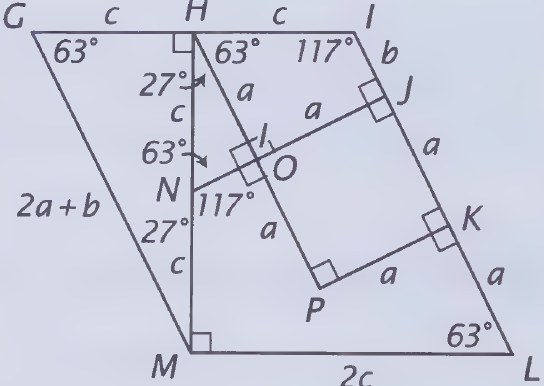
Diagram from page 100. 42. GI L HM and ML L HM. In a plane, two lines perpendicular to a third line are parallel.
43. Aparallelogram.
44. A quadrilateral is a parallelogram if its opposite sides are parallel. 45. 2c.
46. 2a +b. [Some students may recognize that GM can also be expressed in terms of ¢ by using the Pythagorean Theorem.
GM?2 =2 + (202 = 5% 50 GM = c5 ]
47. Asquare.
48. All of its sides and angles are equal. 49. Atrapezoid.
Algebra Review (page 296)
1. 2.236.
2. 22.36.
3. 223.6.
4. 7.07.
5. 70.7.
6. .
7. .
8. .
9. .
10. .
11. .
12. .
13. .
14. .
15. .
16. .
17. .
18. .
19. .
20. 14.
21. 10.
22. .
23. 11.
24. .
25. 63.
26. .
27. 10.
28. 23.
29. .
30. .
31. .
32. .