Chapter 2 — Teacher’s Guide Answers
Answers and teaching commentary for Chapter 2: The Nature of Deductive Reasoning, transcribed from the scanned Teacher’s Guide. Diagrams are cropped from the same page scans.
OCR note. The text was recognized automatically and has not been corrected line by line; formulas and symbols may be imperfect. Check the original PDF for exact wording.
Homework: Chapter 2 exercises · Selected answers · Teacher’s answers PDF
Lesson 1
Set I (pages 43-44)
*1. A conditional statement.
2. “g” represents the hypothesis and “b” represents the conclusion.
b
©
A circle labeled a inside another circle labeled b.
*4. You live in the Ozarks.
5. You live in the United States.
*6. Yes.
7. No.
8. No. If it is cold outside, it isn’t necessarily snowing.
9. No.
10. Itis cold outside if it is snowing.
11. Yes.
12. Statements 1 and 3.
13. Yes.
¢14. If an animal is a koala bear, then it eats only eucalyptus leaves.
15. If the cat is in the birdcage, then it isn’t there to sing.
16. If money grew on trees, then Smokey Bear wouldn’t have to do commercials for a living.
17. If you are an architect, then you use geometry.
*18. If I don’t understand, then I ask questions.
19. If there is a fire, then use the stairs instead of the elevator.
20. If you are a vampire, then you do not cast a shadow. (Or, If you cast a shadow, then you are not a vampire.)
Set II (pages 44—45)
21. If at first you don’t succeed, then try again.
22. Try again if at first you don’t succeed.
23. Region 1.
*24. Regions 1 and 2.
25. Regions 2 and 3.
26. Region 3.
27.
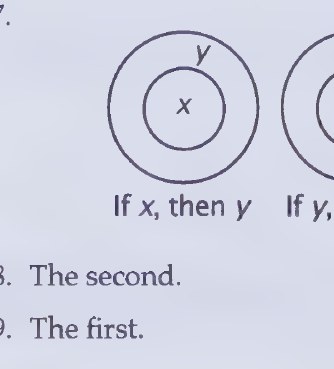
Diagram from page 11.
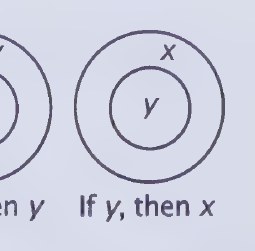
Diagram from page 11.
If x, then y I y, then x
#28. The second.
29. The first.
30. Two.
31.
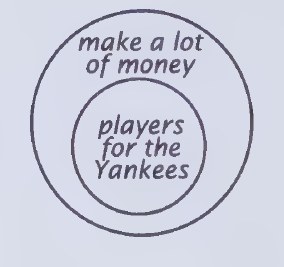
Diagram from page 11.
‘make a lot of money
32. Statements a and d.
33. Statements a and d. 34.
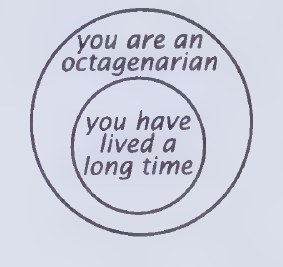
Diagram from page 11.
you are an octagenarian
35, Statements c and d.
36. Statements a and b.
Set 11l (page 45)
The Animal Mind, the source of the information for the Set |1l exercises, is a fascinating book. This paragraph from the dust jacket describes it well:
“In this engaging volume, James and Carol Gould go in search of the animal mind. Taking a fresh look at the evidence on animal capacities for perception, thought, and language, the Goulds show how scientists attempt to distinguish actions that go beyond the innate or automatically learned. They provide captivating, beautifullyillustrated descriptions of a number of clever and curious animal behaviors—some revealed to be more or less pre-programmed, some seemingly proof of a well-developed mental life.”
1. The red monkey shape.
2. In the left-hand column.
3. The red square.
4. If Sarah takes the banana, then Mary will not give chocolate to Sarah.
Lesson 2
Set I (pages 47-48)
Exercises 1 through 4 have an interesting source. In his book titled Euclid and His Modern Rivals (1885), Charles L. Dodgson (Lewis Carroll) criticized some of the geometry books of the time. One of them, Elementary Geometry, following the Syllabus prepared by the Geometrical Association, by J. M. Wilson (1878) contained on page 17 the following “question”:
“State the fact that all ‘geese have two legs’ in the form of a Theorem.” Carroll wrote: “This | would not mind attempting; but, when | read the additional request, to ‘write down its converse theorem,’ it is so powerfully borne in upon me that the writer of the Question is probably himself a biped, that | feel | must, however reluctantly, decline the task.”
1. If a creature is a goose, then it has two legs. 2.
creatures with two legs
geese
3. If a creature has two legs, then it is a goose.
4. No.
*5. You are not more than six feet tall.
6. If you are not more than six feet tall, then you are an astronaut.
7. No.
8. No.
9. If you do not know how to reason deductively.
10. If you cannot comprehend geometry, then you do not know how to reason deductively.
11. You do not know how to reason deductively.
12. If and only if.
¢13. They have the same meaning.
14. If and only if.
15. The fear of peanut butter sticking to the roof of your mouth.
16. If you are afraid of peanut butter sticking to the roof of your mouth, then you have arachibutyrophobia.
17. Yes. It must be true because the sentence is a definition.
18. Common, proper, improper.
19. If a fraction is a vulgar fraction, then it is a common fraction that is either proper or improper.
20. If a fraction is a common fraction that is either proper or improper, then it is a vulgar fraction.
#21. Yes. The converse must be true because this is a definition.
22. “New Year’s Day” does not mean the same
thing as “holiday.” Other days are holidays as well, so its converse is not true.
23. Yes. “New Year’s Day” means the same thing as “the first day of the year.” The converse is true.
Set II (pages 48—49)
The wolf-pack definition in exercises 36 and 37 is an amusing example of recursion. An entire chapter of Clifford Pickover’s book titled Keys to Infinity (Wiley, 1995) deals with the subject of “recursive worlds.”
Lesson 3
24. Yes.
25. No.
©26. No.
27. The second sentence. (Only if it is your birthday do you get some presents.)
©28. Itis the converse. 29.
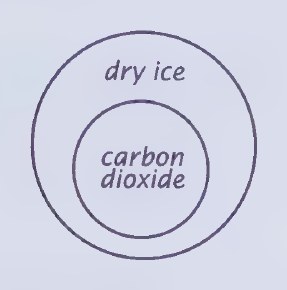
Diagram from page 13.
dry ice
carbon dioxide
30. Itis dry ice if and only if it is frozen carbon dioxide.
31. The teacher thought you misspelled “if.”
®32. Sentence 2. (If it is a detective story, then it is a whodunit.)
33. Yes.
34. If a car is a convertible, then it has a removable top. If a car has a removable top, then it is a convertible.
35, It is the converse.
36. Two or more.
37. Because, according to the definition, there is no limit to the number of wolves in a wolf pack.
Set II (page 49)
Since its creation in the early 1970s, Peter Wason’s puzzle has appeared in puzzle books in a variety of forms. In The Math Gene (Basic Books, 2000), Keith Devlin remarks that most people find the puzzle extremely hard. Devlin restates the problem as a party attended by young people, some drinking alcohol and some soft drinks, some legally and some not. Recast in this format, the problem seems quite simple. Devlin remarks: “The Wason test is famous because the outcome is so dramatic. A change in presentation turns a difficult problem that most people get wrong into an extremely simple one that most easily get right. The fact is that people reason much better about familiar, everyday objects and circumstances than they do about abstract
]
objects in unfamiliar settings, even if the logical structure of the task is the same.”
Turn over the blue card to see if there is a circle on the other side. Turn over the card with the triangle to see if the other side is blue. (It doesn’t matter what is on the other side of the card with the circle. For example, the possibility that the other side is red doesn’t contradict the statement
If a card is blue on one side, it has a circle on the other side.
Set I (pages 52-53)
1. If you keep quiet, others will never hear you make a mistake. If others never hear you make a mistake, they will think you are wise.
2. If you keep quiet, others will think you are wise.
3. a— b, b — c. Therefore,a — c.
e4. All Greeks are humans. All humans are mortals. Therefore, all Greeks are mortals.
5. All Greeks are statues. All statues are mortals. Therefore, all Greeks are mortals.
6. Yes.
*7. No.
8. The hypothesis.
9. The conclusion.
10. a—> b, b — ¢, ¢ > d. Therefore,a — d.
11. The third: If you live where it is cold, you see a lot of penguins.
*12. It also may be false.
13. If Captain Spaulding is in the jungle, he can’t play cards.
14. Yes.
15. If NASA launched some cows into space, they would be the herd shot around the world.
®16. A theorem.
17. If you go to Dallas, you will take a plane. If you take a plane, you will go to the airport. If you go to the airport, you will see all the cabs lined up. If you see all the cabs lined up, you will see the yellow rows of taxis.
#18. If you go to Dallas, you will see the yellow rows of taxis.
19. If a duck had sore lips, he would go to a drugstore. If he went to a drugstore, a duck would ask for some Chapstick. If he asked for some Chapstick, a duck would ask to have it put on his bill.
20. Second statement: If they wanted to take along some food, they would try to carry on six dead raccoons.
Last statement: If the flight attendant objected, they would be told that there is a limit of two carrion per passenger.
21. First statement: If a group of chess players checked into a hotel, they would stand in the lobby bragging about their tournament victories.
Third statement: If the manager asked them to leave, they would ask why.
Set II (pages 53-54) Dice Proof.
©22. 21.(1+2+3+4+5+6=21)
21
23. 7.(==7. 3 )
24. 2.
25. 6. Matchbox Proof.
*26. Red. Because the label is wrong.
27. Ared marble and a white marble.
28. Two white marbles.
Tick-tack-toe Proofs. 29.
X|o
olx|o
30. If your opponent marks an X in the upper left, then you will mark an O in the lower right.
If you mark an O in the lower right, then your opponent will mark an X in the lower center.
If your opponent marks an X in the lower center, you will mark an O in the upper center.
31. (Student drawings.)
32. You will win the game because, no matter where you mark your next O, your opponent will then be forced to allow you to set a winning trap!
Set lll (page 54)
Word ladders were invented by Lewis Carroll in 1877 and have been a popular form of word play ever since. An entire chapter in Martin Gardner’s The Universe in a Handkerchief— Lewis Carroll’s Mathematical Recreations, Games, Puzzles, and Word Plays (Copernicus, 1996) deals with word ladders (called “doublets” by Carroll).
Another interesting reference is Making the Alphabet Dance, by Ross Eckler (St. Martin’s Press, 1996). At the beginning of chapter 4, titled “Transforming One Word into Another”, Eckler remarks: “By drawing on ideas from mathematics … [word play] gains additional respectability and legitimacy.”
1. Example solution: LESS, LOSS, LOSE, LOVE, MOVE, MORE.
2. Example solution: HEAD, HEAR, HEIR, HAIR, HAIL, TAIL.
Lesson 4
Set I (pages 57-58)
It is interesting to note that, like that of Rube Goldberg, Samuel Goldwyn’’s name has entered the dictionary. According to The Random House Dictionary of the English Language, a “Goldwynism” means “a phrase or statement involving a humorous and supposedly unintentional misuse of idiom.”
*1. Contradiction.
2. “In—direct.”
*3. Suppose that it would not speak foul language.
4. Suppose that he has control over his pupils.
5. Suppose that it does not lead to a contradiction.
*6. No.
7. Yes.
8. No.
9. Indirect.
*10. Itis the opposite of the theorem’s conclusion.
*11. The earth is not flat.
12. Suppose that the earth is flat.
13. The stars would rise at the same time for everyone, which they do not.
*14. That it is false.
Set II (pages 58-59)
The puzzles about the weights are adapted from ideas in A. K. Dewdney’s book titled 200% of Nothing (Wiley, 1993). The subtitle of the book is An Eye-Opening Tour through the Twists and Turns of Math Abuse and Innumeracy. Dewdney uses the idea of equal partition of numbers in a section of the book titled “What Do Mathematicians Do?”
J
Trading Desks Proof.
*15. Beginning assumption:
Suppose that the pupils can obey the teacher.
Contradiction:
There are 13 pupils at the black desks but only 12 brown desks.
Conclusion:
The pupils can’t obey the teacher.
Ammonia Molecule Proof.
16. Beginning assumption:
Suppose that the atoms of an ammonia molecule are coplanar.
Contradiction:
Each bond angle is 107°.
Conclusion:
The atoms of an ammonia molecule are not coplanar.
Poker Proof.
17. Beginning assumption: Suppose that someone holds a royal flush. Contradiction: You have all the “10” cards. Conclusion: In this deal of the cards, no one holds a royal flush.
Balanced Weights Proofs.
18. Puzzle 1. One set s 2, 4, 6, 13; the other set is 7,18.
19. If a puzzle of this type has a solution, then each set will weigh half the total weight.
20. Beginning assumption: Suppose that there is a solution. Contradiction: The sum of all of the weights is odd. Conclusion: There is no solution.
Athletes Puzzle.
21. There is only 1 football player and consequently there are 99 basketball players. If there were two or more football players, then, given any two of the athletes, both could be football players. This contradicts the fact that, given any two of the athletes, at least one is a basketball player. Therefore, the assumption that there are two or more football players is false, and so there is only one football player.
Set 111 (page 59)
A good discussion of David L. Silverman’s puzzle about the list of true and false statements appears on page 79 of Knotted Doughnuts and Other Mathematical Entertainments, by Martin Gardner (W. H. Freeman and Company, 1986).
In its original form, the puzzle contained 1,969 statements (to celebrate the new year of 1969) comparable to those in the list in Set Ill. The only true statement in the original version was the 1,968th one.
This sort of puzzle suggests other possibilities that students might enjoy exploring. What if the word “false” were changed into “true” in all of the statements? What if the word “exactly” were omitted?
1. No, because any two statements on the list contradict each other.
2. No, because then the list would contain exactly zero false statements.
3. No.
4. No.
5. One, because the preceding conclusions eliminate all of the other possibilities. The true statement must be C.
Lesson 5
Set I (pages 61-63)
The dog Rin-Tin-Tin was Warner Brothers’ first big money-making star. His movie career began in 1922, and his salary at one time was $1,000 a week. According to Clive Hirschhorn’s The Warner Brothers Story, Rin-Tin-Tin’s 19 films kept the studio prosperous during the silent area and saved many theaters from closure. He was voted most popular film performer in 1926!
1. No (because a period has dimensions.)
2. No (because even an atom has dimensions.)
*3. You go around in circles.
4. Star, tail.
5. Because Rin-Tin-Tin was a movie star who had a tail.
*6. Two points determine a line.
7. Because it is taut and hence straight like a line.
8. Theorems.
9. A statement that is assumed to be true without proof.
10. No. Duck Pond Table.
11. Three noncollinear points determine a plane.
*12. The points.
13. The plane.
14. The table top might tip over.
15. Noncollinear.
16. If and only if.
17. If points are coplanar, then there is a plane that contains all of them. If there is a plane that contains all of them, then points are coplanar.
¢18. Converse. Intersecting Cubes.
19. True.
¢20. True.
21. True.
#22. False.
23. False.
24. True.
25. True.
Set II (pages 63-64) Japanese Weights.
#26. A picul is 1,600 taels.
27. A picul is 16,000 momme.
28. A momme is one-tenth of a tael.
29. No, because we don’t know what any of these units are.
30. Yes. An elephant weighs more than one picul.
31. Because “the load carried by a man” is too vague; some men can carry much heavier loads than others.
Credit Card Rules.
©32. Statements 1 and 3.
33. Transaction finance charge and supercheck.
34. Statements 2, 4, and 5.
35. Statements 2 and 4. (If you go over your credit limit, you will be charged a fee. If you are charged a fee, the fee will be added to your balance.)
36. If you go over your credit limit, a fee will be added to your balance.
Crooked Lines.
¢37. Two points determine a line.
38. Yes.
Lesson 6
39. We did not define the word “line” (nor did we define the word “straight”).
40. A theorem is a statement that is proved.
41. Beginning assumption: Suppose two lines can intersect in more than one point. Contradiction: Two points determine a line. Conclusion: Two lines cannot intersect in more than one point.
Set II (page 64)
1. 3lines.
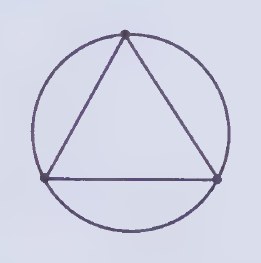
Diagram from page 17.
2. 6lines.
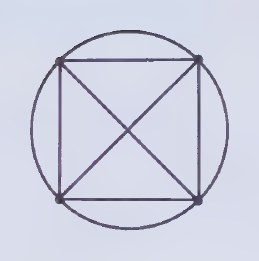
Diagram from page 17.
3. 10lines.
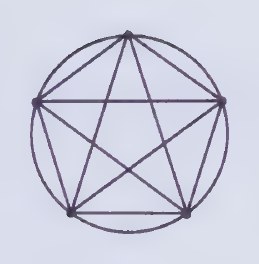
Diagram from page 17.
4. 15lines.
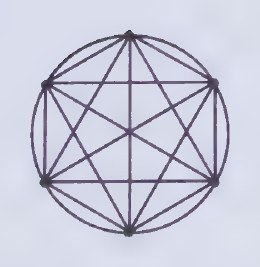
Diagram from page 17.
5. 20 points: 190 lines.
Some students who answer this correctly will probably do it by observing the pattern of increasing differences.
Numberofpoints 2 3 4 5 6 Number of lines 1 3 6 10 15 2 3 45
Each additional point results in one more line than the point before it.
Other students may deduce a formula for the number of lines, [, in terms of the number of points, p:
- Pe=D) 2 (This is the formula for the binomial
coefficient: (Zj J)
Set I (pages 67-68)
Sherman Stein makes some scathing remarks in his book titled Strength in Numbers (Wiley, 1996) about the “tear off the corners” of a triangle procedure illustrated in exercises 8 through 10.
He writes:
“Here is how one of the seventh-grade texts has the pupils ‘discover’ that the sum of the three angles of a triangle is always 180°. Under the heading ‘Work Together,’ it has these directions:
Begin with a paper triangle that is a different shape from those of the other members of your group. Number the angles of the triangle and tear them off the triangle. Place the three angles side-by-side so that pairs of angles are adjacent and no angles overlap.
What seems to be true? Compare your results with those of your group. Make a conjecture.
On the very next page, facing these directions, we find, ‘In the Work Together activity you discovered that the following statement is true.’ In boldface follows, ‘The sum of the measures of the angles of a triangle is 180°.
What kind of discovery or constructing knowledge out of experience is that? From what | know about pupils, they would glance at the bold type on the next page and stop experimenting.”
1. The length of the hypotenuse of a right triangle.
2. The speed of light.
3. The circumference of a circle.
4. The length of one of the other sides of a right triangle.
5. The area of a circle.
6. The Pythagorean Theorem.
7. The squares on the sides contain 16, 9, and 25 small squares; 16 + 9 = 25.
8. The sum of the angles of a triangle is 180°.
*9. No.
10. No. Target Circles.
11. 2,4, 6, 8, and 10 units.
*12. 2m, 4m, 6m, 8, and 10m units.
*13. 9 square units. (3% = 9r.)
14. 9 square units. (n5? — n4? = 9m.)
15. It is because the purple region appears to many people to be much larger than the yellow region.
16. 100. 36 + 64 = 100 by the Pythagorean Theorem.
17. 144. 169 - 25 = 144 by the Pythagorean Theorem.
*18. 30°. (The Triangle Angle Sum Theorem.)
19. 45°.
20. (90 -n)°.
©21. 70°. (180 - 40 = 140, % =70.) 22, 65°. (180 - 50 = 130, 1;—0 =65.) 180~n.
*24. No.
25. This is the converse of the Pythagorean Theorem, and the converse of a true statement isn’t necessarily true. (We will see later that this particular converse is true, but to show why requires a separate argument.)
Set II (pages 69—70)
David Gale, Professor Emeritus of Mathematics at the University of California at Berkeley recalls the rotating pencil demonstration in exercises
38 through 40 as his first encounter with a mathematical proof. Another student showed it to him when he was in the fifth grade. (Tracking The Automatic Ant, by David Gale, Springer, 1998).
Eye Pupil.
#26. Approximately 50 mm?. (42 = 16m = 50.)
27. Approximately 3 mm?. (1% == 3.14.)
28. Approximately 16 times as much.
Triangle Angle Sum Theorem.
29. 90°.
30. 60°.
31. No, because then the third angle would have a measure of 0°.
*32. Yes, because the sum of the other two angles could be 1°.
33. Yes, because the sums of the angles in the two triangles are the same.
The Stretched Cord.
*34. a2
35. 24%
36. 24”,
37. By the Pythagorean Theorem. Pencil Experiment.
*38. To the left.
39. That the pencil has turned through 180°.
40. The sum of the angles of a triangle is 180°.
Aryabhata on the Circle.
11 1 1 es. a 2c2d 2(21’(r)2(2r) e
41. Yes. a= —c—-d= = ==
42, 3.1416. If the circumference is 8(4 + 100) + 62,000 = 62,832 and the diameter is 20,000, then, because ¢ = rid,
62,832 62,832 = n(20,000); so =
m =3.1416.
Review
43. Dilcue’s answer is a good one because not only is PIE an old way to spell PI but his answer reflected in a vertical mirror is 3.14.
Set II (page 70)
Greg N. Frederickson, the author of Dissections, Plane and Fancy (Cambridge University Press, 1997), is a professor of computer science at Purdue University. His book is the definitive work on the amazing topic of geometric dissections and should be on the bookshelf of every geometry classroom.
When the three pieces are arranged as in the second figure, they seem to form a square whose side is the hypotenuse of one of the right triangles. When the pieces are arranged as in the fourth figure, they seem to form two squares whose sides are equal to the other two sides of the right triangle. The total area of the three pieces is the same no matter how they are arranged; so the two arrangements illustrate the Pythagorean Theorem.
Set I (pages 71~73)
A. Bartlett Giamatti was president of Yale University and, later, of the National Baseball League. He also served briefly as Commissioner of Major League Baseball until his death in 1989. Take Time for Paradise is a nice little book on sports and play.
The Morton Salt Company originally considered the slogan “Even in rainy weather, it flows freely” to promote the message that its salt would pour easily in damp weather. They then settled on a variation of the old proverb: “It never rains but it pours” for their slogan and have been using it on their packages since 1914.
The SAT problem was a multiple-choice question in its original format, and the problem asked only for x.
The judge in the trial excerpt was Judge Ito, and the conversation took place in Los Angeles on July 26, 199s, in the case of The People of the State of California vs. Orenthal James Simpson.
1. If something is a limerick, then it has five lines.
2. If I perfect my perpetual motion machine, then I will make a fortune.
3. If something is a toadstool, then it is not edible.
4. a—> b, b— c; therefore, a — c.
5. If we have known freedom, then we fear its loss.
6. One or both of the premises being false.
7. If you are a daredevil, then you are recklessly bold. If you are recklessly bold, then you are a daredevil.
8. Each is the converse of the other.
#9. Collinear.
10. Two.
*11. A postulate.
12. An Euler diagram.
*13. If it rains, then it pours.
14. It pours if it rains.
15. If it pours, then it rains.
16. No.
17. 100°. (180 - 48 - 32 = 100.)
*18. 50°. (2x =100, x = 50.)
19. 98°. (180 -50-32=98.)
#20. Three noncollinear points determine a plane.
21. If the feet of the four legs were not coplanar, the tripod might tip back and forth.
Geometry in Spanish.
22. In every right triangle, the square of the hypotenuse is equal to the sum of the squares of the other two sides.
#23. Square.
24. Equal.
25. They are defined by other words, which results in going around in circles.
26. Point, line, plane.
27. Because we must have a starting point to avoid going around in circles. These words are especially simple and so serve as good starting points. (Note: The answer is not that we cannot define them.)
Courtroom Questions.
28. The witness thought might be 2.12 or 2.17. The witness also said that pi times 2.5 squared is 19 but, rounded to the nearest whole number, the answer would be 20.
29. No. The judge guessed that pi was 3.1214, perhaps influenced by the witness’s guess of 2.12, and 3.1214 is too small.
30. No.
Set II (pages 73-74)
In his book titled Science Awakening (Oxford University Press, 1961), B. L. van der Waerden said of the Egyptians’ method for finding the area of a circle: “It is a great accomplishment of the Egyptians to have obtained such a good approximation. The Babylonians, who had reached a much higher stage of mathematical development, always used it = 3.”
Although it is unlikely that your students will be surprised that the circumference/perimeter ratio of the circle to its circumscribed square is equal to the area/area ratio, this relation is remarkable. It holds true even if the circle and square are stretched into an ellipse and rectangle. John Pottage wrote a nice dialogue between Galileo’s characters Simplicio and Segredo about this topic in the first chapter of his Geometrical Investigations—Illustrating the Art of Discovery in the Mathematical Field (Addison-Wesley, 1983).
The planet so small that someone can walk around it in 20 minutes is included in Lewis Carroll’s Sylvie and Bruno Concluded (1893). More about Carroll’s mathematical recreations can be found in Martin Gardner’s The Universe in a Handerchief (Copernicus, 1996). Carroll wrote of the planet: “There had been a great battle.. . . which had ended rather oddly: the vanquished army ran away at full speed, and in a very few minutes found themselves face-to-face with the victorious army, who were marching home again, and who were so frightened at finding themselves between two armies, that they surrendered at once!”
31. Postulates.
©32. Theorems.
33. Direct and indirect.
*34. 144 square units. (122 = 144.)
35. 256 square units. (16? = 256.)
36. 400 square units. (144 + 256 = 400.) 37, 20 ft. (x2 = 162 + 122 = 400, x = 4/400 =20.)
38. (19—6r)z = (%)rz; so e would be equal to 256 81
39. They would be too large. Panda Proof.
, or approximately 3.16.
40. Second statement: If he had a sandwich, he would take out a gun. Fourth statement: If he shot the waiter, he would leave without paying.
*41. Direct. Clue Proof.
42. Beginning assumption: Suppose that Colonel Mustard didn’t do it. Missing statement: If Miss Scarlet did it, then it was done in the dining room. Contradiction: It happened after 4 p.M. Conclusion: Colonel Mustard did it.
43. Indirect.
Circle in the Square.
*44, 2mr.
45. 8r.
2r m oM. :
46. e e (Z is approximately 0.785.)
47. 2.
*48. 4r2.
2
(o o
4r 4
50. Approximately 1,680 feet. If someone can walk three miles in an hour, they can walk one mile in 20 minutes. Because ¢ = nd,
Algebra Review (page 76)
1. .
2. .
3. .
4. .
5. .
6. .
7. .
8. .
9. .
10. .
11. .
12. .
13. .
14. .
15. .
16. .
17. 10.
18. 8.
19. 3.
20. 6.
21. 13.
22. 9.
23. −7.
24. −5.
25. 60.
26. 0.
27. −12.
28. 37.
29. −2.
30. 4.5.
31. 12.
32. Any number.