Chapter 3 — Teacher’s Guide Answers
Answers and teaching commentary for Chapter 3: Lines and Angles, transcribed from the scanned Teacher’s Guide. Diagrams are cropped from the same page scans.
OCR note. The text was recognized automatically and has not been corrected line by line; formulas and symbols may be imperfect. Check the original PDF for exact wording.
Homework: Chapter 3 exercises · Selected answers · Teacher’s answers PDF
Lesson 1
Set I (pages 80-81)
Zero among all numbers is surely the cause of the most confusion. Ask anyone other than someone knowledgeable in mathematics what number one divided by zero is or what zero divided by zero is, and you will probably not get a meaningful answer. The problem, of course, is that there is no
n . number equal to ° if n # o, whereas quantities
o that approach > may yield any number in the
limit, a fact of which beginning calculus students become aware when they first encounter
P . o . I’Hopital’s Rule. That is why ° itself must remain undefined as well.
Charles Seife remarks in his book titled Zero— The Biography of a Dangerous Idea (Viking, 2000): “If you wantonly divide by zero, you can destroy the entire foundation of logic and mathematics. Dividing by zero once—just one time—allows you to prove, mathematically, anything at all in the universe.”
¢1. Subtraction.
®2. Substitution.
3. Multiplication.
4. Substitution.
5. Division.
6. atb+c+d=b+e+f+g.
7. Subtraction.
8. Subtraction.
9. Substitution.
*10. Addition.
11. Substitution.
12. Division (or multiplication by %).
13. 2.
*14. No number (because there is no number when multiplied by 0 that gives 6.)
15. 0.
16. Any number!
17. Any number can replace ?, although this fact makes the first equation seem strange for numbers other than 0 or 1.
18. Substitution.
b
*19. Ifu=bandc¢0,then%=;, a b = Ifc=4d, thenz= Eby substitution.
Correcting Mistakes.
20. In the first step, 7 was subtracted from the left side of the equation but added to the right side. The equation should be 2x = 12.
¢21. Substitution.
22. Indirect.
Set II (pages 81-82)
We will return to the “sum of the area of the crescents equal to the area of the triangle” problem later in the course.
The figure from the Chinese text illustrating the Pythagorean Theorem is, of course, the one from Euclid’s E/lements. Although the Chinese text dates back only about 400 years, the Pythagorean Theorem may have been known in China long before Pythagoras was born. The theorem appears in the oldest Chinese mathematics book known, the Chou Pei, possibly written as long ago as 1100 B.c.
Triangle and Crescents.
23. They are equal.
24. By subtracting II + IV from both sides of the equation I+ II + IV + V = I1 + IIT + IV, weget ]+ V =1IL
Binomial Square.
©25. 4% and b2
®26. 2qb.
27. a+b.
®28. (a+b)2
29. a2+ 2ab + b2,
30. (a+b)2=a2+2ab + b2 Chinese Proof.
31. The Pythagorean Theorem.
Lesson 2
#32. Substitution.
33. Substitution.
34. Addition.
35. The square of the hypotenuse of a right triangle is equal to the sum of the squares of the other two sides.
Circle Formula.
d d e
36. a=mr? = = (o2 = a=mrland r 2,soa n(z) 4d2.
Quadratic Formula.
37. ax?+bx+c=0.
*38. Division.
39. Subtraction.
40. Addition.
*41. A direct proof.
42. Substitution.
5+25-24 _ -5%1
43. ; X= ; * 4 4 5+1_4 S 4 4 S5-1 -6 == —T=—1.5.
Dilcue’s Pie.
44. The area and circumference of the pie were
evidently the same number. 2
45. If r? = 2mr, then KL Z_m‘/ sor=2.The oo
radius of the pie must have been 2 feet. The circumference must have been 2rt(2) = 4n (or approximately 12.6) feet.
46. 4r (or approximately 12.6) square feet.
Set Il1 (page 83)
There are quite a number of fallacious algebraic “proofs” based on dividing by zero in a disguised form. Carroll’s version, accompanied by his charming whimsy, is undoubtedly the best— especially because it results in such an unexpected answer to one of the first multiplication problems that every child encounters.
Because x =y, x —y = 0. In dividing each side of the equation by (x — y), we are dividing by 0, so the rest does not follow. This is especially obvious if we substitute 0 for (x - y) in the equation
2(x + y)(x — y) = 5(x — y). It is certainly true that 2x2x0=5x0, but notthat2x2=5.
Set I (pages 86-88)
Although the triple jump was included in the first modern Olympics in 1896, it was probably not part of the ancient Greek Olympics. The triple jump is now thought to have originated as a result of a misunderstanding. The Greeks added the lengths of the three best jumps in the longjump competition, which may have led to the idea that they were performing a “triple” jump. The world record for the triple jump is currently a little more than 18 meters.
The closest footwear that we currently have to “seven league boots” was reported in the July 15, 2000, issue of New Scientist magazine. A team of Russian engineers has developed fuel-powered boots that enable the wearer to jump over 6-foot walls, take 12-foot steps, and walk at speeds of 35 miles an hour!
Hotels and apartment buildings commonly have floor numbers that skip from 12 to 14, owing mainly to the possible superstition of potential residents. Even room numbers ending in 13 are often omitted.
1. The points on a line can be numbered so that positive number differences measure distances.
2. A point is between two other points on the same line iff its coordinate is between their coordinates.
3. If A-B-C, then AB + BC=AC.
*4. The definition of betweenness of points.
5. The Betweenness of Points Theorem. Triple Jump.
6. 18 meters. (58 — 40 =18.)
®7. 52.(47 +5=“52.)
8. 6 meters. (58 —52 =6.)
¢9. BC+CD=BD,or5+6=11.
10. AB+BD=AD,or7+11=18.
11. AC+CD=AD,or12+6=18. Eclipse Problems.
12. Collinear.
13. Figure B.
14. 93,240,000 mi. (SE + EM = SM, 93,000,000 + 240,000 = 93,240,000.)
*15. 92,760,000 mi. (SM + ME = SE, SM + 240,000 = 93,000,000, SM = 92,760,000.)
Seven League Boots.
16. B, 11;C, 18; D, 25; E, 32; F, 39.
*17. 18.
18. 39.
19. How far (in leagues) the person is from home. .
Skyscraper.
020. 9-2=7.
21. 15-5=10.
22. No. The second answer is wrong because the ruler omits 13. (The skyscraper does not have a “13th” floor.)
Football Field.
23. A, 25;B, 35. 24, AB=35-25=10.
25. The lines are not numbered like a ruler because to most numbers there correspond two points, not one.
®26. A,-25;B, 15.
27. AB=15-(-25) = 40.
28. Yes. SAT Problem. 29. A B C D E
-1 0 1] 3 5
*30. B.
31. 6 units. [5~(-1)=6.]
Set II (pages 88-90)
When we observe stars at night, any three stars that seem to be collinear almost certainly are not. Such stars in space generally determine the vertices of a triangle that we happen to be seeing “on edge.”
At first glance, the arrangement of the numbers on the yardstick in exercise 48 does not seem especially remarkable. The story behind them, however, is rather intriguing. Martin Gardner in his book titled The Magic Numbers of Dr. Matrix (Prometheus Books, 1985) noted: “Henry E. Dudeney, in problem 180, Modern Puzzles (1926), asked for the placing of eight marks on a 33-inch ruler and gave 16 solutions. Dudeney undoubtedly believed that at least nine marks were required for any ruler longer than 33 inches.” Gardner reported that the yardstick problem of exercise 46 was solved by John Leech in 1956 and first published in a paper titled “On the Representation of 1, 2, . . ., n Differences” in the Journal of the London Mathematical Society. It has since been proved that Leech’s solution for marking the yardstick with only 8 marks is the only one possible.
Pole Vaulter.
32. A point is between two other points on the same line iff its coordinate is between their coordinates.
33. The pole is bent; so the points are not collinear.
34. If A-B-C, then AB + BC = AC.
*35. AB + BC is greater than AC.
36. No. Ladder Problem 1.
37. (Student answer.) (“Yes” seems reasonable.)
#38. AC=AB +BC.
39. BD =BC + CD.
40. Substitution.
41. Subtraction. Ladder Problem 2.
42. B,23; C, 35 D,47; E, 59; E 71; G, 83; H, 95; 1, 107; Y, 118.
43. 107-11 =96 and 8 x 12 = 9.
Lesson 3
4. 2x11+8%x12=22+96=118. Stars Proof.
45. Proof. Suppose that star Y is between star X and star Z. IfX-Y-Z, then XY + YZ = XZ. If XY +YZ=XZ, then7.2 + 9.8 =16.6. This contradicts the fact that 17.0 = 16.6. Therefore, our assumption is false and star Y is not between star X and star Z.
Signal Problem.
46. If you don’t change your speed, you will travel 3 x 44 = 132 feet in 3 seconds. Because A-B-C, AB + BC = AC; so x + 60 = 132 and x =72. You can be 72 feet from the intersection.
47. A B c
a b c
Proof.
A-B-C. (The hypothesis.)
a>b>c. (Definition of betweenness of points and this case.)
AB=a-band BC=b-c. (Ruler Postulate.)
AB+BC=(@-b)+(b-c)=a~c. (Addition.)
AC =a—c. (Ruler Postulate.)
AB + BC = AC. (Substitution.)
Yardstick Distances.
48. 1 AB,JJ 19 BF
2 BC 20 AF
3 AC,CD 21 DG
4 GH, HI 22 EI
5 BD, HJ 23 E]
6 AD 24 CG
7 DE, EE FG 25 DH
8 GI 26 BG
9 GJ 27 AG 10 CE 28 CH 11 FH 29 DI 12 BE 30 BH, D] 13 AE 31 AH 14 DE EG 32 CI 15 FI 33 (] 16 F] 34 BI 17 CF 35 AL BJ
Set II (page 90)
It is always fun to see good mathematics problems posed and solved in unexpected places. The oar problem is adapted from an example in the entry on “Oars” in John Lord’s fascinating book titled Sizes— The lllustrated Encyclopedia (HarperCollins, 1995).
1. Half of CB is 21 inches and half of the overlap is 2 inches; so AB and CD should each be 21 + 2 = 23 inches.
2. Because AB=7x=23,x= ? Because
AF = 25x, AF = 25( 27—3) = 82 inches. (Notice that the length of the paddle is not needed.)
3. Because 82 inches = 6.8 feet, you should probably order 7-foot oars.
Set I (pages 93-95)
More examples of rotations in sports include somersaults in gymnastics and spins in figure skating. Single, double, and triple axels in skating are named for their inventor, Norwegian skater Axel Paulsen.
1. The rays in a half-rotation can be numbered from 0 to 180 so that positive number differences measure angles.
2. A ray is between two others in the same half-rotation iff its coordinate is between their coordinates.
3. If OA-OB-OC, then ZAOB + /BOC = ZAOC.
4. Rav HE.
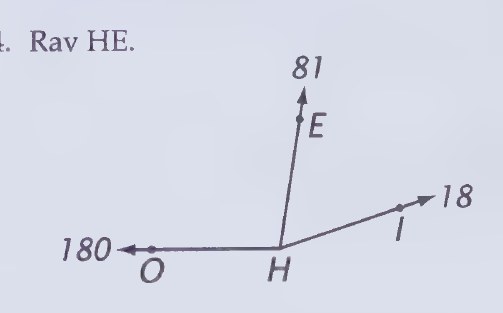
Diagram from page 25.
81
B
18 180 o H
5. ZOHE =99°, ZEHI = 63°, and ZOHI = 162°.
6. The definition of betweenness of rays.
7. The Protractor Postulate.
*8. Rays.
9. Its sides.
10. ZA, ZCAB, ZPAC. Danger Area.
¢11. The coordinates. P, 75,
*13. Acute.
14. One revolution. (The player jumps, spins around once, and releases the ball before landing.)
15. The diver turns one and a half rotations, or 540°, during the dive.
¢16. 15. (One each at A, E, and G, and three each atB,C, D, and F)
17. All 15 of them.
18. ZCBG, ZCDE, ZCFE, ZCFG.
19. ZABG, ZBCE, ZDCF, ZADE, ZE, £G.
20. No. We do not know from what perspective the photograph was taken.
Bubble Angles.
21. Right.
¢22. Obtuse.
. 360
2. 9. (5
=90.)
24. 120°. (? =120.)
Cactus Spokes.
*25. 14.4°. (There are 25 spokes and hence 25
360 such angles; > = 14.4.)
©26. Yes.
27. Its coordinate is between their coordinates. (CS-CP-CK because 43.2 < 57.6 < 86.4.)
28. 14.4°.(57.6-43.2=144.)
©29. 28.8°.(86.4-57.6 =28.8.)
30. 43.2°.(86.4-43.2=432)
*31. ZSCP + £PCK = /SCK.
32. The Betweenness of Rays Theorem.
33. If OA-OB-OC, then ZAOB + ZBOC = ZAOC.
Set II (pages 95-97)
Runway Numbers.
34. 18.
©35. 27.
36. They are %th of the numbers on the protractor.
37. 23.(50° + 180° = 230°.)
©38. They are the same.
39. 110°. (360° - 250°.)
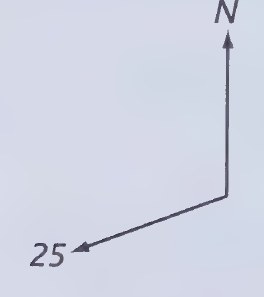
Diagram from page 26.
25
40. The left runway and the right runway. Pool Ball Angles.
*41. Betweenness of Rays Theorem. (If OA-OB-OC, then ZAOB + ZBOC = ZAOC.)
42. Substitution.
43. Subtraction. NBC Peacock.
*44. 20°. (1_20_ =20.)
s5. 18°. (280 _15) 80
10 180
46. 15°. =15. 12 )
47. 16.363636 . . .° (or 16—“) (@ —16{41 )
Minutes and Seconds.
48. An hour.
49. 3,600. (1° = 60” = 60 x 60” = 3,600”.)
*50. 360.
Lesson 4
360°
(24 hours
51. 15. (———.
)
52. 15.
53. 15.
54. Proof.
OA-OB-OC. (The hypothesis.)
a <b < c. (Definition of betweenness of rays and this case.)
ZAOB=b-gand ZBOC =c-b. (Protractor Postulate.)
£ZAOB+ ZBOC=(b-a)+(c-b)=c—a. (Addition.)
£AOC = c —a. (Protractor Postulate.)
£ZAOB + £BOC = ZAOC. (Substitution.)
Set lll (page 97)
This exercise is another example of the need for deductive reasoning and proof. No matter how accurately the figure may be drawn, measurements of ZEFB can neither give its exact value nor reveal why it should be 20°. J. L. Heilbron calls it “The Tantalus problem” after Tantalus, the character in Greek mythology from which the word “tantalize” is derived. The name is fitting because the prospective solver of the problem is “tormented with something desired but out of reach.”
A nice discussion of the problem and a similar but easier one are included on pages 292295 of Heilbron’s Geometry Civilized (Clarendon Press, 1998). More interesting information about the Tantalus problem is included in Tracking the Automatic Ant, by David Gale (Springer, 1998). See pages 123125 on “Configurations with Rational Angles” and the research done on the problem by Armando Machado on pages 227-232.
1. (Student drawing of figure.)
2. ZAGB =50°, ZAGF =130°, ZBGF = 130°, AC =74,
3. On an accurate drawing, it should appear to be about 20°.
Set I (pages 100-101)
The arrow figure in exercises 12 through 14.is variation of the “Muller-Lyer illusion.” It was discovered in 1899 by C. H. Judd, who mentioned it in an article on geometrical illusions published
in Psychological Review. Other variations of this illusion are included in Can You Believe Your Eyes? by J. R. Block and Harold E. Yuker (Brunner/ Mazel, 1992).
Origami is the subject of one of Martin Gardner’s early “Mathematical Games” columns in Scientific American (July 1959), reprinted in The 2nd Scientific American Book of Mathematical Puzzles and Diversions (Simon & Schuster, 1961). As a child, Peter Engel was inspired by this column and has written a wonderful book on the subject, Folding the Universe (Vintage Books, 1989). Beyond including detailed procedures for folding a large variety of figures from simple to extremely complex, Engel relates the history of origami and its connections with many other fields. For example, in a section of the book titled “The Psychology of Invention,” Engel includes a summary of French mathematician Jacques Hadamard’s remarks on the subject of invention in mathematics. Folding the Universe is without doubt the definitive book on origami for the mathematics classroom.
1. Points that are on the same line.
2. Lines that contain the same point.
*3. Figures that can be made to coincide (or fit exactly together).
4. A drawing made with a straightedge and compass.
5. A statement formed by interchanging the hypothesis and conclusion of another statement.
6. A theorem that is easily proved as a consequence of another statement.
7. Then it divides it into two equal segments.
8. If a point divides a line segment into two equal segments, then it is the midpoint of it.
9. Each is the converse of the other.
10. A line segment has exactly one midpoint.
11. An angle has exactly one ray that bisects it. Arrow Illusion.
12. (Most people would say M.)
13. No, because a line segment has exactly one midpoint.
14. AN =NB.
Origami Duck.
*15. No.
16. Yes.
17. ZBAD.
18. £ZBCD, ZACD, and ZBCA.
*19. 45°.
20. 22.5°.
21. 45°
822, 67.5°.
23. 67.5° (because in triangle DFC, £D = 90° and ZFCD = 22.5°).
Bisection Constructions.
24.
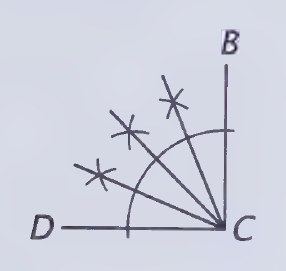
Diagram from page 28.
B
D C
25.
A B
Clock Puzzle.
26. The midpoint of a line segment divides it into two equal segments.
27. 15.
*28. 1.5.
29. D,45E, 6;F 75.
30. 7.5 seconds.
Set II (pages 102-104)
Students taking chemistry might enjoy identifying the atoms in the acetylene molecule: two carbon atoms (points B and C in the figure) and two hydrogen atoms (points A and D). Accordinc
9
to Linus Pauling, the H-C bond length is 1.1 angstroms and the C-C bond length is 1.2 angstroms.
Euclid defined an angle as “the inclination to one another of two lines in a plane which meet one another and do not lie in a straight line”; so, for Euclid, straight angles are not considered.
David W. Henderson, in his valuable book titled Experiencing Geometry (Prentice Hall, 2001), offers some important insights with regard to the question, “What is an angle?” He writes:
“I looked in all the plane geometry books in the university library and found their definitions for ‘angle.’ | found nine different definitions! Each expressed a different meaning or aspect of ‘angle’. …
There are at least three different perspectives from which one can define ‘angle,’ as follows:
a dynamic notion of angle—angle as movement;
angle as measure; and,
angle as geometric shape.. . ..
Each of these perspectives carries with it methods for checking angle congruency. You can check the congruency of two dynamic angles by verifying that the actions involved in creating or replicating them are the same. If you feel that an angle is a measure, then you must verify that both angles have the same measure. If you describe angles as geometric shapes, then one angle should be made to coincide with the other using isometries in order to prove angle congruence.”
Yen Measurement.
*31. 2cm.
®32. 2m (or about 6.28). (c = nd = 2t.)
33. m(or about 3.14).
Acetylene Proofs.
34. Addition. Betweenness of Points Theorem. Substitution.
35. Suppose that B is the midpoint of AC. The midpoint of a line segment divides it into two equal segments. Substitution. The fact that AC > 2AB. B is not the midpoint of AC.
Miter Joint Proof.
36. (1) PA-PC-PB. (By hypothesis.)
£1+ £2 = ZAPB. (Betweenness of Rays Theorem.)
PB bisects ZAPB. (By hypothesis.)
£1 = £2. (If a line bisects an angle, it divides the angle into two equal angles.)
£1+ £1=£APB;so02/£1=/APB. (Substitution.)
- £1= ég (Division.)
Angle Definition.
37. No. The second figure looks like a line.
38. Unless it is marked on the angle, we don’t know where it is.
39. Itis hard to tell because we don’t know on which side of the line to draw them.
40. It seems as if a straight angle has two bisectors, one on either side of the line.
Passion Flower.
41. 2 324, g 36
216 E 144 180
42, 180.
43. 72°. %:72.)
72
*44. They are each 36°. (? =36.)
45. PB, 36; PC, 108; PD, 144; PF, 216; PG, 252; PH, 324.
46. No, because the rays do not lie in a “halfrotation.”
47. Yes, because it divides ZGPC into two equal angles.
Set III
In the chapter on Mascheroni constructions in Mathematical Circus (Knopf, 1979), Martin Gardner wrote:
“It is often said that the ancient Greek geometers, following a tradition allegedly started by Plato, constructed all plane figures with a compass and a straightedge (an unmarked ruler). This is not true. The Greeks used many other geometric instruments, including devices that trisected angles. They did believe, however, that compass-and-straightedge constructions were more elegant than those done with other instruments. . . .
In later centuries geometers amused themselves by imposing even more severe restrictions used in construction problems. The first systematic effort of this kind is a work ascribed to the 10th-century Persian mathematician Abul Wefa, in which he described constructions possible with the straightedge and a ‘fixed compass,’ later dubbed the ‘rusty compass.’”
That it is the 120° angle that can be most easily bisected with a rusty compass will be confirmed in a later lesson.
Rusty Compass Constructions. i
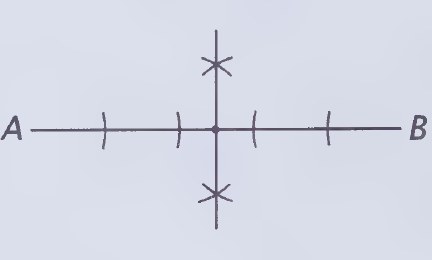
Diagram from page 29.
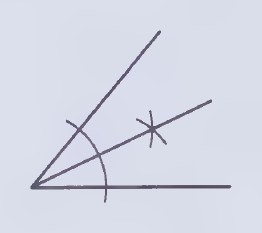
Diagram from page 29.
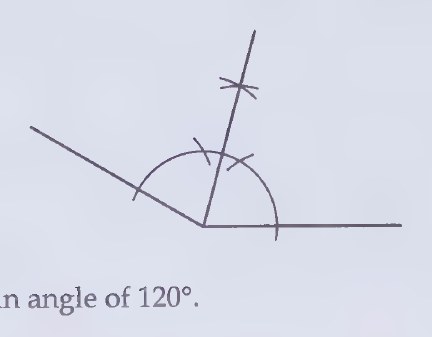
Diagram from page 29.
4. Anangle of 120°.
Lesson 5
Set I (pages 107—108) *]. 90°.
2. 180°.
3. A compliment. Safe Angle. 4, 87°.
5. They are complementary.
6. 177°.
7. They are supplementary.
360
*8. 3.( 12 )
8. 30°. (— =30.
®9. 150°.
10. 60°.
11. From signs of the zodiac (astrological signs). 12.
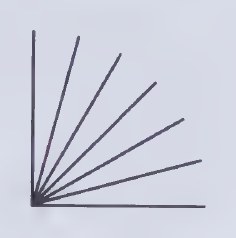
Diagram from page 30.
90 ( 3 ) 1y, 157, (= =15,
14. They are multiples of 15°.
Skier Forces. 15.
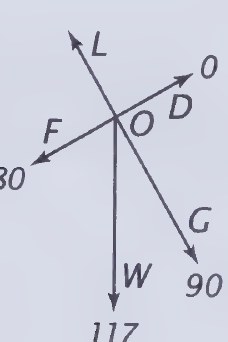
Diagram from page 30.
*16. ZDOW + ZWOF = ZDOF.
17. ZDOW =117 -0=1175; £ZWOF =180-117 = 63°; £DOF =180 -0 = 180°.
18. They are supplementary.
*19, 27°. (LWOG =117 -90 = 27°.)
20. They are complementary.
21. ZWOG, ZWOE.
22. ZLOW, ZDOW.
Triangle in the Woods.
23. The word supplementary is defined in reference to two angles, not three.
24. No. If two of its angles were supplementary, their sum would be 180°; there would be no degrees left for the third angle.
25. Yes. Two angles could have a sum of 90°; the third angle would consequently be a right angle.
Hammer Throw.
*26. Betweenness of Rays Theorem.
27. Aright angle is equal to 90°.
#28. Substitution.
29. If aline bisects an angle, it divides the angle into two equal angles.
30. Substitution.
31. Division.
Set II (pages 108-109)
The Arctic Circle problems are based on information in Ernest Zebrowski’s History of the Circle— Mathematical Reasoning and the Physical Universe (Rutgers University Press, 1999). Zebrowski writes:
“Shown on every globe and drawn (in projection) on every world map, the Arctic Circle connects points around Earth at 66.54° north latitude, and the Antarctic Circle is at 66.54° south latitude. But why would anyone attach special significance to such an unusual number? Clearly, it must not be the number itself that is important, but rather some geographical concept that gives rise to this numerical value. In fact, the latitude of the Arctic Circle is but an artifact of a geometrical relationship, and it is this underlying geometry that is significant.
We’ve already seen that the Tropic of Capricorn is a circle of latitude where the sun is directly overhead at noon around the date of December 22, and that this happens at a latitude of 23.46° south of the equator. On that day of the
Lesson 6
year, the sun’s path is quite low in the sky in the Northern Hemisphere, and the farther north we go, the lower the path of the sun. At points 9o° north of the Tropic of Capricorn, we reach a circle of latitude where the sun barely peeks over the horizon at noon at the winter solstice. This is the Arctic Circle. North of this circle, the sun does not rise at all during the first day of winter. The Arctic Circle has a latitude of 23.46° south latitude, and Earth’s spherical geometry requires that there be a 90° angle between the two.
Meanwhile . . . we find a circle of latitude around the South Pole that basks in sunlight all twenty-four hours of the day when locations within the Arctic Circle are in twenty-four hour darkness. Six months later, of course, the roles of the Arctic and Antarctic Circles are reversed.”
Clock Hands.
32. 8:30.
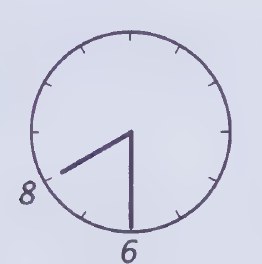
Diagram from page 31.
33. 60°.
34. If the big hand were on the 6, the small hand would be halfway from 8 to 9.
Ocls, 75 Complement and Supplement.
36. LA £C £S 10° 80° 170° 20° 70° 160° 30° 60° 150°
#37. /S seems to be 90° larger than £C.
38. £C =(90 -x)° £S = (180 —x)°.
39. £S - £C = (180 -x)° - (90 - x)° = 90°, or £S=/£C+90°.
Earth Angles.
40. They are complementary.
41. On the horizon.
#42. They are supplementary.
43. The sun never rises.
44. OB bisects ZAOC. £1 = Z2 because complements of the same angle are equal.
45, Yes. Z1 + ZAOC =90° and ZLAOC = L1+ £2;50 £1 + £1 + £2 =90°. Also £1 = £2; 50 341 =90° and so £1 = 30°. Therefore £2 = 30° and ZAOC = 60°.
46. Proof.
£1 and £2 are supplements of £3. (Given.)
£1+ £3=180° £2 + £3 =180°. (If two angles are supplementary, their sum is 180°.)
41+ £3=£2+ £3. (Substitution.)
£1 = £2. (Subtraction.)
Set 111 (page 109)
The angles of the squares are each 90°. Three squares and three star points surround a point just below the center of the figure.
Because the sum of the three angles of the squares is 270°, the sum of the three star points is 360° — 270° = 90°. The angles at the points of the stars are evidently each 30°.
Set I (pages 112-114)
The perception example of exercises 3 through 6 is derived from the work of computer scientist A. Guzman as reported in Human Information Processing—An Introduction to Psychology, by Peter H. Lindsay and Donald A. Norman (Harcourt Brace Jovanovich, 1977). Guzman analyzed pictures of overlapping figures and discovered that, wherever three lines meet to form a linear pair in a figure, it usually indicates that one object is in front of another. This rule is just one of a number of geometric rules that we automatically use in interpreting line drawings.
A rule of thumb followed by civil engineers in applying linear pairs to the construction of road intersections is that the smaller of the two angles in which two streets meet at a “T intersection” should not be less than 80°.
*1. Because they are vertical angles.
2. Because they form linear pairs.
3. As a four-sided figure in front of a triangle. 4, A,B,D,E; C,B,LH; DEG; LEE.
5. ZCBA and ZABI (ABH); ZHIA and £AIB (AIC); «DFE and /I
‘EFG.
6. No.
7. They are a linear pair and they are
supplementary. e 1152,
9. (180-x)°.
10. Z1. Sun Directions. 1lil. 0 310 50
U4 270 920 (o) 230 S 1 130 180
*12. 80°. (130 -50 = 80.)
13. 80°.
*14. They are vertical angles.
15. 100°.
*16. No.
17. If two angles are equal, then they are vertical angles.
18. No.
19. No.
20. Yes. Ship Position.
21. Concurrent.
22. (Figure similar to the one below. Measurements of angles will vary.)
a
1/2 2
6 3 5/4 ©
*23. Two.
24. 180°.
25. Yes. Because £1 + £2 + £3 =180° and £5=/2, /1 + £3 + £5=180° by substitution.
*26. 180°.
27. The sum of the angles of a triangle is 180°.
28. 180°.
29. These angles are vertical angles with the angles of the triangle and so equal to them.
30. These angles are linear pairs; so they are supplementary.
31. Addition.
32. 360°.
33. Because £2 + £3 + /5 + £6 + £8 + £9 = 540° and £3 + £6 + £9 =180°, £2+ /5 + £8 = 360° by subtraction.
Set II (pages 114-115)
The bending of light in a gravitational field certainly complicates our ability to perceive the physical universe. In the part titled “The Rise of Geometrical Analysis” in their book Mathematics in Civilization (Dover, 1984), H. L. Resnikoff and R. O. Wells, Jr., write:
“All terrestrial experiments appear to show that light traveling in a vacuum follows a straight-line path, and it was natural to assume that this would be true of light passing through any region in which there is a gravitational force….
The fundamental idea underlying Einstein’s model, that the force of gravity acts by creating curvature in space.. . . suggests that the paths of light-rays should be deformed from straight lines wherever the geodesics due to gravity are not straight. In particular, this model suggests that the path of a light particle should bend toward the more curved regions (in physical terms, toward the sources of gravitational force). For a light-ray just grazing the limb of the sun the Einstein model predicts that the direction of the ray will be bent toward the sun by an angle of 1.75”. This prediction has been verified . . . .”
Lesson 7
Steep Slope.
34. /1 22 Z3 Z4 25° 65° 115° 65° 33° 57° 123° 57° 48° 42° 138° 42°
35. Z4=22.
#36. Vertical angles are equal.
037. £3=/1+90° or £3 - £1 =90°.
38. £2=(90-x)° £3=[180- (90— x)]° = (90 + x)°; Z£4 =(90-x)°.
39. (90 + x)° — x° = 90°. Hedge Shears.
40. ZESR and ZHSA.
41. SA is always between SE and SR; SR is always between SA and SH.
42. ZESA and ZHSR.
43. Proof.
£ESR = ZHSA. (Given.)
ZESA + £ASR = ZESR; ZASR + ZHSR = ZHSA. (Betweenness of Rays Theorem.)
ZESA + £LASR = ZASR + ZHSR. (Substitution.)
ZESA = ZHSR. (Subtraction.)
Bent Light Ray.
44. There are 60 minutes in 1 degree and 60 seconds in 1 minute.
*45. 179° 59’ 58.25”. Pinhole Camera.
46. 45°. (L1 =£2and £1 + £2=90°)
47. Proof.
£1 and £2 are vertical angles. (Given.)
£1 = £2. (Vertical angles are equal.)
£1 and £2 are complementary. (Given.,
£1+ £2=90°. (If two angles are complementary, their sum is 90°.)
£1+ £1=90°s02£1 =90°. (Substitution.)
£1=45°. (Division.)
SAT Problem.
48. The angles labeled (52)° and (6z + 4)° form a linear pair; so (5z) + (6z + 4) = 180, 11z = 176, and z = 16. The angles labeled (5z)° and (8w)° also form a linear pair; so 5z + 8w = 180. Because z = 16, 5(16) + 8w = 180, 8w = 100, and so w =12.5.
Set 111 (page 116)
The Chinese proof of the vertical angle theorem is identical with that given by Euclid (Book |, Proposition 15).
Euclid’s equivalent of our linear pair theorem is his Proposition 13, which states: “If a straight line set up on a straight line makes angles, it will make either two right angles or angles equal to two right angles.” Hence the appearance of “2ZR” in the Chinese proof rather than reference to either “supplements” or “180°“.
1. ABand CD intersect at O.
2. ZAOD and ZBOC are vertical angles, £AOC and ZBOD are vertical angles.
3. To prove.
4. Proof.
5. The measures of two right angles, or 180°.
6. The angles in a linear pair are supplementary.
7. Substitution.
8. Subtraction.
Set I (pages 119—120)
It is interesting to note that the scuba diver figure comes from a section titled “Geometrical Optics” in a physics textbook (Maschuri L. Warren’s Introductory Physics, W. H. Freeman and Company, 1979). The author points out that Isaac Newton used five postulates about the geometry of optics as well as geometric constructions in his analysis of the behavior of light. Newton’s book, Opticks, was published in 1704 and was immediately accepted as the definitive description of light. Newton modeled Opticks, as well as his most famous work, the Principia, after Euclid’s Elements by starting with definitions and postulates and then proceeding to develop the subject matter through a logical sequence of theorems.
In working the exercises on the Necker cube, your students may discover it “flipping back and forth” and consequently be ready for the ambiguity of exercise 16. Donald D. Hoffman includes a long discussion of this illusion in Visual Intelligence— How We Create What We See (Norton, 1998). Hoffman remarks that, although the picture “feels flat,” it “looks like a cube.” The viewer “constructs the cube” by following certain “rules” critical to vision. He says:
“No one teaches you these rules. Instead, you acquire them early in life in a genetically predetermined sequence that requires, for its unfolding, visual experience.”
The difficulty with the Necker cube is that these rules produce two conflicting but equally coherent interpretations of it as a figure in three dimensions.
*1. Two angles are complementary if their sum is 90°.
2. Two lines are perpendicular if they form a right angle.
3. All right angles are equal.
*4. Supplements of the same angle are equal.
5. A line bisects an angle if it divides it into two equal angles.
*6. If the angles in a linear pair are equal, then their sides are perpendicular.
7. Two lines are parallel iff they lie in the same plane and do not intersect.
8. They may not lie in the same plane. They may lie in lines that intersect.
9. They are concurrent.
¢10. Vertical angles are equal.
11. The angles in a linear pair are supplementary.
12. Five. Cube Illusion.
13. DC, HG, and EF.
*14. DH, AE, and, if perspective is taken into account, HG, EF.
15. (There are four: DA, HE, AB, and EF.)
16. Either one, depending on how you look at the cube.
Mud Cracks.
#17. They are a linear pair.
18. They are supplementary.
19. 90°.
20. Arightangle.
21. They are perpendicular.
22. If the angles in a linear pair are equal, then their sides are perpendicular.
Set II (pages 120—121)
The waterfall exercise comes, of course, from the fact that, if a line is perpendicular to a plane, it is perpendicular to every line in the plane that passes through the point of intersection. This definition will be considered formally in the chapter on geometric solids.
A Deceptive Figure.
23. Yes. AO LOD because /1 is a right angle.
*24. /1 and £3 look like vertical angles, yet they are not equal.
25. /1 and £4 look like a linear pair as do £1 and £2, yet they are not supplementary.
26. Except for AO and OD, the lines that look perpendicular do not form right angles.
27. No. If they were vertical angles, the figure would contain two pairs of opposite rays and all four angles would be right angles.
Bisecting a Linear Pair.
28. 130°. 29.
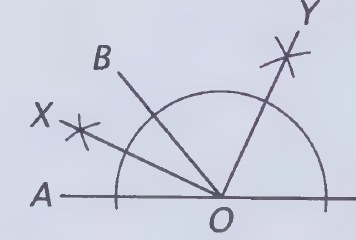
Diagram from page 34.
X
A o) C
*30. £BOX, 25°; £BOY, 65°.
31. 90°.
32. The angles in a linear pair are supplementary.
*33. 180°.
Review
34. 90°.
35. Arightangle.
36. Because it has a measure of 90°.
37. They are perpendicular.
38. Because they form a right angle.
39. L1+ 22+ £33+ £4=360° so 90 +n + 2n + 3n = 360, 6n = 270, and n = 45.
40. £1=90° £2=45°, /3 =90°, Z4=135°
41. They are equal.
42. They are supplementary.
43. Proof.
WA L AB and WA L AC. (Given.)
ZWAB and ZWAC are right angles. (Perpendicular lines form right angles.)
ZWAB = ZWAC. (All right angles are equal.)
44. Proof.
£1 and £2 are complementary. (Given.)
£1+ £2=90°. (The sum of two complementary angles is 90°.)
PB-PC-PD. (Given.)
£BPD = /1 + £2. (Betweenness of Rays Theorem.)
£BPD = 90°. (Substitution.)
£BPD is a right angle. (A 90° angle is a right angle.)
AB L PD. (Two lines that form a right angle are perpendicular.)
Set II (page 122)
The FD Puzzle was sold by the Perry and Elliott Company of Massachusetts and is a variation of the well-known “T-Puzzle,”
which will be explored in
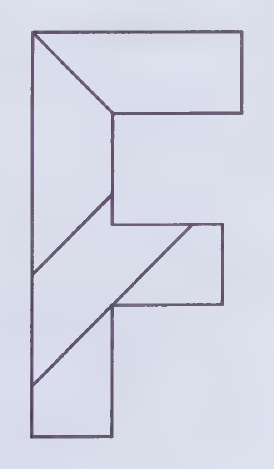
Diagram from page 35.
the lesson on trapezoids.
Set I (pages 124-125)
*1. Yes. E-F-H because 6.1 <7.7 < 10.8.
2. Point D is closer because CB = 1.7 and CD = 1.6.
3. No. AE=6.1and EI=59.
Sliding Bevel.
4. They are always supplementary.
¢5. (180-x)°.
6. ZBEV is obtuse and ZVEL is acute.
7. 90°.
8. The handle is perpendicular to the blade.
9. If the angles in a linear pair are equal, their sides are perpendicular.
Old Quadrant.
10. 47°.(65-18=47.)
*11. CE-CS-CD.
2, 205,
*13. 415.
14. 65-41.5=235. Ollie’s Logic.
15. Yes. It is true that either two lines intersect or they do not.
16. If two lines intersect, they must form a right angle to be perpendicular. If two lines do not intersect, they must lie in the same
plane to be parallel. SAT Problem. 7, 30 0 A B 70 C
110 o D
*18. 110.
19. 30.
20. 40°.
Shoe Laces.
21. They are vertical angles and they are equal.
22. 45°.
#23. They would be perpendicular.
24. They would be equal.
25. Supplements of the same angle are equal. Axioms and Corollaries.
26. An axiom is like a postulate. It is a statement that is assumed to be true without proof.
27. A corollary is a theorem that can be easily proved as a consequence of another statement that is already accepted.
*28. Any number is equal to itself.
29. Aline segment has exactly one midpoint.
30. An angle has exactly one ray that bisects it.
31. All right angles are equal.
Set II (pages 126-128)
The chair-design exercises are from the field of biotechnology. According to Human Factors in Engineering and Design, by Mark S. Sanders and Ernest J. McCormick (McGraw-Hill, 1992),
“The field of human factors—referred to as ergonomics in Europe and elsewhere—deals with the consideration of human characteristics, expectations, and behaviors in the design of the things people use in their work and everyday lives and of the environments in which they work and live.”
Your students may be surprised by the extensive use of mathematics, including geometry and statistics, in this field.
Clock Problems.
32. 150° at 5 o’clock; 60° at 10 o’clock. = 12
10/, 60” 150° 150°
5 60° = 360° — 2(150°).
Stilt Distances. 34, (6+x) ft.
35. xft.
36. Proof.
S-F-T and F-T-H. (Given.)
SF+FT =ST and FT + TH = FH. (Betweenness of Points Theorem.)
ST = FH. (Given.)
SF + FT = FT + TH. (Substitution.)
SF = TH. (Subtraction.)
Chair Design.
37. £2=(90-x)°. 38, ZAOB = (90 - x +y)°.
39. Proof.
Suppose that ZAOB is a right angle.
ZAOB = 90°. (A right angle equals 90°.)
90 — x + y = 90. (Substitution.)
—x + y = 0. (Subtraction.)
y = x. (Addition.)
This contradicts the fact that if x is between 5 and 8 degrees and y is between 20 and 25 degrees, y # x.
Therefore, our assumption is false and
ZAOB cannot be a right angle.
40. No. [£AOB = (90— x + y)°. To find the smallest possible value of ZAOB, let x =8 and y = 20. ZAOB =90 - 8 + 20 = 102°. ZAOB is at least 102°.]
Another SAT Problem. 41. B D A C ~——————o 6 4 2
42. 4 units. Graphite and Diamond.
*43. Hexagons.
44. 720°. (1= % =120°; 621 = 6(120°) = 720°.)
45. Proof.
£1+ £2 + £3 =360° and all of the angles in the figure are equal. (Given.)
£1+ 21+ £1 =360°; so 3£1 = 360°. (Substitution.)
6£1 =720°. (Multiplication.)
Algebra Review (page 130)
1. .
2. .
3. .
4. .
5. .
6. .
7. .
8. .
9. .
10. .
11. .
12. .
13. .
14. .
15. .
16. .
17. .
18. .
19. .
20. .
21. −49.
22. .
23. .
24. .