p. 41
Chapter 2: The Nature of Deductive Reasoning
The last chapter closed with a lesson titled “We Can’t Go On Like This.” It revealed that we need a stronger foundation for our study of geometry than the informal approach that we have used so far.
Euclid led the way by organizing geometry into a deductive system with definitions, assumptions called postulates, and logical methods for proving our conclusions, called the theorems of geometry. In this chapter, you will become acquainted with this system and the nature of deductive reasoning.
p. 42
Lesson 1: Conditional Statements
A goal in studying geometry is to develop the ability to think critically. Deductive reasoning is fundamental to critical thinking, and so we now turn our attention to this subject.
Deductive reasoning is used by both real and fictional detectives. In Agatha Christie’s Murder on the Orient Express, the detective Hercule Poirot says:
We have to rely solely on deduction. That to me, makes the matter very much more interesting… . It is all a matter of intellect.
Toward the end of the mystery, Poirot reasons:
If Ratchett had been heavily drugged, he could not have cried out.
If he had been capable of crying out, he would have been capable of making some kind of struggle to defend himself.
Statements such as the last two are called conditional statements. A conditional statement consists of two clauses, one of which begins with the word “if” or “when” or some equivalent word. Such statements are used by detectives and others to establish conclusions, and they are important in mathematics in writing deductive proofs.
p. 43
A conditional statement can be represented symbolically by
This is read “If a, then b.” The letter a represents the “if” clause, or hypothesis, and the letter b represents the “then” clause, or conclusion. (The word “then,” being understood, is often omitted.) For example, in the statement
If the crime was committed at a quarter past one, the murderer cannot have left the train,
a represents the words “the crime was committed at a quarter past one” and b represents “the murderer cannot have left the train.”
To see how conditional statements relate to each other, you can represent them by using circle diagrams. These diagrams are called Euler diagrams after an eighteenth-century Swiss mathematician, Leonhard Euler (pronounced “Oiler”), who first used them.
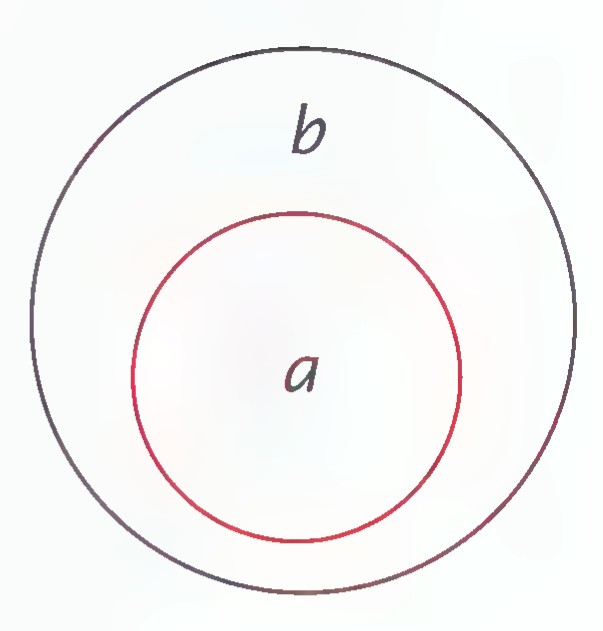
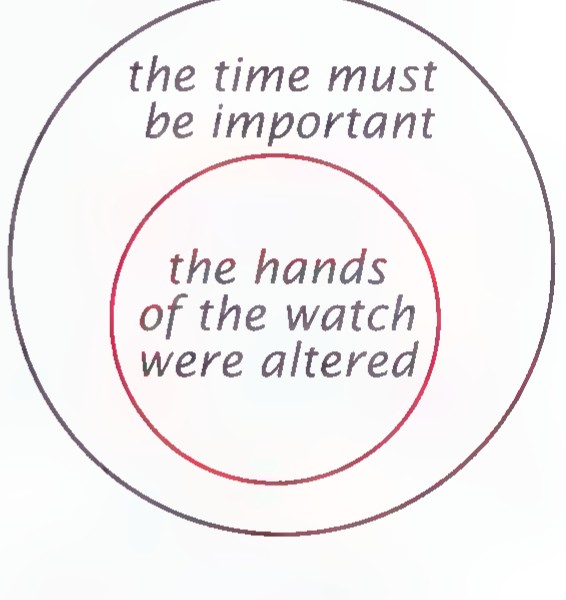
To make an Euler diagram, we draw two circles, one inside the other. The interior of the smaller circle represents a, the hypothesis; the interior of the larger circle represents b, the conclusion. Note that, if a point is inside circle a, it is also inside circle b. Or, briefly, “if a, then b,” which is what the diagram is intended to represent. The diagram at the right, for example, represents the statement
If the hands of the watch were altered, then the time must be important.
We will explore conditional statements in this lesson and put them to work drawing conclusions in Lessons 3 and 4.
Exercises
Set I
- What is a statement that can be represented symbolically by “If a, then b”?
- In the statement “If a, then b,” what do the letters “a” and “b” represent?
- Draw and describe the Euler diagram for “If a, then b.”
Sometimes the conclusion of a conditional statement is stated before the hypothesis. Compare the following statements:
You live in the United States if you live in the Ozarks.
If you live in the Ozarks, then you live in the United States.
- Both statements have the same hypothesis. What is it?
- Both statements have the same conclusion. What is it?
- Are they both true?
Compare these two statements:
If it is snowing, then it is cold outside.
If it is cold outside, then it is snowing.
- Do both statements have the same hypothesis?
- Are they both true? Why or why not?
- Do they mean the same thing?
p. 44
- Rewrite the first statement so that the conclusion is stated before the hypothesis.
- Is the statement that you wrote true?
It is possible to compare the following three statements, even though you probably don’t know what they mean.
Two quoits cancel each other if they ring the same bob.
If two quoits cancel each other, they ring the same bob.
If two quoits ring the same bob, they cancel each other.
- Which two statements have the same hypothesis and the same conclusion?
- Do those two statements mean the same thing?
Rewrite each of the following sentences in “if-then” form. You may change some of the words, but be careful not to change the meanings of the sentences; for example, if you write a true statement in “if-then” form so that it turns out to be false, something is wrong.
Example: Genuine phone numbers do not begin with 555.
Possible answers:
If a phone number is genuine, it does not begin with 555.
If a phone number begins with 555, it is not genuine.
- Koala bears eat only eucalyptus leaves.
- When the cat is in the birdcage, it isn’t there to sing.
- Smokey Bear wouldn’t have to do commercials for a living if money grew on trees.
- All architects use geometry.
- I ask questions whenever I don’t understand.
- Use the stairs instead of the elevator in case of fire.
- No vampire casts a shadow.
Set II
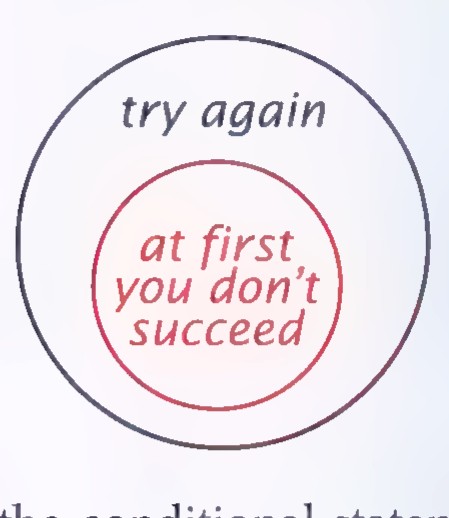
- Write the conditional statement represented by the Euler diagram below in the form “if a, then b.”
- Rewrite the conditional statement that you just wrote in the form “b if a.”
An Euler diagram, such as the one shown below, separates the paper into three regions; they are numbered 1, 2, and 3 in the figure.
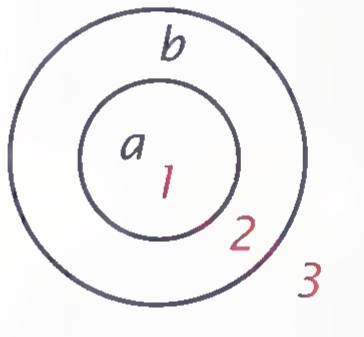
- Which region is inside circle a?
- Which regions are inside circle b?
- Which regions are outside circle a?
- Which region is outside circle b?
- Draw an Euler diagram to represent the statement
If x, then y
and a second Euler diagram to represent the statement
If y, then x.
- Which of your diagrams, the first or the second, also illustrates the statement
If not x, then not y?
- Which diagram also illustrates the statement
If not y, then not x?
- How many “if-then” statements does a given Euler diagram represent?
p. 45
- Draw an Euler diagram to represent the following statement:
All players for the Yankees make a lot of money.
Which of the following statements are illustrated by your diagram?
- If you play for the Yankees, then you make a lot of money.
- If you make a lot of money, then you play for the Yankees.
- If you don’t play for the Yankees, then you don’t make a lot of money.
- If you don’t make a lot of money, then you don’t play for the Yankees.
Which of the statements listed in exercise 32 are true, given that all players for the Yankees make a lot of money?
Draw an Euler diagram to represent the following statement:
If you have lived a long time, then you are an octagenarian.
Which of the following statements are illustrated by your diagram?
- If you are an octagenarian, then you have lived a long time.
- If you have not lived a long time, then you are not an octagenarian.
- If you are not an octagenarian, then you have not lived a long time.
- You are an octagenarian if you have lived a long time.
Which of the statements listed in exercise 35 do you think are true?
Set III
In language experiments with chimpanzees, the biologist David Premack used plastic shapes to represent words. A chimp named Sarah learned to interpret sentences, including conditional statements, built from these shapes.*
One of these statements looked like this.
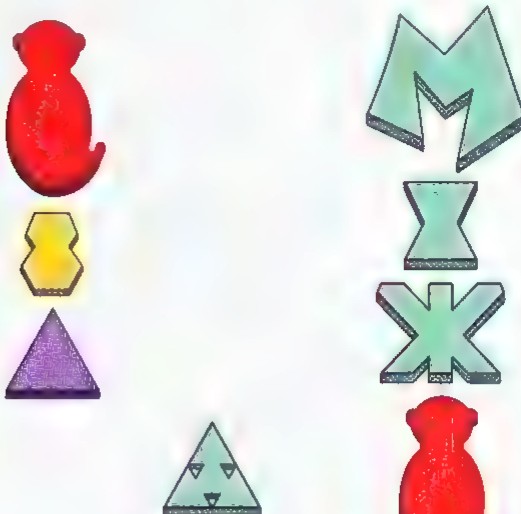
The green triangle with the three holes represented “if then” and the statement said:
If Sarah takes the apple, then Mary will give chocolate to Sarah.
- What shape do you think represented the word Sarah?
- Where does the hypothesis appear in the arrangement of the shapes?
A second statement shown to the monkey, in which the word “banana” appeared, looked like this.
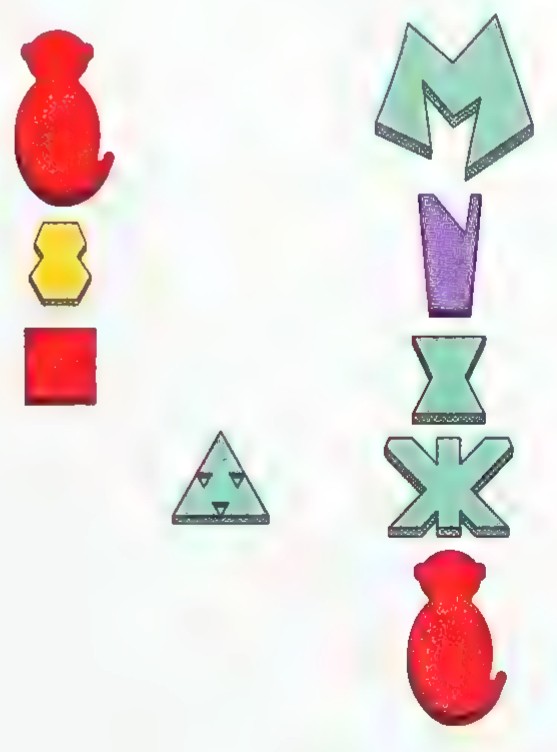
- What shape do you think represented the word “banana”?
- What do you suppose the statement said?
* “The Animal Mind,” by James L. Gould and Carol Grant Gould (Scientific American Library, 1994).
p. 46
Lesson 2: Definitions
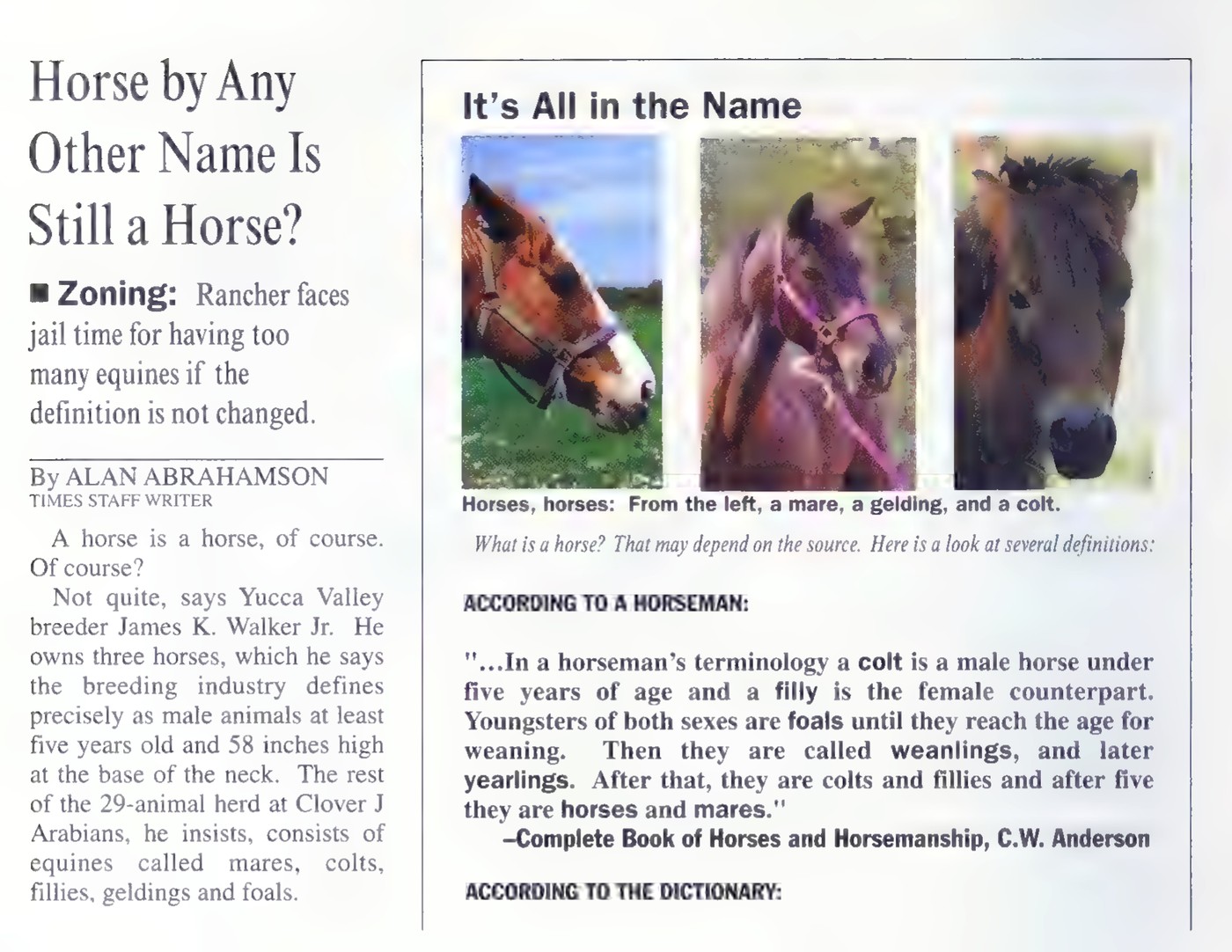
Several years ago a rancher in Yucca Valley, California, got into trouble for having too many horses. He said that he had only 3, but the local officials said that he had 29. The disagreement centered on the definition of a horse.
According to the breeding industry, a horse is “a male animal at least five years old and 58 inches high at the base of the neck.” “Horsefeathers,” said the officials, “If it looks like a horse, trots like a horse and smells like a horse, it is a horse.”
Disagreements about the meanings of words frequently come up in courts of law. To prevent arguments in debates, key terms are often defined first. Variations in a word’s meaning seldom cause much of a problem in everyday communication, but they are serious when we are trying to reason precisely. For this reason, definitions play an important role in mathematics.
When we define a word in geometry, the word and its definition are understood to have exactly the same meaning. For example, when we define a “triangle” as “a polygon that has three sides,” we can say not only that
If a figure is a triangle, then it is a polygon that has three sides
p. 47
but also that
If a figure is a polygon that has three sides, then it is a triangle.
Notice that the hypothesis and conclusion of the first statement are interchanged in the second. The second statement is called the converse of the first.
The converse of a conditional statement is found by interchanging its hypothesis and conclusion. In symbols, the converse of is .
You have seen in the preceding lesson that the converse of a true statement may be false. Because a statement and its converse do not have the same meaning, accepting a statement as true does not require us to accept its converse as true.
For a definition, however, the converse is always true. Because “a,” the word being defined, and “b,” its definition, have the same meaning, “a” and “b” are interchangeable. Consequently, for definitions, either form, or , implies the other. This is not true for ordinary conditional statements.
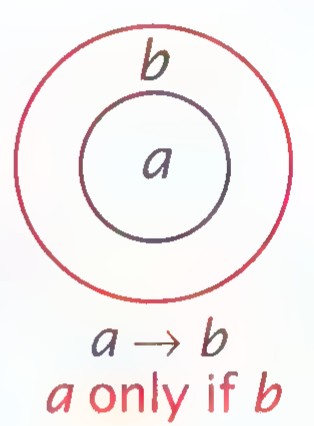
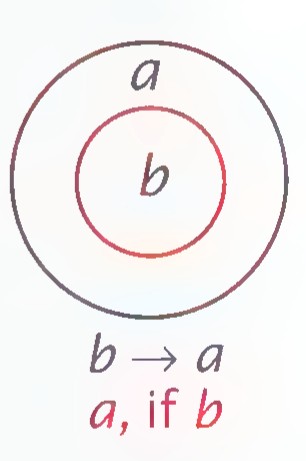
The two Euler diagrams shown here represent and . Notice that the second diagram also illustrates “a, if b” because in it a point is inside circle a if it is inside circle b. The first diagram also illustrates “a only if b” because in it a point is inside circle a only if it is inside circle b. These observations show that, if both a statement and its converse are true, we can write
“a if b” and “a only if b,”
or, more briefly,
“a if and only if b.”
The phrase “if and only if” is represented by the abbreviation “iff” and by the symbol ; means both and .
Because the converse of every definition is true, we usually write definitions in the form “a iff b.” For example, the definition of a triangle given in this lesson can be written as
A figure is a triangle if and only if it is a polygon that has three sides.
Exercises
Set I
Consider the statement
All geese have two legs.
- Write this statement in “if-then” form.
- Illustrate it with an Euler diagram.
- Write the converse of the statement.
- If we assume that the original statement is true, does it follow that the converse is true?
p. 48
Consider the true statement
If you are an astronaut, you are not more than six feet tall.
- What is the conclusion of this statement?
- Write the converse of the statement.
- Is the converse true?
- Does it have the same meaning as the original statement?
Consider the statement
You cannot comprehend geometry if you do not know how to reason deductively.
- What is the hypothesis of this statement?
- Write the converse of the statement.
- What is the conclusion of the converse?
Consider the true definition
You have arachibutyrophobia iff you have the fear of peanut butter sticking to the roof of your mouth.
- What does the abbreviation “iff” stand for?
- From this definition, what can you conclude about the word “arachibutyrophobia” and the words “the fear of peanut butter sticking to the roof of your mouth”?
If the definition were represented in symbols as and “a” represents “arachibutyrophobia,” what does
- “” represent?
- “b” represent?
In words, “” for this definition is “If you have arachibutyrophobia, then you are afraid of peanut butter sticking to the roof of your mouth.”
- Write in words, “” for this definition.
- Is the sentence that you wrote necessarily true? Explain.
For a definition to be understood, it is necessary to know the meanings of the words used in it. The following definition of vulgar fraction is correct but not necessarily helpful.
A vulgar fraction is a common fraction that is either proper or improper.
- Which words in this definition might not be understood?
- Write the definition in “if-then” form.
- Write its converse.
- Is the converse necessarily true? Why or why not?
In writing a definition, we try to say no more than is necessary. Consider the following possible definition of New Year’s Day.
New Year’s Day is a holiday that is the first day of the year.
Suppose this definition were shortened to
New Year’s Day is a holiday.
- Why wouldn’t this shortened version be a good definition of New Year’s Day?
Suppose instead that the definition were shortened to
New Year’s Day is the first day of the year.
- Would this version be a good definition of New Year’s Day? Explain.
Set II
Compare the following two sentences:
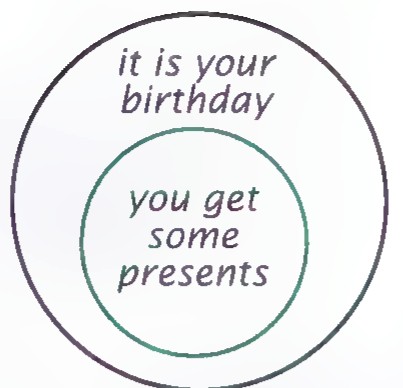
If it is your birthday, then you get some presents.
Only if it is your birthday, do you get some presents.
- Is the first sentence true for you?
- Is the second sentence true for you?
p. 49
- Do both sentences say the same thing?
- Which sentence does this Euler diagram illustrate?
Compare the following two sentences, both of which are true:
If it is dry ice, then it is frozen carbon dioxide.
Only if it is dry ice is it frozen carbon dioxide.
- What relation does the second sentence have to the first?
- Draw an Euler diagram to illustrate the second sentence.
- Combine the two sentences into a single sentence by using the words “if and only if.”
Suppose that on an English test you wrote the sentence
It is a whodunit iff it is a detective story
and that the teacher crossed out the second “f” with a red pencil.
- What kind of mistake did the teacher think you made?
- To which one of these sentences would the “corrected” statement be equivalent?
If it is a whodunit, then it is a detective story.
If it is a detective story, then it is a whodunit.
- Would it be safe to conclude that your English teacher’s knowledge of mathematics is “iffy”?
Consider this statement:
A car is a convertible iff it has a removable top.
- Write the two conditional statements that are equivalent to this statement.
- What relation does the second of your statements have to the first?
Here is an interesting definition:
A wolf pack is two wolves or is a wolf pack together with a wolf.
- According to this definition, how many wolves are in a pack?
- Why is it appropriate that this definition is used as an example in a book titled Keys to Infinity?*
Set III
Here is a puzzle in logical reasoning called the Wason test, named after the British psychologist Peter Wason who created it.†
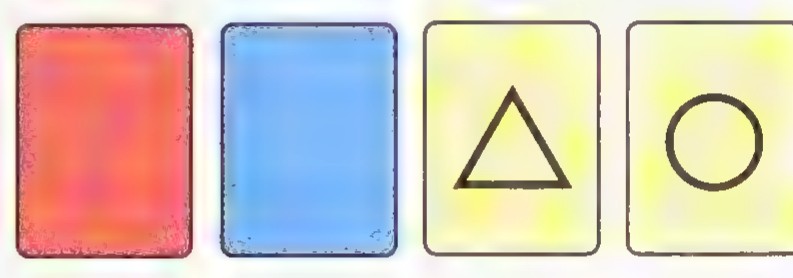
Four cards lie on a table; each card is either red or blue on one side and has a triangle or circle on the other side.
The following conditional statement supposedly describes the way that the cards are made:
If a card is blue on one side, it has a circle on the other side.
The puzzle is to figure out which cards have to be turned over to find out if this statement is true. It turns out that the “obvious” answer, chosen by most people, is wrong.
Which cards would you choose? Explain your reasoning.
* Keys to Infinity, by Clifford A. Pickover (Wiley, 1995).
† The Math Gene, by Keith Devlin (Basic Books, 2000).
p. 50
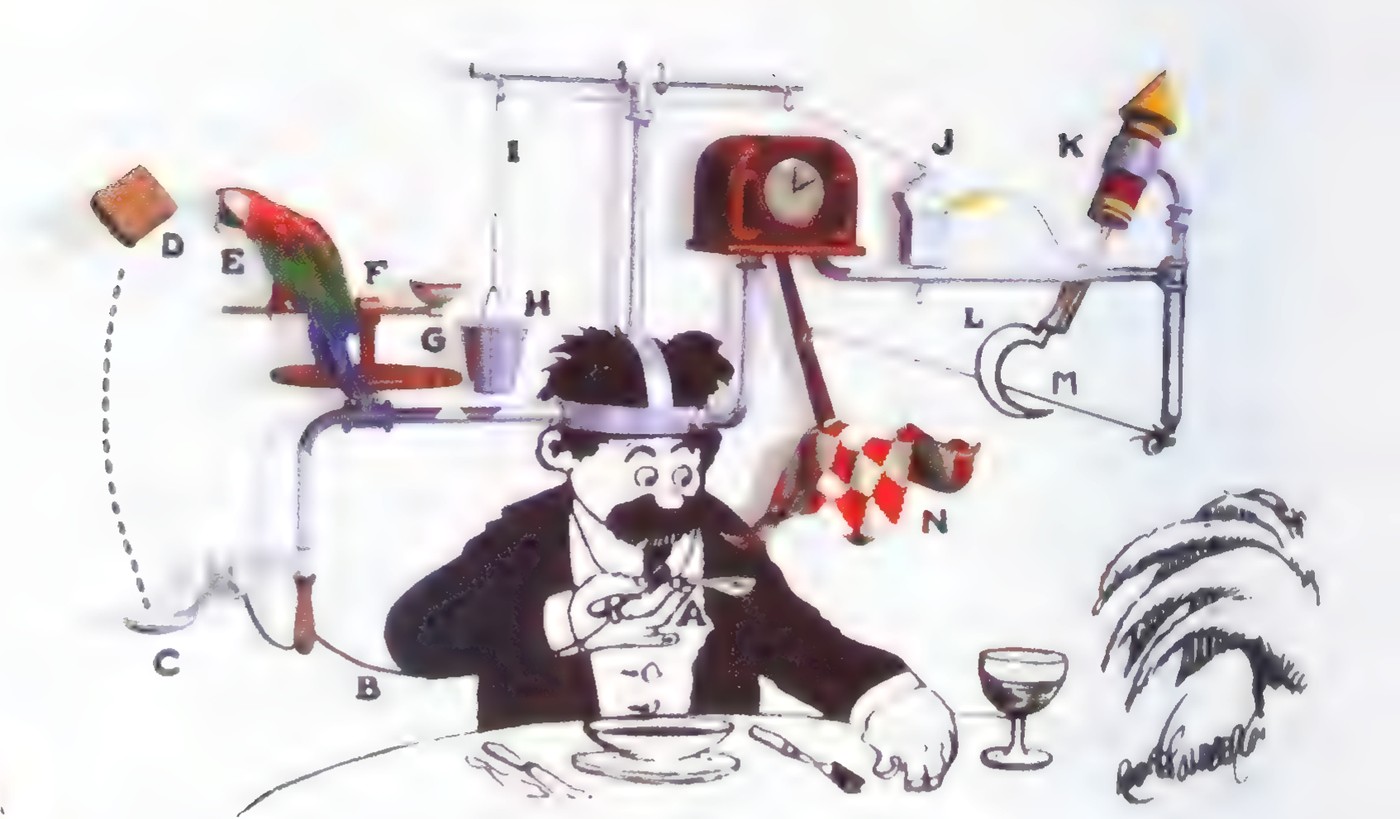
Raising spoon to mouth (A) pulls string (B), thereby jerking ladle (C), which throws cracker (D) past parrot (E). Parrot jumps after cracker, and perch (F) tilts, upsetting seeds (G) into pail (H). Extra weight in pail pulls cord (I), which opens and lights automatic cigar lighter (J), setting off skyrocket (K), which causes sickle (L) to cut string (M) and allows pendulum with attached napkin (N) to swing back and forth, thereby wiping off your chin.
Rube Goldberg is a trademark and copyright of Rube Goldberg, Inc.
Lesson 3: Direct Proof
The artist Rube Goldberg was so well known for his cleverly ridiculous inventions that his name has come to be associated with any complicated and impractical way of performing a simple task. His “self-operating napkin,” pictured above, has been featured in Scientific American and even on a U.S. postage stamp.
The cartoon illustrates a chain of events that begins as follows:
If you raise the spoon of soup to your mouth, the string is pulled. If the string is pulled, the ladle is jerked. If the ladle is jerked, it throws a cracker past the parrot.
Notice how the hypothesis of each successive statement matches the conclusion of the preceding one. The chain continues, finally ending with
If the napkin swings back and forth, the napkin wipes your chin.
p. 51
What makes this series of events so preposterous is that it seems unlikely that the conditional statements describing them are all true. If they are, however, then it follows from taking them all together that
If you raise the spoon of soup to your mouth, then the napkin wipes your chin.
The shortest and simplest case of this sort begins with just two conditional statements from which a third conditional statement follows. Such an argument is called a syllogism.
A syllogism is an argument of the form
If we illustrate the statements and with Euler diagrams and combine them into one, it is easy to see why the third statement, , follows.
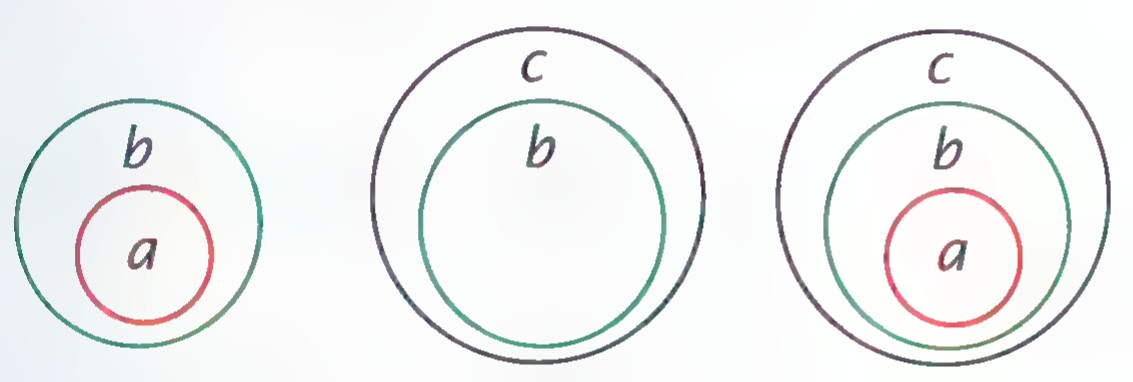
Extending this pattern to the situation illustrated in the Rube Goldberg cartoon, we get
from which it follows that
This argument is an example of a direct proof. The statements are called the premises of the argument, and the statement is called the conclusion of the argument. The conclusion might be considered a theorem.
A theorem is a statement that is proved by reasoning deductively from already accepted statements.
If all of the premises of an argument are true and the logic of the argument is correct, then the conclusion must be true. As the old saying goes, however, “a chain is no stronger than its weakest link.” If one of the premises is false or the logic is faulty, then the conclusion may be false as well. For this reason, we have to pay close attention to the premises and the logic used in any proof. More on this subject will be included in a future lesson.
p. 52
Exercises
Set I
In the Encyclopedia Britannica, a syllogism is described as a “valid deductive argument that has two premises and a conclusion having between them three terms.”
Suppose that the three terms of a syllogism are:
a, “you keep quiet”
b, “others will never hear you make a mistake”
c, “others will think you are wise.”
- Write the two premises of the syllogism as conditional statements.
- Write its conclusion as a conditional statement.
- Write the pattern of the syllogism in terms of the symbols a, b, and c.
Syllogisms were discussed by the Greek philosopher Aristotle in the fourth century B.C. Write the syllogisms illustrated by the following Euler diagrams.
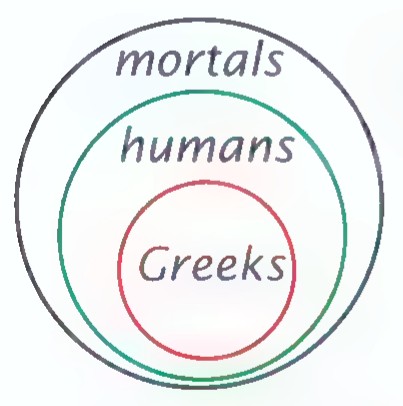
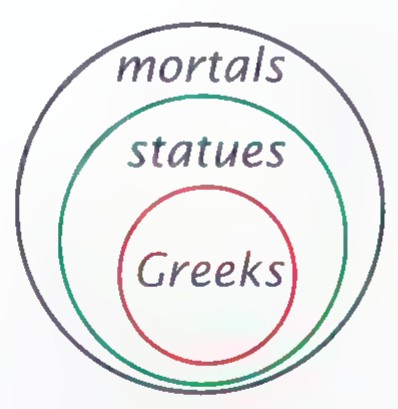
If the premises of a syllogism are true, does it follow that its conclusion must be true?
If the premises of a syllogism are false, does it follow that its conclusion must be false?
Aristotle made the following statement about how you can argue correctly, yet arrive at a false conclusion: “Admit one ridiculous premise and the rest follows.”
Consider the following argument:
If you live at the South Pole, you live in the Antarctic. If you live in the Antarctic, you live where it is cold. If you live where it is cold, you see a lot of penguins. Therefore, if you live at the South Pole, you see a lot of penguins.
What part of the second premise matches
- the conclusion of the first premise?
- the hypothesis of the third premise?
- Starting with to represent the first premise, represent the entire argument in symbols.
- Which premise is ridiculous (false)?
- What does the fact that one premise is false indicate about the conclusion of the argument?
Consider the following premises:
If Captain Spaulding is in the jungle, there are too many cheetahs. If there are too many cheetahs, Captain Spaulding can’t play cards.
- What conclusion follows from them?
- If the two premises are true, does it follow that the conclusion must be true?
Consider these premises:
If NASA launched some cows into space, they would be put into low earth orbit. If some cows were put into low earth orbit, they would be the herd shot around the world.
- What conclusion follows from the two premises?
- What is a statement called that is proved from already accepted premises?
p. 53
Consider the following statements:
If you take a plane, you will go to the airport. If you go to Dallas, you will take a plane. If you see all the cabs lined up, you will see the yellow rows of taxis. If you go to the airport, you will see all the cabs lined up.
- Copy the statements, rearranging them in logical order.
- What “theorem” do they prove?
Consider the following statements:
A duck would ask for some Chapstick if he went to a drugstore. If a duck had sore lips, he would go to a drugstore. A duck would ask to have it put on his bill if he asked for some Chapstick.
- Copy the statements, writing them in “if-then” form and rearranging them in logical order.
Each of the following exercises consists of a “theorem” and a proof in which two statements have been omitted. After studying the relations of the statements given, write the missing statements.
Theorem.
If two hungry vultures took an airplane, they would be told that there is a limit of two carrion per passenger.
Proof.
If two hungry vultures took an airplane, they would want to take along some food.
(What is the second statement?)
If they tried to carry on six dead raccoons, the flight attendant would object.
(What is the last statement?)
Theorem.
If a group of chess players checked into a hotel, the manager would say “I can’t stand chess nuts boasting in an open foyer.”
Proof.
(What is the first statement?)
If they stood in the lobby bragging about their tournament victories, the manager would ask them to leave.
(What is the third statement?)
If they asked why, the manager would say “I can’t stand chess nuts boasting in an open foyer.”
The arguments in exercises 15 through 21 are based on pun stories in A Prairie Home Companion Pretty Good Joke Book (Highbridge Company, 2000).
Set II
The reasoning in each of the following puzzles illustrates the pattern of a direct proof.
Dice Proof. Dice players know that the numbers on the opposite faces of an ordinary die such as the one shown here always total the same.
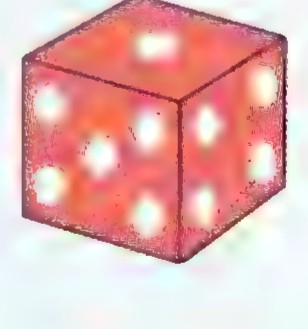
- What is the sum of the numbers of all six faces of a die?
- Because the numbers on each pair of opposite faces totals the same, what number do they total?
- What number is on the face opposite the 5?
- What number must be on the bottom of the die in the picture?
p. 54
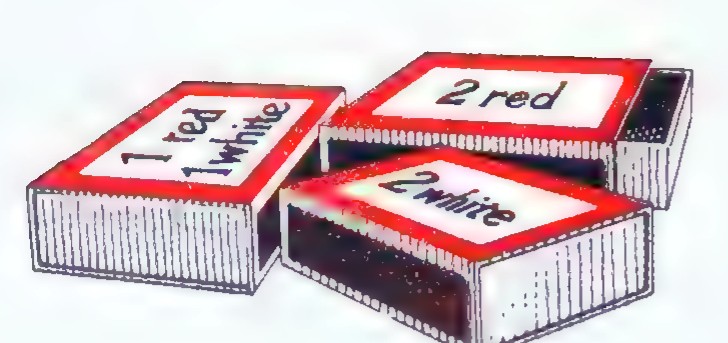
Matchbox Proof. The figure above shows three matchboxes. One contains two red marbles, one contains two white marbles, and one contains a red marble and a white marble. The labels telling the contents of the boxes have been switched, however, so that the label on each box is wrong.
You may choose just one box and open it far enough to see just one marble.
Suppose that you open the box labeled “1 red, 1 white” and that you see a red marble.
- If you see a red marble, then what color is the other marble in the box? Why?
- What would be in the box labeled “2 white”?
- What would be in the box labeled “2 red”?
Tick-tack-toe Proofs. The sequence of moves in tick-tack-toe can resemble the pattern of a direct proof.*
Suppose the first two moves in a game are as shown here (your opponent marks Xs and you mark Os).
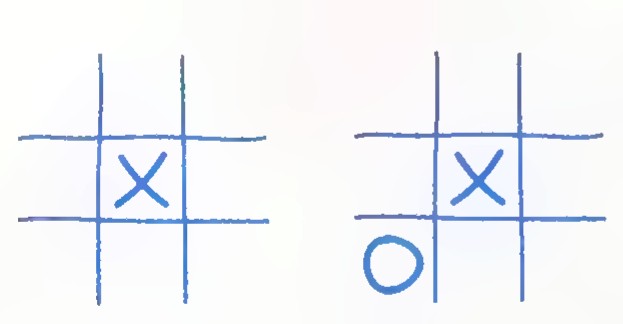
- Copy the second figure on your paper and mark it as needed to copy and complete the following sequence of conditional statements.
- If your opponent marks an X in the upper left, then . . .
If . . . , then . . .
If . . . , then . . .
At this point, it is evident that the game will end in a draw.
Now consider a second game in which the first three moves are shown here (again your opponent marks Xs and you mark Os).
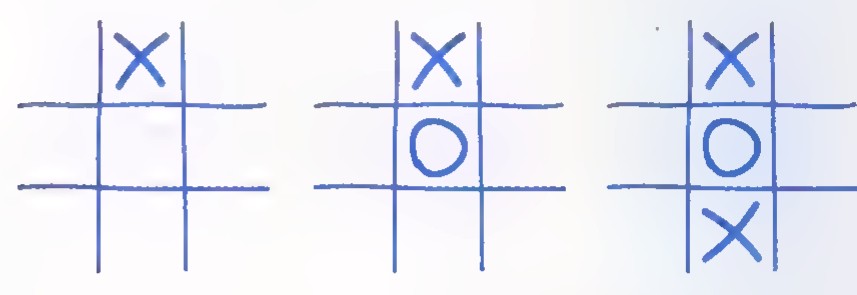
- Make several copies of the third figure on your paper and continue the game in various ways.
- Can you draw any conclusions about whether this game will end in a win or draw? Explain.
Set III
A “word ladder” is a sequence of words in which one letter is changed at a time. For example, the following word ladder
COLD
CORD
CARD
WARD
WARM
transforms COLD into WARM.
The mathematician and writer Rudy Rucker compares word ladders to direct proofs in the sense that successive words are linked to one another just as the conditional statements in a direct proof are linked to one another.
Can you figure out a word ladder that transforms
- LESS into MORE?
- HEAD into TAIL?
* Based on ideas in the chapter on tick-tack-toe in The Scientific American Book of Mathematical Puzzles and Diversions, by Martin Gardner (Simon and Schuster, 1959).
p. 55
Lesson 4: Indirect Proof
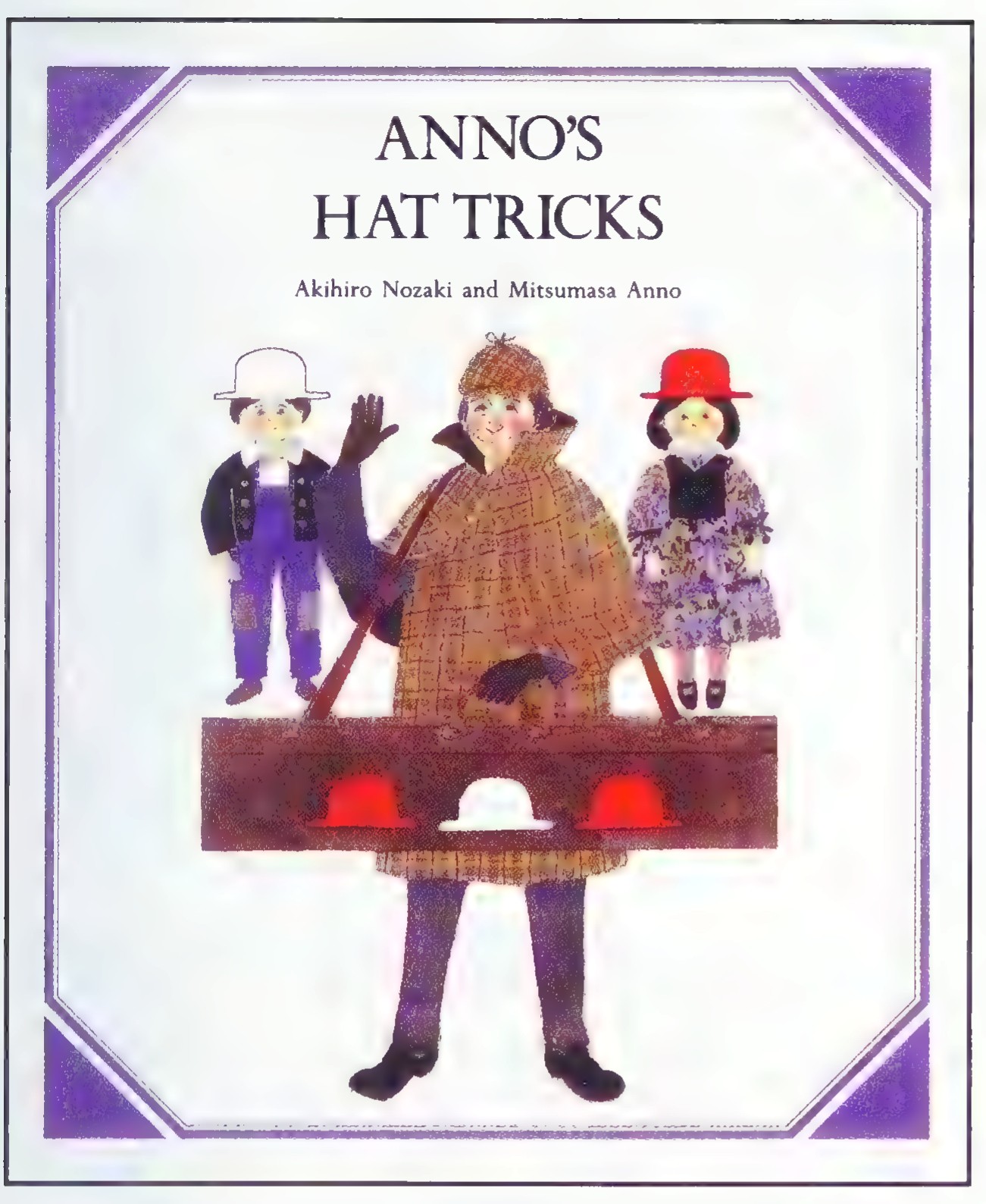
In the book Anno’s Hat Tricks, the mathematician Akihiro Nozaki wrote:
“If” is a very small word, but it is one of the most powerful ones in our language. It is the key to imaginative thinking, a key that opens the door to new ideas. Yet “if” can also be used very strictly, to test the truth of an idea or a supposition in a logical way. . . . The pattern of reasoning that goes “if . . . , then . . .” is very useful. It is no exaggeration to say that modern mathematics has been developed by using the word “if.”
Anno’s Hat Tricks begins with a hatter who has lots of hats in a box. In the first trick, he takes one red hat and one white hat and puts one on you and one on a friend named Tom while your eyes are closed.
* Anno’s Hat Tricks, by Akihiro Nozaki and Mitsumasa Anno (Philomel Books, 1985).
p. 56
When you open your eyes, you see a red hat on Tom. What color is your hat?
Putting the word “if” to work, you reason that
If Tom’s hat is red, then mine must be white.
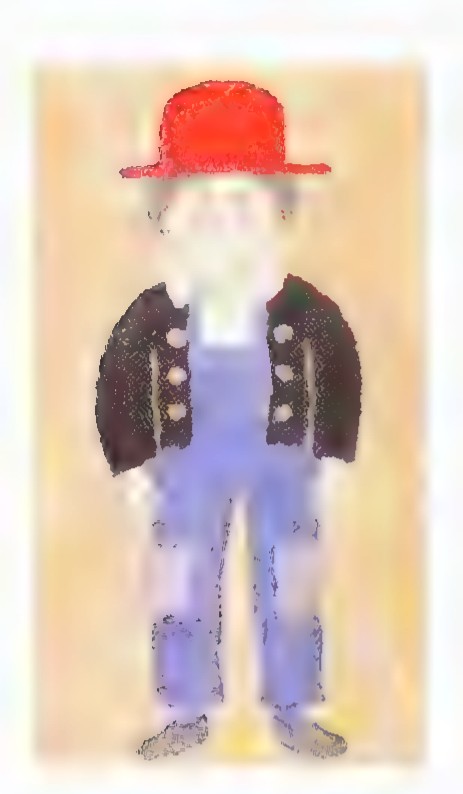
In the second hat trick, the hatter starts with three hats—two red and one white. He puts one on you and one on Tom while your eyes are closed. When you open your eyes, you again see a red hat on Tom and, when Tom looks at your hat, he is sure that his hat is red. What color is your hat?
This time we might start by assuming that your hat is red. If your hat is red, then Tom wouldn’t know whether his hat is white or red because there are two red hats. This contradicts the fact that Tom is sure that his hat is red. Therefore, the assumption that your hat is red is wrong and your hat must be white.
We have arrived at this conclusion by reasoning indirectly.
In an indirect proof, an assumption is made at the beginning that leads to a contradiction. The contradiction indicates that the assumption is false and the desired conclusion is true.
The hatter’s third hat trick provides another example of indirect reasoning. Again, the hatter starts with three hats, two red and one white. Again, he puts one on you and one on Tom while your eyes are closed. When you open your eyes, you again see a red hat on Tom but this time, when Tom looks at your hat, he doesn’t know what color his hat is. What color is your hat?
It must be red. Do you see why?
This time we will put our argument into the format of an indirect proof.
| Proof | |
|---|---|
| Suppose that your hat is not red. | ← We assume the opposite of the desired conclusion. |
| If your hat is not red, then it is white. | |
| If your hat is white, then Tom would know that his hat is red. | |
| This contradicts the fact that he doesn’t know what color his hat is. | ← The contradiction. |
| Therefore, what we supposed is false, and your hat must be red. | ← We end with the desired conclusion. |
Both the direct and the indirect methods of proof require making a chain of conditional statements. In the direct method, the chain begins with the hypothesis of the theorem and ends with its conclusion. In
p. 57
the indirect method, the chain begins with the opposite of the conclusion of the theorem. From here, the chain leads to a contradiction, revealing that the opposite of the conclusion is false, and so the conclusion itself is true.
Patterns of two short proofs of the theorem “If a, then d.”
| Direct proof | Indirect proof |
|---|---|
| If a, then b. If b, then c. If c, then d. Therefore, if a, then d. |
Suppose not d is true. If not d, then e. If e, then f and so on, until we come to a contradiction. Therefore, not d is false; so d is true. |
Exercises
Set I
The movie producer Sam Goldwyn once said: “I’ll tell you what I think in two words: impossible!”
This statement describes what is eventually reached in a certain kind of proof.
- What is it (in one word)?
- According to the way that Goldwyn would say it, name this kind of proof in “two words.”
To prove a theorem indirectly, we begin by assuming the opposite of the conclusion. List the assumption with which an indirect proof of each of the following statements would begin.
Example. If a tailor wants to make a coat last, he makes the pants first.
Answer. Suppose that he does not make the pants first.
- If a chicken could talk, it would speak foul language.
- If a teacher is cross-eyed, he has no control over his pupils.
- If a proof is indirect, then it leads to a contradiction.
Canton, Mississippi, once resolved to:
A. build a new jail.
B. build it out of the materials of the old jail.
C. use the old jail until the new jail is finished.
Tell whether the resolutions in each of the following pairs conflict with each other.
- A and B.
- B and C.
- A and C.
The mathematician and author Keith Devlin recently wrote:
As so often happens in mathematics, the best bet is to look for a proof by contradiction. . . . Once you have obtained your contradiction, you will have achieved your goal, since contradictory conclusions can be obtained only from false assumptions.*
- What kind of proof is the author describing?
- How is the assumption that is proved false related to the theorem being proved?
* Mathematics, The New Golden Age, by Keith Devlin (Columbia University Press, 1999, p. 270).
p. 58
In a book written in the thirteenth century on the shape of the earth, the author reasoned:
If the earth were flat, the stars would rise at the same time for everyone, which they do not.*
- What is the author trying to prove?
- With what assumption does the author begin?
- What is the contradiction?
- What does the contradiction prove about the author’s beginning assumption?
Set II
After studying the relations of the statements given in each of the following indirect proofs, write the missing statements.
Trading Desks Proof. A classroom has five rows of five desks per row. The teacher asks the pupils to change their seats by moving either one seat forward or back or one seat to the left or right.†
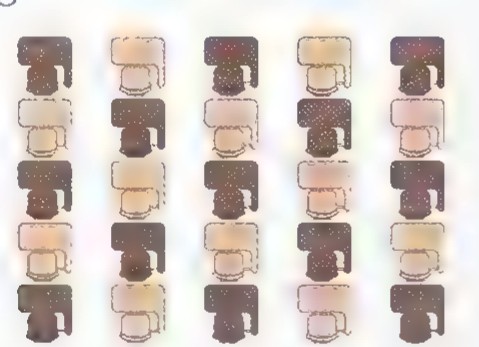
Theorem. The pupils can’t obey the teacher.
Proof.
(What is the beginning assumption?)
If they can obey the teacher, the 13 pupils at the black desks will move to the brown desks.
(Look at the figure to tell what this contradicts.)
Therefore, our assumption is false and
(what conclusion follows?)
Ammonia Molecule Proof. The ammonia molecule consists of three hydrogen atoms bonded to a nitrogen atom as shown in this figure.
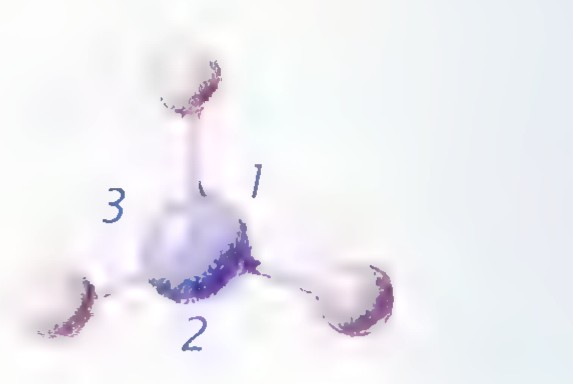
The fact that chemists have found that each bond angle is 107° can be used to prove the following theorem.
Theorem. The atoms of an ammonia molecule are not coplanar.
Proof.
(What is the beginning assumption?)
If the atoms are coplanar, then the sum of the three bond angles is 360°.
If the sum of the three bond angles is 360°, then each angle is 120°. (What does this contradict?)
Therefore, our assumption is false and
(what conclusion follows?)
Poker Proof. John Scarne, for many years the world’s foremost authority on gambling, once said of the game of poker: “Poker is a game of strategy, deception, mathematics and psychology.”‡ Here is an obvious case in which indirect reasoning is used in the game.
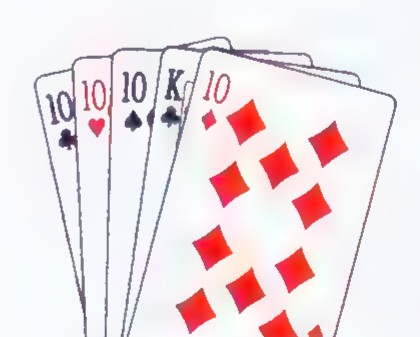
In a poker game with no “wild cards,” you have been dealt the “four of a kind” hand shown in the figure above.
* The Sphere, by Johannes de Sacrobosco.
† A problem from Mathematical Gems, by Ross Honsberger (M.A.A., 1973).
‡ Scarne’s New Complete Guide to Gambling, by John Scarne (Simon & Schuster, 1974).
p. 59
Theorem. In this deal of the cards, no one holds a royal flush.
Proof.
(What is the beginning assumption?)
If someone holds a royal flush, then one of the “10” cards would be in his or her hand. (What does this contradict?)
Therefore, our assumption is false and
(what conclusion follows?)
Balanced Weights Proofs. Here are two puzzles about weights and a scale with two pans. In each case, the puzzle is to separate the weights into two sets so that one set will exactly balance the other.
Puzzle 1

Puzzle 2

- Can you solve either puzzle?
Consider this argument about these puzzles.
If a puzzle of this type has a solution, then the weights of the two sets will be equal. If the weights of the two sets are equal, then each set will weigh half the total weight.
- What conclusion follows from these two premises?
Consider this argument in the form of an indirect proof about these puzzles.
Theorem. If the sum of all of the weights is odd, there is no solution.
Proof.
(What is the beginning assumption?)
If there is a solution, let the weights in one set add up to S.
If the weights in each set add up to S, then the weights in both sets add up to , an even number. (What does this contradict?)
Therefore, our assumption is false and
(what conclusion follows?)
Athletes Puzzle. This puzzle is from the book Are You as Smart as You Think? and can be solved by reasoning indirectly.*
At a sports banquet there are 100 famous athletes. Each one is either a football or a basketball player. At least one is a football player. Given any two of the athletes, at least one is a basketball player.
- How many of the athletes are football players, and how many are basketball players? Explain your reasoning.
Set III
The following puzzle, adapted from one by David L. Silverman, is to decide which of the following statements must be true and which false to avoid any contradictions.†
A. Exactly one statement on this list is false.
B. Exactly two statements on this list are false.
C. Exactly three statements on this list are false.
D. Exactly four statements on this list are false.
- Can two of the statements be true? Why or why not?
- Can all of the statements be false? Why or why not?
- Can three of the statements be true?
- Can all of the statements be true?
- How many statements are true? Explain.
* Are You as Smart as You Think?, by Terry Stickels (Thomas Dunne Books, 2000).
† Journal of Recreational Mathematics (January 1969).
p. 60
Used by permission of Johnny Hart and Creators Syndicate, Inc.
Lesson 5: A Deductive System
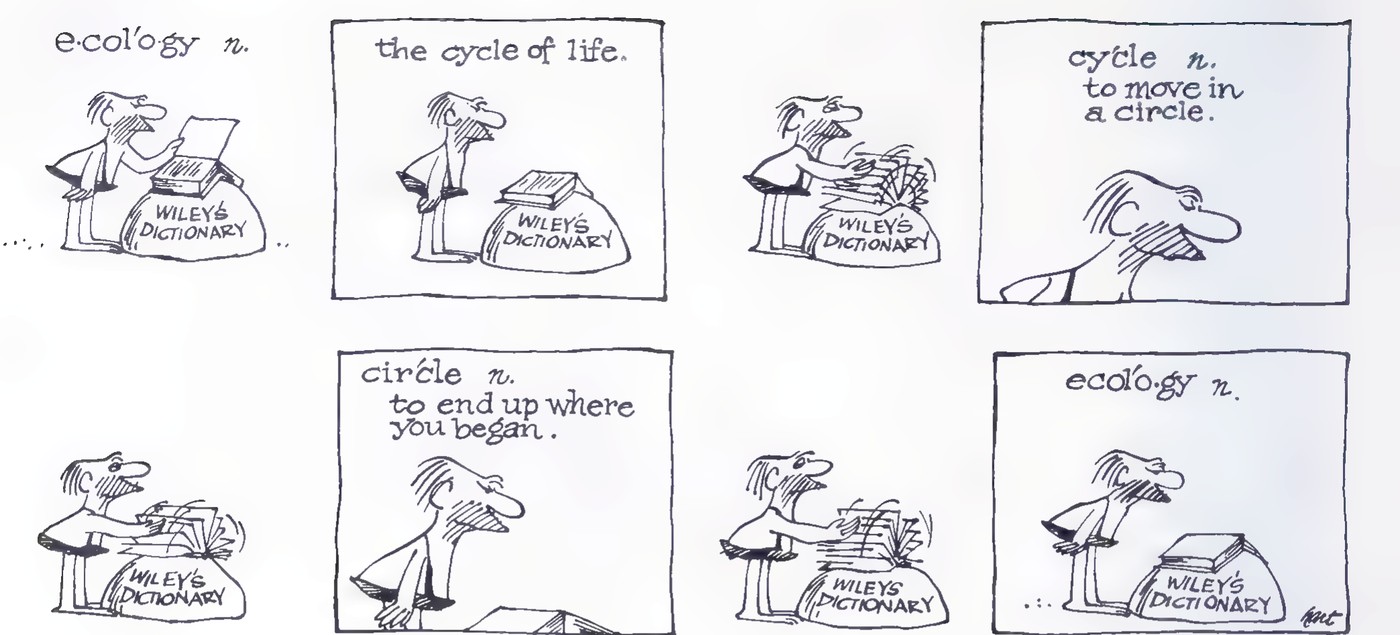
B. C.’s predicament in trying to learn the meaning of “ecology” from Wiley’s dictionary pokes fun at a problem that every dictionary maker has. A dictionary attempts to provide the meaning of every word in simpler words or words that the user already understands. These words, in turn, are defined by even simpler words, but the process cannot go backward without an end. Every dictionary solves this problem by going around in circles.
Definitions are extremely important in mathematics because, without them, a word can have different meanings for different people. To avoid the problem of the dictionary maker—that is, coming back to the point from which we begin—we must have a starting point: some words that we leave undefined. Among these words, the undefined terms, are “point,” “line,” and “plane.”
You have already seen in the first lesson of Chapter 1 how these terms can then be used to define other terms. Here are two examples, restated in “if and only if” terms:
Definition. Points are collinear iff there is a line that contains all of them.
Definition. Lines are concurrent iff they contain the same point.
p. 61
For the same reason that it is impossible to define everything without going around in circles, it is impossible to prove everything. To avoid eventually coming back to the point from which we begin, we must leave a few statements unproved. These statements, called postulates, can then be used as a basis for building proofs of other statements.
A postulate is a statement that is assumed to be true without proof.
We begin with some useful postulates concerning our undefined terms.
Postulate 1
Two points determine a line.
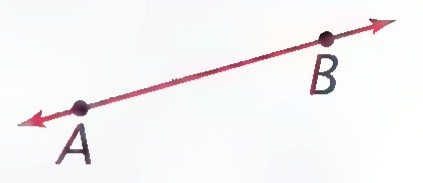
This postulate is suggested by the observation that, if we draw a line, just two points are sufficient to locate its position. The word “determine” in the postulate indicates that, if there are two points, then there is exactly one line that contains them.
The postulate gives some meaning to the word “line” because, for it to be true, it would seem that a line not only must be straight, but also must extend without end in both directions.
Postulate 2
Three noncollinear points determine a plane.
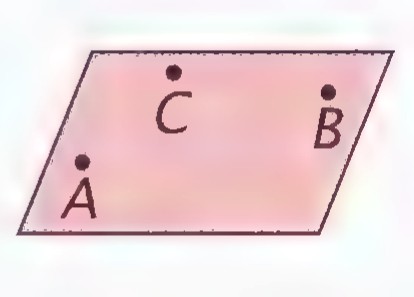
This postulate is suggested by the observation that, although a line cannot be drawn so that it contains three noncollinear points, it is always possible to imagine a plane that contains them. The postulate gives some meaning to the word plane because, for it to be true, it would seem that a plane must be flat, and have no boundaries.
From the undefined terms, then, we can construct definitions of other words. From the definitions and postulates, we can construct proofs, either directly or indirectly, of the statements that we call theorems. The structure that is built by means of logic in this way is called a deductive system.
Exercises
Set I
The American Heritage Dictionary of the English Language gives 34 definitions for the word “point.” The definition given for a point in geometry is “a dimensionless geometric object having no property but location.”
- According to this definition, would it be correct to say that the period at the end of a sentence is a point?
- What about an atom?
The definition says that the only property of a point is “location.” “Location” is defined as a “site or situation.” “Site” is defined as “the place or setting of an event.” “Place” is defined as “a definite location.”
- What happens when, as in a dictionary, you try to define everything?
p. 62
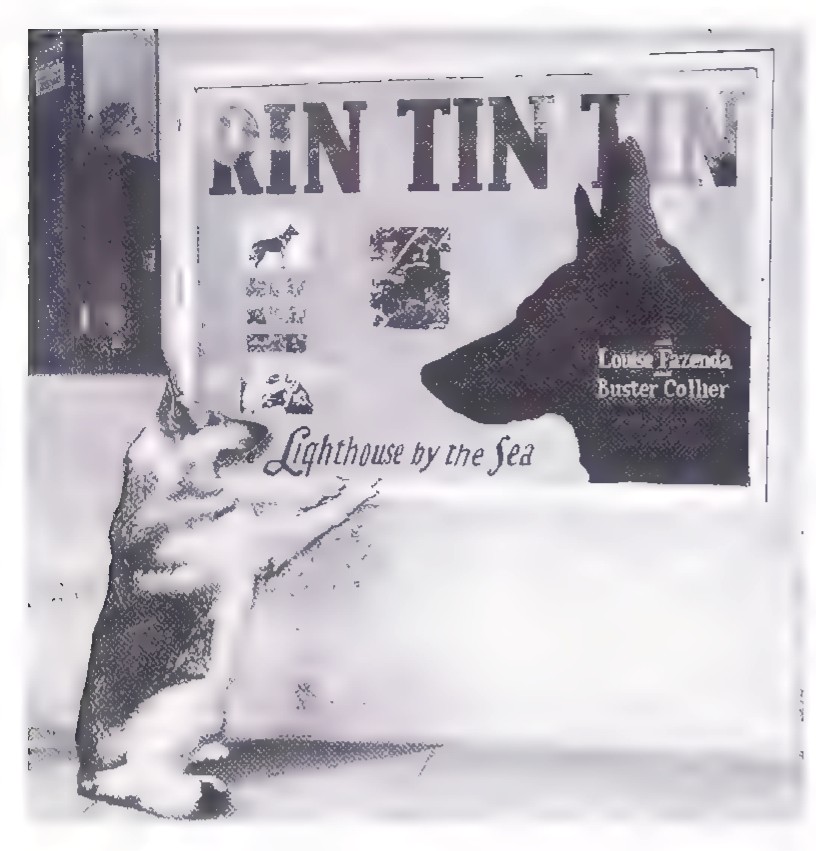
The following dialogue is from a scene in a classroom in the Laurel and Hardy film Pardon Us.
Teacher: What is a comet?
A student: A star with a tail on it.
Teacher: Can anyone give us an example?
Laurel: Rin-Tin-Tin?
- Which words in the other student’s answer did Laurel misunderstand?
- Why did he say “Rin-Tin-Tin”?
If a weight is hung on the end of a piece of string, the string hangs along a vertical line, a line that goes through the center of the earth.
- From whatever point you suspend the weight with the string, the string will have exactly one position. What postulate is illustrated here?
- Why does the string in this position make a better model of a line than when the string is lying on the floor?
The philosopher Bertrand Russell wrote:
I had been told that Euclid proved things, and was much disappointed that he started with postulates. At first I refused to accept them unless my brother could offer me some reason for doing so, but he said:
“If you don’t accept them we cannot go on.”
- What are the statements that are proved called?
- What is a postulate?
- Is it possible to prove everything without going around in circles?
Duck Pond Table. In this clever “duck pond” table, three dipping ducks support a glass table top that represents the surface of the water.*
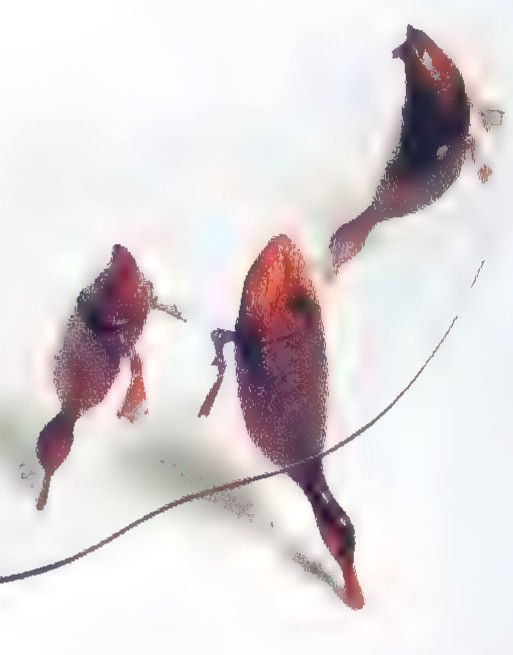
- What postulate does this table illustrate?
- What do the tails of the ducks represent in the postulate?
- What does the table top represent in the postulate?
- What might happen if the ducks were lined up in a row under the table?
- Which word in the postulate would no longer be true of the arrangement if the ducks were lined up in this way?
The points at which the ducks’ tails touch the table are coplanar because
Points are coplanar iff there is a plane that contains all of them.
- What does “iff” mean?
- Write the two “if-then” statements that follow from this definition.
- What word names the relation that your two statements have to each other?
* The Complete Manual of Woodworking, by Albert Jackson, David Day, and Simon Jennings (Knopf, 1996).
p. 63
Intersecting Cubes. This figure shows two intersecting cubes.
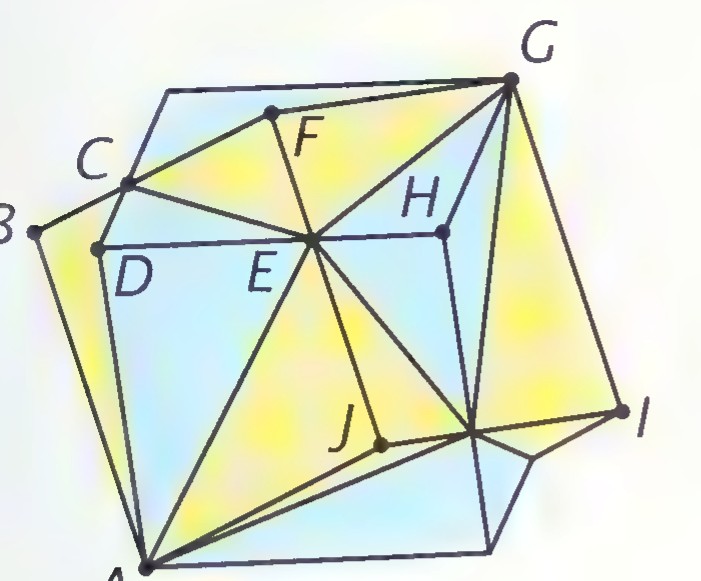
Tell whether each of the following statements is true or false.
- Points B, C, and F are collinear.
- Points B and C determine a line.
- Points F, E, and J are coplanar.
- Points F, E, and J determine a plane.
- Points A, E, and G are collinear.
- Points A, B, C, and J are coplanar.
- Lines DH, FJ, and EG are concurrent.
Set II
Japanese Weights. According to the Macmillan Dictionary of Measurement, a picul is a Japanese unit of weight equal to 16 kwan. A kwan is a unit of weight equal to 100 taels. A tael is a unit of weight equal to 10 momme.
- How would you define picul in terms of tael?
- How would you define picul in terms of momme?
- How would you define momme in terms of tael?
- From these definitions, can you estimate your weight in piculs? Explain.
The dictionary also says that the term picul derives from an expression for “the load that can be carried by one man.”
- Can you conclude anything from this derivation about how the weight of an elephant compares with a weight of 1 picul?
- Why not simply define a picul as “the load that can be carried by one man”?
Credit Card Rules. The following statements appear on the customer agreement for obtaining a credit card.
A transaction finance charge is a charge made if a new advance is added to your account.
If you go over your credit limit, you will be charged a fee.
A supercheck is a check designed for use with your credit card account.
If you are charged a fee, the fee will be added to your balance.
If your card is lost or stolen, you agree to report it immediately.
- Which of these statements are definitions?
- What words do they define?
- Which statements are postulates?
- Which two statements can be combined to form a syllogism?
- What theorem is proved by the syllogism?
Crooked Lines. Obtuse Ollie refuses to use a ruler. He drew the following figure to illustrate, as he described it, “two lines that intersect in two points.”
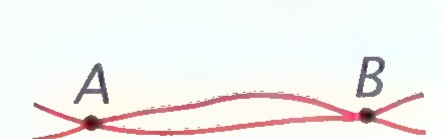
Acute Alice says that his description contradicts one of our postulates.
- What does the postulate say?
- Is Acute Alice correct in saying that there is a contradiction?
p. 64
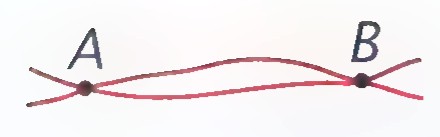
- Why would it be incorrect to criticize Ollie’s drawing by saying that our definition of a line says that a line is straight?
Obtuse Ollie’s drawing and the criticism of it suggest a theorem.
- What is a theorem?
The theorem is:
Two lines cannot intersect in more than one point.
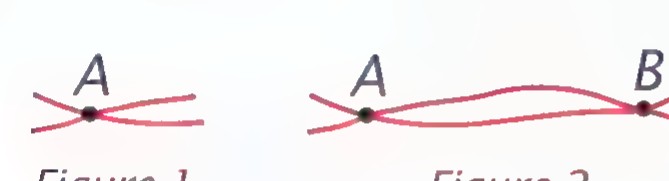
Study the outline of the following indirect proof of this theorem and write the missing statements.
Proof
(What is the beginning assumption?)
If they intersect in more than one point, then two points do not determine a line. (What does this contradict?)
Therefore, our assumption is false and
(what conclusion follows?)
Set III
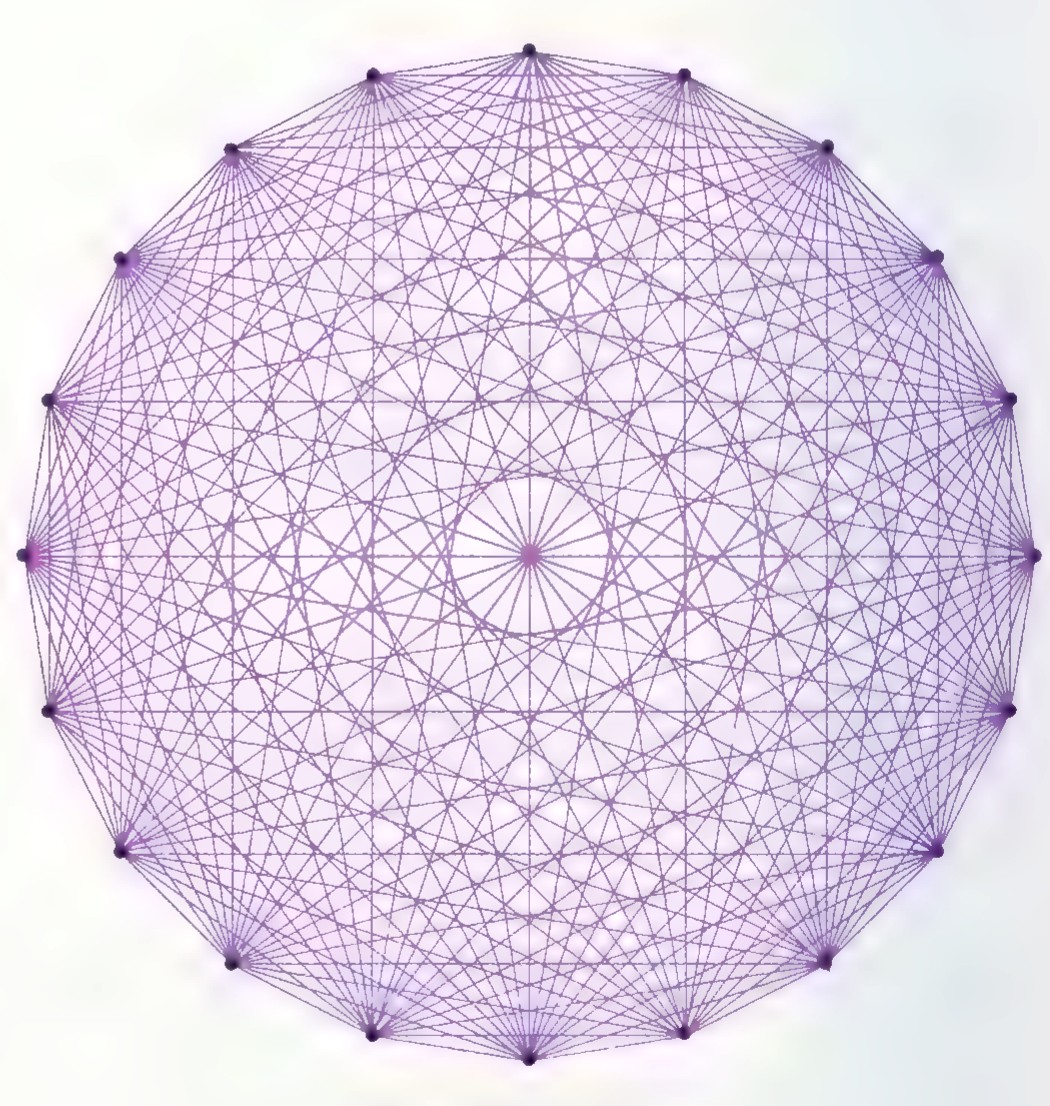
You know that two points determine a line. How many lines could 20 points determine?
The figure at the right shows 20 points arranged in a circle and all of the lines determined by them. Although it would be a challenge to try to count them from the figure, you may be able to guess the correct number by “sneaking up” on the problem.
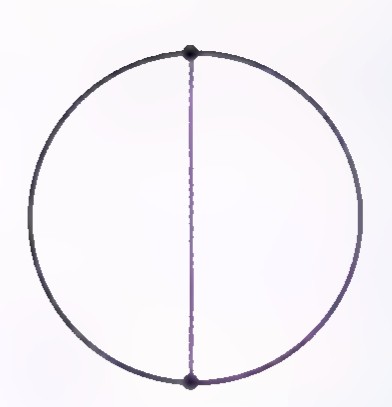
If there were only two points on the circle, there would obviously be just one line.
Draw figures to show the number of lines determined if the number of points on the circle is
- three.
- four.
- five.
- six.
- Do you see any kind of pattern in your results that would enable you to guess the number of lines for 20 points? If so, show your method.
p. 65
Used by permission of Johnny Hart and Creators Syndicate, Inc.
Lesson 6: Some Famous Theorems of Geometry
In his book Euclid—The Creation of Mathematics, Benno Artmann wrote:
The Greek word theorema is related to theater and means something seen, or, in mathematics, an insight, understanding, or knowledge. A mathematical theorem should answer a question or solve a problem that posed itself during the discussion of a mathematical subject.*
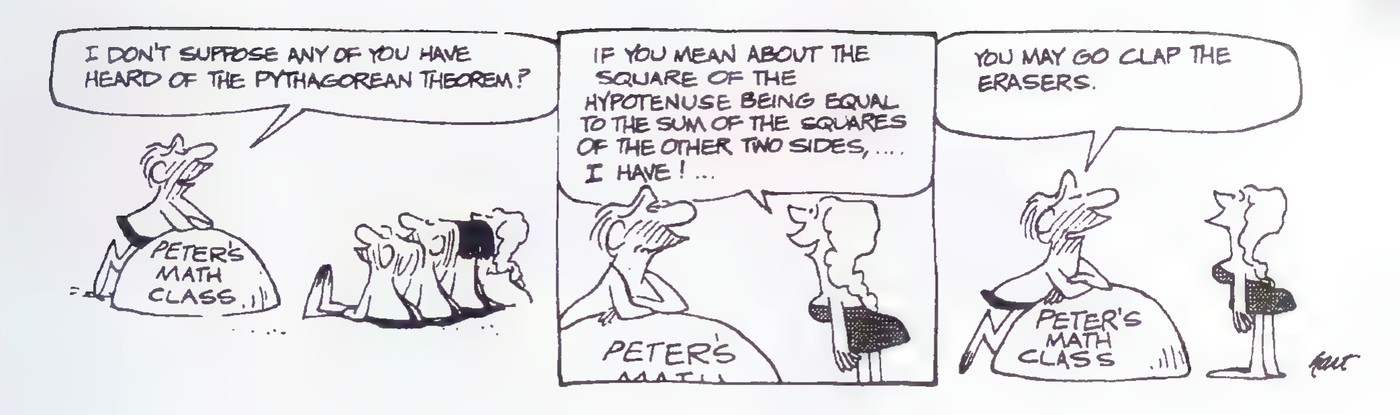
The most famous theorem in all of geometry is the one named for Pythagoras, a Greek mathematician who lived more than 200 years before Euclid. The fame of the Pythagorean Theorem is due to its importance in nearly every branch of mathematics. You may have become acquainted with it in your study of algebra as the equation . In the B. C. strip above, it is stated in words:
The Pythagorean Theorem
The square of the hypotenuse of a right triangle is equal to the sum of the squares of the other two sides.
The Greeks did not use algebraic symbols, so the equation would not have meant anything to them. They thought of the Pythagorean Theorem in terms of the areas of geometric squares.
* Springer, 1999.
p. 66
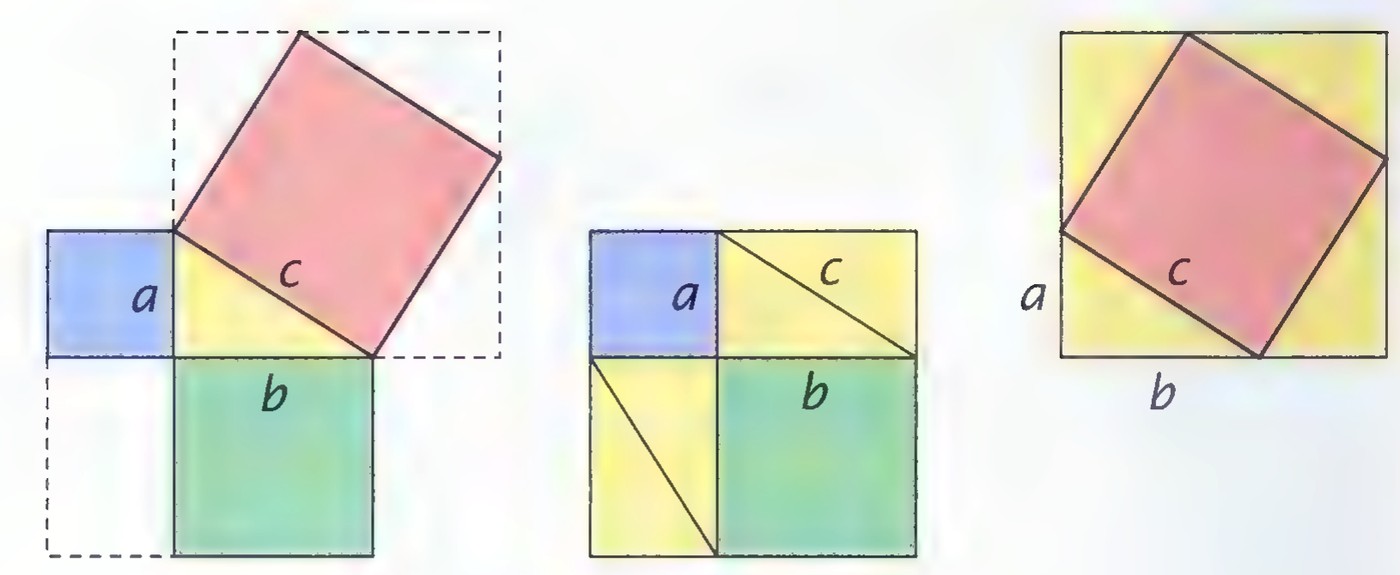
In the figures above, the right triangle is shaded yellow. The hypotenuse, the side of the triangle opposite the right angle, is labeled c, and the other two sides are labeled a and b. The area of the square on the hypotenuse, shaded red, is , and the areas of the squares on the other two sides, shaded blue and green, are and . The theorem claims that, in the first figure, the red area is equal to the sum of the blue and green areas; the other two figures suggest why this claim is true.
Another theorem about triangles with which you may be acquainted concerns their angles:
The Triangle Angle Sum Theorem
The sum of the angles of a triangle is 180°.
This theorem claims that in the first figure below; the second figure suggests why this claim is true.
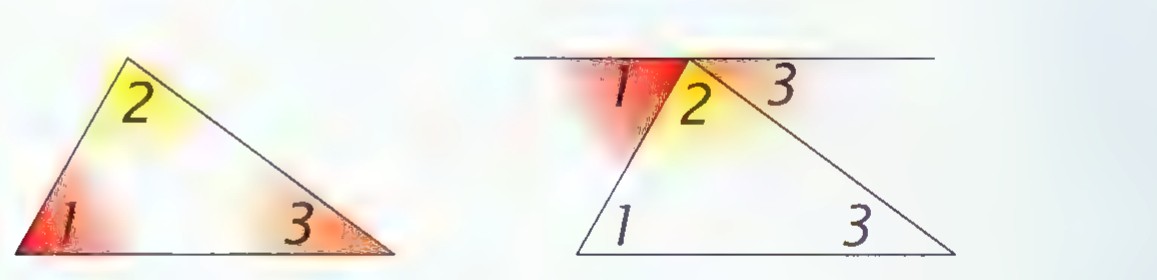
Two more famous theorems with which most students become acquainted before studying geometry concern measuring the circle.
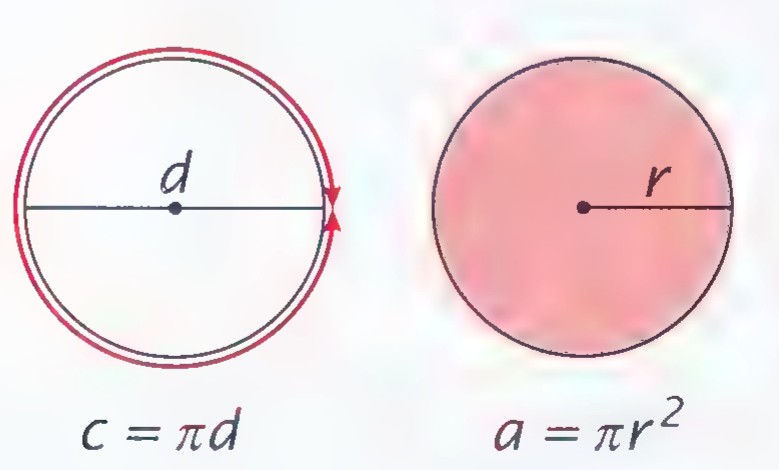
Two Circle Theorems
If the diameter of a circle is d, its circumference is .
If the radius of a circle is r, its area is .
p. 67
Because the diameter of a circle is twice its radius, the formula for the circumference of a circle is often stated as .
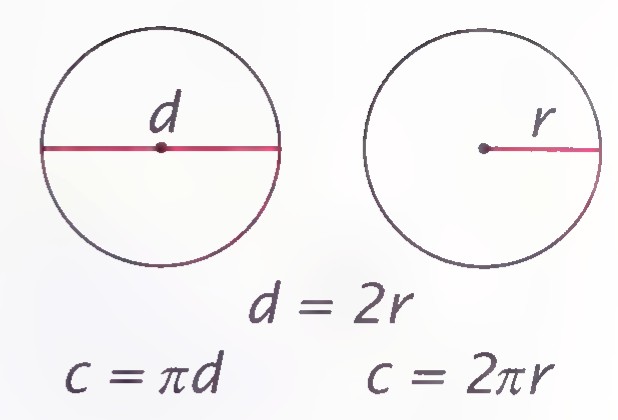
You may remember that , the number called “pi,” is approximately 3.14. No one will ever know its exact value in decimal form, because its decimal form has no known patterns and never ends! Because of the complexity of , it is impossible to suggest with pictures why the theorems about the circumference and area of a circle are true.
In an earlier lesson, we learned that a theorem is a statement that is proved by reasoning deductively from already accepted statements. Although we are not yet able to prove the theorems considered in this lesson, we will begin now to apply them to solving problems. Eventually, we will return to these theorems as we arrive at the points at which we will be able to prove them and, hence, include them in our deductive system.
Exercises
Set I
In a survey of the “10 mathematical formulas that changed the face of the world,” “” ranked first, followed by “.”* It is interesting to note that appears in both of these formulas.
- What does the c in the formula stand for?
- Do you know what the c in the formula stands for?
- What does the c in the formula stand for?
- What does the a in the formula stand for?
- What does the a in the formula stand for?
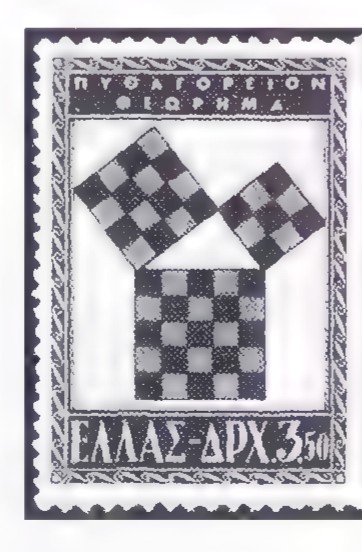
This stamp, issued by Greece in 1955, illustrates a special case of one of the theorems in this lesson.
- Which theorem is it?
- How do the checkerboard patterns on the three sides of the triangle illustrate the theorem?
A contest was held in 1025 A.D. between two of the most learned men in Europe, Raoul and Raimbeau.†
After throwing dust into each other’s eyes(!), Raimbeau challenged Raoul to prove a theorem. The best that Raoul could do was to draw a triangle on paper, cut off its corners, and put them together as shown here.
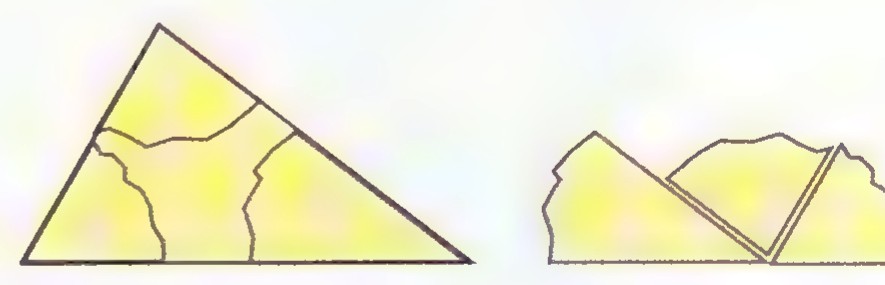
- What theorem was Raoul trying to prove?
- Does his method prove it?
- If he had drawn and cut out a lot of triangles of different shapes and gotten similar results, would he have proved the theorem?
* Wonders of Numbers, by Clifford A. Pickover (Oxford University Press, 2001).
† Geometry Civilized, by J. L. Heilbron (Clarendon Press, 1998).
p. 68
Target Circles. This “target” figure consists of five circles with radii of 1, 2, 3, 4, and 5 units.
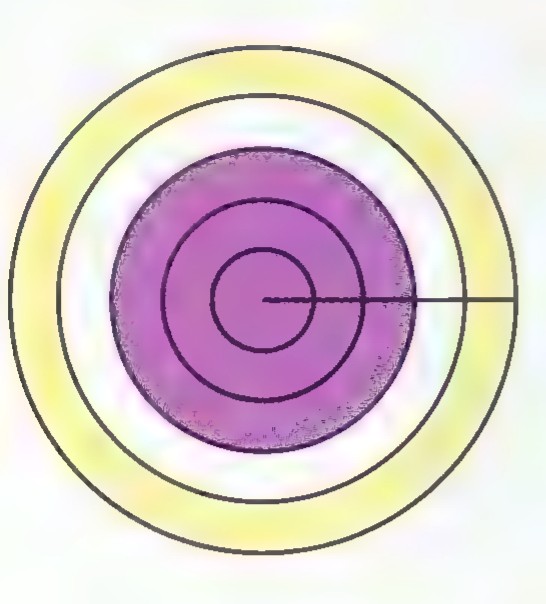
- What are the diameters of the five circles?
- What are the exact circumferences of the five circles?
- What is the exact area of the purple region?
- What is the exact area of the yellow region?
- Why do you suppose that this figure sometimes appears in books on optical illusions?
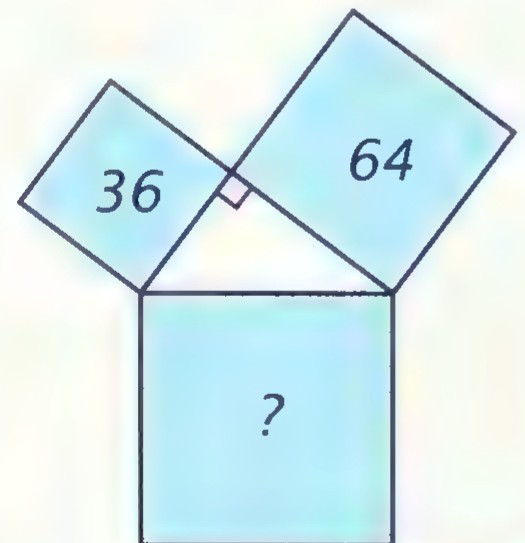
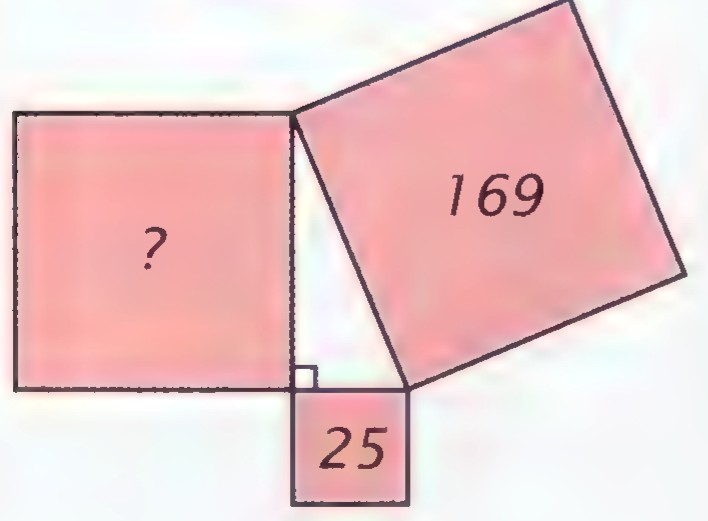
In each of the following figures, squares have been drawn on the sides of a right triangle. Given the two areas shown in each figure, find the third area. Show your methods.
When a bird is gliding, its wings produce a lifting force that makes a 90° angle with the direction of the air flow at the leading edge of the wing.
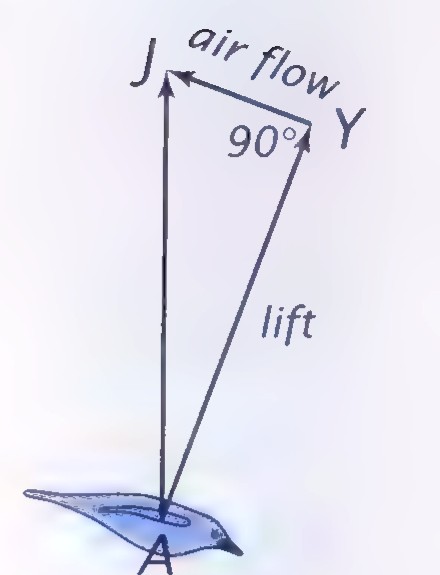
- Find ∠A if ∠J = 60°.
- Find ∠A if ∠J = 45°.
- Find ∠A in terms of n if ∠J = n°.
This figure shows an overhead view of someone at C listening to stereo speakers at A and B. For the sound to be balanced, ∠A = ∠B.
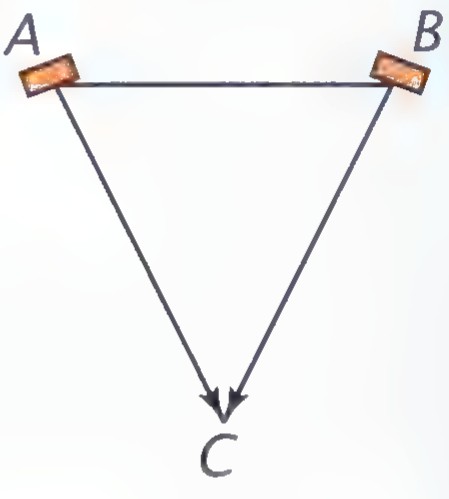
- Find ∠A if ∠C = 40°.
- Find ∠A if ∠C = 50°.
- Find ∠A in terms of n if ∠C = n°.
Notice that the Pythagorean Theorem consists of more than simply “.” Expressed as a conditional statement about the figure shown below, it says:
If this figure is a right triangle with hypotenuse c, then .
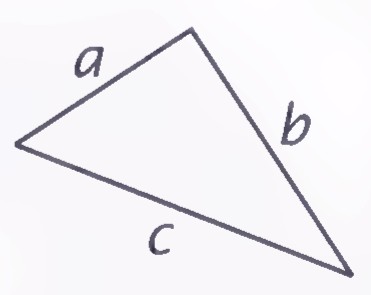
- Given that this statement is true, does it necessarily follow that
If , then this figure is a right triangle?
- Why or why not?
p. 69
Set II
Eye Pupil. The pupil of the eye controls the amount of light entering the eye. The widest that it gets, in dim light, is about 8 mm in diameter. In very bright light, it gets as narrow as 2 mm.*
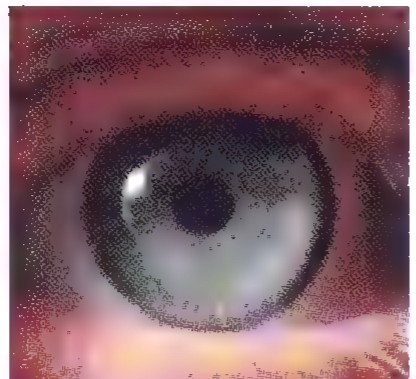
What is the approximate area of the pupil when its diameter is
8 mm?
2 mm?
Approximately how many times as much light does the pupil let in when it is biggest as when it is smallest?
Triangle Angle Sum Theorem. Use the theorem about the sum of the angles of a triangle to answer the following questions.
- If one angle of a triangle has a measure of 90°, what is the sum of the other two angles?
- If all three angles of a triangle are equal, how large is each angle?
- Can a triangle have two 90° angles? Why or why not?
- Can one angle of a triangle have a measure of 179°? Why or why not?
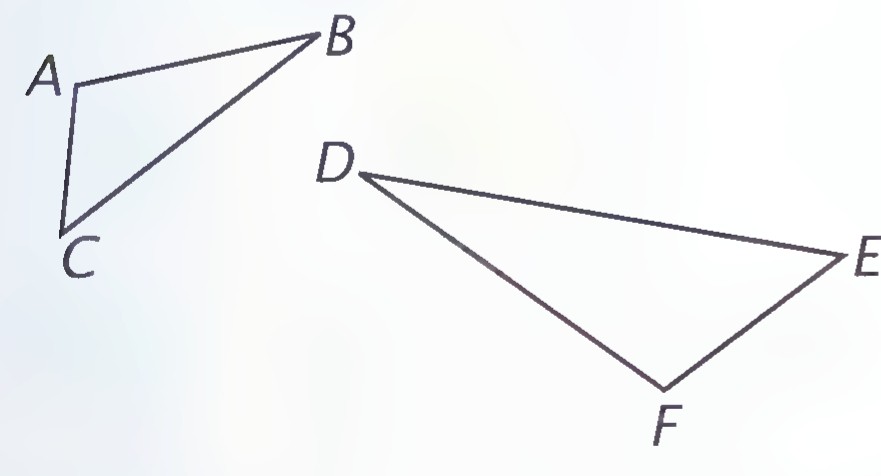
- If two angles of one triangle are equal to two angles of another triangle, does it follow that the third pair of angles have to be equal? Why or why not?
The Stretched Cord. Baudhayana, a mathematician of ancient India, wrote in a book titled Manual of the Cord:
If a cord [AB in the figure] is stretched across the diagonal of a square, the cord is the side of a square double the area of the original square.
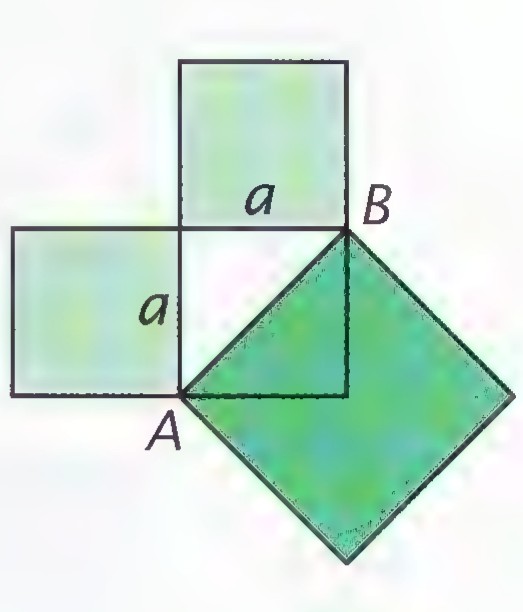
- If the side of the original square is a, what is its area?
- What is the combined area of the two light-green squares?
- What is the area of the dark-green square?
- How do you know?
Pencil Experiment. Imagine a large triangle on which a pencil is placed pointing to the right as shown in the first figure below. If the pencil is pivoted about ∠A, then about ∠B, and then about ∠C, it ends up as shown in the last figure.
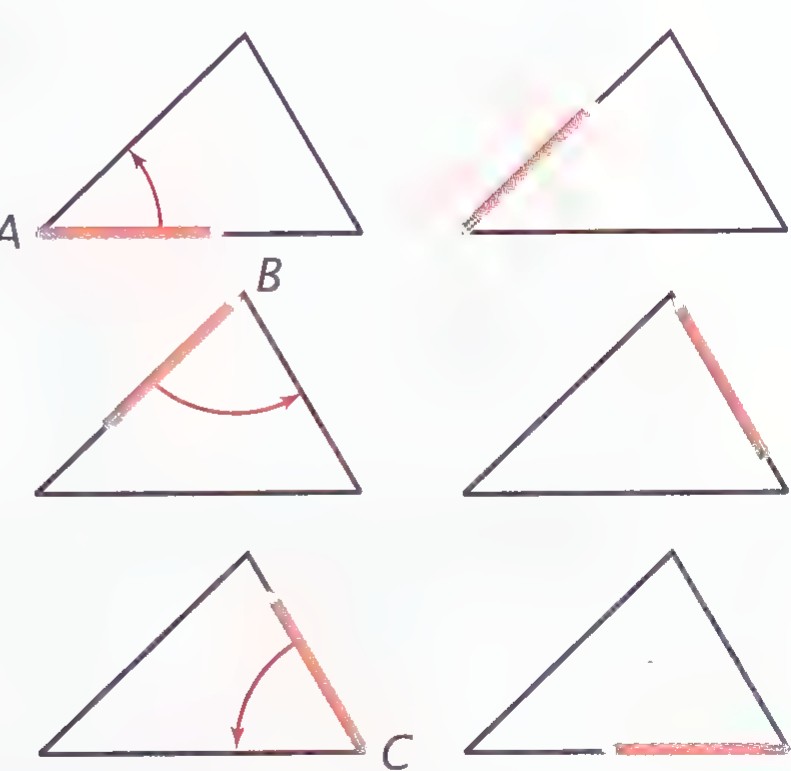
- In what direction is the pencil pointing at the end?
- What does this direction suggest about the number of degrees through which it
* Human Information Processing: An Introduction to Psychology, by Peter H. Lindsay and Donald A. Norman (Harcourt Brace Jovanovich, 1977).
p. 70
has turned in pivoting about the three angles?
- What theorem does this experiment seem to demonstrate?
Aryabhata on the Circle. In the sixth century, the Indian astronomer Aryabhata wrote:
The area of a circle is half of the circumference multiplied by half of the diameter.
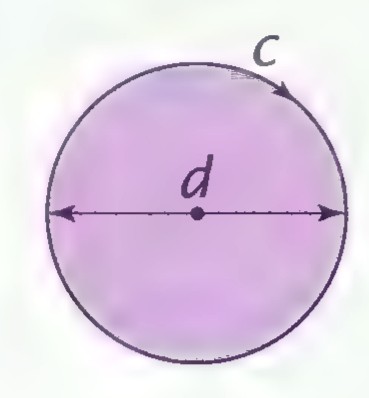
- Is this statement correct? Show why or why not.
Aryabhata also said:
Add 4 to 100, multiply the result by 8 and then add 62,000; the result is approximately the circumference of a circle of diameter 20,000.
- If this result were exact rather than approximate, to what number would be equal?
When asked to write down a number used to measure circles, a backward geometry student named Dilcue wrote:
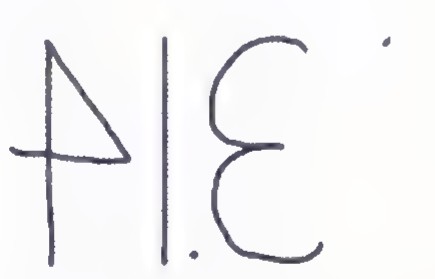
- Do you think he should get any credit for this answer? Explain.
Set III
The following figures show three pieces hinged into a chain. If the two triangles are rotated downward, they form the second figure. If they are rotated upward, they form the fourth figure.*
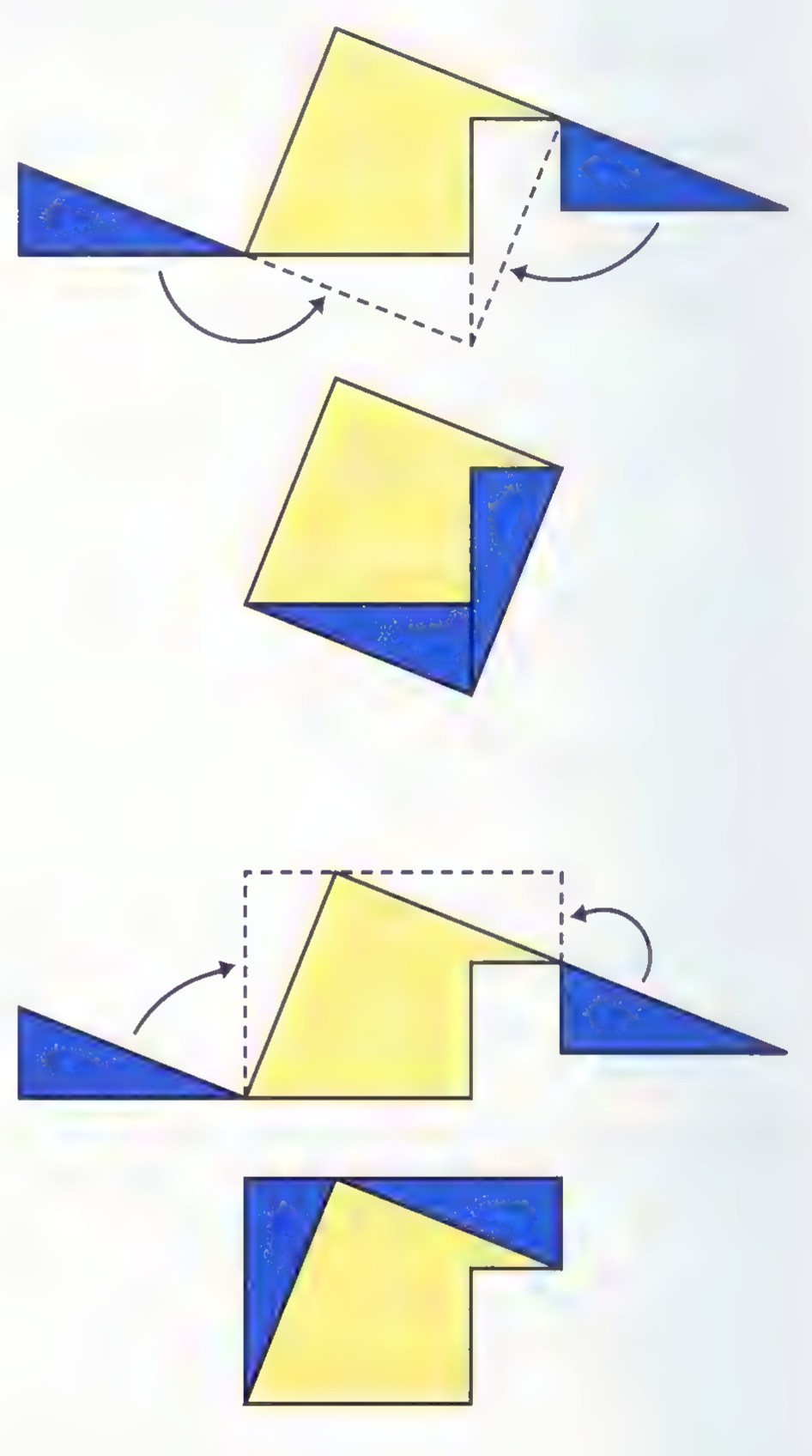
What do the two arrangements of the three pieces illustrate? Explain.
* From Dissections, Plane and Fancy, by Greg N. Frederickson (Cambridge University Press, 1997).
p. 71
Summary and Review
You should be familiar with the following concepts introduced in Chapter 2.
Basic Ideas
| Conditional statement | 42 |
| Converse | 47 |
| Definition | 46–47 |
| Direct proof | 51 |
| Euler diagram | 43 |
| Hypothesis and conclusion | 43 |
| If and only if (iff) | 47 |
| Indirect proof | 55–57 |
| Pi () | 67 |
| Postulate | 61 |
| Premises of an argument | 51 |
| Syllogism | 51 |
| Theorem | 51 |
| Undefined term | 60 |
Postulates
- Two points determine a line. 61
- Three noncollinear points determine a plane. 61
Theorems
The Pythagorean Theorem. The square of the hypotenuse of a right triangle is equal to the sum of the squares of the other two sides. 65
The Triangle Angle Sum Theorem. The sum of the angles of a triangle is 180°. 66
If the diameter of a circle is d, its circumference is . 66
If the radius of a circle is r, its area is . 66
Exercises
Set I
Write in “if-then” form:
- All limericks have five lines.
- I will make a fortune when I perfect my perpetual motion machine.
- No toadstools are edible.
In his book Take Time for Paradise, A. Bartlett Giamatti wrote:
If we have known freedom, then we love it. If we love freedom, then we fear its loss.*
These are the two premises of a syllogism.
- What is the pattern of a syllogism?
- What, in words, is the conclusion of this syllogism?
- What might allow the conclusion of a syllogism to be false?
The following statement is a definition of daredevil:
You are a daredevil iff you are recklessly bold.
- Write the two conditional statements that are equivalent to this statement.
- How is one of your statements related to the other?
The figure below shows three birds perched on a power line.

- If we think of the birds as points on the line, what word describes their relation?
- How many points does it take to determine a line?
- On what type of statement in our deductive system is your answer to the preceding question based?
* Summit Books, 1989.
p. 72
The figure below represents the advertising slogan of the Morton Salt Company.
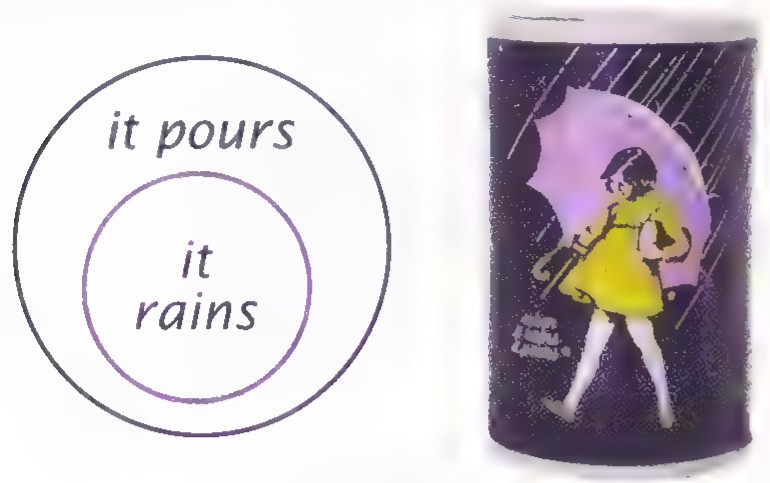
- What is this type of figure called?
- Write the slogan in “if a, then b” form.
- Rewrite it in the form “b if a.”
- Write the converse of the slogan in “if-then” form.
- If the slogan is true, does it follow that its converse also is true?
The figure below appeared in a problem on an SAT exam.
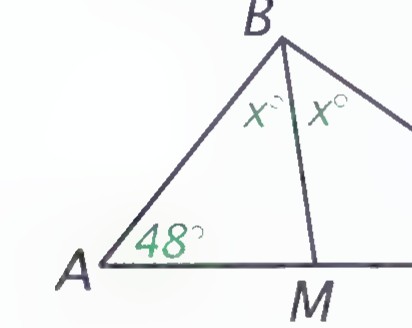
Find each of the following:
- ∠ABC.
- x.
- ∠BMC.
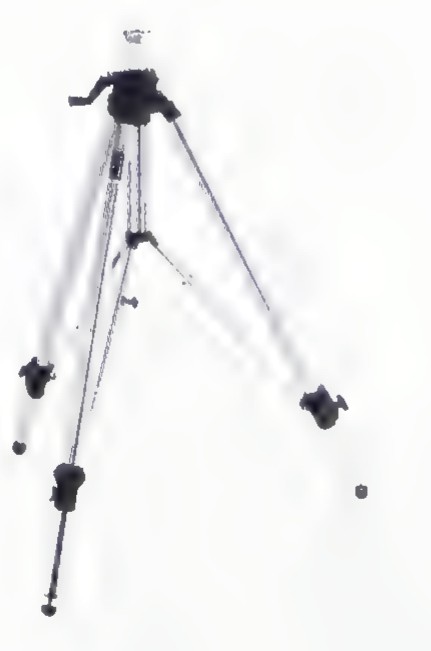
A tripod is a device used to provide steady support to a camera.
- State the postulate that is the basis for the fact that a tripod has three legs.
- What might happen if a tripod had four legs instead of three?
Geometry in Spanish. The following sentence appears in a geometry book written in Spanish:
En todo triángulo rectángulo el cuadrado de la longitud de la hipotenusa es igual a la suma de los cuadrados de las longitudes de los catetos.
- Translate the sentence into English.
- What does the word cuadrado mean?
- What does the word igual mean?
The second word in the sentence is todo. Looking in a Spanish dictionary, we find todo defined as entero, entero defined as completo, and completo defined as entero.
- What do these findings illustrate about the way in which words have to be defined in dictionaries?
- What are some of the undefined terms of geometry?
- Why are these words left undefined?
Courtroom Questions. The following conversation took place in a recent criminal trial in California.*
Attorney: Can you calculate the area of a circle with a 5 mm diameter?
Witness: I mean I could . . . I don’t know right now what it is.
Attorney: Well, what is the formula for the area of a circle?
Witness: Pi R Squared.
Attorney: What is pi?
Witness: Boy, you are really testing me. 2.12 . . . 2.17 . . .
Judge: How about 3.1214?
. . .
Attorney: And what is the radius?
Witness: It would be half the diameter: 2.5.
Attorney: 2.5 squared, right?
Witness: Right.
. . .
* Reported in The Joy of π, by David Blatner (Walker, 1997).
p. 73
Attorney: Tell me what pi times 2.5 squared is.
Witness: 19.
- What mistakes did the witness make?
- Was the judge correct? Why or why not?
- Did the attorney make any mistakes?
Set II
Euclid gathered together the geometric knowledge of his time,
and arranged it
not just in a hodge-podge manner,
but,
he started with what he thought were
self-evident truths
and then proceeded to
PROVE all the rest by
LOGIC.
A splendid idea, as you will admit.
And his system has served
as a model
ever since.LILLIAN LIEBER
The Education of T. C. Mits
- What are Euclid’s “self-evident truths” called?
- What are the rest of the truths proved by logic called?
- What are the names of the two types of proofs used to prove these truths?
In the figure below, squares have been drawn on the sides of a right triangle.
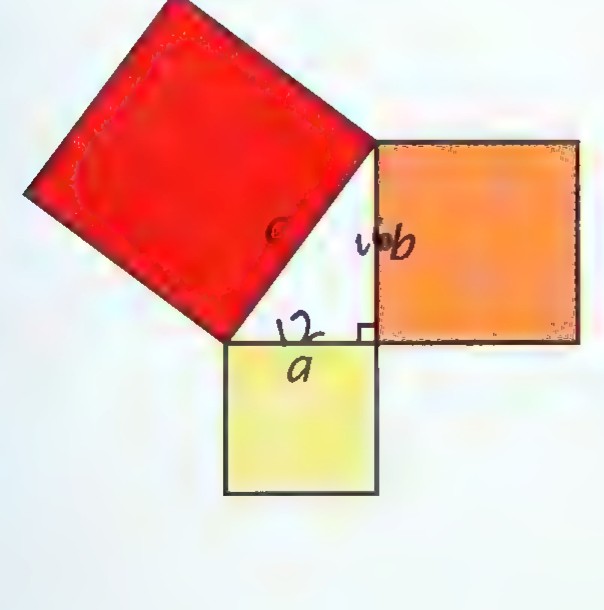
Given that and , find the area of
- the yellow square.
- the orange square.
- the red square.
Heron of Alexandria wrote:
How many times in an attack on a stronghold have we arrived at the foot of the ramparts and found that we had made our ladders too short!*
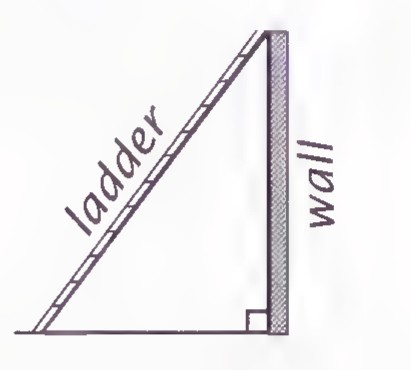
Suppose that a ladder just reaches the top of a wall 16 feet high and that the closest the base of the ladder can be placed to the foot of the wall is 12 feet.
- How long must the ladder be to reach the top of the wall?
From this diagram from the Rhind papyrus, we know that the ancient Egyptians calculated the area of a circle as
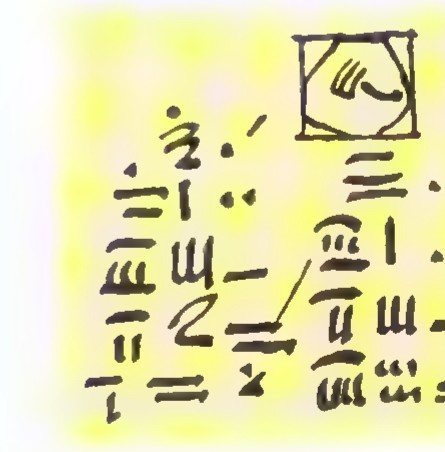
- If this method were correct, then to what fraction would be equal?
- How do the areas of circles given by this method compare with their actual areas?
* Geometry Civilized, by J. L. Heilbron (Clarendon Press, 1998).
p. 74
Panda Proof. Here is another story from A Prairie Home Companion Pretty Good Joke Book. After studying the relations of the statements given in the proof, write the missing statements.
Theorem. If a panda went to a restaurant, then he eats shoots and leaves.
Proof.
If a panda went to a restaurant, he would have a sandwich.
(What is the second statement?)
If he took out a gun, he would shoot the waiter.
(What is the fourth statement?)
If he leaves without paying, then the panda eats shoots and leaves.
What kind of proof is this?
Clue Proof. Mr. Boddy has been the victim of foul play. It happened after 4 P.M. After studying the relations of the statements given in the following proof, write the missing statements.
Theorem. Colonel Mustard did it.
Proof.
(What is the beginning assumption?)
If Colonel Mustard didn’t do it, then Miss Scarlet did it.
(What statement belongs here?)
If it was done in the dining room, then it happened before noon.
(What does this contradict?)
Therefore, our assumption is false and
(what conclusion follows?)
What kind of proof is this?
Circle in the Square. This figure shows a circle drawn inside a square.
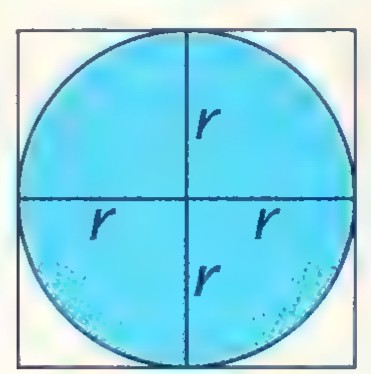
- What is the exact circumference of the circle in terms of r?
- What is the perimeter of the square?
- What fraction of the perimeter of the square is the circumference of the circle?
- What is the exact area of the circle in terms of r?
- What is the area of the square?
- What fraction of the area of the square is the area of the circle?
In one of his books, Lewis Carroll described a planet so small that someone can walk around it in 20 minutes!
- If someone can walk three miles in an hour, what is the approximate diameter of that planet? Explain your reasoning. (1 mile = 5,280 feet.)
p. 75
Algebra Review: Solving Linear Equations
The Distributive Rule
The distributive rule relates the operations of multiplication and addition. For any numbers a, b, and c,
From the definition of subtraction in terms of addition, it follows that
Here are some examples of how the distributive rule is used to eliminate parentheses.
Solving Linear Equations
Some useful steps in solving linear equations are:
Step 1. Use the distributive rule to eliminate parentheses.
Step 2. Simplify both sides of the equation as much as you can.
Step 3. Add and subtract as necessary to get all of the terms containing the variable on one side of the equation and all of the other terms on the other side.
Step 4. Multiply or divide to get the variable alone on one side.
p. 76
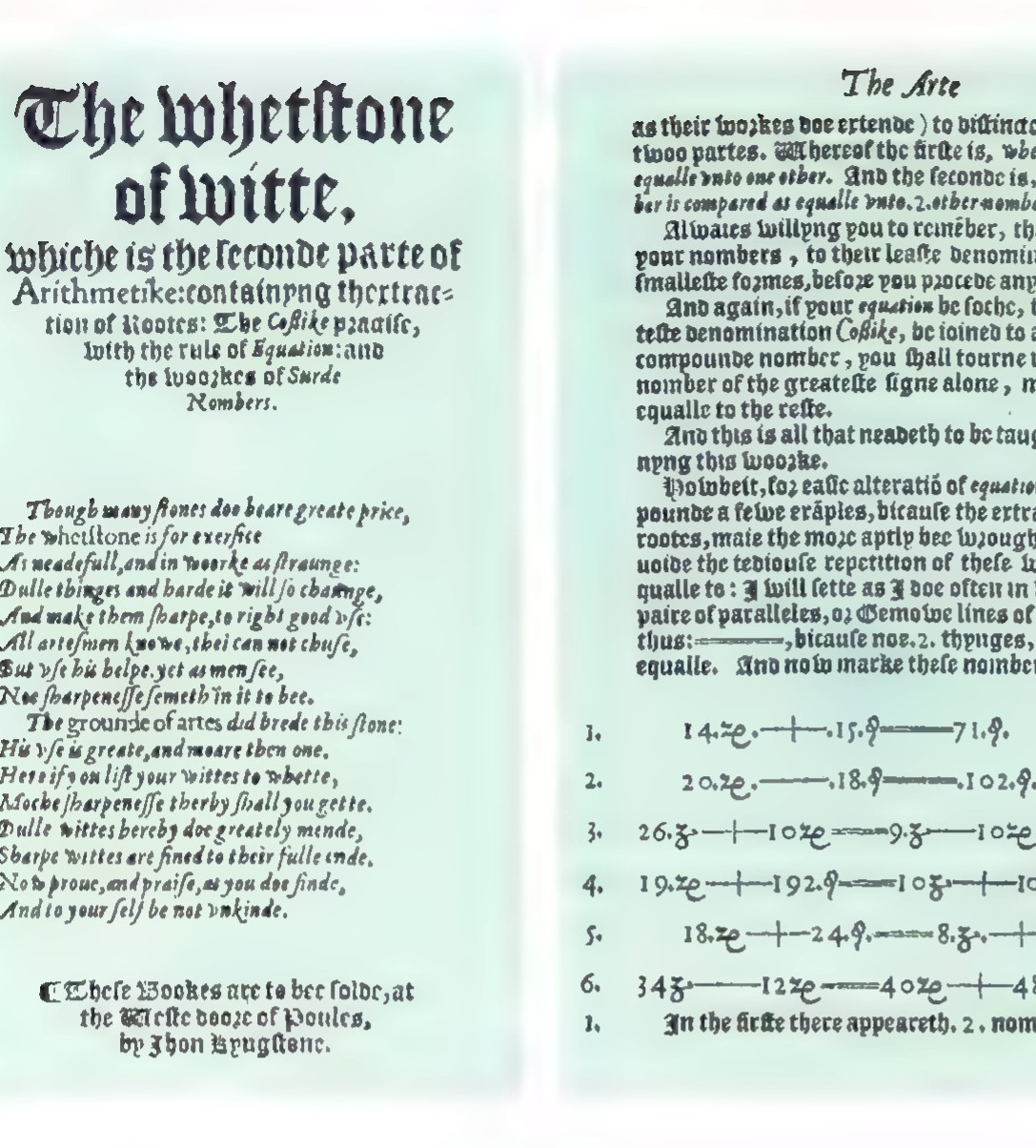
The first algebra book in English, titled The Whetstone of Witte, was written by Robert Recorde and published in 1557. It was in this book that the equal sign was used for the first time in history.
Exercises
Simplify the following expressions.
Use the distributive rule to eliminate the parentheses.
Solve the following equations.