Chapter 1 — Teacher’s Guide Answers
Answers and teaching commentary for Chapter 1: An Introduction to Geometry, transcribed from the scanned Teacher’s Guide. Diagrams are cropped from the same page scans.
OCR note. The text was recognized automatically and has not been corrected line by line; formulas and symbols may be imperfect. Check the original PDF for exact wording.
Homework: Chapter 1 exercises · Selected answers · Teacher’s answers PDF
Lesson 1
Set I (pages 10—11)
Ch’ang-an, now called Sian, was one of two great capital cities of ancient China. It was built on the bank of the Wei River on a main trade route to Central Asia.
The city measured 5 miles from north to south and 6 miles from east to west and was surrounded by a wall 17.5 feet high. Its population in the eighth century is estimated to have been 2 million.
More about Ch’ang-an can be found in chapter 5 of Ancient China, by Edward H. Schafer (Great Ages of Man series, Time-Life Books, 1967).
1. Collinear.
*2. 12cm.
3. 6cm.
4. 4 cm.
5. About 1.3 cm.
6. 10 cm.
7. 3mi. (T”“ =3mi)
6mi 05mi
)
8. 0.5m1.(12cm =
0.5mi
9. 5mi. (10 emx ———
=5mi.)
10. No, because its sides are not all equal.
11. The colored regions (the Palace and Imperial Cities, the two markets, and the park).
0.5 mi
12. 22 mi. (44 cm x ——= cm
=22mi.)
13. Coplanar.
*14. Line segments.
15. A line segment is part of a line and has a measurable length. A line is infinite in extent.
16. 25.
® Answers to exercises marked with a bullet are also given in the textbook.
Set II (page 1)
The figure in this exercise set is a “nine-three” configuration, one of three such configurations in which nine lines and nine points are arranged so that there are three lines through every point and there are three points on every line. It and other configurations of projective geometry are discussed in chapter 3 of Geometry and the Imagination, by David Hilbert and Stefan Cohn- Vossen (A.M.S. Chelsea Publishing, 1990).
17. Nine.
18. Points that lie on aline.
19. Nine. They are E-F-I, A-B-C, A-D-1, G-H-, B-C-D, B-E-H, D-F-H, A-C-F, C-E-G.
20. Lines that contain the same point.
#21. Three. (AC, AF, AL)
22. Three. (AG, BD, BH.)
23. Three. (AF, BD, CG.)
24. Three. (Three lines are concurrent at every lettered point of the figure.)
#25. Six; AB, AG, AC, AF, AD, AL
26. Six; BA, BC, BD, BE, BH, BG.
27. Six; CB, CD, CE, CG, CF, CA.
Set I1l (pages 1112)
The first three figures in this exercise illustrate a special case of the dual of Pappus’s theorem. As long as two sets of three lines in the figure are parallel, as in the first three figures, the added sets of lines are concurrent. A figure such as the last one in the exercise suggests that, when the lines are not parallel, the concurrence is lost. However, the two sets of three segments in the original figure must not necessarily belong to parallel lines. If they belong to concurrent sets of lines, the added sets of lines also are concurrent.
In the exercises, three sets of concurrent lines are named: Al, CF, DG; AF, CI, EH; and BG, CH, El. There are three more sets what are not mentioned, of which one is AD, BE, Gl. The other two sets, AE, BD, FH and BH, CG, DF, are more elusive (1) because, for certain spacings of the lines in the original figure, they are parallel rather than concurrent and (2) because, for the cases in which they are concurrent, the points of concurrency lie outside the figure.
Lesson 2
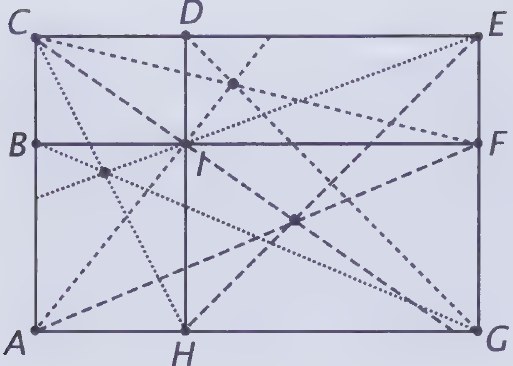
Diagram from page 2.
2. They seem to be concurrent.
3. These lines also seem to be concurrent.
4. These lines also seem to be concurrent.
5. Example figure:
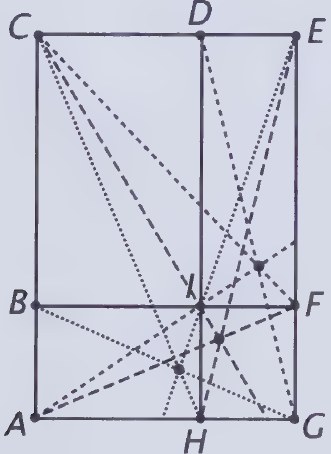
Diagram from page 2.
6. The three sets of lines again seem to be concurrent.
7. Example figures:
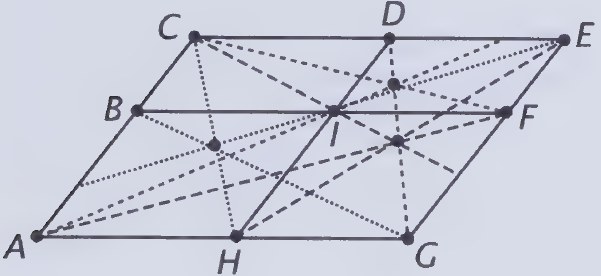
Diagram from page 2.
D €
T A H G
(Just one set of the three lines is shown for the figure above, and the lines are clearly not concurrent.)
8. Aslong as the line segments in the original figure consist of two parallel (or concurrent) sets, the three sets of lines seem to be concurrent. Otherwise, they do not.
Set I (pages 15-16)
In the problems about the constellations, it is interesting to realize that, although the stars that form them give the illusion of being both coplanar and close together, they are certainly not coplanar and not necessarily near one another. The angles that are measured in the exercises are merely the angles between the lines in our map of the sky and not the actual angles between the lines in space.
Triangle Measurements.
1. AB.
*2. £C.
3. AC.
4. /B.
5. AB=5.1cm, AC=2.6cm,
BC =37 cm.
*6. Rays AC and AB.
7. LA=45°
8. (Student drawing.)
9. Rays BA and BC.
*10. ZB=30°.
11. Rays CA and CB.
12. £C=105°.
Lesson 3
Constellation Angles.
*13. Collinear.
14. (Student guess.) (/B is actually smallest.)
15. (Student guess.) (£2 is largest.)
*16. £1=67°.
17. 4B =60°.
18. £2=84°.
19. ZR=71°.
20. (Student drawing.)
21. ZD =143°. 22, ZI=117°.
23. ZP =100°.
Set II (pages 16—17)
According to Rules of Thumb, by Tom Parker (Houghton Mifflin, 1983), “the base of a ladder should be 30 percent of its height from the base of the wall it is leaning against.”
The Sliding Ladder.
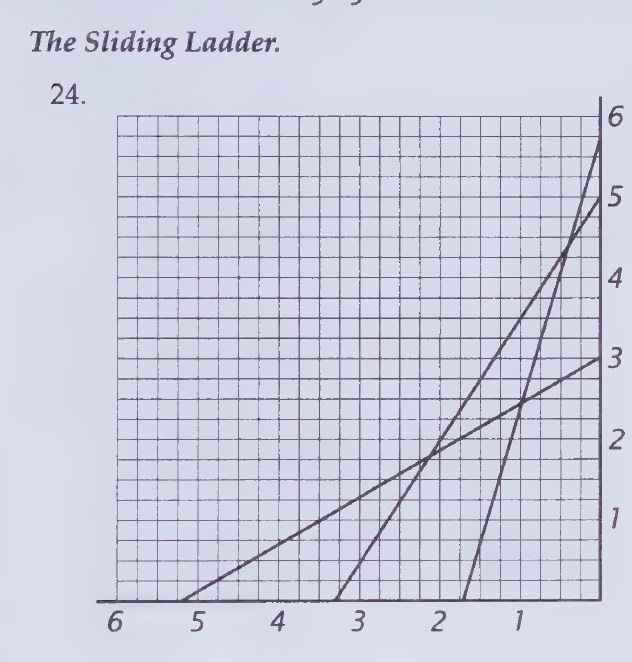
Diagram from page 3.
24.
6 5 4 3 2 1
*25. Approximately 1 % ft.
26. 74°.
27. 16°.
1
*28. Approximately 3 1 ft.
29. 56°.
»30. 34°. A 1
31. Approximately SZ ft.
&2, S
33. 60°.
34. 45°. (The sum of the two angles seems to always be 90°.)
Set II (page 17)
More information on speculations about Mars can be found in the entertaining chapter titled “The Martian Dream” in Pictorial Astronomy, by Dinsmore Alter, Clarence H. Cleminshaw, and John G. Philips (Crowell, 1974).
Measuring Mars.
Dividing 24° into 360°, we get 15; so the distance around Mars is 15 times the distance between the two cities:
15 x 880 miles = 13,200 miles.
Set I (page 21)
Pentominoes were invented by Solomon Golomb, a long-time professor of mathematics and electrical engineering at the University of Southern California, who introduced them in a talk in 1953 at the Harvard Mathematics Club. His book titled Polyominoes (Princeton University Press, 1994) is the definitive book on the part of combinatorial geometry included in recreational mathematics. It is interesting to note that Arthur C. Clarke, the author of 2001—A Space Odyssey, originally intended to use Pentominoes as the game played with the computer HAL before chess was substituted for it instead.
The problems about the Texas ranches were inspired by the fact that people sometimes naively assume that the size of a property can be measured by the time that it takes to walk around it. Proclus wrote about this assumption in 450 A.p. in his commentary on the first book of Euclid.
The Perimeter and Area of a Square.
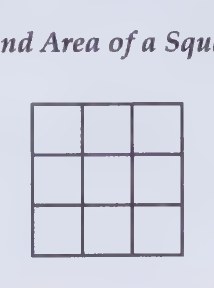
Diagram from page 3.
i,
®2. 9in2,
*3. 12in.
®4. 36inZ
®5. 24in.
6. 1ft2
7. 4ft.
8. 144in2
9. 48in.
10. x2 square units.
11. 4x units. Pentominoes.
12. A polygon is a two-dimensional figure that is bounded by line segments.
¢13. Piece I because it has four sides.
14. 5 square units.
15. Piece P. (It has a perimeter of 10 units; all the other pieces have perimeters of 12 units.)
Texas Ranches.
¢16. Ranch A. (Ranch A needs 36 miles of fencing, whereas ranch B needs 32 miles).
17. Ranch B. (Ranch B has an area of 60 square miles, whereas ranch A has an area of 56 square miles).
18. Area.
Set II (page 22)
A book filled with fascinating information about the Great Pyramid is Secrets of the Great Pyramid, by Peter Tompkins (Harper & Row, 1971).
A Model of the Great Pyramid.
19. 64°.
20. Yes. (The sides opposite the 58° angles appear to be about 9.4 cm each.)
21. (Model of Great Pyramid.)
22. Example figure:
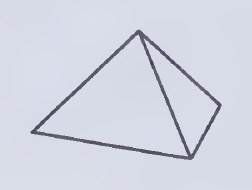
Diagram from page 4.
#23. Polygons.
24. A polyhedron.
#25. Eight.
26. Five.
27. Four.
#28. Three.
29. Five.
©30. Aline.
31. (Student estimate.) (Calculations using trigonometry give a height of about 6.25 cm.)
*32. 756 ft.
33. (Student estimate.) (6.25 % 75.6 gives a height of approximately 470 ft.)
34. Aview from directly overhead.
Set II (page 23)
The square-to-triangle puzzle was created, as the footnote on page 23 states, by Henry Dudeney, England’’s greatest innovator of mathematical puzzles. In The Canterbury Puzzles, he told of exhibiting it to the Royal Society of London in 1905 in the form of a model made of four mahogany pieces hinged together in a chain. When closed in one direction, the pieces formed the triangle and, when closed in the other
direction, they formed the square. The version illustrated on page 23 of the text is slightly altered to make it easier for beginning geometry students to draw. Martin Gardner gives directions for constructing the figure exactly on pages 33 and 34 of The 2nd Scientific American Book of Mathematical Puzzles and Diversions (Simon & Schuster, 1961).
A Square Puzzle.
1. 60°.
2. ZBFP =79° and ZAEH = 49°.
3. £BEH =131° and ZEHA =41°.
4. PF and PG.
Lesson 4
5
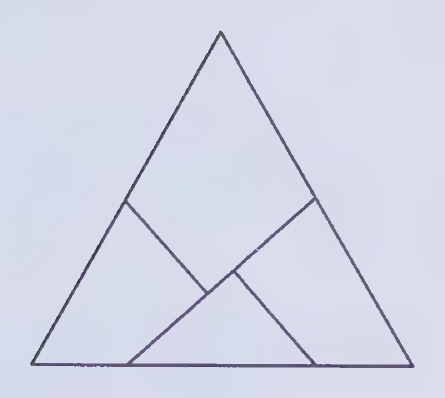
Diagram from page 5.
6. About 21.3 cm.
7. 60°.
8. The area of the triangle is equal to that of the square because they are made of the same pieces.
9. 196 cm?.
10. Itislonger. (The perimeter of the triangle is about 64 cm, whereas the perimeter of the square is 56 cm.)
An excellent history and mathematical treatment of sundials is Sundials—Their Theory and Construction, by Albert E. Waugh (Dover, 1973). The most common type of sundial is the horizontal one and is the kind depicted on the Kellogg’s Raisin Bran box. For this type of sundial to tell time accurately, the angle of its gnomon must be equal to the latitude of the location in which the dial is used. The angle of the gnomon printed on the Kellogg box has a measure of about 39°, evidently chosen because that is a good approximation of the average latitude of the United States. Seattle has a latitude of almost 48°, whereas Miami’s latitude is less than 26°; in locations such as these, the claim that “now you can tell time outdoors” with the cereal box sundial is less than accurate!
Set I (pages 26-27) Finding North by Shadows.
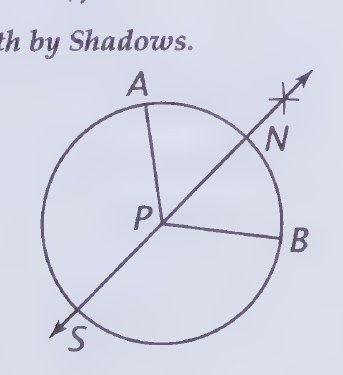
Diagram from page 5.
1.
2. (Student answer.) (ZAPB should be twice
ZAPN.) 3.
B » < - A
4. (Student answer.) (£LAPB should be twice ZAPN.)
¢5. Noncollinear.
6. Coplanar. 7.
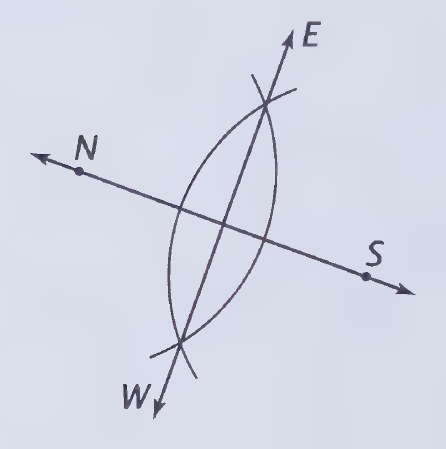
Diagram from page 5.
8. (Student answer.) (The angles formed by NS and EW have measures of 90°.)
9. (Student answer.) (The sum of all four angles is 360°.)
Bisectors in a Triangle.
10. C
e11. The bisecting lines seem to be concurrent.
12. They seem to meet on side CB.
13. The distances seem to be equal.
14, E
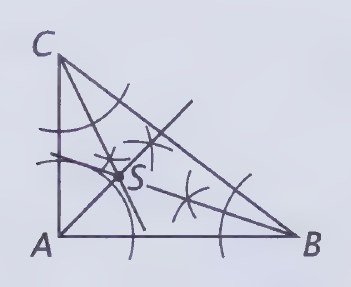
Diagram from page 6.
A B
15. They seem to be concurrent.
*16. No.
Set II (pages 27-29) About Sundials.
*17. West.
18. North.
19. South.
20. Noon.
©21. About6 AM.and 6 P.M.
22. Z10J.
©23. Ol bisects ZHQOJ.
24. No. £ZPOQ and ZQOR do not appear to equal.
*25. ZDOB and ZEOA.
26. £POL.
27. £COB, £PON and ZPOQ.
28. ZEOM.
29. Example figure:
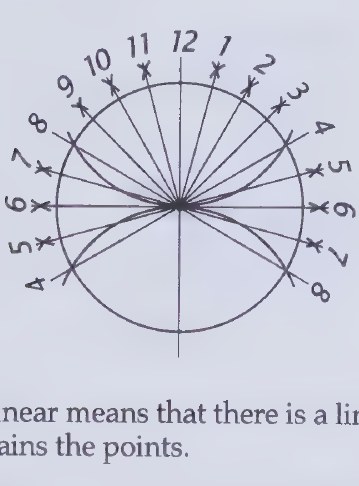
Diagram from page 6.
0 1y
30. Collinear means that there is a line that contains the points.
*31. 60°.
32. 30°.
*33. 180°.
34. 90°. SoNNII58
36, 4 minutes. ( 60 n}];utes _ 4rmlrlutes )
Set II (page 29)
This discovery exercise is adapted from a proof exercise (3.5.18) in Geometry Civilized, by J. L. Heilbron (Oxford University Press, 1998). Every geometry teacher should have a copy of this beautifully written and illustrated book. Dr. Heilbron was formerly Professor of History and the History of Science and Vice Chancellor of the University of California at Berkeley and is currently Senior Research Fellow at Worcester College, Oxford University, and at the Oxford Museum for the History of Science.
Angle Bisectors in a Rectangle.
P
2. Asquare.
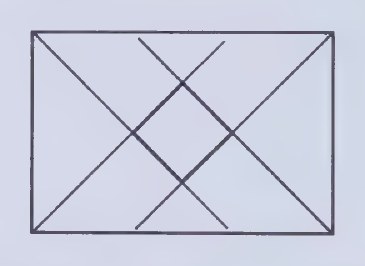
Diagram from page 6.
Again, the lines seem to form a square.
XX
The lines seem to form a square.
Lesson 5
The lines still seem to form a square.
6. Yes. The more elongated the rectangle, the larger the square.
7. 1f the original rectangle were square in shape, the polygon would shrink to a point.
Set I (pages 31—-32)
The incorrect Egyptian formula for finding the area of a quadrilateral was evidently based on the notion of multiplying the averages of the lengths of the opposite sides. It is easy to show (as the students will be asked to do later in the course) that this method gives the correct answer if the quadrilateral is a rectangle. For all other quadrilaterals, the method gives an area that is too large.
The Egyptian Tax Assessor.
1
¢1. 100 square units. (ZZO-ZO =100.) i 1
2. 88 square units. (216-22 =88.)
1
3. 98 square units. (214-28 =98.)
4. Ramses.
5. Yes. (11:8=288.)
6. It contains 80 square units. (10-8 = 80.)
7. It contains 108 square units. (9-12 = 108.) 1
8. 54 square units. (5108 =54)
9. It contains 60 square units. (5-12 = 60.)
1
10. 30 square units. (560 =30.)
o11. It contains 84 square units. (54 + 30 = 84.)
12. Ramses is cheated the most. He pays the highest tax, yet actually has the smallest property. (See the chart below.)
Assessment Actual
Area Area Ramses 100 80 Cheops 88 88 Ptahotep 98 84
Set II (pages 32-34)
We will return to the trisection of line segments and angles later in the course. The method for trisecting an angle presented here is surely the first one to be thought of by most people encountering the problem for the first time. For small angles, it is a fairly good approximation but, for an angle of 60°, the error just begins to become detectable through measurement and, for obtuse angles, its failure becomes very obvious.
The classic book on angle trisection for many years was The Trisection Problem, by Robert C. Yates, originally published in 1942 and reprinted in 1971 by N.C.T.M. as a volume in the Classics in Mathematics Education series. The definitive book is currently A Budget of Trisections, by Underwood Dudley (Springer Verlag, 1987). Dr. Dudley includes some additional information on the subject in “Trisection of the Angle” in his book titled Mathematical Cranks (M.A.A., 1992). All make fascinating reading.
Trisection Problems. 13.
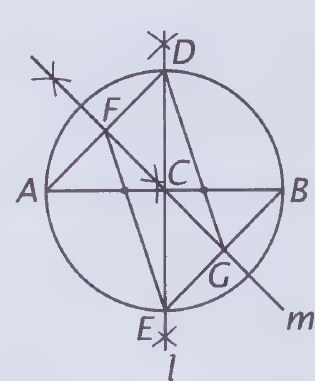
Diagram from page 7.
14.
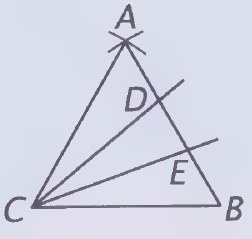
Diagram from page 7.
15. An accurate drawing and careful measurements suggest that ZACD, ZDCE, and ZECB are about 19°, 22°, and 19°, respectively.
Set II (page 34)
This problem was discovered by Leo Moser, who, in a letter to Martin Gardner, said that he thinks it was first published in about 1950. The “obvious’ formula for the number of regions, y = 2”, where nis the number of points, is wrong. The correct formula, -
y= i(n“-érr’+23n’-18n+24)
is surprisingly complicated. For more on this problem, see the chapter titled “Simplicity” in Mathematical Circus by Martin Gardner (Knopf, 1979).
Cutting Up a Circle.
1. Example figure:
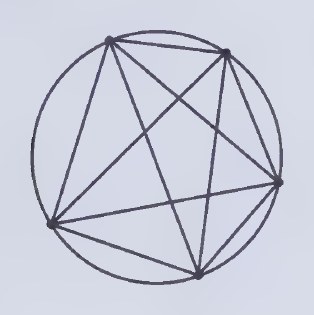
Diagram from page 8.
2. 16. 3 2
4. 4.
5. No. of points connected 2 3 4 5 No. of regions formed 2 4 8 16
6. It doubles.
7. 32.
8. 64.
9. Example figures:
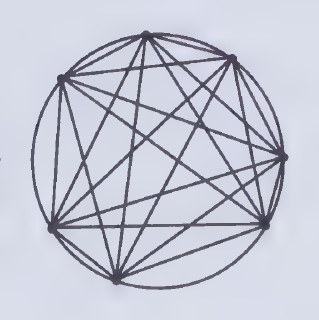
Diagram from page 8.
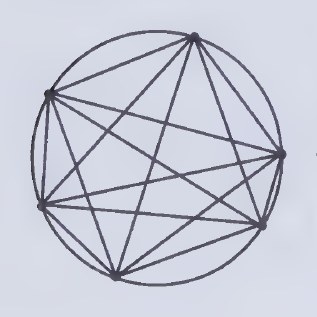
Diagram from page 8.
10. No. (Six points result in at most 31 regions, and seven points in at most 57 regions.)
Review
Set I (pages 36-37)
The transparent view of the cube used in exercises 15 through 17 is named after psychologist Hertha Kopfermann, who studied it in 1930. An interesting discussion of our perception of this figure appears on pages 27 and 28 of Visual Intelligence, by Donald D. Hoffman (Norton, 1998).
1. Line segments.
2. Polygons (or squares).
3. A polyhedron.
4. 3.
e5. 12.
6. 3.
7. 6.
8. Coplanar.
9. 9.
*10. PQ.
11. NO.
12. OP
*13. T.
14. Uand Q.
15. Triangles, quadrilaterals, and a hexagon. (Students who are aware of concave polygons may notice more than one hexagon and even some heptagons!)
16
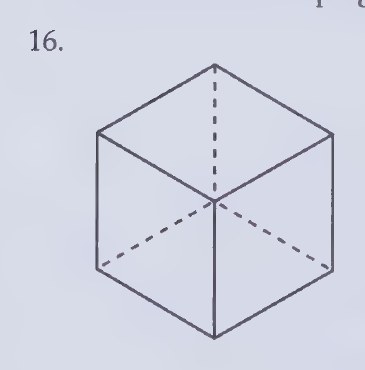
Diagram from page 8.
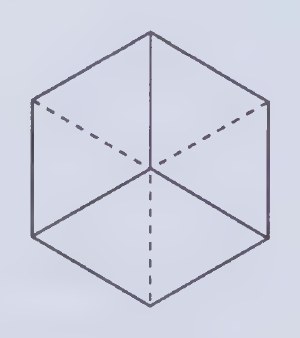
Diagram from page 8.
7 &
Set II (pages 37-38)
Exercises 19 through 26 are based on the fact that every triangle has three excenters as well as an incenter. Each excenter is the point of concurrence of the lines bisecting exterior angles at two vertices of the triangle (ZDAB and ZABE in the figure) and the line that bisects the (interior) angle at the third vertex (£C in the figure). Point F is one of the excenters of the triangle.
Exercises 27 through 30 are based on the fact that, when the midpoints of the sides of any quadrilateral are connected in order with line segments, the quadrilateral that results is a parallelogram. Furthermore, its perimeter is equal to the sum of the length of the diagonals of the original quadrilateral. These facts are easily proved and will be established later in the course.
*18. Constructions.
19.
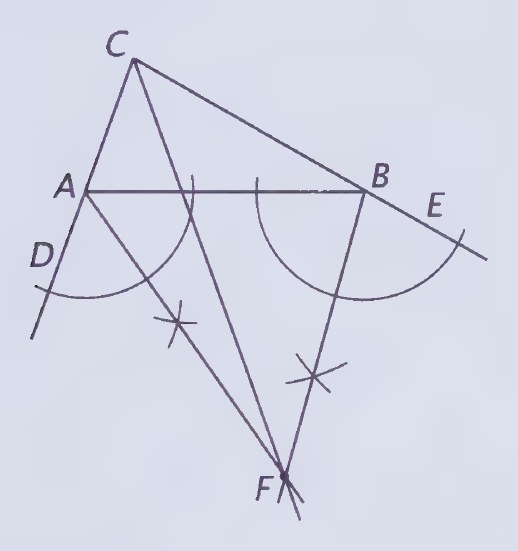
Diagram from page 9.
C
©20. ZDAB =110°.
21. ZABE =150°.
22. ZDCE =80°.
23. ZDAF = ZFAB = 55°.
24. ZABF = ZFBE =75°.
025. /DCF = ZFCE = 40°.
26. Line CF seems to bisect ZDCE.
27.
28. The opposite sides of the quadrilateral appear to be equal (and parallel).
29. (Answer depends on student’s drawing.)
30. (Answer depends on student’s drawing but should be close to the answer to exercise 29.)
Set II (page 38)
The story of Queen Dido and Carthage is told on pages 44—47 of Mathematics and Optimal Form, by Stefan Hildebrandt and Anthony Tromba (Scientific American Library, 1985) and on
pages 64—71 of the revised and enlarged version of this book titled The Parsimonious Universe (Copernicus, 1996).
o1. 1,200 yd. (4-300 =1,200.)
2. 90,000 yd2. (3002 = 90,000.)
3. 500 yd. (900 —2-200 = 500.)
4. 1,400 yd. (2:200 + 2-500 = 1,400.)
5. 100,000 yd?. (200-500 = 100,000.)
6. (Student drawings.) (Students who have made several drawings may suspect that the length along the river should be twice the side width to get as much land as possible. In this case, the numbers are 450 yards and 225 yards and the area is 101,250 square yards.)
Algebra Review (page 40)
1. Associative for addition.
2. Commutative for multiplication.
3. Definition of subtraction.
4. Identity for addition.
5. Definition of division.
6. Inverse for multiplication.
7. 1,728.
8. 12,000.
9. 20.
10. −75.
11. 225.
12. 81.
13. .
14. .
15. .
16. .
17. .
18. .
19. .
20. .
21. .
22. .
23. .
24. .
25. .
26. .
27. .
28. .
29. .
30. .
31. .
32. .
33. .
34. .
35. .
36. .
37. .
38. .
39. .
40. .
41. 0.
42. 1.
43. .
44. .
45. .
46. .
47. .
48. .
49. .
50. .