p. 377
Chapter 10: Similarity
In this chapter, we explore the properties of similar figures—figures that have “the same shape.” Because the corresponding sides of similar polygons are proportional, we begin with a lesson on ratio and proportion. Strange as it may seem, the existence of similar figures is connected to the Parallel Postulate; so the proofs of the theorems on similarity depend on the properties of parallel lines. Many practical problems have solutions based on similarity.
p. 378
Lesson 1: Ratio and Proportion
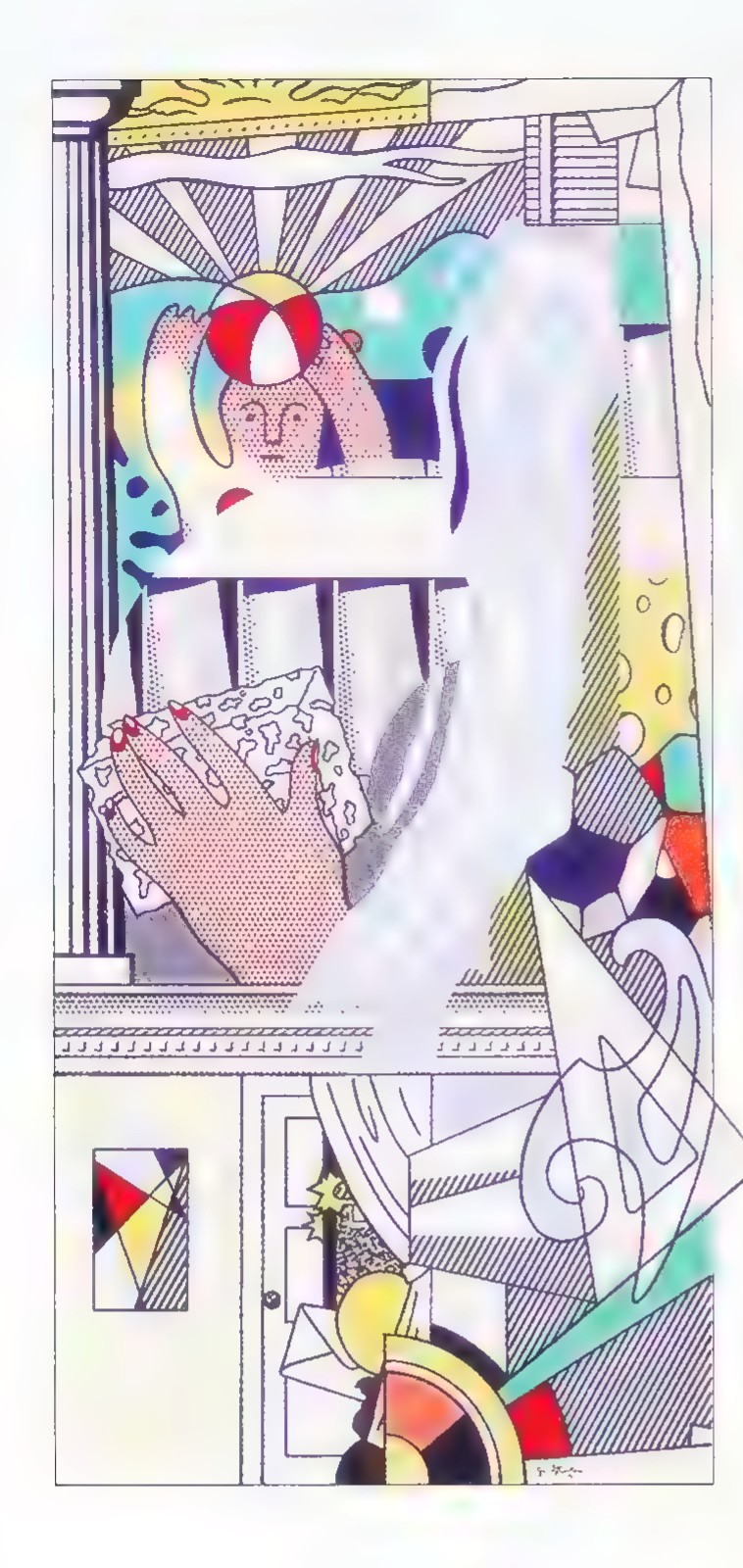
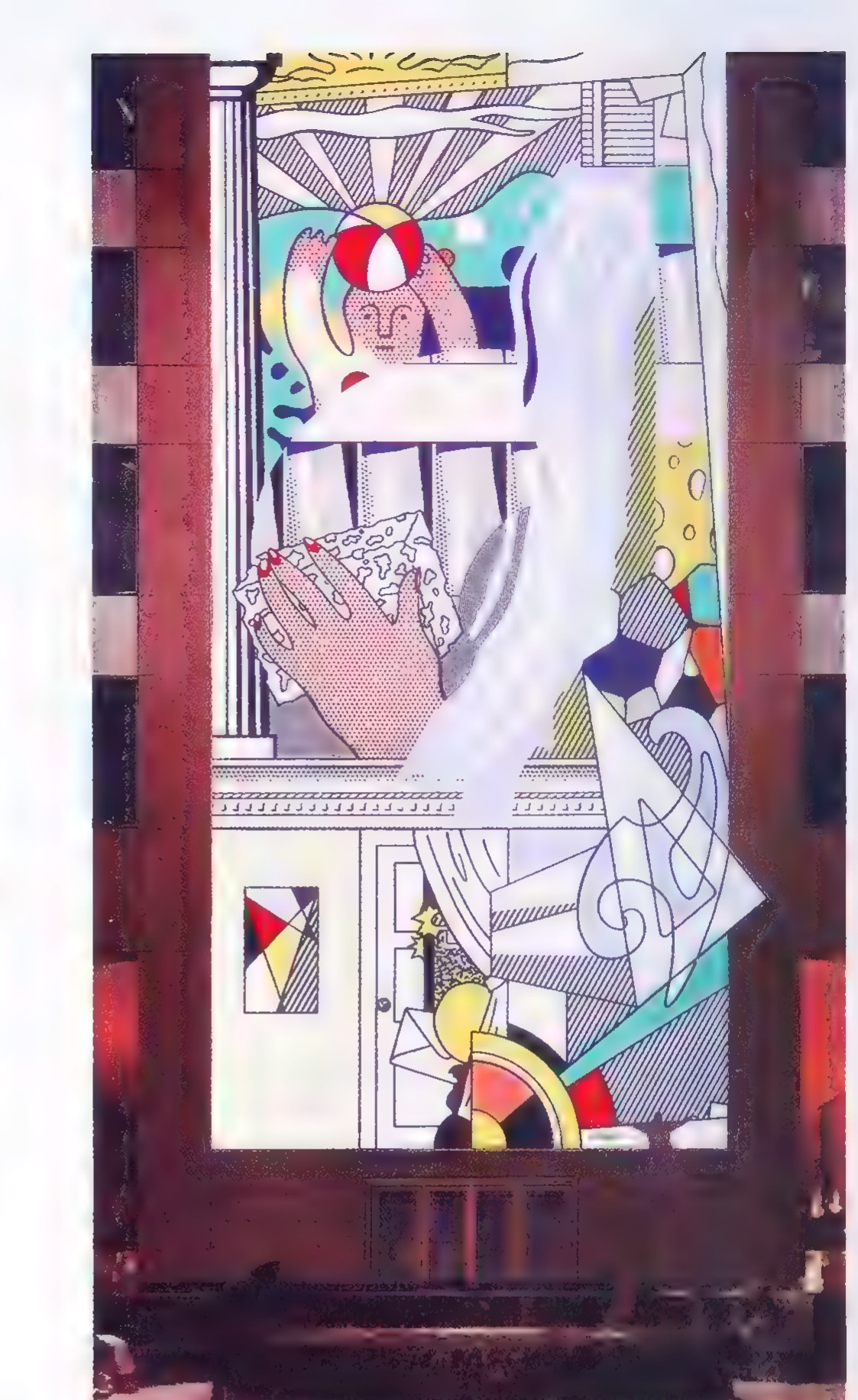
If you saw just the photograph on the left of Roy Lichtenstein’s painting Mural with Blue Brushstroke, you would never guess how large it is. The photograph on the right, showing the artist standing on a ladder below the mural, gives a clue to its true scale.
On this page, the photograph is 2 inches wide and 4.25 inches high. The mural itself is actually 32 feet wide. How high is it?
One way to answer this question is to write and solve a proportion:
p. 379
This proportion is based on the fact that, because the photograph on the facing page and the actual mural have the same shape, their dimensions have the same ratio. In geometry, figures that have the same shape are said to be similar to one another.
Before studying the properties of similar figures, we will review the meaning of ratio and proportion.
Definitions
The ratio of the number to the number is the number .*
A proportion is an equality between two ratios.
We can represent a proportion symbolically as
The numbers , , , and are called the first, second, third, and fourth terms of the proportion, respectively. The second and third terms, and , are also called the means, and the first and fourth terms, and , are called the extremes.
Proportions have many useful properties. For example, you may remember from your study of algebra that, in a proportion, the product of the means is equal to the product of the extremes. This property is easy to prove.
Given:
Prove: .
Proof
| Statements | Reasons |
|---|---|
| 1. | Given. |
| 2. | Multiplication. |
| 3. ; so . | Substitution. |
To solve the proportion
we can cross multiply to get
Lichtenstein’s painting Mural with Blue Brushstroke is 68 feet tall!
*Note that cannot be 0, because division by 0 is undefined.
p. 380
In some proportions, the means are the same number. For example, in the proportion
both means are 10. For this reason, the number 10 is called the geometric mean between 4 and 25.
Definition
The number is the geometric mean between the numbers and if , , and are positive and
Exercises
Set I
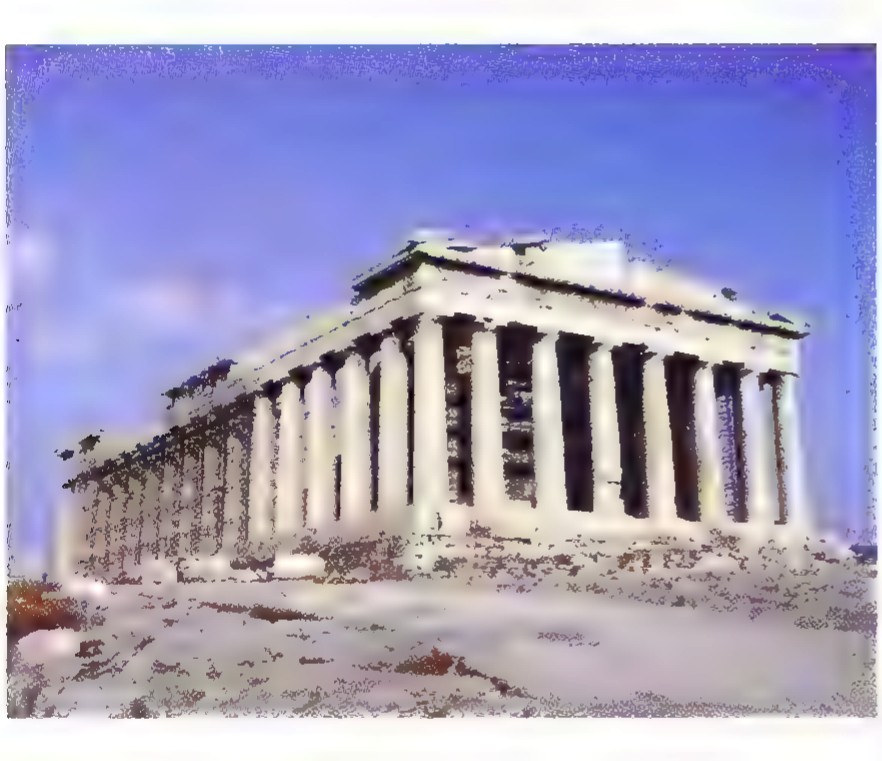
Parthenon Architecture. The Parthenon in Athens was completed in 432 B.C. Its architects used the numbers 81, 36, and 16 in determining its dimensions.
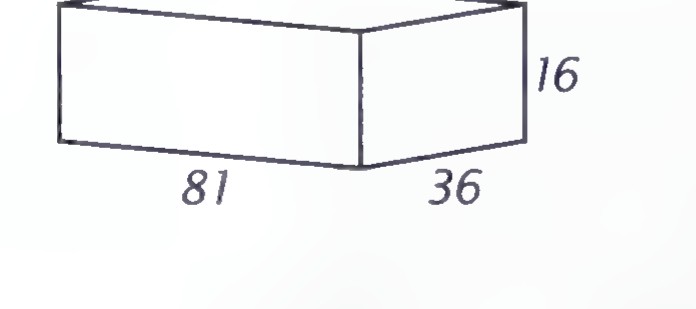
- Express the ratio in decimal form.
- Express the ratio in decimal form.
- Show that, in the proportion , the product of the means is equal to the product of the extremes.
- What is the number 36 called with respect to 81 and 16?
- Write the proportion that follows from taking the square root of each side of .
- Express each of the ratios in your proportion in decimal form.
There is an exact replica of the Parthenon in Nashville, Tennessee. It is 228 feet long.
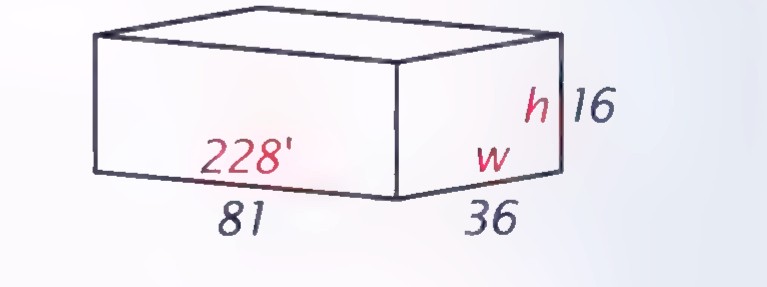
- Solve the proportion to find its width in feet.
- Write and solve a proportion to find its height in feet.
p. 381
The dimensions of the columns in the Parthenon are related to their diameters as shown in the figure at the right.*
Find the following ratios.
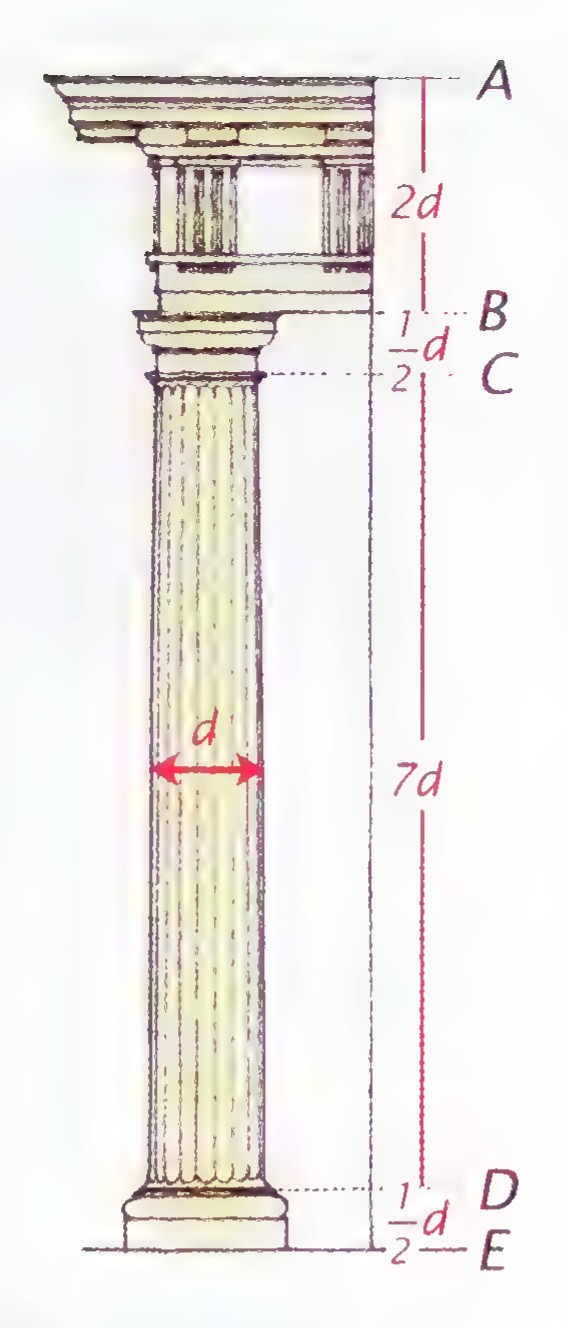
- .
- .
- .
Turtles Forever. The picture below by Belgian artist Peter Raedschelders is titled Turtles Forever.
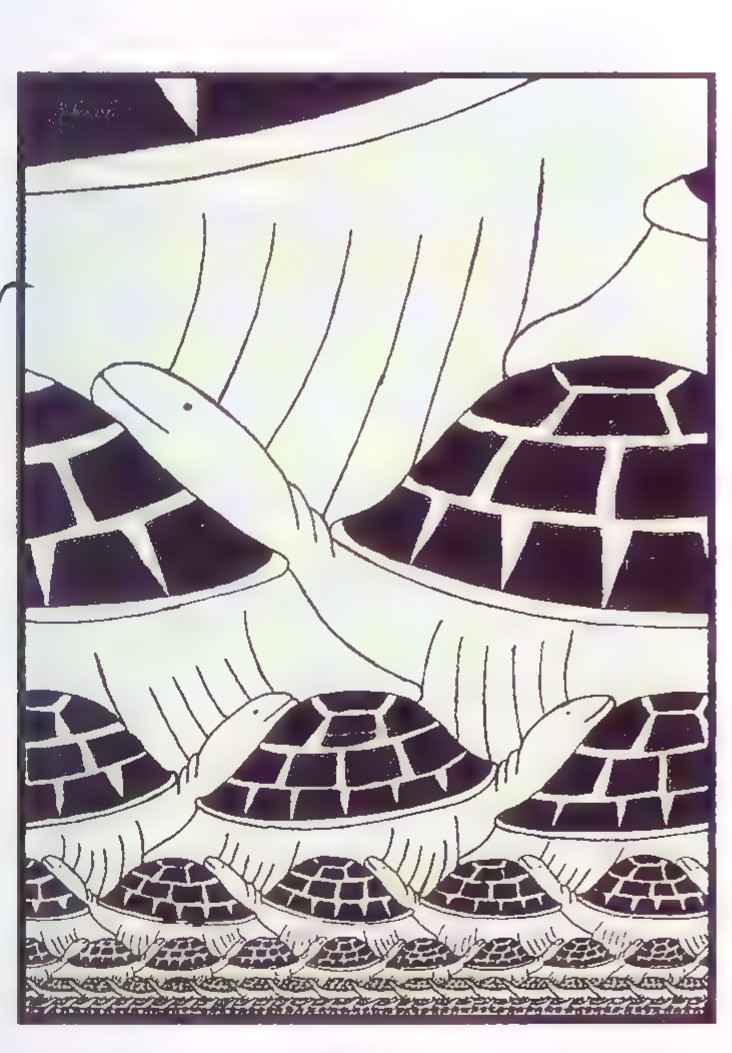
Each successive row has twice as many turtles as the row above it:
* Architecture: Form, Space, and Order, by Francis D. K. Ching (Wiley, 1996).
Copy and complete the following proportions:
- .
- .
- Find three different pairs of numbers for which 8 is their geometric mean.
Ratio. Euclid defined a ratio as “a sort of relation in respect of size between two magnitudes of the same kind.”
In saying “a sort of relation in respect of size,” to what operation with numbers was Euclid referring?
Which of the following expressions does not fit Euclid’s definition of a ratio?
Explain.
Four Rectangles. The four numbered parts of the figure below are rectangles, and .
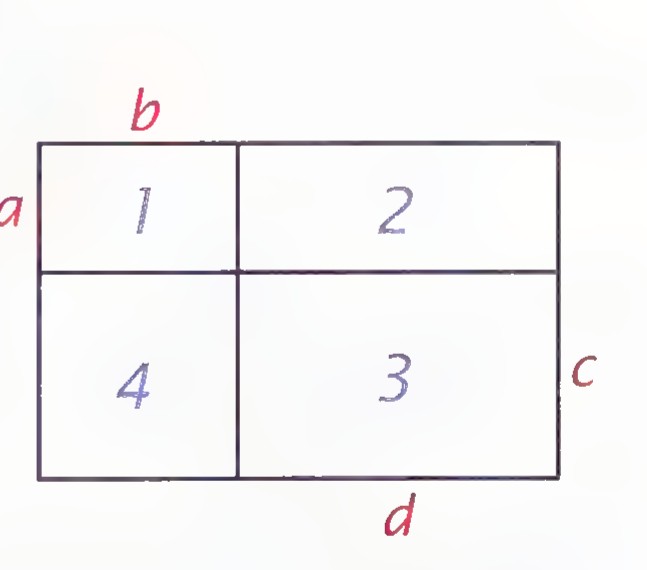
- Write expressions for the areas of the rectangles in terms of , , , and .
- Which two rectangles have the same area?
- For which two rectangles are their corresponding sides proportional?
- Which two rectangles have the same shape?
p. 382
Enlargement. ABC was enlarged on a photocopier to give DEF; so corresponding lengths in the two figures below are proportional.
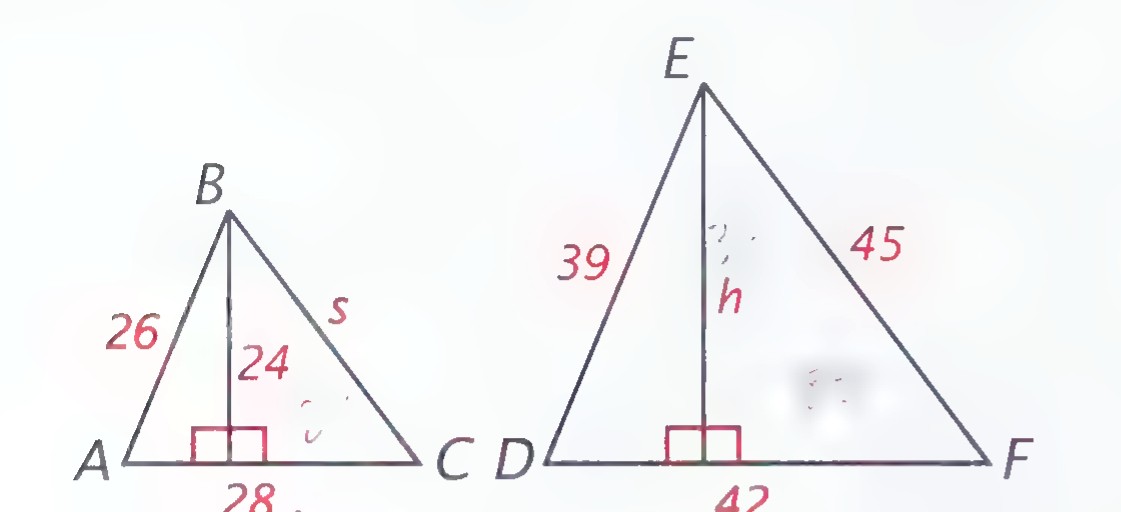
Solve for the unknown lengths in each of the following proportions.
- .
- .
Tell whether or not each of the following proportions is correct.
- .
- .
- .
Set II
Arm Spans. Suppose that Uncle Albert’s arm span is 3 feet and that Alabaster’s arm span is 15 inches.
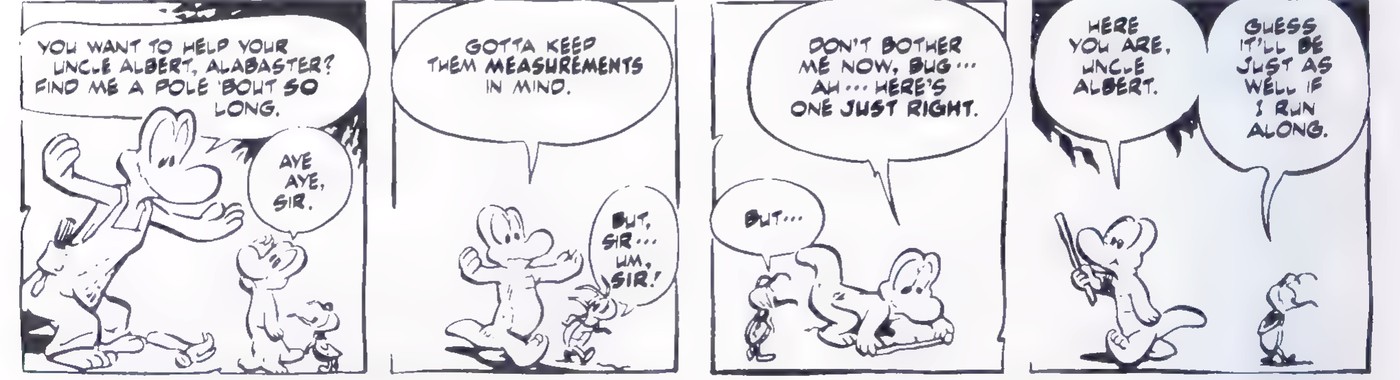
© 1968 Walt Kelly
Does it make sense to say that the ratio of their respective arm spans is or ?
Change Uncle Albert’s measurement to inches and find the ratio of their arm spans. Express the ratio in decimal form.
Change Alabaster’s measurement to feet and find the ratio of their arm spans. Express the ratio in decimal form.
Judging from your answers to exercises 28 and 29, does the ratio of two lengths depend on the unit of measure used?
United States Flag. The official ratio of the width to length of the United States flag is
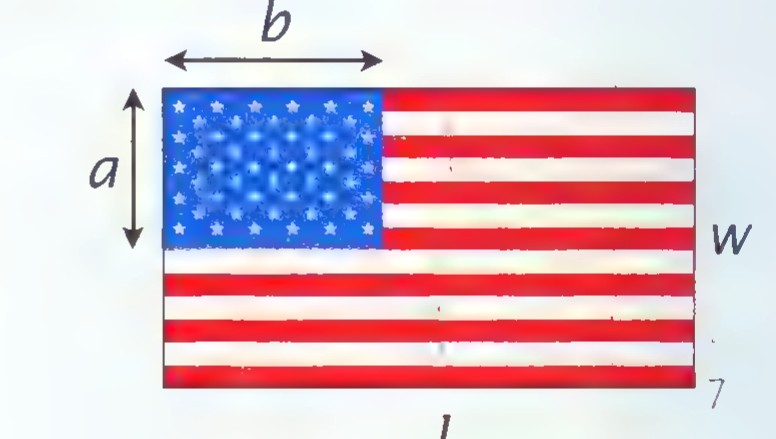
What is the ratio of
- the length to width?
- the width of the blue field, , to the width of the flag?
- the number of red stripes to the number of white stripes?
p. 383
The giant flag in the photograph below is 160 feet wide.
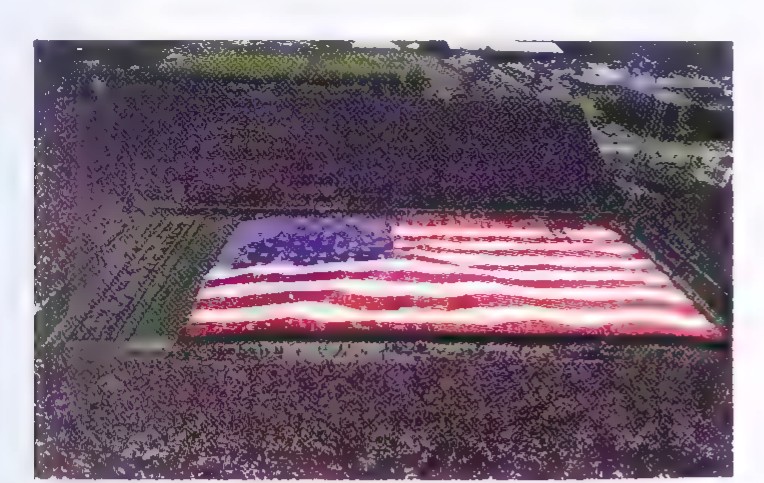
What does represent in the following proportion?
Solve for .
What does represent in this proportion?
Solve for .
What is the width, , in feet of the blue field of this giant flag?
The official value of the ratio is 0.76.
- What is the approximate length, , in feet of the blue field?
The rectangle of the blue field would be similar to the shape of the entire flag if .
- Are these two rectangles similar? Explain.
Pythagorean Tuning. Pythagoras established a tuning system relating the notes of a musical scale to the relative lengths of the strings that produce them. In his system, if the string for middle C is 1 unit long, the string for D is unit long, with the lengths for other notes as shown in the figure at the top of the next column.*
* The Science of Sound, by Thomas D. Rossing (Addison-Wesley, 1990).
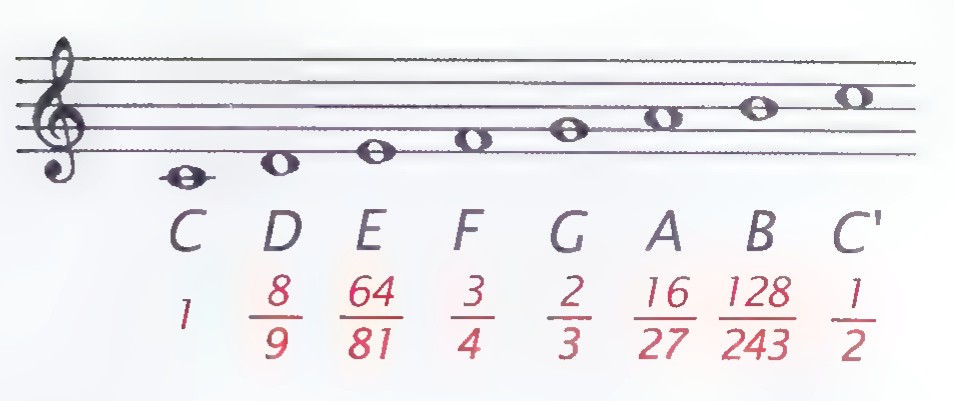
If we let the names of the notes represent the relative lengths of the strings, then
Find each of the following ratios as a common fraction in lowest terms.
- .
- .
- .
- .
- .
- .
From these ratios, it is evident that the length for D is the geometric mean between the lengths for C and E because .
- For which other notes of the scale is the length for one note the geometric mean between the lengths for two other notes?
Geometric Proportions. Given that a certain proportion is true for a geometric figure, other proportions must also be true.
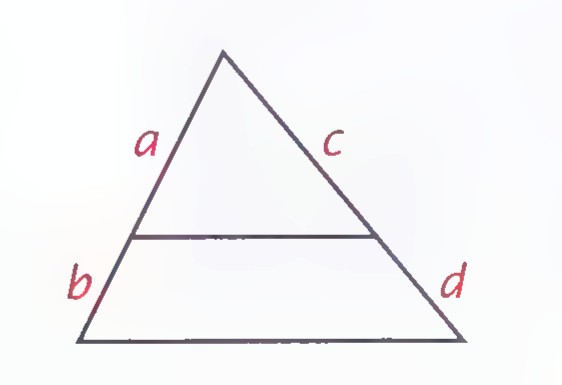
For example, if in the figure above,
then it follows that .
- How does the second proportion differ from the first?
p. 384
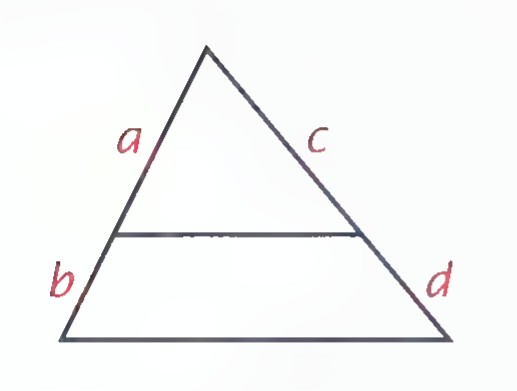
We can show why it follows that .
- If , then . Why?
- If , then ; so . Why?
It also follows that .
- If , then . Why?
- If , then , so . Why?
Sinker or Floater. To a swimming teacher, you are either a “sinker” or a “floater.” If your density is less than that of water, you will float. If your density is greater than that of water, you will sink.*
* Sport Science: Physical Laws and Optimum Performance, by Peter J. Brancazio (Simon & Schuster, 1984).
The density of water is 62.4 pounds per cubic foot.
- Acute Alice weighs 120 pounds and has a volume of 1.95 cubic feet. Is she a “sinker” or a “floater”? Explain.
- Obtuse Ollie’s volume is 2.3 cubic feet and he is a “sinker.” What can you conclude about his weight? Explain.
Set III
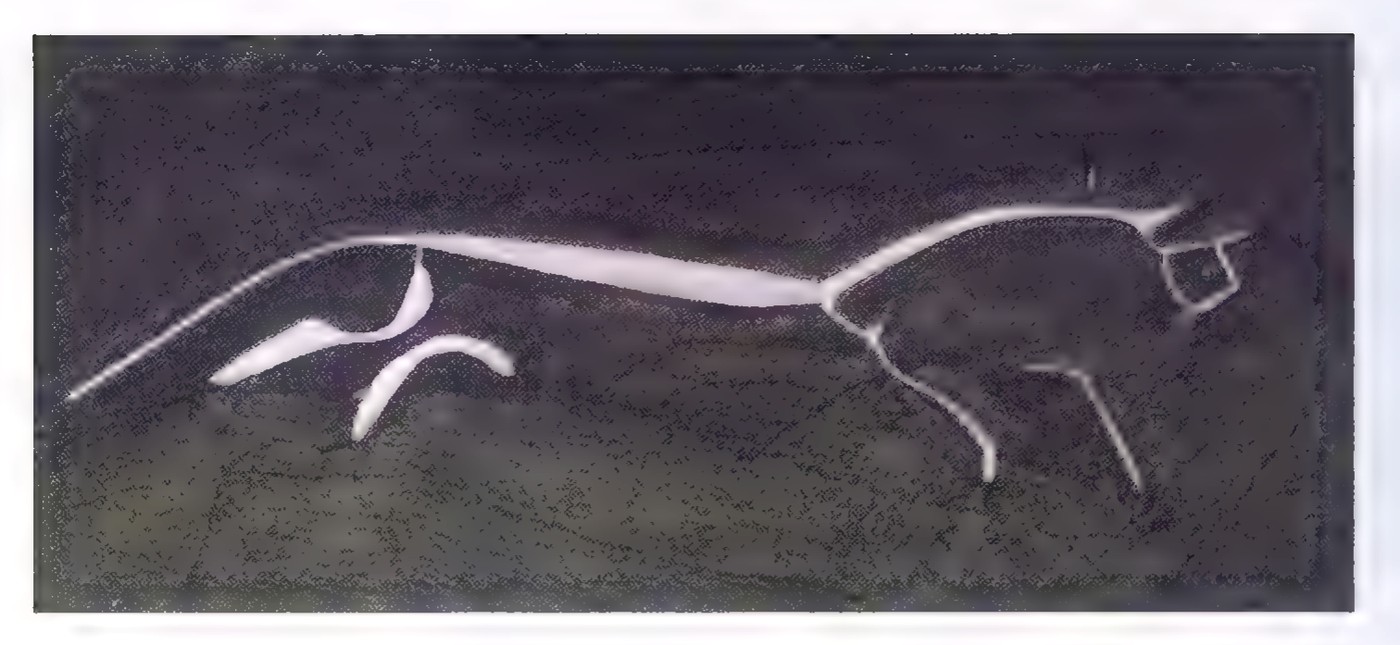
The White Horse. A mysterious figure from the past is the White Horse of Uffington. Located on the hills of southern England, it is thought to have been created in about 1000 B.C.
The horse is 28 meters tall (measured from the top of its head to the bottom of its front legs).
- Use your ruler, the photograph at the top of this page, and an appropriate proportion to figure out how long the horse is. (It is convenient to use millimeters in measuring the picture.)
The scale of the photograph is the ratio of the lengths in it to the corresponding lengths in the actual horse.
- Express the scale of the photograph as a fraction in the form .
p. 385
Lesson 2: Similar Figures
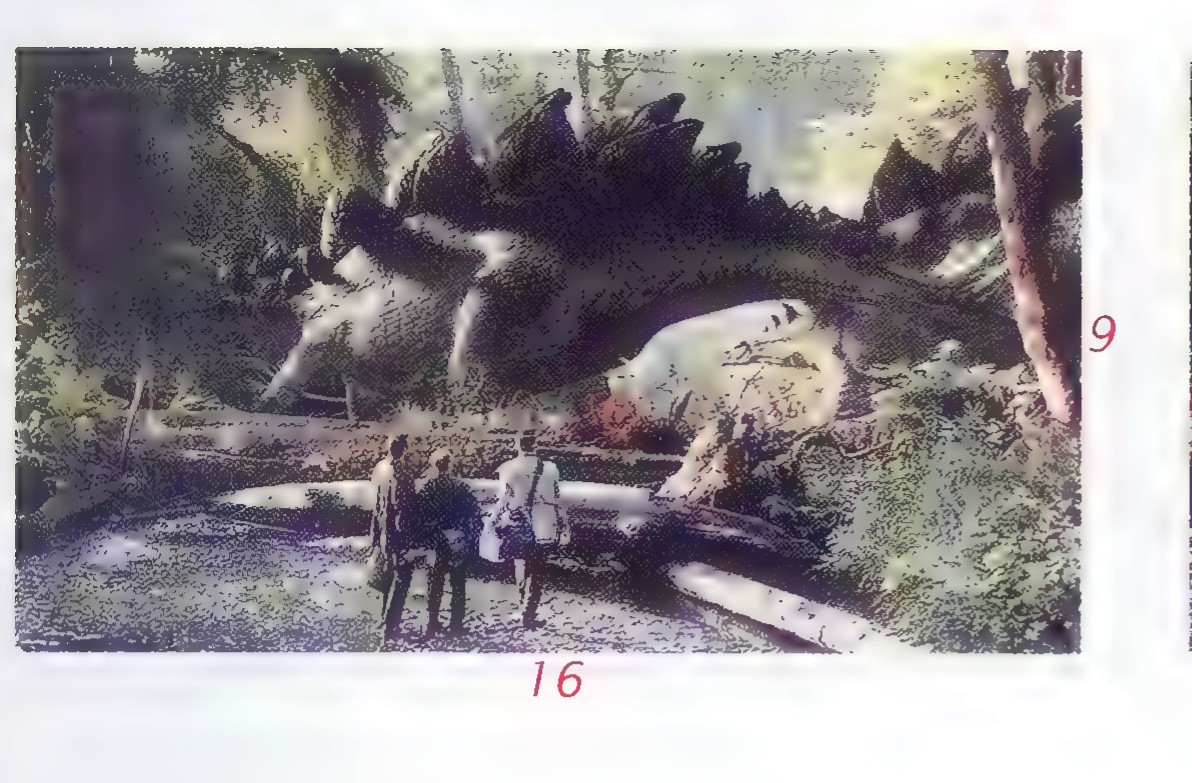
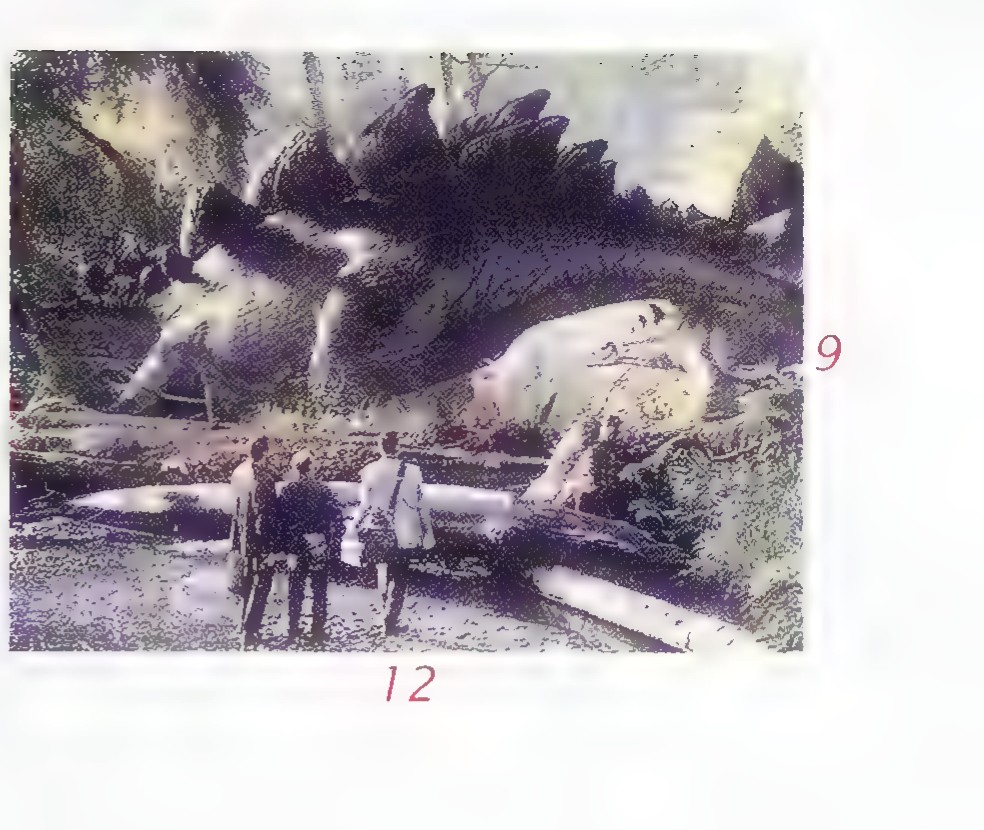
When you watch a movie on television, you are probably not seeing as much of it as you would have seen in a theater. The reason is that television and movie theater screens are shaped differently.
The shape of a screen is given by its “aspect ratio,” the ratio of its width to its height. Most movies are now filmed in a aspect ratio, whereas most television sets produce pictures with a aspect ratio. Because these ratios are different, these movies are the wrong shape for the television screen. One way to deal with this problem is to cut off the sides of the picture (sometimes called “pan and scan”). The other way is to reduce the picture so that its width fits the screen (called “letter box”).
The movie industry would like to make the aspect ratio standard for television pictures. If it succeeds, you may be able to see all of a movie image even on a wristwatch size screen as shown at the right, one-third the size of the image at the top left on this page.

Pan and scan

Letter box
Wristwatch size image
p. 386
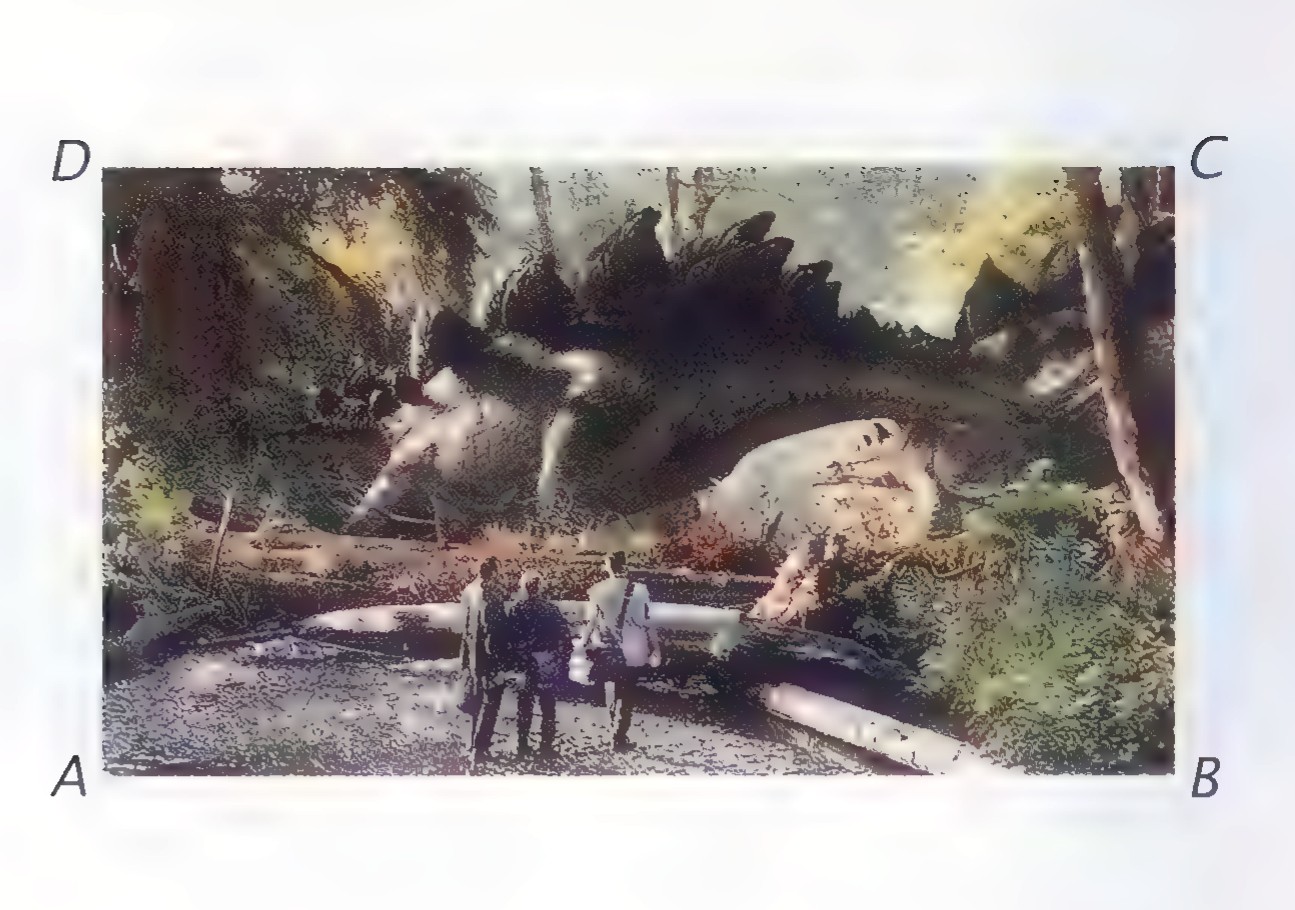
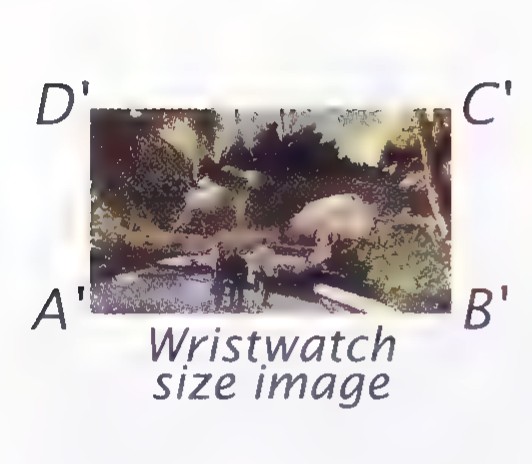
If rectangle ABCD above is matched with the one-third scale rectangle A′B′C′D′ at the left, corresponding sides are proportional,
and corresponding angles are equal,
If the dinosaur’s head were at X and its tail at Y in the image above, then it would also be true that , with X′ and Y′ being the positions of the head and tail in the scale image at the left.
Because the original image and the scale image have the same shape, their corresponding segments are proportional. Such figures are similar and a correspondence between their points such that corresponding segments are proportional is a similarity.
We begin with similar triangles.
Definition
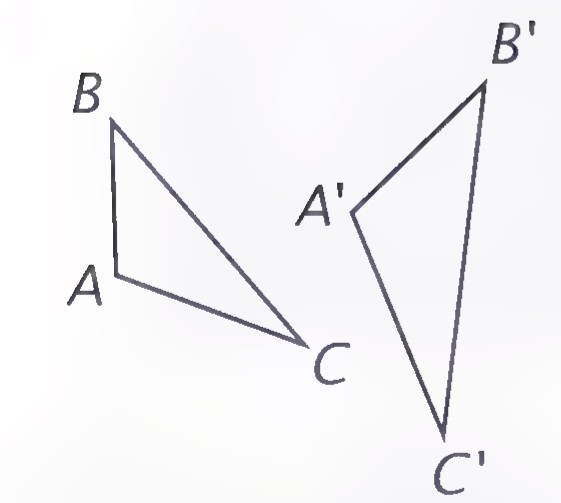
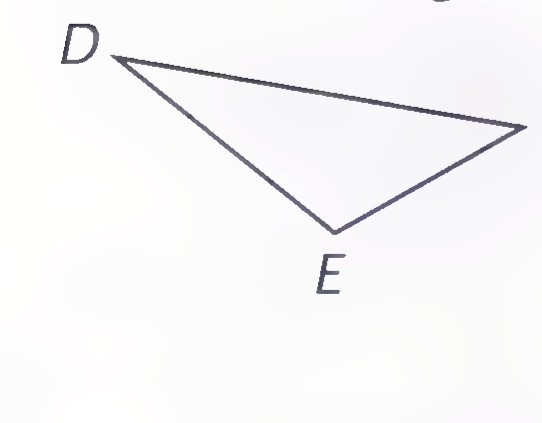
Two triangles are similar iff there is a correspondence between their vertices such that their corresponding sides are proportional and their corresponding angles are equal.
If ABC and A′B′C′ are similar, we write ABC ~ A′B′C′. As with the congruence correspondence, the order of the vertices in the similarity correspondence tells you which points correspond and hence which sides are proportional and which angles are equal. For example, given that ABC ~ EFD, we can write
without even looking at the figures.
p. 387
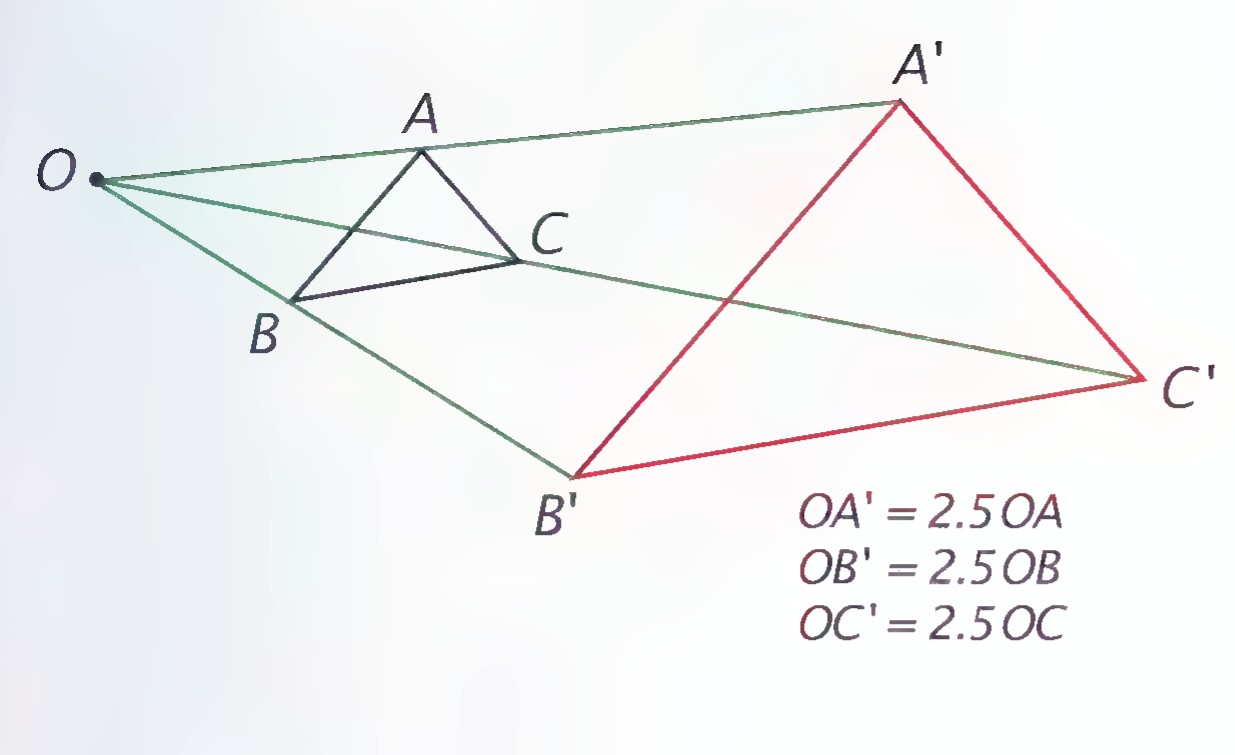
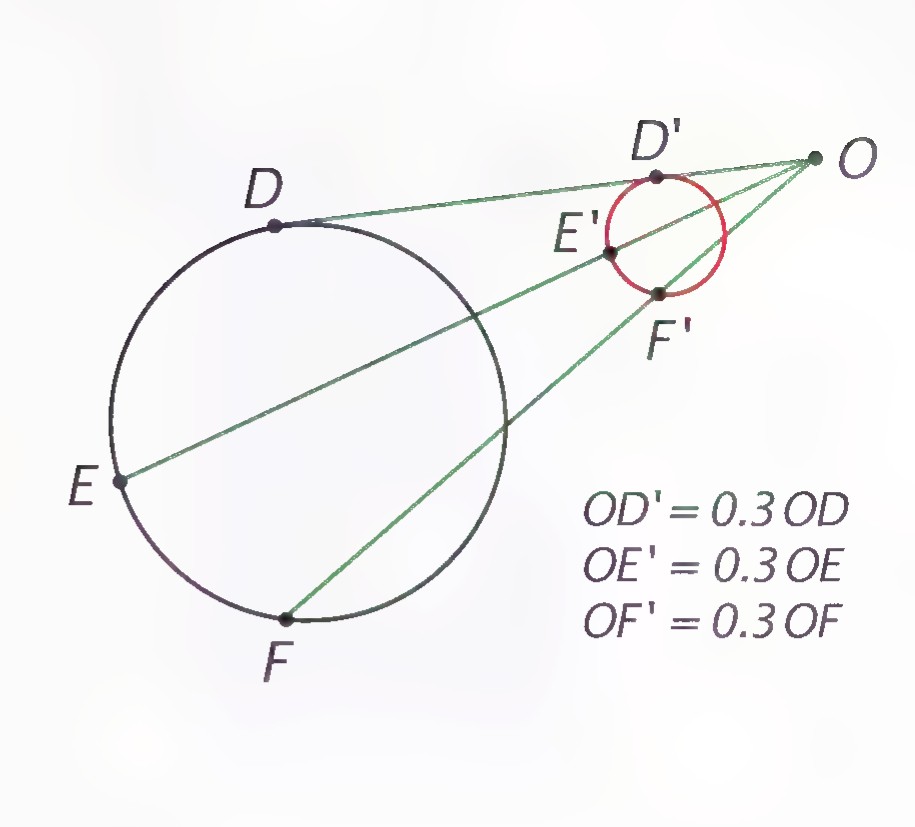
Understanding reflections was a key to understanding isometries and congruence of figures in general. The key to understanding similarity is the dilation transformation. The idea of a dilation comes from the way in which a movie projector works. Light from a bulb is sent through the frame on the film, enlarging it to form the image on the screen. The figures above illustrate how this idea works in geometry—first for two triangles and then for two circles. Point O, chosen as the center of the dilation, corresponds to the source of light. A positive number , called the magnitude of the dilation, gives the relative size of the image compared with the original. This is the ratio of the corresponding lengths. Rays drawn from O through points of the figure correspond to the rays of light from the projector. On each ray, a point is chosen so that, for every point P on the figure, there is a corresponding point P′ on its image such that OP′ = OP. As the figures illustrate, the image can be larger than, smaller than, or even equal to the figure, depending on whether , , or .
Exercises
Set I
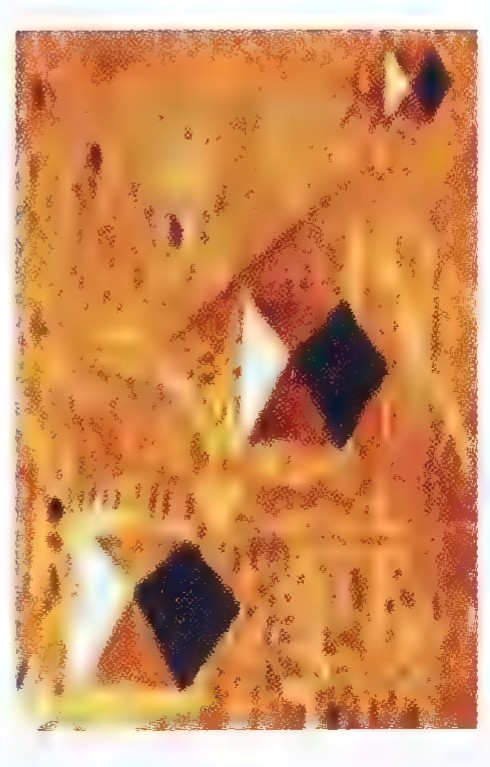
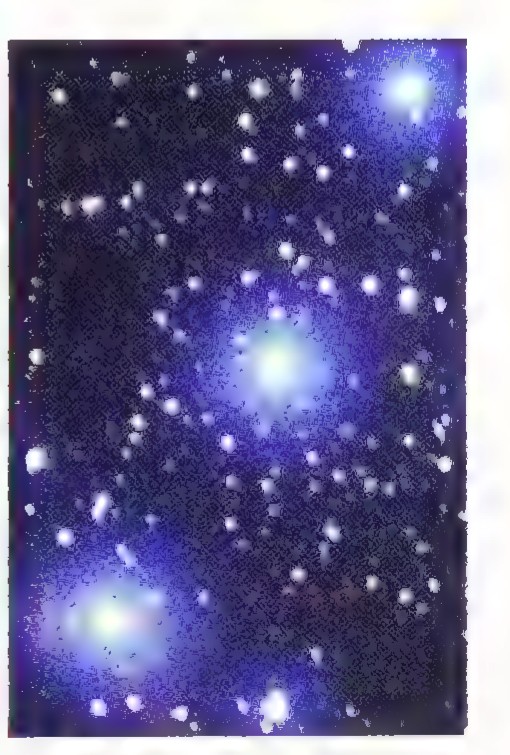
The Pyramids and Orion. The three pyramids at Giza lie at the corners of a long narrow triangle that appears to be similar to the triangle formed by the three stars in Orion’s belt.*
Given that the two triangles are similar, what can you conclude about
- their corresponding sides?
- their corresponding angles?
* The Orion Mystery, by Robert Bauval and Adrian Gilbert (Crown, 1994).
p. 388
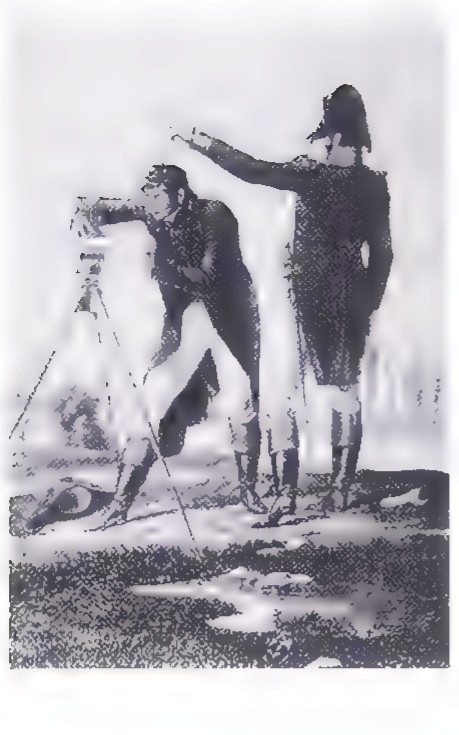
Plane Table. Surveyors used to make maps by using a “plane table.” The figure below shows the table in two successive positions as a map is constructed on it.* Points D and E represent distant points and points F and G are their images on the map.
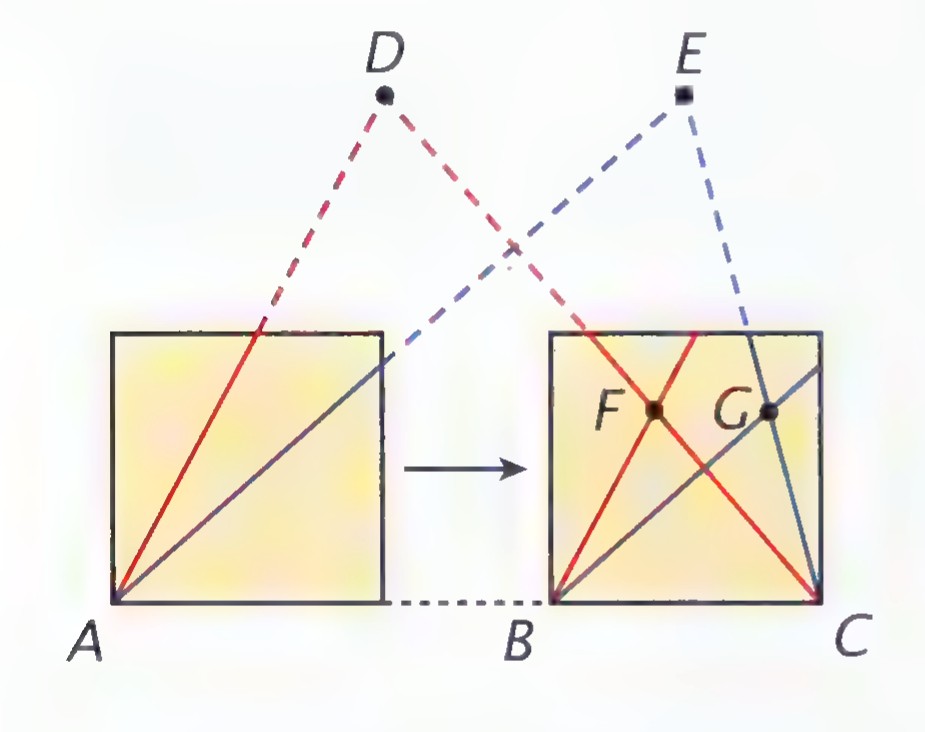
In the figure, ADC ~ BFC and AEC ~ BGC. Copy and complete the following equations.
- DAC = ?.
- AEC = ?.
- GCB = ?.
- .
- .
- .
* Geometry Civilized: History, Culture, and Technique, by J. L. Heilbron (Clarendon Press, 1998).
Kempe’s Linkage. In 1875, Alfred Kempe, a young London lawyer, invented the linkage shown in the figure below. The linkage is constructed so that .
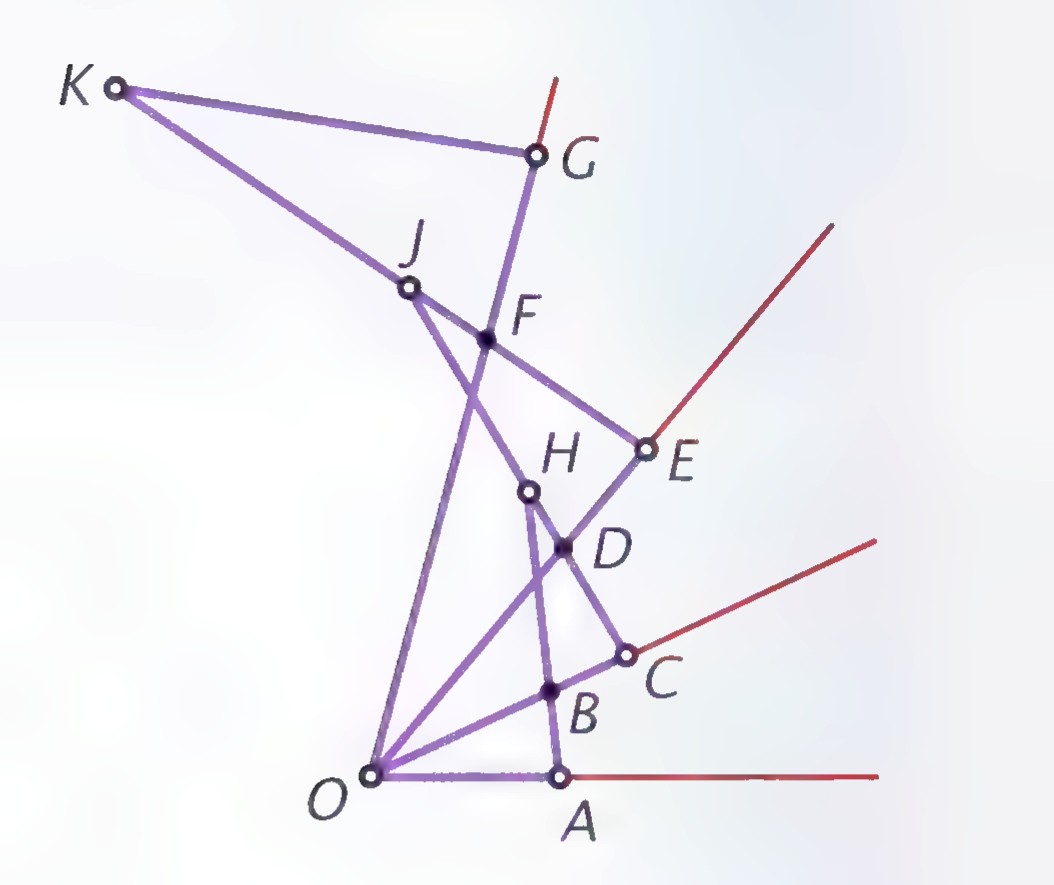
- Find OE and OG if OA = 1 and OC = 2.
As the linkage changes shape, the following three triangles are always similar: OAB ~ OCD ~ OEF.
- What can you conclude about AOB, COD, and EOF? Explain.
- What does the linkage do to AOG?
Billboards. “Poster panel” billboards come in two sizes.
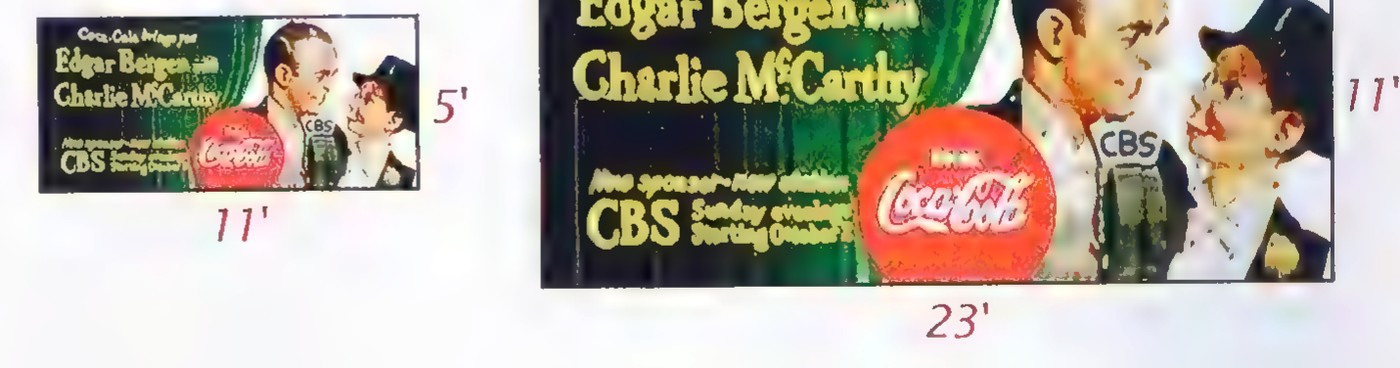
- Show why they are almost, but not quite, similar.
- To what number could 23 be changed to make the two sizes similar?
- To what number could 5 be changed to make them similar?
p. 389
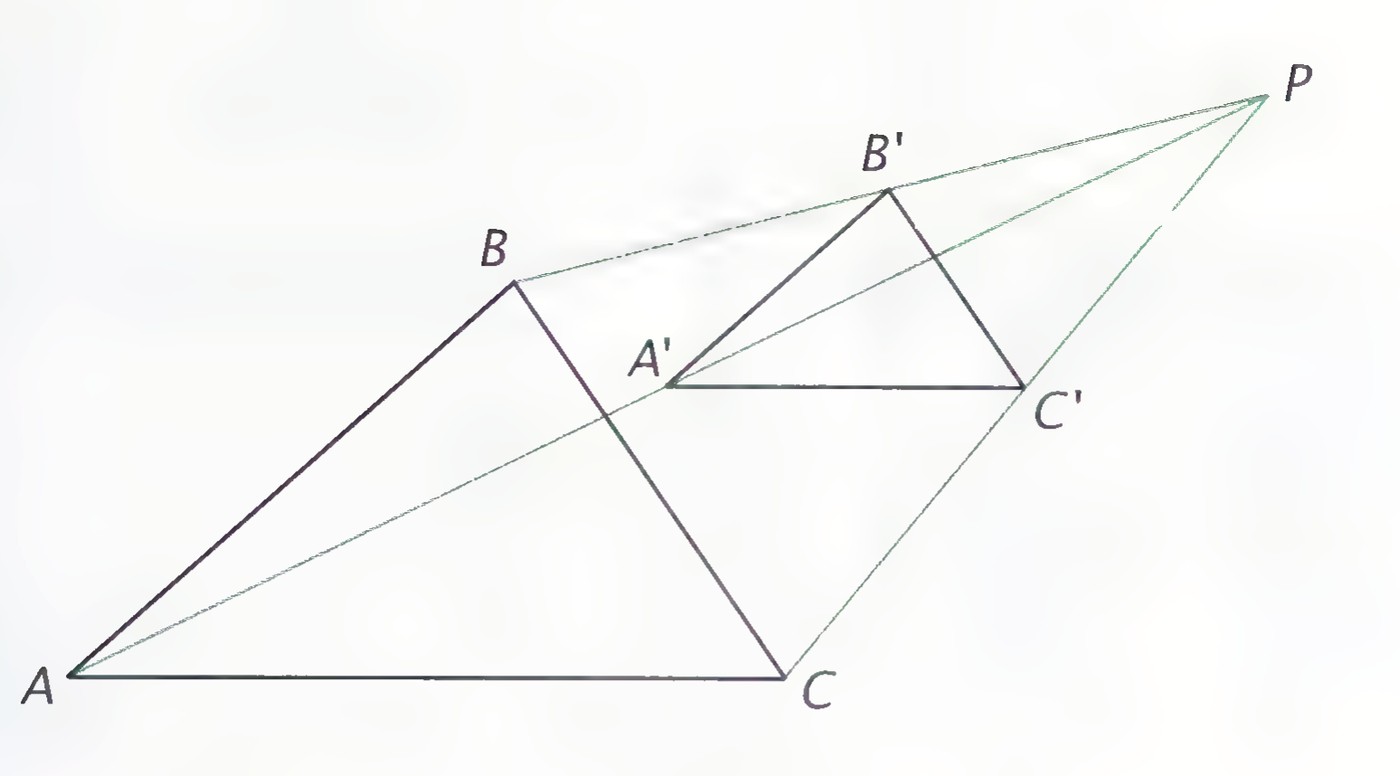
Dilation Problem. In the figure above, A′B′C′ is a dilation image of ABC.
- What is point P called?
- Measure the lengths of the sides of ABC and A′B′C′ in centimeters.
- Exactly how do the sides of A′B′C′ compare in length with the corresponding sides of ABC?
- What is the magnitude of the transformation from ABC into A′B′C′?
- How are points A′, B′, and C′ related to line segments PA, PB, and PC?
Quadrilateral Conclusions. All of the quadrilaterals in the figure below are rectangles, and ABCD ~ EFGD.
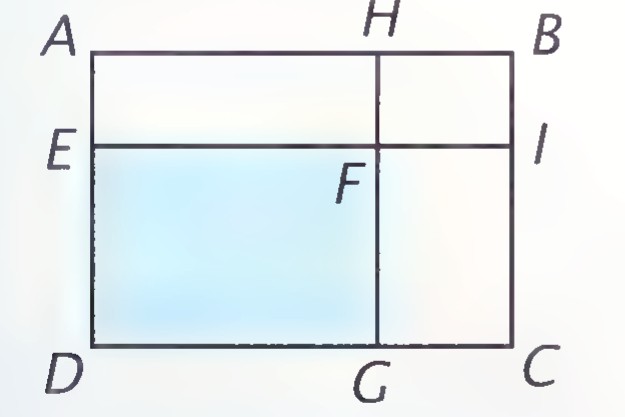
- . Why?
- AD × GD = ED × CD. Why?
- What can you conclude about ADGH and EDCI?
- What can you conclude about AEFH and FGCI? Explain.
Set II
Similar-Triangles Proof. In the figure below, MN is a midsegment of ABC. AMN appears to be similar to ABC.
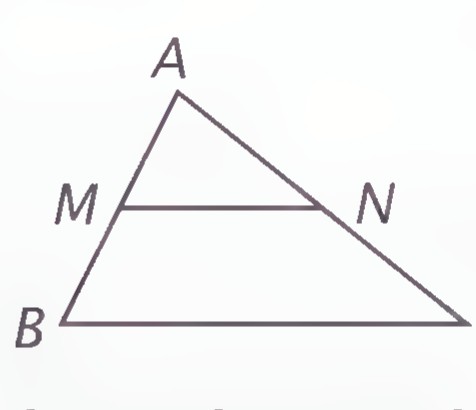
Prove that the triangles are similar by giving a reason for each of the following statements.
- MN BC.
- AMN = B and ANM = C.
- A = A.
- MN = BC.
- .
- AM = MB and AN = NC.
- AM + MB = AB and AN + NC = AC.
- 2AM = AB and 2AN = AC.
- and .
- .
- AMN ~ ABC.
p. 390
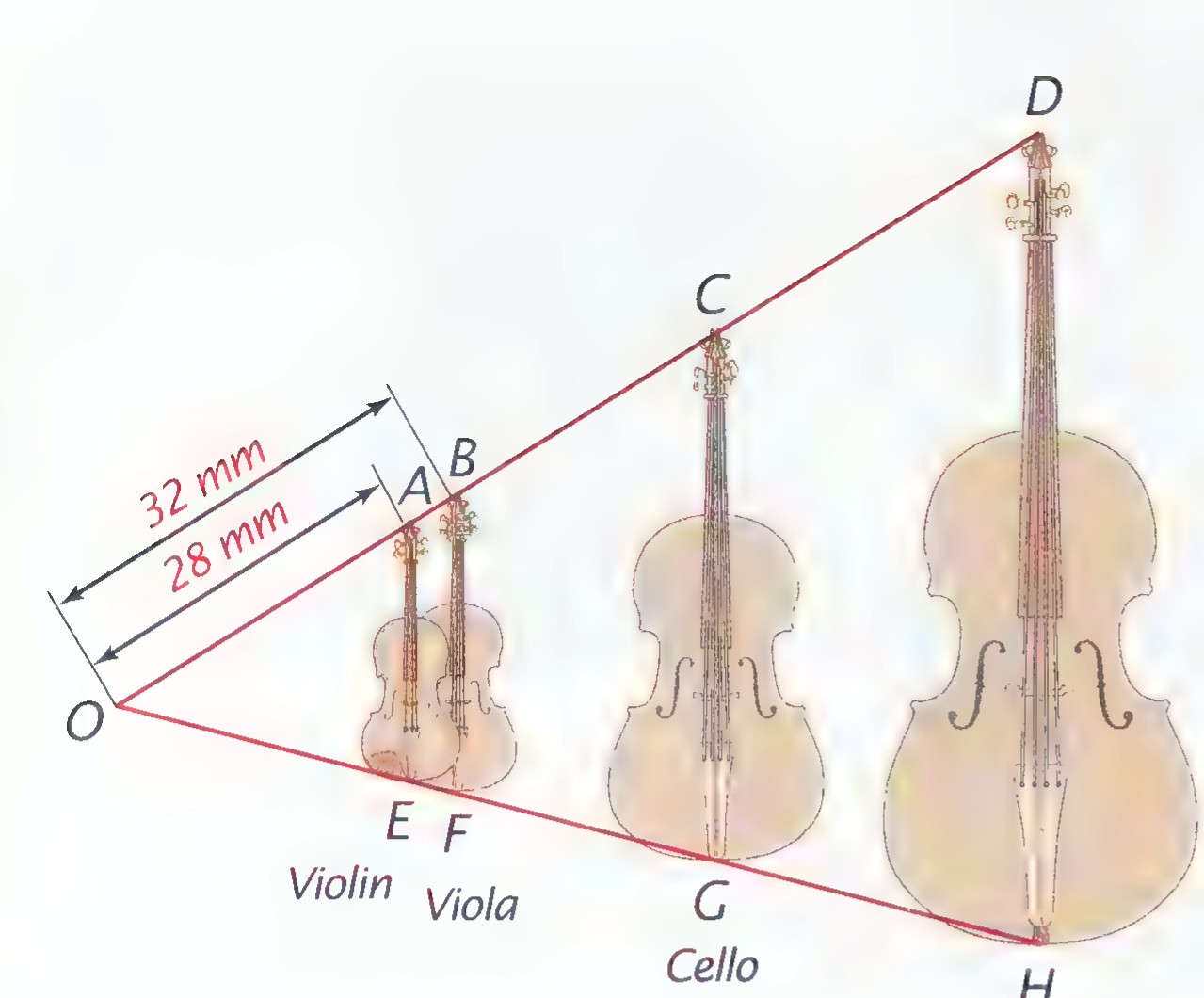
Violin Family. The figure above shows the viola, cello, and bass as three dilations of the violin.
The magnitude of a dilation can be found from a scale drawing by using any units. For example, letting the magnitude of the viola dilation be , we can write OB = OA, or
- Find the magnitude, , of the cello dilation by measuring OC in millimeters and solving OC = OA for .
- Find the magnitude, , of the bass dilation.
- AE = 21 mm. Check this length with your ruler, and measure BF in millimeters. Find the ratio of the lengths of the viola and the violin, .
- Measure CG and find the ratio of the lengths of the cello and the violin, .
- Do the same for the bass and violin.
A violin is about 24 inches long.
- Find the approximate lengths of the viola, cello, and bass.
Paper Sizes. The International Standard for paper sizes is set up so that a sheet of a given size can be cut in half to produce two sheets of the next size that are similar to it, to within a millimeter. Size A0 has length 1188 mm.*
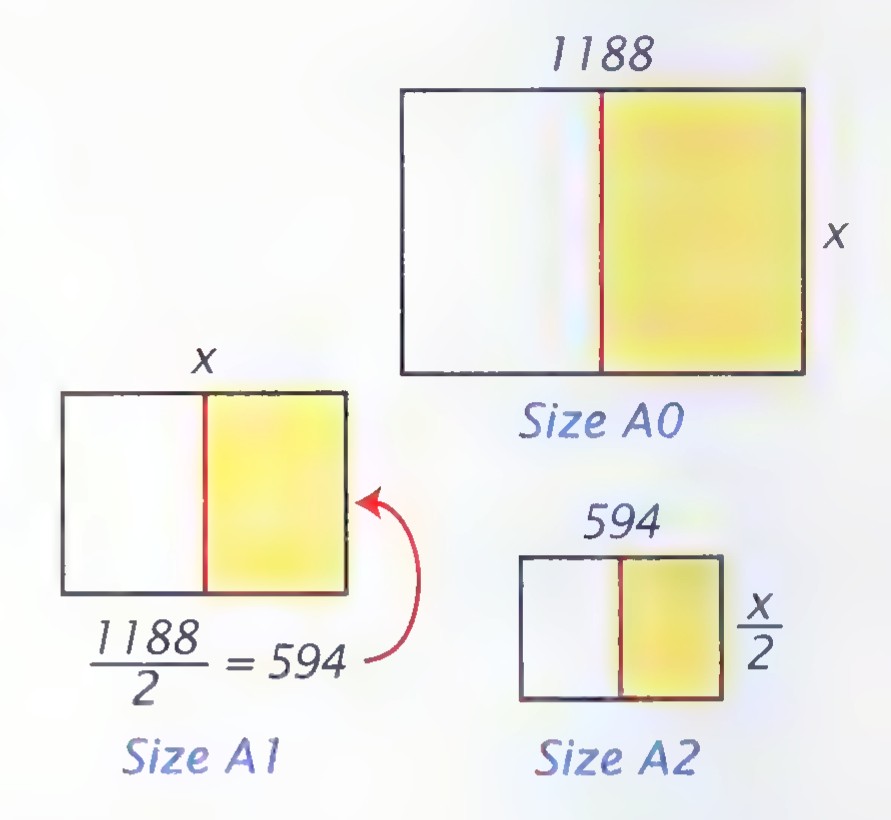
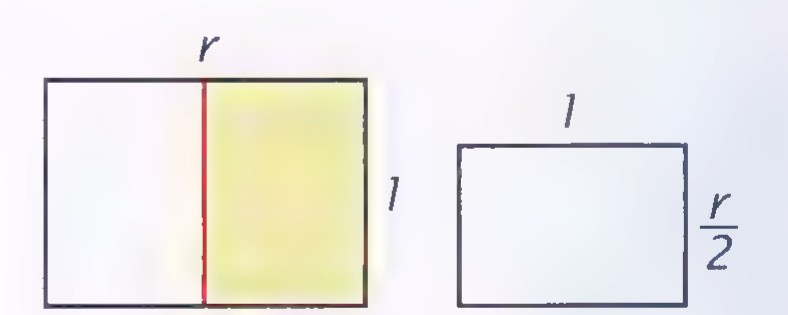
- Refer to the figures above to write a proportion for the corresponding dimensions of sizes A0 and A1.
- Solve the proportion to find , the width of size A0.
- What is called with respect to the numbers 1188 and 594?
- What is the approximate area of a sheet of size A0 in square meters?
- What is the width of a sheet of size A2?
When this system of paper sizes was established, the dimensions were rounded off.
- Refer to the figures above to write a proportion for the corresponding dimensions of two successive sizes.
- Solve the proportion to find the exact ratio of the length to width of each size.
*Some of the dimensions in these exercises have been slightly altered to make the calculations easier.
p. 391
Picture Frames. A rectangular picture 28 inches by 20 inches is surrounded by a frame of constant width.
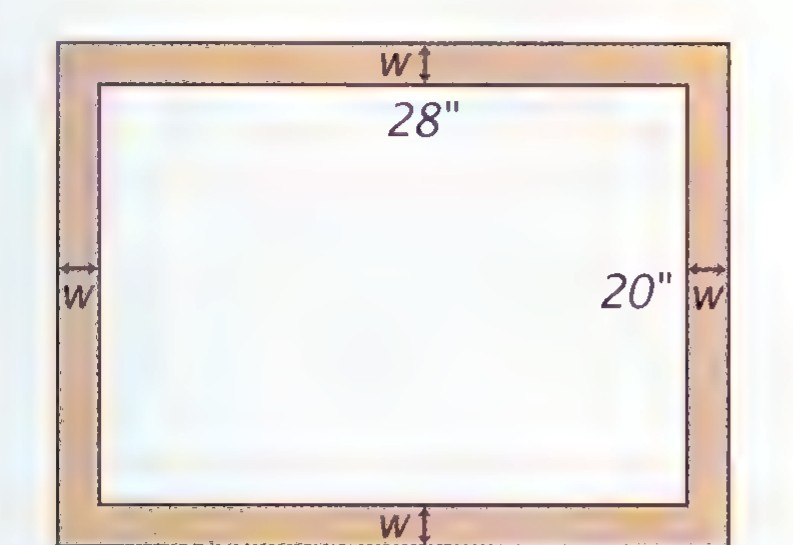
- Write a proportion based on the assumption that the outer edge of the frame has the same shape as the picture.
- Solve the proportion for .
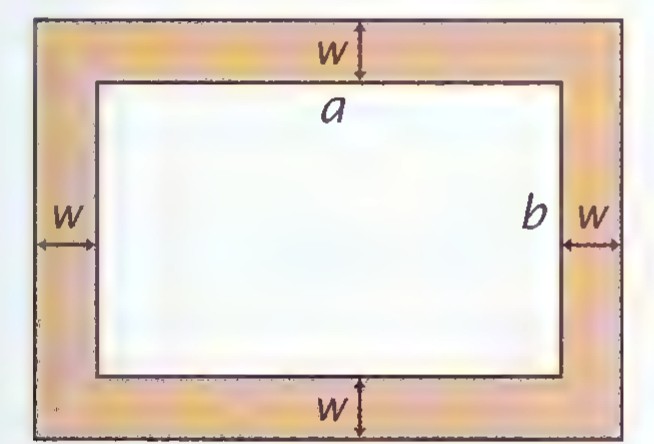
- Repeat exercises 48 and 49 for the figure below.
- If there is a solution for , what shape is the picture?
Set III
Similar Rectangles. Andrea Palladio was perhaps the most influential architect of the Italian Renaissance. His floor plan for the Villa Foscari built in 1558 is filled with similar rectangles.*

Villa Foscari
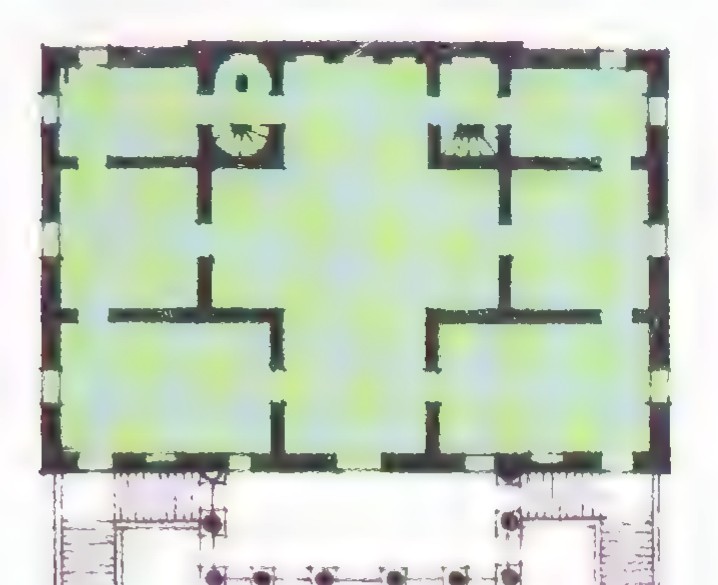
For example, the rectangles GHNM, IJPO, KLRQ, MNTS, OPVU, and QRXW in the figure below have dimensions 2 × 2 and the rectangle HKWT has dimensions 4 × 4. They are similar because
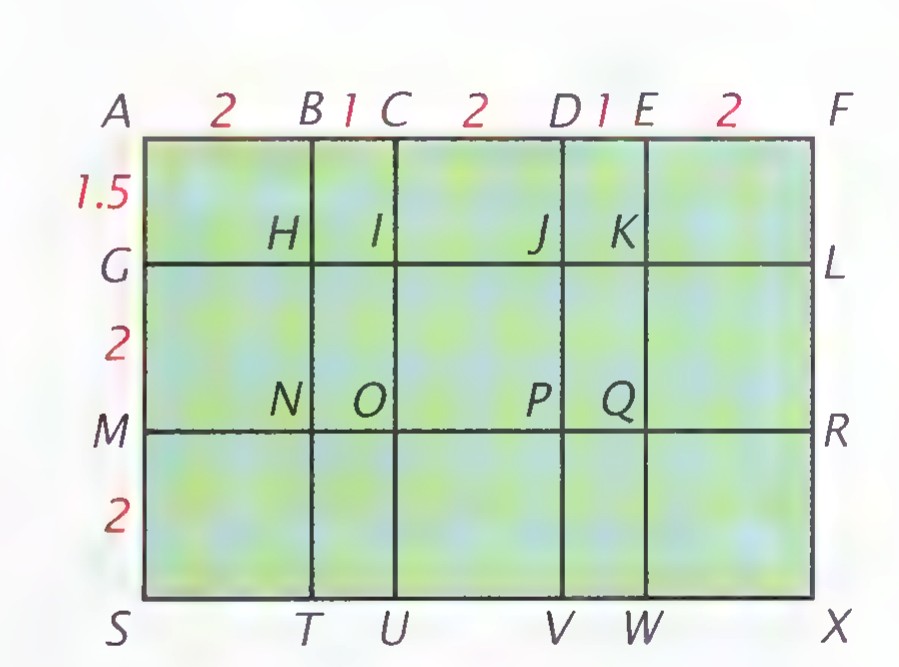
How many sets of similar rectangles of different sizes can you find whose dimensions have each of the following ratios? Name the rectangles in each set and their dimensions.
- .
- .
- .
- .
* Architecture: Form, Space, and Order, by Francis D. K. Ching (Wiley, 1996).
p. 392
Lesson 3: The Side-Splitter Theorem
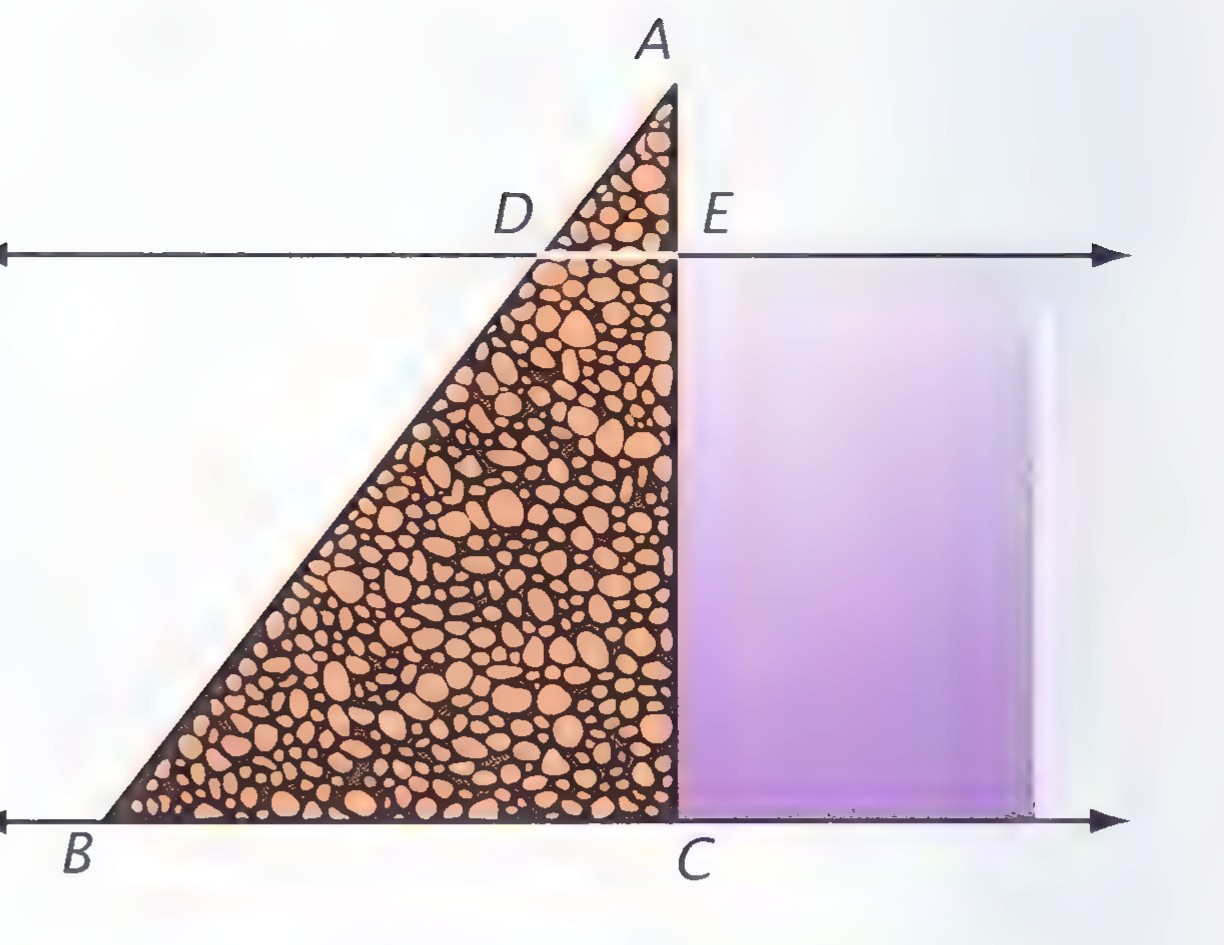
The oldest dam on record was built by the Egyptians on the Nile River in about 2900 B.C. It was washed away in a flood not long after its completion. Built without modern anchoring and reinforcing materials, this dam had to be held in place by its own weight. One mistake in its construction was that it was built as a thick wall, rectangular in cross section. A French engineer showed in 1850 that such a dam should be triangular so as to be thickest where the pressure is greatest.
The figure above is a side view of a triangular dam. The cross section of the dam is ABC; the line of the water level behind the dam, DE, is parallel to the line of the ground, BC.
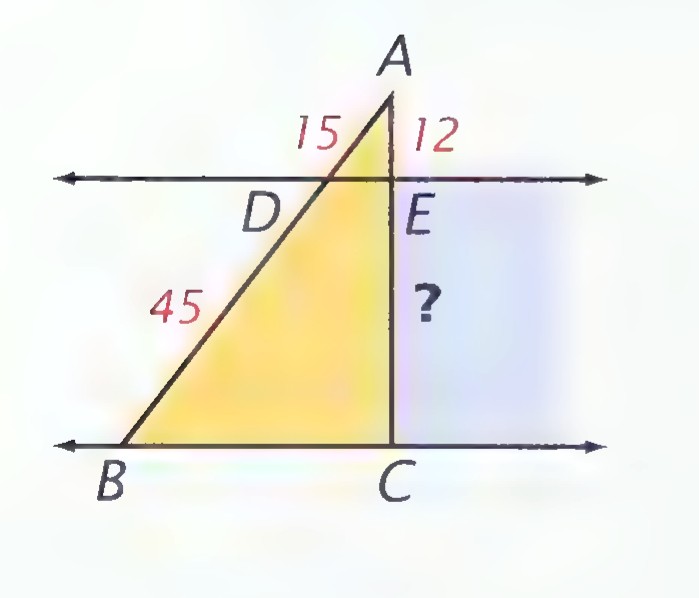
The amount of force of the water against the dam depends on several factors; one of them is the length of EC, the segment that represents the surface of contact. Can the length of EC be determined from the lengths of the other segments in the figure? For example, suppose that AD = 15 meters, DB = 45 meters, and AE = 12 meters. Can we find EC from these numbers?
We will show that, if DE AB, then
By substituting into this equation, we have
p. 393
Solving for EC,
we find that EC is 36 meters long.
This method depends on the following theorem.
Theorem 44. The Side-Splitter Theorem
If a line parallel to one side of a triangle intersects the other two sides in different points, it divides the sides in the same ratio.
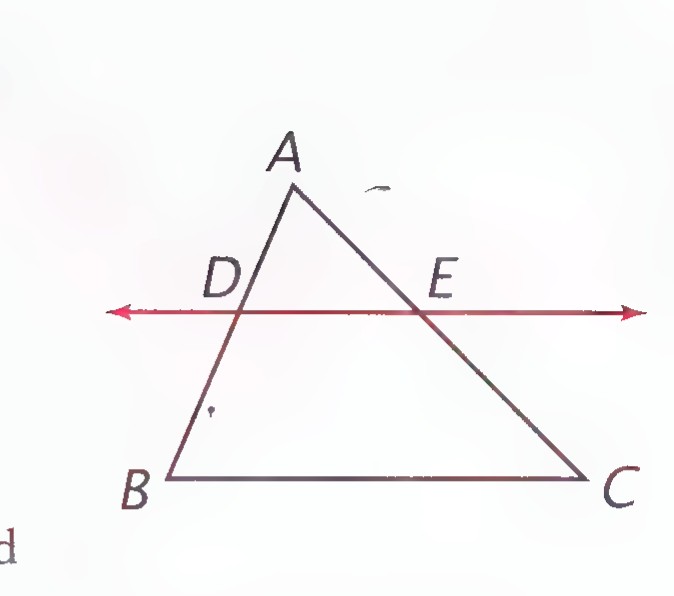
Given: ABC with DE BC.
Prove: .
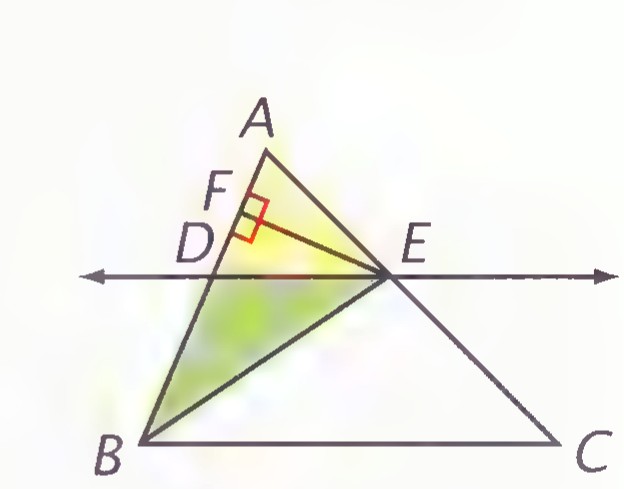
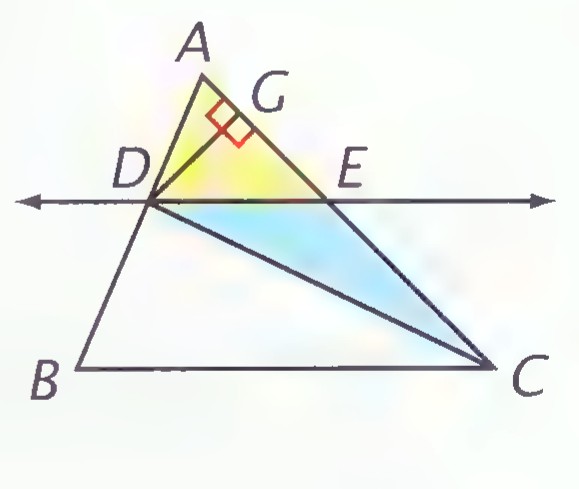
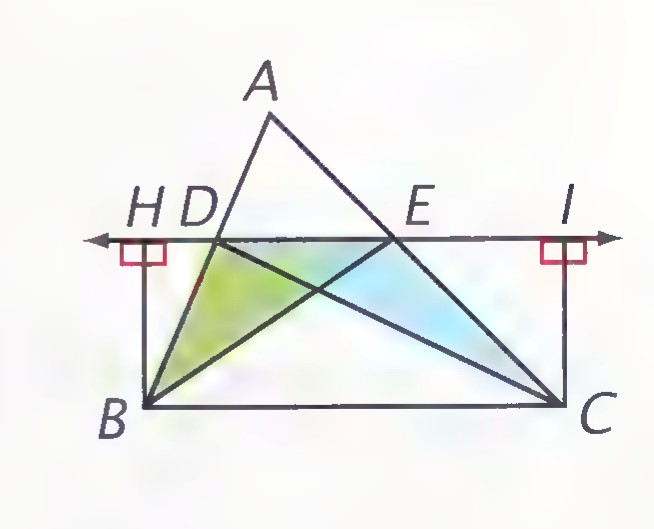
Our proof, based on area, is that of Euclid. Two line segments are added to the figure to form some triangles whose bases are the four segments in the theorem’s conclusion.
Proof
The first part: Draw BE and draw EF AB. EF is an altitude of both AED and DEB; so
Dividing, we get
The second part: Draw DC, and draw DG AC. DG is an altitude of both AED and DEC; so
Dividing, we get
The third part: Locate points H and I on line DE so that BH DE and CI DE. Because HI BC and BH CI (in a plane, two lines perpendicular to a third line are parallel), HICB is a parallelogram. DEB and DEC have equal bases (DE = DE) and equal altitudes (BH = CI because the opposite sides of a parallelogram are equal); so
p. 394
Substituting this result in equation 2, we have
We know from equation 1 that
so we can substitute in equation 3 to get
A useful corollary to the Side-Splitter Theorem is:
Corollary to the Side-Splitter Theorem
If a line parallel to one side of a triangle intersects the other two sides in different points, it cuts off segments proportional to the sides.
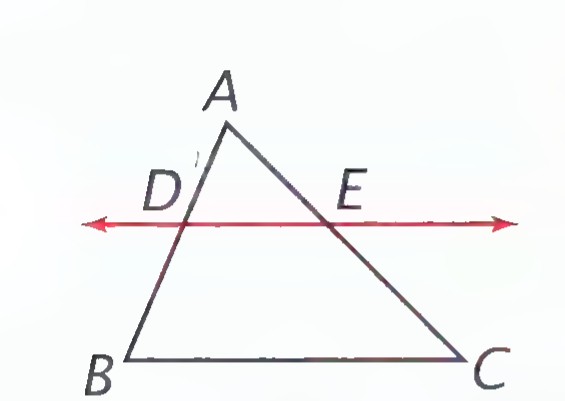
This corollary permits us to conclude that, if DE BC in the figure at the left, then
Exercises
Set I
Turkish Theorem. Here is the Side-Splitter Theorem as it appears in a Turkish geometry book.
Teorem. Bir üçgenin bir kenarına çizilen paralel doğru, diğer iki kenarı içten yahut dıştan aynı oranda böler.
Hipotez: DE // BC.
Hüküm: .
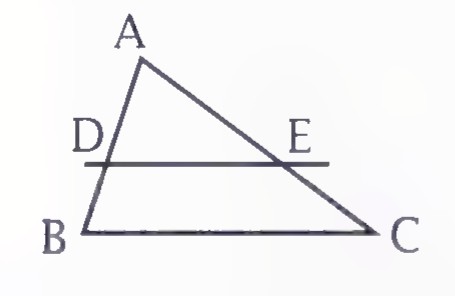
- Which words other than “teorem” do you recognize?
- What is the hypothesis of the theorem in English?
- What is the conclusion of the theorem in English?
Errors of Omission. Leaving out some of the words of a true statement may result in a statement that is false. Draw figures to show why the following statements are false.
- If a line is parallel to one side of a triangle, it divides the other two sides in the same ratio.
- If a line intersects two sides of a triangle in different points, it divides the sides in the same ratio.
- If a line parallel to one side of a triangle intersects the other two sides, it divides them in the same ratio.
p. 395
Picturing Products. In mathematics at the time of Euclid, the product of two numbers was represented as shown in the figure below.
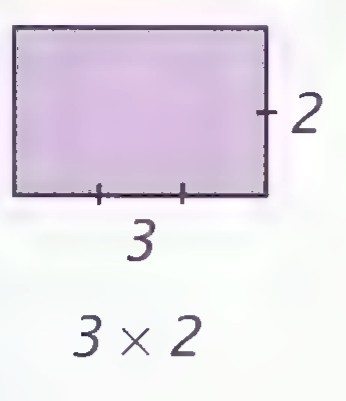
- What represents 6 in the figure?
René Descartes, a French mathematician of the seventeenth century, thought of a way to represent a product by using parallel lines.
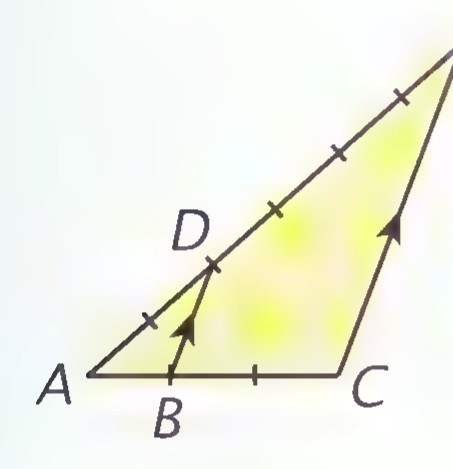
- How are 3, 2, and 6 represented in the figure above?
- Write a proportion whose first term is 1 for the figure below.
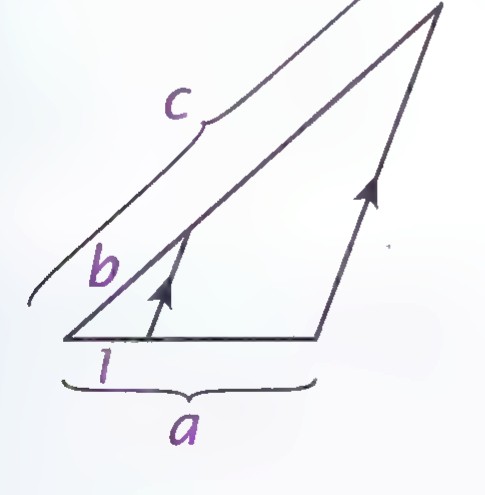
- Show why Descartes’s method works by solving this proportion for .
- Draw a figure that illustrates the square of 3 as an area.
- Draw a figure like that of Descartes that illustrates the square of 3 as a length.
Supply and Demand. The greater the supply of a product, the lower the price it will bring, as shown in the figure below, based on a graph in an economics book.*
In the figure, CP OB and PD AO.
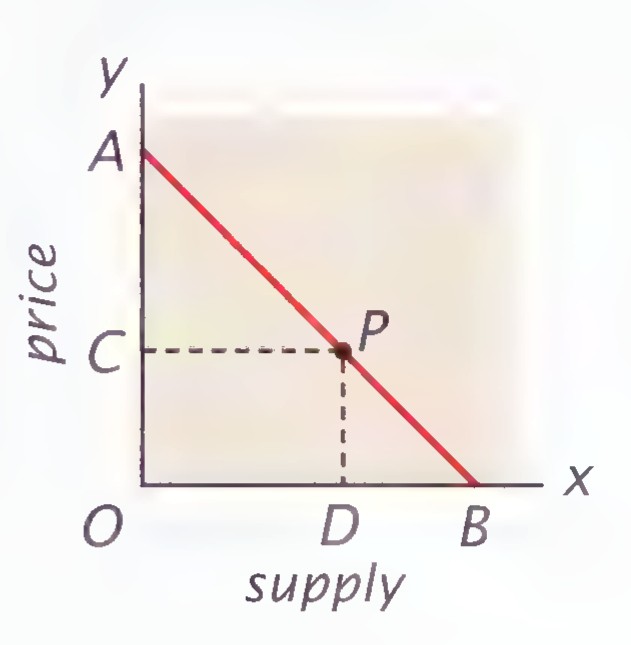
Copy and complete the following proportions in terms of other lengths in the figure.
- .
- .
- .
- .
- Why is ?
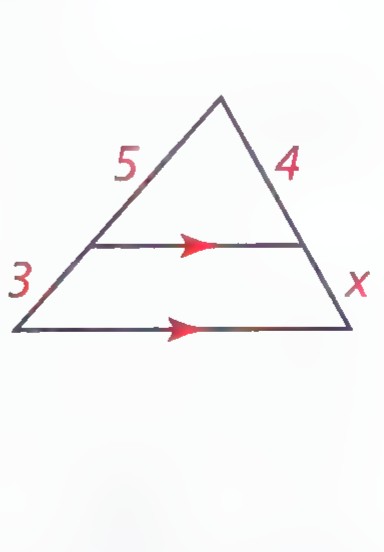
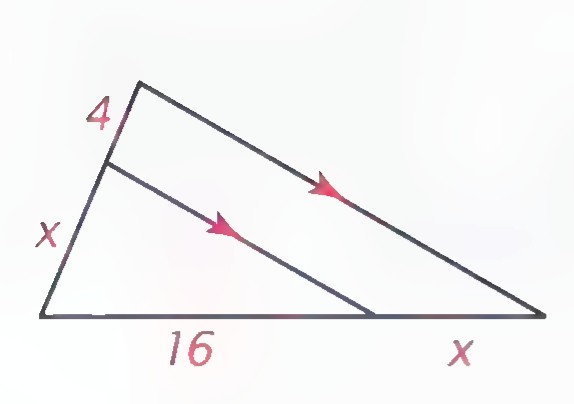
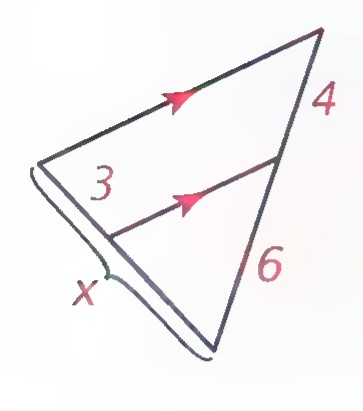
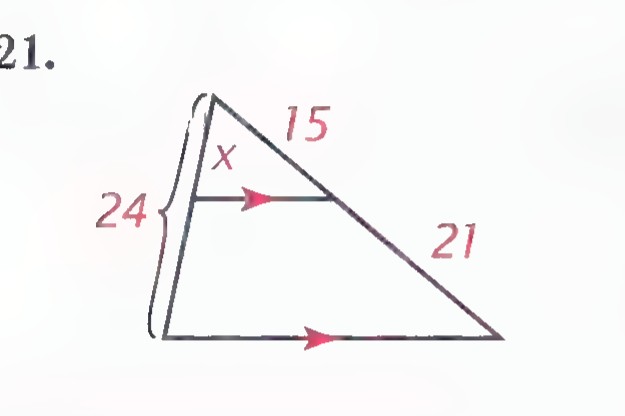
Side-Splitter Practice. Write a proportion for each of the following figures, and solve each proportion for .
* Economics, by Paul A. Samuelson and William D. Nordhaus (McGraw-Hill, 1989).
p. 396
Two-Point Perspective. The figure below is a two-dimensional picture of a cube drawn in “two-point perspective.”*
In the figure, BC = CD, EF = FG, and BE CF DG.
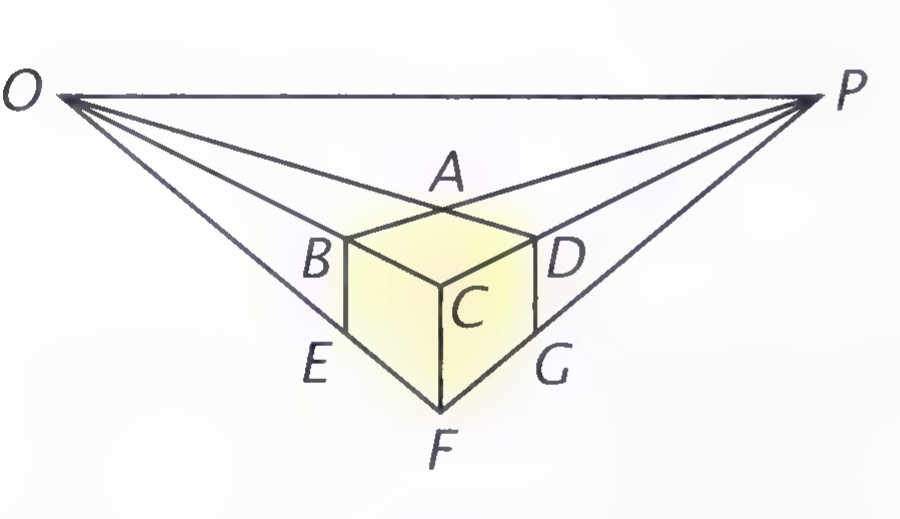
Tell whether each of the following conclusions seems reasonable. In each case, explain why or why not.
- .
- .
- .
- .
* Perspective in Perspective, by Lawrence Wright (Routledge and Kegan Paul, 1983).
Set II
Parallelogram Exercise. ABCD is a parallelogram, and E and F are the midpoints of its opposite sides; DE and BF intersect AC at X and Y.
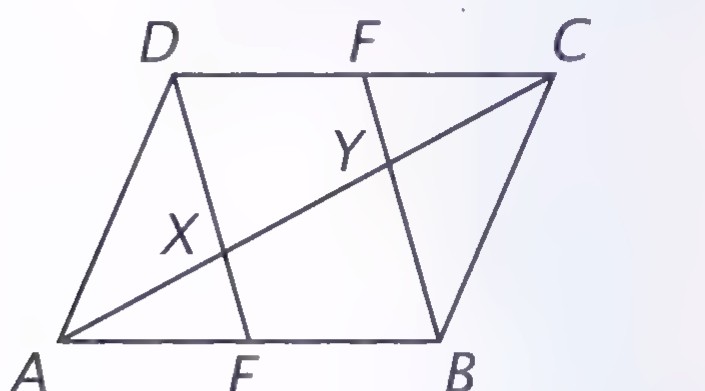
- What can you conclude about EBFD? Explain.
- Why is and ?
- What can you conclude about AX, XY, and YC? Explain.
Corollary to Theorem 44. Complete the following proof of the corollary to the Side-Splitter Theorem by giving the reasons.
Given: ABC with DE BC.
Prove: .
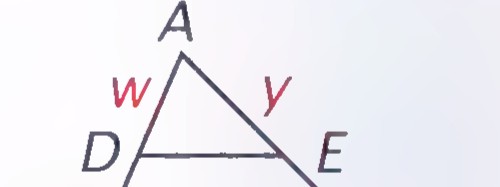
Because the proof is algebraic, it is convenient to express the lengths in the figure in terms of , , , and and show that .
- Because DE BC, . Why?
- . Why?
- . Why?
- . Why?
- ; so . Why?
p. 397
Parallels Path. In the figure below, a path has been drawn starting at point A on side MN of MNO so that each part of the path is parallel to one of the sides of the triangle. G is the name of the point in which the path intersects MN on its return.
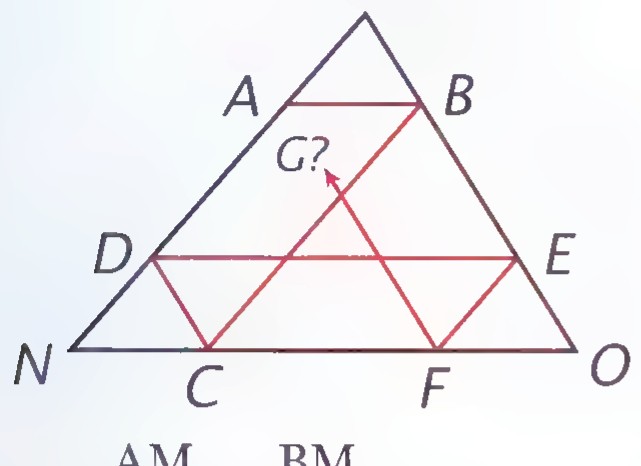
Why is ?
Follow the path to copy and complete the following statement:
Use your result to answer the following questions.
- To what segment is BM equal?
- To what segment is CN equal?
- Why is AM = GM?
- What does this equality indicate about point G?
- How would the path look if it were continued past point G?
Bridge Cables. The Dames Point Bridge in Jacksonville, Florida, is supported by parallel cables.
In the figure below showing three of its cables, the tower, AD, is perpendicular to the deck, DG. The cables are arranged so that AG BF CE and EF = FG. To find out how AB and BC are related, an extra line, IE, has been drawn perpendicularly to DG.
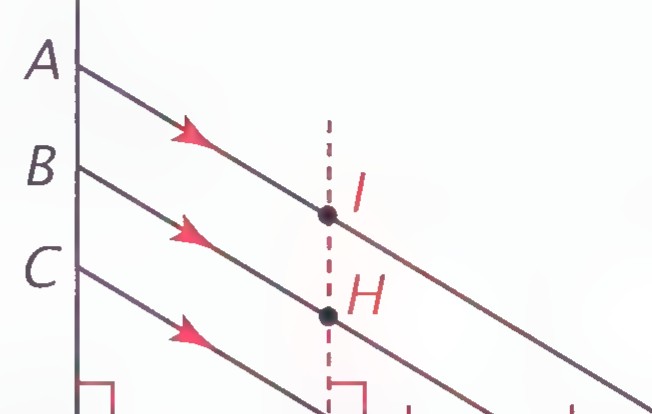
- Why is ?
- What can you conclude about ? Explain.
- Why is IE AD?
- What can you conclude about ABHI and BCEH?
- Why is BC = EH and AB = HI?
- What can you conclude about ? Explain.
- What can you conclude about AB and BC? Explain.
Original Proofs. Write proofs for the following exercises.
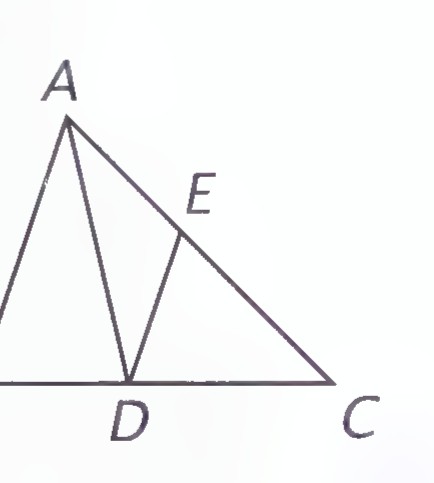
Given: In ABC, AD bisects BAC; AE = ED.
Prove: .
p. 398
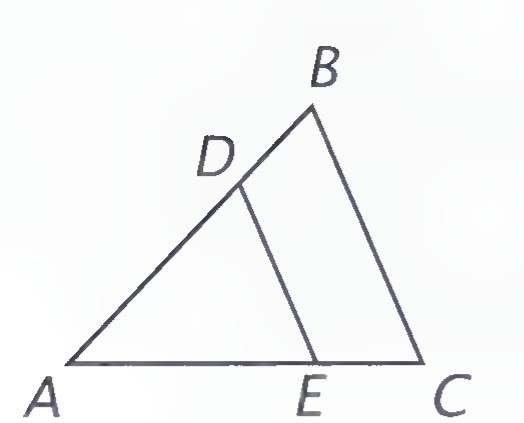
Given: In ABC, AB = AC and DE BC.
Prove: AD = AE.
Set III
Pantograph. A pantograph is an instrument used by artists to copy a figure to any desired scale.
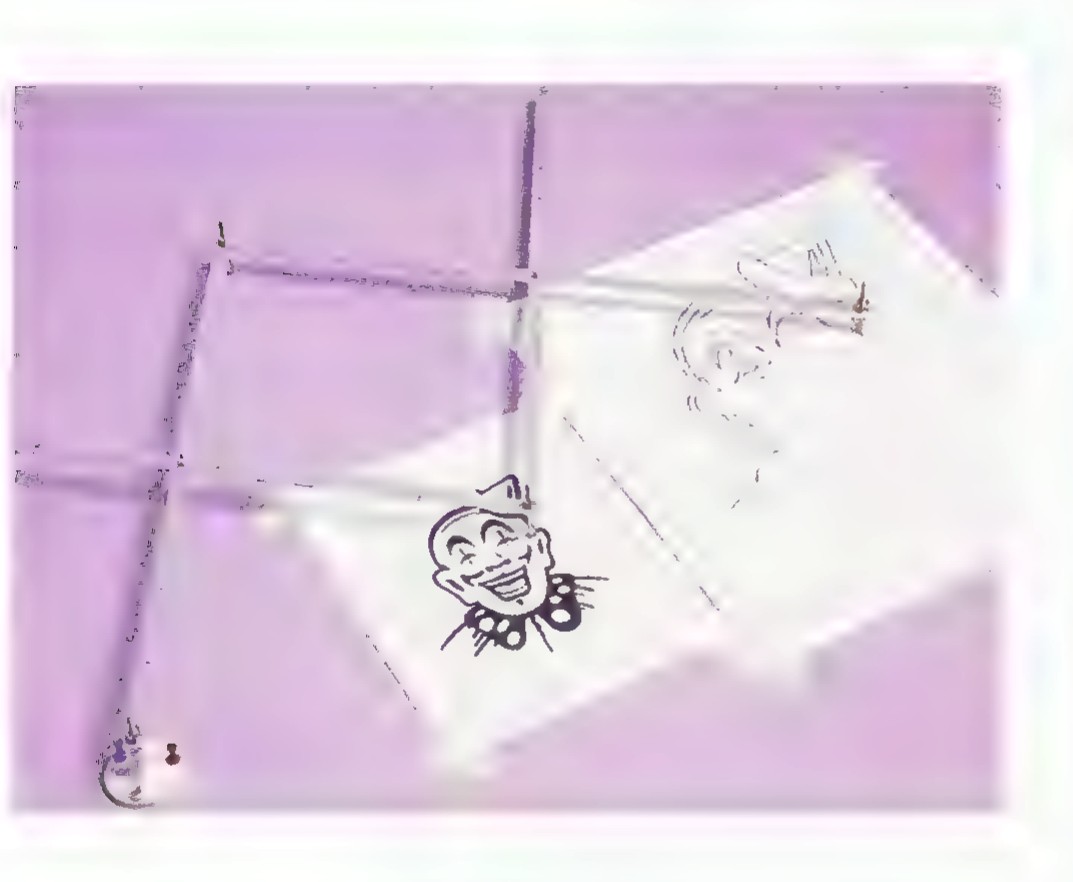
It consists of four bars hinged together as shown in the figure below and is attached to the drawing board at point P. As a stylus at point D traces the figure, a pencil at point E draws a larger copy of it. The bars are connected so that AB = DC = CE and PA = AD = BC.
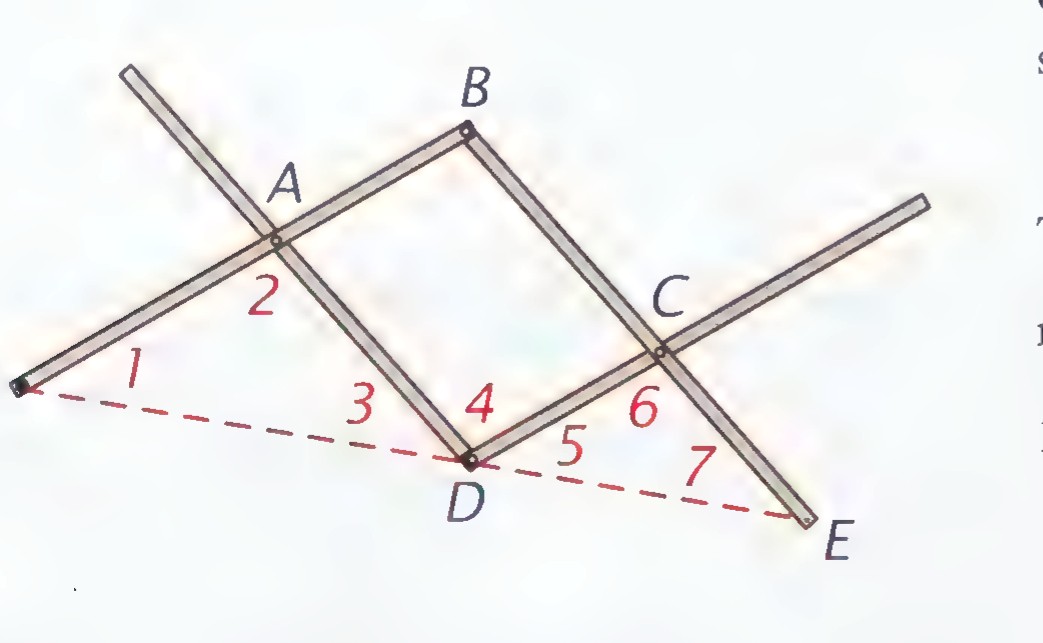
- Copy the figure and mark it as needed to answer the following questions.
- As the pantograph is being used, PB always stays parallel to DC and BE always stays parallel to AD. Why?
- Which of the numbered angles always stay equal to B?
- If B = °, what is the measure of each of the following angles in terms of : $$1, $$3, $$5, and $$7?
As the pantograph is being used,
- to what number is $$1 + $$2 + $$3 always equal?
- to what number is $$3 + $$4 + $$5 always equal?
- what is always true about PDE?
- what is always true about points P, D, and E?
As the pantograph is being used, PD and DE continually change in length, but always stays the same.
- Why?
The “scale factor” of the pantograph is the numerical value of .
- If the pantograph is set up so that PA = 20 cm and AB = 15 cm, what is its “scale factor”? Explain.
p. 399
Lesson 4: The AA Similarity Theorem
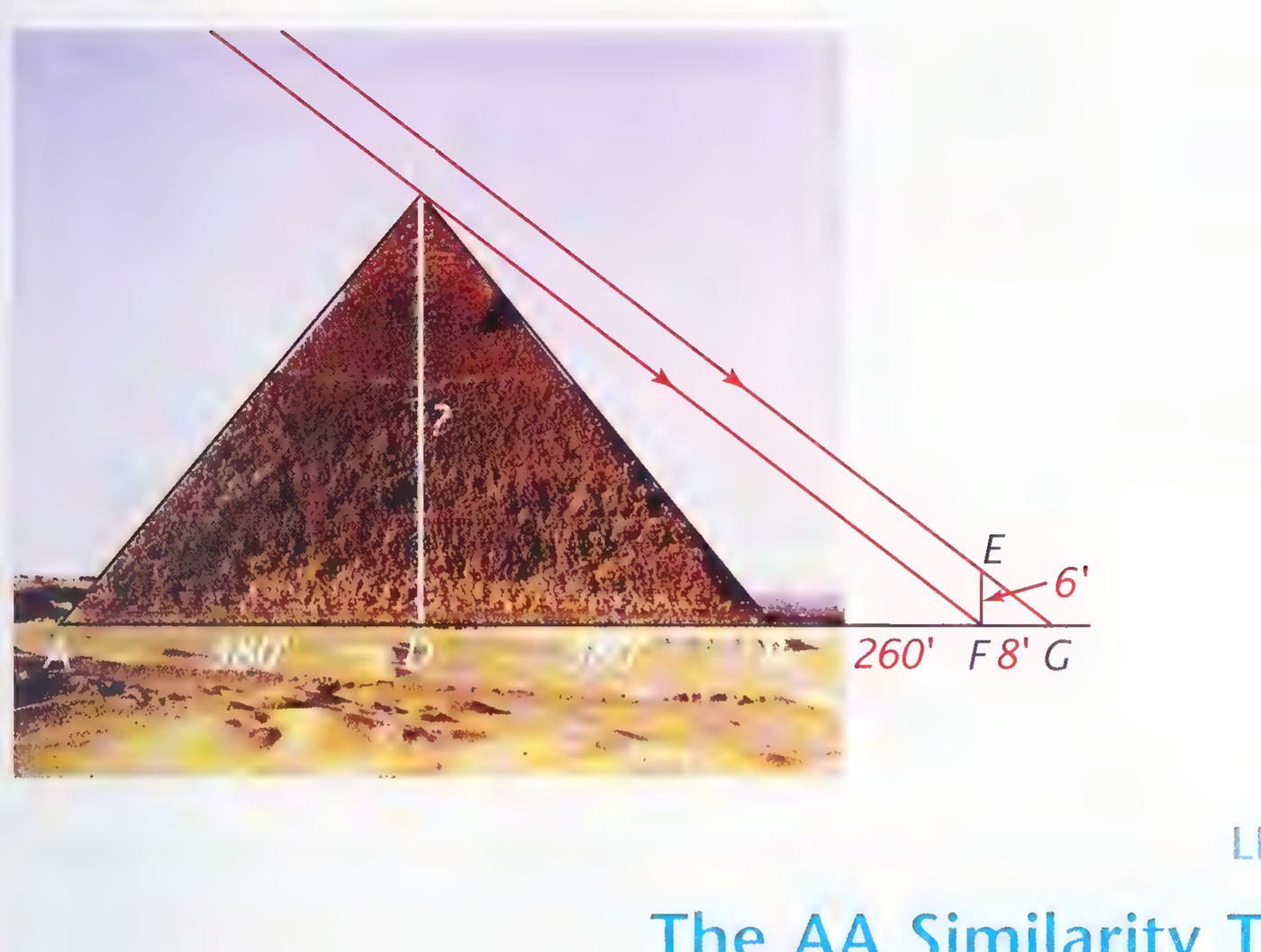
According to the ancient Greek historian Plutarch, Thales, a mathematician who lived several centuries before Euclid, used shadows to find the height of the Great Pyramid. Plutarch wrote:
The king of Egypt particularly liked the manner by which you [Thales] measured the height of the pyramid without any trouble or instrument; for, by merely placing your staff at the extremity of the shadow which the pyramid casts, you formed, by the impact of the sun’s rays, two triangles and so showed that the height of the pyramid was to the length of the staff in the same ratio as their respective shadows.*
The figure above illustrates what Thales may have done. ABC represents the pyramid, CD its height, and BF its shadow. EF represents Thales’ staff and FG its shadow. Reasoning that CF EG and that CDF ~ EFG, Thales wrote and solved a proportion for the corresponding sides of the triangles from which he found the height of the pyramid:
The height is 480 feet.
* The History of Mathematics, by David M. Burton (Allyn & Bacon, 1985).
p. 400
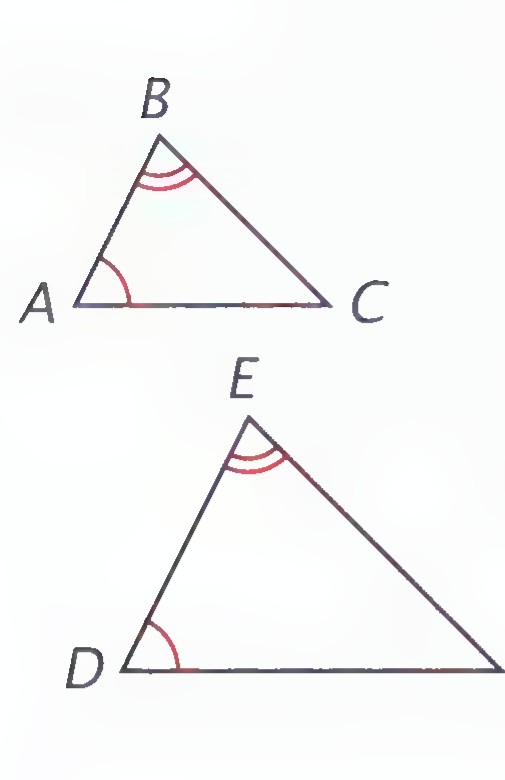
To understand how this method works, we need the following theorem.
Theorem 45. The AA Theorem
If two angles of one triangle are equal to two angles of another triangle, the triangles are similar.
Given: ABC and DEF with A = D and B = E.
Prove: ABC ~ DEF.
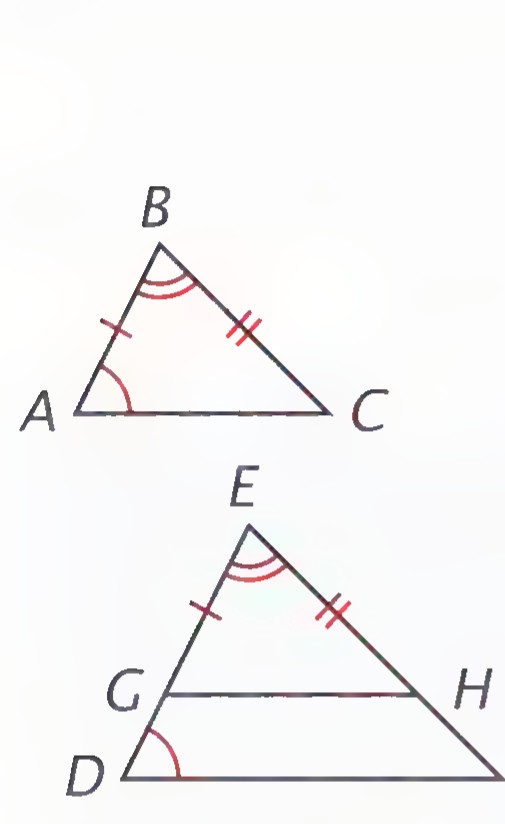
To prove this theorem, we must show that the third pair of angles in the triangles are equal and that all three pairs of corresponding sides are proportional. The angles are easy, and so most of the proof will deal with the sides. Our method will be to copy the smaller triangle in one corner of the larger one as shown in the second pair of triangles at the left. We then have a triangle with a line segment parallel to one side, which lets us apply the corollary to the Side-Splitter Theorem to show that corresponding sides of the triangles are proportional.
Proof
Choose G and H on ED and EF so that EG = BA and EH = BC. Draw GH. Because B = E, GEH ABC (SAS). Therefore, EGH = A. Because A = D, EGH = D. So GH DF.
From the fact that a line parallel to one side of a triangle cuts off segments on the other two sides that are proportional to those sides, we have
Because EG = BA and EH = BC,
by substitution.
By constructing DIJ ABC as shown in the third pair of triangles and by using the same reasoning, we can show that
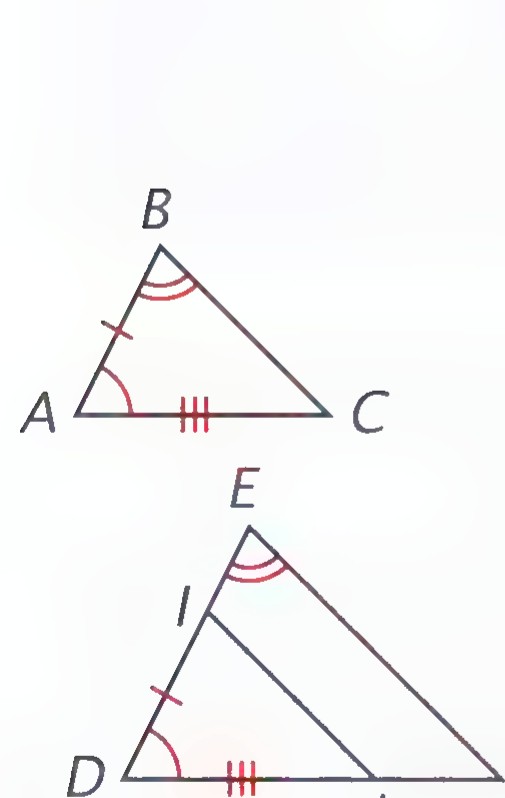
Hence, , and so we have shown that all three pairs of corresponding sides of the triangles are proportional.
Because all three pairs of corresponding angles in the triangles are equal (C = F because, if two angles of one triangle are equal to two angles of another, the third pair of angles are equal), the triangles are similar by definition.
Although we could prove the following theorem directly from the definition of similar triangles, the AA Theorem makes its proof es-
p. 401
pecially easy. All we have to do is show that two pairs of angles in the triangles are equal.
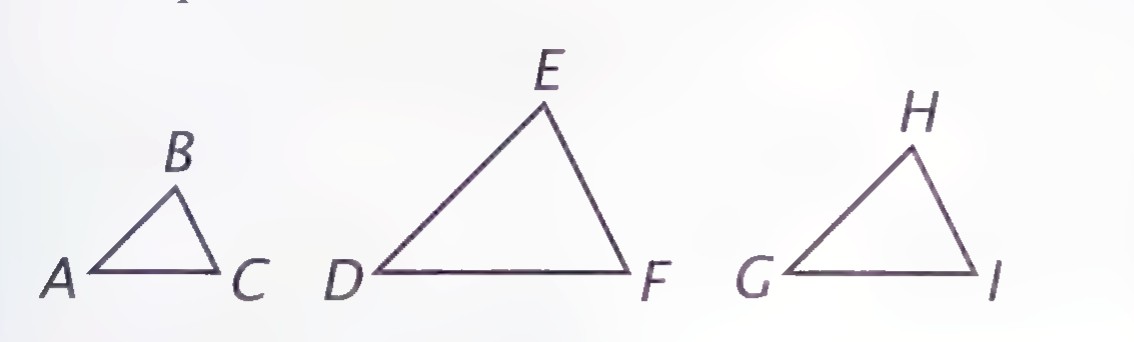
Corollary to the AA Theorem
Two triangles similar to a third triangle are similar to each other.
Given: ABC ~ GHI and DEF ~ GHI.
Prove: ABC ~ DEF.
Proof
Because ABC ~ GHI, A = G and B = H; and, because DEF ~ GHI, D = G and E = H. Therefore, A = D and B = E (substitution). It follows from the AA Theorem that ABC ~ DEF.
Exercises
Set I
Thales’ Method. In the figure below illustrating Thales’ method for measuring the height of the Great Pyramid, CF and EG represent rays of the sun. Because the sun is so far away, Thales assumed that the rays were parallel.
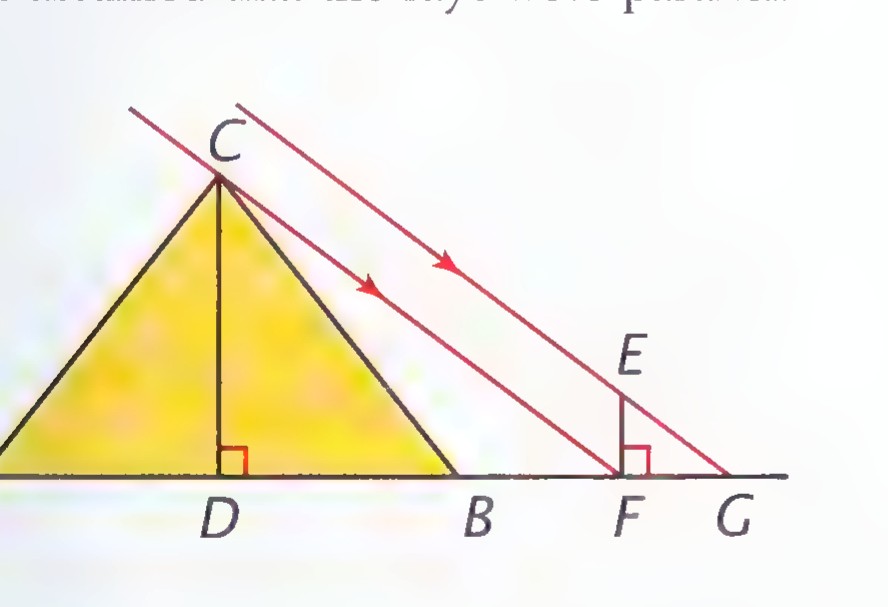
Show how Thales drew the following conclusions by giving a reason for each.
- CFD = G.
- CDF = EFG.
- CDF ~ EFG.
- .
- Triangle Average. Here is a strange fact.* In the figure below, ABC
- DEF and line segments have been drawn between their corresponding vertices.
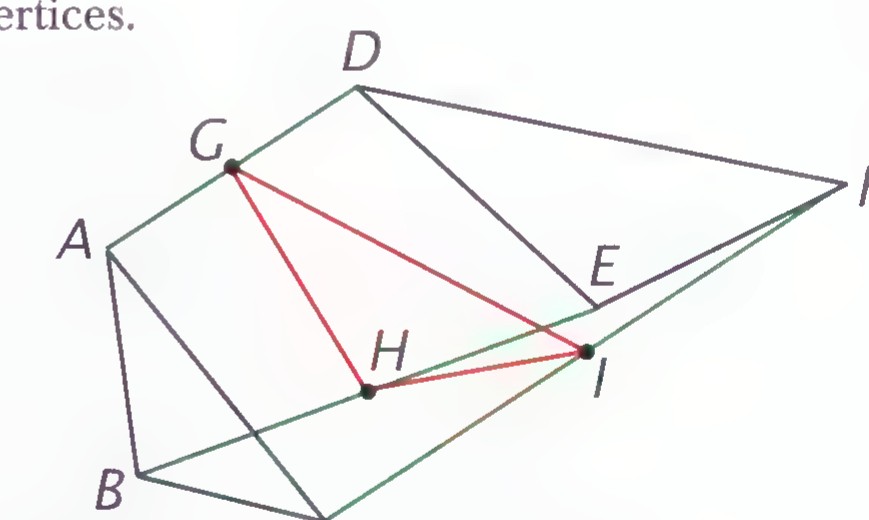
- What relation do points G, H, and I appear to have to these line segments?
If this relation is true, then GHI is similar to ABC.
- Does it follow that GHI must also be similar to DEF? Explain why or why not.
* The Penguin Dictionary of Curious and Interesting Geometry, by David Wells (Penguin, 1991).
p. 402
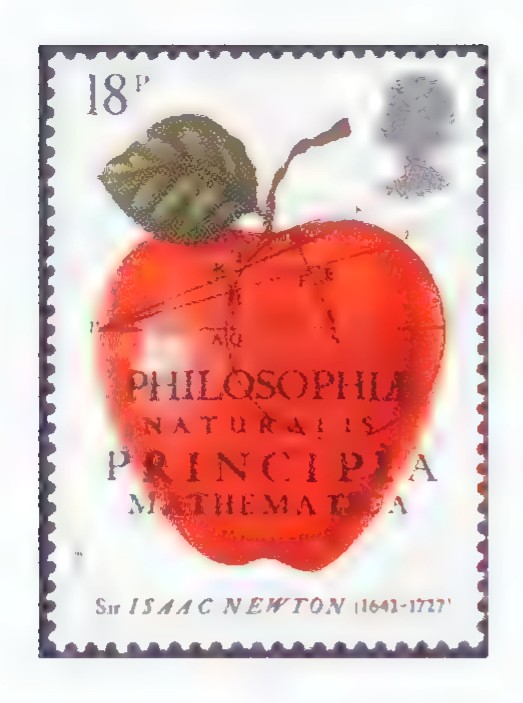
Newton’s Figure. The figure below appeared on the British postage stamp shown above honoring Sir Isaac Newton.
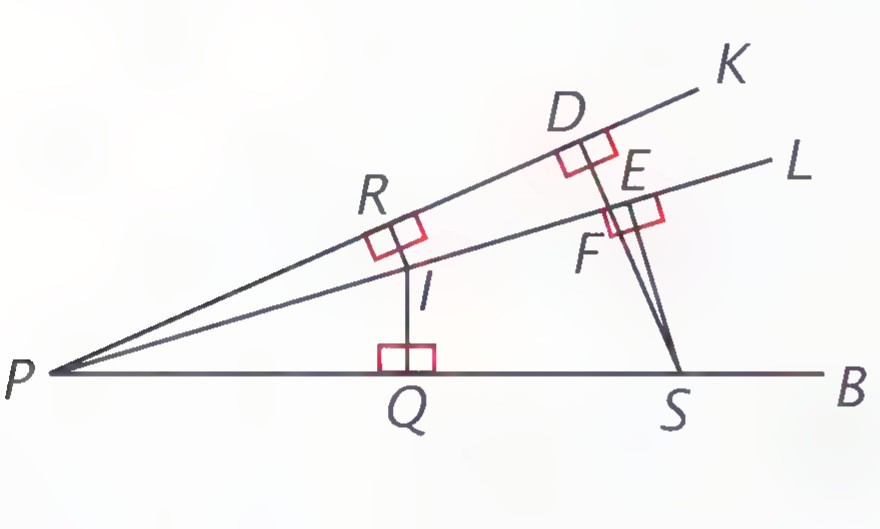
- Find two different pairs of similar triangles in the figure.
- Tell how you know that the triangles are similar.
Nine Triangles. The figure below contains six similar isosceles triangles.
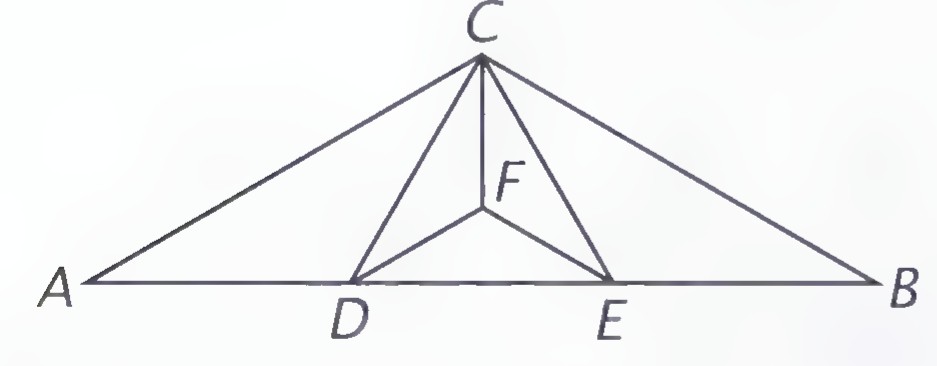
- Name them.
- What are the measures of the angles of these triangles?
- What conclusions can you make about the other triangles in the figure?
Chessboard Puzzle. In the chessboard puzzle, the board is cut into four pieces that, when rearranged, seem to form a rectangle having a different shape.
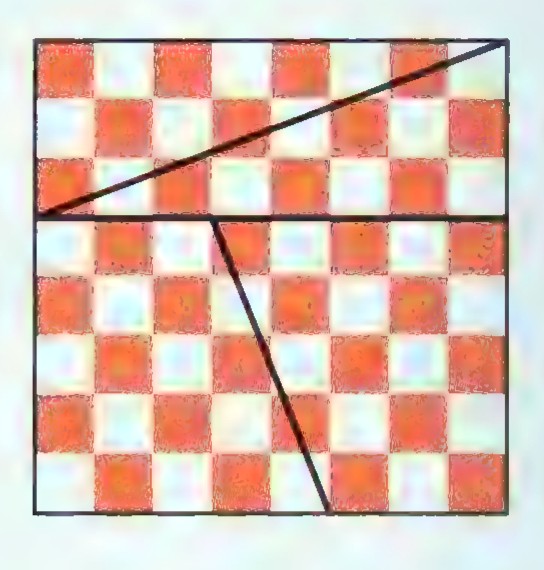
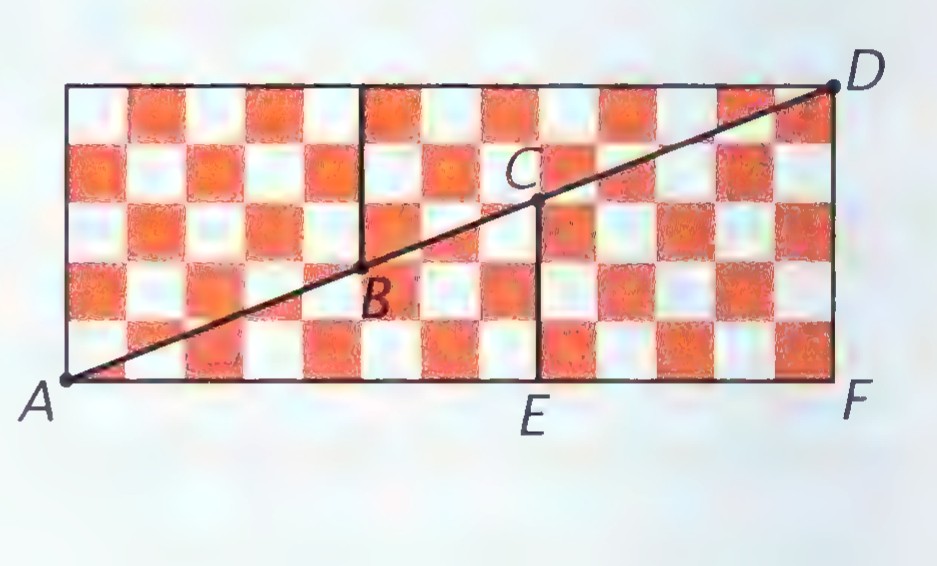
- If the area of one of the small squares of the board is taken as 1 unit, what seems to be the area of each arrangement?
In the second arrangement, points A, B, C, and D appear to be collinear.
- If they are, then AEC ~ AFD. Why?
- If AEC ~ AFD, then . Why?
From the figure, AE = 8 and AF = 13.
- What are the lengths of EC and FD?
- Does ? Explain why or why not.
- What does your answer to exercise 16 indicate about points A, B, C, and D?
- What kind of proof is a proof in which an assumption leads to a contradiction?
p. 403

Il trionfo di Federico di Montefeltro, Piero della Francesca (1420–1492)
Piero’s Theorem. Piero della Francesca, an important painter of the fifteenth century, was also a mathematician. In his book On Perspective for Painting, he proved the following theorem:
If above a line divided into several parts a line be drawn parallel to it and from the points dividing the first line there be drawn lines which are concurrent, they will divide the parallel line in the same proportion as the given line.*
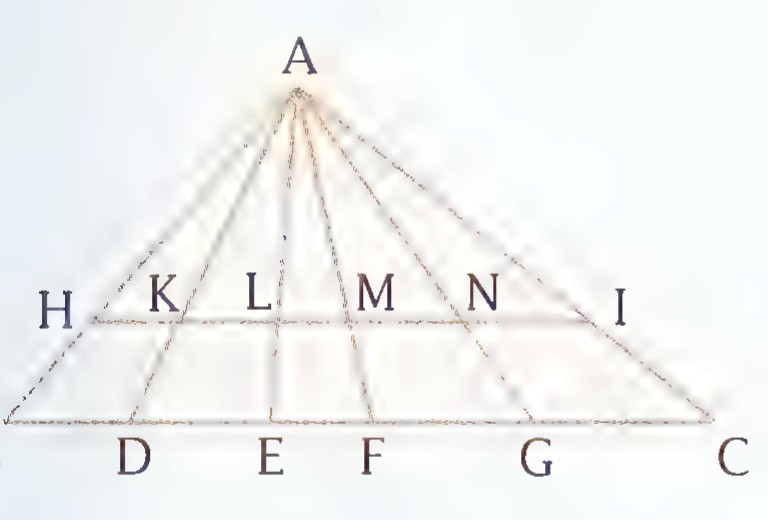
What does this theorem say about lines BC and HI?
What does the word “concurrent” mean?
Copy and complete the following similarity correspondences: AHK ~ ? and AKL ~ ?.
Use your similarity correspondences to copy and complete the following proportions: and .
What proportion follows directly from these two proportions?
Piero completed his proof by showing that three more ratios are equal to the two in your last proportion.
- What are they?
Set II
Electrician’s Formula. Electricians know that, if two resistances and are “in parallel,” they are equivalent to a single resistance R, where R = .†
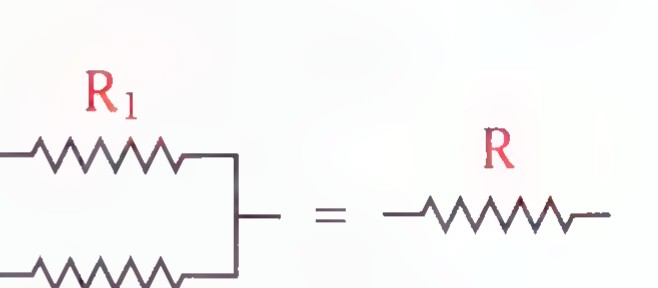
Prove that the figure below illustrates this equation by giving a reason for each of the following statements.
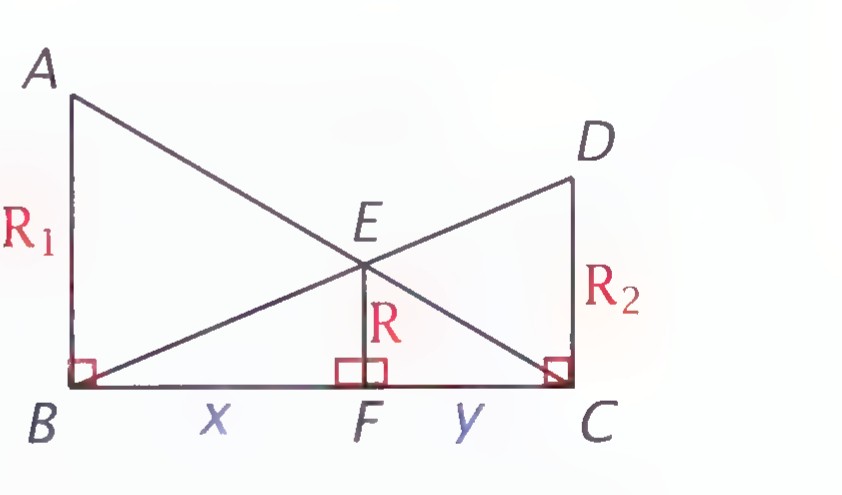
- EFC ~ ABC and EFB ~ DCB.
- and .
- .
- .
- .
- R = .
* The Invention of Infinity: Mathematics and Art in the Renaissance, by J. V. Field (Oxford University Press, 1997).
† Graphics, by A. S. Levens (Wiley, 1962).
p. 404
Sides and Angles. In ABC, AB = 12, BC = 18, AC = 15, and $$1 = C.
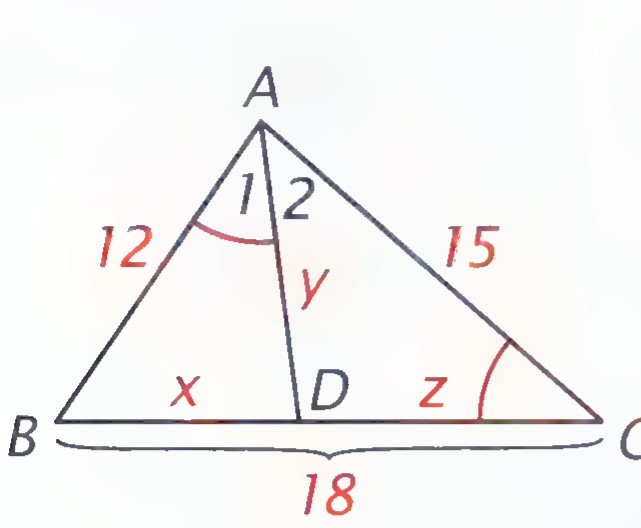
Copy and complete the following statements.
- ABD ~ ?.
- .
- .
- Find , , and .
What can you conclude about
- $$2 and C?
- BAC and C?
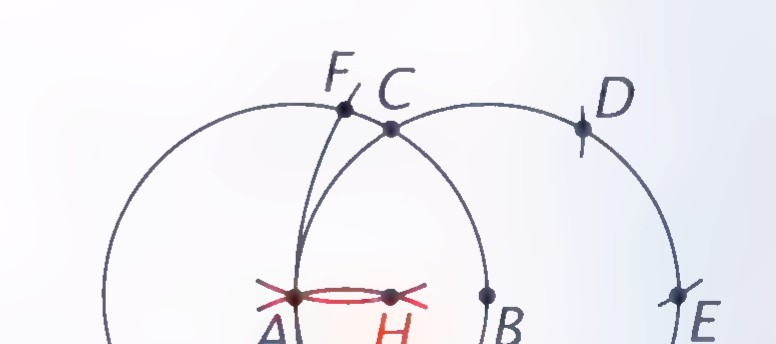
Mascheroni Construction. Lorenzo Mascheroni, an eighteenth-century Italian mathematician, discovered a way of using just a compass to find a point midway between two given points.*
Do the construction by carrying out the following steps.
- First, use your ruler to mark two points, A and B, 2 inches apart.
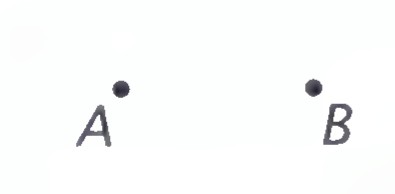
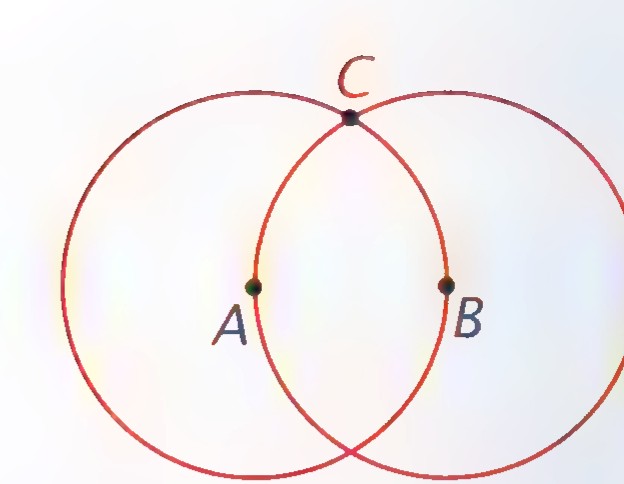
(2) Draw two circles with centers at A and B and with radius AB. Label the upper point in which they intersect C.
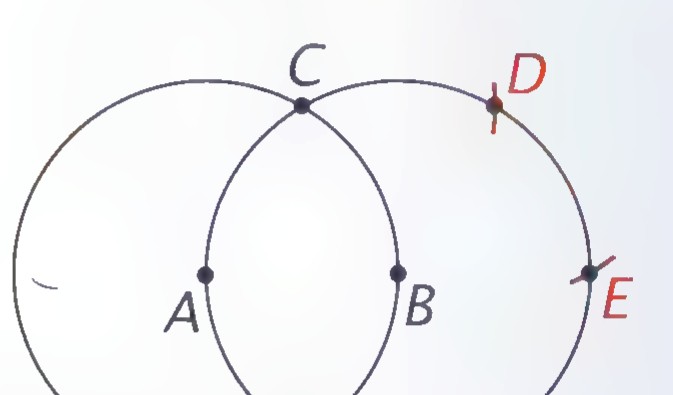
(3) With the same radius AB and C as center, mark point D; then, with D as center, mark point E.
(4) Open the compass to radius EA and, with E as center, draw an arc intersecting the circle on the left at points F and G.
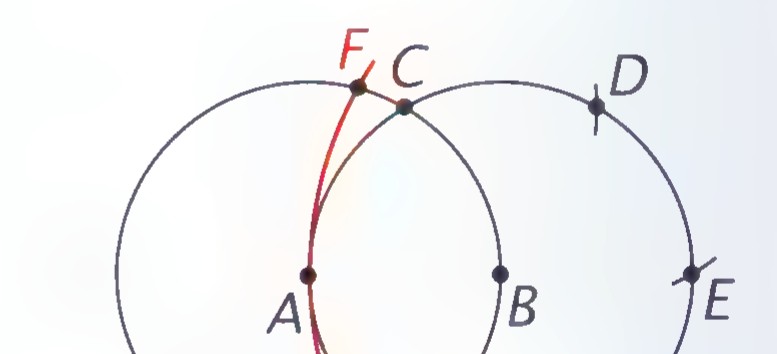
(5) With F and G as centers and radius FA, draw two arcs that intersect at H. Point H is midway between points A and B. (Check this with your ruler.)
* Mathematical Circus, by Martin Gardner (Knopf, 1979).
p. 405
To show why this construction works, draw FA, FH, FE, and AE, as shown in the figure below.
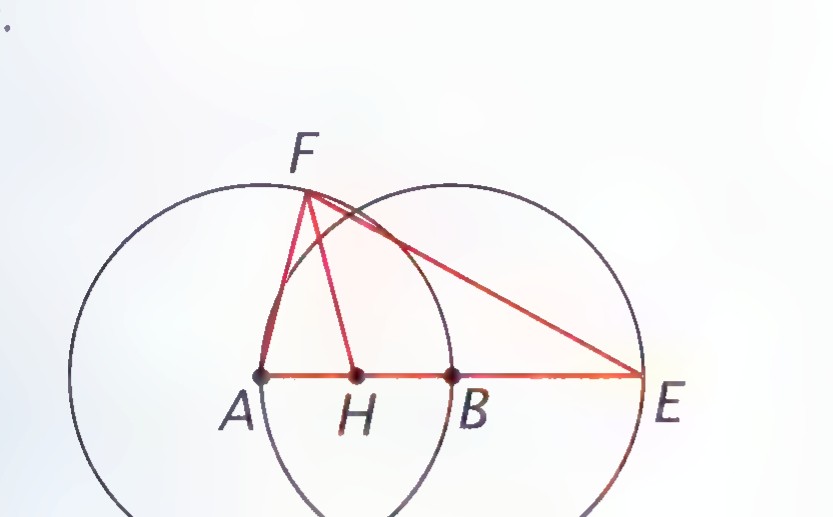
- What kind of triangles are FAH and EFA?
- Why is FAH ~ EFA?
- Why is ?
- To what number is equal? Explain.
- Why is AH = AB?
Déjà Vu. ABC is a right triangle, and CDEF is a square.
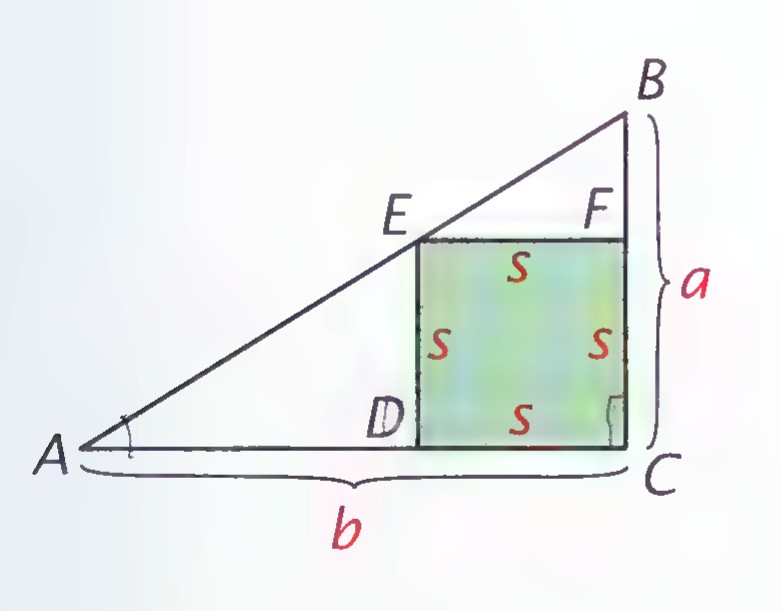
- Why is ABC ~ AED?
- Copy and complete the following proportion: .
- Rewrite the proportion in terms of , , and .
- Solve the proportion for in terms of and .
Compare your answer with the electrical-resistance formula derived in exercises 25 through 30.
- If and in your answer represent two resistances in parallel, what does represent?
Original Proofs. Write proofs for the following exercises.
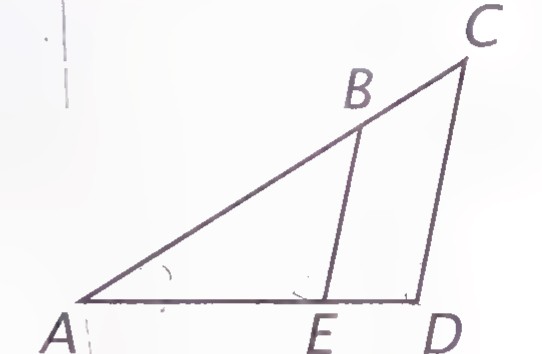
Given: ACD with BE CD.
Prove: ABE ~ ACD.
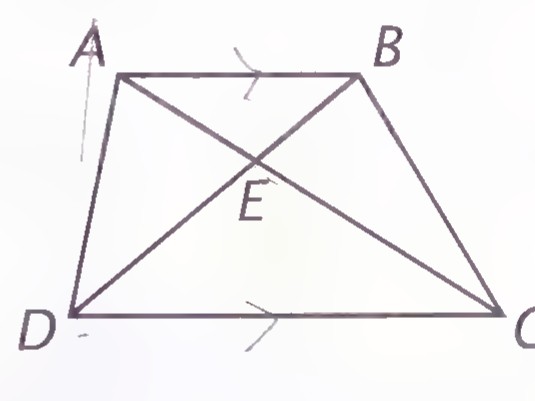
Given: Trapezoid ABCD with bases AB and DC and diagonals AC and BD meeting at E.
Prove: AE × ED = BE × EC.
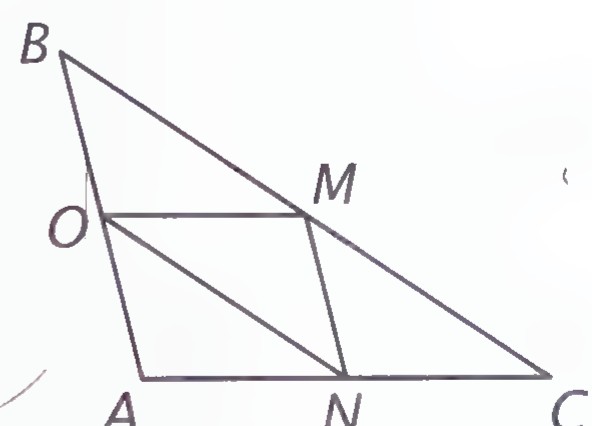
Given: ABC with midsegments MN, MO, and NO.
Prove: MNO ~ ABC.
p. 406
Set III
Dividing Line. Puzzle: To draw a line through point P that divides the figure of nine squares below into two parts of equal area.*
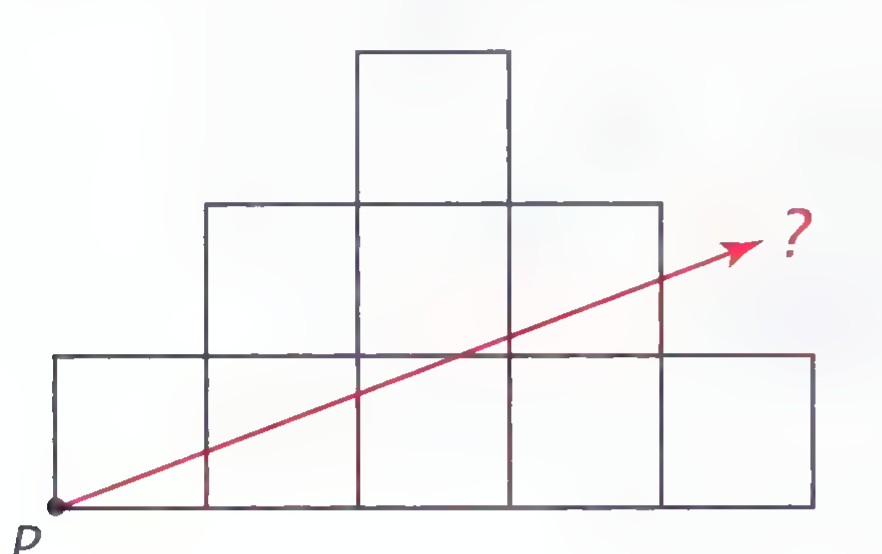
- If the sides of the nine squares are each 1 unit, what are the areas of the two parts?
The figure below shows a way of dividing the region that doesn’t quite work.
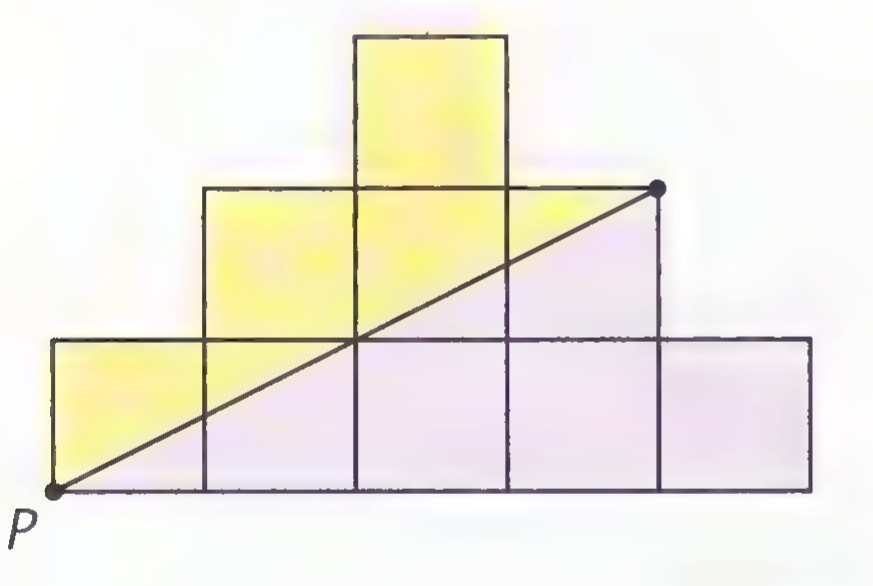
- What are the areas of its two parts?
In the figure below, an extra square has been added, and lines AB (intersecting DE at Q) and PQ have been drawn.
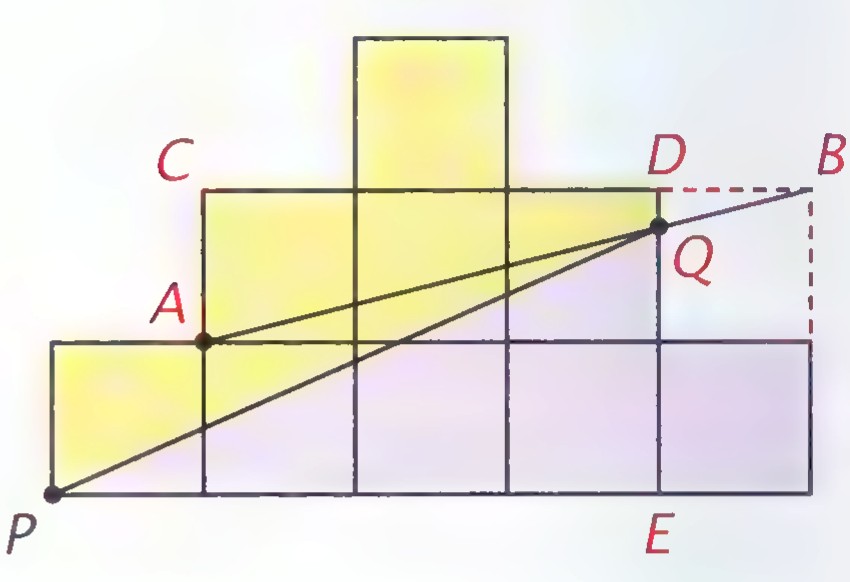
- Why is QDB ~ ACB?
- Why is ?
- To what number is QD equal? Explain.
- What is the area of the purple region?
- Does this figure solve the puzzle?
* Penrose Tiles to Trapdoor Ciphers, by Martin Gardner (W. H. Freeman and Company, 1989).
p. 407
Lesson 5: Proportions and Dilations
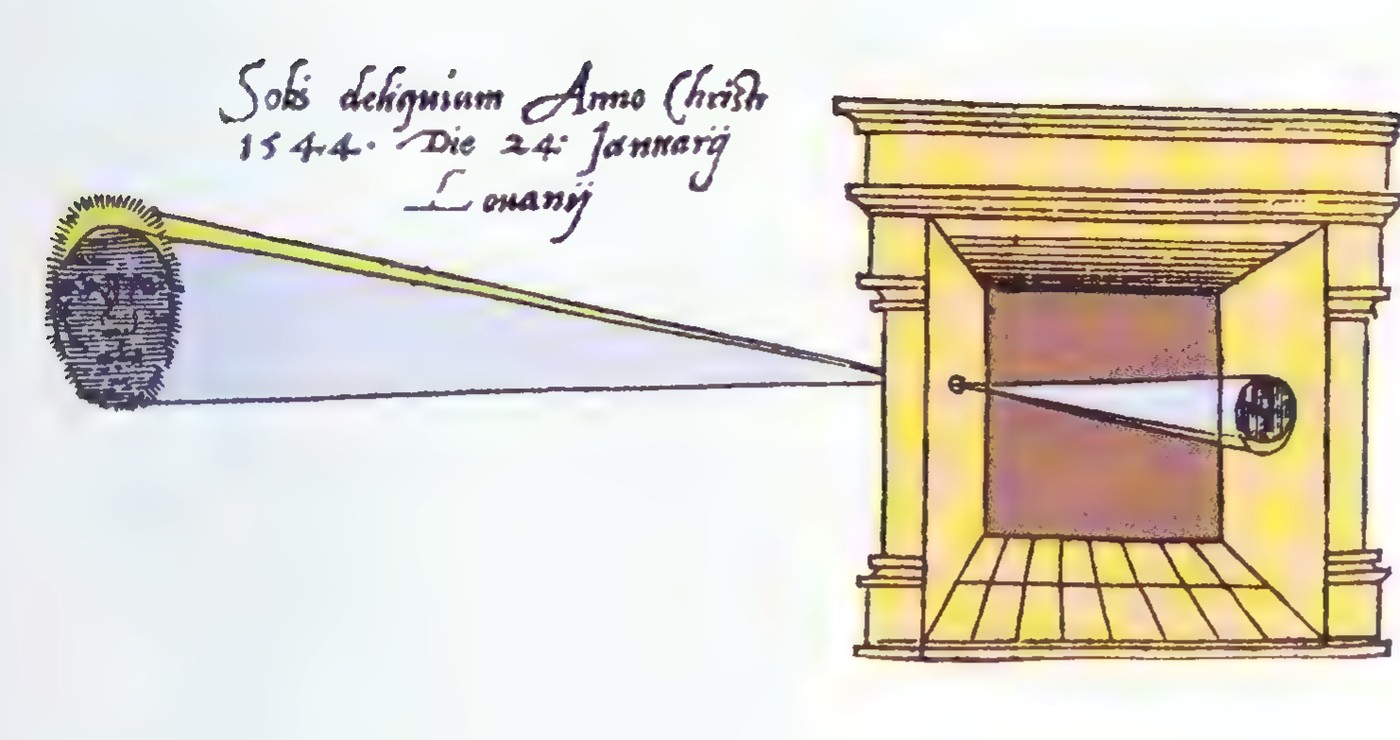
Strange as it may seem, cameras were used long before photography. Their earliest form was the camera obscura, a Latin name meaning “dark room.” The camera obscura, popular in the Middle Ages, was simply a dark room into which light was admitted through a tiny hole. The figure above shows the image of a solar eclipse being formed inside such a camera in 1544. Film for recording the images as photographs was not invented until almost three centuries later.
As you can see in the figure, the camera produces an image that is upside down with respect to the object that it pictures. The size of the image depends on the distance of the object from the pinhole. In the figure at the right, AB represents the object, CD represents the image, and P represents the hole in the wall. If AB DC, it is easy to show that APB ~ CPD.
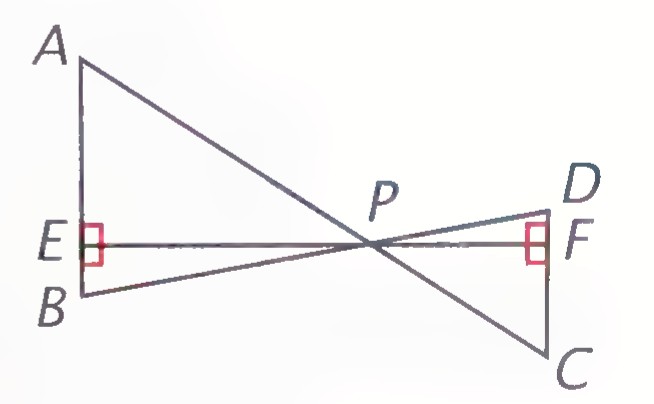
The distances of the object and image from P are the lengths of PE and PF. Altitudes in two triangles such as these are called corresponding altitudes because they are drawn from corresponding vertices of the triangles. It is easy to prove that these altitudes have the same ratio as that of the corresponding sides:
p. 408
Theorem 46
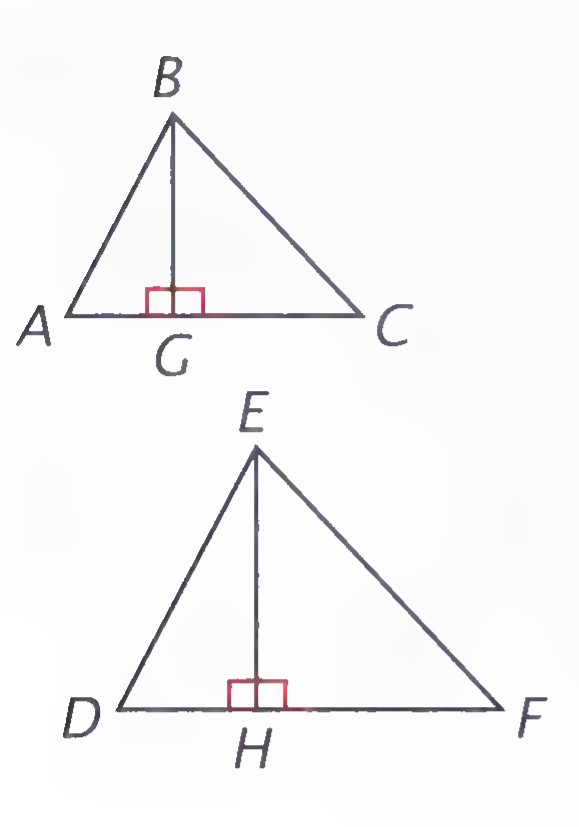
Corresponding altitudes of similar triangles have the same ratio as that of the corresponding sides.
Given: ABC ~ DEF; BG and EH are corresponding altitudes.
Prove: .
Proof*
Because BG and EH are altitudes of ABC and DEF, BG AC and EH DF. It follows that AGB and DHE are right angles, and so AGB = DHE.
Because ABC ~ DEF, we know that A = D (corresponding angles of similar triangles are equal). So ABG ~ DEH (AA), and .
Because ABC ~ DEF, . So by substitution.
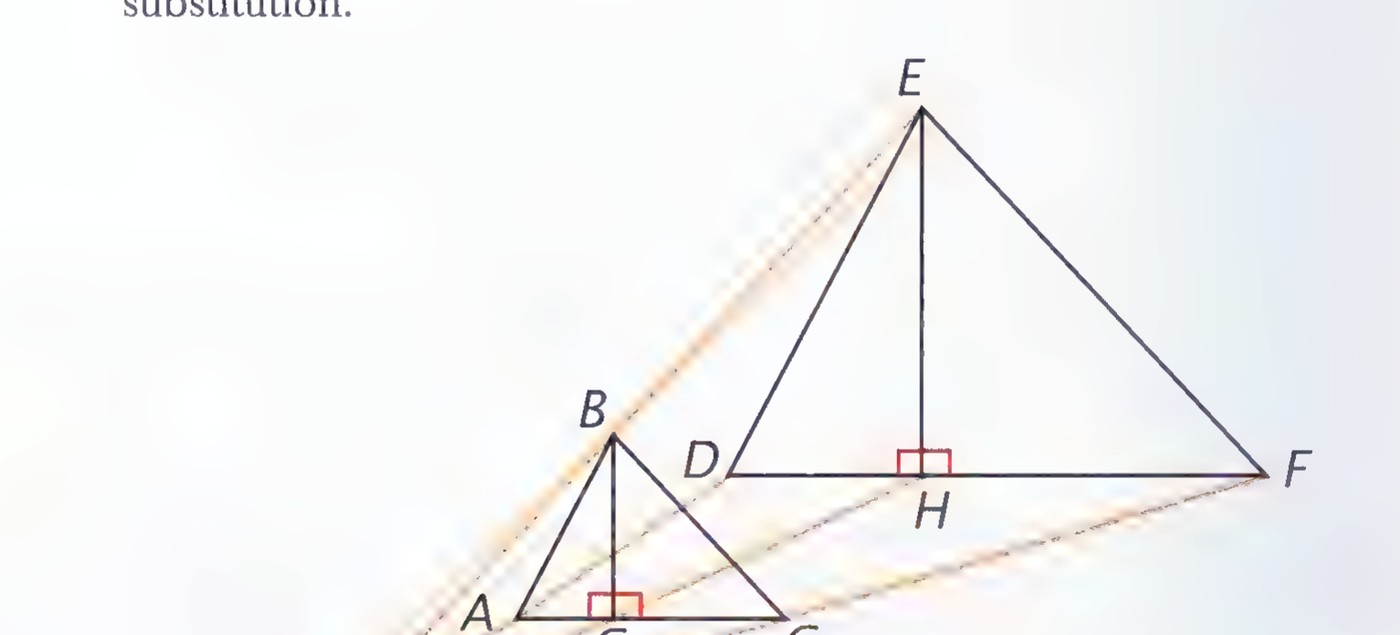
In Lesson 2, we considered the idea of the dilation transformation. This transformation also suggests why the theorem about corresponding altitudes is true. In the figure above, point O is the center of dilation in which DEF and its altitude EH are the dilation images of ABC and its altitude BG. On every ray from point O through a point P on ABC and BG, a point P′ is chosen so that OP′ = OP. In this case, = 2; so OD = 2OA, OE = 2OB, OF = 2OC, and OH = 2OG. As the dilation approach to similarity tells us, when a figure is enlarged or reduced, the distances between all pairs of corresponding points in the figure are changed in the same ratio.
*Our proof is based on figures in which the altitudes are inside the triangles. Similar proofs can be written for the cases in which they are not.
p. 409
Exercises
Set I
Fish Story. How big is the fish? Its apparent size depends on whether you cover the hand or cover the fisherman.*
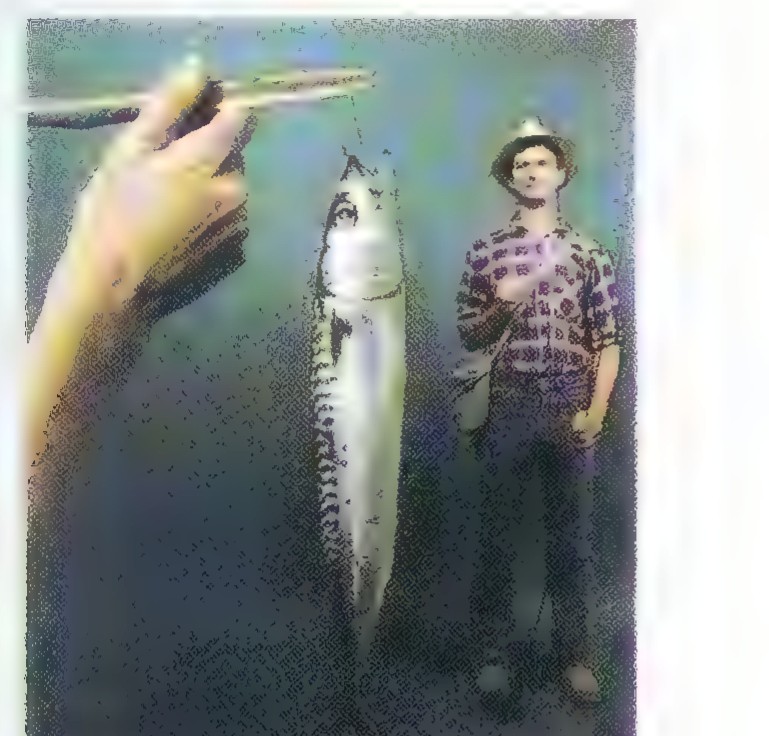
In the figure below, C represents the camera lens, DE the fish, and AB the man.
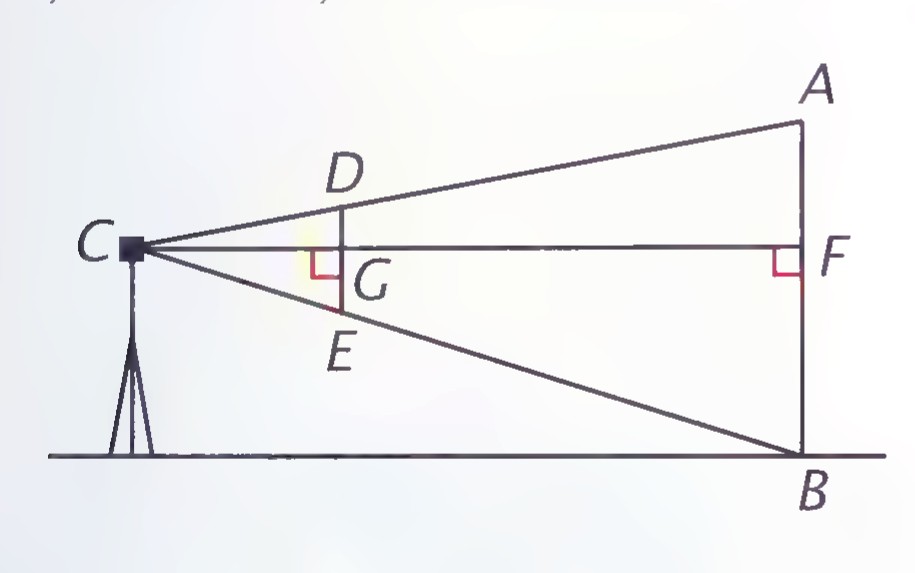
- Which line segments represent the relative distances of the fish and the man from the camera?
- Given that DE CF and AB CF, how do you know that DE AB?
- What can you conclude about CDE and CAB? Explain.
- What are CG and CF called with respect to these triangles?
* Perception, by Irvin Rock (Scientific American Library, 1984).
Copy and complete the following proportion:
State the theorem on which your proportion is based.
If the man is 6 feet tall and is 12 feet from the camera, what other distance would you need to know to be able to figure out the length of the fish?
If that distance is 2 feet, how big is the fish?
In the figure below, either fish can be considered to be the dilation image of the other.
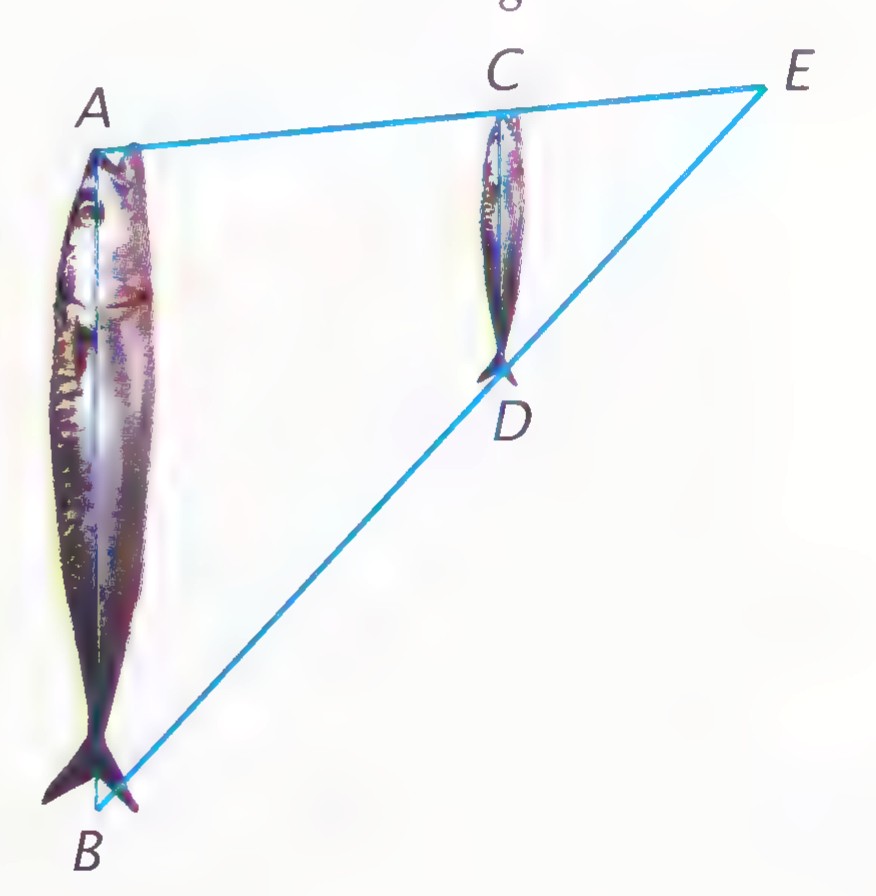
- What is point E called with respect to the dilation?
Measure the following distances in centimeters.
- BE.
- DE.
If AB is the image of CD and is the magnitude of the dilation, then BE = DE.
- Find .
- What does this number indicate about the relative lengths of the two fish?
- Measure AB and CD in centimeters and find .
p. 410
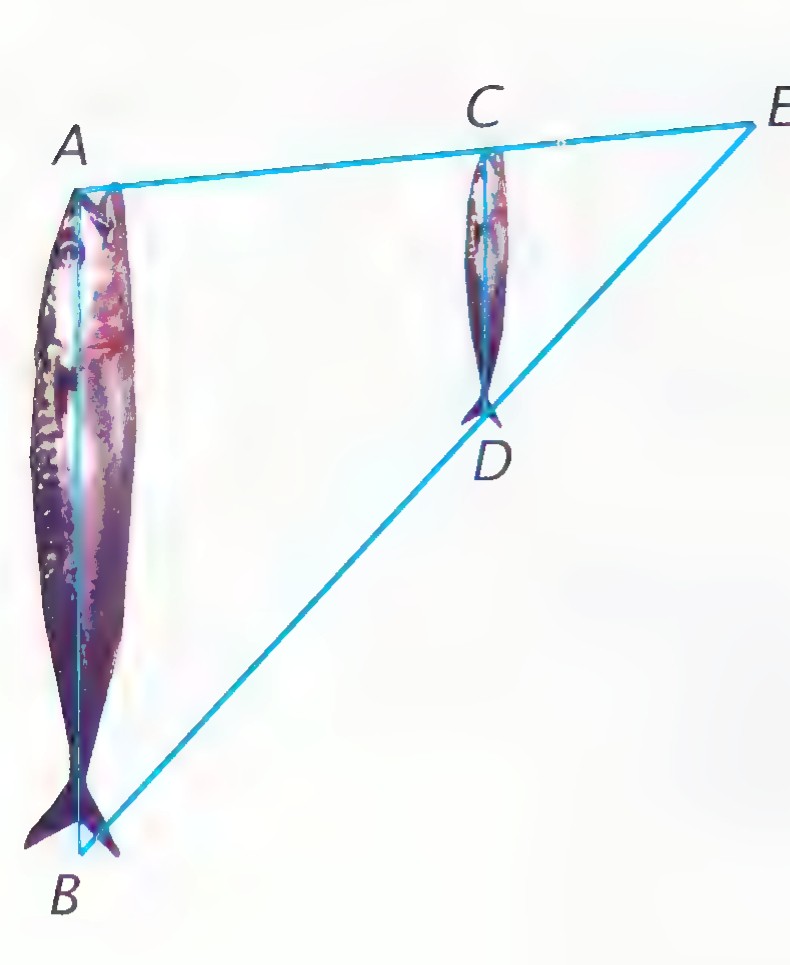
If CD is the image of AB and is the magnitude of the dilation, then DE = BE.
- Find .
- What does this number indicate about the relative lengths of the two fish?
- Use your measurements of AB and CD to find .
- How is the number related to the number ?
Drawing Conclusions. In the figure below, AB ED, AD BE, and AGEF and BGDC are parallelograms.
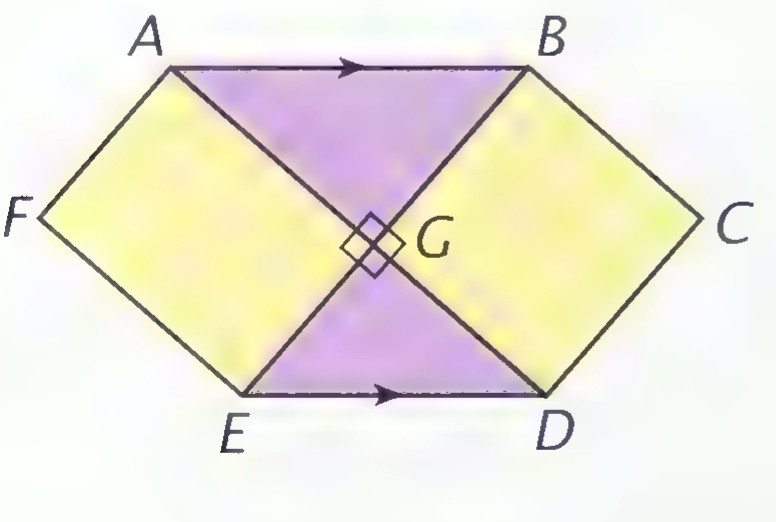
Tell whether or not you think each of the following statements is a reasonable conclusion. In each case, explain why or why not.
- AGB DGE.
- AGB ~ DGE.
- .
- AGEF = BGDC.
- AGB = DGE.
- ADEF = BEDC.
Grid Exercise. On graph paper, draw a pair of axes extending 20 units to the right and 15 units up from the origin.
- Plot the following points and connect them to form ABC: A(4, 8), B(5, 3), C(10, 6).
- Use the transformation on the coordinates of ABC to find the coordinates of A′B′C′. For example, A(4, 8) A′(2 · 4 − 3, 2 · 8 − 4), or A′(5, 12).
- (continued) Draw A′B′C′.
- How does A′B′C′ appear to be related to ABC?
- (continued) Draw lines through the corresponding vertices of the two triangles and extend them across the graph.
- For what type of transformation is A′B′C′ the image of ABC?
- Where is its center?
- What is its magnitude?
Set II
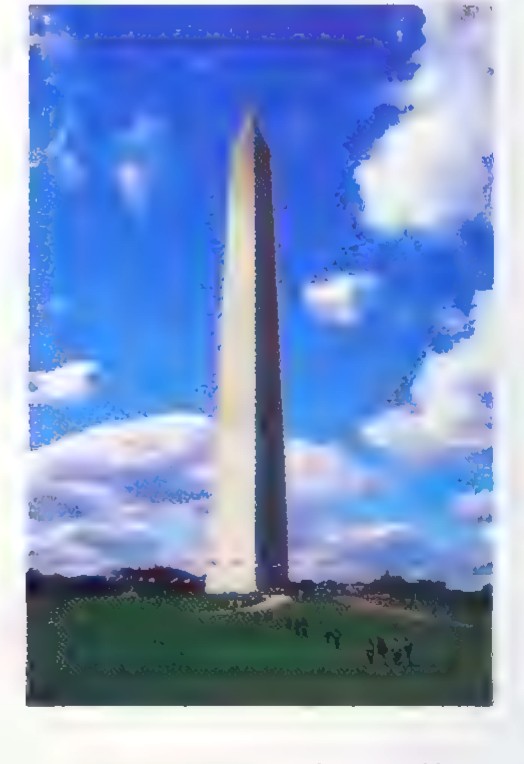
Washington Monument. The tallest structure in our nation’s capital is the Washington Monument.
p. 411
It is a tapered column topped with a small pyramid. The figure below (which is not to scale) shows its dimensions in feet.*
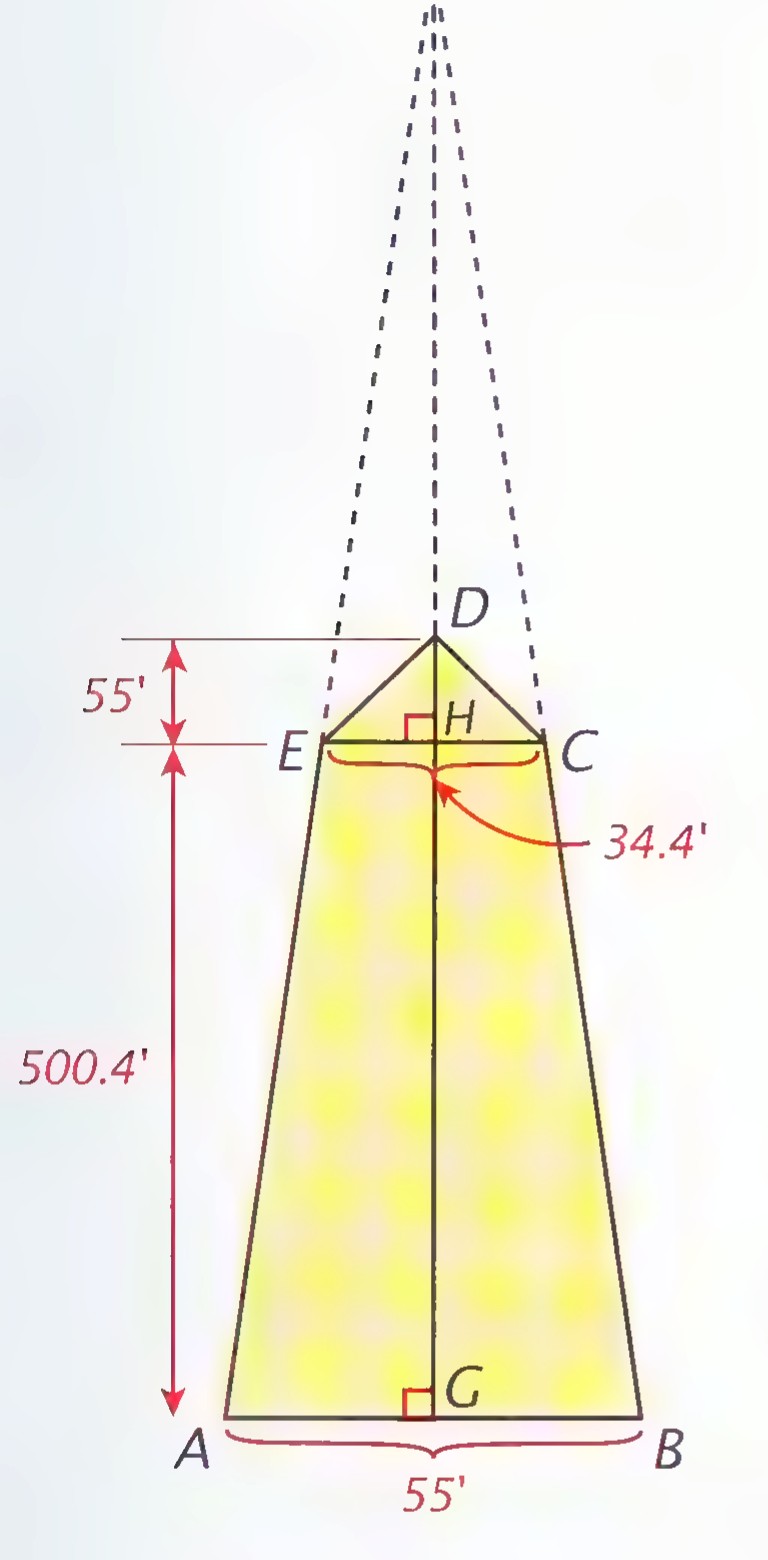
- How tall is the Washington Monument?
The dotted lines show what the monument would look like if its sides did not change direction at E and C.
- Name the pairs of similar triangles in the figure.
- Letting FG = , write and solve a proportion to find out how tall the Washington Monument would be if its sides did not change direction.
* Slicing Pizzas, Racing Turtles, and Further Adventures in Applied Mathematics, by Robert B. Banks (Princeton University Press, 1999).
- State the theorem on which your proportion is based.
Congruence and Similarity. Although you know several ways to prove triangles congruent, we have considered only one way to prove them similar.
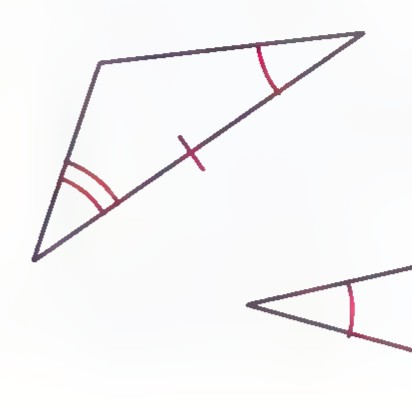
How do you know that the triangles above are
- congruent?
- similar?
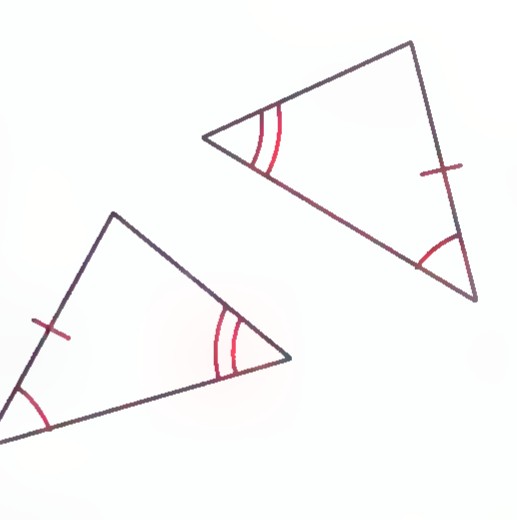
How do you know that the triangles above are
- congruent?
- similar?
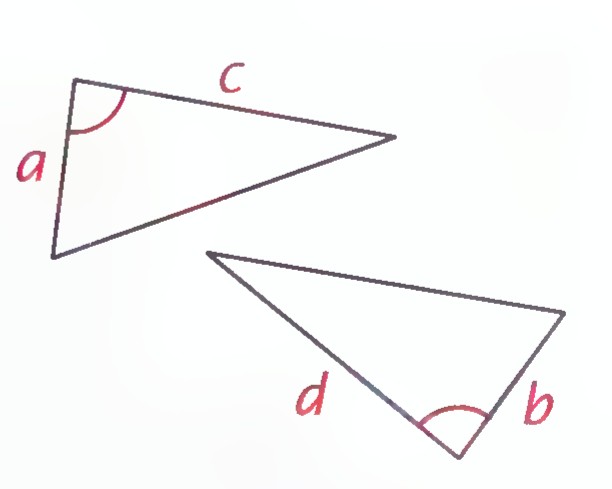
Suppose that, for the triangles above, .
- Would you know that they are congruent if these ratios were equal to 1? Explain.
p. 412
Complete the following proofs by giving the reasons.
SAS Similarity Theorem.
If an angle of one triangle is equal to an angle of another triangle and the sides including these angles are proportional, then the triangles are similar.
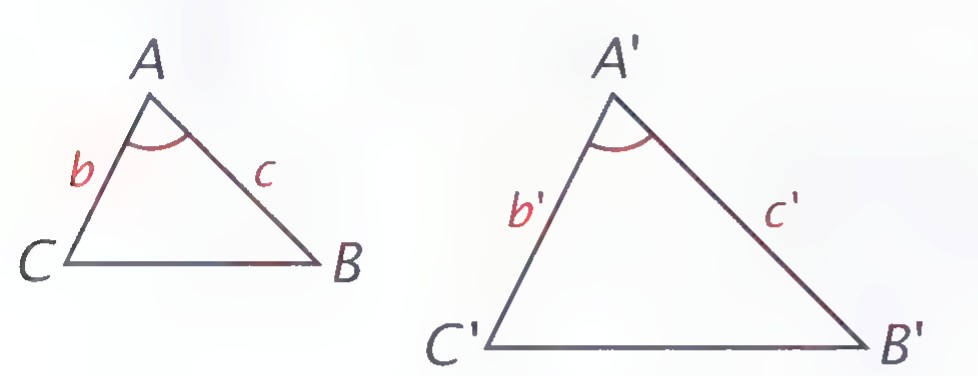
Given: ABC and A′B′C′ with A = A′ and .
Prove: ABC ~ A′B′C′.
To prove this theorem, we will use the same method we used in proving the AA Theorem.
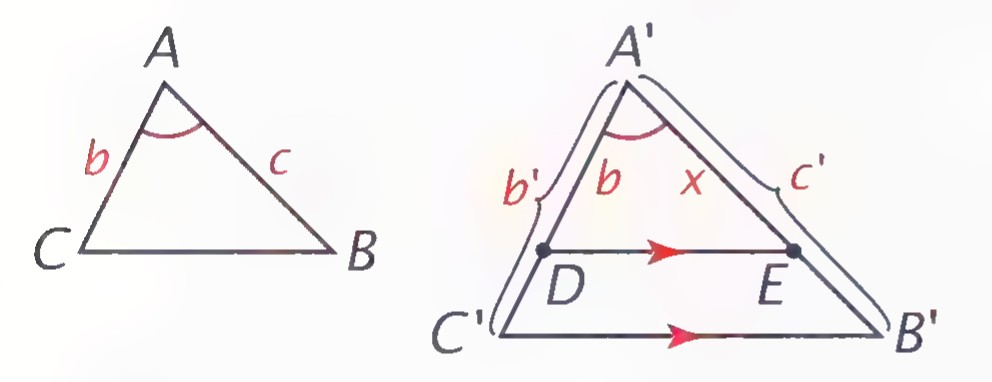
Proof
- Choose point D on A′C′ so that A′D = AC = . Why?
- Through D, draw DE C′B′. Why?
- In A′B′C′, . Why?
- Because (given), it follows that . Why?
- So . Why?
- Therefore, ABC A′ED. Why?
- So C = A′DE. Why?
- Because DE C′B′, A′DE = C′. Why?
- So C = C′. Why?
- Therefore, ABC ~ A′B′C′. Why?
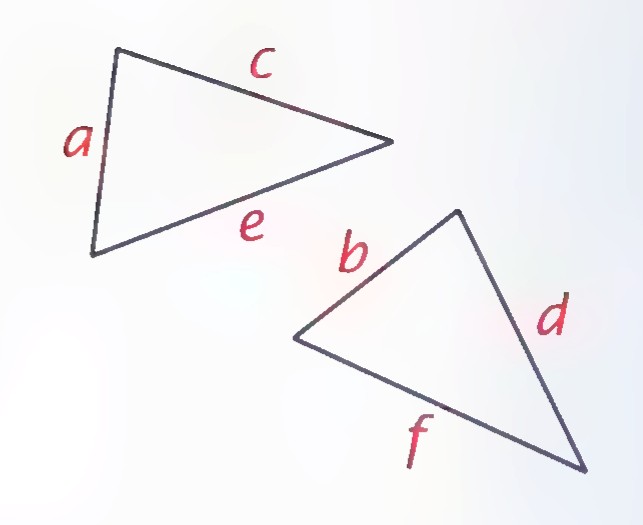
Suppose that, for the triangles above,
- Would you know that they are congruent if these ratios were equal to 1? Explain.
SSS Similarity Theorem.
If the sides of one triangle are proportional to the sides of another triangle, then the triangles are similar.
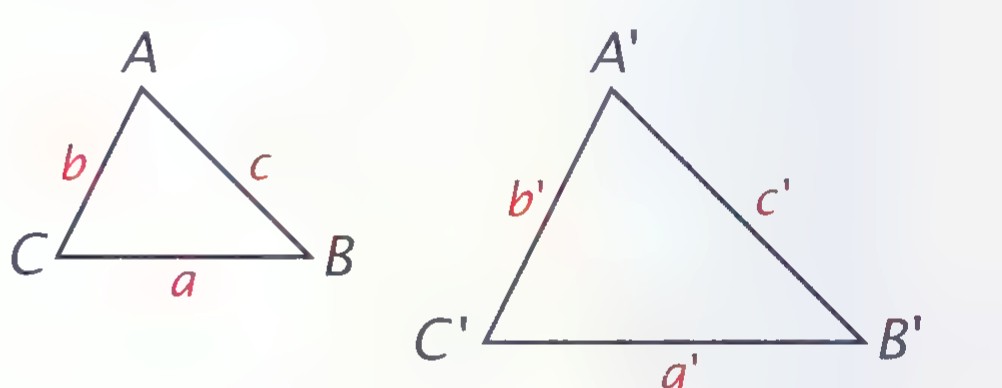
Given: ABC and A′B′C′ with .
Prove: ABC ~ A′B′C′.
The proof of this theorem is similar to the proof of the SAS Similarity Theorem.
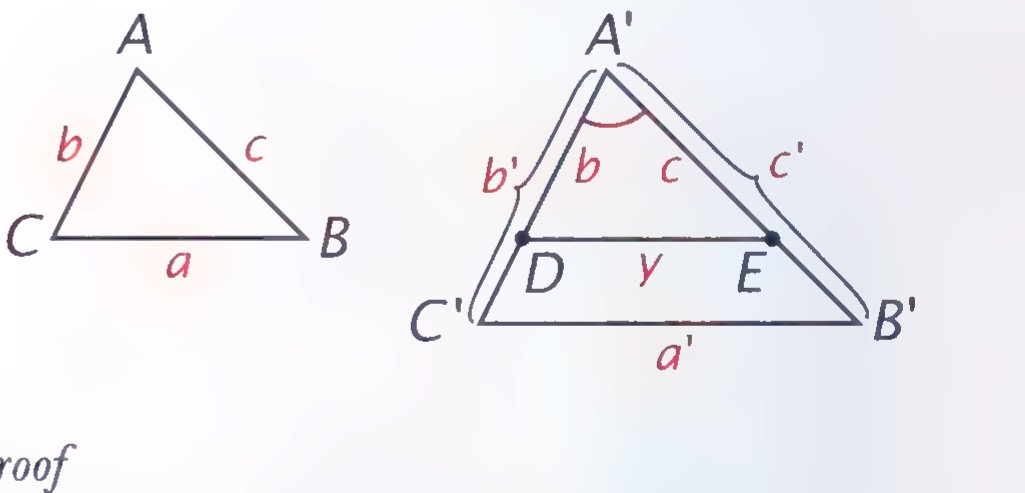
Proof
- Choose point D on A′C′ so that A′D = AC = , and choose point E on A′B′ so that A′E = AB = . Why?
- Draw DE. Why?
- DA′E = C′A′B′. Why?
p. 413
It follows that A′ED ~ A′B′C′ by the SAS Similarity Theorem.
- State this theorem as a complete sentence.
- Because A′ED ~ A′B′C′, it follows that . Why?
- Because (given), it follows that . Why?
- So . Why?
- It follows that A′ED ABC. Why?
- Therefore, A′ED = B and A′ = A. Why?
- So A′ED ~ ABC. Why?
- Because we have already proved that A′ED ~ A′B′C′, it follows that ABC ~ A′B′C′. Why?
Set III
Camera Experiment. You can see how a camera obscura works by doing the following experiment. All that you need is a stiff card (a file card is convenient), a candle, and a dark room.
Poke a hole through the center of the card with your compass point. The hole should have a diameter of about inch. Light the candle and hold it about 6 inches from a wall. Hold the card midway between the candle and the wall with your other hand so that the hole, flame, and wall are in line. You should observe an upside-down image of the flame on the wall.
Hold the card close to the wall and move it toward the candle. What happens to the size of the flame’s image?

In the figure below, AB represents the candle flame, H represents the hole in the card, and CD represents the flame’s image on the wall.
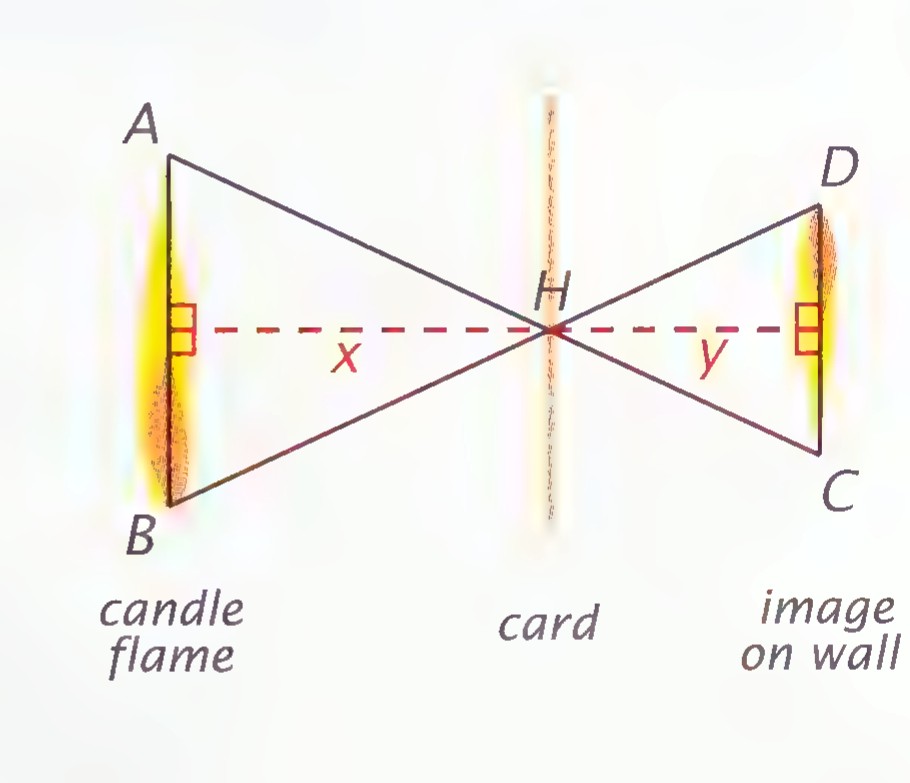
Explain what you observed by doing each of the following exercises.
- Assume that AHB ~ CHD, and derive an equation for CD in terms of AB, , and .
- When the card is moved from the wall toward the candle, what happens to ?
- What happens to ?
- What happens to ?
- What happens to CD?
p. 414
Lesson 6: Perimeters and Areas of Similar Figures
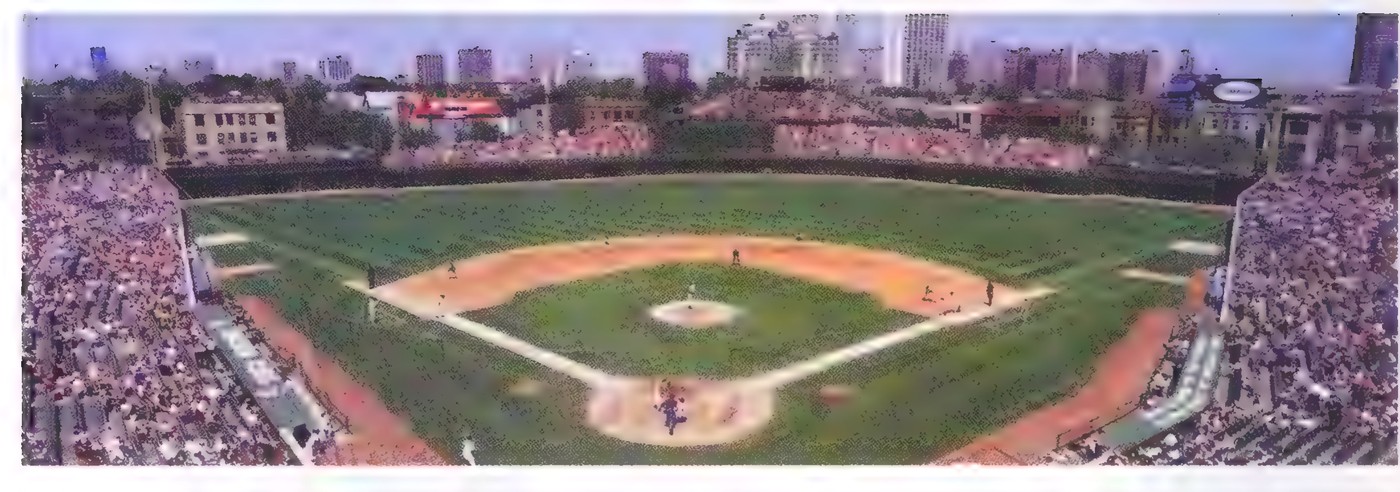
Ever since the rules for baseball were established in 1845, the game has been played on a diamond with bases 90 feet apart. Softball, the scaled-down version of the game first played in 1887, is played on a diamond whose bases are 60 feet apart. How far does a batter have to run to score a run in each game?
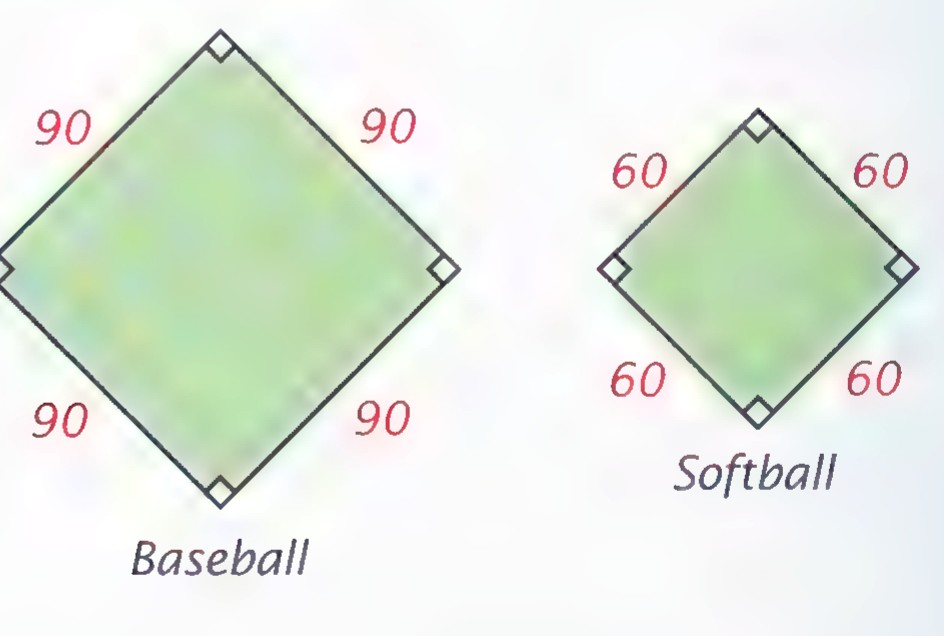
In baseball, the distance is 360 feet; whereas, in softball, it is 240 feet. It is easy to see that these two distances, the perimeters of the diamonds, have the same ratio as that of the lengths of their sides:
Because each side of a baseball diamond is 1.5 times as long as each side of a softball diamond, it makes sense that a baseball player has to run 1.5 times as far as a softball player.
p. 415
What about the areas enclosed by the two diamonds? Does the person who mows the field inside a baseball diamond have 1.5 times as much grass to mow as that inside a softball diamond? The two fields are square in shape; so their areas are = 8,100 square feet and = 3,600 square feet. Comparing the areas of the two fields gives
so their ratio is equal to the square of the ratio of the lengths of their sides.
These results show that, even though the two diamonds are square in shape and therefore similar, their perimeters and areas are related in different ways.
Comparable relations are true for any pair of similar polygons. Although we will derive them for similar triangles, proofs can also be written for polygons having any number of sides. In the same way that we have been using , the first letter of the Greek alphabet, to represent the word “area,” we will use (rho), another Greek letter, to represent the word “perimeter.”
Theorem 47
The ratio of the perimeters of two similar polygons is equal to the ratio of the corresponding sides.
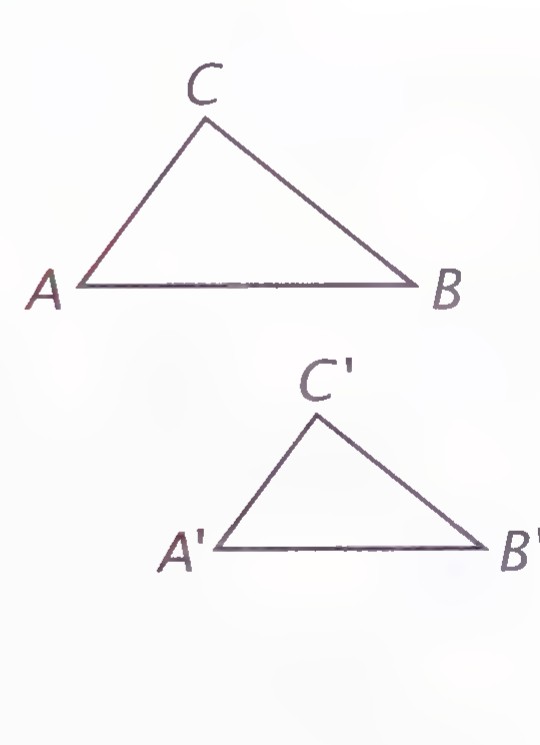
Given: ABC ~ A′B′C′.
Prove: , where .
Proof
Because , it follows by multiplication that
Adding these equations, we get
Because AB + BC + CA = ABC and A′B′ + B′C′ + C′A′ = A′B′C′, we can substitute to get
Dividing gives
p. 416
Theorem 48
The ratio of the areas of two similar polygons is equal to the square of the ratio of the corresponding sides.
Given: ABC ~ A′B′C′.
Prove: , where .
Proof
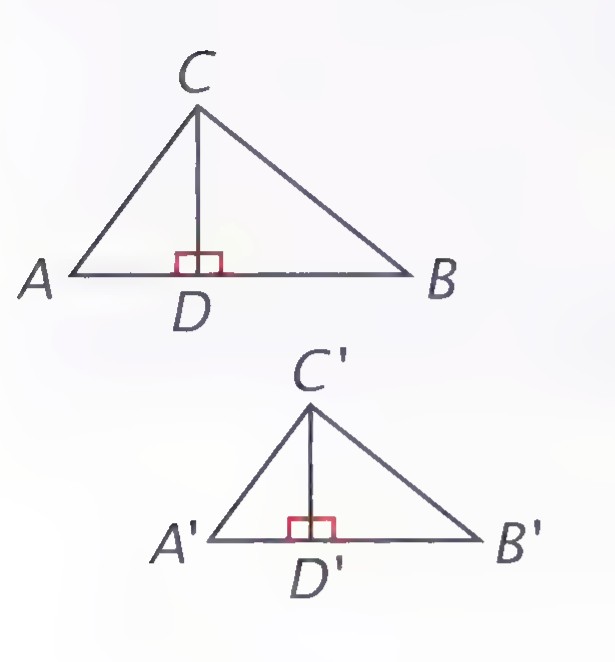
Through C, draw CD AB, and through C′, draw C′D′ A′B′. Because CD and C′D′ are corresponding altitudes of ABC and A′B′C′ and ABC ~ A′B′C′,
(corresponding altitudes of similar triangles have the same ratio as the corresponding sides).
Because ABC = AB · CD and A′B′C′ = A′B′ · C′D′, the ratio of the areas is
Exercises
Set I
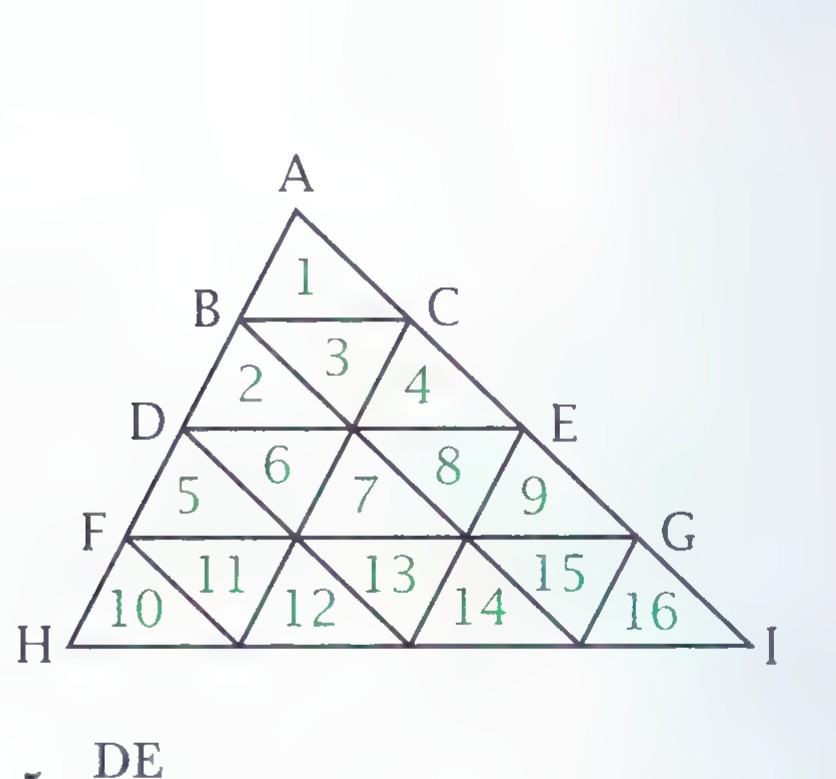
Triangle Ratios. The figure at the right from an old geometry book shows a triangle divided into 16 congruent triangles.*
Find each of the following ratios.
- .
- .
- .
- .
- .
- .
- .
- .
- State the theorem illustrated by exercises 1 through 8.
* First Steps in Geometry, by G. A. Wentworth and G. A. Hill (Ginn, 1901).
p. 417
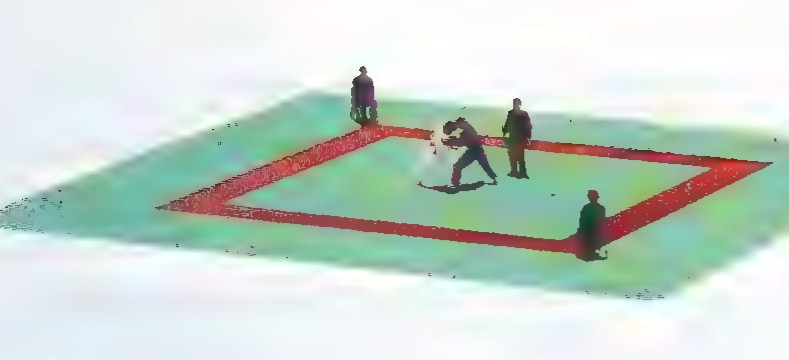
Judo Mat. Judo contests are held on a square mat, the “contest area,” measuring 8 meters on each side. This mat is surrounded by a “danger area” 1 meter wide, which is surrounded by a “safety area” 3 meters wide.*
For convenience, we will use numbers to refer to these three squares as shown in the figure below.
Find each of the following measurements.
- side of 1.
- $$1.
- $$1.
- side of 2.
- $$2.
- $$2.
- side of 3.
- $$3.
- $$3.
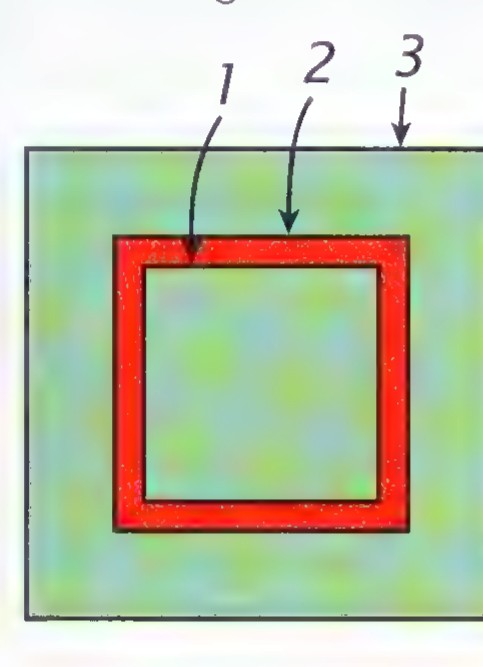
Find each of the following ratios as a common fraction in simplest terms.
- .
- .
- .
- .
- .
- .
Map Scaling. In one of his books, Lewis Carroll once described a map drawn on a scale of a mile to a mile: “It has never been spread out, yet . . . the farmers objected; they said it would cover the whole country, and shut out the sunlight! So now we use the country itself, as its own map, and I assure you it does nearly as well.”
If a map is similar to the country that it represents, what must be true about corresponding
- distances?
- angles?
- areas?
A map in which a foot represents a mile has a scale of
because 1 mile = 5,280 feet.
- On a map of this scale, how many feet would 1 inch represent?
- How many square feet would 1 square inch represent?
- What is the scale of a map in which an inch represents a mile?
- What is the scale of the map described by Lewis Carroll?
* Sports: The Complete Visual Reference, by François Fortin (Firefly Books, 2000).
Set II
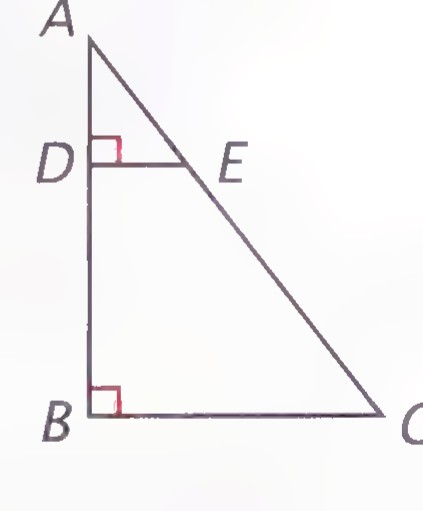
SAT Problem. The figure at the right appeared in a problem on an SAT exam. It was given that the area of ABC = 54 and that AD = AB.
The answers to some SAT problems cannot be determined from the information given.
- Can any conclusion be drawn about ADE and ABC? Explain.
- Is it correct to assume that DE = BC? Why or why not?
- Is it possible to figure out the lengths of AB and BC?
- Is it possible to figure out the lengths of AD and DE?
- Is it possible to figure out the area of ADE? Explain.
p. 418
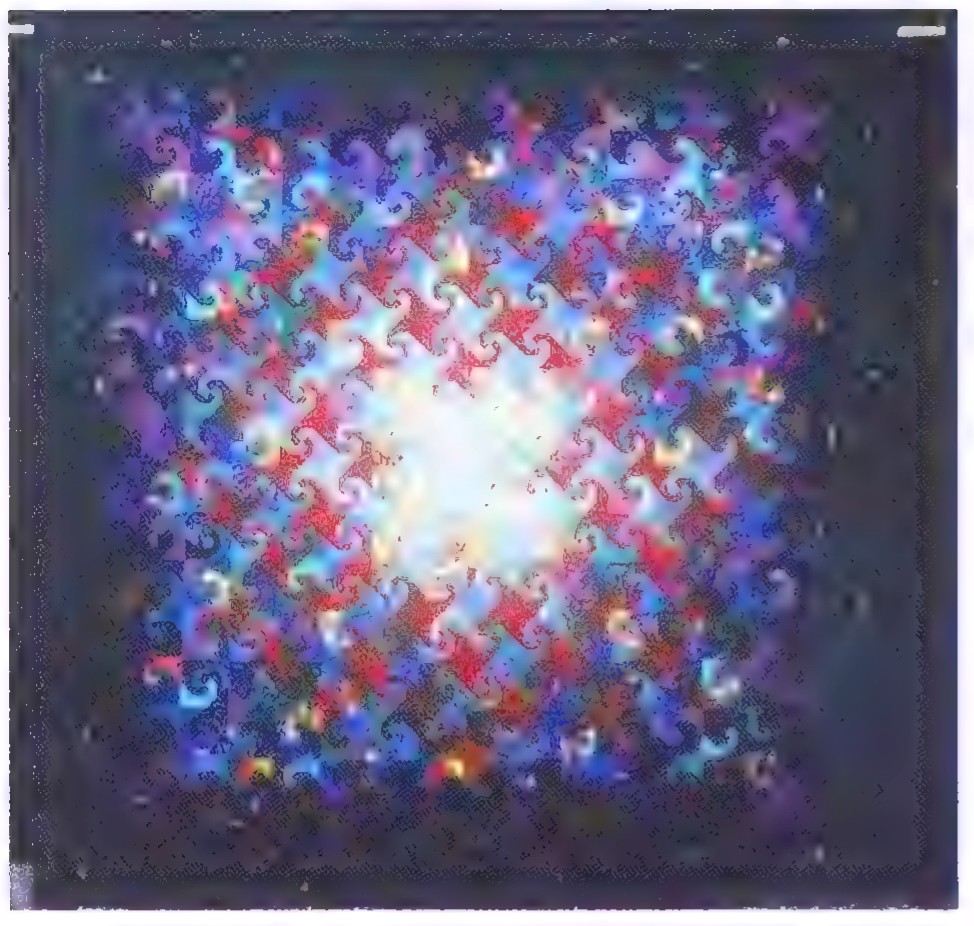
Quilt Pattern. The quilt pictured above, made by Barbara Dean, is based on the pattern of squares shown below.*
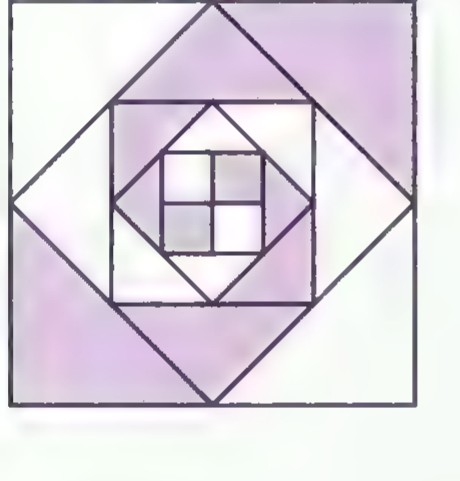
- How many different sizes of squares does the pattern contain?
What is the ratio of
- the area of one of the smallest squares to the area of the next larger square?
- their corresponding sides?
- their perimeters?
What is the ratio of
- the area of the largest square to the area of the next largest square?
- their corresponding sides?
- their perimeters?
* Designing Tessellations: The Secrets of Interlocking Patterns, by Jinny Beyer (Contemporary Books, 1999).
Cranberry Circles. This photograph shows cranberries being gathered into a circle on the surface of a bog in Plymouth, Massachusetts.†
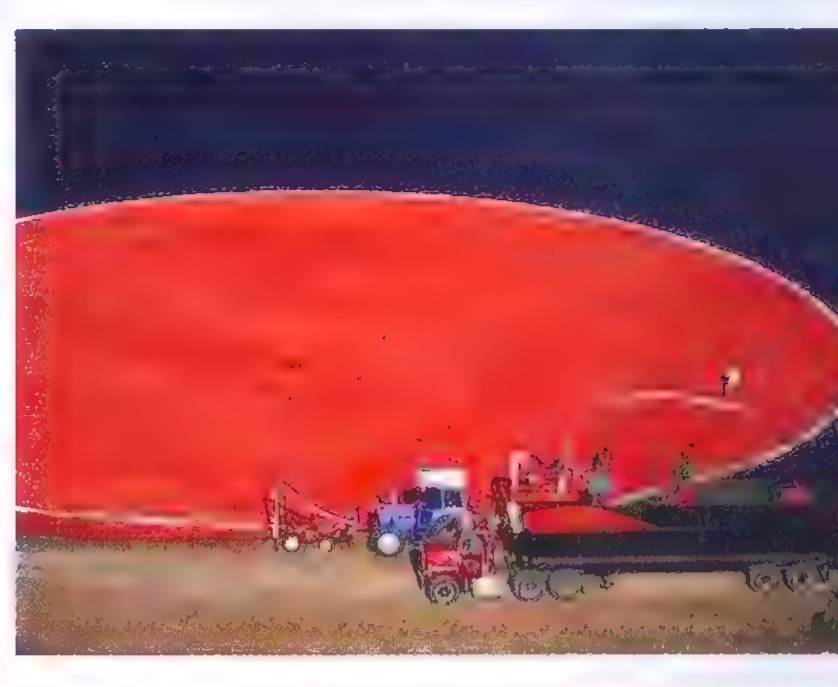
Imagine that the circles below have diameters of 90 feet and 120 feet and that each is filled with a layer of cranberries.
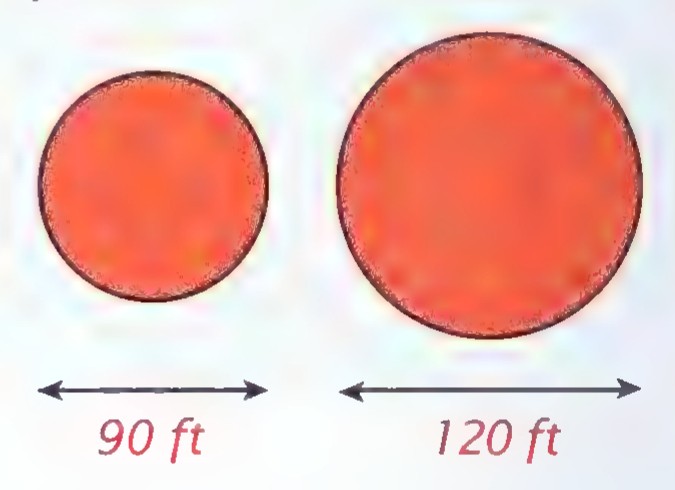
- Why is it reasonable to say that all circles are similar?
- What are the radii of the two circles?
- What are their exact and approximate circumferences?
- What are their exact and approximate areas?
Compare the first circle with the second and find each of the following ratios both as a common and as a decimal fraction.
- The ratio of their diameters.
- The ratio of their radii.
- The ratio of their circumferences.
- The ratio of their areas.
† Look at the Land: Aerial Reflections on America, by Alex MacLean and Bill McKibben (Rizzoli, 1993).
p. 419
Pentagon Measurements. The Pentagon, home of the United States Department of Defense in Arlington, Virginia, is named for its shape.
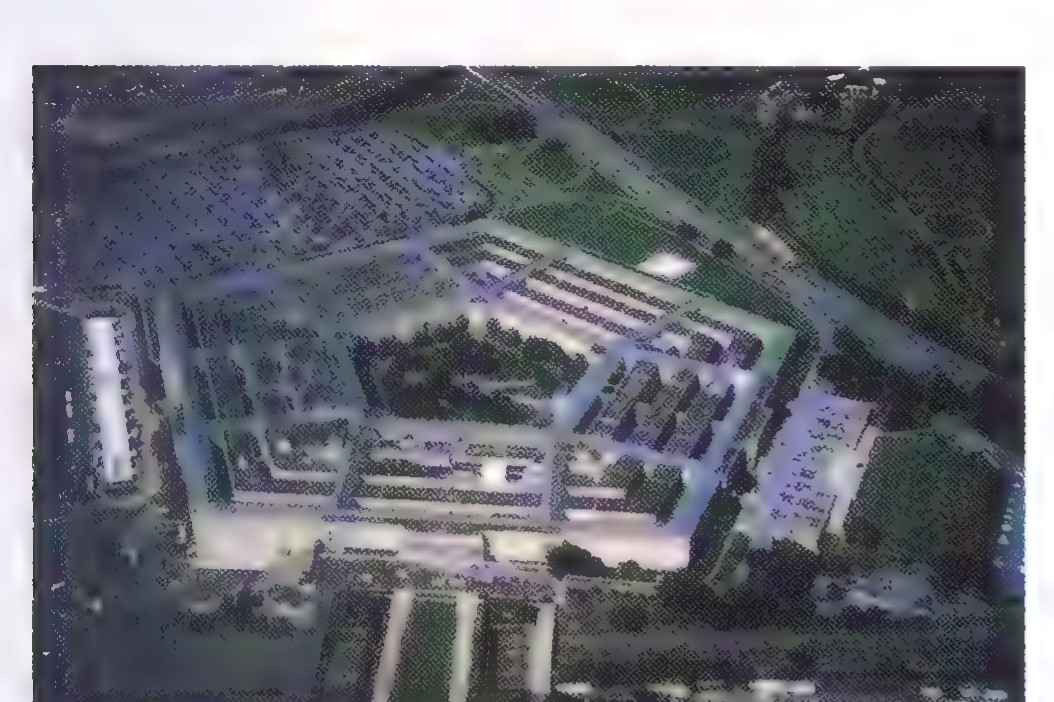
In the scale drawing of the Pentagon below, each side is 1 inch long and each angle is 108°. The area covered by the Pentagon (the blue region in the drawing) is about 1.5 square inches.
The scale used is .
Also, 1 acre = 43,560 square feet.
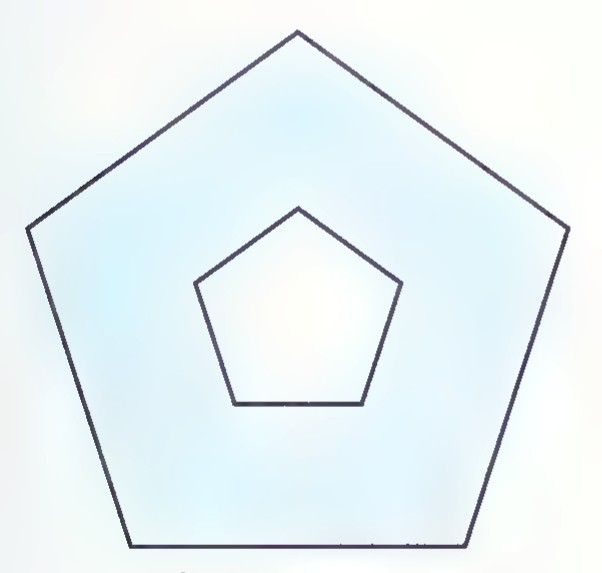
The Pentagon
Find each of the following measurements.
- The measure of each angle of the Pentagon.
- The length of each side of the Pentagon in feet.
- The perimeter of the Pentagon.
- The area covered by the Pentagon in acres.
Set III
Pythagoras on the Sides. According to Pythagoras, the area of the square on the hypotenuse of a right triangle is equal to the sum of the areas of the squares on the two legs.
Would this still be true if pictures of Pythagoras himself were placed on the three sides of a right triangle? Would the Pythagoras on the hypotenuse be equal to the sum of the Pythagorases on the two legs?
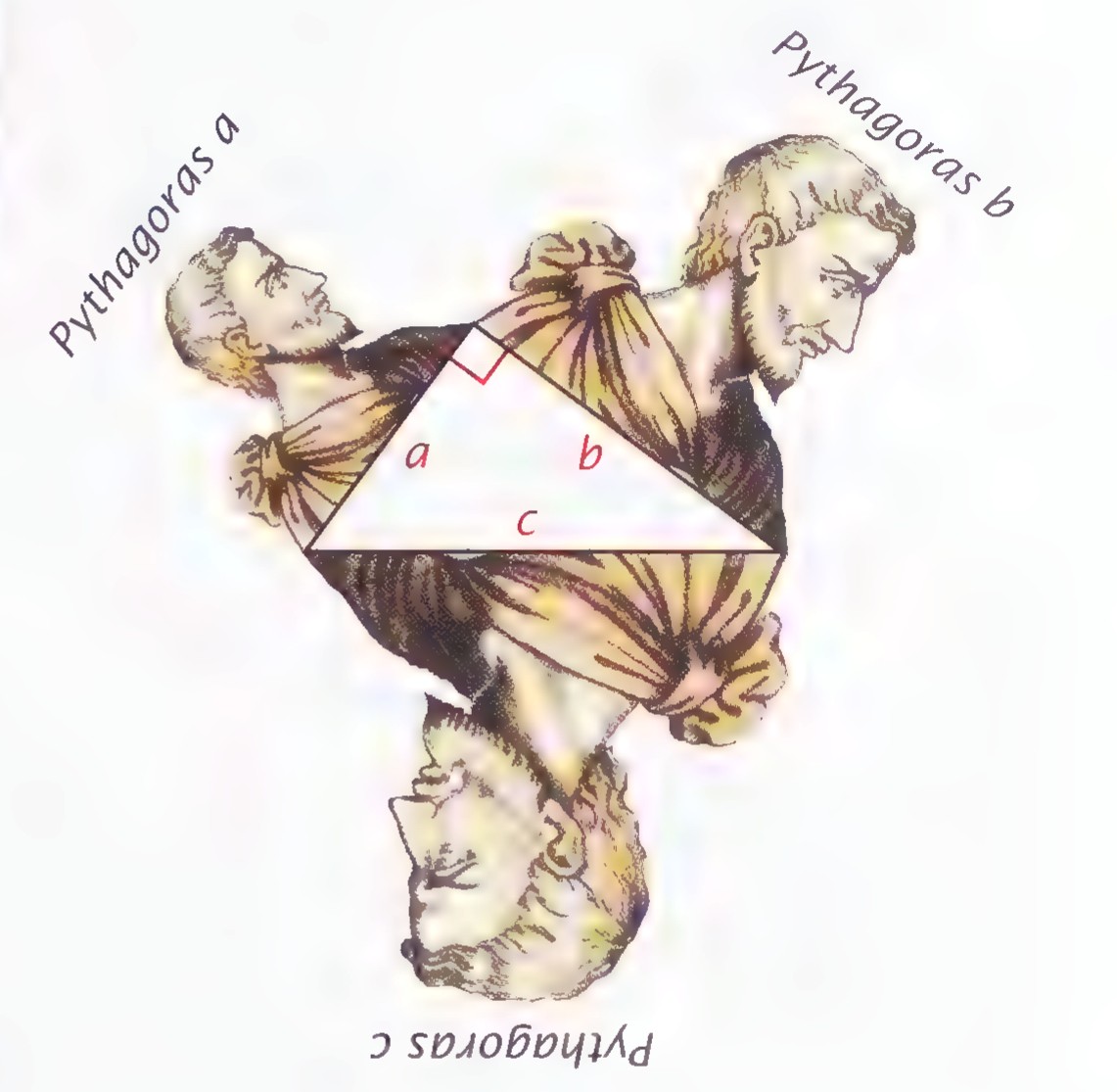
Suppose that, in the figure above, , , and are the lengths of the sides of the right triangle and that the three pictures of Pythagoras (Py.) are similar; that is,
If this is the case, then it seems reasonable to conclude that
Why?
Can you reason from the equations above to show that
p. 420
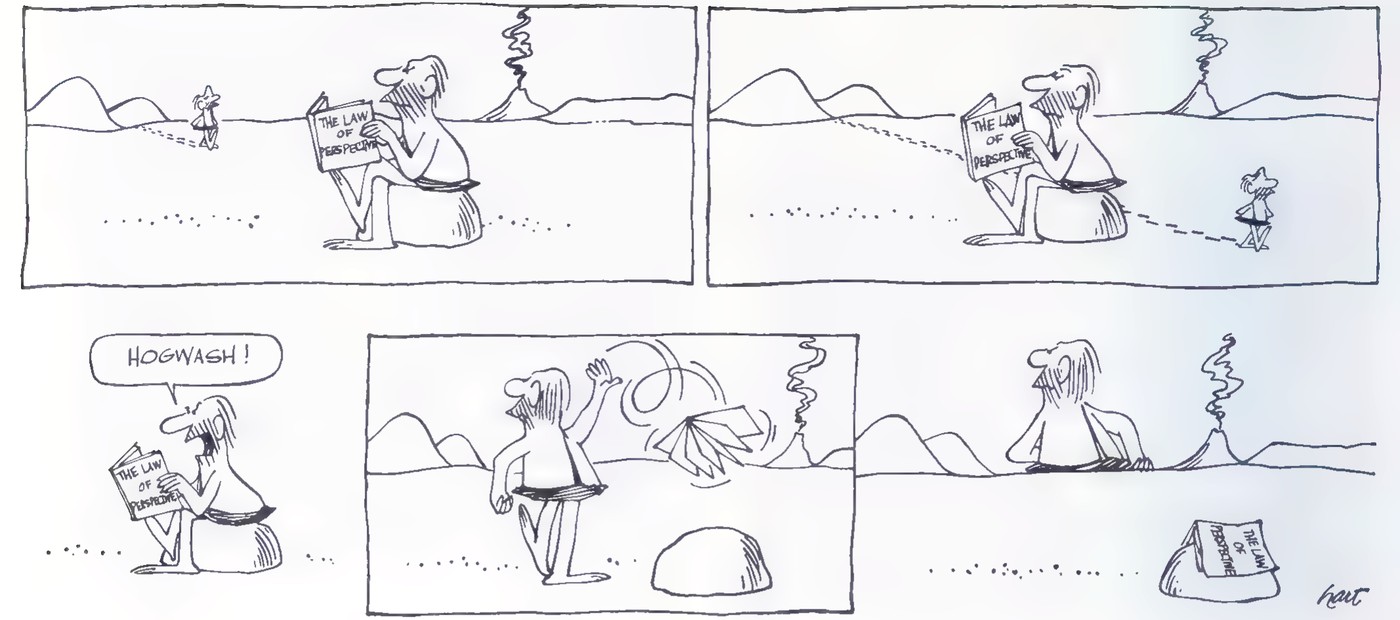
Used by permission of Johnny Hart and Creators Syndicate, Inc.
Summary and Review
Basic Ideas
| Dilation: center, magnitude | 386 |
| Geometric mean | 380 |
| Proportion | 379 |
| Ratio | 379 |
| Similar figures | 386–387 |
| Similar triangles | 386 |
Theorems
The Side-Splitter Theorem. If a line parallel to one side of a triangle intersects the other two sides in different points, it divides the sides in the same ratio. 393
Corollary. If a line parallel to one side of a triangle intersects the other two sides in different points, it cuts off segments proportional to the sides. 394
The AA Theorem. If two angles of one triangle are equal to two angles of another triangle, the triangles are similar. 400
Corollary. Two triangles similar to a third triangle are similar to each other. 401
Corresponding altitudes of similar triangles have the same ratio as that of the corresponding sides. 408
The ratio of the perimeters of two similar polygons is equal to the ratio of the corresponding sides. 415
The ratio of the areas of two similar polygons is equal to the square of the ratio of the corresponding sides. 416
Additional Results
The SAS Similarity Theorem. If an angle of one triangle is equal to an angle of another triangle and the sides including these angles are proportional, then the triangles are similar. 412
The SSS Similarity Theorem. If the sides of one triangle are proportional to the sides of another triangle, then the triangles are similar. 412
p. 421
Exercises
Set I
Body Ratios. The figures below show a 5-month-old infant and an adult drawn as if both were 6 feet tall.*
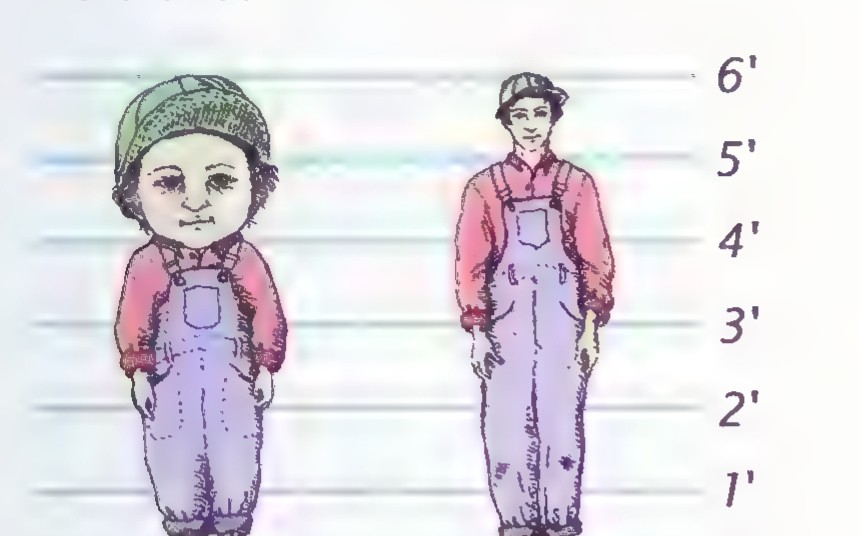
Write each of the following ratios as a simple fraction.
- The length of the infant’s head to the length of the rest of his body.
- The length of the adult’s head to the length of the rest of his body.
- The length of the infant’s arms to the length of his entire body.
- The length of the adult’s arms to the length of his entire body.
Perspective Law. One “law of perspective” is illustrated by the figure below in which DE BC.
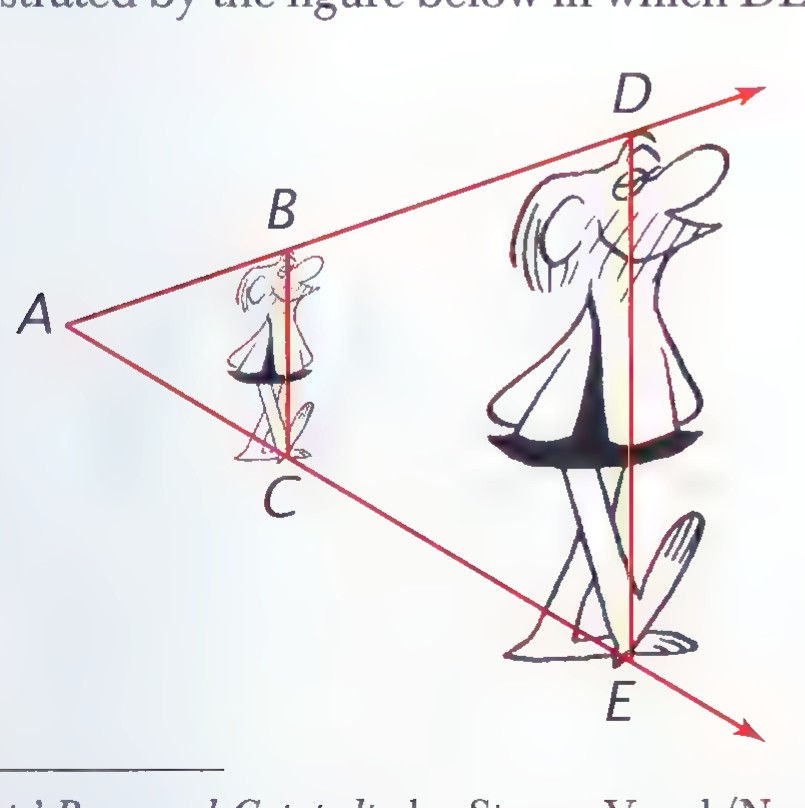
- Why is ?
- Why is ABC ~ ADE?
- Measure each of the following lengths in centimeters: AC, AE, and DE.
- Write and solve a proportion in terms of these lengths to find BC. Then measure BC in centimeters to see if your answer is reasonable.
- How many times as tall as the figure at BC is the figure at DE?
- How does the area of the figure at DE compare with the area of the figure at BC?
Proportion Practice. Find the length marked in each of the following figures.
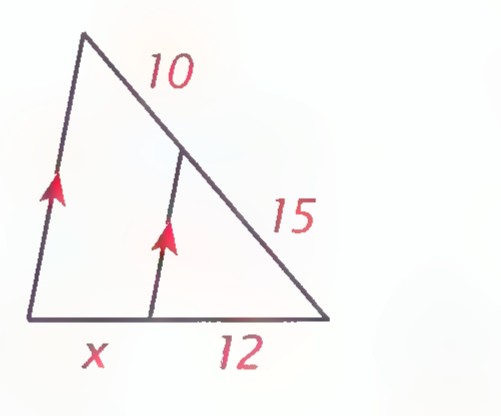
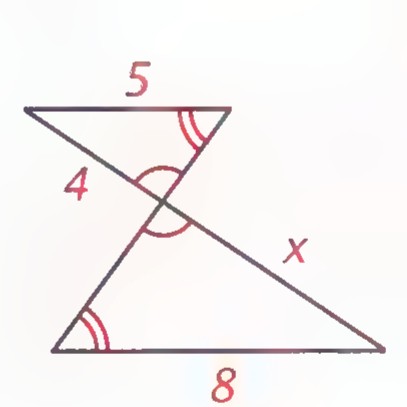
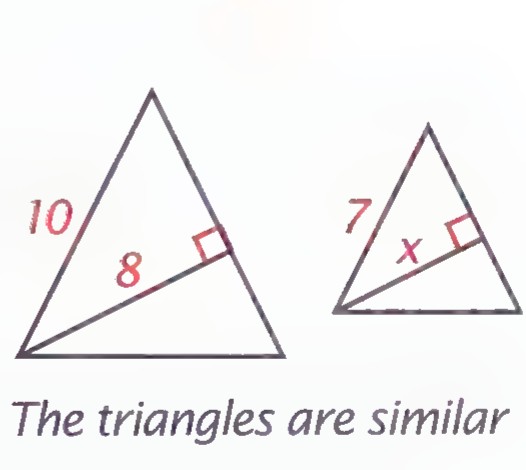
The triangles are similar
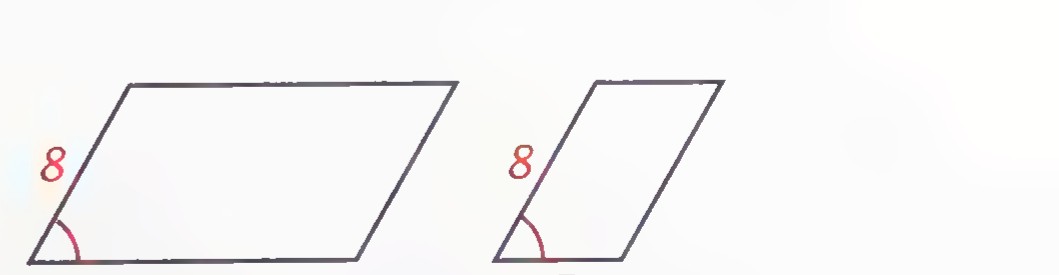
The parallelograms are similar
* Cats’ Paws and Catapults, by Steven Vogel (Norton, 1998).
p. 422
Similar Triangles. The triangles below are similar, and the sides of the larger triangle are 3 times as long as the corresponding sides of the smaller triangle.
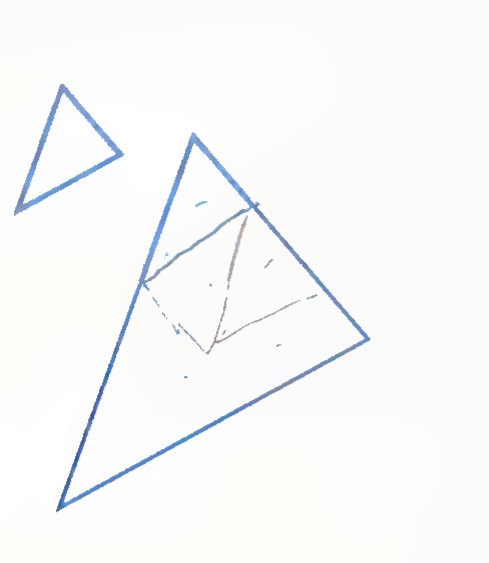
- How many smaller triangles could be packed into the larger?
- Draw a figure to illustrate your answer.
Reptiles. The figure below shows four congruent tiles that have been put together to form a figure that is similar to them.
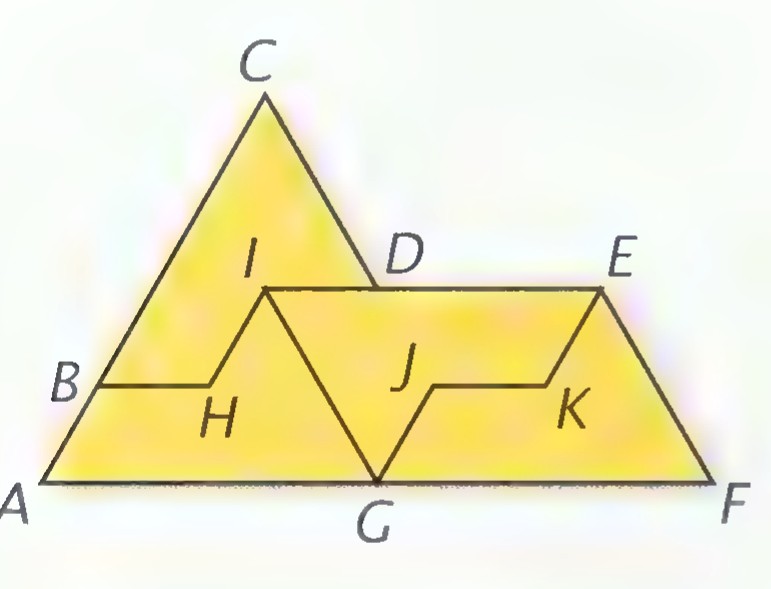
- Exactly what kind of polygons are they?
Copy and complete these correspondences.
- ABHIG E????.
- AFEDC ~ G????.
- What can you conclude about GFEI? Explain.
- Express the area of AFEDC as a multiple of the area of ABHIG.
- Express their perimeters in the same way.
- What is the ratio ?
Free Fall. Galileo used the figure below in his study of the behavior of objects in free fall.*
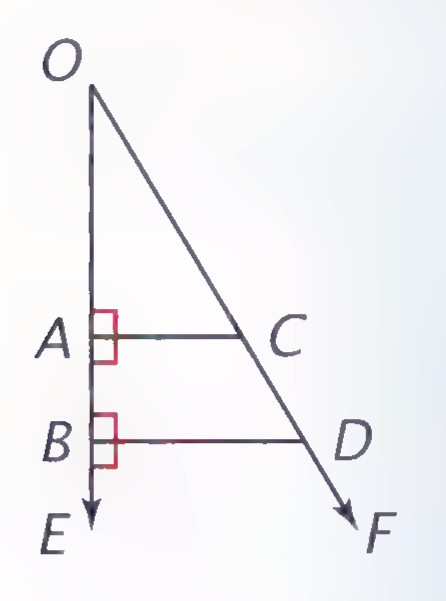
In the figure above, ray OE represents time, and the lengths of AC and BD represent the speed of the falling object at instants A and B; AC OE and BD OE.
- Why is AC BD?
- What happens to the speed of the object as it falls?
- Why is OAC ~ OBD?
- Why is ?
- Why is ?
Type Transformations. The figure below shows several transformations of the letter A into type of different sizes. The sizes are given in “points” (pt).
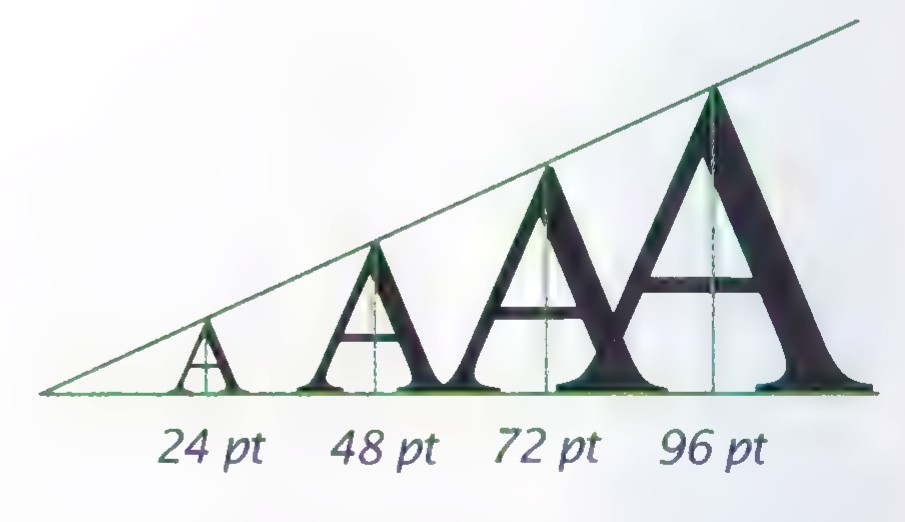
- What are these transformations called?
* Geometry Civilized: History, Culture, and Technique, by J. L. Heilbron (Clarendon Press, 1998).
p. 423
What is the magnitude of the transformation in which
- the 48-point A is the image of the 24-point A?
- the 72-point A is the image of the 96-point A?
As the 24-point A is transformed into the 72-point A, what happens to
- the distances from the center of the transformation to all of its points?
- the angles within the letter?
Set II
Trick Card. The figure below shows the front and back of a trick playing card that seems to get smaller and smaller. A magician secretly folds it in half each time while turning it over to show another card half as large.*
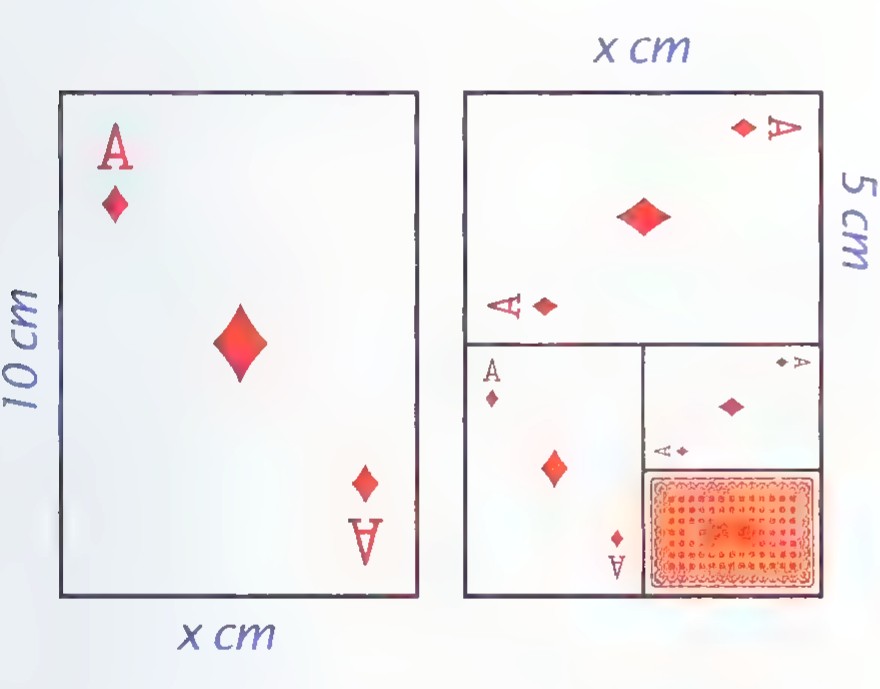
The card is designed so that all four “cards” are similar.
- Use this fact to write and solve a proportion to find , the width of the original card.
- Find the area of the original card.
- Find the ratio of the longer dimensions of the second card and the original card.
- Use this ratio to find the ratio of the areas of the second card and the original card.
- Does your answer seem reasonable? Explain.
* The Unexpected Hanging and Other Mathematical Diversions, by Martin Gardner (Simon & Schuster, 1969).
Catapult. The Roman general Marcellus is attacking the city of Syracuse.† In the overhead view shown below, Archimedes is standing at point A by the city wall and has placed a catapult at point C. A ditch, DE, is parallel to the city wall, CA, and the headquarters of the enemy camp at point B is directly across from Archimedes so that BA CA; also DF CA.
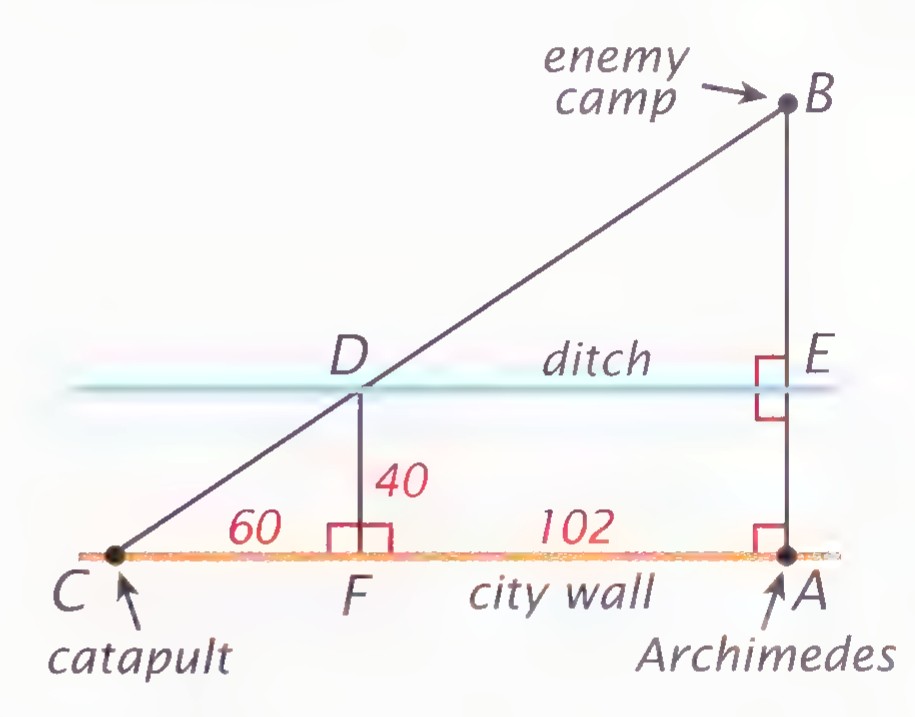
- Given the distances marked on the map, find the distance of the enemy camp from Archimedes.
Leg Splitter. ABCD is a trapezoid with bases AD and BC; EF BC.
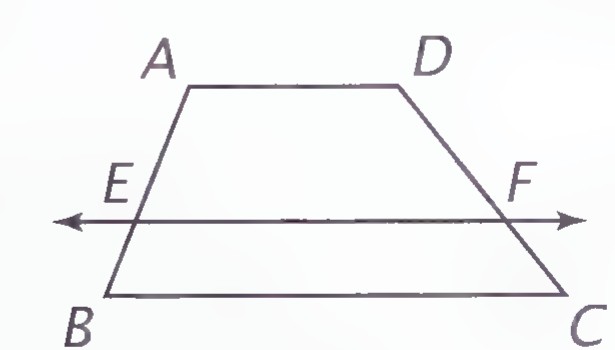
- Copy the figure and mark it as needed to do each of the following exercises.
- EF AD. Why?
†This problem is based on one that appeared in the 1725 edition of the Ladies Diary, a book of puzzles and mathematical problems published yearly in London.
p. 424
- (continued) Draw diagonal AC. Let G be the point in which the diagonal intersects EF.
- and . Why?
- . Why?
- What do exercises 40 through 43 prove about a line that intersects the legs of a trapezoid and is parallel to its bases?
Crossed Ladders. Two long ladders, AB and CD, lean against two buildings as shown below.*
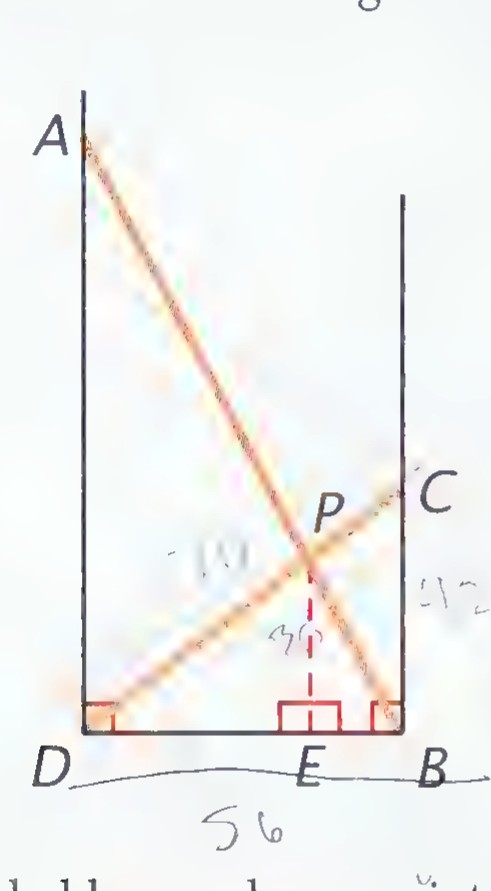
The shorter ladder reaches a point 42 feet above the ground.
- Copy the figure and mark the following distances on it: CB = 42, DE = 40, and EB = 16.
Find each of the following distances.
- PE, the distance of the point in which the ladders cross above the ground.
- AD, the distance that the longer ladder reaches above the ground.
- CD, the length of the shorter ladder.
- AB, the length of the longer ladder.
- The remaining four distances, PA, PB, PC, and PD.
* Mathematical Circus, by Martin Gardner (Knopf, 1979).
Seven Triangles. In ABC, BD AC, EF AC, and AB DE.
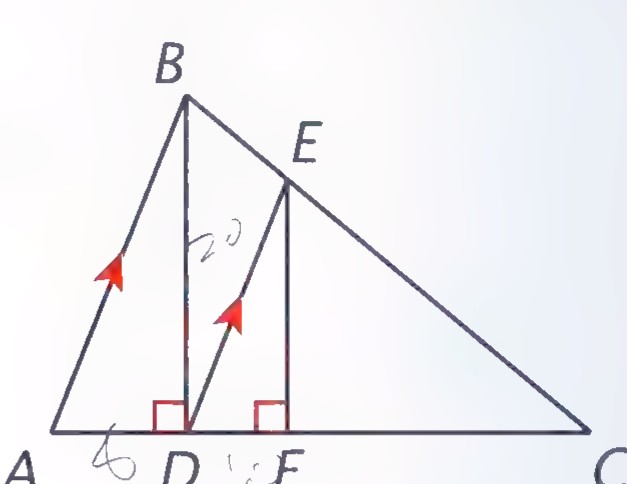
- Find three pairs of similar triangles.
- Copy the figure and mark the following lengths on it: BD = 20, AD = 8, and DF = 6.
Write and solve a proportion to find
- EF.
- FC.
Find each of the following numbers.
- .
- ABD.
- DEF.
- .
- .
- BED.
- DEC.
- .
p. 425
Algebra Review: Quadratic Equations
A quadratic equation is an equation that can be written in the form
This form is called its standard form.
Some quadratic equations can be solved by factoring.
Example 1: Solve .
Solution: Writing the equation in standard form, we get
Factoring the left side, we get
For a product of two factors to be equal to zero, at least one of the factors must be equal to zero, and so
Solving these equations, we get
All quadratic equations can be solved by using the quadratic formula:
The solutions to the equation
can be found by substituting its values for , , and in this formula and simplifying the result.
Example 2: Solve .
Solution: To find , , and , the equation must be written in standard form:
Because , , and ,
The solutions of the equation are and .
Exercises
Solve the following equations by either factoring or using the quadratic formula.
p. 426
Algebra Review: Solving Formulas
In working with formulas, it is often useful to solve for one of the variables in the formula in terms of the other variables.
Example 1: Solve the formula for , given that .
Solution: To do so, we want to end up with an equation beginning with .
Multiplying both sides by gives
and dividing by gives
Taking the square root of each side, we have
(We list only the positive square root because it is given that .)
Example 2: Solve the formula for .
Solution: Factoring the left side of the equation gives
Dividing both sides by gives
Exercises
Solve the following formulas from mathematics and science for the variables indicated. Assume that all of the variables represent positive numbers.
- for .
- for .
- for .
- for .
- for .
- for .
- for .
- for .
- for .
- for .
- for .
- for .
- for .
- for .
- for .
- for .
- for .
- for .
- for .
- for .
- for .
- for .
- for .
- for .
- for .