p. 257
Chapter 7: Quadrilaterals
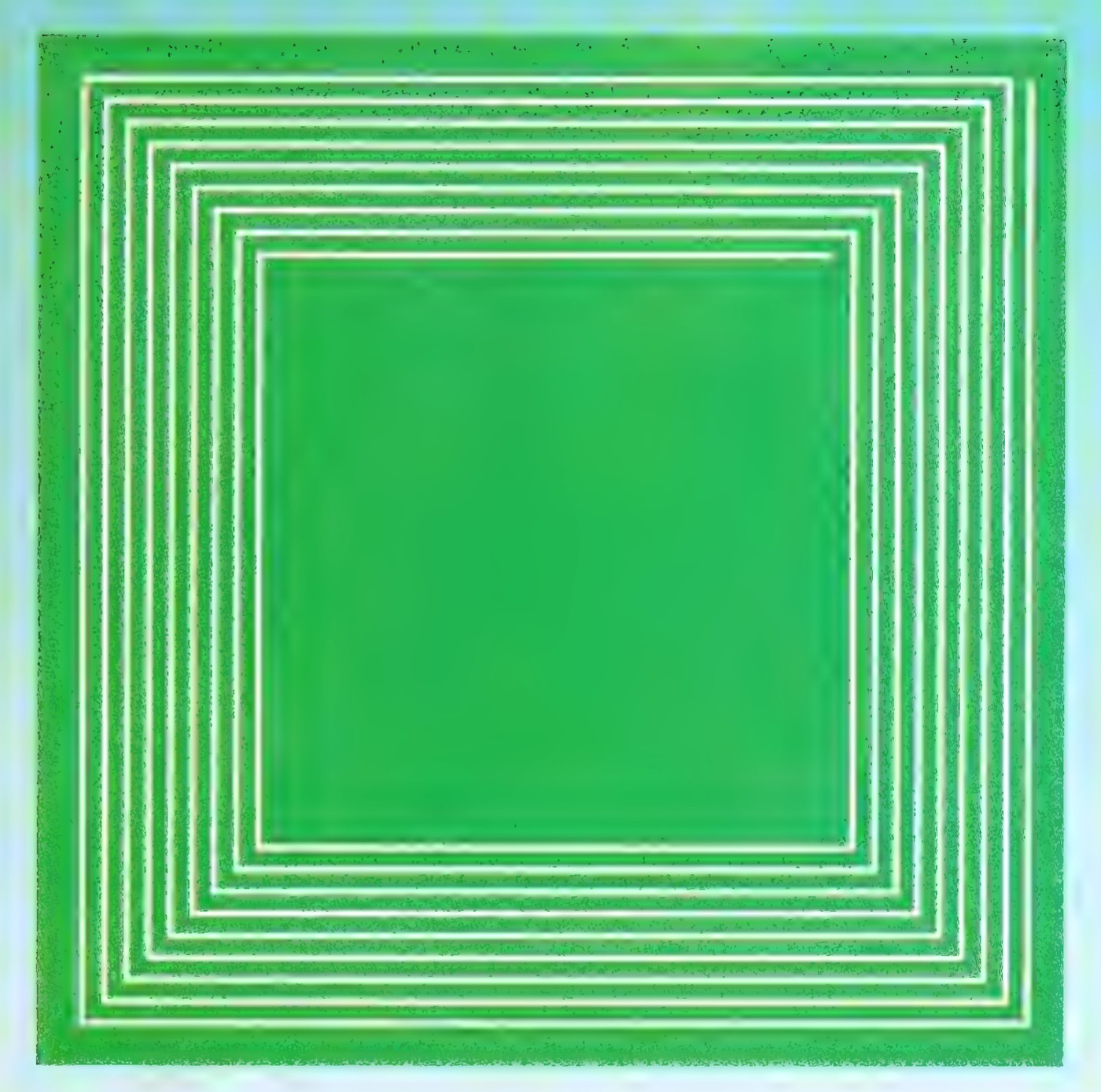
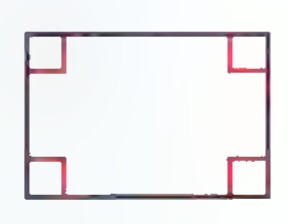
How many squares does this figure contain?
This page is rectangular, as are the doors that you walk through and the floors that you walk on. Rectangles, squares, parallelograms, and other quadrilaterals are found everywhere. In this chapter, you will see that what you know about triangles and parallel lines can be applied to understanding the geometry of quadrilaterals. To learn to see and identify the various types of quadrilaterals and to instinctively know their properties are the goals of this chapter.
p. 258
Lesson 1: Quadrilaterals
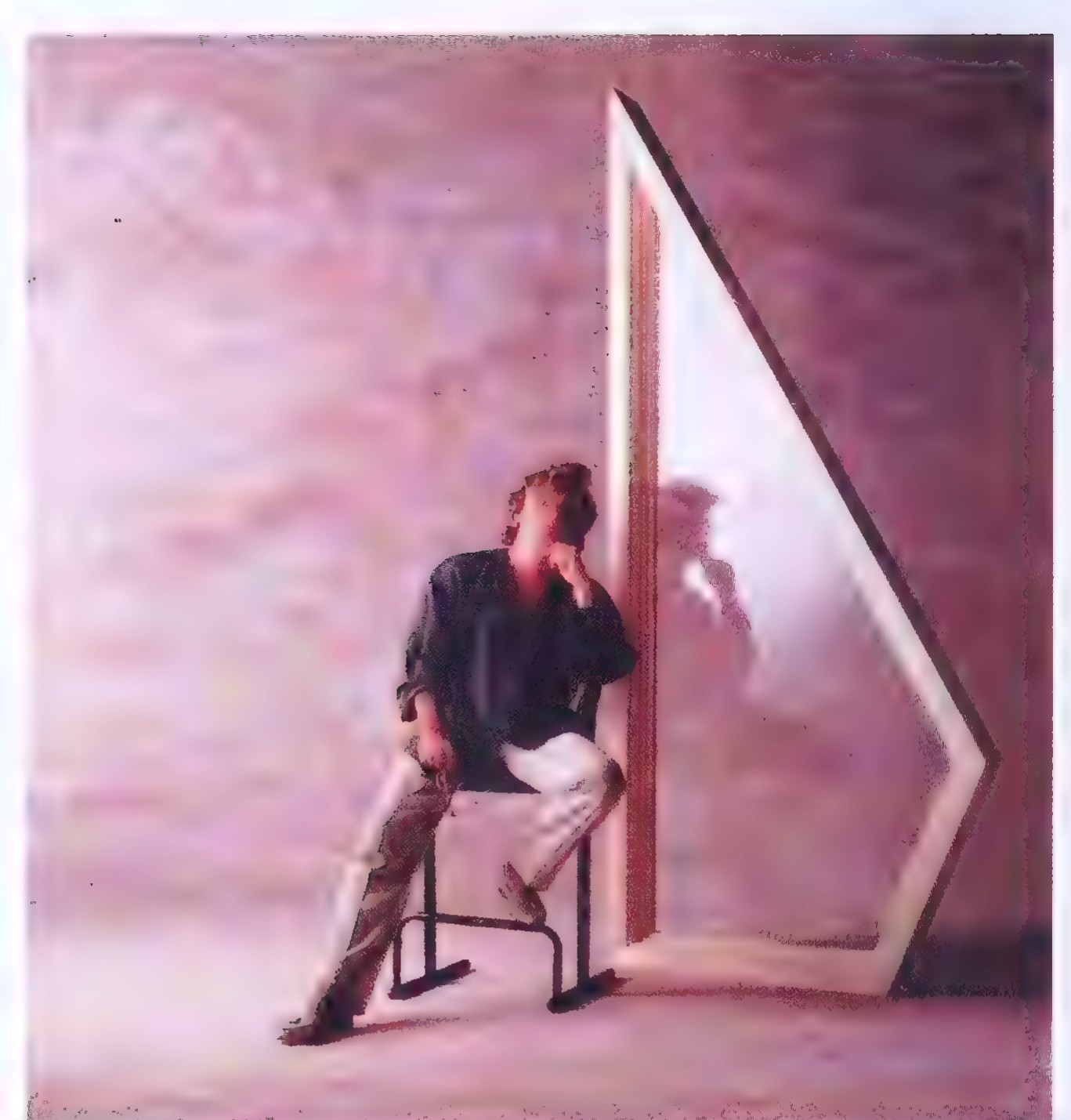
The window in the above photograph, used in an ad for the Marvin Window and Door Company, has an unusual shape. Unlike most windows, which are rectangular in shape, it appears to have only one right angle and sides of four different lengths. It is like a rectangle, however, in that it is a quadrilateral and is convex.
A polygon is convex if, for each pair of points inside the polygon, the line segment connecting them lies entirely inside the polygon. Examples of such segments are shown in green in the convex polygons at the left. A polygon is concave if, for a pair of points inside the polygon, the line segment connecting them does not lie entirely inside the polygon.
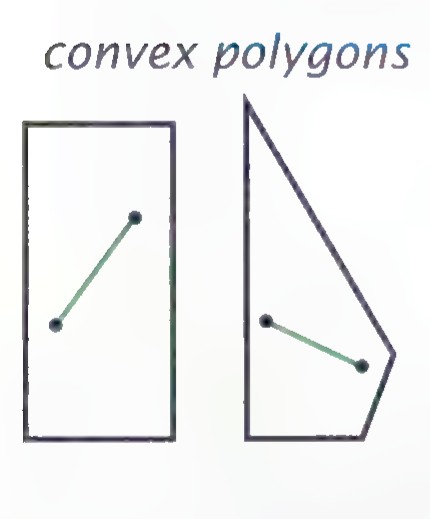
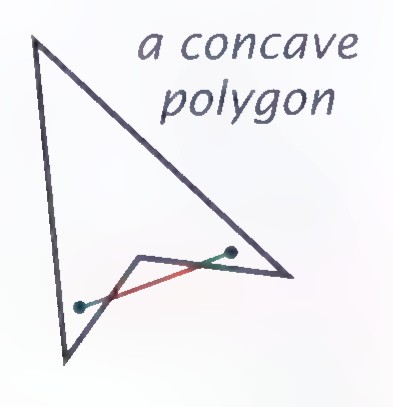
Although all triangles are convex, quadrilaterals and other polygons may be convex or concave. For convenience, when we deal with any polygon having more than three sides, we will always consider it to be convex unless stated otherwise.
p. 259
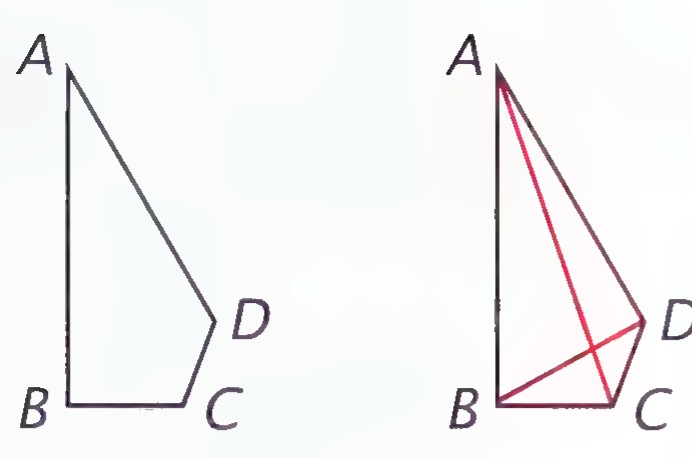
Two sides of a quadrilateral that intersect, such as AD and DC in the figure at the left above, are called consecutive. A pair of sides that do not intersect, such as AB and DC, are called opposite. The same terms are applied to the vertices and angles of a quadrilateral; ∠A and ∠D, for example, are consecutive angles; points A and C are opposite vertices.
Every quadrilateral also has two diagonals (AC and BD in the example at the right above).
Definition
A diagonal of a polygon is a line segment that connects any two nonconsecutive vertices.
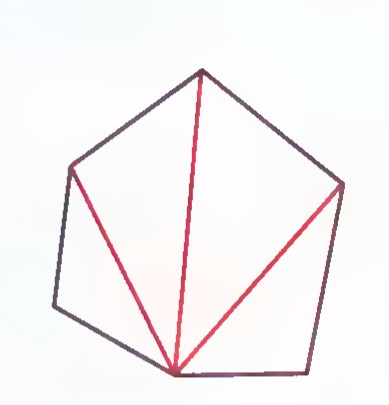
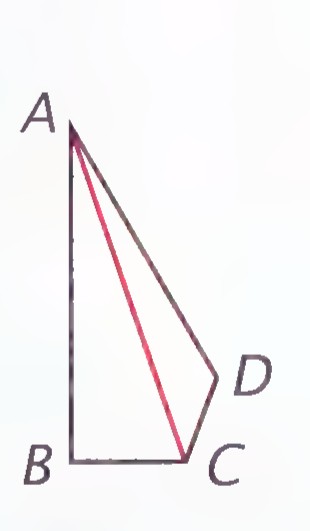
All of the diagonals from one vertex of a polygon divide the polygon into a set of triangles; so we can extend our knowledge of triangles to polygons in general. For example, in regard to a quadrilateral, the diagonal from one vertex results in two triangles. Using the fact that the sum of the angles of every triangle is 180°, we can easily show that the sum of the angles of every quadrilateral is 360°.
Theorem 24
The sum of the angles of a quadrilateral is 360°.
From this theorem (whose proof is considered in an exercise), it immediately follows that, if a quadrilateral is equiangular, each of its angles is a right angle. This is, in fact, how the rectangle got its name: the Latin word rectangulum means “right angled.”
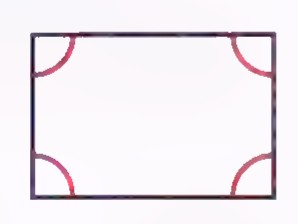
If these angles are equal, each is a right angle.
a rectangle
Definition
A rectangle is a quadrilateral each of whose angles is a right angle.
Corollary to Theorem 24
A quadrilateral is equiangular iff it is a rectangle.
p. 260
Exercises
Set I
Theorem 24. Complete the following proof of Theorem 24 by giving the reasons. The proof is written in paragraph form.
The sum of the angles of a quadrilateral is 360°.
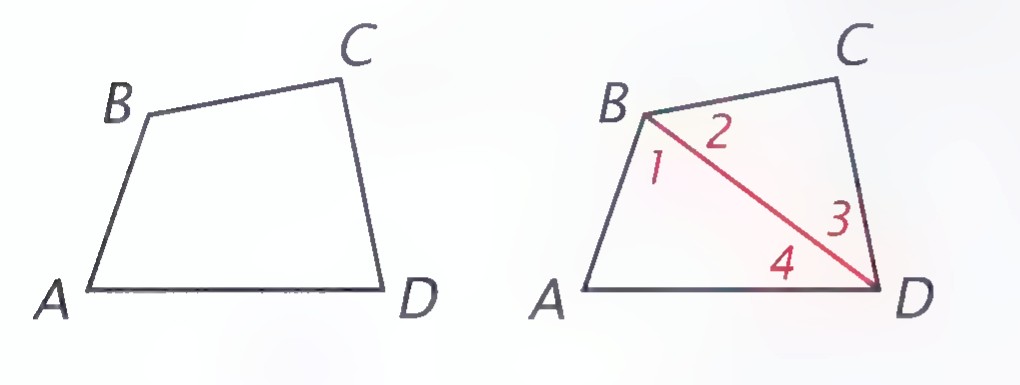
Given: ABCD is a quadrilateral. Prove: ∠A + ∠B + ∠C + ∠D = 360°.
Proof
- Draw BD. Why?
- ∠A + ∠1 + ∠4 = 180° and ∠2 + ∠3 + ∠C = 180°. Why?
- ∠A + ∠1 + ∠4 + ∠2 + ∠3 + ∠C = 360°. Why?
- ∠1 + ∠2 = ∠ABC and ∠3 + ∠4 = ∠CDA. Why?
- ∠A + ∠ABC + ∠C + ∠CDA = 360°. Why?
Proof
- If the measure of each angle is °, then . Why?
- So . Why?
- So ∠A, ∠B, ∠C, and ∠D are right angles. Why?
- So ABCD is a rectangle. Why?
Proof that, if a quadrilateral is a rectangle, it is equiangular.
Given: ABCD is a rectangle. Prove: ∠A = ∠B = ∠C = ∠D.
Proof
- Because ABCD is a rectangle, ∠A, ∠B, ∠C, and ∠D are right angles. Why?
- So ∠A = ∠B = ∠C = ∠D. Why?
Corollary. Complete the following proof of the corollary to Theorem 24.
A quadrilateral is equiangular iff it is a rectangle.
Proof that, if a quadrilateral is equiangular, it is a rectangle.
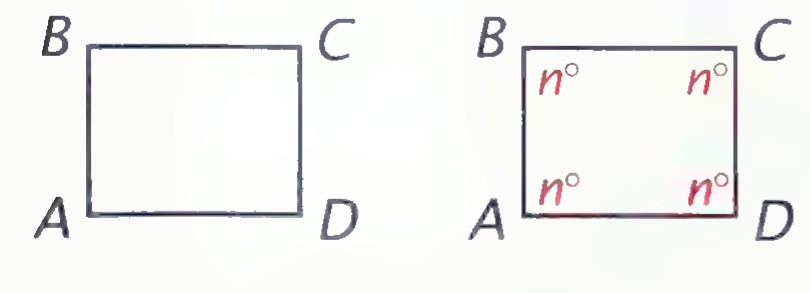
Given: ABCD with ∠A = ∠B = ∠C = ∠D. Prove: ABCD is a rectangle.
Carpets. This photograph shows a freeway overpass under construction near Santa Barbara, California.* Old carpets were used to keep the concrete from hardening too quickly.
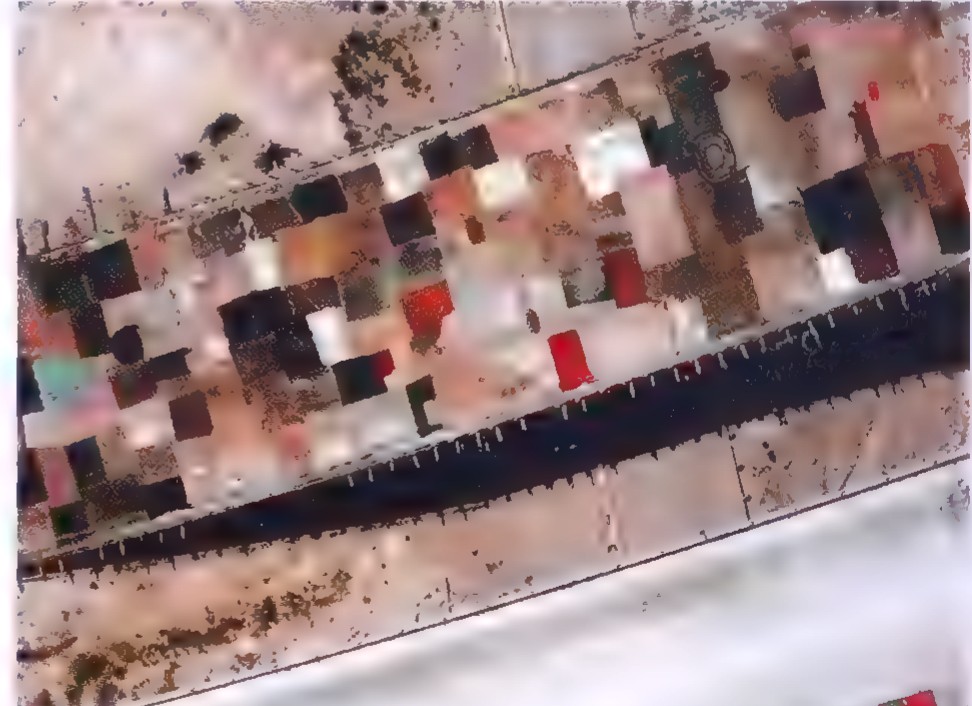
Carpets usually have the shape of equiangular quadrilaterals.
- What are equiangular quadrilaterals commonly called?
* Below from Above: Aerial Photography, by Georg Gerster (Abbeville Press, 1986).
p. 261
ABCD is an equiangular quadrilateral.
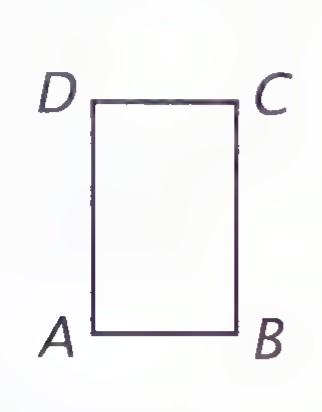
- What kind of angles does it have?
- Why are AD and BC perpendicular to AB and DC?
- Why are the opposite sides of ABCD parallel?
Rectangles. Each of the figures below is a rectangle. The diagonals are shown in blue.
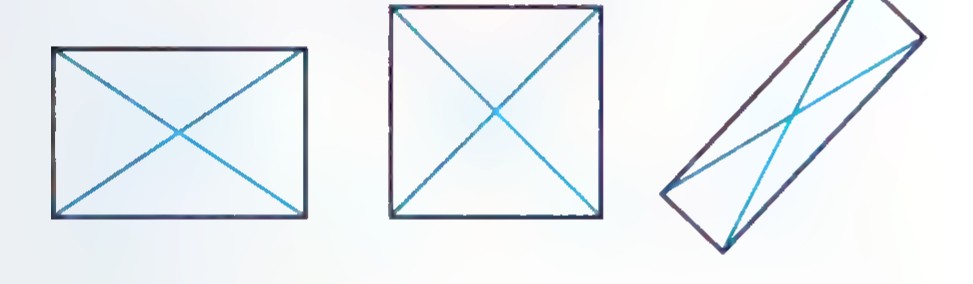
- What is always true about the angles of a rectangle?
What seems to be true about
- the opposite sides of a rectangle?
- the diagonals of a rectangle?
Rhombuses. Each of the figures below is a rhombus. The diagonals are shown in blue.
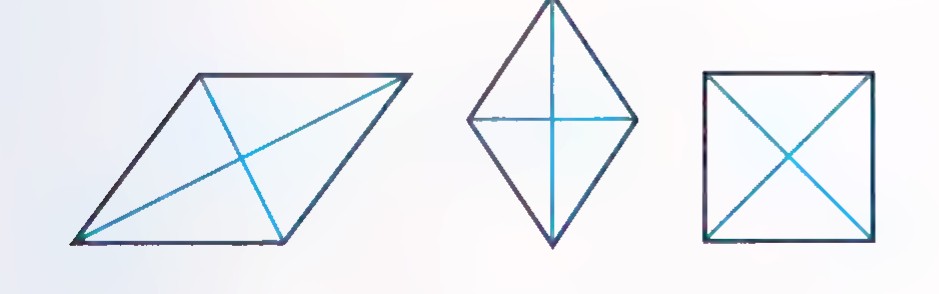
What seems to be true about
- the sides of a rhombus?
- the diagonals of a rhombus?
Squares. Each of the figures below is a square.
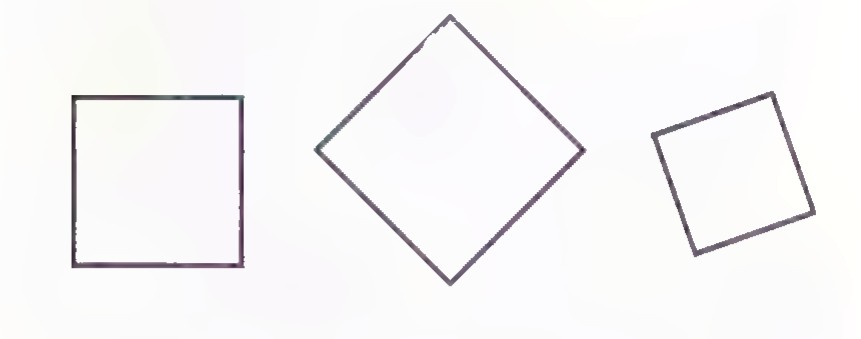
What property do you think squares have in common with
- rectangles?
- rhombuses?
Parallelograms. Each of the figures below is a parallelogram. The diagonals are shown in blue.
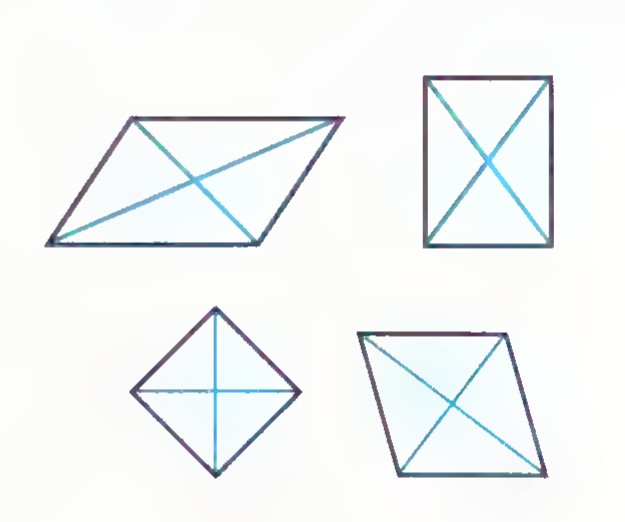
What seems to be true about
- the opposite sides of a parallelogram?
- the opposite angles of a parallelogram?
- the diagonals of a parallelogram?
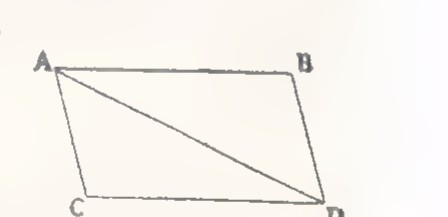
SAT Problem. The figure below appeared in a problem on an SAT exam.
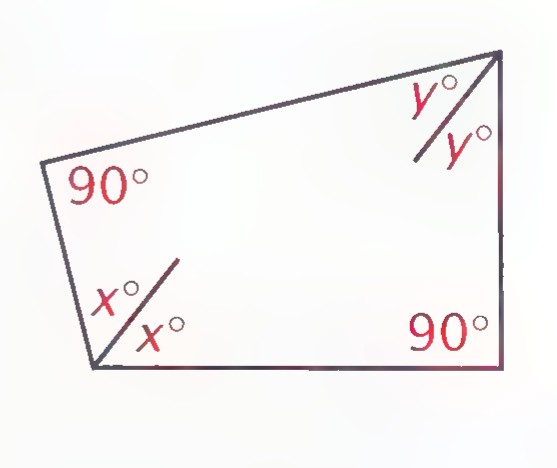
What can you conclude about
- ?
- ?
p. 262
Set II
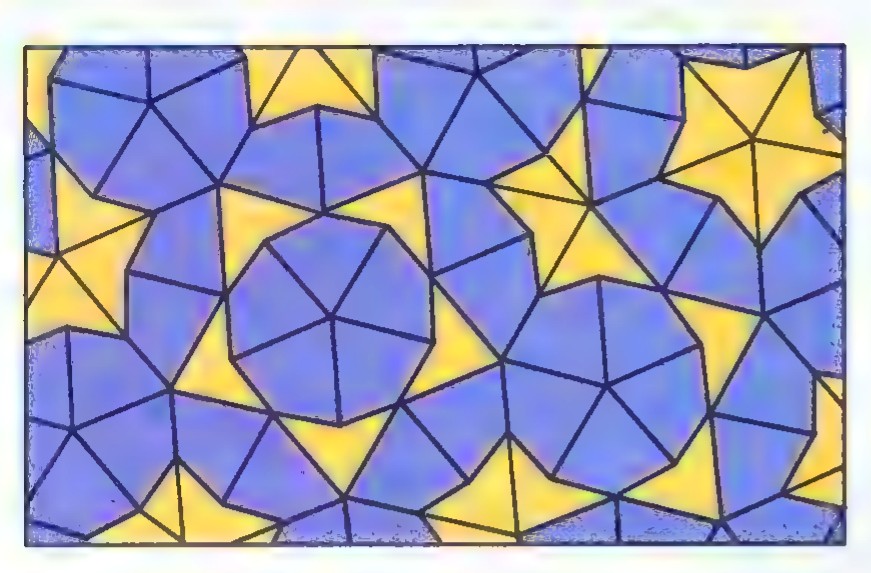
Penrose Tiles. “Penrose tiles,” named after physicist Roger Penrose, who discovered them, can be used to tile a plane in infinitely many ways. A sample of doing so is shown above.* The tiles have the shapes of the two quadrilaterals in the figure below.
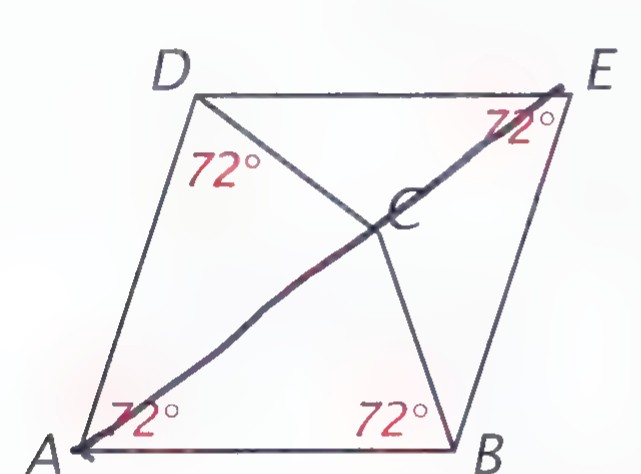
- Which Penrose tile is convex?
- Find the measure of ∠BCD.
- Make a large copy of the figure and draw AC and CE.
The figure is drawn so that AB = BE = ED = DA and CB = CE = CD. Mark this information on your figure.
- How do you know that △ADC ≅ △ABC and △EDC ≅ △EBC?
- (continued) Find the measures of the rest of the angles and mark them in your figure.
- What do all four triangles in the figure have in common?
* The Penguin Dictionary of Curious and Interesting Geometry, by David Wells (Penguin, 1991).
- What seems to be true about points A, C, and E?
- Explain why it is true.
- Does the figure appear to have line symmetry? Why or why not?
We have proved that, if a triangle is equilateral, it is also equiangular.
- If a quadrilateral is equilateral, does it follow that it is also equiangular? Use the figure to explain why or why not.
Gemstone Pattern. One pattern used in cutting gemstones is the “oval cut” shown here.
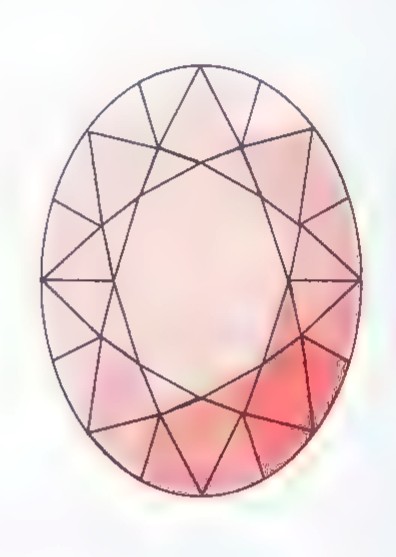
- What polygons are the shapes of its faces?
Our knowledge of the angles of triangles and quadrilaterals can easily be extended to other polygons such as the one in the center of the pattern above. To see how, look at the figure below. In it, a pentagon has been divided into triangles by the diagonals from one vertex.
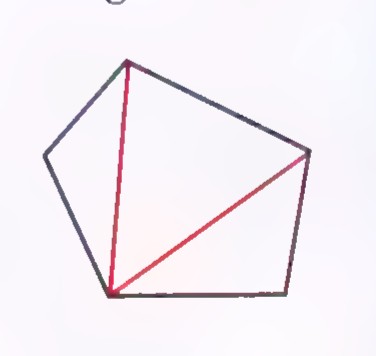
- How many sides does a pentagon have, how many diagonals were drawn, and how many triangles were formed?
- Draw a hexagon and the diagonals from one vertex.
- How many sides does a hexagon have, how many diagonals did you draw, and how many triangles were formed?
p. 263
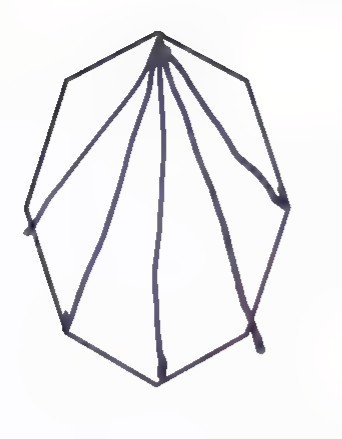
- Copy the figure above, which shows the polygon at the center of the “oval cut,” and draw the diagonals from one vertex.
- How many sides does the polygon have, how many diagonals did you draw, and how many triangles were formed?
Use your observations and results to do the following exercises. In general, if a polygon has sides, in terms of ,
- how many diagonals can be drawn from one vertex?
- how many triangles do these diagonals form?
- Show that your answers are correct for a quadrilateral.
The figure below suggests that the sum of the angles of a pentagon is .
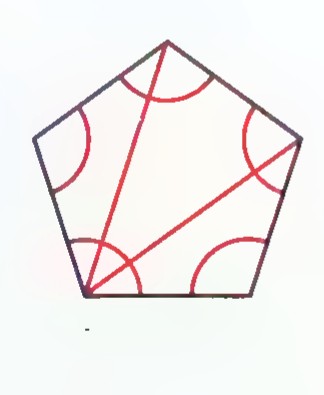
If the pentagon is equiangular, then each angle is .
What is the sum of the angles of a hexagon?
If the hexagon is equiangular, how large is each angle?
What is the sum of the angles of an octagon?
If the octagon is equiangular, how large is each angle?
What, in terms of , is the sum of the angles of an -gon?
If the -gon is equiangular, how large is each angle in terms of ?
Linkage Problems. The figure below shows a linkage made of four rods. The rods can pivot about their ends; so the figure can change its shape.
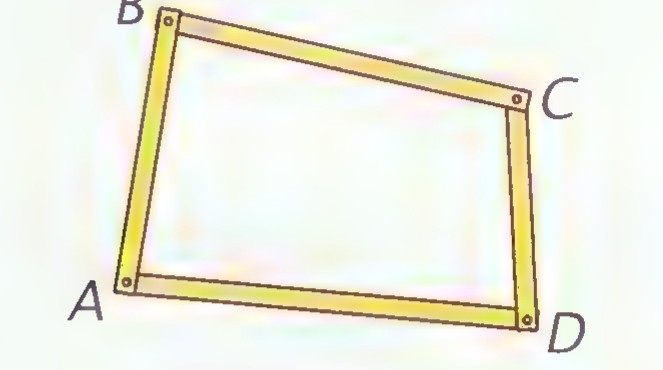
- What can you conclude about the four angles of the linkage when it is in an arrangement such as the one shown?
Suppose the linkage is arranged so that points B, C, and D are collinear, as shown at the left below.
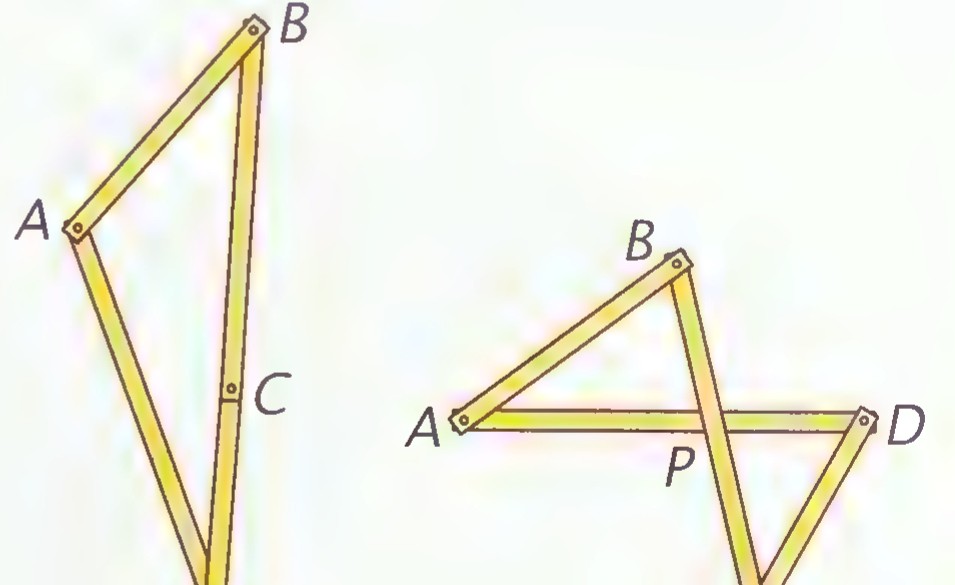
- What can you conclude about the angles of the linkage now?
Suppose the linkage is arranged so that rods AD and BC cross in a point P as shown at the right above.
- How do the measures of ∠A, ∠B, ∠C, and ∠D in this arrangement compare with their measures in the first arrangement?
- Why, in this arrangement, is ∠A + ∠B = ∠C + ∠D?
p. 264
Quadrilateral Angle Sum. ABCD is a quadrilateral in which a line has been drawn intersecting two opposite sides at X and Y.
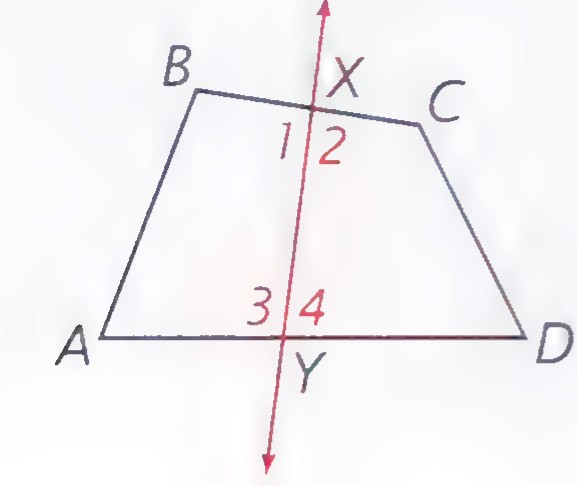
If we assume that the sum of the angles of a quadrilateral is a constant number, , then we can use this figure to explain why must equal 360°. Show why by giving a reason for each of the following statements.
Suppose ∠A + ∠B + ∠C + ∠D = , ∠A + ∠B + ∠1 + ∠3 = , and ∠C + ∠D + ∠2 + ∠4 = .
- ∠A + ∠B + ∠C + ∠D + ∠1 + ∠2 + ∠3 + ∠4 = 2. Why?
- − ∠1 + ∠2 + ∠3 + ∠4 = 2. Why?
- ∠1 + ∠2 + ∠3 + ∠4 = . Why?
- Finish the proof by explaining why it follows that = 360°.
Set III
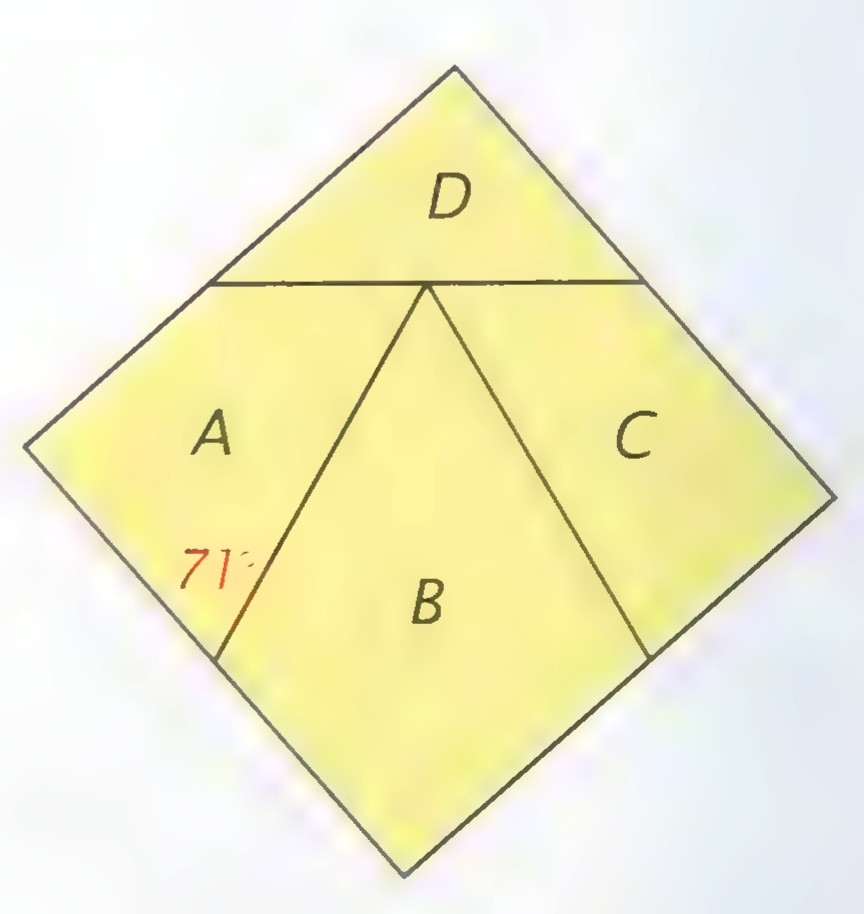
Triangle into Square. The following figures illustrate how an equilateral triangle can be cut into four pieces that can be rearranged to form a square.
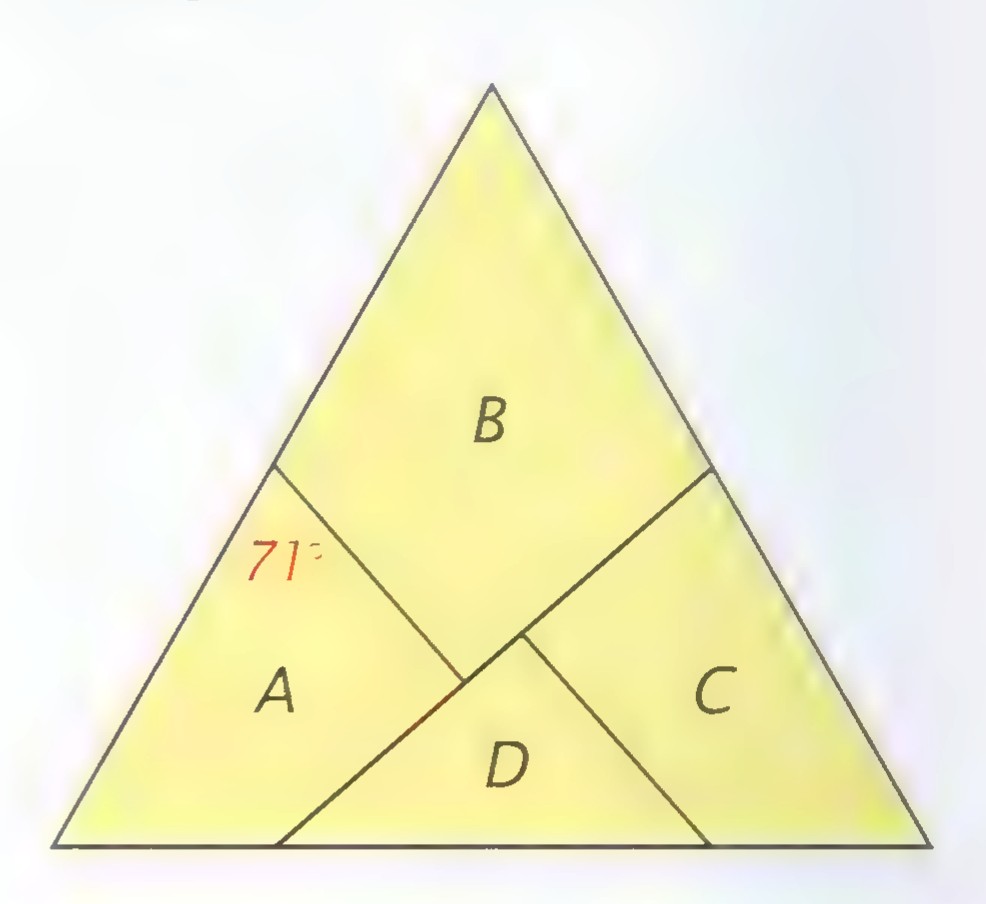
Make a large copy of the figure above, in which the measure of one of the angles of piece A has been given to the nearest degree. Find the measures of as many of the rest of the angles in the figure as you can.
p. 265
Lesson 2: Parallelograms and Point Symmetry
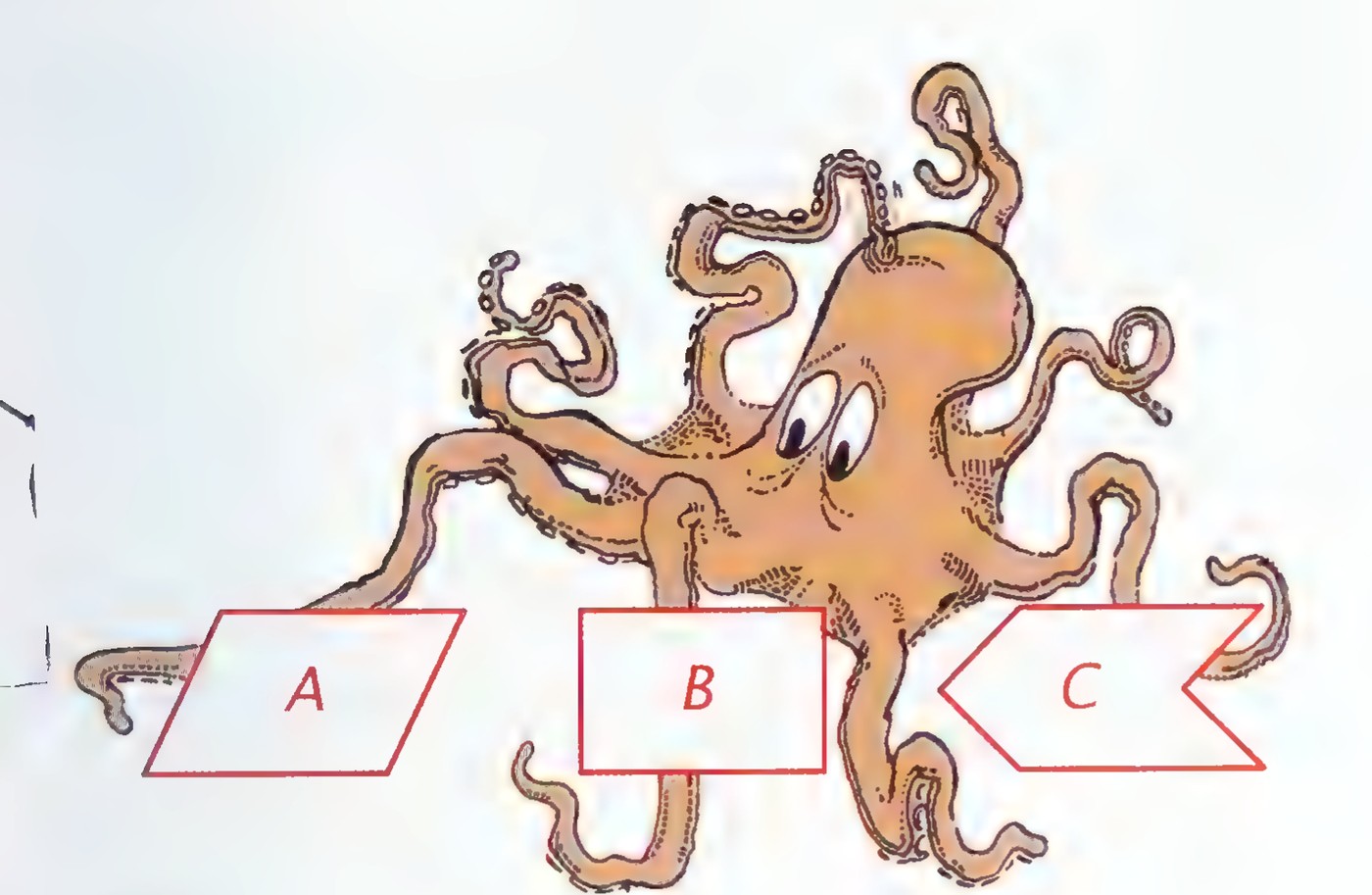
An octopus sees things very differently from the way that we see them. Experiments have shown that an octopus can distinguish between certain geometric shapes but not between others.* For example, of the three figures shown above, two look alike to an octopus and one looks different. Which do you suppose looks different?
The answer is B. If an octopus recognized a geometric figure by the number of sides it has, the answer would be C. From the way in which the eyes of an octopus work, shapes A and C look alike!
This is strange because, from a geometric point of view, figures A and B are the most nearly alike. They are parallelograms, whereas figure C is a concave hexagon.
Definition
A parallelogram is a quadrilateral whose opposite sides are parallel.
Because figures A and B are parallelograms, they have several other properties in common. It is easy to prove that the opposite sides of a parallelogram are not only parallel but also equal, as are the opposite angles. Furthermore, all parallelograms have point symmetry.
* Animal Behavior, by Niko Tinbergen (Time, Inc., 1965).
p. 266
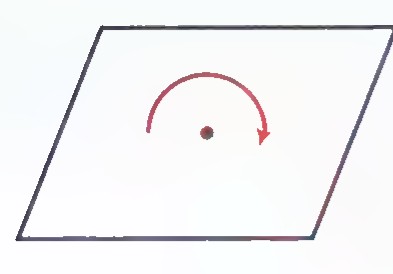
A figure has point symmetry if it looks exactly the same when it is turned upside down. For every parallelogram there is a point, called the center of symmetry, about which it can be turned 180° so that it coincides with itself. For a pair of points, we can show that this is equivalent to the following definition.
Definition
Two points are symmetric with respect to a point iff it is the midpoint of the line segment joining them.
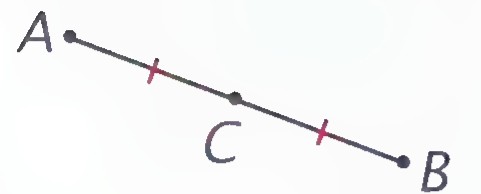
Parallelograms have point symmetry about the point in which their diagonals intersect. This follows from the fact that the diagonals bisect each other. The properties of parallelograms mentioned in this lesson are useful to know and are stated as theorems below.
Theorem 25
The opposite sides and angles of a parallelogram are equal.
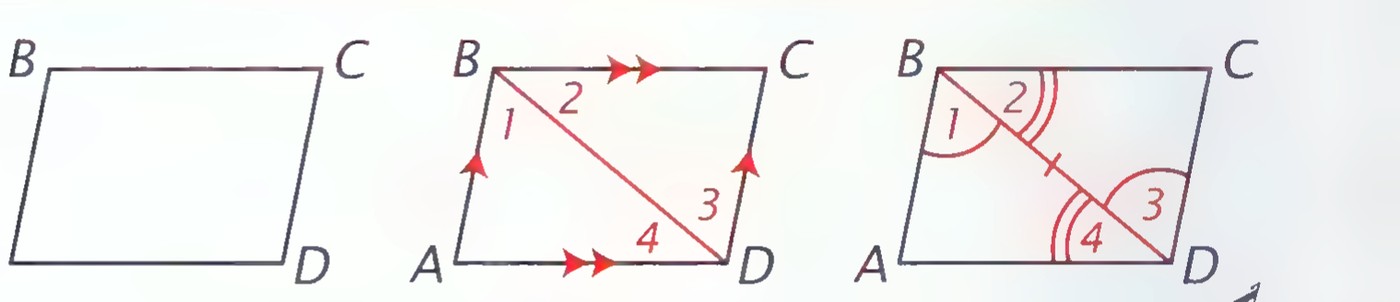
Given: ABCD is a parallelogram. Prove: AB = DC, AD = BC, ∠A = ∠C, and ∠B = ∠D.
The three figures above suggest the proof.
Proof
Draw a diagonal of ABCD. The opposite sides of a parallelogram are parallel; so AB ∥ DC and AD ∥ BC. It follows that ∠1 = ∠3 and ∠2 = ∠4 because parallel lines form equal alternate interior angles.
Because BD = BD (reflexive), △ABD ≅ △CDB (ASA). Therefore, AB = DC, AD = BC, and ∠A = ∠C (corresponding parts of congruent triangles are equal). Because ∠1 = ∠3 and ∠2 = ∠4, ∠1 + ∠2 = ∠3 + ∠4 (addition). ∠ABC = ∠1 + ∠2 and ∠CDA = ∠3 + ∠4 (from the figure and the Betweenness of Rays Theorem); so ∠ABC = ∠CDA (substitution).
Theorem 26
The diagonals of a parallelogram bisect each other.
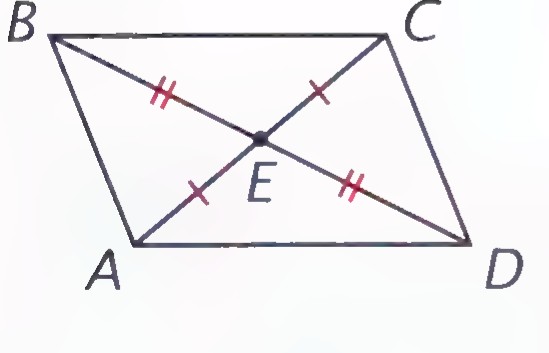
This theorem, illustrated by the figure at the left, also can be proved by using congruent triangles. A proof of it is included in the exercises.
p. 267
Exercises
Set I
These cards are from a baseball card game published in Boston a century ago.*
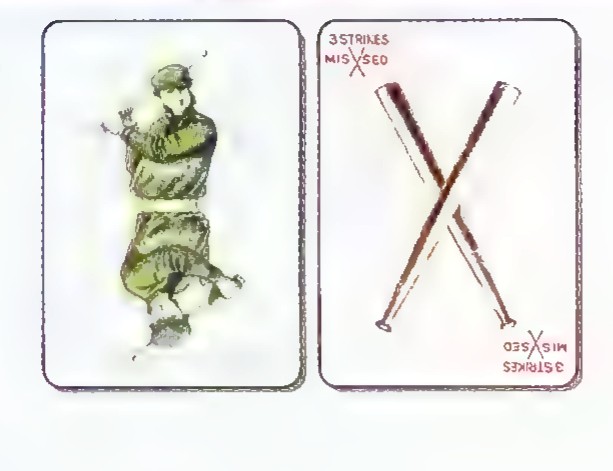
- Which card is symmetric?
- What kind of symmetry does it have?
- What is a simple test for this kind of symmetry?
Optical Illusion. The figure below, called “Sandor’s parallelogram,” appears in a book of optical illusions.†
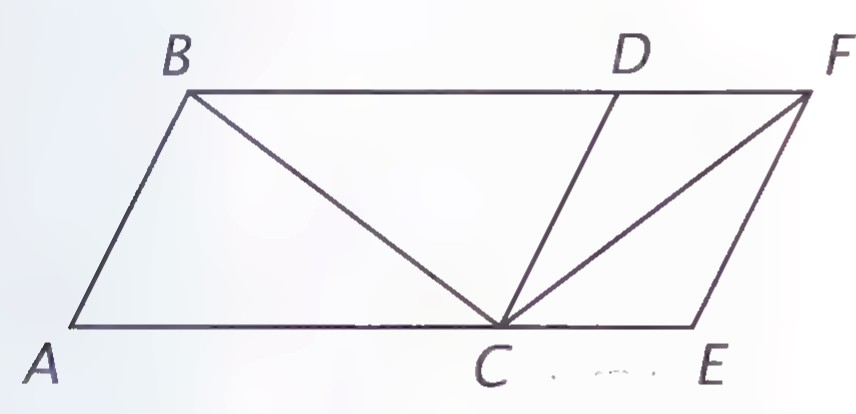
In the figure, AB ∥ CD ∥ EF and AE ∥ BF.
- How many parallelograms does the figure contain?
It appears that AC = BD and CE = DF.
- Is this necessarily true? Explain.
- What do you think is the illusion in this figure?
Explain why each of the following statements must be true.
- ∠A = ∠BDC.
- ∠BDC > ∠BFC.
- ∠A > ∠BFC.
* Paper Toys of the World, by Blair Whitton (Hobby House Press, 1986). † Can You Believe Your Eyes? by J. R. Block and Harold E. Yuker (Brunner/Mazel, 1992).
Theorem 26. Complete the following proof of Theorem 26 by giving the reasons. The proof is written in paragraph form.
The diagonals of a parallelogram bisect each other.
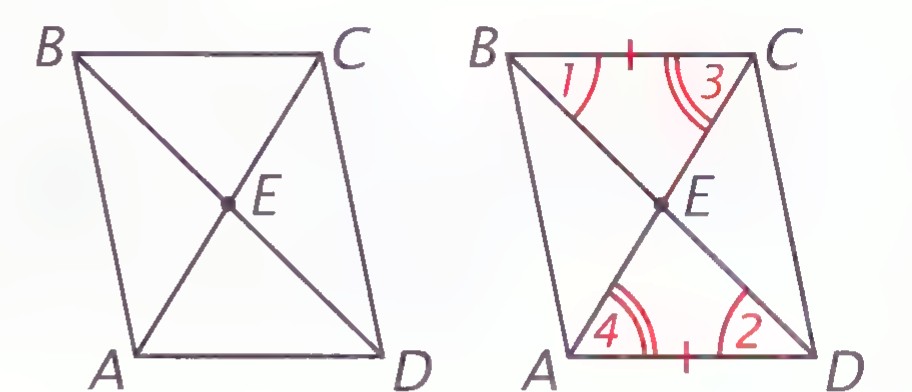
Given: ABCD is a parallelogram with diagonals AC and BD. Prove: AC and BD bisect each other.
Proof
- Because ABCD is a parallelogram, BC = AD. Why?
- Also, BC ∥ AD. Why?
- So ∠1 = ∠2 and ∠3 = ∠4. Why?
- △BEC ≅ △DEA. Why?
- BE = DE and EC = EA. Why?
- AC and BD bisect each other. Why?
Point Symmetry. Every parallelogram has point symmetry. The center of symmetry is the point in which the diagonals of the parallelogram intersect.
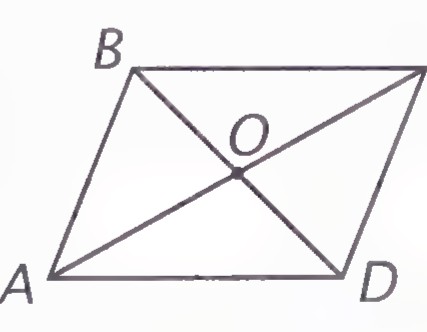
- Copy the figure above showing parallelogram ABCD with its diagonals intersecting at O.
- Why is OA = OC and OB = OD?
Mark your figure to show these and other equal parts as you continue.
p. 268
- Why are A and C (as well as B and D) symmetric with respect to O?
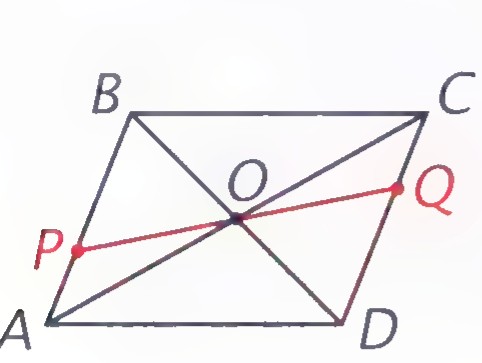
Suppose any other point, such as P in the figure above, is chosen on ABCD and line PO is drawn to intersect ABCD in Q. We can show that P and Q are symmetric with respect to O.
- Why is ∠ABD = ∠BDC?
- Why is ∠POB = ∠QOD?
- Why is △POB ≅ △QOD?
- Why is OP = OQ?
- Why are P and Q symmetric with respect to O?
Set II
Parallelogram Rule. Isaac Newton modeled his book titled The Mathematical Principles of Natural Philosophy on Euclid’s Elements.
COROL. I.
Corpus viribus conjunctis diagonalem parallelogrammi eodem tempore describere, quo latera separatis.
Si corpus dato tempore, vi sola M in loco A impressa, ferretur uniformi cum motu ab A ad B; & vi sola N in eodem loco impressa, ferretur ab A ad C: compleatur parallelogrammum ABDC, & vi utraque feretur corpus illud eodem tempore in diagonali ab A ad D. Nam quoniam vis N agit secundum lineam AC ipsi BD parallelam, haec vis per legem II nihil
His “parallelogram rule” for the addition of forces is given above.
- What word do you think “Corol.” is an abbreviation of?
Sides AB and AC of the parallelogram represent two forces acting on point A.
- Use your ruler and protractor to draw the part of Newton’s figure shown below. Use the measurements shown. Complete the figure by drawing a line through C parallel to AB and a line through B parallel to AC. Also draw AD.
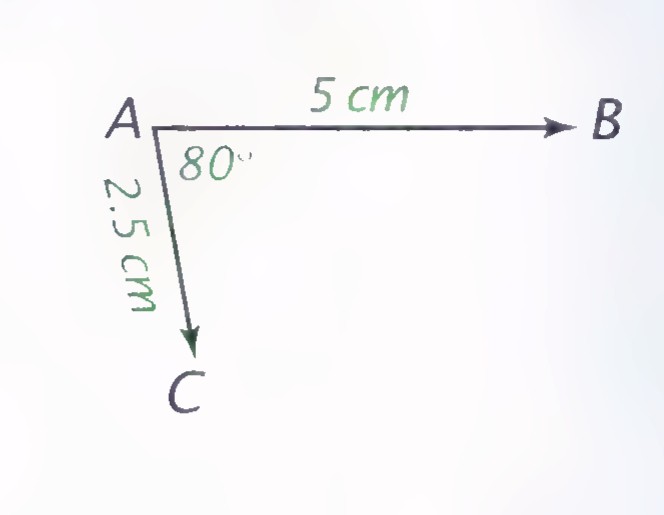
Suppose force AB is 50 pounds.
- How many pounds does 1 cm on your figure represent?
- How many pounds is force AC?
The diagonal AD represents the force that is equivalent to the two forces AB and AC.
- Measure AD in centimeters.
- How many pounds is force AD?
- What is the measure of the angle that force AD makes with force AB?
Angle Bisectors. ABCD is a parallelogram in which BE bisects ∠ABC and CE bisects ∠BCD.
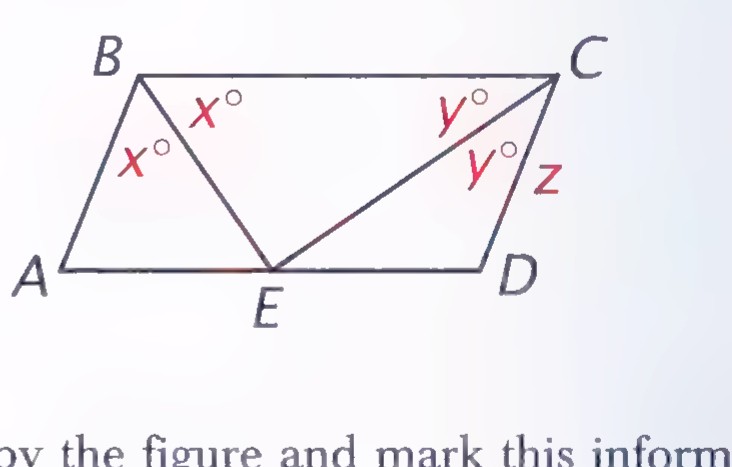
- Copy the figure and mark this information on it.
- Find and name another angle whose measure is ° and another angle whose measure is °.
- Find and name any other line segments whose lengths are .
- What can you conclude about point E?
p. 269
- What can you conclude about AD and DC?
- How are ∠ABC and ∠BCD related? Explain.
- What is ?
- What is ?
- What kind of triangles are △ABE and △ECD?
- What kind of triangle is △BEC? Explain.
- What can you conclude about BE and EC?
Two Parallelograms. In the figure below, ABDE and BCDE are parallelograms; ∠A = °, ∠EBD = °, and ∠C = °.
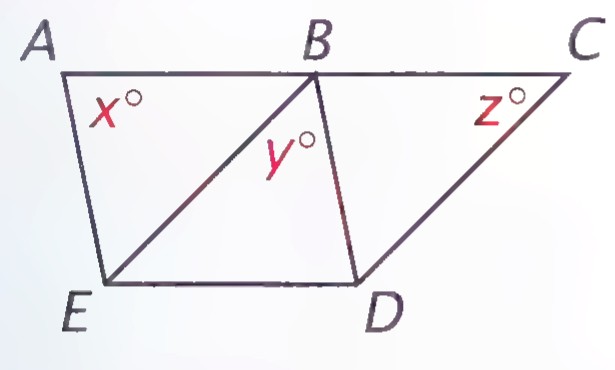
- Copy the figure and mark any other angles whose measures are °, °, and °.
Points A, B, and C appear to be collinear.
- Explain, using , , and , why these points are collinear.
- Explain, using the Parallel Postulate, why A, B, and C must be collinear.
- Which triangles in the figure are congruent?
- Are the parallelograms congruent?
Hidden Triangles. In the figure below, ABCD is a parallelogram in which ∠BAD = 75°; △ABE and △BCF are equilateral triangles.
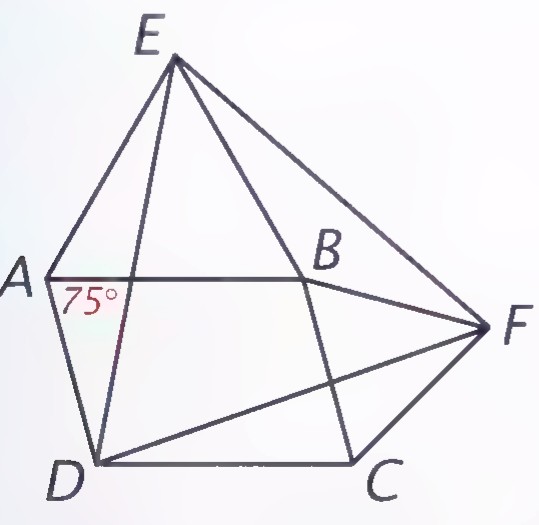
- Copy the figure and mark it as needed to do each of the following exercises.
- Find three triangles in the figure that are congruent.
- How do you know that they are congruent?
- How many equilateral triangles are in the figure? Explain.
Set III
Playing Card Symmetries. Some of the cards in a standard deck of 52 playing cards are symmetric and some are not. For example, in the old playing cards shown below, the king of clubs has point symmetry but the nine of hearts does not.
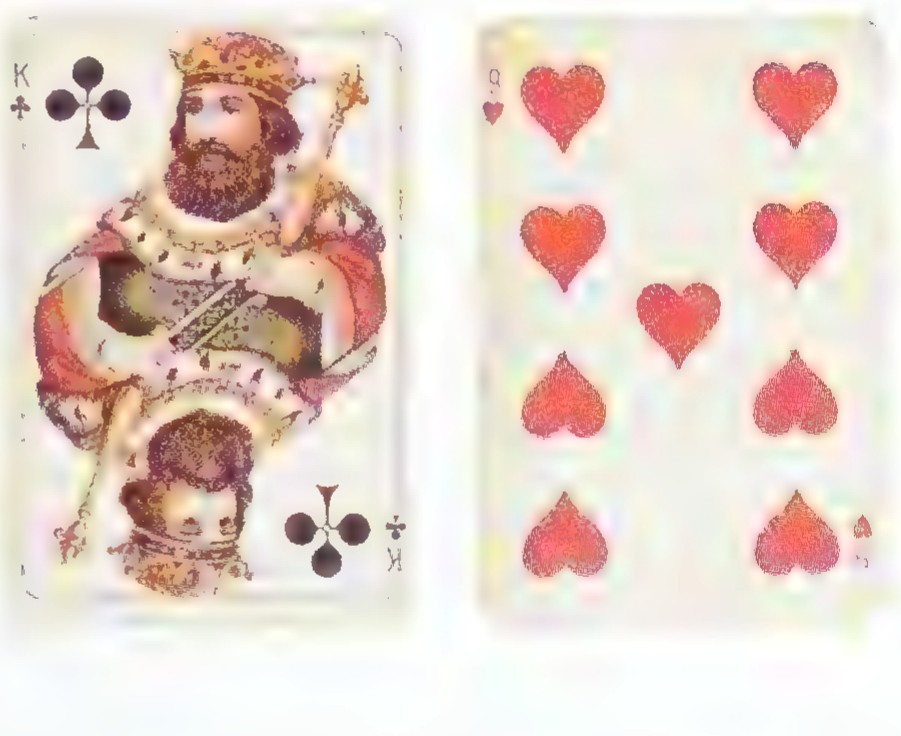
Go through a deck of cards and sort them according to their symmetry.
- Why do so many cards have point symmetry?
- Which cards have line symmetry?
- Are the cards in any suit more symmetric than in the others? If so, why?
- Can you make any general statements about the types of cards that do or do not have symmetry?
- Could some of the cards be slightly redesigned so that they also have symmetry? If so, which ones and how?
p. 270

Lesson 3: More on Parallelograms
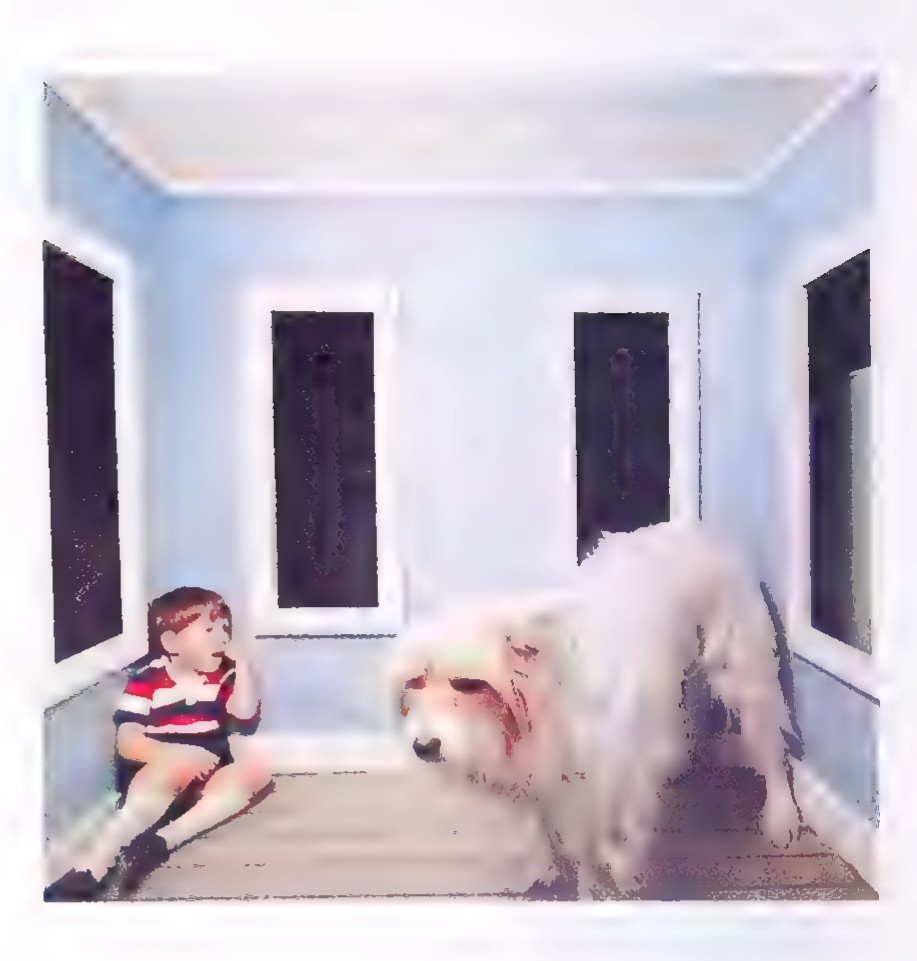
The large photographs above are of the same boy and the same dog in the same room. Neither picture has been retouched.* How can this be?
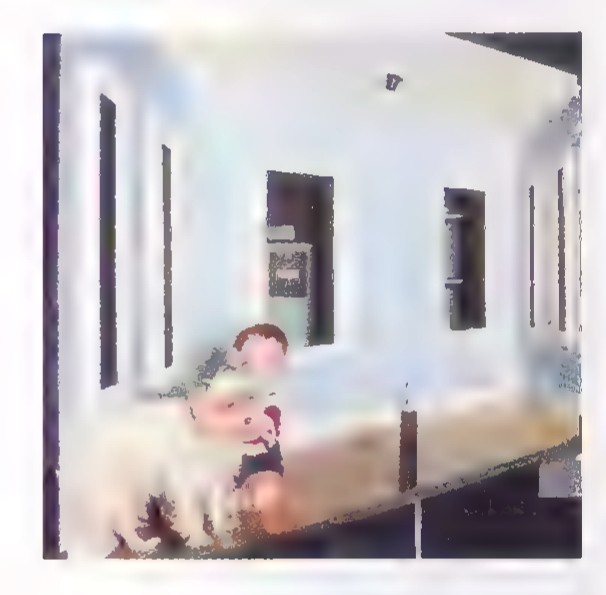
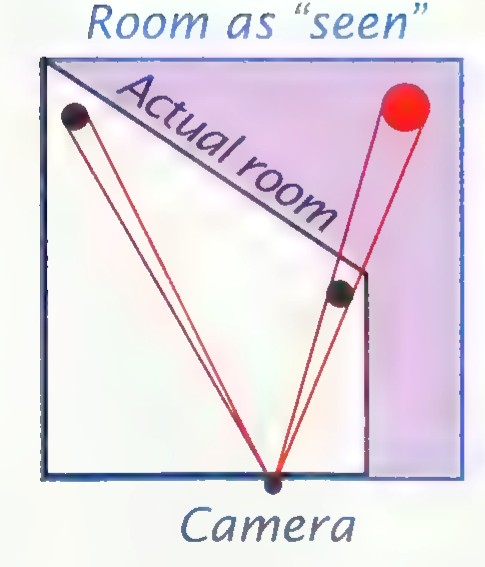
The room has been designed to fool us. Its walls and windows seem to be rectangular, but they are not. The small photograph reveals the room’s actual shape. The floor and ceiling slope toward each other and, as the floor plan of the room at the left shows, the left back corner is much farther from the camera than is the corner at the right. Because we are fooled into thinking that the room is a normal one, we interpret the larger size of both the boy and the dog at the right as meaning that they are larger rather than simply closer to us.
Part of the effectiveness of the illusion is due to our taking for granted that all of the quadrilaterals in the room are parallelograms, which they are not. What do we need to know about a quadrilateral to be sure that it is a parallelogram?
* The Mind, by John Rowan Wilson (Time-Life Books, 1969).
p. 271
Just knowing that its opposite sides are parallel is sufficient, because that is our definition of a parallelogram. This way and some others are listed below and illustrated at the right.
A quadrilateral is a parallelogram if
- its opposite sides are parallel.
- its opposite sides are equal.
- its opposite angles are equal.
- two opposite sides are parallel and equal.
- its diagonals bisect each other.
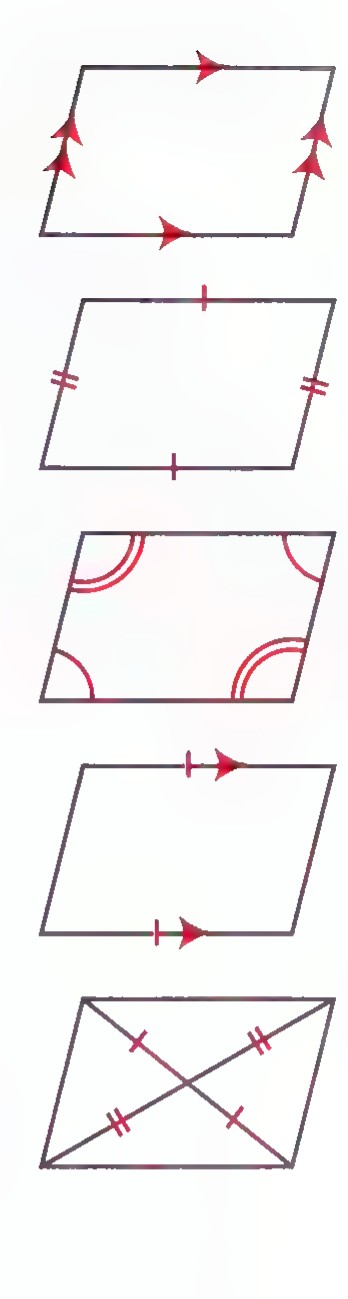
Some of these ways sound familiar because they are converses of theorems that we already know. Most of them can be proved by using congruent triangles.
Theorem 27
A quadrilateral is a parallelogram if its opposite sides are equal.
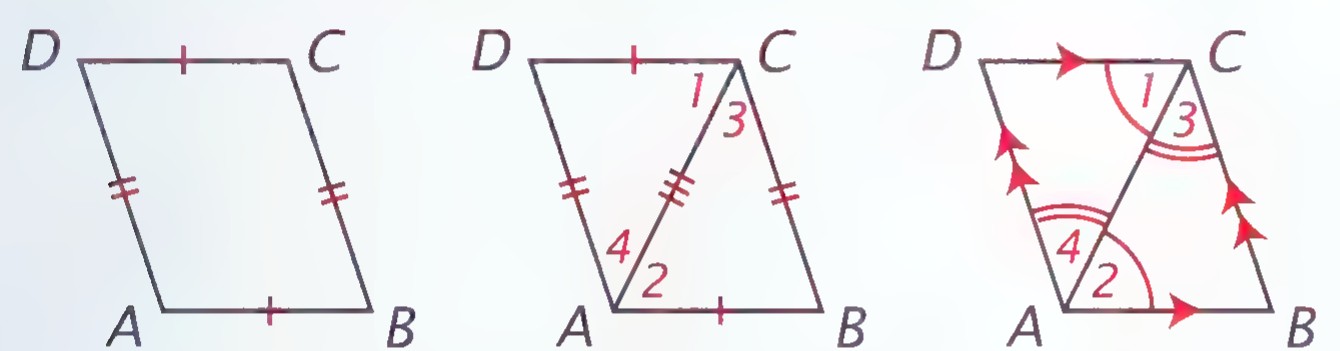
Given: In quadrilateral ABCD, AB = DC and AD = BC. Prove: ABCD is a parallelogram.
The three figures suggest the proof.
Proof
Draw diagonal AC to form △ABC and △ADC. The triangles are congruent according to SSS. It follows that ∠1 = ∠2 and ∠3 = ∠4 because corresponding parts of congruent triangles are equal. So AB ∥ DC and AD ∥ BC (equal alternate interior angles mean that lines are parallel). Therefore ABCD is a parallelogram because its opposite sides are parallel.
The following theorems can be proved just as easily. Their proofs are included in the exercises.
Theorem 28
A quadrilateral is a parallelogram if its opposite angles are equal.
Theorem 29
A quadrilateral is a parallelogram if two opposite sides are both parallel and equal.
Theorem 30
A quadrilateral is a parallelogram if its diagonals bisect each other.
p. 272
Exercises
Set I
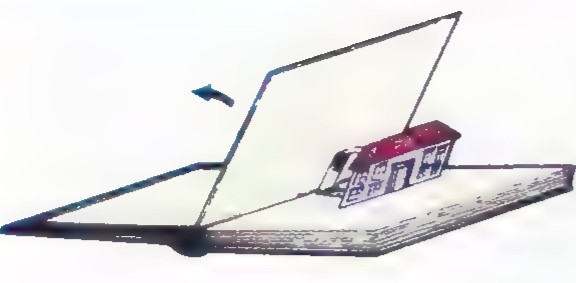
Pop-Up Parallelogram. Pop-up books and cards operate by means of parallelograms. The pop-up parts are kept parallel to the page as it moves by means of tabs such as the one shown in the figure above.*
Each tab is constructed so that AB = DC and AD = BC.
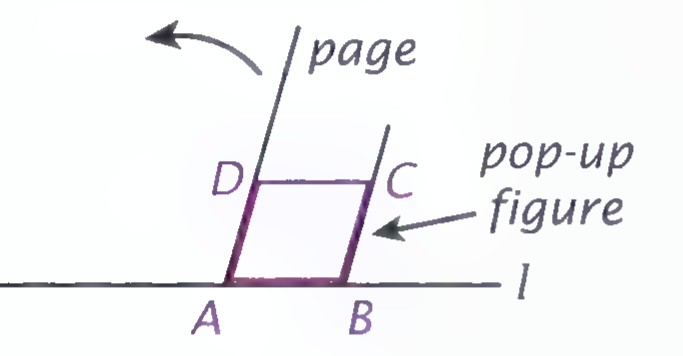
- Why, as the tab pulls the figure up, is ABCD always a parallelogram?
- Why is BC parallel to AD?
- Why are the corresponding angles at A and B always equal?
- When AD ⊥ l, why must BC also be perpendicular to l?
Theorem 28. Complete the following proof of Theorem 28 by giving the reasons.
A quadrilateral is a parallelogram if its opposite angles are equal.
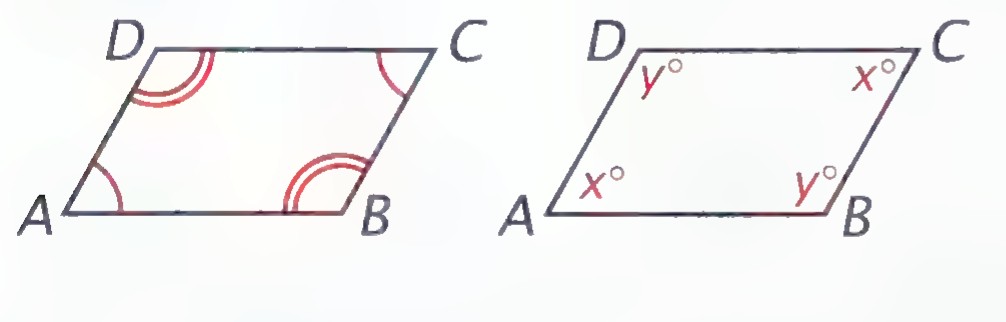
Given: In quadrilateral ABCD, ∠A = ∠C and ∠B = ∠D. Prove: ABCD is a parallelogram.
* Mathematics Meets Technology, by Brian Bolt (Cambridge University Press, 1991).
Proof
Let the measures of the angles be ° and °.
- . Why?
- . Why?
- ∠A and ∠B are supplementary and ∠A and ∠D are supplementary. Why?
- AD ∥ BC and AB ∥ DC. Why?
- ABCD is a parallelogram. Why?
Theorem 29. Complete the following proof of Theorem 29 by giving the reasons.
A quadrilateral is a parallelogram if two opposite sides are both parallel and equal.
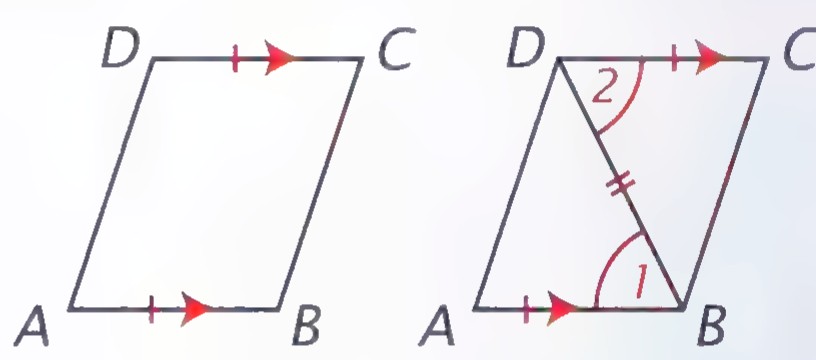
Given: In quadrilateral ABCD, AB ∥ DC and AB = DC. Prove: ABCD is a parallelogram.
Proof
- Draw DB. Why?
- Because AB ∥ DC, ∠1 = ∠2. Why?
- DB = DB. Why?
- Because we also know that AB = DC, △ABD ≅ △CDB. Why?
- So AD = CB. Why?
- Therefore, ABCD is a parallelogram. Why?
Theorem 30. Complete the following proof of Theorem 30 by giving the reasons.
A quadrilateral is a parallelogram if its diagonals bisect each other.
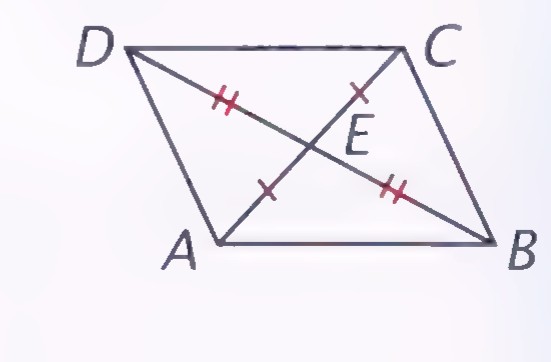
p. 273
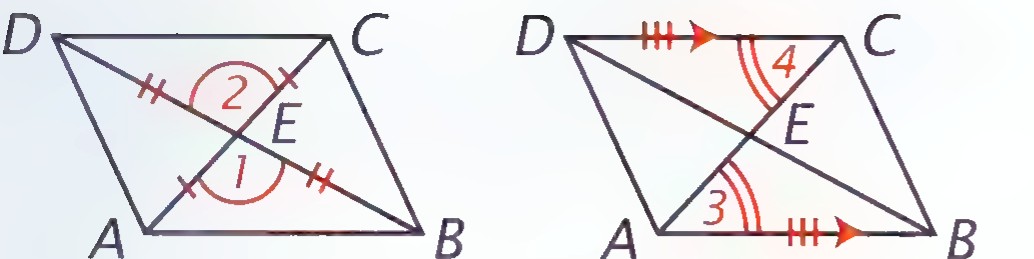
Given: In quadrilateral ABCD, AC and BD bisect each other. Prove: ABCD is a parallelogram.
Proof
- Because AC and BD bisect each other, AE = EC and BE = ED. Why?
- ∠1 = ∠2. Why?
- △AEB ≅ △CED. Why?
- AB = CD and ∠3 = ∠4. Why?
- AB ∥ CD. Why?
- ABCD is a parallelogram. Why?
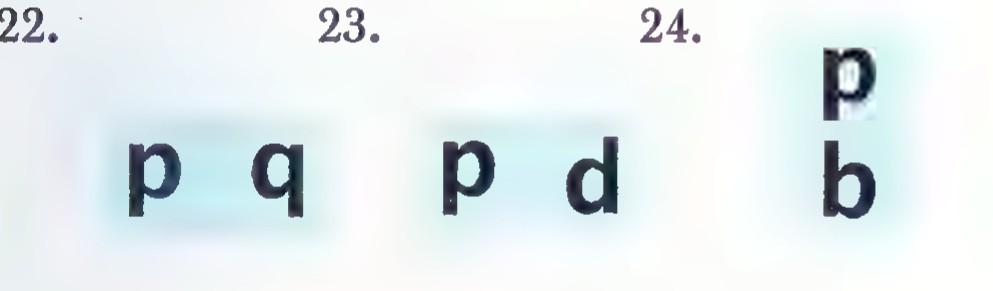
Letter Transformations. Transformations of the first letter of the word parallelogram can be used to illustrate the two basic types of symmetry.*
Name the type of symmetry possessed by each of the following figures and briefly explain why the figure has it.
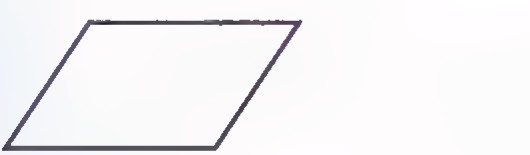
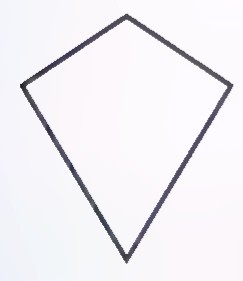
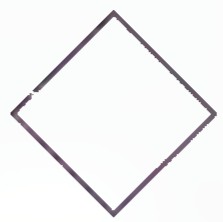
Quadrilateral Symmetries. Tell whether or not each of the following figures appears to be a parallelogram and describe the symmetry of each.
* Inversions, by Scott Kim (Byte Books, 1981).

Economics Graph. The figure below is part of a graph from an economics book.† The two segments labeled I are equal and parallel.
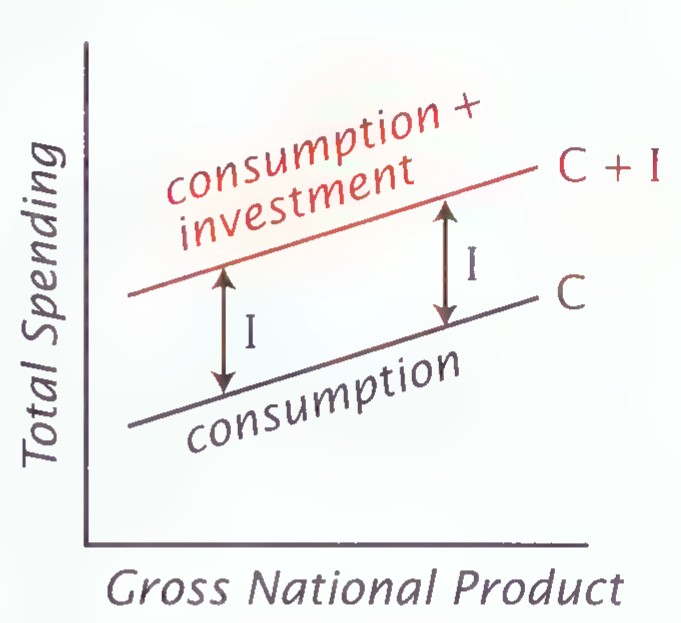
- What seems to be true about the lines labeled C and C + I?
- Explain why it must be true.
Set II
Parallel Rulers. Parallel rulers are two rulers connected by two links so that they always remain parallel.
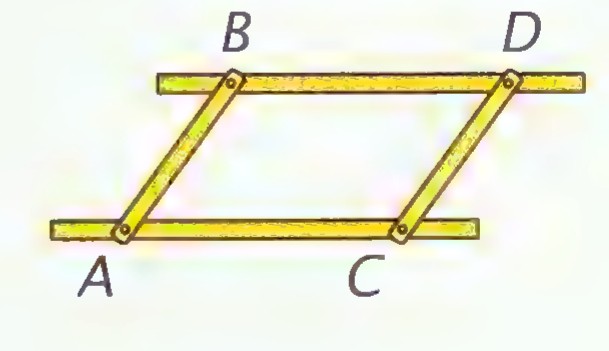
- How do you think the parallel rulers are designed to ensure that they always remain parallel?
- As the rulers are used, what always remain equal even though their size changes?
† Economics, by Paul A. Samuelson and William D. Nordhaus (McGraw-Hill, 2001).
p. 274
Tent Geometry. In this drawing of a tent, ABCD and CDEF are parallelograms. It is true that, not only in a plane but also in space, two lines parallel to the same line are parallel to each other.
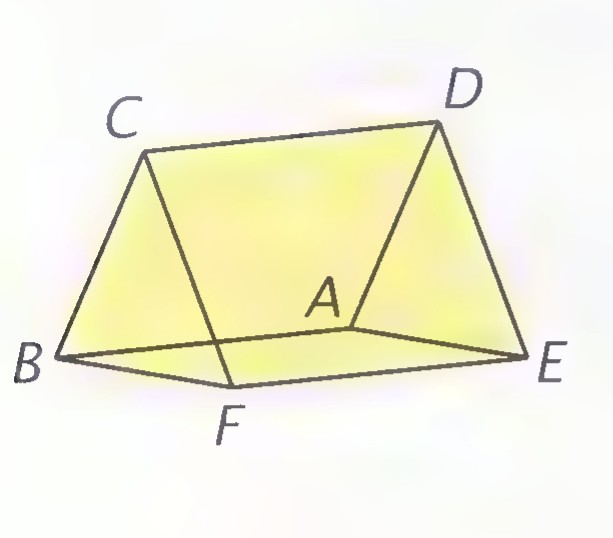
- Copy the figure and mark it as needed to do each of the following exercises.
- It appears that ABFE also is a parallelogram. Is this necessarily true? Explain.
- △ADE and △BCF look as if they are congruent. Is this necessarily true? Explain.
Rope Trick. One of the methods used in Africa to construct a rectangle for the base of a house is described below.
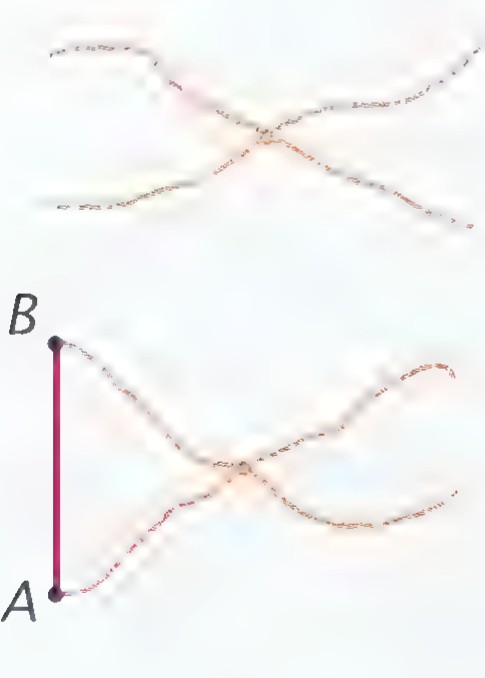
The house builders start with two ropes of equal length that are tied together at their midpoints. A bamboo stick, whose length is equal to that of the desired width of the house, is laid down on the floor and at its endpoints pins are hit into the ground. An endpoint of each of the ropes is tied to one of the pins. Then the ropes are stretched [so that each of the original ropes forms a straight segment] and at the remaining two endpoints of the ropes, new pins are hit into the ground. These four pins determine the four vertices of the house to be built.*
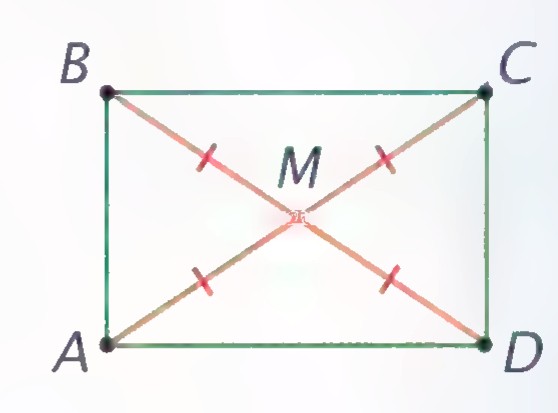
- Draw the figure above and mark it as needed to explain why this method works by answering each of the following questions.
- Why is ABCD a parallelogram?
- Why is AB = DC?
- Why is △BAD ≅ △CDA?
- Why is ∠BAD = ∠CDA?
- Why is ∠BAD = ∠BCD and ∠CDA = ∠ABC?
- Why is ∠BCD = ∠ABC?
- Why is ABCD a rectangle?
Parallel Postulate. The Parallel Postulate is one of the most famous statements of geometry.

- What does it say about the figure above?
It is possible to construct, through P, a line parallel to line l without ever changing the radius of the compass.
* Geometry from Africa, by Paulus Gerdes (Mathematical Association of America, 1999).
p. 275
The method goes back to at least 1574 and the figure below shows how to do it.*
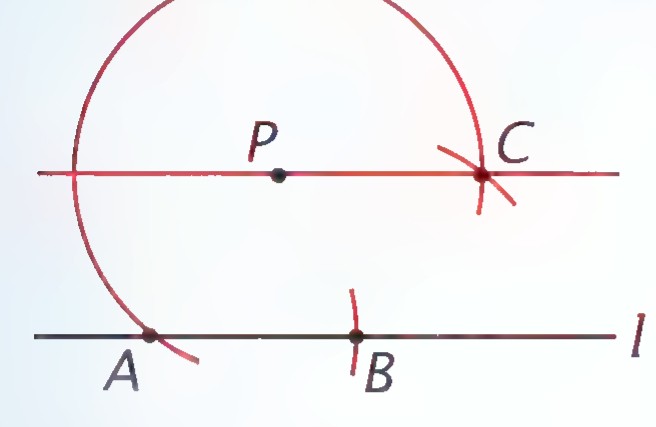
- Use your straightedge and compass as well as the figure as a guide to do the construction.
- Explain, by drawing PA and CB, why line PC is parallel to line l.
Flexible Grid. The figure at the left below shows a grid of squares whose sides are identical steel beams connected by pins at each corner. One of the squares has been braced with a longer beam.†
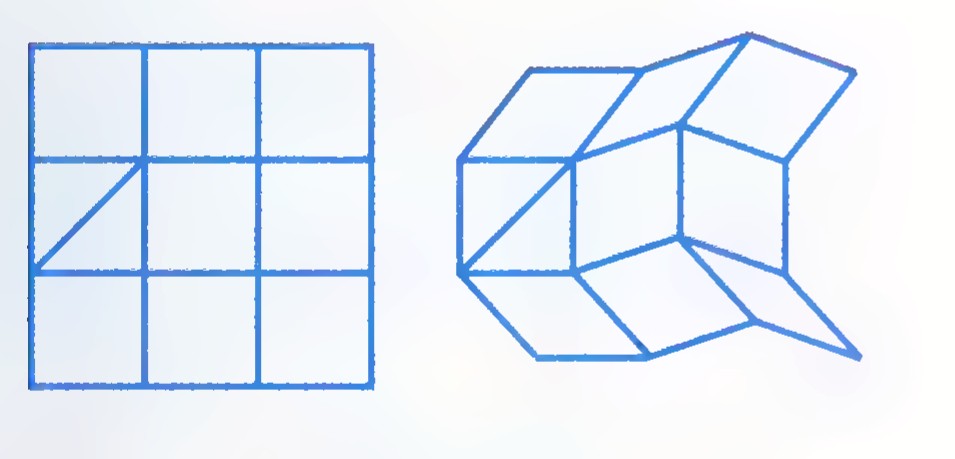
The grid is not rigid and can be flexed as shown in the figure at the right above. (Assume that the grid is still flat, so that all of the beams still lie in the same plane, and that the braced square does not turn.)
The grid contains 25 beams in all. How many of them are horizontal in the
- first position?
- second position?
* Mathematical Circus, by Martin Gardner (Knopf, 1979). † Connections: The Geometric Bridge Between Art and Science, by Jay Kappraff (McGraw-Hill, 1991).
How many of them are vertical in the
- first position?
- second position?
When the grid is flexed, why do the
- two triangles remain unchanged?
- sides of the quadrilaterals remain parallel?
Where are the beams in the second figure that remain
horizontal?
vertical?
Why do these beams remain horizontal and vertical?
Set III
Equilateral Triangles Mystery. Here is a remarkable result that is easier to discover than to explain.‡
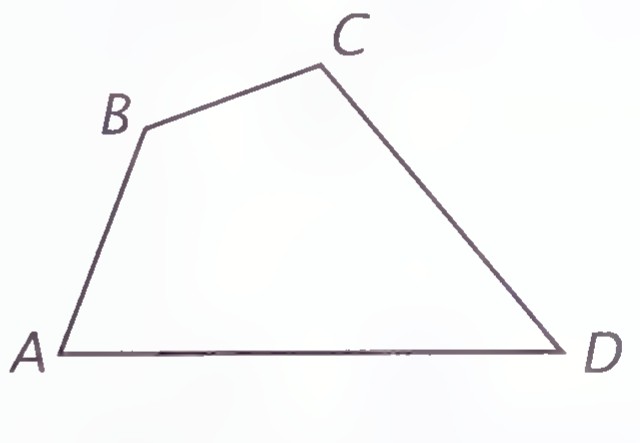
- Draw a large quadrilateral of approximately the same shape as the one shown above. Use your straightedge and compass to construct equilateral triangles alternately inward and outward on its sides. Connect their vertices to form another quadrilateral.
- What seems to be true?
‡ The Penguin Dictionary of Curious and Interesting Geometry, by David Wells (Penguin, 1991).
p. 276
Lesson 4: Rectangles, Rhombuses, and Squares
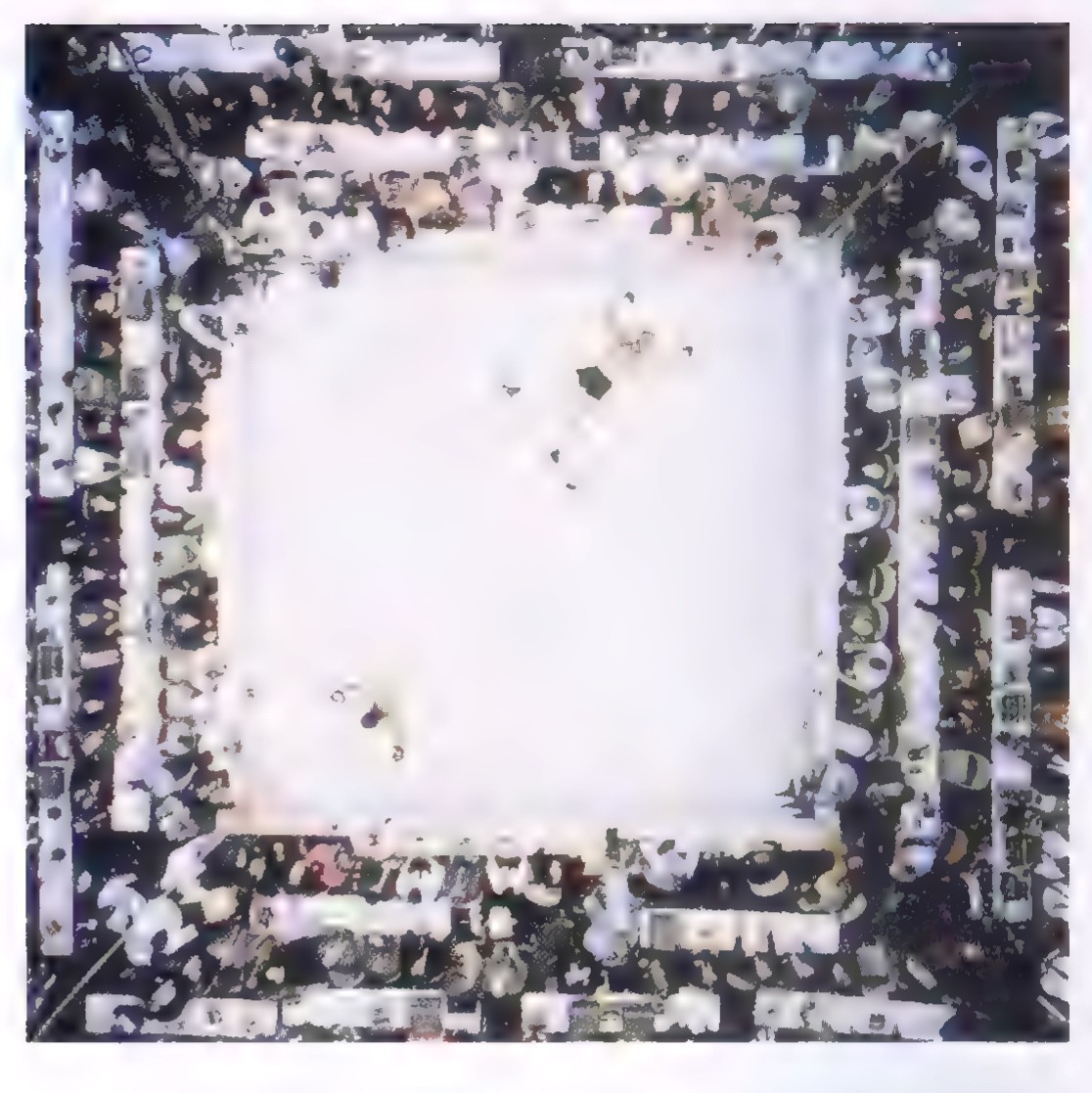
The photograph above was taken from directly above a boxing ring. Muhammad Ali is standing at the lower-left corner after knocking Cleveland Williams flat on the floor.
The boxing ring is in the shape of the most symmetric of all quadrilaterals: the square. Every square is a rectangle because it is equiangular. Every square is also equilateral.
Definition
A square is a quadrilateral all of whose sides and angles are equal.
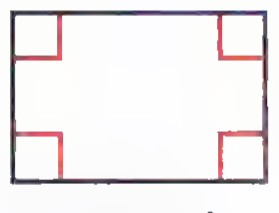
rectangle
It is also true that every square is a rhombus.
Definition
A rhombus is a quadrilateral all of whose sides are equal.
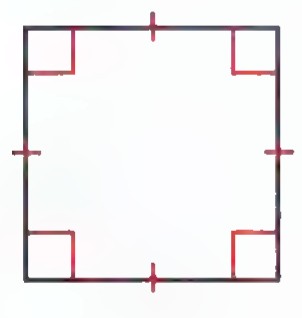
square
It is easy to prove that all rectangles and all rhombuses, and therefore all squares, are parallelograms.
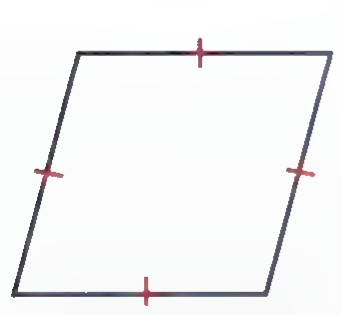
rhombus
Theorem 31
All rectangles are parallelograms.
Theorem 32
All rhombuses are parallelograms.
p. 277
Consequently, every statement that is true about parallelograms is true of rectangles, rhombuses, and squares as well. For example, the diagonals of each of the following figures bisect each other.
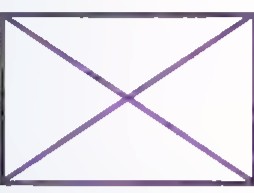
rectangle
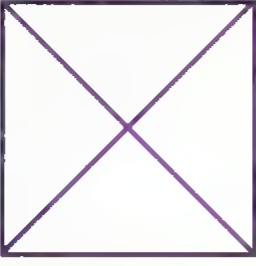
square
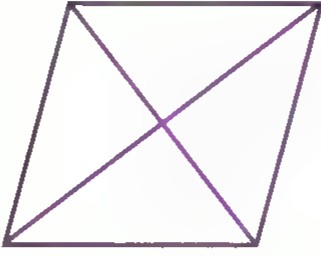
rhombus
The diagonals of a square are also equal (because it is a rectangle) and perpendicular (because it is a rhombus). These facts also are easy to prove.
Theorem 33
The diagonals of a rectangle are equal.
Theorem 34
The diagonals of a rhombus are perpendicular.
Exercises
Set I
Regular Dodecagon. The figure below shows a regular dodecagon divided into quadrilaterals. Every line segment in the figure has the same length.
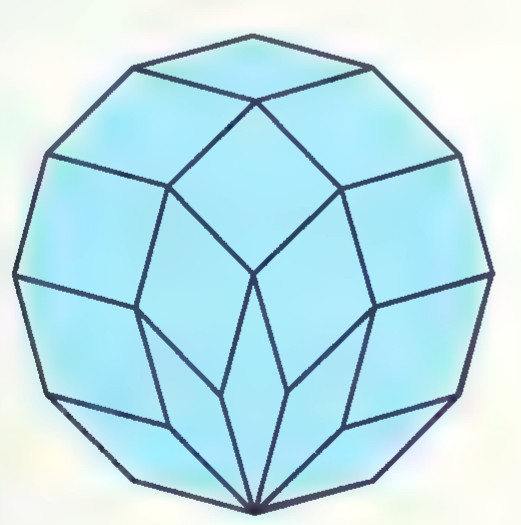
- How many sides does a dodecagon have?
A regular polygon is one that is equilateral and equiangular.
- How many regular quadrilaterals do there seem to be in the figure?
- What is a regular quadrilateral called?
- How many rectangles do there seem to be in the figure?
- How many rhombuses are in the figure?
- How many different shapes of rhombuses does the figure seem to contain?
Complete the proofs of the theorems of this lesson by giving the reasons.
Theorem 31. All rectangles are parallelograms.
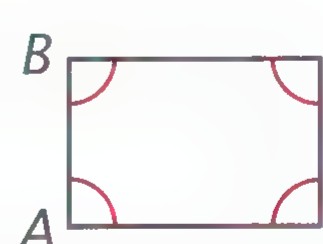
Given: ABCD is a rectangle. Prove: ABCD is a parallelogram.
Proof
- Because ABCD is a rectangle, ∠A = ∠C and ∠B = ∠D. Why?
- Therefore, ABCD is a parallelogram. Why?
p. 278
Theorem 32. All rhombuses are parallelograms.
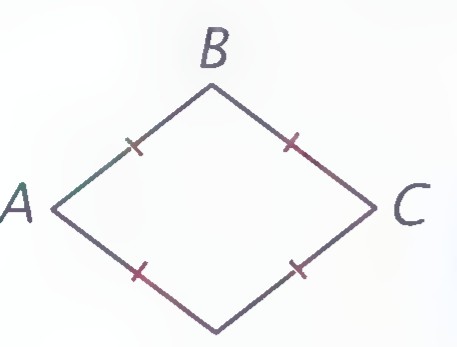
Given: ABCD is a rhombus. Prove: ABCD is a parallelogram.
Proof
- Because ABCD is a rhombus, AB = DC and AD = BC. Why?
- Therefore, ABCD is a parallelogram. Why?
Theorem 33. The diagonals of a rectangle are equal.
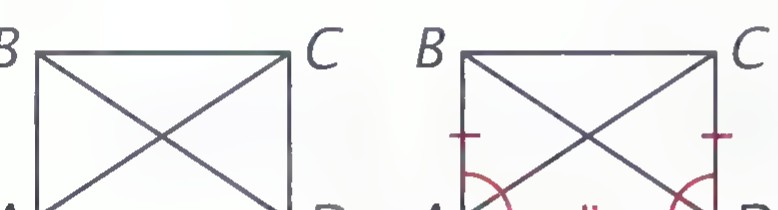
Given: ABCD is a rectangle. Prove: AC = BD.
Proof
- Because ABCD is a rectangle, ∠BAD = ∠CDA. Why?
- ABCD is a parallelogram. Why?
- AB = DC. Why?
- AD = AD. Why?
- △BAD ≅ △CDA. Why?
- AC = BD. Why?
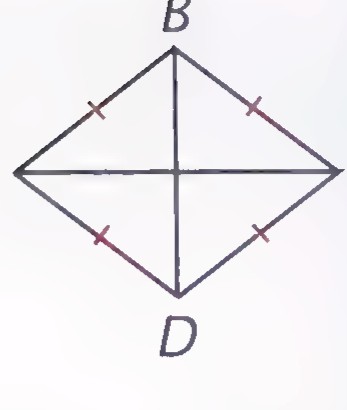
Theorem 34. The diagonals of a rhombus are perpendicular.
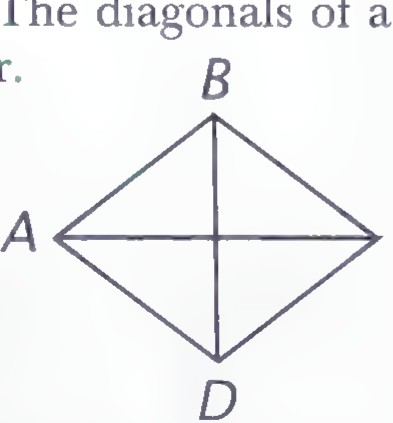
Given: ABCD is a rhombus. Prove: AC ⊥ BD.
Proof
- Because ABCD is a rhombus, AB = BC and AD = DC. Why?
- AC ⊥ BD. Why?
Which Parts? The lines on the pavement in the following photograph taken from overhead mark the boundaries of basketball and volleyball courts.*
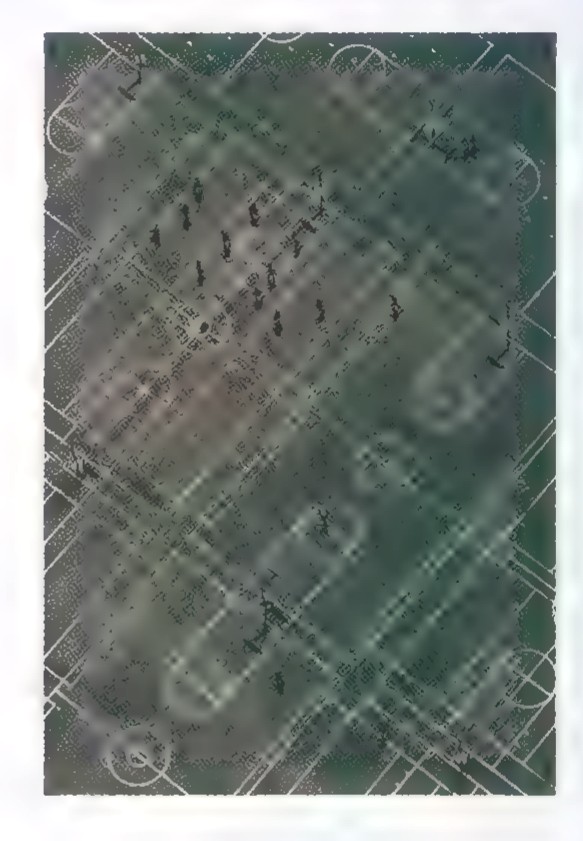
To draw one of the circles shown, only one measure is needed: its radius. For which parts would the measures be needed to draw
a rectangle?
a square?
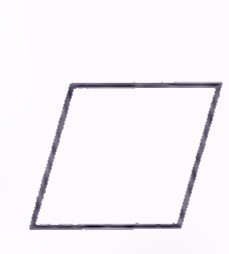
a rhombus?
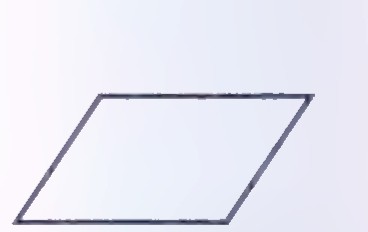
a parallelogram?
* Below from Above, by Georg Gerster (Abbeville Press, 1986).
p. 279
“Just Right.” Someone once said: “A square is perfect because all of its angles are just right.”
- Why can’t all of the angles of a triangle be “just right”?
- If all of the angles of a quadrilateral are “just right,” does it follow that it must be a square? Explain.
- Can you think of any examples of other polygons all of whose angles are “just right”? If so, draw one.
Set II

Checking a Wall. Before designing built-in furniture for a wall, a carpenter measures the wall’s dimensions to see if it is rectangular.
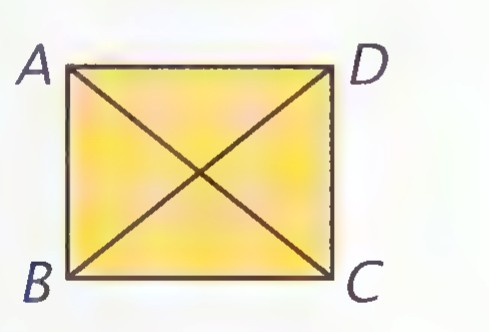
Suppose, in measuring this wall, the carpenter finds that AB = DC and AD = BC.
- Can you conclude from these equalities that the wall is rectangular? Explain.
Suppose that the diagonals of the wall are measured instead and that AC = BD.
- Can you conclude from this equality that the wall is rectangular? Explain.
Suppose that the wall is measured and that AB = DC, AD = BC, and AC = BD.
Draw the figure and mark it as needed to answer each of the following questions.
Why is △ABC ≅ △DCB?
Why is ∠ABC = ∠DCB?
Why is ABCD a parallelogram?
Why is ∠ABC = ∠ADC and ∠DCB = ∠DAB?
Why is ∠ADC = ∠DAB?
Why is ABCD a rectangle?
On the basis of these facts, tell whether each of the following statements is true or false.
- If the opposite sides of a quadrilateral are equal, it is a parallelogram.
- If the opposite sides of a quadrilateral are equal, it is a rectangle.
- The diagonals of a rectangle are equal.
- If the diagonals of a quadrilateral are equal, it is a rectangle.
- If the diagonals of a parallelogram are equal, it is a rectangle.
Square Problem. ABCD is a square and M, N, O, and P are the midpoints of its sides.
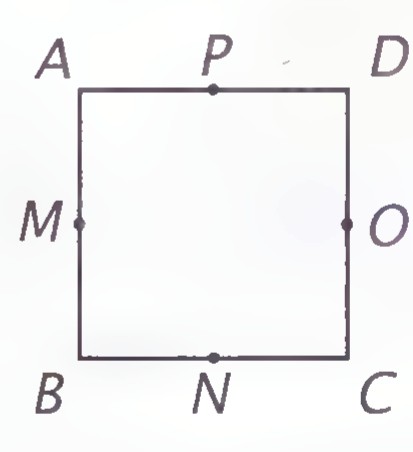
- Use your ruler to make a large copy of this figure in which each side of the square is 2 inches long. Draw AN and CM and label the point in which they intersect X. Draw AO and CP and label the point in which they intersect Y.
- What kind of quadrilaterals are AMCO and APCN?
- How do you know?
- Why does it follow that AXCY is a parallelogram?
- What other kind of quadrilateral does AXCY appear to be?
p. 280
- What seems to be true about points B, X, Y, and D?
- What kind(s) of symmetry does the entire figure appear to have?
Rhombus Problem. ABCD is a rhombus, AE ⊥ BC, and AF ⊥ CD.
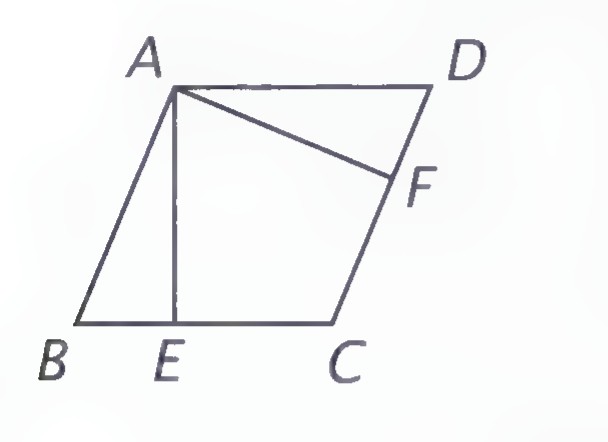
- Copy the figure and mark it as needed to answer exercise 48.
It looks as if AE = AF.
- Is this necessarily true? Explain why or why not.
Triangle Problem. ABDE is a parallelogram and BDCE is a rectangle.
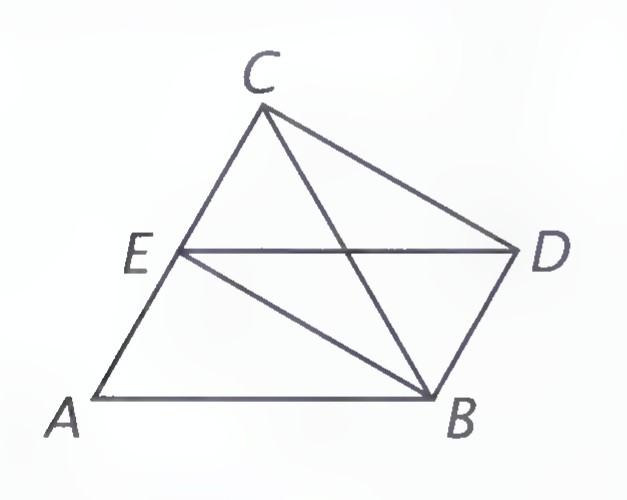
- Copy the figure and mark it as needed to answer exercise 50.
It looks as if △ABC is equilateral.
- What can you prove about △ABC?
Set III
Counting Squares. Acute Alice drew this figure and asked Obtuse Ollie how many squares it contains. Ollie said, “16.”
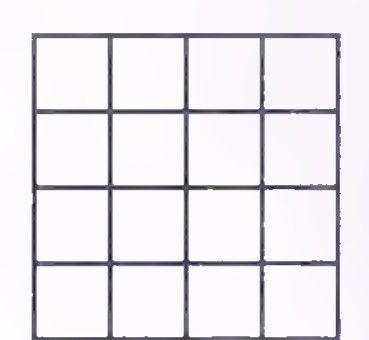
Alice then shaded the one outlined in red in the figure below and asked Ollie, “Did you count this one?” To which Ollie replied, “17!”
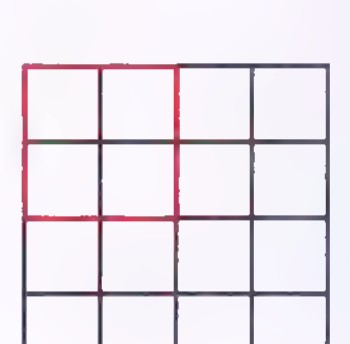
- How many squares does the figure actually contain? Explain.
For revenge, Ollie then drew the figure below and asked Alice how many squares it contains.* Alice said, “14.”
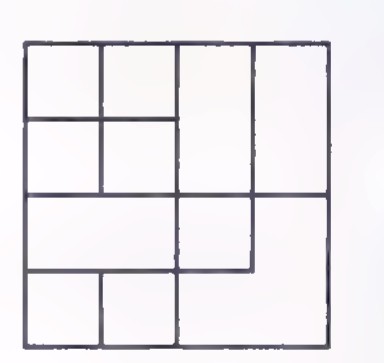
- Do you agree? If not, what is your answer? Explain.
* From Are You as Smart as You Think? by Terry Stickels (Thomas Dunne Books, 2000).
p. 281
Lesson 5: Trapezoids
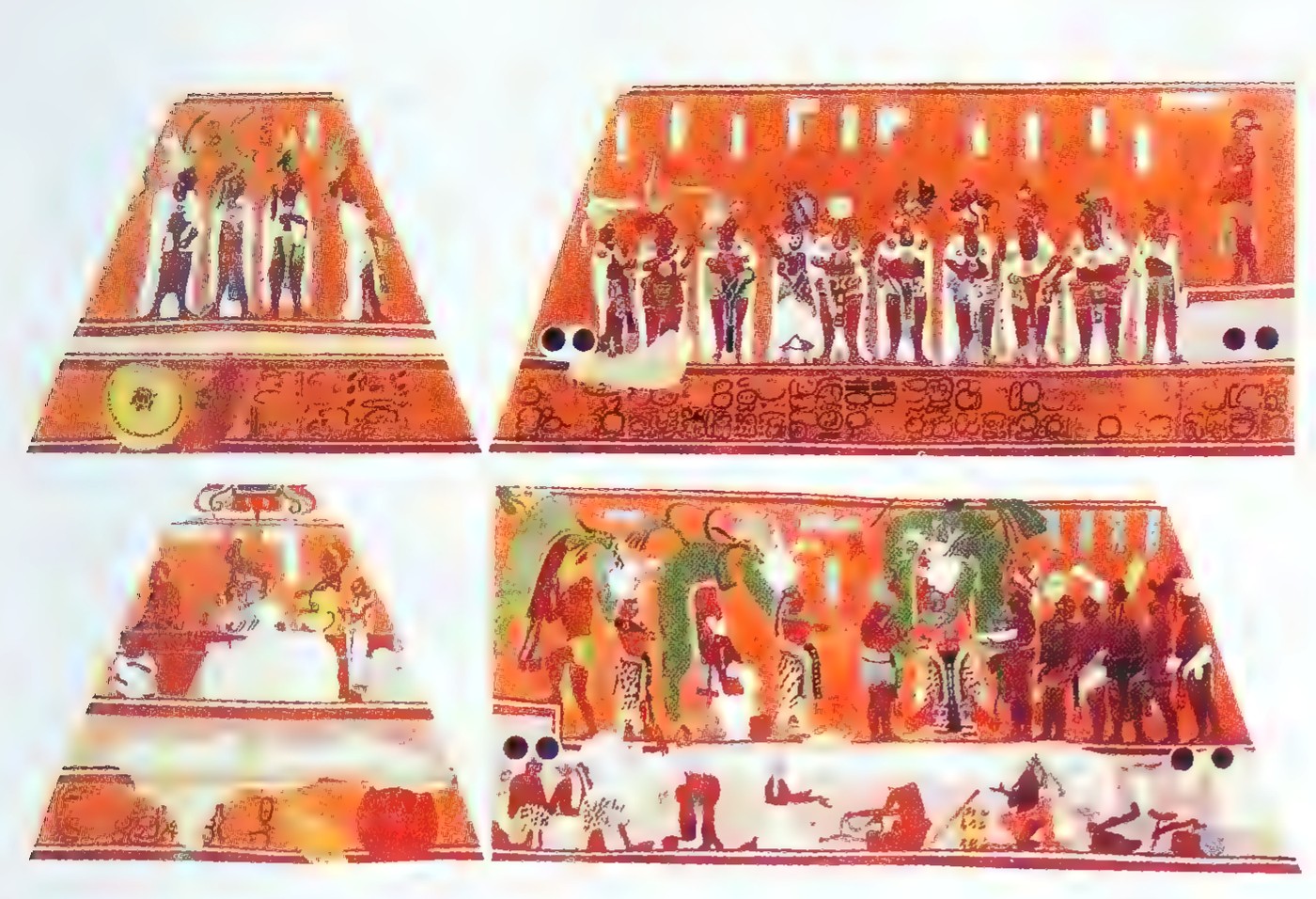
In 1946, an exciting discovery was made in a jungle in southern Mexico. Hidden by the jungle growth, it was a building whose walls were covered with murals made by a Mayan civilization in the eighth century. Four panels of one of the murals showing ancient Americans as they actually looked are shown above. The site is now called Bonampak, Mayan for “painted walls.”
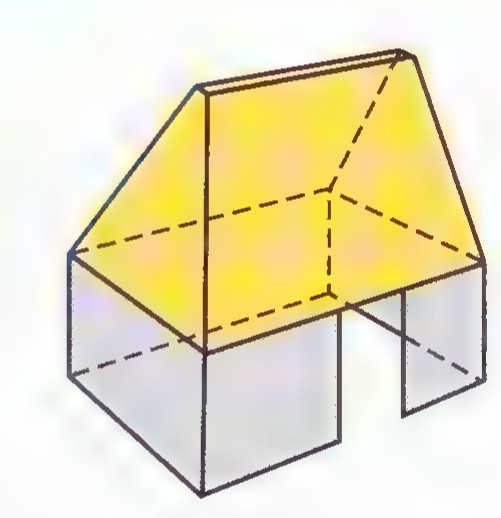
The unusual shape of the panels is due to the fact that they were painted on the sloping ceiling of a room whose design is shown in the first figure at the right. The panels have the shape of trapezoids.
Definition
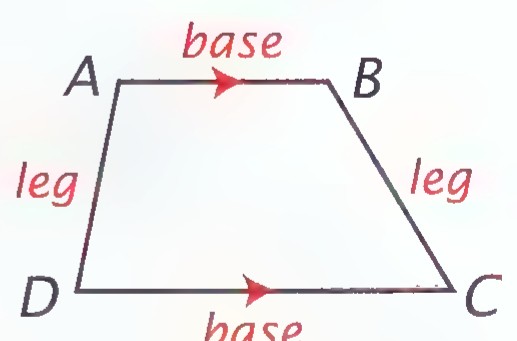
A trapezoid is a quadrilateral that has exactly one pair of parallel sides.
The parallel sides are called the bases of the trapezoid, and the nonparallel sides are called its legs. The pairs of angles that include each base are called base angles: one pair of base angles in trapezoid ABCD at the right is ∠A and ∠B, and the other pair is ∠D and ∠C.
Trapezoid
The two smaller panels in the Mayan mural are in the shape of isosceles trapezoids.
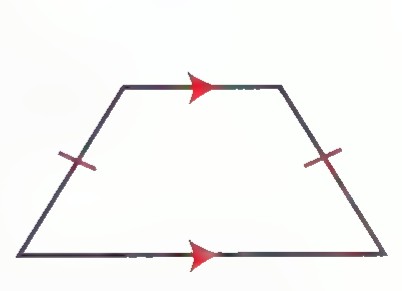
Isosceles trapezoid
Definition
An isosceles trapezoid is a trapezoid whose legs are equal.
p. 282
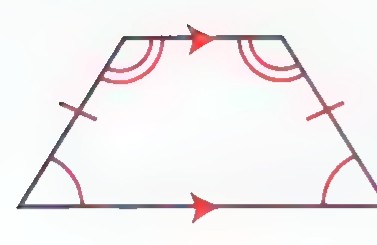
Isosceles trapezoids appear to have line symmetry. If one leg is folded onto the other, the two halves of an isosceles trapezoid look as if they would coincide, which is not true for trapezoids in general. The apparent symmetry of an isosceles trapezoid suggests that its base angles are equal, something that we will prove in the exercises.
Theorem 35
The base angles of an isosceles trapezoid are equal.
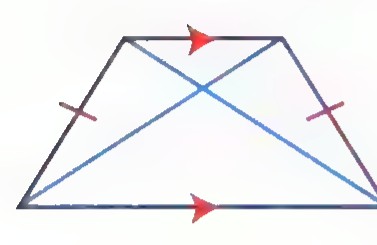
A second property of isosceles trapezoids suggested by line symmetry is that their diagonals are equal. We will also prove this in the exercises.
Theorem 36
The diagonals of an isosceles trapezoid are equal.
Exercises
Set I
Quadrilaterals in Perspective. How we identify a quadrilateral depends on what we assume about it. Consider these figures from a book on architecture.*
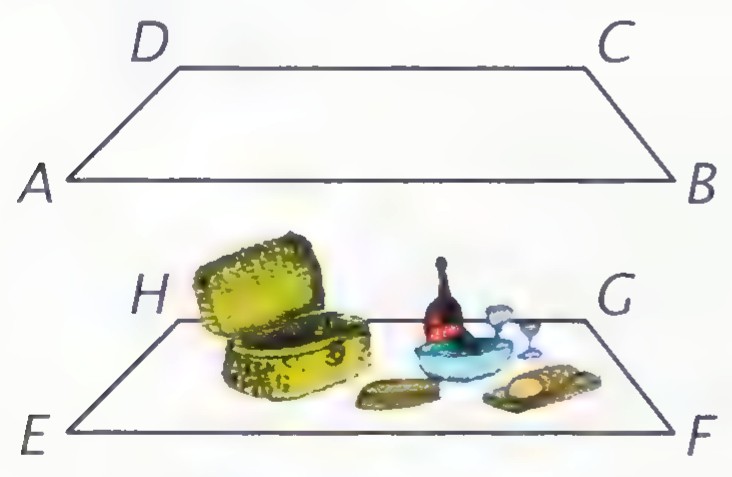
- What kind of quadrilateral does ABCD appear to be?
- What would you have to know to be sure that your conclusion about ABCD is correct?
* Architecture: Form, Space, and Order, by Francis D. K. Ching (Wiley, 1996).
- Does it seem reasonable to say that EFGH is probably a rectangle? Explain.
- What would you have to know to be sure that it is?
- Does it seem reasonable to say that EFGH is probably a parallelogram? Explain.
The figure below from the same book is another example.
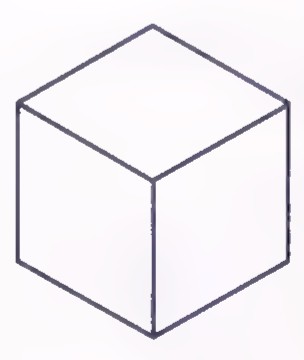
If we assume that the figure is two-dimensional (flat), it appears to contain quadrilaterals that can be named in two ways.
- What are they?
p. 283
If we assume that the figure is three-dimensional, it appears to contain quadrilaterals that can be named in four ways.
- What are they?
Geometric Trademark. The trademark of the Chase Manhattan Bank is a simple geometric design.
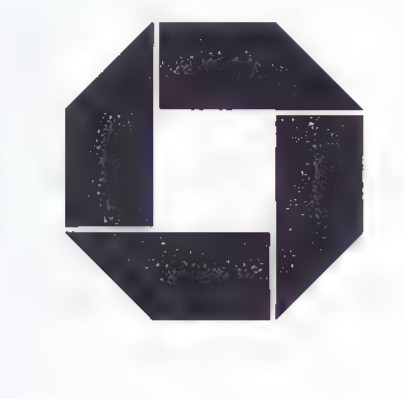
- What kind of symmetry does the figure have?
Its right angles and some of its equal lengths have been marked on the figure below.
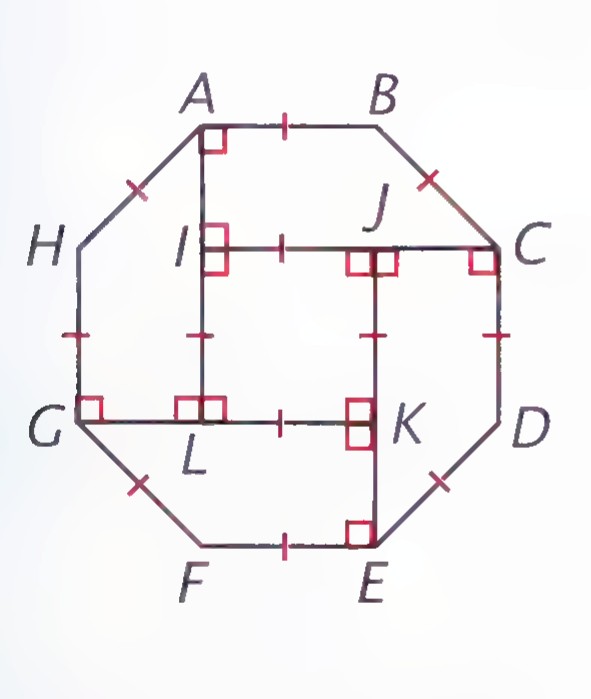
- What kind of quadrilateral is IJKL? Explain.
- What relation do the other four quadrilaterals in the figure seem to have to one another?
- What kind of quadrilaterals are they?
- Which sides of JCDE are its bases?
- If two sides of a trapezoid are equal, does that mean that it is isosceles? Explain.
- Are the base angles of ALGH equal? Explain.
- What kind of polygon is ABCDEFGH?
Complete the proofs of the theorems of this lesson by giving the reasons.
Theorem 35. The base angles of an isosceles trapezoid are equal.
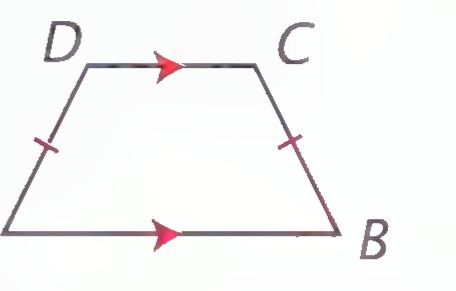
Given: ABCD is an isosceles trapezoid with bases AB and DC. Prove: ∠A = ∠B and ∠D = ∠C.
Proof
- Because AB and DC are the bases of trapezoid ABCD, AB ∥ DC. Why?
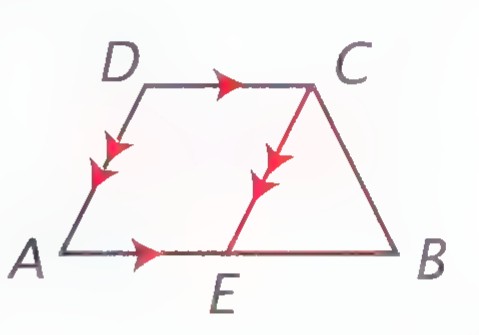
- Through C, why can we draw CE ∥ DA?
- AECD is a parallelogram. Why?
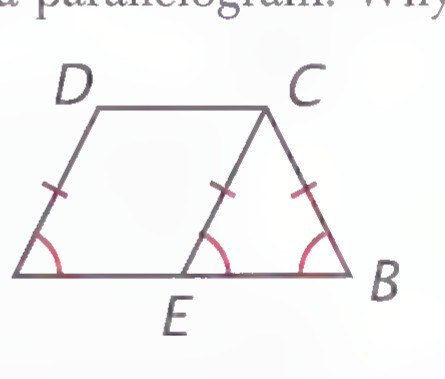
- So DA = CE. Why?
- Because ABCD is isosceles, DA = CB. Why?
- So CE = CB. Why?
- Therefore, ∠CEB = ∠B. Why?
- Because CE ∥ DA, ∠A = ∠CEB. Why?
- So ∠A = ∠B. Why?
- ∠D and ∠A are supplementary and ∠C and ∠B are supplementary. Why?
- ∠D + ∠A = 180° and ∠C + ∠B = 180°. Why?
- ∠D + ∠A = ∠C + ∠B. Why?
- ∠D = ∠C. Why?
p. 284
Theorem 36. The diagonals of an isosceles trapezoid are equal.
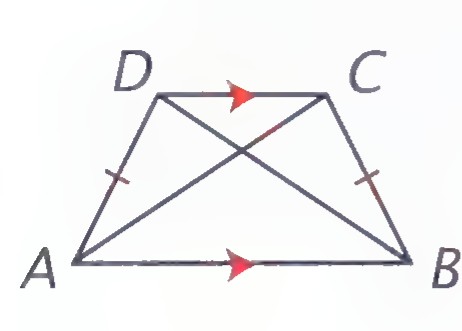
Given: ABCD is an isosceles trapezoid with bases AB and DC. Prove: DB = CA.
Proof
- Because ABCD is an isosceles trapezoid, DA = CB. Why?
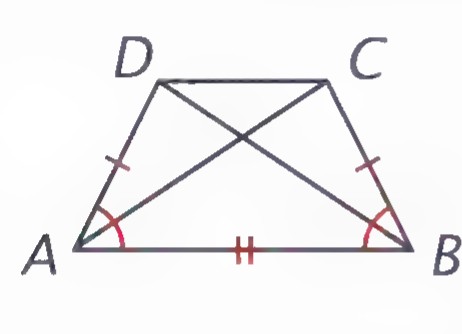
- Also, ∠DAB = ∠CBA. Why?
- AB = AB. Why?
- So △DAB ≅ △CBA. Why?
- Therefore, DB = CA. Why?
Set II
Stepladder. When a stepladder is opened for use, the tool shelf and braces should be parallel.
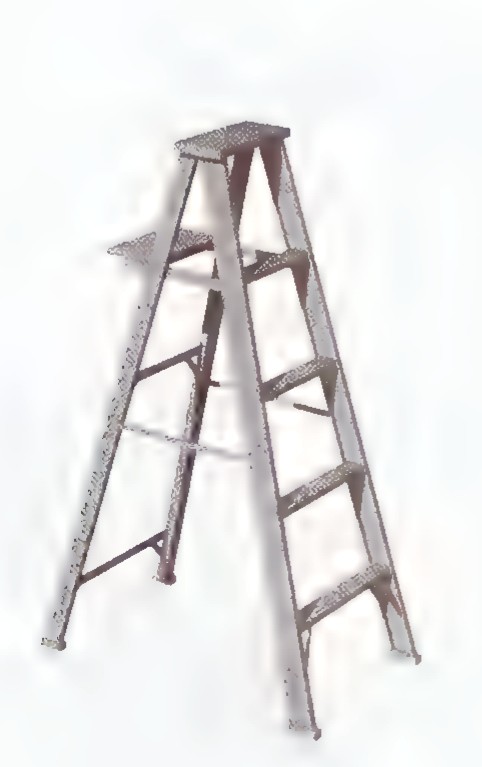
In this side view of the ladder, DF ∥ GH. Also, BE = BF, EG = FH, and ∠BGH = 75°.
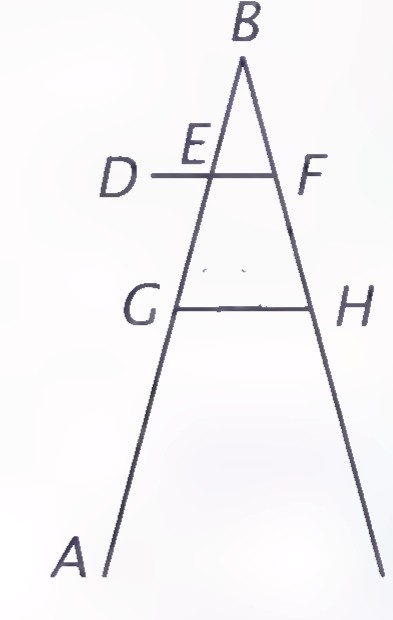
- Copy the figure and mark it as needed to answer each of the following questions.
- What kind of quadrilateral is EFHG?
- How large is ∠FHG?
- How do you know?
- What kind of triangles are △BEF and △BGH?
- How large is ∠BEF?
- How do you know?
- How large is ∠DEB?
- How large is ∠B?
Regular Pentagon. In the Elements, Euclid shows how to construct a regular pentagon in a circle.*
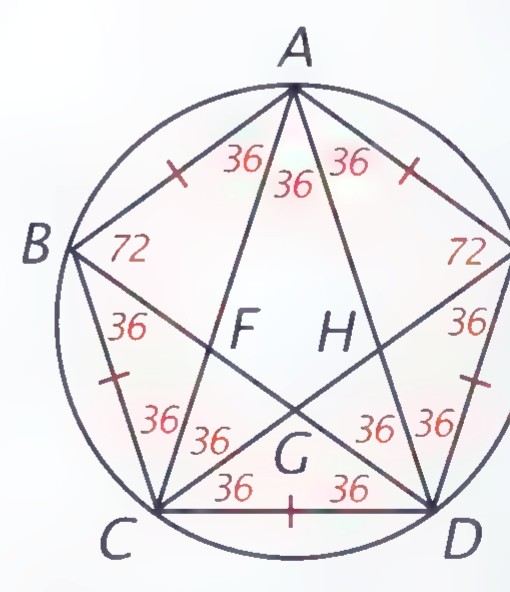
Because the pentagon is regular, AB = BC = CD = DE = EA. The measures of the angles formed by some of its diagonals also are shown.
* Book IV, Proposition 11.
p. 285
Find an example of each of the following quadrilaterals in the figure, and in each case explain how you know that your example is correct.
- An isosceles trapezoid.
- A parallelogram.
- A rhombus.
Trapezoid Diagonals. It is easy to prove that, if a quadrilateral is a trapezoid, its diagonals cannot bisect each other. Give the missing parts for the following indirect proof.
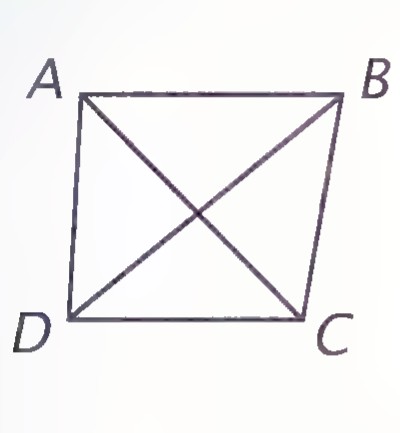
Given: ABCD is a trapezoid. Prove: AC and DB do not bisect each other.
Proof
- Suppose that ?.
- Then ABCD is a parallelogram. Why?
- If ABCD is a parallelogram, then AB ∥ DC and AD ∥ BC. Why?
- If AB ∥ DC and AD ∥ BC, then ABCD is not a trapezoid. Why?
- This contradicts the hypothesis that ?.
- Therefore, what we supposed is false and ?.
We have proved that the diagonals of a trapezoid cannot bisect each other.
- Can they be perpendicular? Explain with either a picture or words why or why not.
Set III
Congruence Puzzle. The following problem is from a popular puzzle book published in the USSR.*
An equilateral triangle can be separated into four congruent triangles as shown in the figures below.
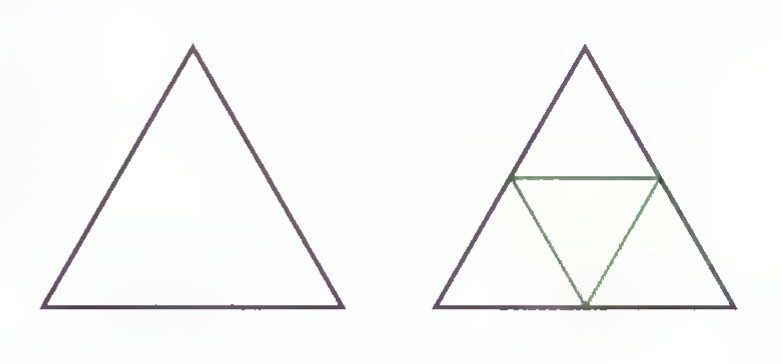
Without the top triangle, the three remaining triangles form a trapezoid. The puzzle is to separate it into four congruent parts.
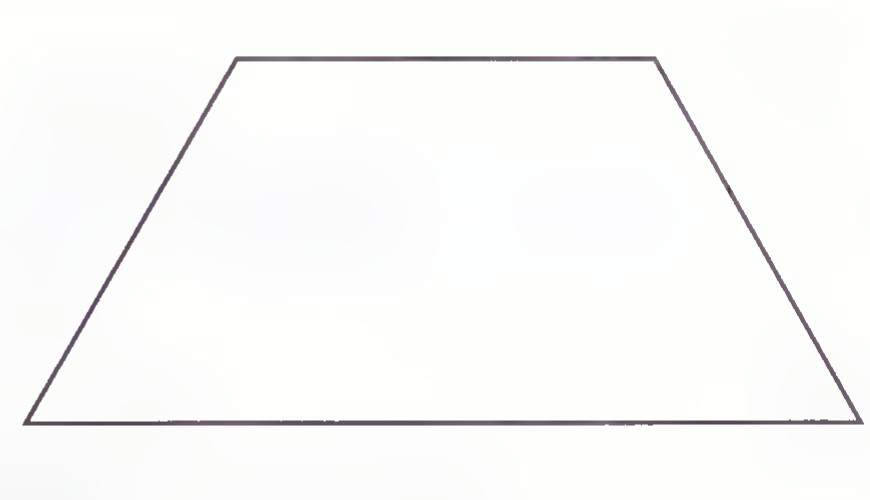
Andrew Miller, a student of Richard Brady in Washington, D.C., who became interested in this problem while studying from the first edition of this geometry book, discovered a solution different from the one thought of by the puzzle’s inventor.
Trace the figure. Can you figure out a way to separate it into four congruent parts?
* An English language edition of The Moscow Puzzles, by Boris A. Kordemsky, was edited by Martin Gardner (Scribner’s, 1972).
p. 286
Lesson 6: The Midsegment Theorem
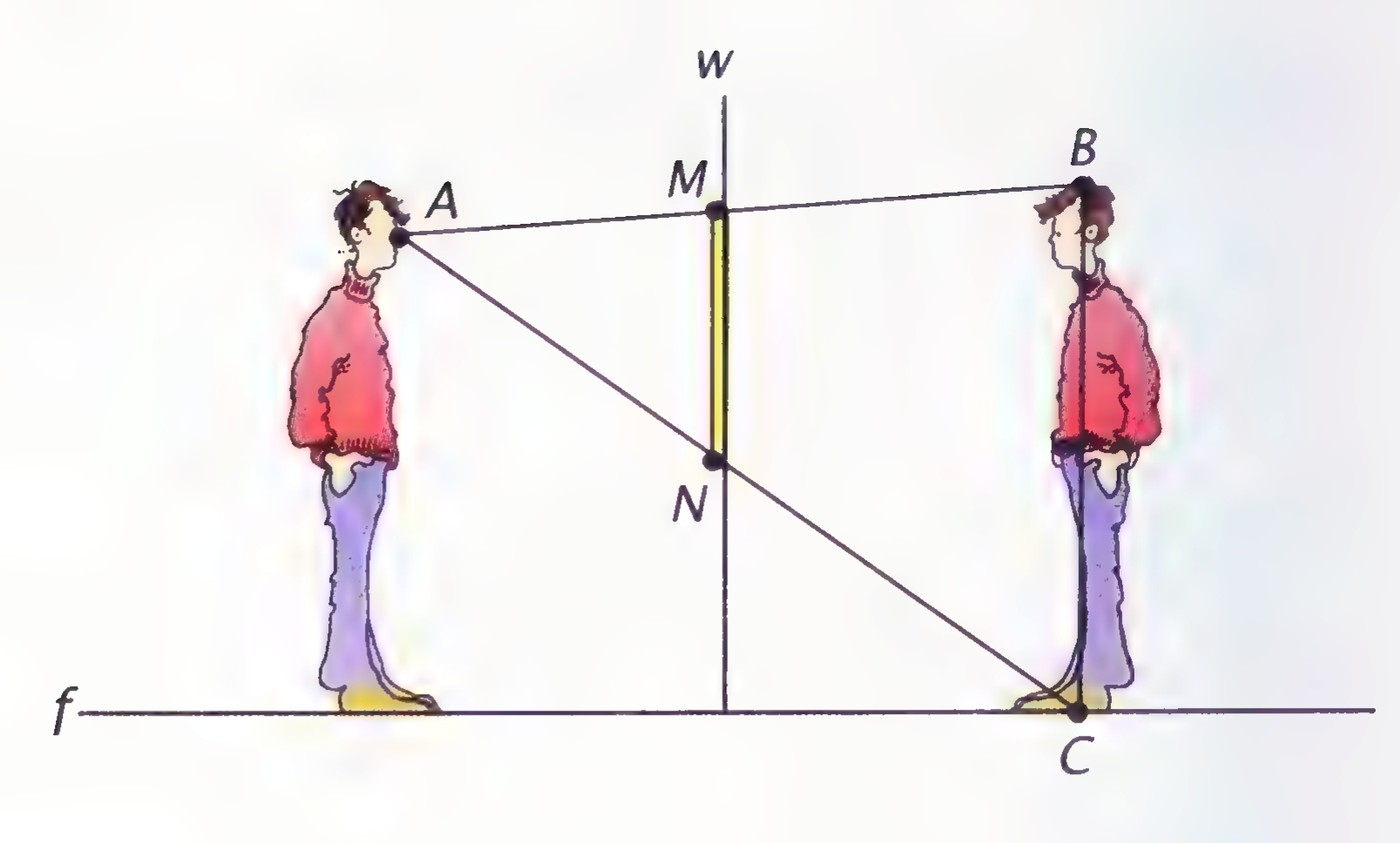
Imagine that you are looking at a reflection of yourself in a large mirror on a wall. How tall would the mirror have to be in order for you to see all of yourself from the top of your head to the bottom of your feet?
When you stand before a mirror, your reflection seems to be standing an equal distance behind it. In the diagram above, line w represents the wall with the mirror on it and line f represents the floor. The person looking at the mirror is shown at the left with his eyes at point A. His reflection, which seems to stand behind the mirror, is represented by BC, and the mirror itself is represented by MN. Points M and N lie on the sides of △ABC; so MN, the length of the mirror, is determined by this triangle.
It can be shown, by using the reflection properties of a mirror, that M is the midpoint of AB and that N is the midpoint of AC. For this reason, MN is called a midsegment of △ABC.
Definition
A midsegment of a triangle is a line segment that connects the midpoints of two of its sides.
We can use this definition and our knowledge of parallelograms to prove the following theorem.
p. 287
Theorem 37. The Midsegment Theorem
A midsegment of a triangle is parallel to the third side and half as long.
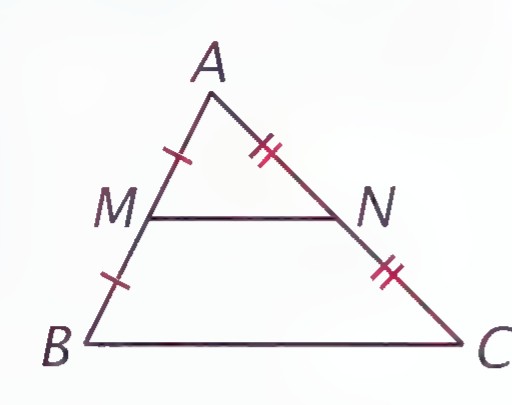
Given: MN is a midsegment of △ABC. Prove: MN ∥ BC and MN = BC.
To prove either part of the conclusion, we have to add something to the figure.
If you study the series of figures at the right carefully, you may be able to see how the proof goes before reading it.
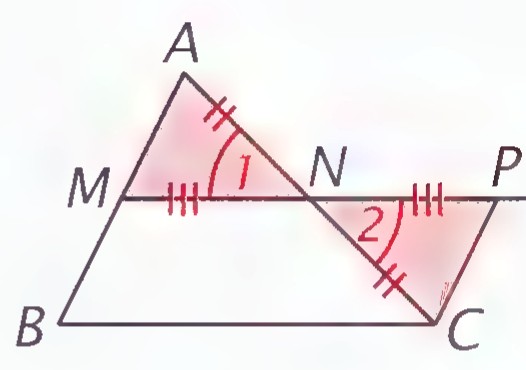
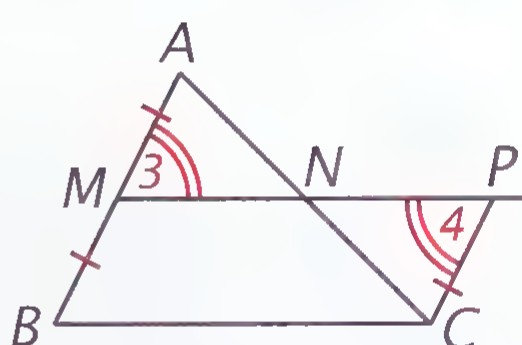
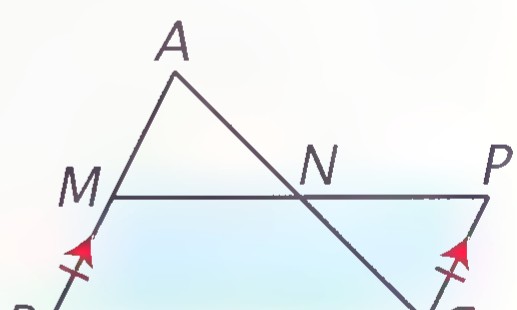
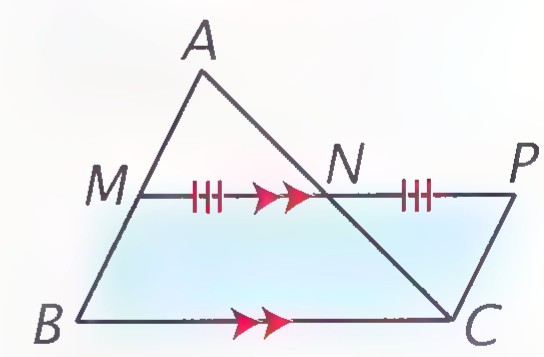
Proof
Part 1. Drawing a new triangle congruent to △AMN
Draw line MN (two points determine a line), choose point P so that NP = MN (the Ruler Postulate), and draw CP. In △AMN and △CPN, MN = NP, ∠1 = ∠2 (vertical angles are equal), and AN = NC (because MN is a midsegment of △ABC, N is the midpoint of AC). So △AMN ≅ △CPN (SAS).
Part 2. Showing that BCPM is a parallelogram
MA = CP (corresponding parts of congruent triangles are equal) and BM = MA (because M is the midpoint of BA); so BM = CP (substitution). Also ∠3 = ∠4 (corresponding parts of congruent triangles are equal); so BA ∥ CP (lines that form equal alternate interior angles are parallel). BCPM is a parallelogram because two opposite sides are parallel and equal (BM ∥ CP and BM = CP).
Part 3. Finishing the proof
MP ∥ BC and MP = BC (the opposite sides of a parallelogram are parallel and equal). Because M-N-P by construction, MP = MN + NP (the Betweenness of Points Theorem). But NP = MN; so MP = MN + MN (substitution). Because MP = 2MN, MN = MP (division); so MN = BC (substitution).
We can now answer the question about how long a mirror on a wall has to be in order for you to see your complete reflection. Look again at the figure at the beginning of this lesson. MN is a midsegment of △ABC; so MN = BC. The segment BC, the length of your image in the mirror, is just as tall as you are. So the mirror can be half as long as you are tall.
p. 288
Exercises
Set I
Portuguese Theorem. Here is the Midsegment Theorem as it appears in a Portuguese geometry book.
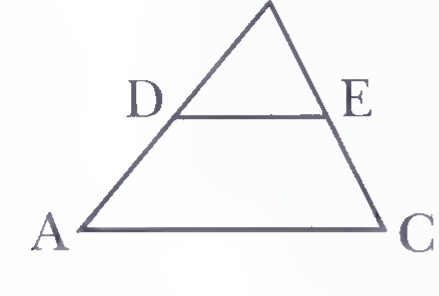
Teorema: O segmento de recta que une os pontos médios de dois lados de um triângulo é paralelo ao outro lado e igual à sua metade.
In the figure, points D and E illustrate the “pontos médios.” AC is the “outro lado.”
- What do you think these words mean?
- What do we call segment DE?
- What do you think these words mean?
- What does the theorem say in English?
- Write its conclusion in terms of the figure.
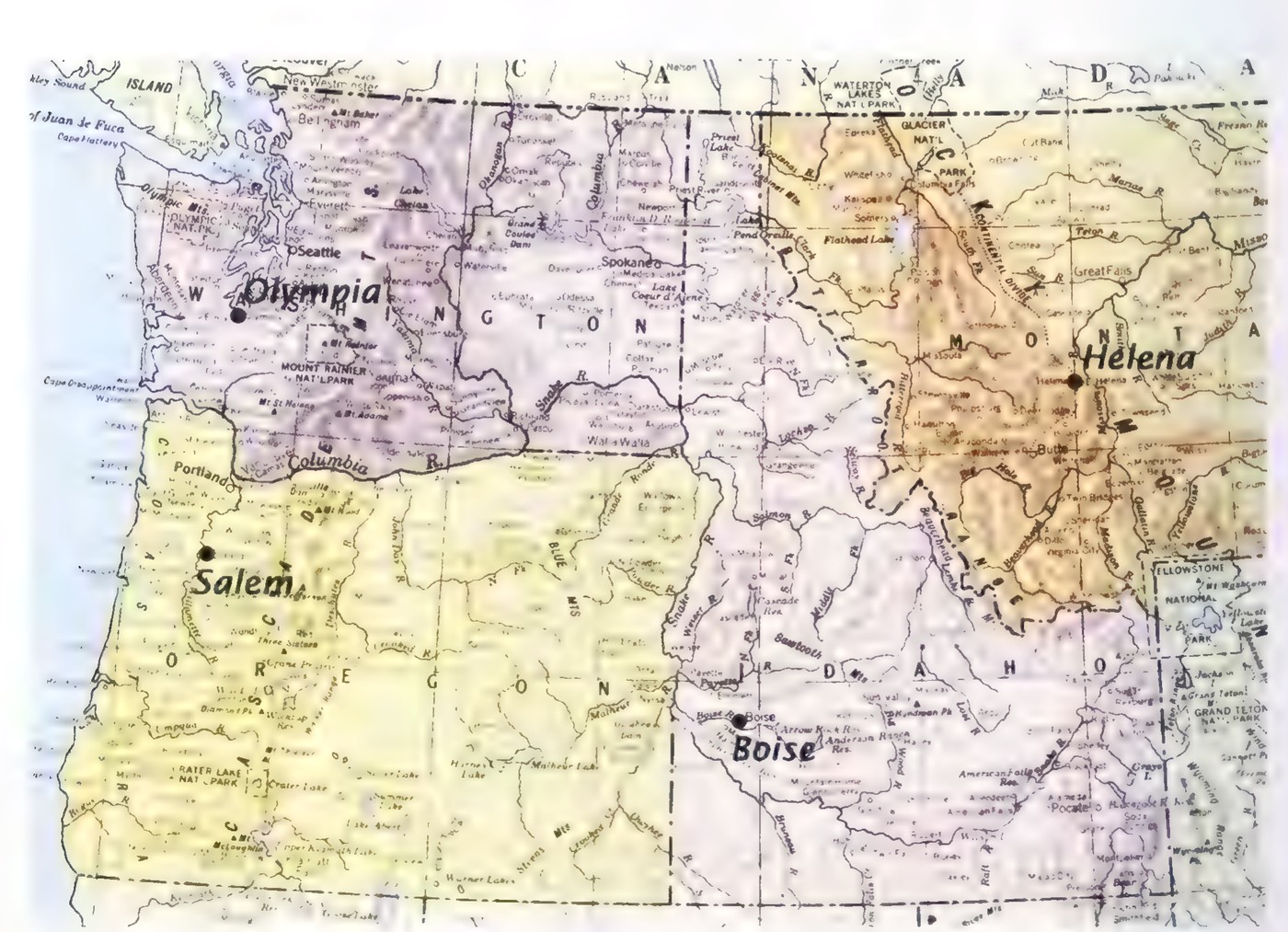
State Capitals Problem. The locations of four state capitals have been marked on the map below.
- Trace the four points on your paper and draw quadrilateral SOHB. Use your straightedge and compass to bisect each of its sides. Starting with the midpoint of side SO, label the midpoints (moving clockwise around the figure) M, N, P, and Q, respectively. Draw quadrilateral MNPQ.
- What is surprising about the result?
- Draw SH. Why is MN ∥ SH and QP ∥ SH?
p. 289
- Why is MN ∥ QP?
- Why is MN = SH and QP = SH?
- Why is MN = QP?
- What do these facts prove about quadrilateral MNPQ?
- Explain why.
- Draw MP and NQ. What seems to be true?
- Explain why it must be true.
Midpoint Quadrilateral. E, F, G, and H are the midpoints of the sides of quadrilateral ABCD.
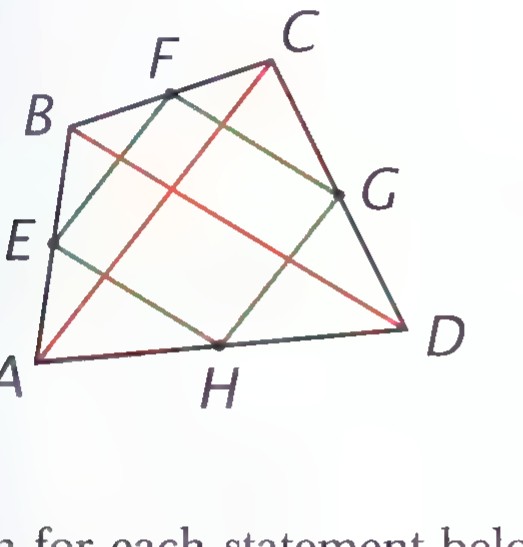
Give a reason for each statement below.
- , , , and . Why?
- . Why?
- . Why?
- What is called with respect to EFGH?
- What is called with respect to ABCD?
- Show how the equation proved in exercise 18 can be stated in words by completing the following sentence:
If the midpoints of the sides of a quadrilateral are connected in order by line segments to form a midpoint quadrilateral, . . .
Two Midsegments. In the figure below, DE is a midsegment of △ABC, FG is a midsegment of △DBE, and AD = CE.
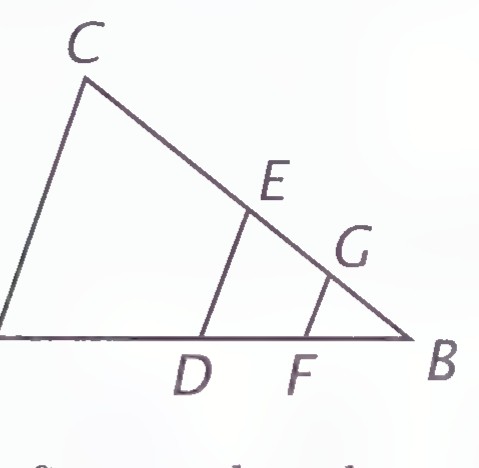
- Copy the figure and mark it as needed to answer each of the following questions.
What can you conclude about
- ADEC? Why?
- ∠A and ∠C? Why?
- △ABC? Why?
- FG and AC? Why?
Set II
Midpoint Coordinates. On graph paper, draw a pair of axes extending 15 units to the right and 15 units up from the origin.
- Plot the following points and connect them with line segments to form △ABC: A (3, 2), B (5, 12), C (11, 8).
Use the grid to help you in locating the midpoints of the sides of △ABC. Let M be the midpoint of AB.
- What are its coordinates?
Let N be the midpoint of BC.
- What are its coordinates?
Let O be the midpoint of AC.
What are its coordinates?
Is there a way to figure out the coordinates of the midpoint of a line segment from the coordinates of its endpoints? If so, how would you do it?
Draw MN.
- Use the distance formula to find its length.
p. 290
- Use the distance formula to find AC.
- Are the two distances related in the way that you would expect? Explain.
- In what way should lines MN and AC be related?
- Is there anything about their relation to the grid that suggests that they have this relation? If so, what is it?
Tetrahedron. An edition of Euclid’s Elements published in London in 1570 featured little paper models attached to the pages that could be folded up to form three-dimensional figures.
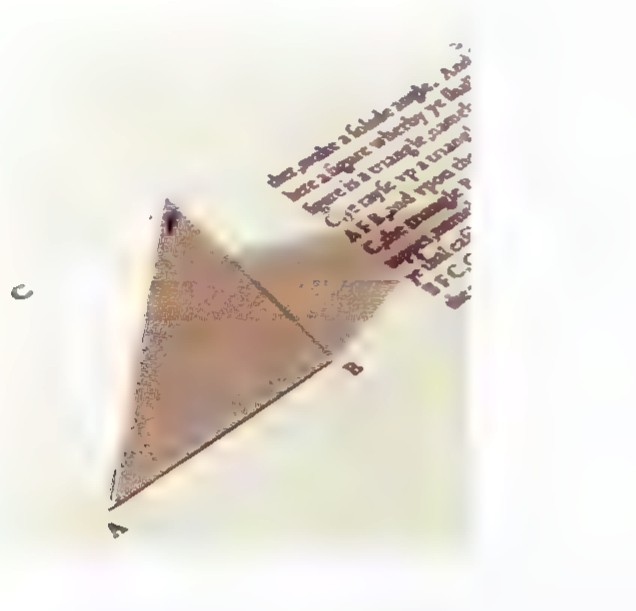
One pattern consisted of a triangle and its three midsegments. It could be folded to form a tetrahedron, which is a polyhedron with four triangular faces.
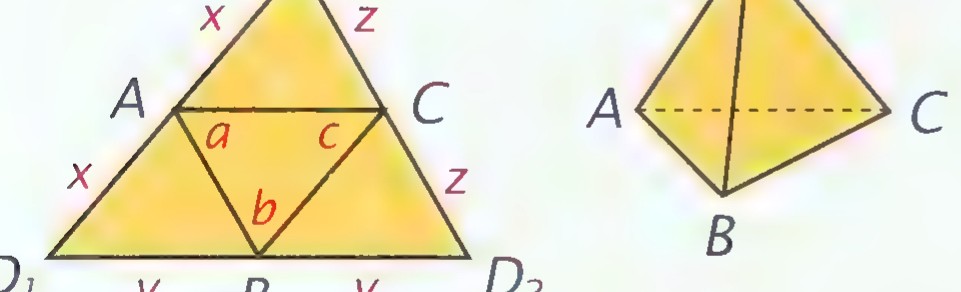
- Copy the first figure above and label the lengths of the sides of △ABC in terms of , , and .
- What must be true about the four triangles in the figure? Explain.
- Copy the second figure and label the lengths of the six edges of the tetrahedron in terms of , , and .
Two edges of a tetrahedron that do not intersect are called opposite edges; for example, AC and BD are opposite edges.
- What do you notice about the opposite edges of the tetrahedron?
In the first figure, the measures of the angles of △ABC are labeled , , and .
- (continued) Label the measures of the angles of the other triangles in terms of , , and .
When the pattern is folded together, three angles meet at each vertex of the tetrahedron.
- What is the sum of the three angles at each vertex?
More Midpoint Quadrilaterals. Exercises 6 through 13 of this lesson demonstrate that the midpoints of the sides of a quadrilateral are the vertices of a parallelogram.
- Draw a large rectangle that is not a square. Find the midpoints of its sides and connect them in order with line segments to form a quadrilateral.
- What special type of parallelogram does the quadrilateral seem to be?
- Mark your figure and use what you know about rectangles to explain why your answer is correct.
- Draw a large rhombus that is not a square. Find the midpoints of its sides and connect them in order with line segments to form a quadrilateral.
- What special type of parallelogram does the quadrilateral seem to be?
- Mark your figure and use what you know about rhombuses to explain why your answer is correct. (Hint: Draw the diagonals of the rhombus.)
- What figure would you expect to get if you connected the midpoints of the sides of a square in order with line segments?
p. 291
Base Average. M and N are the midpoints of the legs of trapezoid ABCD.
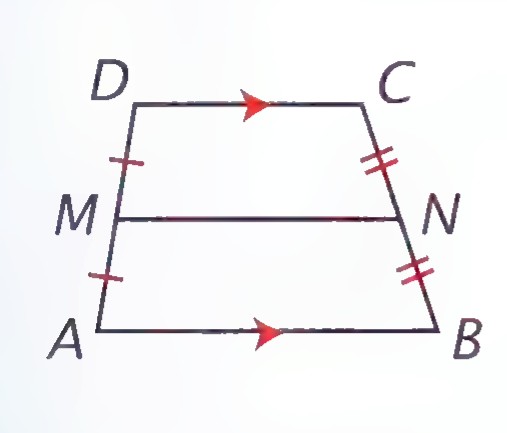
- What seems to be true about MN?
- Copy the figure and mark it as shown. Draw line DN and extend AB to intersect it at P.
- Explain why △DCN ≅ △PBN.
- Explain why MN ∥ AP.
- Explain why MN ∥ DC.
- Explain why MN = (AB + DC).
Set III
Infinite Series. Jonathan Swift, the author of Gulliver’s Travels, once wrote:
So, naturalists observe, a flea Hath smaller fleas that on him prey; And these have smaller still to bite ’em; And so proceed ad infinitum.
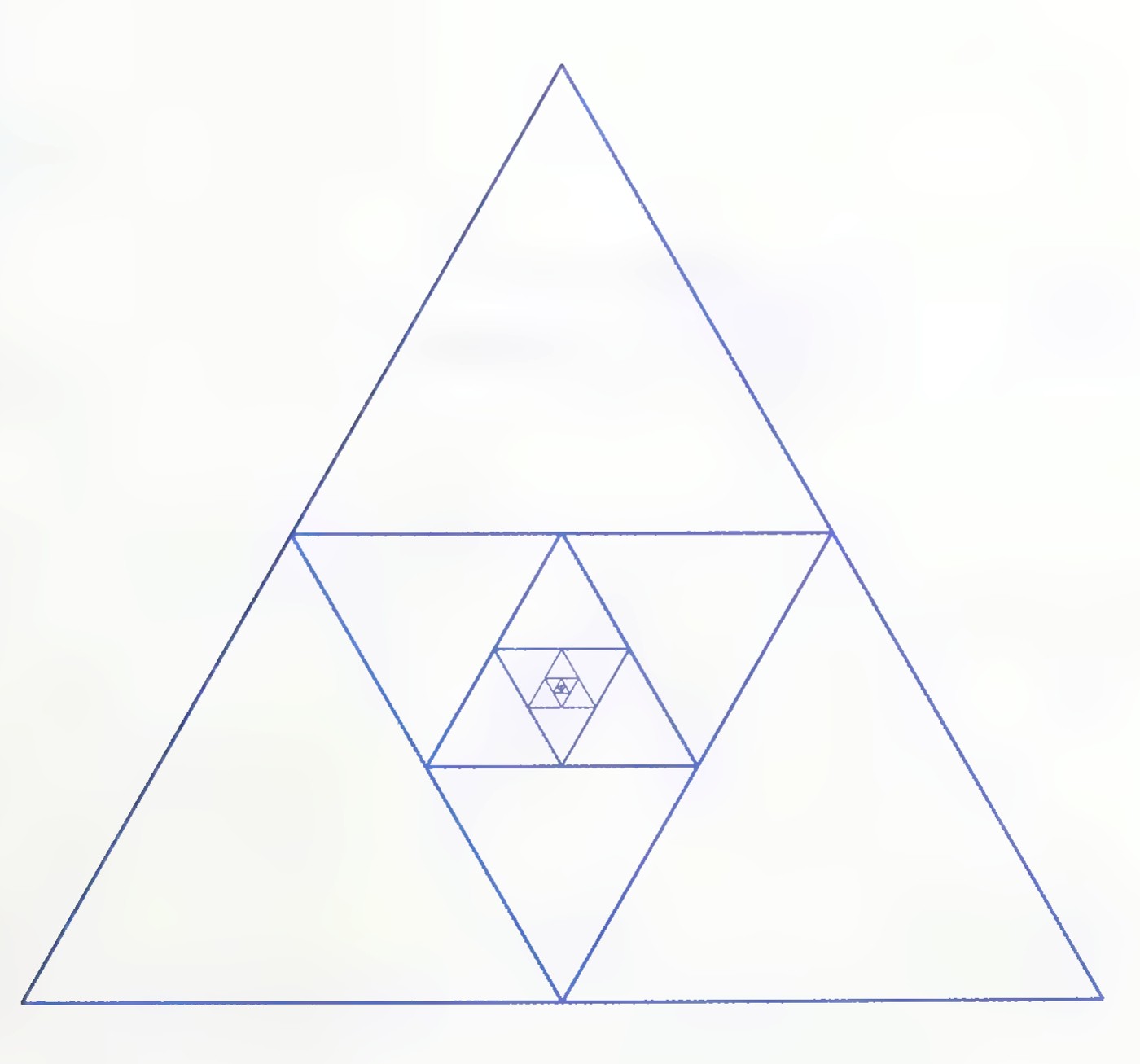
The figure below represents an infinite series, not of fleas, but of equilateral triangles. The sides of the largest triangle are each 4 inches long. Each successive triangle is formed by the midsegments of the preceding one.
With the use of the Midsegment Theorem and a calculator, can you guess what the sum of the lengths of all of the sides of the triangles in this figure is? If so, show your reasoning.
p. 292
Summary and Review
Basic Ideas
Convex and concave polygons 258
Diagonal 259
Isosceles trapezoid 281
Midsegment 286
Parallelogram 265
Point symmetry 265–266
Rectangle 259
Rhombus 276
Square 276
Trapezoid 281
Theorems
- The sum of the angles of a quadrilateral is 360°. 259
Corollary. A quadrilateral is equiangular iff it is a rectangle. 259
- The opposite sides and angles of a parallelogram are equal. 266
- The diagonals of a parallelogram bisect each other. 266
- A quadrilateral is a parallelogram if its opposite sides are equal. 271
- A quadrilateral is a parallelogram if its opposite angles are equal. 271
- A quadrilateral is a parallelogram if two opposite sides are both parallel and equal. 271
- A quadrilateral is a parallelogram if its diagonals bisect each other. 271
- All rectangles are parallelograms. 276
- All rhombuses are parallelograms. 276
- The diagonals of a rectangle are equal. 277
- The diagonals of a rhombus are perpendicular. 277
- The base angles of an isosceles trapezoid are equal. 282
- The diagonals of an isosceles trapezoid are equal. 282
- The Midsegment Theorem. A midsegment of a triangle is parallel to the third side and half as long. 287
Exercises
Set I
Palm Strand Rhombus. The figure below from a book on African geometry shows palm strands woven together to form the wall of a bag. The accompanying description states that “two crossing strips of equal width determine a rhombus.”*
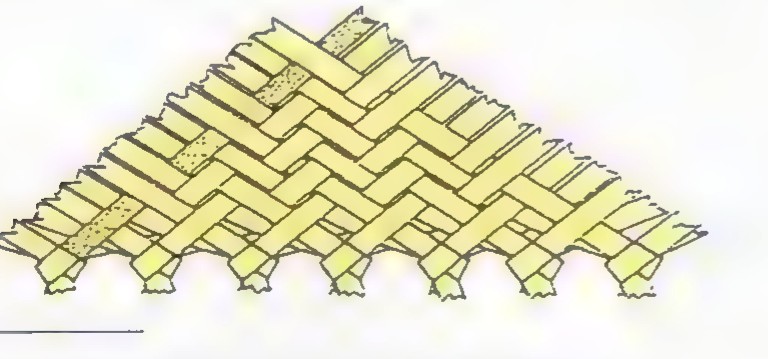
* Geometry from Africa, by Paulus Gerdes (The Mathematical Association of America, 1999).
In the figure below, the edges of each strip are parallel; so AB ∥ DC and AD ∥ BC. The equal widths of the two strips are labeled w.
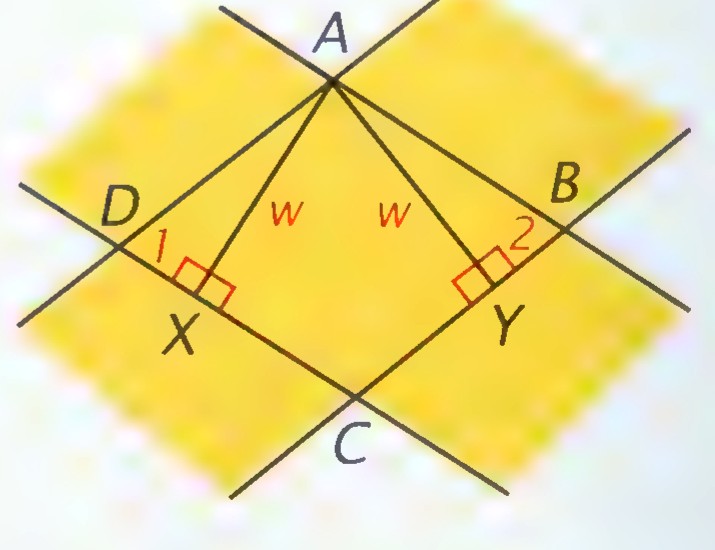
- Draw the figure; mark it as needed to answer each of the following questions.
p. 293
- Why is ABCD a parallelogram?
- Why is ∠1 = ∠2?
- Why is △ADX ≅ △ABY?
- Why is AD = AB?
- AD = BC and AB = DC. Why?
- Why is BC = DC?
- Why is ABCD a rhombus?
Floating Bar. The figures below show two possible ways in which a long square bar might float on a liquid.*
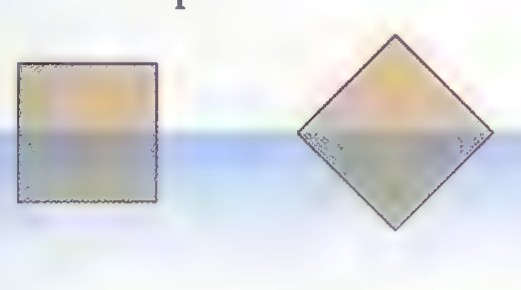
In both figures, the surface of the liquid appears to be a line of symmetry of the square.
- How many lines of symmetry does a square have?
- Does it have point symmetry?
- In which of the two ways illustrated (the first or the second) do you suppose a square bar floats?
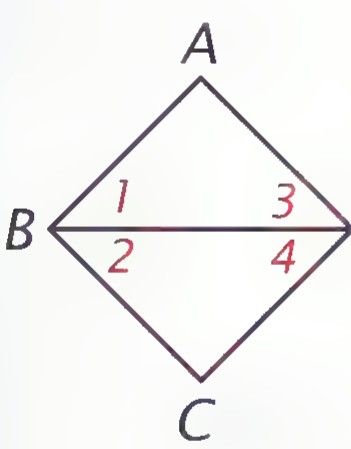
- Copy the figure above and mark it as needed to explain each of the following statements.
- Because ABCD is a square, AB = BC = CD = DA and ∠A = ∠C. Why?
- △BAD ≅ △BCD. Why?
- ∠1 = ∠2 and ∠3 = ∠4. Why?
- Diagonal BD bisects ∠ABC and ∠ADC. Why?
* The Flying Circus of Physics, by Jearl Walker (Wiley, 1977).
Related Statements. Compare the following statements:
If a quadrilateral is a parallelogram, one of its diagonals divides it into two congruent triangles.
If one of its diagonals divides it into two congruent triangles, a quadrilateral is a parallelogram.
- How is the second statement related to the first?
- Are they both true? Use these figures to explain your answer.
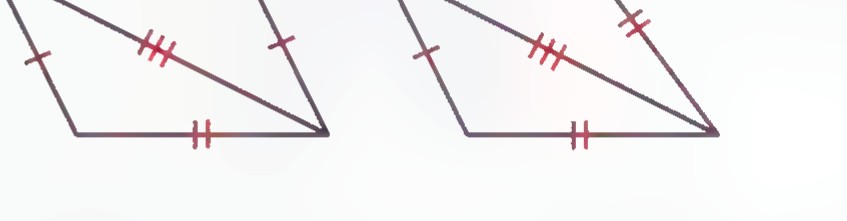
Tell whether each of the following statements is true or false. If you think a statement is false, draw a figure to illustrate why.
- If a quadrilateral is a parallelogram, both pairs of its opposite sides are equal.
- If both pairs of its opposite sides are equal, a quadrilateral is a parallelogram.
- If a quadrilateral is an isosceles trapezoid, it has two pairs of equal angles.
- If it has two pairs of equal angles, a quadrilateral is an isosceles trapezoid.
- All parallelograms are rhombuses.
- All rhombuses are parallelograms.
- If a quadrilateral is a rectangle, it is equiangular.
- If it is equiangular, a quadrilateral is a rectangle.
- If a quadrilateral is a rhombus, its diagonals are perpendicular.
- If its diagonals are perpendicular, a quadrilateral is a rhombus.
- If a quadrilateral is a parallelogram, its diagonals are equal.
- If its diagonals are equal, a quadrilateral is a parallelogram.
p. 294
Jumping Frog. This jumping frog toy operates by means of a cardboard linkage. As the linkage changes shape, the marked lengths always remain equal. As a result, other things do not change.*
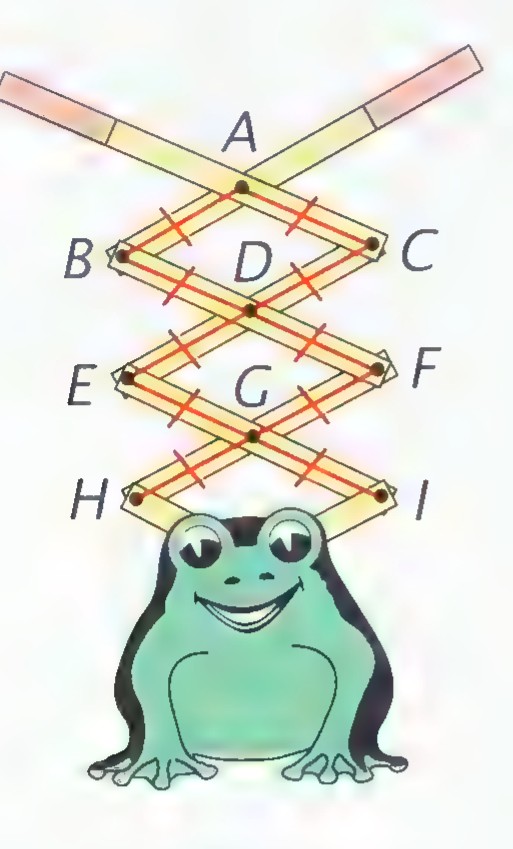
- The sum of the angles in each quadrilateral is always the same. Why?
- The quadrilaterals are always parallelograms. Why?
- Pairs of opposite angles such as ∠B and ∠C always remain equal. Why?
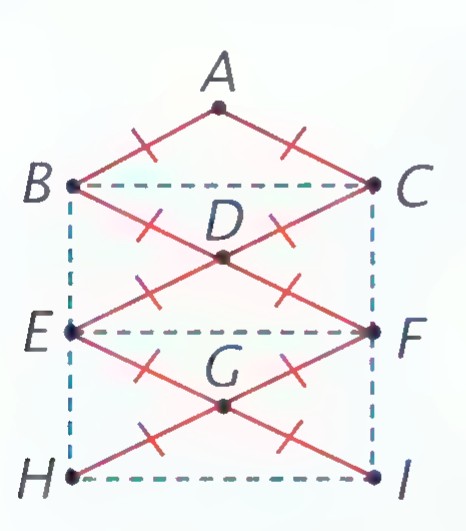
- The quadrilaterals outlined in blue in the figure above are always parallelograms. Why?
- BC, EF, and HI always remain parallel. Why?
* Mathematics Meets Technology, by Brian Bolt (Cambridge University Press, 1991).
Set II
Dissection Puzzle. An old puzzle consists of five pieces that can be arranged in different shapes.†
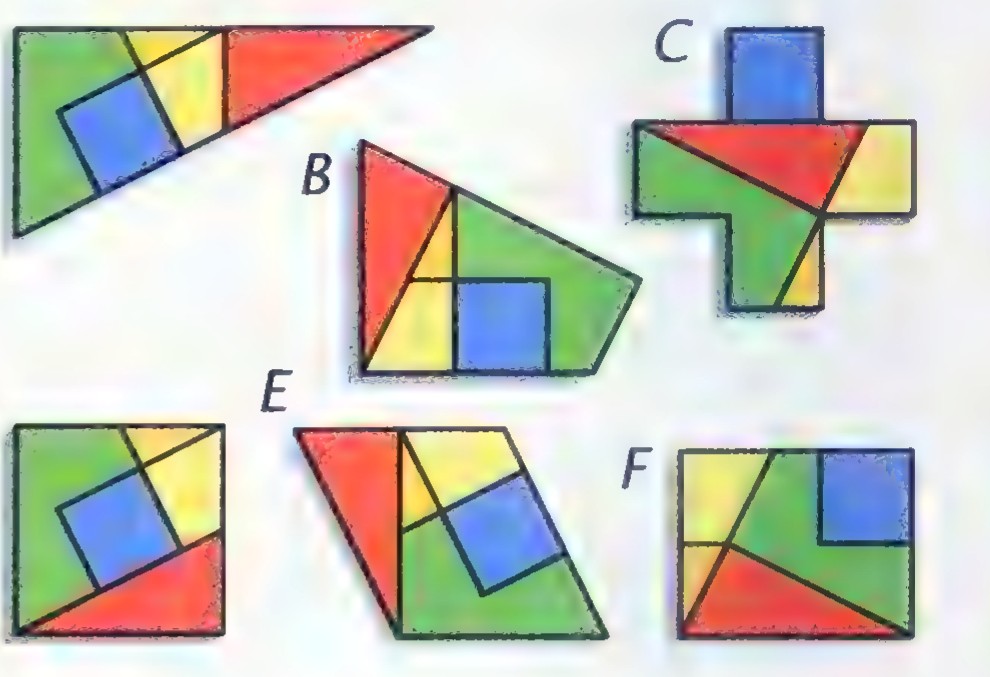
Which of the six shapes appear to be
- parallelograms?
- rhombuses?
- rectangles?
- equilateral?
- convex?
In the drawing of shape E below, GM ∥ HP ∥ IL, the right angles have been marked, and equal lengths have been labeled with lowercase letters.
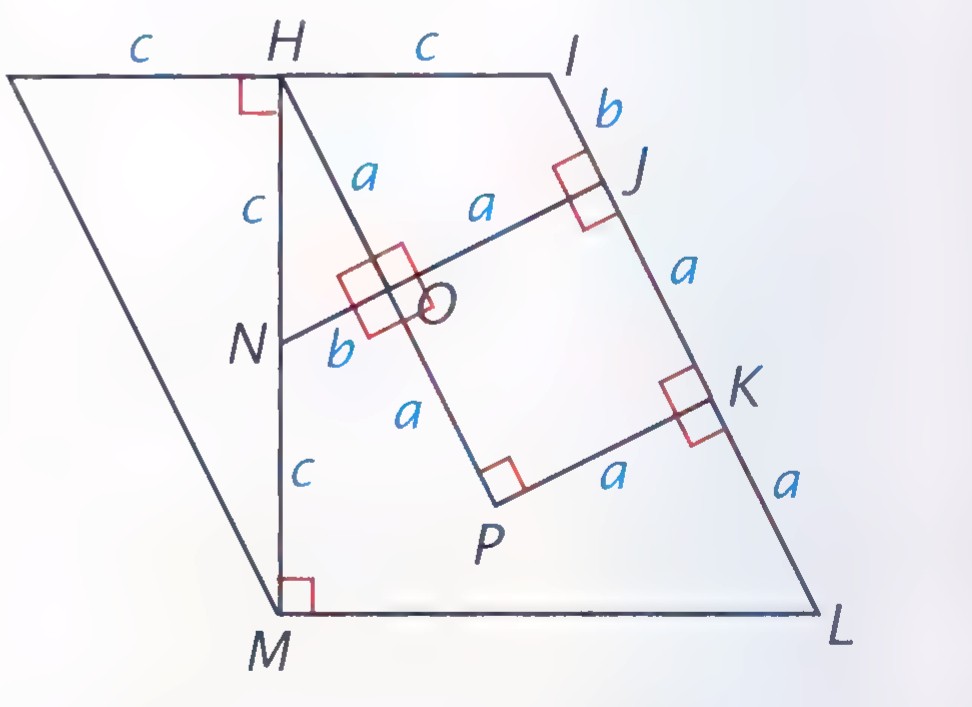
- Make a large copy of the figure and mark it as needed to answer each of the following questions.
† Creative Puzzles of the World, by Pieter van Delft and Jack Botermans (Abrams, 1978).
p. 295
- GI ∥ ML. Why?
- What kind of quadrilateral is GILM?
- How do you know?
In terms of , , and , what is the length of
- ML?
- GM?
- What kind of quadrilateral is JKPO?
- How do you know?
- What kind of quadrilateral is HIJO?
- How do you know?
- (continued) It can be shown that, to the nearest degree, ∠G = 63°. Use this fact to find the measures of the rest of the angles and mark them on the figure.
Words from the Past. A geometry book widely used a century ago* contains the following definitions:
A trapezium is a quadrilateral that has no parallel sides.
A rhomboid is a parallelogram that has no right angles.
According to these definitions,
- can a trapezoid be a trapezium? Explain.
- can a rhombus be a rhomboid? Explain.
- can a rectangle be a rhomboid? Explain.
Rectangles Not. The following quadrilaterals almost look like rectangles but, from the angles given, clearly are not. Explain what you can conclude about each one.
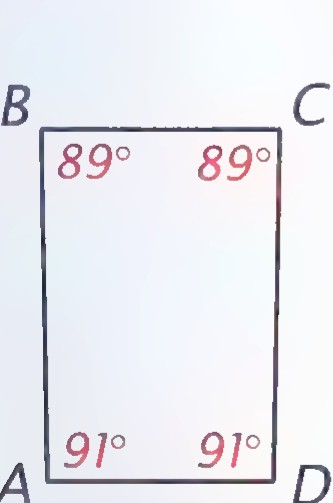
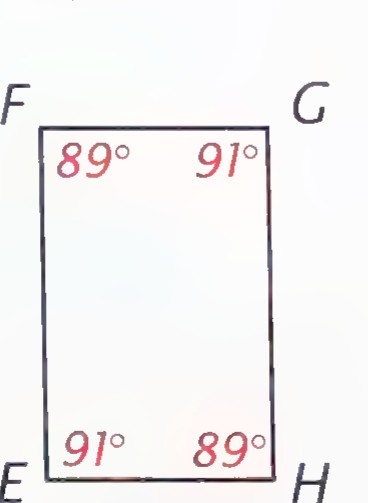
* Plane and Solid Geometry, by G. A. Wentworth (Ginn, 1899).
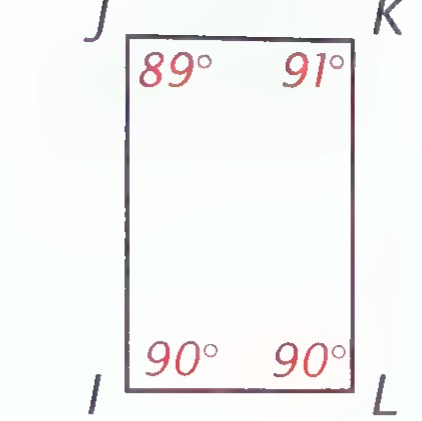
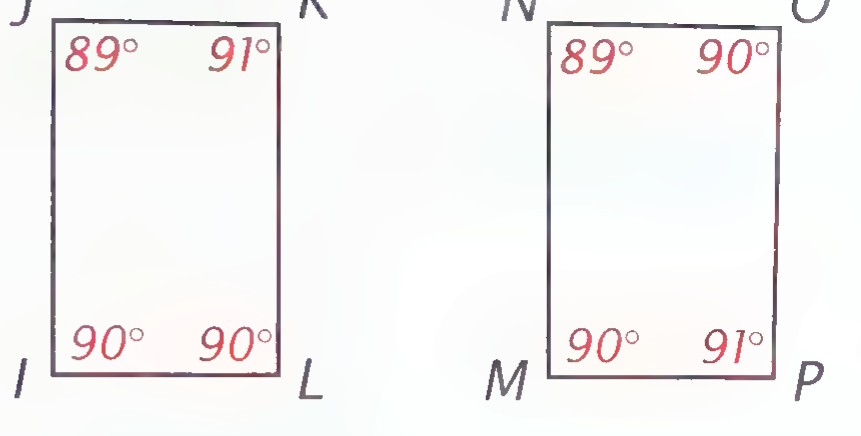
A magician has a deck of playing cards in which the cards are shaped like the quadrilateral in exercise 54. He asks you to take a card, look at it, and put it back into the deck. He shuffles the deck several times, holds it in front of you with one hand, and, with the other hand, slides up the card that you chose.†
- How do you think the trick works?
Another Midpoint Quadrilateral. ABCD is an isosceles trapezoid with bases AB and DC; the vertices of MNOP are the midpoints of its sides.
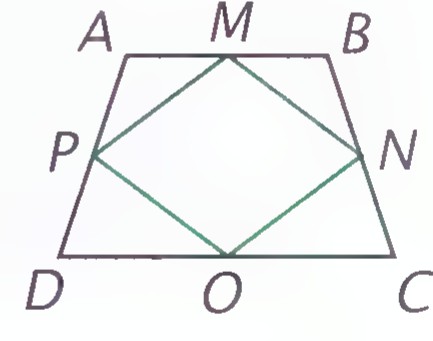
- Copy the figure and mark it as necessary to do each of the following exercises.
- Draw AC and use it to explain why MNOP is a parallelogram.
- What special type of quadrilateral does MNOP appear to be? Explain why your answer is correct.
† The Mammoth Book of Brain Storming Puzzles, by David J. Bodycombe (Carroll and Graf, 1996).
p. 296
Algebra Review: Square Roots
The Square Root of a Product or Quotient
If and are positive,
Simple Radical Form
An expression containing a square root is in simple radical form if the number or expression under the square root sign has no perfect square factors other than 1.
Example 1: Find the square roots of 20 to the nearest hundredth.
Solution: A calculator shows that so and .
Example 2: Write in simple radical form.
Solution: .
Example 3: Simplify .
Solution: .
Exercises
Use your calculator to find each of the following square roots.
- to the nearest thousandth.
- to the nearest hundredth.
- to the nearest tenth.
- to the nearest hundredth.
- to the nearest tenth.
Write in simple radical form.
Write in simple radical form. Assume that represents a positive number.
Use simple radical form to show that
- .
- .
Simplify.
Do as indicated and simplify.