p. 183
Chapter 5: Inequalities
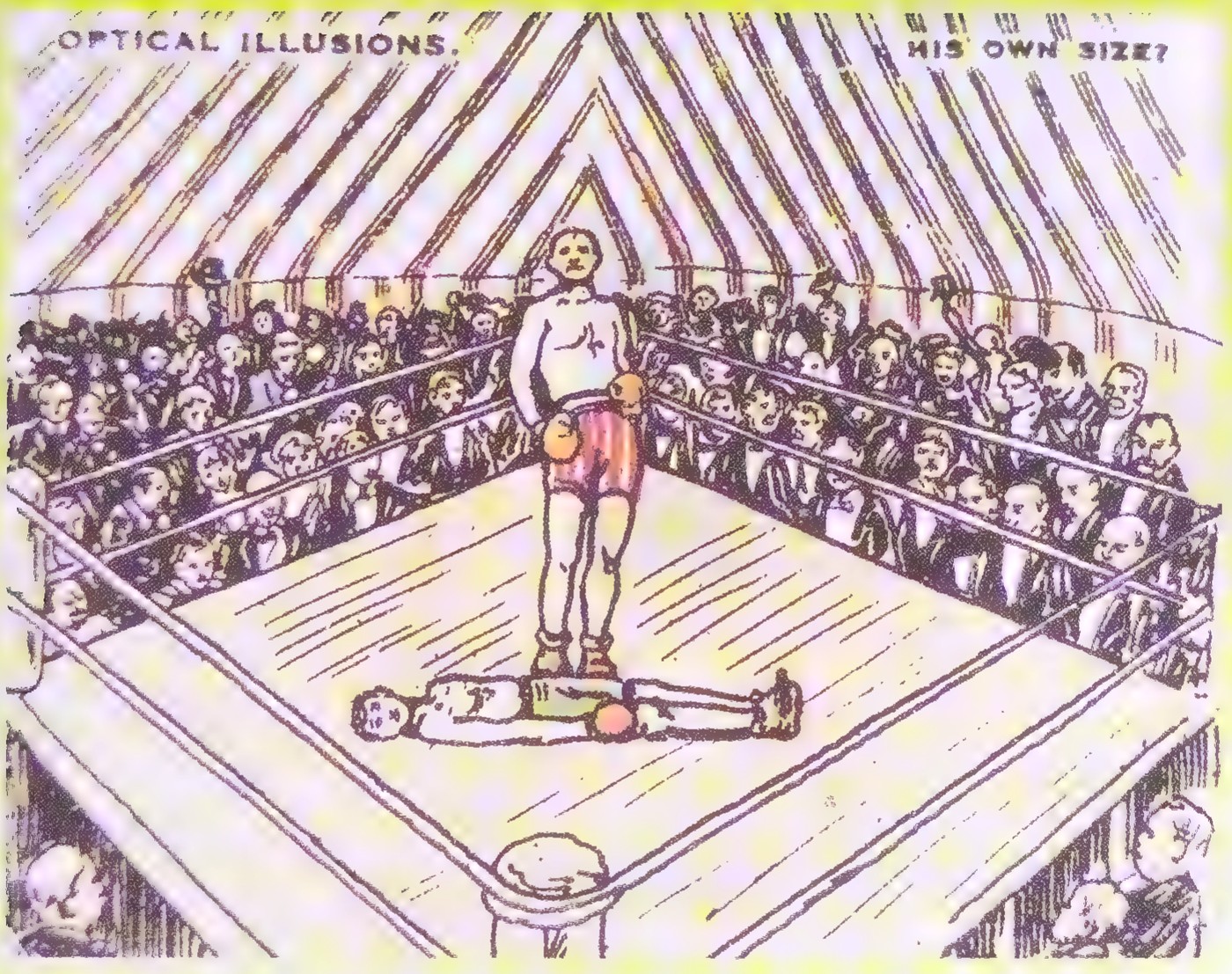
Which boxer is taller?
So far in our study of geometry, we have paid most of our attention to line segments and angles that are equal. The word “equal,” in fact, has appeared in almost every theorem that we have proved. In this chapter, we turn to comparisons of line segments and angles that are not equal. Again, the emphasis is on the properties of triangles. Our survey concludes with one of the simplest, yet most useful, ideas of geometry, the Triangle Inequality Theorem.
p. 184
Lesson 1: Properties of Inequality
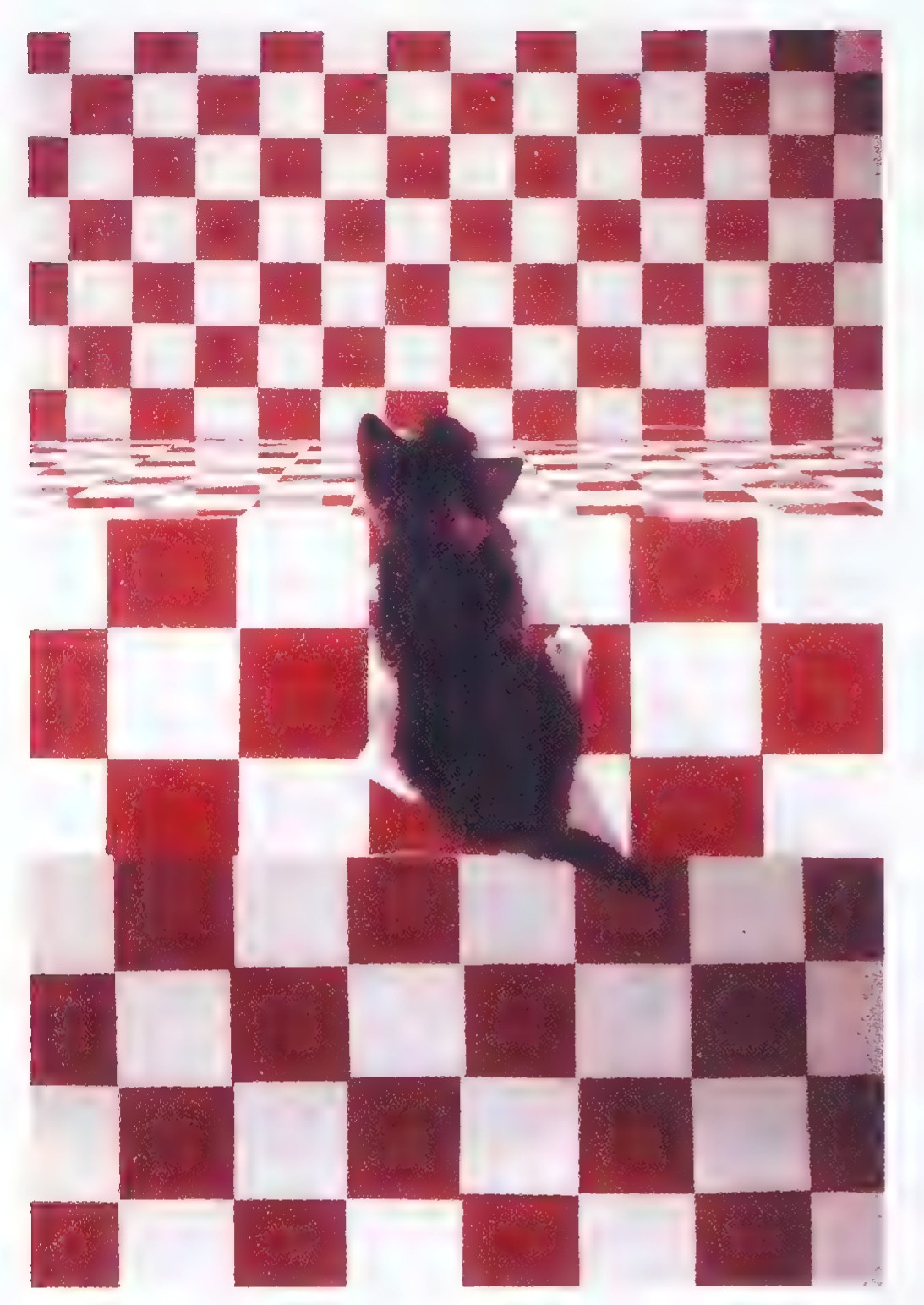
Are we born with the ability to tell which things are close and which are far away, or do we learn it? Two psychologists at Cornell University, Eleanor Gibson and Richard Walk, did an interesting experiment to answer this question. The kitten in the photograph above is sitting on a strip in the middle of a large sheet of glass. Behind the kitten is a floor directly underneath the glass; in front of it is another floor several feet below the glass. Even when a kitten is just old enough to move about, it is afraid to move off the “cliff” to the “deep” side. Chicks and baby goats just 1 day old and human infants just old enough to crawl behave exactly the same way.*
* Perception, by Irvin Rock (Scientific American Library, 1984).
p. 185
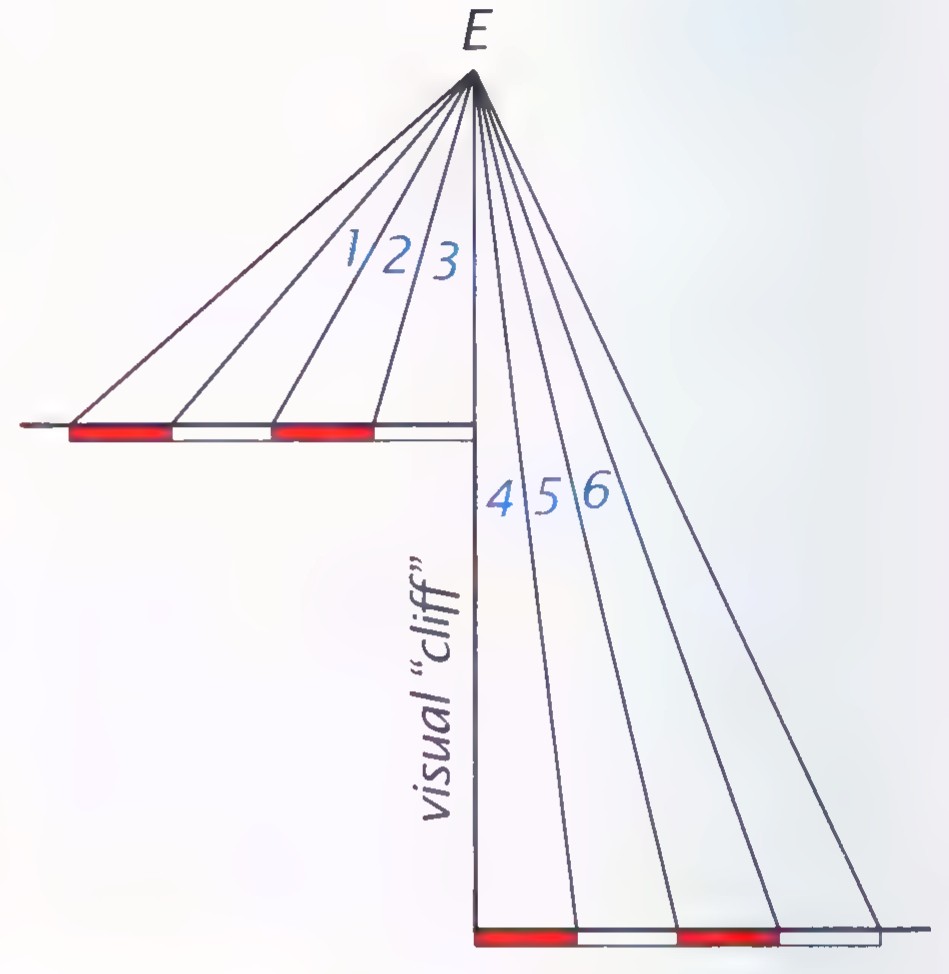
The figure to the right of the photograph shows geometrically the difference in appearance between the two sides of the visual cliff. If point E represents the viewer’s eye, the angles of the equal squares are unequal and there is a sudden change in their size at the edge of the cliff. This difference is a visual cue that helps give a sense of depth.
Looking at the numbered angles, we see that ∠3 is larger than ∠4, which we can write as ∠3 > ∠4. Or, to indicate that ∠4 is less than ∠3, we can write ∠4 < ∠3. Comparing the sizes of the angles on either side of the cliff, we can write ∠1 < ∠2 < ∠3 and ∠4 > ∠5 > ∠6.
So far in our study of geometry, we have paid a lot of attention to equalities between line segments and equalities between angles. In fact, nearly every theorem that we have proved has had the word “equal” in it. In this chapter we will consider several important theorems dealing with inequalities, including one of the most basic ideas in all of geometry, the “triangle inequality” theorem.
We begin by adding some assumptions about inequality to our list of axioms from algebra.* As before, these assumptions are stated symbolically, the letters representing real numbers. They also have names by which you may refer to them.
The “Three Possibilities” Property
Either , , or .
The Transitive Property†
If and , then .
The Addition Property†
If , then .
The Subtraction Property†
If , then .
The Multiplication Property
If and , then .
The Division Property
If and , then .
To this list of assumptions, we add two more properties that follow from them.
The Addition Theorem of Inequality†
If and , then .
The “Whole Greater than Part” Theorem
If , , and , then and .
* Chapter 3, Lesson 1.
† This property and the others marked with a dagger are expressed in terms of the symbol > but are equally valid in terms of the symbol <.
p. 186
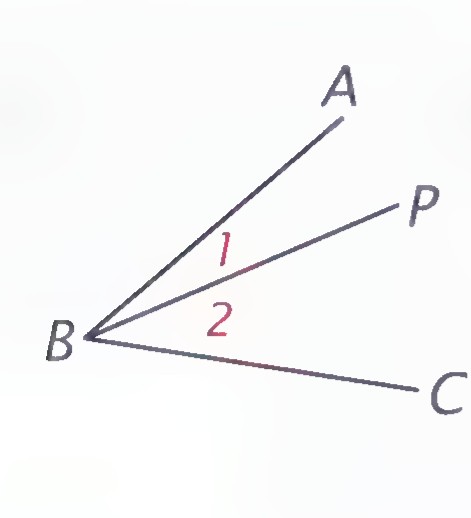
The “whole greater than part” theorem comes from Euclid. Near the beginning of the Elements, he states:
The whole is greater than the part.
In the figure at the left, BA-BP-BC; so ∠1 + ∠2 = ∠ABC. The measures of these angles are positive numbers; so we have the “obvious” and easily proved conclusions that ∠ABC > ∠1 and ∠ABC > ∠2. The “whole greater than part” theorem will be considered in an exercise in this lesson.
Exercises
Set I
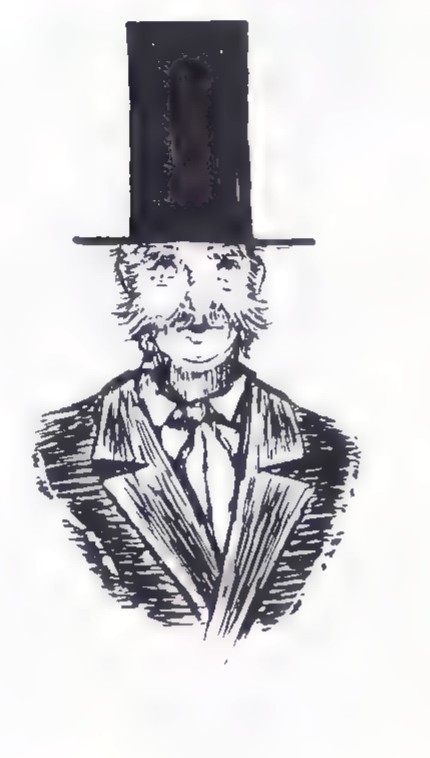
Hat Illusion. This figure is a remarkable optical illusion.*
- If the height of the hat is h and the width of its brim is w, how might h and w be related?
- Which one of the properties of inequality does exercise 1 illustrate?
- Without measuring anything, how do you think h and w compare?
- Use your ruler to measure each distance to the nearest 0.1 cm.
Pecking Order. One chicken will peck another if both want the same grain of food.
- If hen A always pecks hen B and hen B always pecks hen C, what conclusion might follow?
- Which property of inequality is a “pecking order” like?
Equalities and Inequalities. Name the property of equality or inequality illustrated by each of the following statements:
- Either π > 3.14, π = 3.14, or π < 3.14.
- Because π < , 7π < 22.
- If ∠A + ∠B = 90°, then ∠B = 90° − ∠A.
- If ∠B = 90° − ∠A and ∠A < ∠B, then ∠A < 90° − ∠A.
- If ∠A < 90° − ∠A, then 2∠A < 90°.
- If 2∠A < 90°, then ∠A < 45°.
Deceiving Appearances. Although the triangles below may appear to be equilateral and congruent, they are not.
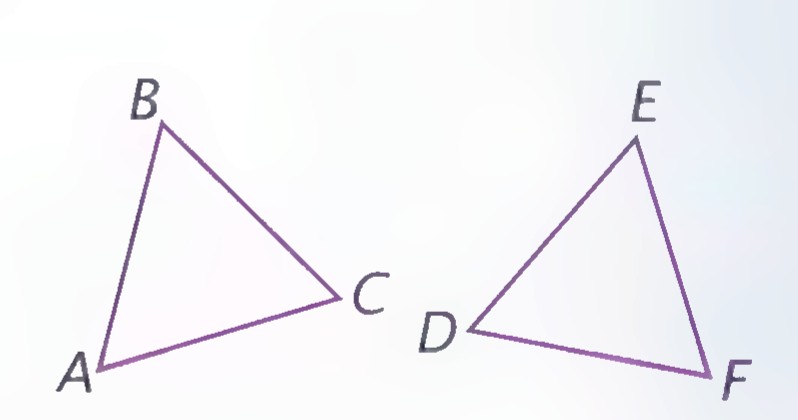
In △ABC, AB > AC and AC = BC.
- What kind of triangle is △ABC?
- What can you conclude about AB and BC?
- Why?
In △DEF, DF < EF and EF < DE.
- What kind of triangle is △DEF?
- What can you conclude about DF and DE?
- Why?
- Why aren’t the triangles congruent?
* From The Snark Puzzle Book, by Martin Gardner (Simon & Schuster, 1973).
p. 187
Perspective Inequalities. When you look up at a tall building from the ground, the floors look progressively shorter.
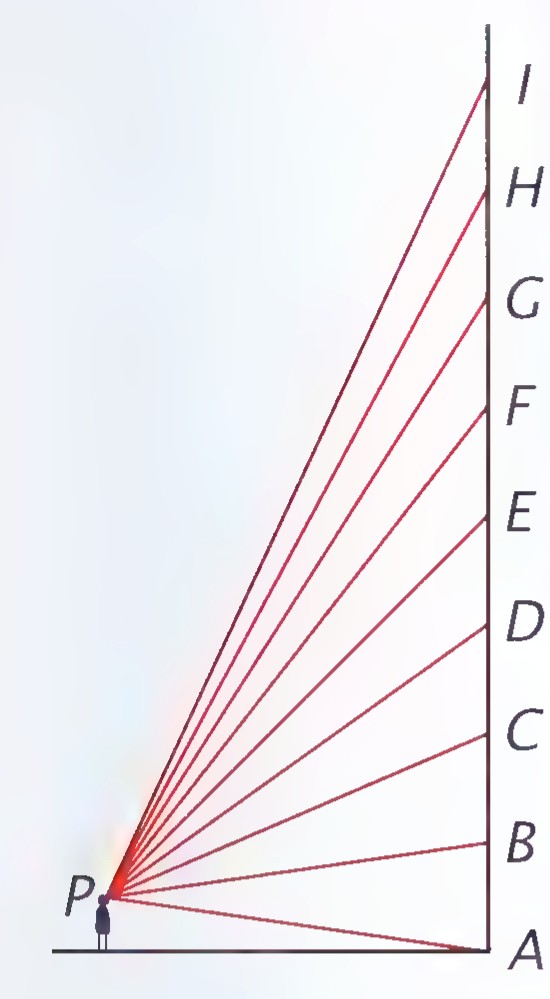
Look carefully at the figure at the left above to tell what symbol should replace the question mark in each of the following statements. (Base your answers on appearances.)
- AB = HI but ∠APB ? ∠HPI.
- BC = CD but ∠BPC ? ∠CPD.
- ∠PIH ? ∠PBA.
- ∠PHG ? ∠PGF.
- ∠PHI ? ∠PGH and ∠PGH ? ∠PFG; so ∠PHI ? ∠PFG.
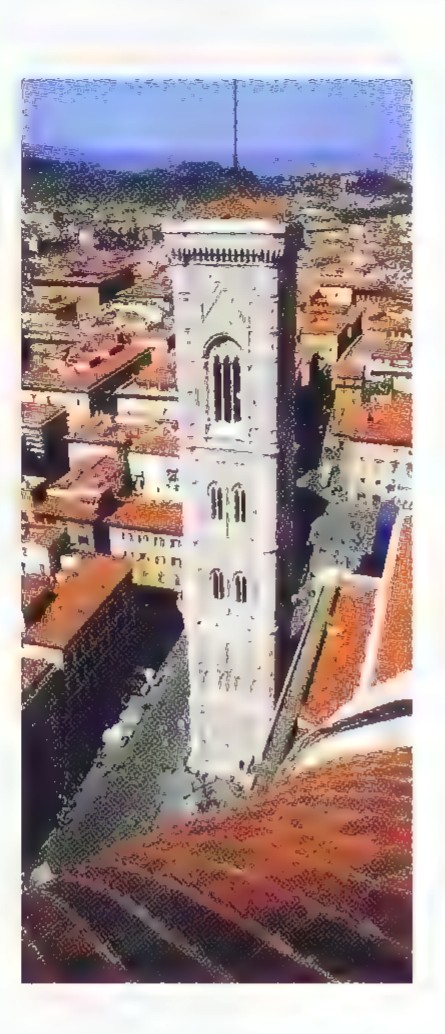
In the fourteenth century, the Italian artist and architect Giotto designed a tower, the campanile in Florence, in which the upper levels are successively taller.
- Why do you suppose he designed the tower in this way?
Set II
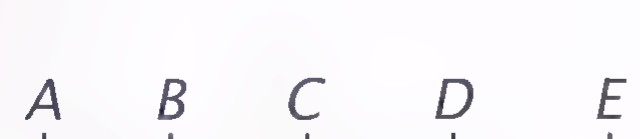
SAT Problem. The figure above appeared in a problem on an SAT exam. The points are spaced on the line so that AB < BC < CD < DE.
All of the following statements, except for one, must be true. Either tell why each statement must be true or identify it as the one that could be false.
- AB < CD and BC < DE.
- AB + BC < CD + DE.
- AC < CE.
- AD > DE.
- BD > BC.
- AB < BD.
Scalene Triangle. The following exercises are about the sides and angles of a scalene triangle.
- Use your ruler to draw and label three line segments of the following lengths: a = 12 cm, b = 10 cm, and c = 8 cm.
- Use your straightedge and compass to construct a triangle having sides of these lengths. Label the sides a, b, and c. Label the angles A, B, and C so that ∠A is opposite side a, ∠B is opposite side b, and ∠C is opposite side c.
- Use your protractor to measure each angle as accurately as you can.
- List the names of the angles in order of size from largest to smallest.
- Do you think that the order of the angles could have been predicted from the order of the sides? If so, how?
Rectangle Inequalities. The figure below is a rectangle.
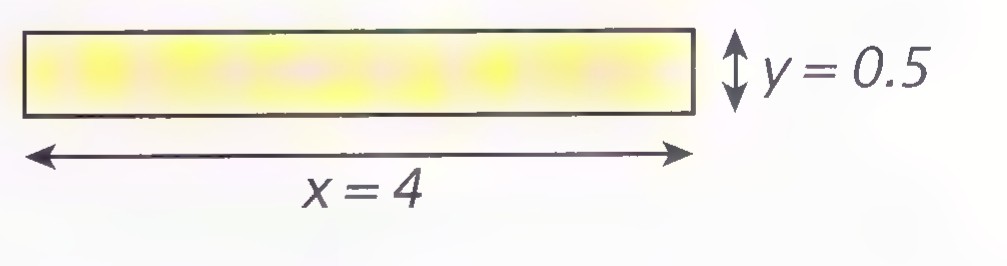
- What is its perimeter?
- If x > 0, y > 0, and p = 2x + 2y, does it follow that p > 2x? Why or why not?
- What is the rectangle’s area?
- If x > 0, y > 0, and a = xy, does it follow that a > x? Explain.
p. 188
PEANUTS reprinted by permission of United Feature Syndication.
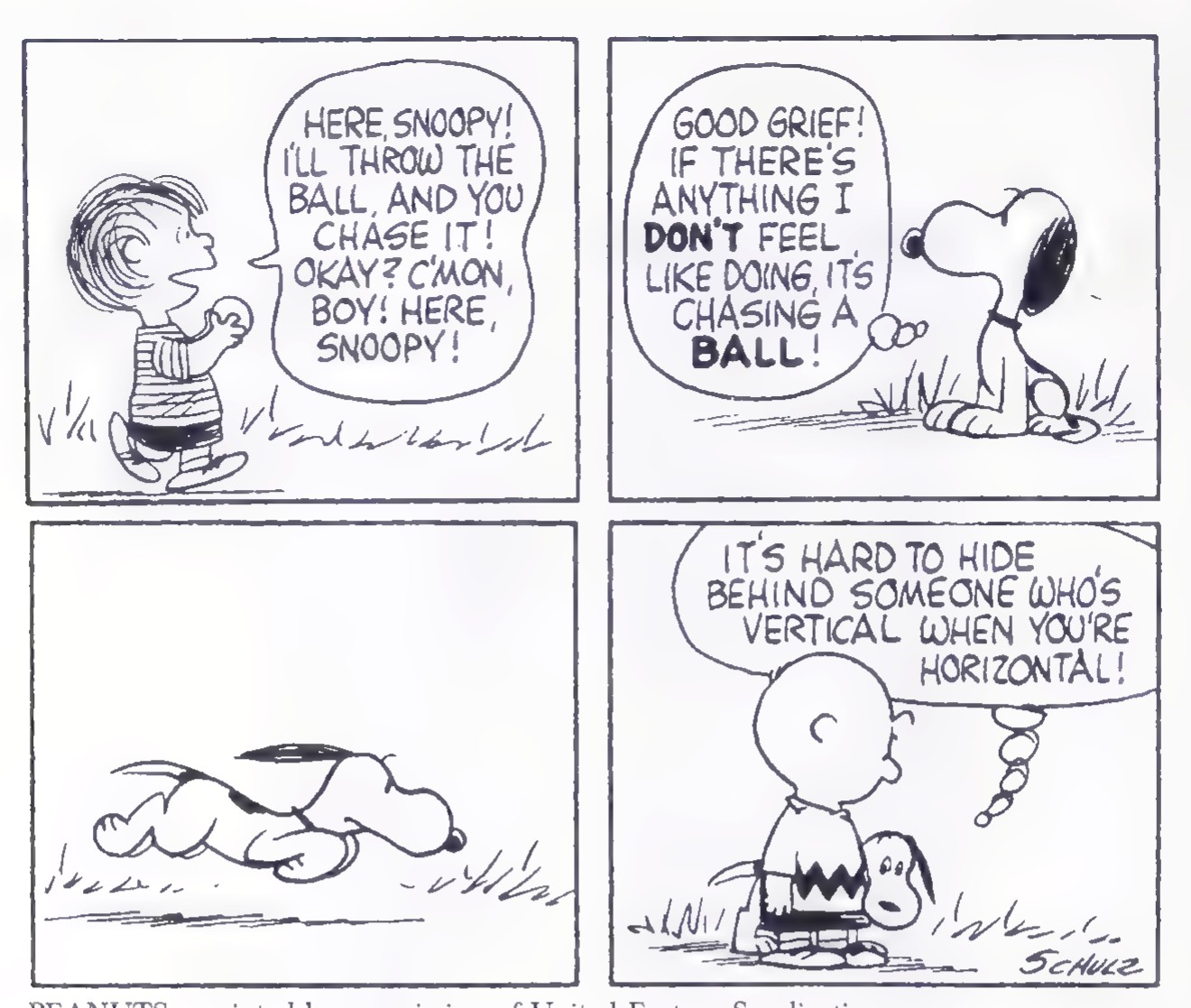
Vertical Lines and Angles. The word vertical is used in two different ways in geometry.
- What does it mean to say that a line is vertical?
There are no vertical lines in the figure below and yet it seems to contain two pairs of vertical angles. The word vertical in “vertical angles” comes from the fact that they have the same vertex.
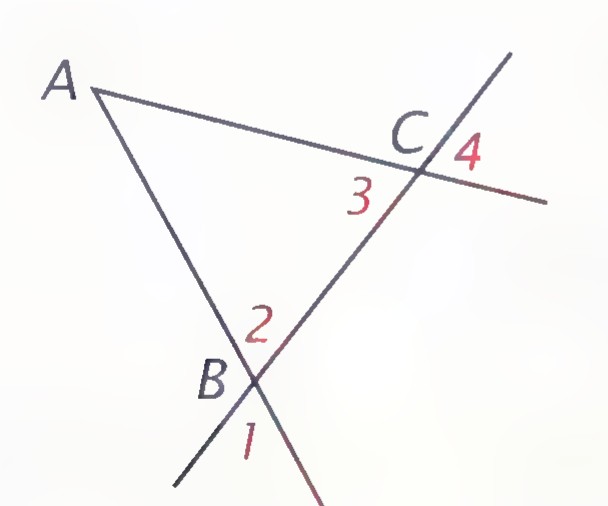
- What else must be true for two angles to be vertical angles?
In the figure, AB = AC, ∠1 < ∠3, and ∠2 = ∠4.
- Is it possible to draw any definite conclusion about whether ∠1 and ∠2 are vertical angles? Explain your reasoning.
- Is it possible to draw any definite conclusion about whether ∠3 and ∠4 are vertical angles? Explain your reasoning.
Use the properties of inequality in this lesson to complete the following proofs.
- The Addition Theorem of Inequality. If and , then .
Proof
| Statements | Reasons |
|---|---|
| 1. . | Why? |
| 2. . | Why? |
| 3. . | Why? |
| 4. . | Why? |
| 5. . | Why? |
- The “Whole Greater than Part” Theorem. If , , and , then and .
Proof
| Statements | Reasons |
|---|---|
| 1. (and ). | Why? |
| 2. (and ). | Why? |
| 3. . | Why? |
| 4. (and ). | Why? |
p. 189
Optics Figure. In the following figure from Euclid’s Optics, an eye at point E is looking at two equal lengths, AB and CD.
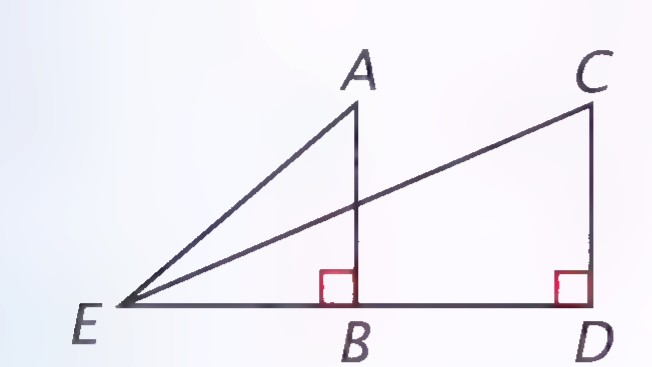
Give the reasons for the following proof that, although AB = CD, ∠AEB > ∠CED.
- Given: EA-EC-ED. Prove: ∠AED > ∠CED.
Proof
| Statements | Reasons |
|---|---|
| 1. EA-EC-ED. | Why? |
| 2. ∠AED = ∠AEC + ∠CED. | Why? |
| 3. ∠AEC > 0. | Why? |
| 4. ∠AED > ∠CED. | Why? |
Write a complete proof for the following.
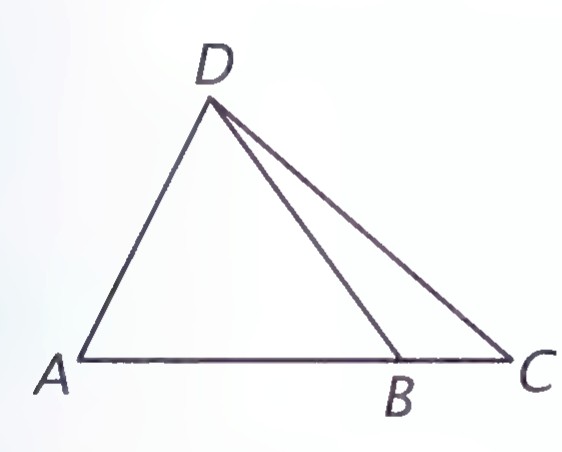
Given: A-B-C; ∠ADB = ∠DAB.
Prove: AC > DB.
Set III
The following statements appear in a book on psychology.*
If A > B and B > C, then A > C.
If A = B and B = C, then A = C.
If A = B and C > 0, then A + C > B.
Although they appear to be about numbers, they are actually rules about making choices. In them, the symbol > means that you prefer one object over another and = means that you have no preference between them.
Suppose A, B, and C represent the following objects respectively: an apple, a banana, and a cookie.
- Tell what the first rule says in regard to these objects.
- Which of our properties of inequality is represented by the same symbols?
- Tell what the second rule says in regard to these objects.
- Which of our properties of equality is the basis for knowing that this pattern is true for numbers?
- Tell what the third rule says in regard to these objects.
- Is the third rule true if A, B, and C represent numbers and = and > mean “equal” and “greater than”? If you think so, prove it. If not, give an example to show why not.
* Human Information Processing: An Introduction to Psychology, by Peter H. Lindsay and Donald A. Norman (Harcourt Brace Jovanovich, 1977).
p. 190
Lesson 2: The Exterior Angle Theorem
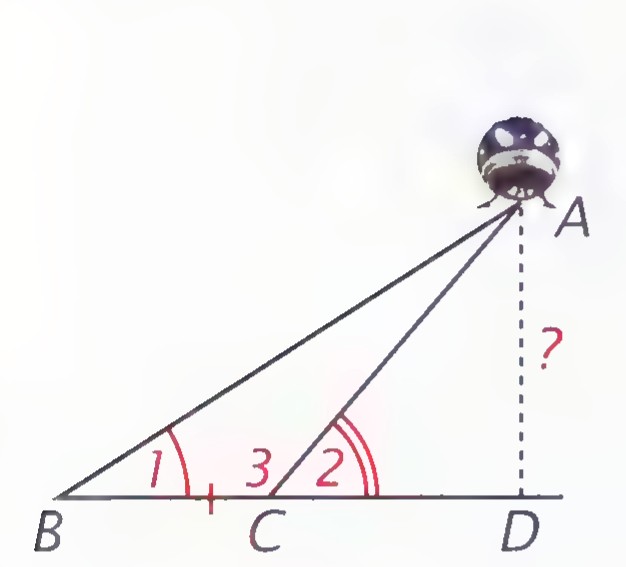
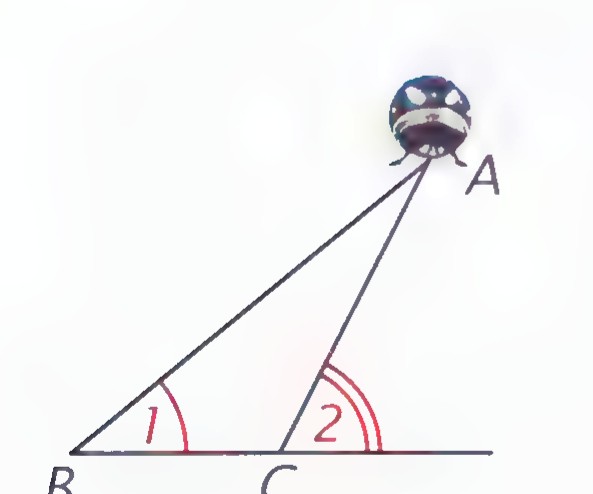
Imagine a UFO (unidentified flying object) hovering in the sky. Observers below wonder how big it is and how high it is above them. They can find its elevation by using some simple geometry. The diagram above shows how.
The observers measure the UFO’s angles of elevation as seen from two positions: ∠1 and ∠2 in the diagram. If the distance between the observers is known, then in △ABC we know the measures of ∠1, BC, and ∠3 (the supplement of ∠2). The size and shape of the triangle are therefore determined by ASA. A scale drawing of the figure can be made and the distance AD can then be measured.
If the UFO moves to the position shown in the second diagram, △ABC changes in size and shape because both ∠1 and ∠2 get larger. In each figure, ∠2 seems to be larger than ∠1. Strange as it may seem, ∠2 is always larger, no matter where the UFO happens to be! We can prove it by using congruent triangles and inequalities.
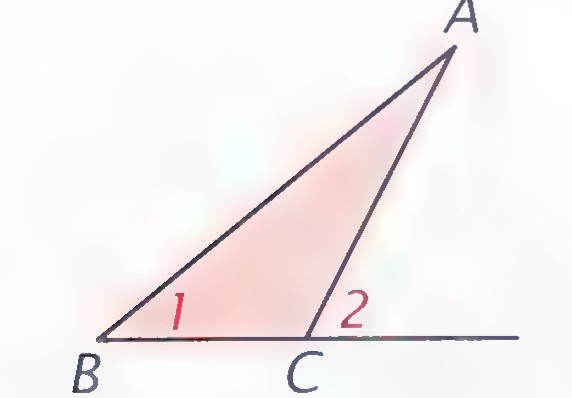
The basic reason is that ∠1 is “in” the triangle and ∠2 is “outside” it. We will call ∠1 an interior angle of △ABC to distinguish it from the exterior angles of △ABC, of which ∠2 is an example.
p. 191
Definition
An exterior angle of a triangle is an angle that forms a linear pair with an angle of the triangle.
In △ABC on page 190, exterior ∠2 forms a linear pair with ∠ACB. The other two angles of the triangle ∠1 (∠B) and ∠A are called remote interior angles with respect to ∠2. Regardless of the position of point A, we can prove that ∠2 > ∠1 and ∠2 > ∠A.
Theorem 12. The Exterior Angle Theorem
An exterior angle of a triangle is greater than either remote interior angle.
Given: ∠ACD is an exterior angle of △ABC.
Prove: ∠ACD > ∠A and ∠ACD > ∠B.
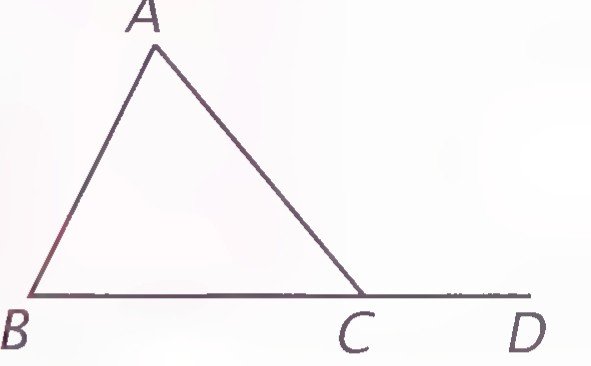
Our proof, that of Euclid, begins by adding some things to the figure at the right. The additions are shown here in red. In proving that the exterior angle, ∠ACD, is greater than the remote interior angle, ∠A, Euclid saw ∠3 as part of ∠ACD. He read the betweenness of rays CA-CP-CD from the figure. Look at the figure now and see if you can guess Euclid’s plan of attack.
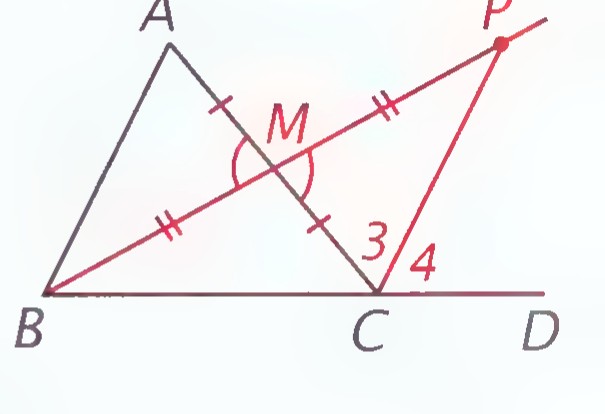
Euclid reasoned that exterior ∠ACD > ∠3 (the whole is greater than the part) and that ∠3 = ∠A because △AMB ≅ △CMP (SAS); so exterior ∠ACD > remote interior ∠A. The following proof in two-column format fills in the details.
Proof
| Statements | Reasons |
|---|---|
| 1. ∠ACD is an exterior angle of △ABC. | Given. |
| 2. Let M be the midpoint of AC. | A line segment has exactly one midpoint. |
| 3. AM = MC. | The midpoint of a line segment divides it into two equal segments. |
| 4. Draw line BM. | Two points determine a line. |
| 5. Choose P on line BM so that BM = MP. | The Ruler Postulate. |
| 6. Draw CP. | Two points determine a line. |
| 7. ∠AMB = ∠CMP. | Vertical angles are equal. |
| 8. △AMB ≅ △CMP. | SAS. |
| 9. ∠A = ∠3. | Corresponding parts of congruent triangles are equal. |
| 10. ∠ACD = ∠3 + ∠4. | Betweenness of Rays Theorem. |
| 11. ∠ACD > ∠3. | “Whole Greater than Part” Theorem. |
| 12. ∠ACD > ∠A. | Substitution. |
The other conclusion, that ∠ACD > ∠B, can be proved in a similar way by adding some more things to the figure. We will consider how in one of the exercises.
p. 192
Exercises
Set I
Garage Door. One type of design for a garage door is shown in the following figures.*
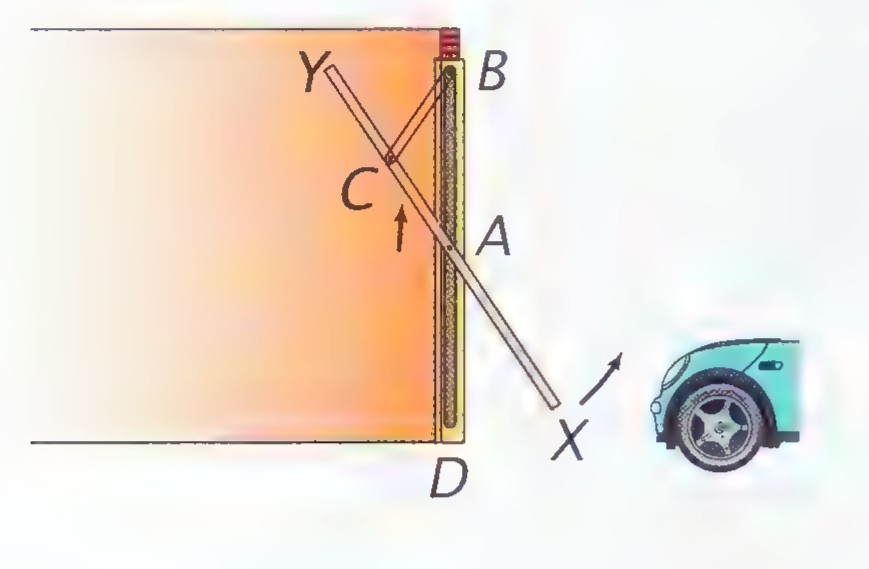
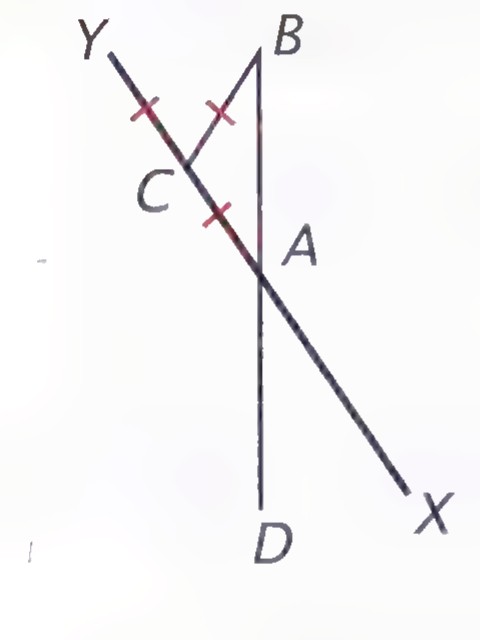
The door XY rotates as a pin at A moves up or down a vertical channel BD; CA = CB = CY.
- Name all of the angles in the figure that are exterior angles to △ABC.
What happens to the size of each of the following angles as the door is being opened?
- ∠DAX.
- ∠BAX.
- ∠BCA.
- As the door moves and △ABC changes shape, why is ∠B always equal to ∠BAY?
- Why is ∠BCY always larger than ∠BAY?
- Why are ∠BAY and ∠DAX always equal?
- In what way are the measures of ∠B and ∠DAX always related? Explain.
Exterior Angles. The sides of the acute triangle at the right have been extended to form its exterior angles.
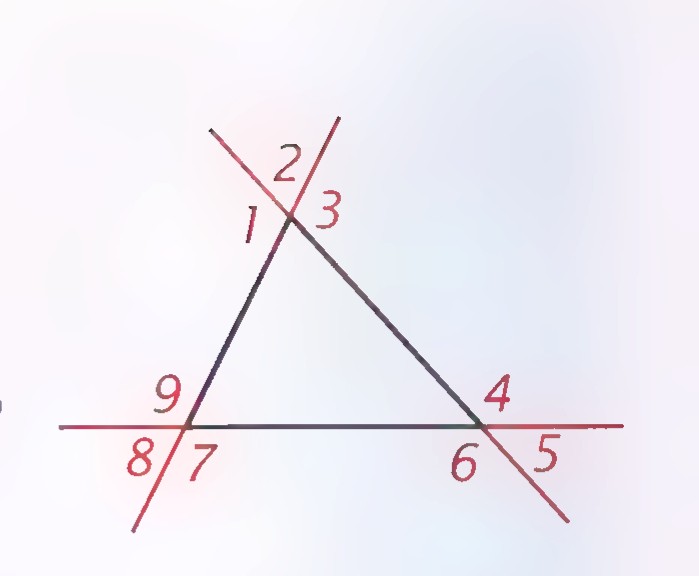
- Which of the numbered angles in the figure are not exterior angles of the triangle?
How many exterior angles does a triangle have
- at one vertex?
- altogether?
Is it possible that all of the triangle’s exterior angles could be
- equal? Explain.
- unequal? Explain.
- Draw a right triangle and extend its sides to form all of its exterior angles. Mark the exterior angles with arcs.
- Draw an obtuse triangle and do the same.
Reasoning from the figure above and the two figures that you have drawn, how many exterior angles of a triangle can be
- acute?
- right?
- obtuse?
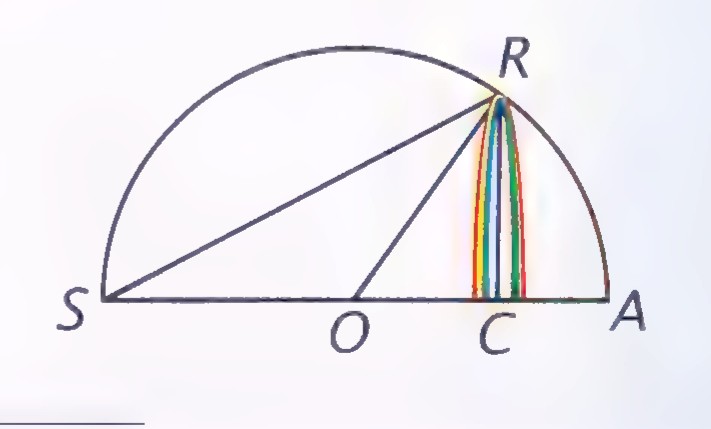
Rainbow. Aristotle used the figure below in trying to explain the rainbow.†
* Mathematics Meets Technology, by Brian Bolt (Cambridge University Press, 1991).
† The Rainbow: From Myth to Mathematics, by Carl B. Boyer (Princeton University Press, 1987).
p. 193
The sun is on the horizon at S, a cloud is at R, and the observer is at O. The points S, O, C, and A are collinear.
- Of which triangle is ∠ROA an exterior angle?
- Write the two inequalities that follow from this fact.
- Of which triangle is ∠ROS an exterior angle?
- Write the two inequalities that follow from this fact.
- Of which two triangles is ∠RCA an exterior angle?
- Write the four inequalities that follow from this fact.
- Is ∠ORC an exterior angle of △ROS? Explain why or why not.
Lines and Angles. The figure below shows three intersecting lines.
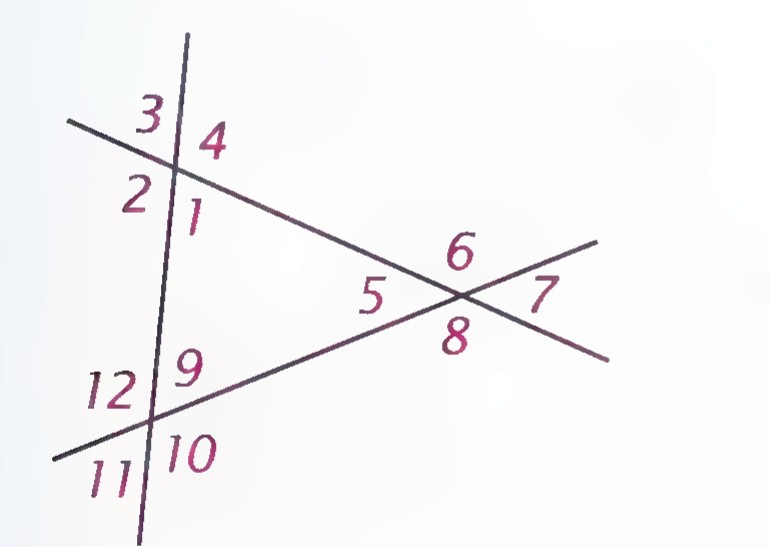
Find each of the following sums.
- ∠1 + ∠2 + ∠3 + ∠4.
- ∠1 + ∠2 + ∠3 + ∠4 + ∠5 + ∠6 + ∠7 + ∠8 + ∠9 + ∠10 + ∠11 + ∠12.
- ∠1 + ∠5 + ∠9.
- ∠3 + ∠7 + ∠11.
- ∠2 + ∠4 + ∠6 + ∠8 + ∠10 + ∠12.
- What does the result obtained in exercise 30 indicate about the sum of the exterior angles of a triangle?
Set II
Exterior Angle Theorem. This figure illustrates how the proof of the Exterior Angle Theorem can be completed. In it, line AC has been extended to E.
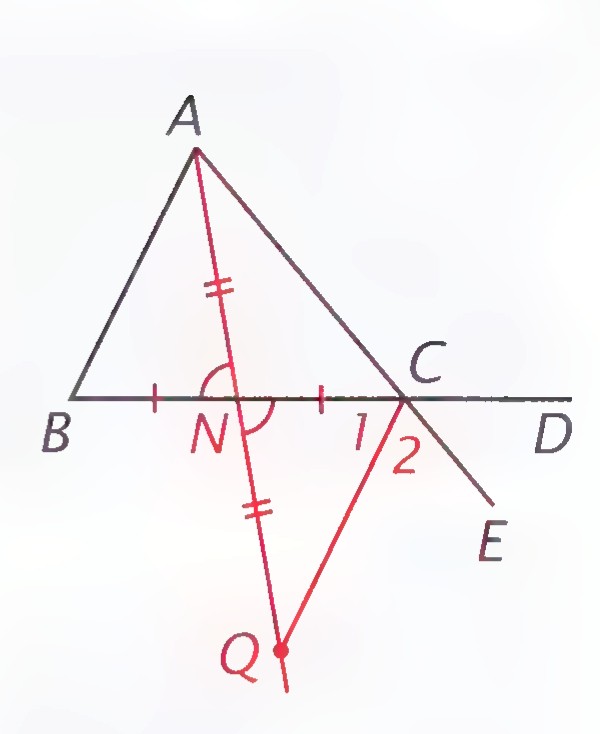
- Why can N be chosen as the midpoint of BC?
- Why can Q be chosen so that AN = NQ?
- Why is △BNA ≅ △CNQ?
- Why is ∠B = ∠1?
- Why is ∠ACD = ∠BCE?
- Why is ∠BCE > ∠1?
- Why are ∠BCE > ∠B and ∠ACD > ∠B?
Angle Sum. After proving the Exterior Angle Theorem, Euclid proved that, in any triangle, the sum of any two angles is less than 180°.
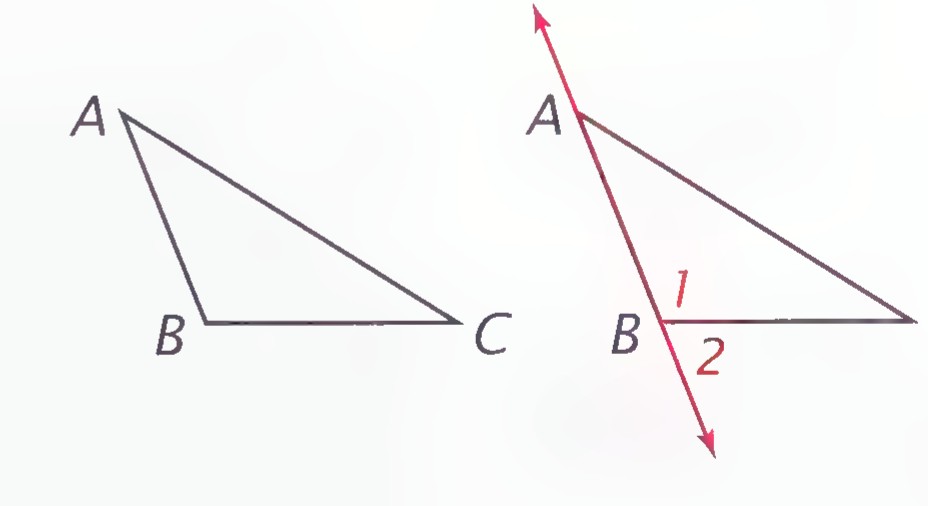
Prove that, in △ABC, ∠A + ∠B < 180° by giving a reason for each of the following statements.
- Draw line AB.
- ∠2 is an exterior angle of △ABC.
- ∠1 and ∠2 are supplementary.
- ∠1 + ∠2 = 180°.
- ∠2 > ∠A.
- ∠1 + ∠2 > ∠1 + ∠A.
- 180° > ∠1 + ∠A, so ∠A + ∠1 < 180°.
p. 194
Angle in a Triangle. Suppose a triangle of any shape is drawn and a point is marked inside it. If line segments are drawn from this point to two of the vertices, the angle formed always seems to be larger than the angle at the third vertex of the triangle.
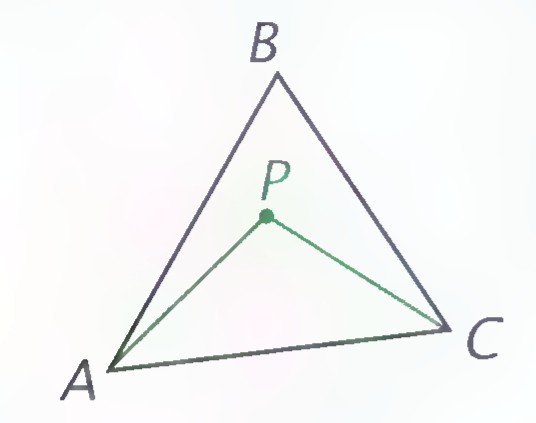
- Copy the figure and extend the line AP to intersect side BC at point X.
- Use the resulting figure to explain why ∠APC is larger than ∠B.
Proclus’s Proof. Proclus, a Greek philosopher and mathematician of the fifth century, proved that it is impossible to draw from a point to a line more than two line segments of the same length. In other words, in the figure at the left below, it is impossible that PA = PB = PC.
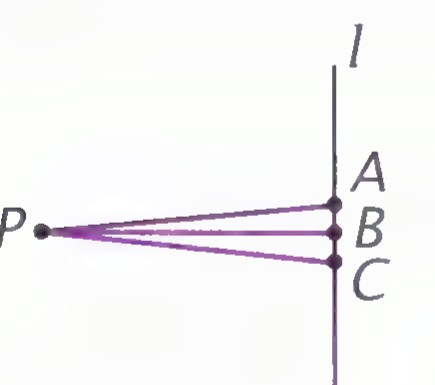
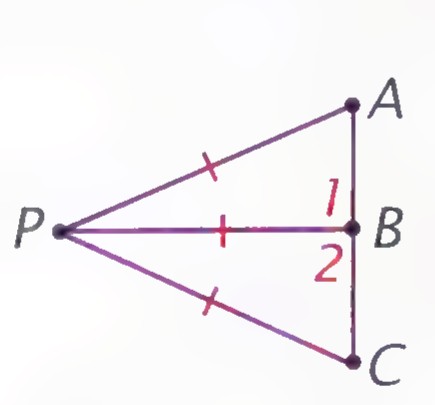
Use the second figure, which has been drawn so as to make the angles in it easier to see, to explain the following steps in Proclus’s argument.
- Suppose PA = PB = PC. Then ∠A = ∠1, ∠2 = ∠C, and ∠A = ∠C. Why?
- What equations follow from these equations by substitution?
- What do they contradict?
- What kind of proof has Proclus used to show that it is impossible that PA = PB = PC?
Set III
Drumhead Geometry. Drumheads were once used to measure angles of elevation to find distances! This figure from the sixteenth century shows them being used to find the height of a tower.*
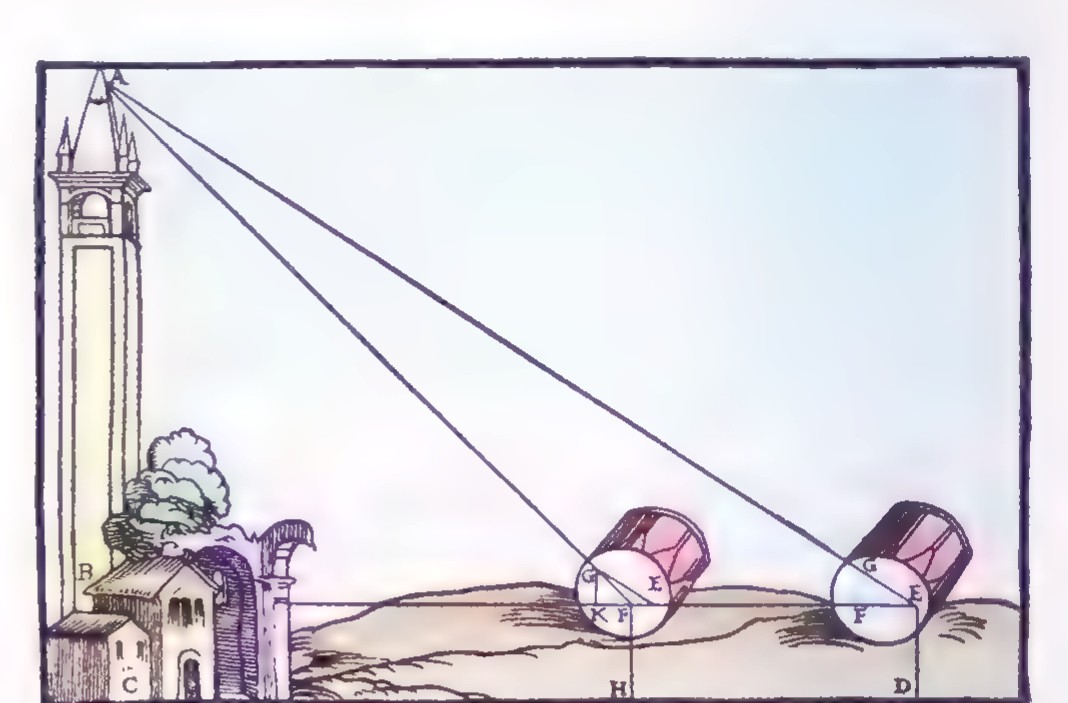
Make a scale drawing of the figure by doing the following.
- Draw a horizontal line and mark two points 2 inches apart to represent the drumheads. Use your protractor to draw two angles of elevation measuring 45° and 34° so that their sides intersect at the point marking the top of the tower.
- Measure the height of the tower in your drawing in inches.
- If the two drums are 40 feet apart, how high is the tower?
* History of Mathematics, by David Eugene Smith (Ginn, 1923; reprint, Dover, 1958).
p. 195
Lesson 3: Triangle Side and Angle Inequalities
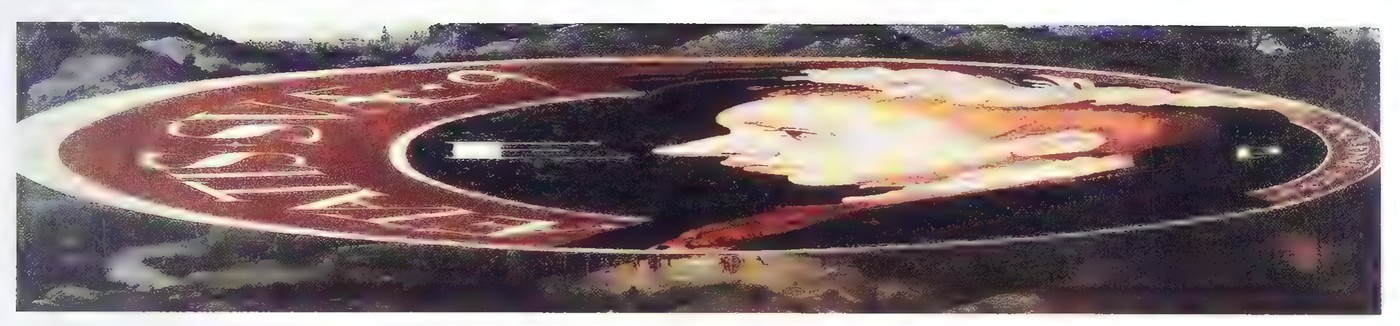
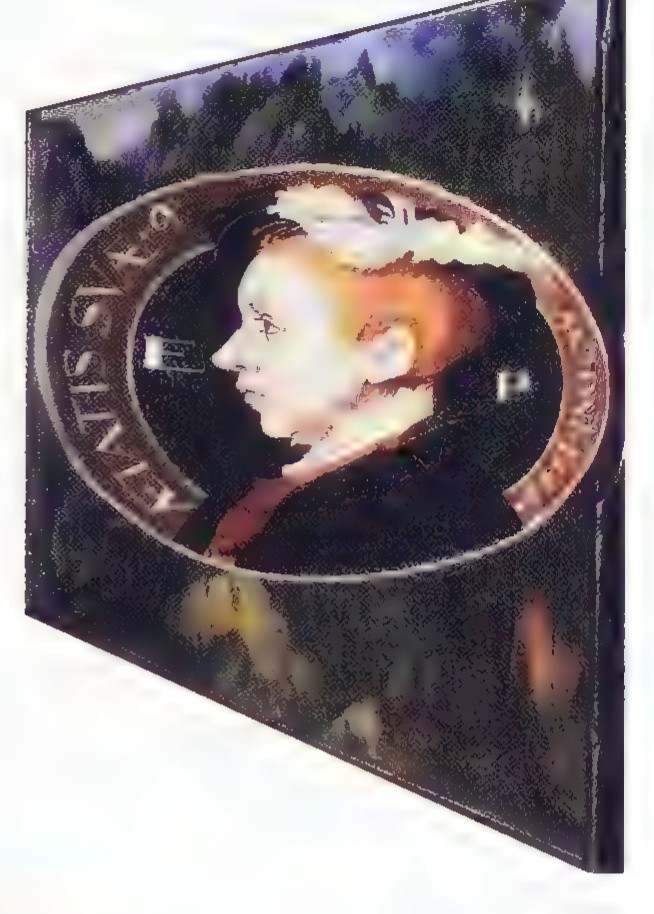
As artists during the Renaissance began to master perspective, some of them began to play tricks with it. The strange-looking portrait above of Edward VI, one of the kings of England, is an example. The artist has painted it in a peculiar perspective so that it is almost unrecognizable when viewed from the front. When viewed from a certain spot in the edge of its frame, however, the perspective is such that the distortion disappears and the portrait looks normal, as seen at the right.
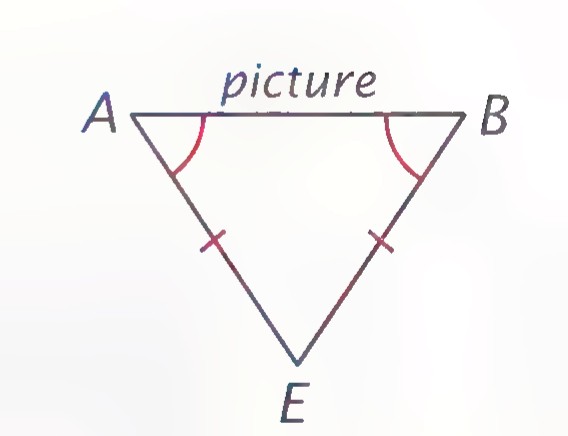
Artists usually paint pictures to be viewed as shown in the first diagram at the right. The diagram shows the top edge of the picture, AB, and the eyes, E, seen from overhead. If the viewer’s eyes are centered with respect to the edges of the picture, EA = EB. The triangle ABE, then, is isosceles and so ∠A = ∠B.
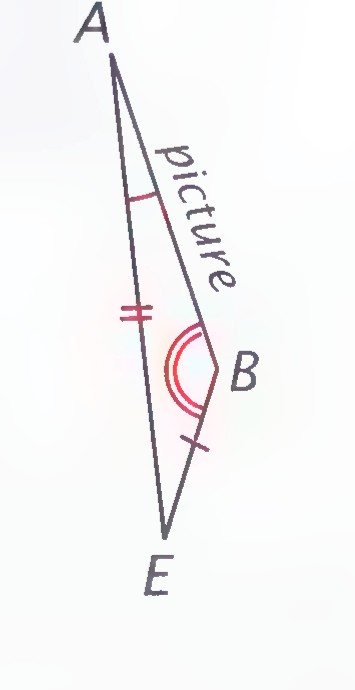
The second diagram shows how the artist intended the painting of Edward VI to be viewed. The viewer has to look at the picture from a point much closer to one edge than the other: EA > EB. The angles at A and B have changed as well: now ∠B > ∠A. The larger angle, ∠B, is opposite the longer side, EA.
This relation of unequal sides and unequal angles holds true for all triangles.
p. 196
Theorem 13
If two sides of a triangle are unequal, the angles opposite them are unequal in the same order.
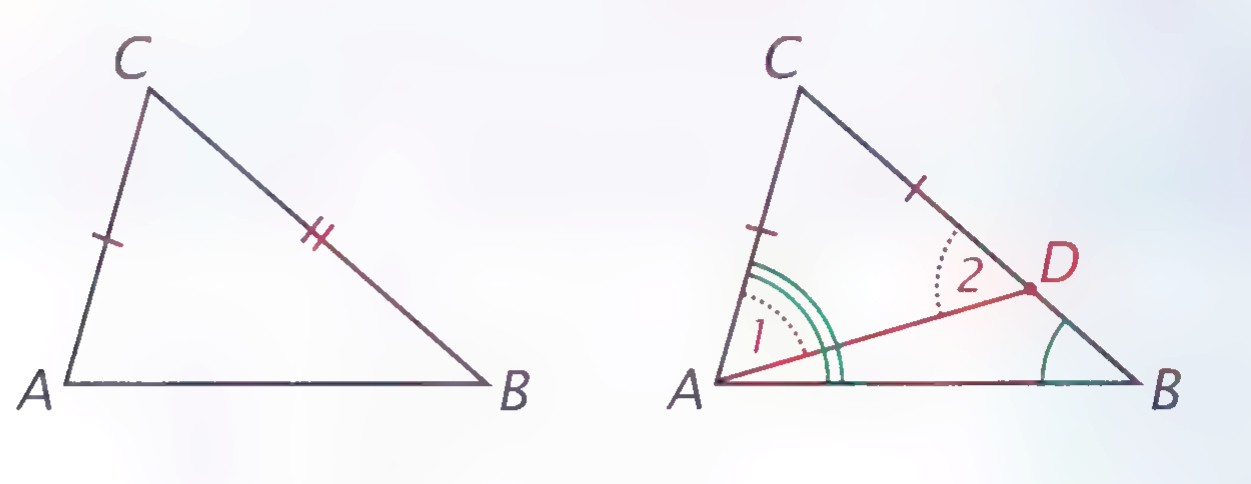
Given: △ABC with BC > AC.
Prove: ∠A > ∠B.
Like many of the proofs in this book, this one follows Euclid’s. The shorter side, AC, is copied along the longer side CB as CD. AD is then drawn to form an isosceles triangle. Study the figure carefully and you may discover Euclid’s plan before reading any further.
Euclid’s proof is based on observing that ∠CAB > ∠1 and ∠1 = ∠2; so ∠CAB > ∠2. But ∠2 > ∠B, so ∠CAB > ∠B. Here is the proof in two-column format.
Proof
| Statements | Reasons |
|---|---|
| 1. △ABC with BC > AC. | Given. |
| 2. Choose D on CB so that CD = CA. | The Ruler Postulate. |
| 3. Draw AD. | Two points determine a line. |
| 4. ∠1 = ∠2. | If two sides of a triangle are equal, the angles opposite them are equal. |
| 5. ∠CAB = ∠1 + ∠DAB. | Betweenness of Rays Theorem (AC-AD-AB). |
| 6. ∠CAB > ∠1. | “Whole Greater than Part” Theorem. |
| 7. ∠CAB > ∠2. | Substitution. |
| 8. ∠2 > ∠B. | An exterior angle of a triangle is greater than either remote interior angle. |
| 9. ∠CAB > ∠B. | Transitive. |
Just as the converse of the isosceles triangle theorem is true, so the converse of this theorem is true.
Theorem 14
If two angles of a triangle are unequal, the sides opposite them are unequal in the same order.
p. 197
Exercises
Set I

The symbol at the right is sometimes painted on streets.*
- What does the symbol mean?
- Why is it painted in this way?
Theorem 13 says:
If two sides of a triangle are unequal, the angles opposite them are unequal in the same order.
Theorem 14 says:
If two angles of a triangle are unequal, the sides opposite them are unequal in the same order.
- How are these statements related to each other?
Complete the statements and give the reasons for the following proof of Theorem 14.
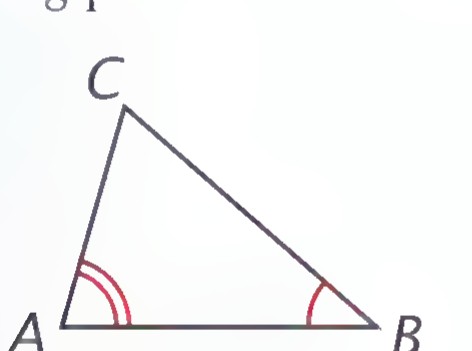
Given: △ABC with ∠A > ∠B.
Prove: BC > AC.
Proof
Suppose that BC is not longer than AC.
- Then either BC = AC or ?.
- Why?
- If BC = AC, then ?.
- Why?
- This contradicts the hypothesis (given) that ?.
- If BC < AC, then ?.
- Why?
- This also contradicts the hypothesis that ?.
- Therefore, what we supposed is false and ?.
- What kind of proof is this?
Triangle Drawing 1. In △ABC (not shown), AB = 6 cm, AC = 8 cm, and BC = 4 cm.
- Which angle of the triangle must be the largest?
- Which angle must be the smallest?
- Use your ruler and compass to construct △ABC.
- What kind of triangle is it?
- Use your protractor to measure each of its angles.
Triangle Drawing 2. In △DEF (not shown), DE = 7 cm, ∠D = 50°, ∠E = 40°, and ∠F = 90°.
- Which side of the triangle must be the longest?
- Which side must be the shortest?
- Use your ruler and protractor to draw △DEF.
- Use your ruler to measure sides DF and EF, each to the nearest 0.1 cm.
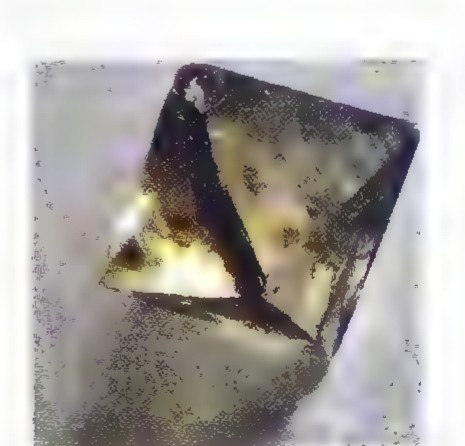
Triangle in Perspective. If a triangle is seen “in perspective,” it is hard to tell what kind of triangle it is. An illustration of triangles seen in perspective is the photograph above of a cubic fluorite crystal, all of whose faces are equilateral triangles.
* Can You Believe Your Eyes? by J. R. Blocker and Harold E. Yuker (Brunnel/Mazel, 1992).
p. 198
Here is another triangle shown “in perspective.” Suppose YZ > XZ and ∠Z > ∠X.
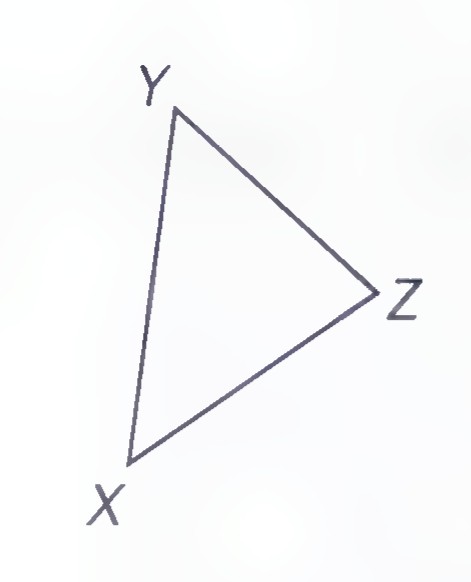
- What can you conclude about ∠X and ∠Y?
- Why?
- What can you conclude about ∠Y and ∠Z?
- Why?
- What can you conclude about XY and XZ?
- Why?
Set II
Folding Experiment. This experiment appeared in an old book titled First Book of Geometry.*
- Use your ruler to draw a large triangle similar in shape to the first figure below. Cut the triangle out and then fold the shorter side AB onto the longer side BC as shown in the second figure. The figure at the top of the next column shows the result. After answering the following questions, tape the triangle to your paper.
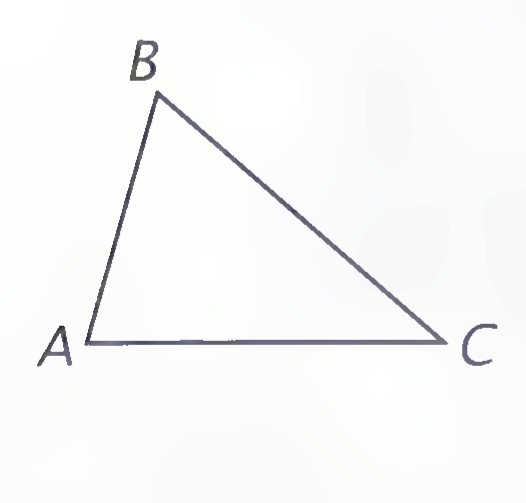
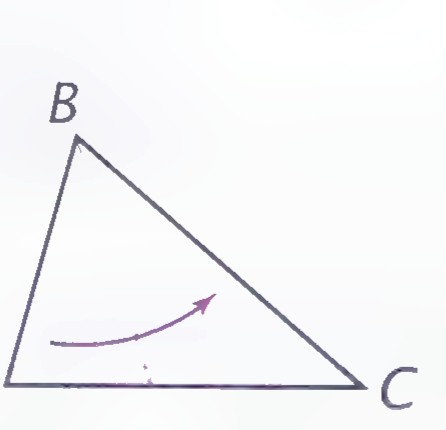
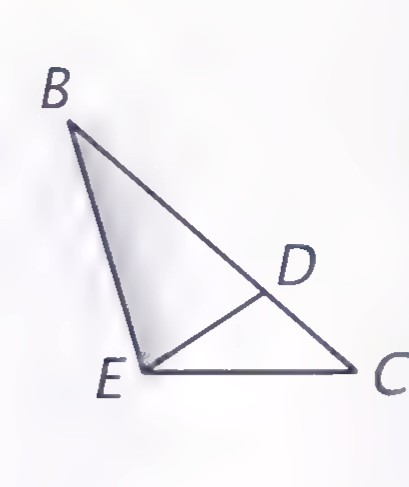
- On what angle did ∠A fall?
- In what way is ∠BDE related to △DEC?
- What does this relation show about how ∠BDE compares with ∠C?
- What theorem does this experiment illustrate?
Look at this figure.
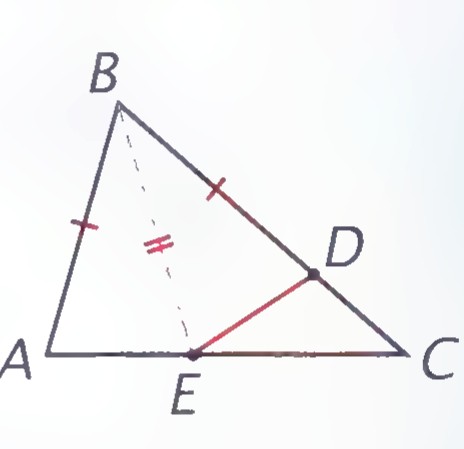
- What does the fold line BE do to ∠ABC?
- How can your answer to exercise 34 be used to prove that ∠BDE = ∠A?
Not Quite Equilateral. Here are some pairs of triangles that are almost equilateral but not quite.
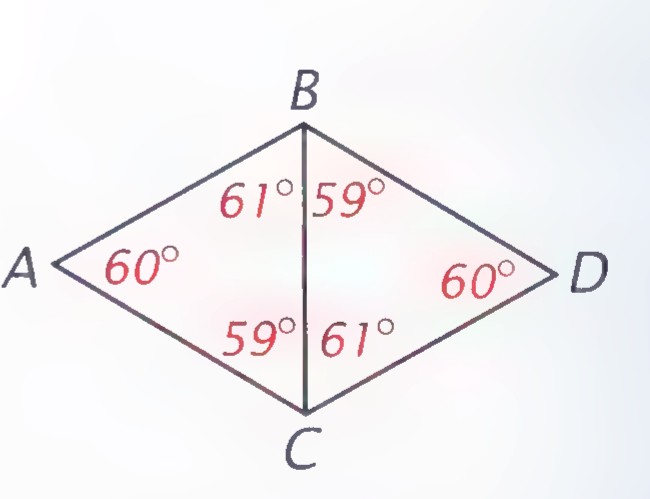
- Are the triangles in the figure above congruent? Why or why not?
- Which side of △ABC is longest?
- Which side of △BCD is longest?
- What can you conclude about these two line segments? Explain.
* Written by Grace Chisholm Young and W. H. Young and published in London in 1905.
p. 199
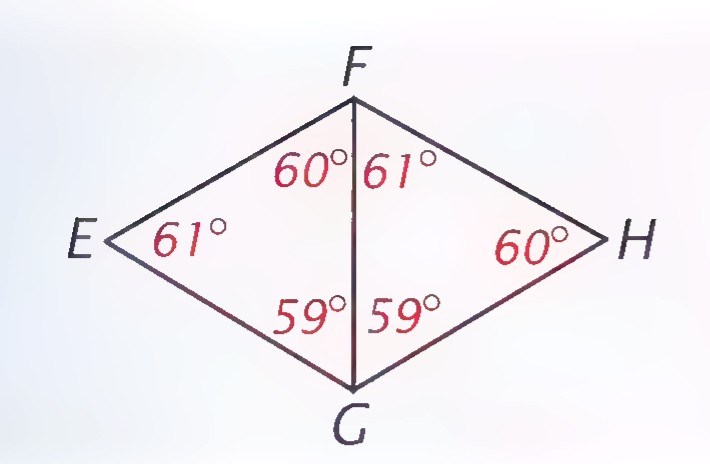
- In the figure above, which side of △EFG is longest?
- Which side of △FGH is longest?
- What can you conclude about these two line segments? Explain.
- Are these triangles congruent? Why or why not?
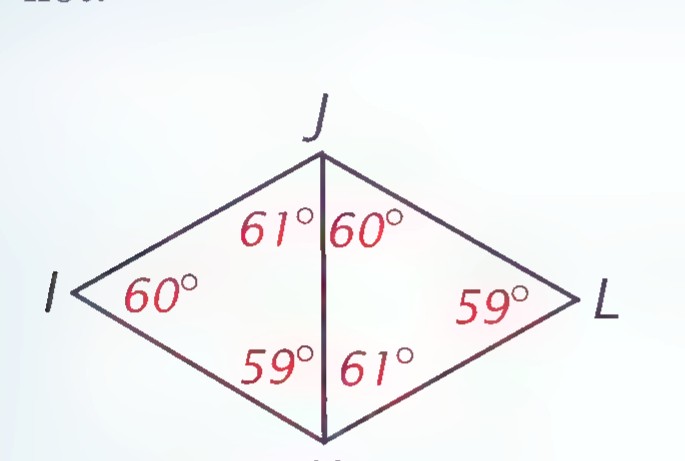
- Is it possible to decide whether or not the triangles in the figure above are congruent? Explain your reasoning.
In the figure below, △ABC is equilateral.
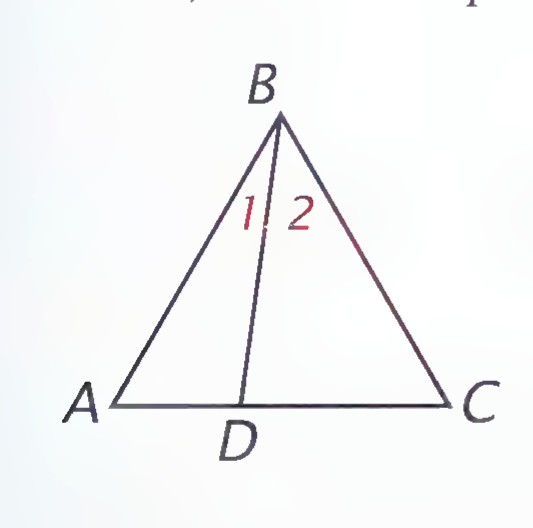
Prove that BD > DC by giving a reason for each of the following statements.
- ∠C = ∠ABC.
- ∠ABC = ∠1 + ∠2.
- ∠ABC > ∠2.
- ∠C > ∠2.
- BD > DC.
In the puzzles of the Surfer and the Spotter in the introduction to this book, we assumed that the shortest path from the surfer’s house to the beach was along a line perpendicular to the line of the beach.*
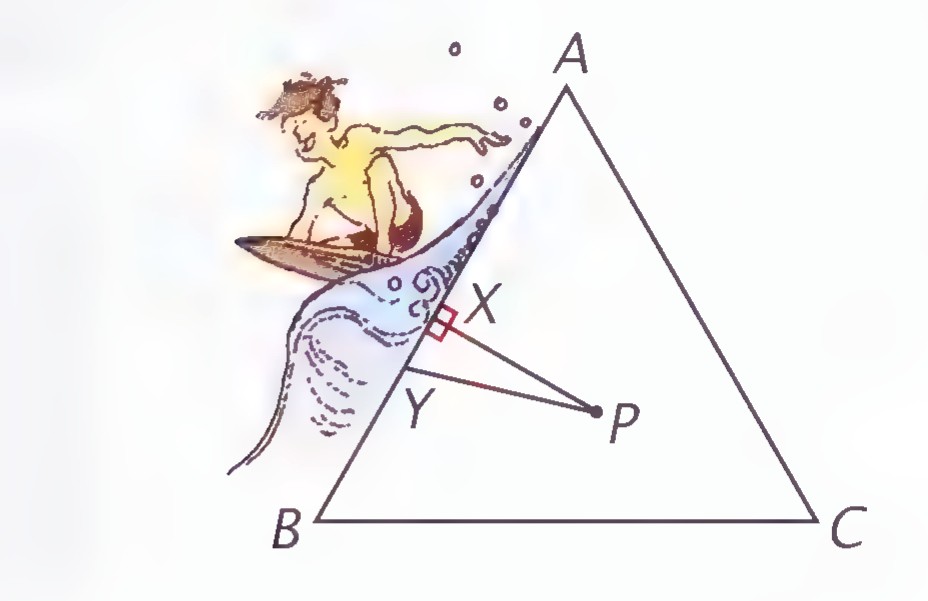
In the figure above, our assumption means that, if PX ⊥ AB, then PY > PX.
- Explain, by using the geometry that you now know, why this is true. (Hint: Notice that ∠PXA is an exterior angle of △PXY.)
Set III
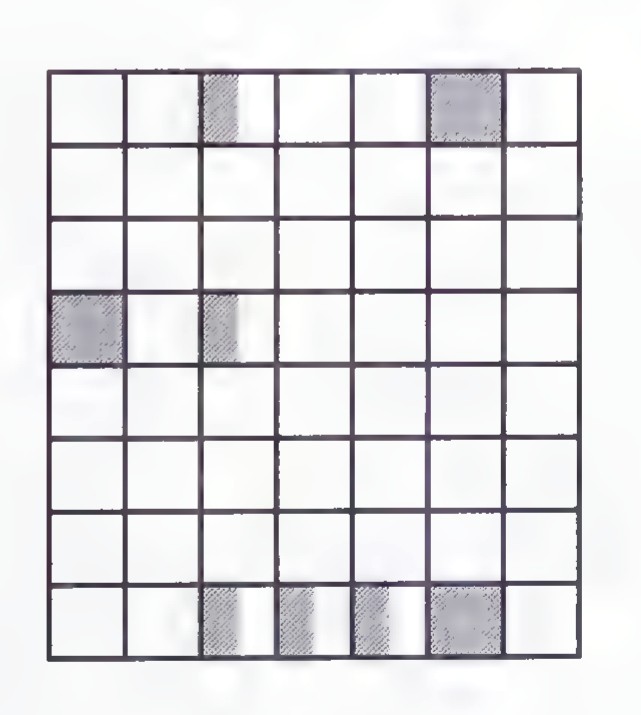
This message was created by Marvin Miller.† What does it say?
* Introduction, p. 4.
† Riddles of the Sphinx and Other Mathematical Puzzle Tales, by Martin Gardner (The Mathematical Association of America, 1987).
p. 200
Lesson 4: The Triangle Inequality Theorem
Venus is an interesting planet. Sometimes seen as the “morning star” and sometimes as the “evening star,” it is often brighter than any object in the sky except the sun or moon.
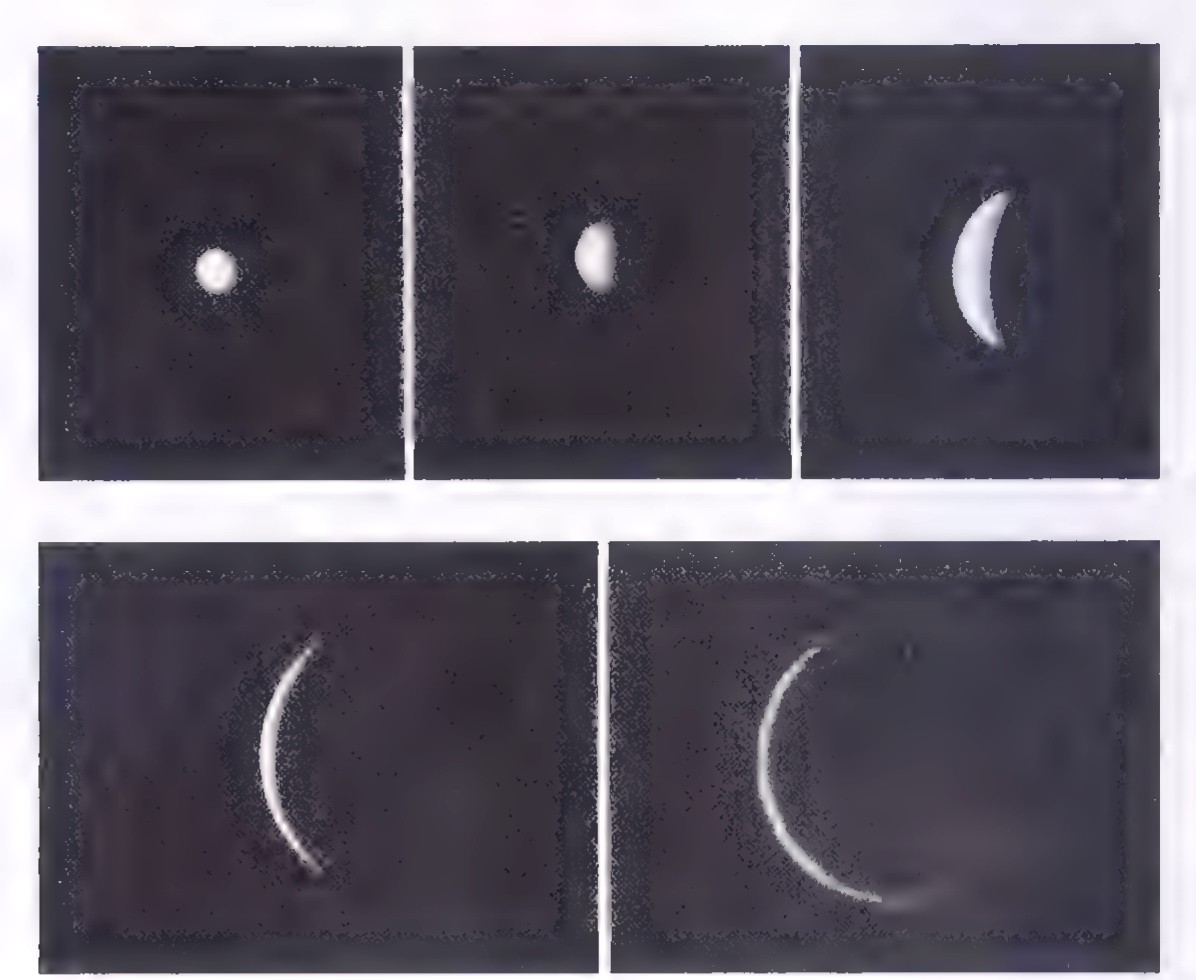
The series of photographs above at the same scale show something first noticed by Galileo through his telescope. He saw that Venus has phases, like the moon. But, unlike the moon, Venus at its full phase appears only about a sixth as large as it does at its new phase. Galileo reasoned that, when Venus is in its full phase, it must be much farther from Earth than when it is in its new phase. Let’s see how this could be so.
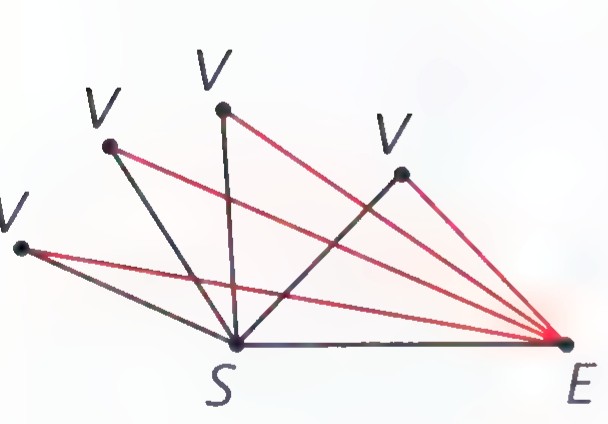
In the figure at the left, points S and E represent the sun and Earth, and the points labeled V represent some positions of Venus. In each sun-Earth-Venus triangle, SE and SV stay about the same, but the length VE changes a lot.
The average distance from the sun to Earth, SE, is 93 million miles; the average distance from the sun to Venus, SV, is 67 million miles. In the sun-Earth-Venus triangle at the left, what can we conclude about the length VE? The Triangle Inequality Theorem tells us that the sum of the lengths of any two sides of a triangle is greater than the length of the third side. From this theorem, we can write the inequalities
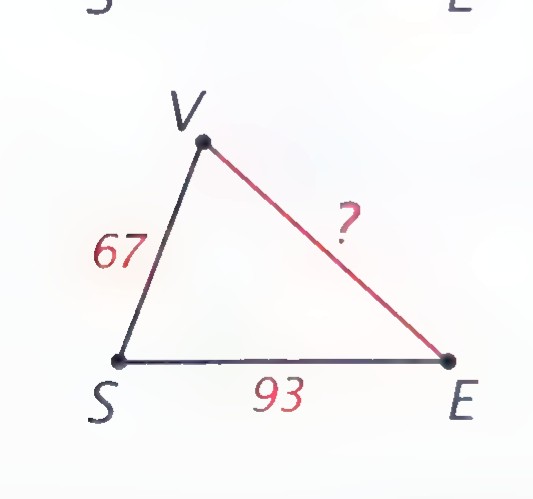
The last of these inequalities doesn’t tell us anything about VE, because 93 > 67. From the other two, we can conclude that
p. 201
At its farthest, Venus is 160 million miles from Earth, more than six times the distance at its nearest, 26 million miles. This fact explains why the apparent diameter of Venus in its full phase is about a sixth of that in its new phase.
Our proof of the Triangle Inequality Theorem follows Euclid’s. Its ingenuity helps explain why the Elements is such a significant book and why it is available today, not only in bookstores but also on the Internet!
Theorem 15. The Triangle Inequality Theorem
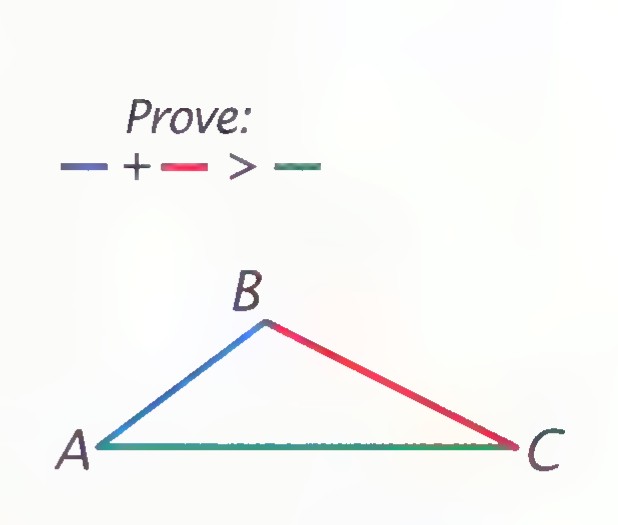
The sum of any two sides of a triangle is greater than the third side.
Given: ABC is a triangle.
Prove: AB + BC > AC.*
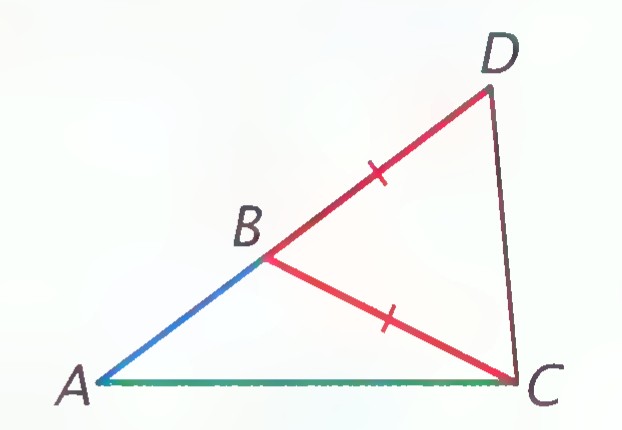
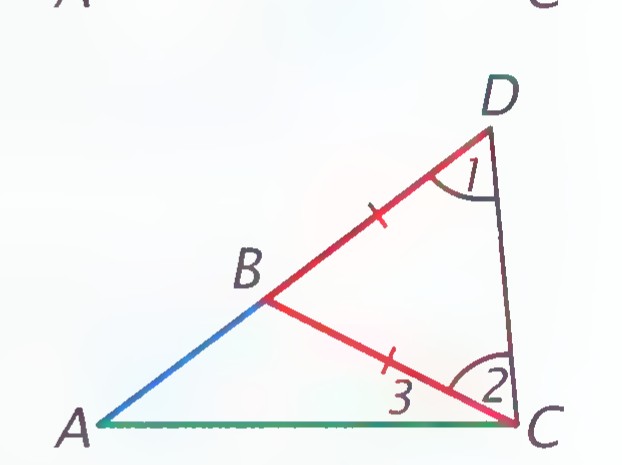
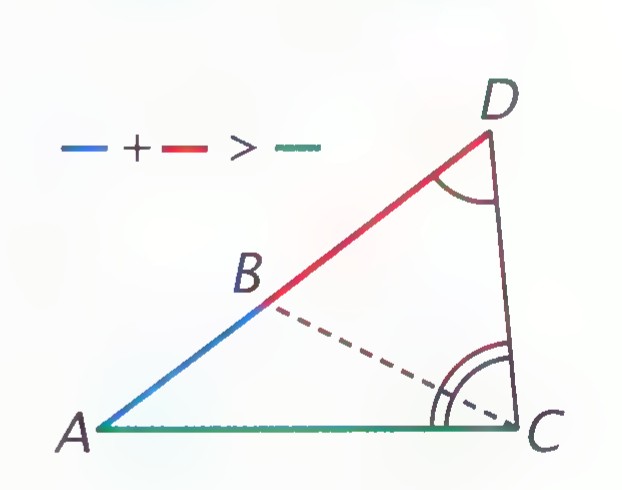
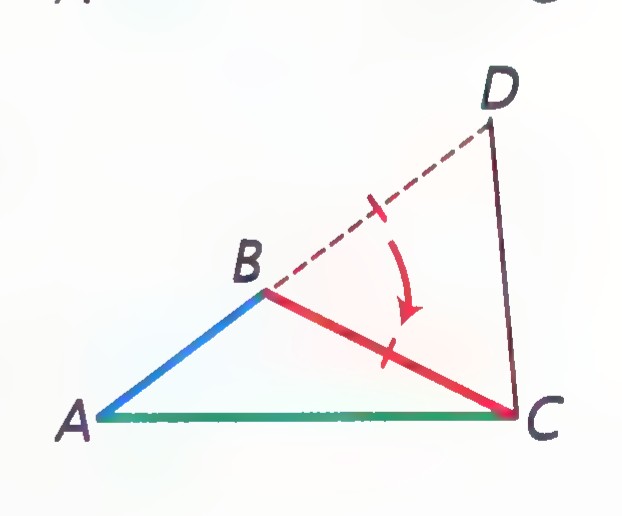
Before reading the proof, see if you can figure out the plan from the figures at the right.
Proof
| Statements | Reasons |
|---|---|
| 1. ABC is a triangle. | Given. |
| 2. Draw line AB. | Two points determine a line. |
| 3. Choose D beyond B on line AB so that BD = BC. | The Ruler Postulate. |
| 4. Draw CD. | Two points determine a line. |
| 5. ∠1 = ∠2. | If two sides of a triangle are equal, the angles opposite them are equal. |
| 6. ∠ACD = ∠2 + ∠3. | Betweenness of Rays Theorem (CA-CB-CD). |
| 7. ∠ACD > ∠2. | “Whole Greater than Part” Theorem. |
| 8. ∠ACD > ∠1. | Substitution (steps 5 and 7). |
| 9. In △ACD, AD > AC. | If two angles of a triangle are unequal, the sides opposite them are unequal in the same order. |
| 10. AB + BD = AD. | Betweenness of Points Theorem (A-B-D). |
| 11. AB + BD > AC. | Substitution (steps 9 and 10). |
| 12. AB + BC > AC. | Substitution (steps 3 and 11). |
* Also, AC + CB > AB and BA + AC > BC. These inequalities can be proved in the same way.
p. 202
Exercises
Set I
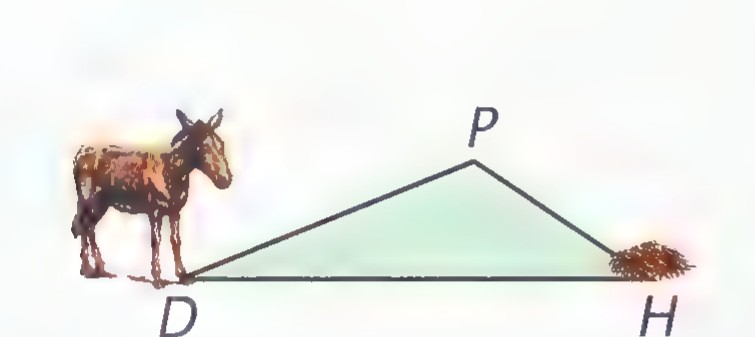
Donkey Sense. Soon after the Elements was written, some people made fun of the Triangle Inequality Theorem, saying that it is obvious even to a donkey and needs no proof. They pointed out that, if a hungry donkey were at one corner of a triangle and some hay were put at another corner, the donkey would walk along the side between them rather than along the other two sides.
- State the Triangle Inequality Theorem as a complete sentence.
- Use it to write the inequality relating the sides of △DPH that the donkey knows.
- Write the other two inequalities relating the sides of the triangle.
- If, rather than proving it, Euclid had assumed the theorem to be true, what would it be called?
- Does assuming something to be true explain why it is true?
Sun, Earth, and Venus. The sun, Earth, and Venus usually determine a triangle, but sometimes they do not.
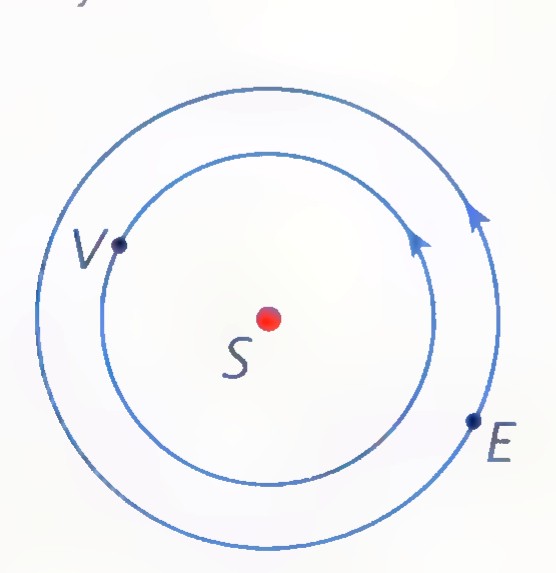
- What relation exists between three points if they do not determine a triangle?
The average distance from the sun to Earth is 93 million miles; the average distance from the sun to Venus is 67 million miles.
Tell whether or not each of the following situations is possible. In the cases that are possible, find the distance between Earth and Venus.
- The sun is between Earth and Venus.
- Venus is between Earth and the sun.
- Earth is between Venus and the sun.
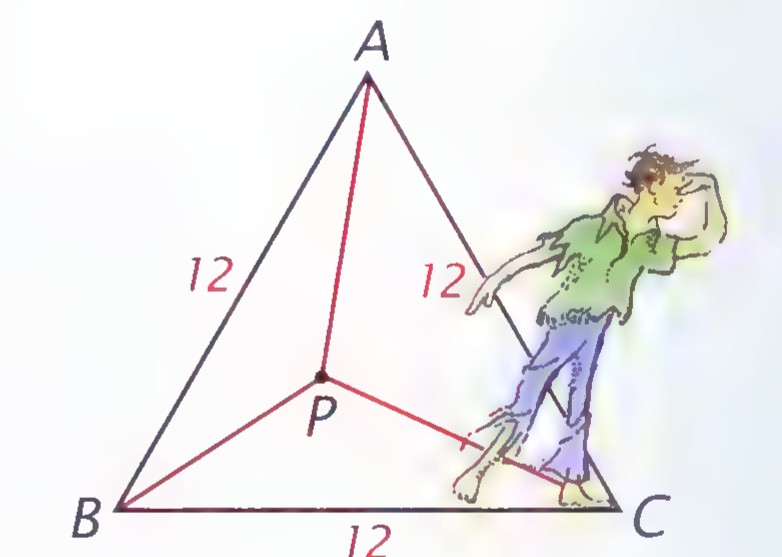
Spotter Problem. In the puzzle of the Surfer and the Spotter in the introduction to this book, the spotter wanted to go to the corners of the island to look for ships. (Recall that the island is in the shape of an equilateral triangle with sides 12 km long.)
Copy and complete the following inequalities by replacing each question mark with a number.
- PA + PB > ?, PA + PC > ?, and PB + PC > ?.
- (PA + PB) + (PA + PC) + (PB + PC) > ?.
- 2PA + 2PB + 2PC > ?.
- PA + PB + PC > ?.
- As long as the spotter builds his shelter at some point within the island, what can you conclude about the sum of the lengths of the paths from his shelter to the corners?
p. 203
SAT Problem. The following problem appeared on an SAT test.
If x is an integer and 2 < x < 7, how many different triangles are there with sides of lengths 2, 7, and x?
- Could x = 3? Explain why or why not.
- What do you think is the answer to the problem? Explain.
Distance and Collinearity. In proving our first theorem, the Betweenness of Points Theorem, we showed that, if A-B-C, then AB + BC = AC.
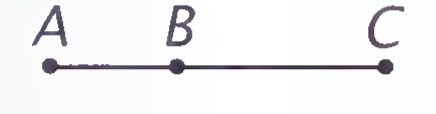
We can now prove that, if AB + BC = AC, then A, B, and C must be collinear.
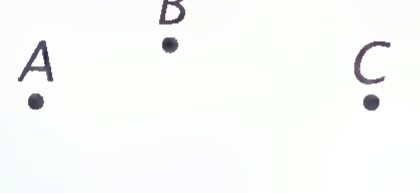
Complete the following steps in the proof.
- Suppose ?. If A, B, and C are not collinear, connect them to form △ABC.
- In △ABC, AB + BC > ?. Why?
- This contradicts the fact that ?.
- Therefore, what we assumed is false and ?.
The Third Side. The lengths of two sides of an isosceles triangle are 4 and 9.
- Is it possible to tell the length of the third side? Explain.
The lengths of two sides of a scalene triangle are 5 and 7.
- Is it possible to conclude anything at all about the length of the third side? Explain.
The lengths of two sides of a right triangle are 6 and 8.
- What could be the length of the third side? (Hint: Think of the Pythagorean Theorem.)
Set II
Heron’s Proof. Heron, a Greek mathematician who lived after Euclid, created a different proof of the Triangle Inequality Theorem.
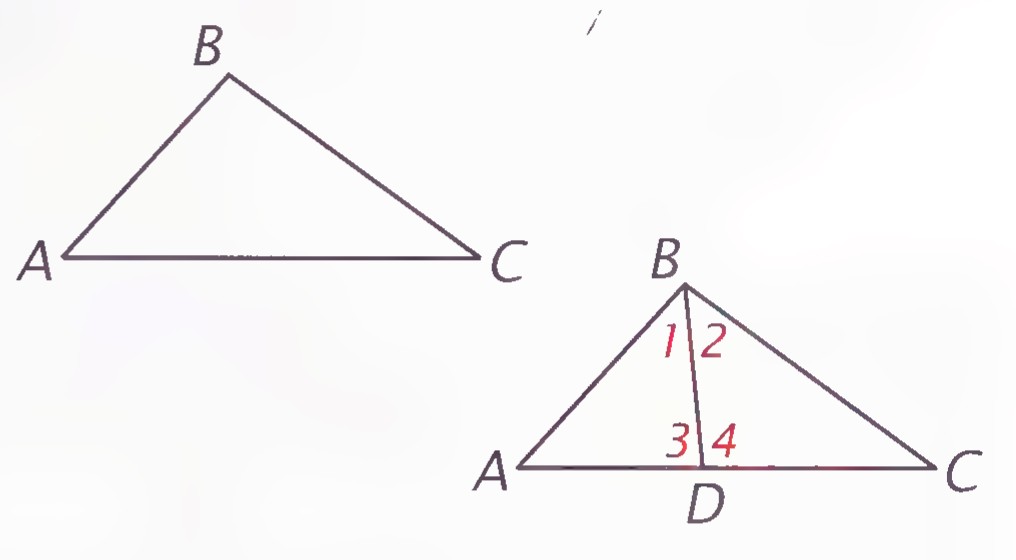
Given: ABC is a triangle.
Prove: AB + BC > AC.
Complete Heron’s proof by giving a reason for each of the following statements.
- Let line BD bisect ∠ABC.
- ∠1 = ∠2.
- ∠3 > ∠2 and ∠4 > ∠1.
- ∠3 > ∠1 and ∠4 > ∠2.
- AB > AD and BC > DC.
- AB + BC > AD + DC.
- AD + DC = AC.
- AB + BC > AC.
Quadrilateral Inequality. The Triangle Inequality Theorem can be extended to polygons other than triangles.
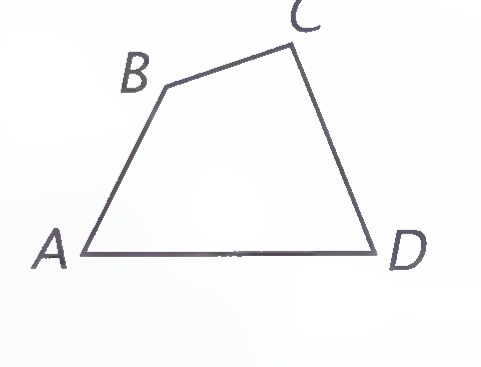
- Use this figure to prove that, for quadrilateral ABCD, AB + BC + CD > AD. (Hint: Draw AC.)
p. 204
Light Path. Heron used the Triangle Inequality Theorem to show that reflected light follows shortest paths.
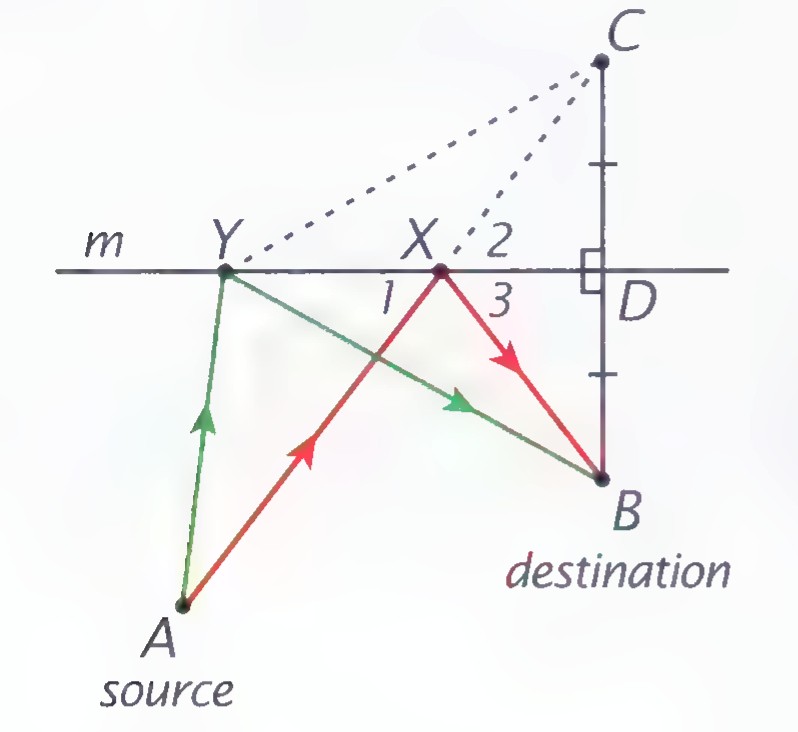
The figure above shows two possible rays of light from a source at point A being reflected by the mirror at a special point X and any other point Y. The light continues to B, its destination.
Some extra lines have been added to the figure for use in the proof: A-X-C, BC ⊥ m, and CD = DB. Tell why each of the following statements is true.
- AY + YC > AC.
- AX + XC = AC.
- AY + YC > AX + XC.
- △CYD ≅ △BYD and △CXD ≅ △BXD.
- YC = YB and XC = XB.
- AY + YB > AX + XB.
- ∠1 = ∠2.
- ∠2 = ∠3.
- ∠1 = ∠3.
- Which statement above shows that the path of the light from A to B is shortest at reflection point X?
- Which statement shows that the angles of the path from A to X to B are equal?
Work Triangle. In the design of a kitchen, the “work triangle” (a triangle with the refrigerator, stove, and sink as its vertices) should have a perimeter between 6.5 meters and 7.0 meters. The “sink to stove” side of the triangle should be between 1.2 meters and 1.8 meters.*
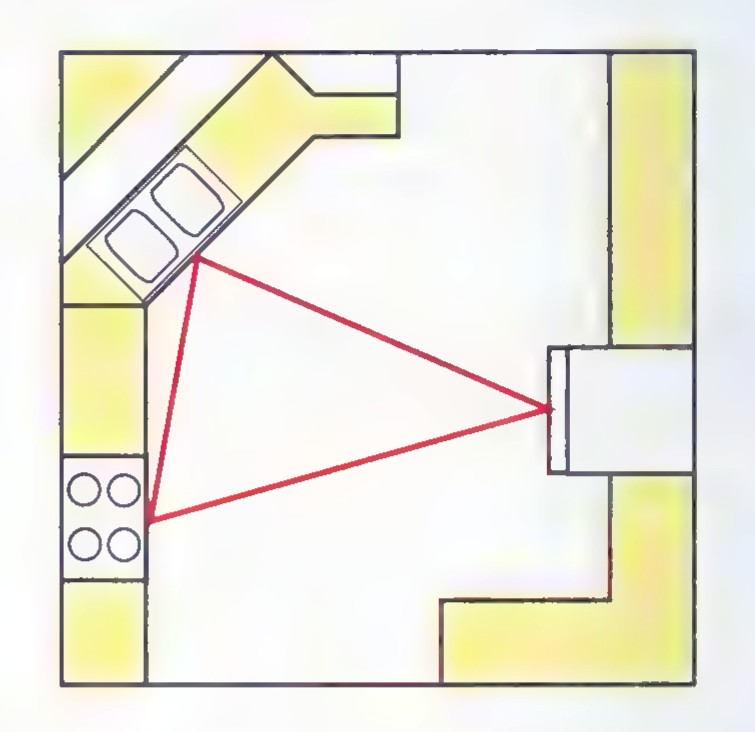
Suppose that, in this kitchen, the perimeter of the work triangle is 7 meters and the “sink to stove” side is 1.5 meters.
- What is the sum of the other two sides?
- If x represents the length of the refrigerator–sink side of the triangle, what is the length of the refrigerator–stove side in terms of x?
- Draw the “work triangle” and write the three expressions for the lengths of its sides on it.
- Write and solve the three inequalities for the triangle that follow from the Triangle Inequality Theorem.
- What can you conclude about what the length of the refrigerator–sink side of the triangle should be?
* The Shape of Space: Food Preparation Spaces, by Robin Crane and Malcolm Dixon (Van Nostrand Reinhold, 1990).
p. 205
Set III
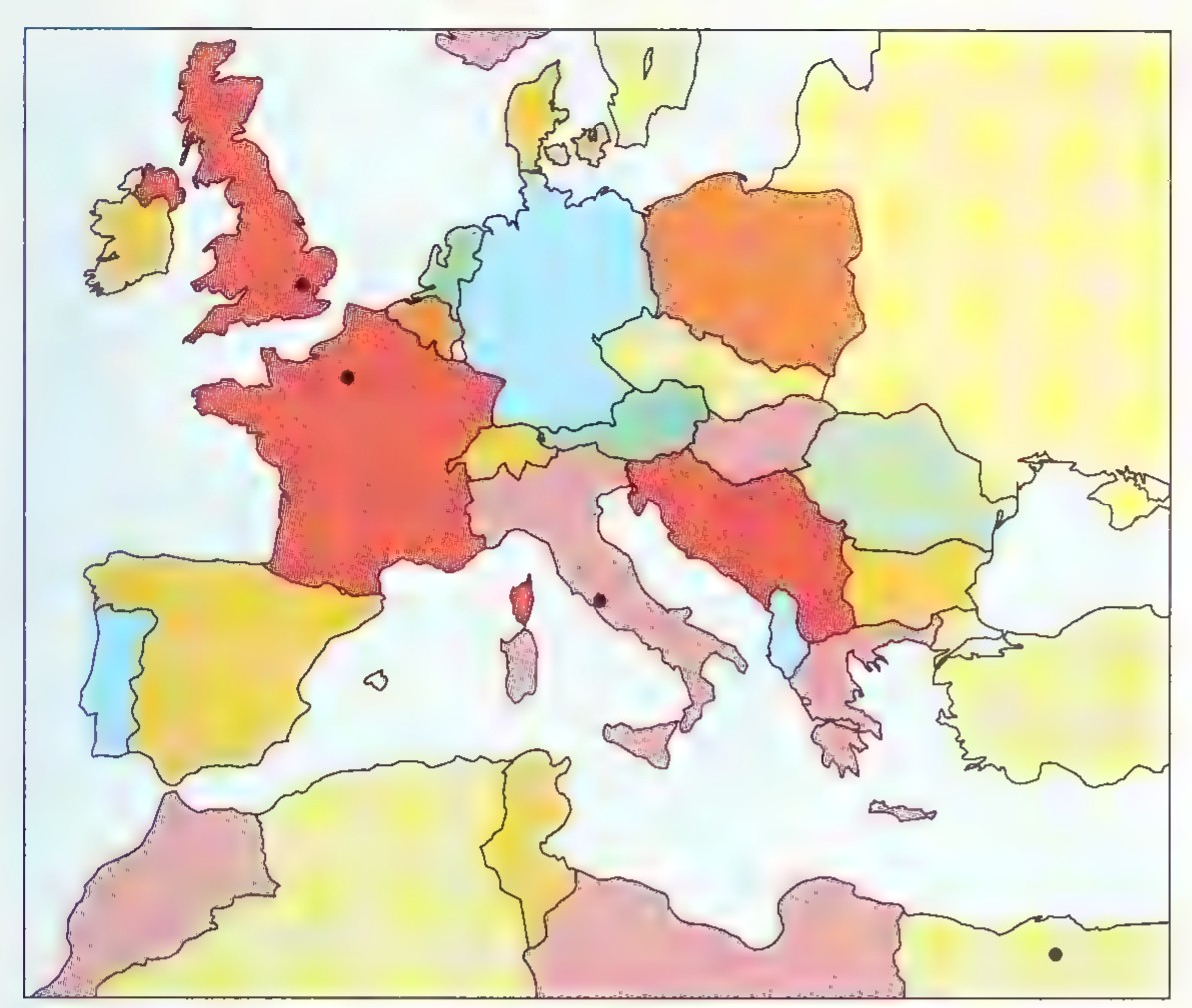
The numbers in the following chart are the distances in miles between four cities, but one of them is wrong.
| Paris | Rome | Cairo | |
|---|---|---|---|
| London | 214 | 895 | 2,185 |
| Paris | 590 | 1,998 | |
| Rome | 1,326 |
The triangle below (not to scale) shows London, Paris, and Rome and the distances between them.
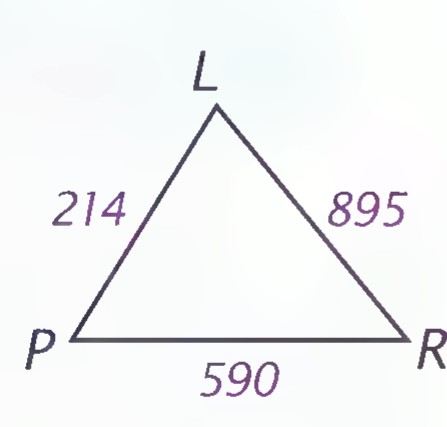
Draw and label triangles for
- London, Paris, and Cairo.
- London, Rome, and Cairo.
- Paris, Rome, and Cairo.
- Which of the four triangles contradict the Triangle Inequality Theorem? Explain.
- Which distance in the chart do you suspect is wrong?
p. 206
Summary and Review
Basic Ideas
Addition, subtraction, multiplication, and division properties of inequality — 185
Exterior angle of a triangle — 191
“Three possibilities” property — 185
Transitive property — 185
“Whole greater than part” theorem — 185–186
Theorems
- The Exterior Angle Theorem. An exterior angle of a triangle is greater than either remote interior angle. 191
- If two sides of a triangle are unequal, the angles opposite them are unequal in the same order. 196
- If two angles of a triangle are unequal, the sides opposite them are unequal in the same order. 196
- The Triangle Inequality Theorem. The sum of any two sides of a triangle is greater than the third side. 201
Exercises
Set I
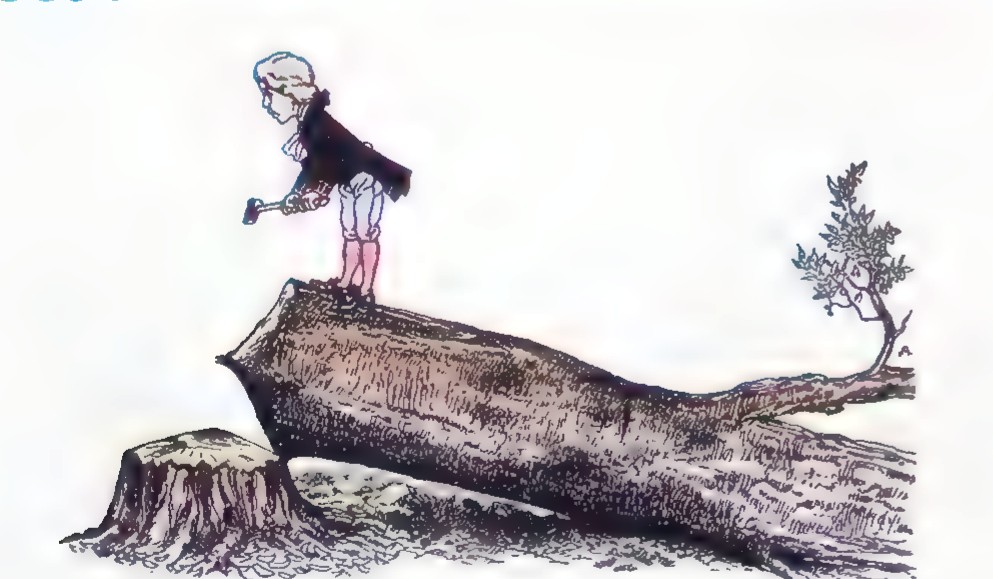
American puzzle maker Sam Loyd drew this picture a century ago. It shows the young George Washington after he had cut down the cherry tree. The puzzle is to find Washington’s face as he looked when he was president.
- Where is he?
- How does the picture have to be viewed to see him?
Minerals are compared in the Mohs scale by what they will scratch and what will scratch them. Diamond will scratch quartz and quartz will scratch glass.
- What conclusion seems to follow from this statement?
- Which property of inequality is this comparison of minerals like?
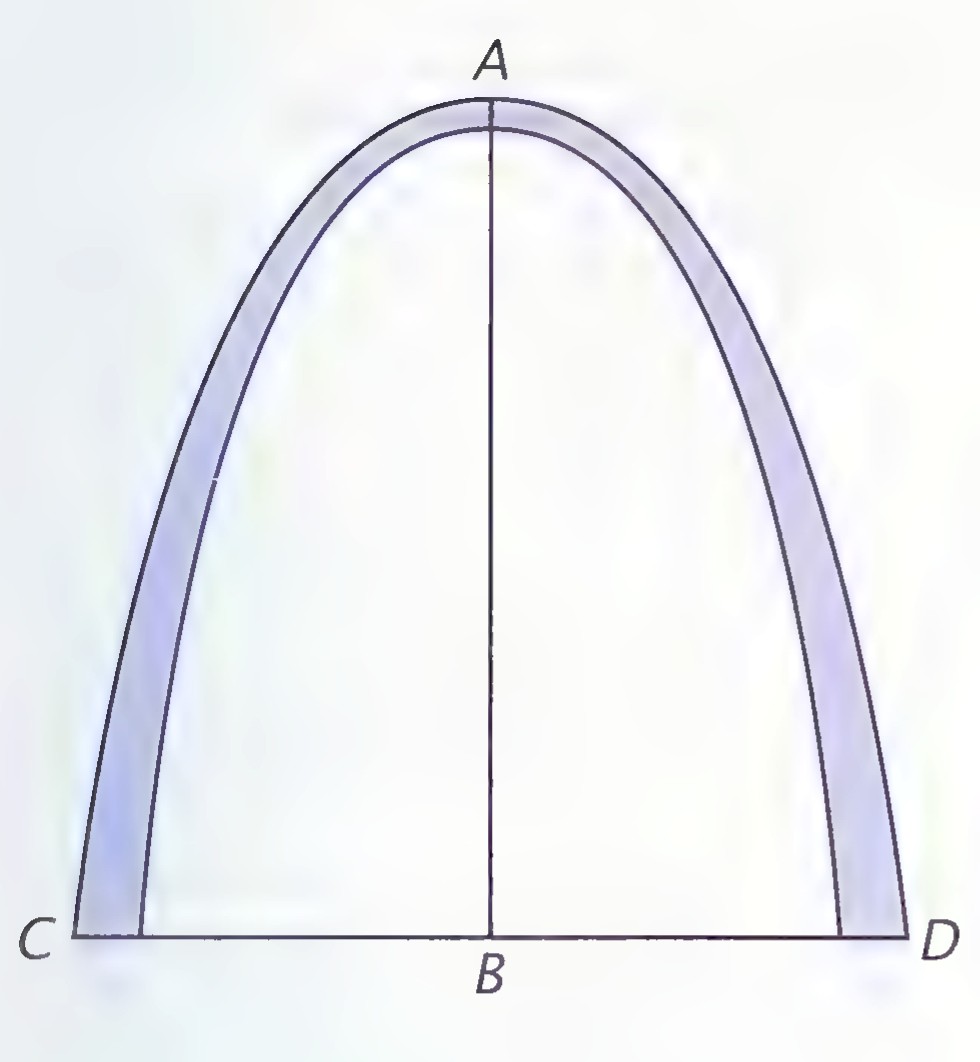
Gateway Arch. The Gateway Arch in St. Louis is shown head on in this photograph.

- Which property of inequality names the ways in which its height and width might compare?
- Without measuring, how do you think the height of the arch compares with its width?
- Measure its dimensions on the scale drawing on page 207 in inches.
- Use the fact that 1 inch represents 252 feet in the drawing to find the height and width of the Gateway Arch.
p. 207
Portuguese Theorem. The following words appear in a Portuguese geometry book:
Teorema: Um ângulo externo de um triângulo é maior do que qualquer dos ângulos internos não adjacentes.
- What is our name for this theorem?
- Write it as a complete sentence.
- What is an “exterior angle”?
What can you conclude about the angles of a triangle if it has an exterior angle that
- has a measure of 1°?
- is a right angle?
- is obtuse?
Soccer Angle. The following description of the goal keeper in soccer is from a book on the Olympics.*
Keepers utilize their geometry skills in another tactic called “cutting the shooter’s angle.” The goalie imagines a straight line between himself and the ball and the middle of the goal so the shooter always has an equal amount of goal to shoot at from both sides.
In the figures below, M is the midpoint of LR, and points K and S represent the positions of the keeper and the shooter.
In this figure, the shooter is “centered” so that SL = SR.
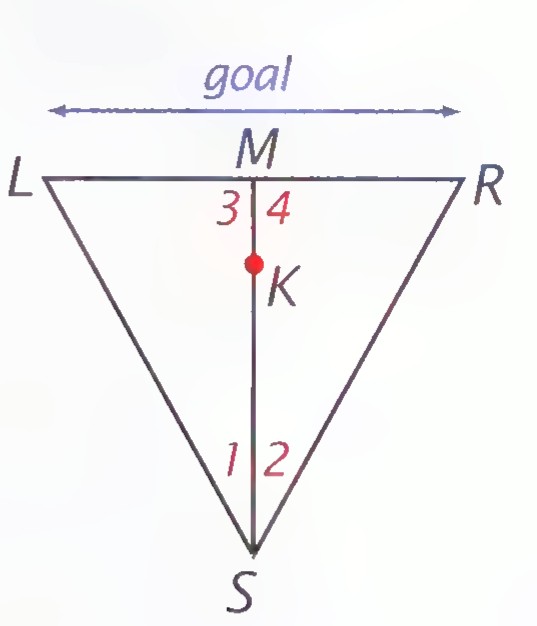
- Draw the figure and mark it as needed to give a reason for each of the following statements.
- LM = MR.
- SM = SM.
- △SML ≅ △SMR.
- ∠1 = ∠2 and ∠3 = ∠4.
- SM ⊥ LR.
In the figure below, the shooter is closer to the left side of the goal so that SL < SR.
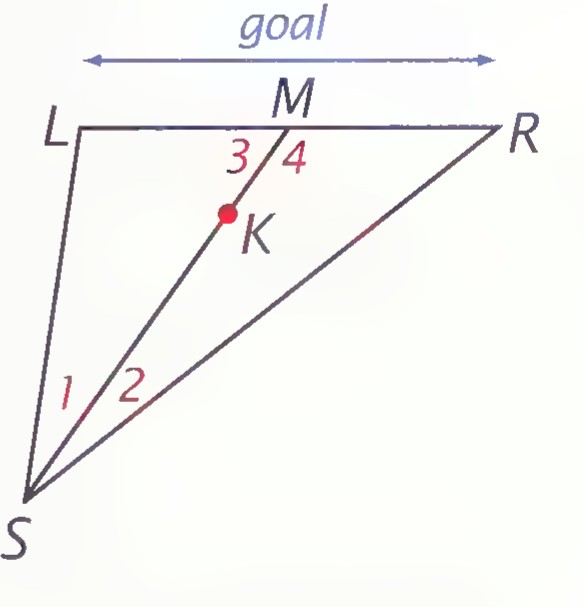
- Draw the figure and mark it as needed to give a reason for each of the following statements.
- ∠L > ∠R.
- ∠4 > ∠L.
- ∠4 > ∠R.
- SR > SM.
* The Science of the Summer Games, by Vincent Mallette (Charles River Media, 1996).
p. 208
Roman Column. The drawing below of an ancient Roman column was made in 1646.*
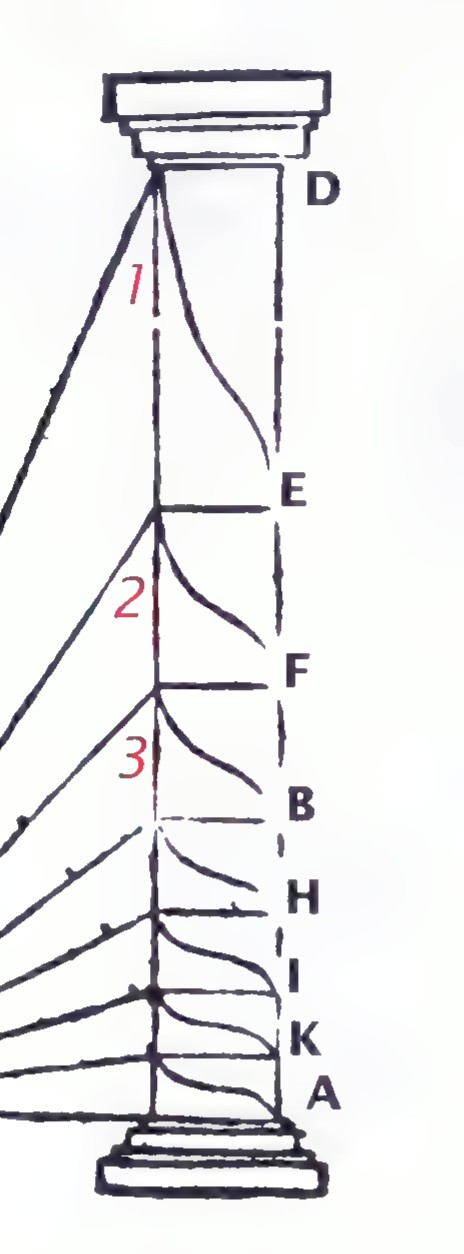
- Center your protractor on the point at the lower left. What do you notice about the angles formed by the lines from this point?
- What do you notice about the lengths of the sections of the column?
- Why do you suppose the column might be designed in this way?
- Why is ∠1 < ∠2 and ∠2 < ∠3?
- Why is ∠1 < ∠3?
Set II
Integers and Triangles. The numbers 1, 3, and 5 are consecutive odd integers and the numbers 2, 4, and 6 are consecutive even integers.
The figures below show the results of trying to construct triangles with these numbers as their sides.
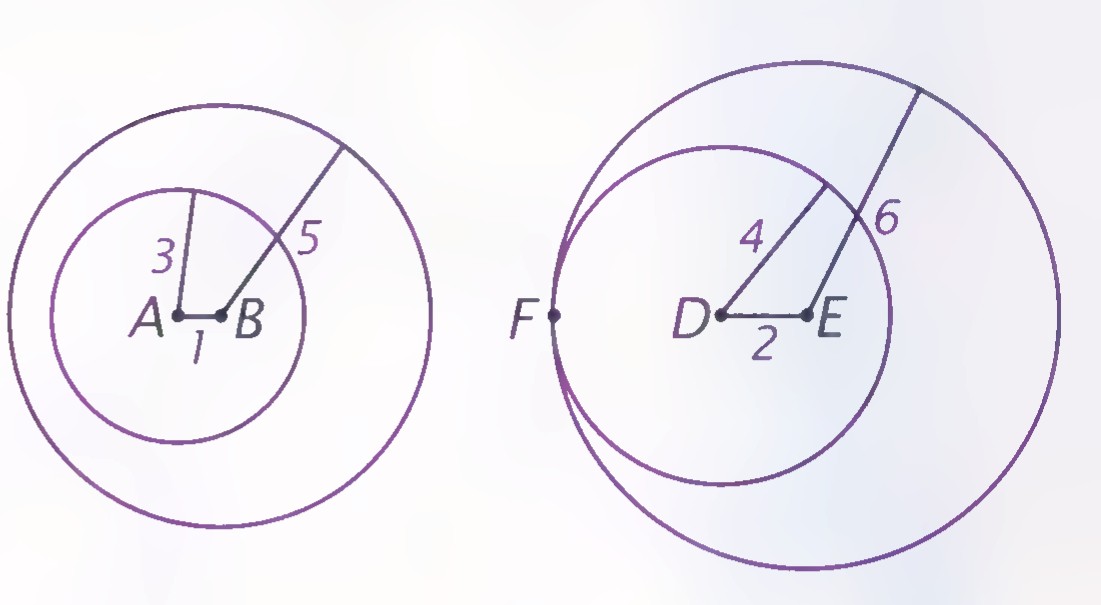
- Explain in each case why no triangle is possible.
- How are points D, E, and F related?
- Try to construct a triangle GHI whose sides are the consecutive odd integers 3, 5, and 7.
In general, if n is an integer, then n, n + 2, and n + 4 are either consecutive odd integers or consecutive even integers.
From the Triangle Inequality Theorem, we know that, if n, n + 2, and n + 4 are the sides of a triangle, then
- Solve this inequality for n.
- Do you think a triangle can have sides of 1,000,000, 1,000,002, and 1,000,004? Explain why or why not.
- As the numbers in a set of consecutive odd or even integers get larger and larger, what does the triangle having them as sides look more and more like?
Different Definition. Near the beginning of Euclid Simplified, a book published in 1875, is this statement:
The base of an isosceles triangle is the unequal side.
- If an isosceles triangle has an “unequal side,” how many “unequal angles” does it have?
* Perspective in Perspective, by Lawrence Wright (Routledge and Kegan Paul, 1983).
p. 209
- How does the statement disagree with our definition of an isosceles triangle?
- Is an equilateral triangle isosceles?
- If one side of an isosceles triangle has a length of 10, what possible conclusions can you draw about the lengths of its other two sides? Explain.
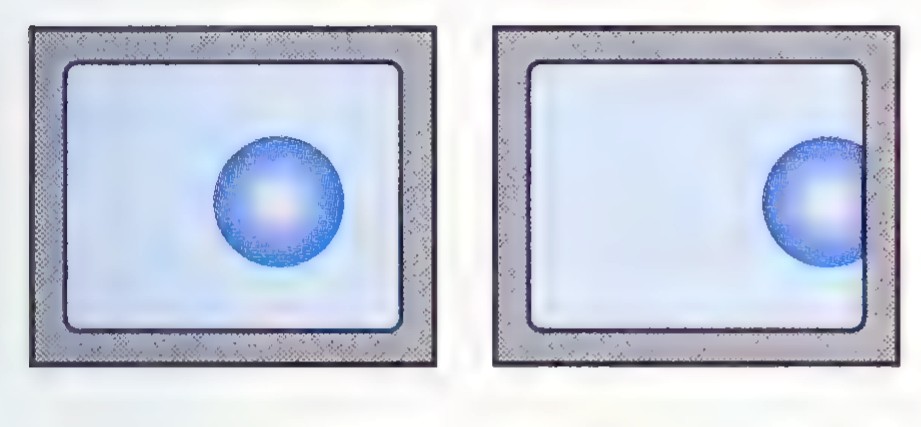
Screen Display. The figures below show a ball as it moves from one position to another on a stereoscopic screen display. On an actual display, the ball appears to be in front of the screen in the first figure but behind the screen in the second.*
The figure below shows an overhead view of someone looking at a stereoscopic display. The stereoscopic effect works only as long as the eyes see an object as completely in the shaded region.
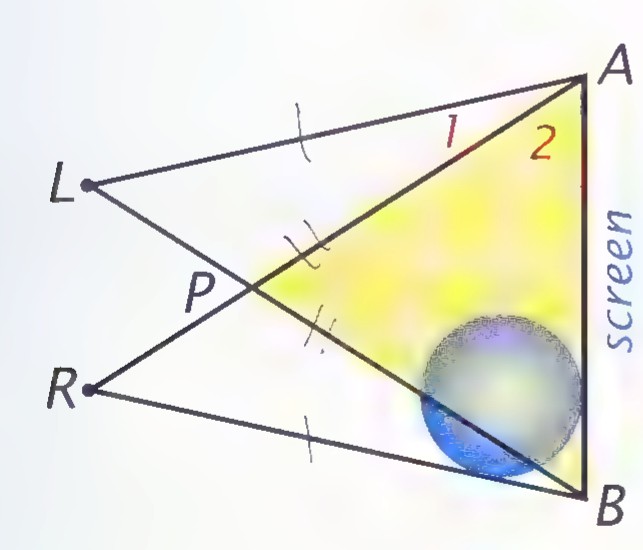
In the figure, LA = RB and LB = RA. Prove that LB > LA by giving a reason for each of the following statements.
- △LBA ≅ △RAB.
- ∠LBA = ∠2.
- ∠LAB = ∠1 + ∠2.
- ∠LAB > ∠2.
- ∠LAB > ∠LBA.
- LB > LA.
SAT Problem. The following description appeared in a problem on an SAT exam.
A triangle has sides of lengths x, x − 2, and 7 − x.
- Write the three inequalities for this triangle that follow from the Triangle Inequality Theorem.
- From these inequalities, what can you conclude about x? Show your reasoning.
Draw the figures with appropriate markings and write complete proofs for each of the following.
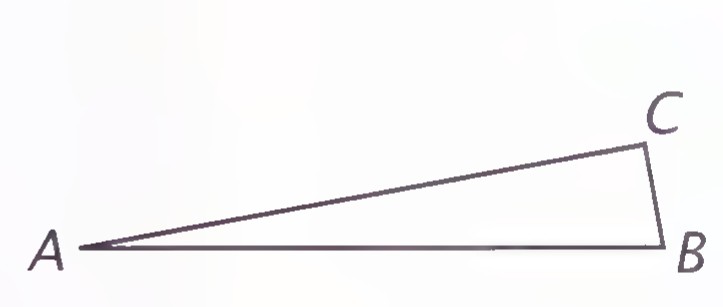
Given: AB > AC; ∠A and ∠B are complementary.
Prove: ∠A + ∠C > 90°.
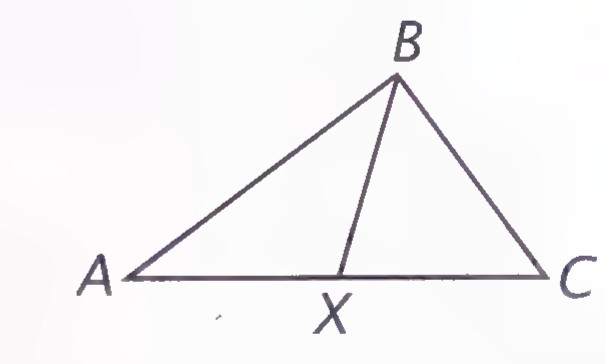
Given: Point X on side AC of △ABC such that XB = XC.
Prove: AC > AB.
* Information Visualization: Perception for Design, by Colin Ware (Morgan Kaufmann, 2000).
p. 210
Algebra Review: Simplifying Fractions
A fraction is in “lowest terms” if its terms (its numerator and denominator) have no common factor other than 1.
In general, if n ≠ 0,
These equations express the fact that the terms of a fraction can be multiplied or divided by the same number without changing its value.
Example 1: Reduce to lowest terms.
Solution:
Example 2: Express and as fractions with a common denominator.
Solution:
Exercises
Reduce to lowest terms.
Express as fractions with the indicated denominators.
- with denominator 4x.
- with denominator x⁴.
- with denominator x − 2.
Express as fractions with a common denominator.
- and
- and
- and
- and
- and
- and