Chapter 5 — Teacher’s Guide Answers
Answers and teaching commentary for Chapter 5: Inequalities, transcribed from the scanned Teacher’s Guide. Diagrams are cropped from the same page scans.
OCR note. The text was recognized automatically and has not been corrected line by line; formulas and symbols may be imperfect. Check the original PDF for exact wording.
Homework: Chapter 5 exercises · Selected answers · Teacher’s answers PDF
Lesson 1
Set I
A chapter of Lawrence Wright’s Perspective in Perspective (Routledge & Kegan Paul, 1983) is titled “Grand Illusions” and concerns various tricks played by architects with perspective. Plato mentions the use of such tricks in the design of Greek temples such as the Parthenon. Giotto’s campanile in Florence is unusual in its use of “counter-perspective.” The tower widens measurably upward, and the upper levels become successively taller toward the top. From the ground, they can look almost equal.
Hat Illusion. 1. Eitherh>w, h=w,orh<w.
2. The “three possibilities” property.
3. (Student answer.) (For most people, the hat appears to be taller than it is wide, and so h>w.)
4. The hat is 1.7 cm high and its brim is 1.8 cm wide.
Pecking Order.
5. Hen A will always peck hen C. 6. The transitive property. Egqualities and Inequalities.
7. The “three possibilities” property. 8. Multiplication.
9. Subtraction.
10. Substitution. 11. Addition.
12. Division. Deceiving Appearances.
13. Isosceles. (Also acute.) 14. AB > BC. 15. Substitution.
16. Scalene. (Also acute.)
17. DF <DE.
18. The transitive property.
19. Because one has two equal sides and the other does not. (One is isosceles, the other scalene.)
Perspective Inequalities. 20. ∠APB > ∠HPL
21. /BPC > ∠CPD.
- /PIH < ∠PBA.
23. ∠PHG < ∠PGF.
24. /PHI> ∠PGH and ∠PGH > ∠PFG; so /PHI > ∠PFG.
25. So that the upper levels would appear to be the same height when viewed from the ground.
Set II
SAT Problem.
- Transitive.
27. Addition.
28. Substitution. (Substituting AC for AB + BC and CE for CD + DE in exercise 27.)
29. Could be false. (To see why, imagine that DE is much longer than it is.)
30. The “whole greater than part” theorem.
31. Transitive. (AB < BC is given and BC < BD in exercise 30.)
Scalene Triangle.
32. a b [4 33. A
b C
C 7 B 34. LA =83° /B=56° ∠C =41°.
35. ∠A> /B> /C.
36. Yes. The order corresponds to the order of the lengths of the opposite sides.
Rectangle Inequalities. 37. 9units. 2-4+2:05=9.)
38. Yes. The “whole greater than part” theorem.
39. 2 square units. (4-0.5=2.)
40. No. This area problem shows why: 4 > 0 and 05>0,but4 x 0.5=2<4.
Vertical Lines and Angles. 41. That the line is “upright” (contains the center of the earth).
42. The sides of one angle must be opposite rays to the sides of the other angle. (It must also be true that two angles are equal if they are vertical angles.)
43. Yes: ∠1 and ∠2 are not vertical angles. If they were vertical angles, they would be equal. Because AB = AC, 22 = /3 (if two sides of a triangle are equal, the angles opposite them are equal). But ∠1 < ∠3; 50 ∠1 < ∠2 (substitution).
44. No. Because ∠2 = /3 (AB = AC) and ∠2 = ∠4, /3 = /4. The fact that two angles are equal does not mean, however, that they are necessarily vertical angles.
45. (1) Given.
Addition.
Given.
Addition.
Transitive (steps 2 and 4).
46. (1) Given.
Subtraction.
Given.
Substitution.
Addition.
Optics Figure.
47. (1) Given.
Betweenness of Rays Theorem.
Protractor Postulate.
The “whole greater than part” theorem.
48. Proof.
A-B-C. (Given.)
AB + BC = AC. (Betweenness of Points Theorem.)
AC > AB. (“Whole greater than part.”)
∠ADB = ∠DAB. (Given.)
AB =DB. (If two angles of a triangle are equal, the sides opposite them are equal.)
AC > DB. (Substitution.)
Set III
In Human Information Processing, Peter H. Lindsay and Donald A. Norman deal with the logic of choice. Concerning the three statements of the Set Il exercises, they write:
“Almost without exception, people agree that their own decision processes ought to be logical. Moreover, formal theories of decision making assume logical consistency: Preferences among objects ought to be consistent with one another. If A is preferred to B and B to C, then logicaily A should be preferred to C. Transitivity of this sort is a basic property that just ought to hold anytime different objects are compared to one another. …
These three rules constitute a sensible set of postulates about decision behavior. Indeed, if the rules are described properly, so that the mathematical framework is removed, they simply sound like common sense. Those who study decision making, however, have discovered that there is a difference between the rules that people believe they follow and the rules that they actually do follow. Thus, although these three assumptions form the core of most decision theories, it is also realized that they do not always apply. There are some clear examples of instances in which each rule is violated.”
(The authors then give anecdotal examples of violations for each of the three rules.)
Martin Gardner treated the subject of nontransitive paradoxes in one of his “Mathematical Games” columns. It is included in his Time Travel and Other Mathematical Bewilderments (W. H. Freeman and Company, 1988).
1. If you prefer an apple to a banana and a banana to a cookie, then you prefer an apple to a cookie.
2. The transitive property.
3. If you have no preference between an apple and a banana or between a banana and a cookie, then you have no preference between an apple and a cookie.
4. Substitution.
5. If you have no preference between an apple and a banana and you prefer a cookie to nothing at all, then you would prefer having an apple and a cookie to having just a banana.
6. Yes. If C>0,then A + C> A. (Addition.) But A =B, so A + C > B. (Substitution.)
Lesson 2
Set I
Aristotle included a section on the causes of the rainbow in De Meteorologia. According to Carl Boyer, Aristotle’s work is “the first truly systematic theory of the rainbow that has come down to us.” Boyer comments on the soundness of some of Aristotle’s geometrical arguments and says: “Had his successors continued his work at the same high level, the story of the rainbow might not have been such a tale of frustration as it was destined to be.”
Garage Door. 1. ∠BCY, ∠BAX, ∠CAD(LYAD).
2. It gets larger.
3. It gets smaller.
4. It gets smaller.
5. If two sides of a triangle are equal, the angles opposite them are equal. 6. An exterior angle of a triangle is greater than either remote interior angle.
7. Vertical angles are equal.
8. They are always equal. Because ∠B = ∠BAY and ∠BAY = ∠DAX, /B = ∠DAX by substitution.
Exterior Angles.
®9. /2, /5, /8. 10. Two.
11. Six.
12. Yes. If the triangle is equiangular, its exterior angles must all be equal because they are supplements of equal angles.
13. No. The exterior angles at each vertex are vertical angles and vertical angles are equal.
14. Example figure:
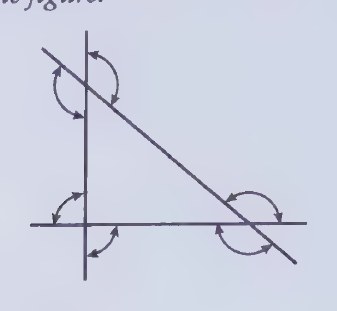
Diagram from page 58.
15. Example figure:
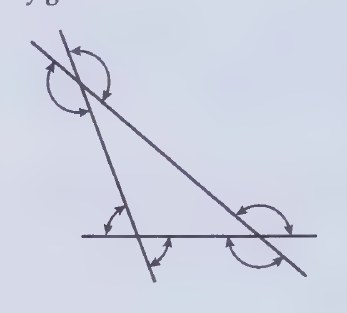
Diagram from page 58. 16. Two.
17. Two.
18. Six. Rainbow. 19. AROS.
- ∠ROA > ∠SRO and ∠ROA > /∠S.
21. AROC. 22, /ROS > ∠ORC and ∠ROS > ∠RCO(Z4RCS).
23. ARCS and ARCO.
24. ∠RCA> /SRC, ∠RCA > /S, ∠RCA > ∠ORC, ∠RCA > ∠ROC.
25. No. Itdoes not form alinear pair with an angle of the triangle.
Lines and Angles. 26. 360°.
27. 1,080°. (3- 360 = 1,080.) 28. 180°.
29. 180°.
30. 720°. (1,080 — 180 — 180 = 720.)
31. Itindicates that the sum is 720°.
Set II
We are indebted to Proclus for his commentary on the first book of Euclid’s Elements. It and the work of Pappus are our two main sources of information on the history of Greek geometry. Proclus defended Euclid from the charge that he proved things that had no need of proof. (More on this is included in Lesson 4 of this chapter.)
Exterior Angle Theorem. 32. A line segment has exactly one midpoint.
33. The Ruler Postulate (or by Construction 1, to copy a line segment).
34. SAS.
35. Corresponding parts of congruent triangles are equal.
36. Vertical angles are equal.
37. The “whole greater than part” theorem.
38. Substitution.
Angle Sum. 39. Two points determine a line.
40. An angle is an exterior angle of a triangle if it forms a linear pair with an angle of the triangle. 41. The angles in a linear pair are supplementary.
42. If two angles are supplementary, their sum is 180°. 43. An exterior angle of a triangle is greater than either remote interior angle.
- Addition.
45. Substitution.
Angle in a Triangle. 46.
X
C
47. ∠APC > ∠AXC and ∠AXC > ∠B because an exterior angle of a triangle is greater than either remote interior angle. So ∠APC > /B by the transitive property.
Proclus’s Proof.
48. If two sides of a triangle are equal, the angles opposite them are equal.
- /1=/∠Cand ∠2=LA.
50. The Exterior Angle Theorem (∠1 is an exterior angle of APBC and ∠2 is an exterior angle of APBA.)
51. Indirect.
Set III
In his History of Mathematics, David Eugene Smith includes a paragraph on “drumhead trigonometry.” He wrote: “The continual warfare of the Renaissance period shows itself in many ways in the history of mathematics . … One of them is related to the subject now under consideration. Several writers of the 16th century give illustrations of the use of the drumhead as a simple means of measuring angles of elevation in computing distances to a castle or in finding the height of a tower.” The illustration is from
S. Belli’s Libro del Misvrar con la Vista (Book of Measuring with Eyesight), published in Venice in 1569.
Drumhead Geometry. il
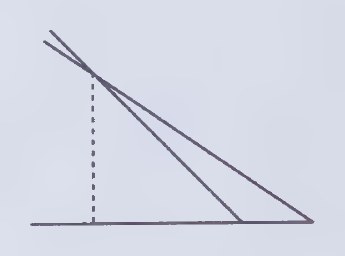
Diagram from page 59.
1
2. (About 4 in; more precisely, about 45 in.)
3. About 80 ft.
Lesson 3
Set I
There are now many more “anamorphic artists” painting streets than pictures. The idea in using anamorphic figures as traffic markers is clearly
not to make them difficult to recognize but
rather just the opposite. The driver of a moving car who is looking far ahead sees the markers from a sharp angle and hence sees them regain their “normal” shape. An entire “Mathematical Games” column focuses on various types of anamorphic art (Scientific American, January 1975). It is included in Martin Gardner’s Time Travel and Other Mathematical Entertainments (W. H. Freeman and Company, 1988).
“Triangles in perspective” is an interesting topic. Suppose we have some wire-frame models of triangles of various shapes. What kinds of shadows can they cast? Can the shadow of an equilateral triangle look scalene? Can the shadow of an isosceles triangle look equilateral? Can the shadow of an obtuse triangle look acute? Does the shadow of a triangle always look like a triangle? What determines the smallest shadow that a triangle can cast?
1. Bicycle lane.
2. So that it can be seen more easily to a driver viewing it “on edge.”
3. Each is the converse of the other.
4. BC<AC.
5. The “three possibilities” property.
6. ∠A=/B.
7. If two sides of a triangle are equal, the angles opposite them are equal.
8. ∠A>/B.
9. LA < /B. 10. If two sides of a triangle are unequal, the angles opposite them are unequal in the same order.
11. ∠A>∠B.
12. BC>AC.
13. Indirect. Triangle Drawing 1. 14. /B.
15. ∠A.
16. C
A I3 B
17. Obtuse. (Also, scalene.) 18. LA =29° ∠B=104°, ∠C =47°. Triangle Drawing 2. 19. DE.
20. DFE.
21. F
D 50 = 40 E
- DF=45cm, EF =54 cm. Triangle in Perspective.
®23. ∠∠X> LY.
24. If two sides of a triangle are unequal, the angles opposite them are unequal in the same order.
25. LZ> Y.
26. LZ > /X (given) and ∠X > LY (exercise 23); S0 ∠Z > ∠Y by the transitive property.
27. XY > XZ.
28. If two angles of a triangle are unequal, the sides opposite them are unequal in the same order.
Set II
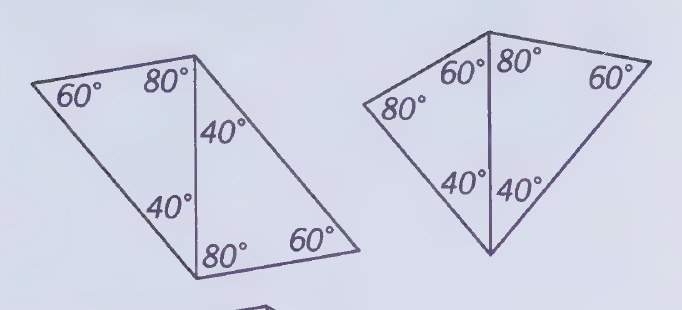
Diagram from page 61.
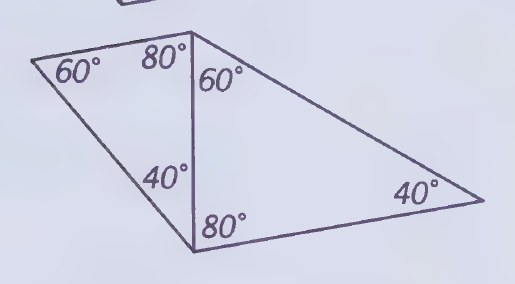
Diagram from page 61.
The exercises on the pairs of “not quite equilateral” triangles are more challenging than they first appear. Some comparable drawings (above) in which the angles are 40°, 60°, and 80° instead are revealing. (Although the triangles in the second and third pairs are not congruent, they are obviously similar. We will return to these figures in the chapter on similarity.)
’
3
Folding Experiment.
29. (Triangle cut out and folded). 30. ∠BDE.
31. ∠BDE is an exterior angle of ADEC.
32. #BDE > ∠C.
33. If two sides of a triangle are unequal, the angles opposite them are unequal in the same order. 34. BE bisects ∠ABC.
35. AABE = ADBE (SAS); so ∠BDE = ∠A (corresponding parts of congruent triangles are equal).
Not Quite Equilateral.
- Yes. They are congruent by ASA.
37. AC.
38. BD.
39. They are equal because corresponding parts of congruent triangles are equal.
40. FG.
41. GH.
- FG < GH because both are sides of AFGH in which GH is the longest side.
43. No. They can’t be congruent because FG and GH are corresponding parts of the triangles but they are not equal.
44. Yes. They are not congruent, because the shortest side of AIJK is I] and the shortest side of AJKL is JK. I] < JK because they are both sides of AIJK in which 1] is the shortest side. As with the preceding pair of triangles, these triangles cannot be congruent, because 1] and JK are corresponding parts of the triangles but they are not equal.
- An equilateral triangle is equiangular.
46. Betweenness of Rays Theorem.
- The “whole greater than part” theorem.
48. Substitution.
49. If two angles of a triangle are unequal, the sides opposite them are unequal in the same order.
50. Because ∠PXA is an exterior angle of APXY, ∠PXA > ∠PYX. Because PX 1L AB, ∠PXA and ∠PXY are right angles; so ∠PXA = ∠PXY = 90°. Therefore, in APXY, 90° > ∠PYX (substitution) and ∠PXY = 90°; so ∠PXY > ∠PYX (substitution again). It follows that PY > PX because, if two angles of a triangle are unequal, the sides opposite them are unequal in the same order.
Set III
The message says “HELLO.” (As Martin Gardner explains, “hold the page horizontally [with the bottom of the page] near the tip of your nose, close one eye, and read the message on a sharp slant.”)
Lesson 4
Set I
In Euclid— The Creation of Mathematics (Springer, 1999), Benno Artmann quotes Proclus on the Triangle Inequality Theorem:
“The Epicureans are want to ridicule this theorem, say it is evident even to an ass and needs no proof
…they make [this] out from the observation that, if hay is placed at one extremity of the sides, an ass in quest of provender will make his way along the one side and not by way of the other two sides.”
Artmann adds some pertinent remarks of his own:
“(The Epicureans of today might as well add that one could see the proof on every campus where people completely ignorant of mathematics traverse the lawn in the manner of the ass.) Proclus replies rightly that a mere perception of the truth of a theorem is different from a scientific proof of it, which moreover gives reason why it is true. In the case of Euclid’s geometry, the triangle inequality can indeed be derived from the other (equally plausible) axioms. On the other hand, the Epicureans win in the modern theory of metric spaces, where the triangle inequality is the fundamental axiom of the whole edifice.”
The transits of Venus (the occasions when Venus is between the sun and Earth) are few and far between. In fact, there have been only six of them since the invention of the telescope (1631, 1639, 1761, 1769, 1874, 1882). The next transits will be on June 8, 2004, and June 6, 2012. In the past, these alignments were used to determine the distance between Earth and the sun by timing the beginning and ending of a transit from widely separated geographical locations, but such methods are now obsolete. More information on the transits of Venus can be found in June 8, 2004.—Venus in Transit, by Eli Maor (Princeton University Press, 2000).
Donkey Sense.
1. The sum of any two sides of a triangle is greater than the third side. 2. DP+ PH > DH.
3. DH + HP >DP; PD + DH > PH.
4. Apostulate.
5. No.
Earth, Sun, and Venus.
6. They are collinear.
7. Yes; 160 million miles. (93 + 67 = 160.)
8. Yes; 26 million miles. (93 - 67 = 26.)
9. Not possible. Spotter Problem.
- PA+PB>12,PA+PC>12, and PB+PC>12.
11. (PA + PB) + (PA + PC) + (PB + PC) > 36.
12. 2PA + 2PB + 2PC > 36.
13. PA+PB+PC>18.
14. Itis more than 18 km. SAT Problem.
15. No. The sides of the triangle cannot be 2, 7, and 3, because 2 + 3 < 7.
16. One triangle. The only integer that will work for x is 6.
Distance and Collinearity. 17. A, B, and C are not collinear.
18. In AABC, AB + BC > AC. The sum of any two sides of a triangle is greater than the third side.
- AB+BC=AC.
20. A, B, and C must be collinear. The Third Side.
21. Yes. Because the triangle is isosceles, the length of the third side must be either 4 or 9. It can’t be 4, because 4 + 4 < 9; so it must be 9.
22. Yes. From the Triangle Inequality Theorem we know that, if x is the length of the third side, then5+7>x, and 5+ x> 7. So2<x<12.
23. If the length of the third side is x, then either x% =62+ 82 or 62 + x2 = 82, So either x%=36+64 =100 and x =10 or 36 + x2 = 64 so that x2 =28 and x = 428 ~5.3.
Set II
Heron’’s Proof.
- An angle has exactly one line that bisects it.
25. If an angle is bisected, it is divided into two equal angles.
26. An exterior angle of a triangle is greater than either remote interior angle. 27. Substitution.
. *28. If two angles of a triangle are unequal, the sides opposite them are unequal in the same order.
29. Addition.
30. Betweenness of Points Theorem.
31. Substitution. Quadrilateral Inequality. 32.
A D
Proof.
ABCD is a quadrilateral. (Given.)
Draw AC. (Two points determine a line.)
AB+BC>ACand AC+ CD=>AD. (The sum of any two sides of a triangle is greater than the third side.)
AB+BC +CD > AC + CD. (Addition.)
AB+BC + CD > AD. (Transitive.)
Light Path.
- The sum of any two sides of a triangle is greater than the third side.
34. Betweenness of Points Theorem.
- Substitution.
36. SAS.
37. Corresponding parts of congruent triangles are equal.
38. Substitution.
39. Vertical angles are equal.
40. Corresponding parts of congruent triangles are equal.
41. Substitution.
42. AY + YB > AX + XB (the statement in exercise 38).
43. /1 = /3 (the statement in exercise 41).
Work Triangle. 44, 55m. (7-1.5=5.5)
45. (5.5-x) m. = Sink
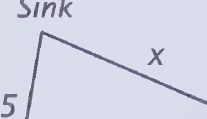
Diagram from page 63.
X 1.5 Refrigerator 5.5-x Stove
47. (1) x+15>55~-x;502x>4,and so x> 2. ) x+ (5.5-x)>1.5;s05.5> 1.5 (which doesn’t tell us anything about x).
- 1.5+ (5.5-x)>x;507 —x>x;507 > 2%, and so x < 3.5.
48. It should be more than 2 m but less than 3.5m.
Set III
We are, of course, assuming that our plane geometry is a reasonably good approximation for what is actually a problem in spherical geometry. The distances in this problem are “air distances” as reported in the World Almanac. The incorrect number is the distance between Paris and Rome; it is actually 690 miles.
1. (London, Paris, and Cairo)
L
214 2185
P08 €
2. (London, Rome, and Cairo) L
895 2,185
R=736 €
3. (Paris, Rome, and Cairo) P
590, 1,998
R332 €
4. The London-Paris-Rome triangle, because 214 + 590 = 804 < 895. The Paris-Rome-Cairo triangle, because 590 + 1,326 = 1,916 < 1,998.
5. The length that the two impossible triangles have in common is 590, which suggests that the distance between Paris and Rome is wrong.
Review
Set I
The Gateway Arch in St. Louis, at 630 ft, is approximately twice as tall as the Statue of Liberty (305 ft) and half as tall as the Empire State Building (1,250 ft). Designed by Eero Saarinen in the shape of an inverted catenary, the arch was completed in 1965. The cross sections of its legs are equilateral triangles with sides 54 ft long at ground level, tapering to 17 ft at the top. Like the top-hat illusion in Lesson 1, the arch gives the impression of being taller than it is wide; the two dimensions are actually the same.
1. In the tree trunk.
2. From the right edge at a sharp angle.
3. Diamond will scratch glass.
4. The transitive property. Gateway Arch. 5. The “three possibilities” property.
6. (Student answer.) (Most people see the arch as looking taller than it is wide.) 7. Both dimensions are 2.5 in.
8. Eachis 630 ft. (2.5 x 252 = 630.) Portuguese Theorem.
9. The Exterior Angle Theorem.
10. An exterior angle of a triangle is greater than either remote interior angle.
11. An exterior angle of a triangle is an angle that forms a linear pair with an angle of the triangle.
- One angle has a measure of 179° and the other two angles are each less than 1°.
13. One angle is a right angle and the other two angles are acute.
14. Every triangle has several exterior angles that are obtuse; so this doesn’t tell us
anything. Soccer Angle.
s,
L R
S 16. The midpoint of a line segment divides it into two equal segments. 17. Reflexive.
18. SSS.
19. Corresponding parts of congruent triangles are equal.
20. If the angles in a linear pair are equal, their sides are perpendicular.
220,
S
22. If two sides of a triangle are unequal, the angles opposite them are unequal in the same order.
23. An exterior angle of a triangle is greater than either remote interior angle. 24. Transitive.
25. If two angles of a triangle are unequal, the sides opposite them are unequal in the same order.
” Roman Column.
- The small angles each appear to be equal to 10°.
27. They increase as you look upward.
28. So that the sections would look equal to someone standing at the base of the column.
- An exterior angle of a triangle is greater than either remote interior angle.
30. Transitive.
Set II
Integers and Triangles.
31. 1+3<5and 2 + 4= 6. For a triangle to be possible, both of these sums would have to be greater than the third length.
32. They are collinear.
33. Example figure:
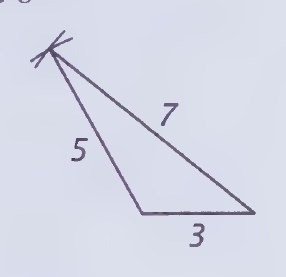
Diagram from page 65.
3
34. n>2%2n+2>n+4,n>2.)
35. Yes. We’ve just shown that a triangle is possible as long as n > 2.
36. An equilateral triangle. Different Definition. 37. One.
38. Our definition says that a triangle is isosceles if it has at least two equal sides; so the third side could also be equal. 39. Yes.
40. (1) If the triangle is equilateral, all three sides can be 10.
If the triangle has exactly two equal sides and the side of length 10 is one of them, then the second side is 10 and the third side is less than 20.
If the triangle has exactly two equal sides and the side of length 10 is not one of them, then each of the other sides must be more than 5.
Screen Display. 041, SSS.
42. Corresponding parts of congruent triangles are equal.
- Betweenness of Rays Theorem.
44. The “whole greater than part” theorem.
45. Substitution.
46. If two angles of a triangle are unequal, the sides opposite them are unequal in the same order.
SAT Problem.
47. x+(x=-2)>7—x. x+(7-x)>x-2. (x-2)+(7-x)>x.
48. 2x-2>7-x,503x>9;s0x>3. 7>x-2;509>x, and so x <9. 5>x;50x<5.
Therefore, 3 <x <5.
49. Proof.
AB> AC. (Given.)
∠C > «B. (If two sides of a triangle are unequal, the angles opposite them are unequal in the same order.)
∠A and ∠B are complementary. (Given.)
∠A + ∠B=90°. (The sum of two complementary angles is 90°.)
∠∠A + ∠C > ∠A + ∠B. (Addition.)
∠A + ∠C >90°. (Substitution.)
50. Proof.
XB = XC. (Given.)
∠C= «∠XBC. (If two sides of a triangle are equal, the angles opposite them are equal.)
∠LABC = ∠ABX + ∠XBC. (Betweenness of Rays Theorem.)
∠ABC > ∠XBC. (The “whole greater than part” theorem.)
∠ABC > ∠C. (Substitution.)
AC > AB. (If two angles of a triangle are unequal, the sides opposite them are unequal in the same order.)
Algebra Review (page 210)
1. .
2. .
3. .
4. .
5. .
6. .
7. .
8. .
9. .
10. .
11. .
12. .
13. .
14. and .
15. and .
16. and .
17. and .
18. or and or .
19. and .