p. 131
Chapter 4: Congruence
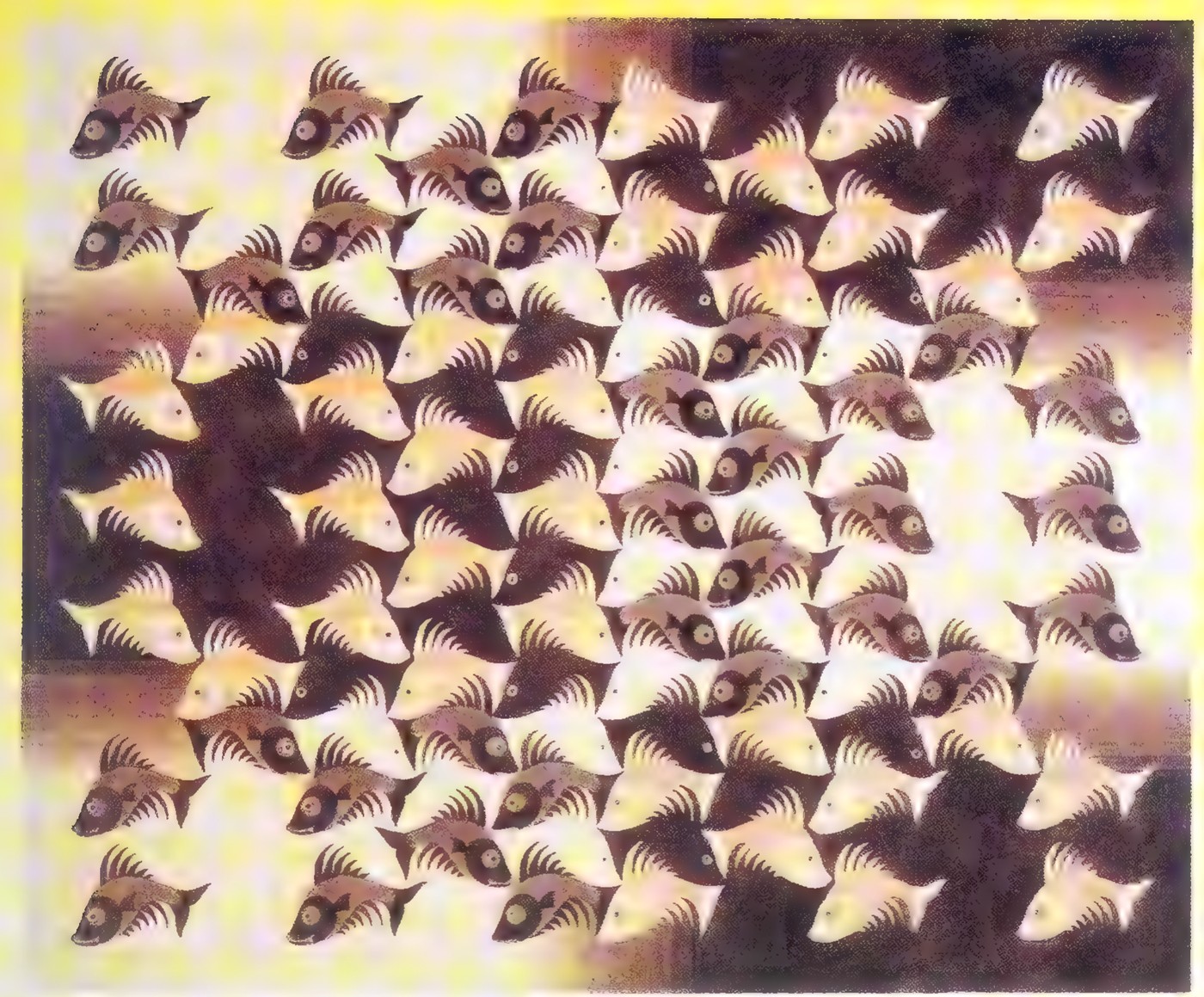
Design drawing for intarsia wood panels with fish—Maurits Escher. © 2002 Cordon Art B.V.—Baarn-Holland. All rights reserved.
Two figures are said to be congruent if they have the same size and shape. Congruent triangles, in particular, appear in many important applications of geometry; therefore much of this chapter deals with the conditions needed to prove them so. Along the way, we will review coordinates in two dimensions, look at several important types of triangles, and learn how congruence is the basis for geometric constructions.
p. 132
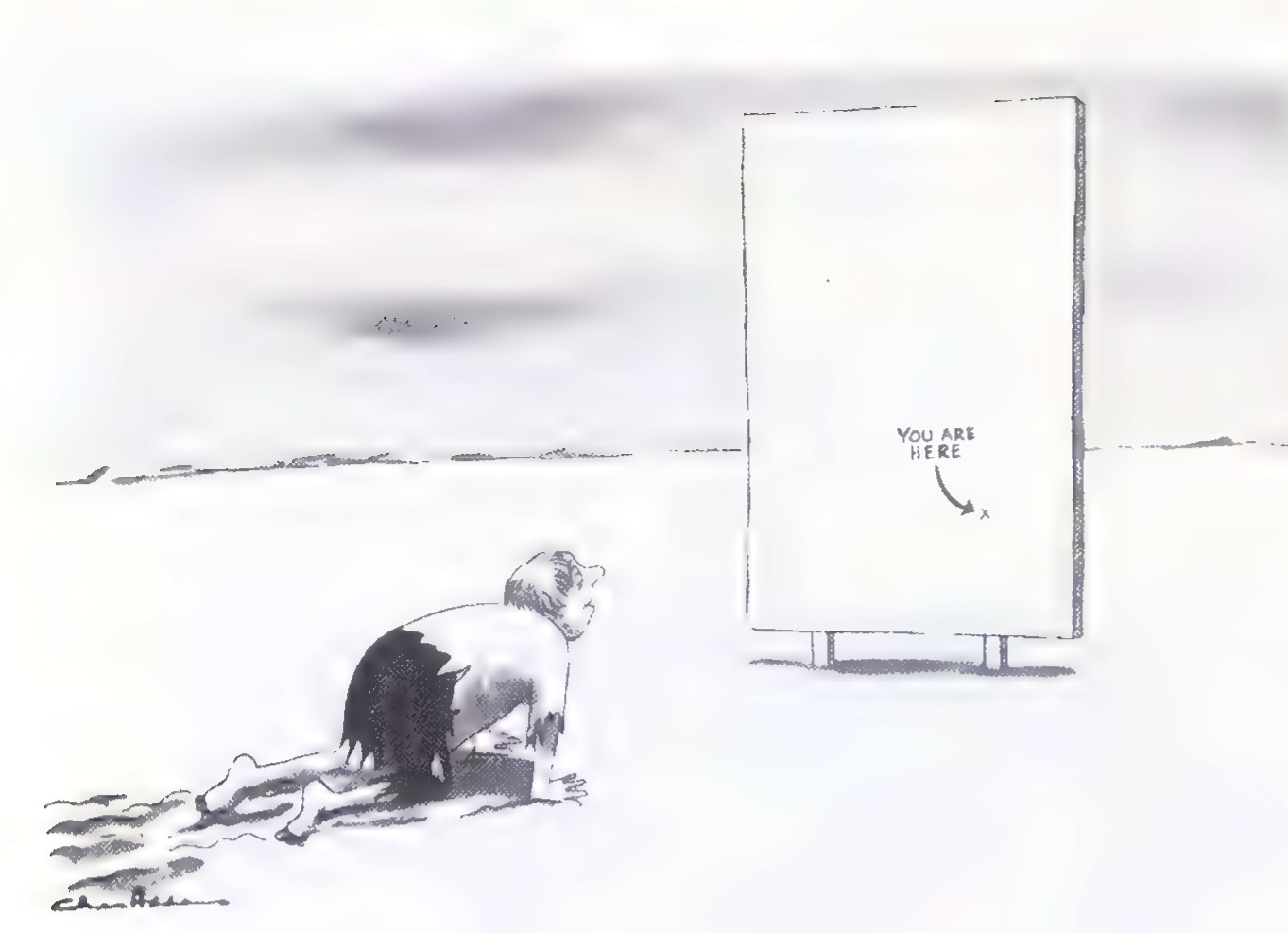
© The New Yorker Collection 1974, Charles Addams from cartoonbank.com. All rights reserved.
Lesson 1: Coordinates and Distance
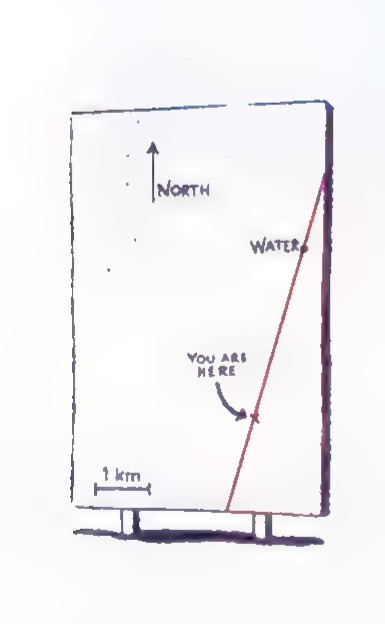
Maps usually include roads and landmarks. The one in this cartoon gives this poor fellow no help because it shows neither. If the man were on a road and the map looked like the one at the left, he could know that he was headed in the right direction and he could figure out how far he had to go.
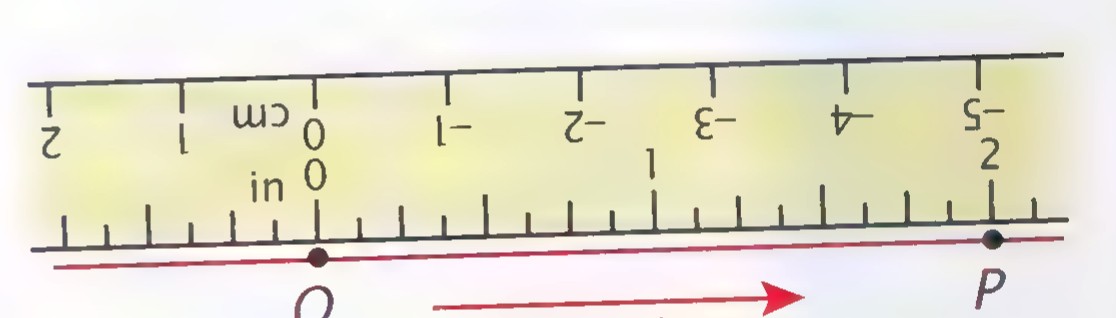
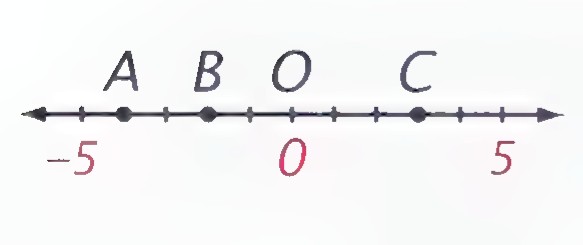
Locating points on a line is easy. First, we choose a starting point O, the origin. Next, we decide which is to be the increasing direction. We can use a ruler as shown above to find that the coordinate of point P is 2 and that for point O is 0. The distance from O to P is the difference between their coordinates, 2 − 0, in inches. By the Ruler Postulate, we get the correct distance however the ruler is placed and whatever units are used. Recall that the numbers assigned to points in this way are called coordinates. Choosing an origin and ruler gives us a one-dimensional coordinate system. In the figure at the left, point B has coordinate −2. What are the coordinates of points A and C?
p. 133
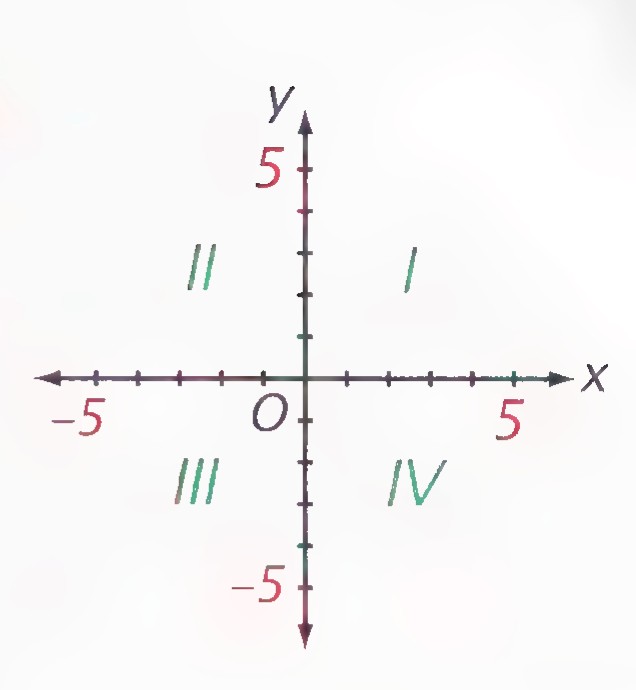
To locate points in a plane, we use a two-dimensional coordinate system. We begin by taking two perpendicular lines as axes. Their intersection gives our origin, O. The line with the same direction as that of the bottom of this page is the horizontal axis, or the x-axis, as the label “x” shows. The other axis is called the vertical axis, or y-axis, labeled “y.” Using our ruler, we establish coordinates on each axis as shown in the figure at the right. The axes separate the plane into four regions called quadrants. The quadrants are identified by numbers, shown as Roman numerals in the figure.
Two coordinates in our system locate a point in the plane. They are found by drawing perpendicular lines from the point to the axes as shown in the figures below.
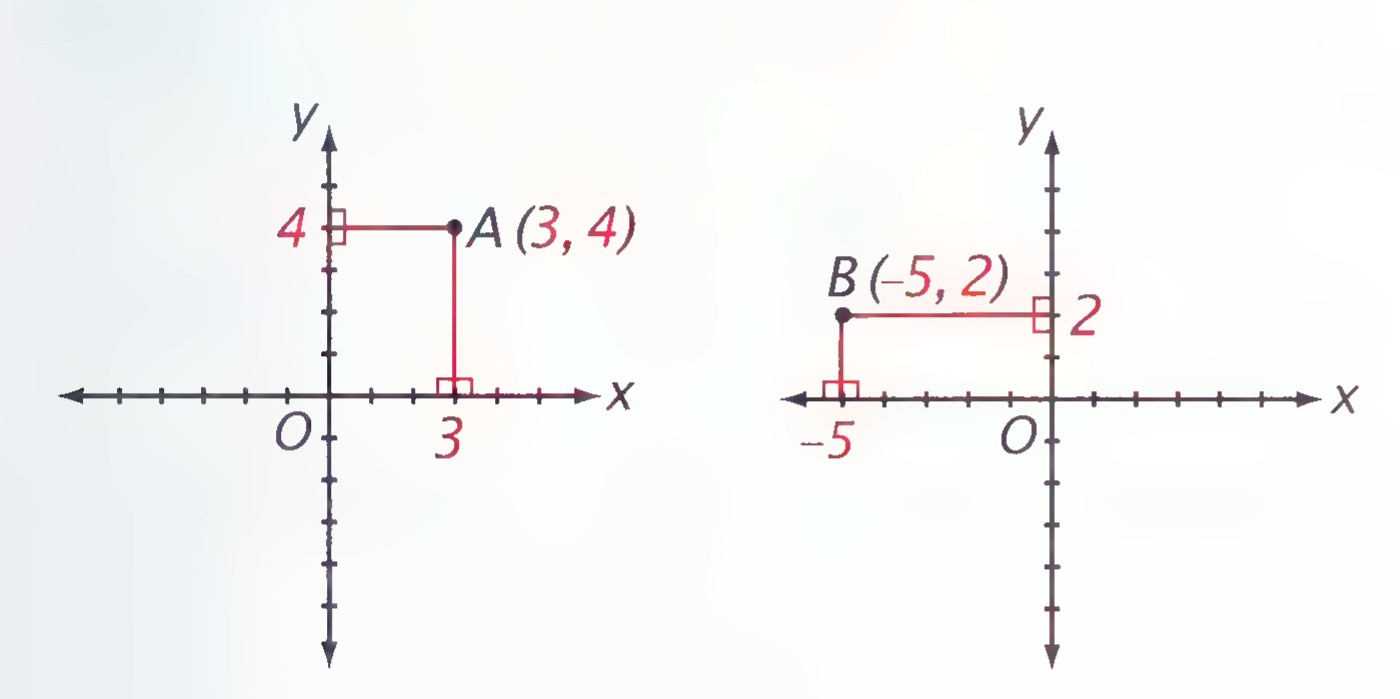
The coordinates of a point are written in parentheses and separated by a comma, the x-coordinate always being listed first: (x, y).
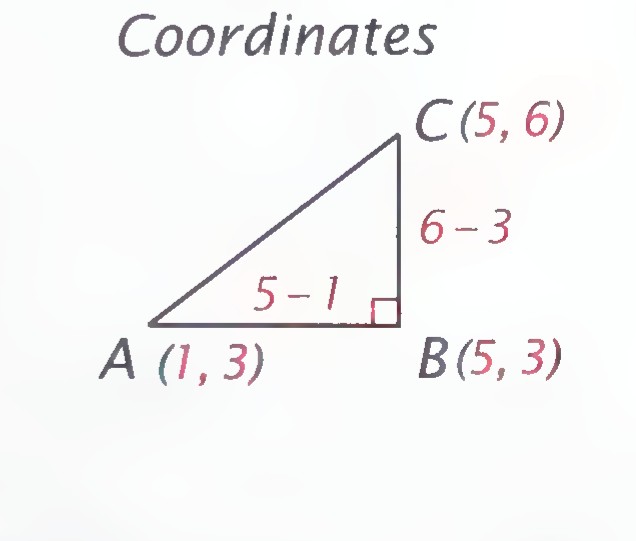
Coordinates can be used to find the distances between points in the plane. In the figure at the right, the grid lines drawn at unit intervals make it easy to see that the lengths of the legs of right triangle ABC are
The length of AC is not obvious, but we can find it by using the Pythagorean Theorem:
and so , in the same units as were used on the axes.
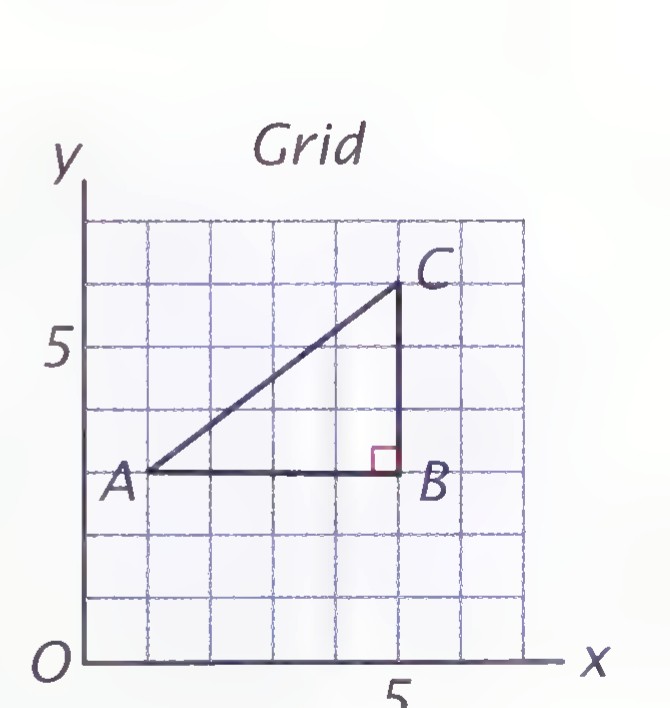
We can find the distances between the points even without the grid, as long as we know their coordinates:
p. 134
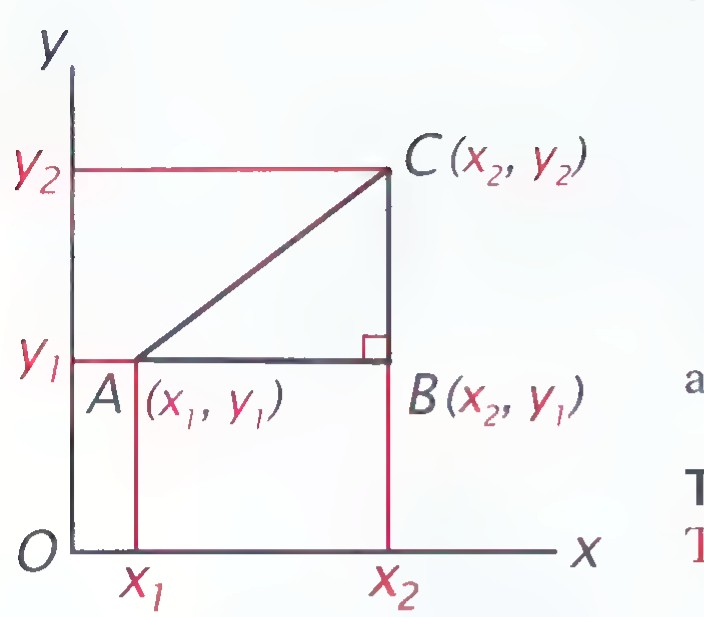
Using the same units for all distances, we can find the distances in terms of general coordinates as the figure at the left shows:
The Pythagorean Theorem gives us this useful distance formula for any two points in the coordinate plane.
The Distance Formula
The distance between the points and is
Exercises
Set I
Pin-Board Geometry. A blind mathematician, Nicholas Saunderson, invented the “pin board,” a device in which pins mark the positions of the intersections on a coordinate grid. To form geometric figures, rubber bands are stretched around the pins.
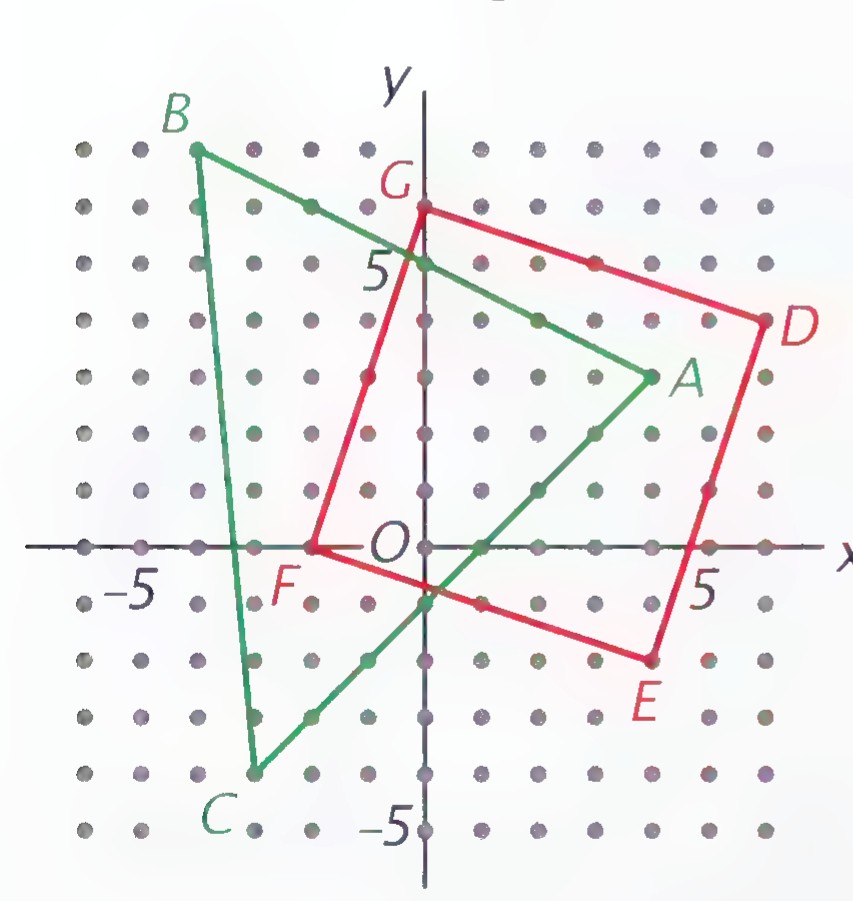
- What are the lines labeled x and y called?
- What is the point labeled O called?
Which points
- have an x-coordinate of 4?
- has a y-coordinate of 4?
- is in the second quadrant?
- is on the y-axis?
The coordinates of point B are (−4, 7).
- What are the coordinates of the other two corners of the triangle?
- What are the coordinates of the four corners of the square?
- If the x-coordinate of a point is 0, where must it be?
- If the y-coordinate of a point is 0, where must it be?
Grids. One dictionary definition of “grid” is “a pattern of horizontal and vertical lines forming squares of uniform size on a map, chart, or aerial photograph, used as a reference for locating points.”*
- To which axis of a graph are the horizontal lines parallel?
- How many numbers are needed to locate a point on a grid?
* The American Heritage Dictionary of the English Language.
p. 135
The figure below shows the design of a grid map that soldiers learn to read.
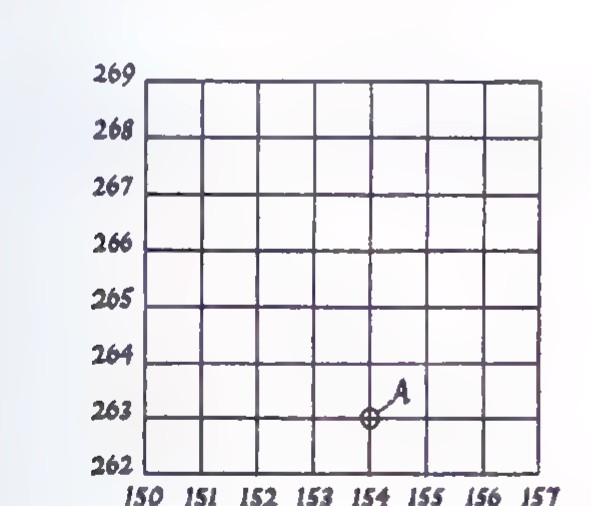
- Why do you suppose they are told to memorize the phrase “Read right up”?
- What are the coordinates of point A?
Another definition of “grid” is “a football field.”
- What does a football field have in common with a grid map?
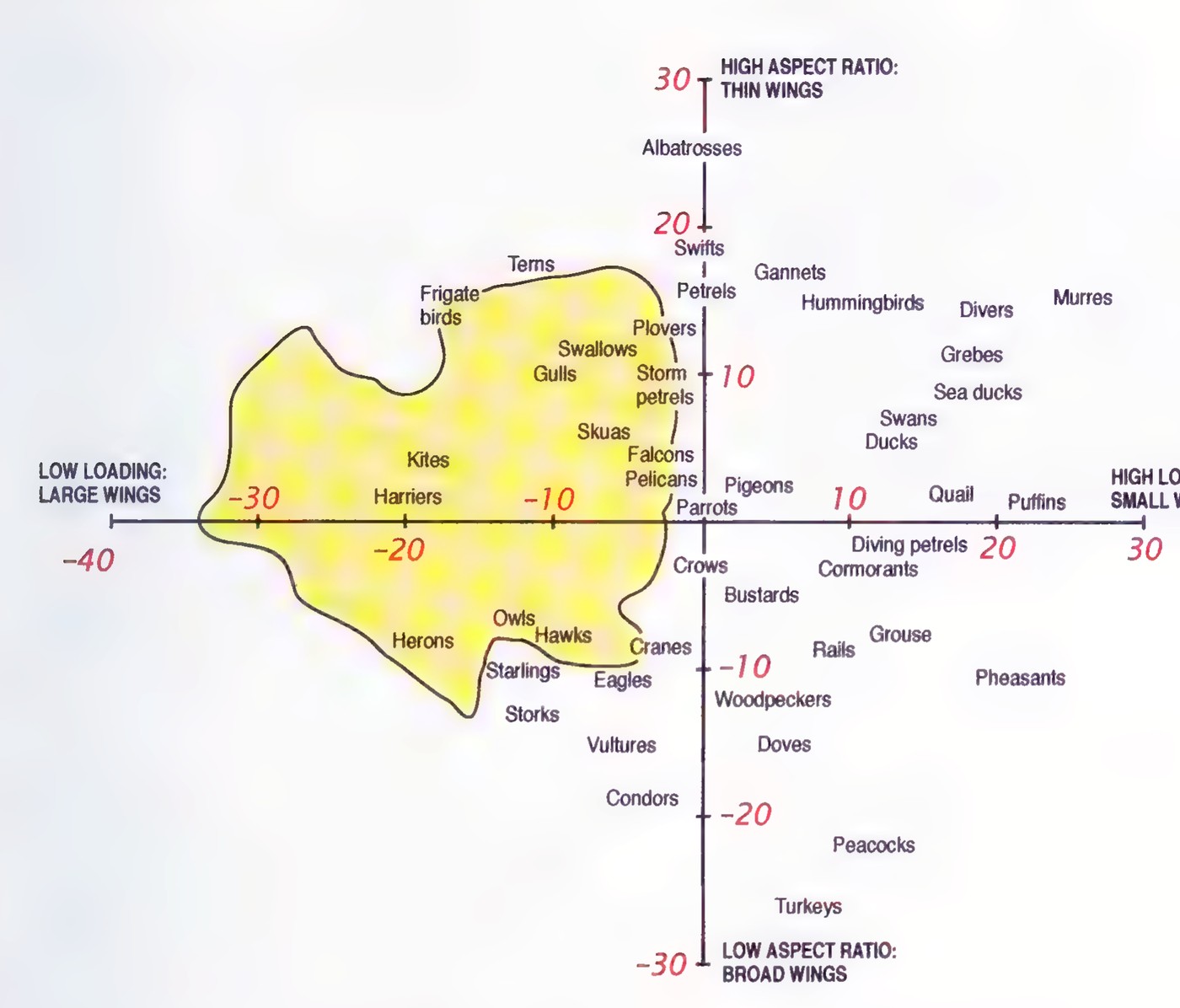
Birds and Bats. The graph above compares different groups of birds according to their ability to fly. The region in yellow shows the area occupied by bats.* Numbers have been added to the axes for reference.
- In which quadrant are the birds whose wings are small and broad?
- In which quadrants are the bats?
Which group of birds seems to be closest to the point
(0, 0)?
(10, 15)?
(−10, −15)?
(0, 25)?
What are the approximate coordinates of the two points in which the “bats region” intersects the x-axis?
* Exploring Biomechanics, by R. McNeill Alexander (Scientific American Library, 1992).
p. 136
An Early Graph. The figure below, from Newton’s Opticks (1704), shows part of the first graph to appear in a book in which the axes are perpendicular and all four quadrants are shown.
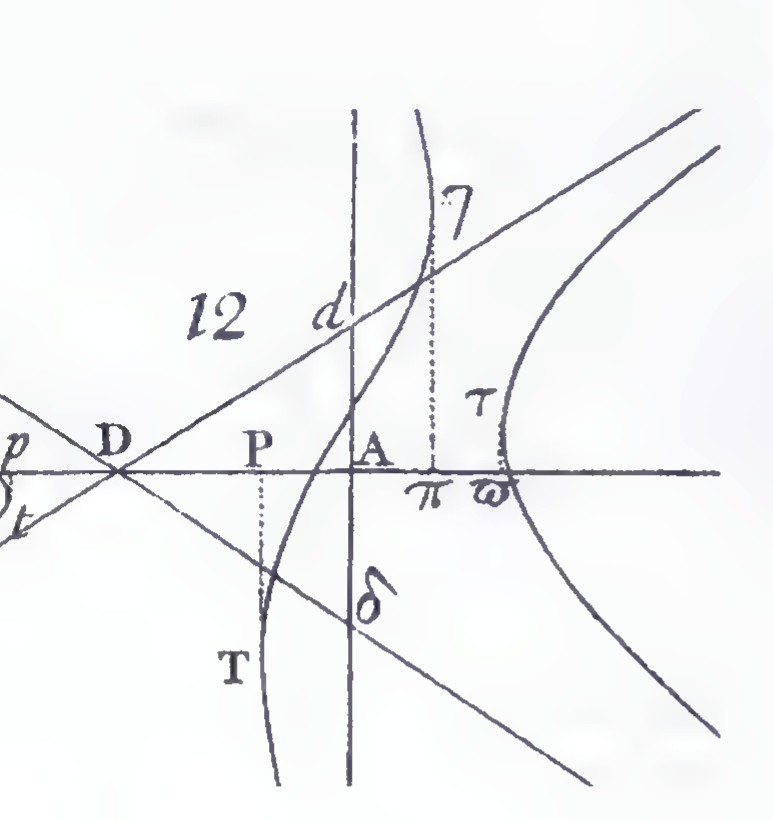
- Which point is the origin?
What seems to be true about the coordinates of
- points D and P?
- point T?
Set II
Tidal Current. The figure below is part of a tidal-current chart for Upper Chesapeake Bay.* The arrows show the direction of the current.
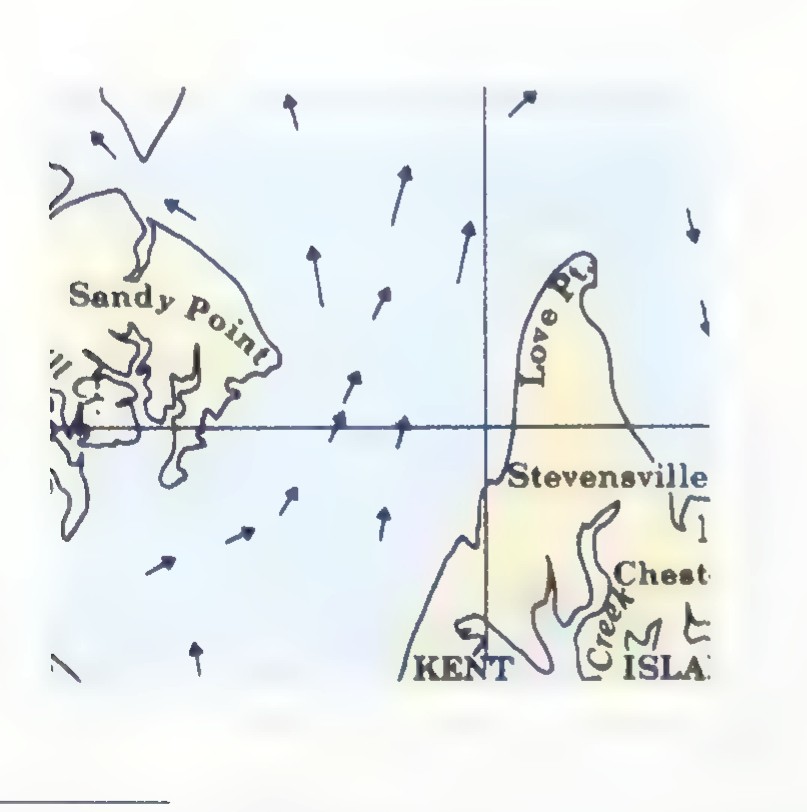
Three current arrows are shown in the graph below.
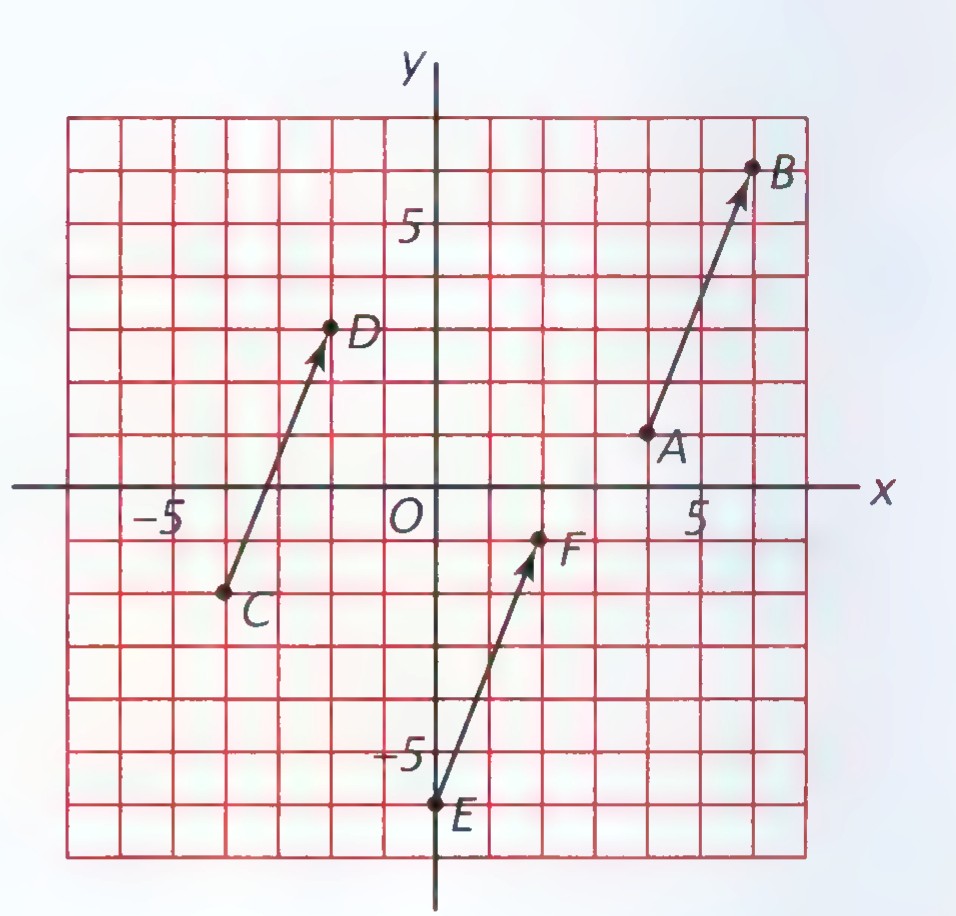
- What seems to be true about them?
- Find the coordinates of the endpoints of arrow AB and use them with the distance formula to calculate its length.
- Do the same for arrow CD.
- Do the same for arrow EF.
- Do your results agree with the appearance of the arrows on the graph?
Japanese Floor Plan. In a traditional Japanese home, a grid of points determines the floor plan.† The figure at the top of the next page shows both the post pattern and the corresponding floor plan on different parts of the same grid.
Suppose that the origin of the grid is at the lower-left corner and the grid lines are 1 unit apart. What are the coordinates of
- point A; and the corresponding point A′?
- point B; and the corresponding point B′?
* Dutton’s Navigation and Piloting, by Elbert S. Maloney (Naval Institute Press, 1985).
† Architecture: Form, Space, and Order, by Francis D. K. Ching (Wiley, 1996).
p. 137
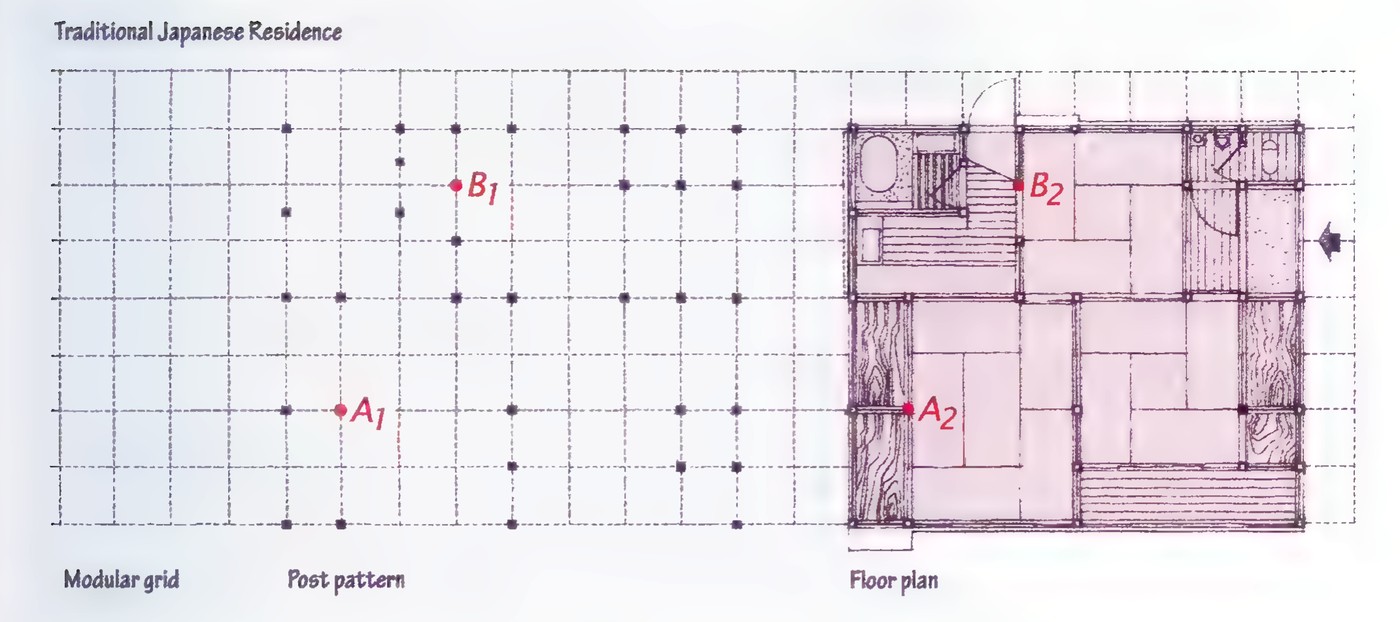
- How are the coordinates of each point on the floor plan related to the coordinates of the corresponding points in the post pattern?
- Where would the floor plan appear on the grid if the x-coordinates of its points matched those of the post pattern but the y-coordinates were 10 units larger?
Computer Screen. The coordinates of a computer screen are usually given in “pixels.” Suppose that the coordinates of two corners of a window on the screen are as shown in the figure below.*

What are the coordinates of
- the lower-right corner of the window, B?
- the upper-left corner, D?
If the pixels are 0.25 mm square, what is the distance
- from A to C?
- from B to D?
Suppose that you use the computer mouse to click on one of the three icons.
- If the computer reads the coordinates (410, 670), which icon did you click?
Distance Formulas. There are distance formulas for all numbers of dimensions!*
- Write the formula for the distance between two points, and in two dimensions.
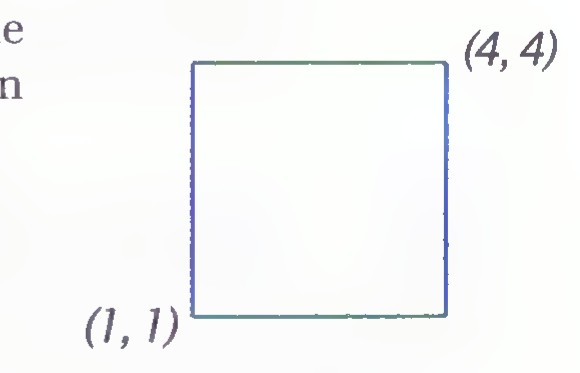
- Use it to find the distance between the opposite corners of this square. Leave your answer in radical form.
* The Geometry Toolbox for Graphics and Modeling, by Gerald E. Farin and Dianne Hansford (A. K. Peters, 1998).
† Beyond the Third Dimension: Geometry, Computer Graphics, and Higher Dimensions, by Thomas F. Banchoff (Scientific American Library, 1990).
p. 138
- Would it be correct to say that the distance formula for one dimension is ?
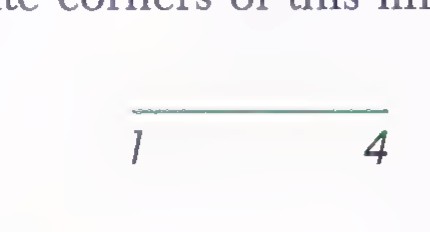
- Use it to find the distance between the opposite corners of this line segment.
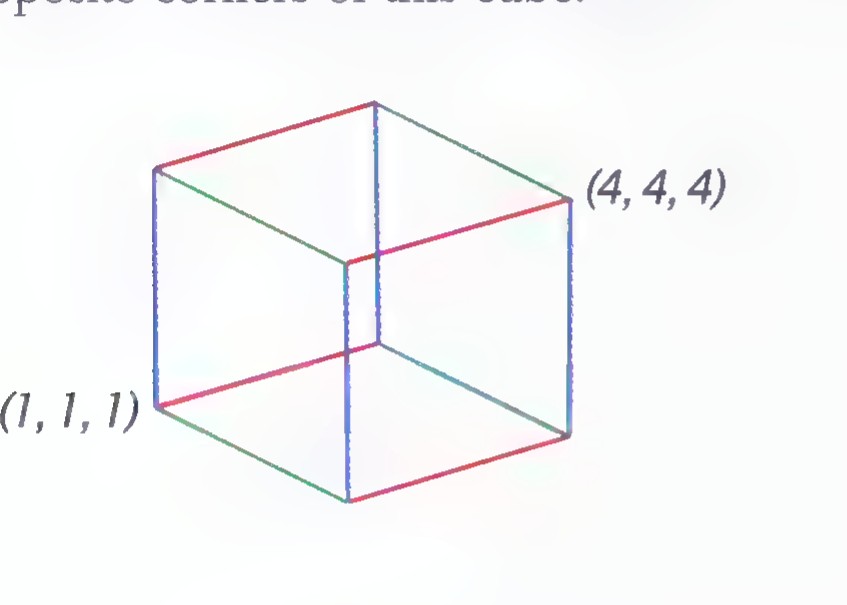
The distance formula for three dimensions is .
- Use it to find the distance between the opposite corners of this cube.
- What do you think the distance formula for four dimensions might be?
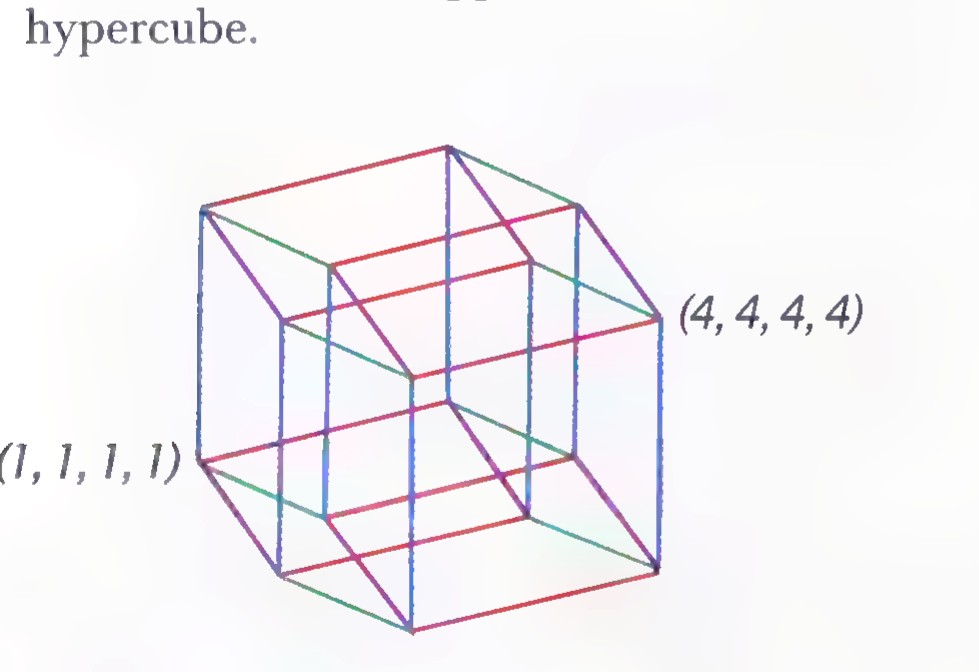
- Use it to find the distance in four dimensions between the opposite corners of this hypercube.
Triangle Coordinates. Use the coordinates of the vertices of the two triangles in the figure at the top of the next column to find the lengths of the sides of
- triangle ABC.
- triangle CDO.
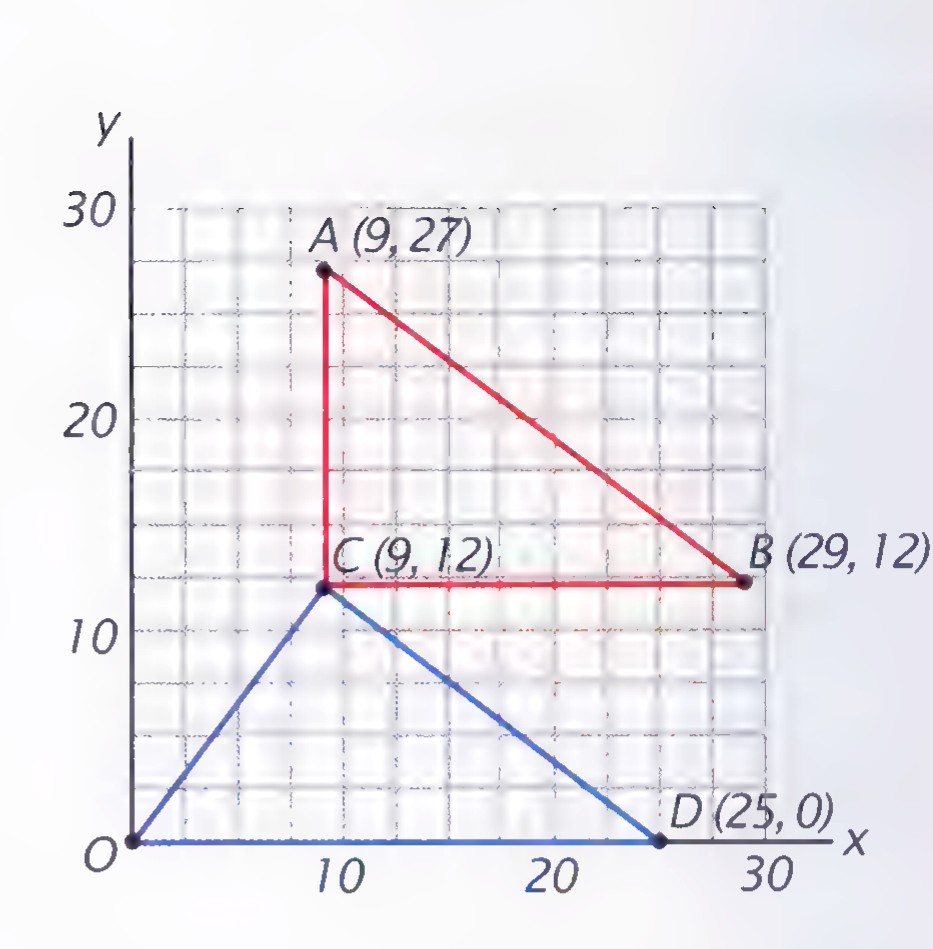
- If an accurate tracing of triangle ABC were made, do you think you could get it to fit exactly on triangle CDO? Explain why or why not.
Set III
A Circle Challenge. The circle in the figure below has its center at the origin.
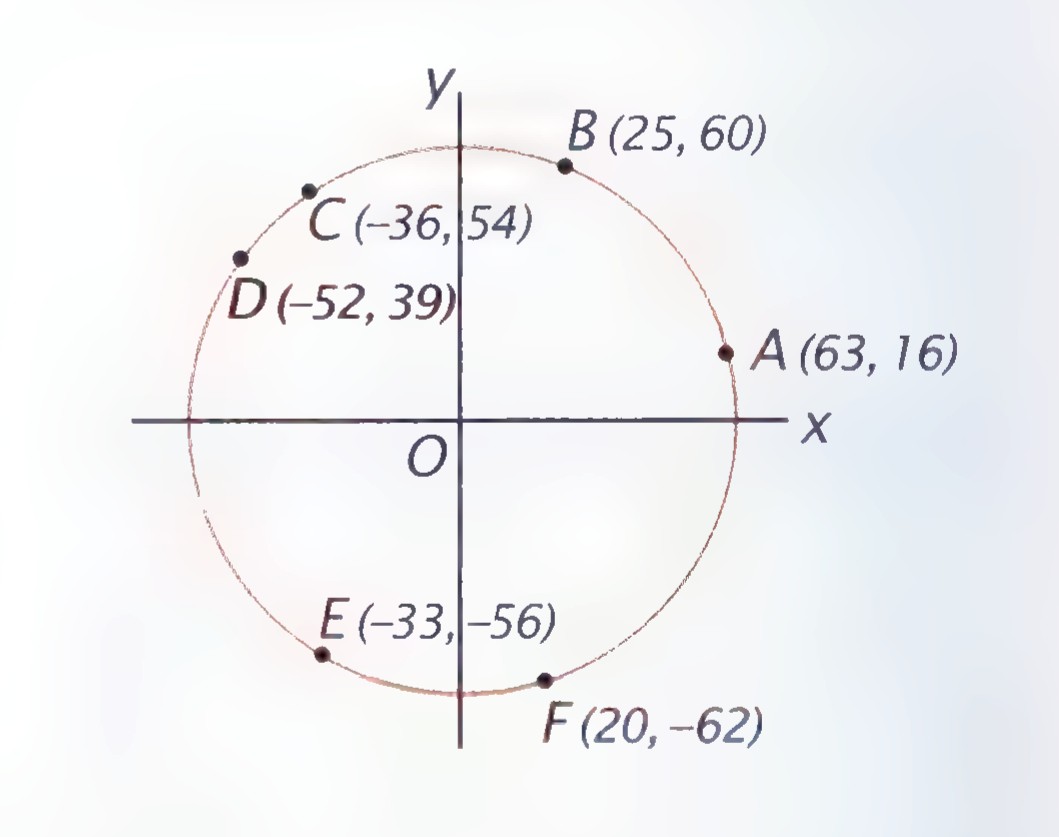
The figure has been accurately drawn but, even though all six points appear to lie on the circle, two of them do not. (Remember that a point has a position only and, unlike the dots in the figure, has neither width nor breadth.)
One of the points is actually inside the circle and one of them is outside it. Which points are they and how can you tell?
p. 139
Lesson 2: Polygons and Congruence
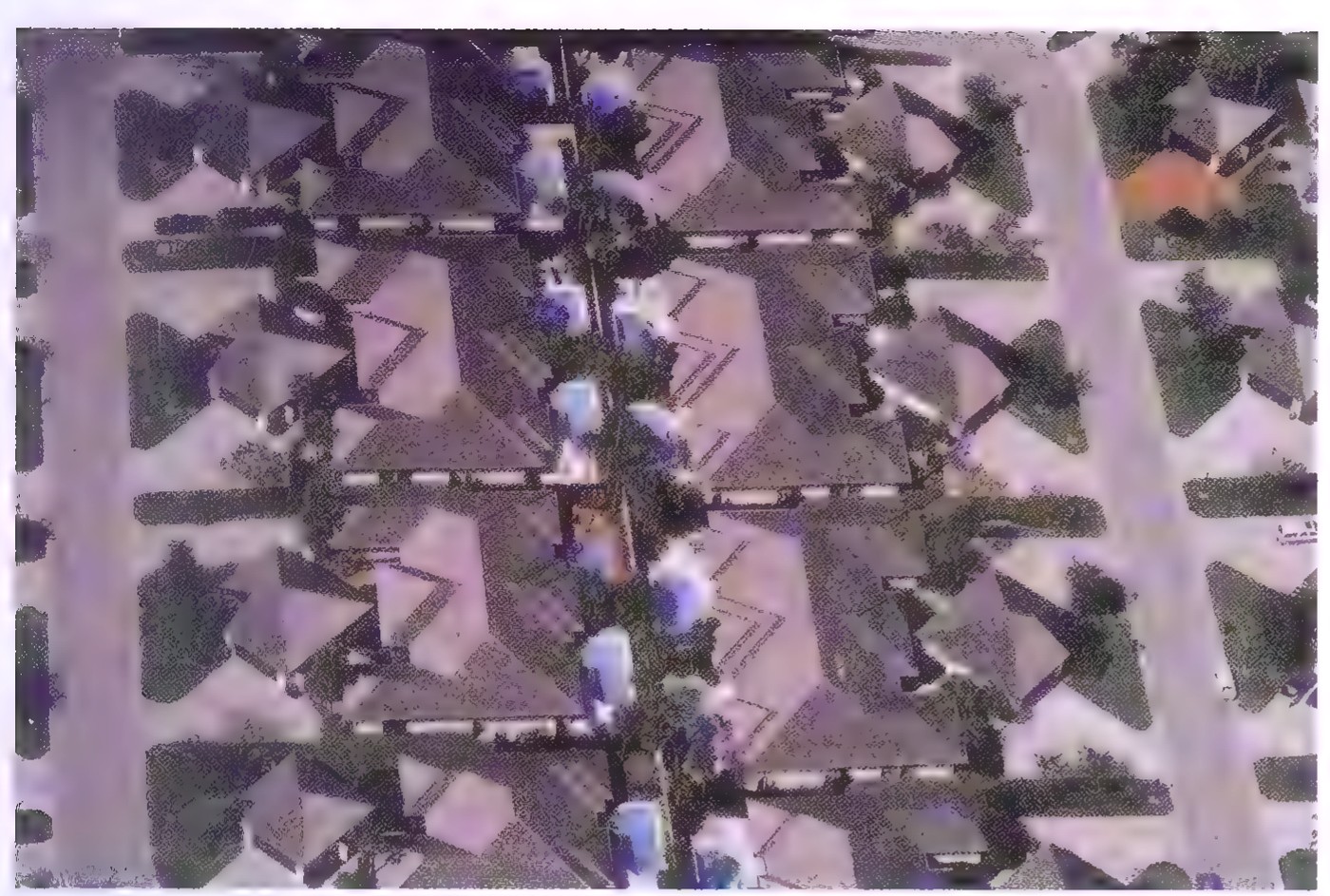
There is not much variety in the housing development in Palm Beach, Florida, pictured above. The lots, houses, and swimming pools look very much alike. Most of the shapes in the photograph are polygons.
In an earlier lesson, a polygon was described as a “figure bounded by line segments that lies in a plane.” The figure at the right, outlining a section of the roofs of the houses in the photograph, suggests a more precise way to define this word.
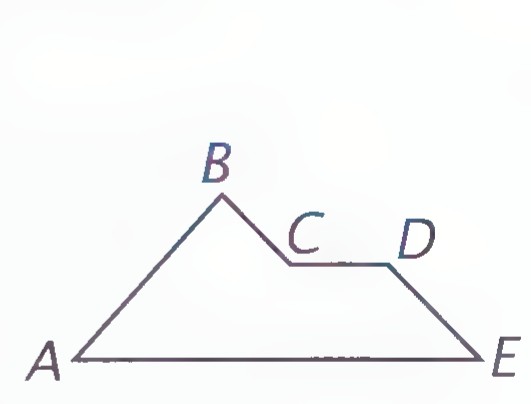
Definition
A polygon is a connected set of at least three line segments in the same plane such that each segment intersects exactly two others, one at each endpoint.
The line segments are the sides of the polygon and their endpoints are its vertices.* Because each side of a polygon intersects exactly two others, a polygon always has the same number of sides as it has vertices. If n is this number, the polygon is an “n-gon.” The roof figure, for example, is a 5-gon.
*The word “vertices” is the plural of “vertex,” the same word used to name the common endpoint of the sides of an angle.
p. 140
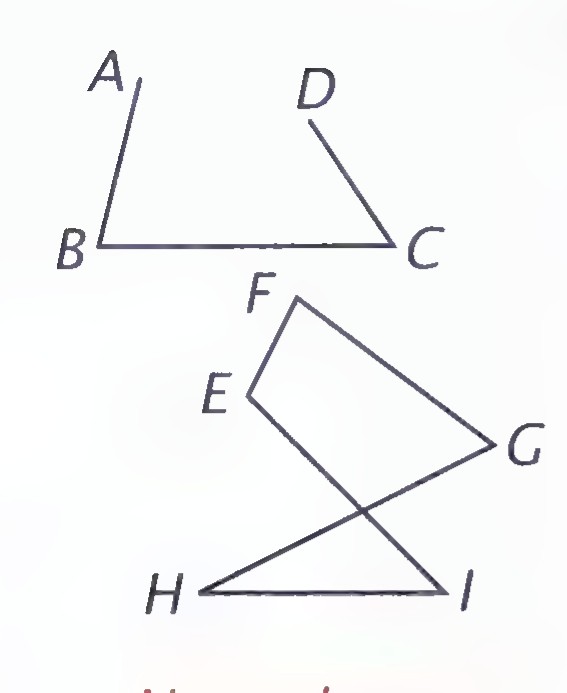
Not polygons
Our definition of “polygon” excludes figures such as those shown at the left. Both figures consist of at least three line segments in the same plane, but in neither figure does each line segment intersect exactly two others, one at each endpoint.
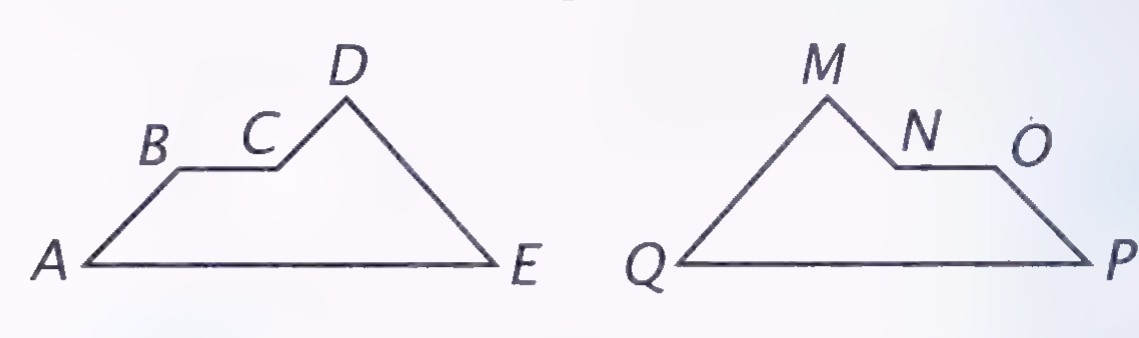
Because the houses in the photograph seem like mirror images of one another, it appears that two roof sections such as those shown above are congruent; that is, that they have the same size and shape. Therefore, if we traced one polygon, we could place the tracing so that it fits exactly on the other one. For these polygons, we would have to turn the tracing over to get them to coincide. In doing so, we are establishing a correspondence between the vertices of the polygons called a congruence. When the tracing of polygon ABCDE is made to coincide with polygon MNOPQ, vertex A falls on P, vertex B falls on O, and so forth. To indicate the correspondence of the vertices, we can write A ↔︎ P, B ↔︎ O, and so on, or, more briefly, ABCDE ↔︎ PONMQ.
Because each pair of sides and angles that correspond in a congruence must coincide, each pair of corresponding parts must be equal. Congruence is easiest to define for triangles.
Definition
Two triangles are congruent iff there is a correspondence between their vertices such that all of their corresponding sides and angles are equal.
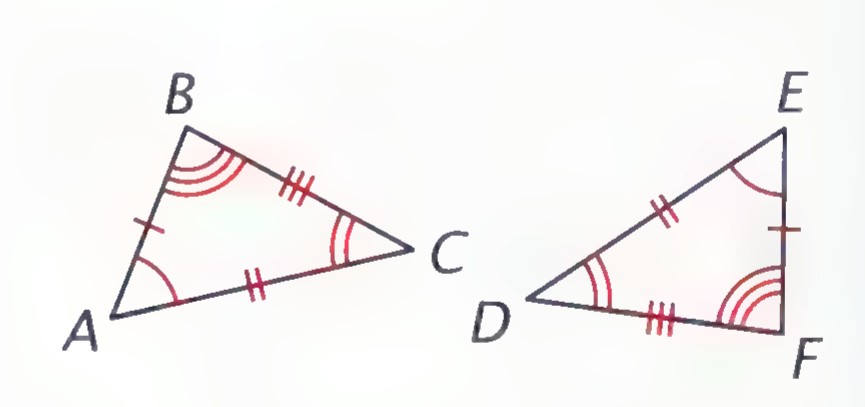
The tick marks and arcs in these triangles indicate the parts of them that are equal. For example, AB = EF and ∠C = ∠D. Triangles ABC and DEF are congruent, but simply saying it does not tell us the correspondence between their vertices that would make them coincide. Writing “△ABC ≅ △EFD” does. The symbol “≅” means “is congruent to,” and “△ABC ≅ △EFD” indicates that the congruence correspondence is
From this abbreviated statement, we can tell without even looking at the triangles that
p. 141
It is easy to prove from the definition of congruent triangles that, if two triangles are congruent to a third triangle, then they must also be congruent to each other. The proof is included as an exercise in this lesson.
Corollary to the definition of congruent triangles Two triangles congruent to a third triangle are congruent to each other.
Exercises
Set I
Connect the Dots. A popular children’s puzzle consists of a set of numbered dots that are to be connected in sequence to make a picture. In the example below, the result is a polygon.
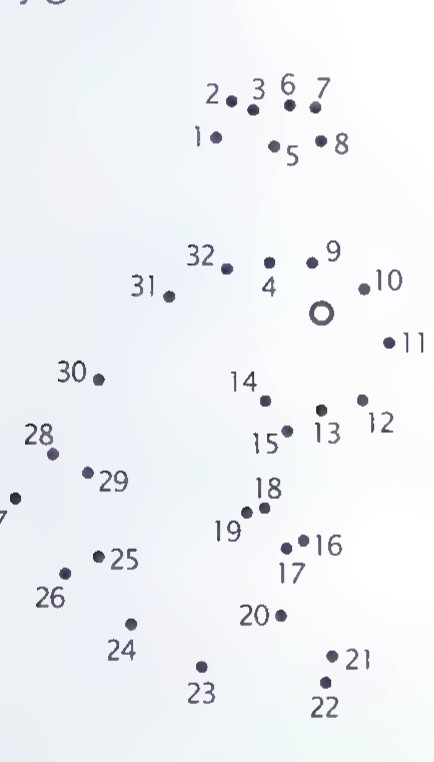
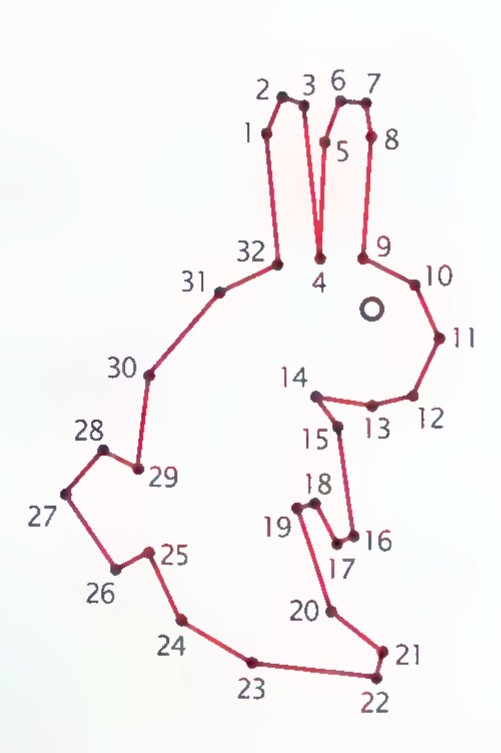
- What are the line segments called with respect to the polygon?
- What are the points called?
- How many sides does this polygon have?
- What is it called with respect to its number of sides?
- If the last point had not been connected to the first point, would the figure still have been a polygon? Explain why or why not.
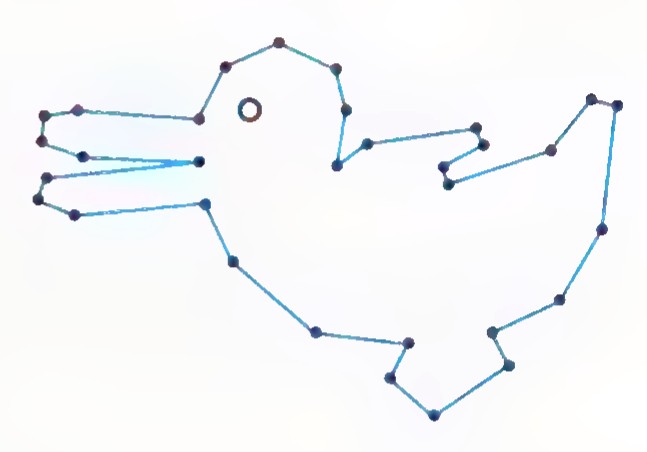
A tracing of the polygon at the right would fit exactly on the polygon at the left.
- What does this indicate about the two polygons?
- What can you conclude about their corresponding sides and angles?
Paper-Clip Patent. This drawing of a paper clip is from the patent issued to its inventor.* It is a single piece of wire bent into five parts.
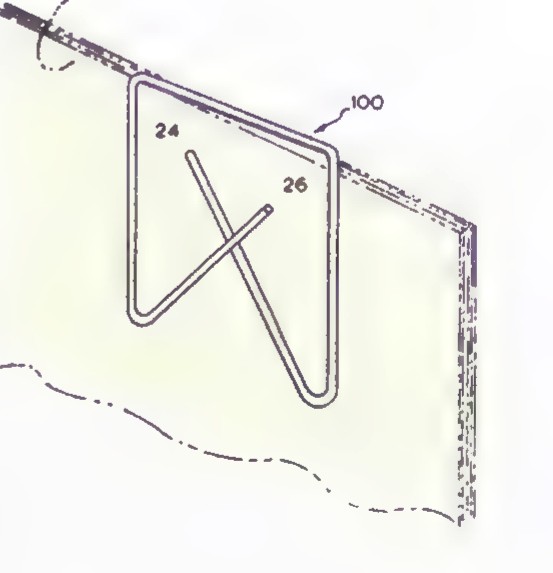
*United States Patent 4,949,435 issued to Gary K. Michelson on August 21, 1990. Included in Invention by Design, by Henry Petroski (Harvard University Press, 1996).
p. 142
The figure below shows the five parts as line segments. The inventor described the clip by saying that BC ⊥ CD and DE ⊥ CD.
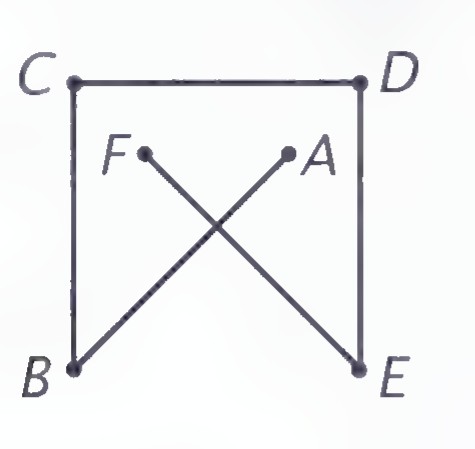
- What does this tell you about ∠C and ∠D?
He also stated the size of ∠B and ∠E in degrees.
- How large do you think each one is?
- Why must some of the angles formed where BA and FE intersect be equal?
- Explain why the paper-clip diagram is not a polygon.
Origami Duck. The origami duck considered in an earlier lesson is based on folding a square sheet of paper as shown in the figure below.
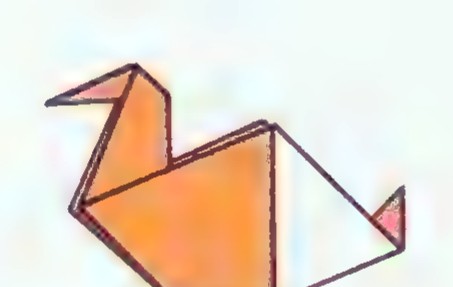
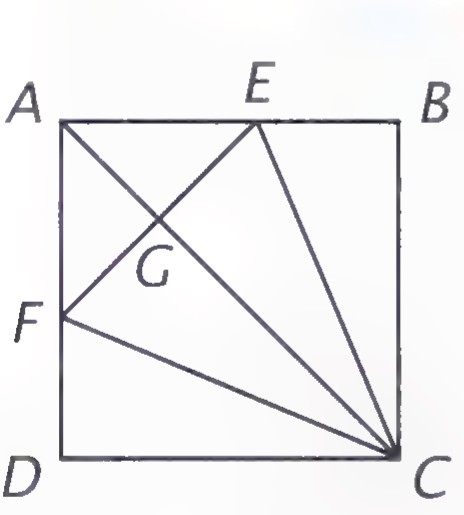
Name the triangles that appear to be congruent to the following triangles.
- △AFG.
- △ACD.
- △CDF.
- △ACE.
- Name a triangle that is not congruent to any other triangle in the figure.
Name the quadrilaterals that appear to be congruent to quadrilateral
- CDFG.
- BCFE.
- ADCE.
Art Gallery. The floor plan of an art gallery with four “wings” is shown at the right.
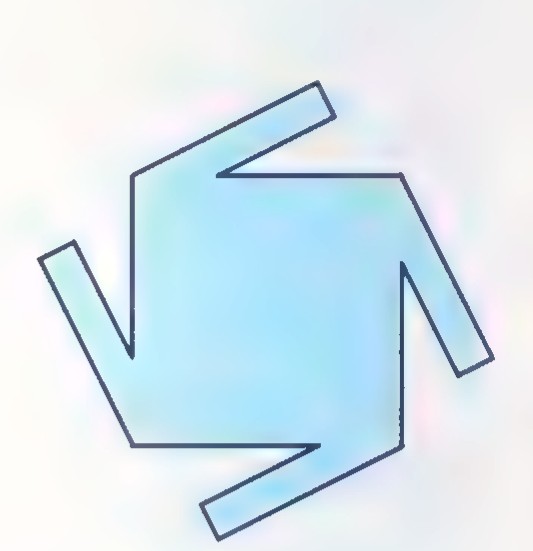
- How many walls does each wall of the gallery meet?
- How many walls does the art gallery have altogether?
- What is a polygon having this number of sides called?
- How many corners does the floor of the gallery have?
- How many guards do you suppose would be necessary if the owners want to keep all the walls of the gallery in view at the same time?
Puzzle Figure. This figure once appeared as part of a puzzle in a magic magazine.*
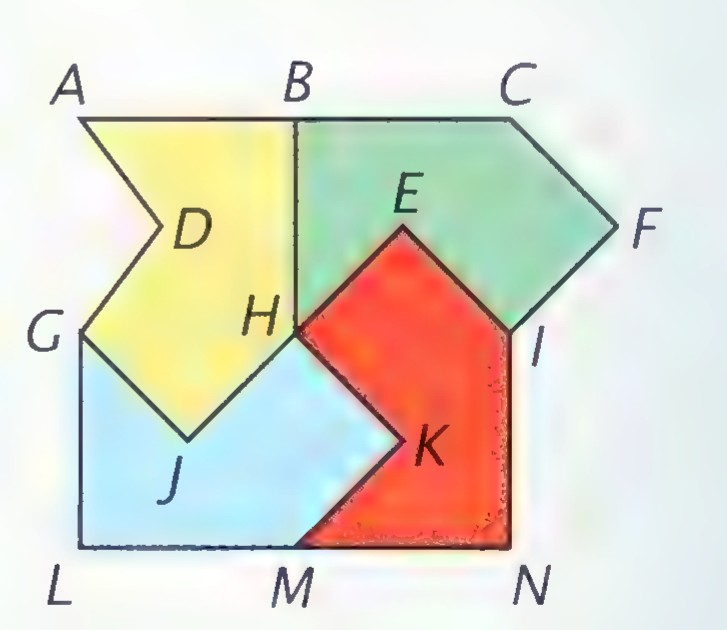
- What kind of polygon do the outer edges of the figure appear to form?
* The Pallbearers Review, July 1969. Reported in Wheels, Life, and Other Mathematical Amusements, by Martin Gardner (W. H. Freeman and Company, 1983).
p. 143
The figure contains four congruent polygons, each shaded a different color.
- What kind of polygons are they?
If a tracing of the yellow polygon were placed on the green one, which of its vertices would fit on
- E?
- B?
- C?
Copy and complete the following congruence correspondence between the vertices of the yellow and green polygons.
- ABHJGD ↔︎ ?
If a tracing of the green polygon were placed on the red one, which of its vertices would fit on
- M?
- I?
- E?
Copy and complete the following congruence correspondences between the vertices of
- the green and red polygons: HBCFIE ↔︎ ?
- the green and blue polygons: HBCFIE ↔︎ ?
- the red and blue polygons: MNIEHK ↔︎ ?
Set II
Tessellation Pattern. The figure below is a tessellation, a pattern of shapes that fit perfectly to cover a surface.
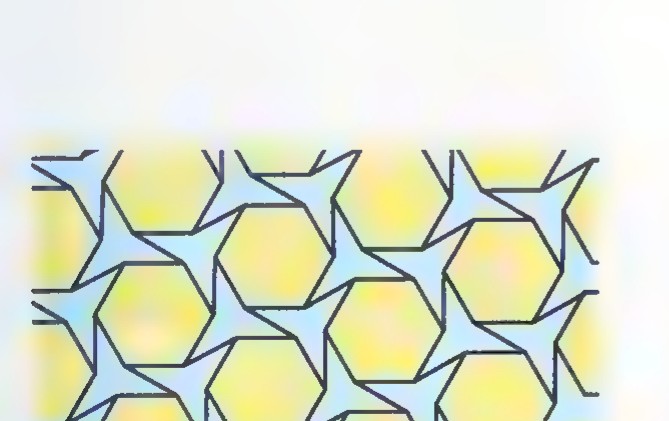
- What do the two types of polygons in the figure have in common?
All of the line segments in the figure are equal.
- If the sides of one polygon are equal to the sides of another, does it follow that the polygons must be congruent?
The polygons shaded yellow are convex and the polygons shaded blue are concave.
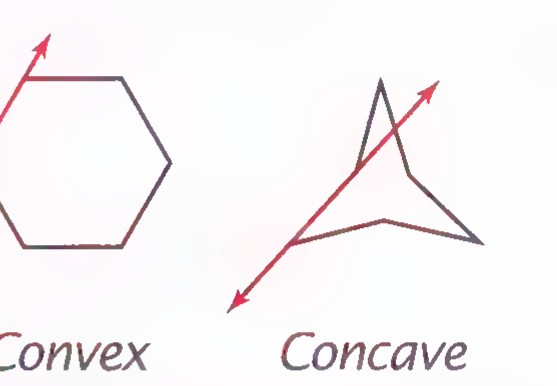
- If a line that contains a side of a polygon lies partly inside the polygon, which kind of polygon is it?
Suppose nails are stuck into the vertices of a polygon and a rubber band is stretched around the nails so that all of the nails are inside it.
- If the rubber band takes the shape of the polygon, which kind of polygon is it?
Draw and identify examples of
- two pentagons, one convex and the other concave.
- two quadrilaterals, one convex and the other concave.
- Can a triangle be concave?
Polygons on a Grid. On graph paper, draw a pair of axes extending 10 units in each direction from the origin.
Plot these points and connect them to form a triangle: (2, 1), (5, 5), (9, 0).
Would you get a different triangle if you connected the points in a different order?
(continued) On the figure that you drew for exercise 44, plot these points and connect them to form a quadrilateral: (−7, 4), (−4, 6), (−4, 8), (0, 3).
p. 144
Do you think someone else could get a different quadrilateral by connecting the same points? Explain.
(continued) On the figure that you drew for exercise 44, plot the following points and connect them to form a quadrilateral that is not congruent to your previous one: (−6, −4), (−3, −2), (−3, 0), (1, −5).
How many different quadrilaterals do you think can be drawn that have the same vertices as the one you just drew?
Dividing a Rectangle. An unusual way to divide a 3-by-7 rectangle into six congruent pieces is shown in the following figure.*
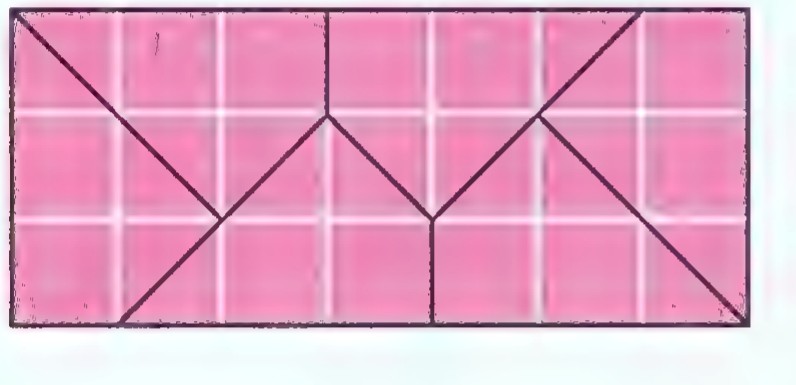
- What is the area of the rectangle, given its dimensions of 3 and 7?
- Because each of the six pieces is congruent, how large would you expect the area of each one to be?
- What are you assuming to be true about the areas of polygons that are congruent?
- Does your answer to exercise 49 agree with what you see inside each piece? Explain.
- How large do the angles of each piece appear to be?
- Do any of the sides in one of the pieces appear to be equal to each other?
- If a tracing were made of one of the pieces, could it be made to coincide with each of the others without turning it over?
Proof Without a Figure. Although most theorems are much easier to understand and prove with a good diagram, the corollary to the definition of congruent triangles doesn’t need one.
- Give the reasons for the statements in the following proof. (Don’t bother to copy the statements.)
Two triangles congruent to a third triangle are congruent to each other.
Given: △ABC ≅ △XYZ and △DEF ≅ △XYZ. Prove: △ABC ≅ △DEF.
Proof
| Statements | Reasons |
|---|---|
| 1. △ABC ≅ △XYZ and △DEF ≅ △XYZ. | Why? |
| 2. ∠A = ∠X, ∠B = ∠Y, ∠C = ∠Z, AB = XY, BC = YZ, AC = XZ, ∠D = ∠X, ∠E = ∠Y, ∠F = ∠Z, DE = XY, EF = YZ, DF = XZ. | Why? |
| 3. ∠A = ∠D, ∠B = ∠E, ∠C = ∠F, AB = DE, BC = EF, AC = DF. | Why? |
| 4. △ABC ≅ △DEF. | Why? |
Set III
The polygons on the next page were created by the Polish mathematician Waclaw Sierpinski, pictured on this postage stamp issued in honor of his work in 1982.†

*Discovered by Michael Reid and reported in Tracking the Automatic Ant, by David Gale (Springer, 1998).
† Penrose Tiles to Trapdoor Ciphers, by Martin Gardner (W. H. Freeman and Company, 1989).
p. 145
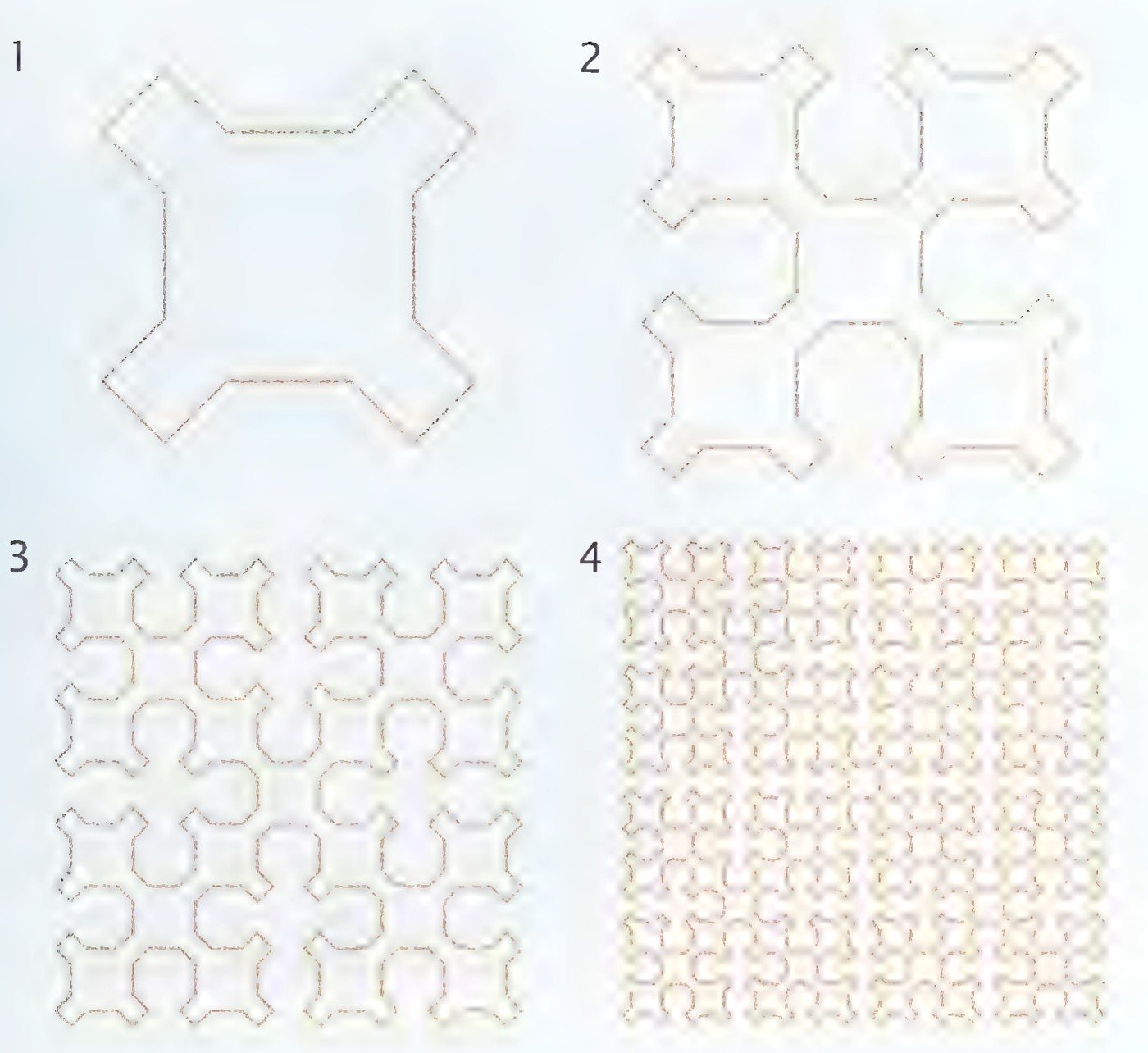
- How many sides does the first polygon have?
- The second polygon?
- Can you figure out how many sides the third and fourth polygons have?
- If the series of polygons were to continue in this way, how many sides do you think the tenth one would have? (A calculator would help!)
- How many sides do you think the nth one would have? Show your reasoning.
p. 146
Lesson 3: ASA and SAS Congruence
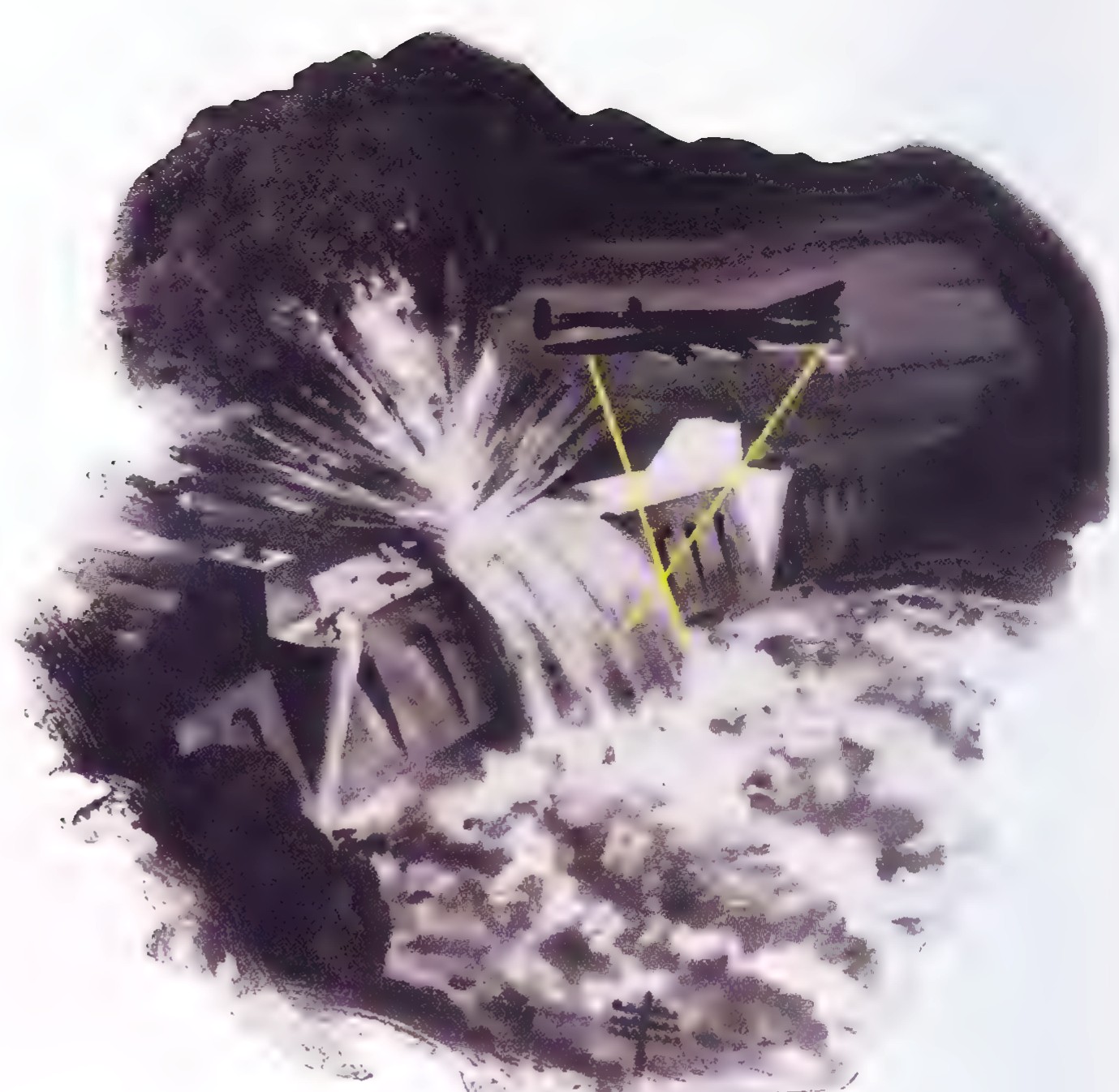
In World War II, the British air force used “skip bombs” to destroy dams that supplied much of the power that ran the Nazi war machine. A feature film titled The Dam Busters tells the amazing story of this adventure.
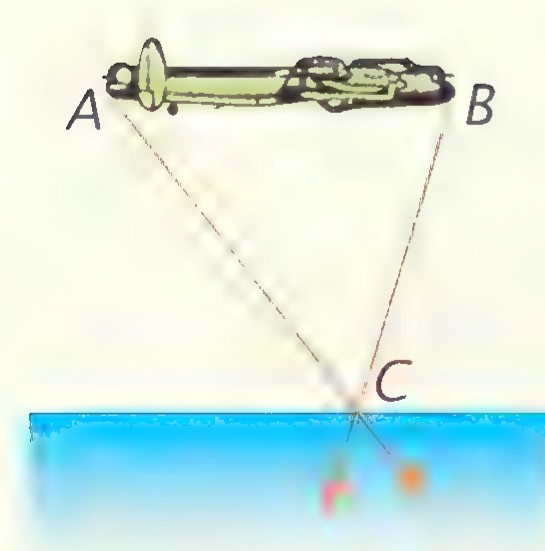
For the bombs to work, they had to be dropped from a plane flying 60 feet above the water. At the time, no instrument on a plane could measure this distance accurately. The problem was solved with two flashlights, one mounted in the airplane’s nose and the other in the tail. The flashlights were pointed in fixed directions and, when the two beams of light met on the water’s surface, the pilot knew that the plane was at the correct height to release the bomb.
The method worked because the two light beams and the body of the plane formed a triangle. The two angles formed by the beams with the body of the plane and the length of the plane determined the vertices of the triangle and hence its size and shape. Even though a triangle has six parts, three sides and three angles, the airplane triangle shows that just three of them, two angles and their “included” side, are sufficient to determine its size and shape.
p. 147
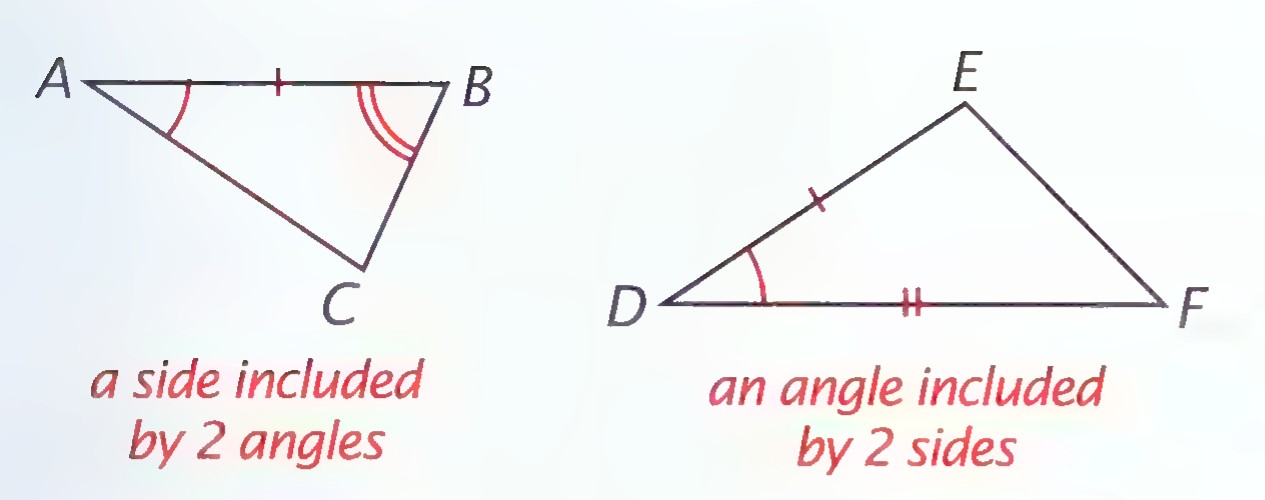
The words “included” and “opposite” describe the relative positions of the sides and angles of a triangle. In △ABC, for example, side AB is said to be included by ∠A and ∠B and to be opposite ∠C. In △DEF, ∠D is said to be included by sides DE and DF and to be opposite side EF.
The tick marks and arcs in these figures are used to call attention to certain parts of the triangles as well as to identify equal sides and angles. The marks here indicate that AB = DE and ∠A = ∠D.
These two triangles are clearly not congruent because they do not have the same size and shape. However, the three parts marked in each triangle determine the size and shape of that triangle. If tracing paper were placed over △ABC and AB were traced along with the angles A and B, the tracing paper could be removed and the rest of the triangle could be drawn simply by extending the sides of the angles as shown at the right.
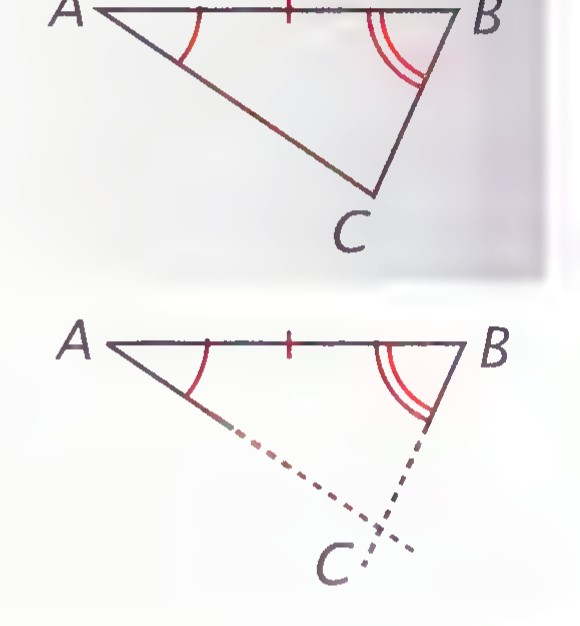
If tracing paper were placed over △DEF and ∠D were traced along with the sides DE and DF, the tracing paper could be removed and the rest of the triangle could be drawn simply by connecting points E and F.
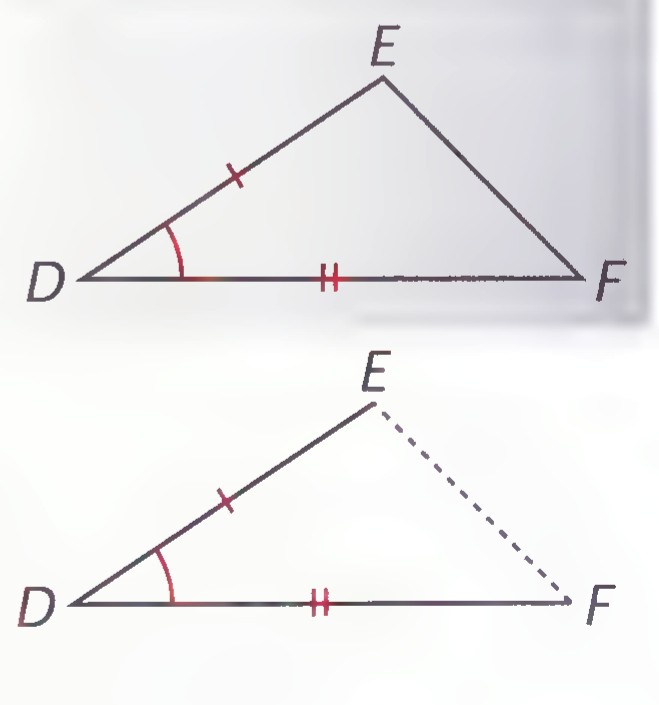
The first of these observations suggests that, if we know that two angles and the included side of one triangle are equal to two angles and the included side of another triangle, that is sufficient to establish that they are congruent. The second observation suggests the same conclusion for two sides and the included angle. We will abbreviate these conclusions as “ASA” and “SAS” and, because they will form the foundation for our reasoning about congruent triangles, we state them as our next postulates.
Postulate 5. The ASA Postulate If two angles and the included side of one triangle are equal to two angles and the included side of another triangle, the triangles are congruent.
Postulate 6. The SAS Postulate If two sides and the included angle of one triangle are equal to two sides and the included angle of another triangle, the triangles are congruent.
It is important to learn these postulates well enough to be able to say them as complete sentences. The appropriate sentence and figure should come to mind when you see ASA or SAS.
p. 148
Exercises
Set I
Bermuda Triangle. The triangle on the map below has been featured in both books and movies. Stretching from Bermuda to Florida to Puerto Rico, it is known as “the Bermuda Triangle.”
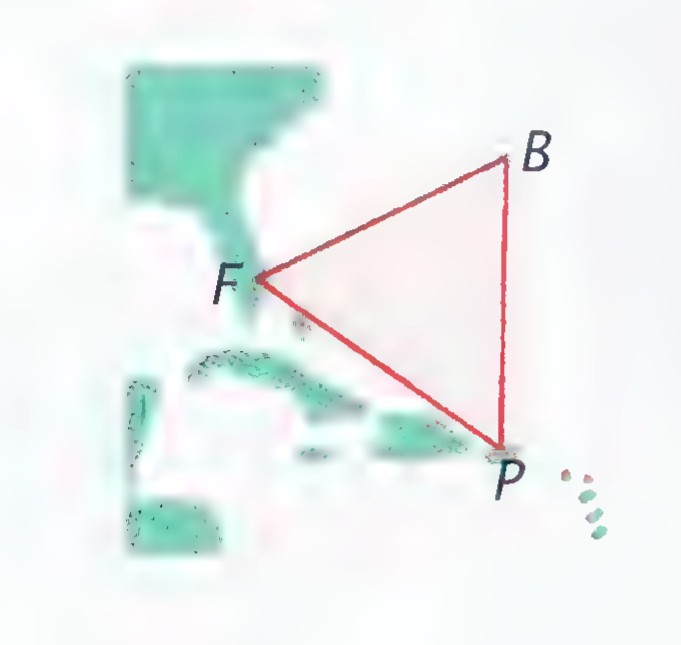
- Which sides of the triangle include ∠B?
- Which side is opposite ∠P?
- Which angle is opposite FP?
- Which angles include side FB?
French Postulate. In France, one of the congruence postulates is stated in these words:
Si deux triangles ont deux côtés égaux chacun à chacun comprenant un angle égal, ils sont égaux.
- Refer to the figure below and write our abbreviation for this postulate.
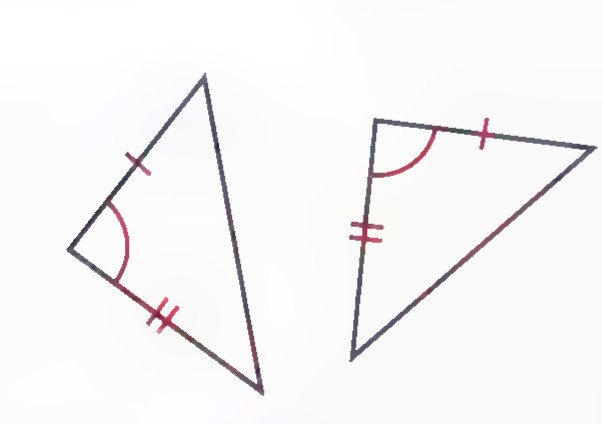
- State the postulate in English as a complete sentence.
- What do you think the abbreviation for this postulate is in French?
- What do you think the abbreviation for the other congruence postulate is in French?
- State it in English as a complete sentence.
Congruence Correspondences. In a section on triangles in his book Architecture,* Francis Ching wrote:
The triangle signifies stability. When resting on one of its sides, the triangle is an extremely stable figure. When tipped to stand on one of its vertices, however, it can either be balanced in a precarious state of equilibrium or be unstable and tend to fall over onto one of its sides.
In the figures below, △TRI ≅ △ANG and △ANG ≅ △LES. Use these congruence correspondences to copy and complete the following equations.
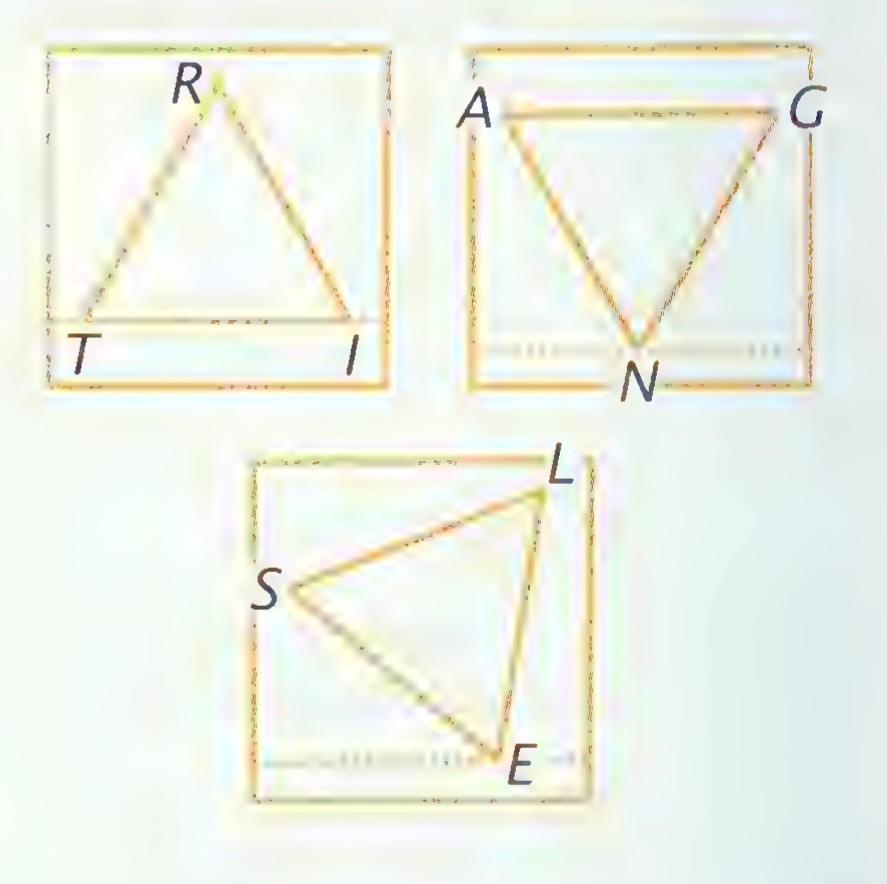
- TR = ?
- ∠I = ?
- IT = ?
- LS = ?
- ∠E = ?
- Why is △TRI ≅ △LES?
* Architecture: Form, Space, and Order, by Francis D. K. Ching (Wiley, 1996).
p. 149
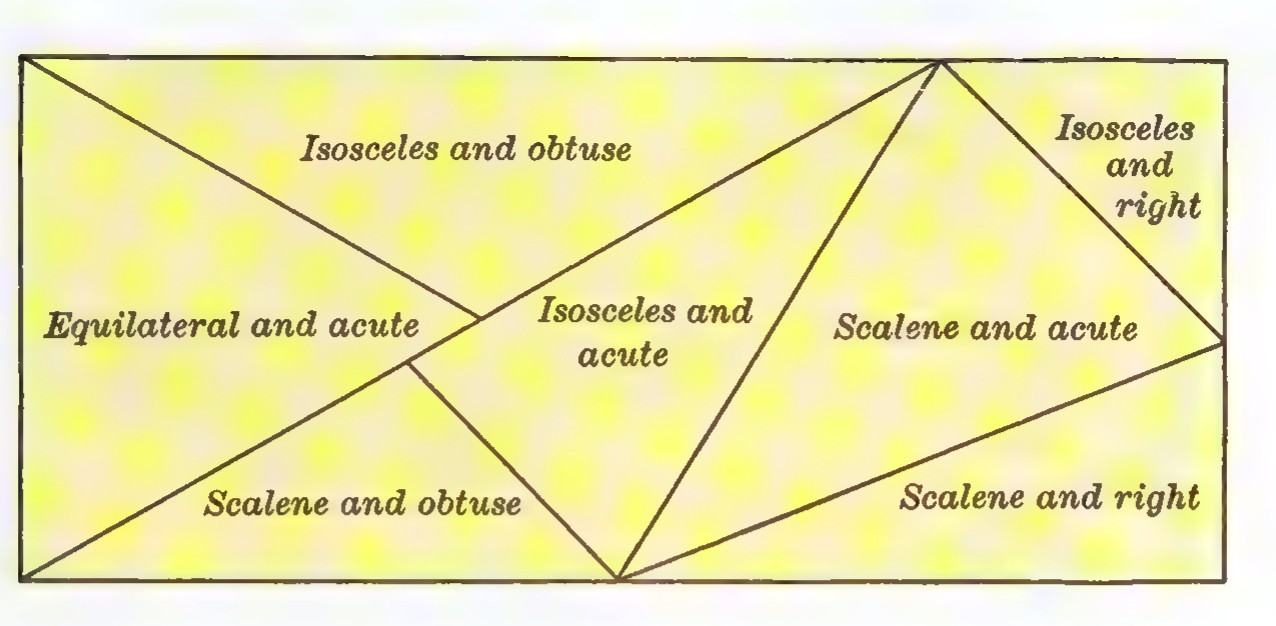
Triangle Names. The figure above, from a geometry book published in 1901, illustrates the words that are used to name triangles according to their sides and angles.*
Compare the relative sizes of the sides and angles of the triangles and the words inside them. Use your observations to tell what you think each of the following words means with reference to triangles.
- Equilateral.
- Acute.
- Isosceles.
- Obtuse.
- Scalene.
- Right.
Intersecting a Triangle. In the figure below, line l contains vertices A and B of the triangle and line n contains vertex C.
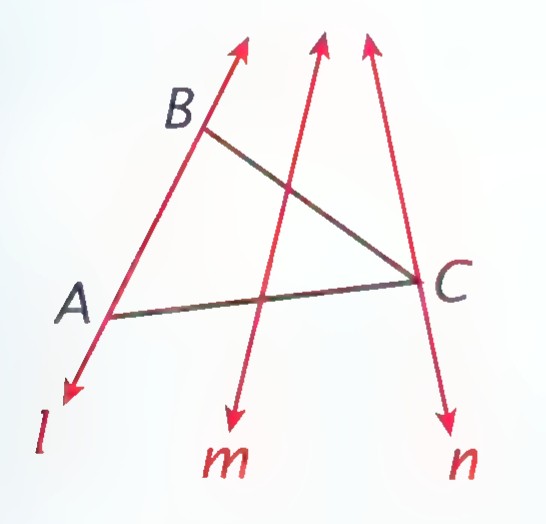
In geometry, two sets of points intersect iff they have at least one point in common.
How many sides of △ABC are intersected by
- line l?
- line m?
- line n?
Is it possible for a line to intersect
- exactly one side of a triangle?
- no sides of a triangle?
Set II
Eye Focus Triangle. When your eyes focus on an object in front of you, your pupils and the object are at the vertices of a triangle.
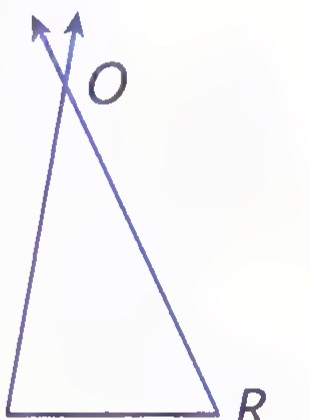
In the figure above, your eyes are at L and R and the object is at O; for most people, the distance between L and R is about 3 inches.
- Draw a line segment LR 3 inches long near the bottom of a sheet of paper. Use your protractor to draw ∠L = 80° and ∠R = 65°.
- Approximately how far is the object from your eyes?
- Measure ∠O with your protractor.
- Does the measure of ∠O seem to be consistent with the measures of ∠L and ∠R? Explain why or why not.
As the object moves away from you, what happens to
- the sizes of ∠L and ∠R?
- the size of ∠O?
* First Steps in Geometry, by G. A. Wentworth and G. A. Hill (Ginn, 1901).
p. 150
Astronomy Problem. The following words from an astronomy book describe the first part of a calculation of the distance from the earth to the moon.*
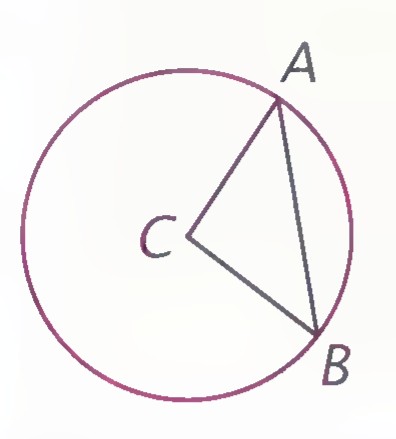
In the triangle ABC, the angle ACB at the center of the earth is known from the difference in latitudes of A and B and in this case is equal to about 94°. AC and BC, the sides of the triangle, are radii of the earth and are known from measurements of the size and shape of the earth. Since two sides and the included angle are known, the third side AB can be computed.
The radius of the earth is approximately 4,000 miles.
- Use your ruler and protractor to make an accurate drawing of △ABC, making AC = BC = 4 cm and ∠C = 94°.
- What is the length of AB in centimeters?
- What is the approximate distance in miles between points A and B on the earth? Explain.
- Measure ∠A and ∠B with your protractor.
- What seems to be true about them?
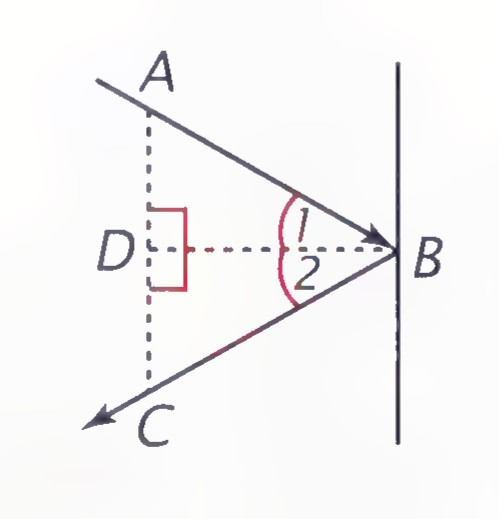
- Why does it follow that ∠ADB and ∠CDB must be right angles?
- Why is ∠ADB = ∠CDB?
- Why is DB = DB?
- Why is △ADB ≅ △CDB?
- What can you conclude about AB and BC?
Pond Problem. The figure at the right shows a way to find the distance across a pond. Posts are put in the ground at the five lettered points so that X-O-A, Y-O-B, XO = OA, and YO = OB.
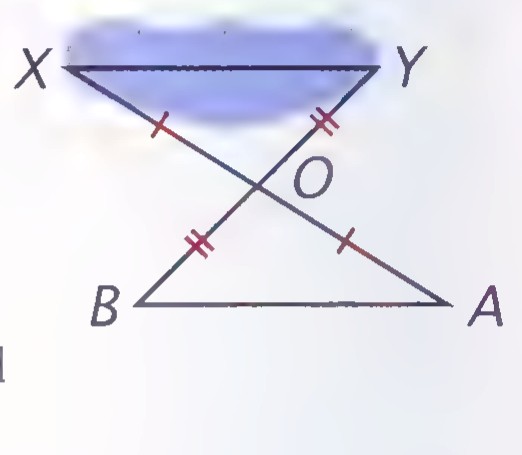
- What do the symbols X-O-A and Y-O-B mean?
- What relation does ray OA have to ray OX and ray OB have to ray OY?
- Why is ∠XOY = ∠AOB?
- Why is △XOY ≅ △AOB?
- How do answers to these questions help in finding the distance across the pond?
Molecule Path. The figure at the right shows the path of a gas molecule that bounces off a wall; ∠1 = ∠2 and AC ⊥ DB.
Set III
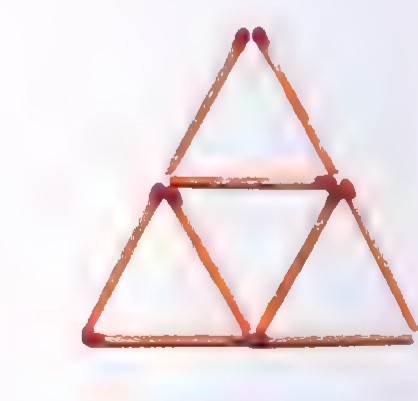
Match Puzzles.† Starting each time with the arrangement of matches shown below, can you show how to leave two triangles by removing
- four matches?
- three matches?
- two matches?
Make drawings to illustrate your answers. There must be no “loose ends.”
* Pictorial Astronomy, by Dinsmore Alter, Clarence H. Cleminshaw, and John G. Phillips (Crowell, 1974).
†From Mathematical Circus, by Martin Gardner (Knopf, 1979).
p. 151
Lesson 4: Congruence Proofs
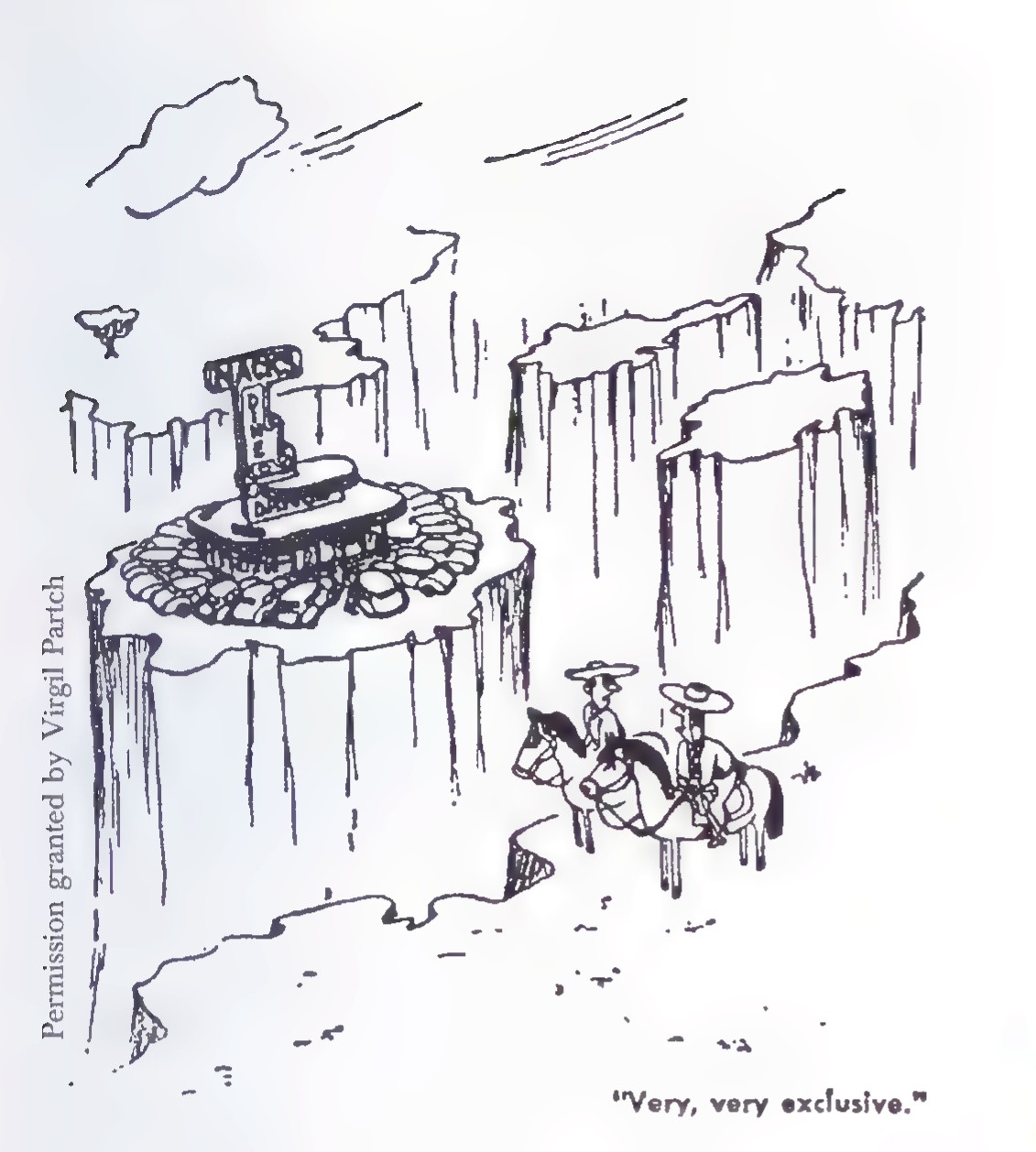
There does not seem to be any easy way for the two cowboys in the cartoon above to get over to that drive-in. Yet there is an easy way for them to find out how far away it is. In fact, if they know the approximate length of their horses’ strides, they can measure the distance (AD in the figure) without any special instruments or even getting off their horses! The method, that of a Roman surveyor of long ago, is based on congruent triangles.*
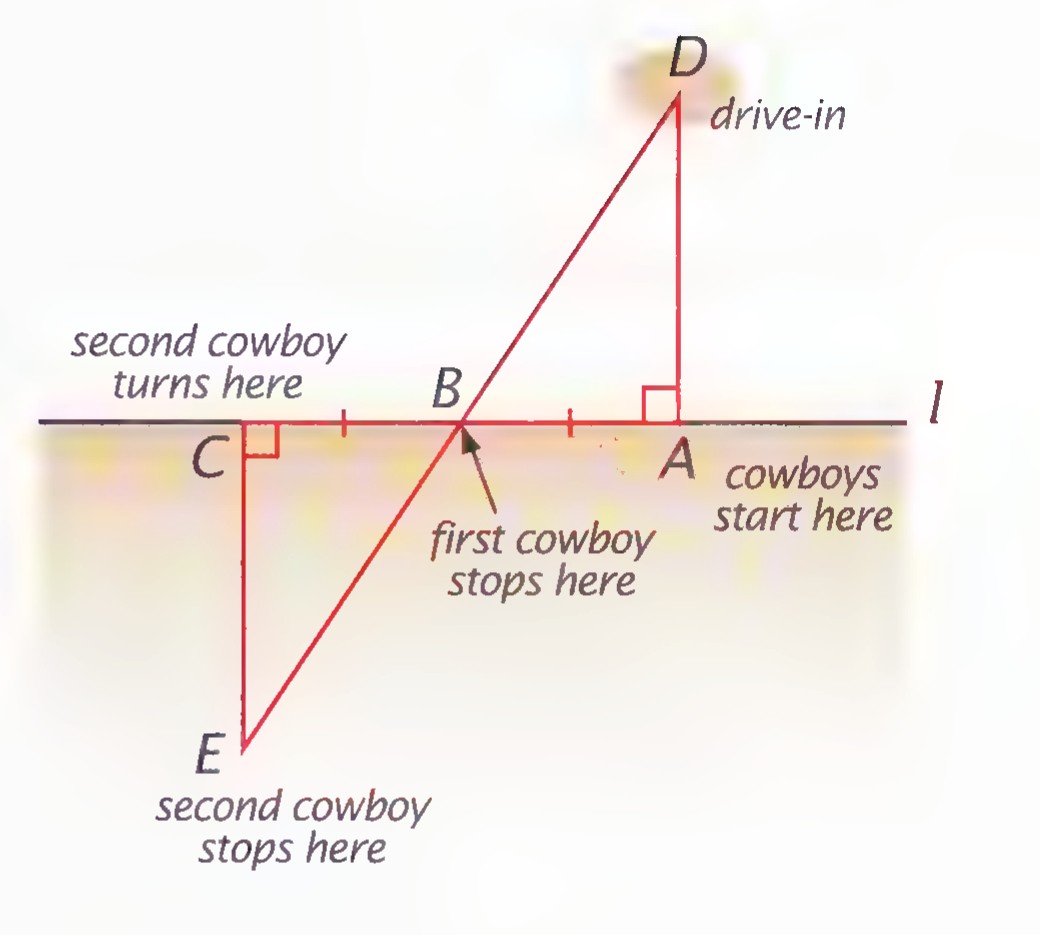
The cowboys start from a position, A, directly across from the drive-in, D. They ride a short distance along a line l that is perpendicular to AD, counting strides as they go. One cowboy stops at point B and the other continues an equal distance along l to point C.
The second cowboy then turns left and rides until he reaches the point, E, where the first cowboy is in line with him and with the drive-in. The distance from C to E must be equal to the distance from A to D. Do you see why?
* Science Awakening, by B. L. van der Waerden (Oxford University Press, 1961).
p. 152
It is because the two triangles in the figure (shown at the left below) are congruent and, because CE and AD are corresponding sides of these triangles, CE and AD must be equal. This conclusion comes from our definition of congruent triangles: Two triangles are congruent iff there is a correspondence between their vertices such that all of their corresponding sides and angles are equal. Because we will use this definition frequently when reasoning about congruent triangles, we state part of it more briefly here.
Definition (Brief Restatement)
Corresponding parts of congruent triangles are equal.
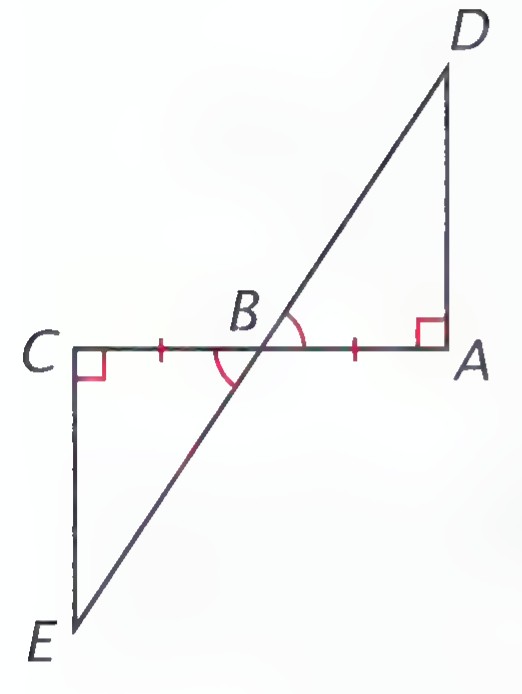
The figure at the left shows the triangles with the parts that we know marked. From the method described, the angles at B are vertical angles; so they must be equal. The triangles are congruent by ASA. All of this information is organized below in the form of a two-column proof.
Given: CA ⊥ AD, CB = BA, ∠C is a right angle and ∠CBE and ∠DBA are vertical angles. Prove: CE = AD.
Proof
| Statements | Reasons |
|---|---|
| 1. CA ⊥ AD. | Given. |
| 2. ∠A is a right angle. | Perpendicular lines form right angles. |
| 3. ∠C is a right angle. | Given. |
| 4. ∠A = ∠C. | All right angles are equal. |
| 5. ∠CBE and ∠DBA are vertical angles. | Given. |
| 6. ∠CBE = ∠DBA. | Vertical angles are equal. |
| 7. CB = BA. | Given. |
| 8. △CBE ≅ △ABD. | ASA. |
| 9. CE = AD. | Corresponding parts of congruent triangles are equal. |
Notice how this proof is organized. To claim that the two triangles are congruent by ASA, we need to show that two pairs of angles and the pair of sides included by them are equal. In other words, we need to write three equations: two about the angles (steps 4 and 6) and one about the sides (step 7). Notice how step 4 follows from steps 2 and 3; step 2 in turn follows from step 1. Step 6 follows from step 5, step 8 from the three equation steps, and step 9 from step 8.
The proof didn’t have to begin with the statement chosen as step 1. It could just as well have begun with statements 3, 5, or 7 instead. There can be several “correct” orders for the steps of a proof.
p. 153
Exercises
Set I
Roof Plan. The design usually used for a roof is shown in the figure at the right.*
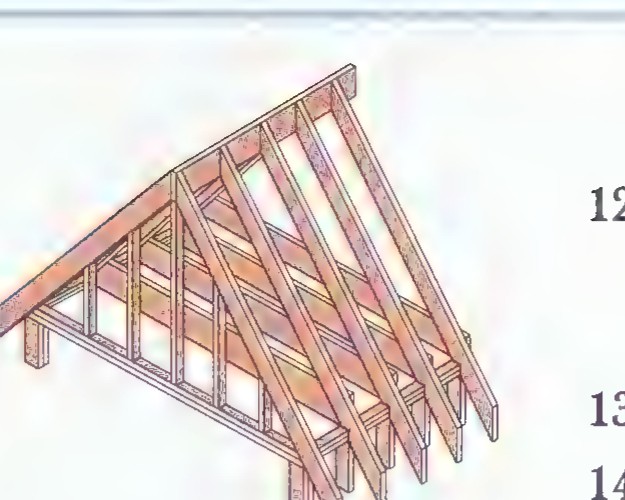
The following diagram shows a side view of the rafters and ceiling joists. We can prove different things about the figure depending on what we assume about it, that is, what we take as “given.”
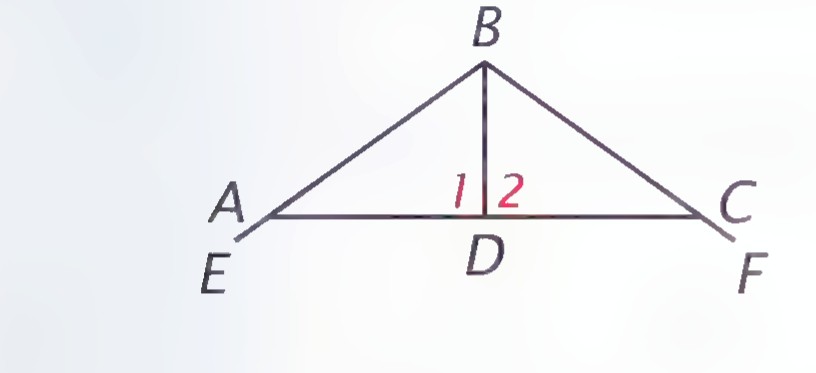
Copy the figure and mark the following “given” information on it: Given: D is the midpoint of AC, BD ⊥ AC.
Why is AD = DC?
Why are ∠1 and ∠2 right angles?
Why is ∠1 = ∠2?
Why is BD = BD?
Why is △ABD ≅ △CBD?
Why is ∠BAD = ∠BCD?
Make another copy of the figure and mark the following “given” information on it instead: Given: ∠1 = ∠2, ∠ABD = ∠CBD.
Why is BD = BD?
Why is △ABD ≅ △CBD?
Why is BA = BC?
Make another copy of the figure and mark the following “given” information on it: Given: BA = BC, BD bisects ∠ABC.
Why is ∠ABD = ∠CBD?
Why is BD = BD?
Why is △ABD ≅ △CBD?
Why is ∠1 = ∠2?
If ∠1 and ∠2 are a linear pair, why is BD ⊥ AC?
Repeating Patterns. The figure below contains several repeating patterns.
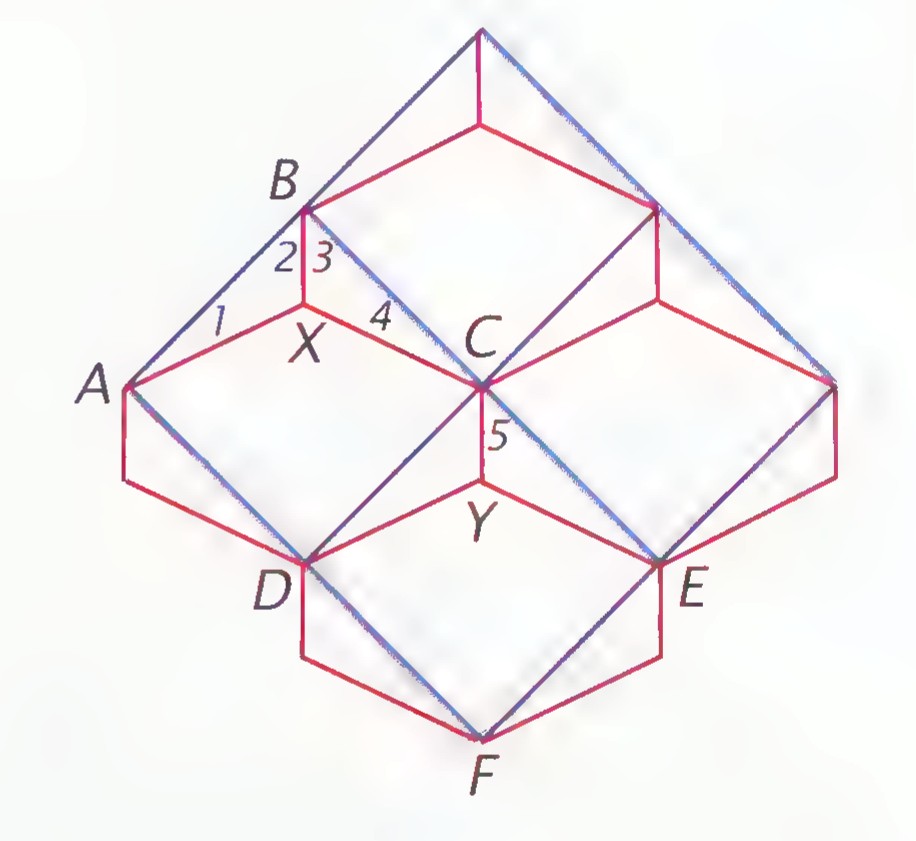
- What kind of polygons do the blue lines seem to form?
- What do the red line segments form?
In the figure, AB = BC, ∠1 = ∠4, and ∠2 = ∠3.
- Which triangles must be congruent?
- Why?
Also, BC = CE, BX = CY, and ∠3 = ∠5.
- Which triangles must be congruent?
- Why?
- Why is △ABX ≅ △ECY?
- Why is AX = YE?
* How to Design and Build Your Own House, by Lupe Di Donno and Phyllis Sperling (Knopf, 1981).
p. 154
Set II
Strange Results. If the congruence postulates are not used correctly, some strange conclusions can result. Here are two examples.
Example 1
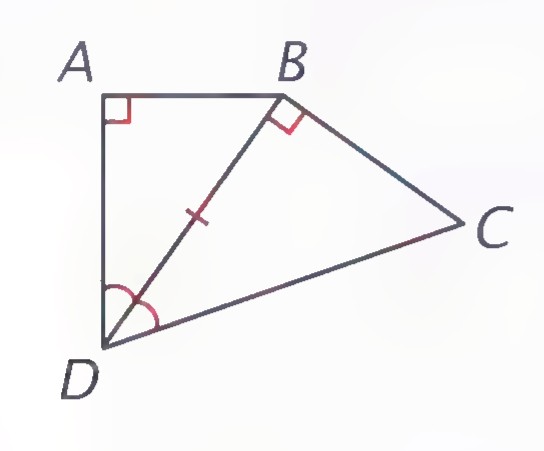
Given: DB bisects ∠ADC; ∠A and ∠DBC are right angles. Prove: △ADB ≅ △BDC.
Proof
| Statements | Reasons |
|---|---|
| 1. DB bisects ∠ADC. | Given. |
| 2. ∠ADB = ∠BDC. | If an angle is bisected, it is divided into two equal angles. |
| 3. BD = BD. | Reflexive. |
| 4. ∠A and ∠DBC are right angles. | Given. |
| 5. ∠A = ∠DBC. | All right angles are equal. |
| 6. △ADB ≅ △BDC. | ASA. |
The figure for this proof is drawn accurately, and all of the given information is true.
- Does △BDC look as if it could be congruent to △ADB? Why or why not?
- What is wrong with the proof?
Example 2
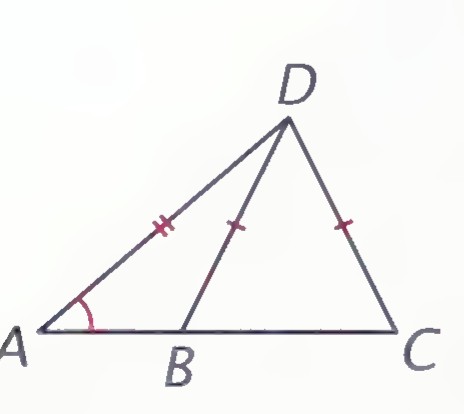
Given: DB = DC. Prove: AB = AC.
Proof
| Statements | Reasons |
|---|---|
| 1. DB = DC. | Given. |
| 2. AD = AD. | Reflexive. |
| 3. ∠DAB = ∠DAC. | Reflexive. |
| 4. △DAB ≅ △DAC. | SAS. |
| 5. AB = AC. | Corresponding parts of congruent triangles are equal. |
Again the figure is drawn accurately.
- What is really true about AB and AC?
- What is wrong with the proof?
Congruence Proofs. Write complete proofs for each of the following exercises. In each case, copy the figure and mark the given information on it. Also copy the “given” and “prove” before writing your statements and reasons. (Each proof can be written in five steps.)
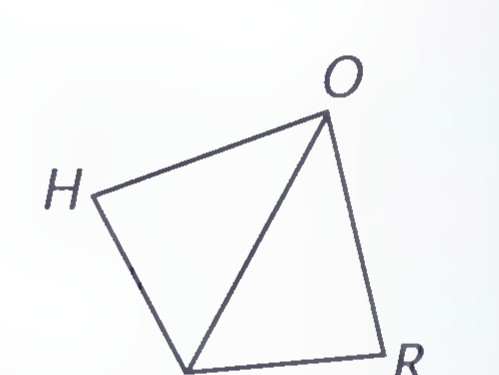
Given: HN = NR; NO bisects ∠HNR. Prove: △HNO ≅ △RNO.
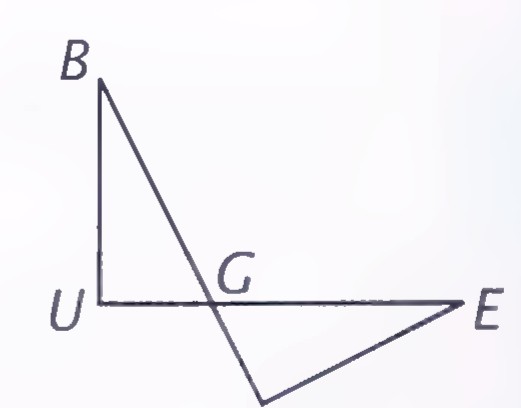
Given: ∠BGU and ∠EGL are vertical angles; BG = GE and UG = GL. Prove: BU = LE.
p. 155
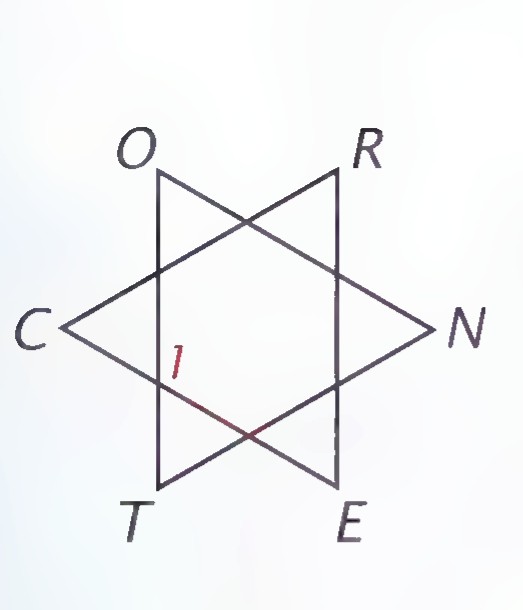
Given: ∠C = ∠O; ∠R and ∠N are supplements of ∠1; CR = ON. Prove: △CRE ≅ △ONT.
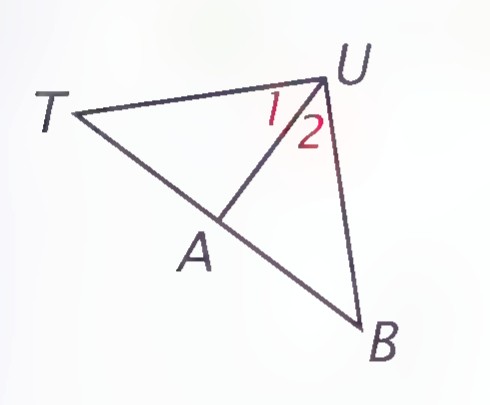
Given: ∠T and ∠2 are complements of ∠1; TA = AU and TU = UB. Prove: AU = AB.
Grid Exercise. On graph paper, draw a pair of axes extending 10 units in each direction from the origin.
Plot the following points and connect them to form △ABC: A(3, 1), B(3, 8), C(7, 1).
Find the lengths of its sides.
(continued) On the figure that you drew for exercise 34, plot the following points and connect them to form △DEF: D(3, −1), E(3, −8), F(7, −1).
In which quadrant is △DEF?
What would happen if you folded the graph paper along the x-axis?
How are the coordinates of the vertices of △DEF related to those of △ABC?
Find the lengths of its sides.
From the observation that ∠A and ∠D are right angles, why does it follow that △ABC ≅ △DEF?
(continued) Draw the triangle on which △ABC would fit if you folded the graph paper along the y-axis. Label its vertices G, H, and I so that △ABC ≅ △GHI.
In which quadrant is △GHI?
What are the coordinates of its vertices?
How are the coordinates of its vertices related to those of △ABC?
(continued) Plot the following points and connect them to form △JKL: J(1, 3), K(8, 3), L(1, 7).
Is △JKL ≅ △ABC?
How are the coordinates of the vertices of △JKL related to those of △ABC?
Is it possible to fold the graph paper so that the vertices of △ABC and △JKL would fit together? If so, where would you fold the paper? Check your answer by trying it.
River Problem. Acute Alice and Obtuse Ollie are standing on the bank of Muddy Boggy Creek. Ollie asks Alice how wide she thinks the river is. Alice adjusts the rim of her hat as she looks across the river, then walks along the river bank and gives Ollie an answer.*
The “three-dimensional” figure below illustrates the situation.
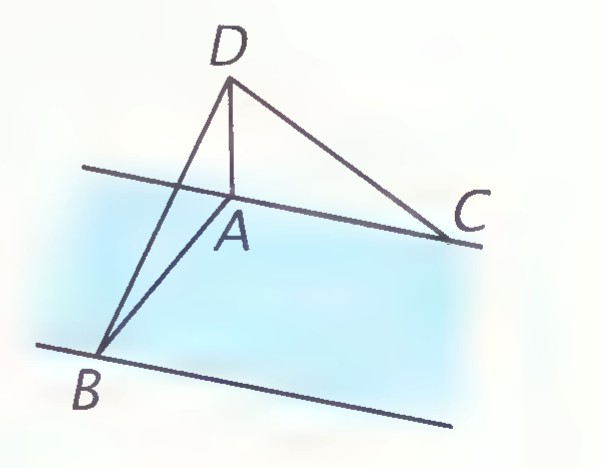
- Copy it and mark the parts that Alice used to figure out her answer.
- Tell how she did it.
*Adapted from a problem in You Are a Mathematician, by David Wells (Wiley, 1995).
p. 156
Set III
The Problem of the Handcuffed Prisoners*
Nine dangerous prisoners have to be carefully watched. Each day they are taken out for exercise, handcuffed in threes as illustrated in this sketch made by one of their guards. How can they be handcuffed so that, on four consecutive days, no pair of prisoners are together in the same group more than once?
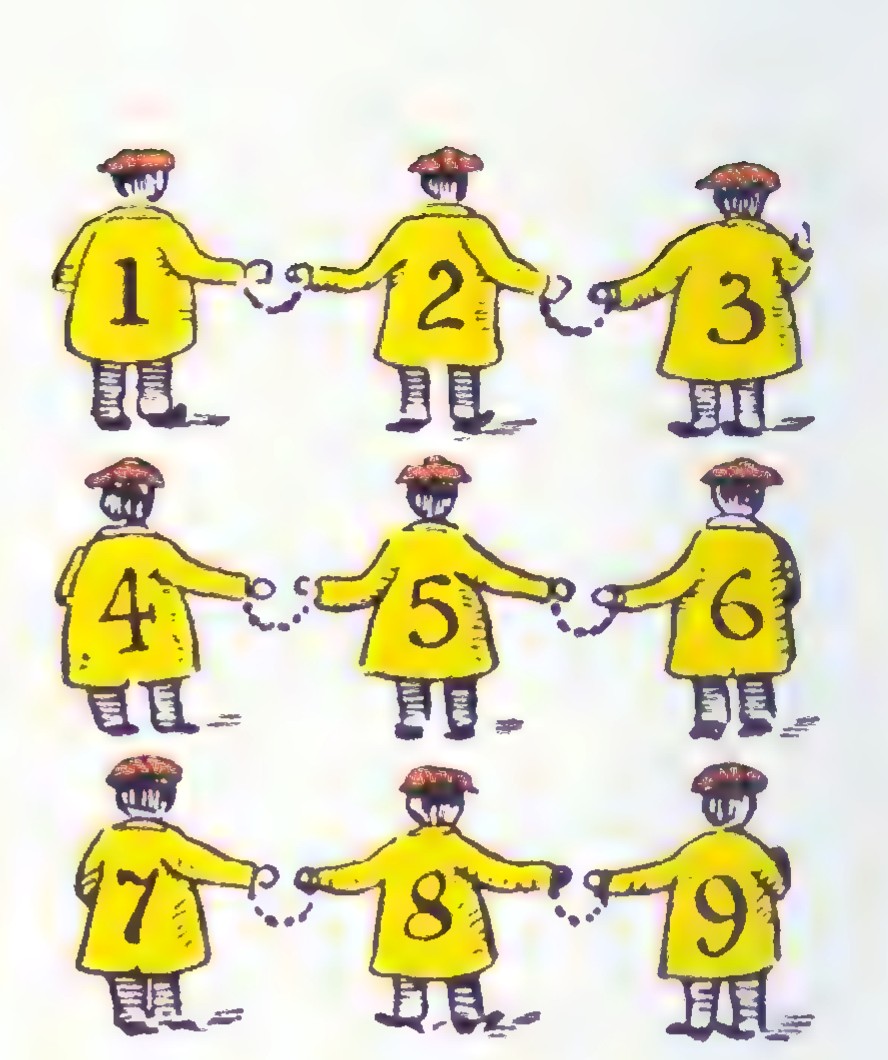
Although this puzzle is much more difficult to solve than it first appears, a solution can be found quite easily by using some simple geometry.
Draw a circle and write the numbers 1 through 9 (except 3) placed as shown in the lower figure at the right. Those on the circle are equally spaced. Draw another circle of the same size and on it draw the diameter and two congruent triangles as shown in red. Write the number 3 in the center of this circle and cut it out.
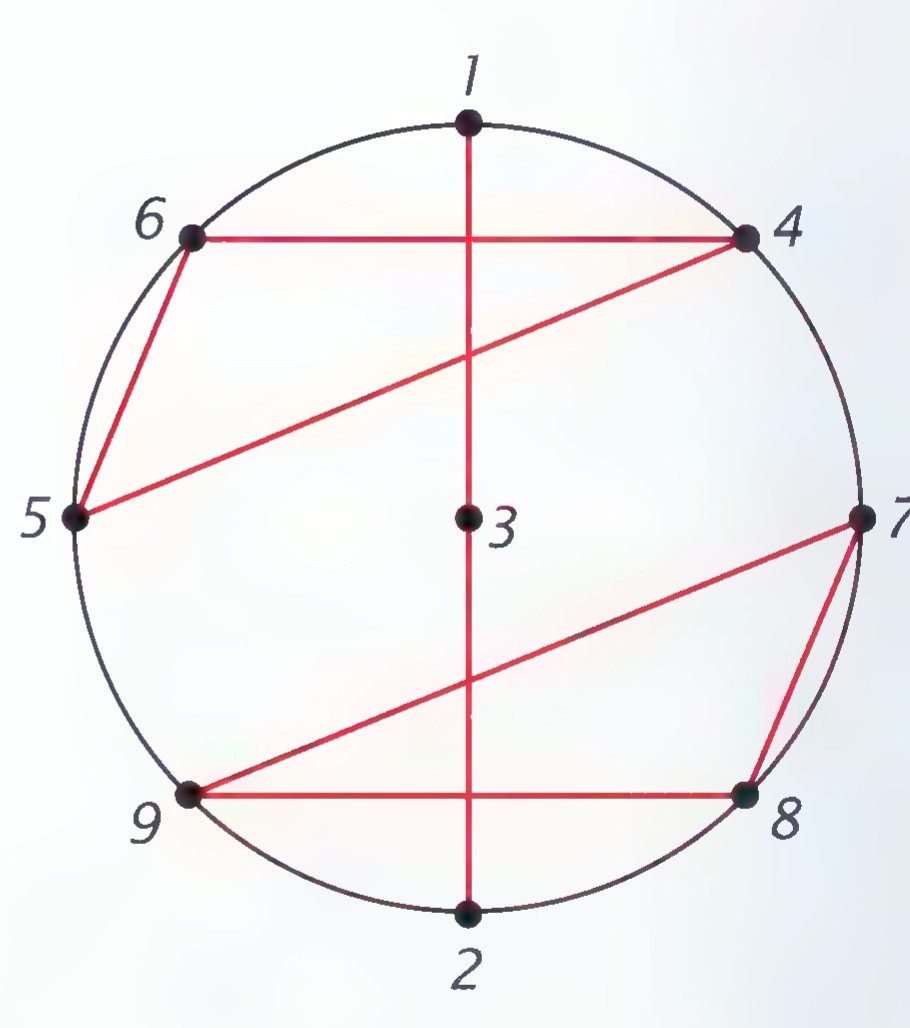
Place it on the first circle so that it looks like the diagram. Copy the set of three numbers on the diameter, and the two sets of three numbers at the vertices of the two triangles. You should get a list like this: 123, 456, 789, corresponding to the way in which the prisoners are arranged in the sketch.
Now rotate the circle so that the diameter falls between 4 and 9 and write down the new sets of numbers (on the diameter and at the vertices of the triangles). Do this again with the diameter placed between 7 and 5, and again with the diameter between 8 and 6.
If you haven’t copied any numbers incorrectly, you have the solution to the puzzle. Strange as it may seem, puzzles of this sort have practical uses, including the statistical design of scientific experiments!
*Adapted from a problem by Henry Ernest Dudeney, Amusements in Mathematics (1917); paperback published by Dover, 1958.
p. 157
Lesson 5: Isosceles and Equilateral Triangles
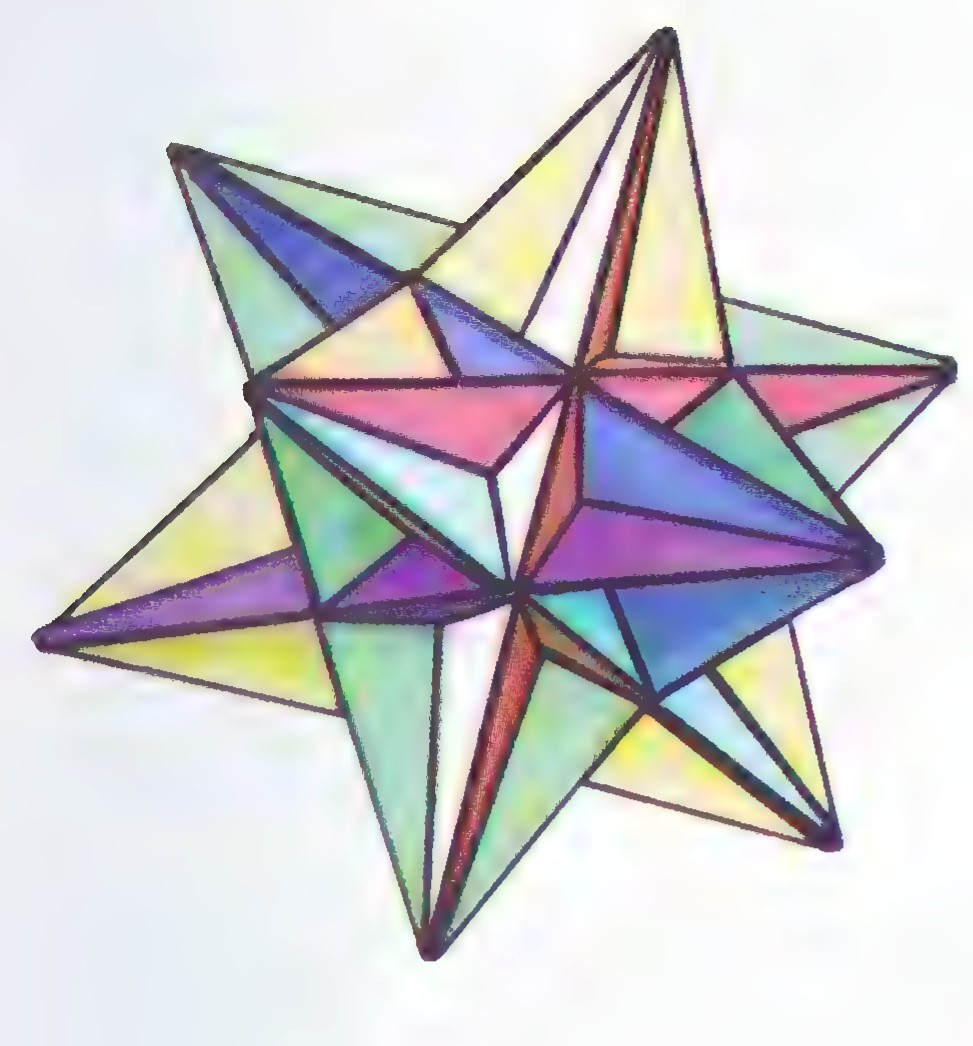
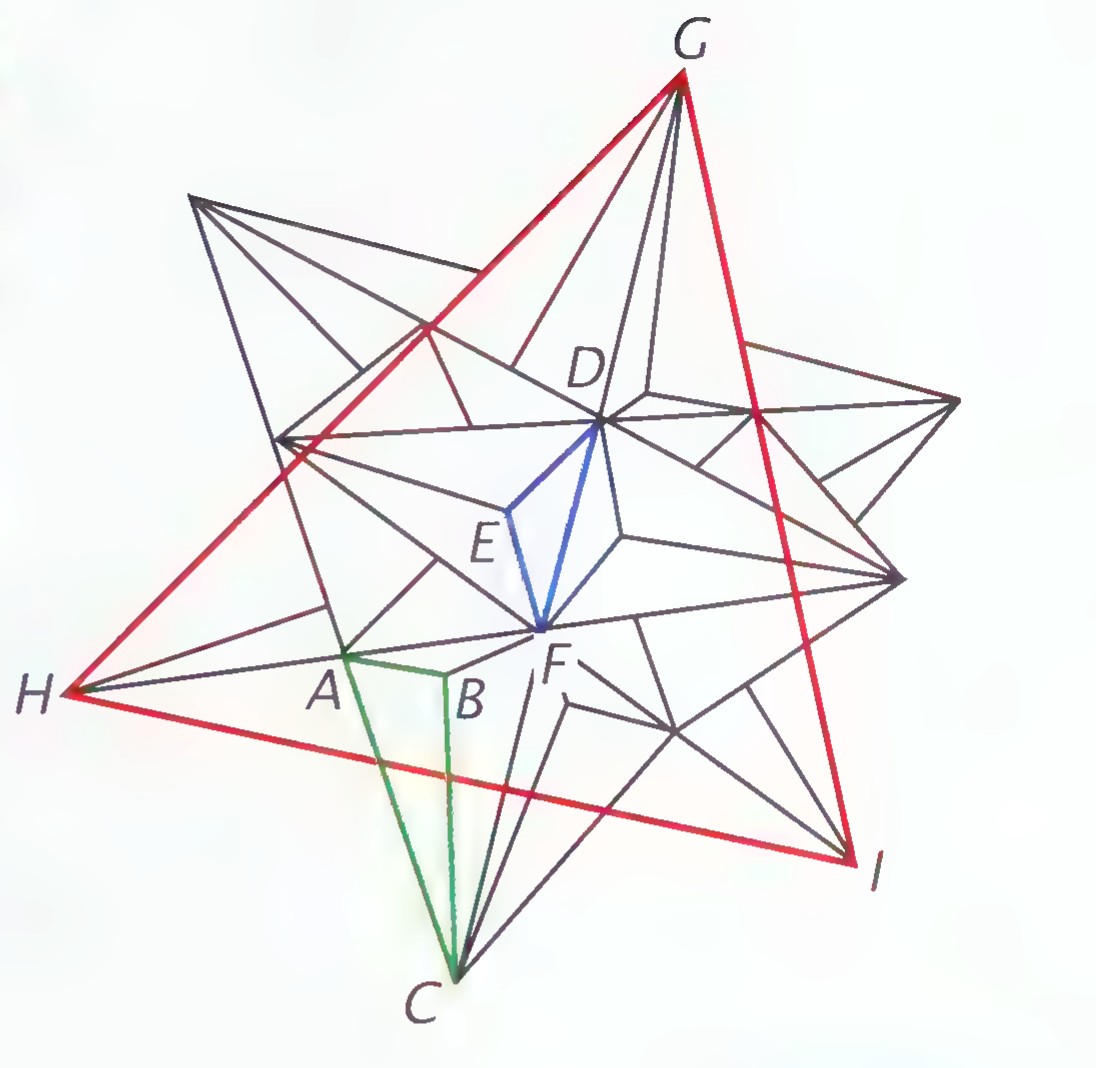
Euclid began the Elements with the construction of an equilateral triangle (Book I, Proposition 1). He ended it comparing five geometric solids called the “regular polyhedra” (Book XIII, Proposition 18). A beautiful polyhedron discovered more than 2,000 years later is shown in the figure above. It was discovered by Louis Poinsot, a French mathematician, in 1809 and is called a “great icosahedron.”
The edges of the great icosahedron form a large number of triangles of various shapes. Most of them, such as △ABC in the figure beside the photograph, are scalene because they have no equal sides. Some of the triangles, such as △DEF, are isosceles because they have two equal sides, and some, such as △GHI, are equilateral because they have three equal sides.
Definitions
A triangle is
- scalene iff it has no equal sides.
- isosceles iff it has at least two equal sides.
- equilateral iff all of its sides are equal.
p. 158
These definitions depend on the relative lengths of the sides of a triangle. Triangles are also classified according to the measures of their angles.
Definitions
A triangle is
- obtuse iff it has an obtuse angle.
- right iff it has a right angle.
- acute iff all of its angles are acute.
- equiangular iff all of its angles are equal.
The sides and angles of triangles are related in special ways. For example, if a triangle has a pair of equal sides, it will also have a pair of equal angles, and conversely. Furthermore, a triangle is equiangular iff it is equilateral.
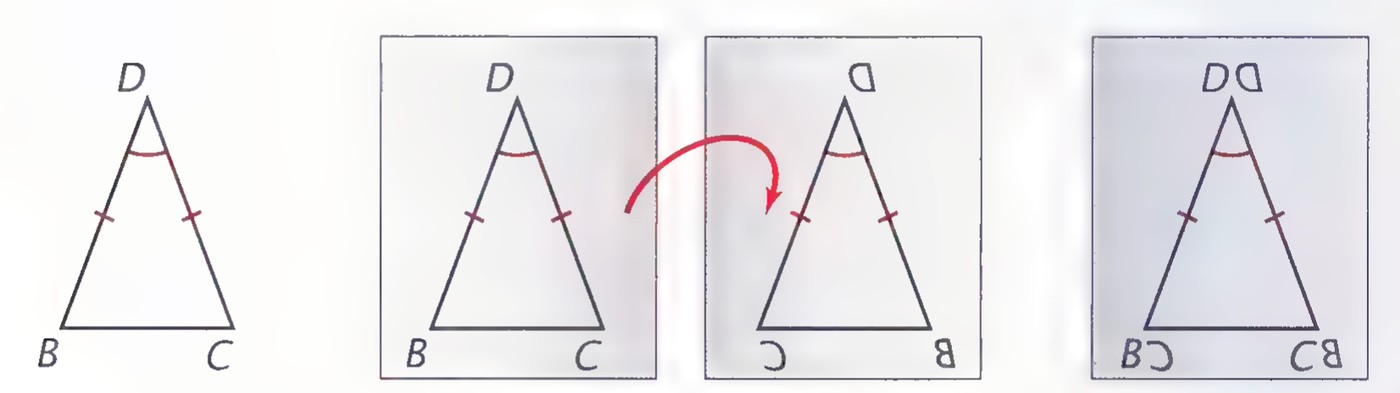
These ideas are easy to prove by using our congruence postulates. Consider △BCD with BD = CD, for example. If you traced it and flipped the tracing over, it would look the same. In fact, if you placed the flipped triangle on the original triangle, the two triangles would coincide. CD would fit on BD because they are equal, ∠D would fit on ∠D, and BD would fit on CD. We have the congruence correspondence, △BCD ≅ △CBD by SAS. It follows that ∠C = ∠B because corresponding parts of congruent triangles are equal. So, if two sides of a triangle are equal, two of its angles also must be equal.
Here is our argument arranged as a proof in two-column form.
Theorem 9 If two sides of a triangle are equal, the angles opposite them are equal.
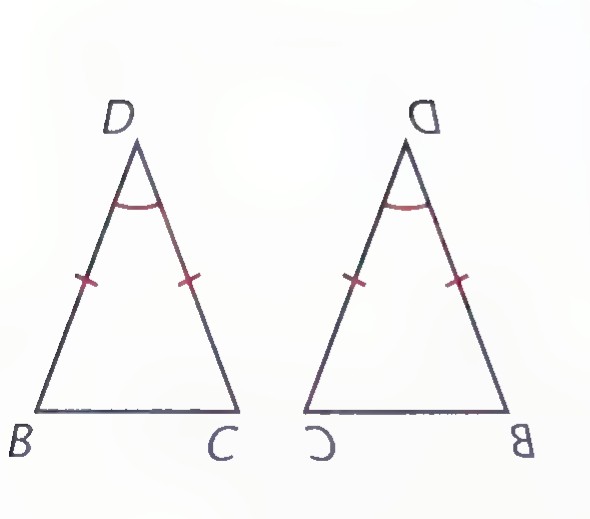
Given: In △BCD, BD = CD. Prove: ∠C = ∠B.
Proof
| Statements | Reasons |
|---|---|
| 1. In △BCD, BD = CD. | Given. |
| 2. ∠D = ∠D. | Reflexive. |
| 3. CD = BD. | Given. |
| 4. △BCD ≅ △CBD. | SAS. |
| 5. ∠C = ∠B. | Corresponding parts of congruent triangles are equal. |
p. 159
The converse of this theorem is also true.
Theorem 10 If two angles of a triangle are equal, the sides opposite them are equal.
From these two theorems, it follows that all equilateral triangles must be equiangular and vice versa.
Corollaries to Theorems 9 and 10 An equilateral triangle is equiangular. An equiangular triangle is equilateral.
These facts are all easy to prove; their proofs are considered in the exercises.
Exercises
Set I
In the figure below, AB = AD and ∠C = ∠BDC.
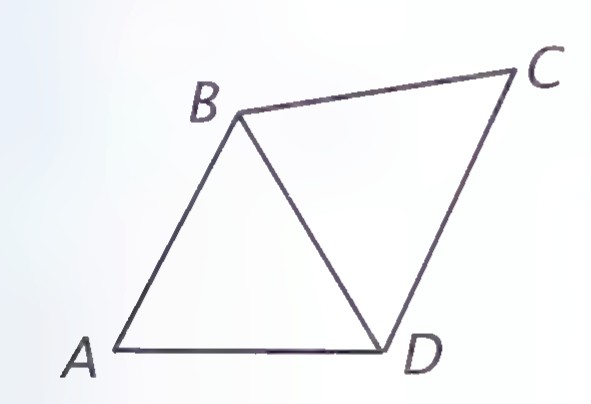
- Copy the figure and mark the equal parts on it.
- Which angle of △ABD is opposite AB?
- Which angles of △ABD must be equal?
- Which side of △BCD is opposite ∠C?
- Which sides of △BCD must be equal?
- Does it follow that △ABD and △BCD are congruent?
The figure at the right appeared in an edition of Euclid’s Elements published in 1665. In △ABC, AB = AC; AD = AE.
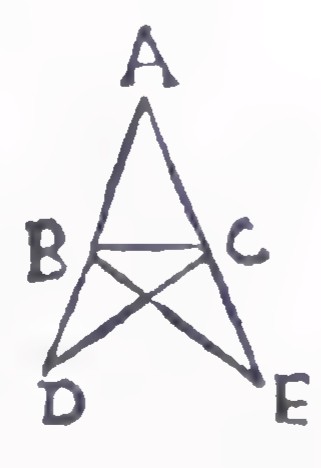
- What kind of triangle is △ABC?
- Why is ∠ABC = ∠ACB?
- What angle do △ACD and △ABE have in common?
- Why is △ACD ≅ △ABE?
- Why is ∠D = ∠E?
“Isosceles.” “Isosceles” is a strange word. Not only is it strange, it is very old. It comes from the Greek word isoskeles and is used only in geometry.
- What does it mean to say that a triangle is isosceles?
- Is an equilateral triangle isosceles? Explain why or why not.
According to the dictionary, “isosceles” means “having equal legs.”
- Where are the equal angles in an isosceles triangle with respect to its legs?
If it is possible, draw an example of an isosceles triangle that is also
- a right triangle.
- a scalene triangle.
- an obtuse triangle.
p. 160
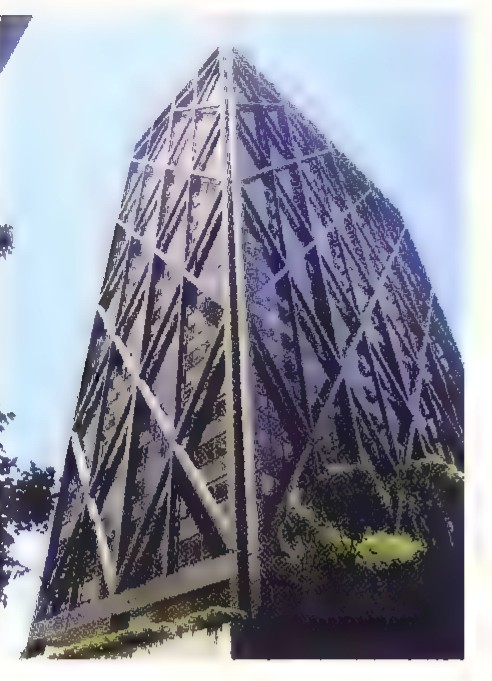
Alcoa Building. The architects who designed the Alcoa building in San Francisco used a grid of isosceles triangles.*
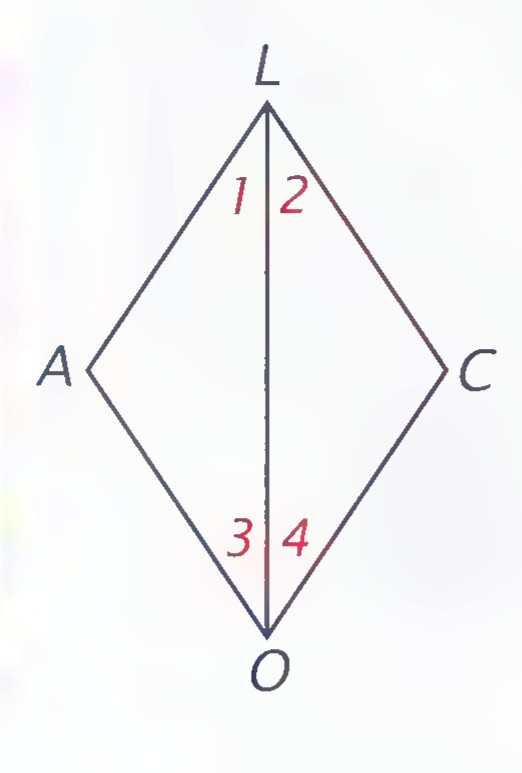
- Copy this figure based on that grid and mark the following information on it: AL = LC = CO = OA; ∠A = ∠C.
- What kind of triangles are △LAO and △LCO?
- Why is ∠1 = ∠3 and ∠2 = ∠4?
- Why is ∠1 + ∠2 = ∠3 + ∠4?
From the figure, we see that LA = LO = LC and OA = OL = OC.
- Why is ∠ALC = ∠1 + ∠2 and ∠AOC = ∠3 + ∠4?
- Why is ∠ALC = ∠AOC?
- Why is △LAO ≅ △LCO?
- Why is ∠1 = ∠2 and ∠3 = ∠4?
- What relation does LO have to ∠ALC and ∠AOC?
Shuffleboard Court. The figure at the right shows one of the scoring zones of a shuffleboard court. SH = HU = UF, FL = LE = EB.
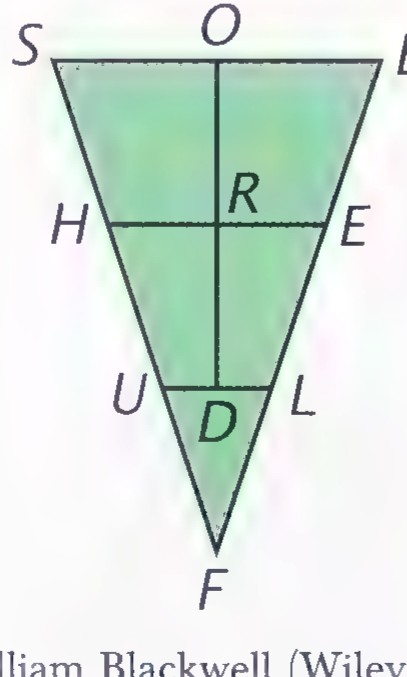
- What relation does OD appear to have to SB, HE, and UL?
- What relation do SB, HE, and UL appear to have to one another?
- What kind of triangles are △SBF, △HEF, and △ULF?
Given that ∠F = 36°, find the measures of
- ∠S and ∠B.
- ∠LUF and ∠ULF.
- ∠SUL and ∠BLU.
Set II
Theorem 10 can be proved in a way almost identical with the proof of Theorem 9.
- Write a complete proof of Theorem 10 by first copying it, the figure, and the “given” and “prove.” Use the proof of Theorem 9 as a guide in writing your proof.
Theorem 10. If two angles of a triangle are equal, the sides opposite them are equal.

Given: In △EFG, ∠E = ∠F. Prove: GE = GF.
Theorem 9 can be used to prove its corollary.
- Write a complete proof of the corollary by first copying it, the figure, and the “given” and “prove.” Copy the statements and give the reasons.
Corollary. An equilateral triangle is equiangular.
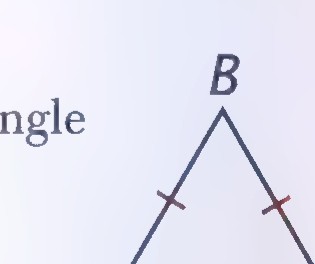
Given: △ABC is equilateral. Prove: △ABC is equiangular.
* Geometry in Architecture, by William Blackwell (Wiley, 1984).
p. 161
Proof
| Statements | Reasons |
|---|---|
| 1. △ABC is equilateral. | Why? |
| 2. BC = AC and AC = AB. | Why? |
| 3. ∠A = ∠B and ∠B = ∠C. | Why? |
| 4. ∠A = ∠C. | Why? |
| 5. △ABC is equiangular. | Why? |
The proof of the corollary to Theorem 10 is almost the same.
- Copy the following and use the proof in exercise 34 as a guide in writing your proof.
Corollary. An equiangular triangle is equilateral.
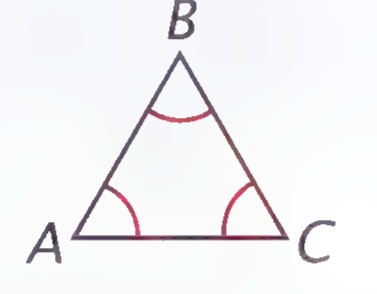
Given: △ABC is equiangular. Prove: △ABC is equilateral.
Hydrogen Sulfide. One of the reasons that rotten eggs stink is hydrogen sulfide. The hydrogen sulfide molecule consists of a sulfur atom bonded to two hydrogen atoms.*
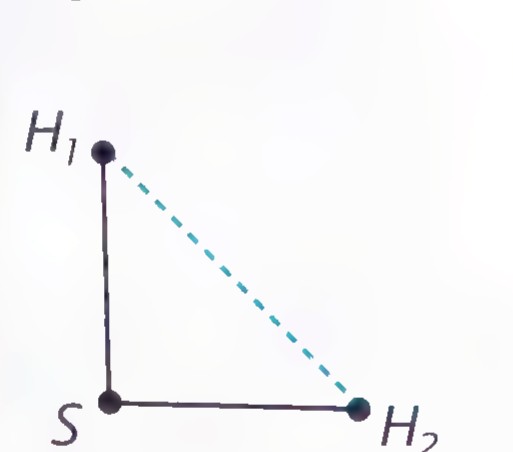
In △SH₁H₂, S represents the center of the sulfur atom; H₁ and H₂ represents the centers of the hydrogen atoms; SH₁ = SH₂.
- What kind of triangle is △SH₁H₂ with respect to its sides?
The measure of ∠H₁ is 43.9°. Find the measure of
- ∠H₂.
- ∠S.
- What kind of triangle is △SH₁H₂ with respect to its angles?
- If you knew that SH₁ = SH₂ = 1.34 angstroms, could you use the Pythagorean Theorem to find the length of H₁H₂? Explain.
In the figure below, △ABD is equiangular and D is the midpoint of AC.
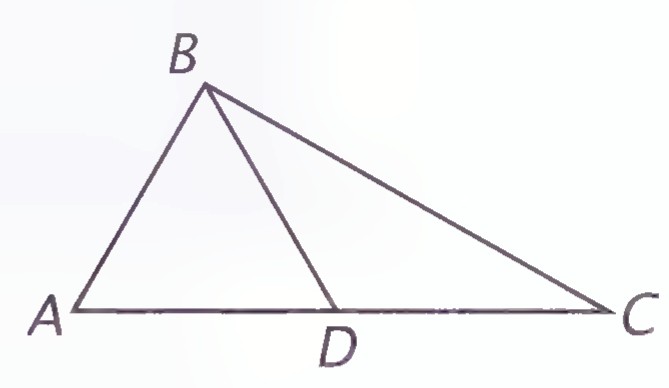
- Copy the figure and mark this information on it.
△BDC is evidently obtuse.
- What further conclusions can you draw about △BDC? Explain your reasoning.
Star Puzzles. In the accurately drawn figure below, 10 line segments connect the 5 lettered points.
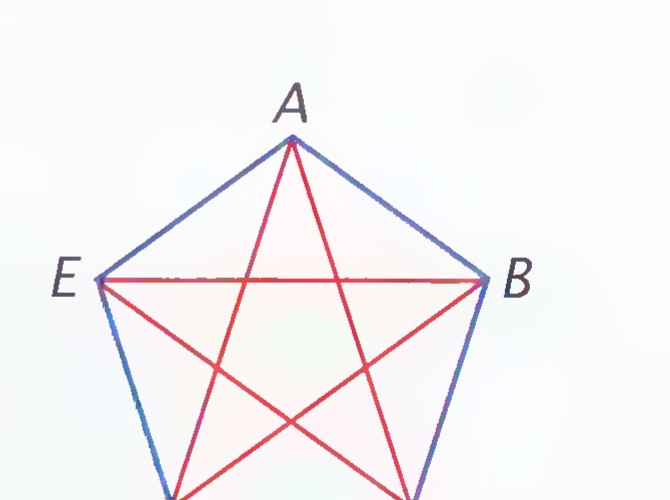
- What kind of polygon is the blue polygon?
- Why isn’t the red star a polygon?
All of the sides and angles of the blue polygon are equal.
- Do you think that the 5 line segments that form the red star also must be equal? Explain why or why not.
* The Architecture of Molecules, by Linus Pauling and Roger Hayward (W. H. Freeman and Company, 1964).
p. 162
In this accurately drawn figure, the 5 line segments that form the red star are equal.
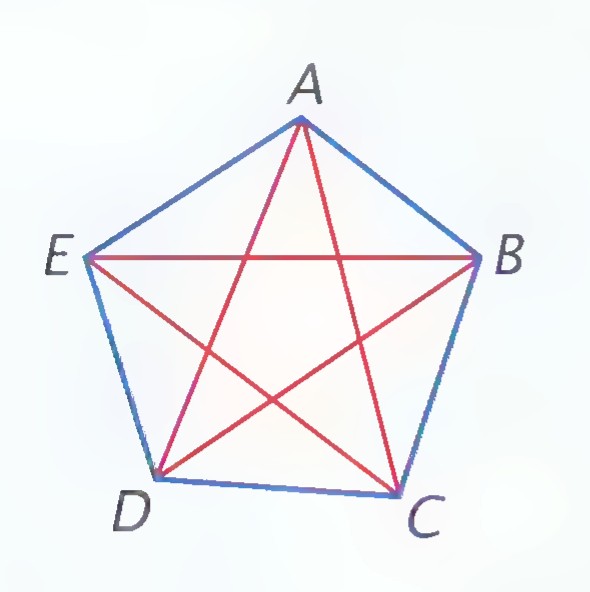
- Do you think that the 5 sides of the blue polygon also must be equal? Explain why or why not.
- If you also knew that the angles at the corners of the red star were equal, could you then conclude that the sides of the blue polygon also are equal? Explain why or why not.
SAT Problem. The figure below appeared in a problem on an SAT exam.
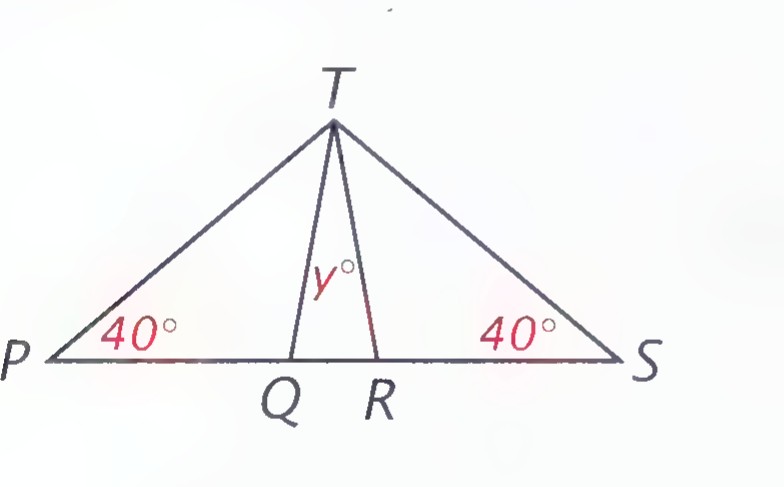
In it, PS is a line segment and PQ = QT = TR = RS.
- What is the value of y? Show your reasoning.
Drawing Exercise.
- Draw a line segment 3 inches long. Use your straightedge and compass to construct an equilateral triangle with the line segment as one of its sides. Label the corners of the triangle A, B, and C. Use your ruler to mark point X on AB so that AX = 1 inch. Mark point Y on BC so that BY = 1 inch. Mark point Z on AC so that CZ = 1 inch. Connect points X, Y, and Z to form △XYZ.
- What seems to be true about △AXZ, △BYX, and △CZY?
- Explain why it must be true.
- What seems to be true about △XYZ?
- Explain why it must be true.
Set III
In this remarkable drawing by Maurits Escher, the artist has filled part of a plane with lizards.*
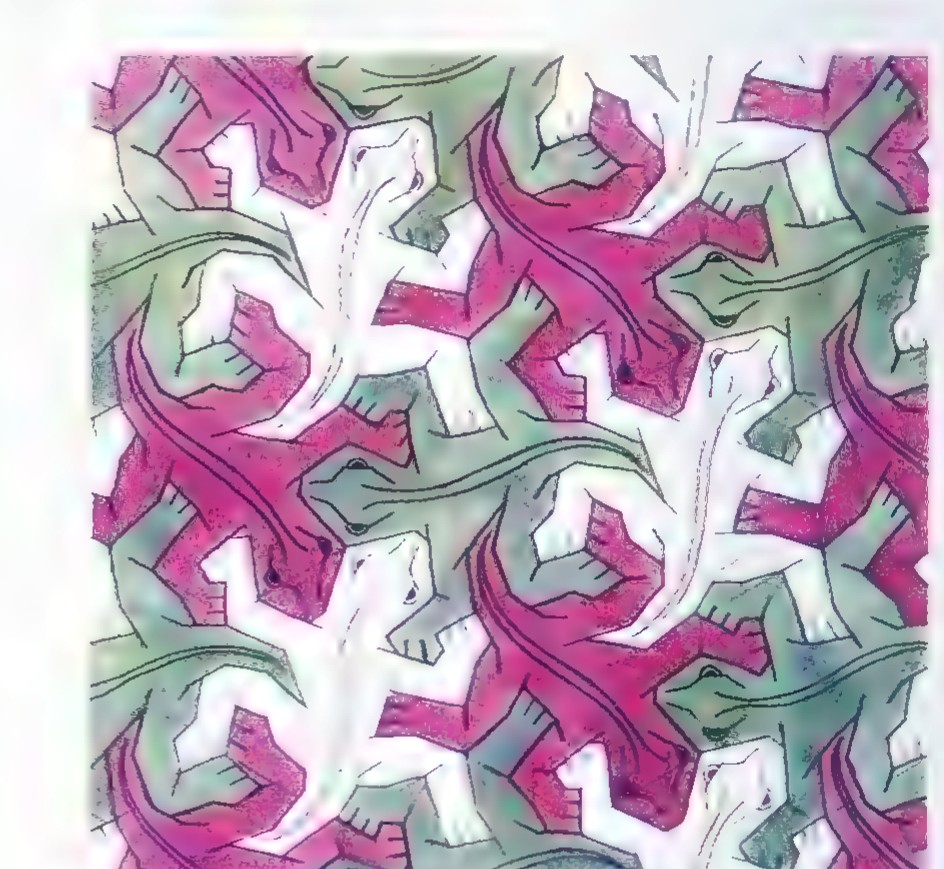
- In how many different directions are the lizards crawling?
- Through how many degrees would one of the lizards have to turn to be crawling in the same direction as one of the lizards next to it?
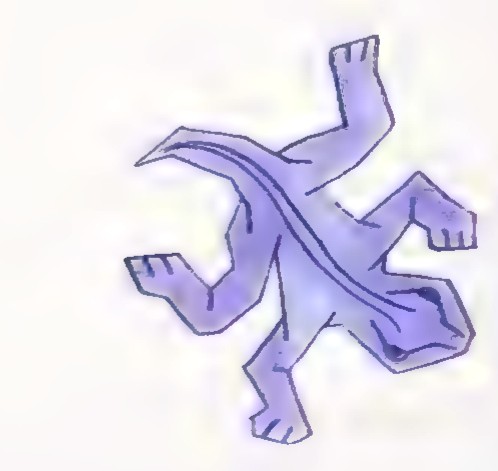
- The lizard at the bottom of this page looks like the ones in the drawing and yet, other than being blue, it couldn’t fit in with all the rest. Why not?
* The Magic of M. C. Escher (Abrams, 2000).
p. 163
Lesson 6: SSS Congruence
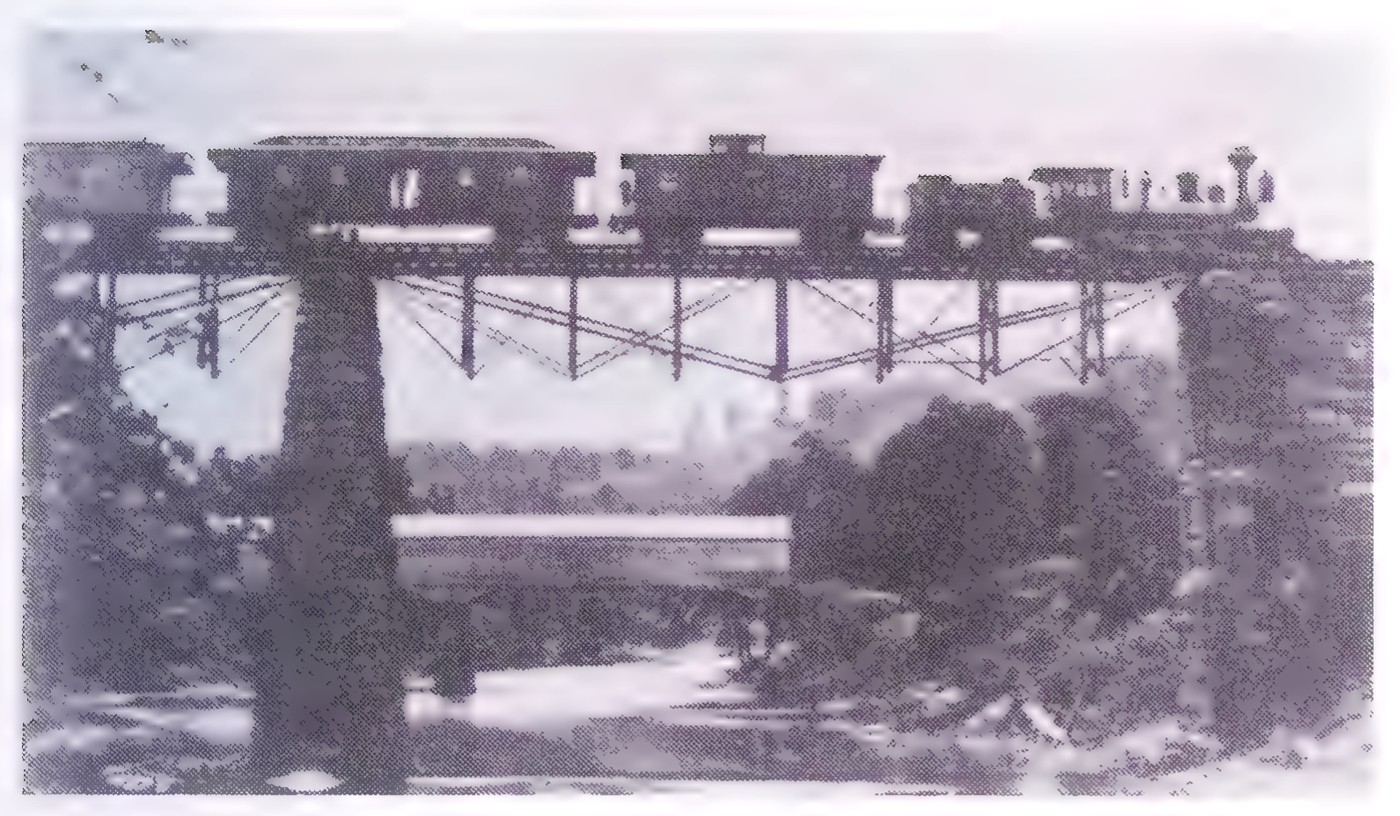
In 1875, the Reverend Samuel Manning described the experience of riding in a train across a bridge like the one in the picture above:
The road is carried across valleys hundreds of feet in depth on rude trestle bridges, which creak and groan beneath the weight of the train. Anything apparently more insecure than these structures can hardly be found elsewhere, and I always drew a long breath of relief as I found myself safely on the other side.*
Although the bridge in the photograph doesn’t look capable of supporting a heavy train, part of its strength comes from the framework beneath it. The framework is composed of “trusses,” based on the triangle, the simplest rigid shape that a structure can have.
If models of a triangle and a quadrilateral are made by threading drinking straws together, the triangle will hold its shape but the quadrilateral will collapse. The shape of the triangle, then, is completely determined by the lengths of its sides.
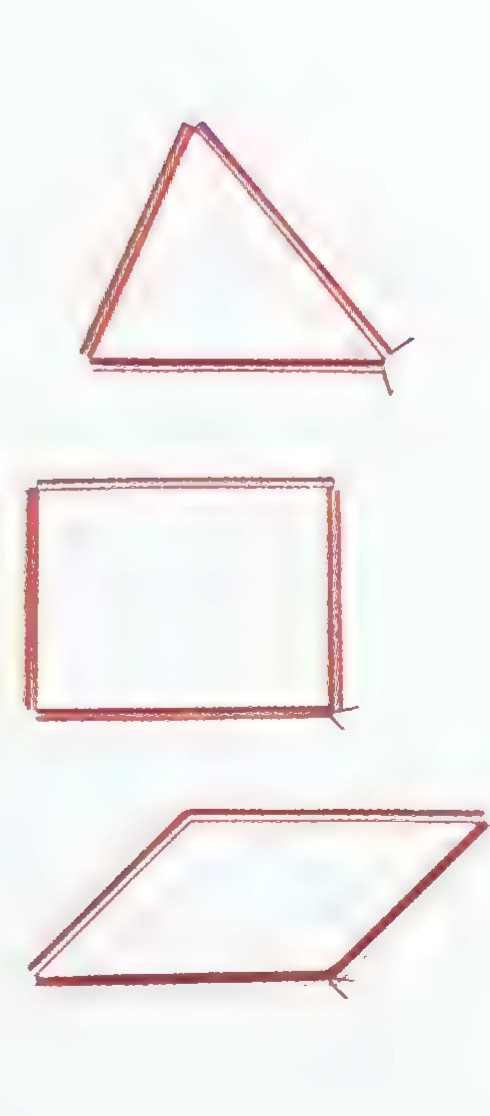
Thus, if the sides of one triangle are equal to the sides of another, the triangles must be congruent. We now have enough facts about triangles to be able to prove it.
* American Pictures (1875).
p. 164
Theorem 11. The SSS Theorem If the three sides of one triangle are equal to the three sides of another triangle, the triangles are congruent.
Our proof, after that of Euclid, is based on copying one of the triangles and then showing that the other triangle is congruent to this copy. The figures illustrate the construction and proof.
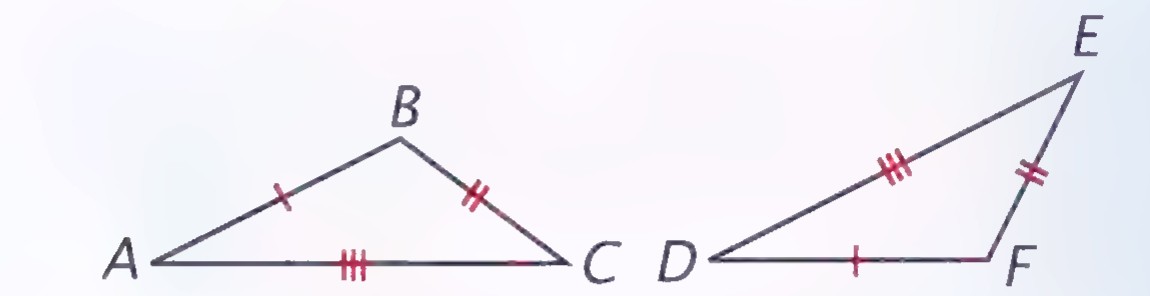
Given: AB = DF, BC = FE, and AC = DE. Prove: △ABC ≅ △DFE.
Proof
The first part: Drawing a new triangle congruent to △DEF.
First, draw ray AX from point A so that ∠CAX = ∠D (Protractor Postulate). Next, choose point P on ray AX so that AP = DF (Ruler Postulate). Draw CP (two points determine a line). △APC ≅ △DFE (SAS).
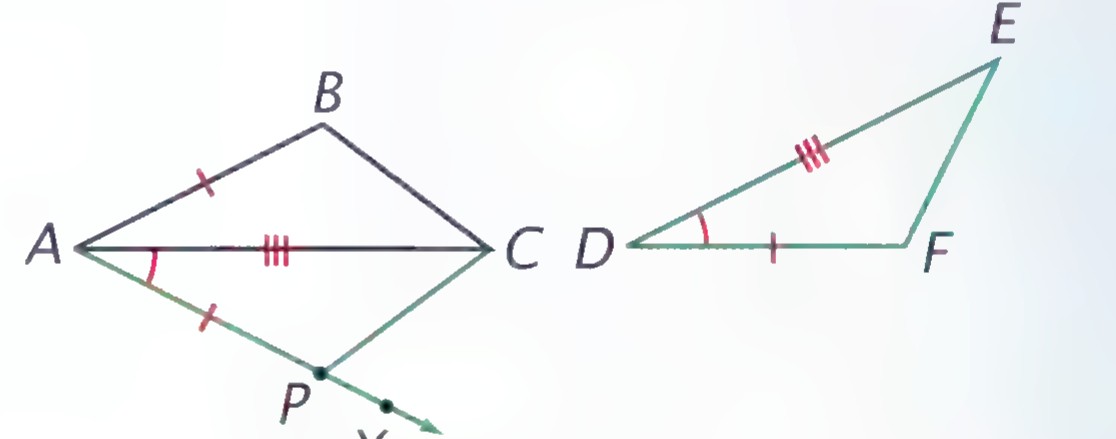
The second part: Showing that the new triangle is congruent to △ABC.
Draw BP. AP = DF (corresponding parts of congruent triangles are equal) and AB = DF (given), so AP = AB (substitution). From this information we know that △ABP is isosceles; so ∠1 = ∠2 (if two sides of a triangle are equal, the angles opposite them are equal).
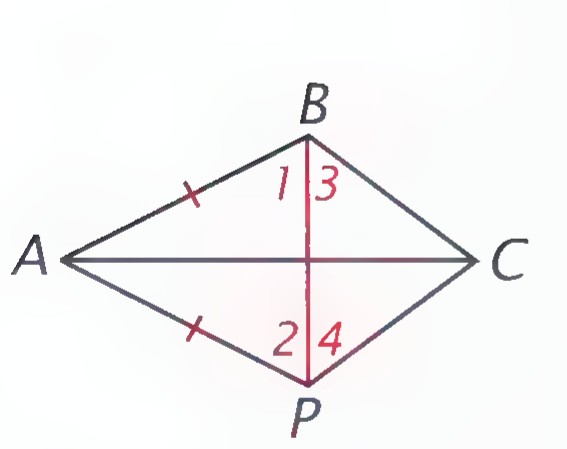
Also, PC = FE (corresponding parts of congruent triangles are equal) and BC = FE (given); so PC = BC (substitution). So △CBP also is isosceles and ∠3 = ∠4.
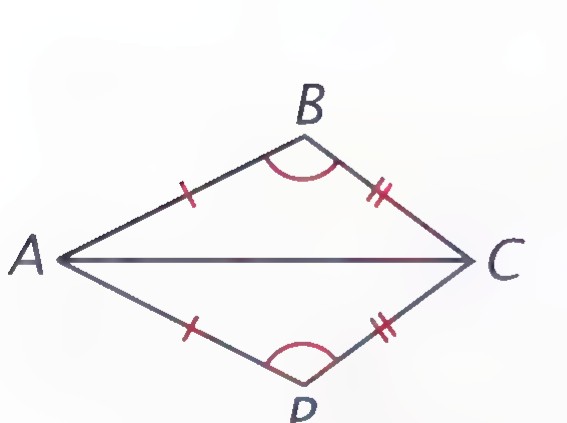
Because ∠1 = ∠2 and ∠3 = ∠4, ∠1 + ∠3 = ∠2 + ∠4 (addition). But ∠1 + ∠3 = ∠ABC and ∠2 + ∠4 = ∠APC (Betweenness of Rays Theorem, which holds because BP divides both ∠ABC and ∠APC); so ∠ABC = ∠APC (substitution). From this information we know that △ABC ≅ △APC (SAS). Finally, △ABC ≅ △DFE because two triangles congruent to a third triangle are congruent to each other.
The proof is long but the theorem is easy to use. You should learn the SSS Theorem well enough to be able to recall it as a sentence whenever you see it referred to as SSS.
p. 165
Exercises
Set I
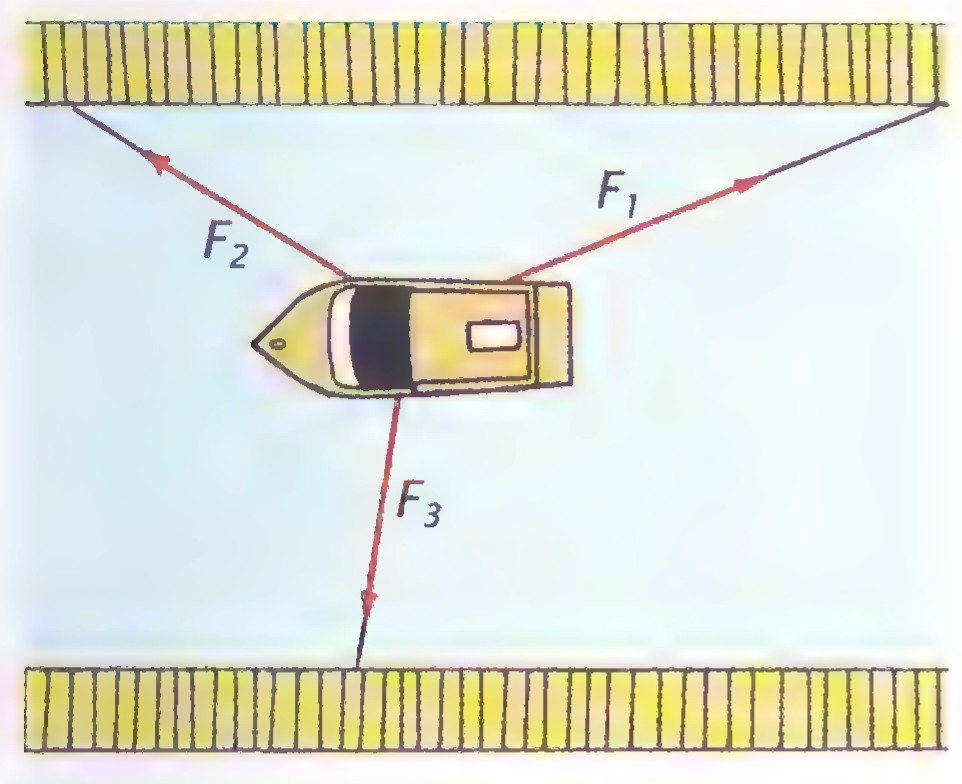
Force Triangles. The figure above shows a boat held in place by three ropes. If the arrows represent the forces acting on the ropes, triangles can be drawn having the arrows as their sides.*
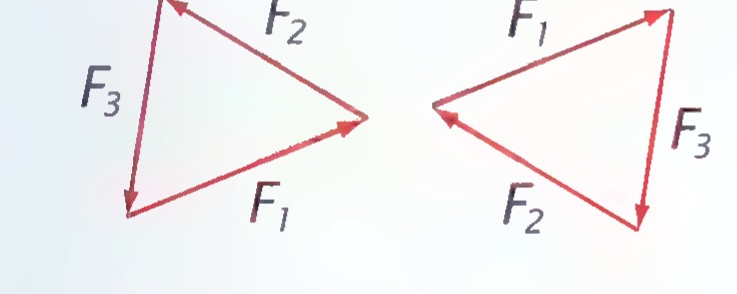
- How do you know that these triangles are congruent?
- Why are the angles of one triangle equal to the angles of the other?
Plumb Level. This device, called a plumb level, consists of a wooden frame in the shape of an isosceles triangle. A string with a weight on it is suspended from its vertex.
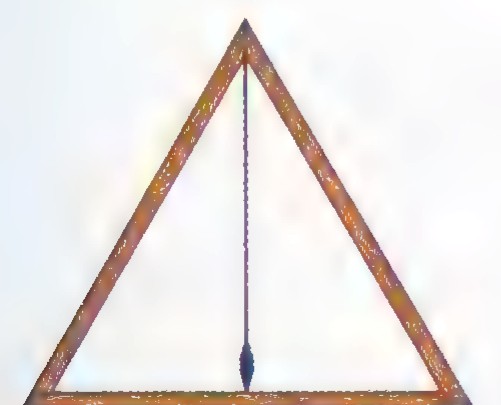
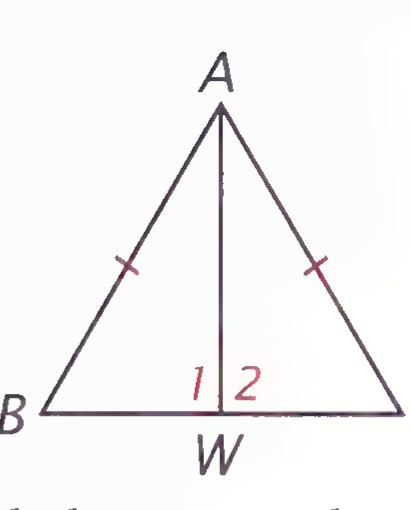
If the weight hangs over the midpoint of BC,
- why is △ABW ≅ △ACW?
- why is ∠1 = ∠2?
- In what other way are ∠1 and ∠2 related?
- Why is AW ⊥ BC?
The weight causes AW to always be vertical.
- What can therefore be concluded about BC?
Suppose instead that the weight line bisects ∠BAC.
- If this is the case, is it still true that △ABW ≅ △ACW? Explain why or why not.
Equal Parts. The two triangles below have been accurately drawn and their equal parts have been marked.
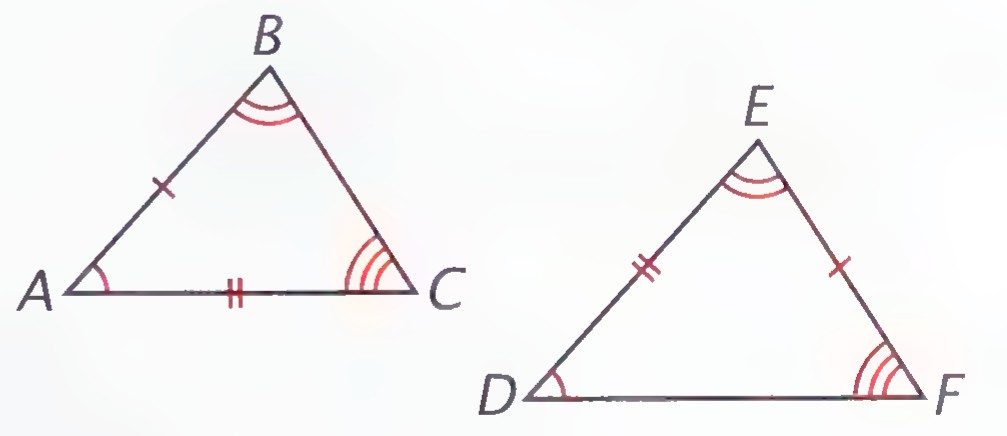
- Are the triangles congruent? Explain why or why not.
- How many pairs of equal parts do they have?
* Project Physics (Holt, Rinehart and Winston, 1981).
p. 166
Are two triangles necessarily congruent if they have
- three pairs of equal parts?
- four pairs of equal parts?
- five pairs of equal parts?
- six pairs of equal parts? Explain.
Angle Bisection. In Chapter 1, you learned how to bisect line segments and angles. We can use congruent triangles to understand why these constructions work.
- Use your protractor to draw an angle of 50°. Use your straightedge and compass to bisect the angle. Label your drawing as shown in the figure below. Draw AD and BD.
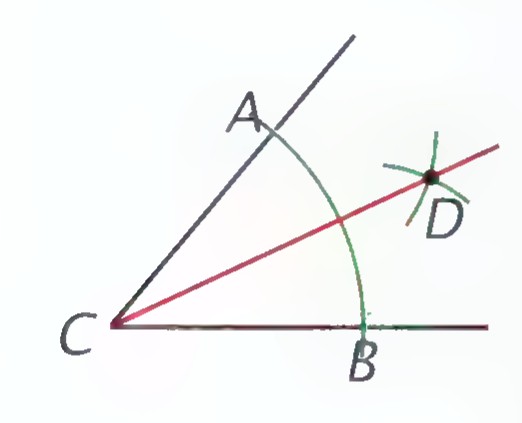
- Which line segments in your drawing are equal by construction?
- Why is CD = CD?
- Why is △ACD ≅ △BCD?
- Why is ∠ACD = ∠BCD?
Segment Bisection. The method for bisecting a line segment can be understood in a similar, but slightly longer, way.
- Use your ruler to draw a line segment 6 cm long. Use your straightedge and compass to bisect it. Label your drawing as shown in the figure below.
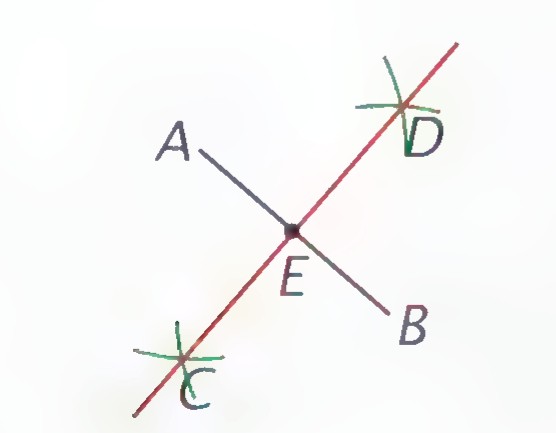
Draw AD, BD, AC, and BC.
- Which line segments in your drawing are equal because of the way that you constructed them?
- Why is △ACD ≅ △BCD?
- Why is ∠ACD = ∠BCD?
- Why is △ACE ≅ △BCE?
- Why is AE = BE?
Set II
Linkage Problem 1. The figure below shows a linkage made of two pairs of equal rods (AB = CD and AD = CB). The rods can pivot about their ends, and so the figure can change its shape.
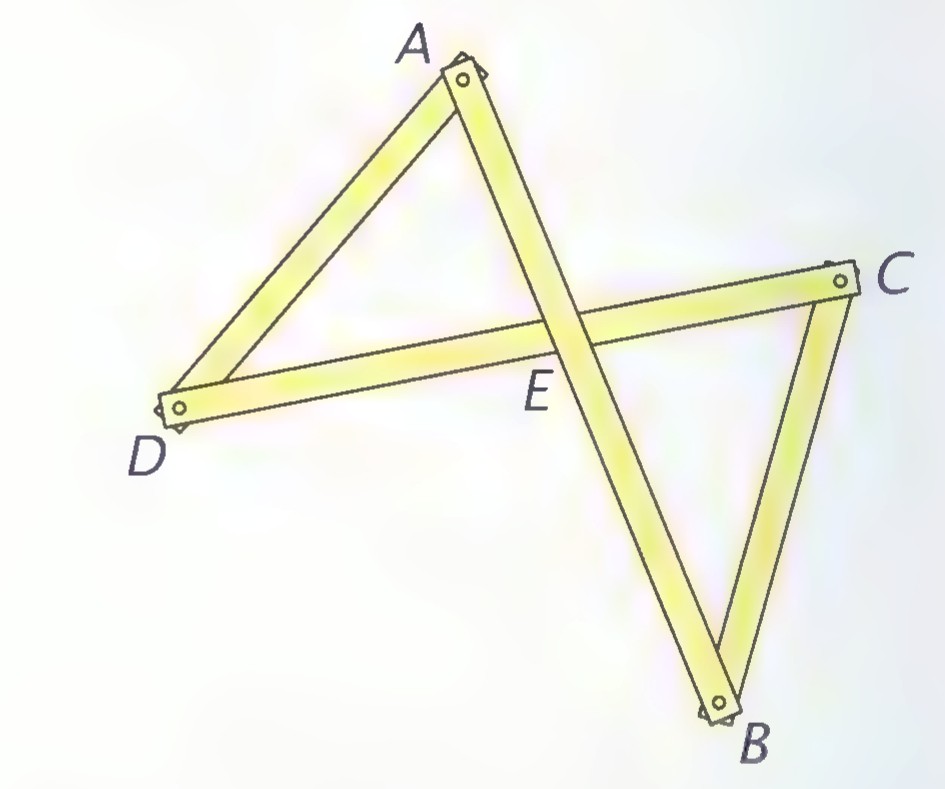
- Draw the figure by using line segments to represent the rods as shown below. Use tick marks to show AD = CB and draw AC.
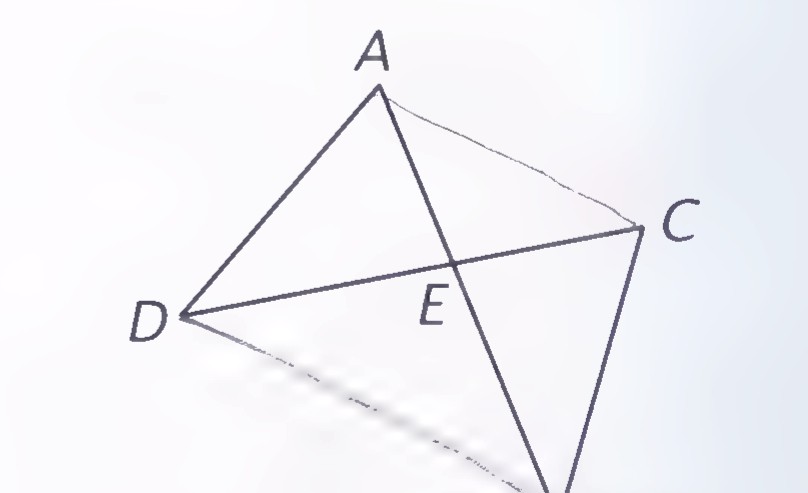
- What seems to be true about △ADC and △CBA?
p. 167
Suppose the linkage were adjusted to a slightly different shape.
Do you think your observation about △ADC and △CBA would still be true? Explain why or why not.
Can anything be concluded about ∠ADC and ∠CBA? Explain.
Do AB and CD appear to bisect each other? Explain.
Can anything be concluded about ∠AEC and ∠DEB? Explain.
(continued) Draw DB.
What can you conclude about
- △DAB and △BCD?
- ∠DAB and ∠BCD?
- As the linkage is slightly changed, what is always true about △AED and △CEB? Explain.
- Can anything be concluded about △AEC and △DEB? Explain.
Linkage Problem 2. The following figure shows another linkage.* In it, OA = OB and AD = DB = BC = CA.
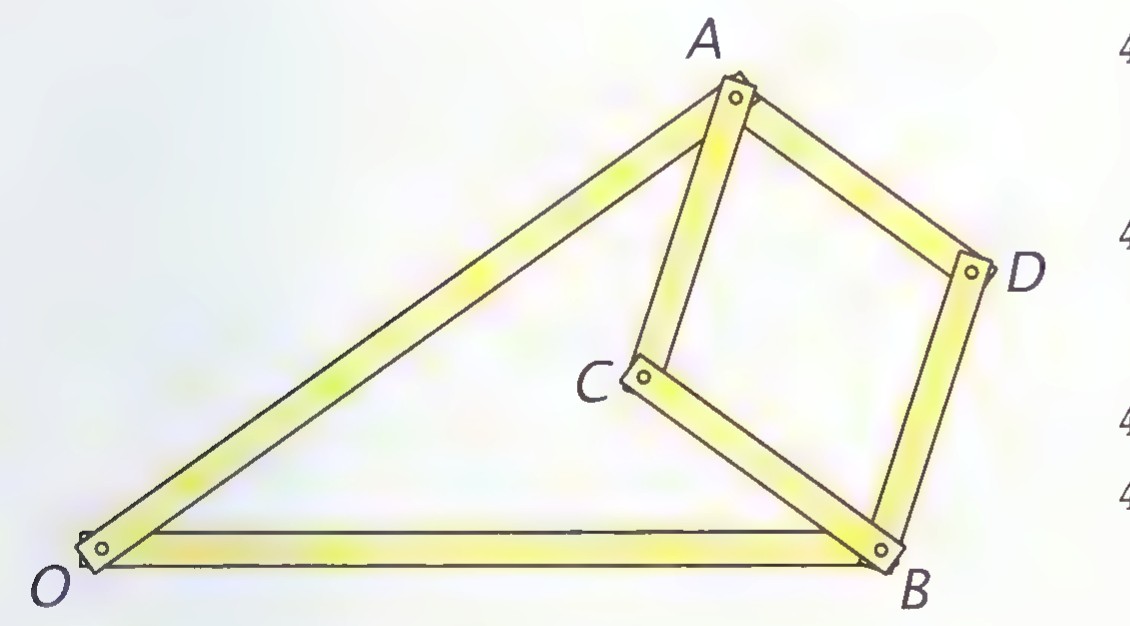
Draw the figure, by using line segments to represent the rods, and mark the equal parts on it.
What seems to be true about points O, C, and D?
(continued) Draw OC.
No matter what shape the linkage is adjusted to, △AOC is always congruent to △BOC. Why?
Why are ∠AOC and ∠BOC always equal?
What relation does line OC have to ∠AOB?
(continued) Draw OD.
What relation does line OD have to ∠AOB? Explain.
Why must lines OC and OD be the same line?
What does this prove about points O, C, and D?
Grid Exercise. On graph paper, draw a pair of axes extending 10 units in each direction from the origin.
Plot the following points and connect them to form △ABC: A(−2, 4), B(7, 7), C(5, −2).
What kind of triangle do you think △ABC is?
Find the lengths of its sides.
Do these lengths agree with your answer to exercise 45? If not, what kind of triangle is △ABC?
(continued) Plot the following points and connect them to form △DEF: D(−9, 0), E(0, −2), F(−6, −9).
Find the lengths of its sides.
What can you conclude about △ABC and △DEF? Why?
Which angle(s) in your drawing are equal to
- ∠A?
- ∠E?
* Geometry and the Imagination, by David Hilbert and Stefan Cohn-Vossen (AMS-Chelsea, 1999).
p. 168
Set III
Bracing the Square. This puzzle once appeared in the “Mathematical Games” column of Scientific American magazine.*
Suppose a square is made of four rods, hinged at their ends. How many more rods of the same length and also hinged at their ends are needed to make the square rigid?
The figure below shows a solution with 23 rods that was discovered by a number of readers of the magazine. As long as the rods lie flat in a plane, no arrangement with fewer than 23 rods will work.
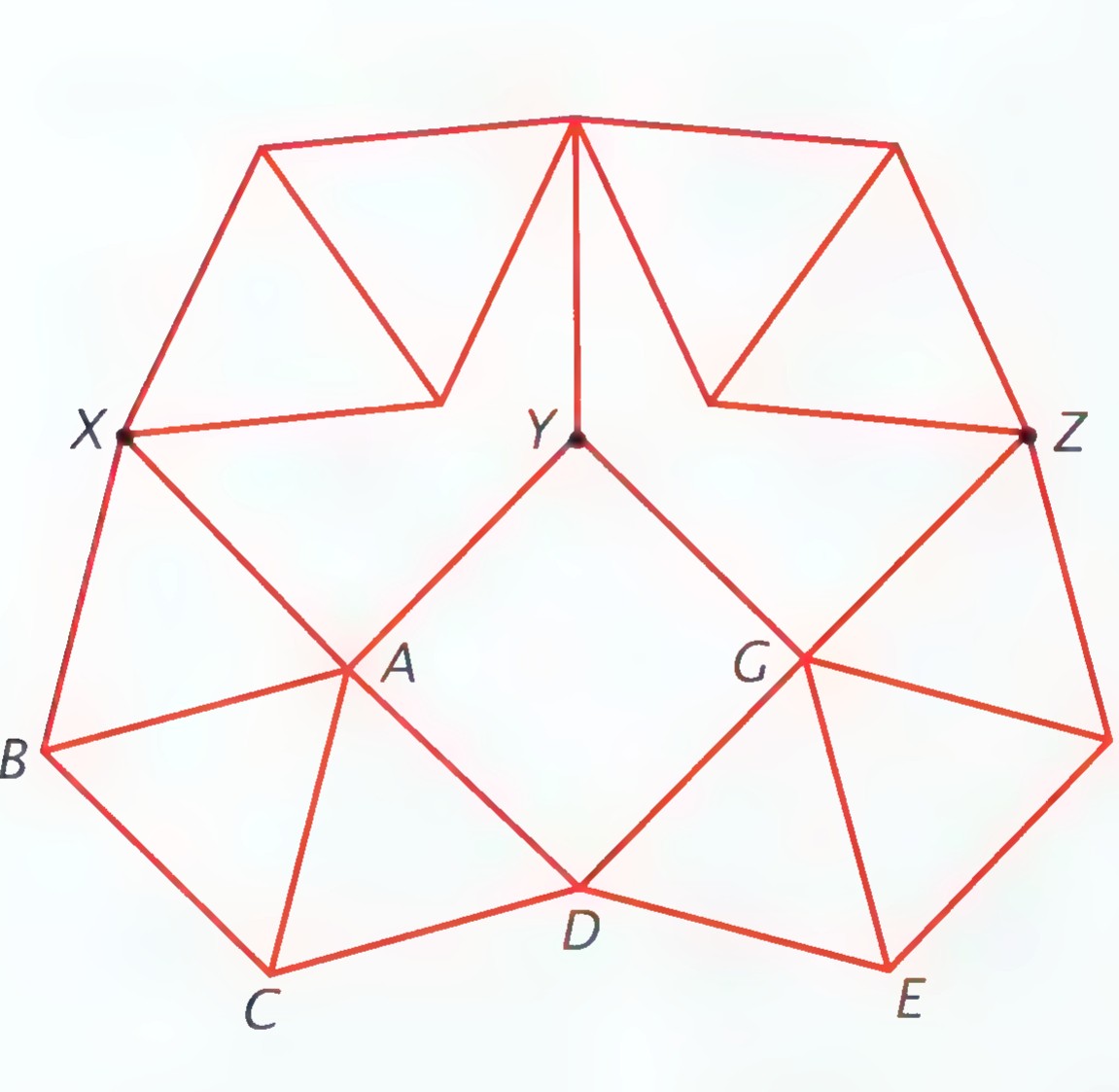
- Trace the figure on your paper and use the facts that the sum of the angles of a triangle is 180° and that each angle of a square is 90° to write down as many of the angle measures in the figure as you can.
The fact that points X, Y, and Z are collinear makes the structure rigid.
- Draw segments XY and YZ and explain, by using the angles at Y, why X, Y, and Z must be collinear.
* Martin Gardner’s Sixth Book of Mathematical Games from Scientific American, by Martin Gardner (W. H. Freeman and Company, 1971).
p. 169
© 1979 United Features Syndicate, Inc.
Lesson 7: Constructions
Vitruvius, a Roman architect of the time of Julius Caesar, wrote in his book On Architecture:
Let the architect be educated, skillful with the pencil, instructed in geometry. . . Geometry is of much assistance in architecture, and in particular it teaches us the use of the rule and compass.
Euclid established the tools used in making geometric constructions: the pencil for marking points, the “rule” (straightedge) for drawing lines, and the compass for drawing circles. You have learned to use these tools in two constructions:
Construction 1. To bisect a line segment.
Construction 2. To bisect an angle.
You learned in Lesson 6 that both constructions are based on the SSS theorem. In this lesson, we will see how the straightedge and compass can be used to copy simple figures.
The word “compass” (originally “compasses”) comes from the Latin word compassare, meaning “to measure off by steps.” For example, if we have a line segment of length “1 unit,” we can use the compass to measure off steps on a line, each 1 unit long.
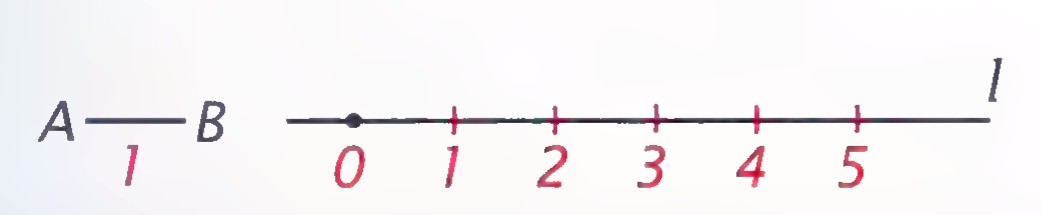
This example illustrates the basic construction of copying a line segment.
p. 170
Construction 3
To copy a line segment.

Let AB be the given line segment. Set the radius of the compass to the length of AB by putting the metal point on A and the pencil point on B. Draw a line (l) and mark a point C on it. With C as center, draw an arc of radius AB that intersects the line (D in the figure at the right above): CD = AB.
Even though we may not know the measure of an angle, we can use a straightedge and compass to copy it.
Construction 4
To copy an angle.

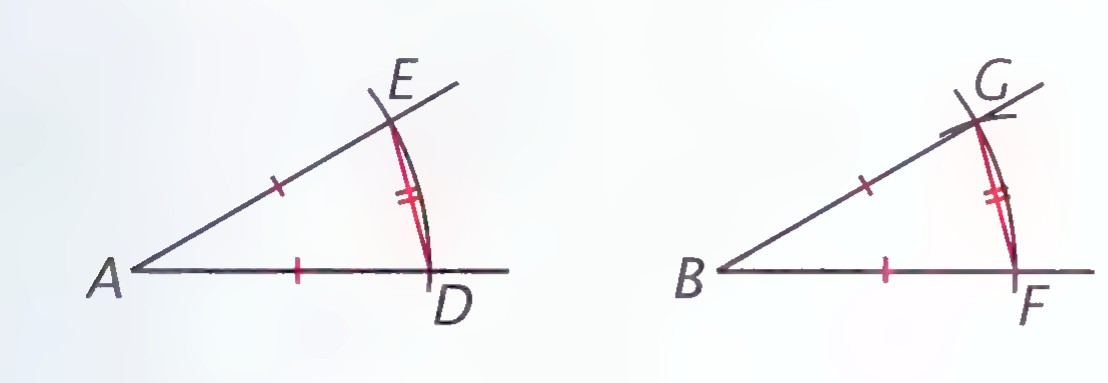
Let ∠A be the angle to be copied. Draw a ray BC as one side of the angle to be drawn. With point A as center, draw an arc that intersects the sides of ∠A (points D and E in the figure at the left below). With point B as center, draw an arc with the same radius as shown in the figure at the right below. This arc intersects BC at point F. We drew it above BC, and that is where the copied angle will be.
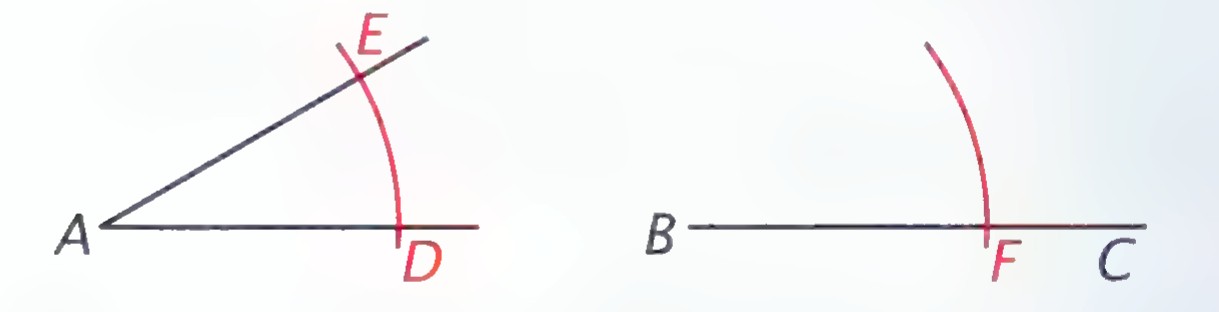
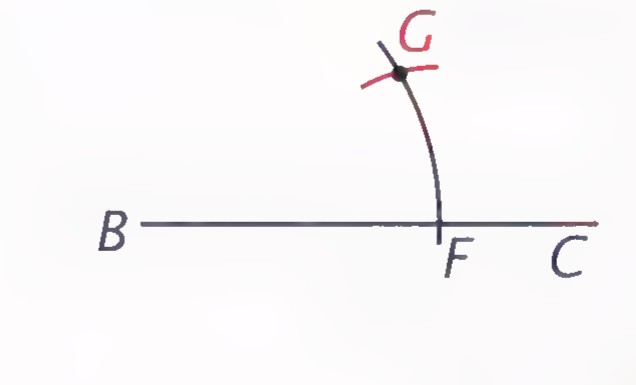
Go back to ∠A and set the radius of the compass to the distance between points D and E. With F as center, draw an arc having this radius so that it intersects the arc through F giving point G.
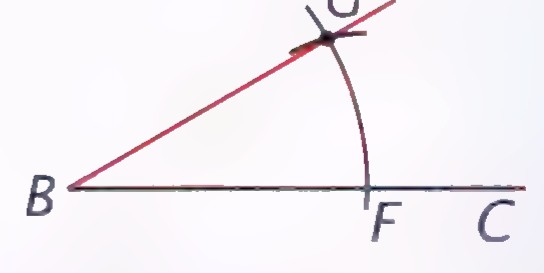
Draw BG to finish the construction: ∠A = ∠B.
p. 171
Drawing DE and FG shows why this works. △ADE ≅ △BFG by SSS, and so ∠A = ∠B because corresponding parts of congruent triangles are equal.
Because of SSS congruence, it is just as easy to copy an entire triangle.
Construction 5
To copy a triangle.
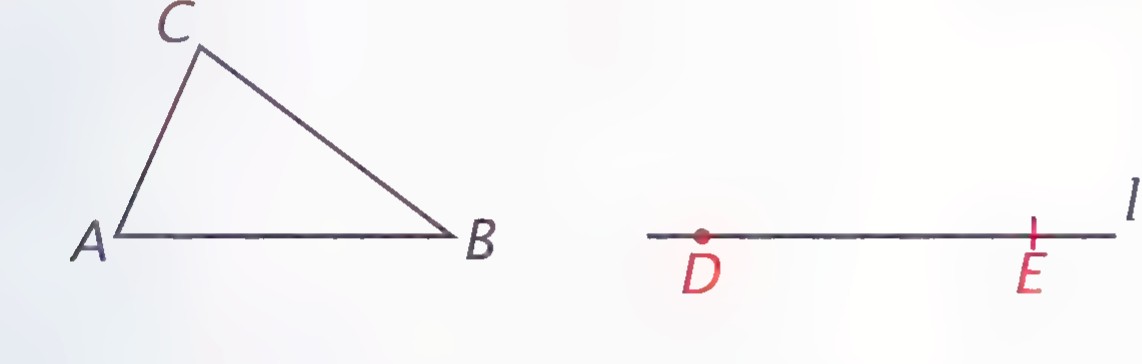
Let △ABC be the triangle to be copied. Draw a line (l) and copy AB on it (DE in the figure at the right above).
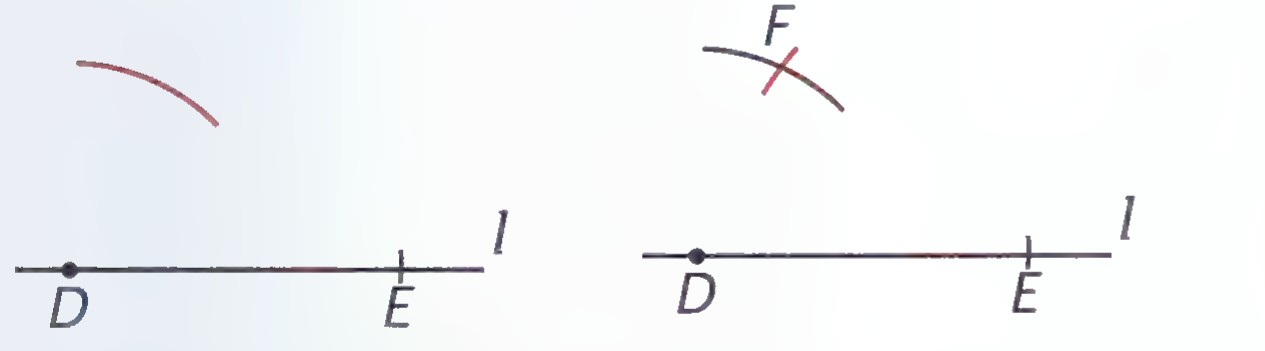
Return to the triangle and set the radius of the compass to the length of AC. With D as center, draw an arc having this radius, as shown in the figure at the left below.
Reset the radius of the compass to the length of BC. With E as center, draw an arc having this radius so that it intersects the first arc at point F, as shown in the middle figure below.
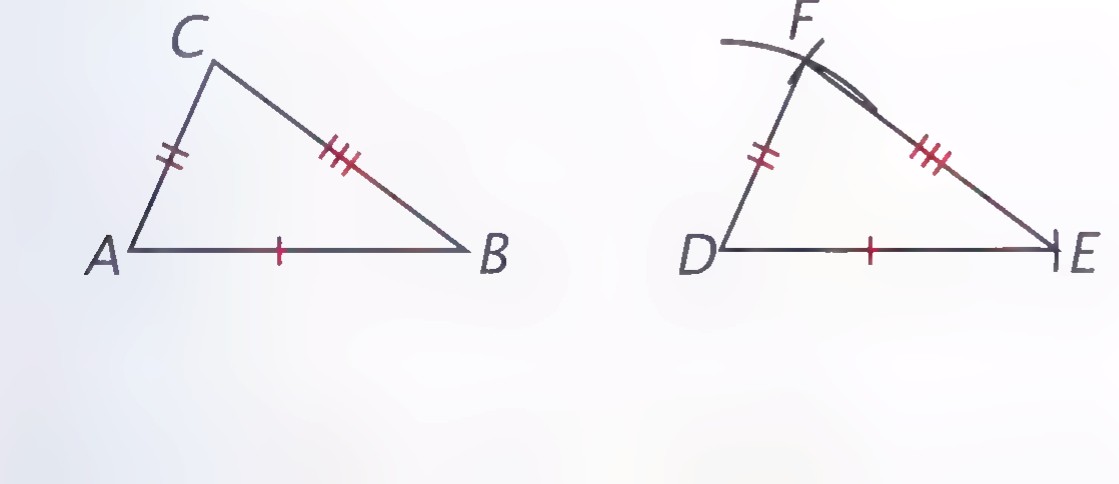
Draw DF and EF to finish the construction, as shown in the figure at the right below.
To see why △ABC ≅ △DEF, mark the equal lengths on the sides of the two triangles. They are congruent by SSS.
p. 172
Exercises
Set I
This old engraving shows a geometer standing beside a globe of the earth.
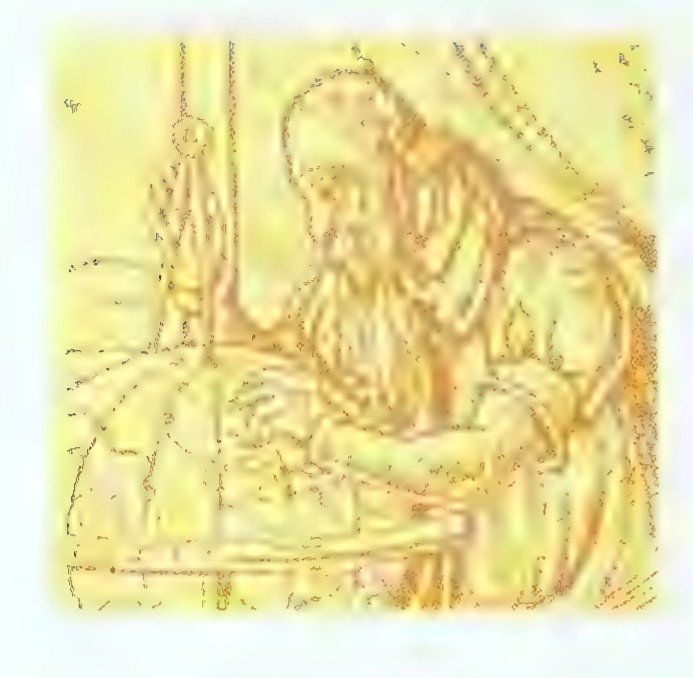
- What tool is he holding?
- What could it be used to compare on the globe?
- Can a circle be drawn on a globe?
- Can a line be drawn on a globe?
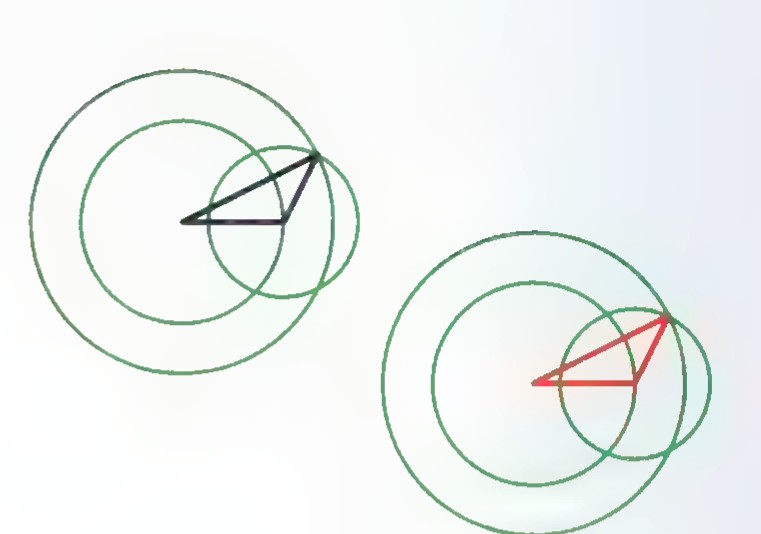
In making constructions, it is customary to draw arcs of circles rather than the entire circles. The following figures show why! Tell what is being constructed in each figure.
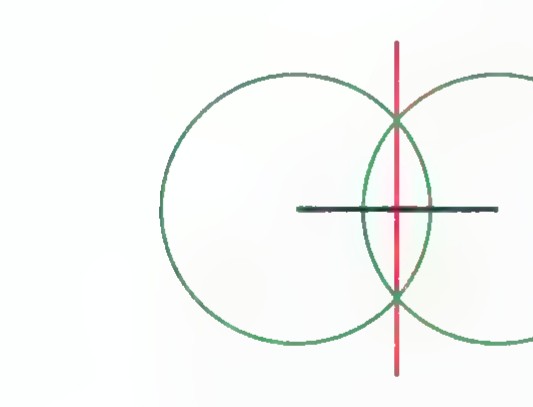
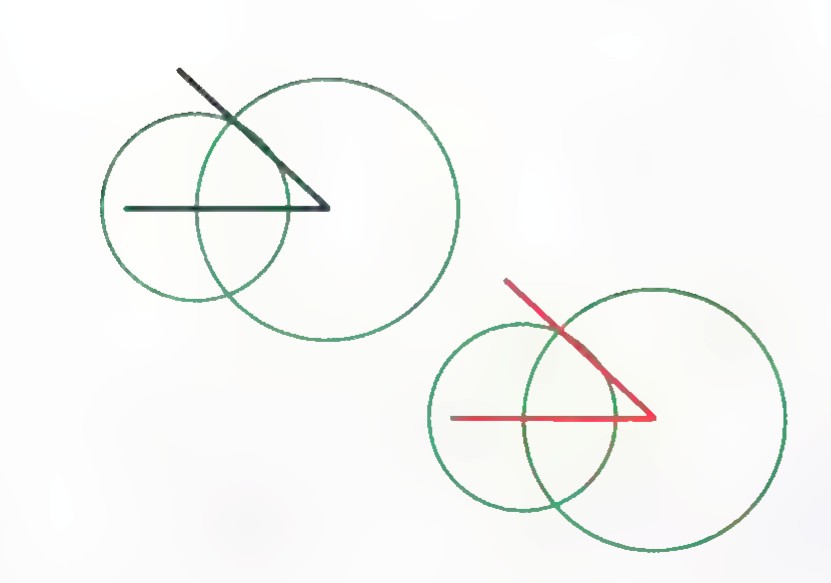
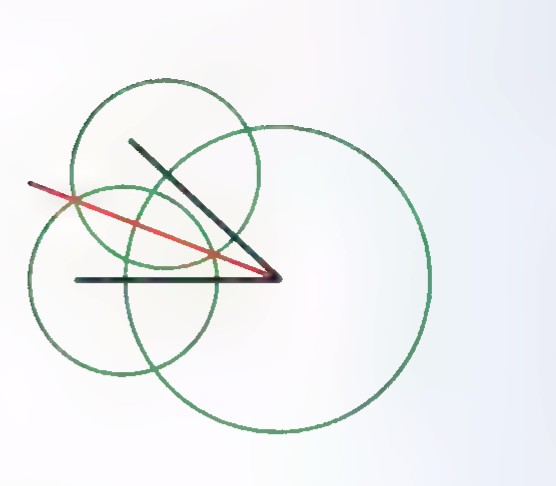
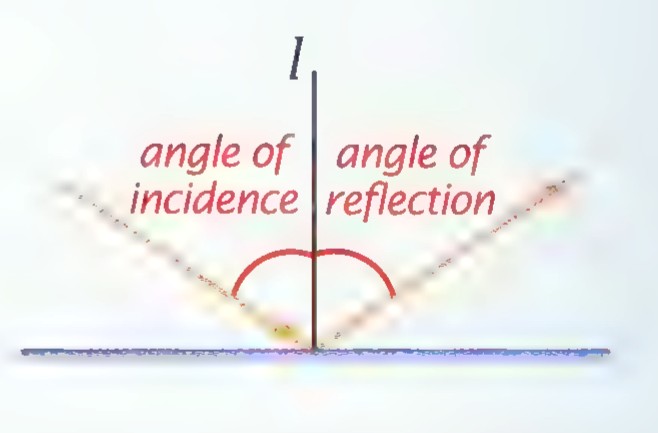
Light Reflection. Euclid’s book on light, Optics, gives the following rule for light reflected from a mirror: The angle of incidence is equal to the angle of reflection. Both angles are measured from a perpendicular line l, as shown in the figure below.
AB represents the mirror and CP the incident ray of light in the figure below. We will use Euclid’s rule to find the reflected ray.
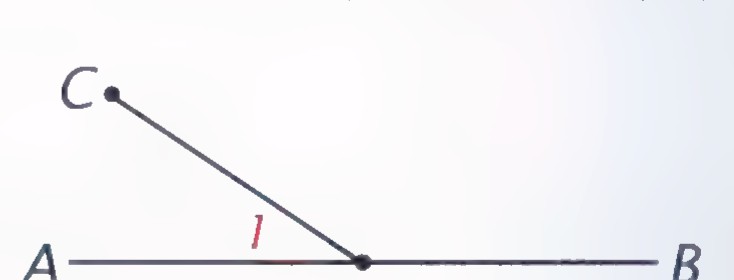
- Draw a figure similar to the one above. Use your straightedge and compass to bisect ∠APB. Label the bisector line l. Write the number 2 inside the angle that line l makes with PC.
p. 173
What relation does line l have to line AB?
What relation does ∠2 have to ∠1?
(continued) On your drawing, use your straightedge and compass to draw the direction of the light ray after it leaves point P. Name another point on this line D.
What construction did you use to find ray PD?
Bridge Girder. This design, a Warren girder, is frequently used in bridge construction.* It is based on equilateral triangles.
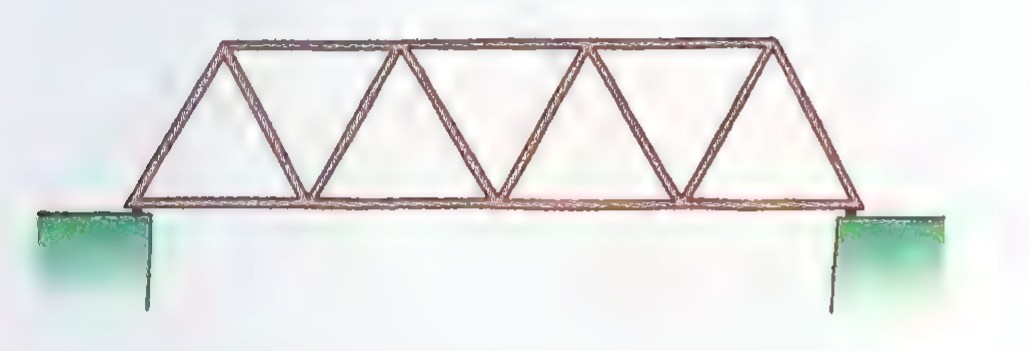
- Use your straightedge and compass to construct such a row of triangles.
- Why are they all congruent?
- Why are all of the angles in the triangles equal? (There are two reasons.)
- How does the line containing the tops of the triangles appear to be related to the line containing their bases?
Equidistant Points. A cartoon in the New Yorker once showed a family on vacation in a car passing a road sign saying “This spot is exactly equidistant between Disneyland and Disney World.”
Choose two points on your paper several inches apart and label them X and Y. Draw line segment XY and use your straightedge and compass to construct its midpoint. Label the midpoint A. Point A is equidistant from X and Y.
What do you think “equidistant” means?
How many midpoints does a line segment have?
(continued) On your drawing, use your compass to find several more points, each of which is equidistant from X and Y.
How many points do you think can be found that are equidistant from the endpoints of a line segment?
Where do all of these points appear to lie?
Car Jack. The car jack in the picture below is a linkage of four bars of equal length. As a screw through A and B is turned, the distance between A and B changes.†
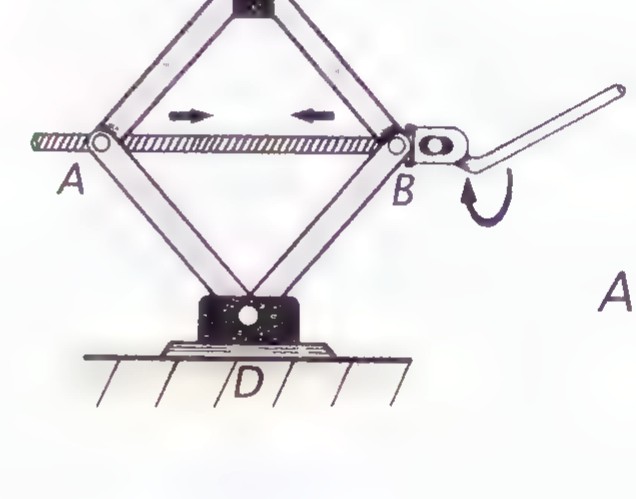
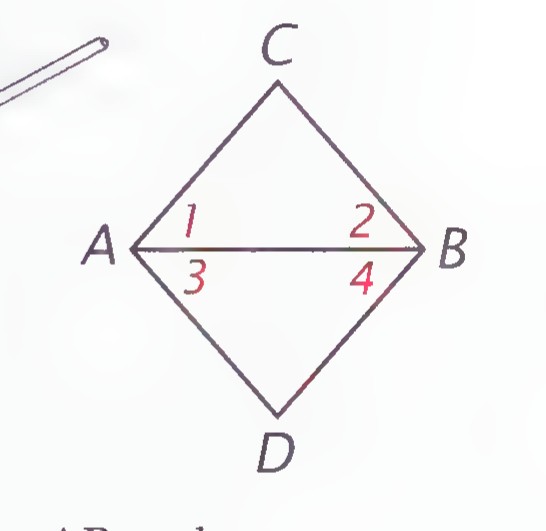
- Draw a line segment AB and construct two triangles ACB and ADB so that AC = CB = AD = DB as shown in the figure at the right above. Identify the equal lengths with tick marks.
- What kind of triangles are △ACB and △ADB?
- Why is ∠1 = ∠2 and ∠3 = ∠4?
- Why is ∠1 + ∠3 = ∠2 + ∠4?
- Why is ∠CAD = ∠CBD?
- Why must △ACB and △ADB be congruent?
- Why is ∠1 = ∠3 and ∠2 = ∠4?
- How is AB related to ∠CAD and ∠CBD?
* Structures, or Why Things Don’t Fall Down, by J. E. Gordon (Plenum, 1978).
† Mathematics Meets Technology, by Brian Bolt (Cambridge University Press, 1991).
p. 174
Set II
A Construction with an Unexpected Result.
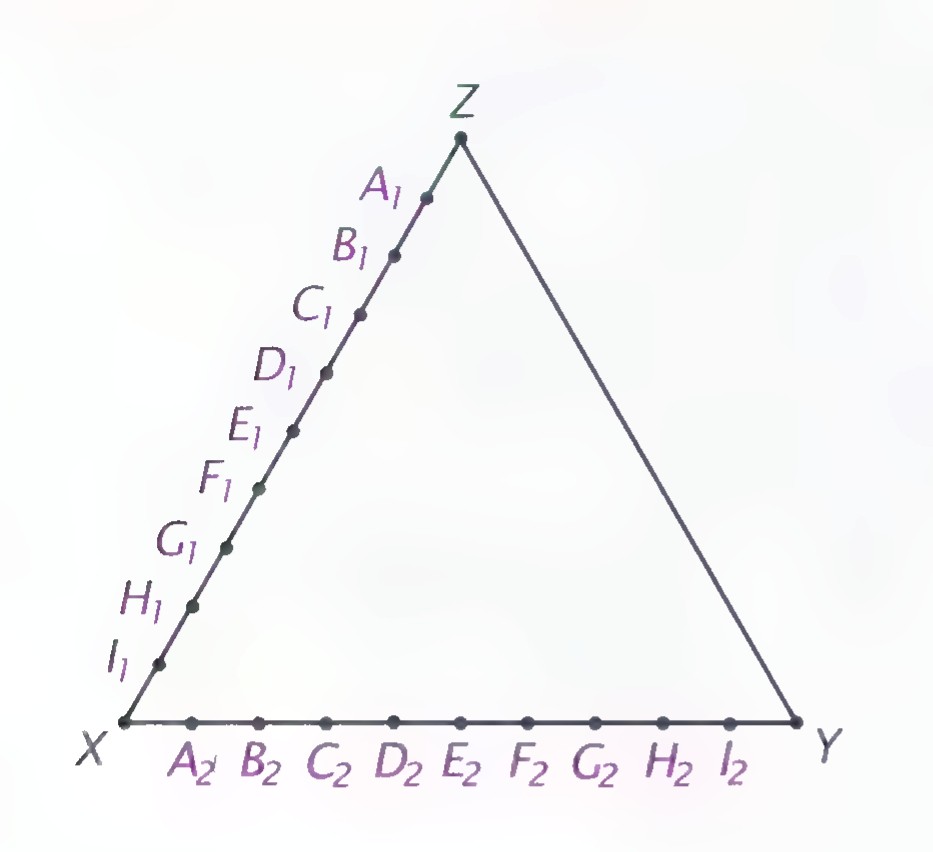
Use your ruler to draw a horizontal line segment 5 inches long in the center of a sheet of paper. Label it XY. Construct equilateral triangle XYZ having XY as its base. Use your ruler to mark points on XY 0.5 inch apart; do the same on XZ. Label the points as shown in the figure above.
Now use your straightedge to draw line segments between the points labeled with the same letter (that is, A₁A₂, B₁B₂, etc.)
Something should now appear to be in the figure that isn’t really there.
- What is it?
The finished figure contains many pairs of congruent triangles.
- To which triangle is △XA₁A₂ congruent?
- How do you know that these triangles are congruent?
Stair Design. In his book On Architecture, Vitruvius suggested using steps that are 3 units high, are 4 units wide, and cover a slant distance of 5 units.
- Use your straightedge to draw a line at the top of a sheet of paper and your compass to mark off 5 equal units as shown in the figure below.
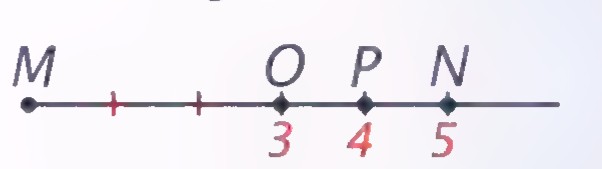
Label your figure as shown and copy the lengths 3, 4, and 5 as needed to do
the following construction.

Starting with a side 4 units long, construct near the upper left of your
paper a triangle whose other sides are 3 and 5 units long (△ABC as shown in
the figure below).

Extend line AC and construct △CDE and △EFG congruent to △ABC as shown in the
figure.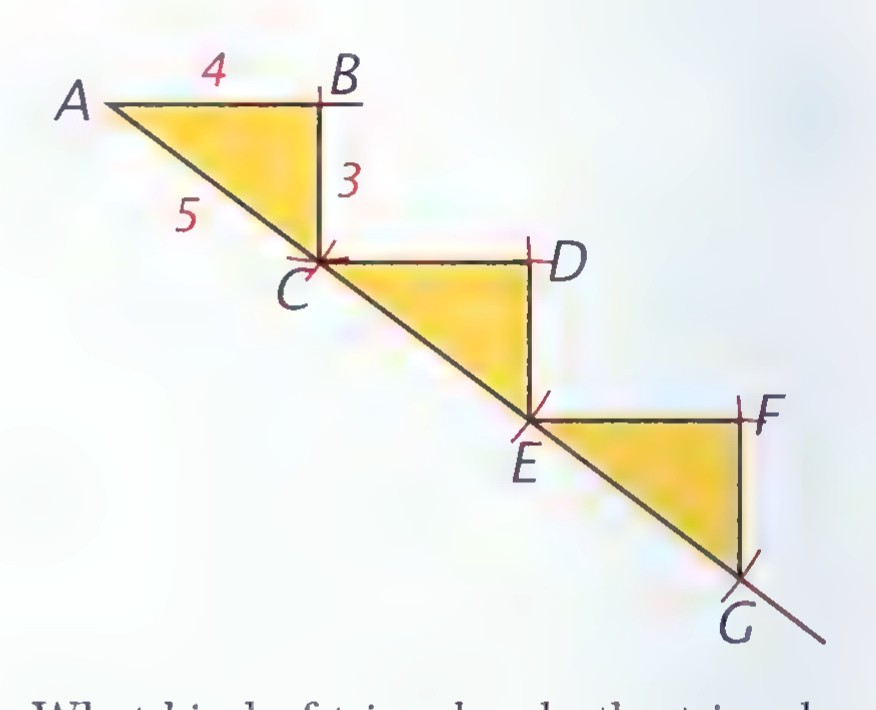
- What kind of triangles do the triangles appear to be?
- How do you know that they are congruent?
Suppose a staircase of 16 steps having this design goes up 10 feet between floors.
- Find the height and width of each step in inches.
- What horizontal distance will the stairs cover?
Guitar Frets. In 1743, a Swedish craftsman without mathematical training developed an accurate construction for locating the frets on a guitar.*
* Another Fine Math You’ve Got Me Into . . . , by Ian Stewart (W. H. Freeman and Company, 1992).
p. 175
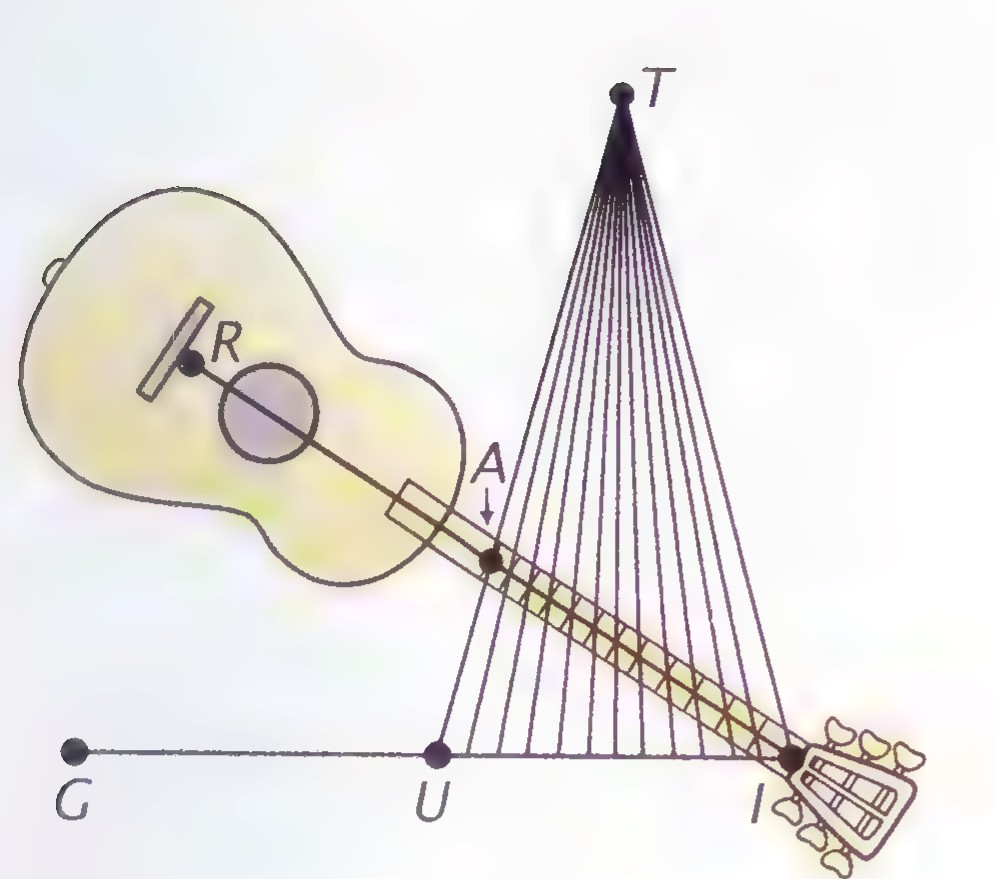
Although the construction requires just a straightedge and compass, we will start with a ruler to speed up the work. Refer to the figure above and the following directions to do the construction.
First, use your ruler to draw a line segment GI 12 cm long and label its midpoint U. Divide UI into 12 equal segments, each 0.5 cm long.
Put the ruler aside and use your straightedge and compass to do the following.
Using UI as one side, construct △TUI so that TU = TI = GI. Draw line segments between T and the equally spaced points along UI. Use your scale on UI to set your compass at 3.5 cm. Find A on UT so that UA = 3.5 cm. Draw line segment IA and extend it to R so that AR = IA. If IR is the length of the guitar string, the points of intersection between I and A mark the positions of the 11 frets between I and A.
What do you notice about the spacing of the frets along the fingerboard?
Set III
The drawing below is from a book by Miranda Lundy, a designer and artist who lives in Cornwall, England. She titles it “Twelve Around One.”*
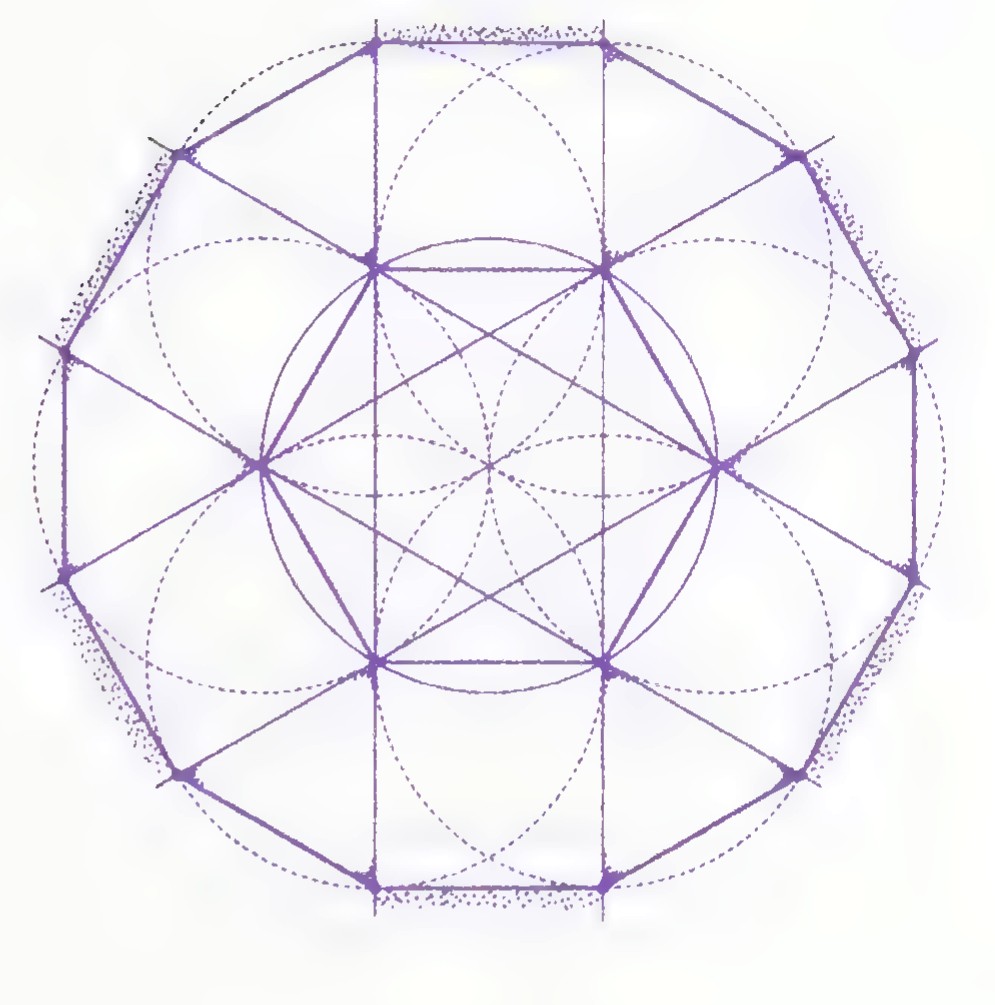
The arcs suggest how the drawing can be constructed with a straightedge and compass.
- Use these tools to try to make as accurate an enlargement of the drawing as you can.
How many of each of the following polygons appear to be in the drawing?
- Squares.
- Equilateral triangles.
- Isosceles triangles that are not equilateral.
* Sacred Geometry, by Miranda Lundy (Walker and Company, 2001).
p. 176
Summary and Review
Basic Ideas
| Congruent polygons | 140 |
| Congruent triangles | 140 |
| Coordinate systems | 132–133 |
| Distance formula | 134 |
| Included and opposite sides and angles | 147 |
| Polygon | 139 |
| Quadrants | 133 |
| Triangles: scalene, isosceles, equilateral | 157 |
| Triangles: obtuse, right, acute, equiangular | 158 |
Postulates
- The ASA Postulate. If two angles and the included side of one triangle are equal to two angles and the included side of another triangle, the triangles are congruent. 147
- The SAS Postulate. If two sides and the included angle of one triangle are equal to two sides and the included angle of another triangle, the triangles are congruent. 147
Theorems
Corollary to the definition of congruent triangles. Two triangles congruent to a third triangle are congruent to each other. 141
- If two sides of a triangle are equal, the angles opposite them are equal. 158
Corollary. An equilateral triangle is equiangular. 159
- If two angles of a triangle are equal, the sides opposite them are equal. 159
Corollary. An equiangular triangle is equilateral. 159
- The SSS Theorem. If the three sides of one triangle are equal to the three sides of another triangle, the triangles are congruent. 164
Constructions
- To bisect a line segment. 23
- To bisect an angle. 23
- To copy a line segment. 170
- To copy an angle. 170
- To copy a triangle. 171
Exercises
Set I
Polar-Bear Pattern. This polar-bear symbol was designed by Francois Brisse for the Northwest Territories of Canada.*
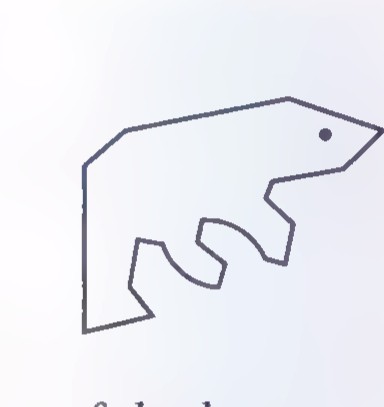
At first glance, the outline of the bear appears to be a polygon.
- Look carefully at the outline to tell why it is not.
It is reasonable to say that the bears in the figure below are congruent, even though they are not polygons.
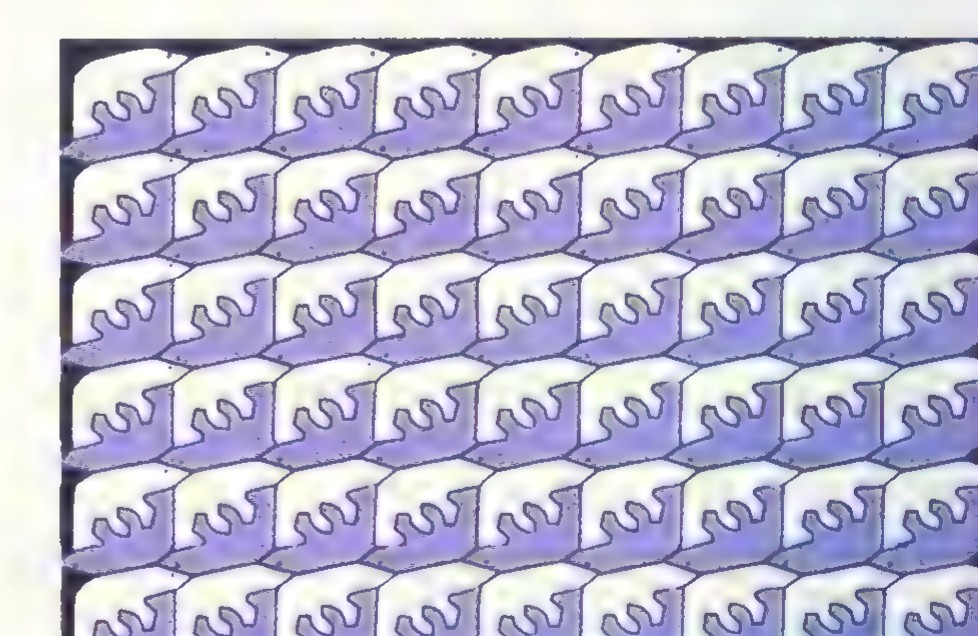
- Why?
* Canadian Mineralogist, vol. 19, 1981, as reported in Symmetry: A Unifying Concept, by Istvan Hargittai and Magdolna Hargittai (Shelter Publications, 1994).
p. 177
- What is unusual about the arrangement of the bears?
Turkish Geometry. The following figures appear in a Turkish geometry book.
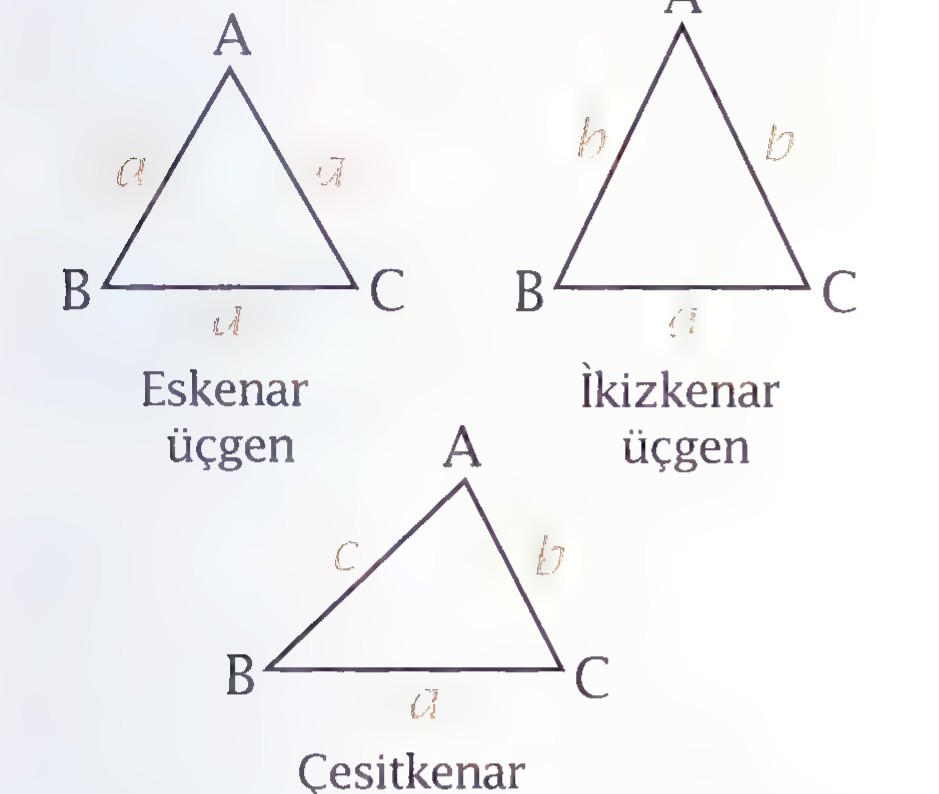
What do you know about the angles of
- an eşkenar üçgen?
- an ikizkenar üçgen, assuming that a ≠ b?
- a çeşitkenar üçgen?
From Euclid. Among the statements near the beginning of Euclid’s Elements are the following ones:
Things that are equal to the same thing are also equal to each other.
Things that coincide with one another are equal to each other.
A scalene triangle is that which has its three sides unequal.
If in a triangle two angles are equal, the sides that are opposite the equal angles will also be equal.
- Which one of these statements is a definition?
- Which statement is one of our theorems?
- What is the difference between a postulate and a theorem?
The first statement might be written in symbols as “If a = b and c = b, then a = c.”
- From which property of equality can we draw the same conclusion?
- In which statement does the word “equal” seem to mean “congruent”?
Angles of Repose. If a grainy material is poured to form a pile, the pile forms an angle with the horizontal called the “angle of repose.”
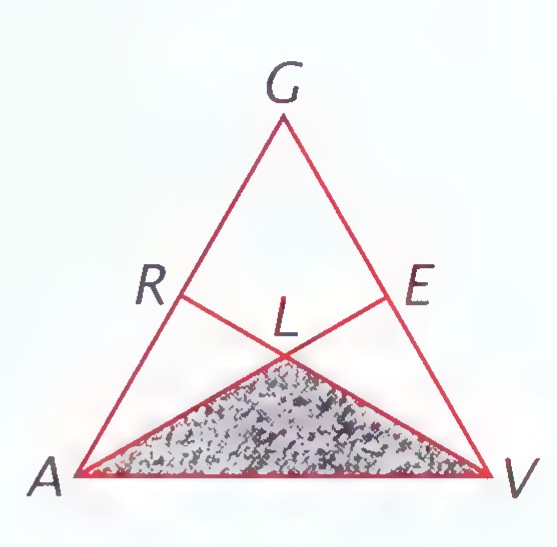
One way to construct this angle for round gravel is illustrated by the figure above, in which ∠LAV is the angle of repose.
- Use your straightedge and compass to construct the figure by first constructing equilateral △AVG and then bisecting ∠GAV and ∠GVA.
- Why is ∠GAV = ∠GVA?
- Why is ?
- Why is ∠LAV = ∠LVA?
- Why is LA = LV?
Find the measure of
∠G.
∠LAV.
∠ALV.
∠GRV.
How large is the angle of repose for round gravel?
The figure at the right illustrates the angle of repose for a pile of coal ashes: AS = SH and AS ⊥ SH.
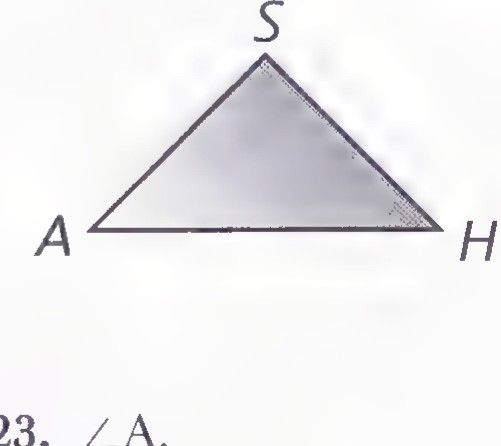
Find the measure of
∠S.
∠A.
Do you think the angles in this figure could be constructed with just a straightedge and compass? Explain why or why not.
p. 178
Congruence in 3-D. A tetrahedron is a polyhedron that has four triangular faces.
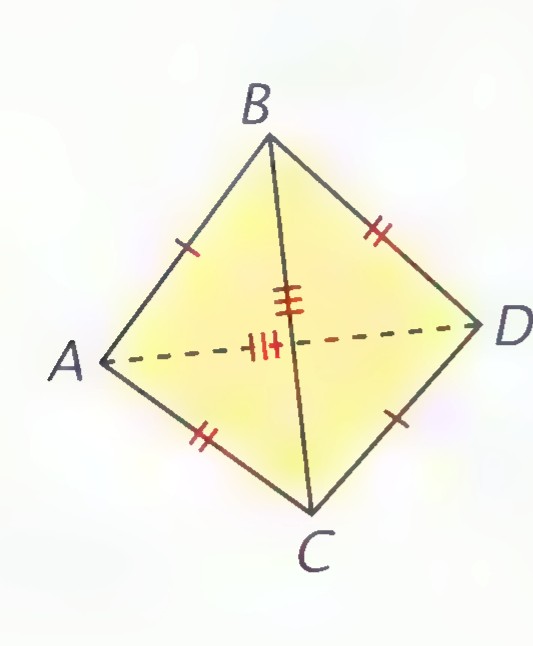
In the tetrahedron above, AB = CD, AC = BD, and AD = BC.
- Why are the four faces congruent?
- Why is ∠BAC = ∠BDC?
- What other angles in the polyhedron are equal to these two angles?
- Which angles are equal to ∠ABC?
Set II
SAT Problem. The following figure appeared in a problem on an SAT exam. Below it was a note stating that it is drawn inaccurately.
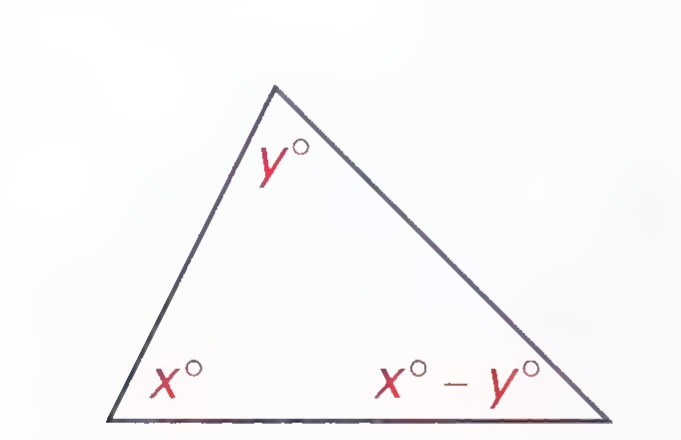
What is the value of x if
- y = 60?
- y = 75?
- y = 89?
- What is strange about this problem?
What must be the value of y for the triangle to be
- isosceles?
- equilateral?
Lines and Midpoints. The figure below shows four lines that intersect in six points.
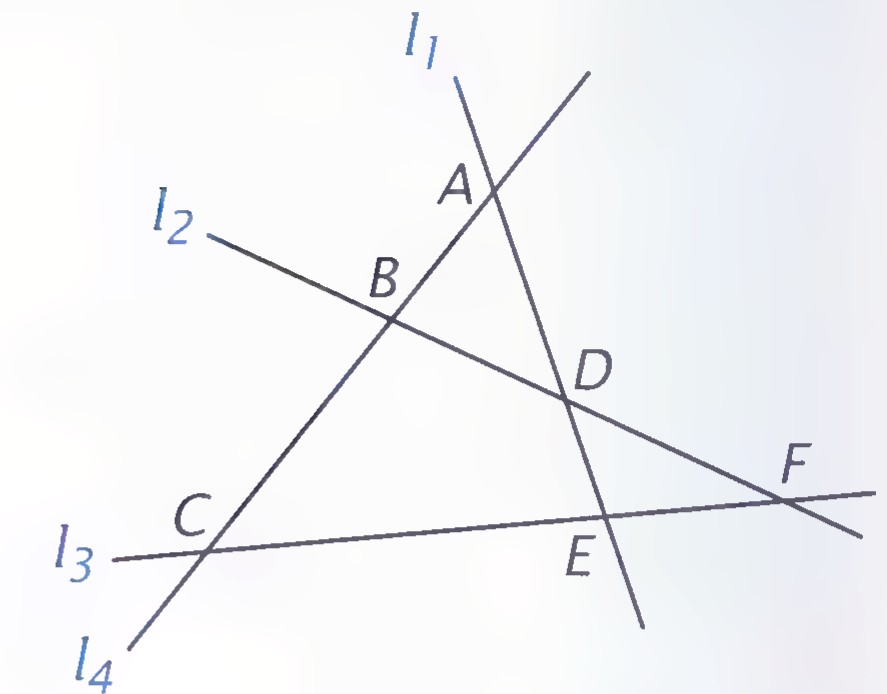
- Use your straightedge to draw a large figure showing four lines that intersect in a similar way. Draw the line segments AF, BE, and CD and then use your straightedge and compass to construct the midpoints of these three segments.
- What seems to be true about the three midpoints?
Ollie’s Mistake. Obtuse Ollie decided to hide a bag of silver dollars by sinking it in a lake. He took it out in a rowboat and cut a notch in the boat’s rim to mark the spot where the bag sank. When he went back to get the gold, Ollie discovered that, no matter where he went, the notch in the boat’s rim told him that he had found the spot!*
On graph paper, draw a pair of axes extending 10 units in each direction from the origin.
Suppose that, in looking for his money, Ollie took his boat first to A(0, 3) and then to B(−2, −1). Plot these two points.
How far is point B from point A?
*Based on a story in The Geometry Toolbox for Graphics and Modeling, by Gerald E. Farin and Dianne Hansford (A. K. Peters, 1998).
p. 179
Suppose points A and B are each actually 5 units from the location of Ollie’s money.
(continued) On your drawing, use your compass to draw two circles with radii of 5, one circle centered at A and the other at B.
How many points are 5 units from both points A and B?
Where is Ollie’s money if it is in
- the second quadrant?
- the fourth quadrant?
Suppose the boat started from a dock located at the point (3, 8) and that Ollie’s money is at the closer of the points in exercises 40 and 41.
- Where is the money?
Rigid Structures. These photographs of a rock in Sweden show ancient carvings of a sled or boat.*
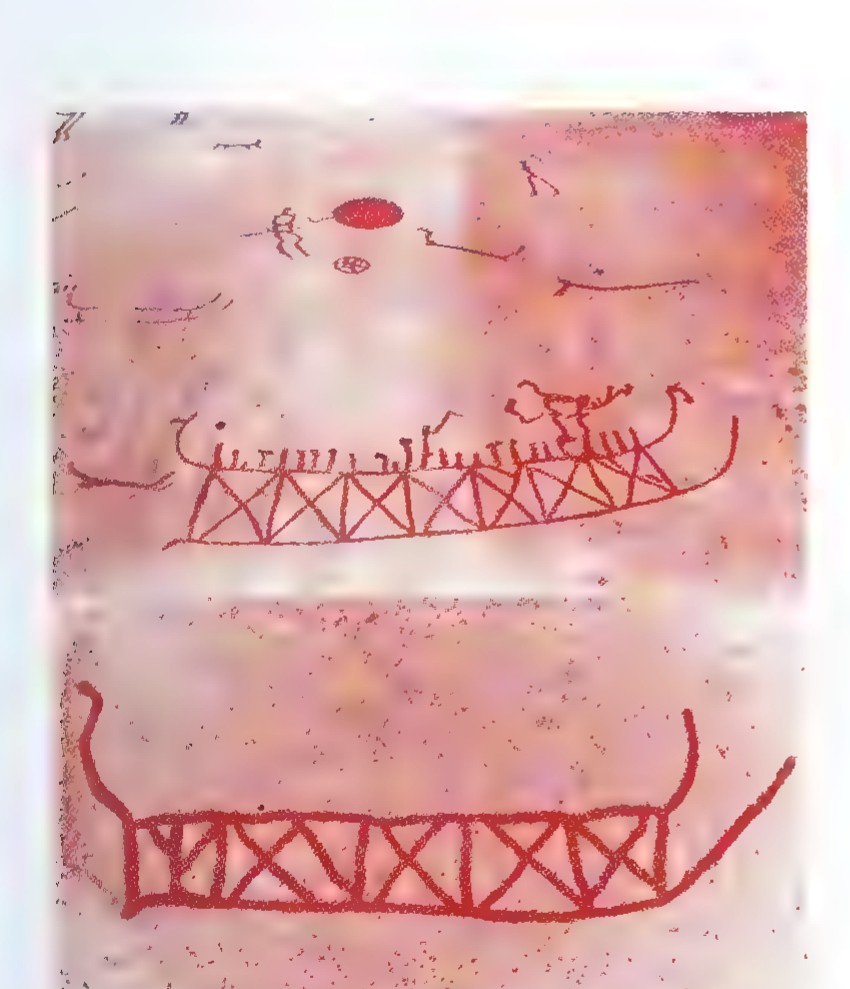
The Xs in the squares are braces added to make the structures rigid.
Although a square can be made rigid with two braces, one is sufficient because one brace is enough to form triangles.
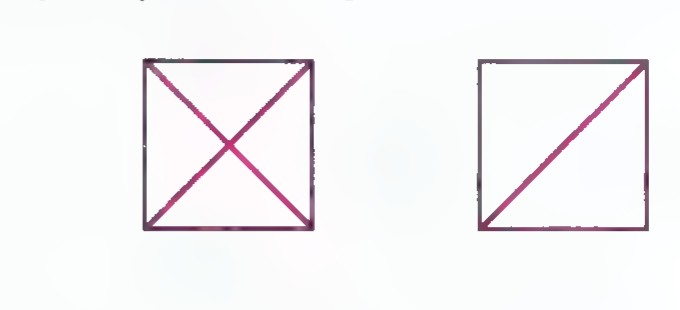
- Draw a pentagon and just enough braces to make it rigid.
Make the same type of drawing for
- a hexagon.
- an octagon.
How many braces are enough to make
- a decagon rigid?
- an n-gon rigid?
Pool Proof. In the figure below, a pool player wants to hit a ball at A so that it banks off the cushion at B and hits the ball at C. Point D is an imaginary point outside the table at which the player aims.
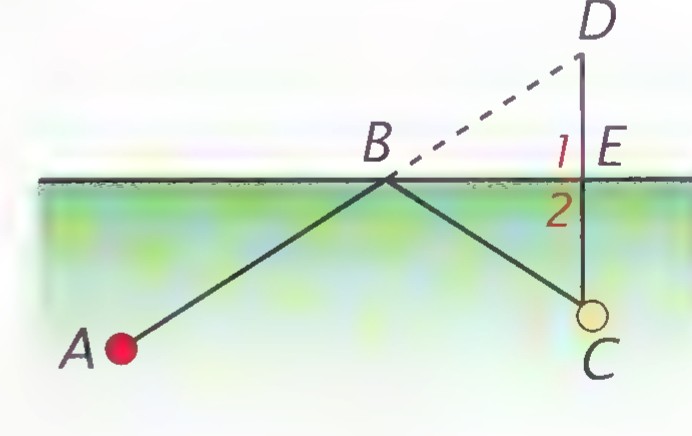
- Tell the reasons for the statements in the following proof about the path of the ball.
Given: A-B-D; DE = EC, and DC ⊥ l. Prove: AB + BC = AD.
Proof
| Statements | Reasons |
|---|---|
| 1. A-B-D. | Why? |
| 2. AB + BD = AD. | Why? |
| 3. DE = EC and DC ⊥ l. | Why? |
| 4. ∠1 and ∠2 are right angles. | Why? |
| 5. ∠1 = ∠2. | Why? |
| 6. BE = BE. | Why? |
| 7. △DBE ≅ △CBE. | Why? |
| 8. BD = BC. | Why? |
| 9. AB + BC = AD. | Why? |
* Cat’s Paws and Catapults: Mechanical Worlds of Nature and People, by Steven Vogel (Norton, 1998).
p. 180
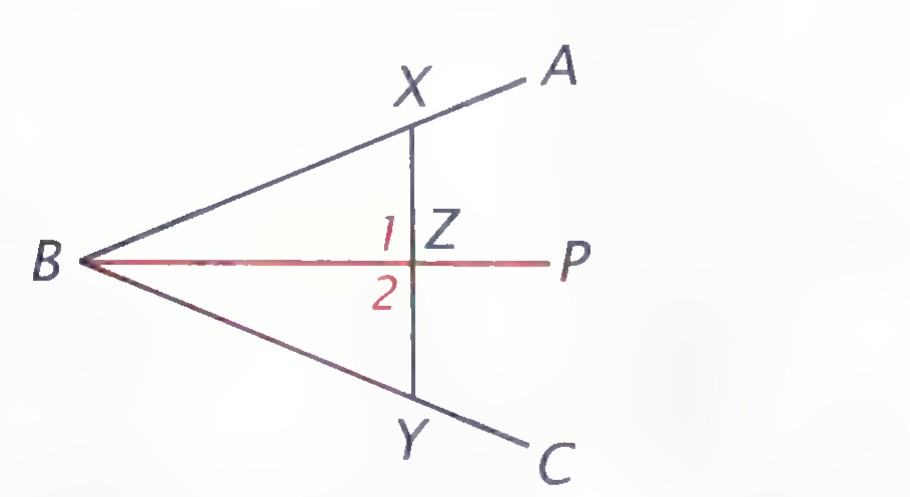
Masonic Tools. If asked which tool in this Masonic emblem could be used to bisect an angle, most people would probably choose the compass.
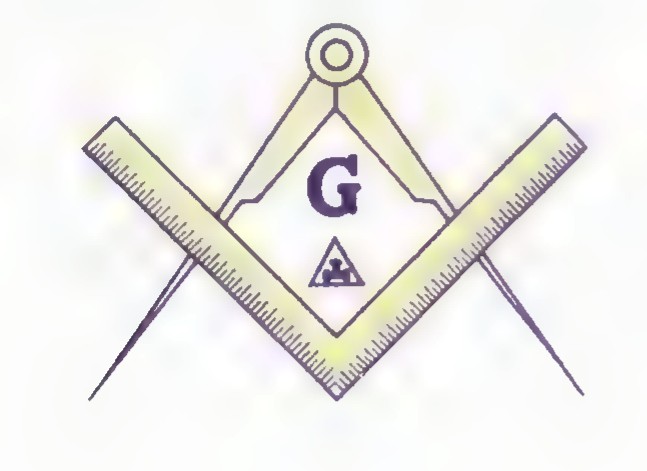
- Use the figure below to explain how the carpenter’s square could be used instead.
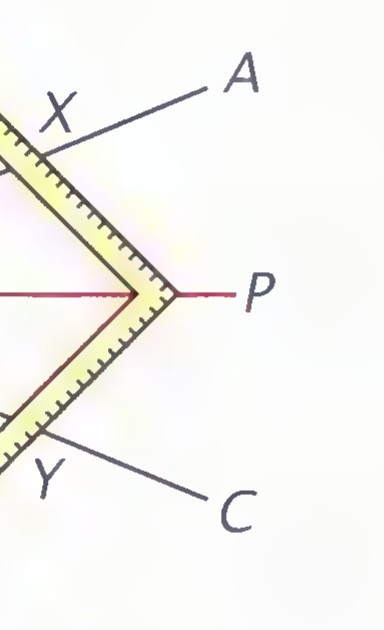
Suppose that, after the angle has been bisected, the carpenter’s square is taken away. If a line is drawn through X and Y, then it must be perpendicular to BP.
- Use the figure below to explain why.
Write complete proofs for the following. In each case, copy the figure and mark the given information on it. Also copy the “given” and “prove” before writing your statements and reasons.
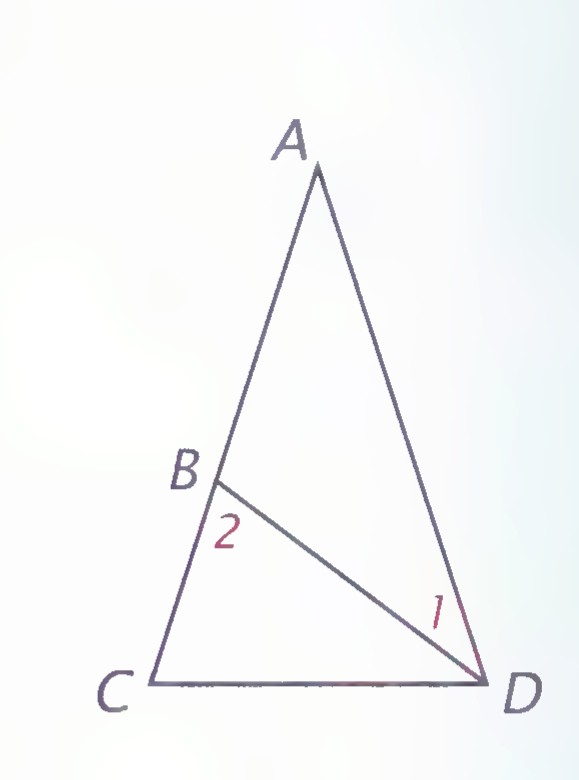
Given: ∠A = ∠1 and ∠2 = ∠C. Prove: AB = CD.
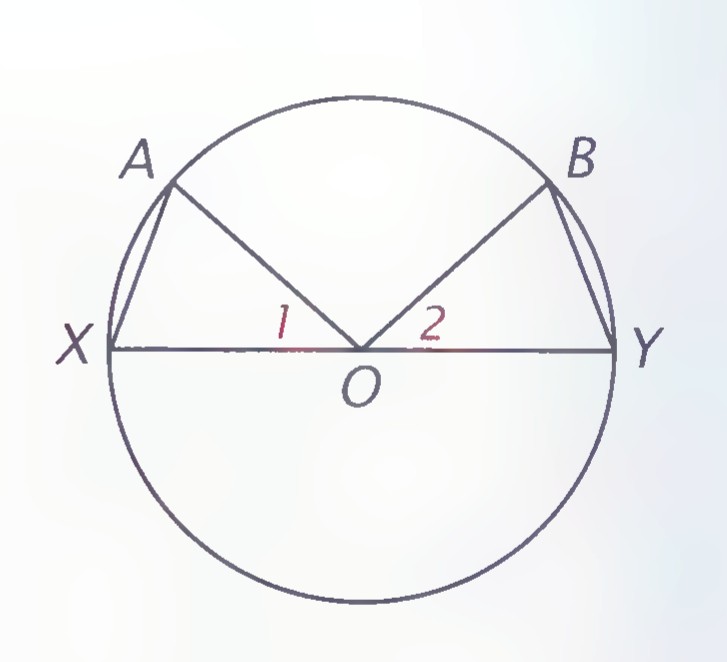
Given: O is the midpoint of XY; ∠1 = ∠2 and OA = OB. Prove: ∠A = ∠B.
p. 181
Algebra Review: Factoring Polynomials
Factoring reverses the operation of multiplication. The distributive rule shows the multiplication of a and b + c.
Reversing this operation on ab + ac, we get
We have factored a out of ab + ac by using the distributive rule in reverse. Taking the greatest common factor gives the simplest remaining expression, as seen below.
Example 1: Factor .
Solution: The greatest common factor of the three terms is 5.
Example 2: Factor .
Solution: The greatest common factor of the two terms is .
When two polynomials such as and are multiplied, the result is a polynomial whose terms have no common factor:
To see how to reverse this operation (that is, factor ), we have to find two factors of 24 whose sum is 11. The general case makes the reason for finding these numbers more obvious:
Example 3: Factor .
Solution: The last term, −35, can be factored into 7 and −5; 7 + −5 = 2. So
p. 182
What do the numbers in the green boxes have in common? What do the numbers in the red boxes have in common? Why, except for the first two, do the red boxes appear only in the fourth and sixth columns?
The next examples illustrate how to extend this process.
Example 4: Factor .
Solution: The first term, , can be factored into and ; so
The last term can be factored into 3 and 3 or 1 and 9.
By trial and error, we write:
So, .
Example 5: Factor .
Solution: All three terms of this polynomial have a common factor of 4, so we factor it out first: .
Factoring into and , we write:
Looking at the factors of 30, we have 1 and 30, 2 and 15, 3 and 10, and 5 and 6. Observing that the factors 3 and 10 have a difference of 7, we write:
So, .
Exercises
Factor.