p. 77
Chapter 3: Lines and Angles
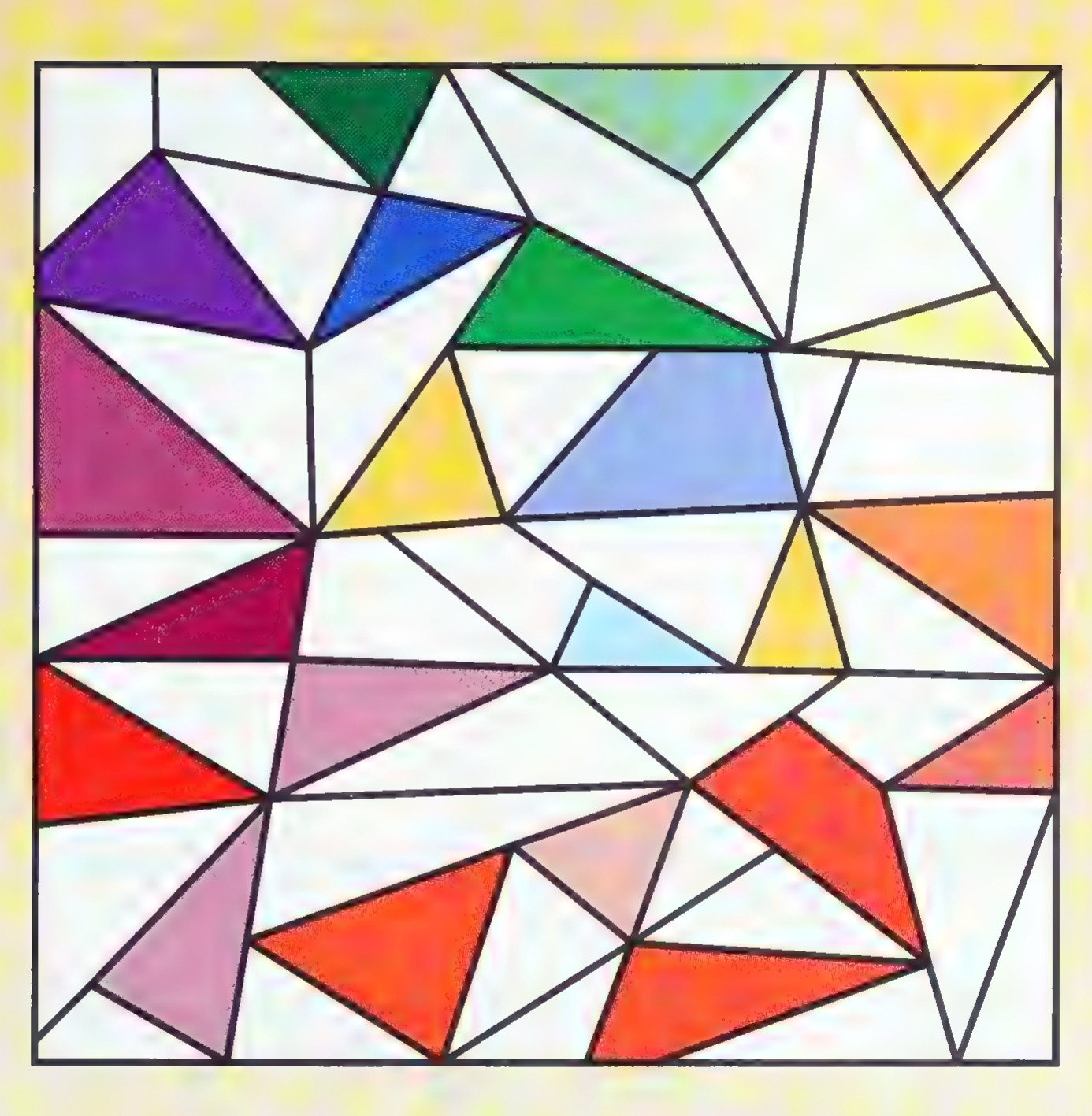
Where is the five-pointed star?
In this chapter, we begin with the algebraic tools used in geometry and then apply them to the measurement of line segments and angles. In doing so, we look at the ways in which rulers and protractors work. These ideas are then applied to exploring relations between angles with respect to both their measures and the positions of their sides. The chapter closes with a look at two important relations between lines.
p. 78
“That, in itself, is a breakthrough.”
Lesson 1: Number Operations and Equality
In your study of algebra, you learned some properties that are true for all numbers. Here are some examples.
. Any number is equal to itself (called the “reflexive” property of equality).
. The order in which two numbers are added doesn’t matter (addition is “commutative”).
. (The “distributive” property.)
. (“Squaring a binomial.”)
. (“Factoring the difference of two squares.”)
The first three properties are examples of statements that are accepted in algebra as true without proof. They are some of the postulates, also called “axioms,” of algebra. The word “axiom” means “a self-evident
p. 79
or accepted rule,” and so the words postulate and axiom convey the same idea.
The last two properties in the list are statements that are often proved in algebra, and so they are examples of algebraic theorems.
We will use some of the postulates (axioms) of algebra when reasoning about figures in geometry. These algebraic postulates about numbers will be just as important as our geometric postulates about points, lines, and planes.
Each algebraic postulate below states that two algebraic expressions are equal to each other. If the symbols a and b represent real numbers, what do we mean by the statement ? Simply that a and b represent the same number. The statements below are direct consequences of this idea. For simplicity, they are stated symbolically, the letters representing real numbers. The postulates have been given names with which you can identify them when you use them.
The Reflexive Property
. (Any number is equal to itself.)
The Substitution Property
If , then a can be substituted for b in any expression.
The Addition Property
If , then .
The Subtraction Property
If , then .
The Multiplication Property
If , then .
The Division Property
If and , then .
Here is an example of how some of these postulates are used in reasoning about a geometric figure.
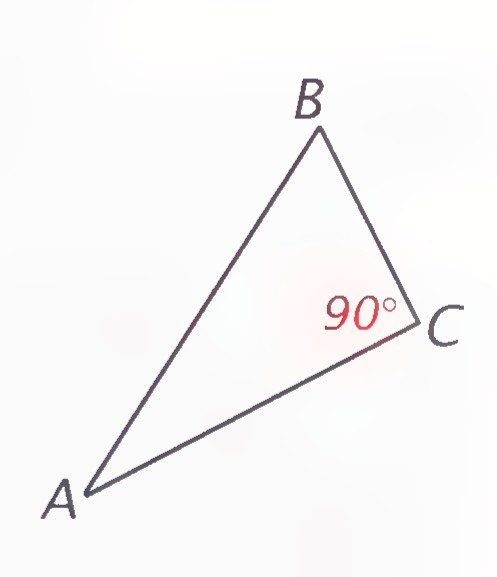
In triangle ABC, ∠C = 90° and ∠B is twice as large as ∠A. How large is ∠A?
(The sum of the angles of a triangle is 180°.)
If ∠C = 90°, ∠A + ∠B + 90° = 180°.
(Substitution.)
If ∠A + ∠B + 90° = 180°, then ∠A + ∠B = 90°.
(Subtraction. 90° was subtracted from each side.)
If ∠A + ∠B = 90° and ∠B = 2∠A, then ∠A + 2∠A = 90°.
(Substitution.)
If 3∠A = 90°, then ∠A = 30°.
(Division. Each side was divided by 3.)
p. 80
Exercises
Set I
Name the property of equality illustrated by each of the following statements.
- If , then .
- If and , then .
- If , then .
- If ∠A + ∠B + ∠C = 180° and ∠C = ∠A + ∠B, then ∠C + ∠C = 180°.
- If 2∠C = 180°, then ∠C = 90°.
In this figure, the perimeter of the green region is equal to the perimeter of the red region.
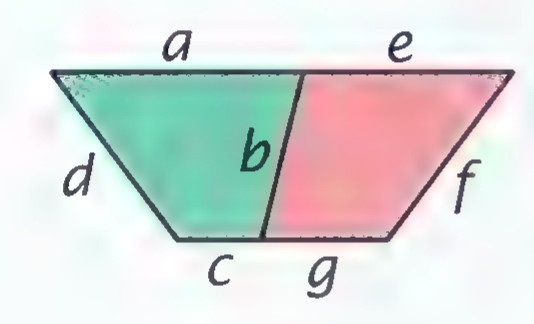
- Write an equation to show this equality.
- Why is ?
This figure shows two lines intersecting to form several angles, three of which are numbered.
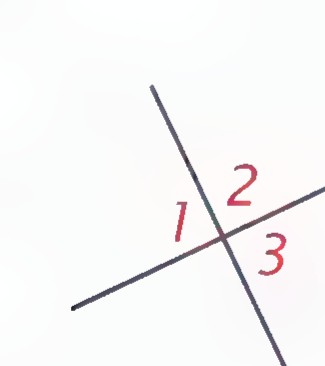
- If ∠1 + ∠2 = ∠2 + ∠3, then ∠1 = ∠3. Why?
- If ∠1 = ∠2 and ∠2 = ∠3, then ∠1 = ∠3. Why?
- If ∠1 = ° and ∠3 = °, then ∠1 + ∠3 = (2)°. Why?
This figure shows how we bisected an angle by using a straightedge and compass. Let’s check the algebra to see that ∠1 is the size that we would expect.
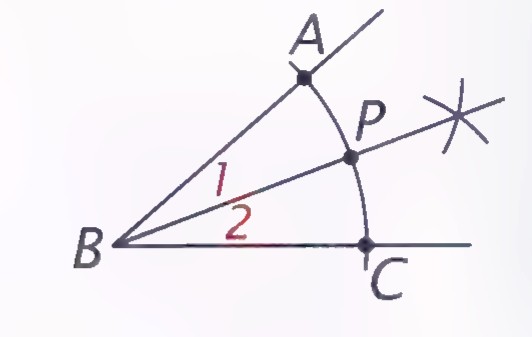
- If ∠ABC = ∠1 + ∠2 and ∠1 = ∠2, then ∠ABC = ∠1 + ∠1 = 2∠1. Why?
- If ∠ABC = 2∠1, then ∠1 = ∠ABC. Why?
The division property does not allow division by 0, because, if it did, some strange things could happen. To see why, try to tell what number should replace ? to make each of the following statements true.
- because .
- because .
- because .
- because .
- What is strange about the equations in exercise 16?
Euclid listed five “common notions” at the beginning of the Elements. One of them is:
If equals are added to equals, the wholes are equal.
In the symbols of algebra, this notion says:
If and , then .
It is easy to prove this statement by using our statement of the addition property:
If , then .
- If and , then . Why?
p. 81
Use the same reasoning to show that
If and ,
then .
Correcting Mistakes. An algebraic mistake can give a wrong solution. Here is an example:
Solve for x:
Solution:
(Addition)
(Division)
- What mistake was made here?
Logical thinking helps find and fix such errors.
Check:
Suppose .
- If and , then . Why?
If , then .
If , then .
This contradicts the fact that . Therefore, our assumption that is wrong.
- What kind of proof is this?
Set II
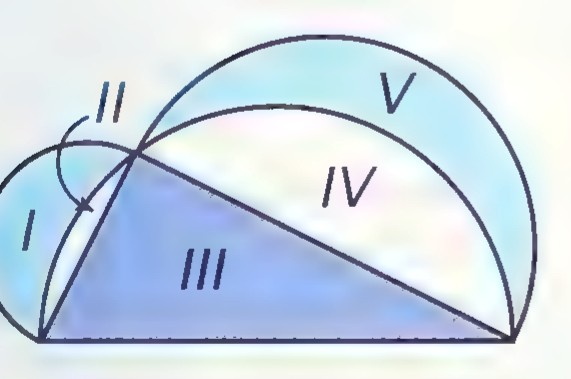
Triangle and Crescents. In this figure, the Roman numerals represent the areas of the five colored regions and
- What can you conclude about how the total area shaded light blue compares with the area shaded dark blue?
- Why?
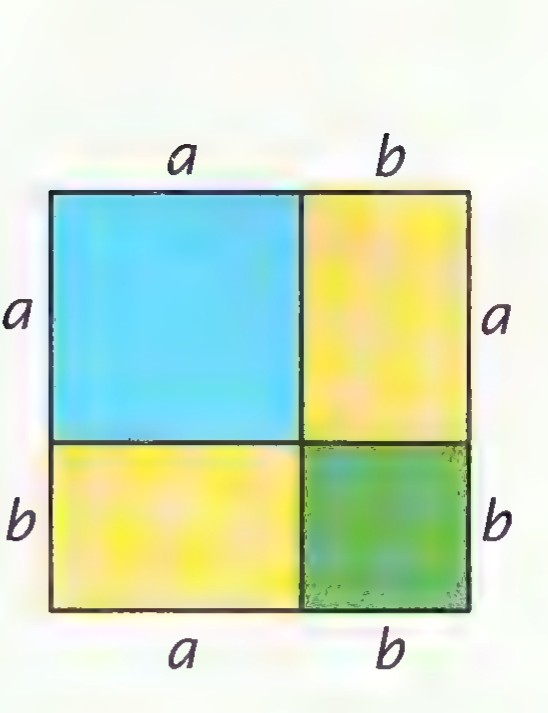
Binomial Square. The figure above shows a large square divided into two smaller squares and two rectangles. The letters a and b represent the lengths indicated.
- What are the areas of the two smaller squares?
- What is the total area of the two rectangles?
- How long is each side of the entire figure?
Write an expression for the area of the entire figure
- in terms of the length of its side.
- as the sum of the areas of the four parts.
- Write an equation to indicate that these two expressions are equal.
Chinese Proof. The figure below is from a Chinese textbook of 1607.
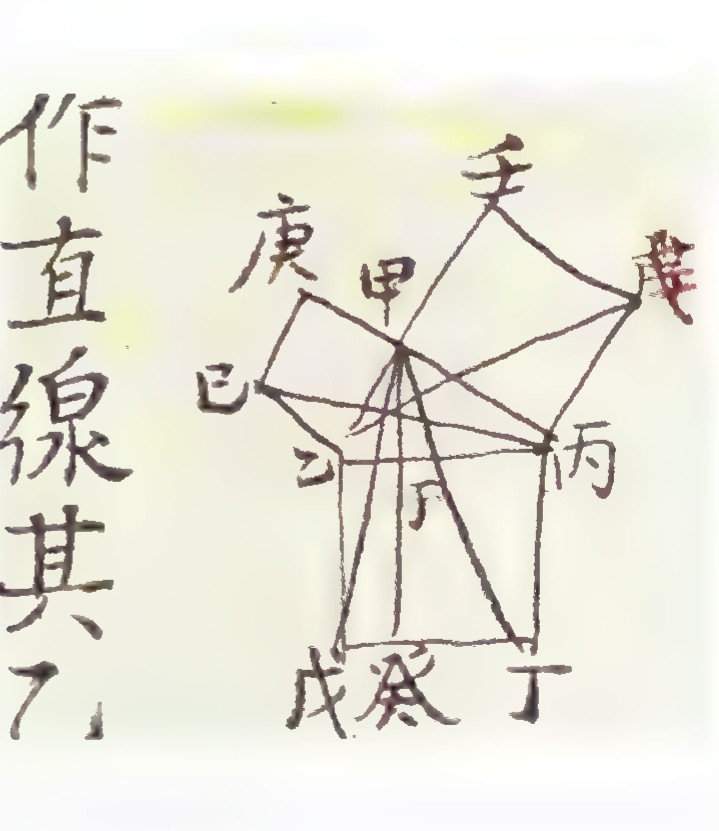
- What theorem does it seem to illustrate?
p. 82
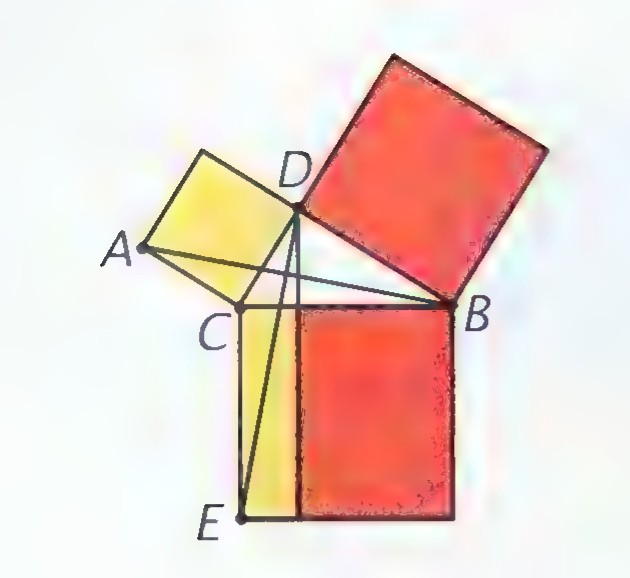
Part of the proof of this theorem shows that
Area of triangle ABC = area of triangle CDE.
Area of yellow square = 2 × area of triangle ABC.
Area of yellow rectangle = 2 × area of triangle CDE.
Another part of the proof shows that
Area of red square = area of red rectangle.
Which property of equality tells why each of the following conclusions is true?
- Area of yellow square = 2 × area of triangle CDE.
- Area of yellow square = area of yellow rectangle.
- Area of yellow square + area of red square = area of yellow rectangle + area of red rectangle.
- State the theorem that this proof demonstrates as a complete sentence.
Circle Formula. There is a formula other than for the area of a circle that can be found by algebra.
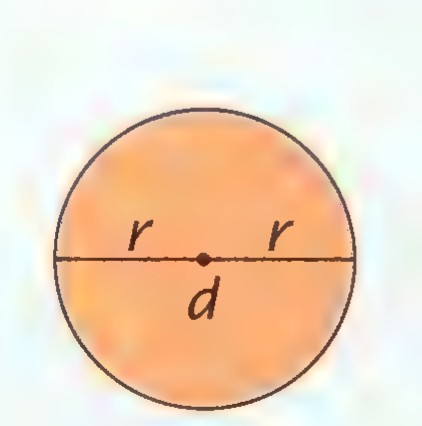
- Use the fact that to write a formula for a in terms of d rather than in terms of r. Show your method.
Quadratic Formula. A famous theorem of algebra is the quadratic formula:
- What is the hypothesis of this theorem?
Name the postulate that is the reason for each of the following first three steps in its proof:
- If , then .
- If , then .
- If , then .
- What kind of proof begins like this?
When the quadratic formula is used to solve an equation such as
in which a = 2, b = 5, and c = 3, the solution begins with
- What postulate is being used here?
- Simplify the expression and find x.
Dilcue’s Pie. Dilcue’s mother baked him a pie for his birthday and everyone in the neighborhood agreed that it was the largest pie that they had ever seen. Dilcue was so impressed that he decided to figure out its circumference in feet. He used the wrong expression, , to do it but still got the right answer!
- How could this have happened if using the wrong expression was his only mistake?
- What was the circumference of the pie? Show your reasoning.
- What was its area?
p. 83
Set III
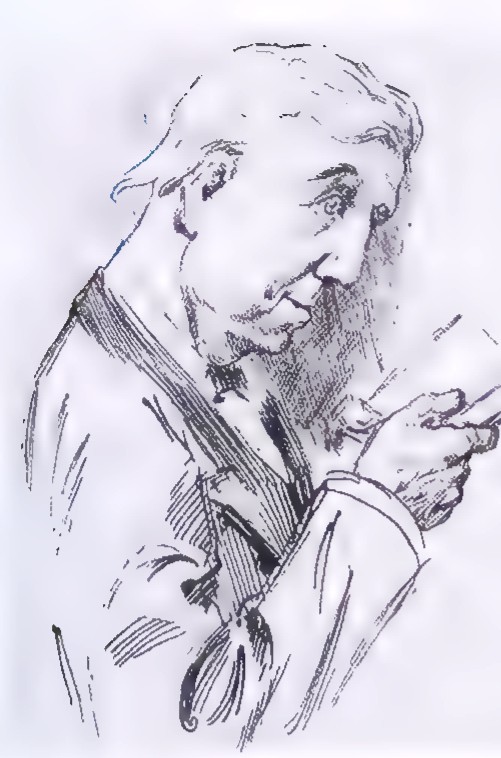
Lewis Carroll once posed the following problem in a letter to a young friend who was studying algebra.*
Understanding you to be a distinguished algebraist (i.e. distinguished from other algebraists by different face, different height, etc.) I beg to submit to you a difficulty which distresses me much.
If and are each equal to “1,” it is plain that and also that . Hence .
Now divide each side of this equation by .
Then .
But , i.e. .
So that .
Ever since this painful fact has been forced upon me, I have not slept more than 8 hours a night, and have not been able to eat more than 3 meals a day.
I trust you will pity me and will kindly explain the difficulty.
Can you?
*The Universe in a Handkerchief, by Martin Gardner (Copernicus, 1996).
p. 84
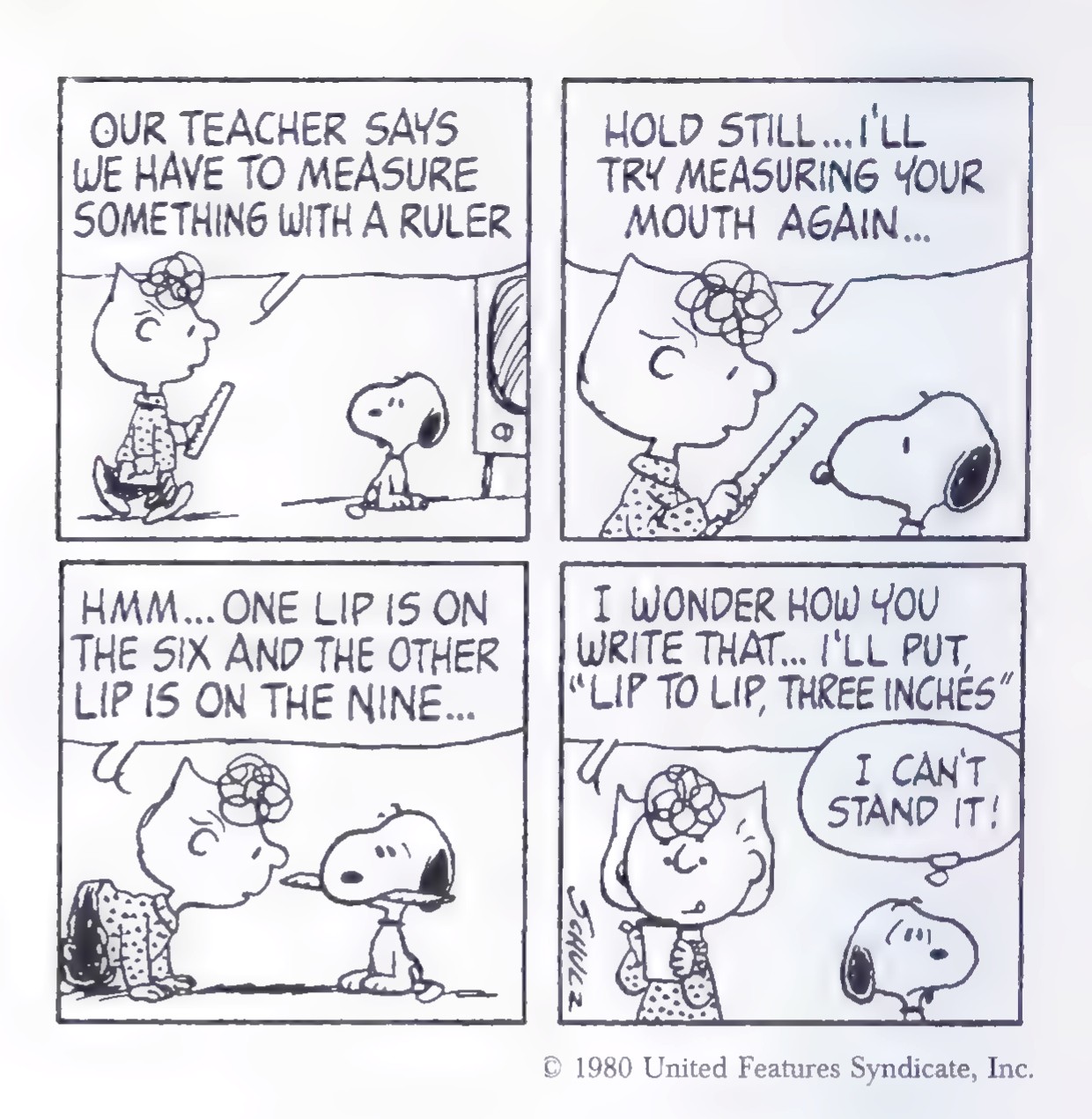
© 1980 United Features Syndicate, Inc.
Lesson 2: The Ruler and Distance
As surprising as it may seem, there are no measurements in Euclid’s Elements. Tools such as the ruler and protractor are never mentioned.
Although Euclid did not attach numbers to line segments, angles or areas, he did compare them with statements such as
All right angles are equal to one another
and
In any triangle the greater side subtends the greater angle.
Numbers are now taken for granted in geometry. In fact, applications such as computer graphics could not exist without them. In this lesson, we will consider how numbers are used in measuring distances.
Our first postulate says that
Two points determine a line.
p. 85
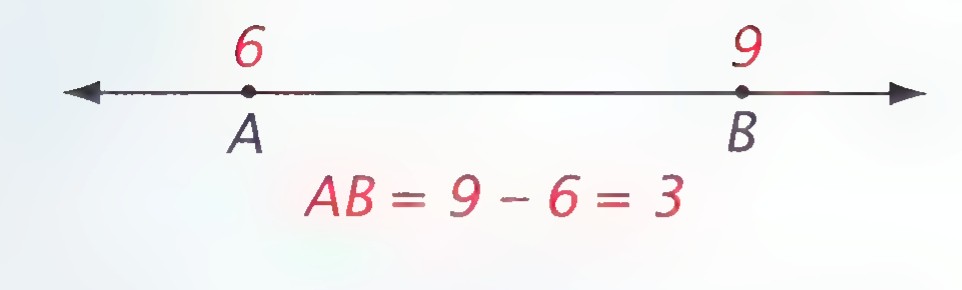
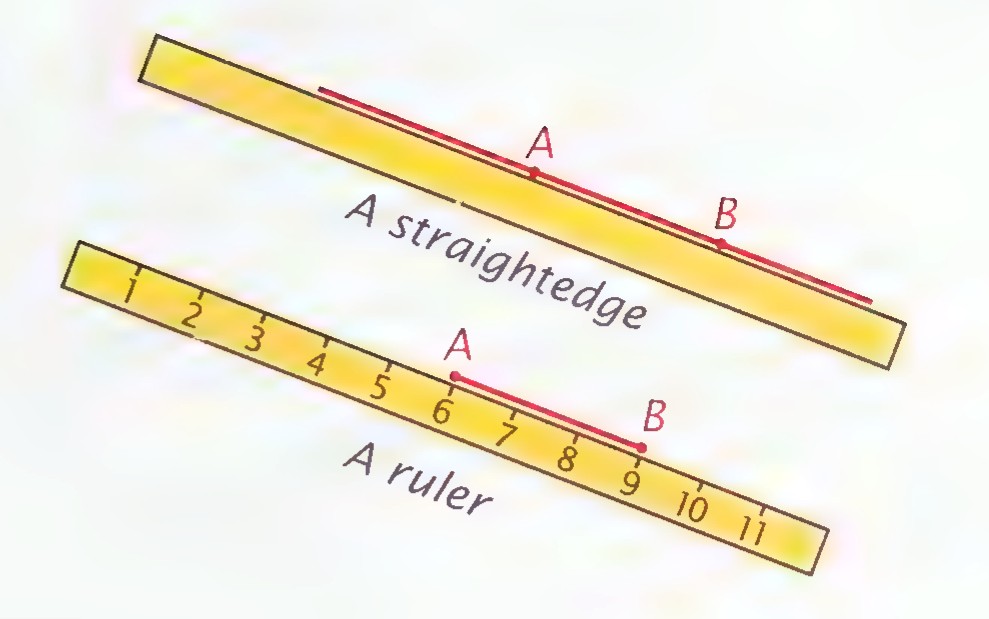
If we merely want to draw the line determined by two points, we can use a simple straightedge to do so. If we want to measure the distance between the points, we need a ruler. If point A falls on the 6 and point B falls on the 9, as happened in measuring Snoopy’s mouth, then AB, the distance from A to B, is 9 − 6 = 3. Because the numbers on the ruler being used are 1 inch apart, Snoopy’s mouth measures 3 inches across.
It is convenient to think of a ruler as an infinite number line. The points on the line are numbered so that to every point there corresponds exactly one real number called its coordinate and, conversely, to every real number there corresponds exactly one point. Furthermore, to every pair of points on the line there corresponds a real number called the distance between them. As illustrated in the example of measuring Snoopy’s mouth, this distance is the positive difference between their coordinates. We will summarize this description of a ruler as the Ruler Postulate.
Postulate 3. The Ruler Postulate
The points on a line can be numbered so that positive number differences measure distances.
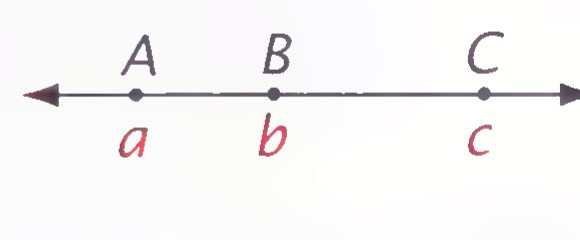
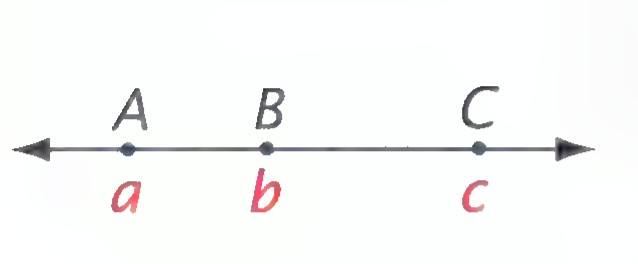
The figure at the right shows three points, A, B, and C, on a line and the numbers that are their coordinates, a, b, and c. We will use the symbol “A-B-C” (or “C-B-A”) to indicate that point B is between points A and C. Because point B is between the other two points, its coordinate, b, must be between their coordinates. In other words, b is greater than one of them and less than the other; either or , which suggests a way to define what it means for one point to be between two others.
Definition (Betweenness of Points)
A point is between two other points on the same line iff its coordinate is between their coordinates. (More briefly, A-B-C iff or .)
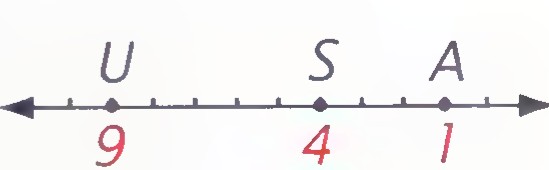
Here is another example. In the figure at the right, the coordinates of U, S, and A are 9, 4, and 1. Computing distances, we get
US = 9 − 4 = 5, SA = 4 − 1 = 3, and UA = 9 − 1 = 8:
US + SA = UA because 5 + 3 = 8.
p. 86
These results are just what we would expect from the figure and can be easily proved as our first theorem.
As you know, a theorem is a statement that is proved by reasoning deductively from already accepted statements, including both definitions and postulates. Our proof is a direct one. To make it easier to read, the statements in it are listed at the left and the reasons for them at the right.
Theorem 1. The Betweenness of Points Theorem
If A-B-C, then AB + BC = AC.
Proof for case in which
| Statements | Reasons |
|---|---|
| 1. A-B-C. | The hypothesis. |
| 2. . | Definition of betweenness of points and this case. |
| 3. AB = and BC = . | Ruler Postulate. |
| 4. AB + BC = . | Addition (and simplification). |
| 5. AC = . | Ruler Postulate. |
| 6. AB + BC = AC. | Substitution (steps 4 and 5). |
Exercises
Set I
Three important ideas have been introduced in this lesson that you should get to know. Write each of them as a complete sentence.
- The Ruler Postulate.
- The definition of betweenness of points.
- The Betweenness of Points Theorem.
Three points on a line have the following coordinates: point A, 123; point T, 1; and point W, 12. Which idea in exercises 1 through 3 is the reason for each statement below?
- T-W-A because .
- TW + WA = TA because T-W-A.
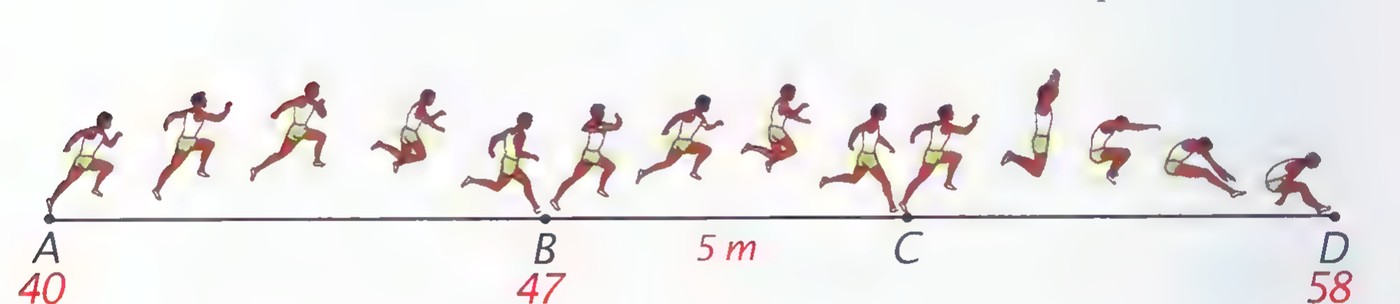
Triple Jump. The figure above shows a triple jump with the jumper taking off from A and landing at B, C, and D. A typical jumper runs about 40 meters to get to the takeoff point.
Use the numbers on the figure to find:
- The total distance of the jump, AD.
- The coordinate of C.
- The distance CD.
Because A-B-C, AB + BC = AC, or 7 + 5 = 12, according to the Betweenness of Points Theorem.
Use the Betweenness of Points Theorem to complete the following statements.
- Because B-C-D, BC + ? = ?, or 5 + ? = ?.
p. 87
- Because A-B-D, AB + ? = ?, or 7 + ? = ?.
- Because A-C-D, AC + ? = ?, or ? + ? = ?.
Eclipse Problems. Eclipses occur when the earth, sun, and moon are in line with each other.
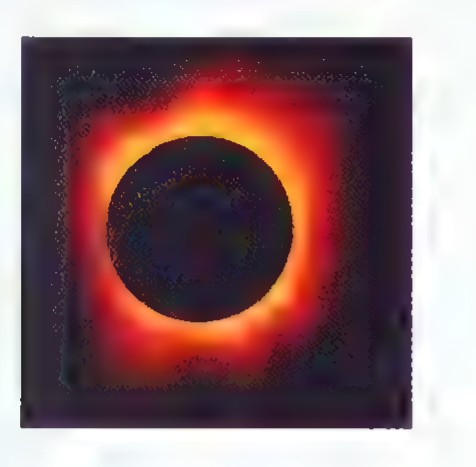
- What are points that lie on the same line called?
The figures below (not to scale) represent the possible positions of the sun, S, earth, E, and moon, M, during an eclipse.
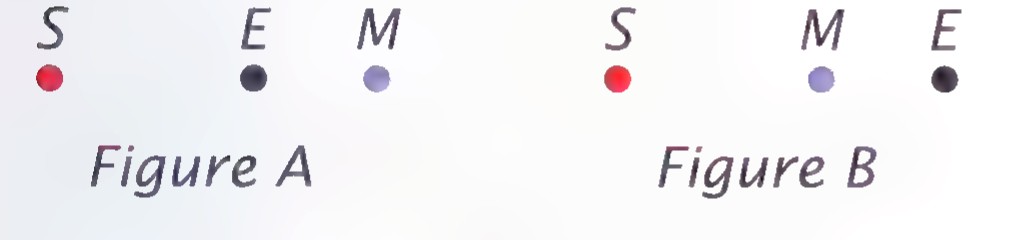
- Which figure illustrates an eclipse of the sun?
If the distance from the earth to the moon is 240,000 miles and the distance from the earth to the sun is 93,000,000 miles, find the distance between the moon and the sun when
- S-E-M.
- S-M-E.
Seven League Boots. According to legend, “seven league boots” allow whoever wears them to travel 7 leagues at each step. (A league is about 3 miles!)

Suppose someone puts them on 4 leagues away from home and walks as shown in the figure above.
- What are the coordinates of points B, C, D, E, and F?
How many leagues away from home is the person after taking
- two steps?
- five steps?
- If n represents the number of steps taken, what does represent?
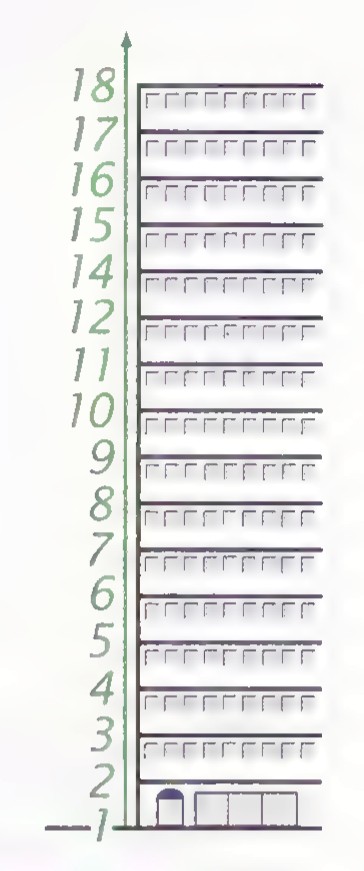
Skyscraper. A side view of the lower floors of a skyscraper is shown in the figure at the right.
Use the Ruler Postulate to find the distance in floors between
- the 2nd and 9th floors.
- the 5th and 15th floors.
- Are both of these answers correct? Why or why not?
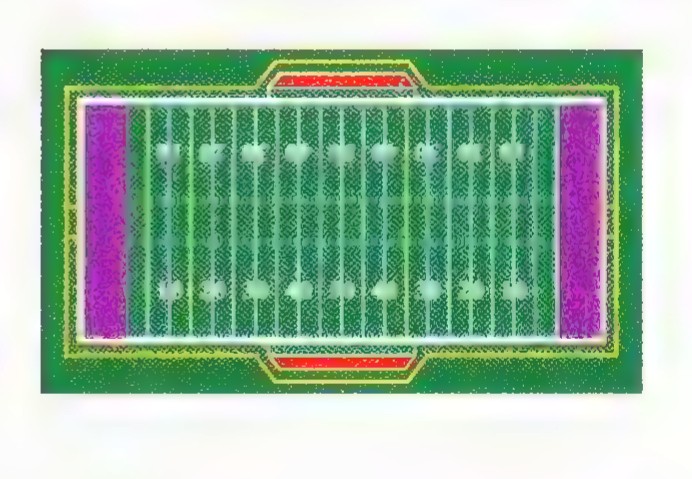
Football Field. The yard lines on a football field are spaced at 5-yard intervals and numbered as shown in the figures above and below.

- At what yard lines are points A and B?
- If these numbers were coordinates as in the Ruler Postulate, then the distance from A to B would be 10 yards. Why?
- Why can’t we think of the numbers of yard lines as coordinates?
p. 88
Suppose the lines on a football field were numbered like this instead.

- What are the coordinates of points A and B now?
- What distance does the Ruler Postulate give for AB now?
- Is this distance correct?
SAT Problem. The figure below appeared in a problem on an SAT exam.
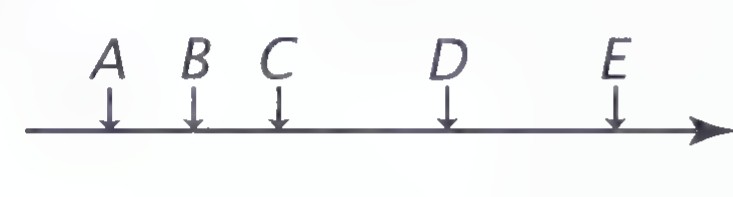
On this number line, the numbers 3, −1, 5, 0, and 1 are indicated by the arrows.
- Copy the figure and write the numbers in the appropriate places.
- Which arrow indicates 0?
- What is the distance from the first arrow to the last arrow?
Set II
Pole Vaulter. This time sequence photograph shows a pole vaulter in action.
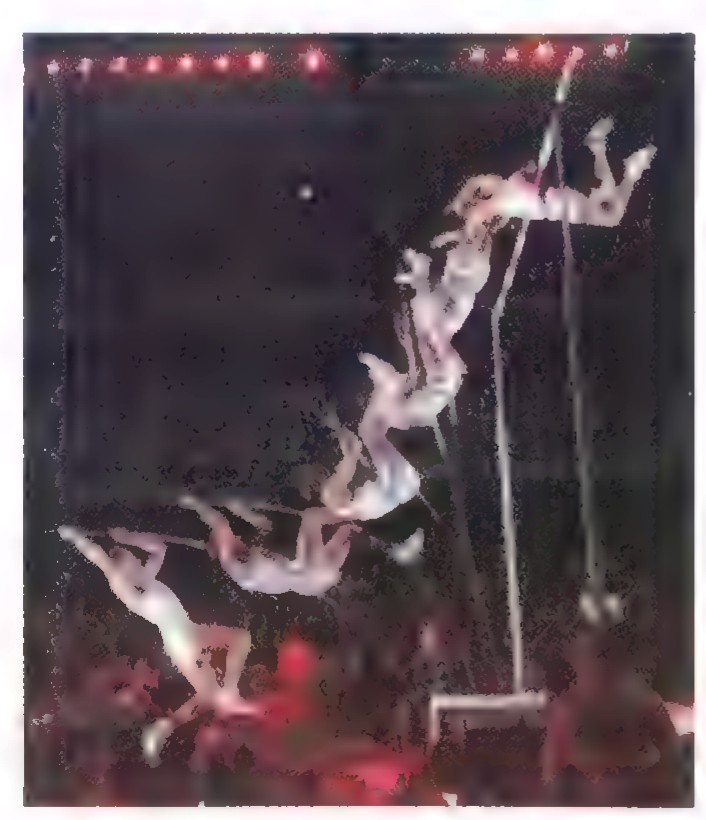
Although it seems that the points at which the vaulter’s hands hold the pole are between the endpoints of the pole, this does not agree with the definition of betweenness of points.
- Without looking it up, try to write the definition of betweenness of points as a complete sentence.
- What is it about the pole that does not fit this definition?
- Without looking it up, try to write the Betweenness of Points Theorem as a complete sentence.
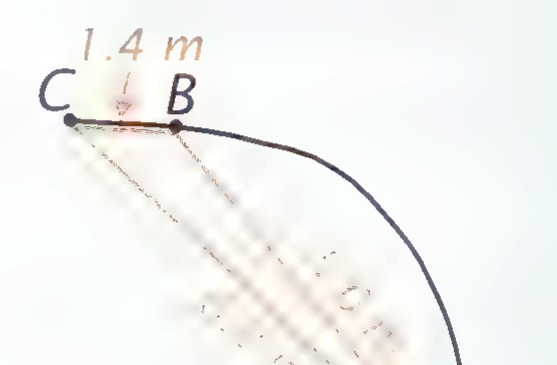
The figure above shows the distances between one hand and the ends of the pole at one moment of the vault.
- How does AB + BC compare with AC in this figure?
- Do you think AB + BC could ever be less than AC?
Ladder Problem 1. The extension ladder in the figure at the right can be adjusted to different lengths. The upper distance (AB in the diagram) looks as if it might be equal to the lower distance (CD).
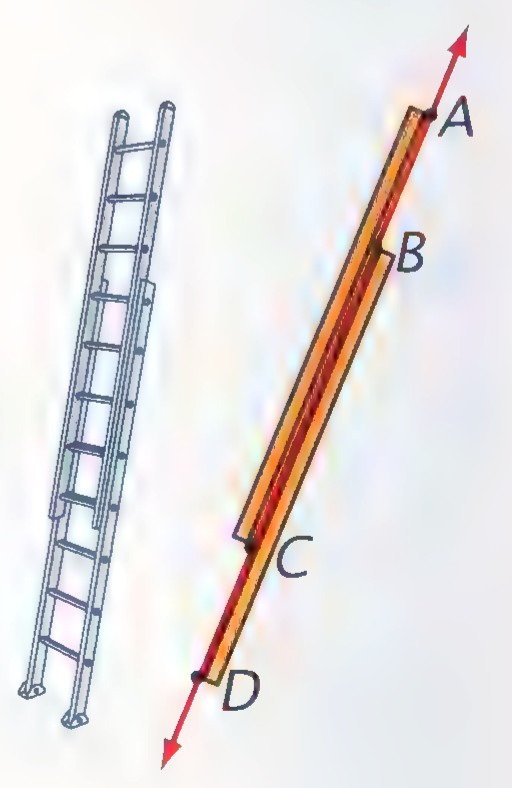
- Do you think these two distances would still look equal to each other if the ladder were extended by sliding the sections as indicated?
p. 89
Suppose that the two parts of the ladder, AC and BD, are the same length (that is, AC = BD).
Complete the following two statements.
- Because A-B-C, AC = ?.
- Because B-C-D, BD = ?.
- Why is AB + BC = BC + CD?
- Why is AB = CD?
Ladder Problem 2. The first rung of the ladder shown in the figure below is 11 inches from the bottom of the ladder and the last rung is 11 inches from the top of the ladder. The other rungs are spaced 12 inches apart.
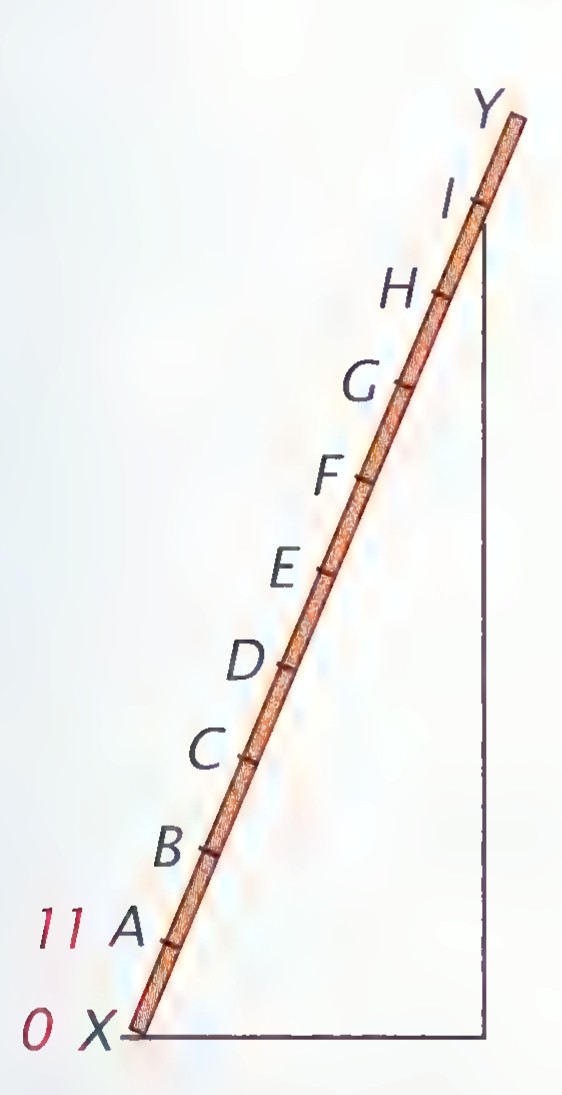
- If the coordinate of X, the bottom of the ladder, is 0 and the coordinate of the first rung is 11, find the coordinates of the other rungs and of the top of the ladder, Y.
Check your work by comparing
- the coordinates of the first and last rungs with the distance between them.
- the coordinate of Y, the top of the ladder, with XY, the total length of the ladder.
Stars Proof. The figure at the right shows three stars as seen from the earth. The distances between the stars, in light-years, are: XY = 7.2, YZ = 9.8, and XZ = 16.6.
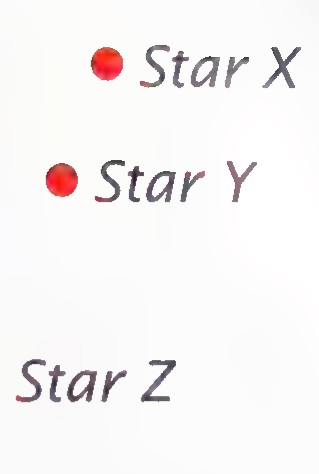
- Copy and complete the following indirect proof that, contrary to their appearance, star Y is not between star X and star Z.
Proof
(What is the beginning assumption?)
(What statement follows from the Betweenness of Points Theorem?)
If XY + YZ = XZ, then 7.2 + 9.8 = 16.6. (What is the contradiction?)
Therefore, our assumption is false and (what conclusion follows?)
Signal Problem. Suppose you are approaching an intersection at a speed of 30 miles per hour (44 feet per second) and the signal turns yellow. The intersection is 60 feet wide and the signal stays yellow for 3 seconds.
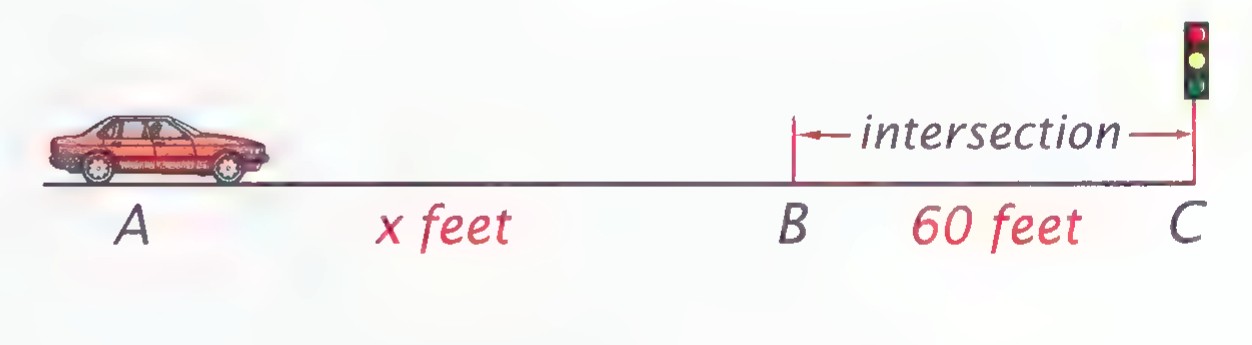
- If you don’t change your speed, how far can you be from the intersection to get through it before the light turns red? Show how the Betweenness of Points Theorem can be used to find the answer.
Our first theorem, the Betweenness of Points Theorem, was proved in this lesson only for the case in which . The proof for the case in which is almost exactly the same.
- Using the proof on page 86 as a guide, write the proof for this case. (Include the figure with your proof.)
p. 90
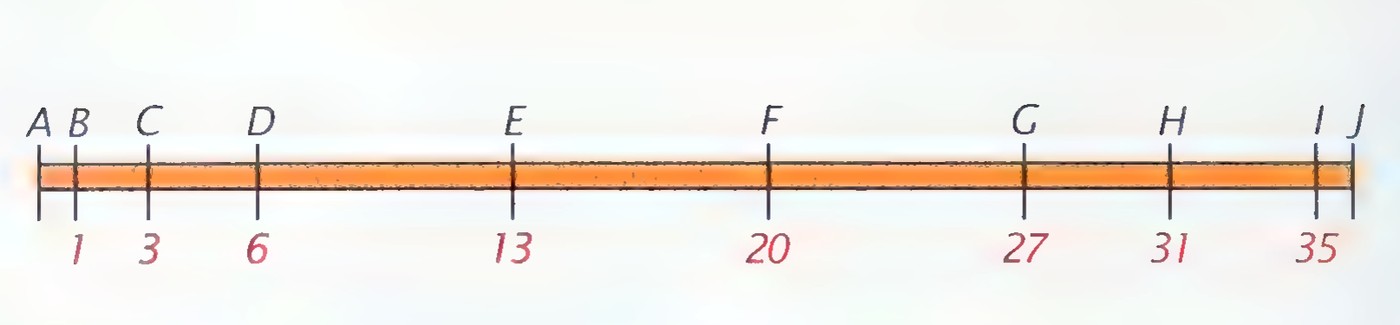
Yardstick Distances. A yardstick 36 inches long is represented in the figure above. Even though it has only eight marks on it, it can be used to measure every whole-number distance from 1 to 36 inches!*
- Show how by making a list of the numbers from 1 through 36 and naming at least one pair of points that can be used to measure each distance.
For example, the beginning of your list would look like this:
1 AB (or IJ)
2 BC
3 AC (or CD) and so forth
Set III
You have inherited a rowboat with no oars. According to Shaw and Tenney, a company in Maine that manufactures oars, the handles of a pair of oars should overlap by 4 inches.†

Overhead view (not to scale)
- If the distance between the oarlocks, BC, is 42 inches and the overlap, AD, is 4 inches, how long should AB and CD be? Show your reasoning.
For efficient rowing, Shaw and Tenney recommend that the inboard part of each oar (AB in each figure) should be 7/25ths of the overall length of the oar. The paddle, EF, is 26 inches long.

- According to this information, how long should the oars for your boat be? Show your method.
Oars come in lengths from 6 feet to 10 feet in 6-inch increments.
- What length of oars would you order for your boat?
*The Incredible Dr. Matrix, by Martin Gardner (Scribners, 1976).
†Sizes, by John Lord (Harper Collins, 1995).
p. 91
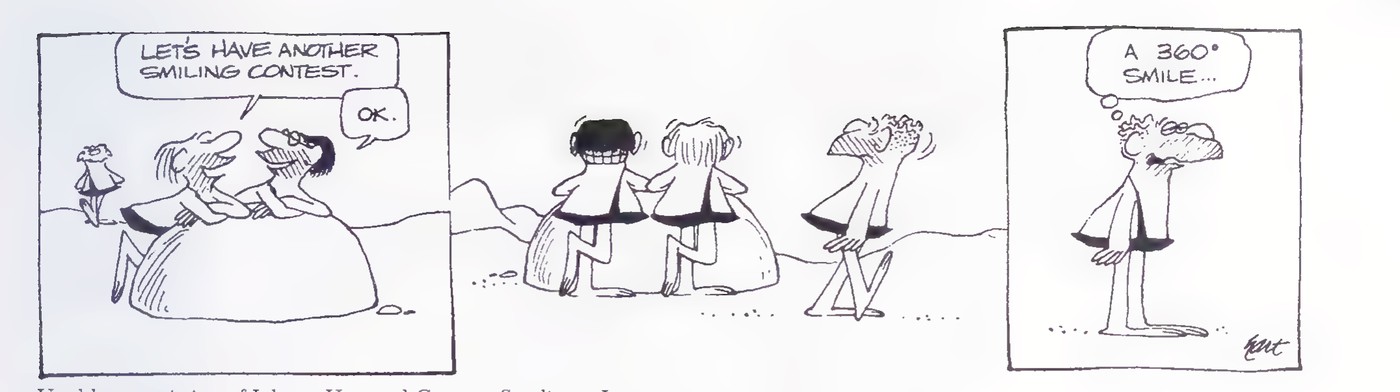
Used by permission of Johnny Hart and Creators Syndicate, Inc.
Lesson 3: The Protractor and Angle Measure
Although a vast number of different units have been invented throughout history to measure distance, the unit chosen by the ancient Babylonians for measuring angles more than 4,000 years ago is still in use today. No other unit of measurement even comes close to having lasted as long as the degree.
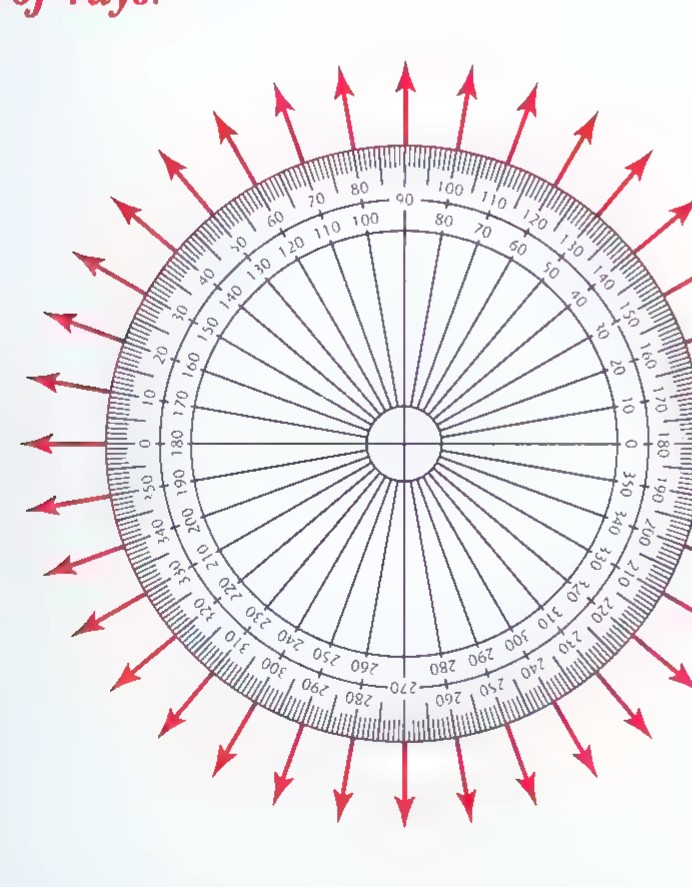
The scale on a circular protractor is divided into 360 equal parts, each part measuring 1 degree. If we imagine a ray with its endpoint at the center of the protractor turning exactly once around the scale, we might think of all of the positions through which it moves as a rotation of rays.
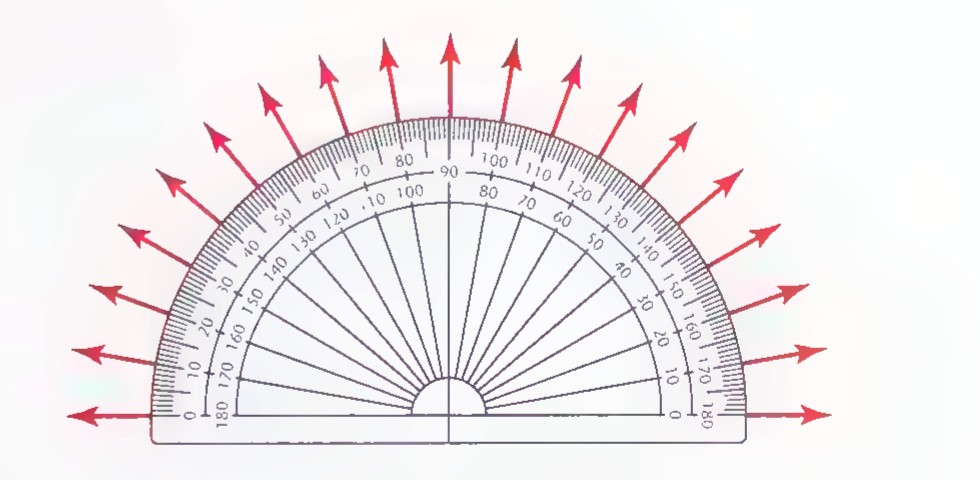
The largest angle usually considered in geometry, however, has a measure of only 180°; so the protractor in most common use is the semicircular protractor. We will refer to all of the rays that correspond to it as a half-rotation of rays.
p. 92
When an angle is measured with a protractor, the center of the protractor must be placed on the vertex of the angle. It isn’t necessary, however, for the 0 mark on the protractor to be placed on one side of the angle.
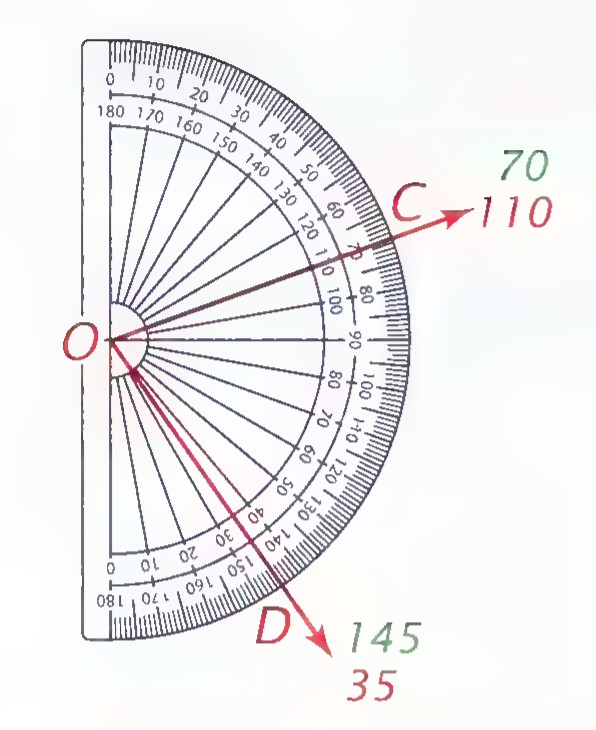
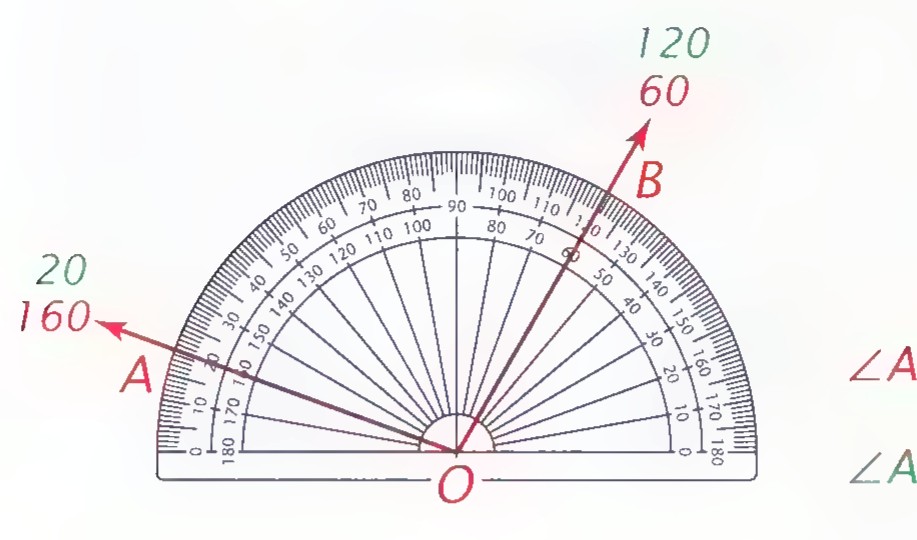
In the figure above, ∠AOB = 160 − 60 = 100° (or 120 − 20 = 100°, depending on which scale you choose) and, in the figure at the left, ∠COD = 110 − 35 = 75° (or 145 − 70 = 75°).
Although every protractor is numbered with two scales, only one of them is needed. In fact, in describing how a protractor works, we will find that it is convenient to think of it as having only one scale. With this in mind, we can say that the rays in a half-rotation can be numbered so that to every ray there corresponds exactly one real number called its coordinate, and to every real number from 0 to 180 inclusive there corresponds exactly one ray. Moreover, to every pair of rays there corresponds a real number called the measure of the angle that the rays determine. The measure of this angle is the positive difference between the coordinates of the rays. This description of a protractor is very much like our description of a ruler. We will summarize it as the Protractor Postulate.
Postulate 4. The Protractor Postulate
The rays in a half-rotation can be numbered from 0 to 180 so that positive number differences measure angles.
Angles are classified according to their measures as follows.
Definitions
An angle is
acute iff it is less than 90°.
right iff it is 90°.
obtuse iff it is more than 90° but less than 180°.
straight iff it is 180°.
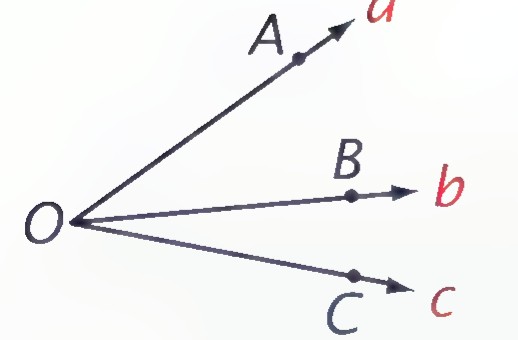
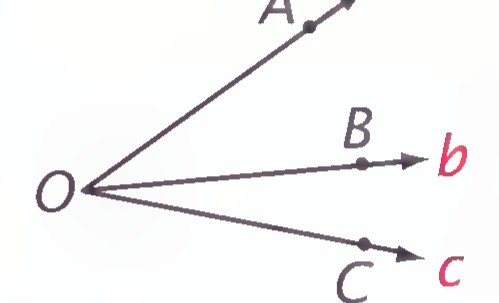
In the figure at the left, rays OA, OB, and OC have a common endpoint, O, and coordinates a, b, and c. It seems reasonable to say that ray OB is between rays OA and OC and to use the abbreviation “OA-OB-OC” (or “OC-OB-OA”). As we did in defining betweenness of points, we can use coordinates to define betweenness of rays.
p. 93
Definition (Betweenness of Rays)
A ray is between two others in the same half-rotation iff its coordinate is between their coordinates. (More briefly, OA-OB-OC iff or .)
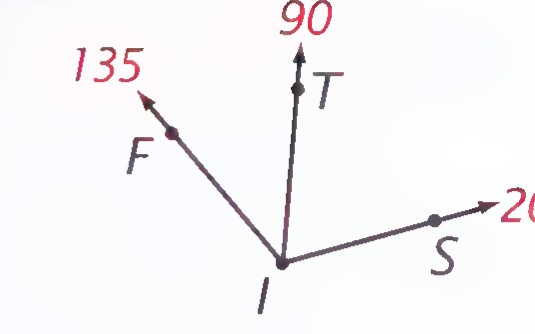
In the figure at the right, the coordinates of rays IF, IT, and IS are 135, 90, and 20. Calculating angles, we get ∠FIT = 135 − 90 = 45°, ∠TIS = 90 − 20 = 70°, and ∠FIS = 135 − 20 = 115°:
∠FIT + ∠TIS = ∠FIS because 45° + 70° = 115°.
Such results are true whenever one ray is between two others, and we prove it as our second theorem.
Theorem 2. The Betweenness of Rays Theorem
If OA-OB-OC, then ∠AOB + ∠BOC = ∠AOC.
Proof for case in which
| Statements | Reasons |
|---|---|
| 1. OA-OB-OC. | The hypothesis. |
| 2. . | Definition of betweenness of rays and this case. |
| 3. ∠AOB = and ∠BOC = . | Protractor Postulate. |
| 4. ∠AOB + ∠BOC = . | Addition (and simplification). |
| 5. ∠AOC = . | Protractor Postulate. |
| 6. ∠AOB + ∠BOC = ∠AOC. | Substitution (steps 4 and 5). |
Exercises
Set I
Three more important ideas have been introduced in this lesson that you should get to know. Write each of them as a complete sentence.
- The Protractor Postulate.
- The definition of betweenness of rays.
- The Betweenness of Rays Theorem.
Three rays in a half-rotation have the following coordinates: ray HE, 81; ray HI, 18; and ray HO, 180.
- Which ray is between the other two? Use your protractor to draw a figure.
- Name and find the measures of the three angles formed by the rays.
Which statement in exercises 1 through 3 is the reason for your answer to
- exercise 4?
- exercise 5?
p. 94
The following definition is from an old book titled First Book of Geometry.*
ANGLES
§ 6. Definition — If you make any two half-lines (§ 2), AB and AC from a point A, they are said to form an angle (Fig. 19). The point A is called the vertex of the angle, AB and AC are called the arms of the angle. We name this the angle BAC, putting in the middle the name of the vertex, and on each side of this the name of a point on one of the arms. If P is another point on the half-line AB and Q on the half-line AC, the angle PAQ is only another name for the angle BAC.
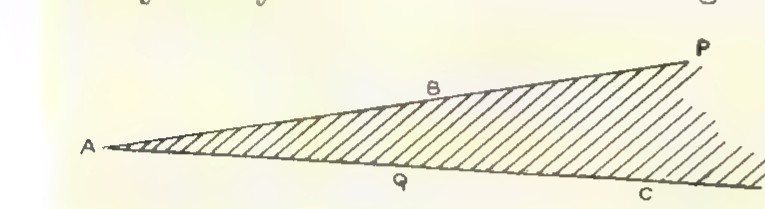
Fig. 19.
- What do we call “half-lines”?
- What do we call the “arms” of an angle?
- Which of the following also are correct names for the angle shown in the figure?
∠A, ∠ABC, ∠CAB, ∠PAC, ∠AQP.
Danger Area. One of the many ways in which angles are used in navigation is in the directions of signal lights warning mariners of hazardous areas. The figure at the right shows a “red sector,” the interior of an angle marking a dangerous area.†
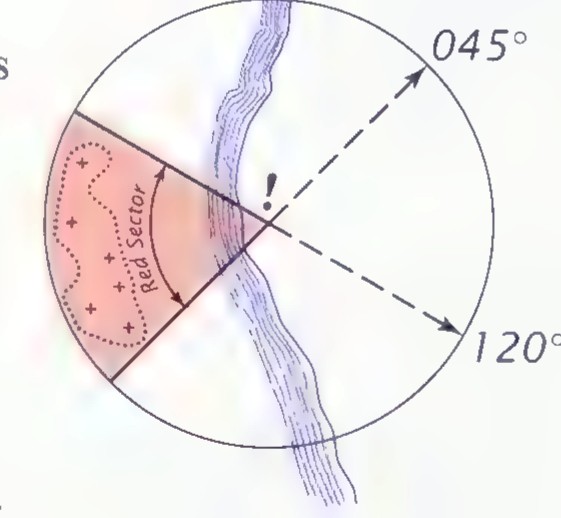
- What are the numbers 45 and 120 called with respect to the sides of the angle opposite the danger angle?
- What is the measure of this angle?
- What kind of angle is it?
Although angles in geometry have measures of no more than 180°, the number of degrees through which something can turn is unlimited. Two examples from sports are listed below.
- A spectacular move in basketball is the “360.” What do you think that means?
- A dive in springboard diving is the “one-and-a-half” somersault. What do you think that means?
The apparent size of an angle depends on your point of view.
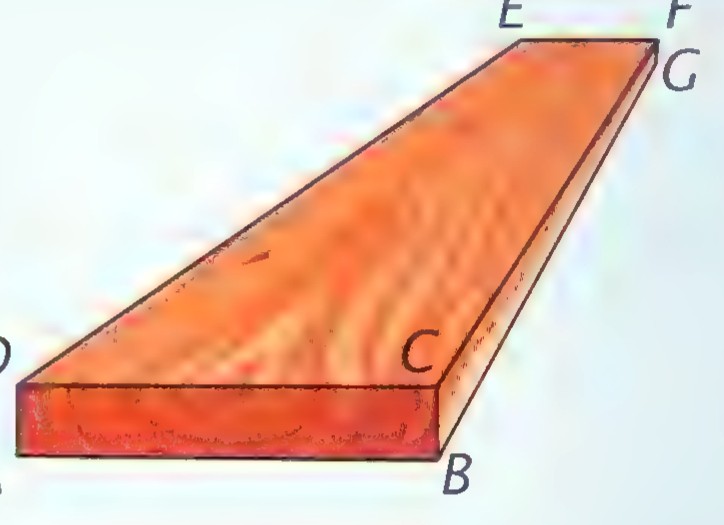
- How many angles do you see in this picture?
- Assuming that it is an ordinary board, how many of them are right angles?
If you measured the angles as they appear in this picture, which angles do you think would be
- acute?
- obtuse?
Birds and planes sometimes form angles in the sky. The photograph below shows geese flying in “V formation.”
- Is it possible to tell from the photograph what type of angle the birds are flying in? Explain.
*Written by Grace Chisholm Young and W. H. Young and published in London in 1905.
†From Dutton’s Navigation and Piloting, by Elbert E. Maloney (Naval Institute Press, 1985).
p. 95
Bubble Angles. If four bubbles in a foam come together as shown in the figure at the left below, they quickly rearrange themselves to form the figure shown at the right.
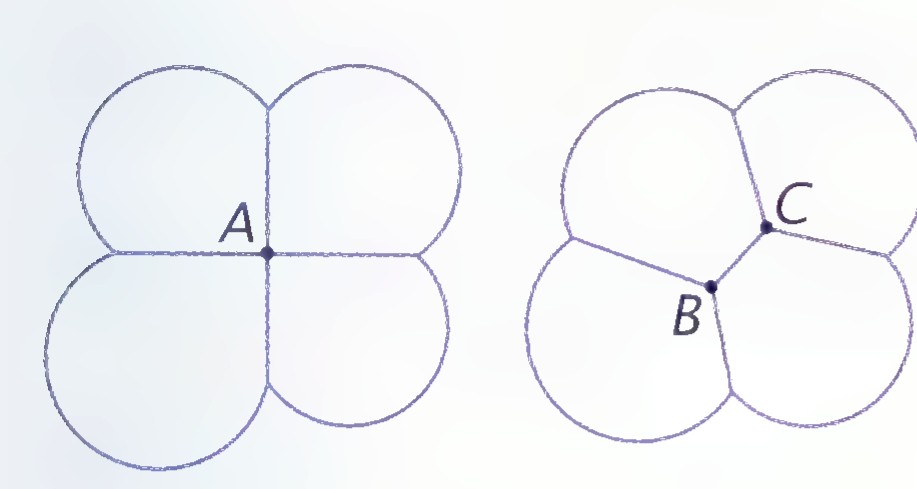
What type of angles seem to surround
- point A?
- points B and C?
- If the four angles surrounding point A are equal, how large is each angle?
- If the three angles surrounding point B and point C are equal, how large is each angle?
Cactus Spokes. The “spokes” coming from the center of this cactus seem to be evenly spaced around it.
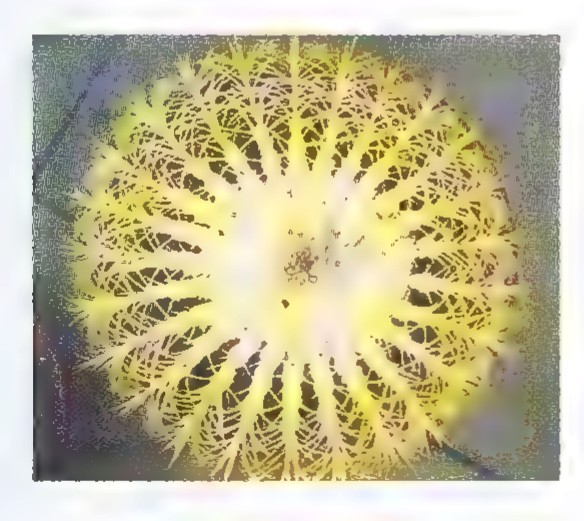
- If this is the case, find the measure of one of the angles formed by two adjacent spokes.
Some of the spokes of the cactus are represented in this figure by rays; the numbers are their coordinates.
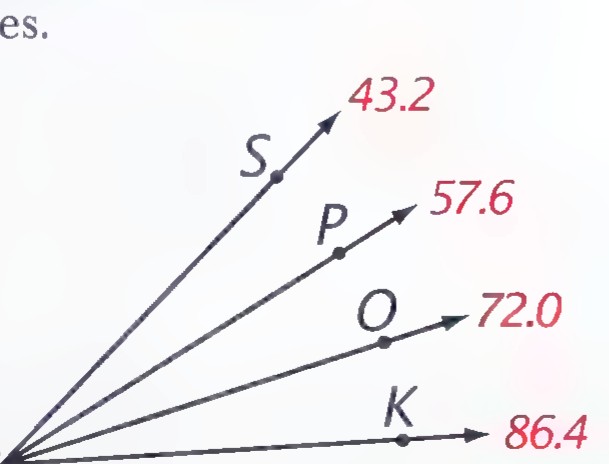
- Would it be correct to say that ray CP is between ray CS and ray CK?
- Use the definition of betweenness of rays to explain why or why not.
Use the coordinates of the rays to find the measures of the following angles.
- ∠SCP.
- ∠PCK.
- ∠SCK.
- Write an equation relating the measures of these three angles.
- What theorem does this equation illustrate?
- State the theorem as a complete sentence.
Set II
Runway Numbers. Airport runways have numbers on them indicating in what direction a plane is heading when it takes off. A runway numbered 0 points due north and a runway numbered 9 points due east.
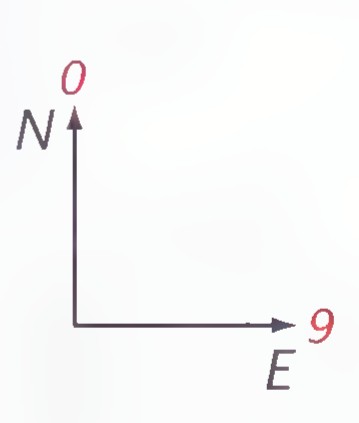
What do you think is the number of a runway pointing
- due south?
- due west?
- In what way are the numbers of airport runways related to the numbers on a circular protractor?
Airplanes sometimes take off from either end of a runway, depending on conditions.
- If one end of a runway is numbered 5, what do you think the opposite end is numbered?
p. 96
Two runways at an airport may have the same number, such as the ones in this photograph.
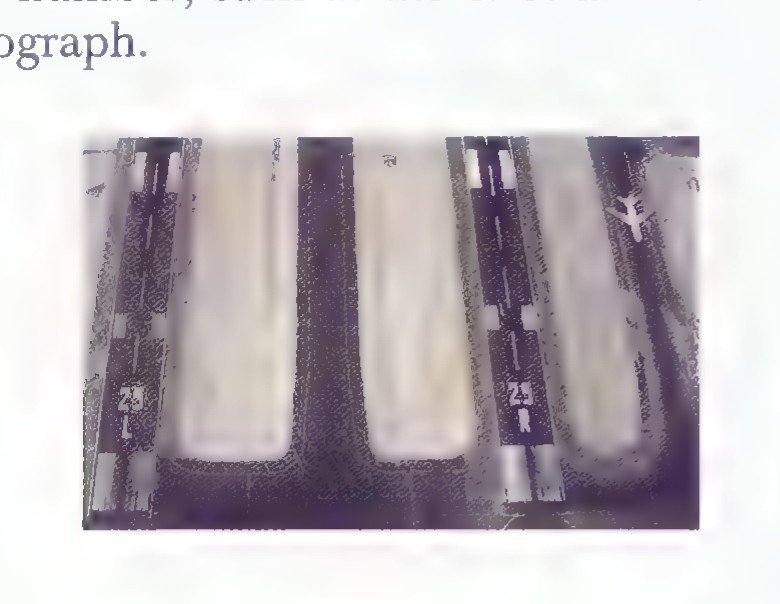
- What does this numbering indicate about the directions of the two runways?
- What angle do these runways make with “due north”? Make a drawing to illustrate your answer.
- What do the letters represent in the photograph?
Pool Ball Angles. In this overhead view of a pool table, the cue ball (white) is shown banking off the lower cushion to nudge the 1-ball into the corner pocket.*
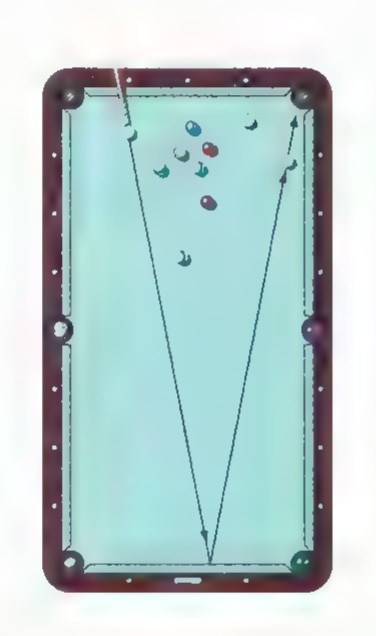
When a pool ball banks off a cushion, the angles that its path forms with the cushion are equal. For example, in the figure below, a ball from point A hitting the cushion at P makes ∠1 = ∠2. A ball from C hitting the cushion at P makes ∠CPX = ∠DPY.
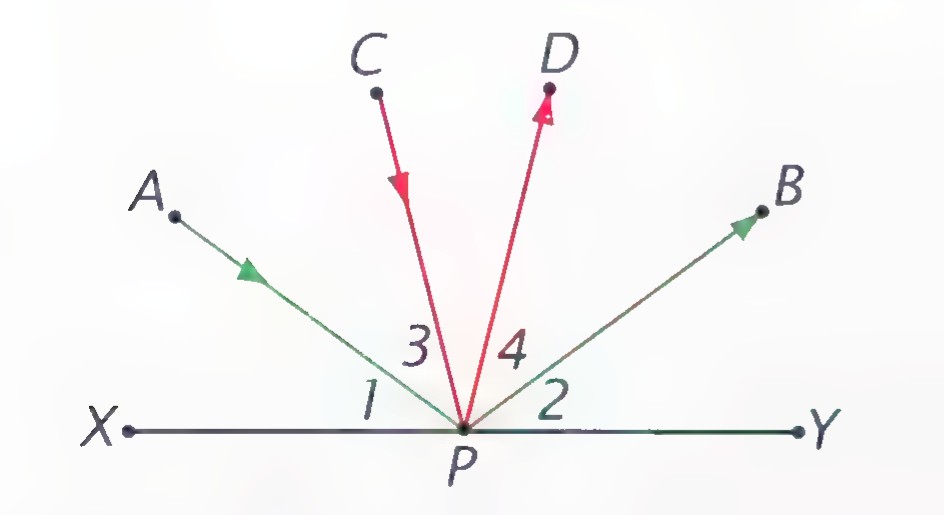
It is easy to prove from these facts that ∠3 and ∠4 in this figure also must be equal. Tell why each of the following statements in the proof is true.
- ∠CPX = ∠1 + ∠3 because PX-PA-PC and ∠DPY = ∠2 + ∠4 because PD-PB-PY.
- ∠1 + ∠3 = ∠2 + ∠4 because ∠CPX = ∠DPY.
- ∠3 = ∠4 because ∠1 = ∠2.
NBC Peacock. When color television first began, NBC chose a peacock with 11 feathers as a symbol for its programs broadcast in color.
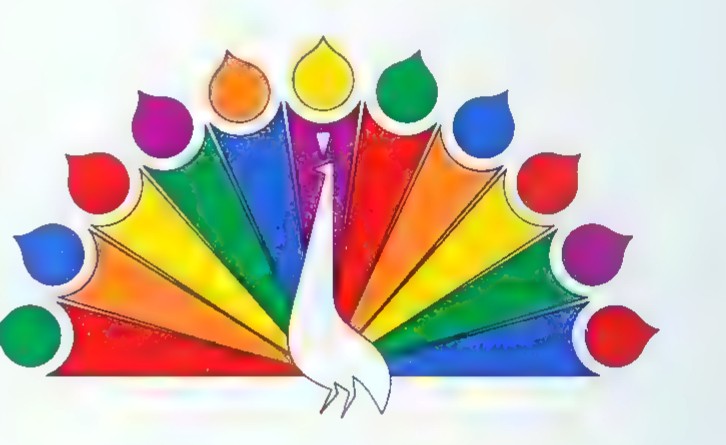
How many degrees do you think the angle of each feather would be if the peacock had
- 9 feathers?
- 10 feathers?
- 12 feathers?
- How many degrees does the angle of each feather in the actual symbol seem to be?
Minutes and Seconds. Units of angle measure smaller than the degree are the minute and second. One degree is equal to 60 minutes and 1 minute is equal to 60 seconds.
- What unit besides the degree also is equal to 60 minutes, with a minute being equal to 60 seconds?
- How many seconds are there in 1 degree?
The earth makes one rotation on its axis in 24 hours.
- How many degrees are in one rotation?
*From Billiards, by John Grissim (St. Martin’s Press, 1979).
p. 97
- Through how many degrees does the earth turn in 1 hour?
- Through how many (angular) minutes does the earth turn in 1 minute of time?
- Through how many (angular) seconds does the earth turn in 1 second of time?
Our second theorem, the Betweenness of Rays Theorem, was proved in this lesson only for the case in which . The proof for the case in which is almost exactly the same.
- Using the proof on page 93 as a guide, write the proof for this case. (Include the figure with your proof.)
Set III
In 1995, a geometrical puzzle in the Washington Post attracted more attention than its author could have imagined. As J. L. Heilbron relates in his book Geometry Civilized,
The United Press Syndicate, which had carried the quiz in which the puzzle first appeared, insisted it could be solved, but by a method too long to print. The man who set the puzzle . . . said that he had forgotten how to do it and could not repeat his lost performance. He had recourse to three dozen geometers, none of whom, he said, could find a solution.*
The problem was to find the measure of ∠EFB in the figure at the right without measuring or using any advanced mathematics.
- Use a ruler and protractor to make an accurate drawing of the figure. Make it as large as you can.
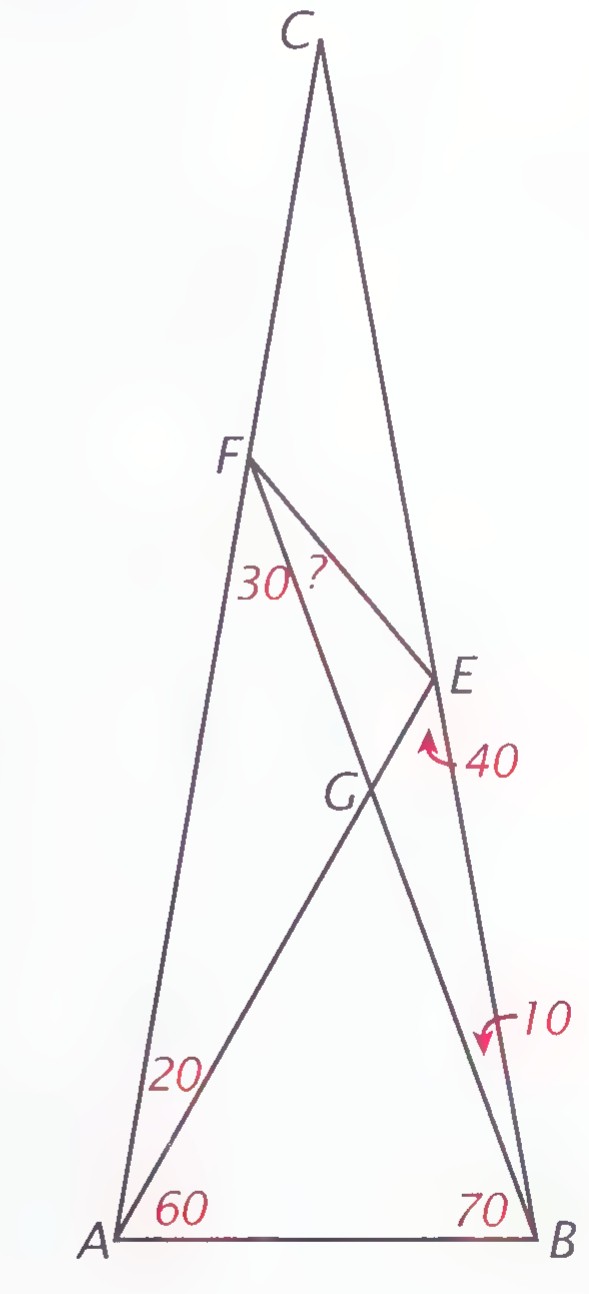
Several angles in the figure can be figured out by using the theorem about the sum of the angles of a triangle.
- Which angles are they and what are their measures?
Obviously, the measure of ∠EFB cannot be figured out as easily or the puzzle would not have given so much trouble. If your drawing is reasonably accurate, however, you may be able to make a good guess.
- What do you think the measure of ∠EFB might be?
*Clarendon Press, 1998.
p. 98
Lesson 4: Bisection
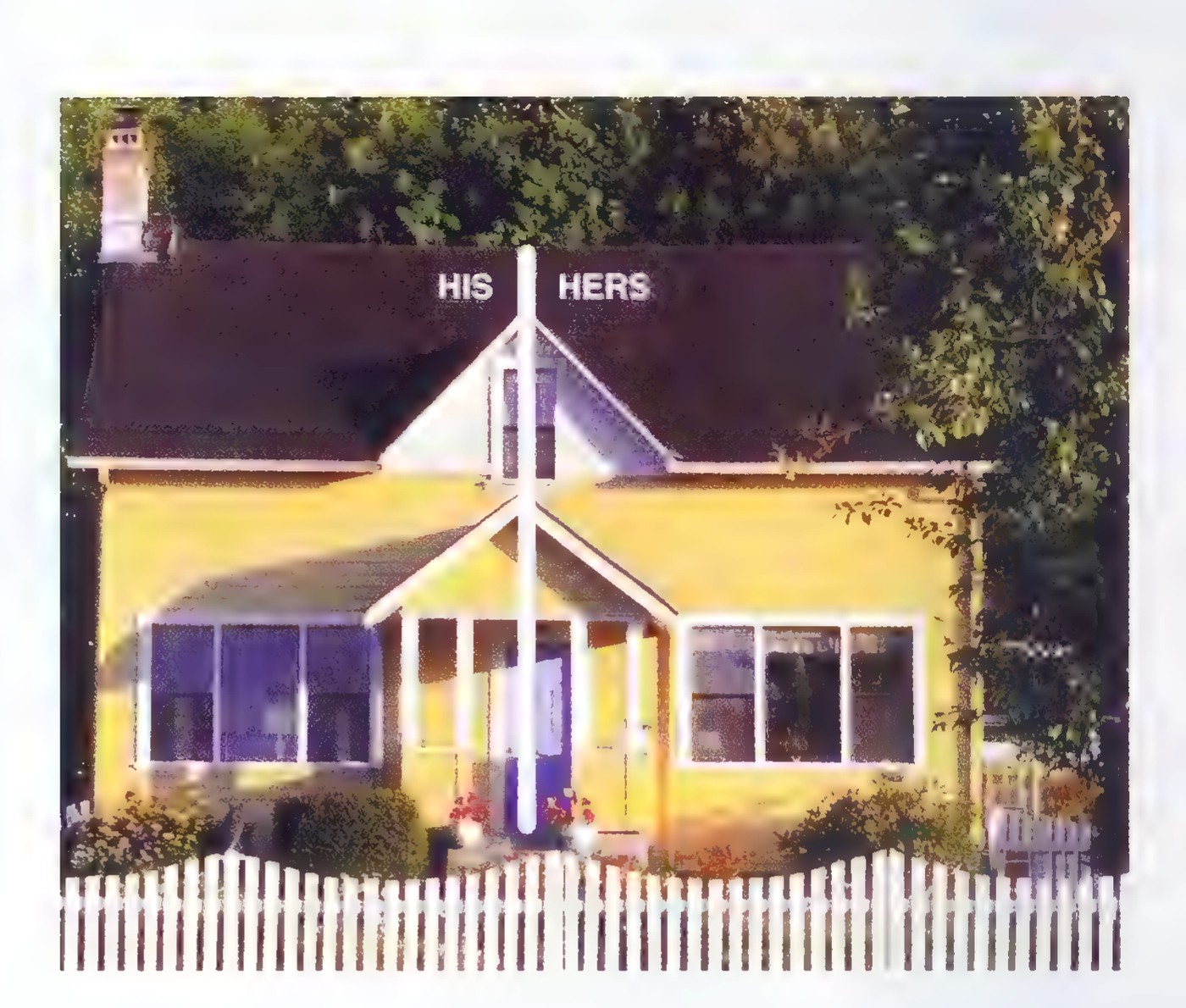
A fellow in Central City, Kentucky, was upset because his wife had filed for divorce and demanded an equal property settlement. Using drills and saws, he started to “bisect” their house into two equal parts, which he called “His” and “Hers.” His wife got a restraining order to stop him from finishing the job.*
In Lesson 4 of Chapter 1, you learned how to bisect line segments and angles with a straightedge and compass. Such figures can also be bisected by folding. If a line segment is drawn on tracing paper and one endpoint is folded onto the other, the crease divides the line segment into two equal parts. The fold line bisects the line segment and intersects it at its midpoint.
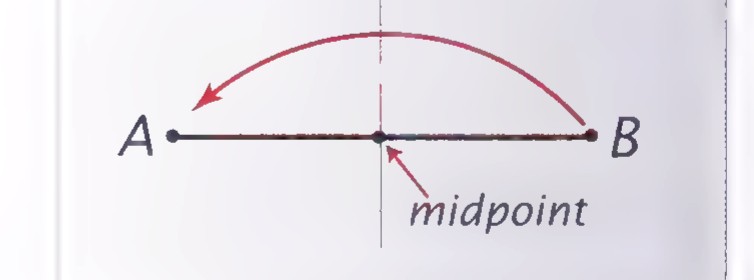
Definition
A point is the midpoint of a line segment iff it divides the line segment into two equal segments.
*Associated Press, January 21, 1983, as reported by Martin Gardner in Penrose Tiles to Trapdoor Ciphers* (W. H. Freeman and Company, 1989).*
p. 99
If an angle is drawn on tracing paper, it can be bisected by folding one side onto the other. The crease line goes through its vertex and forms two equal angles with the sides of the angle.
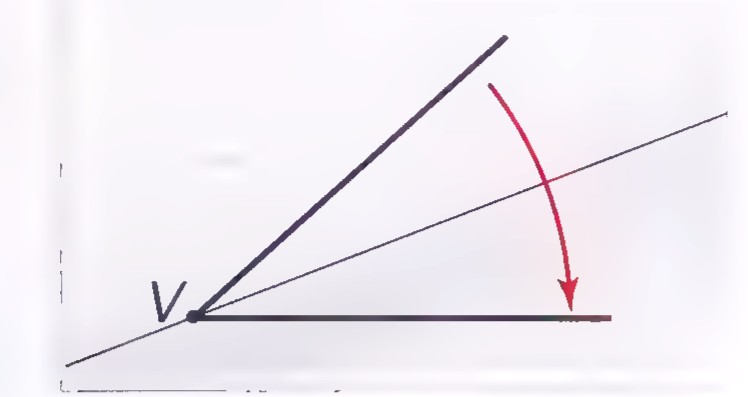
Definition
A line bisects an angle iff it divides the angle into two equal angles.
When we use the word “equal” in these folding examples, we are not thinking of numbers; we are using the word in the sense that Euclid used it. At the beginning of the Elements, Euclid assumed that “things which coincide with one another are equal to one another.” The word congruent is defined in the dictionary as “coinciding exactly when superimposed.” So we can say that, when something is bisected, it is divided into two congruent parts. Clearly, line segments are congruent if they have equal lengths, and angles are congruent if they have equal measures.
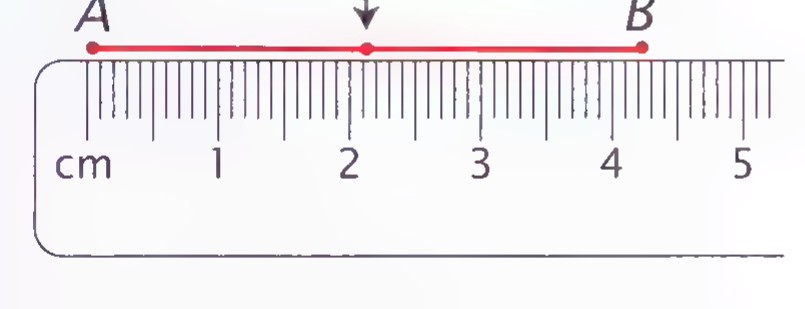
Another way to bisect a line segment is to use a ruler. If line segment AB in the figure above is exactly 4.2 centimeters long, then there is exactly one point on it, M, that divides it into two equal segments:
and so the point is 2.1 cm from each end. In our description of how a ruler works, we assumed that to each number there corresponds exactly one point; so the idea that a line segment has exactly one midpoint follows directly from the Ruler Postulate. A statement that follows directly from another statement is called a corollary to it.
A corollary is a theorem that can be easily proved as a consequence of a postulate or another theorem.
We will call our conclusion about a midpoint a
Corollary to the Ruler Postulate
A line segment has exactly one midpoint.
p. 100
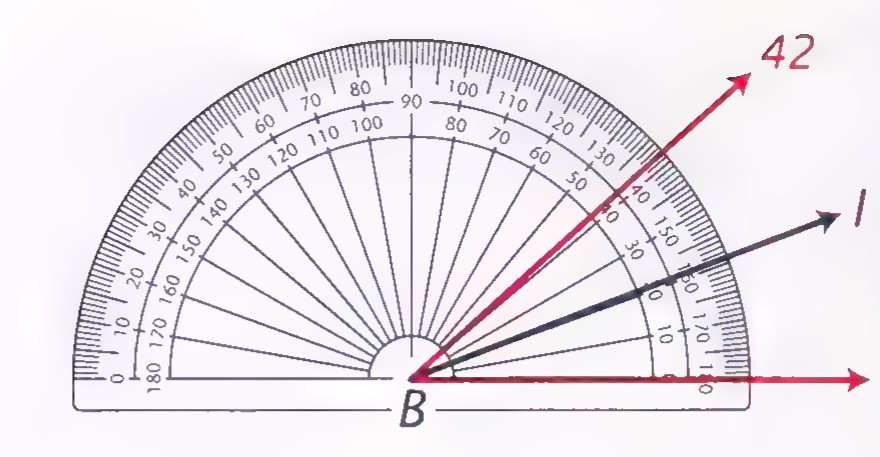
Just as a line segment can be bisected with a ruler, an angle can be bisected with a protractor. If ∠B in the figure above has a measure of exactly 42°, then there is exactly one ray inside it, BI, that divides it into two equal angles:
and so the ray is 21° from each side.
Our description of how a protractor works includes the assumption that to each number from 0 to 180 there corresponds exactly one ray, so the idea that an angle has exactly one ray that bisects it follows directly from the Protractor Postulate.
Corollary to the Protractor Postulate
An angle has exactly one ray that bisects it.
Exercises
Set I
Many important words in geometry begin with the letter C. Explain in a few words what each of the following words means.
- Collinear.
- Concurrent.
- Congruent.
- Construction.
- Converse.
- Corollary.
The definition of midpoint, like all definitions, can be written as two different if-then statements.
- The hypothesis of one of them is “If a point is the midpoint of a line segment.” What is its conclusion?
- Write the other if-then statement as a complete sentence.
- What relation do the two if-then statements have to each other?
State each of the following as a sentence.
- The corollary to the Ruler Postulate.
- The corollary to the Protractor Postulate.
Arrow Illusion. In this “arrow” figure, two points, M and N, have been marked on AB.
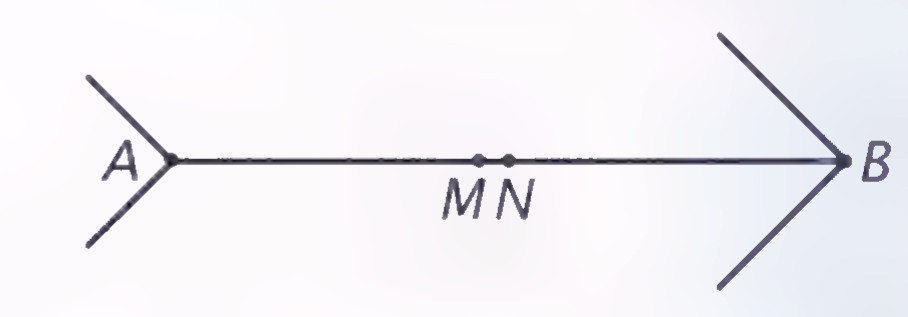
- Which one looks like the midpoint of AB?
- Could they both be midpoints of AB? Why or why not?
- Which two line segments along line AB are equal? (Check your answer with your ruler.)
p. 101
Origami Duck. Origami, the Japanese art of paper folding, was used to create this duck.*
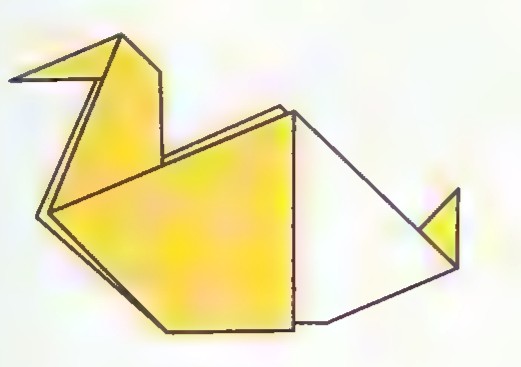
Starting with a square sheet of paper, corner B is folded onto D. Then sides BC and DC are folded onto the fold AC.
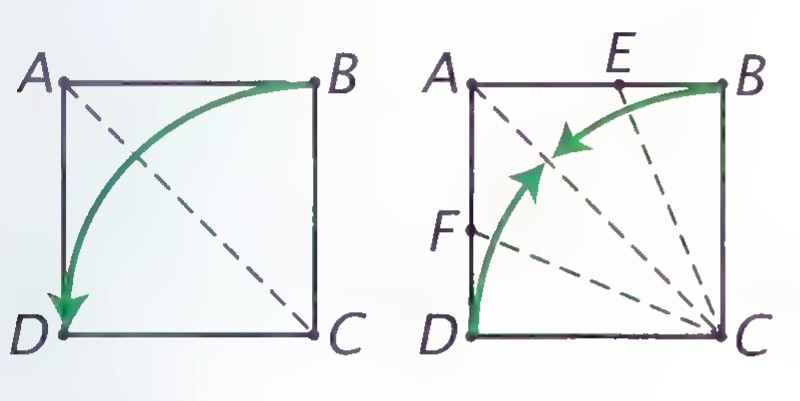
- Does point E appear to be the midpoint of AB?
- Is point E between points A and B?
Because ∠BAC fits onto ∠DAC, ∠BAC and ∠DAC are congruent.
- Which angle is bisected if ∠BAC = ∠DAC?
- Name three more angles that are bisected in the folding process.
Angle BCD is a right angle because the process starts with a square. Find the number of degrees in each of the following angles.
- ∠ACD.
- ∠FCD.
- ∠FCE.
- ∠DCE.
- ∠DFC.
Bisection Constructions. Because this lesson is about bisection, this is a good place to review the two bisection constructions.
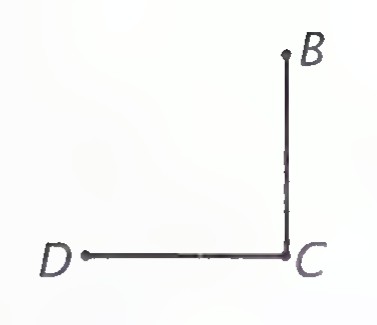
- The origami bisections by construction. Use your protractor to make a large drawing of ∠BCD (the lower right corner of the square of origami paper). Then use your straightedge and compass to bisect ∠BCD. Also bisect both of the angles formed. Finally, measure the angles with your protractor to check your accuracy.
- A short ruler construction. Use your ruler to draw a line segment AB 8 centimeters long. Then use your straightedge and compass to bisect AB. Also bisect both of the segments formed. Finally, measure the segments with your ruler to check your accuracy.
Clock Puzzle. An old puzzle asks, if a clock takes 3 seconds to chime 3 o’clock, how long does it take to chime 6 o’clock?
The figures below reveal the answer. (The points indicate the chimes and the coordinates represent the time in seconds.)
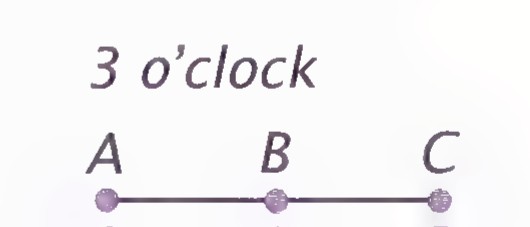
- Because B is the midpoint of AC, AB = BC. Why?
- What is the length of AB?
- What is the coordinate of B?
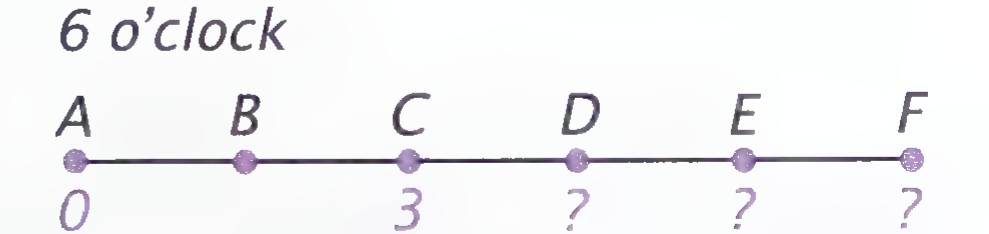
- What are the coordinates of D, E, and F?
- What is the answer to the puzzle?
*Folding the Universe, by Peter Engel (Vintage Books, 1989).
p. 102
Set II
Yen Measurement. The Japanese one-yen coin is unusual in that it is just the right size for measuring distances in centimeters. A row of five of these coins is 10 cm long.
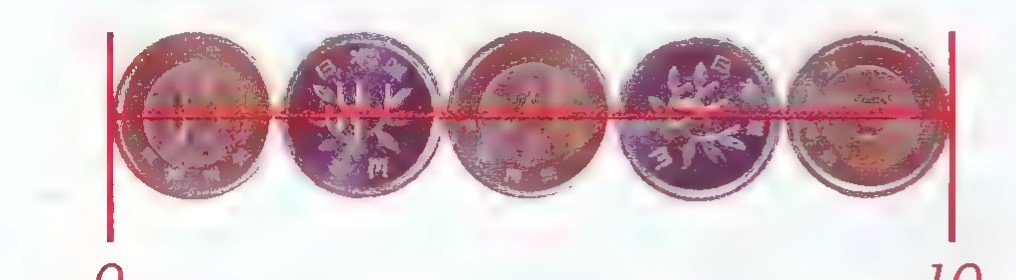
- What is the diameter of a one-yen coin?
Suppose a one-yen coin rolls exactly one revolution along a line without slipping, as shown in the figure below.
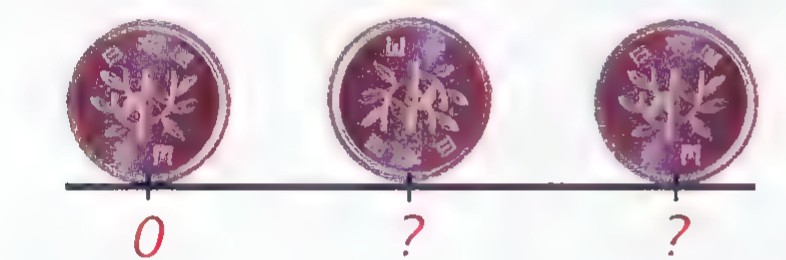
What would be the coordinate of the point at which the coin touches the line
- at the end?
- midway between?
Acetylene Proofs. Molecules of acetylene, a gas used in welding, contain four atoms, as shown in the figure below.*
In the figure at the top of the next column, the points represent the atoms and the line segments represent the bonds between them.
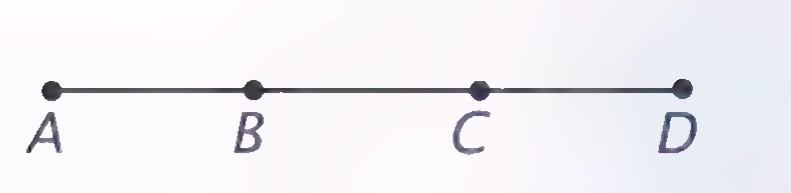
In the acetylene molecule, AB = CD, A-B-C, and B-C-D. Use these facts to supply the reasons for the following direct proof that AC = BD.
- Proof.
AB = CD. (By hypothesis.)
AB + BC = BC + CD. (Why?)
A-B-C and B-C-D. (By hypothesis.)
AB + BC = AC and BC + CD = BD. (Why?)
Therefore, AC = BD. (Why?)
Use the additional fact that AC > 2AB to supply the missing statements and reasons in this indirect proof that B is not the midpoint of AC.
- Proof.
(What is the beginning assumption?)
If B is the midpoint of AC, then AB = BC. (Why?)
Because AB + BC = AC, 2AB = AC. (Why?)
(What does this statement contradict?)
Therefore, our assumption is false and (what conclusion follows?)
Miter Joint Proof. In carpentry, a miter joint is formed when two pieces of wood cut at an angle are joined together.
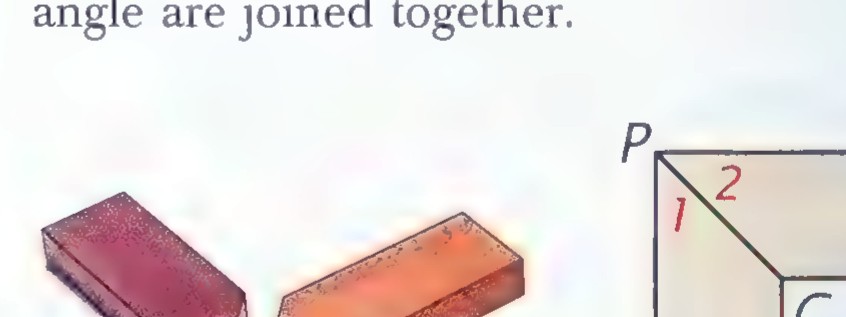
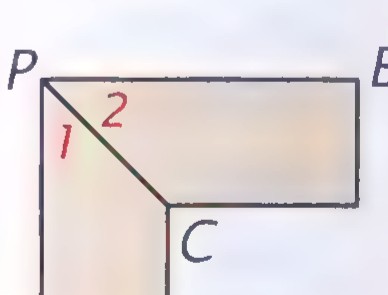
If the pieces are cut correctly, when they are glued together so that PA-PC-PB, PC bisects ∠APB.
Copy and complete the following proof that
*The Architecture of Molecules, by Linus Pauling and Roger Hayward (W. H. Freeman and Company, 1964).
p. 103
- Proof
| Statements | Reasons |
|---|---|
| 1. PA-PC-PB. | By hypothesis. |
| 2. ∠1 + ∠2 = ?. | Betweenness of Rays Theorem. |
| 3. PB bisects ∠APB. | By hypothesis. |
| 4. ∠1 = ?. | If a line bisects an angle, it divides the angle into two equal angles. |
| 5. ∠1 + ∠1 = ∠APB; so 2∠1 = ∠APB. | Why? |
| 6. ∠1 = . | Why? |
Angle Definition. It may surprise you that not everyone agrees on the best way to define some of the terms of geometry. An example is “angle.”
Compare these figures of an obtuse angle and a straight angle.
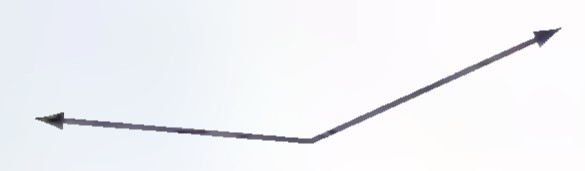
An obtuse angle

A straight angle
- Would you think that both of these figures were angles if they were not so labeled? Explain.
We defined an angle as “a pair of rays that have the same endpoint” and called the common endpoint the vertex of the angle.
- What is strange about the vertex of a straight angle?
In the figure below, some of the rays between the sides of the obtuse angle are shown.
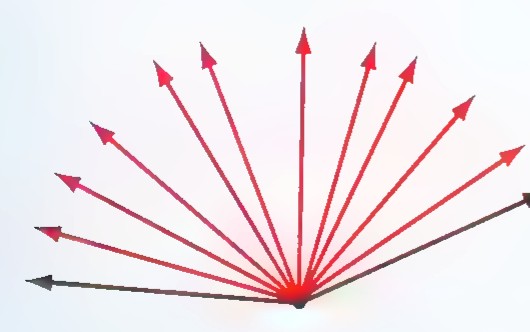
- Where are the rays between the sides of the straight angle?
- Although the corollary to the Protractor Postulate says that an angle has exactly one ray that bisects it, someone might say that the corollary is not true for a straight angle. Why?
Passion Flower. A passion flower has three stigmas, five stamens, and ten petals.*

In the figure below, drawn from the photograph, the stigmas are represented by the red rays and the stamens by the green rays. Imagine a circular protractor placed with its center at P so that the coordinate of ray PA is 0 and the numbers on the scale increase in a clockwise direction.
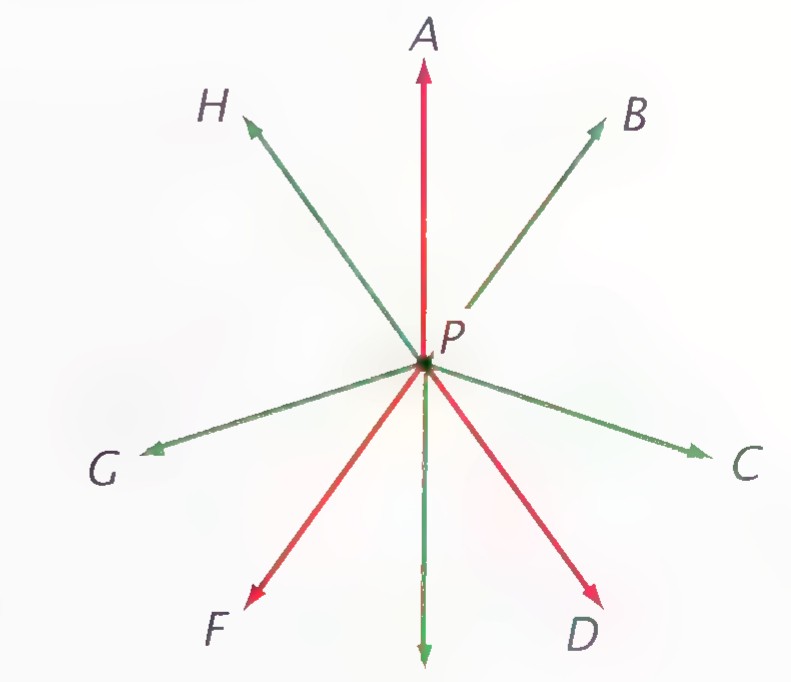
- Copy the figure and mark it appropriately to answer the following questions.
*Numbers: Facts, Figures and Fiction, by Richard Phillips (Cambridge University Press, 1994).
p. 104
- If points A, P, and E are collinear, what is the coordinate of ray PE?
- If the stamens are equally spaced around P, how large is ∠EPC?
- If ray PD bisects ∠EPC and ray PF bisects ∠GPE, how large are ∠FPE and ∠EPD?
- Put all of these assumptions together to find the coordinates of the other rays.
- Would it be correct to say that ray PA is between rays PG and PC? Why or why not?
- Would it be correct to say that ray PE bisects ∠GPC? Why or why not?
Set III
Rusty Compass Constructions. In about 980 A.D., the Persian mathematician Abul Wefa explored making constructions with a straightedge and a compass whose radius cannot be changed. Such a compass is called a “rusty compass.”
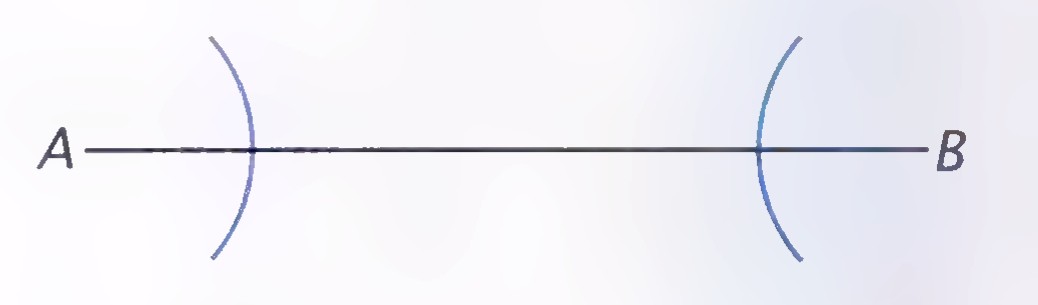
- Use your ruler to draw a line segment AB 5 inches long. Set the radius of your compass to 1 inch. Can you figure out a way to bisect the line segment with your straightedge and compass without changing the radius of the compass?
- Use your protractor to draw a 50° angle and bisect it with your rusty compass.
- Draw a 150° angle and try to bisect it with your rusty compass.
If a rusty compass had a radius of 1 inch, the easiest line segment to bisect would be one 2 inches long.
- Can you guess the size of the angle that would be easiest to bisect with such a compass?
p. 105

Lesson 5: Complementary and Supplementary Angles
If you ride a bicycle in a circle, the bicycle automatically leans toward the center of the circle. The angle at which the bicycle leans depends on its speed and the size of the circle. It is measured from the vertical because that is the “normal” direction of the bicycle.
In the photograph, this angle is labeled A and has a measure of 32°. If the angle of the bicycle with the horizontal were measured instead, ∠B in the diagram at the right, what would its measure be? Because ∠A + ∠B = 90°, ∠B = 90° − ∠A = 90° − 32° = 58°.
Two angles whose sum is 90° are complementary. Such angles are frequent in geometry; so complementary is an important word to know.
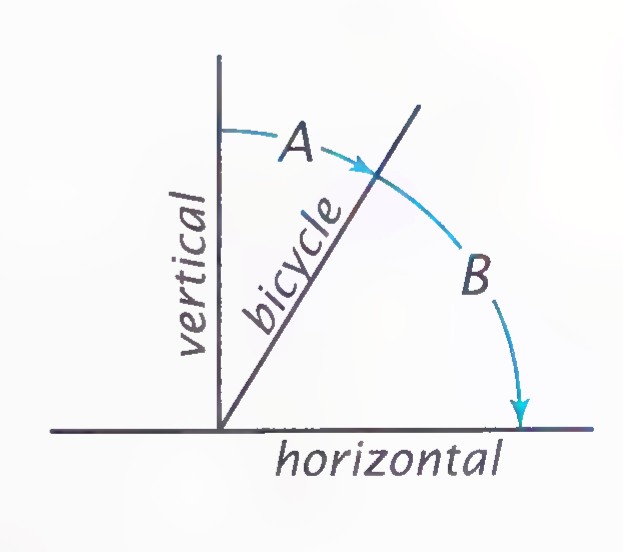
Definition
Two angles are complementary iff their sum is 90°.
Each angle is called the complement of the other. Because the sum of two complementary angles is 90°, the complement of an angle is found by subtracting the angle from 90°.
p. 106
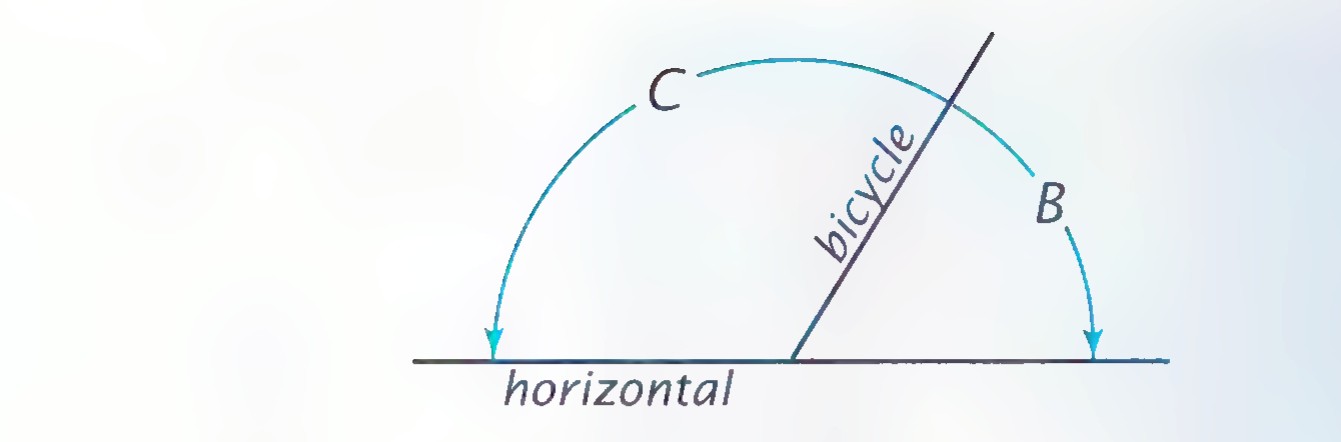
The figure above shows that there are two ways to choose the angle between the bicycle and the horizontal. If ∠B = 58°, what would be the measure of ∠C? Because ∠B + ∠C = 180°, ∠C = 180° − ∠B = 180° − 58° = 122°.
Two angles whose sum is 180° are called supplementary, another important word to know.
Definition
Two angles are supplementary iff their sum is 180°.
Each angle is called the supplement of the other, and the supplement of an angle is found by subtracting the angle from 180°.
Although complementary angles often share a common side, as do supplementary angles, our definitions say nothing about their positions. For example, in the figure at the left, ∠A and ∠B are complementary; ∠DCB and ∠B also are complementary. Given that ∠A = 50°, how large is ∠B? How large is ∠DCB?
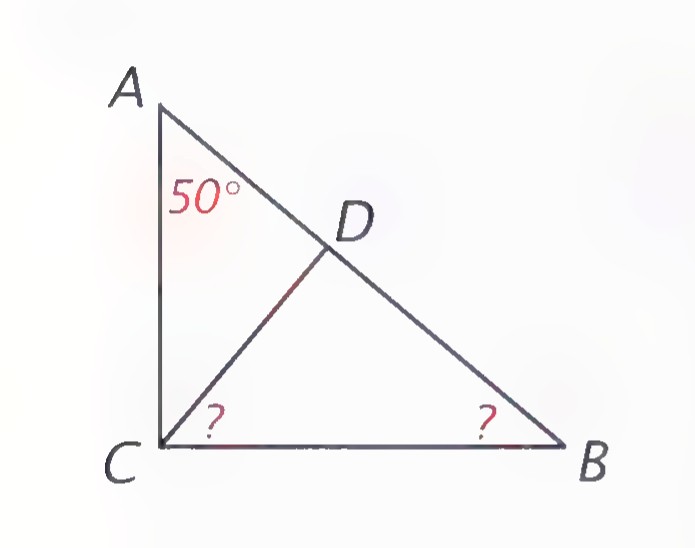
That ∠DCB = ∠A in this figure is no accident. It is easy to prove that two angles that are complements of the same angle must be equal. The proof, which we write in two-column form, is presented below. The hypothesis of a theorem is often referred to as “given” and the conclusion as “prove,” as is done here.
Theorem 3
Complements of the same angle are equal.
Given: ∠1 and ∠2 are complements of ∠3.
Prove: ∠1 = ∠2.
Proof
| Statements | Reasons |
|---|---|
| 1. ∠1 and ∠2 are complements of ∠3. | Given. |
| 2. ∠1 + ∠3 = 90°; ∠2 + ∠3 = 90°. | If two angles are complementary, their sum is 90°. |
| 3. ∠1 + ∠3 = ∠2 + ∠3. | Substitution. |
| 4. ∠1 = ∠2. | Subtraction. |
A similar theorem with an almost identical proof is true for supplementary angles.
Theorem 4
Supplements of the same angle are equal.
p. 107
Exercises
Set I
The definitions in the dictionary for “complement” and “supplement” are quite similar. Complement is defined as “something that completes or makes up a whole” and supplement is defined as “something added to complete a thing, or strengthen the whole.”
To what number does the word “whole” refer with respect to
- complementary angles?
- supplementary angles?
The word complement is easily confused with the word compliment.
- Which one would you rather get from a friend?
Safe Angle. The lights at the end of a runway tell a pilot if the plane is approaching it at the safe angle of 3°. Above this angle, the lights look white; below it, they look red.
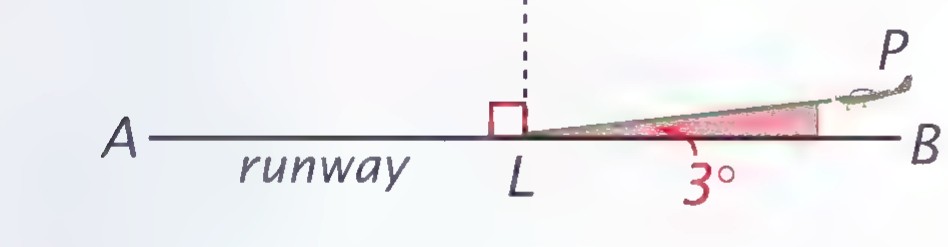
- If the plane is approaching the runway at the safe angle, what angle (∠VLP) does its path make with the vertical?
- What relation does ∠VLP have to ∠BLP?
- What angle should the path of the plane, LP, make with LA?
- What relation does ∠PLA have to ∠BLP?
Sign Measure. An old unit of angle measure, the “sign,” comes from astrology: 12 signs were equal to 360°.
- To how many degrees was one sign equal?
How many degrees were in
- the supplement of a sign?
- the complement of a sign?
- Where do you suppose the name “sign” came from?
Suppose that a right angle is bisected and each of the two angles that result is trisected.
- Sketch a figure to illustrate this.
- How large is each of the smallest angles formed?
- What do the measures of all of the angles in the figure have in common?
Skier Forces. The figure below shows the forces acting on a skier skiing downhill.*
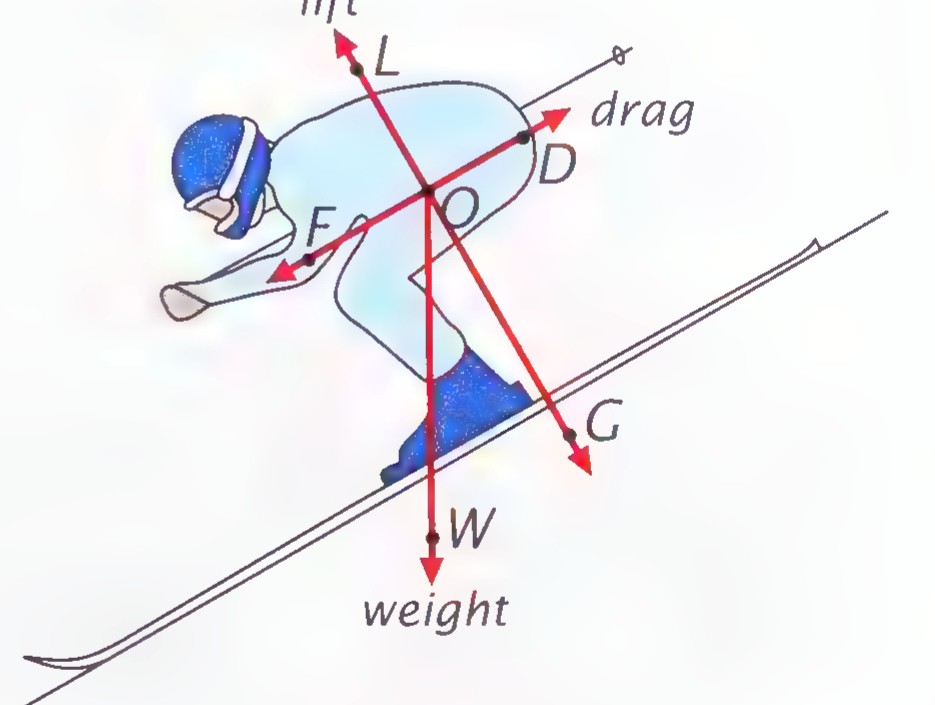
If a protractor is placed on the figure so that OD has the coordinate 0, the coordinates of some of the other rays are:
OG, 90; OW, 117; OF, 180.
- Draw and label the rays on your paper and mark their coordinates.
*The Physics of Skiing, by David Lind and Scott P. Sanders (AIP Press, 1996).
p. 108
- Write the equation that follows from the fact that OD-OW-OF.
- Find the measures of ∠DOW, ∠WOF, and ∠DOF.
- What relation does ∠DOW have to ∠WOF?
- Find the measure of ∠WOG.
- What relation does ∠WOG have to ∠WOF?
Name two angles in the figure that are
- acute.
- obtuse.
Triangle in the Woods. While on a walk in the woods, Obtuse Ollie made a very large triangle by stretching a long rope around three trees. He told Acute Alice that its three angles were supplementary.
- Without even looking at it, Alice said that that was nonsense. Why?
Ollie then claimed that two of its angles were supplementary.
- Is this possible? Why or why not?
Alice looked at the triangle and said that she thought two of its angles were complementary.
- Is this possible? Explain.
Hammer Throw. The direction, OH, of launching the hammer in the hammer throw is shown in this figure. If the hammer is thrown in the ideal direction, then OH bisects ∠YOX.
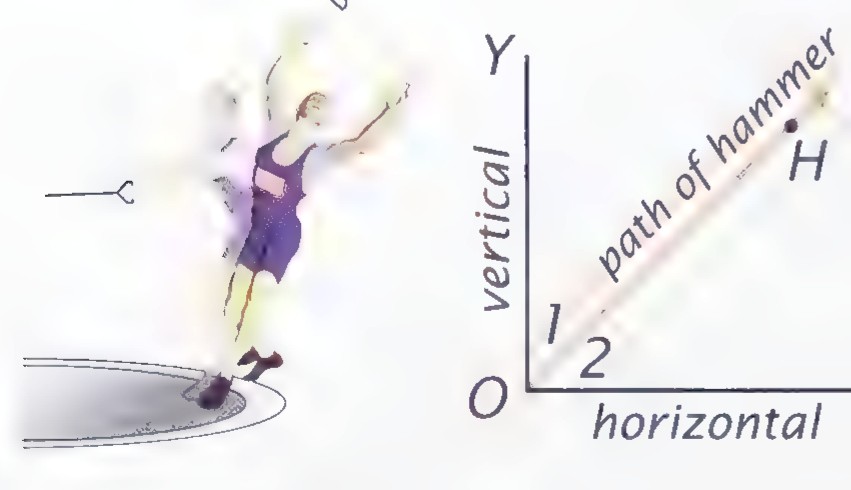
Because OY-OH-OX, why does it follow that ∠1 + ∠2 = ∠YOX?
Given that ∠YOX is a right angle, why is ∠YOX = 90°?
Why does it follow that ∠1 + ∠2 = 90°?
If OH bisects ∠YOX, why is ∠1 = ∠2?
Why does it follow that ∠2 + ∠2 = 90°, or 2∠2 = 90°?
Why does it follow that ∠2 = 45°?
Set II
Clock Hands. A small child just learning to tell time was told that she could stay up until “the big hand is on the 6 and the little hand is on the 8.”
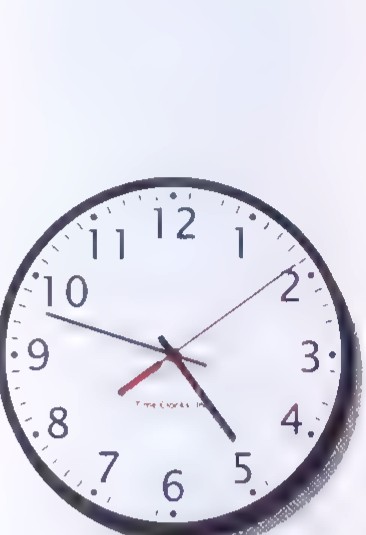
- What time was she supposed to go to bed? Draw a picture of a clock to illustrate it.
- According to the description of the clock, what angle would the hands make?
- If what the child was told was true, how is it that she might have been able to stay up all night?
- What angle would the hands actually make at the bedtime intended?
Complement and Supplement. Suppose that ∠C is the complement of ∠A and that ∠S is the supplement of ∠A.
- Copy and complete the following table.
| ∠A | ∠C | ∠S |
|---|---|---|
| 10° | ? | ? |
| 20° | ? | ? |
| 30° | ? | ? |
- How does ∠S seem to compare with ∠C?
- If ∠A = °, what are the measures of ∠C and ∠S in terms of ?
- Use the two expressions and some algebra to show that the conclusion suggested by the table is always true.
p. 109
Earth Angles. The Arctic Circle connects the points on the earth that are 66.54° north of the equator. The tropic of Capricorn connects the points on the earth that are 23.46° south of the equator.
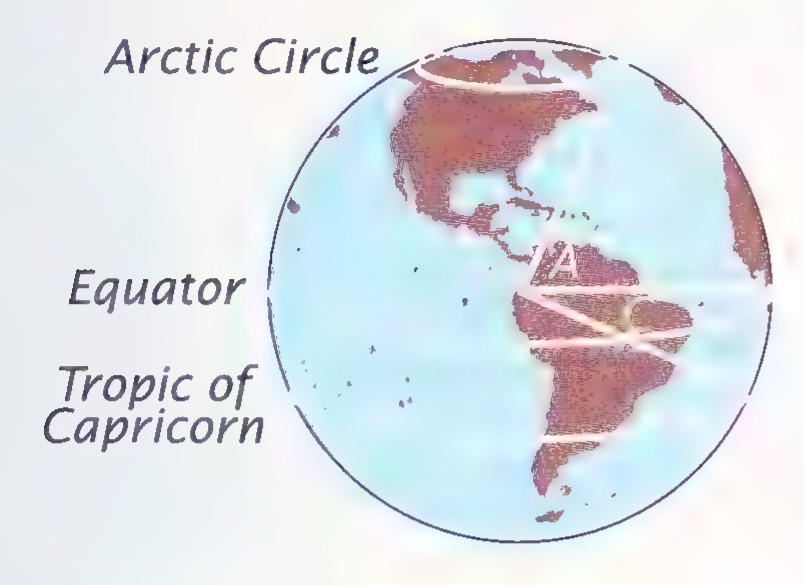
- What relation do these angles have to each other?
On the first day of winter in North America, the sun is directly overhead at noon on the tropic of Capricorn.
- Where do you suppose the sun appears to be at the same time on the Arctic Circle?
The North and South Poles are the points that are 90° north and 90° south of the equator.
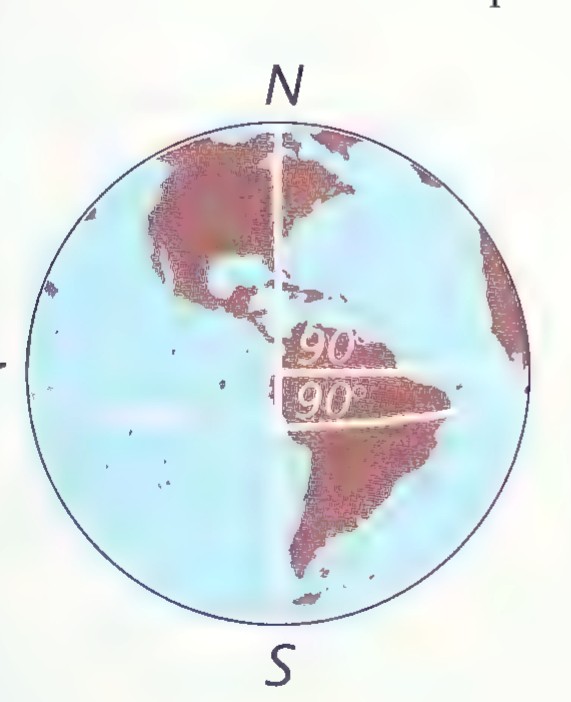
- What relation other than being equal do these angles have to each other?
On the first day of winter in North America, the sun never sets at the South Pole.
- What do you suppose is true of the first day of winter at the North Pole?
In the figure below, ∠1 and ∠2 are both complements of ∠AOC.
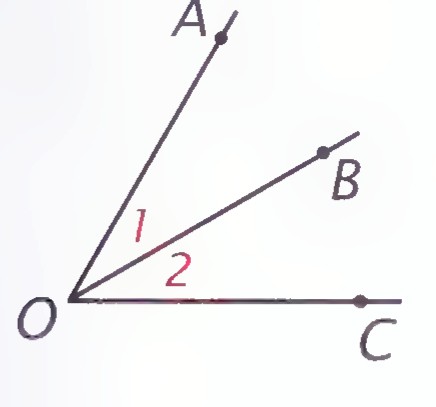
- What else seems to be true? Explain why.
- Is it possible to figure out the size of each angle in the figure without measuring them? Explain.
The proof of Theorem 4 is almost identical with that of Theorem 3.
- Write it, using the proof of Theorem 3 as a guide.
Set III
This pattern is made from 15 squares.*
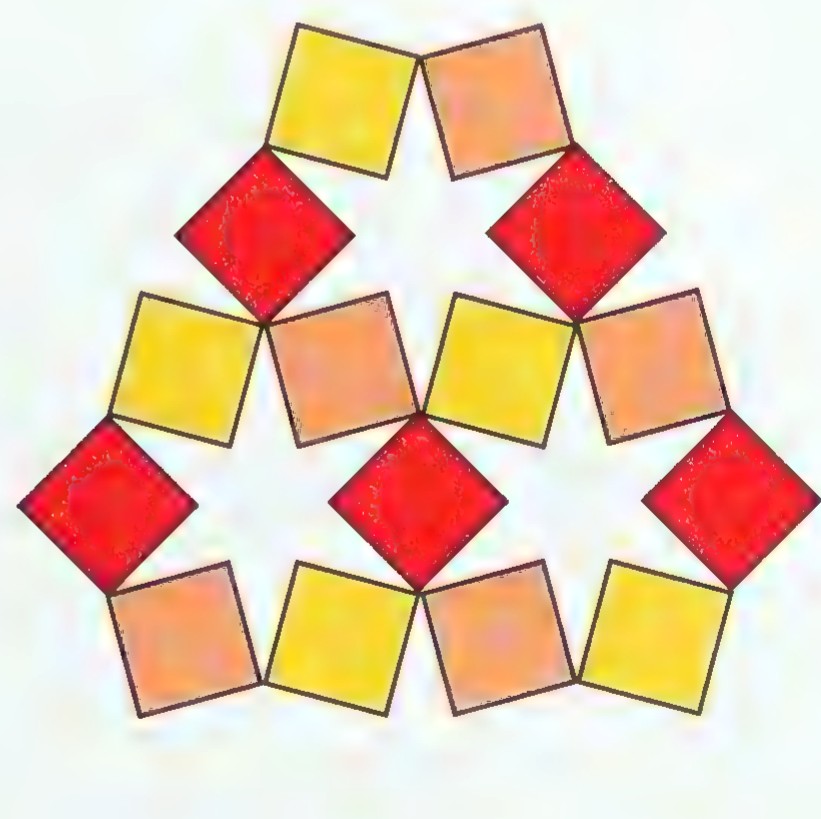
From the appearance of the figure, how large do you think the angles at the points of the stars are? Show your reasoning.
*Numbers: Facts, Figures and Fiction, by Richard Phillips (Cambridge University Press, 1994).
p. 110
Lesson 6: Linear Pairs and Vertical Angles
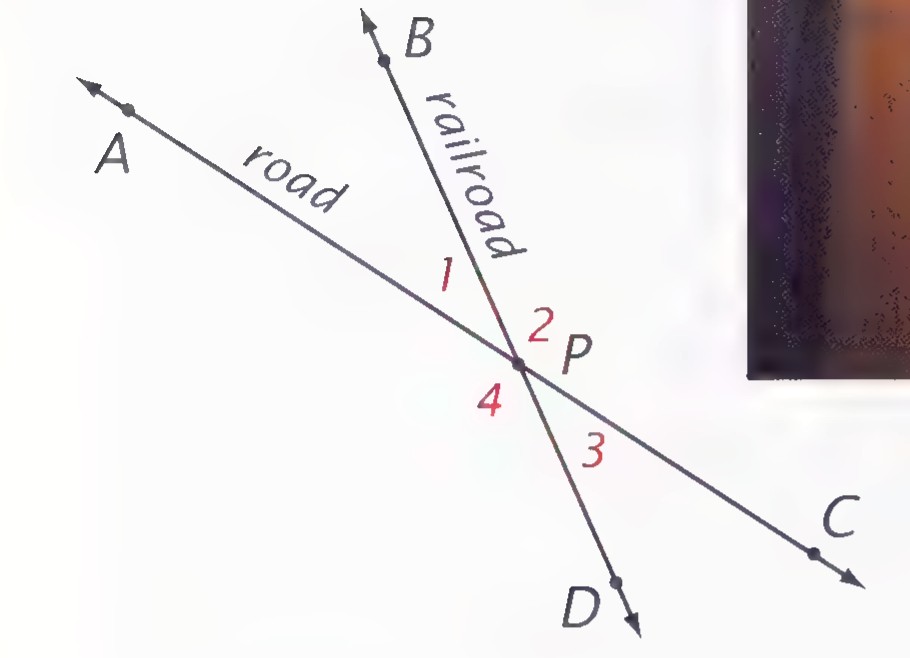
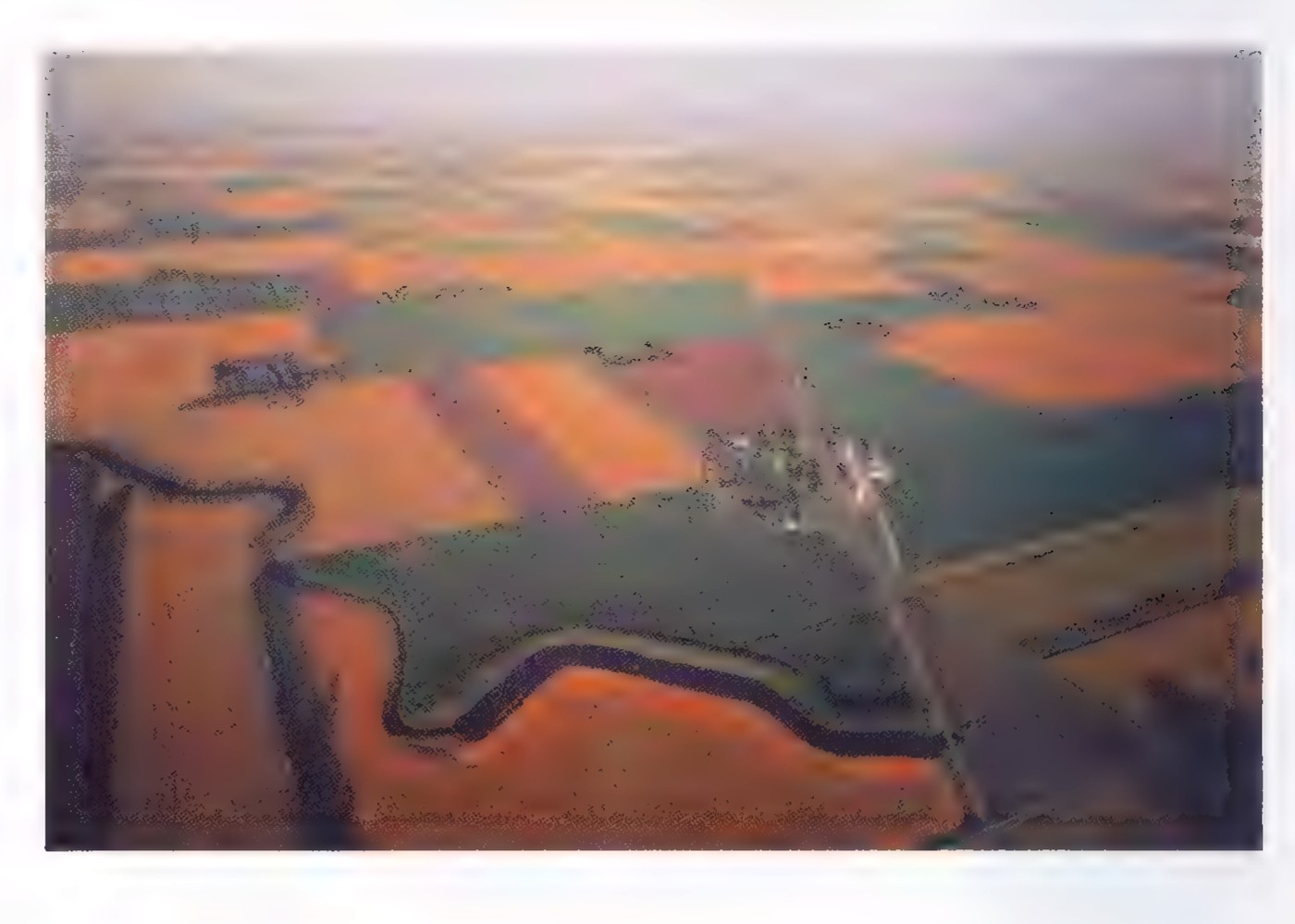
Much of the American landscape is divided by section lines that run north–south and east–west. An exception to this pattern are the railroads. In the photograph above of Castleton, North Dakota, a railroad intersects a road at a fairly sharp angle.
The lines of the road and railroad actually form four angles, which are numbered in the diagram above. Notice also that the point in which the lines intersect, P, divides each line into two rays. Because the rays point in opposite directions, they are called opposite rays: rays PA and PC are opposite rays, as are rays PB and PD.
Angles such as ∠1 and ∠2 that have a common side and have opposite rays as their other sides are called a linear pair. Angles such as ∠1 and ∠3 in which the sides of one angle are opposite rays to the sides of the other are called vertical angles.* Because we will be using these terms throughout our study of geometry, their definitions are repeated here.
*“Opposite angles” seems like a more appropriate name because “vertical” suggests a connection to vertical lines, and vertical angles have nothing to do with vertical lines. The dictionary definition for “vertical angle” is, in fact, “one of two opposite angles formed by two intersecting lines.”
p. 111
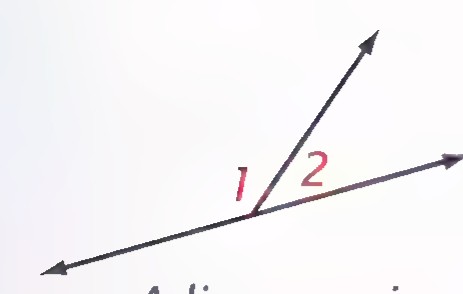
A linear pair
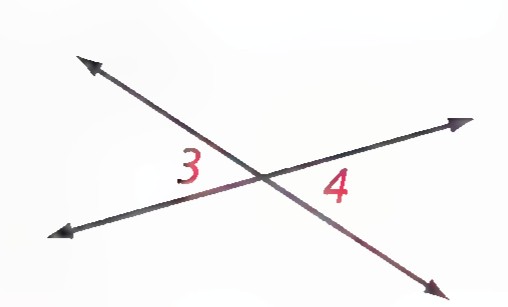
Vertical angles
Definitions
Two angles are a linear pair iff they have a common side and their other sides are opposite rays.
Two angles are vertical angles iff the sides of one angle are opposite rays to the sides of the other.
In Lesson 5 of this chapter, we considered relations between pairs of angles that concerned only their measures. The definitions of complementary angles and supplementary angles say nothing about their sides.
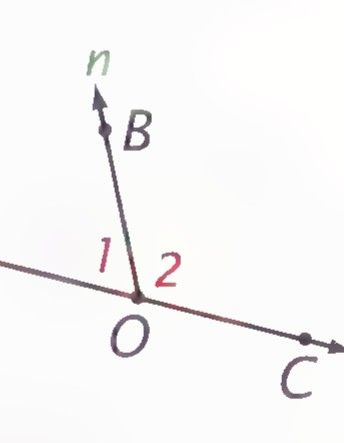
Although the definitions of linear pair and vertical angles say nothing about their measures, the figures at the top of this page suggest some possible conclusions about them. The angles in a linear pair, such as ∠1 and ∠2, seem to be supplementary. Vertical angles, such as ∠3 and ∠4, seem to be equal. Because both of these observations are useful and can be proved on the basis of what we already know, we add them to our list of theorems.
Theorem 5
The angles in a linear pair are supplementary.
Given: ∠1 and ∠2 are a linear pair.
Prove: ∠1 and ∠2 are supplementary.
Proof
| Statements | Reasons |
|---|---|
| 1. ∠1 and ∠2 are a linear pair. | Given. |
| 2. Rays OA and OC are opposite rays. | If two angles are a linear pair, they have a common side and their other sides are opposite rays. |
| 3. Let the coordinates of OA, OB, and OC be 0, , and 180. | Protractor Postulate. |
| 4. ∠1 = − 0 = °, ∠2 = (180 − )°. | Protractor Postulate. |
| 5. ∠1 + ∠2 = ° + (180 − )° = 180°. | Addition. |
| 6. ∠1 and ∠2 are supplementary. | Two angles are supplementary if their sum is 180°. |
p. 112
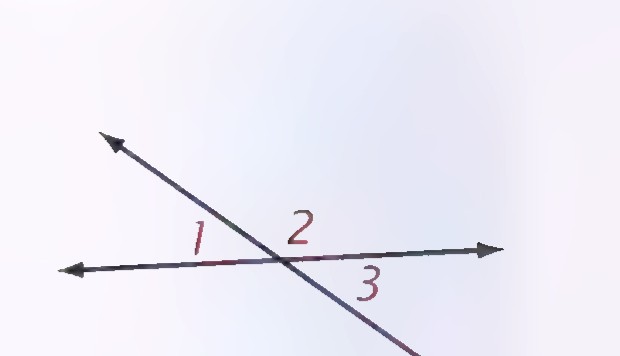
Theorem 6
Vertical angles are equal.
Given: ∠1 and ∠3 are vertical angles.
Prove: ∠1 = ∠3.
Proof
| Statements | Reasons |
|---|---|
| 1. ∠1 and ∠3 are vertical angles. | Given. |
| 2. The sides of ∠1 are opposite rays to the sides of ∠3. | If two angles are vertical angles, the sides of one are opposite rays to the sides of the other. |
| 3. ∠1 and ∠2 are a linear pair; ∠2 and ∠3 are a linear pair. | Two angles are a linear pair if they have a common side and their other sides are opposite rays. |
| 4. ∠1 and ∠2 are supplementary; ∠2 and ∠3 are supplementary. | The angles in a linear pair are supplementary. |
| 5. ∠1 = ∠3. | Supplements of the same angle are equal. |
Exercises
Set I
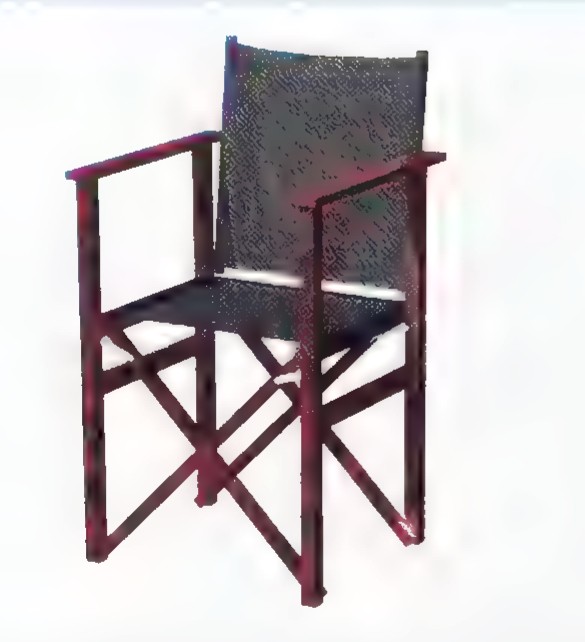
When this chair is closed up, the angles of the braces between its legs change in size. No matter whether the chair is open or closed, however, the way in which these angles are related to one another never changes.
- Why are some of them always equal?
- Why are some of them always supplementary?
Figures such as the one below are used in tests of perception. For example, it might be seen as a four-sided figure and two triangles.
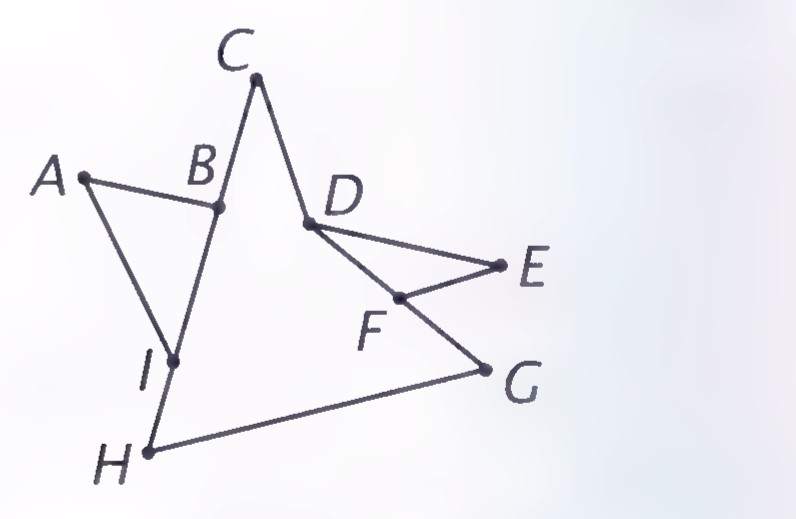
- What other way do you think it might be seen?
- Name the sets of points in the figure that seem to be collinear.
- Name the pairs of angles that seem to be linear pairs.
- Does the figure contain any vertical angles?
p. 113
An intersection of two roads can be dangerous if they do not form 90° angles. In this figure, road X intersects road Y at P.
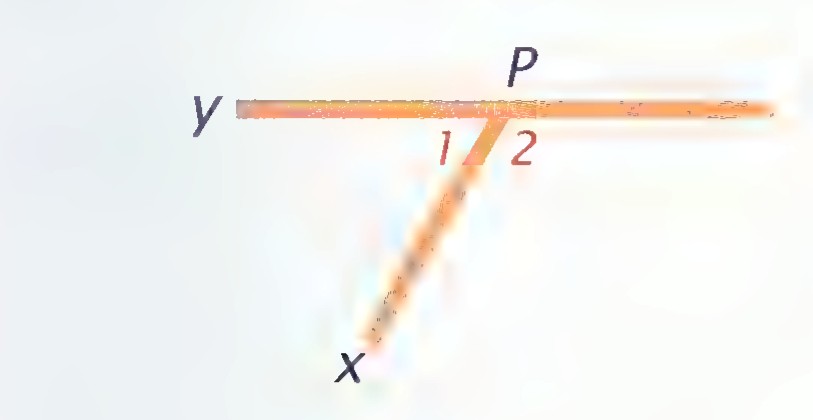
- Name two relations of ∠1 and ∠2.
- If ∠1 = 55°, how large is ∠2?
- How large is ∠1 if ∠2 = °?
- If you went from one road onto the other, through which angle would it be more dangerous to turn?
Sun Directions. Four special directions of the sun in the course of a year are shown along the lines AD and BC in the figure below.* The lines of the map directions bisect the angles formed by these lines.
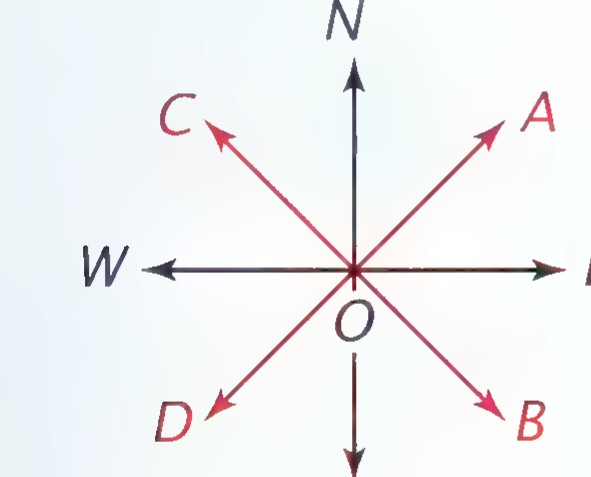
If a circular protractor is centered on point O so that ON has the coordinate 0, the coordinate of OA is 50.
- Copy the figure and write the coordinates of all of the rays on it.
Rays OA and OB show the directions of the sun at sunrise in midsummer and midwinter.
- How large is ∠AOB?
Rays OC and OD show the directions of the sun at sunset in midsummer and midwinter.
- How large is ∠COD?
- Why must ∠AOB = ∠COD?
- How large are ∠AOC and ∠BOD?
In the following figure, ∠1 = ∠2 = ∠3.
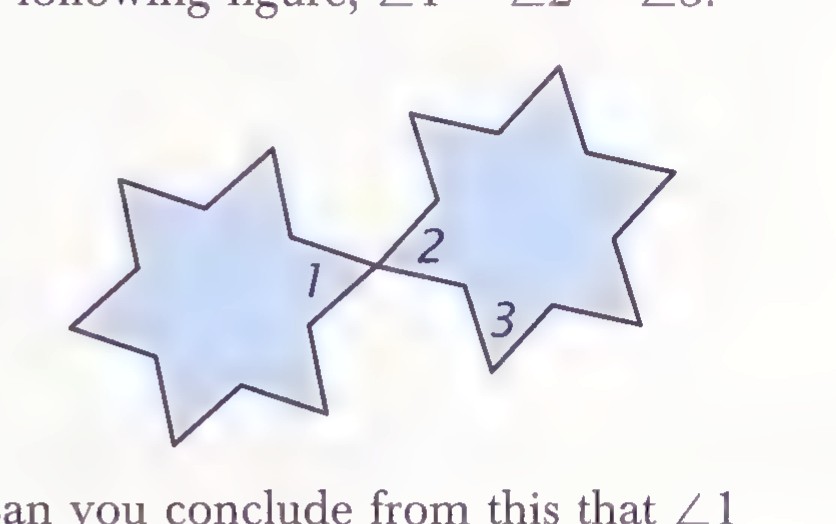
- Can you conclude from this that ∠1 and ∠2 must be vertical angles?
The theorem about vertical angles can be written in the form of a conditional statement:
If two angles are vertical angles, then they are equal.
- Write the converse of this statement.
- Is it true?
- If two angles are not equal, can they be vertical angles?
- If two angles are not vertical angles, can they be equal?
Ship Position. Navigators ordinarily use three lines to determine a ship’s position. If the lines are accurate, they intersect in a single point locating the ship as shown in the figure below.
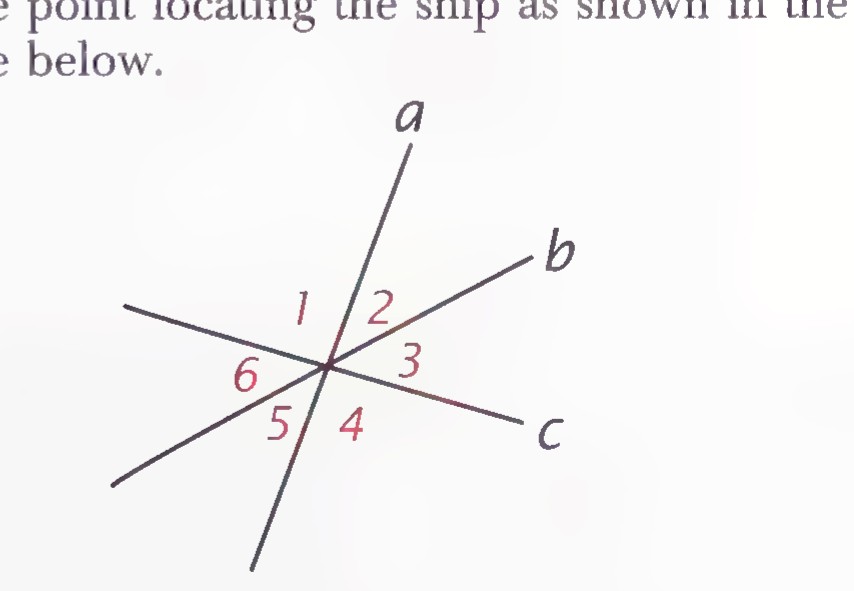
- What word describes lines that contain the same point?
*Stonehenge Complete, by Christopher Chippindale (Cornell University Press, 1983).
p. 114
- Draw and label a large figure similar to the one below. Use your protractor to measure the six numbered angles in your figure.
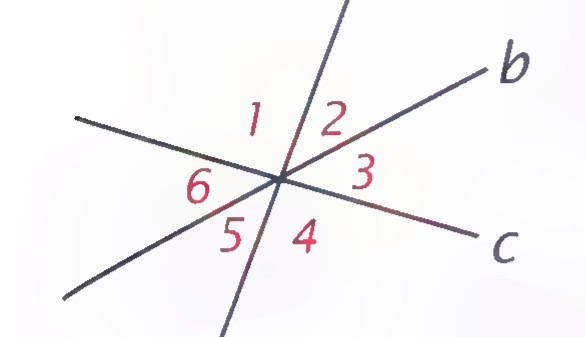
- How many of the six angles do you need to measure to be able to figure out the rest?
Without knowing the measures of any of the angles, it is still possible to know what number three consecutive angles add up to.
- To what number is ∠1 + ∠2 + ∠3 equal?
- Is it possible to tell to what number ∠1 + ∠3 + ∠5 is equal? Explain.
Because of small errors, when a navigator draws the three lines, they may form a triangle such as the one shown in the figure below.
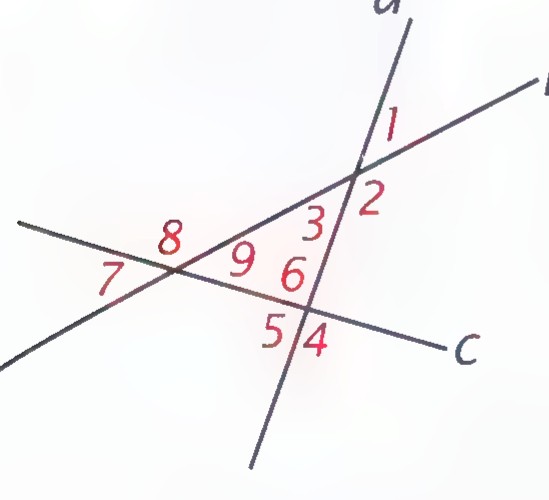
Regardless of the shape of the triangle, it is possible to draw some conclusions about the numbered angles.
To what number is ∠3 + ∠6 + ∠9 equal?
How do you know?
To what number is ∠1 + ∠4 + ∠7 equal?
Explain your reasoning.
Why are ∠2 + ∠3 = 180°, ∠5 + ∠6 = 180°, and ∠8 + ∠9 = 180°?
Why is ∠2 + ∠3 + ∠5 + ∠6 + ∠8 + ∠9 = 540°?
To what number is ∠2 + ∠5 + ∠8 equal?
Explain your reasoning.
Set II
Steep Slope. Trees sometimes grow on very steep slopes. In the figure below, a vertical line along which the tree grows is shown intersecting a line representing the slope.
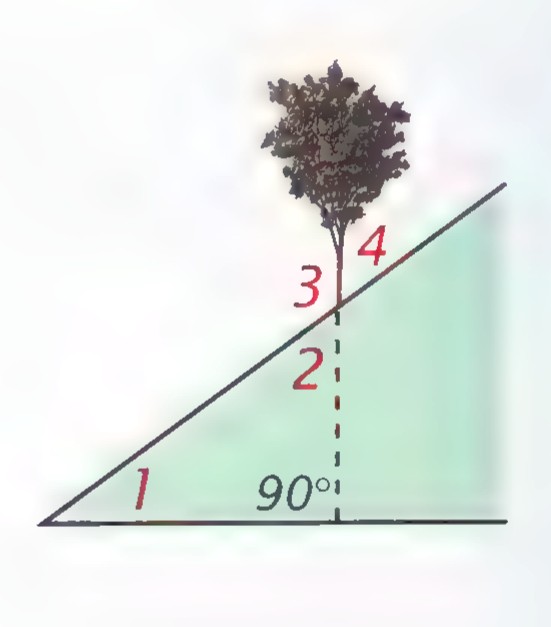
- Copy and complete this table for various measures of the angles in the figure.
| ∠1 | ∠2 | ∠3 | ∠4 |
|---|---|---|---|
| 25° | ? | ? | ? |
| 33° | ? | ? | ? |
| 48° | ? | ? | ? |
- How does ∠4 compare with ∠2?
- Why?
- How does ∠3 seem to compare with ∠1?
- If ∠1 = °, what are the measures of ∠2, ∠3, and ∠4 in terms of ?
- Use the expressions for ∠1 and ∠3 and some algebra to show that the conclusion suggested by the table is always true.
p. 115
Hedge Shears. A pair of hedge shears is shown in this figure.
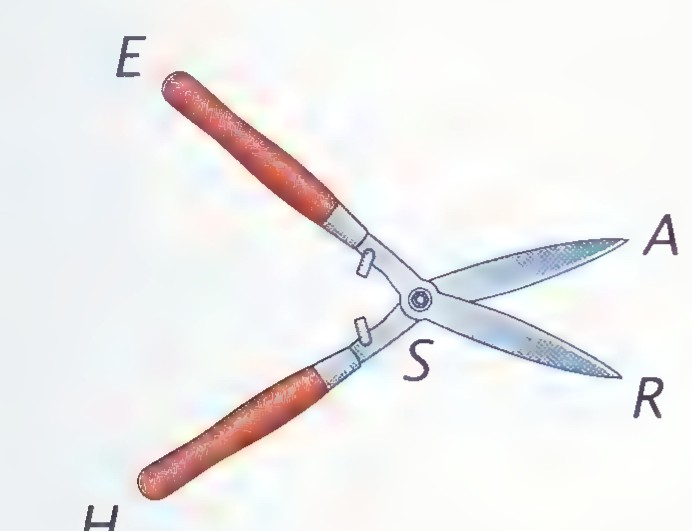
- As the shears are opened and closed, most of the angles vary in size, but two angles never change and are always equal. Which two angles are they?
- As the shears are used, which of the rays with endpoint at S are always between two other rays?
- What pair of angles can change in size but are always equal to each other?
- Show in a short proof why the angles you named in exercise 42 are always equal.
Bent Light Ray. According to Einstein’s theory of relativity, a ray of light passing by the sun is bent by an angle of 1.75 seconds.
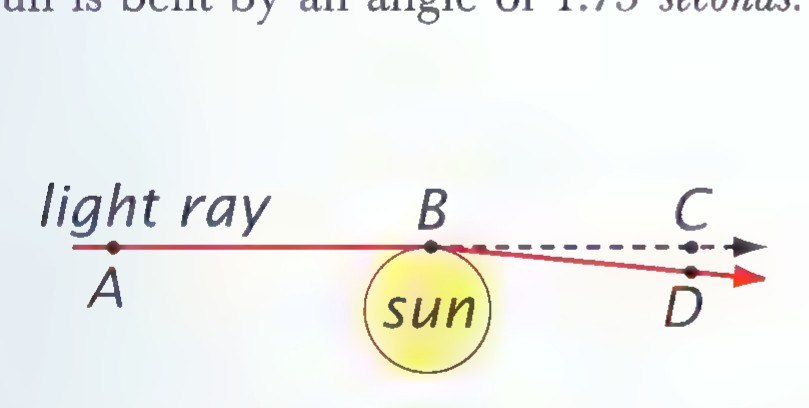
The figure above is a highly exaggerated illustration of how the light is bent.
- How many minutes are in 1 degree and how many seconds are in 1 minute?
- Given that ∠CBD = 1.75 seconds, how large is ∠ABD?
Pinhole Camera. The angle of view of a pinhole camera is shown as ∠1 in this figure.
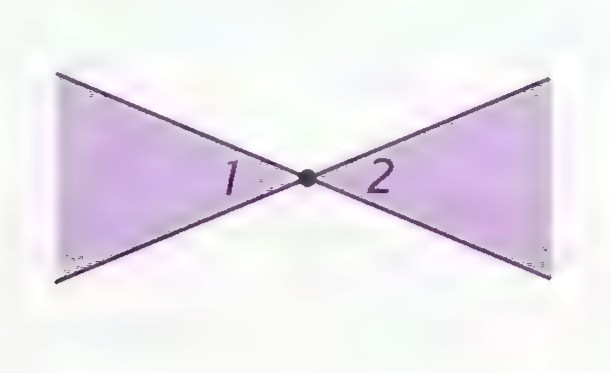
Given: ∠1 and ∠2 are vertical angles and ∠1 and ∠2 are complementary.
- How large do you think the angle of view of this camera is?
- Copy and complete the following proof by using the facts given about the lens.
Proof
| Statements | Reasons |
|---|---|
| 1. ∠1 and ∠2 are vertical angles. | Given. |
| 2. ∠1 = ∠2. | Why? |
| 3. ∠1 and ∠2 are complementary. | Why? |
| 4. ∠1 + ∠2 = ?. | Why? |
| 5. ∠1 + ∠1 = ? and so 2∠1 = ?. | Why? |
| 6. ∠1 = ?. | Why? |
SAT Problem. The following figure appeared in a problem on an SAT exam.
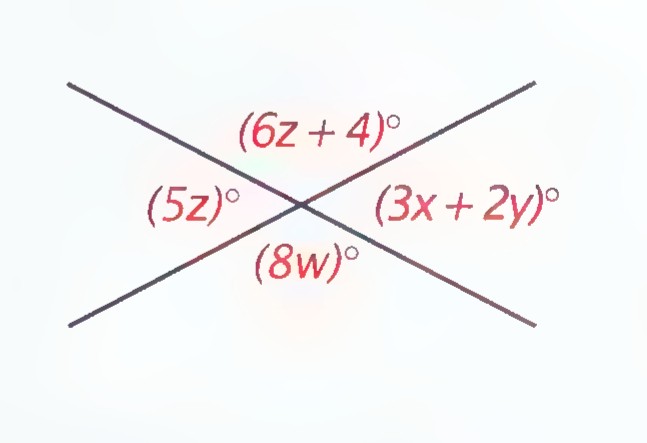
It shows two intersecting lines and the measures of the angles that they form in terms of w, x, y, and z.
- What is the value of w? Show your reasoning.
p. 116
Set III
The proof of the vertical angle theorem as it appears in a Chinese geometry book is shown here.
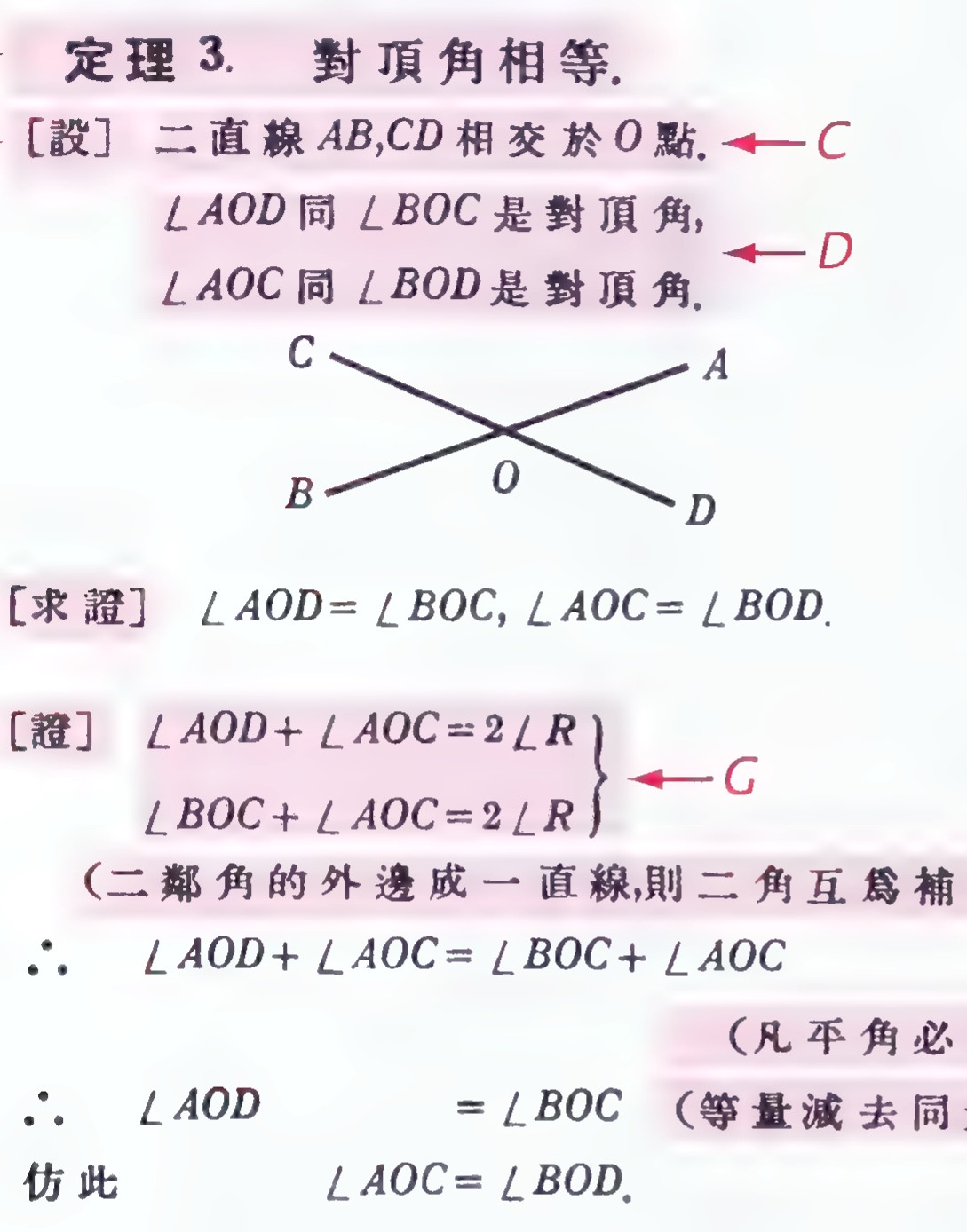
The symbols in the box labeled A say: “Theorem 3. Vertical angles are equal.” The symbol in the box labeled B says: “Given.”
- What do you think the symbols in box C say?
- Box D?
- Box E?
- Box F?
- What do you think the symbols 2∠R mean in box G, given that there is no angle R in the figure?
- The symbols in box H are the reason for the equations in box G. State the theorem in this lesson that you think they represent.
- What do you think the symbols in box I say?
- Box J?
p. 117
Lesson 7: Perpendicular and Parallel Lines
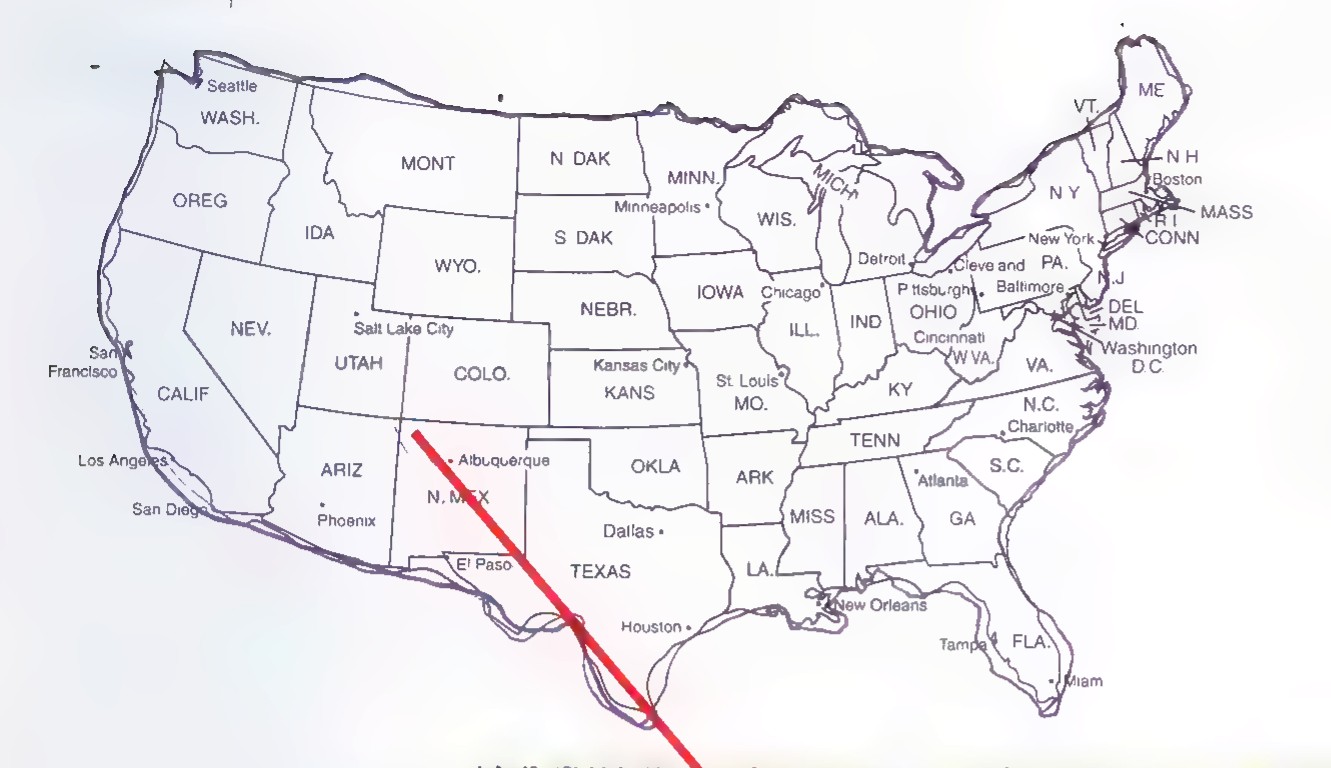
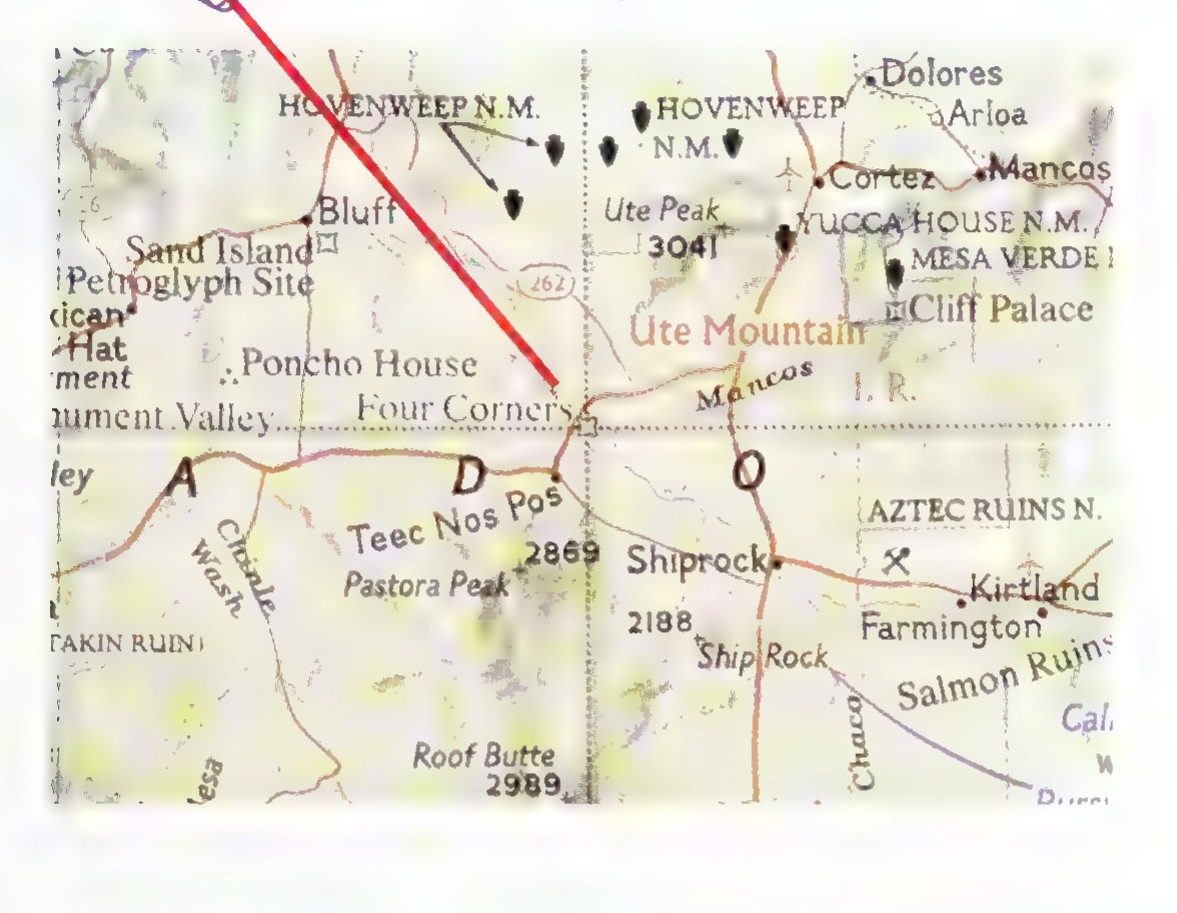
Four Corners is an unusual place. It is the only place in the United States where you can be in four states at once! It is the point in which the border lines of Utah, Colorado, Arizona, and New Mexico intersect. The border lines are perpendicular because they form right angles.
Definition
Two lines are perpendicular iff they form a right angle.
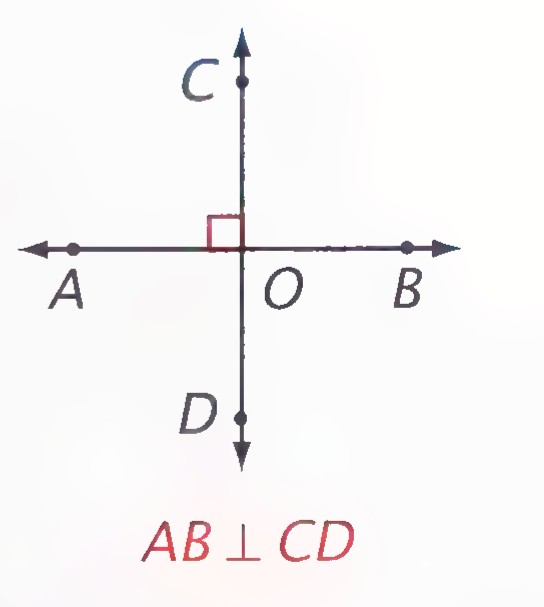
In the figure at the right, lines AB and CD form the right angle AOC, marked by the small square shown in the figure. As we will see, this fact implies that all four angles at O are right angles. The symbol for “perpendicular” is ⊥ and, to indicate that lines AB and CD are perpendicular, we write AB ⊥ CD.
It is easy to prove that, if two lines form a right angle, the other angles must be right angles as well. The proof follows from what we know about linear pairs and vertical angles.
p. 118
Theorem 7
Perpendicular lines form four right angles.
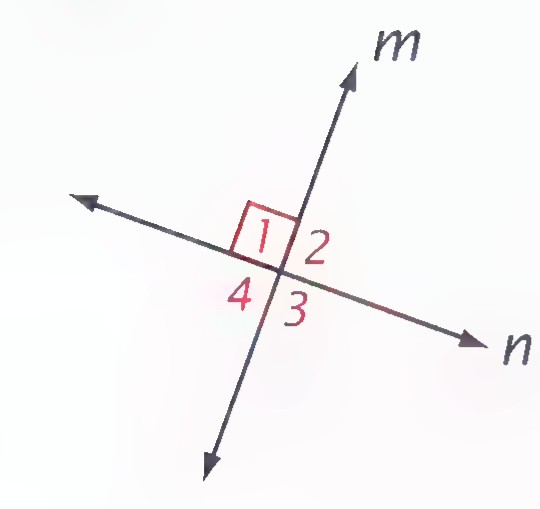
Given: .
Prove: and form four right angles.
Proof
Because , we know that they form a right angle, which we name ∠1. Because ∠1 is a right angle, ∠1 = 90°. Because ∠1 forms a linear pair with ∠2, they are supplementary. Because ∠1 + ∠2 = 180° and ∠1 = 90°, ∠2 also is 90°.
Because ∠1 and ∠3 are vertical angles, as are ∠2 and ∠4, and vertical angles are equal, ∠3 = ∠1 = 90° and ∠4 = ∠2 = 90°. So all four angles are right angles.
Because every right angle has a measure of 90°, we know that all right angles are equal. We will occasionally use this fact in proofs, so we state it as a
Corollary to the definition of a right angle
All right angles are equal.
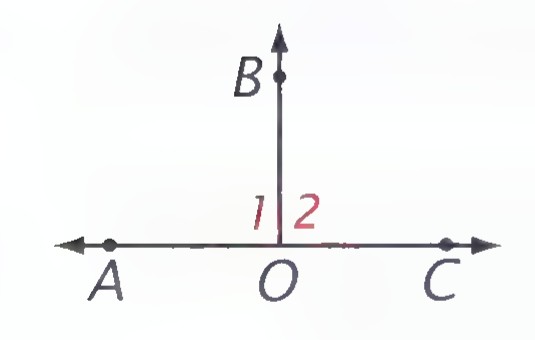
The first figure at the left below shows a linear pair, ∠1 and ∠2, in which ∠1 = ∠2. It is easy to prove from what we know about linear pairs that OB, the line of the common side of the two angles, must be perpendicular to AC, the line of their other two sides.
Theorem 8
If the angles in a linear pair are equal, then their sides are perpendicular.
Given: ∠1 and ∠2 are a linear pair and ∠1 = ∠2.
Prove: OB ⊥ AC.
Proof
Because ∠1 and ∠2 are a linear pair, they are supplementary; so ∠1 + ∠2 = 180°. Because ∠1 = ∠2, ∠1 + ∠1 = 180°; so 2∠1 = 180° by substitution. Dividing by 2 gives ∠1 = 90°; so ∠1 is a right angle. By definition, two lines that form a right angle are perpendicular, so OB ⊥ AC.
Another word that names a relation between two lines is parallel.
Definition
Two lines are parallel iff they lie in the same plane and do not intersect.
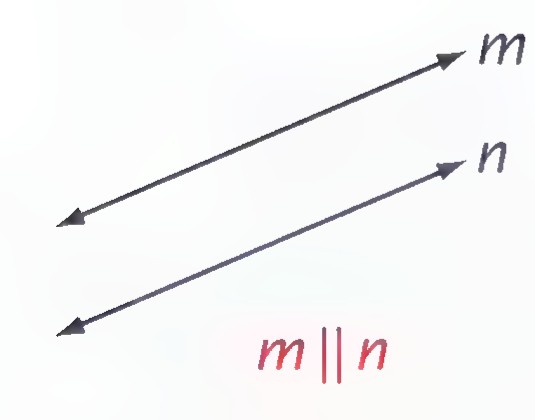
The symbol for “parallel” is ∥. To indicate that lines m and n are parallel, we write m ∥ n. Our definitions for the words perpendicular and parallel are about lines. Because line segments and rays are parts of lines, we also refer to them as being perpendicular or parallel if they lie in lines that are perpendicular or parallel.
p. 119
Exercises
Set I
When light travels from air into water, it is partly reflected and partly refracted (bent).* In this figure, AB intersects CE at W.
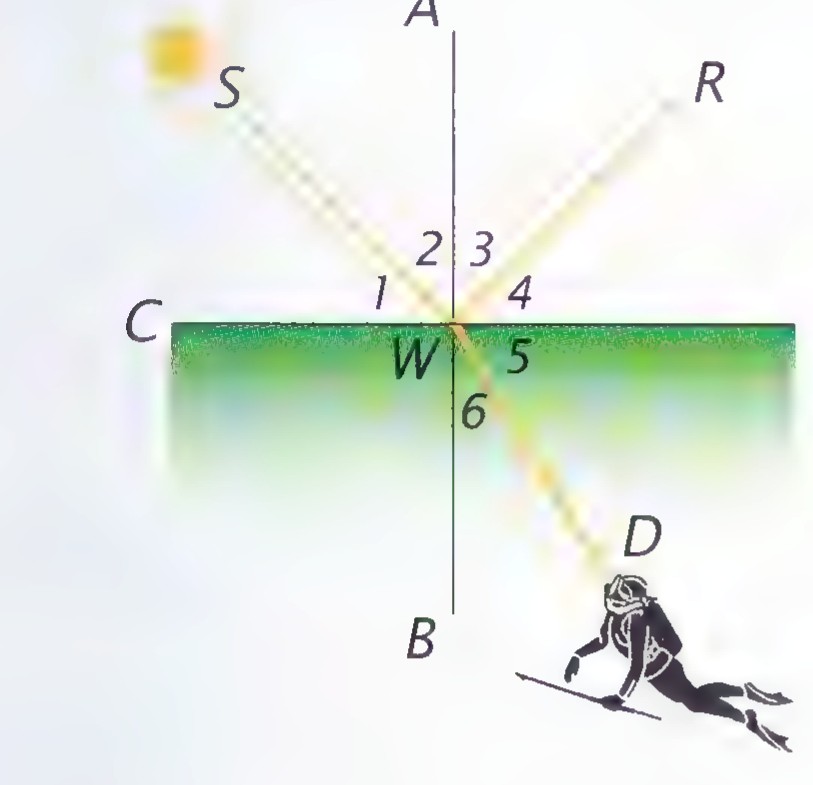
State the reason for each of the following.
- If ∠5 + ∠6 = 90°, then ∠5 and ∠6 are complementary.
- If ∠SWR is a right angle, then SW ⊥ WR.
- If ∠SWR and ∠AWE are right angles, then ∠SWR = ∠AWE.
- If ∠2 and ∠3 are supplements of ∠RWB, then ∠2 = ∠3.
- If ∠2 = ∠3, then WA bisects ∠SWR.
- If ∠AWC = ∠AWE, then AB ⊥ CE.
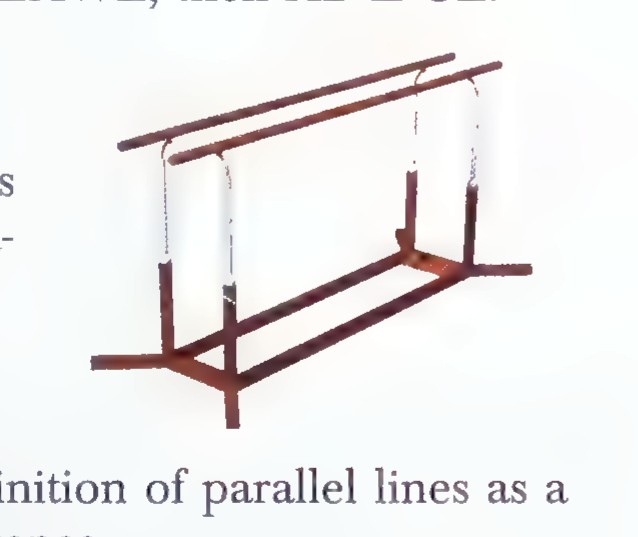
The parallel bars used in gymnastics are a good illustration of parallel lines.
- Write the definition of parallel lines as a complete sentence.
- What are two reasons why parallel bars may not actually be parallel?
A dartboard is divided into sectors by ten lines through its center.
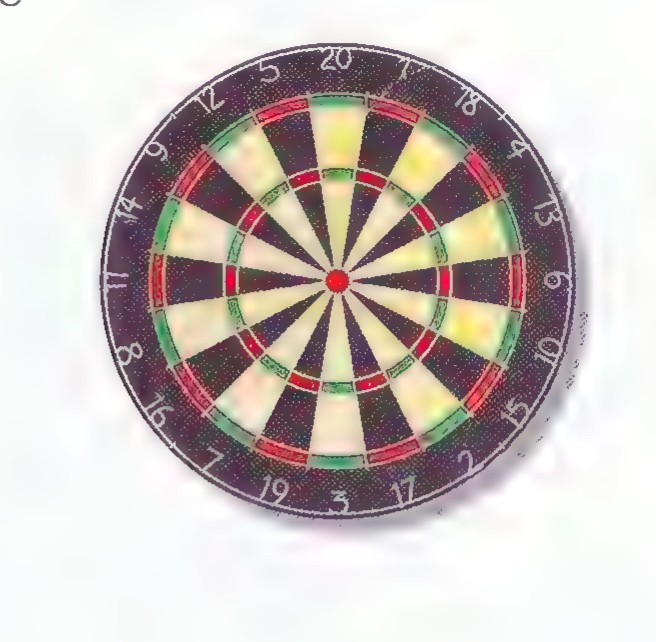
- What relation do the ten lines have to one another?
- Why must the angles of the opposite sectors be equal?
- Why must some of the pairs of angles in the figure be supplementary?
- How many pairs of perpendicular lines do there appear to be on the board?
Cube Illusion. The “Necker cube” illusion is named after the Swiss scientist who first studied it in 1832.† It shows the edges of an ordinary cube.
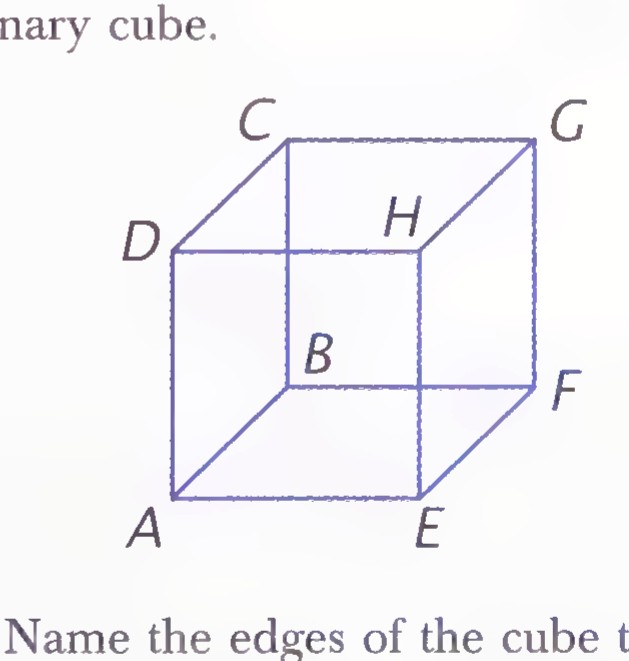
- Name the edges of the cube that appear to be parallel to AB.
- Name the edges that appear to be perpendicular to HE.
- Name an edge that appears to be neither parallel nor perpendicular to CG.
- Which edge of the cube is “in back”: CB or HE?
*Introductory Physics, by Mashuri L. Warren (W. H. Freeman and Company, 1979).
†Visual Intelligence: How We Create What We See, by Donald D. Hoffman (Norton, 1998).
p. 120
Mud Cracks. This photograph shows cracks in mud that has dried up in the sun.*
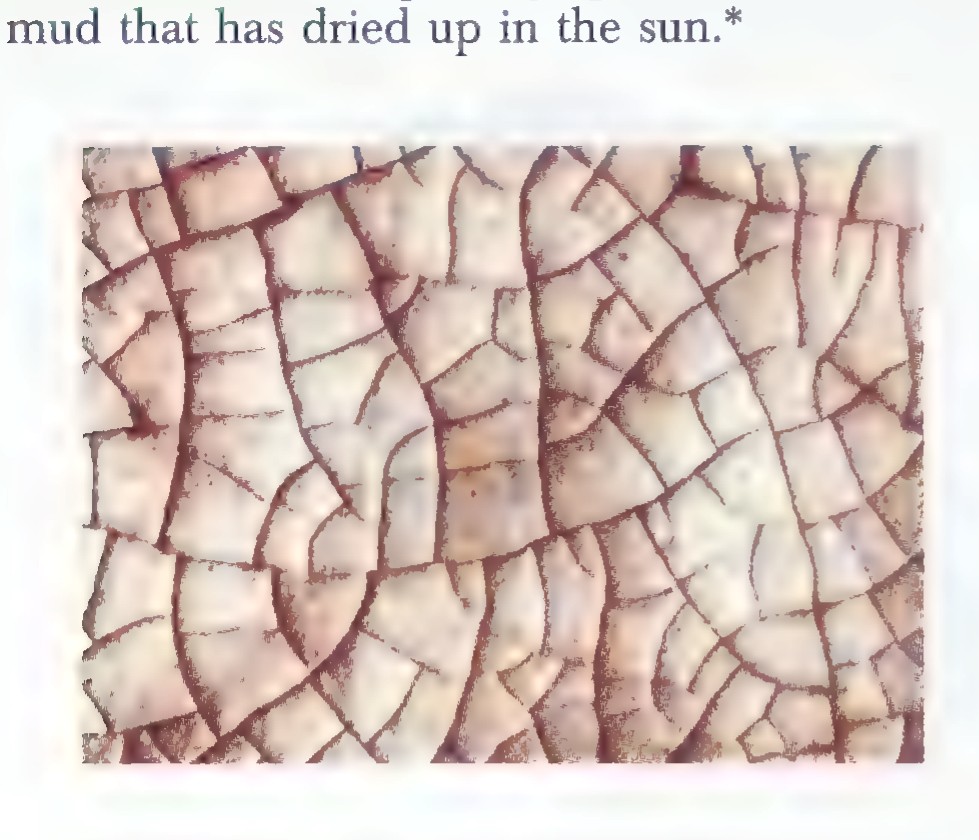
Many of the cracks seem to meet at right angles. The line segments in the figure below represent two cracks, AB and CD, meeting at point B.
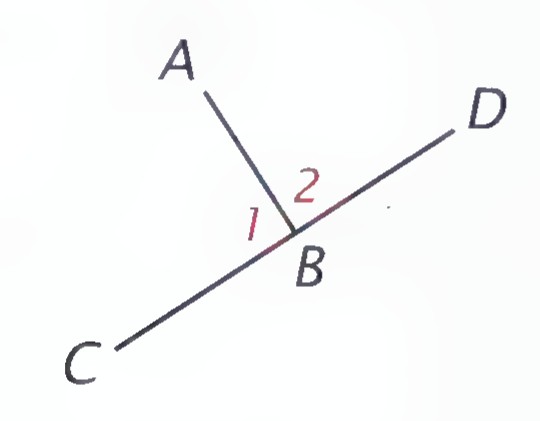
What relation do ∠1 and ∠2 have with respect to
- their sides?
- their measures?
When mud cracks, these angles tend to be equal. If they are equal,
- what is the measure of each angle?
- what kind of angle is ∠1?
- What does this prove about the cracks AB and CD?
- State the theorem of this lesson to which all of these ideas are related as a complete sentence.
Set II
A Deceptive Figure. Appearances can sometimes be deceiving. In this figure, ∠1 is a right angle but ∠2, ∠3, and ∠4 are not.
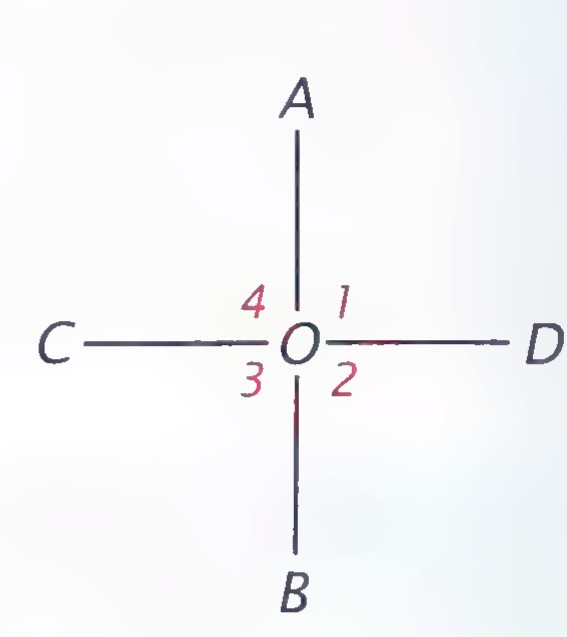
- Is it correct to conclude that any lines in the figure are perpendicular? Explain.
The figure seems to contradict several of our theorems. How does it seem to contradict the theorem
- about vertical angles?
- about a linear pair?
- about perpendicular lines?
- Is it possible that ∠2 and ∠4 could be vertical angles? Explain.
Bisecting a Linear Pair. This figure shows a linear pair in which ∠AOB = 50°.
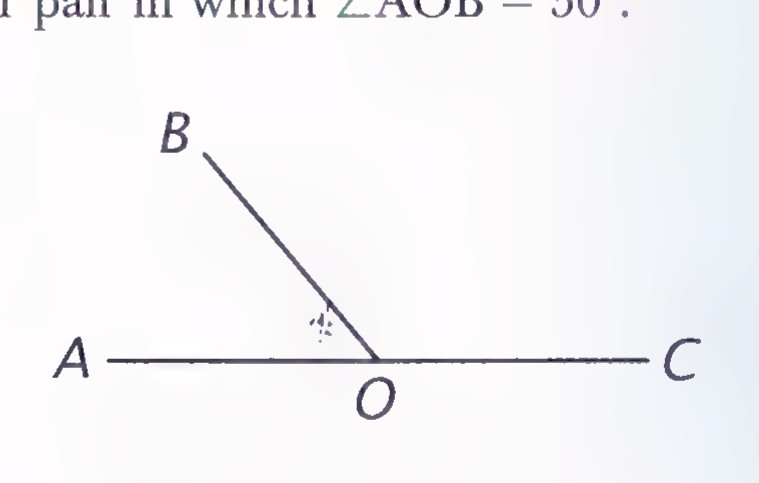
- How large is ∠BOC?
- Use your ruler and protractor to make an accurate enlargement of the figure. Then use your straightedge and compass to bisect ∠AOB and ∠BOC. Label a point X on the bisector of ∠AOB and a point Y on the bisector of ∠BOC.
*Mathematical Snapshots, by H. Steinhaus (Oxford University Press, 1969).
p. 121
- How large should ∠BOX and ∠BOY be? Check the accuracy of your construction by using your protractor to measure these angles.
- How large is ∠XOY?
This figure shows a linear pair in which OX bisects ∠AOB and OY bisects ∠BOC.
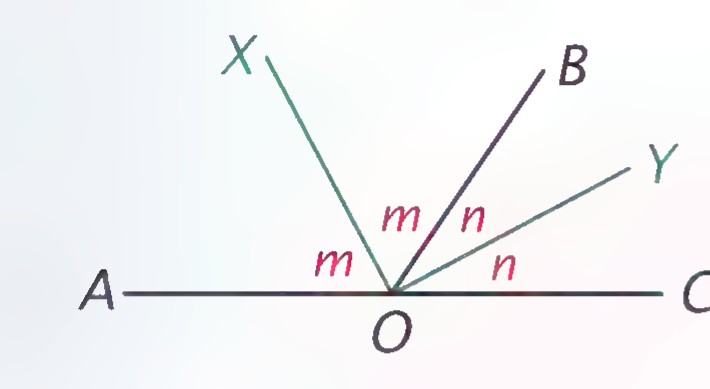
- Why are ∠AOB and ∠BOC supplementary?
- To what number is equal?
- To what number is equal?
- What kind of angle is ∠XOY?
- Why?
- How are OX and OY related?
- Why?
In the figure below, , ∠2 = °, ∠3 = °, and ∠4 = °.
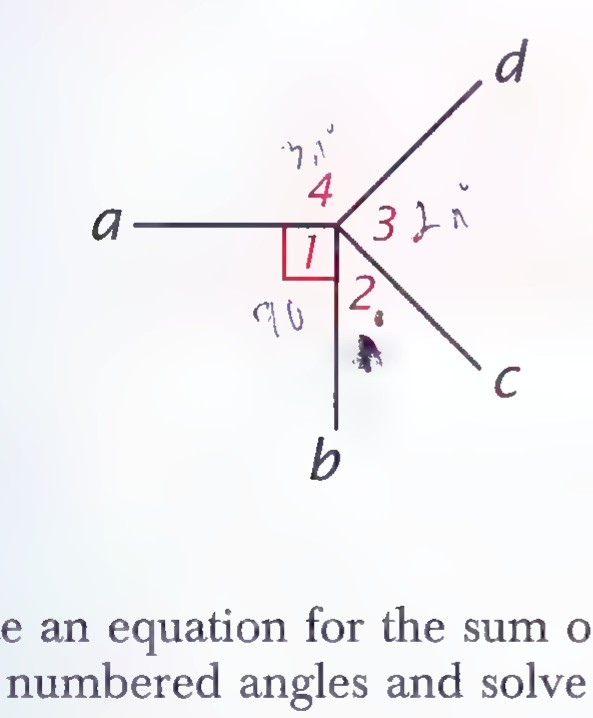
- Write an equation for the sum of the four numbered angles and solve it for n.
- Find the measures of the four angles.
- What relation does ∠1 have to ∠3?
- What relation does ∠2 have to ∠4?
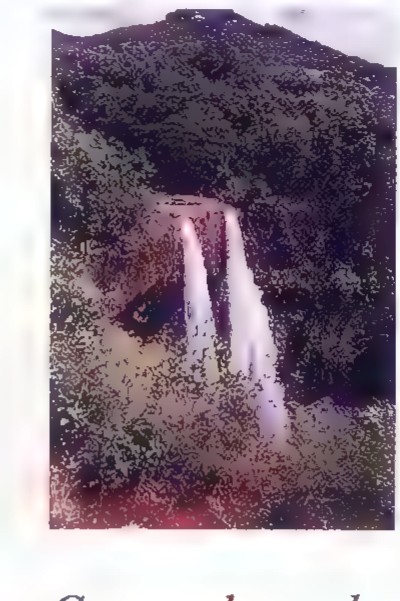
Gravity pulls the water in a waterfall vertically downward to the horizontal surface of the lake below. In the diagram, WA represents the line of the waterfall and points A, B, and C represent points in the plane of the lake’s surface.
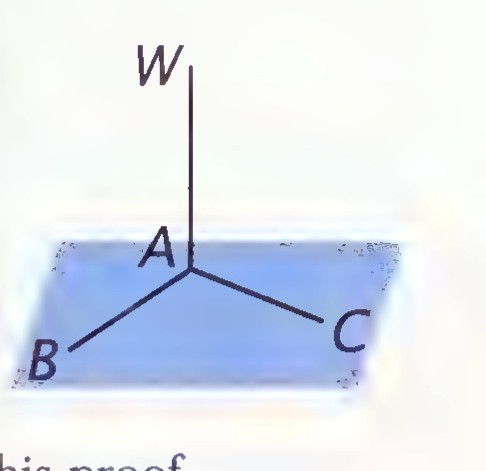
- Copy and complete this proof.
Given: WA ⊥ AB and WA ⊥ AC.
Prove: ∠WAB = ∠WAC.
Proof
| Statements | Reasons |
|---|---|
| 1. WA ⊥ AB and WA ⊥ AC. | Why? |
| 2. ∠WAB and ∠WAC are right angles. | Why? |
| 3. ∠WAB = ∠WAC. | Why? |
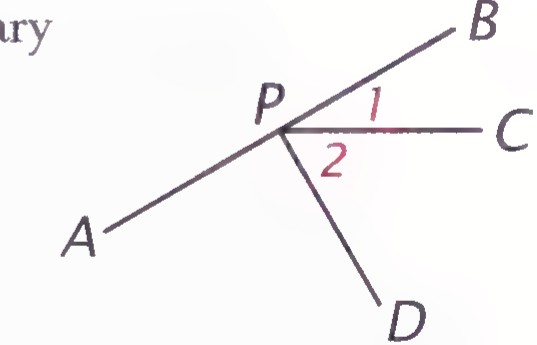
- Copy and complete the following proof.
Given: ∠1 and ∠2 are complementary and PB-PC-PD.
Prove: AB ⊥ PD.
Proof
| Statements | Reasons |
|---|---|
| 1. ∠1 and ∠2 are complementary. | Why? |
| 2. ∠1 + ∠2 = ?. | Why? |
| 3. PB-PC-PD. | Why? |
| 4. ∠BPD = ∠1 + ∠2. | Why? |
| 5. ∠BPD = 90°. | Why? |
| 6. ∠BPD is a right angle. | Why? |
| 7. ?. | Why? |
p. 122
Set III
Just a few letters of the alphabet contain both parallel and perpendicular lines. One of them is F, the first initial of Franklin Delano Roosevelt. It and Roosevelt’s second initial were made into puzzles in 1933, the year Roosevelt first became president.*
Copy the five pieces shown below onto a file card or stiff sheet of paper, cut them out, and see if you can arrange them to form the letter F.
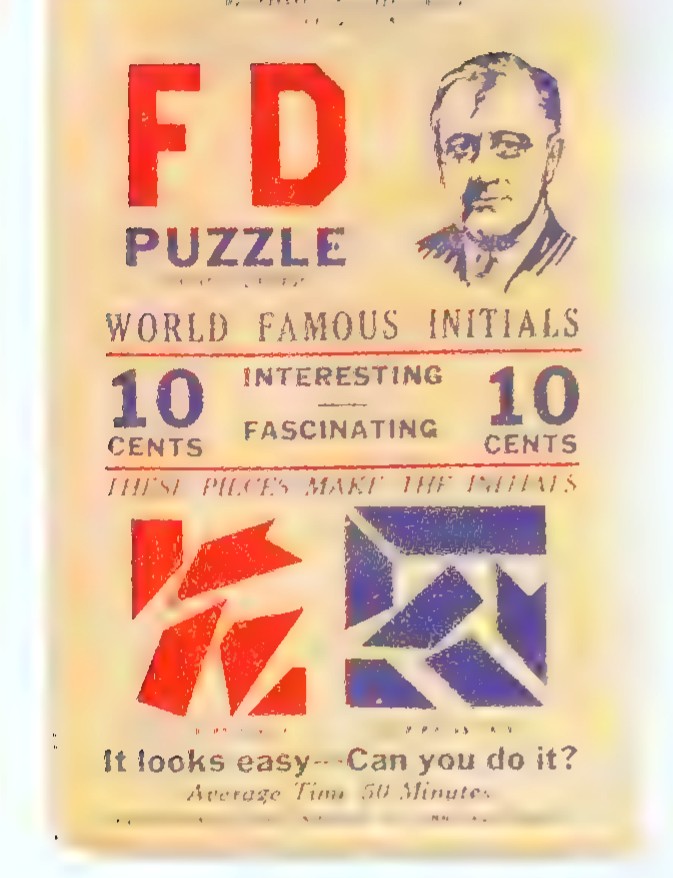
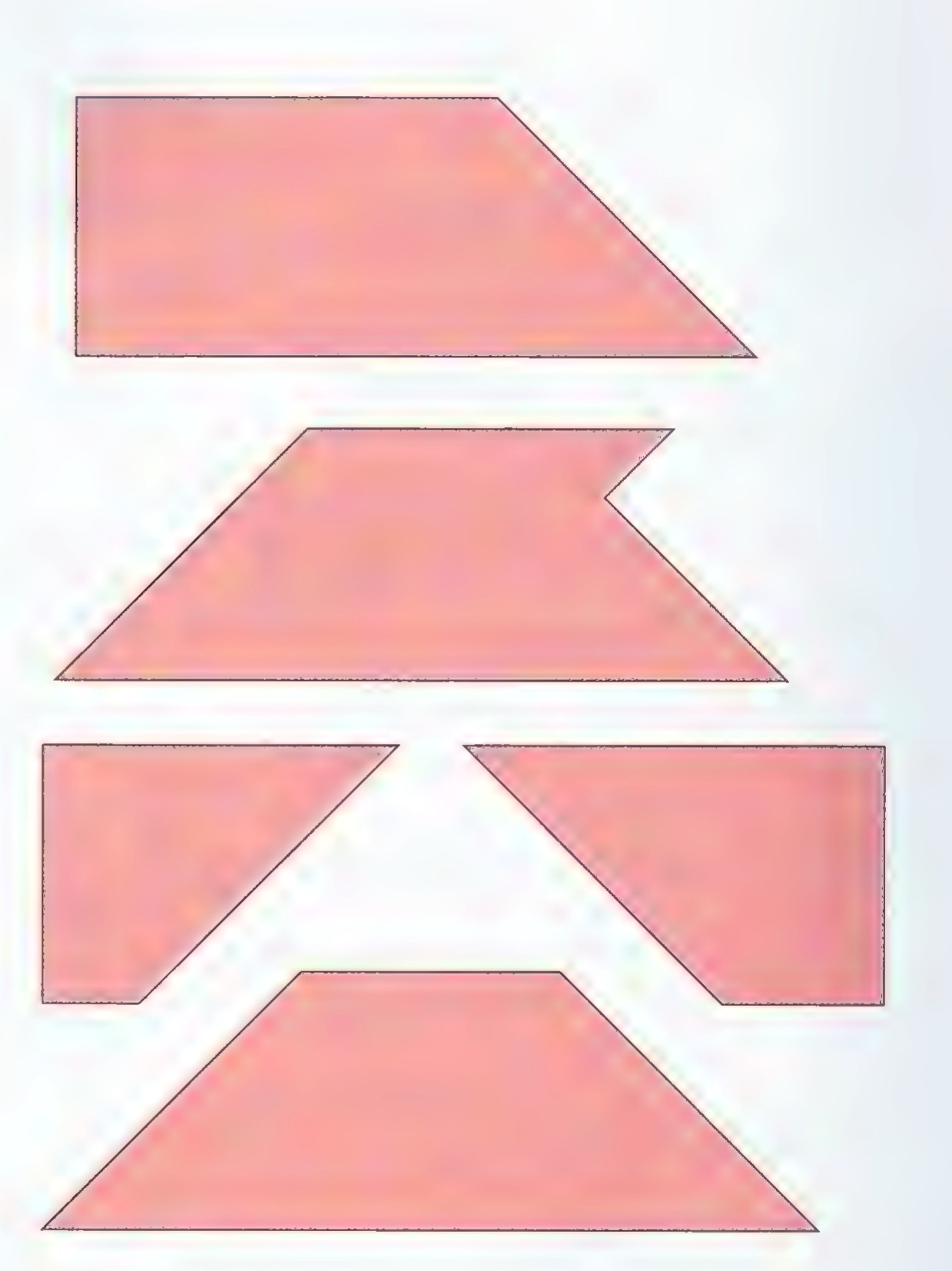
Either draw a diagram of the arrangement or tape the pieces to your paper.
*New Book of Puzzles, by Jerry Slocum and Jack Botermans (W. H. Freeman and Company, 1992).
p. 123
Summary and Review
© The New Yorker Collection 1956, Charles Addams from cartoonbank.com. All rights reserved.
Basic Ideas
| Acute, right, obtuse, and straight angles | 92 |
| Addition, subtraction, multiplication, and division properties | 79 |
| Axiom | 78 |
| Betweenness of points | 85 |
| Betweenness of rays | 93 |
| Bisector of an angle | 99 |
| Complementary angles | 105 |
| Congruent | 99 |
| Coordinate of a point | 85 |
| Coordinate of a ray | 92 |
| Corollary | 99 |
| Linear pair | 111 |
| Midpoint of a line segment | 98 |
| Opposite rays | 110 |
| Parallel lines | 118 |
| Perpendicular lines | 117 |
| Reflexive property | 79 |
| Substitution property | 79 |
| Supplementary angles | 106 |
| Vertical angles | 111 |
Postulates
The Ruler Postulate. The points on a line can be numbered so that positive number differences measure distances. 85
The Protractor Postulate. The rays in a half-rotation can be numbered from 0 to 180 so that positive number differences measure angles. 92
Theorems
The Betweenness of Points Theorem. If A-B-C, then AB + BC = AC. 86
The Betweenness of Rays Theorem. If OA-OB-OC, then ∠AOB + ∠BOC = ∠AOC. 93
Corollary to the Ruler Postulate. A line segment has exactly one midpoint. 99
Corollary to the Protractor Postulate. An angle has exactly one ray that bisects it. 100
Complements of the same angle are equal. 106
Supplements of the same angle are equal. 106
The angles in a linear pair are supplementary. 111
Vertical angles are equal. 112
Perpendicular lines form four right angles. 118
Corollary to the definition of a right angle. All right angles are equal. 118
- If the angles in a linear pair are equal, then their sides are perpendicular. 118
p. 124
Exercises
Set I
The Very Large Array is a radio telescope in New Mexico consisting of 27 dishes. The dishes can be moved along three straight tracks, each about 12 miles long.
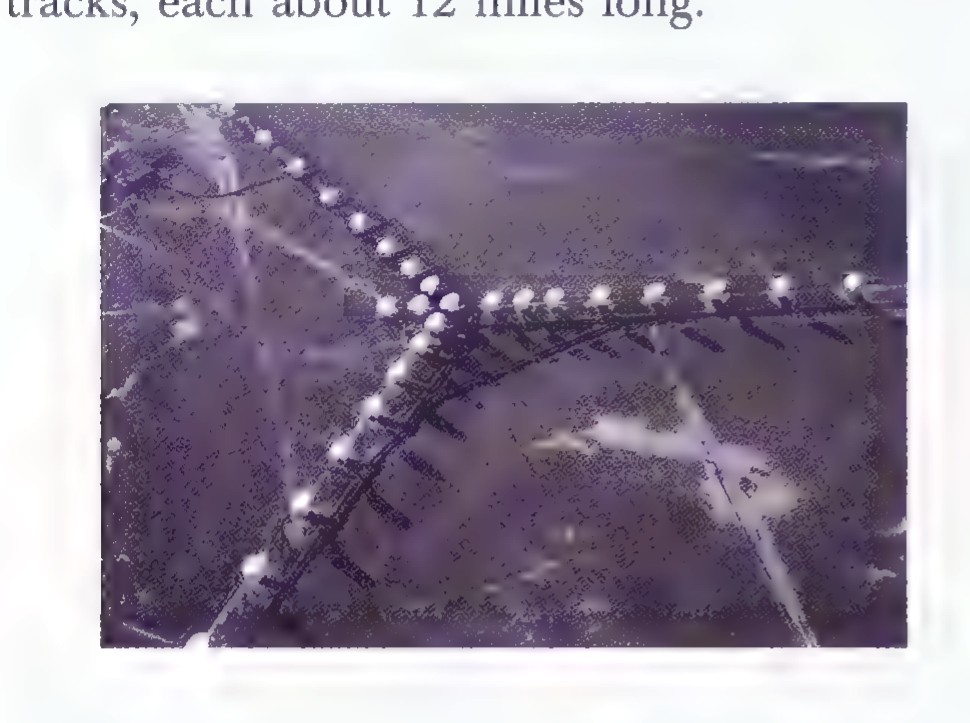
Suppose the centers of the dishes along one track are in a line and have the coordinates shown in the figure below.

- Is F between E and H? Use the definition of betweenness of points to explain why or why not.
- Which point is closer to C: point B or point D? Explain.
- Is E midway between A and I? Show why or why not.
Sliding Bevel. The handle and blade of a sliding bevel, a tool used in carpentry, can be adjusted to different angles.
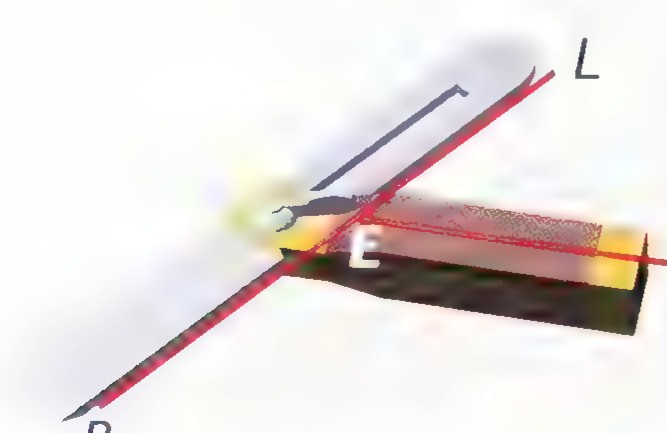
Regardless of the angle, ∠BEV and ∠VEL always form a linear pair.
- What other relation do they always have?
- If ∠BEV = °, what is the measure of ∠VEL in terms of ?
- If ∠BEV is larger than ∠VEL, what type of angle is ∠BEV? ∠VEL?
- If ∠BEV = ∠VEL, how large is each angle?
- If ∠BEV = ∠VEL, what can you conclude about the handle?
- State the theorem that is the basis for your answer.
Old Quadrant. The figure below, from a book published in 1542, shows an astronomical quadrant used to measure the direction of the sun.
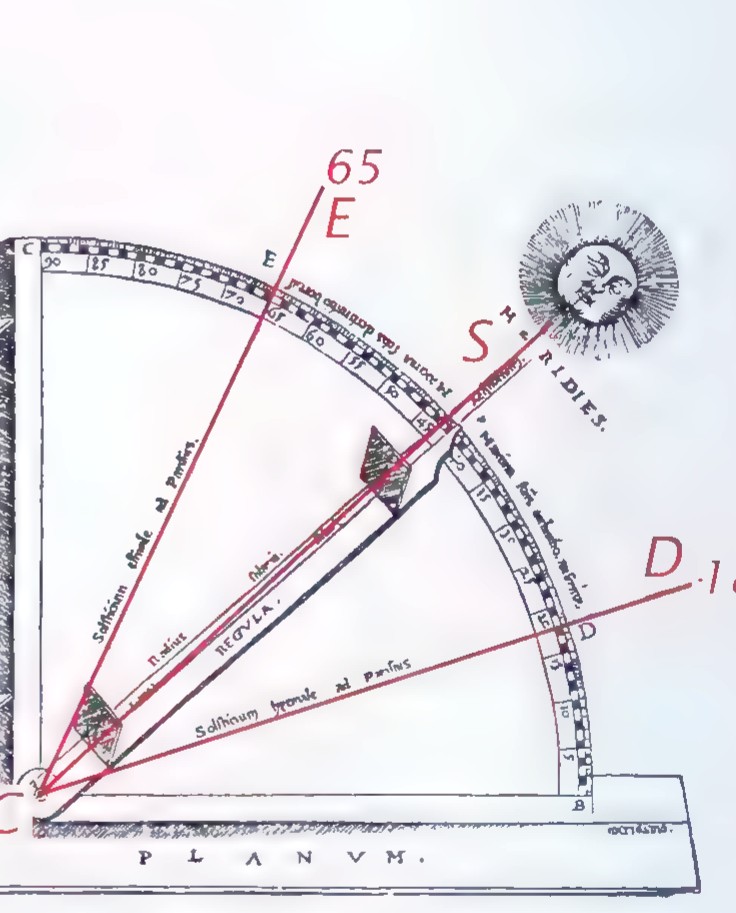
The rays CE and CD have coordinates 65 and 18.
- Find the measure of ∠ECD.
- Write the fact that ray CS is between rays CE and CD in symbols.
The ray CS pointing toward the sun looks as if it might bisect ∠ECD.
- What would be the measure of ∠ECS if it did?
p. 125
- What would be the coordinate of CS?
- Check your work by using the coordinate of CS to find the measure of ∠SCD.
Ollie’s Logic. Obtuse Ollie thought it over and decided: “Either two lines intersect or they do not.” He then reasoned:
“If they intersect, they are perpendicular. If they don’t intersect, they must be parallel.”
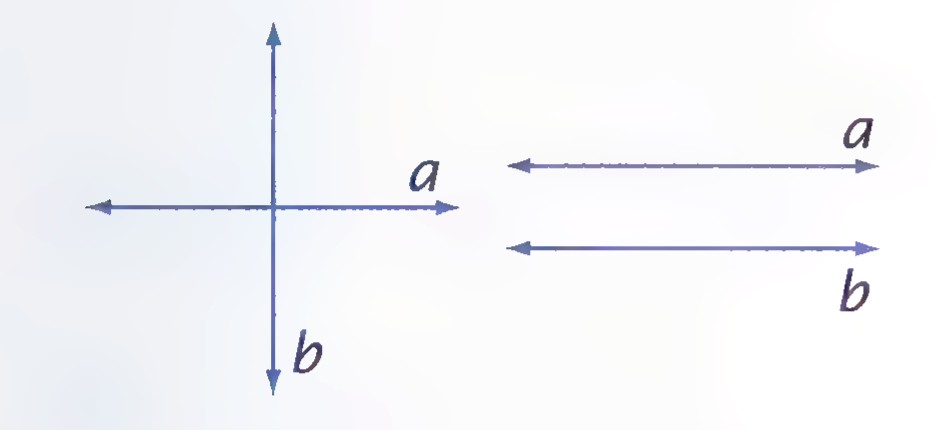
After thinking about Ollie’s reasoning, Acute Alice decided that most of it was nonsense.
- Does anything that Ollie said make sense? If so, what?
- Explain what is wrong with his reasoning.
SAT Problem. The figure below appeared in a problem on an SAT exam.
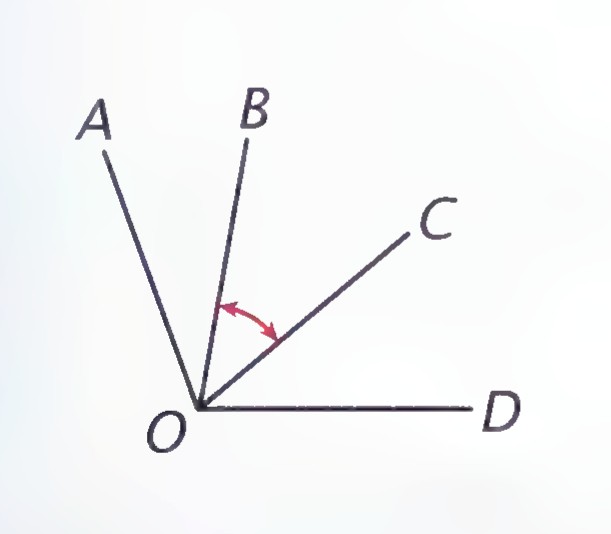
∠AOC = 70°, ∠BOD = 80°, and ∠AOD = 110°.
- Copy the figure and mark the coordinates 0 and 70 on rays OA and OC.
- What is the coordinate of ray OD?
- What is the coordinate of ray OB?
- What is the measure of ∠BOC?
Shoe Laces. A common way of lacing shoes is shown in the figure below.
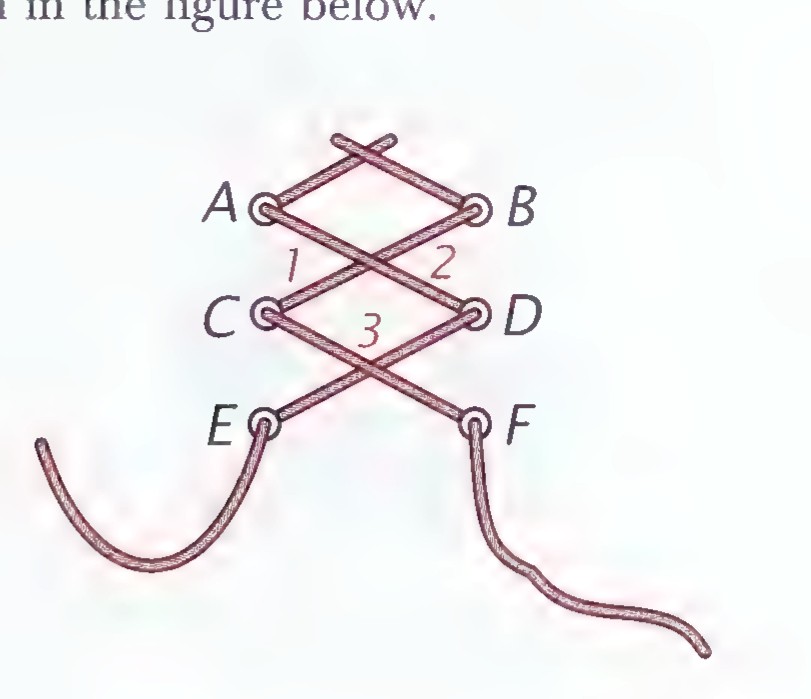
- What are two ways in which ∠1 and ∠2 are related?
- If ∠1 and ∠2 were complementary, how many degrees would each one measure?
- If ∠1 and ∠2 were supplementary, what would be true about AD and BC?
- If ∠1 and ∠3 were both supplementary to ∠2, what could you conclude about ∠1 and ∠3?
- Why?
Axioms and Corollaries. Oliver Wendell Holmes, a Supreme Court justice for many years, once said:
The law embodies the story of a nation’s development through many centuries, and it cannot be dealt with as if it contained only the axioms and corollaries of a book of mathematics.
- What is an axiom?
- What is a corollary?
One of the axioms of algebra used in geometry is the reflexive property of equality.
- State it as a sentence.
Complete the following statements of the corollaries of this chapter.
- A line segment has . . .
- An angle has exactly one ray . . .
- All right angles . . .
p. 126
Set II
Clock Problems. The following two questions are from an old geometry book.*

How many degrees are there in the angle formed by the hands of a clock
at 5 o’clock?
at 10 o’clock?
- What is the answer to each question?
If you reasoned that 10 is twice 5, you might think that the second answer should be twice the first.
- How can the second answer be correctly obtained from twice the first? Draw a figure showing both times on the same clock to illustrate your answer.
Stilt Distances. Suppose a person 6 feet tall puts on stilts 6 feet long so that his or her feet are on cleats feet above the ground.
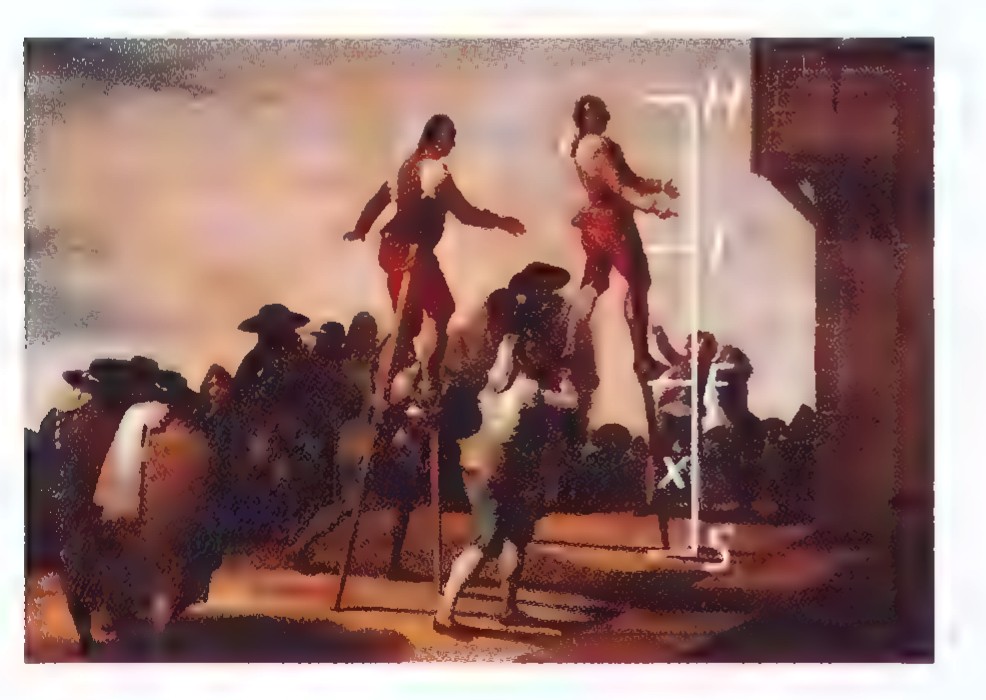
- How “tall,” in terms of , is the person when wearing the stilts?
- How far, in terms of , is it from the top of the stilts to the top of the person’s head?
- Copy and complete the following proof for the stilts figure.
Given: S-F-T, F-T-H, and ST = FH.
Prove: SF = TH.
Proof
| Statements | Reasons |
|---|---|
| 1. S-F-T and F-T-H. | Why? |
| 2. SF + FT = ? and FT + TH = ?. | Why? |
| 3. ST = FH. | Why? |
| 4. SF + FT = FT + TH. | Why? |
| 5. ?. | Why? |
Chair Design. In the design of a comfortable chair, the seat is normally slanted between 5 and 8 degrees from the horizontal and the back is tilted between 20 and 25 degrees from the vertical.
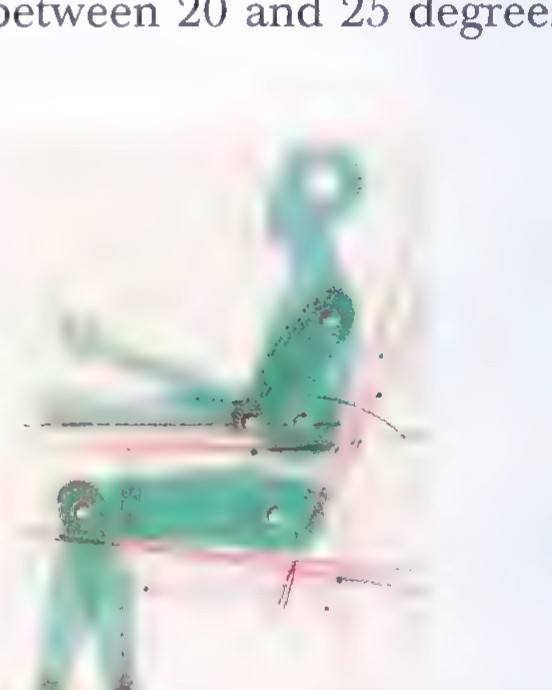
In the diagram below, OA and OB represent the seat and back of the chair; VT ⊥ HZ.
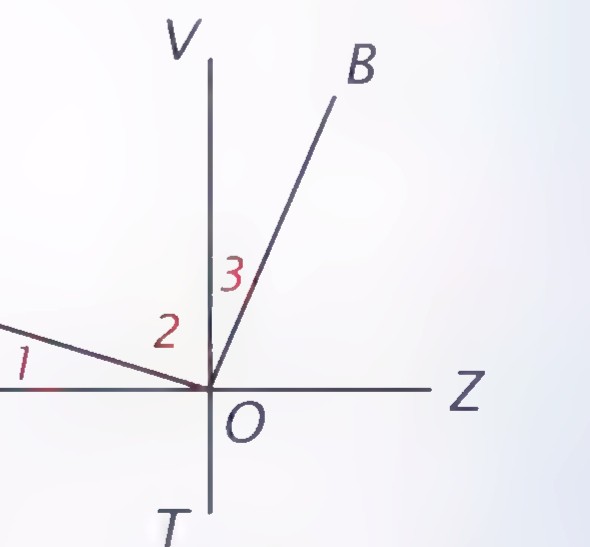
Given that ∠1 = ° and ∠3 = °, find
- ∠2 in terms of .
*Wentworth’s Plane Geometry, by George Wentworth and David Eugene Smith (Ginn, 1910).
p. 127
- ∠AOB in terms of and .
- Copy and complete the following indirect proof that, for a comfortable chair, ∠AOB cannot be a right angle.
Proof.
(What is the beginning assumption?)
∠AOB = 90°. (Why?)
. (Why?)
. (Why?)
. (Why?)
This contradicts the fact that, if is between 5 and 8 degrees and is between 20 and 25 degrees, .
Therefore, our assumption is false and (what conclusion follows?)
- According to the chair-design rules on page 126, can the back of a comfortable chair be perpendicular to the seat?
Another SAT Problem. This description appeared in a problem on an SAT exam:
A, B, C, and D are points on a line, with D the midpoint of segment BC. The lengths of segments AB, AC, and BC are 10, 2, and 12, respectively.
- Draw a figure to illustrate what is being described.
- What is the length of segment AD?
Graphite and Diamond. Although both graphite and diamond consist of carbon atoms, the different geometrical arrangements of the atoms in them give the minerals very different properties.
Carbon atoms in graphite, a very soft mineral, are arranged in flat sheets as shown in the figure below. The points represent the atoms and the line segments represent the bonds between them. All of the angles are equal.
- What kind of polygons do the bonds between the atoms form?
- To how many degrees do you think the angles of one of the polygons add up?
- Copy and complete the following proof.
Given: ∠1 + ∠2 + ∠3 = 360° and all of the angles in the figure are equal.
Proof
| Statements | Reasons |
|---|---|
| 1. ∠1 + ∠2 + ∠3 = 360° and all of the angles in the figure are equal. | Why? |
| 2. ∠1 + ∠1 + ∠1 = 360°, so 3∠1 = 360°. | Why? |
| 3. 6∠1 = ?. | Why? |
Carbon atoms in diamond, the hardest mineral at the earth’s surface, are arranged in space as shown in this figure. (The green segments have been added to make the figure look more three-dimensional.)
p. 128
The atom at O is bonded to four atoms at A, B, C, and D.
- How many angles do the bonds from O make with one another?
- Name them.
Chemists have found that each of these angles has a measure of 109.5°.
- Copy and complete the following indirect proof.
Given: Each angle whose vertex is O has a measure of 109.5°.
Prove: ∠AOB and ∠BOC cannot be a linear pair.
Proof
(What is the beginning assumption?)
∠AOB and ∠BOC are supplementary. (Why?)
∠AOB + ∠BOC = 180°. (Why?)
This contradicts that fact that ∠AOB + ∠BOC = 109.5° + 109.5° = 219°.
Therefore, our assumption is false and (what conclusion follows?)
- Because ∠AOB and ∠BOC cannot be a linear pair, would it be correct to conclude that points A, B, and C are not coplanar? Explain.
March Times. In military marching, “quick time” corresponds to taking 120 steps, each 30 inches long, per minute.
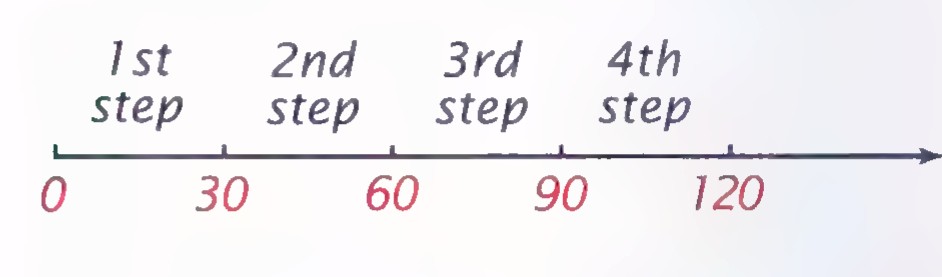
If a marcher starts at 0 and marches along a line, what is the coordinate of the end of the
- fifth step?
- 100th step?
- th step?
What is the marcher’s “speed” in
- steps per minute?
- inches per minute?
- miles per hour? (1 mile = 5280 feet.)
“Double time” is 180 steps, each 36 inches long, per minute.
- What is the speed of a marcher doing “double time” in inches per minute?
- Is the speed of a marcher doing “double time” double the speed of a marcher doing “quick time”? Explain.
p. 129
Algebra Review: Operations with Polynomials
Addition and Subtraction
To add or subtract polynomials, add or subtract like terms (those having the same degree and variable).
Example 1:
Solution:
Example 2:
Solution:
Example 3:
Solution:
Example 4:
Solution:
Multiplication
To multiply two polynomials, multiply each term of one polynomial by each term of the other and then add the resulting terms. (This method uses the distributive rule, as the first example below illustrates.)
Example 1:
Solution:
Example 1 again:
A briefer solution:
p. 130
A page from a nineteenth-century book titled Marmaduke Multiply. The book was used in many elementary schools to help children learn the multiplication table by using pictures and rhymes.
Example 2:
Solution:
Example 3:
Solution:
Example 4:
Solution:
Exercises
Add.
Subtract.
Multiply.
Do the indicated operations.