p. 7
Chapter 1: An Introduction to Geometry

Detail from Metamorphosis III—Maurits Escher. © 2002 Cordon Art B. V.–Baarn-Holland. All rights reserved.
In this chapter, you will see how practical problems ranging from designing a city and measuring the earth to using shadows to tell time led to the development of geometry. The ideas that come from these problems are important because they lead to the solutions of other problems. As you proceed, you will become acquainted with geometric terms and ideas that will be useful as you continue your study of geometry.
p. 8
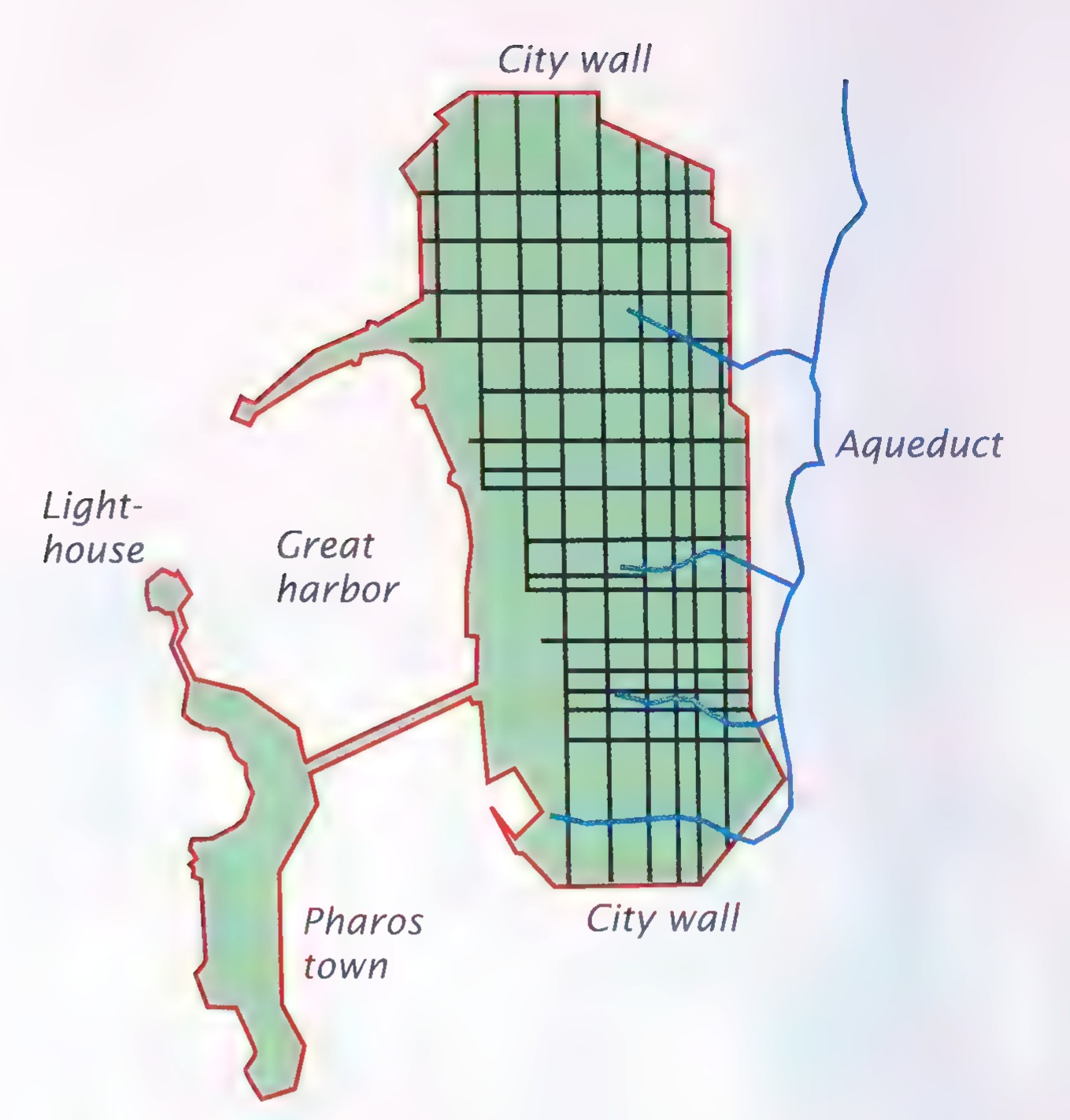
Lesson 1: Lines in Designing a City
Alexandria, the city in which Euclid wrote his famous book on geometry, is named for Alexander the Great. Alexander had conquered much of the ancient world by the time of his death in 323 B.C. He is thought to have planned the streets of Alexandria, which today has become the second largest city in Egypt.
The map above shows the arrangement of the streets in ancient Alexandria. It also suggests some of the basic terms used in geometry. The streets lie along straight lines; they intersect in points and lie in a common plane.
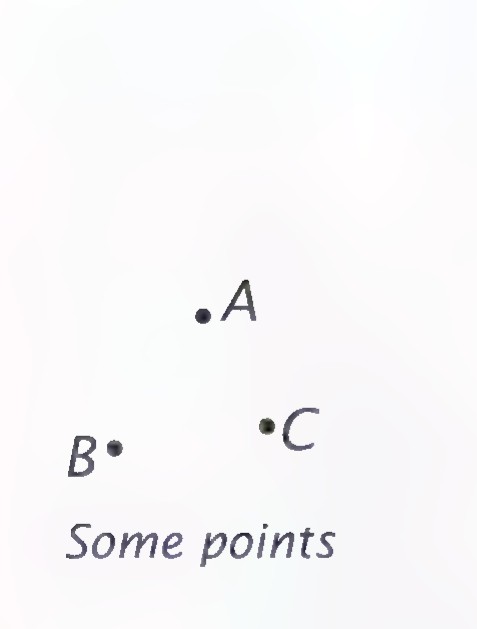
Some points
Euclid described a point as “that which has no part.” This description conveys the idea that, when we draw a dot on paper to represent a point, the point, unlike the dot, has a location only, without physical extent. The points in a figure to which we want to refer are labeled with capital letters.
Euclid described a line as having “breadthless length” and said that “the extremities of a line are points.” These statements reveal that he was thinking of what we would now call a line segment.
p. 9
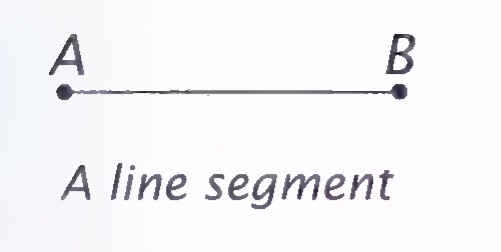
A line segment
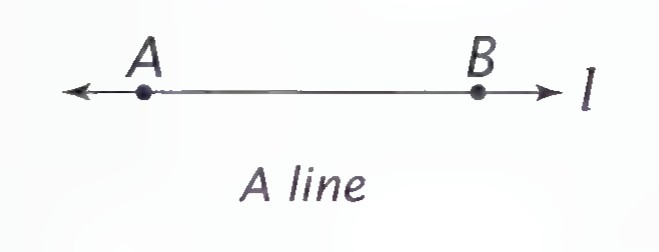
A line
A line segment is part of a line bounded by two endpoints; it has a length that can be measured. Line segment AB in the figure at the left above has a length of 1 inch. A line, however, cannot be measured. The arrows on the figure of the line at the right above indicate that a line extends without end in both directions. These figures also suggest that lines, and hence line segments, are always straight, like a stretched string or the edge of a ruler.
Lines are usually named either by two points that they contain, such as line AB above, or by a single small letter. The line in the figure could be simply named line l.
The map of Alexandria is printed on a flat surface, which illustrates part of a plane. Planes are usually represented by figures such as the two at the right and are usually named, like points, with capital letters. These figures are useful in suggesting that planes are always flat but are unfortunately misleading in suggesting that planes have edges. In geometry, we think of a plane as having no boundaries. Although the parts of the planes shown here are bounded by edges, the complete planes extend beyond them, just as the line AB extends beyond the endpoints of the segment determined by A and B.
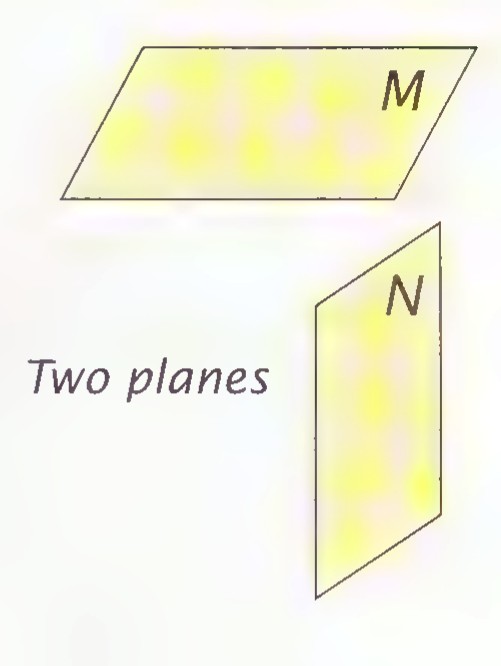
Two planes
Some additional terms relating points, lines, and planes are illustrated and defined below.
Definitions
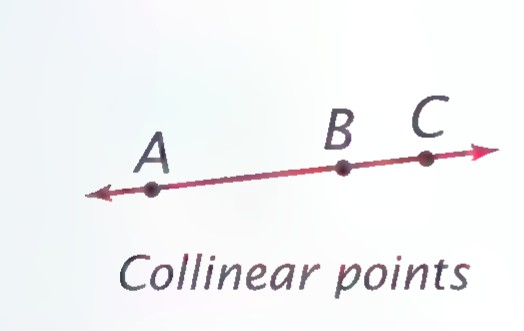
Collinear points
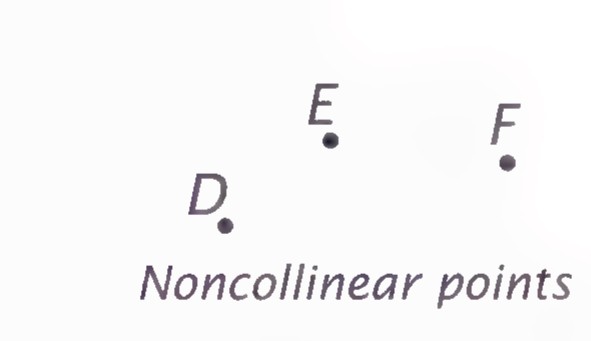
Noncollinear points
Points are collinear if there is a line that contains all of them. Points are noncollinear if no single line contains them all.
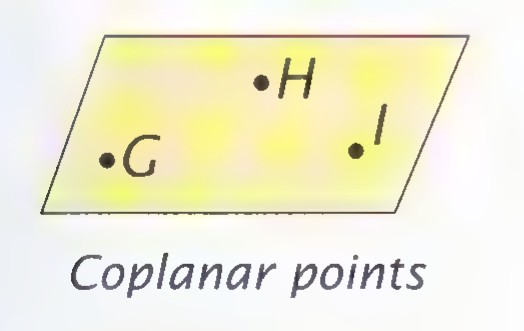
Coplanar points
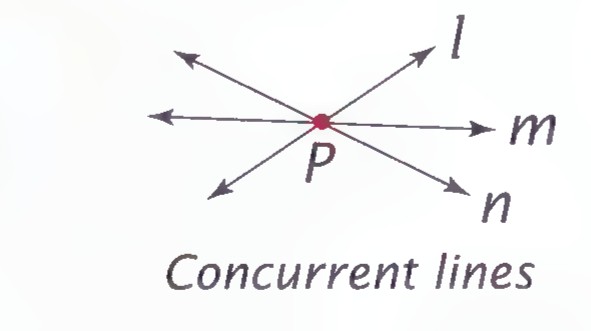
Concurrent lines
Points are coplanar if there is a plane that contains all of them. Lines are concurrent if they contain the same point.
In the figure at the right above, lines l, m, and n all contain point P, their common intersection.
p. 10
Exercises
Set I
This map shows the plan of the main streets of the ancient Chinese city Ch’ang-an.
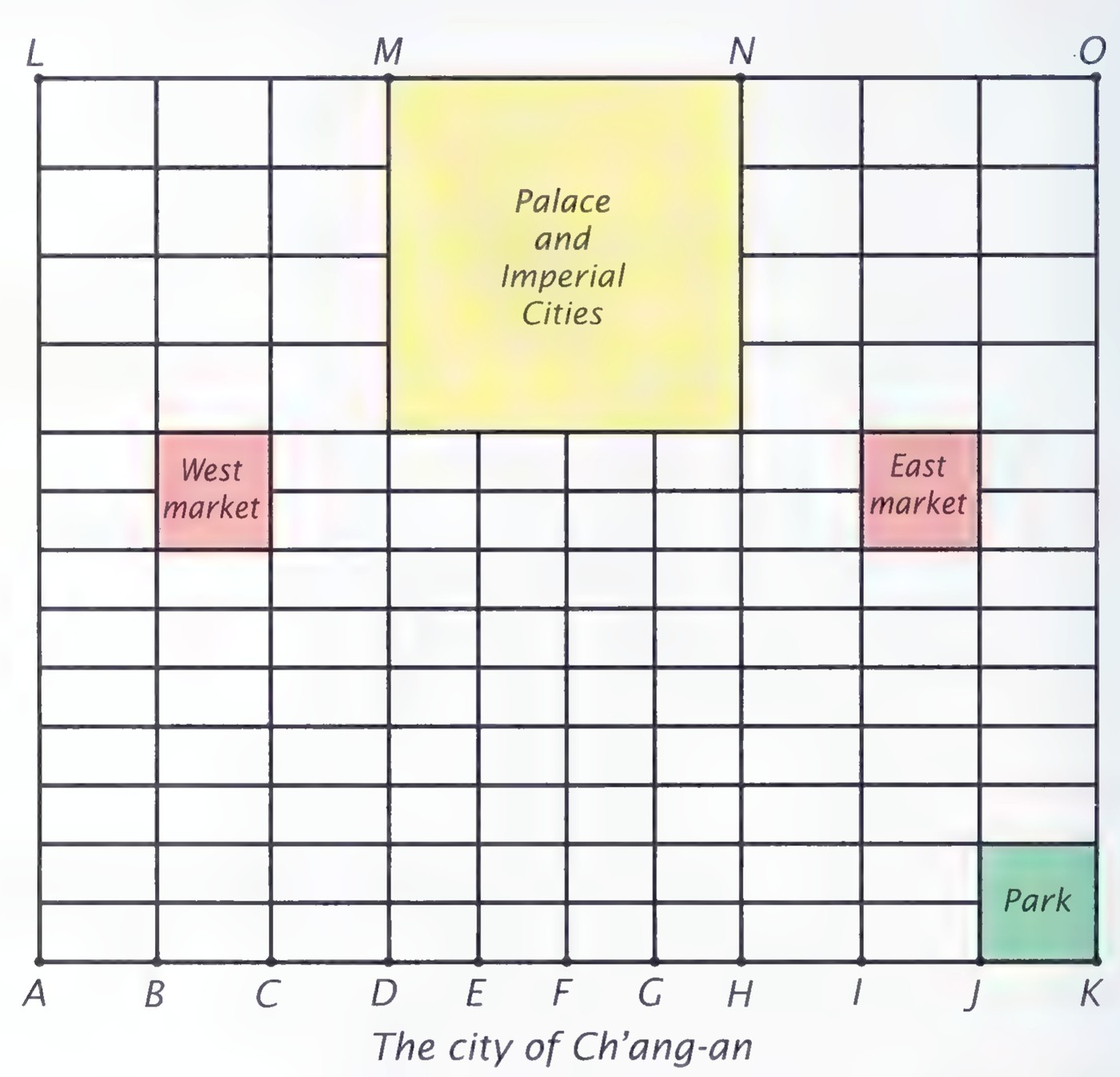
The city of Ch’ang-an
The intersections of the street at the bottom of the map with the streets above it are labeled A through K.
- What word is used to describe points such as these, given that one line contains them all?
Use your ruler to find the lengths of the following line segments in centimeters.
- AK.
- AF.
- AD.
- AB.
- AL.
If the map is accurately drawn and the street from A to K is 6 miles long,
- how many miles is it from A to F?
- how many miles does 1 cm of the map represent?
- how many miles is it from A to L?
- Is the city square? Why or why not?
- What regions of the city do appear to be square?
p. 11
The city, whose name means “long security,” was protected by a surrounding wall.
- Use the lengths of the streets bordering the city to figure out how many miles long the wall was that surrounded it.
If the city were perfectly flat, then all of the points in it would lie in one plane.
- What word is used to describe points such as these?
- Are the streets in the map represented by lines or line segments?
- What is the difference between a line and a line segment?
Notice that AB, CD, and HK are three different segments, yet they all lie in one line.
- On how many different lines do all the segments in this map lie?
Set II
The points and lines in the figure below are related in some unusual ways.
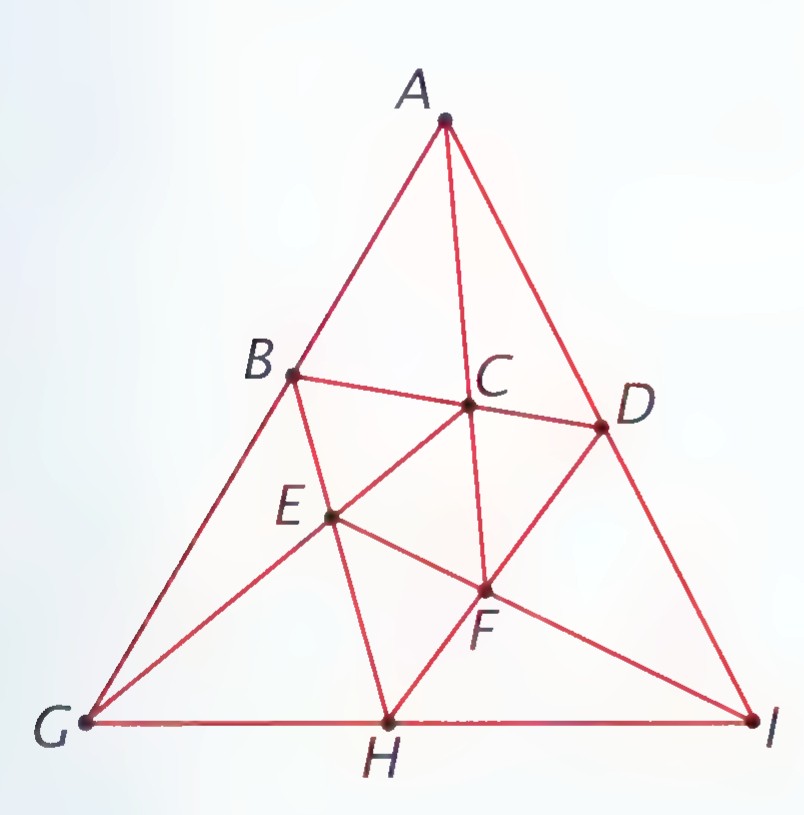
Each point in which line segments intersect has been labeled with a letter.
- How many such points does the figure contain?
- What does the word collinear mean?
The figure has been drawn so that each set of points that appears to be collinear actually is. For example, points E, F, and I are collinear and lie on the line EI.
- How many sets of three collinear points does the figure contain? List them, beginning with E-F-I.
- What does the word concurrent mean?
How many different lines in the figure are concurrent at
- point A?
- point B?
- point C?
- each of the other points?
And now some very tricky questions about the line segments that can be named by using the letters in the figure.
- How many different line segments in the figure meet at point A? Name them.
How many different line segments meet at
- point B? Name them.
- point C? Name them.
Set III
On a sheet of graph paper, draw a figure similar to, but much larger than, the one below.
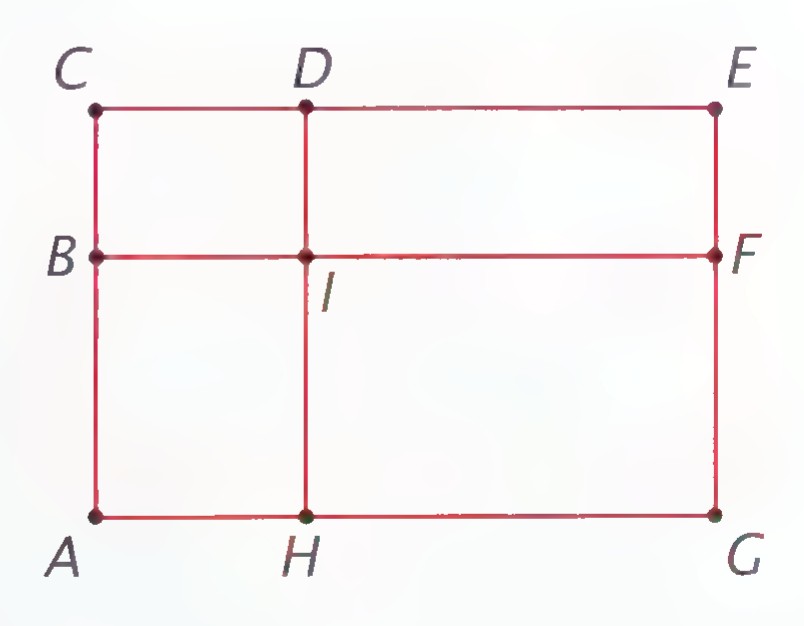
Use a colored pen or pencil to draw the following three lines:
AI, CF, and DG.
Draw enough of each line so that it crosses the entire figure.
p. 12
- What seems to be true about the three lines AI, CF, and DG?
Now use a pen or pencil of a different color to draw these three lines:
AF, CI, and EH.
Extend each line to the edges of the figure.
- Describe what you see.
Now use a pen or pencil of a third color to draw these three lines:
BG, CH, and EI.
Extend each line to the edges of the figure.
- What do you notice?
- Draw the figure again, but change it so that it is taller or shorter, BF is higher or lower, and DH is farther to the left or right. An example of such a figure is shown here, but choose your own.
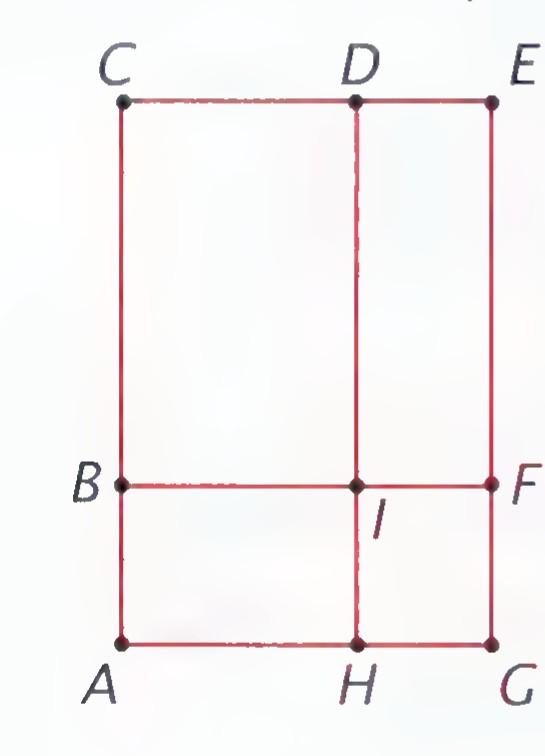
- Now try drawing all the lines again and see what happens. What do you think?
- Try changing the figure in other ways to see what happens to the lines drawn in the three colors. Some examples of altered figures are shown here. (Be sure to make your drawings much larger!)
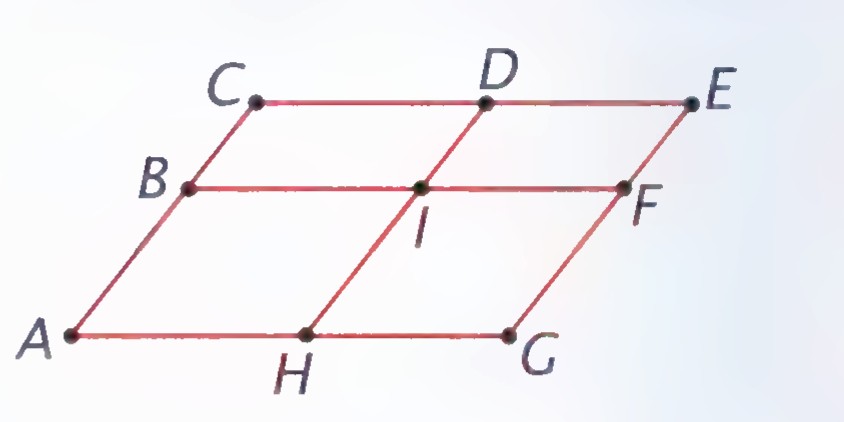
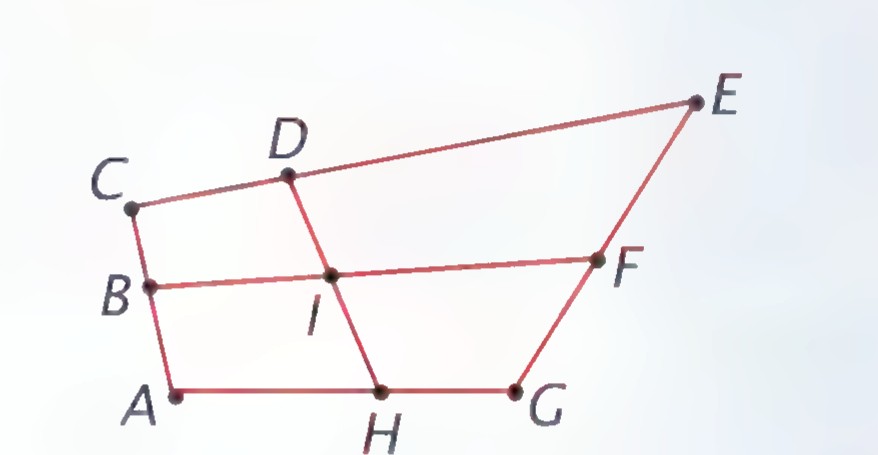
- What do you think?
p. 13
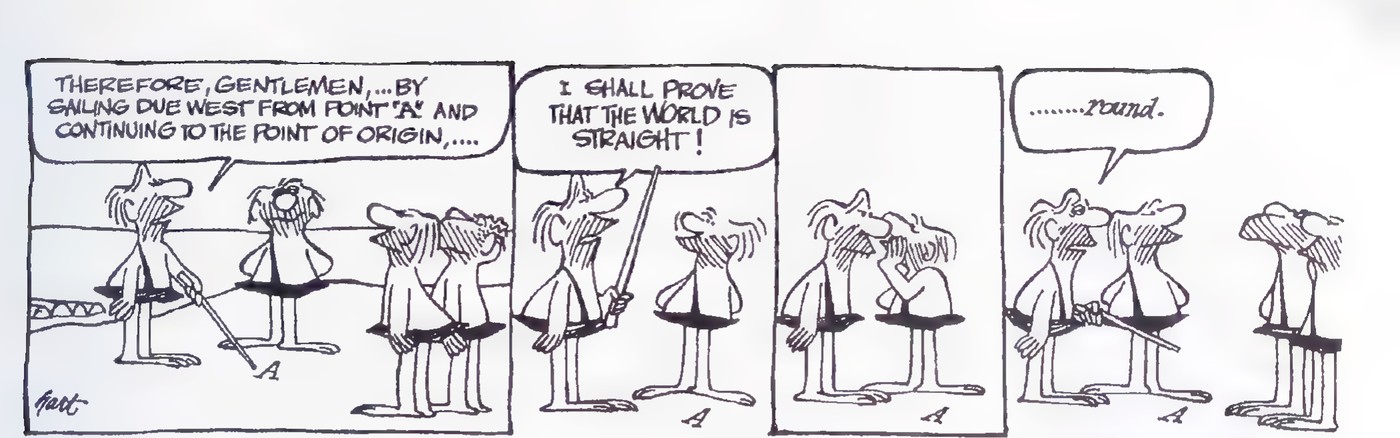
Used by permission of Johnny Hart and Creators Syndicate, Inc.
Lesson 2: Angles in Measuring the Earth
The ancient Greeks knew that the world was round. Eratosthenes, the head of the library in Alexandria where Euclid lived, figured out a clever way to estimate the distance around the world. His method depended on measuring an angle.
Euclid described an angle as “the inclination to one another of two lines in a plane which meet one another.” If we draw a figure showing two lines, l and m, meeting at a point P, several angles are formed.
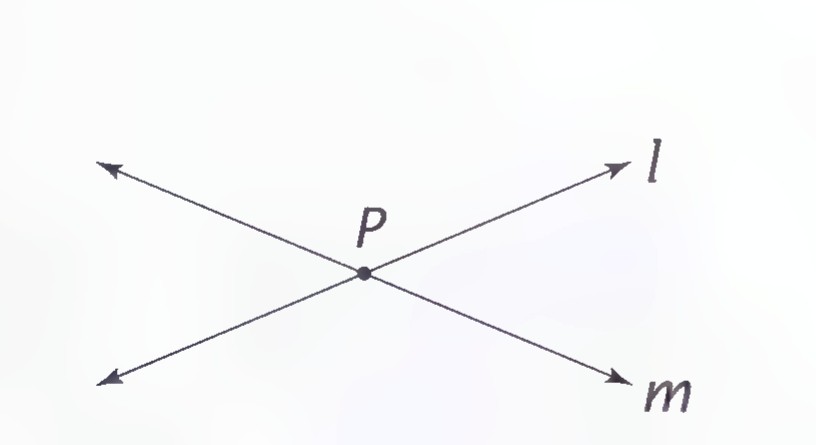
The figure can also be described as consisting of four rays starting from point P. As the figure suggests, a ray is part of a line that extends endlessly in one direction. To refer to a ray, we always name its endpoint first, followed by the name of any other point on it. The name of the ray in the first figure at the right is PA.
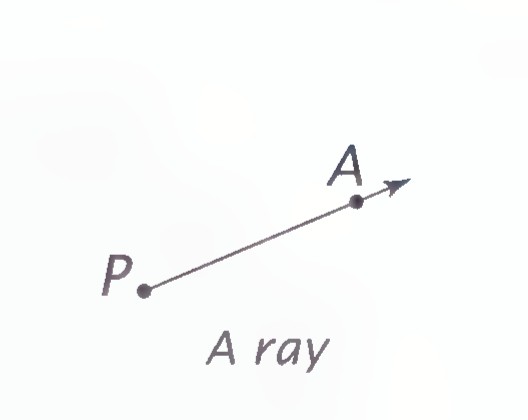
A ray
An angle is a pair of rays that have the same endpoint. The rays are called the sides of the angle and their common endpoint is called the vertex of the angle. Angles can be named in several ways. Using the symbol ∠ to mean “angle,” we can name the angle in the second figure at the right ∠P or ∠1 or ∠APB or ∠BPA. Notice that, if the angle is named with three letters, the vertex is named in the middle.
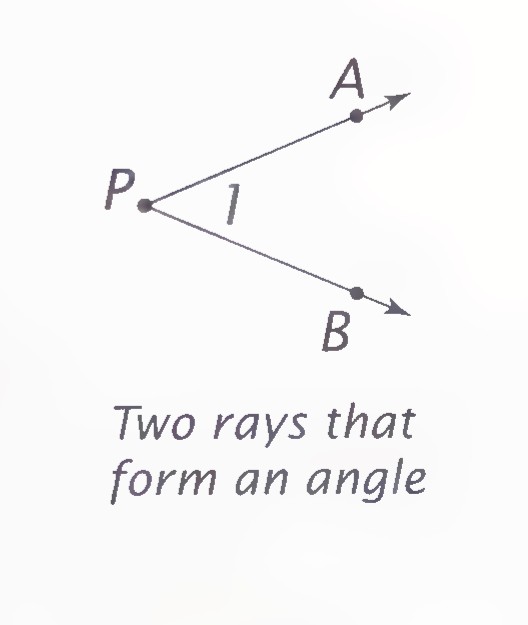
Two rays that form an angle
p. 14
Before learning how Eratosthenes measured the earth, we will review the way in which angles are measured. To measure an angle, we need a protractor.
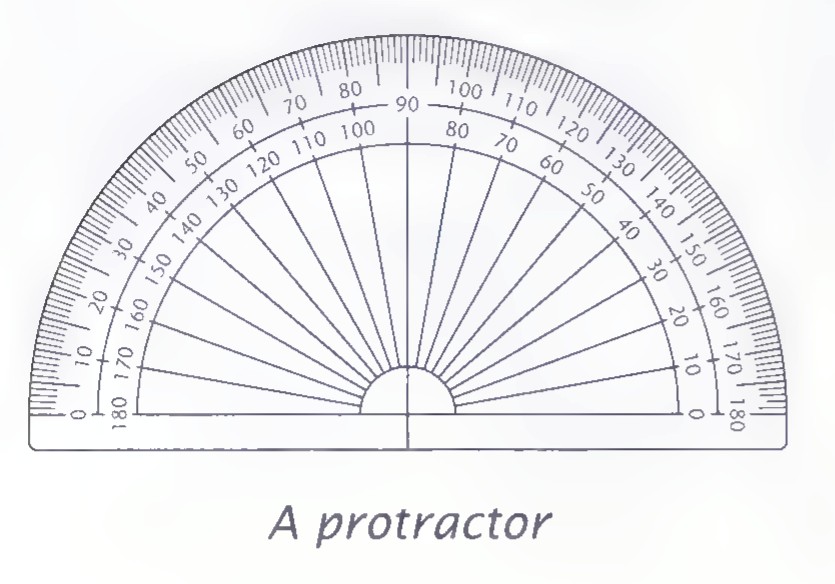
A protractor
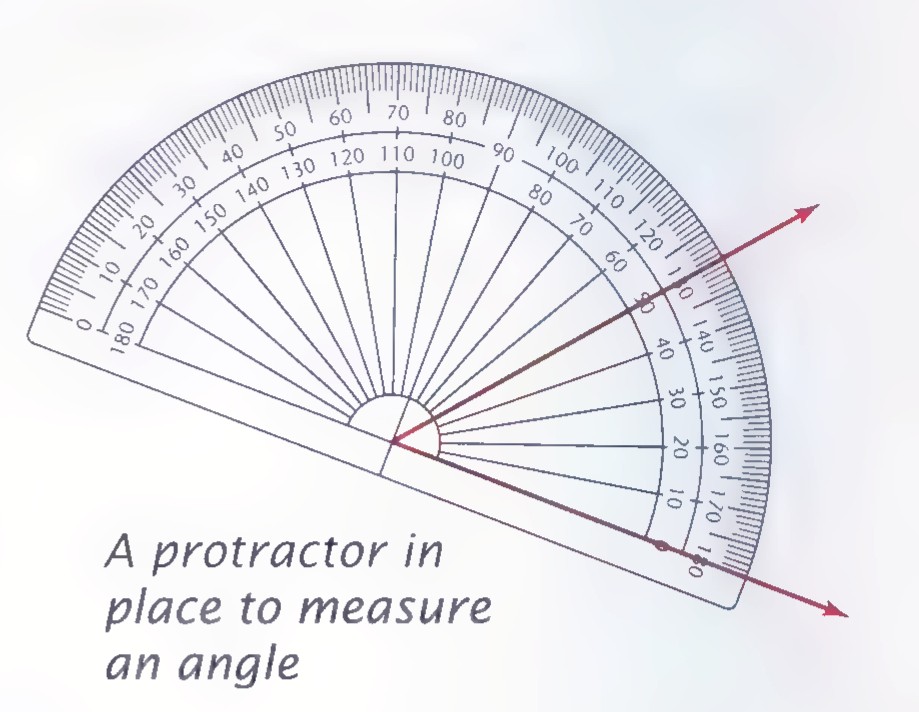
A protractor in place to measure an angle
The protractor measures angles in degrees and has two scales, each numbered from 0 to 180. The center of the protractor is placed on the vertex of the angle so that the 0 on one of the scales falls on one side of the angle. The number that falls on the other side of the same scale gives the measurement of the angle in degrees. Look carefully at the scales on the protractor in the figure above to see why the angle has a measure of 50° and not 130°.
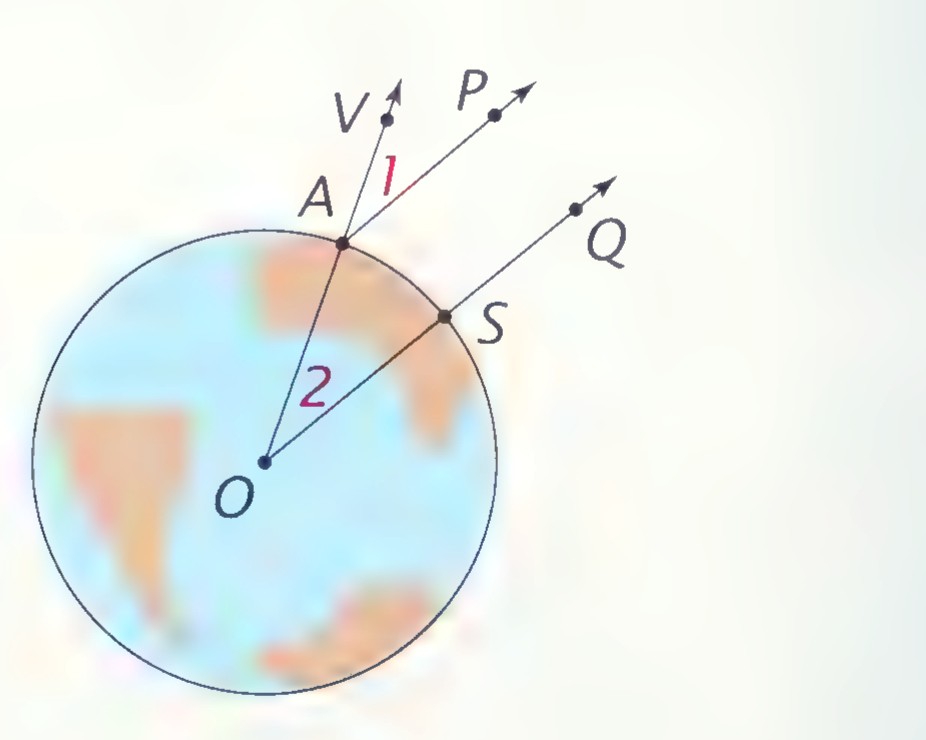
The diagram above illustrates the method that Eratosthenes used to measure the earth. He knew that Alexandria was about 500 miles north of the city of Syene (now called Aswan). The points A and S represent Alexandria and Syene, respectively, and the rays AP and SQ represent the direction of the sun as seen from each city. At noon on a certain day of the year, the sun was directly overhead in Syene, as shown by SQ. In Alexandria at the same time, the direction of the sun was along AP, in contrast with the overhead direction AV.
p. 15
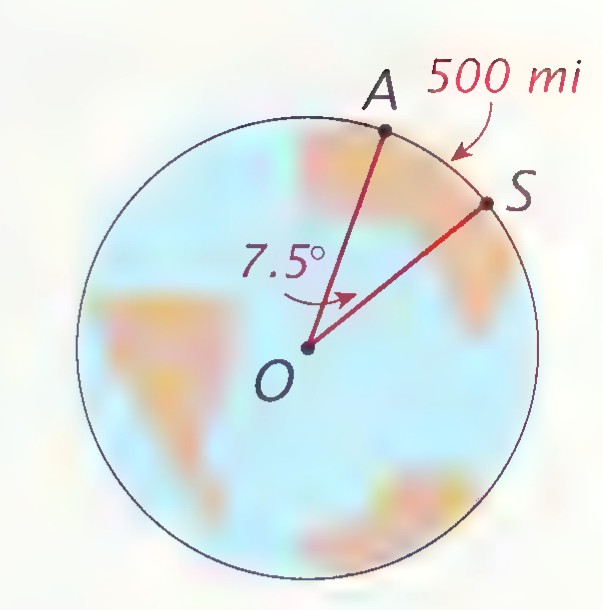
Eratosthenes measured the angle between these two directions, ∠1, and found that it was about 7.5°. Euclid had shown why it was reasonable to conclude that ∠1 was equal to ∠2, the angle with its vertex at the center of the earth. By dividing 7.5° into 360° (the measure of the degrees of a full circle), we get 48; so the full circle is 48 times the angle from Alexandria to Syene:
Eratosthenes concluded that the earth’s circumference (the entire distance around the circle) was 48 times the distance from Alexandria to Syene:
The modern value of the circumference of the earth is about 25,000 miles; so Eratosthenes’ estimate was remarkably accurate.
Exercises
Set I
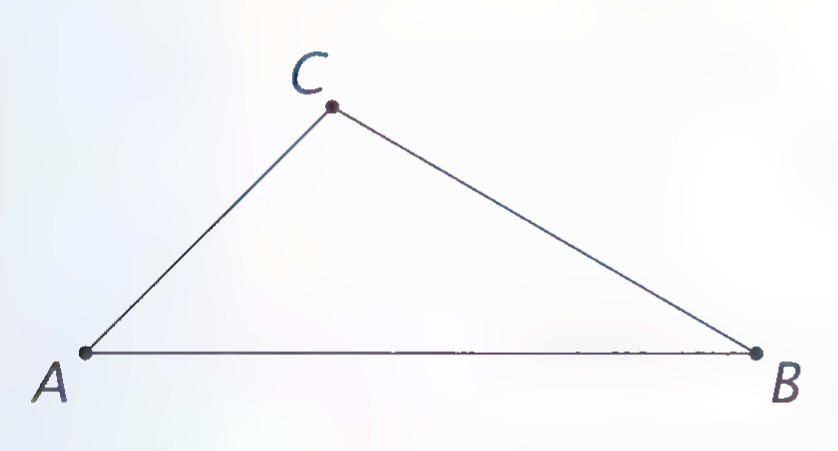
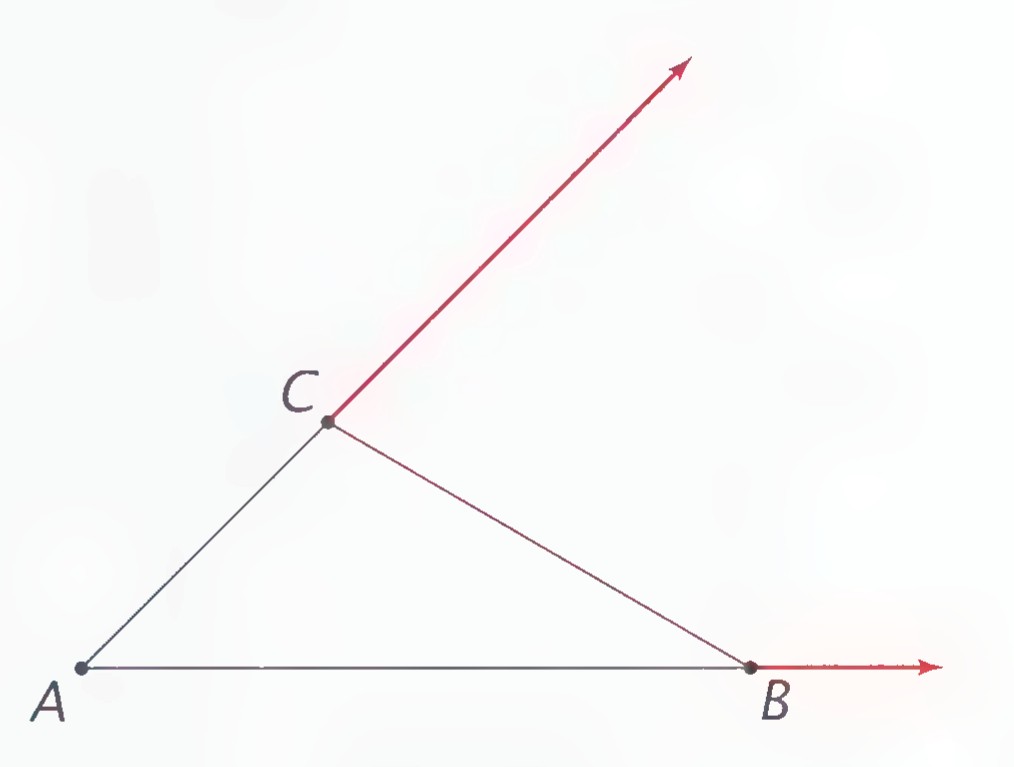
Triangle Measurements. Each side and angle of the triangle above has a different measure. If you simply look at the figure without doing any measuring,
- which side is the longest?
- which angle is the largest?
- which side is the shortest?
- which angle is the smallest?
- Use your ruler to measure the sides of the triangle, each to the nearest 0.1 cm.
Most protractors are too large to be able to measure the angles of a figure such as this triangle easily. For example, to measure ∠A, it is easiest to extend its sides as shown in color in the figure at the right above.
- Name the two rays that are the sides of ∠A.
- Use your protractor to measure ∠A.
- Carefully trace triangle ABC on your paper and then extend the sides of ∠B.
- Name the two rays that are the sides of ∠B.
- Measure ∠B.
Go back to the figure you drew for exercise 8 and extend the sides of ∠C.
- Name the two rays that are the sides of ∠C.
- Measure ∠C.
p. 16
Constellation Angles. Eudoxus, a Greek mathematician, was the first to write about constellations, groupings of stars in the sky, in the fourth century B.C.
Two of the ten stars in the constellation Orion are among the brightest in the sky: Betelgeuse and Rigel. They appear as points B and R in the figure below.
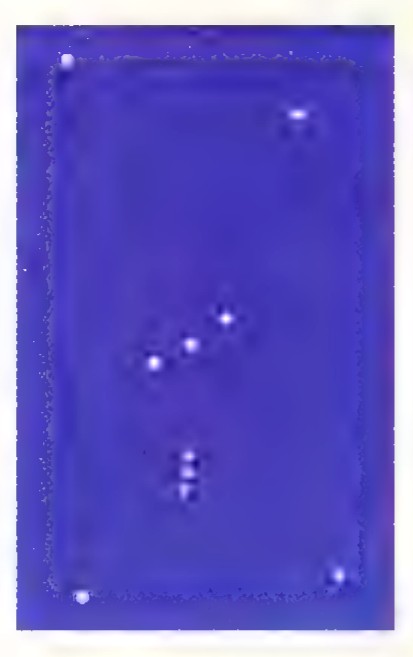
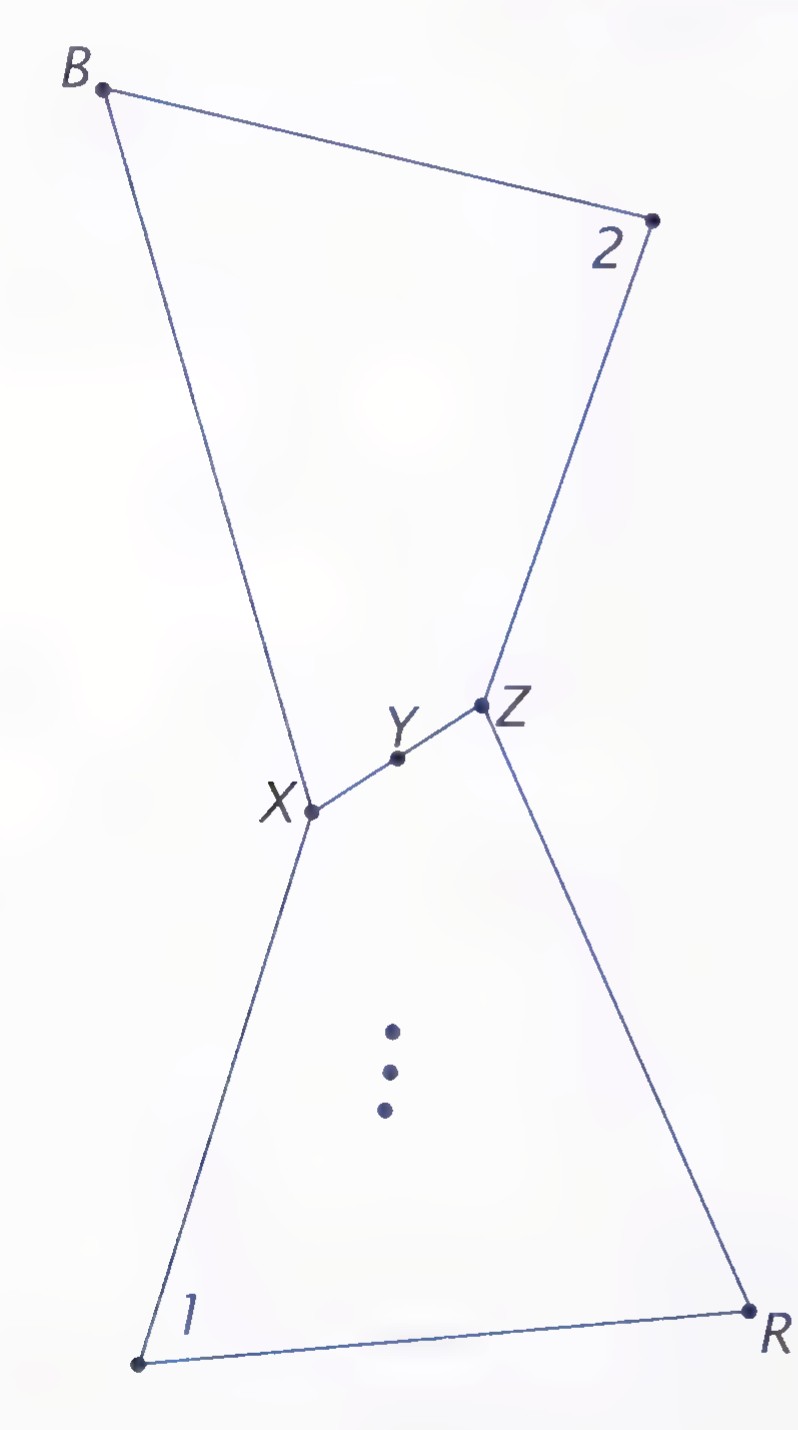
- What word describes the apparent relation of the points labeled X, Y, and Z in Orion’s belt?
Look carefully at the four angles, ∠1, ∠B, ∠2, and ∠R. Without measuring, guess which of these four angles is
- smallest.
- largest.
Use a protractor to measure each of the four angles to check your guesses.
- ∠1.
- ∠B.
- ∠2.
- ∠R.
One of the most well-known constellations is Ursa Major, or the Big Dipper.
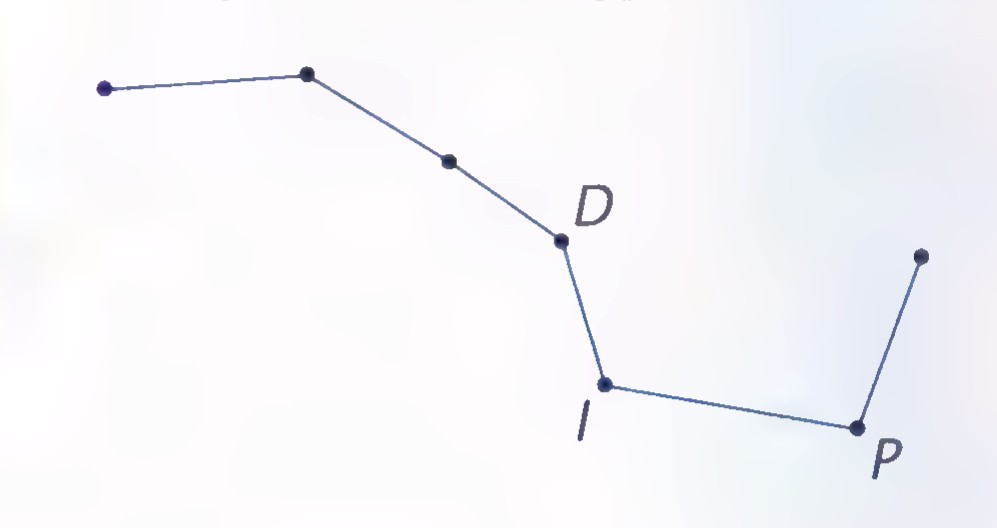
- Carefully trace the figure above and then extend the sides of the angles as necessary to measure each of the following angles.
- ∠D.
- ∠I.
- ∠P.
Set II
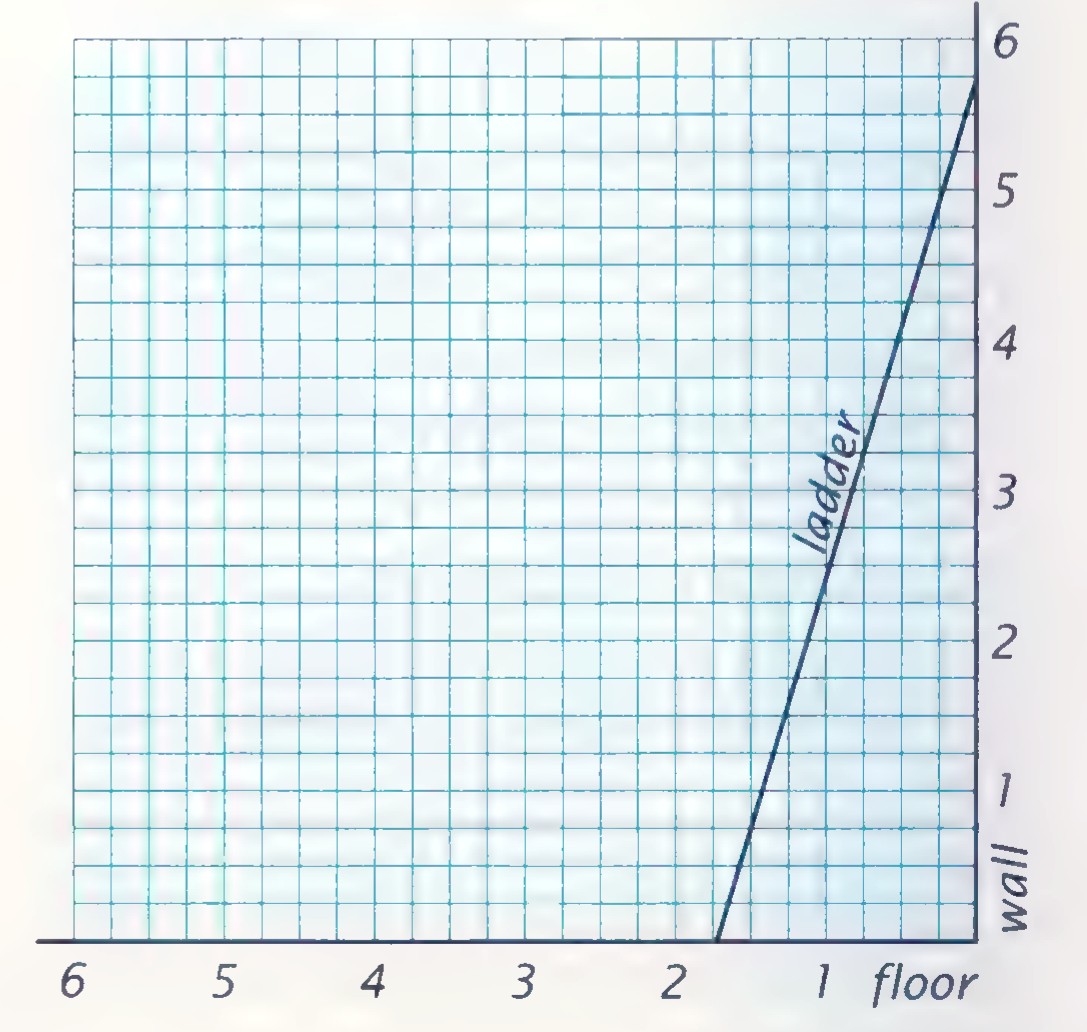
The Sliding Ladder. This figure represents a ladder 6 feet long leaning against a wall.
p. 17
On a sheet of graph paper that is 4 units per inch, draw two lines to represent the wall and floor as shown in the figure. Mark a scale on the wall, letting 1 inch (4 units) represent 1 foot.
The safest position in which to place the ladder is with its top 5¾ feet above the floor. Place the end of your ruler at the 5¾-foot point on the wall and turn the ruler until its 6-inch mark just touches the floor. Trace this safe position for the ladder on your paper.
Approximately how far is the foot of the ladder from the wall?
Use your protractor to measure the angle that the ladder makes
- with the floor.
- with the wall.
Now suppose that the ladder slips down the wall. Place the end of your ruler at the 5-foot point on the wall and turn it until its 6-inch mark touches the floor. Trace this position on your paper.
- About how far is the foot of the ladder from the wall now?
Measure the angle that the ladder now makes
- with the floor.
- with the wall.
Place the end of your ruler at the 3-foot point on the wall, again being sure to turn it so that its 6-inch mark touches the floor.
- About how far is the foot of the ladder from the wall now?
Measure the angle that the ladder now makes
- with the floor.
- with the wall.
Notice that, as the ladder’s angle with the floor becomes smaller, its angle with the wall becomes larger.
- How big do you suppose each angle would be when the angles are equal?
Set III
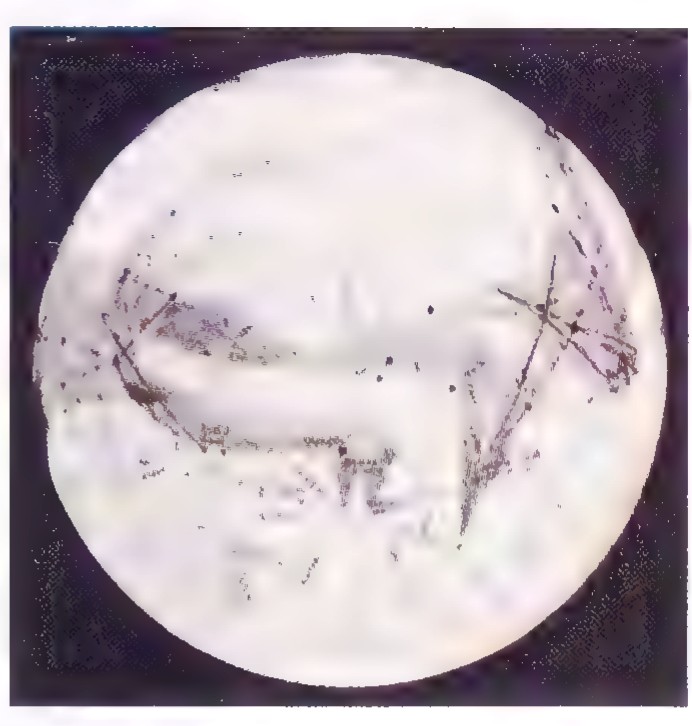
Measuring Mars. The above map of the planet Mars was drawn in 1903 by the astronomer Percival Lowell. It shows canals and cities that he thought had been built by intelligent beings on the planet.
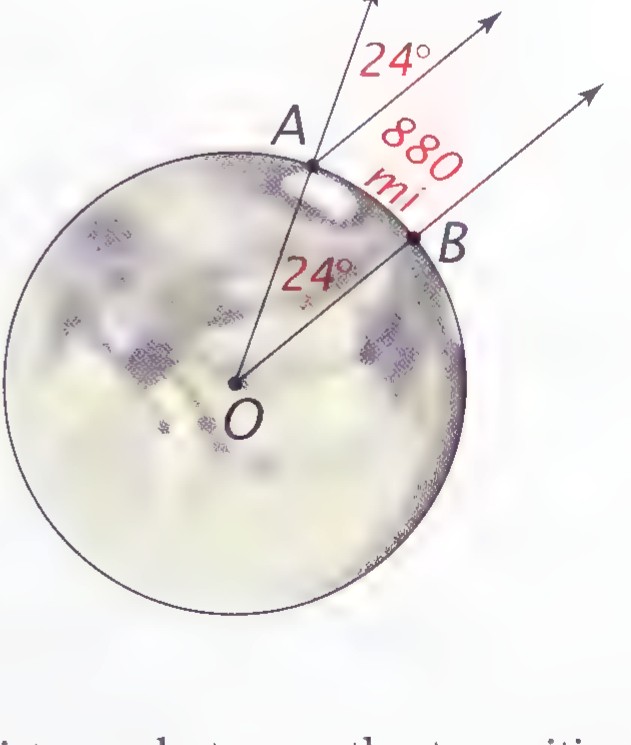
Suppose that the Martians discovered that, when the sun is directly overhead at Botrodus (point B below), it is 24° from the vertical at Aquae Calidae (point A).*
If the distance between the two cities is 880 miles, what is the distance around Mars? (Show your reasoning.)
*For convenience, we will assume that the Martians use the same units of measure that we do.
p. 18
Lesson 3: Polygons and Polyhedra: Pyramid Architecture
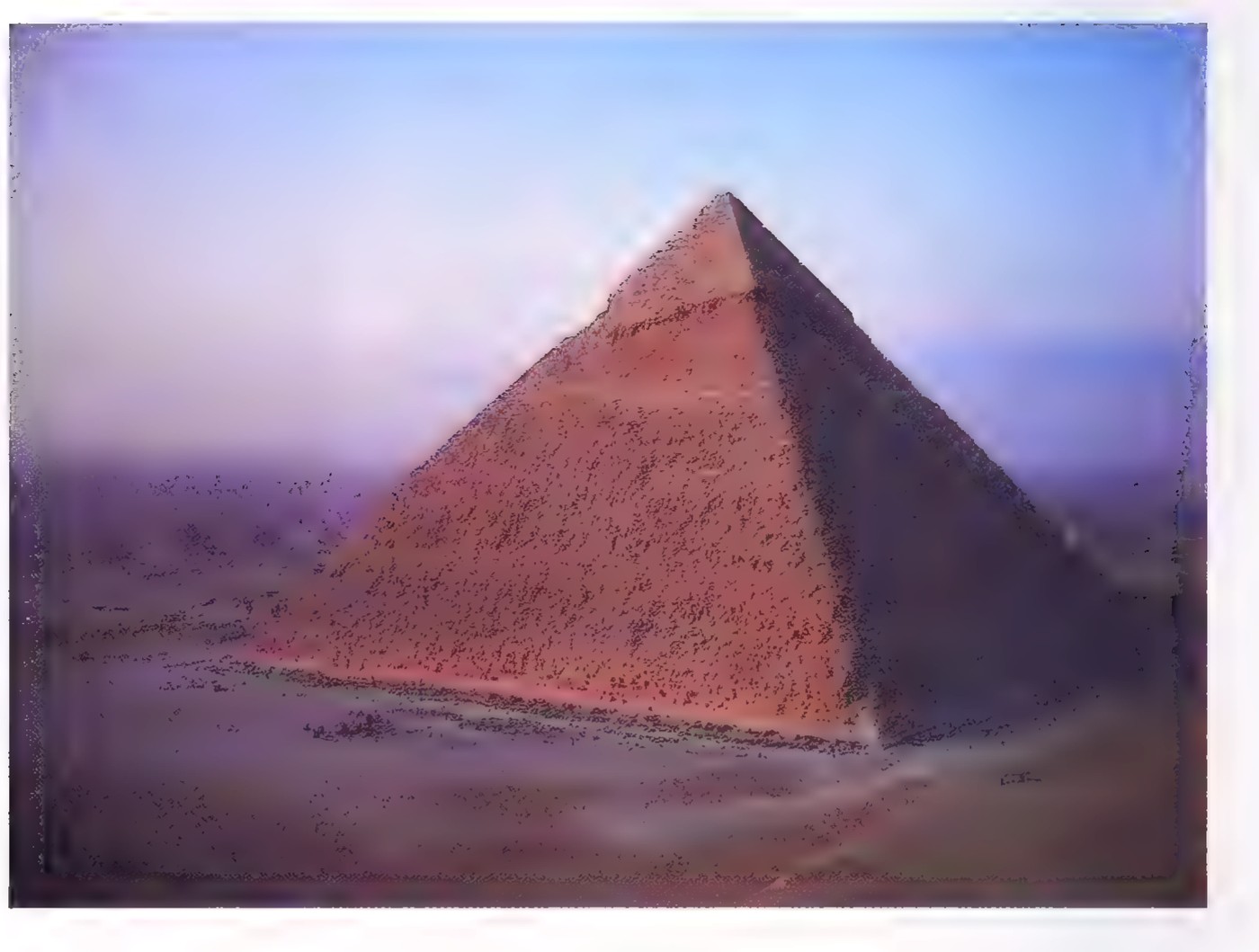
More than 2,000 years before Euclid was born, the ancient Egyptians used their knowledge of geometry to build the Great Pyramid at Giza, the only one of the “seven wonders of the world” still in existence. This pyramid is comparable in height to a building 40 stories high and covers an area of more than 13 acres. It was put together from more than 2 million stone blocks, weighing between 2 and 150 tons each!
Its base is almost a perfect square, and its four faces are in the shape of triangles. Squares and triangles are special types of polygons, and the pyramid itself is an example of a polyhedron. The words polygon and polyhedron are Greek in origin and, although the plural of polygon is polygons, the plural of polyhedron is polyhedra.
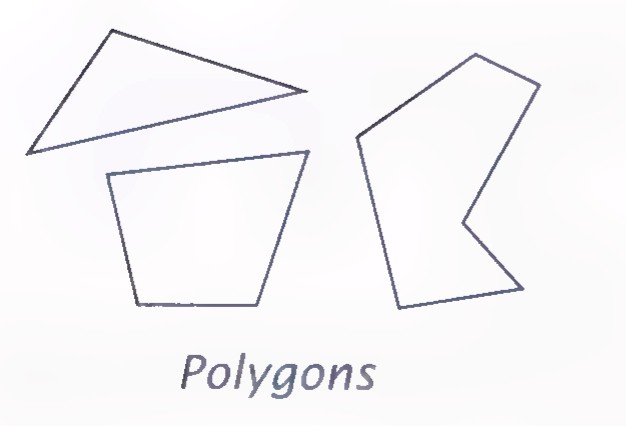
Polygons
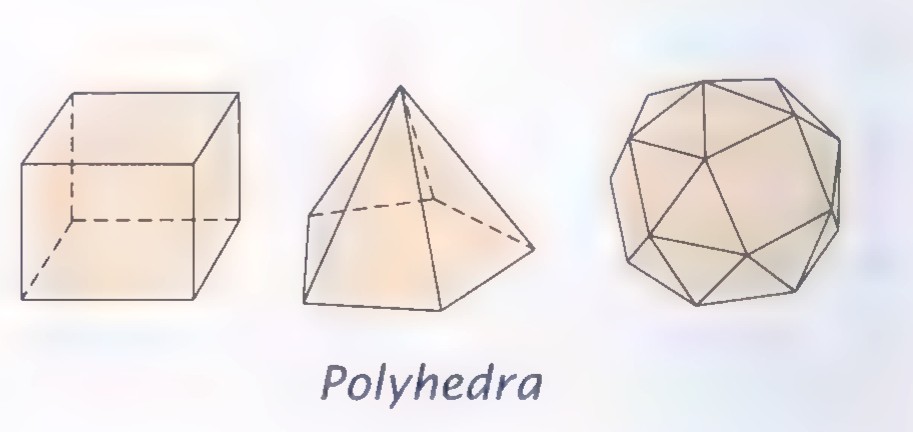
Polyhedra
p. 19
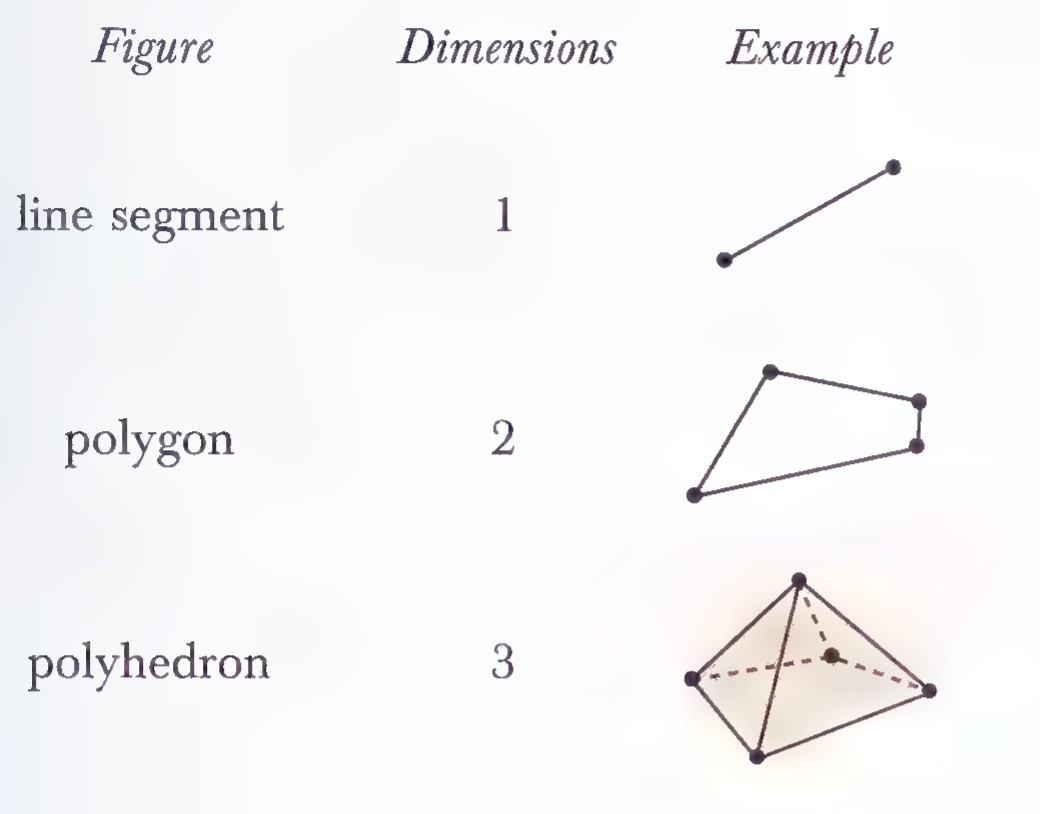
Polygons and polyhedra are related to line segments in a simple way. As you know, a line segment is part of a line bounded by two endpoints; it is a one-dimensional figure. A polygon is bounded by line segments and lies in a plane; it is a two-dimensional figure. A polyhedron is bounded by polygons and exists in space; it is a three-dimensional figure.
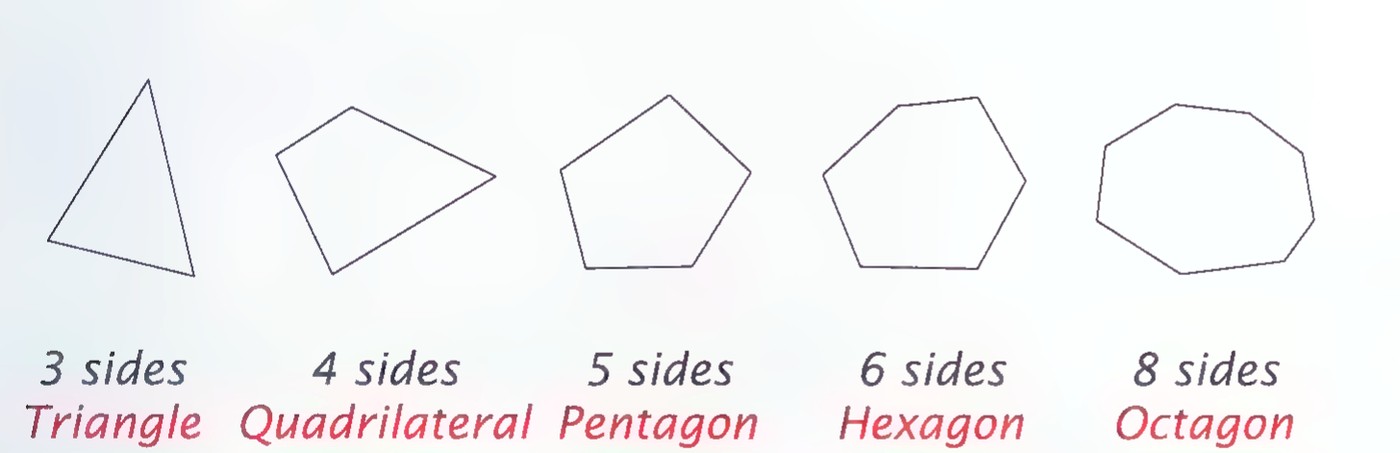
The most basic way to name polygons is according to their number of sides. Some of them are illustrated here.
The ways for naming polyhedra are more complicated. Some words, such as cube and pyramid, are already familiar to you. Others, such as tetrahedron and parallelepiped, are probably not.
Whenever polygons or polyhedra are in practical problems, their measurements are often important. Consider the Great Pyramid, for example. A person seeing it for the first time might wonder how much ground it covers. In other words, what is the area of the polygon that is its base? Another question might concern how long it would take to walk around the pyramid. The answer depends on the perimeter of its base. A third question might concern how much stone was required to build the pyramid. This answer is related to the volume of the polyhedron that is its shape.
p. 20
In this lesson, we will review two of these terms. The easiest one is perimeter. The perimeter of a polygon is the sum of the lengths of its sides.
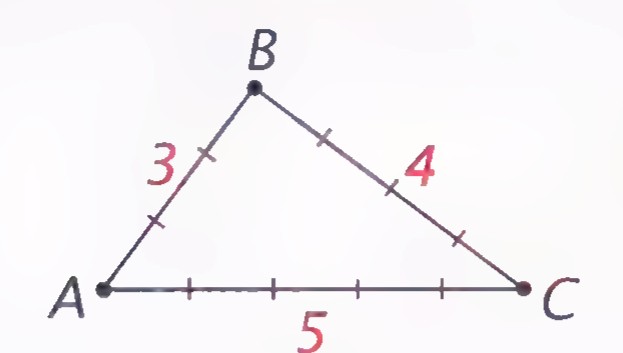
The perimeter of triangle ABC is 3 + 4 + 5 = 12 units.
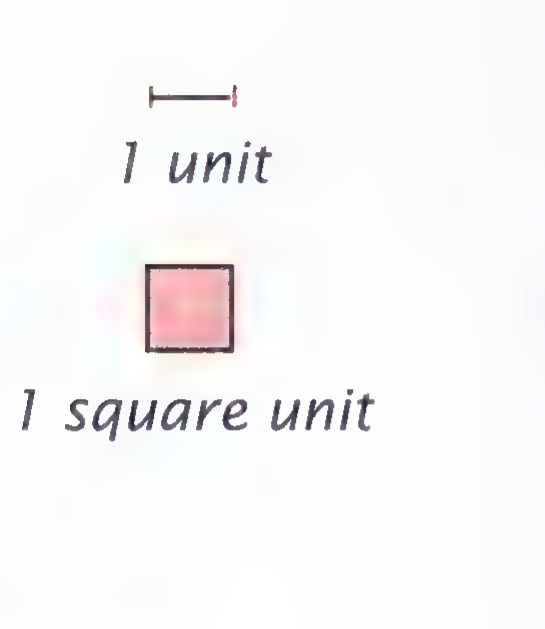
The second term is area. According to one dictionary, area is “the surface included within a set of lines; specifically, the number of unit squares equal in measure to the surface.”* This definition is obvious for a simple figure such as this rectangle.
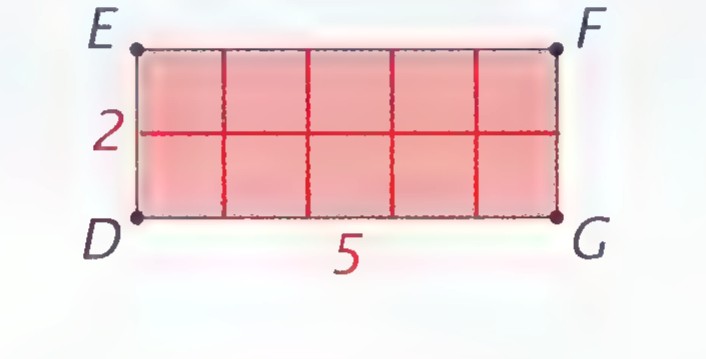
The area of rectangle DEFG is 2 × 5 = 10 square units.
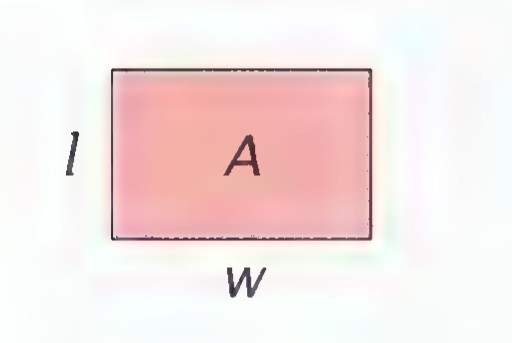
The figure even suggests the simple formula for the area of any rectangle. A rectangle with length l and width w has area A given by
The base of the Great Pyramid is square, with sides 756 feet long.
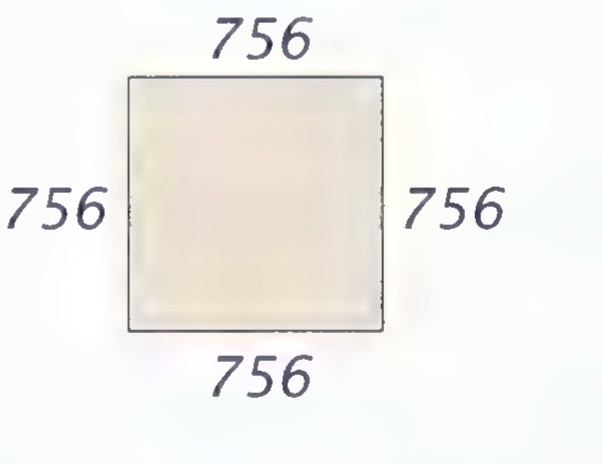
Its perimeter, then, is
756 feet + 756 feet + 756 feet + 756 feet = 4 × 756 feet = 3,024 feet.
A square is also a rectangle; so its area is
756 feet × 756 feet = 571,536 square feet.
* Merriam-Webster’s Collegiate Dictionary.
p. 21
Exercises
Set I
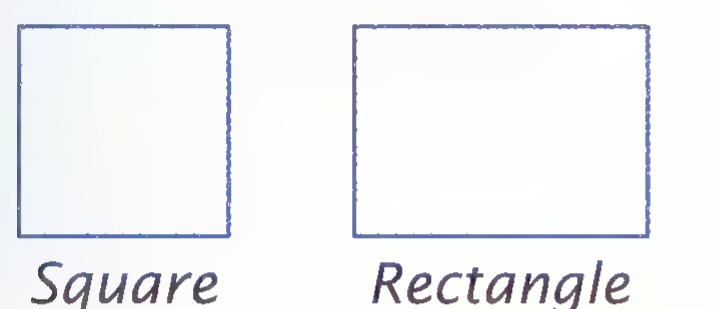
The Perimeter and Area of a Square. The base of the Great Pyramid is in the shape of a square. A square is a rectangle all of whose sides are of equal length. Because a square is a rectangle, each of its angles is a right angle; that is, each angle has a measure of 90°.
Square Rectangle
- Use your ruler and protractor to accurately draw a square whose sides are 3 inches long. Then divide it into smaller squares whose sides are 1 inch long.
- What is the area of the square?
- What is its perimeter?
Without drawing it, imagine a square whose sides are 6 inches long.
- What is its area?
- What is its perimeter?
Without drawing it, imagine a square whose sides are 1 foot long.
- What is its area in square feet?
- What is its perimeter in feet?
Now think of the same square as having sides 12 inches long.
- What is its area in square inches?
- What is its perimeter in inches?
If a square has sides that are x units long, what, in terms of x, is its
- area?
- perimeter?
Pentominoes. A game called Pentominoes uses the 12 pieces shown here. Their names are suggested by their shapes.
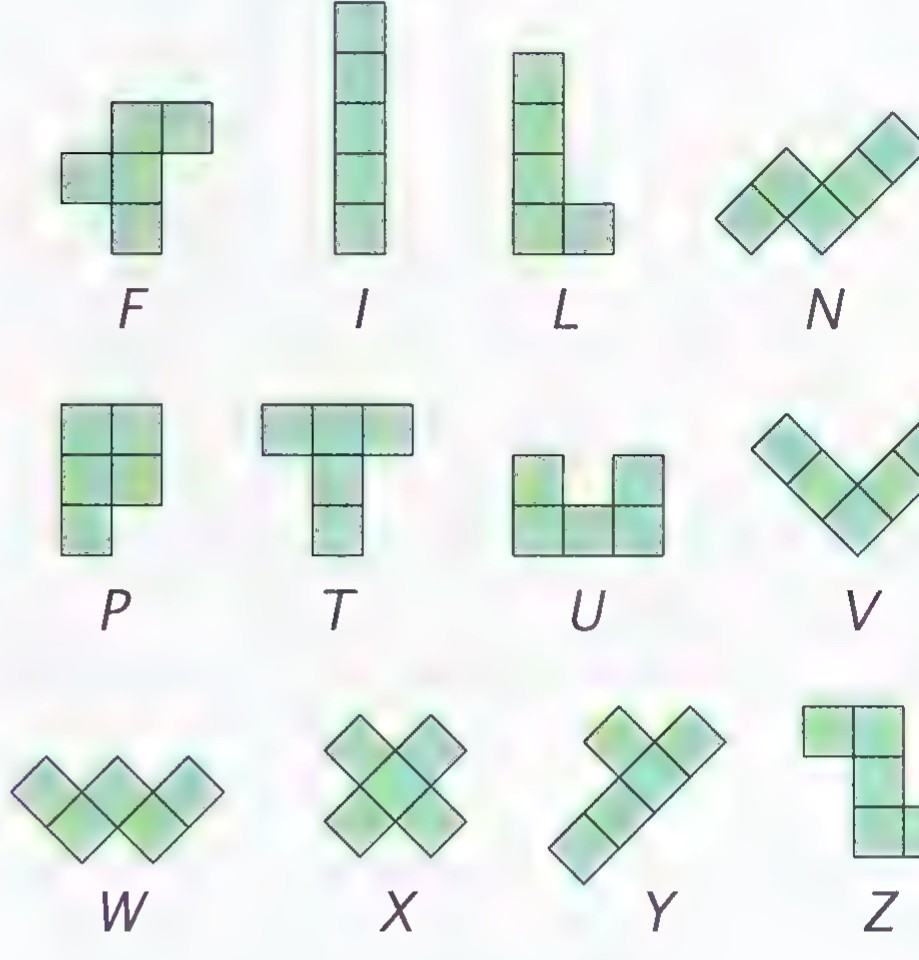
- Each piece is in the shape of a polygon. What is a polygon?
- Which piece is in the shape of a quadrilateral? Why?
- All 12 pieces have the same area. What is it?
- All 12 pieces have the same perimeter except for one. Which one is it?
Texas Ranches. Two ranches are for sale in Texas. Each is in the shape of a rectangle and their dimensions are as follows:
Ranch A: 4 miles wide, 14 miles long. Ranch B: 6 miles wide, 10 miles long.
- Suppose that neither ranch has a fence. Which one would need more fencing to surround it?
- Both ranches are the same price and you want to buy the bigger one. Which one should you buy?
- Which is more important in this situation: perimeter or area?
p. 22
Set II
A Model of the Great Pyramid. While on a trip to study the Great Pyramid in 1799, Napoleon made this sketch together with some notes.
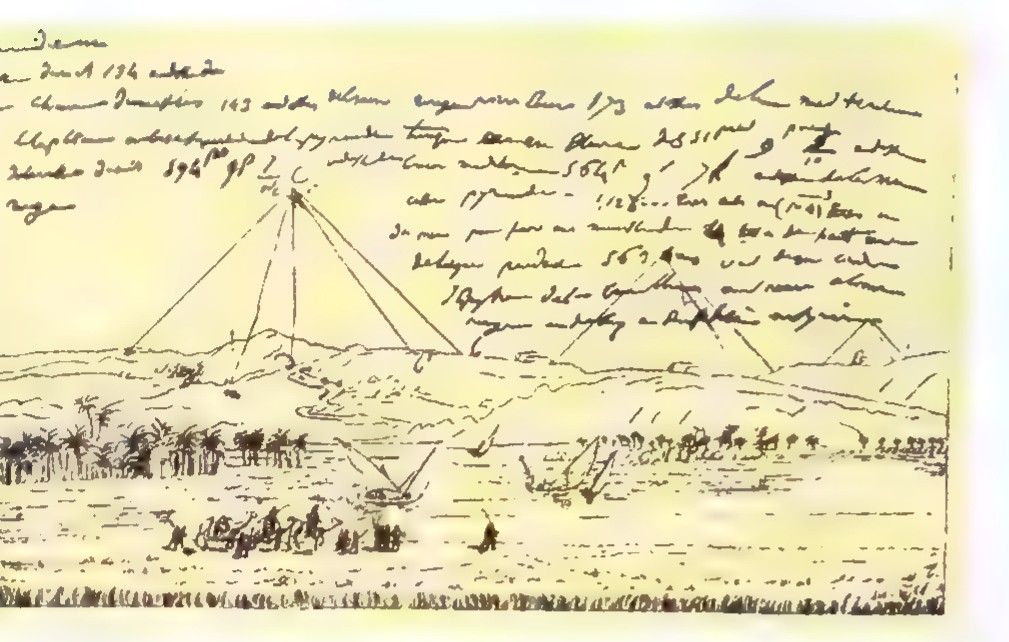
Use your ruler and protractor to draw a square 10 cm on each side for the base of the pyramid on a heavy sheet of paper.
The other four faces of the pyramid are in the shape of triangles. Use the measurements shown in the figure below to draw four triangles on a sheet of heavy paper.
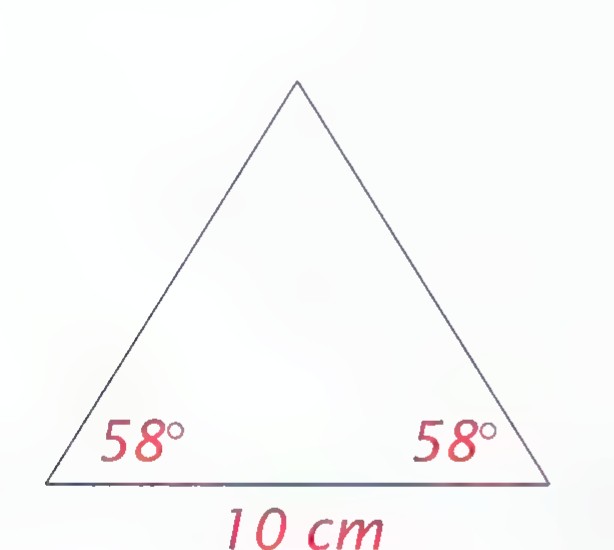
- Use your protractor to measure the angle at the top of one of these triangles.
- Do any sides of the triangle appear to be equal? Use your ruler to check your answer.
- Cut out the square and four triangles and tape them together to make a scale model of the Great Pyramid.
- Make a drawing of the pyramid.
The pyramid has five faces altogether: its square base and its four triangular faces.
- What kind of figures are squares and triangles?
- What kind of figure is the pyramid itself?
The line segments in which the faces of the pyramid meet are called its edges.
- How many edges does the pyramid have?
- How many corners does it have?
- How many edges meet at the top of the pyramid?
- How many edges meet at each corner of the base?
Each face of the pyramid lies in a plane.
- In how many different planes do the faces of the pyramid lie?
- If two lines intersect, they intersect in a point. If two planes intersect, in what do they intersect?
- Use your ruler to estimate, as best as you can, the height of your model in centimeters.
In your model, 10 cm represent 756 feet, the length of one edge of the base of the pyramid.
- How many feet does 1 cm represent?
- Use this result and your estimate of the height of your model in centimeters to estimate the height of the Great Pyramid in feet.
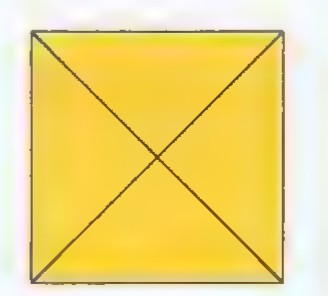
- What view of the Great Pyramid does this drawing appear to show?
p. 23
Set III
A Square Puzzle. The book Mathematical Snapshots by the Polish mathematician Hugo Steinhaus begins with an illustration of four polygons arranged to form a square.*
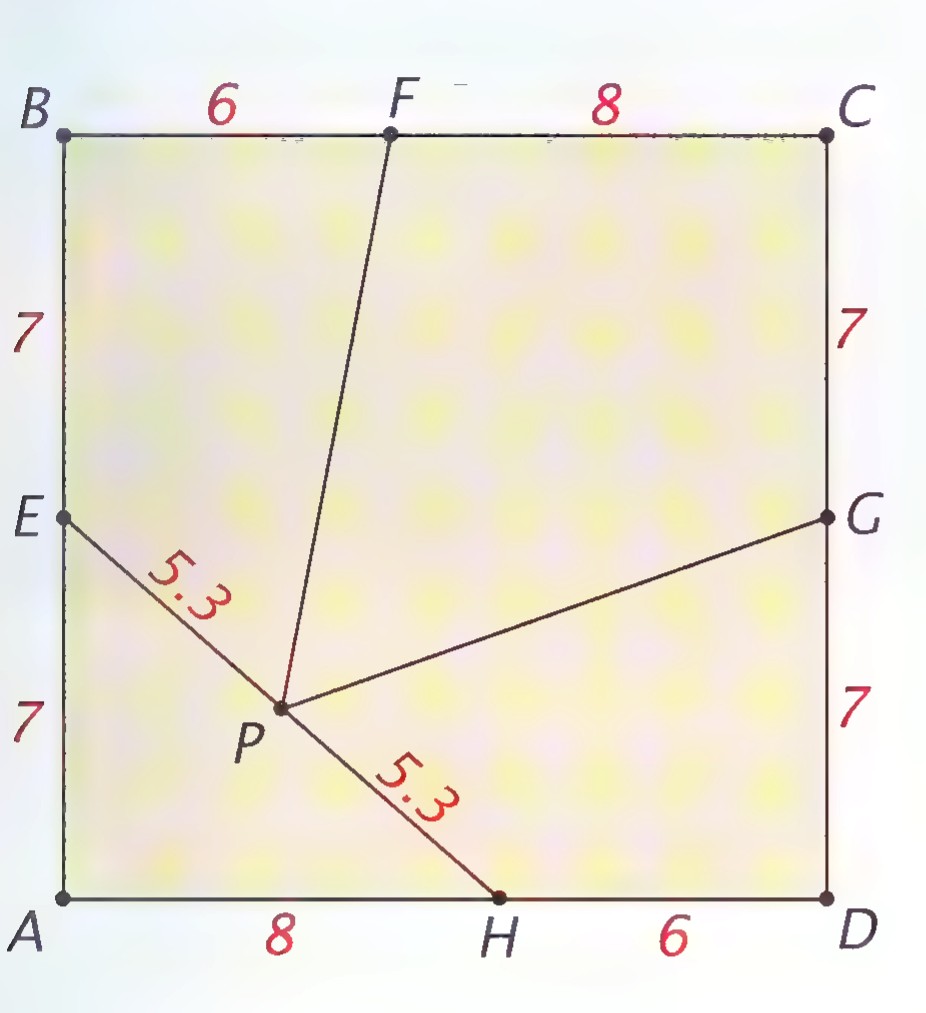
Use your ruler and protractor to make an enlargement of this figure on a sheet of heavy paper by doing each of the following:
- Draw a square 14 cm on each side and label its corners A, B, C, and D as shown in the figure.
- Mark the points E, F, G, and H at the indicated distances from the corners.
- Draw EH.
- Mark point P on EH.
- Draw PF and PG.
Test the accuracy of your drawing and your ability to measure angles by doing each of the following.
- ∠EPF, ∠FPG, and ∠GPH should appear to be equal. What is the measure of each of these angles? Write the measure inside each angle.
- ∠BFP should appear to be 30° larger than ∠AEH. What is the measure of each of these angles?
- ∠BEH should appear to be 90° larger than ∠EHA. What is the measure of each of these angles?
- Two other line segments in the figure should appear to have the same length as that of EH. Which are they?
- Carefully cut the four polygons out. Try to rearrange them to form an equilateral triangle (a triangle all of whose sides are equal). Trace the arrangement on your paper.
- About how many centimeters long is each side of the equilateral triangle?
- How large is each of its three angles?
- How does the area of the triangle compare with that of the original square? Why?
- What is the area of the triangle?
- How does the perimeter of the triangle compare with that of the original square?
*The figure is the solution to a puzzle created in 1902 by Henry Dudeney, England’s greatest inventor of mathematical puzzles. The lengths in it have been rounded for convenience.
p. 24
Lesson 4: Constructions: Telling Time with Shadows
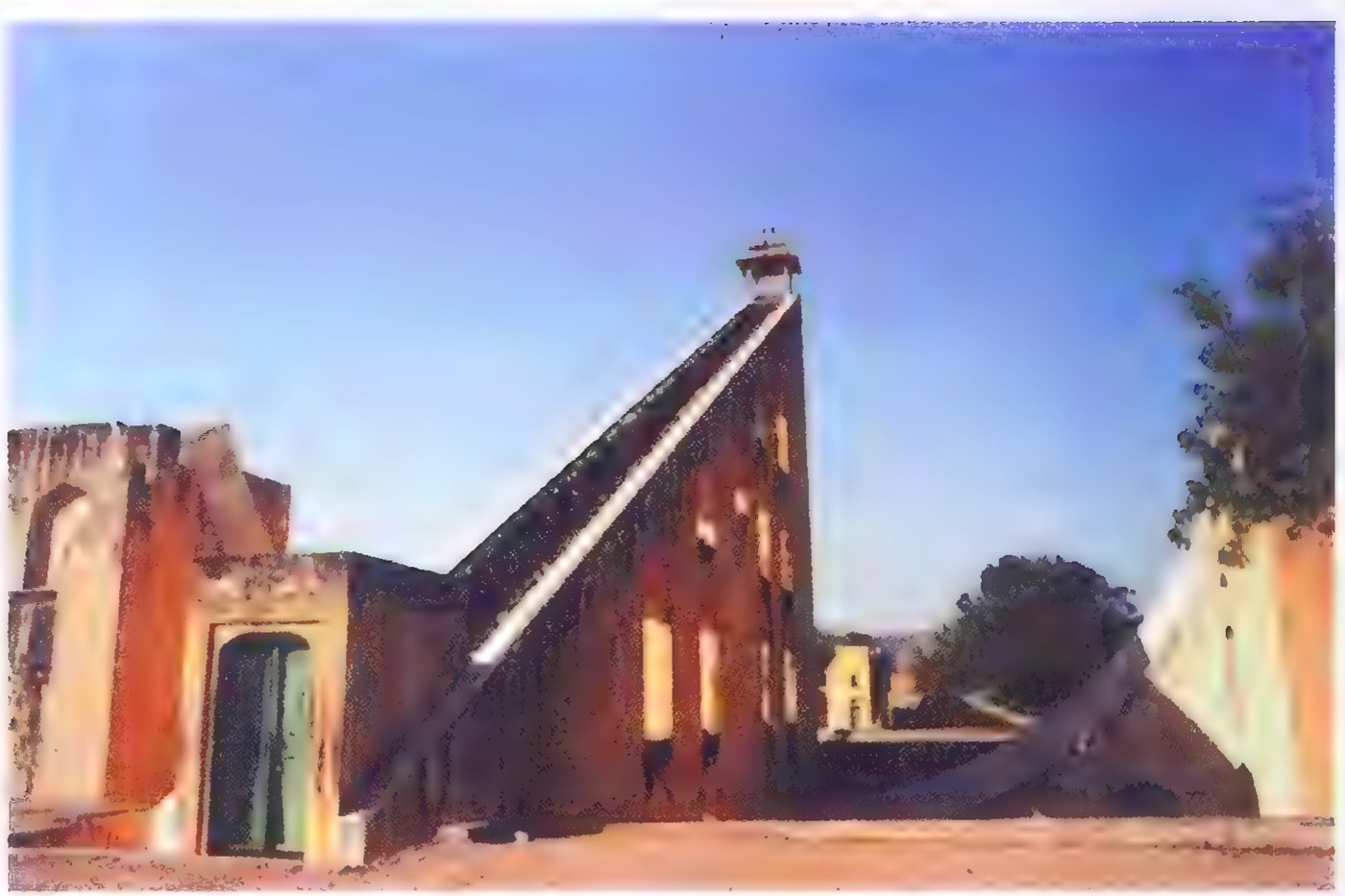
The largest sundial in the world, built in 1724 in Jaipur, India, is shown in the photograph above. Its gnomon (the object that casts the shadow) is a ramp that rises 90 feet above the ground. The shadow cast by the ramp moves at a rate of about two inches per minute, making it possible to accurately tell the local time within seconds!
Sundials were the main instrument for keeping time from the days of ancient Egypt until the sixteenth century. At noon, the sun is at its highest in the sky, the shadow cast by the gnomon is at its shortest, and, in the northern hemisphere, the shadow points northward.
The Egyptians were aware of these facts and put them to use in constructing their pyramids so that their sides faced directly north, south, east, and west. The method that they are thought to have used for finding map directions is related to a geometric construction.
Since the time of Euclid, two tools have been used in making geometric drawings: the straightedge and compass. The straightedge is used for drawing lines (actually line segments), and the compass is used for drawing circles or parts of circles called arcs. A circle is the set of all points in a plane that are a fixed distance from a given point in the plane. The fixed distance is called the radius of the circle and the given point is called its center.
Drawings made with just a straightedge and compass are called constructions to distinguish them from those made with other tools such as a ruler and protractor.
p. 25
In this lesson, we will learn simple constructions for bisecting line segments and angles. To bisect something means to divide it into two equal parts.
Construction 1
To bisect a line segment.
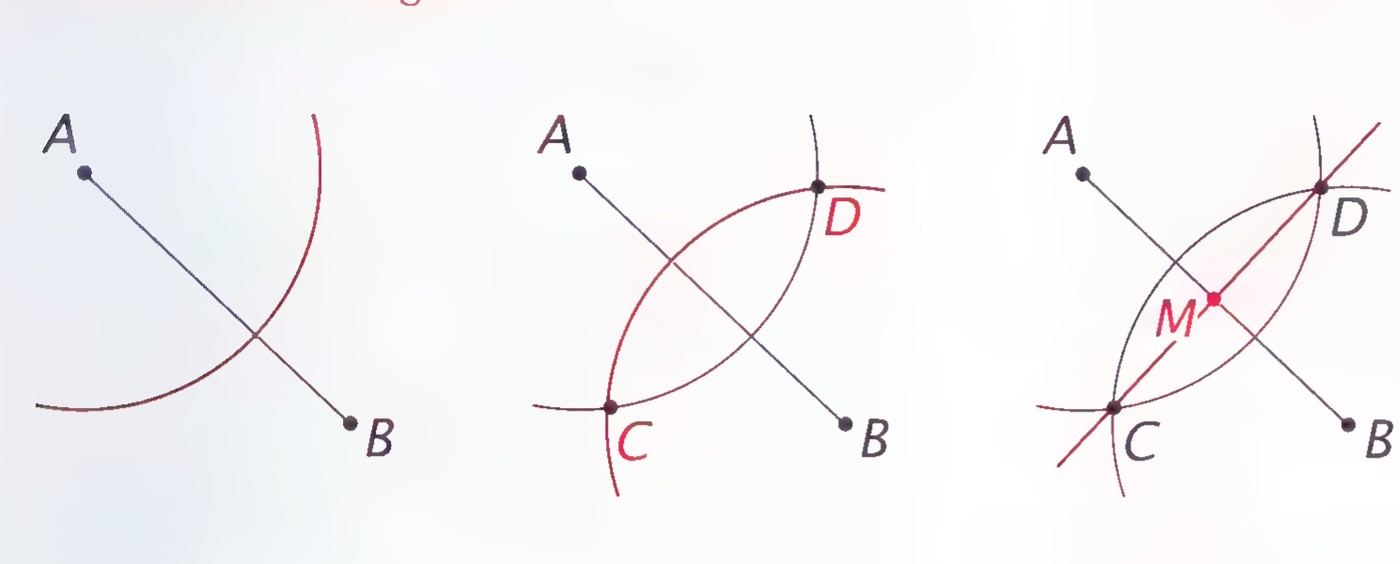
Let AB be the given line segment. With A as center, draw an arc intersecting the segment as shown in the first figure. With B as center, draw an arc of the same radius that intersects the first arc in two points (C and D in the second figure). Draw line CD. Line CD bisects segment AB. In other words, AM and MB have the same length.
There is a simple way to prove that this method does what we have claimed. You will learn how it works later in your study of geometry.
Angles can also be bisected with a straightedge and compass.
Construction 2
To bisect an angle.
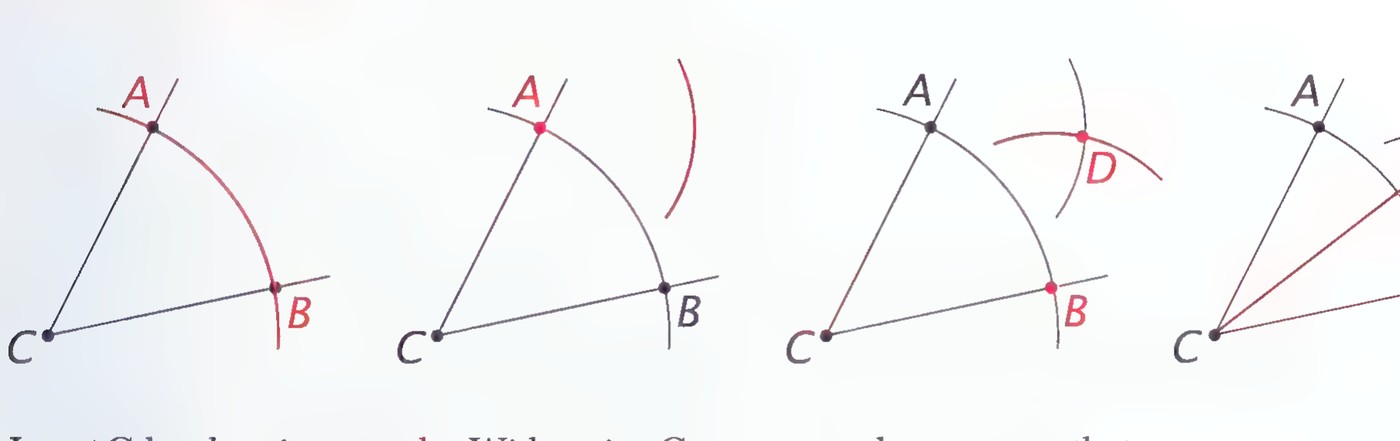
Let ∠C be the given angle. With point C as center, draw an arc that intersects the sides of the angle (at points A and B in the figure). With A as center, draw an arc inside the angle as shown in the second figure. With B as center, draw an arc of the same radius that intersects the arc drawn from point A (at point D in the third figure). Draw line CD. It bisects ∠C. In other words, ∠ACD and ∠DCB are equal in measure.
This equality also can be easily proved, as you will learn later.
p. 26
Exercises
Set I
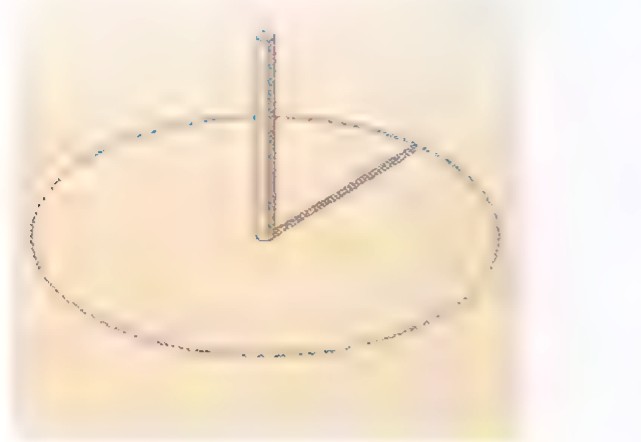
Finding North by Shadows. The ancient Egyptians are thought to have used the shadow of a vertical post to find north. The figure below is an overhead view of some level ground into which a post has been stuck at point P. Once in the morning the tip of the post’s shadow touches the circle at A, and once in the afternoon it touches the circle at B. These two positions of the shadow, PA and PB, form ∠P.
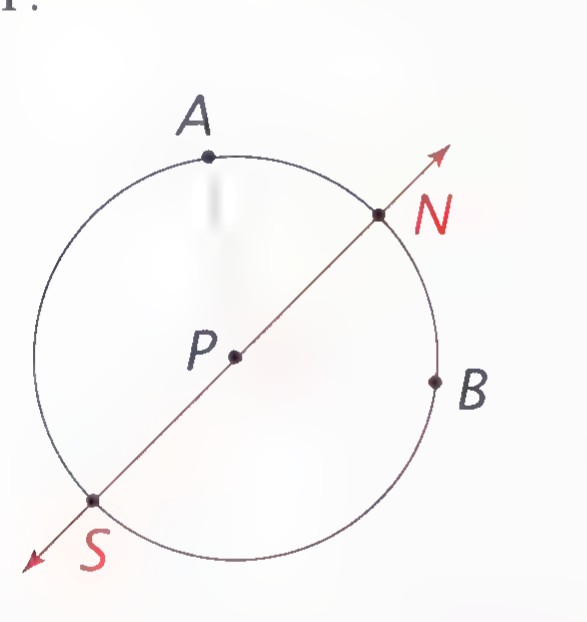
Draw a circle larger than this one, label its center P, mark two points on the circle A and B, and draw PA and PB. Bisect ∠P.
The ray that bisects ∠P points north. Label the point in which it intersects the circle N. Also draw the ray from P that points south.
Check the accuracy of your drawing by using your protractor to measure ∠APB and ∠APN. What measurements do you get?
Apply the directions given for exercise 1 to the following figure.
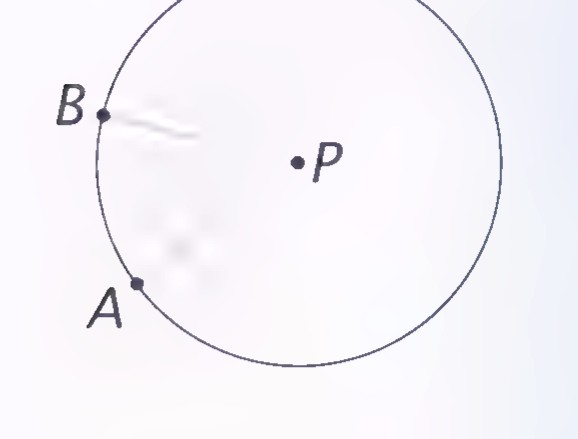
Check the accuracy of your drawing by using your protractor to measure ∠APB and ∠APN.
In each of your drawings, points P, A, and B do not lie on the same line.
What word describes such points?
On the other hand, points P, A, and B do lie in the same plane.
What word describes these points?
Suppose line NS in the figure below points north and south.
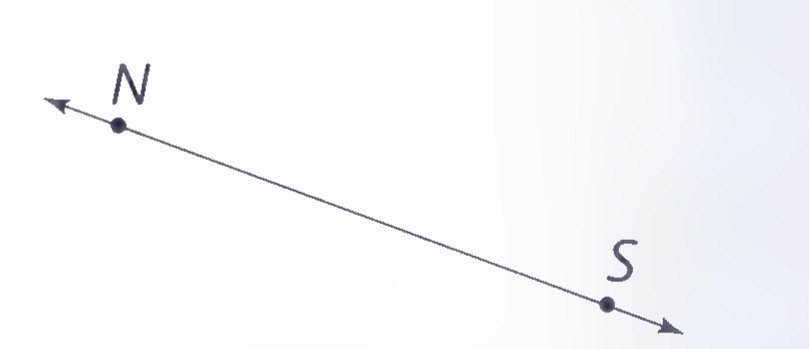
- Draw a figure like this one on your paper and then use your straightedge and compass to construct the line that bisects segment NS. In what directions do you think this line points? Label them on the line.
- Use your protractor to measure the angles formed by NS and EW. Do you get the results that you would expect?
- What is the sum of all four angles? What do you expect it to be?
p. 27
Bisectors in a Triangle.
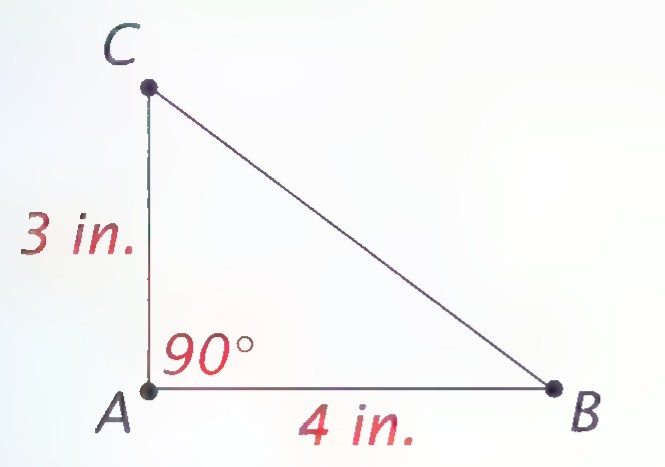
- Use your ruler and protractor to draw a triangle with the measurements shown in the figure above. Then use your straightedge and compass to bisect each side of the triangle.
- What relation do the three bisecting lines that you drew seem to have to each other?
- Where do the lines seem to meet?
Label the point in which they meet P and draw PA.
- How do the distances from point P to the corners of the triangle, A, B, and C, seem to compare?
- Make another copy of the same triangle. This time, use your straightedge and compass to bisect its angles.
- What seems to be true about the three lines that you drew?
Label the point in which they meet S.
- Are the distances from point S to the corners of the triangle equal?
Set II
About Sundials. A sundial was once featured on boxes of Kellogg’s Raisin Bran. When the gnomon (shadow pointer) was cut out and put in place, its shadow moved around the dial during the day. The way in which the hour lines are spaced suggests that the shadow does not always move at the same speed.
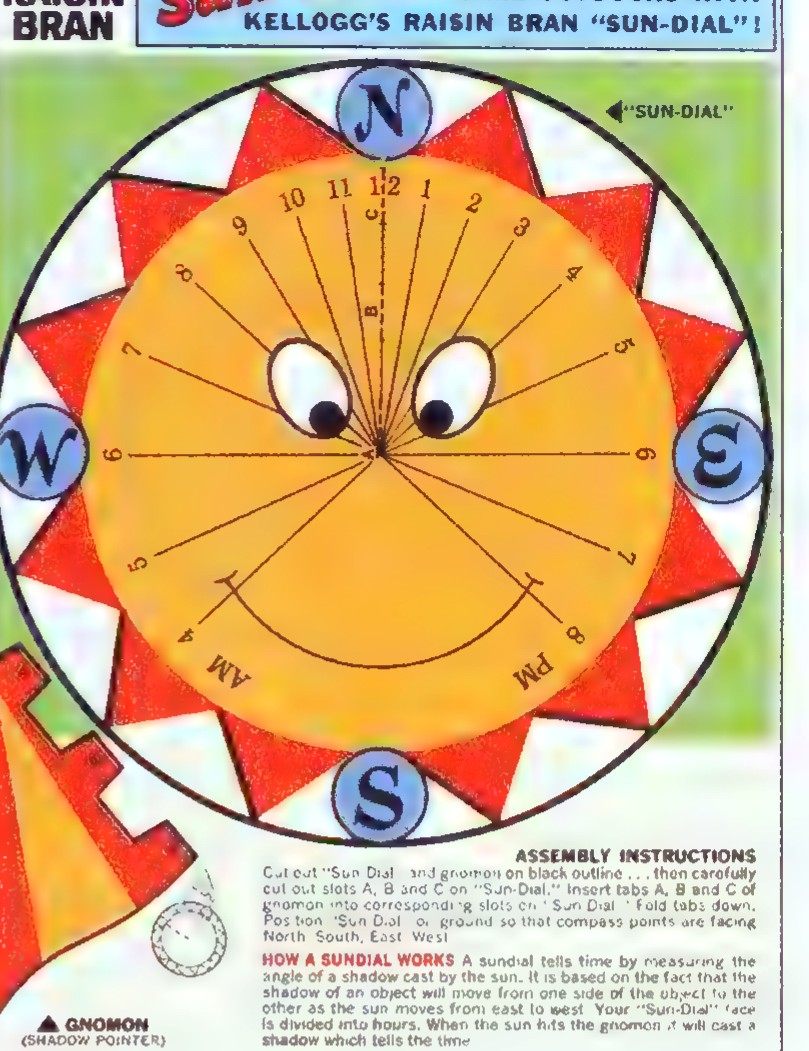
In what map direction does the shadow
- point at 6 o’clock in the morning?
- point at noon?
- never point?
- At what time of the day do you think the shadow moves the most slowly?
- When does it appear to move fastest?
The hour lines of the Kellogg sundial have been redrawn and lettered in the figure below.
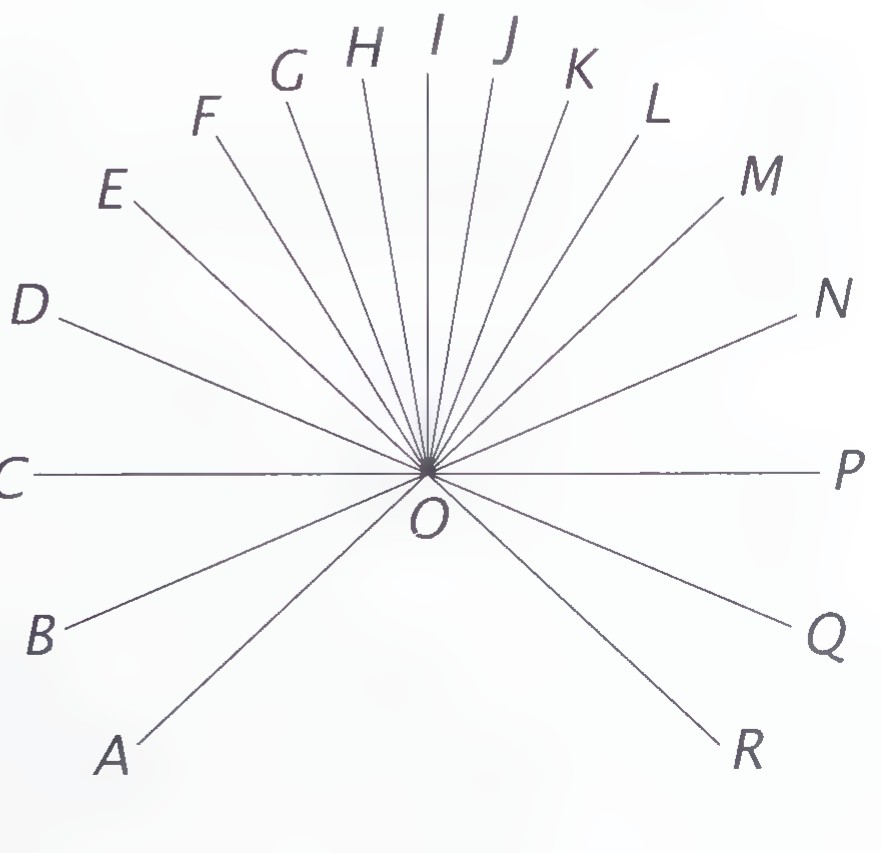
p. 28
- Which angle in the figure seems to be equal to ∠HOI?
- If your answer to exercise 22 is true, what does OI do to ∠HOJ?
- Does OQ seem to bisect ∠POR? Why or why not?
- Name two angles in the figure that OC seems to bisect.
- Which angle seems to be equal to ∠COF?
- Name three angles in the figure that seem to be equal to ∠COD.
- Which angle seems to be equal to ∠AOR?
A sundial in which the hour lines are evenly spaced is simpler to make but harder to use. A straightedge and compass can be used to construct such a sundial without the use of a protractor.
- Use your compass to draw a circle with a radius of 3 inches. Label its center O.
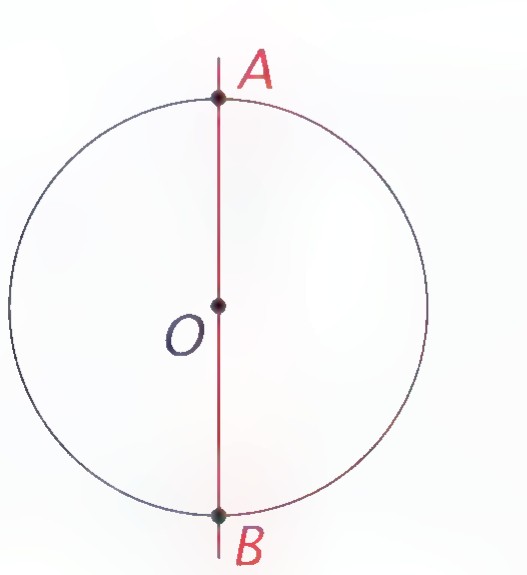
Draw a line through O as shown in the figure at the bottom of the preceding column and label the points in which it intersects the circle A and B.
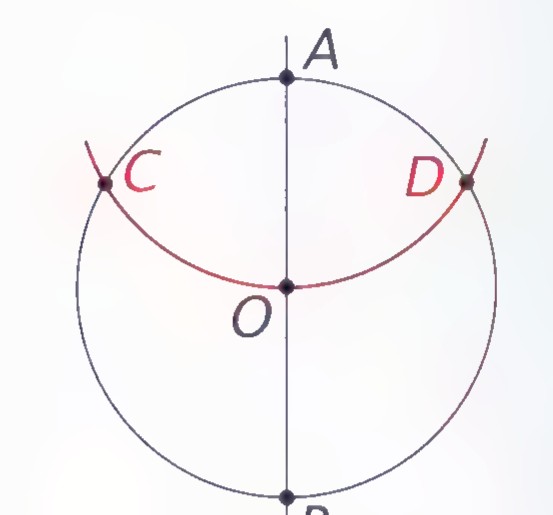
With your compass, draw an arc centered at A and passing through O as shown in the figure below. Label the points in which the arc intersects the circle C and D.
Draw another arc centered at B and passing through O as shown in the left-hand figure below. Label the points in which the arc intersects the circle E and F.
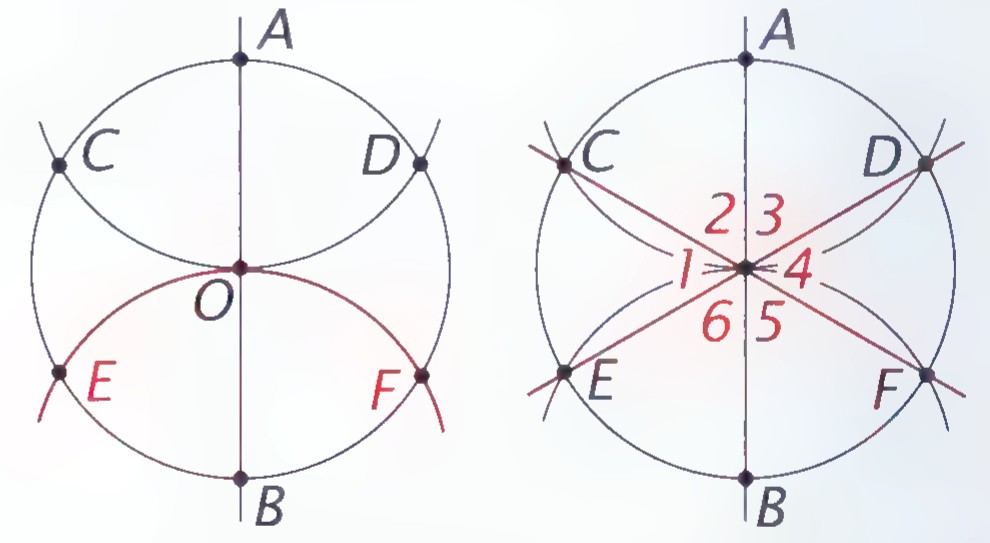
If you have drawn your figure accurately, points C, O, and F should appear to be collinear, as should points E, O, and D.
- What does collinear mean?
Draw the lines CF and ED and number the angles at the center as shown in the right-hand figure above. Each of the six numbered angles in your drawing should appear to be equal. Measure them with your protractor.
- What does the measure of each angle appear to be?
p. 29
Use your straightedge and compass to bisect ∠1, ∠2, ∠3, and ∠4. The lines in your drawing should now look like this.
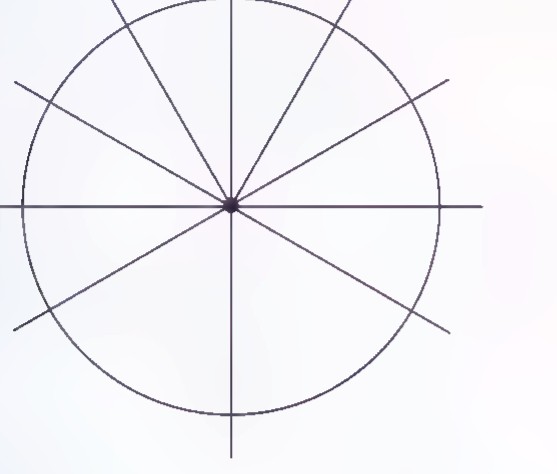
- What is the measure of each of the eight smaller angles in the figure?
Use your straightedge and compass to bisect each of these angles. The lines in your drawing should now look like this.
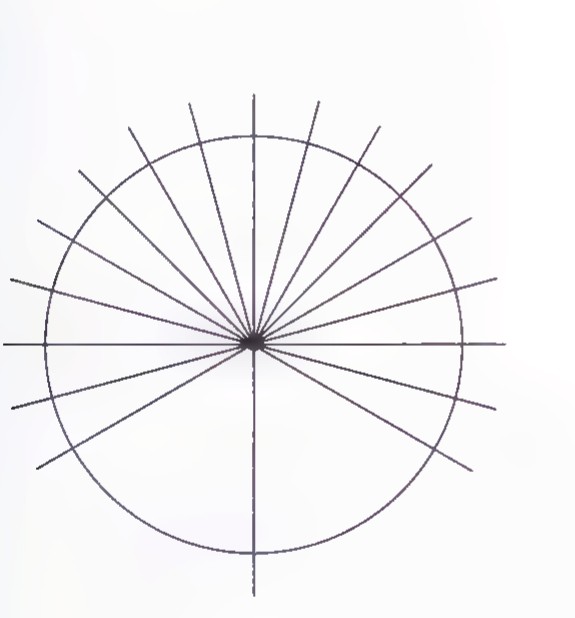
Compare your drawing with the Kellogg’s sundial and number the hour spokes appropriately.
If your sundial had a gnomon perpendicular to its base and if the sundial were tilted in the right direction, the shadow would move at a steady speed across the hour lines.
Through how many degrees would the shadow turn
- between 6 A.M. and 6 P.M.?
- between noon and 6 P.M.?
- during one hour?
- How long would it take the shadow to turn 1 degree?
Set III
Angle Bisectors in a Rectangle. Something rather surprising usually happens when the angles of a rectangle are bisected. The following exercises will help you discover what it is.
- On a sheet of graph paper ruled 4 units per inch, draw a rectangle having sides with lengths 1.5 and 2 inches.
- Draw the four lines that bisect the angles of the rectangle. What polygon do they seem to form?
- Draw another rectangle having sides of lengths 2 inches and 3 inches. Draw the lines that bisect its angles. What do you notice?
- Follow the directions given in exercise 3 but with a rectangle of sides 2 inches and 4 inches. What do you notice?
- Follow the directions given in exercise 3 but with a rectangle of sides 1 inch and 4 inches. What do you notice?
- Is the size of the polygon formed related in any way to the shape of the rectangle? Explain.
- Do you think there is any rectangle for which the polygon would shrink to a point? Explain.
p. 30
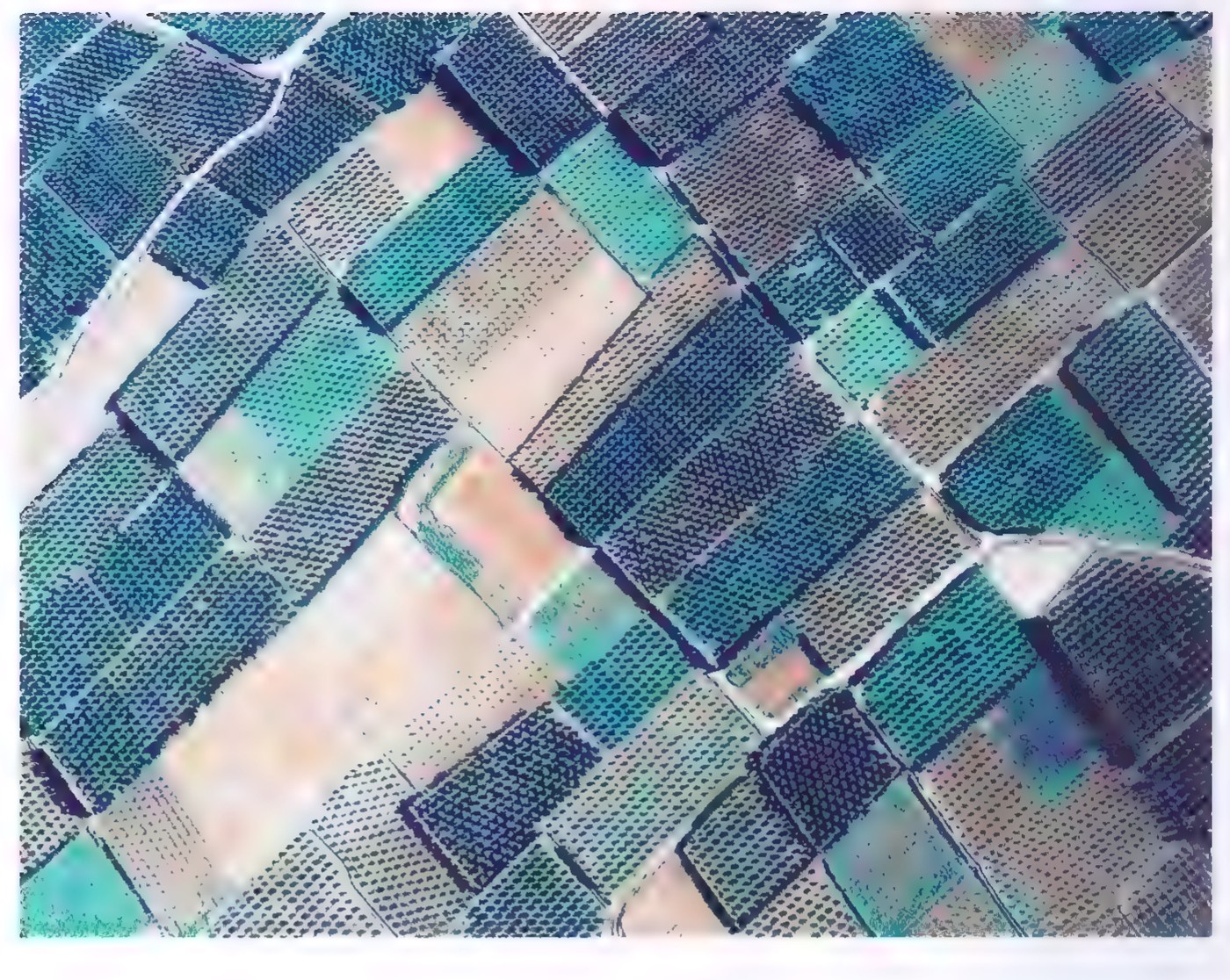
An overhead view of plots of land in the shape of quadrilaterals not far from Alexandria.
Lesson 5: We Can’t Go On Like This
This title may seem to be a very strange one for a geometry lesson, but it points out a troubling problem with what we have been doing so far.
We have become acquainted with many important ideas in geometry, mostly in an informal way. We have learned how to make simple constructions with a straightedge and compass, yet we don’t really know how they work. We have guessed some conclusions on the basis of the appearance of things, not always being certain that they were true. Our approach to geometry to this point has been comparable to that of the ancient Egyptians, long before the time of Euclid.
What has survived of Egyptian mathematics as it existed 4,000 years ago reveals an accumulation of rules and results seemingly based on trial and error. The Egyptians were evidently satisfied with ideas that appeared to be useful, without concerning themselves about why they might or might not always be true.
p. 31
Here is an example of the difficulties to which this approach to geometry leads. To find the areas of fields in the shape of quadrilaterals, the Egyptians used the formula
in which a, b, c, and d are the lengths of the consecutive sides. They had gotten this formula from the ancient Babylonians. The trouble with it is that sometimes it gives the correct answer and sometimes it does not.
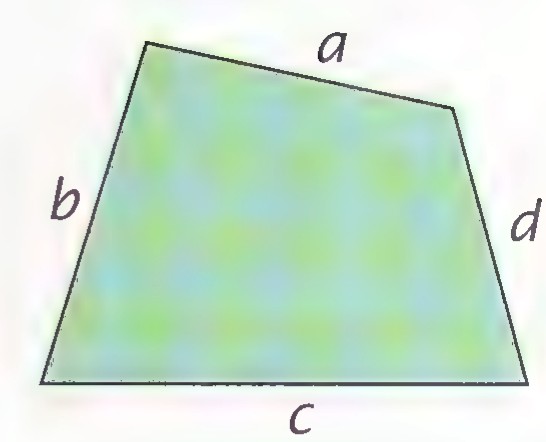
Thus when tax assessors used it to figure out the areas of four-sided fields, some landowners were charged correctly and some were not. In fact, those who were not were cheated every time! The tax assessors may have known that these charges were incorrect, but apparently no one could figure out what was wrong with the formula to cause it to give such undependable results.
We will explore this problem and some other similarly troubling ones in this lesson.
Exercises
Set I
The Egyptian Tax Assessor. We are back in 2500 B.C. and three Egyptians, Ramses, Cheops, and Ptahtep, have recently purchased plots of land in the shapes shown here.
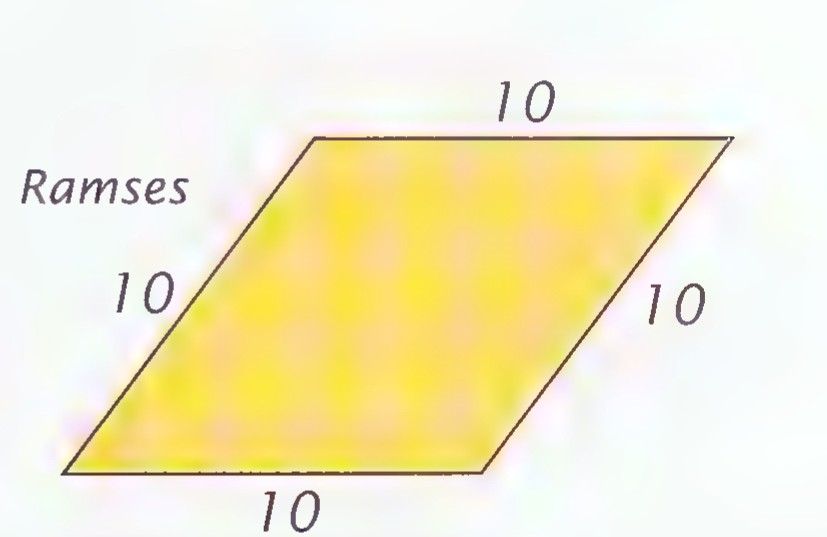
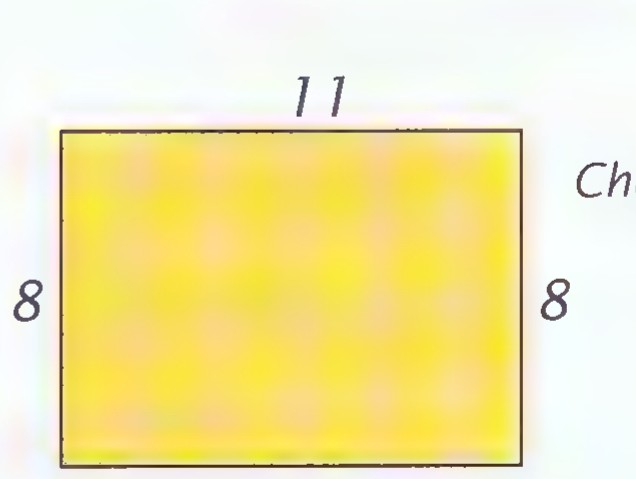
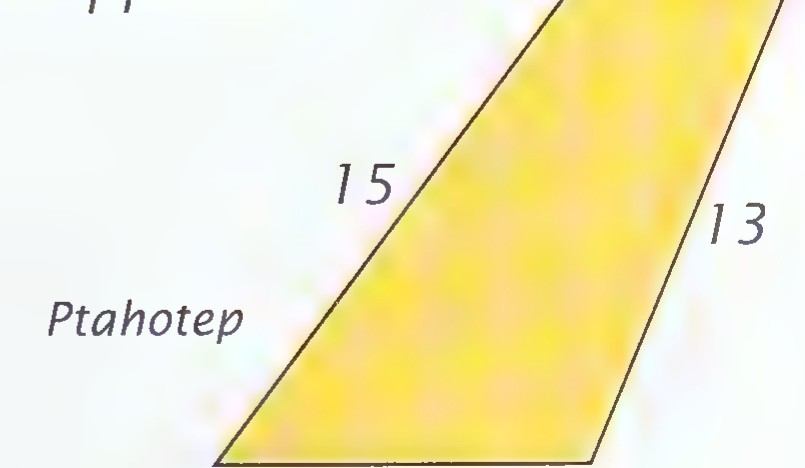
The tax assessor uses his formula for the area of a quadrilateral,
in which a, b, c, and d are the lengths of the consecutive sides.
What area does he calculate for the plot belonging to
- Ramses?
- Cheops?
- Ptahtep?
The bigger the plot, the higher the tax.
- According to these results, who has to pay the highest tax?
p. 32
The area of Cheops’s plot, being rectangular in shape, is easiest to check.
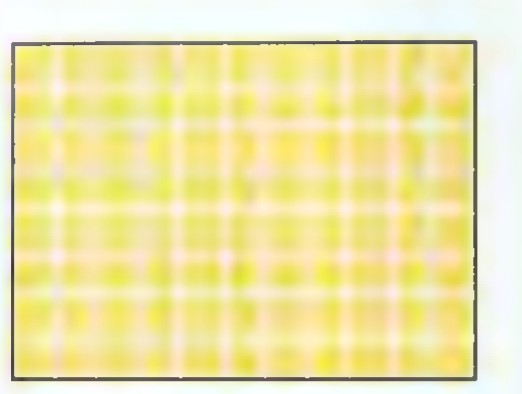
- Does it contain as many square units as the tax assessor says?
Before we try to count the number of squares in each of the other plots, making some changes in the figures will make the job easier.
For Ramses’ plot, we can imagine cutting off the triangular part on the left and moving it to the right.
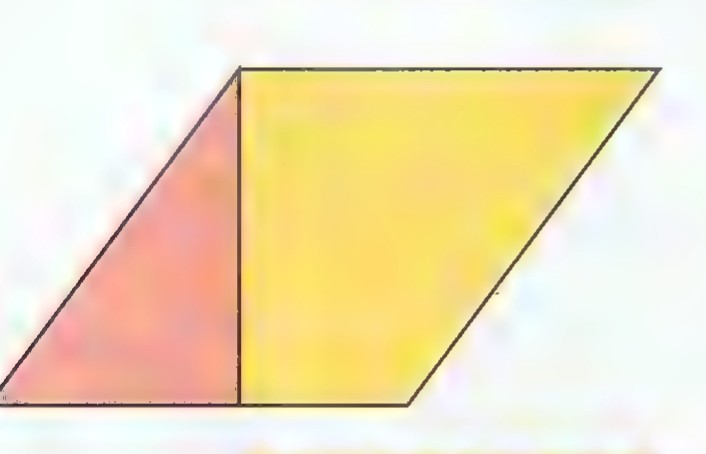
- How many square units does the plot contain?
For Ptahtep’s plot, we can add some lines as shown at the top of the next column.
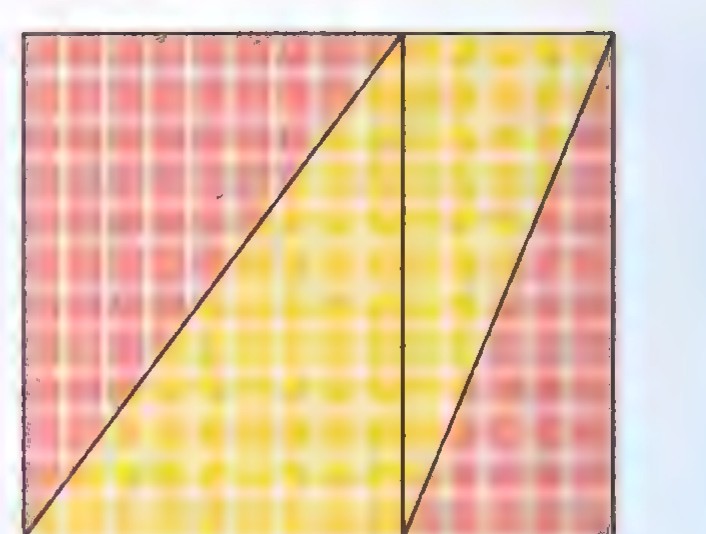
How many square units does the left-hand rectangle contain?
How many square units do you think Ptahtep’s part of this rectangle contains?
How many square units does the right-hand rectangle contain?
How many square units do you think Ptahtep’s part of this rectangle contains?
Use these results to determine how many square units Ptahtep’s property contains.
Which one of the three is cheated the most by the tax assessor’s formula? Why?
How to calculate area correctly is an important topic in geometry. Having worked through these exercises, you will probably agree that it would be convenient to have easier methods whose logic we really understand.
Set II
Trisection Problems. The methods for bisecting line segments and angles by using just a straightedge and compass were known to the ancient Greeks long before Euclid was born. Having solved these two problems, the Greeks naturally wondered if just these two tools could be used to trisect a line segment or angle, that is, divide them into three equal parts.
The trisection problem for line segments was solved almost immediately. Here is one way to do it.
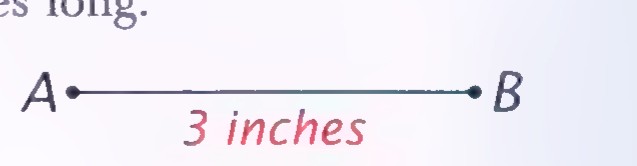
- For convenience in checking the result at the end, draw a line segment AB 3 inches long.
p. 33
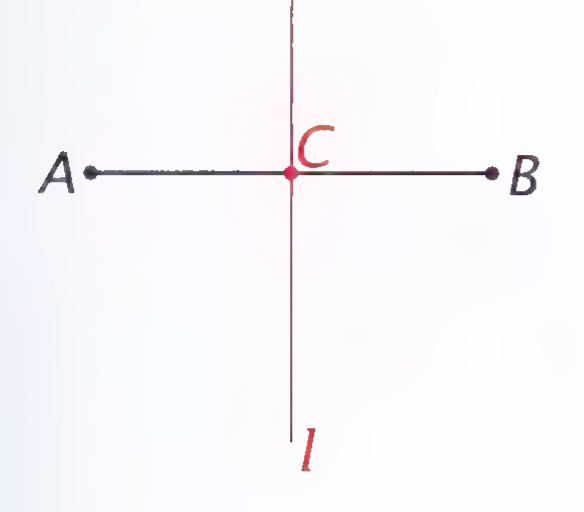
First, use your straightedge and compass to construct the line, l, that bisects AB. Label the midpoint C.
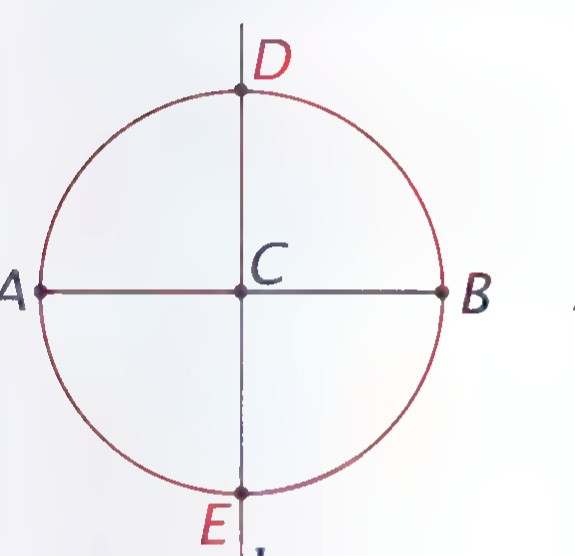
With C as center, draw a circle through A and B. Label the points in which line l intersects the circle D and E. Draw AD and BE.
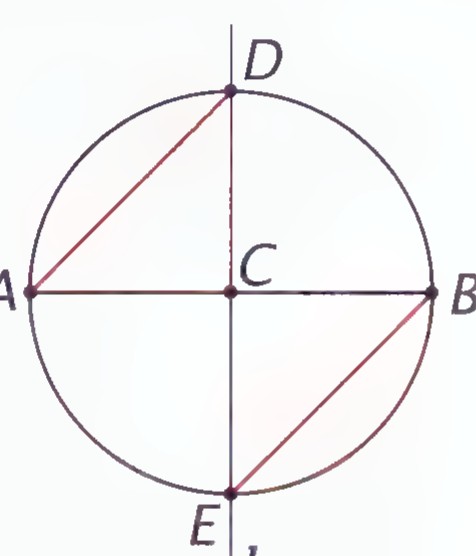
Construct the line that bisects AD and label it m. (You should notice that line m goes through C, the center of the circle.) Where line m intersects AD and BE, label the points F and G as shown here. Draw DG and FE.
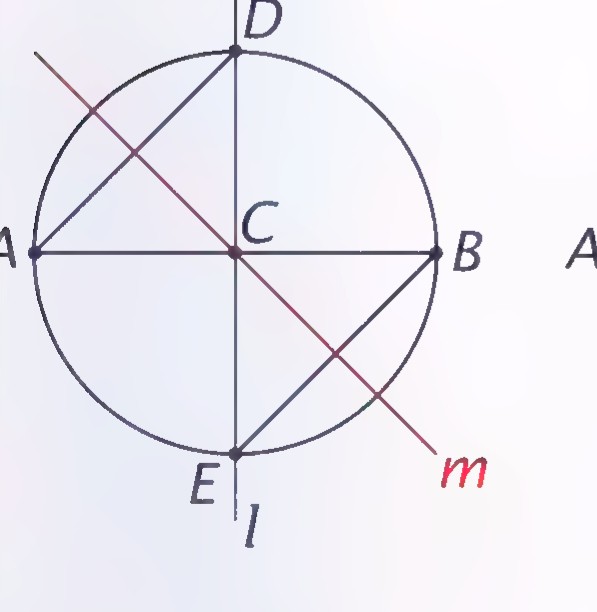
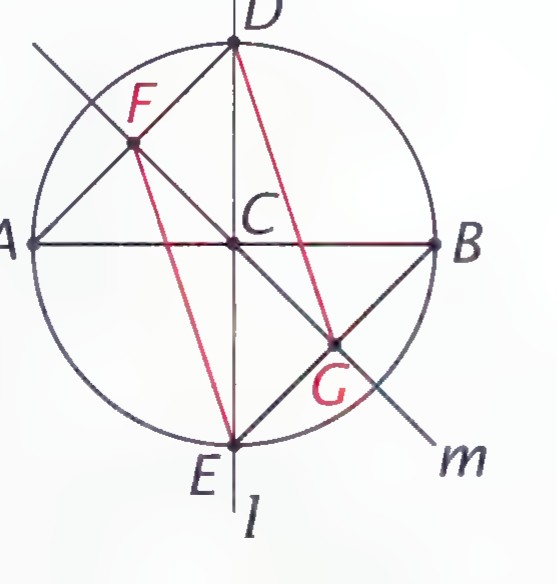
These two line segments trisect the original line segment AB, which you can check with your ruler.
An early method proposed for trisecting angles is illustrated below.
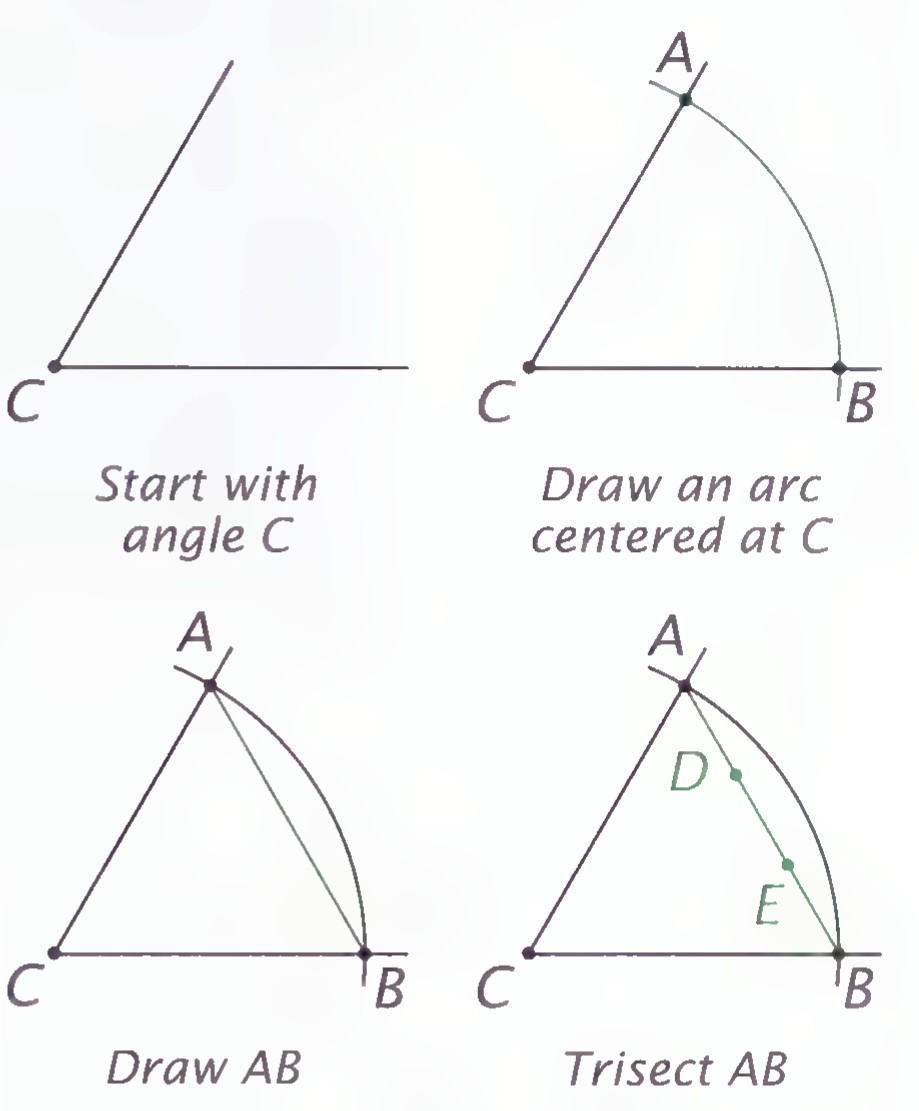
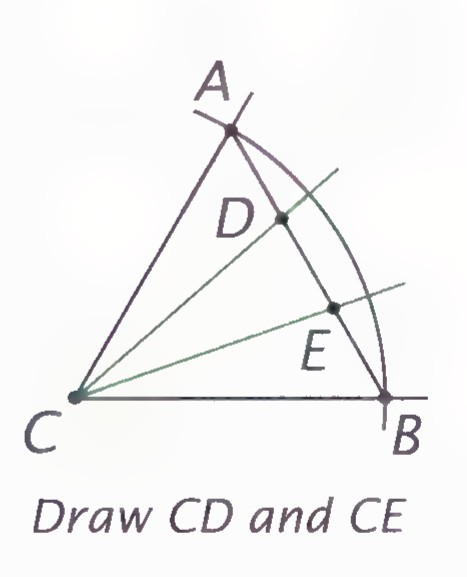
Rather than carrying out this construction with straightedge and compass, we will draw an accurate figure to test the results.
- Use your ruler and compass to draw an equilateral triangle, each of whose sides is 3 inches long. Label its vertices A, B, and C to correspond to the third figure above. Use your ruler to find the points D and E on side AB that trisect it. Draw CD and CE.
p. 34
- Center your protractor on C and carefully measure ∠ACD, ∠DCE, and ∠ECB. What does the measure of each angle seem to be?
Because we can neither draw nor measure things perfectly, it is not easy to tell whether the original angle has been trisected. In fact, it has not. As surprising as it may seem, since the time of Euclid, no one has ever found a way that can be used to trisect any angle by using just a straightedge and compass!
We have made two drawings, both of which might seem to be correct, yet one is not. The title of this lesson, “We Can’t Go On Like This,” describes our dilemma. It is not possible to be sure of what we are doing in geometry without developing a deeper understanding of the subject.
Set III
Cutting Up a Circle. Here is a simple problem about points and circles that has become famous because it is so baffling.
If four points are chosen on a circle and connected with line segments in every possible way, the result might look something like this. Notice that the circle is separated into eight regions.
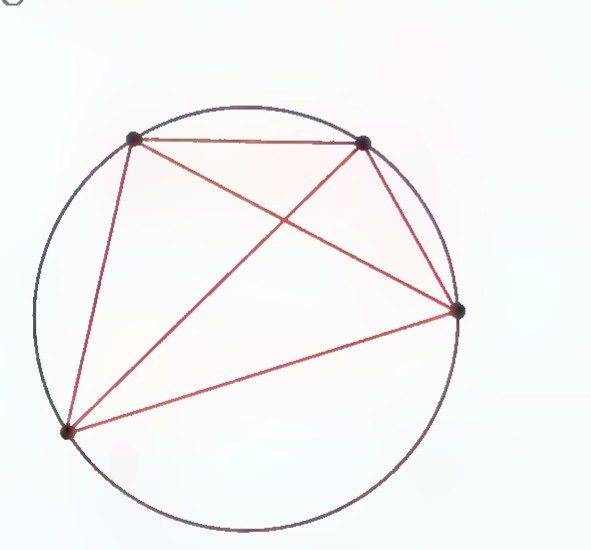
- Draw a circle, choose five points on it, and connect them with line segments in every possible way.
- Into how many regions is the circle separated?
How many regions would be formed if you started with
- just two points?
- three points?
- Put all of these results together by making a table like this:
| Number of points connected: | 2 | 3 | 4 | 5 |
|---|---|---|---|---|
| Number of regions formed: | ? | ? | 8 | ? |
- What happens to the number of regions each time one more point is added to the circle?
How many regions would you expect to be formed if you started with
- six points?
- seven points?
- Make drawings of circles having six and seven points. Start with large circles.
- Are the results what you expected?
p. 35
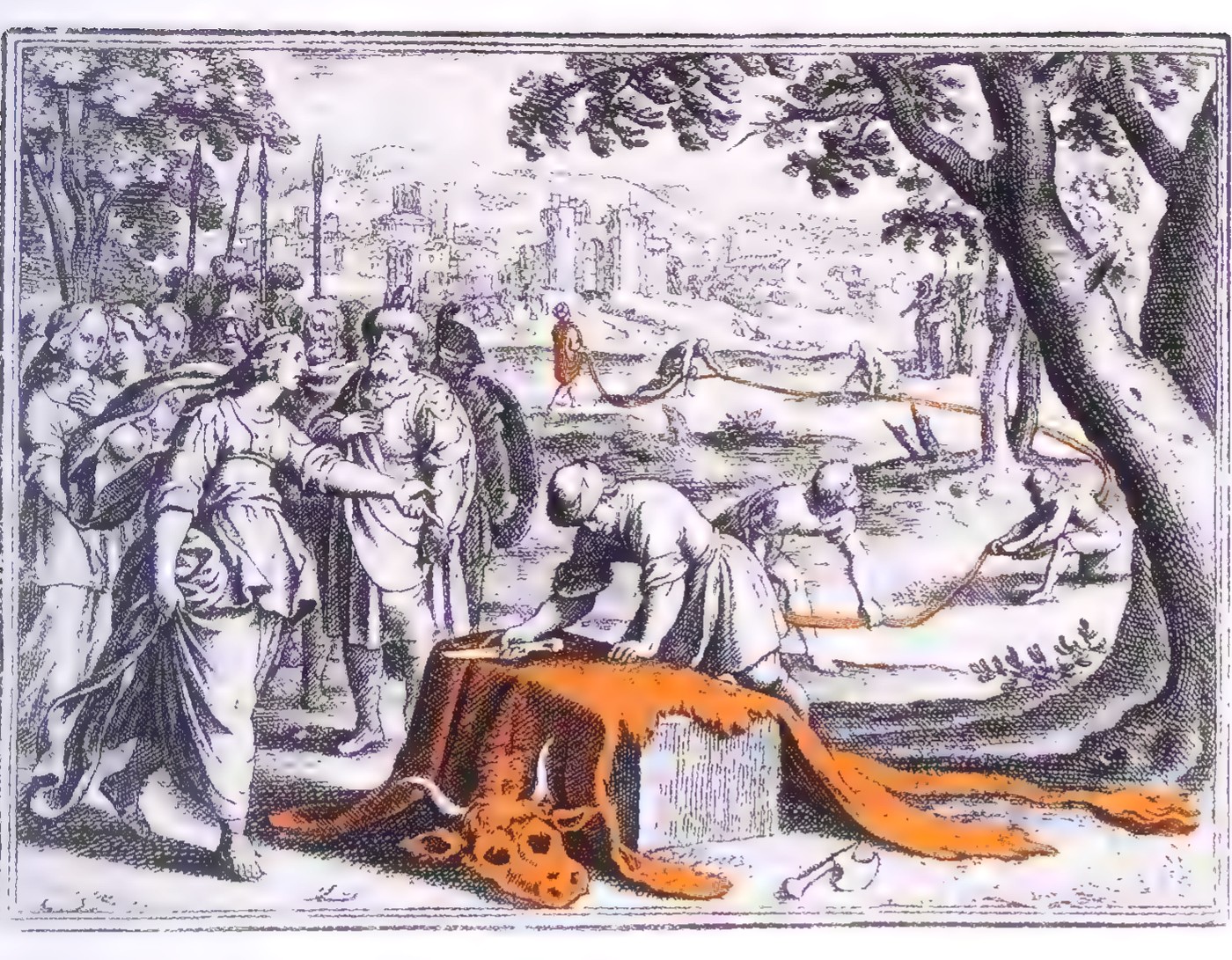
This engraving from 1630 is titled Dido Purchases Land for the Foundation of Carthage. It depicts the hide of an ox being cut to solve a problem in geometry considered in this review.
Summary and Review
Introduction (pp. 1–2)
Since about 300 B.C., Euclid’s book titled the Elements has been the model for presenting geometry in a logical way. We will become acquainted with Euclid’s approach to mathematics in our study of geometry.
Lesson 1 (pp. 8–9)
Some basic terms used in geometry are point, line, and plane. A line segment is part of a line bounded by two endpoints.
Some terms relating points, lines, and planes are collinear (points that are on the same line), noncollinear (points that are not on the same line), coplanar (points that are in the same plane), and concurrent (lines that contain the same point).
Lesson 2 (pp. 13–15)
A ray is part of a line that extends endlessly in one direction. An angle is a pair of rays (called its sides) that have the same endpoint (called its vertex).
A protractor measures angles in degrees.
Lesson 3 (pp. 18–20)
A polygon is bounded by line segments and lies in a plane. A polyhedron (plural polyhedra) is bounded by polygons and exists in space.
Names for some common polygons include: triangle (three sides), quadrilateral (four sides), pentagon (five sides), hexagon (six sides), and octagon (eight sides).
p. 36
Two numbers associated with a polygon are its perimeter (the sum of the lengths of its sides) and its area (the number of unit squares equal in measure to its surface).
A rectangle with length l and width w has area A given by
Lesson 4 (pp. 24–25)
Geometric drawings called constructions are made with just two tools: the straightedge (for drawing lines) and the compass (for drawing circles).
Two simple constructions are to bisect a line segment and to bisect an angle. To bisect something means to divide it into two equal parts.
Lesson 5 (pp. 30–31)
The study of geometry in an informal way, as we have done in this chapter, can lead to many interesting and practical results. This informal approach is ultimately unsatisfactory, however, because conclusions based on appearances or guessing may not always be correct.
Exercises
Set I
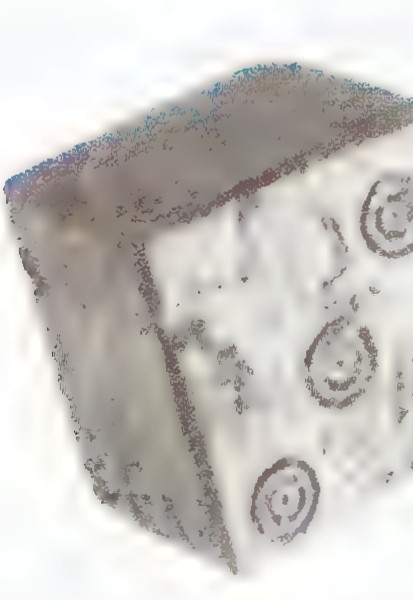
The die shown in the photograph above was made in Italy in about 700 B.C. and is in the shape of a cube.
The corners of a cube are points. What kind of geometric figure
- are its edges?
- are its faces?
- is the cube itself?
The figure below is a transparent view of a cube.
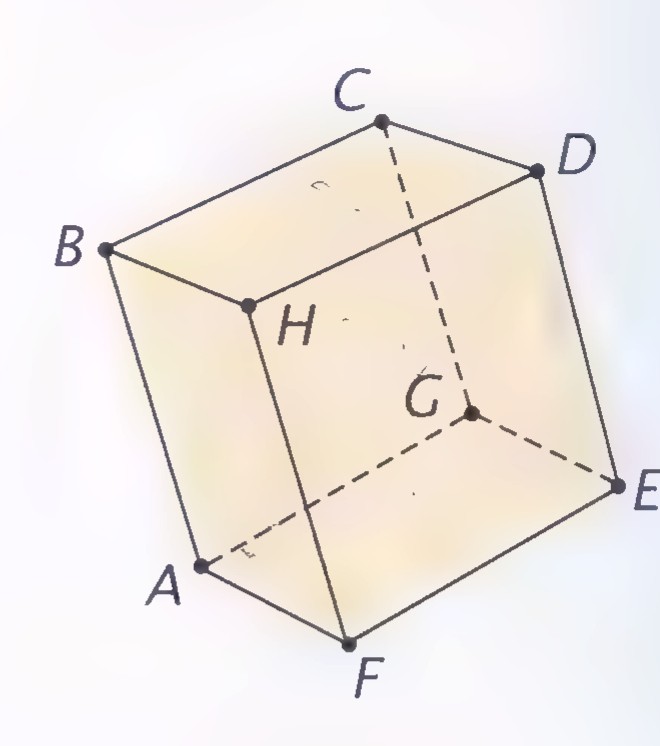
How many edges
- meet at each corner of a cube?
- does a cube have altogether?
How many faces
- meet at each corner of a cube?
- does a cube have altogether?
The corners A, G, and C of the cube are noncollinear.
- What is another word that describes them?
The following pattern can be used to form a cube.
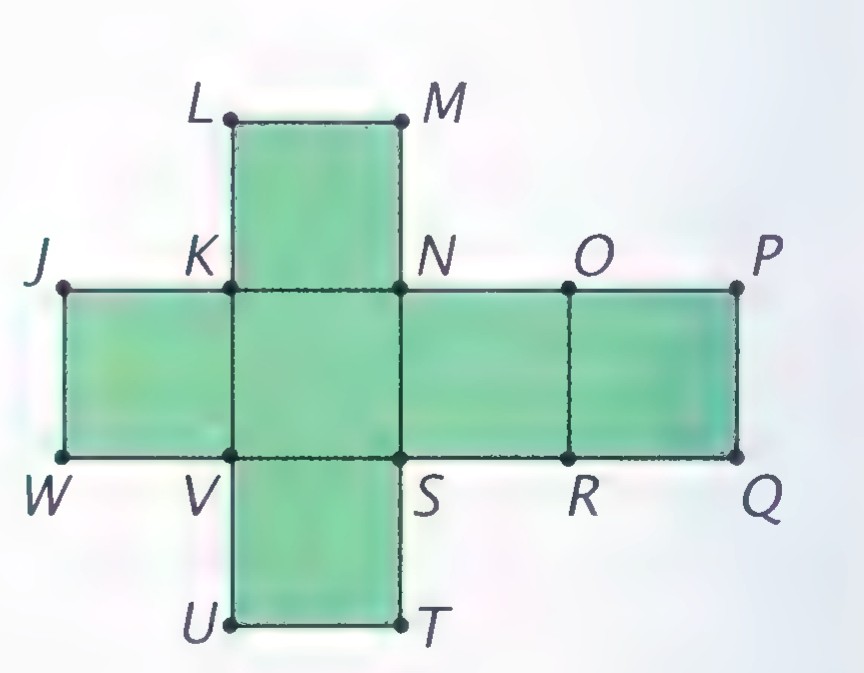
- In how many lines do the edges of the pattern lie?
p. 37
Some harder questions
Suppose the pattern is cut out and folded together to form a cube.
With which edge would each of the following edges come together?
- JW.
- MN.
- LM.
With which corner(s) would each of the following corners come together?
- R.
- W.
Here is another transparent view of a cube.
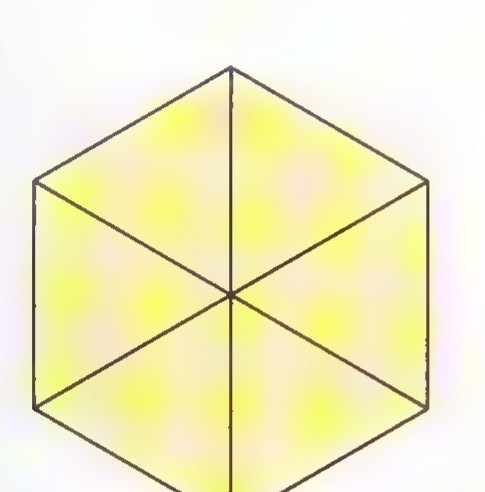
- Looking at this figure as flat rather than three-dimensional, what polygons do you see in it?
- Make a copy of the figure, but make the figure look three-dimensional by drawing it with the hidden edges as dashed line segments.
- What is the greatest number of faces of a die that can be seen at any one time?
Set II
Some drawings in geometry are made with a ruler and protractor, and others are made with just a straightedge and compass.
- What are drawings made with just a straightedge and compass called?
- Use your ruler and protractor to draw a triangle with the measurements shown below in the center of a sheet of paper.
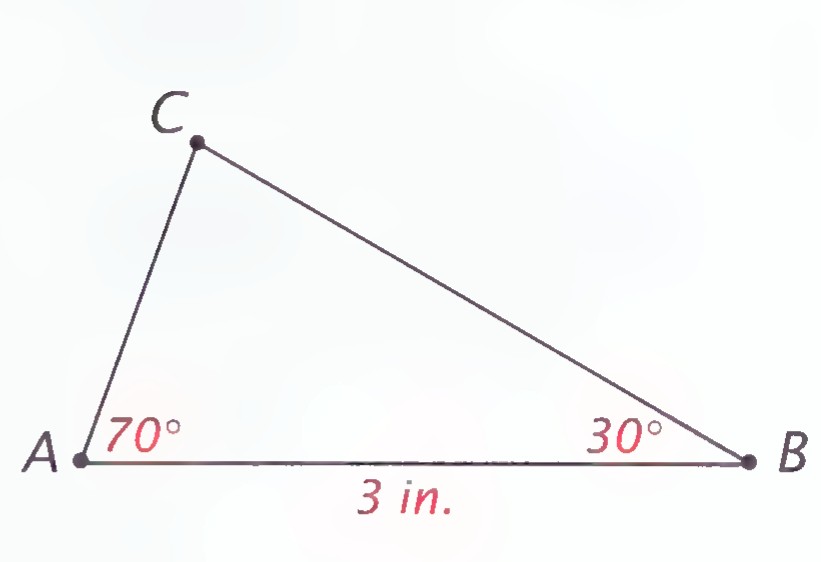
Extend the lines of the sides CA and CB, marking two points D and E on them as shown below.
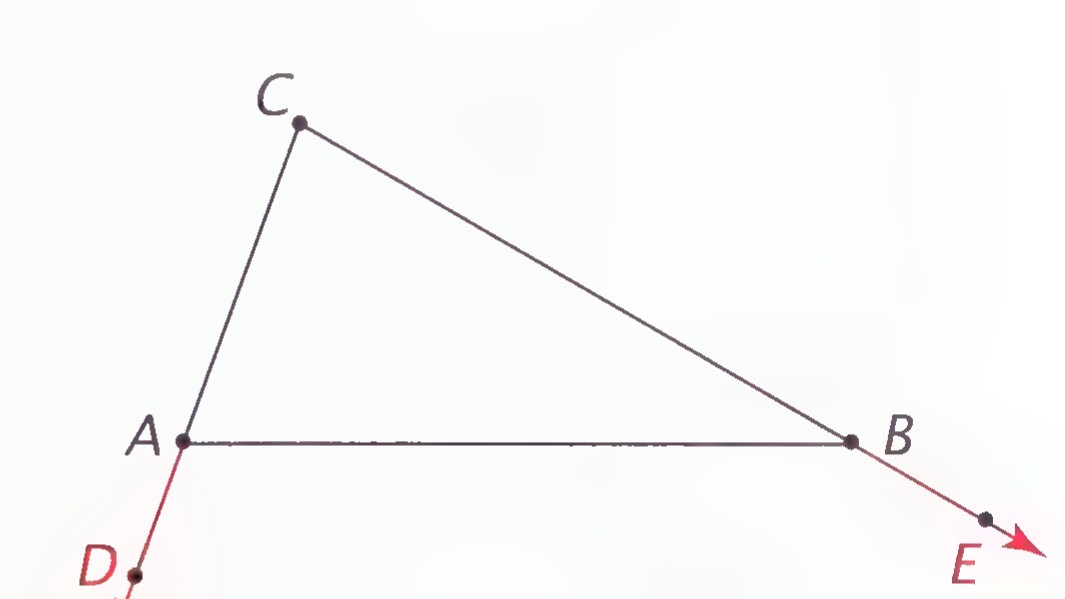
Measure each of the following angles:
- ∠DAB.
- ∠ABE.
- ∠DCE.
Now use your straightedge and compass to bisect ∠DAB and ∠ABE. Draw the two bisectors long enough so that they meet in a point; label it F.
Check the accuracy of your drawing by measuring these angles:
- ∠DAF and ∠FAB.
- ∠ABF and ∠FBE.
Draw CF.
- Measure ∠DCF and ∠FCE.
- What does the line CF seem to do to ∠DCE?
p. 38
- Draw a quadrilateral of about this shape on your paper.
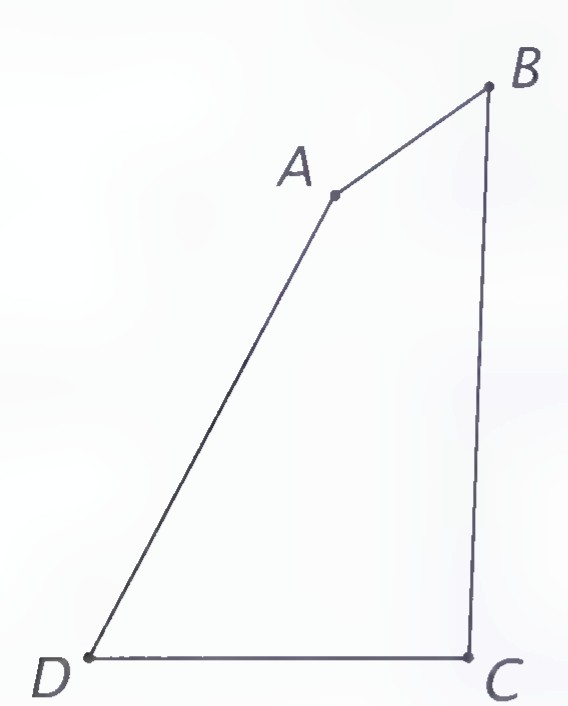
Use your straightedge and compass to bisect the four sides of the quadrilateral. Use the letter M to label the midpoint of side AB, the letter N for the midpoint of BC, the letter O for the midpoint of CD, and the letter P for the midpoint of DA. Connect M, N, O, and P with line segments to form quadrilateral MNOP.
- What do you notice about the sides of this quadrilateral?
- What is its perimeter in centimeters?
Draw AC and BD. These line segments are called the diagonals of quadrilateral ABCD.
- Measure AC and BD in centimeters and add their lengths.
If you have drawn and measured everything accurately, your answers to exercises 29 and 30 should be the same, even though your original copy of quadrilateral ABCD may not look exactly like the one above!
Set III
According to the Roman poet Virgil, a princess named Dido wanted to buy some land in Africa in about 900 B.C. She was told that she could buy as much land as she could enclose with the skin of an ox.
Dido is said to have had the hide cut into thin strips which were then tied together to form as long a cord as possible.
Suppose that her plot of land had to be in the shape of a rectangle, that it could face a river so that the cord would have to stretch only along three sides, and that the cord was 900 yards long.
If the land were in the shape of a square, it would look like this.
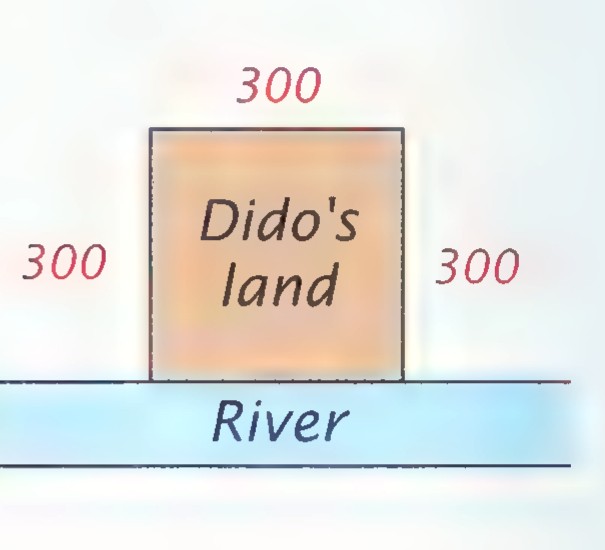
- Including the fourth side, what is the perimeter of this property?
- What is its area?
The following figure shows another possible shape for Dido’s land.
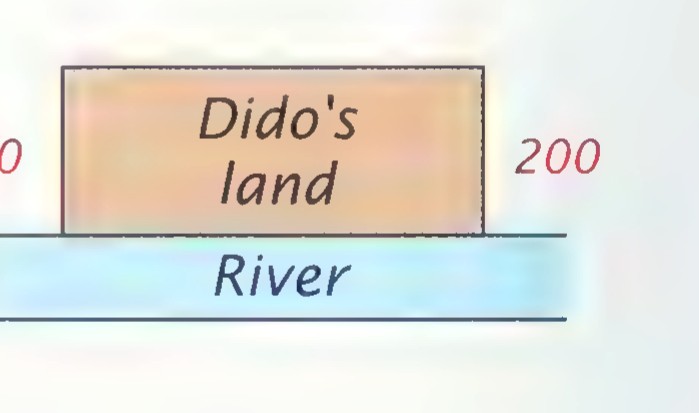
- In this case, how far would the cord reach across the top side?
- What is the perimeter of this property?
- What is its area?
- What length and width should the rectangle have for Dido to get as much land as possible? Make some more drawings to try to find out.
p. 39
Algebra Review: Simplifying Expressions
The operations of addition and multiplication have these basic properties:
| Property | Addition | Multiplication |
|---|---|---|
| Commutative | ||
| Associative | ||
| Identity | ||
| Inverse |
The commutative property tells you that the result of operating on two numbers is independent of their order.
The associative property tells you that the result of operating on three numbers is independent of the way in which they are grouped.
The additive identity is 0 and the multiplicative identity is 1.
The additive inverse of a number, a, is its opposite, −a, and the multiplicative inverse of a number, a, is its reciprocal, .
Multiplication can often be understood as repeated addition; for example, 3a means a + a + a. The 3 in the expression 3a is called the coefficient.
Raising to a power can often be understood as repeated multiplication; for example, a³ means a · a · a. The 3 in the expression a³ is called an exponent.
Subtraction and Division
The operations of subtraction and division are not listed above because they are defined in terms of addition and multiplication, respectively.
Subtracting a number is defined as adding its opposite.
Example:
Dividing by a number is defined as multiplying by its reciprocal.
Example:
p. 40
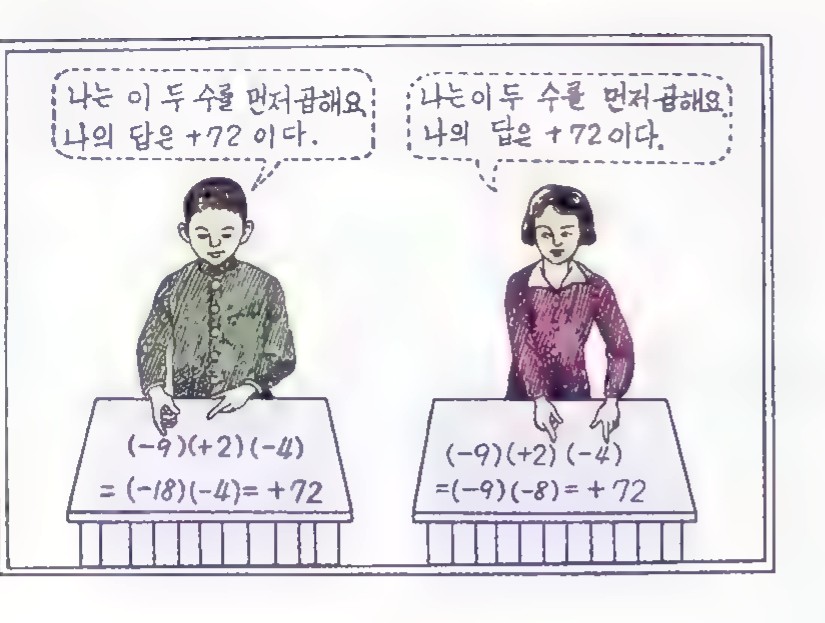
This figure illustrating the associative property of multiplication is from a Korean mathematics book.
Exercises
Name the property or definition illustrated by each of the following equations.
Write each of the following expressions as a single integer.
Simplify the following expressions.