Chapter 15: Geometric Solids
Lesson 1: Lines and Planes in Space
Lesson Outline
Terms: Skew lines, parallel planes (or line and plane), perpendicular line and plane, perpendicular planes, oblique planes (or line and plane).
Transparencies
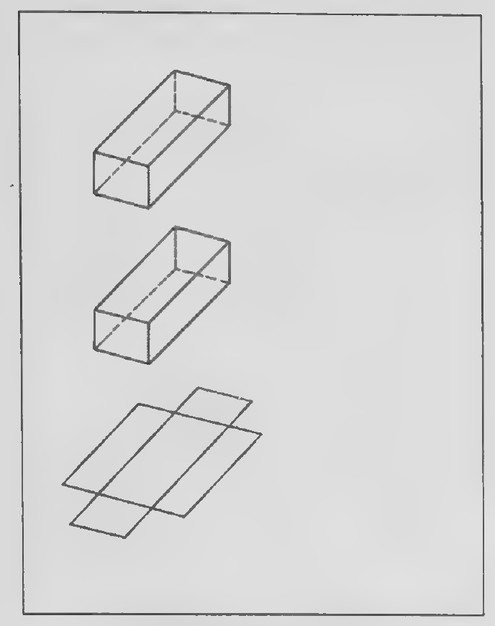
- 15-1-1 File-card puzzle
- 15-1-2 Church porch
Introduction
The figure on Transparency 15-1-1 once appeared in the “Mathematical Games” column of Scientific American and was said to have been in an entrance examination for the School of Architecture of the University of Leningrad. The problem was to make amodel of the figure by taking an ordinary file card, cutting it with scissors, and folding it. In his column, Martin Gardner referred to it as a marvelous test of one’s ability to think in three-dimensional space.*
To introduce the lesson, give each of your students an unlined file card and a pair of scissors to try to create a three-dimensional model of the figure. After some of your students have succeeded at
this, you might draw the following figure on the transparency as a clue on what to do.
The figure on Transparency 15-1-2 is another challenge to our ability to think in three-dimensional space. It is a design for a church porch.* An appropriate sign to put over the entrance would be “Abandon hope, ye who would enter here!” Why? (Bending a sheet of paper in the shape of the walls and ceiling over the door should reveal what is wrong.)
‘This figure is from Perspective in Perspective by Lawrence Wright (Routledge and Kegan Paul, 1983).
*“Mathematical Games,” by Martin Gardner, Scientific American, November 1978.
 Transparency 15-2-1: Rectangular solid
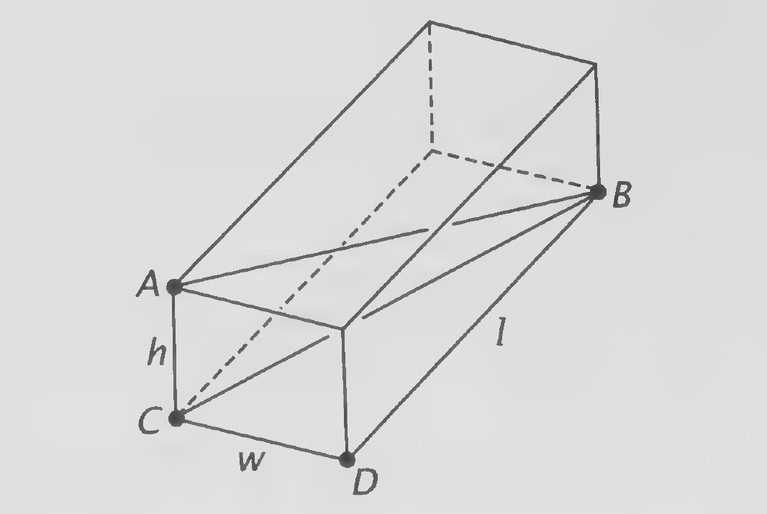 Figure on page 395 — A rectangular box with its length, width, height, and space diagonal labelled
Lesson 2: Rectangular Solids
Lesson Outline
Terms: Polyhedron, rectangular solid, diagonal and dimensions of rectangular solid, cube.
Theorem 79. The length of a diagonal of a rectangular solid with dimensions l, w, and h is √(l² + w² + h²).
Corollary. The length of a diagonal of a cube with edges of length e is e√3.
Transparencies
- 15-2-1 Rectangular solid
Introduction
Before class, stretch a cord or a piece of brightly colored yarn diagonally across the room from one of the corners of the ceiling to the opposite corner of the floor. Begin class by handing out small pieces of paper. Remark that the subject of today’s lesson is rectangular solids and that the classroom is a good example of a rectangular solid. Explain that the cord represents a diagonal of the room, and ask your students to guess its length in feet, writing their names and their guesses on the pieces of paper you have given them. Collect the guesses and set them aside.
Had out duplicated copies of Transparency 15-2-1 and have your students draw diagonal AB in the first figure, as shown at the right. Also label points C and D, and the dimensions of the room h, w, and |.
Explain that the length of AB is determined by the dimensions of the room. To see how this is done, draw CB to form a triangle with AB as one of its
sides. After your students have noticed that △ABC and △BCD are right triangles, guide them in applying the Pythagorean Theorem to the figure to derive the formula for the length of a diagonal of a rectangular solid. (This can be done at the right of the first figure.)
Then, give the dimensions of your classroom in feet and have your students write them on the second figure. Ask them to use the formula that they have just derived to calculate the length of the diagonal. (My classroom is 27 feet wide, 31 feet long, and 14 feet high, and so the length of the diagonal is 1,886 ≅ 43.4 feet.) While your students are doing this, sort out their guesses. After the calculation has been discussed, announce the name(s) of the students(s) who came closest. It might also be interesting to tell the smallest and largest guesses without telling the names of the students who guessed them. (The extreme guesses usually turn
 Transparency 15-3-1: Photograph of crystals
 Transparency 15-3-2: Cover of Crystal Geometry
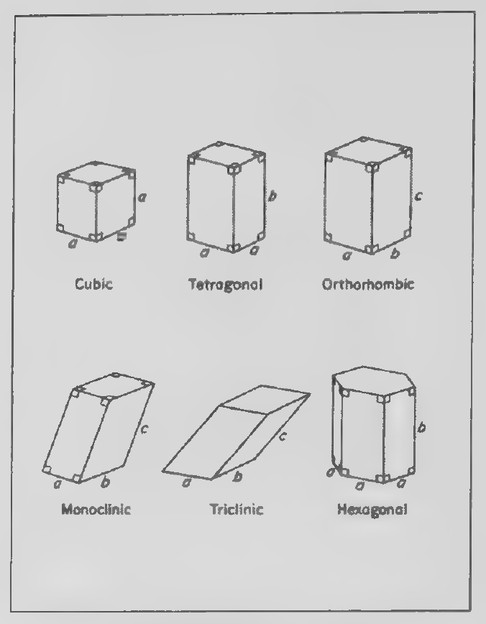 Transparency 15-3-3: A page from Crystal Geometry
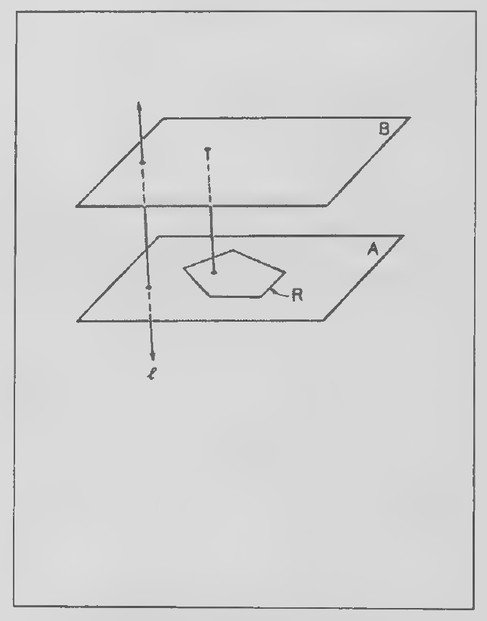 Transparency 15-3-4: A prism
out to be quite outlandish.)
The third figure of the transparency might be used to derive the formula for the surface area of a rectangular solid. The figure can be thought of as the floor and walls of the room, collapsed outward. Have your students add a sixth rectangle at the right to represent the ceiling. Then label the dimensions of the rectangles in terms of I, w and h and use the figure to find the surface area formula. For practice, your students might calculator the total surface area of your classroom in square feet.
To close the lesson, you might guide your students in writing formulas for the length of a diagonal of a cube and its surface area. It is helpful to compare the formulas for the lengths of the diagonals of a square and a cube, emphasizing that both formulas contain square roots and asking your students how they might remember that the square formula has a 2 in it and the cube formula has a 3.
Lesson 3: Prisms
Lesson Outline
Terms: Prism, bases, lateral faces and edges, right prism, oblique prism, net, lateral area, total area of prism.
Transparencies
- 15-3-1 Photograph of crystals
- 15-3-2 Cover of Crystal Geometry
- 15-3-3 A page from Crystal Geometry
- 15-3-4 A prism
Introduction
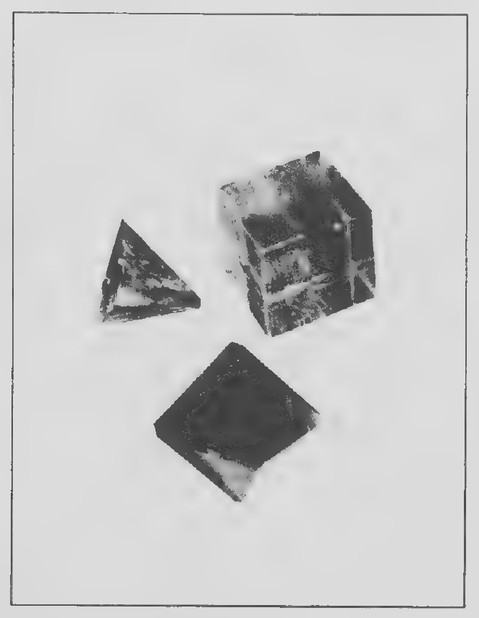
The pictures on Transparency 15-3-1 are photo-
graphs of crystals. The two solids at the top are sodium chlorate crystals and the solid at the bottom is a crystal of chrome alum. Many minerals have crystals in the shape of polyhedra. The figure on the dust jack of Introduction to Crystal Geometry (Transparency 15-3-2) suggests why.* Crystals are three-dimensional arrangements of atoms in which the atoms line up in rows that result in straight edges and flat surfaces.
Crystals can be imagined to consist of little building blocks. Each building block corresponds to an arrangement of atoms or molecules that is regularly repeated throughout the crystal.
“Introduction to Crystal Geometry by Martin J. Buerger (McGraw-Hill, 1971).
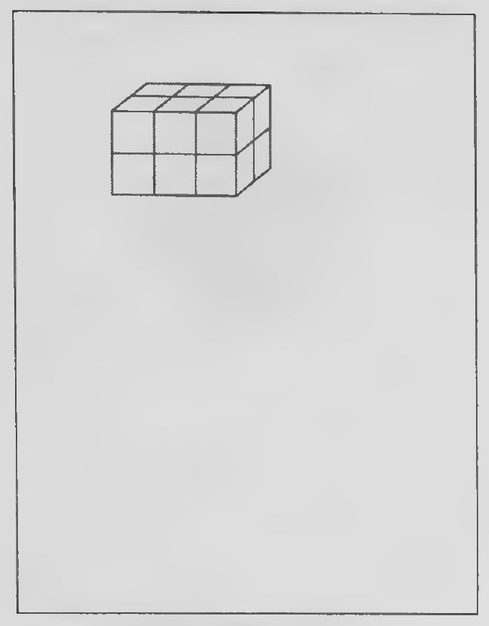 Transparency 15-4-1: Cubes in box problem
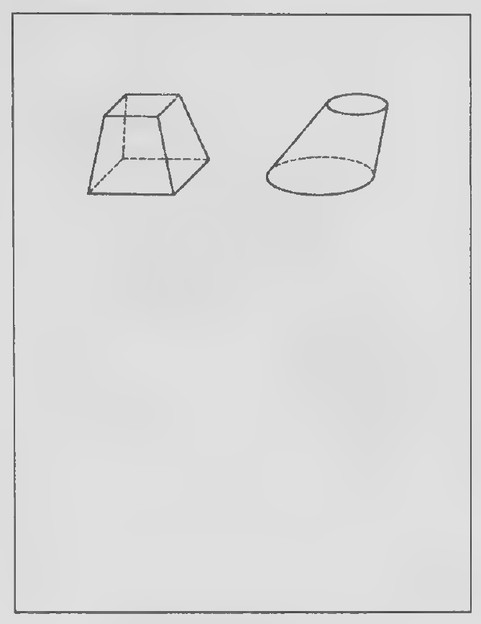 Transparency 15-4-2: Cavalieri’s Principle
Every crystal belongs to one of the six crystal systems illustrated on Transparency 15-3-3. Each system uses a different type of building block and it is the shapes of the building blocks that are shown. Notice that the first three shapes are rectangular solids. All six shapes are prisms.
Following this introduction, you can use Transparency 15-3-4 and its overlay to make the general definition of a prism clear. The rest of the lesson can be presented as in the text.
Lesson 4: The Volume of a Prism
Lesson Outline
Terms: Altitude of a prism, volume, cross section
Postulate 13. Cavalieri’s Principle. Consider two geometric solids and a plane. If every plane parallel to this plane that intersects one of the solids also intersects the other so that the resulting cross sections have equal areas, then the two solids have equal volumes.
Postulate 14. The volume of any prism is the product of the area of its base and its altitude: V=Bh
Corollary 1. The volume of a rectangular solid is the product of its length, width, and height: V =lwh.
Corollary 2. The volume of a cube is the cube of its edge: Vice.
Transparencies
- 15-4-1 Cubes in box problem
- 15-4-2 Cavalieri’s Principle
Introduction
Transparency 15-4-1 can be used to introduce the new lesson. The figure on it appeared in a mathematics question in a test of the National Assessment of Educational Progress. The question was: How many cubes does the box contain?
After discussing the answer, your students might be interested to know that of the 9-year-olds asked this question, only 6% answered it correctly. Of the people 13 years old, 21% gave the correct answer, and of those 17 years old, only 43%! The most commonly given wrong answer was “16.”
After observing that the volume of a rectangular solid that has been divided into unit cubes can be found by counting them, explain that not every solid can be divided into cubes. To find the volume of a general prism, we need to make some assumptions. First, introduce the V = lwh and V = Bh formulas for rectangular solids as in the text. Then, use a deck of playing cards or a ream of paper to suggest how the volume of an oblique rectangular prism might be found from a right rectangular prism. Transparency 15-4-2 and its overlay can be used to introduce Cavalieri’s Principle and the rest of the lesson presented as in the text.
 Transparency 15-5-1: Photograph of the Great Pyramid
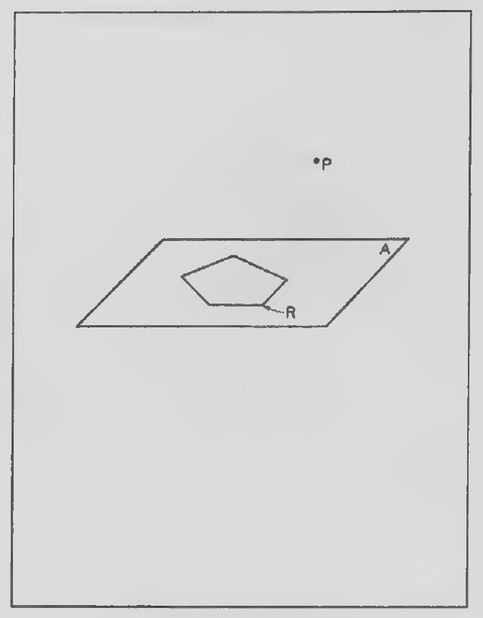 Transparency 15-5-2: A pyramid
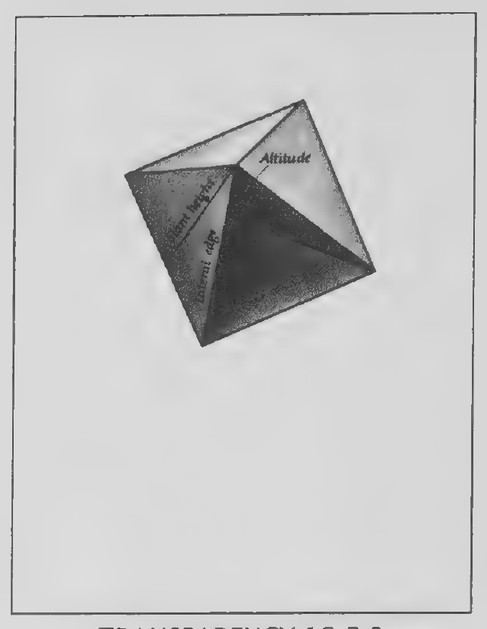 Transparency 15-5-3: Great Pyramid
Lesson 5: Pyramids
Lesson Outline
Terms: Pyramid, base, lateral faces and edges, apex, altitude of pyramid Theorem 80. The volume of any pyramid is onethird of the product of the area of its base and its altitude: Ve = Bh 3
Transparencies
- 15-5-1 Photograph of the Great Pyramid
- 15-5-2 A pyramid 15-5-3. A square pyramid
Worksheet: Three pyramids that fold into
a cube 15-5-4 Three pyramids that fold into a cube
Introduction
The word “pyramid” usually brings to mind the pyramids of Egypt. The Great Pyramid, shown in the photograph on Transparency 15-5-1, is certainly the most famous example. Its shape suggests that a pyramid has a square base and triangular faces that meet at a point. For pyramids in general, however, this is only partly true. Use Transparency 15-5-2 and its overlay to present the geometric definition of a pyramid.
Explain that the Great Pyramid of Egypt is an example of a square pyramid, hand out duplicated copies of Transparency 15-5-3, and introduce the terms pictured onit. Then have your students write on the figure the length of an edge of the base of the Great Pyramid, 760 ft, and its altitude, 484 ft. Guide
them in using the appropriate right triangles to find the altitude of one of the faces (615 ft) and the length of a lateral edge (723 ft).
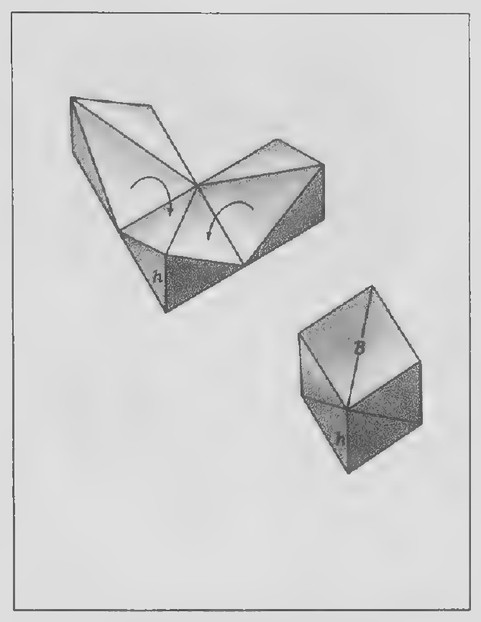
Hand out scissors and copies of the pattern on Worksheet for Lesson 15-5. (If possible, print the worksheet on cover stock; note that there are two patterns on each sheet.) Explain to your students that they are going to do an experiment that will enable them to guess a formula for the volume of a pyramid. Tell them to cut out the pattern, fold it along all the lines, and see what they notice. After they have had time to do this, ask someone to describe what they have noticed.
The pattern can be folded into three square pyramids (unlike the Great Pyramid, their lateral edges are not equal), which can, in turn, be folded toward each other to form a cube. Transparency 15-5-4 illustrates how this can be done. Note that the three pyramids seem to be identical, and so they have equal volumes. Because they can be folded together to form a cube, its volume is three times that of each pyramid. Hence, the volume of one of the pyramids is one-third that of the cube. Because the cube and pyramids have equal bases and altitudes, the volume of one of the pyramids is evidently one-third the product of the area of its base and its altitude. Explain that this conclusion is true for all pyramids and that we will consider it a theorem even though we have not proved it.
To conclude the new lesson, show Transparency 15-5-3 again and help your students, as needed, to find the lateral area and volume of the Great Pyramid. (They are approximately 935,000 square feet and 93,200,000 cubic feet, respectively.)
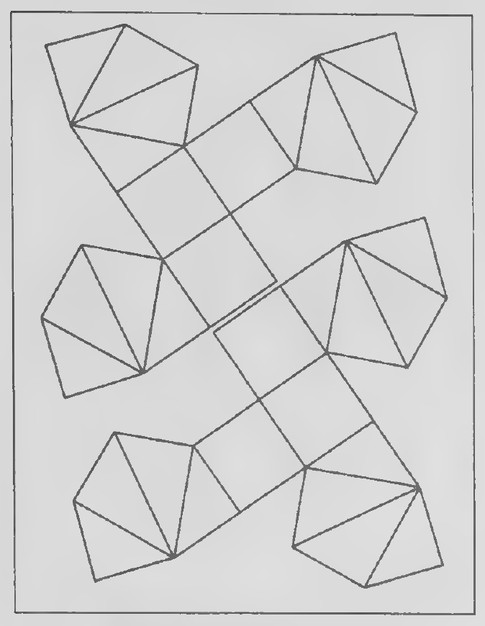 WORKSHEET FOR 15-5
 Transparency 15-5-4: Three pyramids that fold into a cube
 Transparency 15-6-1: Can of tennis balls
Lesson 6: Cylinders and Cones
Lesson Outline
Terms: Cone, lateral surface, circular region, base, apex, altitude, axis, right and oblique cones, cylinder, bases, lateral surface, altitude, axis, right and oblique cylinders.
Theorem 81. The volume of a cylinder is the product of the area of its base and its altitude: V =Bh=rrh.
Theorem 82. The volume of a cone is one-third the product of the area of its base and its altitude:
V= oR, = Lee 3 3
Transparencies
15-6-1_ A can of tennis balls
Introduction
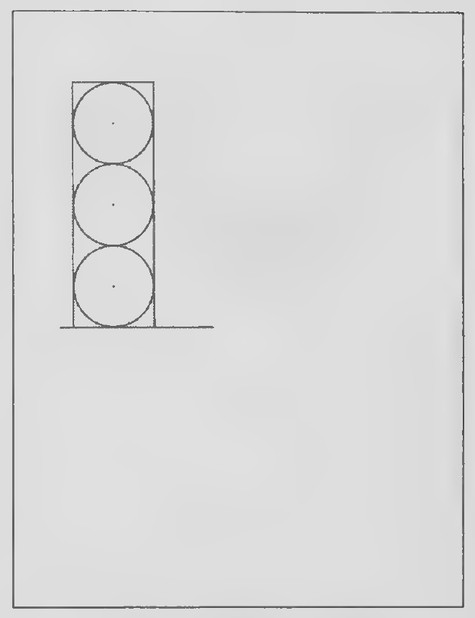
Cut a strip of paper so that it will exactly fit when it is wrapped around a can of tennis balls. Tape the ends of the strip together so that it is held securely in place around the can. Start class by holding up the can and describing what you have done. Tell your students that you are going to cut the strip where you have taped it and stretch it beside the can, holding one end at the bottom. How high would the other end reach?
Hand out duplicated copies of Transparency 15-6-1 which contains a figure representing the can with the three balls inside it. Ask your students to draw a line segment upward from the bottom line to represent how far they think the strip of paper would stretch, While they are doing this, you might
hold the can toward them so that they can see the size of its circular cross section.
Almost all of my students guess that the length of the strip is less than the height of the can. Without telling your students the answer, have them draw asegment through the centers of the balls from the bottom to the top of the can. Label the radii of the circles representing the balls r. What is the height of the can in terms of r² (6r.) What is the length of the strip of paper? (It is the circumference of the base of the can: 2nr, or approximately 6.28r.) So the length of the strip is more than the height of the can!
Following this introduction, the lesson on cylinders and cones can be presented as in the text.
 Transparency 15-7-1: Cork ball
 Transparency 15-7-2: Circle and sphere
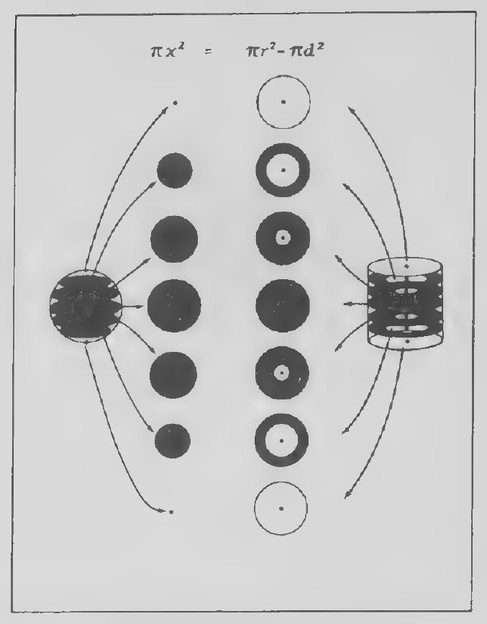 Transparency 15-7-3
Lesson 7: Spheres
Lesson Outline
Terms: Sphere, center, radius, diameter
Theorem 83. The volume of a sphere is on times the cube of its radius:
=3™- ee
Theorem 84. The surface area of a sphere is 4r times the square of its radius: A= ary
Transparencies
- 15-7-1 Cork ball
- 15-7-2 Circle and sphere 15-7-3. Cross sections of a sphere
- 15-7-4 Asphere and hollowed-out cylinder
- 15-7-5 Recreational sites on Mercury
- 15-7-6 The surface area of a sphere
First day
Introduction
Here is a good puzzle.*
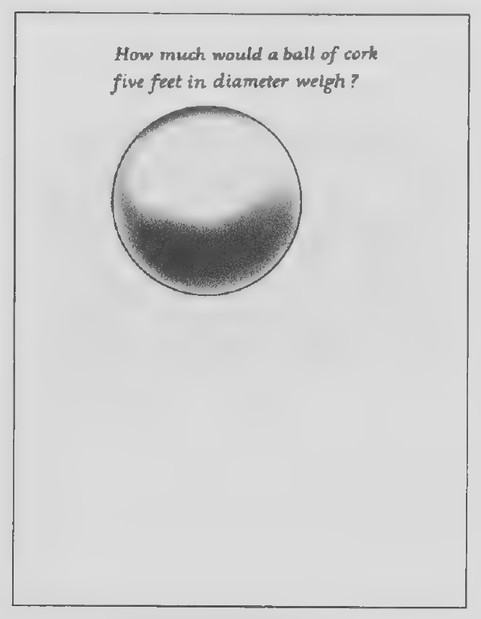
You know how very light cork is. When you have a cork stopper in hand—just now taken out of a bottle—it weighs practically nothing. If thrown into a bowl of water it floats hardly submerged. The stuff is very, very light. So—quick now—we have a ball of cork—a sphere of cork−5 feet in diameter. Ques-
tion: What does it weigh? Could you lift it? No calculations! Just give us a quick guess.
(Show Transparency 15-7-1 and ask your students to write their guesses before continuing.) In order to figure out what a ball of cork 5 feet in diameter would actually weigh, we need to know two things: the density of cork—that is, how much a given volume of it weighs—and, how to find the volume of a sphere.
One cubic inch of cork weighs about 0.14 ounce. To find out how many cubic inches of cork there would be ina ball 5 feet in diameter, we need a formula for the volume of a sphere.
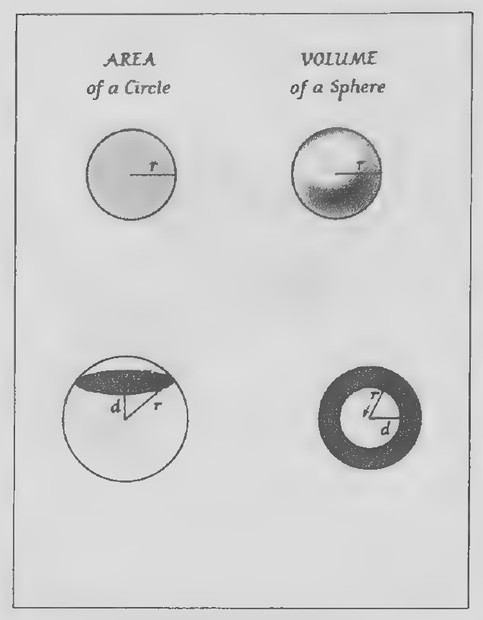
(Show the top half of Transparency 15-7-2.) We know that the area of a circle is a little more than three times the square of its radius: more precisely, mr’. Would you expect the volume of a sphere to also be measured in terms of the square of its radius? (No. Since volume is measured in cubic units, it should be some number times the cube of the radius: that is,?r°.) To find this number, we can use Cavalieri’s Principle.
In deriving the formula for the volume of a sphere, it is helpful to have some models. I use two 4.5-in diameter Styrofoam spheres (available in art and crafts stores), one of which I have sliced into two pieces as in the figure on page 663 of the text. I also use a model of the hollowed-out cylinder (also shown on page 663) whose dimensions match those of the spheres. This model can be made from tag board and tape.
I have my students make a drawing showing a side view of the sphereas shown in the next column.
*From Millergrams I, by Julius Sumner Miller (Doubleday, 1970).
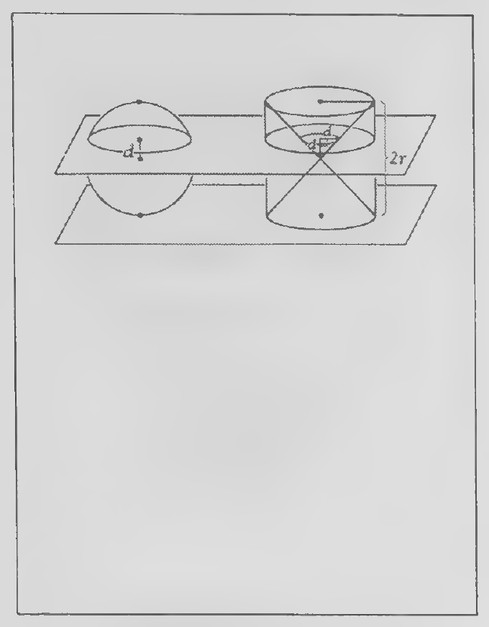 Transparency 15-7-4: Asphere and hollowed-out cylinder
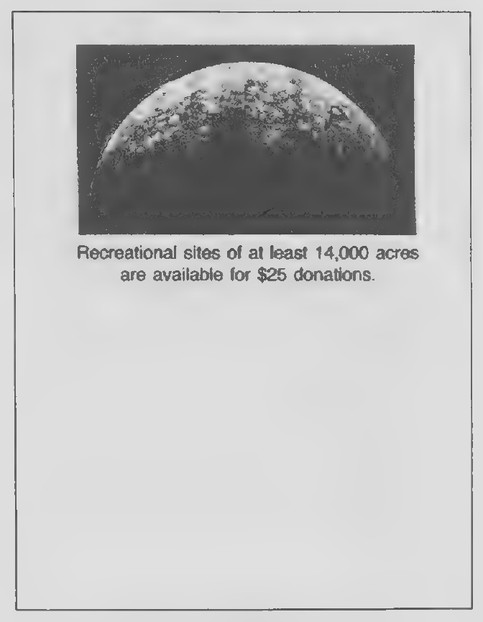 Transparency 15-7-5: Recreational sites on Mercury
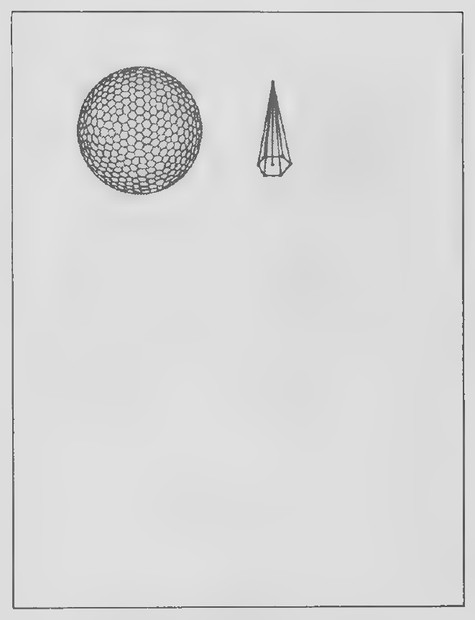 Transparency 15-7-6: The surface area of a sphere
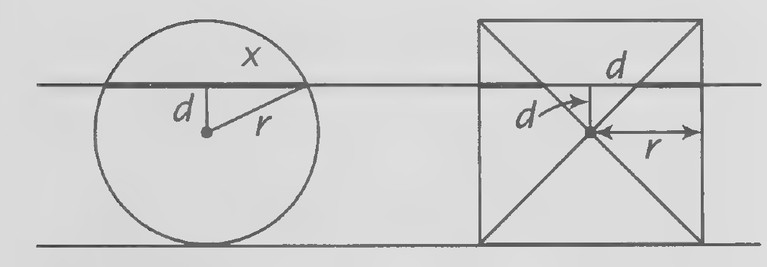 Figure on page 401 — A circle of radius r and diameter d inside a square, illustrating the area relationship
T(r² - d²) Trré - trd2
We treat the discovery of the hollowed-out cylinder as a detective story, illustrating it first with a square and then adding the details step by step. The figures on Transparencies 15-7-3 and 15-7-4 should also be helpful in enabling your students to understand the volume derivation.
After the volume formula has been derived, show Transparency 15-7-2 again and note that we have found the number we were looking for: it is
of Then return to Transparency 15-7-1 and find
the volume and weight of the cork ball.
Since the diameter of the ball is 5 feet, its radius is 2.5 feet or 30 inches:
4
Viait = 3730)? = 36,000n
= 113,000 cubic inches.
Since one cubic inch of cork weighs about 0.14 ounce, the ball would weigh 113,000(0.14) = 15,820 ounces, or almost half a ton!
Since this lesson covers a lot of material, I suggest not assigning any problems for homework until the next day.
Second day
Introduction
Earlier in the course, we calculated the cost of an acre of land in the Yukon Territory that was being sold for 25¢ per square inch. Omni magazine once reported that the Astronomical Society of the Pacific was selling recreational sites on the planet Mercury (Transparency 15-7-5). The sites are advertised as “pollution-free and also atmosphere-free,” but buyers are also warned that the temperatures are somewhat balmy (actually, hot enough to melt lead). At the rate of $25 for 14,000 acres, how much would it cost to buy the entire planet?
To be able to answer this question, we need to know how to find the surface area of a sphere. Use Transparency 15-7-6 to derive the formula for the surface area of a sphere as in the text and then return to the problem about Mercury as a class exercise.
The diameter of Mercury is 3,100 miles and 1 square mile is equal to 640 acres. The surface area of the planet is 4n(1,550)? = 30,000,000 square miles. At $25 for 14,000 acres, the entire planet would cost approximately 35 million dollars.
The Society that made the land offer is a nonprofit organization dedicated to increasing public understanding of astronomy and admits that it does not actually own any land on Mercury.
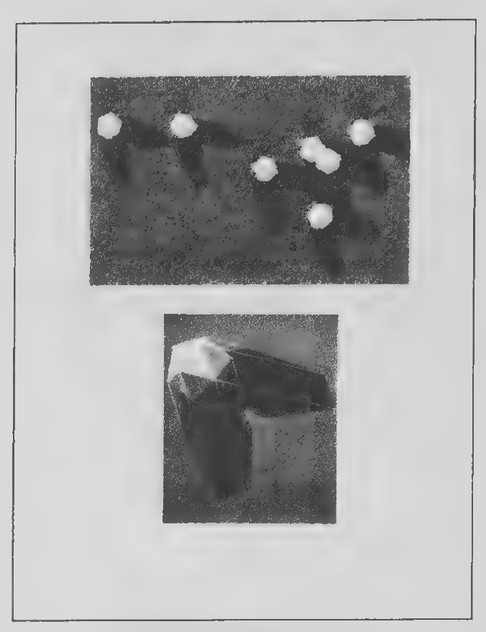 Transparency 15-9-1: Icosahedral virus
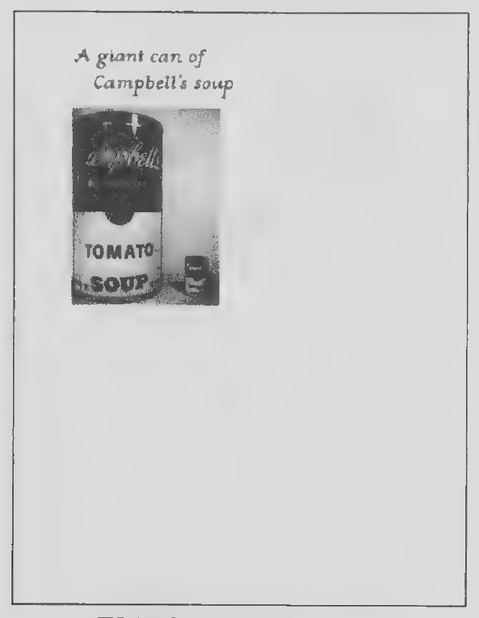 Transparency 15-8-1: A giant can of Campbell’s soup
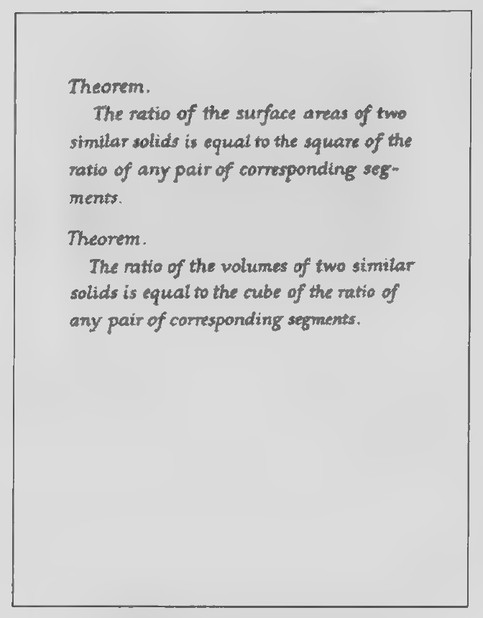 Transparency 15-8-2: Similar solids theorems
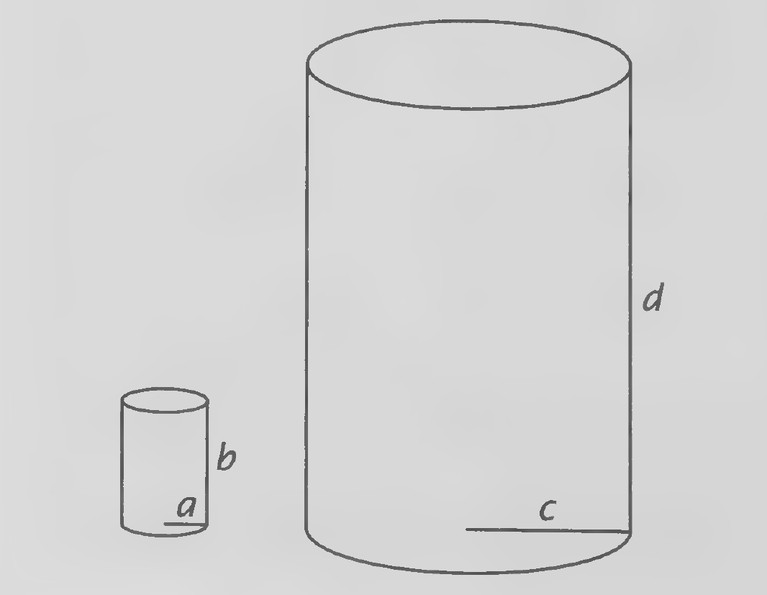 Figure on page 402 — A cylinder and the inscribed rectangular prism used to compare their volumes, with dimensions labelled
Lesson 8: Similar Solids
Lesson Outline
Terms: Similar solids. Theorem 85. If the ratio of a pair of corresponding dimensions of two similar solids is r, then the ratio of their surface areas is r². Theorem 86. If the ratio of a pair of corresponding dimensions of two similar solids is r, then the ratio of their volumes is 7°.
Transparencies
- 15-8-1 A giant can of Campbell’s soup
- 15-8-2 Similar solids theorems
Introduction
An amusing way to introduce this lesson is with a large wastebasket that has been painted to look like a can of soup or soda. The photograph on Transparency 15-8-1 shows a large “Campbell’s soup can” that I bought at a novelty store. An actual can of soup stands beside it.
Although this giant can is a wastebasket, it looks very much like a can of Campbell’s soup. It is about five times as tell as an actual can and has about five times its diameter. As a result, the two cans, giant and genuine, have the same shape.
Have your students draw pictures of two cylinders to represent the cans and label their dimensions as indicated in the figure at the right. If two geometric solids are similar, every pair of distances between pairs of corresponding points in the two
ay ete eae solids is proportional. If the cans are similar, — = — =r.
a (Explain that r represents the ratio of the correspond-
ing dimensions and that in the case of the cans, r=5.) Note that c= ra and d = rb.
How do the lateral areas of the two cans compare? For the small can, A = 2nab, and for the giant can, A = 2ncd = 2n(ra)(rb) = r2(2rab). The ratio of the lateral areas is r². Because r = 5, the lateral area of the giant can is 5¢ = 25 times that of the small can. The “label” on the giant can, then, is 25 times as large as the label on the small can.
How do the volumes of the two cans compare? For the small can, V = 71a@*b, and for the giant can, V = nc2d = n(ra)2(rb) = r3(na2b). The ratio of the volumes is 73. The volume of the giant can is 5° = 125 times that of the small can.
3
The actual can of soup weighs 10 4° and costs
99¢ (at the time of writing). If the giant can were
 Transparency 15-R-1: Five intersecting cubes
 Transparency 15-R-2: THE STEREOCHEMICAL THEORY OF ODOR
 Transparency 15-R-3: Table: Primary odors
filled with soup, how much do you think it would weigh and cost? (Having 125 times the volume of the small can, it is reasonable to think that it would weigh 125 times as much, or about 84 lb. If it also costs 125 times as much, it would cost $123.75.)
Suppose that an even larger can, still similar in shape to the small one, was ten times as tall. How many times bigger do you think its label, weight, and cost would be? (Because r = 10, r² = 100 and r = 1,000. The large can would have a label 100 times as large and would weigh and cost 1,000 times as much.)
Show Transparency 15-8-2 and explain that these theorems hold true, not just for similar cylinders, but for any pair of similar solids. Point out that it is easy to remember that the area ratio is found by squaring and that the volume ratio is found by cubing because area and volume are measured in square and cubic units, respectively.
Lesson 9: The Regular Polyhedra
Lesson Outline
Terms: Regular polyhedron, tetrahedron, octahedron, icosahedron, dodecahedron.
Transparencies
- 15-9-1 Icosahedral virus
Introduction
The photograph at the top of Transparency 15-9-1 was taken through an electron microscope and shows particles of a virus enlarged about 58,000 times. Note the double shadows of the particles and the constancy of their shape. A geometric solid that
casts shadows exactly like these particles is pictured at the bottom of the transparency. It is called an icosahedron and, because its shadows match those of the virus, biologists think that the particles of the virus are in the shape of tiny icosahedra. Models like those shown on page 678 of the text would be helpful in introducing the other regular polyhedra.
Review of Chapter 15
Transparencies
- 15-R-1 Five intersecting cubes 15-R-2. “The Stereochemical Theory of Odor”
- 15-R-3 Table: Primary odors
- 15-R-4 Olfactory receptor sites
- 15-R-5 Analmond odor
First day
Introduction
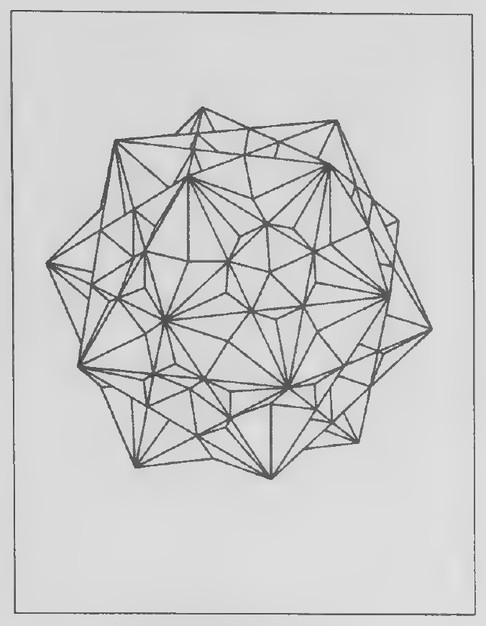
The polyhedron pictured on Transparency 15-R-1 is very complex and yet very simple. Its edges form equilateral triangles, squares, regular pentagons, and five-pointed stars, and it contains 360 faces in all. The 360 faces do not lie in 360 different planes, however. They are contained in only 30 planes and this is what makes the polyhedron simple. Perhaps some of your students will be able to recognize that there are large cubes hidden in the polyhedron. The overlay can be put on the transparency to reveal one of these cubes.
I made the model in the photograph from cardboard and tape, with sticks of balsa wood inside to make it rigid. Information on the patterns needed is given on page 136 of Mathematical Models, Revised Edition, by H. Martyn Cundy and A. P. Rollett (Ox-
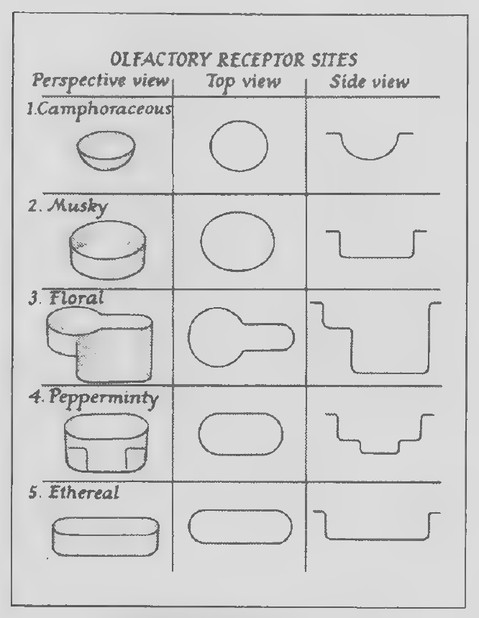 Transparency 15-R-4: Olfactory receptor sites
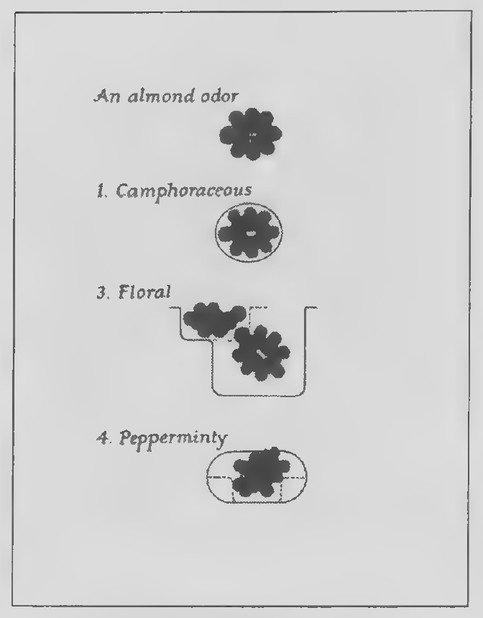 Transparency 15-R-5: Analmond odor
ford University Press, 1961), but its construction requires a lot of time and patience.
Second day
Introduction
Take one or two bottles of almond extract and either remove or tape over the labels so that the names are covered. Hand the bottle(s) out at the beginning of class and ask your students to try to identify the odor.
A Roman poet and philosopher named Lucretius speculated two thousand years ago that the sense of smell is based on geometry. He thought that every substance that has an odor gives off tiny particles of a specific shape. When these particles enter a person’s nose, they fit into certain pores that match their shape. The pores into which the particles fit enable the person to identify the substance from which they came.
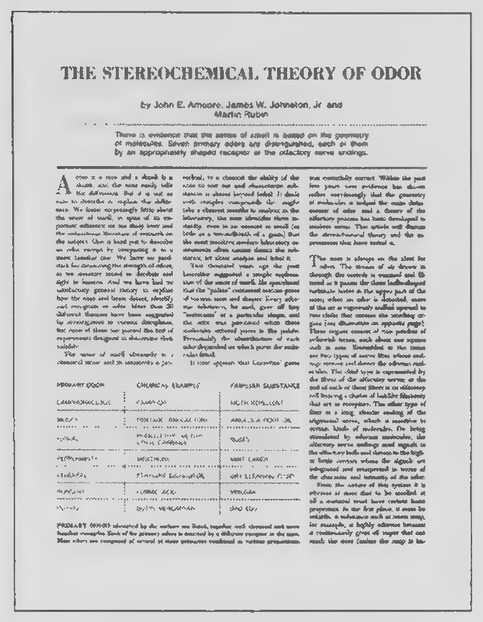
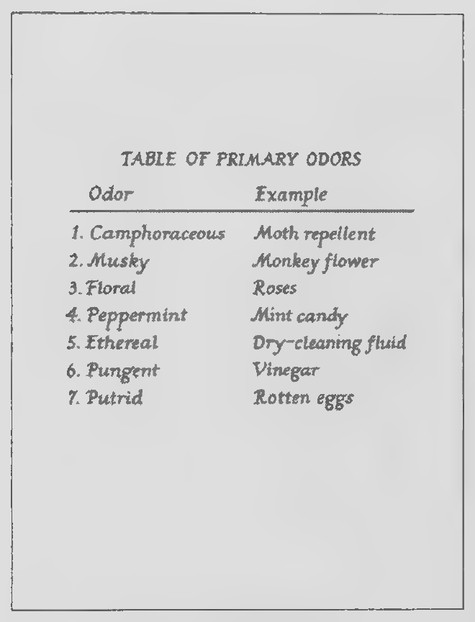
Modern scientists now think that Lucretius’s theory is correct. Show Transparency 15-R-2, on which the first page of an article on odor that appeared in Scientific American is reproduced.* Note the sentence under the title stating that “there is evidence that the sense of smell is based on the geometry of molecules.” There seem to be seven basic odors, as listed in the table enlarged from the article on Transparency 15-R-3. Each of the first five is associated with molecules of a particular geometric shape. Show Transparency 15-R-4. These figures
show perspective, top, and side views of the receptor sites for these five odors. The camphoraceous site is hemispherical in shape. The site corresponding to the odor of musk is shaped like a cylinder. Those for floral and pepperminty odors are more complex in shape, whereas the ethereal site is long and rod-shaped. Add the overlay to the transparency. These diagrams represent molecules that fit each of the five sites.
The two basic odors not shown here, pungent and putrid, are determined not by the shape of the molecule but rather by its charge. Pungent odors, such as that of vinegar, are caused by positively charged molecules, whereas putrid odors are caused by molecules that are negatively charged.
By this time, everyone should have had a chance to smell the almond extract. After someone has identified it, show Transparency 15-R-5. It appears that all odors can be explained in terms of the seven basic ones. For example, the odor of almonds is a combination of camphoraceous, floral, and pepperminty odors. Molecules that possess this odor can fit any one of the three sites (actually, two of them in the floral site). Aremarkable consequence of this theory is that, by putting their knowledge of three-dimensional geometry to use, chemists have been successful in synthesizing substances having various odors simply by producing molecules of the right shape.
*This lesson and its illustrations are adapted from “The Stereochemical Theory of Odor” by John E. Amoore, James W. Johnston, Jr., and Martin Rubin, Scientific American, February 1964, pages 42-49.
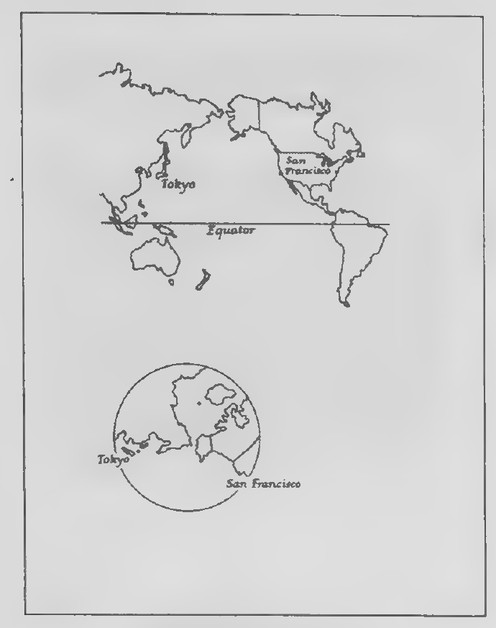 WORKSHEET 16-1
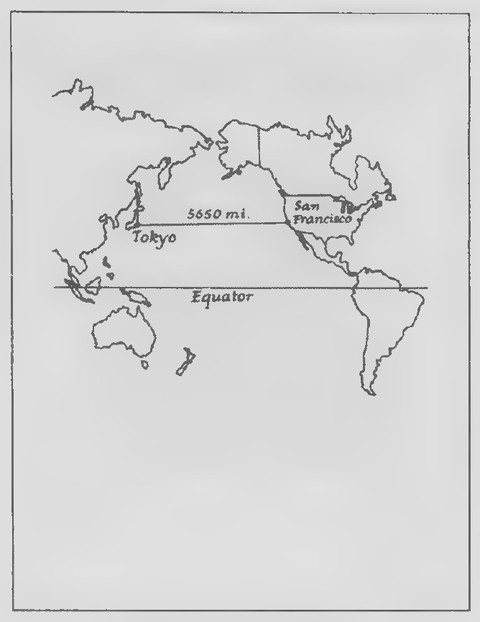 Transparency 16-1-1: From San Francisco to Tokyo
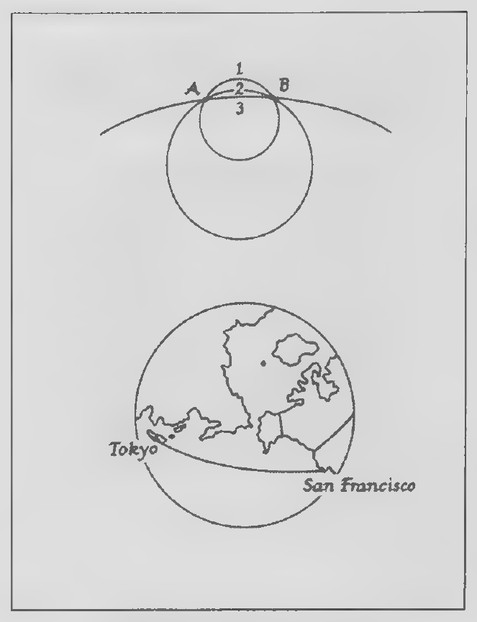 Transparency 16-1-2: The great circle route