Chapter 16: Non-Euclidean Geometries
Before beginning to teach this chapter, it may be helpful to read the following articles:
“Euclid’s Parallel Postulate and Its Modern Offspring” by Martin Gardner, Scientific American, October 1981, pages 23-33.
Mathematics in Western Culture by Morris Kline (Oxford University Press, 1953), Chapter 26, “New Geometries, New Worlds.”
Einstein’s Legacy by Julian Schwinger (Scientific American Books, 1986), Chapter 5, “Geometry and Physics.”
Another valuable reference is the book Euclidean and Non-Euclidean Geometries, Second Edition, by Marvin Jay Greenberg (W. H. Freeman and Company, 1980).
Lesson 1: Geometry on a Sphere
Lesson Outline
Terms: Great circle, antipodal points.
Transparencies
- 16-1-1 From San Francisco to Tokyo
- 16-1-2 The great circle route
Introduction
Hand out duplicated copies of Worksheet for Lesson 16-1. Here are two maps showing the cities of Tokyo and San Francisco. Suppose that a ship sails
from one city to the other. Use your pencil to mark on the first map the path of the ship.
After your students have done this, show Transparency 16-1-1. Gerardus Mercator, the Flemish cartographer who devised the method of mapping the earth used here, wrote:
If you wish to sail from one point to another, here is a chart, and a straight line on it, and if you follow this line carefully you will certainly arrive at your destination. But the length of the line may not be correct. You may get there sooner or may not get there as soon as you expected but you will certainly get there.*
Mercator was referring to a problem that many people are not aware of when they look at a map such as his. It would seem that any other path between Tokyo and San Francisco would be longer than the one we have drawn, yet here is a path (add the overlay to Transparency 16-1) that is significantly shorter. Can you explain how this can be?
Because these paths are on the surface of a sphere, neither one is straight. Both, in fact, are arcs of circles. Show Transparency 16-1-2. In the top figure, two points, A and B, are joined by three arcs numbered 1, 2, and 3. Which arc is shortest? (Arc 3.) How does the circle of which it is a part compare
*From Mapping by David Greenhood (University of Chicago Press, 1964), page 128.
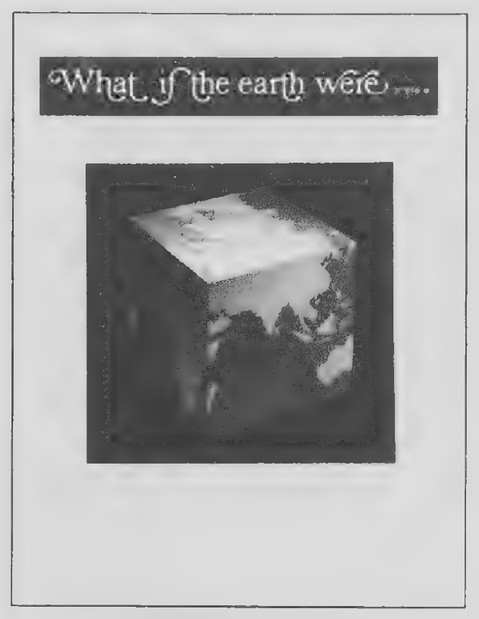 Transparency 16-2-1: What if the world were cubical?
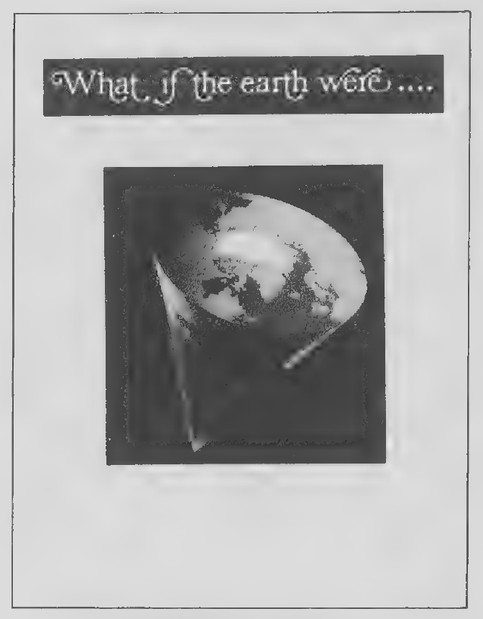 Transparency 16-2-2: What if the world were conical?
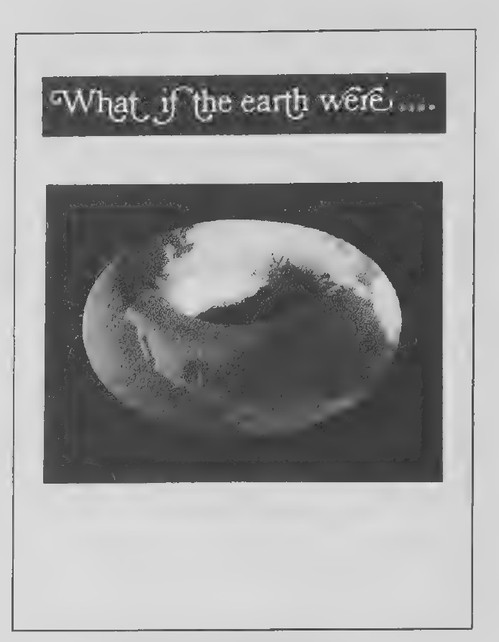 Transparency 16-2-3: What if the world were toroidal?
with the other circles? (It is the largest.) If you could not draw a straight line through points A and B, but could only draw a circle, what would you do to make the arc from A to B as short as possible? (Make the circle as large as possible.)
Look at the bottom figure of the transparency. Because Tokyo and San Francisco are on the surface of a sphere, we cannot draw astraight line along it from one point to the other. We will have to settle for a circle instead. How should we choose it to make the arc from A to Bas short as possible? (Choose the largest possible circle through A and B that lies on the surface of the sphere; namely, the circle whose radius is the same as that of the sphere.) Add the overlay to Transparency 16-1-2 and explain the idea of a great circle. Now have your students mark the center of the earth on the second figure on their worksheets and sketch the great circle that goes through Tokyo and San Francisco.
The rest of the lesson can be developed as in the text.
Lesson 2: The Saccheri Quadrilateral
Lesson Outline
Terms: Birectangular quadrilateral: base, legs, summit, base angles, summit angles; Saccheri quadrilateral.
Theorem 87. The summit angles of a Saccheri quadrilateral are equal.
Theorem 88. The line segment connecting the midpoints of the base and summit of a Saccheri quadrilateral is perpendicular to both
of them. Theorem 89. If the legs of a birectangular quadrilat-
eral are unequal, the summit angles opposite
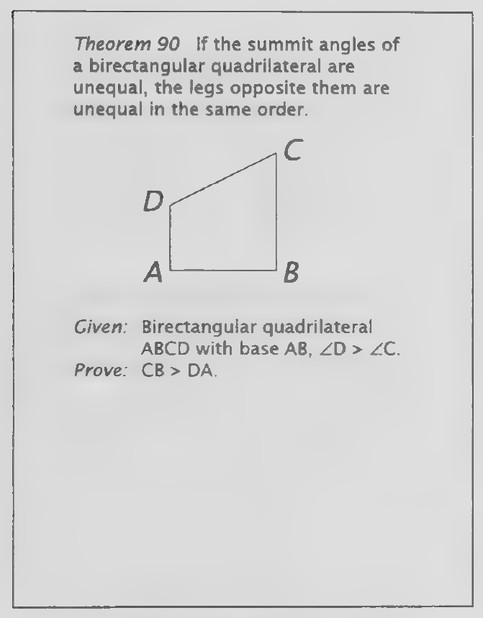
them are unequal in the same order. Theorem 90. If the summit angles of a
birectangular quadrilateral are unequal, the
legs opposite them are unequal in the same
order.
Transparencies
- 16-2-1 What if the world were cubical?
- 16-2-2 What if the world were conical?
- 16-2-3 What if the world were toroidal?
- 16-2-4 What if the world were cataclysmal?
- 16-2-5 Euclid’s fifth postulate
- 16-2-6 Geometry books
- 16-2-7 A deductive system
Introduction
Joseph N. Portney has designed a very attractive set of 9-in x 12-in posters on the theme “What if the world were…?” There are twelve posters in the set, showing photographs of models of an earth that is flat, cubical, dodecahedral, pyramidal, cylindrical, conical, toroidal, hyperboloidal, hyperbolic paraboloidal, oblate spheroidal, “Wegeneroidal,” and “cataclysmal.” The set can be seen on http:/ / www.nrich.maths.org.uk/mathsf /journalf/dec99/ art1/. The figures on Transparencies 16-2-1, 16-2-2, 16-2-3, and 16-2-4 are taken from these posters.
You know that the shortest path between two points in a plane is the line segment joining them. What is the shortest path between two points on a sphere? (An arc of a great circle.) What do you think the shortest path between two points on the sur-
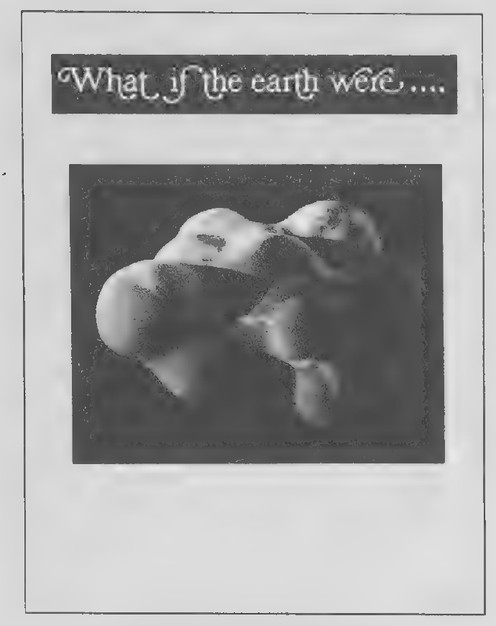 Transparency 16-2-4: What if the world were cataclysmal?
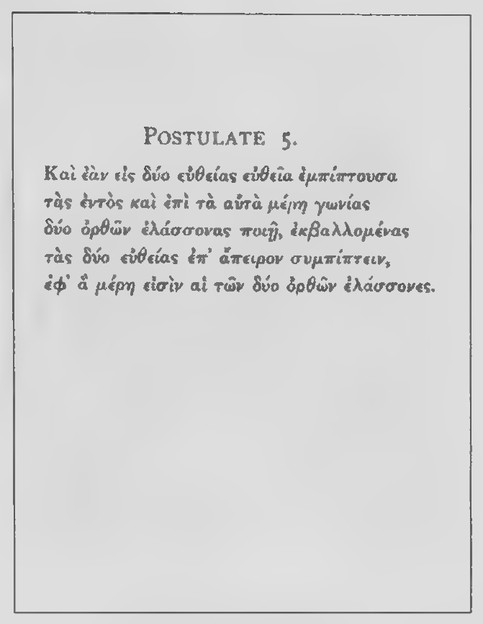 Transparency 16-2-5: Euclid’s fifth postulate
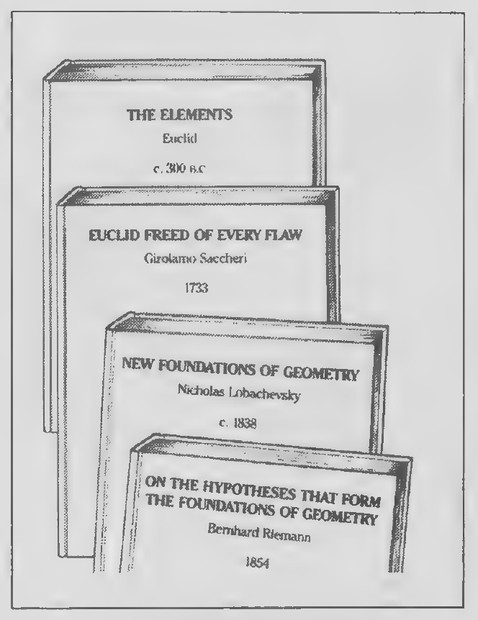 Transparency 16-2-6: Geometry books
face of a cube would be? (A set of one or more line segments.) The shortest paths on the cone and toroid are more complicated and on the “cataclysmal” surface, extremely complex.
To introduce the new lesson, you might show Transparency 16-2-5. Perhaps the most controversial statement to be made in all of the history of mathematics is Euclid’s fifth postulate. Shown here in the original Greek, the postulate states, in effect, that through a point not on a line, there is exactly one line parallel to the line.*
What made the postulate controversial is not that people did not believe it, but rather that others thought Euclid should have proved it as a theorem. Show Transparency 16-2-6. One person who thought this was an Italian priest named Saccheri and who went so far as to write a book titled Euclid Freed Of Every Flaw in which he tried to prove the Parallel Postulate. In this lesson, we will see how Saccheri set out to do this.* The rest of the lesson can now be presented as in the text.
Be sure to emphasize that because Saccheri was trying to prove the Parallel Postulate, he could not
use any theorems whose proofs depend on it. The diagram on Transparency 16-2-7 should help clarify the situation. The boxes represent postulates and the circle identify by number some of the theorems that depend on these postulates. The arrows show only a few of the relations between the statements in the system. In essence, we cannot use any theorems in the bottom group as we prove the theorems in this lesson. You may want to show the transparency from time to time as questions arise. For example, some students will concluce that because the summit angles of a Saccheri quadrilateral are equal, it must be a rectangle. This follows from Theorem 32 (the sum of the measures of the angles of a quadrilateral is 360°). But the proof of Theorem 32 uses Theorem 28 (the sum of the measures of the angles of a triangle is 180°). Theorem 28, in turn, follows from Theorem 25, which follows from the Parallel Postulate. Therefore, if the purpose of the Saccheri quadrilateral is to prove the Parallel Postulate, we cannot assume that it is a rectangle.
The proofs of the four theorems are outlined in the exercises. The proofs of the theorems not assigned should be demonstrated in the lesson.
*This is known as “Playfair’s postulate” and is, of course, the version of the Parallel Postulate that we have used throughout the course. Euclid’s version is: “That, if a straight line falling on two straight lines makes the interior angles on the same side less than two right angles, the two straight lines, if produced indefinitely, meet on that side on which are the angles less than the two right angles.” I would not bring this up in the lesson. tThe article “Saccheri, Forerunner of Non-Euclidean Geometry” by Sister Mary of Mercy Fitzpatrick in The Mathematics Teacher (May 1964), pages 323-332, is a valuable reference.
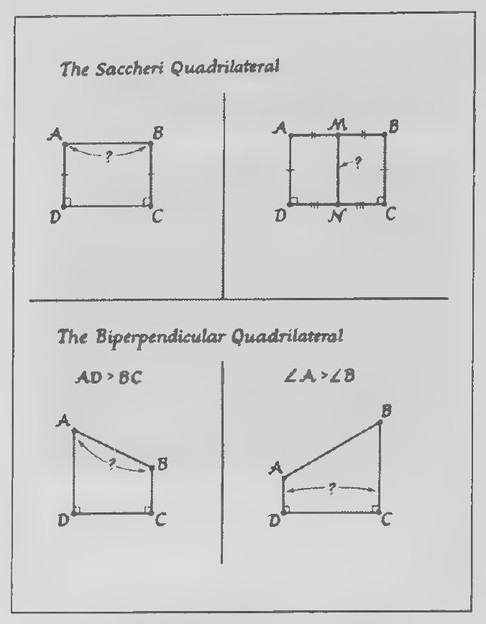 Transparency 16-3-2: Review of Theorems 87 through 90
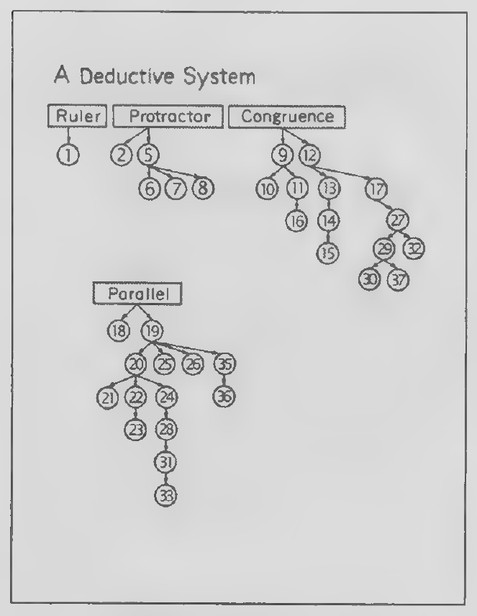 Transparency 16-2-7: A deductive system
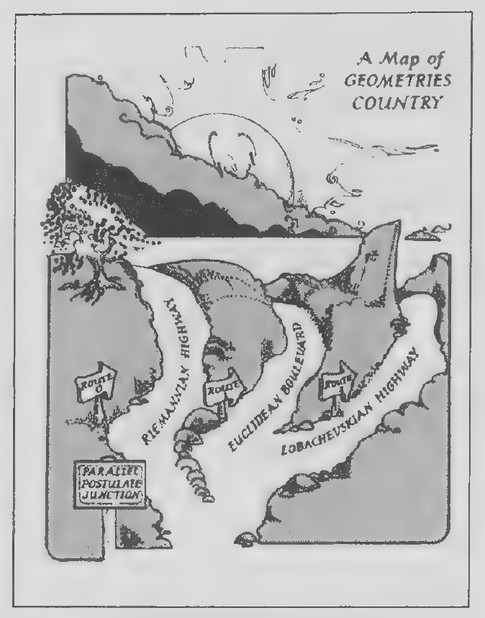 Transparency 16-3-1: A Map of
Lesson 3: The Geometries of Lobachevsky and Riemann
Lesson Outline
Terms: The Lobachevskian Postulate. The summit angles of a Saccheri quadrilateral are acute.
Lobachevskian Theorem 1. The summit of a Saccheri
quadrilateral is longer than its base.
Lobachevskian Theorem 2. A midsegment of a
triangle is less than half as long as the third side.
Transparencies
16-3-1_ Map: Geometries country 16-3-2 Review of Theorems 87 through 90 16-3-3 Theorem 87 (Lesson 2: Set I, Exs. 7-13) 16-3-4 Theorem 88 (Lesson 2: Set II, Exs. 31-35) 16-3-5 Theorem 89 (Lesson 2: Set I, Exs. 14-21) 16-3-6 Theorem 90 (Lesson 2: Set I, Exs. 22-28) 16-3-7 Table: Comparing three geometries
Introduction
To open this lesson, show Transparency 16-3-1. This map compares our study of geometry to traveling through the country. Earlier in the course, we came to the junction pictured at the bottom of the map. When we assumed the Parallel Postulate—that is, that through a point not on a line, there is exactly one line parallel to the line—we chose Route 1. Since then, we have traveled on Euclidean Boulevard a long distance past the junction. Before the nineteenth century, it was assumed that Euclidean Boulevard was the “only way to go”—that no other roads existed. Now we are, in effect, returning to the junction so that we can travel a short way along each of the other highways in order to see what the scenery along them looks like. Route 0 corresponds to the
assumption that through a point not on a line, there are no parallels to the line. We have an introduction to this in our study of geometry on the surface of a sphere. Route 2 corresponds to the assumption that through a point not on a line, there is more than one parallel to the line.
Transparency 16-3-2 is for use in reviewing the statements of the four theorems of Lesson 2. Transparencies 16-3-3, 16-3-4, 16-3-5, and 16-3-6 should be helpful in discussing the proofs of these theorems.
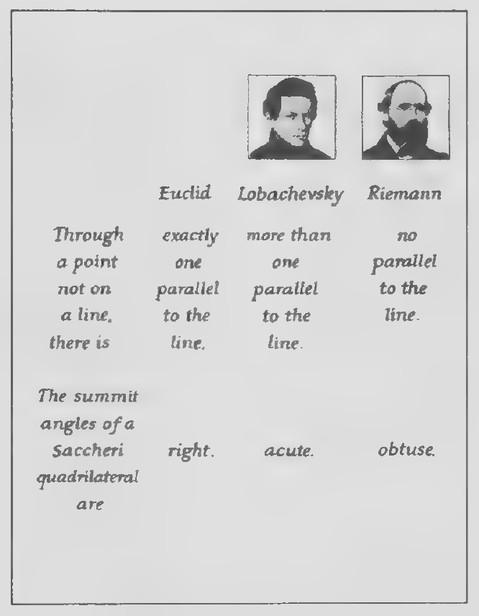
To introduce the new lesson, show Transparency 16-3-7, keeping the right half covered. Explain that either of these statements can be proved from the other. Next, reveal the alternative conclusions to the statements, still keeping the pictures and names of Lobachevsky and Riemann covered. Point out that Saccheri’s plan was to prove Euclid’s Parallel Postulate by proving that the summit angles of a Saccheri quadrilateral are right angles. Saccheri thought that he could do this indirectly by assuming that the summit angles were either acute or obtuse and showing that these assumptions lead to contradictions. (Reveal the rest of the transparency.) Later, other mathematicians, among them Lobachevsky and Riemann, showed that logically consistent geometries could be based on these other assumptions.
Show Transparency 16-2-6 again. The dates shown here reveal that more than one hundred years passed between Saccheri’s pioneering work and the writings of Lobachevsky and Riemann. Show Transparency 16-3-7 again and explain that we will start with the assumption that the summit angles of a
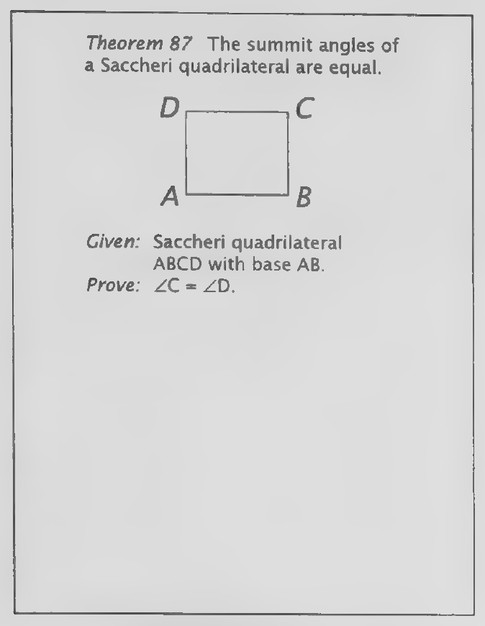 Transparency 16-3-3: Theorem 87 (Lesson 2: Set I, Exs. 7-13)
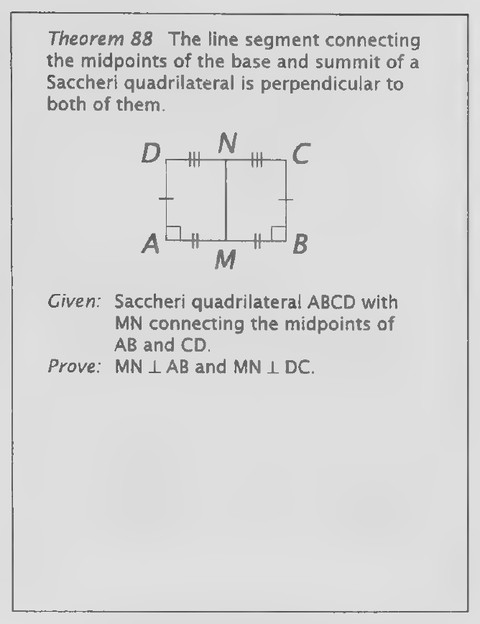 Transparency 16-3-4: Theorem 88 (Lesson 2: Set II, Exs. 31-35)
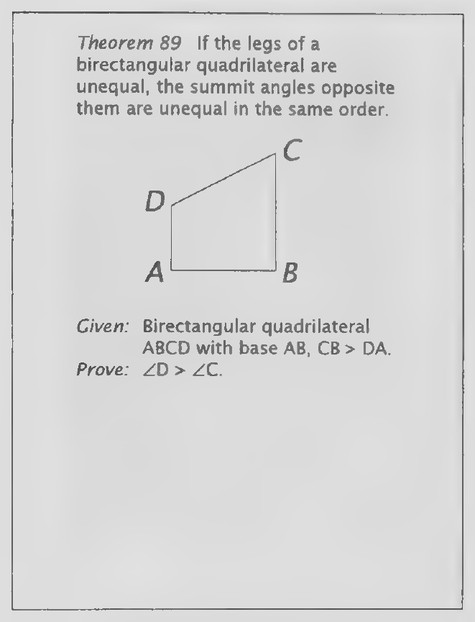 Transparency 16-3-5: Theorem 89 (Lesson 2: Set I, Exs. 14-21)
 Transparency 16-3-6: Theorem 90 (Lesson 2: Set I, Exs. 22-28)
 Transparency 16-3-7: Table: Comparing three geometries
Saccheri quadrilateral are acute. We will refer to this as the “Lobachevskian Postulate” and we will use it to prove some theorems in Lobachevskian geometry. Although the proofs of the two theorems in this lesson are outlined in the exercises, I recommend considering the proof of Theorem 1 in class.
 Transparency 16-4-1: Photograph of Einstein
 Transparency 16-4-2: The shape of the universe
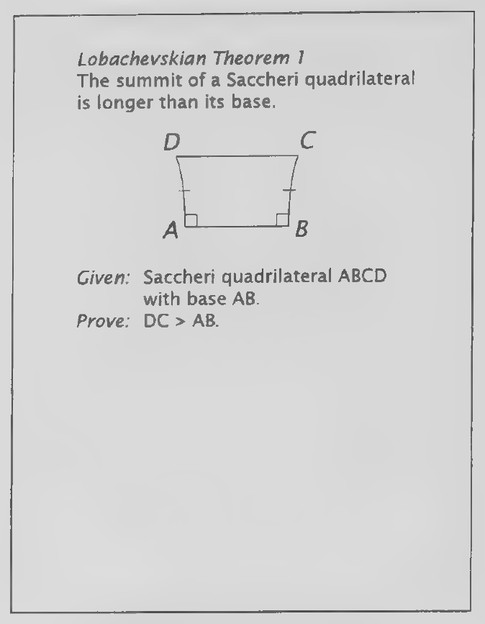 Transparency 16-4-3
Lesson 4: The Triangle Angle Sum Theorem Revisited
Lesson Outline
Lobachevskian Theorem 3. The sum of the angles of
a triangle is less than 180°.
Corollary. The sum of the angles of a quadrilateral
is less than 360°.
Lobachevskian Theorem 4. If two triangles are
similar, they must also be congruent.
Transparencies
- 16-4-1 Photograph of Einstein
- 16-4-2 The shape of the universe 16-4-3. Lobachevskian Theorem 1 (Lesson 3: Set
I, Exs. 1-10) 16-4-4 Lobachevskian Theorem 2 (Lesson 3: Set
I, Exs. 11-18)
Introduction
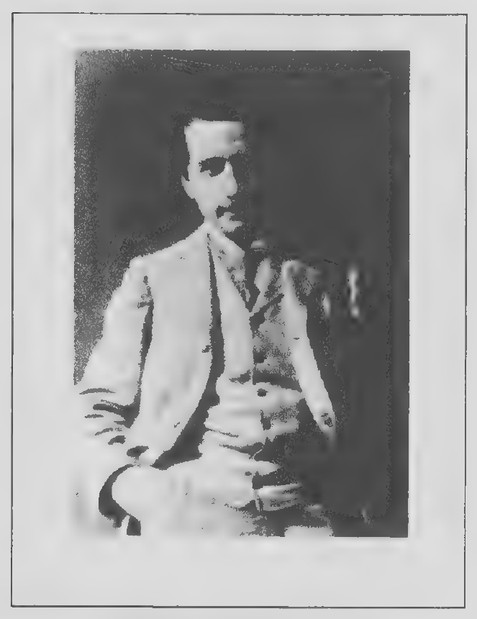
The photograph of Einstein on Transparency 16-4-1 was taken when he was in his early twenties, not long before he developed the theory of relativity for which he was become so famous. Einstein once wrote that if he had not been acquainted with non- Euclidean geometry, he never would have been able to develop the theory of relativity.
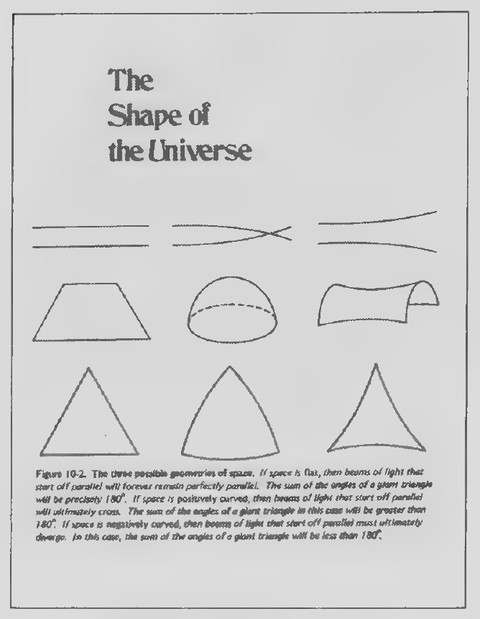
The figures on Transparency 16-4-2 are from a book titled Relativity and Cosmology² and illustrate three possible geometries of space. (Read the caption to the figure.) From the standpoint of mathematics, all three geometries are equally valid. It
makes no sense to say that one of them is true and the others are false. If we are interested in deciding what the universe is like, then it does make sense to ask which geometry fits it. The theory of relativity implies that it may be one of the non-Euclidean geometries.
Transparencies 16-4-3 and 16-4-4 are for use in reviewing the proofs of the Lobachevskian Theorems 1 and 2. Again, even though the proofs of the theorems in the new lesson are outlined in the exercises, it may be best to preview at least one of them in class.
Review of Chapter 16
Transparencies
- 16-R-1 The orbit of Mercury
- 16-R-2 Lobachevskian Theorem 3 (Lesson 4: Set
I, Exs. 1-9) 16-R-3 Corollary (Lesson 4: Set I, Exs. 10-13) 16-R-4 Lobachevskian Theorem 4 (Lesson 4: Set
I, Exs. 14-20) 16-R-5 McDonald’s restaurants around Kansas
City 16-R-6 Point distributions on a plane and on a
sphere 16-R-7_ Escher’s Circle Limit III and diagram
First day
Introduction
Sir Isaac Newton, one of the greatest scientists of all time, was strongly influenced by Euclid. Of his books, the Principia, which is modeled after Euclid’s Elements, the Encyclopaedia Britannica says:
*Relativity and Cosmology by William J. Kaufmann III (Harper and Row, 1973).
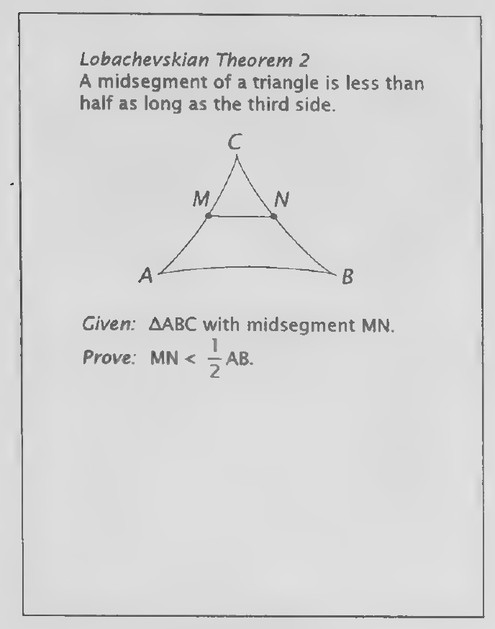 Transparency 16-4-4: Lobachevskian Theorem 2 (Lesson 3: Set
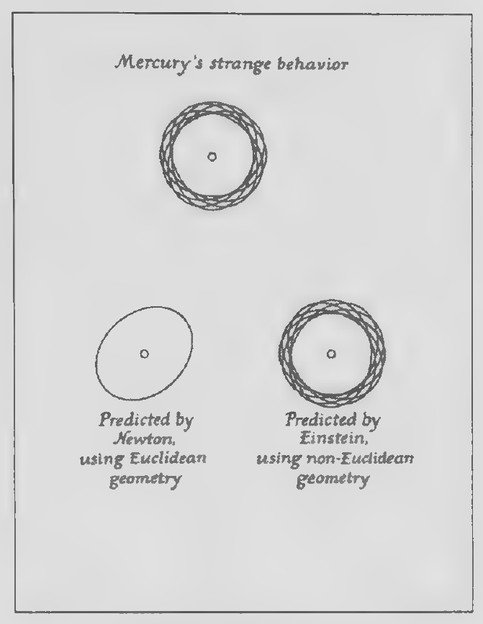 Transparency 16-R-1: The orbit of Mercury
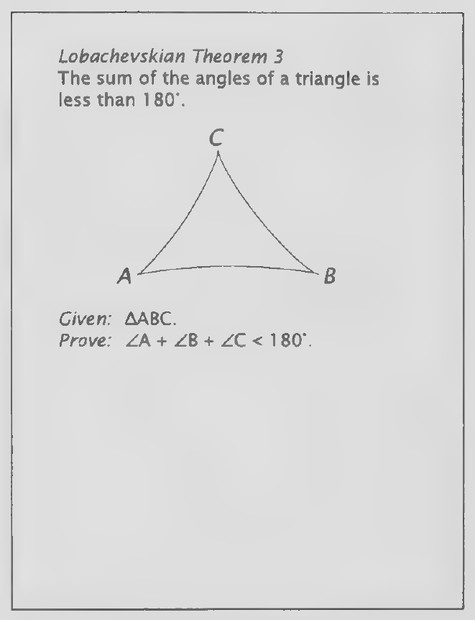 Transparency 16-R-2: Lobachevskian Theorem 3 (Lesson 4: Set
It is explained for the first time the way in which a single mathematical law could account for phenomena of the heavens, the tides, and the motions of objects on the earth. The whole development of modern science begins with this great book.
The Principia was published in 1687. One hundred fifty years later, a French astronomer made a surprising discovery about the planet Mercury. Show the top figure on Transparency 16-R-1. This figure, greatly exaggerated to make it easier to see, represents the orbit of Mercury about the sun. In the course of each revolution, the orbit shifts very slightly. This is strange because, according to Newton’s laws of gravity, Mercury’s orbit shouldn’t do this. Show the lower-left figure on the transparency. The orbit should be a simple ellipse that remains fixed in space. Instead, it rotates very slowly, by about 43 seconds of arc each century.
In 1915, Einstein figured out why. Read the following passages, which are from Chapter 8 of Einstein: The Life and Times by Ronald W. Clark:
… Thus the universe which Newton has seen, and for which he had constructed his apparently impeccable mechanical laws, was not the real universe but only what he had seen through the misleading spectacles produced by gravity. The law which appeared to have worked out so well had been drawn up for a universe that did not exist, as though a tailor had made a suit for a man he had seen only ina distorting mirror..
Einstein’s paper gave not only a corrected
picture of the universe but also a fresh set of mathematical laws by which its details could be described…. These laws utilized Riemannian geometry, the need for which had been the direct result of the assumption that light would be deflected by a gravitational field and that the shortest distance between two points in such a field would not, when viewed from outside it, be coincident with a straight line..
Einstein had seen that his assumption of a curvature of light in a gravitational field meant that Euclidean geometry, satisfactory enough when coping with the small distances of everyday life, had to be replaced by something more sophisticated when dealing with the universe..
Einstein used Riemannian geometry to create equations by which the movements of the stars in their courses and the structure of the universe itself could be described…*
Show the lower-right figure on Transparency 16-R-1. Whereas Newton’s theory of the universe, based on Euclidean geometry, predicts an orbit for Mercury that does not match its actual path, Einstein’s theory, based on Riemannian geometry, predicts it perfectly. According to Einstein, the orbit should rotate 43 seconds of arc each century—the very amount that it does!
Because of this and other evidence, Einstein’s theory of relativity is generally accepted as correctly
*From Einstein: The Life and Times by Ronald W. Clark. Copyright © 1971 by Ronald W. Clark, with the permission of Thomas Y. Crowell Company, Inc., publisher, and The Harold Matson Company, Inc.
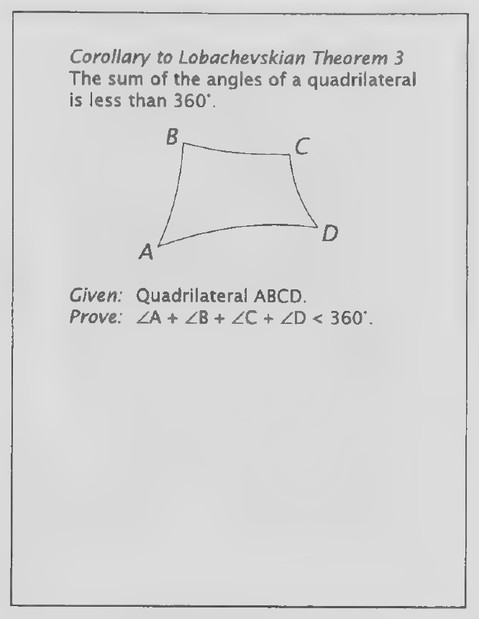 Transparency 16-R-3: Corollary (Lesson 4: Set I, Exs. 10-13)
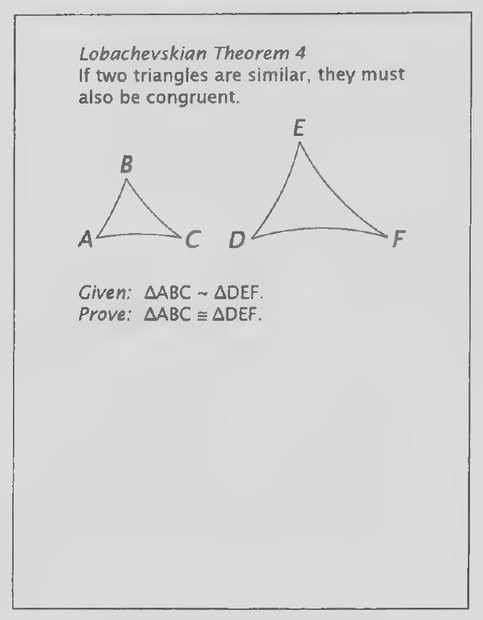 Transparency 16-R-4: Lobachevskian Theorem 4 (Lesson 4: Set
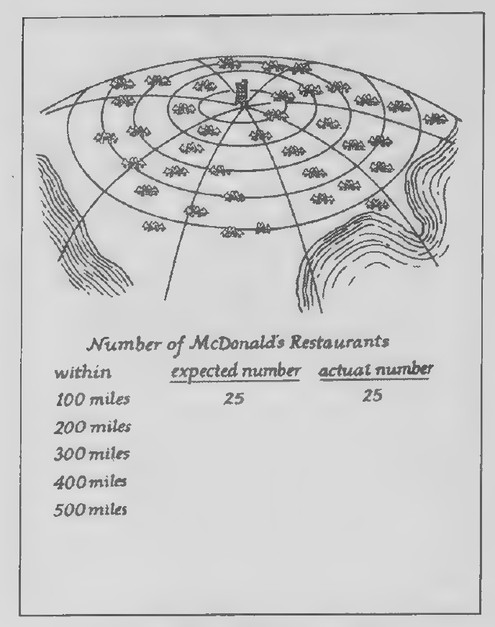 Transparency 16-R-5: McDonald’s restaurants around Kansas
explaining the nature of the universe. It is amazing to think that it is based on a geometry that is non- Euclidean.
Transparencies 16-R-2, 16-R-3, and 16-R-4 are for use in reviewing the proofs of the theorems in Lesson 4.
First day
Introduction
The first McDonald’s hamburger stand opened in 1940 and since then thousands of McDonald’s restaurants have opened in the United States.* Suppose that the president of McDonald’s wanted to find out how the restaurants are distributed through the country. Show Transparency 16-R-5. He might choose a point in the center of the United States—say Kansas City—and decide to count the number of restaurants within 100 miles from this point, 200 miles from it, 300 miles from it, and so on.
Suppose that there are 25 McDonald’s restaurants within 100 miles of Kansas City. If the restaurants are distributed uniformly throughout the country, how many would you expect to find within 200 miles of Kansas City? Because the area of a circle varies as the square of its radius, it would seem that there should be four times as many restaurants in the circle whose radius is twice as large. Within 300 miles of Kansas City, we might expect nine times as many restaurants, and so on. Complete the expected-number column at the bottom of the trans-
parency. The numbers are: 25, 100, 225, 400, and 625.
Now suppose that the actual numbers of restaurants turn out to be as shown here. (Add the overlay.) We see that, as we get further and further from Kansas City, the actual numbers of restaurants fall further and further behind what we had expected. Does this mean that the restaurants are not uniformly distributed but are concentrated around Kansas City?
The answer is no! Our calculations were based on the assumption that the earth’s surface is flat, but it is not. It is curved. Show Transparency 16-R-6. These figures represent the sets of points within 1, 2, 3,4, and 5 units from a given point ina plane and on a sphere. The relations of the areas of the circles on the plane are what we assumed in predicting the numbers of McDonald’s restaurants at various distances from Kansas City. The areas of a comparable set of circle on the sphere have a different relation. As their radii increase, their areas do not grow quite as fast. This explains how the restaurants could be uniformly distributed and yet fall short of the numbers we predicted.*
The point to be learned from this story is that, if we assume that something is uniformly distributed over a surface, we can determine whether the surface is flat (Euclidean) or curved (non-Euclidean) by measuring numbers of the thing at varying distances from a given point in the surface. This is one of the methods astronomers have used to try to de-
‘The decline in “actual” numbers of McDonald’s restaurants in the table on the overlay to Transparency 16-R-6 is actually highly exaggerated to make the point more obvious.
*This story is adapted from one by George Gamow in his book, Mr. Tompkins in Paperback (Cambridge University Press, 1965).
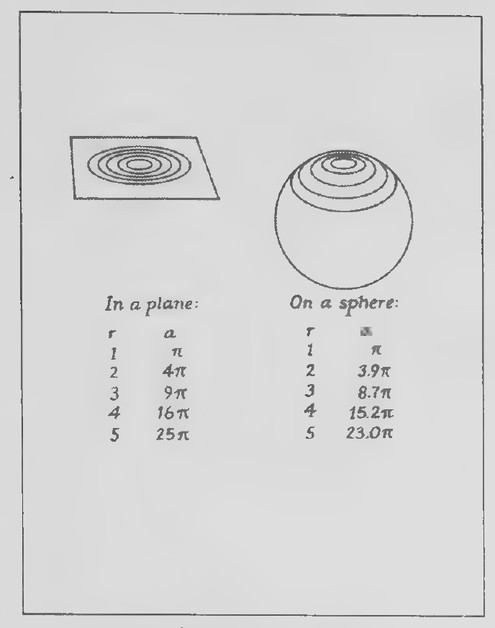 Transparency 16-R-6: Point distributions on a plane and on a sphere
 Transparency 16-R-7
termine whether physical space is Euclidean or non- Euclidean. Although the problem is now three-dimensional rather than two-dimensional, the principle is the same.
In a survey of radio sources in space, astronomers at Ohio State University discovered that the farther out in space one looks, the more the number of observed radio sources falls short of what one would expect if space were Euclidean.* If we assume that radio sources are uniformly distributed throughout space, one implication that can be drawn is that space is non-Euclidean in nature. This, as you may remember, is in agreement with Einstein’s theory of relativity.
It would be interesting to know, if there are other intelligent civilizations in the universe, whether they also began with Euclidean geometry as we did. Of course they would call it by a different name. Because, on a small scale, Euclidean geometry seems so obvious, this seems very probable.
It would also be interesting to know how long it took them to realize that there are other geometries which might fit physical space instead. It took mankind two thousand years to do so!
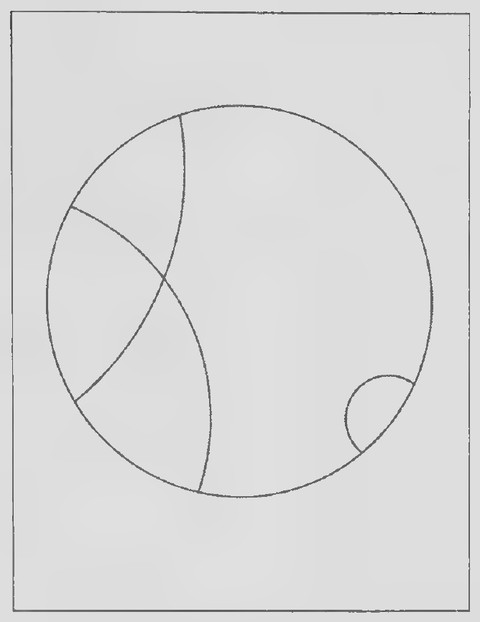
Transparency 16-R-7 and its overlay are for use in discussing Poincaré’s model of Lobachevskian geometry. Show it first with the overlay in place and then remove the overlay to review the idea of orthogonal circles. Escher was inspired to create Circle Limit IITin 1959 as the result of correspondence with the geometer H. S. M. Coxeter.
*From Relativity and Cosmology by William J. Kaufmann III (Harper and Row, 1973), pages 112-113.