Chapter 14: Regular Polygons and the Circle
Lesson 1: Regular Polygons
Lesson Outline
Terms: Regular polygon, center, radius, central angle, apothem. Theorem 74. Every regular polygon is cyclic.
Transparencies
- 14-1-1 Photograph of water-bug egg
- 14-1-2 Cyclic polygon figure
Introduction
The photograph on Transparency 14-1-1 was taken through an electron microscope by an entomologist. (A student who is familiar with the word might explain its meaning: a person who studies insects.) The photograph shows the surface of one of the eggs of a water bug. The extreme magnification (820x) reveals that the surface is covered with an elaborate network: this network seems to consist of polygons of various shapes. In what basic way are all of the polygons alike? (They are all convex.)
Add the overlay to the transparency and ask your students to identify the three polygons shown by name. The hexagon seems to be more symmetric than the other two. Why? (Because its sides and angles are close to being equal.) A convex polygon that is both equilateral and equiangular is called regular.
Following this introduction, hand out duplicated copies of Transparency 14-1-2 and use them
to develop the proof that every regular polygon is cyclic. The figure shows only part of a regular polygon to emphasize that the proof is independent of the number of sides.
Lesson 2: The Perimeter of a Regular Polygon
Lesson Outline
Theorem 75. The perimeter of a regular polygon
having n sides is 2Nr, in which N =n sin a and r is its radius.
Transparencies
- 14-2-1 Picture of Gauss
- 14-2-2 Regular polygon constructions
- 14-2-3 Construction of a regular 17-gon
- 14-2-4 A regular pentagon
Introduction
Carl Friedrich Gauss, whose picture is on Transparency 14-2-1, was born in 1777 and died in 1855. Now considered one of the greatest mathematicians of all time, Gauss made an interesting discovery about regular polygons when he was nineteen years old.
Show Transparency 14-2-2. In yesterday’s lesson, we proved that every regular polygon is cyclic. Constructing a regular polygon with a given number of sides is equivalent to being able to locate that number of equally spaced points on a circle. Add the overlay to Transparency 14-2-2. Euclid be-
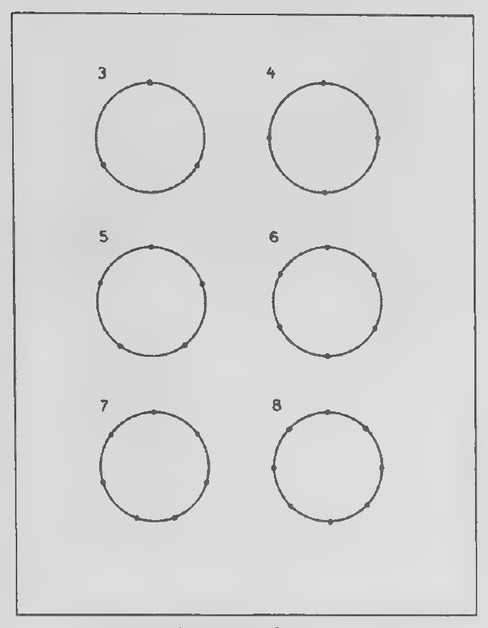 Transparency 14-2-2: Regular polygon constructions
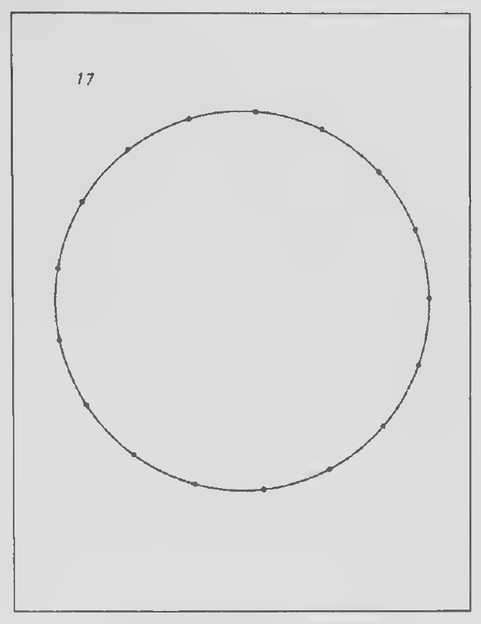 Transparency 14-2-3: Construction of a regular 17-gon
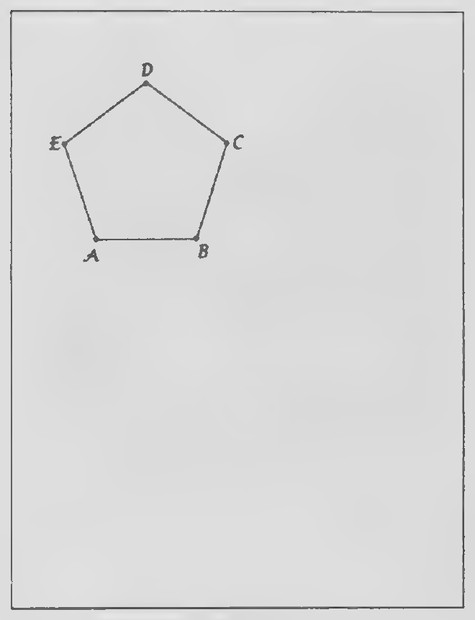 Transparency 14-2-4: A regular pentagon
gan the Elements with an explanation of how to construct the simplest of the regular polygons—the equilateral triangle. Later he showed how to construct several other regular polygons by inscribing them in circles. These include the square, regular pentagon, and regular hexagon. By bisecting their central angles, other regular polygons having twice as many sides can be constructed.
Notice that the regular heptagon is missing. Euclid omitted it from the Elements, and for more than two thousand years it was unclear as to whether it is possible to construct a regular heptagon with just a straightedge and compass. Finally, in 1796, Gauss proved that the construction is impossible.
Show Transparency 14-2-3. At the same time that Gauss proved that seven equally spaced points cannot be located on a circle with just a straightedge and compass, he made a surprising discovery: it is possible to locate seventeen evenly spaced points using these tools. The method for doing so, as you might imagine, is quite complicated. (Add the overlay to Transparency 14-2-3.) Through a long series of steps, the vertical segments at the left and right are drawn. These segments cut off an arc of the circle that is exactly two-seventeenths of it. This arc is then divided in half to produce an arc that is exactly oneseventeenth of the circle. The method is described, together with a brief history of the constructability of the regular polygons, in Introduction to Geometry, Second Edition, by H. S. M. Coxeter (Wiley, 1969), pages 26-28.
To use in deriving the equation for the perimeter of a regular polygon in terms of its radius, I
recommend providing your students with duplicated copies of Transparency 14-2-4. (Having a large, accurate figure to work with is important and this saves time that would be needed by your students to try to draw one.)
Lesson 3: The Area of a Regular Polygon
Lesson Outline
Theorem 76. The area of a regular polygon having n sides is Mr², in which M = ½n·sin(360°/n) and r is its radius.
Transparencies
- 14-3-1 Octagon Spa advertisement
- 14-3-2 Regular octagon
Introduction
The advertisement for the octagonal spa that is reproduced on Transparency 14-3-1 raises the question of how the area of a regular polygon might be determined. Explain that the central objective of this lesson is to derive an equation for the area of a regular polygon in terms of its radius and hand out duplicated copies of Transparency 14-3-2 for use in doing this.
After you have the equation, return to the octagon advertisement and show how its area can be determined. The dimension of the octagon given is its longest dimension: that is, the distance from a vertex to the opposite vertex. The radius of the octagon, then, is 3.5 feet. Guide your students in using their calculators to find its area. (It is approximately 34.7 square feet.)
 Transparency 14-3-1: Octagon Spa advertisement
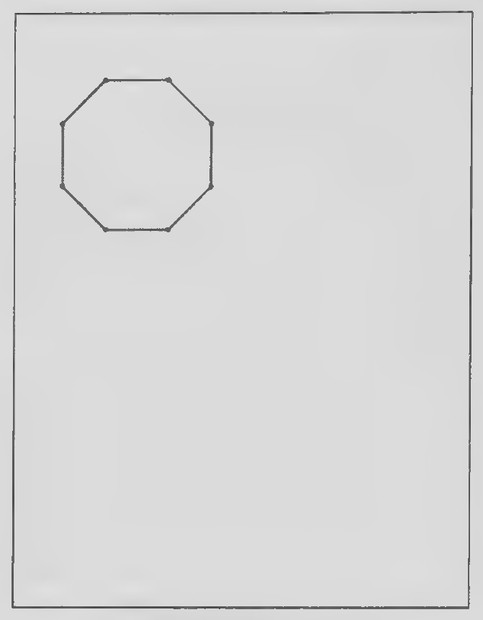 Transparency 14-3-2: Regular octagon
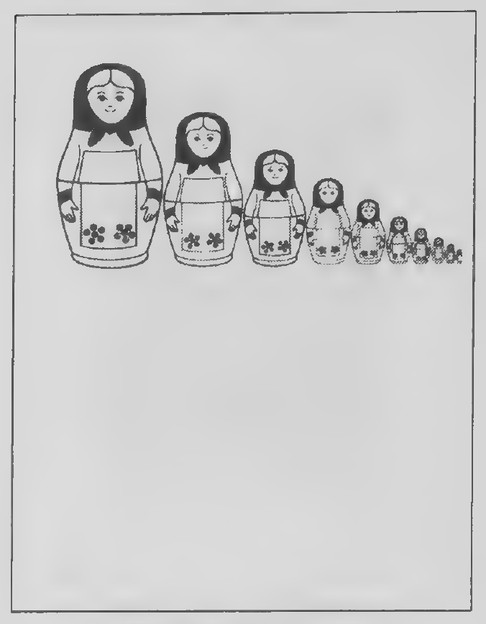 Transparency 14-4-1: Russian dolls in a row
Lesson 4: From Polygons to Pi
Lesson Outline
Terms: Circumference, limit, pi. Theorem 77. If the radius of a circle is r, its circumference is 2mr. Corollary. If the diameter of a circle is d, its circumference is Td.
Transparencies
- 14-4-1 Russian dolls in a row
- 14-4-2 Russian dolls in a stack
Introduction
Anice way to introduce the idea of a limit is to show a set of Russian Matreshka dolls. The dolls are wooden and nest inside each other to represent a sequence of generations. The set that I use consists of twelve dolls ranging in height from almost 20 cm to less than 1 cm. If you have such a set, your students will enjoy seeing the actual dolls. If not, the picture on Transparency 14-4-1 shows what they look like.
Each successive doll is about 75% as tell as the one before it. Suppose that there were no end to the smaller dolls and that this size ratio continued. To what number do you think the heights of the successive dolls would get closer and closer? Even though we would never come to a doll whose height is actually zero, we say that the heights of the dolls approach zero as a limit.
Show Transparency 14-4-2, keeping the table covered. Now suppose that, as we come to each successive doll, we stack them one on top of another. Do you think that we could make the stack as tall as
we please? For example, do you think if we had enough dolls, we could make a stack a mile high?
Show the table on Transparency 14-4-2 and explain that the first column represents the numbers of the dolls, the second column their heights, and the third column the heights of the stacks as more and more dolls are added. Beginning with the fifth line, the numbers have been rounded to four decimal places. After the tenth doll, the table jumps ahead to lines later in the sequence. What number does the height of the 100th doll seem very close to? What number does the height of the stack of the first 100 dolls seem very close to? If even more dolls were added to the stack, the height would continue to get closer and closer to 80 cm. For this reason, we say that it approaches 80 as a limit.
Following this introduction, the lesson on the circumference of a circle as the limit of the perimeters of the inscribed regular polygons can be presented as in the text.
Lesson 5: The Area of a Circle
Lesson Outline
Terms: Area of a circle.
Theorem 78. If the radius of a circle is 1, its area is πr².
Transparencies
- 14-5-1 Digits of pi
Introduction
Before class, I stretch adding machine tape on which I have written the value of 7 to several hundred decimal places across the front, a side, and back
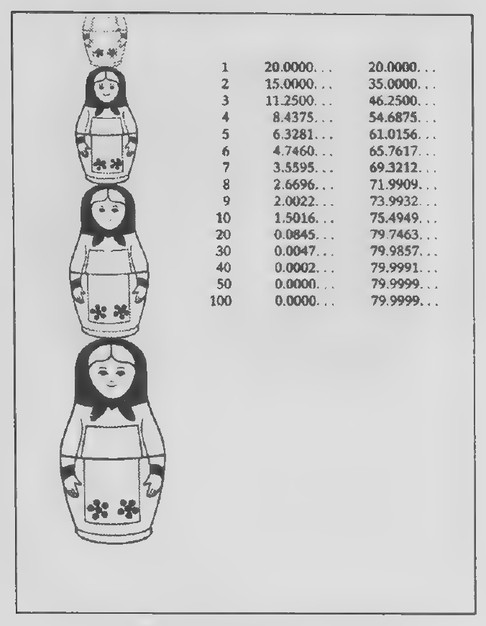 Transparency 14-4-2: Russian dolls in a stack
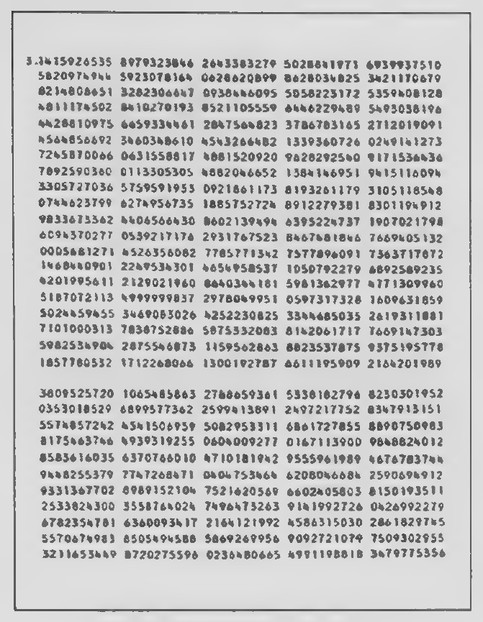 Transparency 14-5-1: Digits of pi
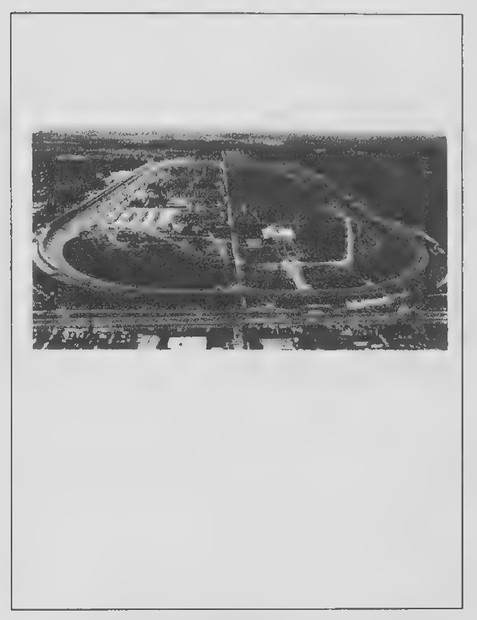 Transparency 14-6-1: Photograph of the Indianapolis Speedway
walls of my classroom. A table listing 1,650 decimal places of mis given on Transparency 14-5-1. I found a spacing of 2 inches per digit convenient. In lieu of the tape, you might, of course, simply show Transparency 14-5-1.
The history of tis very interesting. If you have a copy of the book A History of m by Petr Beckman (Golem Press, 1971), I recommend showing it to your class and then telling your students some of the story. The following outline lists some of the major events.
Tl Decimal Places 2000 B.C. Babylonians: 3 1/8 1 300 B.C. Euclid: 3.14 Z 1504.D. Ptolemy: 3.1416 4 1610 Van Ceulen $10)
Calculus invented in 17th century
1706* Machin 100 1873 William Shanks 707, but wrong after 526
Computers invented in 20th century
1949 ENIAC 2,000 1959 IBM 704 (Paris) >10,000 1961 IBM 7090 (New York) 100,000 1973 (Paris) 1,000,000 1981 (New York) 1,000,000,000 2002 (Tokyo) >1,000,000,000,000
Before the discovery of calculus, approximations of m were obtained from regular polygons. Ludolph van Ceulen, a sixteenth-century Dutch
professor of mathematics and military science, carried out his calculation of 7 to 35 decimal places by starting with a regular polygon having 60 sides and doubling 29 times to get a polygon having more than 32 billion sides!
One of my students once learned the value of 7 to 50 decimal places, but according to the Guinness Book of World Records, in 1981 a 23-year-old man in India recited 31,811 places of m from memory, part of which was broadcast over the radio. It took him more than three hours, going at a rate of more than 150 digits per minute! (One wonders how many listeners stayed tuned through all of this!)
Lesson 6: Sectors and Arcs
Lesson Outline
Terms: Sector, area of sector, length of arc.
Transparencies
- 14-6-1 Photograph of the Indianapolis Speedway
- 14-6-2 Diagram of the Indianapolis Speedway
Introduction
The Indianapolis Motor Speedway, shown in an overhead view on Transparency 14-6-1, opened in 1909 and the Indianapolis 500 began two years later.
Hand out duplicated copies of Transparency 14-6-2. The track, shown in this diagram, consists of four straight segments and four circular arcs. The inside rectangle is 0.14 mile wide and 0.61 mile long and the circular arcs have radii of 0.16 mile. (Write these dimensions on the diagram.) What is the length of the track? (2.5 miles: the straight sections total 1.5 miles and the curved sections 1 mile.) Why
*Also named rt in this year.
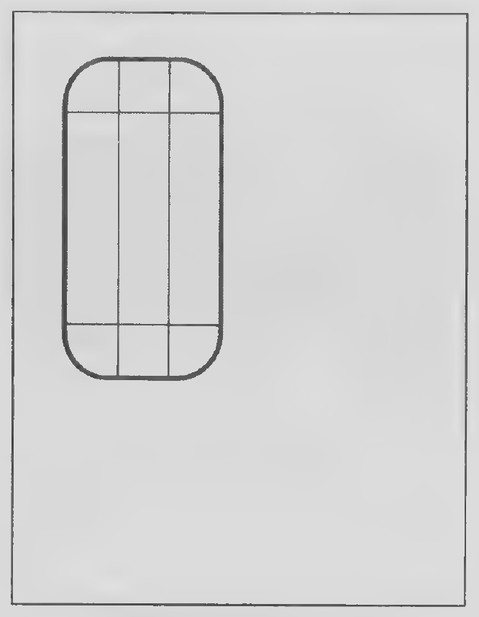 Transparency 14-6-2: Diagram of the Indianapolis Speedway
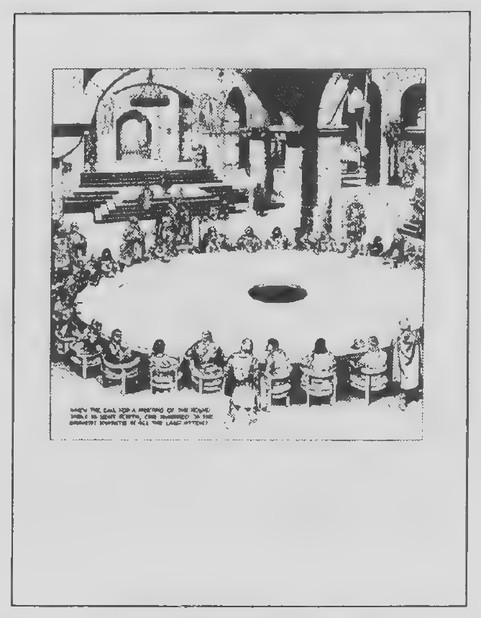 Transparency 14-R-1: King Arthur’s Round Table
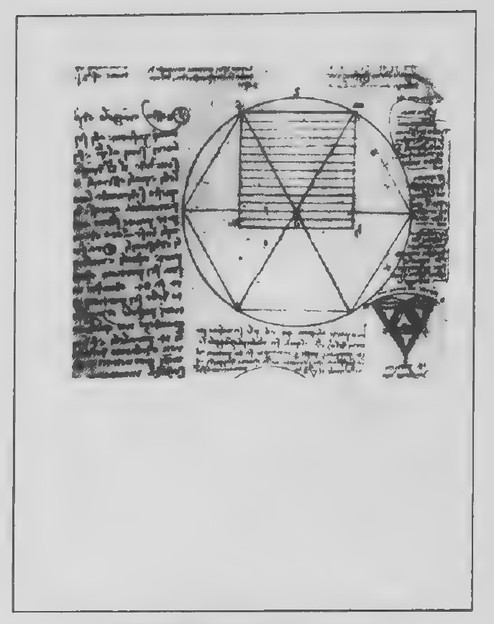 Transparency 14-R-2: Da Vinci’s attempt to square the circle
is the race called the Indianapolis 500? (Because it is 500 miles long.) How many times do the cars go around the track? (200.) How long does it take a car traveling 200 miles per hour to go once around the track? (45 seconds.)
What is the area of the region enclosed by the track? (Approximately 0.41 square mile.) The discussion of these calculations leads easily into a consideration of the topics of the new lesson: arc lengths, and sectors and their areas.
Review of Chapter 14
Transparencies
- 14-R-1 King Arthur’s Round Table
- 14-R-2 Da Vinci’s attempt to square the circle
- 14-R-3 Squaring a crescent
First day
Introduction
The drawing on Transparency 14-R-1 is of King Arthur’s Round Table and is from the “Prince Valiant” comic strip. You might ask your students to imagine that King Arthur and one hundred of his knights are seated at a round table and each person takes up two feet of the table’s circumference. How far is each man from the people seated farthest from him? (The men are at the vertices of a regular polygon having 101 sides. The problem is to find the length of one of its longest diagonals. The longest diagonals are slightly shorter than a diameter of the circle, but close enough to it that its length can be
used for the calculation. d = c/π = 2,002/π ≈ 64. The distance is about 64 feet.)
Second day
Introduction
One of the most famous problems in geometry is that of squaring the circle. To “square a circle” means to use only a straightedge and compass to construct a square that is equal in area to a given circle. Leonardo da Vinci devoted many hours to this problem. Part of a page of one of his notebooks in which he wrote about it is shown on Transparency 14-R-2. It was not until 1882 that it was proved that, like trisecting an angle, the problem of squaring the circle will never be solved.
Show Transparency 14-R-3. In the fifth century B.C., a Greek mathematician named Hippocrates discovered, in trying to square the circle, how to square the crescent-shaped region in this figure. Describe the figure as your students construct it. △ABC is an isosceles right triangle and D is the midpoint of its hypotenuse. The center of CEB is point A and the center of CFB is point D. Let DB = x. The area of the “crescent” can be expressed in terms of x by noticing that it is the difference of the areas of the circular segments CBFC and CBEC. The area of the segment CBEC, in turn, is the difference of the areas of the sector △BEC and △ABC. Using these clues, see if you can find an expression for the area of the “crescent” in terms of x.
Drawing DA forms isosceles right △ABD, and so AB = x√2.
αCEBFC = αCBFC − αCBEC = αCBFC − (αABEC − αΔABC) = ½πx² − [¼π(x√2)² − ½(x√2)²]
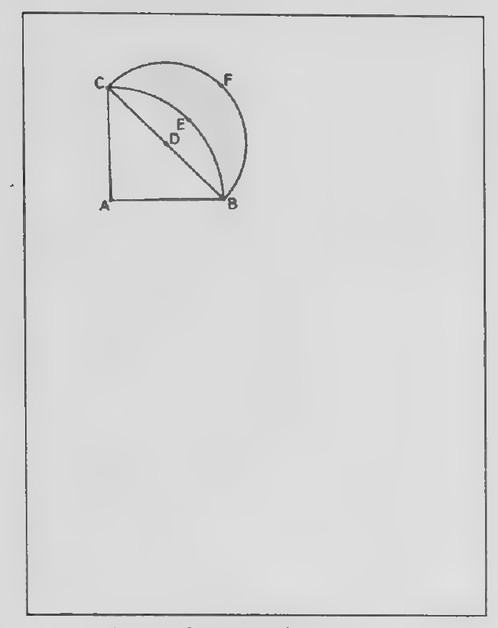 Transparency 14-R-3: Squaring a crescent
Using this result, can you think of a simple way to “square the crescent” by adding a square to the figure? (Because the area of the square is x², its side is x. DA and DB might be used as two sides of the square.)
According to the Greek historian Proclus, Hippocrates, who first figured all of this out, wrote an “Elements of Geometry” more than a century before Euclid wrote his Elements, but Hippocrates’ book, like most mathematical writing of that time, has been lost.
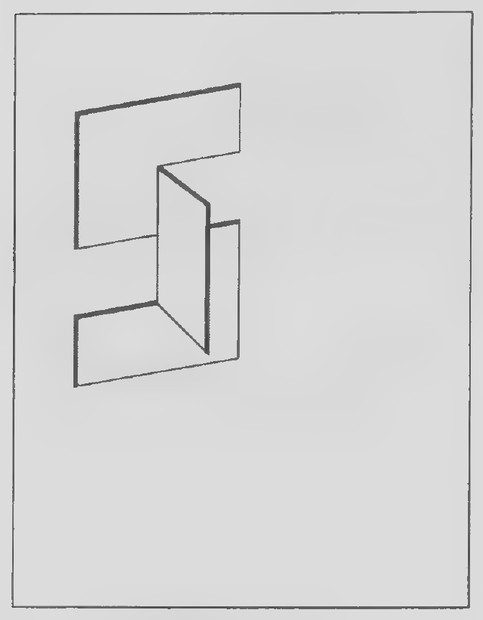 Transparency 15-1-1: File-card puzzle
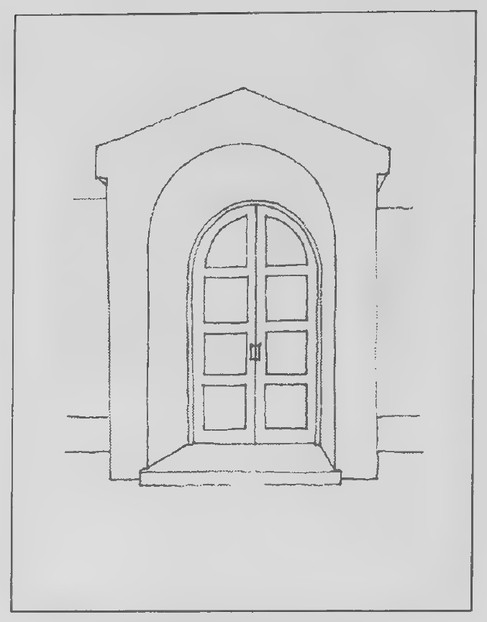 Transparency 15-1-2: Church porch
 Figure on page 394 — A rectangle divided into a square and a smaller similar rectangle (golden-rectangle construction)