Chapter 13: The Concurrence Theorems
Lesson 1: Triangles and Circles
Lesson Outline
Terms: Cyclic, circumcircle, circumcenter, polygon inscribed in a circle, circle circumscribed about a polygon. Theorem 68. Every triangle is cyclic.
Corollary. The perpendicular bisectors of the sides of a triangle are concurrent.
Construction 9. To circumscribe a circle about a triangle.
Transparencies
- 13-1-1 Locations of schools
Introduction
The following problem provides a nice introduction to the ideas of Lesson 1. I will describe it exactly as I present it to my own class; if it is not possible to recast the problem in terms of your own neighboring schools, you might state it in terms of fire stations or some other local landmarks.
Before Grant opened in 1959, the three high schools in this area were North Hollywood High, Van Nuys High, and Polytechnic High. Hand out a map comparable to the one on Transparency 13-1-1 to each student. This map shows the locations of these schools and of Grant. For simplicity, each school has been represented by a single point. As you can see, Grant is closer to North Hollywood High than to the other two schools. It might have
been better to have located Grant so that its distances to the three schools were the same. For convenience, we will refer to the points representing the schools by the first letters of their names. Guess, without doing any measuring, where you think the point that is equidistant from V, P, and N is located and mark it with a small x.
If the point that you have guessed is really equidistant from V, P, and N, it should be possible to draw a circle with it as center that passes through all three points. See if you can do this.
Can you think of a way to use your straightedge and compass to find the point equidistant from V, P, and N that does not involve any guessing? (If necessary, ask where the points that are equidistant from just two of these points are located.) After someone has suggested constructing the perpendicular bisectors of the segments joining the points, have your students draw △VPN and construct the perpendicular bisectors of two of its sides.
How close is the point in which the two lines intersect to the point you marked x? Try to draw a circle with the point in which the two lines intersect that passes through all three vertices of the triangle.
Explain that △VPN is called “cyclic.” The rest of the lesson can be developed as in the text.
 Transparency 13-2-2: Navigation chart
 Transparency 13-3-1: Map: Voyage of Columbus
 Transparency 13-3-2
Lesson 2: Cyclic Quadrilaterals
Lesson Outline
Theorem 69. A quadrilateral is cyclic iff a pair of its opposite angles are supplementary.
Transparencies
- 13-2-1 Oak Island in the news
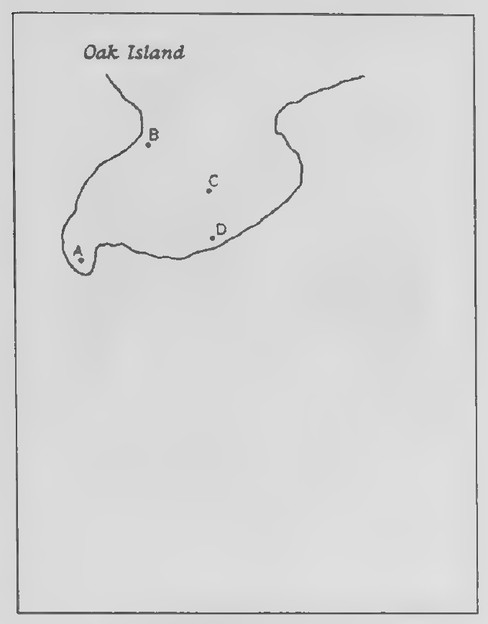
- 13-2-2 Map: Oak Island
Introduction
Ever since 1795, people have been searching for buried treasure on a small island off the coast of Nova Scotia. The island, named Oak Island, is pictured on Transparency 13-2-1. It has been speculated that as much as $30 million worth of treasure may be buried on the island, perhaps by Blackbeard the Pirate or Captain Kidd.
There is an elaborate maze of tunnels below the island’s surface, which engineers say must have taken several years to construct. Unfortunately for people looking for the treasure, these tunnels seem to have been designed to flood any holes that may be dug on the island. Even though little evidence of buried treasure has been discovered, the tunnel system may very well have been built to protect it from discovery.
Hand out duplicated copies of Transparency 13-2-2. This map shows the part of Oak Island where the treasure is thought to be buried. Can you find the exact spot, given that it is equidistant from the four lettered points on the map?
After your students have found the spot, observe that any three of the four lettered points are sufficient to locate it. Draw the circle that contains
all four points and the quadrilateral having those points as its vertices. Observe that this quadrilateral is cyclic because its vertices lie on a circle. After pointing out that, unlike triangles, not every quadrilateral is cyclic, present the rest of the lesson as in the text.
Lesson 3: Incircles
Lesson Outline
Terms: Circle inscribed in a polygon, polygon circumscribed about a circle, incircle, incenter.
Theorem 70. Every triangle has an incircle.
Corollary. The angle bisectors of a triangle are concurrent.
Construction 10. To inscribe a circle in a triangle.
Transparencies
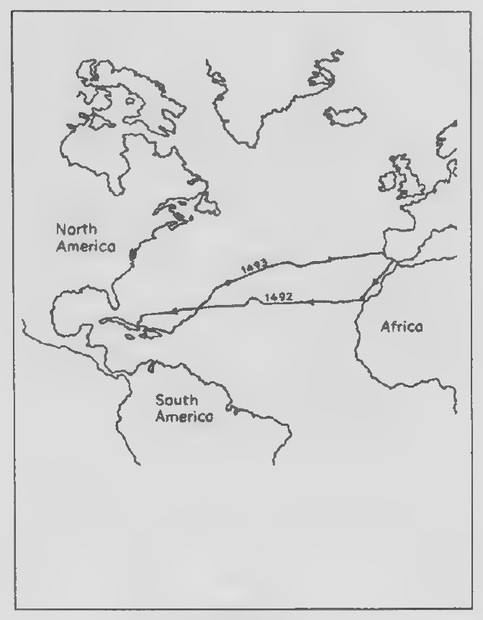
- 13-3-1 Map: Voyage of Columbus
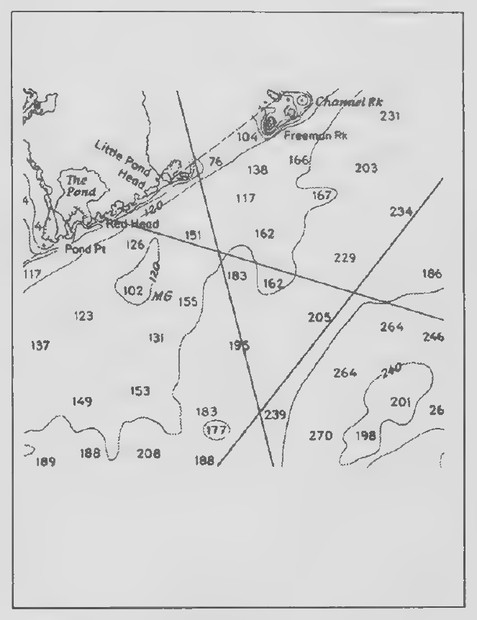
- 13-2-2 Navigation chart
Introduction
The map on Transparency 13-3-1 shows the paths of Columbus’s ships in his historic voyage from Spain to the New World and back again. Although pilots of modern ships have several methods for determining their positions at sea, Columbus used celestial navigation. He kept track of where he was by observing the sun and moon, the planets, and the stars.
A navigator records each sighting as a line on a chart. Three lines are usually used, and, if there are no inaccuracies, they intersect in a point that is the ship’s position. Hand out duplicated copies of Transparency 13-3-2. This figure shows what usually hap-
 Transparency 13-4-1: A problem of gravity
pens: the three lines do not intersect in a common point, but form a triangle. The navigator takes the point that is equidistant from the sides of the triangle as the position of the ship. According to the standard reference on navigation, this point “can be determined geometrically or by computation, but in normal practice the navigator estimates it by eye.”* a Have your students estimate the point that is equidistant from the sides of the triangle by eye. Remark that if the point is correct, it should be possible to draw a circle with this point as center that is tangent to each side of the triangle. A discussion of how to do this leads into the rest of the ideas of the lesson.
Lesson 4: The Centroid of a Triangle
Lesson Outline
Terms: Median, centroid, orthocenter.
Theorem 71. The medians of a triangle are concurrent.
Theorem 72. The lines containing the altitudes of a triangle are concurrent.
Transparencies
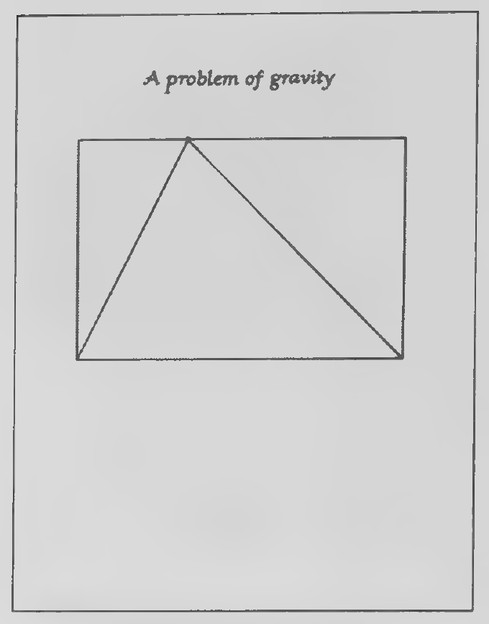
13-4-1_ A problem of gravity
Introduction
Give each student an unlined 4-in x 6-in file card and a pair of scissors. Have your students mark the point on the upper edge 2 inches from the left cor-
ner as shown on Transparency 13-4-1 and draw lines from this point to the lower left and right corners of the card. Cut along these lines and put the two smaller pieces aside.
It is easy to balance the largest triangular piece on three fingers so that it is horizontal. (Illustrate this and have everyone do it.) It is not as easy to balance it on just two fingers. Can you do it? Can you balance the “triangle” on just one finger? (After a few attempts, most students should be able to do this.) Now a very challenging question. Can you balance the “triangle” on the metal point of your compass? You may poke a small hole in the card at whatever point you think will work. (It is unlikely that anyone will be able to guess the precise point on which the triangle may be balanced.)
Let’s see if we can find the balancing point by construction. Make a careful tracing of the triangular piece on a sheet of paper. What lines do you think we should draw in order to find the balancing point? (Have everyone try out any suggestions made. Someone will probably guess that the triangle will balance on its circumcenter and someone else its incenter. When each of these points has been located, it should be labeled on the card. After discovering that neither point will work, someone may think of the triangle’s altitudes. If so, construct them, and, after the class has observed that they seem to be concurrent, label the point as the orthocenter. Because the idea of a median ina triangle has not been considered previously in the course, no one may think of drawing the medians. If this is the case, you might give the following clues.)
It seems that, if the triangle is to balance on one
*Dutton’s Navigation and Piloting, 14th edition, by Elbert S. Maloney (Naval Institute Press, 1985), page 417.
 Transparency 13-5-1: Cartoon of geometers and triangle
 Transparency 13-5-2: Encyclopedia Britannica article on Ceva
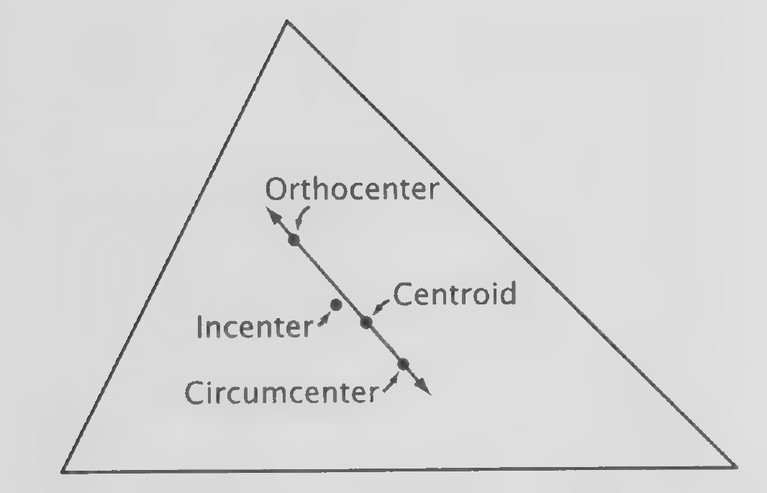 Figure on page 383 — A triangle with its orthocenter, incenter, centroid, and circumcenter marked
and half on the other. In other words, each of the line determining this point should divide the triangle in half. Where do you suppose a line from one vertex of the triangle should be drawn in order to divide the triangle in half? (To the midpoint of the opposite side.) After everyone has drawn the medians, observe that they also seem to be concurrent and then let everyone see if the triangle will
ce: balance on this point.
Proofs that the medians of oe triangle neon current and that the lines containing the altitudes are concurrent are considered in the exercises of the
lesson.
Lesson 5: Ceva’s Theorem
Lesson Outline
Terms: Cevian.
Theorem 73. Ceva’s Theorem. Three cevians, AY, BZ, and CX, of △ABC are concurrent iff
Transparencies. 13-5-1 Cartoon of geometers and triangle 13-5-2 Encyclopedia Britannica article on Ceva
Introduction
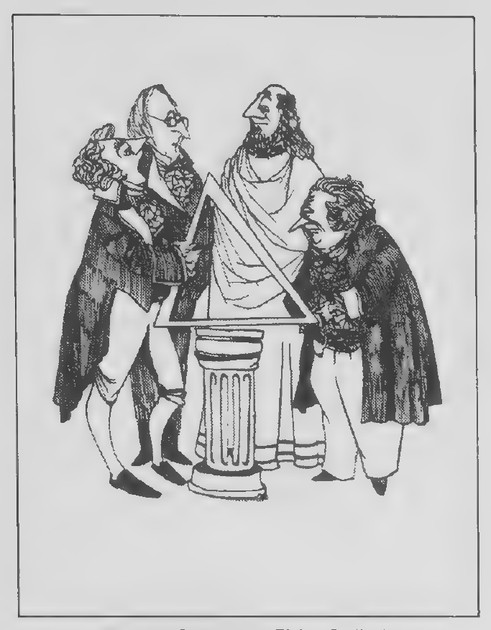
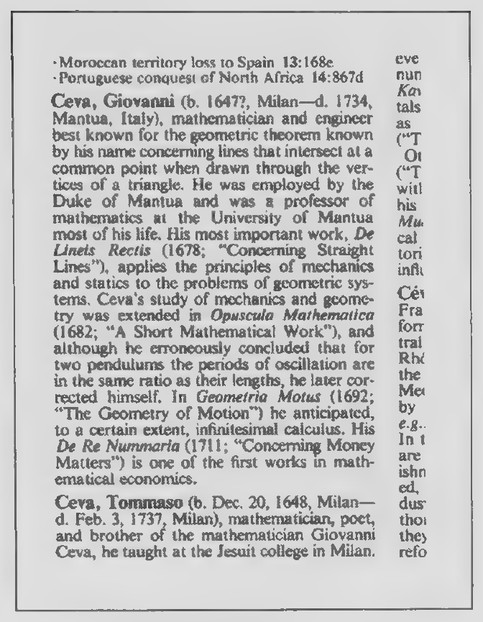
The cartoon on Transparency 13-5-1 was drawn by Kenneth J. Neal when he was a student at Penn Hills High School in Pittsburgh. It illustrates an imaginary discussion of the triangle between a Greek mathematician—perhaps Euclid or Pythagoras—and some European mathematicians of the seventeenth century. One of these mathematicians might be Ceva, whose theorem is the subject of the new lesson. Before introducing the theorem and its proof, show Transparency 13-5-2, on which the article on Ceva in the micropedia section of the Encyclopedia Britannica is reproduced. I recommend having your students draw the figures and write the key equations in the proof that if the cevians are concurrent, the product of the ratios is equal to one. The proof
of the converse is probably best left to be read as part of the assignment.
 Transparency 13-6-1: Something old and something new
 Transparency 13-6-2: Encyclopedia Britannica article on Morley’s
 Transparency 13-R-1: A nine-point surprise
Lesson 6: Napoleon’s Discovery and Other Surprises
Lesson Outline
Transparencies
- 13-6-1 Something old and something new
- 13-6-2 Encyclopedia Britannica article on Morley’s
Theorem
Introduction
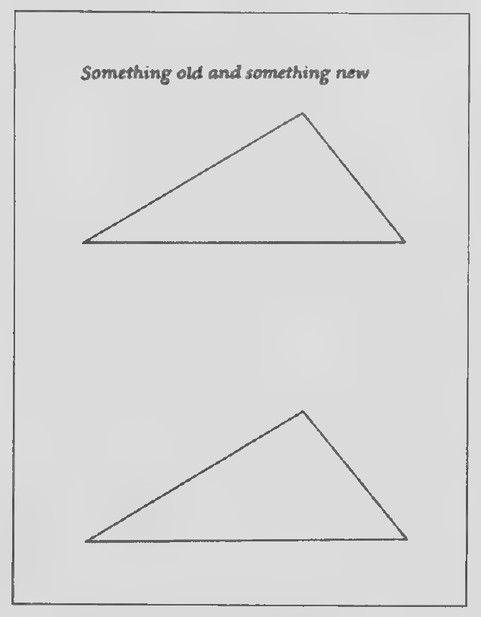
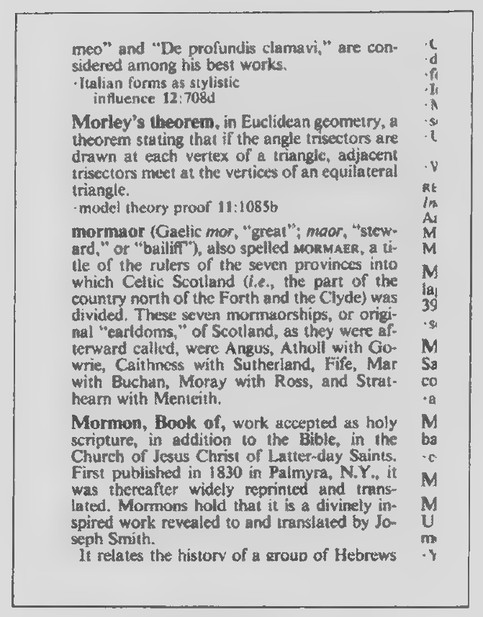
Hand out duplicated copies of Transparency 13-6-1. If the calendar were suddenly turned back 2,000 years and you were still a high school (or college) student, you wouldn’t be taking some of the courses that you take now because they wouldn’t exist. Other courses that you are taking would probably be radically different from what they are now. Much of geometry, however, would be very much the same.
For example, the fact that the angle bisectors of every triangle are concurrent is established in Euclid’s Elements. Use your straightedge and compass to construct, as accurately as you can, the angle bisectors of the first triangle on the sheet you have been given. After your students have done this, have them label the figure “The angle bisectors of a triangle are concurrent—proved by Euclid c. 300 B.C.”
What would happen if, instead of bisecting the angles of a triangle, we trisected them? You may recall that it is impossible to trisect most angles with: just a straightedge and compass. Because this is the case, we will use a protractor instead. Give your students time to draw the trisectors of the three angles as accurately as they can. To make this easier, the triangle has been drawn so that the measures of its
angles are 30°, 51°, and 99°. Demonstrate the procedure on the overhead projector. If the three points of intersection of the adjacent trisectors of the angles are connected with line segments, an equilateral triangle is formed!
This is a relatively new theorem in elementary geometry because it was discovered at the end of the nineteenth century. Label the figure “The angle trisectors of a triangle determine the vertices of an equilateral triangle—discovered by Frank Morley in 1899.” Frank Morley was a professor of mathematics at Johns Hopkins University and the father of the author Christopher Morley. It was not until ten years after Morley made this discovery that someone figured out how to prove it. The entry on Morley’s Theorem in the Encyclopaedia Britannica is on Transparency 13-6-2. A proof of the theorem can be found in Geometry Revisited by H. S. M. Coxeter and S. L. Greitzer, a book in the New Mathematical Library (M.A.A., 1967) but it is by no means easy.
Review of Chapter 13
Transparencies
- 13-R-1 A nine-point surprise
- 13-R-2 Review: The spotter’s puzzle
First day
Introduction
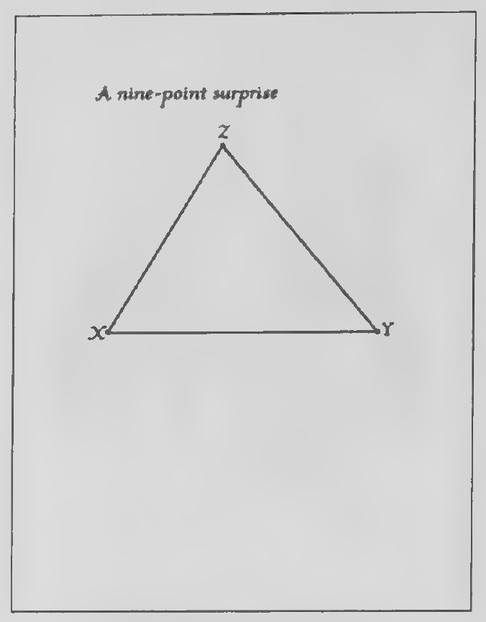
Hand out duplicated copies of Transparency 13-R-1. The following directions are for a rather elaborate construction that provides a good review of ideas as well as having an interesting result. First, construct the three altitudes of the triangle and name them XE, YG, and ∠A. Label the orthocenter of the
 Transparency 13-R-2: Review: The spotter’s puzzle
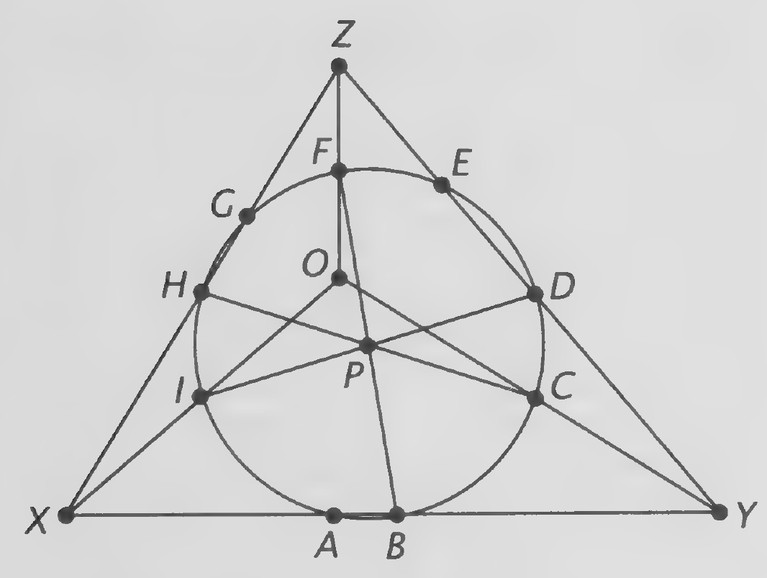 Figure on page 385 — A triangle with an inscribed circle, a circumscribed circle, and the Euler line through its centers
Next, bisect the three line segments connecting the orthocenter of the vertices of the triangle. Label their midpoints as follows: OX, midpoint I; OY, midpoint C; OZ, midpoint F.
Next, find the midpoints of the sides of the triangle and label them as follows: XY, midpoint B; YZ, midpoint D; XZ, midpoint H.
What do you notice? (The points labeled A through I appear to lie on a circle.) That the nine points we have labeled A through I should lie on a circle is quite remarkable. It is not difficult to find the center of the circle because six of them are the endpoints of three of the circle’s diameters. Can you guess which points these are? (The three diameters are FB, HC, and ID.) Draw the three diameters, label the point in which they are concurrent P, and draw the “nine-point” circle.
Two interesting properties of the “nine-point” circle are that its center is the midpoint of the line segment connecting the orthocenter and the circumcenter of the triangle and that its radius is half the radius of the circumcircle of the triangle.
Some of your better students might be interested in seeing a proof of why the nine points lie on a circle. An especially straightforward one is in Excursions in Geometry by C. Stanley Ogilvy (Oxford University Press, 1969), pages 119-120. Historians are not sure who first noticed the “nine-point” circle. The first proof of its existence seems to have been published in 1821.
Second day
Introduction
This is an appropriate point at which to reconsider the spotter’s puzzle introduced at the beginning of the course. Begin by showing Transparency 0-4 and recalling the story of the surfer and the spotter. Your students may have already proved that it doesn’t matter where the surfer builds his house on the island: the sum of the lengths of the perpendicular segments to the sides from every point on the island is the same.*
For the spotter, who wanted to build his house so that the sum of the lengths of the paths from it to the three corners of the island is aminimum, the situation is quite different. The sum depends on the position of the point. Show your students Transparency 0-5 and its overlay to remind them that the sum seems to be the smallest at the “center” of the
*See Chapter 9, Lesson 3, exercises 29-34, on page 355.
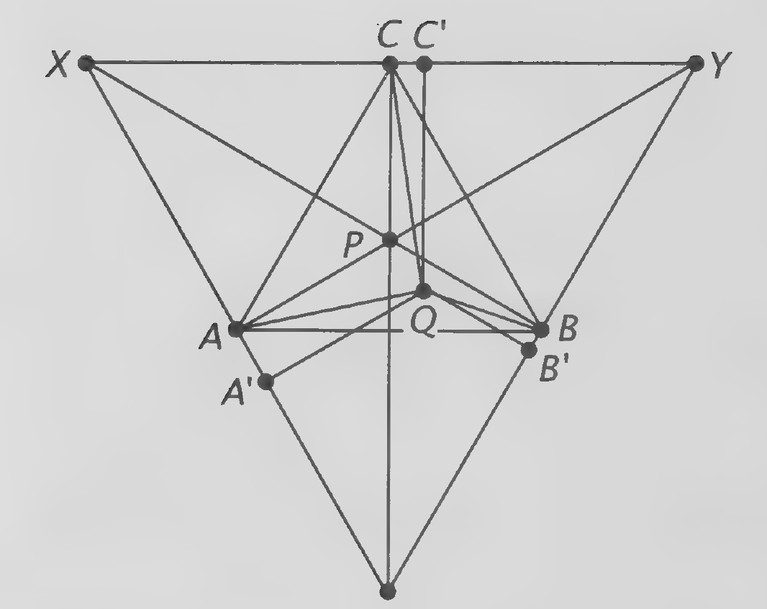 Figure on page 386 — Two similar right triangles sharing a vertex, with the perpendicular segments that give the proportions marked
triangle.
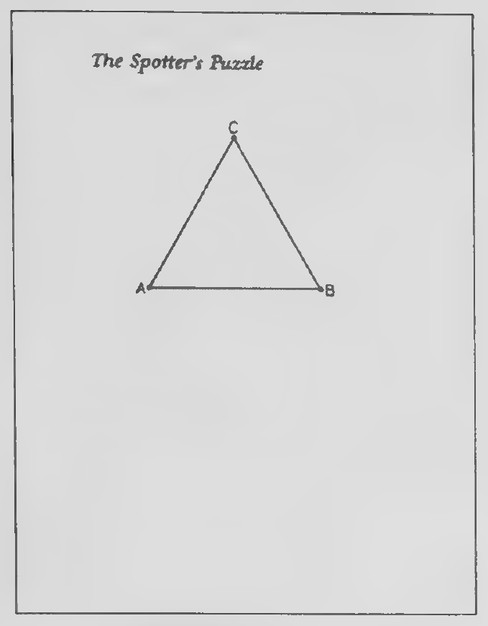
Hand out duplicated copies of Transparency 13-R-2 and ask how the “center” of the triangle can be found. Using congruent triangles, it is easy to show that the angle bisectors, altitudes, medians, and hence, the perpendicular bisectors of the sides, of an equilateral triangle are all the same. So the four centers of the triangle that are determined by these lines are the same point. Find the point and label it P. Notice that ∠APB = ∠BPC = ∠CPA = 120° because the six small triangles formed by the lines are 30°-60° right triangles.
(Ss
BN
A
Next, choose any other point in the triangle, label it Q, and draw QA, QB, and QC. We will show that PA + PB + PC is less than QA + QB + QC and thus prove that the sum of the lengths of the paths from point P to the three vertices is less than the sum from any other point, such as Q.
To do this, we draw lines through the vertices of △ABC so that they are perpendicular to PA, PB, and PC. Label the triangle formed by these lines
△XYZ as shown in the figure above. Looking at quadrilateral XAPC, we see that ∠XAP = 90°, ∠APC = 120°, and ∠PCX = 90°, and so ∠CXA = 60°. By the same reasoning, we can conclude that the other two angles of △XYZ also have measures of 60°, and so △XYZ is equiangular and hence equilateral.
Now draw perpendicular segments from to the sides of △XYZ and label them as shown. Notice that QA’ < QA, QB’ < QB, and QC’ < QC because the perpendicular segment from a point to a line is the shortest segment connecting them.
Finally, observe that we have shown △XYZ to be equilateral and recall that, in reviewing the surfer’s puzzle, we proved that for an equilateral triangle, the sum of the lengths of the perpendicu-
lar segments to the sides from every point in the triangle is the same. Therefore,
PA + PB + PC = QA’ + QB’ + QC’. We have shown that QA’ < QA, QB’ < QB, and @Cy—OG 750
QA’ + OB’ + OC’ =QA + QB + QC, and hence,
PA + PB + PC <QA+ QOB+ QC.
This proof that P is the minimum point was invented by Evangelista Torricelli, an Italian mathematician who also invented the barometer. If the original triangle is not equilateral, then point P is not the circumcenter, incenter, orthocenter, or centroid, but a fifth point called the “Fermat point.” This point is named for Pierre Fermat, who first proposed the general version of the spotter’s problem in the seventeenth century. It is the point such that the segments joining it to the vertices of the triangle form equal angles of 120°.
More information on Fermat’s problem can be found in Mathematical Gems I by Ross Honsberger (M.A.A., 1973), pages 24-34.
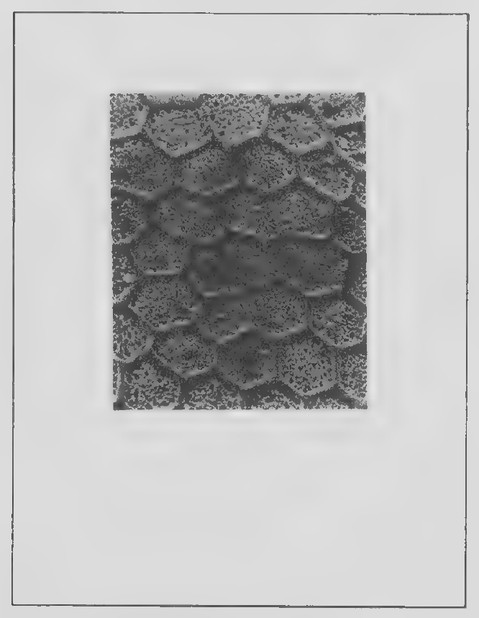 Transparency 14-1-1: Photograph of water-bug egg
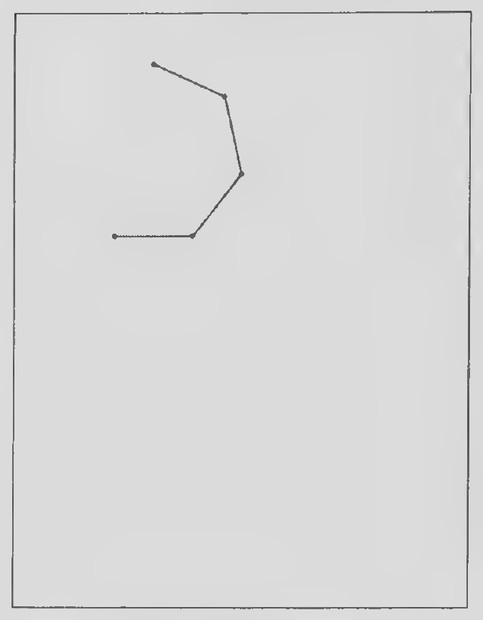 Transparency 14-1-2: Cyclic polygon figure
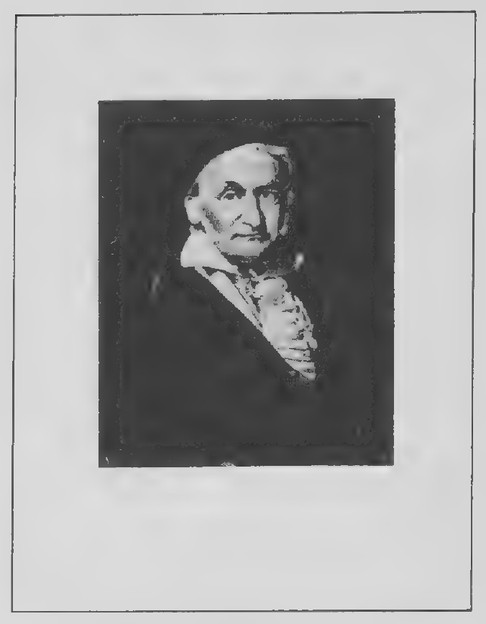 Transparency 14-2-1: Picture of Gauss