Chapter 12: Circles
Lesson 1: Circles, Radii, and Chords
Lesson Outline
Terms: Circle, concentric, radius, chord, diameter. Corollary to the Definition of a Circle. All radii of a circle are equal. Theorem 56. If a line through the center of a circle is perpendicular to a chord, it also bisects the chord. Theorem 57. If a line through the center of a circle bisects a chord that is not a diameter, it is also perpendicular to the chord. Theorem 58. The perpendicular bisector of a chord of a circle contains the center of the circle.
Transparencies
12-1-1_ Photograph of Anchorage earthquake 12-1-2. Map: California
Introduction
The photograph on Transparency 12-1-1 was taken in downtown Anchorage, Alaska, after an earthquake in 1964. The street in the picture was not very far from the earthquake’s epicenter, or point of origin.
Scientists are now able to locate the epicenter of an earthquake quite accurately, even though it may be hundreds of miles from any populated area. When an earthquake occurs, its vibrations are recorded by seismographs. The graph on Transparency 12-1-1 was made on a rotating drum ina seis-
mograph and shows the shock waves of an earthquake. The vertical segments mark off minutes. A little after two minutes from the beginning of the hour, the primary, or P, wave appeared; about five minutes later, it was followed by a secondary, or S, wave. By measuring the time interval between these two waves, seismologists can determine the distance the waves traveled and, hence, how far away the epicenter is.
Hand out duplicated copies of Transparency 12-1-2. Suppose that the waves of an earthquake are picked up by a seismograph at Cal Tech in Pasadena and that they show the epicenter is 230 miles away. Where could the epicenter be? (Somewhere on a circle with a radius of 230 miles and Pasadena as its center.) Have your students set their compasses to this radius, using the scale at the bottom of the map, and draw the circle. Suppose that a seismograph at the University of California at Berkeley, on the other hand, shows that it is 210 miles away from the epicenter of the same earthquake. Draw a second circle having this radius and with its center just above Oakland. What does this tell us about the location of the epicenter? (It could be in one of two places.) Suppose that the University of Nevada at Reno reports that the earthquake is 170 miles away. Draw a circle to illustrate this. What can you conclude from the three circles? (That the epicenter is the point in which they intersect, near Bishop, California.)
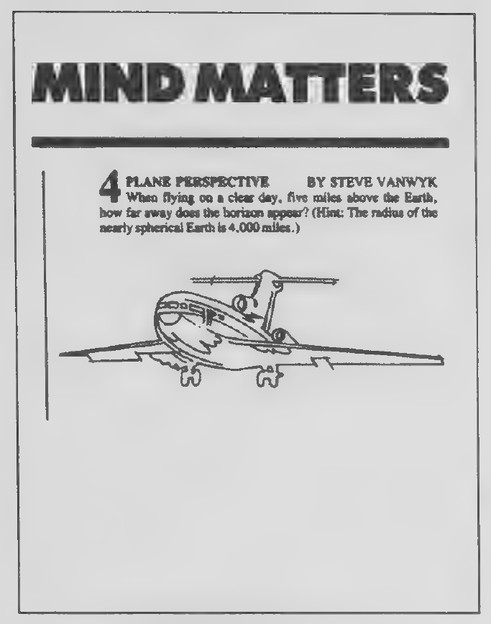 Transparency 12-2-1: Plane-perspective problem
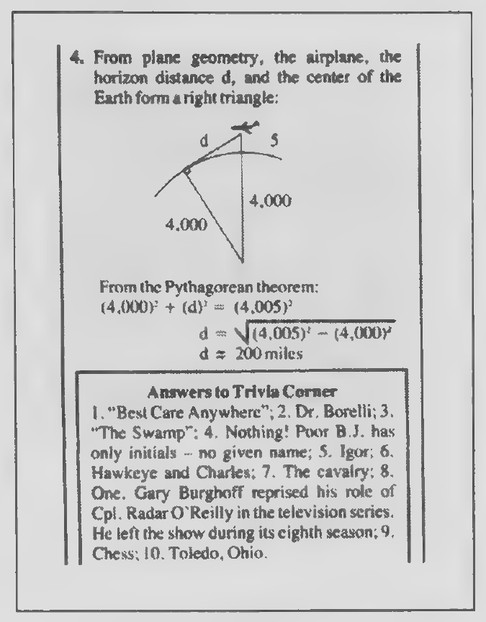 Transparency 12-2-2: Plane-perspective solution
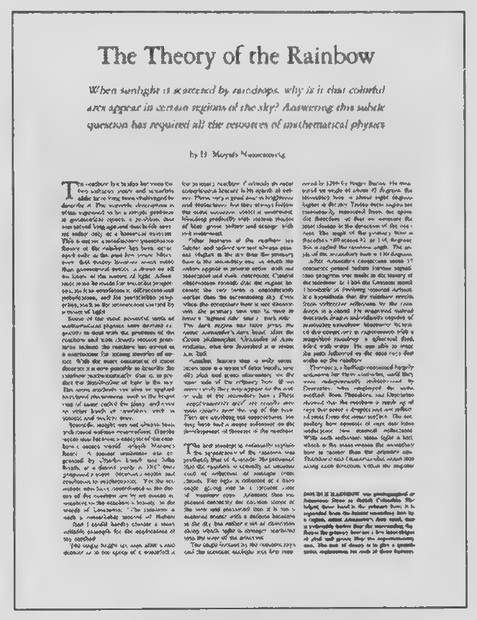 Transparency 12-3-1: “The Theory of the Rainbow”
After remarking that the circle is of great importance in geometry, both because of its many interesting properties and because of its wide variety of practical applications, you might either present the lesson as in the text or assign it for individual study.
Lesson 2: Tangents
Lesson Outline
Terms: Tangent line.
Theorem 59. If a line is tangent to a circle, it is perpendicular to the radius drawn to the point of contact.
Theorem 60. If a line is perpendicular to a radius at its outer endpoint, it is tangent to the circle.
Transparencies
- 12-2-1 Plane-perspective problem
- 12-2-2 Plane-perspective solution
Introduction
The problem on Transparency 12-2-1 appears in an issue of the in-flight magazine published by Delta Airlines. Help your students draw a figure to illustrate it, introducing the term tangent as you do so. As you draw the radius to the point of contact, ask how it seems to be related to the tangent. Explain that this can be proved, so that it is correct to assume that the triangle with its vertices at the airplane, the horizon point, and the center of the earth is a right triangle.
In discussing the solution, it is worth noting that the answer can be estimated without a calculator by factoring rather than squaring:
d = (4,005)? — (4,000)?
— (4,005 + 4,000)(4,005 — 4,000)
= +(8,005)(5) = 440,000
= 200. The horizon appears about 200 miles away.
After finding the solution, your students will be interested in seeing Transparency 12-2-2, on which the answer given in the airline magazine appears. Obviously only passengers who had taken geometry would have been able to solve this problem—or even understand the solution given.
Remind your students that, in finding the solution, we assumed that the tangent is perpendicular to the radius drawn to the point of contact. This proof of this theorem and its converse can then be presented as in the text.
Lesson 3: Central Angles and Arcs
Lesson Outline
Terms: Semicircle, minor arc, major arc, central angle, reflex angle, degree measure of an arc.
Postulate 10. The Arc Addition Postulate. If C is on AB, then mAC + mCB = mACB.
Theorem 61. Ina circle, equal chords have equal arcs.
Theorem 62. In a circle, equal arcs have equal chords.
Transparencies
- 12-3-1 “The Theory of the Rainbow”
- 12-3-2 Photograph of rainbow
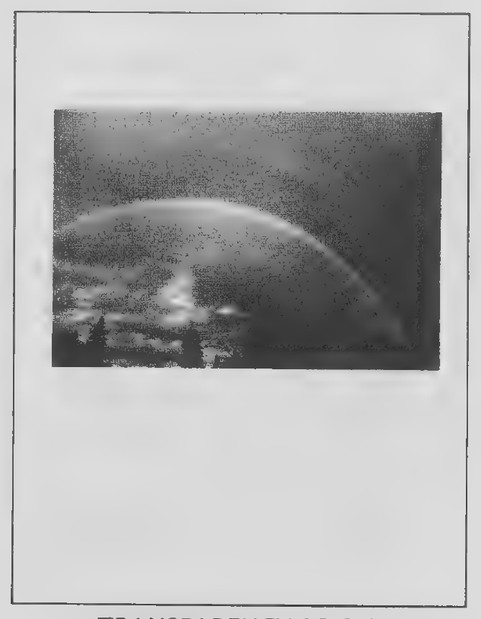 Transparency 12-3-2: Photograph of rainbow
 Transparency 12-4-1: Longest field goal
 Transparency 12-4-2: Football field diagram
Introduction
The Greek philosopher Aristotle is thought to have been the first person to try to explain the rainbow. A lengthy article about the modern theory of the rainbow appeared in the April 1977 issue of Scientific American; the first page of this article is reproduced on Transparency 12-3-1. It, together with the rainbow photograph that appears on Transparency 12-3-2, would make a nice introduction to the new lesson. The lesson can then be presented as in the text.
Lesson 4: Inscribed Angles
Lesson Outline
Terms: Inscribed angle.
Theorem 63. An inscribed angle is equal in measure to half its intercepted arc.
Corollary 1. Inscribed angles that intercept the same arc are equal.
Corollary 2. An angle inscribed in a semicircle is a right angle.
Transparencies
- 12-4-1 Longest field goal
- 12-4-2 Football field diagram
Introduction
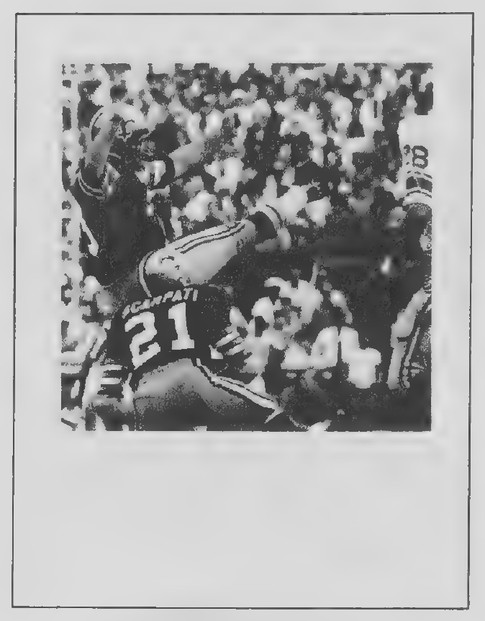
The longest field goal in professional football was kicked by Tom Dempsey in a game between the New Orleans Saints and the Detroit Lions in 1970. The kick, shown on Transparency 12-4-1, covered a distance of 63 yards and is especially amazing because Dempsey has had only half a right foot since birth.
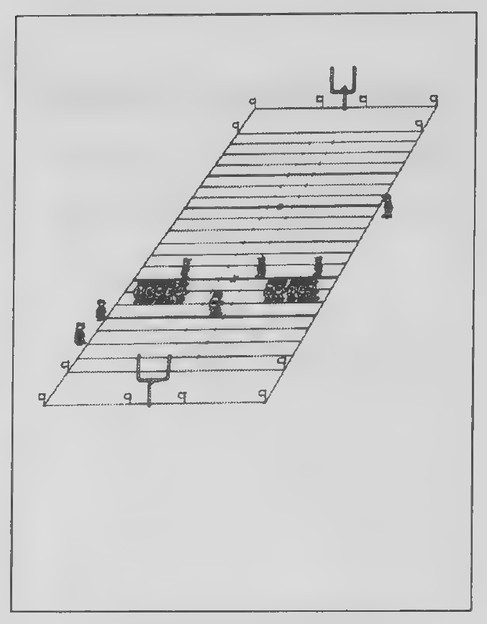
Mark a point on Transparency 12-4-2 to represent a spot 53 yards from the upper goal line (the distance from the goal line to the goal post is 10 yards) and draw rays from that point to the lower corners of the goal post. To make the goal, Dempsey had to kick the ball within this angle, which has a measurte of less than 6°! At what other spots on the field would the angle be the same? Explain that the answer to this question comes from a theorem of the new lesson and present the rest of the lesson as in the text. After the lesson has been completed, show Transparency 12-4-2 again. Explain that the other points on the field for which the goal post angle is the same lie on a circle that contains the kicking point and the corners of the goal post. We know that the angles are equal because of the corollary that inscribe angles that intercept the same arc are equal.
Lesson 5: Secant Angles
Lesson Outline
Terms: Secant, secant angle.
Theorem 64. A secant angle whose vertex is inside a circle is equal in measure to half the sum of the arcs intercepted by it and its vertical angles.
Theorem 65. A secant angle whose vertex is outside a circle is equal in measure to half the difference of its larger and smaller intercepted arcs.
Transparencies
- 12-5-1 Cinerama projector system
 Transparency 12-5-1: Cinerama projector system
 Transparency 12-6-1: Galileo and the moon
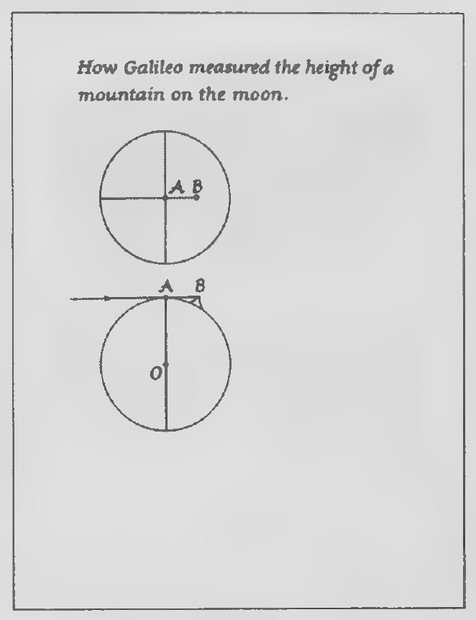 Transparency 12-6-2: How Galileo measured the height of a mountain on the moon
Introduction
In the 1950s, a motion-picture process using three projectors and a curved screen was introduced. Called “Cinerama,” this process produced a stronger sense of reality than the ordinary flat screen, but it was so expensive to operate that it was given up in the 1960s.
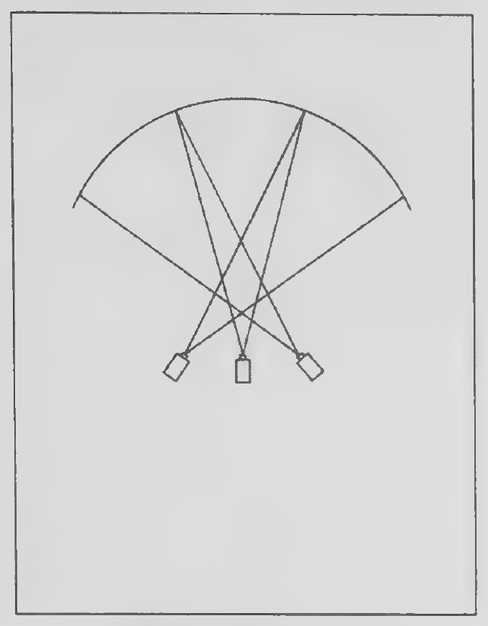
The figure on Transparency 12-5-1 is an overhead view of a Cinerama auditorium, showing the screen and projectors. Add Overlay A and explain that the circle has been divided into 10° arcs. Each projector, then, covers 40° of the screen. Place Overlay B so that the vertex of the projector angle falls on the center of the circle. From the intercepted arc, we see that the projector angle has a measure of 30°. Now, place Overlay B in positions to illustrate an inscribed angle and a secant angle whose vertex is inside a circle. Overlay C can be used to illustrate secant angles whose vertices are outside a circle. After your students have discovered the measure relations between secant angles whose vertices are inside and outside a circle and their intercepted aracs, the proofs of the two secant angle theorems can be developed as in the text.
Lesson 6: Tangent Segments and Intersecting Chords
Lesson Outline
Terms: Tangent segment.
Theorem 66. The Tangent Segments Theorem. The tangent segments to a circle from an external point are equal.
Theorem 67. The Intersecting Chords Theorem. If
two chords intersect in a circle, the product of
the lengths of the segments of one chord is
equal to the product of the lengths of the
segments of the other chord.
Transparencies
- 12-6-1 Galileo and the moon
- 12-6-2 How Galileo measured the height of a
mountain on the moon
Introduction
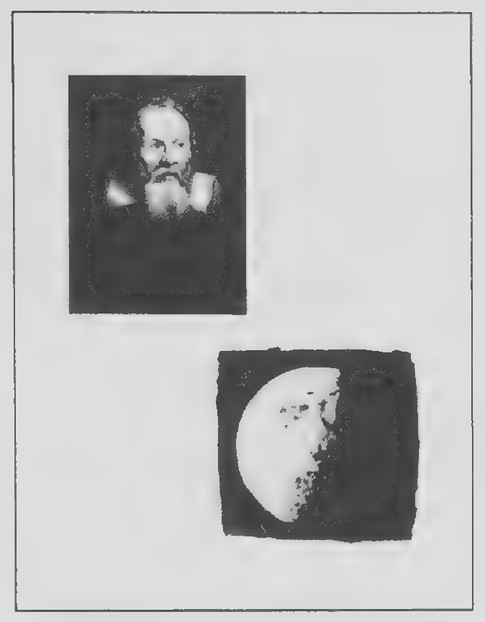
Before Galileo first looked at the night sky through his telescope in the fall of 1609, it was generally believed that the surface of the moon, unlike that of the earth, was perfectly smooth. Galileo noticed that the boundary between the dark and light sides of the moon was very ragged and concluded from this observation that the moon must have mountains and valleys. He made the painting of the moon shown on Transparency 12-6-1 from observations made through his telescope.
Notice that there are several light spots on the dark side, not far from the boundary of the lighted side. Galileo figured that these spots must be mountain peaks high enough to catch some light from the rising or setting sun. With this as the basis of his reasoning, he used some simple geometry to measure the height of a mountain on the moon.
Hand out duplicated copies of Transparency 12-6-2. The first figure represents the moon and one of the light spots, at B, as seen through Galileo’s telescope. The second figure represents a “side view” of the same thing: a ray of light from the sun is tangent to the moon at A and hits the top of the mountain peak at B. Galileo estimated the distance from
 Transparency 12-R-1
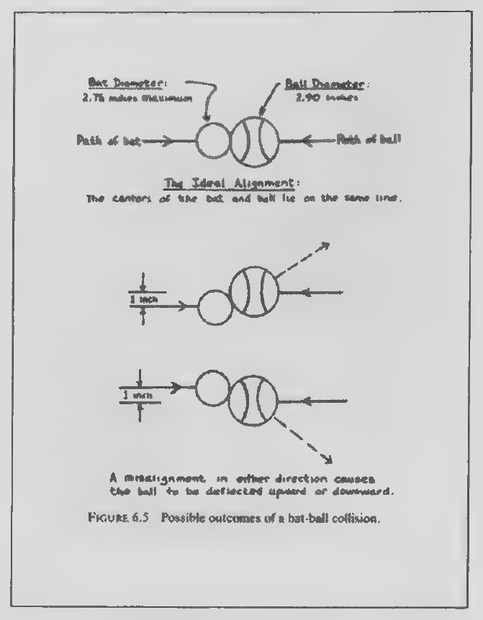 Transparency 12-R-2: Baseball misalignment
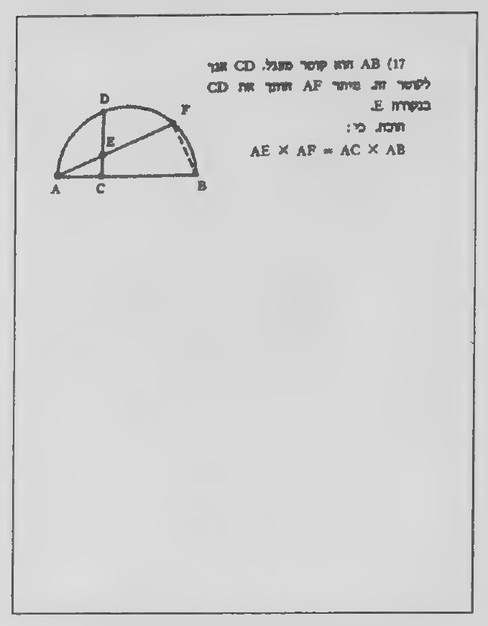 Transparency 12-R-3: A proof from a Hebrew geometry book
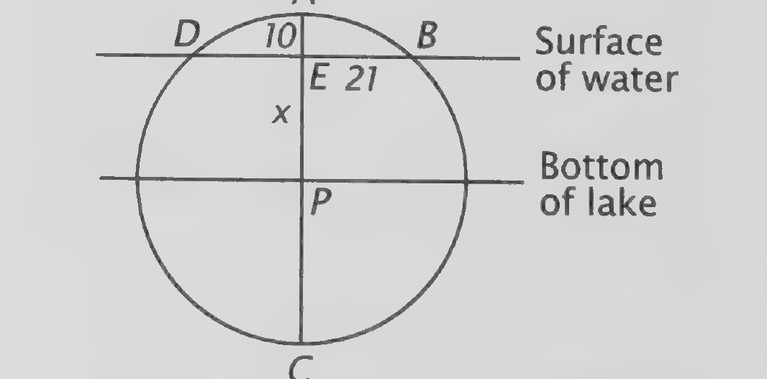 Figure on page 378 — A circle cut by chords and a segment of length 10, with the unknown length x marked
A to B by comparing it with the radius of the moon.
In these figures, AB appears to be about 5 the length
of the radius; but in his painting, Galileo figured
that AB was about — as long as the radius.
12
Galileo knew that the radius of the moon was
1 1,080 miles, and so he estimated AB as 7p (1,080) =
90 miles. Write the lengths of OA and AB on the second figure, draw OB, and give your students some time to figure out the height of the mountain at B.
Because AB is tangent to the circle at A, AB LOA, and so △AOB is a right triangle. Applying the Pythagorean Theorem,
OB? = 1,0802 + 902 = 1,174,500 And so
OB = 1,174,500 = 1083.7. Therefore, the mountain at B is about 3.7 miles high.
Review of Chapter 12
Transparencies
12-R-1_ Longfellow’s water-lily problem 12-R-2 Baseball misalignment 12-R-3 A proof from a Hebrew geometry book
First day
Introduction
The most popular American poet of the nineteenth century was Henry Wadsworth Longfellow. Longfellow was also an amateur mathematician and
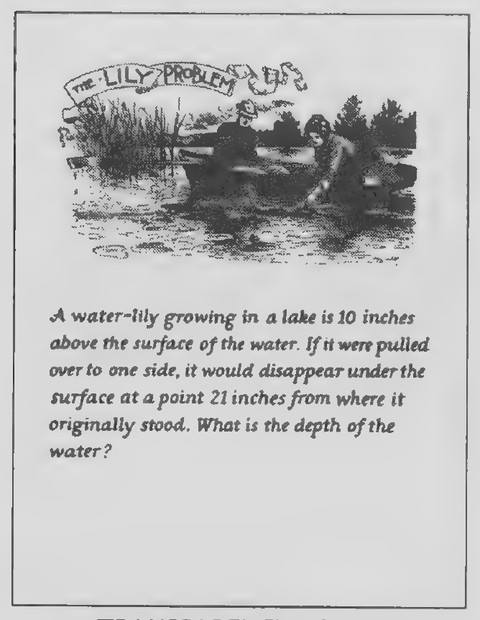
among the problems that he created was one about a water lily in a lake.* (Show Transparency 12-R-1 with the overlay in place.)
A water lily growing in a lake is 10 inches above the surface of the water. If it were pulled over to one side, it would disappear under the surface at a point 21 inches from where it originally stood. What is the depth of the water?
To solve this problem, we need a diagram. Remove the overlay and guide your students in drawing the figure shown below. First, draw just the two horizontal lines and PA. As the water lily is pulled over to one side, what kind of path does the top of it follow? Draw AB and then the entire circle; also, draw the entire diameter AC.
A
Surface
of water
Bottom
of lake
‘This problem was originally in Sam Loyd’s Cyclopedia of Puzzles, privately published in 1914. It is included in Mathematical Puzzles of Sam Loyd, volume 1, selected and edited by Martin Gardner (Dover, 1959).
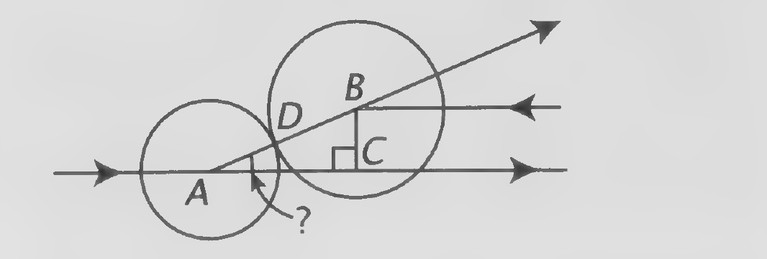 Figure on page 379 — Two circles tangent to a common line and to each other’s external tangents (points A–D marked)
Label EA, EB, and EP as indicated. Then ask your students how they would label ED and PC. (We are assuming that the water lily is originally perpendicular to the surface of the water so that AC bisects DB. ED = 21 and PC = x + 10.) Point out that, without adding anything more to the figure, the Intersecting Chords Theorem can be used to solve for x. Let a student demonstrate his or her solution to the class. Because DE · EB = AE · EC, 21² = 10(2x + 10). Solving for x, x = 17.05. The lengths in the problem are each given as a whole number of inches, and so it is appropriate to round this answer and to say simply that the lake is about 17 inches deep.
Second day
Introduction
The figures on Transparency 12-R-2, which show some possible outcomes when a baseball is struck by a bat, are from Sport Science by Peter J. Brancazio (Simon & Schuster, 1984). The first figure illustrates the ideal situation, in which the bat hits the ball head-on with the greatest possible force. The other figures show situations in which the bat and ball are not perfectly aligned so that the ball is popped up or hit toward the ground.
Have your students draw and label the second figure as shown at the right. On the assumption that the paths of the bat and ball are parallel and a misalignment of 1 inch, at what angle with the path of the bat is the ball deflected? In making the calculation, use the diameters of the bat (2.75 in) and ball (2.90 in) given.
In right △ABC,
BC = 1 and AB = (2.75 + 2.90)/2 = 2.825.
By the definition of the sine ratio,
sin A = BC/AB = 1/2.825 ≈ 0.354
And so ∠A ≈ 21°. The ball is deflected at an angle of approximately 21°.
The proof exercise on Transparency 12-R-3, taken from a Hebrew geometry book, might be used for further review. The “given” seems to be that AB is a diameter of the circle of which the arc is a part, that CD ⊥ AB, and that AF intersects CD at E. FB is evidently an auxiliary line, added as a clue to the proof. The proof is based on showing that the two triangles in the figure are similar.
 Transparency 13-1-1: Locations of schools
 Transparency 13-2-1: Oak Island in the news