Chapter 11: The Right Triangle
Lesson 1: Proportions in a Right Triangle
Lesson Outline
Terms: Projection.
Theorem 49. The altitude to the hypotenuse of a right triangle forms two triangles similar to it and to each other.
Corollary 1. The altitude to the hypotenuse ofa right triangle is the geometric mean between the segments into which it divides the hypotenuse. Corollary 2. Each leg of a right triangle is the geometric mean between the hypotenuse and its projection on the hypotenuse.
Transparencies
- 11-1-1 Photograph of chambered nautilus
Introduction
A chambered nautilus shell cut in half so that the compartments can be seenis an attractive visual aid to have for the mathematics classroom and is worth looking for. The photograph on page 428 of the text is of a shell that can be bought for just a few dollars at an oceanside store.
The chambered nautilus is most abundant in the southwest Pacific where it swims on the ocean floor in search of food. The nautilus lives in the outermost chamber of its shell and can let air into or out of the other chambers to help in moving upward or downward through the water.
Show Transparency 11-1-1 and mark and label the center point of the shell point P. Have a student draw a line through point P in any direction and a second line through P that is perpendicular to the first. Then, label some of the consecutive points in which the curve of the shell intersects these lines and develop the rest of the lesson as presented on pages 428-429 of the text.
Lesson 2: The Pythagorean Theorem Revisited
Lesson Outline
Theorem. The Pythagorean Theorem. Ina right triangle, the square of the hypotenuse is equal to the sum of the squares of the legs.
Transparencies
- 11-2-1 The Pythagorean Proposition
- 11-2-2 Photograph of Elisha S. Loomis
- 11-2-3 Page from The Pythagorean Proposition
Introduction
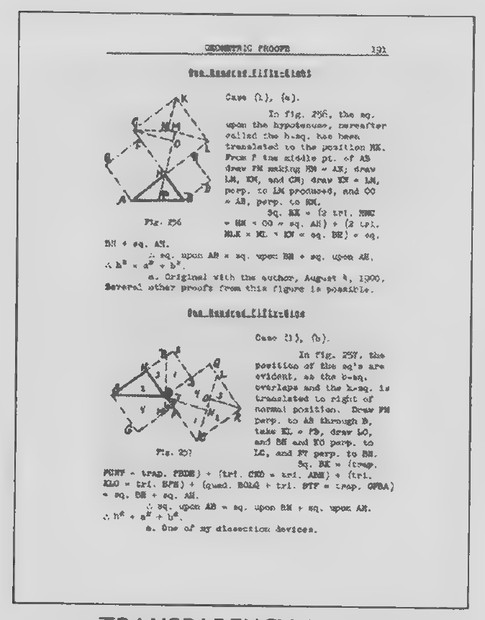
Dr. Elisha Loomis taught mathematics at West High School in Cleveland, Ohio, from 1895 to 1923. As one of his hobbies, he collected proofs of the Pythagorean Theorem. Three hundred and seventy of these proofs were published in a book whose title page is shown on Transparency 11-2-1.* A picture
*The Pythagorean Proposition by Elisha Scott Loomis (privately printed in 1927 and 1940; reprinted in 1968 as volume 1 of N.C.T.M’s Classics in Mathematics Education series).
 Transparency 11-2-3: Page from The Pythagorean Proposition
 Transparency 11-3-1: A Pythagorean guitar
 Transparency 11-3-2: Cover of The Square of the Hypotenuse
of Dr. Loomis is on Transparency 11-2-2 and a typical page from the book is shown on Transparency 11-2-3.
In our previous encounter with the Pythagorean Theorem, we considered several proofs based on area. The exercises also emphasized the area aspect of the theorem. In this lesson, we concentrate more on how the Pythagorean Theorem is used to find lengths. We begin with an unusually simple proof of it based on a theorem of yesterday’s lesson. Guide your students in writing the proof presented on page 435 of the text.
Lesson 3: Isosceles and 30°-60° Right Triangles
Lesson Outline
Theorem 50. The Isosceles Right Triangle Theorem. In an isosceles right triangle, the hypotenuse is ¥2 times the length of a leg.
Corollary. Each diagonal of a square is -/2 times the length of one side.
Theorem 51. The 30°-60° Right Triangle Theorem. In a 30°-60° right triangle, the hypotenuse is twice the shorter leg and the longer leg is V3 times the shorter leg.
Corollary. An altitude of an equilateral triangle 13 having side s is * and its area is aie
Transparencies
11-3-1_ A Pythagorean guitar 11-3-2 Cover of The Square of the Hypotenuse 11-3-3 First page from The Square of the Hypotenuse
Introduction
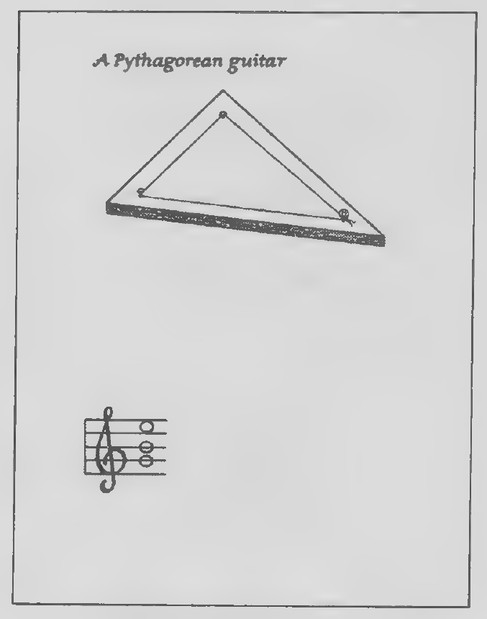
In his book, The Number of Things: Pythagoras, Geometry and Humming Strings (Dutton, 1964), Evans G. Valens describes a “Pythagorean guitar” that your students will find especially interesting. The guitar, pictured on Transparency 11-3-1, is easy to build. All you need is a guitar string, a piece of wood, two nails, two small pulleys (to equalize the tension), and a set-screw.
If a guitar string is stretched around three nails at the vertices of a 3-4-5 right triangle, the three sides of the string triangle, when plucked, will sound a musical chord. If the hypotenuse is tuned to G, the longer and shorter legs will sound B and E, respectively. Valens notes that these are the top three strings of a guitar and that the chord sounded is a minor triad. If arandomly shaped “triangle guitar” is played, it will not ordinarily produce a musical chord. Why does the 3-4-5 right triangle do so? Because Pythagoras, as well as being a great mathematician, was also the founder of the science of music. His belief in the importance of whole numbers led him to define the intervals in the musical scale in terms of them. The scales of Pythagoras are discussed in great detail in chapters 14 through 16 of Valens’s book.
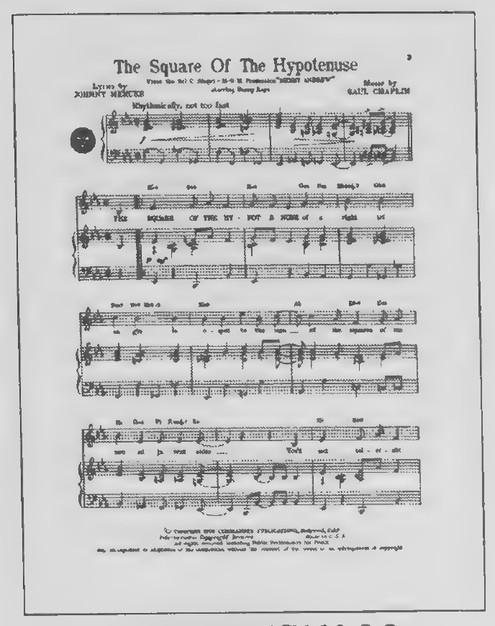
A song that would be especially appropriate to play on a Pythagorean guitar was once featured in a Hollywood movie (Merry Andrew, M-G-M Pictures, 1958). Its title is “The Square of the Hypotenuse” and the cover and first page of the sheet music are pictured on Transparencies 11-3-2 and 11-3-3.
In presenting the new lesson on the relations of
 Transparency 11-3-3: First page from The Square of the Hypotenuse
 Transparency 11-4-1: Crazy inventions
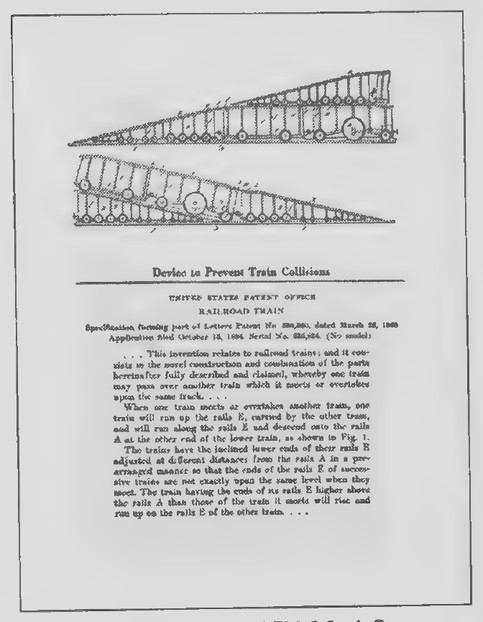 Transparency 11-4-2: A device for preventing train collisions
the lengths of the sides of isosceles and 30°-60° right triangles, you should mention that these theorems are very important in trigonometry as well as geometry.
Lesson 4: The Tangent Ratio
Lesson Outline
Terms: Tangent ratio
Transparencies
- 11-4-1 Crazy inventions
- 11-4-2 A device for preventing train collisions
Introduction
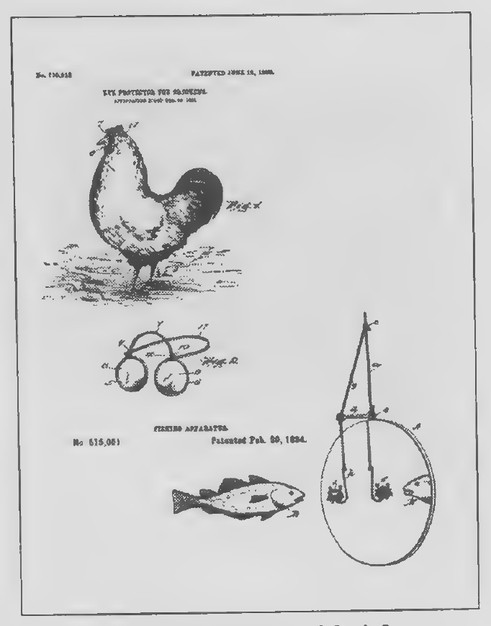
Some extraordinary inventions have been patented in the U.S. Patent Office. A book titled Absolutely Mad Inventions by A. E. Brown and H. A. Jeffcott, Jr. (Dover, 1970) contains reproductions of the original drawings and descriptions filed for some of these patents.
Two of them are shown on Transparency 11-4-1. The first is a pair of goggles for a chicken, to protect its eyes in case other chickens peck it in the head. The second, a device for catching fish, is rather quaintly described by its inventor in these words:
The fish B, when approaching the bait s, will see
the reflection B’, of himself in the mirror, also
coming for the reflection of the bait s’, and will
be made bolder by the supposed companionship,
and more eager to take the bait before his com-
petitor seizes it. He will lose his caution, and take
the bait with a recklessness that greatly increases
the chances of his being caught on the hook.
Another remarkable invention is one for preventing train collisions. It was registered in 1895 and is pictured on Transparency 11-4-2. If a train meets another one approaching on the same track, it can run up the slanted rails of a special car, along rails on top of the rest of the cars, and down the other end car. Instead of colliding, one train merely passes over the other! If two trains are traveling in the same direction, one can overtake and pass the other by the same procedure.
The figures reveal that the end cars are approximately right triangular in shape. If the box cars on the train are 14 ft high and the track on one of these end cars rises at a 15° angle with the horizontal, how long must the car be?
If the angle were 30° or 45°, we could use one of the theorems of the last lesson to find the answer. Because it is not, we need to use some other method. (Following this introduction, you can introduce the tangent ratio and show how it can be used to find the length of one of these end cars. Your students will need some guidance, of course, in learning how to find tangents and inverse tangents on their calculators. Letting x = the length, we have tan 15° = 14/x, from which it follows that x ≈ 52.2 ft. For a rise of 15°, the end car would be about 52 feet long.)
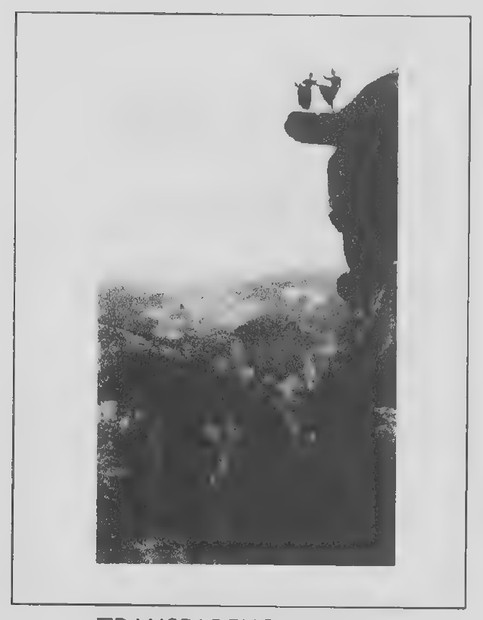 Transparency 11-5-1: Overhanging-rock photograph
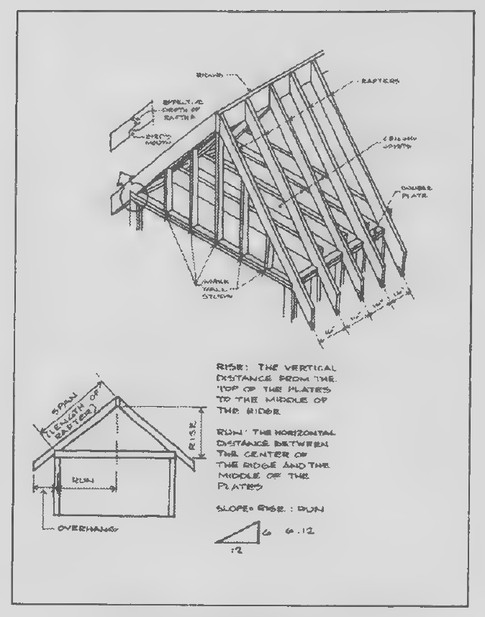 Transparency 11-6-1: Rafters and slope
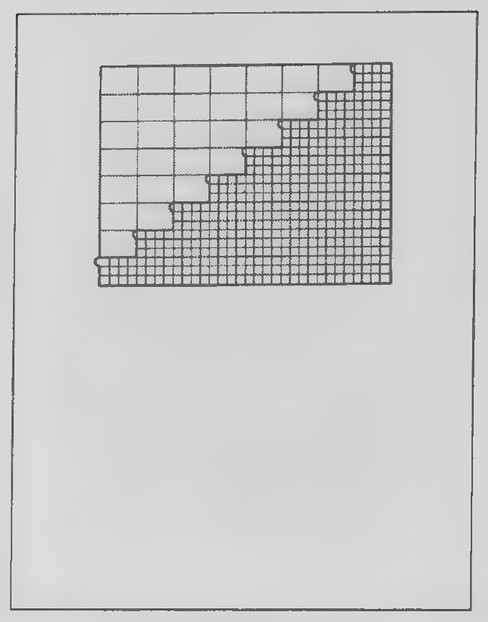 Transparency 11-6-2: Staircase
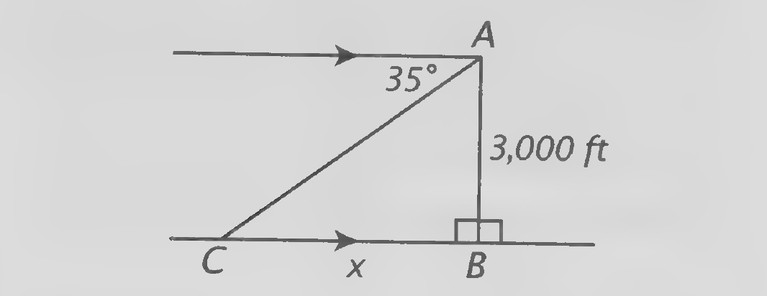 Figure on page 370 — Measuring a height from a distance: an angle of elevation of 35° and a horizontal distance of 3,000 ft
Lesson 5: The Sine and Cosine Ratios
Lesson Outline
Terms: Sine ratio, cosine ratio
Transparencies
- 11-5-1 _ Overhanging-rock photograph
Introduction
The two women in the photograph on Transparency 11-5-1 are dancing on Overhanging Rock at Glacier Point in Yosemite. The picture was taken in 1900, many years before the National Park Service decided that such stunts were too dangerous and barred access to the rock.
Overhanging Rock is 3,000 feet above the valley floor. Suppose that you are standing on the rock and looking down at a point in the valley such that the angle of depression of that point from your position is 35°. (Have your students draw a figure like the one shown here to illustrate this.) How far is
the point of the rock? After your students have had some time to work on this, have someone explain his or her solution. Note that the problem can be solved by either
of the following equations:
= x 6 ℓ03,000
tan 55 = 3,000 or tan35 His
The answer is approximately 4,300 feet.
To introduce the new lesson, ask how far the point you are looking at is from you (label this distance y in the diagram). To find the answer, we can use either the Pythagorean Theorem or another trigonometric ratio. Define the sine and cosine ratios and show how the problem can be solved by using either ratio. The answer is approximately 5,200 feet.
Lesson 6: Slope
Lesson Outline
Terms: Run, rise, slope, angle of inclination, slope.
Theorem 52. Two nonvertical lines are parallel iff their slopes are equal.
Theorem 53. Two nonvertical lines are perpendicular iff the product of their slopes is -1.
Transparencies
- 11-6-1 Rafters and slope
- 11-6-2 Staircase
Introduction
In designing the roof of a building, the architect has to take into account the forces of wind, rain, and snow. If the roof is very steep, for example, snow will tend to slide off it. If the slope is more gentle, snow will remain where it is, so that the roof must be able to support the resulting weight. The figures on Transparency 11-6-1 are from the chapter on roof
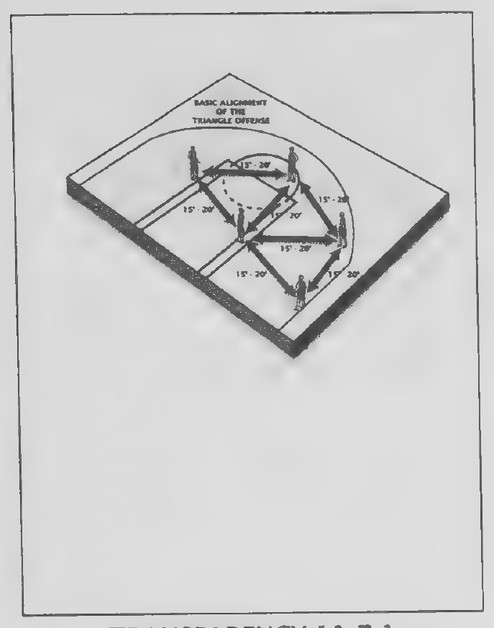 Transparency 11-7-1: The triangle offense
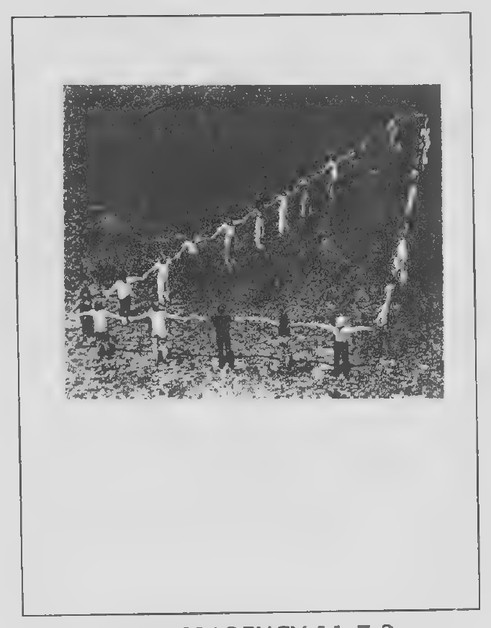 Transparency 11-7-2: Human triangle in Japan
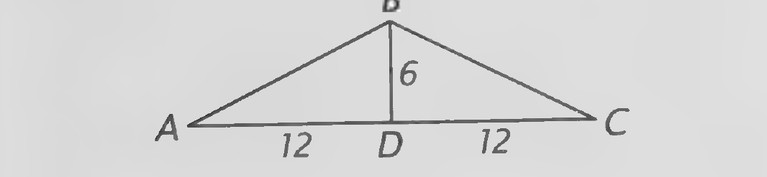 Figure on page 371 — A triangle with its altitude drawn, the height marked 6 and the base divided into segments 12 and 12
design in the book How to Design and Build Your Own House by Lupe DiDonno and Phyllis Sperling (Knopf, 1981). It is interesting to note that the architect and the mathematician use the same terms in discussing slope. With this introduction, you might have your students make a scale drawing on graph paper to represent a roof whose rafters match the 6:12 diagram at the bottom of the transparency. This figure can be used as a basis for developing the rest of the lesson.
B
slope in architecture is in the design of stairways. The figure on Transparency 11-6-2 shows the steepest stairway allowed by most building codes in the United States. What is its slope? It is interesting to note that itis based on the 3-4-5 right triangle, so that its slope
1S 4
Lesson 7: The Laws of Sines and Cosines
Lesson Outline
Theorem 54. The Law of Sines. If the sides opposite ∠A, ∠B and ∠C of △ABC have lengths a, b, sin A sinB _ sin C and c, then b Cc
Theorem 55. The Law of Cosines. If the sides
opposite ∠A, ∠B and ∠C of △ABC have
lengths a, b, and c, then c² = a² + b² — 2ab cos C.
Transparencies
- 11-7-1 The triangle offense
- 11-7-2 Human triangle in Japan
First day
Introduction
Because there is a lot to cover in this lesson, I recommend that you begin class by using Transparency 11-7-1 to introduce and present the lesson as in the text.
Second day
Introduction
The photograph on Transparency 11-7-2 was taken by Ronald L. Dirkse of the American School in Tokyo, Japan. It shows a group of students standing on the football field with their arms outstretched to form the sides of a large triangle. The side of the triangle closest to the camera is formed by five students; 12 students and 13 students stand along the other two sides. If all of the students are the same size, what kind of triangle do you suppose is formed? (Students who recognize that “5-12-13” is a Pythagorean triple will immediately recognize that the triangle is a right triangle. Those who do not can verify that 5¢ + 122 = 132, from which we can draw the same conclusion from the converse of the Pythagorean Theorem.)
Now suppose that one more student joins the group, so that the shortest side of the triangle increases from 5 to 6. What kind of triangle would
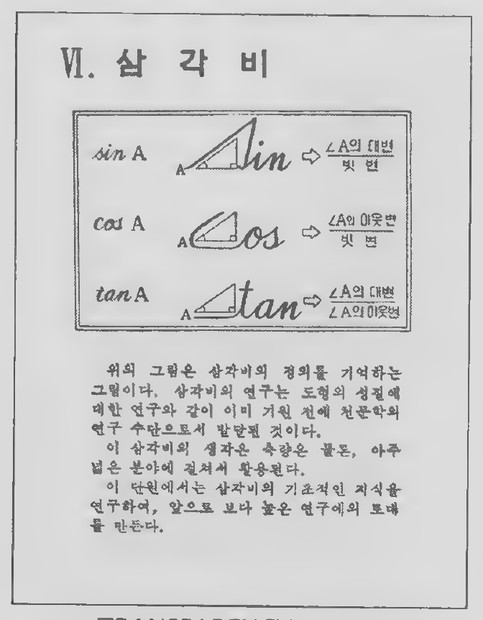 Transparency 11-R-1: Trigonometric ratios from a Korean geometry book
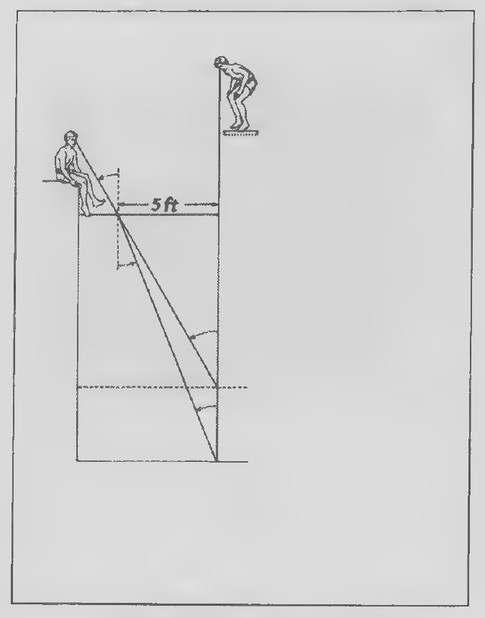 Transparency 11-R-2: Swimming-pool refraction problem
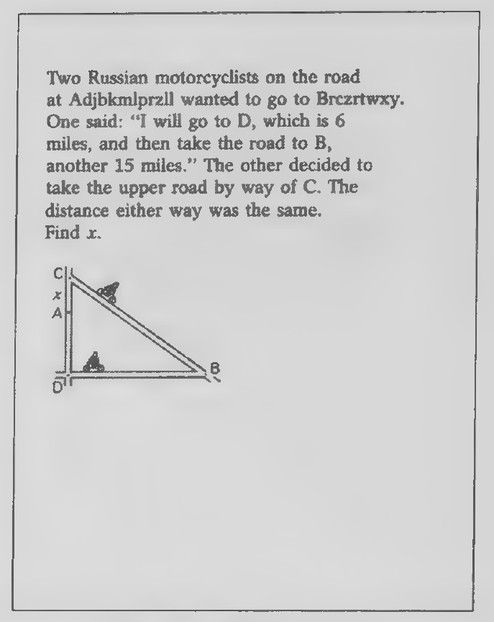 Transparency 11-R-3: Russian motorcyclists problem
result? (You might take a poll of your students to find how many think that the triangle would become acute and how many think it would become obtuse.) Which would you use, the Law of Sines or the Law of Cosines, to find the measures of the angles of a triangle, given its sides? (The Law of Cosines.) Why? (To write a proportion from the Law of Sines requires that we know at least one angle of the triangle, but we do not.) Which angle of the triangle do we need to determine to be able to tell whether the triangle is acute or obtuse? (The largest angle.) Letting C be the vertex of the largest angle, write an equation for the triangle based on the Law of Cosines. [13? = 6? + 122 — 2(6)(12)cos C.] Solve the equation to find out if you guessed correctly as to what type a 6-12-13 triangle is. (Solving
the equation for cos C, we get cos C = = from
which ∠C = 85.6°. The triangle is acute.)
Having done this, you might have your students construct a triangle with sides of 6 cm, 12 cm, and 13 cm, so that they can measure its largest angle with their protractor to confirm that their calculations are reasonable.
Review of Chapter 11
First day
Transparencies
- 11-R-1 Trigonometric ratios from a Korean
geometry book 11-R-2 Swimming-pool refraction problem 11-R-3 Russian motorcyclists problem 11-R-4 Gurus problem
Introduction
Transparency 11-R-1 shows a page from a Korean mathematics book. Your students will be interested in seeing the device used to help in remembering the definitions of the trigonometric ratios. It is clever, but surprising, because it is based on the script forms of letters of the Latin alphabet! Note that our knowledge of the definitions makes it possible to translate the Korean symbols inside the large box.
The figure on Transparency 11-R-2 illustrates refraction of light in a swimming pool.* The two observers are looking at a stone at the bottom of the pool. The observer on the diving board is looking directly down at the stone. The observer at the left sees the stone from the side. Light from the stone is bent at the surface of the water, producing the illusion that the bottom of the pool is higher than it actually is.
Hand out duplicated copies of the transparency and have your students label the angle above the surface of the water 30° and the angle just below the surface 22°. The problem is to use this information to find the actual depth of the water in the swimming pool (label this x on the figure) and the apparent depth of the water as seen by the observer sitting on the side of the pool (label this y).
Applying the tangent ratio to the right triangles
in the figure, we get tan’22° = Es ta=sL2.4 and
x
“The figure and the description given in this lesson are taken from Introductory Physics by Mashuri L. Warren (W. H. Freeman and Company, 1979).
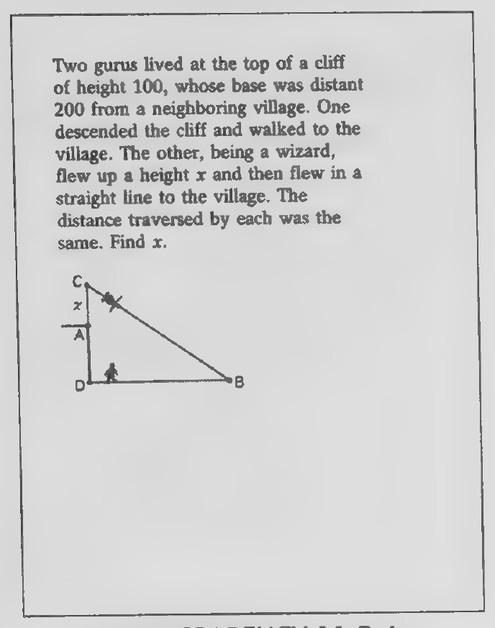 Transparency 11-R-4: Gurus problem
5 tan 30° = —, y= 8.7. The water is actually 12.4 feet deep, whereas to the observer on the left, it appears to be 8.7 feet deep.
Second day
Introduction
The puzzle of the Russian motorcyclists on Transparency 11-R-3 appeared in a book published in England in 1926 (Modern Puzzles by Henry Ernest Dudeney). Your students may need some help in writing and solving the equation on which the solution is based.
After discussing the solution, show Transparency 11-R-4. The puzzle of the motorcyclists bears an interesting resemblance to this puzzle, which was invented by the Hindu mathematician Brahmagupta in about 630 a.p. Having just considered the solution of the other puzzle, most of your students should be successful in solving this one.
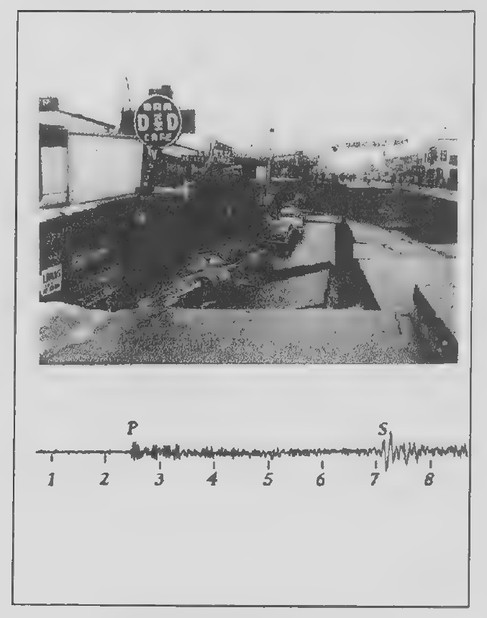 Transparency 12-1-1
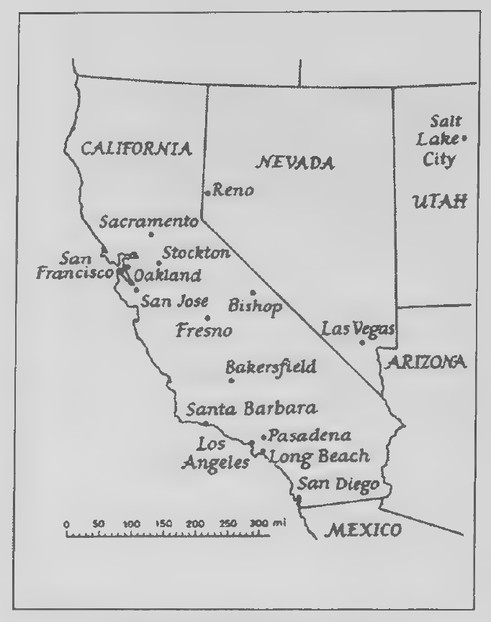 Transparency 12-1-2