Chapter 10: Similarity
Lesson 1: Ratio and Proportion
Lesson Outline
Terms: Ratio, proportion, terms, means, extremes, geometric mean.
Transparencies
- 10-1-1 Photographs of Winnie Mae and models
- 10-1-2 Diagrams of Winnie Mae
Introduction
One of the airplanes in the pictures on Transparency 10-1-1 is an exact replica of the first plane to be flown on a solo flight around the world. Its pilot was Wiley Post and the year was 1933. Although the other plane looks exactly like Post’s plane, it could never be flown around the world because it is too small: it is a scale model of the real plane and weighs only 15 pounds. Can you guess which plane is which? (The one pictured at the top is the model.)
To be convincing, the model must have the same shape as the actual plane. Hand out duplicated copies of Transparency 10-1-2 and explain that the figures could represent views of either the plane or the model. Have your students write the letters w and I on the figures to represent wingspan and length. The plane is 27 ft long and has a wingspan of 42 ft. The model is 4.5 ft long. Can you find out what its wingspan is? (Give your students time to think about this and then let some of those who have the correct answer−7 ft—explain their methods.)
Use the proportion
ON ee
BSS 27, to review the meanings of “ratio” and “proportion,” and present the rest of the lesson as in the text.
Lesson 2: Similar Figures
Lesson Outline
Terms: Similar triangles, similarity correspondence, center and magnitude of a dilation.
Transparencies
- 10-2-1 Betty Grable
- 10-2-2 Why slide enlargements have wrong
proportions 10-2-3 Slide frame and an 8 x 10 photograph
Introduction
Show Transparency 10-2-1. (If your school has a photography class, you might ask a student to take a photograph of one of your school’s well-known athletes—for example, a member of the basketball, baseball, football, gymnastic, soccer, or wrestling teams. Be sure that the photograph is clear enough so that your class can make the required measurements with accuracy.) The Renaissance artist Albrecht Diirer wrote several books on human proportions. Add the overlay. (Make a new overlay if you use a photograph of a student in your school.
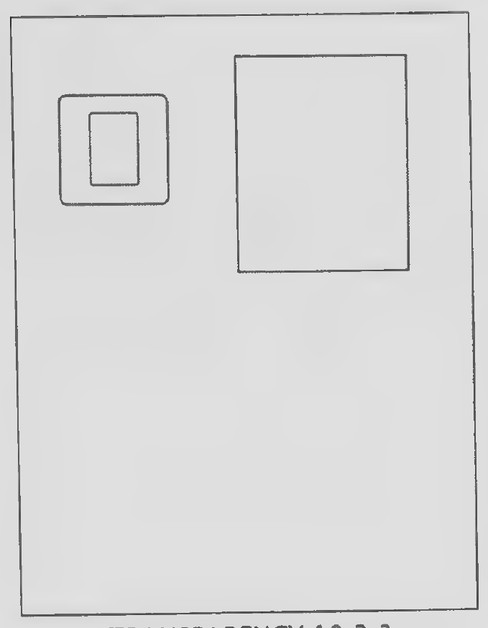 Transparency 10-2-3: Slide frame and an 8 x 10 photograph
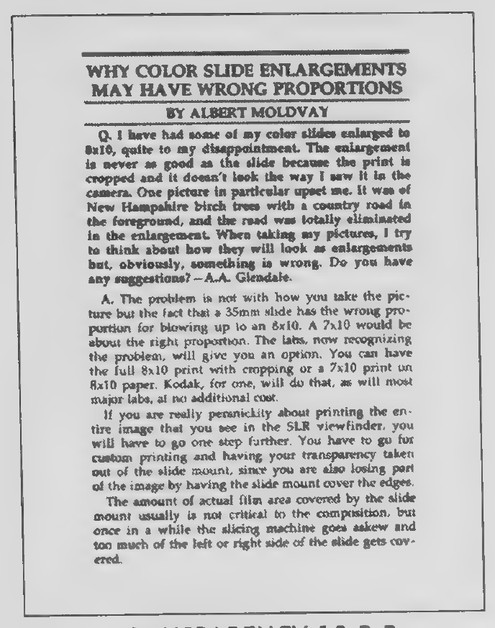 Transparency 10-2-2: Why slide enlargements have wrong proportions
The overlay should mark the positions of the neck, hip, knee, and ankle.) In one of his books, Durer claimed that for most people, the distance from hip to knee is the geometric mean between the distance from neck to hip and the distance from knee to ankle.*
The lines on this photograph of the actress Betty Grable (the “pin-up” girl of World War II), mark the positions of these four points: neck, hip, knee, and ankle. Place an ordinary centimeter ruler on the picture and measure the distance between hip and knee and the distance between knee and ankle, each to the nearest tenth of a centimeter. (They are 5.6 cm and 4.7 cm, respectively.) Mark the distances on the picture and ask your students to use their calculators to figure out what the distance from knee to
hip should be if Dürer’s claim is correct. (x/5.6 = 5.6/4.7; x = 6.7.) Measuring this distance on the picture will reveal that Dürer’s statement seems to be true.
Alternative Introduction Show Transparency 10-2-2, keeping the answer to the question covered. This question once appeared in a photography column in the Los Angeles Times. Read it to your class and, still keeping the answer covered, remark that the answer to the question is the subject of the new lesson.
Hand out duplicated copies of Transparency 10-2-3, on which a 35-mm slide in a frame and an
8 x 10 print are represented. The print is drawn in centimeters rather than inches so that it will fit on the transparency. When a picture is enlarged, it and its enlargement have the same shape. Figures that have the same shape are similar. Define similar triangles and then explain that the definition can be extended to rectangles. Point out that the problem with the slide enlargement is obviously not with the angles. Have your students measure the inner dimensions of the frame in millimeters. (They are about 23 mm and 33 mm, the frame being slightly smaller than the picture on the 35-mm film.)
If the slide is enlarged to a width of 80 mm (8 cm), what will its length be? (23/80 = 33/x; x = 115.) The picture will be approximately 11.5 cm long and this is the cause of the problem. Have your students extend the rectangle representing the print downward another 1.5 cm to show the part of the picture that got eliminated.
To avoid losing part of the picture, the slide could be enlarged to a length of 100 mm instead. In
this case, what would its width be? (x/100 = 23/33; x ≈ 70.) The picture would be approximately 7 cm wide.
Put Transparency 10-2-2 back on the screen and read the first paragraph of the answer, whose meaning will now be very clear.
*Dan Pedoe devotes an entire chapter of his book Geometr y and the Liberal Arts (St. Martin’s Press, 1976) to the geometry of Dürer.
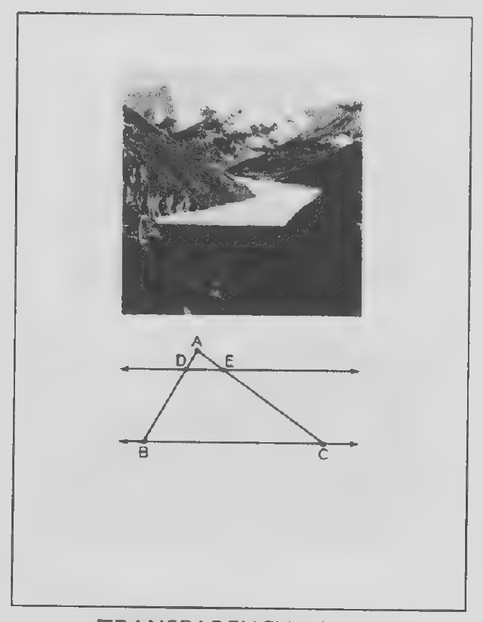 Transparency 10-3-1: Side view of the Grande Dixence dam
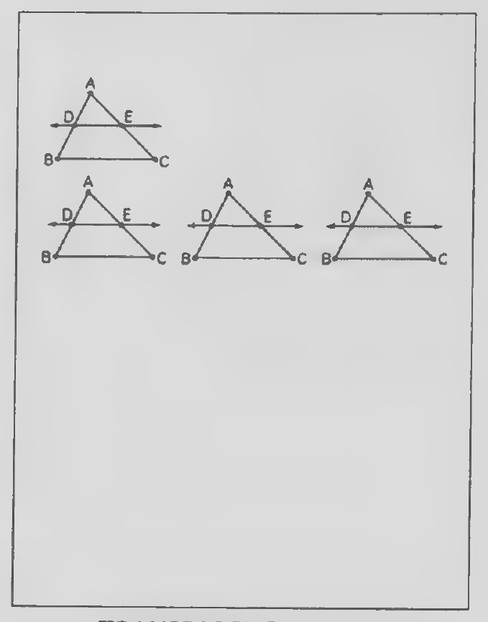 Transparency 10-3-2: Side-splitter theorem figures
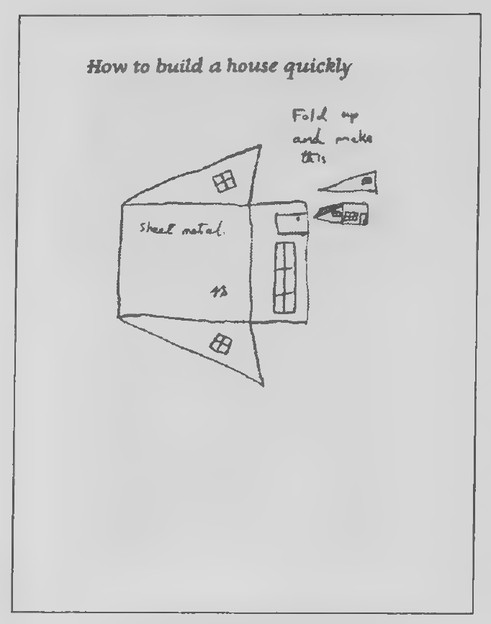 Transparency 10-4-1: “How to build a house quickly”
Lesson 3: The Side-Splitter Theorem
Lesson Outline
Theorem 44. The Side-Splitter Theorem. If a line parallel to one side of a triangle intersects the other two sides in different points, it divides the sides in the same ratio. Corollary. If a line parallel to one side of a triangle intersects the other two sides in different points, it cuts off segments proportional to the sides.
Transparencies
- 10-3-1 Side view of the Grande Dixence dam
- 10-3-2 Side-splitter theorem figures
Introduction
Show Transparency 10-3-1. The photograph shows the Grande Dixence dam in the Swiss Alps, one of the highest dams in the world. The dam was completed in 1961 at a cost of 372 million dollars and holds back more than ten million tons of water.
Explain the meaning of the figure below the photograph (see page 392 of the text). Then present the problem of finding the length of EC indirectly from the lengths of AD, DB, and AE as is done in the text. The figure on the transparency is drawn on a somewhat different scale from that of the one shown in the text. Tell your students that 1 cm on the figure represents a distance of 70 m and measure AD, DB, and AE, expressing each length in meters. (They are 70 m, 280 m, and 105 m, respectively.) Ask your students if they can figure out the length of EC before you measure it and have someone who finds the length explain how he or she did it.
Hand out duplicated copies of Transparency 10-3-2 for your students to use in developing the proof of the Side-Splitter Theorem.
Lesson 4: The AA Similarity Theorem
Lesson Outline
Theorem 45. The AA Theorem. If two angles of one triangle are equal to two angles of another triangle, the triangles are similar. Corollary. Two triangles similar to a third triangle are similar to each other.
Transparencies
- 10-4-1 “How to build a house quickly”
- 10-4-2 Walking in the house
- 10-4-3 AA Similarity Theorem figures
- 10-4-4 How to measure up by looking down
First day
Introduction
The following exercise is based on a problem in a fascinating book titled Children Solve Problems by Edward de Bono (Harper and Row, 1974). Children of various ages were asked to solve problems such as how to stop a cat and dog from fighting, how to weigh an elephant, and how to build a house quickly.
One boy, when given the problem of how to build a house quickly, drew the diagram on Transparency 10-4-1. He figured that, because toy houses are sometimes made by cutting and folding cardboard, the same method might be applied to constructing a house from sheet metal. One problem with his solution is the design that he proposes.
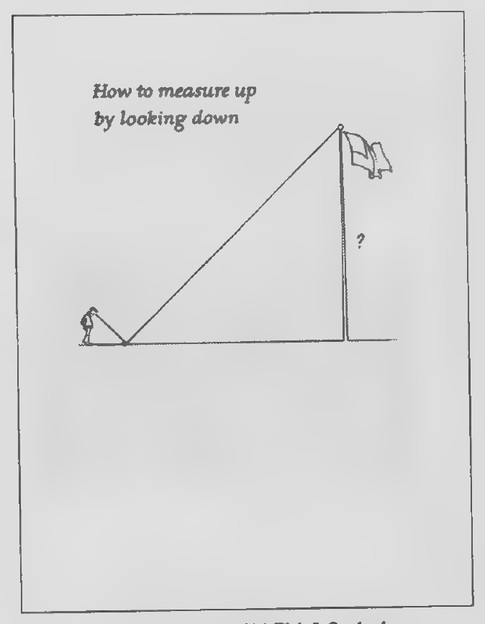 Transparency 10-4-4: How to measure up by looking down
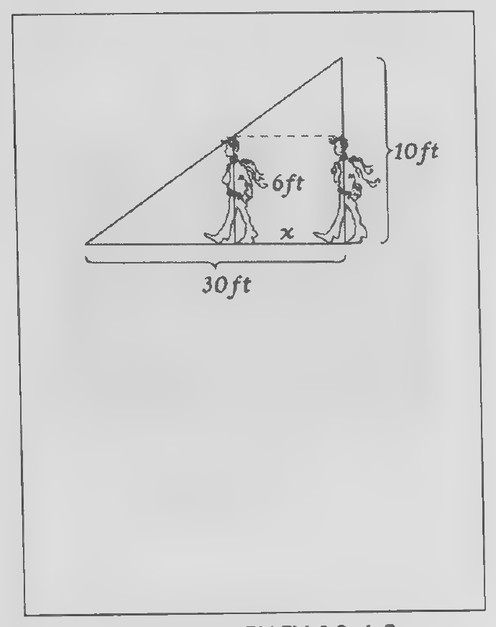 Transparency 10-4-2: Walking in the house
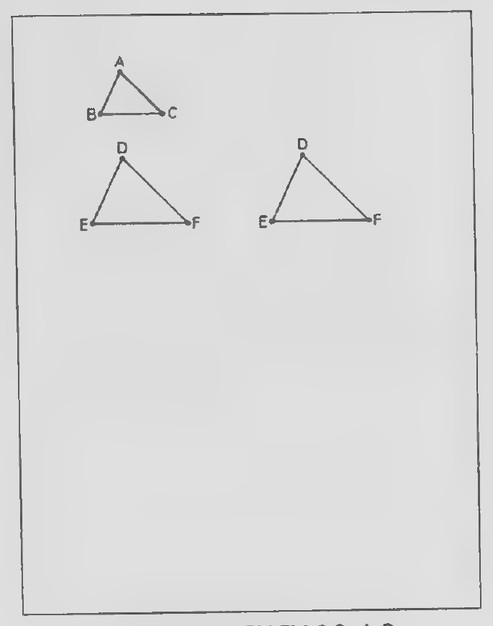 Transparency 10-4-3: AA Similarity Theorem figures
Show Transparency 10-4-2. The roof of the house slants down to one side so that someone walking in the front door would soon bump his head on the ceiling.
Suppose that the right-hand wall of the house as shown here is 10 feet high and that the house is 30 feet wide. (The figure is not drawn to scale.) How far do you think a person 6-feet tall could walk before his head would touch the ceiling?
There are three triangles in the figure, all of which look as if they might be similar. If they are, we can write a proportion between their sides, such as
slice Ehed
10 30 10 30
to find that the person could walk 12 feet.
This raises the question of whether the triangles in the figure are really similar. Remind your students that we never bother to show that all six pairs of parts of two triangles are equal to prove that they are congruent. Certain sets of three pairs of parts are sufficient. (Ask someone to name them.) Then tell your students that it is even easier to prove that two triangles are similar. All we have to show is that two pairs of angles are equal.
Hand out duplicated copies of Transparency 10-4-3 for use in proving the AA Similarity Theorem as in the text. The corollary to this theorem should also be considered before returning to the figure on Transparency 10-4-2 to see why the three triangles are similar. The two smaller triangles are similar to the large one because of the AA Similarity Theorem (the triangles have equal right angles
and common angles); they are similar to each other because of the corollary to the AA Theorem.
If you plan to do the height-measuring experiment on the next day, you might limit the assignment to selected exercises from Set I of Lesson 4.
Second day
Introduction
If possible, take your class outside and let your students try to measure the height of your school flagpole or a tree by means of the mirror method illustrated on Transparency 10-4-4. You need some small mirrors (one for every three students), at least one 50-ft tape measure, and some shorter tape measures. I assign my students to groups of three each: one student in each group acts as the observer, one as the measurer, and one as the recorder. Note that the method assumes that the feet of the observer, the mirror, and the base of the pole or tree are in a hortzontal plane and also that the mirror is level. You might ask your students why these things are important. (They are necessary if the angles in the two triangles are to be equal; this, of course, is the basis for our treatment of them as similar when we write a proportion between their pairs of corresponding sides.)
Although the students work in small groups, I hold each student responsible for making and turning in his or her own calculations.
Some more exercises from Lesson 4 might be assigned for homework.
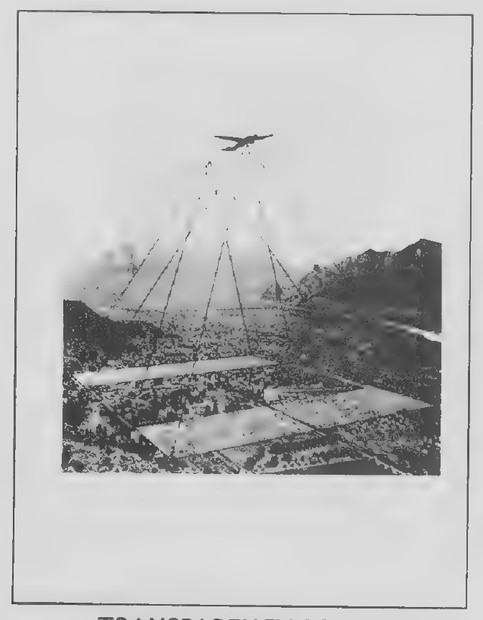 Transparency 10-5-1: Aerial photography
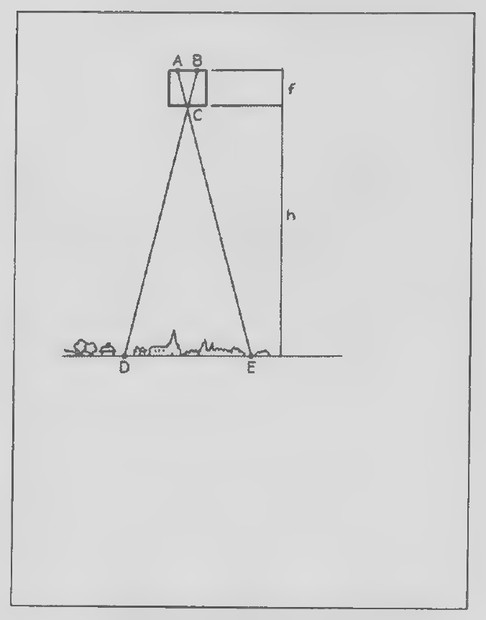 Transparency 10-5-2: Aerial-photography scale diagram
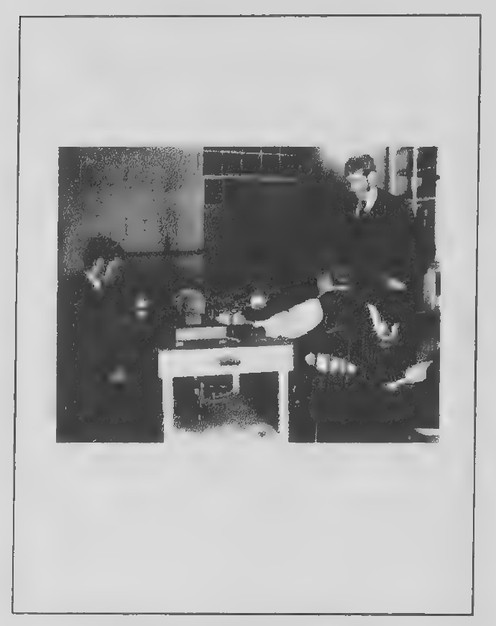 Transparency 10-6-1: An early medical x-ray
Lesson 5: Proportions and Dilations
Lesson Outline
Terms: Corresponding altitudes. Theorem 46. Corresponding altitudes of similar triangles have the same ratio as that of the corresponding sides.
Transparencies
- 10-5-1 Aerial photography
- 10-5-2 Aerial-photography scale diagram
Introduction
Show Transparency 10-5-1. Aerial photography plays an important part in modern map-making. The plane carrying the camera flies on a straight course parallel to the ground and the camera takes a continuous series of overlapping pictures. The figure on the transparency shows the overlap of two successive photographs taken in flight.
It is important to know what the scale of the pictures produced is—that is, how the dimensions of the photograph compare with the dimensions of the region being photographed. The diagram on Transparency 10-5-2 shows how this scale is determined. The figure at the top represents the camera: C is the lens, AB is the film, and fis the focal length of the lens. The altitude of the camera is h and the part of the ground picked up on the film is DE.
Given that AB ∥ DE, why does it follow that △ABC ∼ △EDC? Although f and h are not lengths of sides of these triangles, they are lengths of corresponding altitudes. We can prove that corresponding altitudes of similar triangles have the same ratio as that of the corresponding sides.
After developing this proof, go back to Transparency 10-5-2. The scale of the photograph illus-
trated in this diagram is ≅ Because we have
proved that corresponding altitudes of similar triangles have the same ratio as that of the corresponding sides, we can conclude that
This provides the way by which the scale of aerial photographs is determined: it is found by dividing the focal length of the lens by the altitude of the camera. For example, a camera with a focal length of 6 inches and an altitude of 2 miles produces photographs with a scale of
6 in 0.5 ft 1 1
2mi 2(5,280) ft -4(5,280) 21,120°
Lesson 6: Perimeters and Areas of Similar Figures
Lesson Outline
Theorem 47. The ratio of the perimeters of two similar polygons is equal to the ratio of the corresponding sides.
Theorem 48. The ratio of the areas of two similar polygons is equal to the square of the ratio of the corresponding sides.
Transparencies
- 10-6-1 An early medical x-ray
- 10-6-2 X-ray of bird shot in hand
- 10-6-3 X-ray diagram
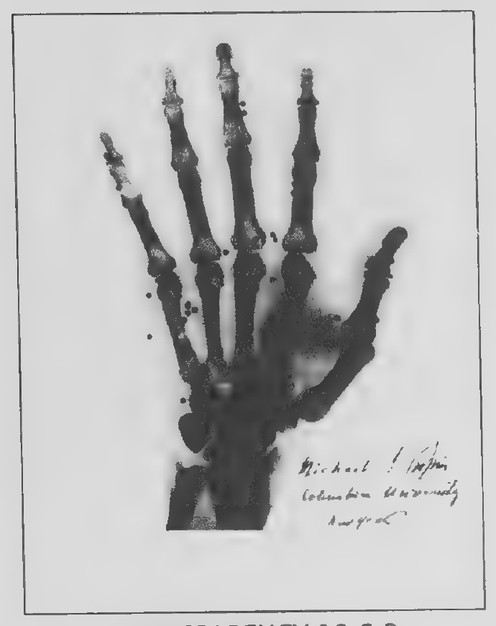 Transparency 10-6-2: X-ray of bird shot in hand
 Transparency 10-6-3: X-ray diagram
 Transparency 10-R-1: Levi 501’s
Introduction
The photograph on Transparency 10-6-1 was taken at Dartmouth College in 1896 and shows one of the medical uses of x-rays. The patient, sitting with his back toward the camera, is having his broken arm x-rayed. The doctors taking the x-ray were not yet aware of the dangers of prolonged radiation.
The x-ray photograph on Transparency 10-6-2 was taken in the same year and shows bird shot that became embedded in the patient’s hand in a hunting accident.
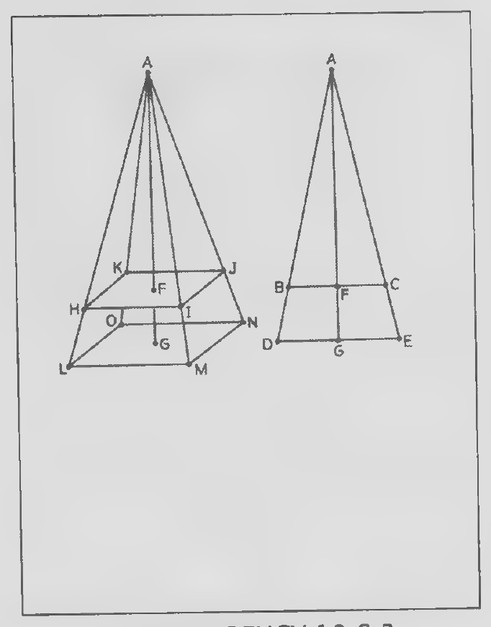
When an x-ray photographis taken, itis always larger than the object it pictures. The reason for this can be seen from the figures on Transparency 10-6-3. In the first figure, a three-dimensional view, the source of the x-rays is at A, the object being photographed is shown as the upper rectangle, and its image on the photographic plate is shown as the lower rectangle. The second figure is a two-dimensional view.
To emphasize the connection between the two figures, have your students add segments BC and DE to the first figure. How does it follow from the fact that BC ∥ DE that △ABC ∼ △ADE in the second figure? Given that AF ⊥ BC, AG ⊥ DE, AF = 16 cm, and FG = 4 cm, find BC/DE. (Because corresponding altitudes of similar triangles have the same ratio as the corresponding sides, BC/DE = AF/AG = 16/20 = 4/5.) This means that the dimensions of the object being x-rayed are four-fifths the corresponding dimensions of the image in the photograph.
If the area of the image in the photograph is 50 cm², what is the area of the object x-rayed? To answer this question, we have to know something about the areas of similar polygons.
Use triangles as on pages 415-416 of the text to prove the perimeter and area relations for similar polygons and then repeat the question about the area of the x-ray. It can be proved that HIJK ∼ LMNO. Therefore, αHIJK/αLMNO = (HI/LM)². Because BC = HI and DE = LM, we can conclude that αHIJK/αLMNO = (BC/DE)². If αLMNO = 50 cm², find αHIJK. [Letting αHIJK = x, we have x/50 = (4/5)² = 16/25, from which it follows that x = 32.] The area of the object x-rayed is 32 cm².
Review of Chapter 10
Transparencies
- 10-R-1 Levi 501’s
- 10-R-2 Eclipsing the moon with a dime
First day
Introduction
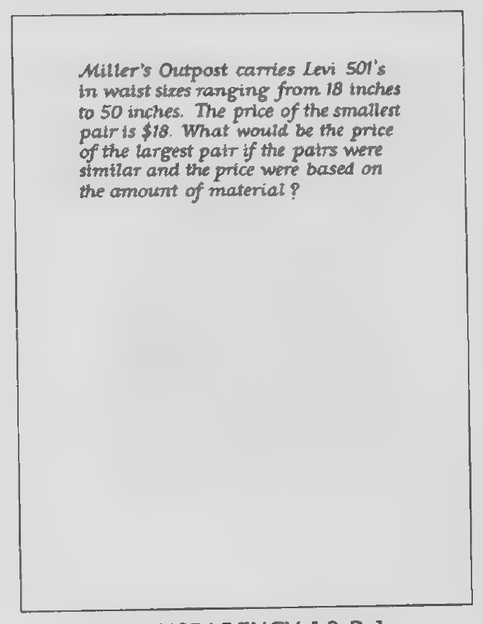
The problem on Transparency 10-R-1 provides a review of the theorem about the areas of similar polygons. Because some students are likely to immediately conclude that the answer is $50, you may want to warn them that this is wrong. Let a student who finds the correct answer explain his or her method. (If the price is based on the amount of ma-
 Transparency 10-R-2: Eclipsing the moon with a dime
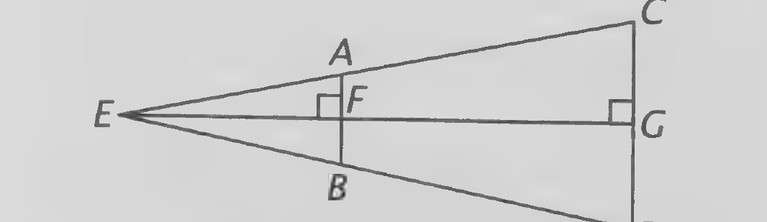 Figure on page 366 — Similar right triangles used to measure an inaccessible distance (points A, B, E, F marked)
terial, we need to compare the areas of the cloth used in making each pair of pants. If they are similar and x represents the price of the largest pair, 18/x = (18/50)²; x = 138.89.) The largest pair would cost about $139. After finishing the problem, you might point out that, although it seems reasonable to assume that clothing patterns over a small range of sizes are similar to each other, the assumption in the problem that the smallest and largest pairs of Levi’s are similar is not very plausible.
Second day
Introduction
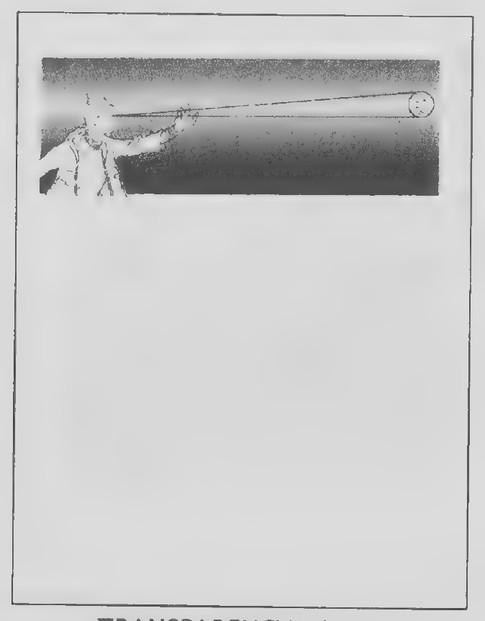
Show Transparency 10-R-2. Imagine that you are standing outside on a night in which there is a full moon. If you closed one eye and held a dime directly in front of your other eye, you could easily “cover” the moon with it. In other words, held close to your eye, the dime would appear larger than the moon. Now suppose that you move the dime away from your eye and toward the moon. How far away do you think you would have to hold the dime in order for it to appear to be the same size as the moon? Six inches? A foot? Students who have dimes with them might hold the coins at various distances from their eyes before guessing the answer to this problem.
Have your students draw the figure shown at the right and explain that point E represents your eye; AB, the edge of the dime; and CD, the edge of the “disk of the moon.” If the dime is held so that AB ∥ CD, then △EAB ≅ △ECD. Because the distances
from your eye to the dime and moon are the lengths of the corresponding altitudes (EF and EG) of these triangles, we know that EF/EG = AB/CD. Which of the four lengths in this proportion is the answer to the question? What do the other lengths represent? EG, the distance to the moon, is about 385,000 km and CD, the diameter of the moon, is about 3,480 km. Students with dimes can measure AB, which is about 1.8 cm. By substituting, we get
EF/385,000,000 m = 0.018 m/3,480,000 m, and so EF ≈ 2 m.
The distance from your eye that you would have to hold the dime in order that it would look equal in size to the moon is about two meters—much farther than anyone would be capable of actually holding it!
 Transparency 11-1-1: Photograph of chambered nautilus
 Transparency 11-2-1: The Pythagorean Proposition
 Transparency 11-2-2: Photograph of Elisha S. Loomis