Chapter 9: Area
Lesson 1: Area
Lesson Outline
Terms: Polygonal region.
Postulate 8. The Area Postulate. Every polygonal region has a positive number called its area such that (1) congruent triangles have equal areas and (2) the area of a polygonal region is equal to the sum of the areas of its nonoverlapping parts.
Transparencies
- 9-1-1 Map: Kansas and surrounding states
- 9-1-2 Map: United States
Introduction
Show Transparency 9-1-1. The earth’s present (2003) population is about 6,300,000,000 people.* Suppose that everyone moved to the state of Kansas: how crowded would it be? (Add the overlay to the transparency.) At the center of the United States, Kansas has an area of about 82,000 square miles. If all 6,300,000,000 people lived in Kansas, what would be the average number of people per square mile? (Approximately 77,000.)
Let’s see how this figure compares with the “population density” of our school. (Give your class the approximate area of your campus as a fraction of a square mile and the number of people on it so that they can find out. For example, the campus of the school at which I teach has an area of about 1/20 square mile and about 3,600 people on it during the school day; hence its “population density” is about 72,000 people per square mile.) According to the Guinness Book of World Records, the most densely populated region in the world is in a section of Hong Kong, with more than 650,000 people per square mile!
Point out that in each of our calculations, we used a number called the area of the region. The idea of “area” is a very fundamental one in geometry and it is the subject of the next chapter of the course.
Show the map of the continental United States on Transparency 9-1-2. The fifty states vary in size from about 591,000 square miles (Alaska) to slightly more than 1,200 square miles (Rhode Island). Note that the areas of states such as Wyoming, Colorado, and Utah are relatively simple to determine, whereas the area of a state such as Florida is not as easily found. Have your students draw a figure representing Utah and use it to introduce the idea of a polygonal region and the Area Postulate.
*Give the appropriate figure for the current year.
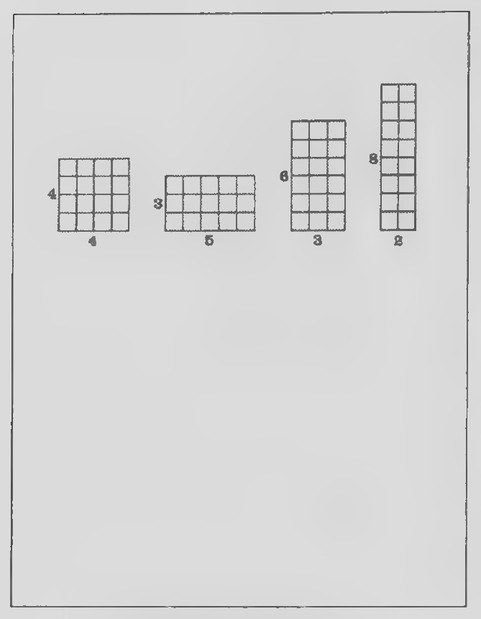 Transparency 9-2-1: National Assessment problem on area
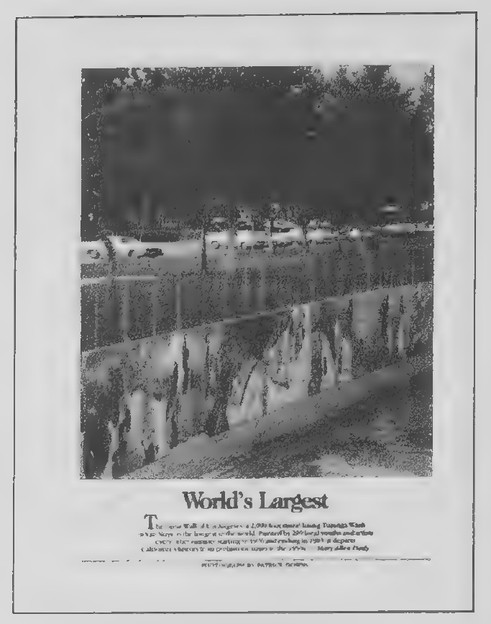 Transparency 9-2-2: World’s longest mural
Lesson 2: Squares and Rectangles
Lesson Outline
Terms: Dimensions of a rectangle: base and altitude.
Postulate 9. The area of a rectangle is the product of its base and altitude.
Corollary. The area of a square is the square of its side.
Transparencies
- 9-2-1 National Assessment problem on area
- 9-2-2 World’s longest mural
Introduction
The figures on Transparency 9-2-1 once appeared in a question on a mathematics test (The National Assessment of Educational Progress) given to nineyear-olds all over the United States. The question was: Which rectangle has the same area as the 4 x 4 square?
After a student gives the correct answer, ask how he or she would explain it to a student who missed it. Only 44% of the students chose the correct answer. Almost as many chose the 3 x 5 rectangle. Can you explain why? (Your students may have a variety of answers for this.) After discussing the difference between perimeter and area, add the overlay to the transparency. We measure area in terms of square units. From these examples, it would seem that the area of a rectangle can always be found by dividing it into these square units and counting them. A shortcut for finding the number of squares would be to multiply the lengths of the “base” and “altitude.”
Develop the rest of the lesson as in the text, emphasizing that, because the dimensions of a rectangle are not always integers, we assume that the shortcut gives the area for every rectangle.
The following exercise is appropriate for the conclusion of this lesson. The longest mural in the world is located next to the school at which I teach (Grant High School, Van Nuys, California). It is called “The Great Wall of Los Angeles”; the photograph on Transparency 9-2-2 shows part of it as well as part of our campus. The mural is 2,000 feet long and 13.5 feet high. A gallon of the paint used covered an area of 150 square feet. On the basis of these figures, how many gallons of paint were needed to produce the mural? (180.)
Transparency 9-2-3 is for use in demonstrating the solution of the Set III exercise. More information about dividing rectangles into squares all having different areas can be found in The Second Scientific American Book of Mathematical Puzzles and Diversions by Martin Gardner (Simon & Schuster, 1961), pages 186-209 and Ingenuity in Mathematics by Ross Honsberger, in the New Mathematical Library (M.A.A., 1970), pages 46-60.
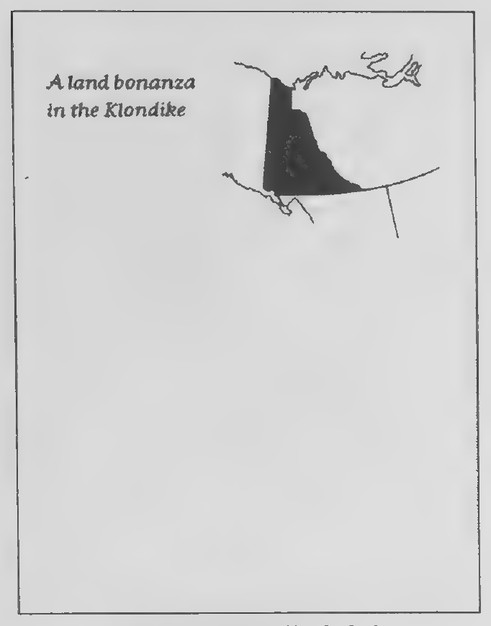 Transparency 9-3-1: A land bonanza in the Klondike
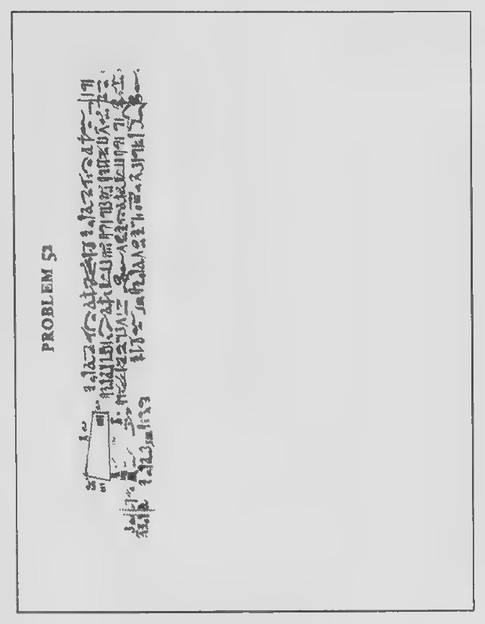 Transparency 9-4-1: Problem 52 from the Rhind Papyrus
Lesson 3: Triangles
Lesson Outline
Terms: Base and altitude of a triangle.
Theorem 38. The area of a right triangle is half the product of its legs.
Theorem 39. The area of a triangle is half the product of any base and corresponding altitude.
Corollary. Triangles with equal bases and equal altitudes have equal areas.
Transparencies
- 9-3-1 A land bonanza in the Klondike
Introduction
Show Transparency 9-3-1. In the 1950s, the Quaker Oats Company sponsored a radio program called “Sergeant Preston of the Yukon.” They once made an offer on their program to sell anyone who sent in 25¢ and a coupon from a box of their cereal some land in the Klondike. For your money, you got a deed to your new property and a small bag of dirt from the general vicinity. Of course, you couldn’t expect a very big lot for only 25¢ and, in fact, each lot was only one square inch in area!
At this rate, how much was one acre of the land being sold for?* One acre is equal to 43,560 square feet. (One acre would have sold for $1,568,160!) The company didn’t make any significant profit, however, because most of the 25¢ went toward the costs
of preparing and mailing the deeds and samples of dirt.
Lesson 4: Parallelograms and Trapezoids
Lesson Outline
Terms: Altitude of a quadrilateral.
Theorem 40. The area of a parallelogram is the product of any base and corresponding altitude.
Theorem 41. The area of a trapezoid is half the product of its altitude and the sum of its bases.
Transparencies
- 9-4-1 Problem 52 from the Rhind Papyrus
Introduction
In 1858, a tourist named Rhind bought an old scroll in a shop in Egypt. The scroll, which is now in the British Museum, turned out to have been written in about 1650B.C. Now called the Rhind Mathematical Papyrus, this scroll is the major source of our knowledge of early Egyptian mathematics.’ It was copied by the scribe Ahmes from earlier writings and contains 87 problems in arithmetic and geometry.
Problem 52 of the Papyrus is shown on Transparency 9-4-1. The problem says:
A cut-off triangle of land is 20 khet on one side, 6 khet on its base, and 4 khet on its cut-off line. What
*This is adapted from a problem in The Lore of Large Numbers by Philip J. Davis, in the New Mathematical Library (M.A.A., 1961).
tThe translation of The Rhind Mathematical Papyrus by Arnold Buffum Chace was published by the N.C.T.M. as volume 8 of the “Classics in Mathematics Education” series.
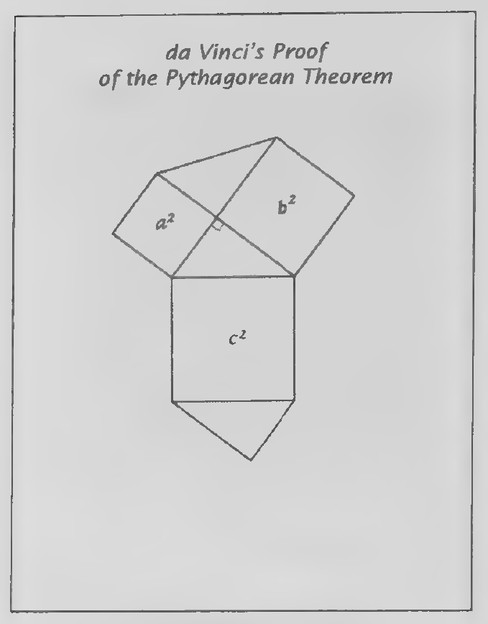 Transparency 9-5-1: Da Vinci’s proof of the Pythagorean
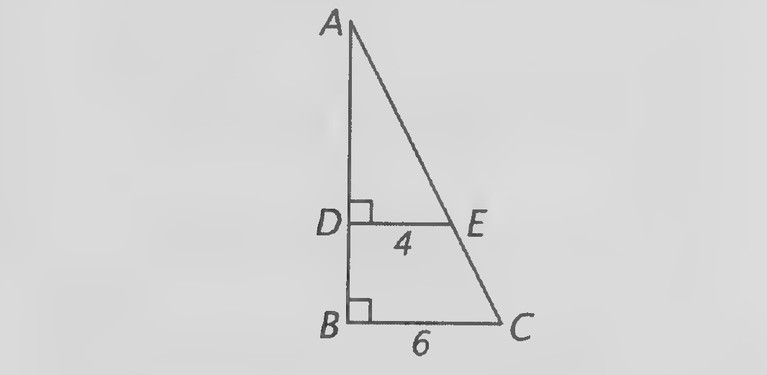 Figure on page 356 — Leonardo da Vinci’s proof diagram: triangle ABC with the perpendiculars and auxiliary segments labelled
is its area? [A khet is equal to 100 cubits, which is roughly 150 feet.]
Although the statement of this problem is rather vague and the figure illustrating it is not accurately drawn, the way in which it is solved makes clear that the problem is about a trapezoid cut off froma right triangle. Have your students draw the following figure to illustrate it.
Although we a formula for the area of a trapezoid, we can find the area of this trapezoid by dividing it into a rectangle and a right triangle. Give your students time to do this before discussing the solution. Drawing a perpendicular from E to BC, we have a rectangle with area 80 and a right triangle with area 20; the area of the trapezoid is 100 square khets.
Following this introduction, the formulas for the areas of a parallelogram and a trapezoid can be derived. Now the Egyptian problem can be reconsidered in terms of the trapezoid area theorem.
Lesson 5: The Pythagorean Theorem
Lesson Outline
Theorem 42. The Pythagorean Theorem. The square of the hypotenuse of a right triangle is equal to the sum of the squares of its legs.
Theorem 43. Converse of the Pythagorean Theorem. If the square of one side of a triangle is equal to the sum of the squares of the other two sides, the triangle is a right triangle.
Transparencies
- 9-5-1 Da Vinci’s proof of the Pythagorean Theorem
- 9-5-2 Converse of the Pythagorean Theorem
First day
Introduction
In this lesson, we come to the Pythagorean Theorem, the most famous theorem in geometry and, indeed, in all of mathematics. It has been proved in many different ways. Leonardo da Vinci invented a proof for it based on the figure on Transparency 9-5-1. Your students should find the following informal treatment of it interesting.
First, notice that the figure contains a right triangle with squares drawn on its three sides. To this da Vinci added some line segments to make two copies of the triangle. Look at the hexagon that contains the squares a² and b² and the two triangles at the top. What kind of symmetry does it seem to have? (Reflection.) Draw the line of symmetry and place, on both sides of it, two pieces that you have cut from colored plastic to fit the two quadrilateral
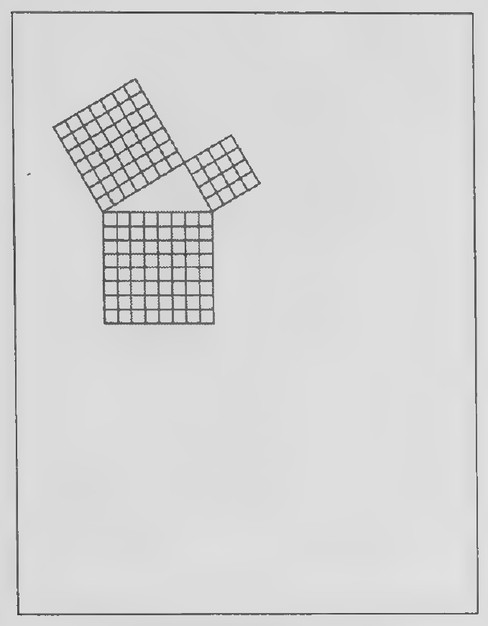 Transparency 9-5-2: Converse of the Pythagorean Theorem
halves of the hexagon.
Next, move the two quadrilateral pieces to the side of the figure and call attention to the hexagon that contains the square c² and the two triangles above and below it. What kind of symmetry does it seem to have? (Rotation.) Draw a line through the vertices of its two right angles and place the two plastic pieces to fit the two quadrilateral halves of this hexagon.
It is possible to prove what the two arrangements of the plastic pieces suggest—that the two hexagons have equal areas. Remove the plastic pieces and call attention again to the regions contained in each hexagon. How does it follow from the fact that the hexagons havae equal areas that a² + b² = c2? (The extra triangles are copies of the original triangle, and so they have equal areas. Letting the area of one of the triangles be x, we have
a² + b²+2x =c*+2x and so
a² +b² =c²,)
To introduce the converse of the Pythagorean Theorem, show Transparency 9-5-2 and explain that this figure is a triangle in which squares have been drawn on the three sides. Then ask if it is a right triangle. If c² a² + b², does it follow that a triangle is not a right triangle? (Yes. Suppose that the triangle is a right triangle. Then c² = a² + b², which contradicts the hypothesis. So it is not a right triangle.) Now suppose that for the triangle on Transparency 9-5-2 we have found that c² = a² + b². Could we conclude from the Pythagorean Theorem that the triangle is a right triangle? (No. We would be
making the converse error.) This raises the question of whether the converse of the Pythagorean Theorem is true. Remark that it is and that the proof is left as one of the exercises.
I recommend giving two assignments on this lesson, limiting the first assignment to some or all of the exercises of Set I.
Second day
Introduction
Every year the Nile River in Egypt overflows its banks in late summer and floods the surrounding land. Herodotus, a Greek historian of the fifth century B.C., wrote: When the Nile inundates the land all of Egypt becomes a sea, and only the towns remain above water, looking rather like the islands of the Aegean. At such times shipping no longer follows the stream, but goes straight across the country.
Because the flooding wiped out many boundary lines, the ancient Egyptians developed some of the basic principles of surveying to reestablish them. The picture on Transparency 9-5-3 is part of a mural more than 3,000 years old. It shows surveyors holding a rope with knots equally spaced along it. By stretching the rope out to form a triangle, the surveyors made use of something we considered in yesterday’s lesson.
The following makes a nice demonstration. Take a rope about 25 feet long and put 13 knots in it at 2-foot intervals. Give a knot at one end to a student to hold and form, in the middle of your class, a 3-4-5 triangle by having other students hold the ap-
 Transparency 9-R-1
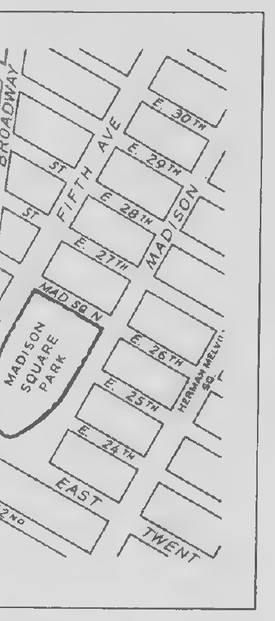 Transparency 9-R-2: Map: Manhattan
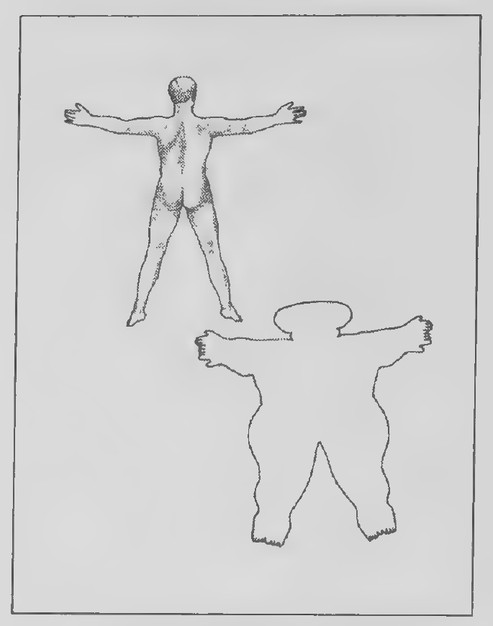 Transparency 9-R-3: The area of a human being
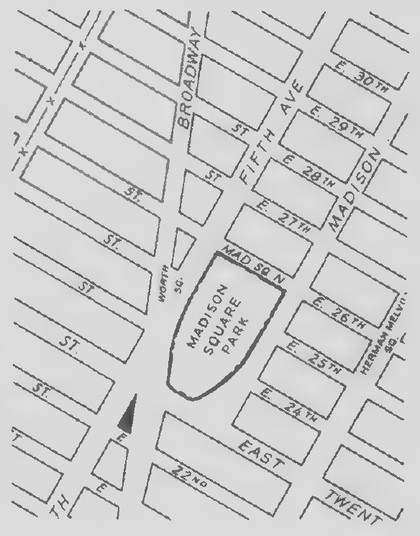 Transparency 9-R-2: Map: Manhattan
propriate knots. Do not tell the class what lengths the sides of the triangle are, but let the students observe them for themselves. The sides should be stretched out tight and the students outside the triangle should stand up and look at the result. Let a student explain what he or she observes. Note that we know that a 3-4-5 triangle is a right triangle not because of the Pythagorean Theorem but because of its converse. A nice transparency could be made from the photograph of an Egyptian field divided into squares from Ancient Egypt by Lionel Casson, in the Great Ages of Man series (Time-Life Books, 1965), pages 48-49. The caption to this photograph is especially appropriate:
A panorama of applied geometry, this Egyptian
field is a patchwork of small squares criss-
crossed with irrigation canals and ditches. To
sustain agriculture in an arid land, the people had to become engineers and learn how to construct complex irrigation works. To cope with the confusion caused by the annual flood of the Nile, Egyptians worked out the rudiments of geometry. “Rope-stretchers,” or surveyors, applied the methods of geometry to redraw the property lines obscured during the flood. Thus the needs of agriculture led the ancient Egyptians to become more than good farmers: mastering both the desert and the river, they not only achieved new skills but expanded their intellectual horizons in the process.*
“Ancient Egypt by Lionel Casson (Time-Life Books, 1965), pages 48-49.
Review of Chapter 9
First day
Transparencies
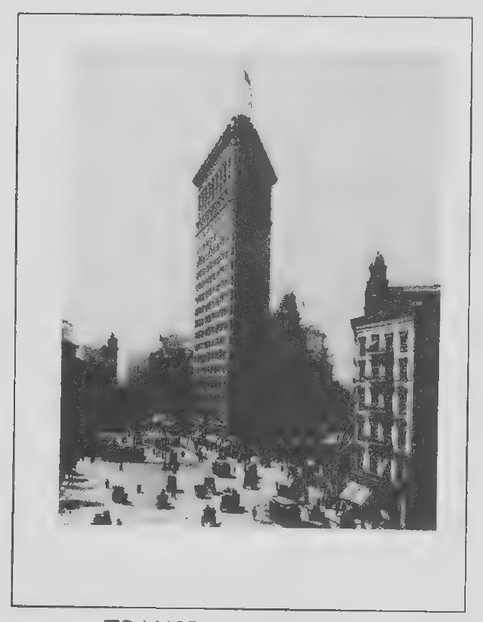
- 9-R-1 _ The Flatiron building
- 9-R-2 Map: Manhattan
- 9-R-3 The area of a human being
- 9-R-2 Table: A person’s area
Introduction
Most of the streets of Manhattan intersect each other at right angles, as they do in most cities. One street that does not, however, is Broadway. The photograph on Transparency 9-R-1 was taken in 1903 at the spot where Broadway (on the left) intersects Fifth Avenue. As the picture shows, the two streets meet at a rather sharp angle and, on the property at the corner, one of the city’s first skyscrapers was built. The building, popularly known as the Flatiron Building, still stands at this intersection.
The map on Transparency 9-R-2 shows the plot of land on which the Flatiron Building was constructed. It is in the shape of a triangle whose sides have lengths 80 feet, 150 feet, and 170 feet. What is the area of the land on which the Flatiron Building stands? (80? + 150? = 1702, so the triangle is a right
1 triangle. Its area is 3 (80)(150) = 6,000 square feet.)
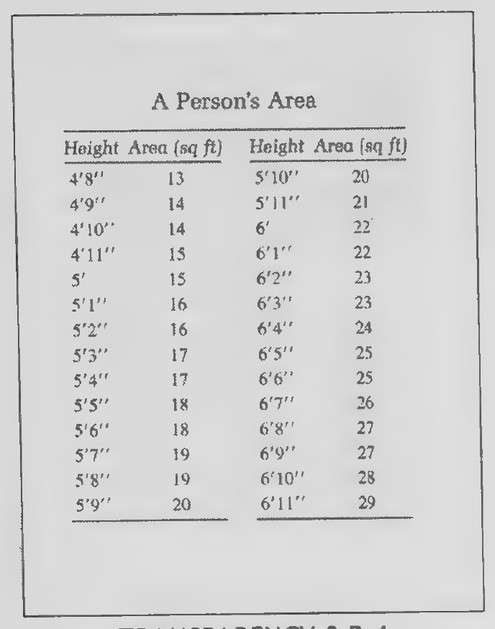 Transparency 9-R-4: A Person’s Area
Second day
Introduction
Almost everyone knows their height and weight quite accurately. Do you know, on the other hand, what your area is? (Show Transparency 9-R-3.) By this, I mean the total surface area of your skin. The lower figure represents the skin of the person in the upper figure stretched out flat like a pelt.
We have developed formulas for finding the areas of a variety of geometric figures, but they are of no use in finding the area of a figure as complex as this. The area of a person of average weight and body build depends on his or her height. Make an estimate of your own area and then I will give you a formula by means of which you can determine it more accurately. (It might be fun to have your students write their estimates on scraps of paper, and then collect the estimates and read some of the more extreme ones to the class before going any further.)
You can find your approximate area by means of the following formula:
3
aod
é )
in which h is your height in feet. After your students have had time to compute their areas by this formula, show Transparency 9-R-4 so that they can check their answers. Each area is rounded to the nearest square foot.
 Transparency 10-1-1: Photographs of Winnie Mae and models
 Transparency 10-1-2: Diagrams of Winnie Mae
 Transparency 10-2-1: Betty Grable