Chapter 8: Transformations
Lesson 1: Transformations
Lesson Outline
Terms: Transformation, translation, reflection, rotation, dilation, isometry.
Transparencies
- 8-1-1 Upside-downs cartoon
- 8-1-2 Upside-downs cartoon strip
- 8-1-3 More transformations
Introduction
One of the earliest comic strips to appear in a newspaper was also one of the most remarkable. Its title was “The Upside-Downs of Little Lady Lovekins and Old Man Muffaroo” and it was published in the New York Herald from 1903 to 1905. The two characters of the cartoon are shown on Transparency 8-1-1. They were drawn so that each character became the other when turned upside down.
One of the comic strips in which these characters appeared is on Transparency 8-1-2. After reading it to your class, point out the amazing aspect of the strip. Not only does each panel make sense upside down, but the story also makes sense even though the first six panels of the strip become the last six panels in reverse order. The artist, Gustave Verbeek, drew a comic strip like this every week for a total of 64 weeks! His work is surely the most amazing application that the rotation transformation has ever had to the field of storytelling and art.
Transparency 8-1-3 can be used to develop the rest of the lesson as in the text.
Lesson 2: Reflections
Lesson Outline
Terms: Reflection of a point through a line, composite, translation, rotation, magnitude.
Construction 8. To reflect a point through a line.
Transparencies
- 8-2-1 Reflection in a lake
Introduction
Show Transparency 8-2-1, which is a photograph of Lake Mathieson in New Zealand. There is something peculiar about this picture. Can you guess what it is? The photograph is upside down. We were fooled by the almost perfect reflection of the landscape and sky in the water into mistaking their images for them. (Turn the picture rightside up.) The edge of the lake divides the picture into two parts in which most of the points above the edge have image points below it. (Draw a line along the lake’s edge and mark several such pairs of points on the picture at various distances from the line. Include one point on the line.) Your students should note that the reflection line is the perpendicular bisector of the segments joining the points to their image points. On the basis of these observations, we will build a “mathematical model” of reflection.
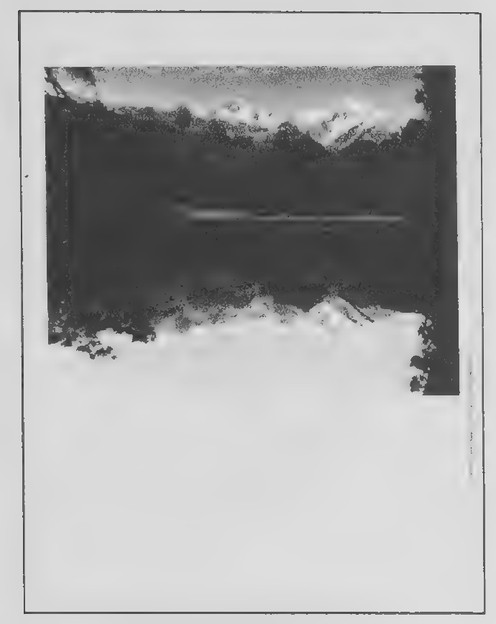 Transparency 8-2-1: Reflection in a lake
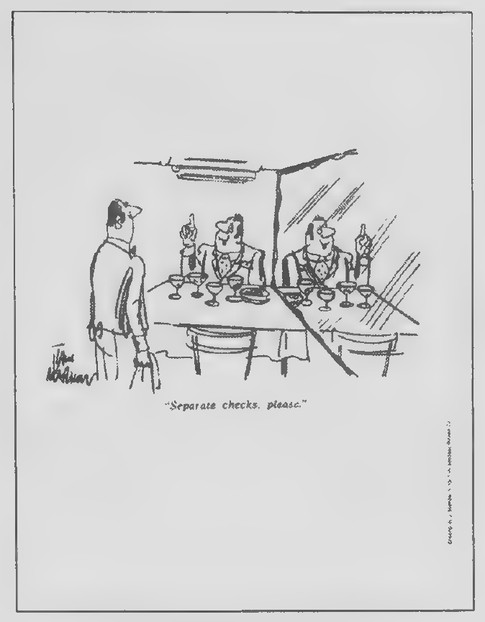 Transparency 8-3-1: “Separate checks, please”.
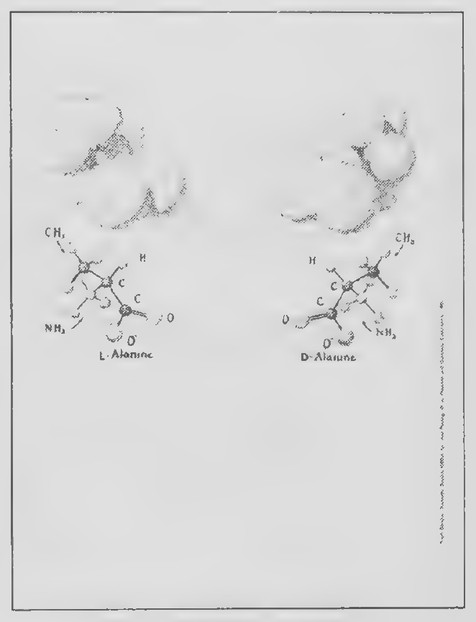 Transparency 8-3-2: Alanine stereoisomers
Develop the rest of the lesson, including the method for locating the reflection of a point through a line by means of straightedge and compass, as in the text.
Lesson 3: lsometries and Congruence
Lesson Outline
Terms: Congruence, glide reflection, mirror image.
Transparencies
- 8-3-1 “Separate checks, please”.
- 8-3-2 Alanine stereoisomers
Introduction
From what the fellow in the cartoon on Transparency 8-3-1 is saying to the waiter, it is apparent that he does not realize that the man sitting at the next table is his own reflection. Perhaps he doesn’t want to pay for all eight drinks because he was irritated by observing that the other person copied everything he did during the meal!
Here is something interesting to think about. Suppose that one of the glasses in front of the man were still full; its image in the mirror, then, would also be full. If it were possible for the man to reach through the mirror and take a drink from the reflected glass, would it taste the same as the drink in the glass in front of him? The answer to this question is “probably not”!*
The figures on Transparency 8-3-2 illustrate two molecules, each of which is the mirror image of the other. Molecules such as these are called stereoisomers. In his book The Architecture of Molecules (W. H. Freeman and Company, 1964), Linus Pauling states that only “left-handed” molecules of the amino acid alanine occur in the proteins of living organisms. The other amino acids in proteins also are left-handed. Some of the right-handed amino acids cannot serve as nutrients and they may, in fact, be poisonous.
Lesson 4: Transformations and Symmetry
Lesson Outline
Terms: Rotation symmetry, reflection (line) symmetry, translation symmetry.
Transparencies
- 8-4-1 Upside-down names by Scott Kim
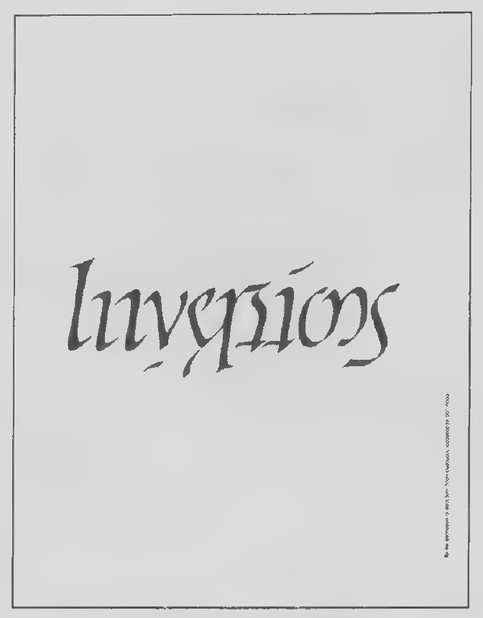
- 8-4-2 Inversions by Scott Kim
- 8-4-3 Symmetry examples
Introduction
The names of Transparency 8-4-1 are from a clever book by Scott Kim, who might be called the “Maurits Escher of calligraphy.” Mr. Kim letters words and phrases in amazingly symmetrical pat-
passage from W. H. Auden’s poem The Age of Anxiety in which a right-handed man sitting in a bar and observing his reflection in a mirror says:
My deuce, my double, my dear image,… What flavor has
That liquor you lift with your left hand…?
*Some of your students would enjoy reading a fascinating book by Martin Gardner on this subject: The Ambidextrous Universe: Mirror Asymmetry and Time-Reversed Worlds, Second Edition (Scribners, 1979). In this book, Gardner quotes a
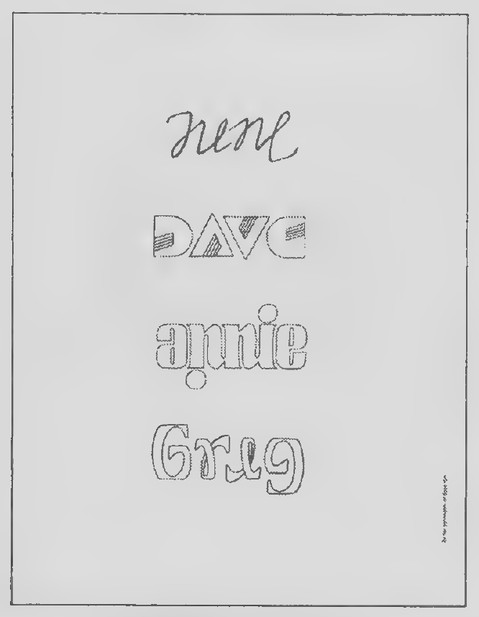 Transparency 8-4-1: Upside-down names by Scott Kim
 Transparency 8-4-2: Inversions by Scott Kim
 Transparency 8-4-3: Symmetry examples
 Transparency 8-R-1: U.S. currency
 Transparency 8-R-2: Cutting corners
 Transparency 8-R-3: Hall of mirrors photograph
terns. Rotating the transparency 180° reveals that each name looks the same upside down. The names have been lettered so that they have rotation symmetry. A figure has rotation symmetry with respect to a point if it coincides with its rotation image about the point. The figure on Transparency 8-4-2 does not have rotation symmetry, but it is remarkable in that it is the name of Scott Kim’s book, Inversions, and, upside down, becomes Scott Kim’s name.
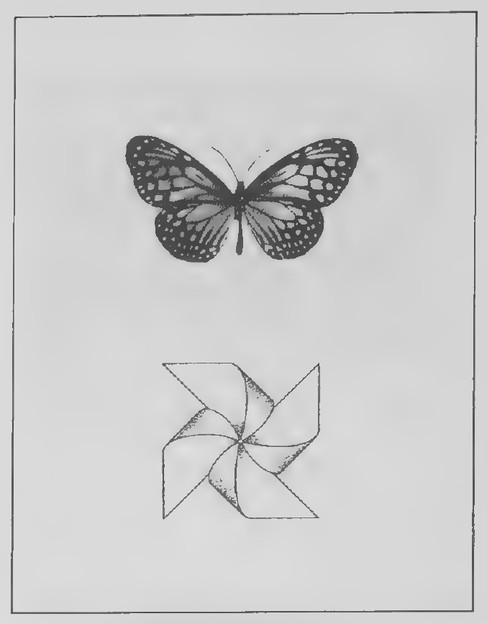
Show the picture of a butterfly on Transparency 8-4-3, keeping the figure below covered, as an example of reflection symmetry. A second copy of the paper-windmill figure to use with the figure on Transparency 8-4-3 is helpful to show that it does not have reflection symmetry but that it does have rotation symmetry. Show how the windmill can be
rotated 90°, 180°, or 270° to coincide with itself.
Review of Chapter 8
Transparencies
- 8-R-1 U.S. currency
- 8-R-2 Cutting corners
- 8-R-3 Hall of mirrors photograph
- 8-R-4 Hall of mirrors diagram
- 8-R-5 Big Dipper
First day
Introduction
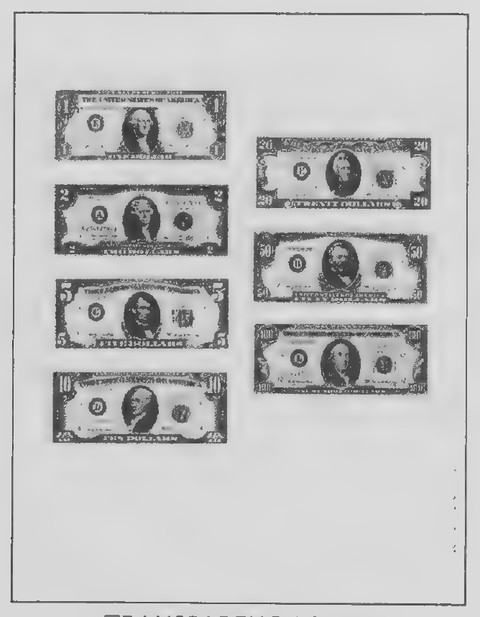
Show Transparency 8-R-1. A bill was once submitted to Congress proposing that U.S. currency be printed in a way that enables a person who is blind to determine the denomination of each note. It was
 Transparency 8-R-4: Hall of mirrors diagram
 Transparency 8-R-5: Big Dipper
suggested that some of the corners of the notes be trimmed so that the values of the notes could be figured out by their shapes.
The seven denominations of bills currently in circulation are shown on the transparency. How many ways are there to cut (or not cut) the corners of a rectangle so that each shape is different? Assume that the cuts are angled at 45° and identical in size.
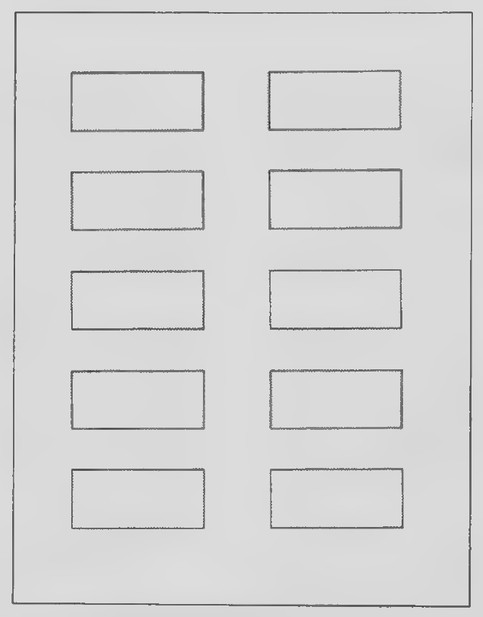
Hand out duplicated copies of Transparency 8-R-2 and give your students some time to try to discover all of the possibilities. Remind them that a blind person feeling a bill does not know what position the bill is in; considerations of symmetry are important in finding ways that are really different.
It is somewhat of a coincidence that there happen to be exactly seven different ways to cut (or not cut) the corners. They are:
No corners.
. One corner.
Two adjacent corners along a short edge.
. Two adjacent corners along a long edge.
. Two opposite corners.
Three corners.
PWN QO N. Four corners.
After the solutions have been found, it is interesting to think about how each particular denomination of bill should be cut. Which bill, for example, should have no corners cut and which should have all four corners cut? (The corners of the bills should be cut so that a person cannot deceive someone who is blind by cutting off additional corners to make them seem more valuable. Therefore, the $1 bill
should have all four of its corners cut. The $2 bill should have three corners cut; the $5, $10, and $20 bills should have two corners cut; the $50 bill should have one corner cut; and the $100 bill should have no corners cut.)
Second day
Introduction
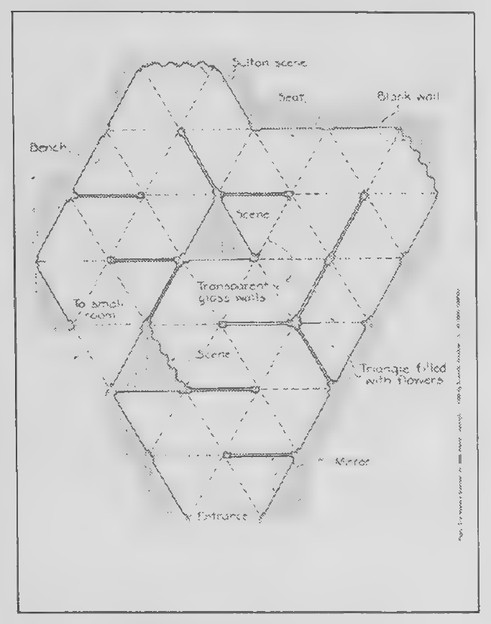
There is an elaborate maze of mirrors in Lucerne, Switzerland, that was originally built for the Swiss National Exhibition of 1896. A photograph showing part of the maze appeared on the cover of the June 1986 issue of Scientific American (Transparency 8-R-3). The floor plan of the maze, shown on Transparency 8-R-4, consists of an array of equilateral triangles. Mirror walls stand on one or two sides of most of these triangles and several scenes, shown on the floor plan, are inside the maze.
Hand out duplicated copies of Transparency 8-R-4 and explain that, if you stood at the entrance of the maze, you would see what looks like a long hallway. The problem is to use reflections to figure out what you would see at the end of the hallway. Help your students in getting started by drawing a line from the center of the entrance to represent a ray of light and showing its first two reflections from the walls. It may be helpful to think of the path as that of a ball rolled into the maze and bouncing around until it hits a surface that is not a mirror. A person standing at the entrance to the maze would see the scene enclosed in the upper triangle.
Asecond problem might be to figure out to what point in the maze you would have to walk in order to see the triangle filled with flowers. (You would
have to walk into the triangle adjacent to the first scene.)
Students who have enjoyed solving these reflection problems will find “The Amateur Scientist” column in the June 1986 issue of Scientific American very interesting. The column, by Jearl Walker, includes another color photograph of the Hall of Mirrors in Lucerne and suggests a variety of experiments to perform to learn more about mirror mazes.
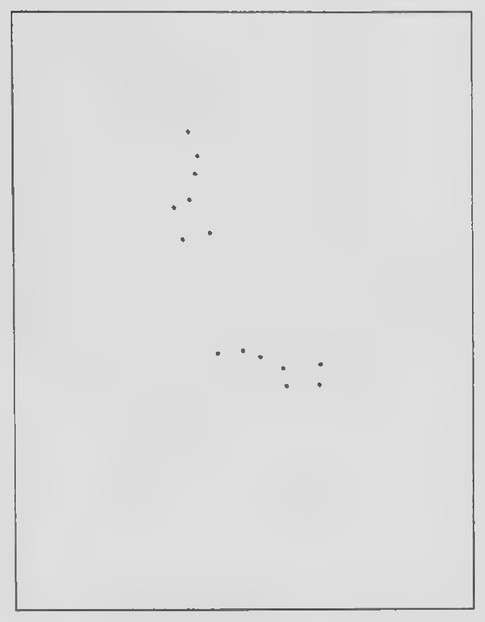
An interesting class exercise for additional review is illustrated on Transparency 8-R-5, which should be duplicated and given to your students. Explain that during the night, the stars of the Big Dipper appear to rotate counterclockwise about Polaris, the north star. In the figure, two positions of the Big Dipper are shown. The first problem is to find Polaris, the center of the rotation. The second problem is to find the magnitude of the rotation. (75°.) The final problem is to estimate the length of time that it takes the Big Dipper to move in the sky from one of these positions to the other. (Five hours.)
 Transparency 9-1-1: Map: Kansas and surrounding states
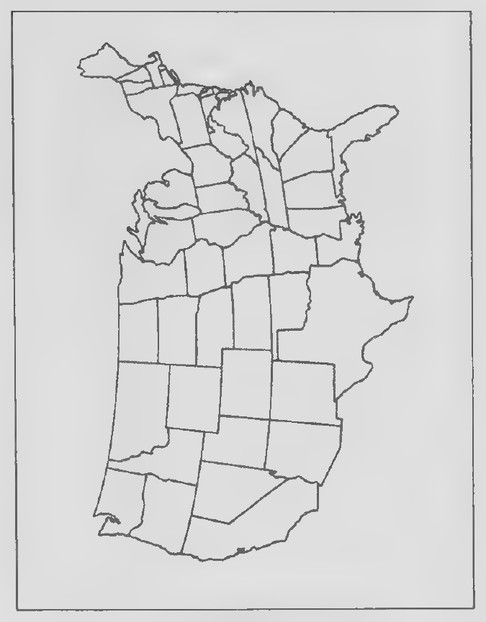 Transparency 9-1-2: Map: United States