Chapter 7: Quadrilaterals
Lesson 1: Quadrilaterals
Lesson Outline
Terms: Convex polygon, concave polygon, diagonal of a polygon, rectangle.
Theorem 24. The sum of the angles of a quadrilateral is 360°.
Corollary. A quadrilateral is equiangular iff it is a rectangle.
Transparencies
- 7-1-1 Photograph of mud cracks
Introduction
Show Transparency 7-1-1 and let your students guess what the photograph is of. It shows cracks in dried mud and is taken from a fascinating book that every mathematics teacher should own: Mathematical Snapshots by Hugo Steinhaus (Oxford University Press, 1969).
Can you guess which cracks occurred first? (The longest ones.) It is interesting to notice that almost all of the cracks meet at right angles. (There is a physical explanation for this in terms of the laws of mechanics.) Most of the figures formed by the cracks have four sides; they are examples of quadrilaterals, the subject of the next chapter of the course.
(Add the Overlay for Transparency 7-1-1.) Certain types of quadrilaterals are given specific names; some examples are shown here. How many of them
can you identify? (1. square; 2. rectangle; 3. parallelogram; 4. trapezoid.)
Lesson 2: Parallelograms and Point Symmetry
Lesson Outline
Terms: Parallelogram, point symmetry.
Theorem 25. The opposite sides and angles of a parallelogram are equal.
Theorem 26. The diagonals of a parallelogram bisect each other.
Transparencies
- 7-2-1 The first crossword puzzle
- 7-2-2 Acrossword puzzle pattern
Introduction
The first crossword puzzle was published in the New York World on December 21, 1913 and is shown on Transparency 7-2-1. Unlike current crossword puzzles, it was diamond shaped and did not contain any black squares. Today, crossword puzzles appear daily in almost every American newspaper. They are almost always square and the black squares in them are usually arranged in symmetric patterns.
The arrangement shown on Transparency 7-2-2 is a typical example. The pattern does not have line symmetry because there is no way to fold it so that the two halves coincide. It has a different kind of symmetry. Can you describe what it is? (The pat-
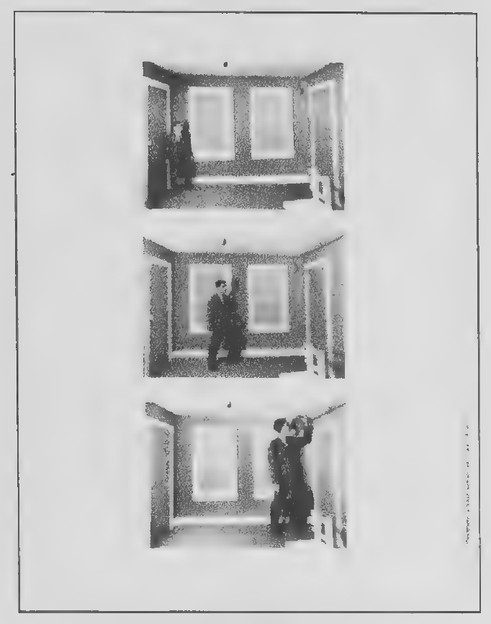 Transparency 7-3-1: The Ames room
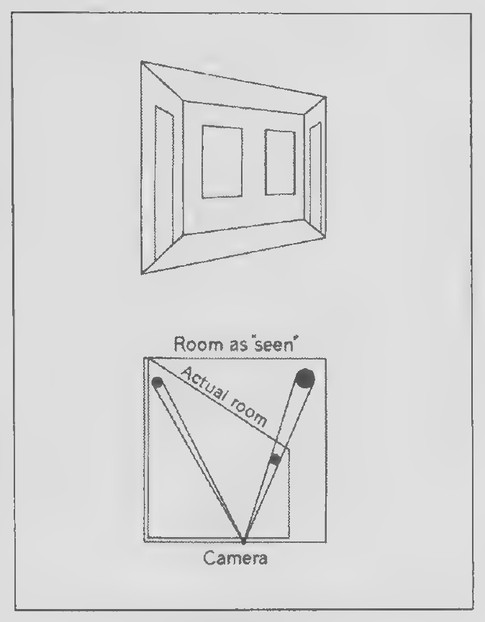 Transparency 7-3-2: The Ames room explained
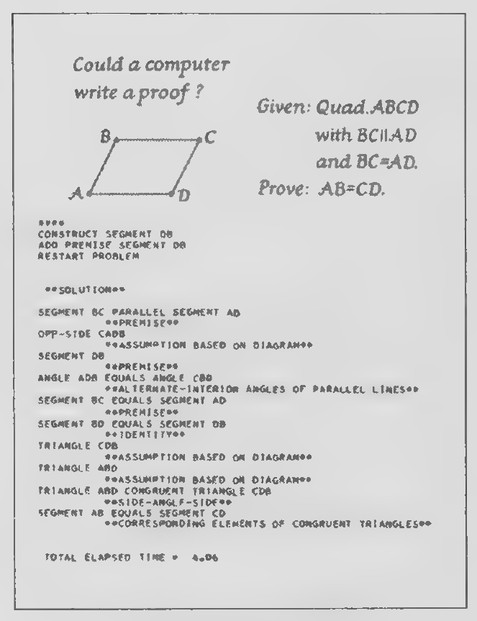 Transparency 7-4-1: Could a computer write a proof?, 1
tern would look the same if it were turned upside down.) A figure having this property is said to possess point symmetry. Mark the point that is the center of the pattern and show examples of pairs of points in the pattern that are symmetric with respect to this point. What relation does this point have to the line segments connecting such pairs of points? (It is their midpoint.)
The grid of a crossword puzzle contains squares and rectangles, both of which also possess point symmetry. It also contains parallelograms; squares and rectangles are also called parallelograms because their opposite sides are parallel. Following from this introduction, the rest of the lesson can be developed as in the text.
Lesson 3: More on Parallelograms
Lesson Outline
Theorem 27. A quadrilateral is a parallelogram if its opposite sides are equal.
Theorem 28. A quadrilateral is a parallelogram if its opposite angles are equal.
Theorem 29. A quadrilateral is a parallelogram if two opposite sides are both parallel and equal.
Theorem 30. A quadrilateral is a parallelogram if its diagonals bisect each other.
Transparencies
- 7-3-1 The Ames room
- 7-3-2 The Ames room explained
Introduction
Transparencies 7-3-1 and 7-3-2 can be used to introduce the new lesson as in the text. The Ames room
was invented by the American psychologist Adelbert Ames. Some interesting experiments with an Ames room are described in the article “Visual Perception and Personality” by Warren J. Wittreich in the April 1959 issue of Scientific American (pages 56-60).
Lesson 4: Rectangles, Rhombuses, and Squares
Lesson Outline
Terms: Square, rhombus.
Theorem 31. All rectangles are parallelograms.
Theorem 32. All rhombuses are parallelograms.
Theorem 33. The diagonals of a rectangle are equal.
Theorem 34. The diagonals of arhombus are perpendicular.
Transparencies
- 7-4-1 Could a computer write a proof?, 1
- 7-4-2 Could a computer write a proof? (2)
Introduction
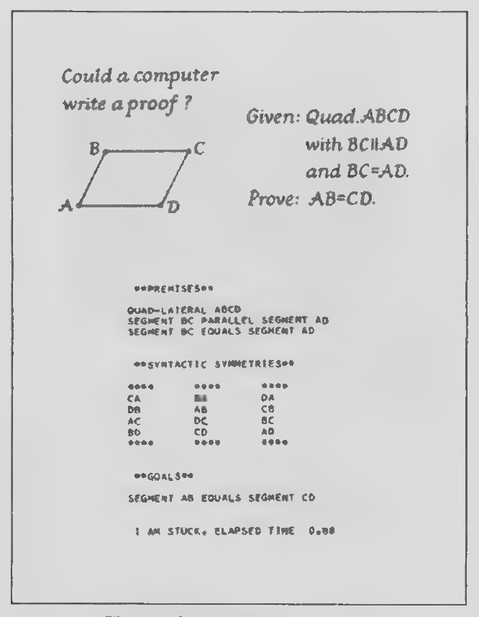
Not long after the invention of the computer, an experiment was conducted at the IBM Research Laboratory to see if a computer could be programmed to write geometric proofs. A number of basic postulates and theorems, along with the methods of deductive reasoning, were stored in the memory of an IBM 704 computer and then it was given some exercises to prove. One of them is similar to a theorem in yesterday’s lesson. Show Transparency 7-4-1. The problem was to show that, if two sides of a quadrilateral are both parallel and equal, then the other two sides are equal. This is what the computer did. Show Transparency 7-4-2. Your stu-
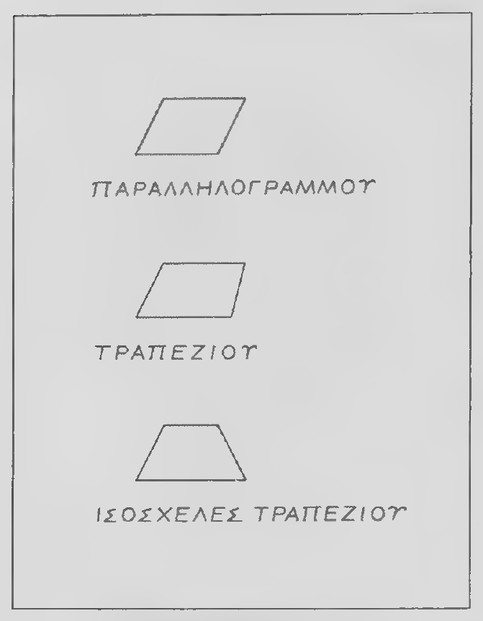 Transparency 7-5-1: Greek parallelogram and trapezoids
 Transparency 7-5-2: Congruence puzzle (Set III)
 Transparency 7-4-2: Could a computer
dents should recognize the “premises” and “goals” as the “given” and “prove.” The “syntactic symmetries” are a list of point relations that had to be included in the program because the computer could not see the figure.
After the computer had “thought” about the problem for 88 seconds, it reported that it was stuck (some of my students exhibit about the same amount of persistence, I am afraid). The computer was stuck because it did not know very much about quadrilaterals. To help out the computer, the person running it added a diagonal to the figure to form some triangles. After a few more minutes, the computer printed out the proof given. As you read it to the class, point out that we would take some of the steps for granted.
If the computer had been programmed with the theorems of yesterday’s lesson, it might have come up with a much shorter proof. Can you think of what it is? (The quadrilateral is a parallelogram because two opposite sides are both parallel and equal. The opposite sides of a parallelogram are equal.)
Your students will be interested to know that in 1976, two mathematicians at the University of Illinois used a computer to finally prove a theorem that people had been trying to prove since its discovery in 1852.* Unfortunately, the proof is so long that it would be impossible for a human being to read it. It took 1,200 hours of computer time to write the
proof and it would take more than a lifetime to read it!
Lesson 5: Trapezoids
Lesson Outline
Terms: Trapezoid, bases, legs, base angles, isosceles trapezoid.
Theorem 35. The base angles of an isosceles trapezoid are equal.
Theorem 36. The diagonals of an isosceles trapezoid are equal.
Transparencies
- 7-5-1 Greek parallelogram and trapezoids
- 7-5-2 Congruence puzzle (Set III)
Introduction
Hand out duplicated copies of Transparency 7-5-1. It is interesting to realize that some of the words that we use in geometry would sound familiar to Euclid, even though he lived in Egypt more than two thousand years ago. The figures and words are from a geometry book written in Greek.
Have your students identify the figures and print their English names in capital letters below the Greek names. The Greek word “parallelogrammon” is derived from words meaning “bounded by parallel lines.” “Trapezion’ is related to trapezoid and the Greek word “isosceles” means “having equal legs.”
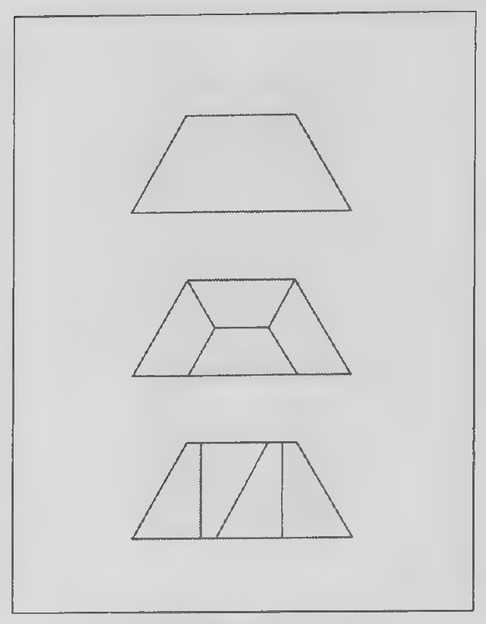
Transparency 7-5-2 is for use in discussing the Set III exercise of Lesson 5. The figure in the center was originally thought to be the only solution to
*The theorem is the four-color map theorem referred to on page 6 of the text. An interesting book on this subject is Four Colors Suffice: How the Map Problem was Solved by Robin Wilson (Princeton University Press, 2002).
 Transparency 7-6-1: The mirror on the wall
this puzzle but Andrew Miller, the high school student of Richard Brady in Washington, D.C. mentioned in the text, discovered the solution pictured at the bottom. This solution was sufficiently surprising that it was reported in Scientific American (Martin Gardner’s “Mathematical Games,” February 1979).
Lesson 6: The Midsegment Theorem
Lesson Outline
Terms: Midsegment
Theorem 37. The Midsegment Theorem. A midsegment of a triangle is parallel to the third side and half as long.
Transparencies
- 7-6-1 The mirror on the wall
Introduction
If possible, place a large mirror on one of the walls of your room before class. Be sure that the mirror is vertical.
You have all looked at reflections of yourselves in large wall mirrors. How do you suppose your distance from the mirror affects the amount of yourself that you can see? (Because the farther you are from the mirror, the farther your reflection seems to be behind it, many people assume that you can see more of yourself as you move away from the mirror. Some people, realizing that, as you back away from a mirror you see less and less of the surrounding room reflected in it, think that you see less of yourself as well. Actually, your distance from the mirror makes no difference. The amount of your-
self that you can see is controlled solely by the length of the mirror and not by how far away from it you happen to be standing. A student who walks from the back of the room toward the mirror at the front while looking at his or her reflection can confirm this.)
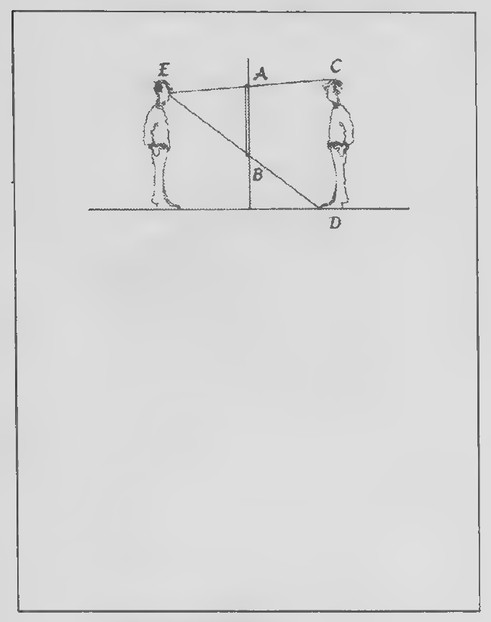
To see why this is so, look at this diagram (Transparency 7-6-1). The vertical segment in the center represents a side view of a wall and AB represents a mirror on it. The mirror is just long enough so that the person standing on the left can see his entire image on the right. (Add Overlay A.) If the person moves away from the mirror, so does his image. Notice, however, that his lines of sight to the reflections of the top of his head and bottom of his feet still pass through points A and B. (Replace Overlay Awith Overlay B.) This figure shows what happens if the person moves toward the mirror instead. Again, his lines of sight pass through points A and B. (Remove Overlay B.) How long do you think the mirror would need to be for the person to see his entire image if he is six feet tall? In other words, if CD = 6, how long do you think AB is? It is not difficult to prove that A and B are the midpoints of sides EC and ED in △ECD. We will call a segment that joins the midpoints of two sides of a triangle a midsegment of the triangle, and we will prove that such a segment is always parallel to the third side of the triangle and exactly half as long. The rest of the new lesson can be developed as in the text.
 Transparency 7-R-1
 Transparency 7-R-2: Square illusion
 WORKSHEET FOR 7-R
Review of Chapter 7
Transparencies
- 7-R-1 _ Garnet crystal and polyhedron
- 7-R-2 Square illusion
- 7-R-3 Quadrilateral quiz Square illusion (worksheet)
First day
Introduction
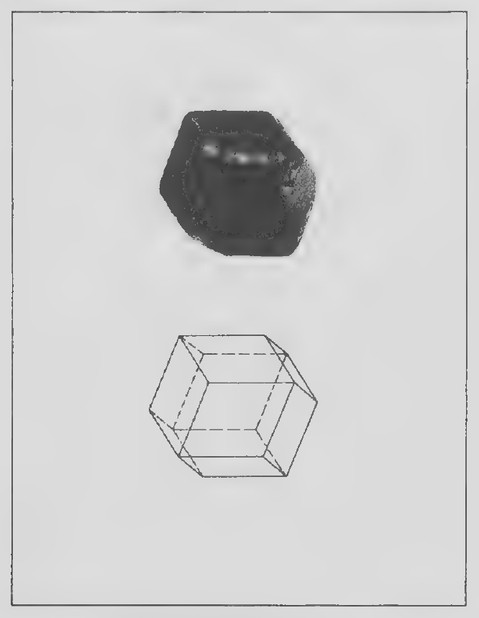
Transparency 7-R-1 contains a photograph of a crystal of garnet and a diagram of its structure.* Every edge of the crystal has the same length, and so its faces are equilateral. What kind of faces does the crystal have? (Rhombuses.) What other names for them can you think of? (Parallelograms, quadrilaterals, polygons.)
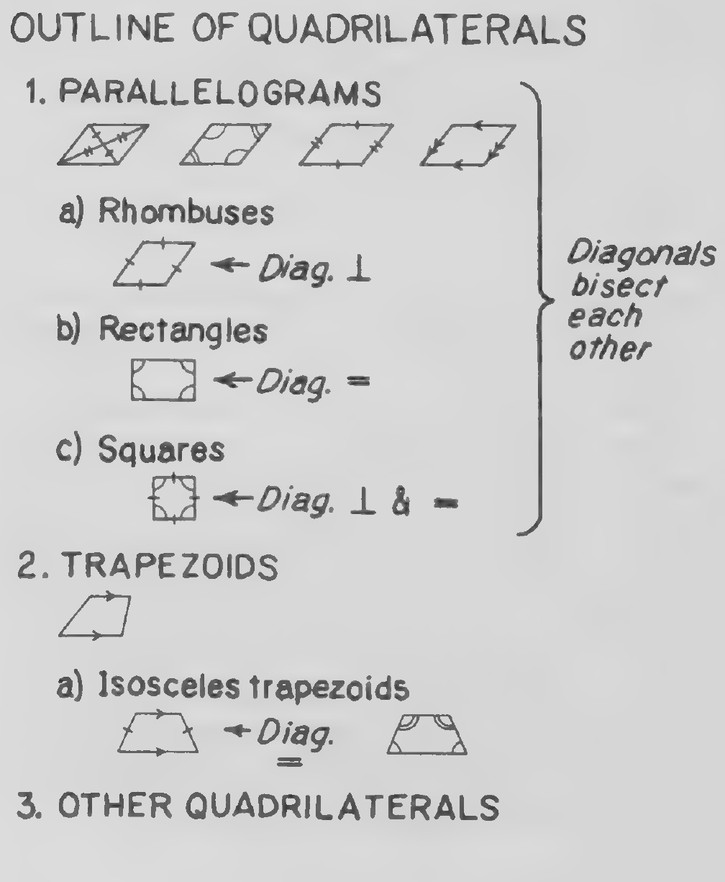
As a review of the various quadrilaterals studied in this chapter, you might direct your students in making an outline such as the one shown at the right.
Second day
Introduction
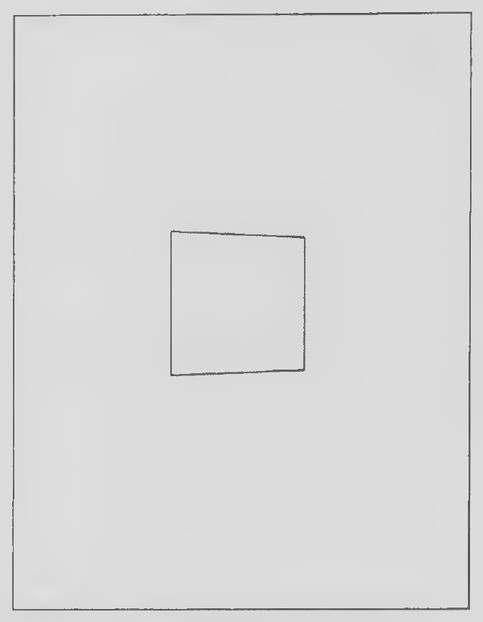
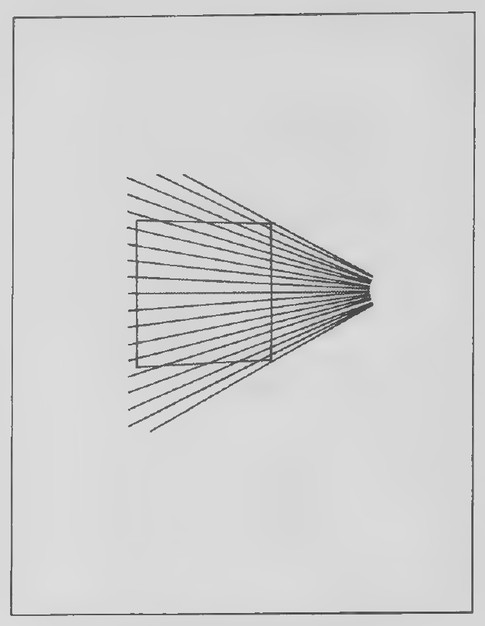
Show Transparency 7-R-2 with the overlay in place and ask your students what kind of quadrilateral they think is pictured. (Square and rectangle are popular guesses.) Then hand out duplicated copies of Worksheet for Chapter 7 Review and give everyone a chance to measure the sides of the quadrilat-
eral with their rulers. After they have discovered that the left and right sides are not equal, remove the overlay from the transparency to reveal the quadrilateral as an isosceles trapezoid. This is quite a remarkable optical illusion!
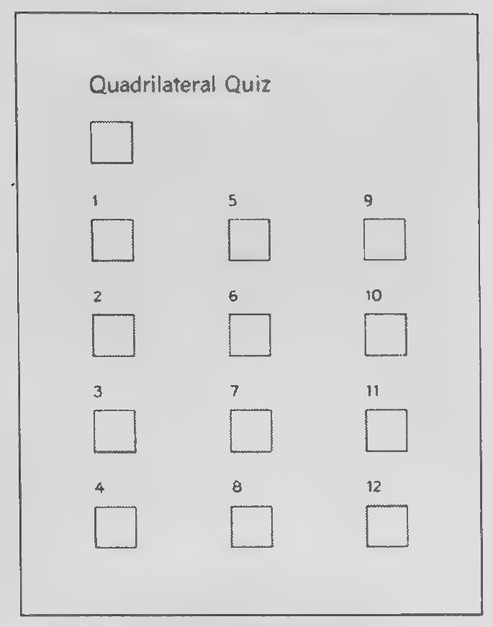
Next, hand out duplicated copies of Transparency 7-R-3 and tell your students that, although these figures look like the quadrilateral in the optical illusion, they are not to make any assumptions about the figures other than what you tell them. The
 Worksheet: outline of quadrilaterals
The outline classifies quadrilaterals: parallelograms (a. rhombuses, b. rectangles, c. squares — the diagonals of all three bisect each other; in rhombuses they are perpendicular, in rectangles equal, and in squares both), trapezoids (a. isosceles trapezoids), and other quadrilaterals.
*This solid, called a rhombic dodecahedron, has 12 identical faces: each face is a rhombus having acute angles of 70°32’. An interested student might enjoy making a model of it for you to use.
 Transparency 7-R-3: Quadrilateral quiz
figure at the upper left is for use as an example. Use arrowheads to mark the top and bottom parallel and explain that the problem, if it is possible, is to identify the type of quadrilateral as specifically as they can. If it is not possible, they are to answer with a question mark. In the case of the example, we do not know anything about the other two sides. The figure could be a parallelogram or a trapezoid, and so the correct answer is a question mark.
Before beginning the quiz, you might mention that the questions vary in difficulty from very easy to very tricky. I tell my students that anyone who is able to answer all twelve questions correctly deserves an A on the chapter. Ask all twelve questions before checking the answers.
What you draw
on the figure The answer
- Mark the vertical sides Parallelogram
parallel and equal.
- Mark all four angles Rectangle
equal.
- Mark both pairs of Parallelogram
opposite sides parallel.
- Mark the vertical sides?
equal.
- Mark all four sides Rhombus
equal.
- Mark both pairs of Parallelogram
opposite angles equal.
- Mark all four sides Square
equal and all four
angles equal.
- Mark the top and 2
bottom parallel and the
vertical sides equal.
- Draw the diagonals Parallelogram
and indicate that they
bisect each other. 10. Mark both pairs of Parallelogram
opposite sides equal. 11. Mark one pairofop-?
posite angles equal. 12. Draw the diagonals?
and mark them
perpendicular.
The last question is particularly treacherous because it is so easy for students who know that the diagonals of a rhombus are perpendicular to make the converse error.
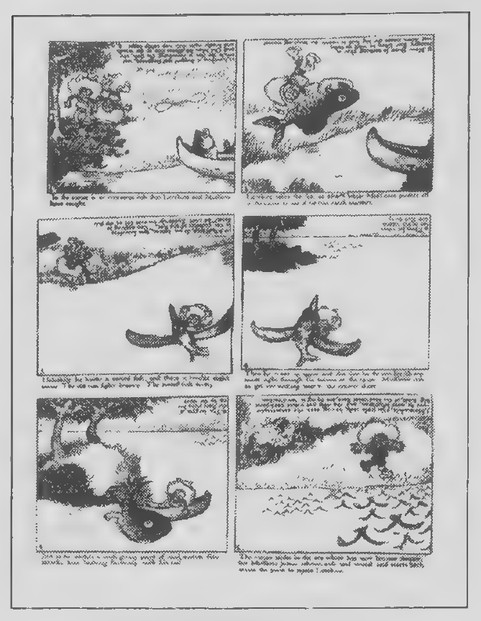 Transparency 8-1-2: Upside-downs cartoon strip
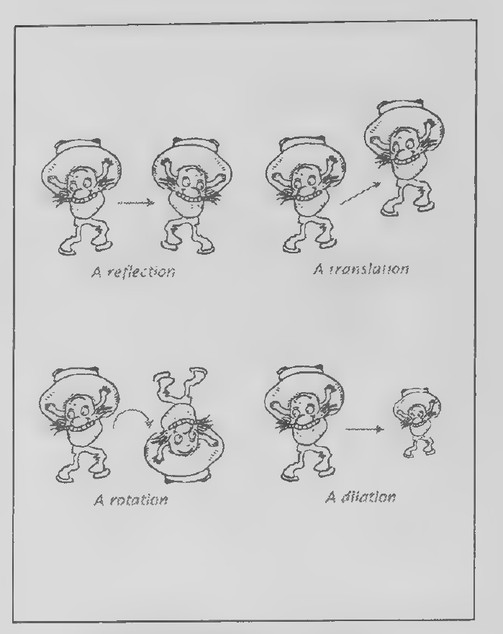 Transparency 8-1-3: More transformations
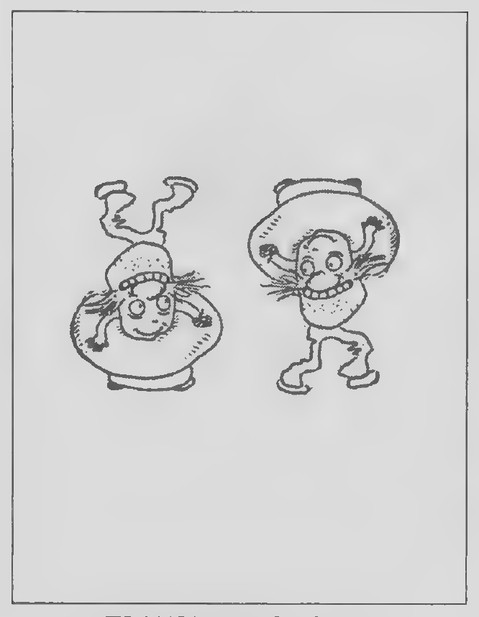 Transparency 8-1-1: Upside-downs cartoon