Chapter 6: Parallel Lines
Lesson 1: Line Symmetry
Lesson Outline
Terms. Perpendicular bisector, equidistant.
Definition. Two points symmetric with respect to a line.
Theorem 16. Ina plane, two points each equidistant from the endpoints of a line segment determine the perpendicular bisector of the line segment.
Construction 6. To construct a line perpendicular to a given line through a given point.
Transparencies
- 6-1-1 Assyrian sculpture
Introduction
Show the upper figure on Transparency 6-1-1, keeping the lower figure covered. This drawing is of a sculpture created in the seventh century B.C. for the palace in the city of Nimrud (nim-rood) in ancient Assyria (now Iraq). It shows two winged creatures with heads like eagles standing on either side of a tree. They are holding pails and appear to be using sponge-like objects to wash, or possibly fertilize, the tree.
At first glance, the right side of the sculpture might appear to be a mirror image of the left side. Can you see why this is not the case? (One pail is higher than the other. More than that, the arms of the creatures are not mirror images of each other: both creatures are using their right hands to hold the sponges(?) and their left hands to hold the pails.)
Show the lower figure on the transparency. Here the sculpture has been redrawn so that each side is
now the mirror image of the other. The figure now has line symmetry. The two figures are from the book Right Hand, Left Hand by Chris McManus (Harvard University Press, 2002). About them, McManus writes:
Technically, it would have been easier for the artist to draw the bottom picture, and so presumably there were strong reasons… for the additional effort put into drawing the top picture. Not the least of those was probably that the artist knew full well that most people are right-handed, and it was reasonable to presume that eagle-headed spirits would be also. The asymmetry at the heart of the original version of the picture adds to its interest, subtlety and realism, as the eye and the mind flip back and forth between the left and right halves, which are simultaneously similar and different.
Following this introduction, the rest of the lesson can be presented as in the text.
Lesson 2: Proving Lines Parallel
Lesson Outline
Terms: Parallel lines, transversal, corresponding angles, alternate interior angles, interior angles on the same side of a transversal.
Theorem 17. Equal corresponding angles mean that lines are parallel.
Corollary 1. Equal interior angles mean that lines are parallel.
Corollary 2. Supplementary interior angles on the
 Transparency 6-2-1: Parallel lines and train tracks
 Transparency 6-2-2: Parallel lines in perspective
 Transparency 6-3-1: Escher’s Waterfall
same side of a transversal mean that lines are
parallel. Corollary 3. In a plane, two lines perpendicular to
a third line are parallel.
Transparencies
- 6-2-1 Parallel lines and train tracks
- 6-2-2 Parallel lines in perspective
Introduction
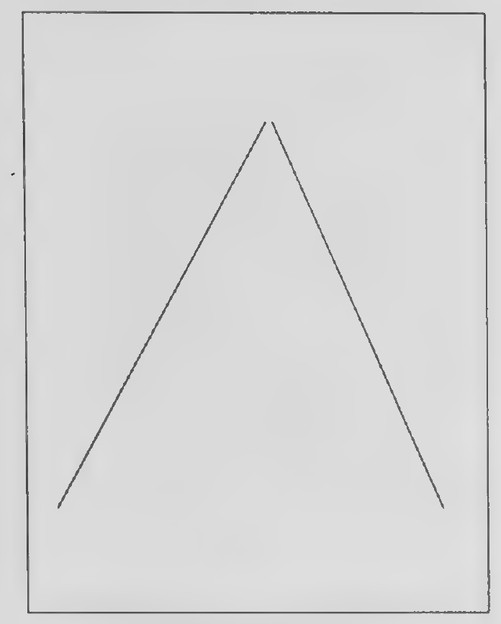
Show Transparency 6-2-1 and ask your students if the lines are parallel. After someone has explained why he or she thinks that the lines are not parallel, add the overlay. The photograph of the train rails suggests that the lines are parallel after all, but that when they are seen in perspective, they seem to intersect.
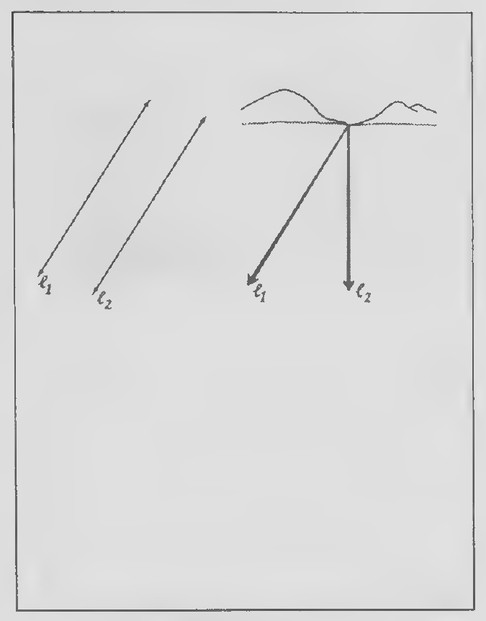
Show Transparency 6-2-2. These figures illustrate two different views of parallel lines. The first view shows the lines as seen from overhead and the second view shows them as seen in perspective. Draw a transversal in each figure, label the figures appropriately (see the figures on page 220 of the text), and develop the rest of the lesson as in the text.
Note that the angle relations introduced in this lesson—corresponding angles, alternate interior angles, and interior angles on the same side of the transversal—are not defined, but merely illustrated.
Lesson 3: The Parallel Postulate
Lesson Outline
Construction 7. To construct a line parallel to a given line through a given point.
Postulate 7. The Parallel Postulate. Through a
point not on a line, there is exactly one line
parallel to the given line. Theorem 18. Ina plane, two lines parallel to a third
line are parallel to each other.
Transparencies
- 6-3-1 Escher’s Waterfall
Introduction
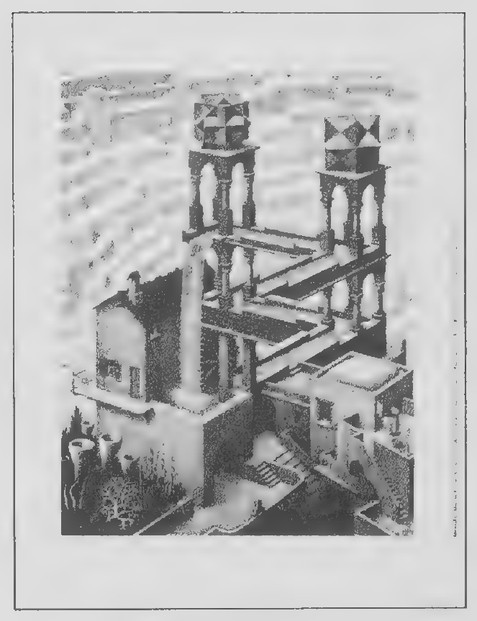
To introduce this lesson, you might show Escher’s Waterfall (Transparency 6-3-1). Escher wrote about ihe
Falling water keeps a millwheel in motion and
subsequently flows along a sloping channel be-
tween two towers, zigzagging down to the point
where the waterfall begins again. The miller sim-
ply needs to add a bucketful of water from time
to time, in order to compensate for loss through
evaporation.”
Waterfall was inspired by the Penrose triangle. It appears three times in the picture, which you can show by placing the overlay for Transparency 6-3-1 in the appropriate positions.
Point out that the picture contains several examples of parallel lines and present the rest of the lesson as in the text. It is important to emphasize that “at least one” and “no more than one” are distinct ideas and that proving one does not prove the other. An example such as the following one may be useful. If we wanted to find out how many stu-
*The Graphic Work of M. C. Escher (Meredith Press, 1967; Ballantine Books, 1971).
 Transparency 6-5-1: Map: United States, 1858
 Transparency 6-4-1: Measuring the height of a cliff
dents at our school might have their birthday today, could we find out if there is at least one by asking everyone in our class? Could we find out if there is no more than one by asking everyone in our class?
Lesson 4: Parallel Lines and Angles
Lesson Outline
Theorem 19. Parallel lines form equal corresponding angles.
Corollary 1. Parallel lines form equal alternate interior angles.
Corollary 2. Parallel lines form supplementary interior angles on the same side of a transversal.
Corollary 3. In a plane, a line perpendicular to one of two parallel lines is also perpendicular to the other.
Transparencies
- 6-4-1 Measuring the height of a cliff
Introduction
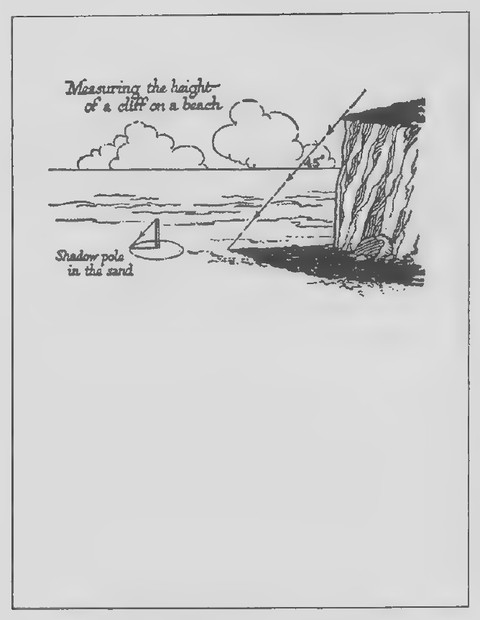
The upper figure on Transparency 6-4-1 illustrates a method for indirectly measuring the height of a cliff and is from the first edition of Lancelot Hogben’s Mathematics for the Million (Norton, 1937). In his book Geometry Civilized (Clarendon Press, 1998), J. L. Heilbron describes it:
You want to measure the height of the sheer cliff without climbing it. Put a stick vertically into the sand and draw a circle around its base with a radius equal to the stick’s height. Then wait for a time on a sunny day when the stick’s
shadow just reaches the circle. At that instant, measure the cliff’s shadow, which will equal its height.
The lower figure suggests one way to show why the method works. AB represents the stick and DE represents the cliff. When the stick’s shadow touches the circle at C, we can conclude that AB = BC. Why? (The circle was drawn so that its radius is equal to the stick’s height.) What kind of triangle is △ABC? (Anisosceles right triangle; ∠B is a right angle since the stick was put vertically into the sand.) What can you conclude about the angles at A and C² (∠A = ∠C = 45°.) Since the sun is so far away, it is assumed that the lines represents the rays of light, AC and DF, are parallel. What does this suggest about ∠F² (That it also has a measure of 45°.) Why would it follow from this that the cliff’s shadow is equal to its height? (Assuming that △DEF is also a right triangle, it follows that ∠D = 45° from which we can conclude that the triangle is also isosceles.)
The main assumption in this argument is that parallel lines form equal corresponding angles with a transversal. You might think that we have already proved this as a theorem, but the theorem we have proved is the converse of this. Remember that a statement and its converse do not say the same thing. If a implies b, it does not necessarily follow that b implies a.
Following this introduction, the rest of the lesson can be presented as in the text.
 Transparency 6-5-2: Triangulation
 Transparency 6-6-1: Acorner reflector
 Transparency 6-6-2
Lesson 5: The Angles of a Triangle
Lesson Outline
Theorem 20. The Angle Sum Theorem. The sum of the angles of a triangle is 180°.
Corollary 1. If two angles of one triangle are equal to two angles of another triangle, the third angles are equal.
Corollary 2. The acute angles of a right triangle are complementary.
Corollary 3. Each angle of an equilateral triangle is 60°.
Theorem 21. An exterior angle of a triangle is equal to the sum of the remote interior angles.
Transparencies
- 6-5-1 Map: United States, 1858
- 6-5-2 Triangulation
Introduction
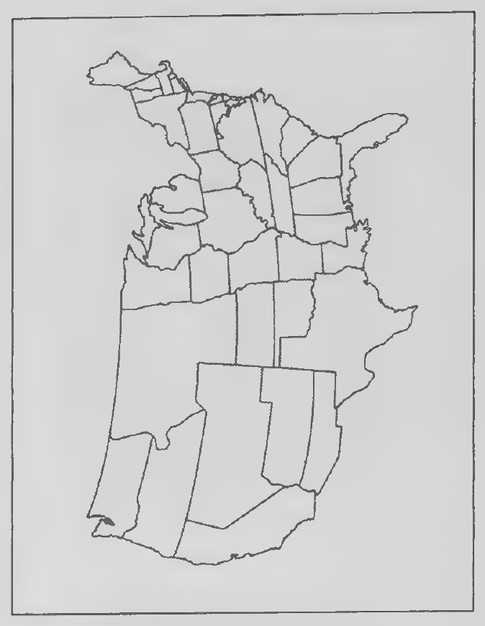
The map on Transparency 6-5-1 shows the United States as it appeared in 1858. The strange-looking regions are labeled, from the upper left, Washington, Nebraska, Oregon, Utah, New Mexico, and “Arrizonia.” Oklahoma is labeled “Indian Territory.” This map was copied from a map of railroad surveys undertaken by the U. S. Government to determine the best route from the Mississippi to the Pacific Coast.”
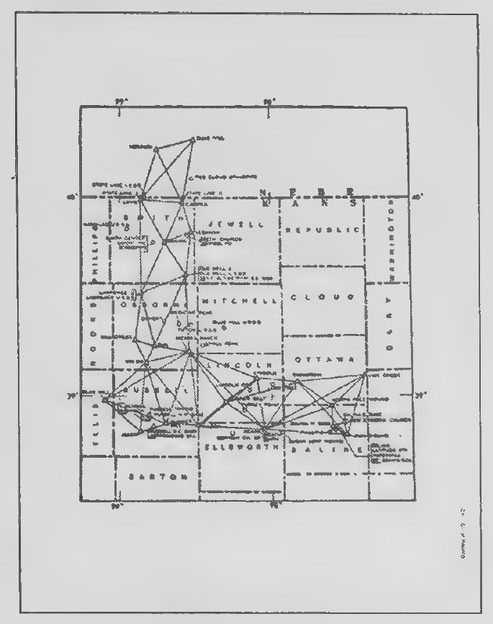
The figure on Transparency 6-5-2 also appears on page 236 of the text and can be used to lead into
the rest of the lesson. In talking about triangulation, it would be interesting to tell your students where the triangulation station mark closest to your school is located. This formation is available from the U. S. Coast and Geodetic Survey.
Lesson 6: AAS and HL Congruence
Lesson Outline
Theorem 22. The AAS Theorem. If two angles and the side opposite one of them in one triangle are equal to the corresponding parts of another triangle, the triangles are congruent.
Theorem 23. The HL Theorem. If the hypotenuse and a leg of one right triangle are equal to the corresponding parts of another right triangle, the triangles are congruent.
Transparencies
- 6-6-1 Acorner reflector
- 6-6-2 . AAS and HL congruence
Introduction
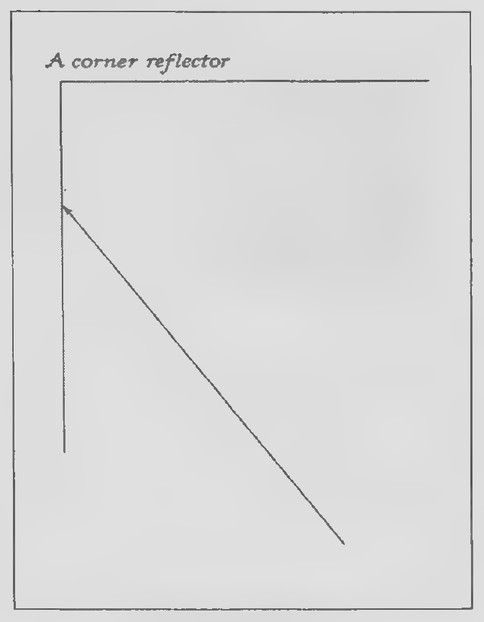
An interesting model that can be used for several purposes consists of two hinged mirrors arranged so that they form a dihedral right angle. Set up such a model in a front corner of the room before class. The model should be approximately at the eye level of your students when they are seated at their desks.
The model is a simple example of a corner reflector: it reflects light back to its source regardless of the direction from which the light comes. This means that all of your students should be able to see their reflections, regardless of where they hap-
*Many interesting maps of the United States are included in The Mapping of America by Seymour I. Schwartz and Ralph E. Ehrenberg (Abrams, 1980).
 Transparency 6-R-1: Doubling the angle on the bow
 Transparency 6-R-2: S.A.T. problem
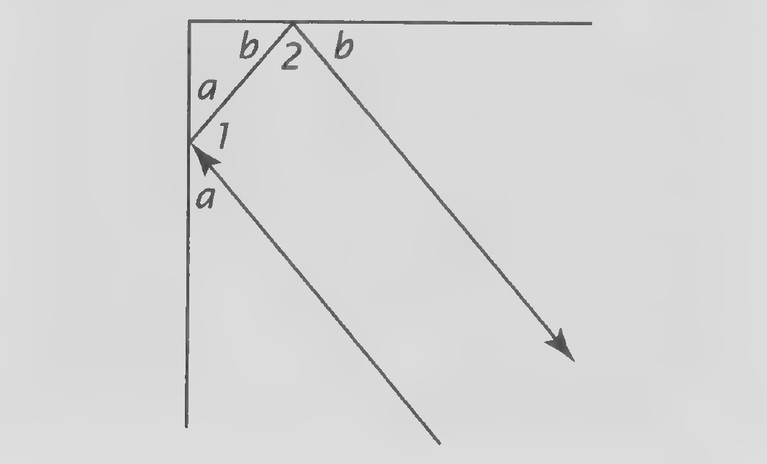 Figure on page 340 — A right angle divided by construction lines, with the small angles labelled a, b, 1, and 2
pen to be seated in the room.
Anarray of corner reflectors was left on the surface of the moon at the time of the first landing in 1969. The reflectors make it possible to use laser light to measure the distance from the earth to the moon to within an inch.
Hand out duplicated copies of Transparency 6- 6-1. This figure shows an overhead view of the two mirrors in the corner reflector and a ray of light hitting one of them. Note that the mirrors are perpendicular to each other. The angle at which a ray of light strikes a mirror is equal to the angle at which it is reflected. Your students can discover how the reflector works by using their protractors and rulers to draw the path of the ray of light after it hits the first mirror. The figure that results suggests that the ray of light is reflected back in the same direction from which it came—that is, the incoming and outgoing paths appear to be parallel.
To prove this, label the measures of the angles as shown in the figure below. The proof makes a
good review of several facts from earlier lessons. Guide your students in writing it by observing that a+b=90, 21 =180-2a, and 22 = 180 — 2b, so that
∠1+2Z2 = (180-22) + (180 — 2b)
= 360 - 2a — 2b
= 360-2(a +b)
= 360 - 2(90)
= 180. Because we have shown that 21 and 22 are supplementary, it follows that /, and I, are parallel.
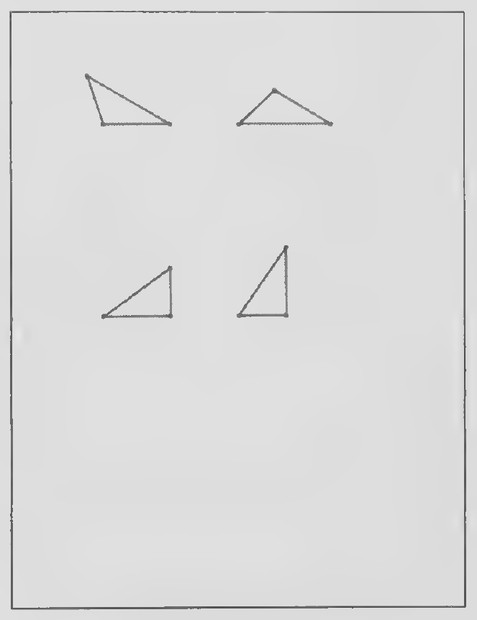
I suggest providing your students with duplicated copies of Transparency 6-6-2 for use in taking notes on the proofs of the AAS and HL congruence theorems.
Review of Chapter 6
Transparencies
- 6-R-1 Doubling the angle on the bow
- 6-R-2 S.A.T. problem
First day
Introduction
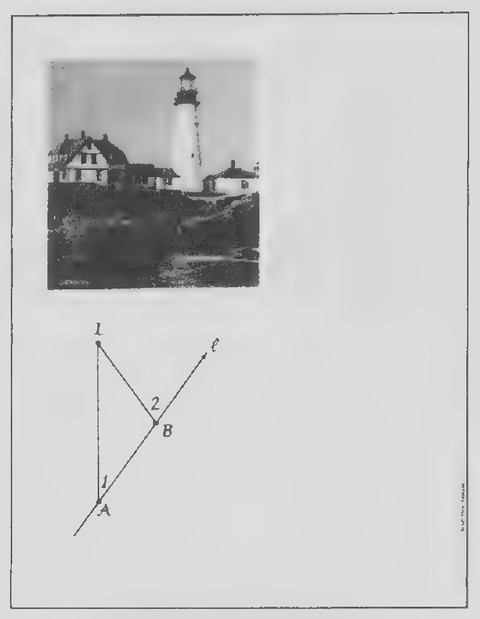
One of the seven wonders of the ancient world was a lighthouse at Alexandria in Egypt. Built at about the time of Euclid, it guided ships until as late as the twelfth century. Today more than 10,000 lighthouses mark the shorelines of the world’s continents for ships traveling at night.
An example of how the navigator of a ship uses geometry to determine how far the ship is from a lighthouse sighted on the shore is illustrated on Transparency 6-R-1. This procedure is called “doubling the angle on the bow.” Suppose that the ship
is moving along line / when a lighthouse at point L is sighted. As the ship travels along the line, the angle between its course and the line of sight to the lighthouse gets larger and larger. If the navigator measures this angle when the ship is at A and then waits until the ship has moved to a point where the angle has doubled, point B in the figure, the navigator can conclude that the distance from the ship to the lighthouse is equal to the distance the ship has traveled in going from A to B. In other words, if 22 =2/1, then LB = AB.
Give your students time to try to write a proof of this procedure, taking as “given” that 22 = 2/1 and that 22 is an exterior angle of △ABL.
Proof.
- 22 =221 and 22 is an exterior angle of
△ABL. (Given.)
- ∠2= 21+ ∠L. (An exterior angle of a
triangle is equal to the sum of the remote
interior angles.)
. 221 = 21+ ∠L. (Substitution.)
. ∠1 = ∠L. (Subtraction.)
O ® O1. LB=AB. (If two angles of a triangle are
equal, the sides opposite them are equal.)
Second day
Introduction
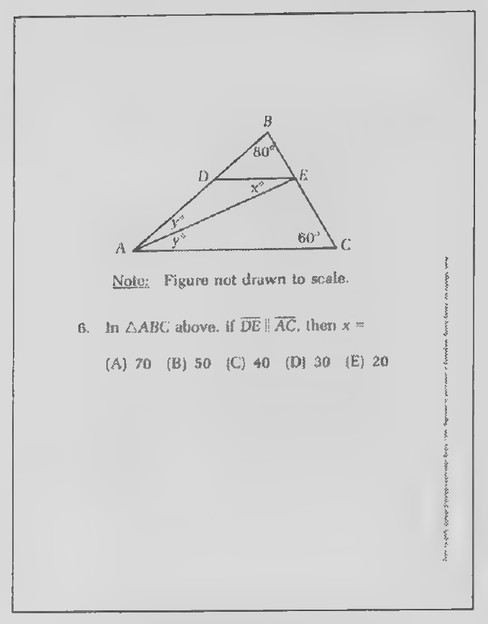
The S.A.T. problem on Transparency 6-R-2 provides further review of ideas in Chapter 6.
 Transparency 7-2-2: Acrossword puzzle pattern
 Transparency 7-1-1: Photograph of mud cracks
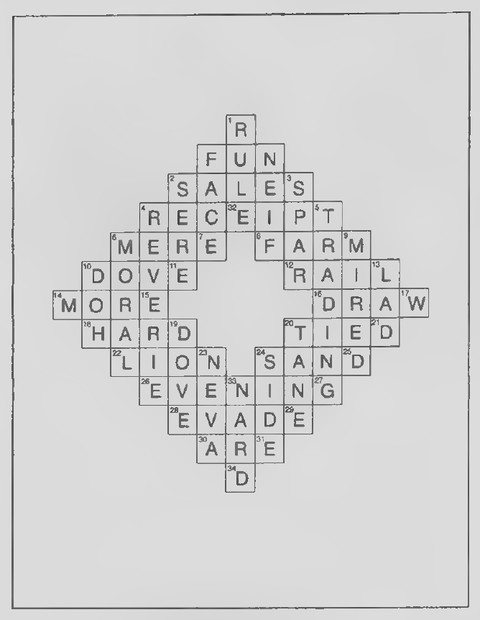 Transparency 7-2-1: The first crossword puzzle