Chapter 5: Inequalities
Lesson 1: Properties of Inequality
Lesson Outline
Properties of inequality: “Three possibilities,” transitive, addition, subtraction, multiplication, division, addition theorem, “whole greater than part” theorem.
Transparencies
- 5-1-1 De Savigny illusion
- 5-1-2 Starfish angles
- 5-1-3 SAT problem (Set II, Exs. 26-31)
- 5-1-4 Proof (Set II, Ex. 48)
Introduction
The figure on Transparency 5-1-1 is based on one from a book published in France in 1905 titled The Entertainments of Science.* Four points have been added to the figure for reference. How do you think the distance from A to B compares with the distance from B to C² (You might poll your class on this question by a show of hands. After doing so, use a transparent ruler to measure the two distances. AB appears to be about 4 inches and BC almost a quarter inch longer.)
So far in our study of geometry, we have paid most of our attention to line segments and angles
that are equal. We now turn to comparisons of line segments and angles that are not equal. To do so, we need to make some new assumptions. For example, in comparing the distances AB and BC in the illusion of Transparency 5-1-1, we took for granted that there were only three possibilities. Either AB > BC, AB = BC, or AB < BC. It is reasonable to think that no other possible relations between the two lengths might exist. We will assume that this is so and call it the three possibilities property of inequality.
Here is an example of another property of inequality. It is easy to see from the figure that AB > CD. From this observation and the fact that BC > AB, we can figure out how BC and CD compare in length without doing any more measuring. What conclusion can you draw? (Because BC > AB and AB > CD, BC > CD.) This conclusion is based on the transitive property of inequality.
We need to also include the operations of addition, subtraction, multiplication, and division in our list of properties of inequality. You are already familiar with these properties from your study of algebra. (As a quick review of them, you might ask your students to verbally solve each of the following equation-and-inequality pairs.)
1S B= 74 = 10)
X=3 = 72@:<110))
A+ x= 9) (eS 5,)
4, 44+x>9.(x>5,)
*In the book, by G. B. De Savigny, the figure was drawn so that AB = BC. The figure is a variation of the “Oppel illusion” and is discussed on page 140 of Jacques Ninio’s book titled The Science of Illusions (Cornell University Press, 2001).
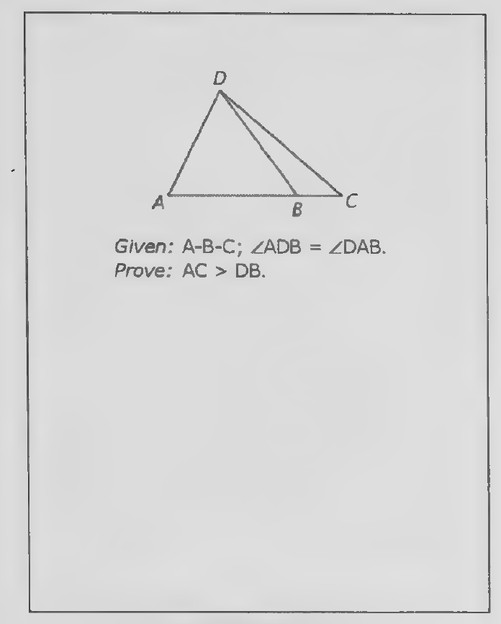 Transparency 5-1-4: Proof (Set II, Ex. 48)
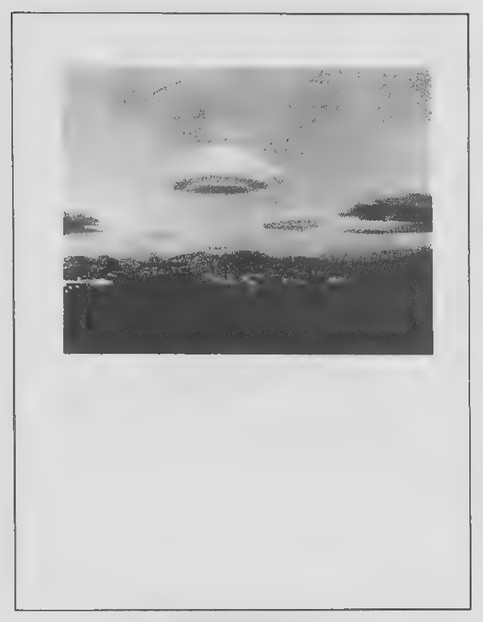 Transparency 5-2-1: A photograph of a UFO?
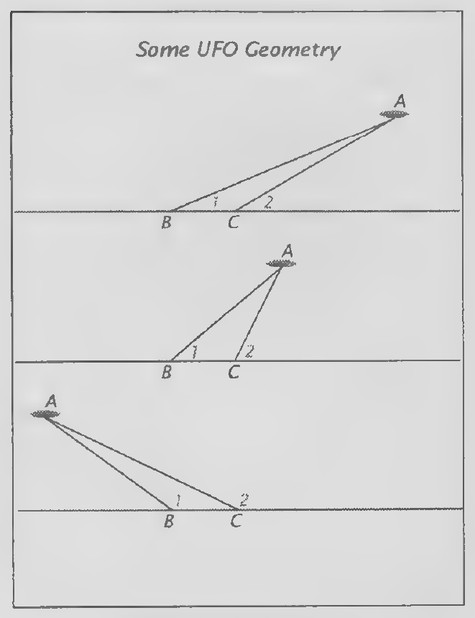 Transparency 5-2-2: Some UFO Geometry
- = 5 < & (x (x < 16. )
Tink = OO, (x =’6,)
Soc 30.10 S26!)
Transparency 5-1-2 is for possible use in introducing the two properties of inequality that are proved in this lesson: the Addition Theorem of Inequality and the “Whole Greater than Part” Theorem.
The angles between the arms of a starfish vary from one starfish to another. In the starfish shown in the photograph, 21 > 23 and 22 > 24. Given this information, how do you think ∠AOC and ∠COE compare in size? (∠AOC > ∠COE.) This conclusion is based on the Addition Theorem of Inequality and substitution:
∠1>2Z3 and 22> ∠4 (Given).
21+ 2Z2> 23+ 24 (Addition Theorem of Inequality).
∠AOC= 21 + 22 and Z COE= 23+ 24 (Betweenness of Rays Theorem).
∠AOC > Z COE (Substitution).
Point out to your students that we will ordinarily assume betweenness relations from the figures and sometimes even skip the betweennesstheorems steps in our proofs.
How do ∠AOC and 21 compare in size? (∠AOC > 21.) This conclusion is based on the “Whole Greater than Part” Theorem. ∠AOC, the “whole angle,” is greater than either of its “parts,” wand 22
Your students are now prepared to summarize the eight properties of inequality by stating them symbolically.
Lesson 2: The Exterior Angle Theorem
Lesson Outline
Definition: Exterior angle of a triangle.
Theorem 12. The Exterior Angle Theorem. An exterior angle of a triangle is greater than either remote interior angle.
Transparencies
- 5-2-1 A photograph of a UFO?
- 5-2-2 . Some UFO geometry
- 5-2-3 . Angle ina triangle (Set II, Exs. 46 and 47)
Introduction
Show Transparency 5-2-1. This photograph was taken in Sao Paulo, Brazil. What do you suppose it shows? (Although it might appear to show some UFOs, those objects are actually lenticular clouds.) Reports of sightings of unidentified flying objects first took place in the summer of 1947, and UFOs have been a topic of controversy ever since. Transparency 5-2-2 can be used to introduce the lesson on the Exterior Angle Theorem as in the text. First explain how the elevation of the UFO can be found from a scale drawing on the basis of the fact that △ABC is determined by ASA. The shape of △ABC doesn’t matter. Before getting into the Exterior Angle Theorem itself, ask your students how the two numbered angles in the second figure on the transparency appear to compare in measure. (22597 1)) The relation between these angles is less obvious in the
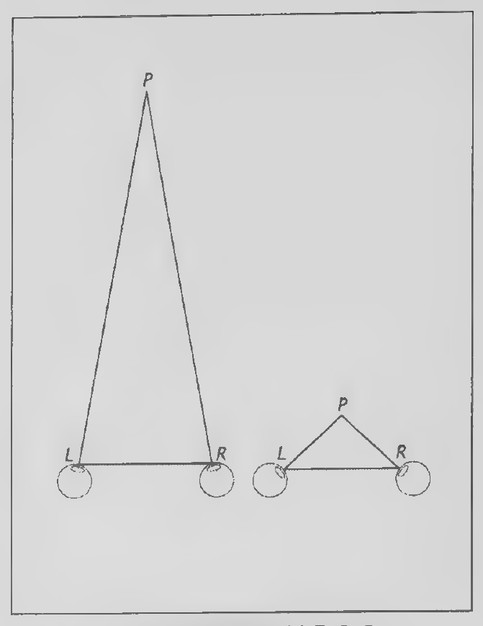 Transparency 5-3-2: Convergence when the object is equidistant
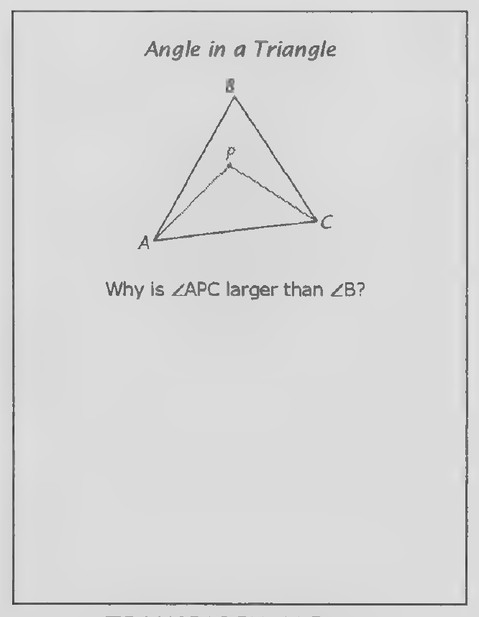 Transparency 5-2-3: Angle in a Triangle
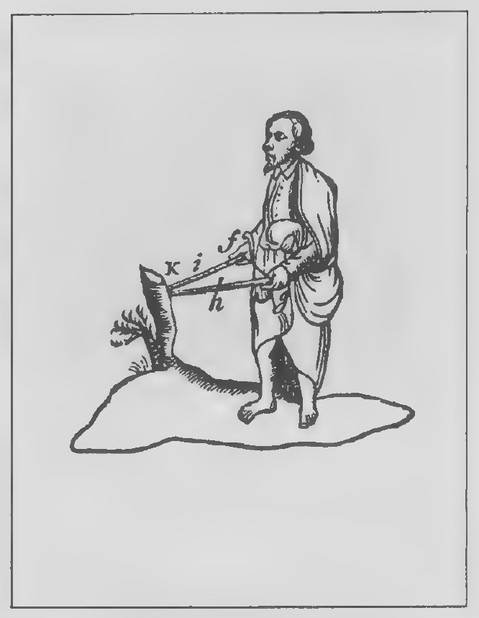 Transparency 5-3-1: Blind man judging distance to object
other two figures. You might also ask your students where the UFO would be located when 21 = 22. They may be surprised to find that there is no such location, because 22 is always greater than 21.
The proof of the theorem given in the text implicitly assumes that ray CP lies between rays CA and CD. The authors of the S.M.S.G. Geometry wrote in defense of this assumption:
“It is probably true that no kind of mathematics can be effectively presented in a completely rig orous form to a tenth-grade class. We should not feel guilty about teaching tenth-grade students merely as much as they can learn. The betweenness problem here will probably go unnoticed by most students. It should be called to the attention only of very capable and critical students.”*
Lesson 3: Triangle Side and Angle Inequalities
Lesson Outline
Theorem 13. If two sides of a triangle are unequal, the angles opposite them are unequal in the same order.
Theorem 14. If two angles of a triangle are unequal, the sides opposite them are unequal in the same order.
Transparencies
- 5-3-1 Blind man judging distance to object
- 5-3-2 Convergence when the object is equidistant
- 5-3-3 Convergence when the object is not
equidistant 5-3-4 Triangle drawings (Set I, Exs. 14-22) 5-3-5 Triangle in perspective (Set I, Exs. 23-28) 5-3-6 Not quite equilateral (Set II, Exs. 36-44)
Introduction
The figure on Transparency 5-3-1 shows how a blind man using two sticks might judge the distance to an object. The more that he has to turn the sticks toward each other, the closer the object. The two eyes of a person who is not blind do the same thing. Have your students do the following experiment: Hold a pencil at arm’s length and slowly bring it toward your face while focusing both eyes on it. As your finger comes closer, your eyes turn toward each other, to the extent that you might even appear to be cross-eyed. This turning, called convergence, produces tension in the muscles turning your eyeballs and helps to give your brain information about how close an object is. Try this experiment again, but this time keep the pencil closer to one eye than the other. It is harder to keep focused on your finger this time because one eye has to turn through a bigger angle than the other.
The figures on Transparency 5-3-2 show overhead views of your two eyes converging on the pencil at two different distances. If the pencil is held equidistant from your eyes in each case so that PL=PR, it follows that ∠L = ∠R. Why? (If two sides of a triangle are equal, the angles opposite them are equal.)
The figures on Transparency 5-3-3 also show overhead views of your eyes and the pencil, but here the pencil is held closer to your right eye than your
*School Mathematics Study Group, Geometry —Teacher’s Commentary, Part 1 (Yale University Press, 1961), page 150.
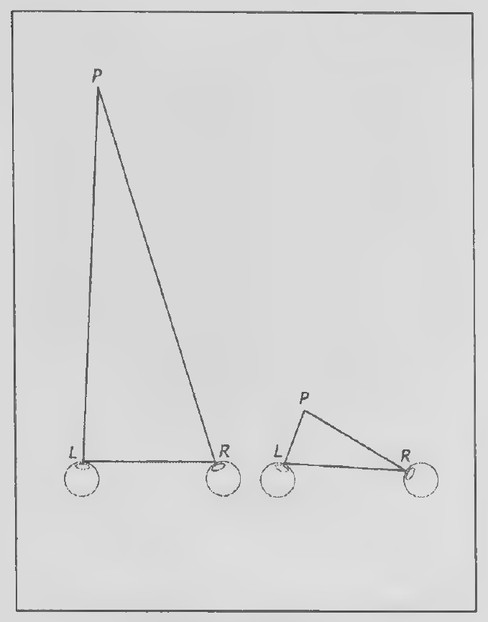 Transparency 5-3-3: Convergence when the object is not
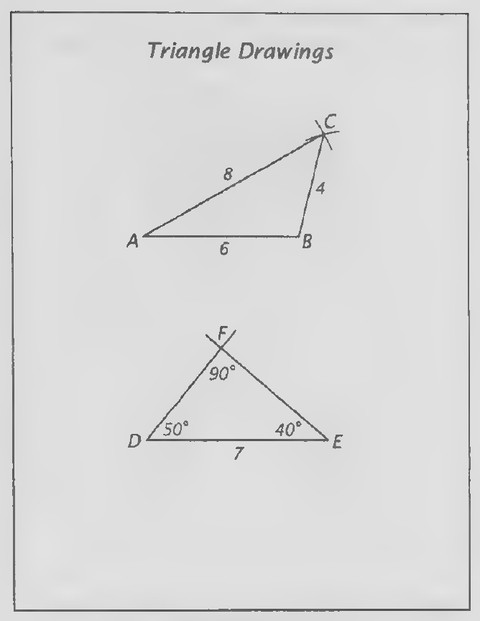 Transparency 5-3-4: Triangle drawings (Set I, Exs. 14-22)
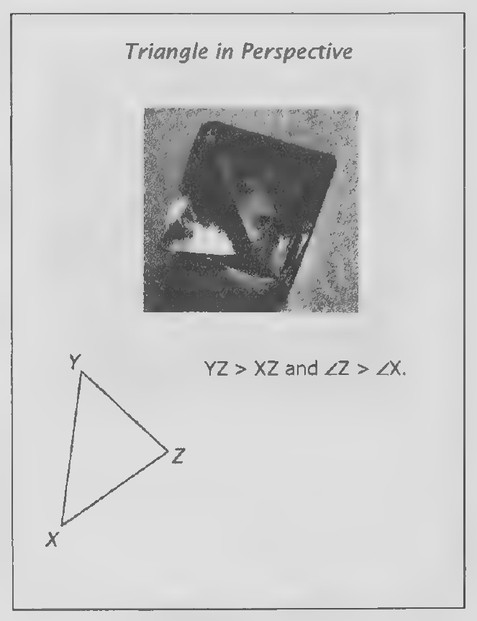 Transparency 5-3-5: Triangle in perspective (Set I, Exs. 23-28)
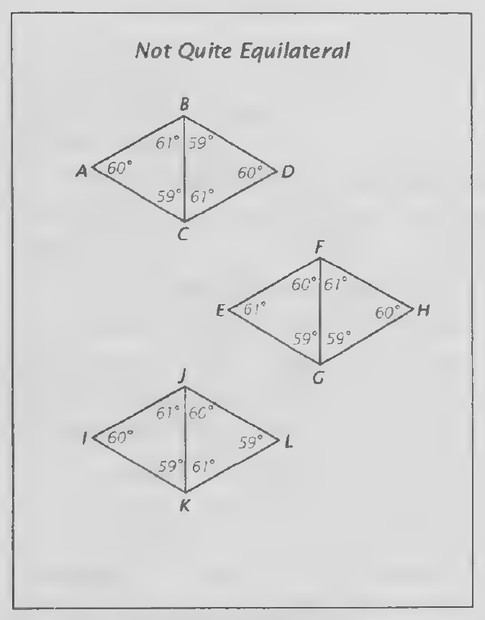 Transparency 5-3-6: Not quite equilateral (Set II, Exs. 36-44)
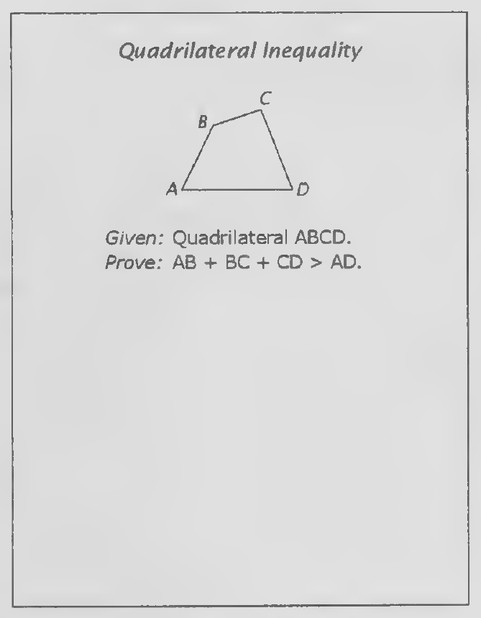 Transparency 5-4-1: Quadrilateral inequality (Set II, Ex. 32)
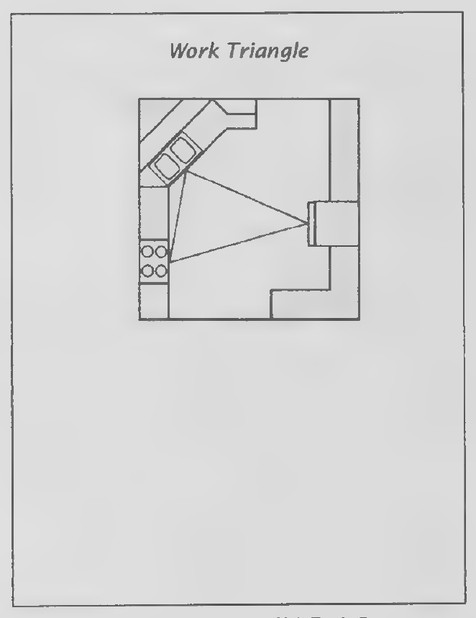 Transparency 5-4-2: Work triangle (Set II, Exs. 44-48)
left as it is moved closer. In this case, PL> PR. What has happened to the relative sizes of the angles at L and R² (∠L < ∠R; or, ∠R > ∠L.) Having put this observation into words, your students are now ready for Theorem 13 and its proof.
Lesson 4: The Triangle Inequality Theorem
Lesson Outline
Theorem 15. The Triangle Inequality Theorem. The sum of any two sides of a triangle is greater than the third side.
Transparencies
- 5-4-1 Quadrilateral inequality (Set II, Ex. 32)
- 5-4-2 Work triangle (Set II, Exs. 44-48)
Introduction
Take a stick of uncooked spaghetti, break it into three pieces of approximately equal length, and place them on the overhead projector. Move them together to form the sides of a triangle. Repeat this process with a second stick of spaghetti, but break it into three pieces whose lengths are not quite so close to being equal. Then ask your students if they think that a triangle can always be obtained from the three pieces formed by breaking a stick of spaghetti in this way.
Let a student who realizes that the answer is “no” break a stick into pieces to demonstrate why the answer is correct. This example raises the question of what it is about the lengths of the pieces that determines whether they can or cannot be made into
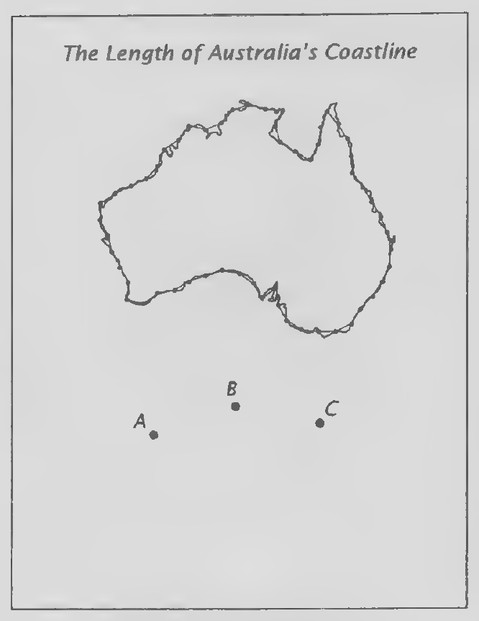 Transparency 5-R-2: The length of Australia’s coastline
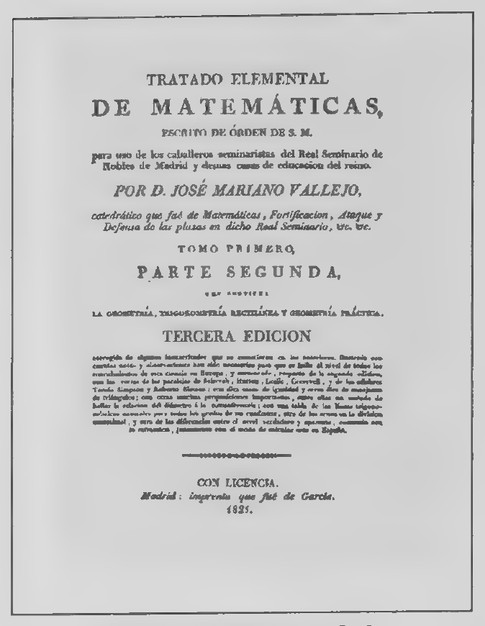 Transparency 5-R-3: Title page of Spanish mathematics book
 Transparency 5-R-1: Satellite photo of Australia
a triangle. Your students are now ready for the Triangle Inequality Theorem and its proof.
Review of Chapter 5
First day
Transparencies
- 5-R-1 Satellite photo of Australia
- 5-R-2 The length of Australia’s coastline
- 5-R-3 Title page of Spanish mathematics book
- 5-R-4 Theorem proof from Spanish mathematics book
- 5-R-5 Gateway arch (Set I, Exs. 5-8)
- 5-R-6 Proof (Set II, Ex. 49)
- 5-R-7 Proof (Set II, Ex. 50)
Introduction
Show Transparency 5-R-1. Do you recognize what is shown in this photograph? (It is a satellite photograph of Australia.*) Two things have been added to the photograph: a grid showing circles of latitude and longitude and the border, or coastline, of Australia, shown in white. Australia is the largest country in the world that is completely surrounded by water. It is easy to measure Australia’s width. It is almost 4,000 kilometers from east to west. To measure the length of Australia’s coastline is another matter. Show Transparency 5-R-2. One way to try to do it is illustrated by the figure at the top. It shows what might happen if a giant walked along the coast. Suppose that each point represents one of the giant’s
footsteps, that the distance between each pair of footsteps is 300 km, and that there are 56 footsteps in all. How far would the giant walk? (56 x 300 km = 16,800 km.) This number, the perimeter of the red polygon, is a rough approximation of the length of the coastline. Now suppose that you walked along the coast. What do you suppose would happen to the apparent length of the coastline if you were to do so? (It would become longer.) This observation suggests something quite strange about the length of Australia’s coastline. What do you suppose it is? (The “length” depends on how you measure it.)
An article in The Australian Geographer? answered the question, “What is the length of the Australian coast?” with “It all depends.” The article went on to state that, when different divider lengths (“distances between footsteps”) are used, the apparent length of the coast steadily increases as the divider length decreases. Steps of 1,000 km suggest a coastline of about 11,000 km; steps of just 1 mm suggest a coastline more than 10 times as long!
The second figure on Transparency 5-R-2 can be used to suggest why the apparent length of the coastline increases as the divider length decreases. Suppose that A, B, and C are three consecutive footsteps along the coast. Why is AB + BC > AC? (The Triangle Inequality Theorem.) Could A,B, and Cbe situated so that AB + BC = AC? (Yes. If A-B-C, then AB + BC = AC.) Could A, B, and C be situated so that AB + BC < AC? (No.)
{What is the length of the Australian coast?” by Robert W. Galloway and Margo E. Bahr (The Australian Geographer, 1979, vol. 3, pp. 244-247).
*Current photographs of Australia, produced by the Japan Meteorological Agency, can be seen on the website: www.bom.gov.au/ weather / satellite /
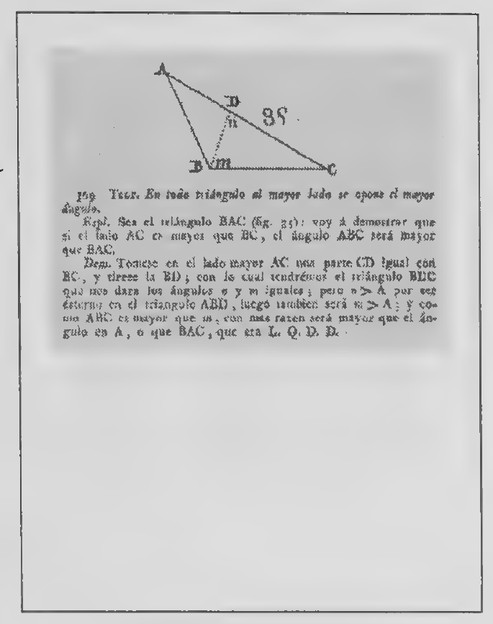 Transparency 5-R-4: Theorem proof from Spanish mathematics book
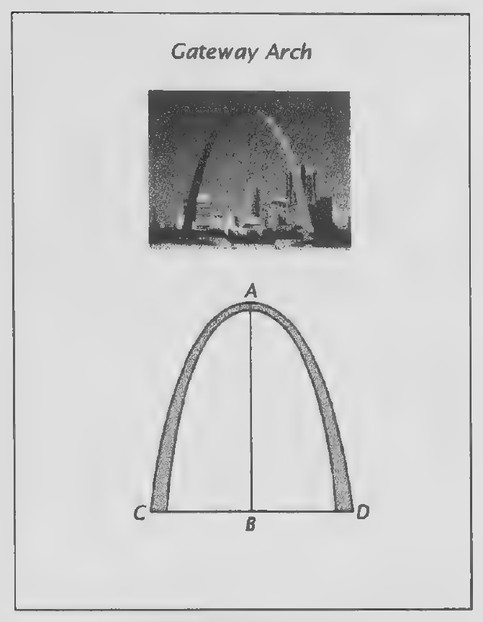 Transparency 5-R-5: Gateway arch (Set I, Exs. 5-8)
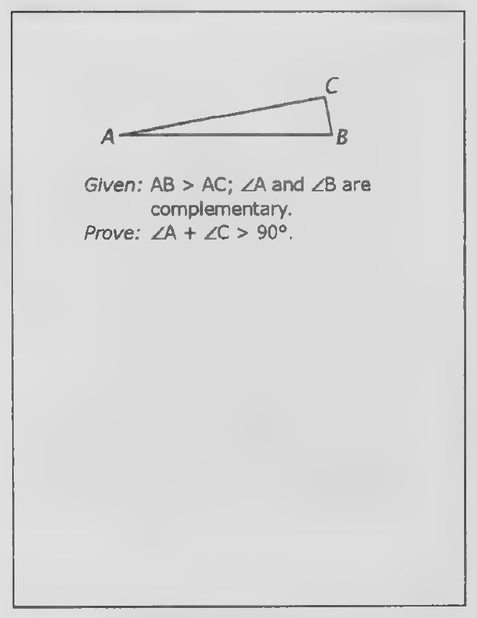 Transparency 5-R-6: Proof (Set II, Ex. 49)
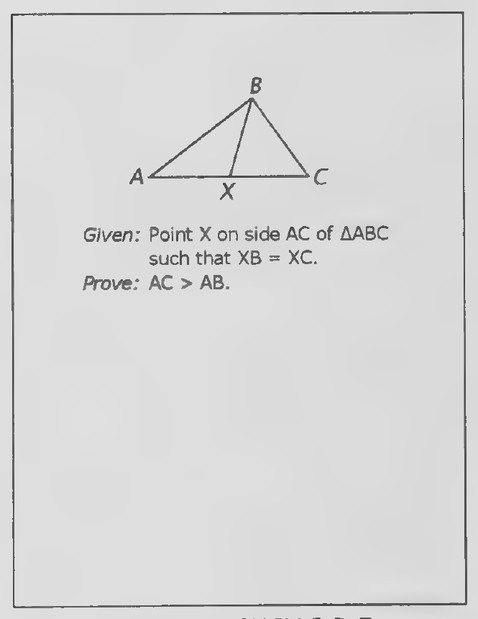 Transparency 5-R-7: Proof (Set II, Ex. 50)
Second day
Introduction
Show Transparency 5-R-3. Here is the title page ofa mathematics book of long ago. Can you tell where and when it was published? (Madrid, 1825.) Show Transparency 5-R-4. Here is one of the proofs from this book. Can you translate the theorem into English? (In every triangle, the greater side is opposite the greater angle.) The “given” and “prove” are stated below the theorem. Can you identify them? (Given: In △BAC, AC> BC. Prove: ∠ABC> ∠BAC.)
At this point you might ask your students to draw the figure and write below it our translations of the theorem, “given,” and “prove.” The proof, like the one of page 196 of the text, is Euclid’s. Point out to your students that, although we first encountered this proof in two-column form, it is written here in paragraph form. Although the two-column form is somewhat helpful when a person first learns to write proofs, mathematicians, including Euclid, use paragraph form. Guide your students in listing the main details of the proof as they help you in translating it.
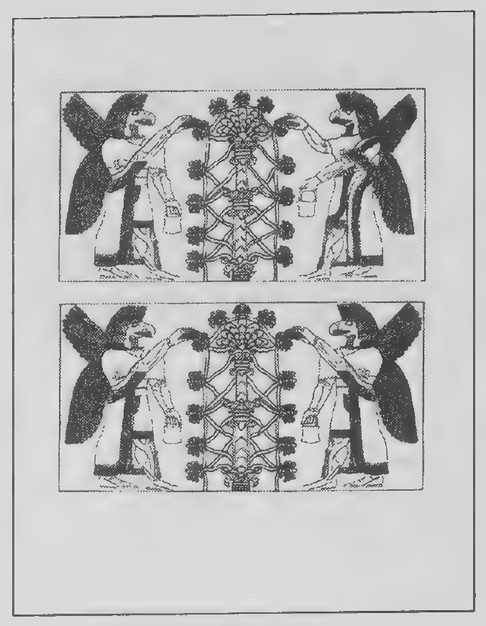 Transparency 6-1-1: Assyrian sculpture