Chapter 4: Congruence
Lesson 1: Coordinates and Distance
Lesson Outline
Terms: Coordinate systems (in one and two dimensions), origin, coordinates, axes, quadrants. The Distance Formula: The distance between the points P,(x,, y,) and P,(x,, y>) is
Vm —-mP +(y-y,).
Transparencies
- 4-1-1 Computer mouse
- 4-1-2 Triangle and coordinate system
- 4-1-3 Bird and bats (Set I, Exs. 16-22)
Introduction
Keeping the rest of Transparency 4-1-1 covered, show the photograph at the top and ask if anyone can identify the object pictured. It is the first computer mouse, built and invented by Douglas Engelbart at the Stanford Research Institute in 1964. Dr. Engelbart called it a mouse “because the tail came out the end,” and in his patent application described it as an “x-y position indicator for a display system.”
Show the figure at the bottom of the transparency. A computer mouse contains a rubber ball that rotates as the mouse is moved. The ball turns two rollers, one to detect horizontal movement and the other to detect vertical movement. This information
is sent by electric signals to the computer, which then moves the cursor on the screen accordingly. All of this is possible because the computer screen operates by a coordinate system.
Show Transparency 4-1-2. In your algebra class, you used coordinate systems to picture linear equations in two variables. You learned that such equations are called linear because they can be graphed as lines. The solutions of a linear equation are pairs of numbers that can be used to locate geometric points. This connection between the numbers of algebra and the points of geometry works both ways. For example, the properties of this triangle can be studied by assigning pairs of numbers to its corners. Add the overlay to the transparency and guide your students in using the resulting coordinates to make an accurate copy of the figure on a sheet of graph paper. [Note: Tape the overlay to the transparency so that the coordinates of the vertices of the triangle are A(1, 4), B(9, 10), and C(14, 5).] The basic ideas of the lesson can be introduced as your students copy the figure. After developing the Distance Formula, apply it to finding the lengths of the sides of the triangle in terms of the unit used in the coordinate system. That the calculated lengths are reasonable can be verified by marking the edge of a file card with the units of the graph paper so that it can be used as a ruler to put in place along the sides of the triangle. (AB = 10, BC = 150 ~7.1, AC = 130 = 11.4.)
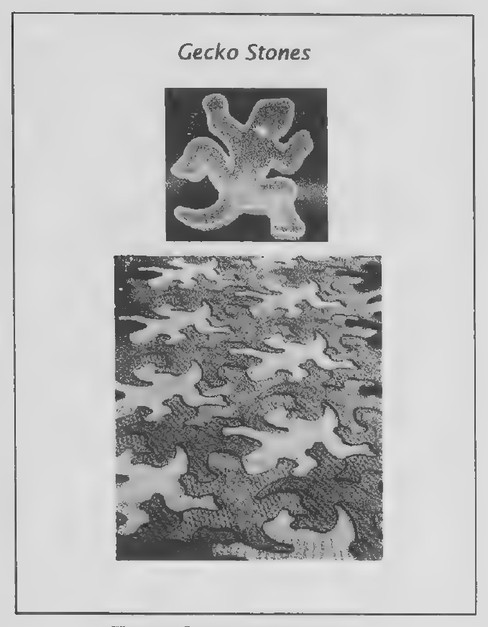 Transparency 4-2-1: Gecko stones
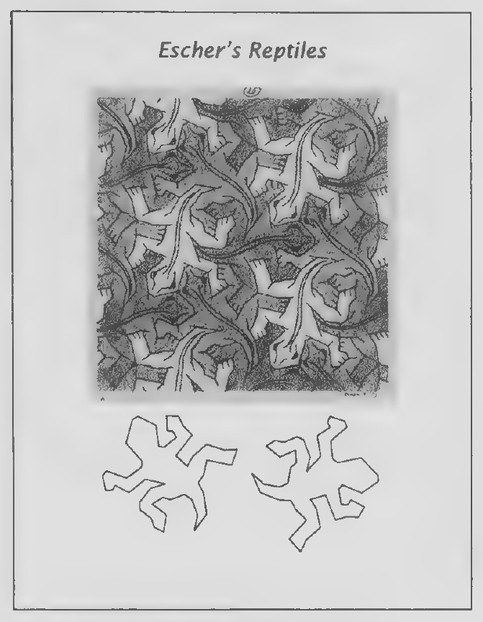 Transparency 4-2-2: Escher’s reptiles
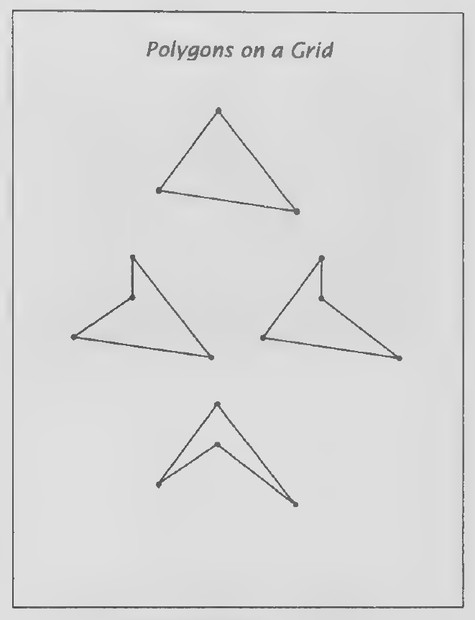 Transparency 4-2-3: Polygons on a grid (Set II, Exs. 44-47)
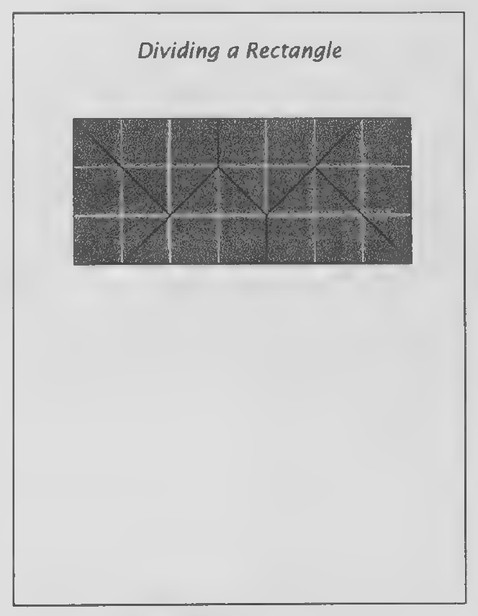 Transparency 4-2-4: Dividing a rectangle (Set II, Exs. 48-54)
Lesson 2: Polygons and Congruence
Lesson Outline
Terms: Polygon, sides, vertices, congruent figures, congruence correspondence.
Definition: Congruent triangles.
Corollary to the definition of congruent triangles. Two triangles congruent to a third triangle are congruent to each other.
Transparencies
- 4-2-1 Gecko stones
- 4-2-2 Escher’s reptiles
- 4-2-3 Polygons on a grid (Set II, Exs. 44-47)
- 4-2-4 Dividing a rectangle (Set II, Exs. 48-54)
Introduction
The photograph at the top of Transparency 4-2-1 shows a mold for making concrete paving stones in the shape of geckos, lizards found throughout the Hawaiian Islands. Created by John August, an architectural designer based in Maui, the stones can be interlocked with one another to pave walkways, as shown in the photograph at the bottom. (More on August’s designs can be found on the following Web site: www.geckostone.com.)
August’s paving stones are based on a drawing created by Maurits Escher. In contrast to the curved border of August’s gecko figure, Escher’s reptiles are bordered by line segments. For this reason, they are polygons. The lesson can now be developed as in the text. (Escher’s reptile polygon is a 50-gon. The two copies of it at the bottom of Transparency 4-2-2 are for use in introducing the idea of a congruence correspondence.)
Lesson 3: ASA and SAS Congruence
Lesson Outline
Terms: Included and opposite sides and angles.
Postulate 5. The ASA Postulate. If two angles and the included side of one triangle are equal to two angles and the included side of another triangle, the triangles are congruent.
Postulate 6. The SAS Postulate. If two sides and the included angle of one triangle are equal to two sides and the included angle of another triangle, the triangles are congruent.
Transparencies
- 4-3-1 Artillery triangle
- 4-3-2 Example proof 1
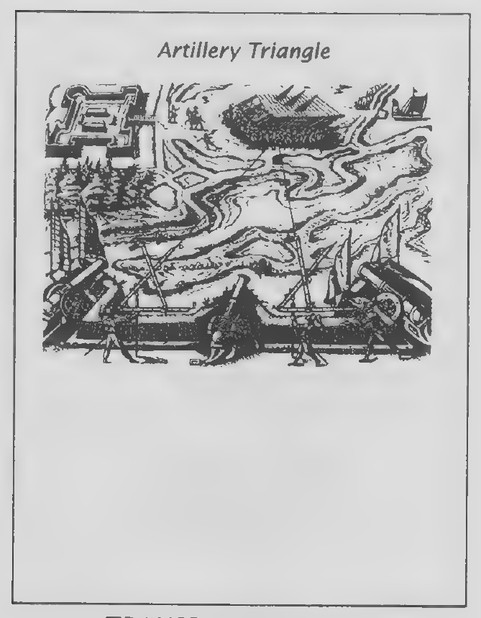 Transparency 4-3-1: Artillery triangle
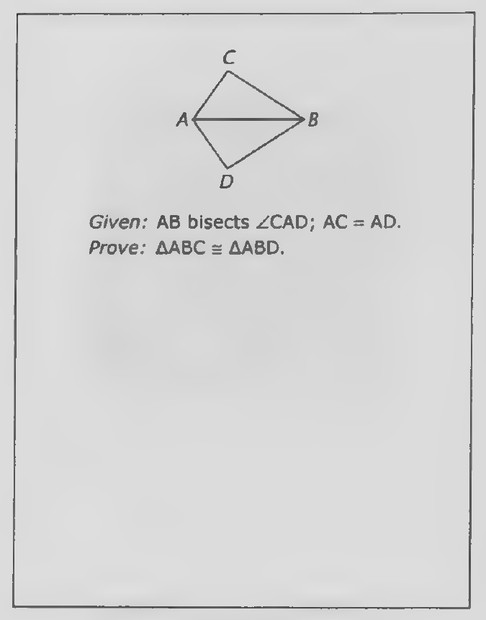 Transparency 4-3-2: Example proof 1
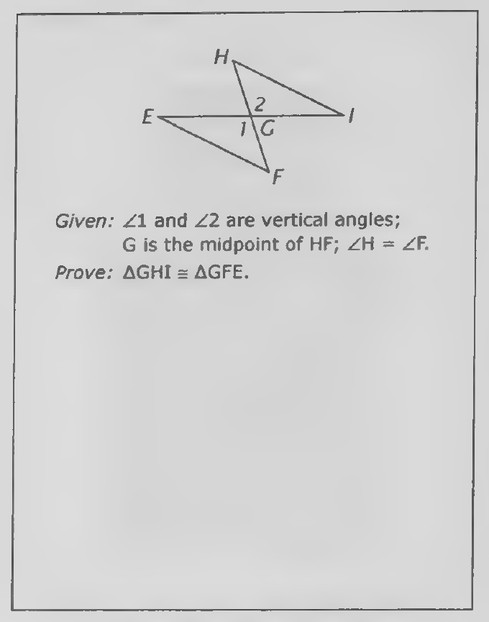 Transparency 4-3-3: Example proof 2
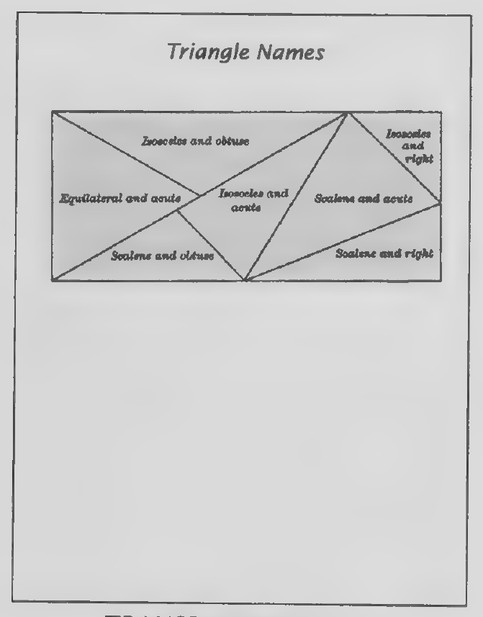 Transparency 4-3-4: Triangle names (Set I, Exs. 16-21)
 Transparency 4-3-5: Trigon
 Transparency 4-3-6: Example proof 3
- 4-3-3 Example proof 2
- 4-3-4 Triangle names (Set I, Exs. 16-21)
- 4-3-5 Trigon
- 4-3-6 Example proof 3
- 4-3-7 Example proof 4
First day
Introduction
The figure on Transparency 4-3-1, from a book published in 1648, shows a cannon aimed at a target. Two people on either side of the cannon are shown measuring angles at the base of a large triangle to figure out the distance to the target. To see how the method works, we will draw a comparable figure. Suppose that the two angle measurers are 80 yards apart. Draw a horizontal line segment AB 4 inches
long to represent this distance. How many yards does 1 inch along AB represent? (20.) Suppose that the person at A measures an angle of 60° between AB and the line of sight to the target. Center your protractor at A and draw a line forming a 60° angle with AB. Suppose that the person at B measures an angle of 75° between AB and the line of sight to the target. Center your protractor at B and draw a line forming a 75° angle with AB. The point in which the two lines intersect marks the location of the target; label it C. Notice that the shape of △ABC is determined by the length of side AB and the measures of the two angles at its endpoints, ∠A and ∠B. Suppose that the cannon is located midway between A and B. Use your ruler to measure the distance from
 Transparency 4-3-7: Example proof 4
 Transparency 4-4-1: The cowboys and the drive-in
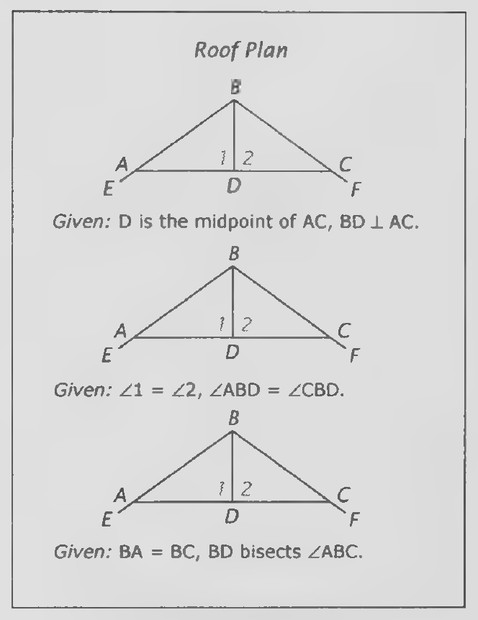 Transparency 4-4-2: Roof plan (Set I, Exs. 1-17)
the cannon to the target. (About 4.75 in.) Approximately how many yards is it from the cannon to the target? (4.75 x 20 = 95 yd.)
Point out that, in drawing the artillery triangle, we did not need to know the lengths of all three of its sides and the measures of all three of its angles. The rest of the lesson can now be developed as in the text.
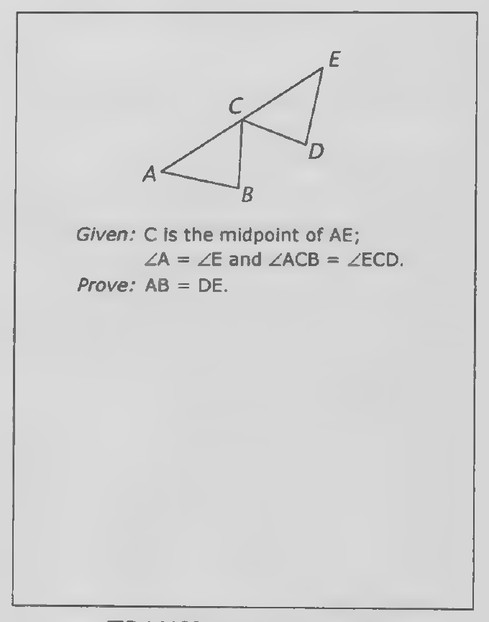
Transparencies 4-3-2 and 4-3-3 are for use in providing your students practice in proving triangles congruent.
Second day
Introduction
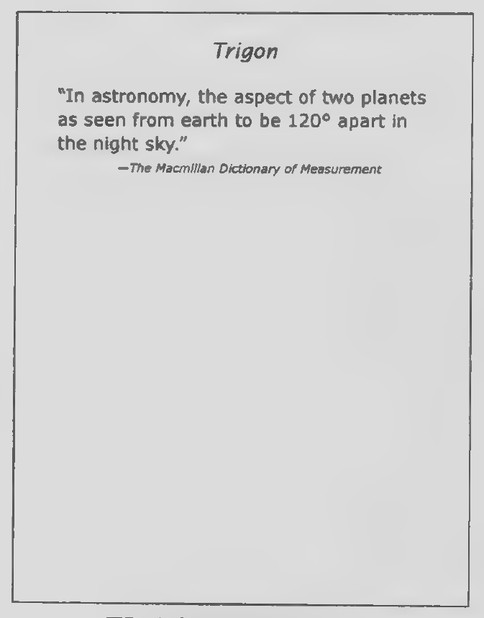
Show Transparency 4-3-5. The word “trigon” is another word for “triangle,” although it is seldom used anymore. According to The Macmillan Dictionary of Measurement (Macmillan, 1994), “trigon” has also been used in astronomy to mean “the aspect of two planets as seen from earth to be 120° apart in the night sky.”
Have your students use their protractors to draw a 120° angle. Label its vertex E to represent the position of the earth. Now suppose that Jupiter and Saturn are seen along the sides of this angle when their distances from earth are 400,000,000 miles and 950,000,000 miles, respectively. For convenience, we will let 1 cm represent 100,000,000 miles. Mark point J to represent Jupiter on one side of ∠E so that EJ = 4 cm. Mark point S to represent Saturn on the other side of ∠E so that ES = 9.5 cm. Draw and measure segment JS. How far apart are Jupiter and Saturn at this time? (JS =~ 12 cm; so the distance between Jupiter and Saturn is about
1,200,000,000 miles.) Notice that the shape of △JES is determined by the measure of ∠E and the lengths of the two sides EJ and ES. Why is it reasonable to expect that all triangles drawn with these same measurements would be congruent? (They would be congruent by the SAS Congruence Postulate.)
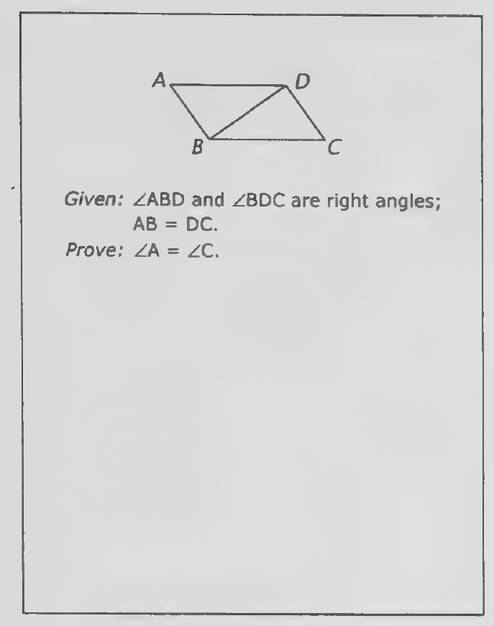
Transparencies 4-3-6 and 4-3-7 are for use in providing your students practice in proving triangles congruent and that corresponding parts of them are equal.
Lesson 4: Congruence Proofs
Lesson Outline
Definition (brief restatement for congruent triangles): Corresponding parts of congruent triangles are equal.
Transparencies
- 4-4-1 The cowboys and the drive-in
- 4-4-2 Roof plan (Set I, Exs. 1-17)
- 4-4-3 . Congruence proof (Set II, Ex. 30)
- 4-4-4 Congruence proof (Set II, Ex. 31)
- 4-4-5 Congruence proof (Set II, Ex. 32)
- 4-4-6 Congruence proof (Set II, Ex. 33)
- 4-4-7 Grid exercise (Set II, Exs. 34-46)
Introduction
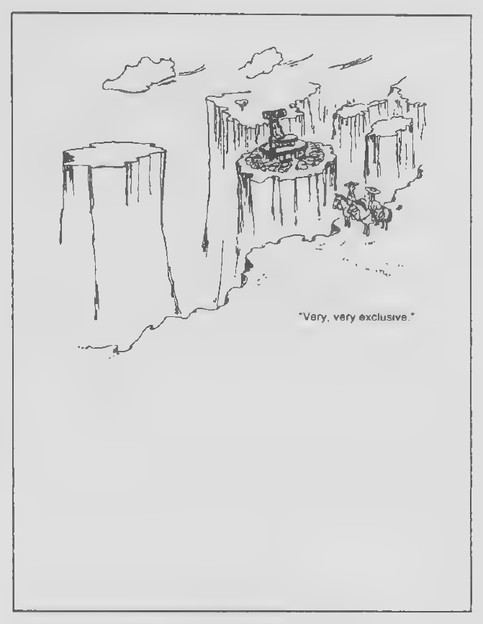
The figure on Transparency 4-4-1 is for use in presenting Lesson 4 as in the text. The proof that the procedure works is another example of proving triangles congruent and using the definition of congruent triangles to conclude that their corresponding parts are equal. If you direct your students in
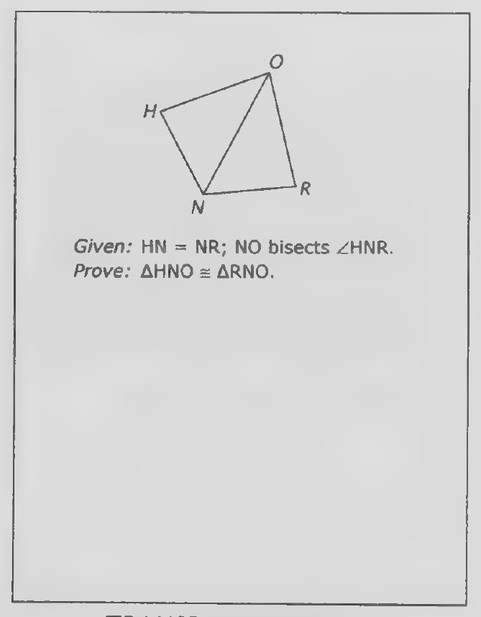 Transparency 4-4-3
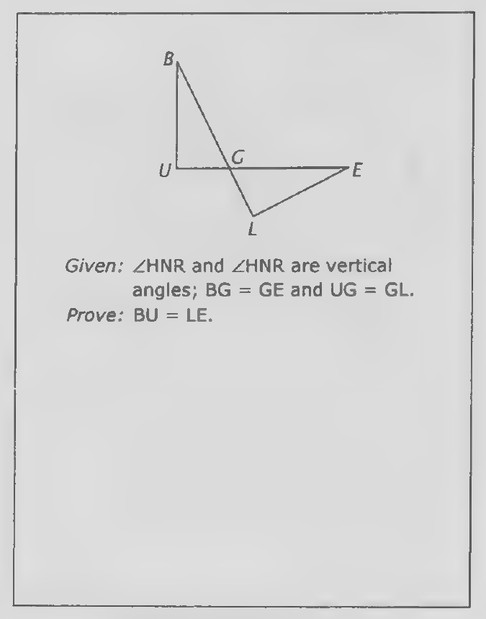 Transparency 4-4-4: Congruence proof (Set II, Ex. 31)
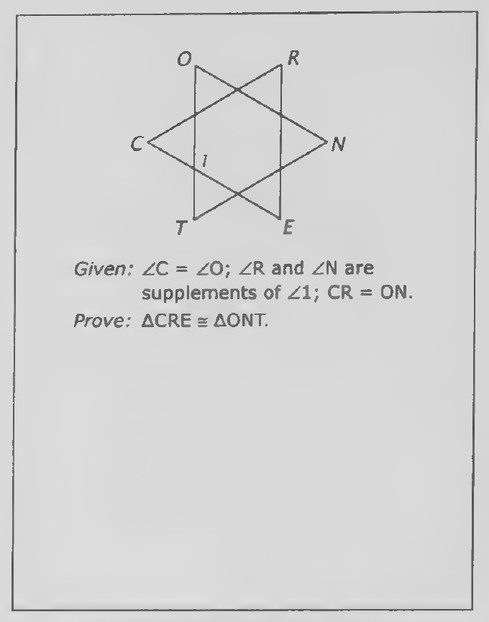 Transparency 4-4-5: Congruence proof (Set II, Ex. 32)
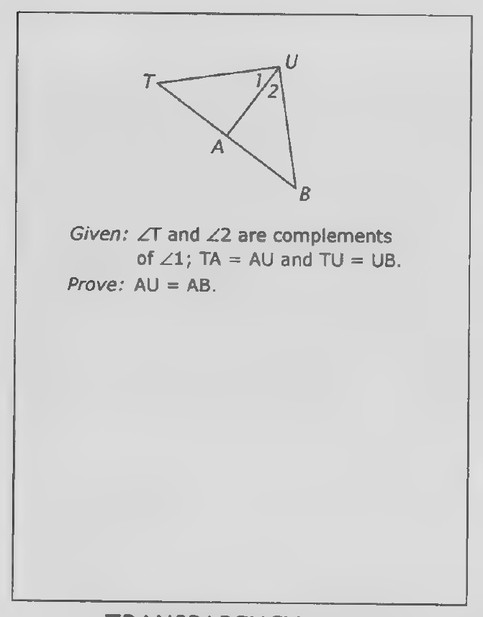 Transparency 4-4-6: Congruence proof (Set II, Ex. 33)
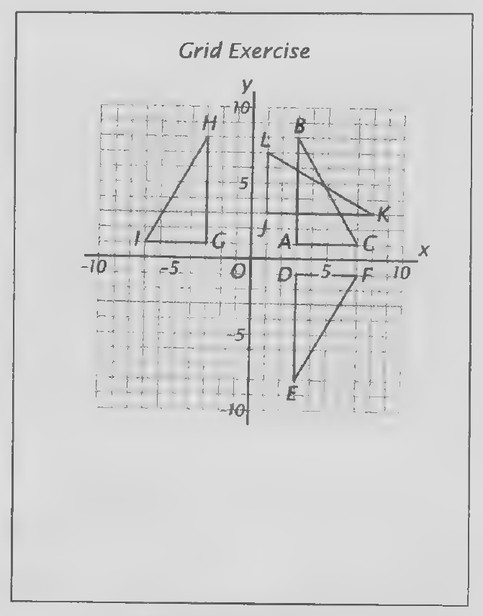 Transparency 4-4-7: Grid exercise (Set II, Exs. 34-46)
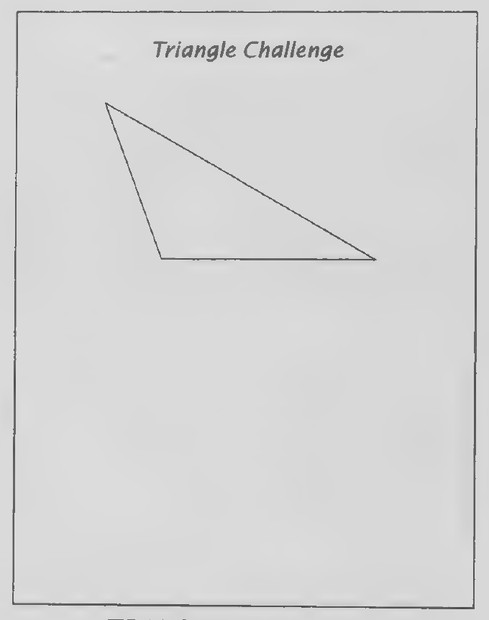 Transparency 4-5-1: Triangle challenge
writing this proof in their notes, it is best to state the “given” as in the text to ensure that the proof is reasonably straightforward. A method comparable to the one for finding the distance to the drive-in may have been used by the Babylonians and Egyptians for measuring the distances of ships from the shore.
Lesson 5: Isosceles and Equilateral Triangles
Lesson Outline
Terms: Types of triangles: scalene, isosceles, equilateral, obtuse, right, acute, equiangular.
Theorem 9. If two sides of a triangle are equal, the angles opposite them are equal.
Corollary to Theorem 9. An equilateral triangle is
equiangular. Theorem 10. If two angles of a triangle are equal,
the sides opposite them are equal. Corollary to Theorem 10. An equiangular triangle is
equilateral.
Transparencies
- 4-5-1 Triangle challenge
- 4-5-2 Theorem 10 (Set II, Ex. 33)
- 4-5-3 Corollary to Theorem 10 (Set II, Ex. 35)
- 4-5-4 Star puzzles (Set II, Exs. 43-47)
- 4-5-5 Drawing exercise (Set II, Exs. 49-53)
Introduction
Hand out duplicated copies of Transparency 4-5-1. This triangle once appeared in the “Mathematical
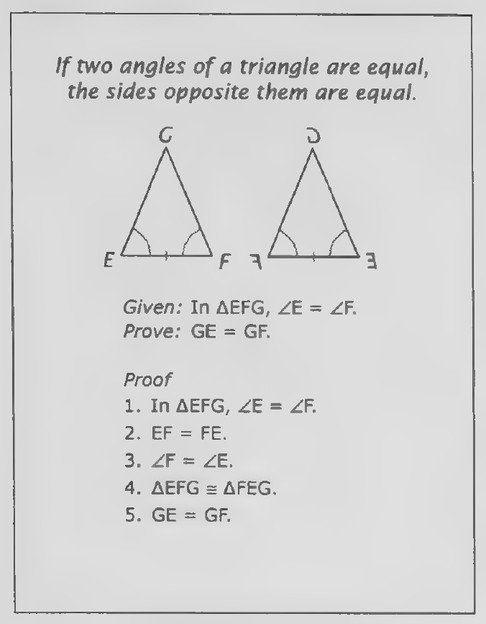 Transparency 4-5-2: Theorem 10 (Set II, Ex. 33)
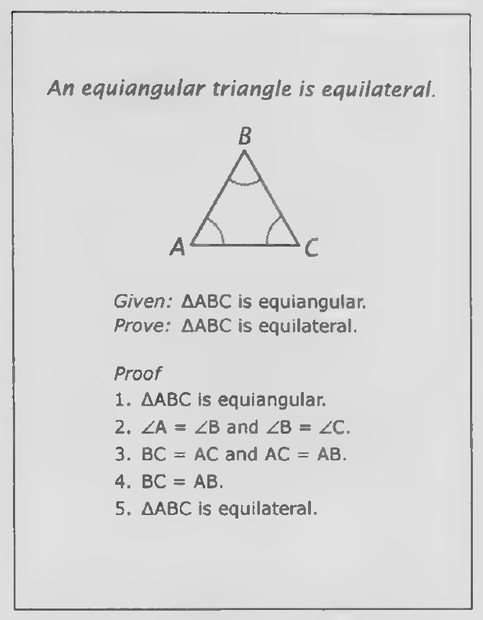 Transparency 4-5-3: Corollary to Theorem 10 (Set II, Ex. 35)
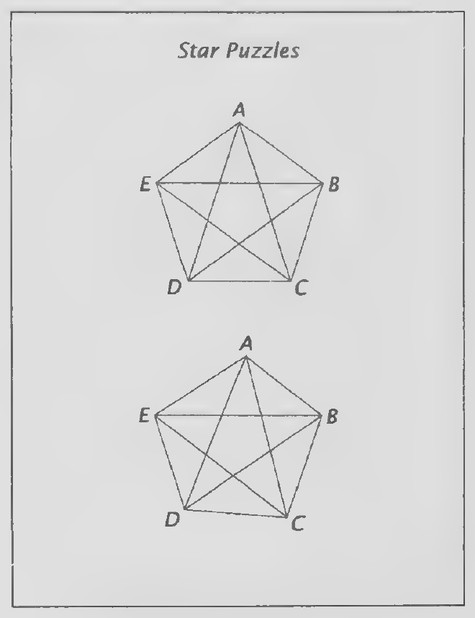 Transparency 4-5-4: Star puzzles (Set II, Exs. 43-47)
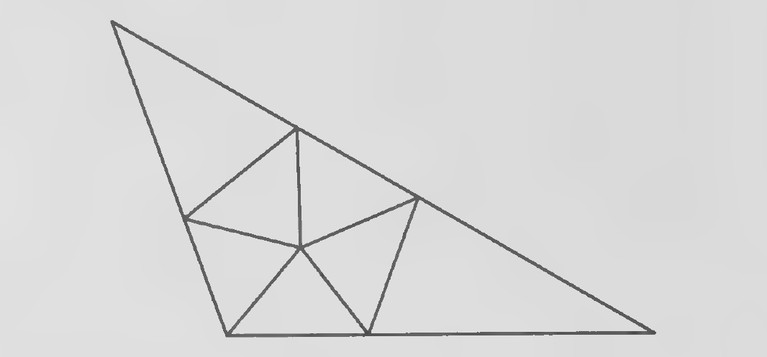 Figure on page 323
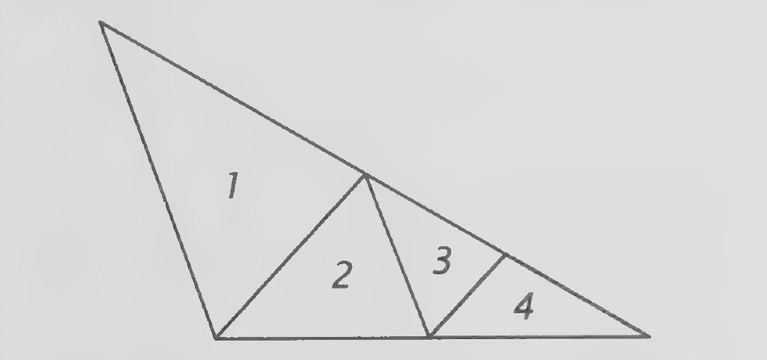 Figure on page 323
Games” column of Scientific American (February 1960). Ask your students to use their protractors to measure its largest angle. (110°.) Explain that this triangle is said to be “obtuse” because it has an obtuse angle, in contrast with a “right” triangle, which has a right angle, and an “acute” triangle, all of whose angles are acute.
The challenge in the magazine was to divide the obtuse triangle into smaller triangles, all of which are acute. As an example of an attempt to do so, add lines to the triangle on the transparency as shown in the following figure.
VSS
three triangles are acute, the fourth is obtuse, and so these lines do not solve the problem. Give your students a few minutes to try to find a solution. (You might even offer a small prize to the first student to do so.) It is unlikely that anyone will be able to solve the problem very quickly. You might want to leave the problem dangling for a few days. If so, you might suggest it as something to work on in other classes, if you get bored!
In the book in which the “Mathematical Games”
column containing this problem was reprinted, Martin Gardner reported that “A number of readers [of Scientific American] sent ‘proofs’ that an obtuse triangle cannot be dissected into acute triangles, but of course it can. The following figure shows a seven-piece pattern that applies to any obtuse triangle.”
Gardner triangles are necessary. The obtuse angle has to be divided by a line. If this line goes all the way to the other side, it will form either another obtuse angle or right angles, all of which would also have to be divided. So the line dividing the obtuse angle has to stop at some point inside the triangle. For all of the angles from this point to be acute, at least five lines have to be drawn. (Four lines would form four angles, but they cannot all be acute, because four numbers each less than 90 cannot add up to 360.) The result is an “inner pentagon” of five triangles, resulting in seven triangles altogether. Gardner also reported that it was a Brooklyn high-school student at the time, Wallace Manheimer, who figured out this proof. It was published in the American Math-
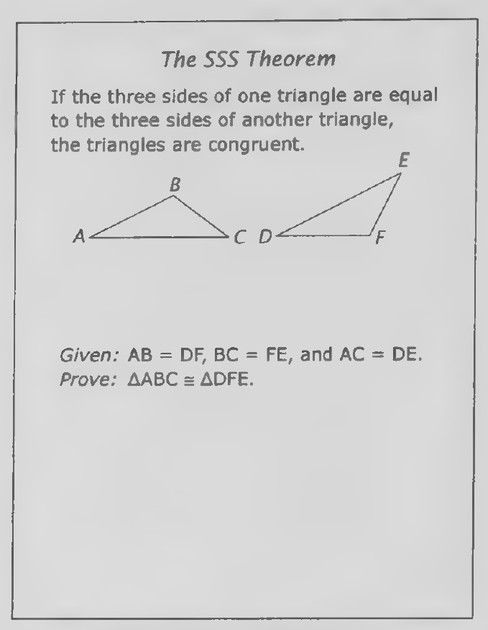 Transparency 4-6-2: The SSS theorem
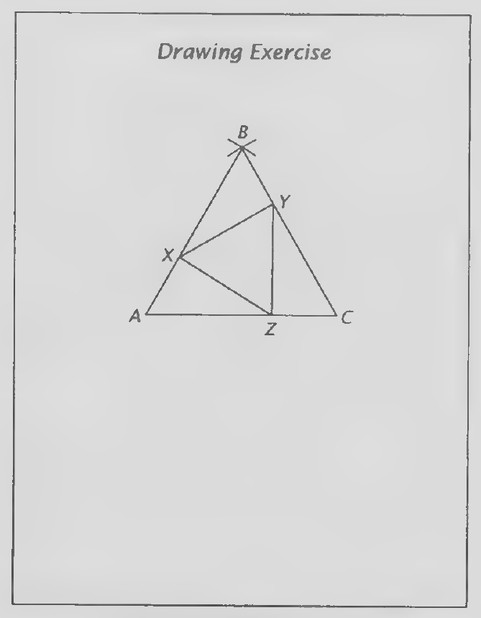 Transparency 4-5-5: Drawing exercise (Set II, Exs. 49-53)
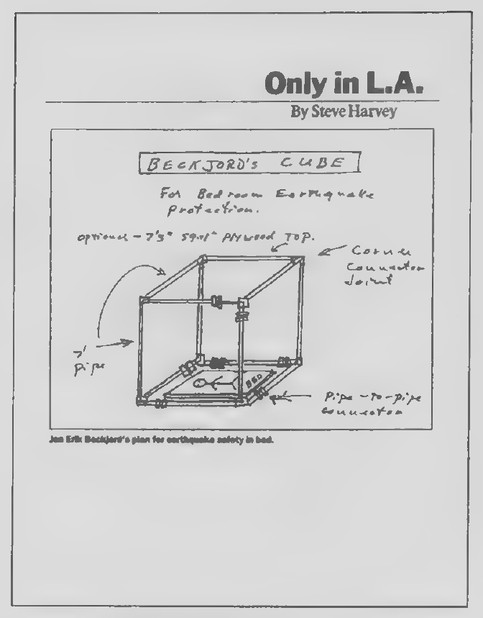 Transparency 4-6-1: Beckjord’s cube
ematical Monthly.
In trying to find a solution to this problem, our attention is drawn to the angles of triangles. At the same time, we have seen that triangles are classified according to their angles. They are also classified according to their sides. The rest of the lesson can now be developed as in the text. Theorem 9, known as the Isosceles Triangle Theorem, has an interesting history. The faces of the pyramids have the shape of isosceles triangles, and the Egyptians undoubtedly knew as far back as 2700 B.C. that, if two sides of a triangle are equal, the angles opposite them also must be equal. The Greek mathematician Thales, born in 625 B.C., is thought to have learned geometry in his travels to Egypt and may have been the first to prove the Isosceles Triangle Theorem. Euclid, who lived about 300 years later, included the theorem in his Elements. The proof of the theorem considered in the text is simpler than Euclid’s and is attributed to Pappus, a Greek geometer who lived in Alexandria in about 300 a.p. When computer programs were first developed to prove geometrical theorems in 1956, acomputer came up with the very same proof! Some comments by Marvin Minsky about the computer proof can be found on the following Web site: www.math. niu.edu/~rusin/known-math/99/minsky.
Lesson 6: SSS Congruence
Lesson Outline
Theorem 11. The SSS Theorem. If the three sides of one triangle are equal to the three sides of
another triangle, the triangles are congruent.
Transparencies
- 4-6-1 Beckjord’s cube
- 4-6-2 The SSS theorem
- 4-6-3 Plumb level (Set I, Exs. 3-8)
- 4-6-4 Linkage problem 1 (Set II, Exs. 26-35)
- 4-6-5 Linkage problem 2 (Set II, Exs. 36-43)
- 4-6-6 Grid exercise (Set II, Exs. 44-51)
- 4-6-7 Bracing the square (Set III)
Introduction
Not long after the big earthquake in Los Angeles in 1994, the figure on Transparency 4-6-1 was published in the Los Angeles Times (February 3, 1994). According to the article with which it appeared, actor Jerry Van Dyke had survived the quake because of a four-posted bed that propped up the falling ceiling of his bedroom. This gave Jon Erik Beckjord the idea of developing a cube made out of pipes for bedroom earthquake protection. Beckjord claimed that the thicker the pipe, the more secure the bed inside the cube would be.
A dramatic illustration that such a cubical structure, consisting only of squares, is not rigid would be to show one made of drinking straws threaded together. A second structure to which a diagonal has been added to each face is rigid because the shape of the resulting triangles, unlike that of the squares, is determined by the lengths of their sides.
For convenience in developing the proof of the SSS Theorem, I suggest handing out duplicated copies of Transparency 4-6-2. Direct your students in using their protractor and ruler to copy △DEF below △ABC as done in the text. There is room on the
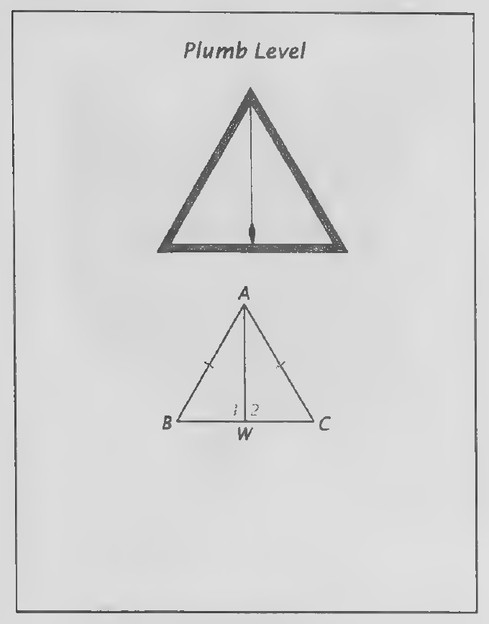 Transparency 4-6-3: Plumb level (Set I, Exs. 3-8)
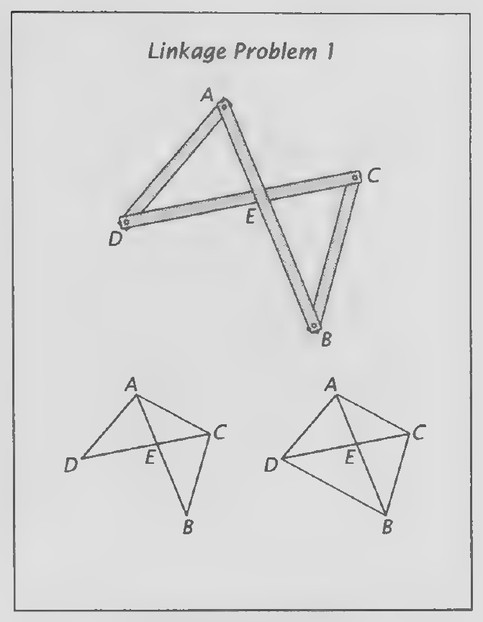 Transparency 4-6-4: Linkage problem 1 (Set II, Exs. 26-35)
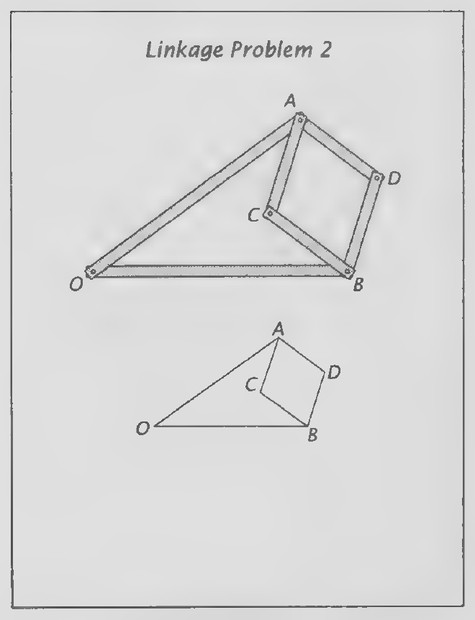 Transparency 4-6-5: Linkage problem 2 (Set II, Exs. 36-43)
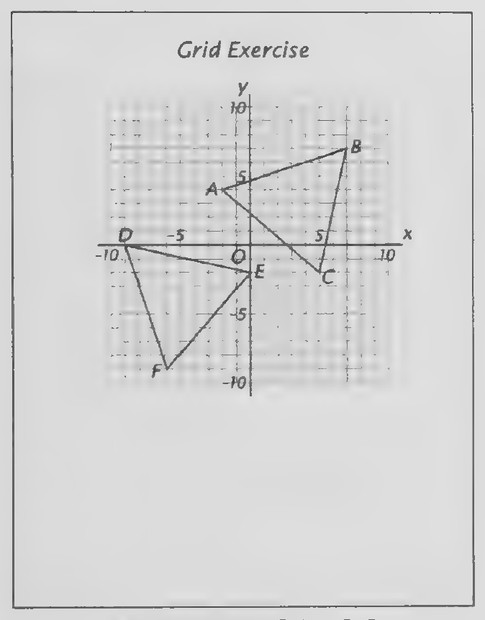 Transparency 4-6-6: Grid exercise (Set II, Exs. 44-51)
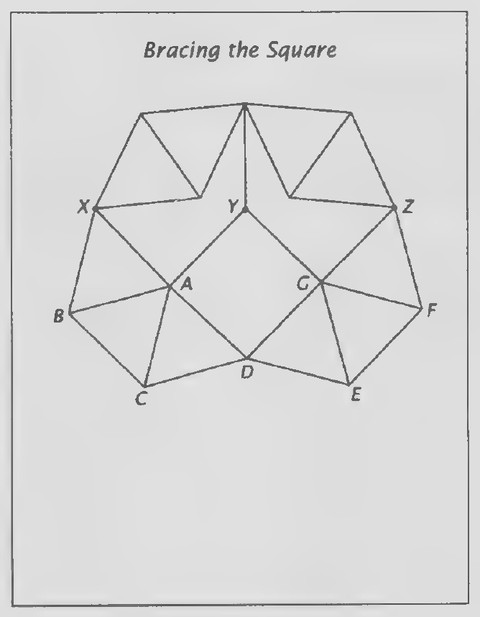 Transparency 4-6-7: Bracing the square (Set III)
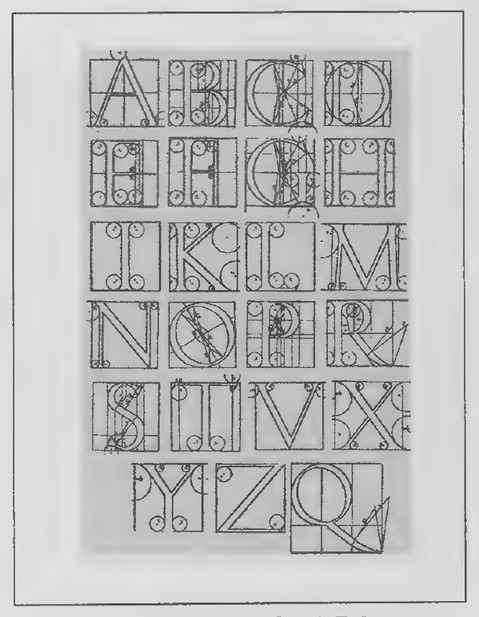 Transparency 4-7-1: Torniello’s alphabet
lower part of the transparency to outline the main ideas of the proof. When you have finished, be sure to let your students know that you hope they have understood how the proof works but that you do not expect them to remember all of the details. The goal here might be compared to understanding the structure of a poem rather than having to memorize it.
Lesson 7: Constructions
Lesson Outline
Construction 3. To copy a line segment.
Construction 4. To copy an angle.
Construction 5. To copy a triangle.
Transparencies
- 4-7-1 Torniello’s alphabet
- 4-7-2 Car jack (Set I, Exs. 22-29)
- 4-7-3 . An unexpected result (Set II, Exs. 30-33)
Introduction
In the Renaissance, several attempts were made to apply mathematics to designing the letters of the alphabet.* The Italian mathematician Luca Pacioli included an appendix on alphabets in a book on geometry published in 1509. Another Italian, the type designer Francesco Torniello, published a book titled The Alphabet in 1517 in which he showed how
*TEX and METAFONT —New Directions in Typesetting, by Donald E. Knuth (Digital Press, 1979).
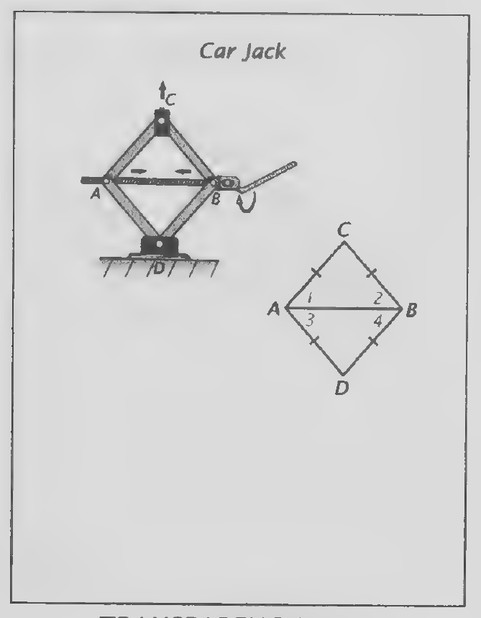 Transparency 4-7-2: Car jack (Set I, Exs. 22-29)
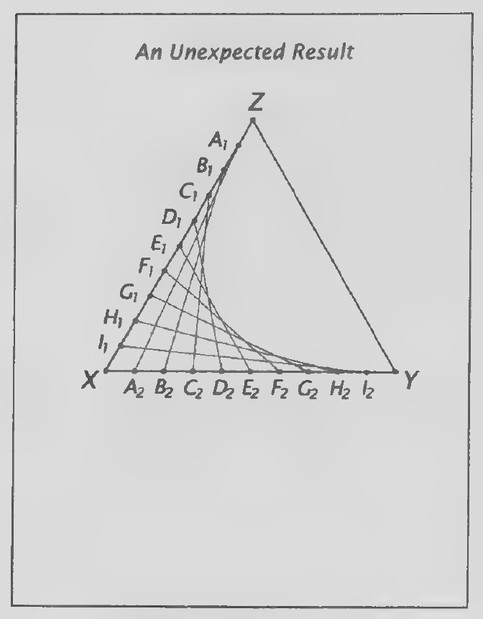 Transparency 4-7-3: An Unexpected Result
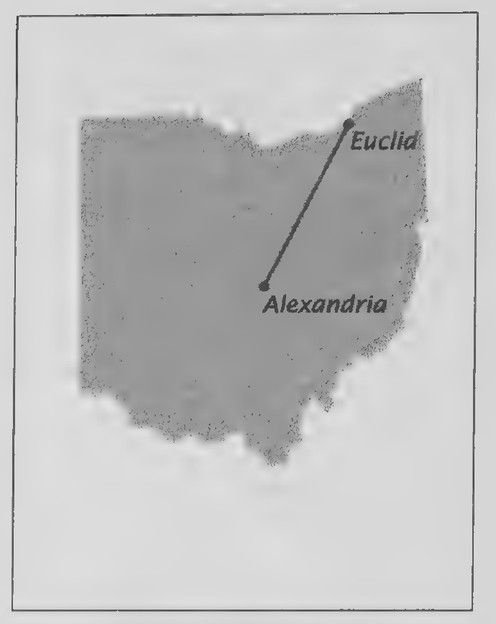 Transparency 4-R-1: Euclid to Alexandria
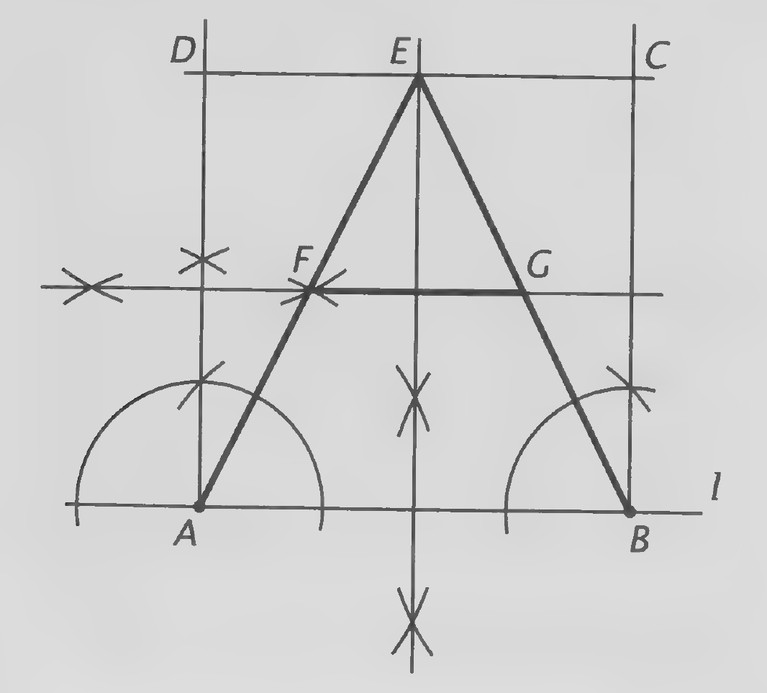 Figure on page 326 — Construction diagram with a rectangle ABCD, a triangle ADE, equal arcs from A and B, and points F and G
to construct capital letters with straightedge and compass. The figures on Transparency 4-7-1 are from Torniello’s book. The outline of each letter consists of line segments, drawn with a straightedge, and arcs of circles, drawn witha compass.
Remind your students that it was Euclid who established the use of the straightedge and compass for making geometric constructions at the very beginning of his Elements. We constructed an equilateral triangle at the beginning of the course, and we have learned how to bisect both line segments and angles. In this lesson, we will learn how to make three more basic constructions. One way to introduce them would be to construct a simple version of a capital A as shown in the following figure and
described in the steps that follow. (Note that the steps review the bisection constructions, as well as introducing the new ones; so demonstrate them at the overhead projector as you lead your students through them. There is no need tojustify results such as the formation of the four squares.)
- Draw a horizontal line / and choose a point A
on it. 2. Bisect straight ∠A to form two right angles. 3. Choose a second point B on! approximately
3 inches to the right of A. 4. Construct a right angle at B by copying one
of the right angles at A.
. Copy segment AB to get AD and BC. O1 Oo. Bisect AB and AD to divide the square into
four smaller squares. 7. Label point E and draw EA and EB. Also
draw the cross bar of the capital A and label
its endpoints F and G.
Is △ABE equilateral? (No.) Show your students how to copy the capital A ina different place on the paper by first copying △ABE and then copying AF and BG to determine FG.
Review of Chapter 4
Transparencies
- 4-R-1 Euclid to Alexandria
- 4-R-2 Toll rate distances
- 4-R-3 Ollie’s mistake (Set II, Exs. 37-42)
- 4-R-4 Proof (Set II, Ex. 51)
- 4-R-5 Proof (Set II, Ex. 52)
- 4-R-6 Euclid carved in stone
- 4-R-7 Euclid’s Elements
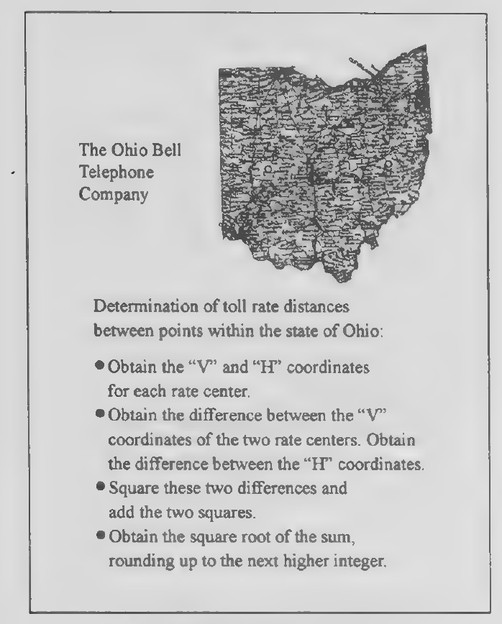 Transparency 4-R-2: Toll rate distances
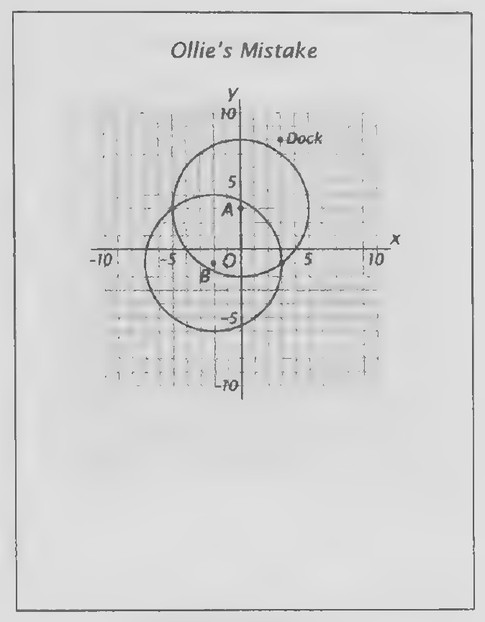 Transparency 4-R-3: Ollie’s mistake (Set II, Exs. 37-42)
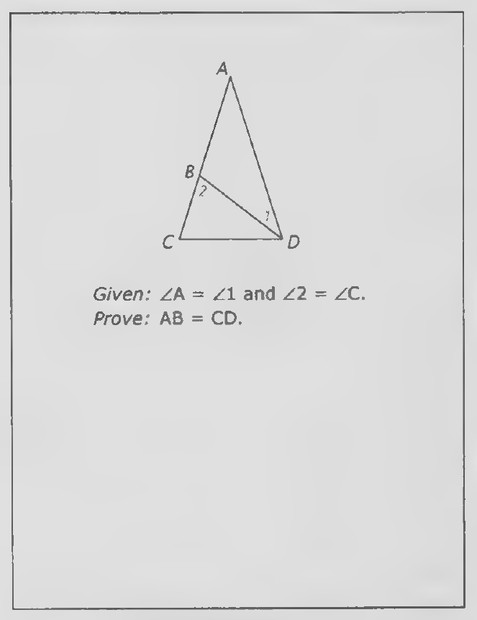 Transparency 4-R-4: Proof (Set II, Ex. 51)
First day
Introduction
It might seem impossible for Euclid to place a call to Alexandria, but it could happen in Ohio! Euclid is a city on the shore of Lake Erie, northeast of Cleveland (Transparency 4-R-1). It was named, as you might suspect, for the Greek mathematician. Alexandria, asmall town located near the center of Ohio, is named for the city in Egypt where Euclid lived.
To calculate the toll rate for a call between two points in Ohio, the Ohio Bell Telephone Company applies a series of rules, part of which are listed on Transparency 4-R-2. Even though you have never seen these rules before, they may seem familiar. Why? (They sound like the Distance Formula.) As the Web site of the Telco Exchange explains, “The Telecom industry has its own unique system of geography. Pricing for many services is based on the ‘airline mileage’ or special distance calculations between points. A unique vertical and horizontal (V&H) coordinate system was developed by AT&T Long Lines in 1960 for the North American continent that is used to define telecom locations. The conventional system of longitude and latitude for describing geographic locations is not used. Although based on the well-known Pythagorean Theorem for calculating distances between points on an X-Y coordinate system, the telecom calculations must be made using a litany of special rules and rounding conventions….”*
As a review of the derivation of the Distance Formula from the Pythagorean Theorem, have your
students mark two points, A and E, on paper to represent Alexandria and Euclid. Label the coordinates of A(V₁, H₁) and the coordinates of E(V₂, H₂). Draw a horizontal line through A and a vertical line through E to form right △ABE. In the distance calculation, what do the differences between the respective coordinates represent? (The lengths of the legs of the triangle.) The V&H coordinates for Euclid and Alexandria are (5536, 2527) and (5915, 2513), respectively. How does the V-H coordinate system seem to differ from our x-y coordinate system? (In our x-y coordinate system, the horizontal coordinate is listed first, whereas in the V-H system, the vertical coordinate is listed first. Also, in the V-H system, the vertical coordinates decrease as you proceed upward.) Use the coordinates of A and B to find the “lengths” of AB and BE. (AB = 2527 − 2513 = 14; BE = 5915 − 5536 = 379.) Use the Pythagorean Theorem to find the “length” of AE. (AE² = AB² + BE²; so AE² = 379² + 14² = 143,641 + 196 = 143,837 and AE = √143,837 ≈ 380.) The distance between Alexandria and Euclid is 120 miles. Roughly how does the length of one unit in the V-H system compare with 1 mile? (It is about one-third of a mile.)
Second day
Introduction
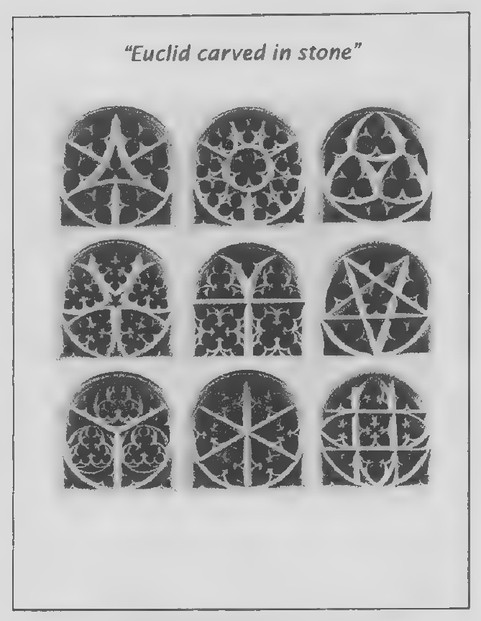
The photographs on Transparency 4-R-6 are of windows in a monastery in Switzerland. The windows date at about 1320 and are examples of geometric tracery, ornamental stone work of interlaced lines and arcs. Their designer was clearly influenced by the constructions of geometry. In an article titled
*www.telcoexchange.com /resources/ carriers/distance.shtml
 Transparency 4-R-6: Euclid carved in stone
 Transparency 4-R-7: Euclid’s Elements
 Transparency 4-R-5: Proof (Set II, Ex. 52)
“The Cloisters of Hauterive” (pronounced Oh-tereef) in The Mathematical Intelligencer (Spring 1991), Benno Artmann describes the theme of the windows as “geometry itself” and described the windows themselves as “a commentary to Euclid… carved in stone.”* Several windows contain designs that are related to the equilateral triangle; the first and third windows of the first row are especially obvious examples. Which windows seem to contain squares? (The second window of the second row; the last window of the third row.) Which window seems to contain the most polygons? (The last window of the second row.) What polygons do you see init? (Five small acute isosceles triangles and a small pentagon, five overlapping obtuse isosceles triangles, five overlapping kite-shaped quadrilaterals. There are also five overlapping concave pentagons as well as a concave decagon, but I suggest that you mention these polygons only if your students happen to notice them.) We will look at one way to construct the basis pattern of this window, but first we will see where it fits into Euclid’s Elements.
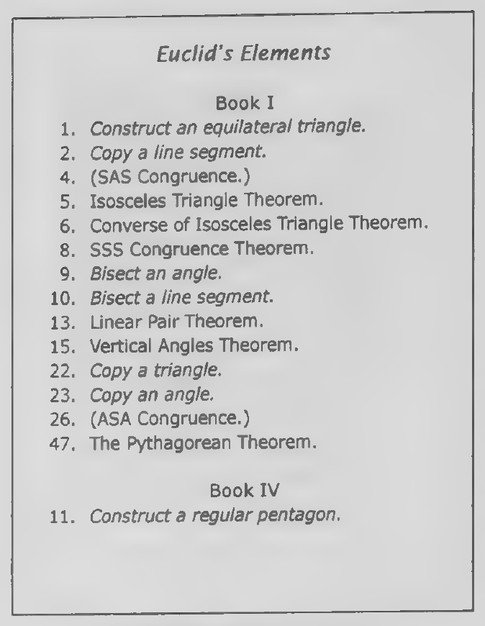
Some of the statements in the first and fourth books (chapters) of the Elements are shown on Transparency 4-R-7 (and listed here). Euclid called the statements “propositions”; we call them “constructions” and “theorems.”
Book I
Construct an equilateral triangle.
Copy a line segment.
(SAS Congruence.)
Isosceles Triangle Theorem.
Converse of Isosceles Triangle Theorem.
SSS Congruence Theorem.
- Bisect an angle. 10. Bisect a line segment. 13. Linear Pair Theorem. 15. Vertical Angles Theorem. 22. Copy a triangle. 23. Copy an angle. 26. (ASA Congruence.) 47. The Pythagorean Theorem. Book IV 11. Construct a regular pentagon.
This list might provide a good basis for review. The italicized propositions are the constructions with which your students are now acquainted. The parenthetical propositions indicate that Euclid proved both SAS and ASA congruence as theorems; we treated these statements as postulates. The designer of the windows went well beyond the first book of the Elements. It was not until Book IV that Euclid showed how to construct a regular pentagon. (Explain that a regular pentagon, like an equilateral triangle, has equal sides and angles.) If the lines of the sides of a regular pentagon are extended until they intersect, they form a five-pointed star called a pentagram. This figure is the pattern of the window that we will now construct.
Give your students the following directions so that they can construct the figure as you demonstrate the steps either at the blackboard or on the
*Material on the mathematics of the Cloisters of Hauterive can be found on the following Web site: www.maths.adelaide.edu.au/pure/ pscott/place/pm13/pm13
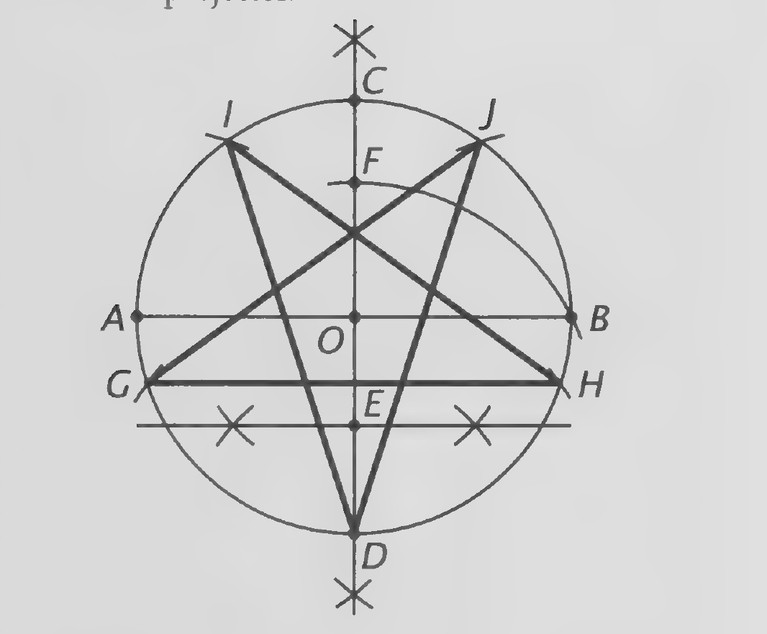 Figure on page 329 — A regular pentagon inscribed in a circle with all its diagonals drawn, forming a pentagram (points A–J marked)
overhead projector.
long. 2. Bisect AB and label its midpoint O. 3. Mark points C and D on the bisecting line so
that OC = OD = OA. 4. Bisect OD and label its midpoint E. 5. With E as center and EB as radius, draw an
arc intersecting CD at F. 6. Draw circle O with radius OA. 7. With D as center and BF as radius, draw arcs
intersecting circle O at G and H. 8. With G and H as centers and BF as radius,
draw arcs intersecting circle O at I and J. 9. Draw the pentagram by drawing the seg-
ments DI, IH, HG, GJ, and JD.
After your students have completed the construction, show Transparency 4-R-6 so that they can see the pentagram window again. Explain that, although we have carried out the steps in constructing the pentagram correctly, we are not yet in position to know why they work. This part of our understanding of geometry will come later in the course.
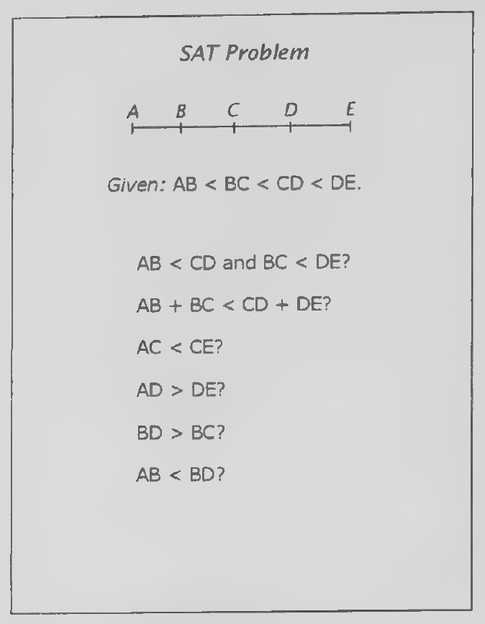 Transparency 5-1-3: SAT problem (Set II, Exs. 26-31)
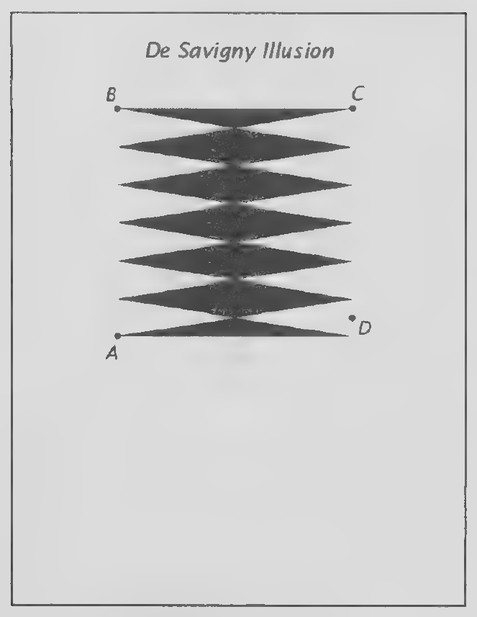 Transparency 5-1-1: De Savigny illusion
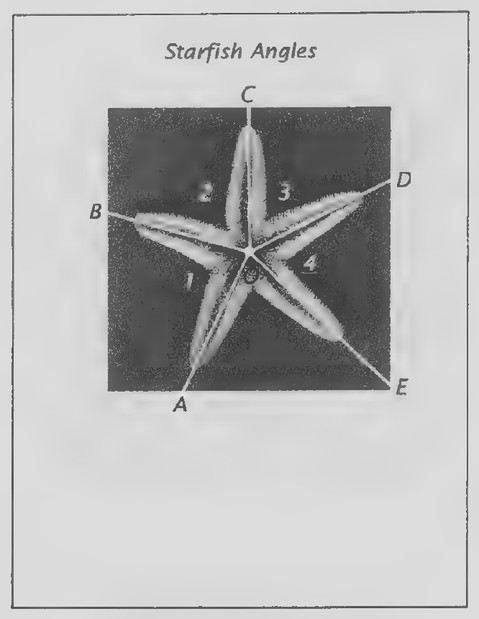 Transparency 5-1-2: Starfish angles