Chapter 2: The Nature of Deductive Reasoning
Lesson 1: Conditional Statements
Lesson Outline
Terms: Conditional statement (hypothesis, conclusion), Euler diagram.
Transparencies
- 2-1-1 Rules of the Game book cover
- 2-1-2 Rules that are conditional statements
- 2-1-3 Yankees problems (Set II, Exs. 31-33)
- 2-1-4 Octagenarian problems (Set II, Exs. 34-36)
Introduction
Show Transparencies 2-1-1 and 2-1-2. Every game is played by rules. Here are some examples of rules for various sports that are listed in a book titled Rules of the Game (The Diagram Group, St. Martin’s Press, 1990). Which sports can you identify?
- If an opponent touches the ball, all the
passing side is eligible to receive the ball.
(Football.)
- A game is forfeited if a team does not have
at least two players on court. (Basketball.)
- If the kicker breaks the law, the defending
side is awarded an indirect free kick.
(Soccer.)
- Arunner is out if he fails to beat a throw to
the base to which he is running. (Baseball.)
- If the game is tied at 14/14, it continues
until one team has a two-point lead.
(Volleyball.)
- A player is offside if he is within his oppo-
nents’ half when the ball is played by a team
mate. (Hockey.)
What do all the statements of these rules have in common? (Each statement tells what happens in the game if something else has happened. Each statement contains the word “if.”) Explain that these statements are examples of conditional statements and develop the rest of the lesson as in the text. In introducing the Euler diagram, be sure to generalize so that the students understand the meaning of the symbols a > b. Call attention to the fact that the exterior of each circle represents the opposite of what its interior represents. Some students are unable to interpret Euler diagrams correctly, because they do not realize that the two circles separate the
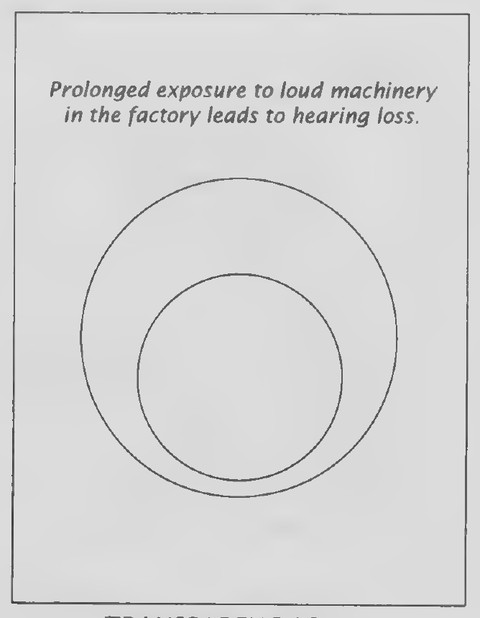 Transparency 2-2-1: Hearing-loss argument
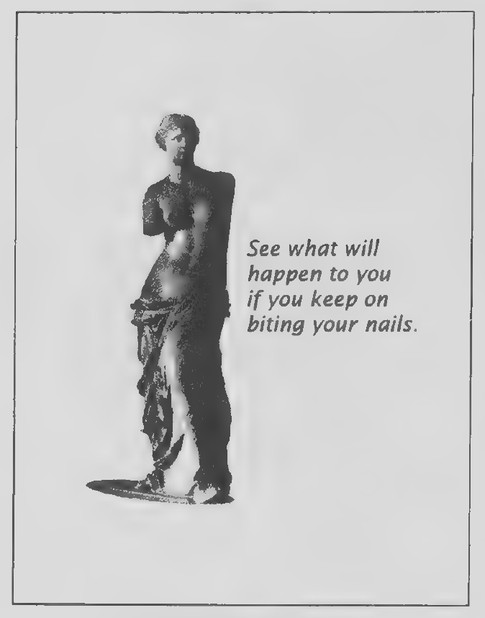 Transparency 2-2-2: If you keep on biting your nails
 Transparency 2-2-3: The squirrel problem
plane into three regions, two of which represent “not a” and two of which represent “not b.”
Lesson 2: Definitions
Lesson Outline
Terms: Definition, converse, if and only if.
Transparencies
- 2-2-1 Hearing-loss argument
- 2-2-2 If you keep on biting your nails
- 2-2-3 The squirrel problem
Review Rob Eastaway and Jeremy Wyndham relate the following legal case in their book titled Why Do Buses Come in Threes? The Hidden Mathematics of Everyday Life (Wiley, 1998):
“A man was suing his company for having caused his deafness. It was agreed by both sides that ‘prolonged exposure to loud machinery in the factory led to hearing loss.’… [T]he plaintiff’s argument was that this proved that his damaged hearing was due to prolonged exposure to loud machinery.”
Ask your students if they agree with this argument. Show Transparency 2-2-1. How would you change this sentence to “if-then” form? (If you are exposed to loud machinery in the factory for a long time, then this exposure leads to hearing loss.) What words belong in each circle of the Euler diagram? (“Loud machinery exposure” in the smaller circle and “hearing loss” in the larger circle.) If you have a hearing loss, does that mean that it was caused by exposure to loud factory machinery? This question leads naturally into a discussion of the converse of a
conditional statement, part of the new lesson. Alternative Review As a quick review, show Transparency 2-2-2 and ask, Of what kind of statement is “See what will happen to you if you keep on biting your nails” an example? (A conditional statement.) What is its hypothesis? (You keep on biting your nails.) What is the rest of the statement called? (The conclusion.) If an Euler diagram were drawn to represent the statement, which words would go in the smaller circle? (You keep on biting your nails.)
Introduction
The American philosopher William James told of camping with some friends in the mountains and returning from a walk to find them engaged in a heated argument. Scot Morris relates the story in his Next Book of Omni Games (New American Library, 1988): “It seems that one of the men had come upon a squirrel clinging to a tree trunk [Transparency 2-2-3]. As the man circled the tree, the squirrel did the same, so that it always faced the man. After going once around the tree, they were both back to where they started. It was clear that the man and the squirrel had both gone around the tree. The question was, Did the man go around the squirrel?” Before giving your students James’s answer, you might poll them about what they think. Morris summarizes it as follows: “If by around we mean ‘First to the south of, then to the west of, then to north of, then to east of…’ then the man does go around the squirrel. If around means ‘First in front of, then to the left of, then in back of, then to the right of.. then, of course, he doesn’t.”
This story leads into the rest of the new lesson.
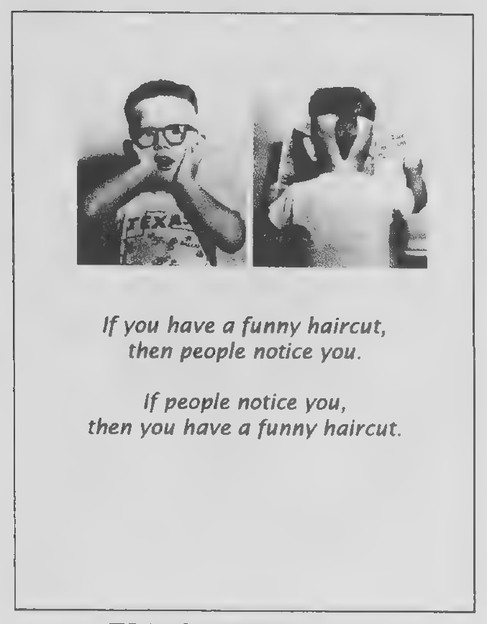 Transparency 2-3-1: If you have a funny haircut
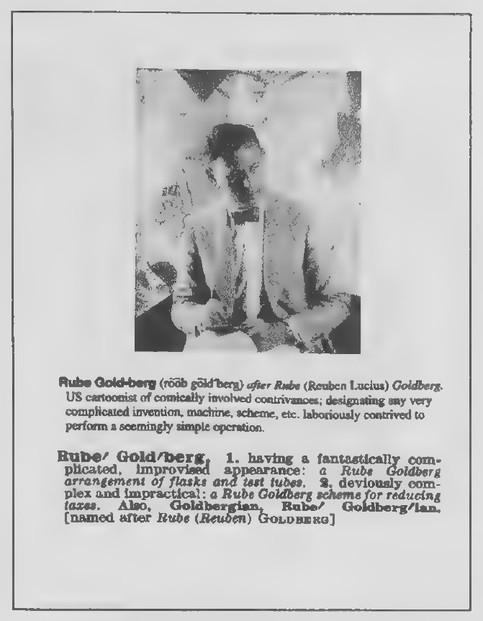 Transparency 2-3-2: Rube Goldberg dictionary entry
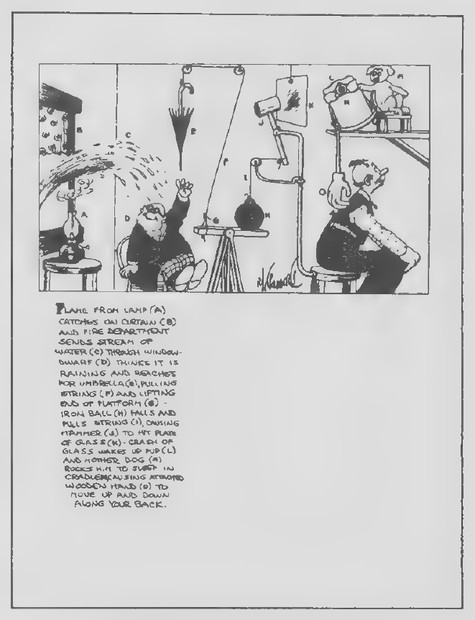 Transparency 2-3-3
A convenient example to use that is different from the one in the text is the definition of “concurrent lines.” You might have your students write it in all three forms as you introduce the ideas of converse and iff:
If lines are concurrent, then they contain the same point.
If lines contain the same point, then they are concurrent.
Lines are concurrent if and only if they contain the same point.
Background for the Teacher In the chapter titled “The Role of Definitions” in his book titled Euclid—The Creation of Mathematics (Springer, 1999), Benno Artmann states: “After Blaise Pascal… it became firmly established that in mathematics definitions are what are called nominal definitions. The notion ‘square’ is nothing but an abbreviation of the phrase ‘equilateral and equiangular quadrilateral,’ and the same is true for any other mathematical concept. In principle one should always be able to replace the shorthand notion by the terms that were used in its definition. In fact, many routine proofs do just this. And more than that: Definitions are never right or wrong, but can only be more or less useful.”
Lesson 3: Direct Proof
Lesson Outline
Terms: Syllogism, direct proof (premises, conclusion), theorem.
Ideas: Pattern of direct proof.
Transparencies
- 2-3-1 If you have a funny haircut
- 2-3-2 Rube Goldberg dictionary entry
- 2-3-3 . Rube Goldberg cartoon
- 2-3-4 Aristotle and the syllogism
- 2-3-5 The yellow rows of taxis (Set I, Exs. 17 and 18)
- 2-3-6 Tick-tack-toe proofs (Set II, Exs. 29-32)
Review Show just the photograph at the upper left of Transparency 2-3-1 and then the photograph at the upper right. These pictures are of three-year-old Robert Eugene Powell of Wichita Falls, Texas, whose father cut his hair in the shape of a coonskin cap when Davy Crockett was popular in the early days of television. Compare the statements below the photographs: (1) If you have a funny haircut, then people notice you. (2) If people notice you, then you have a funny haircut. Do these statements say the same thing? (Observe that, although the first statement may be true, the second certainly is not.) In what way is the second statement related to the first? (It is the converse of the first.) There is one type of statement in mathematics for which the converse is always true. What kind of statement is it? (A definition.) Why is the converse of a definition always true? (The word being defined and its definition have the same meaning.)
Introduction
Show Transparency 2-3-2. Rube Goldberg was an American artist whose name now appears in many dictionaries owing to his drawings of crazy inventions. There are even Rube Goldberg contests the purpose of which is to build the most complicated
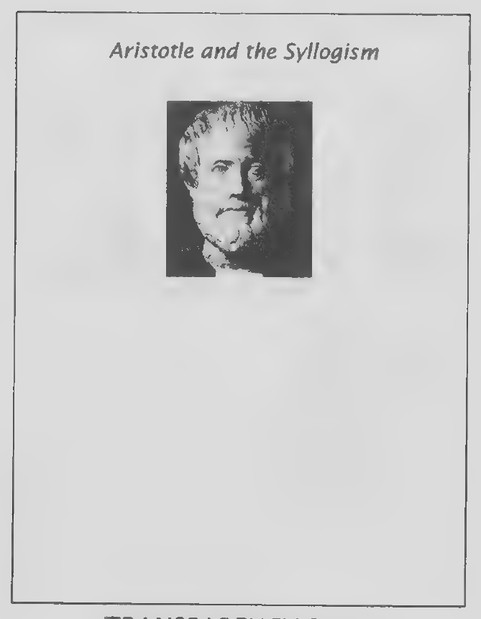 Transparency 2-3-4: Aristotle and the syllogism
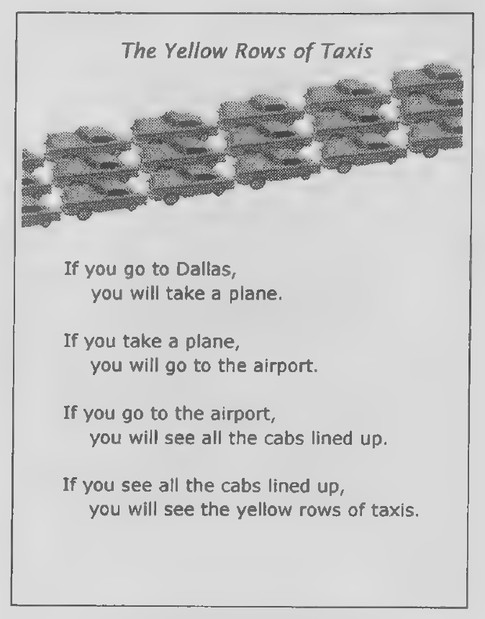 Transparency 2-3-5: The yellow rows of taxis (Set I, Exs. 17 and 18)
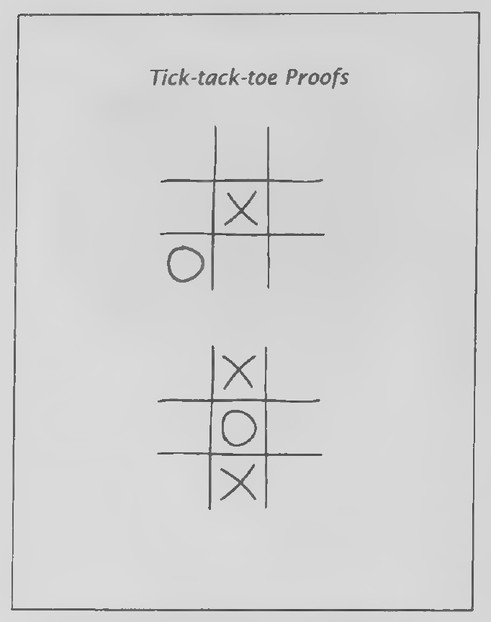 Transparency 2-3-6: Tick-tack-toe proofs (Set II, Exs. 29-32)
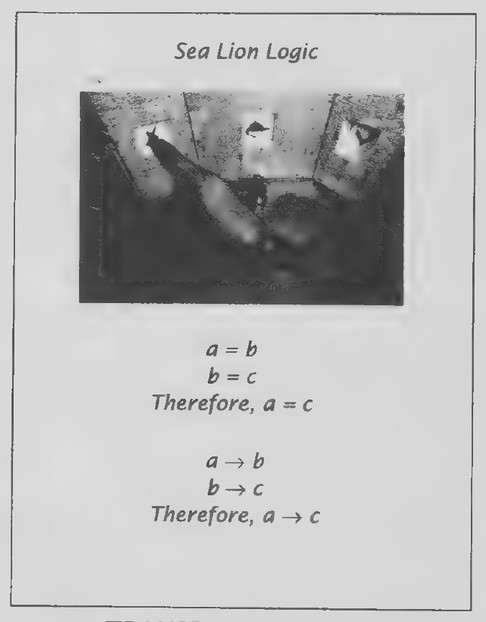 Transparency 2-4-1: Sea lion solving logic problem
machine possible to perform a simple everyday task. (Your students might enjoy Rube Goldberg Inventions by Maynard Frank Wolfe (Simon & Schuster, 2000) as well as the Web site www.rube-goldberg.com.) The cartoon on Transparency 2-3-3 is for use in illustrating the idea of a direct proof as in the lesson in the text. Explain that the cartoon depicts an outlandish device for scratching a person’s back. If the curtain catches fire, the fire department will send water through the window; if water comes through the window, the man by the window will think it is raining—and so on—until, if the pup’s cradle is rocked, the wooden hand will scratch the man’s back. If all of the premises are true, we can conclude that, “if the curtain catches fire, then the wooden hand will scratch the man’s back.”
After representing the pattern of the argument in symbols, you can use Transparency 2-3-4 to illustrate the shortest such argument, the syllogism. The photograph is of a marble bust of Aristotle, the Greek philosopher and scientist who lived about a hundred years before Euclid. The work of Aristotle on the subject of logic is credited for contributing indirectly to Euclid’s Elements. It was in Aristotle’s writings that the syllogism was first discussed. The words “syllogism” and “logic” both derive from the Greek word “logos,” meaning “word” or “reason.”
Lesson 4: Indirect Proof
Lesson Outline
Terms: Indirect proof.
Ideas: Pattern of indirect proof.
Transparencies
- 2-4-1 Sea lion solving logic problem
- 2-4-2 . Anno’s Hat Tricks book cover
- 2-4-3 . Anno’s hat tricks
- 2-4-4 The third hat trick explained
- 2-4-5 Trading desks proof (Set II, Ex. 15)
- 2-4-6 Poker proof (Set II, Ex. 17)
- 2-4-7 Balanced weights puzzles (Set II, Ex. 18)
Review Scientific researchers working with sea lions have found that these animals can solve simple problems in logic. The photograph on Transparency 2-4-1 shows a seal comparing three different symbols. If the seal has learned that symbols a and b are equivalent and that symbols b and c are equivalent, it concludes that symbols a and c are equivalent.
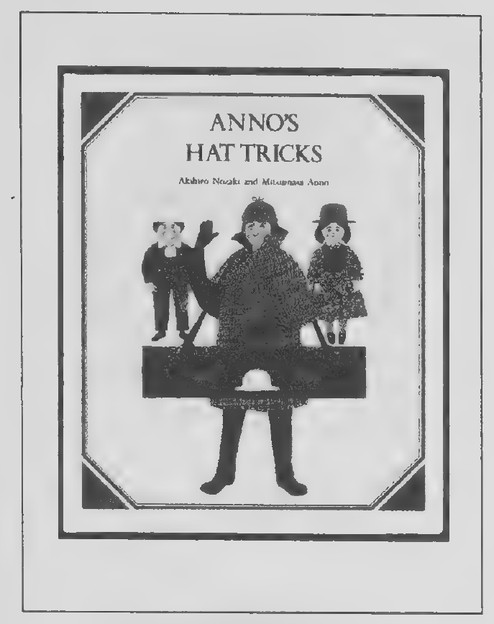 Transparency 2-4-2: HAT TRICKS
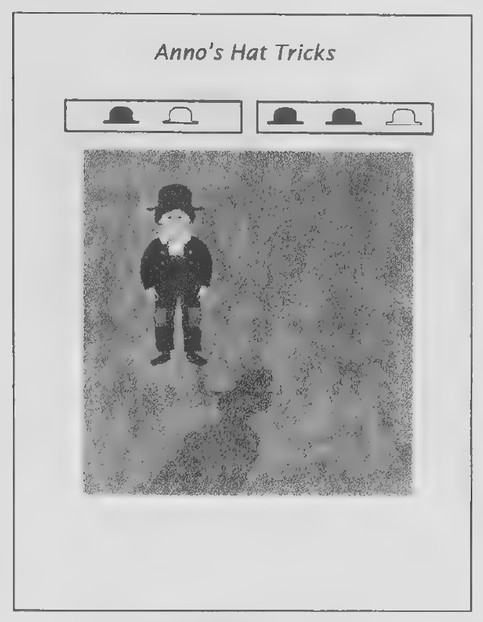 Transparency 2-4-3: Anno’s Hat Tricks
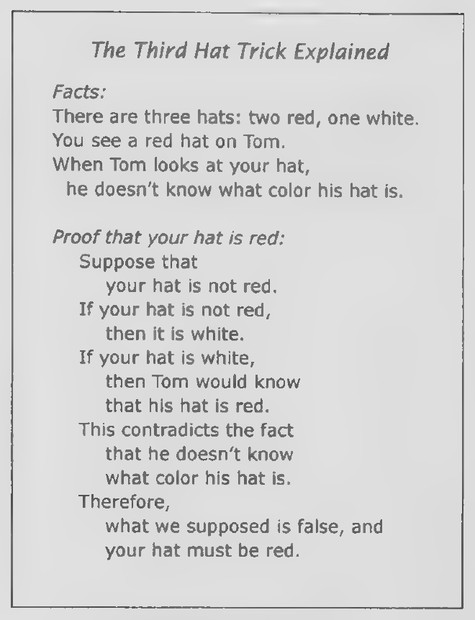 Transparency 2-4-4: The third hat trick explained
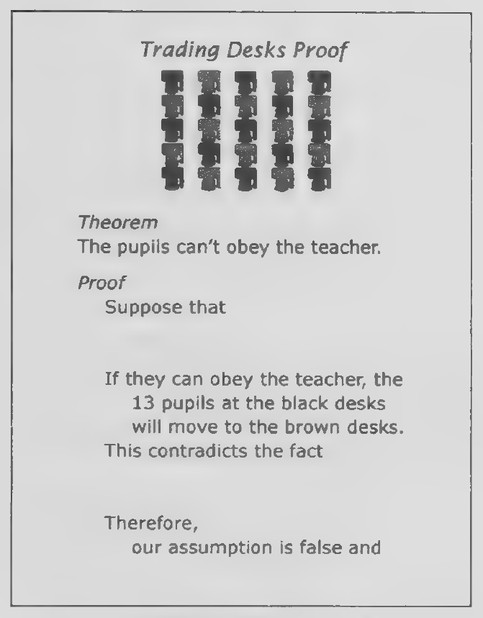 Transparency 2-4-5: Trading desks proof (Set II, Ex. 15)
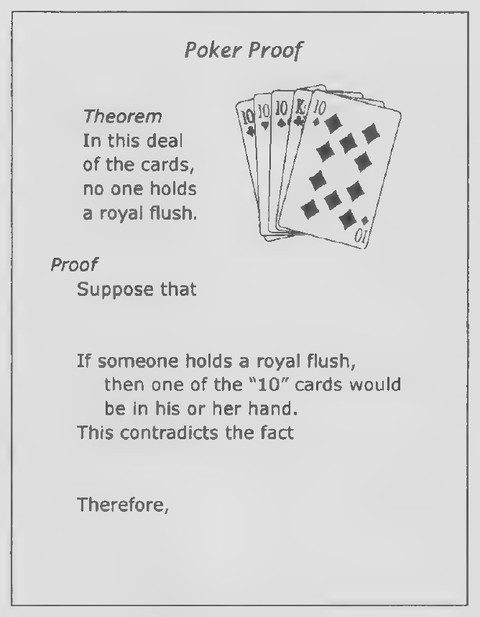 Transparency 2-4-6: Poker proof (Set II, Ex. 17)
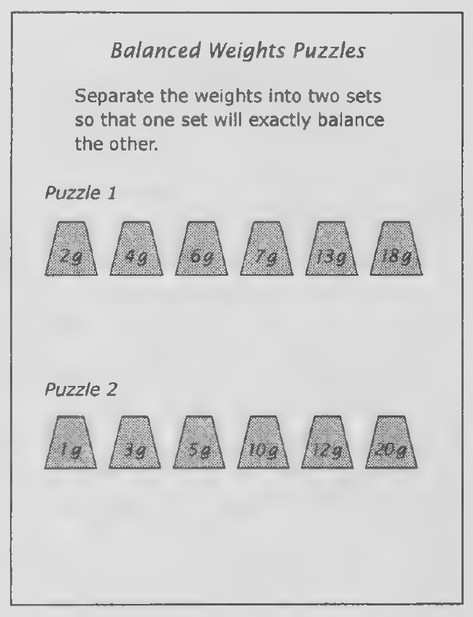 Transparency 2-4-7: Balanced weights puzzles (Set II, Ex. 18)
Compare the two arguments below the photograph: a = b, b =c, therefore, a=c;anda—>b,b-—c, therefore, a — c. The first of these arguments is of the type with which you became acquainted in algebra: in it, a, b, and c represent numbers, and the three statements are equations. The second argument is of the type with which you have become acquainted in geometry. What do a, b, and c represent in it? (Phrases.) What are the three individual statements called? (Conditional statements.) What is the pattern of the three statements called? (A syllogism.) What kind of proof does a syllogism demonstrate? (A direct proof.) The first two statements are the premises of the argument. What is the third statement called? (The conclusion.) What is a statement that is proved by reasoning deductively from
already accepted statements called? (A theorem.)
Introduction
The book Anno’s Hat Tricks with text by Akihiro Nozaki and pictures by Mitsumasa Anno (Transparency 2-4-2) includes a series of entertaining puzzles that provide a good introduction to indirect proof. The following list outlines how the puzzles develop:
- A hatter has one red hat and one white
hat. He puts a hat on Tom and a hat on
you. Tom looks at your hat and concludes
that his own hat is red. What color is your
hat? (White.)
- The hatter takes two red hats and one
white hat. He puts a hat on Tom and a hat
on you. You see that Tom’s hat is red. Tom
looks at your hat and concludes that his
 Transparency 2-5-1: A puzzle from Scientific American
 Transparency 2-5-2: Pepper’s ghost illusion
 Transparency 2-5-3: Intersecting lines theorem (Set II, Ex. 41)
own hat is red. What color is your hat?
(White. Otherwise, Tom wouldn’t have
known that his hat was red.)
- The hatter again takes two red hats and
one white hat. He puts a hat on Tom and
ahat on you. You see that Tom’s hat is red.
Tom looks at your hat but doesn’t know
what color his hat is. What color is your
hat? (Red. Otherwise, Tom would know
that his hat was red.) Although these tricks are considered in the text, your class might enjoy seeing these puzzles enacted with two students: one playing Tom and facing the class; the other playing you (the reader of the book) and facing Tom. Alternatively, you might show Transparency 2-4-3 with the upper right box showing three hats covered. After the first puzzle, cover the upper left box, uncover the upper right box and proceed with the remaining puzzles. Transparency 2-4-4 contains the final argument put into the format of an indirect proof as in the text. The most effective way to use it is to begin with the transparency covered with a sheet of paper and then slide the paper downward to enable your students to anticipate the progression of the proof.
Lesson 5: A Deductive System
Lesson Outline
Terms: Undefined terms, postulate, theorem, deductive system.
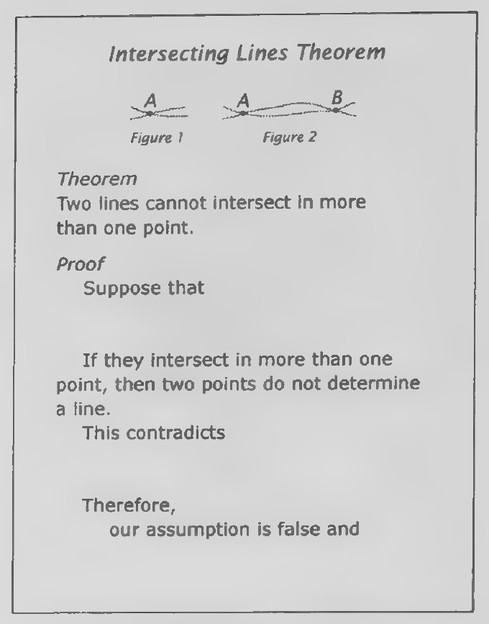
Postulate 1: Two points determine a line.
Postulate 2: Three noncollinear points determine a
plane.
Transparencies
- 2-5-1 A puzzle from Scientific American
- 2-5-2 Pepper’s ghost illusion
- 2-5-3 Intersecting lines theorem (Set II, Ex. 41)
- 2-5-4 How many lines? (Set III)
Review The puzzle on Transparency 2-5-1 once appeared in Martin Gardner’s “Mathematical Games” column in Scientific American July 1971) and provides a good review of indirect reasoning:
“A boy and a girl are sitting on the front steps of their commune. ‘I’m a boy,’ said the one with black hair. ‘I’m a girl,’ said the one with red hair. If at least one of them is lying, who is which?”
As Gardner explains, there are four possible true-false combinations for the two statements: TT, TE FT, and FF. The first is eliminated because it contradicts the fact that at least one of the two is lying. The second and third are eliminated because they lead to the conclusions that both are boys or both are girls, each of which contradicts the fact that one is a boy and one is a girl. So we are left with the conclusion that both lied. The person with black hair is a girl and the person with red hair is a boy.
Introduction
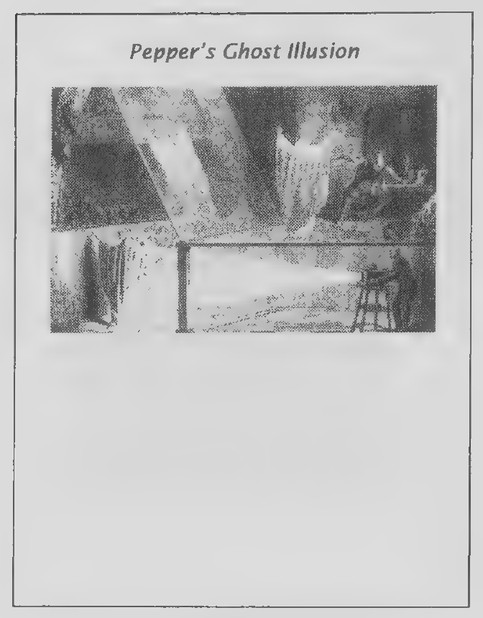
A very popular entertainment in London in 1862 was Pepper’s Ghost Illusion. Something similar to it is used in the Haunted House in Disneyland. The picture on Transparency 2-5-2 shows how the ghost illusion worked. A large sheet of glass was set up on a stage so that it was tilted toward the audience. An actor playing a ghost stood below the level of
 Transparency 2-5-4: How many lines? (Set III)
 Transparency 2-6-1: A message to the stars
 Transparency 2-6-2: The Pythagorean Theorem
the stage. Light projected onto the actor was reflected onto the glass, creating the illusion of a ghost interacting with the actors on the stage. The lighting in the theater was such that the audience saw the ghost but not the glass, and the resulting effect caused a sensation.*
This illusion was based on clever lighting and some three-dimensional geometry. To understand how it works, it is convenient to think of the positions of the real ghost and the illusion on the stage as points, the light producing the illusion as traveling along lines, and the plate of glass and the floor of the stage as parts of planes.
After this introduction, the rest of the lesson can be presented as in the text. Having your students make the following outline should help them understand the components of a deductive system.
A Deductive System
Undefined terms: to avoid circularity.
Definitions.
Postulates (assumed statements): to avoid cir-
cularity.
Theorems (proved statements): proved directly
or indirectly by using rules of logic.
Lesson 6: Some Famous Theorems of Geometry
Lesson Outline
Terms: Hypotenuse, circumference, diameter, pi.
The Pythagorean Theorem: The square of the hypotenuse of a right triangle is equal to the sum of
the squares of the other two sides. The Triangle Angle Sum Theorem: The sum of the
angles of a triangle is 180°. Two Circle Theorems: If the diameter of a circle is d,
its circumference is πd. If the radius of a circle
is r, its area is πr.
Transparencies
- 2-6-1 A message to the stars
- 2-6-2 The Pythagorean Theorem
- 2-6-3 The Triangle Angle Sum Theorem
Introduction
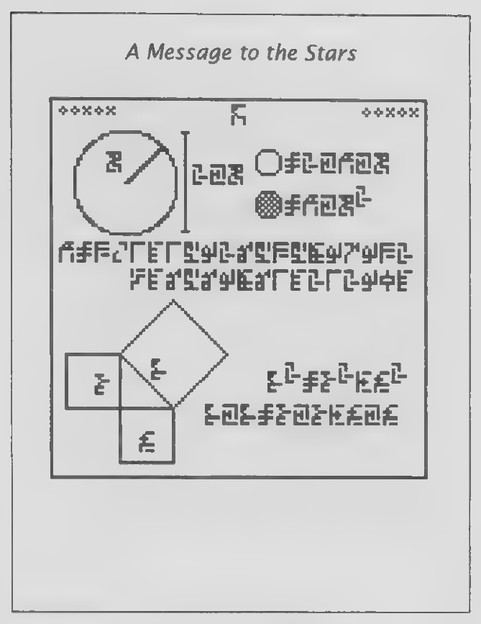
In 1999, two Canadians, astrophysicist Yvan Dutil and cryptographer Stephane Dumas, sent a message into space in the hope of reaching extraterrestrial intelligence. Called the Evpatoria Message or Cosmic Call, it consisted of 23 pages of information about our mathematics, ourselves, Earth, and our solar system.’ Page 5 is about geometry and is reproduced on Transparency 2-6-1. I suggest making copies of this page so that your students can mark it as you consider it in class. The figures and the symbols accompanying them represent three of the most useful and famous theorems of geometry. Can you guess what either figure is about? (The first figure shows a circle with a radius. The symbol by the radius represents its length, R, and the vertical segment to the right of the circle represents the length of its diameter. To the immediate right of this segment are three symbols representing 2 x R. The two rows of symbols to the right of these symbols
*The Great Illusionists, by Edwin A. Dawes (Chartwell Books, 1979).
tThe entire message can be found on the Web site www3.sympatico.ca/stephane_dumas/CETI/ #1999_MESSAGE.
 Transparency 2-6-3: The Triangle Angle Sum Theorem
 Transparency 2-R-1: Woodman, spare that tree
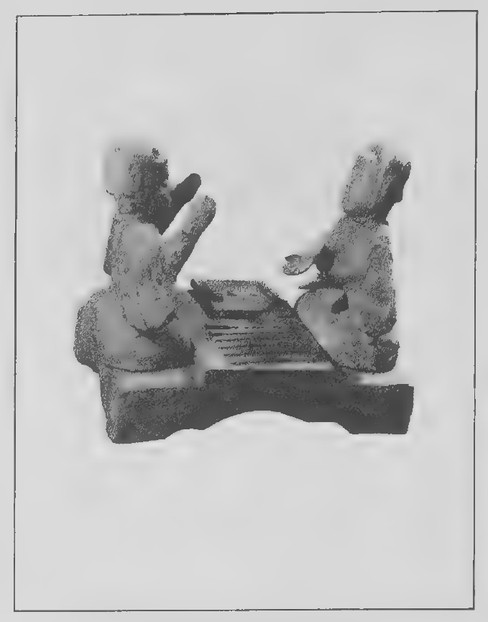 Transparency 2-R-2: Backgammon sculpture
represent C = 2x mx Rand A= R². The two long rows of symbols directly below list some of the digits of 1. (m7 = 3.14159…)
The lower figure, showing squares drawn on the three sides of a right triangle, represents the Pythagorean Theorem. The three symbols on the sides, starting with the hypotenuse and reading clockwise, are c, b, and a. The two rows of symbols to the right of the figure represent c² = a² + b² and cXc=axat+bxb.
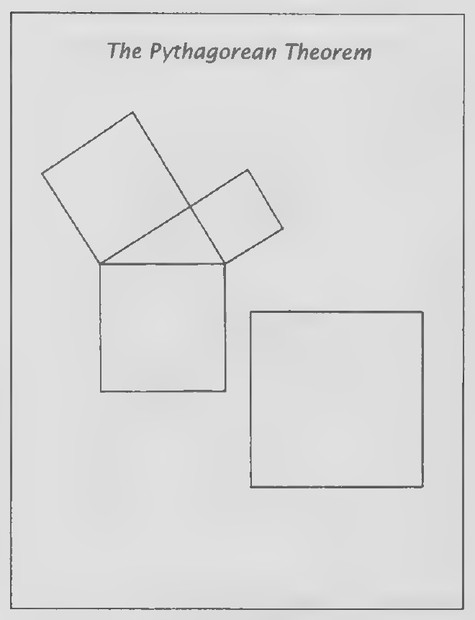
Although formal proofs of the theorems of Lesson 6 will not be considered until later in the course, you will want to present the area demonstration of the Pythagorean Theorem illustrated at the top of page 66 of the text. Transparency 2-6-2 can be used for this purpose. In advance of class, cut from thick sheets of colored plastic the three squares and four copies of the triangle shown in the top figure of the transparency. The triangles should be one color and the squares another. Place the three squares and one of the triangles on the transparency figure and point out that we want to show that it is reasonable to think that the sum of the areas of the two smaller squares is equal to the area of the largest one. Then arrange the triangle and large square in the frame at the bottom of the transparency as shown in the third figure at the top of page 66 of the text. Fill in the remaining spaces with the other three triangles. Explain that we can remove the large square and rearrange the four triangles so that there is exactly enough room for the two smaller squares. In this demonstration, you might leave the triangle at the lower left in place and slide the other three triangles to the appropriate positions so that the two smaller
squares can be fitted into place.
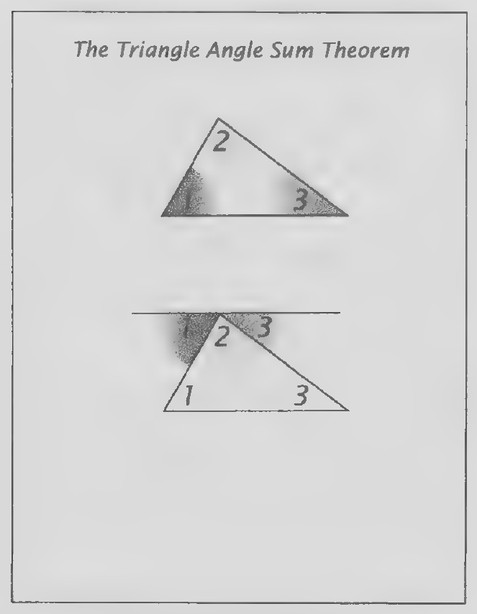
Transparency 2-6-3 is for use in illustrating the Triangle Angle Sum Theorem.
Review of Chapter 2
Transparencies
- 2-R-1 _ Woodman, spare that tree
- 2-R-2 Backgammon sculpture
- 2-R-3 Some rules of backgammon
- 2-R-4 Putting knowledge to work
- 2-R-5 Dialogue with an expert system
- 2-R-6 Expert system’s explanation
2-R-7_ Panda proof (Set II, Exs. 40 and 41) 2-R-8 Clue proof (Set II, Exs. 42 and 43) 2-R-9 Circle in the square (Set II, Exs. 4449)
First day
Introduction
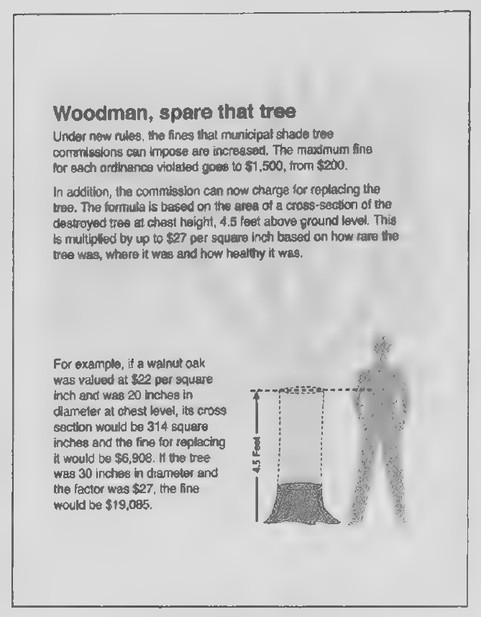
A newspaper article tells of rules establishing fines for cutting down city shade trees. According to the article, “The formula is based on the area of a crosssection of the destroyed tree at chest height, 4.5 feet above ground level. This is multiplied by up to $27 per square inch based on how rare the tree was, where it was and how healthy it was.”
Checking the numbers in the example in the article provide a good exercise for your students in reviewing the formula for the area of a circle. The example is somewhat strange for two reasons. First, a tree with a 20-inch diameter has a radius of 10 inches. The cross-sectional area of 314 square inches clearly comes from letting 7 = 3.14. Students using the m key on a calculator will get an area of 314.159… Square inches and a fine of $6,911.50 rather than
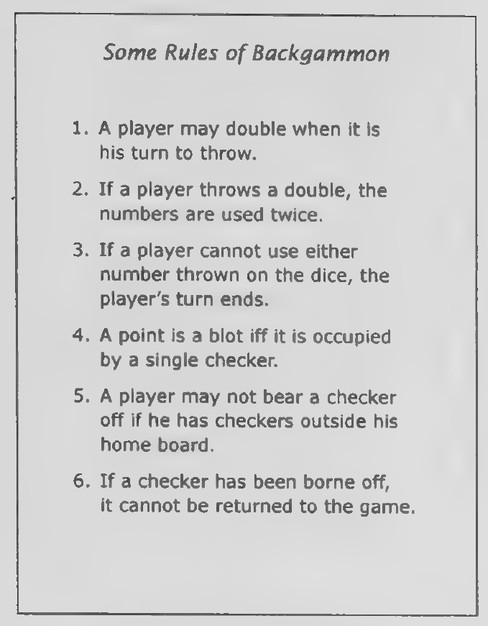 Transparency 2-R-3: Some rules of backgammon
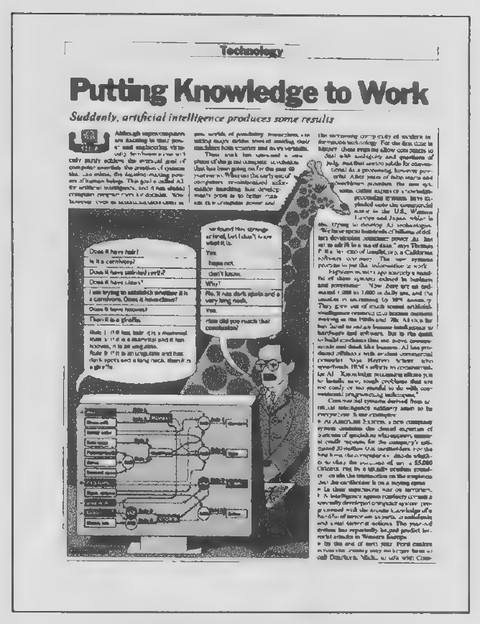 Transparency 2-R-4: Putting knowledge to work
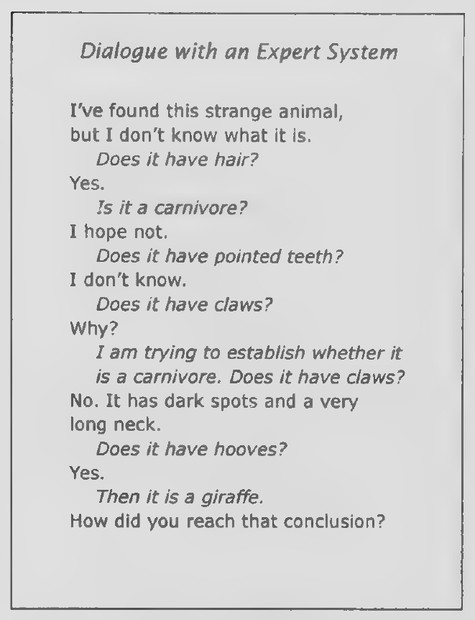 Transparency 2-R-5: Dialogue with an expert system
$6,908. Second, if we continue to letnm =3.14, thena tree with a 30-inch diameter has a cross-sectional area of (3.14)(15)* = 706.5 square inches; a fine factor of $27 gives $19,075.50, rather than $19,085. On the other hand, if the mt key on the calculator is used, the fine becomes about $19,085, the number reported in the article!
Second day
Introduction
Show Transparency 2-R-2 and ask if anyone can guess what game the two people in the picture are playing. (It looks like backgammon.) Amazingly, the photograph is of a sculpture found by Chinese archeologists in a second-century tomb. Some of the rules of backgammon are listed on Transparency 2-R-3:
- A player may double when it is his turn to
throw. 2. If a player throws a double, the numbers are
used twice. 3. If a player cannot use either number thrown
on the dice, the player’s turn ends. 4. A point is a blot iff it is occupied by a single
checker. 5. A player may not bear a checker off if he has
checkers outside his home board. 6. If a checker has been borne off, it cannot be
returned to the game.
What kind of statements are these rules? (Conditional statements.) What is the hypothesis of statement 1? (When it is his turn to throw.) What is the conclusion of statement 3? (The player’s turn ends.) Which statement is a definition? (Statement 4.) What
does the symbol “iff” in this statement mean? (If and only if.) Is the converse of every definition true? (Yes.) Why? (Because the word being defined and its definition have the same meaning.) In general, if a conditional statement is true, is it correct to conclude that its converse is true? (No.) Most rules of games are assumed to be true without proof. What are such statements called in geometry? (Postulates.) What do we call statements that are proved? (Theorems.)
Alternate Introduction An important branch of computer science is artificial intelligence or AI. Artificial intelligence has been defined as “the study of the computations that make it possible to perceive, reason, and act.” Its goal is to understand and emulate the ability of humans to reason; included in every AI program are the rules of deductive reasoning. AI programs called expert systems are now used in a wide variety of applications ranging from business to engineering to medical care. An example of a simple expert system illustrated on Transparency 2-R-4 shows how a series of questions lead to the identification of an animal. The dialogue is reproduced on Transparency 2-R-5:
I’ve found this strange animal, but I don’t
know what it is.
Does it have hair?
Yes.
Is it a carnivore?
I hope not.
Does it have pointed teeth?
I don’t know.
 Transparency 2-R-6: Expert system’s explanation
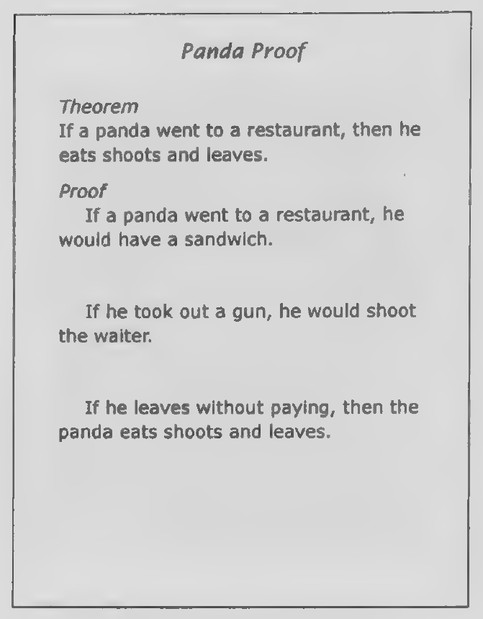 Transparency 2-R-7: Panda Proof
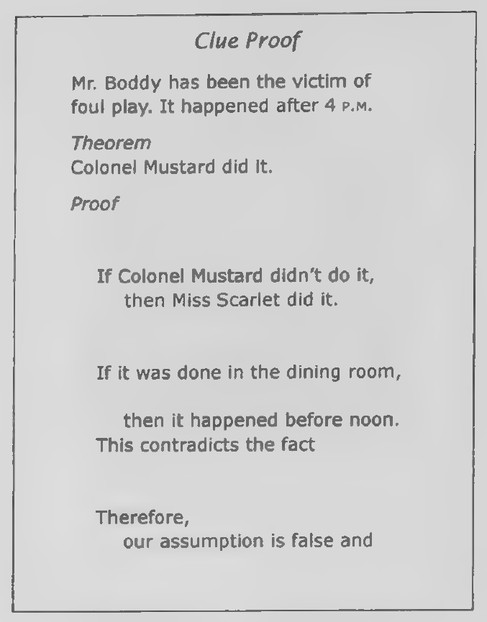 Transparency 2-R-8: Clue proof (Set II, Exs. 42 and 43)
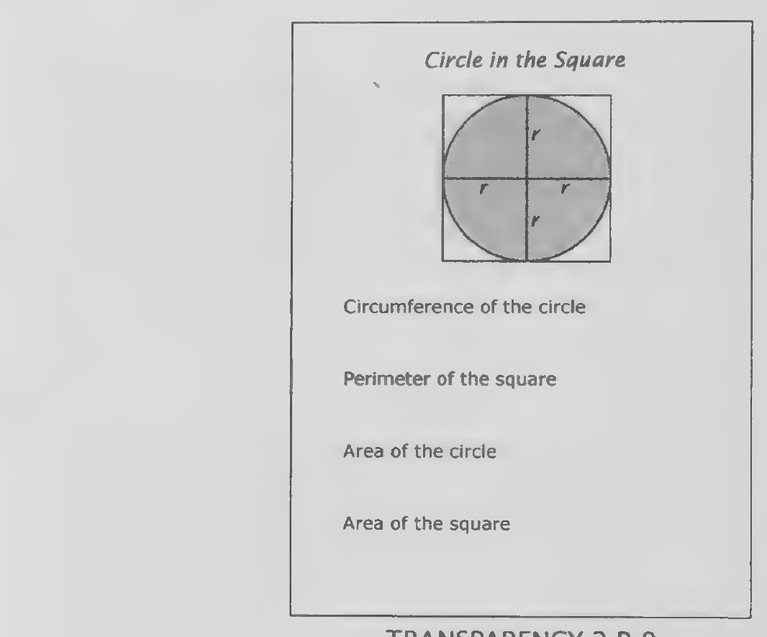 Figure on page 308 — A worksheet table of circle and polygon measurements (circumference, perimeter, area)
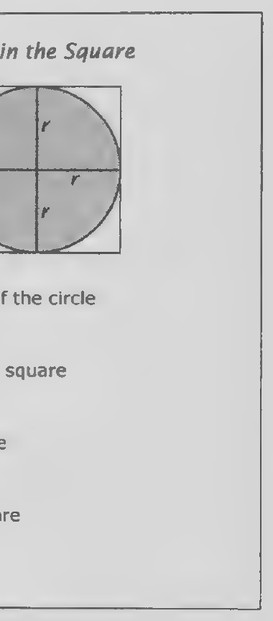 Transparency 2-R-9: Circle in the square (Set II, Exs. 4449)
Does it have claws?
Why?
Iam trying to establish whether it is a carnivore.
Does it have claws?
No. It has dark spots and a very long neck.
Does it have hooves?
Yes.
Then tt is a giraffe.
° A
How did you reach that conclusion?
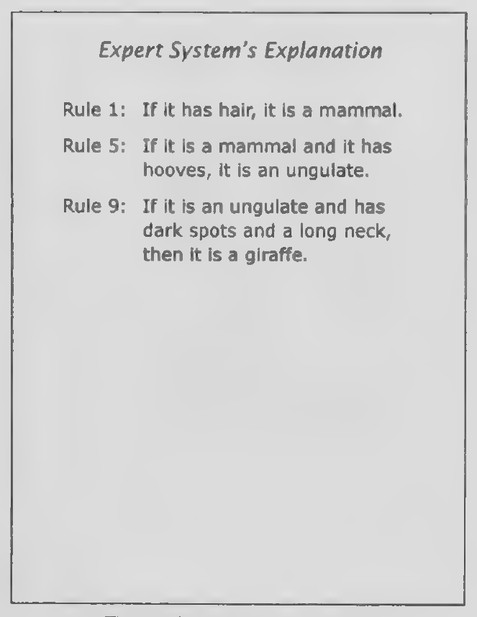
The expert system’s answer is reproduced on Transparency 2-R-6:
Rule 1: If it has hair, it is a mammal.
Rule 5: If it is a mammal and it has hooves, it is an
ungulate.
Rule 9: If tt ts an ungulate and has dark spots and
a long neck, then it is a giraffe.
These rules can be used to provide a brief review of conditional statements. They also provide an example of a chain of statements similar to but somewhat more complicated than a > b, b> c, c — d. The flow chart at the bottom of the figure on Transparency 2-R-4 is comparable to the structure of a complex proof in geometry.
Circle
of the
circle
square TRANSPARENCY
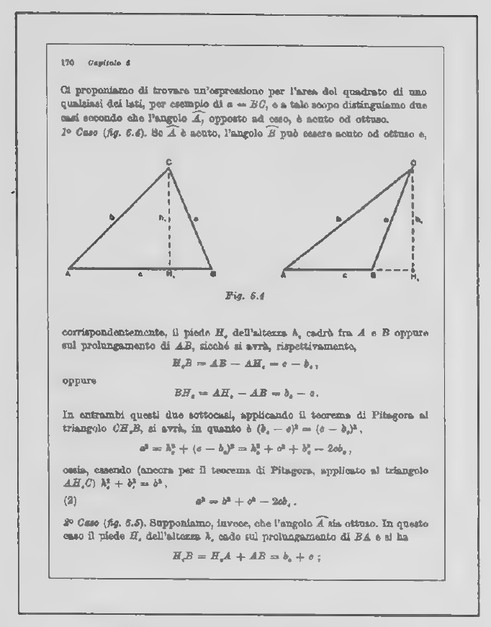 Transparency 3-1-1: Page from Italian geometry book
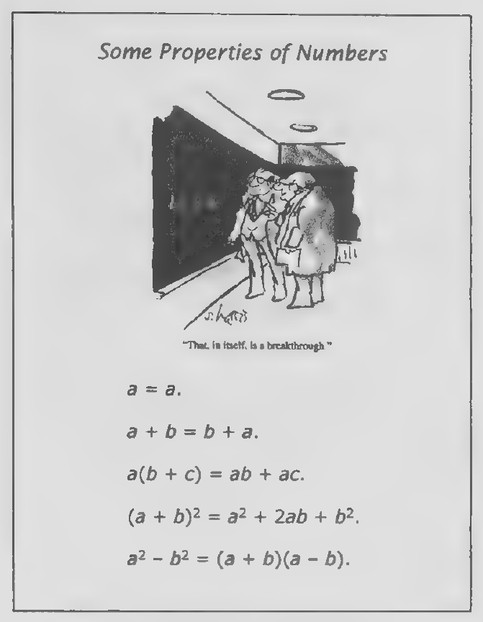 Transparency 3-1-2: Some properties of numbers
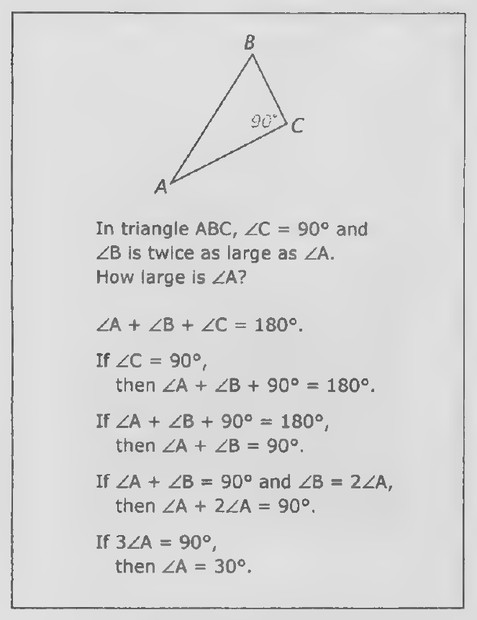 Transparency 3-1-3: Properties of equality applied to a geometric figure
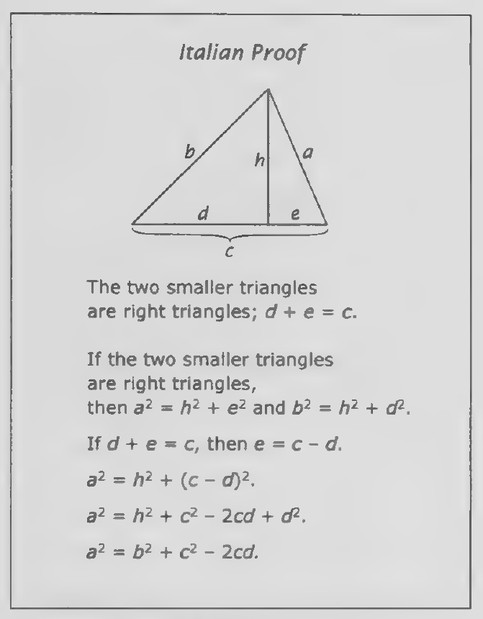 Transparency 3-1-4: Italian proof
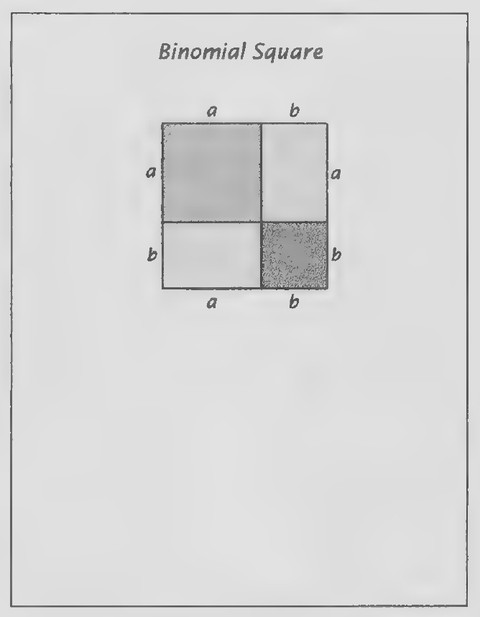 Transparency 3-1-5: Binomial square (Set II, Exs. 25-30)
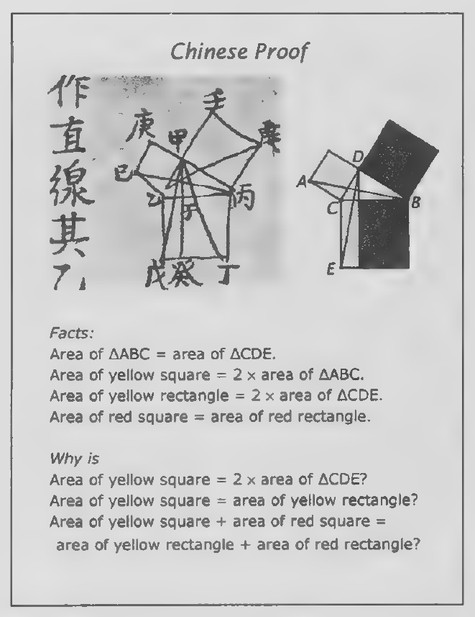 Transparency 3-1-6: Chinese proof (Set II, Exs. 31-35)