Chapter 1: An Introduction to Geometry
Lesson 1: Lines in Designing a City
Lesson Outline
Terms: Point, line, line segment, plane, collinear, noncollinear, coplanar, concurrent.
Transparencies
- 1-1-1 The Nazca lines of Peru
- 1-1-2 The city of Ch’ang-an (Set I)
- 1-1-3 A point-line configuration (Set II)
- 1-1-4 A discovery of Pappus (Set III)
Introduction
One of the world’s unsolved mysteries concerns the desert of southern Peru. Stretching for miles across the land are gigantic drawings of birds and other animals, as well as lines—many lines—leading in every direction. The drawings and lines were put there by the Nazca civilization more than 1,500 years ago. For what purpose, no one knows.
Strange as it may seem, the people who drew these figures probably never saw them in their entirety, because they can only be seen from heights of at least 1,000 feet. They weren’t noticed until the 1920s when airplanes began flying over the Peruvian desert.*
Some of the lines extend for many miles and are incredibly straight. The Nazcas are thought to have stretched strings from posts to aid in their construction. How many posts would be needed to determine the direction of one of these strings? (Two.) The positions of the posts are good models of geometric points, and the stretched string is a good model of part of a geometric line. The flatness of the Nazca plain on which the figures were created makes it a good model of a geometric plane.
This introduction leads naturally into the rest of the ideas included in the lesson. Guide your students in listing and making sketches illustrating the basic terms before they begin the exercises.
*Further information about the Nazca (also spelled Nasca) lines can be found in Pathways to the Gods, by Tony Morrison (Harper & Row, 1978), The World’s Last Mysteries (A Reader’s Digest Book, 1978), and various sites on the Internet, including www.crystalinks.com/nasca.html.
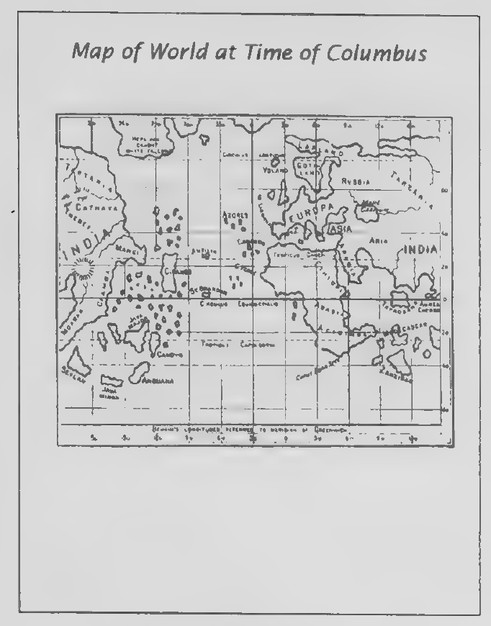 Transparency 1-2-1: Map of world at time of Columbus
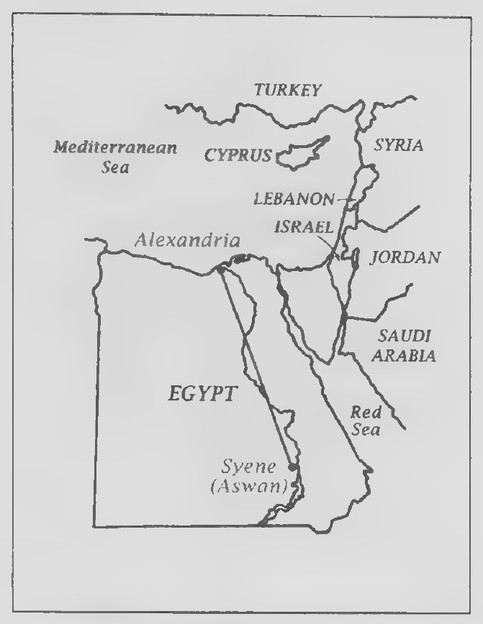 Transparency 1-2-2: Map of Alexandria and Syene
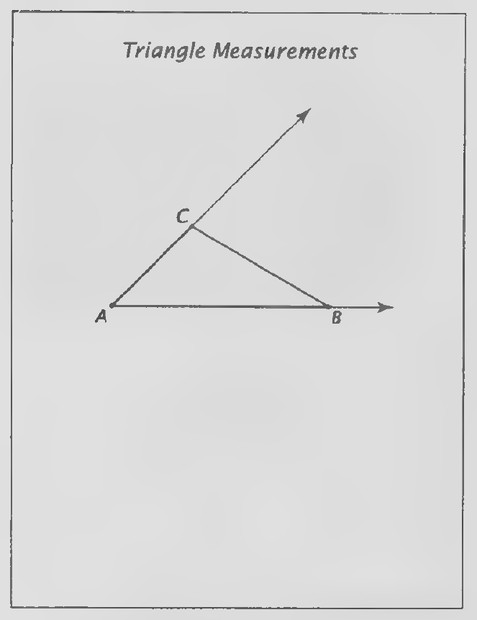 Transparency 1-2-3: Triangle measurements (Set I, Exs. 1-12)
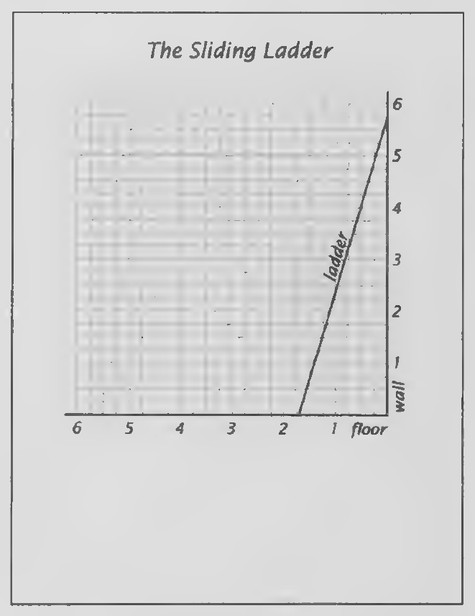 Transparency 1-2-4: The sliding ladder (Set II)
Lesson 2: Angles in Measuring the Earth
Lesson Outline
Terms: Ray, angle (sides and vertex), protractor, degree.
Transparencies
- 1-2-1 Map of world at time of Columbus
- 1-2-2 Map of Alexandria and Syene
- 1-2-3 Triangle measurements (Set I, Exs. 1-12)
- 1-2-4 The sliding ladder (Set II)
Introduction
Good opening questions: Do you know what the distance around the earth is? How long ago do you suppose it was first determined?
In the foreword to the book titled The Log of Christopher Columbus, edited by Robert H. Fuson (International Marine Publishing Company, 1987), Luis Marden wrote:
“No literate person in 1492 thought the world was flat; the Greeks had proved the sphericity of the earth long before Christ. In fact, in that same year of 1492 Martin Behaim in Germany produced a terrestrial globe, still extant. The question under debate was the size of the globe. In the third century B.C., the Greek astronomer Eratosthenes, using only his brain and a shadow-casting column, came astonishingly close to the true circumference, but 500 years later the geographer Ptolemy described an earth one fourth smaller than the true dimension.”
Columbus thought that the circumference of the earth was approximately 20,000 miles. If he had known the correct value, he might not have at-
tempted the journey. As Fuson remarks, Columbus’s belief that the earth was much smaller than it is “was one of the most fortunate mistakes in history.”
The map on Transparency 1-2-1, based on Behaim’s world globe of 1492, makes clear why when he sailed west from Spain and arrived at Cuba, Columbus thought it was Japan (Cipango). Not until considerably later did the Europeans realize that the earth was large enough to contain another continent and ocean.
How could someone have accurately determined the size of the earth more than seventeen centuries before Columbus made his historic voyage? Explain the method that Eratosthenes used as described on pages 14 and 15 of the text by first showing Transparency 1-2-2 and then having your
 Transparency 1-3-1: Tiny house
 TINY HOUSE PATTERN
 Transparency 1-3-2: A square puzzle (Set III)
students draw the following figure. Use the semicircular edge of a protractor to draw a circle to represent the earth. Mark a point, S, at the top of the circle to represent Syene and draw a ray upward from the center of the circle through this point to show the direction of the sun when it is directly overhead. Use the protractor to draw an angle with this ray as one of its sides and with a measure of 7.5° to find the position, A, of Alexandria on the circle. Draw a ray from point A parallel to the original ray to complete the figure and then guide your students in discovering what Eratosthenes did.
Lesson 3: Polygons and Polyhedra: Pyramid Architecture
Lesson Outline
Terms: Polygon (triangle, quadrilateral, pentagon, hexagon, octagon), polyhedron, perimeter, area, rectangle, square.
Transparencies and Worksheet
- 1-3-1 Tiny house Tiny house pattern
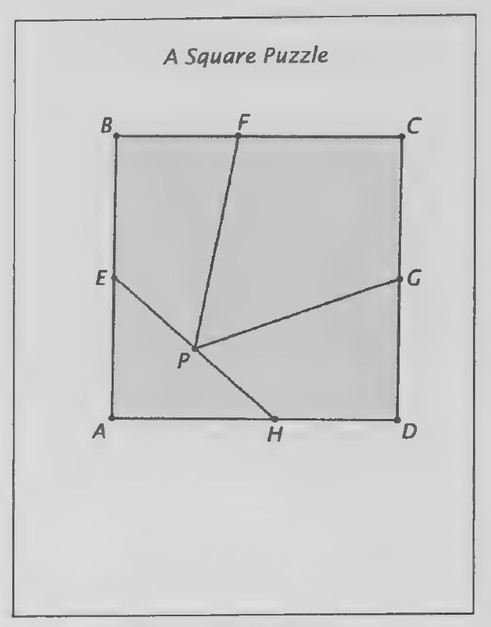
- 1-3-2 Asquare puzzle (Set III) (Cut out a set of the four pieces for use in illustrating how they can be rearranged to form the equilateral triangle.)
Introduction
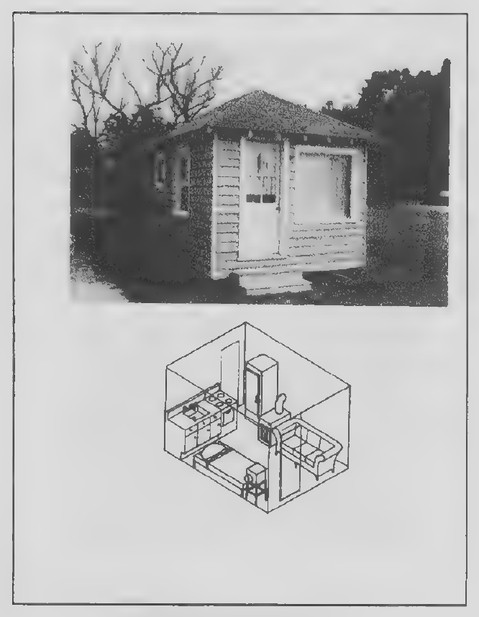
Before class, tape off a rectangle measuring 9 ft by 12 ft on the floor of your classroom to illustrate just how small the tiny house featured in this lesson actually is. The house is located near Whitestone, Virginia. Designed as a 1950s ranch house, it consists of just one room 12 ft long and 9 ft wide. Its interior
is shown in the diagram below the photograph. (Its bathroom is a separate outhouse, not visible in the picture.)*
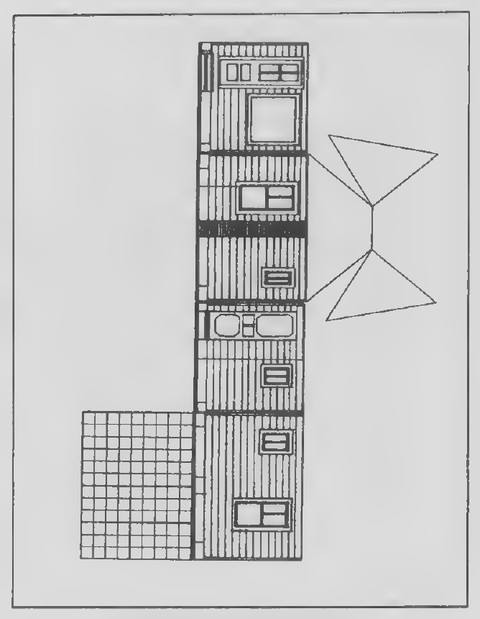
Hand out scissors and copies of the Tiny House Pattern so that your students can put together a simple model of the house. Before they do so, observe that the figures representing the walls, floor, and sections of the roof are examples of polygons [triangles and quadrilaterals (rectangles, squares, and trapezoids)|. The surfaces of the house, after it has been put together, provide an example of a polyhedron (one having nine faces). If the pattern is cut out as a single piece and just one piece of tape used to connect the unattached walls, it can be folded flat again after the lesson has been completed. The rectangle representing the floor of the house has been divided into small squares, each corresponding to 1 square foot. The model can thus be used to develop the rest of the lesson by having your students consider the perimeter and area of the floor.
Lesson 4: Constructions: Telling Time with Shadows
Lesson Outline
Terms: Straightedge, compass, circle (radius, center), construction, bisect.
Constructions: To bisect a line segment, to bisect an angle.
Transparencies
- 1-4-1 Counterclockwise clock
- 1-4-2 Sundial
*Tiny Houses, by Lester Walker (Overlook Press, 1987).
 Transparency 1-4-1: Counterclockwise clock
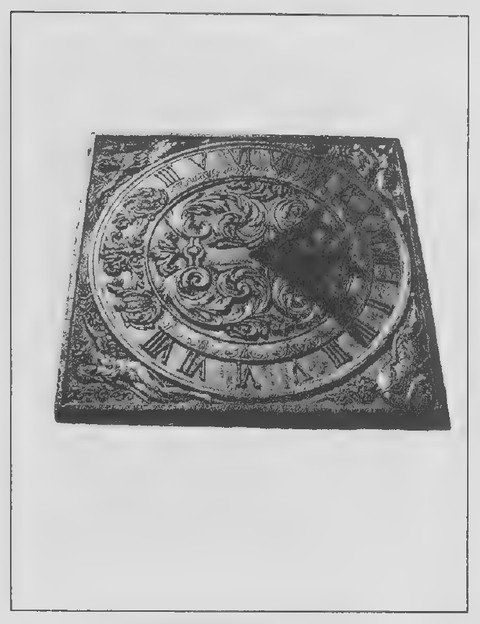 Transparency 1-4-2: Sundial
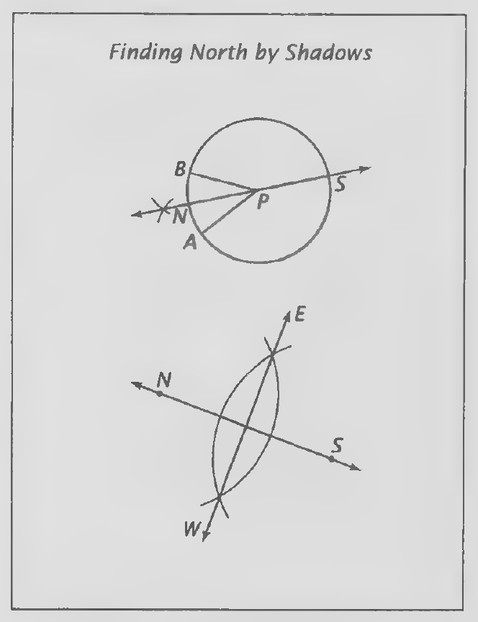 Transparency 1-4-3: Finding North by Shadows
1-4-3. Finding north by shadows (Set I, Exs. 3-9) 1-4-4 Bisectors in a triangle (Set I, Exs. 10-16)
Introduction
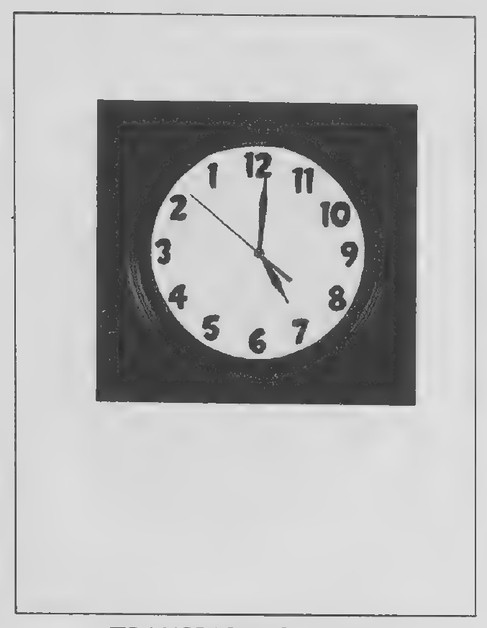
An amusing way to begin this lesson is to have a “backward clock” in view in your classroom as your students arrive. Such clocks are available for about $15 from many different sources on the Internet and can be found by typing “backward clock” on your search engine. The clock shown on Transparency 1- 4-1 is an example of one of these clocks. Ask your students how a clock with its numbers in reverse order could keep correct time. (Its hands go counterclockwise.) The manufacturer of one of these clocks states: “Does the frantic pace of today’s world make you want to turn back the hands of time and give yourself a few extra hours? We’ve solved this problem for you with our new Backward Clock. The hour, minute and second hands move backward to give you the extra time you need. The numbers on this clock are arranged counterclockwise to help you keep track of how much time you’re saving.”
Why do clocks ordinarily run “clockwise”? In his book titled Why Do Clocks Run Clockwise? and Other Imponderables (Harper & Row, 1987), David Feldman gives the following explanation: “Before the advent of clocks, we used sundials. In the northern hemisphere, the shadows rotated in the direction we now call ‘clockwise.’ The clock hands were built to mimic the natural movement of the sun. If clocks had been invented in the southern hemisphere… ‘clockwise’ would be the opposite direction.” The sundial pictured on Transparency 1-4-2 illustrates this resemblance nicely. In their book on
Time (Life Science Library, 1980), Samuel A. Goudsmit and Robert Claiborne observe: “As long as the principal timekeeper was the motion of the sun—for some 4,000 years from ancient Egypt to the 16th Century—the main timekeeping device was the sundial…. The sundial is remarkably reliable, so good that for centuries it was employed to correct mechanical clocks.”
Have your students use a compass to draw a circle and a horizontal diameter. Show them how to construct a vertical diameter and label the endpoints of the diameters according to map directions with north at top. Point out that their drawing lies in the horizontal plane of the paper. Imagine a vertical post with its base at the center of the circle. In what direction would its shadow point when the sun is rising in the east? (West.) Where is the sun in the sky at noon? (In the Northern Hemisphere, it is toward the south.) In what direction does the shadow of the post point at noon? (North.) In what direction does the shadow point when the sun is setting in the west? (East.) The answers to these questions confirm the fact that, in the Northern Hemisphere, shadows turn clockwise during the day.
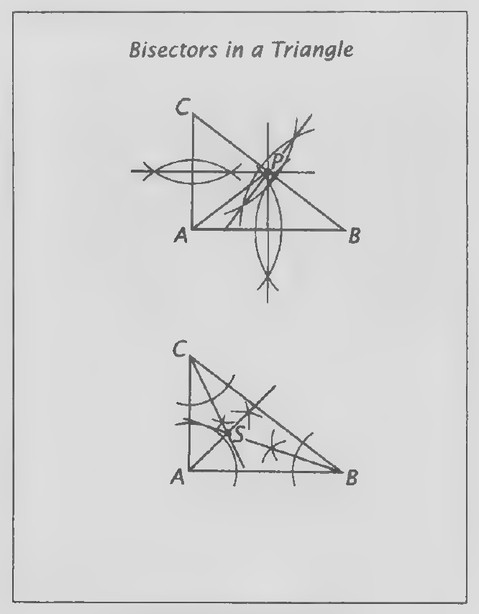 Transparency 1-4-4: Bisectors in a triangle (Set I, Exs. 10-16)
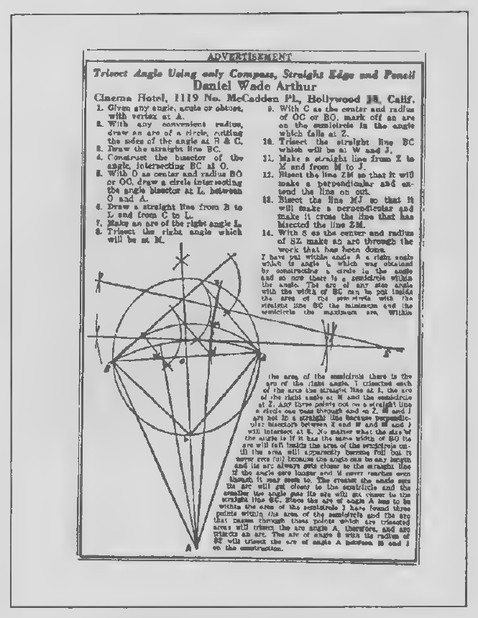 Transparency 1-5-1: Angle-trisection advertisement
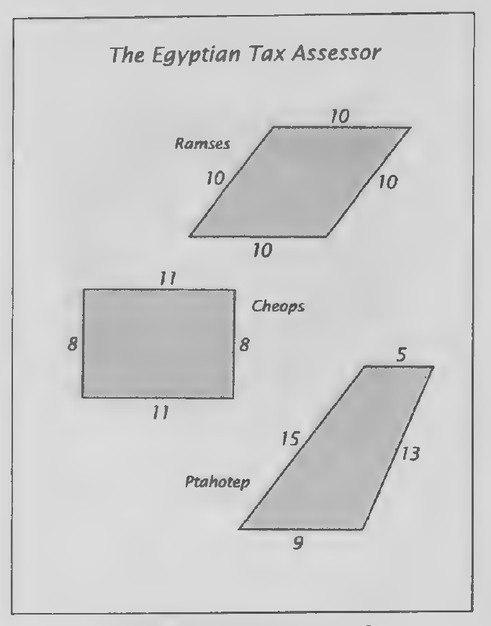 Transparency 1-5-2: The Egyptian tax assessor
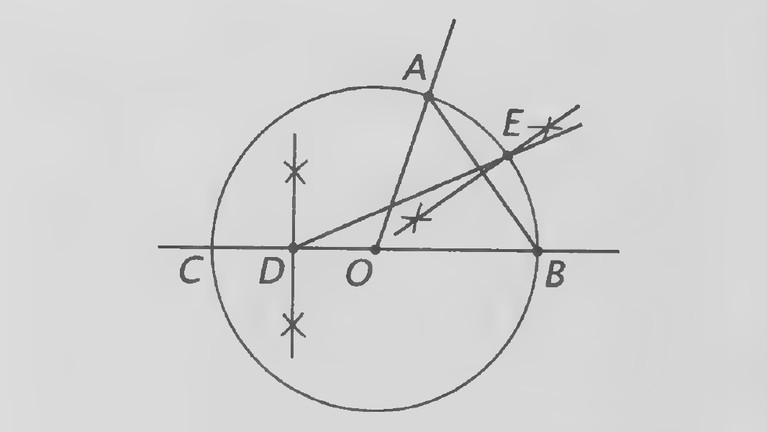 Figure on page 296 — Compass-and-straightedge angle-bisection construction: a circle with center O cut by rays to A and B, with arc marks on OC and the line DE
Lesson 5: We Can’t Go On Like This
Lesson Outline
Theme: The need to know why.
Transparencies
- 1-5-1 Angle-trisection advertisement
- 1-5-2 The Egyptian tax assessor
Introduction
[This introduction is especially appropriate in that it both reviews the bisection constructions of Lesson 4 and leads naturally into the new lesson.] A very strange advertisement (Transparency 1-5-1) once appeared in the Los Angeles Times. It was paid for by a man named Daniel Wade Arthur whose address was a cheap hotel in Hollywood. The ad appeared in the Sunday paper and was rather large; so Mr. Arthur had to have paid a lot of money to run it. He didn’t have any hope of making any money from it, because he wasn’t trying to sell anything. The subject of the ad was a geometry problem! Mr. Arthur was explaining how to trisect an angle using only a compass, straightedge, and pencil. His method was very complicated and would take a lot of time and effort to carry out, which makes one wonder if anyone who saw the ad in the paper bothered to even read it.
A French mathematician published a much simpler way to “trisect an angle” in 1934.* To try it out,
have your draw an angle of 72° and then carry out the construction as illustrated in the figure above and described in the following steps:
- Draw a circle with its center at the vertex of the
angle, O, and let A and B be the points in which
it intersects the sides of the angle. 2. Extend line OB to intersect the circle at C. 3. Bisect CO and let D be its midpoint. 4. Draw AB, bisect it and let E be the point in which
the bisecting line intersects the circle. 5. Draw line DE.
∠EDB appears to have a measure of 24°, and so ∠AOB appears to have been trisected. However, if ∠AOB is exactly 72°, then it can be proved that ∠EDB has a measure of slightly more than 24°. So the method doesn’t quite work, but the mathematician who thought of it realized this. He knew that another mathematician had proved sucha construction to be impossible in 1837, almost a hundred years earlier. Unfortunately for Mr. Arthur, the man who
*The mathematician, Maurice d’Ocagne (1862-1938), was sufficiently famous in France that a street in Paris is now named for him. For an approximation, his method is especially accurate for angles less than 20°. An analysis of it can be found on page 55 of The Trisection Problem, by Robert C. Yates (Franklin Press, 1942; reprinted by N.C.T.M., 1971).
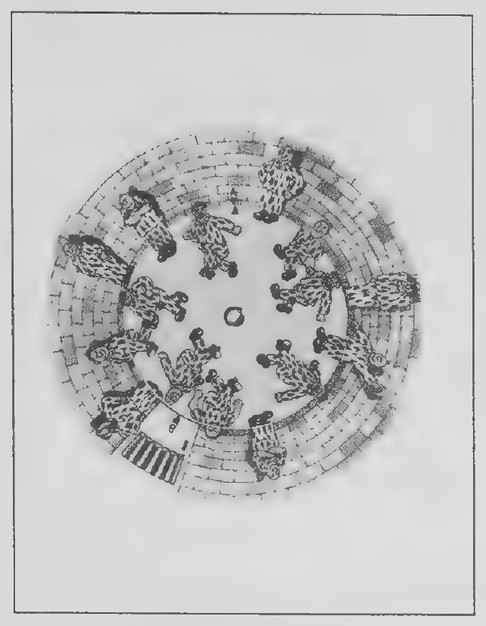 Transparency 1-R-1: Find the escapee
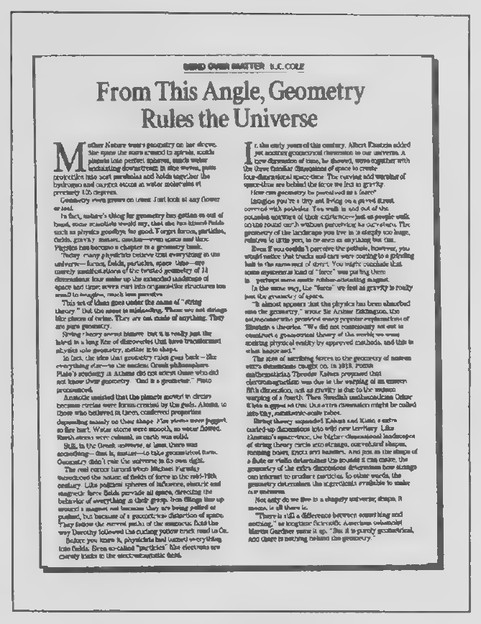 Transparency 1-R-2: Geometry rules the universe
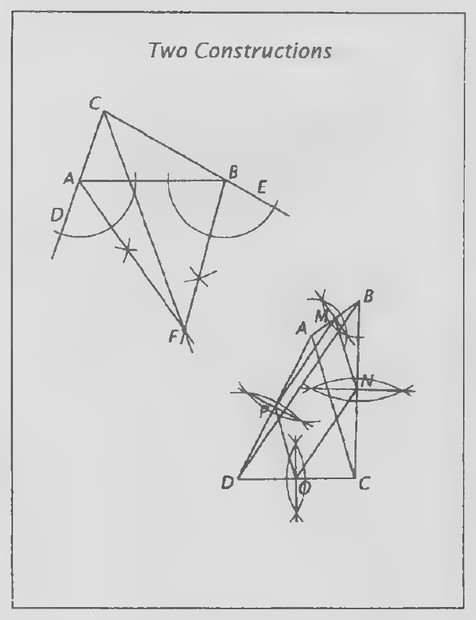 Transparency 1-R-3: Two constructions (Set II)
spent his money on the angle trisection ad, this means that his method doesn’t quite work either. If his method had worked, his money would have been well spent because his name would have become famous in the history of mathematics for succeeding in doing something that people have been trying to figure out ever since the time of Euclid.
The situation presented by the problem of trisecting an angle with just a straightedge and compass leads naturally to several questions. How do you prove that something is impossible? How is it possible to tell the difference between exactly right and almost? How do you prove something in the first place? To eventually be able to answer such questions is a major goal of the study of geometry.
Students who would like to know more about the problem of angle trisection and how people have tried to solve it may be interested in reading the chapter titled “How to Trisect an Angle” in Mathematical Carnival, by Martin Gardner (Knopf, 1975) and looking through A Budget of Trisections, by Underwood Dudley (Springer Verlag, 1987).
Review of Chapter 1
First day
Transparencies
- 1-R-1 Find the escapee
- 1-R-2 Geometry rules the universe
- 1-R-3 Two constructions (Set II)
- 1-R-4 Russian second-grade problem
Introduction
A light-hearted way to begin the review lesson is with a “Geometrical Vanish.” In his book titled
Mathematics, Magic and Mystery (Dover, 1956), Martin Gardner includes two chapters on puzzles of this sort. He describes these puzzles as geometrical paradoxes that consist of “rearranging parts of a figure. After the rearrangement is completed, a portion of the original figure (either part of its area or one of a series of pictures drawn on the figure) has apparently vanished without trace. When the pieces are returned to their original form, the missing area or picture mysteriously appears once more.” American puzzlist Sam Loyd invented and patented an extremely clever puzzle of this sort in 1896. Called “Get Off the Earth,” more than 10 million copies of it were sold in Loyd’s lifetime.
Australian physicist Dugald Keith was inspired by Loyd’s puzzle to create a puzzle with the title “Find the Escapee.” Pictured on Transparency 1-R- 1 and its overlay, the puzzle shows 15 prisoners ina circular jail cell when the arrow on the overlay points to A; when the overlay is turned so that the arrow points to B, one of the prisoners has vanished.
Alternative Introduction A recent article in the Los Angeles Times (Transparency 1-R-2) claims that “Geometry Rules the Universe.” Although it would not be appropriate to read it to your class in its entirety, your students may find the following excerpts to be of interest (italics added for emphasis):
“Mother Nature wears geometry on her sleeve. She spins the stars around in spirals, molds planets into perfect spheres, sends water undulating downstream in sine waves, pulls projectiles into neat parabolas and holds together the hydrogen and oxy-
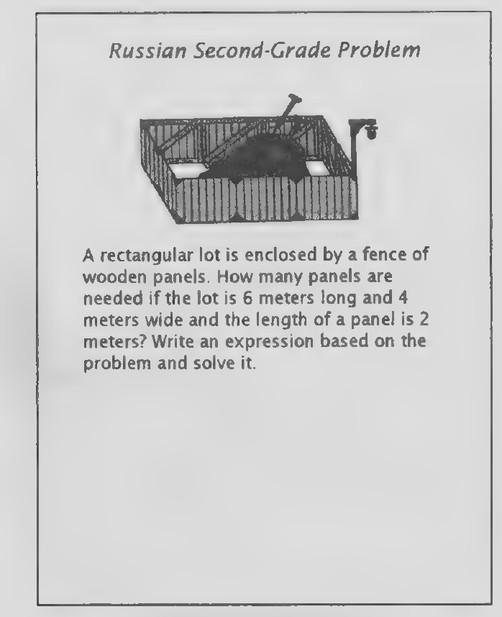 Transparency 1-R-4: Russian second-grade problem
gen atoms in water molecules at precisely 105 degrees.
Geometry even grows on trees: Just look at any flower or leaf.
In fact, nature’s thing for geometry has gotten so out of hand, some scientists would say, that she has kissed fields such as physics goodbye for good. Forget forces, particles, fields, gravity, matter, motion—even space and time. Physics has become a chapter in a geometry book.
Today, many physicists believe that everything in the universe—forces, fields, particles, space, time—are merely manifestations of the twisted geometry of 11 dimensions: four make up the extended landscape of space and time; seven curl into origami-like structures too small to imagine, much less perceive.
This set of ideas goes under the name of ‘string theory.’ But the name is misleading. These are not strings like pieces of twine. They are not made of anything. They are pure geometry.
String theory seems bizarre, but it is really just the latest in a long line of discoveries that have transformed physics into geometry, matter into shape.
In fact, the idea that geometry rules goes back—like everything else—to the ancient Greek philosophers. Plato’s academy in Athens did not admit those who did not know their geometry. ‘God is a geometer,’ Plato pronounced.”
[The article goes on to describe Faraday’s introduction of the idea of force fields, geometrical distortions of space, in the nineteenth century; Einstein’s addition of another geometrical dimension, time, in the twentieth century to form four-
dimensional space-time, used to explain gravity; and the use of string theory to explain why elementary particles exist.]
“In other words,… geometry determines the ingredients available to make our universe.
Not only do we lie ina shapely universe; shape, it seems, is all there is.
‘There is still a difference between something and nothing,’ as longtime Scientific American columnist Martin Gardner sums it up. ‘But it is purely geometrical, and there is nothing behind the geometry.”
Second day
Introduction
People immigrating to the United States are sometimes surprised at the difference between what was taught in their former countries and what their children encounter in their new country. Here is an example that may surprise you. This problem (Transparency 1-R-4) appeared in a book for second-graders used for many years throughout the former Soviet Union. What expression do you think the students were expected to write? What is the solution
6+4+6+4 2(6 + 4) to the problem? ( eer ea; 10 pan-
2 Slik? els.) Suppose that the problem were stated in terms of variables rather than numbers: How many panels are needed if the lot is x m long and y m wide and
the length of a panel is z m² (F2h) In writing
this expression, what are we assuming about z, the length of a panel, with respect to x and y, the dimensions of the lot? (That z divides evenly into x and y.) These more general questions will suggest to some of your students the need for some review of algebra. The first algebra review appears at the end of this chapter and might be done in class as time allows after the chapter review has been completed.
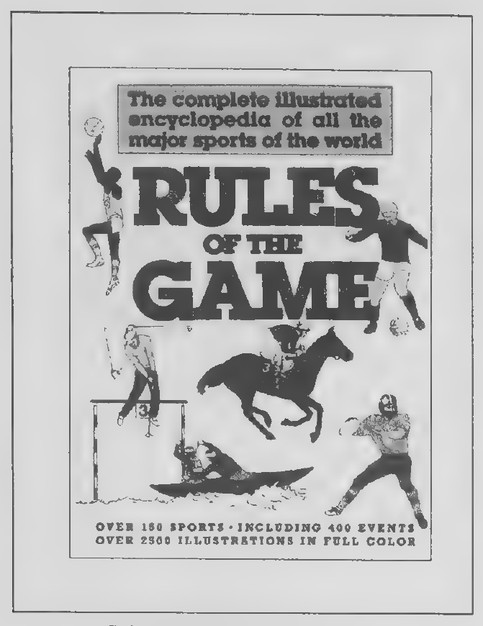 Transparency 2-1-1: Rules of the Game book cover
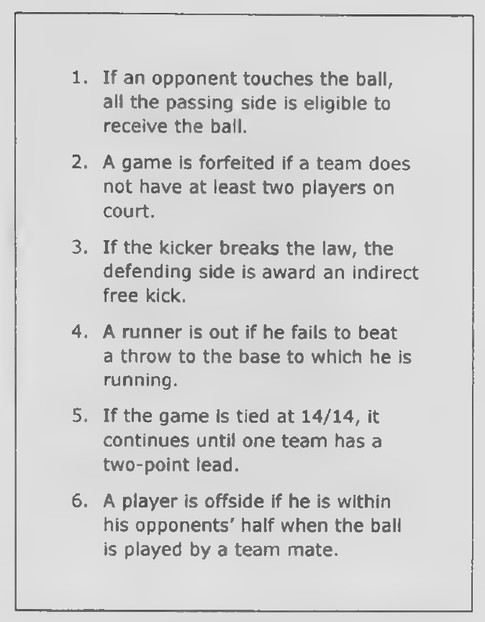 Transparency 2-1-2: Rules that are conditional statements
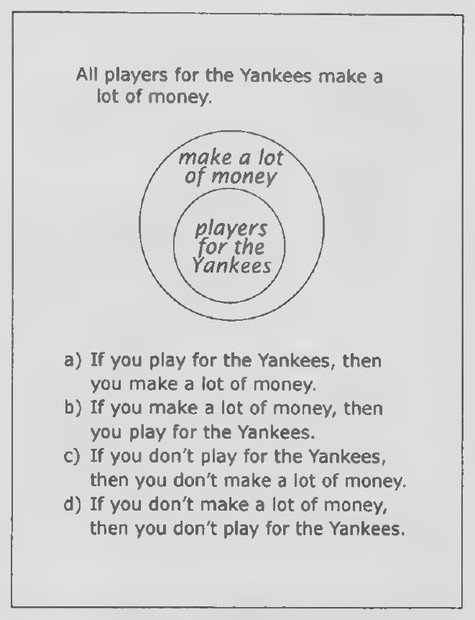 Transparency 2-1-3: Yankees problems (Set II, Exs. 31-33)
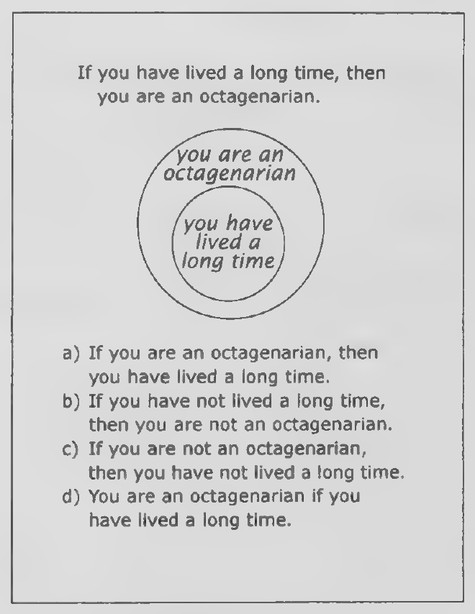 Transparency 2-1-4: Octagenarian problems (Set II, Exs. 34-36)