p. 1
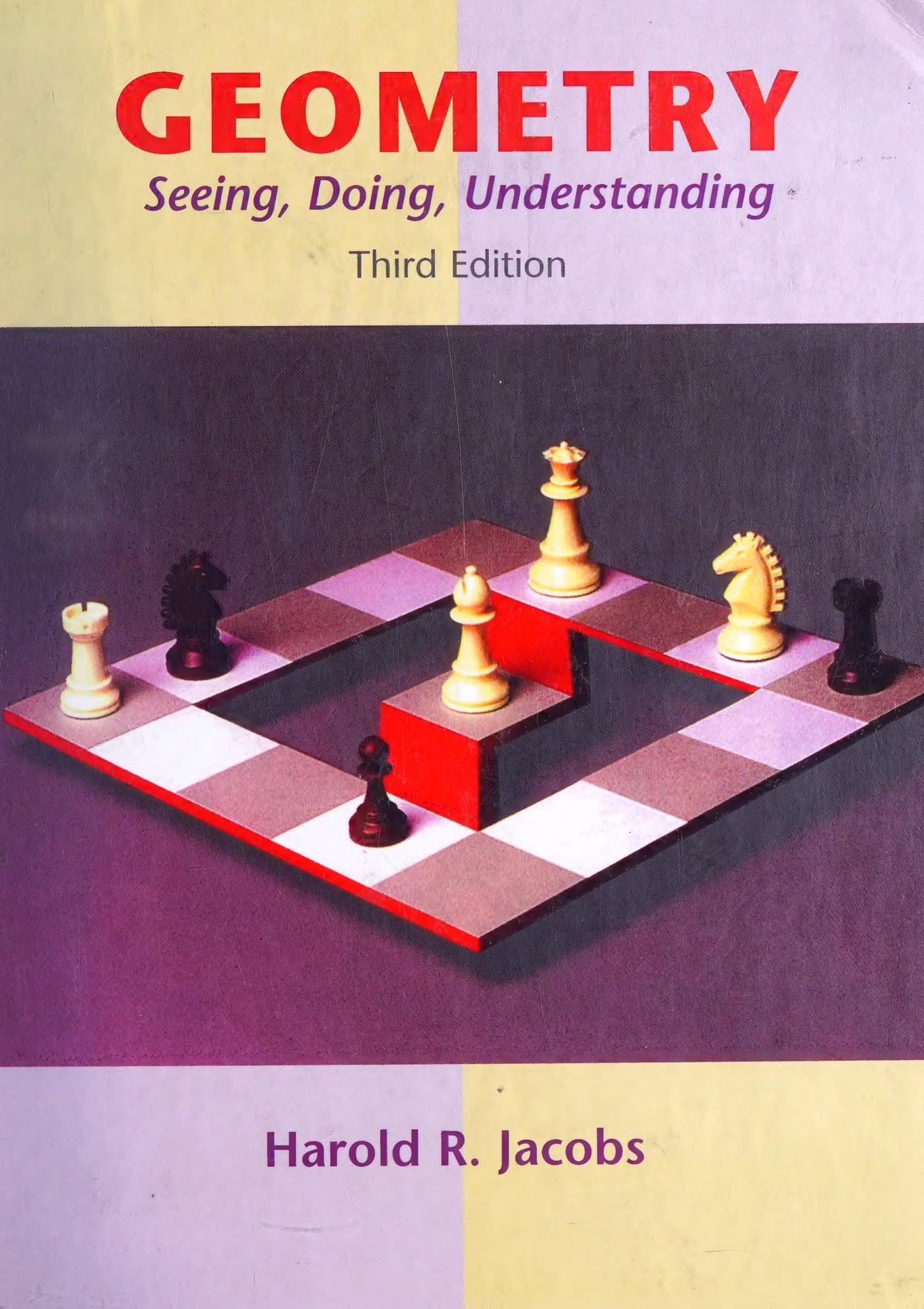
Geometry: Seeing, Doing, Understanding
Third Edition
Harold R. Jacobs
p. 2
THIS BOOK IS THE PROPERTY OF:
State ____________ Province ____________ County ____________ Parish ____________
School District ____________ Other ____________
Book No. ____________
Enter information in spaces to the left as instructed
| Issued to | Year used | Condition issued | Condition returned |
|---|---|---|---|
The copy scanned for this edition has “David Neal,” “2005,” and “713-646-6707” written in the first row.
PUPILS to whom this textbook is issued must not write on any page or mark any part of it in any way, consumable textbooks excepted.
- Teachers should see that the pupil’s name is clearly written in ink in the spaces above in every book issued.
- The following terms should be used in recording the condition of the book: New; Good; Fair; Poor; Bad.
p. 4
Digitized by the Internet Archive in 2022 with funding from Kahle/Austin Foundation
https://archive.org/details/geometryseeingdo0000jaco
p. 5
GEOMETRY
p. 6
Used by permission of Johnny Hart and Creators Syndicate, Inc.
p. 7
GEOMETRY
Seeing, Doing, Understanding
Third Edition
Harold R. Jacobs
W. H. Freeman and Company · New York
p. 8
Executive Editor: Craig Bleyer Senior Development Editor: Mary Johenk Maechling Contributing Editor: Dr. Peter Renz Marketing Manager: Cindi WeissGoldner Project Editor: Jane O’Neill Cover and Text Designer: Diana Blume Illustration Coordinator: Shawn Churchman Illustrations: Network Graphics Photo Editor: Vikii Wong Production Coordinator: Paul W. Rohloff Composition: Matrix Publishing Services Manufacturing: RR Donnelly & Sons Company
ISBN: 0-7167-4361-2 (EAN: 9780716743613)
Library of Congress Control Number: 2003100442
© 2003 Harold R. Jacobs All rights reserved
Printed in the United States of America Third printing
W. H. Freeman and Company 41 Madison Avenue New York, NY 10010 Houndmills, Basingstoke RG21 6XS, England www.whfreeman.com
- v
Table of Contents
- Forewords — xi
- A Letter to the Student — xiii
- Acknowledgments — xv
Introduction: Euclid, the Surfer, and the Spotter — 1
- Inductive Reasoning — 6
1. An Introduction to Geometry — 7
- Lines in Designing a City — 8
- Angles in Measuring the Earth — 13
- Polygons and Polyhedra: Pyramid Architecture — 18
- Constructions: Telling Time with Shadows — 24
- We Can’t Go On Like This — 30
- Summary and Review — 35
- Algebra Review — 39
2. The Nature of Deductive Reasoning — 41
- Conditional Statements — 42
- Definitions — 46
- Direct Proof — 50
- Indirect Proof — 55
- A Deductive System — 60
- Some Famous Theorems of Geometry — 65
- Summary and Review — 71
- Algebra Review — 75
- vi
3. Lines and Angles — 77
- Number Operations and Equality — 78
- The Ruler and Distance — 84
- The Protractor and Angle Measure — 91
- Bisection — 98
- Complementary and Supplementary Angles — 105
- Linear Pairs and Vertical Angles — 110
- Perpendicular and Parallel Lines — 117
- Summary and Review — 123
- Algebra Review — 129
4. Congruence — 131
- Coordinates and Distance — 132
- Polygons and Congruence — 139
- ASA and SAS Congruence — 146
- Congruence Proofs — 151
- Isosceles and Equilateral Triangles — 157
- SSS Congruence — 163
- Constructions — 169
- Summary and Review — 176
- Algebra Review — 181
5. Inequalities — 183
- Properties of Inequality — 184
- The Exterior Angle Theorem — 190
- Triangle Side and Angle Inequalities — 195
- The Triangle Inequality Theorem — 200
- Summary and Review — 206
- Algebra Review — 210
- vii
6. Parallel Lines — 211
- Line Symmetry — 212
- Proving Lines Parallel — 219
- The Parallel Postulate — 225
- Parallel Lines and Angles — 230
- The Angles of a Triangle — 236
- AAS and HL Congruence — 242
- Summary and Review — 249
- Algebra Review — 255
7. Quadrilaterals — 257
- Quadrilaterals — 258
- Parallelograms and Point Symmetry — 265
- More on Parallelograms — 270
- Rectangles, Rhombuses, and Squares — 276
- Trapezoids — 281
- The Midsegment Theorem — 286
- Summary and Review — 292
- Algebra Review — 296
8. Transformations — 297
- Transformations — 298
- Reflections — 305
- Isometries and Congruence — 312
- Transformations and Symmetry — 319
- Summary and Review — 325
Midterm Review — 330
- viii
9. Area — 337
- Area — 338
- Squares and Rectangles — 344
- Triangles — 351
- Parallelograms and Trapezoids — 358
- The Pythagorean Theorem — 365
- Summary and Review — 371
- Algebra Review — 376
10. Similarity — 377
- Ratio and Proportion — 378
- Similar Figures — 385
- The Side-Splitter Theorem — 392
- The AA Similarity Theorem — 399
- Proportions and Dilations — 407
- Perimeters and Areas of Similar Figures — 414
- Summary and Review — 420
- Algebra Reviews — 425
11. The Right Triangle — 427
- Proportions in a Right Triangle — 428
- The Pythagorean Theorem Revisited — 434
- Isosceles and 30°-60° Right Triangles — 441
- The Tangent Ratio — 448
- The Sine and Cosine Ratios — 454
- Slope — 461
- The Laws of Sines and Cosines — 468
- Summary and Review — 475
- Algebra Review — 481
- ix
12. Circles — 483
- Circles, Radii, and Chords — 484
- Tangents — 491
- Central Angles and Arcs — 497
- Inscribed Angles — 504
- Secant Angles — 510
- Tangent Segments and Intersecting Chords — 516
- Summary and Review — 522
- Algebra Review — 527
13. The Concurrence Theorems — 529
- Triangles and Circles — 530
- Cyclic Quadrilaterals — 536
- Incircles — 542
- The Centroid of a Triangle — 548
- Ceva’s Theorem — 554
- Napoleon’s Discovery and Other Surprises — 561
- Summary and Review — 566
14. Regular Polygons and the Circle — 571
- Regular Polygons — 572
- The Perimeter of a Regular Polygon — 579
- The Area of a Regular Polygon — 585
- From Polygons to Pi — 591
- The Area of a Circle — 598
- Sectors and Arcs — 605
- Summary and Review — 612
- x
15. Geometric Solids — 617
- Lines and Planes in Space — 618
- Solid Geometry as a Deductive System — 626
- Rectangular Solids — 628
- Prisms — 634
- The Volume of a Prism — 640
- Pyramids — 647
- Cylinders and Cones — 654
- Spheres — 662
- Similar Solids — 670
- The Regular Polyhedra — 677
- Summary and Review — 683
16. Non-Euclidean Geometries — 689
- Geometry on a Sphere — 690
- The Saccheri Quadrilateral — 696
- The Geometries of Lobachevsky and Riemann — 702
- The Triangle Angle Sum Theorem Revisited — 707
- Summary and Review — 713
Final Review — 718
Back Matter
- Glossary — 728
- Formulary — 738
- Postulates and Theorems — 741
- Answers to Selected Exercises — 747
- Illustration Credits — 767
- Index — 774
- xi
Forewords
This is one of the great geometry books of all time. It is the book that I would like to have had for the geometry classes that I taught at Menlo School and College. It is the finest example of instructional artistry that I have encountered.
When I taught statistics courses, I used the counting and probability chapters from Mathematics: A Human Endeavor by Jacobs. His approach engaged my students and enabled them to discover and master this subject. In the present book, Jacobs does the same thing for geometry.
Harold Jacobs—author and master teacher—loves geometry, and this book shows it. Its thousands of photographs, diagrams, and figures draw the reader into the material. Jacobs has a genius for finding illustrations that reveal a subject and make it come alive. A look at his sources shows the broad search that he made to assemble this visual feast.
Teachers know that in most classes the goal for students is to complete the homework exercises with as little pain as possible. When students get their assignment, they first go to the exercises. If the teacher worked an example in class, the student follows that. If not, then the student scans the text in search of an example that is similar to the exercise. So many textbooks are little more than a bunch of examples, followed by exercises that can be solved by using the methods of the examples. And the student learns by creative copying.
As you page through this book, you will be struck by how few words Jacobs uses in introducing each lesson. Jacobs knows that students will probably not read much introductory material and want to get to the exercises as quickly as possible—solutions are still the goal. But, for Jacobs, the exercises are the beating heart of the book. You will first notice that they are beautifully illustrated with real-world material. As you read, you will discover that they are engaging, carefully sequenced, and structured so that students discover ideas for themselves. Students come away from his exercise sets empowered, because the ideas have become “their” ideas. Students using this book, working alone or in groups, will learn geometry by doing it. The result is that they will enjoy learning a body of integrated concepts that has become their intellectual possession.
Donald J. Albers The Mathematical Association of America
- xii
Twenty-six hundred years ago Thales of Miletus launched the idea that Nature itself is subject to the laws of logic. Geometry, which had previously existed as a practical science, was found during the next few centuries to be tightly bound by logic. Some complex geometric facts were shown to be consequences of far simpler facts, and soon similar analyses of more general ideas about the world became standard for the Greek philosophers. The principle of stitching a few fundamental ideas together by logical analysis is at the heart of all modern science.
About 300 B.C.E., Euclid compiled his famous Elements, containing much of the geometry known at the time. Although the Elements does not fully meet today’s standards of rigor, it quite rightly became and remained the principal textbook for teaching geometry for more than 2,000 years. In the past 100 years, however, the idea of proof has slowly receded (from American textbooks, at least), and now there is often little distinction between statements that have been proved formally and those that appear true on the basis of a drawing or a few measurements. This is an immense loss for American education, especially for science education. Some have tried to introduce formal proofs in algebra in place of those in geometry, but the results in algebra do not have the appeal of theorems such as that of Pythagoras. Geometry offers surprising theorems that can be proved by ingenious reasoning.
This book restores the idea of proof to its rightful place in geometry. Whoever studies this text will know what a proof is, what has been proved, and what has not.
Andrew M. Gleason Harvard University
- xiii
A Letter to the Student
Photograph by Roy Bishop
The most useful question in the history of science is, Why? Because mathematics is the language of science, the same question is important in mathematics as well.
The oldest standing examples of applied geometry are the pyramids of Egypt, built about 2600 B.C. The bases of these structures are almost perfect squares, and their faces are precisely constructed triangles. There is evidence that the Egyptians even knew how to compute the volume of a pyramid but no evidence that they ever tried to understand or explain their methods by asking, “Why?” Their mathematics was based on intuition and experience; even for other ancient civilizations from Babylon to Rome, intuition and experience were as far as geometry went. The subject consisted of disconnected rules, and the fact that these rules “worked” in measuring land and constructing buildings seemed to be enough.
Your understanding of geometry has been like that of these people of long ago. You have a good intuitive knowledge of the subject simply by growing up in the world. As a small child, you may have played with blocks in the shape of cubes. On the playground, you have played with balls in the shape of spheres. In school, you use paper ruled with parallel and perpendicular lines. You drink from cans in the shape of cylinders and eat ice cream from containers in the shape of cones. Geometry is everywhere, and so it is natural for you to take it for granted without ever asking, “Why?”
- xiv
About 600 B.C., the Greeks made a discovery that led to a new way of looking at mathematics. Thales, one of the seven wise men of antiquity, saw how geometric ideas that had been discovered intuitively could be related to one another logically. If some were true, then others must follow without question. He raised the question Why? about a mathematical idea and then successfully answered it. For example, the four edges of the Great Pyramid that meet at its top are equal in length. Thales explained why it follows from this fact that the angles that these edges form with the sides of the base also must be equal.
After Thales came other Greek mathematicians, including Pythagoras, Hippocrates, and, eventually, Euclid. Euclid, about whom you will learn more in this book, presented geometry as a logical system of connected ideas so well that his book titled the Elements became the most widely used textbook ever written. Euclid’s approach to geometry, centered on the question why, was so successful that it even inspired writers in other fields to organize their ideas in the same way. One of the most influential books of modern science, the Principia by Sir Isaac Newton, was modeled after Euclid’s Elements.
The word geometry derives from the Greek words for “earth” and “measure” and in some languages is still used today to mean “earth measurement” or “surveying.” Remarkably, although Euclid’s Elements is the most famous geometry book of all time, the Greek word for geometry never appears in it. The Elements was not a book about measuring the earth; rather, by bringing geometry together as a coherent whole, it made geometry understandable and provided a model for other sciences.
As you pursue your study of geometry, you will encounter not only many familiar ideas but also many ideas new to you that are both beautiful and surprising. As the title of this book suggests, it is about seeing, doing, and understanding. As you read the lessons, you will see the main ideas and some of their applications. With the exercises comes your chance to do, understand, and, consequently, know why. I hope that in using this book you will discover for yourself the wonder and excitement of geometry so that you will find your study of it to be an enjoyable and rewarding endeavor.
Harold Jacobs
- xv
Acknowledgments
Since beginning work on the first edition of Geometry some 30 years ago, I have benefited from the comments and suggestions of many people. Many teachers have been generous in sharing their ideas, both at conferences and through correspondence, and students have contributed as well.
I am especially grateful to Peter Renz, for his unflagging effort and support during the development of all three editions of this book; to Donald J. Albers, Andrew M. Gleason, Keith Henderson, and Thomas Rike, for their detailed comments on the preliminary manuscript of the third edition; and to Patricia Zimmerman, for her expertise and patience in editing this edition and the first. I am also indebted to many colleagues throughout the United States for their various contributions and helpful advice: to Thomas Banchoff, James A. Barys, Charles Bigelow, Richard D. Bourgin, William R. Chambers, Charles Herbert Clemens, Kevin DeVizia, Russel L. Drylie, Kate Epstein, Dani Falcioni, Frederick P. Greenleaf, Shirley S. Holm, Kris Holmes, Jane Jelinek, Ellen Kaplan, Laurence Kaplan, Robert Kaplan, Lehman Kapp, John Larsen, Joseph Malkevitch, Otis W. Milton III, Harry D. Peterson, Gwen Roberts, Doris Schattschneider, Dennis Simons, Wolfe Snow, John W. Sperry, and Clem Wings, in regard to this edition, and to Dennis Anderson, Steven Bergen, Richard Brady, Don Chakerian, Barbara Fracassa, Gary Froelich, Hector Hirigoyen, Geoffrey Hirsch, Mel Noble, Linda Rasmussen, Sy Schuster, Bill Shutters, Ross Taylor, and Sharon Tello, in regard to earlier editions.
Putting a book such as this one together is a formidable task. Without the patience and support of the dedicated staff at W. H. Freeman and Company, it would not have been possible. For their valued efforts, many times above and beyond the call of duty, I would like to thank Mary Johenk, Craig Bleyer, Jane O’Neill, Paul Rohloff, Diana Blume, and Vikii Wong. I remain grateful to Robert Ishi and Heather Wiley for their efforts on earlier editions and their influence on the present one.
I would also like to acknowledge my indebtedness to other authors whose work has been especially helpful to me in this revision: Benno Artmann, H. S. M. Coxeter, John L. Heilbron, David W. Henderson, Dan Pedoe, and David Wells. Finally, I want to express my gratitude to Martin Gardner, for his seemingly endless ideas and inspiring enthusiasm, and to Howard Eves, Morris Kline, George Polya, and W. W. Sawyer, for showing us by example what good mathematics teaching is all about.
p. 21
GEOMETRY