|
In Anytown, USA, a game designer struggles to meet the needs of the gaming public and the needs of a picky licenseholder at the same time. The work, when it's done, is thousands of words of text and dozens of graphics. In Los Angeles, months later, the approvals staff for Big Movie Studios stare at the thing in horror, knowing that they'll make ten times the money by spending thirty seconds approving a coffee mug with a logo on it. In Othertown, USA, a Game Master hears word of a game based on a film his gaming group loves, but he's concerned: Can it capture the spirit of the film? And even if it does, can he? Cinematic licensing is a beast that can defeat the mightiest financial backing and humble the most heroic game designer. The success stories are few, and impermanent. They do, however, include three of the most influential games in the hobby's history. Licensed to Kill 007's eye-bending blend of charts and modifiers seemed streamlined at the time, and while it hasn't aged well, it was clear to everyone that Klug had committed a noteworthy act of game design. 007 pioneered unrepentantly cinematic-style rules, providing results that mirrored the films well and rejected mundane reality as a nuisance. The rules included detailed gameplay where character decisions would be most prominent (gambling, seduction, fighting and vehicular action) and shamelessly abstracted those areas the films glossed over. There were no language rules, for example, suavely side-stepping a design hurdle most other modern-Earth RPGs struggle to climb over.
The First Wave 2010 came first; TSR released it at Gen Con 17, even before the film hit theaters. Unlike Bond, it really was just a marketing gimmick, cashing in on the legacy of Kubrick's classic and the buzz surrounding its sequel. Before they went to the movies, gamers could have deckplans for the Leonov and stats for her crew! TSR achieved this feat by skipping game design entirely; both titles were released as Star Frontiers modules. By using an existing game, TSR could strike while the iron was still heating in the coals, creating well-made but deliberately disposable supplements with no real plans for long-term support or reprints. TSR also released Adventures of Indiana Jones that year, a full-fledged RPG with trademarks to spare and the hopes of a long-lived film franchise to support it. It was well-regarded, but, like James Bond, it had competition in the same year: Hero Games released Justice, Inc., their own "pulp adventure" RPG, stealing the hearts of many gamers that might otherwise have devoted themselves to the TSR game. And unlike Victory's Bond, TSR's Indy didn't have the stuff to compete. 1984's minor entry into film licensing came from the biggest name in television licensing: FASA's powerhouse Star Trek game. Their Star Trek III Sourcebook marked their first entry into official adaptations of the silver screen. FASA's second and last foray into film licensing came in 1986 with Star Trek IV, but that year would be dominated by cinema gaming's second milestone: West End Games' Ghostbusters.
And game design was the key. While Reitman's supernatural comedy was a gamer favorite, it seemed an unlikely prospect for a great game: Who would the players portray? There are only four Ghostbusters, after all. And, ghosts or no ghosts, they're really just exterminators, most of the time. Without a new world to explore or a clear idea of what the PCs would be, many gamers were skeptical. Petersen answered the challenges by exploring a new genre - a kind of "new age pulp" of mad Fortean adventure, where alien invaders and bigfoot were just as likely to crop up as an ordinary free-roaming vapor. Played straight, it's the world of the X-Files or a dozen other modern settings, but it was unheard of in 1986, at least in pop culture. To give the PCs an excuse to get a brown jumpsuit and proton pack, the game introduced Ghostbusters, International, a global franchise spun off with cash Venkman and company earned from saving New York. Unlicensed nuclear accelerators are even cooler when mass-produced, after all. With the franchise angle in place, GMs (Ghost Masters) were encouraged to explore the supernatural and comedic potential of their own hometown.
Point Five Past Lightspeed Greg Costikyan's Star Wars RPG (1987) combined Ghostbusters-influenced mechanics with an even more fertile setting. West End didn't need to reinvent Star Wars to make it the ideal gaming setting; "Hokey religions and ancient weapons" were already what gaming was primarily about. All they needed to do was live up to that setting's potential.
But licensing remains a tricky business under the best conditions, and West End and LFL had their rough moments, amusing in retrospect. Former WEG staffer Eric Trautmann recalls a crack-of-dawn weekend phone call from an agitated Lucasfilm rep:
Several hours of explanations and faxed pages from reference books later, LFL was satisfied that not all corvettes had wheels. Experiments and Failures But Star Wars would be the last of the real milestones. The late 80s and early 90s would be a time of experimentation, for West End and for others, with no real success stories. TOR broke new ground in 1988 with Allen Varney's Willow sourcebook (coauthored by Star Wars designer Costikyan), but it was ground nobody seemed to want. The Willow book was a real first, a film-licensed worldbook, clearly written and designed with roleplayers in mind, but without new game mechanics or ties to an existing game. It included sparse "generic" gaming notes clearly written with D&D in mind, but was essentially a system-free book. The film didn't hit, so the book didn't either, and no one has tried that approach since. In 1989, West End released a completely revised edition of Ghostbusters called GBI which, like the film's own sequel, lacked most of the charm that made the original worth seeing. The 1990s introduced a new player to the field, a small company looking to leverage its way into the upper ranks with licenses, just as West End and FASA had done. They were Leading Edge Games, and they failed. Leading Edge worked with the same approach that TSR had used earlier, focusing on current movie releases as well as established favorites. Alien[3] was heading for theaters in 1992, so they got the license for the Aliens universe and released the roleplaying game in 1991. In the following year, they released Bram Stoker's Dracula and Lawnmower Man. There were even lead figures (although, sadly, no RPG) for Army of Darkness, but Leading Edge didn't live to see the middle of the 90s, much less the end of it.
Masterbook titles were supplements that required the Masterbook core rules as a separate purchase. That, combined with mixed reactions to the game engine, made the licensed worldbooks a less appealing "impulse buy" than they might have been. Of the entire Masterbook library, only Indiana Jones had any degree of real success, with a series of well-regarded supplements and a moderate fan following. While never a "hit" in any sense, it fared better than its predecessor from TSR. West End's final foray into film licensing abandoned the Masterbook approach. Men In Black was a complete RPG based on the film. Like Ghosbusters, it was a comedy game of fortean adventure. Like Species and Tank Girl, it was a pre-arranged license released along with the movie itself, and it came with its own set of design headaches. WEG veteran Timothy O'Brien recalls:
Men In Black enjoyed only moderate sales, and the company didn't last long enough to build on it. In 1998, with Misson: Impossible and Stargate: SG1 licenses trailing unrealized in the water [*], West End Games went down in a flurry of debts, layoffs, lawsuits, and fingers of accusation, and the Star Wars game went with it - on the eve of the resurrection of the film franchise. A New Hope? But, "there is another." The greatest hope for the near future of film-licensed RPGs may be Guardians of Order, a small Canadian publisher which has, in the tradition of publishers past, launched itself into the spotlight with a winning combination of licensing and much-admired game design. Animated feature films have seldom been licensed in the past. Wizards (Whit, 1992) and Project A-Ko (Dream Pod 9/Ianus, 1995) were the only examples until Guardians released David Pulver's impressive Demon City Shinjunku RPG in 1999. While the film's niche status guarantees that the game will never be more than a standalone, the action-horror RPG blends the elegant Big Eyes, Small Mouth "Tri-Stat System" with one of the most complete gaming sourcebooks ever assembled based on a single movie, rivaling West End's film sourcebooks in both detail and quality. With GOO acquiring new licenses by the carload, similarly good animated-film RPGs are probably on the way.
|
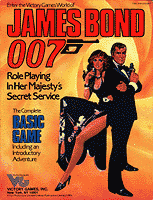 James
Bond 007 designer Gerry Klug dedicated his game to publisher Eric
Dott, citing his understanding in allowing the games rules to be designed
"they way they had to be done." Dott, who'd rejected Dungeons
& Dragons a decade earlier when offered it by Gary Gygax, had
apparently gained new insight as RPGs steadily bullied his wargames onto
the back shelves at retailers. He'd gained something else, too: a major
license that would allow Victory Games to compete in the RPG arena. It
was 1983, and James Bond 007 emerged as a major player immediately,
netting industry awards and rave reviews for both the core game and the
steady stream of support material that followed.
James
Bond 007 designer Gerry Klug dedicated his game to publisher Eric
Dott, citing his understanding in allowing the games rules to be designed
"they way they had to be done." Dott, who'd rejected Dungeons
& Dragons a decade earlier when offered it by Gary Gygax, had
apparently gained new insight as RPGs steadily bullied his wargames onto
the back shelves at retailers. He'd gained something else, too: a major
license that would allow Victory Games to compete in the RPG arena. It
was 1983, and James Bond 007 emerged as a major player immediately,
netting industry awards and rave reviews for both the core game and the
steady stream of support material that followed. So,
James Bond was more than a marketing gimmick; it was a milestone
design, standing firm against two competing espionage titles released in
the same year: Mercenaries, Spies & Private Eyes (Blade/Flying
Buffalo) and Espionage (Hero Games). Only the limitations
of the genre itself determined the ceiling of its success, and the game
remained available until Avalon Hill (and therefore Victory) closed its
doors.
So,
James Bond was more than a marketing gimmick; it was a milestone
design, standing firm against two competing espionage titles released in
the same year: Mercenaries, Spies & Private Eyes (Blade/Flying
Buffalo) and Espionage (Hero Games). Only the limitations
of the genre itself determined the ceiling of its success, and the game
remained available until Avalon Hill (and therefore Victory) closed its
doors. Are
You A GOD?!
Are
You A GOD?! This
odd stew was so well written, and tied to such cunningly fresh game mechanics,
that it all but reinvented RPG design. Ghostbusters had not
a whiff of the wargaming roots the hobby had been founded on. It had clean,
fast, funny rules driven entirely by dramatic and comedic necessity (and
a cute die with a ghost on it). James Bond had been beaten
at the Baccarat table, and every new RPG to follow would be influenced,
directly or otherwise, by Ghostbusters.
This
odd stew was so well written, and tied to such cunningly fresh game mechanics,
that it all but reinvented RPG design. Ghostbusters had not
a whiff of the wargaming roots the hobby had been founded on. It had clean,
fast, funny rules driven entirely by dramatic and comedic necessity (and
a cute die with a ghost on it). James Bond had been beaten
at the Baccarat table, and every new RPG to follow would be influenced,
directly or otherwise, by Ghostbusters.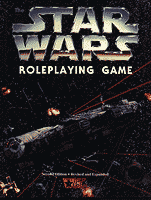 They
succeeded so admirably that their relationship with Lucasfilm grew into
something greater than just a license. West End became one of the keepers
of the Star Wars continuity, charged with the task of cataloguing
references, ships, systems, characters and more from the galaxy of new
creations constantly appearing in the Star Wars universe beyond the films
- because, as game designers, they had to do it anyway. Like Ghostbusters,
Star Wars expanded the universe it took place in, but better
still, those expansions were incorporated into the master property itself.
Until fiscal difficulties later tore everything apart, it was the most
productive and friendly "Hollywood marriage" in gaming.
They
succeeded so admirably that their relationship with Lucasfilm grew into
something greater than just a license. West End became one of the keepers
of the Star Wars continuity, charged with the task of cataloguing
references, ships, systems, characters and more from the galaxy of new
creations constantly appearing in the Star Wars universe beyond the films
- because, as game designers, they had to do it anyway. Like Ghostbusters,
Star Wars expanded the universe it took place in, but better
still, those expansions were incorporated into the master property itself.
Until fiscal difficulties later tore everything apart, it was the most
productive and friendly "Hollywood marriage" in gaming.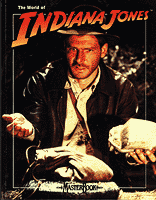 West
End's own experiments with current-release licensing didn't fare much better.
Their Masterbook universal RPG, a retooled version of the
Shatterzone engine, was used primarily as a platform for
licensed settings. These included TV, literary and computer-game worlds,
as well as films. Tank Girl and Species (both
1995) appeared alongside the films that spawned them, and The World
of Indiana Jones (1994) resurrected the license that TSR had botched
in the 80s.
West
End's own experiments with current-release licensing didn't fare much better.
Their Masterbook universal RPG, a retooled version of the
Shatterzone engine, was used primarily as a platform for
licensed settings. These included TV, literary and computer-game worlds,
as well as films. Tank Girl and Species (both
1995) appeared alongside the films that spawned them, and The World
of Indiana Jones (1994) resurrected the license that TSR had botched
in the 80s.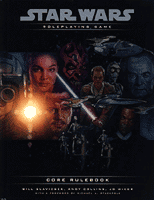 Star
Wars didn't stay dead very long. Struck down, it returned in 2000
in the hands of Wizards of the Coast, with a creative team led by long-time
West End veteran Bill Slavicsek. Time will tell if the new incarnation
has the legs to match its predecessor. Like Lucasfilm's new Star Wars
prequels, it must contend with both the high standards and justifiable
nostalgia of the old fans, and the needs of a newer, younger audience.
Star
Wars didn't stay dead very long. Struck down, it returned in 2000
in the hands of Wizards of the Coast, with a creative team led by long-time
West End veteran Bill Slavicsek. Time will tell if the new incarnation
has the legs to match its predecessor. Like Lucasfilm's new Star Wars
prequels, it must contend with both the high standards and justifiable
nostalgia of the old fans, and the needs of a newer, younger audience.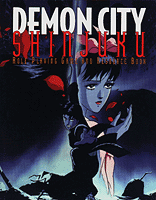 More
importantly, Guardians proved their flexibility and willingness to innovate
with a live-action license: Ghost Dog: Way of the Samurai
(2000). Like most other licenses based on a current film, the game is likely
regarded as disposable, but rather than a lackluster book of stills and
stats, Ghost Dog is an unusual game, combining modern action
and drama with a rare focus on one-on-one campaigning and a well-presented
primer on organized crime. It also proves that GOO's Tri-Stat system can
handle worlds beyond anime, so they might have the muscle to succeed
where Masterbook and Leading Edge could not. Clearly, the
Force is with someone.
More
importantly, Guardians proved their flexibility and willingness to innovate
with a live-action license: Ghost Dog: Way of the Samurai
(2000). Like most other licenses based on a current film, the game is likely
regarded as disposable, but rather than a lackluster book of stills and
stats, Ghost Dog is an unusual game, combining modern action
and drama with a rare focus on one-on-one campaigning and a well-presented
primer on organized crime. It also proves that GOO's Tri-Stat system can
handle worlds beyond anime, so they might have the muscle to succeed
where Masterbook and Leading Edge could not. Clearly, the
Force is with someone.