Previous Chapter ... ... Next Chapter
The muscle up is a fundamental movement that outlives its usefulness as we get to higher intermediate strength and beyond. However, for beginners they are a vastly important skill. The muscle up not only gets one above the rings, but also develops strength in the full range of motion through the pullup and dip positions.
Once we get to a certain point, we are going to transition from the strict pullup / dip muscle up to harder pulling skills, pushing skills, and isometrics in succession with the muscle up transition. This will help build strength moving from position to position which lets us build routines and sequences that can be utilized for strength and conditioning.
The false grip will be the primary grip when training muscle ups. It will be dropped later on, but it is critical to the learning process in the beginning. By putting the wrists on top we arc in a more advantageous position, offering more leverage during the transitional phase. It should be used in all progressions unless otherwise stated.
A false grip is attained by shifting the hands up on the side of the ring, so that the crook of the wrist on the pinky side of the hand sits on the rings or bar. The hand is then wrapped around the bar or rings and held as tight as possible. From there the movement may begin.
One of the problems when learning the false rip position is the difficulty created by poor wrist flexibility or grip strength. If this is a problem, then add additional work to correct both of these problems in the warm up and cool down.
If the wrists themselves are being torn p during training, you have a few options. The firstis decreasing the frequency. Decreasing the frequency will allow the skin to heal and toughen up into calluses much like the hands will toughen up given enough training time. The second is to get wrist bands. or use athletic tape to help blunt the friction. However, the issue with this is that it generally makes it harder to hold the false grip. Alternatively, gloves can be used in conjunction with this, but I do not recommend them because it takes away from grip strength.
Finally, the last and my favorite alternative is to train a different skill or similar progression while the wrists are healing and come back as needed. There is no reason to destroy the skin on your wrists or even on your hands. You can consider it an injury that takes away from your training. As you may know now that if you work through injuries you may have issues with them for a long while. It is best to treat these types of things as an injury condition — avoid the painful and offending stimulus while decreasing frequency just enough to toughen up the skin. Then come back and work them much more when you are healed up.
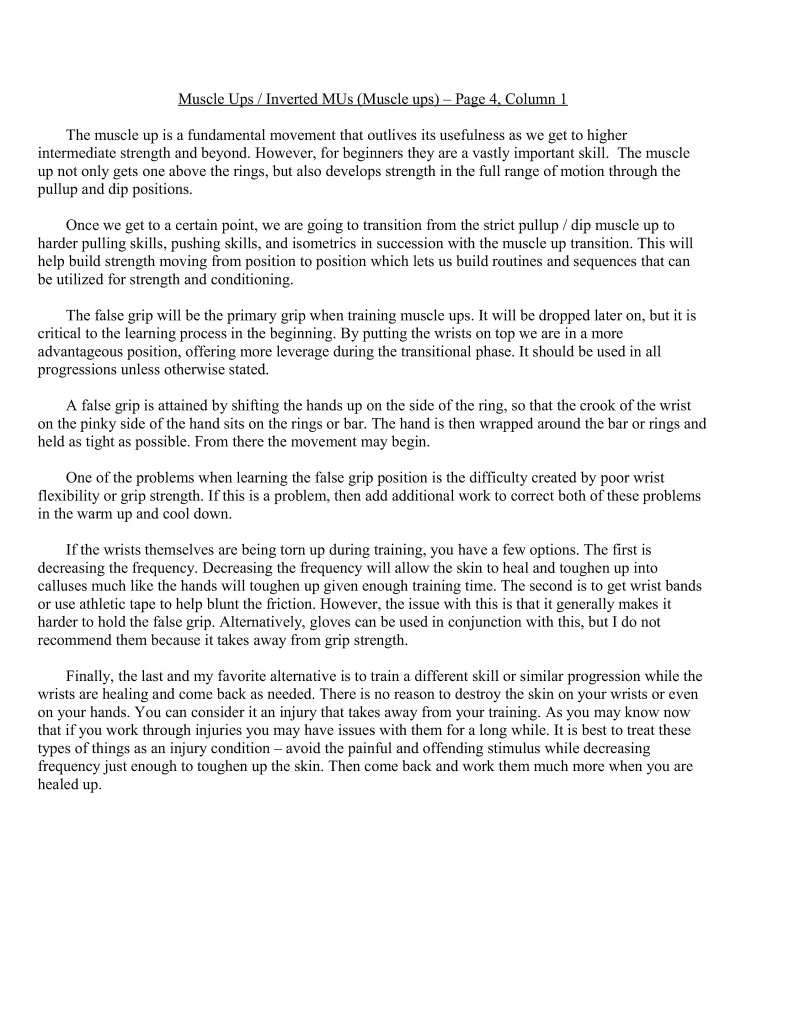
Muscle up negatives should focus on performing muscle up technique exactly in reverse. This is the key to learning the movement before your strength allows you to complete it entirely.
Additionally, leaning to control and manipulate negatives will allow you to chain consecutive muscle ups together much earlier on.
From the straight-arm support position you are going to lower slowly into the bottom of the dip. Make sure you keep the rings as close to your sides as possible.
At the bottom of the dip, there are three things that must occur simultaneously in the transition phase.
From there slowly lower down to the hang position.
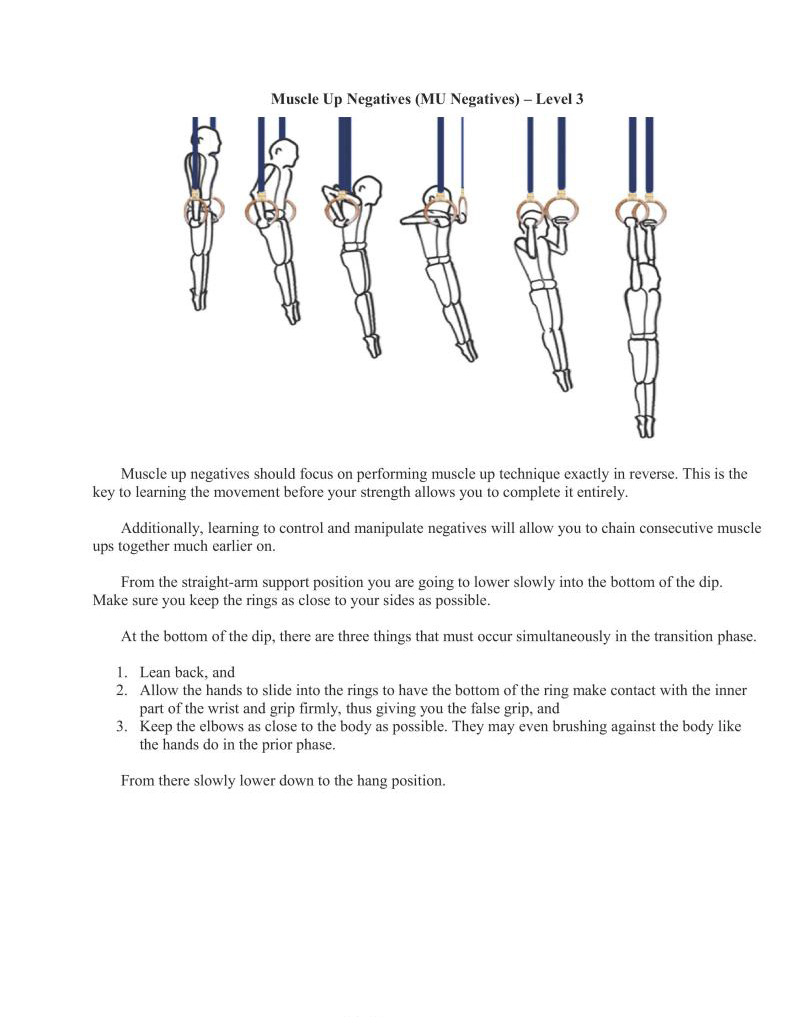
Assisted muscle ups with a spotter, leg, or band assistance also fall into this category, so they can be used as altenatives if kipping muscle ups are not preferable.
The key with any of these techniques is to reinforce the proper movement patterns and build strength through the whole range of motion while using a method that lessens the intensity. A kip accomplishes this via the additional momentum used to get through the transition.
Start with an arch-hollow motion by pushing the hips and shoulders forwards and backwards simultaneously. On the final arch initiate the pullup. As the hands start to near the chin keep on pulling to the nipple area. From the nipple area we are going to:
For most people this is their first introduction to muscle ups. If the difficulty lies in the proper transition, and the kipping muscle ups are not working, there are multiple alternatives.
We can lower the rings and practice the transition from a rowing position, or we can use a spotter to reduce the load while practicing the proper technique to move through the transition. If a pulley system is available to help decrease the load, this can also be used.
Most of the difficulties in this movement come from two places. First, most people do not pull high enough to make it through the transition phase. This can be counteracted with increased strength and practice using the techniques outlined above.
Second, many people will have problems stabilizing the position above the rings. This is also an issue of support hold practice as well as practicing ring dips. You really have to focus on gluing the rings to your side to make sure that you do not wobble or fall out of the dip or support position above the rings.
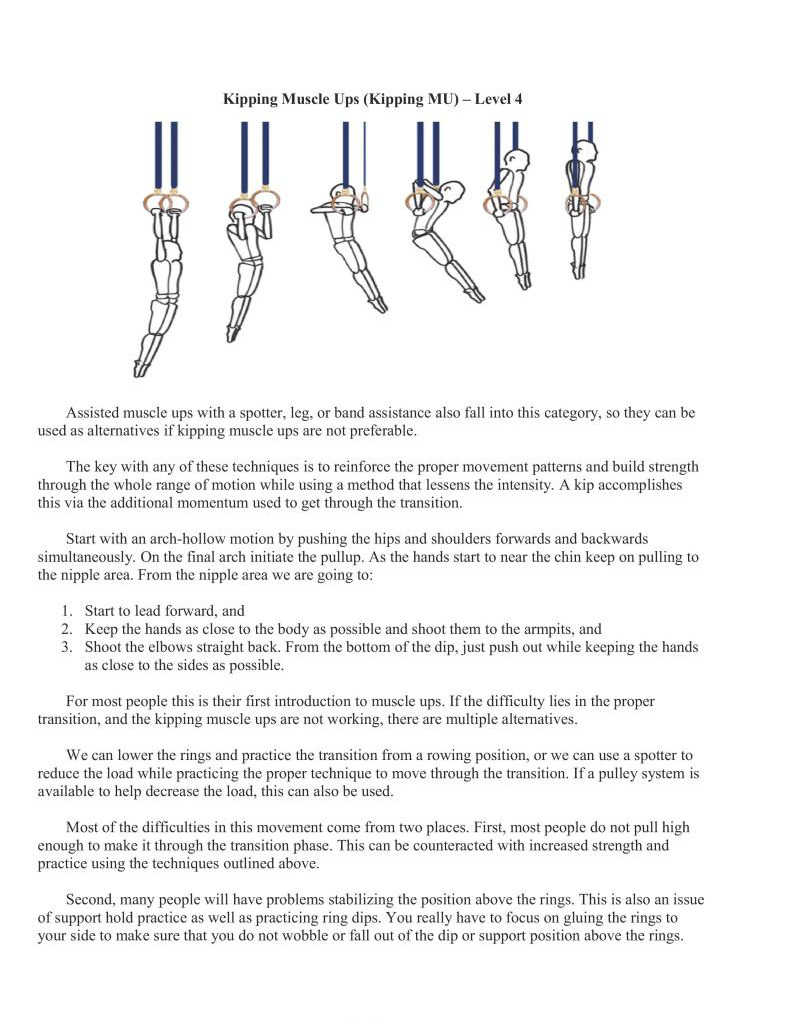
By now we should have a fairly good handle on how the technique for the muscle up works. Because the transitional phase is the limiting factor in the strict muscle up, the main thing that we need to focus on is raw strength development.
If someone can perform both at least 4-5 pullups with the nipples to the rings and 4-5 dips on rings with the hands reaching the armpits, then they should be able to perform a muscle up with good technique coaching. If we find ourselves at this point, it would be a good idea to work transition specific things such as the exercises mentioned in the previous section.
We can think of the transition phase as a rowing motion. Thus, if we have access to dumbbells or other similar types of weight we can use one-arm bent over rows with a light weight as an assistance excreise. To be effective, the hand performing the row should be able to complete the range of motion to the armpit, Remember, like anything with rings it is best to get on the rings for sake of specificity. You will be better off focusing on row muscle ups, human-assisted muscle ups, and pulley-assisted muscle ups, as opposed to dumbbell rows.
There are a couple of assistance exercises that may be used besides the previous mentioned progressions. The first is to lower the rings so that the feet will barely touch the ground at the bottom of the dip. Thus, you can slightly assist the movement with your feet to make it through the transition phase. Aliernatively, you can use a theraband looped between the rings and held with the hands. We can then kneel with one or two legs on the band to get some assistance to make it through the transition phase.
This used to be an A level skill in the gymnastics code of points, but now it is unrated. However, I have kept it in the A skill rating section because it the level of strength provided from this skill rivals most of the other skills at this level.
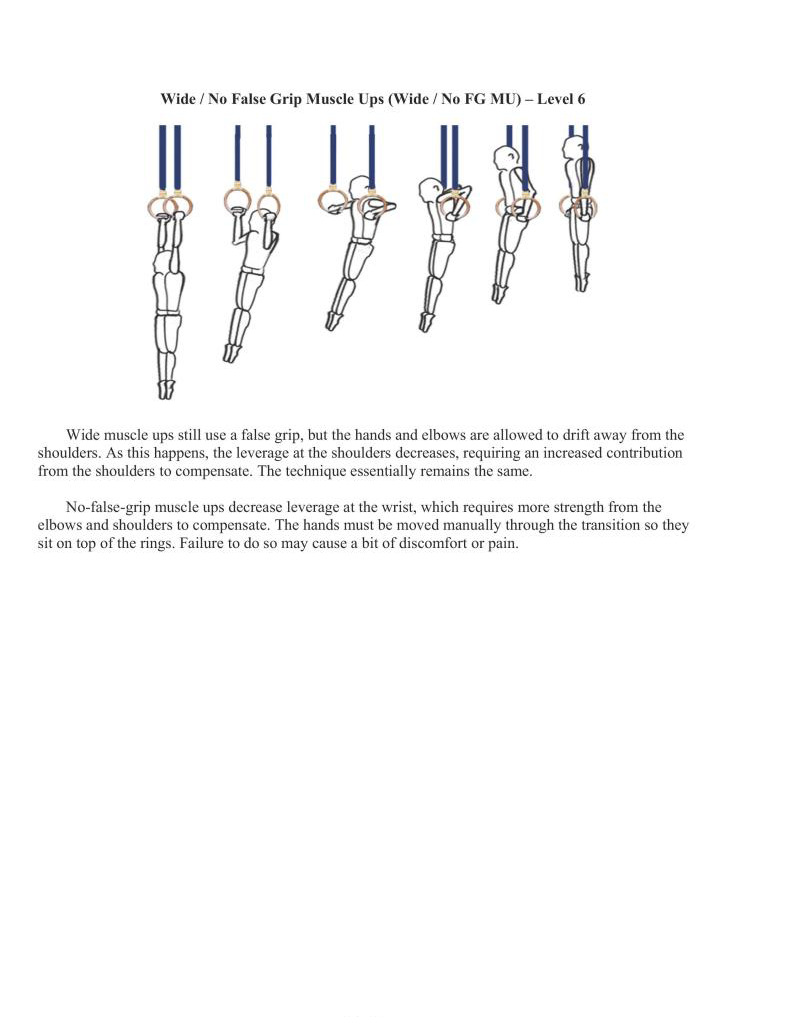
Wide muscle ups still use a false grip, but the hands and elbows are allowed to drift away from the shoulders. As this happens, the leverage at the shoulders decreases, requiring an increased contribution from the shoulders to compensate. The technique essentially remains the same.
No-false-grip muscle ups decrease leverage at the wrist, which requires more strength from the elbows and shoulders to compensate. The hands must be moved manually through the transition so they sit on top of the rings. Failure to do so may cause a bit of discomfort or pain.
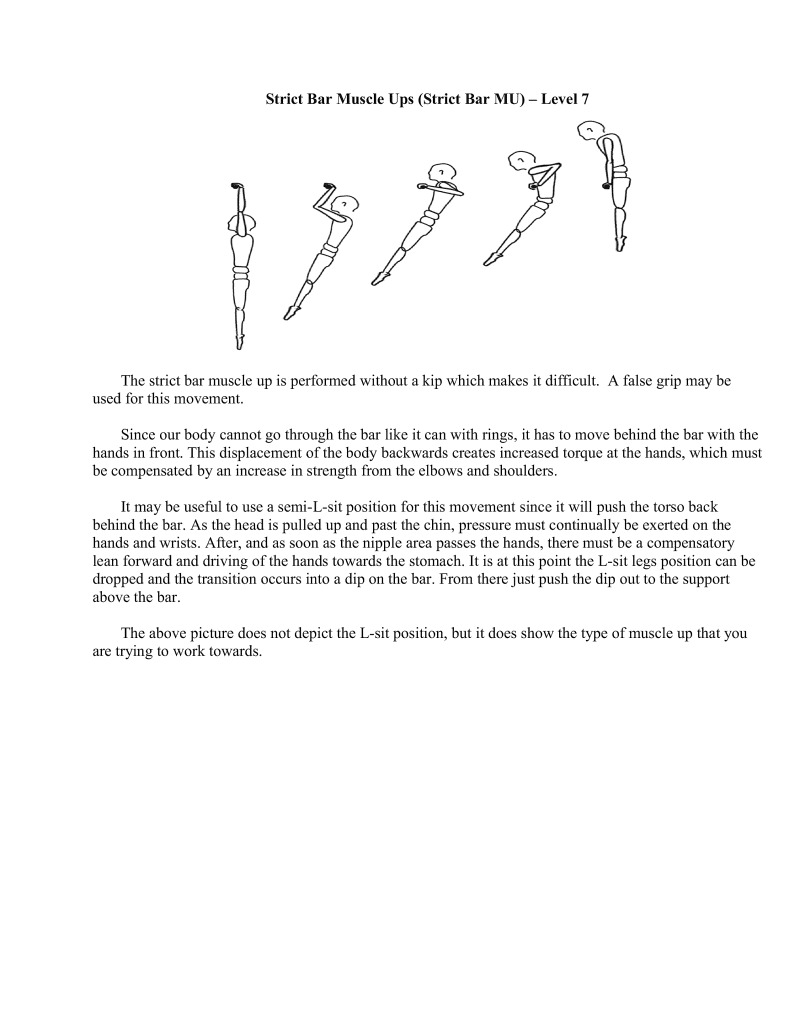
The strict bar muscle up is performed without a kip which makes it difficult. A false grip may be used for this movement.
Since our body cannot go through the bar like it can with rings, it has to move behind the bar with the hands in front, This displacement of the body backwards creates increased torque at the hands, which must be compensated by an increase in strength from the elbows and shoulders.
1t may be useful to use a semi-L-sit position for this movement since it will push the torso back behind the bar. As the head is pulled up and past the chin, pressure must continually be exerted on the hands and wrists. after, and as soon as the nipple area passes the hands, there must be a compensatory lean forward and driving of the hands towards the stomach. It is at this point the Lt legs position can be dropped and the transition occurs into a dip on the bar. From there just push the dip out to the support above the bar.
The above picture does not depict the L position, but it does show the type of muscle up that you are trying to work towards.
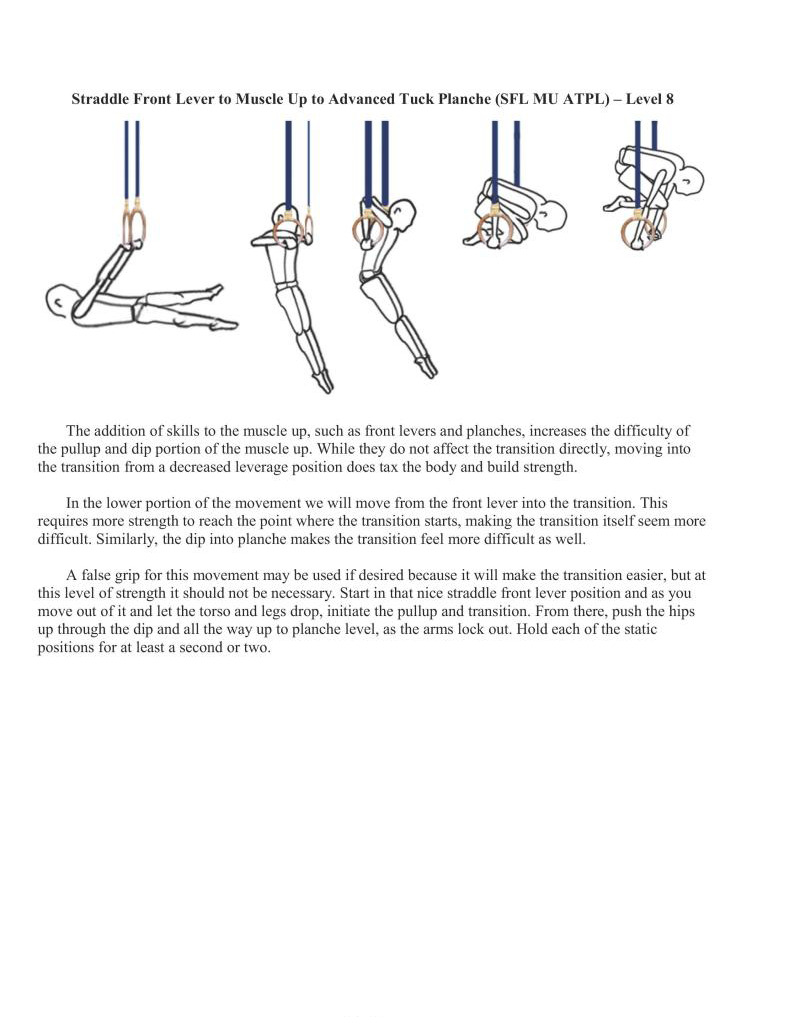
The addition of skills to the muscle up, such as front levers and planches, increases the difficulty of the pullup and dip portion of the muscle up. While they do not affeet the transition directly, moving into the transition from a decreased leverage position does tax the body and build strength.
In the lower portion of the movement we will move from the front lever into the transition. This requires more strength to reach the point where the transition starts, making the transition itself seem more difficult. Similarly, the dip into planche makes the transition feel more difficult as well.
A false grip for this movement may be used if desired because it will make the transition easier, but at this level of strength it should not be necessary. Start in that nice straddle front lever position and as you move out of it and let the torso and legs drop, initiate the pullup and transition. From there, push the hips up through the dip and all the way up to planche level, as the arms lock out. Hold each of the static positions for at least a second or two.
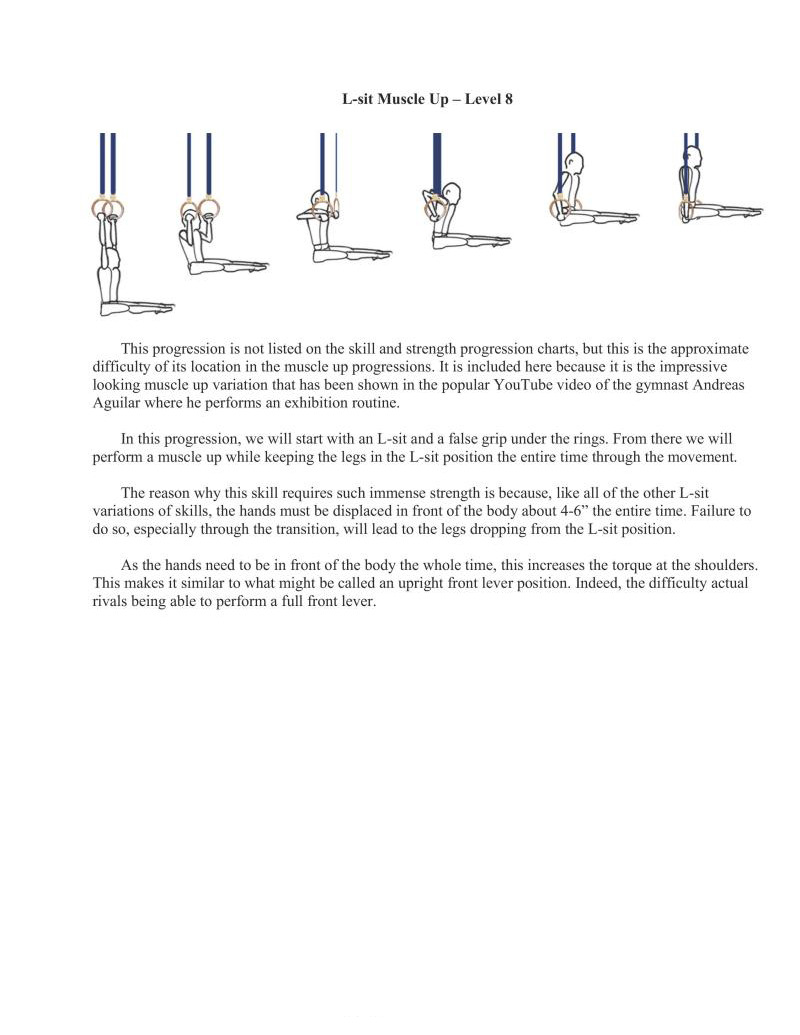
This progression is not listed on the skill and strength progression charts, but this is the approximate difficulty of its location in the muscle up progressions. It is included here because it is the impressive looking muscle up variation that has been shown in the popular YouTube video of the gymnast Andreas Aguilar where he performs an exhibition routine.
In this progression, we will start with an L-sit and a false grip under the rings. From there we will perform a muscle up while keeping the legs in the L-sit position the entire time through the movement
The reason why this skill requires such immense strength is because, like all of the other L-sit variations of skills, the hands must be displaced in front of the body about 4-6" the entire time. Failure to do so, especially through the transition, will lead to the legs dropping from the L-sit position.
As the hands need to be in front of the body the whole time, this increases the torque at the shoulders, This makes it similar to what might be called an upright front lever position. Indeed, the difficulty actual rivals being able to perform a full front lever.
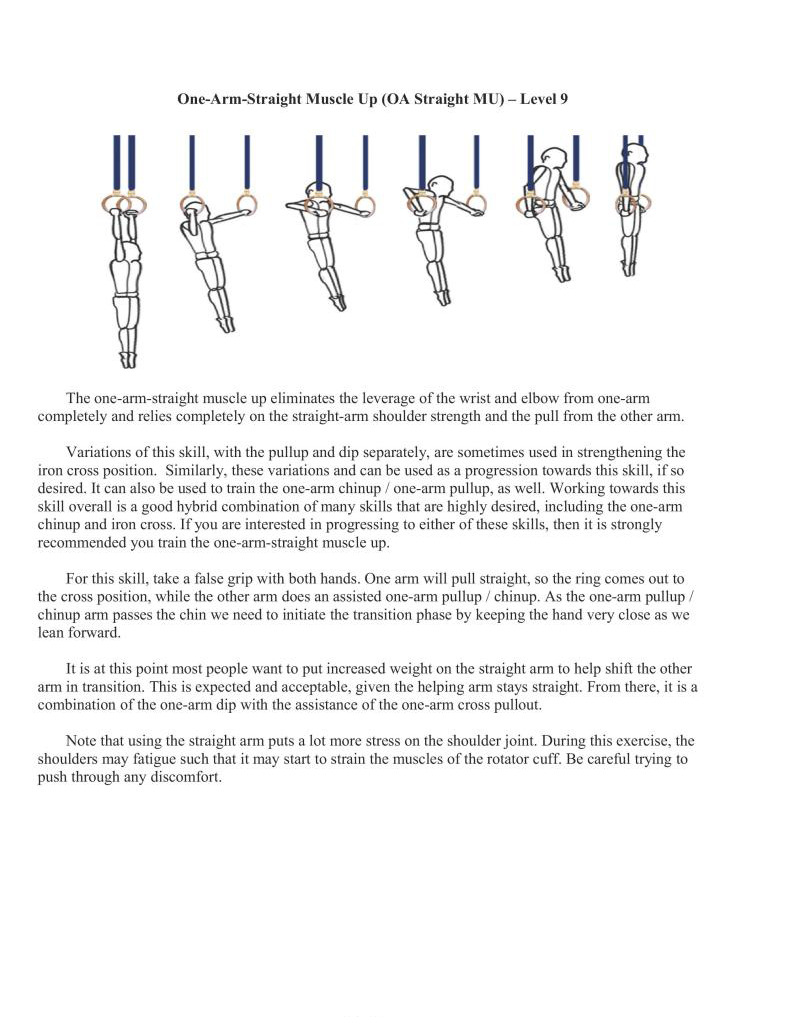
The one-am-straight muscle up eliminates the leverage of the wrist and elbow from one-arm completely and relies completely on the straight-arm shoulder strength and the pull from the other arm.
Variations of this skill, with the pullup and dip separately, are sometimes sed in strengthening the iron cross position. Similarly, these variations and can be used as a progress desired. It can also be used to train the on-arm chinup / one-arm pullup, as well. Working towards this skill overall is a good hybrid combination of many skills that are highly desired, including the one-arm chinup and iron cross. If you are interested in progressing to either of these skills, then it is strongly recommended you train the one-arm-straight muscle up.
For this skill, take a false grip with both hands. One arm will pull straight, so the ring comes out to the cross position, while the other arm does an assisted one-arm pullup / chinup. As the one-arm pullup / chinup arm passes the chin we need to initiate the transition phase by keeping the hand very close as we lean forward.
It is at this point most people want to put increased weight on the straight arm to help shift the other arm in transition. This is expected and acceptable, given the helping arm stays straight. From there, it is a combination of the one-arm dip with the assistance of the one-arm cross puliout.
Note that using the straight arm puts a lot more stress on the shoulder joint. During this exercise, the shoulders may fatigue such that it may start to strain the muscles of the rotator cuff. Be careful trying to push through any discomfort.
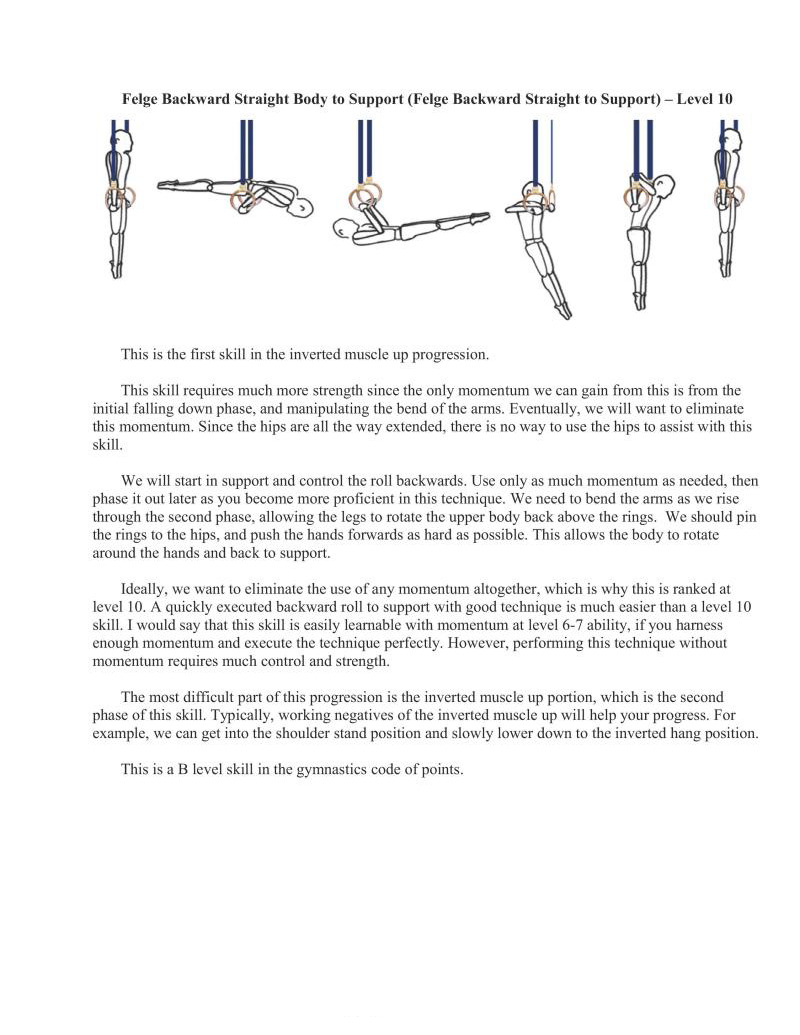
This is the first skill in the inverted muscle up progress
This skill requires much more strength since the only momentum we can gain from this is from the initial falling down phase, and manipulating the bend of the arms. Eventually, we will want to eliminate this momentum. Since the hips are all the way extended, there is no way to use the hips to assist with this skill.
We will start in support and control the roll backwards. Use only as much momentum as needed, then phase it out later as you become more proficient in this technique. We need to bend the arms as we rise through the second phase, allowing the legs to rotate the upper body back above the rings. We should pin the rings to the hips, and push the hands forwards as hard as possible. This allows the body to rotate around the hands and back to support.
Ideally, we want to eliminate the use of any momentum altogether, which is why this is ranked at level 10. A quickly executed backward roll to support with good technique is much easier than a level 10 skill. I would say that this skill is easily learnable with momentum at level 6-7 ability, if you haress enough momentum and execute the technique perfeetly. However, performing this technique without momentum requires much control and strength.
The most difficult part of this progression is the inverted muscle up portion, which is the second phase of this skill. Typically, working negatives of the inverted muscle up will help your progress. For example, we can get into the shoulder stand position and slowly lower down to the inverted hang position.
This is a B level skill in the gymnastics code of points;
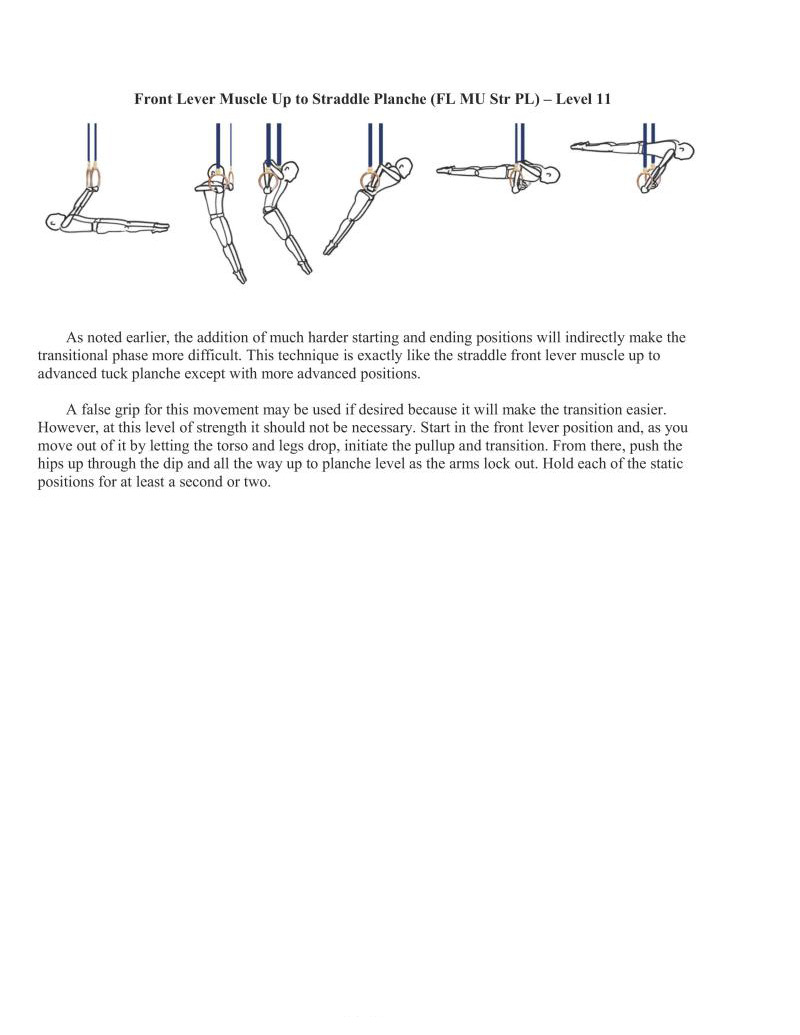
As noted earlier, the addition of much harder starting and ending positions will indirectly make the transitional phase more difficult. This technique is exactly like the straddle front lever muscle up to advanced tuck planche except with more advanced positions.
A false grip for this movement may be used if desired because it will make the transition easier. However, at this level of strength it should not be necessary. Start in the front lever position and, as you move out of it by letting the forso and legs drop, initiate the pullup and transition. From there, push the hips up through the dip and all the way up to planche level as the arms lock out. Hold each of the static positions for at least a second or two.
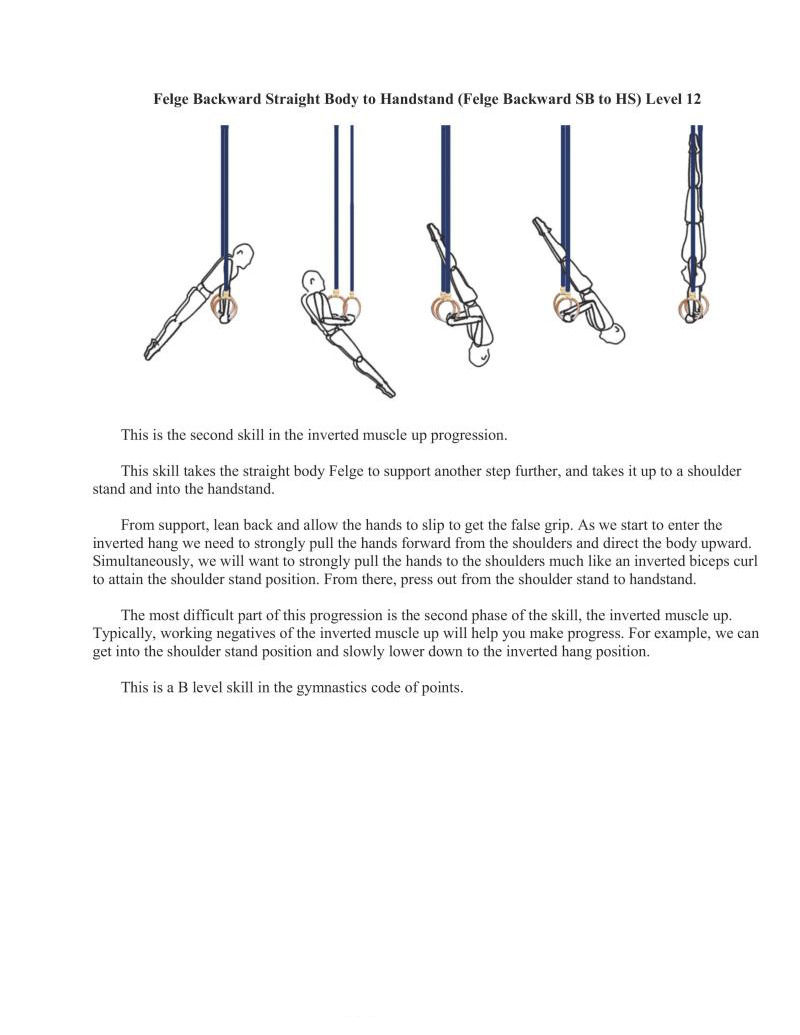
This is the second skill in the inverted muscle up progression.
This skill takes the straight body Felge to support another step further, and takes it up to a shoulder stand and into the handstand.
From support, lean back and allow the hands to slip to gt the false grip. As we start to enter the inverted hang we need to strongly pull the hands forward from the shoulders and dircct the body upward. simultaneously, we will want to strongly pull the hands to the shoulders much like an inverted biceps curl to attain the shoulder stand position. From there, press out from the shoulder stand to handstand.
The most difficult part of this progre: the second phase of the skill, the inverted muscle up. Typically, working negatives of the inverted muscle up will help you make progress. For example, we can get into the shoulder stand position and slowly lower down to the inverted hang position.
This is a B level skill in the gymnastics code of points.
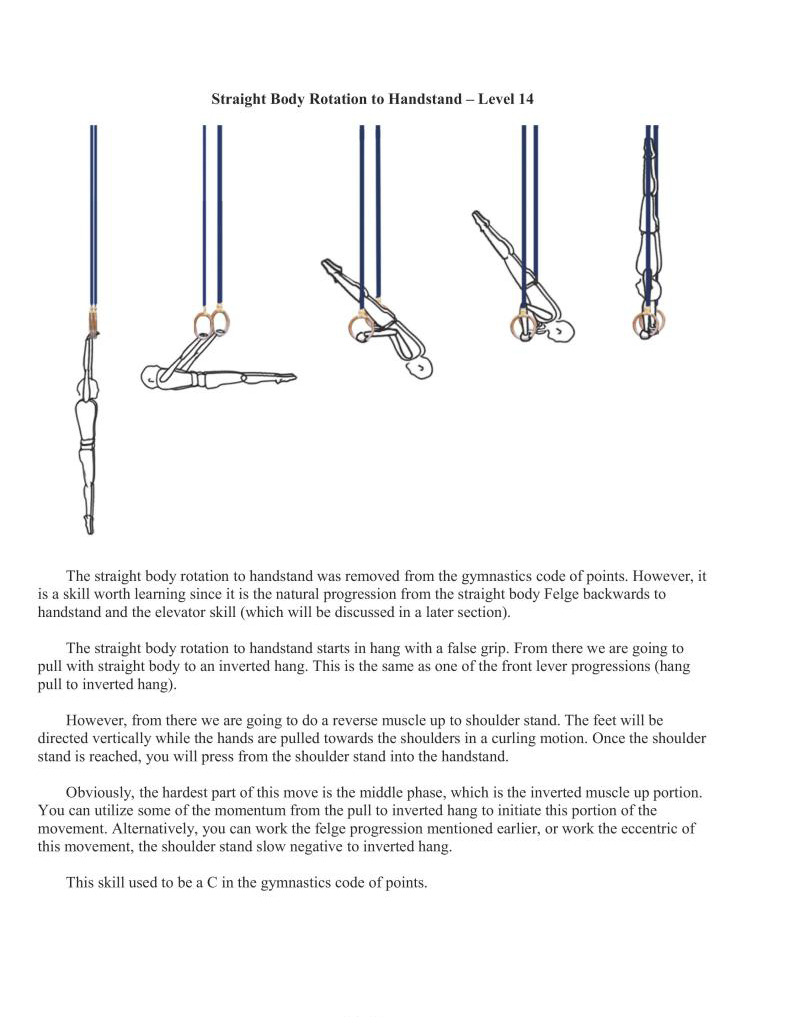
The straight body rotation to handstand was removed from the gymnastics code of points. However, it is a skill worth learning since it is the natural progression from the straight body Felge backwards to handstand and the elevator skill (which will be discussed in a later section).
The straight body rotation to handstand starts in hang with a false grip. From there we are going to pull with straight body to an inverted hang. This is the same as one of the front lever progressions (hang pull to inverted hang).
However, from there we are going to do a reverse muscle up to shoulder stand. The feet will be directed vertically while the hands are pulled towards the shoulders in a curling motion. Once the shoulder stand is reached, you will press from the shoulder stand into the handstand.
Obviously, the hardest part of this move is the middle phase, which i the inverted muscle up portion.
You can utilize some of the momentum from the pull to inverted hang to e this portion of the movement. Alternatively, you can work the felge progression mentioned earlier, or work the eccentric of movement, the shoulder stand slow negative to inverted hang.
This skill used to be a C in the gymnastics code of points.
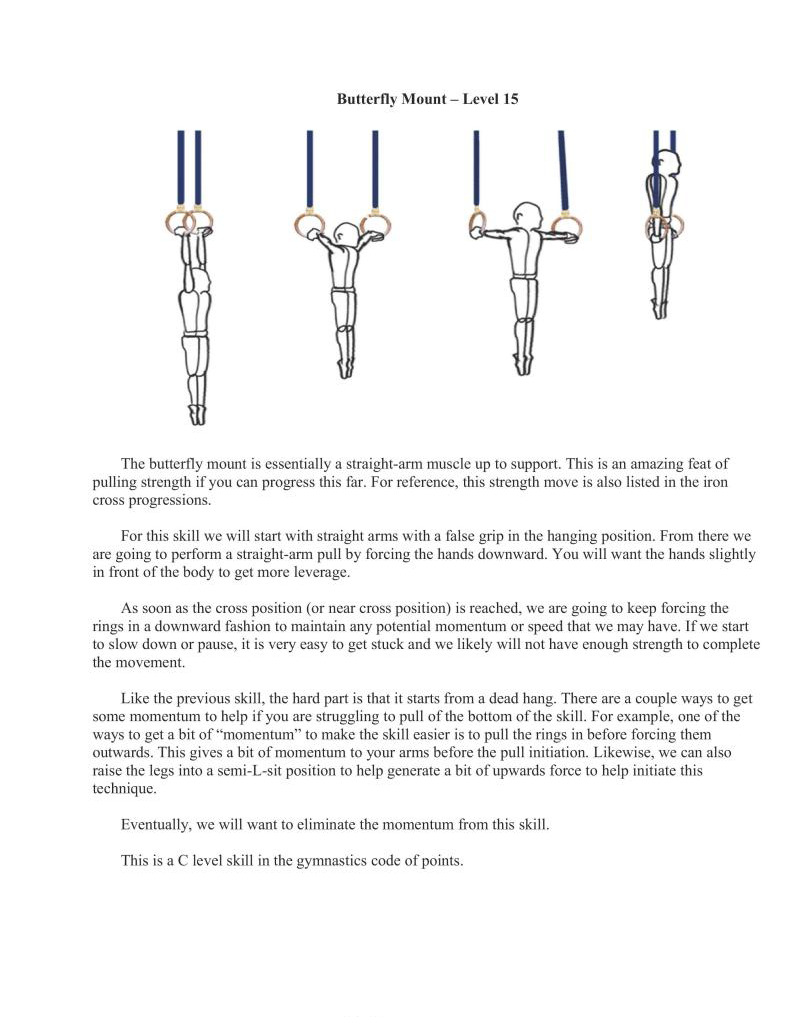
The butterfly mount is essentially a straight-arm muscle up to support. This is an amazing feat of pulling strength if you can progress this far. For reference, this strength move is also listed in the iron cross progressions.
For this skill we will start with straight arms with a false grip in the hanging position. From there we are going to perform a straight-arm pull by forcing the hands downward. You will want the hands slightly in front of the body to get more leverage.
As soon as the cross position (or near cross position) is reached, we are going to keep forcing the rings in a downward fashion to maintain any potential momentum or speed that we may have. If we start to slow down or pause, it is very easy to get stuck and we likely will not have enough strength to complete the movement.
Like the previous skill, the hard part is that it starts from a dead hang. There are a couple ways to get Some momentum to help if you are struggling to pull of the bottom of the skill. For example, one of the ways to get a bit of "momentum" to make the skill easier is to pull the rings in before forcing them outwards. This gives a bit of momentum to your arms before the pull initiation. Likewise, we can also raise the legs into a semi-L-sit position to help generate a bit of upwards force to help initiate this technique.
Eventually, we will want to eliminate the momentum from this skill.
This is a C level skill i the gymnastics code of points.
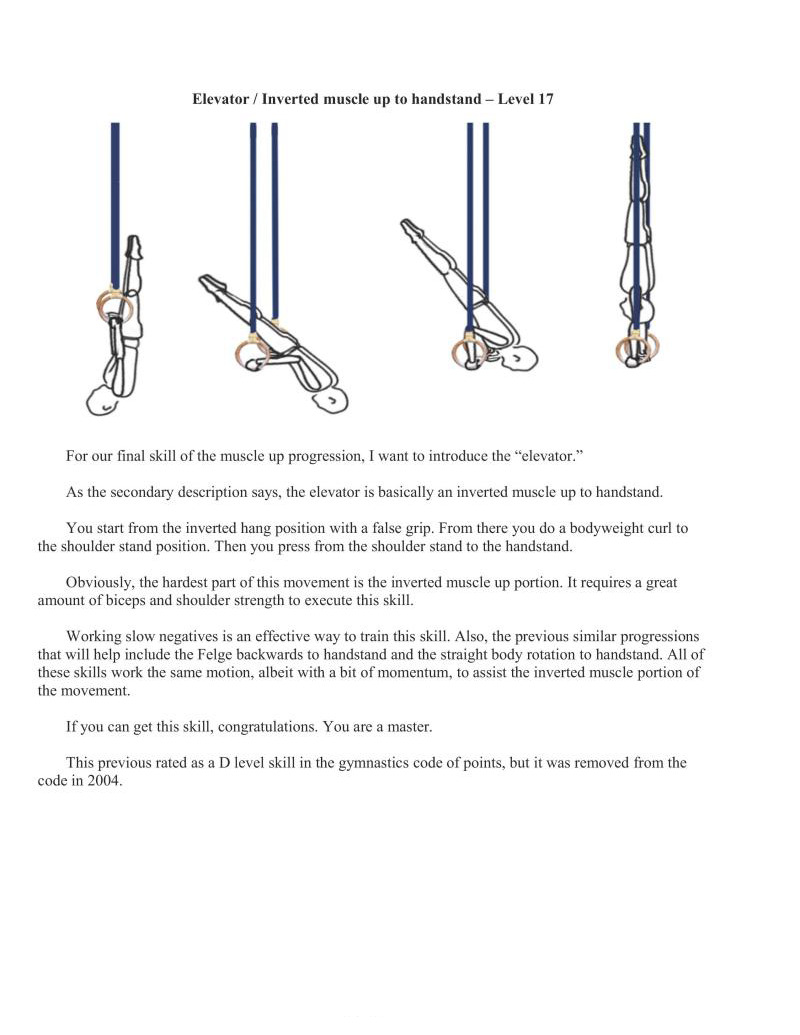
For our final skill of the muscle up progression, I want to introduce the "elevator." As the secondary description says, the elevator is basically an inverted muscle up to handstand.
You start from the inverted hang position with a false grip. From there you do a bodyweight curl to the shoulder stand position. Then you press from the shoulder stand to the handstand.
Obviously, the hardest part of this movement is the inverted muscle up portion. It requires a great amount of biceps and shoulder strength to execute this skill
Working slow negatives is an effective way to train this skill. Also, the previous similar progressions that will help include the Felge backwards to handstand and the straight body rotation to handstand. Al of these skills work the same motion, albeit with a bit of momentum, to assist the inverted muscle portion of the movement.
If you can get this skill, congratulations. You are a master.
This previous rated as a D level skill in the gymnastics code of points, but it was removed from the code in 2004.
The elbow lever progressions are mainly based on balancing ability. While some degree of strength is required to maintain the positions, practice is the main factor in attaining these skills. Thus, I would not necessarily say that the level increases are consistent with the other skills and strength progressions on the charts, so keep that in mind.
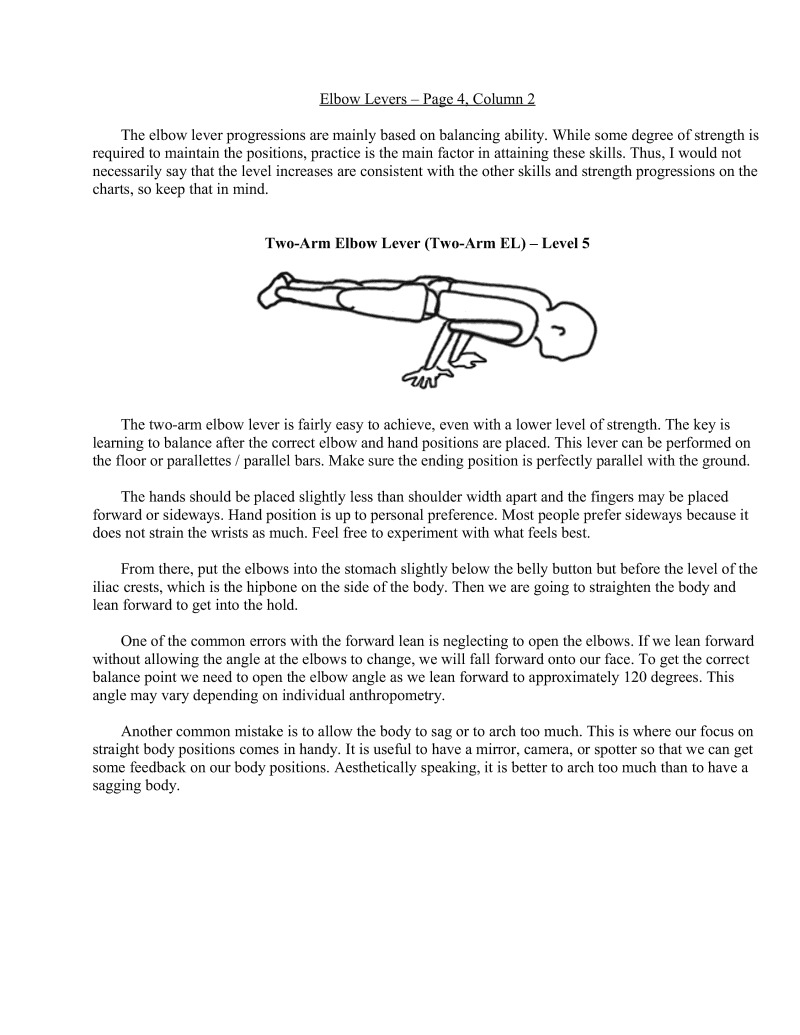
The two-arm elbow lever is fairly easy to achieve, even with a lower level of strength. The key is learning to balance after the correct elbow and hand positions are placed. This lever can be performed on the floor or parallettes / parallel bars. Make sure the ending position is perfectly parallel with the ground.
The hands should be placed slightly less than shoulder width apart and the fingers may be placed forward or sideways. Hand position is up to personal preference. Most people prefer sideways because it does not strain the wrists as much. Feel free to experiment with what feels best
From there, put the elbows into the stomach slightly below the belly button but before the level of the iliac crests, which is the hipbone on the side of the body. Then we are going to straighten the body and lean forward (o get into the hold.
One of the common errors with the forward lean is neglecting to open the elbows. If we lean forward without allowing the angle at the elbows to change, we will fall forward onto our face. To get the correct balance point we need to open the elbow angle as we lean forward to approximately 120 degrees. This angle may vary depending on individual anthropometry.
Another common mistake is to allow the body to sag or to arch too much. This is where our focus on straight body positions comes in handy. It is useful to have a mirror, camera, or spotter so that we can get some feedback on our body positions. Aesthetically speaking, it is better to arch too much than to have a sagging body.
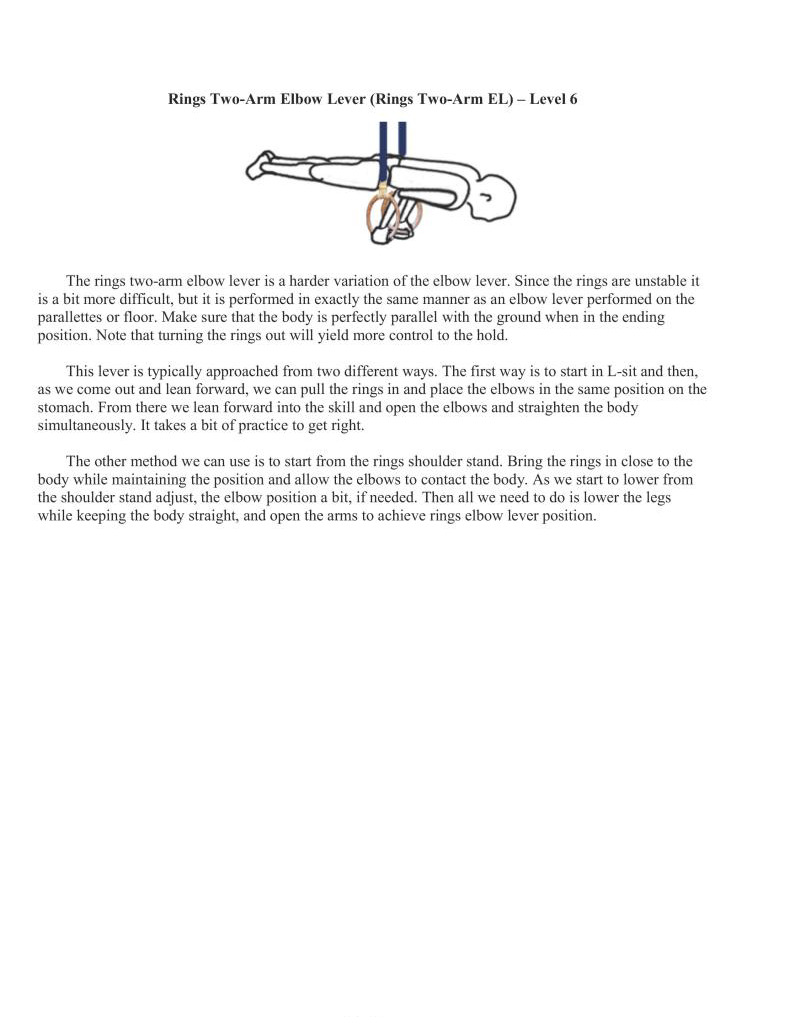
The rings two-arm elbow lever is a harder variation of the elbow lever. Since the rings are unstable it is a bit more difficult, but it is performed in exactly the same manner as an elbow lever performed on the parallettes or floor. Make sure that the body is perfectly parallel with the ground when in the ending position. Note that turning the rings out will yield more control to the hold.
This lever is typically approached from two different ways. The first way is to start in L-sit and then, as we come out and lean forward, we can pull the rings in and place the elbows in the same position on the stomach. From there we lean forward into the skill and open the elbows and straighten the body simultaneously. It takes a bit of practice to get right.
The other method we can use is to start from the rings shoulder stand. Bring the rings in close to the body while maintaining the position and allow the elbows to contact the body. As we start to lower from the shoulder stand adjust, the elbow position a bit, if needed. Then all we need to do is lower the legs. while keeping the body straight, and open the arms to achieve rings elbow lever position.
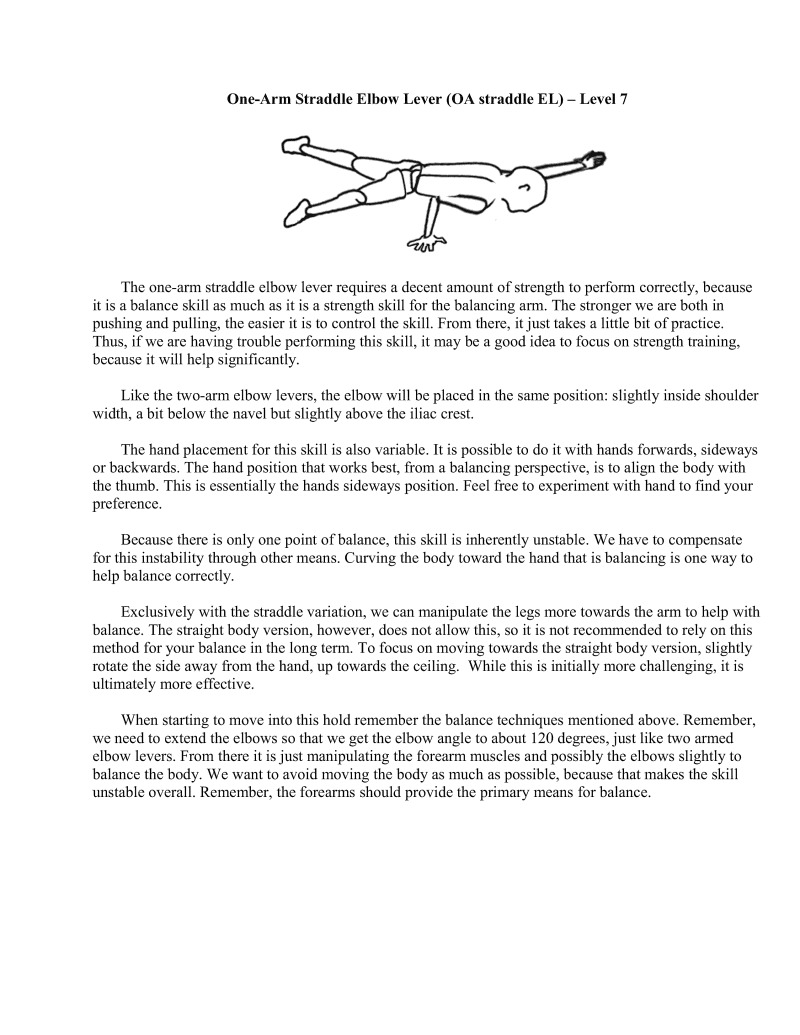
The one-arm straddle elbow lever requires a decent amount of strength to perform correctly, because it is a balance skill as much as it is a strength skill for the balancing arm. The stronger we are both in pushing and pulling, the easier it is to control the skill. From there, it just takes a litte bit of practice. Thus, if we are having trouble performing this skill, it may be a good idea to focus on strength training, because it will help significantly.
Like the two-arm elbow levers, the elbow will be placed in the same position: slightly inside shoulder width, a bit below the navel but slightly above the iliac crest.
The hand placement for this skill is also variable. It is possible to do it with hands forwards, sideways or backwards. The hand position that works best, from a balancing perspective, is to align the body with the thumb. This is essentially the hands sideways position. Feel free to experiment with hand to find your preference.
Because there is only one point of balance, this skill is inherently unstable. We have to compensate for this instability through other means. Curving the body toward the hand that is balancing is one way to help balance correctly.
Exclusively with the straddle variation, we can manipulate the legs more towards the arm to help with balance. The straight body version, however, does not allow this, so it is not recommended to rely on this method for your balance in the long term. To focus on moving towards the straight body version, slightly rotate the side away from the hand, up towards the ceiling. While this is initially more challenging, it is ultimately more effective,
When starting to move into this hold remember the balance techniques mentioned above. Remember, we need to extend the elbows so that we get the elbow angle to about 120 degrees, just like two armed elbow levers. From there it is just manipulating the forearm muscles and possibly the lbows slightly to balance the body. We want to avoid moving the body as much as possible, because that makes the skill unstable overall. Remember, the forearms should provide the primary means for balance.
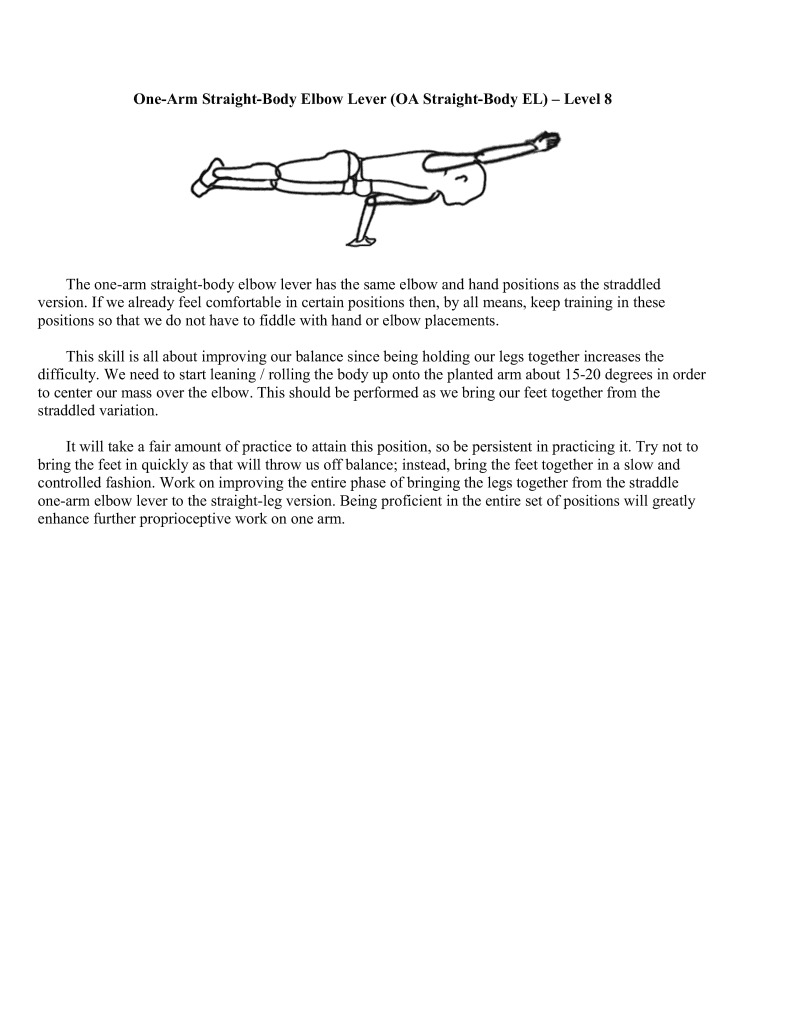
The one-arm straight-body elbow lever has the same elbow and hand positions as the straddled version. If we already feel comfortable in certain positions then, by all means, keep training in these positions so that we do not have to fiddle with hand or elbow placements.
This skill is all about improving our balance since being holding our legs together increases the difficulty. We need to start leaning / rolling the body up onto the planted arm about 15-20 degrees in order 1o center our mass over the elbow. This should be performed as we bring our feet together from the straddled variation.
It will take a fair amount of practice to attain this position, so be persistent in practicing it. Try not to bring the feet in quickly as that will throw us off balance; instead, bring the feet together in a slow and controlled fashion. Work on improving the entire phase of bringing the legs together from the straddle one-arm elbow lever to the straight-leg version. Being proficient in the entire set of positions will greatly enhance further proprioceptive work on one arm.
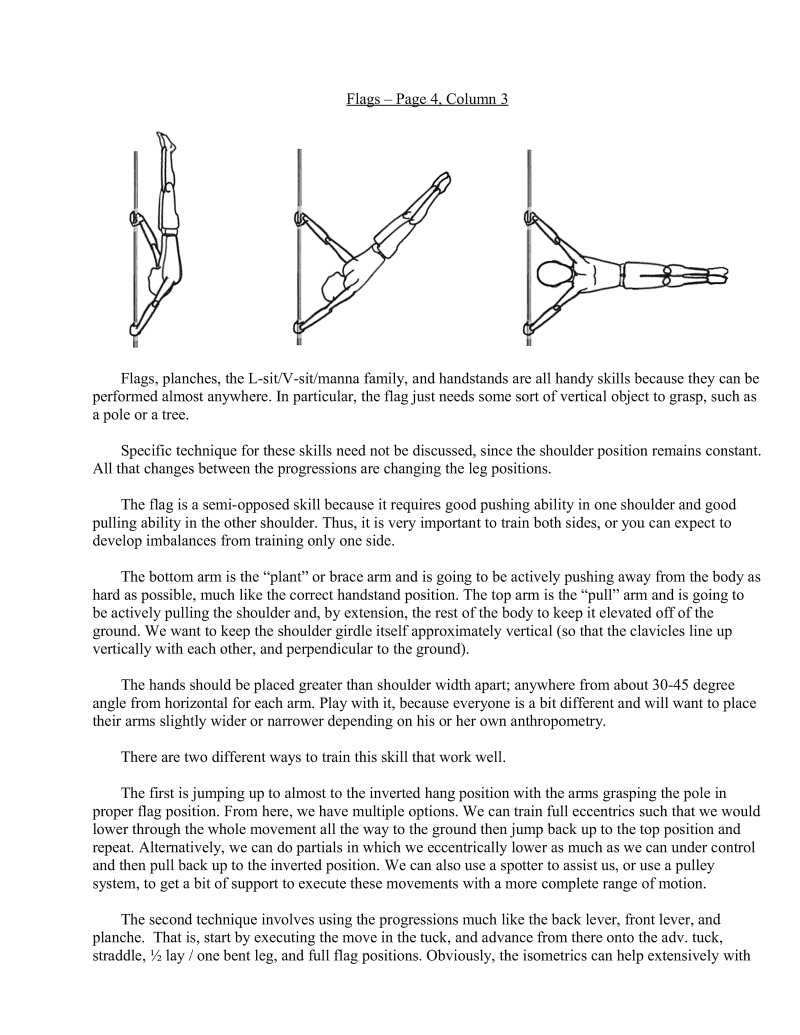
Flags, planches, the L-sit/V-sit/manna family, and handstands are all handy skills because they can be performed almost anywhere. In particular, the flag just needs some sort of vertical object to grasp, such as a pole or a tree.
Specific technique for these skills need not be discussed, since the shoulder position remains constant. All that changes between the progressions are changing the leg positions.
The flag is a semi-opposed skill because it requires good pushing ability in one shoulder and good pulling ability in the other shoulder. Thus, it is very important to train both sides, or you can expect to develop imbalances from training only one side.
The bottom arm is the "plant" or brace arm and is going to be actively pushing away from the body as hard as possible, much like the correct handstand position. The top arm is the "pull" arm and is going to
be actively pulling the shoulder and, by extension, the rest of the body to keep it elevated off of the ground. We want to keep the shoulder girdle itself approximately vertical (so that the clavicles line up vertically with each other, and perpendicular to the ground)
The hands should be placed greater than shoulder width apart; anywhere from about 3045 degree angle from horizontal for each arm. Play with it, because everyone is a bit different and will want to place
their arms slightly wider or narrower depending on his or her own anthropometry.
There are two different ways to train this skill that work well.
The firstis jumping up to almost to the inverted hang position with the arms grasping the pole in proper flag position. From here, we have multiple options. We can train full eccentrics such that we would lower through the whole movement all the way to the ground then jump back up to the top position and repeat. Alternatively, we can do partials in which we eccentrically lower as much as we can under control and then pull back up to the inverted position. We can also use a spotter to assist us, or use a pulley system, to get a bit of support to execute these movements with a more complete range of motion.
The second technique involves using the progressions much like the back lever, front lever, and planche. That i, start by exceuting the move in the tuck, and advance from there onto the adv. fuck, straddle, Y lay / one bent leg, and full flag positions. Obviously, the isometrics can help extensively with
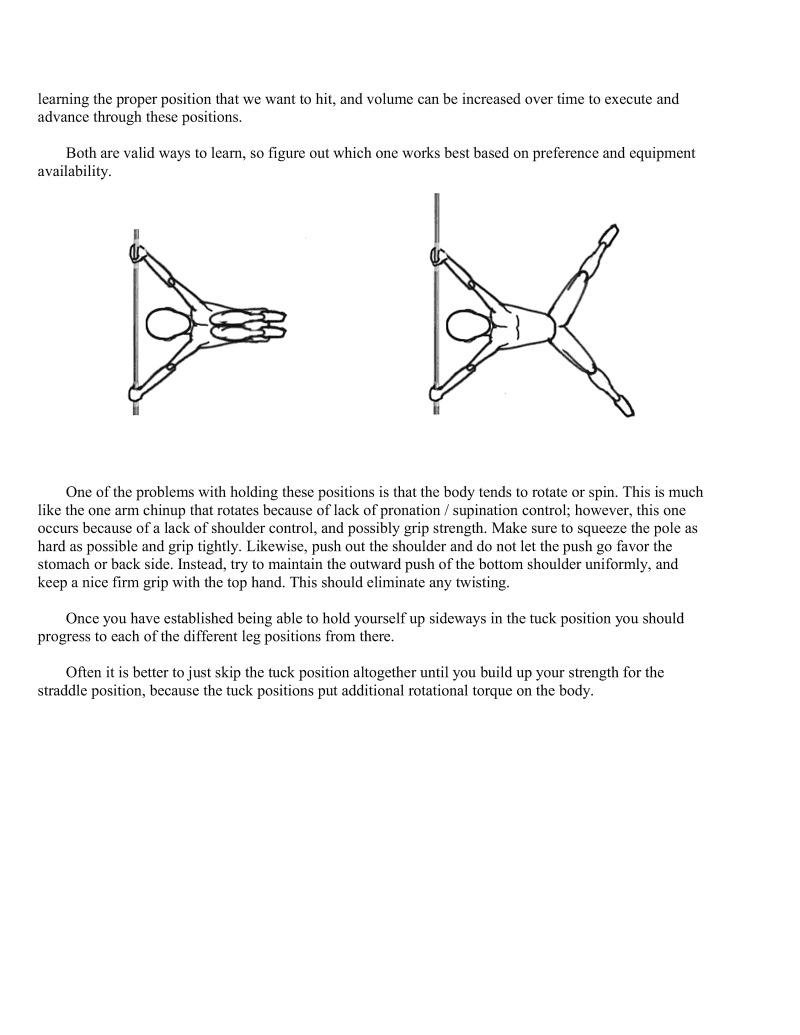
learning the proper position that we want to hit, and volume can be increased over time to execute and advance through these positions
Both are valid ways to learn, so figure out which one works best based on preference and equipment availability.
One of the problems with holding these positions is that the body tends to rotate or spin. This is much like the one arm chinup that rotates because of lack of pronation / supination control; however, this one occurs because of a lack of shoulder control, and possibly grip strength. Make sure to squecze the pole as hard as possible and grip tightly. Likewise, push out the shoulder and do not let the push go favor the stomach or back side. Instead, iry to maintain the outward push of the bottom shoulder uniformly, and keep a nice firm grip with the top hand. This should eliminate any twisting.
Once you have established being able to hold yourself up sideways in the tuck position you should progress to each of the different leg positions from there.
often it is beer to just skip the tuck position altogether until you build up your strength for the straddle position, because the tuck positions put additional rotational torque on the body.
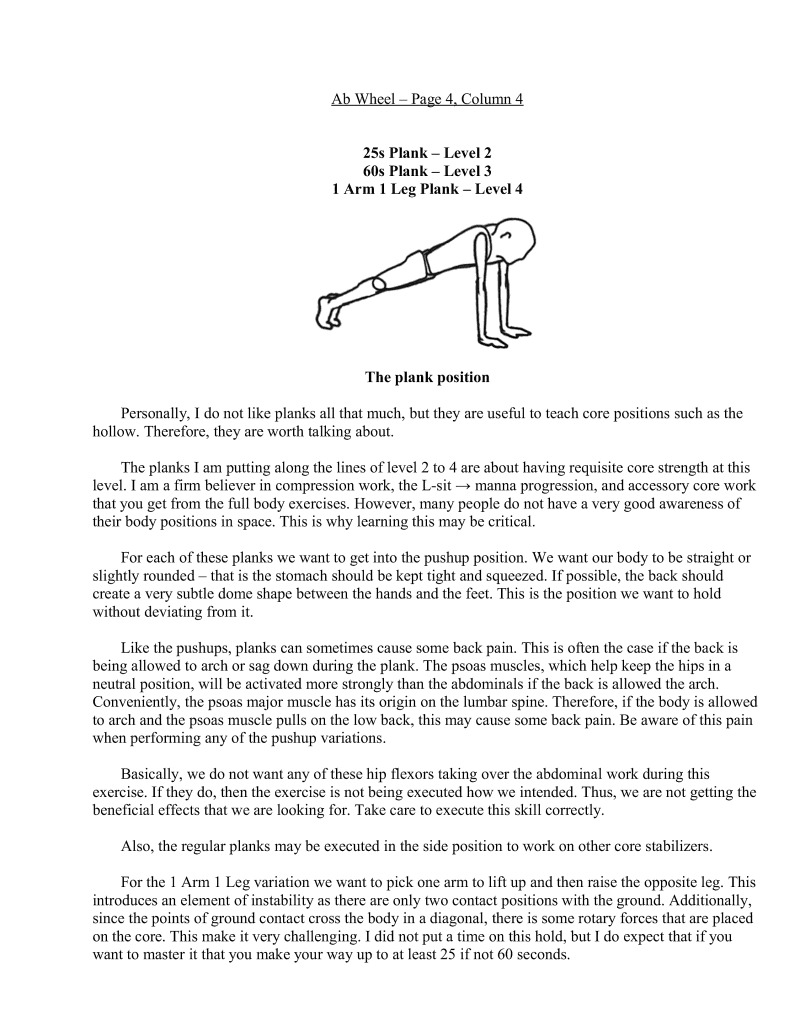
25s Plank — Level 2 60s Plank — Level 3 1 Arm 1 Leg Plank — Level 4
Personally, I do not like planks all that much, but they are useful to teach core positions such as the hollow. Therefore, they are worth talking about.
The planks I am putting along the lines of level 2 to 4 are about having requisite core strength at this level. I am a firm believer in compression work, the L-sit — manna progression, and accessory core work that you get from the full body exercises. However, many people do not have a very good awareness of their body positions in space. This is why learning this may be critical.
For each of these planks we want to get into the pushup position. We want our body to be straight or slightly rounded — that is the stomach should be kept tight and squeezed. If possible, the back should create a very subtle dome shape between the hands and the feet. This is the position we want to hold without deviating from it
Like the pushups, planks can sometimes cause some back pain. This is often the case if the back is being allowed to arch or sag down during the plank. The psoas muscles, which help keep the hips in a neutral position, will be activated more strongly than the abdominals if the back is allowed the arch. Conveniently, the psoas major muscle has its origin on the lumbar spine. Therefore, if the body is allowed to arch and the psoas muscle pulls on the low back, this may cause some back pain. Be aware of this pain when performing any of the pushup variations.
Basically, we do not want any of these hip flexars taking over the abdominal work during this exercise. If they do, then the exercise is not being executed how we intended. Thus, we are not getting the beneficial effects that we are looking for. Take care to execute this skill correctly.
Also, the regular planks may be executed in the side position to work on other core stabilizers.
For the 1 Arm 1 Leg variation we want to pick one arm to lift up and then raise the opposite leg. This introduces an element of instability as there are only two contact positions with the ground. Additionally, since the points of ground contact cross the body in a diagonal, there is some rotary forces that are placed on the core. This make it very challenging. I did not put a time on this hold, but I do expect that if you want to maser it that you make your way up to at least 25 if not 60 scconds.
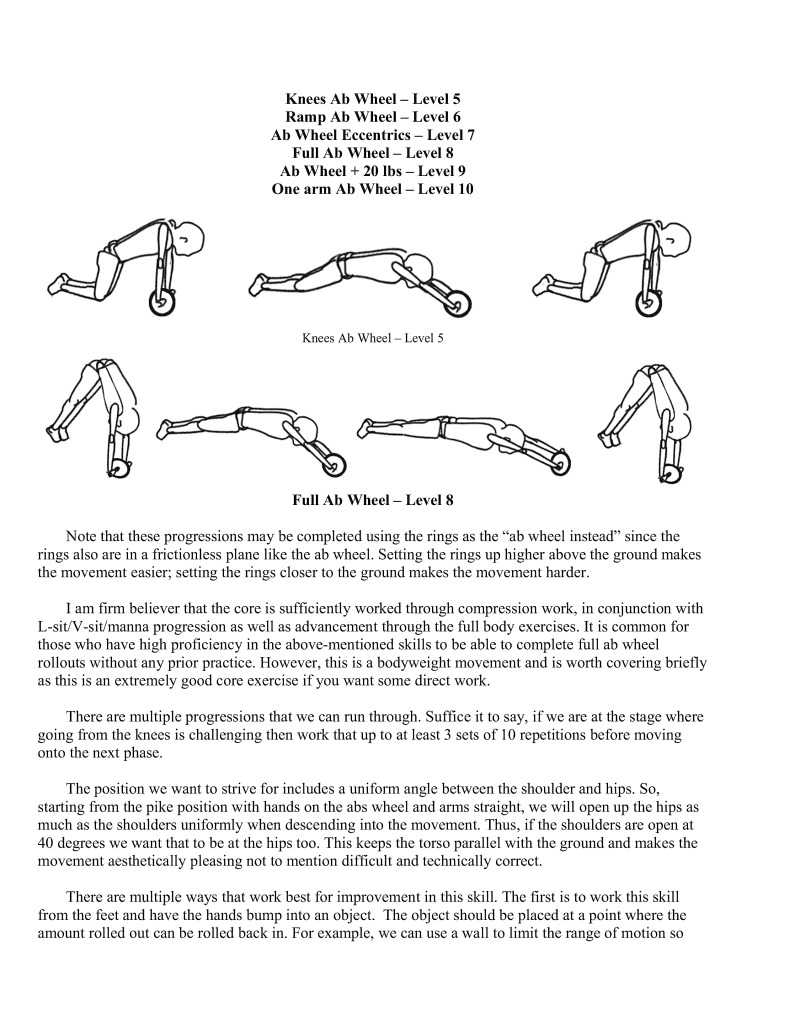
Note that these progressions may be completed using the rings as the "ab wheel instead" since the rings also are in a frictionless plane like the ab wheel. Setting the rings up higher above the ground makes the movement easier; seting the rings closer to the ground makes the movement harder.
I am firm believer that the core is sufficiently worked through compression work, in conjunction with L-sit/V-sit/manna progression as well as advancement through the full body exercises. It is common for those who have high proficiency in the above-mentioned skills to be able to complete full ab wheel rollouts without any prior practice. However, this is a bodyweight movement and is worth covering briefly as this is an extremely good core exercise if you want some direct work
There are multiple progressions that we can run through. Suffice it to say, if we are at the stage where going from the knees is challenging then work that up to at least 3 sets of 10 repetitions before moving onto the next phase.
The position we want to strive for includes a uniform angle between the shoulder and hips. So, starting from the pike position with hands on the abs wheel and arms straight, we will open up the hips as much as the shoulders uniformly when descending into the movement. Thus, if the shoulders are open at 40 degrees we want that to be at the hips too. This keeps the torso parallel with the ground and makes the movement aesthetically pleasing not to mention difficult and technically correct,
There are multiple ways that work best for improvement in this skill. The first is to work this skill from the feet and have the hands bump into an object. The object should be placed at a point where the amount rolled out can be rolled back in. For example, we can use a wall to limit the range of motion so that we go down to a range of motion just before we would collapse. This allows us to progressively back up the feet further and further away from the wall as we progress.
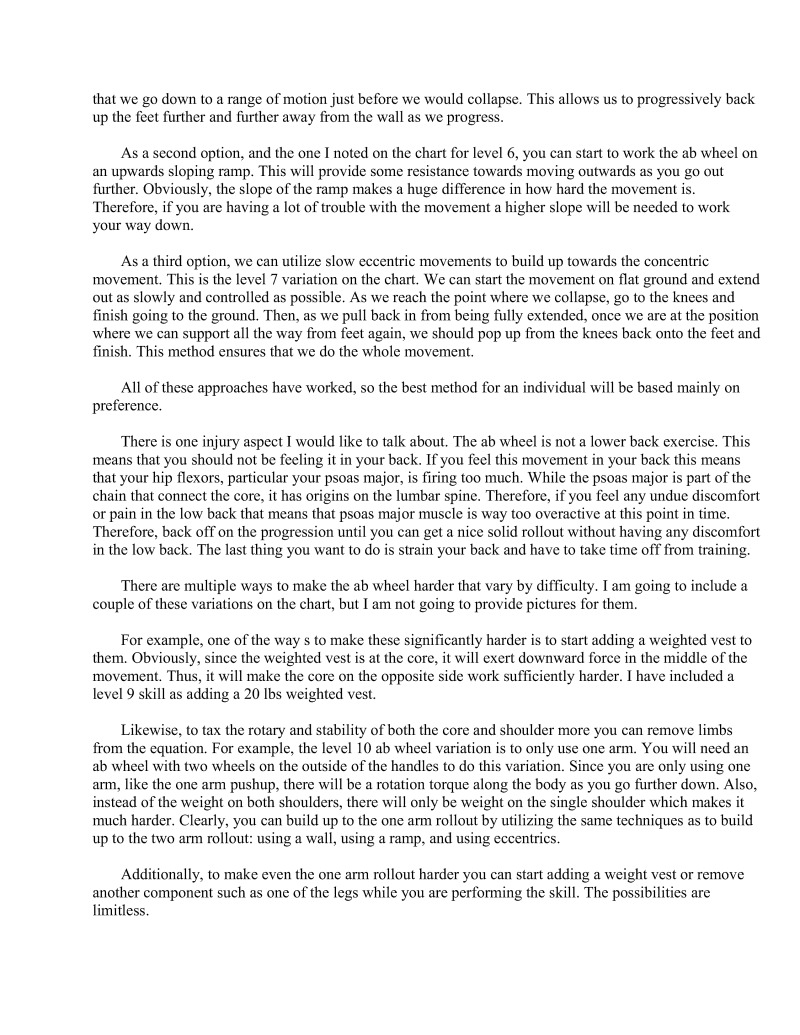
As a second option, and the one I noted on the chart for level 6, you can start to work the ab wheel on an upwards sloping ramp. This will provide some resistance towards moving outwards as you go out further. Obviously, the slope of the ramp makes a huge difference in how hard the movement is. Therefore, if you are having a lot of trouble with the movement a higher slope will be needed to work your way down.
As a third option, we can utilize slow eccentric movements to build up towards the concentric movement. This is the level 7 variation on the chart. We can start the movement on flat ground and extend outas slowly and controlled as possible. As we reach the point where we collapse, go to the knees and finish going to the ground. Then, as we pull back in from being fully extended, once we are at the position where we can support all the way from feet again, we should pop up from the knees back onto the feet and finish. This method ensures that we do the whole movement.
Al of these approaches have worked, 5o the best method for an individual will be based mainly on preference.
There is one injury aspect I would like to talk about. The ab wheel is not a lower back exercise. This means that you should not be feeling it in your back. If you feel this movement in your back this means that your hip flexors, particular your psoas major, is firing too much. While the psoas major is part of the chain that connect the core, it has origins on the lumbar spine. Therefore, if you feel any undue discomfort o pain in the low back that means that psoas major muscle is way too overactive at this point in time. Therefore, back off on the progression until you can get a nice solid rollout without having any discomfort in the low back. The last thing you want to do is strain your back and have to take time off from training.
There are multiple ways to make the ab wheel harder that vary by difficulty. I am going to include a couple of these variations on the chart, but I am not going to provide pictures for them.
For example, one of the way is to make these significantly harder is to start adding a weighted vest to them. Obviously, since the weighted vest is at the core, it will exert downward force in the middle of the movement. Thus, it will make the core on the opposite side work sufficiently harder. I have included a level 9 skill as adding a 20 lbs weighted vest.
Likewise, to tax the rotary and stability of both the core and shoulder more you can remove limbs from the equation. For example, the level 10 ab wheel variation is to only use one arm. You will need an ab wheel with two wheels on the outside of the handles to do this variation. Since you are only using one am, like the one arm pushup, there will be a rotation torque along the body as you go further down. Also, instead of the weight on both shoulders, there will only be weight on the single shoulder which makes it much harder. Clearly, you can build up to the one arm rollout by utilizing the same techniques as to build up to the two arm rollout: using a wall, using a ramp, and using eccentrics.
Additionally, to make even the one arm rollout harder you can start adding a weight vest or remove another component such as one of the legs while you are performing the skill. The possibilities are limitless.
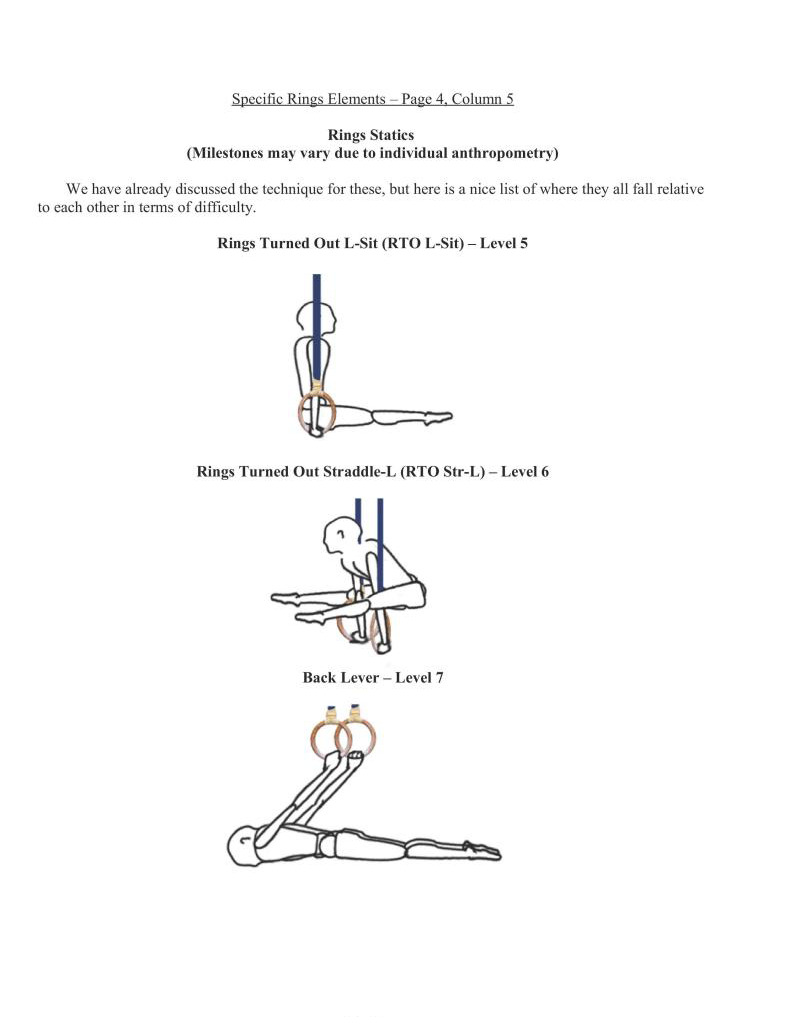
(Milestones may vary due to individual anthropometry)
We have already discussed the technique for these, but here is a nice list of where they all fall relative to each other in terms of difficulty.
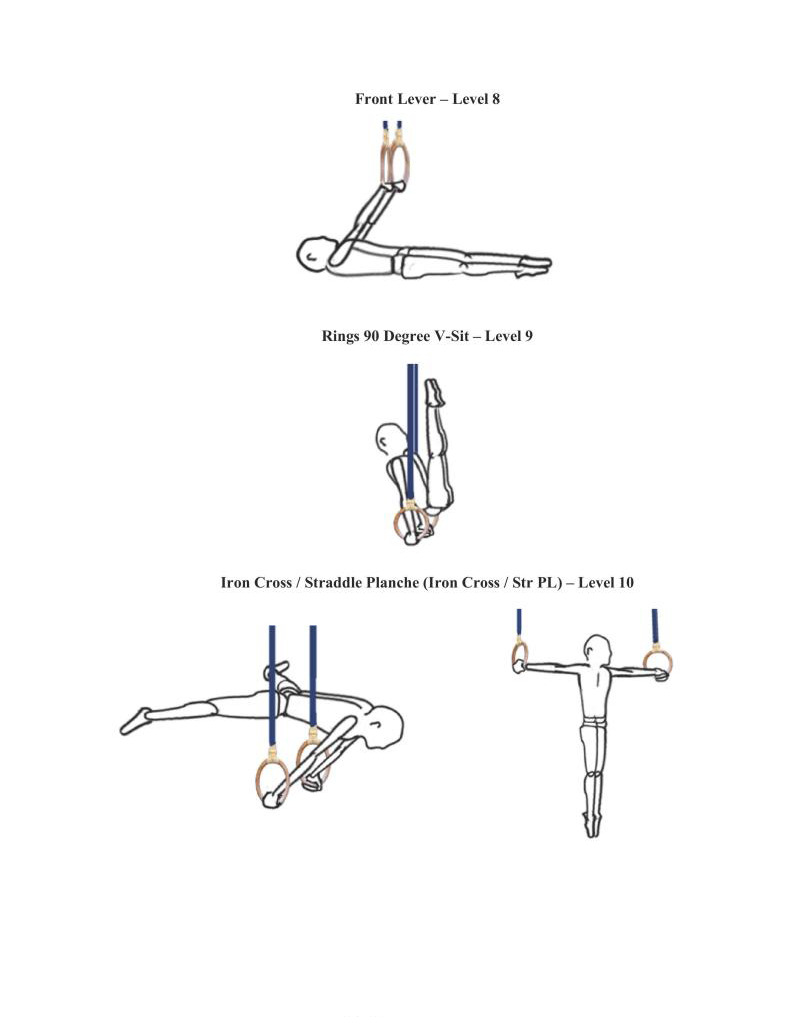
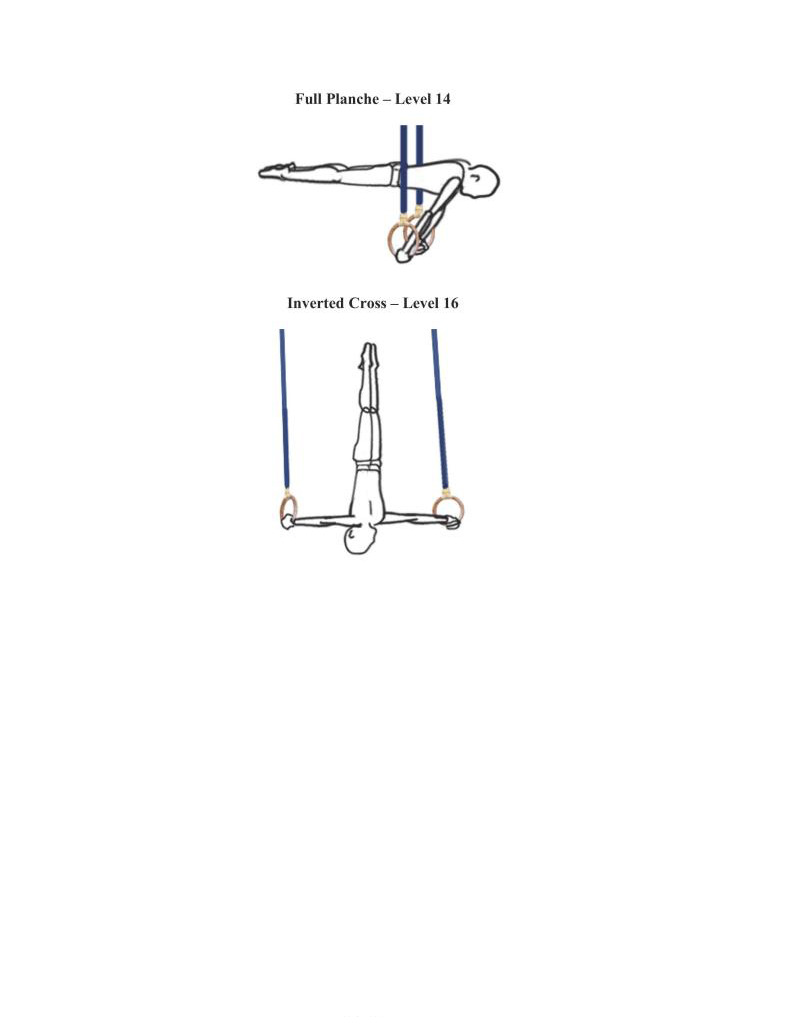
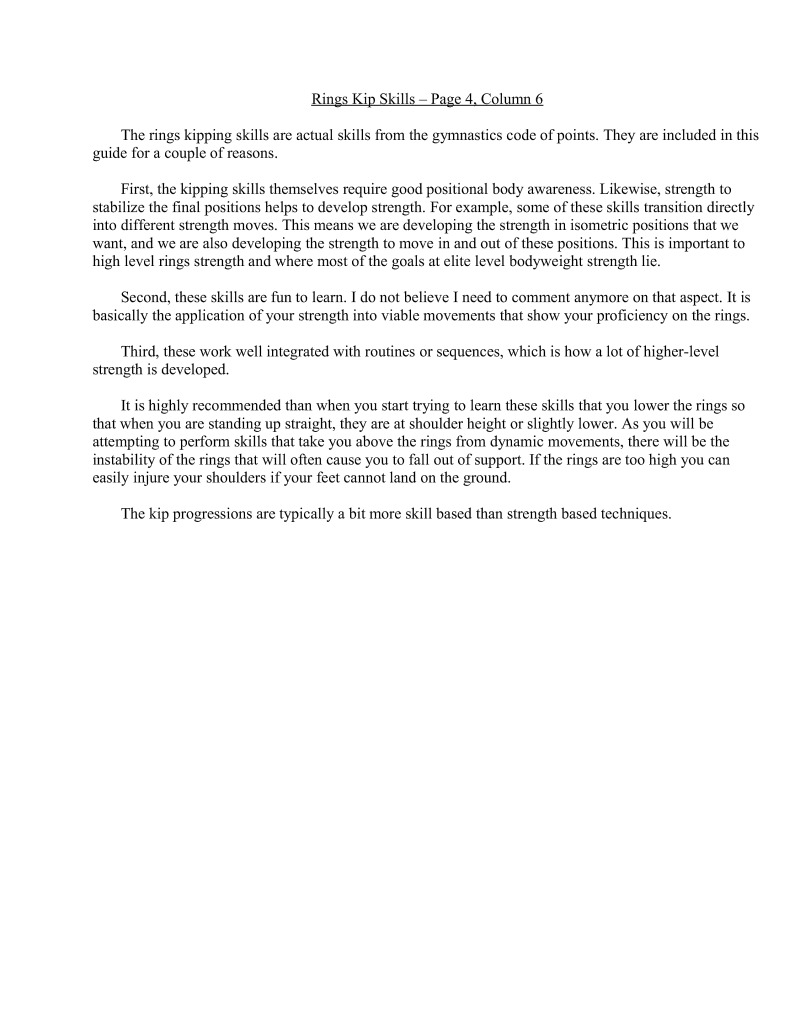
The rings kipping skills are actual skills from the gymnastics code of points. They are included in this. guide for a couple of reasons.
First, the kipping skills themselves require good positional body awareness. Likewise, strength to stabilize the final positions helps to develop strength. For example, some of these skills transition directly into different strength moves. This means we are developing the strength in isometric positions that we want, and we are also developing the strength to move in and out of these positions. This is important to high level rings strength and where most of the goals at elite level bodyweight strength lc.
Second, these skills are fun to learn. I do not believe I need to comment anymore on that aspect. It is basically the application of your strength into viable movements that show your proficiency on the rings.
Third, these work well integrated with routines or sequences, which is how a lot of higher-level strength is developed.
It is highly recommended than when you start rying to learn these skills that you lower the rings so that when you are standing up straight, they are at shoulder height or slightly lower. As you will be attempting to perform skills that take you above the rings from dynamic movements, there will be the instability of the rings that will often cause you to fall out of support, If the rings are too high you can easily injure your shoulders if your feet cannot land on the ground.
The kip progressions are typically a bit more skill based than strength based techniques.
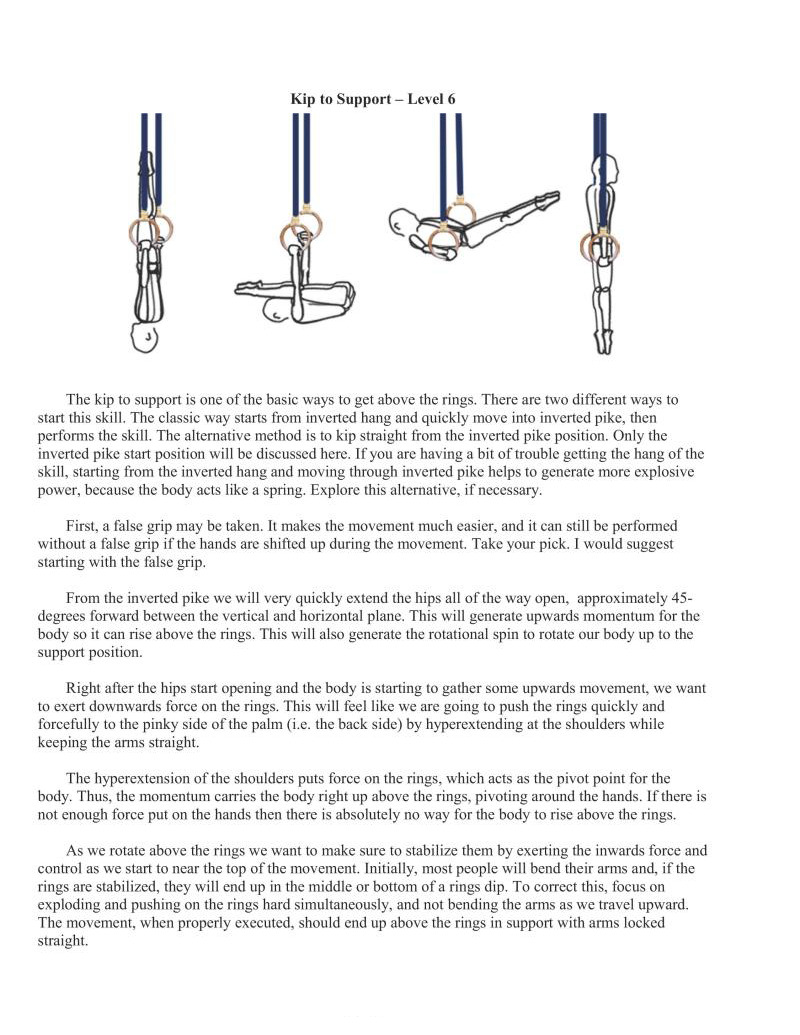
The kip to support is one of the basic ways to get above the rings. There are two different ways to start this skill. The classic way starts from inverted hang and quickly move into inverted pike, then performs the skill. The alternative method is to kip straight from the inverted pike position. Only the inverted pike start position will be discussed here. If you are having a bit of trouble getting the hang of the skill, starting from the inverted hang and moving through inverted pike helps to generate more explosive power, because the body acts like a spring. Explore this alternative, if necessary.
First, a false grip may be taken. It makes the movement much easier, and it can still be performed without a false grip if the hands are shified up during the movement. Take your pick. I would suggest starting with the false grip.
From the inverted pike we will very quickly extend the hips all of the way open, approximately 45- degrees forward between the vertical and horizontal plane. This will generate upwards momentum for the body so it can rise above the rings. This will also generate the rotational spin to rotate our body up to the support position.
Right after the hips start opening and the body is starting to gather some upwards movement, we want to exert downwards force on the rings. This will feel like we are going to push the rings quickly and forcefully to the pinky side of the palm (ic. the back side) by hyperextending at the shoulders while keeping the arms straight
The hyperextension of the shoulders puts force on the rings, which acts as the pivot point for the body. Thus, the momentum carries the body right up above the rings, pivoting around the hands. If there is not enough force put on the hands then there is absolutely no way for the body to rise above the rings.
As we rotate above the rings we want to make sure to stabilize them by exerting the inwards force and control as we start to near the top of the movement. Iniially, most people will bend their arms and, if the rings are stabilized, they will end up in the middle or bottom of a rings dip. To correct this, focus on exploding and pushing on the rings hard simultaneously, and not bending the arms as we travel upward. The movement, when properly excuted, should end up above the rings in support with arms locked straight.
Once you start getting the hang of the skill, typically you will end up in the transition phase of the muscle up or in the decp part of the dip. This usually implied at least
one of a few possible problems. First, as mentioned, you may not be exerting enough force through the rings. Second, it is possible that your explosiveness out of the inverted pike position is lacking. Third, it could be a combination of the coordination between the first and second elements involved in the movement.
Keep practicing. If you are still having serious issues, then attempt to get advice from people who know how to execute the skill well or have coaching experience. It will come with practice though.
This is an A level skill i the gymnastics code of points.
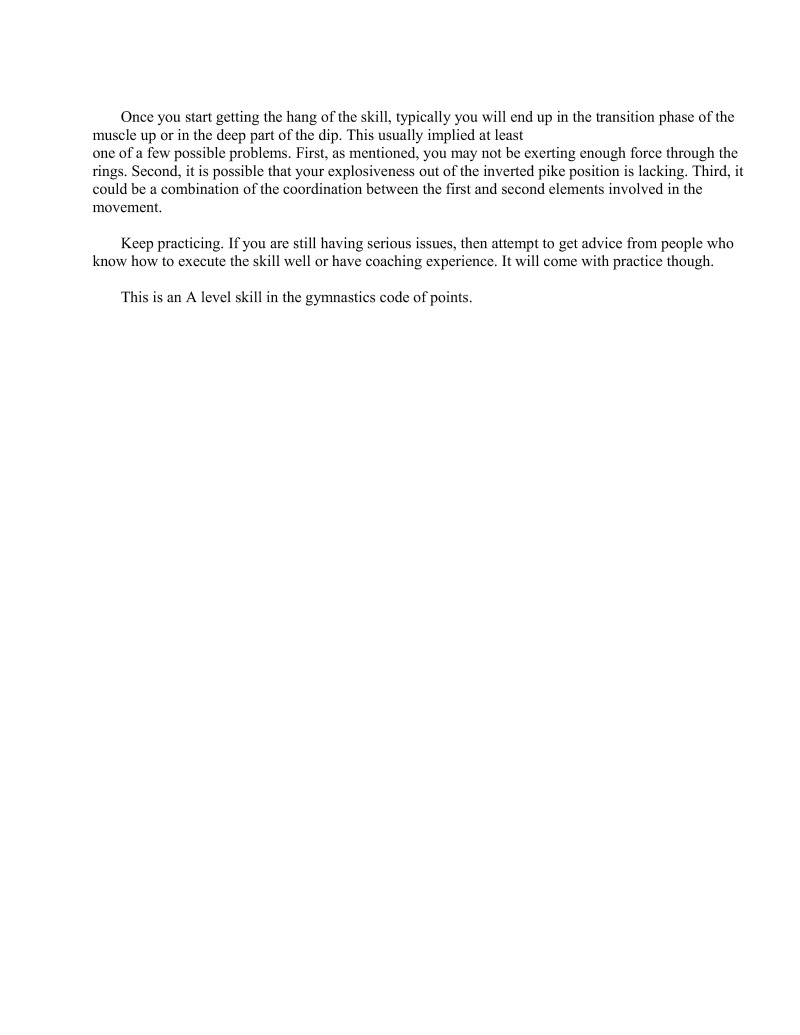
The back kip to support on rings moves in the opposite dircction of the kip to support. Instead of extending forward and shooting the legs at the 45 degree angle to bring us forward, and eventually upright, we will shoot the legs 45 degrees backwards so that we rotate heels over the head into the support position.
First, a false grip may be taken. It makes the movement much easier, but it still can be performed without a false grip if the hands are shified up during the movement. Take your pick. I would suggest starting with the false grip.
From the inverted pike we are going to very quickly extend the hips all of the way open, shooting creating a 45-degree angle between the strap of the rings and the tips of your toes. This will generate upwards momentum for the body so it can rise above the rings, and it will generate the backward rotational momentum. Right after the hips start opening and the body is starting to gather some upwards momentum, we want to exert forward force on the rings.
ce we are nearly upside down at this point the proper movement requires that we push the rings quickly and forcefully forwards in front of our body, while simultaneously pulling them in towards the hips. Ideally, the rings should stay approximately near the position of pants pockets.
Thus, very slightly after opening the hips we are going to pull the rings inward and forward toward your hips to gain the upward and backward momentum. Keep them there. As you get better at this skill, attempt to bring the hands forward and into the hips with straight arms. End this skill in the L-sit position.
This is an A level skill in the gymnastics code of points.
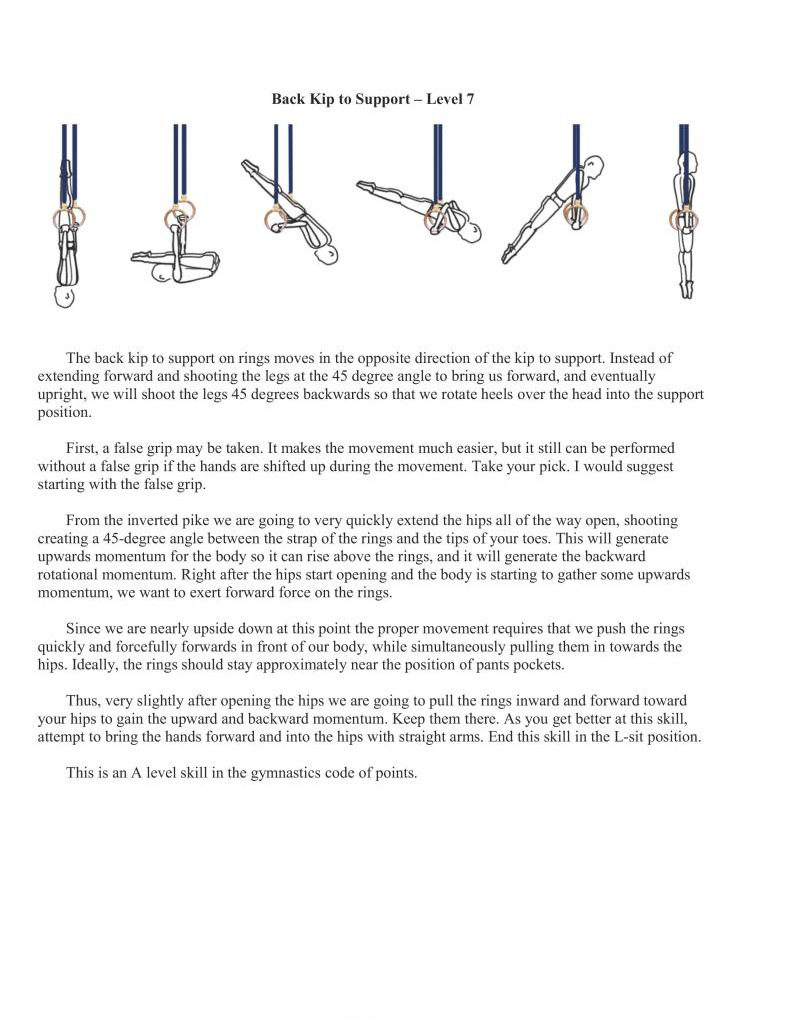
The straight-arm kip to L-sit takes the kip to support and makes it more difficult since the L-sit is achieved before the support position is reached. Since the skill ends in an L-sit position, we need to generate much more momentum from the initial inverted pike hang and, while keeping the arms straight, pull much harder backwards to allow us to get above the rings.
The technique is exactly the same as the previous skill. From the inverted pike explosively open the hips but not all the way so as to maintain the L-sit position. The more quickly this occurs, the easier this skill becomes. Simultaneously, exert the backwards force on the rings to allow us to rotate on the hands up. o the supported L-sit position.
The hard part about this skill is that it must be executed with straight arms the entire time, and it must end in an L-sit position without dipping the legs past parallel. That is why its level is so much harder than the kip to support even though they seem like similar skills.
It is one of the easier rated B skills in the code of points because you do not need extremely good strength to execute this skill, nor extremely good technique. If you have a good combination of both you should be able to execute this skill correctly. This is the first B skill that most trainees achieve.
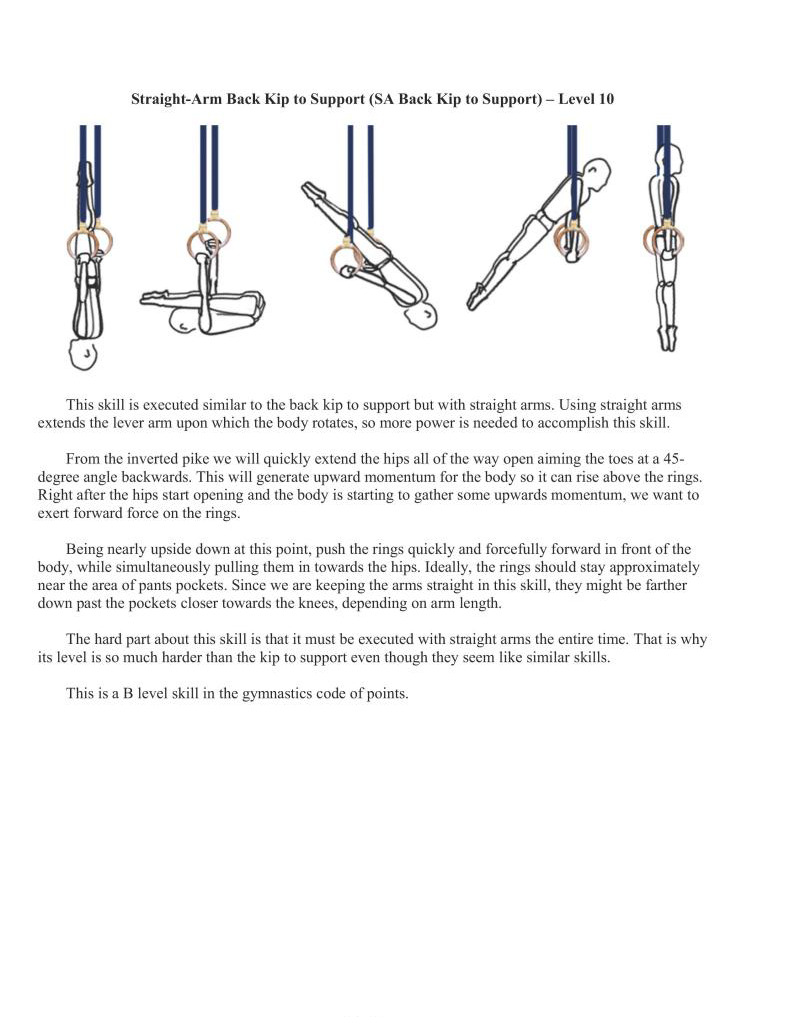
This skill is executed similar to the back kip to support but with straight arms. Using straight arms extends the lever arm upon which the body rotates, so more power is needed to accomplish this skill
From the inverted pike we will quickly extend the hips all of the way open aiming the toes at a 45- degree angle backwards. This will generate upward momentum for the body so it can rise above the rings. Right after the hips start opening and the body is starting to gather some upwards momentum, we want o exert forward force on the rings.
Being nearly upside down at this point, push the rings quickly and forcefully forward in front of the body, while simultaneously pulling them in towards the hips. Ideally, the rings should stay approximately near the area of pants pockets. Since we are keeping the arms straight in this skill, they might be farther down past the pockets closer towards the knees, depending on arm length.
The hard part about this skill is that it must be executed with straight arms the entire time. That is why its level is so much harder than the kip to support even though they seem like similar skills.
This is a B level skill in the gymnastics code of points.
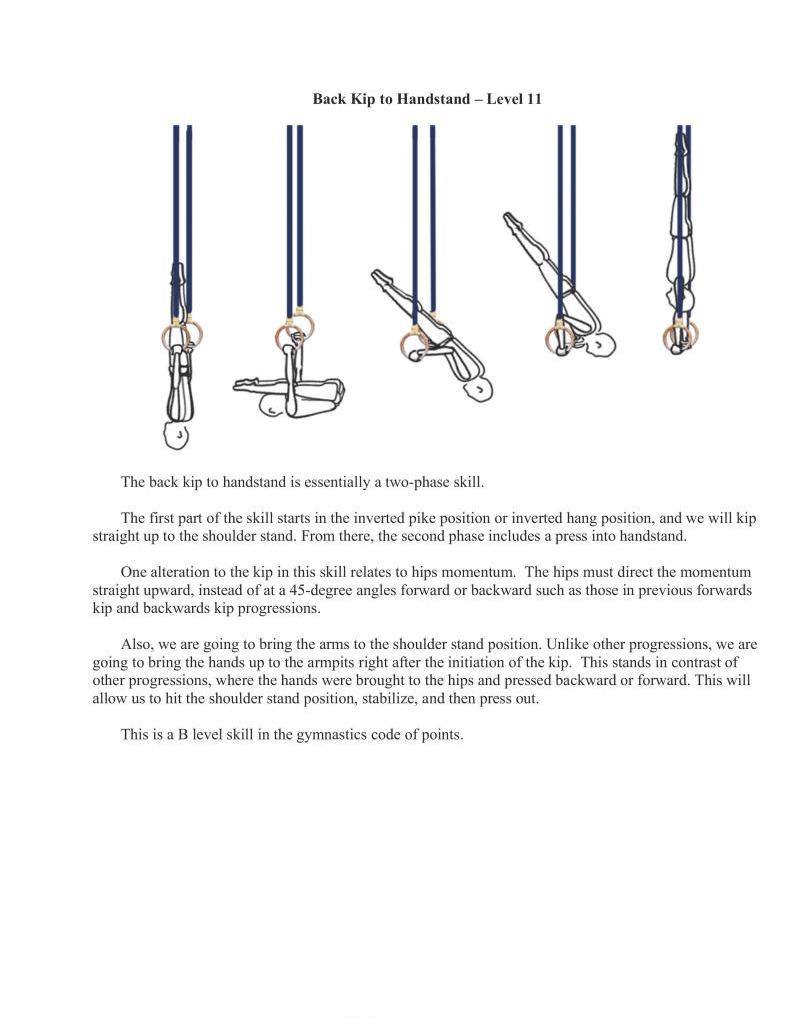
The back kip to handstand is essentially a two-phase skill
The first part of the skill starts in the inverted pike position or inverted hang position, and we will kip straight up to the shoulder stand. From there, the second phase includes a press into handstand.
One alteration to the kip in this skill relates to hips momentum. The hips must dircet the momentum raight upward, instead of at a 45-degree angles forward or backward such as those in previous forwards kip and backwards kip progressions.
Also, we are going to bring the arms to the shoulder stand position. Unlike other progressions, we are going to bring the hands up to the armpits right after the initiation of the kip. This stands in contrast of other progressions, where the hands were brought to the hips and pressed backward or forward. This will allow us to hit the shoulder stand position, stabilize, and then press out.
This is a B level skill in the gymnastics code of points
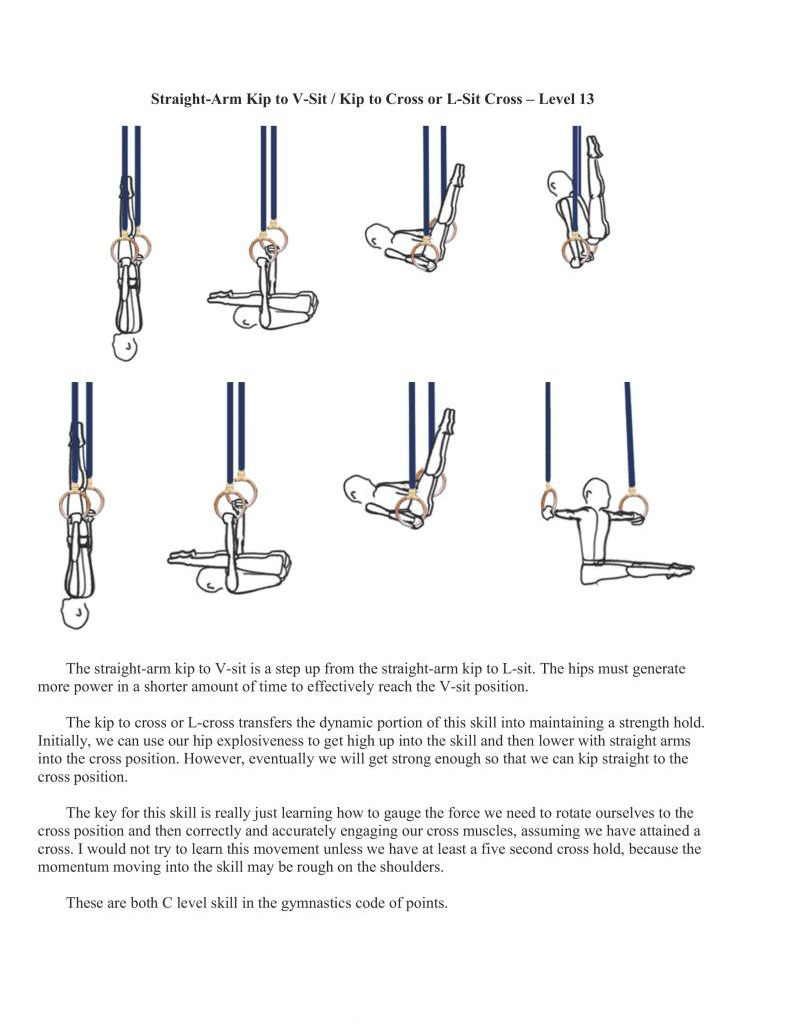
The straight-arm kip to V-sit is a step up from the straight-arm kip to L-sit. The hips must generate more power in a shorter amount of time to ceffectively reach the V-sit position.
The kip to cross or L-cross transfers the dynamic portion of this skill into maintaining a strength hold. Initially, we can use our hip explosiveness to get high up into the skill and then lower with straight arms into the cross position. However, eventually we will get strong enough so that we can kip straight to the cross position.
The key for this skillis really just learning how to gauge the force we need to rotate ourselves to the cross position and then correctly and accurately engaging our cross muscles, assuming we have attained a cross. I would not try to learn this movement unless we have at least a five second cross hold, because the momentum moving into the skill may be rough on the shoulders.
These are both C level skill in the gymnastics code of poins.
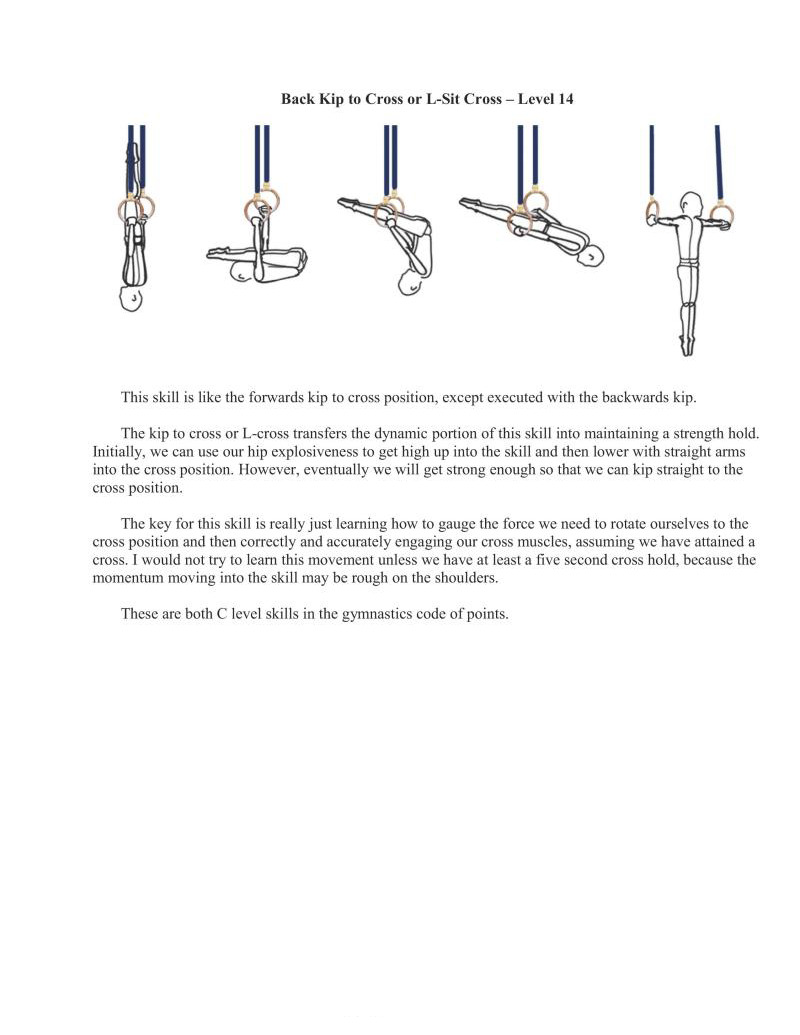
This skill is like the forwards kip to cross position, except executed with the backwards kip.
The kip to cross or L-cross transfers the dynamic portion of this skill into maintaining a strength hold. Initially, we can use our hip explosiveness to get high up into the skill and then lower with straight arms into the cross position. However, eventually we will get strong enough so that we can kip straight to the cross position.
The key for this skill is really just learning how to gauge the force we need to rotate ourselves to the cross position and then correctly and accurately engaging our cross muscles, assuming we have attained a cross. I would not try to learn this movement unless we have at least a five second cross hold, because the momentum moving into the skill may be rough on the shoulders.
These are both C level skills in the gymnastics code of points.
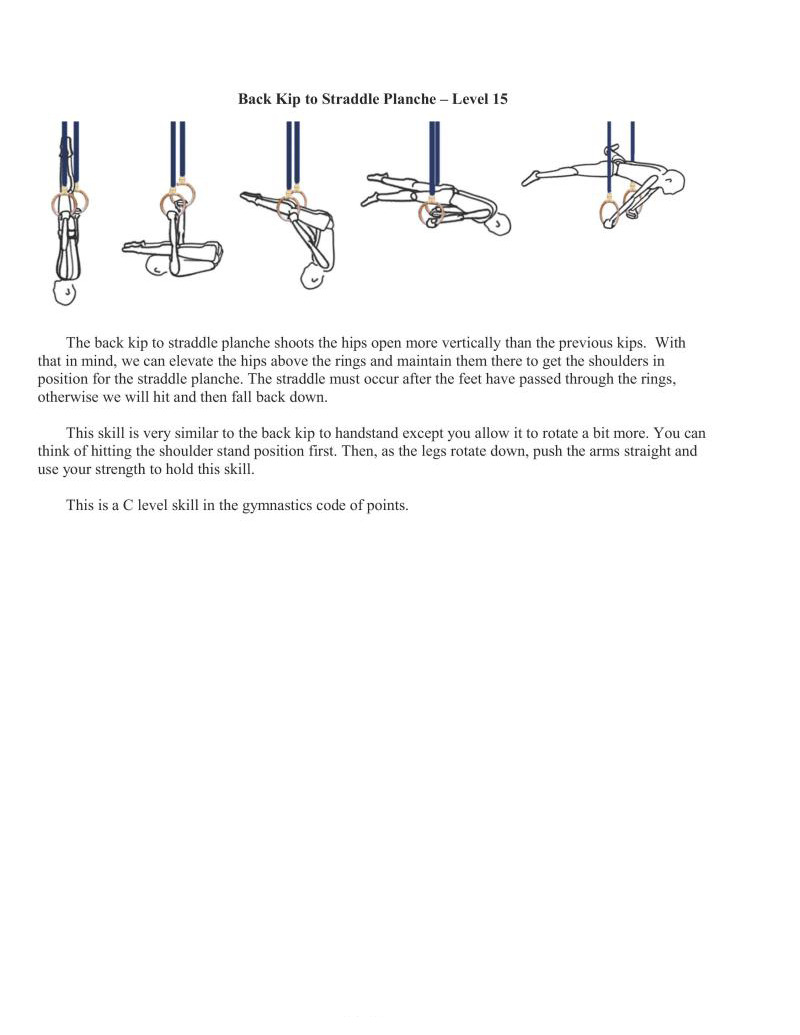
The back kip to straddle planche shoots the hips open more vertically than the previous kips. With that in mind, we can elevate the hips above the rings and maintain them there to get the shoulders in position for the straddle planche. The straddle must occur after the feet have passed through the rings, otherwise we will hit and then fall back down.
This skill is very similar to the back kip to handstand except you allow it to rotate a bit more. You can think of hitting the shoulder stand position first. Then, as the legs rotate down, push the arms straight and use your strength to hold this skill
This is a C level skill in the gymnastics code of points.
The felges are the series of forwards and backwards rolls on rings, to either support or various strength skills. When integrated into routines, they are a lot of fun to perform and show off.
There are no variations of these skills in the tuck position, because the difficulty is too easy, or they are not aesthetically pleasing. However, they can be learned this way before progressing to the pike variations of these skills. Keep this in mind if the pike or straight body variations are too hard at the start.
When you start trying to learn these skills, it is highly recommended that you lower the rings so that they hang at your standing shoulder height. Duc to the nature of these movements, the instability of the rings will often cause you to fall out of suppor. If the rings are too high you can easily injure your shoulders if your feet cannot land on the ground.
The felge progressions are typically more strength based than kipping techniques.
I did not include the tucked versions of the felge forward and felge backward to support. However, they are about 1 progression level easier than their piked counterparts.
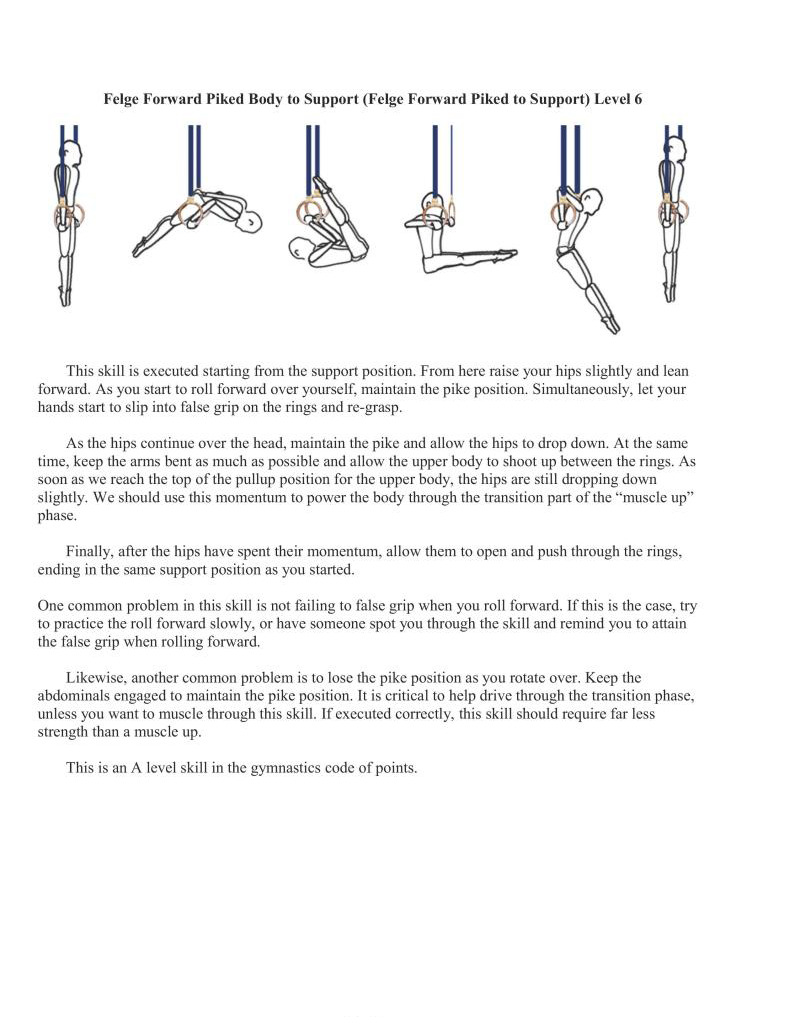
This skill is executed starting from the support position. From here raise your hips slightly and lean forward. As you start to roll forward over yourself, maintain the pike position. simultaneously. let your hands start to slip into false grip on the rings and re-grasp.
As the hips continue over the head, maintain the pike and allow the hips to drop down. At the same time, keep the arms bent as much as possible and allow the upper body to shoot up between the rings. As soon as we reach the top of the pullup position for the upper body, the hips are still dropping down slightly. We should use this momentum to power the body through the transition part of the "muscle up" phase.
Finally, after the hips have spent their momentum, allow them to open and push through the rings, ending in the same support position as you started.
One common problem in this skill is not failing to false grip when you roll forward. If ths is the case, try to practice the roll forward slowly. or have someone spot you through the skill and remind you to attain the false grip when rolling forward,
Likewise, another common problem is to lose the pike position as you rotate over. Keep the abdominals engaged to maintain the pike position. It is critical to help drive through the transition phase, unless you want to muscle through this skill. If executed correctly, this skill should require far less strength than a muscle up.
This is an A level skill in the gymnastics code of points.
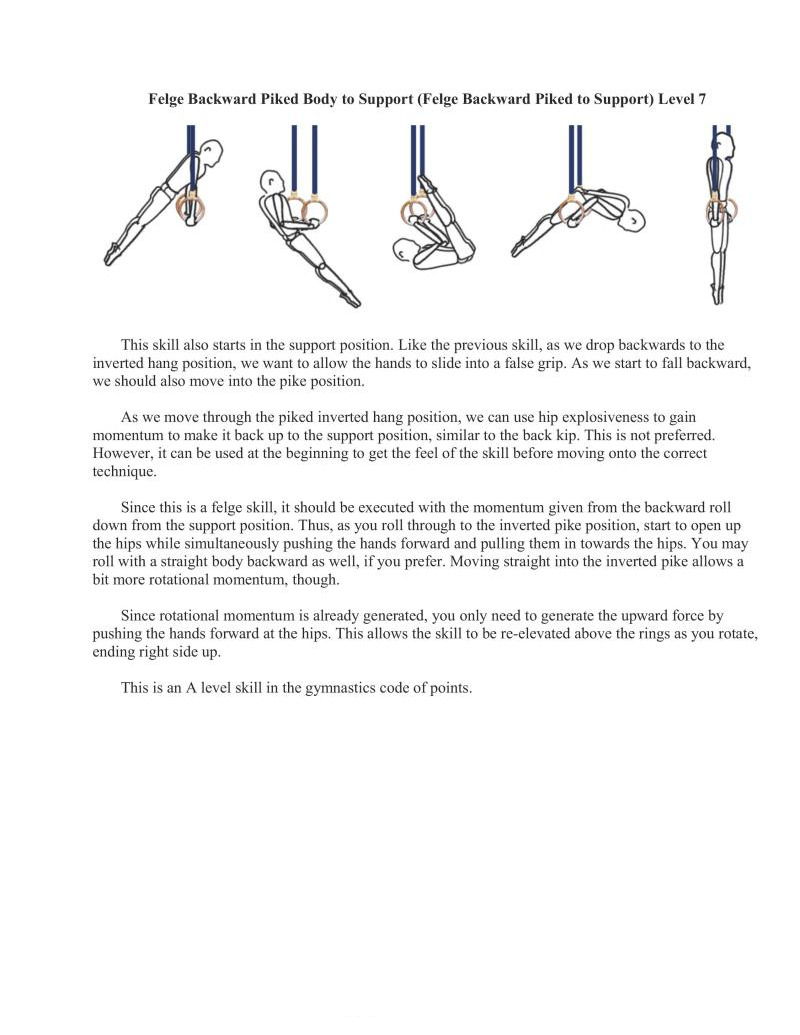
This skill also starts in the support position. Like the previous skill, as we drop backwards to the inverted hang position, we want to allow the hands to slide into a false grip. As we start to fall backward, we should also move into the pike position.
As we move through the piked inverted hang position, we can use hip explosiveness to gain momentum to make it back up to the support position, similar to the back kip. This is not preferred. However, it can be used at the beginning to gt the feel of the skill before moving onto the correct technique.
Since this is a felge skill, it should be executed with the momentum given from the backward roll down from the support position. Thus, as you roll through to the inverted pike position, start to open up
the hips while simultaneously pushing the hands forward and pulling them in towards the hips. You may roll with a straight body backward as well, if you prefer. Moving straight into the inverted pike allows a bit more rotational momentum, though.
Since rotational momentum is already generated, you only need to generate the upward force by pushing the hands forward at the hips. This allows the skill to be re-elevated above the rings as you rotate, ending right side up.
This is an A level skill in the gymnastics code of points.
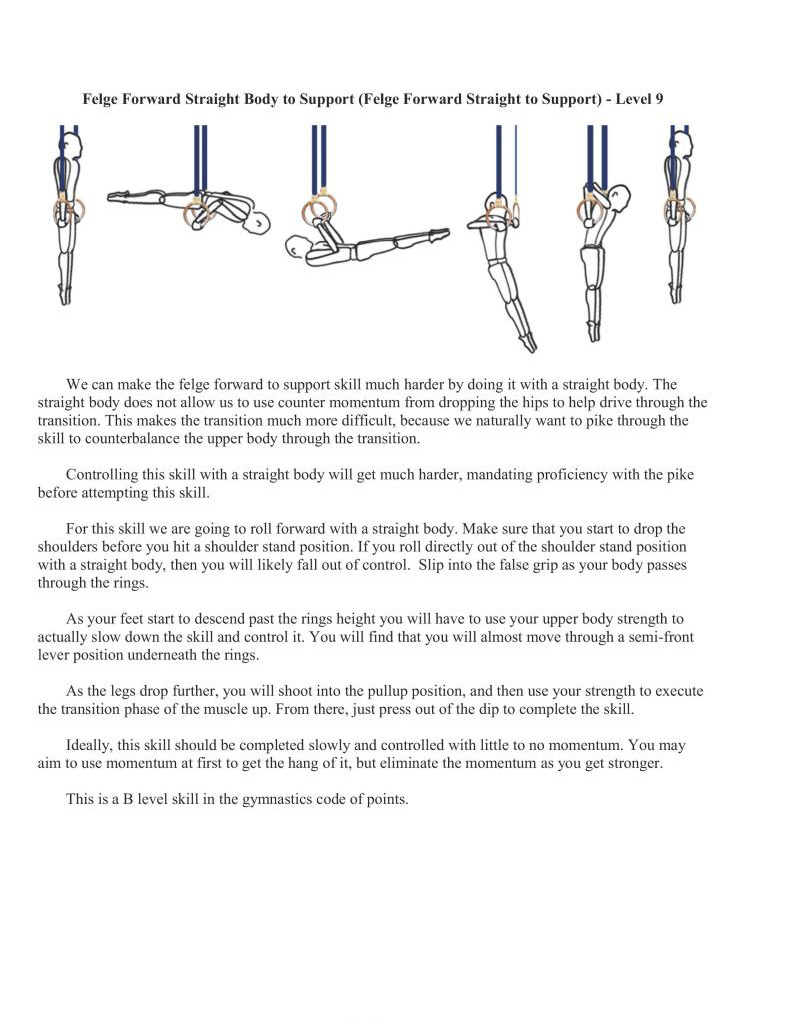
We can make the felge forward to support skill much harder by doing it with a straight body. The straight body does not allow us to use counter momentum from dropping the hips to help drive through the transition. This makes the transition much more difficult, because we naturally want to pike through the skill to counterbalance the upper body through the transition.
Controlling this skill with a straight body will get much harder, mandating proficiency with the pike before attempting this skill.
For this skill we are going to roll forward with a straight body. Make sure that you start to drop the shoulders before you hit a shoulder stand position. If you roll directly out of the shoulder stand position with a straight body, then you will likely fall out of control. Slip into the false grip as your body passes through the rings.
As your feet start to descend past the rings height you will have to use your upper body strength to actually slow down the skill and control it. You will find that you will almost move through a semi-front lever position underneath the rings
As the legs drop further, you will shoot into the pullup position, and then use your strength to execute the transition phase of the muscle up. From there, just press out of the dip to complete the skill.
Ideally, this skill should be completed slowly and controlled with little to no momentum. You may aim to use momentum at first to get the hang of it, but eliminate the momentum as you get stronger.
This is a B level skill in the gymnastics code of points.
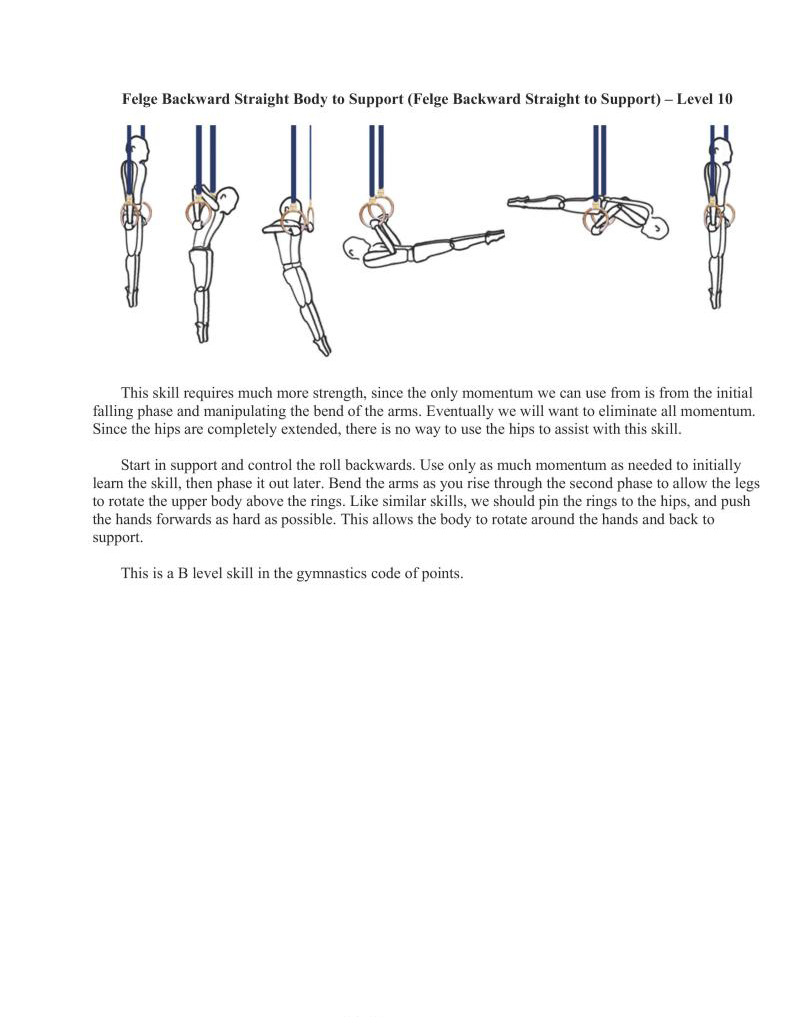
This skill requires much more strength, since the only momentum we can use from is from the initial falling phase and manipulating the bend of the arms. Eventually we will want to eliminate all momentum. Since the hips are completely extended, there is no way to use the hips to assist with this skill.
Start in support and control the roll backwards. Use only as much momentum as needed to initially learn the skill, then phase it out later. Bend the arms as you risc through the second phase to allow the legs o rotate the upper body above the rings. Like similar skills, we should pin the rings to the hips, and push the hands forwards as hard as possible. This allows the body to rotate around the hands and back to support.
This is a B level skill in the gymnastics code of points.
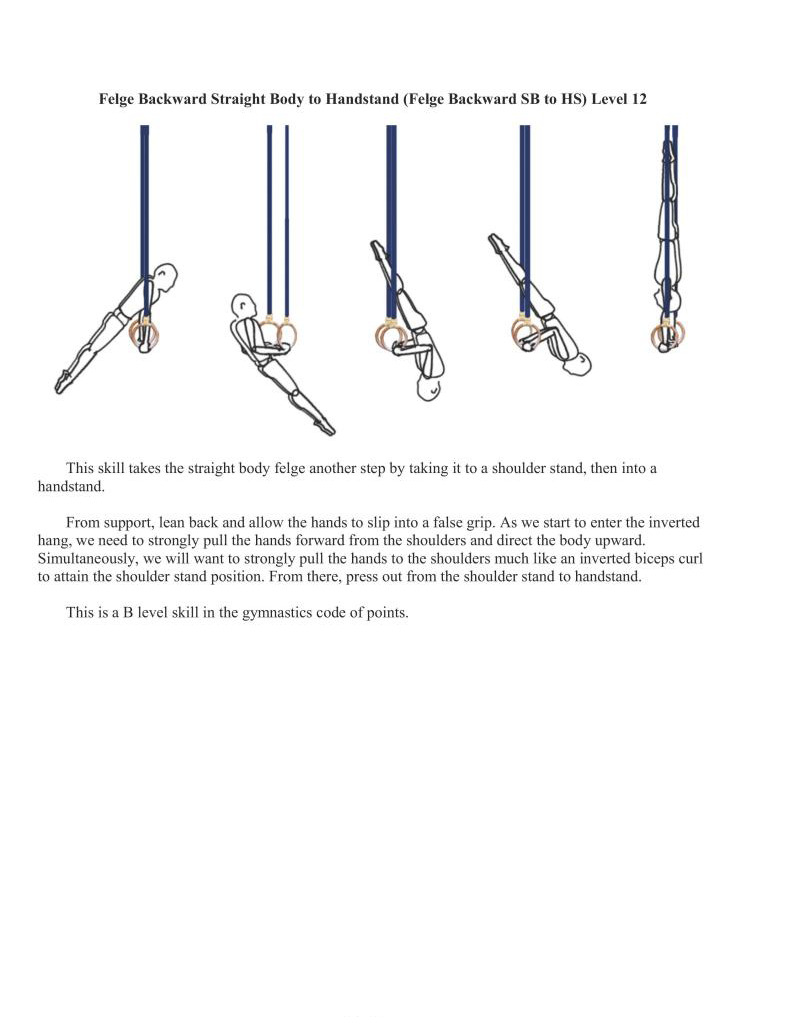
This skill takes the straight body felge another step by taking it to a shoulder stand, then into a handstand.
From support, lean back and allow the hands to slip into a false grip. As we start to enter the inverted hang, we need to strongly pull the hands forward from the shoulders and direct the body upward. Simultaneously, we will want to strongly pull the hands to the shoulders much like an inverted biceps curl o attain the shoulder stand position. From there, press out from the shoulder stand to handstand.
This is a B level skill in the gymnastics code of points.
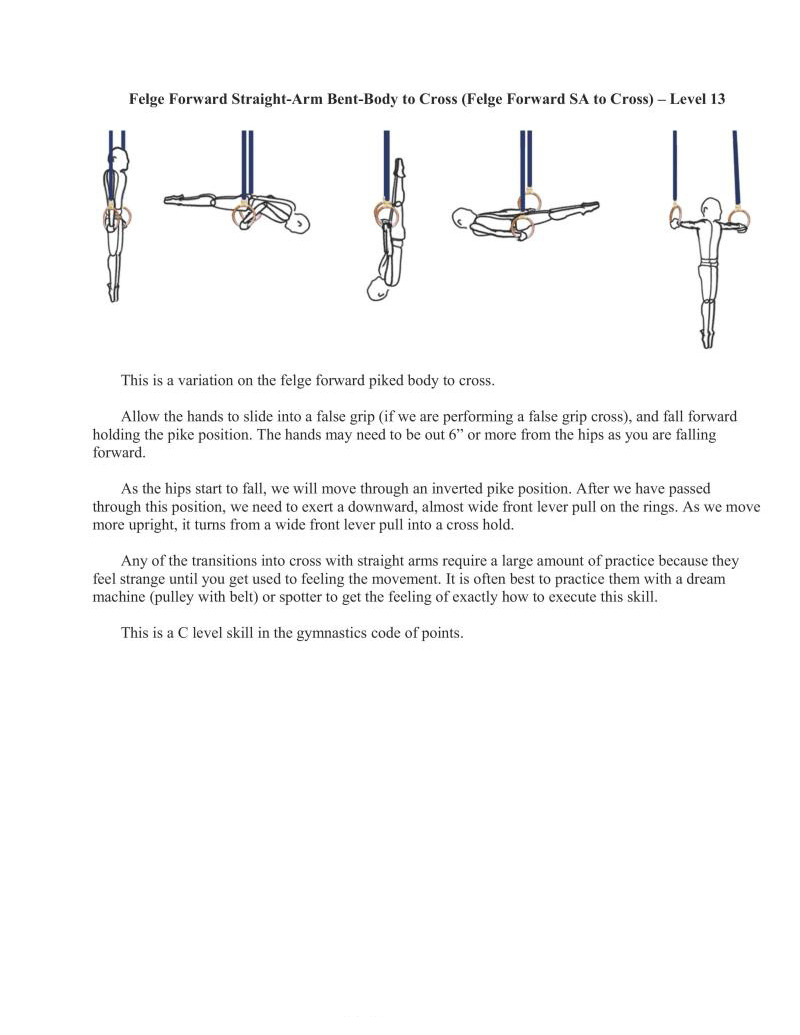
This is a variation on the felge forward piked body to cross.
Allow the hands to slide into a false grip (if we are performing a false grip cross), and fall forward holding the pike position. The hands may need to be out 6 or more from the hips as you are falling forward.
As the hips start to fall, we will move through an inverted pike position. After we have passed through this position, we need to exert a downward, almost wide front lever pull on the rings. As we move more upright, it tums from a wide front lever pull into a cross hold.
Any of the transitions into cross with straight arms require a large amount of practice because they flel strange until you get used to feeling the movement. It is often best to practice them with a dream machine (pulley with belt) or spotter to get the feeling of exactly how to execute this skill.
This is a C level skill in the gymnastics code of points.
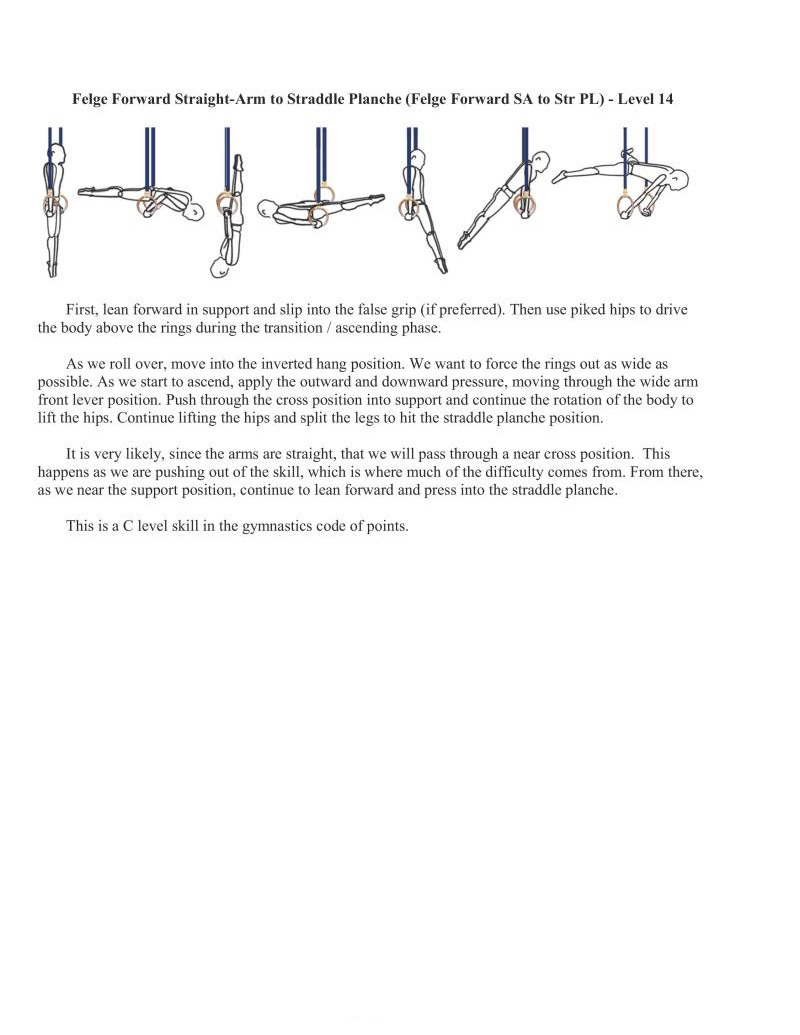
First, lean forward in support and slip into the false grip (if preferred). Then use piked hips to drive the body above the rings during the transition / ascending phase.
As we roll over, move into the inverted hang position. We want to force the rings out as wide as possible. As we start to ascend, apply the outward and downward pressure, moving through the wide arm front lever position. Push through the cross position into support and continue the rotation of the body to Tift the hips. Continue lifting the hips and split the legs to hit the straddle planche position.
It is very likely, since the arms are straight, that we will pass through a near cross position. This happens as we are pushing out of the skill, which is where much of the difficulty comes from. From there, as we near the support position, continue to lean forward and press into the straddle planche.
This is a C level skill in the gymnastics code of points.
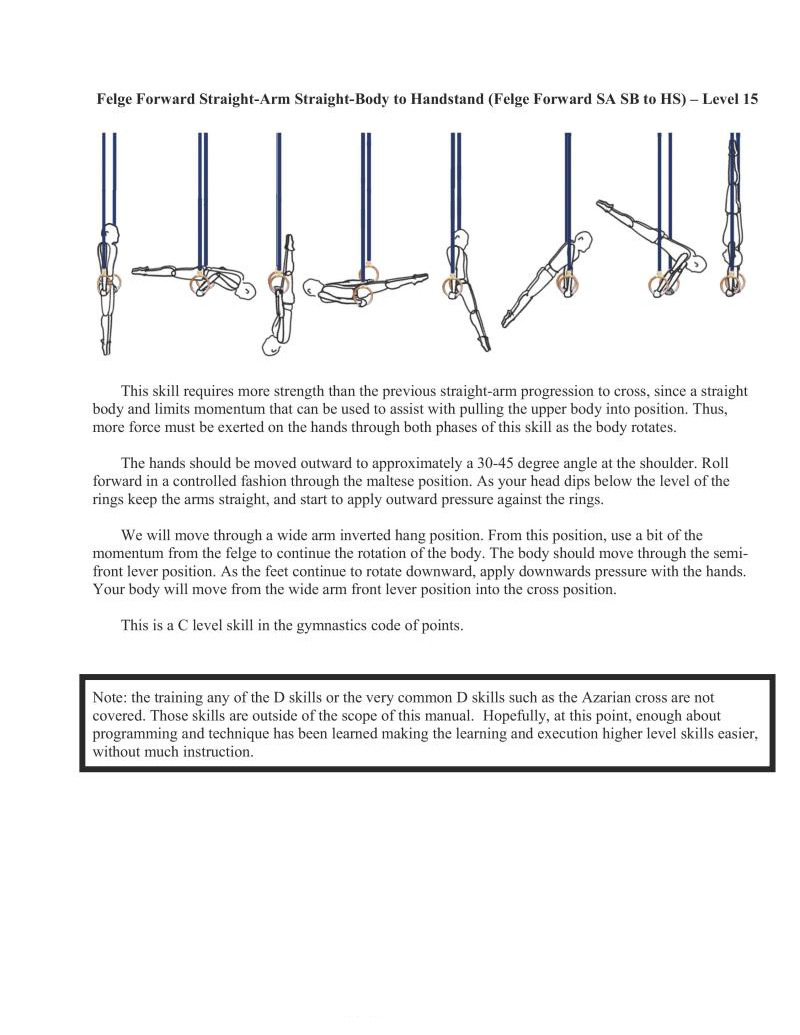
This skill requires more strength than the previous straight-arm progression to cross, since a straight body and limits momentum that can be used to assist with pulling the upper body into position. Thus, more force must be exerted on the hands through both phases of this skill as the body rotates.
The hands should be moved outward to approximately a 30-43 degree angle at the shoulder. Roll forward in a controlled fashion through the maltese position. As your head dips below the level of the rings keep the arms straight, and start to apply outward pressure against the rings.
We will move through a wide amm inverted hang position. From this position, use a bit of the momentum from the felge to continue the rotation of the body. The body should move through the sem front lever position. As the feet continue to rotate downward, apply downwards pressure with the hands Your body will move from the wide arm front lever position into the cross position.
This is a C level skill in the gymnastics code of points.
Note: the training any of the D skills or the very common D skills such as the Azarian cross are not covered. Those skills are outside of the scope of this manual. Hopefully, at this point, enough about programming and technique has been learned making the learning and execution higher level skills easier, without much instruction.
You may noticed that I did not cover all types of bodyweight exercises that can be used. I wanted to make sure to include most of the important exercises to strength development. As this book is already over 500 pages, I am unable to include them all even if there are some that are useful. There may even be creative exercises that are effective that I am not even aware of at the moment.
For example, I did not include any variations of regular rope climbs, banging leg raises, rings flys, ete. This is not because they are not important. I feel that other variations of exercises are as effective or more effective than these exercises in certain goal scenarios.
This is not to say they are not that useful though. While I typically recommend active compression work, L-sit/V-sit/manna progressions, and the other core work that comes from many of the levers over hanging leg raises, the hanging leg raises and their progressions can be effective for building good core strength as well. If you prefer this progression of exercises there is nothing wrong with continuing to perform them,
The same is true with an exercise like rings flys. They are useful for specifically helping with elbow conditioning and assisting with pectoral hypertrophy. If these relate to your goals or you think are a better exercise fit than other exercises on the chart then you should use them for sure.
Therefore, if you are interested in helping to enhance the charts by adding exercise progressions to various levels feel free. It is always good to improve a useful resource to make a better one. If you believe you have some useful ideas, make sure to help spread the word on the Internet or in your community. Bring them to my attention. New ideas are always welcome.
Previous Chapter ... ... Next Chapter