Previous Chapter ... ... Next Chapter
Most information on bodyweight training can be found scattered throughout the web. Fortunately, there are now some resources available on many progressions used in bodyweight strength training.
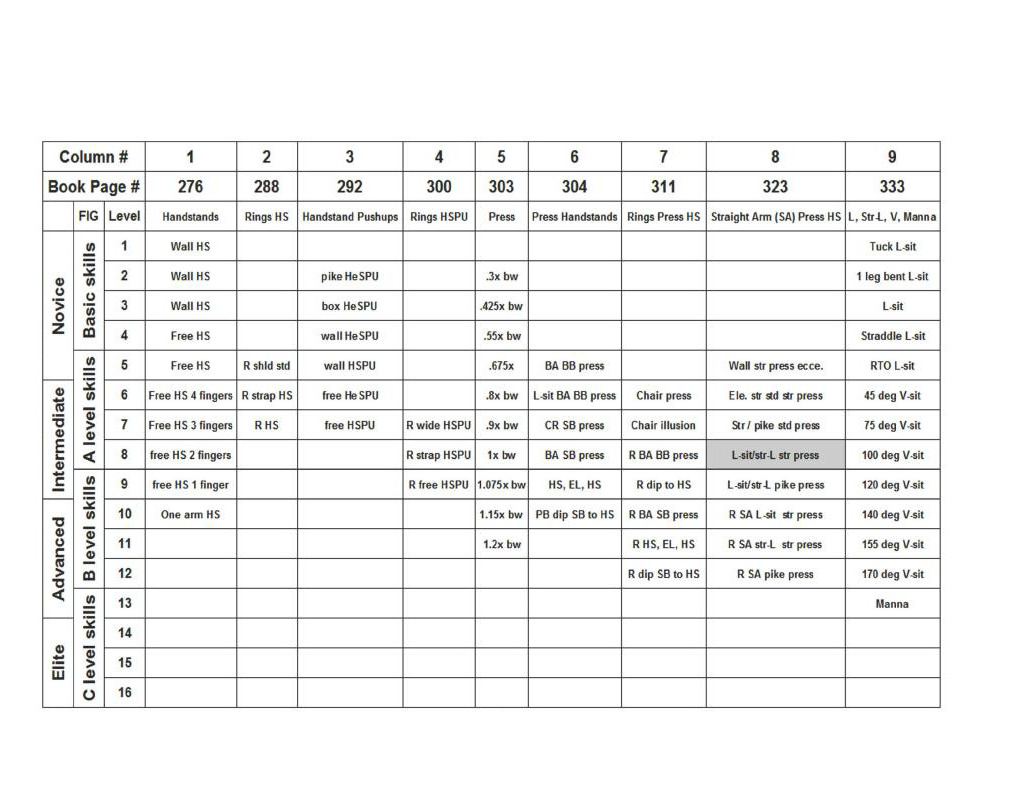
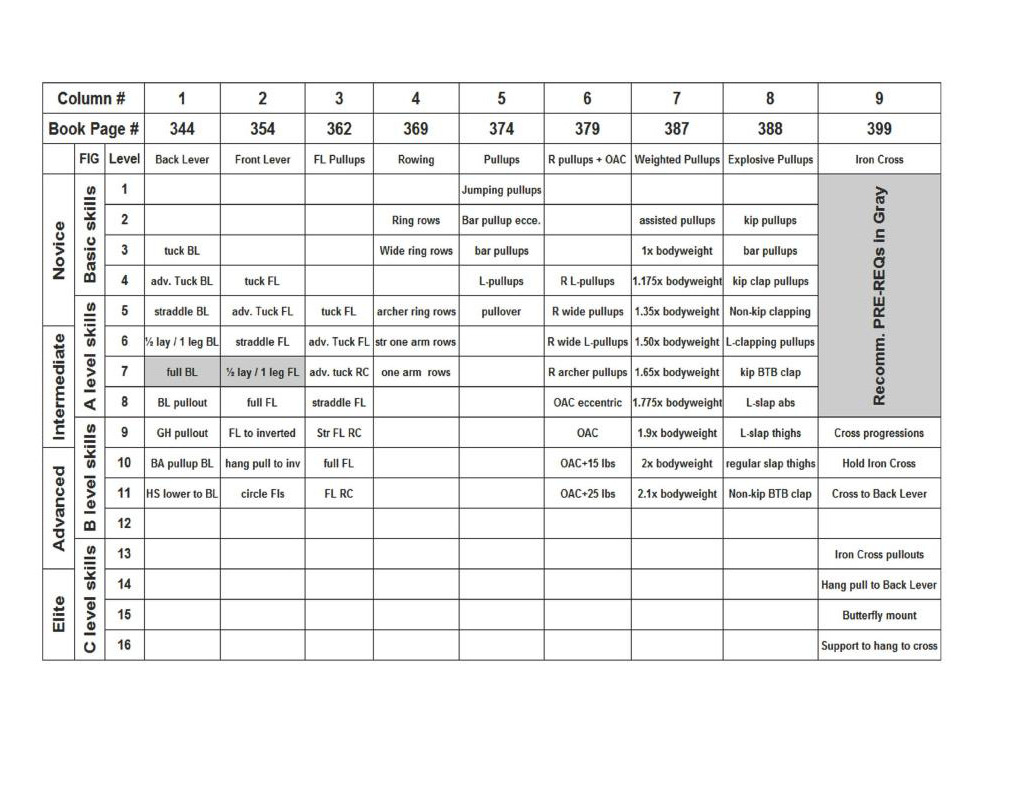
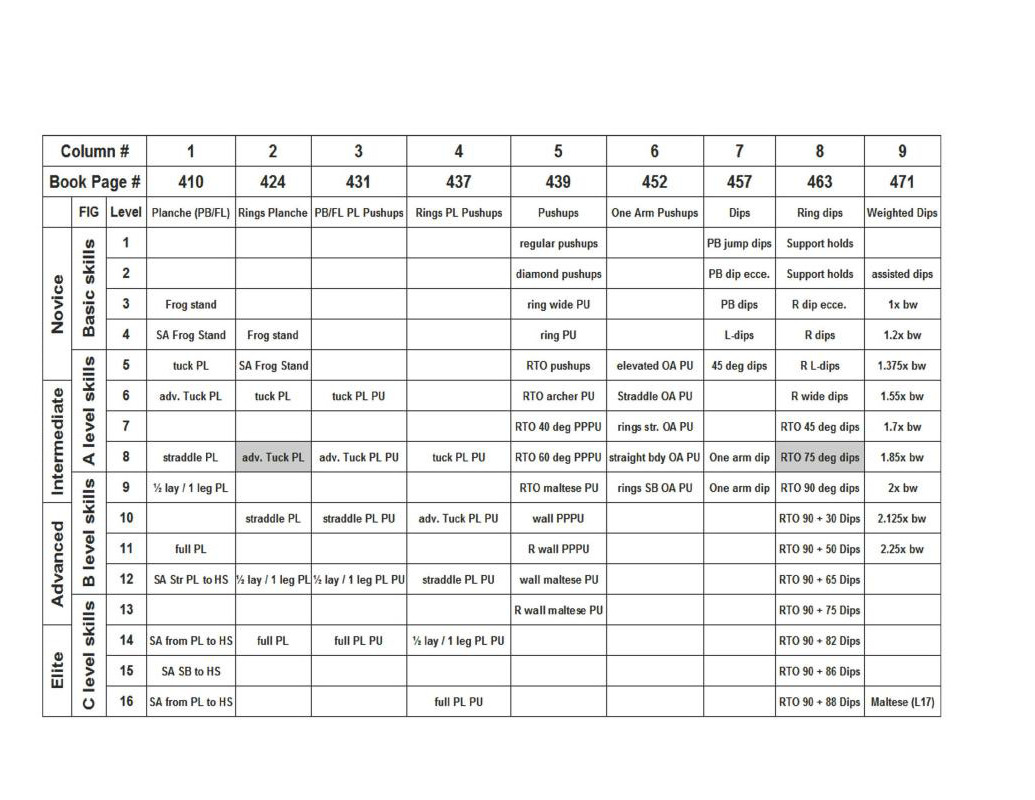
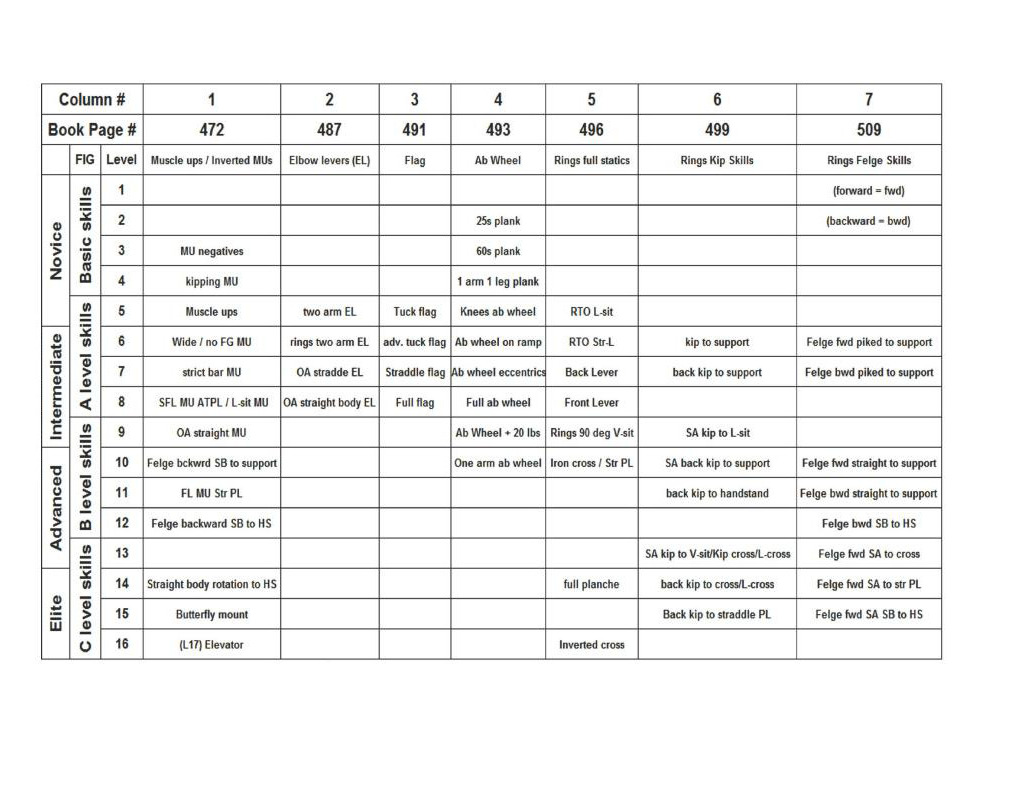
However, there is virtually no way to ascertain levels of skill and strength progression. Therefore, I have put together some strength and progression charts which I will hope will change the way we think about bodyweight exercises. What I mean by skill and strength progression charts is much like the "skill charts" that you would see in an RPG game. You level your character by training and then use your "skill points" on raising your various stats and skill points on abilities. This is much like the bodyweight skill and strength progressions.
In bodyweight strength training there is a wide range of different pulling, pressing, static strength elements, and handstands that can be learned. Each of these requires specific training and much time and effort to be put into learning them to progression effectively. Likewise with RPGs, once you learn a skill or attack there are certain new progressions that are available for you to start learning.
The one thing that is novel about the charts in this book is that many of the elements are based on the Federation International of Gymnastics (FIG) level of difficulty for skills. In the code of points (COP) there is a difficulty based A to F scale. A elements are the easiest, and F elements are the hardest. FIG regulates the COP which standardizes the basic difficulty level of all gymnastics movements — swinging, strength, and dismount elements — allowed on each apparatus.
Obviously, this book will not discuss the merits of swinging elements or dismounts, but it will focus on the various technical and strength progressions that allow gymnasts to develop insane amounts of strength, flexibility, muscle mass, and a pretty good looking body.
The goal here is to categorize and give you, the reader, and idea of where all of the bodyweight strength progressions lie in difficulty. Therefore, you will have a much easier time of choosing particular skill sets and chaining progressions together. Thus, charts will give you an approximate knowledge of where each skill and strength elements lie on the continuum.
I have broken down the skill charts into four specific categories — basic skills, A level skills, B level skills, and C level skill. Each of these levels of skill have four subcategories upon which the difficulty of the exercises increase from level to level. I have denoted in Appendix B the exercise description chapter — which skills are actually in the code of points at certain levels as well.
Additionally, I broke down the charts into specific levels of strength ability that is consistent with the programming that will have to be applied to each category. These categories are novice, intermediate, advanced, and elite level strength
The level of programming will vary between these levels of strength novice, intermediate, advanced, and elite — because we cannot expect to train as someone who is stronger or weaker than us. At different levels of adaptation, respond to stress a bit differently. Specifically, as we increase our strength we tend to need more intensity and volume to stimulate adaptations. Thus, programming will start to become more complex. We will explore these concepts later in this chapter.
The ability to progress consistently is the focus of any sport and any weight lifting program. The same is true for gymnastics and bodyweight strength training. I keep repeating this often because we can learn from the concept that gymnastics and bodyweight training is not so different from other sports and. barbell training.
As we look at the charts and track our abilities it may be noted that we are advanced in one area or lagging in another. This is common. We each have our own strengths and weaknesses depending on our genetics, limb lengths, training schedules, sleep schedules, nutritional factors, stress in our life, etc.
What I would suggest is to focus more on weaknesses and bringing the deficient skills and strength progressions up to the level of our more advanced abilities. Shoring up the our weaknesses will help keep us healthier than if we solely pursued one set of strength or skill progressions. This is especially important if there is a vast difference in pulling versus pushing or a lack of development especially in regards to the
For instance, even if our goal is planche and only planche and we do not care about front lever, back lever, manna, etc. we still have to get strong in the posterior shoulder to attain the necessary muscle mass and strength to achieve the planche progressions. Subsequently, it is necessary to work to shore up our weaknesses as much as possible. This will allow us to facilitate optimal progress and stay uninjured.
I would strongly recommend making a copy of these exercise charts because it will be awkward to lip back and forth in the book to the exercise section located at the end of the book. However, if one not accessible I have tried to provide for this by adding some extra sets of charts in Appendix C.
These copies will be a good comparison to mark down our goals and cross off exercises that we have completed. This will help you keep track of your progress as well.
While those who have been in the gymnastics and bodyweight strength communities may know the common abbreviations and technical terms of the skill and strength progressions on this chart fairly well, most of you will have to refer to the chart and the look at the progression to see what they are.
At this point I think it is a good idea to define the level of "competency" that we will expect to progress on to the next skill or strength level. There are always many questions about:
I think the best way to address this is through an explanation. Normally, in competitive gymnastics a static hold counts if we can hold the skill solidly for 2-3s. However, for our purposes I do not like this amount of time because it is possible to mask a lack of strength with adrenaline. Additionally, if the holds are too short it is hard to get any significant amount of volume to elicit a training effect, so this reasoning is two fold.
Alternatively, I would like to suggest that 6s static holds to count as competent to move up to the next skill level. For example, if we were working the progression of tuck planche, and we could hold the next progression, the advanced tuck planche, 6s then we are ready to move up a skill level
For dynamic movements, I would say 3 repetitions of clean technique should be required to move up 1o the next progression. While it can be argued that you should start moving up after you perform 12 repetitions, I do not agree with this for the simple reason that it is hard to get enough volume to sufficiently force adaptations without being able to do at least sets of 3 repetitions.
As a comparison, we work up to 1 or 2 RM to assess our maximal ability in weight lifting but rarely do we use them as a training stimulus unless we are on an extremely high frequency program. In bodyweight strength training at a level that is below intermediate status we are not going to be working extremely high frequency with the strength progressions because that is the fast track to burnout and overuse injuries. Thus, I am setting a competence level of 3 repetitions before moving up.
Likewise, with eccentrics skills, if we can complete multiple repetitions over 3 seconds then we can consider ourselves competent in the movement. Like the statics/isometrics, this shows good overall control of the movement so long as there is no excessive jerking on the connective tissue that may lead to acute injuries. For example, if we can do a 3s eccentric/negative for the one arm chin-up progression then we may be strong enough to start training them (although I will delineate specific prerequisites that I would like you have before you begin training that movement).
Skills such as handstands tend to rely more on balance than on strength. Many of them have some level of prerequisite strength; however, after that strength is attained they become mostly practiced based to acquire. Like the static holds, a solid hold to be able to progress to the next level should be at about 5-6 seconds to show a level of competency to solidly move up. However, in most of the time based skill exercises it is imperative to actually practice them to be able to hold them for longer periods of time.
For these skills even working "backwards" progressions is very useful in many cases though. The more time we spend in skills like handstands the more we improve. Being an expert in a subject requires 10,000 hours of practice, so it is going to take a lot of work to get to that level of ability.
These generalized assessments of competency will help you evaluate when you should progress or show you what you need to work on more to proceed. We will talk about specific programming options, and what to do if we get stuck between levels later.
The programming needs for the novice are different than than those with intermediate, advanced, or elite strength.
For example, classic barbell beginner programs have a very basic level of complexity. They focus on the major compound lifts such as the squat, deadlift, and bench press. This is ideal for those just starting out because they can progress very quickly, often from session to session. As we improve our abilities in strength and hypertrophy it takes a progressively greater stress to cause similar adaptations to occur. Thus, complexity of programming must increase through changing the structure of the workouts to adjust intensity, volume, repetitions, and frequency.
Regarding the listed progression charts I have decided to categorize them into 4 different levels of ability. This should make it clear that programming adjustments may have to occur at or around each of the different levels. This will be talked about later in the specific programming sections.
I would not say changes must come when transitioning between levels because everyone is different. However, it gives an indicator at the times that training programs may need to be modified if progress starts to plateau for most trainees. There will always be those few who can ignore that who are already strong, and there will be those who will have to start using more complex programming techniques earlier.
The charts are categorized in 16 different levels of strength and skills. When you look at each of the levels they show a similar level of ability across horizontally. Each of these 16 levels are divided into four groups of four. As you can see from the left hand side each quartile is categorized into in basic skills, A level, B level, and C level gymnastics skills.
I have broken these down into 4 distinct categories of programming based primarily on our athletic skill standards.
Gymnasts and gymnastics coaches should note that when looking at the charts the strength movements that are considered advanced level such as iron cross, full planches, etc. are actually considered intermediate level strength moves in gymnastics. Likewise, elite level skills are more advanced
level strength skills. The upper level world class strength transitions are the elite skills which will not be discussed in this book.
The concepts themselves for attaining strength are the same. You will just be taking your gymnasts further along past the abilities on these chars. You should aim for consistent progress based on the programming measures delineated in this book or other resources. The only difference is that there is a. consistently higher level of volume of skill work in gymnastics, so that may take away from specific strength training. However, since gymnastics is a lifetime sport where the strongest gymnasts will have at least 10-15+ years of training under their belt this is fine.
These will be explained more in depth in the programming section.
There are a diverse amount of exercises in bodyweight training that are only really limited by the creativity of the individual. However, there are very few exercises I insist should be in your training program. The ones that are recommended are recommended for important reasons. Let us discuss why.
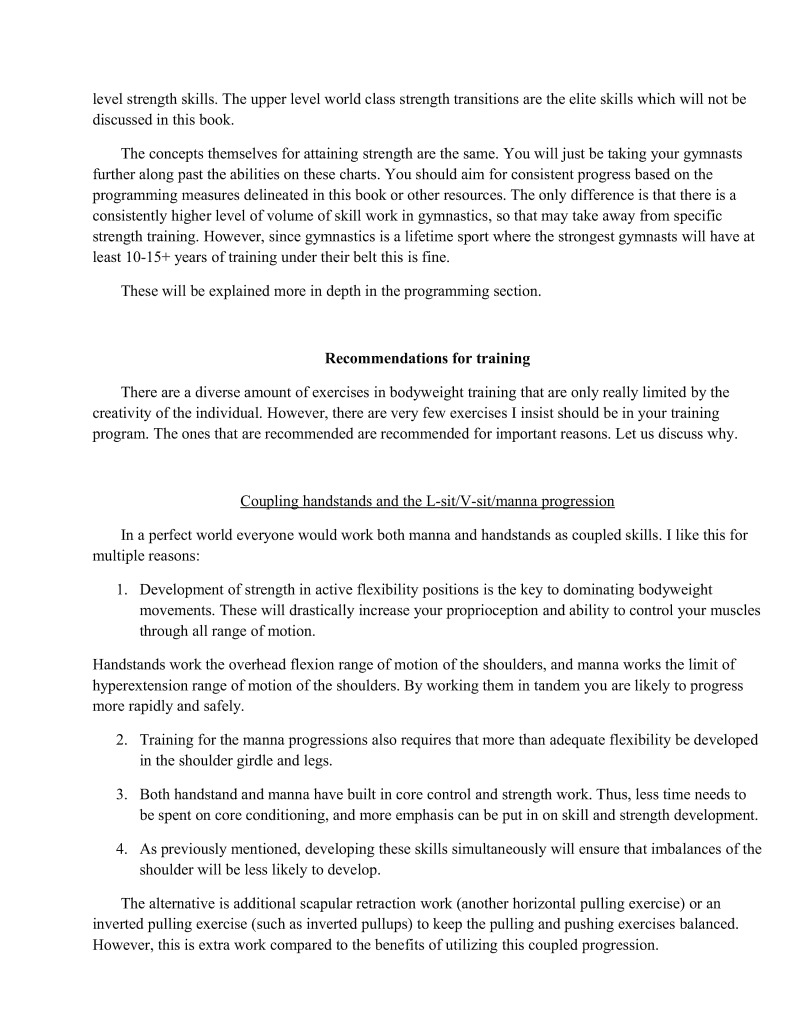
In a perfect world everyone would work both manna and handstands as coupled skills. 1 like this for multiple reasons:
Handstands work the overhead flexion range of motion of the shoulders, and manna works the limit of hyperextension range of motion of the shoulders. By working them in tandem you are likely to progress more rapidly and safely.
Training for the manna progressions also requires that more than adequate flexibility be developed the shoulder girdle and legs.
Both handstand and manna have built in core control and strength work. Thus, less time needs to be spent on core conditioning, and more emphasis can be put in on skill and strength development.
As previously mentioned, developing these skills simultaneously will ensure that imbalances of the shoulder will be less likely to develop.
The alternative is additional scapular retraction work (another horizontal pulling exercise) or an inverted pulling exercise (such as inverted pullups) to keep the pulling and pushing exercises balanced. However, this is extra work compared to the benefits of utilizing this coupled progression.
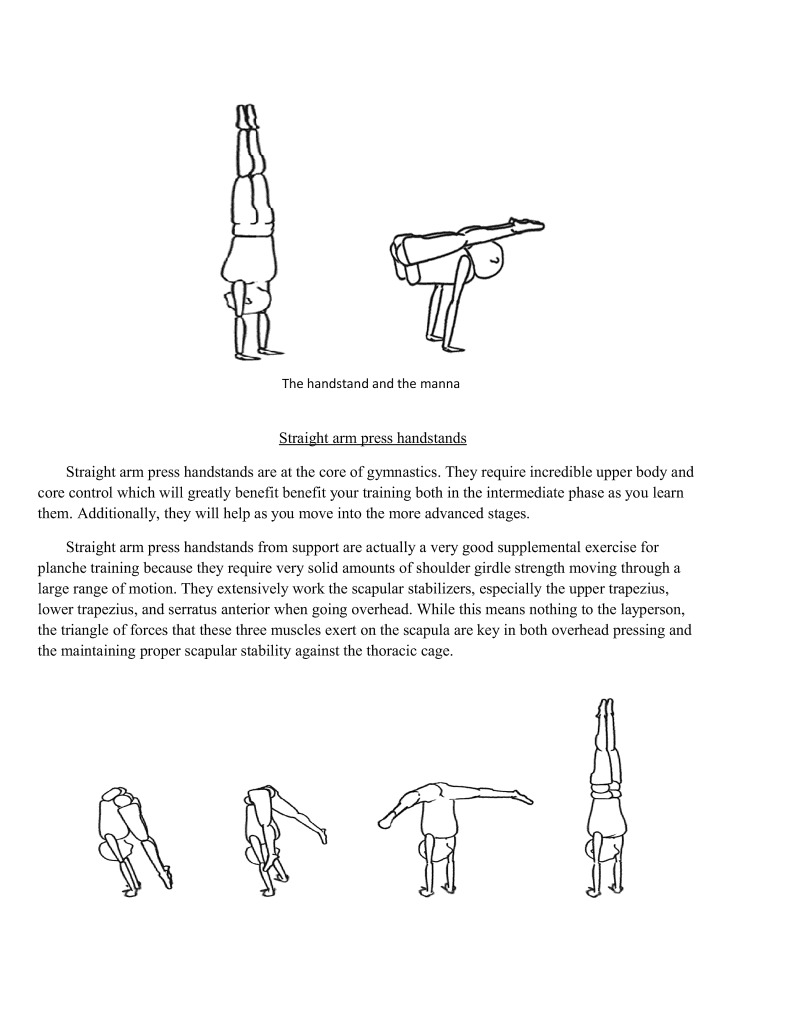
Straight arm press handstands are at the core of gymnastics. They require incredible upper body and core control which will greatly benefit benefit your training both in the intermediate phase as you learn them. Additionally, they will help as you move into the more advanced stages.
Straight arm press handstands from support are actually a very good supplemental exercise for planche training because they require very solid amounts of shoulder girdle strength moving through a large range of motion. They extensively work the scapular stabilizers, especially the upper trapezius, lower trapezius, and serratus anterior when going overhead. While this means nothing to the layperson, the triangle of forces that these three muscles exert on the scapula are key in both overhead pressing and the maintaining proper scapular stability against the thoracic cage.
Likewise, they are an extension of mastering the handstand as you can easily hold handstands once you can control them from a straight arm press. This also applies to the specific bent arm pressing. Once You master straight arm press handstands (straddle press at the very least), most if not all of trainees will be able to do a bent arm press the as well. The same is not true in the opposite direction which is why this skill must be developed first or at last concurrently.
Plus, they look cool.
I do not specifically have any other recommendations that I would say are mandatory like the other three exercises. However, I have some other suggested recommendations.
Handstand pushups, rope climbing (if available), and full back lever development are very important o the process of developing high level strength. The reasoning behind this is because not only help with the development of neuromuscular strength, but also through building up of connective tissue and joint integrity. Thus, they are likely to help significantly in the development of higher upper level skills. Indeed, I have some of these exercises as prerequisites to other higher level strength progressions on the charts and in Appendix B. I only have a small section on rope climbing in Appendix B, but if you have access to a rope you should definitely utilize it
Just remember to organize your workouts so that you can keep your body structurally balanced and injury free. The rest is really up to you and what you want to accomplish. Have fun.
Pull out your sheet with a list of categorized smart goals,
Also, print out progression charts at the end of this chapter, or obtain some from the extras in Appendix C. Two copies will suffice.
First, see if can find the progressions on the chart for all of the goals you have. Make note of them and progressions grouped to the right or left of them. I tried to group skills that have good carryover close together. These can be supplements in progressions along with the main exercises.
Secondly, I assume if you are reading this book that you have some idea of your capabilities. If you have any highlighters I would suggest highlighting where you want to be in one color, and highlighting your current abilities across all of the charts in another color. If you do not know what some exercises are then refer to the exercise section located in Appendix B.
These two steps will give you the baseline of where you are and where you want to be. Thus, we will use the exercises in between to bridge the gap which we will talk about a bit more in the next section.
Print out the charts or use the extras in Appendix C so you can follow along as you read through the rest of the book.
For competency in movements we can summarize:
For primary balance skills we want to be able to hold them least 5-6s at the next level before before progressing completely to that level. However, longer holds are ideal for balanced based skills.
For static skills we want to be able to hold them least 6s at the next level before before progressing completely to that level.
For dynamic strength progressions we want to be able to perform 3 solid repetitions at the next level before before progressing completely to that level.
For eccentrics we want to be able to to control a solid 3s negative for at least 3 repetitions at the next level before before progressing completely to that level.
The main exercises I recommend developing almost in a mandatory manner are handstands with the L-sit/V-sit/manna progression and straight arm press handstands. Other exercises that are strongly recommended are handstand pushups, rope climbing (if available), and full back lever development (before any of the other statics, especially the planche).
Previous Chapter ... ... Next Chapter