Previous Chapter ... ... Next Chapter
Before we consider selecting exercises to compliment our goals and forming them into routine, we need to consider how particular exercises will affect our bodies.
The most absurd example, of course, is when we look into a typical commercial gym. If you have never done this you will see many guys performing exercises focused on increasing the aesthetics of their beach muscles." The exercises that are abused the most are the bench press and biceps curls. They are under the delusion that this will make them attractive or big and strong
The shoulder is unique because it allows for most range of motion of any joint in the upper body. That is to say it has the capacity for the greatest amount of mobility. However, the small amount of joint contact space also means that any sort of imbalance that may develop puts the shoulder at risk for pain and injuries. Thus, it is extremely important to build a routine focused on optimal shoulder health. After all, how can we train if we are in injured or in pain?
Therefore, our first axiom is:
This is not to say we are going to ignore the elbows, wrists, and rest of the articulations in the upper body. Rather, focusing on the shoulder will allow us to correctly select exercises that will build a properly balanced routine.
The second axiom builds off of this point:
All upper body moves go through the shoulder. For this reason alone I believe most of the exercise selection of a routine should be based upon the different articulations of the shoulder.
Bodyweight skills have a unique quality that sets them apart from typical barbell exercises. This unique quality is that many of them require excellent upper body flexibility/mobility to perform. For example, proper handstands require 180 degree shoulder mobility and strength in that position. Likewise, manna, back lever, and one arm pullups all have shoulder mobility requirements that need to be properly developed to ensure success.
The simple method of maintaining structural balance
There are two guidelines for exercise selection that I use. The simplest is based on using push and pull exercises to offset each other. This will allow us to maintain a healthy balance of strength and hypertrophy at the shoulder. Pulling and pushing exercises are defined below.
Any exercise in which the center of mass of the body is moving towards the hands is a pulling exercise
Any exercise in which the center of mass of the body is moving away from the hands is a pushing exercise
This works for most bodyweight exercises in almost all cases.
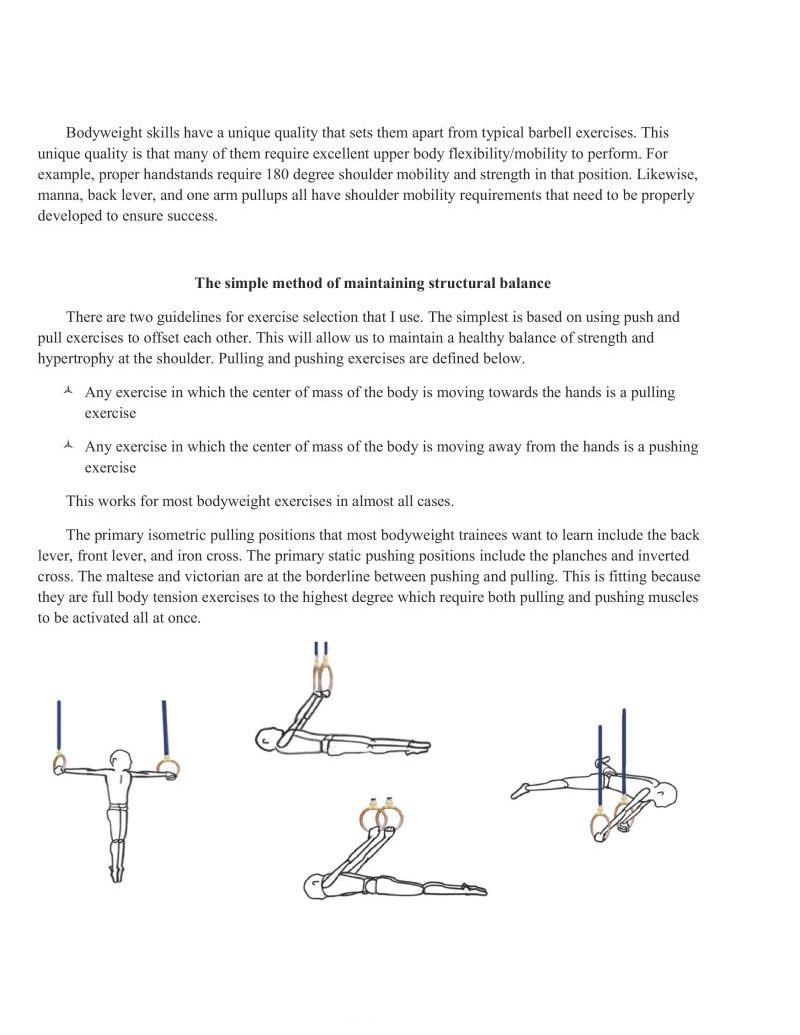
The primary isometric pulling positions that most bodyweight trainees want to learn include the back lever, front lever, and iron cross. The primary static pushing positions include the planches and inverted cross. The maltese and victorian are at the borderline between pushing and pulling. This is fitting because they are full body tension exercises to the highest degree which require both pulling and pushing muscles to be activated all at once.
Everything else falls into its own particular categories.
Vertical pushing includes two sets of movements each at the opposite end of the range of motion such as handstands, overhead presses / handstand presses and dips. Horizontal pushing includes all different types of pushup variations. Vertical pulling include pullups and inverted pullups variations. Horizontal pulling includes any and all rowing variations. Therefore, in this type of system we look to balance vertical and horizontal pushing, and vertical and horizontal pulling.
As stated above, push and pull type exercises are delineated into two different categories for each. There is vertical and horizontal pushing exercises, and there are vertical and horizontal pulling exercises. Since there are a fair amount of straight arm techniques in bodyweight strength training, I want to clarify the methods of integrating these different planes of motion when choosing exercises for certain goals.
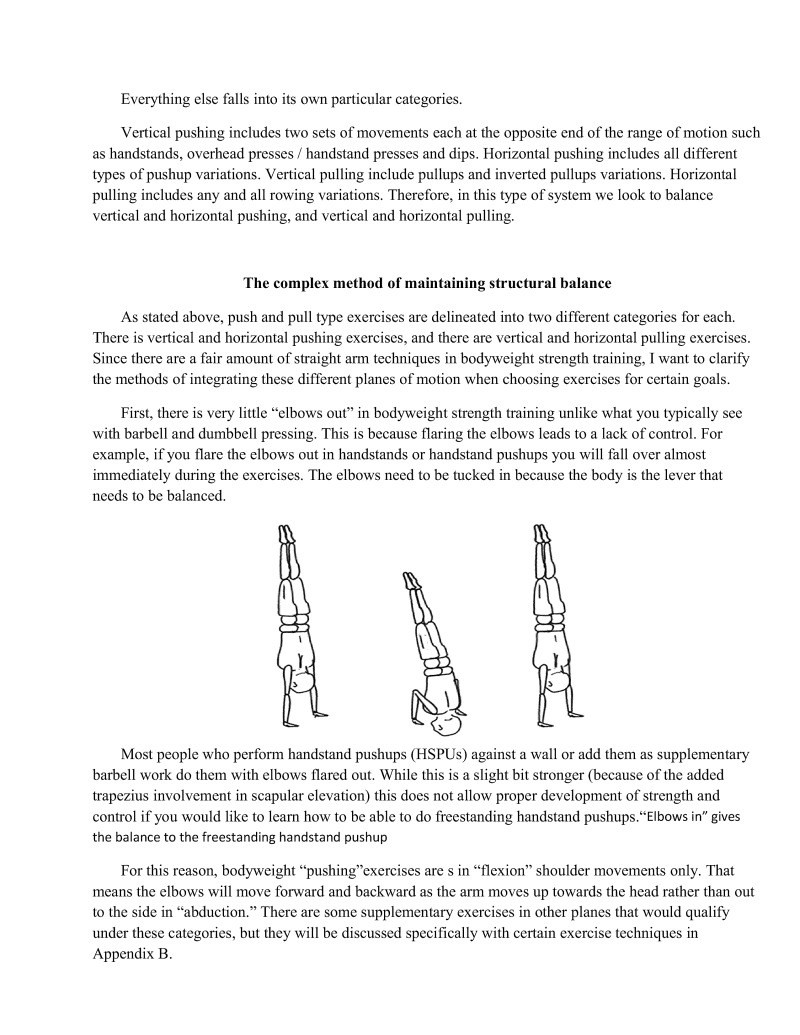
First, there is very little "elbows out" in bodyweight strength training unlike what you typically see with barbell and dumbbell pressing. This is because flaring the elbows leads to a lack of control. For example, if you flare the elbows out in handstands or handstand pushups you will fall over almost immediately during the exercises. The elbows need to be tucked in because the body is the lever that needs to be balanced.
Most people who perform handstand pushups (HSPUs) against a wall or add them as supplementary barbell work do them with elbows flared out. While this is a slight bit stronger (because of the added trapezius involvement in scapular elevation) this does not allow proper development of strength and control if you would like to learn how to be able to do freestanding handstand pushups."Elbows in" gives the balance to the freestanding handstand pushup
For this reason, bodyweight "pushing exercises are is in "flexion" shoulder movements only. That means the elbows will move forward and backward as the arm moves up towards the head rather than out to the side in "abduction." There are some supplementary exercises in other planes that would qualify under these categories, but they will be discussed specifically with certain exercise techniques in Appendix B.
I would further subdivide the pushing exercises into two separate categories that are similar to the vertical and horizontal pushing categories.
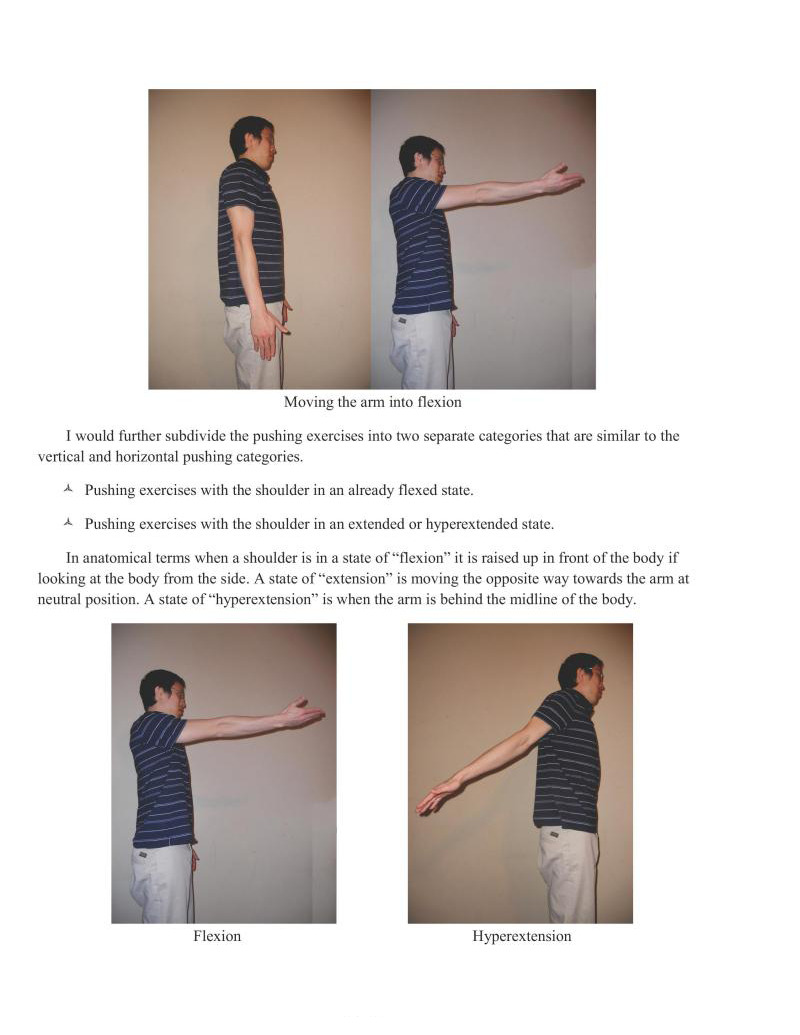
In anatomical terms when a shoulder is in a state of "flexion" it is raised up in front of the body if looking at the body from the side. A state of "extension" is moving the opposite way towards the arm at neutral position. A state of "hyperextension" is when the arm is behind the midline of the body.
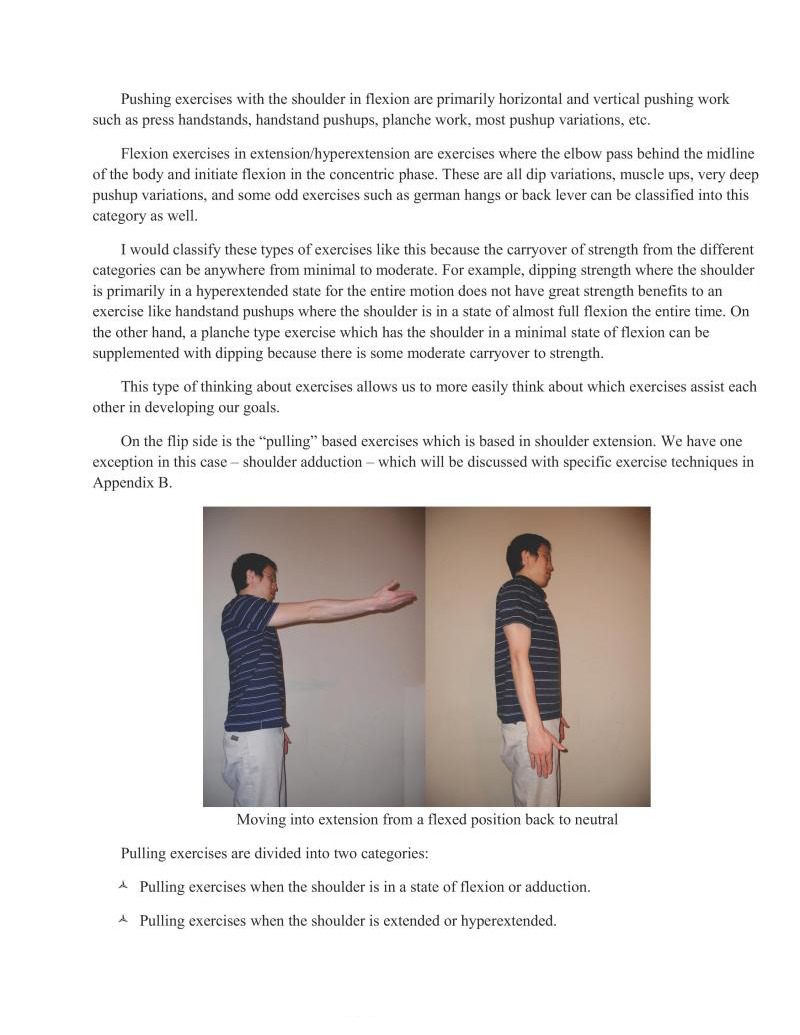
Pushing exercises with the shoulder in flexion are primarily horizontal and vertical pushing work such as press handstands, handstand pushups, planche work, most pushup variations, etc.
Flexion exercises in extension/hyperextension are exercises where the elbow pass behind the midline of the body and initiate flexion in the concentric phase. These are all dip variations, muscle ups, very deep pushup variations, and some odd exercises such as German hangs or back lever can be classified into this category as well.
I would classify these types of exercises like this because the carryover of strength from the different categories can be anywhere from minimal to moderate. For example, dipping strength where the shoulder is primarily in a hyperextended state for the entire motion does not have great strength benefits to an exercise like handstand pushups where the shoulder is in a state of almost full flexion the entire time. On the other hand, a planche type exercise which has the shoulder in a minimal state of flexion can be supplemented with dipping because there is some moderate carryover to strength.
This type of thinking about exercises allows us to more easily think about which exercises assist each other in developing our goals
On the flip side is the "pulling" based exercises which is based in shoulder extension. We have one exception in this case ~ shoulder adduction ~ which will be discussed with specific exercise techniques in Appendix B.
Pulling exercises are divided into two categories:
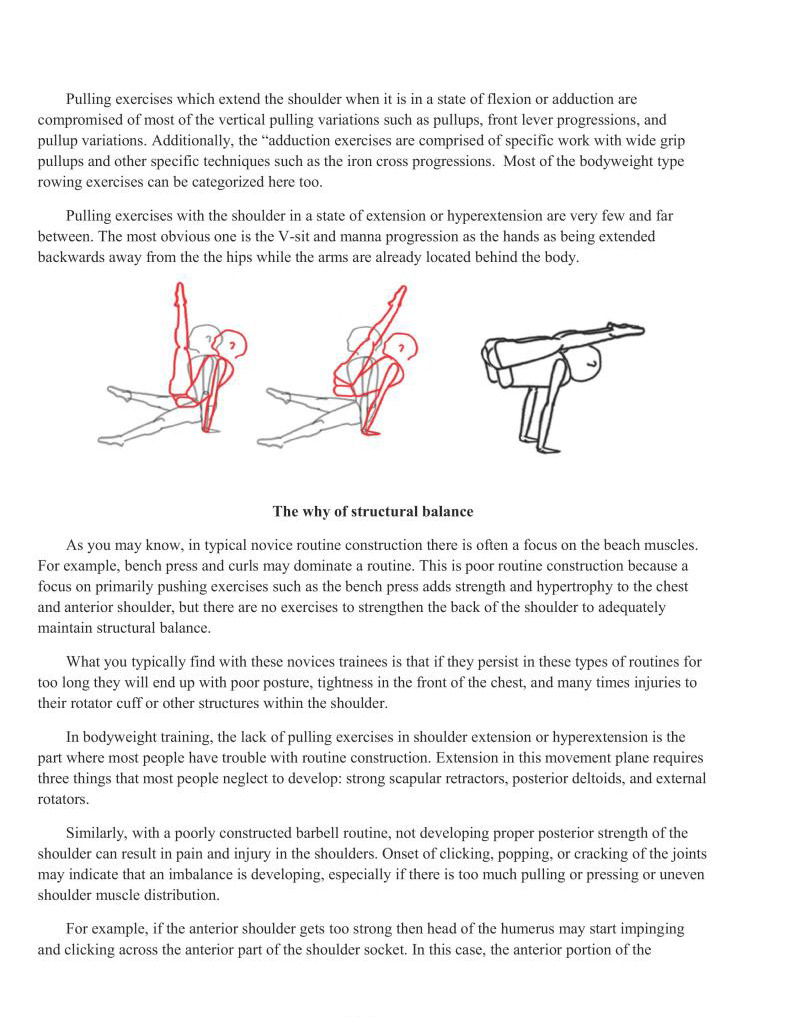
Pulling exercises which extend the shoulder when it is in a state of flexion or adduction are compromised of most of the vertical pulling variations such as pullups, front lever progressions, and pullup variations. Additionally, the "adduction exercises are comprised of specific work with wide grip pullups and other specific techniques such as the iron cross progressions. Most of the bodyweight type rowing exercises can be categorized here too.
Pulling exercises with the shoulder in a state of extension or hyperextension are very few and far between. The most obvious one is the V-sit and manna progression as the hands as being extended backwards away from the the hips while the arms are already located behind the body.
As you may know, in typical novice routine construction there is often a focus on the beach muscles. For example, bench press and curls may dominate a routine. This is poor routine construction because a focus on primarily pushing exercises such as the bench press adds strength and hypertrophy to the chest and anterior shoulder, but there are no exercises to strengthen the back of the shoulder to adequately maintain structural balance
What you typically find with these novice trainees is that if they persist in these types of routines for too long they will end up with poor posture, tightness in the front of the chest, and many times injuries to their rotator cuff or other structures within the shoulder.
In bodyweight training, the lack of pulling exercises in shoulder extension or hyperextension is the part where most people have trouble with routine construction. Extension in this movement plane requires three things that most people neglect to develop: strong scapular retractors, posterior deltoids, and external rotators.
Similarly, with a poorly constructed barbell routine, not developing proper posterior strength of the shoulder can result i pain and injury in the shoulders. Onset of clicking, popping, or cracking of the joints may indicate that an imbalance is developing, especially if there is too much pulling or pressing or uneven shoulder muscle distribution.
For example, if the anterior shoulder gets too strong then head of the humerus may start impinging and clicking across the anterior part of the shoulder socket. In this case, the anterior portion of the
shoulder labrum may be the piece of the shoulder that i clicking or popping. Further imbalances may start to wear down the labrum leading to potential tears or intractable damage.
Clicking, popping, etc. may not always indicate such a problem as you will find out in chapter 15. If someone has always had clicking, it is likely nothing to worry about. However, it may be a problem if it gets louder or there is an onset of pain especially if it develops simultaneously with an imbalanced routine.
In addition, the body does not like its muscles and joints getting out of balance. The body is much smarter than we give it credit for because all of the sensation and proprioception feedback to the nervous system can subconsciously limit force development. If the body senses that there is an imbalance that may lead to an injury, it will limit strength and musculature development in the surrounding area. Keeping proper routine balance is key to avoid these sorts of problems.
This is why the L-sit/V-sit/manna progression is so important. It effectively counteracts the effects of a pushing heavy routine with one simple exercise series. This st of progressions works the scapular retractors, posterior deltoids, and external rotators without doing 2-3 different exercises saving much time and effort. Plus, we get to work towards an awesome skill.
1 talk about potential injury i bodyweight exercises. Far from it actually. Exercising and getting stronger is important and critical to developing healthy bodies.
issues not to scare any of us away from exercising or performing
However, my primary goal here is to get us working towards our goals both safely and effectively. There is no point getting strong if we are injured. Conversely, if we are injured it makes getting stronger much harder to do. We have to consider both of these factors when constructing a routine, especially one based in bodyweight exercises that are known for their ability to be tough on the connective tissues and
First, organize your goals into categories of push and pull. I already helped out this process significantly by placing exercises on the particular charts.
Secondly, break down the push and pull into categories of horizontal and vertical for each Alternatively, you can do it according to the pushing exercises in shoulder flexion/extension, and pulling exercises in shoulder flexion/extension. Both will produce similar categorizations.
Thirdly, if there is a disparity in goals between any of the categories I would suggest that we either supplement with barbell work in that area (which I will not cover in this book) or train the progressions that I recommend or selecting exercises to shore up those weak points.
Based up our analysis of the types of exercises that bodyweight strength training has to provide us I prefer the push/pull system of classification as it is simple and effective.
The basics of this system can be summarized as:
Likewise, the pushing exercises in shoulder flexion/extension flexion/extension yield similar categorization of pushing and pulling and leads to approximately similar selection of exercises.
Typically, if rings isometrics are the goal we will end up with some sort of handstand pres. (pressing upwards), planche work (horizontal pressing), and dipping work (pressing downwards) while there will be some front lever (horizontal pulling), back lever (more vertical oriented pulling), and manna (hybrid press/pull) or a type of rowing exercise (horizontal rowing)
Its best if the vertical upwards pushing starts out as handstand work. Handstands are critical for the development of body proprioception and control. Progression in this skill signifies the level of ability of the user. Very few people develop strong bodyweight abilities without proper handstand work.
Categorizing our goals into the push and pull categories is important to the exercise selection that we will look at in the next two chapters.
Previous Chapter ... ... Next Chapter