Previous Chapter ... ... Next Chapter
Building a routine should follow a few simple rules to maximize the amount of training "ability" you have in a single workout. This section aims to answer the question:
To answer this question I am going to outline a general structure of a daily routine and then justify the reasoning. Then we will focus on building a routine on this foundation.
Warmup is first. To adequately get the body into an optimal state for workouts a few key physiological changes must happen. Core temperature needs to be raised so that the chemical reactions in the muscles will take place faster leading to better contractile function of the muscles and activation of the nervous system. Also, heart rate and blood flow should be elevated to provide oxygen and nutrients to the muscles and to export the waste,
Two signs I like to use that show me someone is ready to workout include a light sweat and a slight increase in breathing cadence.
Skill and technique work should always be second. Once your nervous system and muscles are warmed up and primed to go this is the optimal time for the body to learn new skills or movement patterns.
Good skill and technique practice should be emphasized here. If you are practicing poorly with a skill such as the handstand with loose legs that are flopping all over the place, the body memorizes such patterns and will remember them. When you start to practice them correctly it will be that much harder to change your technique because the bad technique is ingrained. If you are too fatigued to practice just stop and rest. Do not give a half effort to practice. This is the easiest way to get hurt and learn poor movements.
Power work, isometrics, eccentrics and other concentric strength work are third. They are here because they all require a very large stimulus from the central nervous system (CNS) to operate effectively. Since we are recruiting maximal or near maximal numbers of muscle fibers, it is important to perform these after low intensity activities — warm up and skill work — to get the full benefit out of them.
For example, if you performed your strength work at the end after your conditioning, the fatigue will limited your ability to lift the same amount of weight as you could have in the beginning. This would lead to less of a stimulus on the nervous system and muscles and therefore less of a strength adaptation. Thus, you want your high quality performance work to be directly after your warm up and skill work.
Endurance (everything else with it) is placed next in the routine. These exercises are mainly aimed at taking advantage of the energy systems of the muscles. Most of these exercises, unless done at extremely high intensity, are not as rough on the nervous system and musculature as the power, strength, eccentrics, etc. This means that you can still have a fairly good conditioning session after strength work whereas it would not work the same in reverse.
Endurance is not discussed in this book; however, if you have dual interests this is the place to include these activities,
Finally, the static flexibility, prehabilitation work, and cool down are at the end. I would do these at the end of every daily routine. They are important to help the body relax after an intense workout and work other aspects of physical ability or injury prevention.
Since muscle length is regulated by the nervous system via gamma afferent fibers in muscle spindles, is much easier to get good stretching work done at the end when we have fatigued the nervous system and muscles from working out. Additionally, the muscles are much more pliable with the increased blood flow. Likewise, mobility work applies on the same principle.
Prehabilitation refers to basically any work that is focused on injury prevention. Rehabilitation work can be done here as well although it depends how much the body part itself it hurting. If you are not using the injured body part in your workout it might be a good idea to work in rehabilitation/prehabilitation here. Alternatively, this can be performed in the warm up or earlier in the workout as well.
For instance, let us talk about if we needed some prehabilitation work for the shoulder. If the shoulders need additional stabilization exercise then it may be a good idea to to exercises such as rotator cuff exercises or turkish get-ups or other such shoulder exercises. Fatiguing our shoulder stabilizers before our power and strength work is not such a great idea. If they are tired performing rotator cuff exercises before the tough compound exercises, it is much easier for them to fail during the compound exercises and for an injury to occur. Thus, in this case, the rotator cuff exercises should be performed at the end of the routine.
Now, let us talk about each of these topics more in depth on how to program properly for bodyweight strength and skill development.
Many athletes have their own warm ups that they do to get themselves ready to exercise. People may also have their own specific warm ups tailored to their specific mobility weaknesses too. It is fully acceptable to continue to do this, but we need to be aware of the demands bodyweight training on the connective tissue. Thus, if you have your own warm up that you usually use I would recommend hybridizing the warm up and skill development into one tailored a bit more towards bodyweight strength training.
As we discussed in the previous section a good warm up gets the blood flowing, the heart rate up, a light sweat on the brow, and an increase in breathing cadence. What better way to do that than with the actual skills that you have recently mastered. The additional benefit is that you will be able to reinforce correct motor patterns for your body.
Skill development for gymnastics can be employed as part of or replacing the warm up. After you master skills such as handstands, and other strength progressions such as pullups, dips, german hangs, etc. they become less intense on your body. Once they become low intensity, you can adequately use them in your warm up.
For example, if you have mastered a freestanding handstand and are starting to work on freestanding handstand pushups, it may be a good idea to throw a lot of handstand work in your warm up to reinforce proper neural patterns for the movement. Dynamic movements can be utilized such as wall handstands and alternating lifting one hand to touch the shoulder each time (called handstand shoulder taps) Handstands or handstand shoulder taps will help warm up the body and train skills at the same
Skills or strength progressions that are 2-3 levels below your current competency level can be considered exercises that are appropriate for warm up or skill work. On the chart this may correspond to one but usually two levels below static progressions that we are currently working in exercises. This gives us a chance to work on some progressions as skill or in our warm up if we decide that the focus of our strength work is going to be working other movements. It will also help maintain those current progressions.
Examples of these might include throwing in some rings support work for warm up as well as some tuck planche or tuck front lever work if we are working the straddle versions in our workout. Another example may be that if we do not have enough time to work handstand pushups we can substitute in an easier variation of handstand pushup progression here to help maintain the neurological strength we have already attained for the movement.
It is important to adequately prepare the muscles for more intense work. Dynamic stretching and mobilization work is useful in the warm up to take the muscles through their entire range of motion. However, unlike static stretching you are not holding the position at the edge of your range of motion.
Static work held too long before strength training can slightly negatively affect the ability to exert maximal force, so it is important to limit trying to lengthen the muscles too much before training. On the other hand, if your poor flexibility is inhibiting you from properly executing skills then spend some time in the warm up to stretch so that you can properly perform the latter exercises.
Now for a little more about skill development. Skill development for bodyweight strength training is much different than barbell work.
It is unlike barbell training where you can begin learning the more complex movements (such as the Olympic lifts — snatch and clean and jerk), as a beginner and reach a decent level of proficiency within a few months. In fact, with barbell work this is preferable because it allows for years upon years of meticulous training to reinforce proper movement patterns. This will allow the user to perform the movement with heavy loads.
Bodyweight skill development follows a different track. The levels of progression are separated by competency in previous skill development in combination with strength development.
For example, a basic skill such as a handstand and its various progressions has many different levels to work through such as:
The complexity of progressions and the varying nature of many peoples' ultimate goals make progressing in pure bodyweight work extremely difficult if you are not under the tutelage of someone who knows what they are doing and can offer correct progressions and tips on what to work on next
Skill development work will play an ultimate role in developing proper strength. It is to be included in every session if possible. As one's individual skill, strength, and work capacity improves exercises that may have been previously classified as "strength" skills may become skill work.
Thus, it is important every 5-6 weeks to reassess your goals exercise selection in the context of what constitutes skill work and strength work as your training progresses. We will talk about how to properly do this later.
The core constituents of the workout with bodyweight training are comprised of isometrics, eccentrics, or regular repetitions comprised of a controlled eccentric and accelerated concentric movement —referred to hereafter as dynamic movements. Organizing these into a coherent order is a fairly easy task.
Note that "dynamic movements" should not be confused with the "dynamic method" popularized by Westside Barbell where weights used at around 60-70% 1 RM are used for speed work
In general, we want to put the eccentrics and isometrics in the beginning of the work leaving the dynamic movements for last.
We can think of building strength as a combination of CNS neuromuscular adaptations and musculoskeletal adaptations. There is a third — cardiovascular / O2 adaptations —but is irrelevant for our purposes here. Our body has two pools of resources from which to draw. Since the neuromuscular controls the musculoskeletal, we want to first execute tasks that use substantial amount of CNS involvement because they also use a lot of musculature, If we reverse the order we get highly degraded movements compared to the maximum potential that we could theoretically attain from the workout. This is akin to endurance before strength because tiring out the cardiovascular and musculoskeletal components will decrease the ability to exert total force in strength work if done after.
Thus, we put the eccentrics and isometrics first because typical loads used are supramaximal (in the case of eccentrics) or near supramaximal loads (in the case of isometrics). Working up near the edge of our strength limit as we learned in the first chapter is tough on the CNS. Since the CNS governs activation and inactivation of the muscles we want to put the toughest amount of work in the beginning to get the most out of it.
Secondarily, most of the dynamic movements we will be working are well below our strength limit which makes them less taxing on the CNS. Remember back to chapter I: the lowest amount of reps that we are going to use for training purposes is about 3 repetitions (3 RM). Most of the work is probably going to be at 5 RM or greater for anyone below intermediate level. This means that our typical dynamic movements is going to much less intense on the CNS than the eccentrics and isometrics. This allows much more volume of the work to be put on the muscles.
We also want to use full body movements before any specific isolation work that may be in line with our goals. Fatiguing the musculature with isolation exercises is not conducive to good execution of the bodyweight progressions because most of them are full body exercises.
My recommendations for barbell work for beginners have always been based on 2 pushing exercises, 2 pulling exercises, and 1-2 legs/posterior chain exercises. This is similar to what I going to outline for bodyweight routines, except we are going to select exercises from each of the categories we have previously determined in both shoulder flexion and extension planes.
For those with no experience with creating your own routine you should start out with 2 pulling and 2 pushing exercises for the upper body.
For those with some experience, 1 like 3 exercises for push and pull starting out. Then reduce the workout volume of 2 exercises for each push and pull while you simultaneously increase the volume of skill work as work capacity increases.
I use this structure for two reasons. First, getting the trainee to work in many planes of motion is going to extensively help with learning to manipulate themselves in space. This is a bit unlike barbell training where you want to stress few fundamental movements. Secondly, distributing the volume over another set of exercises will help because it is harder to keep strict technique over longer workout sessions. With barbell work you can tell when form degrades and make load adjustments; in bodyweight work the body will inadvertently adjust to improper technique which decreases forces applied, often significantly. Once technique becomes more ingrained then this is less of a problem.
For our pushing exercises we want ones that are based in flexion-in-flexion and flexion-in-extension. For beginners, the best exercises to choose are along the lines of handstands, pushup progress planche, and dips.
For our pulling exercises we want ones that are based in extension-in-extension and extension-in- flexion. For beginners, this would be pullups, some sort front lever or back lever work, and inverted rows or inverted pullups.
For legs there are many options to work on such as sprinting, pistols, plyometrics, or other methods such as this. I still recommend weights should be used. but sometimes people have no access to equipment so they have to make do with what they have. I will not cover these topics in the book though.
First, we will talk about prehabilitation or rehabilitation work, We need to be proactive about taking care of our bodies as injuries represent time off from training (as well as pain and frustration in many cases).
If we are working around an injury specifically the rehabilitation work comes at the end of the workout. Alternatively we can group it with the workout. The workout should focus on working around the injury without any pain, and the rehabilitation work should obviously focus on improving the injury condition. We will talk more about these factors and various options we have in the chapter 14.
Specifically in regards to prehabilitation if we have had previous injuries at certain joints or suspect injuries may be developing because of any twinges of pain, or prolonged soreness of muscles, tendons, or joints then some prehabilitation may be useful.
Chronic muscle tightness or deep soreness should be distinguished from the delayed onset muscle soreness (DOMS) that is common when new exercises are introduced. If volume and frequency stay constant, DOMS usually starts to dissipate as it goes on. Problematic muscle groups will usually be tight, warm, and painful to the touch and will not go away like soreness does.
Most of the time rest will cure all ills, but we will want to add in exercise or mobility work to help facilitate healing and keep the rest of our body healthy. With our prehabilitation exercises, we may be
working to correct existing imbalances, or to prevent ones from forming much like what was described earlier with shoulder imbalance
Proper flexibility and mobility work will go a long way to improving upon the effectiveness of the workouts by keeping joints safe. This is needed in both barbell and bodyweight work. This is even more relevant as we get older: we lose a lot of strength and soft tissue extensibility and usually our posture starts to degrade.
The biggest thing to keep is mind is that we want our joints, tendons, and muscles moving well. Good quality body tissues should not hurt when we apply pressure or massage to them. Likewise, if we move them around without putting any tension into the muscles they should be pliable and easy to move, but not tight with adhesions, scar tissue, and trigger points.
Ideally, our joints should feel good when we use them, and the muscles should be soft and pliable. Close your eyes and move your body. You should feel good and unrestricted in movement. If we think back to an athlete like Michael Phelps as he is preparing to swim competitively, he often performs many arm circles and throws his arms back and forth to help loosen up. You can also see that his muscles are soft and pliable as they bounce around. This is ideal. Mobility work of this type is good pre and post workout, albeit not with the ballistics forces.
Additionally, if our flexibility is hindering our development of some skills then we may need to add extra flexibility work into the beginning of the workout instead of just placing it at the end. One of the more effective things I have personally done for my manna progressions is to do my shoulder stretching (german hangs / skin the cats) directly before training manna so as to allow better movement of the shoulder girdle pressing into hyperextension.
German hangs, wall slides and band dislocates are very good shoulder mobility exercises as they will help improve shoulder range of motion in extreme flexion and hyperextension for handstands and manna respectively. Not that this is all of the work that should be done, but they are the more important exercises. for these purposes. We will talk more about specific mobility and flexibility exercises that can be performed in chapter 16.
Thus, mobility and flexibility work may be integrated into warmups and/or as skill work, during workouts, or even post workout.
Generally, we are only going to add static flexibility work into the warmup or workouts if we have a range of motion limitation that is negatively affecting our ability to perform the exercise correctly. For example, this would be the case of the german hangs with the manna
For mobility we are going to end up taking our muscles to the edge of their range of motion and using that to help loosen up tight structures. This will help our joint complexes to operate optimally.
Write down any of the skill work you want to learn. Also, start to think of what type of exercises you want in your routine and how you would order them based on the information above.
Write down any previous injuries you have had or problematic joints, muscles, tendons, etc. that have or may have been bothering you in the past. Also, write down what you have been doing for rehabilitation or prehabilitation to solve these injuries.
We will take into account how to integrate all of these factors into a routine and how to avoid any contraindicated movements while continually working towards our goals.
Assess your soft tissue structures by using your hands to massage in and check for tightness, trigger points, or other restrictions or chronic problems in your musculature, tendons, or around the joints. Write these down too.
In addition, check and evaluate your flexibility and mobility. The main ones we want to check at this point include our wrists, elbows, shoulders, the straddle stretch, and pike stretch.
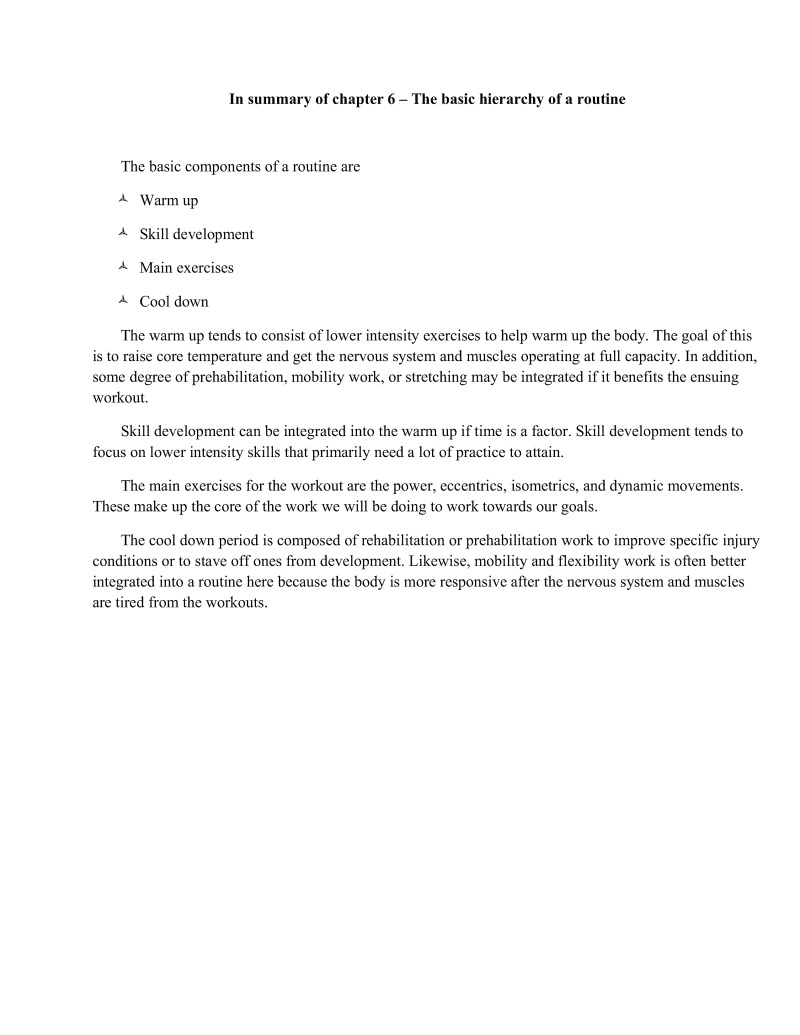
The basic components of a routine are
The warm up tends to consist of lower intensity exercises to help warm up the body. The goal of this s to raise core temperature and get the nervous system and muscles operating at full capacity. In addition, some degree of prehabilitation, mobility work, or stretching may be integrated if it benefits the ensuing workout.
Skill development can be integrated into the warm up if time is a factor. Skill development tends to focus on lower intensity skills that primarily need a lot of practice to attain.
The main exercises for the workout are the power, eccentrics, isometrics, and dynamic movements. These make up the core of the work we will be doing to work towards our goals.
The cool down period is composed of rehabilitation or prehabilitation work to improve specific injury conditions or to stave off ones from development. Likewise, mobility and flexibility work is often better integrated into a routine here because the body is more responsive after the nervous system and muscles are tired from the workouts.
Previous Chapter ... ... Next Chapter