Previous Chapter ... ... Next Chapter
If this was a basic routine we would first ask in what direction do you want to move. For example, remember back to the repetition continuum. It has strength at one end and endurance at the other. Additionally, we cannot optimally train strength and endurance at the same time, Since this book is based on strength progressions, I am assuming that we are going to train for strength. However, first we will look at a couple of other points in regards to endurance and training.
If we were training for bodyweight endurance we would focus mostly on increasing the repetitions or density/volume of work in a set amount of time. This would be consistent with our goals.
Similarly, I would not recommend trying to train both strength and endurance simultaneously. However, for some athletes it is necessary for their sport or other competitions. Thus, in these cases setting both strength and endurance goals would be useful. Recognize that strength goals tend to include movements with high weight and low repetitions and that are difficult to perform. Endurance exercises will tend to include movements with low weight and high repetitions that result in the "burning" feeling in our muscles.
A problem that we often see is that people either do not know how to set goals or they just do not care about setting goals. This is a mistake. They are an integral component of an effective program as they give guidance in structuring a workout plan. Sure, one can make progress without goals — but performance increases skyrocket when high quality goals are set
According to Merriam Webster, goals are "the end toward which effort is directed." Within the context of training, high quality goals are tangible feats that can be measured by numbers. Below are some examples of high quality goals
When most people set their goals for the first time it is common to see very low quality goals. Low quality goals are ill defined and/or not based on measurables that can be accomplished. For example, some low quality goals are listed below:
As previously stated, routines are constructed around high quality goals. If you have a goal to perform 10 dips then it is logical that you need to first build up the capacity to perform a single dip, then 2 dips, then 3 dips, etc
If you are sill having a hard time understanding how to set high quality goals then keep the SMART model in mind:
S Specific
M Measurable
A Action-Oriented
R Realistic
T Time and Resource Constrained
Make sure that your goals are in line with your overarching objective. Let us use John and Alice as examples. John wants to "get stronger" but has set a goal of 150 pushups in a single set. This is somewhat lackluster since 150 pushups in row is a feat of endurance, not a feat of strength. In another example, Alice wants to "have great handstands" so a goal of performing 30 pullups will not move her closer to her goal
An easy way to make sure that your SMART goals are in line with your ultimate aim, you should break down your desired movements into separate, distinct components. Going back to John, he may want to consider pursuing high strength gymnastics techniques like the planche or perhaps set a goal of performing a squat with two times his body weight on his back. Alice, by contrast, may want to break
down the handstand into two separate SMART goals of holding a handstand for 2 minutes against the wall and perform a 30 second freestanding handstand.
One caveat is that many trainees feel that they can improve their performance by sticking to low intensity body weight exercises. An example of this is John's initial goal; he wants to "get strong" by doing 150 pushups in a single set. Let us be clear, though, doing 150 push-ups in a row does not mean you are strong — it means you have good endurance at performing push-ups. If you wish to gain strength through bodyweight training then you must get creative and broaden your horizons. If you really have an interest in increasing endurance then you will find that it is much easier to see endurance gains when you are already very strong and powerful.
A lack of strength will always limit you in all other domains — technique, endurance, skill, balance, flexibility (active and passive), agility, coordination, etc. You must be strong in order to excel in all of these other domains. The converse is typically not true. It is important to keep this in mind as you set your goals.
Once your goals are set then you will definitely want to put them on paper. Declaring your goals is a commitment. Psychologically, we are more likely to follow through on things to which we have committed. This is very well proven in psychological research and has been used by sales teams for decades. If you are skeptical, then here is an interesting quote from the Amway Corporation’s sales training manual:
One final thing before you get started: Set a goal and write it down. Whatever the goal, the important thing is that you set it, so you've got something for which to aim — and that you write it down. There is something magical about writing things down. So set a goal and write it down. When you reach that goal, set another and write that down. You'll be off and running.
If you want to increase the likelihood of success then you should set your goals and write them down. Scratching things off a list is just a very simple way that you can positively reinforce yourself to continue training. The objective here is to change your lifestyle — and positive reinforcement is one of the most effective means of doing so.
I strongly suggest that you keep your goals written in your training journal. A training journal can be in a notebook or online but ts existence ensures progress. If necessary, keep your log by your bed, next to the fridge, near your computer, saved as your homepage, or minimized on your desktop so that you see it regularly during the day. If you realized that you have not done your workout then the log will serve as a reminder to get out and do it before you eat or get sucked into wasting your time online or doing other mundane things to procrastinate.
One of the hardest things to do is to get into the habit of your workout routine and these methods all make this much more possible. Once you get into the groove of your routine the benefits are stark and undeniable.
Grab 4-5 sheets of plain paper. We are going to take you through the process of building a series of goals and constructing it into a well developed routine.
First, write down all of the goals you want to accomplish in regards to bodyweight training.
If you do not know about what type of goals you want to accomplish take a look through Appendix B which is the exercise reference. Appendix B shows many of the different skills and exercise progressions that you can learn. That may help you decide certain things that you want to learn or accomplish.
Appendix C shows the different charts upon which the exercises are based. We will discuss this more thoroughly in chapter 5.
Second, refine them and make them into SMART goals.
We will help you further refine them later and construct a routine around them.
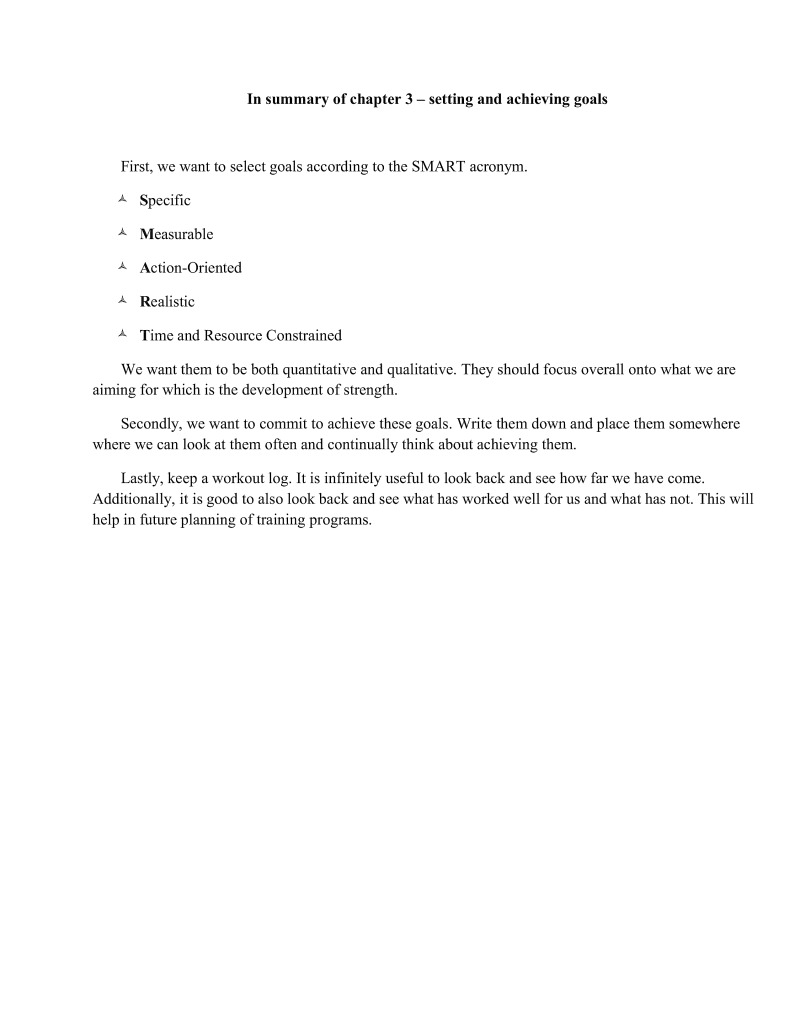
First, we want to select goals according to the SMART acronym.
S Specific
M Measurable
A Action-Oriented
R Realistic
T Time and Resource Constrained
We want them to be both quantitative and qualitative. They should focus overall onto what we are aiming for which is the development of strength.
Secondly, we want to commit to achieve these goals. Write them down and place them somewhere where we can look at them often and continually think about achieving them
Lastly, keep a workout log. It is infinitely useful to look back and see how far we have come. Additionally. it is good to also look back and see what has worked well for us and what has not. This will help in future planning of training programs.
Previous Chapter ... ... Next Chapter