Previous Chapter ... ... Next Chapter
I am going to assume, based on this writing’s subject, that since you are reading this you want to know how to train bodyweight strength rather than endurance. At the very least you want to be able to increase your strength to work on all of the cool gymnastics isometrics, or you want to be able to use the bodyweight strength for various disciplines such as gymnastics, parkour, wrestling, martial arts, or MMA.
We are going to briefly touch over the concepts that will be applicable to our strength progressions beyond the concept of decreased leverage. These are important because knowing how our bodies respond o the stresses we put on them will be advantageous when we start to program our routines.
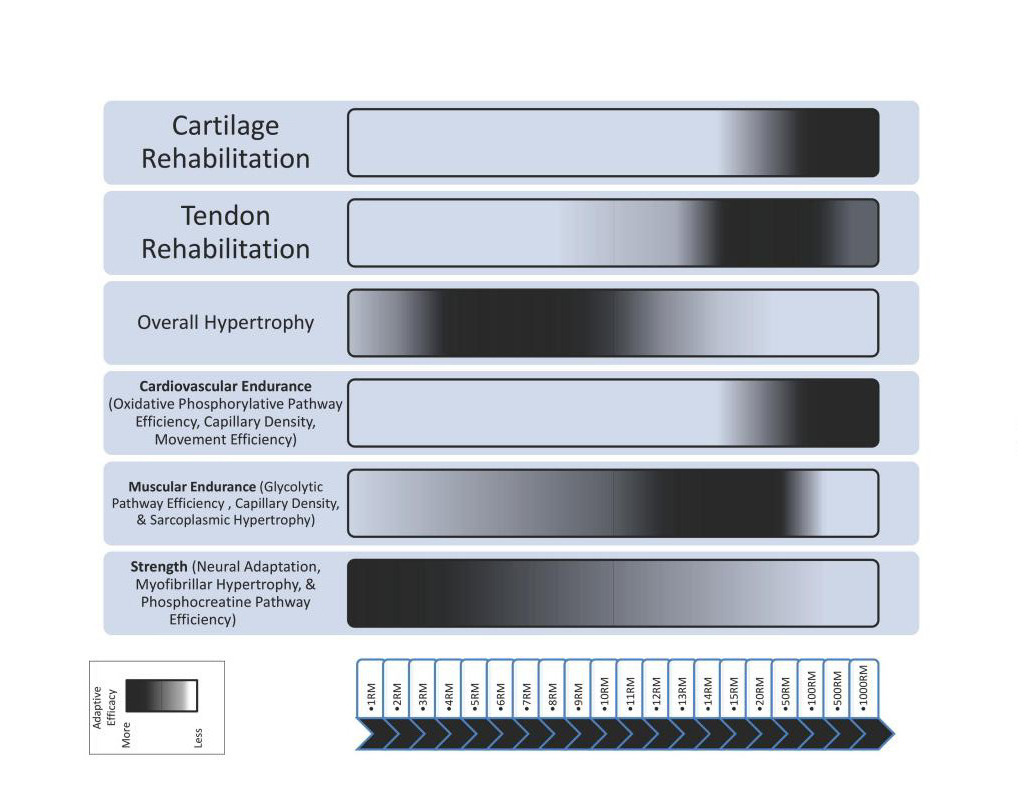
The repetition continuum has strength at one end and endurance at the other. The strength side is attained through low repetitions and heavier weight where a 1 repetition maximum (1 RM) emits the most strength. Endurance occurs with less weight and more repetitions. There are three very important points to take away from the repetition continuum:
The chart on the next page is just to give you a general idea of the different adaptations stimulated at different repetition ranges.
Our bodies are composed of three distinct sets of muscle fibers — type I, type IIa, and type IIb — which are innervated by motor neurons. A "motor unit" is a motor neuron and all of the fibers it innervates or can stimulate to contract.
Type I fibers are our "slow twitch" fibers and are red in color because of the enormous number of mitochondria that are located within them. They have a high capacity for endurance and are the primary muscle fiber type developed by endurance sports. These fibers have the least potential for hypertrophy.
Type IIa fibers are our "adaptable" fibers that are pink in color. They have characteristics of each of the type I and type b fibers. Therefore, the type of training can bias these fibers towards either the strength and power side or the endurance side. This is why training must be specific to the sport: among other adaptations, adapting these fibers towards the wrong side will make you perform more poorly
compared to your competitors. Specificity in sport is king.
Type IIb fibers are our "fast twitch" fibers which are white in color. They fatigue very rapidly because they can only use anaerobic metabolism to supply their energy, but they also contract very rapidly and are the main type of fiber developed in power and strength sports. These have the most potential for hypertrophy.
Motor units and the central nervous system
Motor units are composed of a motor neuron and all of the muscle fibers it innervates. A single motor unit may innervate many different fibers within a muscle, but only innervates muscle fibers of one of the three types,
Motor units are categorized into a continuum similar to the muscle fiber types. At one end we have low threshold motor units (LTMUs) and at the other we have high threshold motor units (HTMUs). In general, the LTMUs correspond to the motor units that innervate the type I slow twitch fibers, and
HTMU correspond to motor units that innervate type IIb fast twitch fibers. Between those are the type IIa muscle fibers in the middle.
The LTMUs are composed of motor units that activate when the required force to move an object is small. Conversely, HTMU are only activated when the force requirement is high. For example, LTMUs are active when we want to lift a small object such as a cup, but HTMU are only activated when we need to use most of our strength such as in a near max effort deadlift. Note that during near max effort or max effort lifts, LTMUS are active along with the HTMU as well.
What this means is that to gain strength and hypertrophy we will always be want to using weights that are heavy. We want to preferentially increase the rate of growth and development of HTMU. Therefore, this can be done by moving weights or bodyweight close to near maximal loads, or it can be done with lighter exercises that are moving quickly. Either way, we will want to accelerate the weight through the
movement. So if the weigh is heavy or the bodyweight movement is tough and we can only move slow we still want to focus on performing it with good technique as fast as possible.
There are six primary ways that the nervous system can increase strength aside from the hypertrophy of muscles. These will be the primary adaptations in any strength program, so it important to know how they work because the principles of some training are based upon these phenomena.
We will talk about each one of these.
Recruitment increases as the force requirements increase. The nervous system has limiters on the amount of force we can produce. Golgi tendon organs in our musculotendinous junctions provide inhibitory feedback as the forces against those tissues increase. Fortunately, with training the inhibitory effect on this can be reduced which increases recruitment of muscle fibers. This effect is greatly enhanced and maximized around then 85-90% 1 RM threshold.
Firing rate increases begin to occur after all motor units in a muscle are recruited. When the nervous system senses the recruitment of all motor units, it further increases strength by sending more rapid electrical signals to the muscles to tell them to contract faster. For most large muscles used mainly for locomotion, this occurs at approximately 90-92% of 1RM (or 3 RM). In many of the more fine motor muscles located in the forearm, rate coding may start to occur as low as 50% of 1RM. Postural muscles in the core and support muscles such as the calves also highly rely on rate coding for improvements in performance.
Synchronization refers to the nervous system’s ability to organize the muscle fiber contractions to make the system more efficient. In untrained individuals, the motor units fire randomly to recruit the forces necessary. As we further train a movement the motor cortex is able to synchronize the firing of motor units. Imagine a game of tug-of-war. When a team pulls together (in synchronization) the force much greater than each person pulling by himself out of synch with everyone else.
Skills and exercises that are repeated often show the greatest increases in recruitment and synchronization. Indeed, recruitment and synchronization are the methods by which the body will increase its strength. This is consistent with practicing skills many times throughout the week, and repeating exercises multiple times a week over the course of a program.
For example, Starting Strength by Mark Rippetoe (Aasgard Press) suggests that novices perform the squat three times per week. More advanced strength programs such as Bulgarian weightlifting protocol may have their athletes performing the Olympic lifts as many as 2-3 times per day for six to seven days a week. Many other sports such as gymnastics, running, etc. which benefit from massive amounts of technical practice require optimal recruitment and synchronization to perform at the highest level. This is true for every sport; Michael Phelps swims miles everyday.
Simply put, if we want to get really good at something we have to do it a lot. This will be an important thing to remember when we start to construct routines.
Rate coding/firing matters very little for a strength-based program, but is useful to note for those seeking hypertrophy. Muscles that rely more on rate coding tend to be composed of more slow-twitch fibers. Therefore, they respond better to higher repetitions. Thus, the core, forearms, calves, and other highly rate coded muscles, use higher repetitions more often for growth.
Antagonistic disinhibition can improve contraction of the muscle. This is usually done by extensively stretching the opposing muscle you are planning to work beforehand. The reflexes operate similarly. For example, when the doctor hits your patellar tendon with the reflex hammer the leg kicks out. This is called reciprocal inhibition where the nervous system activates the quadriceps to fire while it simultaneously inhibits the hamstrings from firing. Thus, we can harness this phenomena to increase contractions in particular muscles
Neural growth/pruning occurs automatically in the brain and is mostly active for movements that are repeatedly practiced. This occurs all over the cortex in motor planning, the primary motor cortex, cerebellum, etc. This is a primary adaptation of skill work, but it is arguably impossible to train consciously. Therefore, we need not go into more detail about it.
The main thing to take away from this is that perfect practice makes perfect, If you are training skill work or movements always make sure to perform them technically correct so you can get the best practice possible. It will greatly improve your abilities if you practice like this.
The central nervous system (CNS) governs the activation of motor units through a variety of systems that are involved with motor planning, activation, and proprioception. Since we are not going to look at this in detail, we can just say that the CNS, like the muscles, has a set point at which it must be stressed to bring about adaptations.
The CNS has a set amount of recovery that it needs to operate at full capacity. We can think of this as a pool. Every time we exercise we take out some water, and every time we sleep, take a day off, cat well, etc. we put a little back in. Over time, the size of our pool (and therefore capacity for water) will increase. The same thing occurs with adaptations for muscular hypertrophy. When we take out too much without replacing it bad things start to happen. This would be where a trainee starts delving into the overreaching and overtraining realm.
Programs for more advanced trainees that are well constructed have planned overreaching built into them. For example, after a program is completed and a deload week is taken, an athlete usually comes back much stronger or faster. This athlete’s pool has become larger in capacity during the program, but still has not sufficiently replaced the water inside of it until that week of recovery where resting and sleeping help fill it back up to capacity.
I mention these because there are a variety of things that are more taxing than others. For example, in weightlifting, deadlifts are one of the more taxing exercises and thus we accumulate much more fatigue doing this exercise than with almost any other. This is why they are put at the end of many beginner programs. Performing them near the beginning would significantly detract from all of the exercises in the workout program.
In bodyweight training this is analogous to working with supramaximal eccentrics and isometrics. All of these are very taxing on the CNS. Thus, when working with many of these types of exercises each week, one has to be aware that stagnation may indicate the need for rest. Most trainees new to exercise
will think that more more exercises or volume are needed which is not the case.
When we get into programming, this is why we will build in deload periods every 4-8 weeks.
We did not talk about eccentrics and isometrics before, and they are of particular importance when discussing bodyweight programming. The studies indicate that isometrics and eccentrics tend to recruit HTMUS right off the bat to sustain their contractions. This makes sense because they are very difficult movements to sustain. However, the occluded blood flow to the muscle and greater time under tension also means that they are also biasing towards metabolic slow twitch adaptations. They will tend to be used by us mainly in supramaximal contractions (for the eccentrics) and near maximal contractions for the isometrics, so it will bias it more towards the HTMU adaptation which is favorable.
Isometric holds too short will not give us enough volume to force adaptations. However, isometrics held too long may bias our adaptations towards more endurance. Therefore, we need to perform our isometrics in the "sweet spot." I will talk about this more in the programming section how we can effectively do this.
As we talked about above, HTMUS have the greatest propensity for hypertrophy. Since fast twitch motor units have very low energy supplies (only anaerobic glycolysis), they fatigue very quickly. Rapid fatigue leads to mechanical intracellular stress. One example of mechanical stress that occurs is that when there is not enough ATP within the muscle. This means that there is an inability to contract the muscles fully and results in more protein breakdown during the eccentric portion of the movements.
Likewise, there is a neural aspect of fatigue that makes hypertrophy increase much more in the fast twitch fibers than the slow twitch. When a motor unit that is connected to a fast twitch fiber is transplanted onto a slow twitch fiber, the slow twitch fiber morphologically changes to a fast twitch fiber. I do not believe this is fully understood yet, but it does mean that there is a neurological component to hypertrophy.
Myofibrillar and sarcoplasmic hypertrophy are the two types of hypertrophy that occur primarily in HTMUs and LTMUs respectively. As we talked about above, hypertrophy in HTMUS result primarily from protein breakdown of the actin and myosin proteins which facilitate muscular contractions. Thus, the body starts adding more contractile proteins — myofibrils — in response to the break down to mitigate it next time. This is the essence of myofibrillar hypertrophy.
Conversely, since LTMUs have many mitochondria they fatigue much slower than the fast twitch counterparts. Thus, most of the stress on the cell is metabolic accumulation of muscular acidosis, reactive oxygen species, and free radicals. In response to this stress, the LTMUs add additional proteins and metabolites which draw more water into the cell creating sarcoplasmic hypertrophy.
Obviously, unless one of your main goals is hypertrophy, we are going to want to limit the amount of sarcoplasmic hypertrophy and focus on myofibrillar hypertrophy. The sarcoplasmic hypertrophy just adds dead weight into bodyweight exercises. There is some overlap so it is impossible to eliminate each one, but we can bias towards one or the other through specific training with lower repetitions at higher intensities.
In lighter sets of lifting such as an 12 RM, all motor units are fatigued or used within 4-5 repetitions. However, since HTMUs fatigue much quicker and recover much slower, most of the stress is placed onto the MTMUS (medium threshold) and LTMU. This is is why they are going to undergo most of the hypertrophy and adaptive stress placed on them. Additionally, the adaptive type IIa fibers are going to be biased more towards endurance especially as the amount of repetitions increase per set.
This is why for strength it is important to primarily be working at or under the 10 RM range. My preference is working between 3-8 repetitions to adequately get enough stress to force the most HTMU strength and hypertrophy adaptations.
There is some inconsistent information out there if your goal is pure hypertrophy. The 5-8 repetition range is optimal for hypertrophy for beginners. Working the higher repetitions such as 9-12 does work fairly well because there is some overlap, but there will be better gains in the 5- range. Most of the primary barbell beginner programs that work effectively — Starting Strength, StrongLifts 55, etc. — will use repetitions in the 5-8 range.
Now, once your body gets used to lifting heavier weights, then mixing it up with alternate repetitions ranges can provide good progress for hypertrophy. This is similar to a lot of the variations in programming that need to be used to advance in strength. So there is a time and a place for different repetitions ranges. If you are interested in hypertrophy, I would suggest that you stick with the 5-8 repetition range for the most part as a beginner.
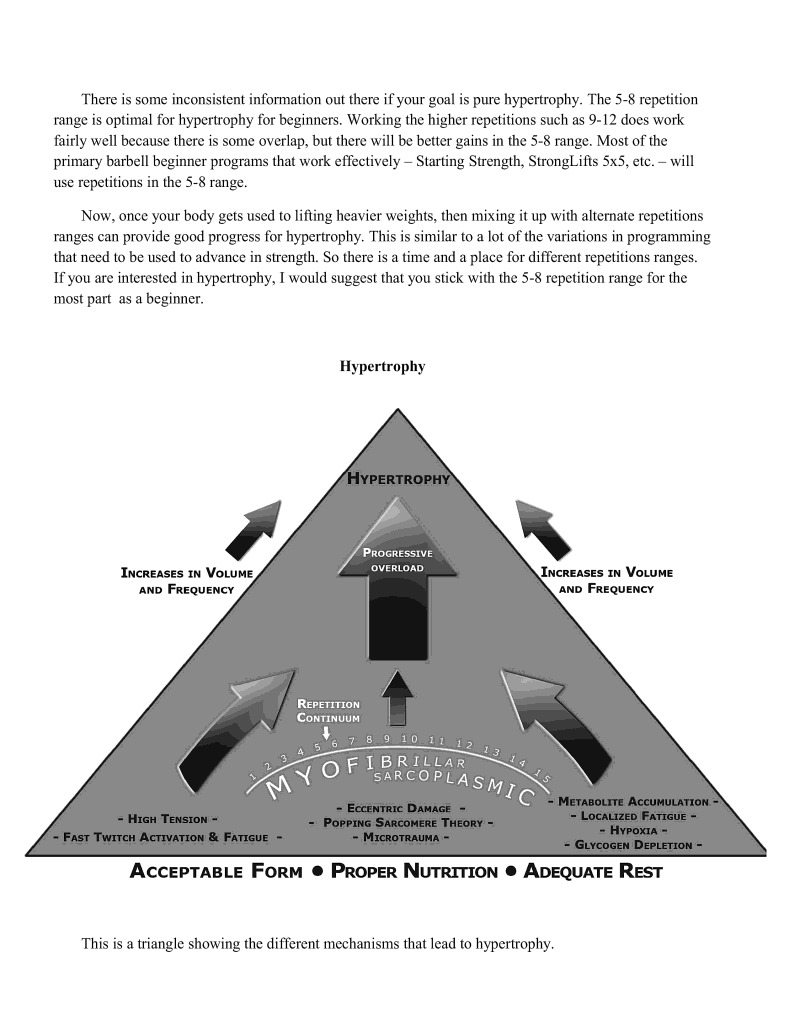
This is a triangle showing the different mechanisms that lead to hypertrophy.
There are mainly 3 different pathways in the body that lead to hypertrophy. The first is high tension and fast twitch activation and fatigue. The second is eccentric damage via the popping sarcomere theory and microtrauma. The third is metabolic accumulation, local growth factors, hypoxia, and glycogen depletion based hypertrophy,
When you think about it in terms of these concepts we will see that "myofibrillar" and "sarcoplasmic’ hypertrophy all occur under these branches to varying degrees as shown by the big letters and small letters of the myofibrillar and sarcoplasmic on the picture.
HTMU / fast twitch activation and fatigue tends to give the most myofibrillar hypertrophy which typically gives the dense look that Olympic lifters and other high strength athletes have. When these structures fatigue, the body thinks that it needs to be able to output more force. Therefore, it adds more myofibrils to help increase strength and power output. Eccentrics and isometrics which typically are at very high intensities also induce this type of muscular hypertrophy.
In between the 5-12 repetition range is where the best hypertrophy occurs. Although this range for beginners is typically in the 5-8 repetition range. This is because the weights are heavy enough to create damage to the muscles, but is also light enough to perform for enough repetitions to create the damage. Since this accumulation of repetitions at a certain weight takes a certain amount of time to perform, many trainers have specified this type of induced hypertrophy as time under tension ~ the total amount of time that the muscle needs to be under to adapt by hypertrophy.
Lastly, we have the metabolite accumulation, hypoxia, local factors, etc. induced hypertrophy. This type of hypertrophy makes the muscle bigger by increasing the volume of the sarcoplasmic elements. For example, adding additional mitochondria, glycogen, enzymes, etc. to the muscle contents draws more water into the cell giving it a more "bloated" look. This typically occurs from the 8-ish repetition range all the way up to about the 15-20 repetition range where the body moves into more endurance after that.
Isometrics, in particular, are interesting because they branch over multiple different pathways of hypertrophy. Since they work at high intensities, they activate HTMU hypertrophy. However, since they occlude blood flow from getting to the muscles they also have some component of hypoxia induced hypertrophy. In fact, most different methods of exercise are usually a combination of one or two of these different pathways. Eccentrics are biased towards HTMU and eccentric damage hypertrophy the most.
When we look at what different exercises force in regards to hypertrophy we can see that it falls along the repetition continuum as displayed on the chart. Changing the "intensity" (c.g. percentage of 1 RM) also changes the amount of repetitions you can perform which is consist with how the body adapts with the differences in the various methods of hypertrophy. Making the rest times longer or shorter can bias towards the left or right on the chart respectively. Adding total volume with sets and./or more exercises allows manipulation of how much damage and stress is applied to the muscles.As you get better at programming, you will be able to figure out how much is optimal much easier.
The same thing applies for strength based gains. Therefore, even if your goal is not hypertrophy, knowing how these processes work also will help you learn how to program effectively for working towards the strength based bodyweight exercises,

We learned that if our goal is strength and obtaining strength moves then we want to execute movements as explosively as possible with good technique. This will help recruit and stimulate the HTMUS that are key for developing the strength that we desire.
Likewise, we want to avoid high repetitions and focus on difficult movements so that our sets utilize the 3-8 repetition range. We work the lower end of the spectrum of repetitions to preferentially stimulate the HTMUS, to maximize the myofibrillar hypertrophy, and minimize the sarcoplasmic hypertrophy.
Eccentrics and isometrics can be used effectively, but they should not make up the majority of our program because they are extremely taxing on the central nervous system.
Previous Chapter ... ... Next Chapter